Labour has today unveiled its Economic Advisory Committee that will be convened by the Shadow Chancellor John McDonnell MP, and will report directly to Labour leader Jeremy Corbyn MP.
Meeting quarterly, the purpose of the Committee will be to discuss and develop ideas around the official economic strategy that Labour will be advocating under the new leadership.
The Committee, which contains a broad based group of world leading economists, includes:
Mariana Mazzucato, Professor, University of Sussex
Joseph Stiglitz, Professor, Columbia University, recipient of the 2001 Nobel Memorial Prize in economics.
Thomas Piketty, Professor, Paris School of Economics
Anastasia Nesvetailova, Professor, City University London
Danny Blanchflower, Bruce V, Rauner Professor of Economics Dartmouth and Stirling, Ex-member of the MPC
Ann Pettifor, Director of Policy Research in Macroeconomics (PRIME), and an Honorary Research Fellow at the Political Economy Research Centre of City University
Simon Wren-Lewis, Professor of Economic Policy, Blavatnik School of Government, University of Oxford.
Speaking ahead of the announcement, Jeremy Corbyn MP, Leader of the Labour Party, said:
“I was elected on a clear mandate to oppose austerity and to set out an economic strategy based on investment in skills, jobs and infrastructure. Our economy must deliver security for all, not just riches for a few.
“I am delighted that John McDonnell as Shadow Chancellor has convened this group to advise the leadership as we set out our economic vision.”
John McDonnell MP, Labour’s Shadow Chancellor, added:
“I am delighted to convene this Economic Advisory Committee that will assist in developing a radical but pragmatic and deliverable economic policy for our country.
“Our Economic Advisory Committee will assist in developing a fairer and more prosperous economic alternative based upon investment and growth which reaches all sections of society.
“Austerity is failing the people of this country. Working alongside world leading economists Labour will present the coherent alternative our country desperately needs.”
Member of the new Committee, Professor Thomas Piketty, said:
“I am very happy to take part in this Economic Advisory Committee and assist the Labour Party in constructing an economic policy that helps tackle some of the biggest issues facing people in the UK.
“There is now a brilliant opportunity for the Labour party to construct a fresh and new political economy which will expose austerity for the failure it has been in the UK and Europe.”
Some thoughts
This is an excellent team of experts on economics, globalisation, equality, inclusion and innovation, whose task is to develop and present the coherent alternative to austerity, social darwinist neoliberalism and small-state Conservatism, which our country desperately needs.
Ann Pettifor is an excellent analyst of the global financial system, who also predicted the global crash as early as 2003 and published a 2006 monograph entitled The Coming First World Debt Crisis.
Professor Mariana Mazzacuto is an economist at the University of Sussex whose work explores the relationship between “financial markets, innovation, and economic growth”. She sits on the Scottish Government’s Council of Economic Advisers, a group dedicated to growing the Scottish economy and combating inequality in Scotland. Last year, Mazzacutowon the New Statesman SPERI prize in political economyfor her research which demonstrates how the state, like the private sector, can encourage innovation.
Professor Danny Blanchflower is widely known, has served on the Bank of England’s Monetary Policy Committee, haswritten extensively for The Guardian, and regularly spoken on Radio 4.
Professor Simon Wren-Lewis is also widely known, extensively published, an Oxford University professor of economics, teaching undergraduate and Masters of Philosophy students. He conducts research in economic methodology, macroeconomic theory and policy, and international macroeconomics. He runs an excellent blog site called mainly macro.
Additional information about the well-known Professor Joseph Stiglitz includes that he has received more than 40 honorary degrees, including from Harvard, Oxford, and Cambridge Universities and been decorated by several governments including Korea, Colombia, Ecuador, and most recently France, where he was appointed a member of the Legion of Honor, order Officer.
Based on academic citations, Stiglitz is the 5th most influential economist in the world today, and in 2011 he was named by Time magazine as one of the100 most influential people in the world.
In stark contrast, a hundred vulture venture capitalists and business leaders, many of whom are Conservative donors, signed an open letter warning of the “perils” of a change in economic policy and urging UK voters to vote Conservative, published in the Telegraph last year. The Conservative Party has close links with the hedge fund industry, too, as research showed that around half of the wealthiest fund managers in Britain have given money to the Tories.
The Labour Party is funded largely by unions, which makes it the cleanest money in politics – from the likes of you and I. Trade unionists are at the forefront of the struggle for human rights; they are committed to social justice and international solidarity, and typically have strong community roots, and therefore will ensure our interests are reflected in policy-making, rather than just those of big business tax-avoiding Tory donors.
It’s very worrying that vulture capitalists like Adrian Beecroft, a longstanding Conservative donor, have been permitted to re-write our employment laws as part of the government’s wider “labor market “reform.” Amongst Beecroft’s known personal investments are Gnodal, a computer networking company, and Wonga.com, an eye-wateringly high interest, opportunist loan company, that commodifies the poorest people with low credit ratings for massive profits. Beecroft has donated more than £500,000 to the Conservative Party since 2006.
The Beecroft Report caused considerable controversy because it recommended that the government should cut “red tape” in order to make the hiring and firing of employees much easier. In the report, Beecroft claimed this would help to “boost the economy” although no evidence for this was provided. It was alleged that significant sections of the report had been doctored. It was also reported that some recommendations had been removed from the original draft of the report.
The (then) Secretary of State for Business, Vince Cable, condemned the report, saying it was unnecessary for the government to scare workers. Beecroft responded by accusing Cable of being “a socialist who does little to help business” and cited his own personal experience of “having to pay out” £150,000 for unfairly dismissing an HR employee as one of the reasons he included the idea in the report. In an excellent article, James Moore, writing for the Independent, said that the Beecroft report contained “the seeds of the ruthless social Darwinism” and he connected the recommendation to Beecroft’s career of cutting jobs, and highlighted Beecroft’s long history of “wholesale attacks on workers’ terms and conditions.”
The Conservatives will always put big business profits before ordinary people’s welfare; where employees are regarded as a disposable cost and not an asset to employers; where noone but the powerful have rights; where wages are kept to the bare minimum, there can be no economic growth. Instead we are witnessing increasing economic enclosure and widespread exclusion – small pockets of privilege characterised by stagnant, accumulated wealth and increasingly widespread poverty elsewhere. With little public spending to stimulate small business and general growth, there can be no economic security.
My point is that there is a link between Party financing and reflected interests in political policies. I wonder who knows what is best for the UK. Qualified and specialist economists or Tory donors, driven entirely by a profit motive and a vested interest in maintaining the status quo?
Gosh, that’s tricky …
Pictures courtesy of Robert Livingstone
—
My work isn’t funded. But you can support Politics and Insights, and help me to continue researching, analysing and writing independently.
There was some speculation last year about the possibility of the Labour Party leader, Jeremy Corbyn, lending his support to the idea of basic universal income. Basic income (which is sometimes called “citizen’s income” or “universal income”) is the idea that absolute poverty can be alleviated by providing every member of a society with an unconditional subsistence income. Supporters of basic income argue that it would alleviate absolute poverty and would also motivate people to work because they would always better off, as work-related income would be additional to their subsistence income.
Jeremy Corbyn had stated during the leadership contest that he was interested in the idea of a “guaranteed social wage” but that he believed there were issues that needed to be worked through.
John McDonnell, the shadow chancellor, has said that the Labour Party will consider universal basic income as a part of its new policy, during a recent talk at the London School of Economics. He said: “It’s an idea we want to look at. Child benefit was a form of basic income so it’s not something that I would rule out.”
At the very least, this indicates the idea of universal provision has regained some credence in the face of a longstanding and seemingly unchallengeable political norm of increasing means-testing and welfare conditionality, established by the Thatcher adminstration, and radically extended by the current government.
McDonnell also said that economists were “close to consensus” that the Conservative Party’s austerity policies had failed, highlighting a largely welcomed and clear opposition to rigid, neoliberal Osbornomics. It’s true that austerity was founded purely on ideology and traditional Conservative prejudices, it was a political decision taken in the context of better alternatives and more humane choices. The poorest citizens have been targeted for the largest proportion of austerity cuts, with disabled people carrying the financial largest burden. It’s worth remembering that after the global recession of 2007, we were in economic recovery by the last quarter of 2009, without any need for austerity.
Last month, an Early Day Motion (EDM) on the policy, tabled by Green Party MP Caroline Lucas, calls on the Government to commission research into the idea of universal basic income’s effects and examine its feasibility to replace the UK’s existing social security system, instead paying all citizens a flat, unconditional income, which would likely come in place of existing social security measures like means-tested benefits.
The motion, which raises the profile of the idea, says the policy “has the potential to offer genuine social security to all while boosting entrepreneurialism.”
But opponents of the basic income have raised concerns including work disincentives, lack of targeted support for those most in need, and the size of the political spending commitment required.
Lucas says:
“The basic income offers genuine social security to everyone and sweeps away most of the bureaucracy of the current welfare system. Fundamentally it would allow people the freedom and flexibility to do more of what they want to do – as well as supporting them in the caring roles they might need – or choose – to do,” she said.
“A basic income would also protect people from rising insecurity in our increasingly ‘flexible’ labour market and help rebuild our crumbling welfare state. I also know from speaking to people in my own constituency that the stability of a basic income could be a real boost to freelancers and entrepreneurs who need support to experiment, learn and take risks, while keeping their heads above water.”
“It’s crucial that any shift towards this bold new policy protects and increases the income for the poorest and those who aren’t able to work. A universal payment for all must not undermine additional help for those who need it most.”
However, last year, the Citizen’s Income Trust (CIT), which has given advice to the Green Party and often cited by the Greens, has modelled the party’s scheme and discovered a major design flaw. It was revealed that that 35.15% of households would lose money, with many of the biggest losers among the poorest households. At the time, Malcolm Torry, director of the CIT, which is a small charitable research body, said: “I am not sure the Green party has yet taken on our new research or the need to retain a means-tested element. We have only just published the new work.”
The criticisms of the scheme, as well as doubts about costings, led the Greens to make a temporary tactical retreat on the issue, with the party’s leader, Natalie Bennett, saying detailed costings for the policy would not be available in the manifesto last March. The Greens had proposed a citizen’s income of around £72 to every adult in Britain regardless of wealth and existing income, which would cost the Treasury around £280bn.
One longstanding criticism of basic income is that it would provide payments to citizens that are already very wealthy, perpetuating social inequality, and wasting resources.
The CIT added that if the policy was applied without a means-tested component, then poorer households would end up receiving far less in state benefits than they would under the existing system.
In 2012, an affordability study done in the Republic of Ireland by Social Justice Ireland found that basic income would be affordable with a 45% income tax rate. This would lead to an improvement in income for the majority of the population.
At a time when the politically planned decline in state provision leaves us questioning how we may prepare for the future, state provision funded by taxation seems by far the most fair way of providing for social support in the long term, and is part of a philosophy that each person, community and society as a whole should care for all. Furthermore, as we have witnessed the biggest and most sustained drop in wages since the 1800s, the government’s assurances that “work is the only route from poverty” no longer carry weight and credibility. For many, work does not “pay.”
Collectivist values are under threat – the failure of “reformed” social security, which has in reality entailed ideologically-driven cuts to the poorest people’s lifeline income, leaves people marginalised, excluded from society, and increasingly, in absolute poverty, is clear evidence of this loss of the core principles of community cohesion, consensus and the post-war collectivist spirit. Collectivism is founded on the idea that everyone has equal worth, and that equality does not imply a lack of unique individuality, but an equal amount of freedom and equal opportunity to develop one’s own potential. Collectivists also tend to strongly favour inclusion and democratic decision-making.
One valid concern about raising people’s household wealth through citizen’s income is that it would encourage inflation. The price of services may rise. Rents may be hiked by private landlords, for example. After the introduction of child tax credits, many private childcare companies subsquently massively increased their prices, and it wasn’t unusual for some to demand payments for a full year, which included periods when childcare wasn’t required.An introduction of basic income must also, therefore, include a package of anti-inflationary measures (such as rent caps) or the value of the payment will soon be eroded, as basic costs for essentials and services rise.
One of the strongest arguments for basic income is that people would no longer be compelled to work in order to meet their basic needs. This means that employers would find it difficult to exploit workers, and would be pushed to offer decent wages, good terms and employment conditions in order to attract workers. People would have greater freedom to pursue meaningful, suitable and appropriate employment rather than having to take any job to avoid poverty and destitution.
However, opponents claim that the incentive to work would be destroyed because basic income is unconditional. Nonetheless it’s difficult to justify dehumanising policies that keep people financially desperate so that they take any job, regardless of its pay, security, terms and conditions. That ignores the fact that people have potential, skills and talents, and simply reduces working to a way of meeting only basic survival needs, which demotivates people and means that they are not willing participants in their working lives. Very wealthy people that inherited fortunes often continue to work, it’s a nonsense that keeping people close to starvation can “incentivise” them in any way at all, other than to fight for their survival. That reduces and regresses society, uncivilising us.
De-commodifying labor by decoupling work from income liberates people from the “tyranny of wage slavery” and leaves a space for innovation, creativitity and rebalances power relationships between wealthy, profit-motivated employers and employees.
There is little support for basic income from the Conservatives, as a means of redistributing income. Whilst a handful of right-wing advocates of basic income generally favour the minimisation or abolition of the public provision of welfare, some have cited basic income as a viable strategy to reduce the amount of bureaucratic administration that is prevalent in many contemporary welfare systems.
Yet we have seen an unprecedented increase in a dark, unaccountable bureacracy this past five years, with private companies such as Atos, Maximus, and the likes of A4E and other private welfare-for-work providers marking the increased conditionality of welfare support – for both out of work support, and soon, for support paid to those in low paid and part-time work. Conservative inclination has been towards substantially raising the (increasingly privatised and for profit) administrative costs of welfare, whilst at the same time radically reducing the lifeline benefits for people needing support for meeting basic needs.
Conservatives may well raise the “something for nothing” objection to basic income, which is founded on the absurd idea that the only way people may contribute to society is through paid labor. Yet non-remunerated activities such as bringing up children, caring for elderly or sick and disabled relatives, supporting vulnerable neighbours, community work, volunteering for charities or investing time and effort in other voluntary endeavours such as contributions to the arts, sharing knowledge, education, writing, are all clearly valuable contributions to society, but these skills and activities have been steadily devalued, whilst providing an increasingly passive, exploitable, disposable (“flexible”) labor force for employers is seen by the Conservatives as somehow fulfiling the best of our potential.
The Conservatives would have us believe that any kind of social security system, which supports the casualties of free-markets, somehow creates those casualties, via vague pet theories of unverified mechanisms such as a “culture of dependency” and a “something for nothing” culture. But we know that the competitive, market choice-driven Tory policies create a few haves and many have-nots.
Even the most ardent neoliberalist would concede that whilst such a free-market system creates clear winners, it also invariably creates casualities – situations of insolvency for others. Inequality is a fundamental element of the meritocracy script that neoliberals so often pull from the top pockets of their bespoke suits. It’s the big contradiction in the smug, vehement meritocrat’s competitive individualism narrative.
This is why the welfare state came into being, after all – because when we allow such competitive economic dogmas to manifest, there are always winners and losers. It’s hardly “fair”, therefore, to leave the casualties of competition facing destitution and starvation, with a hefty, cruel and patronising barrage of calculated psychopolicical scapegoating, politically-directed cultural blamestorming, and a coercive, pathologising and punitive behaviourist approach to the casualities of inbuilt, systemic, inevitable and pre-designated sentences of economic exclusion and poverty.
For me, the most compelling argument for a basic income comes from Abraham Maslow, who was humanist psychologist. He proposed his classical theory of motivation and the hierarchical nature of human needs in 1943. Maslow said basically that the imperative to fulfil basic needs will become stronger the longer the duration that they are denied. For example, the longer a person goes without food, the more hungry and preoccupied with food they will become.
So, a person must satisfy lower level basic biological needs before progressing on to meet higher level personal growth needs. A pressing need would have to be satisfied before someone would give their attention to the next highest need. If a person has not managed to meet their basic physical needs, it’s highly unlikely that they will be motivated to fulfil higher level psychosocial ones.
Maslow’s theory has certainly been verified by the findings of the Minnesota semi-starvation Experiment, and other studies of the effects of food deprivation. Abraham Maslow’s humanist account of motivation also highlights the same connection between fundamental motives and immediate situational threats.
The experiment highlighted a striking sense of immediacy and fixation that arises when there are barriers to fulfiling basic physical needs – human motivation is frozen to meet survival needs, which take precedence over all other needs. This is observed and reflected in both the researcher’s and the subject’s accounts throughout the study. If a person is starving, the desire to obtain food will trump all other goals and dominate the person’s thought processes. This idea of cognitive priority is also clearly expressed in Maslow’s needs hierarchy.
In a nutshell, this means that if people can’t meet their basic survival needs, it is extremely unlikely that they will have either the capability or motivation to meet higher level psychosocial needs, including personal aspirations, social obligations and responsibilities, and the capacity to seek employment.
Keeping people in a state of desperation to meet their basic needs damages social cohesion, places limits on both individual’s and society’s developmental and progressive potential: it stifles personal and social growth. A basic income would liberate people from the all-consuming struggle to meet basic survival needs, allowing them to live meaningful lives. A basic income would rebalance citizen’s rights and responsibilities fairly. It would also ensure that the state does not abuse and exploit socially protected groups.
As a very wealthy first-world nation, ensuring that all citizens can meet their basic needs for food, fuel and shelter is the very least we ought to expect from a so-called democratic government.
Maslow’s classic hierarchy of human needs
—
I don’t make any money from my work. But you can support Politics and Insights and contribute by making a donation which will help me continue to research and write informative, insightful and independent articles, and to provide support to others. The smallest amount is much appreciated, and helps to keep my articles free and accessible to all – thank you.
The Office for National Statistics (ONS) released a health and social carestatistical bulletinlast month about the excess mortality figures last winter, and a projection of figures for this year. In 2014-2015, there was a 151% rise in excess winter deaths in England and Wales, which represents the biggest yearly increase since records began.
Excess deaths in winter (EWD) continue to be an important public health issue in the UK, potentially amenable to effective interventions. This excess mortality is highest in both relative and absolute terms in elderly people and for certain disease groups. It also varies from area to area. EWD are also associated with cold weather. However, it has been observed that other countries in Europe, especially the colder Scandinavian countries have relatively fewer excess winter deaths in winter compared to the UK.
Elderly people, individuals with low incomes (up to 9 million people in the UK live in fuel poverty), sick and disable people, those with mental health problems, babies and children under five, and pregnant women are considered vulnerable when the outside temperature drops below 6°C. Not all people living in fuel poverty is on benefits or are pension age. In fact, a study last winter found that half of households living in fuel poverty in the UK had someone in work.
The ineffective influenza vaccine was partly blamed for some of the increase over the 2014-15 period. The flu vaccine was quoted to have quite a low effectiveness, between 3% or 4%. By the end of the period it was quoted at 34%, but that is still below what we would expect, which is at least 50% effectiveness. However, most people offered the ‘flu vaccine are also offered a pneumonia vaccine. Pneumonia, a respiratory disease, is a complication of ‘flu that is the biggest cause of mortality. But pneumonia is a complication of other illnesses, too. People are much more susceptible to pneumonia when they are also malnourished and living in poverty. And the category “respiratory disease” includes asthma, bronchitis and a range of other illnesses. The ‘flu vaccine’s efficacy is really something of a red herring. Respiratory disease is always a major cause of death in the UK and research shows consistently that it is more likely to be correlated with poverty than an ineffective ‘flu vaccine.
Janet Morrison, the chief executive of the charityIndependent Age, described the figures as shocking. She said: “Even discounting the impact of the flu, the figures are still far higher than in previous years.”
“Councils, the government and energy companies need to help with things like insulating homes and assistance with energy bills for vulnerable customers. But there are also simple things we can all do like checking on our frail and elderly family and neighbours in cold weather. And making sure they are able to take up their flu vaccination, wrap up warm and eat well.”
There were more excess winter deaths in females than in males, as is the case over previous years. Male excess winter deaths increased from 7,210 to 18,400, and female deaths from 10,250 to 25,500 between 2013-14 and 2014-15.
In 2014/15 excess winter deaths increased significantly in all age groups compared with 2013/14.
Main points of the ONS Bulletin:
An estimated 43,900 excess winter deaths occurred in England and Wales in 2014/15; the highest number since 1999/00, with 27% more people dying in the winter months compared with the non-winter months.
The majority of deaths occurred among people aged 75 and over; there were an estimated 36,300 excess winter deaths in this age group in 2014/15, compared with 7,700 in people aged under 75.
There were more excess winter deaths in females than in males in 2014/15, as in previous years. Male excess winter deaths increased from 7,210 to 18,400, and female deaths from 10,250 to 25,500 between 2013/14 and 2014/15.
Respiratory diseases were the underlying cause of death in more than a third of all excess winter deaths in 2014/15.
The excess winter mortality index was highest in the South West in 2014/15 and joint lowest in Yorkshire and The Humber, and Wales.
Last month, David Cameron dismissed questions from Jeremy Corbyn about a looming winter crisis in the NHS (and the impact of the proposed cuts to tax credits) by mocking Labour’s move to the left under the new leader.
The prime minister declined an invitation from Corbyn to guarantee that the NHS will avoid a winter crisis this year and instead joked that he would award the Labour leader “full Marx” for creating his own winter crisis in his party.
Cameron has a very nasty habit of trivialising and diverting attention from what are often serious life and death issues for many of our most vulnerable UK citizens.
Image courtesy of Robert Livingstone
—
This post was written for Welfare Weekly, which is a socially responsible and ethical news provider, specialising in social welfare related news and opinion.
Jeremy Corbyn has said that “Society cannot survive on charity, goodwill, and food banks. It has to rely on the basis of a welfare state that ensures that no one falls into destitution, and a legal system that ensures no one goes unrepresented in the courts.”
He said that he shares agreement with members of his shadow justice team, that the Labour party under Ed Miliband’s leadership had not given legal aid the attention it deserved in the last general election.
“It wasn’t given enough prominence either by us or in the general debates at the election itself, I want to see a rights-based society and the right to justice is crucial, therefore the right to legal aid is absolutely essential,” he said.
The Labour party leader said the government’s £350m worth of cuts to the Ministry of Justice (MoJ) budget had clearly meant many people were not getting justice, and in many cases were going unrepresented in court.
Speaking exclusively to Solicitors Journal, following a barnstorming address at a legal aid forum to a gathering of legal professionals, Jeremy Corbyn said the government’s reforms to the justice system meant firms were pulling out of legal aid to concentrate on more lucrative practice areas, to the detriment of young practitioners.
“At the moment a lot of lawyers feel they can’t be dealing with legal aid, they have to find something else to do, hence the number of firms that don’t want to get involved in legal aid or just do commercial law because that is the only way they can make a living. It is not good for anyone. We need a proper legal system,” said Corbyn.
“It is a deterrent for young people going into law in the future, so we end up with young lawyers not being able to work. If you can, stick at it. Try and stay there because people need good lawyers. They need that representation. I want to see the restoration of legal aid in the new parliament and hopefully we will have a Labour majority to bring it about.”
Labour plan to produce a draft report on the legal aid crisis by April next year and present a finished version at the Labour party conference in Liverpool in September 2016 that can then be used as a “thoughtful and credible justice policy” by the party.
You can read the full exclusive article from Solictors Journalhere
Today, David Cameron strategically evaded a question about his government’s controversial tax credit cuts six times today. The Labour leader, Jeremy Corbyn, had a Jeremy Paxman moment when he repeatedly asked whether people would be left worse off by the cuts after the Treasury revises the proposals.But despite pressing the question, Cameron has yet to respond to it rationally and directly.
Corbyn also challenged Cameron regarding the persistent denial before the election from the Conservatives – including from Cameron, Michael Gove, and the chief whip, that they intended to cut tax credits
The Treasury was forced re-examine the plans after the House of Lords voted down the government’s tax credit cuts twice, tabling amendments to delay the plans until the governmernt took on board new evidence about the negative impacts of the cuts, and until there was better compensation for workers who could lose an average of £1,300 a year.
In a blustering non-response to the Labour leader’s question, Cameron complained that the tax credit plans were defeated by Labour and other opposition peers in a “new alliance of the unelected and unelectable”.
Corbyn responded to an increasingly furious Prime Minister with: “This is not a constitutional crisis. This is a crisis for 3 million people.”
Jeremy Corbyn asked the Prime Minister to assure him that no one will be worse off as a result of cuts of tax credits again.
Cameron responded : “Best way to make sure everyone is better off by building a stronger economy.”
Corbyn again asked: “Can he confirm they will not make anyone worse off?”
Cameron responded with: “He will have to be patient… we will set out our proposals in the Autumn Statement.”
Corbyn said: “People are “very concerned”… “Is he going to cut tax credits or not?”
Cameron said that: “£12 billion welfare cuts were promised in the Tory manifesto. … I’m happy to have a debate as to how we cut welfare”… “because of what happened in the other place.
“We need to reform welfare.”
The Labour leader cited the case of “Karen” who was concerned about the cuts and said “people are very worried about what’s going to happen to them”.
He said: “Following the events in the Lords on Monday evening, and the rather belated acceptance from the prime minister of the result there, can you now guarantee to the house and the wider country that nobody will be worse off next year as a result of cuts to working tax credits?”
However, the prime minister simply refused to elaborate how the government would reduce the impact of the cuts.
Cameron said : “What I can guarantee is we remain committed to the vision of a high-pay, low-tax, lower welfare economy. We believe the way to ensure everyone is better off is keep growing our economy, keep inflation low, keep cutting people’s taxes and introduce the national living wage.
As for our changes, the chancellor will set them out in the autumn statement.”
Corbyn continued to press Cameron for an answer several times. Cameron admitted that “every penny we do not save” from welfare would have to be found elsewhere,” indicating that the government clearly regards lifeline benefits to poor families as the Treasury’s “disposable income“, and no matter what those political decisions to cut the deficit on the backs of those with the least will cost people in terms of income and living standards, whether in work or not, this government intends to continue with swingeing austerity cuts that target the poorest.
It’s clear that the Prime Minister doesn’t have a response for either Jeremy Corbyn or for all of those hard-working people who are set to lose income and see a drop in their living standards because of the tax credit cuts – many of whom may have voted Conservative at the last election, reassured before the election that their welfare support was safe.
A senior Labour spokesperson said the party regarded Cameron’s House of Lords review“as a smokescreen to cover up the real problem of tax credits”.
Labour leader Jeremy Corbyn has asked David Cameron at Prime Minister’s Questions today to publish the details of the Government’s response to the United Nations inquiry into the allegations that Conservative policies are breaching the rights of disabled people in the UK. He also asked if the government intended to co-operate with the inquiry.
Such UN investigations are conducted confidentially by the UN and officials will not confirm or deny whether the UK is currently being put under scrutiny.
However, the ongoing inquiry been widely reported by disability rights groups and campaigners. The Department for Work and Pensions has previously declined to comment on the possibility of an investigation.
Mr Corbyn used his final question to ask about the United Nations inquiry into alleged “grave or systemic violations” of the rights of disabled people in the UK. The PM gave a dismissive response, saying the inquiry may not be “all it’s cracked up to be” and said that disabled people in other countries do not have the rights and support that “they” [disabled people] in the UK are offered. Cameron also implied that Labour’s “strong” equality legislation was a Conservative policy. However, theEquality Act was drafted under the guidance of Harriet Harman.
Jeremy Corbyn asks about David Cameron about his response to the UN inquiry at Prime Minister’s Questions
The United Nations team of investigators are expecting to meet with the Equality and Human Rights Commission, members of parliament, individual campaigners and disabled people’s organisations, representatives from local authorities and academics.
The team will be gathering direct evidence from individuals about the impact of government austerity measures, with a focus on benefit cuts and sanctions; cuts to social care; cuts to legal aid; the closure of the Independent Living Fund (ILF); the adverse impact of the Work Capability Assessment (WCA); the shortage of accessible and affordable housing; the impact of the bedroom tax on disabled people, and also the rise in disability hate crime.
Mr Corbyn said:
“This is deeply embarrassing to all of us in this house and indeed to the country as a whole. It’s very sad news.”
The Government’s approach to people with disabilities had been extremely controversial and been met with criticism from campaign groups. Disabled people have borne the brunt of austerity cuts, losing more income and support than any other social group, and this is despite the fact that Cameron promised in 2010 to protect the poorest, sick and disabled people and the most vulnerable.
They target the very groups that a decent society would protect:
People in poverty (1 in 5 of us) bear 39% of all the cuts
Disabled people (1 in 13 of us) bear 29% of all the cuts
People with severe disabilities (1 in 50 of us) bear 15% of all the cuts
The report outlines further discrimination in how the austerity cuts have been targeted. The report says:
The unfairness of this policy is seen even more clearly when we look at the difference between the burden of cuts that falls on most citizens and the burdens that fall on minority groups. By 2015 the annual average loss in income or services will be:
People who are not in poverty or have no disability will lose £467 per year
People who are in poverty will lose £2,195 per year
Disabled people will lose £4,410 per year
Disabled people needing social care will lose £8,832 per year
Work and Pensions Secretary Iain Duncan Smith said at the Conservative party conference speech in Manchester that disabled people “should work their way out of poverty.”
He went on to say:
“We don’t think of people not in work as victims to be sustained on government handouts. No, we want to help them live lives independent of the state.
We won’t lift you out of poverty by simply transferring taxpayers’ money to you. With our help, you’ll work your way out of poverty.”
The Work and Pensions Secretary has been widely criticised for removing support for disabled people who want to work: by closing Remploy factories, scrapping the Independent Living Fund, cuts to payments for a disability Access To Work scheme and cuts to Employment and Support Allowance.
The reformed Work Capability Assessment has been very controversial, with critics labeling them unfair, arbitrary, and heavily bureaucratic, weighted towards unfairly removing people’s sickness and disability benefit and forcing them to look for work.
The bedroom tax also hits disabled people disproportionately, with around two thirds of those affected by the under-occupancy penalty being disabled.
The United Nations have already deemed that the bedroom tax constitutes a violation of the human right to adequate housing in several ways. If, for example, the extra payments force tenants to cut down on their spending on food or heating their home. There are already a number of legal challenges to the bedroom tax under way in British courts. In principle the judiciary here takes into account the international human rights legislation because the UK has signed and ratified the International Covenant on Economic, Social and Cultural Rights.
UN rapporteur Raquel Rolnik called for the UK government last year to scrap its controversial bedroom tax policy. Rolnik’s report was dismissed as a “misleading Marxist diatribe” by Tory ministers, and she had been subject to a “blizzard of misinformation” and xenophobic tabloid reports.
The DWP’s sanctions regime has also been widely discredited, and there has been controvery over death statistics, eventually released by the Department after a long-running refusal to release the information under freedom of information law.
The Daily Mail has already preempted the visit from the special rapporteur, Catalina Devandas Aguilar, who is spearheading the ongoing inquiry into many claims that Britain is guilty of grave or systematic violations of the rights of sick and disabled people, by using racist stereotypes, and claiming that the UN are “meddling”. The Mail blatantly attempted to discredit this important UN intervention and the UN rapporteur before the visit.
Meanwhile, Cameron seems very keen to play the investigation down, and dismiss the impact of his government’s “reforms” on the lives of sick and disabled people.
We are a very wealthy, so-called first-world liberal democracy, the fact that such an inquiry has been deemed necessary at all ought to be a source of great shame for this government.
Originally published in theIndependentby Liam Young.
The Tories seem to forget that they were the last government – at some point they will have to take responsibility for their handling of the nation.
As Jeremy Corbyn stood for his second PMQs today, the mocking Tory laughs told us everything we need to know about their enduring Bullingdon Club-style politics. Old habits die hard, it seems. But Corbyn opened strongly, with an issue that unites the Labour party: the cuts to working tax credits which penalise the lowest earners, known colloquially as the Tory work penalty.
Again, the Tories laughed at the name ‘Kelly’, so apparently unbelievable do they find the first names of Corbyn’s constituents; they soon fell silent, however, as they heard of her struggle as the mother of a disabled child earning minimum wage in a 40.5-hour-per-week job. Corbyn tackled the bullyboys by pausing at their laughter this time. ‘Some may find this funny,’ he said, as he continued to talk about mass inequality and the housing problem in London. It was a subtle highlight of something glaringly obvious: for millionaires protected by Tory policies, inequality bolstered by unfair taxes and buy-to-let properties really is hilarious.
Cameron’s reply to the work penalty issue was the same old line: apparently a £20-a-week increase in wages will magically solve the problem. This is not true, of course, as Corbyn promptly replied: working families are set to be £1,300 a year worse off as the Conservative government hammers the working and middle classes so as to give to the super rich.
Cameron claimed that Corbyn’s figures on poverty were wrong, but perhaps that is something to do with the fact that the Work and Pensions Secretary fixed the definition of ‘poverty’ recently. You don’t feed and clothe homeless children by changing a definition, and the government should be ashamed. The fact that 50 per cent of wealth is in 1 per cent of hands globally is shambolic, and reports today that inequality is growing in the UK even as our country now has the third most ‘ultra-high net worth individuals’ in the world put paid to Cameron’s claims to have driven opportunity. There could be no bigger proof that his policies continue to squeeze the middle and punish the poor.
Jeremy Corbyn probably had a headache even before PMQs started. George Osborne’s proposal of a ‘fiscal charter’ has been causing problems for Labour over the last few days, not least because it was once a Labour policy rubbished by Cameron himself. It seems strange, then, that Tories are so desperate to implement it now, considering that the Governor of the Bank of England has not endorsed its proposal and no economist has come out in support of it. Most commentary has focused on how it is unrealistic to try and tie the hands of future governments – almost as though Osborne is trying to make an ideological (and erroneous) point about how Labour ‘caused the recession by their overspending’, rather than the truth about rich bankers running wild without regulation. Of course, it also gave Osborne an excellent opportunity to personally ask Labour MPs to rebel – little more than a cynical attempt to ruffle some feathers.
In June, over 70 economists published a letter that clearly noted that the charter has ‘no basis in economics’ and that permanent surplus would increase the debt of households and businesses. The policy is not about protecting the British economy; it is an attempt to bury the Labour party under the same message of the last government. The Tories seem to forget that they were the last government – they have been in power now for almost six years, and at some point they will have to take responsibility for their handling of the nation.
Despite all this, PMQs today were the best moment of Corbyn’s leadership of the Labour party so far. Osborne’s attempt to destabilise the Labour party and force Labour MPs to rebel spectacularly failed, while Corbyn asked if he could bring the Prime Minister back to reality as Tory rhetoric failed against his grassroots facts.
Cameron wants to get Britain building houses, he wants to alleviate poverty, and he wants to rebuild the economy – or so he’d have you believe. In the last five years, house-building has stalled, poverty has increased, inequality appears to be rising and the national debt has doubled. At some point, the Tories have to stop blaming Labour for their own disastrous record. Corbyn is now attacking their mythology head-on – and he might just be getting somewhere.
Liam Young is a freelance political journalist studying international relations at the LSE
Austerity is a political choice not an economic necessity. When the Chancellor rose to his feet at the emergency Budget in July, and when he does so for his Spending Review in October, what is being put forward is an ideologically-driven rolling back of the state.
The analysis published today by the TUC reveals how the Budget gives money to the rich, but takes away from the poor.
This is the Conservative project, dressed up in the post-crisis language of budget deficits and national debt for extra impetus. Inequality doubled under the Thatcher government, and her heirs seem to be doing all they can to ensure that legacy is extended.
The Budget showed austerity is about political choices, not economic necessities. There is money available: the inheritance tax cuts announced in the Budget will lose the exchequer over £2.5billion in revenue between now and 2020. What responsible government committed to closing the deficit would give a tax break that only applies to the richest 4% of households?
The Conservatives are giving away to the very rich in inheritance tax cuts twice as much as reducing the benefit cap will raise by further impoverishing the poorest, and socially cleansing many towns and cities.
Another choice was to cut UK corporation tax to 18%, which at 20% is already the lowest in the G7, lower too than the 25% in China, and half the 40% rate in the United States.
The Treasury estimates that this political choice will see our revenue intake from big business fall by £2.5billion in 2020. That’s nearly twice the amount saved by cutting the tax credits available families with more than two children.
In such circumstances, Labour must be clear: we oppose the Budget, and we oppose austerity. As a group of 40 economists wrote to the Observer a few weeks ago, “opposition to austerity is actually mainstream economics, even backed by the conservative IMF”.
The language of “bringing down the deficit” is non-controversial, it is the method (austerity) that reveals the Chancellor’s agenda as just a cover for the same old Conservative policies: run down public services, slash the welfare state, sell-off public assets and give tax cuts to the wealthiest.
I stood in this race because Labour should not swallow the story that austerity is anything other than a new facade for the same old Conservative plans.
We must close the deficit, but to do so we will make the economy work for all, and create a more equal and prosperous society. Bringing down the deficit on the backs of those on low and average incomes will only mean more debt, more poverty, more insecurity, more anxiety and ultimately more crisis.
We must invest in a more productive economy. Our national infrastructure – energy, housing, transport, digital – is outdated, leaving the UK lagging behind other developed economies. In the Budget, the Chancellor cut back public investment even further.
You cannot cut your way to prosperity. We need to invest in our future. And that takes a strategic state that seeks to shape the economy so that it works for all.
That is the choice for Britain and the choice that Labour must offer.
Jeremy Corbyn is the Labour MP for Islington North and Labour Party leader.
Sisters and brothers, thank you very much for inviting me here today. I must admit it seems to be a very fast journey we are on at the present time and, to me, it is an enormous honour to be invited to address the TUC. It only seems a very short time ago that your General Secretary, Frances O’Grady, did me the honour of coming to speak at the nominating meeting in my constituency, Islington North, and now she has invited me here to address the TUC. I am very grateful, Frances, for what you did there and I am delighted to be here today because I am, and always will be, an active trade unionist. That is in my body.
I have been a trade union member all my life. I was an organiser for the National Union of Public Employees before I became a Member of Parliament. I realise this is deeply controversial because they are now part of Unison but you can only be in one union at a time; you know the problem. That taught me a great deal about people, about values, and about the value of trade unions in the everyday lives of ordinary people. School cleaners, they have a hard time, school meals workers being badly treated, school caretakers looking for some security in their jobs, all those issues that are day-to-day work of trade unions and those that attack and criticise trade unions should remember this.
There are six million of us in this country. We are the largest voluntary organisation in Britain. Every day we make a difference in looking after people in their ordinary lives as well as a huge contribution in the wider community. Unions are not just about the workplace, they are also about society as a whole, life as a whole, and the right of the working class to have a voice in society as a whole. That is why trade unionism is so important.
We celebrate the values of solidarity, of compassion, of social justice, fighting for the under-privileged, and of working for people at home and abroad. Whilst we value and protect the rights that we have in this country, the same thing does not apply to trade unionists all over the world. Those people that died in that dreadful fire in China where there was a free market philosophy around the operation of a port, fire-fighters died trying to protect other workers who should have been protected by decent health and safety conditions. All around the world, Colombia and many other places, trade unionists try to survive trying to stand up for their rights.
Trade unions in Britain have achieved a fantastic amount in protection and in the wider society. We need to stand in solidarity with trade unionists all over the world demanding exactly the same things as we have secured for ourselves and trying to defend for ourselves. Trade unionism is a worldwide movement, not just a national movement and we should never be ashamed to say that.
There are those that say trade unions are a thing of the past and the idea of solidarity, unity, and community are a thing of the past. Ever since this Labour leadership election was announced, and I have taken part in it, I have spoken at 99 different events all over Britain, 99 events in 99 days. Those events were often very large. They would bring together people that had been estranged from the Labour movement or indeed from the Labour Party and they would bring together young people who had not been involved in that kind of politics before.
What brought them together was a sense of optimism and hope. What brought them together was a sense of the way things can be done better in politics in Britain.
Those values I want restored to the heart of the Labour Party, which was of course itself a creation of the trade unions and socialists in the first place. I have some news to report to you. Ever since last Saturday, large numbers of people have been joining the Labour Party and the last figure I got, that was Saturday afternoon, 30,000 people have become members of the Labour Party. Our membership is now more than a third of a million, and rising. Over half a million people were able to take part in that election.
But the values that people bring to joining the Party and the Party brings to them have to be things that we fight for every single day. I want the unions and the Labour Party to work together to win people over to the basic values we all accept, to change minds, and change politics, so that we can have a Labour government, we can look in a different direction, we can look away from the policy of growing inequality and look to a society that grows in equality, in confidence, in involvement of everybody, and does not allow the gross levels of poverty and inequality to get worse in Britain. That is what the Tories have in store for us.
But Labour must become more inclusive and open and I have had the very interesting task in the last few days of a number of events and a number of challenges.
The first thing I did on being elected was to go and speak at a rally in saying Refugees are Welcome Here because they are victims of human rights abuses and other abuses. I thought it was important to give that message out, that we recognise human rights abuses and the victims of it all over the world from wherever they come, they are human beings just like you and me, we hold out our hands and our hearts to them, and we want to work with them for a safer and better world. They are seeking the same things that we are seeking.
Later, the next day, I wanted also to give a message about how we intend to do things and the kind of society we want. So, I was very proud to accept an invitation to attend a mental health open day in my constituency, or a nearby constituency, to show that we believe the NHS is vital and valuable as it obviously and absolutely is but there are many people who suffer in silence from mental health conditions, suffer the abuse that often goes with those conditions, and the rest of society passes by on the other side. Mental illness is an illness just like any other, it can be recovered from, but we have to be prepared to spend the time and the resources and end the stigma surrounding mental illness which often comes with stress, workplace stress, poverty, and many other things.
There are other messages we have to put and the media has been absolutely full of midnight oil burning sessions in appointments to the new Shadow Cabinet of the Parliamentary Labour Party. After consideration and thought, and lots of discussion, we have assembled and appointed a Shadow Cabinet of a majority of women members for the first time ever in history.
To show how determined we are on a number of specific areas of policy, there is a specific Shadow Minister, Luciana Berger, who is dealing with mental health issues. She will be at the table along with everyone else, and there is a specific Minister dealing with housing, and that is because I believe that John Healey will put the case very well. The issue is that we have to address the housing crisis that faces so many people all over this country. The free market is not solving the problem of homelessness.
The free market is not allowing people to lead reasonable lives when they are paying excessive rents in the private-rented sector. We have to change our housing policies fundamentally by rapidly increasing a council house building programme to give real security to people’s lives.
But there are other issues that we have to address, and that is how we make our party and our movement more democratic. The election process that I have just come through was an electorate of 558,000 people, the largest electorate ever for an internal party election. The number of votes that were cast for me were more than twice the total membership of the Tory Party in the whole country. That is something to savour.
But all those people coming forward to take part in this process came forward, yes, because they were interested, yes, because they were hopeful but, yes, because they wanted to be part of a democratic process where we make policy together. We live in a digital age, we live in an age where communications are much easier and we live in an age where we can put our views to each other in a much quicker and in a much more understandable form. So we don’t need to have policymaking that is top down from an all-seeing, all-knowing leader who decides things. I want everybody to bring their views forward, every union branch, every party branch and every union, so we develop organically the strengths we all have, the ideas we all have and the imagination we all have.
When we have all had a say in how we develop, say, the housing policy, or, say, the health policy, say any other particular area of environmental protection or anything else, if everyone has been involved in that policymaking, they own the policy that is there at the end. They are more determined to campaign and fight for it. They are more likely to mobilise many more people around it, so we don’t go through until 2020 with a series of surprises, but we go through to 2020 with a series of certainties, that we are a growing, stronger movement, we are more confident and more determined than ever and, above all, we are going to win in 2020 so we see the end of this Tory Government.
When politicians get out of touch with reality, they sometimes forget where skillsets really lie. Can I give you an example. When I was a union organiser, we used to get involved in negotiations about work-study arrangements, the time it took to drive a van from place A to place B and how long it took to load the van, all those kind of issues. So we would go in there and start negotiations, and I would always go to the branch meeting before hand and say, “Who here is keen on betting?”
Every hand went up, of course. “Who’s the best at betting?” One particular hand would be pointed to, and I would say, “Can you come along to the negotiations?” “Why?” Because that member had brilliant skills at mental arithmetic — this was pre computer days — and he would work out very quickly, and he would say sotto voce to me, “They are lying to you, Jerry. Don’t accept it”, or whatever. Skills at the workplace, skills of ordinary people, knowledge of ordinary people. The elite in our society look with contempt on people with brilliance and ideas just because they don’t speak like them or look like them. Let’s do things differently and do things together.
Had we had a different approach, would we now have the millstone of private finance initiatives around the necks of so many hospitals and so many schools in this country, or would we, instead, have a more sensible form of public sector borrowing to fund for investment and fund for the future, rather than handing over our public services to hedge funds, which is exactly what this Government would like us to do? Be confident, be strong. We have lots of knowledge and lots of power.
I have worked with unions affiliated to the Labour Party and not affiliated to the Labour Party, and I work with all trade unions because I think that is what the Leader of the Labour Party should do. I think the Leader of the Labour Party, if invited, should always be at the TUC. I see it as an organic link.
I want to say a special mention to one group of workers who are here. They are doing their best to defend something we all own, know and love. Welcome to those strikers from PCS from the National Gallery for what they are going through at the present time. They look after our national treasures in the National Gallery. They do it well.
They love what they do and they love what we have got in our National Gallery. Please, let’s not privatise our galleries and privatise our staff. We welcome and we recognise the skills of those people who work in all those places and so many other places as being a precious national asset, not something to be traded away on the market of privatisation. Well done to you for your campaign.
Yesterday the Tories put the Second Reading of the Trade Union Bill to Parliament, and, sadly, it achieved its Second Reading and it has now gone into Committee. Basically, they are declaring war on organised labour in this country ever since they won the General Election, albeit with the support of 24% of the electorate. Yesterday, I was proud to sit alongside Angela Eagle on our Front Bench to oppose the Trade Union Bill, and she rightly said, and I quote: “This Bill is a dangerous attack on basic liberties that would not be tolerated by the Conservative Party if they were imposed on any other section of society.” Stephen Doughty gave an excellent reply, and Labour MPs spoke with passion, knowledge and understanding of the dangers of this Bill.
It is quite interesting how the Tories champion deregulation wherever regulation is ever mentioned. How many times have we heard that, Ministers for Deregulation, Departments for Deregulation, Ministers who will tear up all regulations? But one thing they really want to regulate is organised labour and the trade unions in this country. I think that sauce for the goose is sauce for the gander, don’t you?
So we have to oppose it and recognise what they are doing. The burdens they are placing, as one Tory MP admitted, are actually the strategy that was used by General Franco in Spain on his control of the trade unions in Spain. They seem to still think that it is right just to attack trade unions because they exist. I am not going to be lectured to by saying, “If the Labour Party gets too close to unions it puts us all on the back foot.” I am sorry. Trade unions are an essential and valuable part of modern Britain. Six million people voluntarily join trade unions and I am proud to be a trade unionist. That is why we are going to fight this Bill all the way. When we have been elected with a majority in 2020, we are going to repeal this Bill and replace it with a workers’ rights agenda and something decent and proper for the future.
Every difficulty actually gives you an opportunity, and the difficulty is that this Bill has been placed in front of us, but it gives us the opportunity to defend civil liberties and traditional freedoms and explain to the wider public, beyond trade union members and others, that it is actually a threat to the liberties of all of us. Because by calling into question the right of free association of trade unions they are actually in contravention, in my view, of Article 11 of the European Convention of Human Rights.
They are also in contravention, as Stephen pointed out in his reply yesterday, to the International Labour Organisation conventions. So we are going to continue our opposition to this. They are threatening the right of peaceful protest by looking to criminalise picketing. They are even threatening the right to free speech by seeking to limit what a union member can say on social media during a dispute. Are we really going to have teams of civil servants or lawyers or police or somebody trawling through massive numbers of twitter messages, Facebook messages, to find something somebody said about their employer or about an industrial dispute?
What kind of intrusive society are they really trying to bring about. We have got to fight this Bill all the way, because if they get it through it’s a damage to civil liberties and for everybody in our society. They will use it as a platform to make other attacks on other sections of our community. Let’s be strong about this.
We also have to promote trade unionism and understand that good trade unions, good trade union organisation, yes, it protects people in the workplace, yes, it leads to better pay, better conditions and better salaries and better promotional opportunities as a whole, but it also means there is often better management in those places where unions are very strong. The two things actually go together and are very important. Where unions are weak, job security is weak, conditions get worse and you look at the results of what this Conservative Government are doing. They want to raise the threshold on strike ballots, so I would like to ask the Prime Minister this question: if you want trade unions to vote in ballots, why leave unions with the most archaic, expensive, inefficient method of voting you could find, why not modernise the balloting?
Above all, why not go forward and secure workplace balloting ensuring that every member of a trade union can vote securely and secretly at their own workplace? That, surely, is something we all want in this Bill for ourselves.
But they are also attacking the rights of trade unions to be involved in the wider society. The Tories have always been concerned about the right of trade unions to be involved in political actions in any way. Why shouldn’t workers, organised together in a union, express a political view? Why shouldn’t they use their funds, if they wish, on political or public campaigning? We had the Act in the last Parliament that restricted the participation of unions and charities in public commentary during elections. This is taking it a stage even further. They seem quite relaxed about the involvement of hedge funds and funny money in politics. They seem absolutely obsessed with the cleanest money in politics, which is trade union funds being used for political campaigning.
So we are going to oppose this Bill with every opportunity we get. We are going to expose it for what it is and we are going to try and stop it passing. As I have said, we will try to replace this Bill with something much better.
But there are other issues that we have to remind ourselves about what is going on at the present time. The Welfare Reform Bill is anything but welfare reform. It is all about building on the cuts they have already made, making the lives of the most vulnerable and poorest people in our society even worse. The disability benefits cuts that have been made over the past five years and the availability of the work test have had some disastrous — appalling — consequences where people have even committed suicide and taken their own lives out of a sense of desperation. I simply ask the question: what kind of a society are we living in where we deliberately put regulations through knowing what the effects are going to be on very poor and very vulnerable people who end up committing suicide? And we say it is all part of a normal process. No, it is not!
The reduction in the benefit cap has the effect of socially cleansing many parts of our cities.
Owen Smith and I had discussions last night about amendments that we are going to put down to the Welfare Reform Bill. As far as I am concerned, the amendments we are putting forward are to remove the whole idea of the benefit cap altogether. We need to raise wages and regulate rents rather than to have a welfare system that do things, of subsidising high rents and low wages. Surely, we can do things differently and better if we really want to? We will bring down the welfare bill in Britain by controlling rents and boosting wages, not by impoverishing families and the most vulnerable people.
I have to leave straightaway after I have concluded my remarks here because I want to be back in Parliament to vote against their attempt to cut the tax credits that act as a lifeline to millions of people. Barnados say it will take £1,200 per year away from a lone parent of two working full time on the minimum wage. The Government says there is no alternative to this. John McDonnell, our new Shadow Chancellor of the Exchequer, is setting out what the alternatives are.
They call us “deficit deniers”, but then they spend billions in cutting taxes for the richest families and for the most profitable businesses. What they are as is “poverty deniers”. They are ignoring the growing queues at food banks; they are ignoring the housing crisis; they are cutting tax credits when child poverty rose by half-a-million under the last government to over four million. Let’s be clear. Austerity is actually a political choice that this Government has taken and they are imposing it on the most vulnerable and poorest in our society.
It is our job as Labour to set out a vision for a better society and campaign proudly against Britain’s greatest democratic organisation, the trade union Movement. Our shared vision will be delivered by shared campaigning, a Labour Party proud to campaign for the trade unions and a trade union Movement proud to campaign with Labour. We have a job to do, to understand the process that has been going through in politics in Britain, to understand the levels of inequality that are there, to understand the levels of insecurity of people on zero-hours contracts, students with massive debts and understand the stress and tension that so many people have.
We are actually quite a rich country. We are actually a country that is deeply unequal. Surely, the whole vision of those who founded our unions and founded our political parties was about doing things differently. That generation, those brilliant people brought us the right to vote, got women the right to vote, brought us the National Health Service and brought us so many other things. We build on that in the way we do our policy, we build on that in the way we develop our movement, and we build on that in the way that we inspire people to come together for a better, more decent, more equal, fairer and more just society. These things are not dreams. These things are practical realities that we, together, intend to achieve.
Back in early June, I was asked to do aninterviewwith A Very Public Sociologist, just as Jeremy Corbyn decided to put himself forward as a candidate for the Labour Party leadership. Phil’s first question of course was: Have you made your made up about the Labour leadership?
Jeremy Corbyn was my initial, intuitive choice. This was founded on my previous knowledge of him as an MP that I have always respected and admired. I recognise that Corbyn has always presented a clarified, strong, ethical and material socialism; that he had a strong aim to extend the scope of Labour Party values and push the boundaries of debate to include genuine socialist propositions and alternatives. That is a much needed, valuable development, as an artificially constructed neoliberal consensus has stifled progress in social policies for a long time.
Corbyn has a refreshing sociological imagination, which is a welcomed change from the Conservative’s starkly anti-social focus; ideologically driven repressive, rigid hierarchical thinking, ranking and organising and economic lack of imagination.
But being me, I took a reluctant step back and analysed the situation that the Party was in post-election, adding a rationale; which prompted theonly commentary I’ve writtenabout the leadership competition and the dilemmas facing the Labour Party.
I concluded that a change in direction and a left-leaning leader was most likely to be the best bet for the future, despite the misgivings of some about how such a leader would appeal to an apparently right-shifted, UKIP and Tory-voting public. The right-pitching view through the Overton window has made my hair and toes curl since 2010.
However, as stated, I don’t believe there is a neoliberal, New Right consensus. No-one was genuinely consulted, after all. The world isn’t really filled with irrational, glib, superficial people who all think broadly the same things and who swallow glittering generalities and mediacratic soundbites. Nobody in their right mind would endorse the massive inequalities we are now seeing, and the return of absolute poverty, as a consequence of the stealth policies that are dismantling our welfare state and NHS.
I’m a fairly optimistic realist, after all.
One of the biggest strengths of Corbyn and McDonnell’s powerful anti-austerity alternative narrative is that it will give many more ordinary people a larger stake in our economy. We know that austerity doesn’t work. It’s been used as a front for discriminatory policies that reflect an underlying Conservative extremist and prejudiced ideology.
Young people in particular, who have been betrayed by an older generation that has been happy enough to witness the dismantling of state provision – the provision that they have benefitted from all of their own lives – will hopefully show that such expedient political trade-offs which systematically punish the traditionally disenfranchised, are absolutely unacceptable. Now young people have a hope-inspiring and inclusive alternative that will mobilise their participation in democracy.
The alienation of politically constructed outgroups has profoundly undermined our democracy for a long time. We now have a much-needed change – a viable alternative narrative – for the better. Such an inclusive approach will undermine the Conservatives’ “no alternative” approach – founded on the pleas that austerity is “inevitable” – to public policy, ensuring that they have to listen to a broader section of society and reflect their needs and views in economic and social policies.
Conservative intentions have nothing at all to do with economic necessity, but rather, austerity is nothing more than an ideologically-driven effort to downsize the British state, particularly, to dismantle welfare, legal aid, social housing and the NHS – they are erasing our post-war settlement. The next generation are left with much less opportunity and support than we have enjoyed, the first generation in a long time that are worse off than their parents. We need to change that.
Last December in his annual fiscal statement, George Osborne, the high priest of austerity, set out plans to extend his austerity cuts until 2020, by which time, his projections showed, over-all public spending as a percentage of GDP would fall to the lowest level since the 1930s, reducing state provision to rubble .
In the run-up to this year’s general election, Osborne disavowed these figures. But once he was safely back on Downing Street, he cunningly announced a new spending review aimed at cutting the budgets of some government departments by another twenty-five or thirty per cent, with some of the biggest cuts falling on welfare support.
Labour’s recent increasingly homeopathic approach to public debate and policy – similia similibus curentur: “like cures like” – hasn’t exactly made room for a sturdy challenge to Tory pseudoscience and polished psychobabble, deployed to justify their draconian and frankly vindictive regressivism.
There have been many calls over the last few years from activists and from disillusioned, largely disengaged ex-members that we need to “take back” the Labour Party, reclaim it and make it a “party of the people” again, instead of a Party of opportunist “career politicians”. Well, that has certainly happened.
Yet despite the inevitable logic of what has happened, I still can’t believe Jeremy Corbyn’s landslide win – nearly 60%. Corbyn was the 200 to 1 outsider at the start! I have always maintained that the best leaders are those who don’t seek leadership, but rather, are often reluctantly thrust forward in situations because of their convictions, others come to trust their skills and judgements – and Jeremy Corbyn certainly didn’t prepare for this, but he has taken an unprecedented popularity amongst grassroot supporters and members, and leadership election success in his sure, determined and tightly principled stride.
In his leadership campaign, Corbyn promised to give Labour members a much greater say in the party’s policymaking process, and quite properly so. That is democratic, after all. I believe that proportional representation is also on the table.
His key proposals include renationalisation of the railways, quantitative easing to fund infrastructure, opposing austerity, controlling rents and creating a national education service. And staunchly defending the welfare state, the NHS and access to justice.
Andy Burnham is calling for the party to get behind Corbyn. I always felt that he’s fundamentally a decent man; I’m glad he has been much more gracious than the other candidates. His tireless fight to save our NHS has been outstanding work, we need that kind of dedication from our MPs on the frontbench.
It’s sad that there have been a handful of resignations, but I know many of you will be very happy to see the Blairite stand weakened.
Now the real fight starts. I’m hoping to see a more unified approach amongst my friends, fellow party supporters and members now that the new leadership has been democratically established. This is just the start of our fight for a fair, progressive, civilised UK. Regardless of who you wanted to win, we can’t defeat the Tories and mediacracy in 2020 without willingness and good faith amongst ourselves. We need unity, belief and strength. Solidarity.
Of course the corporate “journalicians” – the puppets of the right-wing establishment – will try to build a hefty damn against the turning tide. We now have one of the most left wing, anti-establishment leaders in Labour Party history.
Evidently that’s a threat to the security of the Conservative Party, leading to mediacratic hysteria and screamingly paranoid, charmless bullying headlines already. This said, it was to be expected: Conservatives have always displayed fears of nonexistent or overblown bogeymen that threaten social order, as well as demonstrating a deft expertise at manufacturing folk devils and inflaming moral panics.
Indeed other psychologists analysing political conservatism as motivated social cognition would certainly verify my comments: these theorists have integrated theories of personality (namely authoritarianism, dogmatism–intolerance of ambiguity), epistemic and existential needs (for closure, regulatory focus, “terror management”),and ideological rationalisation (social dominance, system justification), all of which explain the elaborate Tory and mediacratic manipulations of facts. And dogma.
The Tories are so afraid of alternative perspectives, progress and change – they are such anal retentives that their fearfully and deeply inserted anti-social heads emerge sooner or later where they feel safest and most at home: in the feudal era of their own ancestors.
As well as scaring anachronistic Conservatives into hysterical declarations and reducing them to spasms of gut-clenching horror, brother Corbyn presents us with a relaxed, easy confidence, and a very welcomed alternative and rational narrative that makes a lot of sense in terms of pragmatic problem-solving. His civilised, progressive, inclusive and democratic pro-social vision managed to unite and gain support from many of the Greens and some SNP supporters already. He has appealed to many who have been disengaged from politics and who have felt disenfranchised for a long time. He has already come to represent hope for a better future. That’s a remarkable achievement.
More than40 leading economists, including a former adviser to the Bank of England, have made public their support for Jeremy Corbyn’s anti-austerity policies, dismissing Tory claims that they are “extreme”.
The only other feasible alternative post-election for the Labour Party was to try to gain the support from those who defected to UKIP and the Tories this year, by maintaining the austerity myth for the sake of “economic credibility” and for me, that’s untenable because it would entail a gross contravention of Labour’s core values and principles. Though some of the UKIP supporters are undoubtedly amongst those who have felt disenfranchised on the basis of class alone. However, I am sure that Corbyn will reflect a fundamentally new über-inclusivity that will address the trend towards alienation and anomie.
One thing is certain: the tiresome, disempowering and incredibly lazy soundbite that many on the left have previously delivered in criticism of the Labour Party- “they’re all the same” – won’t be used as the recycled nugget of folk wisdom with any whiff of credibility any more.
Politics is about to become very, very interesting. We needed a credible, strong and appealing alternative to mainstreamed prejudices, and to the social conservatism and neoliberal orthodoxy that became the dominant paradigm following Francis Fukuyama’s “End of History” triumphalism. His end of ideology thesis was nothing but more ideology, based on a manufactured consensus after all. Free-market dogma.
I believe we have got that appealing, rational alternative narrative.
Upwards and onwards.
I don’t make any money from my work. I am disabled because of illness and have a very limited income.
But you can help by making a donation to help me continue to research and write informative, insightful and independent articles, and to provide support to others. The smallest amount is much appreciated – thank you.


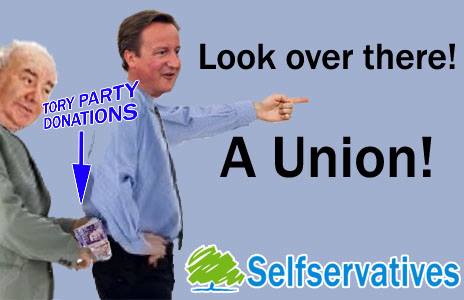

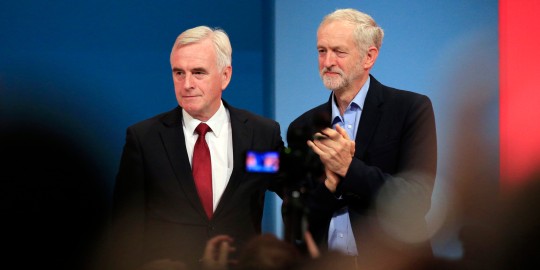
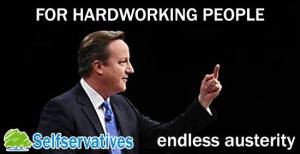
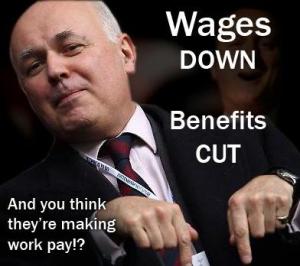
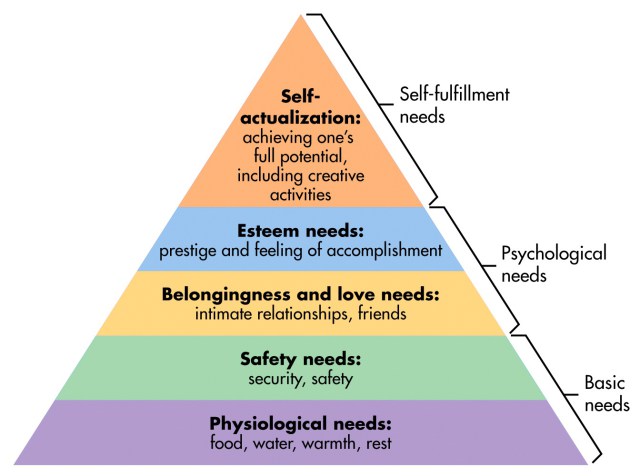


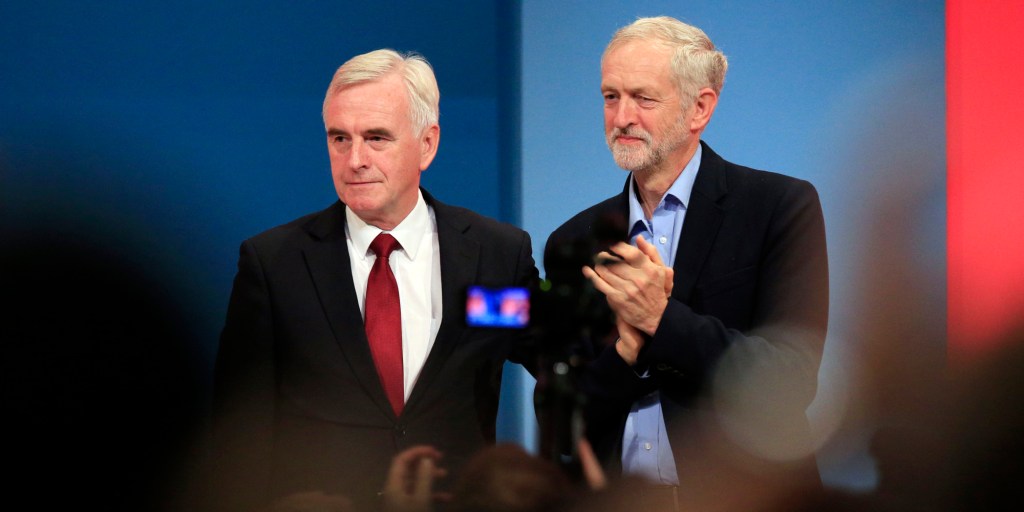


 Politics and Insights