Tag: Leave Campaign

Brexit, law firms, PR, lobbying and the communication ‘dark arts’ political hires

influence

Media Intelligence Partners’ lobbying aims.

Dark arts.” “Peddling.” “Salacious.” These are just a handful of terms the media has used to describe campaign, ‘corporate research’ and ‘strategic communications’. Even the lighter description “opposition” doesn’t quite capture what companies like Cambridge Analytica do. 

The Cambridge Analytica scandal has highlighted that the power and dominance of the Silicon Valley – Google and Facebook and a handful of very wealthy individuals – are at the centre of the global tectonic shift we are currently witnessing, as democracies are increasingly being stage-managed by those who can afford the props and scripts. In a way, it was inevitable that sooner or later, politics would be reduced to branding and ‘market competition’, and that political outcomes would become aligned with neoliberal outcomes. 

Surveillance strategies and targeted marketing also include the use of biometrics. The private company Endless gain, for example, use biometrics and psychology and “to understand human emotions and behaviour, and Psychology to optimise human emotions and behaviour. Our way helps our clients convert more customers, keep them for longer, and have them spend more.” 

Endless Gain claim on their site to “optimise conversions” in the same way that behavioural economists at the Nudge Unit claim to “optimise decision-making”, in their quest to align citizens’ choices with neoliberal outcomes.

The company uses eyetracking, facial expression recognitiongalvanic skin response,  EEG and pupil dilation – biometrics, in addition to conventional psychological research, “bringing together biometric research with findings from decades of academic psychology –particularly on emotional decision-making and the psychology of persuasion – to make changes to your site that increase both revenue and conversions.”  

Other companies, such as the hugely influential Crimson Hexagonuse AI.  The company is based in Boston, Massachusetts and has also a European division in London. Edelman Intelligence, a massive PR company, are a client of this company, as are TwitterThe company’s online data library consists of over 1 trillion posts, and includes documents from social networks such as Twitter and Facebook as well as blogs, forums, and news sites. The company’s ForSight platform is a Twitter Certified Product. (See also: The anti-social public relations of the PR industry, which details the intrusive ‘360 degree’ social media ‘listening’ and monitoring posts used by companies to gather data and intelligence and to formulate ‘strategic communications’ to discredit critics)

This level of surveillance and persuasion is deeply intrusive form of commodification and control that effectively exiles citizens from their own characteristics, perceptions, behaviours and choices, while producing lucrative markets aimed at data mining, behavioural analysis, prediction and modification.

Furthermore, the data collection, analysis and profiling is likely to build in discrimination, reflecting and reinforcing material and power inequalities. Credit reference agencies, insurance companies and the financial sector have previously demonstrated this point only too well. 

The data mining, analytics and persuasion market exists because large corporations and governments want to micromanage and psychoregulate citizens. However, such intrusive surveillance and micromanagement poses fundamental challenges to our democratic norms and personal autonomy.  

Tailored and targeted ‘strategic communications’ and persuasions are based on behaviour modelling and presupposed preferences, which may or may not be accurate or comprehensive. However, such an approach forecloses the possibility of citizens seeing alternative choices and developing new preferences: of accessing a full range of choices, learning and developing. It reduces citizens, commodifying their biology, psychology and decision-making, and transforming human nature into profits for big businesses and maintaining the power of the establishment.

Carole Cadwalladr, writing for the Guardian and Observer, revealed how the foundations of an authoritarian surveillance state have been laid in the US and how British democracy was subverted through a covert, far-reaching plan of coordination enabled by a US billionaire, Robert Mercer. And how we are in the midst of a massive land and power grab by billionaires via our data. Data which is being silently amassed, harvested, analysed, profiled and stored. Whoever owns this data owns the future.

The Cambridge Analytica scandal highlights the erosion of democracy because governments are paying to use these sophisticated techniques of persuasion to unduly influence voters and to maintain a hegemony, amplifying and normalising dominant political narratives that justify neoliberal policies. ‘Behavioural science’ is used on every level of our society, from many policy programmes – it’s become embedded in our institutions – to forms of “expertise”, and through the state’s influence on the mass media, and other social and cultural systems.

It also operates at a subliminal level: it’s embedded in the very language that is being used in political narratives. Repetition is an old propaganda technique that sometimes works. The ‘Strong and Stable’ ideological motif of the government, however, was a tad overused, and led to ridicule because it became so visible as a ill-conceived technique of persuasion. But what about all of the psycholinguistic cues that remain opaque?

The debate should not be about whether or not these methods of citizen ‘conversion’ are wholly effective, because that distracts us from the corrupt intentions behind the use of them, and especially, the implications for citizen autonomy, civil rights and democracy.

Whistleblower Christopher Wylie has said that British voters in the lead up to the referendum to exit the European Union were duped by the Leave campaign. Speaking to MPs on Tuesday 27 March, the former Cambridge Analytica employee described how pro-Brexit groups like BeLeave used Canadian firm Aggregate IQ (AIQ) to profile and target online voters with psychologically tailored “strategic communications”, using personal data allegedly gleaned from Facebook. 

“I think it is completely reasonable to say that there could have been a different outcome of the referendum had there not been, in my view, cheating,” he said. The revelations and accusations came almost exactly one year before the UK leaves the EU on 29 March, 2019.

Wylie said AIQ was subcontracted through Cambridge Analytica, a political data company which also stands accused of manipulating voter behaviour to help Donald Trump win the US presidential election. The comments follow separate accusations that the Leave campaign may have also broken electoral laws on spending thresholds, which are capped at £7m. The Leave campaign spent £6.77m but then allegedly received a £625,000 donation from BeLeave, a youth Brexit group. The donation was then spent on AIQ services, in breach of the £7m limit on campaign spending. Wylie also described the spending breach as part of a “common plan” coordinated by the pro-Brexit campaign.

Cambridge Analytica is by no means the only private company that has hugely profited from corrupt methodologies, abominable politicking and the run-up to Brexit. The company is a pioneer in ‘behavioural microtargeting’ – using online data to build up a sophisticated psychological profile of voters, then targeting those individuals with ‘bespoke’ psychologically tailored messages, and the media, with carefully curated narratives that indulge group tendencies – drawn from social psychology and in-depth knowledge of social science –  and social norms to influence political outcomes.

The UK Policy Group

There are many other similar companies which are quietly raising substantial antitrust concerns.

The UK Policy Group, for example, is the UK branch of a notorious US political organisation – Definers Public Affairs – which has worked for Donald Trump’s administration and has aggressively targeted his critics. The company boasts: “What sets us apart is our focus on political-style research, war room media monitoring, political due diligence and rapid response communications.

“We help our clients navigate public affairs challenges, influence media narratives and make informed decisions to disrupt crowded markets.

“The global political, policy and corporate communications landscapes are evolving rapidly. Decision makers need high quality research to make informed decisions and need relevant content to drive the court of public opinion and provide context to shape decisions by policymakers.

“With affiliates in Washington, D.C., and Silicon Valley, UK Policy Group employs some of the best communicators, researchers and media analysts as part of our team.”

Former government officials are advising this highly controversial company. The UK company’s vice president is Andrew Goodfellow, who was the Conservative Party’s director of policy and research. 

Ameet Gill, who was the former director of strategy Number 10 and founder of lobbying company Hanbury Strategyis providing consultancy to the firm. Official documents reveal that David Cameron ’s former director of strategy, Gill, was given permission by parliamentary authorities to accept a contract advising the firm through his political strategy company Hanbury Strategy. Pelham Groom, a company director, was previously head of ‘media monitoring’ for the Conservative Party. Chris Brannigan, Theresa May’s former Director of Government Relations is also a member of the group’s advisory board. Rhiannon Glover is an analyst, formerly, the late duty press officer for the Conservative Party and researcher in the office of Nick Hurd.

The company is also partnered with Trygve Olson, of Viking Strategies, who advised the European People’s Party in the 2009 EU elections and worked as a consultant to the Republican Party in the US.

The company says: “We offer our clients an end-to-end system of research on issues and opponents, monitoring the news cycles, and shaping narratives via rapid rebuttal communications.

UKPG provides our clients with unparalleled campaign-style research as the foundation of driving informed decisions that allow them to shape public opinion, and impact outcomes.”

The company employs people to find damaging information on political rivals. Scrutinising the personal histories, online videos and posts of Labour Party candidates, the company collects dossiers of potential discrediting and smear material to be handed to the Conservative Party. It’s understood that the information is then handed to right-wing websites and newspapers to construct narratives and add a veneer of evidence to negative articles.

The company expansion by US-based company Definers Public Affairs came at a time when US lobbying firms were eyeing UK expansion “in anticipation of flood of Brexit-related work, using their capacity to influence the national news cycle’ and as a ‘master of opposition research”. 

Ian Lavery MP, Labour Party Chair, said: “I am disappointed but not surprised to hear that in an attempt to deflect from their total lack of direction and policy, the Tories are reduced to digging low and dragging British politics through the gutter, in the desperate hope that they may find some salacious morsel.

“This kind of base mudslinging has no place in British democratic debate, and deflects from the real issues facing people today. It is time that Theresa May stops spending money and effort on these tactics and focuses on policies to improve the lives of those who have suffered because of her government’s heartless policies.”

Brexit

There is a clear danger that the UK, having “taken back control” will simply hand enormous power over to corporate lobbyists who see Brexit as “a once-in-a-lifetime” opportunity to influence the way the UK is governed. Those companies that can influence policies and regulations – such as trade policies, labour laws and environmental regulations – stand to profit hugely.

For those who are worried they won’t, well there are a huge number of think tanks, consultancies and PR companies ready to lobby on their behalf and guide them through the Brexit fallout, all for a hefty sum of post-Brexit private profits. 

In the wake of the EU referendum, many law firms have also created stand alone ‘Brexit’ teams in order to cope with the increasing demand from clients asking how leaving the EU will impact them. Just after the referendum, companies are bringing together existing partners to build out their Brexit teams, mainly composed of individuals with EU/competition, trade and regulatory backgrounds. 

Former government lawyers can earn significantly more money in the private sector. In return, law firms get people with not just the relevant legal skills, but also insider knowledge and connections: people with “a unique understanding of the administrative and political processes across Westminster, Whitehall and Brussels”.

Law firms are hiring politicians, government lawyers and other officials in a bid to position themselves as the go-to people for such advice.

Some of the notable recent moves of government ministers through the revolving  door to private profiteering, are:

Paul Hardy, House of Lords → DLA Piper Senior Director Competition law, International Trade

Andrew Hood, Foreign and Commonwealth Office → Dechert Senior Director International Trade, Government Regulation

Francis Maude, Government → Covington & Burling Senior Advisor International Trade, Regulation

Anthony Parry, HM Treasury → Freshfields Bruckhaus Deringer Consultant EU Law, International Trade.

Here is a list of ‘go-to’ private companies that are profiting from handing out Brexit advice and lobbying on behalf of big business:

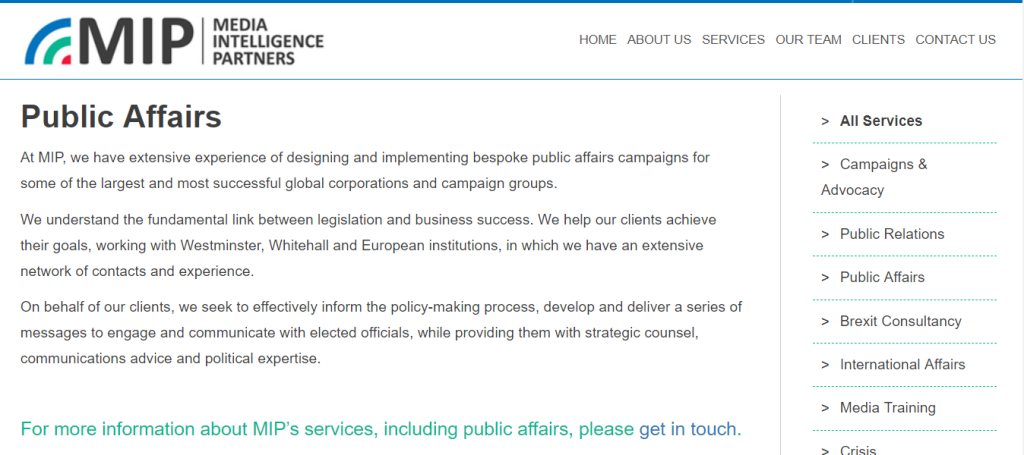
Media Intelligence Partners

Conservative hack Nick Wood, who was once Iain Duncan Smith’s former press aide, set up his own PR consultancy, Media Intelligence Partners in 2004. From 1998 until 2004 he was the Media director for Conservative Party.

However, a break from the Conservatives was absolutely not on the cards for this die-hard Thatcherite. Wood, axed by Michael Howard in 2004, went on to represent Iain Duncan Smith’s think-tank and advised selected Tory parliamentary candidates on PR in the run-up to subsesquent election in 2005.

Wood, who held senior political roles at The Times and Daily Express during a 20-year journalistic career, served under both Iain Duncan Smith and William Hague during one of the most internecine periods in Tory history. 

He has worked with around 50 clients including “prestigious” international think- tanks like the Heritage Foundation and some of the “thought-leaders in UK public policy,” such as the Centre for Social Justice. MIP worked with pro-Brexit Leave means Leave and Economists for Free Trade, formerly called Economists for Brexit. This group has a powerful influence on the media.

Advisors for Economists for Free Trade include Tim Montgomerie, Jacob Rees-Mogg, Owen Paterson, Viscount Ridley and John Longworth, Former Director British Chambers of Commerce, Co-Chairman of Leave Means Leave.

Wood has also worked with major private sector clients including HSBC Bank and eBay. In 2008 he also established the media training and presentation company Pitch-Perfect with Jonathan Haslam, a former Downing Street Press Secretary. 

Media Intelligence Partners (MIP, sometimes MIPPR)) is a London-based PR and lobbying company. The Telegraph reported in 2009 that four Conservative MPs had claimed more than £66,000 in expenses for services provided by the company. Commons rules state that “advice for individual members on self-promotion or PR for individuals or political parties” is banned. However, that didn’t stop Iain Duncan Smith claiming more than £11,000 on his office expense account for services between June 2005 and December 2007. 

Andrew Mitchell, the shadow international development secretary, billed the taxpayer for £18,800 for “research and secretarial services” between April 2006 and July 2008. 

Nadine Dorries, the Conservative MP for Mid-Bedfordshire, claimed almost £20,000 in office expenses for “research” from the consultancy between November 2006 and May last year, while Philip Dunne, another backbencher, claimed for £17,000 for “research and secretarial services”.  

MIP provides services to a number of Brexit lobby groups. As well as being heavily involved in the campaign leading up to the referendum, and Brexit campaigns since, MIP also sells consultancy services to clients.

It says of its ‘Brexit Consultancy’: “MIP is ideally placed to help business leaders navigate this challenging period of change. We help our clients reduce risk and grasp the opportunities of the UK’s exit from the EU. Our insight and expertise on the negotiations and the likely outcomes are invaluable to business leaders in all sectors.”

The company says that during the EU referendum campaign, it “worked closely with current and former cabinet ministers”, including the Secretary of State for Exiting the EU, David Davis, and International Trade Secretary, Liam Fox. It says it ‘remains at the forefront of the campaign to secure the best possible deal for Britain.”

MIP were behind the launch Conservatives for Britain, the organisation that lead the Conservative campaign to leave the European Union. The launch appeared in the Sunday Telegraph on 7 June 2015. Conservatives for Britain was founded by MP Steve Baker and MEP David Campbell Bannerman and went on to attract the support of over 100 Conservative Party MPs.

Grassroots Out

MIP ran the ‘communications and strategy’ campaign forGrassroots Out in the four months prior to the June 2016 referendum. Four senior MIP employees were seconded to the campaign, directing the press office and providing ‘high-level strategic advice’ to the campaign’s key spokespeople. MIP also managed a nationwide Grassroots Out tour, featuring speeches from Chris GraylingOwen Paterson and Liam Fox. Founded by Conservative MPs Peter BoneTom Pursglove and the Labour MP Kate HoeyGrassroots Out claimed cross-party support, including from MIP, the Brexit Secretary David Davis and Nigel Farage, the ex-leader of UKIP.

Leave Means Leave

Since the EU referendum, MIP has been working with Leave Means Leave “to make sure the instructions of the British people are acted upon”. This has involved MIP communicating with ministers on Leave Means Leave‘s behalf. 

Other Brexit-related work includes MIP undertaking media work for the launch of a joint Centre for Social Justice and Legatum Institute report called 48:52 Healing a Divided Britain in September 2016.

The MIP site says: “We devise effective and strategic media outreach, implementing bespoke public relations campaigns. We help our clients achieve their goals across both traditional platforms and more modern online and social media.

“We have unrivalled experience of the media landscape, from Fleet Street to broadcasters and online media. Our staff have worked at the highest levels of national newspapers and international broadcast organisations and have in-depth knowledge of the media’s editorial processes.”

Wood set up MIP with then former Central Office staffer Penny Mordaunt and Nick Longworth, the broadcast PR specialist also axed in the PR Officers’ cull that ended Wood’s five-plus years running Tory media operations.

Edgar Johnson is a Senior Account Executive at MIP and works on a variety projects ranging from new product and company launches to “bespoke political campaigns.” He also assists with MIP’s digital communications and research services.

Prior to joining MIP, Johnson worked as a researcher for Mark Harper MP in the UK Parliament.

He has “valuable campaigning experience from the 2015 General Election where he wrote election literature, devised social media content and campaigned on the front line across several key marginal seats. This helped to return a full brace of Conservative MPs across his region for the first time in nearly 30 years.”

He was also part of MIP’s team providing communications and strategy for the cross-party Grassroots Out campaign during the 2016 EU referendum. During the campaign, he co-ordinated successful events across the country and managed one of Grassroots Out’s largest rallies featuring current Secretary of State for International Trade, Rt. Hon Liam Fox MP. MIP were paid a total of £42,828.00 for their services.

Brexit Consultancy: the result of years of lobbying for vested interests

MIP say: “The United Kingdom’s historic decision to leave the European Union represents a period of uncertainty and opportunity for Britain’s business community. The consequences for legislation, regulation, tariffs and trade rules are huge – and will affect UK firms operating domestically and internationally.

“MIP is ideally placed to help business leaders navigate this challenging period of change. We help our clients reduce risk and grasp the opportunities of the UK’s exit from the EU. Our insight and expertise on the negotiations and the likely outcomes are invaluable to business leaders in all sectors.

“Our Brexit advisory service is headed up by our Chief Executive, Nick Wood. Before founding MIP in 2004, Nick served as Director of Communications to the Conservative Party, having previously been Chief Political Correspondent for The Times newspaper.

“Nick and our MIP staff were at the heart of a Leave campaign that upset the odds, winning the support of 17.4 million people in the largest democratic exercise in the nation’s history.

“We worked with politicians from across the political spectrum, as well as senior business people and campaigning organisations, to bring about the referendum over a number of years. We then worked intensively for four months of the campaign itself to win a historic victory. 

“During this time, we advised and worked closely with current and former cabinet ministers, including the Secretary of State for Exiting the EU, David Davis, and International Trade Secretary, Liam Fox. We remain at the forefront of the campaign to secure the best possible deal for Britain.” (My emphasis)

It then says: “To learn more about how we can help your business capitalise on the opportunities of Brexit, please get in touch.”

In February 2017, the Electoral Commission launched an investigation into referendum spending by Vote Leave and Britain Stronger in Europe. Taking a lead from a series of articles, particularly by Carole Cadwalladr in the Observer, the Commission began looking at the role of AggregateIQ in the referendum campaign.

The Electoral Commission wrote to Darren Grimes, this time asking him to “please explain why you chose to commission AggregateIQ in particular to undertake the work you reported in your spending return, rather than another company.”

Replying on March 3, Grimes told the Electoral Commission that he decided to spend more than £675,000 with AggregateIQ after volunteering with Vote Leave and watching the US presidential election process. “I attended some Vote Leave Ltd events during the campaign as a volunteer activist and socialised with some members of staff. I asked and was told that AIQ was running Vote Leave’s digital campaign and I also became aware that AIQ had worked on Ted Cruz’s presidential campaign, that I was greatly impressed by. I was therefore confident that they could assist us in putting the proposed donation to effect in the time available,” Grimes said in emails to the Electoral Commission.

On 11 May 2018, the Electoral Commission found against Leave.EU, which ran a separate campaign to the official pro-Brexit group Vote Leave, following its investigations into alleged irregularities during the referendum campaign. It found that Leave.EU had unlawfully overspent at least £77,380 – 10% more than the statutory spending limit – though the real figure “may well have been considerably higher”. 

Additionally, its investigations found that Leave.EU inaccurately reported three loans it had received, including “a lack of transparency and incorrect reporting around who provided the loans, the dates the loans were entered into, the repayment date and the interest rate.” Finally, Leave.EU had also failed to provide the required invoice or receipt for “97 payments of over £200, totalling £80,224.”

The Electoral Commission’s director of political finance and regulation and legal counsel complained that the £70,000 fine he was permitted to impose on Leave.EU did not meet the severity of the offences committed by a “key player in the EU referendum”. Further he announced that there was ample evidence of criminal activity from the group campaign chief, Liz Bilney, and that she “knowingly or recklessly signed a false declaration accompanying the Leave.EU referendum spending return”. The Electoral Commission has referred the matter to the police.

Leave.EU’s co-founder, Aaron Banks, has stated that he rejects the outcome of the investigation and will be challenging it in court.

In January 2018, the UK government’s own Brexit analysis was leaked; it showed that UK economic growth would be stunted by 2%-8% for at least 15 years following secession from the EU, depending on the leave scenario. 

The UK continues to learn the hard way that democracy and journalism is in danger of being overwhelmed by rogue politics and a communications industry revolution that accelerates the spread of pro-establishment lies, misinformation and dubious claims, commonly called ‘briefings’.

Many observers point to the two major events – Brexit and the election of Donald Trump – that signal moments of peril for democracy and the press. Both of these events are linked by a handful of people – Steve Bannon and Robert Mercer, for example.

The lobbying industry shapes policies that suit big business and a minority of the population. PR and communications companies are often involved in the circulation of malicious, pro-Conservative ‘strategic communications’ on behalf of those powerful and wealthy enough to benefit from spending hundreds of thousands of pounds on private companies every time there is an election or referendum, the resilience of populist propaganda, racism and sexism and the emergence of the so-called post-truth era erodes the fundamental foundations of democracy and corrupts what was once the cornerstone of ethical journalism. 

Conservative donor Robert Mercer invested $15 million in Cambridge Analytica, where his daughter Rebekah is a board member. Credit Patrick McMullan, via Getty Images.

Related

Conservatives for hire: cashing in on Brexit

The government hired several murky companies plying the same methods as Cambridge Analytica in their election campaign

Calibrating Academy- Hubert Huzzah

The revelations about Cambridge Analytica indicate clearly that western governments are subverting democracy

Cambridge Analytica try to dismiss Chris Wylie’s evidence as ‘conspiracy theories’ and ‘false evidence’


I don’t make any money from my work. But you can help by making a donation to help me continue to research and write informative, insightful and independent articles, and to provide support to others. The smallest amount is much appreciated – thank you.

DonatenowButton

More allegations of Tory election fraud, now we need to talk about democracy

The Conservative Party are facing another investigation from the Electoral Commission following evidenced allegations that they operated a secret call centre during the general election campaign, breaching electoral law, an undercover investigation by Channel 4 News has revealed. 

An undercover reporter working for Channel 4 News secured work at Blue Telecoms, a company in Neath, South Wales. In an area plagued by unemployment and low wages, the call centre hired up to a hundred people on zero-hours contracts. For weeks, they contacted thousands of potential voters in marginal seats across the UK. 

The hired callers were told to say they were working for a market research company called “Axe Research”. No such company is registered in England and Wales. Furthermore, callers were instructed to say that the call centre was situated in Cardiff, rather than Neath.

The investigation has uncovered underhand and potentially unlawful practices at the centre, in calls made on behalf of the Conservative Party. These allegations include:

Paid canvassing on behalf of Conservative election candidates – illegal under election law.

● Political cold calling to prohibited numbers

● Misleading calls claiming to be from an “independent market research company” which does not appear to exist

The Conservative Party have admitted it had commissioned Blue Telecoms to carry out “market research and direct marketing calls” during the campaign, and insisted the calls were legal.

A Conservative spokesman said: “Political parties of all colours pay for market research and direct marketing calls. All the scripts supplied by the party for these calls are compliant with data protection and information law.”

Under the Representation of the People Act, it is illegal to employ someone “for payment or promise of payment as a canvasser for the purpose of promoting or procuring a candidate’s election”.

Call centre employees working on behalf of the party used a script that certainly appeared to canvass for support on film, rather than conduct market research. On the day of the election, call centre employees contacted voters to promote individual candidates.

Anya Proops, a QC specialising in information law, told Channel 4 that political parties had to ensure that third parties working on their behalf followed the law.

“It’s an illegal practice, it’s prohibited under the legislation and in so far as it’s something which has tainted the overall result in favour of a political candidate, then it can void that result.” 

Blue Telecoms is run by Sascha Lopez. He told The Guardian: “In relation to the Conservative party project, I am unable to comment on the content of the scripts or calls to TPS [Telephone Preference Service] numbers, as the scripts and lists of who to call and when to call were given to us by Conservative campaign HQ in London and were not influenced by my team.”

However, a whistleblower at the call centre told Channel 4 News that they had been making potentially unlawful phone calls to voters. 

Undecided voters were fed key Conservative campaign messages, including references to the Brexit negotiations and warnings about a hung parliament.

On the day that voters went to the polls, undecided voters were told that: “the election result in your marginal constituency is going to be very close between Theresa May’s Conservatives and Jeremy Corbyn’s Labour Party”. Callers were also recorded quoting media articles that were pro-Conservative. Operating from a script, the staff claimed they were carrying out calls for “market research” and “polling”. 

One caller is recorded saying: “It was reported in the Daily Mirror in September last year that Jeremy Corbyn is not concerned about the numbers of people coming to live in the UK and it was reported on Sky News this year that Theresa May has restated her pledge to reduce net Migration.”

People were then asked: “Just thinking about these reports in the media and the reports that you live in a marginal constituency that may determine who is prime minister. So does knowing that you live in a marginal constituency that will determine who is prime minister for the Brexit negotiations, does that make you a lot more likely to vote for Theresa May’s Conservative candidate or a little more likely to vote for Theresa May’s Conservative candidate, or are you still unsure, or does it not make a difference?”

The broadcaster’s evidence suggests that on the day of the election, staff called voters in 10 marginal seats, including Bridgend, Gower, Clwyd South and Wrexham.

As the election campaign started, the information commissioner, Elizabeth Denham, wrote to all the major political parties reminding them of the law around telephone calls and data protection. She said that calling voters to promote a political party was “direct marketing” and was regulated by law.

A week before the election, the same call centre staff started saying they were calling on behalf of Theresa May’s Conservatives.

The Conservative party said the call centre was conducting “market research” on its behalf, and was not canvassing for votes. The call centre confirmed it was employed by the party, but has so far denied canvassing on its behalf. 

The Channel 4 undercover reporter has captured evidence that certainly seems to refute that claim. 

The use of ‘big data’ and psychographic targeting

Teams of statisticians and behavioural psychologists who subscribe to the burgeoning practice of “psycho­graphic targeting” have designed their own version of a Myers-Briggs personality test. The original test explores “the basic differences in the ways individuals prefer to use their perception and judgement.”

The test data is supplemented by recent issue surveys, and information from online surveilance, together they are used to categorise political supporters, who then receive psychologically tailored canvassing messages, social media targeting, phone calls and doorstep visits. The micro-targeting of voters has been around for a while, but the Conservative operation has deepened the intensity of the effort and the use of vast resources of psychological data.

This is the campaign approach from a government that claims to advocate a “small state” and “minimal interventions”. However the methods being used which entail the manipulation and management of public perceptions and voting behaviours resemble those of authoritarian regimes, not a healthy liberal democracy. 

Authoritarian propagandists attempt to convey power by defining reality. The reality they portray is usually very simple. The account of reality is offered with the primary goal of switching voters’ value systems to align with the authoritarian value system.

This whole approach is the logical conclusion of the libertarian paternalists‘ “behavioural change” agenda that has been embedded in policies designed by the nudge unit since 2010 in the UK. The political misuse of psychology has been disguised as some kind of technocratic “fix” for a failing neoliberal paradigm, and paraded as neutral “science”. However, its role as an authoritarian prop for an ideological imposition on the population has always been apparent to some of us, especially given the more visible evidence of political narratives and the stage management of our democracy via an extremely manipulative mainstream media over recent years.

The Conservatives’ behaviour change agenda is designed to align citizen’s perceptions and behaviours with neoliberal ideology and the interests of the state. However, in democratic societies, governments are traditionally elected to reflect and meet public needs. The use of “behaviour change” policy involves the state acting upon individuals, and instructing them how they must be. This is profoundly undemocratic. In fact it turns democracy completely on its head. 

A dark message for democracy

Political “dark” advertising that is only seen by its intended recipients is a much greater cause for concern than “fake news” in the spread of misinformation, because it is invisible to everyone but the person being targeted. This means that the individually tailored messages are not open to public scrutiny, nor are they fact checked.

A further problem is that no-one is monitoring the impact of the tailored messages and the potential to cause harm to individuals. The dark adverts are designed to exploit people’s psychological vulnerabilities, using personality profiling, which is controversial in itself. Intentionally generating and manipulating fear and anxiety to influence political outcomes isn’t a new thing. Despots have been using fear and slightly less subtle types of citizen “behaviour change” programmes for a long time. 

The right wing media’s blatant propaganda approach to election campaigning on behalf of the Tories had already contributed significantly to a serious erosion of democratic norms in the UK, the undermining of public trust, to such an extent that profoundly anti-democratic alternatives suddenly seem perfectly acceptable here.

The reality is that often, authoritarians construct an incongruent, flimsy and meaningless language of democracy in order to erect a fact proof screen around an undemocratic reality.  They offer a lot of glittering generalities to the public. However, those apparently incoherent, meaningless slogans are especially designed to signal intents to groups from which the government wants to gain approval. Dog whistling and wedge issues are used extensively by the right.  

Dog whistling is closely associated with a broader wedge strategy, whereby the political party introduces a divisive or controversial social issue into a campaign, aligning its own stance with the dissenting faction of its opponent party, with the goal of causing vitriolic debate inside the opposing party, defection of its supporters, and the legitimising of sentiment which had previously been considered inappropriate. Political campaigns use wedge issues to exploit tension within a targeted population, and undermine unity. 

In light of this, it’s hardly a shocking revelation that an authoritarian government is also using highly tailored and underhanded “dark adverts” to target individuals online, on the basis of information gathered about them and then applied to a process of extensive psychological profiling in order to influence voting behaviours, and the election outcome.

UK voters are being targeted with highly specific and manipulative messages in an attempt to influence their vote.

The shadowy world of online political advertising has until recently gone largely unmonitored, despite the huge power and reach of Facebook and despite social media messaging now thought to have contributed to the election of Donald Trump and the Vote Leave victory.

The new forms of psychological electioneering are invisible to all but the individual people they are designed to reach and influence. 

During the EU referendum, Vote Leave spent a whopping 98 per cent of its £6.8m budget on digital advertising, mostly via Facebook. In the 2015 election, the Conservatives spent £1.2m on digital campaigning, compared with Labour’s £160,000. This meant that the Conservatives reached 17 million people per week, while Labour reached only 16 million in their best month. Facebook claimed that the Conservatives had been able to serve adverts to 80 cent of the site’s users in key marginals. It also boasted that the company “played a part on a highly targeted campaign, helping the Conservatives to speak to the right people over and over again.”

The private companies and individuals who are stage managing our democracy

Dr Simon Moores, visiting lecturer in the applied sciences and computing department at Canterbury Christ Church University and a technology ambassador under the Blair government, said the Information Commisioners Office’s recent decision to shine a light on the use of big data in politics was timely. He said:

“A rapid convergence in the data mining, algorithmic and granular analytics capabilities of companies like Cambridge Analytica and Facebook is creating powerful, unregulated and opaque ‘intelligence platforms’. In turn, these can have enormous influence to affect what we learn, how we feel, and how we vote. The algorithms they may produce are frequently hidden from scrutiny and we see only the results of any insights they might choose to publish.”

He goes on to say: ”They were using 40-50,000 different variants of an ad every day that were continuously measuring responses and then adapting and evolving based on that response.”

Strategic Communication Laboratories (SCL) is a British behavioural science company. The SCL Group, that once advised Nato on so-called “psy-ops”, is a private British behavioural research and strategic communication company. The company describes itself as “global election management agency”.  SCL’s approach to propaganda is based upon a methodology developed by the associated Behavioural Dynamics Institute (BDI). Nigel Oakes founded the latter and also set up Strategic Communication Laboratories and using the new methodology from BDI, ran election campaigns and national communication campaigns for a broad variety of international governments. BDI say: “The goal of the BDI is to establish Behavioural Dynamics as a discipline for the study of group behaviour change.”

There isn’t much information around about BDI‘s connection with military operations, though links with NATO are well-established – see Countering propaganda: NATO spearheads use of behavioural change science, for example. From the article: “Target Audience Analysis, a scientific application developed by the UK based Behavioural Dynamics Institute, that involves a comprehensive study of audience groups and forms the basis for interventions aimed at reinforcing or changing attitudes and behaviour.”

SCL on the other hand, has a clearly defined defence and military division who: “Target Audience Analysis, a scientific application developed by the UK based Behavioural Dynamics Institute, that involves a comprehensive study of audience groups and forms the basis for interventions aimed at reinforcing or changing attitudes and behaviour.”

SCL has different “verticals” in politics, military and commercial operations. All of those operations are based on the same methodology (Target Audience Analysis) and, as far as can be discerned from the outside, SCL and affiliates have very obscure corporate structures with confusing ownership.

In the United States, SCL has gained public recognition mainly though its affiliated corporation Cambridge Analytica (CA). It was created in 2013 as an offshoot of its British parent company (the SCL Group,) to participate in US politics. In 2014, CA was involved in 44 US political races. Their site says: Cambridge Analytica uses data to change audience behavior.” 

And:

PERSUASION

“More effectively engage and persuade voters using specially tailored language and visual ad combinations crafted with insights gleaned from behavioral understandings of your electorate.”

And: “Leveraging CA’s massive team of data scientists and academics, CA is able to provide optimal audience segments based on big data and psychographic modeling. Then, using a sophisticated electronic data delivery system, CA is able to provide TV advertising campaign data that may be used to inform media buyers about shows that have the highest concentrations of target audiences and the least amount of waste; all of which leading to higher media ROI [return on investment] and more voter conversions.”

The company is heavily funded by the family of Robert Mercer, an American hedge-fund billionaire. I’ve mentioned Mercer in a previous article about the right’s undue influence on the media and on voting behaviour. Mercer made his money as a pioneer in the field of Computational Linguistics.

Mercer later became joint CEO of Renaissance Technologies, a hedge fund that makes its money by using algorithms to model and trade on the financial markets. 

One of its funds, Medallion, which manages only its employees’ money, is the most successful in the world – generating $55bn so far. And since 2010, Mercer has donated $45m to different political campaigns – all Republican – and another $50m to non-profits – all right wing, ultra-conservative. This is a billionaire who is trying to reshape the world according to his personal interests, beliefs, wishes and wont. He is an advocate of the neoliberal right, who seek to combine a market economy and economic deregulation with the traditional right wing beliefs in patriotism, élitism, and law and order, delivered within an authoritarian framework. Mercer is known for his anti-welfare and right libertarian views.

To give you a flavour of Mercer’s interests, you only need to follow the money trail: he funds a climate change denial thinktank, the Heartland Institute, and he likes to disrupt the mainstream media. In this aim, he is helped by his close associate Steve Bannon, self-declared “economic nationalist”, Trump’s campaign manager and now chief strategist. The money he gives to the Media Research Center, with its paranoid, anti-progressive mission of correcting “liberal bias” is just one of his pet media projects. He has also worked as vice president of Cambridge Analytica‘s board, the private data-analytics that is owned largely by the Mercer family

Mercer and his family are major donors to Conservative political causes such as Breitbart News. He is the principal benefactor of the Make America Number 1 political action committee (Super PAC). Around 2012, Mercer reportedly invested $5 million in the British data science company, the SCL Group. Most political campaigns run highly sophisticated micro-targeting efforts to locate voters. SCL promised much more, claiming to be able to manipulate voter behaviour through psychographic modeling. This was precisely the kind of work Mercer values.

SCL claimed to be able to formulate complex psychological profiles of voters. These, say the company, would be used to tailor the most persuasive possible message, acting on that voter’s personality traits, hopes or fears.

Of course Mercer was a major supporter of Donald Trump’s 2016 campaign for president and Brexit in the UK. Mercer donated the services of the data analytics company Cambridge Analytica to Nigel Farage and UKIP. The company was able to “advise” and influence Leave.eu through harvesting data from people’s Facebook profiles in order to target them with individualised persuasive messages to vote for Brexit. However, Leave.eu did not inform the UK electoral commission of the donation, contrary to the law which demands that all donations valued over £7,500 must be reported. 

When SCL Elections formed Cambridge Analytica in 2013, the company hired researchers from Cambridge University, hence the name. CA collects data on voters using sources such as demographics, consumer behaviour, internet activity, and other public and private sources. CA is using psychological data derived from millions of Facebook users, largely without users’ permission or knowledge. The company is also trying to change people’s perceptions and behaviours without their consent.

The company maintains offices in New York City, Washington, D.C., and London.

Cambridge Analytica claim to predict not just peoples’ voting intentions and preferences, but also their personality types. The company is proprietorial about its precise methods, but says large-scale research into personality types, based on hundreds of thousands of interviews with citizens, enables them to chart voters against five main personality types – openness, conscientiousness, extraversion, agreeableness and neuroticism. With its head office in London, the company is “A global election management agency, skilled in applying behavioural modeling and microtargeting solutions to political campaigns.”

The marketisation of democracy: the highest bidder wins all, while claiming to speak for the “ordinary person”

Stephen K. Bannon, President Trump’s chief strategist and the intellectual force behind his nationalist agenda, said in February that the new administration is locked in an unending battle against the media and other globalist forces to “deconstruct” an “outdated system of governance”. Jennifer Rubin in The Washington Post writes:

“’They’re going to continue to fight,’” Bannon said of the media, which he repeatedly described as ‘the opposition party,’ and other forces he sees as standing in the president’s way. ‘If you think they are giving you your country back without a fight, you are sadly mistaken.’

Atop Trump’s agenda, Bannon said, was the ‘deconstruction of the administrative state’ — meaning a system of taxes, regulations and trade pacts that the president and his advisers believe stymie economic growth and infringe upon one’s sovereignty.

For those who doubted Trump-Bannon’s determination to destroy the liberal international order that has kept world war at bay and promoted global prosperity since the end of World War II, this will come as a rude awakening. Bannon’s simultaneous attack on the media suggests that it is not simply about trade or immigration policy.”

So data technology, surveilance, psychology and social media and manipulative messaging campaigns are being combined in a powerful new way to sway opinions and win elections without people’s knowledge. In essence, a new, dark, subliminal propaganda war is being waged against citizens by those who wield power, serving the narrow interests of those who do and who are funded by a hidden few who want to weild power also.

Lynton Crosby has been a close advisor in the Conservative election campaigns of Australia, Canada and the UK, and is well known for his racist dog whistling and wedge strategies, influential at an international level.

“In a campaign, what you try to do is either change or reinforce some perceptions that people have in order to influence their behaviour,” says Crosby. 

Crosby’s emphasis is on “below the radar” campaigning, and the targeting of marginal constituencies with highly localised campaigning, latching on to local issues and personalities. To find such divisive and potentially diversionary issues, Crosby’s business partner Mark Textor runs focus groups to find which social groups to target with what questions. Crosby is said to focus on delivering simple messages, targeting marginal constituencies and the use of lots of polls and data. 

 Lynton Crosby, second left, at the party’s annual conference in 2015 with, from left, Lord Feldman, Jim Messina (former Obama campaign chief also hired by the Tories) and then party chairman Grant Shapps. Photograph: David Hartley/Rex

“In a campaign, what you try to do is either change or reinforce some perceptions that people have in order to influence their behaviour,” Crosby says.

Their site commentary highlights whose “democratic” interests Crosby and Textor serve:

“We combine decades of experience in research, political campaigns, strategic communications, media, and corporate intelligence to deliver winning strategies at the highest levels of business and government.

Having worked on successful election campaigns across four continents, we understand the need for timely, actionable intelligence, so our clients can focus the right message and resources on their most persuadable ‘swing voters’ to get the results they want.”

Note the reference to “behaviour changing messages”.

textor

Crosby Textor also claim that: “the team are specialists in advising major companies in how to position themselves to ensure they are integral to government decision-making.”

It was Crosby that created the campaign for the Conservatives with the slogan “Are you thinking what we’re thinking?”: a series of posters, billboards, TV commercials and direct mail pieces with messages such as “It’s not racist to impose limits on immigration” and “how would you feel if a bloke on early release attacked your daughter?” focused on hot-button issues like “dirty” hospitals, landgrabs by “gypsies” and restraints on police behaviour.

In April 2016, Mayor of London and Conservative, MP Boris Johnson, was accused of “dog whistle racism” by Shadow Chancellor of the Exchequer and Labour MP John McDonnell, when Johnson suggested US President Barack Obama held a grudge against the United Kingdom due to his “ancestral dislike of the British Empire” as a result of his “part-Kenyan” heritage after Obama expressed his support for the UK to vote to remain in the European Union ahead of the UK’s referendum on EU membership. Crosby also tried to link Sadiq Khan with terrorist organisations –  the Conservative mayoral candidate’s campaign, was run by Crosby Textor

Mark Textor, co-founder of the private company, was mentored by the late Richard Wirthlin, a pollster who was chief strategist to US President Ronald Reagan. Someone else with past connections to the Wirthlin Group is Kellyanne Conway, President Trump’s election campaign manager and now counsellor to the president, serving alongside Steve Bannon, assistant to the President and White House chief strategist.

All singing from the same crib sheet.

Since Trump’s inauguration, Conway has been embroiled in a series of controversies, including using the phrase “alternative facts, making reference to a “Bowling Green massacre” which never occurred, (Conway “cited” it as justification for a travel and immigration ban from seven Muslim-majority countries enacted by Trump), claiming Michael Flynn had the full confidence of the president hours before he was dismissed, and publicly endorsing commercial products associated with the president’s daughter Ivanka Trump. As a result, a number of media outlets have called her credibility into question, with some refusing her requests for one-on-one interviews.

When such manipulative tactics are exposed from time to time, it’s like a curtain shifting temporarily to give you a glimpse into another dimension, populated by billionaires and a handful of mercenary henchmen who drew up the machinations of a war being waged on democracies, in order to terraform political landscapes to suit the dystopic interests of one percent of the global population, at the expense of the needs of the ninety nine percent. You would be forgiven for thinking that the world and the media are being run almost exclusively by a small number of elitist, pan-nationalist aliens. It’s not a conspiracy theory. It’s a reality.

Jim Messina is a political adviser who was the White House Deputy Chief of Staff for Operations under President Barack Obama from 2009 to 2011 and served as the campaign manager for Obama’s highly successful 2012 re-election campaign. Messina was hired as a campaign strategy adviser to the UK Conservative Party in August 2013. Messina operated from the US during the 2015 general election campaign. He has made statements about his personal admiration for David Cameron. Theresa May has also added him to her team of strategists. 

Gone are the days when it was expected that the public decided who to vote for because of the policies on offer from each party. Now the government focuses on the use of private political masters of the dark campaign arts, who use “political-voter surveillance” techniques, along with a combative and emotional approach to messaging, rather than a rational and reasonable one, and a level of cunning that most definitely treads around the very outer edges of ethics. 

One of Messina’s key strategic methods is finding and targeting swing voters through the meticulous gathering and monitoring of voter information using private polls, and the use of social media “targeting”.  He uses social networking techniques and social media, having sought and received advice from top names in the tech world including Steve Jobs.

Messina uses micro-targeting based on online data. His approach is based on the in-depth psychometrically profiling of people, using publicly available data, including their Facebook “likes” and group memberships. This information is used to create effective and directed digital dark advertising to target millions of voters and manipulate their psychological tendencies and play to their traits.  

Messina has developed a private consulting firm –The Messina Group, which “works with organizations in the private, public, and social sectors to achieve their strategic goals.” The company has an office in London, on Old Park Lane. It says on the site says:

“Using state of the art data and analytics, The Messina Group can harness and amplify the reach of your social network. We accurately model your organization’s likely supporter, voter, or consumer, and – by overlaying that with your existing social media base – we can develop a targeted list of potential new supporters. This targeted, person-to-person sharing is the future of advertising in a fundamentally digital and social world. The Messina Group will ensure that your organization is ahead of the competition.” 

One tactic integrated in this method is aimed at generating a bandwaggon effect, which I have discussed at length elsewhere. The bandwagon effect occurs in voting: some people vote for those candidates or parties who are likely to succeed (or are proclaimed as such by the media). The bandwagon propaganda technique has been applied to situations involving majority opinion, such as political outcomes, where people alter their opinions to the majority view. 

Such a shift in opinion can occur because individuals draw inferences from the decisions of others, which shapes an informational cascade. A cascade develops when people “abandon their own information in favour of inferences based on earlier people’s actions, regardless of how irrational that may be. Bandwaggon propaganda draws on our natural tendency towards social conformity.

During the 2015 general election, the government were accused of trying to “buy the general election” by quietly raising the legal spending limit by £6.2 million to £32.7m in the face of concerns from the Electoral Commission over “undue influence”. The party has reportedly amassed a war chest of more than £70 million. The change to the law on candidates’ election spending, passed without parliamentary debate.

A new project called Who Targets Me, has been attempting to address the lack of transparency of targeted election messaging, by recruiting social media users to share information on what political adverts they are seeing.

It says on their site: “Analysing the aggregated data will allow us to draw out insights about exactly which demographics are being targeted and the exact media and language that campaigners are using to influence your vote.”

In an effort to do something about the lack of transparency, Who Targets Me built a browser extension for Facebook users to download that will then report live to that individual when a political advert is being targeted at them. It also tracks that information in its database. You can sign up to be a Who Targets Me volunteer here.

Given the instability of the government, following the general election delivering a hung parliament, it’s likely that political advertising will continue. You will need to use the Chrome browser and install the Who Targets Me extension.

The Information Commissioner’s Office has already launched a wide-ranging investigation over possible breaches of UK data laws. The Conservatives have so far refused to supply examples of adverts the party is sending to individual voters on Facebook, despite the growing concern over unregulated online election activity.

One problem is money. There are no spending limits on digital advertising and, put simply, the more you spend the more people you reach. Until now, that means it is primarily the wealthier, Conservative campaigns that have benefited.

Another is that psychological influences are different from transparent attempts at rational, reasoned and material persuasion, because they operate outside of conscious awareness. Hiding in plain sight, they trigger involuntary emotive responses in the human subconscious that most people are powerless to resist – and that happens even when they know they’re being influenced. Much of the material being used to “persuade” is dishonest, and aimed at simply smearing the opposition and generating irrational and unfounded fears, rather than open discussion, about political and socioeconomic alternatives to neoliberalism and social conservatism. 

Such tactics are nothing less than a political micro-management of the public’s beliefs an behaviours and are ultimately aimed at nudging your voting decisions to maintain a profoundly unbalanced, increasingly pathological and authoritarian status quo. Such tactics deployed in manufacturing consensus are widely used, and combined, they also serve to reduce public expectation of opposition and in doing so establish diktats: it’s a way of mandating acceptance of ideology, policies or laws by presenting them as if they are the only viable alternative.

There is a much needed public debate to be had about the distinction between political “persuasion” and “manipulation”.

And another about undue political influence. In their summary of electoral offences, the electoral commission says: “A person may also be guilty of undue influence if they impede or prevent any voter from freely exercising their right to vote – even where the attempt is unsuccessful.

Also: “It is an illegal practice to make or publish a false statement of fact about the personal character or conduct of a candidate in order to affect the return of a candidate at an election.”

“Certain offences relate specifically to election campaign publicity material. Election campaign publicity material must contain an imprint, not resemble a poll card and not contain a false statement as to the personal character or conduct of another candidate.”

The Conservatives have certainly taken advantage of our basic tendency to be more motivated by the threat of something presented and subsequently perceived as “bad” than by the presented opportunity for examining positive alternatives.

This is not just a story about the political and commercial misuse of social psychology and data analytics. It has to be understood in the context of a military contractor using military strategies on a civilian population. The public.

David Miller, a professor of sociology at Bath University and an authority in psyops and propaganda, says it is “an extraordinary scandal that this should be anywhere near a democracy. It should be clear to voters where information is coming from, and if it’s not transparent or open where it’s coming from, it raises the question of whether we are actually living in a democracy or not.”

https://www.youtube.com/watch?v=cqK0odTyXjA

Related:

Social media is being used to stage manage our democracy using nudge-based strategies

EXPOSED: CONSERVATIVES IN HOUSE ‘SURVEY’ TEAM

The great British Brexit robbery: how our democracy was hijacked

Negative campaigning, emotions and political participation

Inverted totalitarianism and neoliberalism

What I don’t understand about Conservatism

‘Tory Election Fraud’ Investigation Sees Conservatives Fined £70,000 By Electoral Commission

Political polls, think tanks and propaganda: the antidemocratic writing on the wall

Strategies and motives for resistance to persuasion: an integrative framework

How To Use 10 Psychological Theories To Persuade People

CONTROVERSIAL GCHQ UNIT ENGAGED IN DOMESTIC LAW ENFORCEMENT, ONLINE PROPAGANDA, PSYCHOLOGY RESEARCH

How Covert Agents Infiltrate the Internet to Manipulate, Deceive, and Destroy Reputations – Glenn Greenwauld

Theresa May pledges to create new internet that would be controlled and regulated by government 


I don’t make any money from my work. But you can support Politics and Insights and contribute by making a donation which will help me continue to research and write informative, insightful and independent articles, and to provide support to others. The smallest amount is much appreciated, and helps to keep my articles free and accessible to all – thank you. 

DonatenowButton

top 100 blogs

Brexit, dirty campaigning, the TTIP and a case for Remain

images


“We cannot be content with the state of the EU as it stands. But that does not mean walking away, but staying to fight together for a better Europe.”  Jeremy Corbyn, Statement to The Guardian, 28 July 2015.

Despite his reservations, and a desire to see progressive reform within the European Union, Mr Corbyn strongly supports the Remain campaign. He has been very clear about his views, and he has presented powerful arguments to support his position. He says:

“I have seen first-hand jobs, investment, workers’ rights and environmental protection that being part of the EU helps secure for working people. That’s why, despite its faults, I believe it’s best we vote to stay and work with our friends to make the changes Europe needs.”

It was therefore something of a surprise to see the Leave campaign use a quote with such malicious intent from Mr Corbyn, that was so outdated and out of context, to deliberately mislead people into thinking that the Labour leader supports Brexit.

This post was sponsored on Facebook, and came up more than once in my feed: Stand with Jeremy Corbyn.  

The site is promoted by Matthew Elliot, the founder and former Chief Executive of the TaxPayers’ Alliance and Big Brother Watch. He also acted as Campaign Director for the successful NOtoAV campaign in the 2011 Alternative Vote referendum. He is the Founder and was the Chief Executive of Business for Britain, and is now the Chief Executive of the Vote Leave Campaign Committee, having founded and been the chief executive of the main Vote Leave.

Elliott also founded the Politics and Economics Research Trust (PERT) in 2004. Labour MP and former Shadow Minister for Europe, Emma Reynolds, raised significant questions about the affairs of the TPA and PERT, she wrote to the Charity Commission and said that “PERT may be in breach of charities legally binding commitments to preserve their independence, specifically regarding political activity and the delivery of charitable objectives.”

Of £532,000 PERT paid out in grants in 2014, £300,000 went to the TPA and £205,000 to Business for Britain, both of which are Eurosceptic. £10,000 went to Global Britain, which has campaigned for Brexit. Charitable trusts are not allowed to be used for political purposes under British charity law.

There were some pretty grubby tricks employed during November 2015, when the group established a fake company in order to gain entry to a speech being given by the Prime Minister at the Confederation of British Industry where they heckled him and held banners stating “CBI = voice of Brussels.” Dominic Cummings, campaign director of Leave, subsequently stated:

“You think it is nasty? You ain’t seen nothing yet. These guys have failed the country, they are going to be under the magnifying glass. Tough shit … It is going to be tough”.

The campaign group also stated their intention to target and disrupt meetings of pro-EU organisations and companies. In a letter to the Electoral Commission, Eric Pickles, the former Conservative cabinet minister, said he believed Vote Leave had disqualified itself from lead status in the referendum (which entitles the campaign to public funding) after it pledged to run a “nasty” campaign against opponents.

The European referendum, some have argued, is more important than any general election, because it will potentially change Britain’s relationship with Europe and the rest of the world. There’s a lot of grand and quaint imperialist talk from the Leave camp about power, sovereignty and Britain’s “place in the world.” But it’s a clever sales pitch, nonetheless, as it harnesses the public restiveness, which reflects a broader disquiet with social democracy in the UK. 

I have to agree with Michael Sandel’s comment, in his excellent interview in today’s New Stateman with Jason Crowley: “A big part of the debate has been about economics – jobs and trade and prosperity – but my hunch is that voters will decide less on economics than on culture and ­questions of identity and belonging.”

The Right have always been strongly inclined towards socioeconomic outgrouping, creating categories of others, using stigma and scapegoating techniques to formulate justification narratives for policy that is purposefully designed to impose gross social inequalities. This alienates already marginalised groups, fragments social identities, and of course, breaks social solidarity. It’s therefore no surprise that immigration and othering have been the focus of a substantial part of the Brexit campaign.

He goes on to say: “Social democracy is in desperate need of reinvigoration, because it has over the past several decades lost its moral and civic energy and purpose. It’s become a largely managerial and technocratic orientation to politics. It’s lost its ability to inspire working people, and its vision, its moral and civic vision, has faltered. So for two generations after the Second World War, social democracy did have an animating vision, which was to create and to deepen and to articulate welfare states, and to moderate and provide a counterbalance to the power of unfettered market capitalism.

“This was the raison d’être of social democracy, and it was connected to a larger purpose, which was to empower those who were not at the top of the class system, to empower working people and ordinary men and women, and also to nurture a sense of solidarity and an understanding of citizenship that enabled the entire society to say we are all in this together. But over the past, well, three or four decades, this sense of purpose has been lost, and I think it begins with the Ronald Reagan/Margaret Thatcher era.”   

Yes, the transatlantic neoliberal turn. The commentary throughout the article is coherent and compelling, and well worth the read.

Leaving the EU would mean the UK giving up its place and influence in Europe, turning back the clock and retreating from the established global power networks of the 21st century. It would also legitimize the Conservatives’ crusade against what remains of a political settlement based on an inclusive, multicultural democracy. Without a level of international scrutiny and legal safeguards, I believe that this Conservative governments’ already evident authoritarian inclinations would be held under rather less constraint. 

The Labour Party, except for a small handful of eurosceptics, is now firmly pro-Europe  – we are, after all, internationalists – despite the fact that leader Jeremy Corbyn has in the past questioned whether the EU structure delivers more for business than it does workers. The Scottish National Party, most of the Liberal Democrats, Green Party and Welsh nationalists Plaid Cmyru are firmly placed with the ‘In’ camp. 

Jeremy Corbyn has said that David Cameron must not have a carte blanche to negotiate away workers’ rights as part of his desired EU reform package, ahead of the in-out referendum. However, Corbyn knows for sure that workers’ rights will not be stronger if the UK ends up outside the EU. 

It was the New Labour Government who ended the Tories’ opt-out on EU social policy (the “social chapter” as it was then called) back in 1998. The Trades Union Congress (TUC) have also staunchly defended workers’ rights in the EU over the last two decades. Now Cameron is aiming to undermine such positive EU employment laws in the UK, as the Tories successfully did back in the 1990s with an across-the-board opt-out. This said, Cameron’s “re-negotiation” has been pretty quickly sidelined. 

A Labour government could easily opt back into any areas that the Tories did succeed in opting-out of, as long as the UK is still an EU member state. The real attack on workers’ rights would inevitably happen if the UK left the EU. Then it would be straightforward for the Tory government to repeal other directives protecting workers’ rights. And they would – obligations to implement EU laws would cease, and so leaving the EU would reduce rather than help workers’ rights. And joining the EU again in the future would be very difficult – it would require a new referendum and fresh negotiations with Brussels, at the very least.

One final point. Some on the Left have said that the Transatlantic Trade and Investment Partnership (TTIP) is a reason for them to vote to leave the EU.  I can understand this, because the TTIP will lead to a large-scale transfer of democratic power to multinationals. It is a blueprint for deregulation and privatisation. 

The Left Leave group argue that the deal promotes the privatisation of the NHS, and that leaving the EU would mean avoiding TTIP and hence save Britain’s free healthcare system. However, TTIP would still have a strong influence on the UK economy. Once outside the EU, the UK would be unable to stop the TTIP, or shape it. TTIP would create a transatlantic marketspace that would influence British firms and the UK economy by aligning regulation in the US and EU.  

Britain would need to stop trading with both the EU and the US to escape the TTIP’s regulations. The EU, like the US, would most likely remain an important trading partner for the UK in the event of a success for the Brexit campaign. Brexit is premised on extreme free trade agreements coupled with looser regulation to make us more “competitive.” 

The TTIP deal was supposed to be signed by now – but together, the Progressive Alliance of Socialists and Democrats (S&D) group and Europe’s people have seriously stalled things. Would it really be possible to stop such a move if we couldn’t link up with campaigners across Europe? If being in the EU has brought us TTIP, it has also brought us the means to stop it. Labour MEPs fought hard to secure support within the EU to get the toxic Investor State Dispute Settlement (ISDS) clause removed from the TTIP at the negotiating table last year. 

This was an excellent achievement by our own Labour MEPs within the broader S&D group. The ISDS contradicts principles of democratic accountability and would potentially allow one government to bind another for decades to come. Unlike the great majority of other treaties, investment treaties have very long minimum lifespans ranging up to 30 years. 

Much debate has arisen concerning the impact of controversial ISDS on the capacity of governments to implement reforms and legislative and policy programs related to public health, environmental protection, labour and human rights. 

In the UK, we already have a highly corporatised Government. We have witnessed scandalous price-rigging, and massive job losses, decreased standards in service delivery and a disempowerment of our Unions. This is because the Tories will always swing policy towards profiting private companies and not towards meeting public needs, as we know. 

In Britain, privatisation was primarily driven by Tory neoliberal ideological motives, to “roll back the frontiers of the State.” 

This Conservative government has done everything possible to push the most extreme version of TTIP, just as they’ve fought against pretty much every financial regulation, from bankers bonuses to a financial transaction tax. Cameron has his own programme of stripping away laws that direct big business towards reasonable behaviours and standards, no matter how important those laws are for safeguarding people and our environment.

 —

Related

Three excellent articles: –

EU debate: what are the real choices? – Red Pepper

The energy of the Brexiteers and Trump is born of the failure of elites Michael Sandel / Jason Cowley

#BREXIT ANTI-IMMIGRATION ARGUMENT CONTINUES WAR AGAINST POOR – Rupert Dreyfus/Consented


I don’t make any money from my work. But you can support Politics and Insights and contribute by making a donation which will help me continue to research and write informative, insightful and independent articles, and to provide support to others. The smallest amount is much appreciated, and helps to keep my articles free and accessible to all – thank you.
DonatenowButton