Tag: Outgroups

Dr. Robert J. Lifton’s Eight Criteria for Thought Reform, Cult Thinking and how they relate to Neoliberalism

behavchange
Dr Robert J. Lifton is a psychologist who studied and identified the techniques of mass persuasion and groupthink used in propaganda and in cults (from political to religious). I found his interesting article about the eight criteria for “thought reform” on the International Cultic Studies Association (ICSA) site.

What struck me immediately about Lifton’s criteria is how easily they may be applied to neoliberalism – a totalising, authoritarian New Right ideology, imposed by an elite of very financially secure and powerful oppressors. Neoliberalism is incompatible with democracy, values of equality and human rights. It also requires narratives of othering in order for governments to justify the inequality that neoliberalism is designed to cause. 

Over the last few years, much of the population in the UK have experienced growing inequality and increasingly precarious socioeconomic circumstances, exacerbated by class-contingent neoliberal austerity and ‘small state’ policies.

The neoliberal approach to public policy has become naturalised. Political theorist Francis Fukuyama announced in 1992 that the great ideological battles between “east and west” were over, and that ‘western [neo]liberal democracy’ had triumphed. He was dubbed the “court philosopher of [post-industrial] global capitalism” by John Gray.

In his book The End of History and the Last Man, Fukuyama wrote:

“At the end of history, it is not necessary that all societies become successful liberal societies, merely that they end their ideological pretensions of representing different and higher forms of human society…..What we are witnessing, is not just the end of the cold war, or a passing of a particular period of postwar history, but the end of history as such: that is, the end point of mankind’s ideological evolution and the universalisation of western liberal democracy as the final form of human government.”

I always saw Fukuyama as an ardent champion of ultra-neoliberalism, he disguised his conservatism behind apparently benign virtue words and phrases (as part of a propaganda technique called Glittering Generalities), such as “Man’s universal right to freedom.” 

He meant the same sort of self-interested “freedom” as Ayn Rand: “a free mind and a free market are corollaries.” He meant the same kind of implicit social Darwinist notions long held by Conservatives like Herbert Spencer – where the conditions of the market rather than evolution decides who is “free,” who survives, and as we know, the market is rigged by the invisible hand of government.

Fukuyama’s ideas have been absorbed culturally, and serve to normalise the dominance of the right, and stifle the rationale for critical debate. Additionally a political context has been created to pathologize the left.

Fukuyama’s work is a celebration of neoliberal hegemony. It’s an important work to discuss simply because it has been so widely and tacitly accepted, and because of that, some of the implicit, taken-for-granted assumptions and ramifications need to be made explicit. 

Neoliberalism requires an authoritarian approach to public administration. Rather than an elected government recognising and meeting public needs, instead, we now have a government manipulating citizens to adapt their views, behaviours and circumstances to meet the politically defined needs of the state, in the form of ‘nudging’ and behavioural economics. 

This turns democracy on its head. It is also presents us with a political framework that is incompatible with the UK’s international human rights obligations and equality legislation. 

Government policies have become increasingly irrational.  We have a government that has decided work is a health outcome, for example. In an absurd world where medical sick notes have been politically redefined as fit notes, sick and disabled people are apparently no longer exempt from work, which is now held to be a magic “cure”. The only way out of the politically imposed punitive and increasing poverty for those who cannot work is… to work. (See: Let’s keep the job centre out of GP surgeries and the DWP out of our confidential medical records.) 

Neoliberalism has become a doxa in the Western world. Here in the UK, citizen behaviours are being aligned with politically defined neoliberal outcomes, via policies that extend behaviour modification techniques, based on methodological behaviourism. Policies that “incentivise” have become the norm. This is a psychocratic approach to administration: the government are delivering public policies that have an expressed design and aim to act upon individuals, with an implicit set of instructions that inform citizens how they should be

Aversives and punishment protocols are most commonly used. Coercive welfare policies are one example of this. The recent eugenics by stealth policy entailing the restricting of welfare support to two children only is another. Both were introduced with the explicitly stated political intention of “changing behaviours” of poorer citizens. Those that cannot or will not conform are politically stigmatised and outgrouped, as well as being being further “disciplined” by state-imposed economic sanctions.

Another particularly successful way of neutralising opposition to an ideology is to ensure that only those ideas that are consistent with that ideology saturate the media and are presented as orthodoxy. Every Conservative campaign has been a thoroughly dispiriting and ruthless masterclass in media control.

Communication in the media is geared towards establishing a dominant paradigm and maintaining an illusion of a consensus. This ultimately serves to reduce democratic choices. Such tactics are nothing less than a political micro-management of your beliefs and are ultimately aimed at nudging your voting decisions and maintaining a profoundly unbalanced, pathological status quo. (See also: Inverted totalitarianism and neoliberalism.)

As a frame of analysis, Lifton’s criteria are very useful in highlighting parallels between cult thinking and how political dogma may gain an illusion of consensus; how it becomes a dominant paradigm and is accepted as everyday “common sense.” 

Kitty.

Lifton’s criteria for “thought reform” are:

  1. Milieu Control.  This involves the control of information and communication both within the environment and, ultimately, within the individual, resulting in a significant degree of isolation from society at large.

  2. Mystical Manipulation.  There is manipulation of experiences that appear spontaneous but in fact were planned and orchestrated by the group or its leaders in order to demonstrate divine authority, spiritual advancement or some special gift or talent, such as claims of having a high IQ, that will then allow the leader to reinterpret events, scripture, and experiences as he or she wishes. (This can include “natural order” ideas and political doxa.) 
  3. Demand for Purity.  The world is viewed as black and white and the members are constantly exhorted to conform to the ideology of the group and strive for perfection.  The induction of guilt and/or shame is a powerful control device used here. (Stigma and political outgrouping is used to deter and exile non-conformists.)
  4. Confession.  Sins, as defined by the group, are to be confessed either to a personal monitor or publicly to the group.  There is no confidentiality; members’ “sins,” “attitudes,” and “faults” are discussed and exploited by the leaders. (Mainstream media have bombarded us with “confessions” of “scroungers”, for example. The lives and experiences of those out of work have become public moral “property.”)
  5. Sacred Science.  The group’s doctrine or ideology is considered to be the ultimate Truth, beyond all questioning or dispute.  Truth is not to be found outside the group.  The leader, as the spokesperson for God or for all humanity, is likewise above criticism. (Ties in with Conservative notions of a “natural social order.” But also, pseudoscience may be used to justify controversial policies.)
  6. Loading the Language.  The group interprets or uses words and phrases in new ways so that often the outside world does not understand.  This jargon consists of thought-terminating cliches; slogans which serve to alter members’ thought processes to conform to the group’s way of thinking. (See Glittering Generalities and The Conservatives are colonising progressive rhetoric.)
  7. Doctrine over person.  Member’s personal experiences are subordinated to the sacred science and any contrary experiences must be denied or reinterpreted to fit the ideology of the group. 
  8. Dispensing of existence.  The group has the prerogative to decide who has the right to exist and who does not.  This is usually not literal but means that those in the outside world are not saved, unenlightened, unconscious and they must be converted to the group’s ideology.  If they do not join the group or are critical of the group, then they must be rejected by the  members.  Thus, the outside world loses all credibility.  In conjunction, should any member leave the group, he or she must be rejected also.  (Lifton, 1989)

*Italics in blue added by me.

Related

Nudging conformity and benefit sanctions: a state experiment in behaviour modification

The new Work and Health Programme: government plan social experiments to “nudge” sick and disabled people into work

Cameron’s Nudge that knocked democracy down: mind the Mindspace.

Link: The Government Communication Service guide to communications and behaviour changegcs-guide-to-communications-and-behaviour-change1


I don’t make any money from my work. But you can support my work by making a donation and help me continue to research and write informative, insightful and independent articles, and to provide support to others. The smallest amount is much appreciated – thank you.

DonatenowButton

A view from the Overton window: through the looking glass darkly


CCHU9011


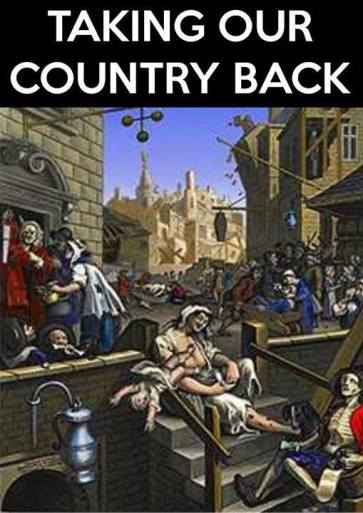
“The UK is a divided country” is a phrase being bandied around a lot, especially in the aftermath of the referendum, and it is of course true. We are divided. We have politically constructed categories of scapegoats, outgroups, uncertainty, disempowerment, low wages, our public services are being dismantled, and we are witnessing massive inequality and growing poverty. The recipe for anomie. Many people feel despair and are fearful of the future.

We have a nation of oppressed people wanting to see others oppressed. The real oppressors, however, are getting a free ride on the back of their own purposefully divisive and diversionary tactics. Dominant narratives and neoliberal ideology – smoke and mirrors; reductive soundbites, dodgy statistics and carefully constructed, cunning fact-proof screens. And yes, the media, directed by the government, have played a significant part in trying to shape what we see and think about, manipulating public opinion. Most of the Tories wanted to leave the EU, Cameron wasn’t typical of his party.

I don’t blame the Scottish people for wanting their independence one bit, particularly from this side of the EU referendum. But that means we will shrivel a little more. England, the husk.

But a divided country hasn’t happened just because of these things. Some of the irrational statements I have heard over the last few years include commentary about how some traditional Labour voters feel the party “let them down” and no longer reflect their interests. Well, I do hope the Tories do better for you, then. Because they’re clearly SO much better at reflecting working-class interests – the new “party of the workers” they mocked. Yet Conservatism in a nutshell is all about reducing worker’s rights and reducing pay so that private companies can make big profits from a cheap and desperate reserve army of labor. And if you reduce welfare provision and make receipt of benefits highly conditional – provision that’s already paid for by working people –  the subsequent rising level of desperation drives many to increasingly insecure jobs for much less pay in order to simply survive.

The “all the same” lie was always a Right-wing expediency, it’s about disempowering and fragmenting the Left. It worked. The Narxists got very narked, with their sense of alienation, and their peculiar brand of exclusive socialism (they are “real” socialists apparently). Yet Miliband had denounced Blairism, and would have given us a fair and progressive tax system. Not good enough, some of you said, but then some people are never happy, so with impeccable knee-jerked fallibility, you helped the Tories back in Office. Again.

Chomsky once said that sometimes, the best we can do is vote for the least damaging option. That at least would have marked the beginning, not the end, of campaigning for social justice and pushing for a socialist agenda.

Meanwhile, all of those genuine traditional socialist values of solidarity and cooperation, community and mutual aid, internationalism, equality and diversity, social justice, worker’s rights, trade unionism, well the Right-wing in Office are smashing those from our common vocabulary. And deporting them. The Tories in power, not the Labour party in opposition. But the government can only do that with OUR consent. So we must take some responsibility for that.

Now we had a further Left Labour leader, but of course for some, he ain’t good enough. The media push an elite agenda, and divert attention from the real problems that are being created by a Conservative government’s policies, and irrationally, the opposition party is hated whilst the Government get on with fucking over ordinary people, the economy and the country. Democracy is steadily being dismantled. Public funds are being stolen and redistributed to the very wealthy and powerful. Public services are being destroyed. Some people are dying because of Tory policies. Meanwhile people bicker amongst themselves and irrationally blame each other, the opposition party and vulnerable social groups. Prejudice grows. People are being permitted to hate. Their prejudice is fed and endorsed by the Establishment. Discrimination happens. Violence begins. People get killed. More people will get killed. Many remain indifferent. But sooner or later, they must take responsibility for that.

If you have ever wondered how fascist or totalitarian regimes manage to gain power, and to commit atrocities, apparently with public consent, well take a close look at the psychosocial processes involved, read Gordon Allport’s work on the growth of prejudice, where that can lead, then look more closely at what is unfolding here in the UK, stage by stage. It’s hidden in plain view, advancing by almost inscrutable degrees. But once you see it, you can’t unsee it.

Most Right-wing political systems, from Conservatism to Fascism, succeed to some extent by fostering a strong anti-intellectual prejudice amongst populations. It serves two key purposes. It discourages people from thinking critically and expressing themselves independently, and it discredits those who do (even before they do) by establishing a cultural normative default that serves to alienate people who challenge established narratives, and invites derision and accusations of being “out of touch with real lives and everyday experiences.”  But those “telling it like it is” often aren’t, quite. Seems to me that people’s hearts and minds are becoming directed, focused increasingly by an external, political and economic, narrow and rigid agenda. 

Why are we divided? Some people blame the government and media for their corrosive rhetoric, some say Tory social Darwinist, supremicist ideology and policies that have influenced the nation and pushed people further to the Right are to blame. Some people blame the general public’s stupidity and gullibility. Some people blame “patronising” and “arrogant” academics and all things intellectual. Some people blame the EU. Some people blame the Labour party. A few people have even blamed me. Some people blame the wealthy. Some people blame our faulty decision-making through rubbish cognitive processes that apparently need “nudging.” Some people blame the poor, or single parents, unemployed people, immigrants, sick and disabled people.

“I take full responsibility for this” said hardly anyone, ever.

I blame those people who choose to opt out of collective responsibility-taking and participatory democracy. Oh yes, democracy is not something you HAVE, it’s something you DO. To be divided as a nation requires social groups to want to oppress other groups, and for bystanders to permit that to happen – you have to participate in the process, even if that participation is just as a bystander who says and does nothing or as a person who is prejudiced at a gut and knee-jerk level. 

We really do have to take some responsibility for that.

13508843_1457642880928107_5042276407041750262_n
Picture courtesy of Dave Sid Poole


Some poignant reflection on what it is to be a socialist

Socialists have always tended to be internationalists. Whereas nationalists believe that the world is divided primarily into different nationalities, geopolitical zones, socialists consider social class to be the primary divide. For socialists, class struggle, not national identity, is the driving force of history. And capitalism creates an international working class that must fight back, united and cooperatively against an international capitalist class.

People who have a nationalist inclination, who view the social world parochially and hierarchically, are more likely than others to hold prejudices toward low-status groups. This is especially true of people who want their own group to dominate and be superior to other groups – a characteristic known in social psychology as “social dominance orientation.” It isn’t only the elite that hold this perspective, either.

But economic and social challenges such as inequality and social injustice will never be addressed by simply drawing a new set of geographical borders.

Any group claiming dominance over another – including the “working class” – is displaying social dominance orientation. The oppressed can be oppressive, too.

It is time to recognise those artificially constructed divisions and unite, for we have nothing left to lose but our chains.

“So comrades come rally
And the last fight let us face”.

The verses of the Internationale were written on 30 June, 1871, in the immediate aftermath of the brutal crushing of the Paris Commune during La Semaine sanglante (“The Bloody Week”). The policies and outcome of the Commune had a significant influence on the ideas of Karl Marx, of course.

The author, Eugène Pottier, was hiding in fear of his life. The lyrics were intended to convey the historical experience of an important workers’ struggle to a worldwide audience. For Pottier, liberty, equality and fraternity meant the promise of a society in which poor people, like himself, had justice.

The Internationale has long been the anthem of the labor’ movement throughout the world. Its power to move people has survived the repression of fascism, the cruel parody that was Stalinism and free market capitalism. Those who sing it need know nothing about it’s history to feel a strong sense of international unity. The Internationale is simultaneously about history, political argument and is a powerful rallying statement. Pottier established a reputation as the workers’ poet. It earned him a seat on the Communal Council representing the 2nd arrondissement.

The sheer power of Pottier’s Internationale lies in the fact that he was able to encapsulate his personal experience of specific events and express them in universal terms. And that identification and recognition is socialism in action.

The Second International (now known as the “Socialist International”) adopted it as its official anthem. The title arises from the First International, which was an alliance of socialist parties formed by Marx and Engels that held a congress in 1864. The author of the anthem’s lyrics, Pottier, attended this congress.

 The Internationale has been translated into many languages, it is a left-wing anthem, and is celebrated by socialists, communists, anarchists, democratic socialists, and some social democrats.

The original French refrain of the song is C’est la lutte finale / Groupons-nous et demain / L’Internationale / Sera le genre humain.

That translates as:

This is the final struggle

 Let us group together and tomorrow

 The Internationale

 Will be the human race.

Right now, that makes me feel like weeping in sorrow.

Related

UKIP: Parochialism, Prejudice and Patriotic Ultranationalism.

Don’t believe everything you think: cognitive dissonance

Inverted totalitarianism. Oh dear

The ultimate aim of the “allthesame” lie is division and disempowerment of the Left

Once you hear the jackboots, it’s too late


I don’t make any money from my work. But you can support Politics and Insights and contribute by making a donation which will help me continue to research and write informative, insightful and independent articles, and to provide support to others. The smallest amount is much appreciated, and helps to keep my articles free and accessible to all – thank you.

DonatenowButton
cards