Tag: Work and Pensions Committee

Call for submissions – inquiry launched into employment support for disabled people

disability-employment-gap

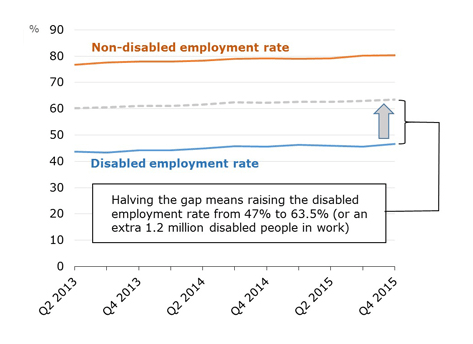
Disability Employment Gap 2015. Source: UK Parliament.

Inquiry background

The Work and Pensions Committee has launched an inquiry into the Government’s commitment to halve the “disability employment gap.” According to the most recent data, 46.7% of disabled people were in work at the end of 2015 compared to 80.3% of non-disabled people. In order to close this gap, the Committee says an extra 1.2 million disabled people would need to be supported into work.

The Committee’s welfare to work report, published in October 2015, raised concerns about the lack of success of existing employment programmes in supporting disabled people into sustained employment.

The Government has since announced:

  • A new Work and Health Programme to replace the current generalist Work Programme and specialist disability Work Choice programmes
  • A real terms increase in spending on the Access to Work Programme, which provides practical support for disabled people, beyond the “reasonable adjustments” required to be made by employers
  • A White Paper to be published this year which will “set out reforms to improve support for people with health conditions and disabilities, including exploring the roles of employers, to further reduce the disability employment gap and promote integration across health and employment.”

Concerns raised over Disability Confident campaign

In addition, the DWP’s Disability Confident campaign, launched in 2013, aims to promote the benefits of employing disabled people to employers.

However, concerns have been raised about the abolition of the Work Related Activity component of Employment and Support Allowance (ESA) worth £29.05 per week – and its equivalent in Universal Credit – for new claimants from April 2017, and the potential effects of this measure on disabled people’s ability to overcome their barriers to working.

Call for written submissions

The Committee invites written submissions addressing the following points:

Steps required to halve the disability employment gap:

  • To what extent are the current range of proposed measures likely to achieve the Government’s ambition of closing the disability employment gap?
  • Should the Government set interim targets along the way to meet the commitment to halve the disability employment gap? What should they be?

Support for employers:

  • How effective is the Disability Confident campaign in reducing barriers to employment and educating employers?
  • What more could be done to support employers?

Effective employment support for disabled people:

  • What should support for people with health conditions and disabilities in the proposed Work and Health programme look like?
  • How should providers be incentivised to succeed?

Likely effects of proposed ESA reform:

  • What are the likely impacts on disability employment of the abolition of the Employment and Support Allowance Work Related Activity component?
  • What evidence is there that it will promote ‘positive behavioural change’? What evidence is there that it will have unintended consequences, and how could these be mitigated?

Aim of the inquiry

The Committee intends to consider possible improvements in:

  • the DWP’s employment support programmes for disabled people
  • Support for employers to take on disabled people
  • Disabled people’s access to the labour market more broadly

The Committee will also examine possible adverse consequences of the Government’s current approach, particularly around proposed changes to ESA, and how these might be addressed.

Chair’s comment

Frank Field MP, Chair of the Committee said:

“The Government has made a welcome commitment to help more people with disabilities into a position where they can find and then keep a job. If it can successfully be seen through, this commitment could signal a major stride towards achieving full employment in our country.

The really important part now is to back-up this commitment with a series of reforms that are tailored to each person’s own skills and ambitions, as well as those conditions that currently limit their ability to work, so that each person can follow a feasible journey into work. We hope the evidence we receive will enable us to help the Government in its search for such a reform package.”

Send a written submission through the disability employment gap inquiry page.

Further information

The deadline for written submissions is Monday 9 May 2016.


ImageVaultHandler.aspx

Related

The new Work and Health Programme: government plan social experiments to “nudge” sick and disabled people into work

The biggest barrier that disabled people face is a prejudiced government

Let’s keep the job centre out of GP surgeries and the DWP out of our confidential medical records

Latest DWP information release reveals a huge rise in the numbers of sick and disabled people being sanctioned

G4S are employing Cognitive Behavioural Therapists to deliver “get to work therapy”

Labour Party To Refer Groundless Iain Duncan Smith Claim To Statistics Watchdog Again

Steve Bell cartoon


Iain Duncan Smith is telling fibs again. Work and pensions secretary claims that 75% of jobseekers think that benefit sanctions have helped them “focus and get on.”

The following is reported by Rowena Mason and Patrick Butler, for theguardian.com on Saturday 12th March 2016:

Labour is to challenge Iain Duncan Smith’s claim that 75% of jobseekers think benefit sanctions have helped them “focus and get on” by lodging a complaint with the official statistics watchdog.

Owen Smith, the shadow work and pensions secretary, said he would write to Duncan Smith challenging him to back up the “groundless” figure and refer the matter to the UK Statistics Authority for investigation.

The work and pensions secretary made the claim in an interview with the Camden New Journal, in which he suggested many claimants were grateful for the consequences of benefit sanctions.

“Seventy-five per cent of all those who have been sanctioned say it helped them focus and get on. Even the people in the jobcentres think it’s the right thing to do … sanctions are the reason why we now have the highest employment levels ever in the UK, and more women in work,” Duncan Smith said.

“What we say is: ‘We’ll give you all the support but at the end of the day we expect you to do something for it: go back to work, take the job, take the interviews.’ And it works, talk to any of the advisers in the jobcentres.”

While out campaigning for the Tory London mayoral candidate, Zac Goldsmith, Duncan Smith also dismissed protests about the controversial sanctions regime as “a classic buzz from the left” and claimed “these people are never going to vote for us – you have to understand, these people hate us”.

Owen Smith said: “Iain Duncan Smith’s claim that 75% of people who had been sanctioned say it ‘helped them focus and get on’ is groundless and shows he is out of touch with the real impacts of policies introduced by his department.

In reality, widespread concerns have been raised about this government’s use of sanctions, including from their own advisers, which is why the cross-party work and pensions select committee called for a full independent review into the system.

However, Iain Duncan Smith is reluctant to accept such scrutiny. Labour is calling for far greater transparency and honesty in this debate, so we can ensure greater numbers of people are actually helped into work, while being treated fairly.

That is why I will be writing to the secretary of state to inform him that we will refer his use of data to the Statistics Authority and calling for the long overdue independent review into sanctions to begin.”

Duncan Smith is believed to have been referring to DWP research that found 72% of jobseeker’s allowance (JSA) claimants said awareness of sanctions made them “more likely to follow the rules.”

However, that paper also said: “There was no evidence from the survey that knowledge of JSA conditions led to actual movement into work. Respondents who said they were more likely to look for work because of their knowledge of JSA conditions were no more likely than other respondents to have moved into work when they left JSA.”

After the interview, the Department for Work and Pensions released a statement saying: “Decisions on sanctions aren’t taken lightly but are an important part of our benefits system – they are only ever used as a last resort and the number of sanctions continues to fall.”

It is not the first time the UK statistics watchdog has been asked to adjudicate on the DWP’s approach to the sanctions regime.

Last year, it asked the DWP to ensure its statements on jobseeker sanctions are “objective and impartial” following a series of complaints by experts.

At the time, the authority’s chair, Sir Andrew Dilnot, wrote to the DWP’s top statistician asking the department to publish far more data and give the public a clearer understanding of how it is imposing sanctions on jobseekers.

Sanctions are used by civil servants to penalise jobseekers when they are alleged to have broken benefit rules, with punishments becoming increasingly severe over the last parliament.

The government has faced repeated calls from Labour to rethink the system, but is resisting pressure for an independent inquiry.

The Commons work and pensions committee last year urged the government to hold a wide-ranging independent review of the regime to address widespread concerns that it is unfair, excessively punitive, and does little to help people get into work.

© Guardian News & Media Limited 2010.

Related

A List of Official Rebukes For Tory Lies

Department of Work and Pensions officials admit to using fake claimant’s comments to justify benefit sanctions

The Department of Whopping Porkies is rebuked as claimants suddenly develop mysterious superpowers after being sanctioned

A letter of complaint to Andrew Dilnot regarding Coalition lies about employment statistics

Audit finds whereabouts and circumstances of 1.5 million people leaving welfare records each year “a mystery”

Universal Credit “in-work progression” inquiry launched – call for evidence

ImageVaultHandler.aspx

The Work and Pensions Committee opened an in-work progression in Universal Credit inquiry on the 9th December.

Background of the inquiry

The Department for Work and Pensions (DWP) intends to establish an “in-work service”, designed to encourage individual Universal Credit claimants on very low earnings to increase their income. Benefit payments may be stopped if claimants fail to take action as required by the DWP. The DWP is conducting a range of pilots to test different approaches but there is very little detail about these. The new regime might eventually apply to around one million people.

The Committee is considering the Department’s plans and options for a fair, workable and effective approach.

These measures will make benefit payments to people who are in work, but on low earnings, conditional on them taking certain steps to increase their pay or hours.

Scope of the inquiry:

Written submissions are invited addressing the following points:

    • DWP’s plans for in-work progression pilots in 2015/16, and how they should be evaluated
    • Which organisations are best-placed to deliver the in-work service for DWP e.g. Jobcentre Plus/other providers from the private, public or voluntary sectors?
    • What should in-work progression support entail and how should it be delivered (e.g. regularity and nature of contact with claimants)?
    • Which groups of claimants should be included and which should be exempt?
    • How should employers be encouraged to facilitate progression?
    • In what circumstances would it be appropriate to sanction a Universal Credit claimant who is in work?
    • Is there any UK or international evidence on effective ways of encouraging in-work progression?

The deadline for submissions is Monday 18 January 2016.

Chair’s comment

Rt Hon Frank Field MP DL, Chair of the Work and Pensions Committee, said:

“The welfare-to-work strategy of successive governments has begun to crack the dependency on out-of-work benefits that had appeared to be an almost intractable problem. Efforts now also need to be focused on a welfare-to-work strategy that not only moves claimants off out-of-work benefit, but more importantly helps them move up the pay ladder and out of poverty. Too many people on low benefit incomes have been encouraged into low-paid jobs whose rewards are only brought up to a more acceptable income level by tax credits and other in-work benefits. I hope our Committee therefore will examine the available evidence and carefully develop an approach to in-work support which is effective, and which people accept as fair.”

I will publish my own submission, prompted by Frank Field’s spectacularly misguided and conservative statement, in due course. Here are a few of the issues and concerns I will be raising: 

Field refers to the Conservative “dependency” myth, yet there has never been any empirical evidence to support the claims of the existence of a “culture of dependency” and that’s despite the dogged research conducted by Keith Joseph some years ago, when he made similar claims. In fact, a recent international study of social safety nets from The Massachusetts Institute of Technology (MIT) and Harvard economists categorically refutes the Conservative “scrounger” stereotype and dependency rhetoric. Abhijit Banerjee, Rema Hanna, Gabriel Kreindler, and Benjamin Olken re-analyzed data from seven randomized experiments evaluating cash programs in poor countries and found “no systematic evidence that cash transfer programmes discourage work.”

The phrase “welfare dependencydiverts us from political discrimation via policies, increasing inequality, and it serves to disperse public sympathies towards the poorest citizens, normalising prejudice and resetting social norm defaults that then permit the state to target protected social groups for further punitive and “cost-cutting” interventions to “incentivise” them towards “behavioural change.”

Furthermore, Welfare-to-Work programmes do not “help” people to find jobs, because they don’t address exploitative employers, structural problems, such as access to opportunity and resources and labor market constraints. Work programmes are not just a failure here in the UK, but also in other countries, where the programmes have run extensively over at least 15 years, such as Australia.

Welfare-to-work programes are intimately connected with the sanctioning regime, aimed at punishing people claiming welfare support. Work programme providers are sanctioning twice as many people as they are signposting into employment (David Etherington, Anne Daguerre, 2015), emphasising the distorted priorities of “welfare to work” services, and indicating a significant gap between claimant obligations and employment outcomes.

The Conservatives have always constructed discourses and shaped institutions which isolate some social groups from health, social and political resources, with justification narratives based on a process of class-contingent characterisations and the ascribed responsiblisation of social problems such as poverty, using quack psychology and pseudoscience. However, it is socioeconomic conditions which lead to deprivation of opportunities, and that outcome is undoubtedly a direct consequence of inadequate political decision-making and policy.

It’s worth bearing in mind that many people in work are still living in poverty and reliant on in-work benefits, which undermines the libertarian paternalist/conservative case for increasing benefit conditionality somewhat, although those in low-paid work are still likely to be less poor than those reliant on out-of-work benefits. The Conservative “making work pay” slogan is a cryptographic reference to the punitive paternalist 1834 Poor Law principle of less eligibility.

The government’s Universal Credit legislation has enshrined the principle that working people in receipt of in-work benefits may face benefits sanctions if they are deemed not to be trying hard enough to find higher-paid work. It’s not as if the Conservatives have ever valued legitimate collective wage bargaining. In fact their legislative track record consistently demonstrates that they hate it, prioritising the authority of the state above all else.

There are profoundly conflicting differences in the interests of employers and employees. The former are generally strongly motivated to purposely keep wages as low as possible so they can generate profit and pay dividends to shareholders and the latter need their pay and working conditions to be such that they have a reasonable standard of living.

Workplace disagreements about wages and conditions are now typically resolved neither by collective bargaining nor litigation but are left to management prerogative. This is because Conservative aspirations are clear. They want cheap labor and low cost workers, unable to withdraw their labor, unprotected by either trade unions or employment rights and threatened with destitution via benefit sanction cuts if they refuse to accept low paid, low standard work. Similarly, desperation and the “deterrent” effect of the 1834 Poor Law amendment served to drive down wages.

In the Conservative’s view, trade unions distort the free labor market which runs counter to New Right and neoliberal dogma. Since 2010, the decline in UK wage levels has been amongst the very worst in Europe. The fall in earnings under the Coalition is the biggest in any parliament since 1880, according to analysis by the House of Commons Library, and at a time when the cost of living has spiralled upwards. And whose fault is that?

It’s certainly not the fault of those who need financial support to meet their basic survival needs despite being in employment.

Send a written submission through the in-work progression in Universal Credit inquiry page.

Don’t forget the deadline is Monday 18 January 2016.

8+Ways+to+Protect+Yourself+From+Emotional+Manipulation

As predicted, Mandatory Review has effectively destroyed independent Tribunals

IDS_nSection 102 and Schedule 11 of the Welfare Reform Act, (Clause 99) is the (State) power to require revision before appeal. People who wish to challenge a benefit decision will no longer be allowed to lodge an appeal immediately. Instead, the government introduced mandatory revision or review stage, during which a different Department of Work and Pensions (DWP) decision maker will reconsider the original decision and the evidence and, if necessary, send for more information.

Many of us have campaigned since 2012 to raise awareness of Clause 99. During the Consultation period, I wrote a set of responses to the government’s proposals, which many people used as a template for their own responses.  I remember that we ALL RAISED THE SAME CONCERNS.

In summary, the main concerns were that basic rate Employment Support Allowance was to be withdrawn during the mandatory review period, leaving sick and disabled people with no money to live on, whilst the DWP reconsidered their own “fit for work decisions” that were wrong.

I know that our consultation responses were ignored by the government. The changes were introduced anyway, despite our grave concerns. Since October 2013 people have to apply for mandatory review separately before they can lodge an appeal. We were also very worried that no time limit was established for the DWP to undertake and complete the mandatory review. Our concerns were fully justified, as it’s emerged that people are waiting 7-10 weeks for the mandatory review decision. Meanwhile, these people cannot appeal. And have no money to live on.

An added concern is that this system as it stands demands such a lot from people who may be very vulnerable, seriously ill and/or have mental health problems. Their difficulties are exacerbated by cuts in legal aid for welfare rights advice and cuts in local authority grants. There is a significant contraction of the availability of help for those who need it the most from advice agencies.

A Benefit Sanctions Briefing was released on 18 February 2015 by the Department of Work and Pensions, comprising of an update of sanctions statistics up to the end of September 2014, and for the first time it also included the outcomes of Mandatory Reviews (or sometimes called “reconsiderations.”)

Dr David Webster, Senior Research Fellow at Glasgow University, said: “The Mandatory Reconsideration system (MR), introduced on 28 October 2013, has fundamentally changed the whole appeal process, introducing additional steps and a new Jobcentre Plus structure. MR has cut the proportion of Job Seekers Allowance sanctions which are challenged by claimants from about one third (33%) to about 20-25%. Employment Support Allowance sanction challenges have returned to below their pre-MR level, at about 45%.

The independent element in the system offered by Tribunals has been effectively destroyed, completely in the case of Employment Support Allowance and almost completely for Job Seekers Allowance, where only 0.14% of sanction decisions are now being taken to a Tribunal.

MR has had no overall impact on the proportion of Job Seekers Allowance sanctions overturned, which remains at about 13%. But the proportion of Employment Support Allowance sanctions overturned has fallen from about 35% to about 20%.

The most disturbing possibility is that Employment Support Allowance claimants’ medical conditions are rendering them unable to cope effectively with the phone calls made to them by DWP officials at home during the MR process.”

He also said: “Job Seekers Allowance (JSA) Reconsiderations and Appeals: The revised DWP statistics show much lower claimant success rates at both internal DWP reconsideration and Tribunal appeal. However, success rates for the few who appeal to a Tribunal have risen and successful Tribunal appeals are at an all-time high. For a claimant prepared to go all the way in the appeal process, the probability of overturning a sanction is now 51%.

Employment Support Allowance (ESA) claimants have higher success rates than JSA claimants at reconsideration and appeal.

In 2013 their reconsideration success rate was 56.1% and their appeal success rate was 26.1%. A higher proportion of ESA claimants than JSA claimants ask for reconsideration. This proportion has been rising rapidly, from below 10% up to March 2011, to over 40% during 2013.

The proportion appealing to Tribunals is lower, only about 1%. In 2013 there were 8,428 reconsiderations or appeals where the claimant was successful in overturning an ESA sanction.

The big surge in ESA sanctions during 2013 was due to penalties for failure to participate in work-related activity. By December 2013 this reason accounted for 87% of ESA sanctions, the other 13% being for failure to attend a work-related interview.

This is in contrast to the experience under the Labour government, when the only reason for sanction was failure to attend an interview [without good reason], and there were no sanctions in relation to work-related activity.

Dr David Webster has submitted evidence to the House of Commons Work and Pensions Committee Inquiry into benefit sanctions.

Many of the key issues with the mandatory review can be seen summarised herehere and here. Sheila Gilmore and Dame Anne Begg have covered these extensively during the ongoing Work and Pensions Committee ESA inquiry, as well as during the course of the many separately tabled debates.

Clause 99 – Mandatory Review – was undoubtedly introduced to make appealing wrong decisions that we are fit for work almost impossible. Sick and disabled people are effectively being silenced by this Government, and the evidence of a brutal, dehumanising, undignified and grossly unfair system of “assessment” is being hidden.

It also hides the crass unfairness and terrible consequences of Tory draconianism – the using of behavioural modification techniques in the form of benefit sanctions that have now been integrated into welfare “conditionality” criteria, and imposed on people who are already struggling materially, some of who are sick and disabled.

Most of those people claiming benefts do so through no fault of their own. To punish people by removing all of their income – and thus their only means of meeting basic survival needs – so arbitrarily, is obscene in a so-called civilised society.

The only way for a tiny group of people to become obscenely rich is for huge masses of others to be kept chronically poor. The tories have spent five years lying to us about who “deserves” what, but the bottom line is this: almost every tory policy has intentionally resulted in money being taken from the poorest or money being handed to the [already] wealthiest and most powerful. (See: Follow the Money: Tory Ideology is all about handouts to the wealthy that are funded by the poor and ‘We are raising more money for the rich’ revisited: some thoughts.)

Related

Clause 99, Catch 22 – The ESA Mandatory Second Revision and Appeals

Clause 99, Catch 22 – State sadism and silencing disabled people

Clause 99, Catch 22 and Penning is telling lies

The New New Poor Law

Sanctions misery for tens of thousands of families this Christmas

Pregnant and sanctioned just in time for christmas… Sanctioned and frozen to death….The latest news from Ashton Under Lyne Jobcentre.

Rachel Reeves promises to remove benefit sanction targets with a Labour Government

Government under fire for massaging unemployment figures via benefit sanctions from Commons Select Commitee

Benefit sanctions are not fair and are not helping people into work

Rising ESA sanctions: punishing the vulnerable for being vulnerable

430835_148211001996623_1337599952_n (1)Many thanks to Robert Livingstone for the memes.

A letter of complaint to Andrew Dilnot regarding Coalition lies about employment statistics

 10270806_319228004894921_8005540502444686357_n
I’ve written the following to Andrew Dilnot:

Dear Sir,

I write in response to the government claims made recently regarding employment. During Prime Minister’s questions in Parliament on Wednesday, Mr Cameron said that the number of people in full-time employment had risen. Other ministers, such as Esther McVey have echoed these claims.

We are growing the economy and we’ve got more people in work,”  Mr Cameron said.

And: The number of people out of work in the UK fell by 133,000 to a fresh five-year low of 2.2 million in the three months to March, official figures show.The jobless rate also fell to a five-year low of 6.8%, the Office for National Statistics (ONS) has said”.

I am very concerned about the accuracy of these claims, and should like to challenge both the validity and reliability of them, given the current methodological problems with measurement, which the ONS have acknowledged in part, previously.

To count as unemployed, people have to say they are not working, are available for work and have either looked for work in the past four weeks or are waiting to start a new job they have already obtained. Someone who is out of work but doesn’t meet these criteria counts as “economically inactive”. The results from a selected sample, based on narrow criteria, are then weighted to give an estimate that reflects the entire population.

The other measure of joblessness – the claimant count – is published for each single month. It doesn’t suffer from the limitations of sample size and sampling frame, because it derives from the numbers of Jobseeker’s Allowance (JSA) claimants recorded by Jobcentre Plus, so a monthly figure is possible right down to local level. But because many people who are out of work won’t be eligible for JSA, it’s an  even narrower measure.

I draw your attention to the following, taken from the Summary of recommendations: Response from the Employment Related Services Association (ERSA) to the Work and Pensions Select Committee inquiry into Jobcentre Plus, dated May, 2013:

Jobcentre Plus performance metrics:

  • The effectiveness of Jobcentre Plus (JCP) should be measured by sustained job outcomes rather than off-benefit flows to create greater incentives to support jobseekers into employment and provide a more accurate picture of success rates. This would address potential perverse incentives to sanction claimants inappropriately, plus ensure greater comparability between JCP provision and contracted out provision.
  •   Such a change could help to provide greater transparency in order to identify those who would benefit from intensive employment support. Such a performance metric would prevent the phenomenon of ‘cycling’, jobseekers moving between short term jobs and unemployment for many years, but not building up the length of time of continual unemployment to qualify them for specialist support.

In particular, I wish to draw your attention to this from the same document – Response from ERSA to the Work and Pensions Select Committee inquiry into JCP, 2013:

4.1. JCP is measured by off-benefit flows rather than sustained job outcomes. This can create perverse incentives to move jobseekers into short term employment outcomes, rather than refer them to long term contracted out support. It can also create a perverse incentive to sanction claimants as discussed below.

ERSA recommends that whilst off-benefit checks are monitored for national statistical purposes, job outcome and sustainment measure, comparable to the Work Programme, should be introduced for Jobcentre Plus. This would enable analysis between the performance of JCP and contracted out provision and provide accurate value for money comparisons.

5.1. DWP point to off-benefit flows as an indication of the effectiveness of pre-Work Programme support. However, analysis undertaken by Policy Exchange calls into question the validity of off-benefit figures as a success measure given that many do not go into sustainable employment or simply move on to another type of benefit.

8.1 As identified by the Committee in its report into the experience of different user groups on the Work Programme, the use of sanctions is inconsistent. 

Providers are obliged to notify Jobcentre Plus if a jobseeker fails to undertake an activity, for example if they miss an appointment. The decision as to whether to actually enact sanctions rests with Jobcentre Plus though. This means that sanctions are not applied even though a provider may think there is a clear case to do so. Conversely, a provider may be satisfied with the progress made by a participant but may be overruled by Jobcentre Plus who have a case for applying conditionality.

For example, one ERSA member reported that Jobcentre Plus decided to sanction a Work Programme participant for insufficient use of the Universal Jobmatch website, despite the fact that the provider had explicitly asked the participant to focus on resolving some other issues ahead of any formal job search activity. Sanctioning represented a great setback in the trust and progress made up to that point. ERSA agrees with the recommendation put forward by the Committee in its most recent report into the Work Programme for DWP to conduct a review of sanctioning activity with a view to ensuring that the processes are clearly understood by participants and consistently applied.

8.2 Part of the problem lies in the fact that Jobcentre Plus is measured by off-benefit flows rather than sustained job outcomes. This therefore means that a situation in which a Personal Advisor applies a sanction that may in fact damage an individual’s progress to employment, would register as a success according to the off-benefit flow measure. ERSA believes that measuring Jobcentre Plus success by sustained job outcomes would remove any perverse incentives to sanction individuals.

So, in summary, simply measuring how many people end their claims for benefits does not reveal the true impact of jobcentre services, nor does it accurately reflect the numbers of those moving into employment.

Let’s not forget that in 1996, the Conservative government introduced the jobseeker’s allowance that cut benefits to young people up to 18 years old – the new allowance was designed to replace unemployment benefit and income support. Young people excluded from eligibility for benefit are therefore absent from unemployment statistics.

The Department has simplified its performance measures and now primarily targets the move by claimants away from benefits, or “off-flow”, as a simple and intuitive measure of performance. However, this gives no information about how individual jobcentres perform in supporting claimants to work. Some may have found work but, in more than 40 per cent of cases, the reason for moving off benefits is not actually recorded.

I am also concerned that underemployment continues to remain very high, despite a small fall of 7,000 in the number in involuntary part time work, the total still stands at 1.42m. This is an increase of a 100 per cent beyond the pre-recession level of 701,000. The rise in employment also continued to be driven by self-employment, which is extraordinary as self-employment is a relatively small part of the UK jobs market. But although just one in seven workers are self-employed, over half of all jobs growth over the year has been in this type of employment. The TUC share this concern, and have said that some people have been forced in to self-employment as they have no alternative.

Previous TUC’s analysis  suggests that rising self-employment is part of a wider shift towards insecure employment, rather than as a result of a growing number of people starting up new companies as ministers have claimed. Analysis shows that self-employed workers are often earning less, underemployed, and have less job security than employees.

One very important issue not currently considered is that since the government does not track or follow up the destination of all those leaving the benefit system, as discussed, the off-flow figures will inevitably include many having their claim ended for reasons other than securing employment, including sanctions, awaiting mandatory review, appeal, death, hospitalisation, imprisonment, on a government “training scheme” (see consent.me.uk  and the Telegraph – those on workfare are counted as employed by the Labour Force Survey.)

Furthermore, last week Iain Duncan Smith met a whistle-blower who has worked for his Department for Work and Pensions for more than 20 years. Giving the Secretary of State a dossier of evidence, the former Jobcentre Plus adviser told him of a “brutal and bullying” culture of “setting claimants up to fail”.

“The pressure to sanction customers was constant,” he said. “It led to people being stitched-up on a daily basis.”

The whistle-blower wishes to be anonymous but gave his details to Iain Duncan Smith, DWP minister Esther McVey and Neil Couling, Head of Jobcentre Plus, who also attended the meeting. He said:

“We were constantly told ‘agitate the customer’ and that ‘any engagement with the customer is an opportunity to ­sanction.”

Iain Duncan Smith and his department have repeatedly denied there are targets for sanctions. However, the whistle-blower says:

“They don’t always call them targets, they call them ‘expectations’ that you will refer people’s benefits to the decision maker. It’s the same thing.”

He claimed managers fraudulently altered claimants’ records, adding: “Managers would change people’s appointments without telling them. The appointment wouldn’t arrive in time in the post so they would miss it and have to be sanctioned. That’s fraud. The customer fails to attend. Their claim is closed. It’s called ‘off-flow’ – they come off the statistics. Unemployment has dropped. They are being stitched up.”

Labour MP Debbie Abrahams, the member of the DWP Select Committee who set up the meeting, has renewed her call for an inquiry into inappropriate sanctioning. Debbie said:

“I am deeply concerned that sanctions are being used to create the illusion the Government is bringing down unemployment.

It is my belief that the claims made by David Cameron and his ministers are an unwarranted, far-fetched inferential leap from methodological premises that don’t stand up to scrutiny, for all of the reasons I have outlined. I felt obliged to draw your attention to this matter, not least because I am not alone in my concerns, and I feel very strongly that it is immoral of any government to mislead the public to which it is meant to be accountable.

Yours sincerely
Ms Susan Jones.

Related article: Austerity, socio-economic entropy and being conservative with the truth

Petition to Stop DWP Minsters Spinning Statistics 

995658_494538353949031_779653065_n
Thanks to  Robert Livingstone for the pictures.