Author: Kitty S Jones

I’m a political activist with a strong interest in human rights. I’m also a strongly principled socialist. Much of my campaign work is in support of people with disability. I am also disabled: I have an autoimmune illness called lupus, with a sometimes life-threatening complication – a bleeding disorder called thrombocytopenia. Sometimes I long to go back to being the person I was before 2010. The Coalition claimed that the last government left a “mess”, but I remember being very well-sheltered from the consequences of the global banking crisis by the last government – enough to flourish and be myself. Now many of us are finding that our potential as human beings is being damaged and stifled because we are essentially focused on a struggle to survive, at a time of austerity cuts and welfare “reforms”. Maslow was right about basic needs and motivation: it’s impossible to achieve and fulfil our potential if we cannot meet our most fundamental survival needs adequately. What kind of government inflicts a framework of punishment via its policies on disadvantaged citizens? This is a government that tells us with a straight face that taking income from poor people will "incentivise" and "help" them into work. I have yet to hear of a case when a poor person was relieved of their poverty by being made even more poor. The Tories like hierarchical ranking in terms status and human worth. They like to decide who is “deserving” and “undeserving” of political consideration and inclusion. They like to impose an artificial framework of previously debunked Social Darwinism: a Tory rhetoric of division, where some people matter more than others. How do we, as conscientious campaigners, help the wider public see that there are no divisions based on some moral measurement, or character-type: there are simply people struggling and suffering in poverty, who are being dehumanised by a callous, vindictive Tory government that believes, and always has, that the only token of our human worth is wealth? Governments and all parties on the right have a terrible tradition of scapegoating those least able to fight back, blaming the powerless for all of the shortcomings of right-wing policies. The media have been complicit in this process, making “others” responsible for the consequences of Tory-led policies, yet these cruelly dehumanised social groups are the targeted casualties of those policies. I set up, and administrate support groups for ill and disabled people, those going through the disability benefits process, and provide support for many people being adversely affected by the terrible, cruel and distressing consequences of the Governments’ draconian “reforms”. In such bleak times, we tend to find that the only thing we really have of value is each other. It’s always worth remembering that none of us are alone. I don’t write because I enjoy it: most of the topics I post are depressing to research, and there’s an element of constantly having to face and reflect the relentless worst of current socio-political events. Nor do I get paid for articles and I’m not remotely famous. I’m an ordinary, struggling disabled person. But I am accurate, insightful and reflective, I can research and I can analyse. I write because I feel I must. To reflect what is happening, and to try and raise public awareness of the impact of Tory policies, especially on the most vulnerable and poorest citizens. Because we need this to change. All of us, regardless of whether or not you are currently affected by cuts, because the persecution and harm currently being inflicted on others taints us all as a society. I feel that the mainstream media has become increasingly unreliable over the past five years, reflecting a triumph for the dominant narrative of ultra social conservatism and neoliberalism. We certainly need to challenge this and re-frame the presented debates, too. The media tend to set the agenda and establish priorities, which often divert us from much more pressing social issues. Independent bloggers have a role as witnesses; recording events and experiences, gathering evidence, insights and truths that are accessible to as many people and organisations as possible. We have an undemocratic media and a government that reflect the interests of a minority – the wealthy and powerful 1%. We must constantly challenge that. Authoritarian Governments arise and flourish when a population disengages from political processes, and becomes passive, conformist and alienated from fundamental decision-making. I’m not a writer that aims for being popular or one that seeks agreement from an audience. But I do hope that my work finds resonance with people reading it. I’ve been labelled “controversial” on more than one occasion, and a “scaremonger.” But regardless of agreement, if any of my work inspires critical thinking, and invites reasoned debate, well, that’s good enough for me. “To remain silent and indifferent is the greatest sin of all” – Elie Wiesel I write to raise awareness, share information and to inspire and promote positive change where I can. I’ve never been able to be indifferent. We need to unite in the face of a government that is purposefully sowing seeds of division. Every human life has equal worth. We all deserve dignity and democratic inclusion. If we want to see positive social change, we also have to be the change we want to see. That means treating each other with equal respect and moving out of the Tory framework of ranks, counts and social taxonomy. We have to rebuild solidarity in the face of deliberate political attempts to undermine it. Divide and rule was always a Tory strategy. We need to fight back. This is an authoritarian government that is hell-bent on destroying all of the gains of our post-war settlement: dismantling the institutions, public services, civil rights and eroding the democratic norms that made the UK a developed, civilised and civilising country. Like many others, I do what I can, when I can, and in my own way. This blog is one way of reaching people. Please help me to reach more by sharing posts. Thanks. Kitty, 2012

Labour’s second-tier reshuffle: congratulations on the new appointments

Image result for labour reshuffle full list

Here is a list of the new appointments:

Shadow Minister for Labour – Laura Pidcock MP

Shadow Minister for Social Care and Mental Health – Paula Sherriff MP

Shadow Minister for International Trade – Judith Cummins MP

Shadow Minister for the Cabinet Office – Chris Matheson MP

Shadow Minister for the Cabinet Office – Laura Smith MP

Shadow Minister for Pensions – Jack Dromey MP

Shadow Minister for the Treasury – Clive Lewis MP

Shadow Minister for the Treasury – Lyn Brown MP

Shadow Minister for International Development – Dan Carden MP

Shadow Minister for International Development – Preet Gill MP

Shadow Planning Minister  – Roberta Blackman-Woods MP

Shadow Minister for Buses – Matt Rodda MP

Shadow Minister for Fire – Karen Lee MP

Laura Pidcock has been a vocal critic of the government’s welfare reform policies, including universal credit, is the new shadow minister for Labour. She is theMP for North West Durham, who is regarded by some as a potential leader.

Clive Lewis, the Norwich South MP who resigned over Labour’s Brexit stance and was recently cleared of a claim of sexual harassment, and will be a junior shadow Treasury minister.

Paula Sherriff becomes shadow social care and mental health minister, exchanging jobs with Jack Dromey, who also takes over as shadow minister for pensions. Dromey, the MP for Birmingham Erdington, has been an advocate of the Waspi campaign to compensate women hit by changes to the state pension age. 

Jeremy Corbyn said: “I am pleased to make these appointments to strengthen Labour’s frontbench team, which is now a government in waiting.

“I look forward to working with them in their new roles holding the government to account, developing policy to transform our country and, with their shadow secretary of states, preparing to form a government that will deliver for the many not the few.”

Congratulations to all.


I don’t make any money from my work. But you can support Politics and Insights and contribute by making a donation which will help me continue to research and write informative, insightful and independent articles, and to provide support to others. The smallest amount is much appreciated, and helps to keep my articles free and accessible to all – thank you. 

DonatenowButton

top 100 blogs

Advertisements


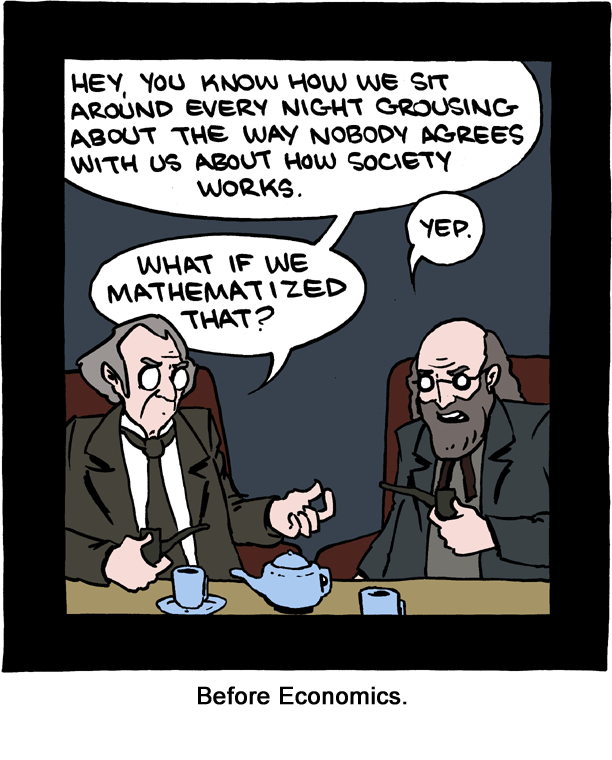
The Financial Times are having a laugh

Related image

I’m doing a little light reading about behavioural economics for my next article.  After following what was clearly a broken link, I had to laugh at this irregular 404 page error notification from the Financial Times:

The page you are trying to access does not exist.

Why wasn’t this page found?

We asked some leading economists.

Stagflation 
The cost of pages rose drastically, while the page production rate slowed down.

General economics
There was no market for it.

Liquidity traps
We injected some extra money into the technology team but there was little or no interest so they simply kept it, thus failing to stimulate the page economy.

Pareto inefficiency
There exists another page that will make everyone better off without making anyone worse off.

Supply and demand 
Demand increased and a shortage occurred.

Classical economics
There is no such page. We are not going to interfere.

Keynesian economics
Aggregate demand for this page did not necessarily equal the productive capacity of the website.

Malthusianism 
Unchecked, exponential page growth outstripped the pixel supply. There was a catastrophe, and now the population is at a lower, more sustainable level.

Neo-Malthusianism 
To avoid unchecked, exponential page growth outstripping the pixel supply and leading to an inevitable catastrophe, we prevented this page from being conceived.

Marxism 
The failure of this page to load is a consequence of the inherent contradictions in the capitalist mode of production.

Laissez Faire Capitalism
We know this page is needed, but we can’t force anyone to make it.

Monetarism 
The government has limited the number of pages in circulation.

Efficient Markets Hypothesis 
If you had paid enough for the page, it would have appeared.

Moral Hazard 
Showing you this page would only encourage you to want more pages.

Tragedy of the Commons 
Everyone wanted to view this page, but no-one was willing to maintain it.

Game theory 
By not viewing this page you help everyone else get better pages.

Mercantilism 
The page is hosted by a foreign web server and is therefore banned to ensure the supremacy of our own software.

Trickle-down
High taxes on content publishers prevented them hiring the person who would have written this page.

Speculative bubble
The page never actually existed and was fundamentally impossible, but everyone bought into it in a frenzy and it’s all now ending in tears.

Socialism
If you were to get the page you wanted you might get a better page than someone else, which would be unfair. This way at least everyone gets the same.

Behavioural economics 
The influence of psychological factors caused you to act in a manner that would not be expected of a purely rational actor.

Theory of the second best 
The best outcome was unachievable, so you have arrived here instead.


Related image


I don’t make any money from my work. But you can help by making a donation to help me continue to research and write informative, insightful and independent articles, and to provide support to others. The smallest amount is much appreciated – thank you.

DonatenowButton

From the abstract to the concrete: urban design as a mechanism of behaviour change and social exclusion

Related image

I rarely venture into large retail areas and shopping centres. They make me feel unwell. I’m rather claustrophobic to begin with. I also have lupus, one of my symptoms is a quite extreme photosensitivity. The lighting in these places quite often triggers an attack of vertigo, nausea, incapacitating disorientation, co-ordination difficulties, muscle rigidity, temporary and severe visual distortions and a very severe headache.

However, I visited one recently with a friend, who was doing some last-minute Christmas shopping. He promised we would visit just two shops, and that our visit would be over quickly.

What struck me straight away is how much retail design is now just about revenue-producing. Shopping malls are unforgiving, soulless and unfriendly places. I was reminded of something I read by David Harvey, about the stark reality of shrinking, privatised and devalued public spaces. Neoliberal marketisation has manifested ongoing conflicts over public access to public space, where profiteering reigns supreme.

My experience of a shopping mall was deeply alienating and physically damaging. It brought with it a recognition of how some groups of people are being coerced and physically situated in the world – how citizens think and act is increasingly being determined by ‘choice architecture’ –  which is all-pervasive: it’s situated at a political, economic, cultural, social and material level. Hostile architecture – in all of its forms – is both a historic and contemporary leitmotif of hegemony. 

Architecture, in both the abstract and the concrete, has become a mechanism of asymmetrically changing citizens’ perceptions, senses, choices and behaviours – ultimately it is being used as a means of defining and targeting politically defined others, enforcing social exclusion and imposing an extremely authoritarian regime of social control. 

Citizens targeted by a range of ‘choice architecture’ as a means of fulfiling a neoliberal ‘behavioural change’ agenda (aimed at fulfiling politically defined neoliberal ‘outcomes’) are those who are already profoundly disempowered and, not by coincidence, among the poorest social groups. The phrase choice architecture implies a range of offered options, with the most ‘optimal’ (defined as being in our ‘best interest’) highlighted or being ‘incentivised’ in some way. However, increasingly, choice architecture is being used to limit the choices of those who already experience heavy socioeconomic and political constraints on their available decision-making options. 

The shopping mall made me ill very quickly. Within minutes the repulsive lighting triggered an attack of vertigo, nausea, co-ordination and visual difficulties. I looked for somewhere to sit, only to find that the seating was not designed for actually sitting on. 

Related image

The public seating that’s just a prop.

This radically limited my choices. In order to sit down to recover sufficiently to escape the building, the only option I had was to buy a drink in a cafe, where the seating is rather more comfortable and fulfils its function. I needed to sit down in order to muster myself to head for the exit, situated at the other end of the building. 

At this point it dawned on me that the hostile seating also fulfils its function. In my short visit, I had been ushered through the frightfully cold, clinical and unfriendly building, compelled to make a purchase I didn’t actually want and then pretty much rudely ejected from the building. It wasn’t a public space designed for me. Or for the heavily pregnant woman who also needed to sit for a while. It didn’t accommodate human diversity. It didn’t extend a welcome or comfort to all of its guests. The functions and comforts of the building are arranged to be steeply stratified, reflecting the conditions of our social reality. The only shred of comfort it offered me was conditional on making a purchase.

Image result for defensive architecture seating

When the purpose of public seating isn’t taking the weight off your feet and providing rest.

Urbanomics and the cutting edge of social exclusion: what is ‘defensive architecture’ defending?

Social exclusion exists on multiple levels. The distribution of wealth and power, access to citizenship rights and freedoms, political influence and consideration are a few expressions of inclusion or exclusion. It also exists and operates in time and space – in places. 

Our towns and cities have also increasingly become spaces that communicate to us who ‘belongs’ and who isn’t welcome. From gated communities and the rise of private policing, surveillance and security to retail spaces designed to fulfil pure profiteering over human need, our urban spaces have become extremely anticommunal; they are now places where an exclusive social-spatial order is being defined and enforced. That order reflects and contains the social-economic order.

Retail spaces are places of increasing psychological and sensual manipulation and control. Hostile architecture is designed and installed to protect the private interests of the wealthy, propertied class in upmarket residential areas and to protect the private profiteering interests of the corporate sector in retail complexes.

The very design of our contemporary cities reflects, directs and amplifies political and social prejudices, discrimination and hostility toward marginalised social groups. Hostile architectural forms prevent people from seeking refuge and comfort in public spaces. Places that once reflected human coexistence are being encroached upon, restrictions are placed on access and limits to its commercial usage, demarcating public and private property and permitting an unrestrained commodification of urban spaces and property.

In 2014, widespread public outrage arose when a luxury London apartment building installed anti-homeless spikes to prevent people from sleeping in an alcove near the front door. The spikes, which were later removed following the public outcry, drew public attention to the broader urban phenomenon of hostile architecture.

Anti-homeless spikes in London

Dehumanising ‘defensive architecture’ – ranging from benches in parks and bus stations that you can’t actually sit on, to railings that look like the inside of iron maidens, to metal spikes that shriek ‘this is our private space, go away’ – is transforming urban landscapes into a brutal battleground for the haves and socioeconomically excluded have-nots. The buildings and spaces are designed to convey often subtle messages about who is welcome and who is not.

Hostile architecture is a form of urban design that aims to prevent people from lingering in public spaces. The anti-homeless spikes here, for example, were installed to deter beggars and those sleeping rough.

Hostile architecture is designed and installed to target, frustrate deter and ultimately exclude citizens who fall within ‘unwanted’ demographics.

Although many hostile architecture designs target homeless people, there are also a number of exclusion strategies aimed at deterring congregating young people, many of these are less physical or obvious than impossibly uncomfortable seating, which is primarily designed and installed to prevent homeless people from finding a space to sleep or rest. However, the seating also excludes others who may need to rest more frequently, from sitting comfortably – from pregnant women, nursing mothers with babies and young children to those who are ill, elderly and disabled citizens.

Some businesses play classical music as a deterrent – based on an assumption that young people don’t like it. Other sound-based strategies include the use of high-frequency sonic buzz generators (the ‘mosquito device’meant to be audible only to young people under the age of 25.

Some housing estates in the UK have also installed pink lighting, aimed at highlighting teenage blemishes, and deterring young males, who, it is assumed, regard pink ‘calming’ light as ‘uncool’. There is little data to show how well these remarkably oppressive strategies actually work. Nor is anyone monitoring the potential harm they may cause to people’s health and wellbeing. Furthermore, no-one seems to care about the psychological impact such oppressive strategies have on the targeted demographics –  the intended and unintended consequences for the sighted populations, and those who aren’t being targeted.

                   Blue lighting in public toilets via Unpleasant Design

Blue lighting has been used in public toilets to deter intravenous drug users; the colour allegedly makes it harder for people to locate their veins. It was claimed that public street crime declined in Glasgow, Scotland following the installation of blue street lights, but it’s difficult to attribute this effect to the new lighting. Blue may have calming effects or may simply (in contrast to yellow) create an unusual atmosphere in which people are uncomfortable – actingout or otherwise. So questions remain about causality versus correlation. Again, no-one is monitoring the potential harm that such coercive strategies may cause. Blue light is particularly dangerous for some migraine sufferers and those with immune-related illnesses, for example, and others who are sensitive to flickering light. 

Hostile architecture isn’t a recent phenomenon

Charles Pierre Baudelaire wrote a lot about the transformation of Paris in the 1850s and 1860s. For example, The Eyes of the Poor captures a whole series of themes and social conflicts that accompanied the radical re-design of Paris under Georges-Eugène Haussmann‘s controversial programme of urban planning interventions.

Baron Haussmann was considered an arrogant, autocratic vandal by many, regarded as a sinister man who ripped the historic heart out of Paris, driving his boulevards through the city’s slums to help the French army crush popular uprisings. Republican opponents criticised the brutality of the work. They saw his avenues as imperialist tools to neuter fermenting civil unrest in working-class areas, allowing troops to be rapidly deployed to quell revolt. Haussmann was also accused of social engineering by destroying the economically mixed areas where rich and poor rubbed shoulders, instead creating distinct wealthy arrondissements.

Baudelaire opens the prose by asking his lover if she understands why it is that he suddenly hates her. Throughout the whole day, he says, they had shared their thoughts and feelings in the utmost intimacy, almost as if they were one. And then:

“That evening, feeling a little tired, you wanted to sit down in front of a new cafe forming the corner of a new boulevard still littered with rubbish but that already displayed proudly its unfinished splendors. The cafe was dazzling. Even the gas burned with all the ardor of a debut, and lighted with all its might the blinding whiteness of the walls, the expanse of mirrors, the gold cornices and moldings…..nymphs and goddesses bearing on their heads piles of fruits, pates and game…..all history and all mythology pandering to gluttony.

On the street directly in front of us, a worthy man of about forty, with tired face and greying beard, was standing holding a small boy by the hand and carrying on his arm another little thing, still too weak to walk. He was playing nurse-maid, taking the children for an evening stroll. They were in rags. The three faces were extraordinarily serious, and those six eyes stared fixedly at the new cafe with admiration, equal in degree but differing in kind according to their ages.

The eyes of the father said: “How beautiful it is! How beautiful it is! All the gold of the poor world must have found its way onto those walls.”

The eyes of the little boy: “How beautiful it is! How beautiful it is! But it is a house where only people who are not like us can go.”

As for the baby, he was much too fascinated to express anything but joy – utterly stupid and profound. 

Song writers say that pleasure ennobles the soul and softens the heart. The song was right that evening as far as I was concerned. Not only was I touched by this family of eyes, but I was even a little ashamed of our glasses and decanters, too big for our thirst. I turned my eyes to look into yours, dear love, to read my thoughts in them; and as I plunged my eyes into your eyes, so beautiful and so curiously soft, into those green eyes, home of Caprice and governed by the Moon, you said:

“Those people are insufferable with their great saucer eyes. Can’t you tell the proprietor
to send them away?”

So you see how difficult it is to understand one another, my dear angel, how incommunicable thought is, even between two people in love.”

I like David Harvey‘s observations on this piece. He says “What is so remarkable about this prose poem is not only the way in which it depicts the contested character of public space and the inherent porosity of the boundary between the public and the private (the latter even including a lover’s thoughts provoking a lover’s quarrel), but how it generates a sense of space where ambiguities of proprietorship, of aesthetics, of social relations (class and gender in particular) and the political economy of everyday life collide.”  

The parallels here are concerning the right to occupy a public space, which is contested by the author’s lover who wants someone to assert proprietorship over it and control its uses.

The cafe is not exactly a private space either; it is a space within which a selective public is allowed for commercial and consumption purposes.

There is no safe space – the unrelenting message of hostile architecture

What message do hostile architectural features send out to those they target? Young people are being intentionally excluded from their own communities, for example, leaving them with significantly fewer safe spaces to meet and socialise. At the same time, youth provision has been radically reduced under the Conservative neoliberal austerity programme – youth services were cut by at least £387m from April 2010 to 2016. I know from my own experience as a youth and community worker that there is a positive correlation between inclusive, co-designed, needs-led youth work interventions and significantly lower levels of antisocial behaviour. The message to young people from society is that they don’t belong in public spaces and communities. Young people nowadays should be neither seen nor heard.

It seems that the creation of hostile environments – operating simultaneously at a physical, behavioural, cognitive, emotional, psychological and subliminal level – is being used to replace public services – traditional support mechanisms and provisions – in order to cut public spending and pander to the neoliberal ideal of austerity and ‘rolling back the state’. 

It also serves to normalise prejudice, discrimination and exclusion that is political- in its origin. Neoliberalism fosters prejudice, discrimination and it seems it is incompatible with basic humanism, human rights, inclusion and democracy.

The government are no longer investing in more appropriate, sustainable and humane responses to the social problems created by ideologically-driven decision-making, anti-public policies and subsequently arising structural inequalities – the direct result of a totalising neoliberal socioeconomic organisation.

For example, homeless people and increasingly disenfranchised and alienated young people would benefit from the traditional provision of shelters, safe spaces, support and public services. Instead both groups are being driven from the formerly safe urban enclaves they inhabited into socioeconomic wastelands and exclaves – places of exile that hide them from public visibility and place further distance between them and wider society. 

Homelessness, poverty, inequality, disempowerment and alienation continue but those affected are being exiled to publicly invisible spaces so that these processes do not disturb the activities and comfort of urban consumers or offend the sensibilities of the corporate sector and property owners. After all, nothing is more important that profit. Least of all human need.

Homelessness as political, economic and public exile

Last year, when interviewed by the national homelessness charity Crisis, rough sleepers reported being brutally hosed with water by security guards to make them move on, and an increase in the use of other ‘deterrent’ measures. More than 450 people were surveyed in homelessness services across England and Wales. 6 in 10 reported an increase over the past year in ‘defensive architecture’ to keep homeless people away, making sitting or lying down impossible – including hostile spikes and railings, curved or segregated, deliberately uncomfortable benches and gated doorways.

Others said they had experienced deliberate ‘noise pollution’, such as loud music or recorded birdsong and traffic sounds, making it hard or impossible to sleep. Almost two-thirds of respondents said there had been an increase in the number of wardens and security guards in public spaces, who were regularly moving people on in the middle of the night, sometimes by washing down spaces where people were attempting to rest or sleep. Others reported noise being played over loudspeakers in tunnels and outside buildings.

Crisis chief executive Jon Sparkes said he had been shocked by the findings. He said: “It’s dehumanising people. If people have chosen the safest, driest spot they can find, your moving them along is making life more dangerous. 

“The rise of hostile measures is a sad indictment of how we treat the most vulnerable in our society. Having to sleep rough is devastating enough, and we need to acknowledge that homelessness is rising and work together to end it. We should be helping people off the streets to rebuild their lives – not just hurting them or throwing water on them.”

‘Defensive architecture’ is a violent gesture and a symbol of a profound social and cultural unkindness. It is considered, calculated, designed, approved, funded and installed with the intention to dehumanise and to communicate exclusion. It reveals how a corporate oligarchy has prioritised a hardened, superficial style and profit motive over human need, diversity, complexity and inclusion. 

Hostile architecture is covert in its capacity to exclude – designed so that those deemed ‘legitimate’ users of urban public space may enjoy a seemingly open, comfortable and inclusive urban environment, uninterrupted by the sight of the casualities of the same socioeconomic system that they derive benefit from. Superficially, dysfunctional benches and spikes appear as an ‘arty’ type of urban design. Visible surveillance technologies make people feel safe.

It’s not a society that everyone experiences in the same way, nor one which everyone feels comfortable and safe in, however.

Hidden from public view, dismissed from political consideration

Earlier this month, Britain’s statistics watchdog said it is considering an investigation into comments made by Theresa May following complaints that they misrepresented the extent of homelessness and misled parliament.

The UK Statistics Authority (UKSA) confirmed that concerns had been raised after the prime minister tried to claim in Parliament that ‘statutory homelessness peaked under the Labour government and is down by over 50 per cent since then.’ Official figures show that the number of households in temporary accommodation stood at 79,190 at the end of September, up 65% on the low of 48,010 in December 2010. Liberal Democrat peer Olly Grender, who made the complaint, also raised concerns last year about the government’s use of the same statistics.

Grender said: “It seems particularly worrying, as we learn today of the increase in homelessness, that this government is still using spin rather than understanding and solving the problem.”

Baroness Grender’s previous complaint prompted UKSA to rebuke the Department for Communities and Local Government. The department claimed homelessness had halved since 2003 but glossed over the fact this referred only to those who met the narrow definition of statutory homelessness, while the overall number of homeless people had not dropped. 

May was accused of callousness when Labour MP Rosena Allin-Khan recently raised questions about homelessness and the rise in food bank use. The prime minister responded, saying that families who qualified as homeless had the right to be found a bed for the night. She said: “Anybody hearing that will assume that what that means is that 2,500 children will be sleeping on our streets. It does not.

“It is important that we are clear about this for all those who hear these questions because, as we all know, families with children who are accepted as homeless will be provided with accommodation.”

Finger wagging authoritarian Theresa May tells us that children in temporary accommodation are not waking up on the streets.

However, Matthew Downie, the director of policy at the Crisis charity for homeless people, said: “The issue we’ve got at the moment is that it’s just taking such a long time for people who are accepted as homeless to get into proper, stable, decent accommodation. And that’s because local councils are struggling so much to access that accommodation in the overheated, broken housing market we’ve got, and with housing benefit rates being nowhere near the market rents that they need to pay.”

He said that while May highlighted a decline in what is categorised as ‘statutory homelessness’, rough sleeping had increased by 130% since 2010.

The category of ‘statutory homelssness’ has also been redefined to include fewer people who qualify for housing support.

Last year, May surprisingly unveiled a £40 million package designed to ‘prevent’ homelessness by intervening to help individuals and families before they end up on the streets. It was claimed that the ‘shift’ in government policy will move the focus away from dealing with the consequences of homelessness and place prevention ‘at the heart’ of the government’s approach. 

Writing in the Big Issue magazine – sold by homeless people – May said: “We know there is no single cause of homelessness and those at risk can often suffer from complex issues such as domestic abuse, addiction, mental health issues or redundancy.”

However, there are a few causes that the prime minister seems to have overlooked, amid the Conservative ritualistic chanting about ‘personal responsibility’ and a ‘culture of entitlement’, which always reflects assumptions and prejudices about the causal factors of social and economic problems. It’s politically expedient to blame the victims and not the perpetrators, these days. It’s also another symptom of failing neoliberal policies.

It’s a curious fact that wealthy people also experience ‘complex issues’ such as addiction, mental health problems and domestic abuse, but they don’t tend to experience homelessness and poverty as a result. The government seems to have completely overlooked the correlation between rising inequality and austerity, and increasing poverty and homelessness – which are direct consequences of political decision-making. Furthermore, a deregulated private sector has meant that rising rents have made tenancies increasingly precarious.

Last year, ludicrously, the Government backed new law to prevent people made homeless through government policy from becoming homeless. The aim is to ‘support’ people by ‘behavioural change’ policies, rather than by supporting people in material hardship – absolute poverty – who are unable to meet their basic survival needs because of the government’s regressive attitude and traditional prejudices about the causes of poverty and the impact of austerity cuts.

Welfare ‘reforms’, such as the increased and extended use of sanctions, the bedroom tax, council tax reduction, benefit caps and the cuts implemented by stealth through Universal Credit have all contributed to a significant rise in repossession actions by social landlords in a trend expected to continue to rise as arrears increase and temporary financial support shrinks.

Housing benefit cuts have played a large part in many cases of homelessness caused by landlords ending a private rental tenancy, and made it harder for those who lost their home to be rehoused.

The most recent National Audit Office (NAO) report on homelessness says, in summary:

  •  88,410 homeless households applied for homelessness assistance
    during 2016-17 
  • 105,240 households were threatened with homelessness and helped to remain in their own home by local authorities during 2016-17 (increase of 63%
    since 2009-10) 
  • 4,134 rough sleepers counted and estimated on a single night in autumn
    2016 (increase of 134% since autumn 2010)
  • Threefold approximate increase in the number of households recorded
    as homeless following the end of an assured shorthold tenancy
    since 2010-11
  • 21,950 households were placed in temporary accommodation outside the local
    authority that recorded them as homeless at March 2017 (increase
    of 248% since March 2011)
  • The end of an assured shorthold tenancy is the defining characteristic of the increase in homelessness that has occurred since 2010

Among the recommendations the NAO report authors make is this one: The government, led by the Department [for Housing] and the Department for Work and Pensions, should develop a much better understanding of the interactions between local housing markets and welfare reform in order to evaluate fully the causes of homelessness.

Record high numbers of families are becoming homeless after being evicted by private landlords and finding themselves unable to afford a suitable alternative place to live, government figures from last year have also shown. Not that empirical evidence seems to matter to the Government, who prefer a purely ideological approach to policy, rather than an evidence-based one. 

The NAO point out that Conservative ministers have not evaluated the effect of their own welfare ‘reforms’  (a euphemism for cuts) on homelessness, nor the effect of own initiatives in this area. Although local councils are required to have a homelessness strategy, it isn’t monitored. There is no published cross-government strategy to deal with homelessness whatsoever. 

Ministers have no basic understanding on the causes or costs of rising homelessness, and have shown no inclination to grasp how the problem has been fuelled in part by housing benefit cuts, the NAO says. It concludes that the government’s attempts to address homelessness since 2011 have failed to deliver value for money.

More than 4,000 people were sleeping rough in 2016, according to the report, an increase of 134% since 2010. There were 77,000 households – including 120,000 children – housed in temporary accommodation in March 2017, up from 49,000 in 2011 and costing £845m a year in housing benefit. 

Homelessness has grown most sharply among households renting privately who struggle to afford to live in expensive areas such as London and the south-east, the NAO found. Private rents in the capital have risen by 24% since the start of the decade, while average earnings have increased by just 3%.

Cuts to local housing allowance (LHA) – a benefit intended to help tenants meet the cost of private rents – have also contributed to the crisis, the report says. LHA support has fallen behind rent levels in many areas, forcing tenants to cover an average rent shortfall of £50 a week in London and £26 a week elsewhere.  This is at the same time that the cost of living has been rising more generally, while both in-work and out-of-work welfare support has been cut. It no longer provides sufficient safety net support to meet people’s basic needs for fuel, food and shelter. 

It was assumed when welfare amounts were originally calculated that people would not be expected to pay rates/council tax and rent. However, this is no longer the case. People are now expected to use money that is allocated for food and fuel to pay a shortfall in housing support, and meet the additional costs of council tax, bedroom tax and so on. 

Local authority attempts to manage the homelessness crisis have been considerably constrained by a shrinking stock of affordable council and housing association homes, coupled with a lack of affordable new properties. London councils have been reduced to offering increasingly reluctant landlords £4,000 to persuade them to offer a tenancy to homeless families on benefits.

Housing shortages in high-rent areas mean that a third of homeless households are placed in temporary housing outside of their home borough, the NAO said. This damages community and family ties, disrupts support networks, isolates families and disrupts children and you people’s education.

London councils are buying up homes in cheaper boroughs outside of the capital to house homeless families, in turn exacerbating the housing crisis in those areas. 

Polly Neate, the chief executive of the housing charity Shelter, said: “The NAO has found what Shelter sees every day, that for many families our housing market is a daily nightmare of rising costs and falling benefits which is leading to nothing less than a national crisis.”

Matt Downie, the director of policy and external affairs at Crisis, said: “The NAO demonstrates that while some parts of government are actively driving the problem, other parts are left to pick up the pieces, causing misery for thousands more people as they slip into homelessness.”

Meg Hillier MP, the chair of the Commons public accounts committee, said the NAO had highlighted a ‘national scandal’. “This reports illustrates the very real human cost of the government’s failure to ensure people have access to affordable housing,” she added. 

More than 9,000 people are sleeping rough on the streets and more than 78,000 households, including 120,000 children, are homeless and living in temporary accommodation, often of a poor standard, according to the Commons public accounts committee.

The Committee say in a report that the attitude of the Department for Communities and Local Government (DCLG) to reducing homelessness has been ‘unacceptably complacent’.

John Healey, the shadow housing secretary, said: “This damning cross-party report shows that the Conservatives have caused the crisis of rapidly rising homelessness but have no plan to fix it.

“This Christmas the increase in homelessness is visible in almost every town and city in the country, but today’s report confirms ministers lack both an understanding of the problem and any urgency in finding solutions.

“After an unprecedented decline in homelessness under Labour, Conservative policy decisions are directly responsible for rising homelessness. You can’t help the homeless without the homes, and ministers have driven new social rented homes to the lowest level on record.”

Surely it’s a reasonable and fundamental expectation of citizens that a government in a democratic, civilised and wealthy society ensures that the population can meet their basic survival needs. 

The fact that absolute poverty and destitution exist in a wealthy, developed and democratic nation is shamefully offensive. However, Conservatives tend to be outraged by poor people themselves, rather than by their own political choices and the design of socioeconomic processes that created inequality and poverty. The government’s response to the adverse consequences of neoliberalism is increasingly despotic and authoritarian.

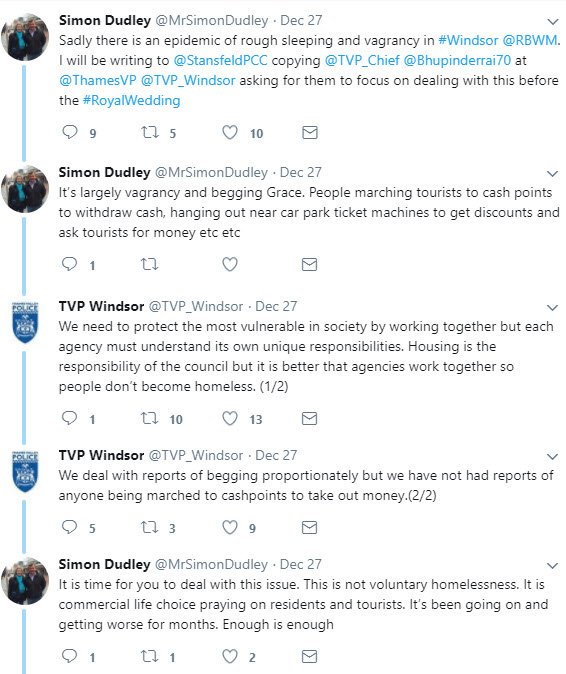
The comments below from Simon Dudley, the Conservative Leader of the Maidenhead Riverside Council and ironically, a director of a Government agency that supports house building, (Homes and Community Agency (HCA)) reflect a fairly standardised, authoritarian, dehumanising Conservative attitude towards homelessness.

Note the stigmatising language use – likening homelessness and poverty to disease – an epidemic. Dudley’s underpinning prejudice is very evident in the comment that homelessness is a commercial lifestyle choice, and the demand that the police ‘deal’ with it highlights his knee-jerk authoritarian response:

Dudley uses the word ‘vagrancy’, which implies that it is the condition and characteristics of homeless people who causes homelessness, rather than social, political and economic conditions, such as inequality, low wages, austerity and punitive welfare policies. The first major vagrancy law was passed in 1349 to increase the national workforce and impose social control following the Black Death, by making ‘idleness’ (unemployment) and moving to other areas for higher wages an offence. The establishment has a long tradition of punishing those who are, for whatever reason, economically ‘inactive’: who aren’t contributing to the private wealth accumulation of others.

The Vagrancy Act of 1824 is an Act of Parliament that made it an offence to sleep rough or beg. Anyone in England and Wales found to be homeless or begging subsistence money can be arrested. Though amended several times, certain sections of the original 1824 Vagrancy Act remain in force in England and Wales. It’s main aim was removing undesirables from public view. The act assumed that homelessness was due to idleness and therefore deliberate, and made it a criminal offence to engage in behaviours associated with extreme poverty. 

The language that Dudley uses speaks volumes about his prejudiced and regressive view of homelessness and poverty. And his scorn for democracy.

The 1977 Housing (Homeless Persons) Act restricted the homeless housing requirements so that only individuals who were affected by natural disasters could receive housing accommodation from the local authorities. This was partly due to well-organised opposition from district councils and Conservative MPs, who managed to amend
the Bill considerably in its passage through Parliament, resulting in the rejection of many  homeless applications received by the local government because of strict qualifying criteria.

For the first time, the 1977 Act gave local authorities the legal duty to house homeless people in ‘priority’ need, and to provide advice and assistance to those who did not qualify as having a priority need. However, the Act also made it difficult for homeless individuals without children to receive accommodations provided by local authorities, by reducing the categories and definitions of ‘priority need’. 

Use of the law that criminalises homeless people may generally include:

  • Restricting the public areas in which sitting or sleeping are allowed.
  • Removing the homeless from particular areas.
  • Prohibiting begging.
  • Selective enforcement of laws.

Murphy James, manager of the Windsor Homeless Project, branded Cllr Dudley’s comments ‘disgusting’ and described the Southall accommodation offered by the Royal Borough of Windsor & Maidenhead as ‘rat infested’. 

He said: “It shows he hasn’t got a clue. He has quite obviously never walked even an inch in their shoes.

“It is absolutely disgusting he is putting out such an opinion that it is a commercial life choice.”

James added the royal wedding should not be the only reason for helping people on the streets.

“I am a royalist but it should have zero to do with the royal wedding,” he said.

“Nobody in this country should be on the streets.” 

Dudley should pay more attention to national trends instead of attempting to blame homeless people for the consequences of government policies, as many in work are also experiencing destitution.

This short film challenges the stereoytypes that Dudley presents. This is 21st century Britain. But still there are people without homes, still people living rough on the streets, including some who are in work, even some doing vital jobs in the public sector, low paid and increasingly struggling to keep a roof over their heads. Central government doesn’t keep statistics on the ‘working homeless’. But we do know that overall the number of homeless people is once again on the rise.

Meanwhile, figures obtained via a Freedom of Information request by the Liberal Democrats from 234 councils show almost 45,000 people aged 18-24 have come forward in past year for help with homelessness. With more than 100 local authorities not providing information, the real statistic could well be above 70,000.

As Polly Toynbee says: “Food banks and rough sleeping are now the public face of this Tory era, that will end as changing public attitudes show rising concern at so much deliberately induced destitution.”

While the inglorious powers that be spout meaningless, incoherent and reactionary authoritarian bile, citizens are dying as a direct consequence of meaningless, incoherent and reactionary Conservative policies.


I don’t make any money from my work. I am disabled because of illness and have a very limited income. But you can help by making a donation to help me continue to research and write informative, insightful and independent articles, and to provide support to others. The smallest amount is much appreciated – thank you.

DonatenowButton

The self-declared ‘most transparent government in history’ is editing history

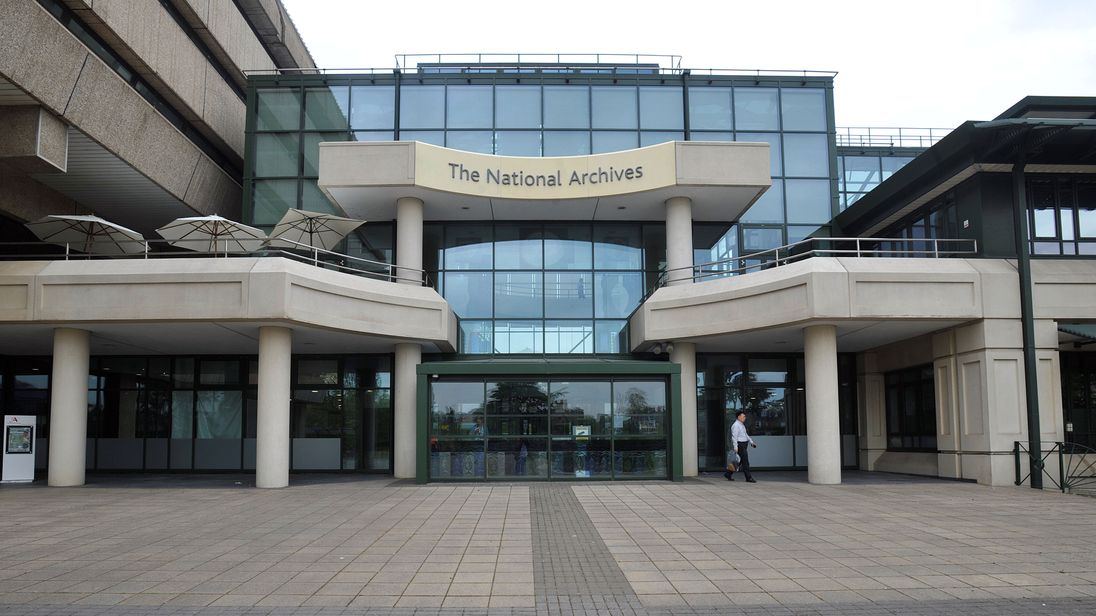
A general view of the main entrance of the National Archives in Kew, London

In 2013, The Guardian revealed that Britain’s Foreign and Commonwealth Office (FCO) had illegally withheld 1.2 million (later revised to 600,000) historic documents from the public, in flagrant breach of the UK Public Records Act. The documents – which include the desk diary of Soviet spy Donald Maclean; case files from Nazi persecution compensation claims; and masses of material removed from Hong Kong – were being held at Hanslope Parka secret, high-security compound in Buckinghamshire that the FCO shares with intelligence agencies MI5 and MI6.

Now documents concerning the Falklands war, Northern Ireland’s ‘Troubles’ and the infamous Zinoviev letter – in which MI6 officers plotted to bring about the downfall of the first Labour government – are all said to have been ‘misplaced’, too.

The Conservatives do like their purges. Back in 2013, they travelled beyond the acceptable into an Orwellian realm and wiped a decade of speeches from the internet, rewriting their own history.

It seems an entire file on the Zinoviev letter scandal is claimed to have been ‘lost’ after Home Office civil servants ‘took it away’. The Home Office declined to say why it was taken or when or how it was lost. Nor would it say whether any copies had been made.

Not to worry, though. In 2015 I made a copy of the Zinoviev letter in full, here, while I was researching it for an article.

Other missing files include those concerning the controversial British colonial administration in Palestine, tests on polio vaccines and long-running territorial disputes between the UK and Argentina.

Almost 1,000 files, each thought to contain dozens of papers, are claimed to be ‘lost’. In most cases, the entire file is said to have been ‘mislaid’ after being removed from public view at the archives and taken back to Whitehall. 

In other cases, papers from within files have been carefully selected and taken away.  

For example, Foreign Office officials removed a few papers in 2015 from a file concerning the 1978 murder of Georgi Markov, a dissident Bulgarian journalist who died after being shot in the leg with a tiny pellet containing ricin while crossing Waterloo Bridge in central London. The Foreign Office subsequently told the National Archives that the papers taken were nowhere to be found. 

After being questioned by the Guardian, Foreign Office said it had managed to locate most of the papers and return them to the archives. A couple, however, are still missing. The Foreign Office declined to say why it had taken the papers, or whether it had copies. 

Other files the National Archives has listed as ‘misplaced while on loan to government department’ include one concerning the activities of the Communist party of Great Britain at the height of the cold war; another detailing the way in which the British government took possession of Russian government funds held in British banks after the 1917 revolution; an assessment for government ministers on the security situation in Northern Ireland in the early 1970s; and three files about defence agreements between the UK and newly independent Malaya in the late 1950s, shortly before the two countries went to war with Indonesia. 

The disappearances of these documents highlights the ease with which government departments can commandeer official papers long after they have been declassified and made available to historians and the public at the archives at Kew, south-west London. 

A Freedom of Information Act request in 2014 showed that 9,308 files were returned to government departments in this way in 2011. The following year 7,122 files were loaned out, and 7,468 in 2013. The National Archives says Whitehall departments are strongly encouraged to promptly return them, but apparently, they are not under any obligation to do so. 

A spokesperson said “The National Archives regularly sends lists to government departments of files that they have out on loan. If we are notified that a file is missing, we do ask what actions have been done and what action is being taken to find the file.” 

Some historians have been particularly distrustful of the Foreign Office since 2013, following the Guardian disclosure that the department had been unlawfully hoarding 1.2m historical files at the high-security compound near Milton Keynes in Buckinghamshire. 

The hoard came to light during high court proceedings brought by a group of elderly Kenyans who were detained and abused during the Mau Mau insurgency in 1950s Kenya, when the Foreign Office admitted it had withheld thousands of colonial-era files. 

A few years earlier, the Ministry of Defence refused to consider a number of files for release under the Freedom of Information Act on the grounds that they ‘may have been exposed to asbestos’. 

The files concerned such matters as arms sales to Saudi Arabia, UK special forces operations against Indonesia and interrogation techniques. The Ministry of Defense denied it was using the presence of asbestos in an old archive building as an excuse to suppress the documents. 

Dr Tristram Hunt MP, the historian and MP who sits on the all–party Parliamentary group on archives and history, said: “To have areas of the national memory erased like this is worrying.” He plans to table written questions to Lord McNally, the Justice Minister with responsibility for The National Archives, to ask about the documents. 

He said: “I’m hopeful it’s a temporary aberration. These things do get lost and come back to life.

“History is an asset in this country. It’s a natural resource, like oil. We have a lot of it and we need to take care of it.” 

Shadow Cabinet Office Minister Jon Trickett said: “The ‘loss’ of documents about controversial periods in history is unacceptable. 

“The British people deserve to know what the Government has done in their name and their loss will only fuel accusations of a cover up. 

“These important historical documents may be a great loss to history – and their disappearance must urgently be investigated.” 

With a straight face, a Government spokesman said: “This is the most transparent Government in history and we are committed to making public as many records as possible, while balancing the need to protect the small amount of information that remains sensitive.

“Last year 95 per cent of government records that were transferred to the National Archives were made public and since 2013 the Government has doubled the amount of material it reviews and releases each year, as we honour our commitment of releasing documents after 20 years.” 

However, the record number of files withheld from release to the National Archives, along with those apparently ‘disappeared’ ought to raise serious concerns about the government’s approach to democratic accountability and transparency. 


I don’t make any money from my work. I am disabled because of illness and have a very limited income. However you can help by making a donation to help me continue to research and write informative, insightful and independent articles, and to provide support to others. The smallest amount is much appreciated – thank you.


DonatenowButton

The anti-social public relations of the PR industry


In the UK, we have a Government that are scandalised and outraged by any criticism whatsoever. Ministers refuse to analyse, reflect and act on legitimate negative appraisal; they prefer instead to adopt outrage, and portray any opposition at all as somehow pathological. However, opposition and critical scrutiny are essential elements of a fully functioning democracy. 

When a Government dismiss any criticism or challenge from academics, charities, social organisations, campaigners and ordinary citizens as ‘scaremongering’, when any and every amount of empirical evidence that their policies cause deep distress and harm to people is declined as merely ‘anecdotal’ and when attempts at rational and democratic debate are simply brushed aside or labelled in a derogatory fashion as ‘marxism’ , it can’t possibly end well for the UK. These are all the trademarks of an authoritarian government teetering on the brink of totalitarianism

Critical narratives that expose the fatal flaws in the governments’ administration of policies, founded on a pernicious and totalising neoliberal ideology, are being effectively stifled or censored. 

One of the key methods being used is a basic ad hominem approach, which consists of attempts to discredit those presenting the Government with critical analysis, democratic feedback and evidence that challenges the governments’ claims. It’s an argumentative strategy (as opposed to a debating strategy) that entails a legitimate criticism or proposition being rebutted and attention being diverted by an attack on the character, motive, or some other attribute of the person presenting the criticism, or persons associated with the criticism, rather than addressing the substance of the criticism itself.

Ad hominem is a fallacious technique of reasoning that may be better understood as a perversion or corruption of perfectly rational debate and this forecloses on the possibility of democratic, rational, meaningful, intelligent and constructive political discourse.

One particular variant of ad hominem is exemplified in the ‘poisoning the well’ tactic that Conservatives use by ridiculously accusing many of their critics of being ‘Marxists’, members of the ‘hard left’ or Momentum, or simply just ‘scaremongers’. Another is a “shoot the messenger”approach. This is just one kind of oppressive method among several that are being used to neutralise alternative narratives and repress a healthy political pluralism – which of course is essential to democracy. 

It isn’t only the ‘business friendly’ neoliberal government engaging in these kind of tactics. It’s something of an irony that Hayek argued against government planning and regulation, claiming that by crushing competitive individualism, it would lead inexorably to totalitarian control. Yet neoliberalism has reduced democracy to spectacle.  

When neoliberals mention ‘the market’ – which they see as a kind of idealised theatre for allocating rewards for competitive profit-seeking behaviours and punishments for citizens’ ‘bad choices’ (mostly in that they are simply poor) – what they tend to mean is simply a situation where corporations and those in positions of power get what they want. ‘The free market’ is a euphemism for rampant capitalism – another narrative given the PR touch. Austerity has become ‘living within our means’ and ‘reducing the deficit’. However, austerity is a central strategy of neoliberal ideology. 

As the state extends deregulation and increases freedoms that permit corporations to profit without constraint, limitation and the safeguards required to protect the environment and citizens, it also needs to re-regulate citizens, limiting their freedoms, micromanaging their perceptions and behaviours to fit with neoliberal outcomes and a shifting power structure.

The changing neoliberal economy has required changing politics and society, reflecting shifts in discourse, ethics, norms, beliefs, behaviours, perceptions and power relationships. It has required the re-alignment of citizens’ identities with neoliberal goals. However, those goals serve the interests of very few people.

The recent political emphasis on psychoregulation – expressed through the ‘behavioural change’ agenda of libertarian paternalism, for example, which is being embedded in public policy – is aimed at either enforcing citizen compliance or socioeconomic exclusion, if they resist.

At the same time, neoliberalism has permitted a few very wealthy and powerful people to rewrite rules, laws, social norms, economic processes, ethics and to place themselves pretty much beyond public visibility, democratic transparency and moral accountability. 

Technotyranny and psychoregulation

John Stauber and Sheldon Rampton wrote in their 1995 book Toxic Sludge Is Good for You!: “Movements for social and political reform have often become targets of surveillance. […] The public relations industry has developed a lucrative side business scrutinizing the thoughts and actions of citizen activists, using paid spies who are often recruited from government, military or private security backgrounds.”

Last week’s revelations from the Bureau of investigative Journalists and the Guardian show just how much that these underhanded tactics are very much in use today. They don’t just impact and damage the groups being infiltrated. By privileging corporate interests, effectively giving them the first and last word on public issues, they distort vital public debates and profoundly damage our democracy.

The leaked documents that the Guardian and Bureau revealed suggest the use of secretive corporate security firms to gather intelligence about political campaigners has been widespread. However, police chiefs have in the past raised a ‘massive concern’ that the activities of the corporate companies are barely regulated and completely uncontrolled. The police have claimed that commercial firms have had more spies embedded in political groups than there were undercover police officers.

The revelations are based on hundreds of pages of leaked documents from two corporate intelligence firms, that reveal the inner workings of a normally subterranean industry over several years in the 2000s. Major firms are hiring people from security firms to monitor and infiltrate political groups that object to their commercial activities. The security firms are spying on law-abiding campaigners and impeding their democratic rights. The spies are known to surreptitiously foster conflicts within campaigns, to set activists against each other, in order to wear them down and ‘disenchant’ them, so they lose their political motivation. “People get tired of it, that’s their weakness,” one person told the Guardian. He worked for a corporate espionage company.

These are the sort of tactics that are also being used to intimidate some individual commentators. 

Depersonalising the personal

I wrote an article recently, which was published by Welfare Weekly, about the Work and Pensions Committee inquiry into Personal Independence Payment (PIP) and Employment and Support Allowance (ESA) assessments. Someone called Lindsay McGarvie, who claimed to be a ‘representative of Atos’, contacted Steven Preece, the editor of Welfare Weekly, asking him to get me to phone him as a matter of ‘high importance’ to have a ‘quick chat’ about a ‘couple of points’ in my article that are ‘inaccurate’. 

It turns that out the ‘representative of Atos’ is actually the director of Atos’s Public Relations (PR) company, called called 3X1. According to his LinkedIn profile,  McGarvie’s specialisms include:

Strategic public affairs counsel
– Reputation management
– Devising and implementing proactive PR and public affairs campaigns
– Media Training
– Digital communications

McGarvie also had directorship of Bread Public Relations Limited, which delivered: “media, marketing, and employee engagement campaigns for public and investor relations. The company specializes in generating third party endorsements by getting the right people to say the right thing, at the right time, and to enhance business strategy. Its activities include media relations, reports, crisis communications, employee engagement, and media training.

The company was founded in 2009 and was based in Aberdeen, United Kingdom. As of September 21, 2015, Bread Public Relations Limited has operated as a subsidiary of 3×1 Limited.

By coincidence someone has also very recently ‘reported’ me to the Department for Work and Pensions, claiming that I am ‘working and being paid as a writer’ and that I am ‘not really disabled’, and ‘faking my illness’. Curious, that.

Over the last few years, I’ve encountered a small group of people who campaigned to discredit my work online, even claiming I was a ‘snout for the establishment’ on one occasion. Bullies often project their own issues onto their target. Some of the lies and smears I saw posted in groups about me were pretty outrageous. From ‘She voted UKIP’ and ‘Sadiq Khan employs her to spread anti-Green propaganda’ to ‘She has over 500 fake online identities’ and ‘She’s a bully and attacked some charity workers’. Most of the attacks were ad hominem. They also had a distinctive psy-ops character. 

This same group have also systematically bullied people for sharing my articles, and  for simply being a friend of mine on Facebook. Sadly a few of those people stopped coming on social media because of how thoroughly unpleasant and intimidating these experiences were at the time. 

The group of perpetrators are people who claim to be left wing campaigners, too. However I strongly suspect that at least some of them aren’t who they say they are. Their ad homimen approach doesn’t tally with their declared ‘socialist’ values and principles.

They ran a malicious smear campaign for quite a stretch of time, and occasionally, people tell me they’re still at it. I just block them now, and when a new account springs up making the same kind of attacks, using the same comments and outrageous lies, I keep blocking, because these are not people who are up for any kind of rational debate. They don’t play nicely at all. 

Just to clarify, Atos have already judged me as disabled on two occasions recently, in addition to my GP, 3 rheumatology consultants, a neurologist, a pulmonary specialist, a physiotherapist and 2 occupational therapists – one from the council, one that my GP sent out to my home.

I don’t get paid for writing articles, including those I contribute to Welfare Weekly. I don’t get paid for my research either. If I did, I would be permitted to earn a certain amount anyway. But I don’t. Having a voluntary donation button on my site doesn’t equal earning a salary. Nor does my writing somehow indicate I am faking my illness. I don’t think disabled people are prohibited from reading, having opinions or sharing them via social media. Not yet, anyway. 

I believe that the timing of the bogus complaint to the DWP was most likely calculated carefully by someone to coincide with Christmas – to cause as much misery and untimely financial hardship as possible. 

I don’t know who made the complaint. It can’t have been done by anyone who actually knows me. But I’ve no doubt that this was a malicious act.

However, it won’t stop me writing any time soon.

I appreciate that the ‘complaint’ to the DWP may have been a coincidence. I also understand that the discussion may even sound somewhat paranoid. However, these are not isolated events, and other campaigners and  groups have also been targeted by Atos.

The use of targeted political ‘dark ads‘ – using ‘big data’ harvesting and the identification and manipulation of distinctive ‘psychological profiles’  – and the tactical use of social media as a weapon in political discourse are examples of how social media is being used to create new marketplaces for political and corporate loyalty, providing the opportunity for shills and astroturfers to opt-in (and out) of identities. The increased use of psychological profiling with sophisticated, targeted and manipulative political techniques of persuasion and astroturfing campaigns has also corresponded with a commensurate decline in the standards and ethics of mainstream journalism. 

The private company Cambridge Analytica hit the news earlier this year because its alleged role in manipulating the voting decisions of citizens by using  detailed profiling of the personalities of individual voters to target them, to create large shifts in public opinion. The controversial company is partly owned by the family of Robert Mercer, an American billionaire hedge-fund manager who supports many neoliberal, politically conservative and alt right causes.

Social network media more generally is being used to construct and shape global politics and manage contemporary political conflicts through the conduction of intelligence collection, targeting, cyber-operations, psychological warfare and command and control activities.

Power and persuasion

PR is a persuasion industry. It involves the creation of powerful lobby groups to influence government policy, corporate policy and public opinion, typically in a way that benefits the sponsoring organisation. PR companies often use a ‘thought leadership’ approach, which usually refers to a potentially ‘winning’ strategy for paying customers, based on a notion of authority, rather than on intellectual reasoning, dialogue and rational debate. There’s a lot of talking at the public, rather than with them.

Money talks and bullshit walks. 

Many PR companies offer an ‘expertise’ in ‘behavioural insights’ to businesses, in order to help them ‘win’ and make profit. However, quite often ‘thought leadership’ entails using well-known marketing techniques to achieve the impression of being an erudite and rational presenter and speaker. It’s inane managementspeak and psychobabble that basically means finding ways of managing company reputations, damage limitation and managing public opinion, promoting corporate and/or specific political interests and making profits. In the same way that Behavioural Economics manages the reputation of Conservative/libertarian neoliberalism, promoting political and corporate interests and making fat profits. 

And stifling criticism. Many people quite reasonably associate PR with all things unethical – lying, spin-doctoring, and even espionage. Many critics argue that there can be no ethical public relations because the practice itself is all about manufacturing opinions, manipulation and propaganda. It’s about smoke and mirrors to hide the source of deception. Neoliberalism is toxic and regressive. It can’t offer the public anything whatsoever of value, so the state and corporations – the only beneficiaries of the now totalising imposition of this ideology – have to employ ‘specialists’ to sell it for them.

Selling neoliberalism to the public using techniques of persuasion and political psychoregulation is also very neoliberal, in that it makes fat profits while imposing  and justifying a hegemony of narrow private interests. 

3X1 is not the only PR company regularly accessing my articles. 

Over the last couple of years, my site has been visited using a portal from Edelman Intelligence, which is among the world’s largest PR companies. Either their staff or their clients have been quietly visiting my own humble WordPress site, the link (which I found on my web traffic and stats information page) shows they were referred to my site from Edelman’s own social media monitoring command centre. 

I know this because on my site’s traffic and stats pagereferrers are listed, such as Facebook, Twitter, search engines and so on. You can click on the link provided and it shows you were site visitors have come from.

Despite the fact that the CEO of the ‘largest PR agency in the world’ called for PR professionals to ‘adopt a new set of standards in the wake of the Bell Pottinger scandal’, Edelman have generated a few scandals of their own. 

The ultimate corporate goal is sheer self-interested profit-making, but this will always be dressed up by PR to appear synonymous with the wider, national interest. At the moment, that means a collective chanting of ‘economic growth’, low taxes, ‘freedom’, supply side ‘productivity’, implied trickle down, jobs and ‘personal responsibility’ – all a part of the broader business friendly neoliberal mantra. It’s like encountering Ayn Rand on steroids and in a very ugly mood.

Corporations buy their credibility and utilise seemingly independent people such as academics with a mutual interest to carry their message for them. Some think tanks – especially free-market advocates like Reform or leading neoliberal think tank, the Institute of Economic Affairs – will also provide companies with a lobbying package: a media-friendly report, a Westminster event, meetings with politicians, that sort of thing. The extensive PR industry are paid to brand, market, engineer a following, build trust and credibility and generally sell the practice of managing the spread of information between an individual or an organisation (such as a business, government agency, the media) and the public.

PR is concerned with selling products, persons, governments and policies, corporations, and other institutions. In addition to marketing products, PR has been variously used to attract investments, influence legislation, raise companies’ public profiles, put a positive spin on policies, disasters, undermine citizens campaigns, gain public support for conducting warfare, and to change the public perception of repressive regimes.

Money talks and bullshit walks, all at the right price.

To paraphrase Seamus Milne, there is a revolving door of mutually exclusive political and corporate favour, ceaselessly spinning.
63606308539839586285265400_revolving-door (1).jpg

Our public life and democracy is now profoundly compromised by its colonisation, as corporate and financial power have merged into the state.

Edelman Intelligence and Westbourne, for example, are engaged in rebuttal campaigns and multimedia astroturfing projects to protect corporate interests:

Monitoring of opposition groups is common: one lobbyist from agency Edelman talks of the need for “360-degree monitoring” of the internet, complete with online “listening posts … so they can pick up the first warning signals” of activist activity. “The person making a lot of noise is probably not the influential one, you’ve got to find the influential one,” he says. Rebuttal campaigns are frequently employed: “exhausting, but crucial,” says Westbourne.” From The truth about lobbying: 10 ways big business controls government. 

The blogs (or ‘flogs’) Working Families for Walmart and subsidiary site Paid Critics were written by three employees of Edelman, for whom WalMart is a paid client. Richard Edelman, president and CEO of the PR firm, apologised on his own flog: “I want to acknowledge our error in failing to be transparent about the identity of the two bloggers from the outset. This is 100% our responsibility and our error; not the client’s.”  

Imagine that. Paying big bucks to a PR company, and yet you have no idea what they actually do for your company. 

It’s like a self perpetuating cycle of ever-increasing corruption. Big companies wouldn’t need PR in the first place if they intend to be genuinely transparent and accountable. PR companies are pretty ruthlesness regarding the tactics they use to earn fat profits for themselves, and for their fellow free marketeers. 

The communications industry’s ethics came under scrutiny due to the fall of Bell Pottinger after the London-based firm was accused of conducting a ‘secret misinformation campaign’ on behalf of Oakbay Investments inflaming racial tensions in South Africa. UK-based industry body, the Public Relations and Communications Association (PRCA) banned Bell Pottinger from trading for five years.

Motherboard (Vice) reports, in 2014, that documents obtained by Greenpeace illustrate the extensive, meticulous planning that has gone into at least one of Edelman‘s proposed astroturf campaigns, aimed at helping TransCanada mobilise ‘grassroots’ support for its effort to build a new pipeline that would carry tar sands oil from Alberta to Quebec.

Astroturfing is the increasingly popular tactic used by corporations to sponsor front groups or manufacture the appearance of grassroots support to simulate a genuine social movement that is rallying for goals in line with their profit motive. It’s the manufacturing of ‘consensus’ where none actually exists. In the past, astroturf efforts have used paid actors, company employees, and media-heavy websites. But the programme that Edelman pitches in its own reports goes even deeper.

The documents detailed an in-depth proposal—part sales pitch, part action plan—put together by Edelman‘s Calgary office, suggesting that TransCanada combat environmental groups by mounting one such manufactured “grassroots advocacy” campaign.

Those environmentalists were organising to oppose the Energy East pipeline, which TransCanada hoped would be an alternative to the long-delayed Keystone XL, on the grounds that it would disastrously boost carbon emissions and increase the likelihood of a major oil spill.

Edelman’s plan was specifically designed to “[… ] add layers of difficulty for our opponents, distracting them from their mission and causing them to redirect their resources,” according to the documents.

It stressed developing “supportive third parties, who can in turn put the pressure on, especially when TransCanada can’t.

In other words, the goal would be to attack environmentalists head on with supporters recruited by, but not necessarily directly affiliated with, Edelman and TransCanada

Greenpeace said: “Edelman’s plan involve a ‘seeding strategy,’aimed at getting trusted academics and TV shows to parrot pro-TransCanada propaganda. The plan rounds out it’s immersive assault on key communities using hyperlocal, geotargeted messaging to take over Facebook feeds and local TV programming… Edelman plans on using the astroturf plan to influence media, the public, politicians, and regulatory agencies.” 

With concerns about climate change and activism quite properly on the rise, along with the dire warnings from climate scientists, sophisticated PR campaigns to shut down opposition to fossil fuel and promote climate change denial has become almost a neccessity for companies like TransCanada

The Motherboard article also says that Edelman runs software called the ‘Grassroots Multiplier’ that it claims can ‘convert average citizens’ into pro-oil ‘true champions.’  Now that resonated with me. We know for sure that this company and its clients are spying on campaigners like me. I contacted Edelman earlier this year to ask them why they were interested in visiting my site. I had no response. 

In April 1998 the Los Angeles Times reported that Edelman had drafted a campaign plan to ensure that state attorneys-generals did not join antitrust legal actions against Microsoft. Documents obtained by the Los Angeles Times revealed that the astroturfing plan included generating ‘supportive’ letters to the editor, opinion pieces, and articles by freelance writers. 

USA Today said the plan included “unusual, and some say unethical tactics, including the planting of articles, letters to the editor and opinion pieces to be commissioned by Microsoft’s top media handlers but presented by local firms as spontaneous testimonials.”  

In 2008 Edelman’s work with E.ON, which planned to build a coal power station at Kingsnorth attracted protests at Edelman‘s UK headquarters. In 2009, to coincide with the weeklong ‘Climate Camp’ range of protests, a group of naked protestors occupied Edelman‘s reception, generating much media attention.

Edelman also provided ‘crisis management’ support and communications for Rupert Murdoch and News Corporation during the phone hacking scandal. 

Among the controversial aspects of Edelman’s history is its work for various tobacco companies in the 1970s, ’80s and ’90s. Documents released under the Master Settlement Agreement revealed how the company played a key role in preventing effective legislation against the tobacco industry and manipulating public opinion on tobacco and its adverse effects on health in the US.

Other documents reveal how Edelman assisted transnational tobacco companies “to slow, to stop, to reverse the growing belief that smoking is harmful to the nonsmoker,” encouraging clients to “break out of the tried and true principles of Public Relations – 101 and massage some truly creative ideas.”

As late as the mid-1990s, Edelman was helping Philip Morris fight smoking bans and working to generate positive media coverage for Marlboro’s products. By then the risks of smoking – the health-damaging and life-limiting effects of tobacco – were widely known and scientifically verified several times over.

Other clients of Edelman have included the despotic and repressive government of Saudi Arabia. Mind you, our own government sells arms to the same government.

Cision are another PR company that provide social media ‘monitoring’ and I have had visits to my site from theirs. The company offers three web-based packages: the ‘CisionMarketing Suite’, the ‘Public Relations Suite’ and a ‘Government Relations and Political Action Committee Suite’The Cision ‘Public Relations Suite’ allows users to distribute press releases, access a database of bloggers and journalists, and monitor and analyse news and social media sites. 

The company’s ‘Government Relations Suite’ manages government contacts, analyses lobbying activity, facilitates communication with elected officials and provides PAC compliance software for filing reports to the FEC and state elections commissions (in US). Cision also have a UK base at Canary Wharf, London. They offer a service to businesses that enables business and other actors to “Monitor millions of social media, mainstream news and online news sources, to help you control your story.” 

Ultimately these strategies are all about public ‘knowledge management’ and manipulation.

A listed app called meltwater has also showed up on my stats page more recently. Outside Insight is Meltwater’s Media Intelligence and Social Media Monitoring tool. Their site says: “PR professionals lean on Meltwater’s product suite to help them boost their brand’s position and demonstrate their ROI (Return on Investment).”

Another app that is used to refer people to my site is from the People Pattern Corporation, which is a market research company that say: “While most social marketing tools focus on analyzing conversations about a brand, we know that the most valuable insights come from studying the people behind those conversations.”

I can’t help but wonder what they made of me and my humble, anti-neoliberal, unprepackaged, unsold, unsponsored, unspun, kiss-my-ass-rational, researched and evidenced analysis and commentaries. 

Then there is Falcon IO, also regularly visiting my site, who say: “Managing brand perception in a world of social and online sharing can seem daunting. Social listening is the first step to regaining control.” What strikes me is the complete lack of transparency surrounding the traffic being directed to my site from these PR companies. I can’t access any of the sites via the links in my traffic stats.

This company say they use behavioural insights to manipulate people’s opinion, using social media as a platform.

So do the Government. In 2008 one member of Boris Johnson’s campaign team was caught posting comments on blogs critical of his boss without sufficiently concealing their identity. A few years later, another member of Johnson’s campaign was found posing as a ‘concerned’ Labour supporter trying to prevent Ken Livingstone from being the party’s candidate for mayor. 

As Adam Bienkov says: “Twitter and blogging have given a voice to millions and allowed genuine opposition movements to take their case to the masses. Censorship of these movements has not always proved effective, with only authoritarian governments possessing the means and the will to implement it. For big business and less repressive governments, the alternative of simply crowding out your opposition online must seem a far more attractive prospect.”

It’s a lucrative business too. On Facebook, it’s commonplace for people with community pages to get a notification asking you to ‘boost’ your posts for a sum of money. This increases the reach of the post – more people see it. This means that those who can afford to pay the most to Facebook have the most prominent positions in newsfeeds, the biggest audiences and potentially, the greatest influence on opinion, as it simply crowds out alternative perspectives.

Even our views and beliefs are being subjected to market forces, as social media platforms are increasingly neoliberalised and thus become increasingly undemocratised. 

Attempts to manipulate the media and public opinion are on the rise – spurred on in part by the repressive political mood in the UK and the growing reach of the internet.

Green plastering the internet

Astroturfing has become a powerful and efficient public opinion management strategy for many organisations, and also for the state. Pre-written letters to an editor have turned into opinion-spamming and fake online reviews. The internet has offered a broad arena to practise astroturfing. It’s an irony that the agriculture world’s prince of darkness. Monsanto, invented the real ‘chemgrass’ asfroturf. And by coincidence, Edelman launched a charm offensive for the GMO giant, intimidating environmentally friendly bloggers and pointing out the occasional ‘couple of errors’ here and there. Seems like a commonly used PR tactic, then. Edelman got pretty much the same treatment that I’ve given 3X1. Quite properly so. I take this democracy and free speech idea very seriously, as it happens.

Astroturfing can range from a few forum posts online or comments praising a company or government ideology and policy to something rather closer to harassmentand abuse, and from genuine disagreement and independent troublemakers to organised ‘trolls’, and acutely personal and intimidating attacks from entirely fake campaigners.

Organisations involved in competition may also suffer substantially from astroturfing practices, when competitors are, for example, spreading false information and rumours about them.

But then, so do campaigners, grassroots groups and academic critics, increasingly. The difference between astroturfing and grassroots movements is that grassroots movements are authentic, created spontaneously and promote issues in the public interest, whereas fake grassroots movements are created artificially by, for example, organisations or the state. Astroturfing is all about promoting private interests.

Lobbyists and PR experts are usually behind fake grassroots movements. George Monbiot also adds the state as one of the actors behind astroturfing. Astroturfing is a weapon that state and corporate players use. Monbiot defines astroturfing as a technique, which mimics spontaneous grassroots mobilisations.

He says: “Companies now use “persona management software”, which multiplies the efforts of each astroturfer, creating the impression that there’s major support for what a corporation or government is trying to do.

 This software creates all the online furniture a real person would possess: a name, email accounts, web pages and social media. In other words, it automatically generates what look like authentic profiles, making it hard to tell the difference between a virtual robot and a real commentator.

 Fake accounts can be kept updated by automatically reposting or linking to content generated elsewhere, reinforcing the impression that the account holders are real and active.

 Human astroturfers can then be assigned these “pre-aged” accounts to create a back story, suggesting that they’ve been busy linking and retweeting for months. No one would suspect that they came onto the scene for the first time a moment ago, for the sole purpose of attacking an article on climate science or arguing against new controls on salt in junk food.

 With some clever use of social media, astroturfers can, in the security firm’s words, “make it appear as if a persona was actually at a conference and introduce himself/herself to key individuals as part of the exercise … There are a variety of social media tricks we can use to add a level of realness to fictitious personas.”

Perhaps the most disturbing revelation is this. The US Air Force has been tendering for companies to supply it with persona management software, which will perform the following tasks:

a. Create “10 personas per user, replete with background, history, supporting details, and cyber presences that are technically, culturally and geographically consistent … Personas must be able to appear to originate in nearly any part of the world and can interact through conventional online services and social media platforms.”

b. Automatically provide its astroturfers with “randomly selected IP addresses through which they can access the internet” (an IP address is the number which identifies someone’s computer), and these are to be changed every day, “hiding the existence of the operation”. The software should also mix up the astroturfers’ web traffic with “traffic from multitudes of users from outside the organisation. This traffic blending provides excellent cover and powerful deniability.”

c. Create “static IP addresses” for each persona, enabling different astroturfers “to look like the same person over time”. It should also allow “organisations that frequent same site/service often to easily switch IP addresses to look like ordinary users as opposed to one organisation.”

Software like this has the potential to destroy the internet as a forum for constructive debate. It jeopardises the notion of online democracy. Comment threads on issues with major commercial implications are already being wrecked by what look like armies of organised trolls – as you can sometimes see on guardian.co.uk.

The internet is a wonderful gift, but it’s also a bonanza for corporate lobbyists, viral marketers and government spin doctors, who can operate in cyberspace without regulation, accountability or fear of detection. In recent years, the lobbying game has changed because of social media websites, citizen journalism (described by one lobbyist as “a major irritant”), and online petitions capable of getting millions of signatures in a matter of hours. Among the lobbyists affected by this shift is James Bethell, whose firm, Westbourne Communications, is in the business of fighting back against what it calls the “insurgency tactics” of online campaigners.

Tamasin Cave and Andy Rowell, writing for Vice, say: Today, commercial lobbyists operate sophisticated monitoring systems designed to spot online threats. It you bad-mouth a large corporation in 140 characters, chances are the corporation’s social media people will find it. Their job, then, is to sift through the sea of online malcontents and find the “influencers.”

“The person making a lot of noise is probably not the influential one,” Mike Seymour, the former head of crisis management at PR and lobbying giant Edelman, told fellow flacks attending a conference across the road from UK Parliament in November 2011. “You’ve got to find the influential one, especially if they are gatherers of people against us.” His point was eloquently made by events happening across town—as he spoke, Occupy protests were creating headlines around the world. Seymour explained that once these influencers are identified, “listening posts” should be put out there, to “pick up the first warning signals” of activist operations. 

Once they have this intelligence, lobbyists can get to work. Part of Westbourne’s response to HS2 critics was to “zero in” and counter “inconsistent” press reports, as Bethell explained to high-speed rail advocates in the US. More broadly, Westbourne has advised US lobbyists of the need to “pick off” their critics with “sniper-scope accuracy” – to “shut them up,” as he explained to an audience of distinguished guests at a conference in 2012. Westbourne engages in aggressive rebuttal campaigns, which involves creating a feeling among opponents that everything they say will be picked apart. This is an “exhausting but crucial” part of successful lobbying, says Bethell.

This ‘exhausting but crucial part of successful lobbying’ includes injecting all sorts of false material onto the internet in order to destroy the reputation of targeted opponents; and the use of techniques drawn from the social sciences, linguistics, poropaganda and the advertising industry to manipulate and warp online discourse and activism to generate outcomes that PR companies’ clients – including governments and the corporate sector – considers desirable.

The corporate is also the political: the cosy relationship of shared totalitarian tactics

Glenn Greenwald is an American journalist and author, best known for his role in a series of reports published by The Guardian newspaper beginning in June 2013, detailing the US and UK global surveillance programmes, and based on classified documents disclosed by Edward Snowden.  

In June 2013, a visit by notionally jackbooted government national security agents to smash computer hard drives at the Guardian newspaper offices hit the news surprisingly quietly, when Snowden exposed a gross abuse of power and revealed mass surveillance programmes by American and British secret policing agencies (NSA and GCHQ

David Miranda, partner of Greenwald, Guardian interviewer of the whistleblower Snowden, was held for 9 hours at Heathrow Airport and questioned under the Terrorism Act. Officials confiscated his personal electronics equipment including his mobile phone, laptop, camera, memory sticks, DVDs and games consoles. 

This was an intimidation tactic, and a profound attack on press freedoms and the news gathering process. As Greenwald said: “To detain my partner for a full nine hours while denying him a lawyer, and then seize large amounts of his possessions, is clearly intended to send a message of intimidation.” Even the Telegraph columnist Janet Daley remarked that these events were like something out of East Germany in the 1970s. 

A couple of years back, Greenwald wrote: “Surveillance agencies have vested themselves with the power to deliberately ruin people’s reputations and disrupt their online political activity even though they’ve been charged with no crimes, and even though their actions have no conceivable connection to terrorism or even national security threats.  

“As Anonymous expert Gabriella Coleman of McGill University told me, “targeting Anonymous and hacktivists amounts to targeting citizens for expressing their political beliefs, resulting in the stifling of legitimate dissent.” Pointing to this study she published, Professor Coleman vehemently contested the assertion that “there is anythingterrorist or violent in their actions.”

Government plans to monitor and influence internet communications, and covertly infiltrate online communities in order to sow dissension and disseminate false information, had long been the source of speculation.

Harvard Law Professor Cass Sunstein, [co-author of “Nudge”, with behavioural economist Richard Thaler], a close Obama adviser and the White House’s former head of the Office of Information and Regulatory Affairs, wrote a controversial paper in 2008 proposing that the US government employ teams of covert agents and pseudo-independent advocates to “cognitively infiltrate” online groups and websites, as well as other activist groups.

Sunstein also proposed sending covert agents into “chat rooms, online social networks, or even real-space groups” which spread what he views as false and damaging “conspiracy theories” about the government. Legitimate criticisms, in other words. I’ve suggested that nudge strategies are being deployed to influence political opinions online for some time. They are.

But the GCHQ documents were the first to prove that a major western government is using some of the most controversial techniques to disseminate deception online and harm the reputations of targets. Under the tactics they use, the state is deliberately spreading lies on the internet about whichever individuals it targets, including the use of what GCHQ itself calls “false flag operations” and emails to people’s families and friends.

Who would possibly trust a government to exercise these powers at all, let alone do so in secret, with virtually no oversight, and outside of any cognizable legal framework?

Then there is the use of psychology and other social sciences to not only understand, but shape and control, how online activism and discourse unfolds.

Greewald said in 2015: “Today’s newly published document touts the work of GCHQ’s “Human Science Operations Cell,” devoted to “online human intelligence” and “strategic influence and disruption”:

Under the title “Online Covert Action”, the document details a variety of means to engage in “influence and info ops” as well as “disruption and computer net attack,” while dissecting how human beings can be manipulated using “leaders,” “trust,” “obedience” and “compliance”:


The documents lay out theories of how humans interact with one another, particularly online, and then attempt to identify ways to influence the outcomes – or “game” it:

Claims that government agencies are infiltrating online communities and engaging in “false flag operations” to discredit targets are often dismissed as conspiracy theories, but these documents leave no doubt they are doing precisely that.

No government should be able to engage in these tactics: there can be no justification for government agencies to target people – who have been charged with no crime – for reputation-destruction, infiltratation [and sometimes destruction] of online political communities, and for developing techniques for manipulating online discourse. But to allow those actions with no public knowledge, informed consent or accountability is particularly dangerous as well as completely unjustifiable.

PR is concerned with selling products, persons, governments and policies, corporations, and other institutions. In addition to marketing products, PR has been variously used to attract investments, influence legislation, raise companies’ public profiles, put a positive spin on policies, disasters, undermine citizens campaigns, gain public support for conducting warfare, and to change the public perception of repressive regimes.

As I said in the opening paragraphs, these reflect the actions of a government (and state sponsors) teetering on the brink of totalitarianism.


Related 

Atos’s PR company director wants me to phone him about one of my articles

More allegations of Tory election fraud, now we need to talk about democracy

Social media is being used to stage manage our democracy using nudge-based strategies

Theresa May pledges to create new internet that would be controlled and regulated by government

The inexorable rise of the PR men

These astroturf libertarians are the real threat to internet democracy – George Monbiot

I share Monbiot’s observations that discussions of issues in which there’s little money at stake tend to be a lot more civilised than debates about issues where big business stands to lose or gain billions: such as climate change, public health, equality and corporate tax avoidance.

These are often characterised by incredible levels of abuse and disruption. I have also noted the strong association between this tactic and a clearly identifiable set of values that are pro-neoliberal. Such values would be remarkably self-defeating for ordinary citizens to hold – the equivalent of daily hitting yourself in the face while simultaneously simply handing out your income to the state and millionaires. These values are: pro-corporate, anti-tax, anti-welfare and anti-regulation.

Many ‘libertarians’ argue that reducing the state means liberation: ‘freedom’ for citizens to pursue their own interests. In an era of all-pervasive government social experimentation in behavoural economics,  citizen psychoregulation and micromanagement and increasing western political authoritarianism, that’s hardly likely to come to pass. The many libertarians I’ve enountered online have a profound dislike of the promotion of civil rights and genuine citizen freedoms. That’s just for ‘snowflakes’, apparently.

The US libertarians are invariably strident patriots,they defend the military and bang on about the right to own a gun so that they can defend their ‘private property’. You can point out to these often aggressive and abusive commentators who like to call you ‘snowflake’, ‘leftard’ , ‘do-gooder’ (absurdly), and ‘bleeding heart liberal’, that without a degree of welfare and healthcare, many can’t possibly be ‘free’, but to no avail.

They simply become more abusive, rational debate becomes impossible and subsequently predictably shuts down. It’s difficult to believe that these parading ‘ordinary folk’ despots are commenting with ordinary folk’s best interests in mind.


I don’t make any money from my work. But you can support Politics and Insights and contribute by making a donation which will help me continue to research and write informative, insightful and independent articles, and to provide support to others. The smallest amount is much appreciated, and helps to keep my articles free and accessible to all – thank you. 

DonatenowButton

top 100 blogs

Social security is a provision paid for by the public to support the public ‘from from the cradle to the grave’ when they fall on hard times

Related image

This post follows on from my previous article, which critically addresses David Gauke’s irrational defence of the punitive use of social security sanctions.

Some logical gaps in government rhetoric

The government claim that more people are in employment. However, the government have ensured via systematic deregulation that the ‘supply-side’ labour market is designed to suit the wants of employers and not the needs of employees. Supply-side policies include the promotion of greater competition in labour markets, through the removal of ‘restrictive’ practices, such as the protection of employment.

For example, as part of supply-side reforms in the 1980s, trade union powers were greatly reduced by a series of measures including limiting worker’s ability to call a strike, and by enforcing secret ballots of union members prior to strike action.

More recently, the Conservatives have attacked trade unions again, encroaching on work place democracy and civil rights. People claiming social security are being coerced by the state to take any job available, regardless of conditions and pay, or face sanctions.

This also seriously undermines any kind of bargaining for better pay and working conditions. It leaves workers without protection against profit-driven monopsonist employers (large employers that tend to dominate the employment market, such as Capita, G4S, Atos, Amazon, Uber, for example) leading to lower and lower wages. The government’s claims about the merits of increased labour market ‘flexibility’ have nonetheless introduced a considerable degree of precarity, which makes workers feel insecure, and more fearful of losing their jobs. It has also led to lower wage growth and rapidly increasing inequality.

As a consequence of government decision-making, much employment is insecure and wages have been driven down to the point where they are exploitative and no longer cover even the basic livings costs of workers. Wages have stagnatedand are most likely to remain stagnated for the foreseeable future. 

So we now have a politically constructed economic situation where even nurses and teachers are forced to visit food banks because they can’t afford to eat. 

At a time when the government boasts more people than ever are in employment, the numbers of cases of malnutrition and poverty-related illnesses are actually rising

The official UK unemployment rate has been well below the EU average for some years, and the as the government keeps pointing out, the employment rate is almost at a historic high, yet the welfare state is seen as a major concern, with the government claiming it presents people with ‘perverse incentives’, which prevent them from working. That very clearly isn’t true. However, the employment figures disguise the serious problem of under-employment, employment precarity and low wages.  

Furthermore, a recent report from the Joseph Rowntree Foundation reveals that more than a  fifth of the UK population is now living in poverty amid the worst decline for children and pensioners in decades. Nearly 400,000 more children and 300,000 more pensioners are now living in poverty than five years ago, during which time there have been continued increases in poverty across both age groups – prompting experts to warn that hard-fought progress towards tackling destitution is ‘in peril’. 

The analysis highlights that 3 factors which had, over previous decades, led to a fall in poverty, are now cause for concern; social security support for many of those on low incomes ensured that people didn’t experience severe hardship and poverty, but it has been falling in real terms, changes to welfare policy have seen the numbers in poverty rising again, affordable social housing is no longer accessible and rents are increasing (particularly in the private sector), and lastly, rising employment is no longer reducing poverty.  

Work very clearly does not pay. 

The UK is regressing. We have a government that is undoing the social gains made following our progressive post-war settlement. 

The economic problems, inequality and poverty that we are witnessing have not arisen because welfare creates ‘disincentives’ to work, nor is there a shortage of  ‘hard workers’ or a sudden growth in the number of ‘shirkers’, or people with faulty characters, as every Conservative government since Margeret Thatcher has claimed. 

There is a shortage of good, secure and adequately salaried jobs. The small rise in the national minimum wage will unfortunately be offset with increasing living costs and the welfare cuts to both in and out of work social security. It’s not, by the way, a ‘national living wage’, as the Tories keep trying to claim. It’s a very modest rise in the minimum wage, which is rather long overdue. 

Image result for welfare spending uk pie chart

‘Making work pay’ is a simply a Conservative euphemism for the dismantling of the welfare state – a civilised and civilising institution that came into existence to ensure that no-one faces starvation, destitution and the ravages of absolute poverty.

Most of our welfare spending goes on pensions, first, then the bulk of the rest goes on supporting people in work who are paid exploitatively low wages.  

Making work pay for employers: the ‘business friendly’ government 

Trade unions are disempowered, because the government hates any form of collective bargaining which is aimed at improving the living and working conditions of ordinary people. They legislated to ensure that any collective action is very difficult. The government also punishes people on low pay with sanctions. As if taking money from people already on the breadline will somehow address the profit seeking executive decisions of employers. That’s cruel beyond belief. 

The Joseph Rowntree Foundation report says that the squeeze on living standards now risks storing up problems for the future, with people being caught in a  ‘standstill generation’ – one where people are unable to build the foundations for a decent, secure life. 

Over the last couple of days, I have seen a few people of pension age claiming that pensions are ‘not welfare’. That pensions are a ‘right’, and that people who paid in all their lives deserve support. Of course they do. 

However, so do our young people (who live in a much less kind society than the one our generation enjoyed), working people, disabled people and everyone else who faces material hardship. We ALL pay into the welfare state. It was designed to provide ‘from the cradle to the grave’ support for everyone who should need it, as set out in Sir William Beveridge’s report Social Insurance and Allied Services, published on 1 December 1942.

Beveridge’s vision was for an national insurance-based welfare state in which entitlement would be earned largely by the function the citizen undertook, either through work or by assuming caring responsibilities. When Winston Churchill finally turned his attention to domestic politics after the Second World War he conjured up the phrase by which Beveridge’s proposals would be described: he envisaged a compulsory national insurance that would afford coverage ‘from the cradle to the grave’.

Social security originally included maternity grants, child benefit, unemployment and sickness benefits, old-age pensions and a grant to cover the costs of death. 

The underpinning welfare principles of universalism and collectivism 

The national insurance scheme is intuitively fair to most people, it is based on collective ethics, rather than being governed by private market insurance rules. 

‘Welfare’ means Wellbeing/Safety/Health. Beverage was tasked with the responsibility of determining what was needed for Britain to take care of the basic needs of citizens, ensuring no-one lived in poverty, and to create a set of reforms that ensured everyone had a basic standard of living, regardless of their circumstances.

Welfare was originally designed to be universally accessible when people were in need of assistance. No-one deserves support in meeting their basic survival needs more than anyone else. Or rather, every person ought to have the same right to adequately meet the costs necessary for survival – basic costs for fundamental needs such as for food, fuel and shelter, for example.

It’s a measure of how successful the Conservatives’ intentional, purposefully divisive stigmatising campaign has been of those in receipt of social security that some social groups want to now distance themselves from the very term ‘welfare’.

Yet the welfare state was a truly great British achievement, it was a civilised and civilising reform that improved the lives of many, sparing them the abject misery of absolute poverty. The Conservatives don’t pay for welfare provision: we do. Yet to hear their anti-welfare rhetoric and to read their anti-humanist ideology, anyone would think the funding comes from their own pockets, such is their scorn and indignation that people should have, and expect the right, to an adequate standard of living and healthcare.

Yet this is what Cameron had in mind when he said he wanted to end ‘the culture of entitlement’. He was signalling that the Conservatives intend to dismantle welfare,  other public services and provisions. The government portrays our welfare state as a ‘free good’, but WE have already paid for it. As did our parents.

Instead of regarding welfare as ‘unsustainable’ and as the problematic ‘vulnerability’ of some citizens requiring support in a system that invariably creates wealth for a few, and increasing hardship for the many, perhaps it’s time to view the government’s obsession with welfare conditionality, ‘behaviour change’ and punitive sanctions – which have turned a provision aimed at meeting basic material needs into a means of disciplining poor people – and with dismantling our social security, for what this really is: state oppression. 

In the 1940s, a widely shared international consensus specifically linked social welfare to democratic citizenship, upholding universal rights, greater equality and social justice. We share with Europe a common history of social rights, democratic participation and welfare capitalism. In light of the recent global transformations of the economic order, significant changes in the distribution of wealth and power have reshaped the meaning of citizenship and redefined the relationship between the state and citizens in a post-welfare-state era. The lasting and damaging effects of austerity and inequality will inevitably negatively influence democratic inclusion and participation, as well as having a profound impact on people’s material wellbeing. 

David Stuckler and Sanjay Basu show in their book, The Body Economic: Why Austerity Kills (2013), that the human costs of dismantling the welfare state may be measured out in increased morbidity and mortality figures, as evidenced in the global recession. The book explores government responses to financial crises through the lens of health outcomes. The authors argue that austerity is never the right prescription as it hinders return to growth and causes immense suffering to citizens’ health and wellbeing. 

In those countries that maintained their welfare system, no such increases occurred. Stuckler and Banjay also point out that those countries which maintained their welfare system recovered quicker from the recession than those that didn’t, indicating that welfare spending is an excellent stimulus to the economy.

The truth is that for Conservatives, their perceived problems of the welfare state is not really an issue of its ‘sustainability’ or cost, it is a purely ideological issue. The Conservatives’ most treasured class-based prejudices and beliefs in the not so free Free Market are chronically and morbidly offended by it. 

I guess Beverage didn’t foresee the sixth great ‘evil’ – the overarching anti-collectivism of belligerently imposed neoliberal socioeconomics, which extends ever-widening inequality and increasing poverty of the masses wherever it travels. 

Welfare was designed for everyone in need, regardless of their age. That was the whole point of welfare – to ensure no-one in the UK is starving and destitute. 

As citizens, we need to stand on our hind legs and bypass the intentionally divisive rhetoric. We need to stand together to defend what is OURS: the welfare state was never funded by the government and never was. 

The wefare budget is therefore not the government’s money to cut.


I don’t make any money from my work. But you can support Politics and Insights and contribute by making a donation which will help me continue to research and write informative, insightful and independent articles, and to provide support to others. The smallest amount is much appreciated, and helps to keep my articles free and accessible to all – thank you. 

DonatenowButton


It’s David Gauke and the government that need to change their behaviours, not poor people

Andrew Marr interviews David Gauke about the effects of welfare sanctions

David Gauke claims that the government’s harsh sanctions regime is to ‘change the behaviours’ of people who need to claim support from the welfare state. This is the welfare state that everyone, including those needing support, has funded through the National Insurance and tax system. Gauke clearly thinks that starving people and making them destitute will somehow punish people into working more. He’s riding the fabled rubber bicycle.

Gauke clearly needs to read Abraham Maslow’s work and the results of the Minnesota starvation experiment, because a vast amount of empirical evidence indicates that when people can’t maintain their basic living requirements – fulfilment of basic physical needs for food, fuel and shelter, which every human being has – then they simply will not have the capacity to fulfil higher level psychosocial needs, and that includes looking for work. 

maslow-5

Gauke tried to imply that more people are working and this is somehow linked to the punitive conditionality regime. However, he chose to completely ignore comments outlining how more people have become homeless, now face soaring debt and face more risk of experiencing mental health problems because of sanctions.

The government have ensured via systematic deregulation that the ‘supply side’ labour market is designed to suit the wants of employers and not the needs of employees. Much employment is insecure and wages have been driven down to the point where they are exploitative and no longer cover even the basic livings costs of workers. Wages have stagnated, and are most likely to remain stagnated for the foreseeable future.

So we now have an economic situation where even nurses and teachers are having to visit food banks because they can’t afford to eat. At a time when the government boasts more people than ever are in employment, cases of malnutrition and poverty related illnesses are actually rising. Work clearly does not pay.

An international study has recently shown that, rather than acting as a ‘perverse incentive’ as the Conservatives claim, generous welfare states tend to encourage people to work. This fits with Maslow’s framework, and findings of the extensive Minnesota starvation experiment, among many other reliable and valid sources of empirical evidence, indicating that sanctions cannot possibly work to ‘incentivise’ or motivate people to work.

If Gauke was remotely interested in ‘getting it right’, he would have surely paid a little attention to this and other important research findings. However, he seems very happy to operate from within his own and his party’s state of perpetual confirmation bias.

So much so that even the harrowing findings of a United Nations inquiry into the government’s woeful record of systematically abusing the human rights of disabled people who need welfare support didn’t break their stride at all. They simply denied it. I’m surprised that the government didn’t accuse the United Nations of being ‘Momentum supporters’, as they usually dismiss their critics with that comment, or simply label us as ‘scaremongers’ or ‘marxists’. However, unlike the word ‘Tory‘, the latter isn’t actually a derogatory term outside of the minds of the Tories and Daily Mail journalists.

Pressing him on the harmful effects of benefit sanctions, in the interview, Andrew Marr quoted an open letter to the Independent signed by representatives of the British Psychological Society (BPS) and the other leading UK psychotherapy organisations. 

The letter called on the government, in the words quoted by Andrew Marr, to “immediately suspend the benefits sanctions system” because:

“We see evidence … which links sanctions to destitution, disempowerment, and increased rates of mental health problems …

“Vulnerable people with multiple and complex needs, in particular, are disproportionately affected.”

In his reply, Gauke completely ignored this, and simply restated that work ‘can help people’s mental health’, while Marr mentioned that the National Audit Office and Public Accounts Committee have both criticised the Department for Work and Pension for not knowing enough about the effect of sanctions. Gauke implied that sanctions are pretty much experimental – a sort of trial and error approach, that the government ‘doesn’t always get right’. 

Actually, it’s not a government that gets much right. It’s not so long ago that government officials admitted that claimant’s comments used in an official benefit sanctions information leaflet were ‘for illustrative purposes only’. The Department for Work and Pensions tried to claim, using fake case studies, and fake ‘testimonials’ that people were ‘happy’ to be sanctioned. The government attempted to manufacture evidence, in other words, to justify the use of despotic state behaviours. It’s not a government that feels any need to be transparent and accountable. It is one, however, thatlikes to get its own way, regardless of how harmful and damaging that may be. 

Something I have also raised concerns about on previous occasions is that behavioural economics – the ideological and experimental ‘libertarian paternalist’ approach of the government in changing the behaviours of citizens (note it’s mostly poor citizens that are being targeted for nudge ‘interventions’) – isn’t being monitored, nor does it operate within a remotely ethical framework. No-one seems to care about the potential for abuse here, or about the potential for the state to inflict lasting psychological damage on citizens via its imposition of psychomanagement.

It’s hardly surprising that an authoritarian government using psychological coercion on the poorest citizens by inflicting extreme punishments – in making food, fuel and shelter (basic survival needs) entirely conditional on citizens’ absolute compliance – is causing serious harm and psychological distress to those citizens. It isn’t how people expect governments to behave in a developed, very wealthy so-called democracy.

B.F Skinner’s lab rats were treated better than people needing welfare support. At least once the rats pressed a lever in the operant conditioning chamber during the experiment, they were fed. Some people are left for weeks, months and sometimes up to 3 years without the means to cover their basic survival needs, just to put this into perspective. The government is experimenting on the poorest citizens without their consent. Punishment is being inflicted by the state in an attempt to ‘cure’ state inflicted poverty. Take a moment to think that through.

Behavioural economics entails ‘nudging’ citizens without their informed consent to change their perceptions and behaviours, so that they meet politically defined economic outcomes. The idea of increasing the severity and duration of welfare sanctions came from behavioural economists, who claim, along with the government, that they know what is ‘best’ for citizens and society. Apparently, conditions entailing starvation and destitution is ‘best’ for poor citizens, while handouts, tax cuts and offshore banking is best for the very wealthy minority.

When citizens experiencing such a deep fear of being sanctioned that they are forced to sit through a jobcentre interview while having a heart attack, when vulnerable disabled people are taking their own lives, rather than face a precarious future in a country that is no longer kind; when the government’s actions are causing real and irreversible harm to people who are ill; when the government’s ‘interventions’ are killing people, when cases of suffering, malnutrition and other poverty related diseases begin to reappear, after decades of progress through the welfare state, now being undone when the government refuses to acknowledge these consequences and does nothing to change its own enormously damaging behaviours – simply continuing to deny these inevitable consequences of its own actions – we must ask ourselves if those political actions and the consequences are fully intended.

Policies are political statements of intent, they provide messages about how a government thinks society and the economy should be organised and this is being imposed on citizens. The more a social group suffers the adverse consequences of a failing economic system, the more the government punishes them. It’s despicable. 

Ordinarily, governments in wealthy democracies are supposed to reflect the needs of the public they serve. This government expects the public to reflect the needs of the government and meet economic policy outcomes. The neoliberal framework is profoundly damaging, however, to most ordinary citizens. It seems it cannot be imposed without a considerable degree of authoritarianism, and irrational, unevidenced and pretty vile ideological justification. The justification simply reflects Conservative class prejudices and an elitism. All of this of course turns democracy completely on its head.

Gauke showed not a shred of remorse or concern regarding the terrible impact of sanctions during that interview. He simply didn’t respond, insisting instead that conditionality is necessary for ‘behaviour change’, and as a ‘fair’ gesture to that mythological beast of burden, the ‘tax payer’. While Gauke is casually discussing the political misuse of the worst kind of brutal, punitive behaviourist pseudopsychology, which is designed solely to prop up a failing economic system and to justify the steady dismantling of the welfare state, real and qualified psychologists are telling the government about the unforgivable harm and damage they are inflicting. The Conservatives are simply refusing to listen and engage with citizens.

The welfare state has always entailed a degree of conditionality ever since its inception. However, Gauke tried to claim that the extremely impoverishing sanctions now being imposed for often arbitrary reasons – on people who are late for an appointment, who are too ill to attend a meeting, or for a range of other reasons that indicate barriers people may face in complying with often meaningless, trivial tasks – are somehow ‘necessary’. But we know that most people who need to claim welfare support are either past working age, or they are actually in work. 

So let’s get this straight, it’s a government that believes withdrawing the means of meeting basic survival needs of poor people is necessary. Let that sink in for a moment.

The arrogant and taken-for-granted assumption is that poor people need behaviour changing ‘state therapy’, when the fault lies with the socioeconomic and political system. Not only has this government done their utmost to pathologise poor people, and scapegoat them for a failing political-economic system, it is a government that is quite happy to watch people suffer. If people can’t meet their basic needs for food, fuel and shelter, they will die. This is a government that is OK with people dying because of government policies. Take a moment to think that through.

Gauke also claimed that work is the only sustainable basis for lifting people out of poverty. As stated previously, most of our welfare spending is on supporting people in work. The problem of low wages is not one that warrants the punitive ‘behaviour change’ approach aimed at those on poor pay and in precarious employment. It’s not as if the government values collective bargaining and trade union interventions. The behaviour that needs changing is that of exploitative, profit driven employers. Yet already disempowered citizens on low pay are being sanctioned for not ‘progressing in work’. This government is absolutely disgraceful, vindictive and unremittingly cruel.

Image result for welfare spending uk pie chart

‘Making work pay’ is a simply a Conservative euphemism for the dismantling of the welfare state – a civilised and civilising institution that came into existence to ensure that no-one faces starvation, destitution and the ravages of absolute poverty.

Gauke conveniently overlooked the fact that the majority of people needing support have worked, many move in and out of low paid, insecure employment, others are in employment but are not paid an adequate amount to meet even their essential living costs. In fact the majority are in employment. Everyone – in work and out – pays taxes and contributes to the treasury. Well, except for those with havens and the power to say ‘this is what we will pay, take it or leave it’ to the government. ‘Sweetheart deals’ generally don’t come from sweet hearts. These are people who don’t care if the welfare state, NHS and other gains made from our post-war settlement are being plundered and destroyed: they are the cheerleaders of social and economic destruction and the architects of absolute poverty for others.

Gauke also claimed that work was the only sustainable basis for ‘helping people out of poverty.’ However the original aim of the architects of the welfare state was to ensure no-one lived in absolute poverty. This is a government that fully intends to continue dismantling our social security system, regardless of the harm that this does to individuals and to society as a whole. 

The BPS’s call for the suspension of benefit sanctions was repeated in our report Psychology at Work, which was launched last month. The report said sanctions should be suspended pending an independent review into the link between their use and their impact on the mental health and wellbeing of claimants.

The Society called on the government to commit to an end-to-end review of the Work Capability Assessment process in order to bring about the culture change needed to make it beneficial. 

Psychology at Work also made recommendations for creating a psychologically healthy workplace and supporting neurodiverse people at work. 

Here is the Society’s full open letter to the Independent:

The DWP must see that a bad job is worse for your mental health than unemployment

We, the UK’s leading bodies representing psychologists, psychotherapists, psychoanalysts, and counsellors, call on the Government to immediately suspend the benefits sanctions system. It fails to get people back to work and damages their mental health.

Findings from the National Audit Office (NAO) show limited evidence that the sanctions system actually works, or is cost effective.

But, even more worrying, we see evidence from NHS Health Scotland, the Centre for Welfare Conditionality hosted by the University of York, and others, which links sanctions to destitution, disempowerment, and increased rates of mental health problems. This is also emphasised in the recent Public Accounts Committee report, which states that the unexplained variations in the use of benefits sanctions are unacceptable and must be addressed. 

Vulnerable people with multiple and complex needs, in particular, are disproportionately affected by the increased use of sanctions.

Therefore, we call on the Government to suspend the benefits sanctions regime and undertake an independent review of its impact on people’s mental health and wellbeing.

But suspending the sanctions system alone is not enough. We believe the Government also has to change its focus from making unemployment less attractive, to making employment more attractive – which means a wholesale review of the back to work system.

We want to see a range of policy changes to promote mental health and wellbeing. These include increased mental health awareness training for Jobcentre staff – and reform of the work capability assessment (WCA), which may be psychologically damaging, and lacks clear evidence of reliability or effectiveness.

We urge the Government to rethink the Jobcentre’s role from not only increasing employment, but also ensuring the quality of that employment, given that bad jobs can be more damaging to mental health than unemployment.

This should be backed up with the development of statutory support for creating psychologically healthy workplaces.

These policies would begin to take us towards a welfare and employment system that promotes mental health and wellbeing, rather than one that undermines and damages it.

Professor Peter Kinderman, President, British Psychological Society (BPS)

Martin Pollecoff, Chair, UK Council for Psychotherapy (UKCP)

Dr Andrew Reeves, Chair, British Association for Counselling and Psychotherapy (BACP)

Helen Morgan, Chair, British Psychoanalytic Council (BPC)

Steve Flatt, Trustee, British Association of Behavioural and Cognitive Psychotherapies (BABCP)

It seems that real psychologists believe it is the government, rather than poor people, who need to change their behaviours.


I don’t make any money from my work. I am disabled because of illness and have a very limited income. But you can help by making a donation to help me continue to research and write informative, insightful and independent articles, and to provide support to others. The smallest amount is much appreciated – thank you.
DonatenowButton

Tory MP David Morris denies citizens accounts of the devastating impact of Tory policies

This is part of the second of two special reports. ITV Granada Correspondent Daniel Hewitt investigates the rise of in-work poverty in the North West of England. You can watch the first report here.

The Conservatives have, on more than one occasion, tried to pass off evidence regarding the negative impacts of their policies as ‘anecdotal’ or as politically ‘biased’.  

Conservative MP David Morris has attempted to deny the accounts of rickets and  children going hungry because of poverty, saying claims are from schools ‘with links to leftwing group Momentum.’

Of course this approach also entails attempting to discredit dedicated public servants and constituents who dare to criticise government policies that are causing harm. 

A report by ITV earlier this week showed teachers at more than one school explaining that they had to wash their pupils’ uniforms because their families couldn’t afford to pay the electricity bills. The report was very widely shared on social media.  

West End primary school reported that teachers sometimes gave coats and shoes to pupils whose parents could not provide them.

Meanwhile, a local GP spoke of treating children for rickets, a condition not seen commonly in the UK since before the development of the welfare state.

It’s clear that welfare provision is no longer adequate in alleviating absolute poverty, which is usually seen in only in developing countries. The welfare ‘reforms’ have systematically reduced the amounts provided for people to meet their basic living costs, such as for food, fuel, clothing and shelter. 

However, Morris, who is the MP for Morecambe and Lunesdale, responded to the reports by posting a call for social services to investigate on Facebook. He wrote: “These claims are not those being experienced by myself or the jobcentre in the area and I would urge anyone affected to book an appointment with the staff at Morecambe jobcentre to assess if they are receiving all of the benefits they are entitled to.” 

Morris added that the claims “always seem to emanate from the same primary schools and Ash Trees surgery in Carnforth”.

Dr David Wrigley of Ash Trees Surgery issued this comment on Twitter: 

“As a senior GP partner at Ash Trees Surgery (mentioned by my own MP Mr Morris in his statement) I can categorically state we have NO links to Momentum as he has stated. I would ask Mr Morris to provide solid evidence of this accusation or withdraw his remark.”

The Morecambe and Lunesdale Labour party said in a statement that Morris “does not see what is happening on his own watch because on the rare occasions he is here, he refuses to engage with the community and attacks teachers and doctors for being ‘politicised’.”

A spokeswoman for the party said: “In the age of the internet, MPs should use social media to establish meaningful dialogues with their constituents.

“For a long time now, Morris has blocked and banned from his Facebook page those who voice their concerns regarding things that happen in our constituency and speak out about the government’s policies, which he supports. However, Mr Morris has gone beyond blocking and banning his aggrieved constituents and now frequently accuses those who criticise him of being trolls or part of coordinated campaigns against him, often using parliamentary privilege to do so.”

The spokeswoman added that Morris was “yet to provide a shred of evidence to back up his accusations and continues to refuse to acknowledge the genuine concerns of his constituents”.

Morris later told ITV: “I’ve not got issues with the report that you’ve run, I’m just questioning the validity of it … [the schools featured] have very strong links to Momentum, and to be quite frank, all the indicators from Ofsted say that the child poverty at that school is absolutely no different to any other in the country.”

Actually, that last part should worry him, because it indicates a widespread problem at a national level. 

As for ‘questioning the validity of it’, well the Conservatives do that with every single piece of research that shows their policy in an unfavorable light. Yet study after study have found pretty much the same thing: that people don’t have enough money to meet their most fundamental needs, including many of those in work

The Conservatives have closed many Sure Start centres, despite the fact that the Sure Start programme was a groundbreaking success. A commitment to supporting families in the early years of their children’s development shouldn’t have been revolutionary, but it was. When the Labour government announced Sure Start in 1998, the programme was targeted at the poorest 20% of wards in England. From there it grew into a network of 4,000 children’s centres across the country, each dedicated to improving the life chances of young children and the wellbeing of families. 

The children’s centres offered employment support, health advice, childcare, parenting help – unified service delivery designed to prevent isolation and, ultimately, to reduce the gaps between rich and poor children which, as a growing body of evidence shows, often go on to define lives.

Now, after almost 7 years of Tory government, it’s hard to imagine what it would feel like were a prime minister to announce a new, universal service designed to reduce poverty and inequality. Instead, the current government seems happy to reverse the social progress made by the Sure Start programme.

By April of last year, nearly a quarter of all Sure Start children’s centres had closed; 156 centres closed in 2015 – almost twice as many as in the previous year. This is unforgivable and tragic because Sure Start worked. A study by Oxford University revealed by the Department for Education just before Christmas was the most detailed ever conducted on the impact of children’s centres – and it found the centres benefited parents and families who regularly attended classes in poorer areas, contributing to less disruptive home lives, better maternal mental health, and improved social skills among children and adults.

Just 4 months ago, Learndirect, the UK’s largest adult training provider, blamed the government’s austerity programme for its failure to meet the education regulator’s minimum quality standards.

Morris claims that “all the indicators from Ofsted say that the child poverty at that school is absolutely no different to any other in the country.” However, Ofsted don’t provide evidence of variations in levels of poverty in their annual report at all. The only comment made by Ofsted relating to poverty was an acknowledgement that schools under-performed and had some difficulty improving their educational standards in areas with acknowledged high levels of deprivation.

It was noted that there is a correlation between high levels of deprivation and educational under-performance, but there was no comparison undertaken between the levels of deprivation in each Local Authority area. So Morris’s reasoning there is fundamentally flawed.

In fact the National Education Union commented on the latest Ofsted report – produced this month – saying: “[…] Ofsted as the Chief Inspector of Education should take Government to task over this. Teachers can do what they can do within schools but it is Government that is missing child poverty reduction targets, presiding over increases in  poverty and failing to produce a decent industrial strategy. 

Conservative ministers wanted to remove a statutory duty to publish levels of UK household income as part of the welfare reform, since 2013, but have been forced to accept, after a battle last year with the House of Lords, that the material deprivation measures should remain protected. The Conservatives had cynically argued for changing the criteria of childhood poverty targets in a way that did not relate to family income. However, poverty IS related to a lack of income that is necessary to meet basic needs.

The government wanted assessments which reflected traditional Conservative prejudices. They wanted to include ‘the number of households with parents in long-term relationships and households where parents were addicted to drugs, alcohol or gambling for example.’ Yet research shows that substance misuse is not correlated with poverty.

The government suffered a defeat in the Lords after peers pushed through an amendment forcing the Conservatives to retain four established indicators, including income, which use official statistics to track and monitor relative and absolute poverty.

It’s difficult not to see the Conservatives’ original proposed changes to what was an anticipation of worsening child poverty figures as a cynical move. It was at the time widely perceived as an attempt to mask the impact of equally widely anticipated cuts to tax credits and to other forms of essential welfare support. 

Poverty and social exclusion: social immobility 

The government has attempted to defend its commitment to improving social mobility for the most disadvantaged people, despite the recent resignation of the entire social mobility commission board, but when pressed, Conservative ministers struggled to name any proposals recommended by the body that had been adopted in the past year. The Conservatives have consistently failed to acknowledge, despite all their rhetoric about ‘meritocracy’, that social mobility is a product of favorable and accommodating economic and social structures. The austerity programme that was aimed disproportionately at the poorest citizens has not facilitated social mobility. Instead it has extended inequality of opportunities, as well as widening material inequality.

In his resignation letter, Alan Milburn says:

“The need for political leadership in this area [social mobility] has never been more pressing. Social mobility is one of the biggest challenges facing our country today. It is not just the poorest in society who are losing out. Whole communities and parts of Britain are being left behind economically and hollowed out socially. The growing sense that we have become an “us and them” society is deeply corrosive of our cohesion as a nation. As the commission’s work has demonstrated, the 20th-century expectation that each generation would do better than the last is no longer being met. At a time when more and more people are feeling that Britain is becoming more unfair, rather than less, social mobility matters more than ever.

While the government seems unable to devote the necessary energy and focus to the social mobility agenda, I have been heartened that others in civil society – from local councils to major employers – are actively embracing it. So I will be establishing a new social mobility institute, independent of the government and political parties, to take forward the practical work that is needed to make a reality of my belief in a fairer, more open, more mobile society in Britain.”

As an emblem of this government’s antipathy to genuinely improving opportunity, it is forecast that record levels of  child poverty will be reached on its watch; the inevitable product of savage cuts in support for low-income working families by around a thousands of pounds a year and those cuts made to people out of work, including disabled people – the cuts that are funding expensive tax cuts which benefit the most affluent.

Many charities have complained they have been silenced from criticising Conservative social policy despite the fact they are hugely damaging. 

Increasing authoritarianism

The Transparency of Lobbying, non-Party Campaigning, and Trade Union Administration Bill – a controversial legislation introduced in 2014 – heavily restricts charities and other organisations from intervening on policy during an election period. However, the legislation has been used to effectively stifle legitimate criticism of damaging policies.

Earlier this year, for example, the Prime Minister launched an attack at the British Red Cross after its chief executive claimed his organisation was responding to a ‘humanitarian crisis’ in hospitals and ambulance services. Theresa May accused the organisation of making comments that were ‘irresponsible and overblown.’ Yet the British Medical Association, Royal College of Nursing and Royal College of Physicians and Simon Stevens, the chief executive of NHS England, had all issued warnings about the increasing pressures on health services.

It’s not the only time the Conservatives have tried to gag charities for highlighting the dire impacts of their policies. In 2014, Conservative MPs reported Oxfam to the Charity Watchdog for campaigning against poverty. I guess the Joseph Rowntree Foundation had better watch it, too. What next, will they be reporting the NSPCC for campaigning for children’s welfare?

The Oxfam campaign that sent the Conservatives into an indignant rage and to the charity watchdog to complain was an appeal to ALL political parties to address growing poverty. Oxfam cited some of the causes of growing poverty in the UK, identified through meticulous research.

'Lifting the lid on austerity Britain reveals a perfect storm - and it's forcing more and more people into poverty' tweeted Oxfam

The Oxfam poster that caused a storm among the Conservatives

Conservative MP Priti Patel must have felt that the Conservatives are exempt from this appeal, due to being the architects of the policies that have led to a growth in poverty and inequality, when she said: “With this Tweet they have shown their true colours and are now nothing more than a mouthpiece for left-wing propaganda.”

I’m wondering when concern for poverty and the welfare of citizens became the sole concern of ‘the left-wing’. That comment alone speaks volumes about the indifference and prejudices of the Conservatives. 

Another  Conservative, MP, Charlie Elphicke, branded the campaign post as a: “shameful abuse of taxpayers’ money,” while Priti Patel went on to accuse Oxfam of “behaving disgracefully.

Therese Coffey, used a favorite Conservative response and accused Oxfam of using: “anecdote to create alarmist generalisations.” Since when is empirical evidence ‘anecdotal’? The increasingly remote Conservative government also label everyone who challenges their ideology and spin on policy as ‘scaremongers’.  

It’s impossible to discuss poverty without reference to its root cause, and that invariably involves reference to government policies. 

Ben Phillips, Oxfam campaigns and policy director, responded:

“Oxfam is a resolutely non-party political organisation – we have a duty to draw attention to the hardship suffered by poor people we work with in the UK.

Fighting poverty should not be a party political issue – successive governments have presided over a tide of rising inequality and created a situation where food banks and other providers provided 20 million meals last year to people who could not afford to feed themselves.”

“This is an unacceptable situation in one of the world’s largest economies and politicians of all stripes have a responsibility to tackle it.”

Oxfam are far from alone in their concern about the rise of absolute poverty in the UK. Around the same time, medical experts wrote an open letter to David Cameron condemning the rise in food poverty under this government, stating that families “are not earning enough money to meet their most basic nutritional needs” and that “the welfare system is increasingly failing to provide a robust line of defence against hunger.” There have been further cuts to welfare, including both in-work and out-of-work support since 2014, which means that the situation can only have got worse.

Many charities have said that the UK government has violated the Human Right to food.  Article 11(1) of the International Covenant on Economic, Social and Cultural Rights (ICESCR) recognises the right of everyone to an adequate standard of living, including adequate food, clothing and housing. The UK has signed and ratified the Covenant, and in so doing is legally bound by the ICESCR, in particular, the human right to adequate food.

According to the Just Fair Consortium report, welfare reforms, benefit delays and the cost of living crisis have pushed an unprecedented number of people into a state of hunger, malnutrition and food insecurity in the UK.

Further research by Oxfam has revealed the extent of poverty among British children, with poor families taking drastic measures to survive. What kind of government is concerned only about stifling critical discussion of its policies, and not about the plight of the citizens it is meant to serve? This is a government that attempts to discredit the accounts of people’s experience of the suffering that is directly caused by this government.

By blaming the casualities of government policy, by imposing coercive ‘behavioural change’ programmes on the poorest citizens – which indicates the government has loaded the responsibility for poverty on individual citizens – and by trying to discredit anyone that champions the rights of the most vulnerable people, the government has abdicated its responsibility to ensure citizens can meet their basic living needs. Their survival needs

Malnutrition is becoming commonplace

In 2014, I wrote an article about the rise in hospital admissions relating to malnutrition. Diseases associated with poverty, which were common during the Victorian era had almost vanished with the advent of the welfare state. Now we are seeing them again. 

NHS statistics indicated that the number of cases of infectious illnesses such as cholera, whooping cough and scarlet fever have almost doubled within five years, with a rise in other illnesses which indicate severe malnutrition such as scurvy, rickets. People are more susceptible to infectious illness if they are under-nourished.

Scurvy is a disease associated with pirates who have been stuck at sea for long periods – it has increased by 31 per cent in England since 2010. This is caused by a lack of vitamin C and is usually due to an inadequate diet without enough fresh fruit and vegetables.

Figures from January 2014 from the NHS indicate that there were 833 hospital admissions for children suffering from Rickets – a condition which is caused by a lack of Vitamin D, from 2012-13. Ten years ago, the figure was just 190. 

The disease, which causes softening of the bones and permanent deformities, was common in 19th century Britain but was almost eradicated by improvements in nutrition. The body produces vitamin D when it is exposed to the sun, but it’s clear that adequate diet plays an important role, too, since the decline of Rickets happened at a time when we saw an improvement in the diets of the nation as a whole.

It is thought that malnutrition is the main cause, children are most at risk if their diet doesn’t include sufficient levels of vitamin D.

Low incomes, unemployment and benefit delays have combined to trigger increased demand for food banks among the UK’s poorest families, according to a report commissioned by the government and released in 2014.

The report directly contradicts the claim from a government minister that the rise in the use of food banks is linked to the fact that there are now more of them. It says people turn to charity food as a last resort following a crisis such as the loss of a job, or problems accessing social security benefits, or through benefit sanctions.

The review emerged as the government comes under pressure from church leaders and charities to address increasing prevalence of food poverty caused by welfare cuts. 

The report was written by food policy experts from the University of Warwick, and it was passed to ministers in June 2013 but had remained undisclosed until February 2014, creating reasonable speculation that the government suppressed its findings.

Examining the effect of welfare changes on food bank use was not a specific part of its remit, and the report is understood to have undergone a number of revisions since early summer, ordered by the Department for Food and Agriculture and the Department for Work and Pensions (DWP).

The researchers found that a combination of rising food prices, ever-shrinking incomes, low pay, increasing personal debt, and benefit payment problems meant an increasing number of families could not afford to buy sufficient food.

In a letter to the British Medical Journal, a group of doctors and senior academics from the Medical Research Council and two leading universities said that the effect of Government policies on vulnerable people’s ability to afford food needed to be urgently monitored.

The group of academics and professionals said that the surge in the number of people requiring emergency food aid, a decrease in the amount of calories consumed by British families, and a doubling of the number of malnutrition cases seen at English hospitals represent “all the signs of a public health emergency that could go unrecognised until it is too late to take preventative action”.

The health specialists also said:“Access to an adequate food supply is the most basic of human needs and rights”.

The authors of the letter, who include Dr David Taylor-Robinson and Professor Margaret Whitehead of Liverpool University’s Department of Public Health, say that they have serious concerns that malnutrition can have a long-lasting impact on health, particularly among children.

Public spending in food stores fell for the first time on record in July 2014, putting the UK recovery in doubt at the time. Such a worrying, unprecedented record fall in food sales indicates that many consumers evidently had not felt the benefit of the so-called recovery.

Yet Conservative ministers have repeatedly insisted that there is no “robust link” between the welfare reforms and rising food bank use, while the welfare minister at the time, David Freud, claimed the rise in food bank use was because there were more food banks and because the food was free.

The Department of Health figures showed that the number of ‘bed days’ accounted for by someone with a primary or secondary diagnosis of malnutrition rose from 128,361 in 2010-11, the year the coalition came to power, to 184,528 last year – a 61% rise over five years.

The National Institute for Health and Care Excellence classes someone as malnourished if they have a body mass index of less than 18.5, have suffered the unintentional loss of more than 10% of their weight over the last three to six months, or if they have a BMI under 20 and have unintentionally seen their weight drop by more than 5% over the previous three to six months.

Worryingly, four out of five people who needed inpatient hospital care because of malnutrition were admitted as an emergency, which suggests their health had deteriorated significantly in the days before they were taken into hospital.

Not enough health and social care professionals have the time or knowledge to correctly identify malnutrition.

Stephen Dalton, the chief executive of the NHS Confederation, which represents hospitals, said: “Our members take malnutrition seriously. Good nutrition is a fundamental human right our citizens can expect, and vulnerable, particularly older, people are most at risk of serious consequences if denied basic compassionate care. At a time of unprecedented demand on health and social care we need to be alert and will take seriously any reliable evidence of basic care not being delivered.”

Time and time again, when challenged and confronted with overwhelming empirical evidence of the terrible harm that their austerity policies and welfare ‘reforms’ are inflicting on citizens, the government simply deny any ‘causal link’. They say that the increase in absolute poverty, malnutrition and hunger, deaths and distress are unrelated to their policies, which they also quite ludicrously claim to be ‘working’. Anyone who tries to raise debate on the matter is labeled a ‘scaremonger’ or a ‘marxist’.

With no sign that the government are going to emerge from behind their basic defence mechanism of collective denial – nor are the Conservatives remotely interested in investigating a clear correlation between their blatant attacks on the poorest citizens via their draconian policies and the terrible hardships people are suffering –  we do have to wonder what the real intention is underpinning their intentionally targeted austerity programme. 

In a very wealthy first-world  democracy, it is absolutely unacceptable that anyone is left hungry, malnourished and in absolute poverty. 

Increasing numbers of people are living in absolute poverty. This is because of the governments’ austerity programme, depressed wages and the steep rise in the cost of living over the last few years.

Disgraceful Conservative MPs that continue to deny this in the face of consistent and overwhelming empirical evidence from a wide array of sources for the past five years at least, are not fit to represent their constituents, nor are the Conservatives, with their crib sheet strategies of denial and dismissal, and techniques of neutralisation, fit to run this country. 

If the government refuse to listen to citizens and to prioritise the basic living conditions and needs of the public, it really is time for it to go. 


I don’t make any money from my work. I am disabled because of illness and have a very limited income. But you can help by making a donation to help me continue to research and write informative, insightful and independent articles, and to provide support to others. The smallest amount is much appreciated – thank you.

DonatenowButton


Atos’s PR company director wants me to phone him about one of my articles

Image result for atos healthcare controversy

Atos don’t provide medical assessments for disabled people needing to claim support: they provide ‘functional’ assessments, as ‘disability analysts’, who ‘focus on what you can do, rather than what you can’t.’

I wrote an article recently, which was published by Welfare Weekly, about the Work and Pensions Committee inquiry into Personal Independence Payment (PIP) and Employment and Support Allowance (ESA) assessments. 

The editor of Welfare Weekly, Steven Preece, forwarded an email to me regarding my article, marked ‘high importance’. It said:

Subject: Atos FAO Sue Jones
Importance: High

Hi there, 

Please could you ask Sue Jones to give me a quick ring on 0141 221 0707 re the article in the link below. We represent Atos and I’d like to have a quick chat about a couple of point in the article which are inaccurate.

http://www.welfareweekly.com/thousands-of-disability-benefit-assessments-deemed-unacceptable-by-the-governments-own-quality-audits/ 

Apologies for the email but I couldn’t find any numbers to call Sue directly. 

Regards

Lindsay McGarvie

Firstly, having been through 3 Atos assessments and a subsequent tribunal, I think it’s absolutely priceless to be lectured about ‘inaccuracies’ from a ‘representative’ of Atos. 

Secondly, I never ring people I don’t know, regardless of the reasons they may give me to do so. I did some research regarding who the person that wants to contact me actually is.

The email was from someone working with a PR company called 3X1. Atos are one of their clientsLindsay McGarvie was political editor at the Sunday Mail, and reporter for the Daily Mail, before moving into PR in 2005. He’s now a director of 3X1.

So, the director of Atos’s PR company wants to discuss my articles that are critical of Atos. The one in question was written while I watched the work and pensions select committee’s evidence session, then I read two articles in the Mirror. I wonder if Mr McGarvie has contacted the Mirror, too. After all, their two articles on the inquiry combined said pretty much the same as mine.

According to his LinkedIn profile, McGarvie’s specialisms include:

– Strategic public affairs counsel
– Reputation management
– Devising and implementing proactive PR and public affairs campaigns
– Media Training
– Digital communications

PR practitioners build and protect the reputation of their clients, whether they are individuals or organisations. Companies whose profits or reputation have been damaged can claim for ‘defamation’. Non-trading corporations can also claim where they can prove that their fiscal situation has been affected, or their property damaged. However, Atos’s reputation was damaged long before my article was written. That is because of  widespread  criticism of their ethics, standards and performance, not because of writers such as me.

3X1 is not the only PR company referring visitors to read my articles.

PR is concerned with persuasion, selling products, persons, governments and policies, corporations, and other institutions. In addition to marketing products, PR has been variously used to attract investments, influence legislation, raise companies’ public profiles, put a positive spin on policies, disasters, undermine citizens campaigns, gain public support for conducting warfare, and to change the public perception of repressive regimes.

Edelman Intelligence and Westbourne, for example, are engaged in rebuttal campaigns and multimedia astroturfing projects to protect corporate interests:

“Monitoring of opposition groups is common: one lobbyist from agency Edelman talks of the need for “360-degree monitoring” of the internet, complete with online “listening posts … so they can pick up the first warning signals” of activist activity. “The person making a lot of noise is probably not the influential one, you’ve got to find the influential one,” he says. Rebuttal campaigns are frequently employed: “exhausting, but crucial,” says Westbourne.” From The truth about lobbying: 10 ways big business controls government

Edelman Intelligence is among the world’s largest PR companies and either their staff or their clients have been quietly visiting my own WordPress site over this last year, the link shows they were referred to my site from Edelman’s own social media monitoring command centre. I’ve contacted the company to ask why, but have yet to receive a response. I’m not a paying client so it’s highly unlikely that the visits are in connection with promoting my best interests.

Cision are another PR company that provide social media ‘monitoring’ and I have had visits to my site from theirs. The company offers three web-based packages: the ‘CisionMarketing Suite’, the ‘Public Relations Suite’ and a ‘Government Relations and Political Action Committee Suite’. The Cision ‘Public Relations Suite’ allows users to distribute press releases, access a database of bloggers and journalists, and monitor and analyze news and social media sites. Designing responses to influential critical voices and general ‘image management’ is one of the things that PR is all about. 

The company’s ‘Government Relations Suite’ manages government contacts, analyzes lobbying activity, facilitates communication with elected officials and provides PAC compliance software for filing reports to the FEC and state elections commissions (US).

Some PR organisations claim that critical bloggers are ‘bullies’

“I often wonder what it is about social media that makes people anti-social. Perhaps the empty dialogue box creates a discomfort similar to silence in a crowded room. Maybe it is the need for instant gratification and peer recognition that comes from outing a company’s poor service. Or, it could be that the Internet provides a safe venue for bullies to vent with minimal repercussions. Whatever the reason, people talking badly about companies create a lot of drama and headaches for corporate leaders.”

As a public interest writer with a strong interest in social justice, equality, imbalances of power relationships, policy, human rights and as a strong advocate of democracy, I believe that ‘outing’ a company’s poor service is necessary to prevent citizens from suffering distress and harm and to hold those with power to account. I’m not motivated by profit – I don’t earn anything from my work. However, I’m motivated by a strong sense of ethical duty and solidarity with my fellow citizens. I want to see big businesses (and governments, for that matter) act in a socially responsible manner. I think it’s a reasonable public expectation that companies actually earn their profits by providing a service which does not cause harm to anyone.

My experience of ‘bullying’ comes from the other direction, from the top down – from powerful business groups and organisations that simply want to silence lone critical voices. Now THAT is bullying. Furthermore, our responses to being bullied are also being micromanaged.

Calling critics ‘bullies’ is a PR stunt in itself.

It’s an oppressive tactic commonly used (by bullies) over recent years by those in positions of power, from the top down. 

I won’t apologise for writing critical articles or holding my informed opinions. I always research and produce evidence throughout the articles I write. That’s not to say I never make mistakes. However, if there is an injustice being done, I will say so.

And I will keep on saying so. 

I have written more than one critical article about government policy aimed at cutting the lifeline support of disabled people, and of Atos, who are employed by the state to implement the cuts via the Work Capability Assessment. Because there is a significant and catastrophically damaging injustice being done to disabled people.

Last year, the United Nations verified that the UK  government have systematically violated the rights of disabled people. Resistance to the injustice of austerity cuts that are targeted at disabled people disproportionately – and among them, at some of our most vulnerable citizens – begins at the raw, weary and often fearful front lines of those impacted first and impacted the hardest: disabled people. 

Disabled people have been forced to pay nine times more than the average citizen to reduce the budget deficit and people with high or complex support needs have been forced to pay 19 times more. From the despotic Bedroom Tax, cuts to Employment and Support Allowance and the closing of the Independent Living Fund, it has been a relentless political assault on one of the most disadvantaged social groups.

The government have contracted private companies to deliver the cuts.

The UK has become the first country in the world to use the United Nations Convention on the Rights of People with Disabilities to be investigated forgrave and systemic violations’ of disabled peoples’ rights and it is telling that the government has since denied the findings of the inquiry, refused to make public the findings and refused to listen to the accounts of disabled citizens.

I was among those involved in contacting the United Nations in 2012 and have submitted evidence regularly since, regarding the impact of government policies on disabled people. 

Atos have played a part in these events and have made a hefty profit from their role. No amount of PR work will convince me that Atos have disabled people’s best interests at heart. I have experienced 3 assessments delivered by Atos, myself. I was told I was ‘fit for work’ after I had taken the painful decision to leave a profession that I loved because I was much too unwell to work. I then had to face a Tribunal. The stress of that exacerbated my illness. I won the appeal. However within 3 months following the successful Tribunal I was sent by the Department for Work and Pensions for another Atos assessment. I collapsed during the subsequent interview. Even the doctor whocarried out the re-assessment stated that I should never have been made to go through it gain so soon after winning my appeal. It’s very difficult to believe that this kind of ordeal is unintended.

People have died within a short time after being told they are fit for work. They clearly weren’t. My friend and fellow campaigner Karen Sherlock is among those people who are simultaneously ‘fit for work’ and dead. She died in fear and despair because the system failed her – because a cruel government refused to listen and powerful men and women refused to act.

My friend Lottie Ryan had a brain tumour. The Department for Work and Pensions sent her a letter demanding that she attend a work related interview or face having her lifeline support cut. She couldn’t even feed herself at this point in time because of the advanced stage of her cancer. She was dying, but that didn’t stop the government from trying to coerce her into work. Now THAT is more than bullying. It’s despotic, savage state persecution.

There are many more disabled citizens’ accounts like these.

I don’t need repressive tactics or ‘reputation management’ strategies flung at me. My aim (and that of many other fellow campaigners) is to ensure that people recognise the systematic political oppression of some social groups in the UK. It’s real. Disabled people are living in fear of a bureaucratic brown envelope arriving through their letterbox. They live in fear every time the government claims they want to ‘help’ and ‘support’ them into work – by cutting their lifeline support even further. 

So, I will continue to criticise. I will continue to speak out and to do my best to raise public awareness of what is happening in what was once a civilised and democratic society. 

I’m far from alone. Atos have been the subject of widespread criticism in the media, among campaign groups, charities, the National Audit Office, Atos ex-employees and whistle blowers, and opposition MPs. Must be hard work having to contact all of those people about ‘inaccuracies’. 

If I’ve made a couple of points that are ‘inaccurate’, then there is a comments section beneath the article in question to accommodate some transparent debate and dialogue. Leave your comment and evidence there, Mr McGarvie. 

My phone number is reserved for my friends, family and people who I trust not to intimidate me.  

Update

I have had four visits to my site today originating from Edelman Intelligence. I know this because on my site’s stats page, referrers are listed, such as Facebook, Twitter, search engines and so on. You can click on the link provided and it shows you were site visitors have come from

Additionally, a listed app called meltwater showed up. Outside Insight is Meltwater’s  Media Intelligence and Social Media Monitoring tool. Their site describes this service: ‘PR professionals lean on Meltwater’s product suite to help them boost their brand’s position and demonstrate their ROI (Return on Investment).

One of the most valuable things that legitimate criticism tells companies is that they have an audience that cares. The worst outcome in public relations isn’t mismanaging criticism or anger; it’s apathy and indifference. Criticism tells you that something is wrong, if you have enough visibility to warrant feedback.

It’s important not to lose sight of the fact that PR is located within local, social, political, cultural, economic and historical contexts. PR approaches often lack critical thinking and analysis needed to improve ethics and societal impact.  

Companies need to understand and listen to audiences as well as evaluate the results of campaigns, in order to identify more ethical, sustainable and socially beneficial ways of practising public relations. However, in the UK, there are few regulations that govern PR firms. That is why public feedback is so important.

In democracies, publics need and demand information about what companies, organisations and governments are doing. Inequities in power and influence, lack of transparency, or negative or harmful societal impacts affect every citizen, potentially.

However, provided it is conducted ethically, public relations may be a legitimate part of free speech which fosters diversity of viewpoints and facilitates democratic dialogue in society.

In short, PR companies and their clients need to listen to ordinary citizens like you and me, rather than simply refusing to accept a viewpoint. One of the most oppressive tactics that has arisen this past few years is the now habitual political dismissal of citizens’ experiences and accounts, as ‘anecdotal evidence’ of the harm that government policies are inflicting on people. Instead of denying the experiences of others, and engaging in techniques of neutralisation, the corporate sector and government need to engage with us using an open and dialogic approach to resolving the growing conflict of interest presented by the private sector profit incentive and the need for ensuring public safety and democratic inclusion.

Related

Reputation launderers: the London PR firms with their own image problems

What you need to know about Atos assessments


I don’t make any money from my work. I am disabled because of illness and have a very limited income. But you can help if you like, by making a donation to help me continue to research and write informative, insightful and independent articles, and to provide support to others. The smallest amount is much appreciated – thank you.

DonatenowButton


Jeremy Corbyn and Noam Chomsky receive the prestigious international MacBride Peace Prize


Jeremy Corbyn was awarded the Sean MacBride Peace Prize along with Noam Chomsky and Japanese anti-military base activists, yet the award received no coverage in the British media. It was International Human Rights day today. Corbyn made an outstanding speech in Geneva, but the UK media unbelievably appear to have vetoed what ought to have been headline news.

So it’s been left to a handful independent journalists and writers like me to report this event.

The International Peace Bureau presents the prestigious Sean MacBride Peace Prize to individuals, organisations or movements for their work for peace, disarmament and human rights. 

Sean MacBride was a founding member of Amnesty International, a hugely well-known and successful charity that was set up by “ordinary people from across the world standing up for humanity and human rights.” MacBride was also a prominent Irish MP who participated in many international organisations including the United Nations and the Council of Europe as well as Amnesty International. He received the Nobel Peace Prize in 1974, the Lenin Peace Prize for 1975–1976 and the UNESCO Silver Medal for Service in 1980. He was Secretary-General of the International Commission of Jurists from 1963 to 1971. Following this, he was also elected Chair (1968–1974) and later President (1974–1985) of the International Peace Bureau in Geneva. He was Vice-President of the Organisation for European Economic Co-operation and President of the Committee of Ministers of the Council of Europe. He had many other key roles.

Despite the significance of such an award being handed to a mainstream British politician, the only media platforms to report the story were independent ones such as EvolvePolitics, The Canary, The Skwawkbox and Vox Political.

As Skwawkbox commented: “Had Theresa May or any other establishment lackey been awarded with a prestigious International Peace Award, can you seriously imagine the entire media would ignore it?”

Corbyn was this year’s recipient, along with renowned scholar Noam Chomsky and the All Okinawa Council Against Henoko New Base. He received his award in Geneva on Friday. 

Noam Chomsky was recognised “for his tireless commitment to peace, his strong critiques to U.S. foreign policy, and his anti-imperialism. Professor Chomsky has been properly described as ‘a genuine people’s hero, an inspiration for struggles all over the world for that basic decency known as freedom’, as ‘one of the greatest and most radical public thinkers of our time’, ‘one of the most significant challengers of unjust power and delusions’, and as a ‘guru’ for the world’s anti-capitalist and anti-imperialist movement. In recent years, in addition to his continuing contributions to the fields of linguistics, philosophy and cognitive science, his critiques have focused on the U.S. post-9-11 ‘War on Terror’ which has provided cover for a continuation of U.S. imperial policies, and the imperative of addressing the dangers posed by nuclear weapons and climate change.” 

Corbyn was recognised and honoured for his “sustained and powerful political work for disarmament and peace.” His longtime work with the Campaign for Nuclear Disarmament in the UK and the Stop the War Campaign was commended, along with his outstanding work for peace as a politician more generally. The award is presented jointly by the International Peace Bureau (IPB) and the World Democratic Forum. The reasons for the award are described on the IPB’s website. It says:

“As a member of parliament in the UK he has, for 34 years continually taken that work for justice, peace and disarmament to the political arena both in and outside of Parliament. He has ceaselessly stood by the principles, which he has held for so long, to ensure true security and well-being for all – for his constituents, for the citizens of the UK and for the people of the world. Now, as leader of the Labour Party and Leader of the Opposition he continues to carry his personal principles into his political life – stating openly that he could not press the nuclear button and arguing strongly for a re-orientation of priorities – to cut military spending and spend instead on health, welfare and education.”

You can watch his speech here:

You can read Corbyn’s outstanding speech here

In 2013, Corbyn was also given The Gandhi Foundation International Peace Award. This is a leader who has unwavering principles and he has shown a deep and lasting commitment to peace and human rights.

Jeremy Corbyn receiving The Gandhi Foundation International Peace Award 

Corbyn has always preferred a diplomatic approach to conflict. The biased media made a big issue of that during general election campaigning earlier this year, with some of the right wing rags wearing away the proverbial barrel to label him a “terrorist sympathiser”. 

Despite the fact the Labour leader said several times during televised interviews that he condemns “all bombing”, journalists, political editors and correspondents seemed to nonetheless feel an inexplicable need to constantly ask if he would “denounce” IRA terrorism.

Meanwhile, Conservatives have been permitted to peddle untruths and manipulate half-truths unchecked. It was almost as if Lynton Crosby, the high priest of divisive politics, dead cats and dog whistles, had widely distributed a crib sheet of a limited range of limited questions to be repeated over and over, such as this one, to divert everyone from any discussion whatsoever about policies or anything remotely meaningful. 

The so-called “impartial” national media are pretty disgusting for allowing this to happen without any critical thought or investigation whatsoever. They permitted no genuine facilitation of democratic debate. You know, those things that journalists are actually paid to do. 

Consequently the run-up to the general election this year saw an absolutely disgusting media manipulation and misrepresentation of Corbyn’s integrity. 

It is possible to feel sympathy for ALL of the deaths and those family and loved ones left behind, in such a tragic, violent and seemingly relentless ethno-nationalist conflict. It’s possible to recognise that all of civilian deaths are an outrage and tragic. It’s possible to recognise the pain of their loved ones and families left behind. It’s also possible to condemn the acts of terrorism that left english civilians dead, too. It’s possible to honour ALL of those people who were killed in the conflict. I know I do.

Human lives are equally precious and have equal worth. It’s a mark of Corbyn’s insighfulness, maturity and integrity that he recognises this. History has a scattering of despots who committed atrocities and genocide, because they refused to consider all people as human beings. It seems some people never learn, though. Holding this perspective does not mean that we cannot also condemn acts of despicable terrorism. 

The Good Friday Agreement in 1998 brought lasting peace. History demonstrated that Corbyn’s approach was the right one. So we need to ask ourselves why it is that Theresa May, her party, and the media are so fixated on events that happened over 20 years ago. For the record, Margaret Thatcher held secret meetings with the IRA to negotiate peace.

Despite being known for her unyielding stance against the IRA during the Troubles, released documents show Thatcher made secret concessions, and that in May 1985 a member of her Cabinet approved a Royal Prerogative of Mercy for Donal Donnelly, who had fled prison 25 years earlier, after being convicted for his membership of the IRA. It seems the media had forgotten this detail in the run-up to the general election.

John Major also had established links with the IRA to negotiate peace.

It’s reasonable to expect governments to explore diplomatic solutions in conflicts in order to keep citizens safe. It’s also reasonable to expect governments to be honest. The Conservatives haven’t been that.

Jermy Corbyn, however, has been consistently open and honest.

Well done and congratulations, Jeremy Corbyn!

This is a very well-deserved award and a measure of his hard work, integrity, honesty, ethics and principles.


I don’t make any money from my work, and I’m not funded. You can help to support Politics and Insights by making a donation to help me continue to research and write independently and continue to support other people

DonatenowButton