Author: Kitty S Jones

I’m a political activist with a strong interest in human rights. I’m also a strongly principled socialist. Much of my campaign work is in support of people with disability. I am also disabled: I have an autoimmune illness called lupus, with a sometimes life-threatening complication – a bleeding disorder called thrombocytopenia. Sometimes I long to go back to being the person I was before 2010. The Coalition claimed that the last government left a “mess”, but I remember being very well-sheltered from the consequences of the global banking crisis by the last government – enough to flourish and be myself. Now many of us are finding that our potential as human beings is being damaged and stifled because we are essentially focused on a struggle to survive, at a time of austerity cuts and welfare “reforms”. Maslow was right about basic needs and motivation: it’s impossible to achieve and fulfil our potential if we cannot meet our most fundamental survival needs adequately. What kind of government inflicts a framework of punishment via its policies on disadvantaged citizens? This is a government that tells us with a straight face that taking income from poor people will "incentivise" and "help" them into work. I have yet to hear of a case when a poor person was relieved of their poverty by being made even more poor. The Tories like hierarchical ranking in terms status and human worth. They like to decide who is “deserving” and “undeserving” of political consideration and inclusion. They like to impose an artificial framework of previously debunked Social Darwinism: a Tory rhetoric of division, where some people matter more than others. How do we, as conscientious campaigners, help the wider public see that there are no divisions based on some moral measurement, or character-type: there are simply people struggling and suffering in poverty, who are being dehumanised by a callous, vindictive Tory government that believes, and always has, that the only token of our human worth is wealth? Governments and all parties on the right have a terrible tradition of scapegoating those least able to fight back, blaming the powerless for all of the shortcomings of right-wing policies. The media have been complicit in this process, making “others” responsible for the consequences of Tory-led policies, yet these cruelly dehumanised social groups are the targeted casualties of those policies. I set up, and administrate support groups for ill and disabled people, those going through the disability benefits process, and provide support for many people being adversely affected by the terrible, cruel and distressing consequences of the Governments’ draconian “reforms”. In such bleak times, we tend to find that the only thing we really have of value is each other. It’s always worth remembering that none of us are alone. I don’t write because I enjoy it: most of the topics I post are depressing to research, and there’s an element of constantly having to face and reflect the relentless worst of current socio-political events. Nor do I get paid for articles and I’m not remotely famous. I’m an ordinary, struggling disabled person. But I am accurate, insightful and reflective, I can research and I can analyse. I write because I feel I must. To reflect what is happening, and to try and raise public awareness of the impact of Tory policies, especially on the most vulnerable and poorest citizens. Because we need this to change. All of us, regardless of whether or not you are currently affected by cuts, because the persecution and harm currently being inflicted on others taints us all as a society. I feel that the mainstream media has become increasingly unreliable over the past five years, reflecting a triumph for the dominant narrative of ultra social conservatism and neoliberalism. We certainly need to challenge this and re-frame the presented debates, too. The media tend to set the agenda and establish priorities, which often divert us from much more pressing social issues. Independent bloggers have a role as witnesses; recording events and experiences, gathering evidence, insights and truths that are accessible to as many people and organisations as possible. We have an undemocratic media and a government that reflect the interests of a minority – the wealthy and powerful 1%. We must constantly challenge that. Authoritarian Governments arise and flourish when a population disengages from political processes, and becomes passive, conformist and alienated from fundamental decision-making. I’m not a writer that aims for being popular or one that seeks agreement from an audience. But I do hope that my work finds resonance with people reading it. I’ve been labelled “controversial” on more than one occasion, and a “scaremonger.” But regardless of agreement, if any of my work inspires critical thinking, and invites reasoned debate, well, that’s good enough for me. “To remain silent and indifferent is the greatest sin of all” – Elie Wiesel I write to raise awareness, share information and to inspire and promote positive change where I can. I’ve never been able to be indifferent. We need to unite in the face of a government that is purposefully sowing seeds of division. Every human life has equal worth. We all deserve dignity and democratic inclusion. If we want to see positive social change, we also have to be the change we want to see. That means treating each other with equal respect and moving out of the Tory framework of ranks, counts and social taxonomy. We have to rebuild solidarity in the face of deliberate political attempts to undermine it. Divide and rule was always a Tory strategy. We need to fight back. This is an authoritarian government that is hell-bent on destroying all of the gains of our post-war settlement: dismantling the institutions, public services, civil rights and eroding the democratic norms that made the UK a developed, civilised and civilising country. Like many others, I do what I can, when I can, and in my own way. This blog is one way of reaching people. Please help me to reach more by sharing posts. Thanks. Kitty, 2012

Theresa May euphemizes savage cuts to PIP when confronted by an angry disabled person demanding democratic accountability

Theresa May

The prime minister has been avoiding confrontation with real citizens and voters so far, and has simply concerned herself with a series of stage-managed media appearances featuring Conservative supporters.

However, Theresa May faced a series of difficult questions after she was confronted by a furious voter over cuts to disability benefits while she was campaigning in Abingdon, Oxfordshire.

Cathy Mohan, who has learning difficulties, challenged the Prime Minister over Conservative cuts, which meant she lost her carer. She also asked about how others had been affected as the Disability Living Allowance (DLA) is replaced by the new cost cutting Personal Independence Payment (PIP). She told the PM that she has been forced to live on £100 a month in benefits after being denied essential support with the extra costs of coping with a learning disability.

In the footage captured by Channel 5 News, the voter demanded tht the government return to the DLA payments system, explaining that she couldn’t survive on the PIP scheme that has replaced it. 

Suprisingly, The Express also ran the story, although it was interesting to note the language use and interpretation to describe the exchange, with the Prime Minister “replying”, “saying”, “concluding” and Cathy “continuing her tirade” and “her rant“. Anyone would think that the Express journalist wanted to portray this citizen demanding democratic inclusion as unreasonable. 

Cathy simply asked: “Theresa, are you going to help people with learning difficulties? 

It’s good to see the Prime Minister being held democratically accountable for once by a real member of the public with a real life account of the devastating impacts of Tory austerity cuts, which have fallen disproportionately on those with the very least, and those who are among our most vulnerable citizens. 

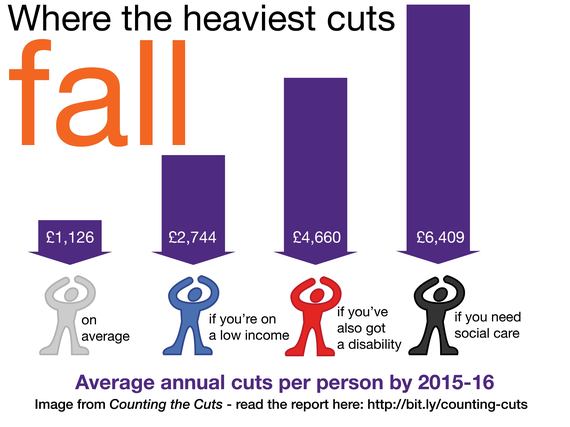
2014-02-17-BurdenoftheCuts-thumb

You can see Cathy angrily and bravely confronting the Prime Minister here

Cathy says “I’m being serious, I want you to do something for us.”

 May replied: “We’ve got a lot of plans for people with mental health in particular…”

But absolutely furious with being fobbed off,  Cathy swiftly interrupted the Prime Minister and continued: “And learning difficulties? 

Because I’ve got mild learning disabilities and I haven’t got a carer at the moment, and I’m angry.

I would like somebody to help me because I can’t do everything I want to do.

I’m talking about everybody not just me, for everybody who’s got mental health and anybody who’s got learning disabilities.

I want them not to have their money taken away from them, and being crippled.

They just took it all away from me,” she said.

She added: “The fat cats keep the money and us lot get nothing.”

It’s true that the vulture capitalist private companies undertaking disability assessments take millions from the public purse to deliver pseudo-medical assessments that are specifically designed to make it unlikely that your claim will be successful, regardless of how ill and disabled you are. 

An audit report concluded that the Department for Work and Pension’s spending on contracts for disability benefit assessments is expected to double in 2016/17 compared with 2014/15. The government’s flagship welfare-cutting scheme will be actually spending more money on the assessments themselves than it is saving in reductions to the benefits bill – as Frances Ryan pointed out in the Guardian, it’s the political equivalent of burning bundles of £50 notes.

The report also states that only half of all the doctors and nurses hired by Maximus – the US outsourcing company brought in by the Department for Work and Pensions to carry out the assessments – had even completed their training.

The NAO report summarises:

£1.6 billion
Estimated cost of contracted-out health and disability assessments over three years, 2015 to 2018

£0.4 billion
Latest expected reduction in annual disability benefit spending

13%
Proportion of ESA and PIP targets met for assessment report quality meeting contractual standard (September 2014 to August 2015).

See: Doctors bribed with 70-90k salaries to join Maximus and “endorse a political agenda regardless of how it affects patients.”

May responded by using trite and meaningless sloganised reassurances: “The government is “particularly focused on those who are most in need”.

“Focusing on those most in need” is a Conservative euphemism for cutting lifeline support for those who need it, by a series of incremental restrictions to the eligibility criteria for PIP.

The criteria for receiving PIP has recently been restricted by the Conservatives, leading to more than 160,000 vulnerable people being denied the additional financial help that they once received.

May continued: What I can do is ensure that we’re giving more help to people with mental health and learning disabilities.

We want to ensure when we look at the help we’re giving to people with any disability that particularly we focus on those who are most in need.”

PIP is a non means tested benefit for people with a long-term health condition or impairment, whether physical, sensory, mental, cognitive, intellectual, or any combination of these. It is an essential financial support towards the extra costs that ill and disabled people face, to help them lead as full, active and independent lives as possible, including staying in work. 

Before 2010, policies that entailed cutting lifeline support for disabled people and those with serious illnesses were unthinkable. Now, systematically dismantling social security for those citizens who need support the most has become the political norm.

Any social security policy that is implemented with the expressed aim of “targeting those most in need” and is implemented to replace a policy that is deemed “unsustainable” is invariably about cost cutting, aimed at reducing the eligibility criteria for entitlement. The government were explicit in their statement about the original policy intent behind PIP. However, what it is that defines those “most in need” involves ever-shrinking, constantly redefined categories, pitched at an ever-shifting political goalpost.

Two independent tribunals have ruled that the Department for Work and Pensions (DWP) should expand the scope and eligibility criteria of PIP, which helps both in-work and out-of work disabled people fund their additional living costs. 

Following a court ruling in favour of disabled people, the government rushed in an “urgent change” to the law to prevent many people with mental health conditions being awarded the mobility component of PIP. Without any parliamentary debate. The court held that people  with conditions such as severe anxiety can qualify for the enhanced rate of the mobility component, on the basis of problems with “planning and following a journey”, or “going out”.  The new regulations were rushed in without any dialogue with the Social Security Advisory Committee, too, via statutory instrument. 

The government’s new regulations will reverse the recent ruling and means that people with mental health conditions such as severe anxiety who can go outdoors, even if they need to have someone with them, are much less likely to get an award of even the standard rate of the PIP mobility component. The new regulations also make changes to the way that the descriptors relating to taking medication are interpreted, again in response to a ruling by a tribunal in favour of disabled people.

The first tribunal said more points should be available in the “mobility” element for people who suffer “overwhelming psychological distress” when travelling alone. The second tribunal recommended more points in the “daily living” element for people who need help to take medication and monitor a health condition. 

The DWP warned that it would cost £3.7bn extra by 2022 to implement the court rulings. The government have responded by formulating an extremely authoritarian “emergency legislation” to stop the legal changes that the upper tribunals had ruled on from happening. From 16 March the law was changed, without any democratic conversation with disabled people and related organisations, or debate in parliament, so that the phrase “For reasons other than psychological distress will be added to the start of descriptors c, d and f in relation to “Planning and following journeys”on the PIP form.

It’s worth noting that the Coalition Government enshrined in law a “commitment” to parity of esteem for mental and physical health in the Health and Social Care Act 2012. In January 2014 it published the policy paper Closing the Gap: priorities for essential change in mental health (Department of Health, 2014), which sets out 25 priorities for change in how children and adults with mental health problems are supported and cared for.

The limiting changes to PIP legislation certainly does not reflect that commitment.  

Let us not forget that last year, the United Nations’ highly critical report confirmed that the UK government has systematically violated the human rights of disabled people.

And let us not forget that this government dismissed the findings of the inquiry and each of the major concerns raised, calling it “offensive”.

It’s rather more offensive that a government of one of the wealthiest so-called democratic nations in the world chooses to disregard its human rights obligations towards disabled people, often leaving them without lifeline support and with devastating consequences, whilst gifting millionaires and rogue multinationals with tax payers money.

Image result for disabled people's rights uk


I don’t make any money from my work. I am disabled because of illness and have a very limited income. But you can help by making a donation to help me continue to research and write informative, insightful and independent articles, and to provide support to others. The smallest amount is much appreciated – thank you.

DonatenowButton

Desperate, underpaid NHS paramedic tells Theresa May: “I’ve seen things no one should have to witness”

Tom Pride's avatarPride's Purge

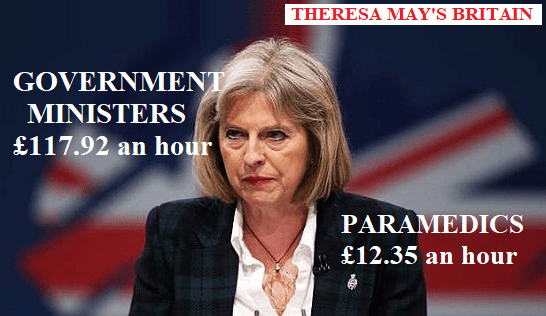
A paramedic has written a moving description on Facebook (see below) of the difficulties he has to face every day in his job, and how he is paid a pittance of just £12.35 an hour to do it.

This is because the Tory government has over the last 7 years capped paramedics’ and other public workers’ pay rises at 1%.

The cabinet ministers who made that decision, however, have seen their own pay rise over the last 7 years to the point they are making approximately £117.92 an hour*, on top of which they can also claim expenses, subsidies and other perks.

A perfect example of Theresa May’s warped Britain today.

Brian Mear:

I joined the Ambulance Service in 1986.
For over 28 years I worked doing “Front Line” work. That’s Emergency work. Covering 999 calls. For the last 6 years of my service I worked alone predominantly on nights at…

View original post 447 more words

Conservatism eats itself by Deborah Talbot

Image result for Theresa May conservatives satire UK

This article from guest author Deborah Talbot is also published on The Sociological Imagination site.

Conservative politics are everywhere, but what is Conservatism and what are Conservatives really like? Deborah takes an ethnographic, insightful and irreverent look at the Conservative mindset. 

In the cities, you don’t notice conservatism. It’s there, for sure, but is pretty quiet about itself. Political parties of a more left persuasion don’t get a chance to do a bit of intense political ethnography, so we assume that everyone is pretty much on the same page, despite differences of opinion over issues.

It was only when I moved to one of England’s Southern regions that my immersion in political and social conservatism began. And I realised then what the Brexit culture wars were all about. Forget Cameron, Johnson, and Osborne. They are just metro decadents and a bit like us – conjured up to lull us into thinking the socially liberal consensus was here to stay.

Because real conservatism is not just a difference of opinion about issues (I support welfare; you think the poor should be made to work in chain gangs, kind of thing). It’s embedded in who they are – their psychology and identity. Which then dictates how they respond to issues.

So I thought it would be helpful to employ my ethnographic skills and do an eight-month investigation into the conservative mind – as it really is, not how it likes to portray itself in the media. Here are my results.

Conservatism is more than party politics

Conservatism is pretty wide ranging, though sometimes it does settle on a political party or perspective, like at the moment with the Conservatives, UKIP and Brexit.

But it doesn’t have to. People that have stayed in the same place for decades, haven’t experienced the significant changes over the past 40-50 years occurring in cities or just don’t get out much, tend towards the conservative. Being creates consciousness, and all that.

Even if they may have traditionally voted Labour for years, their prevailing attitudes to women, immigrants or any local thing they don’t like, makes them easy prey for the right-wing sociopaths.

They don’t like change

That’s right. Any change is met with a wall of muttering and complaint. It could be a good change, like a new building, or trying to sort out a failing transport system.

And despite having acres of space around them, they definitely don’t like change that involves new housing. Or immigrants coming in. Or Londoners. Or the post office down the road changing its sign. Or temporary road works. Or a new cycle lane.

It’s all the same. Change is bad.

Keeping it simple

There’s the sketch that Stewart Lee does about UKIPs anti-immigration policy, where he says, for racists, ‘reality is too full, isn’t it….’

It’s truer than Lee knows. Conservative people just don’t get complexity, whether this is multi-causal chains of reasoning, evidence-based policy or large conurbations.

I guess it’s why change confuses them…because it adds a new variable.

Despite what they say, they don’t like community

Conservatives will make a song and dance about community, but mostly what they mean is that they want to keep it for people exactly like themselves, and to act with impunity.

Because contrary to what they say, conservatives are more likely to engage in anti-social acts, like leaving dog poo in the streets and speeding. Because it’s all about them – hang everyone else.

They parade family like a banner but don’t like children

You’d think conservatives, being all family, nation and work, would like children. But they don’t. Children, in their eyes, need to know their place. Be quiet, stop crying, man up.

Teenagers and even worse, youths, for your average conservative, are evil and it would be better if they were all locked up or forced to join the army (same thing).

Conservatives provide nothing for children and particularly teenagers to do and then castigate them for taking the initiative. Conservative areas are high on vandalism and street drinking (and even so, 99% of young people are lovely). Do they see the relationship? Not at all.

They do love babies though, probably because they are helpless and can’t talk back, which is just how conservatives like ‘em.

They never experienced identity politics

Conservatives of all hues just never went through the identity revolution that hit most cities in the UK and beyond. Because they never experienced it, they don’t understand it, and believe the Daily Mail when they are told it’s ‘political correctness gone mad’ and a ‘threat to the social order’.

The idea that it’s about giving people equality and respect, and not being abusive to people who aren’t like you, seems to have passed them by. Conservatives lack basic good manners, except when it comes to people just like them. Which brings me to…

Patriarchy reigns

Both men and women in conservative areas support a set of social practices and policies that perpetuate the oppression of women. In conservative areas, it’s not sexist to bully and troll women on social media, fail to provide job flexibility and childcare and shut women out of work and professional networks.

‘Her indoors’ gets to stay indoors.

I once innocently asked a local male politician from the ‘Independents’ (closet conservatives) how he could attend so many meetings when he has small children. He said, without batting an eyelid, “My wife does all of that.” There was no shame or irony.

Little provision is made for women who have small children and who want to go to work or meetings. In The Patriarchy, women need to know their place, which is firmly latched to the kitchen sink.

Call attention to it, and it’s very much a case of ‘calm down dear’, or you are called a raging fantasist.

Dislike of the arts and psychological sensitivity

Offered a choice between, say, an art gallery and a bus station, conservatives will opt for the bus station.

The arts are a threat to their narrow social order and need to be marginalised or if possible, crushed. They aren’t beguiled by the success of the creative industries; that’s just a liberal plot to shake them out of their boring shires and give it to young people and immigrants.

And you can’t have a world with things in it, remember?

Similarly, conservatives are very anti-emotion. Sensitivity is tortured out of children by bullying at schools and general ostracism. Because emotion is pinko stuff and real men don’t cry. But, and here’s a big but, some of them invite social media abuse. They are less comfortable with understanding and empathy. Hmm…

Difference, what difference?

Conservatives lack empathy. They simply can’t feel the presence of other humans and assume that those objects moving close to them (people) are simply inanimate or just an extension of them.

I think this is why in conservative areas people lack spatial awareness. Despite all the space they have around them, they simply don’t hear you coming or bump into you because they haven’t seen you. Weird right?

Aggression, anxiety and fear

Road rage, tailgating, noisy neighbours, train noise – the list of things people in conservative areas find annoying and anger provoking is extensive. One gets the impression if they moved to a city they’d have an aneurysm within a year. Or chill the hell out.

Beneath this lies a deep anxiety and fear. The world is a scary place for conservatives. Whatever bad things happen, the government had better do it to someone else rather than them. This is probably why they are so enthusiastic about folk devils and punitive policies.

“Do it to them, not me” should be the conservative motto.

Dislike of public anything

Public transport, public sector, public housing – these all strike fear into the heart of your average conservative. Because they are scared of what they’ll find in public spaces (they might stumble across, say, a person unknown to them personally), they want to destroy it for everyone else.

Conservatives are all about private spaces, first class carriages on trains, cars and roads, where they can pay to keep themselves separate – anything to avoid having an unpredictable encounter with another human.

Obedience is safer

I had a strange conversation with a conservative type who said that they’d voted for Brexit and now they had to go along with whatever May wanted. Anything she wanted, because they had to agree with it (sold their soul, was my interpretation). Conservatives love obedience because they are too scared to be independent. Rather than face that, they try and force everyone else to be obedient too.

But get this, conservatives. Some of us have gone and grown up and can cope with ambiguity and freedom. And do it with other people. We’re not pretending. We really can.

The love of obedience makes their pretend notion of taking back control completely fatuous. What they mean, of course, is hand control to their leader. And then shut your mouth, because the exercising of your democratic rights is making them uncomfortable.

It’s not the economy, stupid

Walking around a small local town with an avid conservative, he looked at all the shops and small business, and sneered, “It’s a bit commercial, isn’t it?”

And here’s the shocker. Your average conservative type doesn’t like economic growth and commercial activity. They don’t. They just pretend to in their manifestos and propaganda.

That’s because they are either retired, independently wealthy, employing other people to run things for them, living off rent, or unemployed. They are not even that keen on volunteering anymore, though remnants of an older conservatism are still out there. Working, volunteering or building a business requires engagement with human normality. Moreover, you need a functioning economy to thrive.

I bet if anyone did a calculation they could correlate declining economic participation with the rise in conservatism.

Think about Brexit. It’ll by all accounts tank the economy and push the UK into long-term shrinkage. Do Brexiteers care? No, because they don’t need an economy. So they believe. Obviously their savings would tank too, but that’s a while off. And remember, they can’t handle a multi-causal chain of reasoning – it’s all about that direct relationship between them and their personal pot of gold.

Their lack of caring about the economy and their dead-eyed love of authority is expressed in the continued conservative support for a hard Brexit. And no wonder they don’t like immigrants, who are generally entrepreneurial and energetic.

Conservatives are more like to say, “Where’s my deckchair?” than “This great new café has opened; let’s go.”

It’s Labour that has become the party of enterprise, which is all over the cities. Conservatives are disengaged. Surprising, eh?

More than any of the other self-defeating psychological dispositions I’ve talked about, the lack of enthusiasm for economic issues shows us that conservatism is eating itself.

Pea sized imaginations

Anyone that wants to hand this lot the reins of power needs to think again. They are myopic, careless and stuck firmly in a past that more suited their narrow-minded fear-obsessed world.

They don’t want to lead us into a new productive and democratic reality. They want to shrink the world, so it fits their pea-sized imaginations.

So if you are thinking about voting Conservative, but you don’t want people in power who have these traits, have another think. Conservatism is eating itself.

Let’s just let it die.

Related
Conservatism in a nutshell 

There is no such thing as a ‘one nation’ Tory: they always create two nations

Granfalloonery, scapegoating, social dominance theory and Conservatism

Theresa May’s Vapid Vision for a One-Party State – William Davies

The following article is written in part by William Davies and published in The New York Times, on May 11, 2017.

LONDON — Britain today confronts a variety of deep, even existential, uncertainties. The terms of its exit from the European Union, the country’s long-term economic prospects and Scotland’s future within the United Kingdom are all in the balance. In contrast to these unknowns, the outcome of the general election on June 8 already feels concrete: The Conservatives, consistently between 17 percent and 20 percent ahead in the polls, are on course for a landslide victory.

In calling this election (despite promises not to) and in her campaigning for it, Prime Minister Theresa May is exploiting this contrast. The Conservatives are being presented as a new type of “people’s party,” under which everyone can huddle to stay safe from the multiple storms that are brewing. Mrs. May and her party are treating this election as too important to be reduced to political divides. With no explanation of how, she claims that “every single vote for me and Conservative candidates will be a vote that strengthens my hand in the negotiations for Brexit.”

This is where Mrs. May’s strategy and rhetoric become disconcerting. Ever since she took over from David Cameron last summer, she has spoken as if Britain is a nation harmoniously united, aside from the divisive forces of party politics and liberal elites seeking to thwart the “will of the people.” The first part of this is simply untrue: Forty-eight percent of the public voted to remain in the European Union, while the other 52 percent held various ideas of what leaving could or should mean in practice.

Prime Minister Theresa May of Britain speaks at the Dhamecha Lohana Centre in Harrow, England, on Monday. CreditPool photo by Stefan Rousseau


Mrs. May’s idea that her opponents are merely playing self-interested political “games” is a classic populist trope, one that suggests that constitutional democracy is really an obstacle standing between people and leader. The prime minister’s rhetoric since calling the general election has implied that the best outcome for “the national interest” would be to eradicate opposition altogether, whether that be in the news media, Parliament or the judiciary. For various reasons (not least the rise of the Scottish National Party) it is virtually impossible to imagine the Labour Party achieving a parliamentary majority ever again, as Mrs. May well knows. To put all this another way, the main purpose of this election is to destroy two-party politics as Britain has known it since 1945. 

One way in which Mrs. May has aggressively pursued this outcome is in her unusual framing of the choice before the British electorate. We are used to politicians presenting policy proposals and promises to the public. Of course, in practice this involves spin doctors seeking to cast their party’s policies in the best light, news outlets twisting the message depending on their political biases and many voters turning away in disgust because they don’t believe a word politicians say. That’s the routine.

The Labour Party, despite occasional populist swipes at the news media, has been sticking roughly to this script. There is a certain irony in this, seeing as Labour, under the socialist leadership of Jeremy Corbyn, has become viewed by many pundits and voters as an implausible party of government. But Labour has nevertheless been regularly putting out clear and reasonably worked-out policy proposals since the election was announced on April 18.

By contrast, Mrs. May has made scarcely any statements regarding policy. Her speeches and campaign literature are peppered with the slogan “strong and stable leadership,” a phrase she then recites on the few occasions that she takes questions from journalists or members of the public. The very basis on which she is asking to be trusted and to be elected seems different from an ordinary policy platform. From a leader of a party still in thrall to Margaret Thatcher, Mrs. May’s virtual silence on the economy is astonishing. The decision to vote Conservative is not to be based on knowledge of what a Conservative government will do — nobody has much of a clue about anything right now — but because of the desperate need for “strong and stable leadership.”

scroll2

May doesn’t speak to us in the recognisable language of a first world liberal democracy. She loathes our proud heritage of human rights. Her inauthentic glittering generalities, delivered robot-style, mask an underlying ideological narrative of scorched earth neoliberal policies, the details of which she refuses to share with us.

That said, it isn’t terribly surprising. If the votes in the general election were to be cast on the strength of public policies, rather than wedge issues and cringeworthy dog whistling slogans, then the Labour party will most certainly win. The Conservatives have left a blaze trail of antisocial policies, which the public have thus far been slow to register. A win for the Conservatives in June will be regarded as an endorsement for the party to finish dismantling the social gains of our post-war settlement: legal aid, welfare, the NHS, social housing and a genuine democracy.

May’s has previously stated her support for a Bill of Rights, one that doesn’t “bind the hands of parliament”. The Conservatives still intend to try and repeal our existing Human Rights Act. This is very worrying, since human rights were designed originally to protect citizens from authoritarian governments like this one. 

The Conservatives have already taken away legal aid, which is so clearly contrary to the very principle of equality under the law. In fact they have turned legal aid into an instrument of discrimination. The government has also tried to dismantle another vital legal protection  – judicial review – which has been used to stop them from abusing political power on several occasions.

The years immediately after the second world war marked a turning point in the history of human rights, as the world reeled in horror at the rise of fascism and the Nazi concentration camps, there came an important realisation that although fundamental rights should be respected as a matter of course, without formal protection, human rights concepts are of little use and consolation to those facing persecution.

So in response to the atrocities committed during the war, the international community sought to define the rights and freedoms necessary to secure the dignity and worth of each and every individual. In 1948 the newly formed United Nations adopted the Universal Declaration of Human Rights (UDHR), one of the most important agreements in world history.

Democracy is one of the universal core values and principles of the United Nations. Respect for human rights and fundamental freedoms and the principle of holding periodic and genuine elections by universal suffrage are essential elements of democracy. These values are embodied in the Universal Declaration of Human Rights and further developed in the International Covenant on Civil and Political Rights which enshrines a host of political rights and civil liberties underpinning meaningful democracies.

Human rights, democracy and the rule of law are core values of the European Union, too. Embedded in its founding treaty, they were reinforced when the EU adopted the Charter of Fundamental Rights in 2000, and strengthened still further when the Charter became legally binding with the entry into force of the Lisbon Treaty in 2009.

A legally binding human rights framework must be applied universally, and implemented without the “interpretation” and interference from individual governments. Furthermore, the State must fund the means of contract enforcement and free and fair trial legal costs, for those who cannot afford it.

If the State fails to fulfil this contingent function, then citizens simply cease to be free.

Image result for Pinochet propaganda

Pinochet claimed that Chile needed a “strong and stable leadership”, following his coup d’état. He went on to become adept at using his power to kill his political opponents – the “saboteurs”.

Government policies are expressed political intentions, regarding how our society is organised and governed. They have calculated social and economic aims and consequences.

How policies are justified is being increasingly detached from their aims and consequences, partly because democratic processes and basic human rights are being disassembled or side-stepped, and partly because the government employs the widespread use of propaganda to intentionally divert us from their aims and the consequences of their ideologically (rather than rationally) driven policies. Furthermore, policies have become increasingly detached from public interests and needs.

No wonder the Prime Minister chooses not to discuss Conservative policies and future policy proposals. 

Opposition and a plurality of perspectives are essential to a democracy. To dismiss anyone with a different view as a “saboteur” is to speak the language of tyranny. This translates as “democracy is sabotaging May’s government.”


“In a way, the world-view of the Party imposed itself most successfully on people incapable of understanding it. They could be made to accept the most flagrant violations of reality, because they never fully grasped the enormity of what was demanded of them, and were not sufficiently interested in public events to notice what was happening.”
George Orwell, Nineteen Eighty-Four.

The primary purpose of propaganda, for Orwell, is to eliminate individual thought and expression. In using euphemisms and metaphors, for example, which one does not create by him or herself, an individual neither creates his/her thoughts nor chooses his/her words; the process of thinking is completely eliminated.

Hannah Arendt wrote Origins of Totalitarianism during the 1940s, a period following on from the atrocities of world war two. Her research raises some fundamental questions about how tyranny can arise and also, the most dangerous forms of political scapegoating and dehumanisation, and the horrific inhumanity to which it can lead. Arendt’s analysis of propaganda and the function of intentional state lies seems particularly relevant here and now in the UK.  

Arendt explained that in Nazi Germany, the opposition was poorly equipped to fight the state because they didn’t understood either the purpose of propaganda or the language of totalitarianism.

The language reveals an intent. So, for example, when the Nazis formulated propaganda about the Jewish community, the opposition would focus on the lack of truth content, and meticulously fact-check the statements made, revealing them to be lies. 

However, Arendt goes on to explain that the propaganda was never intended to be a statement of fact, it was meant to be an outline of intention. 

The Tory creation of socioeconomic scapegoats, involving vicious stigmatisation of vulnerable social groups, particularly endorsed by the mainstream media, is simply a means of manipulating public perceptions and securing public acceptance of the increasingly punitive and repressive basis of the Conservatives’ welfare “reforms”, and the steady stripping away of essential state support and lifeline provision. That the othering rhetoric appeared in the media – the deliberate political act of spoiling and stigmatising a group identity – signaled the government’s intentions towards those groups that were targeted. 

The linguistic downgrading of human life requires dehumanising metaphors: a dehumanising socio-political system using a dehumanising language, and it is becoming familiar and pervasive: it has seeped almost unnoticed into our lives. 

The political construction of social problems also marks an era of increasing state control of citizens with behaviour modification techniques, (under the guise of paternalistic libertarianism) all of which are a part of the process of restricting access rights to welfare provision.

The mainstream media has been complicit in the process of constructing deviant welfare stereotypes – folk devils – and in generating moral outrage that is primarily emotive, rather than having any basis in rationality, from the public.

McGill University political philosophy professor, Jacob T. Levy says “The great analysts of truth and language in politics [including] George Orwell, Hannah Arendt, Vaclav Havel – can help us recognize this kind of lie for what it is…. Saying something obviously untrue, and making your subordinates repeat it with a straight face in their own voice, is a particularly startling display of power over them. Sometimes – often – a leader with authoritarian tendencies will lie in order to make others repeat his lie both as a way to demonstrate and strengthen his power over them.It’s something that was endemic to totalitarianism.”

Arendt and others recognised, writes Levy, that “being made to repeat an obvious lie makes it clear that you’re powerless.” She also recognized the function of an avalanche of lies to render a populace powerless to resist, the phenomenon we now refer to asgaslighting”:

quote-the-result-of-a-consistent-and-total-substitution-of-lies-for-factual-truth-is-not-that-hannah-arendt-115-98-77

“The Party told you to reject the evidence of your eyes and ears. It was their final, most essential command… And if all others accepted the lie which the Party imposed – if all records told the same tale – then the lie passed into history and became truth.”  George Orwell, Nineteen eighty-four.

Kitty S Jones.


I don’t make any money from my work. But you can contribute by making a donation and help me continue to research and write informative, insightful and independent articles, and to provide support to others. The smallest amount is much appreciated – thank you.

DonatenowButton


20 Labour pledges for workers – Ian Lavery

Ian Lavery, Labour Party National Elections and Campaign Coordinator

I am happy that the Labour Party is still funded mostly by trade unions. The role unions have played in funding Labour since its inception has been under attack from the government through the Lobbying bill and subsequent legislation. The Conservatives have unleashed a rolling programme of attacks on working class people, of which the attack on trade unions is only part.

Our right as citizens to collective bargaining has been seriously undermined, and at the same time, the Conservatives have introduced draconian measures that punish working people on low pay, by the introduction of in-work sanctions to their in-work welfare support. However, it is now employers that have all of the power to set the terms and conditions of employment, not employees.

It’s important that voters are fully informed about the causes and interests a party is likely to represent in government. Labour has historically championed ordinary people’s rights. 

“Union money – the few pence freely given every week, by nurses, shop workers and truck drivers – is the cleanest cash in politics today,” Frances O’Grady has said.

“Whether unions set up a political fund is a matter for members, not ministers, because for too long, politics has been controlled by those who already have far too much money and far too much power. Half of the Conservative Party’s funding comes from the City.” 

O’Grady also accused the Tories of trying to discredit unions by calling them Labour’s “paymasters”.  The Conservatives’ paymasters on the other hand – people like capitalist Adrian Beecroft – who donate many thousands to the party, are undermining our rights in work, framing policies that are heavily weighted towards making big profits for big business, resulting in low pay and insecurity for employees. This reflects the interests of the few, not the many.

Here are a couple of articles which outline some of the reasons I proudly support trade unionism, which is fundamental to a functional democracy: The link between Trade Unionism and equality and Why I strongly support Trade Unionism. 

Ian Lavery got in touch with me yesterday, he said:

Last week Labour made 20 pledges to working people – from banning zero hour contracts, a £10 real Living Wage to scrapping the Trade Union Act, a Labour government will put working people first. 

I’m proud that Labour is standing on these pledges and I’ll be doing everything I can to ensure that people up and down the country hear the Labour alternative to Tory insecurity.

The next Labour government will bring in a 20 point plan for security and equality at work:

Give all workers equal rights from day one, whether part-time or full-time, temporary or permanent – so that all workers have the same rights and protections whatever kind of job they have.

Ban zero hours contracts – so that every worker gets a guaranteed number of hours each week

Ensure that any employer wishing to recruit labour from abroad does not undercut workers at home – because it causes divisions when one workforce is used against another

Repeal the Trade Union Act and roll out sectoral collective bargaining – because the most effective way to maintain good rights at work is through a trade union

Guarantee trade unions a right to access workplaces – so that unions can speak to members and potential members

Introduce four new Bank Holidays – we’ll bring our country together with new holidays to mark our four national patron saints’ days, so that workers in Britain get the same proper breaks as in other countries.

Raise the minimum wage to the level of the living wage (expected to be at least £10 per hour by 2020) – so that no one in work gets poverty pay

End the public sector pay cap – because public sector wages have fallen and our public sector workers deserve a pay rise

Amend the takeover code to ensure every takeover proposal has a clear plan in place to protect workers and pensioners – because workers shouldn’t suffer when a company is sold

Roll out maximum pay ratios – of 20:1 in the public sector and companies bidding for public contracts – because it cannot be right that wages at the top keep rising while everyone else’s stagnates

Ban unpaid internships – because it’s not fair for some to get a leg up when others can’t afford to

Enforce all workers’ rights to trade union representation at work – so that all workers can be supported when negotiating with their employer

Abolish employment tribunal fees – so that people have access to justice

Double paid paternity leave to four weeks and increase paternity pay – because fathers are parents too and deserve to spend more time with their new babies

Strengthen protections for women against unfair redundancy – because no one should be penalised for having children

Hold a public inquiry into blacklisting – to ensure that blacklisting truly becomes and remains a thing of the past

Give equalities reps statutory rights – so they have time to protect workers from discrimination

Reinstate protection against third party harassment – because everyone deserves to be safe at work

Use public spending power to drive up standards, including only awarding public contracts to companies which recognise trade unions

Introduce a civil enforcement system to ensure compliance with gender pay auditing– so that all workers have fair access to employment and promotion opportunities and are treated fairly at work

Like the sound of this? Then CLICK HERE to sign up and join me and campaign for a Labour government that will stand up for working people’s rights and their families.

Remember – if you have local or mayoral elections tomorrow, make sure you vote Labour – because we need Labour in our town halls too, to stand up for working people.

I hope to see you on the campaign trail.

Click here to read from source about Labour’s 20 pledges to working people

Millions of pounds originating from HSBC have been laundered directly to the Conservatives, say claims

Roger Mullin of the Scottish National Party.

New cash for Conservatives scandal

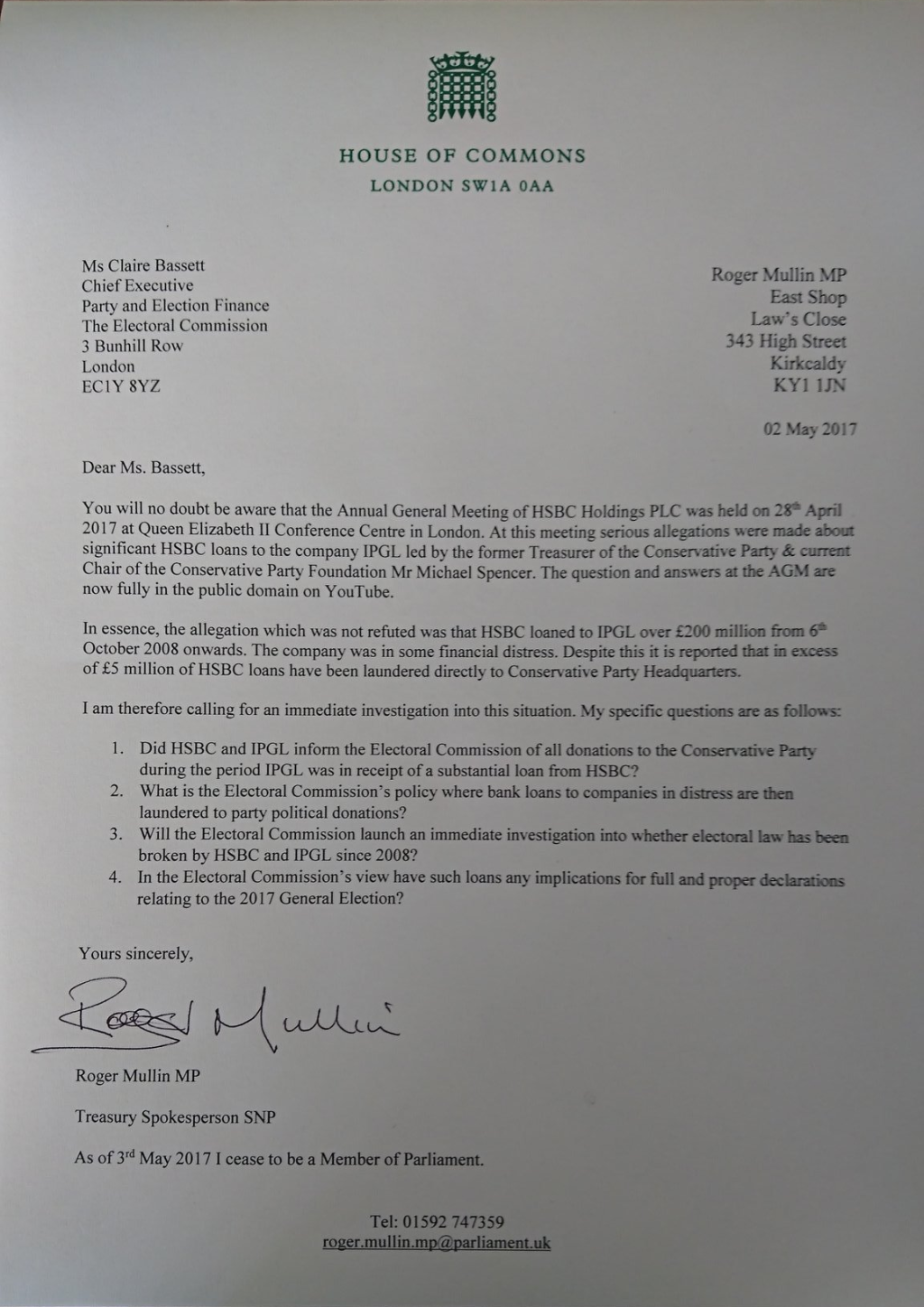
Roger Mullin, MP for Kirkcaldy and Cowdenbeath, has called for an investigation after it was disclosed that “£5 million of HSBC loans were laundered directly to Conservative HQ.” He isn’t alone.

It appears that evidence has emerged of organised, very substantial and ongoing donations made by IPGL – a private holding company – and other subsidiaries, controlled by Michael Spencer, to the Conservative Party, totalling at least £5.3m, representing a “huge percentage of annual turnover”. 

Michael Spencer’s interdealer broker ICAP was fined for its role in the Libor scandal. The Conservative Party resisted calls from the opposition to return £4.6m donations ICAP and Michael Spencer made during the period of the Libor Scandal when Spencer was also Treasurer of the Party.

Campaigners and other opposition MPs such as Labour’s John Mann, who serves on the Treasury Select Committee, have raised these issues, and many allege that such donations wouldn’t have been possible without HSBC’s financial support of IPGL.

The allegations were first raised by Fionn Travers-Smith of Move Your Money at the Annual General Meeting of HSBC Holdings PLC on 28 April. He said:

Not only does this raise questions about HSBCs role in public life, the level of influence that you hold over government, and your own refusal to discuss the possibility of corruption and undue influence at last year’s AGM – but it also raises questions over whether you have contravened your own policies on being politically neutral.

 HSBC’s Douglas Flint responded to the allegations by evading the issues raised, and said “We are politically neutral” and “we’re not going to talk about individual companies at all.” 

Joel Benjamin from Debt Resistance UK questioned these claims of neutrality given deputy chairman of HSBC, Simon Robertson’s £700k donations to George Osborne and the Conservative Party.

In their AGM notice, released in March, HSBC said to its shareholders: “HSBC has a long standing policy not to make any political donations or to incur political expenditure including in the UK or the rest of the EU within the ordinary meaning of those words.

“We have no intention of altering this policy. However, the definitions of political donations and political expenditure used in the UK Companies Act are very wide. As a result, they may cover activities that are an accepted part of engaging with our stakeholders to ensure that issues and concerns affecting our operations are considered and addressed, but which would not ordinarily be considered as political donations or political expenditure.

“As a result, the Directors have concluded that it would be prudent to seek authority from our shareholders to allow them to make political donations and incur political expenditure of up to £200,000 in aggregate in the period up until next year’s AGM. In common with many other UK companies, this is purely a precautionary measure. The authorities sought are not designed to influence public support for any political party, or political outcome; they are simply to ensure that the Group does not inadvertently breach the UK Companies Act.”

As the law stands, a UK-incorporated company must not make a political donation to a political organisation or incur any political expenditure without shareholder approval or, if the company is a subsidiary, the approval of its UK holding company. Directors could incur personal liability if authorisation is not obtained. Nor must it influence public opinion regarding candidates or political outcomes in elections and referendums.

Presumably, the three senior HSBC bank figures who have donated £875,000 to the Conservative party in recent years have done so without shareholder approval. 

Below is Roger Mullin’s last letter as current MP,  parliament is now Dissolved until after the General Election. Mullin posted a copy of the letter on Twitter earlier today.

letter

Some more context

In 2012, the US government was persuaded by our government not to pursue criminal charges against HSBC for allowing rogue states, terrorists and drug dealers to launder millions of dollars after George Osborne and the UK banking regulator intervened to warn that prosecuting Britain’s biggest bank could lead to a “national and global financial disaster”. Instead of facing a prosecution, the bank were given the option to pay a record $1.92bn (£1.4bn) fine

The House financial services committee report said the UK interventions “played a significant role in ultimately persuading the DoJ [Department of Justice] not to prosecute HSBC”. 

The report revealed that Osborne wrote to Ben Bernanke, who was then the Federal Reserve chairman, and Timothy Geithner, the then treasury secretary, to warn that prosecuting a “systemically important financial institution” like HSBC “could lead to [financial] contagion” and pose “very serious implications for financial and economic stability, particularly in Europe and Asia”.

In 2015, it came to light that there are long-standing links between the scandal-hit HSBC and the Conservative Party, after Electoral Commission records showed three senior bank figures have donated £875,000 to the party in recent years. It was revealed that HSBC’s deputy chairman, Sir Simon Robertson, has made 24 separate donations totalling £717,500 in the last nine years.

As a point of interest, the links go much further back, as David Cameron’s great great grandfather, Sir Ewen Cameron, became principal agent to the Calcutta branch of HSBC, following which he acted as manager of its Shanghai branch, where he served until 1890.

Further revelations emerged that the bank allegedly helped wealthy individuals evade tax through Swiss accounts. It was also revealed that HSBC’s deputy chairman, Sir Simon Robertson, has made 24 separate donations totalling £717,500 in the last nine years.

He gave 17 donations to the Conservative Central Office between 2002 and 2014, and four totalling £100,000 to George Osborne between 2006 and 2009. The other three went to the party in East Hampshire. Robertson, who was knighted in 2010, is reported to have a personal wealth of £10m.

Conservative donors, peers and a high-profile MP are listed among the wealthy who legally held accounts in Switzerland with HSBC’s private bank, for a wide variety of reasons. Their ranks include Zac Goldsmith, former MP for Richmond Park, plus his brother, the financier Ben Goldsmith, and a Swiss resident, German-born automotive heir Georg von Opel, who has donated six-figure sums to the government in the past two years.

Peers named in the HSBC files include Lord Sterling of Plaistow, the P&O shipping and ports entrepreneur who was ennobled by Margaret Thatcher, and Lord Fink, who was also a party treasurer under David Cameron and has given £3m to the Conservatives.

Zac Goldsmith has, with his brother Ben and their mother Lady Annabel, donated over £500,000 in cash and in kind to the Conservatives.

Big Banks Aided Firm At Center Of International Bribery Scandal

Cash for Conservatives Exposes the HSBC Dirty Money running the Tory Party – DEBT RESISTANCE UK

 HSBC files: Swiss bank hid money for suspected criminals

The British HSBC bribery and corruption cover-up – Nicholas Wilson

Business dealings of Tory donors could be wiped from official records

Update
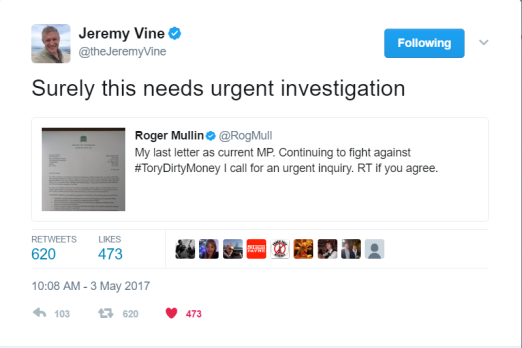
One promising result:

vine

And a rather hasty response from the Electoral Commission, which you can view here: http://www.electoralcommission.org.uk


My work is unfunded and I don’t make any money from it. I am disabled because of illness and struggle to get by. But you can support Politics and Insights and contribute by making a donation which will help me continue to research and write informative, insightful and independent articles, and to provide support to others.  DonatenowButton

“Gig economy” companies exploit workers and are free-riding on the welfare state

Image result for gig economy uk

Deliveroo couriers plan legal action against the food delivery firm to claim better employment rights including the minimum wage, sick pay and holiday.

The 20 delivery riders say they are employees and not, as the company argues, self-employed contractors. In the latest challenge to employment conditions in the gig economy, they are seeking compensation for not receiving holiday pay and for being paid wages below the legal minimum for employees.

The Deliveroo worker’s move follows successful employment tribunal cases brought by cycle couriers at CitySprint, Excel and drivers for taxi app Uber. All three cases found the riders were workers, meaning they are entitled to basic employment rights including holiday pay and the minimum wage, rather than self-employed contractors with no employment rights. 

Uber claimed that its 40,000 drivers in the UK are self-employed, and therefore not entitled to pensions, holiday pay, or other basic employment rights. An employment tribunal in London disagreed, calling Uber’s argument that it was simply a technology company “ridiculous”, and they were relying on “fictions and twisted arguments.”

HMRC is investigating delivery giant Hermes for paying workers less than the minimum wage. Staff receive no holiday or sick pay, and risk losing work if they can’t make their rounds due to illness or lack of childcare.

Some 78 couriers working for Hermes, a company that describes itself as “the UK’s largest nationwide network of self employed couriers”, have subsequently made complaints to Frank Field, the chairman of the House of Commons work and pensions select committee.

It is estimated that falsely classifying workers as self-employed is costing the UK up to £314m per year in lost tax and national insurance contributions. 

A recent study has found that the average self-employed contractor is now paid less than in 1995

The Resolution Foundation – a think tank that aims to improve pay for families – partly has blamed the changing nature of the self-employed workforce. Their report says: “With the introduction and growth of the [so-called] New Living Wage, by 2020 more than 1 in 7 are expected to be paid at or only just above the legal minimum. This increases the need for employers and government to provide personal progression opportunities to get people beyond the wage floor.”

Currently, the government expects individuals to make in-work progression without support, or face financial penalties (sanctions) to their top up Universal Credit. This draconian approach forces unreasonable responsibility onto individuals and their familes, because the problem of low pay is one of exploitative employers and government policy rather than of individual behaviour.

Employers are responsible for setting pay levels and terms. The problem is more broadly one of the key features of neoliberalism, which has led to increasing employment precarity, characterised by insecure, exploitative forms of work. Meanwhile, the organisation of labour and collective bargaining by trade unions are being portrayed as “market distortions” by a government (and a party) that has legislated mercilessly to undermine the basic rights and fair levels of pay for employees.

The Labour party have pledged to reverse the Conservative’s anti-union laws if they are elected June.

The political logrolling of the profit incentive presents us with the most unedifying and hard face of neoliberalism, in which human need is profoundly devalued; the employee is merely availed of as an object of value extraction. The Conservatives certainly don’t value the idea of “a fair day’s wage for a fair day’s work”, despite all their rhetoric about “making work pay”. Over the past six years, we learned that this slogan was only a semantic decoy: a cover for the dismantling of our welfare state by a creeping, unremitting stealth.

The report went on to say that many more people had taken up lower-paid jobs in the so-called “gig economy, essentially self-employed workers taking on a variety of different roles, while the proportion of self-employed business owners with their own staff had fallen. The number of hours worked by the self-employed had also declined.

The foundation said this had limited wage growth before the financial crash, but that pay had been “squeezed” in real terms more recently, falling £100 a week by 2013-14.

Last year, TUC general secretary Frances O’Grady said: “Britain’s new generation of self-employed workers are not all the budding entrepreneurs ministers like to talk about.

“While some choose self-employment, many are forced into it because there is no alternative work. Self-employment today too often means low pay and fewer rights at work.”

The Resolution Foundation’s most recent briefing looks at the final quarter of labour market data for 2016. It says: “Most importantly, inflation has risen rapidly in recent months, weighing heavily on real pay growth – though published pay statistics will take some time to fully reflect this. Well over a third of the workforce are experiencing shrinking pay packets according to the latest figures, in sectors ranging from accommodation to finance and the public sector. Many more will join them in the coming months as inflation continues to rise, with pay across the economy as a whole set to have fallen in the first three months of 2017.

Indeed, our ‘Spotlight’ article notes that real pay in the public sector has likely now begun a fall that could well last for several years. Conversely, private sector pay growth will continue to outpace the headline average earnings figures.”

A Department for Business spokesperson said the government was “committed to building an economy that works for everyone”.

Last year, Damian Green said, in a speech at the Resolution Foundation, that the private sector and voluntary sector “should be more involved in the provision of welfare services”. Green’s endorsement of the “exciting” gig economy and the “huge potential” that it offered came just the month after an employment tribunal found that drivers for the Uber car service should in fact get the minimum wage and paid holiday. 

Green also said: “The Government is a necessary, but not sufficient provider of welfare.” 

Shadow Digital Economy minister Louise Haigh tabled an amendment to the Government’s Digital Economy Bill, New Clause 24, following the tribunal ruling against Uber. 

She said there was still a danger that despite the ruling, Silicon Valley multinationals and other employers could use “loopholes” to break the rules and get around workers’ protections. 

Haigh said: “This is a landmark ruling for workers in the digital economy, and a great victory for the GMB and its members.

“The digital economy was supposed to promise choice and flexibility, but the reality for too many in the sector is that they are overworked, underpaid and exploited by bosses they never meet and who do not even fulfil their basic duties as an employer.

The Work and Pensions Committee report

In a new report the Work and Pensions Committee also concluded that the government must close the loopholes that are currently allowing “bogus” self-employment practices, which are potentially creating an extra burden on the welfare state while simultaneously reducing the tax contributions that sustain it. Increasingly, some companies are using self-employed workforces as cheap labour, excusing themselves from both responsibilities towards their workers and from substantial National Insurance liabilities, pension auto-enrolment responsibilities and the Apprenticeship Levy. 

In an inquiry that has had to be curtailed because of the election, the Committee heard from “gig economy” companies like Uber, Amazon, Hermes and Deliveroo, and from drivers who work with them. The evidence taken painted starkly contrasting pictures of the effect and impact of “self-employment” by these companies.

Companies utlilising self-employed workforces frequently promote the idea that flexible employment is contingent on self-employed status, but the Committee says this is a fiction.

The report

The Committee says:

  • The apparent freedom companies enjoy to deny workers the rights that come with “employee” or “worker” status fails to protect workers from exploitation and poor working conditions. It also leads to substantial tax losses to the public purse, and potentially places increased strain on the welfare state.
  • Designating workers as self-employed because their contract offers none of the benefits of employment puts the cart before horse. It is clear, though, that this logic has taken hold, enabling companies to propagate a myth of self-employment. This myth frequently fails to stand up in court, but individuals face huge risks in challenging their employment status that way.
  • Where there are tax advantages to both workers and businesses in opting for a self-employed contractor arrangement, there is little to stand in the way.
  • An assumption of the employment status of “worker” by default, rather than “self-employed” by default, would protect both those workers and the public purse. It would put the onus on companies to provide basic safety net standards of rights and benefits to their workers, and make the requisite contributions to the social safety net. Companies wishing to deviate from this model would need to present the case for doing so, shifting the burden of proof of employment status onto the better resourced company. 
  • Self-employed people and employees receive almost equal access to all of the services funded by National Insurance, especially with the introduction of the new state Pension, yet the self-employed contribute far less. The incoming government should set out a roadmap for equalising employee and self-employed National Insurance Contributions.
  • The Department for Work and Pensions (DWP) needs to ensure that its programmes and resources reflect the positive contribution that self-employment can make to society and the economy. This may require an expansion of specialist support in JobCentre Plus.
  • The DWP is seeking to support entrepreneurship without subsidising unprofitable self-employment. The existing Minimum Income Floor (MIF) in Universal Credit (UC) does not get this balance right and risks stifling viable new businesses. The incoming Government should urgently review the MIF with a view to improving its sensitivity to the realities of self-employment. Until this is complete, the MIF should not apply to self-employed UC claimants.

Chair’s comments

Frank Field MP, Chair of the Committee, said;

“Companies in the gig economy are free-riding on the welfare state, avoiding all their responsibilities to profit from this bogus “self-employed” designation while ordinary tax-payers pick up the tab. This inquiry has convinced me of the need to offer “worker” status to the drivers who work with those companies as the default option. This status would be a much fairer reflection of the work they undertake which seems to fall between what most of us would think of as “self-employed” or “employed”. 

It would also protect them from some of the appalling practices that have been reported to the Committee in this inquiry. Uber’s recent announcement that it will soon charge its drivers for sickness cover is just another way of pushing costs onto the workforce, to reinforce the impression that those workers are self-employed.

Self-employment can be genuinely flexible and rewarding for many, but “workers” and “employees” can and do work flexibly. Flexibility is not the preserve of poorly paid, unstable contractors, nor does the brand of “flexibility” on offer from these gig economy companies seem reciprocal. It is clearly profit and profit only that is the motive for designating workers as self-employed. The companies get all the benefits, while workers take on all the risks and the state will be expected to pick up the tab, with little contribution from the companies involved.

It is up to Government to close the loopholes that are currently being exploited by these companies, as part of a necessary and wide ranging reform to the regulation of corporate behaviour.”

Uber


My work is unfunded and I don’t make any money from it. I am disabled because of illness and struggle to get by. But you can support Politics and Insights and contribute by making a donation which will help me continue to research and write informative, insightful and independent articles, and to provide support to others.  DonatenowButton

An open letter to the government about mental health services – Jane Lake

mental health

This is a guest post, written by Jane Lake.


Well, General Election time is almost upon us again in the UK, and alongside that comes the selection of “key issues” for debate. This time, mental health, particularly provision for young people, seems to have been chosen as one of the key issues to debate and parade. Initially, I felt this was positive, but the more I’ve considered the issue, the more disheartened I’ve become, because I can’t help but feel that highlighting the need to improve one area of the service only confirms my opinion that those in power have little idea of the current state of the service as a whole.

My first contact with Mental Health services was as a vulnerable seventeen year old, over twenty years ago. At that time, I have to say provision was good. I was appointed a CPN (Community Psychiatric Nurse) who would visit my home regularly, a few days a week at first, tapering down to once a week over around a two year period. My CPN would visit me in my home, and would provide invaluable support. In addition to this, I had access to a ‘drop in’ centre, which was open during office hours, and could contact a crisis team in emergencies. The same centre also ran several hobby and activity groups, for example walking, carpet bowls, a craft group. These sessions were staffed by support workers, and, often in the early days, a CPN as well. These groups were invaluable, as they provided a safe space for vulnerable individuals to interact and feel safe. At that time, they were my only social interaction outside my home and immediate family. In addition to this, there was provision for a support worker, which I took advantage of a couple of years after my diagnosis of clinical depression and anxiety, with mild social phobia, to help me interact with the wider community. My GP at that time also put a note on my medical record, stating that every effort should be made to find me an appointment as soon as one was requested.

My first experience of the cuts was when the social groups at the drop in centre gradually closed, one after another, as a result of therre not being a budget for staff to supervise them. My second was the loss of any fuel allowance for my support worker, which effectively meant that there was no point in my continuiing to see her, as the whole reason for my seeing her was to get out and about in my rural community. I discovered approximately four years ago that there was to be no more support worker provision for anyone I attended the groups with anymore, as a result of budget cuts. This included a young adult male, whose elderly and infirm parents were unable to take out because of their health, meaning that he would be completely isolated on a rural farm, with no real social interaction at all outside his immediate family.

Fast forward, then, to my most recent contact with mental health services, and the impact of decades of chipping away at the funds available to mental health services across the country becomes evident, and, frankly, bleak. The drop in centre, which at one time would’ve been my first port of call, had been closed down and sold off several years previously, so my first point of contact had to be through my GP. Because of huge demand and limited supply, it took about two weeks of daily phone calls by my partner to secure a GP appointment. On visiting my GP for a referral back to mental health services, I was informed that there was likely to be a 12 week waiting list until I could be seen by my mental health team. This, whilst longer than the six weeks I had found more typical in earlier years, wasn’t unexpected, and I had little option but to accept it, so accept it I did. I’m hugely fortunate in that I have an excellent support network within my family, but I did find myself wondering how seventeen year old me would’ve coped, facing such a long wait, alone.

My first contact with my mental health team, approximately thirteen weeks later, was very different to my expectations, which had been based on previous, long, experience. Almost the first words I heard from my CPN were “You get six sessions, maximum. It’s up to you whether you’d like to spread those out weekly, fortnightly, or monthly, but there is a maximum of six.” I will admit, I was slightly stunned for a moment, and was also completely unsure as to how best to split my appointments – in previous years, there had never been a mention of a set number of sessions, and I felt somewhat taken aback by the idea that, without any discussion of my current state of health or circumstances, I was being prescribed six sessions. It felt as though my, or, indeed anyone else who might need the services, actual situation wasn’t even relevant – six was the maximum, whether that was enough or not. This wasn’t a clinical decision based on a health assessment, but a bureaucratic law.

At my final session of six, spread out in the end over approximately three months, both myself and my CPN felt that I wasn’t really ready to be completely discharged, so my CPN suggested that I accept a referral for counselling services. I was warned that waiting lists are lengthy, but, again, with little other option, I accepted this. I eventually received an appointment for my first session nine months later. During this nine month waiting period, I had no contact whatsoever with either my GP or mental health team. This was due partly to my social phobia, which makes it difficult for me to request help at all, but was also very largely a result of not being able to get a GP appointment when I felt able to attend one; I can have the confidence one day, but not the next, and so calling back, day after day, just doesn’t really work out for me. I also felt as though I was overtaxing an already overworked system, in full knowledge that there was little my GP could do other than increase or change my medication, which I didn’t really feel would be helpful. I felt unworthy of asking for help, like a nuisance for continually calling, so I stopped calling. I stopped asking for help.

When I attended my first counselling session, I was informed that there was a maximum of fifteen sessions available per patient, but that as my therapist would be being relocated to a different area after twelve weeks, I would actually only be able to receive twelve. As it turned out, I attended nine sessions before, unfortunately, my therapist suffered a family bereavement, which meant a six week gap in treatment. It also meant that I only had one session available following the gap, due to the therapist being relocated. So rather than a fifteen week continuous course, I actually received ten split sessions from a foreshortened course of twelve. Another bureaucratic bit of nonsense, which declares ten sessions a course of therapy, meant that my therapist was unable to put me forward directly to see another counsellor, although he did very strongly suggest that I should go to my GP, explain the broken nature of my particular course, and request a re-referral for more counselling. Apparently this wouldn’t normally be an option, as each patient is only entitled to one course, but because my treatment had been affected by unusual circumstances, he hoped that my GP might consider a second referral.

And that is where I am now. Trying to get the courage together to face making and attending a GP appointment, to request a referral I might or might not get, that if I do get, will probably involve a huge waiting list. Other than my family, I have no support other than my GP. I have no crisis line, because I had my six sessions and was discharged.

But I consider myself fortunate, because at least I do have my family. I generally don’t go out, I exist probably 80% of the time in one room, my bedroom, because my social phobia makes it difficult for me to interact even with guests in my own home. I feel frustrated and sidelined, but I am not alone. What concerns me is that under the current system, those without their own support networks are, in my opinion, at extremely high risk of self harm and suicide. Waiting lists are long, treatment courses are short and not based upon clinical need. At the same time, we sufferers face ever increasing levels of scrutiny, both within the benefits system and from wider media, who seem to want to class anyone unable to work as a scrounger or basically worthless. As a depression sufferer, I already feel worthless a lot of the time, and without my support network, these factors in combination might well push me over the edge.

The mental health system doesn’t need a review, a rethink or scrutiny. What it needs is funding. What it needs is adequate staffing and resources to function as it should. The current system is unfair both on patients, or clients, or service users, or whatever the PC term is these days, and staff, who are expected to fulfill their extremely difficult roles with both hands effectively tied by bureaucracy and no budgets. We don’t need to look to the future and work out innovative new approaches – we need to look to the past, and employ the system we had, the system that worked so much better than the shambles we have now. Stop the rhetoric, the delay and the chat – and just open the purse strings! I feel that if this doesn’t happen, and soon, many will suffer, and lives may be lost, needlessly.

Image result for mental health care cuts UK

Political polls, think tanks and propaganda: the antidemocratic writing on the wall

Image result for propaganda UK Tories bitter future

The Mail on Sunday columnist, christian and Burkean Conservative, Peter Hitchens, has said:

“Opinion polls are a device for influencing public opinion, not a device for measuring it. Crack that, and it all makes sense.”

I don’t agree with Hitchens on very much, but he is right about this.

In his book The Broken Compass, Hitchens informs us that opinion polls are actually a device for influencing public opinion. He says that the establishment and the media are responsible for this manipulation, based on the misuse of statistics. The overall purpose is to “bring about the thing it claims is already happening”. 

The author cites contemporary examples of the media attacking Gordon Brown and the “predicted” win of the Conservative Party at the 2010 general election, although Hitchens also described Brown, as a “dismal Marxoid.”  Hitchens’ comments are based on his time as a reporter at Westminster. He says that political journalists are uninterested in serious political debate, and describes how a media reporting bias is attempting to facilitate a Tory general election win.

Remarkably, as a social Conservative, Hitchens states one of his motivations for writing the book was to frustrate this exercise.

Of course government influence isn’t the only problem. Neoliberal bias and “market forces” that result in a biased presentation include the ownership of the news source, concentration of media ownership, the selection of staff, the preferences of an intended audience, and pressure from advertisers. In short, we cannot escape the cultural saturation of pro-establishment views, and the establishment is of course both neoliberal and Conservative. 

Predicting elections may seem interesting, fun, and perhaps even educational from an academic perspective, but it doesn’t add much to our democratic practices. Polls give an apparency of “data-driven journalism” but it produces a reductive “horse-race” narrative, in which political and policy context is mostly ignored with the numbers, accurate or not, pretty much being framed as all that matters. This trivialises our democracy and obscures the importance of critical thinking and informed choices regarding policies in influencing the public’s voting decisions. 

Priming and framing

Priming is a subconscious form of memory, based on identification of related ideas and objects. This effect happens when external stimuli “manipulate” internal thoughts, feelings or behaviours. After becoming activated by stimuli, priming triggers these associations in our memory. For example, one study showed that a store playing traditional French or German music can prime shoppers to buy French or German products. Political slogans are also frequently used as a priming tool. They provide reference points – they are gateways to underlying ideological narratives.

So, priming may be used as a strategy that entails the intentional use of certain words, phrases or images that can subtly influence our thinking – via an interpretive frame – at least to an extent. Some psychologists have argued that priming can have effects on changing our decision-making and behaviour, that seeing an image of money can affect our political views, for instance, or that reminding individuals of stereotypes applied to their social group can harm their performance in a test and in other ways. Stigma is a political tool, usually reserved for despotic regimes, but in Western democracies, othering traditionally marginalised groups has become such common practice that it’s almost hidden in plain view.

Attempts to test such effects suggest that at least some of them are not reliable. But priming, in a more general sense, still matters, such as when people use contextual cues during a conversation to interpret the meaning of ambiguous language.

Political media priming is “the process in which the media attend to some issues and not others and thereby alter the standards by which people evaluate election candidates”. A number of studies have demonstrated that there is a dimension of powerful media effects that goes beyond basic agenda setting.

In 1982, Iyengar, Peters, and Kinder first identified this added dimension as the “priming effect.” The theory is founded on the basic assumption that people do not have elaborate knowledge about political matters and do not take into account all of what they do know when making political decisions — they must consider what more readily comes to mind. Through drawing attention to some aspects of politics at the expense of others, the media might help to set the terms by which political judgements are reached, including evaluations of political figures. A process of carefully calculated uses of public opinion on policy issues may (and are) very easily  used as strategies to intentionally influence voters’ standards for assessing political candidates’ attributes. 

In sociology, framing is a schema of interpretation: a sort of shorthand collection of anecdotes and stereotypes that individuals depend on to understand and respond to and navigate events. In other words, people build a series of mental “filters” through biological, social, political and cultural influences. Citizens then use these filters or signposts to make sense of the world. The choices they then make are influenced by the  creation of a frames. The effects of framing can be seen in the media.

With the same information being used as a base, the “frame” surrounding the issue can change the reader’s perceptions without having to alter the underlying facts. In the context of politics or mass-media communication, a frame defines the packaging of an element of rhetoric in such a way as to encourage certain interpretations and to discourage others. 

For political purposes, framing often presents facts in such a way that implicates a social problem that is in need of a certain solution. Members of political parties attempt to frame issues in a way that makes a solution favouring their own political leaning appear as the most appropriate course of action for the situation at hand.

Research on frames in sociologically driven media research generally examines the influence of “social norms and values, organisational pressures and constraints, pressures of interest groups, journalistic routines, and ideological or political orientations and bias of journalists” on the existence of frames in media content

Roger Pielke Jr, professor of Technology Policy Research at the University of Colorado, says: Rather than trying to see the future, political science might serve us better by helping citizens to create that future by clarifying the choices we face and their possible consequences for policy.”

“In treating politics like a sporting event, we diminish the partisanship, the choices, and the fundamental values that lie at the core of politics. I fear that data journalists have diminished our politics.” 

When political opinion polls and the media appear to support one political party over another, there can be little doubt that this will have an influence on the psychology of voters, because it’s akin to declaring election winners before the election is actually held. It works rather like a self-fulfilling prophecy.

In the UK, the media is biased and leans heavily towards the right. Despite the fact that the Labour party currently has the highest party membership in Western Europe, yet the party leader is viciously attacked, and very often in a particularly nasty, personal and highly misleading way. The systematic way in which the media are actively attempting to delegitimise Corbyn is unworthy of a so-called democracy.

party membership

Some countries, such as France, Brazil and South Korea, impose a halt on election polling because of the bandwagon effect, which may skew the democratic process. The bandwagon effect describes a process of voters favouring a party that is doing well in the polls, while the underdog effect predicts that support will go to a party trailing in the polls.

There is also the possibility of a projection effect, with voters’ expectations conforming to their partisanship. There is rather less empirical evidence for the existence of underdog effect than there is for the existence of the bandwagon effect, which is based on individuals rallying to the perceived majority opinion, because of a fairly widespread psychological need for feeling we are part of a social ingroup, and a general tendency towards normative compliance and social conformity. And at a time when the strategically engineered and toxic social divisions of political outgrouping is widespread and affecting citizens’ fundamental sense of identity and self worth, this type of insidious call for a normative compliance and artificial consensus creates a false sense of security for some.

We know that political opinion polls are certainly not always an accurate reflection of public opinion. Samples of the population selected to participate may be biased. For example, asking Daily Mail readers who they will vote for will almost certainly produce a majority right wing set of responses. However, if you ask the same question on Twitter, you are much more likely to get a Labour majority.  

The polls do have an effect on voter intentions and on those trying to influence the outcome of elections.

poll correct

itv tm

Poll by ITV’s This Morning asked viewers which party leader they would prefer to see as Prime Minister.

More generally, in sociology and other social sciences, bias is defined as any tendency which prevents unprejudiced consideration of a research question. Bias can occur at any phase of research, including study design, or sampling and data collection, as well as in the process of data analysis and publication.  

It is widely recognised that quantitative social research methods, such as surveys, may be susceptible to reduced reliability and research bias, sometimes entailing a process where the researchers performing the survey influence the results by selecting a specific kind of sample of the population, for example.

Human nature is complex and can not be reduced easily to just a simple either/or response. Bias may arise when researchers inadvertently or deliberately select subjects that are more likely to generate the desired results. Either way, this is a reversal of the normal processes governing science.

Additionally, there is also a risk of response bias – a general term for a wide range of cognitive biases that influence the responses of participants away from accuracy or truthfulness. These biases are most prevalent in the types of studies and research that involve participant self-report, in quantitative research such as surveys. Response biases can have a large impact on the validity of questionnaires, surveys and polls.

With all of this in mind, we need to think about how the conventional political polls are run, who runs them, who funds them and for what and whose purpose.

In the UK, some of the major polls are run by:

  • Survation, pollster to The Mail on Sunday, Daily Mirror, Daily Record and Sky News. They say: “Survation also have an active strategy and campaign advisory business helping clients better understand customers & members, appreciate & help shape public opinion. We help our clients improve customer engagement and effectiveness of campaigns – be they charitable, political or commercial.” 
  • ComRes, retained pollster for the BBC and The Independent. It says on their site: ComRes provides specialist research and insight to support reputation management, public policy and communications. For more than a decade we have used the latest developments in market and opinion research to inform strategies, change behaviours and define debates.”
  • Ipsos MORI (formerly MORI). Ipsos MORI’s Social Research Institute works extensively for the Government of the United Kingdom, looking at public attitudes to key public services, and so informing social policy. Issues such as identity, social cohesion, loyalty, physical capital and the impact of place on attitudes are all key themes of the Institute’s work. The company also specialises in mass media, brand loyalty, marketing and advertising research.
  • YouGov. – Stephan Shakespeare, the firm’s founder and CEO from 2010, once stood as a Conservative candidate for Colchester; he was also a Conservative Party pollster. The other founder, and CEO until 2010, is Nadhim Zahawi a British Conservative Party politician who has been the Member of Parliament (MP) for Stratford-on-Avon since 2010.
  • ICM. They say Understanding choice means you know how your audience feels, thinks and behaves. And how you can change that. We help influence choice in three areas. How do you energise your brand and communications? How do you improve your customers’ experience of you? How do you understand and influence citizens?  
  • Populus, official The Times pollster. They say: “Our Reputation & Strategy team works with the boards of global companies and public institutions to help them understand, influence, and improve their reputations. We are specialists in reputation. We understand why it matters, how to measure it, what drives it, who influences it, how to align it with existing activity, and what you should do to improve it.”
  • TNS-BMRBTNS changed their name to Kantar Public UK: a leading agency providing research and consultancy to UK policymakers. The company is structured around specific areas of marketing expertise: Brand & Communication; Innovation & Product Development; Retail & Shopper; Customer Experience; Employee Engagement; Qualitative; Automotive; and Political & Social.

All of these companies operate within a taken-for-granted neoliberal context, supporting various actors within the “global market place” paradigm, including governments, and therefore have a distinct ideological leaning and very clearly defined economic interests in maintaining the status quo. 

Nudging voting decisions

It’s likely that Lynton Crosby’s international notoriety made him the subject of considerable press attention during the Conservative’s election campaign. However, there was another man also behind the Conservative campaign who was probably even more cunning. American strategist Jim Messina was hired as a strategy adviser in August 2013. Senior Conservative staff had been impressed by Barack Obama’s easy victories in the 2008 and 2012 presidential elections, crediting a relentless focus on data collection to Messina.

Access to this level of personal data was crucial to the success of the Conservative campaign: it determined which voters the party needed to target, contact and which type of message they would present. This process began with direct mail – personally addressed to voters in each target seat, who were divided into 40 different categories, with a slightly different tailored message for each one.

A telephone research company called Return Marketing (now known as Return Research) canvassed thousands of voters in the run-up to the 2015 general election. The calls they made rather tellingly targeted voters in specific, marginal constituencies.

Last year, the The Canary found evidence that the Conservatives may have broken a law that prohibits paying canvassers to support a specific candidate’s election. Whistleblowers speaking to an independent journalist have alleged that they were told to push poll voters (sway voters towards voting for the Conservatives by using loaded questions.)

Channel Four’s secret filming of the company Return Market’s “push polling”- polling designed to influence voters while masquerading as political research – during the EU referendum.

Pollsters, by and large, reject the charge that they herd public opinion, but social psychologists and behavioural economists inform us that there is more than a little truth in the bandwaggon effect theory.

Pollsters say they are careful to avoid influencing the outcome of a poll through priming and order effects in the survey design, but there are many other stumbling blocks to bear in mind. Social psychologists and the new behavioural economists say that in general people want to follow the crowd and do not like to challenge the normative order (which as a concept is in itself a very functionalist and conservative framing of society).

This is reflected in the nudge theorists’ use of social norming strategies, currently being adopted in public policies, which politically target some social groups to change their perceptions and behaviours. Social norming is based on an assumption of pluralistic ignorance bychoice architects. Ultimately, the “choice architects” are the government, who, after all, are responsible for public policies which utilise experimental behavioural theory.

It’s of major concern that attempts by a government to surreptitiously change the perceptions, behaviours, emotions and decision-making of a population using experimental behavioural economic theory and discriminatory policies is not currently subject to public scrutiny and ethical standards. There is nothing standing in the way of “choice architects” using social norming to generate, manipulate or exploit pluralistic ignorance in order to simply maintain and justify the status quo. In fact they DO.

So if we see an opinion poll telling us what the majority thinks, believe or is doing, because many have an inbuilt psychological bias towards following the crowd, we need to question potential motives underpinning that “information”.

The government know about the bandwaggon bias and are designing communications strategies and policies which play to this heuristic. Buying Facebook ‘likes’ is one example of this attempt to create a false impression of  public consensus and political popularity.

Think tanks, the media and the Conservative influence on public thinking

In the late 1960s and 1970s, movement Conservatives persuaded wealthy individuals and businesses to establish a conservative intellectual and political infrastructure. This includes think tanks that resemble academic institutions but publish studies supporting Conservative and libertarian arguments. The American Enterprise Institute was founded in 1943, but was expanded dramatically with new funding in 1971. The Heritage Foundation was created in 1973 and the Cato Institute was founded in 1974.

In Britain, Tim Montgomerie, has described the Conservative movement as “the infrastructure outside of the party that supports small ‘c’ conservative values.”

A March 2009 presentation by Montgomerie and Matthew Elliott listed a number of organisations as part of the British Conservative movement: 

Institute of Economic Affairs | Centre for Policy Studies | Reform | Adam Smith Institute | Policy Exchange | Centre for Social Justice | Civitas | International Policy Network | Taxpayers’ Alliance | ConservativeHome | New Culture Forum | Standpoint | Migration Watch UK | Countryside Alliance | Centre for Social Cohesion

Elliott compared this with the smaller size of the movement in 1997. According to Montgomerie, the comparison was intended to be indicative rather than comprehensive. An up to date, comprehensive powerbase list might include: 

2020 Health | Atlantic Bridge | Adam Smith Institute | Better Off Out | Big Brother Watch | Bow Group | Bruges Group | Campaign for an English Parliament | Campaign for the Protection for Rural England | Centre for Policy Studies | Centre for Social Cohesion | Centre for Social Justice | Christian Conservative Fellowship | Civitas | Conservative Education Society | ConservativeHome | Conservative Intelligence | Conservative Party | Conservative Philosophy Group | Countryside Alliance | Democracy Institute | Direct Democracy | Drivers Alliance | Doctors for Reform | Economic Policy Centre | Enterprise Forum | European Foundation | European Policy Forum | Family Education Trust | First Defence | Forest | Freedom Alliance | Freedom Association | Freedom Zone | The Free Society | Global Vision | Global Warming Policy Foundation | Henry Jackson Society | Institute of Ideas | Institute of Directors | Institute of Economic Affairs | International Policy Network | Legatum Institute | Liberty League | Localis | Message Space | Migration Watch | New Culture Forum | Nothing British about the BNP | Nurses for Reform | Open Europe | Policy Exchange | Politeia | Progressive Vision | Reform | Reform Scotland | ResPublica | Safe Speed | Save Our Pubs and Clubs | Selsdon Group | Social Affairs Unit | Social Market Foundation | Spiked | Standpoint | Student Rights | Sunlight COPS | Taxpayers Alliance | TEA Party UK | UK National Defence AssociationYoung Britons Foundationamong others. 

The problem is that think tanks synthesise, create and communicate “information” and give “advice” to the public and policy-makers, very often through the media. Think tanks tend to be far more media savvy than academics, often with staff who have backgrounds in the communication industry – media, PR or lobbying organisations.

This means that policy proposals, media narratives and public debate are much more likely to reflect Conservative ideology and favour pro-establishment outcomes, rather than being non-partisan, evidence-based and crucially, a representation of public needs. This of course turns democracy completely on its head. 

As Professor Judy Sebba points out in Getting research into policy: the role of think tanks and other mediators: “Far from educating the public about evidence, think tanks are characterised by closedness and exclusivity. They do not subject their work to review by others and so the quality of their outputs are not assessed. Most worryingly, the media present the work of think tanks as credible sources of research and facts without any checks being in place.”  

As key players in “democratic” politics and in shaping public opinion, think tanks have a responsibility to be transparent about their operations, but seldom are. A good question to ask is who funds them and what is their agenda?

The bandwaggon propaganda technique is also used as a key campaign strategy

More recently, I explored the role of intentionally deceitful political language and rhetoric in another article  which highlights the role that the media play in shaping our public life. Media manipulation involves a series of related techniques in which partisans create images or arguments that favour their own particular interests. Such tactics may include the use of logical fallacies, psychological manipulations, deception, linguistic, rhetorical and propaganda techniques, and often involve the suppression of information or alternative perspectives by simply crowding them out. 

Discrediting and minimisation are often used in persuading other people or social groups to stop listening to certain perspectives and arguments, or by simply diverting public attention elsewhere. An example of diversion is the recent widespread scapegoating of refugees and people who need social security, such as disabled people or those who have lost their jobs, in a bid to maintain the hegemony of neoliberalism and its values at a time when its failings were brought into sharp focus during and following the global crisis – also exposing failings in the behaviours and practices of the government and the vulture capitalist financier class.

Neoliberalism always gravitates towards increasing inequality, extending and deepening poverty. Fear mongering is sometimes used with a diversion or misdirection propaganda technique to mask this, and may be pervasive. Sometimes politicians and media commentators suddenly take a debate in a weird and irrational but predictable direction to avoid democratic accountability.

During the coalition and Conservative governments, the tabloids have chosen and framed most of the debates that have dominated domestic politics in the UK, ensuring that immigration, welfare, law and order, the role of the state, and Britain’s relationship with Europe have all been discussed in increasingly right wing terms, while almost ironically, the government have colonised progressive rhetoric to cover their intentions. It also serves to further discredit the narrative of the left.

The reason in part for this rhetoric, importing words such as “fair”, “social justice” and “equal opportunity” and repeating them ad nauseam is that the Conservatives know that such ideas build the trust of ordinary citizens. 

However, there is therefore a growing chasm between Conservative discourse, and policy intentions and outcomes. There isn’t a bridge between rhetoric and reality. 

The Conservatives commonly use a nudge technique called “social norming” – a Behavioural Insights Team variant of the bandwaggon propaganda technique – particularly for General Election campaigning. It’s about manipulating a false sense of consensus, and normalising Conservative ideology. It’s also about prompting behavioural change, and as such, this method is a blatant attempt to influence the voting behaviours of the public, by suggesting that many others have already “joined” the Conservative “cause” and are happier or better off for doing so. The technique uses societal pressures to play on several basic emotional elements of human nature.

Oh, and then there is the basic technique of telling lies, of course.

Image result for george osborne big labour boy did it kittysjones

And using euphemism:


Image result for Tory lies

Social norming is an appeal to emotional needs to fit in and belong, and also, to be on the side that wins. As stated earlier, it has a kind of self fulfilling prophecy element to it, too. It’s used in advertising – words like “everyone”, “we”, “our” and “most people” or “many” are used a lot to sell brands and imply a popularity of certain products that usually isn’t real.

Political slogans like the almost farcical “country that works for everyone” and the previous “all in it together” are examples of poor attempts at social norming. It’s aimed at shifting our normative framework to accommodate the status quo, too, regardless of how the accounts don’t tally with reality. Once you see it, you can’t unsee it.

Image result for we are all in this together Tory slogan

It’s worth noting that “We are all in it together” was a slogan made famous in Terry Guiliams’s dystopic black comedy Brazil. Cameron certainly had a moment of recycling propaganda with grim irony there.

00122e59eb74fe0acab5f6838951c280

Propaganda techniques commonly used by the Conservatives

As mentioned previously, bandwagon and “inevitable-victory” appeals attempt to persuade the target audience to join in and take the course of action that “everyone else is taking.” Inevitable victory invites those not already on the bandwagon to join those already convinced they are on the road to certain victory. Those already or at least partially on the bandwagon are reassured that staying aboard is their best course of action.  

Join the crowd is a technique that reinforces people’s natural desire to be on the winning side. This technique is used to convince the audience that a programme is an expression of an irresistible mass movement and that it is in their best interest to join. As an example, see Grant Shapps under fire over website ‘sham’ which used models featured on Australian university site to make Tory activists look ‘youthful and in touch’ with Britain. Also see Behaviourism.

Common man – The ordinary folks or Common Man technique is an attempt to convince the audience that the propagandist’s positions reflect the common sense of the people. It is designed to win the confidence of the audience by communicating in the common manner and style of the target audience. Propagandists use ordinary language and mannerisms (and clothe their message in face-to-face and audiovisual communications) in attempting to identify their point of view with that of the average person, and to naturalise it.

Image result for Pictures of MPs pretending being ordinary

hqdefault

Ad hominem is a Latin phrase which has come to mean personally attacking your opponent, as opposed to challenging their propositions and arguments. A recent example is Boris Johnson’s strange attack on Jeremy Corbyn, calling him a “benign herbivore” but at the same time, also a “mutton-headed old mugwump.

The word comes from Massachusett, an Algonquian language spoken by the Massachusett people, from whom the US state takes its name. The word mugquomp, meaning “war leader” or “great chief”, appeared frequently in John Eliot’s 1663 translation of the Bible into the Massachusett language, where it was used as a gloss for an officer, captain, and duke.

Sadly, Johnson, languishing in his own in solipsism, has clearly invented his own personal meaning, though he really should pay heed to Wittgenstein, who warned of the dangers of private language (the idea of a language understandable by only a single individual is incoherent.) Then he wouldn’t sound like such a mutton-headed numpty. Johnson, like many Conservatives, has problems reconciling his “inner” (subjective) experience with the “outside” (objective) world.

By the early 1800s the form “mugwump” had been adopted into English as a humorous term for an important person, leader, or boss. J K Rowling was probably thinking of the earlier meaning when she used the word for the head of the International Confederation of Wizards in Harry Potter, the Supreme Mugwump.

Ad nauseam – This approach uses tireless repetition of an idea. An idea, especially a simple slogan, that is repeated enough times, may begin to be taken as the truth. This approach works best when media sources are limited and controlled by the propagator. Joseph Goebbels, not known to be driven by the passionate inspiration of the moment, but by the result of sober psychological calculation, was particularly talented in utilising this approach. Iain Duncan Smith has previously shown a similar penchant for repeated mendacity. Then there is Theresa May’s ad nauseum slogans: ” A strong and stable leadership in the national interest,” and “A country that works for everyone.”

Image result for Theresa May's slogan United
   Image courtesy of News Thump

Which brings us to the Glittering Generalities technique. This another category of the seven main propaganda techniques identified by the Institute for Propaganda Analysis in 1938. It’s a device often used by the media and in political rhetoric to persuade us to approve and accept something without examining any evidence.

This is a propaganda technique purposefully designed to divert and distract, so that people are less likely to develop their own critical thoughts. This said, the purpose of all forms of propaganda is to tell you what to think, and not how to think.

Glittering Generalities capitalise on increasingly sloganised political discourses, leading to a loss of conceptual clarity, over-idealisation and they also reflect conceptual miserliness – a tendency for some people to prefer simple, superficial and easy answers, rather than having to expend time and effort to grapple with complexity, critical analysis and the need to weigh up evidence. They also succeed in conveying codified messages that reference underpinning discourses which are often prejudiced and controversial, but presented in a way that bypasses any detailed scrutiny, as a consensus view and “common sense.”  An example is the slogan “Taking our country back” as it references an underpinning racist, supremicist discourse, whilst sounding vaguely rightous, because someone nicked England, or hid it on another planet.

Glittering Generalities imply – or signpost us – via common stock phrases to our own tacit knowledge, which often lies below our current focal awareness – prior information, beliefs, ideals, values, schemata and mental models, stereotypes and so on, creating the impression that the person using the terms and phrases understands and sees the world as you do, creating a false sense of rapport by doing so. Or the feeling that some very important recognition has been made.

Glittering Generalities propaganda is sometimes based on a kind of logical fallacy known as Equivocation – it is the misleading use of a term with more than one meaning (usually by glossing over which meaning is intended at a particular time)

Glittering Generalities is a technique very often used by people who seek to stifle debate, sidestep accountability and suppress democratic processes. Because Glittering Generalities tend to obscure or gloss over serious areas of disagreement, they hide controversy and submerge alternative propositions.

As such, Glittering Generalities may often be used to neutralise opposition to dominant ideas. It’s a way of disguising partisanship and of manipulating and reducing democratic choices. It’s part of a process of the political micro-management of your beliefs and decision-making.

Here is a bit of refreshing straight talk for a change:

Related image

I’m not above a bit of sloganeering myself. In 2015, I came up with “Tory cuts cost lives”, which my friend, Robert Livingstone, turned into a couple of memes.

Image result for Tory cuts cost lives

This one recent one went very viral very quickly, glad to see it so widely used:

17992309_1302068139828559_7295604745407481410_n

Finally, I thought I would share that the widely used word “selfservative” came from a disillusioned Tory I knew called Derek. I used it a lot on social media, and my friend, Robert Livingstone, popularised it in his memes. Derek defected to Labour and vanished from the Conservative Facebook groups where Robert and I used to have surprisingly civilised debate with him. 

I will be writing more about electioneering, exposing propaganda and other techniques of persuasion, over the next couple of weeks.

Related

Propaganda Techniques (Summary)

The Conservative’s negative campaign strategy: “share the lies and win a prize”

Dishonest ways of being dishonest: an exploration of Conservative euphemisms

The erosion of democracy and the repression of mainstream media in the UK

Department for Work and Pensions officials admit to using fake claimant’s comments to justify benefit sanctions – a very basic propaganda technique called “telling lies”

Our attitudes and beliefs are being manipulated, our decision-making is being “nudged,” citizens are being micro-managed and policed by the state:

“In a white paper authored by Facebook’s security team and published on Thursday, the company detailed well-funded and subtle techniques used by nations and other organizations to spread misleading information and falsehoods for geopolitical goals. These efforts go well beyond “fake news”, the company said, and include content seeding, targeted data collection and fake accounts that are used to amplify one particular view, sow distrust in political institutions and spread confusion.

“We have had to expand our security focus from traditional abusive behavior, such as account hacking, malware, spam and financial scams, to include more subtle and insidious forms of misuse, including attempts to manipulate civic discourse and deceive people,” said the company.

“In general, Facebook said it faced a new challenge in tackling “subtle and insidious forms of misuse, including attempts to manipulate civic discourse and deceive people.

“Facebook described much of the activity as “false amplification” – which included the mass creation of fake accounts; the coordinated sharing of content and engagement with that content (such as likes); and the distribution of “inflammatory and sometimes racist memes”.  – BBC

In its effort to clamp down on information operations, Facebook suspended 30,000 accounts in France before the presidential election. The company said it was a priority to remove suspect accounts with high volumes of posting activity and the biggest audiences.

The company also explained how it monitored “several situations” that fit the pattern of information operations during the US presidential election. The company detected “malicious actors” using social media to share information stolen from other sources such as email accounts “with the intent of harming the reputation of specific political targets”. This technique involved creating dedicated websites to host the stolen data and then creating social media accounts and pages to direct people to it.

At the same time, a separate set of malicious actors created fake Facebook accounts to falsely amplify narratives and themes related to topics exposed in the stolen data.

Facebook did not specify which stolen data it was referring to, but we know that tens of thousands of emails were hacked from Clinton campaign chairman John Podesta’s Gmail account and released by Wikileaks.

Nor did Facebook attribute the manipulation to any nation state, although it said that the company’s investigation “does not contradict” the findings of a January report by the US Director of National Intelligence that outlined Russian involvement in the election.

Russia has also been implicated in the hacking of French presidential frontrunner, Emmanuel Macron, according to a report by researchers with Japanese anti-virus firm Trend Micro, published this week.

Facebook pledged to monitor attempts to manipulate the platform, to develop new ways of identifying fake accounts, educate at-risk people about how to keep their information safe, and support civil society programs around media literacy.

“We recognize that, in today’s information environment, social media plays a sizable role in facilitating communications – not only in times of civic events, such as elections, but in everyday expression,” said the report. “In some circumstances, however, we recognize that the risk of malicious actors seeking to use Facebook to mislead people or otherwise promote inauthentic communications can be higher.” – The Guardian

“The JTRIG unit of GCHQ is so notable because of its extensive use of propaganda methods and other online tactics of deceit and manipulation. The 2011 report on the organization’s operations, published today, summarizes just some of those tactics:

Throughout this report, JTRIG’s heavy reliance on its use of behavioral science research (such as psychology) is emphasized as critical to its operations. That includes detailed discussions of how to foster “obedience” and “conformity”:


An “I told you so” moment from Glenn Greewald


My work is unfunded and I don’t make any money from it. I am disabled because of illness and struggle to get by. But you can support Politics and Insights and contribute by making a donation which will help me continue to research and write informative, insightful and independent articles, and to provide support to others.  DonatenowButton

The erosion of democracy and the repression of mainstream media in the UK

Daily Mail crush the saboteurs
In George Orwell’s Nineteen Eighty-Four, Winston Smith invents the heroic historical figure Comrade Ogilvy, who had “no aim in life except the defeat of the Eurasian enemy and the hunting-down of spies, saboteurs, thought-criminals, and traitors generally”. Theresa May’s world, too, seems to have shrunk to one in which the greatest enemies are the enemies within and democracy must be democratically eliminated for the good of the people.” Steven Poole.

The Daily Mail headline calling those who oppose the government “saboteurs” is the kind of oppressive tactic and despotic language that is commonly used in totalitarian regimes and by dictators. It’s not the kind of media headline expected in liberal democracies, where opposition to the status quo is necessary for the best interests of the country and essential for any meaningful democratic exchange.

Dr. Lawrence Britt examined the fascist regimes of Hitler (Germany), Mussolini (Italy), Franco (Spain), Suharto (Indonesia) and several Latin American regimes. Britt found 14 defining characteristics common to each, and it is becoming increasingly difficult to overlook some of the parallels with the increasingly authoritarian characteristics of our own right wing government here in the UK. Fascism is an authoritarian and nationalistic right wing system of government and social organisation, though not all authoritarian governments are fascist. However, the two terms are quite often used interchangeably. 

Controlled mass media is one example of a key defining feature of authoritarianism, with “news” being directly controlled and manipulated by the government, by regulation, or via sympathetic media spokespeople and executives. Censorship is very common. There is often an identifiable obsession with “National Security” – along with fear being used as a “motivational tool” by the government on the public, and also, as a justification for greater degrees of censorship.

The United Nations’ 1948 Universal Declaration of Human Rights states: “Everyone has the right to freedom of opinion and expression; this right includes freedom to hold opinions without interference, and impart information and ideas through any media regardless of frontiers”. However, unlike the United States, Britain has no constitutional guarantee of press freedom

The right to freedom of expression is fundamental to a functioning democracy – information and ideas help to inform political debate and are essential to public accountability and transparency in government.

Just to clarify, I don’t, however, condone any incitements of hatred. This is not the same thing as free speech. In fact hate speech is designed to close discussion down by intimidating and silencing targeted social groups. In the Uk, several statutes criminalize hate speech against several categories of persons. The statutes forbid communication which is hateful, threatening, or abusive, and which targets a person on account of disability, ethnic or national origin, nationality (including citizenship), race, religion, sexual orientation, or skin colour. 

Yet just last year, the European Commission against Racism and Intolerance (ECRI) criticised the  right wing Daily Mail and the Sun for “offensive, discriminatory and provocative terminology”.

The ECRI report said hate speech was a serious problem, including against Roma, gypsies and travellers, as well as “unscrupulous press reporting” targeting the LGBT community. 

The report also concluded that some reporting on immigration, terrorism and the refugee crisis was “contributing to creating an atmosphere of hostility and rejection”.

It cited Katie Hopkins’ infamous column in The Sun, where she likened refugees to “cockroaches” and sparked a blistering response from the UN High Commissioner for Human Rights, and the same newspaper’s debunked claim over “1 in 5 Brit Muslims’ sympathy for jihadis”. It seems that the tabloids have confused their frequent incitements to hatred, their many contributions to growing social prejudice and hate speech with free speech.

We have witnessed the political right and the tabloids using rhetoric that has increasingly transformed a global economic crisis into an apparently ethno-political one, and this also extends to include the general scapegoating and vilification of other groups and communities that have historically been the victims of prejudice and social exclusion: the poorest citizens, unemployed and disabled people. These far-right rhetorical flourishes define and portray the putative “outsider” as an economic threat. This is then used to justify active political discrimination and exclusion of the constitutive Other. 

Only some people have the right to freely express themselves, apparently.

Freedom of expression is a universal human right. It is not the prerogative of the politician. Nor is it the privilege of the journalist. In their day-to-day work, journalists are simply exercising every citizen’s right to free speech.

This includes the right to communicate and to express oneself in any medium, including through words, pictures, images and actions (including through public protest and demonstrations).

However, the UK government is more generally failing to live up to its human rights obligations. Social groups with protected characteristics, such as disabled people and asylum seekers, have fared very badly over the past few years. The tabloids have preempted draconian Conservative policies which target those social groups with extensive stigmatising and scapegoating campaigns. This is another indication of the Conservative’s radical authoritarian turn. 

The News Media Association (NMA) say: “Threats to press freedom include attempts to strip back journalistic exemptions under the EU and UK data protection legislation, efforts to water down Freedom of Information legislation which the NMA is campaigning against, new court reporting restrictions, a review of the D-Notice Committee, strengthening police powers to obtain journalistic material, the use of RIPA powers to uncover journalists’ sources, and the continuing campaign to introduce jail sentences for breaches of the Data Protection Act.

Journalists in the UK are also subject to a wide range of legal restrictions which inhibit freedom of expression. These include the libel laws, official secrets and anti-terrorism legislation, the law of contempt and other legal restrictions on court reporting, the law of confidence and development of privacy actions, intellectual property laws, legislation regulating public order, trespass, harassment, anti-discrimination and obscenity.

There is some special provision for journalism and other literary and artistic activities, chiefly intended as protection against prior restraint, in the data protection and human rights legislation. There are some additional, judicial safeguards requiring court orders or judicial consent before the police can gain access to journalistic material or instigate surveillance in certain circumstances, but, in practice, the law provides limited protection to journalistic material and sources.”

The new proposed Espionage Act and a data disclosure law.

The UK government are proposing to change the four Official Secrets Acts, which date back to 1911. They want them scrapped and replaced with a “modernised” Espionage Act and a data disclosure law.

However, the Conservatives have been accused of “criminalising public interest journalism” as it plans to increase the number of years for the “leaking of state secrets” from 2 years to 14, in the first “overhaul” of the Official Secrets Act for over 100 years.

Under the proposals, which were published in February, officials who leak “sensitive information” about the British economy that damages national security could also be jailed. Currently, official secrets legislation is limited to breaches which jeopardise security, intelligence defence, confidential information and international relations.

The government released the proposals citing the “new reality” of the 21st-century internet and national security dangers as justification for a more “robust” system of prosecution.

The recommendations centre around the Official Secrets Act (1989) which governs how public servants in government and the military must keep government information secret and out of publication.

Journalists and civil liberties groups have warned that the threshold for the increased sentence has been lowered and that journalists and whistleblowers acting in the public interest will be effectively gagged. 

In the new government recommendations, the threshold for being prosecuted for revealing state secrets will be changed from “having caused definite damage” to the likelihood of causing damage to national interests. The Law Commission also stated that a defendant should be prevented from making a defence that they believed they were working in the public interest. 

Michelle Stanistreet, general secretary of the National Union of Journalists, said: “The ramifications of these recommendations are huge for journalists and freedom of the press. Journalists face being criminalised for simply doing their job and the public’s right to know will be severely curtailed by these proposals. The union will respond robustly to the Law Commission’s consultation on changes to the Official Secrets Act.

“The National Union of Journalists is also concerned that the Digital Economy Bill, now in Parliament, threatens to undermine journalists sharing information in the public interest.” 

“This union is deeply concerned at yet another attempt by the UK government to curtail the media. The Investigatory Powers Act has put journalists’ sources at risk now that a large number of authorities have the power to intercept reporter’s’ emails, mobile phone and computer records.

“We have plenty of evidence that some police forces routinely used the Regulation of Investigatory Powers Act to get their hands on journalists’ records without their knowledge. The NUJ is also concerned that the Digital Economy Bill, now in Parliament, threatens to undermine journalists sharing information in the public interest.”

The consultation on the UK Government’s new proposals closed earlier this month. Organisations such as Amnesty have submitted their statements and expressed their opposition. 

Campaigners say the bill would make any investigation of government culpability harder and lower the amount of accountability in the civil service, military and government.

From the consultation document: “Chapter 6 – Freedom of Expression Enshrined in Article 10 of the European Convention on Human Rights, freedom of expression is a fundamental right. We consider whether compliance with Article 10 requires the introduction of a statutory public interest defence for those who make unauthorised disclosure. Our conclusion is that Article 10 does not require the introduction of a statutory public interest defence. Our view accords with that the House of Lord in R v Shayler.” 

Once you hear the jackboots…

Three years ago, I wrote an article  – Once you hear the jackboots, it’s too late – which discussed the unannounced visit by government national security agents to smash computer hard drives at the Guardian newspaper offices, though it hit the news unsurprisingly quietly, when Edward Snowden exposed a gross abuse of power and revealed mass surveillance programmes by American and British secret policing agencies (NSA and GCHQ) last year. (More detailed information here).

David Miranda, partner of Glenn Greenwald, Guardian interviewer of the whistleblower Edward Snowden, was held for nine hours at Heathrow Airport and questioned under the Terrorism Act. Officials confiscated electronics equipment including his mobile phone, laptop, camera, memory sticks, DVDs and games consoles. This was a profound attack on press freedoms and the news gathering process, and as Greenwald said: “To detain my partner for a full nine hours while denying him a lawyer, and then seize large amounts of his possessions, is clearly intended to send a message of intimidation.”

My article also outlined another extraordinary and vicious attack on The Guardian, instigated by the Department for Work and Pensions (DWP) communications chief and senior government spin doctor, Richard Caseby, who called for the newspaper to be “blackballed” and prevented from joining the new press regulatory body, because “day after day it gets its facts wrong.” Remarkably, “ineptitude or ideology” were to blame for what he deemed “mistakes” in the paper’s coverage of the DWP’s cuts to benefits. He called for the broadsheet to be kept out of the new Independent Press Standards Organisation (IPSO), set up after the Leveson Inquiry into media standards. 

As a former journalist at the establishment-directed Sun and The Sunday Times, Caseby certainly has an axe to grind against the paper that revealed how those right wing papers’ stablemate, the News Of The World, had hacked the voicemail of murdered teenager Millie Dowler, sparking the phone hacking scandal that forced Rupert Murdoch to close the tabloid down.

In connection with Murdoch’s testimony to the Leveson Inquiry “into the ethics of the British press,” editor of Newsweek International, Tunku Varadarajan, referred to him as “the man whose name is synonymous with unethical newspapers.”

Not a shred of concern was raised about any of this or Murdoch’s nasty and corrupt myth production industry, and right wing scapegoating empire, coming from our government, a point worth reflecting on for a moment. Miliband said the phone-hacking was not just a media scandal, but it was a symbol of what was wrong with British politics.

He called for cross-party agreement on new media ownership laws that would cut Murdoch’s current market share, arguing that he has “too much power over British public life.He said: “If you want to minimise the abuses of power, then that kind of concentration of power is frankly quite dangerous.”  I completely agree.

Those that criticise the unscrupulous right wing status quo, on the other hand, are being increasingly filtered out from the media, or censored. Yet journalists are regarded as “democracy’s watchdogs” and the protection of their sources is the “cornerstone of freedom of the press.” And freedom of the press is a cornerstone of democracy. Although enshrined in such terms by the European Court of Human Rights, these democratic safeguarding principles are being attacked in an increasingly open manner all over the world, including in the democratic countries that first proclaimed them.

The erosion of democracy and the Press Freedom Index

Related image

Reporters Without Borders (RSF) are a collective of journalists who study freedom of the press at a comparative and international level. RSF publish an annual Press Freedom Index (PFI), which provides a ranking for every country, calculated to indicate how much governments restrict the media. The UK has been consistently in low position (the higher the score, the lower the ranking) for the last five years, this year it dropped lower still, highlighting an increasing intrusion of the government on and restriction of the freedom of the press.

This won’t surprise many, especially given the numerous public announcements in the press by the likes of Iain Duncan Smith over the last few years regarding the government’s “monitoring” of the BBC and other media for “left wing bias”. We have a media with a very heavy weighted right wing bias, yet any criticism of government policy reduces our government to shrieking hysterically that the communists have been infiltrating the establishment. It’s a curious fact that authoritarians project their rigidity, insecurities and micro-controlling tendencies onto everyone else.

I’m sure Chris Patten, Rhona Fairhead and Sir David Cecil Clementi, successive government appointed chairpersons of the BBC Trustto act as the ultimate decision makers regarding the BBC’s strategic direction, are just the kind of people who are not tied to political ideologies and corporate interests. After all, everyone knows what a veritable hotbed of communism Chris Patten secretly nurtured. (Sorry, my tongue appears to be momentarily stuck to my cheek).

That the UK government felt the need to announce even more surveillance of the BBC indicates a creeping and considerable degree of authoritarianism, and worryingly, it demonstrates how supremely unconcerned and utterly without shame they are in building a public bonfire to burn what remains of media impartiality in the UK. 

The current RSF report says that the decline in respect for media freedom in democracies is not new. It was already noticeable in previous Indexes. But what is striking in this year’s Index is the growing scale and the nature of the violations seen.

The erosion of democracy and subsequent muting of the media isn’t a problem peculiar to the UK, it’s happening on a global scale. The RSF report says:

“Most of the movement in the World Press Freedom Index unveiled today by Reporters Without Borders is indicative of a climate of fear and tension combined with increasing control over newsrooms by governments and private-sector interests.”

“Journalism worthy of the name must be defended against the increase in propaganda and media content that is made to order or sponsored by vested interests.”

The Index is based on an evaluation of media freedom that measures pluralism, media independence, the quality of the legal framework and the safety of journalists in 180 countries. It is compiled by means of a survey questionnaire in 20 languages that is completed by experts all over the world. This qualitative analysis is combined with quantitative data on abuses and acts of violence against journalists during the period evaluated.

The report says: “The election of the 45th president of the United States set off a witchhunt against journalists. Donald Trump’s repeated diatribes against the Fourth Estate and its representatives – accusing them of being “among the most dishonest human beings on earth” and of deliberately spreading “fake news” – compromise a long US tradition of defending freedom of expression. The hate speech used by the new boss in the White House and his accusations of lying also helped to disinhibit attacks on the media almost everywhere in the world, including in democratic countries.”

Framing and tilting the media: asking the million dollar questions

Robert Mercier is the plutocrat and right wing US computer scientist and media “strategist” at the heart of a US-based multimillion-dollar propaganda network, who expresses an “unwavering commitment to neutralising left wing bias in the news, media and popular culture”. He funded the setting up of Breitbart and has close links to Steve Bannon, Donald Trump and Nigel Farage. See: Robert Mercer: the big data billionaire waging war on mainstream media.

It is a very troubling development, give the US had a global reputation for promoting a strong free press, protected by the First Amendment. This said, it’s certainly not a recent development that political leaders of western so-called democratic countries have intervened directly in an attempt to modify and direct media reporting. The US is ranked at 43 in the 2017 World Press Freedom Index. 

RSF now ranks the UK 40th in the index; a fall from 38th place in 2016. The Nordic countries have the most favourable PFI ranking, with Norway being at the top, followed by Sweden, Finland, and Denmark. It’s an indictment of both UK and US claims to democracy and freedom of the media that three former Soviet countries: Estonia, Latvia, and Lithuania rank more highly. The British press were also outranked by Uruguay, Costa Rica, Jamaica, Namibia, Samoa, Trinidad and Tobago.

RSF’s report says: “Media freedom has never been so threatened and RSF’s “global indicator” has never been so high (3872). This measure of the overall level of media freedom constraints and violations worldwide has risen 14% in the span of five years. In the past year, nearly two thirds (62.2%) of the countries measured have registered a deterioration in their situation, while the number of countries where the media freedom situation was “good” or “fairly good” fell by 2.3%.”

“It was also in late 2016 that the United Kingdom (down 2 places at 40th) adopted a new law extending the surveillance powers of the British intelligence agencies. Dubbed the “Snoopers’ Charter,” the Investigatory Powers Act put the UK in the unenviable position of having adopted “the most extreme surveillance legislation in UK history”, with a law that lacks sufficient protection mechanisms for journalists and their sources. Even more alarming, in early 2017, the Law Commission put forward a proposal for a new ‘Espionage Act’ that would allow the courts to imprison journalists and others for up to 14 years for obtaining leaked information.”

It goes on to say: “The past year also saw a continuation in the trend for media ownership to become concentrated in ever fewer hands, which is exacerbating the media’s dependence on political and economic power holders.”

“A heavy-handed approach towards the press – often in the name of national security – has resulted in the UK slipping down the [PFI]. Parliament adopted the most extreme surveillance legislation in UK history, the Investigatory Powers Act… posing a serious threat to investigative journalism. Even more alarming, the Law Commission’s proposal for a new ‘Espionage Act’ would make it easy to classify journalists as ‘spies’ and jail them for up to 14 years for simply obtaining leaked information.”

The extensive report also warns that:

“Journalism worthy of the name must be defended against the increase in propaganda and media content that is made to order or sponsored by vested interests.”

“It is unfortunately clear that many of the world’s leaders are developing a form of paranoia about legitimate journalism.” (RSF secretary-general Christophe Deloire).

“The climate of fear results in a growing aversion to debate and pluralism, a clampdown on the media by ever more authoritarian and oppressive governments, and reporting in the privately owned media that is increasingly shaped by personal interests. Journalism worthy of the name must be defended against the increase in propaganda and media content that is made to order or sponsored by vested interests. Guaranteeing the public’s right to independent and reliable news and information is essential if humankind’s problems, both local and global, are to be solved.”

The press freedom map below is a visual overview of the situation in each country in the Index. The darker the colour, the worse the PFI ranking. 

The mass media are often referred to as the fourth branch of government because of the power they wield and the oversight function they exercise. However, democracy requires the active participation of citizens. Ideally, the media should encourage citizens to engage in the business of governance by informing, educating and mobilising the public.

The notion of the media as a watchdog, as a guardian of public interest, and as a conduit between governors and the governed was once deeply ingrained. The reality, however, is that the media in democracies are failing to live up to this ideal. They are hobbled by stringent and often repressive laws, monopolistic ownership, and too often, the threat of brute force. State controls are not the only constraints. Balanced and impartial reporting is difficult to sustain in a context of neoliberalism because of competitive media markets that put a premium on the superficial and sensational.

Moreover, the media are manipulated and used as proxies in the battle between political groups, in the process sowing divisiveness rather than consensus, hate speech instead of sober debate, and suspicion rather than social trust. The media significantly contribute to public cynicism and democratic decay.

Noam Chomsky has written extensively about the role of the free market media in reinforcing dominant ideology and maintaining the unequal distribution and balance of power. In Manufacturing Consent, Chomsky and Herman explore the media’s role in establishing the apparence of a political and economic orthodoxy (neoliberalism) and extending a seemingly normative compliance with state policies, while also marginalising antithetical or alternative perspectives, dismissing them as heresy. In the US and UK, most left wing commentors have a very diminished media platform from which to present their perspectives and policy proposals.

This “free-market” version of censorship is more subtle and difficult to identify, challenge and undermine than the equivalent propaganda system which was present in Nazi Germany or the Soviet Union. 

As Chomsky argues, the mainstream press is corporate owned and so reflects corporate priorities and interests. While acknowledging that some journalists are dedicated and well-intentioned, he says that the choice of topics and issues featured in the mass media, the unquestioned premises on which that “coverage” rests, and the range of opinions that are expressed are all constrained to reinforce the state’s dominant ideology.

Image result for media bias uk

Last year, research by YouGov found that the British media is the most right wing in Europe. Readers also ranked the British press as the most biased in all of the seven countries surveyed.
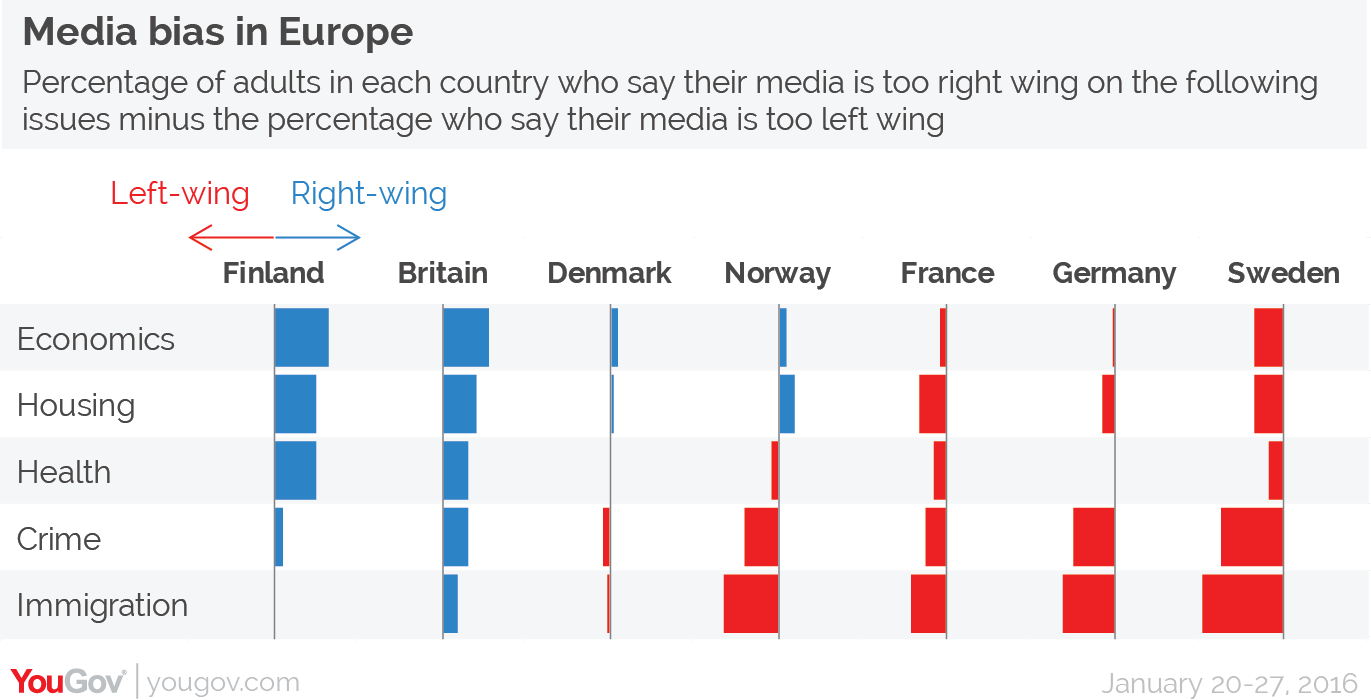
On average British people are more likely than any other country to see the media as skewed towards the right (26% compared to 23% for Finland and 19% for France). Britain’s media is viewed as having a right wing bias, most of all on the subject of economics (net 15 points to the right).

The media have recently portrayed Jeremy Corbyn as both a pacifist and as someone with a paradoxical tendency to “love terrorists”, but then logic and accuracy have never been apparent in most media attacks of the left. (See the Zinoviev letter, for a historic example). 

You know the world is in big trouble when diplomacy and negotiation skills are considered a “threat” to security. It seems that the establishment prefer bombing civilians to get other governments to comply with their wishes. I know which is probably going to contribute to keeping peace the most, and it isn’t “humanitarian” bombing. 

The “poor relations” between nuclear powers has contributed to an atmosphere that “lends itself to the onset of crisis,” according to a very worrying report by the UN Institute for Disarmament Research. The report goes on to say: “The rise in cyber warfare and hacking has left the technical vulnerabilities of nuclear weapons systems exposed to risk from states and terrorist groups.

Nuclear deterrence works—up until the time it will prove not to work. The risk is inherent and, when luck runs out, the results will be catastrophic.

The report went on to say: “The more arms produced, particularly in countries with unstable societies, the more potential exists for terrorist acquisition and use of nuclear weapons.”

The UN report comes as Donald Trump of the US and Vladmir Putin of Russia have both indicated support for expanding their country’s nuclear weapon arsenals. 

Deterrence is at the “greatest risk of breaking down” in North Korea and between India and Pakistan over the disputed territory of Kashmir.

The report also stated an expressed concern over tensions between the West and Russia, which have grown since the annexation of Crimea in 2014. President Putin has maintained Russia would use nuclear weapons if it felt sufficiently threatened.

You know, I think diplomatic skill is a far better quality to look for in a leader, speaking from the perspective of a civilian, in these troubled times. 

istock-456613403.jpg

In most newspapers, including even The Daily Mirror and The Independent, Labour voices that are unreasonably anti-Corbyn outweigh those that are pro-Corbyn. Corbyn’s voice is often absent in the narratives and reporting on him, and when it is present it is often presented in a highly distorted way. 

We all want and need a strong and a critical media, a watchdog of the powers that be, but maybe we do not need an “attack dog” who kills off anyone who dares challenge the status quo and dares to suggest we need a different kind of politics.

 

Related image

Ed Miliband eating a bacon butty on Channel four’s The Last Leg

The coming of epistemological totalitarianism in the UK

Epistemology relates to the theory of knowledge, especially with regard to its methods, validity, and scope, and the distinction between justified belief and opinion. In the UK, our “knowledge” is being framed by the right wing media. The media doesn’t exactly tell us how to think, but it does tell us what to think about, by a selective agenda of topics and the framing of public debate.

The UK establishment news media are highly centralised and dominated by elites who serve and maintain the status quo and who detest democracy.

Image result for media bias examples uk corbyn terrorism

In 2015, I wroteOne particularly successful way of neutralising opposition to an ideology is to ensure that only those ideas that are consistent with that ideology saturate the media and are presented as orthodoxy, to “naturalise” them. The Conservative election campaigns are a thoroughly dispiriting and ruthless masterclass in media control.

Communication in the media is geared towards establishing a dominant paradigm and maintaining an illusion of a consensus. This ultimately serves to reduce democratic choices. Such tactics are nothing less than a political micro-management of your beliefs and are ultimately aimed at nudging your voting decisions and maintaining a profoundly unbalanced, pathological status quo.

Presenting an alternative narrative is difficult because the Tories have not only framed all of the issues to be given public priority – they set and stage-manage the media agenda – they have also almost completely dominated the narrative; they construct and manage the political lexicon and now treat words associated with the left, such as welfare, trade unionism, collective bargaining, like semantic landmines, generating explosions of right wing scorn, derision and ridicule. This form of linguistic totalitarianism discredits any opposition before it even arises.

Words like cooperation, inclusion, mutual aid, reciprocity, equality, nationalisation, redistribution – collective values – are simply dismissed as mere anachronisms that need to be stricken from public conversation and exiled from our collective consciousness, whilst all the time enforcing their own bland language of an anti-democratic political doxa. The political manufacturing of a culture of anti-intellectualism extends this aim, too.”

The London School of Economics (LSE) media and communications department undertook a research project, aiming at contributing to the ongoing public debate regarding the role of mainstream media and of journalists in a media-saturated democracy. In Journalistic Representations of Jeremy Corbyn in the British Press: From “Watchdog” to “Attackdog”, the research team say:

“We set out to recognise and acknowledge the legitimate role of the press to critique and challenge the powers that be, which is often encapsulated by the metaphor of the watchdog. Our systematic content analysis of a representative sample of newspaper articles published in 8 national newspapers between 1 September and 1 November 2015, however, shows that the press reacted in a highly transgressive manner to the new leader of the opposition, hence our reference to the attackdog metaphor.

Our analysis shows that Corbyn was thoroughly delegitimised as a political actor from the moment he became a prominent candidate and even more so after he was elected as party leader, with a strong mandate. This process of delegitimisation occurred in several ways: 1) through lack of or distortion of voice; 2) through ridicule, scorn and personal attacks; and 3) through association, mainly with terrorism.

All this raises, in our view, a number of pressing ethical questions regarding the role of the media in a democracy. Certainly, democracies need their media to challenge power and offer robust debate, but when this transgresses into an antagonism that undermines legitimate political voices that dare to contest the current status quo, then it is not democracy that is served.”

Image result for corbyn terrorism

See Cameron ridiculed for hypocrisy and quoting Corbyn out of context.

According to the Independent Press Standards Organization (IPSO), newspapers are obliged to “make a clear distinction between comment, conjecture and fact and this has not been applied to media discussion of Jeremy Corbyn, by and large.

You can download the full LSE report here.

Also worth a read: How many of Jeremy Corbyn’s policies do you actually disagree with?

More recently, I explored the role of intentionally deceitful political language and rhetoric in another article  which highlights the role that the media play in shaping our public life. Media manipulation involves a series of related techniques in which partisans create images or arguments that favour their own particular interests. Such tactics may include the use of logical fallacies, psychological manipulations, deception, linguistic, rhetorical and propaganda techniques, and often involve the suppression of information or alternative perspectives by simply crowding them out. 

Discrediting and minimisation are often used in persuading other people or social groups to stop listening to certain perspectives and arguments, or by simply diverting public attention elsewhere. An example of diversion is the recent widespread scapegoating of refugees and people who need social security, such as disabled people or those who have lost their jobs, in a bid to maintain the hegemony of neoliberalism and its values at a time when its failings were brought into sharp focus during and following the global crisis – also exposing failings in the behaviours and practices of the government and the vulture capitalist financier class.

Neoliberalism always gravitates towards increasing inequality, extending and deepening poverty. Fear mongering is sometimes used with a diversion or misdirection propaganda technique to mask this, and may be pervasive. Sometimes politicians and media commentators suddenly take a debate in a weird and irrational but predictable direction to avoid democratic accountability.

The process often begins with a marginalised group being singled out and held to blame for the socioeconomic problems created by the system of socioeconomic organisation itself. Using the construction of folk devils (welfare “skivers” , “workshy” “something for nothing culture”, “culture of entitlement” or “dependency” for example), the political class and media generate moral panic and outrage, which serves to de-empathise the public and to justify the dehumanisation of politically created outgroups, and draconian policies.

Campaigners against social injustice are labeled “extremist” and politicians on the left who stand up against prejudice and discrimination are labeled “saboteurs”, “weak”, “anti-British” and extensively ridiculed and smeared. Every single Labour leader, with the exception of Blair, has had this treatment from the mainstream media.

During the coalition and Conservative governments, the tabloids have chosen and framed most of the debates that have dominated domestic politics in the UK, ensuring that immigration, welfare, law and order, the role of the state, and Britain’s relationship with Europe have all been discussed in increasingly right wing terms, while almost ironically, the government have colonised progressive rhetoric to cover their intentions. It also serves to further discredit the narrative of the left.

However, there is therefore a growing chasm between Conservative discourse, and policy intentions and outcomes. There isn’t a bridge between rhetoric and reality.

The Conservatives commonly use a nudge technique called “social norming” – a Behavioural Insights Team variant of the bandwaggon propaganda technique – particularly for General Election campaigning. It’s about manipulating a false sense of consensus, and normalising Conservative ideology. It’s also about prompting behavioural change, and as such, this method is a blatant attempt to influence the voting behaviours of the public, by suggesting that many others have already “joined” the Conservative “cause” and are happier or better off for doing so. The technique uses societal pressures to play on several basic emotional elements of human nature.

Oh, and then there is the basic technique of telling lies, of course.

Social norming is an appeal to emotional needs to fit in and belong, and also, to be on the side that wins. It has a kind of self fulfilling prophecy element to it, too. It’s used in advertising – words like “everyone” and “most people” or “many” are used a lot to sell brands and imply a popularity of certain products that usually isn’t real.

Political slogans like “a country that works for everyone” and the previous “all in it together” are examples of poor attempts at social norming. It’s aimed at shifting our normative framework to accommodate the status quo, too, regardless of how the accounts don’t tally with reality. Once you see it, you can’t unsee it.

With this in mind, we need to think about how the conventional political polls are run, who runs them and for what and whose purpose.

I wouldn’t dream of telling you who to vote for in the coming General Election. However, I will ask that you please very carefully consider what you vote for. 

Independent media organisations like Novara Media, Evolve Politics, Media Diversified, Media Lens, CommonSpace, The Canary, Bella Caledonia, Real Media, The Dorset Eye, Welfare Weekly, Scisco Media, Ekklesia, STRIKE! magazine, The Bristol Cable, Now Then, the Manchester Mule, and many others are taking the fight to the establishment. The new independent media have freedom from institutional dependencies, and in particular, from the influence of government and corporate interests.

Independent media includes any form of autonomous media project that is free from institutional dependencies.

We are not constrained by the interests of society’s major power-brokers.

The independent media collectively reflect a model that is democratic, prefigurative, often collaborative and that has a mutually supportive approach to public interest and conscience-based, as opposed to market-based, media.

We are a collection of diligent witnesses writing a collective, qualitative social testimony, marking and evidencing an era of especially historic political upheavals on a global scale.

The Canary says that independent media “have been ably assisted by an array of skilled and committed bloggers like Vox Political, Another Angry Voice, Pride’s Purge and Politics and Insights (Kitty S Jones) to name but a few.” (Takes a small bow). I would add THE SKWAWKBOX to the list, too.

Related

Don’t buy the lie. To oppose the government is not sabotage –  video by Paul Mason

The bias in our mainstream media makes a lot more sense when you see who owns and runs it – Kerry-Anne Mendoza

We need to talk about the mainstream media and the election. Because a disaster is looming – Steve Topple

BBC’s Stephen Sackur accuses Tories of spreading propaganda about Jeremy Corbyn, and of being unaccountable and undemocratic

Inverted totalitarianism and neoliberism 

Dishonest ways of being dishonest: an exploration of Conservative euphemisms

Once you hear the jackboots, it’s too late

Through the looking glass darkly: the Conservatives are colonising progressive rhetoric

Hypernormalisation – Adam Curtis

Politics and Insights condemns George Osborne’s appointment to the Evening Standard in joint independent media statement


My work is unfunded and I don’t make any money from it. But you can support Politics and Insights and contribute by making a donation which will help me continue to research and write informative, insightful and independent articles, and to provide support to others.

DonatenowButton