Author: Kitty S Jones

I’m a political activist with a strong interest in human rights. I’m also a strongly principled socialist. Much of my campaign work is in support of people with disability. I am also disabled: I have an autoimmune illness called lupus, with a sometimes life-threatening complication – a bleeding disorder called thrombocytopenia. Sometimes I long to go back to being the person I was before 2010. The Coalition claimed that the last government left a “mess”, but I remember being very well-sheltered from the consequences of the global banking crisis by the last government – enough to flourish and be myself. Now many of us are finding that our potential as human beings is being damaged and stifled because we are essentially focused on a struggle to survive, at a time of austerity cuts and welfare “reforms”. Maslow was right about basic needs and motivation: it’s impossible to achieve and fulfil our potential if we cannot meet our most fundamental survival needs adequately. What kind of government inflicts a framework of punishment via its policies on disadvantaged citizens? This is a government that tells us with a straight face that taking income from poor people will "incentivise" and "help" them into work. I have yet to hear of a case when a poor person was relieved of their poverty by being made even more poor. The Tories like hierarchical ranking in terms status and human worth. They like to decide who is “deserving” and “undeserving” of political consideration and inclusion. They like to impose an artificial framework of previously debunked Social Darwinism: a Tory rhetoric of division, where some people matter more than others. How do we, as conscientious campaigners, help the wider public see that there are no divisions based on some moral measurement, or character-type: there are simply people struggling and suffering in poverty, who are being dehumanised by a callous, vindictive Tory government that believes, and always has, that the only token of our human worth is wealth? Governments and all parties on the right have a terrible tradition of scapegoating those least able to fight back, blaming the powerless for all of the shortcomings of right-wing policies. The media have been complicit in this process, making “others” responsible for the consequences of Tory-led policies, yet these cruelly dehumanised social groups are the targeted casualties of those policies. I set up, and administrate support groups for ill and disabled people, those going through the disability benefits process, and provide support for many people being adversely affected by the terrible, cruel and distressing consequences of the Governments’ draconian “reforms”. In such bleak times, we tend to find that the only thing we really have of value is each other. It’s always worth remembering that none of us are alone. I don’t write because I enjoy it: most of the topics I post are depressing to research, and there’s an element of constantly having to face and reflect the relentless worst of current socio-political events. Nor do I get paid for articles and I’m not remotely famous. I’m an ordinary, struggling disabled person. But I am accurate, insightful and reflective, I can research and I can analyse. I write because I feel I must. To reflect what is happening, and to try and raise public awareness of the impact of Tory policies, especially on the most vulnerable and poorest citizens. Because we need this to change. All of us, regardless of whether or not you are currently affected by cuts, because the persecution and harm currently being inflicted on others taints us all as a society. I feel that the mainstream media has become increasingly unreliable over the past five years, reflecting a triumph for the dominant narrative of ultra social conservatism and neoliberalism. We certainly need to challenge this and re-frame the presented debates, too. The media tend to set the agenda and establish priorities, which often divert us from much more pressing social issues. Independent bloggers have a role as witnesses; recording events and experiences, gathering evidence, insights and truths that are accessible to as many people and organisations as possible. We have an undemocratic media and a government that reflect the interests of a minority – the wealthy and powerful 1%. We must constantly challenge that. Authoritarian Governments arise and flourish when a population disengages from political processes, and becomes passive, conformist and alienated from fundamental decision-making. I’m not a writer that aims for being popular or one that seeks agreement from an audience. But I do hope that my work finds resonance with people reading it. I’ve been labelled “controversial” on more than one occasion, and a “scaremonger.” But regardless of agreement, if any of my work inspires critical thinking, and invites reasoned debate, well, that’s good enough for me. “To remain silent and indifferent is the greatest sin of all” – Elie Wiesel I write to raise awareness, share information and to inspire and promote positive change where I can. I’ve never been able to be indifferent. We need to unite in the face of a government that is purposefully sowing seeds of division. Every human life has equal worth. We all deserve dignity and democratic inclusion. If we want to see positive social change, we also have to be the change we want to see. That means treating each other with equal respect and moving out of the Tory framework of ranks, counts and social taxonomy. We have to rebuild solidarity in the face of deliberate political attempts to undermine it. Divide and rule was always a Tory strategy. We need to fight back. This is an authoritarian government that is hell-bent on destroying all of the gains of our post-war settlement: dismantling the institutions, public services, civil rights and eroding the democratic norms that made the UK a developed, civilised and civilising country. Like many others, I do what I can, when I can, and in my own way. This blog is one way of reaching people. Please help me to reach more by sharing posts. Thanks. Kitty, 2012

Call for submissions – inquiry launched into employment support for disabled people

disability-employment-gap

Disability Employment Gap 2015. Source: UK Parliament.

Inquiry background

The Work and Pensions Committee has launched an inquiry into the Government’s commitment to halve the “disability employment gap.” According to the most recent data, 46.7% of disabled people were in work at the end of 2015 compared to 80.3% of non-disabled people. In order to close this gap, the Committee says an extra 1.2 million disabled people would need to be supported into work.

The Committee’s welfare to work report, published in October 2015, raised concerns about the lack of success of existing employment programmes in supporting disabled people into sustained employment.

The Government has since announced:

  • A new Work and Health Programme to replace the current generalist Work Programme and specialist disability Work Choice programmes
  • A real terms increase in spending on the Access to Work Programme, which provides practical support for disabled people, beyond the “reasonable adjustments” required to be made by employers
  • A White Paper to be published this year which will “set out reforms to improve support for people with health conditions and disabilities, including exploring the roles of employers, to further reduce the disability employment gap and promote integration across health and employment.”

Concerns raised over Disability Confident campaign

In addition, the DWP’s Disability Confident campaign, launched in 2013, aims to promote the benefits of employing disabled people to employers.

However, concerns have been raised about the abolition of the Work Related Activity component of Employment and Support Allowance (ESA) worth £29.05 per week – and its equivalent in Universal Credit – for new claimants from April 2017, and the potential effects of this measure on disabled people’s ability to overcome their barriers to working.

Call for written submissions

The Committee invites written submissions addressing the following points:

Steps required to halve the disability employment gap:

  • To what extent are the current range of proposed measures likely to achieve the Government’s ambition of closing the disability employment gap?
  • Should the Government set interim targets along the way to meet the commitment to halve the disability employment gap? What should they be?

Support for employers:

  • How effective is the Disability Confident campaign in reducing barriers to employment and educating employers?
  • What more could be done to support employers?

Effective employment support for disabled people:

  • What should support for people with health conditions and disabilities in the proposed Work and Health programme look like?
  • How should providers be incentivised to succeed?

Likely effects of proposed ESA reform:

  • What are the likely impacts on disability employment of the abolition of the Employment and Support Allowance Work Related Activity component?
  • What evidence is there that it will promote ‘positive behavioural change’? What evidence is there that it will have unintended consequences, and how could these be mitigated?

Aim of the inquiry

The Committee intends to consider possible improvements in:

  • the DWP’s employment support programmes for disabled people
  • Support for employers to take on disabled people
  • Disabled people’s access to the labour market more broadly

The Committee will also examine possible adverse consequences of the Government’s current approach, particularly around proposed changes to ESA, and how these might be addressed.

Chair’s comment

Frank Field MP, Chair of the Committee said:

“The Government has made a welcome commitment to help more people with disabilities into a position where they can find and then keep a job. If it can successfully be seen through, this commitment could signal a major stride towards achieving full employment in our country.

The really important part now is to back-up this commitment with a series of reforms that are tailored to each person’s own skills and ambitions, as well as those conditions that currently limit their ability to work, so that each person can follow a feasible journey into work. We hope the evidence we receive will enable us to help the Government in its search for such a reform package.”

Send a written submission through the disability employment gap inquiry page.

Further information

The deadline for written submissions is Monday 9 May 2016.


ImageVaultHandler.aspx

Related

The new Work and Health Programme: government plan social experiments to “nudge” sick and disabled people into work

The biggest barrier that disabled people face is a prejudiced government

Let’s keep the job centre out of GP surgeries and the DWP out of our confidential medical records

Latest DWP information release reveals a huge rise in the numbers of sick and disabled people being sanctioned

G4S are employing Cognitive Behavioural Therapists to deliver “get to work therapy”

The biggest barrier that disabled people face is a prejudiced government

b584


The very act of renaming incapacity benefit support for sick and disabled people “employment and support allowance” signaled the political intent to make that support precarious, with an aim of pushing people previously exempted from work on medical grounds from lifeline social security protection into work on political grounds, regardless of the consequences. The word “allowance” means the amount of something that is permitted, especially within a set of regulations or for a specified purpose. This language shift signaled the increasing contingency of support for disabled people.

It also reduced and transformed the sick role, making it increasingly transitory, redefining chronic, incurable conditions as somehow transient, and marking a shift from medical definitions of sickness and disability to psychopolitical redefinitions, which are ultimately aimed at pushing forward a small state neoliberalist agenda. Welfare provision is being steadily dismantled. 

However, changing the name and making the eligibility criteria for support much more stringent has not helped sick and disabled people into work. It has simply created circumstances of further disadvantage, hardship and distress for many people.

It hasn’t worked because many of those people affected by the nudge-styled rebranding of their lifeline support and draconian cuts to “incentivise” people to take up and cherish the Puritan work ethic, as the paternalistic Conservatives think we ought to, are simply too ill to work.

Of those that may be able to work, over time, their would-be employers have not engaged with legal requirements and provided adjustments in the workplace to support those disabled people seeking employment. The government have removed the Independent Living Fund, and reduced Access to Work support, Personal Independence Payment (PIP) is very difficult to access because of the stringent eligibility criteria, whilst the disability benefit Employment and Support Allowance was also redesigned to be increasingly difficult to qualify for.

But political word games, and intentions to attempt to shrink the categories of what is deemed “illness and disability” along with the ever-shrinking state, don’t cure illness and disability, and it’s offensive to witness a very wealthy first world so-called democratic government viciously hounding and shamefully coercing a group of people, negatively labeling them as a “burden on the taxpayer”, and forcing them to take any low paid, insecure work, without any support whatsoever, despite the fact their doctor and the state, via the work capability assessment, have deemed them already to be unfit for work, whilst at the same time leaving this group on an isolated, ever-shrinking island with ever-decreasing lifeline support.

Perhaps PIP ought to include invisible bootstraps in the aids and appliances categories.

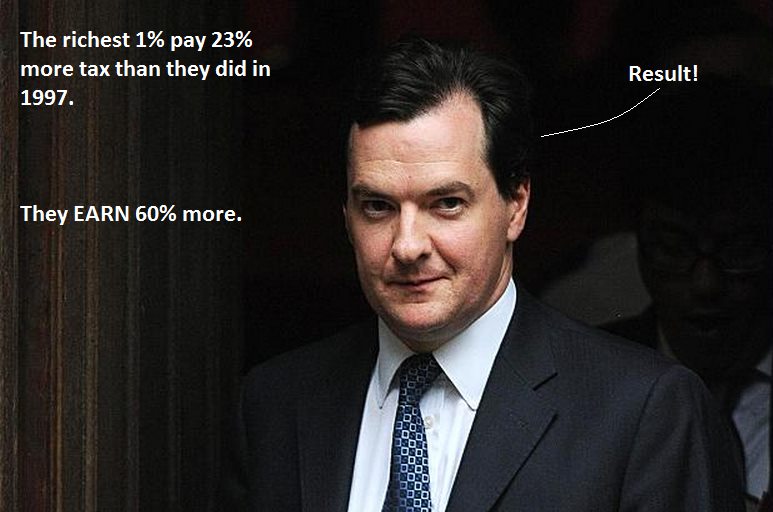
This is juxtaposed with the recent gifted tax cuts for the wealthiest, indicating clearly that Conservatives perceive and construct social hierarchies with policies that extend inequality and discrimination. The axiom of our international human rights is that we each have equal worth. Conservative ideology is fundamentally  incompatable with the UK government’s Human Rights obligations and with Equality law. The chancellor clearly regards public funds for providing essential lifeline support for disabled people as expendable and better appropriated for adding to the disposable income for the wealthy.

Most people (over three-quarters ) who are disabled became so during their working life. There is an implicit political prejudice regarding disability, evident in policy-making, which is that it is an undesirable state and somehow preventable. There is another more explicitly stated prejudice, which relates to the oversimplistic false dichotomy of society. Citizens have been redefined as taxpayers or economic free-riders. However, not only have most disabled people worked and contributed tax and national insurance, people claiming social security also contribute significantly to the Treasury, because we pay VAT, council tax, bedroom tax and a variety of other stealth taxes.

The state confines its focus and responsibility mainly at re-connecting disabled people with the labor market, without any consideration of potential health and safety risks in the workplace, as a strategy of “support,” and justifies the draconian cuts to support as providing “incentives” for people to work, by constructing a narrative that rests on the bogus and socially divisive taxpayer/free-rider dichotomy:

 “You answer if a disabled person can’t work there is NO cut but if they can but won’t, why should taxpayers subsidise them & trolls go mad!”

 By “trolls” Michael Fabricant actually means disabled people and campaigners responding to his tweet.

What happens to those people that can’t work or cannot find an understanding employer, prepared to make reasonable adjustments in the workplace?

On becoming ill – it can happen to anyone

I am medically ill and my illness (lupus) affects my mobility, focus and general wellbeing. I am restricted in what I can do, and the symptoms and exacerbations are very unpredicable. However, it is economic, political and cultural forces which have created and continue to create my ongoing disability and social marginalisation, not my illness. Many of my problems are compounded because of an unadapted physical environment, a lack of resources and the attitudes of others, particularly the current government’s.

I don’t accept that health problems ought to be seen as the cause of the socioeconomic deprivation and exclusion that many of us are experiencing, because the real cause is entirely political. Policies, which exclude disabled people from their design and rationale, have extended and perpetuated institutional and cultural discrimination against disabled people.

My own illness arose partly because of a genetic predisposition, partly because of my gender and hormonal events which often trigger the illness, and probably a variety of other complex reasons, none of which specialists fully understand yet. Prior to becoming very ill, I led a very active and healthy life. I worked hard in a job I loved. My diet is and always has been balanced and healthy, I enjoyed outdoor activities such as climbing, abseiling, archery and walking. I was never inactive or overweight, and I am not stupid when it comes to health issues. Lupus isn’t a “lifestyle choice” and it didn’t arise because of something I did wrong.

All the same, I frequently get well-meaning but bad advice to try different diets, “natural” herbal remedies (people forget that they contain chemicals) – usually the immune- enhancing ones like echinacea, which my rheumatologist has already advised could be very dangerous – and the best one of all: “You should stop taking the heavy duty medication and ‘cleanse your system’.” That would be medication that I take to keep me alive because I tried and ran out of all the other options. I usually recommend a simple course of water melons for such “experts”, to be taken at four hourly intervals, rectally.

Like many other ill and disabled people, I have worked for most of my life. My work was rewarding, and the professional roles I took up have entailed developing inspirational ways to support and enable others, from voluntary work with Women’s Aid and Victim Support, to salaried youth and community work, social work, mental health work and delivering training. I worked whilst being ill for a number of years.

By 2010, I simply couldn’t work any more. My previous and mostly background joint, nerve and muscle pain suddenly became all consuming. My ankles, knees, wrists and fingers swelled. I caught a cold at work which turned to pneumonia on two occasions in 2009. I had apparently random finger abcesses, inexplicable kidney infections, and bruised every time I was touched. I had severe nerve pain in my face and optic nerves, which affects my vision. My hips and lower spine became stiff and painful, my shoulders became frozen. I had a painful rash across my face that looked like eczema, only it wasn’t. I was profoundly tired all of the time, and weighed less than eight stones. My GP ran some tests and everything came back lupus, with complications such as a severe autoimmune bleeding disorder, very low immunity to infection and neurological involvement.

Working put my safety, health and wellbeing at substantial risk. It also potentially exposed other people to risk, too, because of the impact of my illness on my judgments, reliability and consistency, eyesight, ability to supervise, mobility and so on. A tribunal agreed with this assessment in 2012.

It was a very painful recognition that I could no longer work, my decision to leave was very difficult, compounded by a sense of loss of self worth and meaning. I felt that my experience, developed skills, not to mention time and effort invested in studying for a highly vocational Master’s degree, were meaningless and unavailing. However, I was completely unprepared for the damaging impact of the political othering and socioeconomic outgrouping that followed from 2010.

And the poverty. I came to feel that I had been politically redefined as somehow “deviant” by 2012. A much needed transformation to add to the grieving process for the person I was before my body became a traitor. Cheers, Mr Cameron, for the milk of human blindness. The Sex Pistols got it a bit wrong back in the last days of counter-culture and agitprop: it’s not just anarchy that we need for the UK, it’s a modicum of empathy, too.

Doctors and rehabilitation professionals continually recommend medical treatments and practices even though they know that these will not necessarily improve my quality of life. Most of the treatments for autoimmune illnesses such as lupus are largely experimental: comprised of chemotherapies and immune suppressants that carry their own life-threatening risks, and being ill with lupus and other autoimmune illnesses presents a constant and difficult process of weighing up of such risks – life threats from the illness versus life threats and serious life-changing risks from the treatments. 

The dangers that arise when everyone thinks they are an expert on illness and disability

That didn’t stop a job advisor, during my time in the employment support allowance work-related activity, group telling me I should take the chemotherapy methotrexate because her friend with rheumatoid arthritis had some benefit from it. Methotrextate helps around 25% of people taking it, to various degrees, but it cannot cure the illness. Side-effects include sudden death, blindness, liver, kidney and heart failure, lung fibrosis, thrombocytopenia – a serious bleeding disorder which I already have – and death from an overwhelming infection, which I am already susceptible to, since my immune system is easily compromised and broken, amongst many other problems.

As it happens, I had already tried methotrexate for many months, administered by injection into my stomach. It didn’t work and the side-effects were truly diabolical, adding to my existing misery and multiplying symptoms. Another treatment, considered far less risky, called hydroxychloroquine, damaged my retina because I was prescribed too high a dosage, I’m now partially sighted.

However, the unqualified advice from a job coach overlooked that I have a different illness than her friend, and that methotrexate is a black box drug with life-threatening side-effects. Everyone seems to think they are a medical expert nowadays, and that’s the government’s doing, since they have been redefining illness and disability, making it a moral and public matter rather than a private, medical issue. Such political negative role-modelling has permitted a rise in expressions of social prejudice towards disabled people, which is why hate crime has risen significantly since 2010 and is now at the highest level since records began.  

We are either deserving or non-deserving, abled or disabled, never just ill or physically disadvantaged. Our lives have somehow become public property, with all manner of unqualified people feeling entitled to intrude at an intimate level to tell us how to “manage” our illness better. Or to transform media tropes and political folk devils into forms of justification for abuse.

Job centre staff it seems will recommend anything, including unqualified advice about medical treatments, regardless of the risks that may be involved, to coerce people from what was once a social safety net and into any job, regardless of its appropriateness, quality, pay, security, and importantly, it’s potential impact on people’s health and safety.

Last October, I flagged up the extremely worrying government plans to place job coaches in GP practices, with provision made for job centre staff to “update” people’s medical files. The government hadn’t announced this  “intervention” in the lives of disabled people, nor had we been consulted or involved in its design. I found out about it quite by chance because I read Matthew Hancock’s recent conference speech: The Future of Public Services.

I researched a little further and found an article in Pulse which confirmed Hancock’s comments: GP practices to provide advice on job seeking in new pilot scheme.

The government plans to merge health and employment services, and are now attempting to redefine work as a clinical outcome. Unemployment has been stigmatised and politically redefined as a psychological disorder, and the government claims somewhat incoherently that the “cure” for unemployment due to illness and disability, and sickness absence from work, is work.

This is why I visit my doctor and not David Cameron or George Osborne when I need advice, support and treatment related to my medical (and not political) condition.

It’s a prejudiced government that has edited the script regarding sick roles – we no longer have medical sick notes, they have been replaced by political fit notes. The subtext is that we must participate in the world of mainstream work without any choices, without reasonable adaptations and without support. Without any acknowledgement of illness and disability, in fact. Or, we have to accept being redefined, our identity rewritten as “dependent”, “impaired” “unfit for work” as a trade-off for a degree of meagre support.

All of our previous achievements and contributions are forgotten. We once celebrated the achievements of disabled people, but now, we cannot, because disabled people are systematically repressed. We are politically defined as either fit for work (and thus not seen as “disabled”) or not. There are no other options for us, unless we happen to be very wealthy as well as ill.

Singing the body politic in our own voices

We don’t fit with neoliberal dogma and the Tory ideals of “individual responsibility”, competition, a “small state” and compulsory (low) paid employment to enhance profits for the elite’s old boys network. Any positive association with impairment, such as reasonable allowances made or degrees of freedom from the Tory notion of “social obligations” and “responsibilities,” is prohibited. We are faced with an overly simplistic, terribly reductive and dehumanising either/or choice.

We are deemed either fit for work, or too disabled to work, with no accommodation made for what we may be able to contribute in myriad ways to society, nor is our past accumulative experience and skill regarded as a valuable. The moment there is a hint we may have some kind of tenuous work-related capability, all support is withdrawn. However, once we are deemed unfit for work, we are denied full citizen’s status and economic inclusion.

This narrow political approach does nothing to enable and support people, nor does it reflect human diversity. It simply disables us further and denies us autonomy and the right to define ourselves. It’s an approach that actually punishes people for the abilities, experience and skills that they have, stifling human potential. The moment those abilities and skills are revealed at a work capability assessment, all support is withdrawn and those qualities remain unfulfilled. Instead of investing in personal development and extending opportunities, the government is simply cutting social security and public service costs at our expense. It’s not actually their money to cut.

We are expected to participate in an unaccommodating and increasingly competitive job market or suffer the dehumanising consequences and impoverishment of claiming social security long-term. And the people profiting from this are the competing, vulture capitalist private “service” providers.

2014-02-17-BurdenoftheCuts-thumb

There is no support for creating circumstances where our skills may be transfered. There is no support to help anyone adapt their skills and experience to fit future employment. Access to higher education has been restricted because of the steep rise in cost, especially for mature and disabled students. There is nothing in place to ensure that employers recognise disabled people’s skills and experiences and make adaptations to accommodate people wanting to work, and no safety net at all to encourage personal development for disabled people, since all support is tied to rigid definitions of disability. You can either work or not.

Under the guise of lifting burdens on business, this government has imposed burdens on those with disabilities by removing the “reasonable adjustments” that make living our lives possible and allow us some dignity. The labor market is hostile and unaccommodating, providing business opportunities for making profit, but increasingly, the needs and rights of the workforce are being politically sidelined. This will invariably reduce opportunities for people to participate in the labor market because of its increasingly limiting terms and conditions.

This highlights the paramount importance of shifting the political focus to the pressing need to change a disabling culture and to actually listen to our lived experiences, including us in policy design from that of merely coercing us into fitting reductive Conservative definitions to accommodate and fit in with a neoliberal model of society.

We have smug, wealthy and healthy Conservatives redefining disablity, our identity is ascribed by others who have handed us a socially devalued status: we are being told who we are and how we must be.

Citizen’s “needs” are being aligned with politically defined neoliberal outcomes. Those most acutely aware of this are those politically assigned a lower status in the increasingly steep socioeconomic hierarchy. Stigma and othering is used politically to justify the hierarchy and the consequent crass inequalities, which are designed and mediated through policies, not citizens.

Stigma arises because of the perceptions of the oppressor, not those being oppressed. But perhaps it’s time that people who are “working hard” to contribute to the increasingly enclosed economy paused and observed what is going down, because disabled people are not the only ones being stigmatised and radically reduced by a particularly toxic combination of social conservatism and neoliberalism. Punitive and coercive welfare conditionality, including sanctioning, has recently been extended to those in low paid employment and part-time work, as tax credits and additional support vanish under the guise of “universal credit”. The bedroom tax is likely to be extended to the elderly. How does this in any way ensure that “work pays”?  All this will do is increase the precariousness of people’s situations and substantially increase their vulnerability.

The recognition and celebration of human potential, diversity and equal worth has been superceded by an all-pervasive Puritan “hard work” ethic. Our worth is being defined purely in terms of our economic contribution. We are measured out in pounds and pennies whilst making billions for a handful of other people. That is a value that comes exclusively from the dominant paradigm-shaping elite – the ones who actually profit from your hard work.

You don’t.

The government’s new “health and work” programme is actually workfare for sick and disabled people. Apparently, slave labor for big business is good for our “health” and has the added bonus of adding substantially to profits for friends of the Conservatives. It’s amazing how quickly the public have accepted the political semantic shifts, such as “work programme” – compulsory labor for no wage, which was originally about “exploitation” and has now been redefined as “work experience”. Apparently that is also “fair”, “inclusive”, “good” for our health and “makes work pay”.

Makes work pay for whom?

Disability can no longer be considered solely as a medical problem, affecting only a minority of the population. It must be seen for what it is: as a civil rights issue as central to mainstream political discourse. This government uses draconian policies to act UPON disabled people, it does not value our lived experiences nor does it listen and RESPOND to us. It’s a government that simply tells us how we must BE. That is profoundly undemocratic, it discriminates against us and excludes a social group on the basis of a protected characteristic.

There are and have been a lot of ways to define disability, it has variously has been defined through the eugenic model, a medical model, charity model, rights-based model, social model and a radical model. Now it’s time for a disabled people’s model, founded on our lived experiences and varied needs.

Understanding that oppressive situations have not arisen through any fault of our own, and that the oppression is real and has a basis in sociopolitical prejudice and discrimination provides us with the courage needed, and a more solid ground on which to fight for liberation. It always seems to be the case that fighting social injustice is left to the very people who have been excluded and systematically deprived of a political voice and power, it’s always down to us to make others listen. Yet it is invariably the case that when one social group is targeted for political prejudice and discriminatory policies, it affects everyone. Historically we have learned it quickly follows that other groups are singled out, too.

The universal character of human rights is founded on the inherent dignity of all human beings. It is therefore axiomatic that people with medical conditions that lead to disabilities, both mental and physical, have the same human rights as the rest of the human race.

The United Nations is currently investigating this government’s gross and systematic violations of the Convention on the Rights of Persons with Disabilities (CRPD), and a recent report from the House of Lords Select Committee on the Equality Act 2010 and Disability, investigating the Act’s impact on disabled people, has concluded that the Government is failing in its duty of care to disabled people, because it does not enforce the act.

Furthermore, the Select Committee concludes that the government’s red tape challenge is being used as a pretext for removing protections for disabled people. It’s a government that regards the rights and protections of disabled people as a mere bureaucratic inconvenience.

There’s a certain irony regarding the Conservative preoccupation with preserving social order: their rigid ideologically-driven policies create the very things they fear – dissent, insecurity, disorder and the raising of public awareness and recognition of a pressing need for social change and reform. It’s seems to be the case that Conservative governments prompt a growth of social challenges that encourage the flourishing of the very radicalism and revolutionary ideas that they fear and loathe.

That is what happens when people are oppressed.

 11081126_792213310848199_1993005711793194503_n

Picture courtesy of Robert Livingstone


I don’t make any money from my work and I’m not funded. You can support Politics and Insights by making a donation to help me continue researching and writing independently, and to continue to help others.

DonatenowButton
cards

Department for Work and Pensions Recruits Staff To Reduce ESA And PIP Appeal Success Rates

8a26960ab68d6c169049cd0b22475a12

Legal Aid funding became unavailable for welfare cases at First Tier tribunal in April 2013, because of the Conservative-led Legal Aid, Sentencing and Punishment of Offenders Act 2012 (LASPO). This included Legal Aid for appealing all benefit decisions. Legal Aid at Second Tier tribunal may be available if the case is about a point of law. Political lip service was paid to the legal human rights implications regarding the violation to the right to a fair trial (Article 6 of the ECHR), equal access to justice , and the Act provided that funding may be granted on a case-by-case basis where the failure to provide legal aid would be a breach of the individual’s rights under the European Convention on Human Rights (ECHR) or the rights of the individual to the provision of legal services that are enforceable European Union rights.

The Lord Chancellor’s Exceptional Funding Guidance (Non-Inquests) clarified that in determining whether Article 6 ECHR would be breached, it has to be shown that the failure to grant funding would mean that bringing the case would be “practically impossible or lead to an obvious unfairness in proceedings” (para 63). But Ministry of Justice figures showed that from 1 April 2013 to 31 December 2013, of the 1,083 applications determined, funding was granted in only 35 cases (3% of cases). This indicates that the criteria are being applied in an intentionally “overly restrictive manner” and, in the case of welfare benefits, all 11 applications were refused: Exceptional Case Funding Statistics – April 2013 to March 2014

Considering this in a context that includes the introduction of the Mandatory Review, in 2013, and in light of more recent events, I think it’s fair to say that the Conservatives have shown they are determined to take away money that provides essential support from disabled people in particular, one way or another, no matter how much it costs to do so.

Many thanks to Benefits and Work for the following information:

The Department for Work and Pensions has been given £22 million to recruit presenting officers in an effort to reduce the number of claimants winning their personal independence payment (PIP) and employment and support allowance (ESA) appeals.

The Office for Budget Responsibility’s (OBR) “Economic and Fiscal Outlook” document lists the following amount:

“£22 million to DWP to recruit presenting officers across 2016-17 to 2017-18 to support the department in personal independent payments and employment and support allowance tribunals.”

Buzzfeed is reporting that the money will pay for 180 new presenting officers.

The number of PIP appeals is expected to skyrocket over the coming two years as the forced move from DLA to PIP takes place.

In addition, the proportion of successful PIP appeals has increased with every quarter since the benefit was introduced. PIP claimants won in 60% of cases from July to September 2015, up from 56% in the previous quarter.

58% of ESA cases are also won by the claimant.

The DWP is also concerned by the way that tribunal judges have been interpreting the very badly drafted PIP legislation in favour of claimants. In particular, the widening of what counts as aids and appliances for PIP activities by judges is what led to the disastrous attempt to change the point scores for PIP.

In theory, presenting officers should act a s a ‘friend of the court’, helping judges to reach a fair decision. In reality, they will be sent by the DWP to try to discredit claimants and argue as forcibly as possible for the DWP’s interpretation of the law to be accepted.

Attending an appeal tribunal is likely to be an even more gruelling process for claimants over the next few years.

Update

Recovery In The Bin is a mental health social justice group, who are fundraising to help train 16 volunteers to support people with mental health difficulties before and up to ESA/ PIP tribunals. They say:

“Here’s what we’re doing about it

We have asked Welfare trainer Tom Messere, author of the Big Book of Benefits, if he would train 20 volunteers in the basics that they will support people up to these tribunals to give them a bit more of a fighting chance. And whilst we have Tom at our disposal we are also we will be training the volunteers to help fill out the often complex and confusing forms, so that less have to go to tribunal in the first place. The training will be on ESA and PIP, form filling, getting any available medical and informal evidence correctly pitched (what the person needs to ask for), possible calls, key pointers for accompanying, and up to tribunals.

You can join us

We are hoping you can donate to help pay for the training, the venue, transport and accommodation for Tom, and as we are recruiting volunteers, many on low incomes themselves, and as we will need to have representatives in as many places as we can (sorry, we wish we could provide for everywhere) then we are trying to raise as much help for their travel as well.

As such we are looking to raise £2250.”


You can support Recovery In The Bin in their aim to provide support for people who need to fight at tribunal for their ESA and PIP award, and donate here

The government is failing in its legal duty of care to disabled people

GetImage


The House of Lords Select Committee
on the Equality Act 2010 and Disability investigating the Act’s impact on disabled people has concluded that the Government is failing in its duty of care to disabled people. From taxi drivers refusing to take disabled people, to “disgraceful” accessibility at sports grounds, to pubs and clubs failing to provide disabled toilets, the report, entitled The Equality Act 2010: the impact on disabled people, says practice in all areas must be improved.

Comment of Baroness Deech, Chairman

“Over the course of our inquiry we have been struck by how disabled people are let down across the whole spectrum of life.

“Access to public buildings remains an unnecessary challenge to disabled people. Public authorities can easily side-step their legal obligations to disabled people, and recent changes in the courts have led to disabled people finding it harder to fight discrimination.

“When it comes to the law requiring reasonable adjustments to prevent discrimination, we found that there are problems in almost every part of society, from disabled toilets in restaurants being used for storage, to schools refusing interpreters for deaf parents, to reasonable adjustments simply not being made.

“In the field of transport alone, we heard of an urgent need to meet disabled people’s requirements – whether it’s training for staff or implementing improvements to trains and buses – and we’re calling for all new rail infrastructure to incorporate step-free access in its design from the outset.

“The Government bears the ultimate responsibility for enabling disabled people to participate in society on equal terms, and we believe it is simply not discharging that responsibility. Not only has the Government dragged its heels in bringing long-standing provisions of the Act into force, such as those requiring taxi drivers to take passengers in wheelchairs, but has in fact repealed some provisions which had protected disabled people. Intended to reduce the regulatory burden on business, the reality has been an increase in the burden on disabled people.

“The Committee would like to see changes right at the top of Government and is calling for the Minister for Disabled People to be given a place on the Cabinet’s Social Justice Committee. 

“It’s time to reverse the attitude that disabled people are an afterthought. Many of the changes we suggest are simple and do not require legislation. We hope the Government will implement them quickly.”

Findings in the report include:

Transport

The Government should bring into force immediately provisions in the Act obliging taxi drivers to take passengers with wheelchairs. In cases where taxi drivers fail to comply with the Act local authorities should withhold the licences of drivers.

All new rail infrastructure must build into its design step-free access; retrofitting of stock with audio/visual annunciators must be prioritised; training for all rail, bus and coach staff must be made a legal requirement.

Sports grounds

These have been described as “disgraceful” by the Minster for Disabled People and new measures are needed. Ministers must report on the progress made on stadia, following the Premier League’s promise to upgrade all their stadia by August 2017.

Housing and public spaces

Many restaurants, pubs and clubs are difficult to access, with many not providing basic facilities such as a disabled toilet. Local authorities should be allowed to refuse to grant or renew these premises’ licences until they make the necessary changes.

The design of new buildings is another area where local authorities could require new buildings to be wheelchair accessible or adaptable, simply by revising their planning policies.

Communications and democratic inclusion

Communications is an area where disabled people are still being failed. We recommend that all Government departments, local authorities and public bodies review how they communicate with disabled people, and that disabled people must be involved in this process.

The law and enforcement

Developments in recent years have made fighting discrimination more difficult for disabled people. New tribunal fees, less access to legal aid, and procedural changes have combined to create barriers to the effective enforcement of disabled people’s rights. Changes are recommended to combat this.

The Equality Act 2010 was intended to harmonise all discrimination law and to strengthen the law to support progress on equality.

Over the past nine months the Committee has been examining the Equality Act 2010 and in particular its impact on disabled people, looking at areas such as:

·    Implementation
·    Enforcement
·    Reasonable adjustment
·    Transport
·    Communication
·    The Equality and Human Rights Commission
·    Discrimination and the judicial process

During the course of the inquiry the Committee received nearly 180 pieces of written evidence and heard from more than 50 witnesses, among them the Government Equalities Office, the Office for Disability Issues, Disability Rights UK, RNIB, Scope, MIND, British Deaf Association, the Bar Council, Law Society, Discrimination Law Association, Law Centres Network, People First Advocacy, Business Disability Forum, Association of Convenience Stores, Trade Unions Congress, Disabled Persons Transport Advisory Committee, campaign group Transport for All, NHS England, Care Quality Commission, Ofsted, the Independent Parental Special Educational Advice, Association of Train Operating Companies, Confederation of Passenger Transport, Housing Law Practitioners Association, Lewisham Shopmobility Scheme, National Association of Licensing and Enforcement Officers, the Parliamentary and Health Service Ombudsman, Carers UK, and officials from the Department for Transport, Department for Education, Department of Health, Department for Communities and Local Government, and Department for Work and Pensions.

The Committee took evidence from Government ministers Rt Hon Nicky Morgan MP, Secretary of State for Education and Minister for Women and Equalities, Department for Education; Justin Tomlinson MP, Parliamentary Under Secretary of State for Disabled People, Department for Work and Pensions; and Andrew Jones MP, Parliamentary Under Secretary of State, Department for Transport. 

The Committee also heard first-hand testimonies from disabled people as well as visiting a user-led support organisation for disabled people, Real.

Watch the Chair of Equality Act 2010 and Disability Committee Baroness Deech and member of Committee Baroness Campbell of Surbiton discuss the findings of the report, ‘The Equality Act 2010: the impact on disabled people.’ Film with British Sign Language.

Government inaction is failing disabled people

Summary of the Committee’s recommendations.

Welfare, Conditional Citizenship and the Neuroliberal State – Psychology Conference abstract and details

behavchange

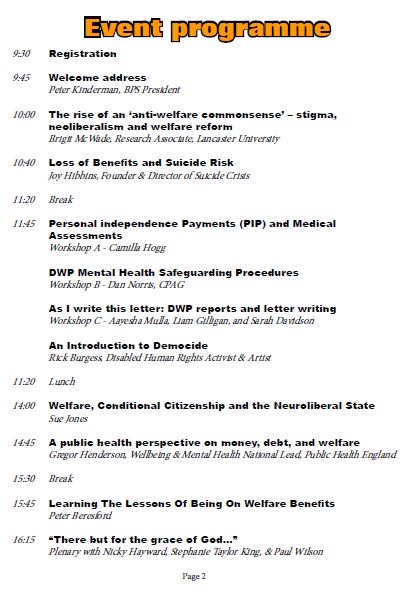
Conference on Friday, October 7, 2016 from 9:30 AM to 4:30 PM at St Thomas Centre – Ardwick Green North, Manchester M12 6FZ, United Kingdom.

Psychologists and the benefits system

“Psychologists need to support people through the benefits system, whilst also working to affect necessary changes in the system. This event will explore some of the debates, challenges and skills necessary to take on these responsibilities.

The day will include presentations from public health, sociology, people with lived experience, clinical psychologists, the Child Poverty Action Group (CPAG) and other professionals. There will also be workshops focussed on skill development, with particular attention on report writing, navigating the benefits system and DWP safeguarding procedures.

This will be a challenging, supportive, thought-provoking day.” Event organiser, Dr Stephen Weatherhead.

Contact: s.weatherhead@lancaster.ac.uk 

Please see here for further details.

Ciml6qCW0AAFo0k
Abstract for my presentation

The consolidation of neoliberalism with Conservative moral authoritarianism has resulted in welfare policy design with a reductive and punitive behaviour change agenda. This decontextualises citizens and personalises responsibility for circumstances of socioeconomic hardship.

The emergent psychopolitical form of governance, founded on expressions of an established hierarchy of power and influence, has some profound implications for traditional notions of welfare, democracy, cognitive autonomy, citizen agency, equality and human rights. Not only does this behaviourist mode of administration fundamentally change the relationship between state and citizen, it extends inequality, prejudice, stigma and outgrouping, with damaging consequences for sociopolitical inclusion, self-perception and selfhood.

Ciml6teWgAAjS1t

Through the looking glass darkly: the Conservatives are colonising progressive rhetoric

Vocabulary+word+cloud.jpg

“When I use a word,” Humpty Dumpty said in rather a scornful tone, “it means just what I choose it to mean — neither more nor less.”

“The question is,” said Alice, “whether you can make words mean so many different things.”

“The question is,” said Humpty Dumpty, “which is to be master — that’s all.”
Lewis Carroll, Through the Looking Glass

Semantic thrifts: being Conservative with the truth

Much communication in the media is geared towards establishing a dominant paradigm and maintaining an illusion of a consensus. This excludes pluralism and ultimately serves to reduce democratic choices. Such an approach is ultimately aimed at nudging your voting decisions and maintaining a profoundly unbalanced, pathological status quo.

Presenting an alternative narrative is difficult because the Conservatives have not only framed all of the issues to be given public priority – they set and stage-manage the media agenda – they have also dominated the narrative; they constructed and manage the political lexicon and now treat words associated with the Left, such as welfare, like semantic landmines, generating explosions of right-wing scorn, derision and ridicule – words like cooperation, inclusion, mutual aid, reciprocity, equality, nationalisation, redistribution and the like are simply dismissed as mere anachronisms that need to be stricken from public conversation and exiled from our collective consciousness, whilst all the time enforcing a bland language of an anti-democratic political doxa.

However, the Conservatives have also raided from the progressive lexicon, and I’m far from alone in noticing the Conservative colonisation of traditionally progressive rhetoric in recent years, using in abundance terms such as “fair”, “support”, “protection”, “freedom” , “opportunity”, “reform” and even “social justice” to pepper their speeches.

Last October, even Dan Hodges noticed the linguistic imports. He said: “Prison reform. Ethnic minority rights. Gay rights. A national housing “crusade”. An “all out assault on poverty”. An attack on “the lowest social mobility in the developed world”. These were the main themes of the Conservative Party leader’s – I’ll repeat that, the Conservative Party leader’s – address to his annual conference. I expected David Cameron to attempt to park his tank on Labour’s lawn.

… It wasn’t just what David Cameron said, but how his party reacted to it. The section of his speech where he said “I want us, the Conservatives, to end discrimination and finish the fight for real equality in Britain today,” was met with a standing ovation.”

The Conservatives have plundered from left wing discourse purely to broaden their superficial appeal and to neutralise opposition to controversial and contentious policy. The legislative context in which such language is being used is completely at odds with how it is being described by purposefully stolen terms and phrases. It’s disorientating and cognitive dissonance inducing to see the language of social justice, democracy, inclusion and equality being used to justify and describe policies which extend social injustice, authoritarianism, exclusion and inequality.

There is a growing chasm between Conservative discourse, and policy intents and outcomes. There isn’t a bridge between rhetoric and reality. Last week I wrote about the chancellor’s budget, and said:

Only a Conservative minister would claim that taking money from sick and disabled people is somehow “fair,” or about “helping”, “supporting” or insultingly, “incentivising” sick and disabled people who have already been deemed unfit for work by their doctors and the state via the work capability assessment to work.

The Tories all too frequently employ such semantic shifts and euphemism – linguistic strategies – as an integral part of a wider range of techniques of neutralisation that are used, for example, to provide linguistic relief from conscience and to suspend moral constraint – to silence both “inner protest” and public objections – to the political violation of social and moral norms; to justify acts that cause harm to others whilst also denying there is any subsequent harm being inflicted; to deny the target’s and casualties’ accounts and experiences of political acts of harm, and to neutralise remorse felt by themselves or other witnesses.

Media discourse has often preempted the Conservative austerity cuts, resulting in the identification, stereotyping and scapegoating of the groups in advance of the targeted, discriminatory policies. Media discourse is being used as a vehicle for the government to push their ideological agenda forward without meeting legitimate criticism, public scrutiny and without due regard for essential democratic processes and safeguards.

The five neutralisation techniques identified by Gresham Sykes and David Matza are: denial of responsibility, denial of injury, denial of victims, appeal to higher loyalties, and condemnation of condemners.

The really critical part of Sykes and Matza’s argument is that rationalisations precede immoral, cruel or controversial acts and are a key factor in making deviant behaviour possible (amongst delinquents, the mafia or Conservative ministers). As such, the rationalisations betray intent.

The cuts of £120 a month to the disability benefit Employment Support Allowance  are also claimed to be “fair.” and “supportive.” Though I have yet to hear a coherent and rational  explanation of how this can possibly be the case. Ministers claimed that people subjected to the ESA Work Related Activity Group cuts could claim PIP if they required support with extra living costs, but now we are told that PIP is to be cut, too.

Osborne ludicrously claimed that the Conservative government was “increasing spending on disabled people”, he said: “Controlling welfare bills is part of what you need to do if you’re a secure country confronting the problems in the world.”

But as Andrew Marr amongst others pointed out, the cuts to ESA and PIP show an intended substantial reduction on government spending to essential support for disabled people.

PIP was introduced by the Conservatives to “target those most in need” and to save money. Despite David Cameron promising before the general election that there would be no further cuts to disability support, ministers nonetheless have claimed that the proposed cuts to PIP are once again to “target those most in need”, which would leave many of those disabled people originally defined as being most in need on an ever-shrinking island.

Linguistic stealth and slick trickery

The Conservatives have co-opted a progressive language to disguise extremely regressive policies, and to blur and manipulate traditional ideological boundaries. It’s purely strategy rather than ideological direction. They have quite cunningly [re-]framed a partisan narrative, dressing it up as common sense. For example, policies are framed using the phrases like “social justice”, “fighting poverty”, Conservatives present themselves as the “party for working people” and claim concern for ensuring people “fulfil their potential”. These are phrases ordinarily associated with discourses of the Left.

This framing makes it much more difficult for the Left to focus public debate on the issues central to social democracy. Equality of opportunity, linked with open social mobility, merit and freedom, is another central value and objective for progressives. However, equality appears to be increasingly couched in negative terms, as opposed to merit, and often associated with social injustice, inefficiency and unfairness by the Conservatives.

Under the Equality Act, provision was made by the Labour government to ensure that legislations didn’t discriminate against protected social groups, which included disabled people. However, the need for public bodies in England to undertake or publish an equality impact assessment of government policies, practices and decisions was quietly removed by David Cameron in April 2011. The legal requirement in the Equality Act that ensured public bodies attempt to reduce inequalities caused by socio-economic factors was also scrapped by Theresa May in November 2010, who said that she favoured a greater focus on “fairness” rather than “equality”, claiming that many people felt “alienated” by the equality agenda.

The Conservatives have paid a lot of money to advisors to develop ways of expressing their world-view and the use of misleading discourse, almost invariably contradicted by policy, practice and outcomes, is intentional.

The Tories use euphemism a lot to neutralise criticism and to present a facade of judicious, equitable rationale for draconian policies founded on ideology and traditional Tory prejudices. The redefinition of the financial crisis as a state – specifically, “irresponsible government” – rather than a market failure, and a narrative of “enhanced efficiency and responsibility in public administration” translates into policy practice as cuts to the public sector, drastic cuts to the post-war settlement social safety net budgets and a steady erosion of workers´ rights, “excellence and free choice in education or health service provision” means widespread privatisation – and a deterioration of public services, leaving  citizen’s with considerably less choice and increasingly unmet needs.

The Conservative’s progressive rhetoric conceals a partisan determination to impose neoliberal policies that shrink the size of the state, while defending traditional Conservative vested interests among the financial sector and the wealthy.

Yet Cameron and his chancellor have successfully placed the blame for the deficit on Labour’s trumped up charge of “profligacy” in government, despite the fact that we were out of recession caused by the global financial crisis, by the last quarter of 2009. Despite the fact that the Conservatives created a recession in 2011, and we lost our Fitch and Moody triple A credit ratings, despite Osborne’s promises and assurances that we wouldn’t. The Conservatives have a historically verified tendency to create recessions, too. The Thatcher administration did, and so did John Major’s. How did the public forget these events? Black Wednesday is estimated to have cost us £3.4 billion. The constant repetition of the profligacy lie, ad nauseam, supplanted the public’s accurate perception of the underlying events.

Tory ideology is about handouts to the wealthy funded by the poor

“David Cameron and George Osborne believe the only way to persuade millionaires to work harder is to give them more money.’

‘But they also seem to believe that the only way to make you (ordinary people) work harder is to take money away.” Ed Miliband, 2012.

Taxation of the wealthy is framed as an unfair burden – an affliction or punishment, propped up by constant implicit references to debunked notions such as trickle-down wealth and job creation. Policies extending social injustice are being reframed as social justice.

Framing takes a long time to develop, and this particular frame was developed by the New Right on both sides of the Atlantic. It does leave progressives with a fight to articulate the moral basis for progressive taxation, obstructed by the outrageous Conservative myth that wealthy people have somehow amassed their wealth all by themselves and therefore deserve it and more. The truth is that it is ordinary UK taxpayers who support the infrastructure of wealth accumulation. It is only fair that those who benefit most from this should also pay their equal share.

Without the veneer of democratic engagement and respectability that the Conservatives raided from discourses of the Left, Conservative policies would appear as they really are: driven by a narrow ideology, based on traditional Tory prejudices and completely indefensible.


wc30allbrightedit1.jpg
This image contains 24 word clouds, representing the 24 categories into which a sample of roughly 130,000 statements from UK House of Commons parliamentarians, all made between 2006 and the present day, were partitioned by the clustering algorithm. Each cloud contains ten words; the larger the word, the more representative it is of the cluster. The colouring is also meaningful: red words have meanings more closely aligned with remarks by Labour politicians; blue words, with those of Conservatives; and yellow words, with the sentiments of Liberal Democrats.See source: Clustering debates from UK politicians.


Recommended

How the Tories Use the Language of Social Justice to Sell Us Social Injustice

How to Respond to Conservatives –  George Lakoff


I don’t make any money from my work and I’m not funded. You can support Politics and Insights by making a donation to help me continue researching and writing independently, and to continue to help others.

DonatenowButton
cards

Call for evidence – Future of Jobcentre Plus inquiry launched

equality+act+image
The Work and Pensions Committee has launched an inquiry into the future of Jobcentre Plus (JCP), the public employment service arm of the Department for Work and Pensions (DWP).

Changes affecting Jobcentre Plus services

A number of important changes will affect the services offered by JCP over the next few years, including:

  • The full implementation of Universal Credit (UC), which, particularly once a fully-functioning digital service is developed, will be a largely online process and have implications for digital inclusion
  • More frequent interviews at the Jobcentre for unemployed claimants in the early stages of benefit claims
  • Delayed referral of long-term unemployed claimants to externally-contracted employment services (welfare-to-work) providers, meaning that JCP will support people who remain out of work for two years
  • The development of a support offer for UC claimants who are in work but on very low incomes
  • Plans for greater co-location of JCP offices with other local services such as council benefit teams and physical and mental health services, including IAPT services
  • Plans for JCP to offer advice, particularly on traineeships and apprenticeships, to 12 to 18 year old school pupils
  • The process of devolution of employment services to combined local authorities and the devolved governments

Call for written submissions

The Committee invites written submissions addressing one or more of the following areas:

  • The likely effects of the planned changes on claimants, including on the quality of services offered to them and the implications in relation to digital inclusion
  • The potential implications for JCP, including in relation to:
    • Resourcing of JCP
    • Jobcentre “footfall” and the configuration of JCP offices
    • The development of suitable performance measures
  • JCP’s capability to provide new, tailored services for particular groups of people, including people with mental health problems
  • Opportunities afforded by coordination with other local services, including the NHS and schools
  • The extent to which reforms will require cultural change within JCP, and the DWP’s capability successfully to foster this change
  • The opportunities and challenges for JCP presented by greater devolution of employment services to regional and national governments

Send a written submission through the Future of Jobcentre Plus inquiry page.

The deadline for written submissions is Friday 22 April 2016.

Committee comments

Heidi Allen MP, Committee Member, said:

“In the brave new world of Universal Credit, the Jobcentre will become so much more than the place where people simply ‘sign on.’ I am in absolutely no doubt that UC marks the beginning of a new age in which the individual and the state are partners in the future potential of the individual, but the Jobcentre and its staff will need to undergo significant transformation. We must ensure Jobcentre Plus has the capacity and capability to change with the times, and deliver quality services which are sensitive to the increasingly varied needs of the individuals it serves.”

 Craig Williams MP, Committee Member, said:

“As much as different people have different needs, so do different places. The DWP has run a pretty centralised network of Jobcentre Plus offices, for perhaps too long. We will want to consider carefully the potential opportunities for greater decentralisation of employment-related services to combined authorities and the devolved governments.”

Further information

Some initial thoughts and concerns regarding the JCP’s capability to provide new, tailored services for particular groups of people, including people with mental health problems

The government’s Work and Health programme involves a plan to integrate health and employment services, aligning the outcome frameworks of health services, Improving Access To Psychological Therapies (IAPT), Jobcentre Plus and the Work Programme. 

There are concerns that the government have already come close to redefining unemployment as a psychological disorder, and now they aim to redefine work as a clinical outcome.

The Work and Health programme in particular is aimed at finding ways of: “preventing people from falling out of the jobs market and going onto Employment and Support Allowance (ESA).”

“These include GPs prescribing a work coach, and a health and work passport to collate employment and health information. These emerged from research with people on ESA, and are now being tested with local teams of Jobcentres, GPs and employers.”  Source: Matthew Hancock’s conference speech: The Future of Public Services.

Whilst for some clients, improving employment prospects may be realistic and what they want, for many others this is not the case and such an intrusive state intervention may be profoundly anxiety-provoking and potentially psychologically damaging. People sometimes become too ill to work. GP surgeries are not the place to subject people to what may be perceived, essentially, as a blunt state behaviour modification programme, designed to coerce people to work regardless of their current capacity of doing so.

People placed in both Employment Support Allowance groups (work related activity group and support group) have been deemed unable to work by both their own qualified doctors and by the state via the work capability assessment. It may well be the case that some people feel able to and want to work in the future, and ask for support to find suitable employment, but it extremely unethical to coerce people to work that are too ill to do so.

That is why an absolute assurance of the voluntary element of client engagement is of paramount importance, it has to be a central underpinning principle of the work and health programme. Furthermore, it has to be assured that any proposed treatment may proceed only on the basis of (and provision for) informed consent from the client.

The principle of consent is an important part of medical ethics and international human rights law. Consent is required by law from a patient regardless of the intervention.

Generally, for consent to be valid it must be informed consent. For this to be the case it must be:

  • Given voluntarily (with no coercion or deceit)
  • Given by an individual who has capacity
  • Given by an individual who has been fully informed about the issue.

GPs have raised their own concerns about sharing patient data with the Department for Work and Pensions – and quite properly so. Pulse reports that the Department for Work and Pensions (DWP) plans to extract information from GP records, including the number of Med3s or so-called “fit notes” issued by each practice and the number of patients recorded as “unfit” or “maybe fit” for work, in an intrusive move described by GP leaders as amounting to “state snooping.”

There are also very serious concerns regarding the plans to permit medically unqualified job coaches to access and “update” patients medical records. That must not happen. Citizen’s complex health conditions and healthcare should never be subject to state editing and nor should these be conflated with political aims. That is potentially very dangerous and has nothing to do with the health and wellbeing of patients. A person’s employment status has no bearing on objective professional and specialist accounts of a person’s illness, diagnosis, medical tests and treatments. Work does not cure illness.

Patients have the right to explicitly refuse their consent to data sharing. The Data Protection Act 1998 covers personal information including health records. Further provision under Article 8 of the Human Rights Act 1998 establishes a right to respect for private and family life. This underscores the duty to protect the privacy of individuals and preserve the confidentiality of their health records. This right must remain intact. There is also additional guidance from the British Medical Association (BMA) here – GPs as Data controllers guidance. (PDF)

The government’s expressed aim is to prompt public services to “speak with one voice.” This proposed multi-agency approach is potentially very reductive, rather than being about formulating expansive, coherent, comprehensive and importantly, responsive provision. There is a danger that such a cross-agency approach will simply involve the co-opting of service providers and professionals as state enforcers, conflating complex citizen needs with simply getting people to work.

Public services “speaking with one voice” will make accessing support conditional, and potentially further isolate already marginalised social groups. It may damage trust between people needing support and professionals who are meant to deliver essential public services, not government slogans and potenially damaging messages. Places that have traditionally provided safe havens for people on low incomes, such as community centres, will no longer be places where people may feel they can escape the pressures and distresses of their circumstances and be relatively and unconditionally secure.

Human beings are subjects, not objects of policy, and the worrying trend towards the government instructing citizens how to be, under the guise of libertarian paternalism, is profoundly antidemocratic, non-dialogic and intrusive – it curtails citizen’s autonomy and basic freedoms and is incongruent with the democratic role of government in formulating policies that meet citizen’s needs. Instead, citizens are being coerced into meeting government aims and policy outcomes.

The move to “join up all public services to ‘get local people back to work'”, including housing and foodbanks may also be used as additional opportunity to extend welfare conditionality, including sanctions, to people who were previously exempted because of their circumstances.

Not only would this raise some serious ethical problems regarding the enforcing of a limited but mandatory state “treatment” on people who cannot work because they are ill, based on a political prejudice that work is somehow “good” for them, it would also limit access to other services that ordinarily provide a broader scope of support with a wider range of aims and outcomes that are more in line with a holistic approach to complex client needs, health and wellbeing.

It would potentially undermine people’s right to health care and support by making provision conditional to finding a job.

In linking receipt of welfare with health services, other public provision providers and access to “therapy,” with the single intended outcome explicitly expressed as employment, the government runs the risk of conflating citizen’s widely varied needs with diktats, and isolating people from traditionally non-partisan networks of relatively unconditional support, such as the health service, social services, community services and mental health services.

All policies are expressed political intentions regarding how our society is organised and governed. They have calculated social and economic aims and consequences. In democratic societies, citizen’s accounts of the impacts of policies ought to matter.

The government have not got a reassuring track record regarding the assessment of people’s illnesses, disability and capability for work, it has to be said. When serious concerns have been raised with ministers regarding the negative and often distressing experiences of sick and disabled people because of government policies, such concerns have been met with denial and a refusal to investigate or indeed, to engage any further.

I should like to know when those citizens who will be directly affected by the proposed policies, especially the work and health programme, were consulted? Have service users had any say at all in the design and aims of these proposed interventions?

It’s worth remembering that governments in first-world liberal democracies are for creating policies that actually meet public needs, rather than imposing totalitarian levels of control, manipulating and micromanaging citizens to meet government needs and political outcomes.


Iain Duncan Smith abandoned his own sinking ship

Impact of tories on income.jpg

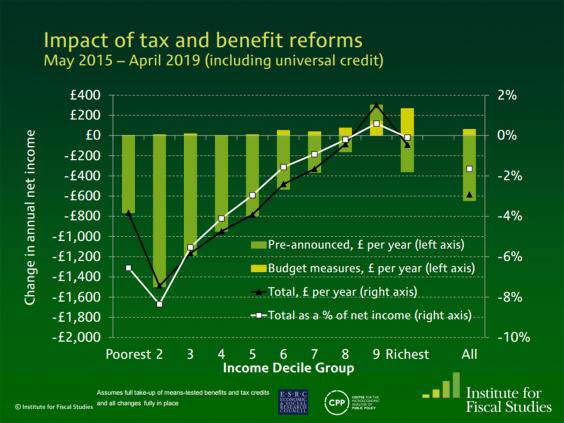
Analysis of George Osborne’s budget from the Institute for Fiscal Studies.

Stephen Crabb has been appointed as the new work and pensions secretary, after Iain Duncan Smith resigned in a flurry of controversy on Friday.

Mr Duncan Smith has said the latest planned cuts to disability benefits were “not defensible” in a Budget that benefited higher-earning taxpayers.

David Cameron said he was “puzzled and disappointed” that Mr Duncan Smith had decided to go when they had agreed to have a rethink about the policies

Iain Duncan’s Smith’s letter of resignation must be a BIG embarrassment to the  Government. It was certainly designed to inflict maximum damage particularly on Chancellor George Osborne. I’ve previously noted that the Chancellor has a tendency to regard the Department for Work and Pensions as little more than an annex to the Treasury, and the welfare budget as the Treasury’s disposable income, but I never anticipated that Duncan Smith would come to say that he sees it that way, too. This is, after all, a minister that has invented statistics and told some pretty far-fetched fibs to prop up justifications of his policies that entail some pretty draconian measures, such as sanctions and work fare, after all.

Yet surprisingly, Duncan Smith has also quite willingly and very publicly provided the government’s opponents with ammunition. He has effectively denounced not only Osborne’s budget, but also, his targeted austerity measures, yet curiously, Duncan Smith has until now been one of the most ideologically devout Thatcherite Conservatives, which is reflected in every policy he has formulated.

He has basically said what many of us have been saying for a long time: that the cuts are political and not because of economic necessity, nor will they help the economy. He also as good as said he doesn’t think we are “all in it together”. It turns out that Osborne blamed Duncan Smith for the Personal Independence Payment (PIP) and Employment Support Allowance (ESA) cuts. But Duncan Smith has been a very quiet man recently, often conspicuous by his absence during parliamentary debates, with Priti Patel left defending the ESA cuts in particular in the Commons.

However, the Department for Work and Pensions did a review of PIP last year, and that’s where the “justification” for the cuts came from – a sample of just 150 people, which was hardly a representative sample. It’s difficult to imagine that IDS didn’t order that review. But it was Osborne who announced the cuts to PIP, not Iain Duncan Smith. Just who carries the original responsibility for the proposed PIP cuts is probably never going to be fully untangled from the crossfire of accusations and counter accusations. But surely Cameron is ultimately responsible for Conservative policies?

In his resignation letter, Iain Duncan Smith says:

“I have for some time and rather reluctantly come to believe that the latest changes to benefits to the disabled, and the context in which they’ve been made are, a compromise too far. While they are defensible in narrow terms, given the continuing deficit, they are not defensible in the way they were placed within a budget that benefits higher earning taxpayers. They should have instead been part of a wider process to engage others in finding the best way to better focus resources on those most in need.

I am unable to watch passively while certain policies are enacted in order to meet the fiscal self imposed restraints that I believe are more and more perceived as distinctly political rather than in the national economic interest.

Too often my team and I have been pressured in the immediate run up to a budget or fiscal event to deliver yet more reductions to the working age benefit bill. There has been too much emphasis on money saving exercises and not enough awareness from the Treasury, in particular, that the government’s vision of a new welfare-to-work system could not be repeatedly salami-sliced.

It is therefore with enormous regret that I have decided to resign. You should be very proud of what this government has done on deficit reduction, corporate competitiveness, education reforms and devolution of power.

I hope as the government goes forward you can look again, however, at the balance of the cuts you have insisted upon and wonder if enough has been done to ensure ‘we are all in this together’ “

You can read the letter in full here

You can see Cameron’s response in full here

Many Conservatives have suggested that Duncan Smith – a supporter of Brexit – had been looking over several weeks for an opportunity to resign, and claimed that he wanted to find a moment when he could inflict maximum damage on the campaign led by Cameron and Osborne to keep Britain in the European Union. But writing in the Observer, Bernard Jenkin, a Tory MP and chair of the Commons public administration select committee, says that Duncan Smith was not prepared to tolerate another raid on the disability budget.

Referring to the prime minister’s letter to Duncan Smith, in which Cameron said he was “puzzled” by the resignation, Jenkin says: “What that letter does not make clear is that the £4bn savings in the budget from welfare still stands and, once again, Iain was being told to find similar cuts from other benefits for working-age people – including for the disabled – again undermining the positive incentives that make it worthwhile for them to take work. That is what he finds morally indefensible.”

However, Debbie Abrahams, the shadow minister for disabled people, who has faced Duncan Smith many times during Commons debates and Work and Pensions Committee inquiries, says she does not accept the reasons Iain Duncan Smith has given for resigning, and believes he chose to resign so he could “embarrass the government as much as he can”.

She adds that planned cuts to disability benefit payments in the Budget were “grossly unfair” and would hit “the most vulnerable in society at the same time the highest earners are getting tax cuts”. 

She says she is grateful that many Conservative MPs are critical of the proposals, but adds: 

“We must make sure that this last cut that has been announced around Personal Independence Payments is stopped and does not carry on.”

The resignation is particularly surprising given that, just hours earlier, the Treasury shelved the proposed cuts to PIP – following threats of a Tory backbench rebellion. Three Tory MPs – including mayoral candidate Zac Goldsmith – have  also been asked to resign as patrons of disability charities over their support for the recent welfare cuts. The complete failure of the austerity project is finally unravelling the Conservatives, and at a time when the Brexit faction of the party is already causing considerable disarray.

Even some of the most loyal Tories were finding it difficult to defend taking money away from sick and  disabled people – particularly since many of those who receive PIP are in work, and in fact some rely on it to stay in work. The cuts to ESA and PIP take place in the context of a Tory manifesto that included a pledge not to cut disability benefits. In fact in March last year, the Prime Minister signalled that the Conservatives will protect disabled claimants from welfare cuts in the next parliament (this one). Cameron said the Conservatives would not “undermine” PIP, which was introduced under the Coalition to save money by “targeting those most in need.” Now it seems those most in need are not the ones originally defined as such.

Controversially, the cuts to disability benefits were planned to fund tax cuts for the most affluent – the top 7% of earners. The Chancellor raised the threshold at which people start paying the 40p tax, in a move that will  see many wealthier people pulled out of the higher rate of income tax, in the coming budget. Mr Osborne said that he wants to “accelerate progress” towards the Conservative’s manifesto pledge of raising the threshold for the 40p rate to £50,000 in 2020. The average annual income in the UK is around £27,000.

The Labour Party have urged Stephen Crabb to appear before MPs on Monday to announce formally that the cuts to disability benefits had been dropped. Owen Smith, the shadow work and pensions secretary, said: “His very first act as secretary of state must be to come to parliament on Monday to announce the full reversal of cruel Tory cuts that will see 370,000 disabled people lose £3,500 a year.”

He also urged Crabb to “stand up to a Treasury that is intent on cutting support for those most in need to pay for tax breaks for those who least need them”.

The main retaliation from the Conservative frontbench has been that Duncan Smith knew about the disability cuts (which he did) and that this is an act of mischief and sabotage designed and timed to destablise Cameron regarding Europe. It may well be. But the divisions had already caused wobbles, Duncan Smith just delivered a swift and hefty kick to the “in” crowd.

However, it’s also clear there has been a rising tension between the Treasury and the Department for Work and Pensions for some time. Duncan Smith felt that the benefits system could be scaled back only so far. Osborne and Cameron would prefer to see the welfare state completely dismantled.

Nonetheless, we have witnessed Duncan Smith’s long term disconnection from the impacts of his policies. He has persistently refused to engage with critics raising serious concerns about the consequences of the welfare “reforms”. He has refused to carry out a cumulative impact assessment of his policies and absolutely refused to monitor the impacts, most of which have been dire for sick and disabled people, and when the specifics of negative consequences were pointed out to him, he has typically reacted with denial, anger and accusations of “scaremongering.”

Duncan Smith used the mantra “there’s no proof of causality” to dismiss those who recognised a correlation between his welfare “reforms” and an increase in premature mortality rates and suicide. He has consistently and quite unforgivably shown that he is more concerned about hiding evidence and stifling criticism than he is about conscienciously investigating the harmful and sometimes devastating consequences that his policies have had on many people.

On the day he resigned, Duncan Smith’s department lost a four year legal battle to keep the many potentially humiliating problems with Universal Credit from the public.

Whatever the reasons may be for Duncan Smith’s resignation, he has certainly highlighted very well that Conservative budget decisions are partisan, taken for  party political interest rather than with consideration for the national interest. But in more than one way.

It’s also worth bearing in mind that it is Iain Duncan Smith’s “reforms” that have prompted a United Nations inquiry into grave and systematic violations of the human rights of disabled people. It’s highly unlikely that Duncan Smith’s reputation will be enhanced in the long-term regarding his legislative legacy, particularly regarding disabled people. He has collaborated with other ministers in designing and extending techniques of neutralisation to attempt justify what are extremely prejudiced, discriminatory and punitive policies aimed at the poorest citizens.

This is a man who has removed people from a structural socioeconomic context and then intentionally blamed them for their individual socioeconomic circumstances, most of which have been created by this government’s actions since 2010. Every single Conservative budget has taken money from the poorest and gifted it to the wealthiest. It’s inconceivable that Tory ministers don’t understand such policies will invariably extend and perpetuate inequality and poverty.

Duncan Smith has damned himself, but nonetheless, a Conservative minister resigning and stating that it is because of a Conservative budget, publicly citing reasons that correlate with the opposition’s objections regarding the government’s ideologically driven and targeted austerity, is a particularly damning turn of events for the Conservative Party as a whole, that’s for sure.

Now that Duncan Smith has publicly denounced the Conservative austerity project, I wonder if he will also recognise and embrace the rational expertise and economic competence of a real party of social justice, which rescued this country from the consequences of a global recession by the last quarter of 2009, whilst Osborne had us back in recession by 2011, and lost us our triple A Fitch and Moody credit ratings after promising not to. I wonder if Duncan Smith now supports the fair party with a track record of verifiable economic expertise – that would be the Labour Party.

rich keep millons
Picture courtesy of Robert Livingstone

I don’t make any money from my work and I’m not funded. You can support Politics and Insights by making a donation to help me continue researching and writing independently, and to continue to help others.
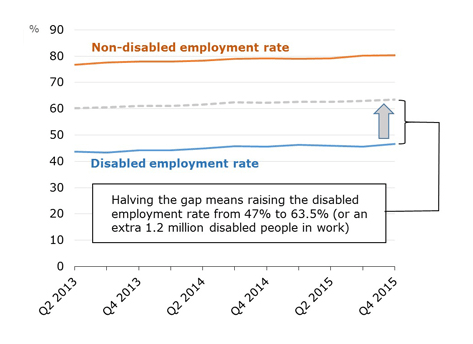
DonatenowButton
cards

The Government’s brutal cuts to disability support isn’t ‘increasing spending’, Chancellor, but handing out tax cuts to the rich is

Chancellor George Osborne


2 wrag

Source: Hansard

Context

Many of us recognised in 2012, when the welfare “reforms” and other cuts to public services that support the poorest citizens were forced through parliament despite considerable opposition, using only the “financial privilege” of the Commons as a justification, that the Conservatives are on an ideological crusade, which flies in the face of public needs, democracy and sound economics, to shrink the welfare state and privatise our essential services.

In a wealth transfer from the poorest to the very rich, we have witnessed the profits of public services being privatised, but the losses have been socialised – entailing a process of economic enclosure for the wealthiest, whilst the burden of losses have been placed on the poorest social groups and our most vulnerable citizens – largely those who are ill, disabled and elderly. The Conservative’s justification narratives regarding their draconian policies, targeting the poorest social groups, have led to media scapegoating, social outgrouping, persistent political denial of the aims and consequences of policies and reflect a wider process of political disenfranchisement of the poorest citizens, especially sick and disabled people.

That the cuts are ideologically driven, and have nothing whatsoever to do with economic necessity, was demonstrated only too well by the National Audit Office (NAO) report earlier this year. The NAO scrutinises public spending for Parliament and is independent of government. The report indicates how public services are being appropriated for purely private benefit.

The audit report in January concluded that the Department for Work and Pension’s spending on contracts for disability benefit assessments is expected to double in 2016/17 compared with 2014/15. The government’s flagship welfare-cut scheme will be actually spending more money on the assessments conducted by private companies than it is saving in reductions to the benefits bill.

From the report:

£1.6 billion
Estimated cost of contracted-out health and disability assessments over three years, 2015 to 2018

£0.4 billion
Latest expected reduction in annual disability benefit spending.

This summary reflects staggering economic incompetence, a flagrant, politically motivated waste of tax payers money and even worse, the higher spending has not created a competent or ethical assessment framework, nor is it improving the lives of sick and disabled people. Some people are dying after being wrongly assessed as “fit for work” and having their lifeline benefits brutally withdrawn. Maximus is certainly not helping the government to serve even the most basic needs of sick and disabled people.

However, Maximus is serving the private needs of a “small state” doctrinaire neoliberal government, and making lots of private profit whilst it does so. The Conservatives are systematically dismantling the UK’s social security system, not because there is an empirically justifiable reason or economic need to do so, but because the government has purely ideological, anticollectivist, antidemocratic, profoundly uncivilising prescriptions and longstanding prejudices.

Last week I wrote about the £30 a week Employmen Support Allowance (ESA) work related activity group (WRAG) cuts, which the Government have forced through the legislative process, despite meeting with widespread opposition, the government claim that it is their financial privilege to do so. Yesterday I wrote about the brutal cuts that are planned for Personal Independence Payments (PIP) for sick and disabled people, which are aimed at saving money by reducing eligibility for the support. The cut, it is estimated, will affect at least 640,000 disabled people by 2020, who may lose up to £150 a week. This is money that provides essential support for people who need help to prepare food, use the toilet or dress themselves, amongst other things, and to maintain a degree of dignity and independence.

The cuts to ESA and Personal Independent Payments (PIP) take place in the context of a Tory manifesto that included a pledge not to cut disability benefits. In fact in March last year, the Prime Minister signalled that the Conservatives will protect disabled claimants from welfare cuts in the next parliament (this one). Cameron said the Conservatives would not “undermine” PIP, which was introduced under the Coalition to save money by “targeting those most in need.” Now it seems those most in need are not the ones originally defined as such.

At the time he told BBC Breakfast: “We’ve replaced one benefit – Disability Living Allowance – with a new benefit – Personal Independence Payment – it’s working well, it is also going to lead to some savings over time and we haven’t created that benefit in order to undermine it. We want to enhance it and safeguard it.”

Semantic thrifts: being Conservative with the truth

Only a Conservative minister would claim that taking money from sick and disabled people is somehow “fair,” or about “helping”, “supporting” or insultingly, “incentivising” sick and disabled people who have already been deemed unfit for work by their doctors and the state via the work capability assessment to work.

The Tories all too frequently employ such semantic shifts and euphemism – linguistic strategies – as an integral part of a wider range of techniques of neutralisation that are used, for example, to provide linguistic relief from conscience and to suspend moral constraint – to silence both “inner protest” and public objections – to the political violation of social and moral norms; to justify acts that cause harm to others whilst also denying there is any subsequent harm being inflicted; to deny the target’s and casualties’ accounts and experiences of political acts of harm, and to neutralise remorse felt by themselves or other witnesses.

Media discourse has often preempted the Conservative austerity cuts, resulting in the identification, stereotyping and scapegoating of the groups in advance of the targeted, discriminatory policies. Media discourse is being used as a vehicle for the government to push their ideological agenda forward without meeting legitimate criticism, public scrutiny and without due regard for essential democratic processes and safeguards.

The five neutralisation techniques identified by Gresham Sykes and David Matza are: denial of responsibility, denial of injury, denial of victims, appeal to higher loyalties, and condemnation of condemners.

The really critical part of Sykes and Matza’s argument is that rationalisations precede immoral, cruel or controversial acts and are a key factor in making deviant behaviour possible (amongst delinquents, the mafia or Conservative ministers). As such, the rationalisations betray intent.

The cuts of £120 a month to the disability benefit Employment Support Allowance  are also claimed to be “fair.” and “supportive.” Though I have yet to hear a coherent and rational  explanation of how this can possibly be the case. Ministers claimed that people subjected to the ESA Work Related Activity Group cuts could claim PIP if they required support with extra living costs, but now we are told that PIP is to be cut, too.

Osborne’s techniques of neutralisation: calling a cut “increased spending”

The chancellor has defended his decision to use the cuts in disability benefits to fund tax breaks for the wealthy. On the Andrew Marr show yesterday, he was questioned about his decision to cut PIP, currently made to over 640,000 disabled people in a bid to save at least £1.2 billion. Many severely disabled people are facing a cut of up to £150 a week under the new reduced eligibility assessment criteria.

Controversially, the cuts to disability benefits will fund tax cuts for the most affluent – the top 7% of earners. The Chancellor is set to raise the threshold at which people start paying 40p tax, in a move that will probably see  many wealthier people pulled out of the higher rate of income tax, in the coming budget. Mr Osborne says he wants to “accelerate progress” towards the Conservative’s manifesto pledge of raising the threshold for the 40p rate to £50,000 in 2020, it is understood. The average annual income in the UK is around £27,000. 

Andrew Marr said: You’re taking money out of the pockets of some of the most vulnerable people in this country, disabled people. These are the people who can least afford the sacrifice, the people with the weakest shoulders.

And you’re changing the rules to hit them. Is that really your priority?”

Osborne ludicrously claimed that the Conservative government was “increasing spending on disabled people”, he said: “Controlling welfare bills is part of what you need to do if you’re a secure country confronting the problems in the world.”

But as Marr pointed out, the cuts to ESA and PIP show an intended substantial reduction on government spending to essential support for disabled people.

From January 2017, the cut to PIP is likely to hit sick and disabled people who face fundamental barriers to health and essential basic care. The cut, it is estimated, will affect at least 640,000 disabled people by 2020.

Andrew Marr went on to say: “At the same time as you’re raising thresholds to help middle-class tax payers, it’s going to seem a very callous set of priorities.”

However, Mr Osborne maintained that the brutal and uncivilised cuts were “necessary to improve the economic conditions in the UK”. He said: “Yes, times are tough. The fiscal situation is a difficult one. All Western countries are not productive enough.”

You can see the interview here:


Austerity and premature mortality

Since 2011, a year after the government began their austerity programme, mortality rates have increased rapidly. Advisers to Public Health England (PHE) have warned that the 4-year trend may be the worst since World War II.

Data from the Office of National Statistics shows a 5.4% (27,000) increase in deaths in the past year alone, prompting calls for an urgent investigation. The year-on-year rise, to a total of 528,340 deaths, is the highest since 1968.

PHE said the elderly were bearing the worst of Tory austerity cuts, with women suffering disproportionately, though this is partly because they live longer, however, it is also due to a growing crisis in the NHS and cuts to social care. Professor Danny Dorling, from Oxford University, an advisor to PHE on older age life expectancy, said:

“When we look at 2015, we are not just looking at one bad year. We have seen excessive mortality – especially among women – since 2012.”

Figures show that the number of deaths had been falling steadily until 2011, a year after the government began their austerity programme, when deaths rates began to increase rapidly.

Professor Dorling cited Tory austerity as the biggest cause:

“I suspect the largest factor here is cuts to social services – to meals on wheels, to visits to the elderly.”

Empirical research published two years ago demonstrated the high a cost the country paid in terms of health and wellbeing for the Thatcher administration’s economic and social policies. The study, which looked at material from existing research and data from the Office for National Statistics, illustrates that Thatcherism resulted in the unnecessary and unjust premature deaths of British citizens, together with a substantial and continuing burden of suffering and a widespread degradation of wellbeing. Co-author and researcher Professor Clare Bambra from the Wolfson Research Institute of Health and Wellbeing said that deaths from violence and suicide all increased substantially during the Thatcher era in comparison with other countries. Regional inequalities in life expectancy between north and south were also exacerbated, as were health inequalities between the richest and poorest in British society.

Professor Bambra also says that the welfare cuts implemented by Thatcher’s governments led to a rise in poverty rates from 6.7% in 1975 to 12% by 1985; poverty is well known to be one of the major causes of ill health and mortality. Income inequality also increased in the Thatcher period, as the richest 0.01% of society had 28 times the mean national average income in 1978 but 70 times the average by 1990. Other research (The Spirit Level) indicates that income inequality is internationally associated with higher mortality and morbidity.

Welfare reform minister, Lord Freud, refused to monitor the number of people who take their own lives as a result of the £120-a-month cut planned for those people in the work related activity group (WRAG), claiming employment and support allowance from April 2017. Concerns were raised in the House of Lords last week, when Baroness Meacher, amongst others, warned that for the most vulnerable, the cut was “terrifying” and bound to lead to increased debt.

Condemning the truly callous and terrible actions of the Treasury, she urged ministers to monitor the number of suicides in the year after the change comes in, adding: “I am certain there will be people who cannot face the debt and the loss of their home, who will take their lives.”

Many people have died as a consequence of the welfare “reforms.”

Not only have the government failed to carry out an impact assessment regarding the cuts, Lord Freud said that the impact, potential increase in deaths and suicides won’t be monitored, apart from “privately” because individual details can’t be shared and because that isn’t a “useful approach”.

He went on to say “We have recently produced a large analysis on this, which I will send to the noble Baroness. That analysis makes it absolutely clear that you cannot make these causal links between the likelihood of dying – however you die – and the fact that someone is claiming benefit.”

Actually, a political refusal to investigate an established correlation between the welfare “reforms” and an increase in the mortality statistics of those hit the hardest by the cuts – sick and disabled people – is not the same thing as there being no causal link. Often, correlation implies causality and therefore such established links require further investigation. It is not possible to disprove a causal link without further investigation.

Whilst the government continue to deny there is a causal link between their welfare policies, austerity measures and an increase in premature deaths and suicides, they cannot deny there is a clear correlation establised, which warrants further research and political accountability.

Then they came for the ESA Support Group …

Despite the fact that this government face a UN inquiry into grave and systematic abuses of the human rights of disabled people, the blatant attacks on a social group with legally protected characteristics continues and the Conservatives continue to target disabled people for a disproportionately large and unfair burden of austerity cuts.

A government advisor, who is a specialist in labour economics and econometrics, has proposed scrapping all ESA sickness and disability benefits. Matthew Oakley, a senior researcher at the Social Market Foundation, recently published a report entitled Closing the gap: creating a framework for tackling the disability employment gap in the UK, in which he proposes abolishing the ESA Support Group. To meet extra living costs because of disability, Oakley says that existing spending on PIP and the Support Group element of ESA should be brought together to finance a new extra costs benefit. Eligibility for this benefit should be determined on the basis of need, with an assessment replacing the WCA and PIP assessment. The Conservative definition of “the basis of need” seems to be an ever-shrinking category.

Oakely also suggests considering a “role that a form of privately run social insurance could play in both increasing benefit generosity and improving the support that individuals get to manage their conditions and move back to work.”

I’m sure the private company Unum would jump at the opportunity. Steeped in controversy, with a wake of scandals that entailed the company denying people their disabilty insurance, in 2004, Unum entered into a regulatory settlement agreement (RSA) with insurance regulators in over 40 US states. The settlement related to Unum’s handling of disability claims and required the company “to make significant changes in corporate governance, implement revisions to claim procedures and provide for a full re-examination of both reassessed claims and disability insurance claim decisions.

The company is the top disability insurer in both the United States and United Kingdom. By coincidence, the  company has been involved with the UK’s controversial Welfare Reform Bill, advising the government on how to cut spending, particularly on disability support. What could possibly go right?

It’s difficult to see how someone with a serious, chronic and often progressive illness, (which most people in the ESA Support Group have) can actually “manage” their illness and “move back into work.” The use of the extremely misinformed, patronising and very misleading term manage implies that very ill people actually have some kind of choice in the matter. For people with Parkinson’s disease, rheumatoid arthritis, lupus and multiple sclerosis, cancer and kidney failure, for example, mind over matter doesn’t fix those problems, positive thinking and sheer will power cannot cure these illnesses sadly. Nor does benefit conditionality and being coerced into work by callously insensitive and medically ignorant assessors, advisors and ministers.

The Reform think tank has also recently proposed scrapping what is left of the disability benefit support system, in their report Working welfare: a radically new approach to sickness and disability benefits and has called for the government to set a single rate for all out of work benefits and reform the way sick and disabled people are assessed. 

Reform says the government should cut the weekly support paid to 1.3 million sick and disabled people in the ESA Support Group from £131 to £73. This is the same amount that Jobseeker’s Allowance claimants receive. However, those people placed in the Support Group after assessement have been deemed by the state as unlikely to be able to work again. It would therefore be very difficult to justify this proposed cut.

Yet the authors of the report doggedly insist that having a higher rate of weekly benefit for extremely sick and disabled people encourages them “to stay on sickness benefits rather than move into work.”

The report recommended savings which result from removing the disability-related additions to the standard allowance should be reinvested in support services and extra costs benefits – PIP. However, as outlined, the government have ensured that eligibility for that support is rapidly contracting, with the ever-shrinking political and economic re-interpretation of medically defined sickness and disability categories and a significant reduction in what the government deem to be a legitimate exemption from being “incentivised” into hard work.

The current United Nations investigation into the systematic and gross violations of the rights of disabled people in the UK because of the Conservative welfare “reforms” is a clear indication that there is no longer any political commitment to supporting disabled people in this country, with the Independent Living Fund being scrapped by this government, ESA for the work related activiy group (WRAG) cut back, PIP is becoming increasingly very difficult to access, and now there are threats to the ESA Support Group. The Conservative’s actions have led to breaches in the CONVENTION on the RIGHTS of PERSONS with DISABILITIES – CRPD articles 4, 8, 9, 12, 13, 14, 15, 17, and especially 19, 20, 27 and 29 (at the very least.) There are also probable violations of articles 22, 23, 25, 30, 31.

The investigation began before the latest round of cuts to ESA and PIP were announced.


426785_10151205298996274_171693454_n

Reverse the ESA disability benefit cut: sign the petition

Extend the PIP consultation & stop cuts to supporting terminally ill & disabled: sign the petition


Related

A tale of two suicides and a very undemocratic, inconsistent government

Paternalistic Libertarianism and Freud’s comments in context

Let’s keep the job centre out of GP surgeries and the DWP out of our confidential medical records

Conservative governments are bad for your health

Research finds strong correlation between Work Capability Assessment and suicide

Benefits Assessor: How Long Are You Likely To Have Parkinson’s?

scroll2

I don’t make any money from my work and I’m not funded. You can support Politics and Insights by making a donation to help me continue researching and writing independently, and to continue to help others.

DonatenowButton
cards

Government plans further brutal cuts to disability support

358-burden-of-cuts

Disabled people are already carrying a disproportionately high burden of the austerity cuts, despite government claims of economic recovery.

Government ministers are planning to cut a key element of the Personal Independent Payment (PIP). Last year a consultation indicated that the Conservatives were considering ways of reducing eligibility criteria for the daily living component of PIP, by narrowing definitions of aids and appliances.

From January 2017, the cut is likely to hit people experiencing incontinence, who struggle to dress themselves, and those facing other fundamental barriers to health and essential basic care. The cut, it is estimated, will affect at least 640,000 disabled people by 2020.

Controversially, it is alleged that the cuts to disability benefit will fund tax cuts for the most affluent – the top 7% of earners. The Chancellor is set to raise the threshold at which people start paying 40p tax, in a move that will probably see  many wealthier people pulled out of the higher rate of income tax, in the coming budget. Mr Osborne says he wants to “accelerate progress” towards the Conservative’s manifesto pledge of raising the threshold for the 40p rate to £50,000 in 2020, it is understood.

Meanwhile, under the plans announced on Friday, sick and disabled people will be much less likely to receive essential disabled benefits if they use aids such as a handrail or a walking stick to get dressed or use the toilet.

The Department for Work and Pensions reviewed a sample of 105 cases of people who had scored all, or the majority, of their points for PIP due to aids and appliances, in order to assess the extent to which the award may reflect extra costs.

The review led the government to conclude that PIP “doesn’t currently fulfil the original policy intent”, which was to cut costs and “target” the benefit to “those with the greatest need.” That originally meant a narrowing of eligibility criteria for people formerly claiming Disability Living Allowance, increasing the number of  reassessments required, and limiting the number of successful claims.

Prior to the introduction of PIP, Esther McVey stated that of the initial 560,000 claimants to be reassessed by October 2015, 330,000 of these are targeted to either lose their benefit altogether or see their payments reduced. Of course the ever-shrinking category of “those with the greatest need” simply reflects a government that has simply made a partisan political decision to cut disabled people’s essential income to fund a financial gift to the wealthiest citizens. There is no justification for this decision, nor is it “fair.”

The government now  claim that the proportion of people awarded the daily living component of PIP, who scored all of their points because they need aids and appliances, has more that tripled, from 11 per cent in April 2014 to 35 per cent in 2015.

The PIP assessment currently examines an individual’s ability to complete ten daily living activities and two mobility activities. Regular reviews were also introduced by the last government to ensure that claimants continue to receive the “right level of support.”

The increase has largely been driven by a significant and sustained rise in relation to activities one, four, five and six: preparing food, washing and bathing, dressing and undressing, and managing incontinence and toileting. Around three-quarters of those who score all of their points through aids and appliances score the minimum number of daily living points needed to qualify for the standard rate of the daily living component.

The government ridiculously claim that the “evidence” presented to the review suggested that in some instances points were being awarded “… because claimants chose to use aids and appliances, rather than needed them.”  And noted that in many cases “ these were non-specialised items of very low cost.”

However, it’s very difficult to justify cutting support for people who require aids to meet fundamental needs such as preparing food, dressing, basic and essential personal care and managing incontinence.

Ministers have now announced their intention to cut PIP for people who currently receive it to help them afford specially-adapted appliances and equipment. Examples of qualifying equipment currently includes adapted cutlery for people who find it difficult to hold things for long periods of time and specially-designed household items for people less able to stand.

Justin Tomlinson, the disabilities minister, said that the cuts to funding for aids and appliances for the disabled could save about £1bn a year and was announced the week before the budget. Charities warned that the cuts to personal independence payments (PIP) would be devastating after the move was confirmed by Tomlinson on Friday.

Tomlinson, said: “The introduction of Personal Independence Payment to replace the outdated Disability Living Allowance for working age claimants has been a hugely positive reform.

But it is clear that the assessment criteria for aids and appliances are not working as planned. Many people are eligible for a weekly award despite having minimal to no extra costs and judicial decisions have expanded the criteria for aids and appliances to include items we would expect people to have in their homes already.

We consulted widely to find the best approach. And this new change will ensure that PIP is fairer and targets support at those who need it most.”

Only a Conservative minister would claim that taking money from sick and disabled people is somehow “fair,” and they frequently do. The cuts of £120 a month to the disability benefit employment support allowance (ESA) are also claimed to be “fair.” and “supportive.” Though I have yet to hear an explanation of how this can possibly be the case. Ministers claimed that people subjected to the ESA Work Related Activity Group cuts could claim PIP if they required support with extra living costs, but now we are told that PIP is to be cut, too.

Bearing in mind the Department for Work and Pensions “review” was based on a sample of just 105 people, it’s very difficult to see how further inhumane cuts to the lifeline income for this group of amongst the most disabled citizens can possibly be justified. How did ministers “plan” the assessment criteria for aids and appliances to work, exactly?  People qualifying for PIP need extra support in meeting their living costs.

A coalition of 25 disability charities has written to the Government to warn against plans that would strip some disabled people of a key payments meant to help them live more independent lives.

The Disability Benefits Consortium wrote to Justin Tomlinson, to argue that proposed changes to Personal Independence Payment – or PIP – assessments would have a “severe impact” on people’s security and make it harder for them to find work.

Debbie Abrahams, the shadow disabilities minister, said: “Removing support for people who need help to use the toilet or dress is an attack on dignity.”

“These further cuts would represent another huge blow, making life even more difficult for many people who already facing huge barriers.”

Phil Reynold, policy and campaigns adviser at Parkinson’s UK, said: “If someone needs aids and appliances to carry out the most basic tasks that most people take for granted then they clearly need ongoing support to live independently, which is often expensive. They should not be penalised by making personal independence payments even more difficult to claim.”

Michelle Mitchell, chief executive of the MS Society, said: “This decision could have a devastating impact on the lives of people with MS. In the worst cases, they could lose up to £150 a week.

PIP is an essential benefit which goes towards the extra cost of being disabled. The new plans will fail some of the most vulnerable people in society and we have serious concerns about the future health and welfare of those affected.”

The government is currently being investigated by the United Nations because of  serious allegations that many of us have made regarding the welfare “reforms”, which have extended gross and systematic abuse of the human rights of disabled people. The UK is the first country to be subject to an investigation regarding the government’s failure to meet legal obligations to uphold disabled people’s human rights. In the 6th wealthiest nation of the world, and a so-called liberal democracy, this treatment of an already marginalised and protected social group is utterly shameful.

536738_306169162785952_999031084_n

scroll2

I don’t make any money from my work and I’m not funded. You can support Politics and Insights by making a donation to help me continue researching and writing independently, and to continue to help others.

DonatenowButton
cards