Author: Kitty S Jones

I’m a political activist with a strong interest in human rights. I’m also a strongly principled socialist. Much of my campaign work is in support of people with disability. I am also disabled: I have an autoimmune illness called lupus, with a sometimes life-threatening complication – a bleeding disorder called thrombocytopenia. Sometimes I long to go back to being the person I was before 2010. The Coalition claimed that the last government left a “mess”, but I remember being very well-sheltered from the consequences of the global banking crisis by the last government – enough to flourish and be myself. Now many of us are finding that our potential as human beings is being damaged and stifled because we are essentially focused on a struggle to survive, at a time of austerity cuts and welfare “reforms”. Maslow was right about basic needs and motivation: it’s impossible to achieve and fulfil our potential if we cannot meet our most fundamental survival needs adequately. What kind of government inflicts a framework of punishment via its policies on disadvantaged citizens? This is a government that tells us with a straight face that taking income from poor people will "incentivise" and "help" them into work. I have yet to hear of a case when a poor person was relieved of their poverty by being made even more poor. The Tories like hierarchical ranking in terms status and human worth. They like to decide who is “deserving” and “undeserving” of political consideration and inclusion. They like to impose an artificial framework of previously debunked Social Darwinism: a Tory rhetoric of division, where some people matter more than others. How do we, as conscientious campaigners, help the wider public see that there are no divisions based on some moral measurement, or character-type: there are simply people struggling and suffering in poverty, who are being dehumanised by a callous, vindictive Tory government that believes, and always has, that the only token of our human worth is wealth? Governments and all parties on the right have a terrible tradition of scapegoating those least able to fight back, blaming the powerless for all of the shortcomings of right-wing policies. The media have been complicit in this process, making “others” responsible for the consequences of Tory-led policies, yet these cruelly dehumanised social groups are the targeted casualties of those policies. I set up, and administrate support groups for ill and disabled people, those going through the disability benefits process, and provide support for many people being adversely affected by the terrible, cruel and distressing consequences of the Governments’ draconian “reforms”. In such bleak times, we tend to find that the only thing we really have of value is each other. It’s always worth remembering that none of us are alone. I don’t write because I enjoy it: most of the topics I post are depressing to research, and there’s an element of constantly having to face and reflect the relentless worst of current socio-political events. Nor do I get paid for articles and I’m not remotely famous. I’m an ordinary, struggling disabled person. But I am accurate, insightful and reflective, I can research and I can analyse. I write because I feel I must. To reflect what is happening, and to try and raise public awareness of the impact of Tory policies, especially on the most vulnerable and poorest citizens. Because we need this to change. All of us, regardless of whether or not you are currently affected by cuts, because the persecution and harm currently being inflicted on others taints us all as a society. I feel that the mainstream media has become increasingly unreliable over the past five years, reflecting a triumph for the dominant narrative of ultra social conservatism and neoliberalism. We certainly need to challenge this and re-frame the presented debates, too. The media tend to set the agenda and establish priorities, which often divert us from much more pressing social issues. Independent bloggers have a role as witnesses; recording events and experiences, gathering evidence, insights and truths that are accessible to as many people and organisations as possible. We have an undemocratic media and a government that reflect the interests of a minority – the wealthy and powerful 1%. We must constantly challenge that. Authoritarian Governments arise and flourish when a population disengages from political processes, and becomes passive, conformist and alienated from fundamental decision-making. I’m not a writer that aims for being popular or one that seeks agreement from an audience. But I do hope that my work finds resonance with people reading it. I’ve been labelled “controversial” on more than one occasion, and a “scaremonger.” But regardless of agreement, if any of my work inspires critical thinking, and invites reasoned debate, well, that’s good enough for me. “To remain silent and indifferent is the greatest sin of all” – Elie Wiesel I write to raise awareness, share information and to inspire and promote positive change where I can. I’ve never been able to be indifferent. We need to unite in the face of a government that is purposefully sowing seeds of division. Every human life has equal worth. We all deserve dignity and democratic inclusion. If we want to see positive social change, we also have to be the change we want to see. That means treating each other with equal respect and moving out of the Tory framework of ranks, counts and social taxonomy. We have to rebuild solidarity in the face of deliberate political attempts to undermine it. Divide and rule was always a Tory strategy. We need to fight back. This is an authoritarian government that is hell-bent on destroying all of the gains of our post-war settlement: dismantling the institutions, public services, civil rights and eroding the democratic norms that made the UK a developed, civilised and civilising country. Like many others, I do what I can, when I can, and in my own way. This blog is one way of reaching people. Please help me to reach more by sharing posts. Thanks. Kitty, 2012

Frank Field’s New Report: Fixing Broken Britain?


In a study report that was published today – Fixing Broken Britain? An audit of working-age welfare reform since 2010, Labour MP Frank Field and co-author Andrew Forsey argue that: 

The Department for Business, Innovation and Skills should take a lead role in tackling the dependence of employers and landlords, whose subsidies in the form of tax credits and Housing Benefit have grown exponentially, by raising wages and productivity.

… the next front in welfare reform will see a fundamental switch from the Department for Work and Pensions – historically always responsible for welfare reform – to the Department for Business, Innovation and Skills, reflecting the new reform agenda.

Field and Forsey, writing for the cross-party think tank Civitas, propose that the next step of welfare reform:

 … involves a renewed drive to help those who have not yet been found a job under the Work Programme – principally the over-50s and the disabled. This should involve weighting the payment-by-results systems further in favour of those claimants facing the steepest barriers to work. This major task, and the prompt and efficient payment of benefits, should be the primary objective of the Department for Work and Pensions.

We believe the payment-by-results system the government introduced now requires a significant recalibration to give the most disadvantaged participants a fighting chance of getting and keeping a job.

The language used in the publication is controversial and I was both concerned and disappointed to see the phrase “welfare dependency” used more than once. It alludes to the Conservative claims of a so-called “culture of dependency”, for which there has never been any supportive empirical evidence presented, (and that’s despite Sir Keith Joseph’s notorious best efforts and meticulous but ultimately forlorn research into a neoliberal New Right myth.)

However, there is much empirical evidence to support structural explanations of unemployment and poverty, but the current government has tended to psychopoliticise these issues, blaming the character and attitudes of unemployed people, reflected in language shifts – for example, the frequent use of words such as “worklessness” which implies responsibility and choice – making unfortunate circumstances a very personal  burden – as opposed to “unemployment”, which at least accommodates factors such as labour market constraints, economic conditions, structural inequalities, state responsibilities and the consequences of political decision-making.

Field and Forsey also recommend “identifying claimants’ strengths and difficulties” as early as possible once they begin claiming benefit; early referrals to the new Work and Health Programme for those on any benefit in most need of support; and lifting the cap on numbers who can enrol on the voluntary welfare-to-work programme for claimants with disabilities, and extending the time for which they can participate.

The problem is that referrals are unlikely to be on a voluntary basis. One of the aims of the Work and Health Programme is to enlist the support of GPs in “prescribing” work coaches to sick and disabled people. Given the confidential nature of the patient/doctor relationship, such an intrusive measure is likely to ultimately undermine people’s trust in their GP, and leave sick people who genuinely cannot work feeling harrassed and coerced by the state. There is good evidence that the work programme has not increased sustainable employment outcomes, and furthermore, it has harmed people with mental health problems.

In fairness to Field and Dorsey, they do accommodate some structural factors in their analysis. They say:

A second major new front against benefit dependency involves raising the earnings of low-paid workers, which requires a national productivity strategy that can be built around the new National Living Wage. The major objective here is to prevent yesterday’s workless poor becoming today’s working poor.

The conditionality attached to the receipt of benefit may have made work an easier option, but real wage growth at the bottom end of the labour market has been the missing piece of the government’s welfare reform puzzle.

In order to enshrine work as the best route out of poverty, the next front in welfare reform must build upon the National Living Wage to deliver the higher productivity that can sustain rising real incomes across the board. This policy needs to be driven by the Secretary of State for Business, Innovation and Skills.

Field and Forsey criticise Universal Credit, stating that if it is ever rolled out nationally, it will not “incentivise” work.  They go on to say:

The government’s flagship welfare scheme will only deliver a lower marginal tax rate for certain groups of claimants and even for them it will be undermined by Universal Credit’s failure to encompass council tax support and free school meals.

Because of Universal Credit’s higher taper rate for many claimants the strategy of fixing “broken Britain” by offering lower withdrawal rates than the current system lies in ruins.

If creating an incentive to work is the goal the present system for the vast majority of claimants meets that goal more effectively. Any reduction in the marginal tax rate will only come for particular groups of Universal Credit claimants should the benefit be introduced.

But then, the failure of Universal Credit to encompass also Council Tax support and free school meals will throw all of these calculations into a mild chaos, to put it at its gentlest.

However, it’s clear that the whole point of Universal Credit is to facilitate a further withdrawal of funding for welfare support.

Field and Forsey argue in the report that because there is little prospect of Universal Credit being rolled out fully by 2020,  George Osborne should act now to “protect lower-paid families with children within the framework of the welfare cuts he is planning.”

They formulate a five-point plan for in-work benefit reform in the current parliament:

  • The tax credit system should be centred on lower-paid workers with children, with entitlements to families earning up to twice the level of the National Living Wage, a ceiling of £32,000.
  • By 2020, childless couples and single workers without children should no longer be eligible for support from the tax credit system.
  • Jobcentre Plus should be revamped so that staff have the skills to help claimants in work increase their hours and/or pay, either in their current job or by finding a new one.
  • Tax credit claimants should be allowed to increase their earnings by up to £5,000 in any 18-month period without any clawback of entitlement, so that they do not lose large chunks of income for working more or for better pay.
  • Vulnerable workers who cannot currently work a full week should be allowed to work up to 24 hours a week and claim Jobseeker’s Allowance or Employment and Support Allowance, rather than the current 16-hour maximum.

They say:

These five reforms would be much more effective in protecting those in work on modest earnings than anything the government is proposing. They build around the revolutionary idea the chancellor has introduced into British politics, particularly welfare reform, namely of introducing a National Living Wage.

This move begins the process of transferring the responsibility for lower earners’ welfare to employers and the Department for Business, Innovation and Skills, and away from the Department for Work and Pensions and Her Majesty’s Revenue and Customs.

However, this is a heavily corporate-sponsored “business friendly” neoliberal government with a clear anti-welfare agenda. What could possibly go right?

 —

 This post was written for Welfare Weekly, which is a socially responsible and ethical news provider, specialising in social welfare related news and opinion.

Audit finds whereabouts and circumstances of 1.5 million people leaving welfare records each year “a mystery”

10270806_319228004894921_8005540502444686357_n

Labour MP Frank Field has called on the government to conduct a survey into the circumstances of those hundreds of thousands of citizens whose benefit income is withdrawn each year under the current harsh sanctioning regime.

Mr Field, who also chairs the Commons Work and Pensions Committee, carried out a forensic audit of the government’s welfare reform programme – Fixing Broken Britain? An audit of working-age welfare reform since 2010, which is to be published today (18 January 2016) by Civitas and co-authored by Andrew Forsey.

Worryingly, the research found that the whereabouts of 1.5 million people leaving the welfare records each year is “a mystery.” The authors also raise concern that the wellbeing of at least a third of those who have been sanctioned “is anybody’s guess.” It’s not the first time these concerns have been raised.

It emerged in 2014, during an inquiry which was instigated by the parliamentary Work and Pensions Select Committee, that research conducted by Professor David Stuckler shows more than 500,000 Job Seekers Allowance (JSA) claimants have disappeared from unemployment statistics, without finding work, since the sanctions regime was toughened in October, 2012.

This means that in August 2014, the claimant count – which is used to gauge unemployment – is likely to be very much higher than the 970,000 figure that the government is claiming, if those who have been sanctioned are included.

The research finding confirms what many of us already knew.

Professor Stuckler, who has analysed data from 375 local authorities, said:

“The data clearly show that many people are not leaving Job Seekers Allowance for work but appear to be being pushed off in unprecedented numbers in association with sanctions.”

The Work and Pensions Committee decided to conduct a further in depth inquiry into benefit sanctions policy at the time, following the findings of the research. This inquiry considered aspects of sanctions policy which were outside the remit of the Oakley Review. (You can see the terms of reference for the inquiry, and submissions were invited, all details of which are here – Committee launch inquiry into benefit sanctions.)

Labour MP Debbie Abrahams said:

“Sanctions are being applied unfairly to job-seekers, as well as the sick and disabled.

The reason the Government is doing this is that it gets them off the JSA claimant figures, so it looks like there are fewer people unemployed.”

Mrs Abraham added:

“Hundreds of thousands of people have had their benefits stopped for a minimum of four weeks and then approximately a quarter of these people, from the research that I’ve seen, are disappearing.

They are leaving and we don’t know where they are going. That’s an absolute indictment of this policy and it’s a little bit worrying if we’re trying to tout this internationally as a real success story.”

The MP for Oldham East and Saddleworth, and shadow disability minister memorably added:

“People have died after being sanctioned, Minister.”

The Government claims that sanctioned claimants who leave the benefit system are going into work – they also claim that their punitive sanctions regime “works”. But the Oxford study found this is untrue in a “majority” of cases. At the time, the government were accused of massaging unemployment figures via benefit sanctions.

Frank Field and Andrew Forsey write:

“The number of sanctions was halved in the year leading up to the 2015 election, but it still remained at half a million. Sanctions are therefore being applied at a scale unknown since the Second World War, and the operation of sanctions on this scale makes for a most significant change in the social security system as it has existed in the post-war period.

A number of people – we know not how large a number – are being totally disconnected from both work and welfare, and risk being exposed to destitution.

Justice calls for a major survey of what happens to the hundreds of thousands of people thrown off the welfare rolls each year through the sanctioning process. It is unacceptable, not only for this government but for its predecessor and those who will follow, to take away benefit from a mass of people each year and not trouble themselves with how this army of people survive. For that is what is happening under the government’s sanctions policy. The ability to track the wellbeing of the whole population is now a part of being a grown up government, let alone a ‘One Nation’ government.”

In the report, Field and Forsey call for four safeguarding reforms, “to restore greater fairness and transparency to the sanctions regime.” They:

  • Propose that the government must forthwith begin a survey so that they can answer the simple but crucial question of what happens to those citizens expelled from the welfare rolls who appear not to find work.
  • Welcome the government’s decision to trial a Yellow Card early warning system, but suggest that should it fail to prevent injustices from occurring, the government should supplement this policy with the option for Jobcentre Plus staff of issuing a non-financial sanction for a claimant’s first failure to meet the terms of their Claimant Commitment. 
  • Recommend that the Department for Work and Pensions trials a ‘grace period’ for vulnerable claimants of Jobseeker’s Allowance or Employment and Support Allowance, during which the requirements placed upon them are eased at times of transition or acute difficulty.
  • Request information from the government showing how much expenditure is withdrawn through its policy of sanctioning claimants.

Last year year, the Work and Pensions Select Committee heard independent estimates that since late 2012 sanctions had resulted in at least £275m being withheld from benefit claimants (the comparable figure for 2010 was £50m). Committee member Debbie Abrahams MP said that the Department for Work and Pensions will not give or does not have actual figures.

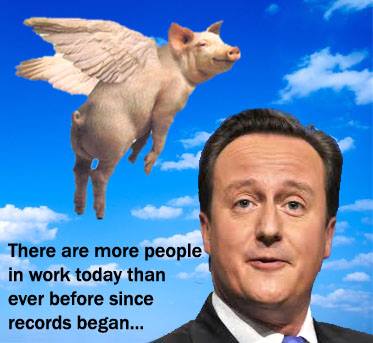
However, it’s truly remarkable that the government somehow manage to pull numbers out of their secret Thunderball when they believe it’s in their own interests to do so. The latest “employment” figures, for example. How likely is it that those numbers are remotely accurate when we have a government that happily presides over the disappearance of many thousands of sanctioned people every year from their accounts?

This post was written for Welfare Weekly, which is a socially responsible and ethical news provider, specialising in social welfare related news and opinion.

Soul-breaking government scheme to provide ‘expert’ employment ‘support’ to young people in schools

430835_148211001996623_1337599952_n (1)


The so-called ‘small state’ government have pledged to intrude schools to place ‘demand-led, Jobcentre Plus staff to supplement careers guidance and help schools deliver their statutory duty to provide high-quality, independent and impartial careers advice.’

See government press release: Jobcentre Plus support rolled out to schools.

Isn’t all existing careers advice impartial?

Ah, I see that impartial now means: ‘to inform independent choice,’ according to the newly introduced Careers and Enterprise Company, who will work with Jobcentre Plus staff ‘to ensure schools receive a coherent and aligned offer.’

Aligned to what? 

The needs of local businesses and the neoliberal labour market and not the needs of young people.

To inform independent choice. That’s a bit like saying “If you do everything I say, you will be truly free to make your own choices.  

The Tories are experts in linguistic behaviourism, telling lies and social control freakery, but not very much else.

Impartial. It’s another one of those Tory definitions that mean something else completely. Like helping or supporting people into work, which actually means a crude type of punitive behaviourism  – the imposition of  punitive financial sanctions if you don’t do exactly what you are told, and actually, quite often, even if you do. I’ve never understood how starvation and destitution can ever help or incentivise anyone to find a job, especially when experience and empirical evidence tells us otherwise. The welfare state has been weaponised against the people it was designed to support: a penultimate, vindictive Tory tactic before they completely dismantle it once and for all.

In 2015, the government’s Earn or Learn taskforce announced a new 3-week programme to give young jobseekers an ‘unprecedented level of support that will help them find work within 6 months.’  Personally, I shudder at the very thought of the Tories supporting my own children. I don’t want them anywhere near young people more generally. Regressive and Orwellian Tory ‘support’ has killed adults. There is no conceivable way that this bunch of tyrants can ever be trusted with our children’s future.

From 2017, the new programme will offer ‘an intensive curriculum’ involving practicing job applications and interview techniques as well as extensive job searches, and is expected to take 71 hours over the first 3 weeks of the claim. Welcome to the ultimate libertarian paternalist’s dystopic ‘education’ programme.

This ‘expert employment support to young people’ has been launched by two utterly inept, lying, dogmatic Conservatives with a history of formulating extremely nasty, punitive approaches to state defined ‘welfare and wellbeing’ – Iain Duncan Smith and Priti Patel.

Someone should put them straight: education includes the opportunity to attend college and university. Curiously, the Conservative brand of ‘impartial’ career advice seems to be all about big business ‘leading the way’ by instilling the protestant work ethic in our children. Life and learning is about working for people who make profits. That is the order of the world. 

Children from the age of twelve are to be coached to undertake ‘work experience.’ To clarify, that’s work fare – stacking shelves at Poundland or sweeping floors at your local McDonald‘s, for no pay.

It’s difficult to see what kind of educational process such a Conservative ‘curriculum’ entails, although it does include a sequence of instruction: a barely concealed hidden curriculum which reinforces existing social inequalities by ‘educating’ students according to their class, promoting the acceptance of a social pre-destiny of exploitation without promoting rational and reflective consideration.

A veritable pedagogy of the oppressed.

Duncan Smith babbles:

This scheme is fundamentally about social mobility and social justice – ensuring we give all young people the best chance to get on in life.

Someone should tell this idiot that social justice is all about the fair and just relationship between the individual and society. This is measured by the distribution of wealth, resources, opportunities, freedoms for personal activity and social privileges. It is about removing barriers to social mobility, the creation of social safety nets and economic justice. There is no mention of work fare for adults and children, exploitation, corporate profits and Tory donors in any standard definition of social justice anywhere.

Steve Bell cartoon

It’s not as if the Conservatives have historically shown the slightest interest in and recognition of realising human potential. That’s far too progressive and would require the capacity for democratic dialogue instead of paternalist preaching and lofty class-contingent, traditionally prejudiced, moralising. The Tories have always prefered a steeply hierarchical world, comprised of ascribed social status.

What the Conservatives plan is a blatant programme of indoctrination and political micromanagement to ensure that young people learn their place and accept a future of exploitative, low paid, insecure jobs, without the prospect of real opportunities or the chance to go to university. It’s more psychoregulation and authoritarian politics and has nothing to do with genuine needs-led or evidence-based policy.

And it’s to be delivered in our schools: transforming them from Ideological State Apparatuses – ideologies have the function of masking the exploitative arrangements on which class societies are based – into unmasked Repressive State Apparatuses. Hidden in plain view.

Authoritarianism tends to become more visible and frankly expressed over time.

demcracy


I don’t make any money from my work. I am disabled because of illness and have a very limited income. But you can help by making a donation to help me continue to research and write informative, insightful and independent articles, and to provide support to others. The smallest amount is much appreciated – thank you.

DonatenowButton

The Strathclyde Review clarifies the Conservatives’ authoritarianism


“The Government appear to consider that any defeat of an Statutory Instrument by the Lords is a breach of convention. We disagree.” Lord Norton of Louth (Conservative)

“The conduct of Parliament is a matter for Parliament, not the Executive. The Executive is accountable to Parliament, not the other way round.” Lord Forsyth of Drumlean (Conservative)

“The assertion is that this House had acted in defiance of the Government’s “electoral mandate”. But the Conservative Party never told voters that it intended to make massive cuts to in-work benefits, and it won a House of Commons majority of only 12 seats on the votes of just 24% of the total electorate, so the claim that the Lords defied an electoral mandate is tosh.” Lord Howarth of Newport (Labour). Source: Hansard.

A Bicameral Parliament is one in which two assemblies share legislative power. The main purpose of the House of Lords is to act as a deliberative assembly, providing expert scrutiny to ensure democratic checks on the power of the Lower House, and where necessary, to provide a counterbalance for excessively partisan legislation that makes no concession to the accommodation and representation of minority views. The House of Lords provides an essential additional layer of democratic process which helps to prevent the so-called “tyranny of the majority” and divisive, potentially damaging partisan changes to public life.

There is always a need to ensure additional checks and balances against incumbent governments and for extending opportunities to review and improve the quality of legislation. There is always a need to broaden the political participation of particular groups in society and to explore ways by which under-represented groups may be identified and included in political processes.

A review by Lord Strathclyde, commissioned by a rancorous and retaliatory David Cameron following the delay and subsequently effective defeat of government tax credit legislation in the House of Lords, recommends curtailing the powers of Upper House. 

Strathclyde proposes that the House of Commons is given the final say over secondary legislation (in particular, Statutory Instruments), which is frequently being used for political manoeuvring to edit the details of Acts, and ensure rules, regulations and even changes to legal definitions are made by ministerial order, rather than by the rather more open and democratic process of primary legislation: it’s being used as a way of bypassing Parliamentary scrutiny. 

In fairness, on page 6 of the report, Lord Strathclyde says:

“I believe it would be appropriate for the Government to take steps to ensure that Bills contain an appropriate level of detail and that too much is not left for implementation by statutory instrument.”

The problem is that Statutory Instruments (SI) are being over-used and are under-scrutinised in the Commons. SIs have become a major form of law-making activity in the UK. In 2015, the UK Parliament passed 34 Acts, whilst 1,999 Statutory Instruments were made. (In fact, 2015 has been a relatively light year for SIs: in 2013 and 2014, 3,292 and 3,486 SIs were made.)

The Government ensure they have a majority on any SI committee and MPs are chosen by Whips. The Hansard Society estimate that SIs currently account for as much as 80 per cent of the Government legislation that impacts citizens. However, they are given substantially less Parliamentary time than Bills, enabling Government to push through their legislative programme with very little scrutiny, exacerbating a lack of democratic transparency and accountability of the Executive (the Government).

The report details 3 possible options:

  • option 1 would remove the House of Lords from the Statutory Instrument procedure altogether – to take Statutory Instruments through the House of Commons only
  • option 2 would seek to retain the present role of the House of Lords but clarify the restrictions on how its powers should be exercised, by codifying them passing a resolution
  • option 3 is a compromise option would create a new procedure in primary legislation. The new procedure would allow the House of Lords to ask the House of Commons to think again when a disagreement exists but gives the final say to the elected House of Commons

Strathclyde has recommended option 3. However that would have a profound impact on our constitutional democracy.

The Hansard Society said that:

“Most criticism of the system is concerned with the negative resolution procedure where the initiative lies with the Opposition to table appropriate annulment motions in the form of Early Day Motions (known as “prayers”). Given that the Government controls almost all the available parliamentary time in the Commons, unless the Opposition can persuade the Government to provide time, either on the floor of the House or in Standing Committee, the SI will not be debated.

The time limit (of an hour and an half) imposed on debates should be removed.”

The Society also recommend far more robust pre-legislative scrutiny mechanisms.

Lord Craig of Radley (Cross-Bencher) points out that:

“Since 2010, 34 Acts have been passed by Parliament with Henry VIII powers. Before us at present there are five Bills with Henry VIII powers. In case your Lordships are not familiar with Henry VIII powers, I should like to read from Clause 68 of the Scotland Bill, which states: “The Secretary of State may by regulations make … such consequential provision in connection with any provision of Part 1, 3, 4, 5 or 6, or … such transitional or saving provision in connection with the coming into force of any provision of Part 1, 3, 4, 5 or 6 … Regulations under this section may amend, repeal, revoke or otherwise modify any of the following (whenever passed or made)” — and so it goes on. In other words, if your Lordships think that you have passed a Bill, you have not — because the Secretary of State can amend it by statutory instrument.”

Baroness Smith of Basildon (Labour) said she would like to thank Lord Strathclyde for his report, and:

“For the extraordinary speed with which it has been produced and the vigour with which he has sought to defend the Government’s exceptionally weak rationale for undertaking it.”

She also said:

“Lord Strathclyde asks for responsible Opposition. We provide that but seek responsible Government.”

Baroness Andrews (Labour) said:

“We have had to refer back to this House secondary legislation which contains substantial policy changes with substantial impacts — for example, the draft hunting regulations, immigration changes, and universal credit. In this Session alone, 32 SIs have had to be corrected by government after serious flaws were identified and 16 have had to be withdrawn completely.

If we add to that ministerial failure to provide impact statements, or Explanatory Memoranda which do the opposite of what they are supposed to do, a picture emerges of a Government who not only deliberately exploit secondary legislation and reduce parliamentary scrutiny in the process but are resentful of proper scrutiny. If we were to lose our exceptional power to reject SIs, Parliament would lose a legitimate brake on government excess. However, it would also reduce the credibility of the scrutiny process as a whole and open the gate to greater abuse. What is needed, which the noble Baroness, Lady Hayman, anticipated, is a wholesale review of secondary legislation to remind Ministers of their public duty to be open and transparent about policy and legislation, to be accountable, and to respect—in fact, invite—the role of scrutiny.

We should not see this as a stand-alone report; rather, it should be seen alongside other legislation and proposals—for example, the lobbying Bill in the previous Parliament that restricted the ability of charities and other groups to campaign for their causes; new limits on freedom of information; and the Trade Union Bill, debated this week, which will strip the Labour Party of its funding, quite contrary to the balanced proposals from the Committee on Standards in Public Life. We have seen reports of Ministers being told to make increased use of statutory instruments to drive through legislation without proper scrutiny; and now we have the proposal to remove this House’s power to veto the same secondary legislation that the Government favour. It is hard not to see this as an authoritarian Executive waging war on the institutions that hold them to account. The Government are seeking to stifle debate, shut down opposition and block proper scrutiny. They are a Government who fear opposition and loathe challenge.”

Lord McNally (Liberal Democrat) said:

“I may want to see this House reformed, but I have no wish to see it become Mr Cameron’s poodle, and a neutered poodle at that.”

I suspect this is a Government that would prefer a world of neutered poodles.

disempowerment
Conservative Paternalism


A full transcript of this important debate can be found here

You can also watch the excellent contributions here.

If even the DWP isn’t Disability Confident, how will a million disabled people get jobs? – Bernadette Meaden

Nobody would expect a person who suffers blackouts to drive a bus or bin waggon once they had thought through the potentially devastating consequences. But political, cultural, psychological and financial coercion is being used to force sick and disabled people to work – the government continues to cut welfare, which was calculated originally to cover only the costs of meeting basic needs.

Cruel sanctions and strict, inflexible, often unreasonable behavioural conditions are being imposed on lifeline benefit receipt, adversely affecting some of our poorest and most vulnerable citizens; unemployed and disabled people are being stigmatised by the government and the media – all of this is done with an utterly callous disregard of a person’s capacity to work, and importantly, the availabilty of appropriate and suitable employment opportunities, and this can often have tragic consequences.

Modern employment practices, which have an increasingly strong focus on attendance micromanagement, present yet another barrier for disabled people who want to work.

The following is taken from an excellent article which was posted on Bernadette Meaden’s blog, on January 16, 2016.

The numbers of disabled people in ‘absolute poverty’ (unable to meet their basic needs) has risen steeply following welfare reforms. Yet in his most recent party conference speech Iain Duncan Smith said to disabled people, “We won’t lift you out of poverty by simply transferring taxpayers’ money to you. With our help, you’ll work your way out of poverty.”

The recent case  of a Department for Work and Pensions (DWP) employee sacked for taking time off for illness illustrates a truth that the government does not acknowledge. Modern employment practices often appear to be incompatible with its aim of getting sick and disabled people off disability benefits and into work.

In this particular case it was reported that after working at the DWP for thirty four years, Ms Powell, who has a disability, fell foul of its sickness absence procedure, whereby formal action is taken against employees after eight days absence, or four spells of absence within a 12-month period.

‘Health problems meant that Ms Powell was frequently off sick. As some of her absences were related to a disability, her trigger point was adjusted from the usual eight to 12 days. However, Ms Powell later went over her allotted 12 days’ absence by a few days, and she was dismissed.’

A year earlier, a DWP whistleblower had revealed :

“Attendance management continues to get more draconian and sackings have become a regular occurrence: a recent guideline instructed managers to consider dismissal for staff off work for longer than 28 days regardless of the reason.”

So despite its own Disability Confident campaign, which calls on employers to “help improve employment opportunities for disabled people and retain disabled people and those with long term health conditions in your business”, the DWP itself seems unable to provide employment for people who may have long or frequent spells of illness. This would suggest that if you have, say, a long term fluctuating health condition, or a disability that requires frequent hospital appointments, you will find it very difficult to keep a job at the DWP.

Of course the DWP is not alone in this. We know that in some workplaces the pressure to attend even when very ill is overwhelming. At the Sports Direct warehouse, for instance, it was reported that over a two year period, 76 calls for an ambulance had been made, with 36 cases classed as ‘life-threatening’ including strokes, convulsions and breathing problems. One woman gave birth in the toilets, and employees said they were too frightened to take time off when they were ill, in case they lost their job. The employment agency that supplied staff to the warehouse had a ‘six strikes and you’re out’ policy, where a strike could include being off sick, or taking ‘excessive or long toilet breaks’. Very few people with a long term health condition would find it possible to keep their job in these circumstances. 

The reality is that in a fiercely competitive economy and austerity-driven government departments, there is very little room for anyone who has a long term health problem. Perhaps somebody in the government should do a little experiment. Try applying for jobs and declaring a long-term illness or disability which may require regular absences. See how easy it is to get a job.

You can read the rest of Bernadette’s excellent article here.

Related
The new Work and Health Programme: the government plan social experiments to “nudge” sick and disabled people into work

The UN Inquiry into the Rights of Persons with Disabilities in the UK – Commons Briefing


disability_2218977b

The House of Commons Library have issued a research briefing, published on Wednesday January 13, 2016, regarding the UN Inquiry into the Rights of Persons with Disabilities in the UK:

“The UN Committee on the Rights of Persons with Disabilities is conducting an inquiry into the impact of the UK Government’s policies on people with disabilities in relation to their human rights obligations. This briefing paper provides information on the Committee, details of the inquiry and an overview of the Government’s policies in relation to people with disabilities.

The inquiry is being conducted under the Optional Protocol to the Convention on the Rights of Persons with Disabilities, to which the UK has been a signatory since 2007. The Optional Protocol allows the UN Committee to investigate a State Party if they have received reliable evidence of ‘grave and systematic violations of the Convention’.

Investigations by the Committee are confidential, and the process, extent and scope of this inquiry are unknown. However, it is believed the inquiry will consider policies introduced by the Coalition Government since 2010 in relation to welfare and social security benefits, and in particular their compatibility with Articles 19 and 28: the rights of persons with disabilities to live independently and to enjoy an adequate standard of living.

The UK is the first country to be investigated by the UN in relation to this Convention.

This paper gives some background to the UN Committee on the Rights of Persons with Disabilities and the Convention, as well as providing an overview of what we know about the UN inquiry. It then outlines a selection of policies introduced under the Coalition Government which have had an impact on people with a disability covering housing, education, welfare, justice, healthcare and employment.

The UN Committee report, along with the UK Government’s response, is not expected to be published until 2017.”

You can read the briefing in full here –The UN Inquiry into the Rights of Persons with Disabilities in the UK

It’s also worth reading the two submissions to the inquiry from the Equality and Human Rights Commission, summarised by the UK Administrative Justice Institute and linked on hereEvidence of the impact of welfare reforms on disabled people

Many thanks to Samuel Miller for flagging this up and for all of his outstanding work.

Social Security

gret deceit
I always worry when David Cameron or Iain Duncan Smith use sentences like: “We will embark on an all out assault on poverty”, because what they actually mean, as past and recent history informs us, is an all out state assault on the poor and further attacks on our social security provision.

Benefits were originally carefully calculated to meet only basic needs. Welfare was designed to provide the minimal amount for food, fuel and shelter to ensure that those unable to provide for themselves didn’t fall into absolute poverty. The amount was based on “the amount the law says you need to live on.” This has been steadily eroded by the welfare “reforms” – cuts.  The severe and punitive welfare sanctions have normalised the idea of people having no welfare support at all, pushing the normative, moral, ethical and rational boundaries of ordinary people steadily, incrementally, in the same way that all tyrants do when they want to take away public rights and freedoms.

The Tories have a plain intent to completely dismantle the welfare state, step by step, using justification narratives that stigmatise and scapegoat the poorest people in order to harden public attitudes, diminishing empathy for the poor, and above all, to get their own way. All of this comes down to nothing more than traditional Tory prejudices towards poor people and their “small state” ideology.

People need welfare support when they become too old to work, lose their job, become injured at work, become disabled through illness or are disabled and can’t find suitable employment. All of these circumstances arise through no fault of th people experiencing these difficulties, and such difficulties may happen to anyone, including you, your children, grandchildren, other relatives and friends. Let’s not lose sight of the fact that the greatest welfare expenditure includes in-work benefits and pensions.

We have ALL contributed to paying for social security, and our parents, grandparents and great grandparents fought for our right to it, as part of our post-war settlement. It isn’t the government’s to take away.

It’s ours, and a measure of how decent, compassionate, civilised, developed and democratic we are as a society.

430847_149933881824335_1645102229_n (1)

Pictures courtesy of Robert Livingstone

Infantilizing the nation – an insight into Conservative ‘paternalism’

                                               hqdefault                                                 Young Bullers


Paternalist parenting classes? Heaven forbid

The Prime Minister claims that every family needs help in improving behaviour and discipline. Ironically, this is from a politician who claims to despise the “nanny state”. He much prefers the Bullingdon brand of paternalist interference in people’s everyday lives. Cameron is also recommending “parenting classes” for all, which is understandable given his own strong instincts as a parent. He left his own child in a pub, after all.

Of course Cameron feels that it’s other people that need parenting and discipline. After all, this is a man who spent his early adulthood involved in bizarre initiation rituals, patriarchal debauchery, recklessly banqueting, getting drunk, trashing college rooms and pubs, listening to Supertramp and smoking pot with James Delingpole and vandalising restaurants. In 2013, it was reported that members of the Bullingdon Club were required to burn a £50 note in front of a beggar as part of an “initiation ceremony”. How encouraging to see the elite showing responsibility, compassion, a concern for social justice and cohesion, equality and alleviating poverty, at an early age.

Now that’s a real deviant subculture.

The draconian sentences handed down to the rioters in 2011, advocated by Cameron –  like the 23-year-old student with no previous convictions who was jailed for the maximum permitted six months after pleading guilty to stealing bottles of water worth £3.50 from Lidl in Brixton, for example –  shows only too well that he believes there is one rule for the Oxford elite and another for the rest of the society. Punishment is a central component of the social order and a means by which social order is produced and maintained.

Actually, defining others as deviant is, too. It’s a Conservative means of enhancing social power and status differentials by degrading the rule-breaker’s status and power.

Cameron’s response to the riots reflects a characteristically Bullingdon conservative disdain: an authoritarian, strict and oppressive approach towards perceived, labelled and stigmatised subordinates. Conservatives have always seen the social world as being organised in terms of hierarchies of worth. Smashing up a pub or restaurant and causing 10k worth of damage is no problem if you can cough up the costs on the spot to keep your thuggish behaviour private, hidden away from the scrutiny of the legal system and the public. Money talks and bullshit struts.

The Conservatives inform us that it is bad parents that cause poverty, opting for a rhetoric of authoritarian populism, creating cardboard monsters, manufacturing folk devils and moral outrage for the tabloids, making excuses for the consequences of their own prejudiced and damaging policy-making.

The establishment is a kind of Moebius strip of finger-pointing, arrogant, moralising privileged and feckless bullies passing the buck. And importantly, these wayward boys and girls always get their own way. They can’t democratically govern the country; they lack the social skills, motivation, developmental and emotional capacity to actually engage in any genuine and democratic dialogue with ordinary people, so they rule. Conservatives have always prefered the simplicity of a socio-economic system defined by inherited social ranks.

Cameron says that the government’s Life Chances Strategy – an “initiative to target tackle child poverty” – will include a plan for “significantly expanding parenting provision”. It will also recommend ways to “incentivise” all parents to take up the offer of classes. The hope is, presumably, that if the middle class take Cameron up on his offer of state parenting instructions, the process of social norming will provide the foundation of state-defined “correct behaviours” for the insubordinate working classes, who are perpetually caught up, according to the Tories, in a pathological cycle of something or other, and therefore need state therapy from elitist antipodean role models to set them straight and put them in their place. It’s the new behaviourism: do as we say, but not what we do.

It seems that poverty is to be addressed with nothing more than a paternalist brand of cheap psychopolitics. The government won’t be dipping their hands into the treasury, which is what’s needed. Instead they prefer to employ shabby techniques of persuasion aimed at indoctrinating a Conservative world-view and enforcing conformity as a replacement for genuinely needs-led and evidence-based policies.

At no point does Cameron mention any commitment to improving people’s standard of living, or ensuring that families have a basic level of income in order to meet their fundamental needs, such as food, fuel and shelter – because struggling to meet basic material needs are the main barriers for people experiencing poverty. It’s sobering to consider that the Tory obsession with the work ethic, embodied in their mantra “making work pay”, is nothing more than a meaningless glittering generality, that purposefully diverts attention from elitist policy-making, and subsequent growing poverty and inequality.

Around half of those who are in poverty and of working age live in a household where at least one person works. The steady drop in real wages since 2010, according to the Office for National Statistics, is the longest for 50 years.

Furthermore, since 2010, the decline in UK wage levels has been amongst the very worst in Europe. The fall in earnings under the Coalition is the biggest in any parliament since 1880, according to analysis by the House of Commons Library, and at a time when the cost of living has spiralled upwards.

Ah, and Cameron uttered that inane managementspeak word again – “incentivise”. It never bodes well when Conservatives use that word. It means he has been listening to the psychobabbling of the Nudge Unit, again. Welfare sanctions, which are the punitive withdrawal of lifeline benefits from people who need to claim welfare support to meet their basic needs are claimed to “incentivise” people to find a job, despite empirical evidence to the contrary, and the cuts to child tax credit, limiting support to just two children, are based on the charming and archaic eugenicist idea that poor people ought to be “incentivised” to have fewer children.

Rich people are apparently “incentivised” by large cash carrots, but poor people just get the brutal, merciless stick. What a classic example of flagrant Conservative ideological incoherence.

Psychopolitical paternalism doesn’t address poverty, it is simply a way of apportioning blame, of abdicating political responsibility and ensuring that poor people accept the Conservative and neoliberal decree that they somehow deserve to be poor.

Cameron claims that:

“Families are the best anti-poverty measure ever invented. They are a welfare, education and counselling system all wrapped up into one. Children in families that break apart are more than twice as likely to experience poverty as those whose families stay together. That’s why strengthening families is at the heart of our agenda.”

The announcement from Cameron was welcomed by Relate, whose chief executive, Chris Sherwood, said:

“Relationship support can help to reduce family breakdown, which is a key driver of poverty and can result in poor outcomes for children.”

Actually, family breakdown is quite often a consequence of poverty, not a cause of it. Back in 2010, Fergus Drake, director of UK programmes with Save the Children expressed an unease that many of us felt, regarding the Conservative’s feckless drive to offload the responsibility for poverty onto poor people, who are casualities of the consequences of neoliberalism, which extends discriminatory economic policies. He said:

“We would say poverty causes family breakdown rather than vice versa. If you are worried about putting food on the table, or being able to turn on the heater so you can have a hot bath, the stress that causes to a relationship can make things really difficult.”

Poverty isn’t caused by family breakdown, it’s caused by discriminatory policies and social insititutions that extend and perpetuate inequality. We are now the most unequal country in the European Union, and even more unequal than the US. If Cameron really wanted to address childhood poverty, he would ensure that people have enough to meet their basic needs, instead of steadily withdrawing welfare support and cutting public services. He should end the class-contingent austerity that his government have imposed on only the poorest people.

Tim Nichols, of the Child Poverty Action Group, agrees that the Conservatives should be careful not to confuse causes and consequences. He says:

“We don’t think that this is robust strategy. Tackling child poverty can’t be done without more redistribution.”

Cameron is talking ideologically-driven nonsense, reflecting traditional Tory prejudices. This government has become obsessed with moralising about and manipulating individual agency, which is increasingly seen as being to blame for high levels of poverty and social exclusion in the UK, which are created entirely by callous, discriminatory political policies. Political gaslighting does not help people out of poverty.

People are poor because they don’t have enough money to meet their needs. That is what Cameron needs to acknowledge and address.

Parenting and elitist-authoritarian ideology

Cameron’s paternalist-authoritarian turn was evident back in 2010, when he said that:

“Discipline is the foundation of a good education. Headteachers need to decide on exclusions.”

Most people that have worked in either formal or informal education settings are very aware that using punishment and threats is very counterproductive. Making young people suffer in order to change their future behaviour can often elicit temporary compliance, but this strategy is highly unlikely to lead to conversion or to help children become ethical, responsible decision makers in the long term. Punishments don’t involve any engagement of deliberative processes.

Punishment, even if referred to euphemistically as “consequences,” tends to generate oppositional behaviours, anger and defiance.  Furthermore, it models the use of power rather than reason and damages the important trust-based relationship between adult and child.

Authoritarian models of parenting are emotionally and physically traumatising. There’s an Old Testament brand of harshness in conservative authoritarian approaches to human behaviours.

Authoritarian parents often have prejudices based on wealth and what may be defined as “achievement”, gender, class and race. They tend to be highly competitive, lacking warmth and empathy. They teach their children to compete at all costs, and to win by whatever means. Most authoritarians are behaviourists, with a preference for punishments rather than rewards to control others.

Authoritarians tend to advocate corporal punishment, they see freedom as chaotic, they can’t tolerate ambiguity or recognise the complexities and subtleties of human conduct, and they tend to advocate capital punishment.

Because authoritarian parents expect absolute obedience, children raised in such settings are typically very good at following rules.

However, they often lack self-discipline. Children raised by authoritarian parents are not encouraged to explore and act independently, so they never really learn how to set their own limits and personal standards.

Whilst developmental experts agree that rules, boundaries and consistency are important for children to have, most believe that authoritarian parenting is too punitive and lacks the warmth, unconditional love, safety, trust and nurturing that children need.

Of course public schools also foster authoritarianism and elitism. Boarding school: the trauma of the ‘privileged’ child by Joy Schaverien explores the emotional deprivation and abuse that many experience as a result of public school culture. Psychotherapist Nick Duffell (2000) wrote a book based on workshops he has conducted over ten years with adults who attended boarding schools as children. He has identified many lasting pathological psychological patterns common in those he calls Boarding school survivors.

In his recent work: Wounded Leaders: the Psychohistory of British Elitism and the Entitlement Illusion, Nick says:

“A cherished national character ideal, eschewing vulnerability and practising a normalised covert hostility based on bullying in the dorm adversely affects even those who did not have the privilege of such an education. It leaves Britain in the social and emotional dark ages, led by “the boys in the men that run things.

This specific culture of elitism, protected by financial interests and the “It never did me any harm” syndrome, means that Britain is unlikely to foster the kind of leadership necessary in our world of increasing complexity, which needs a communal mindset and cooperative global solutions. But worse, new scientific evidence shows that this hyper-rational training leaves its devotees trapped within the confines of an inflexible mind, beset with functional defects, presented here as the Entitled Brain.”

It’s a sobering thought that so many boarding school survivors – psychologically and emotionally damaged individuals – are involved in running the country and determining the terms and conditions of our lives.

002fc17b9115fe26a6ed5d9d58b1ece1.603x472x1


I don’t make any money from my work. My articles are free. If you like, you can make a donation to help me continue to research and write free, informative, insightful and independent articles, and to provide support to others. The smallest amount is much appreciated – thank you.

DonatenowButton

Consultation as government seek to limit disabled people’s eligibility for Personal Independence Payment

2014-02-17-BurdenoftheCuts-thumb


The government is considering ways of reducing eligibility criteria for the daily living component of Personal Independence Payment (PIP) by narrowing definitions of aids and appliances. Other suggestions for cuts include:

  • Targeting resources through a lump sum payment for claimants who meet or exceed the eligibility point threshold for the daily living component but score all of their points from aids and appliances. The value of this lump sum could be less than the cumulative value of the equivalent monthly payments. It could be discretionary and could be restricted, for example through the use of vouchers. It would not act as a passport to any other benefit or benefit premia and would not exempt claimants from the benefit cap.
  • A monthly payment below the equivalent weekly rate for claimants who meet or exceed the eligibility point threshold for the daily living component, at either rate, but score all of their points from aids and appliances. Again, this payment would not act as a passport to any other benefit or benefit premia and would not exempt claimants from the benefit cap.
  • A new condition of entitlement that claimants must score some points from a descriptor that does not relate to aids and appliances.

The government are conducting a consultation and invite views from all interested parties, especially disabled people and disability organisations.

The Department for Work and Pensions reviewed a sample of 105 cases of people who had scored all, or the majority, of their points for PIP due to aids and appliances, in order to assess the extent to which the award may reflect extra costs.

So, the review of just 105 claims has led the government to conclude that PIP doesn’t currently fulfil the original policy intent, which was to cut costs and “target” the benefit to “those with the greatest need.”

That basically meant a narrowing of eligibility criteria for people formerly claiming Disability Living Allowance, previously, increasing the number of reassessments required, and limiting the number of successful claims. Prior to the introduction of PIP, Esther McVey stated that of the initial 560,000 claimants to be reassessed by October 2015, 330,000 of these are targeted to either lose their benefit altogether or see their payments reduced.

I’m just wondering where the ever-reductive quest for the ever-shrinking category of “those with the greatest need” will end.

The PIP assessment currently examines an individual’s ability to complete ten daily living activities and two mobility activities. Regular reviews were also introduced by the last government to ensure that claimants continue to receive the “right level of support.”

The government now say that the proportion of people awarded the daily living component of PIP, who scored all of their points because they need aids and appliances, has more that tripled, from 11 per cent in April 2014 to 35 per cent in 2015.

This increase has largely been driven by a significant and sustained rise in relation to activities one, four, five and six: preparing food, washing and bathing, dressing and undressing, and managing incontinence and toileting. Around three-quarters of those who score all of their points through needing aids and appliances score the minimum number of daily living points needed to qualify for the standard rate of the daily living component.

The government claim that evidence presented to the review suggested that in some instances points were being awarded “… because claimants chose to use aids and appliances, rather than needed them.”  And noted that in many cases “ these were non-specialised items of very low cost.”

However, it’s very difficult to justify cutting support for people who require aids to meet fundamental needs such as preparing food, dressing, basic and essential personal care and managing incontinence.

The government also say:

“The results of the review suggest that significant numbers of people who are likely to have low or minimal additional costs are being awarded the daily living component of the benefit solely because they may benefit from aids and appliances across a number of the activities, despite the relatively low point score awarded for them.

In addition to this, recent judicial decisions, based on the current legislation, have broadened the scope of aids and appliances to include articles, such as beds and chairs, which are unlikely to be a reliable indicator of extra costs.

These developments are inconsistent with the original policy intent of awarding the benefit to claimants with the greatest need. We have therefore decided to consult on how aids and appliances are taken into account when determining entitlement to the daily living component.”


The consultation will run from 10 December 2015 until 29 January 2016.

You can access the consultation document here

Man walks into Ashton Under Lyne Jobcentre, gets sanctioned goes home and commits suicide. Another day outside the Jobcentre.

11196235_481003708719482_8797603064126897147_n

Source: Man walks into Ashton Under Lyne Jobcentre, gets sanctioned goes home and commits suicide. Another day outside the Jobcentre.

More: Sanctions are founded on Tory psychobabble. You can’t “incentivise” people by starving them

Benefit Sanctions can’t possibly ‘incentivise’ people to work – here’s why