Author: Kitty S Jones

I’m a political activist with a strong interest in human rights. I’m also a strongly principled socialist. Much of my campaign work is in support of people with disability. I am also disabled: I have an autoimmune illness called lupus, with a sometimes life-threatening complication – a bleeding disorder called thrombocytopenia. Sometimes I long to go back to being the person I was before 2010. The Coalition claimed that the last government left a “mess”, but I remember being very well-sheltered from the consequences of the global banking crisis by the last government – enough to flourish and be myself. Now many of us are finding that our potential as human beings is being damaged and stifled because we are essentially focused on a struggle to survive, at a time of austerity cuts and welfare “reforms”. Maslow was right about basic needs and motivation: it’s impossible to achieve and fulfil our potential if we cannot meet our most fundamental survival needs adequately. What kind of government inflicts a framework of punishment via its policies on disadvantaged citizens? This is a government that tells us with a straight face that taking income from poor people will "incentivise" and "help" them into work. I have yet to hear of a case when a poor person was relieved of their poverty by being made even more poor. The Tories like hierarchical ranking in terms status and human worth. They like to decide who is “deserving” and “undeserving” of political consideration and inclusion. They like to impose an artificial framework of previously debunked Social Darwinism: a Tory rhetoric of division, where some people matter more than others. How do we, as conscientious campaigners, help the wider public see that there are no divisions based on some moral measurement, or character-type: there are simply people struggling and suffering in poverty, who are being dehumanised by a callous, vindictive Tory government that believes, and always has, that the only token of our human worth is wealth? Governments and all parties on the right have a terrible tradition of scapegoating those least able to fight back, blaming the powerless for all of the shortcomings of right-wing policies. The media have been complicit in this process, making “others” responsible for the consequences of Tory-led policies, yet these cruelly dehumanised social groups are the targeted casualties of those policies. I set up, and administrate support groups for ill and disabled people, those going through the disability benefits process, and provide support for many people being adversely affected by the terrible, cruel and distressing consequences of the Governments’ draconian “reforms”. In such bleak times, we tend to find that the only thing we really have of value is each other. It’s always worth remembering that none of us are alone. I don’t write because I enjoy it: most of the topics I post are depressing to research, and there’s an element of constantly having to face and reflect the relentless worst of current socio-political events. Nor do I get paid for articles and I’m not remotely famous. I’m an ordinary, struggling disabled person. But I am accurate, insightful and reflective, I can research and I can analyse. I write because I feel I must. To reflect what is happening, and to try and raise public awareness of the impact of Tory policies, especially on the most vulnerable and poorest citizens. Because we need this to change. All of us, regardless of whether or not you are currently affected by cuts, because the persecution and harm currently being inflicted on others taints us all as a society. I feel that the mainstream media has become increasingly unreliable over the past five years, reflecting a triumph for the dominant narrative of ultra social conservatism and neoliberalism. We certainly need to challenge this and re-frame the presented debates, too. The media tend to set the agenda and establish priorities, which often divert us from much more pressing social issues. Independent bloggers have a role as witnesses; recording events and experiences, gathering evidence, insights and truths that are accessible to as many people and organisations as possible. We have an undemocratic media and a government that reflect the interests of a minority – the wealthy and powerful 1%. We must constantly challenge that. Authoritarian Governments arise and flourish when a population disengages from political processes, and becomes passive, conformist and alienated from fundamental decision-making. I’m not a writer that aims for being popular or one that seeks agreement from an audience. But I do hope that my work finds resonance with people reading it. I’ve been labelled “controversial” on more than one occasion, and a “scaremonger.” But regardless of agreement, if any of my work inspires critical thinking, and invites reasoned debate, well, that’s good enough for me. “To remain silent and indifferent is the greatest sin of all” – Elie Wiesel I write to raise awareness, share information and to inspire and promote positive change where I can. I’ve never been able to be indifferent. We need to unite in the face of a government that is purposefully sowing seeds of division. Every human life has equal worth. We all deserve dignity and democratic inclusion. If we want to see positive social change, we also have to be the change we want to see. That means treating each other with equal respect and moving out of the Tory framework of ranks, counts and social taxonomy. We have to rebuild solidarity in the face of deliberate political attempts to undermine it. Divide and rule was always a Tory strategy. We need to fight back. This is an authoritarian government that is hell-bent on destroying all of the gains of our post-war settlement: dismantling the institutions, public services, civil rights and eroding the democratic norms that made the UK a developed, civilised and civilising country. Like many others, I do what I can, when I can, and in my own way. This blog is one way of reaching people. Please help me to reach more by sharing posts. Thanks. Kitty, 2012

Conservative policies are in breach of the UN Convention on the Rights of the Child

hands_anna


The Children’s Commissioner has criticised the Conservative’s tax credit cuts and called for measures to reduce the impact that the changes will have on the poorest children. Anne Longfield OBE, who was appointed last November, taking up her role on 1 March 2015, is calling on the government to exempt 800,000 children under five from tax credit cuts and to offer additional support to families with a child under five-years-old.

The role of Children’s Commissioner was established under Labour’s Children Act in 2004 to be the independent voice of children and young people and to champion their interests and bring their concerns and views to the national arena. The Commissioner’s work must take regard of children’s rights (the United Nations Convention on the Rights of the Child) and seek to improve the wellbeing of children and young people.

I reported last year that the Children’s Commissioner (then Maggie Atkinson) had already warned the government that the UK is in breach of the UN Convention on the Rights of the Child. As Chancellor George Osborne prepared his mid-term (Autumn) budget statement last year, the government’s Children’s Commissioner for England published a report criticising the Coalition’s austerity policies, which have reduced the incomes of the poorest families by up to 10 percent since 2010.

The Children’s Commissioner said that the increasing inequality which has resulted from the cuts, and in particular, the welfare reforms, means that Britain is now in breach of the United Nations Convention on the Rights of the Child, which protects children from the adverse effects of government economic measures.

Another report from the Social Mobility and Child Poverty Commission at the time indicated some very worrying trends regarding decreasing living standards, increasing employment insecurity and low pay, and the return of significant, rising levels of absolute child poverty not seen in the UK since the advent of the welfare state. Until now. (See the findings from the State of the Nation report.)

Dr Maggie Atkinson, the Children’s Commissioner, said: 

“Nobody is saying that there isn’t a deficit to close. Our issue is that at the moment, it is the poorest in society who have least to fall back on that are paying the greatest price for trying to close that deficit. It is patently unfair. It is patently against the rights of the child.”

Dr Atkinson added that this means the UK has broken the UN Convention on the Rights of the Child, under which each country is obliged to protect children from the detrimental consequences of economic policies. The Commissioner condemned the government for placing undue financial pressures on poorer parents, despite being one of the most developed countries in the world.

However, the government rejected the findings of what they deemed the “partial, selective and misleading” Children’s Commissioner report.

The Commissioner has again written to the Chancellor to call for children in the poorest families aged under five to be protected from the cuts.

However, Osborne is pretty unrepentant, yesterday he warned the House of Lords not to “second guess” the Commons on “financial matters.” He even went so far as to claim the cuts had been endorsed at the general election, which of course is untrue. The Conservatives have threatened the House of Lords with a constitutional shake-up show-down if they continue to oppose the tax credit cuts.  It’s highly unlikely that the Conservatives will back down over the tax credit cuts.

A damning joint report written by the four United Kingdom Children’s Commissioners for the UN Committee on the Rights of the Child’s examination of the UK’s Fifth Periodic Report under the UN Convention on the Rights of the Child (UNCRC), dated 14 August 2015, says, in its overall assessment of the UK’s record:

“The Children’s Commissioners are concerned that the UK State Party’s response to the global economic downturn, including the imposition of austerity measures and changes to the welfare system, has resulted in a failure to protect the most disadvantaged children and those in especially vulnerable groups from child poverty, preventing the realisation of their rights under Articles 26 and 27 UNCRC.

The best interests of children were not central to the development of these policies and children’s views were not sought.

Reductions to household income for poorer children as a result of tax, transfer and social security benefit changes have led to food and fuel poverty, and the sharply increased use of crisis food bank provision by families. In some parts of the UK there is insufficient affordable decent housing which has led to poorer children living in inadequate housing and in temporary accommodation.

Austerity measures have reduced provision of a range of services that protect and fulfil children’s rights including health and child and adolescent mental health services; education; early years; preventive and early intervention services; and youth services.

The Commissioners are also seriously concerned at the impact of systematic reductions to legal advice, assistance and representation for children and their parents/carers in important areas such as prison law; immigration; private family law; and education. This means that children are denied access to remedies where their rights have been breached.

The Commissioners are also concerned at the future of the human rights settlement in the United Kingdom due to the UK Government’s intention to repeal the Human Rights Act 1998 (HRA) which incorporates the European Convention on Human Rights (ECHR) into domestic law; replace it with a British Bill of Rights (the contents of which are yet to be announced), and ‘break the formal link between British courts and the European Court of Human Rights’.

The HRA has been vital in promoting and protecting the rights of children in the United Kingdom and the European Court of Human Rights has had an important role in developing the protection offered to children by the ECHR.The Commissioners are concerned that any amendment or replacement of the HRA is likely to be regressive.”

You can read the report in full here

Government turns its back on international laws, scrutiny and standards: it’s time to be very worried

564882_438358886199493_1982719183_n

Concerns have been raised by lawyers and legal experts that Conservative ministers have quietly abandoned the longstanding principle that members of the government should be bound by international law.

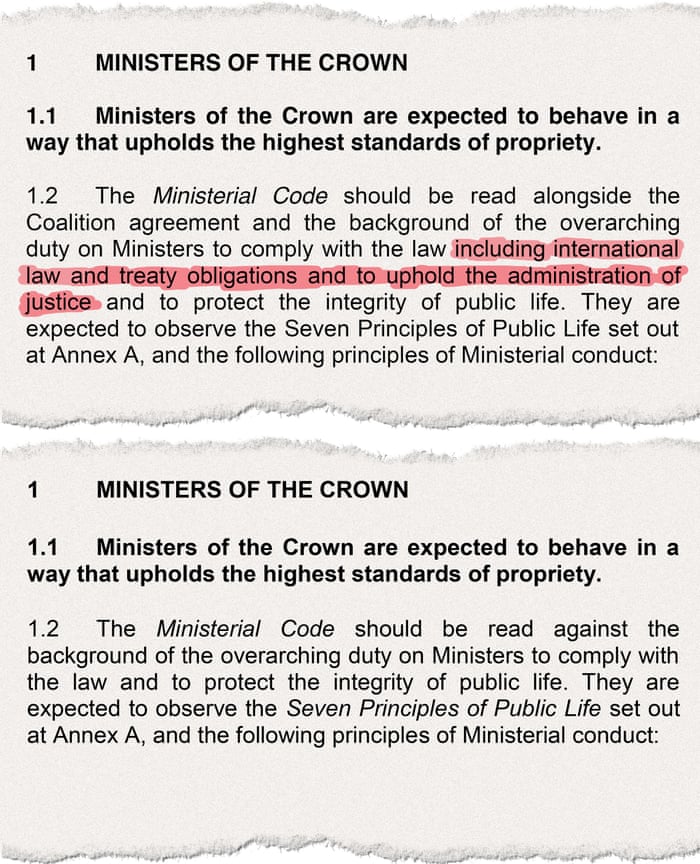
The rewritten ministerial code, which was updated on October 15  without any announcement, sets out the standard of conduct expected of ministers. It has been quietly edited. The latest version of the code is missing a key element regarding the UK’s complicity with international law. 

The previous code, issued in 2010, said there was an “overarching duty on ministers to comply with the law including international law and treaty obligations and to uphold the administration of justice and to protect the integrity of public life”.

The new version of the code has been edited to say only that there is an “overarching duty on ministers to comply with the law and to protect the integrity of public life”.

Legal experts say key issues affected by the change could include decisions about “whether to go to war or use military force, such as the use of drones in Syria, any decision made by an international court about the UK and any laws not incorporated into English law, such as human rights legislation and the Geneva conventions.

Ministerial code changes between 2010 and 2015.
Photograph: Government handout – courtesy of the Guardian

This comes as the UK government is facing another United Nations inquiry regarding widespread allegations that the Conservative welfare reforms breach the Human Rights of disabled people. It also comes following the government announcement this week that there are plans to scrap the Human Rights Act by next summer, to replace it with a controversial “British Bill of Rights.”

Raquel Rolnik, the UN’s special rapporteur for housing, found the bedroom tax to contravene human rights and in 2013, she called for the Tory “spare room subsidy” to be suspended immediately. In a wide-ranging report she also calls for the extension of grants to provide more social housing, the release of public land, build-or-lose measures to target landbanks and increased private rented sector regulation. None of these are recommendations which the Conservatives have been remotely willing to entertain, instead they have directed hostility towards the United Nations.

The Conservatives have already taken away access to legal aid from the poorest and most vulnerable citizens, in a move branded contrary to the very principle of equality under the law. Last year, Grayling, then the Justice Secretary, was accused of turning legal aid into an instrument of discrimination by a court, because of his attempt to introduce a residency test to legal aid access, a move which exceeded his statutory powers when he devised it.

He has also tried to dismantle a vital legal protection available to the citizen – judicial review – which has been used to stop him abusing his powers again and again. Judicial review is the mechanism by which citizens can hold the government to its own laws. With the Criminal Justice and Courts Bill, the justice secretary tried to put it out of reach.

Grayling, suffered a defeat in the House of Lords vote on his plans to curtail access to judicial review, which would have made it much harder to challenge government decisions in court.

Peers voted by 247 to 181, a majority of 66, to ensure that the judges keep their discretion over whether they can hear judicial review applications after a warning from a former lord chief justice, Lord Woolf, that the alternative amounted to an “elective dictatorship”.

He has tried to restrict legal aid for domestic abuse victims, welfare claimants seeking redress for wrongful state decisions, victims of medical negligence, for example.

It’s very worrying that this is a government that wants to leave Europe behind and sever the connection with the European Convention on Human Rights.  It’s a government that wants to do as it pleases, free from international scrutiny and what it clearly sees as the constraints of international law and the judgments of international courts.

The Conservatives have demonstrated an eagerness to take away citizens’ rights to take their case to the European court, with many of their actions clearly based on an intent on tearing up British legal protections for citizens and massively bolstering the powers of the state.

The Guardian reports that a legal challenge against the change will be lodged on Friday by Rights Watch, an organisation which works to hold the government to account. Yasmine Ahmed, its director, said:

“This amendment to the ministerial code is deeply concerning. It shows a marked shift in the attitude and commitment of the UK government towards its international legal obligations.”

In his preamble to the new ministerial code, David Cameron says: “People want their politicians to uphold the highest standards of propriety. That means being transparent in all we do.”

However, I reported last year that in terms of international standards of conduct, the Conservatives are not doing well. Transparency International flagged up many areas of concern in their report: A mid-term assessment of the UK Coalition Government’s record on tackling corruption

The Cabinet Office has of course denied there was any intention to weaken international law and the administration of justice by omitting the phrases from the new code.

A spokesman said:

“The code is very clear on the duty that it places on ministers to comply with the law. ‘Comply with the law’ includes international law.

The wording was amended to bring the code more in line with the civil service code. The obligations remain unchanged by the simplified wording. The ministerial code is the prime minister’s guidance to his ministers on how they should conduct themselves in public office.”

However, a Conservative party policy document promises that the ministerial code will be rewritten in the context of the UK withdrawing from the European convention on human rights. In order to help achieve these aims the document says:

“We will amend the ministerial code to remove any ambiguity in the current rules about the duty of ministers to follow the will of Parliament in the UK.”

Lord Falconer, Labour’s shadow lord chancellor, said:

“If this is what ministers are planning to do it is shocking. We are a country that prides itself on operating in accordance with the rule of law. That has always meant both domestic and international law.

This is a message we have sent out both internally and externally. If we are now regarding compliance with international law for ministers as optional that is staggering. If ministers breach international law it will no longer be misconduct.”

The Guardian cites Ken Macdonald QC, the former director of public prosecutions, who said:

“It is difficult to believe that this change is inadvertent. If it’s deliberate, it appears to advocate a conscious loosening of ministerial respect for the rule of law and the UK’s international treaty obligations, including weakening responsibility for the quality of justice here at home.

In a dangerous world, the government should be strengthening its support for the rule of law, not airbrushing it out of the ministerial code. On every level, this sends out a terrible signal.”

Ironically, on the same day that the new code was quietly released, the attorney general, Jeremy Wright, gave a keynote address about the importance of international law to an audience of government lawyers at the Government Legal Service International Law Conference.

Wright said:

“The constitutional principle to respect the rule of law and comply with our international obligations is reflected in the ministerial code – which applies to me as much as to any other minister. The code states that there is an overarching duty on ministers to comply with the law, including international law and treaty obligations and to uphold the administration of justice and to protect the integrity of public life.”

It is not clear whether or not the attorney general was informed about the changes to the ministerial code at the time of his speech. Both the Cabinet Office and the attorney general’s office have declined to answer this question.

Tory ministers are a major source of national embarrassment when they denounce the European Court of Human Rights whilst instructing the rest of the world, including other European states, to respect our collective international human rights obligations and “the rule of law.” Human Rights legislation exists throughout the free world. Free speech, the right to a fair trial, respect for private life and the prohibition on torture are values which distinguish democratic societies from despotic states.

There is no justification for editing obligations to upholding international laws, human rights or for repealing the Human Rights Act: that would make Britain the first European country to regress in the level and degree of our human rights protection. It is through times of recession and times of affluence alike that our rights ought to be the foundation of our society, upon which the Magna Carta, the Equality Act and the Human Rights Act were built – protecting the vulnerable from the powerful and ensuring those who govern are accountable to the rule of law.

Update: Former head of government’s legal service says obligation that ministers must comply with international law – dropped from revised ministerial code – had irritated PM: No 10 ‘showing contempt for international law’


I don’t make any money from my work and I am not funded. I am disabled because of illness and struggle to get by. But you can help me continue to research and write informative, insightful and independent articles, and to provide support to others, by making a donation. The smallest amount is much appreciated – thank you.

DonatenowButton

Prime minister dismisses UN inquiry into government’s discriminatory treatment of disabled people

disability_2218977b

Labour leader Jeremy Corbyn has asked David Cameron at Prime Minister’s Questions today to publish the details of the Government’s response to the United Nations inquiry into the allegations that Conservative policies are breaching the rights of disabled people in the UK. He also asked if the government intended to co-operate with the inquiry.

Such UN investigations are conducted confidentially by the UN and officials will not confirm or deny whether the UK is currently being put under scrutiny.

However, the ongoing inquiry been widely reported by disability rights groups and campaigners. The Department for Work and Pensions has previously declined to comment on the possibility of an investigation.

Mr Corbyn used his final question to ask about the United Nations inquiry into alleged “grave or systemic violations” of the rights of disabled people in the UK. The PM gave a dismissive response, saying the inquiry may not be “all it’s cracked up to be” and said that disabled people in other countries do not have the rights and support that “they” [disabled people] in the UK are offered. Cameron also implied that Labour’s “strong” equality legislation was a Conservative policy. However, the Equality Act was drafted under the guidance of Harriet Harman.

Jeremy Corbyn asks about David Cameron about his response to the UN inquiry at Prime Minister’s Questions

The United Nations team of investigators are expecting to meet with the Equality and Human Rights Commission, members of parliament, individual campaigners and disabled people’s organisations, representatives from local authorities and academics.

The team will be gathering direct evidence from individuals about the impact of government austerity measures, with a focus on benefit cuts and sanctions; cuts to social care; cuts to legal aid; the closure of the Independent Living Fund (ILF); the adverse impact of the Work Capability Assessment (WCA); the shortage of accessible and affordable housing; the impact of the bedroom tax on disabled people, and also the rise in disability hate crime.

Mr Corbyn said:

“This is deeply embarrassing to all of us in this house and indeed to the country as a whole. It’s very sad news.”

The Government’s approach to people with disabilities had been extremely controversial and been met with criticism from campaign groups. Disabled people have borne the brunt of austerity cuts, losing more income and support than any other social group, and this is despite the fact that Cameron promised in 2010 to protect the poorest, sick and disabled people and the most vulnerable.

In 2013, Dr Simon Duffy at the Centre for Welfare Reform published a briefing outlining how the austerity cuts are targeted. The report says:

The cuts are not fair.

They target the very groups that a decent society would protect:

  • People in poverty (1 in 5 of us) bear 39% of all the cuts
  • Disabled people (1 in 13 of us) bear 29% of all the cuts
  • People with severe disabilities (1 in 50 of us) bear 15% of all the cuts

The report outlines further discrimination in how the austerity cuts have been targeted. The report says:

The unfairness of this policy is seen even more clearly when we look at the difference between the burden of cuts that falls on most citizens and the burdens that fall on minority groups. By 2015 the annual average loss in income or services will be:

  • People who are not in poverty or have no disability will lose £467 per year
  • People who are in poverty will lose £2,195 per year
  • Disabled people will lose £4,410 per year
  • Disabled people needing social care will lose £8,832 per year

Work and Pensions Secretary Iain Duncan Smith said at the  Conservative party conference speech in Manchester that disabled people “should work their way out of poverty.”

The Work and Pensions Secretary has been widely criticised for removing support for disabled people who want to work: by closing Remploy factories, scrapping the Independent Living Fund, cuts to payments for a disability Access To Work scheme and cuts to Employment and Support Allowance.

The reformed Work Capability Assessment has been very controversial, with critics labeling them unfair, arbitrary, and heavily bureaucratic, weighted towards unfairly removing people’s sickness and disability benefit and forcing them to look for work.

The bedroom tax also hits disabled people disproportionately, with around two thirds of those affected by the under-occupancy penalty being disabled.

The United Nations have already deemed that the bedroom tax constitutes a violation of the human right to adequate housing in several ways. If, for example, the extra payments force tenants to cut down on their spending on food or heating their home. There are already a number of legal challenges to the bedroom tax under way in British courts. In principle the judiciary here takes into account the international human rights legislation because the UK has signed and ratified the International Covenant on Economic, Social and Cultural Rights.

The right to adequate housing is recognised in a number of international human rights instruments that the UK has signed up to.

UN rapporteur Raquel Rolnik called for the UK government last year to scrap its controversial bedroom tax policy. Rolnik’s report was dismissed as a “misleading Marxist diatribe” by Tory ministers, and she had been subject to a “blizzard of misinformation” and xenophobic tabloid reports.

The DWP’s sanctions regime has also been widely discredited, and there has been controvery over death statistics, eventually released by the Department after a long-running refusal to release the information under freedom of information law.

The Daily Mail has already preempted the visit from the special rapporteur, Catalina Devandas Aguilar, who is spearheading the ongoing inquiry into many claims that Britain is guilty of grave or systematic violations of the rights of sick and disabled people, by using racist stereotypes, and claiming that the UN are “meddling”. The Mail blatantly attempted to discredit this important UN intervention and the UN rapporteur before the visit.

Meanwhile, Cameron seems very keen to play the investigation down, and dismiss the impact of his government’s “reforms” on the lives of sick and disabled people.

We are a very wealthy, so-called first-world liberal democracy, the fact that such an inquiry has been deemed necessary at all ought to be a source of great shame for this government.


A tribute to Michael Meacher

201378_115847Celebrating the 65th birthday of the NHS

I’m so saddened to hear that Michael Meacher, MP for Oldham West and Royton, has passed away. He was a strongly principled, thoroughly decent MP and the loss of such a great man is a huge loss to the Labour Party, as well as to family, friends and constituents. He will be missed very much.

Michael, the former Labour environment minister who served in the governments of Harold Wilson, James Callaghan and Tony Blair, died aged 75 after a short illness.

The MP for Oldham West and Royton kept his seat with a 14,738 majority at the 2015 general election and was one of  the of MPs to support Jeremy Corbyn in the Labour leadership contest.

He described Corbyn’s election as a “seminal day in British politics, marking the coming together of the two great conditions needed for transformational change”.

Michael was a hardworking Member of Parliament from 1970 until his death, initially for Oldham West and then from 1997 for Oldham West and Royton.

He was a champion of social justice and equality, and talked such a lot of sense.

Meacher appeared as himself in the excellent BBC Television drama serial the Edge of Darkness in 1985.

Michael Meacher in the BBC’s Edge of Darkness

On 23 September 2006, Meacher became the sixth Labour MP to start a blog. Mr Meacher has also written articles for ePolitix.com, which included criticism of Blair and Brown for their centre left-wing policies, including privatisation. He also called for a more conciliatory policy in the Middle East, attempts to tackle income inequality, and a greater commitment to reducing energy use.

In 2013, Meacher strongly criticised the firm Atos and the Work Capability Assessments of sick and disabled people carried out on behalf of the Department for Work and Pensions, in a sustained and excellent campaign documented through his blog. Meacher was also staunch campaigner against austerity and inequality.

He was a prolific and skilled writer, as well as an outstanding, talented speaker, and I recommend you visit his site.

images
Here’s a post from Michael, from April 30, 2015
:

1,000 richest Britons now hold assets worth £547 billions, 13m Britons now in poverty, half in work

The Murdoch paper Sunday Times has just published its Rich List for 2015 which shows that the richest 1,000 persons based in Britain now have wealth valued at £547.1bn.   That works out at an average level of wealth of nearly £550 millions per person, though there are wide variations between the threshold level of £100 millions at the base to £13.2 billions at the top (someone called Len Blavatnik).   These are not only staggering figures, but perhaps even more staggeringly, they have more than doubled since the financial crash in 2009.   In that year the richest thousand had £258 millions, but they now have 112% more.   They include 117 billionaires with a total wealth of £325 billions, nearly £3 billions each on average.   Indeed Britain apparently now has more billionaires per 100,000 of the population than any other country in the G20 group of the world’s biggest economies, more even than the US.   The number of billionaires in Britain has almost trebled in the past decade: there were only 40 in 2005.

This is the richest 0.003% of the population.   At the other end of the spectrum there are now over 13 million persons in poverty households as officially defined, i.e. the household’s total income is less than 60% of the national median income.   That works out, though varying according to family size, to about £240 a week.   What however is most disturbing, though little recognised, is that in more than half these households at least one person is in work.   This arises because the national minimum wage is very low (£6.50 per hour), and even that is rarely enforced against unscrupulous employers, but also because of the alarming zero hours contracts system.   That accounts for some 20% of the population at the bottom; in contrast the top 1% take home in excess of £3,000 a week, including thousands who are millionaires getting over £20,000 a week.

Inequality in Britain is now grotesque.   What should be done?   Labour is proposing a Living Wage of at least £8 per hour at the base and at the top a mansion tax on properties worth over £2m, an increase in the top rate of income tax from 45% to 50%, and a bankers’ bonus tax to raise £2.5bn.   But that is nowhere near enough to bring inequality within acceptable limits.   What is really needed is a wealth tax.    A wealth tax pitched at 1% should raise £5.5bn from the richest 1,000 persons so long as it was made clear that any failure to report the true and accurate level of wealth would be penalised by doubling the rate of tax.   A wealth tax aimed at the richest 1% (some 310,000 persons) would of course raise several more billions.   To assist in the rigorous collection of these taxes the number of tax inspectors, which the Tories (and Blair-Brown before them) hugely reduced, should be built up to whatever level necessary since ARC, their professional body, calculates that they raise between 30-180 times their salary each year.

images

Rest in peace, Michael Meacher.
November 4, 1939 – October 21, 2015

PIP refused for allegedly spending too much time on Facebook

Facebook-Logo-Wallpaper-Full-HD

Thanks to Benefits and Work for this post.

A shocked welfare rights worker, posting on Rightsnet, has revealed how his client had their personal independence payment (PIP) appeal refused because of the amount of time the claimant allegedly spent on Facebook.

Accused of lying
The claimant had appealed to a first-tier tribunal about the decision on their PIP claim and attended an oral hearing with a representative.

Whilst considering their mental health, the claimant was asked by the panel whether they ever used Facebook. The claimant replied that they did so ‘now and again’.

After all the evidence had been taken, the claimant and their representative returned to the waiting room while the tribunal made their deliberations.

However, when they were called back before the panel to hear the decision, the claimant was accused of lying to the tribunal. The medical panel member had the claimant’s Facebook page open on their smartphone and was reading from it, clearly taking the view that the number of posts was too frequent to be regarded as ‘now and again’.

Because the evidence gathering phase of the appeal had ended, the claimant was not allowed to respond, they could only listen to the decision of the tribunal in shocked silence.

Thus they were given no opportunity to challenge the accusation that they were lying or to explain that their partner also used their Facebook page.

Instead, they must now go through the lengthy process of asking for a statement of reasons from the tribunal judge – which can take many weeks or months to be provided – before asking for the decision to be set aside or appealing to the upper tribunal.

Breach of natural justice
There is a very strong probability that the decision will be overturned because it is such a flagrant breach of natural justice: the decision was based on evidence acquired by the panel itself from elsewhere and the claimant was given no opportunity to comment on it.

But, as well as leaving a big question mark over the quality of training for tribunal members, this episode also raises the possibility that claimants’ use of social media may in the future be used as evidence when making decisions on benefits entitlement.

If all the facts are collected and the claimant is given the opportunity to comment on them, this may just be another indignity that claimants are expected to learn to live with. Either that or claimants will need to make sure that their online life is kept as private as possible.

But if decisions are made based on partial evidence and wrong assumptions, as in this case, it will simply lead to more unfairness and injustice for sick and disabled people.

View the topic on Rightsnet

Osborne’s tax credit cuts omnishambles

540525_186110078206715_79170441_n

The Chancellor, George Osborne, has recently announced that the Conservatives are a true “workers party”  – claiming that his opponents, the Labour Party, represent the unemployed. But the Conservatives are attempting to re-write history: the Labour Party grew from the Trade Union Movement, and have a strong tradition of supporting worker’s rights and fair wages, and of course the Unions have retained close institutional links with the Labour Party.

Osborne has argued, somewhat absurdly, that reducing tax credit payments to people in low paid jobs would give them “economic security” by reducing the Government’s spending deficit. Labour argues that the richest should pay to cut the deficit, and has identified cuts to tax avoidance and corporate subsidies that could replace cuts to the lowest paid. Osborne’s priorities reflect a traditional Conservative ideology.

As Richard Murphy, from Tax Research UK, points out:

“… the government is forcing the burden of risk bearing onto those least able to bear it in society – that is those with the lowest income. So just as we now know inequality, especially concerning wealth, is rising rapidly, insecurity is also increasing exponentially as risk is being passed from those with the capacity to bear it to those who have not.”

Osborne’s “long-term economic plan” isn’t without controversy. According to many economists, during recessions, the government can stimulate the economy by intentionally running a deficit. The budget deficit is the annual amount the government has to borrow to meet the shortfall between current receipts (tax) and government spending.

Of course, last year, serious doubts were raised regarding Osborne’s deficit targets after the treasury met a significant tax revenue shortfall. Osborne’s obsession with deficit cutting and the Conservative small-state ideology has clearly overlooked the problems created by poor pay and high living costs, which has impacted detrimentally at both a micro and macro level, creating an economic spiral of cuts and stagnation. And it has widened inequality significantly.

In order to keep his promises on further future tax cuts for higher earners, Osborne will invariably make even more cuts to public services, public sector pay and the social security safety net that are so deep they will severely damage both the economy and potentially, the fabric of our society.

The Institute for Fiscal Studies (IFS) have recently criticised George Osborne’s proposed tax credit cuts, because it is “at odds” with wider Conservative stated aims to “support hardworking families”.

Research conducted by the IFS calculated that only around quarter of money take from families through tax credit cuts would be returned by the new National “Living Wage”.

Tax credits are payments made by the Government to people on lower incomes, most of whom are in work.

It was announced today that the Work and Pensions Committee is holding an urgent evidence gathering session on the proposed reforms to the tax credit system on Monday 26 October. The Committee will question representatives of respected independent think tanks that have analysed the impact of the Conservative plans, including the IFS and the Resolution Foundation, who revealed that the planned welfare cuts will lead to an increase of 200,000 working households living in poverty by 2020, and that almost two-thirds of the cut would be borne by the poorest 30 per cent of households, whilst almost none of the cuts will fall upon the richest 40 per cent of households.

A Labour motion calling on the government to rethink the controversial tax credit cuts has been defeated in the Commons. But despite Labour losing the vote today, the debate saw a number of Tory MPs attack the proposed changes, too.

In her maiden speech today, Tory MP Heidi Allen said that her party risks betraying its values, as she voiced her opposition to tax credit cuts.

She suggested ministers were losing sight of the difficulties of working people in their “single-minded determination to achieve a [budget] surplus”. She also said that the tax credit changes do not pass the “family test”, warning that the pace of the reforms is “too hard and too fast”.

The opposition day motion called for a reversal of the policy but MPs voted against it by 317 to 295 – a government majority of just 22. Next week, the vote in the House of Lords was set to be far closer, with the very real possibility that on Monday, Peers would  vote to block the changes. Because the tax credit cut proposals were not in the Tory manifesto, it means they are not bound by the usual Salisbury convention that prevents the peers from blocking election promises.

Also, the tax credit cuts were not included in the Finance Bill, which normally enacts a Budget, and the opposition have used the opportunity to seize on the fact that a Statutory Instrument can be halted by a single House of Lords vote.

Mr Cameron effectively ruled out cutting the benefit before the election, telling a voters Question time that he “rejected” proposals to cut tax credits and did not want to do so.

The cuts are part of £12bn cuts to the social security budget that the Government is to make – the details of which the Conservatives refused to announce before the election.

However, in an unprecedented move, the Conservatives have threatened a constitutional “showdown”, and have refused to engage in dialogue with peers that want kill off the proposed Tory cuts. The government warned the House of Lords it would trigger a full-scale constitutional crisis by pressing ahead with their plans.

Despite the fact that the chancellor faces a growing rebellion against the cuts among Tory MPs, the government told the group of crossbench peers that they also “risked” a renewed push to weaken the powers of the upper house if they refused to back down.

The threats from the government that came because it was facing probable defeat on what is an extremely unpopular reform, even amongst their own party ranks, are truly remarkable, showing a contempt for democratic process and a lack of willingness to engage in transparent dialogue. They came after Lady Meacher, a crossbencher who is the former chair of the East London NHS Trust, threatened to table a “fatal motion” to kill off the cuts to tax credits.

The Tories do not have a majority in the Lords and faced defeat after Labour and the Liberal Democrats said they would support Lady Meacher.

It is understood that Meacher withdrew her fatal motion on Tuesday night and announced she would table a motion calling on the government to deliver a report responding to the warning by the Institute for Fiscal Studies that 3 million families would lose over £1,000 a year.

Meacher told the Guardian today:

My plan at the moment is to put down a motion which will prevent this regulation being approved on Monday, which will require the government to produce a report responding to the IFS analysis and consider mitigating action before bringing it back. This gives time to the House of Commons to go on doing what they are doing. There are Tory MPs horrified by this.

So we are giving the government time to think again, but the word fatal would not be appropriate. This is causing a great deal of consternation at government level and we are trying to find a way through which will ensure that the government revisits these regulations

This move will also allow time for the Work and Pensions Committee to gather further evidence to present to the government, too. The Committee have stated that they will ask representatives questions on the following topics;

  • The impact of the April 2016 tax credit cuts (in isolation and in the context of other welfare measures in the Summer Budget), and the National Living Wage
  • The winners and losers and their characteristics
  • The extent to which the National Living Wage will compensate individuals receiving lower tax credit payments
  • The distributional impact of these measures, individually and combined
  • The scale of the financial gains/losses to households and what influences this
  • The quality of the analysis produced by the Government to support their proposals
  • Other options for achieving savings from the tax credit system that will mitigate the impact on the least well off
  • The implications for work incentives and the Government’s wider objectives in welfare reform

Select Committees work in both Houses of parliament. They check and report on areas ranging from the work of government departments to economic affairs. The results of these inquiries are made public and the Government must respond to their findings.

A select committee is a cross-party group of MPs or Lords given a specific remit to investigate and report back to the House that set it up. Select committees are one of the key ways in which Parliament makes sure the Government is adequately scrutinised, held to account, and has to explain or justify what it is doing or how it is spending taxpayers’ money.

Committee findings are reported to the Commons, printed, and published on the Parliament website. The government then usually has 60 days to respond to the committee’s recommendations.

The Osborne omnishambles is far from done and dusted yet.

555114_453356604733873_1986499794_nPictures courtesy of Robert Livingstone

Tories Threaten To Suspend House Of Lords If It Attempts To Halt Tax Credit Cuts

Image result for democracy UK

Yesterday I reported that a rarely-used procedure called a “fatal motion” is set to be tabled in the House of Lords this week, followed by a vote next week, with the specific design of preventing George Osborne from putting his controversial proposed £4bn tax credit cuts into law.

The Huffington Post reports that House of Lords could be controversially suspended or “flooded with Tory peers” if it takes the “nuclear option” of killing off George Osborne’s tax credits cuts next week, according to government sources. This is a truly remarkable threat from the Conservative government, in a so-called first world liberal democracy.

Furious Conservatives are threatening the unprecedented and profoundly undemocratic retaliation if peers decide to proceed with the step of using the so-called “fatal motion” to kill the Chancellor’s plans to cut working tax credits.

Campaigners believe that the usual Salisbury convention, which stops the Lords from blocking a party’s plans, does not apply because the tax credits cuts were not mentioned in the Tory manifesto in May.

But a fatal motion on what the Tories deem “a financial matter” would be unprecedented and Tory sources say the government are determined that the Lords would “have to pay a serious political price” if the Government is defeated next week.

Normally if the Lords defeat the Government on a money-related bill, it can be overturned easily in the Commons by the Speaker deeming it a financial issue. But a statutory instrument has no such condition.

Baroness Meacher told BBC Radio 4’s World at One on Monday afternoon that the cross-party determination to overturn the plans was strong.

Asked how much support she had, Meacher said: “A lot. There are clearly a lot of Conservatives who are very worried about this. There’s very strong support from the Labour Party and Lib Dem, cross-benchers who are very worried.”

And the government’s threat comes when several Conservatives have warned the tax credit cut will be damaging. Also speaking to the BBC today, even Boris Johnson ramped up the pressure on the chancellor. The London mayor said while it was “brave” and “right” to reform the tax credit system the government needed to make sure it was done in a fair way. He said:

I think everybody is concerned about everything that bares down unfairly on the working poor and it’s very important as we take this thing forward we do it in such a way as to minimize that impact.

Baroness added that Bishops in the Lords were “very deeply concerned” and would “want to support a rethink” of Osborne’s plan. Asked if the Bishops would support her, she said: “That’s my understanding.”

This is an unprecedented and extremely undemocratic threat on the part of the government. The House of Lords shares responsibility for making laws with the House of Common. The role of the House of Lords (sometimes called the “upper house”) is to provide an additional safeguarding mechanism of democracy, as the second chamber of Parliament. Members regularly review and amend Bills from the Commons.

The House of Lords plays a vital role in making and shaping our laws and crucially, in checking and challenging the government; it shares this role with the House of Commons. The Lords has a reputation for thorough and detailed scrutiny of Bills.

The House of Lords serves a valuable democratic function by providing a national forum of debate free from the constraints of party discipline. Although the defeat of government legislation by the house has been relatively rare on major legislation, it sometimes does defy the government. Members come from many walks of life and bring experience and knowledge from a wide range of occupations. Members use their extensive individual experience to investigate and scrutinise public policy.

Much of this work is done in select committees – small groups appointed to consider specific policy areas. Members play a crucial role in holding the government to account.

In late 2011 and early 2012, the Tory-led Coalition government suffered a series of defeats in the House of Lords on amendments to its flagship Welfare Reform Bill. Most of the defeats were on highly controversial matters, including the bedroom tax, disability benefits, the reform of the child maintenance system and the introduction of an overall benefit cap.

The Lords also tabled amendments to the Legal Aid, Sentencing and Punishment of Offenders Bill. All were subsequently overturned by the House of Commons, which cited its “financial privilege” – or the right to dismiss the Lords’ demands on “financial matters”. As a consequence it was argued by the government that the Lords should, by convention, not insist on its proposals.

These events provoked anger both inside and outside parliament, with claims that the government had misused parliamentary procedure in order to secure its extremely controversial policy programme, and that the incident could be considered not only as profoundly undemocratic, but also, as “an abuse of privilege,” and a means of avoiding unwelcome scrutiny of and accountability for objectionable policies. A widespread complaint is that the financial privilege process lacks transparency.

At present there are no clear definitions as to what falls within Commons financial privilege. And once privilege has been invoked on an amendment, the Commons gives no explanation as to why. Such lack of transparency makes it difficult for peers to anticipate whether financial privilege will be applied to their amendments, and has certainly fed perceptions outside parliament that the process is being abused.

There is also a lack of transparency about how the Lords may respond when faced by a claim of Commons financial privilege.

The mechanisms of democracy have been steadily stripped back since 2011. Who could forget the (still) unpublished National Health Service risk register, which estimated the negative consequences of the Tory Health and Social Care Bill, deliberately hidden from public scrutiny despite court rulings that demanded its release.

The Tax Credit cuts are extremely unpopular with the UK public, and quite properly so. The Conservatives claim to “make work pay”, but that is clearly not the case for those “strivers” on low pay.

Democracy is supposed to protect and reflect the interests of citizens. In Britain, it does the exact opposite: routinely working against the interests of the many, in favour of a wealthy, privileged few.

Public communication from the Conservatives has generally been geared towards establishing a dominant paradigm and maintaining an illusion of a consensus.

It seems the government is no longer concerned with maintaining that illusion, or preserving even the façade of democracy.

inconPicture courtesy of Robert Livingstone

WRAG cuts will “lead to more tragedies”, says Debbie Abrahams

Sick and disabled people in the Work Related Activity Group (WRAG), claiming Employment and Support Allowance (ESA) will see payments cut by £30 a week, to bring the benefit in line with the current Jobseeker’s Allowance (JSA) rate.

The cut will affect up to 500,000 sick and disabled people, including many with incurable and progressive conditions like Parkinson’s and Motor Neuron Disease, who are unfit for work but whom the Department of Work and Pensions believes may be capable of working at some point in the future.

Debbie Abrahams, the shadow minster for disabled people, and a former public health consultant, is calling on the Government to scrap the measure.

Debbie has highlighted the government’s own figures, which showed that the death rate of people on out-of-work disability benefits had increased – in comparison with the general population – from 2003 to the period between 2011 and 2014.

She has pointed out that people in the WRAG were 2.2 times more likely to die than the general population.

She said:

“The innuendo that people with a disability or illness might be ‘faking it’ or are ‘feckless’ is quite frankly grotesque and belies the epidemiological data.

Incapacity benefit and ESA are recognised as good population health indicators. I can say that as a former public health consultant. I have experience of this and I have worked in this field.

The release of the government’s own data, which show that this group are more likely to die than the general population, proves that point.”

Ms Abrahams said the government had “continually maligned, vilified and demonised” benefit claimants, whilst its use of words like “shirkers” and “scroungers” had led to these terms being used far more often in the media.

Disability hate crime has increased significantly over the past five years. Recent figures published by the Home Office reveal that 2,508 disability motivated hate crimes were reported and recorded by the police in 2014/15, up 25% from 2,006 in 2013/14.

Debbie Abrahams told the Daily Mirror:

“Disabled people are already twice as likely to live in persistent poverty.

While last year, more than 300,000 additional disabled people were pushed in to poverty.

That is why Labour is calling for the Government to carry out a proper impact assessments that considers the combined impact of cuts to disabled people.”

Speaking to fellow MPs, Debbie said:

“This group of people are vulnerable and need care and support, not humiliation, from us. 

Once again the cart is being put before the horse: make cuts in support and cross your fingers that something turns up for disabled people.”

During the first parliamentary debate about the WRAG ESA cuts, Priti Patel, the employment minister, said the work-related activity component was introduced by the last Labour government “as an incentive to encourage people to participate in employment”.

She said:

“Clearly, we know that that has not happened. We are therefore reforming our approach with DWP, through our jobcentres and work coaches, to support individuals to get back into work.”

She added:

“Through all our welfare reforms we have made it clear that we will continue to protect and support the vulnerable.

That of course includes those who have terminal illnesses or people with progressive illnesses who are unable to work.”

During discussion of a related clause of the bill, Patel added:

“It is very easy for Labour members to claim that the [WRAG] measure is about taking money away.

It is about providing the right kind of support for people with health conditions and disabilities.”

It IS about taking money away.

Let’s not forget that this government have actually cut support for disabled people who want to work. The Access To Work funding has been severely cut, this is a fund that helps people and employers to cover the extra living costs arising due to disabilities that might present barriers to work. The Independent Living fund was cruelly scrapped by this Government, which also has a huge impact on those trying their best to lead independent and dignified lives.

Ms Abrahams said:

“It is unjust that people with serious health conditions, who have been assessed by the Government’s own Work Capability Assessment process as ‘not fit for work’, should have support cut in this manner.

These measures also risk making it harder for some disabled people to move back to work, as they will have lost the financial support that helps them secure employment opportunities.”

Absolutely.

The impact of a Conservative government on Child Poverty – analysis of report by UNICEF

crdb2_0xiaacsaz
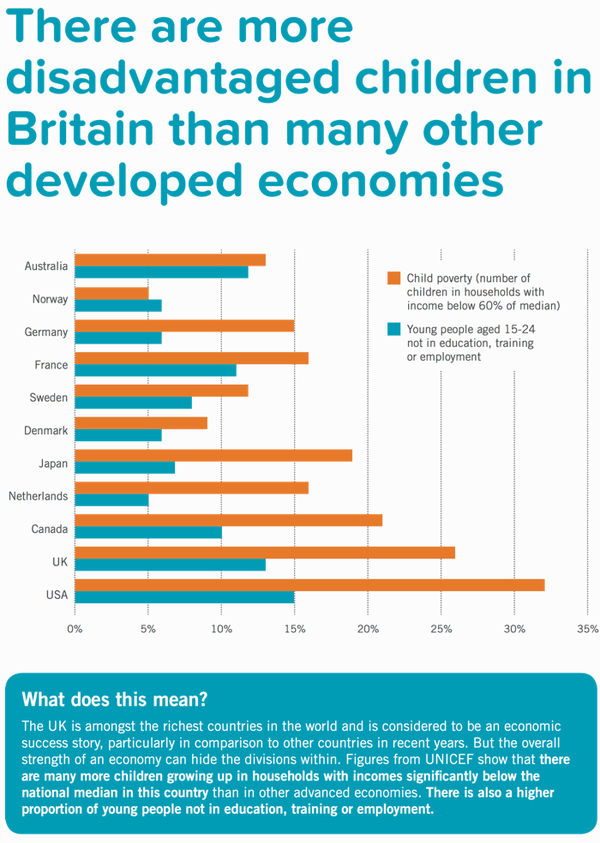
Graphic from Inequality Briefing

If ever you needed convincing evidence that austerity – which is central to neoliberalism and social conservatism – doesn’t benefit the majority, and that the UK has a system that extends inequality and increases poverty, this is it.

Furthermore, austerity was not imposed as an economic necessary, and there were other choices available to the UK government that were less damaging to the poorest citizens and to the economy.

UNICEF have published a report about the impact of the global economic crisis and its aftermath on children. It runs fron 2007 to 2013, so worryingly, the more recent UK government welfare cuts and the consequences are not yet included in this international analysis.

In the executive summary, the report says:

“For each country, the extent and character of the crisis’s impact on children has been shaped by the depth of the recession, pre-existing economic conditions, the strength of the social safety net and, most importantly, policy responses

Remarkably, amid this unprecedented social crisis, many countries have managed to limit – or even reduce – child poverty. It was by no means inevitable, then, that children would be the most enduring victims of the recession.”

The report goes on to say that those Governments that supported existing public institutions and programmes helped to buffer countless children from the crisis – a strategy that others may consider adopting.

The UK was quite clearly not one such country, and more recently, Iain Duncan Smith has conveniently announced changes to how we measure child poverty, shifting the economic responsibility and moral focus by blaming individuals for circumstances created by socioeconomic constraints and political decisions.

The report says:

“Many countries with higher levels of child vulnerability would have been wise to strengthen their safety nets during the pre-recession period of dynamic economic growth, which was marked by rising disparity and a growing concentration of  wealth.”

In the UK, inequality has grown since the recession because of austerity measures that have been targeted at the poorest households. In fact, the UK is now the most unequal country in the EU, and has even higher levels of inequality than the US.

“The magnitude of change since the recession is worth noting. The absolute number of children living in severe material deprivation in the 30 European countries analysed was 11.1 million in 2012 – 1.6 million more than in 2008

This trend is the result of a net effect that includes substantial decreases (more than 300,000 fewer deprived children in Germany and Poland) and unprecedented increases in four countries (Greece, Italy, Spain and the United Kingdom).”

Almost half of the severely materially deprived children (44 percent) in 2012 lived in three countries: Italy (16 percent), Romania (14 per cent) and the United Kingdom (14 per cent).

The report goes on to say:

“At the start of the recession, not surprisingly, child poverty was lower where public spending on families and children was higher. During the recession, welfare states were expected to increase their public protection spending, and many did. 

In such countries, the health and well-being of citizens, especially those in financial or social need, are safeguarded by grants, unemployment assistance programmes, pensions and other benefits. 

In a recession, these benefits act as counter-cyclical economic stabilizers.”

One of the most striking contrasts in the report was that whilst many other countries increased spending on welfare and essential public services to shelter the most vulnerable citizens from the impact of the global recession, in the UK, the government chose to target those social provisions for all of the austerity cuts.

The report says:

“Since 2010, the United Kingdom has implemented a series of cuts that have reduced the real value and coverage of child benefits and tax credits for families withchildren. In 2013, a cap was imposed on the total benefits a household can receive, mainly affecting a small number of large families with high housing costs, while housing benefits were cut (the so-called ‘bedroom tax’), affecting large numbers of social tenants.”

It’s clear that the impacts and aftershocks of the global recession were not shared equally in our society, and the austerity measures have only made things worse for those most affected – the poorest. One emerging certainty from this report is that economic indicators alone do not reveal the complexity of social reality.

The report recommends that governments increase investment in social protection policies and programmes that can reduce poverty, enhance social resilience in children and support economic development in an efficient, costeffective way.

Such measures include guaranteeing basic incomes for families, and a child rights impact assessment as strategy for political decision-making in the best interests of children.

Last year, I wrote that the government’s Children’s Commissioner for England published a report criticising the Coalition’s austerity policies, which have reduced the incomes of the poorest families by up to 10 percent since 2010.

The Children’s Commissioner said that the increasing inequality which has resulted from the cuts, and in particular, the welfare reforms, means that Britain is now in breach of the United Nations Convention on the Rights of the Child, which protects children from the adverse effects of government economic measures.

It therefore comes as no surprise that the current government is planning to repeal our Human Rights Act and replace it with an alternative Bill of Rights. That will mean that  human rights will no longer be absolute – they will be subject to stipulations and caveats. The government will establish a threshold below which Convention rights will not be engaged, allowing UK courts to strike out what are deemed “trivial cases”.

During their last term, the Conservatives contravened the Human Rights of disabled people, women and children. It’s clear that we have a government that regards the rights and wellbeing of most of the population as an inconvenience to be brushed aside.

You can read the UNICEF report in full here.

(Non -discrimination): The Convention applies to all children, whatever their race, religion or abilities; whatever they think or say, whatever type of family they come from. It doesn’t matter where children live, what language they speak, what their parents do, whether they are boys or girls, what their culture is, whether they have a disability or whether they are rich or poor. No child should be treated unfairly on any basis.

Article 3

(Best interests of the child): The best interests of children must be the primary concern in making decisions that may affect them. All adults should do what is best for children. When adults make decisions, they should think about how their decisions will affect children. This particularly applies to budget, policy and law makers.

Article 26

(Social security): Children – either through their guardians or directly – have the right to help from the government if they are poor or in need.

Article 27

(Adequate standard of living): Children have the right to a standard of living that is good enough to meet their physical and mental needs. Governments should help families and guardians who can not afford to provide this, particularly with regard to food, clothing and housing.

1957929_293215800829475_303676825_o

House of Lords plan move to halt Tory tax credit cuts

Jeremy Corbyn challenges David Cameron over tax credit cuts and affordable housing in his second Prime Minister’s Questions appearance.

According to reports, a rarely-used procedure called a “fatal motion” is set to be tabled in the House of Lords this week, followed by a vote next week, with the specific design of preventing George Osborne from putting his controversial proposed £4bn tax credit cuts into law. In the House of Lords, Peers may table a “prayer” against a negative Statutory Instrument. Under the standard negative procedure, the Statutory Instrument is annulled if the prayer motion is agreed by the House within 40 days of the Statutory Instrument being laid.

Fatal motions are extremely rare, with only a very small number successfully passed since the 1960s, as Peers are wary of overreaching their usual delaying powers with such a drastic “nuclear option.”

But campaigners and crossbench, Labour and Liberal Democrat Peers point out that the fact that the tax credit cuts were not in the Conservative manifesto means they are not bound by the usual Salisbury convention that prevents the Lords from blocking election promises. Opposition parties believe that any move to halt the legislation would be constitutional because the tax credits cuts were not in the Tory manifesto in May, and David Cameron even told TV viewers in the election campaign that tax credit rates would not be cut.

The tax credit cuts were not included in the Finance Bill, which normally enacts a Budget, and the opposition have used the opportunity to seize on the fact that a Statutory Instrument can be halted by a single House of Lords vote.

The tax credit cuts are due to come into force in April, but the statutory instrument needed to make them law is due to be voted on in the House of Lords on October 26.

As I reported in  Welfare Weekly  (and here) earlier, Shadow Chancellor John McDonnell pledged today that his party would reverse the tax credits cuts once it came into power.

The Huffington Post reports that a crossbench peer is being lined up to table the motion in a bid to garner as much support as possible and use the in-built anti-Tory majority in the Lords to stop the Chancellor from going ahead.

The Conservatives have a small overall Commons working majority of 16, however, they are outnumbered in the Lords, with 246 peers compared with 209 for Labour and 106 for the Liberal Democrats. There are also a further 175 peers are crossbenchers (not aligned to any party) and 25 of these are bishops. It is understood that the bishops may also take the rare step of voting against the Government.

The so-called Tax Credits Regulations 2015 (Income Thresholds and Determination of Rates) (Amendment) are in the name of Treasury minister and former Goldman Sachs banker Lord O’Neill of Gatley.

The Liberal Democrats have already tabled a “regret” motion that can only delay the Bill, however, a senior crossbencher will be asked this week table a much the much more drastic fatal motion to kill the secondary legislation.

Among the crossbench names mentioned by campaigners are former social work specialist Baroness Meacher, who has led previous Government defeats on welfare legislation.

Labour also has its own Opposition day debate on Tuesday, which although lacking any binding vote will be used to gauge how many Conservative MPs are worried about the plans, and to court their support in opposing the Bill.

Labour MP Frank Field said:

“This [motion] will be one of those amendments which are rarely tabled but which will kill the measure.

“As time goes on, more of Osborne’s backbenchers are now understanding that far from protecting strivers as the Chancellor promised, he is aiming the biggest cut ever in welfare on this group, who he courted during the election.

“It smashes his 2020 election campaign which would have been all about the strivers. Tory MPs have taken seriously, as the leadership haven’t, that they wish to represent strivers.”

Despite significant pressure from some Tory MPs in marginal seats, the Prime Minister and Mr Osborne have so far rejected warnings that the tax credits cuts will leave large numbers of the low paid workers hundreds of pounds worse off.