Author: Kitty S Jones

I’m a political activist with a strong interest in human rights. I’m also a strongly principled socialist. Much of my campaign work is in support of people with disability. I am also disabled: I have an autoimmune illness called lupus, with a sometimes life-threatening complication – a bleeding disorder called thrombocytopenia. Sometimes I long to go back to being the person I was before 2010. The Coalition claimed that the last government left a “mess”, but I remember being very well-sheltered from the consequences of the global banking crisis by the last government – enough to flourish and be myself. Now many of us are finding that our potential as human beings is being damaged and stifled because we are essentially focused on a struggle to survive, at a time of austerity cuts and welfare “reforms”. Maslow was right about basic needs and motivation: it’s impossible to achieve and fulfil our potential if we cannot meet our most fundamental survival needs adequately. What kind of government inflicts a framework of punishment via its policies on disadvantaged citizens? This is a government that tells us with a straight face that taking income from poor people will "incentivise" and "help" them into work. I have yet to hear of a case when a poor person was relieved of their poverty by being made even more poor. The Tories like hierarchical ranking in terms status and human worth. They like to decide who is “deserving” and “undeserving” of political consideration and inclusion. They like to impose an artificial framework of previously debunked Social Darwinism: a Tory rhetoric of division, where some people matter more than others. How do we, as conscientious campaigners, help the wider public see that there are no divisions based on some moral measurement, or character-type: there are simply people struggling and suffering in poverty, who are being dehumanised by a callous, vindictive Tory government that believes, and always has, that the only token of our human worth is wealth? Governments and all parties on the right have a terrible tradition of scapegoating those least able to fight back, blaming the powerless for all of the shortcomings of right-wing policies. The media have been complicit in this process, making “others” responsible for the consequences of Tory-led policies, yet these cruelly dehumanised social groups are the targeted casualties of those policies. I set up, and administrate support groups for ill and disabled people, those going through the disability benefits process, and provide support for many people being adversely affected by the terrible, cruel and distressing consequences of the Governments’ draconian “reforms”. In such bleak times, we tend to find that the only thing we really have of value is each other. It’s always worth remembering that none of us are alone. I don’t write because I enjoy it: most of the topics I post are depressing to research, and there’s an element of constantly having to face and reflect the relentless worst of current socio-political events. Nor do I get paid for articles and I’m not remotely famous. I’m an ordinary, struggling disabled person. But I am accurate, insightful and reflective, I can research and I can analyse. I write because I feel I must. To reflect what is happening, and to try and raise public awareness of the impact of Tory policies, especially on the most vulnerable and poorest citizens. Because we need this to change. All of us, regardless of whether or not you are currently affected by cuts, because the persecution and harm currently being inflicted on others taints us all as a society. I feel that the mainstream media has become increasingly unreliable over the past five years, reflecting a triumph for the dominant narrative of ultra social conservatism and neoliberalism. We certainly need to challenge this and re-frame the presented debates, too. The media tend to set the agenda and establish priorities, which often divert us from much more pressing social issues. Independent bloggers have a role as witnesses; recording events and experiences, gathering evidence, insights and truths that are accessible to as many people and organisations as possible. We have an undemocratic media and a government that reflect the interests of a minority – the wealthy and powerful 1%. We must constantly challenge that. Authoritarian Governments arise and flourish when a population disengages from political processes, and becomes passive, conformist and alienated from fundamental decision-making. I’m not a writer that aims for being popular or one that seeks agreement from an audience. But I do hope that my work finds resonance with people reading it. I’ve been labelled “controversial” on more than one occasion, and a “scaremonger.” But regardless of agreement, if any of my work inspires critical thinking, and invites reasoned debate, well, that’s good enough for me. “To remain silent and indifferent is the greatest sin of all” – Elie Wiesel I write to raise awareness, share information and to inspire and promote positive change where I can. I’ve never been able to be indifferent. We need to unite in the face of a government that is purposefully sowing seeds of division. Every human life has equal worth. We all deserve dignity and democratic inclusion. If we want to see positive social change, we also have to be the change we want to see. That means treating each other with equal respect and moving out of the Tory framework of ranks, counts and social taxonomy. We have to rebuild solidarity in the face of deliberate political attempts to undermine it. Divide and rule was always a Tory strategy. We need to fight back. This is an authoritarian government that is hell-bent on destroying all of the gains of our post-war settlement: dismantling the institutions, public services, civil rights and eroding the democratic norms that made the UK a developed, civilised and civilising country. Like many others, I do what I can, when I can, and in my own way. This blog is one way of reaching people. Please help me to reach more by sharing posts. Thanks. Kitty, 2012

Pregnant and sanctioned just in time for christmas… Sanctioned and frozen to death….The latest news from Ashton Under Lyne Jobcentre.

Embedded image permalink

Here is further evidence of sanction targets, Conservative ministers insist they don’t exist.

This week, David Cameron visited Auschwitz, on the International Day of Human Rights. As a prime minister that has contravened the human rights of children, women, and disabled people, and given that he has pledged to leave the European Convention on Human Rights and repeal our Human Rights Act, I can only assume he visited one of the sites where some of the worst atrocities and abuses in our collective history took place for a truly cynical photo opportunity.

Many of us over this past couple of years have identified parallels between the Coalition’s prejudiced, socially divisive othering rhetoric, policy justification narratives and propaganda and those used by the Nazis. The main article, from The poor side of life highlights more parallels. It also provides further harrowing account of the suffering and death that is happening as a direct consequence of Conservative policies.

“We are only following orders” – the Superior Orders excuse – often known as the “Nuremberg defense” because it was presented at the Nuremberg trials as a defense of the actions of those who had carried out Nazi atrocities during the second world war: it was dismissed – it’s NO defense at all, and those tried were deemed fully culpable – responsible for their own actions. They were found guilty.

See also: The Conservative’s slippery slope and Allport’s scale of prejudice

Aktion Arbeitsscheu Reich, Human Rights and infrahumanisation

Techniques of neutralisation – a framework of prejudice

Charlotte Hughes's avatarThe poor side of life

Today was our usual demonstration day. The wind was howling and the rain and hail was pouring down. We were cold but we turn up every week. We will not let the victims of the Job centre down. Whilst handing leaflets out a lady that had said hello to us on previous occasions came running out of the Job Centre. She was upset, crying, she screamed “Why does this place treat you like this?” She is pregnant and has been put on the terrible universal credit scheme. A scheme which really knows how to make anyone suffer. She had fulfilled all her job search requirements. But when she turned up at the Job Centre to sign on they said that she hadn’t turned up for an interview that she never received a letter for. They couldn’t or most likely wouldn’t show her a copy of this letter… that’s if it…

View original post 312 more words

How to be poor on a budget.

1459165_266124213538634_1461740450_n

Here in the UK, we are fortunate that our government is very supportive of poverty, they have even put together a package of generous policies that incentivise ordinary tax payers: it’s a scheme where you pay in installments with a built-in guarantee of getting absolutely nothing back. A welcome move that ensures almost anyone can now become poor with hardly any effort at all. There’s never been a better time to be poor.

Iain Duncan Smith has put together a generous and useful additional package of support that will successfully remove that stubborn remaining income in the form of ghastly lifeline benefits, so you needn’t put up with being unfortunately able to make those ends meet a moment longer, thanks to the genius of Mr Duncan Smith’s fair and much needed cuts and sanctions. Politics with principles. Good old-fashioned Tory principles.

And what better way to guarantee your highly privileged status of vagabondage and not having a job than to make sure you are so busy being engaged in a fight for basic survival that you can’t be bothered with being incentivised to look for work. We all know that deep joy which utter exhaustion, sinking despair, deprivation and absolute demotivation brings. Yes, it’s a nice rest, for an increasing elite of paupers and vagabonds. That earns you another sanction – it’s the perfect poverty cycle of choice for those of us with such high aspirations to have low aspirations.

Some have criticised this indulgent nothing for something culture, but a government spokesperson, Mr Dickensian, said that poor people deserve the chance to further themselves into a dead end. Mr Cameron said this week that Labour were to blame for cutting poverty, but under the Conservatives, thanks to their special austerity measures for the poor, the economy is working like it should and poverty is now higher than it’s been since records began.

The good news is that being poor costs absolutely nothing. All it takes is a little know-how.

Once people see the benefits of malnutrition, rickets and scurvy, and many other low budget, value Victorian age diseases, I’m sure they will be inspired by their simple chic appeal. The growing popularity of being very hungry has enticed many these past four years. The ease by which malnutrition can be acquired under this generous government, who are making poverty a truly thrilling once in a lifetime opportunity, a must-have, has been welcomed and hailed as the new poor law come-back, the return of a Golden Age for the Conservatives. It’s a very welcomed return of nostalgic, ever so quaint Social Darwinist Tory principles.

However, critics have said that being poor is not the cause of poverty, and claim that poverty specialists have manufactured the statistical evidence. Genuinely poor people have to have significant character flaws, really rubbish lives, personal weaknesses, ineptitudes – no skills at all – to qualify for being in poverty.

A report from ThanAtos, the private company hired by the government to assess people to see if they are genuinely on the point of death from starvation in order to be eligible for poverty, says that many are just feigning starvation and despair and some are even faking thinness. ThanAtos’s research shows that many expect to be provided with food bank vouchers so they can continue to be parked on luxury standards of suffering indefinitely. The report said:

Far too many of those who claim they are poor don’t even have a plasma screen and a sky dish, and we know for a fact that they don’t eat takeaways, take drugs, smoke or drink cheap cider, they lack personal ineptitudes, and many don’t even have loads of unkempt children, so they are just frauds. The problem is that once people see the privilege and benefits of gnawing hunger and destitution, they all want some. It’s all supply-led, people just want poorness as a freebie.

It’s certainly set a trend.

Being poor is so popular that the marginalised wealthy have launched a backlash because languishing in poverty is such a self-indulgent lifestyle choice, especially when the economy is growing. We all know that poor people cost the economy lots of money, as Mr Cameron says. Somehow. And we know that the struggling millionaires are very low-maintenance, economically, requiring only a few meagre tax breaks, like the one of £107,000 each per annum, just to keep them going. A millionaire spokesperson, Samuel Smiles, said:

These poor people have taken the easy, stress-free option of not sending their children up chimneys and into t’mills any more and won’t even try their hand at pick-pocketing and prostitution. Those were once respected pauper activities, but now these poor people are jumping on the band-waggon and tarnishing the good name of thrift, self-help and state-inflicted misery.”

Another spokeperson for wealthy people, Thomas Malthus, said that being rich is fraught with potentially embarrassing socialising difficulties as other people’s exclusive and privileged poverty inspires much outrage, envy, sanctimonious and unfortunate, pretentious one -downmanship from wealthy people, especially at dinner parties. Many have resorted to hiding their posh Le Creuset sets and Agas in the garage, and using a camping stove for all three courses. Growing numbers of the traumatised wealthy have tragically ended up in retail therapy.

Yes, we know we have to help the disadvantaged and hard-done-by wealthy, they need our support and of course, every penny counts. If only they could see that they need us and as much as we need them. We paupers wouldn’t be where we are today if it wasn’t for the wealthy. But we do deserve our special social status.

The fact remains that they bring it all on themselves. I’m not without sympathy  but these wealthy people don’t try hard enough to make do, go without and downsize. I do agree that the government needs to support them with some educational classes to help them achieve the skills required to become poorer. Since poor people need to learn both self-denial and total selfishness, it requires a special talent, and is admittedly difficult to emulate. But many think the wealthy deserve all they get, because they are lazy and just give up, parked on their wealth for life. Poverty is not luck, it’s something you really have to work at. And the new nothing for something culture helps almost everyone into poverty, so there are no excuses for the feckless rich, it’s never been easier to be poor.

But having been denied access to poverty all of their lives, many of the wealthy have decided to become experts on it instead. It’s fueled by the politics of envy, but at least it allows rich people to feel a little included on the periphery of covetable poverty experiences. Many have suggested we don’t have any cookery skills, so it’s not a lack of money but the inability to cook imaginary rice puddings from scratch that creates the privilege of poverty. But that’s untrue, as many paupers endeavor to create all of their fabulous meals every day from nothing at all.

The choice between relative deprivation and downsizing to absolute poverty presents us with a particularly tricky dilemma. It is only the very truly brave and liberated that opt to take the plunge. Unless of course you are one of those lucky people that have inherited your poverty from your parents. Some people are blessed with good genes and don’t have to work at it. But they are the lucky few.

Then there’s the culture of entitlement, it’s the same thing as Margaret Thatcher’s culture of deprivation, only it’s been amended so that we don’t make wealthy folk feel inadequate and alone in their tragic lives of undeserved, much-needed handouts and empty lifestyles – getting something for nothing. It must be so unfulfiling to have all of your needs met and still have a big surplus of money. What a nightmare. No wonder the rich are so envious of our nothing for something culture. So much so that denial is their defence mechanism of choice. And who can blame them.

Poor people everywhere welcome the government’s move to cut the numbers of the moderately wealthy and lift them into poverty, and many have praised David Cameron for ensuring that ordinary people now have equal opportunities when it comes to accessing poverty.

Record numbers of poor people are achieving being very poor, according to Mr Osborne, though he said we’ve a way to go before we hit the targets set by the Office for Victorian Era Fiscal Parsimony, but by the end of this parliament, we should be on track. The Institute of Misery confirmed these findings. However, the Institute of Economic Farce have said that their predicted targets were far exceeded.

It’s so fashionable, being poor. I watched a fashion programme on the TV, in-between all the soaps and Oprah, called “On the catwalk this week.” We saw a new range of designs called “Pauper”, emulating the fabulously poor Gutterati, which is similar to the grunge of the early Tory 90’s, but with more on-trend rags, holes and longer-term wearability. Accessories included funky cardboard boxes, park benches with stylish newspaper edging and a shop doorway with punky spikes. It’s in vogue  to wear your suffering on your tattered sleeves, with minimalist foot wear.

One model was heard screaming obscenities at a journalist, after being accused, insultingly, of having anorexia. She said proudly that she was authentically poor and starving because she chose to do workfare at a Gentlemen’s club, when the Department of Work and Pensions offered her a fashionable, must-have benefit sanction. She was then sent on workfare to the modelling agency, and is very grateful for the opportunity to have nothing at all.

But columnist Hate E Bopkins said: “That’s a big fat lie, she’s a fraud, we all know that poor people get fat because they eat nothing but takeaways, black puddings, pie and chips and they can skillfully mismanage their meagre money to good effect, they’re pros, damn the cunning blighters.

  We all know it’s only the scrounging and disadvantaged wealthy that have that tiresome,  excessive energy and unfortunate and unfashionable money to eat that dreadful fresh fruit and veg, healthy rubbish and be seen slim at the gym. The culturally shameful and depraved creatures. How I wish I could be really poor. I’d love to have nothing at all, ideally.”

Ms Bopkins recommends we buy takeaways and eat really great unwholesome foods like pie and chips, whilst watching soaps and Jeremy Kyle on the telly. Oh, and avoid porridge like the plague. (Although plague, pneumonia, bad teeth and TB may well be set to become the new luxe accessories for poor people this season, according to top fashionistas such as Oxfam and the Joseph Rountree Foundation).

Jamie Oliver, amongst others, says that poor people always have a very large plasma TV. Thanks for that great tip, Jamie. If you bought one whilst in work, you should get rid of it immediately and buy an even larger one from your benefit. You must also subscribe to Sky and get a big dish put on your house. Trade in your furniture and household items the very moment you stop working, and buy them all again so you don’t have to live with the guilt and shame of having anything you may have (inadvertently, I’m sure) bought from what you once disgracefully earned.

Another top tip is have lots of children that you can’t afford. Poor people need to get pregnant only once they are absolutely broke. Never plan your children when you are  in work, or down and out in prosperity, that’s a big no-no. Make sure you lose the job, house and everything else first. Wealthy people will feel included in this lifestyle choice and you can provide opportunity for a suffering wealthy person to share their outrage. It’s therapeutic for them, helping to alleviate their sense of shame and inadequacy.

One of the greatest joys of being poor is that everyone else has got generous and seemingly endless advice for you. There are lots of sound tips around on how to get on with being poor quietly. And the media are interested in sharing all the details of your private life with the public, so they can tut, have some outrage, grumble, seethe and foam a lot, and then give you their advice. It’s because they are so envious of your lucky life experiences that many are thinking of becoming disabled, just so they can share our exclusive pauper status for themselves. They want to own your poverty and I suspect they’d like to commercialise it. But we know that the poor invented poverty, and it’s ours.

Another poverty tip is take expensive holidays abroad, walk your dog if you have one and go to the pub. You must make sure you get someone to take photos of you looking busy and happy and post on facebook, or better still, send them to the Department of Work and Pensions.

Many Sun and Daily Mail readers erroneously think that disabled poor people aren’t allowed to do anything at all that looks normal, they get very distressed and outraged that you aren’t suffering enough, so they will kindly report you. Strictly in your best interests of course, because to these kind, unprejudiced, well-meaning souls, there’s nothing more important than ensuring your complete sacrifice and suffering, and it’s the surest way of getting your benefit stopped, then you can get on with wallowing in your hard-won destitution, suffering and absolute poverty. Because as this thrifty government of self-helping, help themselves specialists has demonstrated, you’re  absolutely worth it.

540695_532291630173703_1425159679_n (1)Thanks to Robert @LivingstonePics


DWP fake psych ‘test’ order illegal – according to DWP

Although this article from THE SKWAWKBOX BLOG is from last year, the issues raised here are even more relevant now, as the Government’s pet project, the Behavioural Insights Team (also known as the “Nudge” Unit) has extended it’s reach much further, including into the far Right’s political domain that entails the micro-management of the media.

We can see that the welfare “reforms” were founded on basic ideas from the discredited pseudo-psychology called Behaviourism and the principles of operant conditioning. “Incentivise”, a word the Conservatives use a lot, is one that they claim is simply imported from the language of paternalistic libertarianism. We are reassured that the government are encouraging people to make “the right choices” for their own long-term benefit, by using “choice architecture” to change the decision-making context that is presented to the public.

However,  a government that punishes the poorest citizens with sanctions that entail the withdrawal of lifeline benefits can only at best be described as authoritarian and coercive. 

I’m currently working on an article about “Nudge” and the bogus psychology  employed to manipulate the public by a psychocratic government.


DWP fake psych ‘test’ order illegal – according to DWP.


Thanks to Robert @LivingstonePics

UKIP: Disability claimants are “parasitic underclass of scroungers”


10437171_327099100774478_1052932761_n


With thanks to Political Scrapbook

Accused of “pointing at immigrants and the disabled and holding his nose” on Question Time last night, Farage retorted that he “never has” criticised people with disabilities.

Yeah, Nige. Apart from in that manifesto policy document which was mysteriously deleted from the UKIP website last year.

The party claimed that 75% of incapacity benefit claimants “are fit and healthy”, dubbing them “a parasitic underclass of scroungers” and handing them a £1,300 cut in state aid:

“The welfare state has also created a brazen culture of benefit “scrounging”, whereby individuals who are perfectly capable of working refuse to do so, and go on benefits instead. They frequently justify this by feigning illness.

“This gives rise to a parasitic underclass of “scroungers”, which represents both an unreasonable tax burden on the working population

What is that if not an attack?


scroll2


Related

UKIP: Parochialism, Prejudice and Patriotic Ultranationalism.KIP

Not that I can ever endorse Russell Brand, either, for the reasons outlined here: Apathy and the alchemical dissolution: bring on the dancing horses

1380472_552739704795562_483105758_nThanks to Robert Livingstone  @LivingstonePics

Ed Miliband’s speech on the deficit and economy: George Osborne’s cuts are extreme and ideological

10424302_677497562319775_766713150422913861_n

Ed Miliband will today (Thursday) deliver a major speech on how the next Labour government will build a strong economic foundation by dealing with the deficit and balancing the books – but never going down the Tory road to take Britain back to 1930s spending levels which existed before the NHS.

In his speech, Mr Miliband will attack the Tories for pursuing an extreme project, motivated by ideology rather than necessity, which will put vital public services at risk:

“My speech today is about the deficit. Its place in our priorities, how a Labour government would deal with it, and how we would do so consistent with our values.

“The Tory plan is to return spending on public services to a share last seen in the 1930s: a time before there was a National Health Service and when young people left school at 14. There is only one 35 per cent strategy in British politics today: the Tory plan for cutting back the state and spending on services to little more than a third of national income.

“And they have finally been exposed by the Autumn Statement for what they really are: not modern compassionate Conservatives at all – but extreme and ideological, committed to a dramatic shrinking of the state and public services, no matter what the consequences.

“They are doing it, not because they have to do it, but because they want to. That is not our programme, that will never be our programme, and I do not believe it is the programme the British people want.

“This is a recipe for public services that will disintegrate and for a permanent cost of living crisis because we won’t be investing in the skills and education people need for good quality jobs, and indeed for sufficient tax revenues. And we know what the result will be: the Tories might be able to deliver the cuts they have promised, but they won’t be able to cut the deficit as they promised.”

Mr Miliband will set out a tough and balanced One Nation Labour approach to dealing with the deficit based on five principles:

1.      Setting a credible and sensible goal to balance the books and get the national debt falling as soon as possible within the next Parliament.

Not having a fiscal plan which sets a target of a 35 percent state, putting public services and productive investment at risk.

2.      Recognising that Britain will only be able to deal with the deficit by tackling the cost-of-living crisis.

Not allowing welfare spending to rise and tax revenues to fall because of low wages, insecure jobs, housing shortages and social failure.

3.      Making common sense spending reductions with departmental spending falling and using money better by devolving power, breaking down old bureaucracies, and rebuilding public services around early intervention.

Not cutting spending to 35 percent of national income that will lead to disintegrating public services and a permanent cost-of-living crisis because we won’t be investing in the skills needed for good jobs and healthy revenues.

4.      Protect everyday working people by ensuring those with the broadest shoulders bear the greatest burden.

Not cutting taxes for the wealthiest while asking everyday working people to pay more.

5.      Promising new policies only when they are fully funded, like Labour’s £2.5 billion time to Care Fund for the NHS, so that they do not require any additional borrowing

Not making commitments that depend on borrowing or promising unfunded tax cuts skewed to the wealthiest that will eventually be paid for by bigger cuts to public services or increases in VAT.

Ed Miliband will say:

“Labour will make fairer choices to help protect vital services and balance the books with measures including a Mansion Tax on properties worth more than £2 million, cracking down on tax avoidance, and reversing the millionaires’ tax cut to restore the 50p rate on incomes over £150,000 a year.

“In these hard times, we are determined to do everything we can to protect everyday taxpayers from bearing an increased burden and to do all we can to protect public services. And those who have done best, under this government and indeed under the last, must pay their fair share. 

We want successful entrepreneurs and those who do well to be rewarded. But we must pull together as a society not drift apart and we cannot do that if deficit reduction is simply on the backs of ordinary people.”

He will say that Labour will only make new commitments that are credible, costed and funded without additional borrowing – unlike the Conservatives who are promising unfunded tax cuts that would put public services at risk.

“This is an essential test of credibility. There is huge uncertainty about the deficit because of economic circumstances and on the basis of recent experience. That makes it all the more important that parties do not spray around unfunded commitments they cannot keep.

“It is why we will only make commitments in our manifesto that are properly funded – not commitments that depend on borrowing. That’s why we’ve explained how we will pay for every policy that we’ve put forward: costed, credible and funded.

“In contrast, the Conservative Party has pledged to make tax cuts when they have absolutely no idea how they will fund them: tax cuts that will cost over £7 billion a year at the end of the Parliament and even more, billions more, if they happen earlier in the Parliament.

“The Tories cannot say how they would fund their tax cuts skewed to help the wealthiest. This is not responsible and it is not right: the British people should be in no doubt what the Tory promise means: they will pay the price for tax cuts in higher VAT or even bigger cuts to public services. The Tories’ priority is unfunded tax cuts, Labour’s priority is to save our National Health Service.”

Labour’s costed and evidenced key policy pledges to date.

To underline Labour’s determination to deal with the deficit fairly and balance the books as soon as possible in the next parliament, Ed Balls has written to members of the Shadow Cabinet. He says:

“It’s now clear the Tories have abandoned any pretence of being in the centre-ground with an increasingly extreme and unbalanced plan. They have made an ideological choice to pencil in deeper spending cuts for the next Parliament because they are refusing to ask those with the broadest shoulders to make a greater contribution and, crucially, are ignoring the need for a plan to deliver the rising living standards and more good jobs that are vital to getting the deficit down.10001887913_f8b7888cbe_o

In contrast, Labour will take a tough but balanced approach to getting the deficit down. Our economic plan will deliver the rising living standards, more good jobs and stronger and more balanced growth which are a vital part of any fair and balanced plan to get the deficit down.

We will make different and fairer choices from the Tories, including reversing this government’s £3 billion a year tax cut for people earning over £150,000 and taking action to close tax loopholes and introducing a mansion tax on properties worth over £2 million in order to help save and transform our National Health Service.

And unlike George Osborne, we will not make any spending or tax commitments without saying where the money is coming from.”

Ed Balls intends to raise state spending rather than complying with Mr Osborne’s austerity plans of further drastic cuts, and he said his party will ring-fence more Whitehall budgets. A recent report by the Organisation for Economic Co-operation and Development (OECD) has found what most of us already knew: that income inequality actually stifles economic growth in some of the world’s wealthiest countries, whilst the redistribution of wealth via taxes and benefits encourages growth. Osborne’s economic policy is damaging the economy. Miliband has consistently put equality high on the list of Labour’s priorities, and quite rightly so.

Labour have proposed progressive taxation, they have pledged to save the NHS, safeguard benefits and repeal the Bedroom Tax, which affects the poorest people: those on low wages and those on benefits, costing them money that was calculated to meet only the basic living costs of food and fuel, originally. Benefit was calculated on the assumption that full housing costs and rates/council tax were also paid by Local Authorities. That is no longer the case. The Tory welfare cuts and rising cost of living have meant a return of absolute poverty, not seen in this country since before the establishment of the welfare state.

At the moment, health, foreign aid and schools are protected from spending cuts, but in his letter, Mr Balls told members of the shadow cabinet that “our manifesto will spell out other limited areas which will have spending protected.”

The Tories’ stated plan to continue cutting even once the deficit has been eliminated has given Labour the opening needed to point out the damaging ideological drive to shrink the state, and to dismiss austerity once and for all. Given that the Conservatives have rigidly set the terms of economic debate and have established a dominant frame of reference since taking office,  I think the response to the Autumn statement from Labour is deft, careful and the proposals are costed, fair and viable.

Reducing the deficit can only happen once we have genuine (and widely shared) economic growth.

The alternative is the Conservative’s extreme, ideological never-ending austerity – all pain with no gain whatsosever for most people. For better or worse, deficit reduction is the political reality against which Labour’s economic credibility is now being defined. Cut the deficit Labour must; but they have taken reassuring steps to do it in a genuinely more comfortable, fair and intelligent way than the Tories.

The full text and more details of Ed Miliband’s speech about the deficit can be found here.

Related 

One of the most destructive Tory ideological myths has been officially debunked

Osborne’s Autumn statement reflects the Tory ambition to reduce State provision to rubble

Follow the Money: Tory Ideology is all about handouts to the wealthy that are funded by the poor

14533697838_dffcc736f2_o (1)
Many thanks to Robert Livingstone@LivingstonePics

One of the most destructive Tory myths has been officially debunked

1450041_569755536427312_1698223275_n

The Organisation for Economic Co-operation and Development (OECD) has discovered what most of us already knew: that income inequality actually stifles economic growth in some of the world’s wealthiest countries, whilst the redistribution of wealth via progressive taxation and benefits encourages growth.

The recent report from the OECD, a leading global think tank, shows basically that what creates and reverses growth is the exact opposite of what the current right-wing government are telling us, highlighting the truth of Miliband’s comments in his speech today – that the Tory austerity cuts are purely ideologically-driven, and not about effectively managing the economy at all. But again, many of us knew this was so.

The Labour Party’s economic plan, based on progressive taxation, equality and funding of public services is the best way forward for economic growth and social stability. The Conservatives have killed the potential for a sustainable economic recovery, and will continue to do so, because they promise endless austerity. This is rather akin to treating a disease with more disease.

Osborne’s economic policy is comparable with riding the fabled rubber bicycle.

We aren’t going anywhere.

The report showed evidence that the UK would have been at least 20 percent better off if the gap between the rich and poor hadn’t widened since the eighties under Thatcher, and successive Conservative administrations – the most recent having reversed the equality measures put in place by Blair. (Yes, he really did).

Prior to the global recession, the Tories said they would match the Labour government’s state spending and suggested they may even further it. However, when the global crash happened, a sudden opportunity presented for Tories to become fully-fledged… Tories, grinding their ideological axe, taking a neoliberal swing at the “bloated” public sector and at Labours’ public spending for the protection of public services and the most vulnerable citizens during the economic crisis.

It’s worth remembering that the Coalition has borrowed more in just 3 years than Labour did in 13. In fact Osborne has borrowed more than every Labour government since 1900 combined. And the current government have nothing to show for it, whereas the Labour government at least adequaltely funded public services and effectively sheltered the poorest citizens from the worst consequences of the global crisis.

Let us not forget that this feckless government inherited an economy that was in recovery. They destroyed that and caused a UK recession by imposing austerity, savagely cutting public spending and public services. Thatcher used the same basic strategy to redistribute public wealth to private bank accounts and create inequality, although she didn’t cut as deeply. It didn’t work back then either. She caused a deep recession, as did John Major – Tories being Tories.

Let us not forget that despite the finger-pointing blame game that the Conservatives indulge in – their perpetual attempts to undermine Labour’s economic credibility and bolster their own ineptitude – that it was Osborne that lost the triple A Fitch and Moody credit ratings, despite his pledge that he wouldn’t. We are regarded as an economic liability on an international level, which flies in the face of Osborne’s lies about economic growth and removes any credibility from his blustering, swaggering claims. I do wish the public more broadly would engage in some joined-up thinking, since many have believed that the cuts were inevitable, but Tory propaganda, in fairness, is designed to fragment the truth and disjoint rationality.

The truth is that Gordon Brown was right with his ideas about fiscal stimulation (rather than Osborne’s coercive fiscal contraction): it’s been a confirmed model over and over by economists and by the fact that we were out of recession in 2010. The Tories’ austerity measures have since damaged the economy profoundly.

But austerity was never about what works. Austerity is simply a front for policies that are entirely founded on Tory ideology, which is  all about handouts to the wealthy that are funded by the poor. 

Accumulation for the wealthy by dispossession of the poor.

The OECD report highlights the fact that Conservative economic rhetoric is based on utter nonsense: it isn’t remotely rational. Tory ideology is incoherent, vindictive towards the poorest and extremely damaging, socio-economically. It shows us that the sacrifices of austerity, which were cruelly imposed on those least able to carry that burden, were justified by a malicious lie dressed-up as a promise of economic growth. But that is precisely what the Tories are destroying.

We knew that the laissez faire capitalism of industrial capitalism  and the more recent financial capitalism of post industrial neoliberalism  extend inequality. How can such systems, founded on competitive individualism, not do so? But now we have the evidence that inequality damages rather than encourages economic growth.

I’ve said elsewhere that Conservatism is centred around the preservation of traditional social hierarchy and inequality. Tories see this, erroneously, as an essential element for expanding economic opportunity. But never equal opportunity.

Conservatives think that civilised society requires imposed order, top down control and clearly defined classes, with each person aware of their rigidly defined “place” in the social order. Conservatism is a gate-keeping exercise geared towards economic discrimination and preventing social mobility for the vast majority.

David Cameron’s Conservative party got into Office by riding on the shockwaves of the 2008 global banking crisis: by sheer opportunism, dishonesty and by extensively editing the narrative about cause of that crisis. The Conservatives shamefully blamed it on “the big state” and “too much state spending.”

They have raided and devastated the public services and social security that citizens have paid for via taxes and national insurance. Support provision for citizens is cut to the bone. And then unforgivably, they blamed the victims of those savage, ideologically-directed cuts for the suffering imposed on them by the Conservative Party, using the media to amplify their despicable, vicious scapegoating narratives.

Conservatives really do think that inequality is necessary, they think that our society ought to be divided and hierarchical. They are traditional rather than rational. They have an almost feudalist approach to economic policy, blended with a strong old boys network of corporocrats.

The Tories have long been advocates of the market society, which turns everyone and everything into a commodity. Neoliberalism is an invisible hand in an iron glove, with its whispered broken promise of a mythological “trickle down” as justification – now the new right neoliberals are officially a cult of vicious cranks.


Related

The BBC expose a chasm between what the Coalition plan to do and what they want to disclose

The word “Tories” is an abbreviation of “tall stories”

Conservatism in a nutshell

Osborne’s Autumn statement reflects the Tory ambition to reduce State provision to rubble

A list of official rebukes for Tory lies


1017174_500690710000462_512008904_n
Many thanks to Robert Livingstone @LivingstonePics

I don’t make any money from my work. I am disabled because of illness. But you can contribute by making a donation and help me continue to research and write informative, insightful and independent articles, and to provide support to others.

The smallest amount is much appreciated – thank you.

DonatenowButton

International Human Rights Day – some food for thought

994442_352804464870608_5110112617916821526_n

“I call on States to honour their obligation to protect human rights every day of the year. I call on people to hold their governments to account.”

UN Secretary-General Ban Ki-moon.

The UN General Assembly proclaimed 10 December as Human Rights Day in 1950, to bring to the attention ‘of the peoples of the world’ the Universal Declaration of Human Rights as the common standard of achievement for all peoples and all nations.

This year’s slogan, Human Rights 365encompasses the idea that every day is Human Rights Day. It celebrates the fundamental proposition in the Universal Declaration that each one of us, everywhere, at all times is entitled to the full range of human rights, that human rights belong equally to each of us and bind us together as a global community with the same ideals and values.

7005_494073677328832_658777491_n

The Coalition’s legal aid reforms  undermine the fundamental principle of legal equality and breach Article 6(1) of the European Convention of Human Rights: the right to a fair trial. They reflect a truly authoritarian agenda of legislative tyranny: the reforms effectively remove legal access for many, crucially that access ultimately safeguards individual liberty against intrusion by the State, and protects us from despotic abuses of authority.

The UK Coalition is currently under investigation by the UN for serious violations of the rights of disabled people.

Children’s Commissioner warns that UK is now in breach of the UN Convention on the Rights of the Child

UK Government in breach of the human rights convention on gender discrimination.

Welfare reforms break UN convention

humanrights

Statement for 2014 of the High Commissioner for Human Rights

Zeid Ra’ad Al Hussein

“All human beings are born free and equal in dignity and rights”: in perhaps the most resonant and beautiful words of any international agreement, the Universal Declaration of Human Rights promises, to all, the economic, social, political, cultural and civil rights that underpin a life free from want and fear.

These human rights are not country-specific. They are not a reward for good behaviour, or particular to a certain era or social group. They are the inalienable entitlements of all people, at all times and everywhere, 365 days a year.

They are the rights of people of every colour, from every race and ethnic group; whether or not they have disabilities; citizens or migrants; no matter their sex, their class, their caste, their creed, their age or sexual orientation.

The commitments made to the people of the world through the Universal Declaration are in themselves a mighty achievement – discrediting the tyranny, discrimination and contempt for human beings that have so painfully marked human history. And since the Declaration was adopted, countless people have gained greater freedom.

Violations have been prevented. Independence and autonomy have been attained.Many people – though not all – have been able to secure freedom from torture, unjustified imprisonment, summary execution, enforced disappearance, persecution and unjust discrimination, as well as fair access to education, economic opportunities, rich cultural traditions and adequate resources and health-care.

They have obtained justice for wrongs, and national and international protection for their rights, through the strong architecture of the international human rights legal system.

The power of the Universal Declaration is the power of ideas to change the world. It tells us that human rights are essential and indivisible – 365 days a year. Every day is Human Rights day: a day on which we work to ensure that all people can gain equality, dignity and freedom.

The UN Human Rights Office stands with the millions of people around the world whose voices are denied.

And I look forward to you joining us, whether you do so via social media or in person. Together, we must demand what should be guaranteed: our human rights, universal, indivisible, inalienable, for everyone, 365 days a year.

scroll2

David Cameron has pledged to leave the European Convention of Human Rights (ECHR) if he is elected next year, and he will repeal Labour’s Human Rights Act, which consolidates the Universal Declaration of Rights.

Human rights are the bedrock of democracy, when that UN charter was written, in the aftermath of the second world war, as an international response to atrocities inflicted by some States, such as the Holocaust, it set out the basic rights for citizens that all governments  should respect and uphold

The strong link between democracy and human rights is captured in article 21(3) of the Universal Declaration of Human Rights, which states:

“The will of the people shall be the basis of the authority of government; this will shall be expressed in periodic and genuine elections which shall be by universal and equal suffrage and shall be held by secret vote or by equivalent free voting procedures.”

The rights enshrined in the International Covenant on Economic, Social and Cultural Rights and subsequent human rights instruments covering group rights (e.g.indigenous peoples, minorities, people with disabilities) are equally essential for democracy as they ensure inclusivity for all groups, including equality and equity in respect of access to civil and political rights.

Labour’s Human Rights Act ought to be a source of pride. It is a civilised and a civilising law. It means that we can hold our government to account in UK courts, rather than needing to go to Strasbourg. It ensures that Britain remains a nation where key universal benchmarks of human decency and protections against State abuse are upheld by the courts.

Membership of the ECHR ought to be a source of pride, too. As well as providing a legal framework for basic decency and civilisation for member States, it also provides a crucial mechanism of international scrutiny that ensures governments are accountable for their actions towards citizens.

The Coalition has, in just four years, contravened the human rights of disabled people, poor people, women and children.

We need to ask two important questions: What kind of government would treat the most vulnerable citizens – protected groups – with such little respect, dignity, care and esteem?

And what kind of government would not wish to uphold basic standards of decency and civilised safeguards – the basic rights and protections of citizens from the actions of the State, within a legal framework of international standards for political accountability?

564882_438358886199493_1982719183_nThe protection of freedom under the Human Rights Act: some illustrations


Thanks to Robert Livingstone for his excellent memes.


Poor people are rubbish at being poor, says Iain Duncan Smith and Conservative Baroness Jenkin of Kennington

526544_532055030197363_2137237288_n

It’s truly remarkable that whenever we have a Conservative government, we suddenly witness media coverage of an unprecedented rise in the numbers of poor people who suddenly seem to develop a considerable range of baffling personal ineptitudes and immediately dysfunctional lives.

We see a proliferation of  “skivers” and “scroungers”, an uprising of “fecklessness”, a whole sneaky “culture of entitlement”, “drug addicts”, a riot of general all-round bad sorts, and apparently, the numbers of poor people who suddenly can’t cook a nutritious meal has climbed dramatically, too. We are told that starvation is not because of a lack of money and access to food, but rather, it’s because people don’t know how to budget and cook, that’s according to the Conservative Baroness Jenkin of Kennington.

She recommends that poor people stop avoiding porridge, since it only costs 4 pence a bowl.

1390648_548165358586330_1740107407_n
The alarming rise in numbers of adults who have suddenly forgotten how to cook and eat porridge since David Cameron took Office, up to last year.

The very fact that people suddenly and worryingly forget these crucial life-skills under every single Conservative government, but most particularly under this one, provides a darn good reason to vote them out on May 7th, 2015, I should say.

Iain Duncan Smith added: “People are going to food banks because they get divorced, ill or addicted to drugs,  it is “ridiculous” to blame the Government.

It is really rather ridiculous to assume that that every single reason that someone is going to a food bank is down to what the Department for Work and Pensions does.

The report itself today and other reports are also clear and they show there are often people with very dysfunctional lives, people who have been caught in drug addiction, family breakdown, people who have gone into serious illness that aren’t claiming benefits and come into difficulty.”

1002589_521987671204099_896277269_n (1)

Gosh, such a massive rise in “dysfunctional lives”, divorce, family breakdown, serious illness and drug addiction, and all since 2010 – even more reasons to vote them out. This Government has clearly created a tide of social problems, as very few people were incompetently hungry and desperately silly enough to need food banks under the last government. In fact I didn’t even know they existed back then. But that’s the “Big Society” for you. What a bright idea to replace welfare with charity. It’s just like the good old Victorian days. Hurrah!

I mean it’s not as if wealthy people ever suffer from messy divorce, serious illness, family breakdown and drug addiction. That must be why we never see them at food banks.

These people simply need to stop being seriously ill, divorced and all of that, that’s what I say.

A lot of people who specialise in studying poverty have said the welfare “reforms” are behind the rise in food bank use, as well as rising benefit sanctions, low pay and ever-rising living costs. But Iain Duncan Smith seems to know what he’s doing, especially when it comes to talking about “fairness”. Or statistics, for that matter.  You never hear about people starving who don’t have a messed-up life, after all. The man has solved that cause and effect dilemma conveniently and to his discredit, very cheaply. Bravo. We should give him a break, as the poor, inadequate vicious bully defensive man can’t even afford to buy his own underwear.

It’s just a coincidence that the Tory austerity measures have been targeted at the poorest, after all. Nothing to do with those draconian, punitive fair and much-needed cuts to people’s lifeline benefits.

Meanwhile, I’m delighted to see the rise in tax-avoiding, sanctimonious kindly wealthy people preaching Victorian values of thrift, self-help and morality, but only to the poor, of course. We really must learn to manage how to not have the basic requirements for survival better, after all. We’re just going about being paupers all wrong. We all know that increasing absolute poverty is an indulgent lifestyle choice. Who wouldn’t jump at the chance to have such an easy time of it, languishing in all of that deprivation, a shorter life and constant cold and hunger? Not to mention such a special social status. It’s so important to know one’s place.

Yes. Poor people are just so incompetent at being impoverished. How utterly selfish. We really ought to make much better use of our absolute poverty. Perhaps we should learn how to announce a flounce from the country, like many of the tight-fisted, selfish, personality disordered,  socially irresponsible hard done by millionaires do, at the prospect of social policy not going quite their way. Some of them were very cross indeed about the very idea of contributing to our economy, and who can blame them. After all, it matters not that poor people starve, as the most important and useful thing for this country is the accumulation of more wealth by an already very wealthy minority. The destruction of our country’s economy, public services, welfare and so many lives is a sacrifice the wealthy are more than happy to pay.

Good thing that David Cameron has obliged their generosity. Phew. The alternative just wouldn’t bear thinking about for those poor millionaires, who are, after all, victims of terrible discrimination, and inequality. Someone has to be, apparently. It’s in the Tory social order rule book. Still, at least we are all better off than Iain Duncan Smith. Most of us are still capable of managing coherence, as money can’t buy that. So we can be cheap and cheerful.

But the rich have obviously forgotten the virtues of porridge and thrift, too.

Perhaps the poor could run budgeting classes for poor, needy millionaires. It seems not many people know that porridge provides the way out of grinding, long-term material deprivation and helps to prevent terrible social problems. Better safe than sorry, I say.

And David Cameron says rich people need looking after. They must be very vulnerable and fragile. I’m sure it will make the mansion tax more palatable, too, for the tax dodging unbearably tortured souls that may have to dip their hands in their vast vaults and pay their way for once endure it. They didn’t mind the bedroom tax, though, despite it being a breach of human rights, and they even managed to stay calm and silent at the destitution and deaths it has caused: they didn’t complain once, bless them. So perhaps they’ll cope with the mansion tax after all.

There’s no porridge on the House of Lord’s menu, either. I feel so sorry for them:

Embedded image permalink

See what I mean? An example of Baroness Jenkin’s “budgeting skills”, which are subsidised by UK tax-payers. The House of Lords’ 760 peers benefit from an £84 discount on their food every week. The generous cut is more than the weekly Jobseeker’s Allowance, which is just £71. And the subsidy comes on top of the £300-a-day “subsistence” given to peers for each day they attend the Lords, to cover food and accommodation. How do they endure it?

And thinking about it, isn’t it odd that whenever we see the curiously abrupt forgetfulness and sudden ineptitude on the rise amongst the poorest members of the public and their increasingly chaotic, difficult lives, it coincides every time with a significant increase in poverty, inequality, politically manufactured unemployment, a significant rise in the cost of living, poor working conditions and lower wages, and welfare “reforms”.

And a bunch of selfservatives in Office. There’s a correlation there somewhere, isn’t there?

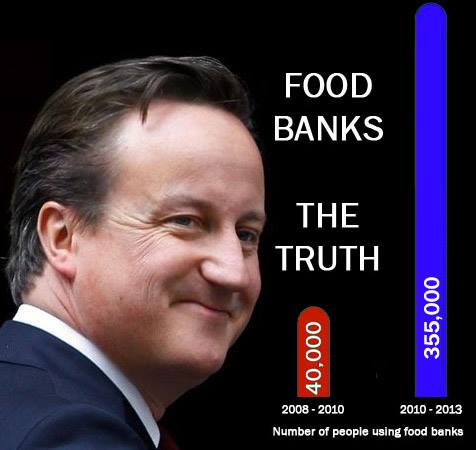
Primary referral causes in 2013-14

Latest foodbank figures top 900,000: life has got worse not better for the poorest in 2013/14, and this is just the tip of the iceberg – The Trussell Trust.

Executive Summary of Emergency Use Only Report.

The just about surviving report


1459165_266124213538634_1461740450_n
Thanks to Robert Livingstone for his excellent memes

Here’s what I believe – Ed Miliband

People sometimes say to me politicians are all the same. That couldn’t be further from the truth. So let me explain what I stand for, in the simplest terms.

For me, everything starts with this: our country is currently set up only to work for a privileged few at the top. It’s time to level the playing field so it works for us all.

When David Cameron talks about the economic recovery, most people in Britain are left wondering why they aren’t feeling its benefits. They want to know why, when they work so hard, their living standards are falling; why, when they make a decent living, they can’t afford to buy a house; and why, against the experience of every generation before us, their kids are worse off than they are.

Or let me put it another way: people are asking why we have zero-hours contracts while some at the top seem to get away with paying zero tax. The same rigged system that lets most people down allows a privileged few to grow ever more wealthy.

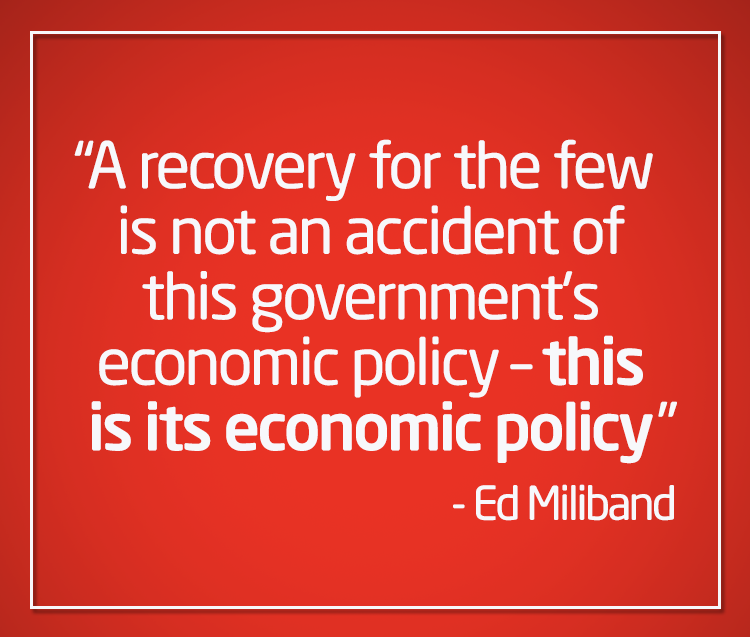
This widening inequality is no accident; it is the direct result of the Tories’ values and their beliefs about how Britain should be run.

  • They believe that insecurity is the way you make people work harder.
  • They think low pay is the way we should compete in the world.
  • They trust that markets will always get the right outcome.
  • They believe the only answer for our public services is to hand them over to private firms — our NHS included.

These ideas failed us in the past and they are failing us now.

Underpinning these ideas is a set of values I abhor: the view that the success of the country depends on a few at the top, and that the rest of us should be content to sit patiently and wait for some scraps to fall from their table.

My own values could not be more different from those of this government.

  • I believe it’s essential that people are rewarded fairly for their hard work — and that we cannot live in a country where chief executives get pay rises 10, 20, 30 times as large as their workers, year on year on year.
  • I believe that each generation should do better than the last.
  • I believe that decent public services are the foundation of who we are as a country — and that the NHS is the embodiment of that.
  • I believe that no vested interest — no bank or energy company or any other rich or powerful group or person — should be allowed to take advantage of the rest of us.

 Above all I believe that Britain only succeeds when working people succeed.

 Those are my values. They’re why I want to be your prime minister, and why I believe our country needs a Labour government.

If this is a vision that you believe is right for Britain,
I need your help to win the election in six months’ time, because we will only win if everyone who wants change fights for it.

We’re going to do it door by door, street by street, town by town.

We’re going to talk to friends, neighbours, and communities about our ambitions for our country. We’re going to chip in small donations to club together against the Tories’ millionaires.

When you’re deciding whether or not to get involved, remember what we’re fighting for:

  • Energy bills frozen until 2017
  • An £8 minimum wage
  • The end of exploitative zero-hours contracts
  • Guaranteed jobs for young people
  • 200,000 more homes built a year
  • The end of the bedroom tax
  • Reform of our banks so they work for our businesses once again
  • A cut in business rates to help small businesses
  • Apprenticeships alongside every government contract
  • An end to recruitment agencies only hiring from abroad
  • The repeal of the Health and Social Care Act
  • Tens of thousands more doctors, nurses, midwives and care workers

Together, these measures add up to a country that starts to work for the majority again.

Millions of people in this country are resting their hopes on us fighting for a fairer, better Britain in six months’ time, and I will not let them down.

The future of our country is in our hands.


In six months a Labour government can begin the business of changing our country for the better. Help us get there: http://labour.tw/1tYncgM

scroll2

Ed Miliband’s policy pledges at a glance

46 more good reasons to vote Labour

Ed Miliband is an excellent leader, and here’s why.

The establishment are ‘frit’ because Ed Miliband is the biggest threat to the status quo we’ve seen for decades

Conservatism in a nutshell


The road to the food bank is paved by failures in the welfare safety net: new report

1896930_10151941274942411_961048560_n

Foreword.

It’s truly remarkable that whenever we have a Conservative government, we suddenly witness media coverage of an unprecedented rise in the numbers of poor people who have suddenly seemingly developed a considerable range of personal ineptitudes.

We see a proliferation of  “skivers” and “scroungers”, an uprising of “fecklessness”,  and apparently, the numbers of poor people who suddenly can’t cook a nutritious meal has climbed dramatically, too. We are told that starvation is not because of lack of money and access to food, but rather, it’s because people don’t know how to budget and cook, according to the Conservative Baroness Jenkin of Kennington. She recommends that poor people eat porridge, since it only costs 4 pence a bowl.

1390648_548165358586330_1740107407_n
The alarming rise in numbers of adults who have suddenly forgotten how to cook and eat porridge since David Cameron took Office, up to last year.

The very fact that people suddenly and worryingly forget these life-skills under every single Conservative government, but most particularly under this one, provides a darn good reason to vote them out on May 7th, 2015, I should say.

Meanwhile, I’m delighted to see the rise in sanctimonious wealthy people preaching Victorian values of thrift, self-help and morality, but only to the poor, of course. We really must learn to manage how to not have the basic requirements for survival better, after all. Poor people are just so incompetent at being poor.

I’ve written a full and fitting tribute to the ideas of Baroness Jenkin and Iain Duncan Smith here: Poor people are rubbish at being poor, says Iain Duncan Smith and Conservative Baroness Jenkin of Kennington.

However, here are two non-satirical, recent reports that highlight the structural and circumstantial reasons why people are starving and needing to use food banks, all of which are a consequence of Conservative policies.

Kittysjones.

With thanks to the Child Poverty Action Group.

Visiting a food bank is a last resort: we all hope that if times get hard, the safety net is there to make sure we aren’t left without the means to buy food for ourselves or our family. Yet research from the Child Poverty Action Group, Oxfam, Church of England and the Trussell Trust has found that failures in the social safety net itself are most often the trigger for food bank referrals.

The report says that, while money is tight for many reasons, including bereavement, relationship breakdown, illness or job loss, issues such as sanctions, delays in benefits decisions or payments or being declared “fit for work” led people to turn to food banks for support.

  • Around a third of foodbank users in the sample were waiting for a decision on their benefits – and struggling in the meantime
  • Between 20 and 30% had their household benefits reduced or stopped because of a sanction

Other factors included loss of income due to the “bedroom tax” or the benefit cap.

The research used 40 in-depth interviews with food bank users, data from over 900 users at three food banks around the country, and detailed analysis of nearly 200 clients accessing one food bank in Tower Hamlets.

Summary of key findings:

  •  People interviewed for this research turned to food banks as a last resort, when other coping strategies had failed or were overstretched. Deciding to accept help from a food bank was often difficult, and was described by participants as being ‘unnatural’, ‘embarrassing’ and ‘shameful’.
  •  Most food bank users were facing an immediate, acute financial crisis – either a complete loss of income or a very significant reduction in their income had left them at crisis point, with little or no money to put food on the table.
  •  The acute crises people faced could be prompted by a sudden loss of earnings, or a change in family circumstances such as bereavement or homelessness. However, for between half and two-thirds of the people included in this research, the immediate income crisis was linked to the operation of the benefits system (with problems including waiting for benefit payments, sanctions, or reduction in disability benefits) or tax credit payments.
  •  The emergency support available to people at a time of crisis was not sufficient to prevent them having to turn to a food bank. Many participants were not aware of the various emergency payments available in different circumstances, and even fewer were receiving them. Only half (or less) of the users we spoke to knew they could seek support from the Local Welfare Assistance Scheme; very few of those potentially eligible had been awarded short-term benefit advances or hardship payments.

“My benefits all stopped because I didn’t put down the right job history… That’s what’s put me behind on everything, so that’s why the foodbank has been a godsend:… it can’t get no worse than this, it physically can’t.”

 Read the Executive Summary of Emergency Use Only Report.

Download the full report: Emergency Use Only.

scroll2

Just about surviving is the third report from a longitudinal project: it’s part of a broader, ongoing qualitative study of the cumulative impact of the Coalition’s welfare reform in the London Borough of Newham.

The research was conducted by Community Links, which is a pioneering and respected charity based in Newham, east London, once praised by the prime minister David Cameron as “one of Britain’s most inspiring community organisations.”

However, the charity was co-founded by David Robinson, a social activist, who abandoned his initial support for the Coalition’s Big Society project in protest at the damage being inflicted on the UK’s poorest neighbourhoods by what he called the government’s “barrage of unsustainable cuts.”

The study has revealed that far from encouraging people on benefits to move into work, the draconian Coalition welfare cuts have pushed many further from employment.  The report says that the state has reduced welfare support to the point where it barely enables people to survive.

Overwhelmingly, the reforms have made people “feel insecure and vulnerable to even small fluctuations in their small income or circumstance; continuing to erode their resilience.”

Furthermore, by forcing people into stressful situations where day-to-day survival becomes a pressing priority, the “reforms” (that are, in reality, simply cuts to people’s benefits), which were hailed by the Conservatives as a system of help and incentives – to “nudge” people into changing their behaviour so that they try harder to find work – are in fact eroding people’s motivation. In other words, the reforms have deincentivised and hindered people looking for employment, achieving the very opposite to the intent claimed by the Tories, to justify their draconian policies.

The report states that people are caught between trying to escape welfare reform through poor employment alternatives and feeling trapped in poverty. They move in and out of low paid work – susceptible to shocks and unprepared for the future.

Careful balancing of budgets and borrowing money from family and friends has enabled some to stumble through, but others are increasingly paralysed in unsustainable situations, facing unfair multiple challenges which they cannot resolve.

And just let me clarify here, it’s through no fault of their own. Poor people did not formulate the policies that are making them poor.

The study reports a “culture of fear“, especially among those with serious disability or illness, who were unable to work and so felt powerless to escape or offset the financial losses causes by welfare cuts.

It says:

“The continued squeeze on incomes is forcing people into survival mode: having to deal with incredibly stressful situations day-to-day and unable to focus on the  longer-term. People feed their children and go without themselves; wash clothes by hand if their washing machine breaks; walk miles to work in the early hours of the morning; they just about get by. But only just.”

The sheer scale and speed of the cuts to state support left interviewees with “almost no flexibility to live with any comfort”. It meant some of those interviewed were:

“Barely surviving.”

Most people who were interviewed told researchers they both wanted to work and saw benefit in working. The report calls on ministers to provide more help in getting people into work, and criticises the lack of compassion in the implementation of the reforms.

Kittysjones.

Related

The Coalition are creating poverty via their policies

Welfare sanctions make vulnerable reliant on food banks, says YMCA

Study finds Need For Food Banks IS Caused By Welfare Cuts

It’s absolute poverty, not “market competition” that has led to a drop in food sales.

Welfare reforms, food banks, malnutrition and the return of Victorian diseases are not coincidental, Mr Cameron

Primary referral causes in 2013-14

Latest foodbank figures top 900,000: life has got worse not better for the poorest in 2013/14, and this is just the tip of the iceberg – The Trussell Trust.