Author: Kitty S Jones

I’m a political activist with a strong interest in human rights. I’m also a strongly principled socialist. Much of my campaign work is in support of people with disability. I am also disabled: I have an autoimmune illness called lupus, with a sometimes life-threatening complication – a bleeding disorder called thrombocytopenia. Sometimes I long to go back to being the person I was before 2010. The Coalition claimed that the last government left a “mess”, but I remember being very well-sheltered from the consequences of the global banking crisis by the last government – enough to flourish and be myself. Now many of us are finding that our potential as human beings is being damaged and stifled because we are essentially focused on a struggle to survive, at a time of austerity cuts and welfare “reforms”. Maslow was right about basic needs and motivation: it’s impossible to achieve and fulfil our potential if we cannot meet our most fundamental survival needs adequately. What kind of government inflicts a framework of punishment via its policies on disadvantaged citizens? This is a government that tells us with a straight face that taking income from poor people will "incentivise" and "help" them into work. I have yet to hear of a case when a poor person was relieved of their poverty by being made even more poor. The Tories like hierarchical ranking in terms status and human worth. They like to decide who is “deserving” and “undeserving” of political consideration and inclusion. They like to impose an artificial framework of previously debunked Social Darwinism: a Tory rhetoric of division, where some people matter more than others. How do we, as conscientious campaigners, help the wider public see that there are no divisions based on some moral measurement, or character-type: there are simply people struggling and suffering in poverty, who are being dehumanised by a callous, vindictive Tory government that believes, and always has, that the only token of our human worth is wealth? Governments and all parties on the right have a terrible tradition of scapegoating those least able to fight back, blaming the powerless for all of the shortcomings of right-wing policies. The media have been complicit in this process, making “others” responsible for the consequences of Tory-led policies, yet these cruelly dehumanised social groups are the targeted casualties of those policies. I set up, and administrate support groups for ill and disabled people, those going through the disability benefits process, and provide support for many people being adversely affected by the terrible, cruel and distressing consequences of the Governments’ draconian “reforms”. In such bleak times, we tend to find that the only thing we really have of value is each other. It’s always worth remembering that none of us are alone. I don’t write because I enjoy it: most of the topics I post are depressing to research, and there’s an element of constantly having to face and reflect the relentless worst of current socio-political events. Nor do I get paid for articles and I’m not remotely famous. I’m an ordinary, struggling disabled person. But I am accurate, insightful and reflective, I can research and I can analyse. I write because I feel I must. To reflect what is happening, and to try and raise public awareness of the impact of Tory policies, especially on the most vulnerable and poorest citizens. Because we need this to change. All of us, regardless of whether or not you are currently affected by cuts, because the persecution and harm currently being inflicted on others taints us all as a society. I feel that the mainstream media has become increasingly unreliable over the past five years, reflecting a triumph for the dominant narrative of ultra social conservatism and neoliberalism. We certainly need to challenge this and re-frame the presented debates, too. The media tend to set the agenda and establish priorities, which often divert us from much more pressing social issues. Independent bloggers have a role as witnesses; recording events and experiences, gathering evidence, insights and truths that are accessible to as many people and organisations as possible. We have an undemocratic media and a government that reflect the interests of a minority – the wealthy and powerful 1%. We must constantly challenge that. Authoritarian Governments arise and flourish when a population disengages from political processes, and becomes passive, conformist and alienated from fundamental decision-making. I’m not a writer that aims for being popular or one that seeks agreement from an audience. But I do hope that my work finds resonance with people reading it. I’ve been labelled “controversial” on more than one occasion, and a “scaremonger.” But regardless of agreement, if any of my work inspires critical thinking, and invites reasoned debate, well, that’s good enough for me. “To remain silent and indifferent is the greatest sin of all” – Elie Wiesel I write to raise awareness, share information and to inspire and promote positive change where I can. I’ve never been able to be indifferent. We need to unite in the face of a government that is purposefully sowing seeds of division. Every human life has equal worth. We all deserve dignity and democratic inclusion. If we want to see positive social change, we also have to be the change we want to see. That means treating each other with equal respect and moving out of the Tory framework of ranks, counts and social taxonomy. We have to rebuild solidarity in the face of deliberate political attempts to undermine it. Divide and rule was always a Tory strategy. We need to fight back. This is an authoritarian government that is hell-bent on destroying all of the gains of our post-war settlement: dismantling the institutions, public services, civil rights and eroding the democratic norms that made the UK a developed, civilised and civilising country. Like many others, I do what I can, when I can, and in my own way. This blog is one way of reaching people. Please help me to reach more by sharing posts. Thanks. Kitty, 2012

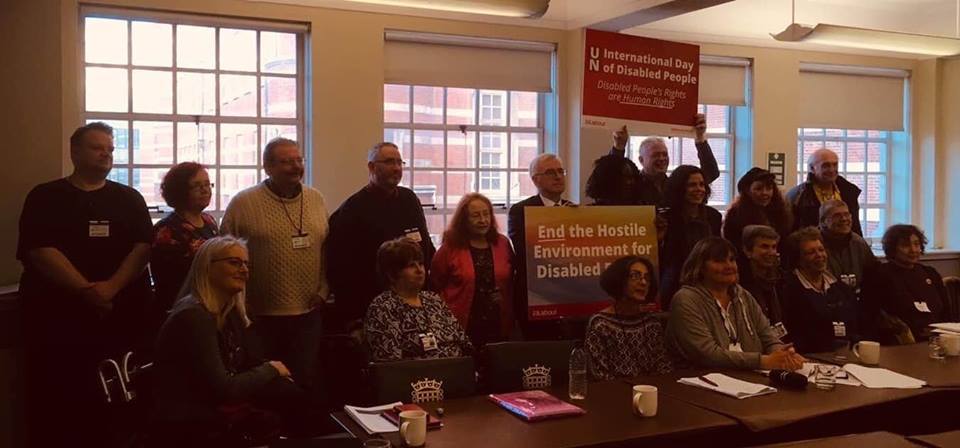
Campaigners organise ‘First Do No Harm lobby’, aimed at preventing further social security related deaths

this ESA round

Disabled campaigners, researchers and organisations who have played a key role in exposing the discrimination and harm caused by the government’s social security reforms have been travelling to Westminster to attend round table discussions with five Labour shadow ministers. The meetings are chaired by Shadow Chancellor John McDonnell. I was invited to attend by John McDonnell’s office in September, because of my own ongoing campaign work.

The meetings are also the launch of a series of campaigning efforts and consultation between the Labour party, disabled activists, researchers and allied organisations. Labour MPs also hope to secure support from members of other political parties in the longer term.

We will be continuing to challenge the government’s persistent denial of a ‘causal link’ between their draconian social security policies and the distress, systematic human rights violations, serious harm and deaths of disabled people that have arisen in correlation with those policies.

Unless the government undertakes a cumulative impact assessment of the harm and  injustices that have followed in the wake of their welfare reform acts, they cannot provide evidence to support their own claims and flat denials that their policies are causing hardship, harm and distress. 

Public health experts from the Universities of Liverpool and Oxford have also produced a research report titled First, do no harm’: are disability assessments associated with adverse trends in mental health? A longitudinal ecological study. It highlights that the process of reassessing people on incapacity benefit for the new employment and support allowance (ESA) from 2010 to 2013 was “associated with” an extra 590 suicides, 279,000 additional cases of self-reported mental health problems, and the prescribing of a further 725,000 anti-depressants.

Speaking to the Huffington Post last year, the shadow chancellor said that he became furious during a Parliamentary debate when he demanded a comprehensive assessment of the cumulative impact of welfare reforms on disabled people and the government refused. He praised the website Calum’s List, which details the cases of at least 60 deaths linked to welfare cuts.

He added:  “We said to the Government we know now from Calum’s List, listing people from reports in the press and elsewhere of people committing suicide as a result of Government cuts.

We knew the Government were monitoring some coroners’ reports and we wanted them published, but [then DWP minister Esther] McVey wouldn’t and I got really angry.”

“Next week, what we are doing is getting a group of campaigning organisations and a group of experts together to talk about the way in which Work Capability Assessments are still having an impact, to try to get to the bottom in terms of mental health and suicide.”

McDonnell added that Labour’s first Queen’s Speech include legislation “making sure we have a welfare and benefit system that lifts people out of poverty”.

He said that his Hayes and Harlington constituency casework now operates an open-door system four days a week due to demand from people hit by government cuts. 

He added: “Helen who runs my office said the casework now is on a scale and a depth of suffering that we’ve never seen before. And this in a constituency with the [Heathrow] airport, high levels of employment but wages not matching the housing costs and the pressure on people working all hours just to keep a roof over their heads.

“If anything goes wrong they fall out of the system. Last month we were dealing with two families living in cars. We also have the ‘beds in sheds’ phenomenon, families living in a shed or garage rented out to them, it’s staggering really.

“Before this last eight years, those sort of horrendous situations would be infrequent but you wouldn’t have someone so heavily sanctioned. The sanctions often impact on people with mental health conditions hardest.”

The Labour party’s track record of inclusion and democratic consultation with disabled citizens and their communities contrasts starkly with the Conservative’s exclusionary ‘we know better than you’ approach to disability policies. The government have imposed cuts on disabled people, acting upon them as if they are objects of policy rather than being citizens within a democracy.  

Government policies are expressed political intentions regarding how our society is organised and governed. They have calculated social and economic aims and consequences. In democratic societies, citizens’ accounts of the impacts of policies ought to matter.

However, in the UK, the way that welfare policies are justified is being increasingly detached from their aims and consequences, partly because democratic processes and basic human rights are being disassembled or side-stepped, and partly because the government employs the widespread use of linguistic strategies and techniques of persuasion to intentionally divert us from their aims and the consequences of their ideologically (rather than rationally) driven policies. Furthermore, policies have more generally become increasingly detached from public interests and needs.

The Labour party listen to citizens’ accounts, and have always acknowledged our concerns. John McDonnell was involved in the setting up of Disabled People Against the Cuts (DPAC). After a nationwide round of consultations with disabled people about policies which enshrine the Equality and Human Rights acts, led by Debbie Abrahams, the Labour party wrote an additional manifesto, outlining policies for disabled people, called Nothing about you without you, which many of us have contributed to.

DSCN3314.JPG

Alex Cunningham, me, Debbie Abrahams and Gail Ward after the Disability Equality Roadshow and consultation in December, 2016.

The First Do No Harm lobby on 13 February aims to expose the continued harm caused to disabled people by government social security reforms, and to seek safeguarding changes to the social security system. It follows many years of growing concerns about the controversial Work Capability Assessment (WCA) and the failure of Department for Work and Pensions (DWP) ministers to make the necessary changes to make the assessment process safe.

Disability rights campaigners and MPs will focus on the repeated failure of the DWP to ensure that the “further medical evidence” needed to demonstrate a disabled person’s eligibility for out-of-work disability benefits is always collected, particularly for claimants with mental health conditions.

The three key asks of the lobby are:

1. To incorporate the principle of “First Do No Harm” into the assessment process for disabled people in the welfare system.
2. To call for the publication of a cumulative impact assessment of social security changes to disabled people.
3. To implement an assessment framework that treats disabled people with dignity and respect.

The lobby has been facilitated by Labour’s Treasury and work and pensions teams, through shadow chancellor John McDonnell and shadow work and pensions secretary Margaret Greenwood. Both Labour MPs and activists hope that MPs from all parties will attend. 

Shadow chancellor, John McDonnell has previously said that he believed the ongoing meetings with disability rights campaigners and allied organisations could herald the start of “a significant movement to expose the brutality of the system” and secure “permanent change”.

He told Disability News Service: “Disabled people have had enough of the continuing austerity, attacks and discrimination.

“The lobby will brief on the plight of disabled people and lobby for reform to protect against this harm.” The aim is to push for the principle of “First Do No Harm” to be included in the benefits assessment process, through a framework that “treats disabled people with dignity and respect”.

The lobby also aims to push the government to acknowledge years of raised concerns by our community to carry out a cumulative assessment of the impact of its social security cuts and reforms on disabled people. 

Campaigners will also call for an end to the government’s punitive sanctions and conditionality regime.

The First Do No Harm lobby is the first organised action arising from the ongoing meetings between disabled activists and allies and Labour shadow ministers, including John McDonnell, Margaret Greenwood and shadow minister for disabled people Marsha de Cordova.

Both Margaret Greenwood and Marsha de Cordova are to speak at the briefing as part of the lobby on 13 February.

A mass lobby is one way of using your right to turn up to the House of Commons and request a meeting with your MP as one of his or her constituents. An MP’s role is to represent a constituent’s interests – even if he or she does not entirely agree with them. As each MP may have up to 90,000 constituents to look after, it is best to be as brief, clear and courteous as possible when you meet your MP.   

Disabled people or allies who want their MP to attend the lobby should write to their MP – you can find MP’s email addresses here: WriteToThem – to inform them you wish to seek an appointment on the day of the lobby. 

The lobby is due to take place on Wednesday 13 February between 1pm and 6pm, with the briefing from 2-3.30pm, in the Palace of Westminster’s committee room 15. The committee room can be used for one-to-one meetings with MPs or further discussions on the issue from 1pm-2pm and then from 3.30pm-6pm 

ESA lalst 3

The most recent meeting at Portcullis House, Westminster.


Related

John McDonnell attacks Tory disability cuts and vows to address suicides linked to welfare reforms

Lobby aims to persuade MPs that DWP must First Do No Harm on assessments

Labour’s Disability Equality Roadshow comes to Newcastle

Nothing about you without you – the Labour party manifesto for disabled people

I very much wanted to attend this very important mass lobby and contacted my MP in respect of this. However, unfortunately I am currently not well enough to travel down to Westminster. I will, however, be working hard promoting the event on social media. 


I don’t make any money from my work. But you can make a donation if you wish and help me continue to research and write informative, insightful and independent articles, and to provide support to others going through disability claims, assessments, mandatory reviews and appeals. The smallest amount is much appreciated – thank you.

DonatenowButton

DWP is not engaging with expert calls for change to Universal Credit says Select Committee

DWP-Department-for-work-and-pensions-500x320.jpg

The Work and Pensions Committee is today launching a new inquiry into what the Government calls “natural migration”: the process by which people claiming existing benefits move onto Universal Credit if they have a change in their circumstances.

Universal Credit has now been rolled out to every Jobcentre in the country. This means that if people who are already claiming benefits under the old system have a change in their circumstances (for example, if they form part of a new couple, or separate from an existing partner), they can’t make a new claim for the old benefits. Instead, they have to make a whole new claim for Universal Credit.

The Government calls this “natural migration” to Universal Credit. However, people who transfer onto Universal Credit in this way aren’t eligible for any transitional protection payments and so may see a change in their income from benefits. For many people, this may be the first time that they discover that their income will change under Universal Credit. The change usually entails a drop in income. 

The Committee has heard concerns that:

  • the Government hasn’t given clear and comprehensive information about the “triggers” for “natural migration”
  • the absence of transitional protection means people might have to cope suddenly with a drop in income.

This is the latest stage in the Committee’s ongoing work on Universal Credit – which has already resulted in the Government making significant changes to the system.

In its November report on so-called “managed migration” – the process of wholesale moving existing benefit claimants onto Universal Credit even if their circumstances haven’t changed  – the Committee called on the Government to publish an assessment of the impact of a sudden loss of income due to natural migration on different claimant groups, and then to look again at whether the triggers for natural migration are appropriate. In its official response to that report, published today alongside this new inquiry launch, the Government has refused to do that. 

The Chair, Frank Field, has written back to the Secretary of State with a series of questions about the Government’s response – that correspondence is also published today. The Committee say they are “disappointed and concerned by the Government’s failure to engage with its report and reasoning behind key recommendations, and intends to return to several of them including, now, the “triggers” for natural migration.” The Department for Work and Pensions (DWP) declined, again, to set tests that it will meet before managed migration begins. “Given that we, the National Audit Office (NAO) and the Social Security Advisory Committee (SSAC) all made this recommendation, this continued resistance is very disappointing.”

Actually, it’s very worrying, as it indicates a blatant disregard for the protocols of Government accountability and democratic dialogue.

The Government’s response also does not address the central issue of who takes the risk in the transition to Universal Credit, with the Committee arguing repeatedly that it should be Government, making the huge reform, who assume the risk, not existing benefit claimants who include the most vulnerable people in our society. The Government claims it’s simply impossible for it to move people over without requiring them to make a new claim, but “did not offer—and has not offered during the Committee’s inquiry—any evidence” why. 

The DWP also appears strangely reluctant to acknowledge the key recommendation it did accept. The Committee had said DWP should not ask MPs to vote on new UC rules until it had listened to expert views on them. And that is what happened: rather than a vote before Christmas as the Government had originally planned, revised rules were published last week. The Chair was therefore very “surprised to read that the Government ‘does not accept this recommendation’, given that by the time the response arrived the Government had not only accepted the recommendation but also implemented it.”

Read the Government response on managed migration

Read the Committee’s report on managed migration

You can send the Committee your views on ‘natural migration by February 18. (Click on the link).


Related

Universal Credit is an unmitigated catastrophe for ill and disabled people

‘Disability confident’ DWP acted ‘perversely’ in sacking of disabled woman, court says


My work is unfunded and I don’t make any money from it. This is a pay as you like site. If you wish you can support me by making a one-off donation or a monthly contribution. This will help me continue to research and write independent, insightful and informative articles, and to continue to provide support others who are affected by the welfare ‘reforms’DonatenowButton

London solicitor linked to Panama Papers fined £45,000 with further £40,000 costs

lawyer-fined-for-failing-to-identify-panama-paper-clients-pep-status (1)

A law firm partner is facing an £85,000 bill for failing to excercise adequate due diligence to check the background of his clients, following a disciplinary hearing centering around the huge data leak from former Panamanian law firm Mossack Fonseca.

London solicitor, Khalid Mohammed Sharif, partner at the Westminster private client company Child & Child, has been fined £45,000 by the Solicitors Disciplinary Tribunal (SDT). Costs of £40,000 were also imposed.

According to the SDT findings, Sharif’s failings led to a “large amount of money being laundered” and his “culpability was high”. However, the tribunal noted that he co-operated with the investigation and had voluntarily reported himself to the Solicitors Regulation Authority.

The tribunal representative also said that Sharif “failed to take any or any adequate steps to ascertain from publicly available information” and that the fine was an “appropriate and proportionate sanction in all the circumstances.”

Under the current rules and legislation concerning money laundering, (regulation 14 of The Money Laundering Regulations 2007) any person connected with senior political officials should be considered as a politically exposed person (PEP) and simple due diligence should have ensured that this protocol was followed.

Sharif claimed that the two women had no political connections. But, according to the published outcome, Sharif admitted that he failed to take adequate steps to check this, when even an internet search may have identified them as PEPs.

The solicitor, admitted to the roll of solictors in 2005, also admitted to not undertaking enhanced customer due diligence even though he had not met the clients. Sharif was the company’s money laundering reporting officer (MLRO).

The judgement said: “The respondent was wholly culpable for his misconduct. Further, he was the MLRO at the firm. This should have heightened his sense of his obligations, and his awareness of the risks.”

Sharif’s clients were not identified in the ruling but have been reported to be two daughters of the president of Azerbaijan. The women Leyla and Arzu Aliyeva – the daughters of President Ilham Aliyev – set up a secret offshore company to help manage their multimillion-pound property portfolio in Britain. The firm, Exaltation Limited, was based in the tax haven of the British Virgin Islands. The properties were worth nearly £60m.  

Although contracts were exchanged in 2015, the deal failed. Again, when completing the source of funds for the reported £14 million worth of deposits, the PEP status was still not recognised by the lawyer.

It has been alleged that the clients were also the owners of a British Virgin Islands company that was set up by Mossack Fonseca, the law firm from which sensitive information was stolen during the Panama Paper data breach. The list of failures to ascertain the PEP credentials of the clients has culminated in the conclusive verdict from the Tribunal.

However, while the Tribunal viewed the potential of money laundering through property to be extremely serious, the SDT also conceded that the misconduct “was not so serious that the protection of the public and the protection of the reputation of the profession required him to be removed from practice.”

Details of the offshore company emerged in April 2016 following the Panama Papers leak. Child & Child had instructed Mossack Fonseca to incorporate the company.

The Panama Papers are an unprecedented leak of 11.5m files from the database of the world’s fourth biggest offshore law firm and corporate service provider (Mossack Fonseca.) The records were obtained from an anonymous source by the German newspaper Süddeutsche Zeitung, which shared them with the International Consortium of Investigative Journalists (ICIJ). The ICIJ then shared them with a large network of international partners, including the Guardian and the BBC.

Reporters found that some of the Mossack Fonseca shell corporations were used for illegal purposes, including fraud, money laundering, tax evasion, and evading international sanctions.

The documents reveal the myriad ways in which the wealthy – including some public officials – can exploit secretive offshore tax regimes. Twelve national leaders are among 143 politicians exposed, as well as their families and close associates from around the world known to have been using offshore tax havens.  The leaked files identified 61 family members and associates of prime ministers, presidents and kings, and members of their families, including Margaret Thatcher’s son, Mark Thatcher.

In a 2013 letter, unearthed by the Financial Times to the then president of the European Council, Herman Van Rompuy, from the then Prime Minister of the UK David Cameron said that offshore trusts should not automatically be subject to the same transparency requirements as shell companies. Cameron’s personal involvement in the EU-wide debate emerged as he continued to face questions about his family’s connections to Blairmore Holdings Inc, the offshore trust set up by his late father, the existence of which was revealed in leaked papers from the database of  Mossack Fonseca. 

While no standard official definition exists, the International Monetary Fund describes an offshore financial centre, or tax haven, as a jurisdiction whose banking infrastructure primarily provides services to people or businesses who do not live there, requires little or no disclosure of information when doing business, and offers low taxes.

Tax havens are one of the key engines of the rise in global inequality. Oxfam blamed tax havens in its 2016 annual report on income inequality for much of the widening gap between rich and poor. “Tax havens are at the core of a global system that allows large corporations and wealthy individuals to avoid paying their fair share,” said Raymond C. Offenheiser, president of Oxfam America, “depriving governments, rich and poor, of the resources they need to provide vital public services and tackle rising inequality.”

It’s widely known that the world’s super-wealthy have taken advantage of lax tax rules to siphon off at trillions of pounds, from their home countries’ economies and hoard it abroad – and the offshore drain involves a sum larger than the entire American economy. The sheer scale of hidden assets held by the mega-rich also strongly suggests that standard measures of inequality, which tend to rely on surveys of household income or wealth in individual countries, radically underestimate the true level of inequality – the gap between rich and poor.

It also strongly suggests that the Conservatives are radically overestimating the value of their hero ‘wealth generators’ and their contribution to the UK economy, along with their strange neoliberal theory of ‘trickle down’. Then again, perhaps these are justification narratives to prop up the immoral financial habits of a wealthy and powerful elite.  

Mossack and Fonseca were detained February 8, 2017 on money-laundering chargesIn March 2018, Mossack Fonseca announced that it would cease operations at the end of March due to “irreversible damage” to their image as a direct result of the Panama Papers.


My work is unfunded and I don’t make any money from it. This is a pay as you like site. If you wish you can support me by making a one-off donation or a monthly contribution. This will help me continue to research and write independent, insightful and informative articles, and to continue to provide support others who are affected by the welfare ‘reforms’DonatenowButton

‘Disability confident’ DWP acted ‘perversely’ in sacking of disabled woman, court says

disability-confident-image-version.jpg

The government’s meaningless Disability Confident campaign.

The Guardian reports that a disabled woman was discriminated against when she was unfairly sacked by the Department for Work and Pensions, which behaved in a “perverse” and “blinkered” manner, a judge has found. 

Isabella Valentine was employed by the DWP on a programme designed to get vulnerable, long-term unemployed people back into work by nurturing and training apprentices over a 12-month period, bringing them to a point where they could apply for jobs in the usual way. Instead, “inexplicable and strange” disciplinary measures were taken by the DWP after just four days’ sickness that led to Valentine’s dismissal. 

“I suffer regular migraines that are so severe and unpredictable that I am officially classed as disabled. Because of that and a lack of qualifications, I haven’t been able to find decent employment,” said Valentine.

“When I was handpicked for this programme, I was so happy. I hoped that I had finally found employers who would let me do a good job while being understanding of the time off I sometimes have to take because of my migraines. 

“Instead, I was made to feel small and so stressed that my migraines got even worse. Not only were no reasonable adjustments made for my disability as legally required but I was subject to the same strict and unbending rules that permanent employees had to work by.” 

She added: “My manager started harassing me on the first day I took off sick because of a migraine. By the fourth day, the department had started disciplinary proceedings and decided to dismiss me. Which it then did.” 

In his judgment, the employment judge, Robin Postle, said: “[Valentine’s treatment] does beg the question, why, given the nature of why the claimant was put on the course, to try and get her back into the workplace, the [DWP] did not make reasonable adjustments [under the Equality Act 2010], in disregarding migraine absences, or indeed, simply taking no further action. The claimant has suffered unfavourable treatment and she had a disability.” 

The DWP has been taken to the employment tribunal by staff almost 60 times over claims of disability discrimination in a 20-month period. The DWP, which has about 75,000 staff, has the worst record on disability discrimination of any large government department with 57 cases, compared with 20 cases against the Home Office (which has about 30,000 staff), 32 against the Ministry of Justice (about 70,000 staff) and 29 against HM Revenue and Customs (about 60,000 staff). 

The number of allegations made by disabled staff is surprising because the DWP is responsible for the much-criticised Disability Confident scheme, which aims to help employers recruit and retain disabled employees. DWP claims to be a Disability Confident leader”, the highest of the scheme’s three levels. 

Valentine’s manager was told she would require extra support and leeway to enable her to complete the course. The Suffolk Law Centre solicitor Carol Ward fought the case as part of the National Lottery Reaching Communities-funded project Tackling Discrimination in the East, said: “The behaviour of the DWP was particularly inexplicable and strange because the whole point of the course was to help the apprentices who struggled to cope in the workplace. 

“The claimant had been personally chosen by a DWP work coach. The scheme specifically said apprentices would need nurturing and support, and that they weren’t expected to contribute to the business in the same way as those recruited in the usual way. But as soon as she hit the four-day absence trigger, disciplinary procedures were started.” 

The behaviour of Valentine’s managers was, the judge found, “frankly perverse”. Meetings with Valentine were frequently misrepresented in “clearly incorrect” letters sent by her direct manager. 

Instead of exercising the discretion available to her, the same manager “slavishly followed the policy in a blinkered manner”, while a second manager “had a closed mind”. A third manager who conducted Valentine’s appeal failed to do basic checks on the considerable leeway that had been granted to many other apprentices on the same course.

The consequence was a “predetermined decision” to dismiss Valentine before she had even returned from her second period of sick leave. 

“This was particularly surprising given the fact that [one of the managers said] it became clear very quickly that this was a group of people who needed a lot of support as they were not used to the working environment and needed support to help them cope,” said the judge. 

The DWP said: “We accept this decision. Our general approach is a supportive one – we provide employees with free access to counselling, health advice, physiotherapy and workplace adjustments to manage absences, and we do not dismiss staff without proper consideration and taking professional advice.”

The evidence strongly suggests otherwise. 


My work is unfunded and I don’t make any money from it. This is a pay as you like site. If you wish you can support me by making a one-off donation or a monthly contribution. This will help me continue to research and write independent, insightful and informative articles, and to continue to provide support others who are affected by the welfare ‘reforms’. DonatenowButton

Universal Credit is an unmitigated catastrophe for ill and disabled people

Image result for pictures universal credit

I co-run an online advice and support group for people going through Personal Independence Payment (PIP) and Employment and Support Allowance (ESA) claims, assessments, mandatory reviews and appeals. Recently there has been a spike in people being reassessed for their awards of both kinds of support much earlier than expected. Furthermore, many are seeing their longstanding awards being taken from them by the Department for Work and Pensions following the reassessment, when this is clearly unjustifiable.

Failing a work capability assessment usually triggers migration onto Universal Credit.

For example, a significant proportion of this group have chronic or degenerative illnesses that are not going to improve. If someone with such a condition is deemed unfit for work, or in need of extra support to meet their needs and maintain independence, given that it’s highly improbable that their condition will improve,  it’s more than unreasonably cruel that following review, these people have lost their awards, most often based on highly inaccurate reports from assessors and the Department’s decision makers.

One person received a letter notifying her of an early ESA review – it wasn’t due until next year – just days after she had seen her PIP award removed, following a review that was not due until 2021. 

Those people claiming Universal Credit (UC) and needing a work capability assessment because they have not previously received ESA are experiencing long delays (often around six months) before the assessment appointments are finally arranged. This is true even when there is clear evidence of ill health and/or disability, and it means people miss out on additional payments. Some are being subjected to conditionality and sanctions because they are being given inappropriate requirements to look for work while they wait for their assessment. 

A recurring problem with UC is the failure of DWP staff to include a limited capability for work (LCW) or limited capability for work related activity (LCWRA) element in a claim for Universal Credit for people moving from ESA, who had already been assessed as entitled to the equivalent element in ESA. These components are supposed to be automatically included in UC but people are reporting that it this is not happening.

Two people who had been claiming ESA for two or more years, both placed in the support group following their assessments, triggered ‘natural migration’ when they claimed Discretionary Housing Payment (DHP) because of hardship. One person’s local council had wrongly made ‘non dependent’ deductions for her adult son, pushing her into hardship and rent arrears. As she was awarded PIP at the daily living rate, non dependent deductions should not have been made, as the standard daily living award exempts people from those deductions in this group of PIP  claimants.   

She later reported that non dependent deductions were wrongly taken from her UC housing element, also. She said that the problem arose because PIP awards are not logged on the system, which means that once the underpayments were eventually rectified, she still had to remind her advisor that she was exempt from non dependent deductions being made to her housing costs. The problem keeps arising, however, with some of the deductions still being made some months. She also told me that her mandatory review request was completely ignored.

The DHP application from both people in the support group triggered a move from existing benefits on to UC. When migrated from ESA on to UC, people in the ESA support group should be automatically awarded the extra element of UC (the ‘limited capability for work-related activity element’) and should not be required to undertake any work related activity. However this did not happen and both were refused this element. Another person was told, wrongly, that she would need to undergo another work capability assessment and another was asked to undertake inappropriate work related activities which he were unable to carry out because of his illness.  

Several others have also reported that they have submitted requests for mandatory review and not had any response. One person was told that they had to ring to request the review, rather than requesting it in writing. She was then told that because more than one month had passed since the decision she was challenging, she could not request a mandatory review. 

Special rules exist for terminally ill people who are expected to live less than six months, to fast-track their claims for support and to allow certain health-related payments to be paid at the highest rate without needing further assessment. One person applied for UC and was incorrectly told that there was no special rules provision under UC. She was asked to provide evidence that she could not carry out work related activities before she could receive the payments due to her and have her work related conditionality lifted, despite the fact she had submitted a DS 1500 report from her consultant.

Another person who is terminally ill told me that his advisor said there was no evidence that he had submitted a DS 1500 report. By this time, he had already waited seven weeks for his UC claim to be processed. He was still waiting for a PIP assessment date. 

Another problem arising for disabled people is that some are experiencing difficulty making new-style ESA claims (which are based on National Insurance contributions, rather than being income related) in ‘full service’ jobcentre areas, and are being wrongly advised to claim UC in circumstances where that is not required. 

One very vulnerable young person told me that he was flatly refused when he asked to claim the disability element of UC. His GP had told him he was unfit for work. His work coach said that he was “not allowed” to claim disability benefit under UC rules. He was sanctioned because he could not carry out  work related activities, which also had an impact on his partner. He needed support with a mandatory review request and his doctor submitted a report from the young man’s consultant. His sanction was overturned after seven weeks. That is seven weeks of hunger, fuel poverty and threats of eviction because of mounting rent arrears. 

Transitional protection for disabled people

The government recently announced transitional protections, include paying the Limited Capability for Work element in Universal Credit if someone has been continuously entitled to ESA and entitled to the Work-Related Activity Component in ESA prior to 3rd April 2017 and are migrated to Universal Credit. This means people with ESA awards after that date, or those making a new claim for UC will not get the disability income guarantee which is only provisionally available to others.

The government have recently postponed the migration of people who have a PIP award onto UC, because there is no transitional protection in place, which means people will lose their disability premium. Transitional protection of disabled peoples’ disability income guarantee is not due to come into effect until later this year (July). 

However, when people have a change in circumstances, they are automatically migrated onto UC. The change may include moving house, or a change in the amount of support you get, or someone joining or leaving your household. It’s been reported that changes to housing benefit awards – such as an increase, or a DHP award – have also triggered ‘natural migration’ onto UC. 

People who already claim Working Tax Credit and become ill are being asked to claim UC. Those who claim income-based jobseeker’s allowance and need to attend court or Jury Service, or are remanded in custody, are also being asked to claim UC.  If someone starts work that would normally entitle them to working tax credits, or if they work, but their hours drop below 16 hours a week, they will be asked to claim UC. If someone already claims Child Tax Credits and income based legacy benefits and starts work with enough hours to satisfy Working Tax Credit conditions, they will also be asked to claim UC.

A high court judgement last year said that the loss of disability premiums (the disability income guarantee) under UC is discriminatory and contrary to the European Convention on Human Rights. 

The government conceded after some reluctance that they would ensure transitional protection is in place for people who receive the severe disability premium via their legacy benefits. However, there are three types of disability premium, and the government have so far only mentioned protecting one of them, though it is implied that the other premiums will be included. 

Many of us have said previously that the government’s ‘flagship’ failure, UC, is about implementing further cuts to social security support by stealth. However, the loss of income to disabled people through hidden cuts was under-reported. Last year I wrote about how the disability income guarantee that legacy benefits ensured had been removed from UC – Disability Income Guarantee abolished under Universal Credit rules – a sly and cruel cut.

The draft regulations setting out the managed migration process, including details of transitional protection, were consulted on by the Social Security Advisory Committee  (SSAC) in July 2018. The SSAC report and the Government’s response were published in November 2018. Some changes were made to the Regulations as a result of SSAC’s report. The draft regulations were also published on November 2018 and were expected to be debated in Parliament this month (January 2019.)

However, in the draft regulations, only one of the three disability rates is mentioned in the planned transitional provisions – the Severe Disability Premium (SDP). 

On the government site, it says there a three rates under ESA and/or PIP:

“Disability premium

You’ll get:

  • £33.55 a week for a single person
  • £47.80 a week for a couple

Severe disability premium

You’ll get:

  • £64.30 a week for a single person
  • £128.60 a week for a couple if you’re both eligible

Some couples will be eligible for the lower amount of £64.30 a week instead.

Enhanced disability premium

You’ll get:

  • £16.40 a week for a single person
  • £23.55 a week for a couple if at least one of you is eligible

You can get the disability premium on its own. You might get the severe or enhanced disability premium as well if you’re eligible for them. There are (complex) rules of eligibility which are outlined on the same site. For example, if you have a ‘non dependent’ child living with you, that makes you ineligible for the severe disability premium, but you may be entitled to one or both of the others.

If you get income-related Employment and Support Allowance (ESA) you cannot get the disability premium, but you may still qualify for the severe and enhanced premiums.”

The draft regulations did not clarify whether all of the disability income guarantee rates will be included in the transitional protections arrangements. 

In a letter to the Social Security Advisory Committee, the government says of the new draft regulations: “They also introduce transitional protection payments and additional provisions to support existing and former Severe Disability Premium recipients.”

The Secretary of State for Work and Pensions also says in the letter: “In designing Universal Credit, one of the key aims was to simplify the existing system. For people with health conditions and disabilities, a conscious choice was made not to replicate every aspect of disability provision in the current system, which contains 7 different disability payments. Instead, the right levels of support can be provided through 2 rates of payments, reflecting the current Employment and Support Allowance components.” [My emphasis]

The choice was originally to cut all disability premiums for those with a ‘change in circumstances’ and new claims. The hardships that this decision has caused were intentional. 

A House of Commons briefing paper entitled Universal Credit and the claimant count outlines why “Universal Credit is increasing the number of people claiming unemployment benefits, by requiring a broader group of claimants to look for work than was the case under Jobseeker’s Allowance.” 

However, UC also requires other groups of people who were previously exempt from conditionality to look for work, or to increase their hours and pay, if they already work.

This means that the increased application of conditionality and sanctions regime will affect families and couples, where one person – not necessarily the person who has made the claim – has been sanctioned. For the first time, UC will mean families who are in work but on low pay will also be subject to sanctioning if they don’t make efforts to increase their hours or pay. It’s not clear what provision is in place to safeguard children and vulnerable family members form the impact of severe hardship when a family member is sanctioned.

Furthermore, last year the government’s own research, together with a mass of other studies, have clearly demonstrated that sanctions do not work as the Conservatives claim they were intended to. Frank Field, chair of the Work and Pensions Committee, accused ministers of trying to bury the findings of a secret DWP report, rather than give parliament the chance to debate how to better help low-paid workers. 

Field said if UC were to be built into a “line of defence against poverty, rather than an agent in its creation”, a more careful application of sanctions would require “urgent attention”.

He added: “Likewise, any new service to help the low-paid should be built around the provision by a dedicated caseworker of information, advice and guidance, as part of a clear and agreed contract which is aimed at helping them to earn more money and, crucially, overcoming the barriers that currently prevent them from being able to do so.” 

The government’s report came after a major report from the UK’s biggest food bank network found the rollout of UC would trigger an explosion in food bank use, with data showing that moving onto the new welfare support was the fastest growing cause of food bank referrals. The Trussell Trust said urgent changes to the new welfare system were needed to protect vulnerable claimants from falling into hardship or dropping out of the benefit system altogether. 

Garry Lemon, director of policy at the Trussell Trust, said: “We owe it to ourselves to have a benefits system that gives us support when we need it most, and ensures everyone has enough money to afford the absolute essentials. 

“Yet our research shows that the more people are sanctioned, the more they need foodbanks. On top of this, government’s own research shows that sanctioning under universal credit has no effect in encouraging people to progress in work. 

“With the next stage of universal credit about to rollout to three million people, it is vital that we learn from evidence on the ground and avoid the mistakes of the past.” 

Margaret Greenwood, Labour’s shadow work and pensions secretary, said it was “shocking” that the government was sanctioning working people who are “just trying to do the right thing”.

She said: “This report shows that there is no evidence that sanctioning helps people increase their earnings. Meanwhile, wages are still below 2008 levels and millions of people are stuck in insecure work. 

“Universal credit is clearly failing in its current form. Labour is committed to a root-and-branch review of the social security system to ensure it tackles poverty and provides support when people need it.” 

In a damning report in 2016, the National Audit Office castigated the DWP for failing to monitor people whose benefits had been docked and suggested the system cost more money than it saved. 

Yet a DWP spokesperson said: “The ‘in work progression trials’ helped encourage claimants to increase their hours, seek out progression opportunities and take part in job-related training.

“The trials delivered positive results for many of the lowest paid people who claim universal credit and we are now considering the findings.” 

This is political gaslighting, which reveals a government’s intentions to continue implementing a draconian welfare policy, regardless of the significant and mounting empirical evidence – including from their own research – demonstrating this punitive does nothing to ‘support’ people into work, or into better paid jobs. In fact it prevents people from doing anything other than struggling to survive.

The briefing – Universal Credit and the claimant count  – says “In Full Service areas existing legacy benefit claimants may move onto Universal Credit if they experience a change of circumstances such that they would have had to make a new claim for a different legacy benefit. As new claims for legacy benefits are no longer possible, only Universal Credit can be claimed.  The DWP refers to this as “natural migration.”

“Existing legacy benefit claimants whose circumstances do not change will remain on their existing benefits until they are invited to make a claim for Universal Credit at the final “managed migration” stage. This is expected to begin in late 2020 and be completed by December 2023, but will be preceded by a managed migration pilot involving 10,000 households starting in July 2019.”

The briefing provides an outline of why the claimant count has risen in areas where UC has been rolled out:

“Universal Credit requires a broader span of people to look for work than was the case for legacy benefits.

“The introduction of Universal Credit means that more claimants are required to look for work as a condition of receiving the benefit. This is referred to as “conditionality”.

“For example, someone out of work who previously claimed Child Tax Credit or Housing Benefit but not Jobseeker’s Allowance was not required to look for work. Under Universal Credit they are required to look for work, subject to certain exceptions.

“Similarly, under Universal Credit, the partners of claimants are now required to seek work. Previously, if someone was in employment and claiming tax credits or housing benefits but their partner was not in work (and not claiming Jobseeker’s Allowance), there was no requirement for their partner to look for work. This is no longer the case, subject to an earnings threshold and certain exceptions.

“The OBR has estimated that conditionality will be extended to around 300,000 additional claimants.

“Additional conditionality will also be applied to Universal Credit claimants who would otherwise have received Education and Support Allowance (ESA), and the OBR has estimated that around 150,000 claimants will be required to look for work as a result. Furthermore, the OBR has forecast that around 450,000 newly-eligible Universal Credit claimants will face further additional conditionality requirements (though not necessarily an obligation to look for work).”

If people are not obliged to look for work, what is the point in imposing conditionality them?

And: “New claimants who are awaiting or appealing Work Capability Assessments are being required to look for work. Some of the claimants who under the legacy system would previously have claimed ESA are initially subject to all work-related
requirements upon starting a new claim to Universal Credit, pending their Work Capability Assessment.

“New ESA claimants who can provide a ‘fit note’ are treated as having a limited capacity for work pending their Work Capability Assessment. This is not the default position under Universal Credit.

“Although a claimant must meet with a Jobcentre Plus Work Coach within seven days of applying for Universal Credit to agree the conditions attached to their receipt of benefits, the period until a Work Capability Assessment takes place is often much longer. During this period, Work Coaches set conditionality based on their understanding of the claimant’s health condition, but there are concerns that Work Coaches may struggle to identify claimant support needs accurately.

“Those claimants who are required to look for work will be included in the claimant count statistics. We might expect some to drop out of the claimant count again once the Work Capability Assessment has taken place, assuming they are judged to have limited capability for work, but they can remain on full conditionality for an extended period (and thus remain in the claimant count statistics).”

And confirming the accounts of disabled people I have supported:

“In addition, there have been reports that some claimants moving from ESA onto Universal Credit who have limited capability for work are being required to undergo a new Work Capability Assessment, and in the meantime are subject to full conditionality. Under Regulation 19 of the Universal Credit (Transitional Provisions) Regulations 2014 (SI 2014/1230 as amended), these people should be treated, from the outset of their Universal Credit application, as having limited capacity for work without the need for a Work Capability Assessment. The Child Poverty Action Group (CPAG) has reported this as one of the most common problems highlighted by advisers.” 

It’s crossed my mind more than once that the sudden increase in early ESA and PIP reassessments may be linked to an aim to reduce the costs of the government’s unanticipated legal requirement to pay disabled and ill people transitional protection when they are migrated onto UC, or when they are forced to claim UC because of a change in circumstance – hence work coaches telling people in both ESA groups frequently that they have to undergo another assessment, when the rules state very clearly that they don’t.

The cases  I have highlighted here reflect only my most serious concerns about some of the consequences UC is having for ill and disabled people. It’s worrying that the problems I have outlined were not confined to just a couple of areas; the errors and problems seem to be entrenched on a systemic and national scale.


Related 

The rush to throw sick or disabled people off ESA and force them onto Universal Credit goes on while the DWP talks bollocks about support…


My work is unfunded and I don’t make any money from it. This is a pay as you like site. If you wish you can support me by making a one-off donation or a monthly contribution. This will help me continue to research and write independent, insightful and informative articles, and to continue to provide support others who are affected by the welfare ‘reforms’DonatenowButton

Demos say the DWP should be axed, I disagree. Here’s why

Image result for DWP

A leading cross-party thinktank has proposed that ministers should consider abolishing the Department for Work and Pensions.

In a provocative paper that marked the start of Demos’ research examining the Department of Work and Pensions, Tom Pollard, formerly of the mental health charity Mind, who has also completed an 18 months secondment to the Department for Work and Pensions (DWP), illustrates a bureaucracy blighted by “historic dynamics and averse to radical thinking.”

Pollard’s paper identifies three problems with the DWP. First, the department is afflicted by a “benefits lens”, where case handlers perceive employment support as a condition for receiving benefits, rather than a means of enabling claimants to pursue fulfilling work. Where benefits are the carrot, sanctions are the stick. Sanctioning claimants for misdemeanours such as arriving late to meetings creates a “confrontational dynamic of power asymmetries.” In other words, it strips citizens of their autonomy.

Many neoliberals have also claimed that welfare strips citizens of responsibility, though there has been no convincing evidence of this to date. 

Second, Pollard argues the department is impoverished in ambition. DWP staff are often promoted from frontline roles working in job centres. While such expertise is valuable, he argues that staff often seem “incapable of thinking about radical solutions”, and repeat the mistakes of the past, gravitating towards punitive systems of conditionality and sanctions.

These factors contribute to the DWP’s “injured reputation” among frontline users. Productive engagement between case handlers and claimants is dependent on trust. “There’s such a rift between the DWP and hard to help groups that I don’t know how you could get back to engaging on meaningful terms – there’s too much baggage”, Pollard says.

In the thought-provoking paper, entitled Pathways from Poverty: a case for Institutional reform, Pollard explains why he believes that the DWP is institutionally and culturally incapable of making the reforms needed to deliver better outcomes for society’s most vulnerable and sets out a radical new vision for the future of welfare provision.

Most of the work of Amber Rudd’s department could be carried out more effectively by other Whitehall ministries, according to Pollard. He calls for the DWP to be stripped of responsibility for these “hard-to-help groups”, with the health department and NHS helping the ill find work, local government taking over Jobcentre Plus, and benefits and pensions delivered by HMRC. The charitable sector could also be given a bigger role. 

Some criticisms

Pollard critically discusses the culture within the DWP, implying that the key problems and devastating social consequences arising from the government’s welfare reform programme are simply a result of staff attitudes and inept administrative procedure within the department. 

The crisis in our social security system is the result of government’s policies, which have embedded traditional prejudices about people experiencing poverty, and that have led to the institutionalisation of discriminatory practices within the DWP. There is no guarantee that moving the functions of the DWP somewhere else will bring about any change in attitudes and practices, or improved outcomes for people relying on social security as a lifeline. 

The DWP has come under constant fire from many campaigners, academics and charities for serious problems with universal credit, and for the catastrophic work capability assessments of those who are unfit to work. Rudd is attempting to repair The department’s reputation by tinkering with the roll-out of universal credit and fighting with the Treasury to end the freeze on working-age benefits. However, these gestures are nowhere near enough to put the major shortcomings of the system right and to mitigate the cuts to support that univesal credit and other benefits entail. 

The report concludes that while the DWP has been able to “help” people with minor difficulties into employment, the outcomes are “much poorer when it comes to supporting people with more complex needs”, such as the ill, disabled, older people, those with drug and alcohol problems, ex-prisoners and those who are homeless.

Pollard proposes that if the removal of these functions from the DWP proves to be a success, a more comprehensive approach could see the department abolished altogether”.

He says: “If the department as it stands remains at the heart of employment support for ‘harder-to-help’ groups, we will face further years of well-intentioned reforms and programmes yielding disappointing outcomes, because of how they will be formulated and how they will be received.”

The problem is that the reforms are not “well-intentioned”, and the outcomes are not “disappointing”, they are catastrophic. The policies were intentionally punitive, leading to the consequences we see: people experiencing hardship have been punished by as system that was designed originally to support them and mitigate the circumstances of  hardship.

Pollard accuses the DWP of seeing claimants through a “benefits lens”, in which conditions were placed on their payments as a way of forcing them into work. He warns that the department’s reputation among many groups is now so bad that it may prove impossible and expensive to improve. “A bad reputation is far harder to lose than a good one,” he says.

However, the problem is rather much larger than the poor reputation of the DWP. It is the policy framework that determines the set of administrative practices which in turn, shapes the “culture” within the DWP.  It is the distress and harms that are being experienced by people claiming support, most of whom have also paid into the Treasury – that is the most pressing issues here, not reputation ‘damage limitation’ strategies, or an exercise in PR trust building for the government.

Abolishing the DWP, merging it with the Department of Health and involving charities in service delivery, as proposed by Pollard, will send out the clear message that social security is no longer a discrete function or key priority of the state. It also permits the state to withdraw from providing social security.

Responsibility for budgeting for and administering welfare will become diffuse. Placing social security side by side with healthcare is also risky, as it may further stigmatise jobseekers. We have already seen the government consistently stigmatise those who are out of work, implying that unemployment is some kind of psychological disorder. Others, such as Adam Perkins, have even proposed that there is a “genetic welfare trait.” , that runs counter to Conservative notions of “good citizenship”. 

The NHS is also suffering from chronic under-funding. How will it prioritise welfare provision, when it is already struggling to deliver health care, in the face of the increasing rationing of treatments and procedures?

Historically, charities administered welfare. But the provision was patchy and varied from area to area. There were no consistent standards of support for people in hardship. During times of economic recession, charities were often unable to provide people with any support at all, at a time when they needed it most.

Local authorities are now struggling to deliver statutory services because of government cuts. Essential provisions are being rationed as a consequence. There is no guarantee that any additional funding would be ringfenced. We have already seen social services sending vulnerable young people to other areas – sometimes back to their hometown, for example – to shift the burden of cost to another local authority.  The old Poor Law saw parishes moving poor people out of their area, they were pushed from parish to parish, refused ‘relief’ in order, often, to keep local rates bills low.

A recent paper entitled “Dependency, Shame and Belonging” examines the practice of making the poor wear badges from the 16th century through to the compulsory identification of all parish paupers under a 1679 statute, differentiating between those deemed ‘deserving’ and ‘undeserving’. By the late 17th century, magistrates and legislators decided to deter potential badge applicants by making life on the parish as unattractive as possible. Badging became a means of preventing begging and shaming holders, made compulsory in 1697.

The proposal from Demos simply exchanges one form of expensive, intrusive and ineffective bureaucracy with another. How would the Department of health and charities be allocated funds to carry out this publicly funded state function? How would they be held accountable? 

As I touched on earlier, unless the policy framework is also radically changed to one that is supportive, rather than punitive, and to one that isn’t about administering cuts to people’s lifeline support, then the perverse incentives to apply conditionality and sanctions will remain embedded in administration practices. 

A government that does not support a social security programmme – and the anti-welfarism of the Conservatives has been apparent for a long time – is likely to see the shift in responsibillity for delivering social security as a further step in abolishing welfare provision entirely, which has always been their long term aim. 

Finally, it’s worth noting that Demos produced a paper in 2011 advocating reducing the costs of disability benefit by “engaging with the private insurance industry” and proposing that: “reform to encourage individual responsibility and income protection is genuinely of mutual benefit.” The approach laid out in this report builds on the theory and practice of the profoundly antidemocratic ‘libertarian paternalism’ or ‘nudge’ theory. 

Other papers from the thinktank peddle the views of antiwelfarist James Purnell, who, for example, proposed charging interest on crisis loans to unemployed people and pensioners made by the Department for Work and Pensions, which were interest-free, at a rate of up to 26.8% per annum. This was met with great hostility and was blocked by the intervention of the Prime Minister, Gordon Brown. It was Purnell who announced the Work Capability Assessment, triangulating the Conservatives. Purnell advocated Unum’s approach to “claims management”, in a bid to cut costs of disability support. (See Rogue company Unum’s profiteering hand in the government’s work, health and disability green paper for more detailed discussion). 

The Conservative’s ideological position has been used politically as a justification to reduce social security provision so that it is no longer an adequate amount to meet citizens’ basic living needs. The aim is to discredit the welfare system itself, along with those needing its support. The government have long wished to replace the publicly funded social security provision ultimately with mandatory private insurance schemesas have some ‘blue Labour’ neoliberals, including Purnell. 

The th empirically unevidenced idea that welfare creates ‘dependency’ and ‘disincentivises’ work has been used as a justification for the introduction of cuts and an extremely punitive regime entailing ‘conditionality’ and sanctions. The government have selectively used punitive behavioural modification elements of behavioural economics theory and its discredited behaviourist language of ‘incentives’ to steadily withdraw publicly funded social security provision, which is the ultimate ideological goal. That is the root of the problem. 

In light of this, the timing of Pollard’s set of proposals is also rather suspect – see The Centre for Social Justice say Brexit is ‘an opportunity’ to introduce private insurance schemes to replace contribution-based social security.

A DWP spokesperson has responded from the government’s crib sheet of crafted statements: “This report is completely misguided and we have no plans to reduce functionality at a time when unemployment is at its lowest, welfare reforms are rolling out across the country and millions are saving for a private pension for the first time. Jobcentres are a local presence yet benefit from a national framework. DWP supports around 20 million people to get into work and save for their retirement, as well as giving stability to those who cannot work, and will continue to do so as one responsible organisation.”


My work is unfunded and I don’t make any money from it. This is a pay as you like site. If you wish you can support me by making a one-off donation or a monthly contribution. This will help me continue to research and write independent, insightful and informative articles, and to continue to provide support others who are affected by the welfare ‘reforms’DonatenowButton

Theresa May considering scrapping Human Rights Act following Brexit

humanrights

The prime minister is to consider repealing the Human Rights Act after Brexit, despite promising she is “committed” to its protections, a minister has revealed. This is, after all, a government that has always tended to regard the human rights of some social groups as nothing more than a bureaucratic inconvenience. Many of us have been very concerned about the implications of Brexit for human rights in the UK.

The House of Lords EU Justice Sub-Committee has exchanged correspondence with the Government about clarifying the wording of the Political Declaration regarding the European Convention on Human Rights. 

There is no justification for editing or repealing the Human Rights Act itself, that would make Britain the first European country to regress in the level and degree of our human rights protection. It is through times of recession and times of affluence alike that our rights ought to be the foundation of our society, upon which the Magna Carta, the Equality Act and the Human Rights Act were built – protecting the most vulnerable citizens from the powerful and ensuring those who govern are accountable to the rule of law.

Observation of human rights distinguishes democratic leaders from dictators and despots. Human Rights are the bedrock of our democracy, they are universal, and are a reflection of a society’s and a governments’ recognition of the equal worth of every citizens’ life.

Nonetheless, the government will decide on the future of the landmark legislation once “the process of leaving the EU concludes”, according to a letter submitted to a parliamentary inquiry.

This disclosure comes despite the Brexit white paper stating last year that the UK would remain in the European Convention on Human Rights (ECHR), after  following a warning from the European Union (EU) that pulling out would jeopardise a future security deal. However, the prime minister has previously pledged to leave the ECHR, expressing frustration because there was no Commons majority for doing so. 

It is in this context of previous statements of intent that the wording of the letter was described as “troubling” by the Lords EU Justice Sub-Committee, which has warned that the letter casts doubt on more recent, repeated pledges from the government to protect the ECHR.

“Is the government sincere in its commitment to the ECHR?”, Baroness Kennedy of The Shaws, the committee’s chair, asked.

“If so, why has it failed to give assurances that it will not repeal or reform the Human Rights Act, which in essence incorporates the rights set out in the ECHR into domestic British law?”

The committee wrote to the Ministry of Justice after the alarm was raised by the wording of the political declaration, which was agreed with the EU in December alongside the legally binding divorce deal.

The declaration said the UK would merely agree “to respect the framework of the European Convention on Human Rights” – dropping the previous pledge of being “committed” to it. Previous plans to replace the Human Rights Act with a ‘British Bill of Rights’ appeared in the 2010 Programme for Government, and in the Conservative manifesto in 2015. included an emphasis on interpreting rights more subjectively, rather than regarding them as ‘absolute’. 

In response, Edward Argar, a junior justice minister, wrote: “The difference in wording does not represent a change in the UK’s position on the ECHR

A central tenet of our future relationship with the EU is our mutual belief in the importance of human rights and fundamental freedoms.”

But he went on to suggest that the Human Rights Act may be scrapped when Brexit is concluded.

He wrote: “Our manifesto committed to not repealing or replacing the Human Rights Act while the process of EU exit is underway.” 

“It is right that we wait until the process of leaving the EU concludes before considering the matter further in the full knowledge of the new constitutional landscape.

Many Conservatives are critical of Labour’s Human Rights Act, claiming it gives “too many rights to criminals” and some have even claimed it undermines “personal responsibility.”

However, in 2015 Amnesty UK commissioned a poll that indicated the British public are not particularly willing to see any change to existing Human Rights legislation, with only one in 10 people in the UK (11%) believing that scrapping the Human Rights Act should be a government aim.

It’s extremely worrying that a government thinks it should pick and choose which rights we are entitled to and select who they deem worthy of them. The whole point of rights and protections is that they are universal: they must apply to everyone equally in order to work at all.

It took people in the UK a very long time to claim the rights we have and we mustn’t let the Conservatives take them away with the stroke of a pen.

The peers said it would imperil human rights if the government “intend to break the formal link” between the UK courts and the EHCR.

Baroness Kennedy said: “Again and again we are told that the government is committed to the European Convention on Human Rights, but without a concrete commitment, and with messaging that is changing and becoming diluted.”

The government have played a long game, however, and have almost certainly always intended to repeal the Human Rights Act. One issue that prevented that happening over the last few years is the Good Friday Agreement, as the Labour government also committed to incorporate the European Convention of Human ECHR into the law of Northern Ireland and to the establishment of a Northern Ireland Human Rights Commission. 

The politics of regression

In 2015, wrote about how the government has quietly edited the ministerial code, which was updated on October 15  without any announcement at all. The code sets out the standard of conduct expected of ministers. The latest version of the code is missing a key element regarding complicity with international law.

The previous code, issued in 2010, said there was an “overarching duty on ministers to comply with the law including international law and treaty obligations and to uphold the administration of justice and to protect the integrity of public life”.

The new version of the code has been edited to say only that there is an“overarching duty on ministers to comply with the law and to protect the integrity of public life”.

Conservative party policy document had revealed that the ministerial code will be rewritten in the context of the UK withdrawing from the European convention on human rights. In order to help achieve these aims the document says: “We will amend the ministerial code to remove any ambiguity in the current rules about the duty of ministers to follow the will of Parliament in the UK.”

In the original Conservative proposals to scrap our existing human rights framework, and replace it with their own, one sentence from the misleadingly titled document –Protecting Human Rights in the UK, (found on page 6 ) – is particularly chilling: “There will be a threshold below which Convention rights will not be engaged.”

Basically this means that human rights will no longer be absolute or universally applied – they will be subject to state stipulations and caveats. And discrimination. The government will establish a threshold below which Convention rights will not be engaged, allowing UK courts to strike out what are deemed trivial cases.

The Conservatives’ motivation for changing our human rights legislation is to allow reinterpretations to work around the new legislation when they deem it necessary. The internationally agreed rights that the Conservatives have always seen as being open to interpretation will become considerably prone to ideological bias, prejudice and open to subjective challenge.

Breaking the formal link between the European Court of Human Rights and British law would mean any judgement from Europe would be treated as “advisory” only, rather than legally binding, and would need to be “approved” by parliament. Such a Bill would profoundly disempower citizens because it will shift the balance of democracy completely, placing power almost entirely in the hands of the state.

Whatever constitutional or political configurations emerge following Brexit, the present threat to rights and equality is a major threat to citizens’ liberties and freedoms. It demands coherent and collective action in the public interest.  


Related

Concerns about the impact of Brexit on the human rights of disabled people in update report to UNCRPD

A strong case for the Human Rights Act


My work is unfunded and I don’t make any money from it. This is a pay as you like site. If you wish you can support me by making a one-off donation or a monthly contribution. This will help me continue to research and write independent, insightful and informative articles, and to continue to provide support others who are affected by the welfare ‘reforms’. DonatenowButton

Leaked document reveals how government are micromanaging public perceptions of the government’s austerity programme

daniel-kahneman-quote-nudge

Kahneman’s work with Amos Tversky was a key influence on the development of behavioural economics. Kahneman’s friend and colleague, Richard Thaler, built on their body of work, producing the first text about Nudge. Behavioural economics is a form of neoliberal ‘cognitive credentialism’.

It has increasingly informed political justification narratives, favouring the wealthy and powerful, and presenting a case for imposing austerity on the poorest citizens. It is also used to fuel a tenuous, pseudoscientific and neo-technocratic alternative account of the subsequent growth in poverty and inequality, and the political destruction of the UK’s public services.

The Conservative-led coalition instituted the Nudge Unit in 2010. Although now part-privatised, and seemingly wholly unaccountable to the public, it remains a part of the Cabinet office, too. 

A question we really need to ask is who nudges the nudgers?

A leaked dossier, apparently a joint study by the Cabinet Office and Department for Work and Pensions, states: “Austerity and its fall-out undermined perceptions of competence and the belief that [the government is] acting fairly, openly and with integrity.”

The damning document was accidentally exposed by an unnamed person, revealing it in front of Westminster journalists and photographers. The leak highlights the fundamental disconnect between what people are experiencing and what they are being told is happening by the government.

This is a form of testimonial injustice and part of a wider strategy of epistemic authoritarianism.

The document shows part of a study that has highlighted the poor state of the public’s trust in politics, government and the party in power. It then outlines strategies that are part of an attempt to ‘build trust’ and “improve government communications.” This indicates a shameful government that thinks soundbites rather than a much needed positive change in policy direction is an adequate way of running the country. 

It also reflects the utter arrogance of a Conservative government who think that trust is something that may be simply acquired from the public, rather than earned.

The authors named on the document are Laura de Moliere, the Department for Work and Pension’s lead behavioural scientist, and Catherine Hunt, Head of Insight and Evaluation at the Cabinet Office.

The document shows the governments’ planned use of communication strategies to ‘manage’ public perceptions of the government’s behaviours and their policies. However, the Conservative’s draconian austerity programme has resulted in widespread distress, hardship, harm, and has caused citizen deaths. This document basically reveals the Conservative’s emphasis on political slogans, attempts at subliminal manipulation and gaslighting techniques, as a means of simply maintaining their power. Using language to erode people’s shared sense of reality is also a totalitarian technique of control.

The document shows a government with no intention of changing their prejudiced, punitive policies and the subsequent harms and hardships they are inflicting on the poorest citizens. It demonstrates a profoundly undemocratic government with absolutely no intention of listening to the public, or engaging in a democratic dialogue.

“Acting in the public’s interest” has become another empty, meaningless Conservative slogan, repeated ad nauseam, in much the same way as “strong and stable” was, and before that, “we’re all in it together.”

brazil

Poster from Terry Gilliam’s dark, dystopic film Brazil. It’s a satire, about a hidden,  bureaucratic, totalitarian government, which is reminiscent of George Orwell’s Nineteen Eighty-Four.

The Conservative’s austerity policies have been targeted at the poorest and most vulnerable citizens, while at the same time as the savage cuts were being implemented, the chancellor lavished £107,000 each per year in a tax break hand out to millionaires. We have never been “all in it together”. That was a big lie.

Cameron’s slogan preempted the damage that austerity has inflicted on the UK, because it was known in advance that those policies were going to cause harm. The government have responded to raised criticisms and legitimate concerns regarding the consequences of their policies by using a range of techniques of neutralisation.

However, a few cunning and deceitful linguistic strategies and lies are not going to fool people for long. Sooner or later, the empirical evidence catches up and then overtakes the lies. Peoples’ direct experiences of austerity inform them of the truth. Yet the government is trying to tell them that those experiences are not so. Using a form of political gaslighting – calling people who raise legitimate concerns “scaremongers”, for example – reflects the same attitudes and behaviours of despots throughout history.

strong and stable

Fascism ultimately takes on the contours of whatever national and political culture produces it.

This is a government that has a serious problem in recognising any limits to its authority.

The UK’s democracy recession

The leaked paper explains why several ministers and Conservative MPs have appeared to be using the same crib sheet recently, claiming repeatedly that Universal Credit, for example, is “compassionate and fair”, when that description does not in any way match the evidence. It explains the repeated and unbelievably ludicrous claims that the government make about their commitment to “social justice”,  “fairness”, and that they are “competent” and “tackling inequality” in the context of a policy framework underpinned by conscious cruelty. 

The government have hired specialist coaches to instruct them in how to tell lies effectively, using experts in behaviourist communication techniques of manipulation. We have historically regarded states that employ surveillance and monitoring to screen, rank and change citizens’ behaviour by acting upon them without their consent as “totalitarian”. 

A state that misuses psychology and propaganda to impose conformity on a population regards citizens as a means to an end, to fulfil ideological goals: “Everything within the state, nothing outside the state, nothing against the state”.

The Conservatives have adopted the Joseph Goebbels’ propaganda approach to managing public perceptions and beliefs. Like Goebbels, the Conservatives have adapted techniques in commercial advertising to the political sphere, including the use of catchy slogans and subliminal cues. 

Nudge and behavioural economics more generally has added another layer of strategic and creeping authoritarianism aimed at micromanaging  citizens’ perceptions, decision-making and behaviours to align them with government aims. 

This, of course, completely turns democracy on its head, as I have said on many other occasions on this site. 

dossier

The damning leaked document.

It’s truly remarkable that a government who claims it favours a small state has used public funds to build a massive and private propaganda and behaviour modification empire, without any reference to the consent of the governed. The need to control citizens to such a degree indicates an overcentralisation of  political decision making. 

Ian Lavery said: “Austerity has done more than just destroy public trust, it has destroyed lives.

“The Tory party continues to treat being in government as some sort of cynical PR exercise.

“If they recognise that austerity has been a disaster, they should be focusing on bringing it to an end rather than how to spin it.”

Several of us have approached the government for comment.

However, it will probably take a while for the government’s Strategic Communications Service to finish crafting their response.

Here is the document in full, courtesy of the Mirror

The role of communication in rebuilding political trust

November 2018

Catherine Hunt, Cabinet Office & Laura De Moliere, DWP

1. What does this paper deliver?

This paper provides a definition of trust, based on a review of academic, public sector and media industry publications as well as our own research. It identifies the factors that underpin trust, looks at why trust in the institutions of government is falling and sets out how this affects us as communicators. It builds on the conclusions from our previous paper on trust from April 2018 and recommends a strategy for building trust and improving the effectiveness of our communication activity in the future.

2. Summary and recommendations

The main conclusions that can be drawn from this paper are:

An individual citizen’s trust in government (political trust) is based on his or her perceptions of its competence and whether or not is acting in the public (and the individual’s personal) interest, judged by the values that it governs by.

  • Competence is judged by the presence of five specific behaviours: setting out a shared vision for the future; authenticity; taking perspectives; valuing others’ opinions; and transparency.
  • The core trust values that Government should demonstrate are fairness, openness and integrity

Citizens’ political trust and views of whether it is acting competently and in the public interest is influenced by:

  • Specific support for the political administration in power at any given point in time.
  • Diffuse support for the overall system of government and its institutions

Trust in politicians has always been low. However, the global recession in 2008 and subsequent period of austerity triggered a decline in diffuse trust for the system of government in many Western economies, including the UK.

  • Austerity and its fall-out undermined perceptions of competence and belief that it […] acting fairly, openly and with integrity

Rapid social, demographic and technological changes are […]

As diffuse trust in the institutions of government […]

parties is rising. People who support […]

parliament. This is also true for […]

The decline in political trust […]

which will in turn reduc[…]


(The last part was only partially visible in the photo capture.)

One final comment. I have researched and written a lot over the last few years about the very issues that this leak exposes. I’ve been one of the biggest critics of PR and strategic comms, techniques of neutralisation, the political abuse of psyop techniques and psychographic targeting, behavioural economics and the political use of nudge on a largely unaware and non-consenting public.

In other words, I have told you so.

I’ve linked this psychopolitical governance approach with the Cambridge Analytica scandal, the government’s use of similar companies during the last election, and the Leave campaign. The Institute for Statecraft and Integrity Initiative exposure reveals yet another dimension of this hidden, dark approach to governance. It indicates a kind of secret police, employed to uphold and enforce the government’s narrative and ideological aims.

“In an ever-changing, incomprehensible world the masses had reached the point where they would, at the same time, believe everything and nothing, think that everything was possible and nothing was true… The totalitarian mass leaders based their propaganda on the correct psychological assumption that, under such conditions, one could make people believe the most fantastic statements one day, and trust that if the next day they were given irrefutable proof of their falsehood, they would take refuge in cynicism; instead of deserting the leaders who had lied to them, they would protest that they had known all along that the statement was a lie and would admire the leaders for their superior tactical cleverness.” Hannah Arendt, The Origins of Totalitarianism, 1951.

Some voices are eternally relevant.


Related

gcs-guide-to-communications-and-behaviour-change1 - Copy
You can read this document here.

You can also read the Civil Service Strategic Communications handbook here

Some of my work:

The government hired several murky companies plying the same methods as Cambridge Analytica in their election campaign

The connection between Universal Credit, ordeals and experiments in electrocuting laboratory rats

 The government plan social experiments to “nudge” sick and disabled people into work

Exclusive: DWP Admit Using Fake Claimant’s Comments In Benefit Sanctions Leaflet

The benefit cap, phrenology and the new Conservative character divination

Rogue company Unum had a profiteering hand in the government’s work, health and disability green paper – Politics and Insights

Stigmatising unemployment: the government has redefined it as a psychological disorder

Cameron’s Nudge that knocked democracy down: mind the Mindspace

The just world fallacy


Financial advisors and millionaires are preparing for a Labour government led by Corbyn

30 years of plutocracy have brought un-representative democracy

Back in 2013, I wrote an article, together with Richard Murphy, director of Tax Research UK, which was about a chilling proto-fascist document written by JP Morgan – it can be accessed here: The Euro Area Adjustment—About Half-Way There.

Firstly, the authors said that ‘financial measures’ are ‘necessary’ to ensure that major investment houses such as JP Morgan can continue to reap huge profits from their speculative activities in Europe.

Secondly, the authors maintain, it is necessary to impose ‘political reforms’ aimed at suppressing opposition to the massively unpopular austerity measures being imposed at the behest of the banks and financial sector. 

The authors write: “The political systems in the periphery were established in the aftermath of dictatorship, and were defined by that experience. Constitutions tend to show a strong socialist influence, reflecting the political strength that left-wing parties gained after the defeat of fascism [following world war 2].

“Political systems around the periphery typically display several of the following features: weak executives; weak central states relative to regions; constitutional protection of labour rights; consensus-building systems which foster political clientalism; and the right to protest if unwelcome changes are made to the political status quo. The shortcomings of this political legacy have been revealed by the [eurozone] crisis.”

Whatever the historical inaccuracies in their analysis, there can not be the slightest doubt that the authors of the JP Morgan report are arguing for governments to adopt authoritarianism to complete the process of social counterrevolution to austerity that is already well underway across Europe.

What JP Morgan is making very clear is that anything resembling ‘socialism’, representative ‘democracy’, collectivism, trade unionism or inclinations towards the left of the spectrum must be removed from political structure: localism must be replaced with strong, central authority; labour rights must be removed, consensus (democracy) and the right to protest must be curtailed.

In short, JP Morgan are calling for extremely authoritarian measures to suppress the working class and wipe out its social gains since the post-war settlement. This is the proto-fascism and reflects the unadulterated antisocial voice of  neoliberalism, which is incompatible with human rights, social liberalism and democracy.

JP Morgan are not a lone voice making such demands. In the UK, savage welfare cuts have driven some disabled individuals to fear for their lives. But the austerity programme also has a few winners. Cutting or eliminating publicly funded support programmes that support the poorest citizens, those who fall on hard times, has long been an ideological goal of Conservatives.

Doing so also generates a tidy windfall for the corporate class, as the ‘business friendly’ government services are privatised and savings from austerity pay for tax cuts for the wealthiest citizens. The liberalisation that the financial class demand – what bankers call deregulation – is the process that caused the financial crash.

Many of us have said over the last eight years that austerity is not an economic necessity or ‘in the national interest’ as was claimed in 2010, and it is more like a tool of ‘statecraft’ and radical socioeconomic re-engineering, driven entirely by ideology and not economic requirements. 

You can read my 2013 article here.

Now for more of the same

In a truly nauseating article in the Financial Times (FT) titled How to hedge your finances against a future Corbyn governmentfinancial ‘advisors’ are cowering in outraged ‘fear’ at the prospect of a Labour government. They are very worried that a few millionaires may face a capital gains tax rise, property taxes and other erosions to the generous privileges they have become accustomed to over the last few years.

Gosh, fancy that, having to contribute a fair amount of tax towards maintaining a country that the rich have taken so much from. Yet they don’t want to contribute anything to the society that has benefited them so much. 

I can really empathise with their ‘fears’. I mean, that’s almost as bad as having to join the foodbank queue because your wage doesn’t meet the cost of living, or even your most fundamental survival needs. I can see why they would be left cowering in fear behind their hoarded wealth. 

804-cover-1200

This despicable class of people, who regard most of their fellow human beings as disposable commodities, have had their own way for far too long. They have institutionalised their power through law, media, and corrupt political rituals, and have become habituated to the status quo.

The FT says “They might be considered unlikely to vote for Jeremy Corbyn, but the rising popularity of the Labour leader is rapidly moving up the agenda in conversations between the UK’s wealthiest and their financial advisers. In the event that he came to power, what impact might future Labour policies have on their wealth? And secondly, what financial planning measures — if any — could be considered to mitigate these?

Well you could be less controlling and anally retentive. Less pathological about wealth defense. You just let go and stop hoarding obscene amounts of money. You could care about the suffering inflicted on others so that you can stash your cash offshore, leaving a black hole in the economy and our public services on the point of collapse, because of ever-circling vulture capitalist parasites like you.

George Bull of RSM, the accountancy firm, says: “these fears are well-founded, as Labour’s 2017 manifesto mentioned wealth taxes as one option for easing the care cost crunch.”

Oh, the sheer horror of it. I mean fancy having to give a shit for the people who have been brutally dispossessed by the state in order to fuel the accumulation of even more wealth for the already very very wealthy. How outrageous. 

The article goes on to say:  “Should a mis-step in the Brexit negotiations topple the existing administration, this could prompt a fresh election which many believe Mr Corbyn could win.”

Yes, and your very worst fear has been realised. The PM’s Brexit deal was rejected by 230 votes – the largest defeat for a sitting government in history. It takes a very special sort of skill to unite so many people against your proposals. Dis may.

Yet curiously, despite the vote of no confidence tabled by Corbyn, the BBC are claiming that the Pound rises after ‘meaningful’ Brexit vote and crashing defeat for the PM.

The BBC then claim the “vote opens up a range of outcomes, including no deal, a renegotiation of May’s deal, or a second referendum.” However, the BBC don’t mention the rather obvious other possibility – a General Election, which is more than a little short sighted of them.

Even if we assume that a no confidence motion may not force an election , it would be prudent to consider Wednesday’s vote as the start of a process. The shadow international trade secretary Barry Gardiner has suggested the PM could face a series of confidence votes in the coming weeks. In fact that is highly likely, since she does not command a majority and will struggle getting anything through parliament.

Apparently, sterling rose 0.05% to $1.287 after declines of more than 1% earlier in the day. The currency slumped 7% in 2018 reflecting uncertainty about the terms of the UK’s exit from the European Union. 

“A defeat has been broadly anticipated in markets since the agreement with the EU was closed in November 2018 and caused several members of the government to resign,” said Richard Falkenhall, senior FX strategist at SEB. The BBC says that “business groups said their members’ patience was wearing thin.”  

On Friday, hedge fund manager Crispin Odey, a major donor to the Brexit campaign, said he now expected the project to be abandoned altogether and that he is “positioning for the pound to strengthen.”

The real culture of entitlement

The very wealthiest are likely to find ways to circumvent increased taxes on those on the highest incomes. I guess rich  people don’t like  ‘progressive’ tax , well-funded and functioning and effective public services 

Bull continues: “There is no certainty as to what people might do.

“However, we hear far greater interest about lifetime tax planning — for example, gifts of assets to children being made sooner rather than later — so that parents’ asset values are reduced before a wealth tax or land value tax takes force.”

“The favourable inheritance tax status of defined contribution pensions, which can currently be passed tax free to heirs in some circumstances, is something many advisers fear the current government will scrap, let alone a Labour one. Higher-rate tax relief on pensions contributions is another obvious area of vulnerability, advisers say.”

Vulnerability? I guess that’s pretty relative. Ask those people targeted by austerity policies from 2010, which saw them lose their lifeline support while at the same time, the chancellor handed out £107,000 each per year to millionaires in the form of a tax cut. People have died because the government’s austerity policies. Get a grip.

My favourite part was this:  

“The Labour party has also signalled its intention to close various loopholes and tax breaks, as well as ending “the social scourge of tax avoidance”. It has signalled that it would make public the tax returns of those earning more than £1m a year and double the number of HMRC staff investigating wealthy tax avoiders.

“It might also increase the insurance premium tax on private healthcare. The rate of corporation tax would be restored to 26 per cent. In addition, a Labour government might tackle tax planning that takes advantage of the gap between income and corporate tax rates, such as the practice of holding investments within a company.

“One possibility is that the undistributed profits of “ close” companies— those controlled by five or fewer people — could be taxed as though they had been distributed to shareholders. 

“Labour has said it wants to see the public disclosure of trusts, which it describes as “a key vehicle for tax avoidance and illicit financial flows”. The industry says HMRC already has access to this information and making it public would put beneficiaries in a vulnerable position. 

“People avoiding tax by using trusts would fear “trial by media”.

“It would be a witch hunt. People might want to consider unwinding those structures.”

My heart bleeds. Like the ‘trial by media’ that unemployed and disabled people faced in the run up to the brutal and uncivilised cuts to the social security that the overwhelming majority of them had paid into via taxes? And all to justify a transfer of wealth from public funds to a few private bank accounts, a proportion of those being offshore.

The hysteria continued: “Labour’s plans to nationalise railways, water, energy and Royal Mail would take a toll on those segments of the market. And Mr Corbyn’s aim to intervene more heavily in areas such as energy could drag on the dividends paid by those companies and investment funds.”

But it would benefit the public. You know, the many, not the few.

cover photo, Image may contain: text

Job Curtis, a Henderson fund manager, says: “We are already beginning to see weakness in companies involved in passenger transport and water utilities. United Utilities — a water company covering the north west of England, has experienced a large share price fall in the last year partly because of the increased likelihood of a Labour government under Corbyn.”

“Sectors including utilities and energy companies are high dividend payers and whether it’s nationalisation or increased regulation and price caps, the outlook for higher and sustainably high dividend incomes looks under threat under a Corbyn government,” says Mr Stevenson. 

But many of us will be able to afford our utility bills.

Henry Pryor, an independent buying agent, whines the prospect of a Labour government is “frightening” for the owners of large, expensive assets. I think Henry should really try to expand his understanding of the word “frightening”.

I suggest he asks citizens for some insights, perhaps those with severe illness who are forced to claim disability support after a lifetime of working and paying social insurance via taxes, then he should go through mandatory review and the appeal process. That’s fear. Or perhaps he should spend a year on the streets, without the safety of his wealth and assets. 

 That said, perhaps the pitchforks really are coming…

Nick Hanauer is a rich guy, an unrepentant capitalist — and he has something to say to his fellow plutocrats: Growing inequality is about to push our societies into conditions resembling pre-revolutionary France.


You can sign the petition (here) to register your own no confidence in Theresa May’s government, and demand a general election. Only 557 more signatures are needed, as the response overnight has been overwhelming. 


My work is unfunded and I don’t make any money from it. This is a pay as you like site. If you wish you can support me by making a one-off donation or a monthly contribution. This will help me continue to research and write independent, insightful and informative articles, and to continue to provide support others who are affected by the welfare ‘reforms’. 

DonatenowButton


A motion of no confidence in the government is just the start of a wider process

The Press Association has provided this helpful guide to the motion of no-confidence, tabled by Jeremy Corbyn in an attempt to bring about a general election. The vote is scheduled to be held tomorrow afternoon.

It is the first time the procedure has been used under the provisions of the Fixed Term Parliaments Act, passed by the coalition government under David Cameron.

This is how it will work:

Mr Corbyn will move the motion tabled in his name as Leader of the Opposition and will speak first in the debate scheduled for Wednesday afternoon.

The Prime Minister will then speak for the government and at the end of proceedings at 7pm, MPs will vote.

If the government wins there will not be a general election and ministers will carry on in office.

If the government loses, the Act states there must be an “early” election unless the government can regain the confidence of the House by winning a confidence vote within 14 days.

During that two-week period there is no statutory limit on how many times a confidence motion can be brought forward and voted on.

In the course of that period the opposition may seek to form alliances within the Commons to demonstrate that they are the party most likely to command the confidence of the House and therefore should be given the opportunity to form a government.


The shadow international trade secretary Barry Gardiner has already suggested that the PM could face a series of confidence votes in the coming weeks.

Scotland’s first minister, Nicola Sturgeon, has said the SNP supports Jeremy Corbyn’s confidence motion. Describing the vote as “a defeat of historic proportions for the prime minister and her government”, Sturgeon said:

It has been crystal clear for months that the prime minister’s approach was heading for a crushing defeat. Instead of facing up to that fact, she wasted valuable time with her postponement of the meaningful vote in December. There is no more time to waste.

It’s almost certain that all of the other opposition parties will support the motion. But the DUP have already stated that they will support the government tomorrow, which was expected.

Here are the figures for how the parties voted on Theresa May’s deal:


You can sign the petition (here) to register your own no confidence in Theresa May’s government, and demand a general election.


My work is unfunded and I don’t make any money from it. This is a pay as you like site. If you wish you can support me by making a one-off donation or a monthly contribution. This will help me continue to research and write independent, insightful and informative articles, and to continue to provide support others who are affected by the welfare ‘reforms’. 
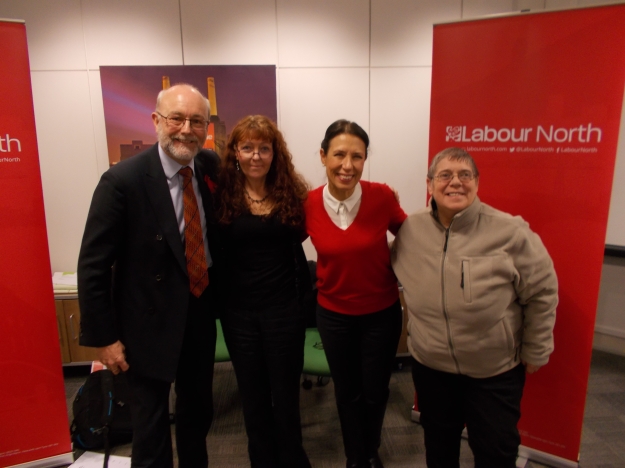
DonatenowButton