Author: Kitty S Jones

I’m a political activist with a strong interest in human rights. I’m also a strongly principled socialist. Much of my campaign work is in support of people with disability. I am also disabled: I have an autoimmune illness called lupus, with a sometimes life-threatening complication – a bleeding disorder called thrombocytopenia. Sometimes I long to go back to being the person I was before 2010. The Coalition claimed that the last government left a “mess”, but I remember being very well-sheltered from the consequences of the global banking crisis by the last government – enough to flourish and be myself. Now many of us are finding that our potential as human beings is being damaged and stifled because we are essentially focused on a struggle to survive, at a time of austerity cuts and welfare “reforms”. Maslow was right about basic needs and motivation: it’s impossible to achieve and fulfil our potential if we cannot meet our most fundamental survival needs adequately. What kind of government inflicts a framework of punishment via its policies on disadvantaged citizens? This is a government that tells us with a straight face that taking income from poor people will "incentivise" and "help" them into work. I have yet to hear of a case when a poor person was relieved of their poverty by being made even more poor. The Tories like hierarchical ranking in terms status and human worth. They like to decide who is “deserving” and “undeserving” of political consideration and inclusion. They like to impose an artificial framework of previously debunked Social Darwinism: a Tory rhetoric of division, where some people matter more than others. How do we, as conscientious campaigners, help the wider public see that there are no divisions based on some moral measurement, or character-type: there are simply people struggling and suffering in poverty, who are being dehumanised by a callous, vindictive Tory government that believes, and always has, that the only token of our human worth is wealth? Governments and all parties on the right have a terrible tradition of scapegoating those least able to fight back, blaming the powerless for all of the shortcomings of right-wing policies. The media have been complicit in this process, making “others” responsible for the consequences of Tory-led policies, yet these cruelly dehumanised social groups are the targeted casualties of those policies. I set up, and administrate support groups for ill and disabled people, those going through the disability benefits process, and provide support for many people being adversely affected by the terrible, cruel and distressing consequences of the Governments’ draconian “reforms”. In such bleak times, we tend to find that the only thing we really have of value is each other. It’s always worth remembering that none of us are alone. I don’t write because I enjoy it: most of the topics I post are depressing to research, and there’s an element of constantly having to face and reflect the relentless worst of current socio-political events. Nor do I get paid for articles and I’m not remotely famous. I’m an ordinary, struggling disabled person. But I am accurate, insightful and reflective, I can research and I can analyse. I write because I feel I must. To reflect what is happening, and to try and raise public awareness of the impact of Tory policies, especially on the most vulnerable and poorest citizens. Because we need this to change. All of us, regardless of whether or not you are currently affected by cuts, because the persecution and harm currently being inflicted on others taints us all as a society. I feel that the mainstream media has become increasingly unreliable over the past five years, reflecting a triumph for the dominant narrative of ultra social conservatism and neoliberalism. We certainly need to challenge this and re-frame the presented debates, too. The media tend to set the agenda and establish priorities, which often divert us from much more pressing social issues. Independent bloggers have a role as witnesses; recording events and experiences, gathering evidence, insights and truths that are accessible to as many people and organisations as possible. We have an undemocratic media and a government that reflect the interests of a minority – the wealthy and powerful 1%. We must constantly challenge that. Authoritarian Governments arise and flourish when a population disengages from political processes, and becomes passive, conformist and alienated from fundamental decision-making. I’m not a writer that aims for being popular or one that seeks agreement from an audience. But I do hope that my work finds resonance with people reading it. I’ve been labelled “controversial” on more than one occasion, and a “scaremonger.” But regardless of agreement, if any of my work inspires critical thinking, and invites reasoned debate, well, that’s good enough for me. “To remain silent and indifferent is the greatest sin of all” – Elie Wiesel I write to raise awareness, share information and to inspire and promote positive change where I can. I’ve never been able to be indifferent. We need to unite in the face of a government that is purposefully sowing seeds of division. Every human life has equal worth. We all deserve dignity and democratic inclusion. If we want to see positive social change, we also have to be the change we want to see. That means treating each other with equal respect and moving out of the Tory framework of ranks, counts and social taxonomy. We have to rebuild solidarity in the face of deliberate political attempts to undermine it. Divide and rule was always a Tory strategy. We need to fight back. This is an authoritarian government that is hell-bent on destroying all of the gains of our post-war settlement: dismantling the institutions, public services, civil rights and eroding the democratic norms that made the UK a developed, civilised and civilising country. Like many others, I do what I can, when I can, and in my own way. This blog is one way of reaching people. Please help me to reach more by sharing posts. Thanks. Kitty, 2012

Ewan Morrison – YES: Why I Joined Yes and Why I Changed to No

Groupthink, repression, obedience and conformity are not what you would expect to confront in a group of passionate campaigners insisting loudly that they are about to wrestle power from the English authoritarians and take responsibility to develop a discrete State, no less, and to establish the “rule of the people by the people”.

This lucid account confirmed my worst fears in many respects about the Yes Campaign, and as an English outsider confined to observing the economic and socio-political processes involved in the independence debate, on a micro-level – analysis of personal encounters has been restricted to a few overtly angry, oppositional, strongly anti-Labour Yes campaigners, who felt my Englishness and Labour Party support warranted and justified bullying and abusive behaviour.

This powerful article provides an insight into a claustrophobic, awkward and defensive affiliation of disparate groups, of ontological insecurity, tempered with blind faith, psychic spit and glue, and a sprinkling of sugared silence, balanced only with negative campaigning and black propaganda.

wakeupscotland's avatarwakeupscotland

 Ewan Morrison is an award-winning Scottish author and screenwriter.

how one word silencedFour months ago I joined the Yes camp out of a desire to take part in the great debate that the Yes camp told me was taking place within their ranks. Being a doubter I thought maybe I’d failed to find this debate and that it was exclusive to the membership of the Yes camp, so I joined hoping I could locate it and take part. But even as I was accepted into the ranks – after my ‘Morrison votes Yes’ article in Bella Caledonia, I noted that 5 out of the meagre 20 comments I received berated me for either not having decided sooner or for having questioned Yes at all. Another said, and I paraphrase: ‘Well if he’s had to mull it over he could easily switch to the other side.’ That comment in Bella Caledonia worked away…

View original post 1,804 more words

Inequality has risen: Incomes increased for the richest last year, but fell for everyone else

1459720_569627496440116_902730897_n

On 04 June, 2014, at 3.52pm BST, Cameron said inequality is at its lowest level since 1986. I really thought I’d misheard him. This isn’t the first time Cameron has used this lie. We have a government that provides disproportionate and growing returns to the already wealthy, whilst imposing austerity cuts on the very poorest. How can such a government possibly claim that inequality is falling, when inequality is so fundamental to their ideology and when social inequalities are extended and perpetuated by all of their policies? The standard measure of inequality is  certainly being used to mislead us into thinking that the economy is far more “inclusive’ than it is.

Dr Simon Duffy authored report – A Fair Society?  – last year, for the Centre for Welfare Reform, about how the austerity cuts have been targeted. He said:

  • People in poverty are targeted 5 times more than most citizens
  • Disabled people are targeted 9 times more than most citizens
  • People needing social care are targeted 19 times more than most citizens

“The UK is the third most unequal developed country in the world and most disabled people live in poverty. The current policy is guaranteed to increase inequality and to make extreme poverty even worse.”

I also wrote an article last year –  Follow the Money: Tory Ideology is all about handouts to the wealthy that are funded by the poor. I said:

The following cuts came into force in April 2013:

  • 1 April – Housing benefit cut, including the introduction of the ‘bedroom tax’
  • 1 April – Council tax benefit cut
  • 1 April – Legal Aid savagely cut
  • 6 April – Tax credit and child benefit cut
  • 7 April – Maternity and paternity pay cut
  • 8 April – 1% cap on the rise of in working-age benefits (for the next three years)
  • 8 April – Disability living allowance replaced by personal independence payment (PIP)
  • 15 April – Cap on the total amount of benefit working-age people can receive

Here are some of the “incentives” for the wealthy:

  • Rising wealth – 50 richest people from this region increased their wealth by £3.46 billion last year to a record £28.5 billion.
  • Falling taxes – top rate of tax cut from 50% to 45% for those earning over £150,000 a year. This is 1% of the population who earn 13% of the income.
  • No mansion tax and caps on council tax mean that the highest value properties are taxed proportionately less than average houses.
  • Benefited most from Quantitative Easing (QE) – the Bank of England say that as 50% of households have little or no financial assets, almost all the financial benefit of QE was for the wealthiest 50% of households, with the wealthiest 10% taking the lions share
  • Tax free living – extremely wealthy individuals can access tax avoidance schemes which contribute to the £25bn of tax which is avoided every year, as profits are shifted offshore to join the estimated £13 trillion of assets siphoned off from our economy.

I also said: “A simple truth is that poverty happens because some people are very, very rich. That happens ultimately because of Government policies that create, sustain and extend inequalities. The very wealthy are becoming wealthier, the poor are becoming poorer. This is a consequence of  “vulture capitalism”, designed by the opportunism and greed of a few, it is instituted, facilitated and directed by the Tory-led  Coalition. ”  

Inequality Briefing reports that richest fifth of the UK population saw their incomes increase by £940 in 2013. But incomes were down by £250 for the other 80% of the population… and by £381 for the poorest fifth , according to data from the Office for National Statistics (ONS)

Incomes increased for the richest fifth of the population last year, but fell for everyone else

Thanks to Inequality Briefing for the info graphic and summary

To download the full pdf, click here

Explaining the data

This data compares the ‘equivalised disposable household income’ for 2011/12 and 2012/13. It was published by the Office for National Statistics as part of ‘the effects of UK tax and benefits on household income 2012/13 study.’ ONS have found that the recession did have a small effect on reducing inequality, but it now looks as though inequality is set to increase.

It has increased. Just as we have predicted.

1234134_539964652739734_1075596050_nPicture courtesy of  Robert Livingstone

Other relevant articles:

Quantitative data on poverty from the Joseph Rowntree Foundation

Welfare reforms, food banks, malnutrition and the return of Victorian diseases are not coincidental, Mr Cameron

The poverty of responsibility and the politics of blame 

“We are raising more money for the rich” – an analysis 

Cameron’s Gini and the hidden hierarchy of worth

How the Tories chose to hit the poor

Antidote to the anodyne: The Internationale.


10403560_335367326614322_7277306109560040209_n

The verses of the Internationale were written on 30 June, 1871,  in the immediate aftermath of the brutal crushing of the Paris Commune during La Semaine sanglante (“The Bloody Week”). The policies and outcome of the Commune had a significant influence on the ideas of Karl Marx, of course.

The author, Eugène Pottier, was hiding in fear of his life. The lyrics were intended to convey the historical experience of an important workers’ struggle to a worldwide audience. For Pottier, liberty, equality and fraternity meant the promise of a society in which poor people, like himself, had justice.

The Internationale has long been the anthem of the labour’ movement throughout the world. Its power to move people has survived the repression of fascism, the cruel parody that was Stalinism and free market capitalism. Those who sing it need know nothing about it’s history to feel a strong sense of international unity. The Internationale is simultaneously about history, political argument and is a powerful rallying statement. Pottier established a reputation as the workers’ poet. It earned him a seat on the Communal Council representing the 2nd arrondissement.

The sheer power of Pottier’s Internationale lies in the fact that he was able to encapsulate his personal experience of  specific  events and express them in universal terms. And that identification and recognition is socialism in action.

The Second International (now known as the “Socialist International”) adopted it as its official anthem. The title arises from the First International,  which was an alliance of socialist parties formed by Marx and Engels that held a congress in 1864. The author of the anthem’s lyrics, Pottier, attended this congress.

The original French refrain of the song is C’est la lutte finale / Groupons-nous et demain / L’Internationale / Sera le genre humain. That translates as: “This is the final struggle / Let us group together and tomorrow / The Internationale / Will be the human race.”) The Internationale has been translated into many languages, it is a left-wing anthem, and is celebrated by socialists, communists, anarchists, democratic socialists, and some social democrats.

There’s something of an irony in the fact that New Caledonia became a penal colony from the 1860s until the end of the transportations in 1897, about 22,000 criminals and political prisoners were sent to there, amongst were them many Communards arrested after the failed Paris Commune, including Henri de Rochefort and Louise Michel. But I’m a person that sometimes connects the obscure, and seemingly random.

Which brings me onto contemporary geopolitical issues. Perhaps the famous Caledonian antisyzygy is a highly romanticised way of saying “cognitive dissonance.” Nationalism is the driving ideology of the Scottish National Party, the current Government of Scotland. The clue is in the name.

In the face of the current bloated propagandeering and emotive battle-cry rhetoric, attacks from the cybernats (I’ve even had the “we know where you live, and it’s not far from the borders…”), well, I much prefer articulate cognitive dissidents.

As I have written at length on the subject of  UKIP and ultranationalism, I will focus here mainly on the issues that arise with Scottish independence, though the  two topics are closely related, particularly on an ideological and sociological level.

Although civic-national ideals influenced the development of representative democracy in countries such as the United States and France (the United States Declaration of Independence of 1776, and the Declaration of the Rights of Man and of the Citizen of 1789), these  examples are very distinct from the current wave of  Ultranationalism in the UK, which is founded on emotionalism, fomenting talk of presumed, real, or imagined enemies, predicating the existence of threats to the survival of the native, dominant or otherwise idealised national ethnicity or population group, and of course, secession.

This kind of nationalism is inherently divisive because it highlights perceived differences between people, emphasising an individual’s identification with their own nation. The idea is also potentially oppressive because it submerges individual identity within a national whole, and gives elites or political leaders potential opportunities to manipulate or control populations.

It’s worth keeping in mind that fascism is often founded on a form of palingenetic ultranationalism that promotes “class collaboration” (as opposed to class struggle), a totalitarian state.  Fascists have often promoted ethnic or cultural nationalism. Fascism stresses the subservience of the individual to the state, and the need for absolute and unquestioned loyalty to a strong ruler. The key elements are that fascism can be defined by its core myth, namely that of “national rebirth” — “palingenesis“.

Sociologist Max Weber’s conception of charismatic authority has historically been noted as the basis of many nationalist governments. Weber theorised,  before the outbreak of war in 1914, that charismatic authority was one part of a triadic typology of political legitimacy, along with legal-rational authority and traditional authority. He defined it as “devotion to an exceptional leader and to the normative rules ordained by him.” Unlike the other two types of legitimacy, the charismatic bond has an exceptional, highly intense, and emotional nature. It arises “out of suffering, conflict, and out of “enthusiasm, or of despair and hope, in times of psychic, physical, economic, ethical, religious, or political distress.”

In other words, nationalism is a poor, provincialist palliative for current, troubled global-scale socio-economic conditions. An anecdote, not an antidote.

Often, abstract political ideologies are generally incomprehensible to the rank and file and are only vaguely understood by their more articulate spokespersons, whose preference for a certain “ism” may be only an expedient means of getting the “in” group “out.” Furthermore, history again has shown us that disintegration of the manipulated sense of nationalist unity after independence often makes incompatible the simultaneous pursuit of the two goals of political development: the consolidation of the state and the growth of central government capacity to modernise. Economic and social challenges will never be addressed by simply drawing a new border.

“I’ll tell you what hermits realise. If you go off into a far, far forest and get very quiet, you’ll come to understand that you’re connected with everything.” – Alan Watts

Fascists aren’t just fascists when it comes to your preferred target group – be it the shabby, politically motivated case presented against migrants, sick and disabled people, unemployed people, women, gay people, academia or the “middle class” that appeals to you – fascists are fascists full stop. UKIP supporters fail to recognise, for example, that most migrants are working class, and oppressed, too. These are your brothers and sisters, in the artificial categories, the “other” groups that the elite have set up for you to hate. I have never seen the UK so divided, with oppressed groups pitched against other oppressed groups, and national boundaries being drawn to divide and weaken us further.

Dividing people by using blame and prejudice further weakens our opposition to oppression.

A recurring theme that SNP ministers and independence supporters alike have persistently utilised is that independence would enable Scotland to rid itself of “government’s that it did not vote for.” Given that the SNP came to power in 2011 on the back of under half of the votes cast, what are the majority of Scots who didn’t vote for them supposed to do, faced as they are by a government they did not vote for?

The SNP’s line of reasoning proves also that their case for independence can only ever be made when Conservatives reside in Downing Street. For 13 years, Scotland VOTED Labour and GOT a Labour government. It is only now that the SNP talk of Scotland getting a government they didn’t vote for. And of course, it’s only now that they decided that Labour are the “enemy” too, and Scotland’s problems are apparently  the fault of Westminster.  This is suddenly justified by a priceless criticism of  Labour’s previous “neoliberalism” coming from Salmond, who is a neoliberal.

 Salmond’s key economic taxation proposal of a reduction in corporation tax to 15 percent, which if implemented would make Scotland one of the most “business friendly economies in Europe”, with the Tory mantra of “job-creation” tagged on as the justification  mechanism,this  reveals his orientation towards trickle-down Thatcherite economic pifflebunk which has been discredited beyond redemption by the current recession. The SNP has refused to commit an independent Scotland to Labour’s proposal for a 50p top rate of tax. It has also refused to support a new top band of council tax. There are  no countervailing measures to replace the funds lost from public services.

With no measures at all to reduce income or wealth inequality, and with no corresponding transfer of income or wealth proposed for poorer Scots, inequality would not fall in the SNP’s independent state. And according to the independent Institute for Fiscal Studies, without the pooled resources from the rest of the UK, there would need to be an additional £3 to 10 billion of cuts or tax increases simply to keep Scotland’s finances sustainable.

Of course it’s a myth that nationalism is correlated with socialism, yet it’s one myth currently being used by some of the yes campaigners, especially the ones that (quite offensively and wrongly) conflate being English with conservatism.

On the issue of nations and the proletariat, the Communist Manifesto says:

“The working class have no country. We cannot take from them what they have not got. Since the proletariat must first of all acquire political supremacy, must rise to be the leading class of the nation, must constitute itself the nation, it is so far, itself national, though not in the bourgeois sense of the word. National differences and antagonism between peoples are daily more and more vanishing, owing to the development of the bourgeoisie, to freedom of commerce, to the world market, to uniformity in the mode of production and in the conditions of life corresponding thereto. The supremacy of the proletariat will cause them to vanish still faster. United action, of the leading civilised countries at least, is one of the first conditions for the emancipation of the proletariat.”

In general, Marx preferred internationalism and interaction between nations in class struggle, saying in preface to the Contribution to the Critique of Political Economy that ” one nation can and should learn from others.” Similarly, though Marx and Engels criticised Irish unrest for delaying a worker’s revolution in England, both Marx and Engels believed that Ireland was oppressed by Great Britain but believed that the Irish people would better serve their own interests by joining proponents of class struggle in Europe, as Marx and Engels claimed that the socialist workers of Europe were the natural allies of Ireland.

Nationalism was one consequence of imperialism (though far from exclusively so). As capitalism spread around the globe, it also gave rise to powerful movements of resistance. Initially, the revolt of workers and peasants in countries oppressed by imperialism almost invariably takes the form of primitive nationalism.

Lenin said: “Socialists must be especially prepared to give most emphatic warning to the proletariat and other working people of all nationalities against direct deception by the nationalistic slogans of “their own” bourgeoisie, who with their saccharine or fiery speeches about “our native land” try to divide the proletariat and divert its attention from their bourgeois intrigues while they enter into an economic and political alliance with the bourgeoisie of other nations…. It follows, therefore, that workers who place political unity with “their own” bourgeoisie above complete unity with the proletariat of all nations, are acting against their own interests, against the interests of socialism and against the interests of democracy.

Socialists are internationalists. Whereas nationalists believe that the world is divided primarily into different nationalities, geopolitical zones, socialists consider social class to be the primary divide. For socialists, class struggle, not national identity, is the driving force of history. And capitalism creates an international working class that must fight back, united and co-operatively against an international capitalist class.

Progress, evolution and development, by their very nature, demand of us that we extend ourselves beyond where we are. But the loss of a fundamental recognition of our common bonds, shared experiences, collectivism – the breakdown of solidarity – is retrogressive and involuted.

We are becoming socially fragmented and politically disempowered by a shifted focus on increasingly parochialised concerns. It’s what Thatcher wanted to see.That is why Veteran Labour MP Tony Benn,half-English and half-Scottish, believed independence would do nothing for socialism and would weaken both Scotland and England.

David Benn said his brother, Tony, who sadly died in March this year, was a “committed supporter” of devolution but was fervently against “outright independence”.

Hilary Benn said: “The socialism my father campaigned for all his life was about solidarity.

“He was a passionate believer in standing together and supporting one another in struggle and difficulty, not pushing people apart.

“To him, independence would not further the beliefs he fought for. That’s why he was clear that the Labour cause – and the Socialist cause – was best served by staying together.”

I agree.

People who view the social world parochially and hierarchically are more likely than others to hold prejudices toward low-status groups. This is especially true of people who want their own group to dominate and be superior to other groups – a characteristic known as “social dominance orientation.” It isn’t only the elite that hold this perspective, either

Any group claiming dominance over another – including the “working class” – is displaying social dominance orientation. The oppressed can be oppressive, too.

It is time to recognise those artificially constructed divisions and unite, for we have nothing left to lose but our chains.

“So comrades come rally
And the last fight let us face”.

scroll2


“The Yes campaign in Scotland, as reasonable as it imagines itself, seems to believe in the unreasonable proposition that you can improve your marriage by getting a divorce” –  Dear Scotland: An open letter from your Canadian cousins

“The Ukip leader Nigel Farage has accused Alex Salmond of stirring up “excessive nationalism” and “anti-English hatred” with just two weeks to go until the vote on Scottish independence.” Remarkable allegation from the king of closing borders – Scottish Independence10658811_698839816852216_7811240035919643833_o

 Many thanks to my friend Robert Livingstone, as ever, for his epic memes, and for seeding the idea for this article.


Peter Duut’s Mother In Law Speaks Out About Her Daughter’s Current Situation

This is how vulnerable people are treated here in the UK.

samedifference1's avatarSame Difference

Same Difference has been in touch with the mother-in-law of Mr Peter Duut, who has asked for the following to be published exclusively, and shared with those who might remember his quite high-profile case.

I am the mother of Mrs Laurel Joanna Duut, the widow of Peter Duut, who died tragically in October 2011, after financially supporting my disabled daughter for years preciously in Holland, and also in the UK after all of her benefits ceased in 2002 after she had cared for her terminally ill father – we have never been given any reason as to why her benefits had ceased.

In the months before his death, Peter was denied benefits even though he had worked very hard in the Netherlands and the UK paying tax and National insurance in both countries. He was refused benefits and advised that he had no right to reside in the UK. As…

View original post 621 more words

The Conservatives’ slippery slope and Allport’s scale of prejudice

Gordon Allport studied the psychological and social processes that create a society’s progression from prejudice and discrimination to genocide. In his research of how the Holocaust happened, he describes sociopolitical and socio-psychological processes that foster increasing social prejudice and discrimination and he demonstrated how the unthinkable becomes acceptable: it happens incrementally. It happens because of a steady, nudged erosion of our moral and rational boundaries, and propaganda-driven changes in our attitudes towards others, all of which advances culturally, by almost inscrutable degrees. 

The process always begins with political scapegoating of a social group and with ideologies that identify that group as an enemy or a social burden in some way.  It begins with dehumanizing language.

By using dehumanizing language, we negatively shape the way we view some groups of people. We may begin to view them as “less-than” or “subhuman”. When we view someone as less than us, it creates a social, cultural, moral, psychological and emotional separation, which makes it easier to permit or commit violence against them. Every human being has inherent dignity by virtue of our shared humanity and the rational nature that comes with it. No matter our age, innocence, gender, size, race, nationality, or ability, we are all equally human; our language and actions should reflect that fact.

Unless we actively challenge dehumanizing rhetoric, it will continue to permeate our society and lead to acts of violence.  Dehumanizing rhetoric used to oppress groups of human beings in the past is still being used against marginalized groups of today.

bad-words-poster-smaller.png
                                                                                         Examples of dehumanizing language

A history of devaluation of the group that becomes the target, authoritarian culture, and the passivity of internal and external witnesses (bystanders) all contribute to the probability that violence against that group will develop, and ultimately, if the process is allowed to continue evolving, genocide.

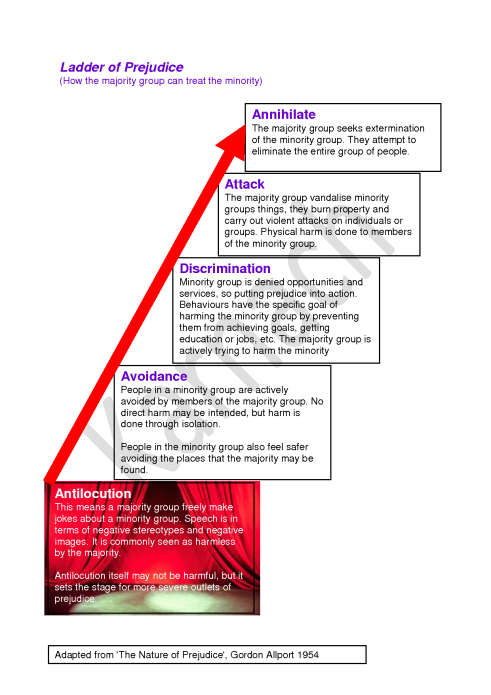
Economic recession, uncertainty and authoritarian or totalitarian political systems contribute to shaping the social conditions that seem to trigger Allport’s escalating scale of prejudice. In his book, The Nature of Prejudice, Gordon W. Allport uses the metaphor of a ladder to describe how “little acts,” which often go unnoticed, can lead to serious and deadly individual and collective behaviors.  This framework describes, in ascending order, five “rungs” of intolerance and injustice: speech, avoidance, discrimination, physical attack, extermination.

Allport's ladder

The Conservatives are authoritarians, they manufactured an economic recession, as did the previous Conservative administrations. Though the sheer pace and blatancy of Cameron’s austerity programme  – a front for the theft and redistribution of public wealth to Tory-supporting private bank accounts – is unprecedented, even for Conservatives.

And prejudice towards vulnerable minority groups is almost a cardinal Conservative trait. The media is being used by the right-wing as an outlet for blatant political propaganda, and much of it is manifested as a pathological persuasion to hate others. This process of outgrouping and othering has historically been used by tyrants to target, oppress, persecute and murder some social groups.

599849_369461329790068_1640090166_n

The Conservative party has said that they are “controlling immigration” by clamping down on benefits tourism and health tourism – so that we only welcome those who want to “work hard and contribute to our society”, cutting net immigration from outside the EU to levels not seen since the late 1990s – to “ease pressure on the schools and hospitals that all hardworking people rely on”, and introducing a new citizen test with “British values at its heart”.  Such policies pander to public nationalism and normalise political fascism.

David Cameron is asking for our views on immigration. I didn’t bother responding to the highly selective, deliberately poorly designed, directed and loaded survey.

As someone who has designed sociological and psychological surveys, I know that rule number one for conducting genuine research is that we do not use loaded or leading questions. And I can’t abide the distraction and diversionary tactics – “finger pointing” politics at its very worst: scapegoating and bullying towards politically exploited minority groups, those least able to speak up for themselves.

We know that it is Tory polices that have damaged our Country, and not migrants, or ill and disabled people, or the poorest citizens. So I sent the following qualitative response to David Cameron:

“I’ve always felt the Tories don’t belong here, they have stolen all of our money, jobs, best houses, they’re scrounging off the hard-working taxpayer, and are draining our publicly funded public services – the welfare state, social security; legal aid, social housing, and they are bleeding the NHS dry. We can’t afford Conservatives, they contribute absolutely nothing to society, and cost ordinary people pretty much everything. They are also known criminals and terrorists, so they should be immediately deported back to the feudal era, where they  belong and never allowed back to civilised, democratic society again”.

Well, it is said that in satire, irony is militant. I pointed back and found the truth.

We are obliged to critique, in every  way we can, the constant subliminal drip of Tory bullying, imperialist white supremacist, social Darwinist, patriarchal political culture, because it is normalised by political narrative, a complicit mass media, and rendered opaque, presented tacitly as unproblematic “common sense”. 

It isn’t common sense. It’s nasty, manipulative authoritarian right-wing prejudice, scapegoating and diversion. For those of you who welcome the political permission to exercise your own racism, it’s worth bearing in mind that prejudice tends to “multi-task”.

Once a social group is targeted for outgrouping and discrimination, others quickly follow, as Pastor Martin Niemöller famously observed very well, in his famous statement about the cowardice of German intellectuals following the Nazis’ rise to power and the subsequent purging of their chosen targets, group after group.


  Related 

When the oppressed are oppressive too

UK becomes the first country to face a UN inquiry into disability rights violations

Techniques of neutralisation – a framework of prejudice

UKIP: Parochialism, Prejudice and Patriotic Ultranationalism.

999622_566748676727998_1599547969_n (1)
Art work courtesy of Robert Livingstone


I don’t make any money from my work. But you can support Politics and Insights and contribute by making a donation which will help me continue to research and write informative, insightful and independent articles, and to provide support to others going through ESA an PIP assessments and appeals. The smallest amount is much appreciated, and helps to keep my articles free and accessible to all – thank you. 

DonatenowButton

top 100 blogs

Mental Health Services in crisis because of Coalition cuts to funding


tory cuts

A succession of Conservative governments have demonstrated very clearly that when it comes to funding established and crucial provisions for our most vulnerable citizens, they lack the foresight required to grasp that reducing funding means reducing our public services to a bare capacity for “firefighting” only – crisis management – rather than a much preferred “preventative” approach.

Under the guise of a “policy of deinstitutionalisation”, Thatcher’s “Care in the Community” Bill was about anything but care: it was all about cutting costs, as reflected in the experiences of many people leaving long term institutional care and being left to fend for themselves in the community. 

Previous Conservative governments of 1979 to 1997 had been responsible for a series of changes in the conceptualisation and delivery of community care services. . In particular, this period saw the introduction of a series of private sector approaches and terminology, as well as the gradual transition of social workers and social services departments into service “purchasers” rather than necessarily the providers of care. As a result of these changes, the community care landscape changed dramatically.

And now, as predicted by many professionals who have consistently warned of the harmful consequences of the Heath and Social Care Bill, it’s the case that a serious funding shortage for mental health services in England is putting patients (and staff) at grave risk. A lack of resources and staff is severely compromising care in parts of the country, with frontline teams often being left to carry the burden of risk, to the detriment of patients.  NHS hospitals are experiencing a massive surge in the number of patients attempting to self-harm and take their own lives, new figures have revealed.

The data, disclosed by UK mental health trusts, following Labour Party freedom of information requests, indicates suicide and self-harm attempts increased by 50 percent in mental health hospitals across Britain between 2010 and 2013. In the past year alone, incidents of patients attempting to take their own lives or inflict self-harm in the institutions has risen by 30 percent.

The FOI requests were tendered by Labour’s Luciana Berger, who is the Shadow Minister for Public Health. Fifty NHS mental health trusts were approached in total, and each was asked for the number of self-harm incidents and suicide attempts on their wards over the past four years. Twenty-nine supplied figures, while twenty one failed to respond. This comes as experts warn that acute mental health services are in crisis and struggling to cope with demand. NHS staff are working very hard in very difficult circumstances. Although the Royal College of Psychiatrists recommends occupancy levels of 85%, figures show that mental health wards are operating over capacity, with some running at up to 138%, and the shortage of beds has forced some mental health patients to travel hundreds of miles for treatment. Figures from the BBC show that minimum of 1,711 mental health beds were closed between April 2011 and August 2013. 

A recent investigation by Health Service Journal (HSJ) revealed that there are 3,640 fewer nurses and 213 fewer doctors working in mental health in April this year compared to staffing levels two years ago. Mental health spending has been cut for the first time in a decade, by the Coalition. 

The same investigation showed that the NHS’s mental health trusts have lost over £250 million of their funding in the same period.

Number of self-harm and suicide attempts across 29 Mental Health Trusts:

2010 2011 2012 2013
Total 14815 16711 17946 23053
Average 511 576 619 795

Luciana Berger MP, Labour’s Shadow Minister for Public Health, said:

“This increase in self-harm and suicide attempts on NHS wards is deeply concerning.

“Mental health services have been squeezed year on year, the number of specialist doctors and nurses has dropped and there aren’t enough beds to meet demand. The pressure this is putting on mental health wards is intolerable.

“It is unacceptable that people in touch with mental health services may not be getting the support they need. These are some of the most vulnerable patients in our NHS. Ministers must now take urgent action to tackle this crisis.”

And given that 42 percent of the NHS mental health trusts approached by Labour failed to issue a concrete response to the party’s recent inquiry, the true extent of this crisis may be considerably more serious than  Luciana Berger’s recently published figures indicate.

Pressure on mental health beds is so severe that some patients are having to be sectioned to secure necessary care, a survey of doctors (conducted by online journal Community Care) found. Sectioning someone under the Mental Health Act – denying them their liberty – should only be done when a person is a risk either to themselves or others. It is a legal process led by a social worker (an approved mental health professional) working alongside two doctors. A patient cannot be sectioned purely to secure a bed, but the survey suggests doctors are being influenced towards detaining someone if it will make it more likely a necessary bed can be accessed.

Sir Simon Wessely, president of the Royal College of Psychiatrists, said that the figures were “a glaring warning sign” that mental health is “running dangerously close to collapse”.  If Wessely is concerned, we all ought to be.

The Government has been criticised for allowing mental health services to be cut disproportionately, as the NHS as a whole undergoes the most severe budget cut in its history.

1912510_690135534389311_7775048840596309303_o

Picture courtesy of Robert Livingstone scroll2

If you are supporting someone who feels suicidal – you  can download a pdf from MIND, that provides information and practical suggestions for what you can do and where you can go for support. 

From  Rethink – Mental health information – Crisis contacts

From NHS Choices – Mental health helplines

Sane Line: 0845 767 8000 (6pm – 11pm every day) www.sane.org.uk

Samaritans: 08457 90 90 90 (24 hours every day)  www.samaritans.org

It’s absolute poverty, not “market competition” that has led to a drop in food sales.

1450041_569755536427312_1698223275_n
Public spending in food stores fell for the first time on record in July this year, putting the UK recovery in doubt. Such a worrying, unprecedented record fall in food sales indicates that many consumers evidently have yet to feel the benefit of the so-called recovery.

The price of food was 0.2% higher than a year ago. The Office for National Statistics (ONS) started collecting the data for food sales in 1989The volume of food sales was also down last month, by 1.5% on an annualised basis.

There was also a marked fall in petrol consumption, and the only prominent area of growth was in spending that entailed use of mail order catalogues, and at market stalls, as people use credit to buy essential items and shop around for cheap alternatives and bargains.

Food manufacturing is the UK’s single largest manufacturing sector. The food and drink supply chain is a major part of the UK economy, accounting for 7% of GDP, employing over 3.7 million people, and generating at least £80 billion per year,  according to data from the Cabinet Office. There was an increase in the food sector (excluding agriculture) from 2000-2009 in Britain; the whole UK economy increased by 47% during the same period.

The Office for National Statistics has put the recent decline down to “prolonged discounting and price wars”.

However, crucially, the quantity of food bought in food stores also decreased by 1.5 per cent year-on-year in July.

It doesn’t take a genius to work out that repressed, stagnant wages and RISING living costs are going to result in reduced sale volumes. Survation’s research in March this year indicates that only four out of every ten of UK workers believe that the country’s economy is recovering. But we know that the bulk of the Tory austerity cuts were aimed at those least able to afford any cut to their income.

What we need to ask is why none of the mainstream media articles, or the ONS account, duly reporting the drop in food sales, have bothered to link this with the substantial increase in reported cases of malnutrition and related illnesses across the UK. It’s not as if this correlation is a particularly large inferential leap, after all.

It stands to reason that if people cannot afford food, they won’t be able to buy it. Furthermore, that consumers were not actually considered as a part of the ONS and media assessment is frankly strange, to say the least, with emphasis being placed solely on deterministic market competition criteria, and hardly a skim over any analysis of the social-political conditions that have undoubtedly contributed to the significant drop in food sales.

Food banks provide food aid to people in acute need, usually following referral by health or social care professionals, such as social workers, doctors, health visitors, and organisations such as the Citizens Advice Bureau and Jobcentre Plus. The Department for Work and Pensions has acknowledged that there is internal guidance to staff on signposting to food banks and a recent Freedom of Information request reported in The Guardian, revealed a “high level process” to be observed by jobcentre staff for referring claimants who say that they are suffering hardship and need food.

The role of Jobcentre Plus in referring people to food banks was described by Mark Hoban, Minister of State for Employment at the Department for Work and Pensions (DWP) as follows in December 2012: “The DWP, through Jobcentre Plus, operates a foodbank referral service. This is a simple signposting process which builds on the Jobcentre Plus standard practice of holding, locally, the details of organisations to which we signpost claimants who tell us they are in financial difficulty. Jobcentre Plus will only signpost claimants when they can offer no more help.”

Jobcentre Plus have been “signposting” people to food banks nationally since September 2011. Circumstances where a Jobcentre might make a referral to a food bank include:

  •  where a Crisis Loan or Short Term Benefit Advance had been refused;
  •  where a change in circumstances had affected a person’s entitlement to benefit, or reduced the amount they receive;
  •  where payment of benefit had been delayed (e.g. because a claim was still being
    assessed, or DWP was awaiting information to enable a decision on a claim).

The original version of the Jobcentre Plus referral form included boxes to tick to indicate the reason for the referral. However, the report in the Guardian on 6 September 2013 highlighted that the DWP had suddenly “unilaterally redesigned the food bank vouchers it issues to clients” – the three boxes on the previous form which had enabled JobCentre Plus “to indicate why they referred the person: because of benefit delay, benefit change, or refusal of crisis loan … have been removed from the new version of the form. The vouchers no longer tell the [Trussell] trust why the person has been referred”.

As Patrick Butler astutely observed, this has the effect of removing data that helps highlight why impoverishment caused by welfare “reform” has become one of the biggest single drivers of people turning to food banks. The Government needs political cover for lying ministers such as Freud and McVey, who like to pretend food banks have nothing to do with austerity and welfare reform; but the DWP sends its impoverished customers in droves to them anyway.

Research by the Joseph Rowntree Foundation and others indicates quite clearly that:

  • Some of the increase in the number of people using food banks is
    caused by unemployment, increasing levels of underemployment,
    low and falling income, and rising food and fuel prices. The
    National Minimum Wage and benefits levels need to rise in line
    with inflation, in order to ensure that families retain the ability to
    live with dignity and can afford to feed and clothe themselves and
    stay warm.
  • More alarmingly, up to half of all people turning to food banks
    are doing so as a direct result of having benefit payments delayed,
    reduced, or withdrawn altogether. Figures gathered by the Trussell
    Trust show that changes to the benefit system are the most common reasons for people using food banks;these include changes to crisis loan eligibility rules, delays in payments, Jobseeker’s Allowance ,sanctions and sickness benefit
    reassessments.
  • There is very clear evidence that the benefit sanctions regime is leading to destitution, hardship and hunger on a large scale.

Furthermore, in November last year, in a letter to the British Medical Journal, a group of doctors and senior academics from the Medical Research Council and two leading universities said that the effect of Government austerity policies on vulnerable people’s ability to afford food needed to be “urgently” monitored.

There was a significant surge in the number of people requiring emergency food aid, a decrease in the amount of calories consumed by British families, and a doubling of the number of malnutrition cases seen at English hospitals, which represents “all the signs of a public health emergency that could go unrecognised until it is too late to take preventative action,” they wrote.

Despite mounting evidence for a growing food poverty crisis in the UK, Tory ministers continue to maintain the lie that there is “no robust evidence” of a link between their sweeping welfare “reforms” and a rise in the use of food banks. However, publication of research into the phenomenon, commissioned by the Government itself, was delayed, amid speculation that the findings may prove embarrassing for the Government.

“Because the Government delayed the publication of research it commissioned into the rise of emergency food aid in the UK, we can only speculate that the cause is related to the rising cost of living and increasingly austere welfare reforms,” the public health experts wrote. It is very evident that the welfare state is “failing to provide a robust last line of defence against hunger.”

The authors of the letter, who include Dr David Taylor-Robinson and Professor Margaret Whitehead of Liverpool University’s Department of Public Health, say that malnutrition can have a devastating, long-lasting impact on health, particularly amongst children.

Chris Mould, chief executive of the Trussell Trust, the largest national food bank provider, said that one in three of the 350,000 people who required food bank  support at the Trussell Trust centres alone this year were children. It is estimated that by 2013, at least 500,000 people were reliant on food aid.

Access to adequate food is the most basic of human needs and rights. The right to food is protected under international human rights and humanitarian law and the correlative state obligations are equally well-established under international law. This right is recognised in the 1948 Universal Declaration of Human Rights (Article 25) as part of the right to an adequate standard of living, and is enshrined in the 1966 International Covenant on Economic, Social and Cultural Rights (Article 11).

Olivier De Schutter (a United Nations Special Rapporteur on the Right to Food) recently pointed to increases in the number of food banks in developed countries  such as the UK as an indicator that Governments are “in danger of failing in their duty to protect citizens under the International Covenant on Economic, Social and Cultural Rights” (IESCR), which states that all citizens should have access to adequate diet without having to compromise other basic needs.

Whilst the Department for Work and Pensions (DWP) claims that the benefits system provides a “safety net for essentials such as food”, the evidence increasingly does not support this claim. In fact, there is substantial and ever-mounting evidence that the inadequacies of the welfare safety net are now directly driving the growth of hunger and reliance on charitable food handouts.

The BBC reported the “‘Shocking increase’ in Employment Support Allowance (ESA) sickness benefit sanctions” on August 13th, within the first three months of 2014, there were 15,955 sanctions on ESA claimants, compared with 3,574 in the same period last year. I reported about the impact of sanctions in February, 2014, and I reported the substantial increase in ESA sanctions May 2014, along with the Benefits and Work site, amongst other “non-mainstream” writers. It’s incredible that the BBC, with relatively vast resources to hand hasn’t bothered researching and reporting this issue until now.

Perhaps this explains the BBC’s endorsement of the Government welfare “reforms” and their complicity with the persecution of sick and disabled people: James Purnell – one  of the chief architects of the current government’s “reforms”  (Gordon Brown had previously rebuffed Purnell’s proposals, and Purnell resigned as a consequence), is the BBC’s Director of Strategy & Digital which “brings together Communications, Future Media, Marketing, Policy, Research and Development and Strategy”. So, Mr Purnell is on the Executive Board, which, I am sure, contributes to the BBC’s current degree of “impartiality”, especially evident in attempts to defer delivery of politically damning news, or in their other quest to purposefully deliver politically motivated factual detours.

There is currently no established government measure of food poverty. A recent report by the Centre for Economics and Business Research defined households who have to spend more than 10% of their annual income on food as being in food poverty.

The Food Ethics Council states that food poverty means that an individual or household isn’t able to obtain healthy, nutritious food – they have to eat what they can afford or find, not what they choose to.

If people can’t meet basic survival needs, then that is defined as absolute poverty. We haven’t seen absolute poverty in the UK since before the inception of the welfare state. Until  now.

“Food banks open across the country, teachers report children coming to school hungry; advice services and local authorities prepare for the risks attached to welfare reform. There is evidence of a rising number of people sleeping rough, and destitution is reported with increasing frequency.” Julia Unwin, Joseph Rowntree Foundation, 2013.

“In households which cannot afford an adequate diet for their children, 93% have at least one adult who “skimps” on their own food to try to protect the children. Half a million children are not adequately fed in the UK today, not as a result of negligence but due to a lack of money.” Poverty and Social Exclusion UK. 2013.

We know that the imposed limitations on welfare processes and procedures have been found to be impacting on the growing demand for food banks. Decision-making around sanctions has been found to be particularly problematic from the perspective of food banks, where decisions were seen as unfair and/or arbitrary. Similarly, errors made in declaring people on Employment Support Allowance fit for work were also highlighted, by research undertaken by the Sheffield University Political Economy Research Institute.

More generally, “ineffective administration” of lifeline welfare payments is also seen to be an important driver of need, where people’s payments are delayed or stopped and they are left with no or heavily reduced income. Tory policy changes to the length of time sanctions run for (from 2 weeks to 3 years) is “significantly problematic”, given the  enormous implications for financial insecurity. And resultant absolute poverty.

Basic incomes are being reduced, making it much more difficult for people to make ends meet. In addition, “reforms” – which is the Orwellian Tory word for severe cuts – impacting on food poverty include the cap to benefit payments, the Bedroom Tax, and the loss of full Council Tax exemption for many benefit claimants.

No-one should be hungry, without food in this Country. That there are people living in a politically imposed state of absolute poverty is unacceptable in the UK, the world’s sixth largest economy (and the third largest in Europe). This was once a civilised first-world country that cared for and supported vulnerable citizens. After all, we have paid for our own welfare provision, and we did so in the recognition that absolutely anyone can lose their job, become ill or have an accident that results in disability. This is a Government that very clearly does not reflect the needs of the majority of citizens.

It is also unacceptable in a so-called liberal democracy that we have a Government that has persistently denied the terrible consequences of their own policies, despite  overwhelming evidence that the welfare “reforms” are causing people, harm, distress and sometimes, death. Furthermore, this is a Government that has systematically employed methods to effectively hide the evidence of the harm caused to others as a consequence of their devastating, draconian “reforms” from the public. This clearly demonstrates an intention to deceive, and an intention to continue causing people harm.

In English criminal law, intention is one of the types of mens rea (Latin for “guilty mind”) that, when accompanied by an actus reus (“guilty act”), constitutes a crime. It’s difficult to envisage that anyone in the UK would fail to understand that any act that prevents people from accessing food, and the means of meeting other basic survival needs, such as shelter, will cause them harm.

This is a Government that knows exactly what it is doing.

1459720_569627496440116_902730897_n
Many thanks to Robert Livingstone for his excellent artwork

UK becomes the first country to face a UN inquiry into violations of disabled peoples’ human rights

994442_352804464870608_5110112617916821526_n (1)

We ought to be very concerned about the government’s declaration that they intend to withdraw from the European Convention on Human Rights, (ECHR) and to repeal our own Human Rights Act, (HRA). One has to wonder what Cameron’s discomfort with the HRA is. The Act, after all, goes towards protecting the most vulnerable citizens from neglect of duty and abuse of power. The rights protected by the HRA are drawn from the 1950 European Convention on Human Rights, which was a way of ensuring that we never again witness the full horrors of the second world war, and overwhelmingly, one of the greatest stains on the conscience of humanity – the Holocaust.

Human Rights establish a simple set of minimum standards of decency for humankind to hold onto for the future. The European Convention on Human Rights and Fundamental Freedoms was drafted as a lasting legacy of the struggle against fascism and totalitarianism, as well as the atrocities of world war 2.

What kind of government would want those basic protections for citizens overturned?

One that doesn’t value or wish to uphold the universal protection of its citizens. From the State.

Last month, a new report, Dignity and Opportunity for All: Securing the Rights of Disabled People in the Austerity Era – Jane Young is the lead author – exposed the Coalition’s failure to meet its international human rights obligations under both the UN Convention on the Rights of People with Disabilities (UNCRPD) and the International Covenant on Economic, Social and Cultural Rights (ICESCR).

The report – also published by the Just Fair Coalition, a consortium of 80 national charities including Amnesty International, Save the Children, and Oxfam, says the UK is in clear breach of its legal obligations. Support structures for many disabled people have disappeared or are under threat as local authorities cut social care budgets, while cuts to social security will leave many disabled people without lifeline support for daily living.

Jane Campbell, a cross-bench peer who is disabled herself, said: “It is both extremely worrying and deeply sad that the UK – for so long regarded as an international leader in protecting and promoting disabled people’s rights – now risks sleepwalking towards the status of a systematic violator of these same rights.”

The UK government seems to be the first to face such a high-level international inquiry, initiated by the United Nations Committee because of “grave or systemic violations” of the rights of disabled people. That ought to be a source of shame for the Coalition, especially considering that this country was once considered a beacon of human rights, we are (supposedly) a first-world liberal democracy, and a very wealthy nation, yet our government behave like tyrants towards the poorest and some of the most vulnerable citizens of the UK.  As disability specialist, campaigner and first-class human rights activist, Samuel Miller says: “Britain is [now] a retrograde society and a flagrant violator of human rights—especially the rights of the sick and disabled”. 

It’s because of the sterling work of people such as Mr Miller that the UN have been made aware of our dire situation, here in the UK. Many of us have contacted the UN and made submissions, detailing the detrimental impacts that punitive Tory policies such as the bedroom tax, other welfare “reforms” (cuts), including the increasing use of extremely punitive welfare sanctions which leave people without the means to meet their most basic survival needs, the draconian Work Capability Assessment, brutal Tory targets for reducing spending and local authority cuts, for example, are having on ill and disabled people.

This is a government who refuse to undertake a cumulative impact assessment of their “reforms” and also continue to dismiss any evidence provided that challenges their own glib and deceitful account as “anecdotal” or “scaremongering”. Yet we are expected to regard Tory soundbites such as the “culture of entitlement” and the “something for nothing culture” which are ideologically motivated rather than   resting on some sort of empirical evidence. The Tories believe that their opinions alone somehow justify the cruel removal of people’s lifeline benefits and support. 

There’s more than one issue here, though it’s plain that the government have no intention of addressing any of the terrible consequences of their draconian policies, and use denial and stigmatising others to deflect attention from their aims. I am reminded of Techniques of Neutralisation – a well known collection of tactics used historically to justify prejudiced views, discriminatory and oppressive policies and  despotic actions.

Another related and important issue is that people’s qualitative experiences should matter to any decent democratic government, but the Coalition is far more concerned with its persistent attempts at DISCREDITING those experiences, (such attempts to invalidate and exclude the narrative of experiences of previously and presently marginalised people is a hallmark of the oppressive, supremacist condescension of historically powerful and privileged groups) –  denying their victims a voice and remedy. We know that this is not a democratic government that serves its citizens and reflects their needs, equally or otherwise.

Thanks to the sterling work of Dr Simon J Duffy, from the Centre for Welfare Reform, among others, we know that the austerity measures in the UK have disproportionately affected those people with disabilities and their carers. Dr Duffy’s work on the impact of the austerity cuts shows us that:

  • People in poverty are targeted 5 times more than most citizens
  • Disabled people are targeted 9 times more than most citizens
  • People needing social care are targeted 19 times more than most citizens

Yet, this government claims a cumulative impact assessment is “too difficult and costly”, I suggest that they use their considerable publicly donated, tax-collected wealth to fund the work of the Centre for Welfare Reform, who managed to undertake this work without hitting the obstacles the government claims it has. This said, perhaps the findings are the real obstacle that the government are concerned about. Because those findings are damning, and tell us that the welfare “reforms” are NOT “fair” as claimed, and are causing harm, distress, hardships and sometimes, death. The grossly punitive, draconian “reforms” need to be repealed.

The UN Committee has the power to launch an inquiry if it receives “reliable information” that violations have been committed, and as the Labour Government signed up to the protocol in 2009 – the UNCRPD and the international covenant on economic, social and cultural rights – it is legally binding. Many of us have used the Optional Protocol to the Convention on the Rights of Persons with Disabilities to send communication and make submissions since 2012.

Austerity measures and welfare “reforms” such as the bedroom tax (which is in itself established by the UN as being a contravention of human rights law) mean the rights of disabled people to independent living, work, and adequate social security have been seriously undermined, causing significant hardship and harm, quite often leading to tragic consequences.

Such investigations are necessarily conducted “confidentially”, so the UNCRPD  has formally refused to confirm or deny that the UK is being investigated. However, a recording has emerged (one hour and twenty five minutes long, watch from one hour and four minutes) of a former CRPD member seemingly revealing that the inquiry has been launched.

Professor Gabor Gombos, who is the co-founder of Voice of Soul, Hungary’s first organisation for ex-users and survivors of Mental Health Institutions, and co-chair of the World Network of Users and Survivors of Psychiatry, can be heard informing the audience that CRPD has “started its first inquiry procedure against the United Kingdom”.

He informs the Sixth International Disability Law Summer School at the National University of Ireland in Galway, June, that inquiries are only used where there are suspicions of “grave” violations of human rights. He says: “Where the issue has been raised and the government did not really make effective actions to fix the situation – it is a very high threshold thing – the violations should really be grave and very systemic.”

Earlier this year, the level of UK benefits paid in pensions, jobseeker’s allowance and incapacity benefits was deemed “manifestly inadequate” because it falls below 40% of the median income of European states, by the Council of Europe in Strasbourg.

The finding in an annual review of the UK’s adherence to the council’s European social charter is likely to provoke a fresh dispute between the government and European legal structures. Iain Duncan Smith, the work and pensions secretary, dismissed it as “lunacy”.

Not an open, accountable minister, or government, then.

The Council of Europe, which has 47 member states, said the conclusions were legally binding in the same way that judgements relating to the European Convention on Human Rights had to be applied by member states.

Aoife Nolan, professor of International Human Rights Law at the University of Nottingham and a trustee of Just Fair said government policies were compromising disabled people’s human rights.

“Not only do these policies cause significant hardship and anxiety, but they also amount to impermissible backward steps in relation to disabled people’s human rights, contrary to the UN human rights framework.”

The report was submitted to the United Nations, which, as I’ve previously outlined in earlier articles here, is in the process of reviewing UK compliance with its obligations to the rights of disabled people.

Last year, Amnesty International condemned the erosion of human rights of disabled people in UK, and the Joint Parliamentary Committee on Human Rights conducted an inquiry into the UK Government’s implementation of Article 19 of the United Nations Convention on the Rights of Persons with Disabilities – the right to live independently and to be included in the community. The inquiry, which began in 2011, has received evidence from over 300 witnesses.

The inquiry highlighted just how little awareness, understanding and employment of the Convention there is by the Tory-led government. Very few of the witnesses made any specific reference to the Convention in their presented evidence, despite the inquiry being conducted by the Parliamentary Human Rights Committee, with the terms of reference clearly framing the inquiry as being about Article 19 of the UNCRPD.

“This finding is of international importance”, said Oliver Lewis, MDAC Executive Director, “Our experience is that some Governments are of the view that the CRPD is nothing more than a policy nicety, rather than a treaty which sets out legal obligations which governments must fulfil.”

The report is particularly critical of the Minister for Disabled People (Maria Miller, at the time) who told the Committee that the CRPD was “soft law”. The Committee criticised this as “indicative of an approach to the treaty which regards the rights it protects as being of less normative force than those contained in other human rights instruments.” (See the full report.) The Committee’s view is that the CRPD is hard law, not soft law. 

Quite properly so. The whole point of human rights legislation is that it is universally applied, regardless of characteristics, preferences or belonging to a specific community or social group. The Tories seem to believe that poor people, disabled people and those with mental and physical illness should enjoy fewer rights than others.

Dr Hywel Francis MP, Chair of the Committee, said: “We are concerned to learn that the right of disabled people to independent living may be at risk through the cumulative impact of current reforms. Even though the UK ratified the UNCPRD in 2009 with cross-party support, the Government is unable to demonstrate that sufficient regard has been paid to the Convention in the development of policy with direct relevance to the lives of disabled people. The right to independent living in UK law may need to be strengthened further, and we call on the Government and other interested organisations to consider the need for a free-standing right to independent living in UK law.”

“The Government is meant to include disabled people in making sure people have their human rights upheld. We are concerned that a part of the Law on treating people equally and fairly (Equality Act section 149) does not say any more that disabled people should be involved. This is a step backwards.”

In other words, the Tory-led Coalition has quietly removed this part of the Equality Act.

The budget of the Equality and Human Rights Commission (EHRC), which was established by the Labour Party when they were drafting this flagship policy, is being reduced by over 60%, its staffing cut by 72%, and its powers restricted by the Coalition. Provisions that are being repealed by the Enterprise and Regulatory Reform (ERR) Bill include the duty on public authorities to have due regard to the need to reduce socioeconomic inequalities.

Savage Legal aid cuts from April 2013 have also contributed significantly to creating further barriers to ensuring Equal Rights law protect us, and the Tory-driven Legal Aid Bill also contravenes our right to a fair trial under Article 6(1) of the European Convention on Human Rights.

This is not a coincidental multiple policy timeline, but rather a very coordinated political attack on potential legal challenges at a time when Tory-led severe and devastating multiple welfare and provision cuts have affected disabled people so disproportionately. The changes, which came into effect in April, will hit “the same group of disabled people over and over again”. 

Our political freedoms and human rights must not be subservient to Tory notions of ‘economic success’. Democracy is not about the private accumulation of wealth of a few millionaires at the expense of others. It is about the wise use of the collective wealth – pubic funds – for the common good of the public – that must extend to include ALL of our citizens. And a decent, civilised, democratic society supports its vulnerable members and upholds universal human rights.

We need to ask why our government refuses to instigate or agree an inquiry into the substantial rise in deaths among ill and disabled people, as these deaths are quite clearly a correlated consequence of this government’s policies.

What kind of government uses the media to scapegoat and stigmatise ill and disabled people, by lying and inventing statistics to “justify” the persecution of our most vulnerable citizens, and the withdrawal of their crucial lifelines and support?

One that does not value those lives, or regard them as having an equal worth with others.

scroll2

I’m adding this comment from Samuel Miller, as it highlights his ongoing, excellent, valuable and much appreciated work with the United Nations on our behalf, which is a most welcomed addition to our own ongoing submissions of evidence over the past couple of years:

A superlative piece, which I will bring to the attention of senior UN officials. Ahead of the September meeting of the Human Rights Council (see third paragraph of :-http://mydisabilitystudiesblackboard.blogspot.ca/2014/08/an-inopportune-time.html), I will shortly submit an inquiry request to the CRPD and Human Rights Council, petitioning them to open an investigation into Britain’s benefit-sanctioning regime. (At the request of Jorge Araya, UNCRPD Secretary, I am completing a bibliography of media articles on this subject, with particular focus on inappropriate sanctions.)

You already know my views on this matter: http://twishort.com/1RVfc.

My bibliographic assignment for the UNCRPD Secretary might be an indication that the UN has already opened an investigation into Britain’s benefit-sanctioning regime, but for the sake of certainty I’ll make that request myself.”

And further:  See my letter to High Commissioner, Navi Pillay, below. I included your superb article in my letter, Sue.

Subject: There is an urgent need for a UN investigation into the United Kingdom’s benefit-sanctioning regime

Samuel Miller 

Attachments3:58 PM 

High Commissioner Navi Pillay
Office of the United Nations High Commissioner for Human Rights (OHCHR)
Palais Wilson
52 rue des Pâquis
CH-1201 Geneva, Switzerland.

Dear Ms. Pillay,

I am a 57-year-old Disability Studies specialist and disability activist from Montreal, Canada who has been communicating frequently and voluntarily, since January 2012, to senior United Nations officials, on the welfare crisis for the United Kingdom’s sick and disabled.

(See attached, and the following:

http://www.twitlonger.com/show/n_1rp0uui,
http://www.twitlonger.com/show/n_1rtnc63,
http://www.twitlonger.com/show/n_1rtvfk5 )
.

It is my understanding that a 22-page letter, pointing out that cuts to social security benefits introduced by Iain Duncan Smith and enforced by his Department for Work and Pensions on behalf of the Coalition government may constitute a breach of the UK’s international treaty obligations to the poor, will also be discussed at a meeting of the UN Human Rights Council in New York, in September. It is signed by Raquel Rolnik, the former UN special rapporteur on adequate housing; Magdalena Sepúlveda Carmona, the former UN special rapporteur on extreme poverty; and Olivier De Schutter, the former UN special rapporteur on the right to food.

Could you please add, as an addendum to that letter, my partial bibliography on Britain’s benefit-sanctioning regime, which is attached below in PDF format. My views can be found on page two; I am extremely concerned about the British government’s soaring use of benefit sanctions, and the evidence from MPs and the Work & Pensions Committee, which provides oversight of the Department for Work and Pensions, is especially compelling and strongly suggests that the government is stitching-up benefit claimants and is involved in a cover-up of that fact. The refusal of the government to agree to the Work & Pensions Committee’s request for an independent inquiry into this matter only compounds suspicion.

In closing, I would be most appreciative if the Human Rights Council and the OHCHR would open an investigation into this matter. This article (https://kittysjones.wordpress.com/2014/08/16/uk-becomes-the-first-country-to-face-a-un-inquiry-into-disability-rights-violations/) is very worthy of your—and their—attention, as well.

I wish to congratulate you on your tenure as High Commissioner, and wish you every success in your future endeavors.

Warm regards

Samuel Miller
 

14533697838_dffcc736f2_o (1)

Pictures courtesy of  Robert Livingstone 

scroll2

The last Labour government introduced a host of measures to strengthen the rights of our most vulnerable groups – in particular they protected the rights of disabled people. They formulated the Human Rights Act 1998. They passed the Disability Discrimination Act 2005, introduced the Equality Act 2010, formed the Equality and Human Rights Commission, and, in 2009, the Labour government signed the United Nations convention on the rights of persons with disabilities.

The few successful cases we have seen brought against the Tories are down to these Labour laws. We mustn’t lose sight of that. And I’ve every faith that a Labour government will address the gross injustices extended by the draconian of this government, using the existing laws, and their currently proposed policy of prosecuting people for hate speech against the vulnerable.


I don’t make any money from my work and I am not funded. I am disabled because of illness and struggle to get by. But you can help me continue to research and write informative, insightful and independent articles, and to provide support to others, by making a donation. The smallest amount is much appreciated – thank you.

DonatenowButton

Lynton Crosby’s staff deleted valid criticism from Wikipedia

The Conservative election guru’s staff engaged in an ‘edit-war’ to delete details of his links with the tobacco industry and his election strategies from Wikipedia.

A Channel 4 News investigation has found that substantial sections were removed from the Wikipedia page of Lynton Crosby, an Australian political strategist, by staff at the Crosby Textor consultancy firm that he co-founded.

On 15 July last year, accounts linked to Crosby Textor staff deleted multiple times sections on the controversy when the Conservative party dropped its policy for plain cigarette packaging.

The policy on cigarette packs has been revived after a review, but at the time the press linked the policy being dropped to Crosby Textor representing the tobacco giant Philip Morris.

The deleted section includes a call by a Liberal Democrat MP for Lynton Crosby to be sacked.

Wikipedia editors reverted the changes, leading the Crosby Textor linked-staff to again make the deletions, initiating an “edit-war” in which users repeatedly try to edit a page, disregarding more senior Wikipedia editors’ warnings and revisions.

This lead to the Crosby Textor-linked accounts, including entire Crosby Textor computer networks, being permanently banned from editing any Wikipedia entry.

Crosby Textor said: “It’s hardly surprising that any individual or company would want to correct inaccuracies and falsehoods on its Wikipedia page. Indeed, Channel 4 News appears to have a team of editors making hundreds of corrections and alterations to its Wikipedia page.”

Channel 4 News has identified eleven changes made to its own page from computers on ITN servers. All of the edits relate to adding or removing the names of staff.

Election strategy deletions

Other edits made last year by Crosby Textor linked-accounts sought to delete information about Lynton Crosby’s election strategy.

The edits deleted a section outlining how Mr Crosby is said to favour the so-called ‘wedge issue’ strategy.

The deleted section on Wikipedia says: “The party he advises introduces a divisive or controversial social issue into a campaign… (with) the goal of causing vitriolic debate inside the opposing party.”

The edits also deleted information about Lynton Crosby’s alleged role in controversial claims made during the 2011 Australian federal election when allegations were made of asylum seekers throwing children overboard, and a slogan “We will decide who comes to this country and the circumstances in which they come” came to prominence.

One Crosby Textor-linked staff member annotated the edit with the words: “Spurious attempts are being made on this page. Opinion should not be confused with fact. If a user wishes to make changes they should balance the points rather than cherry-pick negative content.”

The only part of the “Tactics” section of the entry that was not deleted said: “Crosby is said to run a tight ship, focus on simple messages, target marginal constituencies and use lots of polls.”

News

Wikipedia ban

Channel 4 News has found that the edits were made by at least two separate Crosby Textor staff, one whom worked on Boris Johnson’s 2012 campaign to be re-elected Mayor of London.

A separate user on a Crosby Textor internet address in Australia on July 15, 2013, made three edits between 02:58 and 03:04 that deleted the sections on the plain packaging, and his controversial electoral technique.

Due to the number of edits, and reversions of attempts by independent editors to fix the changes, Wikipedia launched an investigation to determine who was making the changes.

Wikipedia administrator Basalisk checked what computer networks the edits were made from and found the users were working on “multiple continents”, making similar edits, and using similar tactics, such as the use of “sock-puppets”, a word for one person using multiple accounts under different names.

All of the accounts were banned indefinitely from making further edits.

“I suspect that you have a conflict of interest of some sort with the firm Crosby Textor,” the Wikipedia administrator Nick-D wrote to one of the users at the time.

“[The accounts] are single purpose accounts whose editing has almost only been to add similar positive material to and remove critical material from articles concerning the leaders of the political consultancy firm Crosby Textor.

“Their recent editing is indistinguishable,” said Nick-D.

One Crosby Textor-linked account in London rebuked a Wikipedia editor for an edit made to the page of Lynton Crosby saying: “Forcing your opinion on the wider community further damages the reputation and purpose behind Wikipedia.”

One has to ask in all seriousness which “opinions” are really being forced on the wider community, here, Mr Crosby?

Seems there’s a clear pattern of deceit, fabrication and being conservative with the truth emerging:

Some of the promises the Tories are trying to delete from the internet

The Tory “A” list of “mistruths” – Austerity, socio-economic entropy and being conservative with the truth

10853165213_ddb97ac601_o

Image used with big thanks to Robert Livingstone.

Thanks also to Channel 4 News.

Benefit sanctions are not fair and are not helping people into work

maslow-5Hierarchy of human needs – Abraham Maslow

If we  cannot fulfil our most basic survival needs, we cannot be motivated or “incentivised” to do anything else.

scroll2Here are two articles about the terrible, extremely harsh and punitive consequences of the governments’ historically regressive, ethically challenging benefit sanctions regime. This is a very cruel and limited application of operant conditioning: the government are applying punishment to vulnerable people who need the support of lifeline benefits to meet their fundamental survival needs, under the guise of “paternalistic libertarianism.”  

The punishments are applied most frequently to the most vulnerable people. Our welfare system was designed to support people, but under the Tory-led Coalition, it has been transformed into an administration that is run on unethical principles, akin to the Milgram experiment, with the difference that the punishments used are real, and decisions to punish welfare claimants are resulting in very real and terrible consequences.

It’s a biological fact that when people cannot meet their basic survival needs – food, fuel and shelter – they will die. Everybody understands this, no matter how well-insulated by personal wealth they may be. The government understands this.

The welfare “reforms” are harming people, and are causing deaths.

Article from The Guardian by

“I was ill with hunger, went to prison for stealing food and became homeless”

In collecting evidence for his review of the failings of the benefits sanctions process, welfare expert Matthew Oakley could have spoken to me. Since 2011, I’ve been sanctioned many times. I received a long benefits sanction due to a mix-up about Work Programme courses I should have attended as a condition of receiving out-of-work benefits. Life became hell. Once my food had run out, I had no money to buy more. I was sent back on the Work Programme but without funds to feed myself. The hunger was unbearable. I did not have the energy to turn up. This led to another sanction.

The sanctions became a vicious cycle as I became too ill to do anything. When I did get a job interview, I looked like a zombie as I had lost so much weight. I could not focus properly and lacked energy. Support from friends and family fell away as they assumed I was addicted to drugs. I was just hungry. I tried contacting my local MP but he did not seem interested. I felt alone and trapped. With nobody to turn to, and feeling like it was my only option, I pocketed a sandwich from a supermarket. I was arrested and fined £80. I had no way of paying and spent a week in prison for non payment. I lost my flat as I was £1,000 in rent arrears and I had piles of outstanding bills.

After a year without benefits, I approached a local homeless shelter for help. They took me in and fed me until the sanction was over. It was only in the hostel that I discovered that I was entitled to hardship payments, of which the Jobcentre had failed to inform me. I now volunteer at the homeless shelter as a thank you for all their help and because it feels good to help feed hungry people. I’ve tried my hardest to avoid more sanctions, but I’ve since been sanctioned for missing my signing in appointment, because I was at a job interview, of all things.

And I’m not alone. A research programme I’m involved in at Leeds University has heard from other people, such as Chloe, who was sanctioned for not doing enough to find work. “Four to eight weeks with no money is pretty alarming when you’ve got kids and bills and a house to run. I think I’ve cried solid for two weeks. I can’t cope,” she told researchers.

As Rosie, another single mother from the study put it: “They’re all right saying that you’re sanctioned as a punishment for not going in [for an appointment] but what am I and my son meant to eat? If that’s the only money we’re getting, what are we meant to do?” I thought “sanctions” were for criminal countries who pose a threat to the world. But now I know they are used against ordinary citizens too.

scroll2

From Mirror columnist Ros Wynne-Jones

‘Bullying’ welfare system of this Conservative Party drives vulnerable to brink

On Wednesday Gill Thompson is launching a petition on behalf of her brother David Clapson – who died after being sanctioned.

It calls on David Cameron to hold an inquiry into benefit sanctions – the term for when money is withheld from welfare claimants as a punishment.

“My brother David Clapson, a diabetic ex-soldier, died starving and destitute because he was penalised by the Job Centre for missing a meeting,” the petition says.

“David had his £71.70 weekly allowance stopped, meaning he couldn’t afford food or electricity. He was penniless, starving and alone.

“His electricity card was out of credit, meaning the fridge where he should have kept his diabetes insulin chilled was not working.

“Three weeks after his benefits were stopped he died from diabetic ketoacidosis – caused by not taking his insulin.”

David’s story is awful beyond measure. He had worked for 29 years, including five in the Army and 16 with British Telecom, and been a carer for several years for his sick mother.

When he died he had just £3.44 to his name, six tea bags, a tin of soup and an out-of-date can of sardines. A coroner also found he had no food in his stomach.

David Clapson
Tragic: David as a soldier, left, and later.

I have written many times about the cruelty of sanctions and the need for the independent inquiry called for by Debbie Abrahams MP.

Abrahams even thought she had got Esther McVey to agree to one at a Work and Pensions Select Committee meeting – but the Government backtracked after the meeting.

I believe there may be a link between unemployment figures and sanctions – and that is what an inquiry needs to confirm or deny. It also needs to explain why almost one million poor, unemployed and vulnerable people needed “punishing” last year.

A few months ago, a campaigner sent me a link to a desperate message on David Cameron’s Facebook page. It was a suicide note, written to the PM by a mother who said she had been sanctioned to live on £25 a week for not attending the Work Programme.

The letter said she had been unable to attend because of mental health problems including anxiety, agoraphobia and post traumatic stress disorder.

“You see, I don’t really want to live any more,” the letter read. “Not in the world you have created… I prefer this way to starving to death.

“Please tell my daughter I loved her very much and am doing this to protect her.” When I tracked down the woman, she had survived her suicide attempt.

But she had given up her daughter to social services, fearing that she couldn’t afford to feed her – and because she felt the effect the stress had had on her mental health meant she could no longer care for her.

Her daughter remains in care.

“How could I attend the Work Programme?” she asked me. “I can’t even leave my own front door.”

After the incident, in May, the woman received a letter from the DWP saying her sanction had been overturned. It was dated the same day as her suicide attempt. She would have died not knowing that the decision had been overturned.

The same week, in this column, I told the story of a Job Centre Plus adviser for 20 years, who warned of a “brutal and bullying” culture setting customers up to fail.

“The pressure to sanction customers was constant,” he said. “It led to people being stitched up on a daily basis.”

The Coalition toughened the sanctions regime for benefit claimants in 2012. Charities including the Joseph Rowntree Foundation, Gingerbread and St Mungo’s have warned that sanctioned claimants face “destitution”.

Meanwhile, food bank provider the Trussell Trust has linked the sanction regime to people being forced to turn to food banks.

In January, I interviewed the family of Sheila Holt, forced on to the Work Programme at the threat of sanctions. Her mental health problems meant she was too terrified to attend.

Sheila Holt
Coma: Sheila Holt.

Sheila’s family say the pressure led to her being sectioned, and ultimately to her having a heart attack which left her in a coma.

Nine months later, Sheila is still in hospital and is now being moved to a special nursing home as doctors say she is unlikely to fully regain consciousness.

“She is being fed by a tube,” her father Kenneth, 74, told me.

“She still can’t breathe by herself. She can’t speak, but we think maybe she can hear us. She cries if the nurse touches her.”

In May, Kenneth received a full apology from the then Minister for Disabled People, Mike Penning.

“The minister told me he was very sorry,” Ken told me, after travelling to the DWP with his MP, Simon Danczuk.

“He said Sheila should never, ever have been treated the way she was.

“He said: ‘I promise you this will not happen to any other family. The buck stops with me’.”

Penning has since been moved from the DWP to become Police Minister.

The DWP says sanctions are a necessary means of getting people into work. “The overwhelming majority of jobseekers do the right thing in return for their benefits, for example by looking for work and turning up to appointments and job interviews,” said a DWP spokesman.

“Decisions to sanction the small minority of claimants for not doing all they can to look for work are not taken lightly – and we have robust checks, appeals processes and hardship payments in place for those who disagree or who need further financial support.”

But what Gill Thompson, Sheila’s family, and the woman who wrote to David Cameron all want to know is how can the Government justify a punitive system that is driving people to foodbanks, to starvation and death.

Related:

Black Propaganda

Punishing Poverty: A review of benefits sanctions and their impacts on clients and claimants

The targeting, severity and impact of sanctions on benefit claimants needs urgent review

Poverty

430847_149933881824335_1645102229_n (1)With thanks to Robert Livingstone