Author: Kitty S Jones

I’m a political activist with a strong interest in human rights. I’m also a strongly principled socialist. Much of my campaign work is in support of people with disability. I am also disabled: I have an autoimmune illness called lupus, with a sometimes life-threatening complication – a bleeding disorder called thrombocytopenia. Sometimes I long to go back to being the person I was before 2010. The Coalition claimed that the last government left a “mess”, but I remember being very well-sheltered from the consequences of the global banking crisis by the last government – enough to flourish and be myself. Now many of us are finding that our potential as human beings is being damaged and stifled because we are essentially focused on a struggle to survive, at a time of austerity cuts and welfare “reforms”. Maslow was right about basic needs and motivation: it’s impossible to achieve and fulfil our potential if we cannot meet our most fundamental survival needs adequately. What kind of government inflicts a framework of punishment via its policies on disadvantaged citizens? This is a government that tells us with a straight face that taking income from poor people will "incentivise" and "help" them into work. I have yet to hear of a case when a poor person was relieved of their poverty by being made even more poor. The Tories like hierarchical ranking in terms status and human worth. They like to decide who is “deserving” and “undeserving” of political consideration and inclusion. They like to impose an artificial framework of previously debunked Social Darwinism: a Tory rhetoric of division, where some people matter more than others. How do we, as conscientious campaigners, help the wider public see that there are no divisions based on some moral measurement, or character-type: there are simply people struggling and suffering in poverty, who are being dehumanised by a callous, vindictive Tory government that believes, and always has, that the only token of our human worth is wealth? Governments and all parties on the right have a terrible tradition of scapegoating those least able to fight back, blaming the powerless for all of the shortcomings of right-wing policies. The media have been complicit in this process, making “others” responsible for the consequences of Tory-led policies, yet these cruelly dehumanised social groups are the targeted casualties of those policies. I set up, and administrate support groups for ill and disabled people, those going through the disability benefits process, and provide support for many people being adversely affected by the terrible, cruel and distressing consequences of the Governments’ draconian “reforms”. In such bleak times, we tend to find that the only thing we really have of value is each other. It’s always worth remembering that none of us are alone. I don’t write because I enjoy it: most of the topics I post are depressing to research, and there’s an element of constantly having to face and reflect the relentless worst of current socio-political events. Nor do I get paid for articles and I’m not remotely famous. I’m an ordinary, struggling disabled person. But I am accurate, insightful and reflective, I can research and I can analyse. I write because I feel I must. To reflect what is happening, and to try and raise public awareness of the impact of Tory policies, especially on the most vulnerable and poorest citizens. Because we need this to change. All of us, regardless of whether or not you are currently affected by cuts, because the persecution and harm currently being inflicted on others taints us all as a society. I feel that the mainstream media has become increasingly unreliable over the past five years, reflecting a triumph for the dominant narrative of ultra social conservatism and neoliberalism. We certainly need to challenge this and re-frame the presented debates, too. The media tend to set the agenda and establish priorities, which often divert us from much more pressing social issues. Independent bloggers have a role as witnesses; recording events and experiences, gathering evidence, insights and truths that are accessible to as many people and organisations as possible. We have an undemocratic media and a government that reflect the interests of a minority – the wealthy and powerful 1%. We must constantly challenge that. Authoritarian Governments arise and flourish when a population disengages from political processes, and becomes passive, conformist and alienated from fundamental decision-making. I’m not a writer that aims for being popular or one that seeks agreement from an audience. But I do hope that my work finds resonance with people reading it. I’ve been labelled “controversial” on more than one occasion, and a “scaremonger.” But regardless of agreement, if any of my work inspires critical thinking, and invites reasoned debate, well, that’s good enough for me. “To remain silent and indifferent is the greatest sin of all” – Elie Wiesel I write to raise awareness, share information and to inspire and promote positive change where I can. I’ve never been able to be indifferent. We need to unite in the face of a government that is purposefully sowing seeds of division. Every human life has equal worth. We all deserve dignity and democratic inclusion. If we want to see positive social change, we also have to be the change we want to see. That means treating each other with equal respect and moving out of the Tory framework of ranks, counts and social taxonomy. We have to rebuild solidarity in the face of deliberate political attempts to undermine it. Divide and rule was always a Tory strategy. We need to fight back. This is an authoritarian government that is hell-bent on destroying all of the gains of our post-war settlement: dismantling the institutions, public services, civil rights and eroding the democratic norms that made the UK a developed, civilised and civilising country. Like many others, I do what I can, when I can, and in my own way. This blog is one way of reaching people. Please help me to reach more by sharing posts. Thanks. Kitty, 2012

Punishing Poverty: A review of benefits sanctions and their impacts on clients and claimants

430847_149933881824335_1645102229_n (1)

Benefits sanctions are financial penalties that are given to people who are deemed to have not met the conditions for claiming benefits. The social security system has always been based on people meeting certain conditions – this has  been true for all working-age benefit claimants, with sanctions applicable to those who fail to observe those conditions. This has been the case since its inception.

However, the Coalition changed the conditions and increased the application, duration and severity of sanctions that apply to those claiming Job Seekers Allowance (JSA) and extended the application of sanctions to those in the Work Related Activity Group of those claiming Employment and Support Allowance (ESA). Since 2012, benefit payments can be suspended for a minimum of four weeks and for up to three years where a person “fails to take sufficient steps to search for work”, to “prepare themselves for the labour market” or where they turn down an offer of employment or leave a job voluntarily.

Although it has been claimed officially there are no targets for the number of sanctions that are made, Greater Manchester Citizens Advice Bureau became very concerned about the increase in the number of clients they were seeing who had sanctions against them, and the duration of these sanctions. From July to September in 2013 they conducted a research survey to investigate these issues, and to look at how people claiming benefits who were already on very restricted incomes coped with the further reductions made.

Despite initial Government denials, it is clear that recently some Job Centres have been set targets for sanctioning claimants, with DWP staff creating “league tables” based on the number of sanctions issued by individual Job Centres.

The effects are apparent in the dramatic increase in the number of sanctions issued: in 2009 the number of claimants sanctioned was 139,000, consistent with number earlier in the decade; by 2011 this had increased to 508,0005.

Here are the key findings of the research:

1. 60% of those sanctioned had been receiving JSA, but a further 33% were unfit for work and were receiving ESA.

2. 40% of respondents said they had not received a letter from the Job Centre informing them of the sanction.

3. Almost a quarter of respondents did not know why they had been sanctioned. 29% of respondents said they had been sanctioned because they had not done enough to look for work. However, many people commented that the sanction had been applied unfairly, when they had in fact looked for work or attended an interview as required, because of a very narrow interpretation of the rules or for reasons that were beyond their control.

4. More than half the respondents said they had not received any information about how to appeal against the sanction. Nonetheless, three-fifths (62%) of respondents had appealed. One third of these appeals had been successful and a further 23% of those who had appealed were still waiting to hear the outcome. Administrative delays in receiving formal notification of the sanction meant that a number of people had been refused leave to appeal because they were out of time, adding further to the perception that they had been treated unfairly.

5. The majority of respondents had been sanctioned for four weeks or less, but almost one third had been sanctioned for 10 weeks or more. The average duration of the sanction was 8 weeks.

6. Two-thirds of respondents had been left with no income after the sanction was imposed. Those with children reported they only had child benefit and child tax credits.

7. Just under a quarter (23%) of those sanctioned were living in households with children. More than 10% of respondents were lone parents.

8. Respondents coped with the loss of income by borrowing money from friends and family (80%), from the bank or on their credit card (8%) or from a pay day loan company (9%).

9. They also cut down on food (71%), heating (49%) and travel (47%). Almost a quarter (24%) had applied for a food parcel. Some respondents had been left to scrounge for food from skips or bins, or had had to resort to begging to feed themselves.

10. The sanction had a severe impact on the mental and physical health of many respondents. Existing health conditions were exacerbated because of poor diet and stress, and a number of respondents said they had attempted suicide or that they felt suicidal.

11. There were also serious effects on the wider family, particularly children, because of the loss of income. There were stresses also on adult relationships: one respondent said ‘the strain has quite literally smashed our family to pieces’.

12. Many respondents felt they had been unjustly treated because of the Job Centre’s own administrative errors or because a sanction had been imposed unreasonably given their circumstances.

Conclusions and recommendations

13. The Government’s Social Security Advisory Committee (SSAC), in its 2012 review of conditionality and sanctions in the benefits system, concluded that for conditionality to work it was essential that there was: (1) good communication; (2) personalisation; and (3) fairness.

14. The evidence of this survey is that none of these conditions is currently being met and that the imposition of sanctions is causing great hardship not only to claimants but to their dependants. The hardship is likely to make claimants less rather than more likely to be in a position to find and keep paid work.

15. CAB recommend that the findings of the SSAC should be implemented swiftly and effectively. Further, we recommend that greater consideration needs to be given to what the intended effects of sanctions are and how to avoid the many “unintended consequences” revealed by this survey.

Respondents also reported having their Disability Living Allowance (DLA), Housing Benefit and Council Tax Benefit cut.

DLA is a benefit paid on the basis of a persons’ care needs and is not conditional. It is not included in the benefits that can be the sanctioned. The fact that some people reported that this benefit had been cut, indicates that communication from the DWP had been poor and that people did not understand their situation adequately.

Although Housing Benefit and Council Tax reduction are also not subject to the sanctions regime, the local authority Revenue and Benefits Unit is informed by the Job Centre whenever a claim has stopped. This means that when a sanction is imposed people need to inform their local housing office in order to make sure that their housing benefit and council tax reduction restart, otherwise they risk incurring rent and council tax arrears, in addition to losing their benefit income. People claiming these benefits may be unaware that they need to let their housing office know about a sanction, and may therefore lose these benefits too.

Almost two-thirds of respondents (63%) had been left with no income after the imposition of the sanction. Those with children reported that they only had child benefit and child tax credits.

Almost three quarters of respondents (72%)  said that they had no other income for the period that they were sanctioned. Only 13% had received hardship payments and 15% reported that they had had other benefits.

The majority of respondents were living alone (51%), but almost a quarter of those sanctioned were living in households with children. More than 10% of respondents were lone parents. Where there are others in the household, the sanction clearly affects the whole household, not just the individual, even though other household members are not subject to the claimant’s conditionality rules. This is a particularly serious issue for children’s welfare. This also raises questions about what the boundaries are to the intended consequences of the benefits sanction. Is it fair to penalise children and others who are dependent on benefit claimants. What justification can be given for the effects of sanctions on other household members or wider family?

It is worrying that almost a quarter of those sanctioned lived in households with children and more than 10% of respondents were single parents. Loss of income for the parent inevitably imposes hardship on children in the household, as respondents’ accounts made clear. Children were aware of the threat of eviction and of the stress on their parent(s). Although parents did their best to shield their children from the effects of the sanction (for example by going without food themselves so that their children could eat), children were adversely affected.

One child was taken out of school because her mother could not afford the taxi fare to get her to school. There was no evidence that DWP had sought to monitor these effects or that there was adequate access to appropriate hardship arrangements.

A number of respondents said they had not been told about the possibility of applying for a hardship payment until it was too late to do so. Turning these payments into loans, under the 2012 Welfare Reform legislation, adds further to the indebtedness that sanctions create, and therefore to consequences that extend well beyond the period of the sanction. Additionally, a proportion of those sanctioned had taken out pay day loans, (the high-cost credit sector has many lucrative links with Conservatives, too), others had used overdrafts and credit cards to try and get by. Several people reported that they were forced to take out illegal loans from loan sharks. Respondents also reported that they had had to sell furniture and other household items, or pawn goods in order to cope financially.

Furthermore, many people who had had a sanction imposed had suffered serious consequences, particularly in terms of their mental and physical health, which cannot be regarded as an appropriate part of the conditional provision of social security.

Appeals

Forty percent of respondents said they had not received a letter from the Job Centre informing them of the sanction, and it is therefore not surprising that more than half of all respondents (51%) said they had not received any information about how to appeal against the sanction. Nevertheless 62% of respondents had appealed. One third of those who appealed were successful, a further 23% were still awaiting the outcome of their appeal.

A number of claimants had been unfairly refused leave to appeal because they were outside the one month time limit, this was because of DWP administrative delays in informing them formally of the sanction.

The key recommendations are:

  •  The DWP should put into place effective arrangements to monitor sanctions and the impacts on claimants and their families. Data from this should be published regularly.
  • Action should be taken to mitigate the negative effects of sanctions such as exacerbating ill health and penalising claimants’ children.
  • Sanctions should be fair and proportional. Clients should not be sanctioned for things that are not their fault, such as administrative errors, or that are beyond their control.
  •  Job Centre Plus should review its communications with clients and ensure that important information about sanctions and appeals reaches them effectively. In particular, clients should understand the reason why the sanction has been imposed and how they can appeal against it. They should also be given information about hardship payments.

The results of the survey indicate very clearly that the three requirements for effective conditionality of benefits set out by the Social Security Advisory Committee (SSAC) in their 2012 report – communication, personalisation and fairness – are not being met in an  unacceptably large number of cases.

The requirements placed on people claiming benefits that had led to a sanction being imposed, often failed to take into account the realities of life, whether this was the lack of resources in rural areas for those on a low income, the effects of disability, illness, lack of familiarity with computers, or bereavement, as many claimants’ accounts indicated.

It was found that many people who had had a sanction imposed suffered serious consequences, particularly in terms of their family relationships, mental and physical health, which cannot be regarded as an appropriate or acceptable part of the conditional provision of social security. 


The full report is here

995658_494538353949031_779653065_n
Pictures from the brilliant Robert Livingstone.

Related

Benefit sanctions are not fair and are not helping people into work

Rising ESA sanctions: punishing vulnerable citizens for being vulnerable

The targeting, severity and impact of sanctions on benefit claimants needs urgent review

The just world fallacy

Welfare reforms, food banks, malnutrition and the return of Victorian diseases are not coincidental, Mr Cameron

scroll2

Update

Samuel Miller, a very dedicated Canadian campaigner for human rights and a disability specialist has been submitting work to the United Nations Convention on the Rights of Persons with Disabilities, (to which the last Labour government signed up) to inform a much-needed inquiry, which he has requested.

Samuel has included articles from my site to support his request on our behalf, including this one, and he forwarded this to me:

The UNCRPD Secretary, Mr. Jorge Araya, has acknowledged receipt of your article and attached report on benefit-sanctioning.

Jorge Araya

Attachments 3:29 AM

Dear Mr. Miller

I acknowledge receipt of the attachment.

Regards

United Nations Human Rights
Jorge Araya
Secretary of the Committee on the Rights of Persons with Disabilities
Groups in Focus Section
Human Rights Treaties Division

Office of the United Nations High Commissioner for Human Rights

E-mail: jaraya@ohchr.org
Tel: +41 22 917 9106
Fax: +41 22 917 9008
Web: www.ohchr.org

And previously:

Letter to High Commissioner, Navi Pillay, below. I included your superb article in my letter, Sue.

Subject: There is an urgent need for a UN investigation into the United Kingdom’s benefit-sanctioning regime

Samuel Miller <disabilityinliterature@gmail.com>

Attachments3:58

High Commissioner Navi Pillay
Office of the United Nations High Commissioner for Human Rights (OHCHR)
Palais Wilson
52 rue des Pâquis
CH-1201 Geneva, Switzerland.

Dear Ms. Pillay,

I am a 57-year-old Disability Studies specialist and disability activist from Montreal, Canada who has been communicating frequently and voluntarily, since January 2012, to senior United Nations officials, on the welfare crisis for the United Kingdom’s sick and disabled. (See attached, and the following: http://www.twitlonger.com/show/n_1rp0uui,http://www.twitlonger.com/show/n_1rtnc63, http://www.twitlonger.com/show/n_1rtvfk5).

It is my understanding that a 22-page letter, pointing out that cuts to social security benefits introduced by Iain Duncan Smith and enforced by his Department for Work and Pensions on behalf of the Coalition government may constitute a breach of the UK’s international treaty obligations to the poor, will also be discussed at a meeting of the UN Human Rights Council in New York, in September. It is signed by Raquel Rolnik, the former UN special rapporteur on adequate housing; Magdalena Sepúlveda Carmona, the former UN special rapporteur on extreme poverty; and Olivier De Schutter, the former UN special rapporteur on the right to food.

Could you please add, as an addendum to that letter, my partial bibliography on Britain’s benefit-sanctioning regime, which is attached below in PDF format. My views can be found on page two; I am extremely concerned about the British government’s soaring use of benefit sanctions, and the evidence from MPs and the Work & Pensions Committee, which provides oversight of the Department for Work and Pensions, is especially compelling and strongly suggests that the government is stitching-up benefit claimants and is involved in a cover-up of that fact. The refusal of the government to agree to the Work & Pensions Committee’s request for an independent inquiry into this matter only compounds suspicion.

In closing, I would be most appreciative if the Human Rights Council and the OHCHR would open an investigation into this matter. This article (https://kittysjones.wordpress.com/2014/08/16/uk-becomes-the-first-country-to-face-a-un-inquiry-into-disability-rights-violations/) is very worthy of your—and their—attention, as well.

I wish to congratulate you on your tenure as High Commissioner, and wish you every success in your future endeavors.

Warm regards

Samuel Miller


Request for information about your experiences of ESA and the WCA for Commons Select Committee Inquiry

292533_330073053728896_1536469241_n

Employment and Support Allowance and Work Capability Assessments

Inquiry status: Inquiry announced on 6 February, deadline for receipt of evidence is Friday 21 March.

The deadline for submitting evidence is Friday, March 21, 2014

Background

Employment and Support Allowance (ESA) was introduced in October 2008 for claimants making a new claim for financial support on the grounds of illness or incapacity. It replaced Incapacity Benefits, Income Support by virtue of a disability and Severe Disablement Allowance.

ESA is paid to people who have limited capability for work (who are placed in the Work Related Activity Group (WRAG)), and people who have limited capability for work related activity (who are placed in the Support Group).

The majority of claimants applying for ESA are invited to a face-to-face assessment to help determine whether they fall within either of these two groups or whether they are fit for work. This assessment, called the Work Capability Assessment (WCA), is carried out by Atos Healthcare under its medical services contract with DWP. Atos produces a report following the WCA and this is used by the DWP Decision Maker, alongside any other additional evidence, to determine whether the claimant should be placed in the WRAG or the Support Group, or is fit for work.

In April 2011, the Government began reassessing existing Incapacity Benefits (IB) claimants to determine their eligibility for ESA using the WCA. The Committee published a report on Incapacity Benefit Reassessment in July 2011.

The Committee’s inquiry

In light of recent developments in this area, including the publication of a number of reviews of the WCA, expressions of concern from DWP regarding Atos’s performance in delivering the WCA, and the introduction of mandatory reconsideration, the Committee has decided to undertake an inquiry into ESA and WCAs to follow-up its 2011 report.

Submissions of no more than 3,000 words are invited from interested organisations and individuals.

The Committee is particularly interested to hear views on:

  • Delivery of the WCA by Atos, including steps taken to improve the claimant experience
  • The effectiveness of the WCA in indicating whether claimants are fit for work, especially for those claimants who have mental, progressive or fluctuating illnesses, including comparison with possible alternative models
  • The process and criteria for procuring new providers of the WCA
  • The ESA entitlement decision-making process
  • The reconsideration and appeals process
  • The impact of time-limiting contributory ESA
  • Outcomes for people determined fit for work or assigned to the WRAG or the Support Group
  • The interaction between ESA and Universal Credit implementation

Submissions do not need to address all of these points.

The deadline for submitting evidence is Friday 21 March.

How to submit your evidence

To encourage paperless working and maximise efficiency, select committees are now using a new web portal for online submission of written evidence. The web portal is available on this website.

The personal information you supply will be processed in accordance with the provisions of the Data Protection Act 1998 for the purposes of attributing the evidence you submit and contacting you as necessary in connection with its processing.

Each submission should:

  • be no more than 3,000 words in length
  • be in Word format with as little use of colour or logos as possible
  • have numbered paragraphs

If you need to send a paper copy please send it to: The Clerk, Work and Pensions Committee, House of Commons, 7 Millbank, London SW1P 3JA

Material already published elsewhere should not form the basis of a submission, but may be referred to within a proposed memorandum, in which case a web link to the published work should be included.

Once submitted, evidence is the property of the Committee. It is the Committee’s decision whether or not to accept a submission as formal written evidence.

Select Committees are unable to investigate individual cases.

The Committee normally, though not always, chooses to make public the written evidence it receives, by publishing it on the internet (where it will be searchable), or by making it available through the Parliamentary Archives. If there is any information you believe to be sensitive you should highlight it and explain what harm you believe would result from its disclosure. The Committee will take this into account in deciding whether to publish or further disclose the evidence.

Further guidance on submitting evidence to Select Committees is available on the parliamentary website (PDF PDF 2.41 MB)Opens in a new window.

995658_494538353949031_779653065_n
                Many thanks to Robert Livingstone for his pictures

Related links:

What you need to know about Atos assessments. 
Clause 99, Catch 22 – The ESA Mandatory Second Revision and Appeals
ESA RevolvingThe ESA ‘Revolving Door’ Process, and its Correlation with a Significant Increase in Deaths amongst the Disabled.

The just world fallacy

1459165_266124213538634_1461740450_n
The Tories now deem anything that criticises them as “abusive”. Ordinary campaigners are labelled “extremists” and pointing out flaws, errors and consequences of Tory policy is called “scaremongering”.

Language and psychology are a powerful tool, because this kind of use “pre-programs” and sets the terms of any discussion or debate. It also informs you what you may think, or at least what you need to circumnavigate first in order to state your own account or present your case. This isn’t simply name-calling or propaganda: it’s a deplorable and tyrannical silencing technique.

The government have gathered together a Behavioural Insights Team (BIT) – it is a part of the Cabinet Office – which is comprised of both behavioural psychologists and economists, who apply positivist (pseudo) psychological techniques to social policy. The approach is not much different to the techniques of persuasion used in the shady end of the advertising industry.  They produce positive psychology courses which the Department for Work and Pensions (DWP) are using to ensure participants find satisfaction with their lot; the DWP are also using psychological referral with claims being reconsidered on a mandatory basis by civil servant “decision makers”, as punishment for non-compliance with the new regimes of welfare conditionality for which people claiming out of work benefits are subject.

Positive psychology courses, and the use of psychological referral as punishment for non-compliance with the new regimes of welfare conditionality applied to people claiming out of work benefits are example of the (mis)application of Cognitive Behavioural Therapy (CBT).

CBT is all about making a person responsible for their own thoughts and how they perceive events and experiences and can sometimes be used to empower people. But used in this context, it’s a political means to push an ideological agenda, entailing the “responsibilisation” of poverty, with claimants being blamed for not having a job or for being ill and/or disabled.

However, responding with anger, sadness and despair is normal to many events and circumstances, and to deny that in any way is actually grotesque, cruel and horrendously abusive – it’s a technique called gaslighting – a method of psychological abuse that is usually associated with psychopathic perpetrators.

Gaslighting techniques may range from a simple denial by abusers that abusive incidents have occurred, to events and accounts staged by the abusers with the intention of disorienting the targets (or “victims”.)

The government is preempting any reflection on widening social inequality and injustice by using these types of behavioural modification techniques on the poor, holding them entirely responsible for the government’s economic failures and the consequences of  class contingent policies.

Sanctions are applied to “remedy” various “defects” of individual behaviour, character and attitude. Poor people are being coerced into workfare and complicity using bogus psychology and bluntly applied behavioural modification techniques.

Poor people are punished for being poor, whilst wealthy people are rewarded for being wealthy. Not only on a material level, but on a level of socially and politically attributed esteem, worth and value.

We know from research undertaken by sociologists, psychologists and economists over the past century that being poor is bad for mental wellbeing and health. The government is choosing to ignore this and adding to that problem substantially by stripping people of their basic dignity and autonomy.

The application of behavioural science is even more damaging than the hateful propaganda and media portrayals, although both despicable methods of control work together to inflict psychological damage on more than one level. “Positive psychology” and propaganda serve to invalidate individual experiences, distress and pain and to appropriate blame for circumstances that lie entirely outside of an individual’s control and responsibility.

Social psychologists such as Melvin Lerner followed on from Milgam’s work in exploring social conformity and obedience, seeking to answer the questions of how regimes that cause cruelty and suffering maintain popular support, and how people come to accept social norms and laws that produce misery and suffering.

The just-world” fallacy is the cognitive bias (assumption) that a person’s actions always bring morally fair and fitting consequences to that person, so that all honourable actions are eventually rewarded and all evil actions are eventually punished.

The fallacy is that this implies (often unintentionally) the existence of cosmic justice, stability, or order, and also serves to rationalise people’s misfortune on the grounds that they deserve it. It is an unfounded, persistent and comforting belief that the world is somehow fundamentally fair, without the need for our own moral agency and responsibility.

The fallacy appears in the English language in various figures of speech that imply guaranteed negative reprisal, such as: “You got what was coming to you,” “What goes around comes around,” and “You reap what you sow.” This tacit assumption is rarely scrutinised, and goes some way to explain why innocent victims are blamed for their misfortune.

The Government divides people into deserving and undeserving categories – the “strivers” and “scroungers” rhetoric is an example of how the government are drawing on such fallacious tacit assumptions – that utilises an inbuilt bias of some observers to blame victims for their suffering – to justify social oppression and inequality that they have engineered via policy.

The poorest are expected to be endlessly resilient and resourceful, people claiming social security are having their lifeline benefits stripped away and are being forced into a struggle to meet their basic survival needs. This punitive approach can never work to “incentivise” or motivate in such circumstances, because we know that when people struggle to meet basic survival needs they are too pre-occupied to be motivated to meet other less pressing needs.

Maslow identifies this in his account of the human hierarchy of needs, and many motivational studies bear this out. This makes the phrase trotted out by the Tories: “helping people into work” to justify sanctions and workfare not only utterly terrifying, but also inane.

Unemployment is NOT caused by “psychological barriers” or “character flaws”. It is caused by feckless and reckless governments failing to invest in growth projects. It’s not about personal “employability”, it’s about neoliberal economics, labour market conditions, political policies and subsequent socio-structural problems.

Public policy is not a playground for the amateur and potentially dangerous application of brainwashing techniques via the UK government’s Behavioural Insights Team (BIT) or “nudge unit”. This is NOT being nasty in a nice way: it is being nasty in a nasty way; it’s utterly callous.

The rise of psychological coercion, “positive affect as coercive strategy”, and the recruitment of economic psychologists for designing the purpose of  monitoring, modifying and punishing people who claim social security benefits raises important ethical questions about psychological authority. Psychology is being used as a prop for neoliberal ideology.

We ought to be very concerned about the professional silence so far regarding this adoption of a such a psychocratic, neo-behavourist approach to social control and an imposed conformity by this government.

430847_149933881824335_1645102229_n (1)

Pictures courtesy of Robert Livingstone 

Related reading:

AFTER FORCED-PSYCHOMETRIC-TEST DEBACLE, NOW JOBCENTRES OFFER ONLINE CBT – Skywalker

The Right Wing Moral Hobby Horse:Thrift and Self Help, But Only For The Poor

From Psycho-Linguistics to the Politics of Psychopathy. Part 1: Propaganda.

The Poverty of Responsibility and the Politics of Blame

Whistle While You Work (For Nothing): Positive Affect as Coercive Strategy – The Case of Workfare by Lynne Friedli and Robert Stearn (A must read)


I don’t make any money from my work. But you can support Politics and Insights and contribute by making a donation which will help me continue to research and write informative, insightful and independent articles, and to provide support to others. The smallest amount is much appreciated, and helps to keep my articles free and accessible to all – thank you. 

DonatenowButton

The coming Corporatocracy and the death of democracy

923022_488684277867772_33457858_n
“Fascism should more appropriately be called Corporatism because it is a merger of state and corporate power.”
Benito Mussolini.

“The real corruption that has eaten into the heart of British public life is the tightening corporate grip on government and public institutions – not just by lobbyists, but by the politicians, civil servants, bankers and corporate advisers who increasingly swap jobs, favours and insider information, and inevitably come to see their interests as mutual and interchangeable… Corporate and financial power have merged into the state.”Seumus Milne.

The Conservative privatisation programme has been an unmitigated failure. We have witnessed scandalous price rigging, and massive job losses, decreased standards in service delivery and a disempowerment of our Unions. But then the Tories will always swing policy towards benefiting private companies and not the public, as we know. In Britain, privatisation was primarily driven by Tory ideological motives, to “roll back the frontiers of the State”. The “survival of the fittest’ Conservative social policies are simple translations from the “very privileged survival of the wealthiest at all cost” and “profiteering for Tory donors and sponsors'” economic ideology.

Consider, for example, who the beneficiaries of Tory workfare policy are. Despite spectacular failure in “helping people into work”, these schemes persist. In 2012, the National Institute of Economic and Social Research (NIESR) reviewed the DWP’s impact assessment into how its “mandatory work programme” was working. Former Cabinet Office chief economist and NIESR director Jonathan Portes wrote: “Whatever your position on the morality of mandatory work programmes like these – the costs of the programme, direct and indirect, are likely to far exceed the benefits.”

“At at time of austerity, it is very difficult to see the justification for spending millions of pounds on a programme which isn’t working.”

So we ask ourselves who benefits from this “scheme”. Big business does of course. They get free labour, funded by the tax payer, to maximise profits. The service providers also benefit. What this means is that the money “saved”’ in public sector cuts has been used to subsidise some of this Country’s richest companies, and they have been provided with free labour from a reserve of State induced unemployment. Workfare is nothing less than the gross exploitation of the economic victims of this Government.

The apparent Conservative desire for wider share ownership in some instances of privatisation was certainly intended to make the privatisation reforms difficult to reverse: it would make them very expensive to reverse, but also, it’s partly because re-nationalisation risks alienating the critical middle class swing voters in the electorate, quite apart from the fiscal implications.

Private ownership is considered by the Tories as one of the better ways of reducing the power of the trades unions, and with it the perceived support for the opposition Labour Party. Indeed, creating counterweights to the perceived and mythologised “monolithic” unions meant that inadequate attention was given to dispersed control and competition, evident in the early utility privatisations of telecoms and gas, for example.

Privatisation and liberalisation are distinct policies, whilst it is possible (and common) to privatise services without liberalising, it is less often understood that one can liberalise without privatisation.

For example, it is quite common for gas and electricity distribution networks to be municipally owned, with private ownership elsewhere. After the collapse of Railtrack, the British Government created Network Rail, a not-for-profit-distribution public-private partnership, a quasi-commercial public entity that is a compromise between the desire to renationalise and a desire to keep the debt off the public sector’s balance sheet.

Roads are almost entirely in public ownership while transport services are almost entirely privately supplied. The main case for privatising networks like the power grid is that they can be more effectively exposed to profit-related incentives, while at the same time clarifying the nature of regulation, and separating the regulatory and ownership functions.

Of course the alternative view is that the state can better pursue its interests [on behalf of citizens] by direct control through ownership than by indirect control through regulation. Tory privatisation has been a total failure. It’s entirely ideologically driven.

The Conservatives are endorsing the Trans Pacific Partnership (TPP) and the Transatlantic Trade and Investment Partnership (TTIP) , which will enshrine the rights of Corporations under International Law, and restrict future governments in overturning the changes through the threat of expensive legal action. These are the largest trade agreements in history, and yet they are NOT open for review, debate or amendment by Parliaments or the public. This agreement will shift the balance of power between Corporations and the State – effectively creating a Corporatocracy. It will have NO democratic foundation or restraint whatsoever. The main thrust of the agreement is that Corporations will be able to actively exploit increased rights in the TPP and TTIP to extend the interests of the corporation, which is mostly to maximise their profits.

Human rights and public interests won’t be a priority. Six hundred US corporate advisors have had input into this trade agreement. The draft text has not been made available to the public, press or policy makers. The level of secrecy around this agreement is unparalleled. The majority of US Congress is being kept in the dark while representatives of US corporations are being consulted and privy to the details.

A major concern is that many of the regulations likely to be affected under TTIP are designed to protect our health and the environment by setting safe levels of pesticides in food and chemicals in our toiletries and household cleaning products for example. These safeguards will be eroded or eliminated, potentially exposing people to greater risks of unsafe, unregulated commercial goods to support  the interests of multinationals.

In November, WikiLeaks published a draft chapter of the agreement – and the reasons for secrecy became clear. The draft confirms our fears that this agreement tips the balance of power between Corporations and the State and citizens firmly in favour of Corporations.

The Transatlantic Trade and Investment Partnership includes a particularly toxic mechanism called investor-state dispute settlement (ISDS). Where this has been forced into other trade agreements, it has allowed big global corporations, already with too much power, to sue Governments in front of secretive arbitration panels composed of corporate lawyers, which bypass our domestic courts and override the decisions of parliaments and interests of citizens. Not that this would be a particular issue in the case of the UK, with the Government always favouring policies that promote the interests of such powerful businesses at the expense of the public, anyway. But this mechanism would also remove any chance whatsoever of public interests being a consideration in the decision-making process  In short, it will bypass what remains of our democratic process completely.

We have seen already that this mechanism is being used by mining companies elsewhere in the world to sue governments trying to keep them out of protected areas; by banks fighting financial regulation; by a nuclear company contesting Germany’s decision to switch off atomic power. After a big political fight we’ve now been promised plain packaging for cigarettes. But it could be anexed by an offshore arbitration panel. The tobacco company Philip Morris is currently suing the Government in Australia through the same mechanism in another treaty.

In the UK, we already have a highly corporatised Government. These agreements will suppress internet freedom, restrict civil liberties, decimate internal economies, stop developing countries distributing the lowest cost drugs, endanger public healthcare, and hand corporations the right to overturn decisions made by democratic governments in the public interest.

The chief agricultural negotiator for the US is the former Monsanto lobbyist, Islam Siddiqui. If ratified, the TPP would impose punishing regulations that give multinational corporations unprecedented rights to demand taxpayer compensation for policies that corporations deem a barrier to their profits.

It seems to me that our Government has been paving the way for this shortcut to corporocratic hell since they took Office. If you want an idea of what kind of socio-political changes the outlined Agreements will entail, J P Morgan gave us a chilling preview, earlier this year. What J P Morgan made clear is that “socialist” and collectivist inclinations must be removed from political structures; localism must be replaced with strong, central, authority; labour rights must be removed, consensus politics [that’s democracy] must cease to be of concern and the right to protest must be curtailed.

This is an agenda for hard right, corporatist government.

Say goodbye forever to your human rights, to democracy, and to the environment.

252299_486936058042594_609527550_n
Pictures courtesy of Robert Livingstone

scroll2

Please ask your MP to sign the EDM:

TRANSATLANTIC TRADE AND INVESTMENT PARTNERSHIP

Session: 2013-14
Date tabled: 26.11.2013
Primary sponsor: Lucas, Caroline
Sponsors: Meale, Alan Caton, Martin Hopkins, Kelvin Corbyn, Jeremy Flynn, Paul

That this House is concerned about the inclusion of investor-to-state dispute settlements in the Transatlantic Trade and Investment Partnership (TTIP); notes that their inclusion would enable foreign investors to file complaints against a national government whenever investors perceive a violation of their rights and that these complaints are filed directly to international arbitration tribunals and completely bypass national courts and the judicial system; believes there is a real risk that these provisions in the TTIP could overturn years of laws and regulations agreed by democratic institutions on social, environmental and small business policy on both sides of the Atlantic and is of the view that the Government’s assertions about the economic benefits of the trade deal are questionable; further believes that any transatlantic partnership implies a relationship based on mutual trust, respect and shared values, something that the ongoing revelations about US secret services’ surveillance of EU citizens and public representatives up to the highest level has shown to be gravely lacking; therefore calls for investor-to-state dispute settlements to be removed from the TTIP; and further calls on the Government to push for talks on the partnership agreement to be frozen immediately, in order to allow for a full public debate and Parliamentary scrutiny from both Houses of Parliament with a view to establishing whether full transparency and fundamental EU rights and rules can be guaranteed.

Early day motion 793

The Alternative Trade Mandate Alliance (and the Corporate Europe Observatory), which has just been launched, is a European alliance of over 50 civil society organisations. It forwards a proposal to make EU trade and investment policy work for people and the planet, not just the profit interests of a few.

EU – wide campaign to make Trade/Investment Policies work for People not Corporations

Further reading:

The lies behind this transatlantic trade deal

How the EU is making NHS privatisation permanent

THE SECRET TRADE AGREEMENT ABOUT TO COMPLETE THE CORPORATE TAKEOVER OF DEMOCRACY 

Osborne’s bid to end democracy by the back door


Defining features of Fascism and Authoritarianism

999622_566748676727998_1599547969_n

Max Weber’s principle of Verstehen is a fundamentally critical approach in all social sciences, including politics, and we can see the consequences of its absence in the cold, pseudo-positivist approach of the Coalition in the UK. Their policies clearly demonstrate that they lack the capacity to understand, or meaningfully “walk a mile in the shoes of another”. The Coalition treat the population of the UK as objects of their policies and not as equal, subjective human beings. Policies are designed by the government, for the government, and reflect nothing of public interests.  Whenever the government are challenged and confronted with evidence from citizens that their policies are causing harm, they simply deny the accounts and experiences of those raising legitimate concerns.

The Conservatives do not serve us or meet our needs, they think that we, the public, are here to serve political needs and to fulfil politically defined economic outcomes. Citizens are seen as a means to government ends. We are ‘economic units’. In fact we are being increasingly nudged to align our behaviours with narrow, politically defined neoliberal outcomes.

My own starting point is that regardless of any claim towards the merits of value-freedom in any discussion about society, we cannot abdicate moral responsibility, cannot justify moral indifference. We see values and principles enshrined in a positive approach, exemplified in our laws, human rights and democratic process. We are also seeing an erosion of this tendency towards a globalisation of values, and inclusion of a recognition and account of the full range of human experiences in policy making. Indeed recently in the UK, public policy has become an instrument of stigmatisation, social exclusion and increasing minoritization. 

As a society, we have allowed the state to redefine our collective, universal, relatively egalitarian and civilising support structures, such as social housing, legal aid, welfare and broader public services as being somehow problematic. Those who need support are stigmatised, scapegoated, outgrouped and othered. The government tells us that welfare and other public services present “moral hazards”, and that they “disincentivise” citizens to be self sufficient. Yet the social gains of our post-war settlement were made to include everyone, should they fall on difficult times. We each pay into the provision, after all.

These provisions are civilising and civilised socioeconomic mechanisms that ensure each citizen’s life has equal dignity and worth; that no-one dies prematurely because of absolute poverty or because they have no access to justice, medical care and housing. 

Our post-war settlement was the closest that we ever came to a genuine democracy, here in the UK. It arose because of the political consensus, partly founded on a necessity of the state to meet the social needs of the newly franchised working class. 

However, we are now being reduced in terms of human worth: dehumanised to become little more than economically productive actors. We have a government that tends to describe protected vulnerable social groups in terms of costs to the State, regardless of their contributions to society, and responsibility is attributed to these social groups via political scapegoating in the media and state rhetoric, while those decision-makers actually responsible for the state of the economy have been exempted, legally and morally, and are hidden behind complex and highly diversionary ‘strategic communication’ campaigns and techniques of neutralisation (elaborate strategies of denial and rebuff).

Techniques of neutralisation are a series of methods by which those who commit illegitimate acts temporarily neutralise certain values within themselves which would normally prohibit them from carrying out such acts, such as morality, obligation to abide by the law, and so on. In simpler terms, these are psychological methods for people to turn off “inner protests” when they do, or are about to do something they themselves perceive as wrong. Some people don’t have such inner protests – psychopaths, for example – but they employ techniques of neutralisation to manipulate and switch off those conscience protests of others.

Language use can reflect attempts at minimising the impact of such wrongful acts. The Mafia don’t ever commit “murder”, for example, instead they “take someone out”, “whack them” or “give someone their medicine”. But the victim ends up dead, no matter what people choose to call it. Examining discourses and underpinning ideologies is useful as a predictive tool, as it provides very important clues to often hidden political attitudes and intentions – clues to social conditions and unfolding events. Linguistic habits are frequently important symptoms of underlying feelings and attitudes.

We know that benefits, for example, are calculated to meet basic living requirements only, such as food, fuel and shelter needs. To take away that basic support is devastating for those people having to struggle for basic survival. The Labour Party recently managed to secure concessions that ensured that the right of appeal for those sanctioned is maintained.

Iain Duncan Smith wanted to remove that right. But appeals take months to happen, and meanwhile people are left suffering  enormously, living in absolute poverty, as a result of having no money to meet their most fundamental survival needs. 

Sanctions are not “help” for jobseekers. Sanctions are state punishment and a form of persecution. It doesn’t matter how hard you look for work when you are one of 2,500,000 unemployed people and there are only 400,000 jobs available. If we want to help people into work we need to create decent pay and secure jobs, rather than punishing individuals for being out of work during the worst recession for over 100 years.

Work is no longer a guaranteed route out of poverty, as wages have stagnated and remain lower than they were before the global recession. More than half of the people queuing at food banks are in work. Reducing welfare has also lowered wages, as people who are desperate are forced to take any form of employment with poor conditions and wages. 

In a similar way, the Tories attempt to to distort meanings, to minimise the impact of what they are doing. For example, when they habitually use  the word “reform”, what they are referring to is an act that entails “removal of income”, “cuts”, and  punitive “incentives”, “help” and “support”: Tory-speak “help” means to “punish and take from”. Targets for such punishment and cuts are translated as Tory “statistical norms” or “not targets but aspirations” and “robust expectations of performance”. As I said earlier, these are techniques of neutralisation. Or Newspeak, if you prefer.

The “help” and “incentivisation” that the Tory-led Coalition have provided for jobseekers in the recession, at a time when quality jobs are scarce, secure and stable full-time work is also scarce, are entirely class contingent and punitive. Decent jobs that pay enough to get by on are like …well…Tory statistics; conjured from the aether, a very cheap trick – an illusion. We know that unemployment and underemployment are rising. 

Sartre once said that oppressors oppress themselves as well as those they oppress. Freedom and autonomy are also reciprocal, and it’s only when we truly recognise our own liberty that we may necessarily acknowledge that of others. Conservatism has always been associated with a capacity to inhibit and control, and never liberate. We need to take responsibility for the Government that we have. In fact we must.

Fascism evolves over a period of time. No-one ever woke up one morning to find it had suddenly happened overnight. It’s an ongoing process just as Nazism was. Identifying traits is therefore useful. Fascism and totalitarianism advance by almost inscrutable degrees. 

If you really think it could never happen here, you haven’t been paying attention this past few years to the undemocratic law repeals and quiet edits – especially laws that protect citizens from state abuse – the muzzling of the trade unions, a hatred of left and socialist perspectives, the corporocratic dominance and rampant cronyism, the human rights abuses, the media control and othering narratives, the current of anti-intellectualism and other serious blows to our democracy.

Dr. Lawrence Britt examined the fascist regimes of Hitler (Germany), Mussolini (Italy), Franco (Spain), Suharto (Indonesia) and several Latin American regimes. Britt found 14 defining characteristics common to each, and it is difficult to overlook some of the parallels with the characteristics of the increasingly authoritarian government here in the UK:

1. Powerful and continuing Nationalism – fascist regimes tend to make constant use of patriotic mottos, slogans, soundbites, symbols, songs, and other paraphernalia. Flags are seen everywhere, as are flag symbols on clothing and in public displays.

2. Disdain for any recognition of Human Rights – politically justified by stirring up fear of “enemies” and the need for “security”, the people in fascist regimes are persuaded that human rights can be ignored in certain cases because of “need.” The public tend to become apathetic, or look the other way, some even approve of persecution, torture, summary executions, assassinations, long incarcerations of prisoners, often without charge and so forth. But the whole point of human rights is that they are universal.

3. Identification of enemies and scapegoats used as a unifying cause – the public are rallied into a unifying patriotic frenzy over the need to eliminate a perceived common threat or foe: social groups; racial, ethnic or religious minorities; liberals; communists; socialists, terrorists international organisations and so forth.

4. Supremacy of the Military – even when there are widespread domestic problems, the military is given a disproportionate amount of government funding, and the domestic agenda is neglected. Soldiers and military service are glamorised.

5. Rampant sexism – The governments of fascist nations tend to be almost exclusively male-dominated. Under fascist regimes, traditional gender roles are made more rigid. Divorce, abortion and homosexuality are suppressed and the state is represented as the ultimate guardian of the family institution. Policies emphasise traditional and rigid roles. The government become the ‘parent’, because they “know what’s best for you”. Families that don’t conform are pathologised. 

6. Controlled mass media – the media is directly controlled by the government, but in other cases, the media is indirectly controlled by government regulation, or by ensuring strategically placed sympathetic media spokespeople and executives. Censorship is very common.

7. Obsession with “National Security” and protecting “borders”- fear is used as a motivational tool by the government over the masses.

8. Historically, religion and Government are intertwined – governments in fascist nations tend to use the most common religion of the nation as a tool to manipulate public opinion. Religious rhetoric and terminology is common from government leaders, even when the major tenets of the religion are diametrically opposed to the government’s policies or actions. But technocratic rule – referencing ‘science’ may also be used to appeal to the public and garner a veneer of  credibility.

9. Corporate Power is protected – The industrial and business aristocracy of a fascist nation often are the ones who put the government leaders into power, creating a mutually beneficial business/government relationship and power elite.

10. Labour power is suppressed – because the organising power of labour is the only real threat to a fascist government, labour unions are either eliminated entirely, or are severely suppressed.

11. Disdain for intellectuals and the Arts – fascist nations tend to promote and tolerate open hostility to higher education, and academia. It is not uncommon for professors and other academics to be censored or even arrested. Free expression in the arts and letters is openly attacked.

12. Obsession with Crime and Punishment – under fascist regimes, the police are given almost limitless power to enforce laws. The people are often willing to overlook police abuses and even forego civil liberties in the name of patriotism. There is often a national police force with virtually unlimited power in fascist nations.

13. Rampant cronyism and corruption – fascist regimes almost always are governed by groups of friends and associates who appoint each other to government positions and use governmental power and authority to protect their friends from accountability. It is not uncommon in fascist regimes for national resources and even treasures to be appropriated or even outright stolen by government leaders.

14. Fraudulent elections – sometimes elections in fascist nations are a complete sham. Other times, elections are manipulated by smears, the strategic misuse of psychology and propaganda campaigns, and even assassination of opposition candidates has been used, use of legislation to control voting numbers or political district boundaries, and of course, strategic communications together with targeted manipulation of the media. Fascist nations also typically use their judiciaries to manipulate or control elections, historically.

All fascist governments are authoritarian, but not all authoritarian governments are fascists. Fascism tends to arise with forms of ultra-nationalism. Authoritarianism is anti-democratic. Totalitarianism is the most intrusive; a ‘totalising’ form of authoritarianism, involving the attempted change, control and regulation of citizens’ perceptions, beliefs, emotions, behaviours, accounts and experiences. (See “nudge”, the Cambridge Analytica scandal, and the “Integrity Initiative” scandal, for example)

Authoritarian legitimacy is often based on emotional appeal, especially the identification of the regime as a “necessary evil” to combat easily recognisable societal problems, such as economic crises, with “tough choice”.

Authoritarian regimes commonly emerge in times of political, economic, or social instability, and because of this, especially during the initial period of authoritarian rule, such governments may have broad public support. Many won’t immediately recognise authoritarianism, especially in formerly liberal and democratic countries.

In the UK, there has been an incremental process of un-democratising, permeated by a wide variety of deliberative and disassembling practices which have added to the problem of recognising it for what it is.

Authoritarians typically prefer and encourage a population to be apathetic about politics, with no desire to participate in the political process. Authoritarian governments often work via propaganda techniques to cultivate such public attitudes, by fostering a sense of a deep divide between social groups, society and the state, they tend to generate prejudice between social groups, and repress expressions of dissent, using media control, law amendments or by quietly editing existing laws.

There is a process of gradual habituation of the public to being governed by shock and surprise; to receiving decisions and policies deliberated and passed in secret; to being persuaded that the justification for such deeds was based on real evidence that the government parades in the form of propaganda. It happens incrementally. Many don’t notice the calculated step-by-step changes, but those that do are often overwhelmed with the sheer volume of them.

Authoritarians view the rights of the individual, (including those considered to be human rights by the international community), as subject to the needs of the government. Of course in democracies, governments are elected to represent and serve the needs of the population.

Again, the whole point of human rights, as a protection for citizens, is that they apply universally. They are premised on a view that each human life has equal worth.

Democracy is not only about elections. It is also about distributive and social justice. The quality of the democratic process, including transparent and accountable government and equality before the law, is critical. Façade democracy occurs when liberalisation measures are kept under tight rein by elites who fail to generate political inclusion. See Corporate power has turned Britain into a corrupt state  and also Huge gap between rich and poor in Britain is the same as Nigeria and worse than Ethiopia, UN report reveals.

Some of the listed criteria are evident now. I predict that other criteria will gain clarity over the next couple of years.

“One doesn’t see exactly where or how to move. Believe me, this is true. Each act, each occasion, is worse than the last, but only a little worse. You wait for the next and the next. You wait for the one great shocking occasion, thinking that others, when such a shock comes, will join with you in resisting somehow. You don’t want to act, or even to talk, alone; you don’t want to “go out of your way to make trouble.” Why not? – Well, you are not in the habit of doing it. And it is not just fear, fear of standing alone, that restrains you; it is also genuine uncertainty.

“Uncertainty is a very important factor, and, instead of decreasing as time goes on, it grows. Outside, in the streets, in the general community, “everyone is happy. One hears no protest, and certainly sees none. You know, in France or Italy there will be slogans against the government painted on walls and fences; in Germany, outside the great cities, perhaps, there is not even this.

In the university community, in your own community, you speak privately to your colleagues, some of whom certainly feel as you do; but what do they say? They say, “It’s not so bad” or “You’re seeing things” or “You’re an alarmist.” (Or “scaremonger”)

“And you are an alarmist”. You are saying that this must lead to this, and you can’t prove it. These are the beginnings, yes; but how do you know for sure when you don’t know the end, and how do you know, or even surmise, the end?

On the one hand, your enemies, the law, the regime, the Party, intimidate you. On the other, your colleagues pooh-pooh you as pessimistic or even neurotic. You are left with your close friends, who are, naturally, people who have always thought as you have.” –  Milton Mayer, They Thought They Were Free.

Citizens feel increasingly powerless to shape the political institutions that are meant to reflect their interests. Politicians must relearn how to speak to disenfranchised citizens in an inclusive, meaningful way, to show that dysfunctional democracies can be mended.

Directing collective fear, frustration and cultivating hatred during times of economic turbulence at politically constructed scapegoats – including society’s protected groups which are historically most vulnerable to political abuse – has never been a constructive and positive way forward.

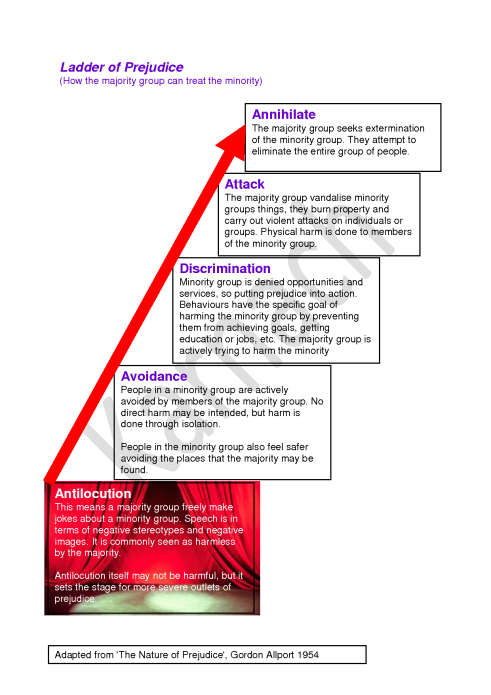
As Gordon Allport highlighted, political othering leads to increasing prejudice, exclusion, social division, discrimination, hatred and if this process is left to unfold, it escalates to hate crime, violence and ultimately, to genocide.

Othering and outgrouping are politically weaponised and strategic inhumanities designed to misdirect and convince populations suffering the consequences of intentionally targeted austerity, deteriorating standards of living and economic instability – all of  which arose because of the actions of a ruling financial class – that the “real enemy is “out there”, that there is an “us” that must be protected from “them.”

In the UK, democracy more generally is very clearly being deliberately and steadily eroded. And worse, much of the public has disengaged from participatory democratic processes.

It’s time to be very worried.

Allport's ladder

Further reading

“We must keep alert, so that the sense of these words will not be forgotten again. Ur-Fascism is still around us, sometimes in plainclothes. It would be so much easier, for us, if there appeared on the world scene somebody saying, “I want to reopen Auschwitz, I want the Black Shirts to parade again in the Italian squares.” Life is not that simple. Ur-Fascism can come back under the most innocent of disguises. Our duty is to uncover it and to point our finger at any of its new instances—every day, in every part of the world. Franklin Roosevelt’s words of November 4, 1938, are worth recalling: “I venture the challenging statement that if American democracy ceases to move forward as a living force, seeking day and night by peaceful means to better the lot of our citizens, fascism will grow in strength in our land.” Freedom and liberation are an unending task.” Umberto Eco, in Ur-Fascism


Politics and Insight’s independent, measured, authoritative reporting has never been so vital, or in the public interest. These are turbulent, decade-defining times. Whatever lies ahead for us all, I will be with you – investigating, disentangling, analysing and scrutinising, as I have done for the last 9 years. 

More people, like you, are reading and supporting independent, investigative and in particular, public interest journalism, than ever before.

I don’t make any money from my research and writing, and want to ensure my work remains accessible to all.

I have engaged with the most critical issues of our time – the often devastating impact of almost a decade of Conservative policies, widespread inequality to the influence of big tech on our lives. At a time when factual information is a necessity, I believe that each of us, around the world, deserves access to accurate reporting with integrity and the norms of democracy at its heart. 

My editorial independence means I set my own agenda and present my own research and analyisis.  My work is absolutely free from commercial and political interference and not influenced one iota by billionaire media barons.  I have worked hard to give a voice to those less heard, I have explored where others turn away, and always rigorously challenge those in power.

This morning I came across this on Twitter:

John Mann@LordJohnMann

I can this morning announce that as government advisor on antisemitism that I will be instigating an investigation this January into the role of the Canary and other websites in the growth of antisemitism in the United Kingdom. https://twitter.com/supergutman/status/1205296902301990912 

Marlon Solomon@supergutman

Who’d have guessed that Mendoza – one of the people most responsible for toxifying the British left with racially charged conspiracy theories about Jews – would blame a Jew before anyone else.

Whoever takes control of Labour, from whatever faction, please fuck these people off.

View image on Twitter
3,147 people are talking about this

Independent journalists are now facing a threat from an authoritarian government, who have successfully managed to distort our mainstream media.

I did expect this promise of a purge on left leaning sites if Boris Johnson was returned to office, but not quite so soon after the event. It’s a case of vote Tory on Thursday, get fascism by Saturday. 

John Mann isn’t by a long stretch the only so-called moderate ex-Labour neoliberal  extremist whipping up McCarthyist hysteria and hate. But he has been strategically placed for a while by the Conservatives to destroy independent sites like mine. He’s a particularly nasty individual.

My first step to fight back in the coming year is to join the National Union of Journalists (NUJ). It is an essential protection, now.

It’s not cheap, especially for someone like me, as I’ve no income from my work. I pay WordPress to keep adverts off my site, too. But I am one of those people who often has to make daily choices about whether to eat or keep warm. I am disabled because of an illness called lupus. Like many others in similar circumstances, I am now living in fear for our future under a government that has already systematically and gravely violated the human rights of disabled people, which has resulted in fear, suffering, harm and all too often, premature death.

I hope you will consider supporting me today, or whenever you can. As independent writers, we will all need your support to keep delivering quality research and journalism that’s open and independent.

Every reader contribution, however big or small, is so valuable and helps keep me going. 

DonatenowButton

Nihilism isn’t cool, trendy or the path to Nirvana: it’s a lazy abstention from all that matters.

1209102_539900659412800_1664499134_n

nihilismˈ noun 1. the rejection of all political, religious and moral principles, often in the belief that life is meaningless. “Insistence that man is a futile being”. synonyms: negativity, cynicism, pessimism; rejection, repudiation, renunciation, denial, abnegation; disbelief, non-belief, unbelief, scepticism, lack of conviction, absence of moral values, agnosticism, atheism, non-theism.
NO PRINCIPLES.

The road to nowhere, dissolution. In short, it’s the absence of belief in anything meaningful, positive, celebratory or decent. No acknowledgement of our remarkable potential as human beings. No faith in anything – it’s grubby, and leaves you groundless, rootless, unprincipled and in a no-place, with no escape.

Russell Brand is a “trendy” nihilist. However, this is not simply another article about Brand, but rather, I want to use this as an opportunity for discussing critical thinking. Brand is as good a case as any to use to explore this and propaganda techniques.

My friend, Charles Britton, commented on an article I wrote about the Russell Brand interview with Jeremy Paxman, and it’s a brilliant comment, because it shows a step-by-step process of critical thinking and analysis that exposes something that many seem to have have missed: an absence. A void. Brand used a lot of words that say nothing at all. Here is the comment:

“When I saw the argument between Russell Brand and Paxman, there were things he said that were clever, and which I liked and there seemed to be a real passion. Apart from the not voting, I thought, I couldn’t agree with that. And apart from the revolution idea because a) they are bloody, b) you don’t know who’ll you’ll end up with in charge (you may even lose the vote), and c) we do have the vote. If there were enough of a groundswell of anger about how we are being treated to spark a revolution, then it would show in how people voted (and how we campaigned). We’d vote out the bastards without needing a revolution! 

(I’m fairly certain that if people can’t be bothered voting, they won’t be bringing on a full-blown revolution any time soon either. Anyone out there got one booked? Please do pencil me in.)

“I still liked some other things he said. Apart from the implication that the parties are all the same. That’s the kind of thing you hear from most of the ”cutting-edge” (aggressive and politically ignorant) stand-ups on TV panel shows and celebs guesting on Question Time. Sadly, this blanket cynicism tends to win-over the politically illiterate of the crowd. Eventually I realised that there wasn’t really anything much in his statements apart from a certain  confident, [apparently] eloquent style. I’m left confused by this, wondering why his Newsnight interview was so “sensational”!


I have also pondered why Brand has such undeserved attention at the moment, and why some seem to think he had something to say, I clearly missed something, so I studied his interview with Paxman carefully. One thing that really struck me is that Brand completely failed to recognise and acknowledge that life wasn’t the same under the last government.

We didn’t have austerity, there were not thousands of sick and disabled people dying, and there was no substantial increase of absolute poverty and wealth inequalities under the Labour government, because of their policies, but these things are happening now.

Labour created human rights and equality policies, and the Tories are steadily unravelling those. Only the wealthy, and indifferent nihilists can afford imperviousness regarding the fundamental contrasts of Labour and Conservative governments. Brand’s self-serving claim that “they are all the same” only echoes what many of the most demigogic, disruptive, aggressive and very divisive individuals, have been using to misinform anyone who will listen. Brand is a multimillionaire who is likely invested in maintaining the status quo. A look at the differences in policies shows clearly that there are fundamental differences between the Conservatives and Labour. (For example, see here: Political Parties – NOT all as bad as each other).

So why would Brand or anyone else, for that matter, offer such a defeatist and dangerous idea up – that voting is futile – especially when the consequence is likely to be further divisions amongst those on the left, whilst the right-wing supporters, who ALWAYS vote, will simply ensure we have another Tory government in office in 2015?

How will that help the situation Brand outlined and criticised? And why is it ever okay to advocate no action? How about encouraging people to take some responsibility for how things are, and to work together to change things for the better?

I’ve written elsewhere about Brand’s narcissism and a fundamental lack of concern for others. As empathy, emotional sustenance and support, solidarity, loyalty, and a sense of belonging all become relics of a fast receding past due to the policies of the Tory-led Government, which act upon citizens as if they were objects, rather than serving them, as human subjects, the mass victims of anomic trauma put up as primitive, last resort narcissistic defences.

These, in turn, only exacerbate the very traumatic conditions, social dislocations, and experiences that necessitated their deployment in the first place. But our ability to organise, self-assemble, and act in co-operation and unison is in jeopardy, as is our future as a society, yet Brand advocated no action.

But some people promote themselves, making a lot of money from “criticising” the status quo, and Brand isn’t alone in being privately invested in how things are whilst publicly claiming otherwise.

Brand used recognisble propaganda techniques in his interview with Paxman, that signpost people to a variety of typified meanings, without actually meaningfully exploring any of them, using superficial Buzzwords (and phrases,) and Glittering Generalities.

The narrative isn’t coherent and meaningful, has no real depth, but what Brand does very well is implies – “signposts” you – via common stock phrases, creating the impression he understands and sees the world as you do. He creates a faux sense of rapport by doing so. But if you look elsewhere, the clues about Brand are there, in his books, articles and other interviews. It soon becomes clear that he does not connect with people, he doesn’t seem to relate. He generally seems to see others as a means to his own ends, and tends to exploit them. Those that have a joke at the expense of others have little empathy, and tend to be unsurprisingly exploitative and cruel.

That’s all Brand does, and even in the interview with Paxman, when he was asked something he couldn’t answer, he resorted to talking the piss out of Paxman.

It’s worth bearing in mind that when someone speaks or writes, they are trying to convince you of something. Ask yourself what it is that they want you to believe, then analyse their basic proposition carefully. Examine what they are saying, look for consistency, coherence, reasoning and logic, and look for the evidence to support the proposition.

Analyse what he actually said – there is NO proposition there at all, he used a lot of words to say nothing – it really is a cul-de-sac. Buzzwords and phrases are a propaganda technique to shape people’s perception, and persuade them that you “know” about their lives, situation and that you have insight.

Management jargon is an example – the familiarity of the words and phrases lulls you and fools you into feeling some important recognition has been made.

Here are some of the buzzwords and phrases Brand used to get your attention, gain your credibility, admiration, create a false sense of rapport; people, power, hierarchical, paradigm, serves a few people, humanity, alternate, alternate political systems, destroy the planet, economic disparity, needs of the people, treachery, deceit, political class, disenfranchised, disillusioned, despondent, underclass, represented, social conditions, undeserved underclass, impact, but that’s all just semantics really, political or corporate elites, serve the population, currently, public dissatisfaction.

We have all used these words and phrases, but we have put them together in structured and meaningful comments, with an aim. Brand didn’t do that.

Glittering Generalities is a propaganda technique, arises very often in politics and political propaganda. Glittering generalities are words that have different positive meaning for individual subjects, but are linked to highly valued concepts.

When these words are used, they demand approval without thinking, simply because such an important concept is involved. Brand made use of these Glittering Generalities; socialist, egalitarian, massive redistribution of wealth, heavy taxation of corporations, massive responsibility for energy companies, environment, profit is a filthy word, global utopian system, genuine option (amongst several others).

The whole dialogue is a propaganda vehicle that aims to deliver one message: there’s no point voting. Go back to sleep. There are identifiable dark fifth column ideologies of nihilism and conspiracy theories which have steadily gained popularity among some of the far-left here in the UK. Que sera sera. Idealism often morphs into cynicism.

These  ideologies reflect anti-values of defeatism, hopelessness, rejection of democracy, and organised government. What a deadly sedative – a very poisonous narcotic for a nation that desperately needs to rekindle respect for human rights, equality, and shared societal values of co-operation, compassion, hope, mutual support and community.

Nihilism is so dangerous because it is a glib, superficial and reactionary response that fundamentally attacks the very worth of humanity itself – because it’s based on the view that nothing really matters, everything is meaningless, nothing and no-one has any real worth, value or meaning.

Nihilism is a spiralling vortex of wretched and miserable relativism. It leaves people groundless and rootless. Que sera sera.

But we have a responsibility to take an interest in our lives, and the plight of others, regardless of our view of “human nature”.

The is /ought distinction highlights that there’s a fundamental difference between descriptive and prescriptive statements. As conscious beings with at least a degree of free-will, we can hoist our selves out of apathy by learning from consequences, by our empathy and concern for others, by our good will and by our conscious intent.

We are not cultural dupes – determined by social structure, or by our biology, sure, we are influenced by these, and a little constrained by them, but we are also capable of transcending these constraints – we are so much greater than that, or at least we have the potential to be so.

Conservatives don’t value such human potential: they tend formulate policy to squash it, curtail it, they stand against the tide of social evolution. Regressive ideology, authoritarian principles.

There is a tangible link with nihilism, and the egocentricity of psychopathy. First of all, psychopaths may be regarded as moral nihilists. Secondly, psychopaths like an apathetic, disengaged and anomic society, where citizens lack conviction, and there’s an absence or erosion of moral values.

Psychopaths regard the rest of us as being defective, and seek relentlessly to remake the world in their own image, to proselytize their viewpoint and  to “teach” their “defective” empathic fellows to think like them. Unfortunately, they can. People can become psychopathic, they can numb down their sensitivity to others. But a psychopath can never learn to think like an empathic person.

People with a normal capacity for empathy can turn off that capacity and think like psychopaths. Language is a powerful thing, and normal human beings respond to linguistic cues to switch to “psychopathy mode”.

The ancient Greeks and the Founders of our country understood the devastating destructiveness of the language of stigmatising, demonising and othering, particularly to democracies. They called the charismatic psychopaths who excelled at its practice “demagogues.” More recently, neuroscience has provided evidence that such demonising, dehumanising and hate radically alters the way the human brain processes information, making subjects immune to reason, increasingly intolerant, and very easily manipulated.

Divide and conquer is the age old defence of elites. Diversion. I am sure there is a link between nihilism, psychopathy and Conservative ideology. Extensive research has found significant correlations between key antisocial personality traits and  Conservative views. Specifically, the research claims to find elements of narcissism, psychopathy and Machiavellianism in Conservative subjects.

The Tory mantra: “there is no such thing as Society” leaks a significant clue about principle elements of core Conservative beliefs. The Conservative ideological justification for the destruction of the social unit, promotion of competitive individualism and “survival of the fittest” principles, the shrinking of the State and deliberately manipulated destruction of public belief in government overall is psychopathic.

It’s all about isolating people, breaking up networks and destroying co-operation and community. And of course such unifying and community-building ideas are the very foundations of socialist values and principles.

By focusing on competitive individualism as the primary method of improving the economy and society, Conservatism is an inherently misanthropic ideology; as all motives are seen through pure self-interest, cynicism in human nature becomes the norm. If people exist to simply get what they can for themselves, the motivation for sociability and co-operation decreases.

We become insular, fragmented and isolated. The characteristic of the psychopathic value system is its somewhat Manichean world view  – idealised me versus demonised him, idealised us  versus demonised them, reflecting the echo-other world view of the pathological narcissist or psychopath. The Tories deliberately create anxiety about others, divide social groups, reduce social cohesion, and create folk devils to bear the brunt of the blame for consequences of Tory policies.

It’s by no coincidence at all that those folk devils also bear the brunt of inhumane Tory policies, too. The Labour government didn’t get everything right for everyone, but Labour have never persecuted social groups like the Tories have, or wilfully destroyed state support for the most vulnerable citizens.

If we don’t vote, then that leaves the Tory supporters, who will simply vote the Tory authoritarians back into Office, and guess what? That doesn’t affect Brand at all. Well, except for the standard £107, 000 that all millionaires get under this Government, each, per year, in the form of a tax break.

We can politically engage, campaign, lobby politicians, and take some responsibility, rather than shrugging, disengaging, and ensuring that nothing will change. Authoritarian governments require a passive, disengaged public to emerge and to maintain their power. We have a duty to challenge and to push back – to demand positive changes and shape a society that supports those that cannot support themselves, that’s the mark of a civilised society. We simply have to fight our way back to decency.

We have to reclaim the progress we once made in an evolved human rights orientated culture. The Tories have undone many decades of hard work and struggle to establish those rights. We have to act, and we must vote. Vote Labour.

scroll2
This is also worth reading: “They are not all the same.” ‘They’re all the same’ is what reactionaries love to hear. It leaves the status quo serenely untroubled, it cedes the floor to the easy answers of Ukip and the Daily Mail. No, if you want to be a nuisance to the people whom you most detest in public life, vote. And vote Labour.”  Robert Webb

– http://www.newstatesman.com/politics/2013/10/robert-webb-re-joins-labour-protest-russell-brand

226786_150917841725939_960158327_n

Thanks to Robert Livingstone for his brilliant artwork

Apathy and the alchemical dissolution: bring on the dancing horses

1377534_553061751430024_867769246_n

Hating all the faking
And shaking while I’m breaking

Your brittle heart…

Bring on the new messiah
Wherever he may roam”.  Echo and the Bunnymen

I suffer from the frequent recognition that we are strangers living in a world that is flawed and absurd. Alas, pneumatikoi, to be tragically informed that we are also trapped here in the dark, because of a flawed design, with a duty and hope to nurture a single spark of divine light, so impossibly placed.

I write from hospital, listening to my personal stereo, and here I have a lot of time to think, even when I don’t, I still do. It’s a long-standing habit.

Meanwhile, Russell Brand has a few “revelations”, too, whilst stood on the surface of things. He’s getting down to the nitty gritty, isn’t he?

3F067639-DF74-3CDA-E97B9C3FB5664AD8-352293

Brand’s “controversial” self-publicity antics – getting arrested and charged with criminal damage and indecent exposure back in 2001.

I said “dancing horses” Russell, not “prancing arses”.

Mr Brand is a stereotype, not an archetype, although the Trickster momentarily crossed my mind, but no, he’s not as significant as that. Stereotype characters can easily be interchanged from one context (or story) to another without any major impact on the plot. Stereotypes tend to be characters that have little depth or originality, they are like wooden puppets that can move around and be readily utilised.

Brand is such a stereotypical publicity harlot and narcissist. It’s really no coincidence that his new stand-up show is called “The Messiah Complex”, I mean, Jesus, what ARE the media feeding us.

That Echo and the Bunnymen song has always conjured up some identifiable themes of alchemy (to me, anyway), and the true power of alchemy is that it generally remains covert and misunderstood. The general aim is that we are raised and purified to a state of perfect intuitive apprehension of spiritual truths – a direct gnosis of reality: “All obscurity will be clear to you”. That doesn’t mean you clarifying your own intellectual obscurity, by the way, Russell.

The goal of alchemy is to make this golden moment permanent in a state of consciousness called the Philosopher’s Stone. Ostensibly concerned with turning base metals into gold, alchemy was actually dedicated to transmuting the “lead” of self-hood into the “gold” of spirit: it’s about personal transformation. Not personal commodification, Russell.

A great Hindu sage wrote about the spiritual accomplishment of gnosis using the metaphor of the philosophers’ stone. Jnaneshwar the saint (1275–1296), wrote a commentary with seventeen references to the philosophers’ stone that explicitly transmutes base metal into gold.

The seventh century Indian sage Thirumoolar, in the classic text Tirumandhiram explains humanitys’ path to immortal divinity. In verse 2709 he declares that the name of God, Shiva, is an alchemical vehicle that turns the body into immortal gold. Not leather and big hair, Russell.

On a global level, dissolution – the second of seven stages of alchemy – is symbolised by the (archetypal) Great Flood, the cleansing of the earth of all that is inferior. The Dancing Horses may be seen as the four horses of the apocalypse. The Sanskrit Yuga Cycle doctrine tells us that we are now living in the Kali Yuga; the age of darkness, when moral virtue, spiritual capacities and mental capabilities reach their lowest point in the cycle. Well, you had to get something right, I suppose, Russell.

The Indian epic The Mahabharata  describes the Kali Yuga as the period when the “World Soul” is black in hue; only one quarter of virtue remains, which slowly dwindles to zero at the end of the Kali Yuga (some say in 2025). Men turn to wickedness; disease, lethargy, anger, natural calamities, anguish and fear of scarcity dominate our existence. Penance, sacrifices and religious observances fall into disuse. All creatures degenerate. Change passes over all things, without exception. The Kali Yuga (Iron Age) was preceded by three other Yugas: Satya or Krita Yuga (Golden Age), Treta Yuga (Silver Age) and the Dwapara Yuga (Bronze Age). There isn’t a tin god age to be seen, Russell.

Sri Krishna foretold that Kali Yuga will be full of extreme hardships for people with ideals, wisdom and values. I wonder if that also means it will be a breeze for shallow, pretentious hypocrites and fools? Looks like it.

In the song (and please forgive my overly hermeneutic tendencies here), there is reference to the many lies surrounding us, and a description of why we become broken in spirit. Well, it was written during the Thatcher era. At one time we may have believed these lies to be true, but at the end of an age, all things change. Perhaps we may call it end-stage conservatism, it was always going to be terminal. But we do have a choice here in the outcome, and we can vote them out – making it terminal for them, and not us. In fact we really MUST.

All of those lies are brought out into the open for everyone to see. This may bring about a sense of hopelessness and apathy within us. The gravest danger is that our faith is completely smashed, the order of things decays, the world falls down, yet the grand stage is set to build up an entirely new world. Many don’t seem to mind either way because they no longer know what to believe in. Trapped in a state of cognitive dissonance. So they fall asleep to escape the pain. But that is an act of cowardice that leaves others to face the onslaught increasingly alone. We must face this as a society, and we must organise and act together.

Meanwhile, apparently we stand in anticipation to hear the gospels of a new messiah.

But seriously, folks, Russell Brand??

Gosh, and we all assumed everything was fine and dandy until dandy Russell stuck his narcissistically-fashioned oar in. It’s good to know that when asked to edit an issue of the New Statesman,  Randy Brandy Wandy, who usually writes booky wooks, said:  I said yes because it was a beautiful woman asking me.

How about that, Mr Brand is such a political creature, and in no way a part of the patriarchal establishment when he can muster such un-sexist responses off the top of his head. I’m convinced that his rampant sexism was just a blip, really, I am.

Here’s an extract from the Booky wook:

I love poor people … they know where the drugs are.

I stayed in touch with James after the show and used with him quite a lot. We only fell out after I gave him £100 to get me some heroin and he fucked off and didn’t come back.

It’s obviously difficult to have a genuine friendship when one of you is on the telly and the other is a tramp: “He’s a homeless person and I’m a glamorous TV presenter – we’re the original odd couple!” Still, the fact that I had a drug problem meant that wherever I went in the world, from Havana to Ibiza to the mean streets of the Edinburgh Festival, I always had to seek out the poor and the dispossessed, as they are the people who generally know where the drugs are.

Brand clearly regards poor people as a means to his own exploitative, narcissistic ends, and there is not one ounce of compassion, empathy or sign of a genuine personal connection with any of the people he describes with such cold detachment in his writing, and even worse, he forces these reduced and superficial characterisations to perform obscene stand-up comedy. He parodies their misfortune. I was half-expecting to read “a homeless person is someone you step over coming out of the club”.

If his infamous conservative patriarchal inclinations haven’t convinced you that Brand is a screaming Tory with big hair, then surely his tendency towards exploiting the poor, having them run his drug errands, using them as reduced fictional devices to promote himself does.

He talks about himself in the New statesman article with free-ranging grandiosity, and from such a small confinement, although he chucks in an occasional observation that many of us have already made from the sharp-end – that’s the frontline, and not a fix before the pub, Russell –  he goes on to elaborate a shabby, nihilistic view that leads us to the almost predicable cul-de-sac comment: I don’t vote because to me it seems like a tacit act of compliance. My word, what a radical chap.

Right ho, Russy Wussy, my darlink, because not voting is going to achieve what precisely? You big ole revolutionary, you.

Ah. Tory supporters always vote, don’t they? So, what do we get with the Brand plan of action none action? Oh, more of the same utter battering we are currently getting, ultimately, a never-ending Cameron yuga. It’s the end of the world, as we know it, but Brand feels fine, so he wants us to do nothing. And that is the real act of compliance.

Well done Brand, champion of the status quo, he doesn’t give a flying one because, well, he’s a multimillionaire. He isn’t going to starve or become homeless any time soon, so he does NOTHING but spout meaningless regurgitated Tory-shaped pap from the pre-pubescent, tacky camp of scwweamy weamy, preening and very superficial, bouffant, leather-trousered faux-angst. Brand is a comedian (allegedly), not a politician or a social commentator.

And isn’t he dating Jemima Khan (nee Goldsmith)? Jemima’s father was Sir James Michael “Jimmy” Goldsmith, a billionaire financier and tycoon. Jemima has two brothers; Zac Goldsmith, a Tory MP who is married to Alice Rothschild, and her half-brother owns a little £1,500-a-year membership nightspot in London’s Mayfair – where various members of the royal family are regulars. You know, for a guy claiming to deplore the establishment, Brand sure likes to hang out with the wrong sort. An anti-establishment establishmentarian, if you would. He has the multi-faceted, remarkable intricacies and complexities of a stifled yawn.

If those who advocate a no vote or a spoiled ballot paper heard the archive interviews with women from the imprisoned suffrage campaign hunger strikers describing how they were pinned down and force-fed, with nasal tubes brutally forced all the way down into their stomachs, perhaps they would feel shame enough to change their mind. Or perhaps they ought to read about the Peterloo Massacre. They suffered so that we may have the right to vote. Use it.

Most people who read this already feel the crisis facing us, many of us have spoken about it in depth, for some time. We know already about the profit-driven corporations that are raking in vulgar levels of profit and contributing to impoverishing and killing people, and to the destruction of the planet, there is nothing we didn’t know there. And many have articulated and analysed in depth, and with depth. Campaigners with integrity, who care about what is happening under this authoritarian nightmare, many directly affected themselves, yet some shallow publicity whore comes along, and suddenly he’s the guru of the moment. Meanwhile, those who have worked hard to publicise the information are forgotten by a public that prefers style (well, allegedly) over content every time. Brand the celeb gets on the telly after all, he must be important (sorry, typo there: I meant “impotent”). I mean Jesus, just what is the media feeding us?

Authoritarian governments depend upon an apathetic, disengaged public, to emerge and to remain in power. If not voting worked, we wouldn’t be facing the crisis that we are now because of this opportunistic regime that are currently running this country and its people into the ground. And they are doing everything they can to continue to do so. That includes employing celebrity propaganda spokespersons. (See Jamie Oliver.) But we have to change the cycle, and the only way to do that is by gnosis, by taking responsibility for informing ourselves, our knowledge, political participation and actions.

Russell Brand isn’t waking people up – he is lulling them back to sleep.

Without our constructive acts of engagement through organised and intensive, grassroots campaigning, lobbying and dialogue with key political figures we will remain ignored and nothing will change, the never-ending kali yuga of the Tories, with no social progress, ever again. Only further descent and dissolution.

It is precisely this nihilistic and reactionary disengagement from political process, which is what Brand is advocating, that allows powerful corporate lobbies to corrosively influence our democratic process, and enables proto-fascist parties like UKIP to increasingly shape political discourse, it’s a condoning of apathy – and of course, apathy fuels more apathy.

What really concerns me is that there are many people under the impression that not voting, or spoiling their ballot paper will somehow shame the Tories into decent behaviour, and force the Labour Party to do their precise bidding, personally tailoring policies to suit just them, because that happened the last time a lot of people didn’t vote, and the time before, they sure got a “clear message” then, and were SO bothered by that, weren’t they? Meanwhile Tory sponsors, donors and supporters won’t ever allow THEIR votes to be split, spoiled or wasted, you can bet on that.

The Tories don’t give a f*ck if you are apathetic, feel alienated, don’t vote, spoil your ballot paper, feel disenfranchised, or want to protest, they just simply want to rule you, pillage your country, continue to exploit you and take your money. In fact, by not voting or spoiling your ballot paper, you may as well hand Cameron your vote, and everything else you have, too.

And far too many people are prepared to allow that to happen, one way or another. Again.

Brand is not waking people up, he is lulling them back to sleep. He’s a pro-Tory fop and irresponsible pseudochristos, without conscience or grace.

One thing is for sure, five more years of the Tories and it really will be the end of the world as we knew it. Cameron yuga.

1380472_552739704795562_483105758_n


 Thanks to Robert Livingstone for his excellent, spot on memes


Related posts: How to deal with an Atos mole and cunningly fake, complex Messiahs.

This article started life in the comments I made, in anger, here


The moral nihilism of the Coalition

tumblr_m81dzafFA21qcekj1o1_500
Poster and slogan from Terry Gilliam’s dystopic film “Brazil”. David Cameron evidently has a strong sense of taunting irony.

Narratives of “welfare dependency” have once again become much more common place and increasingly assertive under the coalition Government – embedded in narratives driven by the the so-called Skivers and Strivers dichotomy. Poverty, according to this distinctly Tory perspective, is caused by a culture of deviance, idleness and dependency. The poor are responsible for their poverty. They cannot be trusted to be responsible, or make the right choices for themselves – or society more generally – and so are in need of paternalistic guidelines and cognitive behaviour therapy. Poverty is being re-responsiblised.

But the rich are not getting richer whilst the poor get poorer: the rich are getting richer because the poor getting poorer. There’s a chasmic conflict of interest between the rich persons’ selfish, individual goals and collective societal values.

A simple truth is that poverty happens because some people are very, very rich. That happens ultimately because of Government policies that create, sustain and extend inequalities. The very wealthy are becoming wealthier, the poor are becoming poorer. This is a consequence of vulture capitalism, designed by the sheer opportunism and pathological greed of a few, it is instituted, facilitated and directed by the Tory-led Coalition.  

Welfare provision was paid for by the public, via tax and NI contributions. It is not a handout. It is not the Governments money to cut. That is our provision, paid for by us to support us if and when we need it. It’s the same with the National Health Service. These public services and provisions do not and never did belong to the Government to sell off, exploit to make a profit from, to strip bare, as they have done

For the Tories, the competitive pursuit of economic gain is the only freedom worth having. And only those that have gained substantially have freedoms worth having. Let’s not lose sight of the fact that this social Darwinist approach to socio-economics means unbridled private business, insidious systematic indoctrination, gross exploitation of the masses and political extortion.

Public understanding is being purposefully distorted and the reality of society’s organisation is concealed to serve the interests of an elite, through a process of ideological hegemony – whereby existing political arrangements, ways of thinking and social organisation are tacitly accepted as logical and “common sense”. The media serve as ideological state apparatus that transmit this “common sense”. The truth is that poor people are the victims of politically manufactured  inequality and crass exploitation. Our once progressive, civilised society is being savagely dismantled, and the Tories are steadily and clumsily re-assembling it using identikit Victoriana.

The truth is that David Cameron has deliberately and spitefully targeted the poorest and most vulnerable to bear the brunt of the austerity cuts. When we actually look at the relative targeting of the Tory-led cuts of different social groups, then we see that:

  • People in poverty are targeted 5 times more than most citizens
  • Disabled people are targeted 9 times more than most citizens
  • People needing social care are targeted 19 times more than most citizens.From: A Fair Society? How the cuts target disabled people 

This is a Government that deliberately creates insecurity and scarcity for many: income, employment opportunities, affordable housing, education opportunities, access to justice, health, energy, for example, whilst private companies make lots of money from these deliberately engineered circumstances, such as by using workfare to boost their profits from the use of free labour (at the expense of the tax payer).

The Governments’ economic decisions, policies and driving, incoherent ideology has created high unemployment and underemployment, job instability, they’ve devalued the worth of labour, excluded those who are vulnerable from the labour market by withdrawing support from them, and then has the vindictive gall to savagely blame the victims of its own crimes, for those crimes, conducting media character assassinations of the poorest, the weakest, demeaning people via the media, stripping them of their dignity and LYING about them.

Our economy is being tailored by the Tories to serve 1% of the population and this has a detrimental effect on everyone else. The Government has removed support and services for the people who need them most, whilst insisting that they must work. To regard the poorest and most vulnerable members of our society as less valuable, and to constantly attack them via the media is quite frankly disgusting conduct for a Government and those that support these despicable and hideous political narratives and policy actions. Such narratives say everything about the authors, and have nothing meaningful at all to say about those left in the situations that this Government have manufactured via policies: those situations which none of them have ever had to experience or face personally.

When they diminish others, they diminish us ALL.

No-one seems to have challenged the idea that working to make someone else very wealthy is somehow virtuous, either. By implication, those that cannot work are regarded as lesser citizens, and that has become tacitly accepted. We have, once again, a Government that makes labouring compulsory, regardless of a persons capability, yet the same Government has devalued labour in terms of wages, rewards, and working conditions, whilst handing out huge amounts of our money to those exploiting the poor unemployed, the sick and disabled. And Tories are always about vicious and divisive rhetoric. Growing social inequality generates a political necessity for prejudices.

Most people who don’t work have no choice about it due to circumstances, such as poor health, disability, caring responsibilities, parenting responsibilities and a lack of reliable, affordable childcare, being frail and elderly. These are reasons that are completely out of a persons control. People forget that ill health doesn’t discriminate: it can happen to anyone. And so can unemployment. No-one is invulnerable, except for the very wealthy: the ones that won’t ever need any state support.

Let’s hear some mention of facts in the media, instead of the usual Tory mouth pieces sanctimoniously preaching at people, “advising” how to manage their loss of lifeline support better, whilst endorsing the sadism of this Government. Let’s hear a loud and civilised call for the halt to the current program of cruel cuts, which are disproportionately targeted at those with the very least, whilst this Government rewards those with the very most with massive tax handouts. Let’s hear the demand for decency, and a new and fair welfare system that is built on a fundamental recognition of the equal worth of all human beings and the guarantee of human rights for all.

It’s time we stood up as a nation on our hind legs.

538861_380839531985581_164896303_n                   Thanks to Robert Livingstone for his brilliant art work.

This was originally written as a part of a longer piece of work: The right-wing moral hobby horse: thrift and self-help, but only for the poor.

The right-wing moral hobby horse: thrift and self-help, but only for the poor.

1002589_521987671204099_896277269_n (1)
What is it with this seemingly never ending queue of very wealthy people and celebrities, without a shred of shame, self-awareness or knowledge of socio-economics, that they nonetheless feel it’s quite okay “
to have dispensed with generosity in order to practice ‘charity'”, to pinch a phrase from Albert Camus.

Jamie Oliver claimed that he couldn’t quite grasp poverty in the UK, where people made choices between “massive TVs” and nutritious food. I can’t help wondering how many poor people Oliver has taken the time and trouble to visit, but I concluded he prefers to deal in hand-me-down, shabby clichés rather than homespun truths. More recently, Michael Gove suggested that the rise in people accessing food banks was a result of poor financial management, rather than it being due to “genuine need” because of  a massive hike in the cost of living and subsequent plummeting living standards, rising unemployment, low wages, savage benefit cuts, and brutal, targeted benefit sanctions.

The very wealthy Lord Freud claimed that families using food banks were simply looking for “free meals”, and this was not “causally connected” to increased poverty due to austerity cuts. Conservative Environment Minister Richard Ponsonby – and hereditary peer – the 7th Baron De Mauley – has advised the poor to reconsider their buying habits and resist the temptation to spend more money on the latest electronic gadgets, clothes and “food that they will not eat” in efforts to recapture the war-time spirit of “make, do and mend”.

So, the poor are being handed cognitive behaviour strategies and instructions from the wealthy, dressed up as common sense, with the emphasis being on self-management – there is an implicit assumption here that poor people require a psychotherapeutic approach to material hardship that is usually reserved for addressing dysfunctional emotions, maladaptive behaviours and cognitive processes. The solution to poverty, according to these socially inept rich people is behaviour modification for the poor, and not coincidently, the philosophical origins of cognitive therapy can be traced back to the Stoic philosophers. The subtext of this raft of advice for the alienated poor from the aloof wealthy is: endure your pain and penury without a display of feelings and without complaint. Because we really don’t want to hear about it.

However, a central theme in Stoicism is that humans possess a unique capacity to be rational and self-autonomous and this remains a powerful defence of democracy, equality and human rights. The Stoics directed us to think clearly and rationally about the idea of living in harmony with the way the universe is, but they didn’t say anything about accepting social inequalities as a fundamental part of that universe or conflating what is with what ought to be.

The idea of stoic “self-help” is a useful reference point in any discussion of Victorian culture and values. As a moral crusader and proponent of that idea, Samuel Smiles has become something of right wing icon: any mention of him is commonly taken to imply a well-known and easily identified set of values.

In Thrift, which was published in 1875, Samuel Smiles declared: “riches do not constitute any claim to distinction. It is only the vulgar who admire riches as riches”.

I think it’s the rich that admire riches as riches. And being poor is a dismal experience. Regarding those that have all of the wealth as vulgar offers no comfort at all from material hardship, hunger and destitution.

Smiles was a very popular Victoria moralist. He claimed that the Poor Law Amendment Act 1834, which punished the poor in order to cure them of their poverty habits, was “one of the most valuable that has been placed on the statute-book in modern times”. In Self-Help, which I read as an apology for Victorian middle class values, he said:

No laws, however stringent, can make the idle industrious, the thriftless provident, or the drunken sober. Such reforms can only be effected by means of individual action, economy and self-denial; by better habits, rather than by greater rights”.

Thrift  and Self-Help were Victorian bibles, and although Smiles was a  critic of many conventional middle class values, what an irony it is that the man who argued in favour of nationalising the railways in 1868, should get sufficiently warped by history to emerge as the champion and much admired historical figure for the Tories during the 1980s. This said, Smiles did have conservative credentials, with his liking for the Poor Law Reform Act, and his intrusive advice to the poor about how to manage poverty their better and with some “character”, whilst practising self-denial.

Smiles basically argued that individuals could and should improve themselves through hard work, thrift, self-discipline, education, and “moral improvement” and should not seek the help of Government. He was Thatcher’s darling and is Cameron’s formative hero.

The idea of distinguishing between different categories of the poor, dividing them up into discrete and manageable groups, is almost as old as the British state. The paternalistic Elizabethan poor laws were originally designed to keep the poor at home –  to stop them from becoming vagrants. However, the insistent Utilitarians of the day decided that a great deal of poverty was not inevitable as a by-product of socio-economic and political conditions, but rather, it was a product of fecklessness. Thomas Malthus, Herbert Spencer and others argued from a social Darwinist perspective, claiming that the Elizabethan poor law encouraged irresponsibly large families, idleness and personal fecklessness.

This was the “responsibilisation” of poverty that resulted in the introduction of the punitive workhouse, as we know – a place where paupers would be incarcerated and forced to labour. At the core of the Poor Law Reform Act was the notion of less eligibility: reducing the number of people entitled to support, so that only those who could not work (rather than those who “would not” work) would receive support.

It’s here that the distinction between the “deserving” and “undeserving” poor became a legal one. Nowadays, savage cuts, sanctions and benefit “conditionality” may be seen as a parallel of the principle of less eligibility. The Poor Law reform also “made work pay”. Those who could not work were deterred from applying for poor law support, as workhouses were made deliberately so unpleasant, often resembling a prison more than a refuge. Many critics of the day condemned them as “the new Bastilles”. As we passed the celebration the 200th anniversary of Charles Dickens, we are witnessing a return of precisely the sort of language about the poor that he did so much to expose as cruel and inhuman.

Narratives of “welfare dependency” have once again become much more common place and increasingly assertive under the coalition Government – embedded in narratives driven by  the the so-called Skivers and Strivers dichotomy. Poverty, according to this distinctly Tory perspective, is caused by a culture of deviance, idleness and dependency. The poor are responsible for their poverty. They cannot be trusted to be responsible, or make the right choices for themselves – or society more generally – and so are in need of “paternalistic guidelines” and cognitive behaviour therapy. Poverty has been “re-responsiblised”.

In The Protestant Ethic and the Spirit of Capitalism, Max Weber argued that Puritan ethics and ideas influenced the development of capitalism. Ideas that work is “virtuous” can be traced back to the Reformation, when even the most humble professions were regarded as adding to the common good and thus blessed by God, as much as any “sacred” calling. A common illustration of the time is that of a cobbler, hunched over his work, who devotes his entire effort to the praise of God.

To explain the work ethicWeber shows that certain branches of Protestantism had supported worldly activities dedicated to deferred gratification and economic gain, seeing them as being endowed with moral and spiritual significance.

This recognition was not a goal in itself, but rather a by-product or unintended consequence of other doctrines of faith that encouraged planning, hard work and self-denial in the pursuit of worldly wealth. For the Tories, the competitive pursuit of economic gain is the only freedom worth having. And only those that have gained substantially have freedoms worth having. Let’s not lose sight of the fact that this social Darwinist approach to socio-economics means unbridled private business, insidious systematic indoctrination, gross exploitation of the masses and political extortion.

1374718_540929452643254_208125039_n (1)
Ayn Rand
,
another Tory idol, who endorsed minarchism and laissez-faire capitalism and gave her full approval to selfishness, used a moral syntax that has been linked with fascism. She advocated rational and ethical egoism and rejected ethical altruism. She was derisory, and wrong because there is a “moral and political obligation of the individual to sacrifice at least some of his/her own interests for the sake of a greater social good.”

The alternative, as Rand would have it, is most people being regimented into a slave caste to serve a handful of self-seeking, power hungry greedy psychopaths. Alas, for it seems we will always have the despotic wealthy with us – a lofty, discrete and detached class of tyrants, loudly dismissing inconvenient truths, and not just about the poor.

The social, economical and psychological distance between those with great amounts of money, power and a voice would span cosmological distances when compared to the poor. A prerequisite to empathy is simply paying attention to a person who is suffering. We always have the opportunity to help the poorest and most vulnerable. But the rich are not getting richer whilst the poor get poorer: the rich are getting richer by the poor getting poorer. There’s a chasmic conflict of interest between the rich persons’ selfish, individual goals and collective societal values.

There is a clear lack of compassionate thought and action amongst the anti-social wealthy elitist Government, and their policies are dogmatic, brutal and tipped heavily towards supporting the powerful, whilst punishing the poor. Homo economicus is a conservative, self-serving and wretched, mythologising miser.

The UN’s 2013 Human Development Report has also noted that the “gap between rich and poor in UK society has risen sharply” since the Coalition government took power. The UN reports that there is greater inequality in the UK than in other countries in Western Europe. It is also noted that the market has not stepped in where institutions have failed: “Markets are very bad at ensuring the provision of public goods, such as security, stability, health and education”, the report reads. I don’t think we ought to be stoically accepting any of this as simply “the way things are”.

Entire lives, human experiences are being reduced to cheap tabloidisms, nasty political soundbites and wildly disgusting, politically convenient stereotypical generalisations that don’t stand up to very much scrutiny. There isn’t an ounce of genuine philanthropy to be had in these sanctimonious tirades, just frank stereotyping, the frequent mention of plasma screen TVs, (something that the bourgeoisie popularised when they rushed out to buy them when they first hit the market: they were dubbed the new wall mounted “4 wheel drives” of the living room, before they became sufficiently cheap for poorer members of society to buy) and a lot of judgement about the perceived lifestyle choices of the poor.

Benefits were calculated to meet only basic survival needs – food, fuel and shelter. If people manage to buy more than that on benefits, then kudos to themfor their budgeting skills. Osborne could learn a lesson or two from these people. But of course the truth is that people move in and out of work, and it would be unreasonable to expect them to dispose of those goods that they bought when they were employed, simply to satisfy an increasingly spiteful, judgemental class, that seems to think that poor people should have nothing at all, living a life of utter misery.

We are told what to buy, what not to buy, how to eat, and how to mend, make do, and go without.

Go without? Isn’t that what poverty is all about? The poor are experts in “going without”, social exclusion and isolation. Nonetheless, the Government have erected a media platform for the idle rich to moralise about what we should and shouldn’t be spending our meagre finances on. Ladies and gentlemen, let me introduce the new lifestyle police. The Government are telling us how we may and may not live our private lives, and how we ought to “manage” our poverty better.

Dogma.

And lies about poverty, its causes, effects and solutions, infects almost everything Iain Duncan Smith says, as he formulates pseudo-moral justifications for the hardship his Government’s own policies are causing. The media propaganda machine oblige him very well with screaming misinformation about the feckless poor. Poverty, he would have us believe, is down to individual faults and personal deficits. Again.

Only a half-wit would believe that in order to “make work pay”, rather than raise the lowest wages, we remove lifeline benefits from the very poorest. Bearing in mind that those benefits were carefully calculated by previous Governments to meet basic costs for survival needs: food, fuel and shelter: “the amount the law says you need to live on”. Apparently, this protective law no longer applies.

The Tories are constantly lowering public expectations and defending the indefensible.

Propaganda.

And if there is one thing that melds Cameron’s sparse, ever shrinking and handouts-for-the-boys highly privatised nightwatchman state brand of victoriaphile conservatism together, it is the belief that poverty is best left to wealthy individuals to remedy, rather than Government. His Big Society  approach to social provision can perhaps best be summed up with the phrase: “you’re on your own, because we took your money and we don’t care”. On your marks … it’s a race to the very bottom.

It has been too easy for the Tory-led Government to sell the concept of welfare “reforms” (cuts)  based on a simple narrative about of “welfare scroungers” getting “something for nothing” whilst the rest of us have to work hard to pay for it, to an apathetic public. This kind of narrative is deliberately designed to stimulate a strong sense of injustice, cause divisions and generate anger. The fact that benefit fraud in reality represents a tiny fraction of the welfare system and that the vast majority of claimants have pre-paid into the system via taxation before becoming unemployed are carefully omitted in order to create the impression that the “scrounger” problem is much worse than it actually is. 0.6% of all claims were deemed to be “fraudulent”, and many of those were actually errors on the part of the Department of Work and Pensions in dealing with legitimate claims.

The real “culture of entitlement” is not to be found amongst the poor, the unemployed, the sick and disabled, as this Government would have you believe. As a matter of fact, most amongst this politically minoritized social group have paid tax and paid for the provision that they ought to be able to rely on when they/we have need of it, it’s oursafter all. The real culture of entitlement comes from the very wealthy, and is well-fed and sustained by our aristocratic and authoritarian Government.

Every time we have periods of high unemployment, growing inequalities, substantial increases in poverty, and loss of protective rights, there is a Conservative Administration behind this wilful destruction of people’s lives, and the unravelling of many years of essential social progress and civilised development that spans more than one century. And that development was fought for and won.

We never see celebrities in the media questioning the fact that we only ever see the rise of the welfare “scrounger” and a “culture of dependency” when we have a Tory Government. And that it also coincides every time with a significant increase in politically manufactured unemployment, a rise in the cost of living, lower working conditions and wages. There’s a connection there somewhere, isn’t there? It seems the likes of Jamie Oliver and Richard Ponsonsby don’t do joined up thinking. And we know from history that the Tories never have.

1381256_10151703147396305_1638953570_n (1)

Public understanding is being purposefully distorted and the reality of society’s organisation is concealed to serve the interests of an elite, through a process of ideological hegemony – whereby existing political arrangements, ways of thinking and social organisation are tacitly accepted as logical and “common sense”. The media serve as ideological state apparatus that transmit this “common sense”. The truth is that poor people are the victims of gross inequality and crass exploitation. Our once progressive, civilised society is being savagely dismantled, and the Tories are steadily and clumsily re-assembling it using identikit Victoriana.

We are seeing a generation of our young people silenced at the margins of society, they are being fed a steady drip of subliminal messages about the worthlessness and steady bastardisation of their labour. Unemployment was statistically eradicated among 16- and 17-year-olds in the 1980s when the Tories changed the law so that school leavers could not claim unemployment benefit. Out of sight and out of mind. This is now being mooted for all young people up to the age of 25.

The Prime Minister began discussion of cutting housing benefits for “feckless” under-25s last year. Consequently, following this Tory “logic”, the UK could soon have the lowest youth unemployment rate in Europe. If we keep moving in that direction we could have a rate as low as the one in India today, or in Britain in the 1800’s, when there was no such thing as unemployment, because we chose back then to call people with no jobs  “paupers”. And people were paupers because they were idle and feckless, and incapable of helping themselves. It’s common sense, right?

No. It’s propaganda.

If we are prepared to even entertain any finger-pointing distraction and discussion about the “undeserving poor”, let us also point back, and balance the debate with a fair, realistic discussion of the “undeserving rich”, too.

It is the very rich that need to manage their personal fortunes better in order to stop  inflicting poverty on thousands. They need to learn how to go without, make do and mend. They need to stop greedily gathering and hoarding our wealth and frittering tax payers money on extravagant, selfish lifestyles. The wealthy need to pay close attention to the steady destruction of our society, the removal of our civilised and protective services – paid for via our taxes – and the subsequent loss of a dignified future for so many.  

I resent the intrusion of hypocritical, greedy rich “moral” crusaders with no scruples whatsoever, or restraint, when it comes to stigmatising the poor, smugly telling poor people they must endure their poverty better, manage their meagre incomes and lack of resources with resilience and resourcefulness that they themselves lack, basically because rich people want to avoid feeling any social responsibility whatsoever. These indignant, self-legitimising, babbling psychopaths want to keep the wealth which was gained at our expense.

The scrounging rich have had it far too good for far too long. It’s about time these idle takers took some responsibility for the society they have taken so much from. I want to hear about how they will repay their much greater debt. I want to hear about their culture of entitlement, and why they  believe that they can have everything whilst increasingly, so many have nothing. And with poverty and inequality on the increase, I want to hear about how the wealthy intend to do something directly to remedy this. Because we know that poverty is caused through a gross inequality in wealth distribution.

Lord Ponsonby is very rich because other people are poor. Yet he and others like him had no problems accepting £107,000 per year via a tax break from this Countries’ treasury, and he irresponsibly endorses a Government who take money from the poor to give handouts to the rich. And tax break from what, exactly? It wasn’t anything to do with social responsibility, that’s for sure.

No-one has the right to preach about responsible behaviour after irresponsibly taking that amount of money from the poor, nor do they have any right to intrude into the private lives of poor people. Lord Freud has got nothing meaningful to say about living in poverty because he doesn’t and never has. Our private lives and personal choices are not public property to be prodded, scrutinised, criticised or discussed by people like him.

The feckless, something-for-nothing rich should be rejecting handouts in the form of tax breaks, and they need to pay their taxes – they need to put something back – contribute to the society from which they have insolently taken so much, not least a hugely disproportionate amount of wealth, leaving so many with nothing.

The last budget saw 25 billion pounds of our money handed out to big private companies already worth millions via a tax cut – that’s FIVE times the amount this Country spends on jobseekers allowance. Job centres no longer support people to find work: the main purpose now is to remove state support from people any way they can. Just like Atos – re-contracted by this government to cut lifeline benefits from the disabled and ill. How is this grotesque imbalance in how rich and poor, vulnerable people are treated by our Government acceptable?

Government minsters and the complicit media discuss the poor, and present articles which vilify the poor and disabled in the same way that serial killers do to objectify their victims. David Cameron has used his own disabled son in an attempt to humanise himself in public, whilst his own policies and ministers’ rhetoric have systematically dehumanised and objectified sick and disabled people in this country. That’s the psychopathic manipulation one would expect to see of a mass murderer, not a prime minister of the UK.

David Cameron has deliberately and spitefully targeted the poorest and most vulnerable to bear the brunt of the austerity cuts. When we actually look at the relative targeting of the Tory-led cuts of different social groups, then we see that:

  • People in poverty are targeted 5 times more than most citizens
  • Disabled people are targeted 9 times more than most citizens
  • People needing social care are targeted 19 times more than most citizens. From: A Fair Society? How the cuts target disabled people

Under the bedroom tax rules, which violate basic human rights, more than 600,000 social tenants with spare rooms must either move or pay an average of £14 a week penalty. However, members of parliament with a spare room in their London homes can claim an additional allowance from the tax payer if a child or children routinely resides with them. The Independent Parliamentary Standards Authority has ruled that MPs will remain eligible for the additional allowance if the child visits just once a month. 29 hypocritical MPs have claimed an additional £64,000 and a further 20 who claimed £37,000, whilst at the same time endorsing and supporting the bedroom tax.

Meanwhile, homelessness  rose 21% in the last year, while rough sleepers (those not eligible for Local Authority support) rose 31% in England and 62% in London. The Bedroom Tax has negatively impacted on many people receiving Housing Benefit and their payments have been cut for having “spare bedrooms”. Many cannot escape the growing rent debts they are accumulating due to the cruel cut to their housing costs, because there are no [Government defined] appropriate housing alternatives in existence. So many will be evicted from homes, due to rent arrears, to find themselves homeless, with no suitable accommodation available. But wealthy private landlords are free to charge whatever they want to, there are no rent controls or a decent social housing policy in place.

This is a Government that deliberately creates insecurity and scarcity for many: income, employment opportunities, affordable housing, education opportunities, access to justice, health, energy, for example, whilst private companies make lots of money from these deliberately engineered circumstances, such as by using workfare to boost their profits from the use of free labour (at the expense of the tax payer).

The Governments’ economic decisions, policies and driving, incoherent ideology has created high unemployment, devalued the worth of labour, excluded those who are vulnerable from the labour market by withdrawing support from them, and then has the vindictive gall to savagely blame the victims of its own crimes, for those crimes, conducting character assassinations of the weakest, demeaning people, stripping them of their dignity and LYING about them.

Our economy is being tailored by the Tories to serve 1% of the population and this has a detrimental effect on everyone else.

1385377_543441635725369_2033031510_n

The cumulative effects of the range of savage social security cuts designed by the Tories, which have hit the working poor, the jobless, the elderly and disabled people has been a massive rise in reliance on food banks.  The number of people relying on food charity rose by 300% between in the year between April 2012 and 2013. This was once a first world country. Once the rest of the welfare “reforms” came into effect in April this year, the numbers relying on food aid have shot up 200% in the three months following. That means  150,000 more people have joined the queues at food banks, in addition to the half a million people already needing aid since 2010.

As Clement Attlee pointed out half a century ago:“Charity is a cold, grey, loveless thing. If a rich man wants to help the poor, he should pay his taxes gladly, not dole out money at a whim”.

No-one seems to have challenged the idea that working to make someone else very wealthy is somehow virtuous, either. By implication, those that cannot work are regarded as lesser citizens, and that has become tacitly accepted. We have, once again, a Government that makes labouring compulsory, regardless of a persons capability, yet the same Government has devalued labour in terms of wages, rewards, and working conditions, whilst handing out huge amounts of our money to those exploiting the poor unemployed, the sick and disabled.

And Tories are always about vicious and divisive rhetoric. I’d recommend Cognitive Behaviour Therapy, only I know as a social work practitioner that the success rate is very, very low, especially when we are dealing with such entrenched and irrational systems of belief. And manipulative, amoral individuals with severe antisocial personality disorders.

Most who don’t work have no choice about it due to circumstances, such as poor health, disability, caring responsibilities, parenting responsibilities and a lack of reliable, affordable childcare, being frail and elderly. These are reasons that are completely out of a persons control. People forget that ill health doesn’t discriminate: it can happen to anyone. And so can unemployment. No-one is invulnerable, except for the very wealthy: the ones that won’t ever need any state support.

The Government has removed support and services for the people who need them most, whilst insisting that they must work. To regard the poorest and most vulnerable members of our society as less valuable, and to constantly attack them via the media is quite frankly disgusting conduct for a Government and those that support these despicable and hideous political narratives and policy actions. Such narratives say everything about the authors, and have nothing meaningful at all to say  about those left in the situations this Government have contributed to manufacturing: those situations which none of them have ever had to experience or face personally. When they diminish others, they diminish us ALL.

Let’s hear some mention of facts in the media, instead of the usual Tory mouth pieces sanctimoniously preaching at people, “advising” how to manage their loss of lifeline support better, whilst endorsing the sadism of this Government. Let’s hear a loud call for the halt to the current programme of cruel and vicious cuts, which are disproportionately targeted at those with the very least, whilst this Government rewards those with the very most with massive tax handouts. Let’s hear the demand for decency, and a new and fair welfare system that is built on a fundamental recognition of the equal worth of all human beings and the guarantee of human rights for all. A social security that fulfils its intended purpose – to actually support people, rather than punishing them.

1374847_539931546076378_846200727_n
Thanks to Robert Livingstone for his excellent anti-indoctrination art work

Some further reading:

MPs’ expenses: Tory frontbencher Mike Penning claimed for dog bowl
The Truth About Jobseeker’s Allowance
(a powerpoint presentation by jobseeker Benjamin Barton)
Red Cross officials called on European governments to try and find new ways to address to the crisis, as austerity programmes plunge millions into poverty and hunger.
How the cuts are targeted
The Poverty of  Responsibility and the Politics of Blame 
Quantitative Data on Poverty from the Joseph Rowntree Foundation


Why we are sorry to see Anne McGuire leave Labour’s front bench

292533_330073053728896_1536469241_n
Labour’s shadow minister for disabled people has told us that she is resigning from the party’s front bench. She also leaves her role in the Labour Task force, led by Sir Bert Massie, former chair of the Disability Rights Commission, which is currently investigating effective and legislative ways to break the established link between disability and poverty.

Anne McGuire has been shadow minister since October 2011, and has been a highly respected minister for disabled people for three years in the last Labour Government.

Anne – who herself has a long-term health condition – has insisted that it was her own decision to leave the role, and she has stated: “I just thought it was the time for me to go”.  She added: “I have been both the minister for disabled people and the shadow minister for over five years taken together and I think it is time I allowed someone else the opportunity to take the work forward”.

She had told the Labour leader Ed Miliband in July that she wanted to leave her post at his next Cabinet re-shuffle, which is expected within the next few weeks.

Anne worked with Liam Byrne last year on the consultation with disabled people across the country, entitled Making Rights a Reality, and she said that this experience has allowed her to hear from people about their experiences, and how the “reforms” have negatively impacted on so many of us. The consultation was also used to raise awareness of human rights amongst disabled people.

I met with Anne last November, together with Gail Ward and Susan Archibald, to discuss the diabolical Work Capability Assessment, amongst many other things. We found a staunch ally in Anne, and she has been a Minister with integrity.

Here’s an account of the meeting with Anne last year – Welfare Wrongs and Human Rights: a dialogue with Anne McGuire.

Here is the discussion summary.

Anne will always be remembered by our community for her very articulate attacks on the media’s [mis]representation of disabled people and on the Government’s welfare reforms, in parliamentary debate. I remember her account of private debate, too, on the same topic with Iain Duncan Smith, and such was her ferocity and anger at the profound unfairness of the media’s sustained persecution of sick and disabled people, fanned by Iain Duncan Smith, as we know, that she pinned him against a wall on one occasion.

Two years ago, after taking up the new post, she directly accused the Government of “talking up” the issue of disability benefit fraud, and attacked the coalition for not doing more to address offensive and inaccurate stories in the media about “cheats”, “frauds” and “scroungers”.

Of course we know this is not just about an ideologically motivated economic theft from the people with the least, and a redistribution of wealth to those that need it least (the already very wealthy), it’s an existential attack too: a psychic war that is being waged on us every bit as much as am economic one, with the media on the enemy frontline, attacking us on a linguistic and psychological level every day. We have been redefined, semantically reduced, dehumanised, and demarcated from the rest of the population and turned into the “others”, and this divisive strategy has paid off for the Government, because we are now regularly attacked by our own side: by those people who are also with us on this increasingly sparsely resourced, economically excavated side of the growing inequality divide. Tory divide and rule tactics: fostering a politics of hatred.

Imagine what that does to faith and hope. For those of you that are not sick and/or disabled, I can tell you that it is often a very isolating and lonely experience. That is made so much more unbearable by prejudice and hate from other people. To be excluded further from everyday life and experience, both materially and existentially, brings about a terrible, bleak, desolating sense of social abandonment and a very real imprisonment. We are living in a Government-directed culture of hatred.  It’s no coincidence that hate crime against disabled people has risen quite steeply over this past two years. Most of us have experienced some verbal abuse from members of the wider public, at the very least. It’s become such a common experience that it may be regarded as almost normalised behaviour.

Anne McGuire told us that she and Anne Begg, amongst others, have repeatedly challenged the Tory-led stigmatising and dehumanising language, and the shameful invention of statistics in the media. Publicly and privately. Anne has repeatedly expressed her anger and disgust at the “serial offenders” – especially Iain Duncan Smith.

The defamatory Tory-led rhetoric must surely constitute hate crime and we know that the rising statistics of disability hate crime is certainly linked to this hateful propaganda campaign on the part of the Coalition to justify removing support and lifeline benefits from the sick and disabled, and from those in low paid work.

Anne said: “The last three years have seen an unprecedented attack on disabled people, with a sustained misrepresentation of their lives in some sections of the media, and a series of welfare changes on which the Government is too ashamed to carry out a cumulative impact assessment”.

Yes, the Coalition already know that their cuts hit the same group over and over again: sick and disabled people. Furthermore, it is highly unlikely to be an “unintended consequence” of policy, given the telling persistent refusal to undertake a cumulative impact assessment.

Anne’s comments came as McVey defended her failure to carry out an assessment in an interview at her party conference in Manchester.

Anne said she would continue to challenge the Government from the backbenches and as co-chair of the all party parliamentary disability group.

She added: “I will continue to work with other parliamentary colleagues to ensure that the issues that affect disabled people are pushed higher up the agenda of all political parties”.

We are very pleased to hear that Anne.

And remember Anne, whilst we may be prevented from calling a liar a liar by parliamentary protocols, norms and rules, there are other ways of saying the same thing …


1235473_537097386359794_65317730_n (1)

 Many thanks to Robert Livingstone for brilliant art work.