Author: Kitty S Jones

I’m a political activist with a strong interest in human rights. I’m also a strongly principled socialist. Much of my campaign work is in support of people with disability. I am also disabled: I have an autoimmune illness called lupus, with a sometimes life-threatening complication – a bleeding disorder called thrombocytopenia. Sometimes I long to go back to being the person I was before 2010. The Coalition claimed that the last government left a “mess”, but I remember being very well-sheltered from the consequences of the global banking crisis by the last government – enough to flourish and be myself. Now many of us are finding that our potential as human beings is being damaged and stifled because we are essentially focused on a struggle to survive, at a time of austerity cuts and welfare “reforms”. Maslow was right about basic needs and motivation: it’s impossible to achieve and fulfil our potential if we cannot meet our most fundamental survival needs adequately. What kind of government inflicts a framework of punishment via its policies on disadvantaged citizens? This is a government that tells us with a straight face that taking income from poor people will "incentivise" and "help" them into work. I have yet to hear of a case when a poor person was relieved of their poverty by being made even more poor. The Tories like hierarchical ranking in terms status and human worth. They like to decide who is “deserving” and “undeserving” of political consideration and inclusion. They like to impose an artificial framework of previously debunked Social Darwinism: a Tory rhetoric of division, where some people matter more than others. How do we, as conscientious campaigners, help the wider public see that there are no divisions based on some moral measurement, or character-type: there are simply people struggling and suffering in poverty, who are being dehumanised by a callous, vindictive Tory government that believes, and always has, that the only token of our human worth is wealth? Governments and all parties on the right have a terrible tradition of scapegoating those least able to fight back, blaming the powerless for all of the shortcomings of right-wing policies. The media have been complicit in this process, making “others” responsible for the consequences of Tory-led policies, yet these cruelly dehumanised social groups are the targeted casualties of those policies. I set up, and administrate support groups for ill and disabled people, those going through the disability benefits process, and provide support for many people being adversely affected by the terrible, cruel and distressing consequences of the Governments’ draconian “reforms”. In such bleak times, we tend to find that the only thing we really have of value is each other. It’s always worth remembering that none of us are alone. I don’t write because I enjoy it: most of the topics I post are depressing to research, and there’s an element of constantly having to face and reflect the relentless worst of current socio-political events. Nor do I get paid for articles and I’m not remotely famous. I’m an ordinary, struggling disabled person. But I am accurate, insightful and reflective, I can research and I can analyse. I write because I feel I must. To reflect what is happening, and to try and raise public awareness of the impact of Tory policies, especially on the most vulnerable and poorest citizens. Because we need this to change. All of us, regardless of whether or not you are currently affected by cuts, because the persecution and harm currently being inflicted on others taints us all as a society. I feel that the mainstream media has become increasingly unreliable over the past five years, reflecting a triumph for the dominant narrative of ultra social conservatism and neoliberalism. We certainly need to challenge this and re-frame the presented debates, too. The media tend to set the agenda and establish priorities, which often divert us from much more pressing social issues. Independent bloggers have a role as witnesses; recording events and experiences, gathering evidence, insights and truths that are accessible to as many people and organisations as possible. We have an undemocratic media and a government that reflect the interests of a minority – the wealthy and powerful 1%. We must constantly challenge that. Authoritarian Governments arise and flourish when a population disengages from political processes, and becomes passive, conformist and alienated from fundamental decision-making. I’m not a writer that aims for being popular or one that seeks agreement from an audience. But I do hope that my work finds resonance with people reading it. I’ve been labelled “controversial” on more than one occasion, and a “scaremonger.” But regardless of agreement, if any of my work inspires critical thinking, and invites reasoned debate, well, that’s good enough for me. “To remain silent and indifferent is the greatest sin of all” – Elie Wiesel I write to raise awareness, share information and to inspire and promote positive change where I can. I’ve never been able to be indifferent. We need to unite in the face of a government that is purposefully sowing seeds of division. Every human life has equal worth. We all deserve dignity and democratic inclusion. If we want to see positive social change, we also have to be the change we want to see. That means treating each other with equal respect and moving out of the Tory framework of ranks, counts and social taxonomy. We have to rebuild solidarity in the face of deliberate political attempts to undermine it. Divide and rule was always a Tory strategy. We need to fight back. This is an authoritarian government that is hell-bent on destroying all of the gains of our post-war settlement: dismantling the institutions, public services, civil rights and eroding the democratic norms that made the UK a developed, civilised and civilising country. Like many others, I do what I can, when I can, and in my own way. This blog is one way of reaching people. Please help me to reach more by sharing posts. Thanks. Kitty, 2012

The New New Poor Law

547145_195460507271672_1145852710_n

A society with inequalities is and always has been the rational product of Conservative Governments. History shows this to be true. Tory ideology is built upon a very traditional and somewhat feudal vision of a “grand scheme of things”, a “natural order”, which is extremely hierarchical.

The New Poor Law of 1834 was based on the “principle of less eligibility,” which stipulated that the condition of the “able-bodied pauper” on relief be less “eligible” – that is, less desirable, less favourable – than the condition of the very poorest independent labourer. “Less-eligibility” meant not only that “the pauper” receive less by way of relief than the labourer did from his wages but also that he receive it in such a way (in the workhouse) that made pauperism (being in absolute poverty) less respectable than work – to stigmatise it. Thus the labourer would be discouraged from lapsing into a state of “dependency” on poor relief and the pauper would be “encouraged” to work.

The Poor Law “made work pay”, in other words.

The Poor Law Commission report, presented in March 1834, was largely the work of two of the Commissioners, Nassau Senior and Edwin Chadwick. The report took the outline that poverty was essentially caused by the indigence of the character and morality of individuals rather than arising because of inequality and the prevailing political, economic and social conditions. The general view that informed the New Poor Law was that: “Paupers claim relief regardless of his merits: large families get most, which encourages improvident marriages; women claim relief for bastards, which encourages immorality; labourers have no incentive to work; employers keep wages artificially low as workers are subsidised from the poor rate.”

I am sure that the commissioners have descendants that now write for the Daily Mail.

The Victorian era has made a deep impact upon Tory thinking, which had always tended towards nostalgia and tradition. Margaret Thatcher said that during the 1800s, “not only did our country become great internationally, also so much advance was made in this country … As our people prospered so they used their independence and initiative to prosper others, not compulsion by the state”.

There she makes an inference to the twin peaks of callous laissez-faire and the mythical and largely implied  “trickle down” effect. Yet history taught us only too well that both ideas were inextricably linked with an unforgivable and catastrophic increase in destitution, poverty and suffering for so many, for the purpose of extending profit for a few.

Writing in the 1840s, Engels observed that Manchester was a source of immense profit for a few capitalists. Yet none of this significantly improved the lives of those who created this wealth. Engels documents the medical and scientific reports that show how human life was stunted and deformed by the repetitive, back breaking work in The Condition Of The Working Class In England. Constantly in his text, we find Engels raging at those responsible for the wretched lives of the workers. He observed the horror of death by starvation, mass alienation, gross exploitation and unbearable, unremitting, grinding poverty.

The great Victorian empire was built while the completely unconscientious, harsh and punitive attitude of the Government further impoverished and caused distress to a great many. It was a Government that created poverty and also made it somehow dishonourable to be poor. While Britain became great, much of the population lived in squalid, disease-ridden and overcrowded slums, and endured the most appalling living conditions. Many poor families lived crammed in single-room accommodations without sanitation and proper ventilation. That’s unless they were unlucky enough to become absolutely destitute and face the horrors of the workhouse. It was a country of startling contrasts. New building and affluent development went hand in hand with so many people living in the worst conditions imaginable.

Michael Gove has written: For some of us Victorian costume dramas are not merely agreeable ways to while away Sunday evening but enactments of our inner fantasies … I don’t think there has been a better time in our history”  in “Alas, I was born far too late for my inner era”.

A better time for what, precisely? Child labour, desperation? Prostitution? Low life expectancy, disease, illiteracy, workhouses? Or was it the deferential protestant work ethic reserved only for the poor, the pre-destiny of the aristocracy, and “the rich man in his castle, the poor man at his gate”?

In a speech to the Confederarion of British Industry, (CBI) George Osborne argued that both parties in the Coalition had revitalised themselves by revisiting their 19th-century roots. He should have stayed there.

When Liberal Democrat David Laws gave his first speech to the Commons as the secretary to the Treasury, Tory MP Edward Leigh said: “I welcome the return to the Treasury of stern, unbending Gladstonian Liberalism”, and  Laws recognised the comparison to the Liberal prime minister, and said: “I hope that this is not only Gladstonian Liberalism, but liberalism tinged with the social liberalism about which my party is so passionate”.

The Coalition may certainly be described as “stern and unbending”, if one is feeling mild and generous. I usually prefer to describe them as “retro-authoritarian”.

We know that the 19th-century Conservative party would have lost the election had it not been rescued by Benjamin Disraeli, a “one-nation” Tory who won working-class votes only because he recognised the need and demand for essential social reform. Laissez-faire, competitive individualism and social Darwinism gave way to an interventionist, collectivist and more redistributive, egalitarian Keynesian paradigm.

There’s something that this Government have completely missed: the welfare state arose precisely because of the social problems and dire living conditions created in the 17th, 18th, 19th and early 20th centuryies The 19th century also saw the beginnings of the Labour Party. By pushing against the oppressions of the Conservative Victorian period, and by demanding reform, they built the welfare state and the public services that the current Government is now so intent on dismantling.

The UK Government’s welfare “reform” programme represents the greatest changes to welfare since its inception. These changes will impact on the poorest and the most vulnerable people in our society. It will further alienate already marginalised social groups. In particular, women rely on state support to a greater extent than men and will be disproportionately and adversely affected by benefit cuts. Disabled people even more so.

Former Conservative leader Iain Duncan Smith (who didn’t manage to lead his party to an election due to losing a motion of no confidence) is largely responsible for this blitzkreig of apparent moral rigour, a right wing permutation of “social justice” rhetoric and harsh Victorian orthodoxy. Work is being conflated with social justice and social mobility. However, people in work are also queuing at food banks because they can’t meet their basic needs. Reducing welfare simply creates a reserve army of labour that also serves to drive the value of wages down. It creates a downward spiral of living standrads for everyone.

The Government asserts that its welfare “reform” strategy is aimed at breaking the cycle of “worklessness” and dependency on the welfare system in the UK’s poorest families. Poor Law rhetoric. There’s no such thing as “worklessness”, it’s simply a blame apportioning word, made up by the Tories to hide the fact that they have destroyed the employment market, as they always do. It’s happened under every Tory government. At least Thatcher’s administration were honest about it. Her government admitted that they were prepared to tolerate high levels of unemployment in order to bring inflation down. Instead the UK ended up with high unemployment, low wages AND high inflation. The end result was recession.

The “reforms” (cuts) consist of 39 individual changes to welfare payments, eligibility, sanctions and timescales for payment and are intended to save the exchequer around £18 billion. How remarkable that the Department for Work and Pensions claim that such cuts to welfare spending will reduce poverty. I have never yet heard of a single case of someone who is poor actually benefitting from someone else reducing an amount from what little money they have. You can’t punish people out of poverty by making them more poor. That idea is simply absurd and cruel.

There’s nothing quite so diabolical as the shock of the abysmally expected: the brisk and brazen Tory lie, grotesquely untrue. Such reckless and Orwellian rhetoric permeates Government placations for the “reforms”.

The “reforms” were hammered through despite widespread protest, and when the House of Lords said “no“, the Tories deployed a rarely used and ancient parliamentary device, claimed “financial privilege” asserting that only the Commons had the right to make decisions on bills that have large financial implications. Determined to get their own way, despite the fact no-one welcomed their policy, the Tories took the rare jackbooted, authoritarian step to direct peers they have no constitutional right to challenge the Commons’ decisions further. Under these circumstances, what could possibly go right?

That marked the start of a very antidemocratic slippery slope.

The punitive approach to poverty didn’t work during the last century, it unfortnately simply stripped disadvanted citizens of their dignity and diverted people, for a while, from recognising the real cause of poverty. It isn’t about individual inadequacies: poor people do not cause poverty, but rather, Conservative Governments do via their hierarchical worldview, ideological incentives, policies and economic decision-making.

Conservative by name and retrogressive by nature.

This was taken from a larger piece of work: welfare reforms and the language of flowers: the Tory gender agenda

Related posts:

Largest study of UK poverty shows full-time work is no safeguard against deprivation

The link between Trade Unionism and equality

Follow the Money: Tory Ideology is all about handouts to the wealthy that are funded by the poor

The Poverty of Responsibility and the Politics of Blame

548467_541268255942707_974267629_n
Many thanks to Robert Livingstone

Osborne’s real aim is not budget surplus, but attack on Welfare State & public sector

By Michael Meacher, MP.
Originally published here, on October 1st

600839_539897852746414_2066719011_n

Osborne’s proposed goal of a budget surplus in the next parliament is absurd on several counts. First, the politics of austerity for a full decade 2010-20 is surely untenable. The unrest after just 3 years is already clearly mounting, and the idea that the lid could be held down for another 7 years is fanciful, especially since any further additional departmental or welfare cuts earmarked to be made during 2015-20 will be much harder to implement once the earlier reductions have been pocketed. Second, the plan is utterly dependent not only on securing those cuts, but also on achieving a long period of high growth. But where is that growth engine to come from, when investment has crashed and is shockingly low, wages are still falling, exports are stymied, and the eurozone is deeply troubled?

Gathering hopes that a hesitant recovery will endure are pinned on a growth model that has been proven not to work, based largely on consumer borrowing and housing mortgages. Osborne’s bringing forward stage 2 of Help to Buy from the middle of next year to next week will only exacerbate the the housing bubble that has already unmistakeably begun to develop.

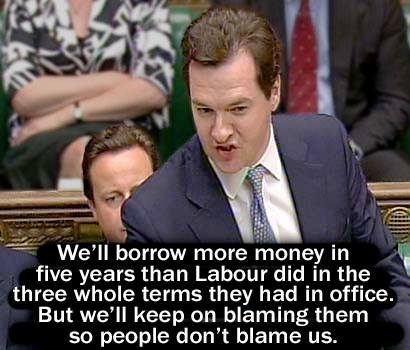
Then there are the figures that Osborne rolls out. They don’t match reality at all. He predicts the budget deficit to fall to £43bn by 2017-8. But this is pie in the sky based on his present record. Despite his first 3 years of austerity the deficit has been stuck at £120bn and has not fallen at all, so what is the evidence for believing it will fall by two-thirds in the next 4 years? In fact every forecast made by Osborne on deficit reduction has been missed by a mile.

In June 2010, a month after the election, he forecast cumulative net borrowing of £322bn between 2011-15; this year that was hiked up to £564bn, an enormous increase of 60%. In June 2010 the ratio of public sector net debt to GDP was forecast to start falling in 2014; earlier this year that was postponed a further 3 years into the future, and it now looks as though that may be extended to 4-5 years. In June 2010 the peak level of net debt had been predicted at 70% of GDP; earlier this year that was ratcheted up to 86%. On that record, would you buy a second-hand car from this man?

Even more troubling is the collapse in investment which has dropped to just 13% of GDP compared with the global average of 24%. Indeed in terms of global ranking in the investment-to-GDP league, Britain is now 159th lowest in the world, just behind Mali, Paraguay and Guatemala. So, come on George, you may not have produced much of a recovery, but surely under your leadership we can try to catch up with Mali.

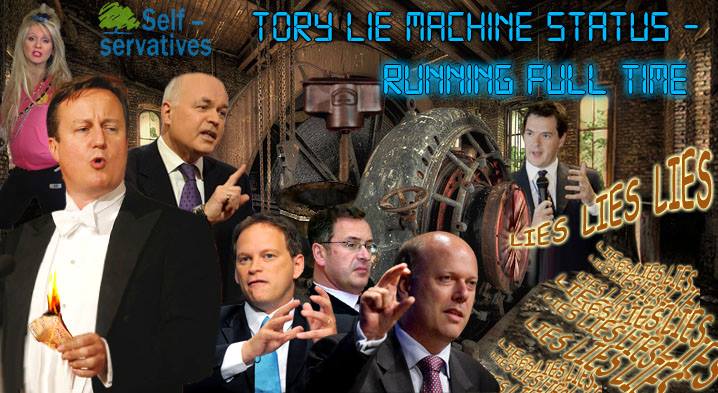
Tory Fascist Lie Machine The Daily Mail Has Met Its Match

1209102_539900659412800_1664499134_n

In the 1930s, Theodor Adorno offered cogent criticism of the mass media, stating that it gave rise to ideology by standardising and stereotyping cultural “goods”, and it weakened people’s capacity to think in an autonomous and critical manner. Everyday life becomes  the ideology of “its own [notable] absence”. Put another way, the “news” constitutes a reification of an extremely narrow range of our human experience.

Adorno and the Frankfurt Institute of [Critical] Social Studies generally proposed that this had rendered the public more susceptible to the ideology of Nazism and fascism. The media is simply a way of transmitting ideology, and is a mechanism by which dominant and powerful social groups are able to diffuse ideas which promote their own interests. Louis Althusser regarded the media as an integral part of the ideological state apparatus.

So I had wondered when the right-wing media bullying, character assassinations and lie campaigns against Ed Miliband would begin. Miliband  has previously boldly demanded the breakup of Rupert Murdoch‘s media empire over the phone-hacking scandal. Today Ed Miliband has stood up to Paul Dacre, the most corrosive Fleet Street editor. This is a bold and direct challenge from Miliband to the propaganda of an established status quo, of course.

After the Mail  attempted to claim that Miliband’s late father “loathed Britain” on the basis of one adolescent diary entry, Miliband points to his immaculate record of service in the Royal Navy, mentioned only in passing by the paper:

He arrived, separated from his mother and sister,  knowing no English but found a single room to share with my grandfather. He was determined to better himself and survive. He worked as a removal man,  passed exams at Acton Technical College and was accepted to University. Then he joined the Royal Navy”.

In a thoroughly decent, balanced response in the Daily Mail,  Miliband takes a steady aim at the paper for running a loathsome virulent gutter attack on his father, Ralph, under the despicable headline “The man who hated Britain”. Miliband writes:

It’s part of our job description as politicians to be criticised and attacked by newspapers, including the Daily Mail. It comes with the territory. The British people have great wisdom to sort the fair from the unfair. And I have other ways of answering back.

But my Dad is a different matter. He died in 1994. I loved him and he loved Britain. And there is no credible argument in the article or evidence from his life which can remotely justify the lurid headline and its accompanying claim that it would “disturb everyone who loves this country”.

Many politicians have seen members of their families traduced by the Mail  but few, if any, have responded as Miliband has. He has taken a decisive and brave path; yet another defining moment of his leadership, and a verification of his integrity and skill in handling malicious right -wing media rhetoric. He says:

When I was growing up, he didn’t talk much about the Holocaust years because it was a deep trauma for both sides of my family. But he did talk about his naval service. The Daily Mail’s article on Saturday used just a few words to brush over the years my father spent fighting for his adopted country in the Second World War. But it played a bigger part in his life than that”.

But whilst defending his father against the Mail’s  alleged charges, he also uses his article to open a wider debate about much needed press standards and ethics. Here are the important closing paragraphs:

Britain has always benefited from a free press. Those freedoms should be treasured. They are vital for our democracy. Journalists need to hold politicians like me to account – none of us should be given an easy ride – and I look forward to a robust 19 months between now and the General Election.

But what appeared in the Daily Mail on Saturday was of a different order all together. I know they say ‘you can’t libel the dead’ but you can smear them.

Fierce debate about politics does not justify character assassination of my father, questioning the patriotism of a man who risked his life for our country in the Second World War, or publishing a picture of his gravestone with a tasteless pun about him being a ‘grave socialist’.

The Daily Mail sometimes claims it stands for the best of British values of decency. But something has really gone wrong when it attacks the family of a politician – any politician – in this way. It would be true of an attack on the father of David Cameron, Nick Clegg, or mine.

There was a time when politicians stayed silent if this kind of thing happened, in the hope that it wouldn’t happen again. And fear that if they spoke out, it would make things worse. I will not do that. The stakes are too high for our country for politics to be conducted in this way. We owe it to Britain to have a debate which reflects the values of how we want the country run.

With this clear and well-measured response, Miliband has set a standard, drawn a line in the sand, signalling that unlike previous leaders, he will not tolerate press abuses for fear of political retribution. I say bravo.

In the particularly notable section on “leadership and character” in his conference speech last week, Miliband declared:

The real test of leadership is not whether you stand up to the weak, that’s easy; it’s whether you stand up to the strong and know who to fight for”.

Today, Miliband has certainly demonstrated that he is prepared practice what he preaches. It’s remarkable that a newspaper which has previously condemned commentators for “speaking ill of the dead” when Baroness Thatcher died suddenly sees fit to put aside it’s faux scruples for this all out attack on the deceased Ralph Miliband, with the sole intention to discredit his articulate, decent and honest son, who has truly become a big thorn in the side of all things conservative.

And regardless of whether readers share his politics (and the comments section of the Mail’s  website suggests many readers take a more favourable view of Miliband’s proposed energy price freeze than their paper), Mail readers will respect the decency of a son defending his father. Milband’s article is yet another plain indication of what a powerful and open kind of leader he is. That’s a shot in the foot to you, there, Dacre.

A Labour spokesman said: “Ed Miliband wrote his right to reply article because he wanted to state clearly that his father loved Britain. He wanted the Daily Mail to treat his late father’s reputation fairly. Rather than acknowledge it has smeared his father, tonight the newspaper has repeated its original claim. This simply diminishes and exposes the Daily Mail further”.

It will be for people to judge whether this newspaper’s treatment of a World War Two veteran, Jewish refugee from the Nazis and distinguished academic reflects the values and decency we should all expect in our political debate”.

This comes at a sensitive time as the privy council decides this month whether to accept a royal charter proposed by leading newspaper groups or by the three main political parties.

So the Daily Mail is opening up opportunity to discuss, not to mention, re-write history. Let’s explore this further. I seem to recall that the Mail has notably disseminated fascist ideology on many previous occasions.

On 6th February, during his first cross-examination in the Leveson Enquiry, Dacre openly admitted that the Mail  had used the private detective Steve Whittamore, who was jailed in 2005 for illegally accessing information, but Dacre claimed that the rest of the British press had done so too. Oh, right, let you off then.

Peter Wright, now a former editor of the Mail on Sunday, had said in his Leveson examination that the paper continued using Whittamore for 18 months after his conviction, which Dacre effectively confirmed.

Dacre’s many hate-filled and nationally divisive headlines following the imposition of the Tory-led barbaric benefit cuts that promote an ideological pre-Victorian regressive separation of our fellow citizens into the categories of deserving and undeserving poor, demonstrates plainly that this is a person without morals, compassion or the capacity for critical evaluation and telling the truth.

Here are some critically evaluative, truthful citations from the Mail during the 1930s, and they may explain why the Mail  has been so strangely and uncharacteristically silent when it comes to championing its own “glorious” past. Never mind, I shall speak to fill the notable absence of comment on the matter.

1375288_540499736019559_589735434_n

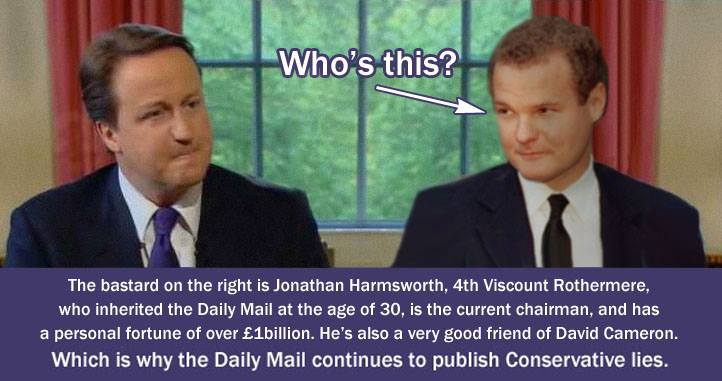
Some history: Viscount Rothermere, of Hemsted in Kent, is a title in the Peerage of the United Kingdom. It was created in 1919 for the press Lord Harold Harmsworth, 1st Baron Harmsworth. He had already been created a baronet, of Horsey in the County of Norfolk, on 14 July 1910, and Baron Rothermere, of Hemsted in the County of Kent, in 1914. Every holder of the titles has served as Chairman of Daily Mail and General Trust plc. As of 2009, the titles are held by the first Viscount’s great-grandson, the fourth Viscount, Jonathon Harmsworth, who succeeded his father in 1998 (see above.)

Current Mail Corporate directors are:

  • Lord Rothermere
  • Peter Williams
  • Paul Dacre
  • Padraic Fallon
  • Charles Dunstone
  • Nicholas Berry

Lord Rothermere and the Mail were editorially sympathetic to the [then] Tory Oswald Mosley and the British Union of Fascists (BUF). Rothermere wrote an article entitled “Hurrah for the Blackshirts” in January 1934, praising Mosley for his “sound, common sense, Conservative doctrine”. This support ended only after violence at a BUF rally in Kensington Olympia, which rather forced the issue later that year.

1276494_10200734846602013_820773330_o

This headline appeared on the front page of the 8th July 1934 edition, and accompanied a piece on Sir Oswald Mosley’s British Union of Fascists that read, in part:

If the Blackshirts movement had any need of justification, the Red Hooligans who savagely and systematically tried to wreck Sir Oswald Mosley’s huge and magnificently successful meeting at Olympia last night would have supplied it”.

Subsequent articles emphasised the paper’s unwavering support, and on 15th January 1934, the BUF was described as: “a well-organised party of the right ready to take over responsibility for national affairs with the same directness of purpose and energy of method as Hitler and Mussolini have displayed”.

This parallels the Mail’s similar enthusiasm for Fascist parties elsewhere in Europe, especially Adolf Hitler’s burgeoning Nazi movement: “The sturdy young Nazis are Europe’s guardians against the Communist danger”.

On 24th September, 1930 Lord Rothermere, wrote:

These young Germans have discovered, as I am glad to note the young men and women of England are discovering, that it is no good trusting to the old politicians. Accordingly they have formed, as I would like to see our British youth form, a Parliamentary party of their own. […] The older generation of Germans were our enemies. Must we make enemies of this younger generation too?”

On 10th July 1933, Rothermere continued:

I urge all British young men and women to study closely the progress of the Nazi regime in Germany. They must not be misled by the misrepresentations of its opponents. The most spiteful distracters of the Nazis are to be found in precisely the same sections of the British public and press as are most vehement in their praises of the Soviet regime in Russia. They have started a clamorous campaign of denunciation against what they call “Nazi atrocities” which, as anyone who visits Germany quickly discovers for himself, consists merely of a few isolated acts of violence such as are inevitable among a nation half as big again as ours, but which have been generalized, multiplied and exaggerated to give the impression that Nazi rule is a bloodthirsty tyranny”.

On 7th December 1933, Hitler wrote to Rothermere in person:

I should like to express the appreciation of countless Germans, who regard me as their spokesman, for the wise and beneficial public support which you have given to a policy that we all hope will contribute to the enduring pacification of Europe. Just as we are fanatically determined to defend ourselves against attack, so do we reject the idea of taking the initiative in bringing about a war. I am convinced that no one who fought in the front trenches during the world war, no matter in what European country, desires another conflict”.

safe_image
Hitler and the Viscount Rothermere

Lord Rothermere had friendships with Adolf Hitler and Benito Mussolini, and directed the Mail’s editorial stance towards them in the 1930s. Rothermere’s 1933 leader “Youth Triumphant” praised the new Nazi regime’s accomplishments, and was subsequently used as propaganda by them. In it, Rothermere predicted that:

The minor misdeeds of individual Nazis would be submerged by the immense benefits the new regime is already bestowing upon Germany”.

Stan Cohen’s “Folk Devils and Moral Panics” outlines a clear explanation of the way in which the media and those in a position of political power define a social group as a threat to societal values and interests. Fanned by screaming media headlines, Cohen demonstrates how this leads to such groups being marginalised and vilified in the popular press and public imagination, inhibiting rational debate about solutions to social problems that those marginalised groups are being scapegoated and blamed for creating.

Furthermore, he argued that moral panics serve to identify and expose the very fault lines of power in society. There is no consensus, only a constant attempt to superficially justify and maintain a corrupt system of gross power imbalances and crass politically created inequalities.

Conservative by name, and regressive by nature. We must continue to challenge and dismantle the Tory-directed media monologues.

And if you have any doubts about the right-wing stranglehold on the media, just go ask the Guardian editor-in-chief what happened to the hard drives that held Edward Snowden’s very informative disclosures.

Yes, that’s the unmistakable sound of jackboots approaching.

599849_369461329790068_1640090166_n
With many thanks to Robert Livingstone for his continued and valuable efforts to expose this Government via his brilliant pictures.

scroll2


Please sign the petition to
 Speak up for decency in British politics

Update from Mike Sivier, 11th March, 2014: Naughty, naughty Daily Mail! Miliband story creates torrent of complaints


14 new policies in just 72 hours from Labour.

544807_370332463014480_1710535589_n

1. Labour pledge to build a million new homes

2. Labour pledged to create a State-Owned Rail Company that would compete and win back Rail Franchises.

3. Labour vow to cut business rates for small firms

4. Labour vowed to introduce an increased Bankers’ Bonus Tax if they win in 2015.

5. Labour promised Free Childcare worth £5,000 a year for working parents who had kids aged 3+4.

6. Labour committed to Sacking ATOS and scrapping WCA assessments if they win the election.

7. Ed Miliband promised to repeal the Bedroom Tax.

8. Ed Balls pledged to reverse the Pension Tax relief that the Tories gifted to millionaires.

9. Labour promised to reverse the Tory Tax cut for Hedge Funds.

10. Labour said they would create 200,000 Apprenticeships and tie it to immigration.

11. Ed Miliband vowed to increase the fine levied on firms not paying the Minimum Wage by 1000% to £50,000.

12. Labour are to introduce a new Disability Hate Crime Prevention Law.

13. Labour would freeze gas and electricity bills for every home and business in the UK for at least 20 months,the big energy firms would be split up and governed by a new tougher regulator to end overcharging.

14. Voting age to be lowered to 16

Miliband has also declared a commitment to socialism.

Watch this space  ♥


Ed Miliband’s speech to the Labour conference: full text

It’s great to be in Brighton. And I want to start by thanking somebody from the bottom of my heart for the kindest of words. Not Justine …oh, I would like to thank her, a round of applause for Justine please, ladies and gentlemen. Not my mum … but a woman called Ella Philips. It was local election day, Ella rode past me on her bike, she fell off …it’s not funny! I helped her up and afterwards she called me something I had never been called before: she said I was an “action hero”. Why are you laughing? She said I was an action hero “who mysteriously appeared out of nowhere”. And she said, “What added to all the confusion was that Ed was actually attractive and not geeky at all”. I promise you, she did say that. She said, “Even the way he appeared was suave”. I don’t know why you find this so funny, friends. “He was dressed casually, but he had style”. Sounds quite me, doesn’t it? Now I was pretty pleased with this, as you can tell, until something dawned on me: Ella was concussed. She was badly concussed. In fact, she herself said, “I was seeing things because I was still in quite a daze”. Well, Ella, you are not kidding. But let me say, Ella, if you are watching today, thank you, you have made my year.

I want to start today with the simplest of thoughts. An idea that has inspired change for generations. The belief that helped drive us out of the Second World War and into that great reforming government of 1945. An ambition that is more important now than it has been for decades. An emotion that is felt across our country at kitchen tables every night. A feeling that is so threatening to those who want to keep things as they are. Words that are so basic and yet so powerful, so modest and yet so hard to believe. Six simple words that say: Britain can do better than this. Britain can do better than this; we are Britain, we are better than this.

Are you satisfied with a country where people are working for longer for less, year after year? Are you satisfied with a country divided losing touch with the things we value the most? Are you satisfied with a country that shuts out the voices of millions of ordinary people and listens only to the powerful? Are you satisfied with a country standing apart as two nations? Well I am not satisfied. We are Britain, we are better than this. And we have to rebuild anew One Nation. An economy built on your success, a society based on your values, a politics that hears your voice – rich and poor alike – accepting their responsibilities top each other. One Nation, we are going to make it happen, and today I am going to tell you how.

I want to start with leadership. Leadership is about risks and difficult decisions. It is about those lonely moments when you have to peer deep into your soul. I ran for the leadership of this party, it was really hard for my family, but I believed that Labour needed to turn the page and I was the best person to do it. I when I became leader I faced a decision about whether we should stand up to Rupert Murdoch. It wasn’t the way things had been done in the past, but it was the right thing to do so I did it. And together we faced them down. And then the other week I faced an even bigger decision about whether the country should go to war. The biggest decision any leader faces, the biggest decision any Parliament faces, the biggest decision any party faces. All of us were horrified by the appalling chemical weapons attacks in Syria, but when I stood on the stage three years ago, when I became your leader, I said we would learn the lessons of Iraq. It would have been a rush to war, it wasn’t the right thing for our country. So I said no. It was the right thing to do. You see, the real test of leadership is not whether you stand up to the weak, that’s easy; it’s whether you stand up to the strong and know who to fight for. And you know I am reminded of a story back when I was starting out, standing to be an MP in Doncaster, with a woman called Molly Roberts. Molly was in her seventies, and there I was candidly trying to get her vote, sitting in her front from sipping a mug of tea. And she said to me, “How can you, who weren’t brought up in this area, possibly understand the lives of people here, their hopes and their struggles?”

It was the right question, and here is the answer. For me it lies in the values I was brought up with. You see in my house it was my mum that taught me these values. About the importance of reaching out a listening to people, of understanding their hopes and their struggles. She is the most patient, generous person I have met in my whole life. And she taught me never to be contemptuous of others, never to be dismissive of their struggle. Now she was teaching me a lesson of life. And some people will say, ah yeah but you have to leave decency behind when it comes to politics. Well I say they are wrong, because only if you reach out and listen can you do the most important thing a leader can do, the most important qualification in my view for being Prime Minister. Only then will you have the ability to walk in the shoes of others and know who to fight for, whoever your opponent, however powerful they are, guided by the only thing that matters: your sense of what is right. This is what I believe, this is where I stand, this is the leadership Britain needs.

And when I think about who we need to fight for I think about all the people I have met over the last year. I think of the people Britain and their enormous and extraordinary spirit. I think of our troops, serving so bravely all around the world. Let us pay tribute to them today. You know I have seen in Afghanistan those young men and women, young men and women who are young enough to be my son or daughter serving our country, and it is a truly humbling experience. And the events of the last few days in Kenya remind us of the importance of being ever-vigilant against terrorism at home and around the world. I think of the brave men and women of our police force, who serve with so little credit each and every day for our country.

Let us thank them for what they do. And then I think of all the people I have met over the last year. During the local election campaign I did something unusual. I went to town centres, market squares and high streets and I stood on a pallet – not a soapbox, but a pallet. And I talked to people about their lives. I remember this town meeting I had in Cleverly. It was just coming to the end of the meeting and this bloke wandered up. He was incredibly angry. It’s a family show so I won’t exactly repeat what he said. He was so angry he wouldn’t give me his name, but he did tell me his story about how he spent the last ten years looking after his disabled wife, and then another four years looking for a job and not finding one. He was angry about immigration and some people in the crowd booed him. But actually he wasn’t prejudiced, he just felt the economy didn’t work for him. And then I think about the two market traders I met in Chesterfield, standing by their stalls, out in all weathers, working all hours, and they said look this country just doesn’t seem to be rewarding our hard work and effort. There seem to be some people getting something for nothing. This society is losing touch with our values. And then I think about this beautiful sunny spring day I spent in Lincoln. And the face in the crowd, this young woman who said she was an ambulance controller. So proud to be working for our National Health Service. And so proud too of her young son.

Because she was a single parent, nineteen years old, and what she said to me was, “Why does everybody portray me as a burden on the system? I am not a burden on the system, I am going out, I am doing the right thing for the country, why doesn’t anyone listen to my voice?” And then I think about this scaffolder I met just around the corner from where I live. I was just coming back from a local café I’d been at. He stopped in me the street, he said to me, “Where’s your bodyguard?” I said I don’t have one, but that’s another story. He told me his story. And what he said to me was “look, I go out, I do the work, I go all around the country, again out in all weathers, I earn a decent wage, but I still can’t make ends meet”. And he said to me, “Is anyone ever going to do anything about those gas and electric bills that just go up and up, faster than I can earn a living?” He wanted someone to fight for him. Now if you listen to these stories – four of millions of the stories of our country – and you have your own, and your friends and family, what do you learn? All of these people love Britain, they embody its great spirit, but they all believe that Britain can do better than this. Today I say to them and millions of others you’re right, Britain can do better than this, Britain must do better than this, Britain will do better than this with a government that fights for you.

But for Britain to do better than this we’ve got to understand why we got here, why things are so tough at the moment even while they tell you there is a recovery and why unless we put things right it will only be a recovery for the few. Now what I’m about to tell you is the most important thing I’m going to say today about what needs to change about our country. For generations in Britain when the economy grew the majority got better off. And then somewhere along the way that vital link between the growing wealth of the country and your family finances was broken. This is, this goes beyond one party or one government. It is more important to you than which party is in power, even more important than that.

You see, when I was growing up in the 1980s, I saw the benefits of growing prosperity, people able to buy a house, a car, even a second car, go on a foreign holiday their grandparents would never have dreamed of. Not spend all their hours at work, able to spend time with kids, not working all the hours that god sends, have a secure pension in retirement and also believe that their kids would have a better life than them. That feels a long way away from where Britain is today doesn’t it and that is because it is. You see, somewhere along the way that link got broken. They used to say a rising tide lifts all boats, now the rising tide just seems to lift the yachts. Now I say this to the people of Britain. If I were you I wouldn’t even take a second look at a political party unless they make this their central defining purpose because your future depends on it. Your children’s future depends on it. Britain’s future depends on it. I say we are Britain we can do better than this.

Now I have got a question for you ladies and gentlemen, do the Tories get it?

[Audience: No]

Oh come on, I didn’t hear you, do the Tories get it?

[Audience: No]

Ok that is better. They don’t get it do they. I want to say this. I understand why three and a half years ago some people might have thought that David Cameron did get it and that is why people voted for him at the last general election. But they voted for change and I don’t believe they got the change that they were voting for. Let me just explain it this way: next week we are going to see David Cameron resuming his lap of honour for how brilliantly he’s done as Prime Minister. Claiming credit for his enormous achievements, how he has saved the economy as they put it.

No doubt he’ll even be taking off his shirt and flinging it into the crowd expecting adoration from the British people like he did recently on holiday and maybe I should make this promise while I’m about it, if I become Prime Minister I won’t take my shirt off in public, I mean it is just not necessary is it. I’ll try and keep the promise. Anyway, back to David Cameron, so he is going on this lap of honour, everything is brilliant, he’s saved the economy, George Osborne, he deserves the garlands as well, you know, aren’t they brilliant. Come on. The slowest recovery in one hundred years. One million young people looking for work. More people on record working part-time who want full time work. More people than for a generation out of work for longer. The longest fall in living standards since 1870. That is not worthy of a lap of honour. That is worthy of a lap of shame and that is the record of this government.

He does have one record though but I don’t think it credits a lap of honour. He has been Prime Minister for 39 months and in 38 of those months wages have risen more slowly than prices. That means your living standards falling year, after year, after year. So in 2015 you’ll be asking am I better off now than I was five years ago? And we already know the answer for millions of families will be no. You’ve made the sacrifices, but you haven’t got the rewards. You were the first into the recession but you are the last one out. Now of course it would have taken time to recover from the global financial crisis whoever was in power. But when these Tories tell you that the pain will be worth the gain, don’t believe them. They can’t solve the cost of living crisis and here is why. The cost of living crisis isn’t an accident of David Cameron’s economic policy it is in his economic policy.

Let me explain why. You see he believes in this thing called the global race, but what he doesn’t tell you is that he thinks for Britain to win the global race you have to lose, lower wages, worse terms and conditions, fewer rights at work. But Britain can’t win a race for the lowest wages against countries where wages rates are pennies an hour and the more we try the worse things will get for you. Britain can’t win a race for the fewest rights at work against the sweat shops of the world and the more we try the worse things will get for you. And Britain can’t win a race for the lowest skilled jobs against countries where kids leave school at the age of 11. And the more we try the worse things will get for you. It is a race to the bottom. Britain cannot and should not win that race.

You see it is not the low achievements of these Tories that really gets me. That is bad enough. It is their low aspirations; it is their low aspirations for you. It is their low aspirations for Britain but their high hopes for those at the top. The City bonuses are back. Up 82% in April alone thanks to the millionaire’s tax cut. So when they tell you the economy is healing, that everything is fixed, just remember, they are not talking about your life, they are talking about their friends at the top. That is who they are talking about; it is high hopes for them. And every so often you know the mask slips doesn’t it.

The other day a man they call Lord Howell, he was I think their advisor on fracking at one point… There is nothing funny about that. He said it was wrong to frack in some areas but it was ok in others, it was ok in the North East of England because he said, and I quote ‘it was full of desolate and uninhabited areas.’ In one casual aside dismissing one whole region of the country. Let’s tell these Tories about the North East of England and every other part of Britain. People go out to work. They love their kids. They bring up their families. They care for their neighbours. They look out for each other. They are proud of their communities. They are proud of their communities. They hope for the future. The Tories call them inhabitants of desolate areas. We call them our friends, our neighbours, the heroes of our country. They are fed up of a government that doesn’t understand their lives and a Prime Minister who cannot walk in their shoes. We are Britain, we are better than this.

Now, to make Britain better we have got to win a race to the top, not a race to the bottom. A race to the top which means that other countries will buy our goods the companies will come and invest here and that will create the wealth and jobs we need for the future but we are not going to be able to do it easily. It is going to be tough and let me just say this friends. You think opposition is tough, you should try government. It is going to be tough; it is not going to be easy. And I’m not going to stand here today and pretend to you it is.

We are going to have to stick to strict spending limits to get the deficit down. We are not going to be able to spend money we don’t have and frankly if I told you we were going to you wouldn’t believe me, the country wouldn’t believe me and they would be right not to believe me. But we can make a difference. We can win the race to the top and let me tell you how. It is about the jobs we create, it is about the businesses we support, it is about the talents we nurture, it is about the wages we earn and it is about the vested interests that we take on. Let me start with the jobs of the future. The environment is a passion of mine because when I think about my two kids who are 2 and 4 at the moment and not talking that much about the environment, more interested in The Octonauts. There’s a plug. In 20 years’ time they’ll say to me ‘were you the last generation not to get climate change or the first generation to get it?’ That is the question they’ll be asking.

But it is not just about environmental care. It is also about the jobs we create in the future. You see some people say, including George Osborne, that we can’t afford to have environmental at a time like this. He is dead wrong. We can’t afford not to have an environmental commitment at a time like this. That is why Labour will have a world leading commitment in government to take all of the carbon out of our energy by 2030. A route map to one million new green jobs in our country. That is how we win the race to the top.

And to win that race to the top we have also got to do something else, we’ve got to support the businesses of the future. Now many of the new jobs in the future will come from a large number of small businesses not a small number of large businesses. And this is really important. If you think 15 years ahead, the rate of change and dynamism is so great that most of the new jobs that will be being done will be by companies that don’t yet exist. Now that changes the priorities for government. When this government came to office, since they came to office they cut taxes for large business by £6 bn but raised taxes on small businesses. Now I don’t think that is the right priority. Yes we need a competitive tax regime for large businesses but frankly they’ve short-changed small business and I’m going to put it right. If Labour wins power in 2015 we will use the money that this government would use to cut taxes for 80,000 large businesses to cut business rates for 1.5 million businesses across our country.

That is the way we win the race to the top. One Nation Labour. The party of small business. Cutting small business rates when we come to office in 2015 and freezing them the next year benefitting businesses by at least £450 a year. That is how we win the race for the top friends, and to win that race to the top we’ve also got to nurture the talents of the next generation. The skills of people. There are so many brilliant businesses in our country who provide amazing training for the workforce, but look, we have got to face facts, leading businesses say this to me too which is there aren’t enough of them and we have got to work to change that so we will say if you want a major government contract you must provide apprenticeships for the next generation. And we’ll also say to companies doing the right thing, training their workforce that they will have the power to call time on free-riding by competitors who refuse to do the same. That’s how we win the race to the top friends.

It’s not just business that has to accept responsibility though, it’s young people. We have a tragedy in this country. Hundreds of thousands of young people who leave school and end up on the dole. We’ve got this word for it haven’t we? NEET: Not in education employment or training. Behind that short word is a tragedy of hundreds of thousands of wasted lives. If the school system fails our young people they shouldn’t be ending up on benefits. They should be ending up in education or training so they can get back on the road to a proper career. That requires them to accept responsibility but it requires government too to accept our responsibilities for the next generation in Britain, and that’s what we’ll do.

But to win the race to the top we’ve also got to take advantage of the talents of Britain’s 12 million parents. Justine and I had one of the great privileges in any parent’s life this year, which was taking our son Daniel to his first day at school. He was nervous at first, but actually pretty soon he started having fun; it’s a bit like being leader of the Labour Party really. Well it’s not exactly like being leader of the Labour Party. But look, for so many parents in this country the demands of the daily school run, combined with their job are like their very own daily assault course and we’ve got to understand that. Because we can’t win the race to the top with stressed out parents and family life under strain – we’ve got to change that.

In the last century, schools stayed open till mid-afternoon and that was okay back then because one parent usually stayed at home. But it’s not okay now: that’s why we want every primary school in Britain to have the breakfast clubs and after school care that parents need and that’s what the next Labour government will do.

To win the race to the top we’ve also got to deal with the issue of low pay. The National Minimum Wage, one of the last Labour government’s proudest achievements, friends. But we have to face facts: there are millions of people in this country going out to work, coming home at night, unable to afford to bring up their families. I just think that’s wrong in one of the richest countries in the world. The next Labour government must write the next chapter in dealing with the scourge of low pay in this country. And to do that though, we’ve got to learn lessons from the way the minimum wage came in, because it was about business and working people, business and unions working together in the right way so we set the minimum wage at the right level and we’ve got to do the same again. The minimum wage has been falling in value and we’ve got to do something about it.

There are some sectors, and I don’t often say anything nice about the banks but I will today, there are some sectors which actually can afford to pay higher wages, and some of them are – a living wage in some of the banks. So we’ve got to look at whether there are some sectors where we can afford a higher minimum but we’ve got to do it on the right basis – business and working people working together. That’s what we will do: the next Labour government will strengthen the minimum wage to make work pay for millions in our country. That’s how we win the race to the top.

And to win that race to the top we’ve got to call a halt to the race to the bottom, between workers already here and workers coming here. I’m the son of two immigrant parents. I’m proud of the welcome Britain gave me and my family, and we’ve always welcomed people who work, contribute and are part of our community. Let me say this, if people want a party that will cut itself off from the rest of the world, then let me say squarely: Labour is not your party. But if people want a party that will set the right rules for working people then Labour is your party, the only party that will do it. Employers not paying the minimum wage and government turning a blind eye – it’s a race to the bottom; not under my government.

Recruitment agencies hiring only from overseas – it’s a race to the bottom; not under my government. Shady gang masters exploiting people in industries from constructing to food processing – it’s a race to the bottom; not under my government. Rogue landlords, putting 15 people in tied housing – it’s a race to the bottom; not under my government. And our country, sending out a message to the world that if you need to engage in shady employment practices, then Britain is open for businesses? It’s a race to the bottom; not under my government. And in case anyone asks whether this is pandering to prejudice, let’s tell them, it isn’t. It’s where Labour has always stood – countering exploitation, whoever it affects, wherever they come from. We’ve never believed in a race to the bottom, we’ve always believed in a race to the top, that is our party.

And to win the race to the top we’ve also got to take on the vested interests that hold our economy back. In the 1990s we committed to a dynamic market economy. Think of those words: ‘dynamic, ‘market’, ‘economy’. And then think about this, what happens when competition fails? What happens when it just fails again and again and again? Then government has to act. Train companies that put the daily commute out of reach. Payday lenders who force people into unpayable debt. Gas and electric companies that put prices up and up and up. It’s not good for an economy. It’s not a dynamic market economy when one section of society does so well at the expense of others. It’s bad for families, it’s bad for business and it’s bad for Britain too.

Now some people will just blame the companies but actually I don’t think that’s where the blame lies. I think it lies with government. I think it lies with government for not having had the strength to take this on. Not having stood up to the powerful interests. Not having the strength to stand up to the strong.

Take the gas and electricity companies. We need successful energy companies, in Britain. We need them to invest for the future. But you need to get a fair deal and frankly, there will never be public consent for that investment unless you do get a fair deal. And the system is broken and we are going to fix it.

If we win the election 2015 the next Labour government will freeze gas and electricity prices until the start of 2017. Your bills will not rise. It will benefit millions of families and millions of businesses. That’s what I mean by a government that fights for you. That’s what I mean when I say Britain can do better than this.

Now the companies aren’t going to like this because it will cost them more but they have been overcharging people for too long because of a market that doesn’t work. It’s time to reset the market. So we will pass legislation in our first year in office to do that, and have a regulator that will genuinely be on the customers’ side but also enable the investment we need. That’s how Britain will do better than this.

So, making Britain better than this starts with our economy – your economic success as a foundation for Britain’s economic success. But it doesn’t just stop there it goes to our society as well. I told you earlier on about those market traders in Chesterfield and how they felt that society had lost touch with their values. I think what they were really saying was this: that they put in huge hard work and effort, they bring up their kids in the right way and they just feel that their kids are going to have a worse life than them. And nowhere is that more true than when it comes to renting or buying a home.

There are 9 million people in this country renting a home, many of whom who would want to buy. 9 million people – we don’t just have a cost of living crisis, we have a housing crisis too. In 2010 when we left office there was a problem. There were one million too few homes in Britain. If we carry on as we are, by 2020 there will be two million too few homes in Britain. That is the equivalent of two cities the size of Birmingham. Wave got to do something about it and the next Labour government will. So we’ll say to private developers, you can’t just sit on land and refuse to build. We will give them a very clear message – either use the land or lose the land, that is what the next Labour government will do.

We’ll say to local authorities that they have a right to grow, and neighbouring authorities can’t just stop them. We’ll identify new towns and garden cities and we’ll have a clear aim that by the end of the parliament Britain will be building 200,000 homes a year, more than at any time in a generation. That’s how we make Britain better than this.

And nowhere do we need to put the values of the British people back at the heart of our country more than in our National Health Service, the greatest institution of our country. You know I had a letter a couple of months back from a 17 year old girl. She was suffering from depression and anxiety and she told me a heart-breaking story about how she had ended up in hospital for 10 weeks. Mental health is a truly one nation problem. It covers rich and poor, North and South, young and old alike and let’s be frank friends, in the privacy of this room; we’ve swept it under the carpet for too long. It’s a bit of a British thing isn’t it; we don’t like to talk about it. If you’ve got a bad back or if you’re suffering from cancer you can talk abbot it but if you’ve got depression or anxiety you don’t want to talk about it because somehow it doesn’t seem right – we’ve got to change that. It’s an afterthought in our National Health Service.

And here’s a really interesting thing – so you might say, it’s going to be really tough times Ed, you told us that before. You said there would be really difficult decisions in government, and that’s true, so how are you going to make it work? Well here’s the thing, the 17-year-old said in that letter, look if someone had actually identified the problem when it started three years earlier I wouldn’t have ended up in hospital. I wouldn’t have ended up costing the state thousands of pounds and the anguish that I had. So it’s about that early identification and talking about this issue.

And if it’s true of mental health, it’s true in an even bigger way about care for the elderly. There’s so much more our country could be doing for our grandmas and granddads, mum and dads, nuclease and aunts. And it’s the same story. Just putting a £50 grab rail in the home stops somebody falling over, prevents them ending up in hospital with the needless agony, and all of the money that it costs. The 1945 Labour government, in really tough times, raised its sights and created the National Health Service. I want the next Labour government to do the same, even in tough times, to raise our sights about what the health service can achieve, bringing together physical health, mental health, and the care needs of the elderly: a true integrated National Health Service. That’s the business of the future.

But we don’t just need to improve the health service, friends; we’ve got to rescue it from these Tories. And the Liberals too. Now look, before the election, I remember the speeches by David Cameron. I remember one where he said the three most important letters to him were NHS. Well he has got a funny way of showing it, hasn’t he?

And when they came to office, they were still saying how brilliant was in the health service, how the health service was doing great things and the doctors and nurses and so on. Now have you noticed they have changed their tune recently? Suddenly they are saying how bad everything is in the NHS. Now the vast majority of doctors and nurses do a fantastic job. Sometimes things go wrong. And when they do, we should be the first people to say so. But hear me on this. The reason David Cameron is running down the NHS is not because the doctors and nurses aren’t doing as good a job as they were before. It is because they have come to a realisation that the health service is getting worse on their watch and they are desperately thrashing around trying to find someone else to blame. Blame the doctors, blame the nurses, blame the last Labour government.

That is what they are doing. Well let me tell you about the record of the last Labour government. When we came to office there were waiting time targets of 18 months that were not being met, when we left office there were waiting time targets of 18 weeks that were being met. When we came to office there was an annual winter A&E crisis, when we left office the people had A&E services they could rely on. When we came to office there were fewer doctors and nurses, we when left office more doctors and nurses than ever before. And when we came to office people said well the health service, it was a good idea in previous generations but I don’t really believe it will be there in the next, and we left office with the highest public satisfaction in the history of the health services. Yes friends, we did rescue the National Health Service. So when you hear David Cameron casting around for someone to blame for what is happening in the NHS just remember it is not complicated, it’s simple, it’s as simple as ABC: when it comes to blame, it is Anyone But Cameron.

We know who is responsible, the top-down reorganisation that nobody voted for and nobody wanted, the abolition of NHS Direct, the cuts to social care, the fragmentation of services. We know who is responsible for thousands of fewer nurses, we know who is responsible not just for an annual A&E crisis, but an A&E crisis for all seasons. It is this Prime Minister who is responsible. So friends it is the same old story, we rescue the NHS, they wreck the NHS and we have to rescue it all over again. And that is what the next Labour government will do.

Right, I have explained to you how we can make Britain better by changing our economy and changing our society, and now I want to talk about how we change our politics. And here is the bit you have all been looking forward to: party reform. Now look let me say to you, change is difficult, change is uncomfortable. And I understand why people are uncomfortable about some of the changes, but I just want to explain to you why I think it is so important.

With all of the forces ranged against us, we can’t just be a party of 200,000 people. We have got to be a party of 500,000, 600,000, or many more. And I am optimistic enough – some might say idealistic enough – to believe that is possible. And the reason it is possible in our party is the unique link we have with the trade unions. The unique link. I don’t want to end that link, I want to mend that link. And I want to hear the voices of individual working people in our party, louder than before. Because you see, think about our history. It is many of you who have been telling us that actually we haven’t been rooted enough in the workplaces of our country. And that is what I want to change. And that is the point of my reforms. See my reforms are about hearing the voices of people from call centre workers to construction workers, from people with small businesses to people working in supermarkets at the heart of our party. Because you see it is about my view of politics. Leaders matter, of course they do, leadership matters, but in the end political change happens because people make it happen. And you can’t be a party that properly fights for working people unless you have working people at the core of your party, up and down this country. That is the point of my reforms. And I want to work with you to make them happen so that we can make ourselves a mass-membership party. Friends, let’s make ourselves truly the people’s party once again.

But to change our politics we have got to a lot more than that. We have got to hear the voices of people that haven’t been heard for a long time. I think about our young people, their talent, their energy, their voices. The voices of young people demanding a job, the voices of young people who demand that we shoulder and don’t shirk our responsibilities to the environment. The voices of gay and lesbian young people who led the fight and won the battle for equal marriage in Britain. And the voices of young people, particularly young women, who say in 2013 the battle for equality is not won. You see they are not satisfied that 33% of Labour MPs are women, they want it to be 50% and they are right. They are not satisfied that 40 years after the Equal Pay Act, we still do not have equal pay for work of equal value in this country. They are not satisfied and they are right. And they are not satisfied that in Britain in 2013, women are still subject to violence, harassment, and everyday sexism. They are not satisfied and they are right. Friends, let’s give a voice to these young people in our party. And let’s give a voice to these young people in our democracy, let’s give the vote to 16 and 17 year olds and make them part of our democracy.

But you know we have got to win the battle for perhaps the most important institution of all, our United Kingdom. Friends, devolution works. Carwyn Jones, our brilliant First Minister of Wales, he is showing devolution works. And let’s praise the leadership of our Scottish Joanne Lamont for the brilliant job she is doing against Alex Salmond. Now that referendum on September the 18th 2014, it is going to be conducted on the basis of fact and figures and arguments and counterarguments, but I have a story I want to tell you which I think says even more. It’s the story of Cathy Murphy. Cathy Murphy lives in Glasgow, she worked in the local supermarket. In 2010, Cathy was diagnosed with a serious heart problem, but she came to Labour conference nonetheless in 2011 as a delegate. She fell seriously ill. Her family were called down from Glasgow.

The doctors said to her that to save her life they’d have to give her a very long and very risky operation. She had that operation a few weeks later at the world-leading Liverpool Broadgreen hospital. Cathy pulled through. She went back to Glasgow some weeks later. She comes back down to Liverpool every six months for her check-up. Now she said to me the nurses and doctors don’t ask whether she is English or Scottish, the hospital doesn’t care where she lives. They care about her because she is Scottish and British, a citizen of our United Kingdom. Friends, Cathy is with us today, back as a delegate. Where is she? Cathy’s here. Friends, I don’t want Cathy to become a foreigner. Let’s win the battle for the United Kingdom.

So I have talked to you today about policy and what a Labour government would do, how it would make Britain better and win a race to the top in our economy, put our society back in touch with people’s values and change our politics so it lets new voices in. But the next election isn’t just going to be about policy. It is going to be about how we lead and the character we show. I have got a message for the Tories today: if they want to have a debate about leadership and character, be my guest. And if you want to know the difference between me and David Cameron, here’s an easy way to remember it. When it was Murdoch versus the McCanns, he took the side of Murdoch. When it was the tobacco lobby versus the cancer charities, he took the side of the tobacco lobby. When it was the millionaires who wanted a tax cut versus people paying the bedroom tax, he took the side of the millionaires. Come to think of it, here is an even easier way to remember it: David Cameron was the Prime Minister who introduced the bedroom tax, I’ll be the Prime Minister who repeals the bedroom tax.

You see here is the thing about David Cameron. He may be strong at standing up to the weak, but he is always weak when it comes to standing up against the strong. That is the difference between me and David Cameron, so let’s have that debate about leadership and character, and I relish that debate. And we know what we are going to see from these Tories between now and the general election, it is the lowest form of politics, it is divide and rule. People on benefits versus those in work. People in unions against those outside union. People in the private sector versus those in the public sector. People in the north against those in the south. It is the worst form of politics. Like sending vans into areas of Britain where people’s mums and granddads have lived for years, generations, and telling people to go home. I say we are Britain, we are better than this. Telling anyone who’s looking for a job that they are a scrounger. However hard they are looking, even if the work is not available. I say we are Britain we are better than this. So come on. So David Cameron I have got a message for you. You can tell your Lynton Crosby, it might work elsewhere, it won’t work here. We’re Britain, we’re better than this.

Friends, the easy path for politics is to divide, that’s the easy part. You need to know this about me, I believe in seeing the best in people, not the worst. That’s what I am about. That’s how we create One Nation. That’s how we make Britain better than this. That’s how we have a government that fights for you.

Now, it is going to be a big fight between now and the general election. Prepare yourself for that fight. But when you think about that fight, don’t think about our party, think about our country. I don’t want to win this fight for Labour; I want to win it for Britain. And just remember this, throughout our history, when the voices of hope have been ranged against the voices of fear, the voices of hope have won through. Those who said at the dawn of the industrial revolution that working people needed the vote and they wouldn’t wait – they knew Britain could be better than this, and we were.

Those that said, at the birth of a new century, those who said at the birth of a new century that working people needed a party to fight for them and the old order wouldn’t do – they knew Britain could be better than this, and we were. Those who said at our darkest hour in the Second World War that Britain needed to rebuild after the war and said ‘never again’, they knew Britain could be better than this, and we did. Those who said, as the 20th Century grew old, that the battle for equality was still young; they knew Britain could do better than this, and we did.

And so now it falls to us, to build One Nation, a country for all, a Britain we rebuild together. Britain’s best days lie ahead. Britain can do better than this.

We’re Britain, we’re better than this. I’ll lead a government that fights for you.

403898_365377090198492_976131366_n
Thanks to Robert Livingstone for his excellent pictures

Why we must oppose the Coalition’s Mandatory National IDs and Biometric Systems

7902_534741773262022_1829149425_n
The UK Government have started to roll out mandatory Biometric Global ID Cards. These will trace, track and store our information directly, wherever we go. This is now being implemented by the UK Border Agency. If you applied for a residence permit in a category that did not require you to enrol your biometric information and your application is granted on or after 1 December 2012 you must now apply for a biometric residence permit. Mandatory national ID cards violate essential civil liberties. They increase the power of authorities to reduce your freedoms to those granted by the card.

The Communications Data Bill (the Snooper’s Charter) never made it through the legislative process, yet the Secretary of State for the Home Department was asked by Dominic Raab how much her Department currently remunerates (a) telephone companies, (b)  internet service providers and (c) others annually for data storage; and what estimate she has made of such figures if the draft Communications Data Bill was passed.

The answer provided was: “the total estimated payment to the communications industry for these purposes by the Home Office for the fiscal year 2012-13 is £15 million. 80% of this expenditure is through a pilot project established by the Home Office to ensure value for money and auditing of payments to industry. Under this pilot, a subset of providers are reimbursed directly by the Home Office, with the money then recharged to operational agencies”.

In June 2013 the Snowden leaks revealed that GCHQ has access to the transatlantic cables that carry the world’s communications and is intercepting and processing billions of communications every day and sharing the information with the US.

This includes recordings of phone calls, the content of email messages, entries on social media sites and the history of an internet user’s access to websites. All without public knowledge and consent. This is not the kind of behaviour one would expect from Governments in western democracies.

The project – Tempora – has been in existence since the beginning of 2012. The leaks also suggest that the US authorities have similarly breath-taking and direct access to global communications via the world’s biggest internet companies. This secretive programme is known as PRISM and reports strongly suggest that the UK also accesses this data.

So it appears those who failed to make the case for the Draft have already smuggled in a more intrusive Snoopers’ Charter for blanket surveillance through the back door.

The Communications Capabilities Development Programme (CCDP) is a Coalition initiative to create a ubiquitous mass surveillance scheme for the United Kingdom. It would involve the logging of every telephone call, email and text message between every inhabitant of the UK, (but would not record the actual content of these emails) and is intended to extend beyond the realms of conventional telecommunications media to log communications within social networking platforms such as Twitter and Facebook. It is an initiative of the Office for Security and Counter-Terrorism at the Home Office, whose Director is Charles Farr. It has been pursued since the 2010 Coalition Strategic Defence and Security Review.

Freedom of expression and privacy are two sides of the same coin – and we need both for full participation in democratic society. Surveillance techniques that prevent individuals remaining anonymous when producing or accessing information both infringe privacy and have a stifling effect on free expression. 

Systems of identification that employ automatic recognition of individuals’ faces, fingerprints, or irises are gaining ground globally. Biometric ID systems are increasingly being deployed at international border checkpoints, by Governments seeking to implement national ID schemes, and by private sector agents. Yet as biometric data is collected from more and more individuals, privacy concerns about the use of this technology are also attracting much attention.

The Coalition have certainly changed the relationship between the citizen and state: privacy experts have sounded the alarm that the national database would further usher in the era of “Big Brother”, as David Kravets from Wired Magazine has suggested.

It seems that the State wants to take a clear authoritarian role using the principle of permission for basic freedoms and civil rights: it’s nothing short of a tyrannical attempt to catalogue the population.

Mandatory nationwide identification systems have been implemented in a number of other countries including Argentina, Belgium, Colombia, Germany, Italy, Peru and Spain. Whilst these schemes many vary by country, individuals are typically assigned an ID number, which is used for a broad range of identification purposes. Large amounts of personal data such as name, date of birth, place of birth, gender, eye colour, height, current address, photograph, and other information is linked to this ID number and stored in a centralised database.

The French Constitutional Council ruled that their new law proposing the introduction of a new biometric ID for French citizens was unconstitutional. In many countries, such as Argentina, national ID regimes are adopted during military or identified authoritarian regimes. And this ought to trigger alarm bells.

Supporters argue that biometric identifiers are an efficient way to accurately identify people, biometrics are costly, prone to error, and present extreme risks to privacy and individual freedom. Once biometric data is captured, it frequently flows between Governmental and private sector users. Companies have developed biometric systems to control access to places, products and services. Citizens can be asked for a thumbprint to access e-Government services or enter a room in a corporate headquarters. Geo-location tracking, video surveillance and facial recognition software built on top of large biometrics collections can further enable pervasive surveillance systems.

Following 9/11, many Governments began collecting, storing and using biometrics identifiers in national IDs. Authorities justified these initiatives by arguing that biometric identification and authentication helps secure borders, verify employment and immigration, prosecute criminals, and combat identity fraud and terrorism. Despite this global trend, the citizens of many countries have successfully opposed biometric national ID schemes including Australia, Canada, New Zealand, and the United Kingdom, under the previous Labour Government, abandoned the pursuit of the initiative because of the widespread criticisms presented.

National ID is required for employment, people may be fired and their   employer fined if they fail to present the necessary papers. People without ID cards can be denied the right to purchase property, open a bank account or receive Government benefits. National identity systems present difficult choices about who can request to see an ID card and for what purpose.

Mandatory IDs significantly expand police powers. Police with the authority to demand ID are invariably granted the power to detain people who cannot produce one. Many countries lack legal safeguards to prevent abuse of this power. And as we know, some states simply refuse to implement those safeguards, should they be in place, in any event.

National ID systems have been used historically to discriminate against people on the basis of race, ethnicity, religion and political views. The use of national IDs to enforce immigration laws invites discrimination that targets minorities. There is little evidence to support the argument that national IDs reduce crime. Instead, these systems create incentives for identity theft and widespread use of false identities by criminals. And we know that the administration of ID programs is most often outsourced to unaccountable companies. Private sector security threat models assume that at any one time, one per cent of company employees are willing to sell or trade confidential information for personal gain. I suspect that percentage to be much higher.

80 civil liberties organisations have asked the Council of Europe in 2011 to investigate whether National ID biometrics laws in Europe comply with the Council of Europe Privacy Treaty and the European Convention on Human Rights. We need to refuse to let states collect massive amounts of biometric data without due regard to privacy rights.

With the international community still reeling from the revelations of mass surveillance sparked by Edward Snowden’s leaks, much of the discussion of internet issues is focused on how to protect human rights, in particular privacy, in the digital age. The widespread surveillance scandal has now reached the United Nation’s Human Rights Council, which opened its 24th session last week to a multitude of questions about privacy and spying, many of them were targeted at the United States and United Kingdom. That’s perhaps not surprising, since UN representatives were among those listed as being monitored by the NSA and GCHQ.

Human rights lawyer Navi Pillay, who is also the UN’s High Commissioner for Human Rights, has urged all countries to “ensure that adequate safeguards are in place to prevent security agency overreach and to protect the right to privacy and other human rights”.

The launch of International Principles on the Application of Human Rights to Communications Surveillance follows landmark report from the United Nations Special Rapporteur on the right to Freedom of Opinion and Expression, which details the widespread use of state surveillance of communications, stating that such surveillance severely undermines citizens’ ability to enjoy a private life, freely express themselves and enjoy their other fundamental human rights. And recently, again the UN High Commissioner for Human Rights, Nivay Pillay, emphasised the importance of applying human right standards and democratic safeguards to surveillance and law enforcement activities.

The High Commissioner presented a report on the safety of journalists, which contains an overview of the situation facing journalists and identifies good practices that could assist in creating a safe and enabling environment in which journalists are able to freely exercise their profession. The report highlighted the attacks that online journalists face, such as illegal hacking of their accounts, monitoring of their online activities, arbitrary arrest and detention, and the blocking of websites that contain information critical of the authorities.

One part of the potential solution to those concerns will be officially launched this Friday in a Human Rights Council side-meeting on digital privacy hosted by concerned countries: the International Principles on the Application of Human Rights to Communications Surveillance.

Amnesty International also submitted a written statement on impact of surveillance on human rights, as did a group of 14 South Korean NGOs though the Korean Progressive Network “Jinbonet”. These efforts build on the joint civil society statement at the last session of the Human Rights Council, in the aftermath of revelations of the NSA’s PRISM program. The statement, which attracted support of over 300 human rights organisations and individuals, called for means to ensure more systematic attention by the UN to internet related human rights violations.

We really don’t want to see the UK, in cahoots with the US, regarded as having started a race to the bottom of privacy standards: a race too many other countries will be happy to join. The greatest risk to the internet in the international arena at the moment lies in the formation of an unholy alliance between countries who are already seeking excuses to spy and censor the net and those, like the United States, who have previously argued against such practices, but are now having to defend their own surveillance excesses using similar language.

Government mandated biometric systems are invasive, costly, and damage the right to privacy and free expression. They violate the potential for anonymity, which is crucial for whistle-blowers, investigators, journalists, and political dissidents.

National ID cards and the databases that lie behind them comprise the cornerstone of Government surveillance systems that creates risks to privacy and anonymity. The requirement to produce identity cards on demand habituates citizens into participating in their own surveillance and ultimately, social control.

We are seeing a rise of constraints placed on the global population (such as use of  repressive tactics against any political opponents and a prohibition of anti-regime activity – often subtle in nature, such as trojan horse types of legislation) by overly bureaucratic authoritarian regimes. We no longer have a vibrant and full democracy, as we are seeing an increasing deprivation of civil liberties, and little tolerance for meaningful opposition. Liberal democracies are founded on certain principles such as the rule of law, an independent judiciary, and we are certainly seeing a shift away from this here in the UK.

The private sphere is the part of our social life in which individuals enjoy a degree of authority, unhampered by interventions from Governmental or other institutions. Examples of the private sphere are our family, relationships and our home. There has been an increasing intrusion by Government into the private domain, (the bedroom tax is a good example of this, since it affects our family sleeping arrangements and significantly reduces the choice of home we are permitted to live in) whilst at the same time, our participation in the public domain of work, business, politics and ideas is being repressed.

The publication of mass surveillance revelations by the Guardian’s Glenn Greenwald has had reverberations around the world. The UK government has moved toward confrontation with the news organisation by forcing the destruction of hard drives that contained documents leaked by former NSA contractor Edward Snowden. The recent developments around the detention of David Miranda and the seizure of material he was carrying under Section 7 of the Terrorism Act has raised concerns over press freedom. But many of us know that the press here has not been unbiased and “free” for some time now.

Free speech as a constitutional principle must be inviolable. As a person that closely follows events in Parliament, and I base much of my work on Hansard records, I know that media representation of challenges to the Government and portrayals of the opposition are NOT free from bias, and Government interference. Not that some Minsters hide the fact that they openly interfere – Iain Duncan Smith accused Stephanie Flanders of “peeing all over British industry” with her coverage of employment figures, that contradicted his own, which led to the Tories closely monitoring BBC for “left wing bias” ahead of party conference season.

Article 19 of the Universal Declaration of Human Rights states:

“Everyone has the right to freedom of opinion and expression; the right includes freedom to hold opinions without interference and to seek, receive and impart information and ideas through any media regardless of frontiers”.

These international standards of freedom of expression are no longer being met. Our liberties are certainly being steadily eroded by an authoritarian Government.

And we must not be become silent and complicit.

scroll2

With many thanks to His Excellency Sir Kurt Alleyne, the International Human Rights Commission Ambassador for United Kingdom and Northern Ireland, for flagging up this issue, and for subsequent discussion. 

Further reading:

UN’s High Commissioner for Human Rights, publicly defined the right to electronic privacy and freedom from surveillance as a human right.

International Principles on the Application of Human Rights to Communications Surveillance

New Israeli Biometric Database Pilot Scheme

In the US –The Immigration Reform Bill – Prodding Forth Real ID, an INTERNATIONAL Biometric ID

David Miranda, schedule 7 and the danger that all reporters now face

Smashing of Guardian hard drives over Snowden story ‘sinister’, says Amnesty

It’s Left-wing prats who are defending our freedoms: “The British degree of trust in their security agencies startles many other countries (like Germany and the US) where liberty is taken less for granted. An editor of the US National Review wrote last week of those “who steadfastly refuse to express anxiety unless they can actually hear jackboots”. Note: once you hear the jackboots, it’s too late.”

Belgacom Attack: Britain’s GCHQ Hacked Belgian Telecoms Firm

“Operation Socialist” Hack

BBC Newsnight exclusive interview with journalist Glenn Greenwald on Edward Snowden, the PRISM revelations and mass surveillance


994763_494550317281168_1024248164_n


Many thanks to Robert Livingstone for his brilliant pictures

Atos Minister Hoban forced to rethink by vigorous systematic critique from Spartacus

992934_219007768250279_1428084301_n

Originally published by Michael Meacher on September 11th, 2013 here.


Yesterday’s meeting with Mark Hoban, the Work Capability Assessment (WCA) Minister, presented him with a systematic catalogue of all the main weaknesses, faults and failures of the whole WCA process. He was told in no uncertain terms that under the Evidence-Based Review new descriptors are needed now since not one single more person should have to go through a test with descriptors biased against them. He was told he must ensure that GPs can provide evidence and are not allowed to refuse, and that this evidence must be taken fully into account before considering a WCA.


He was told that there must be mental health champions in every centre (not less than half as at present), that every assessment should be recorded, that assessment phase payments must continue throughout mandatory reconsideration, and that new centres must replace the 29 centres still inaccessible. He was also told that 3-9 month reassessment periods were frankly absurd. And he was told that a person undergoing a WCA must be able to score under both physical and cognitive descriptors again since separating them was clearly unworkable.

Hoban listened attentively, though his replies to some of these points seemed rather unconvincing, which on several occasions he was not allowed to get away with by Sue Marsh, who led for Spartacus and argued the case passionately. It was also put to him that many of the disability groups wanted outright abolition of the WCA, though he waived that aside. Nevertheless it was made clear to him that the current WCA format was universally regarded as fundamentally at fault, and he did let slip in an unintended aside that the government’s ‘current relationship with Atos was not very good’, by which of course he meant there was a thundering great row going on behind the scenes.

At the end of the 45 minute meeting Hoban was asked to agree to another early meeting if the disability community could come together to produce an alternative to the WCA. He responded by arguing that it would have to be very robust and meet a high bar in terms of performance, but he certainly didn’t reject the idea out of hand.

Significantly, today MPs were invited to undergo a mock WCA themselves at the House of Commons where they were put through the type of questioning and demands for evidence used in WCAs in order to determine whether they scored enough to be fit to be an MP. Quite a number of MPs attended, but the great majority (including me) failed miserably to get anywhere near scoring the number of points necessary.   It did make MPs, and certainly me, a lot more aware of what it is like to be subject to this kind of ordeal which, not to put too fine a point on it, is set up to make you fail.

Jobseekers are being coerced into experimental drug trials dressed up as “job opportunities”

1098410_520975421305324_1267996419_n

In December last year, David Cameron announced that it was: simply a waste to have a health service like the NHS and not use the data it generatedLet me be clear, this does not threaten privacy”, he reassured us, “it doesn’t mean anyone can look at your health records, but it does mean using anonymous data to make new medical breakthroughs”.

Cameron often inadvertently signposts the coming of a diabolical lie with the phrase “let me be clear”, as we know. We also know that so-called anonymisation of data offers no protection at all to identities and personal details. Campaigners described the plan as an “unprecedented threat” to confidentiality, Health Secretary Jeremy Hunt says, rather worryingly, that it will be a boon to research.

It’s common knowledge that many Coalition MPs and Peers are heavily financially invested in pharmaceutical and health care companiesOver 200 parliamentarians have recent past or present financial links with, and vested interests in companies involved in healthcare and all were allowed to vote on the Health and Social Care Bill. The Tories have normalised corruption and made it almost entirely legal. Our democracy and civic life are now profoundly compromised as a result of corporate and financial power colonising the State, and vice versa.

The Health and Social Care Bill, 2012, has a telling insertThe Secretary of State’s duty as to research, which is: “In exercising functions in relation to the health service, the Secretary of State must promote – (a) research on matters relevant to the health service, and (b) the use in the health service of evidence obtained from research”.

And also very worryingly: (1) The National Patient Safety Agency is abolished. (2) The National Patient Safety Agency (Establishment and Constitution) Order 2001 (S.I. 2001/1743) is revoked. (3) In section 13 of the NHS Redress Act 2006 (scheme authority’s duties of co-operation), omit subsection (2)

So we must ponder just how coincidental it is that Jobseekers are now being coerced into experimental drug trials, or risk benefit sanctions, as the trials are being dressed up as “job opportunities”.

People claiming Jobseekers Allowance while searching for new employment are being forced to accept ever-worsening working conditions or to join exploitative Government work programmes in desperate attempts to survive, as our civilised social safety nets and lifeline benefits are being torn away by a draconian and authoritarian Government.

The rising number of unemployed and underemployed citizens of the UK are having their desperation to survive exploited, enticed into zero hour contracts, workfare and now, clinical trials. My revulsion at this Government is at an all time absolute. It is surely time for the UK public to say enough is enough.

Jobseekers using the Government’s new job website – the Universal JobMatch – have been receiving multiple messages from the service inviting them to apply for jobs, only to find that these “employment opportunities” are actually clinical trials.

JC1                                 Please click on screen capture image to enlarge.

Mr Chris Morgan wrote to Scriptonite Daily, he was the first to flag up this concern. He said:

I was dumbfounded, shocked and so angry that my government would send me on clinical trials…I didn’t think I’d be put out to pasture this early in my life, to go and become a lab rat”.

Chris lives with his partner and two children aged 9 and 11, and has been seeking work since losing his role in Health and Safety for retail giant Marks and Spencers in November 2012.  He had been with the company for five years before being dismissed. He has subscribed to Universal JobMatch in the hopes of finding employment.

He logged on this morning to find five jobs recommended to him by the Government’s online job service. He said that he has been left feeling “sick to my stomach” after realising the Government considers participation in a clinical trial for £100 a day as his best current option of “employment”.JC2                                               Click on screenshot to enlarge

My UK job site lists: “Paid Clinical Trials – Permanent – to earn over £100 a day

There are more listed “jobs” listed here. Posted on the site by Covance. (Please see footnote for more information).

Chris is now concerned that by declining this recommendation he would be considered as turning down an “employment opportunity” and therefore stand to lose his “eligibility to claim social security.”

Here, we are seeing the development of a distinctly anti-welfare system which vigorously and absolutely exploits the most vulnerable citizens, and treats anyone unfortunate enough to find themselves unemployed, or inadequately employed, or disabled with utter contempt, stripping them of dignity. People are now expected to work for free, move out of their home if their children have a bedroom each, rely on charities for food, whilst Government ministers such as Michael Gove and Iain Duncan Smith claim with an utter poverty of moral responsibility that it’s all their own fault.

Most of us learned from history – the Victorian era and the Poor Law Reform – that poverty is NOT caused by the poor, but rather, by reckless Governments, their draconian ideology and poor economic decision-making. The punitive Poor Law Reform Act was based on the same claims of “making work pay” as the current Government’s welfare reforms are.

Tory “facts” are seen through a lens of pre-conceptions and ideology. The Joseph Rowntree Foundation choose to study poverty. Cynical Iain Duncan Smith simply changes the definition of itWhat kind of society is this where poor people risk prosecution if they scavenge in bins for scraps, and now, where they are being forced into trialing experimetal drugs, under the threat of sanctions and subsequent starvation and destitution if they refuse.

I had some dialogue earlier with the International Human Rights Commission about this matter of serious concern, because of implications for the Human Rights of jobseekers.

Sir-Kurt Alleyne, International Human Rights Commission Ambassador for the United Kingdom and Northern Ireland stated:

I am greatly concerned that the Coalition Government have felt it’s justified to place Clinical Trial “Test Subjects” among persons Universal JobMatch (Job Searches). These are highly contentious and are in fact at times openly a direct risk to health and have been known to lead to irreversible negative health implications. As many are highly aware, refusing work will cause the DWP to Sanction a persons Claim. To offer any such positions to persons indicates that the government ministers responsible for authorizing this have felt that those desperate to find employment will place themselves in harms way to satisfy quotas required that enable a person to receive benefits such as Job Seekers Allowance ( JSA )”.

Sir Kurt Alleyne has called upon His Excellency World Chairman Amb Dr-Shahid Amin Khan, Ihrc Hq and the High Commissioner for the Commonwealth of Countries Ambassador, John G Raciti, and asked that support be given in these matters as a matter of duty in protecting Commonwealth Citizens, due to the:

“further serious implications being levied against Benefit Claimants. This furthers the already unacceptable manner in which persons are being treated and is unacceptable. This is forcing people to become test subjects if they cannot find suitable other employment on grounds DWP will in fact be able to Sanction a Claim for ‘Refusing Employment'”.

Sir-Kurt Alleyne further stated:

At this time I fully believe that use should be made of the request from UN Special Rapporteur Ms. Rolnik. Whilst undertaking her recent Fact Finding Mission relating to Bedroom Tax which she is reportedly going to recommend its immediate removal, she has provided contact detail so matters relating to ESA, WCA, IC, SDA and other similar matters can be sent too her. I believe this should be fully utilized”.

An initial contact memorandum is to be written this morning. John H Ractiti said that the problem needs assessing [in terms of the full context] and solutions offered to help ease the pressure on millions of people, and tens of thousands of families within the Commonwealth.

At this point in time discussion about these concerns and strategic planning for support networks also to be sourced and introduce is taking place. This morning I will write to the shadow Cabinet to inform them of these very serious and extremely worrying developments.

Our Human Rights are a precious and valuable safeguard against the horrors of exploitation and persecution. They arose in response to the atrocities committed during the War and the Holocaust. The International Community sought to define the rights and freedoms necessary to secure the dignity and worth of each individual. Ratified by the United Kingdom, one of the first countries to do so, in 1951, those Human Rights originally established in the Universal Declaration have been steadily eroded since the Coalition gained Office. There’s a clear link between high levels of inequality and failure of Government’s to recognise human rights, and to implement them in policies.

Economic, social and cultural rights are recognised and protected in international and regional human rights instruments. Member states have a legal obligation to respect, protect and fulfil economic, social and cultural rights and are expected to take “progressive action” towards their fulfilment. The right to an adequate standard of living. However, the Government’s welfare “reforms” clearly violate this fundamental human right, and we are seeing a significant and substantial increase in economic discrimination and exploitation of the most vulnerable social groups.

Authoritarians view the rights of the individual, (including those considered to be human rights by the international community), as subject to the needs of the Government. Of course in democracies, Government’s are elected to represent and serve the needs of the population. Democracy is not only about elections. It is also about distributive and social justice. The quality of the democratic process, including transparent and accountable Government and equality before the law, is critical. Façade democracy occurs when liberalisation measures are kept under tight rein by elites who fail to generate political inclusion. See Corporate power has turned Britain into a corrupt state  and also Huge gap between rich and poor in Britain is the same as Nigeria and worse than Ethiopia, UN report reveals.

In the UK, democracy is clearly being deliberately dismantled. It is unacceptable that vulnerable groups are being subjected to such ruthless exploitation at the hands of the Government and their corporate bedfellows. It’s time to be very, very worried. We must fight this unravelling of our civilisation and regression of our hard-earned social development. We really must.

I am suddenly and horribly reminded of Josef Mengele, infamous for performing human experiments on Nazi concentration camp inmates, including children, for which he was called the “Angel of Death”. He was also one of the SS physicians who supervised the selection of arriving transports of prisoners, determining who was to be killed and who was to become a forced laborer.

Godwin’s law has been repealed. The UK Coalition have severely restricted its credible and legitimate scope for application.

We are certainly climbing Allport’s Ladder.

scroll2

If you have had any experiences regarding similar exploitative job suggestions, or unfair benefit sanctions, negative experiences with Atos and the WCA and any other issue related to welfare reform, please do share them with the UNHRC.

Raquel Rolnik also wants to know about any experiences you have had involving not being allowed or able to speak out, as is your democratic right. These experiences, for example, may include being stopped from speaking out on the streets at events or meetings, as well as being restrained or curtailed during a protest or demonstration.

I think that the poll tax-styled council tax benefit cuts are also having a dire impact on many people and this would be worth including, too. As would any experience with difficulties accessing legal aid, as that reform also breaches Article 6(1) of the European Convention of Human Rights: the right to a fair trial.

Raquel Rolnik’s email address is: srhousing@ohchr.org

You can also write to:
His Excellency Mr Ban Ki Moon
United Nations Secretary-General
UN Headquarters
First Avenue at 46th Street
New York, NY 10017
USA
E-­mail: sgcentral@un.org

See also: Government wrongs, Human Rights and a call for evidence from Raquel Rolnik

scroll2

Footnote
Pharma trial jobs      Pharma 2 
    
Screen shots of Covance advertisement on My Jobs U.

Click to enlarge image.

More examples of Covance advertisements on the Simply Hired UK site, and the experimental drug trials are listed as “jobs and vacancies” here. It is extremely worrying that clinical trials are being described and presented as permanent paid work by the Government’s online job service. It’s not the only time that the Coalition’s Universal Jobmatch website has caused concern. In August, the site advertised six jobs for dancers, table-top dancers, and entertainment dancers, in an American style lap-dancing club in Norwich.

The venue hiring is the Sugar & Spice American table dancing club, which describes itself on its website as offering its customers a “unique experience” that is “compared to the out-dated traditional gentlemen’s or strip club”. As well as offering “main-stage entertainment,” it says it offers “private dances in our basement booths or on one of [our] dance beds from topless to fully nude”.

The adverts on the taxpayer-funded website have been greeted with outrage. Quite properly so. Labour MP Stella Creasy told The Independent  that the Government-endorsed vacancies were “degrading”. She said “No one should be asked to expose themselves in that way or face a sanction [having their benefit stopped].”

People claiming jobseeker’s allowance are required to use the one-year-old site to look for work or can risk losing their benefit. Furthermore, people risk sanctions of up to three years if they are deemed to fail in meeting strict criteria for eligibility, which includes a required amount of job searching, and applications for work. Some posts are “recommended” by job centre plus advisers on the system, and must be followed up. If claimants don’t apply for those recommended posts, they are sanctioned.

I found some further information about the company widely advertising clinical drug trials as “jobs”. In the 1990s, Covance performed studies sponsored by the tobacco industry claiming that even extreme exposure to secondhand smoke was safe for humans. According to the Surgeon General of the United States Public Health Service, second-hand smoke substantially increases the risks of lung cancer and heart disease. Covance internal documents from 2002 discuss a “Philip Morris/Covance Project Team” for studies. At a November 2005 tobacco trade-group conference in Manila, Philippines, Covance’s presentation was entitled: “How Can Covance Support Research and Development Needs of the Tobacco Industry?”

Covance became the subject of controversy following allegations in 2003–2005 by the British Union for the Abolition of Vivisection and People for the Ethical Treatment of Animals that non-human primates were being abused in its laboratories in Germany and the United States.

Covance, also known as Hazleton Laboratories in 1989, was also at the centre of a major scandal involving release of a strain of the Ebola virus. In November 1989 at the Hazleton Primate Quarantine Unit in Reston, Virginia, lab monkeys were found to have carried Ebola virus from the Philippines. The U.S. Centres for Disease Control and Prevention intervened to “eradicate” the infected animals, burn the complex down, and avoided a potentially disastrous outbreak.

Afterwards, in February 1990, a number of infected monkeys were shipped to Hazleton facilities in both Virginia and Texas. This strain was also found to be airborne. More Reston ebolavirus infected monkeys were discovered in 1992 in Siena, Italy and at the Texas Hazleton facility again in March 1996. Curiously, the personnel that were infected remained “asymptomatic”, according to reports. But generally, this disease has a high mortality rate.

In June 2005 Covance filed a lawsuit in the United States against People for the Ethical Treatment of Animals (PETA) and the investigator for fraud, breach of employee contract, and “conspiracy to harm the company’s business by deceitfully infiltrating and videotaping the … facility.” The company filed a parallel lawsuit in England in an attempt to stop PETA showing the tape; the British judge called the footage “highly disturbing,” and ruled that there was a legitimate public interest in the material being shown.

Covance USA – drug tests on primates filmed undercover by PETA

“We can judge the heart of men by their treatment of animals” –  Immanuel Kant.

“The Coalition Government is determined to secure and expand the UK’s position as an international hub for innovation, medical science and research and in the last 12 months has generated more than £1 billion industry and private sector investment. The Prime Minister will use his visit to the US to meet with CEOs and senior figures from leading pharmaceutical companies, including Johnson & Johnson, Baxter, Covance and Pfizer. The meeting will focus on the UK’s life sciences sector and initiatives such a genomics and dementia research”.

A policy advisory group – The Ministerial Industry Strategy Group – is co-chaired by the Secretary of State for Health and the Chairman of the British Pharma Group, and aims to promote a “strong and profitable UK-based bio-pharmaceutical industry capable of sustained research”.

Further reading:
Profit over and above human need  – “The drug companies will get away with whatever they can get away with within the law to look after the interests of their shareholders. But they couldn’t get away with these things were it not for members of my profession being willing to collude with them and put patients in second place”: unfavourable results from medical trials are being withheld, MPs warn

942124_214298768721179_2140233912_n
Thanks to Robert Livingstone for his art work

Government wrongs, Human Rights and a call for evidence from Raquel Rolnik

564882_438358886199493_1982719183_n

My hon. Friend the Member for North Ayrshire and Arran (Katy Clark) mentioned the legality of the Government’s legislation. Let me be clear that our Governments have been condemned by the International Labour Organisation and other international organisations for two decades now because of their trade union legislation.

It is not just about the right to strike; it is about certain basic and fundamental trade union rights. The clause, yet again, imposes further duties that I believe to be completely contrary to ILO (International Labour Organization conventions).

 Yet again, this country will be isolated in the world and condemned for its attack on trade union rights, which are incorporated in all those international statutes and conventions as a basic human right” -John McDonnell.

This was the third day of Parliamentary debate regarding the Transparency of Lobbying, Non-Party Campaigning and Trade Union Administration Bill: it breaches human rights, specifically articles 8 and 11 of the European Convention on Human Rights.

An additional concern for me was the lack of transparency and opportunity for pre-legislative scrutiny of this Bill. The Government deliberately withheld details – the Electoral Commission had not see the draft Bill, nor had the Select Committee seen it in full.

Cameron is also attempting to limit judicial review. If Select Committees are excluded from the legislative process, a case can be challenged under judicial review as that means the legislation is being created on an undemocratic and procedurally unfair basis. Select Committees are part of the constitutional area of law-making, they simply cannot be ignored.

The withholding of key details of drafted Bills from Select Committees means that effective and organised challenging from the opposition is stifled, too. We most certainly have an authoritarian Government that arrived unannounced and unauthorised, one that has very clearly spent some time out of Office spitefully planning an attack on civil society, and the dismantling of the means of redress. The contents of the Lobbying Bill highlight this further.This was a carefully calculated move, and such tactics have become increasingly common since this Government took Office. It would be an enormous mistake, if not academic dishonesty, to pretend that we now live in a first world liberal democracy.

As I have said elsewhere, the purpose of Government in any democracy is to reflect the needs of a population. This Government seems to believe that the population are here to fulfil their own needs, and they are exploiting the vulnerable, stealing lifeline benefits from them – which we have all paid for via taxes – to profit the very wealthy. This is authoritarianism, and not democracy.

The disclosure from the opposition of yet another contravention of our human rights in Government policy-making comes at a time when the United Nations (UN) have found that the welfare reforms are also in breach of international human rights statute.

The bedroom tax constitutes a violation of the human right to adequate housing in several ways. If, for example, the extra payments force tenants to cut down on their spending on food or heating their home. There are already a number of legal challenges to the bedroom tax under way in British courts. In principle the judiciary here takes into account the international human rights legislation because the UK has signed and ratified the International Covenant on Economic, Social and Cultural Rights.

The right to adequate housing is recognised in a number of international human rights instruments.

Article 25 of the Universal Declaration of Human Rights recognises the right to housing as part of the right to an adequate standard of living. It states that:

Everyone has the right to a standard of living adequate for the health and well-being of himself and of his family, including food, clothing, housing and medical care and necessary social services, and the right to security in the event of unemployment, sickness, disability, widowhood, old age or other lack of livelihood in circumstances beyond his control”.

Article 11(1) of the International Covenant on Economic, Social and Cultural Rights (ICESCR) also guarantees the right to housing as part of the right to an adequate standard of living. The UN Convention on the Rights of Persons with Disabilities CRPD was ratified by the UK on 8th June 2009. With the possible exception of European treaties, the CRPD is the most important international treaty on disability.

The Government welfare “reforms” (cuts) undermine the right to live independently and to be included in the community – Article 19 of the United Nations Convention on the Rights of Persons with Disabilities. The Joint Parliamentary Committee on Human Rights conducted an enquiry and found that CRPD did not have a significant role in the Coalition development of welfare policy and legislation, as is required by the Convention.

Economic, social and cultural rights are recognised and protected in international and regional human rights instruments. Member states have a legal obligation to respect, protect and fulfil economic, social and cultural rights and are expected to take “progressive action” towards their fulfilment. However, the Government’s welfare “reforms” clearly violate the fundamental human right to an adequate standard of living, and we are seeing a significant and substantial increase in economic discrimination and exploitation of the most vulnerable social groups.

I heard Grant Shapps attempt to trivialise the issue of the Government’s breach of our human rights with their Bedroom Tax policy by pointing out that other countries are breaching human rights. The Government here have breached international human rights standards and law, regardless of whether or not other Governments in the world have done so.

The fact that this Government have been found to infringe upon our fundamental human rights by an independent assessor, using international legal standards didn’t seem to faze him one bit. His response and anger was directed only at the fact that the assessment had happened at all.

People are dying here, many are made homeless, we are seeing a massive increase in food poverty, and people are committing suicide because they are so very desperate. This is because of the Government’s welfare “reforms”. Human suffering, loss of dignity and death may have many facets, but all of them are equally unforgiving, and when imposed by humans on fellow humans, all are equally unforgivable.

Unabashed by this, and the fact that this Government are actually found to be guilty of human rights violations, Shapps made an outrageous and personal attack on UN envoy Raquel Rolnik. The right-wing media have followed in pursuit, using shameful racism and diversionary character assassination techniques to try and discredit Raquel.

Raquel Rolnik, UN special housing rapporteur has made an initial recommendation about a number of issues – all of which have been highlighted by the media, politicians and advocates working on housing related matters, in particular:

(1) the bedroom tax breaches human rights
(2) regulation of the private rent sector is needed, and
(3) social housing stock needs to be increased.

She also expressed concern about the impact of welfare reforms and austerity measures on the most vulnerable and highlighted that she had seen signs retrogression in the enjoyment of the right to adequate housing.

The UN aide also wants the Bedroom Tax to be investigated fully, as the scheme was never piloted and already constitutes an assault on human rights.The Bedroom Tax is an unfair piece of legislation which has disproportionately negative consequences on disabled people, and those already on the lowest incomes and is therefore discriminatory, as outlined in Labour’s Equality Act, 2010.

She said: “If one life is lost because of these reforms it is one too many“.

Raquel has also hit back at the aggressive behaviour and language of the UK Government following her criticisms of the “bedroom tax”, or “spare room subsidy”, which she recommended be immediately suspended in a press release yesterday. Shapps has claimed Ms Rolnik of being “politically biased” but of course UN Officials are apolitical when it comes to applying the LAW, which is the same, regardless of whether or not a person investigating a breach of that law is liked by the Government, our media, and regardless of alleged personal characteristics.

Raquel Rolnik acted within her remit and did meet the members of the Government, despite the Tory chairman’s claims to the contrary. Although Shapp’s complaints about Ms Rolnik’s failure to meet face-to-face with the ministers responsible for welfare and housing – and hence an alleged lack of balance in her statement – seem somewhat ironic and grossly misplaced, given that it was the Government who did not act on her pre-visit request for those meetings.

She also pointed out at a press conference she held yesterday that she was invited by the Government to be here and that she did speak to Government ministers, including David Foster, Eric Pickles, officials from the Department of Work and Pensions, and she had a list of all the meetings.

She has rightly criticised the deplorably aggressive behaviour of the UK Government:

It was the first time a Government has been so aggressive. When I was in the USA, I had a constructive conversation with them accepting some things and arguing with others. They did not react like this.”

Nor did Croatia, Algeria, Maldives, Argentina, United States, Israel, Rwanda, Palestine, Kazakhstan and Indonesia. In none of these countries did she experience the same level of hostility and aggressiveness from the Government, Raquel informs us.

This truly is a Government of bullying authoritarians that shame us internationally, and this lady was a guest in our Country. It’s atrocious that the Government could not extend courtesy, respect and good manners to this UN envoy. The utter disregard the Government showed the findings of this inspection shows the world how little regard our Government has for vulnerable citizens, how little concern they have for their welfare and rights, and that they couldn’t even put up a pretence of “best behaviour” and polite engagement with an international audience.

Raquel Rolnik wants to hear about all of the human rights abuses currently occurring in the UK, particularly those related to the welfare reforms. She is also interested in any experiences involving suppression of a right to free speech and protest. I wrote to the UN Human Rights Council recently about the implications of legal aid reform and also about the Transparency of Lobbying, Non-Party Campaigning and Trade Union Administration Bill. Previously I have written about the welfare reforms, and had some discussion with the Commission, who have condemned the whole raft of reforms as “retrogressive”.

At her press conference in London, Raquel Rolink once again criticised the Government regarding the the bedroom tax and the benefit cap, and said that Government are clearly violating our human rights, attacking those who needed the support. She has called for an immediate suspension of the bedroom tax and the benefit cap. She said the bedroom tax was not piloted, either.

She mentioned the personal testimonies of people affected by the bedroom tax, the lack of affordable housing the long waiting lists for social housing. Raquel recognises that people cannot move, and cannot afford to pay moving costs. She acknowledged that people with both mental and physical health conditions were dreadfully affected, and that low income workers are also desperately struggling. She can see that those affected are at substantial risk of their health deteriorating as a consequence of the stressful circumstances raised by the bedroom tax, and she acknowledged that people are dying because of the terrible impact of these measures, and that people cannot afford to eat, and heat their homes in order to pay it and keep a roof over their heads.

Raquel stated clearly to the representatives from the media that the policies introduced by this Government do contravene our human rights. She then asked for an immediate suspension of the bedroom tax, for more social housing and private rental housing to be built, for rents to be lowered so people can afford to live and the rents to be capped.

Representatives from Atos Miracles asked if Raquel would look at evidence regarding Atos Healthcare and the Work Capability Assessments (WCA) and the Employment Support Allowance (ESA) related deaths. The numbers of the people who have died due to a deterioration in their condition and all of the related suicides within 6 weeks of their ESA claims ending were mentioned. Racquel Rolnik said she would examine all of the welfare changes and welcomed personal stories about the WCA and how it is affecting people.

Therefore Raquel wants to collate accounts from everyone affected, and this evidence will be presented to the United Nations General Council in March. Personal stories will be included in the report she presents.

Raquel was made aware of the Parliamentary debate regarding the Transparency of Lobbying, Non-Party Campaigning and Trade Union Administration Bill currently going through parliament. She made it clear that the people of the UK have a democratic right to protest and to freedom of expression, as the Government signed the agreement at the UN Convention to allow this freedom.

The UN will not permit the UK Government to prevent people from speaking out, as is their democratic right. Racquel is interested in any experiences you may have regarding any prevention you have experienced in exercising democratic rights. These experiences, for example, may include being stopped from speaking out on the streets at events or meetings, as well as being restrained or curtailed during a protest or demonstration.

Towards the end of the conference, campaigners handed Racquel two boxes of personal testimonies and accounts amounting to well over 2,000, from people adversely affected by the bedroom tax. She was shocked by the sheer volume of accounts. Raquel said that she will read every single one.

You can email Raquel Rolnik regarding Atos and the WCA and any other issue related to welfare reform. She also wants to know about any experiences that have happened when you have not been allowed or able to speak out, as is your democratic right. I think that the poll tax-styled council tax benefit cuts are also having a dire impact on many people and this would be worth including, too. As would any experience with difficulties accessing legal aid, as that reform also breaches Article 6(1) of the European Convention of Human Rights: the right to a fair trial.

Raquel Rolnik’s email address is: srhousing@ohchr.org

You can also write to:
His Excellency Mr Ban Ki Moon
United Nations Secretary-General
UN Headquarters
First Avenue at 46th Street
New York, NY 10017
USA
E-­mail: sgcentral@un.org

A very BIG well done and thank you to those incredible campaigners that attended the conference, which included Gail Ward, Scar Sugarplum, Paula Peters, Steven Lathwell and Jessica Mccarnun.

Related links:

Amnesty International has condemned the erosion of human rights of disabled people in UK

Briefing on How Cuts Are Targeted – Dr Simon Duffy

The Government considers itself to be above the law.

The Coming Tyranny and the Legal Aid Bill.

The UK Government have got it wrong about our Human Rights.

Update: I have had some discussion with the International Human Rights Commission, and His Excellency Sir Kurt Alleyne has now written to the UN special rapporteur Raquel Rolnik regarding her fact finding mission in relation to the “highly controversial Bedroom Tax”. A request was made that  evidence of matters relating to the welfare reforms more broadly be requested to be included in her final report, and considerable concern was expressed, after “having viewed a number of matters relating to ATOS Healthcare, ESA and the DWP”.

So to verify, experiences of wrongful sanctions are to be included, and as previously stated, experiences of Atos and assessment, council tax benefit cuts, difficulties accessing legal aid, any improper conduct regarding the DWP, any negative impact that any of the reforms have had on your quality of life and well-being, any restrictions regarding free speech and exercising democratic rights to protest.

The final paragraph of the letter really hit me hard, and despite the fact that I have been campaigning to raise awareness of these issues for two years:

At this time I am greatly concerned that the Right to Adequate Housing, the Right to Food, The right to Education, The Right to Health, The Right to Security, The Convention on the Rights of the Child and numerous other matters are being violated. I duly request your further commitment to these matters so they may be addressed and be realigned to the Universal Declaration of Human Rights and all Additional / Optional Conventions and Protocols as observed by International Law and Standards”.

H.E. Sir Kurt Alleyne
Ambassador to United Kingdom and Northern Ireland
International Human Rights Commission

482882_456712161064984_1212213617_n
Many thanks to Robert Livingstone for his exceptional work on awareness raising, and his brilliant satirical pictures

The Government Are Feckless, Neglectful and Abusive – My Speech at the TUC 2013 – Jack Monroe


1459720_569627496440116_902730897_n

This is an excellent article by Jack Monroe

An article in the Guardian  recently claimed that ‘austerity has been hijacked by the moralisers’ – and judging by George Osborne’s latest announcement that “austerity works”, it seems they were right. As though it’s all just ‘cosy frugality’, as though we are all just living in a snapshot of a nostalgic poster of post-war Britain. I’m surprised the posters haven’t made a reappearance, unaltered, to back up the chancellors claims.

Eat less bread. Food is a weapon. Your own vegetables all year round. Dig for victory. Home grown food. Make do and mend. Keep calm and carry on.
But there’s nothing cosy and nostalgic about missing days of meals, turning the heating off for two consecutive winters and every bloody day and night in between.

There’s nothing cosy and nostalgic about unscrewing the light bulbs so you can’t accidentally turn them on, or selling your son’s shoes, or drinking the formula milk that the food bank gave you because there’s nothing else. If that’s cosy frugality, the moralisers and apologisers ought to try it. For a month. Or six. Or 18.

Turn off the fridge, because it’s empty anyway. Sell anything you can see lying around that you might get more than a quid for. Walk everywhere in the pouring rain, in your only pair of shoes, with a soaking wet and sobbing toddler old trailing behind you. Drag that toddler into every pub and shop in unreasonable walking distance and ask them if they have any job vacancies. Try not to go red as the girl behind the counter appraises your tatty jumper and dirty jeans before telling you that they have no jobs available. “For you”, you add in your head, and you drag that toddler home, still soaking, still unemployed, to not-quite dry out in your freezing cold flat.

Put two jumpers on that you’ll wear all week, to keep washing to a minimum. You sit at home in your coat anyway, and nobody’s there to notice.

Drag yourself to the cooker to pour some tinned tomatoes over some cold pasta, and try not to hurl it across the room in frustration when your toddler tells you he doesn’t want it: “I want something else, Mummy.” But there isn’t anything else. But aren’t we supposed to just keep calm and carry on?

You get up the next morning and give your child one of the last Weetabix, mashed with a little water, with a glass of tap water to wash it down with.

“Where’s mummy’s breakfast?” He asks, all big blue eyes and innocent concern. You tell him you aren’t hungry, but you weren’t hungry last night either, and sooner or later he’ll notice that mummy never seems hungry any more.

Hunger hurts. Hunger distresses, and depresses. Admitting that you cannot afford to feed your child is both terrifying and humiliating. Professionals that signpost people to food banks for help often report that they are reluctant to go, because it feels like begging. And my god, it feels like begging.

And you think if you admit to skipping meals, to feeding your child the same cold pasta for nights on end, you think if anyone notices the badly damaged wrists from your recent suicide attempt, that you might lose your son. He might be taken into care. And despite the cold and the despair and the mind raging with doubt and fear and uselessness, there’s a little boy that relies on you to provide his meals – no matter how rubbish they are – and to put his jumper on before he goes to bed at night. So you say you’re fine. But you’re not. You’re full of rain and heartache and anger and it’s starting to seep through the cracks in the kept up appearances. But don’t you just keep calm, and carry on?

My circumstances were not unique to me. The Oxfam report – Walking The Breadline, published in June this year, states that half a million people in the UK rely on food banks. Yet the Government puts their fingers in their ears, blaming feckless parenting and scroungers. Half a million feckless parents. Half a million scroungers. They claim that there is no link between cuts to welfare and the growing demand for food banks.

Lord Freud claims that people ‘turn up for free food’ – painting a picture of people waltzing in and topping up the Ocado delivery with a few battered fruits and some dented tins of tomatoes. Such comments display a complete disconnect from reality. You can’t just ‘turn up’ to a food bank. You need to be referred – by a childcare professional, a health visitor, social services or similar agency. Someone needs to recognise that your household is at serious risk of going hungry if they don’t intervene. And intervention is a feared word. So people become adept at pretending they don’t need help.

Michael Gove blames child poverty and hunger on reckless parenting – with no acknowledgement to the fact that many people using food banks are doing so because of benefit delays, sanctions, low income, and unemployment. No acknowledgement that many people who use food banks are IN WORK. What sort of a society do we live in where people who go out to work to support their families, need emergency food handouts?

Many parents tell of going to bed hungry themselves in order to feed their children. Gove would call that reckless parenting. And they repeat, they bleat, that food bank use has nothing to do with welfare cuts.

So here’s a figure.:

Since April 2013, and the introduction of the Bedroom Tax, food bank use in the UK has increased 175%.

The number one reason cited for food bank referral is cuts or delays to benefits, including sanctions and Bedroom Tax.

And while food banks are meeting a real and desperate need for half a million families in the UK, surely the responsibility for feeding the poorest and most vulnerable lies with the Government, not with charity? Isn’t that the entire point of the welfare state?

So in terms of feckless parenting, it is the state that is sending its children to school, to bed and to work hungry.

By cutting welfare lifelines, the state is the abusive parent.

By casting around to blame anyone else, by ignoring the cold hard face of true poverty in the UK, it is the state that is feckless.

By refusing to tackle poverty at its root, it is the government that is being neglectful.

But until they change housing benefit to monthly payments in line with people’s rent and mortgage payments, until they commit to a living wage legislation that is not age discriminatory, until they reinstate the crisis loan, revoke the bedroom tax – we need to carry on talking about it. Get angry. Get noisy. Use the collective voice of 6million union members to lobby and campaign and not stop until children are not going to bed hungry any more.

As Desmond Tutu said – there comes a point where we need to stop just pulling people out of the river. We need to go upstream and find out why they’re falling in.

Jack Monroe at the TUC, 9th September 2013.

Further reading:

The Poverty of Responsibility and the Politics of Blame

Quantitative Data on Poverty from the Joseph Rowntree Foundation.

According the the Tories, economic terrorism is the new humanism.

Poverty and Patrimony – the Evil Legacy of the Tories.

310024_618087491552293_1852914423_n

Thanks to Robert Livingstone for his brilliant art work

UN housing investigator’s report exposes Shapps’ lies

7664_531871386882394_1484375941_n
The British Government refuses to conduct a cumulative impact assessment of its welfare reforms on the grounds that it is too difficult to do – that the changes are too complicated.Yet the DWP has the unmitigated gall to demand “actual hard research and data” from Ms. Raquel Rolnik, UN Special Rapporteur for adequate housing, who is calling for the bedroom tax to be abolished.They have missed a fundamental point: it’s truly remarkable that Tories loudly attribute the capacity for moral agency to other people – everyone else in fact – people claiming benefits, for example, formulating sanctions and “assessments” to both shape and question the morality of the poor constantly, or demanding more and more “evidence” from anyone that challenges, yet the Tories think they stand outside of any obligation to morality themselves.
It’s always someone else’s responsibility, never theirs. Any claim to value-freedom in decision-making, in any case, does not and cannot exempt the Government from their obligation to International Human Rights Law, moral responsibility, or justify their utter moral indifference  to the plight of the vulnerable.
The purpose of Government in any democracy is to reflect the needs of a population. This Government seems to believe that the population are here to fulfil their own needs, and they are exploiting the vulnerable, stealing lifeline benefits from them – which  we have all paid for via taxes – to profit the very wealthy. This is authoritarianism, and not democracy.
This morning I heard Grant Shapps attempt to trivialise the issue of the Government’s breach of our Human Rights by pointing out that other countries are breaching Human Rights. The Government here have breached International Human Rights standards and law, regardless of whether or not other Governments in the world have done so.
People are dying here, made homeless, we are seeing a massive increase in food poverty, and people are committing suicide because they are so desperate. Human suffering, loss of dignity and death may have many facets, but all of them are equally unforgiving, and when imposed by humans on fellow humans, all are equally unforgivable.
This Government have consistently breached the Human Rights of the sick and disabled. It’s about time something was done about it.

Kitty S Jones.

Brilliant article by Mike Sivier:
UN housing investigator’s report exposes Shapps’ lies.
images
Thanks to Robert Livingstone for his art work