Category: Behavioural Science

Universal Credit “in-work progression” inquiry launched – call for evidence

ImageVaultHandler.aspx

The Work and Pensions Committee opened an in-work progression in Universal Credit inquiry on the 9th December.

Background of the inquiry

The Department for Work and Pensions (DWP) intends to establish an “in-work service”, designed to encourage individual Universal Credit claimants on very low earnings to increase their income. Benefit payments may be stopped if claimants fail to take action as required by the DWP. The DWP is conducting a range of pilots to test different approaches but there is very little detail about these. The new regime might eventually apply to around one million people.

The Committee is considering the Department’s plans and options for a fair, workable and effective approach.

These measures will make benefit payments to people who are in work, but on low earnings, conditional on them taking certain steps to increase their pay or hours.

Scope of the inquiry:

Written submissions are invited addressing the following points:

    • DWP’s plans for in-work progression pilots in 2015/16, and how they should be evaluated
    • Which organisations are best-placed to deliver the in-work service for DWP e.g. Jobcentre Plus/other providers from the private, public or voluntary sectors?
    • What should in-work progression support entail and how should it be delivered (e.g. regularity and nature of contact with claimants)?
    • Which groups of claimants should be included and which should be exempt?
    • How should employers be encouraged to facilitate progression?
    • In what circumstances would it be appropriate to sanction a Universal Credit claimant who is in work?
    • Is there any UK or international evidence on effective ways of encouraging in-work progression?

The deadline for submissions is Monday 18 January 2016.

Chair’s comment

Rt Hon Frank Field MP DL, Chair of the Work and Pensions Committee, said:

“The welfare-to-work strategy of successive governments has begun to crack the dependency on out-of-work benefits that had appeared to be an almost intractable problem. Efforts now also need to be focused on a welfare-to-work strategy that not only moves claimants off out-of-work benefit, but more importantly helps them move up the pay ladder and out of poverty. Too many people on low benefit incomes have been encouraged into low-paid jobs whose rewards are only brought up to a more acceptable income level by tax credits and other in-work benefits. I hope our Committee therefore will examine the available evidence and carefully develop an approach to in-work support which is effective, and which people accept as fair.”

I will publish my own submission, prompted by Frank Field’s spectacularly misguided and conservative statement, in due course. Here are a few of the issues and concerns I will be raising: 

Field refers to the Conservative “dependency” myth, yet there has never been any empirical evidence to support the claims of the existence of a “culture of dependency” and that’s despite the dogged research conducted by Keith Joseph some years ago, when he made similar claims. In fact, a recent international study of social safety nets from The Massachusetts Institute of Technology (MIT) and Harvard economists categorically refutes the Conservative “scrounger” stereotype and dependency rhetoric. Abhijit Banerjee, Rema Hanna, Gabriel Kreindler, and Benjamin Olken re-analyzed data from seven randomized experiments evaluating cash programs in poor countries and found “no systematic evidence that cash transfer programmes discourage work.”

The phrase “welfare dependencydiverts us from political discrimation via policies, increasing inequality, and it serves to disperse public sympathies towards the poorest citizens, normalising prejudice and resetting social norm defaults that then permit the state to target protected social groups for further punitive and “cost-cutting” interventions to “incentivise” them towards “behavioural change.”

Furthermore, Welfare-to-Work programmes do not “help” people to find jobs, because they don’t address exploitative employers, structural problems, such as access to opportunity and resources and labor market constraints. Work programmes are not just a failure here in the UK, but also in other countries, where the programmes have run extensively over at least 15 years, such as Australia.

Welfare-to-work programes are intimately connected with the sanctioning regime, aimed at punishing people claiming welfare support. Work programme providers are sanctioning twice as many people as they are signposting into employment (David Etherington, Anne Daguerre, 2015), emphasising the distorted priorities of “welfare to work” services, and indicating a significant gap between claimant obligations and employment outcomes.

The Conservatives have always constructed discourses and shaped institutions which isolate some social groups from health, social and political resources, with justification narratives based on a process of class-contingent characterisations and the ascribed responsiblisation of social problems such as poverty, using quack psychology and pseudoscience. However, it is socioeconomic conditions which lead to deprivation of opportunities, and that outcome is undoubtedly a direct consequence of inadequate political decision-making and policy.

It’s worth bearing in mind that many people in work are still living in poverty and reliant on in-work benefits, which undermines the libertarian paternalist/conservative case for increasing benefit conditionality somewhat, although those in low-paid work are still likely to be less poor than those reliant on out-of-work benefits. The Conservative “making work pay” slogan is a cryptographic reference to the punitive paternalist 1834 Poor Law principle of less eligibility.

The government’s Universal Credit legislation has enshrined the principle that working people in receipt of in-work benefits may face benefits sanctions if they are deemed not to be trying hard enough to find higher-paid work. It’s not as if the Conservatives have ever valued legitimate collective wage bargaining. In fact their legislative track record consistently demonstrates that they hate it, prioritising the authority of the state above all else.

There are profoundly conflicting differences in the interests of employers and employees. The former are generally strongly motivated to purposely keep wages as low as possible so they can generate profit and pay dividends to shareholders and the latter need their pay and working conditions to be such that they have a reasonable standard of living.

Workplace disagreements about wages and conditions are now typically resolved neither by collective bargaining nor litigation but are left to management prerogative. This is because Conservative aspirations are clear. They want cheap labor and low cost workers, unable to withdraw their labor, unprotected by either trade unions or employment rights and threatened with destitution via benefit sanction cuts if they refuse to accept low paid, low standard work. Similarly, desperation and the “deterrent” effect of the 1834 Poor Law amendment served to drive down wages.

In the Conservative’s view, trade unions distort the free labor market which runs counter to New Right and neoliberal dogma. Since 2010, the decline in UK wage levels has been amongst the very worst in Europe. The fall in earnings under the Coalition is the biggest in any parliament since 1880, according to analysis by the House of Commons Library, and at a time when the cost of living has spiralled upwards. And whose fault is that?

It’s certainly not the fault of those who need financial support to meet their basic survival needs despite being in employment.

Send a written submission through the in-work progression in Universal Credit inquiry page.

Don’t forget the deadline is Monday 18 January 2016.

8+Ways+to+Protect+Yourself+From+Emotional+Manipulation

The Department for Work and Pensions don’t know what their ethical and safeguarding guidelines are but still claim they have some

dc308-media_http1bpblogspot_yzchd

I have recently written quite extensively about problems with how the government conduct “research,” I’ve also highlighted the many official rebukes the Conservatives have faced because of their tendency to invent statistics to “verify” their ideologically-driven, value-laden “hypotheses.”

Who could ever forget the Department for Work and Pension’s fake testimonials from fake benefit claimants telling us all how fakely beneficial the fakesters had found having their fake lifeline benefits withdrawn for fake non-compliance, leading to fake improvements of behaviour, presumably after a bout of fake starvation and destitution.

The new Work and Health Programme, aimed at reducing the number of people claiming Employment and Support Allowance (ESA), is currently still at a research and trialing stage. Part of the experimental nudge element of this research entails enlisting GPs to “prescribe” job coaches, and to participate in constructing “a health and work passport to collate employment and health information.”  (See The new Work and Health Programme: the government plan social experiments to “nudge” sick and disabled people into work.)

This raised some serious ethical concerns for me, which I addressed in a Freedom of Information (FoI) request to the Department for Work and Pensions (DWP). The most important part of the request was:

I should like to ask what ethical guidelines are in place regarding the use of behavioural theory on claimants. What guidelines are in place to protect claimants from any potential adverse effects of trials and experiments using methods aimed at changing behaviours of claimants? And what method of gaining claimant consent (to be used as a subject in trials and experiments ) is used by the Department and by job centres?

I did ask a further three brief and reasonable questions, citing a source of information – The Government Communication Service guide to communications and behaviour change quoting from it and explaining the questions.

My request was refused.

The DWP response

I can confirm that we hold information falling within the description specified in your request. However, we estimate that the cost of complying with your request would exceed the appropriate limit for central Government, set by regulations at £600. This represents the estimated cost of one person spending 3½ working days in determining whether the Department holds the information, and locating, retrieving and extracting it.

Under section 12 of the Freedom of Information Act the Department is not therefore obliged to comply with your request and we will not be processing it further.

images

Firstly, something as fundamentally important as safeguarding and ethical guidelines regarding government behavioural/psychological experimentation should actually be available for public access and scrutiny, not hidden away in a place that allegedly takes so much time, effort and money to locate.

Anyone would think those comments are simply an obstructive tactic, if the DWP can confirm that they have the information, then surely that reduces the cost and time spent retrieving and extracting it to comply with my request. Wouldn’t you think?

Someone who is earning £600 for 3½days work is on a very generous annual salary of around £45K. Unless this person is being paid to be intentionally incompetent and obstructive, their job skills suck, it has to be said. So do the logic and reasoning skills of the person who wrote that response.

I also know from experience that the DWP regularly respond only partially. They had the option of answering some of my request, at least. After all, they claim to have the information, seems a shame not to share some of it.

However, because the ethical considerations of government experiments and trials on people needing welfare support are so very important, I have pursued this request further by taking the option of simplifying it.

I wrote:

Dear DWP CAXTON HOUSE Communications,

You confirm that you have the information that I requested, but then claim that it would exceed the £600 limit to provide that
information which you state is because of the “estimated cost of one person spending 3½ working days in determining whether the Department holds the information, and locating, retrieving and extracting it.”

If you confirm you have the information, then surely that reduces the cost and time spent retrieving and extracting it to comply with my request.

I will however simplify my request. Most people would expect that ethical guidelines, safeguards and the important matter of client consent to participating in Government trials and experiments on people needing welfare support is something that the DWP would have to hand – easy to retrieve and very important information that one would expect to be in the public domain in any case. But I can’t find it.

I refer again to the The Government Communication Service guide to communications and behaviour change –
https://gcn.civilservice.gov.uk/wp-conte…

In particular, I refer to page 5: “Behavioural theory is a powerful
tool for the government communicator, but you don’t need to be an experienced social scientist to apply it successfully to your work.”

I should like to ask:

  • What ethical guidelines are in place regarding the use of behavioural theory on claimants?
  • What guidelines are in place to protect claimants from any potential adverse effects of trials and experiments using methods aimed at changing the behaviours of claimants?
  • And what method of gaining claimant consent (to be used as a subject in trials and experiments ) is used by the Department for Work and Pensions and by job centres?

Yours sincerely,

Susan Jones

Link to the request

Here is the FoI request and response in full: Use of behavioural theory to change behaviours of people claiming benefits.

Under Section 16 of the FoI Act the DWP should assist me in helping to narrow my request so that it may fall beneath the cost limit. I have narrowed my request and submitted a shorter, simplified version, focussing on the ethical issues only. It is reasonable to expect the DWP, whose remit includes face to face work with some of our most vulnerable citizens, to have ethical and safeguarding guidelines and consent forms to hand without having to pay someone hundreds of pounds for days of work to “find and retrieve” information that ought to be in the public domain anyway. 

In the event of that request being refused, I will be pursuing this further via the Internal Review Mechanism, and if need be, I shall be contacting the Information Commissioner’s Office.

gcs-guide-to-communications-and-behaviour-change1

I wonder if the response was influenced by this

Update

My second amended request has been refused. I have therefore asked for an Internal Review. I said:

Dear DWP CAXTON HOUSE Communications,

I refer to your first response: “Under section 16 of the Act we
should assist you in helping you narrow your request so that it may fall beneath the cost limit. It may help to reduce the number of questions by refocusing it to only a few elements of the presently broad request. We will consider a fresh any revised request however we cannot guarantee that any revised request will fall within the cost limit.”

I subsequently submitted a narrowed and focussed request in
response, with just 3 basic questions from the initial FOI request. You responded by refering to my original request, and completely ignored my amended and narrowed down, shorter request.

I am therefore making a formal complaint that you did not address the reduced, simplified and narrowed down request. I am asking for an internal review.

I wrote:

“I should like to ask what ethical guidelines are in place
regarding the use of behavioural theory on claimants.

What guidelines are in place to protect claimants from any
potential adverse effects of trials and experiments using methods aimed at changing the behaviours of claimants?

And what method of gaining claimant consent (to be used as a
subject in trials and experiments ) is used by the Department for Work and Pensions and by job centres?”

You have stated that you do have this information. As I have
considerably narrowed down the request to 3 very basic questions, the costs involved in retrieving and providing it ought to be quite minimal. It’s also a very reasonable request. The DWP works with some of our most vulnerable citizens. It is especially important that in light of the current experimental nature of behavioural theories, and the current trialing of the new government health and work programme, that there are ethical guidelines and safeguards in place to protect vulnerable clients, and also, that there is a mechanism for gaining informed consent from clients who are subjects of trials and experiments.

These are issues that researchers within the medical sciences and social sciences have to consider every day. Using behavioural modification (“behavioural change theory”) methods on citizens without their consent and without engaging their deliberative processes has enormous ethical implications.

The British Psychological Society , for example, has strict code of
conduct and human research ethics –
http://www.bps.org.uk/sites/default/file…

And I refer to the Helsinki Declaration regarding medical research http://www.ncbi.nlm.nih.gov/pmc/articles…

The Geneva Declaration – https://en.wikipedia.org/wiki/Declaratio…

And the the Nuremberg code includes such principles as informed consent and absence of coercion; properly formulated scientific experimentation; and beneficence towards experiment participants – https://en.wikipedia.org/wiki/Nuremberg_…

These are just a few examples of codes of ethics regarding human research.

There are a wide range of legal and Human Rights implications
connected with experimentation and research trials conducted on social groups and human subjects. My request for clarification that there are ethical guidelines, safeguards and protections for subjects and basic consent mechanisms in place and the details of what they are is therefore a very reasonable one.

Yours sincerely,

Susan Jones

Link to this

I also added that Section 16 of the FoI Act places a duty on public authorities to provide reasonable advice and assistance to applicants. I was not provided with “advice or assistance.” I was not asked if I prefer to narrow my request in an alternative way to reduce costs (this is a breach of the section 16 duty to advise and assist). Nonetheless I did narrow my request, and that was completely ignored, the second response I received was related entirely to the initial request. In fact it was exactly the same response. I also challenged the DWP’s estimate of the costs of meeting my request. The rest of the grounds for my request for an Internal Review may be viewed here.

The media need a nudge: the government using ‘behavioural science’ to manipulate the public isn’t a recent development, nudging has been happening since 2010

8+Ways+to+Protect+Yourself+From+Emotional+Manipulation

Last year I wrote a critical article about the government’s Nudge Unit. The ideas of libertarian paternalism were popularised around five years ago by the legal theorist Cass Sunstein and the behavioural economist Richard Thaler, in their bestselling book Nudge. Sunstein and Thaler argue that we are fundamentally “irrational” and that many of our choices are influenced negatively by “cognitive bias.” They go on to propose that policymakers can and ought to nudge citizens towards making choices that are supposedly in their best interests and in the best interests of society.

But who nudges the nudgers?

Who decides what is in our “best interests”?

And how can human interests be so narrowly defined and measured in terms of economic outcomes, within a highly competitive, “survival of the fittest” neoliberal framework? The Nudge Unit is concerned with behavioural economics, not human happiness and wellbeing.

The welfare reforms, especially the increased application of behavioural conditionality criteria and the extended use of benefit sanctions, are based on a principle borrowed from behavioural economics theory – the cognitive bias called “loss aversion.” It refers to the idea that people’s tendency is to strongly prefer avoiding losses to acquiring gains. The idea is embedded in the use of sanctions to “nudge” people towards compliance with welfare rules of conditionality, by using a threat of punitive financial loss, since the longstanding, underpinning Conservative assumption is that people are unemployed because of behavioural deficits.

I’ve argued elsewhere, however, that benefit sanctions are more closely aligned with operant conditioning (behaviourism) than “libertarian paternalism,” since sanctions are a severe punishment intended to modify behaviour and restrict choices to that of compliance and conformity or destitution. But nudge was always going to be an attractive presentation at the top of a very slippery slope all the way down to open state coercion. Most people think that nudge is just about helping men to pee on the right spot on urinals, getting us to pay our taxes on time, or to save for our old age. It isn’t.

How can sanctioning ever be considered a rational political action –  that taking away lifeline income from people who are already struggling to meet their basic needs is somehow justifiable, or “in their best interests” or about making welfare “fair”?  The government claim that sanctions “incentivise” people to look for work. But there is an established body of empirical evidence which demonstrates clearly that denying people the means of meeting basic needs, such as money for food and fuel, undermines their physical, emotional and psychological wellbeing, and serves to further “disincentivise” people who are already trapped at a basic level of struggling to simply survive.

The Minnesota Semistarvation Experiment for example, provided empirical evidence and a highly detailed account regarding the negative impacts of food deprivation on human motivation, behaviour, sociability, physical and psychological health. Abraham Maslow, a humanist psychologist who studied human potential, needs and motivation, said that if a person is starving, the desire to obtain food will trump all other goals and dominate the person’s thought processes. This idea of cognitive priority is also represented in his classic hierarchy of needs. 

0_0_0_0_370_308_csupload_52703375

Maslow’s hierarchy of needs

In a nutshell, this means that if people can’t meet their basic survival needs, it is extremely unlikely that they will have either the capability or motivation to meet higher level psychosocial needs, including social obligations and responsibilities to job seek.

Libertarian paternalists claim that whilst it is legitimate for government, private and public institutions to affect behaviour the aims should be to ensure that “people should be free to opt out of specified arrangements if they choose to do so.” The nudges favoured by libertarian paternalists are also supposed to be “unobtrusive.” That clearly is not the case with the application of coercive, draconian Conservative welfare sanctions. (See Nudging conformity and benefit sanctions.)

Evidently the government have more than a few whopping cognitive biases of their own.

I have previously criticised nudge because of its fundamental incompatibility with traditional democratic principles, and human rights frameworks, amongst other things. Democracy is based on a process of dialogue between the public and government, ensuring that the public are represented: that governments are responsive, shaping policies that address identified social needs. However, policies are no longer about representing and reflecting citizen’s needs: they are all about telling us how to be.

I’ve also pointed out that nudge operates to manipulate at a much broader level, too. The intentional political construction of folk devils and purposeful culturally amplified references to a stereotype embodying fecklessness, idleness and irresponsibility, utilising moral panic and manufactured public outrage as an effective platform for punitive welfare reform legislation, is one example of the value-laden application of pseudoscientific “behavioural insights” theory. The new paternalists have drawn on our psychosocial inclinations towards conformity, which is evident in the increasing political use of manipulative normative messaging. (For example, see: The Behavioral Insights Team in the U.K. used social normative messages to increase tax compliance in 2011.) 

The paternalist’s behavioural theories have been used to increasingly normalise a moral narrative based on a crude underpinning “deserving” and “undeserving” dichotomy, that justifies state interventions imposing conditions of extreme deprivation amongst some social groups – especially those previously considered legally protected. Public rational and moral boundaries have been and continue to be nudged and shifted, incrementally. Gordon Allport outlined a remarkably similar process in his classic political psychology text, The Nature of Prejudice, which describes the psychosocial processes involved in the construction of categorical others, and the subsequent escalating scale of prejudice and discrimination.

So we really do need to ask exactly in whose “best interests” the new paternalist “economologists” are acting. Nudge is being targeted specifically at the casualties of inequality, which is itself an inevitability of neoliberalism. The premise of nudge theory is that poor people make “bad choices” rather than their circumstances being recognised as an inexorable consequence of a broader context in which political decisions and the economic Darwinism that neoliberalism entails creates “winners and losers.”

I have seen very little criticism of nudge in the mainstream media until very recently. On Monday the Independent published an article about how the Chancellor exploited our cognitive biases to secure his cuts to welfare, drawing particularly on the loss aversion theory. To reiterate, in economics decision theory, loss aversion refers to people’s tendency to strongly prefer avoiding losses to acquiring gains.

From the Independent article:

“Researchers have also found that people do not treat possible forgone gains resulting from a decision in the same way as equivalent potential out-of-pocket losses from that same decision. The forgone gains are much less psychologically painful to contemplate than the losses. Indeed, the gains are sometimes ignored altogether.

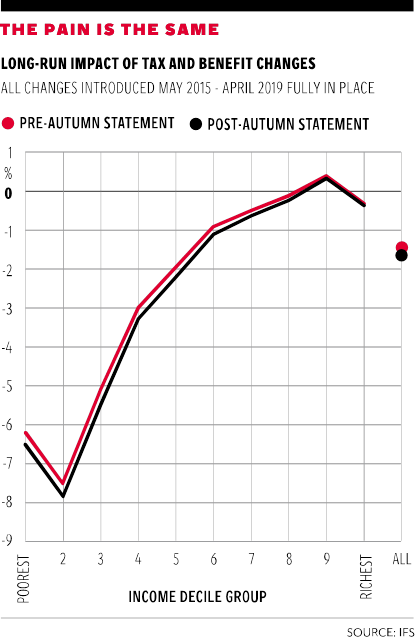
There was an apparent attempt to harness this particular psychological bias in George Osborne’s Autumn Statement. Of course the Chancellor was forced into a memorable U-turn on his wildly unpopular tax credit cuts. Millions of poor working families will now not see their benefits cut in cash terms next April. Yet the Chancellor still gets virtually all his previously targeted savings from the welfare bill by 2020.

How? Because the working age welfare system will still become much less generous in five years’ time. As research from the Institute for Fiscal Studies and the Resolution Foundation has shown, the typical low-income working family in 2020 will be hit just as hard as they were going to be before the Autumn Statement U-turn. The Chancellor seems to be calculating that the pain of future forgone gains will be less politically toxic than immediate cash losses.”

 image002

It’s hardly a revelation that the Conservative government are manipulating public opinion, using scapegoating, outgrouping and the creation of folk devils in order desensitize the public to the plight of the poorest citizens and to justify dismantling the welfare state incrementally. As I’ve pointed out previously, this has been going on since 2010, hidden in plain view.

In the article, Ben Chu also goes on to say:

“Experiments by Daniel Kahneman, Jack Knetsch and Richard Thaler also suggest that this stealth approach fits with people’s sense of fairness. They found that in a time of recession and high unemployment most people they surveyed thought a hypothetical company that cut pay in cash terms was acting unfairly, while one that merely raised it by less than inflation was behaving fairly.

There was another exploitation of our psychological biases in the Autumn Statement. The Chancellor announced an increase in stamp duty for people buying residential properties to let. That underscored the fact that the Chancellor remains wedded to the stamp duty tax, despite pressure from public finance experts to shift to a more progressive and efficient annual property tax (perhaps an overhauled council tax).

But Mr Osborne, like all his recent predecessors, realises that stamp duty, for all its deficiencies, tends to be less resented as a form of taxing property. Why? Because of “anchoring”. When people buy a house they are mentally prepared to part with a huge sum, usually far bigger than any other transaction they will make in their lives. The additional stamp duty payable to the Treasury on top of this massive sum, large though it is, seems less offensive. People resent it less than they would if the tax were collected annually in the form of a property tax – even if, for most, it would actually make little difference over the longer term. Sticking with stamp duty is the path of least resistance.”

There is another economologist “experiment” that seems to have slipped under the radar of the media – an experiment to nudge sick and disabled people into work, attempting to utilise GPs in a blatant overextension of the intrusive and coercive arm of the state. It is aimed at ensuring sick and disabled people don’t claim benefits. I don’t recall any mention of behaviourist social experiments on the public in the Conservative manifesto.

When I am ill, I visit a doctor. I expect professional and expert support. I wouldn’t consider consulting Iain Duncan Smith about my medical conditions. Or the government more generally. There are very good reasons for that. I’m sure that Iain Duncan Smith has Dunning–Kruger syndrome. He thinks he knows better than doctors and unreliably informs us that work can set you free, it can help prevent and cure illness.  Yet I’ve never heard of a single case of work curing blindness, heart disease, rheumatoid arthritis, cerebral palsy, multiple sclerosis, cancer or even so much as a migraine. I’ve also yet to hear of a person’s missing limbs miraculously growing back. The Conservative “medical intervention” entails a single prescription: a work coach from the job centre. State medicine – a single dose to be taken daily: Conservative ideology, traditional prejudice and some patronising and extremely coercive paternalism. The blue pill.

I don’t agree with the conclusions that Ben Chu draws in his article. Whilst he acknowledges that:

“The Government has a Behavioural Insights Team (or “Nudge Unit”) whose objective is to exploit the public’s psychological biases,” he goes on to say that it’s merely “to push progressive policies, such as getting us to save more for retirement and helping us make “better choices”, perhaps by counteracting the negative impact of loss aversion. But, as we’ve seen, the Chancellor is not above exploiting our biases in a cynical fashion too.” 

Progressive policies? The draconian welfare “reforms” aren’t remotely “progressive.” In the UK, the growth and institutionalisation of prejudice and discrimination is reflected in the increasing tendency towards the transgression of international legal human rights frameworks at the level of public policy-making. Policies that target protected social groups with moralising, stereotypical (and nudge-driven) normative messages, accompanied with operant disciplinary measures, have led to extremely negative and harmful outcomes for the poorest and most vulnerable citizens, but there is a marked political and social indifference to the serious implications and consequences of such policies.

There is a relationship between the world that a person inhabits and that person’s actions. Any theory of behaviour and cognition that ignores context can at best be regarded as very limited and partial. Yet the libertarian paternalists overstep their narrow conceptual bounds, with the difficulty of reconciling individual and social interests somewhat glossed over. They conflate “social interests” with neoliberal outcomes.

The asymmetrical, class-contingent application of paternalistic libertarian “insights” establishes a hierarchy of decision-making “competence” and autonomy, which unsurprisingly corresponds with the hierarchy of wealth distribution.

So nudge inevitably will deepen and perpetuate existing inequality and prejudice, adding a dimension of patronising psycho-moral suprematism to add further insult to politically inflicted injury. Nudge is a technocratic fad that is overhyped, theoretically trivial, unreliable; a smokescreen, a prop for neoliberalism and monstrously unfair, bad policy-making.

Libertarian paternalists are narrowly and uncritically concerned only with the economic consequences of decisions within a neoliberal context, and therefore, their “interventions” will invariably encompass enforcing behavioural modifiers and ensuring adaptations to the context, rather than being genuinely and more broadly in our “best interests.” Defining human agency and rationality in terms of economic outcomes is extremely problematic. And despite the alleged value-neutrality of the new behavioural economics research it is invariably biased towards the status quo and social preservation rather than progressive social change.

At best, the new “behavioural science” is merely theoretical, at a broadly experimental stage, and therefore profoundly limited in terms of scope and academic rigour, as a mechanism of explanation, and in terms of its capacity for generating comprehensive and coherent accounts and understandings of human motivation and behaviour.

At worst, the rise of this new form of psychopolitical behaviourism reflects, and aims at perpetuating, the hegemonic nature of neoliberalism.

But for the record, when a government attempts to micromanage and manipulate the behaviour of citizens, we call that “totalitarianism” not “nudge.” 

behavchange.jpg

Related reading

A critique of Conservative notions of social research

The government plan social experiments to “nudge” sick and disabled people into work

Mind the MINDSPACE: the nudge that knocked democracy down

Nudging conformity and benefit sanctions

A critique of Conservative notions of social research

images
The goverment’s archaic positivist approach to social research shows that they need a team of sociologists and social psychologists, rather than the group of “libertarian paternalists” – behavioural economists – at the heart of the cabinet office, who simply nudge the public to behave how they deem appropriate, according to a rigid, deterministic, reductive neoliberal agenda and traditional, class-contingent Conservative prejudices.


Glossary

Epistemology – The study or theory of the nature and grounds of knowledge, especially with reference to its limits, reliability and validity. It’s invariably linked with how a researcher perceives our relationship with the world and what “social reality” is (ontology), and how we ought to investigate that world (methodology). For example, in sociology, some theorists held that social structures largely determine our behaviour, and so behaviour is predictable and objectively measurable, others emphasise human agency, and believe that we shape our own social reality to a degree, and that it’s mutually and meaningfully negotiated and unfixed. Therefore, detail of how we make sense of the world and navigate it is important.

Interpretivism – In sociology, interpretivists assert that the social world is fundamentally unlike the natural world insofar as the social world is meaningful in a way that the natural world is not. As such, social phenomena cannot be studied in the same way as natural phenomena. Interpretivism is concerned with generating explanations and extending understanding rather than simply describing and measuring social phenomena, and establishing basic cause and effect relationships.

Libertarian paternalism – The idea that it is both possible and legitimate for governments, public and private institutions to affect and change the behaviours of citizens whilst also [controversially] “respecting freedom of choice.”

MethodologyA system of methods used in a particular area of study or activity to collect data. In the social sciences there has been disagreement as to whether validity or reliability ought to take priority, which reflected ontological and epistemological differences amongst researchers, with positivism, broadly speaking, being historically linked with structural theories of society – Emile Durkheim’s structural-functionalism, for example – and quantitative methods, usually involving response-limiting surveys, closed-ended questionaires and statistical data collection, whereas interpretive perspectives, such as symbolic interactionism, phenomenology and ethnomethodology, tend to be associated with qualitative methods, favoring open-ended questionaires, interviews and participant observation.

The dichotomy between quantitative and qualitative methodological approaches, theoretical structuralism (macro-level perspectives) and interpretivism (micro-level perspectives) is not nearly so clear as it once was, however, with many sociologists recognising the value of both means of data collection and employing methodological triangulation, reflecting a commitment to methodological and epistemological pluralism. Qualitative methods tend to be more inclusive, lending participants a dialogic, democratic voice regarding their experiences.

Ontology – A branch of metaphysics concerned with the nature of reality and being. It’s important because each perspective within the social sciences is founded on a distinct ontological view.

Positivism – In sociology particularly, the view that society, like the physical world, operates according to general laws, and that all authentic knowledge is that which is verified. However, the verification principle is itself unverifiable.

Positivism tends to present superficial and descriptive rather than in-depth and explanatory accounts of social phenomena. In psychology, behaviourism has been the doctrine most closely associated with positivism. Behaviour from this perspective can be described and explained without the need to make ultimate reference to mental events or to internal psychological processes. Psychology is, according to behaviourists, the “science” of behaviour, and not the mind.

Critical realism – Whilst positivists and empiricists more generally, locate causal relationships at the level of observable surface events, critical realists locate them at the level of deeper, underlying generative mechanisms. For example, in science, gravity is an underlying mechanism that is not directly observable, but it does generate observable effects. In sociology, on a basic level, Marx’s determining base (which determines superstructure) may be regarded as a generative mechanism which gives rise to emergent and observable properties.

Randomised controlled trials (RCTs) – RCT is a positivist research model in which people are randomly assigned to an intervention or a control (a group with no intervention) and this allows comparisons to be made. Widely accepted as the “gold standard” for clinical trials, the foundation for evidence-based medicine, RCTs are used to establish causal relationships. These kinds of trials usually have very strict ethical safeguards to ensure the fair and ethical treatment of all participants, and these safeguards are especially essential in government trials, given the obvious power imbalances and potential for abuse. A basic principle expressed in the Nuremberg Code is the respect due to persons and the value of a person’s autonomy, for example.

In the UK, the Behavioural Insight Team is testing paternalist ideas for conducting public policy by running experiments in which many thousands of participants receive various “treatments” at random. Whilst medical researchers generally observe strict ethical codes of practice, in place to protect subjects, the new behavioural economists are much less transparent in conducting research and testing public policy interventions. Consent to a therapy or a research protocol must possess three features in order to be valid. It should be voluntarily expressed, it should be the expression of a competent subject, and the subject should be adequately informed. It’s highly unlikely that people subjected to the extended use and broadened application of welfare sanctions gave their informed consent to participate in experiments designed to test the theory of “loss aversion,” for example.

There is nothing to prevent a government deliberately exploiting a research framework as a way to test out highly unethical and ideologically-driven policies. How appropriate is it to apply a biomedical model of prescribed policy “treatments” to people experiencing politically and structurally generated social problems, such as unemployment, inequality and poverty, for example?

cogs

The increasing conditionality and politicisation of “truths”

The goverment often claim that any research revealing negative social consequences arising from their draconian policies, which they don’t like to be made public “doesn’t establish a causal link.”  Recently there has been a persistent, aggressive and flat denial that there is any “causal link” between the increased use of food banks and increasing poverty, between benefit sanctions and extreme hardship and harm, between the work capability assessment and an increase in numbers of deaths and suicides, for example.

The government are referring to a scientific maxim: “Correlation doesn’t imply causality.” 

It’s true that correlation is not the same as causation.

It’s certainly true that no conclusion may be drawn regarding the existence or the direction of a cause and effect relationship only from the fact that event A and event B are correlated. Determining whether there is an actual cause and effect relationship requires further investigation. The relationship is more likely to be causal if the correlation coefficient is large and statistically significant, as a general rule of thumb. (For anyone interested in finding out more about quantitative research methods, inferential testing and statistics, this is a good starting point – Inferential Statistics.)

Here are some minimal conditions to consider in order to establish causality, taken from Hills criteria:

  • Strength: A relationship is more likely to be causal if there is a plausible mechanism between the cause and the effect.
  • Coherence: A relationship is more likely to be causal if it is compatible with related facts and theories.
  • Analogy: A relationship is more likely to be causal if there are proven relationships between similar causes and effects.
  • Specificity: A relationship is more likely to be causal if there is no other likely explanation.
  • Temporality: A relationship is more likely to be causal if the effect always occurs after the cause.
  • Gradient: A relationship is more likely to be causal if a greater exposure to the suspected cause leads to a greater effect.
  • Plausibility: A relationship is more likely to be causal if there is a plausible mechanism between the cause and the effect.

Hill’s criteria can be thought of as elements within a broader process of critical thinking in research, as careful considerations in the scientific method or model for deciding if a relationship involves causation. The criteria don’t all have to be met to suggest causality and it may not even be possible to meet them in every case. The important point is that we can consider the criteria as part of a careful and relatively unbiased research process. We can also take other precautionary steps, such as ensuring that there are no outliers or excessive uncontrolled variance, ensuring the populations sampled are representative and generally taking care in our research design, for example.

However, it is inaccurate to say that correlation doesn’t imply causation. It quite often does.

Furthermore, the government are implying that social research is valid only if it conforms to strict and archaic positivist criteria, and they attempt to regularly dismiss the propositions and research findings of social scientists as being “value-laden” or by implying that they are, at least. However, it may also be said that values enter into social inquiry at every level, including decisions to research a social issue or not, decisions to accept established correlations and investigate further, or not, which transforms research into a political act. (One only need examine who is potentially empowered or disempowered through any inquiry and note the government response to see this very clearly).

It’s noteworthy that when it comes to government claims, the same methodological rigour that they advocate for others isn’t applied. Indeed, many policies have clearly been directed by ideology and traditional Tory prejudices, rather than valid research and empirical evidence. For example, it is widely held by the Conservatives that work is the “only route out of poverty”. Yet since 2010, the decline in UK wage levels has been amongst the very worst in Europe. The fall in earnings under the Tory-led Coalition is the biggest in any parliament since 1880, according to analysis by the House of Commons Library, and at a time when the cost of living has spiralled upwards. Many people in work, as a consequence, are now in poverty, empirically contradicting government claims.

web-earnings-graphic

So what is positivism?

Positivism was a philosophical and political movement which enjoyed a very wide currency in the second half of the nineteenth century. It was extensively discredited during the twentieth century.

Auguste Comte (1798-1857,) who was regarded by many as the founding father of social sciences, particularly sociology, and who coined the term “positivism,” was a Conservative. He believed social change should happen only as part of an organic, gradual evolutionary process, and he placed value on traditional social order, conventions and structures. Although the notion of positivism was originally claimed to be about the sovereignty of positive (verified) value-free, scientific facts, its key objective was politically Conservative. Positivism in Comte’s view was “the only guarantee against the communist invasion.” (Therborn, 1976: 224).

The thing about the fact-value distinction is that those who insist on it being rigidly upheld the loudest generally tend to use it the most to disguise their own whopping great ideological commitments. In psychology, we call this common defence mechanism splitting.  “Fact, fact, fact!” cried Mr Thomas Gradgrind. It’s a very traditionally Conservative way of rigidly demarcating the world, imposing hierarchies of priority and order, to assure their own ontological security and maintain the status quo, regardless of how absurd this shrinking island of certainty appears to the many who are exiled from it.

Perhaps unsurprisingly, Comte’s starting point is the same as Hayek’s, namely the existence of a spontaneous order. It’s a Conservative ideological premise, and this is one reason why the current neoliberal Tory government of self-described “libertarian paternalists” embrace positivism without any acknowledgement of its controversy.

However, positivist politics was discarded half a century ago, as a reactionary and totalitarian doctrine. It’s is true to say that, in many respects, Comte was resolutely anti-modern, and he also represents a general retreat from Enlightenment humanism. His somewhat authoritarian positivist ideology, rather than celebrating the rationality of the individual and wanting to protect people from state interference, instead fetishised the scientific method, proposing that a new ruling class of authoritarian technocrats should decide how society ought to be run and how people should behave. This is a view that the current government, with their endorsement and widespread experimental application of nudge theory, would certainly subscribe to.

Science, correlation and causality

Much scientific evidence is based on established correlation of variables – they are observed to occur together. For example, correlation is used in Bell’s theorem to disprove local causality. The combination of limited available methodologies has been used together with the dismissing “correlation doesn’t imply causation” fallacy on occasion to counter important scientific findings. For example, the tobacco industry has historically relied on a dismissal of correlational evidence to reject a link between tobacco and lung cancer, especially in the earliest stages of the research, but there was a clearly and strongly indicated association. 

Science is manifestly progressive, insofar as over time its theories tend to increase in depth, range and predictive power.

Established correlations in both the social and natural sciences may be regarded, then, as a starting point for further in-depth and rigorous research, with the coherence, comprehensiveness and verisimilitude of theoretical propositions increasing over time. This is basically a critical realist position, which is different from the philosophical positivism that dominated science and the social sciences two centuries ago, with an emphasis on strictly reductive empirical evidence and the verification principle (which is itself unverifiable).

Positivist epistemology has been extensively critiqued for its various limitations in studying the complexities of  human experiences. One critique focuses on the positivist tendency to carry out studies from a “value-free” outsider perspective in an effort to maintain objectivity, whilst the insider or subjective perspective is ignored. There is no mind-independent, objective vantage point from which social scientists may escape the insider. A second critique is that positivism is reductionist and deterministic. It emphasises quantification and ignores and removes context, meanings, autonomy, intention and purpose from research questions by ignoring unquantifiable variables.

It therefore doesn’t extend explanations and understanding of how we make sense of the world. A third critique is that positivism entails generalisation of data which renders results inapplicable to individual cases; data are used to describe a population without accounting for significant micro-level or individual variation. Because of these and other problems, positivism lost much favour amongst sociologists and psychologists in particular. 

Verification was never the sole criterion of scientific inquiry. Positivism probably lost much more methodological and epistemological currency in the social sciences than the natural sciences, because humans cannot be investigated in the same way as inert matter. We have the added complication of consciousness and [debatable] degrees of intentionality, so people’s behaviour is much more difficult to measure, observe and predict. There’s a difference between facts and meanings, human behaviours are meaningful and purposeful, human agency arises in contexts of intersubjectively shared meanings. But it does seem that prediction curiously becomes easier at macro-levels when we examine broader social phenomena, mechanisms and processes. (It’s a bit like quantum events: quite difficult to predict at subatomic level, but clarifying, with events apparently becoming more predictable at the level we inhabit and observe every day.)

Now, whilst correlation isn’t quite the same as “cause and effect”, it often strongly indicates a causal link, and what usually follows once we have established a correlation is further rigorous research, eliminating “confounding” variables and bias systematically (we do use rigorous inference testing in the social sciences). Correlation is used when inferring causation; the important point is that such inferences are made after correlations are confirmed as real and all causational relationships are systematically explored using large enough data sets.

The standard process of research and enquiry, scientific or otherwise, doesn’t entail, at any point, a flat political denial that there is any relationship of significance to concern ourselves with, nor does it involve withholding data and a refusal to investigate further.

Positivism and psychology

Positivism was most closely associated with a doctrine known as behaviourism during the mid-20th century in psychology. Behaviourists confined their research to behaviours that could be directly observed and measured. Since we can’t directly observe beliefs, thoughts, intentions, emotions and so forth,  these were not deemed to be legitimate topics for a scientific psychology. One of the assumptions of behaviourists is that free-will is illusory, and that all behaviour is determined by the environment either through association or reinforcement. B.F. Skinner argued that psychology needed to concentrate only on the positive and negative reinforcers of behaviour in order to predict how people will behave, and  everything else in between (like what a person is thinking, or their attitude) is irrelevant because it can’t be measured.

So, to summarise, behaviourism is basically the theory that human (and animal) behaviour can be explained in terms of conditioning, without appeal to wider socioeconomic contexts, consciousness, character, traits, personality, internal states, intentions, purpose, thoughts or feelings, and that psychological disorders and “undesirable” behaviours are best treated by using a system of reinforcement and punishment to alter behaviour “patterns.”

In Skinner’s best-selling book Beyond Freedom and Dignity1971, he argued that freedom and dignity are illusions that hinder the science of behaviour modification, which he claimed could create a better-organised and happier society, where no-one is autonomous, because we have no autonomy. (See also Walden Two1948: Skinner’s dystopian novel).

There is, of course, no doubt that behaviour can be controlled, for example, by threat of violence, actual violence or a pattern of deprivation and reward. Freedom and dignity are values that are intrinsic to human rights. Quite properly so. All totalitarians, bullies  and authoritarians are behaviourists. Skinner has been extensively criticised for his sociopolitical pronouncements, which many perceive to be based on serious philosophical errors. His recommendations are not based on “science”, but on his own covert biases and preferences.

Behaviourism also influenced a positivist school of politics that developed in the 50s and 60s in the USA. Although the term “behavouralism” was applied to this movement, the call for political analysis to be modeled upon the natural sciences, the preoccupation with researching social regularities, a commitment to verificationism, an experimental approach to methodology, an emphasis on quantification and the prioritisation of a fact-value distinction: keeping moral and ethical assessment and empirical explanations distinct, indicate clear parallels with the school of behaviourism and positivism within psychology.

The political behaviouralists proposed, ludicrously, that normative concepts such as “democracy,” “equality,” “justice” and “liberty” should be rejected as they are not scientific – not verifiable or falsifiable and so are beyond the scope of “legitimate” inquiry. 

Behaviourism has been criticised within politics as it threatens to reduce the discipline of political analysis to little more than the study of voting and the behaviour of legislatures. An emphasis on  the observation of data deprives the field of politics of other important viewpoints – it isn’t a pluralist or democratic approach at all – it turns political discourses into monologues and also conflates the fact-value distinction.

Every theory is built upon an ideological premise that led to its formation in the first place and subsequently, the study of  “observable facts” is intentional, selective and purposeful. As Einstein once said: “the theory tells you what you may observe.”

The superficial dichotomisation of facts and values also purposefully separates political statements of what is from what ought to be. Whilst behavouralism is itself premised on prescriptive ideology, any idea that politics should include progressive or responsive prescriptions – moral judgements and actions related to what ought to be – are summarily dismissed.

Most researchers would agree that we ought to attempt to remain as objective as possible, perhaps aiming for a relative value-neutrality, rather than value-freedom, when conducting research. It isn’t possible to be completely objective, because we inhabit the world that we are studying, we share cultural norms and values, we are humans that coexist within an intersubjective realm, after all. We can’t escape the world we are observing, or the mind that is part of the perceptual circuit.

But we can aim for integrity, accountability and transparency. We can be honest, we can critically explore and declare our own interests and values, for example. My own inclination is towards value-frankness, rather than value-freedom – we can make the values which have been incorporated in the choice of the topic of research, and of the formulation of hypotheses clear and explicit at the very outset. The standardised data collection process itself is uncoloured by personal feelings (that is, we can attempt to collect data reliably and systematically.) However, the debate about values and the principle of objectivity is a complex one, and it’s important to note that symbolic interactionists and post modernists, amongst others, have contended that all knowledge is culturally constructed. (That’s a lengthy and important discussion for another time.)

Nudge: from meeting public needs to prioritising political needs

The idea of “nudging” citizens to do the “right thing” for themselves and for society heralds the return of behaviourist psychopolitical theory. Whilst some theorists claim that nudge is premised on notions of cognition, and so isn’t the same as the flat, externalised stimulus-response approach of behaviourism, my observation is that the starting point of nudge theory is that our cognitions are fundamentally biased and faulty, and so the emphasis of nudge intervention is on behaviour modification, rather than on engaging with citizen’s cognitive or deliberative capacities.

In other words, our tendency towards cognitive bias(es) render us incapable of rational decision-making, so the state is bypassing democratic engagement and prescribing involuntary and experimental behavioural change to “remedy” our perceived cognitive deficits.

Behaviourists basically stated that only public events (behaviours of an individual) can be objectively observed, and that therefore private events (intentions, thoughts and feelings) should be ignored. The paternal libertarians are stating that our cognitive processes are broken, and should be ignored. What matters is how people behave. It’s effectively another reductionist, instrumental stimulus-response approach based on the same principles as operant conditioning.

Nudge is very controversial. It’s experimental use on an unconsenting population has some profound implications for democracy,  which is traditionally based on a process of dialogue between the public and government, ensuring that the public are represented: that governments are responsive, shaping policies that address identified social needs. However, Conservative policies are no longer about reflecting citizen’s needs: they are increasingly all about instructing us how to be.

The context-dependency and determination of value-laden nudge theory

Libertarian paternalists are narrowly and uncritically concerned only with the economic consequences of decisions within a neoliberal context, and therefore, their “interventions” will invariably encompass enforcing behavioural modifiers and ensuring adaptations to the context, rather than being genuinely and more broadly in our “best interests.” Defining human agency and rationality in terms of economic outcomes is extremely problematic. And despite the alleged value-neutrality of the new behavioural economics research it is invariably biased towards the status quo and social preservation rather than progressive social change.

At best, the new “behavioural theories” are merely theoretical, at a broadly experimental stage, and therefore profoundly limited in terms of scope and academic rigour; as a mechanism of explanation and in terms of capacity for generating comprehensive and coherent accounts and understandings of human motivation and behaviour.

Furthermore, in relying upon a pseudo-positivistic experimental approach to human cognition, behavioural economists have made some highly questionable ontological and epistemologial assumptions: in the pursuit of methodological individualism, citizens are isolated from the broader structural political, economic and sociocultural and established reciprocal contexts that invariably influence and shape an individuals’s experiences, meanings, motivations, behaviours and attitudes, causing a deeply problematic duality between context and cognition.

Yet many libertarian paternalists reapply the context they evade in explanations of human behaviours to justify the application of their theory in claiming that their “behavioural theories” can be used to serve social, and not necessarily individual, ends, by simply acting upon the individual to make them more “responsible.” But “responsible” is defined only within the confines of a neoliberal economic model. (See, for example: Personal Responsibility and Changing Behaviour: the state of knowledge and its implications for public policyDavid Halpern, Clive Bates, Geoff Mulgan and Stephen Aldridge, 2004.)

In other words, there is a relationship between the world that a person inhabits and a person’s perceptions, intentions and actions. Any theory of behaviour and cognition that ignores context can at best be regarded as very limited and partial. Yet the libertarian paternalists overstep their narrow conceptual bounds, with the difficulty of reconciling individual and social interests somewhat glossed over. They conflate “social interests” with neoliberal outcomes.

The ideological premise on which the government’s “behavioural theories” and assumptions about the negative impacts of neoliberalism on citizens rests is fundamentally flawed, holding individuals responsible for circumstances that arise because of market conditions, the labor market, political decision-making, socioeconomic constraints and the consequences of increasing “liberalisation”, privatisation and marketisation.

Market-based economies both highly value and extend competitive individualism and “efficiency”,  which manifests a highly hierarchical social structure, and entails the adoption of economic Darwinism. By placing a mathematical quality on social life (Bourdieu, 1999), neoliberalism has encouraged formerly autonomous states to regress into penal states that value production, competition and profit above all else, including attendance to social needs and addressing arising adverse structural level constraints, the consequences of political decision-making and wider socioeconomic issues, such as inequality and poverty.

As a doxa, neoliberalism has become a largely unchallenged reality. It now seems almost rational that markets should be the allocators of resources; that competition should be the primary driver of social problem-solving, innovation and behaviour, and that societies should be composed of individuals primarily motivated by economic conditions and their own economic productivity. Despite the Conservative’s pseudo-positivist claims of value-neutrality, the economic system is being increasingly justified by authoritarian moral arguments about how citizens ought to act.

The rise of a new political behaviourism reflects, and aims at perpetuating, the hegemonic nature of neoliberalism.

11196235_481003708719482_8797603064126897147_n

Image courtesy of Tiago Hoisel


Nudging conformity and benefit sanctions: a state experiment in behaviour modification

cogs


“Behavioural theory is a powerful tool for the government communicator, but you don’t need to be an experienced social scientist to apply it successfully to your work.”
Alex Aiken
Executive Director of
Government Communications


Normalising structural violence and state punishment 

Conservative anti-welfare discourse excludes the structural context of unemployment and poverty from public conversation by transforming these social problems into individual pathologies of “welfare dependency” and “worklessness.” The consequence is an escalating illogic of authoritarian policy measures which have at their core the intensification of punitive conditionality. These state interventions are justified by the construction and mediation of stigma, which is directed at already marginalised social groups that the policies target.

The groups, which include ill and disabled people, people who are unemployed, are painted with a Malthusian brush, as a “burden on the state” and a drain on what are politically portrayed and publicly seen as scarce resources in an era of austerity. Political processes of scapegoating, stigmatisation and outgrouping have been amplified by a largely complicit UK corporate media. These calculated outgrouping narratives have in turn been used to legitimise state violence.

Such policies and interventions are then rationalised as innovative and new political and economic responses. Behavioural economics theories, which “nudge” is a part of, for example, are aimed at “changing the behaviours” of citizens perceived to “make the wrong choices” – ultimately the presented political aim is to mend Britain’s supposedly “broken society” and to restore a country that “lives within its means”, according to a narrow, elitist view, bringing about a neoliberal utopia built on “economic competitiveness” in a “global race.” 

Disadvantage has become an individualised, private matter: it has been politically reduced and is explained as a private, internal characteristic of disadvantaged individuals, rather than it being an inevitable feature of a socioeconomic form of organisation founded on competitive individualism. This allows the state to depoliticise it, making disadvantage the private and sole responsibility of citizens, whilst at the same time, justifying a psychopolitical approach to changing citizen’s behaviours to fit with neoliberal outcomes. 

Institutions structure political struggles, they provide models, schemas and scripts for citizen’s behaviours. Bureaucratic norms within the welfare state have become increasingly about moral rectification. Debate about addressing structural inequality and poverty has been transformed into political rhetoric about behavioural incentives to change what are deemed to be poor people’s biased attitudes, cognitive deficits and faulty actions. Apparently, wealthy people don’t have these flaws. 

Welfare dependency is now a synonym for poverty, with its perceived dimensions of moral/psychological dependency accepted as a character “trait” or a “personality disorder.”  The sociopolitical relations of subordination, exploitation and economic organisation that were hidden within the discourse of “dependency” have now completely disappeared from public conversations about poverty. 

Context

Narratives about social security in the UK that emphasise a deepening of neoliberalisation became particularly virulent in the context of the global economic crash, which raised threats to the New Right neoliberal hegemony.

In August 2008, James Purnell, then Work and Pensions secretary, ordered a review of welfare to cut costs. The review explored how behavioural economics (nudge) may be used to “motivate” those claiming  welfare support and to establish what the “right conditions” are for the long-term unemployed or to deal with those thought to be “abusing the system.”

The review also addressed issues such as how people’s aversion to loss could be used to reduce the claimant count, which included consideration of the loss of high regard in the community; respect for legitimate authority; reciprocity – including a sense of obligation to give something back – and finally, “social proof” (using normative setting) – responding to the behaviour of others, such as their successful search for work.

Following some targeted survey work carried out by the Department for Work and Pensions, it was claimed that more than half of claimants say they are more likely to look for work because of the threat of sanctions. It was also suggested that attaching more stringent conditions to welfare could draw on the then latest British interest in nudge economics, and the “hidden art of persuasion.” This took place in a context of other European countries and the US exploring similar radical welfare reforms. (See also: Experiments on Unemployment Benefit Sanctions and Job Search Behaviour, 2004).

However, the direct evidence on the impact of sanctions largely concerns how it affected the compliance; rule-following job seeking behaviour and employment rates of those who have actually experienced or been formally warned of a sanction. However, how “employment rates” are actually measured poses a problem, as, in the UK, an outcome of employment is assumed if someone’s claim is closed.

Several US studies have used high quality designs to analyse differences in post-welfare outcomes and found that, on average, those who are sanctioned out of the welfare system are less likely to enter employment than those who leave for other reasons. Sanctioned welfare leavers are more likely to experience severe hardship and some become disconnected from income and other support systems.

Purnell resigned in 2009, as Gordon Brown refused to implement his neoliberal welfare proposals. The Nudge Unit was established and formally instituted as part of the Cabinet in 2010, under Cameron’s coalition government.

I’ve written more than one critical piece about the Government’s part-privatised Nudge Unit – the Behavioural Insights Team – particularly its insidious and malevolent influence on the range of psychocratic policies aimed at “behavioural changes” which are now being imposed on the poorest citizens. 

From the shrinking category of legitimate “disability” to forcing people to work for no pay on exploitative workfare schemes, “nudge” has been used to euphemistically frame punitive policies, “applying the principles of behavioural economics to the important issue of the transition from welfare to work.” (See: Employing BELIEF:Applying behavioural economics to welfare to work, 2010.)

The Conservatives have claimed to make welfare provision “fair” by introducing substantial cuts to benefits and harsh conditionality requirements regarding eligibility to social security, including the frequent use of extremely punitive benefit sanctions as a means of “changing behaviours,” and “incentivising” people to find work, highlighting plainly that the Conservatives regard unemployment and disability as some kind of personal deficit on the part of those who are, in reality, simply casualties of structural constraints; labor market conditions, exclusion from acceptable living standards because of cuts to income and rising living costs, bad political decision-making and subsequent policy-shaped socioeconomic circumstances.

The word “fair” originally meant “treating people equally without favouritism or discrimination, without cheating or trying to achieve unjust advantage.” Under the Conservatives, we have witnessed more than one manipulated semantic shift, words like “fair” , “support” , “reform” , “responsibility”, “opportunities” and “help” , for example, have become embedded in a narrative of superficial  Glittering Generalities – part of a lexicon of persuasion and precarious psychosemantics that simply prop up Tory ideology  – an idiom of belief – in an endlessly erroneous, irrational and self-referential way.

The problem is that the power of a system of such implicit beliefs to defeat valid objections one by one is entirely due to the circularity  and self-perpetuating nature of such systems, as Iain Duncan Smith, who stands firmly within this idiom, consistently demonstrates only too well. After being rebuked by the UK Statistics Authority (ONS) for his claim that his policies have “forced 8,000 benefit claimants back into work” in 2013, he was informed politely that this wasn’t empirically evidenced – his claim could not be proven with his statistics. His response was: “I have a belief that I am right […] you cannot disprove what I said.” His “theory” tells him what he may observe.

There is a gulf between the rhetoric and empirical evidence on benefit sanctions. The evidence base is both small and limited in its scope, and it does not accommodate the differing approaches to preventing poverty and promoting opportunity that arise in international policy design. Increased welfare conditionality and sanctions are too narrowly based on a rhetoric of moral(ising) philosophy, and takes a highly selective approach evidence.

Iain Duncan Smith is the expert Tory pop-psychologist, fluent in psychobabble words like “incentivise” and “behavioural change” and whilst he demands rigorous research standards from academics and his critics, he doesn’t ever uphold those same standards himself.

If you “just know” you’re right, then does it matter if you regularly make up the evidence to support your mighty powers of New Right and very neoliberal intuitions?  It ought to, and it would if Conservative policy was genuinely based on meeting public needs, evidence and objective measures of effectiveness, rather than being based on prejudice and political expediency.

Words like “fair” and “help” now signpost an intentionally misleading Conservative discourse. Nudge permeates language, prompting semantic shifts towards bland descriptors which mask power and class relations, coercive state actions and political intentions. One only need to look at the context in which the government use words like “fair”, “support”, “help” “justice” and “reform” to recognise linguistic behaviourism in action. Or if you prefer, Orwellian doublespeak.

The Conservatives have orchestrated semantic shifts which reflect neoliberal values and reference a distinctive New Right ideological repertoire, from which is constructed basic pseudo-scientific justification narratives, asserting that people claiming welfare do so, as I said previously, because of “faulty” personal characteristics and various types of cognitive incompetence and laziness. In short, the government have pathologised and stigmatised unemployment, redefining it as a psychological disorder.

The government have also problematised welfare, based on the absurd New Right idea that financial support when people really need it somehow creates problems, rather than it being an essential mechanism aimed at alleviating poverty, extending social and economic support, justice and opportunities: social insurance and security

The government have adopted a strongly disciplinarian approach to structural problems such as poverty, using narratives that are strikingly reminiscent of the attitudes and values that shaped the extremely punitive and ill-conceived 1834 Poor Law amendment act.

The post-war welfare state is founded on the idea that government plays a key role in ensuring the protection and promotion of the economic and social well-being of its citizens. It is based on the principles of equality of opportunity, equitable distribution of wealth, and both political and social responsibility for those unable to avail themselves of the minimal provisions for health and wellbeing.

Restricting choices to “choice”

The increased use and rising severity of benefit sanctions became an integrated part of welfare “conditionality” in 2012. Sanctions are based on a principle borrowed from behavioural economics theory – a cognitive bias called “loss aversion.” It refers to the idea that people’s tendency is to strongly prefer avoiding losses to acquiring gains. The idea is embedded in the use of sanctions to “nudge” people towards compliance with welfare rules of conditionality, by using a threat of punitive financial loss, since the longstanding, underpinning Conservative assumption is that people are unemployed because of behavioural deficits.

I’ve argued elsewhere, however, that benefit sanctions are more closely aligned with operant conditioning (behaviourism) than “libertarian paternalism,” since sanctions are a severe punishment intended to modify behaviour and restrict choices to that of compliance and conformity or destitution.

Libertarian paternalists claim that whilst it is legitimate for government, private and public institutions to affect behaviour the aims should be to ensure that “people should be free to opt out of specified arrangements if they choose to do so.” The nudges favoured by libertarian paternalists are also supposed to be “unobtrusive.” That clearly is not the case with the application of coercive, draconian Conservative welfare sanctions.

Last year I wrote about the connection between the Nudge Unit’s pseudoscientific obsession with manipulating people’s decision-making by utilising various cognitive bias theories – in this case, particularly, the behavioural economic theory of loss aversion and the increased use and severity of benefit sanctions. Though most people succumbing to the Nudge Unit’s guru effect (ironically, another cognitive bias) think that “nudging” is just about prompting men to pee on the right spot in urinals, or about persuading us to donate organs and to pay our taxes on time. Nudge is at the very heart of the New  Right’s neo-behaviourist turn, which entails the application of operant conditioning to individualise and privatise social problems such as inequality and poverty. 

When it comes to technocratic fads like nudge, it’s worth bearing in mind that truth and ethics quite often have an inversely proportional relationship with the profit motive. It’s a cognitive bias, if you will.

For anyone curious as to how such tyrannical behaviour modification techniques like benefit sanctions arose from the bland language, inane, managementspeak acronyms and pseudo-scientific framework of “paternal libertarianism” – nudge – read this paper, focused almost exclusively on New Right small state obsessions, paying particular attention to the part about loss aversion, on page 7.

And this on page 18: The most obvious policy implication arising from loss aversion is that if policy-makers can clearly convey the losses that certain behaviour will incur, it may encourage people not to do it,” and page 46: “Given that, for most people, losses are more important than comparable gains, it is important that potential losses are defined and made explicit to jobseekers (e.g. the sanctions regime).”

The recommendation on that page: We believe the regime is currently too complex and, despite people’s tendency towards loss aversion, the lack of clarity around the sanctions regime can make it ineffective. Complexity prevents claimants from fully appreciating the financial losses they face if they do not comply with the conditions of their benefit.”

The Conservatives duly “simplified” sanctions by extending them in terms of severity and increasing the frequency of use. Sanctions have also been extended to include previously protected social groups, such as disabled people.

The paper was written in November 2010, prior to the Coalition policy of increased “conditionality” and the extended sanctions element of the Tory-led welfare “reforms” in 2012.

Sanctioning welfare recipients by removing their lifeline benefit – originally calculated to meet the cost of only basic survival needs – food, fuel and shelter – isn’t about “arranging choice architecture”, it’s not nudging: it’s operant conditioning. It’s a brand of particularly dystopic, psychopolitical behaviourism, and is all about a totalitarian level of micromanaging people to ensure they are obedient and compliant to the needs of  the “choice architects” and policy-makers. Nudge in this context is nothing more than a prop for austerity, neoliberalism and social conservatism.

It is all-pervasive, nudge permeates political rhetoric and discursive practices. Words like “help” and “support” disguise coercive and punitive state actions. Bland language is used to normalise inequality and discriminatory political practices. The word “incentivise,” for example, is used a lot by the Conservatives, but to wealthy people, it means financial privileges in the form of tax cuts and privatised wealth, and to poor people, it means having lifeline income taken away by the state. 

Deploying behavioural modification techniques (and without the public’s consent) marginalises political discussion, stifles public debate, sidesteps democratic dialogue, problem-solving, criticism and challenges and forecloses the possibility of social justice considerations.

Furthermore, an individual’s autonomy, which is also the basis of his or her dignity, as a person, is worthy of protection and should not be interfered with by any kind of behavioural modification, “nudge” or otherwise. Nor should removing people’s lifeline income designed to meet only basic survival needs ever be withdrawn as a state “correction” and punishment.

Nudge operates at a much broader level, too. The intentional political construction of folk devils and purposeful culturally amplified references to a stereotype embodying fecklessness, idleness and irresponsibility, utilising moral panic and manufactured public outrage as an effective platform for punitive welfare reform legislation, is one example of the value-laden application of pseudoscientific “behavioural insights” theory. The new paternalists have drawn on our psychosocial inclinations towards conformity, which is evident in the increasing political use of manipulative normative messaging. (For example, see: The Behavioral Insights Team in the U.K. used social normative messages to increase tax compliance in 2011.) 

The paternalist’s behavioural theories have been used to increasingly normalise a moral narrative based on a crude underpinning “deserving” and “undeserving” dichotomy, that justifies state interventions imposing conditions of extreme deprivation amongst some social groups – especially those previously considered legally protected. Public rational and moral boundaries have been and continue to be nudged and shifted, incrementally. Gordon Allport outlined a remarkably similar process in his classic political psychology text, The Nature of Prejudice, which describes the psychosocial processes involved in the construction of categorical others, and the subsequent escalating scale of prejudice and discrimination

In the UK, the growth and institutionalisation of prejudice and discrimination is reflected in the increasing tendency towards the  transgression of international legal human rights frameworks at the level of public policy-making. Policies that target protected social groups with moralising, stereotypical normative messages, accompanied with operant disciplinary measures, have led to extremely negative and harmful outcomes, but there is a marked political and social indifference to the serious implications and consequences of the impacts of such policies .

The theory tells you what you may observe

There is no evidence that welfare sanctions improve employment outcomes. There is no evidence that sanctions “change behaviours.” There is, in any case, a substantial difference between people conforming with welfare conditionality and rules and gaining appropriate and secure employment.

One difficulty is that since 2011, Job Centre Plus’s (JCP) primary key performance indicator has been off-flow from benefit at the 13th, 26th, 39th and 52nd weeks of claims. Previously JCP’s performance had been measured against a range of performance indicators, including off-flows from benefit into employment.

Indeed, when asked for evidence by the Work and Pensions Committee, one minister, in her determination to defend the Conservative sanction regime, regrettably provided misleading information on the destinations of JSA, Income Support and Employment Support Allowance claimants from 2011, that pre-dated the new sanctions regime introduced in 2012, in an attempt to challenge the findings of the University of Oxford/LSHTM study on the effects of sanctions on getting JSA claimants off-flow. (Fewer than 20% of this group of people who were no longer in receipt of JSA were recorded as finding employment.) Source: Benefit sanctions policy beyond the Oakley Review – Work and Pensions.

Studies have shown that being “treated” by at least one “stick” (punitive measure) significantly reduces an individual’s earnings after periods of unemployment; on the other hand, participating in a supportive programme affects earnings positively.

 Treatment and policy regime effects of Carrots and Sticks, in % of average earnings

 Effects are expressed in percent of average monthly earnings within 3.5 years after unemployment (3547 CHF = 3290 EUR = 3575 USD in sample). Treatment effects: effects of being exposed to at least one carrot (job search assistance, training) or stick (sanction, workfare programme).

Source: Arni, P, Lalive, R, and G J van den Berg (2015) “Treatment versus regime effects of Carrots and Sticks”, IZA Discussion Paper 9457.

It’s remarkably difficult to reconcile state imposed responsibilities that illiberally target only one social group, with democracy and universal human rights, which are based on core principles like dignity, fairness, equality, respect and autonomy.

We ought to question the claim that the manipulation of public decision-making to cut costs to the state is in our “best interests.” Who is nudging the nudgers, and  clearly they have their own whopping great “cognitive biases.”

Behavioural modification techniques are particularly prone to abuse because they are very effective – all tyrants and bullies are behaviourists – and such techniques represent, because of the range of subtle to threatening methods in which they exercise control and can elicit compliance, a political tool that is difficult to observe, challenge and control.

It’s also worth noting that the application of nudge is entirely experimental and nonconsenusal. For the record, when a government in a so called first world liberal democracy – that are generally expected to recognise and address public needs – decides to act upon citizens to change their behaviours to meet partisan, ideologically directed outcomes, we tend to call that authoritarianism, not nudge.

If it wasn’t for this government’s “behaviourist turn” and psychosemantic approach to the inequality and poverty that their policies tend to extend, the Department for Work and Pensions would have been renamed “The Department for Punitive State Correction and Neoliberal Behaviour Modification Experiments.” 

 
Nudge. It’s become another clever little euphemism. 
gcs-guide-to-communications-and-behaviour-change1From the Ministry of euphemism and semantic thrifts, 1984th edition


I wrote much of this as part of a considerably longer piece, but felt that this particular point and the evidence regarding the intensification of sanctions was lost in the weight of other important issues raised in the original article: The government plan social experiments to “nudge” sick and disabled people into work


Related

The benefit cap, phrenology and the new Conservative character divination

Man with diabetes had to have his leg amputated because of benefit sanctions

Cases of malnutrition continue to soar in the UK

Two key studies show that punitive benefit sanctions don’t ‘incentivise’ people to work, as claimed by the government


I don’t make any money from my work. But you can help by making a donation and help me continue to research and write free, informative, insightful and independent articles, and to provide support to others. The smallest amount is much appreciated – thank you.

DonatenowButton cards

Government refuses to review the negative impact of sanctions on people with mental illness

Illustration by Jack Hudson.

The increased use and rising severity of benefit sanctions became an integrated part of welfare “conditionality” in 2012. Sanctions are based on the behavioural theory called “loss aversion,” which is borrowed from economics and decision theory. Loss aversion refers to the idea that people’s tendency is to strongly prefer avoiding losses to acquiring gains. The idea is embedded in the use of sanctions to “nudge” people towards “changing their behaviours,” by using a threat of punitive loss, since the underpinning assumption is that people are unemployed because of personal behavioural deficits and making “wrong decisions,” rather than because of socio-economic conditions and political policy decisions.

However, a wealth of evidence has demonstrated that sanctioning does not help clients into work; indeed, it is more likely to make it much harder to get a job. Furthermore, sanctions are often applied in an arbitrary manner, without due regard to proportionality, rationality or for the health and wellbeing of people claiming benefits.

The Government is facing renewed calls for an independent review to examine its controversial benefit sanctions policy and to ensure vulnerable people are protected. However, Department of Work and Pensions minister, Priti Patel, has refused to examine the effect of its  sanctions regime on the mental health of people who are affected by it.

MPs used a question session in the Commons to raise concerns over the impact of benefit sanctions on the mental health of claimants.

Employment minister, Patel, said any analysis of the temporary benefit cuts’ effects would be “misleading” in isolation and that their effect should therefore not be examined.

“There are many factors affecting an individual’s mental health. To assess the effect of sanctions in isolation of all other factors would be misleading,” she told MPs at a Work and Pensions Questions session in the House of Commons.

She also claimed that there was no evidence that sanctions particularly affected people with mental health problems – a claim contrary to the results of independent research.

More than 100 people with mental health issues have their benefits sanctioned every day, according to figures released earlier this year.

The government’s refusal to engage with criticism of the sanction system’s effect on mental health comes after the highly critical study by the charity Mind.

83 per cent of Work Programme participants with mental health issues surveyed by Mind said the scheme’s “support” had made their mental health problems worse of much worse.

Jobseekers are to be given 14 days’ notice before facing benefit sanctions under a new scheme being trialled next year by the Department for Work and Pensions (DWP).

But the government were questioned why they are waiting until next year to trial this idea.

Eilidh Whiteford, the SNP’s social justice and welfare spokeswoman, told Ms Patel: “The so-called yellow pilot scheme is actually an admission by the Government that the sanctions regime isn’t working at the present time, and it’s particularly badly failing people with serious mental illnesses.

“Why is the Government waiting until next year to bring in this pilot scheme, and in the meantime will they please just stop sanctioning people who are seriously ill?”

Ms Patel said she would “respectfully disagree” with Ms Whiteford, adding: “Claimants are only asked to meet reasonable requirements taking into account their circumstances and I think, as you will find with the pilots as they are under way, that again this is about how we can integrate support for claimants and importantly provide them with the support and the guidance to help them get back to work.”

Ms Whiteford insisted the reality is people with mental health problems are being “disproportionately sanctioned”, adding that has been clear for “some time”.

Ms Patel replied: “For a start, the Government has been listening and we have responded to the Work and Pensions Select Committee, hence the reason we will be trialling and piloting the new scheme.”

She reiterated staff in jobcentres are trained to support claimants with mental health conditions, adding: “There is no evidence to suggest mental health claimants are being sanctioned more than anybody else.”

Shadow work and pensions minister Debbie Abrahams told Ms Patel: “You may have inadvertently slipped up there.

“There is clear evidence from last year that 58% of people with mental health conditions on the Employment Support Allowance work-related activity group were sanctioned.

“Obviously that’s over half and that’s the equivalent to 105,000 people – 83% in a Mind survey say that their health condition was made worse as a result of this.”

Data released by the mental health charity Mind recently revealed the scale of sanctions imposed on people with mental health problems being supported by out-of-work disability benefits.

Obtained by the charity under the Freedom of Information Act, the figures show that there were up to three times more benefit sanctions issued by the Department for Work and Pensions (DWP) to people with mental health problems last year than there were people “supported” into work.

There were almost 20,000 benefits sanctions received by people who were out of work because of their mental health last year, while only 6340 of this group were successfully supported into a job during the same period.

Professor Jamie Hacker Hughes, President of the British Psychological Society, said:

“Today’s news, from a Freedom of Information request made by the mental health charity Mind, shows that three times as many people are subject to benefit sanctions as those who have been supported back into work.”

“We in the British Psychological Society have become increasingly concerned about benefit sanctions and a number of other issues concerning the psychological welfare of those on benefits.

“We have repeatedly sought a meeting with the Secretary of State and his team and now repeat that request so that his Department may become aware of the most up-to-date psychological research and opinion on these issues.

“There are approximately 250,000 people receiving the benefit Employment and Support Allowance who need this support primarily because of their mental health. People can be sanctioned – have their benefits cut – if they fail to participate in work-related activity, including missing appointments or being late for meetings or CV writing workshops.

“However, many people with mental health problems find it difficult to participate in these activities due to the nature of their health problem and the types of activities they’re asked to do, which are often inappropriate.”

The government has a duty to monitor the impact of its policies, and to make the results public. Sanctions are founded on theory and experimental behavioural science, which adds a further dimension of legitimacy to calls for a review into the impacts of sanctions on people.

This post was written for Welfare Weekly, which is a socially responsible and ethical news provider, specialising in social welfare related news and opinion.

The new Work and Health Programme: government plan social experiments to “nudge” sick and disabled people into work


Illustration by Jack Hudson

The government’s Nudge Unit team is currently working with the Department for Work and Pensions and the Department of Health to trial social experiments aimed at finding ways of: “preventing people from falling out of the jobs market and going onto Employment and Support Allowance (ESA).”

“These include GPs prescribing a work coach, and a health and work passport to collate employment and health information. These emerged from research with people on ESA, and are now being tested with local teams of Jobcentres, GPs and employers.”

This is a crass state intrusion on the private and confidential patient-doctor relationship, which ought to be about addressing medical health problems, and supporting people who are ill, not about creating yet another space for obsessive political micromanagement. It’s yet another overextension of the coercive arm of the state to “help” people into work. Furthermore, this move will inevitably distort people’s interactions with their doctors: it will undermine the trust and rapport that the doctor-patient relationship is founded on.

In the current political context, where the government extends a brutally disciplinarian approach to basic social security entitlement, it’s very difficult to see how the plans to place employees from the Department for Work and Pensions in GP practices can be seen as anything but a threatening gesture towards patients who are ill, and who were, up until recent years, quite rightly exempted from working. Now it seems that this group, which includes some of our most vulnerable citizens, are being politically bullied and coerced into working, regardless of the consequences for their health and wellbeing.

Of course the government haven’t announced this latest “intervention” in the lives of disabled people. I found out about it quite by chance because I read Matthew Hancock’s recent conference speech: The Future of Public Services.

I researched a little further and found an article in Pulse which confirmed Hancock’s comment: GP practices to provide advice on job seeking in new pilot scheme.

Hancock is appointed Minister for the Cabinet Office and Paymaster General, and was previously the Minister of State for Business and Enterprise. He headed David Cameron’s “earn or learn” taskforce which aims to have every young person earning or “learning” from April 2017.

He announced that 18 to 21-year-olds who can’t find work would be required to do work experience (free labour for Tory business donors) as well as looking for jobs or face losing their benefits. But then Hancock is keen to commodify everyone and everything, including public data.

However his references to “accountability and transparency” don’t stand up to much scrutiny when we consider the fact that he recently laid a statement before parliament outlining details about the five-person commission that will be asked to decide whether the Freedom of Information act is too expensive and “overly intrusive.”

He goes on to say: “And this brings me onto my second area of reform: experimentation. Because in seeking to improve our services, we need to know what actually works.”

But we need to ask for whom services are being “improved” and for whom does such reform work, exactly?

And did any of the public actually consent to being experimented upon by the state?

Or to having their behaviour modified without their knowledge?

Now that the nudge unit has been privatised, it is protected from public scrutiny, and worryingly, it is also no longer subject to the accountability afforded the public by the Freedom of Information Act.

The Tory welfare “reforms” are a big business profiteering opportunity, whilst lifeline benefits are being steadily withdrawn: policy context

The current frame of reference regarding Conservative welfare policies is an authoritarian and punitive one. It’s inconceivable that a government proposing to continue cutting the lifeline income of sick and disabled people, including a further £120 a month to those people in the ESA Work Related Activity group (WRAG), will suddenly show an interest in actually supporting disabled people. There are also proposals to further limit eligibility for Personal Independence Payments (PIP) for sick and disabled people. 

From the shrinking category of legitimate “disability” to forcing people to work for no pay on exploitative workfare schemes, “nudge” has been used to euphemistically frame punitive policies, “applying the principles of behavioural economics to the important issue of the transition from welfare to work.” (From: Employing BELIEF: Applying behavioural economics to welfare to work, 2010.)

And guess who sponsored the “research” into “nudging” people into workfare? Steve Moore, Business Development Director from esg, which is a leading welfare to work and vocational skills group, created through the merger and acquisition of four leading providers in the DWP and LSC sector.” How surprising.

It’s even more unsurprising that esg was established by two Conservative donors with very close ties to ministers, and were subsequently awarded very lucrative contracts with the Department for Work and Pensions. I think there may have been a “cognitive bias” in operation there, too. But who is nudging the nudgers?

Of course the “aim” of the “research” is: “breaking the cycle of benefit dependency especially for our hardest to help customers, including the “cohort” of disabled people.”

However, there’s no such thing as a “cycle of benefit dependency”, it’s a traditional Tory prejudice and is based on historically unevidenced myths. Poverty arises because of socioeconomic circumstances that are unmitigated through government decision-making. In fact this government has intentionally extended and perpetuated inequality through its policies.

2020health – Working Together is a report from 2012 that promotes the absurd notion of work as a health outcome.  This is a central theme amongst ideas that are driving the fit for work and the work and health and programme. Developing this idea further, Dame Carol Black and David Frost’s Health at Work – an independent review of sickness absence was aimed at reviewing ways of “reducing the cost of sickness to employers, ‘taxpayers’ and the economy.” Seems that the central aim of the review wasn’t a genuine focus on sick and disabled people’s wellbeing and “health outcomes,” then. Black and Frost advocated changing sickness certification to further reduce the influence of GPs in “deciding entitlement to out-of-work sickness benefits.”

The subsequent “fit notes” that replaced GP sick notes (a semantic shift of Orwellian proportions) were designed to substantially limit the sick role and reduce recovery periods, and to “encourage” GPs to disclose what work-related tasks patients may still be able to perform. The idea that employers could provide reasonable adjustments that allowed people who are on sick leave to return to work earlier, however, hasn’t happened in reality.

The British Medical Association (BMA) has been highly critical of the language used by the government when describing the fit for work service. The association said it was “misleading” to claim that fit for work was offering “occupational health advice and support” when the emphasis was on sickness absence management and providing a focused return to work.

The idea that work is a “health” outcome is founded on an absurd and circular Conservative logic that people in work are healthier than those out of work. It’s true that they are, however, the government have yet again confused causes with effects. Work does not make people healthier: it’s simply that healthy people can work and do. People who have long term or chronic illnesses often can’t work. The government’s main objection to sick leave and illness more generally, is that it costs businesses money. As inconvenient as that may be, politically and economically, it isn’t ever going to be possible to cure people of serious illnesses by cruelly coercing them into work.

The government’s removal of essential in-work support for disabled people – such as the Independent Living Fund, and the replacing of Disability Living Allowance  with Personal Independence Payment in order to reduce eligibility, cut costs and “target” support to those most severely disabled, and the cuts to the Access To Work scheme – means that it is now much more difficult for those disabled people who want to work to find suitable and supported employment.

The politics of punishment

There’s a clear connection between the Nudge Unit’s obsession with manipulating “cognitive bias” – in particular, “loss aversion” – and the increased use, extended scope and severity of sanctions, though most people succumbing to the Nudge Unit’s guru effect (ironically, another cognitive bias) think that “nudging” is just about prompting men to pee on the right spot in urinals, or persuading us to donate organs and to pay our taxes on time.

When it comes to technocratic fads like nudge, it’s worth bearing in mind that truth and ethics quite often have an inversely proportional relationship with the profit motive.

For anyone curious as to how such tyrannical behaviour modification techniques like benefit sanctions arose from the bland language, inane, managementspeak acronyms and pseudo-scientific framework of “paternal libertarianism” – nudge – read this paper, focused almost exclusively on New Right obsessions, paying particular attention to the part about “loss aversion” (a cognitive bias according to behavioural economists) on page 7.

And this on page 18: The most obvious policy implication arising from loss aversion is that if policy-makers can clearly convey the losses that certain behaviour will incur, it may encourage people not to do it,” and page 46: “Given that, for most people, losses are more important than comparable gains, it is important that potential losses are defined and made explicit to jobseekers (e.g.the sanctions regime).” 

The recommendation on that page: We believe the regime is currently too complex and, despite people’s tendency towards loss aversion, the lack of clarity around the sanctions regime can make it ineffective. Complexity prevents claimants from fully appreciating the financial losses they face if they do not comply with the conditions of their benefit.”

The Conservatives duly “simplified” sanctions by extending them in terms of severity, frequency and by broadening the scope of their application to include previously protected social groups.

The paper was written in November 2010, prior to the Coalition policy of increased “conditionality” and extended sanctions element of the Tory-led welfare “reforms” in 2012.

Sanctioning welfare recipients by removing their lifeline benefit – originally calculated to meet the cost of only basic survival needs – food, fuel and shelter – isn’t about “arranging choice architecture”, it’s not nudging: it’s operant conditioning. It’s a brand of particularly dystopic, psychopolitical neobehaviourism, and is all about a totalitarian level of micromanaging people to ensure they are obedient and conform to meet the needs of the “choice architects” and policy-makers.

Nudge even permeates language, prompting semantic shifts towards bland descriptors which mask power and class relations, coercive state actions and political intentions. One only need to look at the context in which the government use words like “fair”, “support”, “help” “justice” and “reform” to recognise linguistic behaviourism in action. Or if you prefer, Orwellian doublespeak.

It’s rather difficult to see how starving people and threatening them with destitution can possibly improve the well-being of many socially excluded people, and help to bring them to inclusion.”

The conclusion that Ancel Keys drew from the Minnesota Starvation Experiment in the the US during the 1940s, (which explored the physical and psychological effects of undernutrition, and stressed the dramatic, adverse effect that starvation had on competence, motivation, behaviour, mental attitude and personality) was that “democracy and nation building would not be possible in a population that did not have access to sufficient food.”

No amount of bland and meaningless psychobabble or intransigent, ideologically-tainted policies can legitimize the economic sanctioning of people who are already poor and in need of financial assistance.

Apparently, citizenship and entitlement to basic rights and autonomy is a status conferred on only the currently economically productive. Previous employment and contributions don’t count as “responsibility,” and don’t earn you any rights – the government believes that citizens owe a perpetual debt of unconditional service to the Conservative’s steeply stratified economy. Not much of a social contract, then. Cameron says he wants to “build a responsible society” by removing people’s rights and reducing or removing their lifeline income. Presumably, free invisible bootstraps are part of the deal.

Government decision-making has contributed the most significant influence on “health outcomes.” Conservative policies have entailed a vicious cutting back of support and a reduction of essential provision for sick and disabled people. In fact this group have been disproportionately targeted for austerity cuts time and time again, massively reducing their lifeline income. It’s not being “workless” that has a detrimental impact on people’s health and wellbeing: it is the deliberate impoverishment of those requiring state aid and support, funded from the public purse, (including contributions from those who now need support), which is being dogmatically and steadily withdrawn.

Making work pay for whom?

If work truly paid, then there would be no need to incentivise” almost 1.2 million low-paid workers claiming the new universal credit with the threat of in-work benefit sanctions if they fail to “take steps to boost their earnings.”

It’s very difficult to see how punishing individuals for perhaps being too ill to work more that a few hours, or those working for low pay or part-time in the context of a chronically weak labour market, depressed wages and with little scope for effective negotiating and collective bargaining can possibly be justified. It’s an utterly barbaric way for a government to treat citizens.

Surely if the government was genuinely seeking to increase choices and to widen access to the workplace for sick and disabled people, it would not be cutting the very programmes supporting and extending this aim, such as the Access to Work scheme  – a fund that helps people and employers to cover the extra living costs arising due to disabilities that might present barriers to work – and the Independent Living Fund.

This government has pushed at the public’s rational and moral boundaries, establishing and attempting to justify a draconian trend of punishing those unable to work, and what was previously unthinkable – stigmatising and punishing legally protected social groups such as sick and disabled people – has become somehow acceptable. We are on a very slippery slope, clearly mapped out previously by Allport’s scale of prejudice.

People’s needs don’t disappear just because the government has decided to “pay down” an ever-growing debt and build a “surplus” by taking money from those that have the least. Or because the government doesn’t like “big state interventions.”

So the recent proposed cut to ESA – and this is a group of sick and disabled people deemed physically incapable of work by doctors – is completely unjustified and unjustifiable. No amount of pseudo-psychology and paternalist cruelty can motivate or “incentivise” people who are medically ill.

It’s for disabled individuals and their doctors – professionals, specialists and experts – to decide if a person can work or not, it’s not the role of the state, motivated only by a perverse economic Darwinist ideology. Maslow taught us that we must attend to our physiological needs before we may be motivated to meet higher level psychosocial ones.

Iain Duncan Smith is a zealot who actually tries to justify further punitive cuts to disabled people’s provision by claiming that working is “good” for people and is the only “route out of poverty.”

Presumably he believes work can cure people of the serious afflictions that they erroneously thought exempted them from full-time employment. 

He stated: “There is one area on which I believe we haven’t focused enough – how work is good for your health. Work can help keep people healthy as well as help promote recovery if someone falls ill. So, it is right that we look at how the system supports people who are sick and helps them into work.”

Duncan Smith undoubtedly “just knows” that his absurd claim is “right.” He’s never really grown out of his “magical thinking” stage, or transcended his dereistic tendencies. His department had to manufacture “evidence” recently in a ridiculous attempt to support Iain Duncan Smith’s imaginative, paternalist claim that punitive sanctions are somehow “beneficial” to claimants, by using fake characters to supply fake testimonials, but this was rumbled and exposed by a well-placed Freedom of Information request from Welfare Weekly.

Recent research indicates that not all work serves to “keep people healthy” nor does it ever “promote recovery.” This assumption that work can promote recovery in the case of people with severe illness and disability – which is why people claim ESA – is particularly bizarre. We have yet to hear of a single case involving a job miracle entailing people’s limbs growing back, vision being restored, or a wonder cure for heart failure, cerebral palsy, multiple sclerosis and lupus, for example.

The government’s Fit for Work scheme is founded on exactly the same misinformative nonsense. It supports profit-making for wealthy employers, at the expense of the health and wellbeing of employees that have been signed off work because of medically and professionally recognised illness that acts as a real barrier to work.

Furthermore, there is no proof that work in itself is beneficial. Indeed much research evidence strongly suggests otherwise.

And where have we heard these ideas from Iain Duncan Smith before?

Arbeit macht frei.

If work really paid then surely there would be no need to “nudge” people by using sanctions, regardless of whether or not they are employed. “Making work pay” is all about reducing support for those who the government deems “undeserving,” to “discourage welfare dependency” by making any support as horrible as the workhouse – founded on the principle of “less eligibility”, where conditions for those in need of support were punitive and kept people in a state of desperation so that even the lowest paid work in the worst of conditions would seem appealing.

The public/private divide

For a government that claims a minarchist philosophy, remarkably it has engineered an unprecedented blurring of public/private boundaries and a persistent violation of traditionally private experiences, including thoughts, beliefs, preferences, autonomy and attitudes via legislations and of course a heavy-handed fiscal conflation of public interests with private ones.

This also caught my attention from Matthew Hancock’s speech transcript:

“My case is that we need continuous improvement in public services. And for that we must reform the relationship between citizen and state. [My bolding]

“The case for reform is strong. Because people have high and rising expectations about what our public services should deliver. Because budgets are tight, and we have to make significant savings for our country to live within her means.”

Basically, the “paternalistic libertarian” message here is that we will have to expect less and less from the state, as the balance between rights and responsibilities is heavily weighted towards the latter, hence requiring the “reform” of the relationship between citizen and state.

However, surely it is active, democratic participation in processes of deliberation and decision-making that ensures that individuals are citizens, not subjects.

Social democracy evolved to include the idea of access to social goods and improving living standards as a means of widening and legitimizing the scope of political representation.

Political policies are defined as (1) The basic principles by which a government is guided. (2) The declared objectives that a government  seeks to achieve and preserve in the interest of national community. As applied to a law, ordinance, or Rule of Law, it’s the general purpose or tendency considered as directed to the welfare or prosperity of the state or community.

Once upon a time, policy was a response from government aimed at meeting public needs. It was part of an intimate democratic dialogue between the state and citizens. Traditional methods of participating in government decision-making include:

  • political parties or individual politicians
  • lobbying decision makers in government
  • community groups
  • voluntary organisations
  • public opinion
  • public consultations
  • the media

Nowadays, policies have been unanchored from any democratic dialogue regarding public needs and are more about monologues aimed at shaping those needs to suit the government. 

Nudge does not entail citizen involvement in either its origin or design. The state intrusions are at such an existential level, of an increasingly authoritarian nature, and are of course reserved for the poorest, who are deemed “irrational” and incapable of making “the right decisions.”

Yet those “faulty decisions” are deemed so from the perspective of the Behavioural Insights Team, (the “Nudge Unit”) who are not social psychologists: they are predominantly concerned with behavioural economics, decision-making and how governments influence people – “economologists”, changing people’s behaviours, enforcing compliance to fulfil political aims. That turns democracy completely on its head.

The Nudge Unit gurus claim that we need help to “correct our cognitive biases”, but those who make policies have their own whopping biases, too.

Nudge is the new fudging

Nudge is a prop for New Right neoliberal ideology that is aimed at dismantling a rights-based society and replacing it with an insidiously nudged, manipulated, compliant, and entirely “responsible”, “self-reliant” population of divided, isolated state-determined individuals who expect nothing from their elected government.

The Conservatives are obsessive about strict social taxonomies and economic enclosures. The Nudge Unit was set up by David Cameron in 2010 to try to “improve” public services and save money. The asymmetrical, class-contingent application of paternalistic libertarian “insights” establishes a hierarchy of decision-making “competence” and autonomy, which unsurprisingly corresponds with the hierarchy of wealth distribution.

So Nudge inevitably will deepen and perpetuate existing inequality and prejudice, adding a dimension of patronising psycho-moral suprematism to add further insult to politically inflicted injury. Nudge is a fashionable fad that is overhyped, trivial, unreliable; a smokescreen, a prop for neoliberalism and monstrously unfair, bad policy-making.

As someone who (despite the central dismal and patronising assumptions about the irrationality of others that king nudgers have as a central cognitive bias and the traditional prejudices that Tory ideology narrates,) manages to make my own decisions relatively without bias, intelligently, rationally, critically, carefully and coherently, and that, along with my professional and academic background, I can and will conclude that no matter how you dress it up, nudge is a pretentious, cringeworthy pseudo-intellectual dead-end.

 A Nudge for the Conservatives from history

The more things change for the Tories, the more they tend to stay the same.

In the 1870s, England had a recession and the Conservatives launched a Crusade of cuts to welfare expenditure to diminish “dependency” on poor law outdoor relief – non-institutional benefits called “out-relief” because it was paid to the poor in their own homes from taxation, rather than their having to go into the punitive “deterrent” workhouses.

The Crusade included cutting medical payments to lone mothers, widows, the elderly, chronically sick and disabled people and those with mental illness. The 1834 Poor Law amendment was shaped by people such as Jeremy Bentham, who argued for a disciplinary, punitive approach to social problems and particularly poverty, whilst Thomas Malthus focused attention on overpopulation, and moralising about the growth of illegitimacy. He placed emphasis on moral restraint rather than poor relief as the best means of easing the poverty of the lower classes. 

David Ricardo argued that there was a problem with poor relief provision “interfering” with an iron law of wages. Ricardo claimed that aid given to poor workers under the old Poor Law to supplement their wages had the effect of undermining the wages of other workers, so that the Roundsman System and Speenhamland system led employers to reduce wages, and needed reform to help workers who were not getting such aid and rate-payers whose poor-rates were going to subsidise low-wage employers. Yet we found, despite Ricardo’s pet theory, that the poor law deterrent element served to push wages down further.

The effect of poor relief, in the absurd view of the reformers, was to undermine the position of the “independent labourer.” They also wanted to “make work pay.” And end the “something for nothing” culture. But much subsequent evidence shows that reducing support for people out of work actually drives wages and working conditions down.

Neither the punitive poor law amendment act of 1834 or the Crusade “helped” people into work or addressed the lack of available paid work – that’s unemployment, not the made-up and intentionally stigmatizing word “worklessness”.

And its utter failure as a credible account of poverty – the-blame-the-individual narrative and the notion that relief discourages “self-reliance” – fuelled the national insurance act of 1911 and the development of the welfare state along with the other civilising and civilised benefits of the post-war settlement. 

The Conservatives inadvertently taught us as a society precisely why we need a welfare state.

We learned that it isn’t possible to be “thrifty” or help ourselves if we haven’t got the means for meeting basic survival needs. Nor is it possible to be nudged out of poverty when the means of doing so are not actually available. No amount of moralising and pseudo-psychologising about poor people actually works to address poverty, and structural socioeconomic inequalities.

The government’s undeclared preoccupation with behavioural change through personal responsibility is simply a revamped version of Samuel Smiles’s bible of Victorian and over-moralising, a hobby-horse: “thrift and self-help” – but only for the poor, of course. Smiles and other powerful, wealthy and privileged Conservative thinkers, such as Herbert Spencer, claimed that poverty was caused largely by the irresponsible habits of the poor during that era. But we learned historically that socioeconomic circumstances caused by political decision-making creates poverty.

Conservative rhetoric is designed to have us believe there would be no poor people if the welfare state didn’t somehow “create” them. If the Tories must insist on peddling the myth of meritocracy, then surely they must also concede that whilst such a system has some beneficiaries, it also creates situations of insolvency and poverty for others.

In other words, the same system that allows some people to become very wealthy is the same system that condemns others to poverty.

This wide recognition that the raw “market forces” of the old liberal laissez-faire (and the current starker neoliberalism) causes casualties is why the welfare state came into being, after all – because when we allow such competitive economic dogmas to manifest, there are invariably winners and losers.

That is the nature of “competitive individualism,” and along with inequality, it’s an implicit, undeniable and fundamental part of the meritocracy myth and neoliberal script. And that’s before we consider the fact that whenever there is a Conservative government, there is no such thing as a “free market”: in reality, all markets are rigged for elites.

Public policy is not an ideological tool for a so-called democratic government to simply get its own way. Democracy means that the voices of citizens, especially members of protected social groups, need to be included in political decision-making, rather than so frankly excluded.

We elect governments to meet public needs, not to “change behaviours” of citizens to suit government needs and prop up policy “outcomes” that are driven entirely by traditional Tory prejudice and ideology.

And by the way, we call any political notion that citizens should be totally subject to an absolute state authority “totalitarianism,” not “nudge.”

demcracy
Courtesy of Robert Livingstone

Update: The government have since announced the introduction of a number of “policy initiatives” aimed at reducing the number of people claiming Employment and Support Allowance (ESA). These initiatives are currently still at a research and trialing stage. Health Management, a subsidiary of MAXIMUS are to deliver the fit for work programme, which was set up based on recommendations from the Health at Work – an independent review of sickness absence report by Dame Carol Black and David Frost. The review was aimed at “reducing the cost of sickness to employers, ‘taxpayers’ and the economy.”

Fit for Work occupational health professional will have access to people’s diagnoses from their fit notes, the fit note end date and any further information that the GP considers relevant to their absence from work or current treatment (at the discretion of the GP). The primary referral route for an assessment for the Maximus programme will be via the GP.

The government is cutting funding for contracted-out employment support by 80%, following the Spending Review. The Department for Work and Pensions has indicated that total spending on employment will be reduced, including not renewing Mandatory Work Activity and Community Work Placements, the new Work and Health Programme will have funding of around £130 million a year – around 20% of the level of funding for the unsuccessful Work Programme and Work Choice, which it will replace.

Iain Duncan Smith says: “This Spending Review will see the start of genuine integration between the health and work sectors, with a renewed focus on supporting people with health conditions and disabilities return to and remain in work. We will increase spending in this area, expanding Access to Work and Fit for Work, and investing in the Health and Work Innovation Fund and the new Work and Health Programme.” 

Meeting the Government’s goal of halving the employment gap between disabled and non-disabled workers – moving around one million more disabled people into work – will be no easy task. Not least because despite Iain Duncan Smith’s ideological commitments, and aims to “reduce welfare dependency,” most disabled people who don’t work (and claim ESA) can’t do so because of genuine and insurmountable barriers such as incapacitating and devastating, life-changing illness. No amount of targeting those people with the Conservative doublespeak variant of “help” and nasty “incentivising” via welfare sanctions and benefit cuts will remedy that.


Benefit sanctions: Britain’s secret penal system – Dr David Webster

With many thanks to the Centre for Crime and Justice Studies.

Benefits claimants are subjected to an ‘amateurish, secret penal system which is more severe than the mainstream judicial system’, writes Dr David Webster of the University of Glasgow.

Few people know that the number of financial penalties (‘sanctions’) imposed on benefit claimants by the Department of Work and Pensions now exceeds the number of fines imposed by the courts. In Great Britain in 2013, there were 1,046,398 sanctions on Jobseeker’s Allowance claimants, 32,128 on Employment and Support Allowance claimants, and approximately 44,000 on lone parent recipients of Income Support. By contrast, Magistrates’ and Sheriff courts imposed a total of only 849,000 fines.

Sanctioned benefit claimants are treated much worse than those fined in the courts. The scale of penalties is more severe (£286.80 – £11,185.20 compared to £200 – £10,000). Most sanctions are applied to poor people and involve total loss of benefit income.

Although there is a system of discretionary ‘hardship payments’, claimants are often reduced to hunger and destitution by the ban on application for the first two weeks and by lack of information about the payments and the complexity of the application process. The hardship payment system itself is designed to clean people out of resources; all savings or other sources of assistance must be used up before help is given.

Decisions on guilt are made in secret by officials who have no independent responsibility to act lawfully; since the Social Security Act 1998 they have been mere agents of the Secretary of State. These officials are currently subject to constant management pressure to maximise penalties, and as in any secret system there is a lot of error, misconduct, dishonesty and abuse.

The claimant is not present when the decision on guilt is made and is not legally represented. While offenders processed in the court system cannot be punished before a hearing, and if fined are given time to pay, the claimant’s punishment is applied immediately. Unlike a magistrate or sheriff, the official deciding the case does not vary the penalty in the light of its likely impact on them or their family. If the claimant gets a hearing (and even before the new system of ‘Mandatory Reconsideration’ only 3 per cent of sanctioned claimants were doing so), then it is months later, when the damage has been done.

‘Mandatory reconsideration’, introduced in October 2013, denies access to an independent Tribunal until the claimant has been rung up at home twice and forced to discuss their case with a DWP official in the absence of any adviser – a system which is open to abuse and has caused a collapse in cases going to Tribunal.

Yet the ‘transgressions’ (DWP’s own word) which are punished by this system are almost exclusively very minor matters, such as missing a single interview with a Jobcentre or Work Programme contractor, or not making quite as many token job applications as the Jobcentre adviser demands.

How did we get to this situation? Until the later 1980s, the social security system saw very little use of anything that could be called a sanction. Unemployment benefits were seen as part of an insurance scheme, with insurance-style conditions. Any decision on ‘disqualification’ (as it was called) from unemployment benefit was made by an independent Adjudication Service, with unrestricted right of appeal to an independent Tribunal. The maximum disqualification was 6 weeks, and those disqualified had a right to a reduced rate of Supplementary Benefit assessed on the normal rules.

‘Sanctions’ are almost entirely a development of the last 25 years.

[“Conditionality” has been a part of welfare to some degree since its inception. However, the Coalition made sanctions a key part of welfare conditionality as a part of their welfare “reforms in 2012, considerably increasing their severity, timescale and frequency. My insert. KSJ].

The British political class has come to believe that benefit claimants must be punished to make them look for work in ways the state thinks are a good idea. Yet the evidence to justify this does not exist. A handful of academic papers, mostly from overseas regimes with milder sanctions, suggest that sanctions may produce small positive effects on employment. But other research shows that their main effect is to drive people off benefits but not into work, and that where they do raise employment, they push people into low quality, unsustainable jobs.

This research, and a torrent of evidence from Britain’s voluntary sector, also shows a wide range of adverse effects. Sanctions undermine physical and mental health, cause hardship for family and friends, damage relationships, create homelessness and drive people to Food Banks and payday lenders, and to crime. They also often make it harder to look for work. Taking these negatives into account, they cannot be justified.

Benefit sanctions are an amateurish, secret penal system which is more severe than the mainstream judicial system, but lacks its safeguards. It is time for everyone concerned for the rights of the citizen to demand their abolition. 


David Webster’s written and oral evidence to the House of Commons Work and Pensions Committee inquiry into Benefit Sanctions beyond the Oakley Review is available on the Parliament.uk website and and his other papers on sanctions are available via Child Poverty Action Group.

This article first appeared on Monday, 26 January, 2015 on the  Centre for Crime and Justice Studies site. You can read the original here

Related
Sanctions are founded on Tory psychobabble. You can’t “incentivise” people by starving them

Department of Department of Work and Pensions officials admit to using fake claimant’s comments to justify benefit sanctions

Sanctions are founded on Tory psychobabble. You can’t “incentivise” people by starving them

430835_148211001996623_1337599952_n (1)

The fact that there is now such an extensive gap between Conservative rhetoric, the claims being made and reality makes the task of critical analysis difficult.

But the most striking thing isn’t just the disorientating gap between rhetoric and reality: it is also the gap between the bland vocabulary used and the references, meanings and implications of what is actually being said.

Lying, saying one thing and doing another, creating a charade to project one false reality when something else is going on, is very damaging: it leaves people experiencing such deception deeply disorientated, doubting their own memory, perception and sanity.

To cover their tracks and gloss over the gaping holes in their logic, the Tories employ mystification techniques, the prime function of which is to maintain the status quo. Marx used the concept of mystification to mean a plausible misrepresentation of what is going on (process) or what is being done (praxis) in the service of the interests of one socioeconomic class (the exploiters) over or against another class (the exploited). By representing forms of exploitation as forms of benevolence, the exploiters confuse and disarm the exploited.

The Conservatives also use Orwellian-styled language – semantic shifts – and construct incongruent, dissonance-inducing narratives to misdirect us, and to mask the aims and consequences of their policies.  For example, the words “fair”, “support” and the phrase “making work pay” have shifted to become simple socio-linguistic codifications for very regressive punitive measures such as cuts to social security support. 

The semantics are also stratified. People who are unaffected by austerity policies will probably take the bland vocabulary at face value. Cameron said:

“The British people are decent, sensible, reasonable, and they just want a government that supports the vulnerable.”

However, the “vulnerable” know a very different reality to the one substituted and described on their behalf. People who are adversely affected by Conservative policy will regard the bland vocabulary as bewildering, deceitful, frightening – especially because of its incongruence with reality – and most likely, as very threatening. Such rhetoric is designed to hide intention, but it is also designed to deliberately invalidate people’s own experiences of Tory policies and ultimately, the consequences of an imposed Tory ideology.

Not that there can be any mistaking the threats aimed at sick and disabled people from Duncan Smith in his Conference speech. He said:

“We won’t lift you out of poverty by simply transferring taxpayers’ money to you. With our help, you’ll work your way out of poverty.”

Of course the Work and Pensions secretary employed a traditionally Tory simplistic, divisive rhetoric that conveniently sections the population into “deserving” tax payers and “undeserving” non-tax paying citizens, to justify his balefully misanthropic attitude towards the latter group, as usual. However, the majority of sick and disabled people have worked and have contributed tax. 

Tory claims are incongruent with reality, evidence, academic frameworks and commonly accepted wisdom.

As Dr Simon Duffy, from the Centre for Welfare Reform points out, the poor not only pay taxes they also pay the highest taxes.  For example, the poorest 10% of households pay 47% of their income in tax. This is a higher percentage than any other group. We tend to forget that people in poverty pay taxes because we forget how many different ways we are taxed:

  • VAT
  • Duties
  • Income tax
  • National Insurance
  • Council tax
  • Licences
  • Social care charges, and many others taxes.

Mr Duncan Smith said that many sick and disabled people “wanted to work” and that the Government should give them “support” to find jobs and make sure the welfare system encouraged them to get jobs.

Ah, he means the “making work pay,” approach, which is the Tory super-retro approach to policy-making, based on the 1834 Poor Law principle of less eligibility again.  The reality is that sick and disabled people are being coerced by the state into taking any very poorly paid work, regardless of whether or not they can work, and to translate the rhetoric further, Duncan Smith is telling us that the government will ensure the conditions of claiming social security are so dismal and brutal that no-one can survive it.

Cameron also claims that the Conservatives are the “party for workers”, and of course lamblasted Labour. Again. Yet it was the Labour party that introduced tax credits to ensure low paid workers had a decent standard of living, and this government are not only withdrawing that support, we are also witnessing wages drop lower than all of the other G20 countries, since 2010, the International Labour Organisation reliably informs us.

This fall not only led to a tight squeeze on living standards (the cost of living has rapidly increased), it also led to a shortfall in treasury income in the form of tax revenues. But all of this is pretty standard form for Conservative governments, and shouldn’t come as any surpise, given their history and ideological foundation. We see recession, lower standards of living, wages being driven down and poorer working conditions under very single Tory government. Thatcher did the same, for example.

And Cameron’s promise during his address to the Conservative party conference that “an all-out assault on poverty” would be at the centre of his second term is contradicted by a sturdy research report from the Resolution Foundation that reveals planned welfare cuts will lead to an increase of 200,000 working households living in poverty by 2020.

Duncan Smith also criticised what he claimed was Labour’s “something for nothing culture” which was of course a very supportive and fair, reasonably redistributive system. He also dismissed and scorned the protests against his policies, which his party’s conference has been subject to. But demonstration and protest is a mechanism of democracy for letting a government know that their policies are having adverse consequences.

Many of the disabled protesters at the conference are being hounded, hurt and persecuted by this government and actually, we are fighting for our lives. But clearly this is not a government that listens, nor is it one that likes democratic dialogue and accountability.

In his teeth-grindingly vindictive and blindly arrogant speech, Duncan Smith also criticised the old Employment Support Allowance benefit for signing people off work when they were judged by doctors as too sick to work. He claimed that Labour treated disabled people as “passive victims.” I’m wondering what part of professional judgements that a person is too sick to work this lunatic and small-state fetishist finds so difficult to grasp. Duncan Smith is a confabulating zealot who drives a dogmatic steam-roller over people and their experiences until they take some Tory neo-feudalist deferential, flat-earth shape that he thinks they should be.

Let’s not forget that this government have actually cut support for disabled people who want to work. The Access To Work funding has been severely cut, this is a fund that helps people and employers to cover the extra living costs arising due to disabilities that might present barriers to work. The Independent Living fund was also cruelly scrapped by this Government, which also has a huge impact on those trying their best to lead independent and dignified lives.

By “support to get jobs”, what Duncan Smith actually means is no support at all. He means more workfare – free labor for Tory donors – and more sanctions – the removal of people’s lifeline social security. He also means that good ole’ totalitarian dictum of “behaviour change,” a phrase that the Tories are bandying about a lot, these days.  Ask not what the government can do for you.

And what about the very frail and elderly people needing support?

The public care sector has been cut by a third this past 5 years, yet people are still aging and living longer, so demand for the services has risen. We know that private residential care homes notoriously put profit over care standards, as yet there’s not been an equivalent local authority scandal, but cuts and gross underfunding mean care workers are stretched beyond limit, and there aren’t enough funds to run an adequate home care service. It’s mostly the very frail and elderly who need this service. And it’s those vulnerable citizens that are being increasingly left without adequate care, and certainly not care of a sufficient standard to maintain their dignity.

These are citizens that have paid into a social security system that was established for “cradle to the grave” support if it was needed. This government has so wickedly betrayed them. That’s hardly making a lifetime of work and contribution “pay”.

The knock-on effect is that many people without adequate care end up stranded in hospital, taking up beds and resources, through no fault of their own, and as we know, the health service is also desperately struggling to provide adequate service because of Tory cuts.

Tory policy is all about social engineering using justification narratives founded on an insensate, draconian ideological and semantic unobtainium equivalent. It’s clear that this government lacks the experience and understanding necessary for the proper use of psychological terms. The content of their smug and vindictive justification narratives and stapled-together, alienating and psychopathic rhetoric deviates markedly from even basic common sense and good judgement.

The Tories reduce long debated, complex ideas to surprisingly spiteful platitudes, and hand us back dogmas gift wrapped in aggrandized certitude.

They bandy about insidiously bland, psychobabble words like “incentivise” in the context of coercive state actions – such as the ideas for welfare increased conditionality and brutal operant conditioning based sanctions.

I sent an Freedom of Information request (FOI) to the Department of Work and Pensions asking about the sanction figures from 2010 to present day, and I also asked how sanctions can possibly “incentivise” or “help” people into work,  what psychological/academic/theoretical framework the claim is premised on and what research evidence supports this claim, after I pointed out Maslow’s motivation theory based on a hierarchy of needs – accepted conventional wisdom is that you can’t fulfil higher level psycho-social needs without first fulfiling the fundamental biological ones.

If people are reduced to struggling to meet basic survival needs, then they can’t be “incentivised” to do anything else. And even very stupid people know that if you remove people’s means to eat, keep warm and shelter, they will probably die. It’s worth remembering that originally, benefits were calculated to meet only these basic survival needs. That’s why welfare is called a social “safety net”.

No response from the Department of Work and Pensions yet.

maslow-5Maslow’s hierarchy of needs

There can be no justification whatsoever for removing that crucial safety net, and certainly not as a political punishment for people falling on hard times – that may happen to anyone through no fault of their own.

No matter what vocabulary is used to dress this up and attempt to justify the removal of people’s lifeline benefits, such treatment of citizens by an allegedly democratic, first-world government is unacceptable, despicable, cruel: it’s an act of violence that cannot fail to cause harm and distress, it traps people into absolute poverty and it is particularly reprehensible because it jeopardises people’s lives.

And what kind of government does that?

This is an excerpt, taken from a much longer article about the Tory Conference.
430847_149933881824335_1645102229_n (1)
Related

Sanctions misery for tens of thousands of families this Christmas

If the Tories don’t like being compared to the Nazis, then they need to stop behaving like despots.

Government under fire for massaging unemployment figures via benefit sanctions from Commons Select Committee

A tale of two suicides and a very undemocratic, inconsistent government

Rising ESA sanctions: punishing sick and disabled people for being sick and disabled

Benefit sanctions are not fair and are not helping people into work

292533_330073053728896_1536469241_nThanks to Robert Livingstone for the illustrations

The new social prescribing: ask not what your government can do for you

socialprescribing


I have a background in community work and have always seen it as a progressive mechanism for social transformation; challenging oppression; extending inclusion and democracy; offering learning and personal growth opportunities; empowerment, social justice, equity, fairness, participation, self-determination, amongst many other things. Communities potentially provide essential support for individuals, groups and organisations, and opportunities for reciprocity. Good community work promotes human development, and fosters civic responsibility through solidarity, cooperation and mutual aid.

Social prescribing is basically a community-based referral: it’s a means of enabling primary care services to refer patients with psycho-social, emotional or practical needs to a range of local, non-clinical services, often provided by the voluntary and community sector, and it’s aim is to improve people’s mental health, physical health and wellbeing, using community interventions.

In practice this means that GPs, nurses and other healthcare practitioners work with patients to identify non-medical opportunities or interventions that will help, improving support and the wider social aspects of their lives. The services that patients can choose from include everything from debt counselling, support groups, allotments and walking clubs, to community cooking classes and one-to-one coaching. Both evidence and commons sense suggests that social prescribing may be particularly appropriate and beneficial for isolated, marginalised groups. And needs-led community provision that supports and enhances psychosocial health and wellbeing is an excellent idea.

Poor mental health is often correlated with poverty, (Melzer et al. 2004) poor community integration, and competitiveness amongst social groups (Arrindell et al., 2003). Key questions arise as to the efficacy, therefore, of working with individuals, when much research suggests community work would be more effective (Orford, 2008).

So far so good.

I had the following message yesterday from friend and fellow writer, Linda:

“I have received an email from my local Tory MP letting me (and other constituents) know that he is going to be setting up a ‘Mental Health Surgery’ Hub with a ‘Mental Health Expert’ who will be handing out ‘social Prescriptions’ as he says he is aware that many mental health problems are caused by ‘Social Problems’. Im wondering if there is perhaps a wider agenda from the Conservatives.”

This is the relevant paragraph taken from his email:

“Since my election in May I have been surprised at the number of my constituents with different mental health issues, so much so I am looking to run a surgery ‘hub’ with a mental health specialist so people can drop in and have their needs assessed and be issued with a form of ‘social prescription’. I recognise many mental health issues are caused or exacerbated by social factors so sometimes a social solution can be more effective than a medical one.

I did a little research.

The 2010 Marmot Review (Fair Society, Healthy Lives) of health inequalities identified social prescribing as an, “approach [that] facilitates greater participation of patients and citizens and support in developing health literacy and improving health and wellbeing”.

It identified additional NHS healthcare costs linked to inequality as being well in excess of £5.5 billion per year. It is claimed that social prescriptions can cut the NHS bill.

However, despite the growing popularity of social prescriptions amongst cash and resource-strapped professionals, the University of York has surprisingly produced research to show that there is little good quality evidence that social prescribing is cost-effective.

But the thing that bothers me the most is the link that the Conservative government have made between social prescriptions, cost-cutting and (as I deeply suspected) as a mechanism of extending behavioural modification (euphemistically called “nudging” by the government’s team of behavioural economists and decision-making “experts”).

I read several current reviews of social precribing, each mentioning both criteria in recommendations for “success.”:

“The work of social prescribing health trainers fits with the approach of the Coalition Government as described in its White Paper on Public Health which emphasises the need to ‘build people’s self esteem and confidence’ in order to bring about changes in behaviour.”

It also fits with the Marmot Review’s recommendation on tackling the social problems that undermine health and with the Coalition Government’s approach to behaviour change as outlined in recent publications such as MINDSPACE.” (Link added by me.)

and:

“In times when finances are under pressure and the NHS is charged with achieving ‘better for less’, primary care needs to be looking at how to do things differently.”

Nesta, who now partly own the Government’s Behavioural Insights Team (the Nudge Unit) are of course at the forefront of promoting social prescriptions amongst medical professionals, firmly linking what is very good idea with very anti-democratic Conservative notions of behaviour change, citizen responsibility and small-state ideology. So, it’s no longer just about helping people to access a wider range of community-based services and support, social prescribing has also places strong emphasis on “encouraging patients to think about how they can take better care of themselves.”

Of course, there is what may easily be construed as a whopping self-serving process of linking behavioural change with social prescribing, opening some potentially very lucrative opportunities for Nesta.  

However, taken at face value, the idea of promoting patient participation in their own care sounds very democratic and reasonable. Common sense, in fact.

In this context, social prescribing can be seen as a logical extention of the Biopsychosocial model (BPS) of ill health. The biological component of the model is based on a traditional allopathic (bio-medical) approach to health. The social part of the model investigates how different social factors such as socioeconomic status, culture and poverty impact on health. The psychological component of the biopsychosocial model looks for potential psychological causes for a health problem such as lack of self-control, difficulties with coping, emotional turmoil, and negative thinking.

Of course a major criticism is that the BPS model has been used to disingenuously trivialise and euphemise serious physical illnesses, implying either a psychosomatic basis or reducing symptoms to nothing more than a presentation of malingering tactics. This ploy has been exploited by medical insurance companies (infamously by Unum Provident in the USA) and government welfare departments keen to limit or deny access to medical, social care and social security payments, and to manufacture ideologically determined outcomes that are not at all in the best interests of patients, invalidating diagnoses, people’s experience and accounts, and the existence of serious medical conditions.

Unum was involved in advising the government on making the devastating cuts to disabled people’s support in the UK’s controversial Welfare Reform Bill. (See also: The influence of the private insurance industry on the UK welfare reforms.)

Secondly, this is a government that tends to emphasise citizen responsibilities over rights, moralising and psychologizing social problems, whilst quietly editing out government responsibilities and democratic obligations towards citizens.

For example, poverty, which is caused by political decisions affecting socioeconomic outcomes, is described by the Conservatives, using elaborate victim-blame narratives, and this is particularly objectionable at a time when inequality has never been greater in the UK. Poverty may only be properly seen in a structural context, including account of the exclusion and oppression experienced by those living in poverty, the global neoliberal order, the gender order, the disability, racial, sexual and other orders which frame social life and precipitate poverty in complex and diverse ways. It’s down to policy-makers to address the structural origins of poverty, not the poor, who are the casualities of politically imposed structural constraints.

In this context, social prescriptions are used to maintain the status quo, and are likely to be part of a broader process of responsibility ascription – based on the traditional Conservative maxim of self-help, which is used to prop up fiscal discipline and public funding cuts, the extensive privatisation of public services, defense of private property and privilege, and of course, the free market. The irony of the New Right, neoliberal, paternalistic libertarianism is that the associated policies are not remotely libertarian. They are strongly authoritarian. It’s a government that doesn’t respond to public needs, but rather, it’s one that pre-determines public interests to fit within an ideological framework

A government that regards individuals as the architects of their own misfortune tends to formulate policies that act upon individuals to change their behaviour, rather than to address the structural constraints (and meet public needs,) such as social injustice and unequal access to resources. This isn’t a government prepared to meet public needs at all. Instead it’s a government that expects citizens to change their behaviour to accommodate the government’s ideologically directed needs.

That approach flies in the face of established professional community work values and principles.

Poor people suffering mental ill health because we live in a society that is extremely unequal, are blamed by the government for the “symptoms” of their poverty – poor eating habits and “lifestyle choices”. But poverty is all about limited choices, which is itself not a “lifestyle choice.” No-one actually chooses to be poor. Government policies, social structures and systemic failures create poverty.

The Conservatives extend an economic Darwinism, coupled with an extremely intrusive disciplinary approach, mass surveillance and a stigmatising rhetoric, whilst moralising a free-market framework that constrains many and preserves the privilege of a few. The absurdity is this: if an economic framework isn’t meeting the needs of a population, it isn’t an adequate response for the government to act upon citizens who have become casualities of that framework, to persuade or coerce people into fitting within an increasingly harmful and useless socioecomomic ideology.

There is a clear correlation with low socioeconomic status and poor mental health. Poverty is a complex, multidimensional phenomenon, encompassing the lack of means to satisfy basic needs, lack of control over resources, often, a lack of access to education, exclusion from opportunities, and poor health. Poverty is intrinsically alienating and distressing, and of particular concern are the direct and indirect effects of poverty on the development of psychosocial stress. (See also: The Psychological Impact of Austerity – Psychologists Against Austerity.)

State “therapy” aimed at changing the behaviour of individuals diverts attention from growing inequality, and from policies that are creating circumstances of absolute poverty. It also diverts attention from the fact that if people cannot meet their basic physiological needs, they cannot possibly be “incentivised” to meet higher level psychosocial ones. 

I wrote a critical analysis of the government proposal to introduce Cognitive Behaviour Therapists to deliver state “therapy” in job centres earlier this year, with the sole aim of improving “employment outcomes.” There is also an extensive critique of Cognitive Behaviour Therapy (CBT) included in the article, along with some discussion about the merits of community work, which is very relevant to this discussion. (See: The power of positive thinking is really political gaslighting.)

I also wrote earlier this year about how the government has stigmatised and redefined unemployment, problematizing and re-categorising it as an individual psychological disorder. Both articles are very pertinent to this discusion. (See: Stigmatising unemployment: the government has redefined it as a psychological disorders.)

Welfare has been redefined: it is a now a reflecton of a government pre-occupied with assumptions about and modification of the behaviour and character of recipients rather than with the alleviation of poverty and ensuring economic and social wellbeing.

The stigmatisation of people needing benefits is designed purposefully to displace public sympathy for the poor, and to generate moral outrage, which is then used to further justify the steady dismantling of the welfare state.

Many psychosocial problems have arisen because of social conservatism and neoliberalism. The victims of this government’s policies and decision-making are being portrayed as miscreants – as perpetrators of the social problems caused by the government’s decisions.

It’s all too often the case that good ideas are placed in political ideological frameworks, distorted, and are then applied to simply justify and prop up dogma.

Meanwhile, mental health services are facing crisis because of budget cuts by this government, Local Authorities and community services have also been cut to the bone. (See: The cost of the cuts: the impact on local government and poorer communities.) Those with mental health problems are stranded on an ever-shrinking island.

Policy initiatives such as social prescriptions, which focus on how to remediate problems at an individual level, seeing both poverty and mental illness, for example, as simply states of being – rather than dealing with the generative political and economic practices and social relations framework which precipitated that state in the first place, effectively depoliticises political problems leaving people with an internalised state of oppression, disabling them from taking effective action.

The political refusal to permit people to voice their concerns and anxieties in political rather than personal terms further exacerbates sociopolitical marginalisation, low status, it breaks a sense of connectedness with others and wider communities, it reinforces a sense isolation and of personal responsibility for circumstances that are politically constructed and disowned.