Category: Conservatives

Emily Thornberry’s letter about the Integrity Initiative’s propaganda initiative

I recently wrote an article related to the tweet above, about the covert government-funded unit which has been systematically and strategically attacking the official opposition, seriously undermining democracy in the UK.  

Last month (5 November), Anonymous Europe obtained a large number of documents relating to the activities of the ‘Integrity Initiative’ project, which was launched back in autumn, 2015. The project is funded by the British government and has been established by the Institute for Statecraft.

It’s perhaps unsurprising that the hack has had zero substantive coverage in the UK, US or European press since a number of journalists were also implicated in playing a role to fulfil the project’s aims, but it was picked up by Russian media. 

The Institute for Statecraft is affiliated with the NATO HQ Public Diplomacy Division and the Home Office-funded ‘Prevent’ programme, among other things. Statecraft’s Security Economics director, Dr Shima D Keene, collaborated with John A. S. Ardis on a paper about information warfare. Anonymous published the documents, which have unearthed the massive UK-led psyop to create a ‘large-scale information secret service’ in Europe, the US and Canada.

The declared goal of the project is to “counteract Russian propaganda” and Moscow’s hybrid warfare (a military strategy that employs political warfare and blends conventional warfare, ‘irregular’ warfare and cyberwarfare with other influencing methods, such as fake news, diplomacy, lawfare and foreign electoral intervention). 

The Integrity Initiative consists of representatives of political, military, academic and journalistic communities with the think tank in London at the head of it.

On 26 November, Integrity Initiative published a statement on the Russian media coverage of the hack. In it they said:

“The Integrity Initiative was set up in autumn 2015 by The Institute for Statecraft in cooperation with the Free University of Brussels (VUB) to bring to the attention of politicians, policy-makers, opinion leaders and other interested parties the threat posed by Russia to democratic institutions in the United Kingdom, across Europe and North America.”

“The Integrity Initiative aims to unite people who understand the threat, in order to provide a coordinated Western response to Russian disinformation and other elements of hybrid warfare.”

In the wake of the leaks, which also detail Government grant applications, the Foreign Office have been forced to confirm they provided massive funding to the Integrity Initiative.

In response to a parliamentary question by Chris Williamson, Europe Minister Alan Duncan said: “In financial year 2017-18, the FCO funded the Institute for Statecraft’s Integrity Initiative £296,500.

“This financial year, the FCO are funding a further £1,961,000. Both have been funded through grant agreements.” 

Apparently, the Institute launched the Integrity Initiative in 2015 to “defend democracy against disinformation.” However, the evidence uncovered strongly suggests that it’s rather more of an attempt to defend disinformation against democracy.   

In the Commons yesterday, Emily Thornberry asked Alan Duncan why taxpayers money had been used by the so-called ‘Integrity Initiative’ to disseminate political attacks [on Jeremy Corbyn and the Labour Party] from its Twitter site.

Duncan insisted that the Foreign and Commonwealth Office (FCO) funding did not support the Integrity Initiative’s Twitter operation, which raises some interesting questions. See Thornberry’s letter demanding answers below:


I’m very much looking forward to the response.


I don’t make any money from my work. I am disabled because of illness and have a very limited income. But you can help by making a donation to help me continue to research and write informative, insightful and independent articles, and to provide support to others. The smallest amount is much appreciated – thank you. 

DonatenowButton

About the government’s claims on ‘real wages’ being ‘the highest since 2011’…


(Update: Raab has removed the original Tweet. Good job I took a screenshot of it).


Firstly, the graph does not show what Raab is claiming. The graph does show that after 8 years of Conservative government, real wages are lower than when the coalition took office. In fact they are lower now than they were during the Great Global Recession in 2008. This shows an appalling and shameful record.

After the global recession in 2008, consumer prices rose faster than the average wage, so the real value of wages fell. They continued to fall until 2014.

The average real wage is now actually lower than it was ten years ago.

Following the recession in 2008, average wages fell almost consistently in real terms until mid-2014. From 2014 to 2016, inflation was low and wages increased, though they’re still not back to their pre-recession levels. Now, inflation has caught up again, and real wages are levelling off a little.

Analysis by the Office for National Statistics showed that in 2014, average earnings for full-time workers grew by only 0.1%. However, the average earnings of full-time workers who had been in their job for more than a year rose by 4.1%.

So although the drop in average earnings tells us something important about the economy overall, it’s not the same as what’s happened to everybody working in the UK.

For example, the level of wages is different depending on where you live in the UK. No region’s average full-time weekly earnings is above its 2009 level.

Wages are highest in London, and the population there has also seen the biggest falls in earned income. The average full-time employee in London earned £655 a week in 2017; down from £700 in real-terms in 2009.

The smallest fall was seen in Northern Ireland, where in 2017 the average full-time weekly wage was £504 a week, down from £522 in real terms in 2009. 

People working for the public sector, such as in the NHS, state schools or the civil service, have seen pay growth being restricted in recent years as a matter of policy.

Public sector pay has grown more slowly than private sector pay for the past four years – though recently it has started to catch up, as the caps have recently started to be lifted.

But the private sector suffered large falls in pay during the post-recession years. 

To understand changes to peoples’ incomes we need to also consider tax and benefit changes as well.

Working households’ average income after taxes and benefits has fallen in real terms, from £35,100 in 2008/09 to £34,500 in 2016/17. That has been calculated by adding income to cash social security and then subtracting direct tax (e.g. income and council tax) and indirect taxes (e.g. VAT) for households where at least one person earns income from employment or self-employment. But that doesn’t include some losses such as the bedroom tax. 

The poorest fifth of households paid the most, as a proportion of their disposable income, on indirect taxes – 29.7% compared with 14.6% paid by the richest fifth of households.

Furthermore, the effects of taxes and benefits (ETB) data from the Office for National Statistics’s (ONS’s) Living Costs and Food Survey (LCF), are from a small, voluntary sample survey on which these data are calculated which comprises of around just 5,000 private households in the UK.

The ONS say themselves that the sample tends not to include the very poorest and the very wealthiest citizens. That means there is under-reporting at the top and bottom of the income distribution as well as non-response error (see The effects of taxes and benefits upon household income Quality and Methodology Information report for further details of the sources of error.

That is likely to distort the view of the extent of income inequality.

It’s also worth looking at some comparison at an international level, too.

Oh dear.

When citizens use a public service, it’s viewed as a ‘payment in kind’

‘Benefits in kind’ – education and healthcare, for example – are also added to the final amount of income that citizens are estimated to have. However, this distorts the calculation of average income levels. Citizens pay taxes and so contribute towards paying for these services, and the poorest citizens are likeliest to rely on them rather more than the wealthiest citizens.

This means that in effect, poorer citizens using public services appear to be better off than they actually are, since using public services does not increase incomes. In fact the smaller the income that citizens have, the more likely it is that they will need to use public services. That does not make them any wealthier than they are.

Consequently, the ratio of income of the richest fifth to the poorest fifth appears to fall from twelve to one, to five to one. The inclusion of indirect taxes (for example, alcohol duties, Value Added Tax (VAT) and so on) and benefits in kind (for example, education, National Health Service) further reduces this ratio to less than four to one. 

That does not present an accurate picture regarding income distribution. The poorest fifth of households received relatively larger amounts of ‘benefits in kind’ in 2017. This however, is not income. Nor is it a ‘gift’, since most people have paid into the Treasury and contributed council tax towards the services that they may need to use.

It’s almost like charging people twice for public services, which is utterly disgraceful. It would be very interesting to see the calculation of UK income distribution without this political cheat, that makes it look as though the poorest citizens are rather better off than they actually are. 

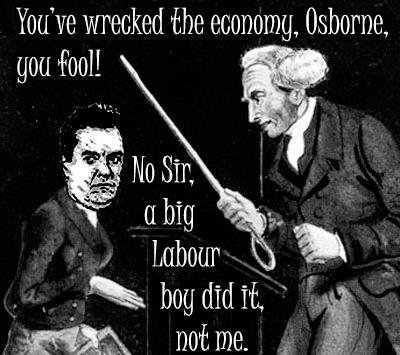
Finally, its worth remembering that despite their claims, the Conservatives inherited an economy that had escaped the impact of the global crash, and was out of recession by the last quarter of 2009. By 2011, the Conservatives put us back in recession. It’s what Conservatives do. Thatcher and Major both created recession in the UK, as did Cameron’s government. Despite pledging to keep our triple A level international Fitch and Moody credit ratings – another thing the Tories inherited – Obsorne lost them. Then in 2016, the UK was stripped of its last AAA rating as credit agency – Standard & Poor’s –  who warned of the economic, fiscal and constitutional risks the country now faces as a result of the EU referendum result.

The two-notch downgrade came with a warning that S&P could slash its rating again. It described the result of the vote as “a seminal event” that would “lead to a less predictable stable and effective policy framework in the UK”.

Yet the Conservatives claim they are the party of ‘economic competence’. You just have to laugh at that. 

Image result for a big labour boy osborne kittysjones

I’ll leave you with this comment, which made me chuckle:

Update

Wages are still worth a third less in some parts of the country than a decade ago, according to a report. Research by the Trades Union Congress (TUC) found that the average worker has lost £11,800 in real earnings since 2008.

The organisation said that the UK has suffered the worst real wage slump among leading economies

The biggest losses have been in areas including the London borough of Redbridge, Epsom and Waverley in Surrey, Selby in North Yorkshire and Anglesey in north Wales, the studyfound.

Workers have suffered real wage losses ranging from just under £5,000 in the north-east to more than £20,000 in London, said the report.

The TUC general secretary, Frances O’Grady, said: “The government has failed to tackle Britain’s cost-of-living crisis. As a result, millions of families will be worse off this Christmas than a decade ago.

“While pay packets have recovered in most leading economies, wage growth in the UK is stuck in the slow lane.

“Ministers need to wake up and get wages rising faster. This means cranking up the pressure on businesses to pay staff more, especially at a time when many companies are sitting on large profits.”

A government spokesman said: “The UK’s jobs market has never been stronger, employment is at a record high with more people in work in every region of the UK since 2010 and wages are now rising at their fastest in a decade.

“We have cut income tax for 31 million people, and through the national living wage we have helped to deliver the fastest wage growth in 20 years for over two million of the lowest-paid workers.”

Stephen Clarke, senior economic analyst at the Resolution Foundation thinktank, said: “While wages are currently growing at their fastest rate in a decade and employment is at a record high, the sobering big picture is that inflation-adjusted pay is still almost £5,000 a year lower than when Lehman Brothers was still around.

“Stronger wage growth is needed to make 2019 a better year for living standards than this one.”

A change from the government that is utterly conservative with the truth would be a good starting point.


I don’t make any money from my work. But you can help me by making a donation to help me continue to research and write informative, insightful and independent articles, and to provide support to others. The smallest amount is much appreciated – thank you.

DonatenowButton

Amber Rudd is either telling deplorable lies or she is disgracefully ignorant of her own department’s policies

Image result for amber rudd

People claiming Universal Credit have been told by the Department for Work and Pensions to apply for provisional driving licences to use as a form of ID, with the costs being taken from their benefits, an MP has said. 

Liverpool Walton MP, Dan Carden, called on the Department of Work and Pensions (DWP) to postpone the roll-out of Universal Credit in his constituency until after Christmas and highlighted the issue with people having to pay out for a driving licence as one of many administrative problems with the new system.

In a letter to the secretary of state, Amber Rudd MP, Carden said: “We have families experiencing poverty on an unprecedented scale and now facing further avoidable hardship in the run up to Christmas. 

“I have now been informed that job centres across Liverpool are advancing payments to my constituents to obtain provisional driving licences for the purposes of identification and then deducting the cost from their benefits.

“Constituents are also having to pay for postal orders, passport photographs and postage, just to obtain provisional licences.”

He explained that the DVLA says there is a five-week wait for provisional licences, and highlighted the delays before the first payments are made when someone is transferred on to Universal Credit.

The controversial new benefit is claimed to simplify the system and it is being rolled out in many parts of Liverpool this week. Carden added: “Continuing with this roll-out will leave many of the most vulnerable families in Liverpool Walton destitute by Christmas and I am therefore asking you to intervene as a matter of urgency.”

In response to the letter, a DWP spokeswoman told Sky News: “Having ID is not a requirement for those making a Universal Credit claim but it does make the process easier.

“If customers don’t have any ID we can reimburse the cost if they choose to apply for a passport, driving licence or long birth certificates.”

Amber Rudd, the secretary of state for work and pensions, responded with a denial, as follows:

However, it seems Rudd failed to bother checking her own government’s web site for advice and evidence, which outlines how to claim Universal Credit.

Completely contradicting Rudd’s claims, it says on the government’s site:

Amber rudd lies 1

Amber rudd lies 2

So Rudd is either woefully ignorant of the policies that her own department is implementing, or she is telling lies. Either way, it’s utterly deplorable that she labelled the opposition ‘scaremongers’ for simply raising legitimate concerns about a cruel, unfit for purpose, out of touch policy. 

When people apply for Universal Credit they are asked to verify their identity online via the GOV.Verify service. 

To do so, you need either;

  • A valid UK driving license
  • A valid UK passport.

Of course this creates problems for those without the documents. The Universal Credit claim cannot go ‘live’ without conforming to the ID verification framework. People generally can’t get an advance because their claim isn’t live. Once they’ve received their new ID document, (takes around 6-8 weeks usually), it’s then a further 5 weeks (at least) until their first universal credit payment.

According to the government web site, you can only apply for an advance on your first payment if you have already verified your identity. It says:

You can apply for an advance payment in your online account or through your Jobcentre Plus work coach.

You’ll need to:

  • explain why you need an advance
  • verify your identity (you do this online when you submit your Universal Credit claim or at your first Jobcentre Plus interview)
  • provide bank account details for the advance (talk to your work coach if you cannot open an account.)

It seems that the “terrific” job coaches are not applying rules consistently, leading to a post code lottery concerning the verification requirements for claims. 

The Verify framework:

This particular response from Rudd has become a deplorable, standardised and authoritarian tactic of repressing legitimate criticism for the Conservatives, however. Other Tory ministers who have habitually used the term ‘scaremonger’ as a gaslighting technique include Sarah Newton and David Gauke among others. 

Gaslighting is a persistent manipulation and attempted brainwashing technique where the abuser manipulates narratives and/or situations repeatedly in an attempt to trick people into distrusting their own perceptions and experiences. Gaslighting is an insidious form of psychological abuse. It is not the kind of behaviour that one would expect from a government minister in a democratic society.

This kind of being somewhat Conservative with the truth may also be seen as a technique of neutralisation.

These techniques are used to switch off the conscience of both the perpetrator and their audience when someone plans or has already done something that causes distress and  harm to others.

The idea of techniques of neutralisation was first proposed by David Matza and Gresham Sykes during their work on Edwin Sutherland’s Differential Association in the 1950s. Matza and Sykes were working on juvenile delinquency, they theorised that the same techniques could be found throughout society and published their ideas in Delinquency and Drift, 1964.

They identified the following psychological techniques by which, they believed, delinquents justified their illegitimate actions, and Alexander Alverez further identified these methods used at a socio-political level in Nazi Germany to justify” the Holocaust:

1. Denial of responsibility. The offender(s) will propose that they were victims of circumstance or were forced into situations beyond their control.

2. Denial of harm and injury. The offender insists that their actions did not cause any harm or damage.

3. Denial of the victim. The offender believes that the victim deserved whatever action the offender committed. Or they may claim that there isn’t a victim.

4. Condemnation of the condemners. The offenders maintain that those who condemn their offence are doing so purely out of spite, ‘scaremongering’ or they are shifting the blame from themselves unfairly. 

5. Appeal to higher loyalties. The offender suggests that his or her offence was for the ‘greater good’, with long term consequences that would justify their actions, such as protection of a social group/nation, or benefits to the economy/ social group/nation.

6. Disengagement and Denial of Humanity is a category that Alverez
added to the techniques formulated by Sykes and Matza because of its special relevance to the Holocaust. Nazi propaganda portrayed Jews and other non-Aryans as subhuman.

A process of social division, scapegoating and dehumanisation was explicitly orchestrated by the government. This also very clearly parallels Gordon Allport’s work on explaining how prejudice arises, how it escalates, often advancing by almost inscrutable degrees, pushing at normative and moral boundaries until the unthinkable becomes tenable. This stage on the scale of social prejudice may ultimately result in genocide.

Any one of these six techniques may serve to encourage violence by neutralising the norms against prejudice and aggression to the extent that when they are all implemented together, as they apparently were under the Nazi regime, a society can seemingly forget its normative rules, moral values and laws in order to engage in wholesale prejudice, discrimination, exclusion of citizens, hatred and ultimately, in genocide.

In accusing citizens and the opposition of ‘scaremongering’, the Conservatives are denying responsibility for the consequences of their policies, denying harm, denying  distress; denying the victims and condemning the condemners.

Meanwhile, for many of us, the government’s approach to social security has become cruel, random, controlling; an unremitting, Orwellian trial. However, no amount of gaslighting or authoritarian ministers using techniques of neutralisation will discredit or deter the growing number of witnesses, nor will those authoritarians negate the lived and collective experiences of those of us undergoing the trials within an intentionally created hostile environment.


I don’t make any money from my work. I am disabled because of illness  and have a very limited income. But you can help by making a donation to help me continue to research and write informative, insightful and independent articles, and to provide support to others. The smallest amount is much appreciated – thank you.

DonatenowButton

62 year old woman faces losing home because of unfair and pointless welfare sanction

b584

A 62-year-old woman says that she’s been forced to leave her home after the Department for Work and Pensions (DWP) sanctioned her – cut her benefits – for turning up late for a meeting.

Faith Hurford, from Hillesley near Stroud, who suffers with a range of medical conditions that haven’t been disclosed, says the benefit sanction means she is unable to afford the rent and has to move away from her home because of the DWP’s callous and unfair decision.

The Stroud News and Journal reports that despite her health problems, Faith had to travel a staggering 15 miles (one way) to attend a meeting about her Universal Credit claim in Stroud.

Due to heat, the sheer distance she had to cycle, as well as her chronic health issues, Faith was forced to stop and take a break at a Sainbury’s store to recover her energy, before continuing the arduous journey.

This meant that Faith turned up late for the appointment and was subsequently sanctioned for failing to turn up for the meeting on time.

Faith described the sanction as “unlawful” and tried to appeal the harsh ruling, but the loss of benefit meant she could no longer afford the rent and has to move away to Nailsworth.

“I had been a supporter of Universal Credit before – it helps you look for work and it’s simpler to use – but that sanction was unlawful.

“By the time I got to Sainsbury’s after hours of cycling I couldn’t go any further, I was completely dazed.”

Faith says that she tried to explain the reason for her lateness but her reasonable appeals fell on deaf ears.

She says that the sanction has cost her nearly £200 in lost benefit payments.

“You need to take a person’s circumstances into account. The effort I went to was not recognised in any shape or form.

“I can’t recover from a sanction like that, I’m on a shoestring. I grow my own veg, I’ve reduced my food intake. There’s nothing else I can do,” she said, adding “I’ve fallen behind on rent and I can’t afford this place now. I’ve got to move out.”

Faith is currently looking for a new place to live while waiting to hear back about an appeal lodged with the social security tribunal.

Sanctions on welfare payments which have caused thousands of claimants to fall into hardship are being handed out without evidence that they actually work. The Department for Work and Pensions doesn’t even monitor and analyse its own data, making claims that sanctions “work” from an evidence-free zone. 

There is no evidence that sanctions work as the government insists they do

A report published earlier this year by the WelCond project, led by the University of York and involving the Universities of Glasgow, Sheffield, Salford, Sheffield Hallam and Heriot-Watt, analysed the effectiveness, impact and ethics of welfare conditionality from 2013 to 2018.

The findings of this report’s adds more evidence to a substantial and growing body that welfare conditionality within the social security system is largely ineffective and that benefits sanctions have severe and negative impacts on personal, financial and health outcomes, including mental health.

The report suggests that too much emphasis is being placed on negative consequences for not being engaged in job-seeking activities and not enough emphasis on more positive and individualised work-shaping activities to help people access work that they wish to be in.

In 2016 the British Psychological Society (BPS) and a range of allied organisations (British Association for Behavioural and Cognitive Psychotherapies (BABCP), British Association for Counselling and Psychotherapy (BACP), British Psychoanalytic Council (BPC)), stated a very clear position against welfare sanctions, in response to reports of a lack of efficacy and potential harm to mental health, as outlined in their 2016 joint response

The organisations say that key concerns remain that not only is there no clear evidence that welfare sanctions are effective, but that they can have such negative effects on a range of outcomes including mental health.

They go on to say “We continue to call on the Government to address these concerns, investigate how the jobcentre systems and requirements may themselves be exacerbating mental health problems and consider suspending the use of sanctions subject to the outcomes of an independent review.”

The collective organisations – BPS, BACP, BPC, BABCP and UKCP – are the UK’s leading professional associations for psychological therapies, representing over 110,000 psychologists, counsellors, psychotherapists, psychoanalysts and psychiatrists who practise psychotherapy and counselling.

In 2016, even the government’s technocratic team of behavioural economists and policy gurus at the Nudge Unit did a u-turn on benefit sanctions. They said that the state using the threat of benefit sanctions may be counterproductive”. The idea of increasing welfare conditionality and enlarging the scope and increasing the frequency of benefit sanctions originated from neoliberal behavioural economics theories of the Nudge Unit in the first place. 

It’s difficult to imagine how punitive sanctioning – psycho-coercion – which entails the removal of people’s lifeline income which was originally calculated to meet the costs of only basic survival needs, such as for food, fuel and shelter, could ever be seen as “helping people into work.” 

Commons Select Committee inquiry into sanctions 

The Work and Pensions Committee has published a report this month regarding the findings of an ongoing inquiry into welfare conditionality and sanctions. They say: 

“The human cost of continuing to apply the existing regime of benefit sanctions – the ‘only major welfare reform this decade to have never been evaluated’ – appears simply too high. The evidence that it is achieving its aims is at best mixed, and at worst showing a policy that appears ‘arbitrarily punitive’.”  

The Committee say in their report that the Coalition Government “had little or no understanding of the likely impact of a tougher sanctions regime” when it introduced it in 2012 with the stated aim, as the NAO describes it, that “benefits, employment support and conditions and sanctions together lead to employment.”

At that point, the Government promised to review the reform’s impact and whether it was achieving its aims on an ongoing basis. But six years later, Government “is [still] none the wiser.”

In their report, the select committee urge the government to reassess the sanctions regime. However, there is no evidence they ever assessed it in the first place.

Commenting on the Work and Pensions Committee inquiry, Chair Frank Field MP says:

“We have heard stories of terrible and unnecessary hardship from people who’ve been sanctioned. They were left bewildered and driven to despair at becoming, often with their children, the victims of a sanctions regime that is at times so counter-productive it just seems pointlessly cruel.

While none of them told us that there should be no benefit sanctions at all, it can only be right for the Government to take a long hard look at what is going on. If their stories were rare it would be unacceptable, but the Government has no idea how many more people out there are suffering in similar circumstances. In fact, it has kept itself in the dark about any of the impacts of the major reforms to sanctions introduced since 2012.

The time is long overdue for the Government to assess the evidence and then have the courage of its reform convictions to say, where it is right to do so, ’this policy is not achieving its aims, it is not working, and the cost is too high: We will change it.”

Yes, we must.

Related

Pointlessly cruel’ sanctions regime must be reassessed, says Commons Select Committee

New research shows welfare sanctions are punitive, create perverse incentives and are potentially life-threatening


My work is unfunded and I don’t make any money from it. This is a pay as you like site. If you wish you can support me by making a one-off donation or a monthly contribution. This will help me continue to research and write independent, insightful and informative articles, and to continue to support others.

DonatenowButton

A letter to Theresa May from a cancer patient who was turned down for PIP

Paige Garratt was just 22 when she was diagnosed with advanced, stage 4 Hodgkin’s lymphoma. The cancer had spread to her lymph nodes and lungs.

Last month, i published a story about how a benefits assessor visited her during her chemotherapy treatment and decided she was ‘not sick enough’ for Personal Independence Payment (PIP). She had lost all of her hair and was so ill during the home visit she couldn’t raise her head off the sofa. 

Here, Paige shares an open letter to the Prime Minister:

Dear Theresa May,

I cried when I opened the letter that said I wasn’t entitled to some help when I was extremely sick.

It’s hard to find the words to describe the panic and despair you feel having been diagnosed with cancer. It’s utterly, utterly, terrifying.

Can you imagine having to deal with everything cancer brings, then a stranger decides you’re not ‘sick enough’ for some financial help from the Government? 

It’s physically exhausting to go through round after round of chemotherapy and your body feels ravaged. There’s the nausea, brain fog, sleep problems and hair loss.

Then there’s the worries over the possible permanent damage – it was such a knock to be warned the treatment may rob me of my fertility at aged 22. It could have also affected my heart and lungs.

On top of that, you can’t go to work so you’re on basic statutory sick pay. But the bills still need paying, plus there’s the cost of the trips to the hospital (three times a week for my chemotherapy). 

The heating bills went up too and I needed new warmer clothing as the chemo gave me the chills. Knowing I wasn’t getting any support meant I had to force myself to go back to work when I still felt extremely ill – I shouldn’t have had to do this.

Can you imagine having to deal with everything cancer brings, including the stress of how you’ll pay your bills, then a stranger decides you’re not ‘sick enough’ for some financial help from the Government?

The very last thing cancer patients should be worrying about is finances – but that’s what your ‘austerity measures’ are doing to us.

The whole process of claiming was lengthy. It took two months to get a response to my initial application – and another month for the home visit to take place – and by this time I had used up all my savings.

Yet the benefits assessor decided I didn’t need any help with caring for myself while battling cancer and chemotherapy.

Then why did my mum have to take three months of work to take care of me, as I was unable to do basic things such as feed and wash myself some days?

On the home visit, the chemo had made my head so heavy I couldn’t hold it up without using my hands, so I had it rested on the arm of the sofa the whole time.

How could the person who assessed me genuinely not see that I was broken? She wrote down that my mental health did not seem to be affected. She didn’t even ask me how I was feeling.

The assessors are not blind – as human beings they must see when genuinely needy people are struggling. There’s just one reason they are making these decisions – because of your  ‘austerity measures’.

I was made to feel like I was lying, a fraud.

I am not. I am a hard working person who was working not one but two jobs, so that I could support myself and save up for a house deposit when I was struck by cancer.

Your Government says it wants to come down on the benefit scroungers who abuse the system. I am not one of them – your cut backs are hurting genuine people in need.

Because I had to spend all my savings I have to start from the bottom financially. How is this fair? I have paid my taxes to your Government and I deserve help when I need it. We all do.

The response to the story about me was overwhelming. A leading doctor said my case showed “our country has reached a new low of callousness”.

One person on Twitter suggested I hadn’t been clever enough to play the system. Why should cancer patients and other people with serious illnesses have to think like that on top of everything they’re dealing with?

How do you think it makes someone like me feel, when I read that private firms Independent Assessment Services (formerly known as Atos) and Capita raked in in more than £250 million for carrying out these gruelling medical assessments – a £40m increase in funding despite widespread concerns with the system? 

Mrs May, why are you rewarding them for making desperately ill people destitute? 

I went back to work at the bakery too soon, trying to manage two hours a day but standing on my feet all day completely knocked me. Then with my CLIC sargent social worker’s help, I managed to successfully appeal the decision and was awarded PIP in May this year. 

This was around seven months after I had first been diagnosed. People with cancer need the financial help when they’re off work sick and struggling.

The way I was treated by your Government added extra stress during the darkest days of my life.

People are dying because of benefit cut backs. Mrs May, will you reply to my question to you: Are you going to carry on treating sick and disabled people this way?

Paige finished her chemotherapy in March this year and a scan has shown she is in remission.

She said  “The whole experience of PIP has been so negative and de-humanising. I was made to feel like I’m doing something wrong for being ill.”

The Department of Work and Pensions (DWP) spokesperson gave the usual crib sheet drivel as a response: “We are committed to supporting people with disabilities and health conditions. We support 1.88 million people through PIP and 1.97 million people through DLA. We have never spent more on benefits for disabled people and people with long-term health conditions, totalling over £50bn a year – up £7bn since 2010. Under PIP, 30% of claimants receive the highest rate of support, compared with 15 per cent under DLA.

“But we constantly seek to improve the quality of PIP assessments. We have commissioned to independent reviews of PIP, and most recently announced that we will pilot video recording of assessments, improving confidence in the assessment process. We will continue to reassess the quality of the process to ensure that it works well for everyone.”

Included in the amount spent on ‘benefits for disabled people’ is the extortionate and ever-rising cost of paying for inept, profiteering private companies to deliver the completely unfit for purpose assessments.

The DWP seem to think they are personally paying for ill and disabled people’s support. However, most have worked and contributed tax to the social security system, and should be able to reasonably expect support in their time of need. Yet all too often people are de-humanised, and treated without dignity, respect and compassion when they turn to the state provision they have contributed to, when they become vulnerable because of ill health.

The government has clearly mismanaged our public funds, because week after week I see people who are seriously ill and need crucial support being refused their lifeline by the state.

After five years and a lot of critical feedback from people going through the PIP process and from charities and allied associates, academics and shadow ministers, you would expect that it would ‘work well for everyone’ by now.

Related

Government guidelines for PIP assessment: a political redefinition of the word ‘objective’

Fear of losing disability support led a vulnerable man to a horrific suicide

Disabled mum took fatal overdose after she was refused PIP 

A man with multiple sclerosis lost his PIP award after assessment report was dishonestly edited during ‘audit’


My work is unfunded and I don’t make any money from it. This is a pay as you like site. If you wish you can support me by making a one-off donation or a monthly contribution. This will help me continue to research and write independent, insightful and informative articles, and to continue to support others.

DonatenowButton

The budget will not alleviate inequality, poverty and hardship that government policies have created

Watch Jeremy Corbyn’s excellent response to the budget, while facing the braying, sneering, smirking government. 

Hammond is economical with copies of the Budget 

The Labour party have accused the chancellor Philip Hammond of breaking the ministerial code after opposition parties were not given a copy of the budget in advance. The code states that when a minister makes a statement to MPs in the Commons “a copy of the text of an oral statement should usually be shown to the opposition shortly before it is made”. The rules are that 15 copies and associated documents should be sent to the chief whip’s office at least 45 minutes before a statement. The government have frequently flouted these rules, prefering to follow the rampant authoritarianism protocol of avoiding scrutiny, transparency and above all, democratic accountability

However, a Treasury source claims that there was ‘no official rule’ that other parties should get an early look at budget measures. “We did not do anything differently from what we have been doing for the past 20 years,” the source said. I half expected him to add that the Ministerial Code isn’t really a code, but more a kind of ‘loose guideline’. 

The opposition is said to be considering a formal complaint. 

Austerity has not ended

Jeremy Corbyn accused the government of a U-turn on Theresa May’s party conference pledge that austerity was over. Hammond told MPs that austerity was “coming to an end”. The Labour leader replied: “The prime minister pledged austerity is over. This is a broken promises budget. What we’ve heard today are half measures and quick fixes while austerity grinds on.”

The Labour party also criticised income tax cuts, which it said would favour the better off and said there were no guarantees that government departments would not face further cuts. The Resolution Foundation have also concluded the same. 

Government rattles the Office for Budget Responsibility

The Office for Budget Responsibility (OBR), whose role, unsuprisingly, is to scrutinise the budget are also disgruntled because the government only handed over the final Budget policy measures on 25 October, a day late. This means the OBR hasn’t been able to check that the government’s sums actually add up.

The precise changes to universal credit came too late for the OBR to assess them properly, too. The budget red book says that the roll-out of universal credit is now scheduled to end in December 2023. It says:

In response to feedback on universal credit, the implementation schedule has been updated: it will begin in July 2019, as planned, but will end in December 2023.

But until recently, as this House of Commons library briefing (pdf) reveals, the roll-out was due to end in March 2023.

Officially the government says that, if the UK had to leave the EU with no deal, it could manage. But the OBR doesn’t share this view:

A disorderly one [Brexit] could have severe short-term implications for the economy, the exchange rate, asset prices and the public finances. The scale would be very hard to predict, given the lack of precedent.

The Press Association (PA) reports that the Labour leader said eight years of austerity has “damaged our economy” and delayed the recovery, adding the government has not abandoned the policy despite the chancellor’s latest spending pledges. The PA says:

Leading the response to the budget, Corbyn also said the proposals announced will “not undo the damage done” by the squeeze on spending.

He told the Commons: “The prime minister pledged austerity was over – this is a broken promise budget.

“What we’ve heard today are half measures and quick fixes while austerity grinds on.

“And far from people’s hard work and sacrifices having paid off, as the chancellor claims, this government has frittered it away in ideological tax cuts to the richest in our society.”

Corbyn added: “The government claims austerity has worked so now they can end it.

“That is absolutely the opposite of the truth – austerity needs to end because it has failed.”

Corbyn later said the “precious” NHS is a “thermometer of the wellbeing of our society”, adding: “But the illness is austerity – cuts to social care, failure to invest in housing and slashing of real social security.

“It has one inevitable consequence – people’s health has got worse and demands on the National Health Service have increased.”

Corbyn also condemned the “horrific and vile antisemitic and racist attack” in Pittsburgh, noting: “We stand together with those under threat from the far-right, wherever it may be, anywhere on this planet.”

The Labour leader criticised pay levels for public sector workers, adding: “Every public sector worker deserves a decent pay rise, but 60% of teachers are not getting it – neither are the police nor the Government’s own civil service workers.”

The economy is also being damaged by a “shambolic Brexit”, Corbyn added.”

Elements of the budget have revealed a Conservative party in ideological retreat. One of Jeremy Corbyn’s greatest achievements as leader of the opposition is the undermining of the neoliberal hegemony and his presentation of an alternative narrative and economic strategy. Personally I am glad that neocon neoliberal Francis Fukuyama didn’t get the last word after all. 

Over the last couple of years, the government have imported policy ideas and adopted rhetoric from the Labour party to use as strategic window dressing. Hammond announced an end to the government signing off on much-loathed private finance initiative contracts – something Corbyn had already promised. As a former Treasury advisor noted:

Originally introduced by John Major, and continued under New Labour, PFIs are essentially a way for the state to finance and then look after new infrastructure. The traditional way for the government to build a new piece of infrastructure, such as a hospital, a school, or a new road bypass, was to raise the money in taxes, or borrow it from the bond markets, and then pay builders to deliver the project. After that, the public sector would own the asset. 

The theoretical justification for Private Finance Initiatives (PFI) is that the private sector is more efficient at delivering and managing infrastructure projects than civil servants. PFI also supposedly transfers the financial risk of a construction project over-running from the public to the private sector. However earlier this year, the National Audit Office (NAO), released a new report which highlighted a lack of evidence that PFIs offer value for money for taxpayers.

The report followed the collapse of the construction and services firm Carillion which has shone a bright spotlight on the flawed process of  state contracting and outsourcing.

According to the Treasury data there are 716  PFI projects (of which 686 are operational) with a capital value of just under £60bn. Of this total the Department of Health was responsible for £13bn, the Ministry of Defence £9.5bn and the Department of Education £8.6bn.

Hammond pledged a tax crackdown with a UK “digital services tax”, aimed only at multimillion companies rather than startup businesses. On universal credit, the government attempted to neutralise the toxic issues with an extra £1bn to ‘ease issues with its rollout.’

But Hammond’s generous tax cuts to the very wealthiest households indicate that this is still very much a government for the few, not the many. 

Alison Garnham, chief executive of the Child Poverty Action Group, commented:

The work allowance increase is unequivocally good news for families receiving universal credit but a bigger salvage operation is still needed for the benefit. And bringing forward higher tax allowances – which will cost much more than the universal credit change – will mainly benefit the richest half of the population. We look forward to hearing more detail on how the secretary of state will use the extra £1bn to ease the migration of people on existing benefits to universal credit.

This is crunch time for universal credit. We hope the chancellor’s positive announcements on work allowances will be followed by a pause in the roll-out to allow for a fundamental review of its design and, crucially, for a commitment to restoring all the money that’s been taken out of universal credit.

Final comment:


My work is unfunded and I don’t make any money from it. This is a pay as you like site. If you wish you can support me by making a one-off donation or a monthly contribution. This will help me continue to research and write independent, insightful and informative articles, and to continue to support others.

DonatenowButton

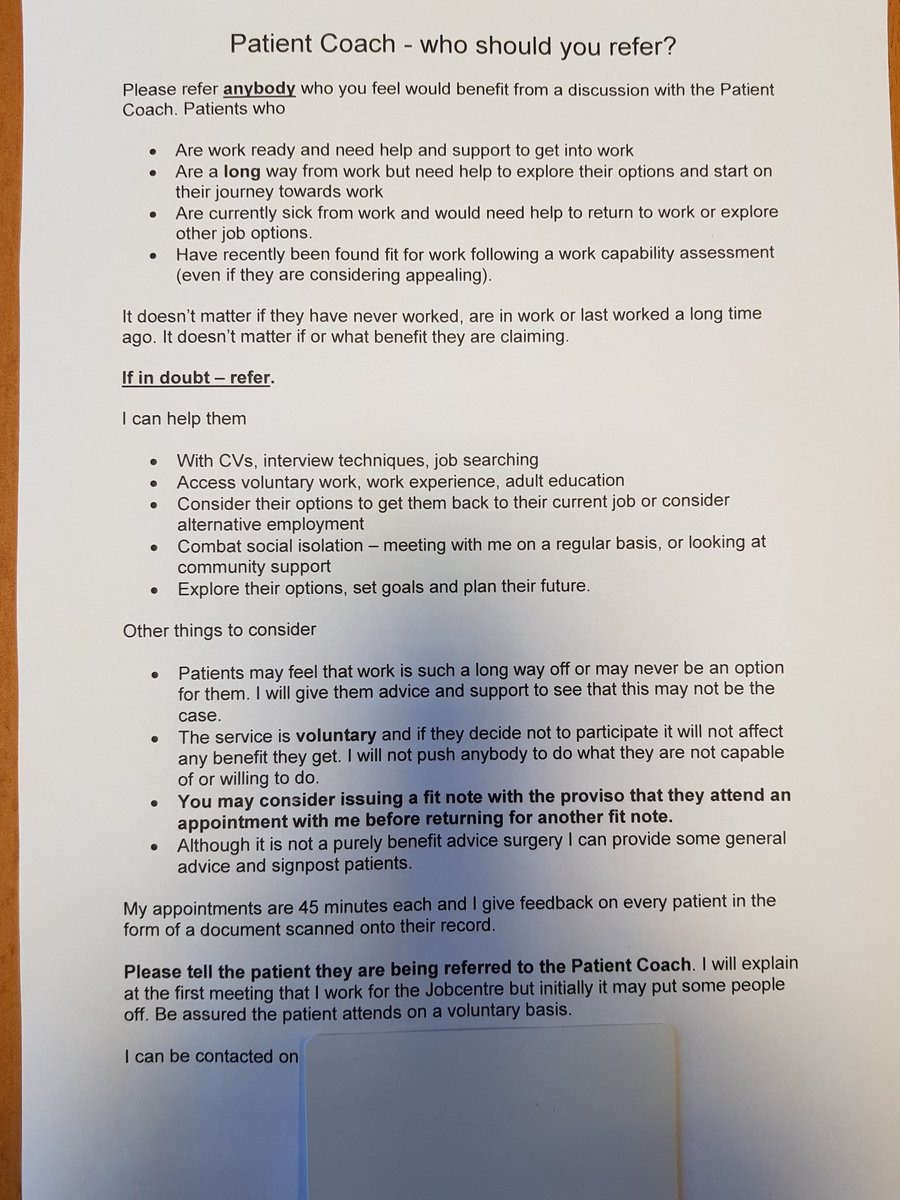
GPs told to consider making fit notes conditional on patients having appointment with work coach

Thanks to  for the copy of a patient work coach letter to GPs.

One of the most worrying comments on the above letter is that despite claiming the work coach service is voluntary, and that if a patient refuses to engage “it won’t affect any benefit they get”, the letter then goes on to suggest that doctors may consider the issuing of subsequent fit notes conditional (“with the proviso that”) on their patient attending a meeting with the work coach. That one sentence simply makes a mockery of the claim that patient engagement with work coaches is voluntary. 

Illnesses don’t respond to provisos or caveats. People don’t suddenly recover when the Department for Work and Pensions decides that they are fit for work. When job centre staff tell GPs to stop issuing sick notes to patients it can have catastrophic consequences, from which the government never seem to learn. In fact they don’t even acknowledge the terrible costs that their deeply flawed policies are inflicting on citizens. 

Julia Savage is a manager at Birkenhead Benefit Centre in Liverpool. In 2016, she wrote a letter (an ESA65B notification form) addressed to a GP regarding a seriously ill patient. It said:

We have decided your patient is capable of work from and including January 10, 2016.

“This means you do not have to give your patient more medical certificates for employment and support allowance purposes unless they appeal against this decision.

“You may need to again if their condition worsens significantly, or they have a new medical condition.” 

The GP subsequently repeatedly refused to provide him with new fit notes, even as his health deteriorated, and he died months later.

James Harrison – the patient – had been declared “fit for work” and the letter stated that he should not get further medical certificates. The Department for Work and Pensions contacted his doctor without telling him, and ordered him to cease providing sick certification, James died, aged 55.

He was very clearly not fit for work.

It is very worrying that the ESA65B form is a standardised response to GPs from the Department for Work and Pensions following an assessment where someone has been found fit for work.  

The government as boardroom doctors: political jobsworths

The Department for Work and Pensions issued a new guidance to GPs in 2013, regarding when they should issue a Fit Note. This was updated in December 2016. 

In the dogma document, doctors are warned of the dangers of “worklessness” and told they must consider “the vital role that work can play in your patient’s health”. According to the department, “the evidence is clear that patients benefit from being in some kind of regular work”

As a matter of fact, it isn’t clear at all.

The idea that people remain ill deliberately to avoid returning to work  – what Iain Duncan Smith and David Cameron termed “the sickness benefit culture” – is not only absurd, it’s very offensive. This is a government that not only disregards the professional judgements of doctors, it also disregards the judgements of ill and disabled people. However, we have learned over the last decade that political “management” of people’s medical conditions does not make people healthier or suddenly able to work.

Government policies, designed to ‘change behaviours’ of ill and disabled people have resulted in harmdistress and sometimes, in premature deaths.

Call me contrary, but whenever I am ill with my medical and not political illness, I generally trust my qualified GP or consultant to support me. I would never think of making an appointment to see the irrational likes of Esther McVey or Iain Duncan Smith for advice on lupus, or to address my health needs and treatment. 

The political de-professionalisation of medicine, medical science and specialisms (consider, for example, the ghastly implications of permitting job coaches to update patient medical files), the merging of health and employment services and the recent absurd declaration that work is a clinical “health” outcome, are all carefully calculated strategies that serve as an ideological prop and add to the justification rhetoric regarding the intentional political process of dismantling publicly funded state provision, and the subsequent stealthy privatisation of Social Security and the National Health Service. 

De-medicalising illness is also a part of that increasingly behaviourist-neoliberal process:  “Behavioural approaches try to extinguish observed illness behaviour by withdrawal of negative reinforcements such as medication, sympathetic attention, rest, and release from duties, and to encourage healthy behaviour by positive reinforcement: ‘operant-conditioning’ using strong feedback on progress.” Gordon Waddell and Kim Burton in Concepts of rehabilitation for the management of common health problems. The Corporate Medical Group, Department for Work and Pensions, UK. 

Waddell and Burton are cited frequently by the Department for Work and Pensions (DWP) as providing ‘scientific evidence’ that their policies are “verified” and “evidence based.” Yet the DWP have selectively funded their research, which unfortunately frames and constrains the theoretical starting point, research processes and the outcomes with a heavy ideological bias. 

This behaviourist framing simply shifts the focus from the medical conditions that cause illness and disability to the ‘incentives’, behaviours and perceptions of patients and ultimately, to neoliberal notions of personal responsibility and self-sufficient citizenship in the dehumanising context of a night watchman, non-welfare state, absent of any notion of human rights. 

Medication, rest, release from duties, sympathetic understanding – the remedies to illness – are being appallingly redefined as ‘perverse incentives’ for ill health, yet the symptoms necessarily precede the prescription of medication, the Orwellian renamed (and political rather than medical) “fit note” and exemption from work duties. Notions of ‘rehabilitation’ and medicine are being redefined as behaviour modification: here it is proposed that operant conditioning in the form of negative reinforcement –  punishment – will cure’ ill health. 

It’s a completely slapstick rationale, hammered into shape by a blunt instrument – political ideology. People cannot simply be ‘incentivised’ (coercion is a more appropriate term) into not being ill. Punishing people for being poor by removing their support does not ‘help’ them to stop being poor, either, despite the  doublespeak and mental gymnastic pseudoscientific rubbish the government spouts.

Turning health care into a government work programme 

The government dogmatically assert “The idea behind the fit note is that individuals do not always need to be fully recovered to go back to work, and in fact it can often help recovery to return to work.” 

It was 2015 when I wrote a breaking article about the government’s Work and Health programme, raising concerns that the Nudge Unit team were working with the Department for Work and Pensions and the Department of Health to trial social experiments aimed at finding ways of: “preventing people from falling out of the jobs market and going onto Employment and Support Allowance (ESA).” 

“These include GPs prescribing a work coach, and a health and work passport to collate employment and health information. These emerged from research with people on ESA, and are now being tested with local teams of Jobcentres, GPs and employers.”

Of course the government hadn’t announced these ‘interventions’ in the lives of ill and disabled people. I found out about it quite by chance because I happened to read Matthew Hancock’s  conference speech: The Future of Public Services.

I researched a little further and found an article in Pulse – a publication for for medical professionals – which confirmed Hancock’s comment: GP practices to provide advice on job seeking in new pilot schemeI posted my own article on the Pulse site in October 2015, raising some of my concerns.

Many of us have warned that the programme jeopardises doctor-patient confidentiality, risks alienating patients from their doctors and perverts the primary role and ethical mission of the healthcare system, which is to help people to recover from illnesses. Placing job coaches in GP surgeries makes them much less inaccessible, because it turns appointments potentially into areas of pressure and coercion. That is the very last thing someone needs when they become ill.

One worry was that the government may use the ‘intervention’ as a further opportunity for sanctioning ill and disabled people for ‘non-compliance’. People who are ill often can’t undertake work related tasks precisely because they are ill. Until recent years, this was accepted as common sense, and any expectation of sick people having to conform with such rigid welfare conditionality was quite properly regarded as both unfair and unrealistic.

I expressed concern that the introduction of  job coaches in health care settings, peddling the myth that ‘work is a health outcome’ would potentially conflict with the ethics and role of a doctor. I also stated my concern about the potential that this (then) pilot had for damaging the trust between doctors and their patients. 

In another article in 2016, titled Let’s keep the job centre out of GP surgeries and the DWP out of our confidential medical records, I outlined how GPs had raised their own concerns about sharing patient data with the Department for Work and Pensions – and quite properly so. 

Pulse reported that the Department for Work and Pensions (DWP) plans to extract information from GP records, including the number of Med3s or so-called ‘fit notes’  issued by each practice and the number of patients recorded as ‘unfit’ or ‘maybe fit’ for work, in an intrusive move described by GP leaders as amounting to “state snooping.”

Part of the reason for this renewed government attack on ill and disabled people is that the Government’s flagship fit note scheme, which replaced sick notes five years ago in the hope it would see GPs sending thousands more employees back to work to reduce sickness-related absence, despite GPs having expressed doubts since before its launch, has predicably failed.

The key reason for the failure is that employers did not take responsibility for working with employees and GPs seriously, and more than half (59%) of employers said they felt unable to support employees by making all of the legally required workplace adjustments for those who had fit notes signed as “may be fit for work.” Rather than address this issue with employers, the government has decided instead to simply coerce patients back into work without essential support.

Another reason for the failure of this scheme is that most people who need time off from work are ill and genuinely cannot return to work until they have recovered. Regardless of the government’s concern for the business and state costs of sick leave, people cannot be simply ushered out of illness and into work by the state to “contribute to the economy.”

When a GP says a person is ‘unfit for work’, they generally ARE unfit for work, regardless of whether the ‘business friendly’ government likes that or not. And regardless of the politically prescribed Orwellian renaming of sick notes, which show ‘paternalist’ linguistic behaviourism in action.

In 2017, the General Medical Council (GMC) – independent regulator for doctors in the UK – wrote a response to the government’s green paper: Improving Lives: The Work, Health and Disability Green Paper consultation. The authors of the document begin by saying ” Our purpose is to protect, promote and maintain the health and safety of the public by ensuring proper standards in the practice of medicine.”

The response continues: “Where doctors are expected to play a role in initiatives such as those set out in the Green paper, our concern is to ensure that any responsibilities that might be placed on doctors would be consistent with their professional obligations and would not risk damaging patients’ trust in their doctors. While we believe that many of the Green paper proposals are promising, we are concerned that key elements appear to present a conflict with the ethical responsibilities we place on doctors. The comments below are seeking clarification in these areas.”

And: “We understand from this Green paper, and from the Department of Work and Pensions’ published FOI response, dated 22 December 2016, that the work coaches who will conduct the mandatory health and work conversation with claimants will not be health professionals. There is a risk that claimants will not get the right support in setting health and work-related goals during this mandatory conversation if the work coach does not have clinical expertise.

“It would be helpful to know whether work coaches will be expected to have access to the claimant’s healthcare team and/or health records to inform these conversations. If so, we would appreciate reassurance that there will be a process for obtaining consent from the claimant, and providing assurance to the relevant health professionals that the individual has provided consent. Given that work coaches do not require medical expertise, we have some concerns about these conversations leading claimants to agree to health-related actions in a Health and Work ‘claimant commitment’. It seems possible that agreed actions might not be clinically appropriate for that individual or not the best course of action given their health condition. 

If a claimant commitment were reviewed by the claimant’s doctor (or other healthcare professional), and the doctor concluded that there was a health risk; then would the claimant be free to withdraw from the commitment without facing a benefits penalty? If not, then this would put the doctor and patient in a very difficult position, if it appeared that the patient had been poorly advised by the work coach and was not making an informed, voluntary decision in requesting a particular treatment or care regime from their doctor. 

We note the intention is for any agreement made in the Health and Work Conversation to be seen as voluntary. However, it seems to us that since the Conversation itself is mandatory and a Claimant commitment may influence subsequent handling of an individual’s Work Capability assessment, then in practice claimants may see these agreements as mandatory.

“As a result they may feel pressured to accept advice and make commitments which may not be appropriate in their case. This would place theirdoctors in a difficult ethical position, and we are concerned to ensure that this is not the case.

The authors add: “… we make it clear in our guidance that doctors must consider the validity of a patient’s consent to treatment if it is linked with access to benefits. Doctors should be aware that patients may be put under pressure by employers, insurers, or others to accept a particular investigation or treatment (paragraph 41, Consent: patients and doctors making decisions together).

“Difficulty could arise if a doctor does not believe that a patient is freely consenting to treatment and is instead only giving consent due to financial pressure. Doctors must be satisfied that they have valid consent before providing  treatment, which means they could be left with a difficult decision as to whether to refuse treatment in the knowledge that this could affect the patients benefit entitlements.” 

The GMC also raise concerns about how sensitive health data is collected and shared for purposes other for patients’ direct care, without patients being informed or giving consent. The government have simply proposed to access health care data to support “any assessment for financial support” and told GPs to assume consent has been given.

Promoting the myth that work is a ‘clinical outcome’ 

A Department for Work and Pensions research document published back in 2011 – Routes onto Employment and Support Allowance – said that if people believed that work was good for them, they were less likely to claim or stay on disability benefits. 

Of course it may be the case that people in better health work because they can, and have less need for healthcare services simply because they are relatively well, rather than because they work. 

From the document“The belief that work improves health also positively influenced work entry rates; as such, encouraging people in this belief may also play a role in promoting return to work.”

The aim of the research was to “examine the characteristics of ESA claimants and to explore their employment trajectories over a period of approximately 18 months in order to provide information about the flow of claimants onto and off ESA.” 

A political decision was made that people should be “encouraged” to believe that work was “good” for their health. There is no empirical basis for the belief, and the purpose of encouraging it is simply to cut the numbers of disabled people claiming Employment and Support Allowance (ESA) by “helping” them into work.

Another government document from 2014 – Psychological Wellbeing and Work – says: We know that being in work is good for wellbeing and that mental health problems are an increasing issue for the nation and so the Minister for Welfare Reform and the Minister for Care and Support jointly sought to expand the evidence base on common mental health problems.  

“A number of Government programmes assess and support those with mental health difficulties to work, but it is internationally recognised that the evidence base for successful interventions is limited. 

“The Contestable Policy Fund gives ministers alternative avenues to explore new thinking and strategies that offer cross-Government benefits. This report was commissioned through this route.” 

And: “Within the time and resources available for this study the research team did not undertake extensive assessment of the quality of the evidence base (eg assessing the research design and methodology of previous studies)”

The government have gone on to declare with authoritarian flourish that they now want to reinforce their proposal that “work is a health outcome.” Last year, a report by the Mental Health Task Force and chaired by Mind’s Paul Farmer, recommended that employment should be recognised as a ‘health outcome’.  I’m just wondering how people with, say, personality disorders, or psychosis are suddenly going to overcome the nature of their condition and all of a sudden successfully hold down a job for a minimum of six months.

Mind those large logical gaps… 

This has raised immediate concerns regarding the extent to which people will be pushed into work they are not able or ready to do, or into bad quality, low paid and inappropriate work that is harmful to them, under the misguided notion that any work will be good for them in the long run.

It has become very evident over recent years that the labour market is not delivering an adequate income for many citizens and despite “record levels of employment”, the problem seems to be getting bigger. The government’s answer to the problem has been to extend punishment those on low pay, rather than tackle employers who pay exploitative, low wages.

The idea of the state persuading doctors and other professionals to “sing from the same [political] hymn sheet”, by promoting work outcomes in social and health care settings is more than a little Orwellian. Co-opting professionals to police the welfare system is very dangerous. 

In linking receipt of welfare with health services and “state therapy,” with the single intended outcome explicitly expressed as employment, the government is purposefully conflating citizen’s widely varied needs with economic outcomes and diktats, isolating people from traditionally non-partisan networks of relatively unconditional support, such as the health service, social services, community services and mental health services.

Public services “speaking with one voice” as the government are urging, will invariably make accessing support conditional, and further isolate already marginalised social groups. Citizens’ safe spaces for genuine and objective support is shrinking as the state encroaches with strategies to micromanage those using public services. This encroachment will damage trust between people needing support and professionals who are meant to deliver essential public services, rather than simply extending government dogma, prejudices and discrimination.

State micromanagement of tenants

The GMC say in their response to the government’s proposals: “We are unclear about the evidence that might support a move to the position that ‘being in employment’ should be regarded as a ‘clinical outcome’ that healthcare professionals are expected to work towards with people of employment age seeking health-related advice and treatment. This is a highly contentious issue and indeed Dame Carol Black’s report certainly makes clear that there is limited support for this within the profession.” 

I’m not unclear. There is no evidence. In an era of small state neoliberalism and ideologically driven austerity, it is an act of sheer political expediency to claim that ‘worklessness’ is the reason for the poor health outcomes that are in fact correlated with increasing inequality, poverty and lower standards of living – higher mortality;  poorer general health, long-standing illness, limiting longstanding illness; poorer mental health, psychological distress, psychological/psychiatric morbidity; higher medical consultation, medication consumption and hospital admission rates.

Both social security and the National Health Service have been intentionally underfunded and run down by the Conservatives, who have planned and partially implemented a piecemeal privatisation process by stealth, to avoid a public backlash.

Unemployment (not ‘worklessness’ –  that’s part of the privileged discourse of neoliberalism, which serves to marginalise the structural aspects of persistent unemployment and poverty, by transforming these into individual pathologies of benefit ‘dependency ‘and ‘worklessness’) is undoubtedly associated with poverty, because welfare provision no longer meets the most basic living costs.

However to make an inferential leap and claim that work is therefore ‘good’ for health’ is incoherent, irrational and part of an elaborate political gaslighting campaign of an authoritarian government, who simply don’t want to address growing poverty and inequality caused by their own neoliberal policies.

The direction that government policy continues to be pushed in represents a serious threat to the health, welfare, wellbeing, basic human rights, democratic inclusionand lives of patients and the political independence of health professionals.


Related

The new Work and Health Programme: government plan social experiments to “nudge” sick and disabled people into work 

Illustration by Jack Hudson


My work is unfunded and I don’t make any money from it. This is a pay as you like site. If you wish you can support me by making a one-off donation or a monthly contribution. This will help me continue to research and write independent, insightful and informative articles, and to continue to support others.

DonatenowButton

George Osborne ignored civil servants’ warnings of increased child poverty due to 1% public sector cap

Image result for George osborne

Back in July 2015, George Osborne, then chancellor, announced that the 1% public sector pay cap would be extended for four years – a policy that had not been included in the Conservative manifesto. The cap remained in force until the 2018/19 pay round.

Documents released under the Freedom of Information Act show that Osborne had received advice from civil servants warning him that the policy would “make it more difficult for low-income families with children to access essential goods, and will therefore make it harder for the government to hit the Child Poverty Act targets.”

Authoritarian Osborne ignored civil servants’ warnings that extending the public sector pay cap would force children into poverty, the newly released documents reveal. Civil servants also warned that extending the cap “could increase financial pressure on families of public sector workers which may have a negative impact on family relationships”.

The previously undisclosed warnings are contained in a ministerial decision record obtained by GMB union. The papers reveal that ministers had also considered freezing public sector pay for two years. 

The Treasury released the paper to GMB after a prolonged delay and following being instructed to respond to the GMB by the information commissioner. Rehana Azam, GMB’s national secretary, said the pay freeze had a devastating impact on the union’s members for many years.

Osborne’s policy has directly affected over a million families with children. There are an estimated 2.4 million dependent children in households in which there is at least one public sector worker in the UK.

Azam went on to say : “This document is a mark of shame on ministers who imposed years of real-terms pay cuts in the full knowledge that it would condemn families and children to poverty.

“If Theresa May is serious about ending ‘burning injustices’, she must use this budget to reverse the fall in living standards that this government has imposed on ordinary working people.”

It emerged earlier this month that the cap on benefits, also imposed by Osborne in 2015, will mean that low-income families will miss out on an extra £210 a year from April. Analysis by the Resolution Foundation highlighted that more than 10m households will face a real-terms loss of income from the government’s austerity measures, introduced when Osborne was chancellor. It was also reported this week that Philip Hammond, Osborne’s successor, is considering imposing regional public sector pay rates. However, similar proposals were defeated in the 2010 to 2015 parliament.

A Whitehall source confirmed that the Treasury is considering overhauling the system to allow greater regional variation in pay rises. The chief secretary to the Treasury, Liz Truss, reportedly told the cabinet that pay rises should be ‘determined by retention, performance and productivity.’

The reasoning means that those working in London and the south-east could receive greater increases because pay in other regions is already more “competitive” with private sector levels, the source confirmed.

Meanwhile, Hammond is under increasing pressure to loosen curbs on spending after May used her conference speech in Birmingham to tell voters that next year’s spending review would mark the end of almost a decade of austerity.

George Osborne was contacted for comment and has not responsed at the time of writing.

Image result for George osborne


My work is unfunded and I don’t make any money from it. This is a pay as you like site. If you wish you can support me by making a one-off donation or a monthly contribution. This will help me continue to research and write independent, insightful and informative articles, and to continue to support others.

DonatenowButton

Conservative MSP faces calls to resign over eugenic comments about benefits claimants

Michelle Ballantyne

 Michelle Ballantyne MSP

A Conservative Member, of the Scottish Parliament (MSP) has said welfare claimants ‘cannot have as many children as they like’ during her defence of the government’s welfare reforms.

The Conservative spokesperson on social security made the claim that poor people should not have more than two children, during a debate on poverty and inequality at Holyrood. The Scottish Government’s Cabinet Secretary for Communities and Local Government, Aileen Campbell MSP, intervened to ask whether the spokesperson was “proud of the two child limit and proud of the rape clause”.  

MSP Michelle Ballantyne said, “It is fair that people on benefit cannot have as many children as they like, while people who work and pay their way and don’t claim benefits don’t have to make decisions about the number of children they have”.

Ballantyne seems to have overlooked the fact that many people may have their children while in work. Over the last eight years, employment has become precarious, with many people moving in and out of work frequently. Furthermore, as wages have stagnated and been devalued, many people in work also rely on welfare to ensure they can meet their basic needs. Yet she implies that those claiming social security are a distinct class of  people who don’t work.  

Scottish National Party MSP, Tom Arthur, furiously criticised Ballantyne’s offensive eugenic suggestion, stating: “In my two and half years in this parliament, the contribution from Michelle Ballantyne was one of the most disgraceful speeches I have ever heard.

“Six minutes of pompous Victorian moralising, that would have been better suited to the pages of a Dickens novel.

“And to suggest that poverty should be a barrier to a family, that people who are poor are not entitled to any more than two children – what an absolutely disgraceful position.

“And she should be utterly, utterly ashamed of herself.”

Ballantyne previously called for a debate on “whether we feel there should be no restriction on the number of children you can have”.  She was widely condemned for her appalling defence of the two-child cap on benefits.

Ballantyne has argued previously that welfare recipients should have limits imposed on their right to a family life. In an interview in May this year, she said: “That’s a debate we’re going to have to have in Scotland in terms of whether we feel there should be no restriction on the number of children you can have.”

She added: “If you are looking for it in terms of what is nice, and what feels good then it’s easy to say we shouldn’t impose limits.”

In the same interview, Ballantyne made the ludicrous claim that, while foodbank demand was rising, “what we haven’t got is hard evidence about what the real causes are… I haven’t yet seen the concrete evidence of where that’s coming from.”

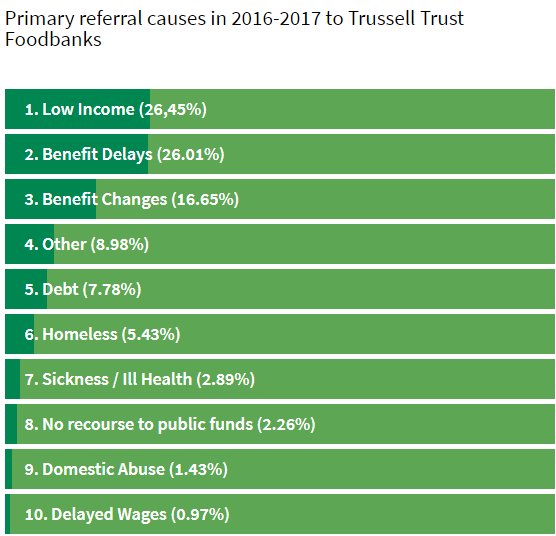
Foodbank providers have repeatedly provided evidence linking demand with Conservative welfare policy, including sanctions and the roll-out of Universal Credit.


SNP MSP Tom Arthur said: “The mask has well and truly slipped. Michelle Ballantyne’s horrific comments were not a slip of the tongue, but instead reflected her long-standing views.

“And now that these previous, utterly unacceptable comments about imposing a ‘restriction’ on the number of children people should have has come to light, she should withdraw the remark and apologise for it.

“The two child cap will put 150,000 Scottish children at greater risk of poverty by 2021 – but to Michelle Ballantyne, that’s a price worth paying so she can lecture those in low paid work or who’ve fallen on hard times.

“The Tories truly are the nasty party.”

Arthur has since called on Ballantyne to resign. He said: “Michelle Ballantyne’s comments were vile and ignorant – and should have no place in Scottish political life”, he said.

“Given her comments, and what we now know about her hypocrisy and her form on the issue, Michelle Ballantyne’s position as Tory welfare spokesperson is completely untenable.

“That Ruth Davidson thought someone with Ms Ballantyne’s views would be acceptable in this role is all we need to know about the Scottish Tories.

“If Ms Davidson and her Deputy won’t remove Ms Ballantyne she should resign as Tory welfare spokesperson – otherwise it will be clear that the Tories are prepared to drag the debate into the gutter as their welfare cuts drive more and more children into poverty.”

The two-child policy was passed into law via universal credit. The original idea for treating children as a commodity and moralising about what items poor people should spend their money on came from Iain Duncan Smith – the Tory consensus is definitely no flat screen TVs, (has anyone tried to buy one that isn’t flat-screened now?) or iphones, and certainly not more children than the government deems appropriate for poorer families.

The Conservatives really do think like this. It’s not just a ‘slip’ by one nasty MSP. It’s now a fundamental part of the wretched and punitive welfare policy framework. 

And the punch line:

Related

The government’s eugenic policy is forcing some women to abort wanted pregnancies

The government’s eugenic turn violates human rights, costing families at least £2,800 each so far, according to DWP statistics

UN to question the Conservatives about the two-child restriction on tax credits

A brief history of social security and the reintroduction of eugenics by stealth

Eugenics is hiding behind Hitler, and informs Tory policies


My work is unfunded and I don’t make any money from it. This is a pay as you like site. If you wish you can support me by making a one-off donation or a monthly contribution. This will help me continue to research and write independent and informative articles, and to continue to support others.

DonatenowButton

PMQs showcases a government that is spiteful and Conservative with the truth


In a very wealthy so-called liberal democracy, from 2016 to last year, these are the reasons why people were referred to food banks. The highest number of referals are among the low earners, demonstrating the government’s slogan ‘making work pay’ is a myth. Work does not pay for many. However, the government chooses to gaslight the population about consequences of it’s policies.

Today in Prime Minister’s Questions: 

As my local Labour MP, Kevan Jones quipped: “the Conservatives will be celebrating re-opening workhouses next.”

The spite and malice on the Prime Minister’s face as she responds to the opposition, using blatant and snide playground gestures to intimidate never fails to anger me. It’s disgraceful that the government reduce serious political issues to immature ‘win or lose’ game playing and PR tactics.

The truth is that Universal Credit is not just failing our ‘relative’ contemporary standards of poverty but those of William Beveridge in the 1940s. Conservatives accuse Labour of ‘taking us back to the seventies’, but May’s government have taken us back to the 1940s, and to absolute poverty levels that existed before there was a welfare state. Absolute poverty is when people cannot meet their basic survival needs: food, fuel and shelter. The UK’s publicly funded social security system is no longer an adequate provision for people to meet the costs of their most fundamental and universal human needs. 

This is a government that has demanded the most from those citizens with the very least under the guise of austerity, while handing out public funds to the private banks accounts of the wealthiest.

Theresa May also selectively and maliciously quoted a section of a book – Economics For The Many  – which was edited by Shadow Chancellor John McDonnell, declaring Labour’s costed manifesto “doesn’t add up”. the Prime Minister went on it to claim the Labour party would “wreck the economy”, but as usual she was being Conservative with the facts.

She attempted to make it look like Professor Simon Wren-Lewis was criticising Labour’s economic strategy, but he wasn’t. The quote mining – a frequently used Conservative strategy to present lies and to mislead parliament and the public – referred to a book chapter May referred to by Wren Lewis , an economist and member of Labour’s Economic Advisory Committee.  Basically the chapter says that Labour will ensure: 

  • The Government is spending less than it takes in in tax within five years
  • Government debt is falling within five years
  • Labour will only borrow for investment and infrastructure, not for day-to-day spending.

Wren Lewis never said that Labour’s manifesto didn’t ‘add up’. He said that other people claimed it didn’t add up. And he said that it didn’t matter.

Wren Lewis notes in the chapter that the Institute for Fiscal Studies (IFS)claimed it ‘doesn’t add up’ – which is a very different thing. And actually, the IFS didn’t really say that either. It said that it was “hard to say” whether Labour’s pledge to reduce debt was compatible with their promises of a wave of nationalisations of water and energy.

The IFS said essentially that because the Labour party would transform the economy so radically, it would be impossible to say whether their manifesto costings would be accurate.

It’s a priceless cheek, as well as a malicious attack, especially considering that the Conservatives did not bother to cost their own manifesto at all.

The blatant lie also shows the prime minister’s utter contempt for democracy.

Finally, a word about the Conservative’s crowing regarding ‘their’ employment levels. 

The ‘high employment’ narrative does not benefit citizens, who face zero hour contracts, little employment security and more than half of those people needing to claim welfare support are in work. The Conservative’s definition of ‘employment’ includes people who work as little as one hour a week. It includes carers. It also includes people who have been sanctioned.

Now there is a perverse incentive to furnish a hostile environment of Department for Work and Pensions’ administrative practices in action.

When the Conservatives took office in 2010, on average citizens earned £467 a week. The latest figures from the Office for National Statistics (ONS) show that we now take home £460 a week. In other words, average wages have gone down in real terms during the eight years of Conservative-Lib Dem and Conservative governments, while the cost of living has risen substantially. It’s a misleading to make these claims at all when weekly earnings are actually 1.3 per cent lower now in real terms than they were when the Conservatives took office in 2010.

Furthermore, the ONS also produced household data suggesting that the true rate of unemployment is 4 times greater than the government’s preferred statistic.

The Conservative’s official definition of unemployment disguises the true rate, of course. In reality, about 21.5% of all working-age people (defined as ages 16 to 64) are without jobs, or 8.83 million people, according to the Office for National Statistics. I know whose statistics I believe, given the Conservative’s track record of abusing figures and telling lies.

Here is more data here on the effect of chronic underemployment of the unemployment rate, and the depressing Conservative reality of the ‘business friendly’ gig economy.

Conservatives being conservative with the truth as ever.

And spiteful.


I don’t make any money from my work. But you can help me by making a donation to help me continue to research and write informative, insightful and independent articles, and to provide support to others. The smallest amount is much appreciated – thank you. 

DonatenowButton