Category: Economics

The impact of a Conservative government on Child Poverty – analysis of report by UNICEF

crdb2_0xiaacsaz
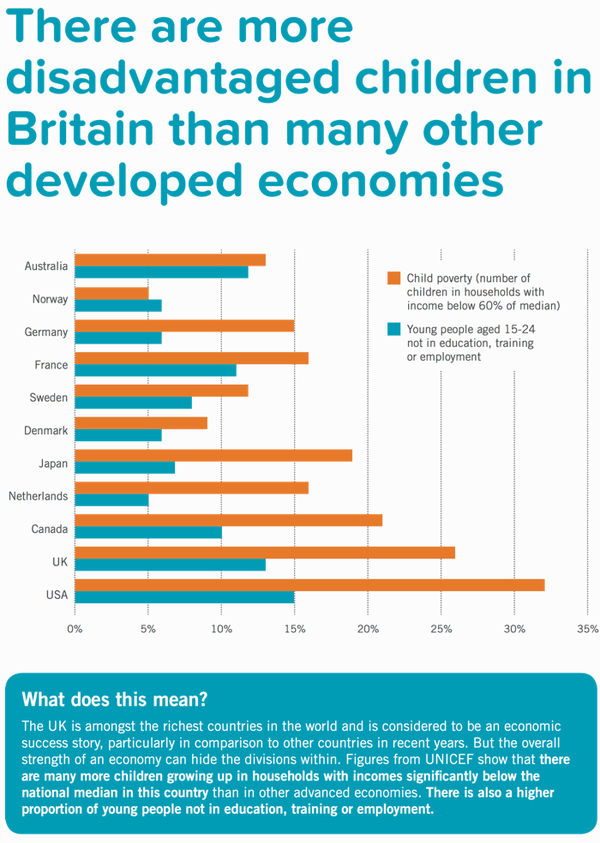
Graphic from Inequality Briefing

If ever you needed convincing evidence that austerity – which is central to neoliberalism and social conservatism – doesn’t benefit the majority, and that the UK has a system that extends inequality and increases poverty, this is it.

Furthermore, austerity was not imposed as an economic necessary, and there were other choices available to the UK government that were less damaging to the poorest citizens and to the economy.

UNICEF have published a report about the impact of the global economic crisis and its aftermath on children. It runs fron 2007 to 2013, so worryingly, the more recent UK government welfare cuts and the consequences are not yet included in this international analysis.

In the executive summary, the report says:

“For each country, the extent and character of the crisis’s impact on children has been shaped by the depth of the recession, pre-existing economic conditions, the strength of the social safety net and, most importantly, policy responses

Remarkably, amid this unprecedented social crisis, many countries have managed to limit – or even reduce – child poverty. It was by no means inevitable, then, that children would be the most enduring victims of the recession.”

The report goes on to say that those Governments that supported existing public institutions and programmes helped to buffer countless children from the crisis – a strategy that others may consider adopting.

The UK was quite clearly not one such country, and more recently, Iain Duncan Smith has conveniently announced changes to how we measure child poverty, shifting the economic responsibility and moral focus by blaming individuals for circumstances created by socioeconomic constraints and political decisions.

The report says:

“Many countries with higher levels of child vulnerability would have been wise to strengthen their safety nets during the pre-recession period of dynamic economic growth, which was marked by rising disparity and a growing concentration of  wealth.”

In the UK, inequality has grown since the recession because of austerity measures that have been targeted at the poorest households. In fact, the UK is now the most unequal country in the EU, and has even higher levels of inequality than the US.

“The magnitude of change since the recession is worth noting. The absolute number of children living in severe material deprivation in the 30 European countries analysed was 11.1 million in 2012 – 1.6 million more than in 2008

This trend is the result of a net effect that includes substantial decreases (more than 300,000 fewer deprived children in Germany and Poland) and unprecedented increases in four countries (Greece, Italy, Spain and the United Kingdom).”

Almost half of the severely materially deprived children (44 percent) in 2012 lived in three countries: Italy (16 percent), Romania (14 per cent) and the United Kingdom (14 per cent).

The report goes on to say:

“At the start of the recession, not surprisingly, child poverty was lower where public spending on families and children was higher. During the recession, welfare states were expected to increase their public protection spending, and many did. 

In such countries, the health and well-being of citizens, especially those in financial or social need, are safeguarded by grants, unemployment assistance programmes, pensions and other benefits. 

In a recession, these benefits act as counter-cyclical economic stabilizers.”

One of the most striking contrasts in the report was that whilst many other countries increased spending on welfare and essential public services to shelter the most vulnerable citizens from the impact of the global recession, in the UK, the government chose to target those social provisions for all of the austerity cuts.

The report says:

“Since 2010, the United Kingdom has implemented a series of cuts that have reduced the real value and coverage of child benefits and tax credits for families withchildren. In 2013, a cap was imposed on the total benefits a household can receive, mainly affecting a small number of large families with high housing costs, while housing benefits were cut (the so-called ‘bedroom tax’), affecting large numbers of social tenants.”

It’s clear that the impacts and aftershocks of the global recession were not shared equally in our society, and the austerity measures have only made things worse for those most affected – the poorest. One emerging certainty from this report is that economic indicators alone do not reveal the complexity of social reality.

The report recommends that governments increase investment in social protection policies and programmes that can reduce poverty, enhance social resilience in children and support economic development in an efficient, costeffective way.

Such measures include guaranteeing basic incomes for families, and a child rights impact assessment as strategy for political decision-making in the best interests of children.

Last year, I wrote that the government’s Children’s Commissioner for England published a report criticising the Coalition’s austerity policies, which have reduced the incomes of the poorest families by up to 10 percent since 2010.

The Children’s Commissioner said that the increasing inequality which has resulted from the cuts, and in particular, the welfare reforms, means that Britain is now in breach of the United Nations Convention on the Rights of the Child, which protects children from the adverse effects of government economic measures.

It therefore comes as no surprise that the current government is planning to repeal our Human Rights Act and replace it with an alternative Bill of Rights. That will mean that  human rights will no longer be absolute – they will be subject to stipulations and caveats. The government will establish a threshold below which Convention rights will not be engaged, allowing UK courts to strike out what are deemed “trivial cases”.

During their last term, the Conservatives contravened the Human Rights of disabled people, women and children. It’s clear that we have a government that regards the rights and wellbeing of most of the population as an inconvenience to be brushed aside.

You can read the UNICEF report in full here.

(Non -discrimination): The Convention applies to all children, whatever their race, religion or abilities; whatever they think or say, whatever type of family they come from. It doesn’t matter where children live, what language they speak, what their parents do, whether they are boys or girls, what their culture is, whether they have a disability or whether they are rich or poor. No child should be treated unfairly on any basis.

Article 3

(Best interests of the child): The best interests of children must be the primary concern in making decisions that may affect them. All adults should do what is best for children. When adults make decisions, they should think about how their decisions will affect children. This particularly applies to budget, policy and law makers.

Article 26

(Social security): Children – either through their guardians or directly – have the right to help from the government if they are poor or in need.

Article 27

(Adequate standard of living): Children have the right to a standard of living that is good enough to meet their physical and mental needs. Governments should help families and guardians who can not afford to provide this, particularly with regard to food, clothing and housing.

1957929_293215800829475_303676825_o

Jeremy Corbyn confronted the Tories with the poverty they’re creating at PMQs – and all they could do was laugh – Liam Young

Originally published in the Independent by Liam Young.

jeremy-corbyn-1
The Tories seem to forget that they were the last government – at some point they will have to take responsibility for their handling of the nation.

As Jeremy Corbyn stood for his second PMQs today, the mocking Tory laughs told us everything we need to know about their enduring Bullingdon Club-style politics. Old habits die hard, it seems. But Corbyn opened strongly, with an issue that unites the Labour party: the cuts to working tax credits which penalise the lowest earners, known colloquially as the Tory work penalty.

Again, the Tories laughed at the name ‘Kelly’, so apparently unbelievable do they find the first names of Corbyn’s constituents; they soon fell silent, however, as they heard of her struggle as the mother of a disabled child earning minimum wage in a 40.5-hour-per-week job. Corbyn tackled the bullyboys by pausing at their laughter this time. ‘Some may find this funny,’ he said, as he continued to talk about mass inequality and the housing problem in London. It was a subtle highlight of something glaringly obvious: for millionaires protected by Tory policies, inequality bolstered by unfair taxes and buy-to-let properties really is hilarious.

Cameron’s reply to the work penalty issue was the same old line: apparently a £20-a-week increase in wages will magically solve the problem. This is not true, of course, as Corbyn promptly replied: working families are set to be £1,300 a year worse off as the Conservative government hammers the working and middle classes so as to give to the super rich.

Cameron claimed that Corbyn’s figures on poverty were wrong, but perhaps that is something to do with the fact that the Work and Pensions Secretary fixed the definition of ‘poverty’ recently. You don’t feed and clothe homeless children by changing a definition, and the government should be ashamed. The fact that 50 per cent of wealth is in 1 per cent of hands globally is shambolic, and reports today that inequality is growing in the UK even as our country now has the third most ‘ultra-high net worth individuals’ in the world put paid to Cameron’s claims to have driven opportunity. There could be no bigger proof that his policies continue to squeeze the middle and punish the poor.

Jeremy Corbyn probably had a headache even before PMQs started. George Osborne’s proposal of a ‘fiscal charter’ has been causing problems for Labour over the last few days, not least because it was once a Labour policy rubbished by Cameron himself. It seems strange, then, that Tories are so desperate to implement it now, considering that the Governor of the Bank of England has not endorsed its proposal and no economist has come out in support of it. Most commentary has focused on how it is unrealistic to try and tie the hands of future governments – almost as though Osborne is trying to make an ideological (and erroneous) point about how Labour ‘caused the recession by their overspending’, rather than the truth about rich bankers running wild without regulation. Of course, it also gave Osborne an excellent opportunity to personally ask Labour MPs to rebel – little more than a cynical attempt to ruffle some feathers.

In June, over 70 economists published a letter that clearly noted that the charter has ‘no basis in economics’ and that permanent surplus would increase the debt of households and businesses. The policy is not about protecting the British economy; it is an attempt to bury the Labour party under the same message of the last government. The Tories seem to forget that they were the last government – they have been in power now for almost six years, and at some point they will have to take responsibility for their handling of the nation.

Despite all this, PMQs today were the best moment of Corbyn’s leadership of the Labour party so far. Osborne’s attempt to destabilise the Labour party and force Labour MPs to rebel spectacularly failed, while Corbyn asked if he could bring the Prime Minister back to reality as Tory rhetoric failed against his grassroots facts.

Cameron wants to get Britain building houses, he wants to alleviate poverty, and he wants to rebuild the economy – or so he’d have you believe. In the last five years, house-building has stalled, poverty has increased, inequality appears to be rising and the national debt has doubled. At some point, the Tories have to stop blaming Labour for their own disastrous record. Corbyn is now attacking their mythology head-on – and he might just be getting somewhere. 

Liam Young is a freelance political journalist studying international relations at the LSE

The welfare state: from hung, drawn and quartered to Tory privatisation

Thatcher scary

The mess that Thatcher left in her wake is verified by several longitudinal studies. Dr. Alex Scott-Samuel and colleagues from the Universities of Durham, West of Scotland, Glasgow and Edinburgh, sourced data from over 70 existing research papers, which concludes that as a result of unnecessary unemployment, welfare cuts and damaging housing policies, the former prime minister’s legacy:

includes the unnecessary and unjust premature death of many British citizens, together with a substantial and continuing burden of suffering and loss of well-being. 

The article also cites evidence including the substantial increase in income inequality under Thatcher – the richest 0.01% of society had 28 times the mean national average income in 1978 but 70 times the average in 1990, and there was a rise in UK poverty rates from 6.7% in 1975 to 12% in 1985.

The research article concludes that:

Thatcher’s governments wilfully engineered an economic catastrophe across large parts of Britain by dismantling traditional industries such as coal and steel in order to undermine the power of working class organisations, such as unions.This ultimately fed through into growing regional disparities in health standards and life expectancy, as well as greatly increased inequalities between the richest and poorest in society.

New Right Conservatives have a curiously evidence-resistant conviction that the “big state” has somehow stymied our society: that the “socialist relic” – our NHS and our Social Security system, which supports the casualties of Tory free markets, have somehow created those casualties. But we know from history and recent events that competitive individualism and market choice-driven Tory policies create a few haves and many have-nots.

Tory rhetoric is designed to have us believe there would be no poor if the welfare state didn’t somehow “create” them. If the Conservatives must insist on peddling the myth of meritocracy, then surely they must also concede that whilst such a system has some beneficiaries, it also creates situations of insolvency and poverty for others.

In a wealthy so-called first world democracy, it is profoundly uncivilised and anti-democratic to simply dismiss people experiencing poverty and hardship effectively as collateral damage, and terribly cruel and irresponsible to blame those people for the situations of difficulty and deprivation created by policies and the socio-economic framework itself.

This wide recognition that the raw “market forces” of stark laissez faire cause casualties is why the welfare state came into being, after all – because when we allow such competitive economic dogmas to manifest – as the stormy present – there are winners and losers. That is the nature of competitive individualism, and along with inequality, it’s an implicit, undeniable and fundamental part of the meritocracy script.

And that’s before we consider the fact that whenever there is a Conservative-led government, there is no such thing as a “free market”: in reality, all markets are rigged to favour elites.

Cameron is continuing to build on Thatcher’s legacy. We know from the Central Policy Review Staff (CPRS) report, which was encouraged and commissioned by Margaret Thatcher and Geoffrey Howe in 1982, that there was a radical, politically toxic plan to dismantle the welfare state, to introduce education vouchers, ending the state funding of higher education; to freeze welfare benefits and to introduce an insurance-based health service, ending free health care provision of the NHS. One of the architects of the report was Lord Wasserman, he  was one of Cameron’s advisors until 2012.

A confidential cabinet memorandum by the Central Policy Review Staff in September 1982, said: “This would of course mean the end of the National Health Service.” The report was declassified and released in 2012 by the National Archives under the 30-year rule.

But the fear of the scale of opposition to the plan meant the grand dismantling of the welfare state didn’t happen. Instead the Conservatives have planned and worked to take it apart a piece at a time.

In 1982 unemployment rose above three million. Yet the Tories were happy with further increases to try and drive down wages. John Sparrow of the Cabinet Office’s Central Policy Review Staff think-tank, wrote in a June memo to Thatcher that the youth training scheme, introduced in 1983, would be “likely to displace some older workers”.

He continued:

Displacement is not necessarily a bad thing, since it puts downward pressure on wage rates.” Sparrow noted that government plans to end out-of-work benefits for 16 year olds would remove them from the unemployment figures.

Fast-forward to the present: David Cameron is prepared to consider making workers pay into flexible saving accounts to self-fund periods of illness and unemployment benefits, Downing Street has confirmed.

The idea was first floated by Iain Duncan Smith who said he was “very keen” to have a debate about encouraging people to use personal accounts to save for unemployment or illness, even though it is not “official” government policy.

Duncan Smith told the Sunday Telegraph:

We need to support the kind of products that allow people through their lives to dip in and out when they need the money for sickness or care or unemployment.

We need to encourage people to save from day one but they need to know that they can get some of the money out when their circumstances change. This is not government policy but I am very keen to look at it, as a long-term way forward for the 21st century.

Duncan Smith seems to be suggesting that benefits are replaced with a kind of unemployment insurance scheme as seen in the US or products known as “fortune accounts”, which are used in Singapore.

Asked about the idea of workers saving up for their sickness and unemployment benefits, Cameron’s official spokeswoman confirmed he was prepared to consider such a model. She said:

I think the PM shares the work and pensions secretary’s view that we should be doing more to encourage people to take personal responsibility for how they manage their affairs.

The proposal of fortune accounts for the UK was examined in depth in a paper by the Right-wing libertarian Adam Smith Institute thinktank in 1995, which considered how people could go to a single private provider for an account that gave them long-term care insurance, disability cover, health insurance, savings fund management and unemployment insurance.

The paper suggested:

Many other things that we often regard as ‘welfare’ today are also insurable and will be part of the fortune account package. Cover against incapacity to work, long-term care services, and disability, will all be in the package.

A report from Civitas argued (preemptively) that National Insurance is “no longer fit for purpose” and that everyone in work should be forced to save into a private pension to help shoulder the burden of the rising costs of old age.

Civitas professorial research fellow Peter Saunders argued in the report, titled Beyond Beveridge, that the principle that those who are able to should pay into the system has been eroded and “taxpayer-funded hand-outs” have increasingly replaced contributions-based benefits.

He goes on to say that whilst the main purpose of the proposed personal welfare accounts would be for retirement saving, they could also provide cover for when times are tough during periods of short-term unemployment, sickness and parental leave.

It reads like Daily Mail dogma to me.

The report reviews Britain’s National Insurance system and
proposes that it be replaced by compulsory “personal welfare

accounts.”

The introduction of personal insurance schemes would mark the end of welfare provision as we know it. Furthermore, those least likely to be able to afford the premiums are those most at risk of losing their jobs.

The Tories fully intended that the welfare “reforms” were the beginning of the end of our welfare state. The welfare cuts were ushered in strictly because of the despotic use of “financial privilege” by Cameron to bypass the widespread and vehement opposition to the Bill.

At the time, such was my dismay at the proposed welfare “reform” Bill that I emailed the entire House of Lords, imploringly. After using a reasoned approach, my second email simply said: the welfare reforms must not happen. Many of the peers and members replied, and many responded with “agreed.” But Cameron made the “reforms” happen anyway and apparently felt no obligation to observe the niceties of democratic process.

The Tories clearly have no intention of ensuring a safety net for citizens and have plotted to dismantle our welfare state since the Thatcher era. This is a long-planned outcome for the Tories. Social security and public services are in serious jeopardy.

Cameron’s rhetoric is full of references to “rolling back the state”, the “re-awakening of community spirit”, and a restoration of the kind of “intermediate civic institutions” that preceded the welfare state. The whole idea of Cameron’s “big society” is that private charities fill the holes created by public spending cuts.

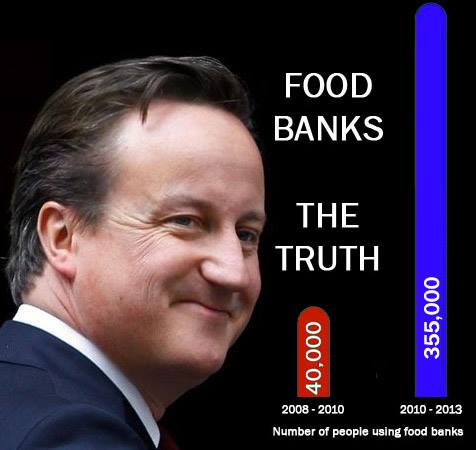
Food banks have increasingly replaced welfare, for example, yet the point of post-1945 European welfare states was to free those in need from dependence on the insecurity of private generosity, which tends to miss out the socially marginalised, and to be least available when times are hardest.

Welfare, or social security, if you prefer, has provided a sense of security and dignity that we never previously enjoyed, it established a norm of decency, mutuality of our social obligations and created a parity of esteem and worth which was, until fairly recently, universal, regardless of wealth and status.

The “big bad state” is comprised of civilised and civilising institutions. It is such stable and enduring institutions and subsequently secure individuals that are raised above a struggle for basic survival which provide a frame for coherent communities. The Conservatives, with their anti-humanist, anti-enlightenment demagoguery of rigid class division, and policies that engineer steep social stratification, tend to create ghettoes, not communities.

The paternalism of traditional Tories and the authoritarianism of the current New Right are profoundly undemocratic: neither design can reflect the needs of the public since both frameworks are imposed on a population, reflecting only the needs of the ruling class, to preserve social order.

Conservative small-state ideology has led to depopulated social policies, which have dehumanised people, and indicate that the Tory policy-makers see the public as objects of their policies, and not as human subjects.

The moralising scrutiny and control of the poor is a quintessential element of tory narrative. Tory ideology never changes. They refuse the lessons of history, and reject the need for coherence and rationality. Tories really are stuck in the Feudal era. They have never liked the idea of something for everyone, yet everyone has paid for welfare provision:

“The [financial] crisis is an opportunity to sweep away the rotten postwar settlement of British politics. Labour is moribund. But David Cameron has a chance to develop a “red Tory” communitarianism, socially conservative but sceptical of neoliberal economics.” Phillip Blond, The Rise of the Red Tories, 2009.

Cameron was never sceptical of neoliberalism: like Thatcher, he has extended it without restraint. Neoliberalism entails a charismatic ideology – what sociologist Pierre Bourdieu calls a doxa: an unquestionable orthodoxy that operates as if it were the objective truth – that facilitates an uncompromising attack on public welfare; inevitable, growing inequality, and the individualization of all social actions, all in the name of private “enterprise”, the accummulation of private wealth for a minority and “global competitiveness.”

Unsurprisingly, then, unemployment, inequality, and poverty are increasingly blamed on the individuals experiencing these conditions rather than on the structural constraints that create the conditions.

We are being turned away from the role of the community and instead our attention is being purposefully diverted and re-focused solely on the “responsibilities” of individuals (and those responsiblities are inversely proportional to how much wealth a person has), common social values such as cooperation, mutual support, reciprocal altruism are being eroded, and the interdependent and intersubjective nature of social life is flatly denied: mutual relationships and common bonds are being dissolved and replaced by a social Darwinist narrative – founded on the mantra of competitive individualism.

The policies, practices and irrational beliefs of the state are distorting the perceptions of social groups and individuals, the colonisation of public language and space with neoliberal narratives – facilitated by a largely complicit media – delivers a distinctive anti-rationalist epistemology that restructures public ontological understandings.

Those understandings have become profoundly anti-collectivist and increasingly, antisocial, ultimately undermining social cohesion, stability and social security.

___


Related

The welfare debate and the end of reason

The welfare state – can we afford it?

Can we afford the welfare state?

Britain can still afford the welfare state

We can’t afford to lose the welfare state.

Images courtesy of Robert Livingstone

The budget: from trickle-down to falling down, whilst holding hands with Herbert Spencer.

proper Blond
“We are moving Britain from a high welfare, high tax economy, to a lower welfare, lower tax society.”

George Osborne, 8 July 2015

The pro-wealthy and anti-humanist budget indicates clearly that the Conservatives are preoccupied with highlighting and cutting the state cost of sustaining the poorest citizens rather than the costs of subsidising the rich.

I’ve pointed out before that the Conservatives operate a perverse, dual logic: that wealthy people need support and encouragement – they are offered substantial financial incentives – in order to work and contribute to the economy, whereas poor people apparently need to be punished – by the imposition of financial cuts – in order to work and contribute to the economy.

That Osborne thinks it is acceptable to cut the lifeline benefits of sick and disabled people to pay for government failures, whilst offering significant cuts to corporation tax rates; raising the tax-free personal allowance and extending inheritance tax relief demonstrates very clearly that the myth of trickle-down is still driving New Right Conservative ideology, and that policy is not based on material socio-economic conditions and public need. (And Cameron is not a one-nation Tory, despite his claims.)

Research by the Tax Justice Network in 2012 indicates that wealth of the very wealthy does not trickle down to improve the economy, but tends to be amassed and sheltered in tax havens with a detrimental effect on the tax bases of the home economy.

A more recent report – Causes and Consequences of Income Inequality : A Global Perspective by the International Monetary Fund concluded in June this year that there is no trickle-down effect –  the rich simply get richer:

“We find that increasing the income share of the poor and the middle class actually increases growth while a rising income share of the top 20 percent results in lower growth—that is, when the rich get richer, benefits do not trickle down.”

It’s inconceivable that the Conservatives fail to recognise such policy measures will widen inequality. Conservatives regard inequality and social hierarchy as inevitable, necessary and functional to the economy. Furthermore, Conservatives hail greed and envy as emotions to be celebrated, since these drive competition.

Since the emergence of the New Right, from Thatcher to Cameron, we have witnessed an increasing entrenchment of Neoliberal principles, coupled with an aggressive, authoritarian brand of social conservatism that has an underpinning of crude, blunt social Darwinist philosophy, as carved out two centuries ago by the likes of Thomas Malthus and Herbert Spencer.

Spencer is best known for the expression “survival of the fittest,” which he coined in Principles of Biology (1864), after reading Charles Darwin’s work. Spencer extended natural selection into realms of sociology, political theory and ethics, ultimately contributing to the eugenics movement. He believed that struggle for survival spurred self-improvement which could be inherited. Maslow would disagree. All a struggle for survival motivates is just a struggle for survival.

Spencer’s ideas of laissez-faire; a survival-of-the-fittest brand of competitive individualism; minarchism – minimal state interference in the processes of natural law – and liking for private charity, are echoed loudly in the theories of 20th century thinkers such as Friedrich HayekMilton Friedman and Ayn Rand who each popularised Spencer’s ideas, whilst Neoliberal New Right Conservatives such as Ronald Reagan, Margaret Thatcher and David Cameron have translated these ideas into policies.

Ideology has considerable bearing on policies, and policies may be regarded as overt, objective statements of political intent. I’ve said many times over the past five years that Conservatives have forgotten that democracy is based on a process of dialogue between the public and government, ensuring that the public are represented: that governments are responsive, shaping policies that address identified social needs. Conservative policies are quite clearly no longer about reflecting citizen’s needs: they are increasingly authoritarian, and all about telling us how to be.

Conservatives have always coldly conceived society as a hierarchy of human value, and they have, from their pinnacle of supremacist, self-appointed authority, historically cast the vulnerable and the poorest as the putative “enemies of civilization.” Social Darwinism is written in bold throughout their policies.

Furthermore, such a combination of Neoliberal and Conservative political theory, explicitly opposes democratic goals and principles. Neoliberalism was originally used by academics on the Left as a pejorative to capture the policies of imposed exploitation, privatisation, and inequality.

Neoliberalism is now characterised by the use of international loans and other mechanisms to suppress unions, squash state regulation, elevate corporate privilege, privatise public services, and protect the holdings of the wealthy. The term became widely recognised shorthand for rule by the rich, authoritarianism and the imposition of limits on democracy.

Banks, corporations, the financial sector, and the very wealthy are exercising power and blocking any attempt to restructure the economic system that brought about the crash.

Meanwhile, the free market is a market free for powerful interests; the profit motive has transformed the organising value of social life, and those who the Conservatives evidently regard as collateral damage of this socio-economic dogma made manifest are paying the price for the global crash, with Osborne and the Conservatives constructing narratives that problematise welfare support, generating moral panic and folk devils to demonise the poorest citizens in need of support.

Growing social inequality generates a political necessity for cultivating social prejudices.

Such Othering narratives divert public attention from the fact that the right to a fair and just legal system, a protective and effective safety net for the poorest, free healthcare – all of the social gains of our post-war settlement – are all under attack.

I have said elsewhere that Conservative ideology is incompatible with our legal commitments to human rights. The United Nations declaration of Human Rights is founded on the central tenet that each and every human life has equal worth. The Conservatives don’t agree, preferring to organise society into hierarchies of worth and privilege.

Conservative austerity measures and further impending welfare cuts are not only a deliberate attack on the poorest and most vulnerable social groups; the range of welfare cuts do not conform to a human rights standard; the “reforms” represent a serious failure on the part of the government to comply with Britain’s legal international human rights obligations.

The cuts announced by the chancellor include a further reduction to the benefits cap – not only from £26,000 to £23,000, as promised in the Conservative Party’s 2015 manifesto, but down even further to £20,000 outside of London.

Child tax credit, housing benefit and working tax credit will be reduced, with child tax credit only being paid for the first two children. Presumably this is, to quote Iain Duncan Smith, to “incentivise behavioural change,” placing pressure on the poorest to “breed less,” though personally, being the direct, blunt, no-nonsense sort, I prefer to call it a nudge towards “eugenics by stealth.”

The Social Mobility and Child Poverty Commission say that any cuts to tax credits will cut the incomes of 45 per cent of working families. These cuts are particularly controversial, since the benefits cap was partly justified as a way of “making work pay”  – a Conservative narrative that echoes the punitive 1834 New Poor Law Principle of less eligibility – see: The New New Poor Law.

The Government asserts that its welfare “reform” strategy is aimed at breaking the cycle of “worklessness” and dependency on the welfare system amongst the poorest families. It’s more punitive Poor Law rhetoric.

There’s no such thing as “worklessness”, it’s simply a blame apportioning word, made up by the Tories to hide the fact that they have destroyed the employment market, just as Thatcher did, and as the Conservatives always do.

Punishing the low paid, cutting the income of families who work for low wages directly contradicts the claim that the Conservatives are “making work pay.”

Yet Osborne has framed his welfare cuts with the “The best route out of poverty is work” mantra, claiming that slashing the social security budget by £46 billion in the next five years, (including cutting those benefits to disabled people, who have been assessed as unfit for work and placed in the Work Related Activity Group (WRAG), and cutting in-work benefits, such as tax credits) is needed to make sure “work pays” and that: “we give a fair deal for those on welfare and a fair deal to the people, the taxpayers of this country who pay for it.”

The Conservatives always conveniently divide people into an ingroup of taxpayers and an outgroup of stigmatised others – non-tax payers. However, most people claiming benefits are either in work, and are not paid enough, through no fault of their own, to pay tax, or are pensioners who have worked most of their lives; or are unemployed, but have previously worked and contributed tax.

Most people claiming disability benefits have also worked and contributed tax, too.

Unemployment and in-work benefit claims are generally a measure of how well or poorly the government is handling the economy, not of how “lazy” or “incentivised” people are.

And only the Tories have the cheek to claim that raising the minimum wage (long overdue, especially given the hikes in the cost of living) is the introduction of a living wage. The basic idea is that these are the minimum pay rates needed so that workers have an acceptable standard of living. Over the last few years, wages have very quickly fallen far behind the ever-rising cost of living.

The increase is at a rate of £7.20 an hour for people over the age of 25.  Housing benefit will be withdrawn from those aged between 18 and 21, while tax credits and universal credits will be targeted at people on lower wages by reducing the level at which they are withdrawn.

The chancellor’s announcement amounted merely to an increase in the minimum wage, and the curbs on tax credits would hit low-paid workers in other ways, unfortunately.

Whilst the announcement of a phased increase in the minimum wage is welcome, it is difficult to see how this will reverse the increasing inequality that will be extended as a further consequence of this budget without a matching commitment to improving the structural framework – the quality and stability of employment available. As it is, we are now the most unequal country in EU.

If the government were sincerely interested in raising wages to make work genuinely pay, ministers would be encouraging rather than stifling trade unionism and collective bargaining. But instead we see further cuts to public sector pay in real terms year after year and the raising of the legal bar for industrial action so that strikes will be effectively outlawed in public services. And let’s not forget the grubby partisan policy of two years ago – the Let Lynton Lobby Gagging Act.

Rhys Moore, director of the Living Wage Foundation, said:

“Is this really a living wage? The living wage is calculated according to the cost of living whereas the Low Pay Commission calculates a rate according to what the market can bear. Without a change of remit for the Low Pay Commission this is effectively a higher national minimum wage and not a living wage.”

Those most affected by the extreme welfare cuts are those groups for which human rights law provides special protections. The UK government has already contravened the human rights of women, children, and disabled people.

The recent report of the UK Children’s Commissioner to the UN Committee on the Rights of the Child, published in July this year, says:

“Response to the global economic downturn, including the imposition of austerity measures and changes to the welfare system, has resulted in a failure to protect the most disadvantaged children and those in especially vulnerable groups from child poverty, preventing the realisation of their rights under Articles 26 and 27 [of the UN CRC] … Reductions to household income for poorer children as a result of tax, transfer and social security benefit changes have led to food and fuel poverty, and the sharply increased use of crisis food bank provision by families.”

The parliamentary Joint Committee on Human Rights recently reported on the UK’s compliance with the United Nations Convention on the Rights of the Child (CRC), and found it woefully lacking:

“Welfare cuts will ensure that the government is not in compliance with its international human rights obligations to realise a right to an adequate standard of living under Article 11 of the International Covenant on Economic and Social Rights (ICESR) and a child’s right to an adequate standard of living under Article 27 of the UN CRC. Further it will be in breach of the statutory target to eliminate child poverty contained in the Child Poverty Act 2010.”

Just in case you missed it, there has been a very recent, suspiciously timed change to the definition of child poverty, and a proposed repeal of the Child Poverty Act – something that Iain Duncan Smith has been threatening to bring about since 2013.

It’s yet another ideologically directed Tory budget, dressed-up in the rhetoric of economic necessity, detached from public needs.

And Conservative ideology is all about handouts to the wealthy that are funded by the poor.

Related:

George Osborne’s Political MasterstrokeA View from the Attic

Osborne’s class spite wrapped in spin will feed a backlashSeumas Milne

Budget 2015: what welfare changes did George Osborne announce, and what do they mean?  New Statesman: The Staggers

How Osborne’s new cuts breach the UK’s human rights obligations, Lecturer in Law at Lancaster University

Osborne’s Autumn statement reflects the Tory ambition to reduce State provision to rubble

Osborne’s razor: the Tory principle of parsimony is applied only to the poorest

The BBC expose a chasm between what the Coalition plan to do and what they want to disclose

1450041_569755536427312_1698223275_n
Thanks to Robert Livingstone

Budget 2015: cuts to make Daily Mail readers wince, but not just yet

9686687899_74d73c6216_oPicture courtesy of Robert Livingstone.

Article by Michael Kitson, University of Cambridge

George Osborne is preparing to deliver the first Tory budget since 1996. He will proclaim the success of the government’s “long-term economic plan” and will use this as a platform to launch a radical reduction of welfare expenditure. But repeatedly extolling the success of your long-term economic plan does not mean that you have one. And an economy that in the first quarter was growing at a sluggish annual rate of 2.2% per head – after a deep and protracted recession – is not an indicator of sustained economic revival.

There are two main components of the government’s economic plan. First, to decrease the budget deficit and eventually move it to surplus – with the fiscal burden being borne by cuts in government spending. Second, to reduce the size of the state in the British economy. This is not an “economic plan”, it is a political agenda based on a doctrine of faith.

The focus on fiscal austerity has meant that monetary policy (interest rates and quantitative easing) has been the main stimulant to the economy. Thus, private sector debt is considered good and desirable whereas public sector debt is bad and harmful.

This makes little economic sense; what is important is the appropriate balance between borrowing to consume and borrowing to invest. In a period of cheap money, it is no surprise that consumers are buying new cars in record numbers (85% of which are manufactured abroad); the problem is that the state is not investing in the infrastructure that the economy needs.

The growth record

The supporters of austerity have argued that the return of economic growth is justification for the policy. This argument is full of holes. The anti-austerity group never argued that the economy would remain in a permanent recession – their concern was that recovery would be delayed and the downturn would cause long-term damage. The normal path for an economy that suffers a shock is that it bounces back with a period of rapid economic growth. The bounce-back has been feeble in the UK and growth has yet to get back to trend.

Furthermore, the most important indicator of prosperity is GDP per capita, and as shown by the red line in the chart below, this is still below the level achieved in 2008. This reflects the UK’s productivity problem. As the liberal economist Paul Krugman observed:

Productivity isn’t everything, but in the long run it is almost everything. A country’s ability to improve its standard of living over time depends almost entirely on its ability to raise its output per worker.

Although it will probably receive a lot of lip service in the budget, there has been no coherent plan to raise productivity in the UK.

ONS, Quarterly National Accounts, Quarter 1 (Jan to Mar) 2015

The retreat of the makers

The UK remains an unbalanced economy: regional disparities have widened since the early 1980s and this process was not halted by the financial crisis. The government has proclaimed that it is putting the power into the “Northern powerhouse”. But regional policy in the UK is piecemeal and parsimonious; and you do not build a powerhouse by postponing infrastructure spending in the North.

Support for industry is another area where soundbites trump substance. The chancellor has called for “a Britain carried aloft by the march of the makers”. But as the chart below shows, although there has been a recovery of the service sector, the manufacturing sector remains smaller than it was before the financial crisis.

The coalition government revived the notion of “industrial policy” to support the manufacturing sector; but this was a Vince Cable initiative which is not being pursued by the current government – which is instead implementing major cuts at the Department for Business, Innovation & Skills, the department responsible for business support and innovation.

ONS, Quarterly National Accounts, Quarter 1 (Jan to Mar) 2015

Of course, it is often argued that manufacturing does not matter any more as we are a service-based economy. Services will continue to provide most of the jobs and most of the output of the economy. Where manufacturing plays a crucial role is as an important source of exports: to help address the deficit that the chancellor rarely talks about – our massive and persistent trade deficit with the rest of the world.

The size of the state

An important part of the long-term political plan is to reduce the size of government – to wield the axe to what the Daily Mail refers to as the “the bloated overweening state. This is a big challenge as the size of the state (as a share of GDP) has increased in all advanced economies since World War II.

This has not been due to some statist plot, but reflects the implications of prosperity. As economies have grown and the standard of living and life expectancy have increased, there has been expanding demand for health, education and pensions. And much of this demand has been met by the state and funded by tax revenue. These are the largest components of government expenditure in the UK; and if the chancellor is serious about reducing the size of the state this is where his axe will have to eventually fall.

Hitting benefit claimants in the meantime is an easy target – and, after all, not many of them are likely to vote Conservative. But large-scale cuts to school budgets, the NHS and state pensions may even make some readers of the Daily Mail wince.

The Conversation

Michael Kitson is University Lecturer in Global Macroeconomics at University of Cambridge.

This article was originally published on The Conversation.
Read the original article.

The poverty of responsibility and the politics of blame. Part 3 – the Tories want to repeal the 2010 Child Poverty Act

demcracy

Political theories of poverty vary across the political spectrum, with those on the right tending to individualise social problems more generally, and those on the left tending to socialise them. Very different policy implications stem from each perspective.

Since the Thatcher era, the New Right have developed a distinctive behaviourist approach to poverty, founded on the idea that poor people are poor because they lack certain qualities and traits.

In 2013, Iain Duncan Smith worked on developingbetter measures of child povertyto provide a “more accurate reflection of the reality of child poverty.” According to the Conservatives, poverty isn’t caused by a lack of income.

The Coalition conducted a weighted and biased consultation at the time that did little more than provide a Conservative ideological framework in the form of leading questions, to catch carefully calculated, led and subliminally shaped public responses.

Iain Duncan Smith has indicated he will repeal the 2010 Child Poverty Act, which committed the government to a target of eradicating child poverty in the UK by 2020. He has dispensed with the current relative definition of poverty (anyone in a household beneath 60% of median income), abandoned the targets and introduced a new (although rather unclear) definition: the child poverty target is to be replaced with a new duty to report levels of educational attainment, “worklessness” and addiction, rather than relative material deprivation and disadvantage.

Duncan Smith argues that the measures set originally by Tony Blair are a “poor measure of poverty”, and he claims that families can fall or go above the relative poverty line for reasons that have little to do with their material wealth.

Using the Centre for Social Justice’s 2012 report Rethinking Child Poverty, (set up by none other than Iain Duncan Smith in 2004) to support his ideological perspective, Duncan Smith’s account of UK poverty is defined by bad parenting, by alcohol dependency and drug-addiction.

There is of course very little focus on accounts of parents who are poor because they are unemployed or in low-paid work. Or because of government policies that are directed at rewarding wealthy people and punishing poor people. (See also: We are raising more money for the rich.) Duncan Smith said:

“We know in households with unstable relationships, where debt and addiction destabilise families, where parents lack employment skills, where children just aren’t ready to start school, these children don’t have the same chances in life as others. It is self evident.”

Of course it’s also “self-evident” that debt, addiction and unstable relationships happen to wealthy people as well, so as far as causal explanations of poverty go, this one certainly lacks credibility and coherence.

Furthermore, I propose that a lack of opportunities and life chances arise from the cumulative effects of discriminatory economic and social structures and policies. Iain Duncan Smith went on to say:

“They cannot break out of that cycle of disadvantage. We are currently developing these measures right now – family breakdown, problem debt and drug and alcohol dependency – and we will report each year on these life chances as well.”

The Conservatives are claiming that poverty arises because of the “faulty” lifestyle choices of people with personal deficits and aim to reconstruct the identities of poor people via psychopolitical interventions, but it is only through a wholesale commitment to eliminating poverty by addressing unemployment, underemployment, job insecurity, low paid work, inadequate welfare support and institutionalised inequalities that any meaningful social progress can be made.

Over the last five years, the UK has become the most unequal country in Europe, on the basis of income distribution and wages. If that increase in inequality arose because of individual failings, as the Conservatives are claiming, why have those personal failings only become apparent so suddenly within the past five years? The Child Poverty Action Group voiced concerns :

“The statement isn’t about strengthening efforts to end child poverty, but about burying the failure of the government’s child poverty approach. And with more cuts coming down the line, child poverty is set to rise.”

The Bell Swerve

Iain Duncan Smith draws on a framework of ideas that was shaped to a large extent by the white male supremacist musings of Charles Murray, the controversial ultra-conservative American sociologist that exhumed social Darwinism and gave the bones of it originally to Bush and Thatcher to re-cast.

Murray’s New Right culture of poverty theory popularised notions that poverty is caused by an individual’s personal deficits and character flaws; that the poor have earned their position in society; the poor deserve to be poor because this is a reflection of their lack of qualities and level of abilities. Murray’s very controversial work The Bell Curve was a novel of racist pseudoscience and manipulated, misleading statistics which he used to propose that social inequality is caused by the genetic inferiority of the black and Latino communities, women and the poor.

According to Murray, disadvantaged groups are disadvantaged because, on average, they cannot compete with white men, who are intellectually, psychologically and morally superior. Murray advocates the total elimination of the welfare state, arguing that public policy cannot overcome the “innate deficiencies” that cause unequal social and educational outcomes.

Many critics, including myself, regard Murray as a white supremacist, a nationalist that has a long history of advocating discredited ideas that are rooted in eugenics. Nonetheless, Murray has had a significant influence on Conservative thinking about welfare in particular, both here in the UK and across the Atlantic.

“Unless the government sets out a clear target for improving the life chances of the poorest families, its agenda for healing social division in our country will lack both ambition and credibility.”

The Children’s Commissioner issued a statement regarding the repeal of the Child Poverty Act:

“The Child Poverty Act targets were not just about relative poverty – which is a measure of inequality, important in itself – but also included a measure of material deprivation. Critically, the new measures proposed today would not include any tangible measure of poverty, hunger, cold, or deprivation of any kind. Poverty is a financial measure. Unemployment statistics and statistics on educational attainment are already collected.

“The majority of children living in poverty have at least one parent who is working. Employment is important but if wages do not rise substantially in relation to living costs it will not provide a route out of poverty alone. The Joseph Rowntree Foundation has today published a report stating that families with children working full-time on the National Minimum Wage are now 15% short of the Minimum Income Standard that people believe offers an acceptable standard of living.  Today’s announcement will effectively confine to history any figures on the millions of children being raised in families who experience in-work poverty denying them necessities such as adequate food, clothing and heating.”

Last year, the Children’s Commissioner said that the increasing inequality which has resulted from the cuts, and in particular, the welfare reforms, means that Britain is now in breach of the United Nations Convention on the Rights of the Child, which protects children from the adverse effects of government economic measures.

Austerity cuts are disproportionately targeted at the poorest. It’s particularly shameful that absolute poverty has returned to Britain since 2010, given that we are the 5th wealthiest nation in the world. That indicates clearly just how much inequality has increased under the Conservatives since 2010.

Poverty and inequality are a consequence of the way that society is organised, political decision-making and how resources are allocated through discriminatory government policies.

Poverty arises because of the behaviour of the powerful and wealthy, not the poor.

___

See also:

The Poverty of Responsibility and the Politics of Blame

The poverty of responsibility and the politics of blame – part 2

The just world fallacy

The right-wing moral hobby horse: thrift and self-help, but only for the poor

The New New Poor Law

UK Wealth Divide widens, with inequality heading for “most unequal country in the developed world”

Poor people are poor because they don’t know how to get something from nothing

1957929_293215800829475_303676825_oPictures courtesy of  Robert Livingstone

BBC reports unsurprisingly that Newcastle City Council has been ‘forced’ to plunder welfare funds

Newcastle Civic CentreNewcastle City Council said it would have to stop providing crisis loans to vulnerable residents

The BBC reports that a north-east council says government budget cuts are forcing it to use funding earmarked for vulnerable residents.

Newcastle City Council is using money previously ring-fenced for welfare and crisis loans on other frontline services.

Labour council deputy leader Joyce McCarty said it was facing “really tough choices”.

The government said local councils were best placed to decide priorities.

However, the government is proposing to cut a further £12bn from its annual welfare budget.

Funding for welfare grants and crisis loans was devolved to local control in 2013/14.

Ring-fencing was removed from 2015/16 and the cash now goes into the council’s central budget.

The authority said it could not prioritise discretionary loans over its statutory obligations and would only be able to allocate £120,000, compared with last year’s £229,000, for emergency welfare payments.

The Council had been forced to “make some really, really tough choices between providing frontline services and offering this level of support” to poorer residents, Ms McCarty said.

The Tees Valley Community Foundation, a private charity which helps to support those in need, said they expected more requests for help as a result.

Chief executive Hugh McGouran said he expected to see “a rapid increase” in demand.

“Twelve billion is such an eye watering figure,” he said.

“There’s going to be some significant cuts and I think people will start to turn more and more to charities to try and plug that gap.”

The government claim that nationally-run community care grants and crisis loans had been “poorly targeted and failed to help those most in need”.

“Local authorities now choose how best to support local welfare needs,” a Department for Communities and Local Government spokesman said.

“Additional money had been provided to assist authorities dealing with pressures on local welfare and health and social care,” he said.

However, I believe that this comment is little more than a platitude, intended to blur central government accountabilty. The government know precisely how much money is available to each council. How is it conceivable that local authorities have been provided with additional funding when this is offset with overall steep local authority budget cuts by the same government?

Moreover, the largest cuts have been made in the poorest areas, as the Institute for Fiscal Study (IFS) point out, with the same areas set to lose the most again over the next few years.

During the last term, local authorities in England with communities ranked in the top 20 per cent for health deprivation and disability have faced an average reduction in spending power of £205 per head – 12 times the average for places in the bottom 20 per cent.

Communities ranked in the top fifth for income deprivation affecting older people saw an average reduction in spending power of £229 per head while the average reduction for places in the bottom fifth was just £39.

Perhaps it’s worth noting that those authorities in the most deprived areas tend to be those that are predominantly Labour. This clearly indicates that the government is purposefully targeting Labour councils for dispropotionately higher cuts than Conservative ones.

The Joseph Rowntree Foundation (JRF) also point out that severe cuts to local authority budgets are having a profound effect on the services people receive. The poorest communities and residents are being hardest hit and those least able to cope with service withdrawal are bearing the brunt of the Conservative austerity drive.

It’s inconceivable that this isn’t intentional, targeted austerity on the part of the government.

The shadow Secretary of State for Communities and Local Government, Hilary Benn, said earlier this year that it was “irresponsible and unfair” for the Conservatives to have imposed the biggest reductions in local authority budgets on those communities with the highest numbers of older people living in deprived households.

“The A&E crisis in our NHS, driven in part by insufficient social care provision where it is needed, shows that the Tories can’t be trusted with vitally important health and social care services,” he said.

The UK is now the most unequal country in EU, and Cameron has been very conservative with the truth

tory lies

Last year I wrote an article – Cameron’s Gini and the hidden hierarchy of worthand I said: On 04 June, 2014, at 3.52pm BST, Cameron said that inequality is at its lowest level since 1986. I really thought I’d misheard him. But of course Cameron lies, that’s an established fact.

This isn’t the first time Cameron has used this lie. We have a government that provides disproportionate and growing returns to the already wealthy, whilst imposing austerity cuts on the very poorest. How can such a government possibly claim that inequality is falling, when inequality is so fundamental to their ideology and when social inequalities are extended and perpetuated by all of their policies? It seems the standard measure of inequality is being used to mislead us into thinking that the economy is far more “inclusive’ than it is.

A newly published report by the Dublin-based Foundation for the Improvement of Living and Working Conditions (Eurofound) states that the UK has become the most unequal country in Europe, on the basis of income distribution and wages.

The report also says that the UK has the highest Gini coefficient of all European Union (EU) member states – and higher than that of the US. The coefficient is a widely used measure of the distribution of income within a nation, and is commonly used to calculate inequality.

According to analysts at Eurofound, Britain has a Gini coefficient of 0.404, whilst that of the US is 0.4. Portugal and Latvia followed the UK with Gini coefficients of 0.358 and 0.357, respectively. The average Gini index for the EU as a whole in 2011 was 0.346.

Eurofound was established in 1975 to contribute to the planning and design of improved living and working conditions. This role is undertaken in partnership with governments, employers, trade unions and the European Union institutions.

The report says that there was a decrease in inequality before the global crisis that was entirely due to a significant reduction in between-country wage differentials (in other words, a process of convergence in pay levels – see: Labour’s excellent record on poverty and inequality – which came to a halt, reflecting the effects of the global crash, in 2008, and then started to reverse towards the end of the period of this analysis, in 2011.

My friend, the British economist Michael Burke, observed that  Eurofound’s study demonstrates the previous claims by David Cameron that Britain’s economy is recovering from the recession were false.

Speaking to RT on Tuesday, Mr Burke said: “The Tory government is fond of making spurious claims about Britain being the strongest economy in Europe. But the reality is that Britain under the Tories is the European capital of inequality.”

All of the deterioration in the Gini coefficient in the EU is caused by the worsening of inequality,” he added.

The jobs machine that David Cameron [is referring to] is in reality low-paid jobs, many of them providing unproductive services to the ultra-rich.”

The UK now has the worst Gini coefficient in the EU. Gini is the most widely accepted measure of how fairly income is distributed amongst a nation’s residents and is the standard measure of inequality. Cameron, parroting Thatcher, has claimed that there is no such thing as “public money,” indicating clearly that the economic enclosure that was initiated by the Tories under the guise of austerity, affecting the poorest citizens most of all, but leaving the wealthy unaffected by cuts, is going to be permanent.

A YouGov survey conducted this month and published on Monday found that most voters in the UK believe the government should prioritize tackling inequality – reducing the gap between rich and poor – over faster economic growth.

The findings, which suggest strong public support for redistribution, will complicate the debate about precisely how the Labour Party lost the general election, particularly given the Labour manifesto, outlining strongly redistributive and progressive tax policies, which had disgruntled a number of super petulant super-rich celebrities, who threatened to flounce from the UK if Labour gained office.

YouGov found that of the main parties, only Conservative supporters were significantly more likely to care about economic growth than inequality. Bearing in mind that Cameron won with 36.9% of the vote, the considerable gap between the priorities of Conservatives and those of the other parties will most likely mean a difficult five years for the prime minister.

With homelessness increasing by 55% between 2010 and 2014, whilst food bank use has surged, malnutrition and absolute poverty, not seen in this country since before the inception of the welfare state, are becoming more commonplace, and with more draconian cuts planned by the Tories for the already diminished and essential support for the poorest – many of whom are in low waged work – it’s going to be an extremely punishing five years for those already at the poorest end of the UK’s steeply hierarchical society.

Last year, I wrote about the study from the Organisation for Economic Co-operation and Development (OECD), who found what most of us already knew: that income inequality actually stifles economic growth in some of the world’s wealthiest countries, whilst the redistribution of wealth via taxes and benefits encourages growth.

The report from the OECD, a leading global think tank, shows basically that what creates and reverses growth is the exact opposite of what the current right-wing government are telling us, highlighting the truth of Ed Miliband’s comments in his speech – that the Tory austerity cuts are purely ideologically driven, and not about managing the economy at all.

But many of us already knew this was so.

1459720_569627496440116_902730897_nPictures courtesy of Robert Livingstone

David Cameron promised a further £7.2 BILLION tax cuts to the rich at the expense of the poor

1450041_569755536427312_1698223275_n

I wrote an article last year – Follow the Money: Tory Ideology is all about handouts to the wealthy that are funded by the poor – which outlines Coalition policies that have widened inequalities and increased poverty by handing out public money to the wealthy that has been taken from the poorest. I pointed out that this Government have raided our tax-funded welfare provision and used it to provide handouts to the very wealthy – £107,000 EACH PER YEAR in the form of a tax break for millionaires, amongst other things.

And what does our imperturbable chancellor promise if this disgrace of a government is re-elected? True to Tory form, more of the same: austerity for the poor and public services cuts, and tax breaks for the wealthiest.

But further cuts to lifeline benefits and public services is surely untenable. Absolute poverty has risen dramatically, this past four years, heralding the return of Victorian illnesses that are associated with malnutrition. People have died as a consequence of the welfare “reforms”. Supporting the wealthy has already cost the poorest so very much, yet this callous, indifferent, morally nihilistic  government are casually discussing taking even more from those with the very least.

This isn’t anything to do with economic necessity: it’s all about Tory ideology. Under the guise of austerity, the Tory-led Coalition have stripped our welfare and public services down to the bare bones. Any further cuts will destroy what remains of our post-war settlement.

Despite facing a global recession, the Labour Government invested in our public services, and borrowed substantially less in thirteen years than the Coalition have in just three years. UK citizens were sheltered very well from the worst of the global bank-induced crash.

Gordon Brown got it right in his championing of the G20 fiscal stimulus, agreed at the London summit of early April 2010, which was a continuation of his policies that had served to steer the UK economy out of the consequences of a global recession, and to protect citizens from the consequences of cuts to services and welfare.

Osborne’s policy of imposing austerity and budget cuts on an economy that was actually recovering was a catastrophic error. The austerity propelled the economy backwards and into depression; and, far from using public spending as a countervailing force against the cutbacks in private sector investment, the Coalition’s budget cuts served to aggravate the crisis. Many people are suffering terribly as a consequence, reduced to a struggle for survival.

And in these socio-economic circumstances, the Tories have pledged a further £7.2 BILLION tax cuts to the rich. The funding for the tax cuts will come from further catastrophic “savings” made at the expense of the poorest yet again – £25 billion more to be sliced from welfare, Local Authorities,  education, police and other vital services.

Three things are immediately clear. Firstly, without the ramping up of VAT in 2010, to 20%, Osborne would be in even more dire financial straits than he is.

Secondly, income tax has, despite allegedly rising employment, failed to increase.

Thirdly, corporation tax, targeted for cuts, year after year, has slumped. The tax system is increasingly veering toward very regressive – biased in favour of the wealthy – consumption taxes, which affects the poorest, most, and failing to deliver fairer taxes on income.

This is the result of government policy: increasing VAT but cutting corporation tax, and the engineered kind of “recovery” we have ended up with. The Office for Budgetary Responsibility (OBR) reminded us in October of the extent of the Coalition’s failure to reduce the deficit.

Public sector net borrowing in 2013-14 was originally expected to be £60 billion; the out-turn for borrowing was £108 billion (on a comparable basis). This amounts to a shortfall of nearly £50 billion, with borrowing approaching double the original predictions made when the government’s austerity policies were announced in 2010.

Much of this shortfall is accounted for by the current earnings crisis. UK workers are suffering the longest and most severe decline in real earnings since records began in Victorian times, according to an analysis published by the TUC. But Tories always lower wages, and hike up the cost of living. And whilst workers are struggling to make ends meet, private business owners/Tory donors are raking in millions of pounds. But this is exactly how Tories like to run society in a nutshell.

It’s their imposition of a feudalist schemata for social relationships. Cognitively, Tories are the equivalent of historical egocentric toddlers: they are stuck at this painful stage of arrested development.

“The deficit reduction programme takes precedence over any of the other measures in this agreement” – stated in the Coalition Agreement.

For a government whose raison d’etre is deficit reduction, the Coalition really isn’t very good at all. But austerity reflects the triumph of discriminatory Tory ideology over needs-led, evidenced-based policy making.

The OBR said the forecast from 2010 was over-optimistic because it did not take into consideration the effect of lower wages as well as a higher levels of tax-free personal allowance on the upper brackets of income tax. National Insurance contributions were also £7.4 billion below forecast.

Which brings us back to the issue of further tax cuts for the wealthy, with no mention of raising wages for the poorer work-force, and of course there is the promise of more cuts to come for those relying on lifeline benefits. I don’t think that the Coalition cares that their policies don’t balance the books, as it were, or mend the economy. Nor do they care what the consequences are for the wider public.

TUC General Secretary Frances O’Grady said:

The government’s failure to get wages growing again has not only left families far worse off than in 2010, it’s put the public finances in a mess too. The economy has become very good at creating low-paid jobs, but not the better paid work that brings in income tax. The Chancellor’s sums just don’t add up – he can’t make the tax cuts for the better off that he is promising and meet his deficit reduction target without making cuts to public services.

His cuts would be so deep that no government could deliver them without doing damage to both the economy and the fabric of our society. We can’t cut our way out of this problem any more than we can dig ourselves out of a hole. More austerity would only keep us stuck in a downward spiral. The Chancellor should use next week’s Autumn Statement to invest in growth and to put a wages recovery at the top of the agenda.

Shadow Chancellor Ed Balls said:

Nobody will be fooled by pie in the sky promises of tax cuts when David Cameron cannot tell us where the money is coming from. Even the Tories admit this is an unfunded commitment of over £7 billion, so how will they pay for it? Will they raise VAT on families and pensioners again?

Cameron has also announced the basic rate before we start paying tax would rise from £10,500 to £12,500. While a worker on £12,500 would save £500 a year, someone earning £50,000 would keep £1,900 extra.

Those earning up to £123,000 would be £484 richer. Someone on £12,500 would save £500 a year, while someone on up to £50,000 would keep £1,900 extra. And the £500 tax cut for basic rate earners will be almost wiped out by George Osborne’s raid on in-work benefits.

Paul Johnson of the Institute for Fiscal Studies think tank says it was:

very difficult to see how the £7billion tax giveaway could be paid for.

We’re looking at promises of £7billion of tax giveaways in the context of an overall plan to get the deficit down but even without tax giveaways that requires pretty extraordinary levels of spending cuts such that most government departments will see their spending cut by a third by 2020.

How are you going to afford this? Even more dramatic spending cuts?

At the Tory Conference, Cameron promised to expand the National Citizen Service youth project for every teenager in the country, have the lowest rate of corporation tax of any major economy.

There was also a pledge to abolish youth unemployment by the end of the decade. But the Tory faithful gave the loudest applause for his pledge to scrap the Human Rights Act.

This is a truly terrifying pledge, because human rights were originally formulated as an international response to the atrocities of the 2nd World war, and to ensure that citizens are protected from abuses of their government.

A Labour Party analysis found the proposed tax break would hand David Cameron and other Cabinet ministers an extra £132 a year. But a family with two children with one earner on £25,000 a year would lose £495 by 2017-17 due to the benefits freeze announced by Mr Osborne.

The Tory plan is based solely on spending cuts, mainly directed at the working age poor. And the Conservative plan to raise the higher rate threshold to £50,000 means that  working-age poor people are to fund a tax cut that is four times greater for higher rate tax payers than for basic rate taxpayers.

Ed Balls said in response:

David Cameron’s speech showed no recognition that working people are £1,600 a year worse off under the Tories nor that the NHS is going backwards on their watch. The only concrete pledge we’ve had from the Tories this week is a promise to cut tax credits by hundreds of pounds for millions of hard working people while keeping a £3 billion tax cut for the richest one per cent.

TUC general Secretary Frances O’Grady added:

No amount of dressing up can hide the fact that the policies in this speech pass by those who need the most help to reward richer voters.

Alison Garnham, Chief Executive of Child Poverty Action Group, said:

What was missing in the PM’s speech was any recognition that independent projections show that child poverty rates are set to soar. We know that raising the personal tax allowance is an ineffective way of supporting low paid families.Independent analysis shows that just 15% of the £12 billion required to raise the PTA to £12,500 would go to working families in the lowest-income half of the population.

Many simply don’t earn enough to benefit from this policy, and those that do just see their benefits and tax credits withdrawn as their incomes rise.

The Institute for Fiscal Studies showed in their Green Budget publication this year that just 15% of the gains from increasing the personal allowance would benefit the poorest half of Britons, concluding:

There are better ways to help the low paid via the tax and benefit system.

Ex-Treasury official James Meadway,  now a senior economist at the New Economics Foundation, said Cameron’s changes were:

irresponsible, expensive gimmicks that scarcely affect the poorest workers.

They imply swingeing public sector cuts and mean handing over more cash to the already rich.

Ed Miliband will respond tomorrow (Monday), declaring that the Tories’ failure to tackle the cost-of-living crisis has helped cost the Exchequer £116.5 billion – leading to higher borrowing and broken promises on the deficit. The price tag, equivalent to almost £4,000 for every taxpayer, is based on new research from the House of Commons Library being published by the Labour Party.

This shows that low pay and stagnant salaries, combined with soaring housing costs and the failure to tackle root causes of increased welfare bills, means that over the course of this Parliament:

  • Income tax receipts have fallen short of forecasts by more than £66 billion.
  • National Insurance Contributions are £25.5 billion lower than expected.
  • Spending on social security is £25 billion higher than planned [despite brutal cuts to lifeline benefits]

Mr Miliband is expected to say the test for George Osborne in this week’s Autumn Statement will be to set out a plan to build a recovery for working people – one which recognises the link between the living standards and Britain’s ability get the deficit down.

He is expected to say:

For a very long time, our country has worked well for a few people, but not for everyday people. “We live in a country where opportunities are too skewed to those at the top, where too many people work hard for little reward, where too many young people can’t find a job or apprenticeship worthy of their talents, and where families can’t afford to buy a home of their own.

For all the Government’s boasts about a belated economic recovery, there are millions of families still caught in the most prolonged cost-of-living crisis for a century.  For them this is a joy-less and pay-less recovery.

My priority as Prime Minister will be tackling that cost-of-living crisis so that hard work is properly rewarded again, so that our children can dream of a better future, so that our public services including the NHS are safe.

Building a recovery that works for everyday people is the real test of the Autumn Statement.

But that isn’t a different priority to tackling the deficit. Building a recovery that works for most people is an essential part of balancing the books.

The Government’s failure to build a recovery that works for every-day people and tackle the cost-of-living crisis isn’t just bad for every person affected, it also hampers our ability to pay down the deficit.

Britain’s public finances have been weakened by a Tory-led Government overseeing stagnant wages which keep tax revenues low.

Britain’s public finances have been weakened by Tory policies which focus on low paid, low skilled, insecure jobs – often part-time or temporary – because they do not raise as much revenue as the high skill, high wage opportunities we need to be creating.

And our public finances have been weakened by higher social security bills to subsidise low paid jobs and the chronic shortage of homes.   

The result has been David Cameron and George Osborne missing every single target they set themselves on clearing the deficit and balancing the books by the end of this parliament.

Their broken promises, their abject failure, are not an accident. They are the direct result of an outdated ideology which says all a Government has to do is look after a privileged few at the top and everyone else will follow.

That is why this Government has done a great job of squeezing the middle, but a bad job of squeezing the deficit.

The test this week for David Cameron and George Osborne is whether they recognise that Britain will only succeed and prosper for the long term by tackling the cost-of-living crisis and building a recovery which works for the many, not just for a few.

Or whether they will just offer more of the same old ideas that have failed them, failed everyday working people, and failed Britain over the past four years.

10001887913_f8b7888cbe_o

Thanks to Robert Livingstone for the brilliant memes

Conservatism in a nutshell, part 2: Laissez-faire isn’t.

PANews+BT_N0321471377269205233A_I1

 “David Cameron and George Osborne believe the only way to persuade millionaires to work harder is to give them more money.

But they also seem to believe that the only way to make ordinary people work harder is to take money away.”

Ed Miliband.

Source: Hansard, December 12, 2012.

10689499_731152076954323_875040546185242333_n

Oh, the irony of Cameron trying to blame the “global economy” for the utter mess of the UK economy that his party has created. (Well, unless you are a millionaire, then it’s all a pretty good mess, actually.) Cameron’s mess is an entirely homegrown one, and is entirely down to his policies. Worse still, no matter how desperate things get, his message to the UK is that the only solution is to stick to his plan – more austerity – the plan that has created the problems in the first place.

Labour dealt with the global banking crisis without the need for austerity, and had steered the UK out of recession by 2009/10, Cameron, and his government caused a homegrown recession just like Thatcher and Major did, through redistributing public wealth to private pockets and offshore bank accounts.

The Conservative’s “long term economic plan” is to continue transferring public funds to private bank accounts. Not for the benefit of the economy, or the public, but for the sole benefit of hoarding millionaires and Tory donors who are sucking our public funds out of circulation and killing the economy.

“Trickle-down economics” is a term imported from the US, to refer to the idea that tax breaks and other economic benefits provided to businesses and upper income levels of society will benefit poorer citizens by improving the economy as a whole. It’s linked with Laissez-faire ideology.

Laissez-faire is basically the theory of Conservative/Liberal governments that uphold the apparent autonomous character of the economic order, believing that government should not intervene in the direction of economic affairs. “Free markets” and “free competition” are seen as a reflection of the natural system of liberty.

From a Laissez-faire perspective, the State has no responsibility to engage in positive intervention to promote equality through wealth distribution or to create a welfare state to protect people from poverty, instead relying on charity to provide poor people with relief. I rather suspect this is what Cameron means by “big society”.

The claim that people who have their taxes lowered, with greater wealth, will distribute their benefit to less wealthy individuals, so that a fraction will reach the general population and stimulate the economy, is of course completely unfounded and absurd. It’s worth noting that proponents of the policy generally do not use the term “trickle-down” themselves. But the underpinning assumptions of trickle-down theory are implicit in the rhetoric of Laissez-faire/supply-side economics, and clearly expressed in social policy.

The phrase “trickle-down” has been attributed to humorist Will Rogers, who originally said of the US New Deal (the response to the Great Depression of 1930s) that “money was all appropriated for the top in hopes that it would trickle down to the needy.”

It’s original use was entirely pejorative and it was drawn on as a lampoonery device .

The Depression of the 1930s profoundly influenced our theories of economics and resulted in many changes in how governments dealt with economic downturns, and the subsequent widespread poverty, such as the use of stimulus packages, Keynesian economics, and Social Security, manifested in our post-war settlement.

Cameron is dismantling those civilised foundations we built, using the malfeasance of his own administration – austerity – and of the finance sectors that caused the global crash, as an excuse to drive their prize ultra-conservative Ayn Rand ideology into manifest existence – the withdrawal of State support for anyone who may need it. For those that don’t, the State is there as your best buddy, and will continue to intervene on your behalf to feed you great gifts.

For a party claiming to reduce the State and reduce interventions, they sure intervene a lot. Talk about an Adam Smith sleight of hand…with one “invisible hand” they take money from the poor, by introducing policies that purposefully cut income and public services, and with the other, they hand out our money to the millionaires.(See: Follow the Money: Tory Ideology is all about handouts to the wealthy that are funded by the poor.)

The trickle-down theory is not a genuine feature of the economy, but an illusion maintained by Conservatives to fool the poor into believing that there is opportunity for social mobility, and to excuse their miserly, cruel cuts to the poor, and generosity to those that don’t actually need it. It’s political hocus-pocus.

What we need, as history has taught us, is broad fiscal policies that are directed across the entire economy, and not toward just one specific income  group: that merely condenses wealth into the private bank accounts of a few, reducing the entire economy and society to a few stagnant pools of hoarding greed. It also reflects the implicit Conservative advocacy of Social Darwinist philosophy, with the “market place” absurdly operating as “natural law”, generating a socioeconomic hierarchy.

A 2012 study by the Tax Justice Network indicates that wealth of the super-rich does not trickle down to improve the economy, but tends to be amassed and sheltered in tax havens with a negative effect on the tax bases of the home economy. (See: Wealth doesn’t trickle down – it just floods offshore, research reveals.)

The trickle down theory and Laissez-faire philosophy formed the basis of economic policy during the industrial revolution of the 1800s.  It didn’t work then either, in the wake of widespread absolute poverty resulting from deeply exploitatively low wages combined with very dangerous work environments, it became evident that exclusively Laissez-faire economic attitudes resulted in the political engineering and endorsement of exploitation and harsh mistreatment of citizens. It shortened people’s lives and reduced most citizens to a harsh, miserable existence. It was a time when economic theory was mistranslated into a social doctrine of”survival of the fittest.”

Conservatives: the more things change, the more they stay the same.

Bloody Feudalists.

As Hilary Mantel observed this week, the Tory-led Coalition are more brutal towards the poor and vulnerable than Thomas Cromwell was, she said that the Middle Ages appeared a positively enlightened era compared to the “retreat into insularity” which the UK had currently embraced. Mantel summed up criticism of this Government’s regressive justification narratives very well:

The government portrays poor and unfortunate people as being morally defective. This is a return to the thinking of the Victorians. Even in the 16th century, Thomas Cromwell was trying to tell people that a thriving economy has casualties and that something must be done by the state for people out of work.

“Even back then, you saw the tide turning against this idea that poverty was a moral weakness.”

Of course we know that poverty is caused entirely by Government policies. And if you didn’t know that, then ask yourself how the following policies could possibly cause anything but inequality and increasing poverty for the poorest:

These cuts, aimed at the poorest, came into force in April 2013:

  • 1 April – Housing benefit cut, including the introduction of the bedroom tax
  • 1 April – Council tax benefit cut
  • 1 April – Legal Aid savagely cut
  • 6 April – Tax credit and child benefit cut
  • 7 April – Maternity and paternity pay cut
  • 8 April – 1% cap on the rise of in working-age benefits (for the next three years)
  • 8 April – Disability living allowance replaced by personal independence payment (PIP)
  • 15 April – Cap imposed on the total amount of benefit working-age people can receive.

At the same time, note the Tory “incentives” for the wealthy:

  • Rising wealth – 50 richest people from this region increased their wealth by £3.46 billion last year to a record £28.5 billion.
  • Falling taxes – top rate of tax cut from 50% to 45% for those earning over £150,000 a year. This is 1% of the population who earn 13% of the income.
  • No mansion tax and caps on council tax mean that the highest value properties are taxed proportionately less than average houses.
  • Benefited most from Quantitative Easing (QE) – the Bank of England say that as 50% of households have little or no financial assets, almost all the financial benefit of QE was for the wealthiest 50% of households, with the wealthiest 10% taking the lions share
  • Tax free living – extremely wealthy individuals can access tax avoidance schemes which contribute to the £25bn of tax which is avoided every year, as profits are shifted offshore to join the estimated £13 trillion of assets siphoned off from our economy.
  • Millionaires were awarded a “tax break” of £107,000 each per year.
  • The richest 1,000 in UK double their wealth since crash while average incomes drop 6%

That most definitely does not indicate any “trickle-down” of wealth.

It was noted by the Keynsian economist John Kenneth Galbraith, adviser to President John F. Kennedy, that trickle down theory was originally less elegantly called the “horse and sparrow” theory in the 1800s.

The original theory was based on the idea that if you feed a horse enough oats, it will shit enough to feed a lot of sparrows.

And the Conservatives are certainly feeding us horse shit.

10407927_677369232332608_5384979058089243718_n


Related

The Great Debt Lie and the Myth of the Structural Deficit

Conservatism in a nutshell

The World At One, Radio 4, 17th November, 2014“The economic situation explained in 3 minutes.Tory austerity has given us the slowest recovery since the South Sea Bubble.Professor David Blanchflower absolutely slaughters Cameron over his pre-excuse warning over the world economy, he blames Tory austerity for tanking Britain’s economy and preventing a recovery, and states that any recovery we do have is simply part of the cycle as long as you don’t wreck it with austerity, and confirms that our economy was on the RISE in 2009 / 2010.” Robert Livingstone.

Some highlights of the Conservative long term economic plan so far:

540525_186110078206715_79170441_nFitch and Moody triple A credit rating lost
1390648_548165358586330_1740107407_nThe return of absolute poverty and Victorian malnutrition-related illnesses, such as rickets and scurvy.
10001887913_f8b7888cbe_oAusterity was never about “paying down the debt”, that was a Tory lie: it is entirely about “raising more money for the rich“.
1374847_539931546076378_846200727_n
This is conservatism in a nutshell

482882_456712161064984_1212213617_nConservative socio-economic ideology is incompatible with human rights.

1379986_541109785958554_2049940708_n

Many thanks to Robert Livingstone for his persistence in exposing the Tory lies and hypocrisy in his pictures.