Category: Neoliberalism

Sarah Newton lied to parliament and the public about the DWP’s standardised letter to GPs following ‘fit for work’ assessment

newton

Sarah Newton, former minister of state for disabled people.

It’s very evident over the last decade that neither she nor her party actually support disabled people.

Last month and previously, I reported about the controversial issues raised by the Department for Work and Pensions’ standard ESA65B GP’s letter template, which was only relatively recently placed on the government site, following a series of probing Parliamentary Written Questions instigated by Emma Dent Coad, addressed to the minister of state for disabled people. Her responses to the questions were repetitive, vague, unevidenced and did not address the questions raised. 

Campaigners and MPs have called for the Department for Work and Pensions’ (DWP) amended letter to GPs to be scrapped after it emerged that ill and disabled people appealing against unfair work capability assessment (WCA) decisions were left in near destitution after their GPs refused to provide further ‘fit notes’, because they were instructed that they did not need to by DWP officials.

It emerged that ministers ordered changes to the standard-issue letter to remove references that made it clear to GPs they may have to issue a medical statement if their patient wished to appeal against a WCA decision. The DWP claims this was not intended to dissuade GPs from issuing fit notes. 

However, it’s highly unlikely that government ministers ordered the amendment to the letter for another purpose, as there are none. This was a calculated strategy to deter people from appealing DWP decisions, by leaving them in severe financial hardship.

The mandatory review was also introduced for similar reasons, since people are left without any income while the DWP reviews its decision, a process which can take longer than six weeks.  

Those people who challenge WCA decisions are entitled to continue to receive employment and support allowance (ESA) at basic rate, worth £73.10 a week while they await their appeal hearing, but to do so they must obtain fit notes from their GPs to provide evidence that they are too ill to work.

They must also first await the outcome of a mandatory review before submitting their appeal. Before a claimant may lodge an appeal, they must first ask the DWP to ‘reconsider’ their original decision. There is no limit on how long the DWP may take to reconsider the original decision regarding their award. 

The DWP has a stated target of upholding 80% of their original decisions, so the majority of people then have to appeal following the review outcome.  The law says that the claimant may claim basic rate ESA following mandatory review if they wish to proceed with an appeal.

So the misleading change to the template letter routinely sent from the DWP to GPs has led to people who have lodged an appeal against an unfair decision being stopped from claiming basic rate ESA while awaiting the appeal hearing. This prevents many low-income disabled people from accessing any financial support while they wait for months on end to go to tribunal. Furthermore, we know that catastrophically inaccurate decisions following the assessments within the DWP are pretty much the norm. Nationally, 72% of people who appeal against their work capability assessment decision are successful.

Entitlement to ESA pending appeal is enshrined in the ESA Regulations to cover the whole of the period leading up the hearing. It is also possible to have the payment backdated to cover the Mandatory Review waiting period too – it can take over six weeks for the DWP to review their original decision, over which time people are left without welfare support.

ESA pending appeal is not paid automatically – people usually have to ask for it, and must provide fit notes from their GP, presenting these along with their appeal acknowledgment letter from the Tribunal Courts to their local Job Centre. The Job Centre should report back to the DWP who will arrange for ESA pending appeal to be paid.

From last year, then minister for disabled people, Sarah Newton, responded to one of several Written Questions from Emma Dent Coad, saying: “The ESA65B letter is issued to GPs in every case where an Employment and Support Allowance (ESA) claimant has been found ‘fit for work’. This process was built into the IT system as part of the introduction of ESA in October 2008.

That is partly untrue, since the original wording has been amended. 

Newton went on to say: “Following a Ministerial requirement by the Cabinet Secretary, which was endorsed by the Secretary of State for Work and Pensions, the content of the ESA65B letter has been improved in order to explain to GPs the type of support customers can expect to receive from their local Jobcentre, and to ask GPs to encourage customers in their efforts to return to work.” [My emphasis]. 

The decision to change the letter template was made without any scrutiny from or consultation with parliament or the public.

The standard template letter, titled Help us support your patient to return to or start work says: “We assessed [Title] [First name] [Surname] on and decided that [select] is capable of doing some work, but this might not be the same type of work [select] may have done before.

“We know most people are better off in work, so we are encouraging [Title] [First name] [Surname] to find out what type of work [select] may be able to do with [select] health condition or disability through focused support at [select] local Jobcentre Plus.

“In the course of any further consultations with [Title] [First name] [Surname] we hope you will also encourage [select] in [select] efforts to return to, or start, work

“Please do not give [Title] [First name] [Surname] any more fit notes relating to [select] disability/health condition for ESA purposes.

Newton responded to one of several Written Questions from Emma Dent Coad, saying: “The ESA65B letter is issued to GPs in every case where an ESA claimant has been found ‘fit for work’. This process was built into the IT system as part of the introduction of ESA in October 2008. 

“Following a Ministerial requirement by the Cabinet Secretary, which was endorsed by the Secretary of State for Work and Pensions, the content of the ESA65B letter has been improved in order to explain to GPs the type of support customers can expect to receive from their local Jobcentre, and to ask GPs to encourage customers in their efforts to return to work.” [My emphasis]. 

Professor Helen Stokes-Lampard, the chair of the Royal College of GPs (RCGP), said the lack of clarity over when GPs should issue fit notes could put patients’ finances and health at risk. “No GP wants that, and it only serves to threaten the long-standing trust that patients have in their family doctor.”

Until 2017 the standard letter advised GPs that if their patient appealed against the WCA decision they must continue to provide fit notes.

However, on (undisclosed) ministerial orders, the letter now states that GPs “do not need to provide any more fit notes for ESA purposes”. It does not mention the possibility that the patient may appeal, or that a fit note is needed for the patient to obtain ESA payments until the appeal is heard.

Frank Field, the chair of the work and pensions select committee, also raised the issue with Newton back in January. Newton replied that the wording was amended “to make the letter simpler and clearer”, adding that DWP communications were intended to be “clear, understandable and fit for purpose”.

The purpose appears to be to deter people from appealing unfair DWP decisions concerning the loss of their social security disability award.

Field replied that the wording was “not having the desired effect”, and urged her to revise it to make clear ESA claimants on appeal were entitled to fit notes. “This simple step could greatly ease the stress and worry that people who are awaiting an appeal experience.”

Newton told Field: “We are committed to ensuring our communication is clear, which is why the wording of this letter was cleared by both the British Medical Association and the Royal College of General Practitioners (RCGP). However, we will of course consider feedback when revising the letter.”  Newton tends to stick to a script in her responses, though. She told Emma Coad Dent exactly the same thing, almost word for word last year, in her response to a Written Question.

As I commented in a previous article, it was extremely unclear on what basis the RCGP agreed to the new wording as the change was agreed at a DWP stakeholder meeting for which, according to Newton, there are no formal minutes.

Newton confirmed this in the correspondence between herself and Field, as well as in her responses to Emma Coad Dent’s long series of Written Questions on this issue.

Firstly, on 16 May, last year, Newton says: “The Cabinet Secretary first issued the requirement to revise the ESA65B letter in November 2014.

“The wording of the ESA65B was changed to emphasise the benefits of work and to ask GPs to encourage their patients in their efforts to return to some form of work.”

Then, according to Newton: “The British Medical Association and the Royal College of General Practitioners agreed to the revised wording of the ESA65B on 4 August 2016.” 

However, in June last year, she also said, in response to a Written Question from Emma Dent Coad: “DWP’s Legal Service cleared the revised wording on 29 July 2016 and the then Secretary of State for Work and Pensions subsequently authorised the changes.”

Yet when asked in November last year what written evidence her Department holds on the British Medical Association and Royal College of General Practitioners agreement to the revised wording of the ESA65B letters sent to claimants’ GPs when they fail the work capability assessment, she replied: “There is no written evidence relating to the agreement obtained from the British Medical Association and the Royal College of General Practitioners on the revised wording of the ESA65B letter.

“In accordance with the Answer of 30 May 2018 to Question 146987, agreement on the final wording of the ESA65B was obtained via the regular meetings DWP holds with both organisations.” 

She was being conservative with the truth. In other words, she was telling lies.

Following a series of distressing reports about people dying as they await the result of the Personal Independent Payment (PIP) and ESA assessments, the Work and Pensions select Committee has published the Royal College of GPs’ (RCGP) and the British Medical Association’s (BMA) views on DWPs controversial advice to doctors on “Fit Notes” for people awaiting the outcome of an ESA appeal.

The Committee asked both  organisations (PDF PDF 163 KB)Opens in a new window  (PDF PDF 163 KB)Opens in a new window for their input, following DWP’s repeated claims that they had approved the advice, given in a letter (form, ESA65B) to the GPs of people who have been denied ESA after assessment: PIP and ESA Assessments.

The Committee has described the assessment processes for disability/incapacity benefits as “gruelling” and “error-ridden”, potentially forcing claimants into DWP’s “arduous, protracted” reconsideration and appeals process. People who have been denied ESA at the assessment stage, but who are awaiting the results of their appeal are entitled to an “assessment rate” of ESA, in recognition of the hardship they may endure during the potentially lengthy wait for their appeal.

However, in recent months the Committee has been investigating concerns (PDF PDF 1.41 MB)Opens in a new window that the advice DWP is giving to doctors about the system and process is causing confusion, leading directly to people being left without the lifeline income they are entitled to.

I have reported previously that people have died soon after being declared ‘fit for work’ by the DWP, after the Department have contacted a patients’ doctor without notifying  them, telling the GP not to issue any more ‘fit’ notes. 

Comments from RCGP and BMA 

The Department has claimed in response to the Committee (PDF PDF 219 KB)Opens in a new windowthat Agreement on the final wording of the revised ESA65B was obtained via the regular meetings DWP holds” with both the British Medical Association and Royal College of GPs”, (PDF PDF 84 KB)Opens in a new window and that the wording is the outcome of “close and extensive working between DWP, BMA and RCGP.” (PDF PDF 165 KB)Opens in a new window

Both medical professionals’ associations’ have now written to the Committee – and in the case of the RCGP, directly to the Secretary of State (PDF PDF 199 KB)Opens in a new window – expressing their concerns about both DWP’s advice to GPs and its characterisation of their approval or endorsement. The RCGPs said:

“Without a fit note from their GP, claimants who are awaiting the outcome of their appeal will not be able to receive ESA. They would therefore have to seek Universal Credit or Jobseekers Allowance, and subsequently try and meet the work-seeking requirements of those benefits, potentially endangering their health in the process. As such the College is deeply concerned about the potential impact of this on doctors and their relationships with potentially vulnerable patients.”

As the BMA describes in its response to the Committee (PDF PDF 164 KB)Opens in a new window:  

“By way of background the BMA attends meetings with the RCGP and the DWP where information is shared with the aim of improving working practices between the DWP and clinicians. While the BMA may act in an advisory capacity it does not have the authority to clear, approve or otherwise sign off any DWP correspondence or policies and would see this as being clearly outside of our remit…At a meeting with the DWP and RCGP a BMA representative was given sight of the ESA65B amended letter. The BMA considers that sight of this letter was for the purposes of information sharing and did not agree or otherwise sign off the content of the letter.”

The Royal College of GPs put the same point to the Committee (PDF PDF 197 KB)Opens in a new window:

We are aware that the Department claims that ‘The British Medical Association and the Royal College of General Practitioners agreed to the revised wording of the ESA65B on 4 August 2016’. However, there is some ambiguity about what was said in the referenced meeting with the DWP. Since the DWP did not keep any written records of what was said at this meeting [as DWP admits in its latest letter to the Committee (PDF PDF 165 KB)Opens in a new window], we are unable to provide further clarity.”

The RCGP statement continues:

“Since these changes were made, significant evidence has come to light about the negative impact that these changes have had in relation to patient care, leading to some patients being denied fit notes by their doctors. We are concerned that the current wording of ESA65B does not sufficiently clearly indicate that there are circumstances in which GPs may need to continue to issue fit notes for their patients. It is essential that communication with GPs is as clear as possible, to uphold the high levels of trust that exist between GPs and their patients. As a minimum we would want to see the wording of the ESA65B letter urgently changed to its previous wording.”  

This means that ministers have once again mislead both parliament and the public in claiming that both medical professional organisations agreed to the wording of a controversial letter which told GPs not to provide benefits officials with proof that seriously ill patients were unfit for work.

I’ve reported on this particular issue more than once, and highlighted the parliamentary dialogue between Newton, who resigned in March, and the DWP, who have said in separate statements that the document wording “was cleared by both the British Medical Association and the Royal College of General Practitioners”.

Both organisations have now dismissed Newton and the DWPs’ claim. In the letter, the BMA,  said that they did not “clear” the wording, they were simply been shown the letter template during a meeting at the DWP.

When the organisation wrote to Frank Field, Pensions select committee, the letter states categorically that: “The BMA considers that sight of this letter was for the purposes of information sharing and did not agree or otherwise sign off the content of the letter.” 

The RCGP has told work and Pensions secretary Amber Rudd  that the letter “does not clearly indicate that there are exceptions to this wording, including if a claimant is appealing against the decision”. 

The Royal College raised fears that vulnerable patients awaiting the outcome of appeals may further harm their health by trying to meet the requirements of other benefits such as Universal Credit or Jobseeker’s Allowance.

However, a DWP spokesperson told me: “We have regular discussions with the BMA and RCGP to ensure we deliver effective support to disabled people and those with health conditions.

“The wording of this letter was discussed as part of these meetings, as both organisations confirm, as was the release of the final letter.

“Of course we recognise the concerns of GPs which is why we are discussing a revised letter with the BMA and RCGP and have issued clear guidance for GPs in the meantime.”

So, not only did the DWP and Conservative ministers lie and get caught out, they have continued to repeat the lie following its exposure.

Meanwhile citizens who are ill and disabled are left in dangerous situations with unacceptable levels of hardship, and some have died as a consequence, yet the government continues to present and mechanically repeat crib sheeted PR and strategic comms responses to limit the political damage of justified concern and criticism of their cruel, miserly, punitive, discriminatory, robotic neoliberalism and authoritarian policies that target those with the least in any way they can to prevent them from accessing the support that their taxes and National Insurance have contributed to creating. 

When David Cameron said the Conservative party was going to address the ‘culture of entitlement’, and ‘change the relationship between citizens and the state’ this is precisely the kind of underhand, targeted discrimination he had in mind. The ‘low tax, low welfare society’ is one where the wealthiest pay very little tax and the poorest citizens – in work and out – simply go without the means of meeting their most fundamental needs. 

The wider political aim is to systematically dismantle every single welfare and public service and to normalise the brutality of this process by almost inscrutable degrees, by telling lies that attempt to neutralise the serious concerns raised by campaigners, opposition MPs, academics, charities and medical professionals. This method of political gaslighting is much worse than lying, because it is a calculated, deliberate method of psychological manipulation and abuse.


I don’t make any money from my work. But if you like, you can contribute by making a donation which helps me continue to research and write informative, insightful and independent articles, and to provide support to others going through disability  assessment and appeals. The smallest amount is much appreciated – thank you.

DonatenowButton


The government are challenging independent disability assessment appeal decisions

newton

In 2017, the then minister for disabled people, Sarah Newton, said that the Department for Work and Pensions (DWP) was “recruiting, training and deploying” approximately 150 presenting officers (POs) to attend Personal Independence Payment (PIP) and Employment and Support Allowance (ESA) tribunals “in order to present the Secretary of State’s case and support the first tier tribunal in arriving at the right decision”.

The question is the ‘right decision’ for whom? It’s certainly not disabled people.

Given that, at the point of appeal, the Secretary of State’s case has already been presented twice –  at the first DWP decision following assessment and again during the mandatory review – it seems that the government is using an incredibly oppressive and authoritarian approach to prevent successful appeal outcomes for ill and disabled people trying to access disability-related social security alone, without legal aid and support in the majority of cases. 

Last week I spoke to someone who won her PIP appeal following a reassessment which had resulted in the loss of her PIP award. After waiting two weeks for some communication from the DWP,  she rang to see when her award would be reinstated. She was informed that the DWP had requested the full written reasons for the tribunal’s decision, and that they were considering challenging the court’s decision. If the DWP decide to proceed with their challenge, they must apply for permission to appeal.

The application must be made within one month of the date of the tribunals’ written statement of reasons. So far, the claimant has been left without her award for 13 weeks, and she is very distressed. Having gone through mandatory review and appeal, she is utterly exhausted and the stress of the process has significantly exacerbated her illness – she has multiple sclerosis. Since her assessment, she has also needed treatment for anxiety and depression.

The claim for PIP was in relation to her physical disabilities, but she has become mentally unwell as a direct consequence of her extremely distressing experiences. The DWP will be permitted to appeal the tribunal’s decision only if it is considered that the decision resulted from an error of law. Once the tribunal have received the request the chair of the tribunal will provide a written statement to the claimant and the DWP explaining why they awarded PIP.  It can take up to 12 weeks for the written statement to be sent out.  

I co-run a support group online for people going through ESA and PIP claims, assessments, mandatory review and appeals. We are seeing a rise in the number of cases where the DWP are requesting written reasons for the decision of the tribunal, but quite often, it eventually emerges that they are not proceeding with an appeal. 

This leaves people waiting many months with the fear they may lose their lifeline award, causing a lot of additional and unnecessary distress. Furthermore, the DWP are not keeping people informed of their intentions in a reasonable and timely manner, which adds significantly to the distress and uncertainty that the whole awful process has created.

There are two people who have waited over 12 months after they won their appeal, while being told by the DWP that they are still awaiting the judge’s decision as to whether the DWP can proceed with a challenge. Meanwhile, the DWP refuse to discuss the details of the matter any further when people ask for details and an idea of a timescale.

One person told me he felt that the DWP are “intentionally playing mind games to demoralise and scare people”, and that leaving people feeling precarious was “a deliberate strategy” to undermine people’s expectation of support, and 

Someone else who won their PIP appeal has been left for four months without any payments, the DWP claim he owes them money for an overpayment, and refuse to release the money he is owed. However, he told me that he does not owe any money, and has never been overpaid, as prior to his relatively recent claim for PIP and ESA, he was in work and received no social security. He ahs also been forced to appeal the DWP’s decision not to award him ESA. 

The DWP were allocated £22m of public money to hire the “presenting officers” to “support” the DWP at disability benefit tribunals. Disability campaigners warn that these 180 presenting officers, rather than helping judges to make fair decisions about whether to overturn the DWP’s rejection of someone’s claim for benefits, will inevitably argue as forcibly as possible in the government’s favour. The aim is to cut the number of successful appeal outcomes for claimants. The reality is that PO’s are sent by the DWP to try to discredit claimants’ accounts and to argue forcibly for the DWP’s interpretation of the law to be accepted. 

A freedom of information request by Disability News Service resulted in them being sent forms that have to be completed by presenting officers after each tribunal they attend.

Included in the documents are the following questions for presenting officers attending ESA and PIP tribunals, respectively:

“PO impact – Was SG [support group] award averted”

“PO impact – was enhanced PIP award averted?”

DNS quotes a DWP insider, saying that presenting officers are being given the ‘target’ of stopping enhanced PIP payments and that this was placing ‘immoral pressure’ on presenting officers. (See the full article: ‘Truly appalling’ revelations ‘show DWP is subverting justice’ at appeal tribunals.)

The DWP outline says: “The PO must be confident that the decision is accurate and prepared to lapse appeals where this is not the case. They must highlight inconsistencies and take appropriate action when new evidence comes to light, including making a critical assessment of its validity.

But surely that is the role of an independent court.

At the time, Marsha de Cordova, Labour’s shadow minister for disabled people, described the DWP’s admission as “truly appalling”.

She said: “The idea that the ‘impact’ of DWP staff is being assessed on whether they managed to get ESA support group or enhanced PIP awards ‘averted’ is truly appalling.

“Presenting officers are supposed to be there to provide fair and balanced evidence of a claimant’s needs.

“In May last year [2017], freedom of information requests revealed that the DWP was setting targets to reject 80 per cent of social security appeals at mandatory reconsideration.

“They clearly haven’t changed their approach.”

She added: “The whole system is broken: from assessments where, for example, only eight per cent of claimants think assessors understood their mental health, through to appeals where judges are overturning over 67 per cent of initial ESA and PIP decisions.

“Labour will scrap the current PIP and ESA assessments, bringing an end to the Conservatives’ failed, privatised assessment system.

“Instead of enforcing a culture of distrust and cost-cutting, we will work with disabled people to ensure that they have personalised, holistic support to live full and independent lives.”

The assessment process, from beginning to end, is almost entirely about providing opportunities for assessors and DWP decision makers to manufacture as many far fetched ‘inconsistenciesas they can to prevent awards and deter as any higher rate awards as possible.

This means that PIP is not about meeting the needs of disabled people, it is about how little the state can get away with paying out from public funds, regardless of a person’s needs and entitlement.

It was acknowledged in my own PIP assessment report that I had cognitive difficulties because of my illness. The HCP said that I had difficulty focusing when asked questions and needed prompting. She acknowledged that I rely on a 7 day pill organiser to ensure I take my medication safely and correctly.

However, the report said that I had a degree (I graduated back in 1996), I had worked in a profession – as a social worker (until 2010, when I became too ill to work) and I had a driving licence in 2005 (I haven’t been able to drive since 2005 because of flicker-induced partial seizures). The assessment took place in 2017. I was not awarded a point for cognitive problems, and was just one point short of an enhanced PIP award. The reasoning behind not awarding the one point was unreasonable, irrational pretty thinly stretched, given that I cannot drive, I was forced to give up work in 2010, and I graduated in 1996. The decision at mandatory review was exactly the same, with the same woefully incoherent reasoning presented again.  

In November 2017, POs attended 23% of all first tier PIP tribunals, but the aim back then is to increase this to 50%.

It would seem likely that presenting officers are being used primarily to target claimants who are likely to be seeking enhanced rates of PIP or the support group of ESA. In which case their presence has nothing to do with improving decision making by feeding back to colleagues and everything to do with taking awards from disabled people, regardless of the high price disabled people have to pay in terms of loss of independence, loss of income to meet their basic and additional needs, placing them in unacceptable situations of severe hardship. 

A claimant who secretly recorded his personal independence payment (PIP) assessment and provided a transcript to a tribunal has won his appeal against a disability living allowance (DLA) to PIP transfer decision, the BBC has reported.

Nev Cartwright, 45, received DLA because of breathing difficulties caused by a lung tumour which led to his left lung being removed.

Last year he was told to attend a ‘medical’ to assess him for PIP instead of DLA. Because he had seen a programme the night before questioning the fairness of PIP assessments, Nev decided to secretly record the interview on his mobile phone.

As a result of the assessment Nev lost his higher rate mobility and had to return his Motability car.

When he read the PIP assessors report he realised that there was information missing and other details such as his peak flow reading, had been altered. The effect was to make Nev seem much more mobile than he actually was.

Nev had a professional company write a transcript of his assessment recording and asked to be allowed to submit it as evidence for his appeal.

The DWP tried to prevent the transcript being admitted by the tribunal, but they failed and the transcript was taken into account. As a result Nev won his case and now has his Motability vehicle again.

Given the very costly restrictions attempt to place on openly recording your PIP assessment, it is not surprising that some claimants turn to doing so covertly. Although we have had members who have used relatively inexpensive cassette recorders at their assessment.

It is not illegal to secretly record your assessment.

But if you are caught doing so and refuse to stop, the interview is likely to be ended and you will be held by the DWP to have failed to take part in the assessment with the result that you will not be awarded PIP.

This imbalance of power is most certainly subverting justice for disabled people. We often hear about the outright unfair methods the DWP uses to cut disabled people’s income when they have been held to account. But for every case we hear about where justice prevails in the end, there are many more that slip under the radar, because perhaps some of us are simply too ill, exhausted and disheartened to appeal alone, without any legal support, while the government spends hundreds of thousands of pounds of public funds to prevent us from having a fair and balanced assessment and hearing, and accessing the social security support that most of us have paid towards.

Meanwhile, Atos and Capita have come under fire for the reported mishandling of as many as a third of the PIP assessments they carried out. The firms received a raise for their efforts last year, raking in more than £250 million each for the controversial disability welfare checks, despite Parliament’s Work and Pensions Committee recently suggesting vulnerable people had been “pushed to the brink of destitution” by the contractors’ handling of the scheme.

That’s because the private companies are contracted to do precisely that by the government.

pip-esa inhumane


My work is unfunded and I don’t make any money from it. This is a pay as you like site. If you wish you can support me by making a one-off donation or a monthly contribution. This will help me continue to research and write independent, insightful and informative articles, and to continue to support others going through PIP and ESA assessment, mandatory review and appeal.

DonatenowButton

Increasing rationing in the NHS is incompatible with ‘halving the disability employment gap’

NHS-cuts

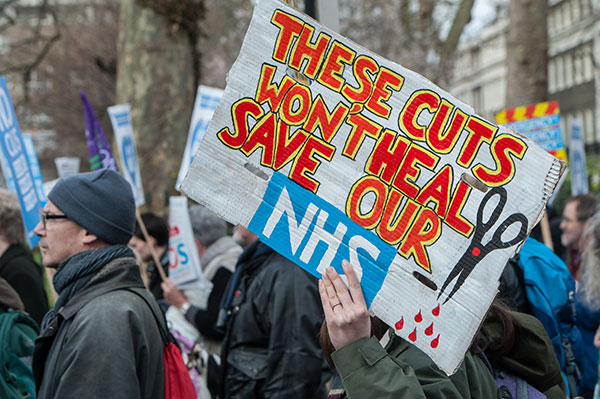
NHS England has published an updated list of medical conditions for which you can no longer receive prescriptions for, as part of a wider cost-cutting exercise due to insufficient funding from central government.

Last year I wrote an article about the stealthy creep of rationing of treatments in the NHS, and how gatekeeping has become a watchword within our public services over the past seven years. It’s being driven by the government’s deep affection for neoliberal dogma, the drive for never-ending ‘efficiency savings’ and the Conservatives’ lean, mean austerity machine. Perish the thought that the public may actually need to use the public services that they have funded through their contributions to the Treasury, in good faith. 

One important point I didn’t raise in the article was about how the marketisation of the NHS has given rise to ‘perverse incentives’, which violate the very principles on which the national health service was founded. Neoliberal policies have shifted priorities to developing profitable ‘care markets’ making ‘efficiency’ savings and containing costs, rather than delivering universal health care.

In 2017, doctors raised concerns that vital medical treatments and operations are being increasingly rationed. The treatments affected include hip and knee replacements and cataract surgery to help restore sight as well as drugs for conditions such as severe forms of autoimmune related arthritis.

Such health care is normally given routinely under the NHS, but the British Medical Journal has found evidence it is being cut back, the data showed doctors are having to resort to special appeals to get their patients treated, and that the increasing restrictions were due to a lack of funding. 

The journal gathered evidence from clinical commissioning groups (CCGs) which showed the special requests are increasingly being used for vital non-emergency services, many of which prevent conditions from deteriorating and preserve mobility and vision, for example. 

Responses from 169 of the 209 clinical commissioning groups, which control local budgets, showed:

  • In 2013-14 there were just 49 requests made for hip and knee surgery, but by last year the figure had reached 899
  • Over the same period, the number of cataract appeals trebled to more than 1,000.
  • Overall the number of requests being made through the special cases route rose by 47% to 73,900
  • Just over half of all requests were approved.

Doctors now use a standardised scoring system to assess how much discomfort and lack of mobility a patient has for hip and knee replacements, for example. By increasing the bar at which a referral for an operation is made, the NHS is restricting the numbers of people getting treatment. This will invariably have an impact on the quality of people’s lives, and their degree of independence. 

These restrictions also apply to essential mental health care.

Doctors said the trend was a clear indicator that care was being rationed. For every case where an ‘exceptional argument’ has been made for treatment, there will be plenty more where patients will have gone without care and their doctor did not appealed.

Restricting access to mental health care, arthritis and cataract treatment is a false economy. Patients with these conditions are at risk of social isolation, depression, and the latter two conditions may lead to fall-related injuries and other complications. This cost-cutting approach means the NHS is reduced to little more than a crisis management service, rather than one that treats citizens to ensure they don’t reach a point of crisis in the first place, which is the best possible outcome. 

The administration of health service support impacts on people’s ability to work

The impacts of a profoundly punitive and inadequate social security system on the health of disabled people, and how the cuts have become a barrier to work has been well documented, and the enduring poverty and hardship disabled people are forced to live under. There has been rather less discussion about the impact of cuts to health care, treatment rationing and how this affects peoples’ working lives, however. With the NHS in crisis and waiting times for non-urgent treatments escalating, it’s difficult to see how timely interventions to help people back to work can possibly be delivered. 

One patient who has been caught up in the health care squeeze is Helen Cole, from west London. She was diagnosed with rheumatoid arthritis 11 years ago. This is an autoimmune condition that leads to very severe and disabling inflammatory arthritis and progressive joint damage. It doesn’t only affect the joints, however, as the illness can also affect major organs, such as the heart and lungs. It can cause osteoporosis and affect blood vessels, nerves, tendons and may even affect the hearing. Furthermore, during flare ups of inflammation, rheumatoid arthritis generally makes people feel very unwell.

Most rheumatologists agree that early treatment is essential to try and prevent the disease progressing rapidly.  Helen relies on an immune suppressing drug called rituximab, but it is not being routinely funded by her local health managers, so her doctor has to make a special request for it every six months. This has led to delays in her getting the drug and gaps in her treatment. Last time, she had to wait 10 weeks to get her next treatment. 

“I had a lot of pain in my joints and really big problems with fatigue. It can be really challenging day to day.”

She said she finds the whole process “stressful” and believes it “makes no sense”.

“The whole point of treating a disease like rheumatoid arthritis is to try to keep it under control at all times,” she added. 

Having timely and effective treatment which manages symptoms as effectively as possible can make a lot of difference to a person’s quality of life and independence, including being able to remain in work.  

Autoimmune conditions such as rheumatoid arthritis leave a progressive wake of damage that cannot be undone, which is why early treatment is essential. Patients are not always given treatments that are the most effective. The new generation of biologics –  such as rituximab –  are  very effective, but cost much more than older ‘disease modifying’ medications such as methotrexate, which is a chemotherapy that suppresses the immune system. Between 15 – 25% of people with rheumatoid arthritis respond positively to methotrexate. 

The new and expensive biologics, on the other hand, tend to be prescribed to those people whose disease is deemed ‘severe’, and who have not responded to methotrexate. But classification of ‘severe’ disease is an imprecise art and definitions are now invariably tied in with available funding. It means that people are waiting until their disease becomes aggressive, and damage to their joints has progressed before even being considered for a treatment that could have helped prevent the damage in the first place. In other words, NHS cuts are leading to disability, when it may have been prevented with effective treatments.

Stephen Cannon, of the Royal College of Surgeons, said local health managers were “unfairly and unnecessarily prolonging the time patients will spend in pain, possibly immobile and unable to carry out daily tasks or to work”.

The latest list of restrictions on prescriptions includes those for:

  • Acute Sore Throat 
  • Cold Sores
  • Conjunctivitis
  • Coughs and colds and nasal congestion
  • Cradle Cap (Seborrhoeic dermatitis – infants)
  • Haemorrhoids
  • Infant Colic
  • Mild Cystitis
  • Contact Dermatitis
  • Dandruff
  • Diarrhoea (Adults)
  • Dry Eyes/Sore tired Eyes
  • Earwax
  • Excessive sweating (Hyperhidrosis)
  • Head lice
  • Indigestion and Heartburn
  • Infrequent constipation
  • Infrequent Migraine
  • Insect bites and stings
  • Mild Acne
  • Mild Dry Skin/Sunburn
  • Mild to Moderate Hay fever/Allergic Rhinitis
  • Minor burns and scalds
  • Minor conditions associated with pain, discomfort and/fever. (e.g. aches and sprains, headache, period pain, back pain)
  • Mouth ulcers
  • Nappy Rash
  • Oral Thrush
  • Prevention of dental caries
  • Ringworm/Athletes foot
  • Teething/Mild toothache
  • Threadworms
  • Travel Sickness
  • Warts and Verrucae
  • Probiotics, vitamins and minerals are no longer available on prescription.

Although there are over-the-counter medications that people can buy for most of these conditions, those living on low incomes may not be able to afford the treatments. Effective pharmacy treatment for cystitis, for example, is around £25. If left untreated, cystitis can lead to kidney infection, which will require urgent treatment. Conjunctivitis is an eye infection that can be caused by bacteria, and this type most frequently needs an antibiotic ointment to prevent it from becoming more serious, because the eyes are very vulnerable to infection. Left untreated it can damage the eye and may cause blindness. 

There are exceptions to the restrictions, however. Circumstances where the product licence doesn’t allow the type of medication to be sold over the counter to certain groups of patients, for example. This may vary by medicine, but could include babies, children and/or women who are pregnant or breast-feeding. Community pharmacists will be aware of what these restrictions are and can advise patients accordingly. 

Patients with a minor condition suitable for self-care that has not responded sufficiently to treatment with an OTC (over the counter) product may also be prescribed treatment.

Patients where the clinician considers that the presenting symptom is due to a condition that would not be considered a minor ailment may also be prescribed medication for some of the above conditions. For example, chronic dry eyes many be one symptom of an underlying autoimmune condition, without effective treatment, it may cause progressive damage to the cornea as well as recurring bouts of conjunctivitis. Recurring mouth ulcers may be a symptom of a chronic condition, such as an autoimmune disease – for example lupus. 

In circumstances where the prescriber believes that in their clinical judgement exceptional circumstances exist that warrant deviation from the recommendation to self-care, they may prescribe medication for the above conditions.

Patients where the clinician considers that their ability to self-manage is compromised as a consequence of social, medical or mental health vulnerability to the extent that their health and/or wellbeing could be adversely affected if left to self-care may also warrant prescribed treatment for these conditions.

NHS England chief executive Simon Stevens, said: “To do the best for our patients and for taxpayers it’s vital the NHS uses its funding well.”

But that flies in the face of the ‘preventative approach’ that health secretary Matt Hancock has proposed recently.  For example, contact dermatitis may become infected if left untreated, especially if the person affected can’t isolate the cause. If one member of a family has head lice (and children pick them up very easily from nursery or school) and this isn’t treated promptly, the whole family is likely to catch them. Effective head lice treatment is costly and needs to be repeated. 

Threadworms are also highly contagious, and children pick them up very easily, as they are transmitted via microscopic eggs that can stick to clothing, towels, bedding, carpets and on unwashed hands. One study showed that up to 40% of children at primary school age will have threadworms. If access to prescribed treatment is restricted, children with embarrassing and very unpleasant, uncomfortable conditions like threadworms and head lice in poorer families may be left with the conditions longer, and may well pass on the parasites to others.

Deflection is when patients who are unable to get a GP appointment or adequate treatment seek treatment elsewhere – for example, an accident and emergency (A&E) department. The national GP patient survey asked patients who were unable to get a convenient appointment last time they called their GP what they did instead. It found that people end up going to an A&E department or a walk-in centre. Again, cost-cutting leads to further costs further down the line. 

Restricting treatments for those with mental health conditions and chronic illness means that these citizens are less likely to be able to work. This is at odds with the government’s pledge to ‘half the employment disability gap’.

GP’s are being ‘incentivised’ to reduce referrals to specialists

It was announced in April last year that General Practitioners across England will be able to “better manage” hospital referrals with a “digital traffic light system” developed by the Downing Street policy nudge wonks. This nudge is designed to target the ‘referral behaviours’ of GPs.

GPs are being offered cash payments as an ‘incentive’ to not refer patients to hospitals – including cancer patients – according to an investigation by Pulse, a website for GPs. 

Furthermore, a leaked letter sent by NHS to England to Clinical Commissioning Groups (CCGs) and seen by Pulse magazine last year, asks that all family doctors in England to seek approval from a medical panel for all non-urgent hospital referrals.  

A “clinical peer review of all referrals from general practice by September 2017”, will be required, the letter said. 

To ‘incentivise’ the scheme, the letter said that there will be “significant additional funding” for commissioners that establish peer-led policing schemes. It added that it could reduce hospital referral rates by up to by 30 per cent. NHS England said that they want to introduce the “peer review scheme” whereby GPs check the referrals of one another to ensure they are ‘appropriate’. However, experts warn this increasingly Kafkaesque layer of bureaucracy could lead to more problems and possible conflict with patients’ safety and standard of care. 

“Cash incentives based on how many referrals GPs make have no place in the NHS, and frankly, it is insulting to suggest otherwise,” said Professor Helen Stokes-Lampard, chair of the Royal College of GPs.

Of course, it’s important to take measures to ensure that GP referrals are appropriate and high-quality, but payments to reduce referrals would fly in the face of this, and erode the trust our patients have in us to do what is best for them and their health.” 

The NHS has been squeezed for increasingly drastic ‘efficiency savings’ in the past eight years. It’s absurd, however, that a huge amount of money is being spent on restricting access to healthcare, rather than on simply adequately funding healthcare provision.

Potential impact on social security assessments for people with chronic illness

Something else to consider is the potential impact this may have on people needing to claim social security disability support. The private company assessors hired by the government to determine eligibility for Employment and Support Allowance (ESA) and Personal Independence Payment (PIP) tend to regard people who haven’t been referred to a specialist as being less ill than those who have.

They also tend to take prescribed treatments into account when assessing the severity of illness, the needs of claimants and their eligibility for an award. Being let down by the NHS potentially has a knock-on effect which may leave some people in a situation where they can’t get either the health care or the financial support they need to live independently, increasing their vulnerability. 

There is no specific list of services to which individuals using the NHS are guaranteed access. Instead individuals have a number of legal rights that are set out in the NHS Constitution. These include the right to: receive most NHS services free of charge; receive certain treatments within a maximum waiting time; be treated in a safe and clean environment; have access to drugs and treatments recommended by the National Institute for Health and Care Excellence (NICE), if a doctor says it is appropriate. 

Like our social security system, the NHS should be there for all of us in our time of need, based on principles of inclusion, support and security for all, assuring us of our safety and dignity. However, chronic under funding, rationing and the increasing marketisation and ‘efficiency savings’ demanded by the government are incompatible with supporting citizens – especially those with multiple disadvantages – to live full, healthy and independent lives.

nhs-integrated-care-brought-to-you-by-...-1


Related

Tories propose nudge, big business AI initiative and ‘personal responsibility’ in place of adequate health care funding

Cash for Care: nudging doctors to ration healthcare provision


I don’t make any money from my work. If you like, you can help me by making a donation to help me continue to research and write informative, insightful and independent articles, and to provide support to others going through disability assessment, mandatory review and appeal.

DonatenowButton

BPS sign consensus statement asking for end of welfare sanctions

Image result for welfare sanctions

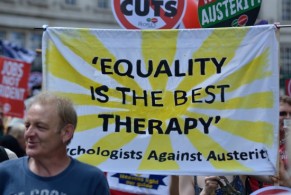
The British Psychological Society (BPS) has joined eight other leading mental health organisations in calling for the removal of social security sanctions for people with mental health conditions. The statement launched yesterday at the 12th New Savoy Annual Conference in London.

It calls for everyone living with a mental health condition to be supported in gaining financial security, whether through the social security system or appropriate help in returning to or gaining paid work. However, the statement makes clear that no one with a mental ill health should ever be forced to look for work, or face the threat of having their lifeline support reduced because of welfare conditionality and sanctions.

In the statement signed by mental health experts and charities, such as the Centre for Mental Health, Mental Health Foundation and Rethink Mental Illness among others, the BPS say: “We believe that everyone living with a mental health condition should be supported to attain financial security. Whether they need the support of the social security system or help when they would like to return to or gain paid employment, no one should have to struggle to make ends meet as a result of their mental health problem.

“Yet too many people lose their jobs or are denied opportunities in the labour market because of a mental health condition. And too often our social security system treats people with insufficient dignity and humanity.

“Combined, these issues can exacerbate or contribute to mental health problems.

“We believe that anyone living with a mental health condition has a right to be supported to work if they want to, and to live out of poverty.”

“No one with a mental health condition, however, should ever be mandated to look for work, or to face the threat of having their benefit payments reduced. Neither conditions nor sanctions have been shown to work or to be safe for people with mental health difficulties, and as a result we believe they should be stopped. 

“No one should be left in poverty because they have a mental health condition. We pledge to work together to achieve an end to the harm we have seen that sanctions can cause, and a start towards a meaningful entitlement to effective support, based  genuinely around the needs of each person.” 

Sanctions, under which people lose benefit payments for between four weeks and three years for “non-compliance”, have come under fire for being unfairpunitive, failing to increase job prospects, and causing hunger, debt and ill-health among jobseekers. And sometimes, sanctions have been correlated with deaths.

It’s not the first time the BPS and allied organisations have called on the government to make changes to controversial social security policies. In 2015, Professor Jamie Hacker Hughes, then President of the BPS, said:

“The Society has repeatedly asked for a meeting with ministers at the Department for Work and Pensions so that we can express our concerns over the Work Capability Assessment (WCA) – so far without success. We are particularly concerned that the government’s benefits policy may misuse psychological tools and techniques. We want to ensure policies are informed by appropriate psychological, theoretical and practical evidence.”

The Society published a briefing paper 2016, and an official Call to Action asking the government to commission an end-to-end redesign of the Work Capability Assessment (WCA) process – including its outcomes and periods for reassessment.

Last year, a collective of the UK’s leading professional associations for psychological therapies reaffirmed their opposition to welfare sanctionsThe British Association for Behavioural and Cognitive Psychotherapies, British Association for Counselling and Psychotherapy, British Psychoanalytic Council, British Psychological Society and UK Council for Psychotherapy between them represent more than 110,000 psychologists, counsellors, psychotherapists, psychoanalysts and psychiatrists who practise psychotherapy and counselling.

In a joint response to last year’s report of the Welfare Conditionality project, the organisations say:

“Our key concerns remain that not only is there no clear evidence that welfare sanctions are effective, but that they can have negative effects on a range of outcomes including mental health.

“We continue to call on the Government to address these concerns, investigate how the jobcentre systems and requirements may themselves be exacerbating mental health problems and consider suspending the use of sanctions subject to the outcomes of an independent review.”

The organisations reaffirmed the clear position against welfare sanctions that they previously took in a 2016 joint response

Dr Lisa Morrison Coulthard the British Psychological Society’s then acting director of policy said:

“We are delighted to sign this joint statement. The Society has seen increasing evidence that benefit sanctions undermine people’s health and wellbeing, and that people with multiple and complex needs are disproportionately subject to them.”

Last year, the UK’s most extensive study of welfare conditionality concluded that  sanctions are ineffective at ‘helping’ people into work and are more likely to reduce those affected to absolute poverty, ill-health and even survival crime.

The five-year longitudinal research tracked hundreds of claimants, finding that the controversial policy of withdrawing social security support as punishment for alleged failures to comply with jobcentre rules has been little short of disastrous. The report says: “Benefit sanctions do little to enhance people’s motivation to prepare for, seek or enter paid work. They routinely trigger profoundly negative personal, financial, health and behavioural outcomes.”

It was found that sanctions impacted negatively on people’s mental health, frequently triggering high levels of stress, anxiety and depression. 

The report authors called for a review of the use of sanctions, including an immediate moratorium on benefit sanctions for disabled people who are disproportionately affected, together with an urgent “rebalancing” of the social security system to focus less on compliance and more on helping claimants into work.

Labour’s shadow secretary for work and pensions Margaret Greenwood said: “The current sanctions system is immoral and ineffective. It is not helping people into employment and at the same time is leaving vulnerable people on the brink of destitution, without any source of income for long periods.”

Sanctions are justified and imposed by the government, who claim they promote ‘behavioural change’. Ministers tend to present narratives where individuals are held responsible for social and economic problems.

However, many of us believe we need a  fundamental change in the UKs’ socioeconomic organisation, because neoliberalism systematically excludes the poorest citizens, while generously rewarding the wealthiest. Power relationships within our society also need to  change, because the government is inflicting structural violence – socioeconomic oppression – on marginalised social groups, based entirely upon the government’s own traditional class prejudices.

If any ‘behavioural change’ (a euphemism for state coercion) is needed, it is most certainly on the part of Conservative policy-makers, not from those who are being systematically oppressed. Sanctions reflect the actions of a more broadly abusive and authoritarian regime. Sanctions mean that the poorest citizens’ only means of meeting their most fundamental survival needs – food, fuel and shelter – is removed from them as a punishment for simply being poor.

Yet we know the government’s misuse of psychology, embedded in their crib sheet justification of sanctions, is dangerous, cruel and boardroom psychobabbling utter nonsense. 

It’s time the public stopped being bystanders in the face of targeted state abuse.

Priti Patel uses techniques of neutralisation to discredit the concerns raised and the evidence presented that sanctions harm people’s mental health. She even disgracefully called this cruel and punitive state action “support” ,”help” and “fair”.

It is never acceptable to endorse an oppressive, abusive regime that deliberately removes people’s means of basic survival, to meet “labour market requirements”.


Related

New research shows welfare sanctions are punitive, create perverse incentives and are potentially life-threatening

Pointlessly cruel’ sanctions regime must be reassessed, says Commons Select Committee

The Minnesota Starvation Experiment provided empirical evidence that demonstrates clearly why welfare sanctions can’t possibly work as an “incentive” to “make work pay”

Short Version: 


I don’t make any money from my work. If you like, you can help me by making a donation to help me continue to research and write informative, insightful and independent articles, and to provide support to others going through disability assessment, mandatory review and appeal.

DonatenowButton

Labour party plans to end privatisation of public services

BRITAIN-CONSTRUCTION-POLITICS-BANKRUPTCY

Carillion was a British multinational facilities management and construction services company which liquidated in January 2018 | Daniel Sorabji/AFP via Getty Images

The current government has consistently failed to fix the serious problems created by its’ privatisation of public services, which has directly impacted on the lives of many citizens. Those needing the support of services have found them less accessible, conditional and often, rather than alleviating hardship and socioeconomic exclusion, the private sector, contracted in tandem with government policies, has contributed to actually increasing the vulnerability of marginalised social groups, exploiting them for profit.

Poorly conceived contracts have created cost increases that surpass the costs of in-house services, and the oversight of the contracts is poor, the government is vulnerable to corruption and profiteering. The scandal of G4S and Serco charging the Ministry of Justice for tagging offenders who were dead shows just the visible surface of how bad things can get.

G4S, for example, has left a wake of human rights abuses on a global scale, and we have to question how on earth such highly controversial companies manage to secure successive government contracts involving working with vulnerable populations. The Ministry of Justice is still spending millions on tagging offenders with G4S and Capita despite the tagging scandal because, despite all of the chatter about ‘market competition’, it has not actively welcomed in or competently procured new entrants in the market.

In the wake of the collapse of Carillion, a succession of scandals involving large British companies like G4S, Serco and others, and the zig-zagging share price of outsourcing giant Capita, now is the right time to rethink the UK government’s approach to the private provision of public services. 

Any government that claims it wants to ‘take on vested interests’ wherever they may be must look first at how it itself has created – and become dependent -on a select number of vested, incumbent private suppliers. In practice, when the government claim ‘efficiency’, that generally means lower wages and substantially reduced services. When they mention ‘economies of scale’, that generally translates as constructing the contracts in such a way as to leave only the largest companies eligible to bid for them.

When the government use the word ‘incentives’, for the profiteering companies, those are perverse incentives. And when they say ‘competition’,  the government is refering to a handful of companies barely compete with one another at all but instead operate as an unelected oligarchy – a shadow state.

A Labour government would end the outsourcing of public service contracts that involve close contact with vulnerable groups, because of ongoing, grave concerns that people are being put at risk by private contractors such as Atos and Capita. The party has drawn up the plan in response to what is described as a series of outsourcing disasters. 

This would mean addressing the controversial assessments for disability and illness related social security, NHS care, the treatment of people in detention centres and prisons, and failures over recruitment and substandard housing for Armed Forces personnel, bringing those services back ‘in house’. 

Under the Labour’s party’s plans, when an outsourced contract expires or is terminated, central or local government will be required to assess whether a service involves significant contact with ‘at risk’ groups, poses a threat to people’s human rights, or entails the use of ‘coercive powers’. People ‘at risk’ are defined as those who rely on state protection, be they prisoners, hospital patients or social security recipients. 

If the answer to these criteria is “yes”, then new statutory guidance would be used,  which will lessen the grip of the private sector over our public services. After years of privatisation, it’s become clear that perverse incentives – the profit motive and ‘efficiency’in particular – have led to very poor service delivery and caused distress and harm to many citizens who have needed to access support, such as social security or healthcare. Private firms have performed notoriously badly, most often prioritising private profit over meeting human needs, while costing the British public billions of pounds.

However, there may be exemptions to the Labour party’s new rule, where:

  • The contract does not fall under a statutory definition of ‘relevant contract’.
  • The value of the contract is below a certain threshold.
  • The contract is between local authorities (or between a local authority and another public authority).
  • The public authority can demonstrate that it has ‘good reason’ to override statutory guidance.

The Labour party has repeatedly criticised the outsourcing of assessments for Personal Independent Payments and for Employment and Support Allowance, saying that this has led to a complete breakdown in trust between disabled people, the assessors and DWP decision-makers. The Ministry of Justice was forced to take control of Birmingham prison from the contractor G4S, after inspections found that prisoners were regularly using drink, drugs and violence, and corridors were littered with cockroaches, blood and vomit last year. The plan comes after a series of high-profile outsourcing controversies.

Andrew Gwynne MP, Labour’s Shadow Communities and Local Government Secretary, said: “For too long the British public have paid the price for outsourcing.

“The Tories’ dogmatic commitment to markets at all costs has delivered sub-standard services at inflated prices. And when they fail, as they often do, it’s the taxpayer that picks up the bill.

“Labour is proposing a radical new settlement that gives people the power to end outsourcing and decide for themselves how best to deliver the services they need.

“For too long this county has been run by and in the interests of a small few who are all in it together.

“It’s time to shift the scales and bring democracy and accountability back to government, and put power in the hands of the many”.

The plan is most likely to be backed by unions, but may cause concern for some councils  under severe financial pressure after years of cuts to their funding.

The pledge is also part of a wider Labour strategy to return public services to public ownership. It reflects that Labour is serious about implementing major democratic changes to the economy, to make it more inclusive.

healthcare-privatisation-730x470 (1)

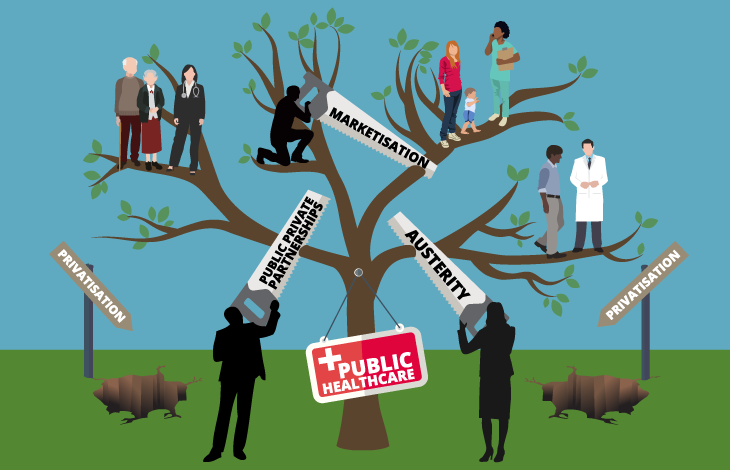
The threats to public health care in the UK.

Outsourcing in the NHS is officially said to be about cutting costs and improving efficiency, but such reforms, have really helped create healthcare markets that simply promote inequality among patients and healthcare workers and erode the public nature of healthcare provision.

There is also a very obvious limiting factor to a ‘market’ in healthcare: those in most need of healthcare are least able to pay the ‘market price’ for it – the elderly, very young, people with mental illness and those who are chronicically il , many of whom are poor. So, for private healthcare to be profitable for more than just the wealthiest minority, it still requires public funding.  The government, however, have systematically refused to accept this, despite the empirical evidence that verifies the damage being done to the poorest and most vulnerable citizens.


I don’t make any money from my work. I am disabled because of an illness called lupus. If you want to, you can help me by making a donation to help me continue to research and write informative, insightful and independent articles, and to provide support to others going through disability assessment, mandatory review and appeal.

DonatenowButton

Government data reveals scandal: 1,000s dying just months after being denied PIP support

Tory newton

Sarah Newton, minister for disabled people.

Government ministers have said that the controversial Personal Independence Payment (PIP) assessments ensure that those people “most in need” receive support. Last month I wrote about a disclosure from the Department for Work and Pensions (DWP) concerning the mortality rates of people awaiting PIP assessments.

Official DWP data reveals that 7,990 people died within six months of having a claim for PIP rejected by cruel DWP ‘decision makers’. This indicates that contrary to Conservative minister’s claims, those most in need of support are being catastrophically failed by the assessment regime. 

Of these, 3,680 died within just three months of having their PIP applications rejected by the DWP.  The figures also show that 17,070 people have died waiting for their PIP claims to be assessed by DWP decision makers.

It has also been revealed that 5,290 of those who had applied under the Special Rules for terminally ill people (SRTI), (those with a terminal disease with less than 6 months to live), died before the DWP made a decision on their claim. 

Further disclosure indicated that 11,790 of these undecided claims were dealt with under ‘normal rules’ and so had not been fast-tracked because they were terminally-ill.

A separate set of DWP figures show that 72% of PIP claimants who take their cases to a social security tribunal go on to win their appeals.

Labour MP Madeleine Moon said: “These shameful figures reveal how potentially gravely ill people who should be eligible for benefits, have tragically fallen through the cracks of a system that should be there to support them as they approach the end of life.”

They haven’t fallen through the cracks. These people were forced through them.

Marsha de Cordova, Labour’s shadow minister for disabled people, said: “These shocking figures show that the cruel and callous PIP assessment is unfit for purpose.

“That thousands of people die three months after being denied vital social security payments is disgraceful.

“Ill and disabled people are being failed [with]the most tragic consequences.

“Labour will end the hostile environment in the DWP and replace the PIP assessment framework with a system that treats disabled people with dignity and respect.”

A DWP spokesperson shamefully insisted there was “no evidence” to suggest people died for the same reason they were trying to claim PIP. And those affected were “only a small fraction of the millions of PIP claims since 2013.”

But there is also no evidence that people did not die for the same reasons they were turned down for support, either.

The government are not monitoring the impacts of the policy, and so have persistently failed to collect evidence either way. Furthermore, dismissing thousands of people so atrociously left in hardship – by a system designed specifically to cut support – indicates the hardened and callous attitude of the state and fundamental lack of compassion towards ill and disabled people, most of whom have paid social insurance contributions for social security provision, only to find in their time of need that welfare support and public services are increasingly inaccessible.

In 2017, two tribunals had ruled the DWP should expand the reach of PIP – which helps disabled people fund their additional living costs. Yet the DWP warned that this would cost £3.7bn extra by 2022 – so unveiled emergency legislation to stop the change happening. At the time, then Disabilities Minister Penny Mordaunt said her move would “make sure we are giving support to those who need it most” – and insisted no one who had already been claiming PIP would see payments drop. 

However, there is clear evidence that PIP is not being awarded to many thousands of people “who need it most”. 

Sarah Newton, now the Minister of State for Disabled People, published one lot of  figures on 11 January following a question raised in parliament by Madeleine Moon in December: “How many people have died while waiting for their personal independence payment assessment to be completed; and what were the conditions those people died from?”

Newton responded: “All benefit claims can be made under the special rules for people who are terminally ill which will mean that they are fast tracked. These are currently being cleared within 6 working days for new claimants to PIP. The Department would encourage all claimants with a terminal illness to let the department know and to apply using the special rules.”

Newton is actually implying that payments are being delayed because people aren’t informing the DWP of their terminal condition. That’s highly unlikely.

She said: “The cause of death of PIP claimants is not collated centrally by the Department.”

Over 3.6 million applications to PIP were made between April 2013 and 30th April 2018. Of these:

  • 4,760 claimants died between their case being referred to, and returned from, an assessment provider;
  • 73,800 claimants died within 6 months of their claim being registered; and
  • 17,070 claimants died after registering but prior to the DWP making a decision on their claim. Details of the claimant’s primary medical condition, where recorded, are in the accompanying spreadsheet.”

The total number of PIP claimants who died was 95,000. But Newton’s response does not indicate at what stage of their claim the 73,800 people, who died within six months of it being registered, were at. Nor does it indicate what those people who did not have terminal or degenerative illnesses died of – including those with mental illness. For example, 270 of those mortalities are listed as having had anxiety and/or depressive disorders as their primary disorder.

Of those who did have terminal illnesses, we need to ask why these people were  cruelly left waiting so long for their assessment, if, as Newton claims, they are ‘fast tracked’ through the claim and assessment process. There is clearly a gap between what we are being told and what is actually happening. 

Newton also warns on her data release: “This is unpublished data… It should be used with caution and it may be subject to future revision.”

There is, however, an Excel spreadsheet that indicates some of the primary conditions of those people who have died. But we cannot assume that those mortalities have arisen as a consequence of the recorded condition. That’s because the DWP isn’t carrying out any detailed monitoring. 

The DWP are experts at reluctantly providing data that lacks both context and details, which, they often say, they simply don’t collate. And 9,020 people’s main condition was not recorded at all by the DWP.  There is no means of useful comparison between mortality rates year by year, or a reference point to start from. A similar statistical analysis of Disability Living Allowance (DLA) claimant mortalities, for example, would help establish an average or baseline. 

Moon followed up on her questions. On January 17, she asked “the Secretary of State for Work and Pensions, pursuant to the Answer on 11 January 2019 to Question 203813, how many claimants of personal independence payments who died within six months of their claim being registered had their application rejected.” (See: Personal Independence Payment: Written question – 209778).  

Sarah Newton answered on the 01 February as follows:  

“Over 3.6 million applications to Personal Independence Payment (PIP) were made between April 2013 and 30th April 2018. Of these, 73,800 claimants died within 6 months of their claim being registered.  

“Prior to any Mandatory Reconsideration or Appeal action, 56,770 and 7,990 of these claimants had their claims awarded and disallowed respectively. 

If a claimant dies before a decision is made on an outstanding claim, the Department establishes whether the claimant’s representative or next of kin wishes to proceed with the claim. If not, the claim is withdrawn so around 7,700 of the 73,800 claims were withdrawn rather than awarded or disallowed.

“56,920 of the 73,800 claims have been credited with a payment.

“Claims made under the special rules for people who are terminally ill are fast tracked and are currently being cleared at a median average of 6 working days for new claimants. This has reduced from a median average of 11 working days between April 2013 and March 2014. 

“Notes: 

  • These figures include claims made under both Normal Rules and Special Rules for Terminal Illness (SRTI) and include new claims and Disability Living Allowance (DLA) to PIP reassessment claims. 
  • The point of application is taken as the day the claimant registered a claim to PIP as recorded on the PIP computer system. 
  • The outcome is the first DWP decision recorded on the PIP Computer system. This does not take into account any mandatory reconsideration or Appeal action so some of these claimants may have subsequently been awarded PIP. Some cases do not have a decision recorded. 
  • This is unpublished data from the PIP computer system’s (PIP CS) management information. It should be used with caution and it may be subject to future revision. 
  • Figures are rounded to the nearest 10. 
  • Figures cover claims made up to and including 30th April 2018 and clearances up to and including 31st October 2018. 
  • GB only. 

“Under the Social Security (Notification of Deaths) Regulations 2012 and s125 of Social Security Administration Act 1992 date of death is provided to the Department for all registered deaths. Additionally next of kin also provide information on the date of death of an individual and this information is used appropriately in the administration of Departmental benefits.” 

Grouped Questions: 209776. 

In December last year, Amber Rudd admitted she has ‘concerns’ that disability benefit tests could be failing the most vulnerable citizens. 

The Work and Pensions Secretary made the comment days after we told how 72% of tribunal appeals overturn the original test

Previously the DWP has said the number of successful appeals is low overall. But Rudd told MPs: “I do have concerns about the number of appeals that get through, i.e. a lot. 

“Which does indicate that maybe those earlier decisions could be better made.”

rudd
Amber Rudd

20,133 people appealed a decision to change or deny their PIP in the three months before Christmas, of which 14,581 won their case. All those people had already gone through an internal appeal known as a Mandatory Reconsideration – which several  MPs have described as a “rubber stamp”.  

The figures released by Sarah Newton reveal that more than 130 working-age disabled people a month on average have been found ineligible for PIP following an initial assessment by government contractors Atos and Capita but were nonetheless so unwell that they died soon afterwards. 3,680 disabled people – or more than 60 a month – died within three months of their initial PIP applications being rejected by DWP. 

PIP is very clearly unfit for purpose. The government urgently need to change this, instead of continuing with their neoliberal project of disassembling public services, including social security. Imposing conscious cruelty on marginalised social groups in the UK has become a standardised policy practice of the Conservatives.


My work is unfunded and I don’t make any money from it. This is a pay as you like site. If you wish you can support me by making a one-off donation or a monthly contribution. This will help me continue to research and write independent, insightful and informative articles, and to continue to provide support others who are affected by the welfare ‘reforms’. 

DonatenowButton

Financial advisors and millionaires are preparing for a Labour government led by Corbyn

30 years of plutocracy have brought un-representative democracy

Back in 2013, I wrote an article, together with Richard Murphy, director of Tax Research UK, which was about a chilling proto-fascist document written by JP Morgan – it can be accessed here: The Euro Area Adjustment—About Half-Way There.

Firstly, the authors said that ‘financial measures’ are ‘necessary’ to ensure that major investment houses such as JP Morgan can continue to reap huge profits from their speculative activities in Europe.

Secondly, the authors maintain, it is necessary to impose ‘political reforms’ aimed at suppressing opposition to the massively unpopular austerity measures being imposed at the behest of the banks and financial sector. 

The authors write: “The political systems in the periphery were established in the aftermath of dictatorship, and were defined by that experience. Constitutions tend to show a strong socialist influence, reflecting the political strength that left-wing parties gained after the defeat of fascism [following world war 2].

“Political systems around the periphery typically display several of the following features: weak executives; weak central states relative to regions; constitutional protection of labour rights; consensus-building systems which foster political clientalism; and the right to protest if unwelcome changes are made to the political status quo. The shortcomings of this political legacy have been revealed by the [eurozone] crisis.”

Whatever the historical inaccuracies in their analysis, there can not be the slightest doubt that the authors of the JP Morgan report are arguing for governments to adopt authoritarianism to complete the process of social counterrevolution to austerity that is already well underway across Europe.

What JP Morgan is making very clear is that anything resembling ‘socialism’, representative ‘democracy’, collectivism, trade unionism or inclinations towards the left of the spectrum must be removed from political structure: localism must be replaced with strong, central authority; labour rights must be removed, consensus (democracy) and the right to protest must be curtailed.

In short, JP Morgan are calling for extremely authoritarian measures to suppress the working class and wipe out its social gains since the post-war settlement. This is the proto-fascism and reflects the unadulterated antisocial voice of  neoliberalism, which is incompatible with human rights, social liberalism and democracy.

JP Morgan are not a lone voice making such demands. In the UK, savage welfare cuts have driven some disabled individuals to fear for their lives. But the austerity programme also has a few winners. Cutting or eliminating publicly funded support programmes that support the poorest citizens, those who fall on hard times, has long been an ideological goal of Conservatives.

Doing so also generates a tidy windfall for the corporate class, as the ‘business friendly’ government services are privatised and savings from austerity pay for tax cuts for the wealthiest citizens. The liberalisation that the financial class demand – what bankers call deregulation – is the process that caused the financial crash.

Many of us have said over the last eight years that austerity is not an economic necessity or ‘in the national interest’ as was claimed in 2010, and it is more like a tool of ‘statecraft’ and radical socioeconomic re-engineering, driven entirely by ideology and not economic requirements. 

You can read my 2013 article here.

Now for more of the same

In a truly nauseating article in the Financial Times (FT) titled How to hedge your finances against a future Corbyn governmentfinancial ‘advisors’ are cowering in outraged ‘fear’ at the prospect of a Labour government. They are very worried that a few millionaires may face a capital gains tax rise, property taxes and other erosions to the generous privileges they have become accustomed to over the last few years.

Gosh, fancy that, having to contribute a fair amount of tax towards maintaining a country that the rich have taken so much from. Yet they don’t want to contribute anything to the society that has benefited them so much. 

I can really empathise with their ‘fears’. I mean, that’s almost as bad as having to join the foodbank queue because your wage doesn’t meet the cost of living, or even your most fundamental survival needs. I can see why they would be left cowering in fear behind their hoarded wealth. 

804-cover-1200

This despicable class of people, who regard most of their fellow human beings as disposable commodities, have had their own way for far too long. They have institutionalised their power through law, media, and corrupt political rituals, and have become habituated to the status quo.

The FT says “They might be considered unlikely to vote for Jeremy Corbyn, but the rising popularity of the Labour leader is rapidly moving up the agenda in conversations between the UK’s wealthiest and their financial advisers. In the event that he came to power, what impact might future Labour policies have on their wealth? And secondly, what financial planning measures — if any — could be considered to mitigate these?

Well you could be less controlling and anally retentive. Less pathological about wealth defense. You just let go and stop hoarding obscene amounts of money. You could care about the suffering inflicted on others so that you can stash your cash offshore, leaving a black hole in the economy and our public services on the point of collapse, because of ever-circling vulture capitalist parasites like you.

George Bull of RSM, the accountancy firm, says: “these fears are well-founded, as Labour’s 2017 manifesto mentioned wealth taxes as one option for easing the care cost crunch.”

Oh, the sheer horror of it. I mean fancy having to give a shit for the people who have been brutally dispossessed by the state in order to fuel the accumulation of even more wealth for the already very very wealthy. How outrageous. 

The article goes on to say:  “Should a mis-step in the Brexit negotiations topple the existing administration, this could prompt a fresh election which many believe Mr Corbyn could win.”

Yes, and your very worst fear has been realised. The PM’s Brexit deal was rejected by 230 votes – the largest defeat for a sitting government in history. It takes a very special sort of skill to unite so many people against your proposals. Dis may.

Yet curiously, despite the vote of no confidence tabled by Corbyn, the BBC are claiming that the Pound rises after ‘meaningful’ Brexit vote and crashing defeat for the PM.

The BBC then claim the “vote opens up a range of outcomes, including no deal, a renegotiation of May’s deal, or a second referendum.” However, the BBC don’t mention the rather obvious other possibility – a General Election, which is more than a little short sighted of them.

Even if we assume that a no confidence motion may not force an election , it would be prudent to consider Wednesday’s vote as the start of a process. The shadow international trade secretary Barry Gardiner has suggested the PM could face a series of confidence votes in the coming weeks. In fact that is highly likely, since she does not command a majority and will struggle getting anything through parliament.

Apparently, sterling rose 0.05% to $1.287 after declines of more than 1% earlier in the day. The currency slumped 7% in 2018 reflecting uncertainty about the terms of the UK’s exit from the European Union. 

“A defeat has been broadly anticipated in markets since the agreement with the EU was closed in November 2018 and caused several members of the government to resign,” said Richard Falkenhall, senior FX strategist at SEB. The BBC says that “business groups said their members’ patience was wearing thin.”  

On Friday, hedge fund manager Crispin Odey, a major donor to the Brexit campaign, said he now expected the project to be abandoned altogether and that he is “positioning for the pound to strengthen.”

The real culture of entitlement

The very wealthiest are likely to find ways to circumvent increased taxes on those on the highest incomes. I guess rich  people don’t like  ‘progressive’ tax , well-funded and functioning and effective public services 

Bull continues: “There is no certainty as to what people might do.

“However, we hear far greater interest about lifetime tax planning — for example, gifts of assets to children being made sooner rather than later — so that parents’ asset values are reduced before a wealth tax or land value tax takes force.”

“The favourable inheritance tax status of defined contribution pensions, which can currently be passed tax free to heirs in some circumstances, is something many advisers fear the current government will scrap, let alone a Labour one. Higher-rate tax relief on pensions contributions is another obvious area of vulnerability, advisers say.”

Vulnerability? I guess that’s pretty relative. Ask those people targeted by austerity policies from 2010, which saw them lose their lifeline support while at the same time, the chancellor handed out £107,000 each per year to millionaires in the form of a tax cut. People have died because the government’s austerity policies. Get a grip.

My favourite part was this:  

“The Labour party has also signalled its intention to close various loopholes and tax breaks, as well as ending “the social scourge of tax avoidance”. It has signalled that it would make public the tax returns of those earning more than £1m a year and double the number of HMRC staff investigating wealthy tax avoiders.

“It might also increase the insurance premium tax on private healthcare. The rate of corporation tax would be restored to 26 per cent. In addition, a Labour government might tackle tax planning that takes advantage of the gap between income and corporate tax rates, such as the practice of holding investments within a company.

“One possibility is that the undistributed profits of “ close” companies— those controlled by five or fewer people — could be taxed as though they had been distributed to shareholders. 

“Labour has said it wants to see the public disclosure of trusts, which it describes as “a key vehicle for tax avoidance and illicit financial flows”. The industry says HMRC already has access to this information and making it public would put beneficiaries in a vulnerable position. 

“People avoiding tax by using trusts would fear “trial by media”.

“It would be a witch hunt. People might want to consider unwinding those structures.”

My heart bleeds. Like the ‘trial by media’ that unemployed and disabled people faced in the run up to the brutal and uncivilised cuts to the social security that the overwhelming majority of them had paid into via taxes? And all to justify a transfer of wealth from public funds to a few private bank accounts, a proportion of those being offshore.

The hysteria continued: “Labour’s plans to nationalise railways, water, energy and Royal Mail would take a toll on those segments of the market. And Mr Corbyn’s aim to intervene more heavily in areas such as energy could drag on the dividends paid by those companies and investment funds.”

But it would benefit the public. You know, the many, not the few.

cover photo, Image may contain: text

Job Curtis, a Henderson fund manager, says: “We are already beginning to see weakness in companies involved in passenger transport and water utilities. United Utilities — a water company covering the north west of England, has experienced a large share price fall in the last year partly because of the increased likelihood of a Labour government under Corbyn.”

“Sectors including utilities and energy companies are high dividend payers and whether it’s nationalisation or increased regulation and price caps, the outlook for higher and sustainably high dividend incomes looks under threat under a Corbyn government,” says Mr Stevenson. 

But many of us will be able to afford our utility bills.

Henry Pryor, an independent buying agent, whines the prospect of a Labour government is “frightening” for the owners of large, expensive assets. I think Henry should really try to expand his understanding of the word “frightening”.

I suggest he asks citizens for some insights, perhaps those with severe illness who are forced to claim disability support after a lifetime of working and paying social insurance via taxes, then he should go through mandatory review and the appeal process. That’s fear. Or perhaps he should spend a year on the streets, without the safety of his wealth and assets. 

 That said, perhaps the pitchforks really are coming…

Nick Hanauer is a rich guy, an unrepentant capitalist — and he has something to say to his fellow plutocrats: Growing inequality is about to push our societies into conditions resembling pre-revolutionary France.


You can sign the petition (here) to register your own no confidence in Theresa May’s government, and demand a general election. Only 557 more signatures are needed, as the response overnight has been overwhelming. 


My work is unfunded and I don’t make any money from it. This is a pay as you like site. If you wish you can support me by making a one-off donation or a monthly contribution. This will help me continue to research and write independent, insightful and informative articles, and to continue to provide support others who are affected by the welfare ‘reforms’. 

DonatenowButton


Studies find higher premature mortality rates are correlated with Conservative governments

Image result for mortality

In 2014, public health experts from Durham University denounced the impact of Margaret Thatcher’s policies on the health and wellbeing of the British public in research which examined social inequality and injustice in the 1980s.

The study, which looked at over 70 existing research papers, concludes that as a result of unnecessary unemployment, welfare cuts and damaging housing policies, the former prime minister’s legacy includes the unnecessary and unjust premature death of many British citizens, together with a substantial and continuing burden of suffering and loss of well-being.

The research shows that there was a massive increase in income inequality under  the Thatcher government – the richest 0.01 per cent of society had 28 times the mean national average income in 1978 but 70 times the average in 1990, and UK poverty rates went up from 6.7 per cent in 1975 to 12 per cent in 1985.

Thatcher’s governments wilfully engineered an economic catastrophe across large parts of Britain by dismantling traditional industries such as coal and steel in order to undermine the power of working class organisations, say the researchers. They suggest this ultimately fed through into growing regional disparities in health standards and life expectancy, as well as greatly increased inequalities between the richest and poorest in society.

Co-author Professor Clare Bambra from the Wolfson Research Institute for Health and Wellbeing at Durham University, commented: “Our paper shows the importance of politics and of the decisions of governments and politicians in driving health inequalities and population health. Advancements in public health will be limited if governments continue to pursue neoliberal economic policies – such as the current welfare state cuts being carried out under the guise of austerity.”

Housing and welfare changes are also highlighted in the paper, with policies to sell off council housing such as Right to Buy and to reduce welfare payments resulting in further inequalities and causing “a mushrooming of homelessness due to a chronic shortage of affordable social housing.” Homeless households in England tripled during the 1980s from around 55,000 in 1980 to 165,000 in 1990.

And while the NHS was relatively untouched, the authors point to policy changes in healthcare such as outsourcing hospital cleaners, which removed “a friendly, reassuring presence” from hospital wards and has ultimately led to increases in hospital acquired infections. 

Co-author Professor David Hunter, from Durham University’s Centre for Public Policy and Health, said: “Taking its inspiration from Thatcher’s legacy, the coalition government has managed to achieve what Thatcher felt unable to, which is to open up the NHS to markets and competition.”

The study, carried out by the Universities of Liverpool, Durham, West of Scotland, Glasgow and Edinburgh, is published in the International Journal of Health Services.

The backwards future

Image result for mortality

An increase in UK infant mortality over the past two years, after more than a century of a decline, is the starkest indicator of how, as a society, we are regressing, failing to support the physical and mental wellbeing of children and young people. In October, the frightening implications for individual families and the long-term pressures on the public sector were highlighted by the Royal College of Paediatrics and Child Health, which had published its projections of likely outcomes for child health up to 2030.

The study compares the UK with the EU15+, comprising 15 long-standing EU members plus Australia, Canada and Norway. It shows that by 2030 the UK infant mortality rate will be 80% higher than the EU15+, even if the country resumes its previous downward path. If we carry on as we are, the rate will be 140% higher. As always, the impact is greatest among the poorest citizens. To put this into persepctive, the United Nations’ estimates of infant mortality indicate that only around six other countries have had increases over the past two or three years. We are now comparable with countries such as Dominica, Grenada and Venezuela.

The brutal cuts to local government have increased the risks facing the most vulnerable. Child protection services are increasingly being driven to wait until a child is in crisis before intervening. This puts children in danger, increases family break-ups and drives up the long-term costs to public services as people struggle to cope in later life with the aftermath of avoidable trauma.

Problems associated with poverty are compounded as children grow. As many as 1,000 Sure Start children’s centres may have closed since 2010, stripping away early years support for children from the poorest homes. Remaining centres struggle to cope. 

Cuts in services addressing domestic violence and addiction put more children in danger. The repeal of child protection policies that the last Labour government brought in – Every Child Matters – has hardly helped, too. Michael Gove repealed the policy the day after he took office in 2010.

A more recent study, published in the medical journal Lancet Public Health, has revealed that people living in the most deprived regions of the country die up to ten years earlier than their wealthier counterparts.

According to the study, the life expectancy between rich and poor citizens has increased from six years in 2001 to eight years in 2016 for women, and from nine to ten years for men. The research was carried out by the Imperial College London.

The researchers say that stagnant wages and cuts to social security are among the main causes for the growing life expectancy gap, they warn that the their findings are a “deeply worrying indicator of the state of our nation’s health”.

The study also reveals that child mortality rates are higher among deprived communities, with the poorest children more than twice as likely to die before they reach adulthood, compared to children born into well-off families.

The researchers said people from the most deprived sections of society are at a far greater risk of developing diseases like heart disease, lung and digestive cancers, and respiratory conditions – despite the fact that most of these conditions are avoidable and treatable.

Professor Majid Ezzati, senior author of the research from Imperial’s School of Public Health, said: “Falling life expectancy in the poorest communities is a deeply worrying indicator of the state of our nation’s health, and shows that we are leaving the most vulnerable out of the collective gain.

“We currently have a perfect storm of factors that can impact on health, and that are leading to poor people dying younger.

“Working income has stagnated and benefits have been cut, forcing many working families to use foodbanks.

“The price of healthy foods like fresh fruit and vegetables has increased relative to unhealthy, processed food, putting them out of the reach of the poorest.

“The funding squeeze for health and cuts to local government services since 2010 have also had a significant impact on the most deprived communities, leading to treatable diseases such as cancer being diagnosed too late, or people dying sooner from conditions like dementia.”

Jonathan Ashworth MP, the Labour party’s Shadow Health and Social Care Secretary, said: “This is latest evidence of stark differences in life expectancy, which should act as an urgent wake up call for ministers ahead of the long term NHS plan.

“The shameful truth is women living in poorer areas die sooner and get sick quicker than women in more affluent areas.

“It’s why as well as ending austerity, Labour recently announced we’d target growing health inequalities and implement a specific women’s strategy in government to ensure the health and wellbeing needs of women are met.”

The ideologically prompted and systematic dismantling of public services has stalled our progress as a society, transforming it into a social Darwninist dystopia. The  inequalities in mortality between haves and have nots is proof that the government has abandoned and intentionally economically excluded growing numbers of citizens, causing harm, premature death, and leaving them in profound in distress and deprivation, while inequalities in wealth, inclusion, wellbeing and opportunity are being pushed even higher. 

If a parents neglect children child, intentionally leaving them without food, warmth and shelter, punishing them because of some unevidenced theory about ‘incentives’ and their attitude, behaviour and motivation, we would say that is abuse. When the state neglects children and treats them this way, we call it welfare ‘reform’. 

The public have paid into social security funds and other public services. It is citizen-funded provision FOR citizens when or if they need it. It is not the government’s moeny to take from ordinary people and hand out to millionaires.

Dying prematurely because you are poor is the most unfair outcome of all. As a society, we should all be concerned about the growing divergence in rich-poor life expectancy and the fact that this divergence is damaging citizens. It should also be a cause for substantial public concern that inequalities are being wilfully engineered and fuelled by the UK government.


My work is unfunded and I don’t make any money from it. This is a pay as you like site. If you wish you can support me by making a one-off donation or a monthly contribution. This will help me continue to research and write independent, insightful and informative articles, and to continue to support others.

DonatenowButton

The Choice Architecture Of Poverty

Special Rapporteur Philip Alston has presented a United Nations Report on Poverty in the UK. The UK Mainstream Media have not really excelled in analysis or presentation of the findings. After almost a decade of Nudge by Press Release, the Guardian has missed the vital message while the BBC has simply recycled old Government Press Releases. The Mainstream Media seem to be shy about embracing the most damning finding of the report.  

In December 2017, Professor Alston carried out a visit to the USA – California, Alabama, Georgia, Puerto Rico, West Virginia, and Washington DC – carrying out the same kind of investigation as has just finished in the UK. The most damning finding of the UN-US Report on Poverty was similar to the most damning finding of the UN-UK Report on Poverty. Had the Guardian excelled in Journalism they might have highlighted that the UN was not simply finding something isolated.

The Guardian and the BBC might not have concluded that the “Government is in denial” because following the implications of the most damning finding is that POVERTY IS A CHOICE 

Both in 2017, in the USA, and in 2018 in the UK, the UN has concluded that poverty is a choice and that Government has made the decision that the only choice on offer is compliance or poverty. The Mainstream Media is failing to follow any kind of analysis that follows the implications of the finding that poverty is a choice and there is no adequate explanation as to why? The notion that poverty is a choice is one that has been foisted onto everybody by the Government since 2010. Welfare Changes have been touted as Reforms which will enable people to choose to lift themselves out of poverty. That choice takes place within the Choice Architecture that has been created by policy.   

In the UN-US Report, Alston states that: 

“ …I heard how thousands of poor people get minor infraction notices which seem to be intentionally designed to quickly explode into unpayable debt, incarceration, and the replenishment of municipal coffers…”  

In the UN-UK Report, Alston similarly finds that:  

One of the key features of Universal Credit involves the imposition of draconian sanctions, even for infringements that seem minor. Endless anecdotal evidence was presented to the Special Rapporteur to illustrate the harsh and arbitrary nature of some of the sanctions, as well as the devastating effects that resulted from being completely shut out of the benefits system for weeks or months at a time. As the system grows older, some penalties will soon be measured in years.”  

The Mainstream Media make no connection between the American Experience and the British Experience. As if there was no connection between US Policy and UK Policy. As if all the shuttling back and forth between Republicans and Conservatives has never had any impact. As if the Minor Infraction Notices are, in no way, related to Benefit Sanctions. There is an almost willing blindness: never stray from the press release.  

The UN Rapporteur was never commissioned to analyse Nudge Theory. The outcome of eight years of Libertarian Paternalism has transformed British Society into something that, the UN recognises, punishes the Poverty it also chooses to deliver. The overwhelming Mainstream Media response has been the Punch and Judy caricature and Poverty Porn Prurience instead of analysis.

How did a Government get to the point where Human Rights are optional or contingent upon being an Employee: this is a question central to the current Welfare Policy which is transforming British Society. It also has an answer that the UN Rapporteur gives: POVERTY IS A CHOICE.  

In putting forward an endless series of press releases and promoting the production of daytime television portraying skivers and strivers the Department of Work and Pensions has been nudging the Mainstream Media into only presenting a narrative where strivers can choose to leave poverty and only skivers would want to avoid that choice. The constant nudging – the well written Press Releases that, frequently, substitute for actual Journalism – has worked. The Government has decided to provide the choice of poverty in a range of ways.  

The Government provision of choices of poverty underline that decisions are placed beyond Claimants in a calculated and cruel manner. The Choice Architecture prevents Claimants from making decisions. Decisions would empower Claimants and also permit innovation. Claimants could determine what is the best course of action. Instead the digital by default process has been used to provide a series of choices without any deviation permitted.

A Claimant who fails to fill in any choice – and fill it in correctly, and fill it in digitally – automatically chooses poverty. Similarly, those who fail to know that choices have been proffered are choosing poverty. The complexity of the choice architecture is overwhelming – even for those engaged in administering it. It is a system that has been designed to deliver poverty – and it has.  

The skills to interact with a State that is being made actively oppositional and digital as the UN-UK Report highlights:   

The reality is that digital assistance has been outsourced to public libraries and civil society organizations. Public libraries are on the frontline of helping the digitally excluded and digitally illiterate who wish to claim their right to Universal Credit.” 

Which is not too distant from the UN-US Report:

Much more attention needs to be given to the ways in which new technology impacts the human rights of the poorest Americans. This inquiry is of relevance to a much wider group since experience shows that the poor are often a testing ground for practices and policies that may then be applied to others. These are some relevant concerns.”  

The truth is, the US and the UK have parallel tracks in overarching Policy objectives: eliminate the State and have the Poor fend for themselves. The emphasis on digital systems as a means to distance Policy Makers from Policy Delivery and to “cut costs” is evident across the US and UK Reports. Pretrial detention has been an area calling for systematic reform in the US for decades. The UN-US Report observes:   

Automated risk assessment tools, take “data about the accused, feed it into a computerized algorithm, and generate a prediction of the statistical probability the person will commit some future misconduct, particularly a new crime or missed court appearance.”

The system will generally indicate whether the risk for the particular defendant, compared to observed outcomes among a population of individuals who share certain characteristics, is ‘high’, ‘moderate’, or ‘low’. Judges maintain discretion, in theory, to ignore the risk score.” 

Which reflects the “automated” nature of the Work Capability Assessment for the Disabled in the UK, previously reported by the UN as being either at risk or actually in the process of grave human rights abuse. In the UN-UK Report the Automated Risk Assessment tools are commented upon:   

But it is clear that more public knowledge about the development and operation of automated systems is necessary. The segmentation of claimants into low, medium and high risk in the benefit system is already happening in contexts such as ‘Risk-based verification.’ Those flagged as ‘higher risk’ are the subject of more intense scrutiny and investigation, often without even being aware of this fact. The presumption of innocence is turned on its head when everyone applying for a benefit is screened for potential wrongdoing in a system of total surveillance. And in the absence of transparency about the existence and workings of automated systems, the rights to contest an adverse decision, and to seek a meaningful remedy, are illusory.”   

Which underlines that the Government of the day – regardless of political inclination – are delivering Policy Objectives without transparency, clarity or even sufficient information to determine what the Policy Objectives are. When policy objectives only become clear through outcomes, there is a clear suspicion that Democracy has been subverted. Which is the general direction the UN-US and UN-UK Reports indicate. There are serious Human Rights failings but also a serious democratic deficit arising from the idea that POVERTY IS A CHOICE.   

The use of Computer Systems is not neutral or innocent. The Special Rapporteur notes that:   

it is worrying that the Data Protection Act 2018 creates a quite significant loophole to the GDPR for government data use and sharing in the context of the Framework for Data Processing by Government.”  

Which is not simplistically that UK Government Departments have “rights” to trawl through personal data but that it is increasingly criminalised for Claimants – more than eight million people – to object to that trawl or to object to the sharing of data with Commercial Contractors. Those same Contractors being Employers and the inevitable consequence of data sharing being to put Claimants at a distinct power and negotation disadvantage when contracts of Employment are considered. Because the UK Government Departments have zero obligation to ensure Claimants get the best possible job. Simply that Claimants flow off the Register.   

Which is how POVERTY IS A CHOICE is being delivered from Government to the People. Interaction with the Department of Work and Pensions has become the single most corrosive interaction with Government that People can have. The design of benefits has become an exercise in delivering the ideological convictions of the Government regardless of the practicality of those convictions. For the Conservative Government, that conviction is that people should be in poverty unless they are Employed. Which ensures the disabled, parents, students, pensioners, entrepreneurs in start-up and Carers are locked into a combative process in which the only exit is to choose poverty.  

The UK Mainstream Media is not really exploring this dimension of the UN Rapporteur’s commentary. It leads to uncomfortable terrain for any Journalist. Not least, the intimate connection between the Republicans in the US and the Conservatives in the UK. The ideological convergence of the Conservatives with the Republicans has delivered a wide range of public policy disasters. The Department of Work and Pensions has been allowed carte blanche to redesign the Welfare State based on the Workfare preferred by the Republicans.

The Nudge Unit has crossed, and recrossed, the Atlantic ensuring that the Conservative’s historic prejudice for “the right to manage” has become inflated. Including all aspects of social existence into contractual relationships between the Government and the People. Dating back to Ronald Reagan’s 1985 “Contract with America” speech where everything was reduced to legislation as contract and society became replaceable with a well ordered business.

The UK Mainstream Media is not really capable of exploring these ideas because, quite simply, to do so is to undermine the interests of their owners. Without any need for coercion, the Government is capable of nudging the Media into endlessly propagating the POVERTY IS A CHOICE agenda.  

Despite the comprehensive nature of the UN Rapporteurs investigations and reporting, there is little about the UN-UK Report that is actually surprising. The connection between the UN-UK and UN-US Reports might well be a surprise to the Media. Realistically, there should be no surprise at all. The Extremists of The Atlantic Bridge, The Heritage Foundation and all the myriad of Far Right Think Tanks since Reagan, have all been promoting the same ideas both sides of the Atlantic. They have all been ensuring that the tools exist for Government to make only once choice possible for the People and that choice is Poverty.  

UN-UK Report  

UN-US Report 

 Picture: Mika Rottenberg, Bowls Balls Souls Holes, Video Installation Rose Art Museum Waltham USA (2104). 

This article was written by Hubert Huzzah.


My response to Brandon Lewis when he invited me to support the Conservatives

Image result for brandon lewis and theresa May

I was surprised to get the following email from Brandon Lewis, the Conservative party chairman, yesterday. 

I’ve published my response below the email.

Brandon lewis1

Brandon Lewis 2

brandon lewis 3

My response:

I want to share some news with you, Brandon,

I won’t ever be supporting the Conservatives. 

The government claims that austerity will ensure our children don’t inherit debt. That’s utter rubbish. I have seen my 2 youngest sons struggle making ends meet to get through university. Their tuition fees cost a lot more than our young people are permitted to borrow through the student loans company to meet their living costs each year. Despite the poorest students struggling to get by, they will still come away from university with a debt that is the same size as my mortgage was in 2003. My sons also lost their Education Maintenance Allowance because of your government.  To be frank, your party have caused my family and loved ones nothing but increasing hardship.

That’s how much this government values young people. Not very much. Certainly not enough to invest in their future, or in in opportunities that are meaningful and secure. My generation had access to free higher education. This generation is the first in a long time to be worse of than their parents were, in multiple ways, and not just because of the heavy costs of an education.

One of the first acts the Tories did when they took office in 2010 was to scrap Labour’s Every Child Matters child protection and welfare policy. In fact Gove quietly removed it the very day after the election. They then decimated youth services.

Jobs have become increasingly precarious. Worker’s rights and conditions are deteriorating and exploitation is flourishing because you have viciously attacked trade unionism and undermined the principle of collective bargaining. You have also deregulated the labour market because you are, after all, the ‘business friendly’ party.

Conservative corporatocratic principles have tilted the balance of power away from workers, leading to blatantly exploitative employment practices and grim, insecure working conditions. Your ‘business friendly’ agenda is the reason for bank bailouts, excessive pay for CEOs, increasing socioeconomic inequality, as well as the exploitation of national treasuries, people, and natural resources. Such an approach constitutes proto-fascism. 

Historically, fascists have operated from a social Darwinist perspective of human relations. Like the Conservatives, they create and value inequality. In terms of economic practices, this has generally meant promoting the interests of successful and monopolistic big business while destroying trade unions and other organisations of the working class. Fascists also promoted nationalism. I’m sure you don’t need me to point out the numerous uncomfortable parallels here, including your party’s stranglehold on the media. 

“Fascism should more appropriately be called Corporatism because it is a merger of state and corporate power” – attributed to Benito Mussolini, but probably came from Giovanni Gentile, the philosopher of fascism, in the first edition of the Italian Encyclopedia (Enciclopedia Treccani).

In 2013, JP Morgan wrote a document, which I read at the time – The Euro Area Adjustment—About Half-Way There. Firstly,  they say that financial measures are necessary to ensure that major investment houses such as JP Morgan can continue to reap huge profits from their speculative activities in Europe. Secondly, the authors maintain, it is necessary to impose ‘political reforms’ aimed at suppressing opposition to the massively unpopular austerity measures being imposed at the behest of the banks. 

The authors write: “The political systems in the periphery were established in the aftermath of dictatorship, and were defined by that experience. Constitutions tend to show a strong socialist influence, reflecting the political strength that left-wing parties gained after the defeat of fascism.

“Political systems around the periphery typically display several of the following features: weak executives; weak central states relative to regions; constitutional protection of labour rights; consensus-building systems which foster political clientalism; and the right to protest if unwelcome changes are made to the political status quo. The shortcomings of this political legacy have been revealed by the crisis.

Whatever the historical inaccuracies in their analysis, there can not be the slightest doubt that the authors of the JP Morgan report are arguing for governments to adopt authoritarianism to complete the process of social counterrevolution that is already well underway across Europe.

What JP Morgan is making clear is that anything resembling ‘socialism’ or left inclinations must be removed from political structures; localism must be replaced with strong, central authority; labour rights must be removed, consensus (democracy) and the right to protest must be curtailed. In short, JP Morgan called for authoritarian measures to suppress the working class and wipe out its social gains since the post-war settlement. This is the unadulterated anti-philanthropic voice of neoliberalism, which your party has embraced. 

Last year 16,333 people in the London borough of Kensington and Chelsea voted in the general election for Jeremy Corbyn’s Labour party, a constituency that has always been Conservative. Curiously, as the Financial Times pointed out, Kensington is where the senior European bankers live.  Andrea Orcel, chief executive of UBS’s investment bank, is among its denizens. BNP Paribas employs 7,500 people in London, and above VP level, most of them live in the vicinity of South Kensington station – 25% of inhabitants of the South Kensington neighbourhood in particular work in finance. It is inferred that the swing happened in part because of the complete hash that your party is making of Brexit.

Your ‘high employment’ narrative does not benefit citizens, who face zero hour contracts, little employment security and more than half of those people needing to claim welfare support are in work. Your definition of ‘employment’ includes people who work as little as one hour a week. It includes carers. It also includes people who have been sanctioned.

Now there is a perverse incentive to furnish a hostile environment of DWP administrative practices in action.

When your party took office in 2010, on average citizens earned £467 a week. The latest figures from the Office for National Statistics (ONS) show that we now take home £460 a week. In other words, average wages have gone down in real terms during the eight years of Conservative-Lib Dem and Conservative governments, while the cost of living has risen substantially. It’s a misleading to make these claims at all when weekly earnings are actually 1.3 per cent lower now in real terms than they were when the Conservatives took office in 2010.

Furthermore, the ONS also produced household data suggesting that the true rate of unemployment is 4 times greater than the government’s preferred statistic.

The Conservative’s official definition of unemployment disguises the true rate, of course. In reality, about 21.5% of all working-age people (defined as ages 16 to 64) are without jobs, or 8.83 million peopleaccording to the Office for National Statistics. I know whose statistics I believe, given your party’s track record of abusing figures and telling lies.

Here is more data here on the effect of chronic underemployment of the unemployment rate, and the depressing new reality of the gig economy.

Conservatives being conservative with the truth as ever.

As ever we are witnessing the same old cheap labour Conservatism, where profits grow and wages are a stagnated pittance. Private companies gatekeep resources and services that were originally intended to meet the most basic needs of citizens, costing the tax payer billions while offering nothing in return but misery and cruel ideologically driven behaviourist practices. 

The clue is in the name: the word “Tory” I guess. It derives from the Middle Irish word tóraidhe, which means outlaw, robber or brigand, from the Irish word tóir, meaning “pursuit”, since outlaws were “pursued men”. It was originally used to refer to an Irish outlaw and later applied to Confederates or Royalists in arms. The term was originally one of abuse. As far as I am concerned, it remains so.

The Tories live by plundering. They steal people’s wages, public services, human rights and liberties, public provision and labour, in order to raise more money for the rich.

People know that wages are low, because of their daily experiences. The cost of living has risen, while wages have remained depressed throughout the last 8 years. People in work have had to queue at food banks, and in-work poverty is growing. Meanwhile you have pared publicly funded welfare support down to the bone. We pay for public services that your government seems to think we shouldn’t need. Your government is a sanctimonious, arrogant Victorian relic, with scant regard for citizens rights and democracy.

A personal account of why I won’t ever support the Conservatives

I’m a disabled person and from where I am trying to stand, I can see very clearly and first hand how your government have taken money from the poorest citizens and handed it out to your very wealthy and powerful friends. At the same time that you were imposing austerity on the poorest citizens and savage cuts on welfare and public services – placing a disproportionate burden on disabled people in particular – you were handing out tax cuts to millionaires to the tune of £107,000 each per year. Your austerity programme was very class contingent. Your generosity is pure elitism in action. Your ‘accumulation by wealthy through dispossession of the poorest’ approach to economics creates a hole in our economy which you attempt to plug every time by squeezing the poorest citizens. It’s a vicious cycle of vicious class discrimination and despotic behaviour, Brandon. 

And you richly reward private companies to gatekeep publicly funded services, causing those who have funded and continue to fund those safety net provisions distress and harm when they need to access the support they have paid for.

I have experienced this first hand. After working for many years, I became too ill to work in 2010, just as the Conservative-led coalition took office. I was forced to give up a social work job I loved because I was very ill. The last 8 years have been the bleakest I have ever known. Not just because I am seriously ill, but because your government have treated my human rights and those of other disabled people as somehow optional and increasingly conditional. Yet the whole point of human rights is that they are universal.

Disabled people like me have been forced to carry the heaviest burden of austerity because of traditional Conservative prejudices. In the last 8 years I have undergone 4 assessments, mandatory review, appeal and years of unwarranted distress and hardship, exacerbating my illness. I lost my home.

At my last ESA assessment, I was so ill that I collapsed. It was just 3 months after I had won my appeal. The nurse who conducted my first assessment said I was fit for work and I scored zero points. Her report must have been about someone else, because it bore no resemblance to my disability, my illness, my life or the assessment. At my last ESA assessment, I ensured that the interview was recorded. The doctor I saw could not understand why the Department for Work and Pensions had sent me for a reassessment when I was so clearly very unwell and having to take chemotherapy. Remarkably, following my collapse, he kindly sent me home in a taxi and Atos paid for it. It was either that or an ambulance.

Because my experiences claiming ESA were so distressing, I couldn’t face claiming PIP for SEVEN years. My local council had helped me, despite the miserly cuts you have imposed on them, (especially in view of the current surplus) because I needed aids and appliances in my home to maintain my mobility, and they offered support with my PIP claim. The assessment experience was once again appalling, leaving me in a lot more pain than when I arrived for the examination. Furthermore, I was told I could not have a point awarded for cognitive difficulties, despite the fact it was noted in the report that I needed prompting during the interview several times, and that my short-term memory is poor – I need aids to remember to take my medication, for example.

The assessor, having acknowledged my cognitive difficulties, went on to conclude somewhat incoherently that it wasn’t a problem. The point was the difference between a basic award and an enhanced award.  The reasoning for deducting that point went as follows: I used to have a driving licence in 2003. I worked as a social worker until 2010 – when I became too ill to work. She also said that I have a degree (gained in 1996, long before I became ill). Therefore there is ‘no evidence’ that [in 2017] my illness has caused cognitive problems, despite it being known to do so. I haven’t been able to drive since 2005 because I developed a sensitivity to flicker, which causes partial seizures. Just driving past lamp posts, telegraph posts and trees triggers vertigo, blindness, severe coordination difficulties, speech difficulties, altered states of consciousness, and muscle rigidity and twitching. I haven’t worked for 8 years, since becoming seriously ill. 

The DWP didn’t even bother to respond to my request for a mandatory review.

My experiences are not isolated events. They have become commonplace for so many others. Your government continues to refuse to listen to people like me. You have dismissed us, deplorably, as ‘scaremongers’. Such political gaslighting is shameful.

You have refused to listen to the concerns raised by the United Nations regarding the systematic and grave violations of disabled people’s human rights because of your excruciatingly punitive policies that create hostile environments for those social groups your government clearly despises.

So I’m sure you will understand why I cannot ever support an authoritarian government that refuses to listen to so many citizens’ accounts of their experiences of extremely punitive government policies, or one that refuses to democratically include them in policy design and support them in participating in the economy and society.

What is the point of a government of a wealthy country that not only fails to ensure that all citizens can meet their basic survival needs, but also remains completely indifferent to those needs?

So my answer is no, Brandon.

Ask yourself: what has your party ever done for people like me, my loved ones and my friends? 

With utmost sincerity,

Sue Jones

Related

Conservatism in a nutshell

JP Morgan wants Europe to be rid of social rights, democracy, employee rights and the right to protest (2013)


I don’t make any money from my work and have a very limited income. But you can help  if you like by making a donation to help me continue to research and write informative, insightful and independent articles, and to provide support to others. The smallest amount is much appreciated – thank you. 

DonatenowButton