I’ve yet to see a decent challenge to the Tory proposition that citizenship and rights can be determined by, and ought to be conditional, on how hard-working a person is. Of course the definition of “hard-working” is narrowly restricted to categories of paid employment. People working for nothing on workfare programs aren’t considered to have any value at all. They are simply left to fall down into the vortex created by neoliberal logical gaps.
The Conservatives have always had a pathological need to create social systems comprised of ranks and categories, it’s a fundamental feature of their collective ontological insecurity and fits in very well with the key features and demands of neoliberalism.
It’s complete and utter nonsense. Dogma
People’s worth isn’t measured in terms of their contribution to the increasingly private wealth of businesses, or what they can do for an employer. Or their participation in an increasingly enclosed neoliberal economy. Human worth is universal, regardless of whether or not we work to make someone else rich.
Nor is entrepreneurship the pinnacle of human achievement.
Behave.
If work was so rewarding, there wouldn’t be any resentment directed at people who aren’t working. Workers would be content with their lot, rather than regarding others with envy, sneaking suspicion and vilifying those people trying to simply survive on the meagre benefits that most of them contributed towards via taxes. The establishment and the media would have no public complicity in their perpetual scapegoating, outgrouping and socially divisive programmes. We can always expect a particularly controversial, targeted and damaging policy from the Tories when we see the sudden appearance in the media of a new category of folk devils. It’s intentional, strategic, calculated and scapegoating is presented as a justification narrative for yet another battle against another marginalised group in the establishment’s broader class war.
The truth is that the majority of people don’t find work rewarding at all, and for many, having a paid job isn’t a way out of poverty. Labourers are deeply envious of the perceived freedom of those they feel don’t have to toil. The Conservatives know this and have virtually culturally criminalisedbeing unemployed. This said, if you end up in prison, at least you can rely on being fed, whereas if you are claiming jobseekers allowance or sickness and disability benefits, there’s a substantial risk of being arbitrarily sanctioned, suddenly leaving you without the means of buying food and meeting other basic survival needs.
Effective collective bargaining can only happen if people have the right to refuse jobs that are exploitative. Workfare has taken that right away. Welfare conditionality has taken that right away.
As welfare provision shrinks, an increasingly desperate reserve army of disposable labour becomes easier to exploit; work choices shrink, wages are driven down, job insecurity grows and working conditions worsen. It’s thecast-iron law of Conservatism. As I’ve pointed out before, the Poor Law of 1834 worked in the same way: the enshrinedprinciple of less eligibility, which meant that conditions in workhouses had to be much worse than conditions available to those in the lowest paid work outside so that there was a deterrence to claiming support. In reality this meant that an individual had to be completely destitute in order to quality for poor relief. The Tory mantra “making work pay” is based on the same ideology as the less eligibility principle. It was always a front for the neoliberal New Right imperative to dismantle welfare support and compete in a race to the bottom through the various descending layers and facets of absolute poverty. Whilst employers ascend and profit.
We decided, agreed and ratified that each human life has equal worth at an international level after the consequences of hierarchical thinking culminated in the atrocities of World War Two. Hitler thought that some people were worth more than others. All despots do. However, we progressed, we learned. We evolved. We formulated Human Rights as a coherent and collective response.
But the blame doesn’t entirely belong to the Tories. The next time you look down on your neighbours for being sick, disabled, mentally ill, unemployed or for being from a different ethnic background, remember where that sort of collective thinking takes us as a society. If you don’t believe me, go away and read Gordon Allport’s The Nature of Prejudice, have a look at Allport’s Ladder, and compare to where we are now, in the UK, in the 21st Century.
As a society, we need to learn from history. Progress. Evolve.But we are regressing instead. Human Rights are fundamentally incompatible with neoliberalism.
Allport wrote about how the Holocaust happened. Public acceptance of eugenic thinking happens incrementally; rational and moral boundaries are pushed, bit by bit, almost imperceptibly, until the unacceptable becomes acceptable. And prejudice multi-tasks. Hitler killed the sick, disabled, the poor and “workshy” first.
That psychosocial and political process is happening here, unfolding in stages day by day, week by week, year by year: the media are a large part of the ideological mechanism; a state apparatus used to push against our rational and moral boundaries. And this mechanism is being used to de-empathise us, to make us less sympathetic to the plight of politically definedothers. And to regard them as having less worth than ourselves. Neoliberalism creates steep hierarchies of power and wealth, it isn’t generous to most people.
My message here is about the equal worth of all human beings. Who we are is a universal, and not the same as “what” we are or the labels we may acquire because of our superficial characteristics. Those things are artificial and culturally relative. We all share the same basic needs, fears and hopes, we share archetypal dreams and nightmares. To paraphrase RD Laing:
All in each, each in all, all distinctions are mind; of mind, in mind, by mind. No distinctions, no mind to distinguish.
All lives equally precious.
Our worth can never be measured out in meagre pounds and pennies.
Government officials have admitted that claimant’s comments used in an official benefit sanctions information leaflet were “for illustrative purposes only”.
The revelation comes in response to a Freedom of Information (FOI) request from Welfare Weekly, in which the site authors questioned whether the comments used in the leaflet were of a genuine or fake nature.
Welfare Weekly asked the Department of Work and Pensions (DWP) to provide any evidence or information to prove that the comments used in the publication were from “genuine” claimants.
Within days of submitting their request to the DWP, the original information leaflet suddenly disappeared from the government’s website without explanation.
However, we at Welfare Weekly had already downloadeda copy of the leaflet(pdf) in anticipation of the response to our FOI request.
That leaflet included comments from two sickness benefit claimants who had supposedly been affected by benefit sanctions, Zac and Sarah.
Source: DWP
According to the leaflet, Zac had said:
“I let my work coach know in advance that I couldn’t go to our meeting because I had a hospital appointment.
I had a good reason for not going to the meeting and proof of the appointment. My benefit payment hasn’t changed and we booked another meeting I could get to.”
While Susan had allegedly said:
“I didn’t think a CV would help me but my work coach told me that all employers need one. I didn’t have a good reason for not doing it and I was told I’d lose some of my payment. I decided to complete the CV and told my work coach.
I got a letter to say my benefit would go down for two weeks. I was told it was longer than a week because I missed a meeting with my work coach back in March.
My benefit is back to normal now and I’m really pleased with how my CV looks. It’s going to help me when I’m ready to go back to work.”
However, Welfare Weekly have revealed that neither of these comments came from genuine Employment and Support Allowance claimants.
Both comment’s were completely made up and included to “help people understand when sanctions can be applied and how they can avoid them by taking certain actions”, according to the DWP.
The response to Welfare Weekly’s Freedom of Information request reads:
“The photos used are stock photos and along with the names do not belong to real claimants.
The stories are for illustrative purposes only.
We want to help people understand when sanctions can be applied and how they can avoid them by taking certain actions. Using practical examples can help us achieve this.
We have temporarily changed the pictures to silhouettes and added a note to make it more clear that these are illustrative examples only.
We will test both versions of the factsheet with claimants and external stakeholders to further improve it in the future. This will include working with external organisations.”
___
The DWP have used comments and accounts that are categorically untrue in a blatant attempt to justify the use of cruel and punitive welfare sanctions, and to invalidate the experiences of genuine claimants in distress and material hardship because of sanctions. The revelation is particularly controversial because the sanctions system is causingextreme hardship, extreme psychological distress and sometimes, death, it is being operated in anunfair and arbitrary way.
Mark Serwotka, the general secretary of the PCS union, said:
“It’s disgraceful and sinister that the DWP has been trying to trick people into believing claimants are happy to have their benefits stopped or threatened. Sanctions are unnecessarily punitive and counterproductive, and should be scrapped.”
The institute that is responsible for regulating the behaviour of organisations producing public relations material – the Chartered Institute of Public Relations (CIPR) – haslaunched an investigation into whether any of its members were involved in producing the document of lies.
CIPR president Sarah Pinch said:
“Falsely creating the impression of independent, popular support is a naive and opaque technique which blatantly disregards the CIPR’s standards of ethical conduct. It is deeply disappointing if public relations professionals allowed it to be published.”
I’ve written at length about the adverse consequences of increased benefit conditionality and sanctioning elsewhere on this site. SeeDespotic paternalism and punishing the poor. Can this really be England?This is a blatant attempt to normalise an exceptionally punitive political approach to “supporting people into work”, inappropriately using social norming – one of several nudge techniques. Another name for the psychological technique used here is frank ‘gaslighting’.
I’ve also written about the fact that we have a government formulating policy that does not address economic, structural and political causes of poverty, instead the aim is to bring about “behavioural changes” within the population – particularly amongst the poorest and the most vulnerable social groups – to suit the anti-welfare ideology of New Right Conservatism, ministers seem to have forgotten that democratically elected governments are meant to address the needs of a population, rather than the converse being true. This despicable tactic was aimed at hiding the truth: sanctions have a devastating impact on people’s lives, as the benefit being removed is calculated at a rate to meet only basic needs, such as food, fuel and shelter in the first place.
In a democratic, rights-based society, we ought to expect that the public are not stigmatised and “acted upon,” by a government using techniques of persuasion ordinarily reserved for the seedy end of advertising and marketing industry, and by the deployment of propaganda and outright lies by the powers-that-be, in order to fulfil purely ideological directives. Governments serve the public, in first-world Liberal democracies. This government serves the government.
We call a political system where the public are expected and directed to accommodate the government’s needs and wants “totalitarianism.”
___
Are you willing to share your experience of benefit sanctions? 38 Degrees are asking people to share their sanction stories, if you would be happy for it to be used publicly. 38 degrees will ensure all contributions are published using first names only. Please click here to participate in the Speak Out survey and campaign.
Many thanks to Peter Kyle MP for this explanation of his decision to abstain on a vote for the second reading of the Welfare Reform and Work Bill.
The Welfare Bill
Last night I abstained on a vote for the Second Reading of the Welfare Bill. I did this after a lot of thought and I want to explain why. There’s already some myths about what was being voted on last night and also misunderstanding of parliamentary procedure and I want to tackle all these issues, too.
When I first read the Bill it became abundantly clear what the government was up to. They had lumped together measures that Labour – and many of you – would wholeheartedly support with other policies that we would rightly hate. These are the games they are playing simply to divide the left – that’s right, they’re playing games with welfare simply to get one over on us.
On the issues that I support in this Bill, the three most significant are the creation of three million new apprentices (many are the higher and advanced ones included in the Labour manifesto); lowering of rents for social housing; and more investment into the ‘troubled families programme’ which has its origins in the early intervention policies I worked on in 2006 and 2007. Each of these measures would directly benefit us in Hove and Portslade and I want them as soon as possible.
Then there are some really terrible policies that will damage not just our community but society too, such as scrapping targets on abolishing child poverty, and cuts to funding for people with disabilities or living with cancer or Parkinson’s disease, or are declared unfit for work. These I obviously oppose with all my heart.
So you see my predicament: people have suggested to me that it is a matter of principle that I should have voted against this Bill. But for me, as someone who has worked so hard to end youth unemployment, it is also a matter of principle to vote for the very apprenticeships that will help me honour my pledge to you. To vote against that part of the Bill would mean I also vote against my principles. I also see the suffering of people in arrears in social housing, it would have also meant breaking my principles to vote against help for them, too.
So, as a way forward, Labour tabled what is called a ‘reasoned amendment’. This is a way of stating which parts of a Bill you oppose and which you support when you abstain. It enabled me to not vote for or against the overall Bill, but instead make a public statement about why that course of action was taken and which parts I supported and opposed.
And there’s more. There are three more stages that this Bill must pass through in the House of Commons before it moves to the House of Lords. The next is Committee Stage (which is what I just sat on for the Education and Adoption Bill) where you can scrutinise the Bill line by line and table amendments to each section of it. Labour have already published some of the amendments we will seek to introduce at this stage and I’ve included them at the bottom of this update. Each one of these will have to be voted on by MPs and you should all lobby the MPs who are on this committee to support them. All it would take is for two or three Tories to do the right thing and the amendment will become law.
Then the Bill returns for its Report Stage, and finally it’s Third Reading. At these points it is still possible for me to vote against the entire Bill if I believe that is the only course of action left. After that, the Bill passes to the Lords where the government lacks a majority and the Labour team there can try to bring further influence.
Some people have said on social media that I am now supporting cuts to Tax Credits which contradicts an interview I gave to the Argus recently, so let me clear this up: cuts to Tax Credits are not included in this Bill, they will be introduced later in the year by another parliamentary procedure called a ‘statutory instrument’ and I will vote against them. The only time I will vote for cuts to tax credits is when wages are already at a level at which they are no longer needed, not before, as the government are doing
There’s one more myth doing the rounds that I’d like to debunk: Labour could not have won the vote last night because not a single Tory voted against this Bill. Some people are suggesting that because not every Tory voted last night, we could have beaten them. The truth is that if it had looked like we were going to vote against the Bill the government would have simply forced all the ministers and cabinet to break free of meetings to come and vote. It is a heartbreaking truth but because we lost the election we cannot beat the government unless Tories vote with us.
I won’t pretend that this has been easy for me because it hasn’t. Because we lost the election we don’t get to choose the battles we fight or the battleground. The Tories chose to put all these conflicting policies into one Bill to make it difficult for people like you and me. They are hoping that the general public’s lack of awareness of the intricacies of how laws are made will force the left to split and for Labour to crumble yet further after our defeat.
I told you during the campaign when I wrote about other tough issues like my Israel / Palestine visit that I would not dodge difficult decisions but I would always be available to explain myself, to listen, and to learn from your perspective and experiences. I didn’t reach the conclusion to abstain simply because the whips told me to.
For me, it was the only way I saw of moving forward while being true to my principles even though I knew a lot of people would be shocked and concerned upon reading the headlines. Believe me, I’d rather that hadn’t been necessary.
I want to get going and solve the tough challenges we face, like youth unemployment and the cost of housing and families that need support, and I want to oppose the vindictive nature of the way this government are using welfare reform to demonise the poor and vulnerable. I will do both with all the strength I have, even though sometimes it will mean taking difficult decisions that risk upsetting the very people I have gone into politics to help. I knew this job would have its difficult moments and this is one of them. I’m doing the best I can to deliver positive change on your behalf even though it is the Tories who are dealing the cards in parliament.
I’ve had my say now, and I’m really looking forward to hearing what you think, so please post and share your thoughts and experiences and I’ll do everything I can to respond to as many as possible.
All the best, Peter.
Here are some of the amendments Labour will try to have included in the Bill:
An amendment to prevent the Government abolishing the targets for reducing child poverty;
The Government are also trying to delete child poverty from the remit of the ‘Social Mobility and Child Poverty Commission’ so that it becomes just the ‘Social Mobility Commission’. An amendment will prevent that taking place;
An amendment which will mean that the household benefit cap would not apply to persons who are responsible for a child under 2 years old, are a carer, or are in temporary accommodation because of domestic violence;
A new clause which will require the Secretary of State to report each year on the impact of the household benefit cap, particularly on child poverty;
An amendment which will require the level of the household benefit cap to be reviewed every year, rather than only once in a Parliament. The review would be based on the new clause above requiring the impact of the benefit cap on child poverty to be assessed each year;
An amendment which will require the Social Security Advisory Committee to review the Discretionary Housing Payments fund each year to ensure that sufficient resources are available. Discretionary Housing Payments are used to support those who are unfairly affected by the benefit cap;
An amendment which will set the target of full employment as 80 per cent of the working age population – in line with the Labour Government’s definition and recent research which shows that this would be an ambitious target. The Bill includes a process for reviewing progress towards ‘full employment’, but does not define what is meant by that;
An amendment to require the UK Commission on Employment and Skills to assess whether the Government’s target for apprenticeships is being met, so that the Government can be held to account. There is significant concern among businesses and others that the quality of apprenticeships is being watered down in order to increase the numbers;
An amendment which will require the resources which are being dedicated to helping troubled families to be clearly set out;
An amendment which will ensure that interventions to support troubled families are focused on helping people into work;
An amendment to prevent the Bill restricting Universal Credit for three or subsequent children even when the third child is born before 5 April 2017;
A new clause preventing the restrictions to tax credits applying to three or more children where a third child is born as a result of a multiple birth, where a third of subsequent child is fostered or adopted, where a third child or subsequent child is disabled, or where a family with three or more children moves onto tax credits or universal credit in exceptional circumstances – including but not restricted to the death of one member of the family, the departure of one parent or loss of income through unemployment – which would be set out by the Social Security Advisory Committee. It also sets up an appeals process for all cases covered by this clause;
An amendment preventing cuts in the Employment and Support Allowance (ESA) for the WRAG group of around £30 a week. People who are in the WRAG group have been through a rigorous test which has deemed them not fit for work, for example because they have Parkinson’s or are being treated for cancer;
An amendment requiring the Government to produce a plan to offset the impact of lower social rents on housing associations. Labour supports the reduction in social housing rents, which will help low-income families and bring down the housing benefits bill. However, we must protect against impacts on the ability of housing associations to build new affordable homes and maintain their existing properties;
An amendment which subjects the four-year benefit freeze to an annual review subject to changes in inflation.
___
It is extraordinary that the Labour party could have got itself into such a muddle over welfare reform (which is Tory-speak for crippling welfare cutbacks) when Osborne’s sole motive for this bill, which had its second reading today, is to create divisions within Labour and label it as the party of shirkers. The bill is awful.
Our welfare state arose as a social security safety net – founded on an assurance that as a civilised and democratic society we value the well-being and health of every citizen.
There was a cross-party political consensus that such provision was in the best interests of the nation as a whole at a time when we were collectively spirited enough to ensure that no one should be homeless or starving in modern Britain.
As such, welfare is a fundamental part of the UK’s development – our progress – the basic idea of improving people’s lives was at the heart of the welfare state and more broadly, it reflects the evolution of European democratic and rights-based societies.
Now the UK “social security” system is anything but. It has regressed to reflect the philosophy underpinning the 1834Poor Law, to become a system of punishments aimed at the poorest and most marginalised social groups. The Poor Law principle of less eligibility – which served as a deterrence to poor people claiming poor relief is embodied in the Conservative claim of Making work pay: benefits have been reduced to make the lowest paid, insecure employment a more appealing option than claiming benefits.
Unemployed people have absolutely no bargaining power or choice regarding their work conditions and pay. They are coerced by the state to apply for any work available. This also negatively impacts on collective bargaining more widely, the creation of a desperate reserve army of labor serves to drive wages down further. (See:Conservatism in a nutshell.)
The draconian benefit sanctions are about depriving people of their lifeline benefits because they have allegedly failed to comply in some way with increasingly stringent welfare conditionality – which is aimed at enforcing compliance, “behaviour change” and achieving reductions in welfare expenditure rather than supporting people claiming benefits and helping them to find work.
Removing a person’s means of meeting basic survival needs presents significant barriers to that person finding work. If we can’t meet our basic needs, we cannot be motivated or “incentivised” to do anything but struggle for survival.
Abraham Maslow’s hierarchy of needs.
Such a political aim of “behaviour change” is founded entirely on assumptions and moral judgements about why people are unemployed or underpaid. And of course serious concerns have arisen because sanctions have tended to be extremely discriminatory. Young people, women with childcare responsibilities, people with learning disabilities, people with mental illnesses and disabled people are particularly vulnerable as a consequence of the rigid conditionality criteria.
Frankly, such an approach to welfare seems to be cruelly designed to exclude those people who need support the most. Not only does the current government fail to recognise socio-economic causes of poverty, poor wages, underemployment and unemployment because of political decision-making – preferring to blame individuals for economic misfortune – it also fails to recognise the detrimental wider social and economic implications of penalisingpoor peoplefor the conservativeengineeringof asteeply hierarchical society.
As a government thatvalues social inequality, and regards it as necessary for economic growth, insolvency and poverty for some is intrinsic to the Conservative ideological script and drives policy decisions, yet the Tories insist that individuals shape their own economic misfortunes.
Worse, the Conservatives are prepared to leave peoplewithout a basic means of support– one that the public have paid for themselves.
Austerity – which is aimed at the poorest members of society – has served to increase inequality, and since the Tory welfare “reforms,” we have seen a re-emergence of absolute poverty. Up until recently, our welfare system ensured that everyone could meet their basic survival needs. That no longer is the case.
A brief history of welfare
A welfare state is founded on the idea that government plays a key role in ensuring the protection and promotion of the economic and social well-being of its citizens. It is based on the principles of equality of opportunity, equitable distribution of wealth, and both political and social responsibility for those unable to avail themselves of the minimal provisions for well-being.
It was recognised that people experienced periods of economic difficulty because of structural constraints such as unemployment and recession, through no fault of their own. It was also recognised that poor health and disability may happen to anyone through no fault of their own.
The welfare state arose in the UK during the post-war period, and following the Great Depression, for numerous reasons, most of these were informed by research carried out into the causes of poverty, its effects on individuals and more broadly, on the UK economy. There were also political reasons for the Conservatives and Liberals supporting the poorer citizens – the newly enfranchised working class.
Charles Booth in London and Sebohm Rowntree in York carried out the first serious studies of poverty and its causes. They both discovered that the causes were casual labour, low pay, unemployment, illness and old age – not laziness, fecklessness, drunkenness and gambling, as previously assumed. The poverty studies raised awareness of the extent of poverty in Britain and the myriad social problems it caused.
The Boer war of 1899-1902 highlighted the general poor state of health of the nation. One out of every three volunteers failed the army medical due to malnutrition, other illnesses due to poor diet and very poor living conditions. The military informed the government at the time of the shockingly poor physical condition of many of those conscripted.
It was realised that the effects of poverty were potentially damaging to the whole of society. Health problems and infectious disease – rife in the overcrowded slums – could affect rich and poor alike. It was recognised that the economy suffered if large numbers of people were too poor to buy goods and social problems such as exploitation, debt, crime, prostitution and drunkenness were a direct result of poverty, and not the cause of it.
The discovery of widespread poor health as a consequence of poverty raised concerns about Britain’s future ability to compete with new industrial nations such as Germany and the USA. National efficiency would only increase if the health and welfare of the population improved.
The growth of the Labour Party and Trade Unionism presented a threat to the Liberals and the Conservatives. The new working class voters were turning to these organizations to improve their lives. The traditionally laissez-faire Liberals recognised this and supported the idea of government help for the working class.
Back to the present: welfare is no longer about welfare
The current Conservative government has taken a distinctly behaviourist turn – a form of psychopolitics which essentially reduces explanations of poverty to the personal – blaming poor people for poverty and unemployed people for unemployment, formulating policies that are about making people change their behaviour, based on a simplistic “cause and effect” approach. The governmentnudgesand we are expected to comply. Increasing the use of benefit sanctions is one policy consequence of this psychopolitical approach.
Of course this brand of psychopolitics is all about the government assuming the fallibility of the population and the infallibility of the government when it comes to decision-making and behaviours.
Although Cameron claims that “Nudge” draws on a “paternalistic libertarian” philosophy, any government that acts upon a population, by reducing liberties, choices and by imposing behavioural modification without public consent – expecting people to change their behaviours and choices unwittingly to fit with what the state deems “right,” rather than reflecting public needs via democratic engagement and a genuine dialogue, is actually authoritarian.
As I’ve saidelsewhere, welfare has been redefined: it is pre-occupied with assumptions about and modification and monitoring of the behaviour and character of recipients, rather than with the alleviation of poverty and ensuring economic and social well-being.
Eugenics by stealth
Further intention of directing behavioural change is at the heart of policies that restrict welfare support such as tax credits to two children. The Conservatives have recentlyannounced plansto cut welfare payments for larger families. Whilst this might not go as far as imposing limits on the birth of children for poor people, it does effectively amount to a two-child policy.
A two-child policy is defined as a government-imposed limit of two children allowed per family or the payment of government subsidies only to the first two children.
Of course this is justified using a Conservative ideologically driven scapegoating narrative of the feckless family, misbehaving and caught up in a self-imposed culture of dependence on welfare.
This restriction in support for children of larger families, however, significantly impacts on the autonomy of families, and their freedom to make decisions about their family life.Benefit rules purposefully aimed at reducing family size rarely come without repercussions.
It’s worth remembering that David Cameronruled out cuts to tax creditsbefore the election when asked during interviews. Tax credit rates weren’t actually cut in the recent Budget—although they were frozen and so will likely lose some of their value over the next four years because of inflation.
Some elements were scrapped, and of course some entitlements were restricted. But either way a pre-election promise not to cut child tax credits sits very uneasily withwhat was announced in the budget.
Iain Duncan Smith said last year thatlimiting child benefit to the first twochildren in a family is “well worth considering” and “could save a significant amount of money.” The idea was being examined by the Conservatives, despite previously being vetoed by Downing Street because of fears that it could alienate parents. Asked about the idea on the BBC’s Sunday Politics programme, Duncan Smith said:
“I think it’s well worth looking at,” he said. “It’s something if we decide to do it we’ll announce out. But it does save significant money and also it helps behavioural change.”
Firstly, this is a clear indication of the Tories’ underpinning eugenicist designs – exercising control over the reproduction of the poor, albeit by stealth. It also reflects the underpinning belief that poverty somehow arises because of faulty individual choices, rather than faulty political decision-making and ideologically driven socio-economic policies.
Such policies are not only very regressive, they are offensive, undermining human dignity by treating children as a commodity – something that people can be incentivised to do without.
Moreover, a policy aimed at restricting support available for families where parents are either unemployed or in low paid work is effectively a class contingent policy.
The tax child credit policy of restricting support to two children seems to be premised on the assumption that it’s the same “faulty” families claiming benefits year in and year out. However, extensive research indicates that people move in and out of poverty – indicating that the causes of poverty are structural rather than arising because of individual psychological or cognitive deficits.
The Joseph Rowntree Foundation published astudy that debunked the notion of a “culture of worklessness”in 2012. I’ve argued with othersmore recentlythat there are methodological weaknesses underlying the Conservative’s regressive positivist/behaviourist theories, especially a failure to scientifically test the permanence or otherwise of an underclass status, and a failure to distinguish between the impact of “personal inadequacy” and socio-economic misfortune.
Back in the 1970s, following his remarks on the cycle of deprivation, Keith Joseph established a large-scale research programme devoted to testing its validity. One of the main findings of the research was that there is no simple continuity of social problems between generations of the sort required for his thesis. At least half of the children born into disadvantaged homes do not repeat the pattern of disadvantage in the next generation.
Despite the fact that continuity of deprivation across generations is by no means inevitable – the theory is not supported by empirical research – the idea of the cycle of “worklessness” has become “common sense.” Clearly, common perceptions of the causes of poverty are (being) misinformed. The individual behaviourist theory of poverty predicts that the same group of people remain in poverty.This doesn’t happen.
However, the structural theory predicts that different people are in poverty over time (and further, that we need to alter the economic structure to make things better). Longitudinal surveys show that impoverished people are not the same people every year. In other words, people move in and out of poverty: it’s a revolving door, as predicted by structural explanations of poverty.
Many families are in work when they plan their children. Job loss, an accident or illness causing disability, can happen to anyone at any time. It’s hardly fair to stigmatise and penalise larger families for events that are outside of their control.
Limiting financial support to two children may also have consequences regarding the number of abortions. Abortion should never be an outcome of reductive state policy. By limiting choices available to people already in situations of limited choice – either an increase of poverty for existing children or an abortion, then women may feel they have no choice but to opt for the latter. That is not a free choice, because the state is inflicting a punishment by withdrawing support for those choosing to have more than two children, which will have negative repercussions for all family members.
Many households now consist of step-parents, forming reconstituted or blended families. The welfare system recognises this as assessment of household income rather than people’s marital status is used to inform benefit decisions. The imposition of a two child policy has implications for the future of such types of reconstituted family arrangements.
If one or both adults have two children already, how can it be decided which two children would be eligible for child tax credits? It’s unfair and cruel to punish families and children by withholding support just because those children have been born or because of when they were born.
And how will residency be decided in the event of parental separation or divorce – by financial considerations rather than the best interests of the child? That flies in the face of our legal framework which is founded on the principle of paramountcy of the needs of the child. I have a background in social work, and I know from experience that it’s often the case that children are not better off residing with thewealthier parent, nor do they always wish to.
Restriction on welfare support for children will directly or indirectly restrict women’s autonomy over their reproduction. It allows the wealthiest minority to continue having babies as they wish, whilst aiming to curtail the poor by disincentivising “breeding” of the “underclass.” It also imposes a particular model of family life on the rest of the population. Ultimately, this will distort the structure and composition of the population, and it openly discriminates against the children of large families.
People who are in favour of eugenics believe that the quality of a race can be improved by reducing the fertility of “undesirable” groups, or by discouraging reproduction and encouraging the birth rate of “desirable” groups.
Eugenics arose from the social Darwinism and laissez-faire economics of the late 19th century, which emphasised competitive individualism, a “survival of the wealthiest” philosophy and sociopolitical rationalisations of inequality.
Eugenics is now considered to be extremely unethical and it was criticised and condemned widely when its role in justification narratives of the Holocaust was revealed.
But that doesn’t mean it has gone away. It’s hardly likely that a government of a so-called first world liberal democracy – and fully signed up member of the European Convention on Human Rights and a signatory also to the United Nations Universal Declaration – will publicly declare their support of eugenics, or their totalitarian tendencies, for that matter, any time soon.
But any government that regards some social groups as “undesirable” and formulates policies to undermine or restrict that group’s reproduction rights is expressing eugenicist values, whether those values are overtly expressed as “eugenics” or not.
Conservatives are not known for valuing diversity, it has to be said.
Implications of the welfare “reforms”: Human rights
Article 25 of the Universal Declaration of Human Rights, of which the UK is a signatory,reads:
Everyone has the right to a standard of living adequate for the health and well-being of himself and of his family, including food, clothing, housing and medical care and necessary social services, and the right to security in the event of unemployment, sickness, disability, widowhood, old age or other lack of livelihood in circumstances beyond his control.
Motherhood and childhood are entitled to special care and assistance. All children, whether born in or out of wedlock, shall enjoy the same social protection.
A recent assessment report by the four children’s commissioners of the UK called on the government to reconsider its deep welfare cuts, voiced “serious concerns” about children being denied access to justice in the courts, and called on ministers to rethink plans to repeal the Human Rights Act.
The commissioners, representing each of the constituent nations of the UK, conducted their review of the state of children’s policies as part of evidence they will present to the United Nations.
Many of the government’s policy decisions are questioned in the report as being in breach of the convention, which has been ratified by the UK.
England’s children’s commissioner, Anne Longfield, said:
“We are finding and highlighting that much of the country’s laws and policies defaults away from the view of the child. That’s in breach of the treaty. What we found again and again was that the best interest of the child is not taken into account.”
Another worry is the impact of changes to welfare, and ministers’ plan to cut £12bn more from the benefits budget. There are now 4.1m children living in absolute poverty – 500,000 more than there were when David Cameron came to power.
It’s noted in the report that ministers ignored the UK supreme court when it found the “benefit cap” – the £25,000 limit on welfare that disproportionately affects families with children, and particularly those with a larger number of children – to be in breach of Article 3 of the convention – the best interests of the child are paramount:
“In all actions concerning children, whether undertaken by public or private social welfare institutions, courts of law, administrative authorities or legislative bodies, the best interests of the child shall be a primary consideration.”
The United Nation’s Convention on the Rights of the Child (UNCRC) applies to all children and young people aged 17 and under. The convention is separated into 54 articles: most give children social, economic, cultural or civil and political rights, while others set out how governments must publicise or implement the convention.
The UK ratified the Convention on the Rights of the Child (UNCRC) on 16 December 1991. That means the State Party (England, Scotland, Wales and Northern Ireland) now has to make sure that every child benefits from all of the rights in the treaty. The treaty means that every child in the UK has been entitled to over 40 specific rights. These include:
Article 1
For the purposes of the present Convention, a child means every human being below the age of eighteen years unless under the law applicable to the child, majority is attained earlier.
Article 2
1. States Parties shall respect and ensure the rights set forth in the present Convention to each child within their jurisdiction without discrimination of any kind, irrespective of the child’s or his or her parent’s or legal guardian’s race, colour, sex, language, religion, political or other opinion, national, ethnic or social origin, property, disability, birth or other status.
2. States Parties shall take all appropriate measures to ensure that the child is protected against all forms of discrimination or punishment on the basis of the status, activities, expressed opinions, or beliefs of the child’s parents, legal guardians, or family members.
Article 3
1. In all actions concerning children, whether undertaken by public or private social welfare institutions, courts of law, administrative authorities or legislative bodies, the best interests of the child shall be a primary consideration.
2. States Parties undertake to ensure the child such protection and care as is necessary for his or her well-being, taking into account the rights and duties of his or her parents, legal guardians, or other individuals legally responsible for him or her, and, to this end, shall take all appropriate legislative and administrative measures.
3. States Parties shall ensure that the institutions, services and facilities responsible for the care or protection of children shall conform with the standards established by competent authorities, particularly in the areas of safety, health, in the number and suitability of their staff, as well as competent supervision.
Article 4
States Parties shall undertake all appropriate legislative, administrative, and other measures for the implementation of the rights recognized in the present Convention. With regard to economic, social and cultural rights, States Parties shall undertake such measures to the maximum extent of their available resources and, where needed, within the framework of internationalco-operation.
Article 5
States Parties shall respect the responsibilities, rights and duties of parents or, where applicable, the members of the extended family or community as provided for by local custom, legal guardians or other persons legally responsible for the child, to provide, in a manner consistent with the evolving capacities of the child, appropriate direction and guidance in the exercise by the child of the rights recognized in the present Convention.
Article 6
1. States Parties recognize that every child has the inherent right to life.
2. States Parties shall ensure to the maximum extent possible the survival and development of the child.
Article 26
1. States Parties shall recognize for every child the right to benefit from social security, including social insurance, and shall take the necessary measures to achieve the full realization of this right in accordance with their national law.
2. The benefits should, where appropriate, be granted, taking into account the resources and the circumstances of the child and persons having responsibility for the maintenance of the child, as well as any other consideration relevant to an application for benefits made by or on behalf of the child.
Finally, it’s worth noting, as sociologist Lane Kenworthy has pointed out, that the Nordic welfare experience of the modern social democratic model can:
“promote economic security, expand opportunity, and ensure rising living standards for all . . . while facilitating freedom, flexibility and market dynamism.”
Nordic welfare modelsinclude support for a universalist welfare state which is aimed specifically at enhancing individual autonomy, promoting social mobility and ensuring the universal provision of basic human rights, as well as for stabilizing the economy, alongside a commitment to free trade.
The Nordic model is distinguished from other types of welfare states by its emphasis on maximizing labor force participation, promoting gender equality, egalitarian and extensive benefit levels and the large magnitude of income redistribution.
Nobel Prize-winning economist Joseph Stiglitz has noted that there is higher social mobility in the Scandinavian countries than in the United States, and argues that Scandinavia is now the land of opportunity that the United States once was. The Nordics cluster at the top of league tables of everything from economic competitiveness to social health to happiness.
They have avoided both southern Europe’s economic sclerosis and America’s extreme inequality. Development theorists have taken to calling successful modernisation “getting to Denmark”.
The Nordics demonstrate very well that it is possible to combine competitive capitalism with a large state: they employ 30% of their workforce in the public sector, compared with an OECD average of 15%. The main lesson to learn from the Nordics is not ideological but practical.
The state is popular not because it is big but because it works. A Norwegian pays tax more willingly than a Californian because he or she has access to decent schools, support when times are difficult and free health care as a result.
Norway ranks among the richest countries in the world. GDP per capita is among the highest in the world.
Norway regards welfare services not as social costs but as fundamental social investment for open innovation and growth.
Innovation should not be an opportunity for a few only. It should be democratised and distributed in order to tackle the causes of growing inequality.
Punch cartoon by Bernard Partridge from 29 October 1924.
A scene from Alan Bleasdale’s perceptive GBH, a much misunderstood, darkly comedic series from 1991. Some felt that Bleasdale was attempting to discredit the militant left, but what he portrayed is an infiltation of the Labour Party by MI5, ordered by the Conservative government at the time. Their aim was to recruit, manipulate and indoctrinate local “young bulls” with quasi left-wing ideology to have them assist, unknowingly, in destablising and discrediting the Labour Party in its entirety.
The far-right, racism and social conflict always bloom and flourish under Conservative governments.
Fueling social tensions, MI5 agents provocateurs were prepared to manipulate theethnic communities to foster social division, in the hope of causing riotsand ultimately, the hardened right-wing thugs (MI5 were eventually revealed as the real thugs here) dismissed the minority groups as collateral damage, a callous, calculated move that was deemed necessary to destroy the Labour Party.
MI5 staged a series of violent racist assaults on the city’s ethnic minorities, using hired local hardcases posing as police officers. They “made things happen.” Ultimately to preserve the status quo. In the drama, it’s eventually revealed that the plot to destablise the Left involves Britain’s entire intelligence community.
Some commentators at the time felt that Bleasdale was portraying the end of socialism, but if he was, it was ultimately at the hand of the Tories – the real enemy within – not the militant left.
I watched the mini series again recently, and it made me think of the Zinoviev letter – one of the greatest but almost forgotten British political scandals of last century – it was forged by a MI6 agent’s source and almost certainly leaked by MI6 or MI5 officers to the Conservative Party, according to an official report published in 1999.
Britain’s most senior security and intelligence officials discussed the smearing of the Labour party just as it was emerging as a major political force according to previously secret documents.
The potential repercussions of attempts by the intelligence agencies to damage the Labour party were debated at length by the little-known Secret Service Committee, later research – now released at theNational Archives– shows.
Of course it was not the only time Britain’s intelligence agencies were implicated in attempts to destabilise a Labour government. A group of right-wing intelligence officers attempted todestabilise Harold Wilson’s administrationsin the 1960s and 70s.
One newly released document at the National Archives is a minute of the Secret Service Committee, dated 11 March 1927. It quotes Sir William Tyrrell, top official at the Foreign Office, referring to a conversation he had with the prime minister, Stanley Baldwin, about politically inspired leaks by the police special branch as well as the security and intelligence agencies.
Baldwin’s main concern, said Tyrrell, was the fear that the political work done at Scotland Yard might at any moment give rise to a scandal, owing to the Labour party obtaining some “plausible pretext to complain that a government department was being employed for party politics.”
On October 8, 1924, Britain’s first Labour government lost a vote of confidence in the House of Commons. The next day the Foreign Office was evidently sent a copy of a letter, purportedly originally sent from Grigori Zinoviev, the president of Comintern, addressed to the central committee of the Communist Party of Great Britain. The letter urged the party to stir up the British proletariat and the military in preparation for class war.
On October 25 the letter appeared in the heavily Conservative-biased Daily Mail just four days before the election. The political and diplomatic repercussions were immense.
The Daily Mail published a series of sensationalist headlines:
Civil War Plot by Socialists’ Masters
Moscow Order to Our Reds
Great Plot Disclosed Yesterday
Paralyse the Army and Navy
Mr. MacDonald Would Lend Russia Our Money
Here is the entire fake Zinoviev ‘letter’:
Very secret
Executive Committee, Third Communist International.
To the Central Committee, British Communist Party.
Presidium, September 15, 1924. Moscow.
Dear Comrades,
The time is approaching for the Parliament of England to consider the Treaty concluded between the Governments of Great Britain and the S.S.S.R. for the purpose of ratification. The fierce campaign raised by the British bourgeoisie around the question shows that the majority of the same, together with reactionary circles, are against the Treaty for the purpose of breaking off an agreement consolidating the ties between the proletariats of the two countries leading to the restoration of normal relations between England and the S.S.S.R.
The proletariat of Great Britain, which pronounced its weighty word when danger threatened of a break-off of the past negotiations, and compelled the Government of MacDonald to conclude the treaty, must show the greatest possible energy in the further struggle for ratification and against the endeavours of British capitalists to compel Parliament to annul it.
It is indispensable to stir up the masses of the British proletariat to bring into movement the army of unemployed proletarians whose position can be improved only after a loan has been granted to the S.S.S.R. for the restoration of her economics and when business collaboration between the British and Russian proletariats has been put in order. It is imperative that the group in the Labour Party sympathising with the Treaty should bring increased pressure to bear upon the Government and Parliamentary circles in favour of the ratification of the Treaty.
Keep close observation over the leaders of the Labour Party, because these may easily be found in the leading strings of the bourgeoisie. The foreign policy of the Labour Party as it is, already represents an inferior copy of the policy of the Curzon Government. Organize a campaign of disclosure of the foreign policy of MacDonald.
The I.K.K.I. (Executive Committee, Third [Communist] International) will willingly place at your disposal the wide material in its possession regarding the activities of British Imperialism in the Middle and Far East. In the meanwhile, however, strain every nerve in the struggle for the ratification of the Treaty, in favour of a continuation of negotiations regarding the regulation of relations between the S.S.S.R. and England. A settlement of relations between the two countries will assist in the revolutionising of the international and British proletariat not less than a successful rising in any of the working districts of England, as the establishment of close contact between the British and Russian proletariat, the exchange of delegations and workers, etc., will make it possible for us to extend and develop the propaganda of ideas of Leninism in England and the Colonies. Armed warfare must be preceded by a struggle against the inclinations to compromise which are embedded among the majority of British workmen, against the ideas of evolution and peaceful extermination of capitalism. Only then will it be possible to count upon complete success of an armed insurrection. In Ireland and the Colonies the case is different; there is a national question, and this represents too great a factor for success for us to waste time on a prolonged preparation of the working class.
But even in England, as other countries, where the workers are politically developed, events themselves may more rapidly revolutionise the working masses than propaganda. For instance, a strike movement, repressions by the Government etc.
From your last report it is evident that agitation-propaganda work in the army is weak, in the navy a very little better. Your explanation that the quality of the members attracted justifies the quantity is right in principle, nevertheless it would be desirable to have cells in all the units of the troops, particularly among those quartered in the large centres of the country, and also among factories working on munitions and at military store depots. We request that the most particular attention be paid to these latter.
In the event of danger of war, with the aid of the latter and in contact with the transport workers, it is possible to paralyse all the military preparations of the bourgeoisie, and make a start in turning an imperialist war into a class war. Now more than ever we should be on our guard. Attempts at intervention in China show that world imperialism is still full of vigour and is once more making endeavours to restore its shaken position and cause a new war, which as its final objective is to bring about the break-up of the Russian Proletariat and the suppression of the budding world revolution, and further would lead to the enslavement of the colonial peoples. ‘Danger of War’, ‘The Bourgeoisie seek War’, ‘Capital fresh Markets’ – these are the slogans which you must familiarise the masses with, with which you must go to work into the mass of the proletariat. These slogans will open to you the doors of comprehension of the masses, will help you to capture them and march under the banner of Communism.
The Military Section of the British Communist Party, so far as we are aware, further suffers from a lack of specialists, the future directors of the British Red Army.
It is time you thought of forming such a group, which together with the leaders, might be in the event of an outbreak of active strife, the brain of the military organisation of the party.
Go attentively through the lists of the military ‘cells’ detailing from them the more energetic and capable men, turn attention to the more talented military specialists who have for one reason or another, left the Service and hold Socialist views. Attract them into the ranks of the Communist Party if they desire honestly to serve the proletariat and desire in the future to direct not the blind mechanical forces in the service of the bourgeoisie, but a national army.
Form a directing operative head of the Military Section.
Do not put this off to a future moment, which may be pregnant with events and catch you unprepared.
Desiring you all success, both in organisation and in your struggle.
With Communist Greetings,
President of the Presidium of the I.K.K.I.
ZINOVIEV
Member of the Presidium: McMANUS
Secretary: KUUSINEN
Some historians say that the letter aided the Conservative party in hastening the collapse of the Liberal party which led to a decisive Conservative victory. Curiously, a now familiar tactic.
Others say the letter was an example of Conservative deceit, which in 1924, enabled Britain’s Conservative party to cheat their way to a general election victory. Personally, I’m inclined to believe the latter. It’s not as if the Conservatives have a history of democratic engagement,transparency, accountability and honesty, after all.
The faked letter came at a sensitive time in relations between Britain and the Soviet Union, due to the Conservative opposition to the parliamentary ratification of the Anglo-Soviet trade agreement of 8 August 1924.
The publication of the letter was severely embarrassing to Prime Minister James Ramsay MacDonald and his Labour party. The chance of a victory was dashed as the spectre of internal revolution and a government oblivious to the red peril dominated the public consciousness, via the media.
MacDonald’s attempts to establish doubt regarding the authenticity of the letter were catastrophically in vain, hampered by the document’s widespread acceptance amongst Tory government officials. MacDonald told his Cabinet he “felt like a man sewn in a sack and thrown into the sea.”
New light on the scandal which triggered the fall of the first Labour government in 1924 is shed in a study by Gill Bennett, chief historian at the Foreign Office, commissioned by Robin Cook in 1998.
Bennett’s investigation implicates Desmond Morton, an MI6 officer and close friend of Churchill who appointed him personal assistant during the second world war, and also points to Major Joseph Ball, an MI5 officer who joined Conservative Central Office in 1926. Ball later went on to be one of the earliest spin doctors – for the Tories.
The exact route of the forged letter to the Daily Mail will probably never be known. There were other possible conduits, including Stewart Menzies, a future head of MI6 who, according to MI6 files, admitted sending a copy to the Mail.
In summary, the letter was purported to be from Grigori Zinoviev, president of the Comintern, the internal communist organisation, called on British communists to mobilise “sympathetic forces” in the Labour Party to support an Anglo-Soviet treaty (including a loan to the Bolshevik government) and to encourage “agitation-propaganda” in the armed forces.
As stated, on October 25, 1924, just four days before the election, the Mail splashed headlines across its front page claiming: Civil War Plot by Socialists’ Masters: Moscow Orders To Our Reds; Great Plot Disclosed. Labour lost the election by a landslide.
Ms Bennett said the letter “probably was leaked from SIS [the Secret Intelligence Service, commonly known as MI6] by somebody to the Conservative Party Central Office.” She named Major Ball and Mr Morton, who was responsible for assessing agents’ reports.
“I have my doubts as to whether he thought it was genuine but [Morton] treated it as if it was,” she said.
She described MI6 as being at the centre of the scandal, although it was impossible to say whether the head of MI6, Admiral Hugh Sinclair, was involved.
Ms Bennett also said there was “no evidence of a conspiracy” in what she called “the institutional sense.”
Of course not. Such an act of deceit couldn’t possibly have been intended to damage the Labour party.
However, sarcasm aside, there was no evidence that refuted such a conspiracy either. The security and intelligence community at the time consisted of a “very, very incestuous circle, an elite network” who went to school together. Their allegiances, she says in her report, “lay firmly in the Conservative camp.”
Ms Bennett had full access to secret files held by MI6 (though some have been destroyed) and MI5. She also saw Soviet archives in Moscow before writing her 128-page study. The files show the forged Zinoviev letter was widely circulated, including to senior army officers, to inflict maximum damage on the Labour government.
She found no evidence to identify the name of the forger. The report says there is no hard evidence that MI6 agents in Riga were directly responsible – though it is known they had close contacts with White Russians – or that the letter was commissioned in response to British intelligence services’ “uneasiness about its prospects under a re-elected Labour government.”
The report does not tie up loose ends. But by putting a huge amount of material into the public domain, it at least allows people to make up their own minds. Important questions remain, and may always go unanswered – such as who actually forged the letter.
However, even if Ms Bennett is right in her suggestion that MI6 chiefs did not set up the forgery, her report claims that MI6 deceived the Foreign Office by asserting it did know who the source was – a deception it used to insist, wrongly, that the Zinoviev letter was genuine.
Ms Bennett claims that we cannot conclude the scandal brought down Ramsay Macdonald’s government, which had already lost a confidence vote and Liberal support on which it depended was disappearing.
“In electoral terms,” she says, “the impact of the Zinoviev letter on Labour was more psychological than measurable.”
I don’t agree. The despicable faked letter was an act that was intended to harm the party’s popularity and undermine public trust, AND to have a psychological impact.
The media has always exercised enormously heavy influence on voters, I find it a little odd that such a connection was deemed insignificant. Especially given the wide use of black propaganda, very evident at the time.
Besides, this isn’t an isolated event, and there does appear to be an established relationship between Conservative governments and the Secret Service staging persistent attempts at “destabilising,” discrediting and smearing the left. And the media.
Fast-forward to more recent events, and low and behold, the mainstream media are still feeding us the fear-mongering and pseudo-warnings of an “evil Communist threat” in the form of Ralph Miliband, and his “influence” on his son, “Red Ed,” claiming that the Labour leader’s policies are founded on a “legacy of evil“ and a “poisonous creed.” That’s once again according to the very pro-establishment, corrupt Daily Mail, of course. (See also:Tory Fascist Lie Machine The Daily Mail Has Met Its Match.) Same old tactics.
The Comintern and Soviet government vehemently and consistently denied the authenticity of the document. Grigori Zinoviev issued a denial on 27 October 1924 (two days before the election), which was finally published in the December 1924 issue ofThe Communist Review,considerably well after the MacDonald government had fallen.
Zinoviev declared:
“The letter of 15th September, 1924, which has been attributed to me, is from the first to the last word, a forgery. Let us take the heading. The organisation of which I am the president never describes itself officially as the “Executive Committee of the Third Communist International”; the official name is “Executive Committee of the Communist International.” Equally incorrect is the signature, “The Chairman of the Presidium.” The forger has shown himself to be very stupid in his choice of the date. On the 15th of September, 1924, I was taking a holiday in Kislovodsk, and, therefore, could not have signed any official letter. […]
It is not difficult to understand why some of the leaders of the Liberal-Conservative bloc had recourse to such methods as the forging of documents. Apparently they seriously thought they would be able, at the last minute before the elections, to create confusion in the ranks of those electors who sincerely sympathise with the Treaty between England and the Soviet Union. It is much more difficult to understand why the English Foreign Office, which is still under the control of the Prime Minister, MacDonald, did not refrain from making use of such a white-guardist forgery.”
Bugger, secret service spies are “weirdos who have created a completely mad version of the world that they then impose on the rest of us.”Adam Curtis
Sounds like a very Conservative mindset to me. I think that it’s a fairly safe and balanced conclusion that the Intelligence Services lack diversity, with a strong tendency to recruit staunch establishmentarians.
Again, the Zinoviev letter is by no means the only attempt by the security and intelligence services to destabilised a Labour government.
Peter Wright, a former MI5 officer, showed inSpycatcher, a candid autobiography, how elements in his agency worked against the Wilson government in the 1970s.
Despite the Thatcher government’s attempts to prevent publication, the book gained worldwide attention.MI5’s own archives have shownthere was a “permanent file” on the Labour leader throughout his time in office. He is the only serving prime minister to have a permanent Secret Service file.
MI5 opened the dossier in 1945 when Mr Wilson became an MP after communist civil servants allegedly suggested he had similar “political sympathies.”
His file was so secret that he was given the pseudonym Norman John Worthington.
Sir Michael Hanley, MI5 director general from 1972, went to even greater lengths to conceal its existence by removing it from the central index, meaning any search would result in a “no trace.”
Personal permission from Sir Michael was required to access it.
This is backed up by corroborating interviews with senior figures at the time.
These events unfolded at a time when the establishment, from the intelligence services down to parts of Fleet Street, were paranoid about the “threat of communism.” So paranoid it seems, they were prepared to believe a prime minister of Britain was an active Soviet spy.
At a time of continuing Cold War tensions, industrial unrest was rife, the country had suffered power cuts and a three-day working week and in 1975 the government was being warned privately that the consequences would be severe if it could not curb inflation.
Whilst some on the hard left believed revolution was imminent, former military figures, angry at the extent of union control, were building private armies, in preparation for the coming conflict, according to the then BBC investigative journalist Barrie Penrose. (Penrose co-authored The Pencourt File with another journalist, Roger Courtiour.)
Meetings with Wilson were secretly recorded in 1976 by both the journalists (Penrose and Courtiour) weeks after his shock departure from Number 10.
“Wilson spoke darkly of two military coups which he said had been planned to overthrow his government in the late 1960s and in the mid 1970s,” Penrose writes.
Wilson told the journalists they “should investigate the forces that are threatening democratic countries like Britain.”
In his book, Peter Wright also outlines a plot to force Wilson’s resignation by MI5 agents who were convinced he was a Communist spy. Wright’s account is often dismissed as an exaggeration, but fresh evidence of plots surfaced in 2006.
Penrose says that witnesses confirm such plotting “wasn’t in the fevered imagination of an embittered ex-PM.”
Writing about the drama documentary The Plot Against Harold Wilson, shown on BBC Two at 21:00 on Thursday 16 March, 2006, Penrose concludes:
“You may ask, at the end of the programme, how much of it can be believed. My view now, as it was then, is that Wilson was right in his fears…. in answer to the question ‘how close did we come to a military government’ I can only say – closer than we’d ever be content to think.”
Harold Wilson, Aneurin Bevan, Ian Mikardo, Tom Driberg and Barbara Castle of the Keep Left Group (1951)
“By the timeA Very British Coupwas published, in 1982, the political climate was even more propitious. Prompted by the imminent arrival of cruise missiles, CND demonstrations were attracting crowds in excess of 200,000. The establishment was getting so twitchy that, as we later learned, Michael Heseltine had set up a special unit in the Ministry of Defence to counter the impact of CND.
The US was getting a relapse of McCarthist twitchiness too. When A Very British Coup was published I was editor of the political weekly Tribune, and we were selling the book by mail order through the paper. A few days after the first advert appeared we were intrigued to receive an order from the US embassy. We duly dispatched a copy and waited to see what would happen next. We did not have to wait long.
An invitation arrived to lunch with the minister, the most important man at the embassy after the ambassador. He even sent his bullet-proof Cadillac to Tribune’s modest headquarters in Gray’s Inn Road to convey me to his mansion in Kensington.
At first I assumed that I was one of a number of guests, but no: there was just the minister, two of his colleagues, an Asian butler and myself.
“Why are you interested in a minnow like me?” I inquired.
“I reckon,” he drawled, “that you are among the top 1,000 opinion formers in the country.”
“Well, I must be about number 999.”
“The other 999 have been here too.”
A year or two later I received from an anonymous source an envelope posted in Brussels. It contained an internal US state department memorandum addressed to US diplomats in London listing a number of questions they were to put to “authorised contacts” in London regarding the balance of power within the Labour party and opinion regarding the US bases in general and the impending arrival of cruise missiles in particular. Although, in retrospect, we can see they had no cause for concern, there is no doubt that alarm bells were ringing in Washington.
A Very British Coup attracted attention elsewhere too. It was helpfully denounced in the correspondence columns of the Times, and as a result sales in Hatchards of Piccadilly almost matched those at the leftwing bookshop Collets. (When it comes to selling books, a high-profile denunciation is worth half a dozen friendly reviews and I have always done my best to organise one).
Thereafter interest might have faded, but for events conspiring to make it topical. In August 1985 the Observer revealed that an MI5 officer, Brigadier Ronnie Stoneham, was to be found in room 105 at Broadcasting House. His job? Stamping upturned Christmas trees on the personnel files of BBC employees he deemed to be unsuitable for promotion. Students of A Very British Coup will know that my head of MI5, Sir Peregrine Craddock, was also vetting BBC employees. What’s more, he also had a spy on the general council of CND – and in due course the MI5 defector Cathy Massiter revealed that there had indeed been such a spy. His name was Harry Newton.
Finally, in 1987 Peter Wright, a retired MI5 officer, caused a sensation with his claim that he and a group of MI5 colleagues had plotted to undermine the Wilson government. Suddenly the possibility that the British establishment might conspire with its friends across the Atlantic to destabilise the elected government could no longer be dismissed as leftwing paranoia.”
The Enemy Within.
Margaret Thatcher branded Arthur Scargill and the other leaders of the 1984-5 miners’ strike the enemy within. With the publication of Seumas Milne’s bestselling book a decade later, the full irony of that accusation became clear. There was an enemy within. But it was not the National Union of Mineworkers (NUM) that was out to subvert liberty. It was the secret services of the British state – operating inside the NUM itself.
Seumas Milne reveals the astonishing lengths to which the government and its intelligence machine were prepared to go to destroy the power of Britain’s miners’ union. Using phoney bank deposits, staged cash drops, forged documents, agents provocateurs and unrelenting surveillance, MI5 and police Special Branch set out to discredit Scargill and other miners’ leaders.
Planted tales of corruption were seized on by the media and both Tory and Labour politicians in what became an unprecedentedly savage smear campaign. This is one of the UK’s most important postwar class confrontations.
Seumas Milne has highlighted the continuing threat posed by the security services to democracy today.
Milne describes the Conservative government’s systematic resort to anti-democratic measures to break the resistance of Britain’s most powerful union: from the use of the police and security services to infiltrate and undermine the miners’ union to the manipulation of the courts and media to discredit and tie the hands of its leaders.
“A decade after the strike, I called the book I wrote about that secret war against the miners The Enemy Within, because the phrase turned out to have multiple layers of meaning. As the evidence has piled up with each new edition, the charge that Thatcher laid at the door of the National Union of Mineworkers can in fact be seen to fit her own government’s use of the secret state far better.
It wasn’t just the militarised police occupation of the coalfields; the 11,000 arrests, deaths, police assaults, mass jailings and sackings; the roadblocks, fitups and false prosecutions – most infamously at the Orgreave coking plant where an orgy of police violence in June 1984 was followed by a failed attempt to prosecute 95 miners for riot on the basis of false evidence.
It’s that under the prime minister’s guidance, MI5, police Special Branch, GCHQ and the NSA were mobilised not only to spy on the NUM on an industrial scale, but to employ agents provocateurs at the highest level of the union, dirty tricks, slush funds, false allegations, forgeries, phoney cash deposits and multiple secretly sponsored legal actions to break the defence of the mining communities.
In the years since, Thatcher and her former ministers and intelligence mandarins have defended such covert action by insisting the NUM leaders were “subversive” because they wanted to bring down the government. Which of course they did – but “legitimately,” as Scargill remarked recently, by bringing about a general election – as took place in the wake of the successful coal strike of 1974.
In reality, as 50 MPs declared when some of these revelations first surfaced, Thatcher’s government and its security apparatus were themselves guilty of the mass “subversion of democratic liberties”. And, as the large-scale malpractices of police undercover units have driven home in the past couple of years, their successors are still at it today.”
I don’t make any money from my work. I am disabled because of illness and have a very limited income. But you can help by making a donation to help me continue to research and write informative, insightful and independent articles, and to provide support to others. The smallest amount is much appreciated – thank you.
Universal Creditwas originally presented to the public as a positive facet of the otherwise draconian Tory welfare “reforms.” Designed to simplify the benefit system, introducing more flexibilty, and to ensure that benefit claimants were “always better off in work” – by removing “disincentives” to employment.
Of course, in tandem with this are the much more punitive, coercive and cost-cutting policies – cuts to disability benefits, the introduction of an overall benefit cap and the extended and increasing use of sanctions, as a key part of a stringent and increasingly coercive conditionality regime.
You have to wonder how the Conservatives have avoided the criticism levelled at the Thatcher government of the 1980s: that it sacrificed and condemned millions who desperately wanted to work to mortify on benefits as a “price worth paying” for ‘economic recovery’ following the recession that the Thatcher administration created in the first place.
After all, Cameron’s government are still sacrificing those with the least, no matter how much he enlists the support of the media in constructing folk devils to divert and manipulate public attention, to justify a withdrawal of state responsibility, and by using the ensuing media generated moral panic and outrage to justify the draconian welfare “reforms.”
To hear Iain Duncan Smith speak, Universal Credit holds some kind of mystical power that will address all manner of social problems from unemployment and the “undesirable” attitudes of benefit claimants to child poverty.
Critics, especially in the media, tend to invoke the dismal consequences of IT contracting and the stunted progress of the policy’s roll-out.
This said, the Department for Work and Pensions are not well known for their cooperation and forthcoming when it comes to sharing pertinent information. But all of this has allowed the continuation of a dangerous myth: that the problems facing UC are all about delivery, rather than design.
It also means that UC becomes an impossible project to manage well. It seems that none of the programme leaders can take big problems to Iain Duncan Smith because he is in desperate denial that big problems can exist. He has clearly invested much ego equity in this vanity project. The Department has therefore a fostered a “good news” front. Staff are undoubtedly sent off to some of the same courses as jobseekers, to learn the powers of positive thinking and other such magical thinking schemes.
As the new generation of cognitive behaviour therapists would have us believe, the world is really ok, it’s just the way you think about it and respond to it that is the real problem… Gee, and I thought that was called ‘gaslighting.’
Staff set to strike in protest of delivery and administrative burdens, not the policy design burdens on claimants
Some 1,500 Universal Credit workers are complaining of staff shortages, poor training and money squandered on IT that wasn’t used. They claim they’re being given unrealistic targets as the government’s flagship reform is rolled out across Britain – over its original deadline and budget.
The scheme, championed by Duncan Smith with David Cameron’s full support, received royal assent in 2012 with initial plans for a full roll-out by the 2015 general election.
A pilot scheme has been introduced in selected areas, but only 65,000 people in the UK are currently claiming UC, according to government data.
Huge costs include £40m which was spent on computer code which then wasn’t used – with officials admitting in 2013 it would end up having no value.
And aPublic and Commercial Services Union (PCS) survey earlier this year found 90% of staff still had concerns the IT system wouldn’t be adequate.
Next week’s walkout will be followed by an overtime ban running until August 18.
The union says that the Department for Work and Pensions isn’t giving the scheme enough resources and has performed a “massive scaling back” of flexible working hours.
General secretary Mark Serwotka said:
“The introduction of Universal Credit has been a textbook example of how not to reform essential public services.
The DWP’s handling of every aspect of it has been disastrous.”
But my own concerns extend well beyond mere financial costs of administration and implementation issues. Universal Credit is designed to cut even more from the amount of support that people get. Many people are struggling because of the cuts that have happened already to ‘legacy’ benefits, such as the cap and bedroom tax. Further cuts are going to bring devastation to the very people who, as a society, we should be supporting the most.
Universal Credit is highly likely to inflict more hunger, fuel poverty and destitution on people who are already struggling to meet their basic living costs. The numbers needing to use food banks will certainly rise substantially, and homelessness, too. Universal Credit is not especially designed to accommodate disabled people, too. The conditionality is even more punitive, and it’s likely that the use of sanctions will rise. There is no clarification regarding the carrying over of the various disability premiums from legacy disability benefits to Universal Credit, for example.
“Worryingly, the undercover journalist claimed he was told his call centre was “like Fight Club.” A trainer was recorded telling him: “It’s a bit like Fight Club – we don’t discuss what happens in Fight Club.
So you don’t talk about flexible support fund either.”
This kind of repressive withholding of information about support for claimants now permeates job centres, along with an oppressive culture of secrecy imposed on staff more generally.
Altercasting – authority and compliance‐gaining strategies
The oppressive welfare “reforms” have a profoundly negative impact on those people who the policies are aimed at. Job Centre Plus’s predominant focus is now on compliance monitoring with less attention given to meaningful and in-depth employment advice and support for claimants. This effectively transforms welfare into a system designed to administer discipline and punishment to people who need support.
Perhaps the major contributing factor to an increase in workplace oppression among DWP staff is the collective behaviours of the current government, which has fashioned, perpetuated, permitted and endorsed traditional prejudices against social groups, such as disabled and unemployed people, together with a complicit media. Tory policies have historically embedded a punitive approach towards the poorest social groups.
This in turn means that those administering the policies, such as staff at the Department for Work and Pensions and job centres are also bound by the same punitive, authoritarian behaviours directed at a targeted group.
As established figures of authority and role models, their behaviour establishes a framework of acceptability. Parliamentary debates are conducted with a clear basis of one-upmanship and aggression rather than being founded on rational exchange. Indeed, the prime minister sneers at rationality and does not engage in a democratic dialogue, instead he employs the tactics of a bully: denial, scapegoating, vilification, attempts at discrediting, smearing and character assassinations. This in turn gives government departments and indeed wider society permission and approval to do the same.
Much government policy aimed at marginalised groups is about imposing conformity whilst enforcing the systematic removal of publicly funded state support.
The set of underpinning assumptions that Universal credit is founded on are wrong. The New Right have formulated individualistic psychopolicy interventions aimed at the most excluded social groups. These coercive and punitive policies are dressed up and paraded in a populist, pseudo-language of psychology, poorly defined and flawed concepts such as “lack of motivation” and “psychological resistance to work” are being used by politicians and job centre staff toallocate claimants to more or less arduous workfare regimes, for example.
Such policies are not aimed at supporting people: instead they act upon people, objectifying and dehumanising them. And instructing them how to be.
Welfare has been redefined: it is pre-occupied with assumptions about and modification of the behaviour and character of recipients rather than with the alleviation of poverty and ensuring economic and social wellbeing.
For example, Jobcentre “nudge” posters, designed by the GovernmentBehavioural Insights Teamare used to “encourage” claimants to expand the area of job search to increase their chances of finding work. The posters are designed “to challenge claimant attitudes that had been identified as barriers to work.”Aimed at Universal Credit and Jobseeker’s Allowance claimants, the posters used the idea of “loss aversion” (an economics anddecision theorywhich, in basic terms, claims that disincentives are more effective than incentives in modifying behaviours,) by highlighting the potential job opportunities that claimants might miss out on by not widening their job search area. Of course the most powerful application of loss aversion theory is in benefit sanctions for non-compliance.
The Behavioural Insights Teamhave also prompted the use of “altercasting” (a technique of persuasion, aimed at manipulating identity, (to be assumed by other(s) with whom one interacts with, which is “congruent with one’s own goals”) to establish a social dynamic based on the authority of Jobcentre staff and an obedient counter-role of claimants.
All of the Tory psychopolicies are authoritarian, they are aimed at coercing compliance, ultimately. Altercasting is a method of persuading people by forcing them into asocial role, so that they will be restricted to behaving according to that role.
It’s worth considering that the Authority-Agent altercast was also used by Stanley Milgram in 1974 inan experimentto prompt people to give electric shocks (increasing in potency) to other people (in a fake learning experiment that was really about social obedience) under orders of the authoritative experimenter. The participants were actually administering fake shocks to acting confederates, but they were unaware of this deception. 65% of the participants were compliant in administering what they took to be near-lethal shocks.
The stigmatisation of people needing welfare support not only demoralises those it is aimed at,it is also designed purposefully to displace public sympathy for the poorest citizens, and to generate moral outrage, which is then used to further justify the steady dismantling of the welfare state. Such stigmatising – by usingnegative affiliationand outgrouping rhetoric – is another type of altercasting. It serves to stabilise benign conceptions of the “authority”, to structure social threat perceptions of others and to legitimate what are ultimately cruel and punitive policies.
But the problems of austerity and the economy were not caused by people claiming welfare, or by any other powerless, scapegoated, marginalised group for that matter, such as migrants. The problems have arisen because of social conservatism and neoliberalism. The victims of this psychocratic government’s policies and decision-making are being portrayed as miscreants – as perpetrators of the social problems that are caused by government decisions.
“Welfare dependency has become a significant problem in Britain with a huge social and economic cost.” The new benefit will be “leaner” and “firmer”.
The UK has one of the highest rates of children growing up in homes where no one works and this pattern repeats itself through the generations. Less than 60% of lone parents in the UK are in employment, compared to 70% or more in France, Germany and the Netherlands … Universal Credit will start to change this. It will reintroduce the culture of work in households where it may have been absent for generations.” May have? Despite the claims from government about the existence of families with three or even two ‘workless’ generations, researchers have been “unable to locate any families in which there were three generations in which no-one had ever worked.”
The Joseph Rowntree Foundation published thestudy that debunked the notion of a “culture of worklessness” in 2012. I’ve argued with othersmore recently that there are methodological weaknesses underlying the Conservative’s regressive positivist/behaviouristtheories, especially a failure to scientifically test the permanence or otherwise of an underclass status, and a failure to distinguish between the impact of “personal inadequacy” and socio-economic misfortune.
Back in the 1970s, following his remarks on the cycle of deprivation, Keith Joseph established a large-scale research programme devoted to testing its validity. One of the main findings of the research was that there is no simple continuity of social problems between generations of the sort required for his thesis. At least half of the children born into disadvantaged homes do not repeat the pattern of disadvantage in the next generation.
Despite the fact that continuity of deprivation across generations is by no means inevitable – the theory is not supported by empirical research – the idea of the cycle of “worklessness” has become “common sense.” Clearly, common perceptions of the causes of poverty are (being) misinformed. The individual behaviourist theory of poverty predicts that the same group of people remain in poverty. This doesn’t happen.
However, the structural theory predicts that different people are in poverty over time (and further, that we need to alter the economic structure to make things better). Longitudinal surveys show that impoverished people are not the same people every year. In other words, people move in and out of poverty: it’s a revolving door, as predicted by structural explanations of poverty.
And then there is the fact that in-work poverty is rising. Over the last five years, the UK hasbecome the most unequal country in Europe, on the basis of income distribution and wages. If that increase ininequalityarose because of individual failings, as the Conservatives are claiming, why have those “personal failings” only become apparent so suddenly within the past five years?
The Conservatives are claiming that poverty arises because of the “faulty” lifestyle choices of people with personal deficits and aim to reconstruct the identities of poor people viapsychopolitical interventions(state ‘therapy’),but it is only through a wholesale commitment to eliminating poverty by sincerely addressing unemployment, underemployment, job insecurity, low paid work, inadequate welfare support and institutionalised inequalities that any meaningful social progress can be made.
Unemployment and in-work benefit claims are generally a measure of how well or poorly the government is handling the economy, not of how “lazy” or “incentivised” people are.
___
Here are some key problems with the design of Universal Credit:
• Monthly payments The government thinks this will help promote good budgeting and more closely replicate monthly salary payments. Campaigners are worried that the shift from weekly and fortnightly payments to this new regime may push claimants recipients into debt. The Social Market Foundation says: “Most households in our sample opposed the idea of a monthly payment. This was the case for the majority of households, who tended to budget on a daily, weekly or fortnightly cycle.”
One of the most controversial aspects of Universal Credit is the introduction of a new seven-day waiting period before an individual qualifies for benefit. What is more, people on Universal Credit will have to endure a wait of one calendar month whilst their entitlement is calculated, and then a further seven-day wait for payment into their account, which will produce a total wait of at least five weeks before people already in hardship receive any money.
• Benefit payments will go directly to one member of a couple In cases of domestic abuse and violence, this could give perpetrators command of household income, further enabling them to control and isolate their partners. AsSandra Horleyfrom Refuge points out:
“The housing benefit on which refuges depend is the lifeblood of the national network of services that keep women and children safe. But this vital source of income is now at risk. Many of our refuges do not meet the official definition of “supported exempt accommodation”, which means that a lot of the women we support will fall foul of the benefit cap.
This will be particularly damaging for women who pay two rents – one for the refuge they are living in temporarily, and the other for the home they have fled. Women who move on from refuges and resettle in areas of high rent may also be plunged into debt as a result of the cap. Those who accumulate rent arrears may face eviction and be left with an impossible dilemma either to sleep rough or return to their violent partner.”
• Direct payments The prospect of stopping housing benefit payments to landlords and directly paying the claimant is causing a lot of unease. The National Housing Federation says the shift from paying landlords to paying claimants direct for the housing benefit element could trigger unprecedented levels of arrears and increased rent collection costs.
“Of all the reforms, the introduction of direct payments to tenants is expected to have the biggest impact – more than 80% of housing associations say it will affect their organisations a great deal or a fair amount,” an NHF report warns. “84% of associations believe that rent arrears will increase as a direct result of welfare changes. The average increase expected is 51%, which, if replicated across the sector, would mean an additional £245m of arrears.”
The government has said that “vulnerable” tenants may be excluded(pdf) and has devised an “automatic switchback mechanism” – paying rent to the landlord when a tenant’s arrears hit a threshold level – but there are currently very few details of what constitutes a vulnerable tenant.
There are concerns that more people could be evicted as a result. The BBC obtained figures that showed when the direct payments were piloted in six areas of the country there was a big rise in rent arrears as some tenants failed to pass that money on, with arrears rising from about 2% to 11%.
• Conditionality and sanctions “Entitlement to UC is subject to a strict regime of ‘personalised’ conditionality (ie mandatory activity to prepare for and obtain work), backed by tough benefit sanctions (ie loss of benefit) for non-compliance,” the government says.
The Child Poverty Action Group warns: “The need for more conditionality comes across as a moral crusade, rather than being evidence based … There are concerns that some vulnerable claimants could face repeated sanctions for failing to comply with the demands of the system and that personal advisers and the Work Programme (within a culture of ‘payment by results’) will have too much power and discretion to impose unreasonable requirements on claimants.”
The charity warns in a UC training document: “Sanctions, in the form of loss of benefit, are designed to incentivise claimants to meet their work-related requirements and punish them for unreasonable failures. The regime is harsh, and there is concern that some claimants who repeatedly fail to comply with the system could be sanctioned and forced to survive on below subsistence income for long periods. This could include vulnerable claimants with mental health or social functioning problems, who find it difficult to comply with directions.”
A high level sanction can be imposed if, for example, a claimant fails for no good reason to take up an offer of paid work. The higher level sanction is the loss of the standard allowance of 91 days for a first failure, 182 days for a second higher level sanction within a year, and 1,095 days (three years) for another failure within a further year (disregarding “pre-claim” failures).
Hardship payments will be available of 60% of the sanctioned amount for those who cannot meet their “immediate and most basic and essential needs for accommodation, heating, food and hygiene”.
• Lone parents will probably lose out The Institute for Fiscal Studies (IFS) calculates that “because of the way the parameters of universal credit have been chosen, couples, and particularly those with children, look set to gain by more, on average, than single-adult families, particularly lone parents, who will lose on average according to our analysis”.
Universal Credit is designed to ensure that the government’s aim is fulfilled: that our social insurance and social security provision is dismantled.
My work is unfunded and I don’t make any money from it. This is a pay as you like site. If you wish you can support me by making a one-off donation or a monthly contribution. This will help me continue to research and write independent, insightful and informative articles, and to continue to provide support others who are affected by the welfare ‘reforms’.
The mess that Thatcher left in her wake is verified by several longitudinal studies. Dr. Alex Scott-Samuel and colleagues from the Universities of Durham, West of Scotland, Glasgow and Edinburgh, sourced data from over 70 existing research papers, which concludes that as a result of unnecessary unemployment, welfare cuts and damaging housing policies, the former prime minister’s legacy:
includes the unnecessary and unjust premature death of many British citizens, together with a substantial and continuing burden of suffering and loss of well-being.
The article also cites evidence including the substantial increase in income inequality under Thatcher – the richest 0.01% of society had 28 times the mean national average income in 1978 but 70 times the average in 1990, and there was a rise in UK poverty rates from 6.7% in 1975 to 12% in 1985.
The research article concludes that:
Thatcher’s governments wilfully engineered an economic catastrophe across large parts of Britain by dismantling traditional industries such as coal and steel in order to undermine the power of working class organisations, such as unions.This ultimately fed through into growing regional disparities in health standards and life expectancy, as well as greatly increased inequalities between the richest and poorest in society.
New Right Conservatives have a curiously evidence-resistant conviction that the “big state” has somehow stymied our society: that the “socialist relic” – our NHS and our Social Security system, which supports the casualties of Tory free markets, have somehow created those casualties. But we know from history and recent events that competitive individualism and market choice-driven Tory policies create a few haves and many have-nots.
Tory rhetoric is designed to have us believe there would be no poor if the welfare state didn’t somehow “create” them. If the Conservatives must insist on peddling the myth of meritocracy, then surely they must also concede that whilst such a system has some beneficiaries, it also creates situations of insolvency and poverty for others.
In a wealthy so-called first world democracy, it is profoundly uncivilised and anti-democratic to simply dismiss people experiencing poverty and hardship effectively as collateral damage, and terribly cruel and irresponsible to blame those people for the situations of difficulty and deprivation created by policies and the socio-economic framework itself.
This wide recognition that the raw “market forces” of stark laissez faire cause casualties is why the welfare state came into being, after all – because when we allow such competitive economic dogmas to manifest – as the stormy present – there are winners and losers. That is the nature of competitive individualism, and along with inequality, it’s an implicit, undeniable and fundamental part of the meritocracy script.
And that’s before we consider the fact that whenever there is a Conservative-led government, there is no such thing as a “free market”: in reality, all markets are rigged to favour elites.
Cameron is continuing to build on Thatcher’s legacy. We know from the Central Policy Review Staff (CPRS) report, which was encouraged and commissioned by Margaret Thatcher and Geoffrey Howe in 1982, that there was a radical, politically toxic plan to dismantle the welfare state, to introduce education vouchers, ending the state funding of higher education; to freeze welfare benefits and to introduce an insurance-based health service, ending free health care provision of the NHS. One of the architects of the report was Lord Wasserman, he was one of Cameron’s advisors until 2012.
A confidential cabinet memorandum by the Central Policy Review Staff in September 1982, said: “This would of course mean the end of the National Health Service.” The report was declassified and released in 2012 by the National Archives under the 30-year rule.
But the fear of the scale of opposition to the plan meant the grand dismantling of the welfare state didn’t happen. Instead the Conservatives have planned and worked to take it apart a piece at a time.
In 1982 unemployment rose above three million. Yet the Tories were happy with further increases to try and drive down wages. John Sparrow of the Cabinet Office’s Central Policy Review Staff think-tank, wrote in a June memo to Thatcher that the youth training scheme, introduced in 1983, would be “likely to displace some older workers”.
He continued:
Displacement is not necessarily a bad thing, since it puts downward pressure on wage rates.” Sparrow noted that government plans to end out-of-work benefits for 16 year olds would remove them from the unemployment figures.
Fast-forward to the present:David Cameron is prepared to consider making workers pay into flexible saving accounts to self-fund periods of illness and unemployment benefits, Downing Street has confirmed.
The idea was first floated by Iain Duncan Smith who said he was “very keen” to have a debate about encouraging people to use personal accounts to save for unemployment or illness, even though it is not “official” government policy.
We need to support the kind of products that allow people through their lives to dip in and out when they need the money for sickness or care or unemployment.
We need to encourage people to save from day one but they need to know that they can get some of the money out when their circumstances change. This is not government policy but I am very keen to look at it, as a long-term way forward for the 21st century.
Duncan Smith seems to be suggesting that benefits are replaced with a kind of unemployment insurance scheme as seen in the US or products known as “fortune accounts”, which are used in Singapore.
Asked about the idea of workers saving up for their sickness and unemployment benefits, Cameron’s official spokeswoman confirmed he was prepared to consider such a model. She said:
I think the PM shares the work and pensions secretary’s view that we should be doing more to encourage people to take personal responsibility for how they manage their affairs.
The proposal of fortune accounts for the UK was examined in depth in a paper by the Right-wing libertarian Adam Smith Institute thinktank in 1995, which considered how people could go to a single private provider for an account that gave them long-term care insurance, disability cover, health insurance, savings fund management and unemployment insurance.
The paper suggested:
Many other things that we often regard as ‘welfare’ today are also insurable and will be part of the fortune account package. Cover against incapacity to work, long-term care services, and disability, will all be in the package.
A report from Civitas argued (preemptively) that National Insurance is “no longer fit for purpose” and that everyone in work should be forced to save into a private pension to help shoulder the burden of the rising costs of old age.
Civitas professorial research fellow Peter Saunders argued in the report, titled Beyond Beveridge, that the principle that those who are able to should pay into the system has been eroded and “taxpayer-funded hand-outs” have increasingly replaced contributions-based benefits.
He goes on to say that whilst the main purpose of the proposed personal welfare accounts would be for retirement saving, they could also provide cover for when times are tough during periods of short-term unemployment, sickness and parental leave.
It reads like Daily Mail dogma to me.
The report reviews Britain’s National Insurance system and
proposes that it be replaced by compulsory “personal welfare
accounts.”
The introduction of personal insurance schemes would mark the end of welfare provision as we know it. Furthermore, those least likely to be able to afford the premiums are those most at risk of losing their jobs.
The Tories fully intended that the welfare “reforms” were the beginning of the end of our welfare state. The welfare cuts were ushered in strictly because of the despotic use of “financial privilege” by Cameron to bypass the widespread and vehement opposition to the Bill.
At the time, such was my dismay at the proposed welfare “reform” Bill that I emailed the entire House of Lords, imploringly. After using a reasoned approach, my second email simply said: the welfare reforms must not happen. Many of the peers and members replied, and many responded with “agreed.” But Cameron made the “reforms” happen anyway and apparently felt no obligation to observe the niceties of democratic process.
The Tories clearly have no intention of ensuring a safety net for citizens and have plotted to dismantle our welfare state since the Thatcher era. This is a long-planned outcome for the Tories. Social security and public services are in serious jeopardy.
Cameron’s rhetoric is full of references to “rolling back the state”, the “re-awakening of community spirit”, and a restoration of the kind of “intermediate civic institutions” that preceded the welfare state. The whole idea of Cameron’s “big society” is that private charities fill the holes created by public spending cuts.
Food banks have increasingly replaced welfare, for example, yet the point of post-1945 European welfare states was to free those in need from dependence on the insecurity of private generosity, which tends to miss out the socially marginalised, and to be least available when times are hardest.
Welfare, or social security, if you prefer, has provided a sense of security and dignity that we never previously enjoyed, it established a norm of decency, mutuality of our social obligations and created a parity of esteem and worth which was, until fairly recently, universal, regardless of wealth and status.
The “big bad state” is comprised of civilised and civilising institutions. It is such stable and enduring institutions and subsequently secure individuals that are raised above a struggle for basic survival which provide a frame for coherent communities. The Conservatives, with their anti-humanist, anti-enlightenment demagoguery of rigid class division, and policies that engineer steep social stratification, tend to create ghettoes, not communities.
The paternalism of traditional Tories and the authoritarianism of the current New Right are profoundly undemocratic: neither design can reflect the needs of the public since both frameworks are imposed on a population, reflecting only the needs of the ruling class, to preserve social order.
Conservative small-state ideology has led to depopulated social policies, which have dehumanised people, and indicate that the Tory policy-makers see the public as objects of their policies, and not as human subjects.
The moralising scrutiny and control of the poor is a quintessential element of tory narrative. Tory ideology never changes. They refuse the lessons of history, and reject the need for coherence and rationality. Tories really are stuck in the Feudal era. They have never liked the idea of something for everyone, yet everyone has paid for welfare provision:
“The [financial] crisis is an opportunity to sweep away the rotten postwar settlement of British politics. Labour is moribund. But David Cameron has a chance to develop a “red Tory” communitarianism, socially conservative but sceptical of neoliberal economics.” Phillip Blond, The Rise of the Red Tories, 2009.
Cameron was never sceptical of neoliberalism: like Thatcher, he has extended it without restraint. Neoliberalism entails a charismatic ideology – what sociologist Pierre Bourdieu calls a doxa: an unquestionable orthodoxy that operates as if it were the objective truth – that facilitates an uncompromising attack on public welfare; inevitable, growing inequality, and the individualization of all social actions, all in the name of private “enterprise”, the accummulation of private wealth for a minority and “global competitiveness.”
Unsurprisingly, then, unemployment, inequality, and poverty are increasingly blamed on the individuals experiencing these conditions rather than on the structural constraints that create the conditions.
We are being turned away from the role of the community and instead our attention is being purposefully diverted and re-focused solely on the “responsibilities” of individuals (and those responsiblities are inversely proportional to how much wealth a person has), common social values such as cooperation, mutual support, reciprocal altruism are being eroded, and the interdependent and intersubjective nature of social life is flatly denied: mutual relationships and common bonds are being dissolved and replaced by a social Darwinist narrative – founded on the mantra of competitive individualism.
The policies, practices and irrational beliefs of the state are distorting the perceptions of social groups and individuals, the colonisation of public language and space with neoliberal narratives – facilitated by a largely complicit media – delivers a distinctive anti-rationalist epistemology that restructures public ontological understandings.
Those understandings have become profoundly anti-collectivist and increasingly, antisocial, ultimately undermining social cohesion, stability and social security.
By Private Eye Political Correspondent Noah Surprise.
There was widespread shock across Britain today that the £12 billion of welfare cuts promised in the Tory election manifesto would turn out to be £12 billion of cuts to the welfare budget.
“We definitely didn’t think these 12 billion worth of cuts would involve people like us,” said one first-time Tory voter, having her child tax credits halved.
“We thought it would only affect those wretched people on those awful benefit shows on Channel 4.”“We feel utterly betrayed by the Tories,” said another father, who is having his family working tax credits slashed.
“Why didn’t Osborne say these 12 billion worth of cuts would affect me? I naturally assumed it would hit people in the North, guests on the Jeremy Kyle show and muslims. That’s why I voted Tory.”
George Osborne has insisted he’d worked hard to ensure that the cuts to benefits were spread evenly between those people most likely to vote Labour and those most likely to vote Lib Dem.
And finally, a timely reminder of Martin Niemöller’s words on the ultimately self-destructive complicity of bystander apathy, because despots never simply attack and persecute the group of your choosing:
First they came for the Socialists, and I did not speak out
Because I was not a Socialist.
Then they came for the Trade Unionists, and I did not speak out— Because I was not a Trade Unionist.
Then they came for the Jews, and I did not speak out— Because I was not a Jew.
Then they came for me—and there was no one left to speak for me.
“We are moving Britain from a high welfare, high tax economy, to a lower welfare, lower tax society.” George Osborne, 8 July 2015
The pro-wealthy and anti-humanist budget indicates clearly that the Conservatives are preoccupied with highlighting and cutting the state cost of sustaining the poorest citizens rather than the costs of subsidising the rich.
I’ve pointed out before that the Conservatives operate a perverse, dual logic: that wealthy people need support and encouragement – they are offered substantial financial incentives – in order to work and contribute to the economy, whereas poor people apparently need to be punished – by the imposition of financial cuts – in order to work and contribute to the economy.
That Osborne thinks it is acceptable tocut the lifeline benefitsof sick and disabled people to pay for government failures, whilst offering significant cuts to corporation tax rates; raising the tax-free personal allowance and extending inheritance tax relief demonstrates very clearly that the myth of trickle-down is still driving New Right Conservative ideology, and that policy is not based on material socio-economic conditions and public need. (And Cameron is not aone-nation Tory, despite his claims.)
Research by theTax Justice Networkin 2012 indicates that wealth of the very wealthy does not trickle down to improve the economy, but tends to be amassed and sheltered intax havenswith a detrimental effect on the tax bases of the home economy.
“We find that increasing the income share of the poor and the middle class actually increases growth while a rising income share of the top 20 percent results in lower growth—that is, when the rich get richer, benefits do not trickle down.”
It’s inconceivable that the Conservatives fail to recognise such policy measures willwiden inequality. Conservatives regard inequality and social hierarchy asinevitable, necessary and functional to the economy. Furthermore, Conservatives hail greed and envy as emotions to be celebrated, since these drive competition.
Since the emergence of the New Right, from Thatcher to Cameron, we have witnessed an increasing entrenchment of Neoliberal principles, coupled with an aggressive, authoritarian brand of social conservatism that has an underpinning of crude, blunt social Darwinist philosophy, as carved out two centuries ago by the likes of Thomas Malthus and Herbert Spencer.
Spencer is best known for the expression “survival of the fittest,” which he coined in Principles of Biology (1864), after reading Charles Darwin’s work. Spencer extended natural selection into realms of sociology, political theory and ethics, ultimately contributing to the eugenics movement. He believed that struggle for survival spurred self-improvement which could be inherited. Maslowwould disagree. All a struggle for survival motivates is just a struggle for survival.
Spencer’s ideas of laissez-faire; a survival-of-the-fittest brand of competitive individualism; minarchism – minimal state interference in the processes of natural law – and liking for private charity, are echoed loudly in the theories of 20th century thinkers such asFriedrich Hayek, Milton FriedmanandAyn Randwho each popularised Spencer’s ideas, whilst Neoliberal New Right Conservatives such as Ronald Reagan, Margaret Thatcher and David Cameron have translated these ideas into policies.
Ideology has considerable bearing on policies, and policies may be regarded as overt, objective statements of political intent. I’ve said many times over the past five years that Conservatives have forgotten that democracy is based on a process of dialogue between the public and government, ensuring that the public are represented: that governments are responsive, shaping policies that address identified social needs. Conservative policies are quite clearly no longer about reflecting citizen’s needs: they are increasingly authoritarian, and all about telling us how to be.
Conservatives have always coldly conceived society as a hierarchy of human value, and they have, from their pinnacle of supremacist, self-appointed authority, historically cast the vulnerable and the poorest as the putative “enemies of civilization.” Social Darwinism is written in boldthroughout their policies.
Furthermore, such a combination of Neoliberal and Conservative political theory, explicitly opposes democratic goals and principles. Neoliberalism was originally used by academics on the Left as a pejorative to capture the policies of imposed exploitation, privatisation, and inequality.
Neoliberalism is now characterised by the use of international loans and other mechanisms to suppress unions, squash state regulation, elevate corporate privilege, privatise public services, and protect the holdings of the wealthy. The term became widely recognised shorthand for rule by the rich, authoritarianism and the imposition of limits on democracy.
Banks, corporations, the financial sector, and the very wealthy are exercising power and blocking any attempt to restructure the economic system that brought about the crash.
Meanwhile, the free market is a market free for powerful interests; the profit motive has transformed the organising value of social life, and those who the Conservatives evidently regard as collateral damage of this socio-economic dogma made manifest are paying the price for the global crash, with Osborne and the Conservatives constructing narratives that problematise welfare support, generating moral panic andfolk devilsto demonise the poorest citizens in need of support.
Growing social inequality generates a political necessity for cultivating social prejudices.
Such Othering narratives divert public attention from the fact that the right to a fair and just legal system, a protective and effective safety net for the poorest, free healthcare – all of the social gains of our post-war settlement – are all under attack.
I have said elsewhere that Conservative ideology is incompatible with our legal commitments to human rights. The United Nations declaration of Human Rights is founded on the central tenet that each and every human life has equal worth. The Conservatives don’t agree, preferring to organise society into hierarchies of worth and privilege.
Conservative austerity measures and further impending welfare cuts are not only a deliberate attack on the poorest and most vulnerable social groups; the range of welfare cuts do not conform to a human rights standard; the “reforms” represent a serious failure on the part of the government to comply with Britain’s legal international human rights obligations.
The cuts announced by the chancellor include a further reduction to the benefits cap – not only from £26,000 to £23,000, as promised in theConservative Party’s 2015 manifesto, but down even further to £20,000 outside of London.
Child tax credit, housing benefit and working tax credit will be reduced, with child tax credit only being paid for the first two children. Presumably this is, toquote Iain Duncan Smith, to “incentivise behavioural change,” placing pressure on the poorest to “breed less,” though personally, being the direct, blunt, no-nonsense sort, I prefer to call it a nudge towards “eugenics by stealth.”
The Social Mobility and Child Poverty Commission say that any cuts to tax credits will cut the incomes of 45 per cent of working families. These cuts are particularly controversial, since the benefits cap was partly justified as a way of “making work pay” – a Conservative narrative that echoes the punitive 1834 New Poor Law Principle of less eligibility – see:The New New Poor Law.
The Government asserts that its welfare “reform” strategy is aimed at breaking the cycle of “worklessness” and dependency on the welfare system amongst the poorest families. It’s more punitive Poor Law rhetoric.
There’s no such thing as “worklessness”, it’s simply a blame apportioning word, made up by the Tories to hide the fact that they have destroyed the employment market, just as Thatcher did, andas the Conservatives always do.
Punishing the low paid, cutting the income of families who work for low wages directly contradicts the claim that the Conservatives are “making work pay.”
Yet Osborne has framed his welfare cuts with the “The best route out of poverty is work” mantra, claiming that slashing the social security budget by £46 billion in the next five years, (including cutting those benefits to disabled people, who have been assessed as unfit for work and placed in the Work Related Activity Group (WRAG), and cutting in-work benefits, such as tax credits) is needed to make sure “work pays” and that: “we give a fair deal for those on welfare and a fair deal to the people, the taxpayers of this country who pay for it.”
The Conservatives always conveniently divide people into aningroupof taxpayers and an outgroup of stigmatised others – non-tax payers. However, most people claiming benefits are either in work, and are not paid enough, through no fault of their own, to pay tax, or are pensioners who have worked most of their lives; or are unemployed, but havepreviously worked and contributed tax.
Most people claiming disability benefits have also worked and contributed tax, too.
Unemployment and in-work benefit claims are generally a measure of how well or poorly the government is handling the economy, not of how “lazy” or “incentivised” people are.
And only the Tories have the cheek to claim that raising the minimum wage (long overdue, especially given the hikes in the cost of living) is the introduction of a living wage. The basic idea is that these are the minimum pay rates needed so that workers have an acceptable standard of living. Over the last few years, wages have very quickly fallen far behind the ever-rising cost of living.
The increase is at a rate of £7.20 an hour for people over the age of 25. Housing benefit will be withdrawn from those aged between 18 and 21, while tax credits and universal credits will be targeted at people on lower wages by reducing the level at which they are withdrawn.
The chancellor’s announcement amounted merely to an increase in the minimum wage, and the curbs on tax credits would hit low-paid workers in other ways, unfortunately.
Whilst the announcement of a phased increase in the minimum wage is welcome, it is difficult to see how this will reversethe increasing inequalitythat will be extended as a further consequence of this budget without a matching commitment to improving the structural framework – the quality and stability of employment available. As it is, we are nowthe most unequal country in EU.
If the government were sincerely interested in raising wages to make work genuinely pay, ministers would be encouraging rather than stifling trade unionism and collective bargaining. But instead we see further cuts to public sector pay in real terms year after year and the raising of the legal bar for industrial action so that strikes will be effectively outlawed in public services. And let’s not forget the grubby partisan policy of two years ago – theLet Lynton Lobby Gagging Act.
“Is this really a living wage? The living wage is calculated according to the cost of living whereas the Low Pay Commission calculates a rate according to what the market can bear. Without a change of remit for the Low Pay Commission this is effectively a higher national minimum wage and not a living wage.”
Those most affected by the extreme welfare cuts are those groups for which human rights law provides special protections. The UK government has already contravened the human rights ofwomen, children, anddisabled people.
“Response to the global economic downturn, including the imposition of austerity measures and changes to the welfare system, has resulted in a failure to protect the most disadvantaged children and those in especially vulnerable groups from child poverty, preventing the realisation of their rights under Articles 26 and 27 [of the UN CRC] … Reductions to household income for poorer children as a result of tax, transfer and social security benefit changes have led to food and fuel poverty, and the sharply increased use of crisis food bank provision by families.”
“Welfare cuts will ensure that the government is not in compliance with its international human rights obligations to realise a right to an adequate standard of living under Article 11 of the International Covenant on Economic and Social Rights (ICESR) and a child’s right to an adequate standard of living under Article 27 of the UN CRC. Further it will be in breach of the statutory target to eliminate child poverty contained in the Child Poverty Act 2010.”
Just in case you missed it, there has been a very recent, suspiciously timedchange to the definition of child poverty, and a proposed repeal of the Child Poverty Act – something that Iain Duncan Smith has been threatening to bring aboutsince 2013.
It’s yet another ideologically directed Tory budget, dressed-up in the rhetoric of economic necessity, detached from public needs.
George Osborne is preparing to deliver the first Tory budget since 1996. He will proclaim the success of the government’s “long-term economic plan” and will use this as a platform to launch a radical reduction of welfare expenditure. But repeatedly extolling the success of your long-term economic plan does not mean that you have one. And an economy that in the first quarter was growing at a sluggish annual rate of 2.2% per head – after a deep and protracted recession – is not an indicator of sustained economic revival.
There are two main components of the government’s economic plan. First, to decrease the budget deficit and eventually move it to surplus – with the fiscal burden being borne by cuts in government spending. Second, to reduce the size of the state in the British economy. This is not an “economic plan”, it is a political agenda based on a doctrine of faith.
The focus on fiscal austerity has meant that monetary policy (interest rates and quantitative easing) has been the main stimulant to the economy. Thus, private sector debt is considered good and desirable whereas public sector debt is bad and harmful.
This makes little economic sense; what is important is the appropriate balance between borrowing to consume and borrowing to invest. In a period of cheap money, it is no surprise that consumers are buying new cars in record numbers (85% of which are manufactured abroad); the problem is that the state is not investing in the infrastructure that the economy needs.
The growth record
The supporters of austerity have argued that the return of economic growth is justification for the policy. This argument is full of holes. The anti-austerity group never argued that the economy would remain in a permanent recession – their concern was that recovery would be delayed and the downturn would cause long-term damage. The normal path for an economy that suffers a shock is that it bounces back with a period of rapid economic growth. The bounce-back has been feeble in the UK and growth has yet to get back to trend.
Furthermore, the most important indicator of prosperity is GDP per capita, and as shown by the red line in the chart below, this is still below the level achieved in 2008. This reflects the UK’s productivity problem. As the liberal economist Paul Krugman observed:
Productivity isn’t everything, but in the long run it is almost everything. A country’s ability to improve its standard of living over time depends almost entirely on its ability to raise its output per worker.
Although it will probably receive a lot of lip service in the budget, there has been no coherent plan to raise productivity in the UK.
ONS, Quarterly National Accounts, Quarter 1 (Jan to Mar) 2015
The retreat of the makers
The UK remains an unbalanced economy: regional disparities have widened since the early 1980s and this process was not halted by the financial crisis. The government has proclaimed that it is putting the power into the “Northern powerhouse”. But regional policy in the UK is piecemeal and parsimonious; and you do not build a powerhouse by postponing infrastructure spending in the North.
Support for industry is another area where soundbites trump substance. The chancellor has called for “a Britain carried aloft by the march of the makers”. But as the chart below shows, although there has been a recovery of the service sector, the manufacturing sector remains smaller than it was before the financial crisis.
The coalition government revived the notion of “industrial policy” to support the manufacturing sector; but this was a Vince Cable initiative which is not being pursued by the current government – which is instead implementing major cuts at the Department for Business, Innovation & Skills, the department responsible for business support and innovation.
ONS, Quarterly National Accounts, Quarter 1 (Jan to Mar) 2015
Of course, it is often argued that manufacturing does not matter any more as we are a service-based economy. Services will continue to provide most of the jobs and most of the output of the economy. Where manufacturing plays a crucial role is as an important source of exports: to help address the deficit that the chancellor rarely talks about – our massive and persistent trade deficit with the rest of the world.
The size of the state
An important part of the long-term political plan is to reduce the size of government – to wield the axe to what the Daily Mail refers to as the “the bloated overweening state“. This is a big challenge as the size of the state (as a share of GDP) has increased in all advanced economies since World War II.
This has not been due to some statist plot, but reflects the implications of prosperity. As economies have grown and the standard of living and life expectancy have increased, there has been expanding demand for health, education and pensions. And much of this demand has been met by the state and funded by tax revenue. These are the largest components of government expenditure in the UK; and if the chancellor is serious about reducing the size of the state this is where his axe will have to eventually fall.
Hitting benefit claimants in the meantime is an easy target – and, after all, not many of them are likely to vote Conservative. But large-scale cuts to school budgets, the NHS and state pensions may even make some readers of the Daily Mail wince.


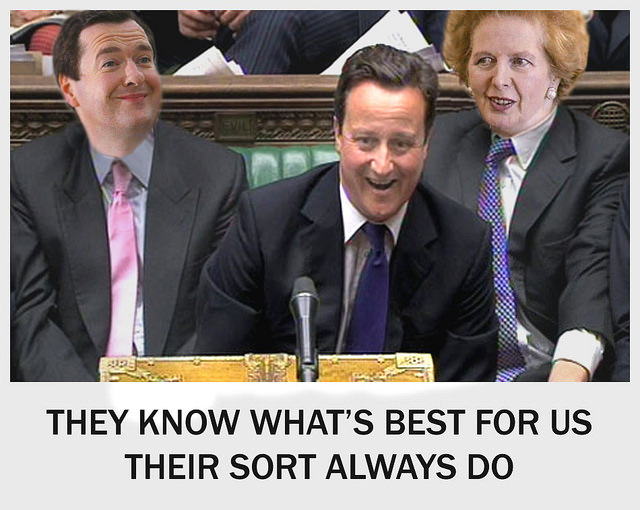

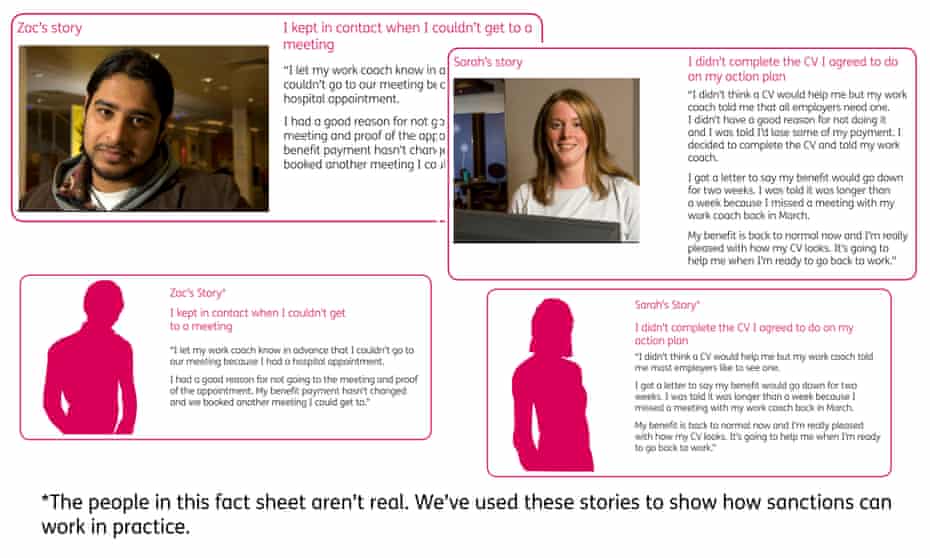

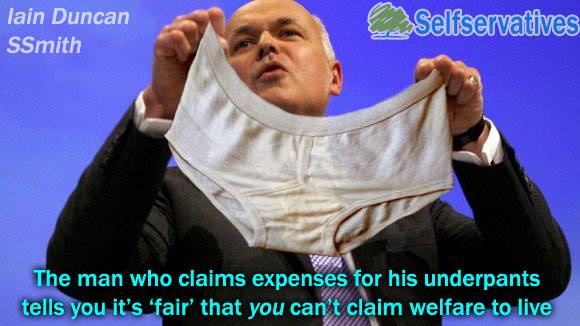


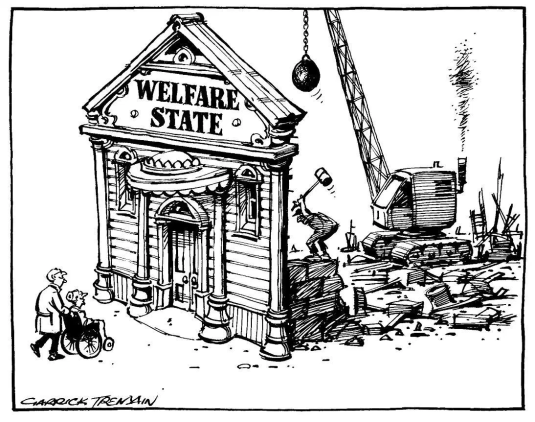

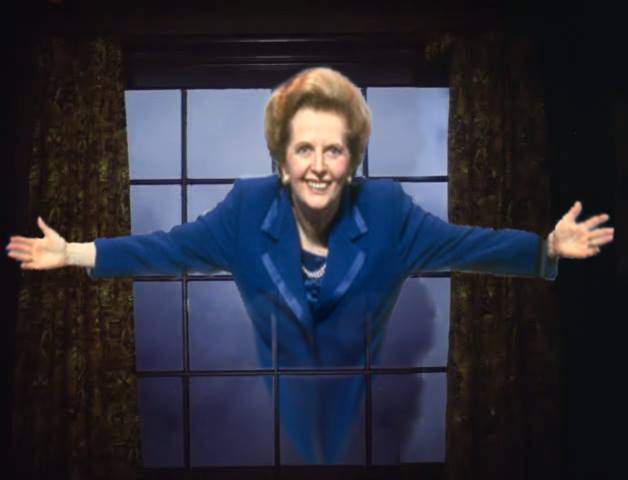


 “We feel utterly betrayed by the Tories,” said another father, who is having his family working tax credits slashed.


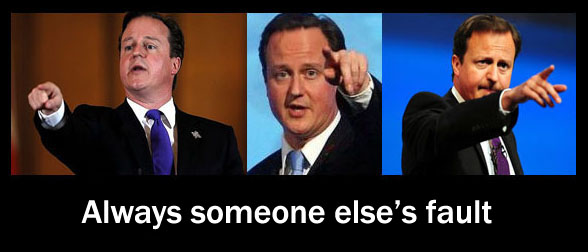


 Politics and Insights