Category: Political ideology

Techniques of neutralisation – a framework of prejudice

71915_457283111007889_61730291_n

Societies may help to enable or hinder disabled people through policies and attitudes. We have moved such a long way from the Labour era of “celebrating diversity and equality” and from a time of simply celebrating the achievements of disabled people. Now we can’t walk or ride in our wheelchairs with our head up in public for fear of attack, or someone in parliament or the media attempting to invalidate our life experiences, rewriting them, implying we are faking our disability in some way, or that somehow, we made a “wrong life choice” that resulted in our illness and disability, turning us into a “burden on the state” that most of us have contributed to.

We have somehow been labelled the “undeserving poor.” This government have lied and lied to try and justify their punitive policies, claiming that their austerity cuts, which are aimed disproportionately at sick and disabled people and the system of punishing sanctions are “fair.” Our lives have become the moral property of the moralising government, a wilfully ignorant public and egocentric celebrities who like to offer is their “lifestyle tips”. We are no longer free to just be.

How did this level of democratic exclusion, malicious outgrouping and stigmatisation happen in a so-called civilised liberal democracy?

Our own government have deliberately manufactured and perpetuated misconceptions about disabled people via their rhetoric, intentional, strategic lies and manipulated statistics.

The Tories have unforgivably cultivated and manipulated the very worst of the public’s prejudices. They have created prejudiced cultural scripts that justify their policies, which also serve to alienate and scapegoat us, we have become marginalised, outgrouped, defined as the Other.

Language and narrative play a key role in the process of outgrouping and scapegoating. Consider, for example, that some of the most draconian policies are referred to as “reforms.” But we know that the changes, rather than improving people’s lives as implied, the word “reform” has been used by the Conservatives as a euphemism for cuts to essential public services, support and social safety nets. Social security cuts and sanctions that entail the withdrawal of lifeline income to meet basic survival needs (benefits were calculated to meet only the the cost of food, fuel and shelter) are claimed to “help” people to look for work, and to “make work pay.” Cuts to disability income are claimed to “support” disabled people into work.

The idea of techniques of neutralisation was first proposed by David Matza and Gresham Sykes during their work on Edwin Sutherland’s Differential Association in the 1950s. Matza and Sykes were working on juvenile delinquency, they theorised that the same techniques could be found throughout society and published their ideas in Delinquency and Drift, 1964.

They identified the following propaganda methods by which, they believed, delinquents justified their illegitimate actions, and Alexander Alverez identified these methods used at a socio-political level in Nazi Germany to “justify” the Holocaust:

1. Denial of responsibility. The offender(s) will propose that they were victims of circumstance or were forced into situations beyond their control.

For example, this technique was used by the Nazis and usually took the form that the perpetrator was “only carrying out orders from above.”

2. Denial of injury. The offender insists that their actions did not cause any harm or damage.

For example, under the Nazi regime this took the form of special language which hid or disguised what was actually being done, euphemisms in which killing became “special treatment,” “cleansing”and many other similar examples.

3. Denial of the victim. The offender believes that the victim deserved whatever action the offender committed.

For example, The Nazis ensured it was widely believed that Jews were involved in a conspiracy to enslave the whole world, so that killing them was self-defence. Although a fabrication, many Germans, appeared to have believed it to be true.

4. Condemnation of the condemners. The offenders maintain that those who condemn their offence are doing so purely out of spite, or are shifting the blame from themselves unfairly.

For example, claims made by the German government and the media that the other countries that were condemning the Nazis were historically guilty of worse crimes, such as the treatment of blacks and Native Americans in the United States and the treatment of native peoples in the French, British and Spanish colonies.

5. Appeal to higher loyalties. The offender suggests that his or her offence was for the greater good, with long term consequences that would justify their actions, such as protection of a friend/social group/nation.

For example, German perpetrators of genocide thought of themselves as patriots, nobly carrying out their duty.

6. Disengagement and Denial of Humanity is a category that Alverez
added to those techniques formulated by Sykes and Matza because of its special relevance to the Holocaust. Nazi propaganda portrayed Jews and other non-Aryans as subhuman. Dehumanisation was explicitly orchestrated by the government. This also very clearly parallels Gordon Allport’s work on explaining how prejudice arises.

Any one of these six techniques can serve to encourage violence by neutralising the norms against prejudice, aggression and murder, to the extent that they are all implemented together, as they apparently were under the Nazi regime, a whole society can seemingly forget its normative rules, moral values and laws , in order to engage in wholesale prejudice, hatred and genocide.

We really must challenge our own government’s attempts to normalise prejudice. One voice can make a difference amongst many. Social norms are the unwritten rules that govern social behaviour. These are customary standards for behaviour that are widely shared by members of a culture. We know that it is possible for an articulate and vocal minority to stem the normative influence of a larger majority. It’s up to each of us to have a responsible role in meta-scripting  those norms.

Wittgenstein once said “The limits of my language are the limits of my  world.”

Words are powerful. As well as describing, signifying, explaining, persuading, interpreting, deceiving and so on, they may also issue commands and instructions.

Language is impactful and speech is an intentional act. We “spell” words. Spelling may also be described as “words or a formula purported to have magickal powers.” Narratives may create change or support existing orders. With words, both spoken and unspoken, we can shape and re-shape the universe. We can create. We can also destroy. Einstein changed the meaning of the word “mass” and transformed Newton’s universe of structures to his own universe of events. He created a different universe, such is the power of conceptualisation and communication.

We can oppress or liberate with a few intentional words. We can both speak and be the change we want to see. The choice and challenge is collectively ours.


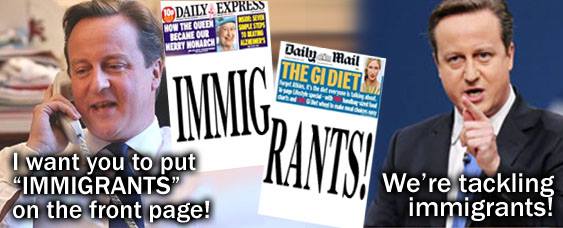
Techniques of neutralisation: Cameron says keep calm and carry on climbing Allport’s ladder

599849_369461329790068_1640090166_n
The Conservatives have deliberately created socio-economic conditions of austerity to benefit the wealthy at the expense of the poorest. They have created cultural scripts that justify their policies, which also serve to alienate and demonise politically constructed categories of the other. Individuals in the most vulnerable social groups, as a consequence, experience feelings of being out-grouped, estrangement from their community and society, experience an outsider status and antagonism and aggression from other ingroups.

It’s recognised in social psychology that people define themselves to a large degree in terms of social groupings and generally, it seems people have a tendency to denigrate others who don’t fit into those groups, with a little prompting.

Others who share our particular qualities are identified as our “ingroup,” and those who do not are our “outgroup.” The Conservatives are basically manipulating an inclination we seem to have towards prejudice, in order to foster and extend social divisions and undermine social cohesion, by creating artificial categories of outgroups. The calculated “striver versus scrounger” rhetoric is one example of this.

Yet as humans we also possess a need to belong, and to be accepted by others. Conformity is one recognisable response of people managing feelings of rejection, of not belonging and of not being accepted. Division and isolation tends to foster obedience.

Alienation (isolation between groups also leads to engulfment within them, and some loss of identity) is the fundamental condition for inter-group conflict. The Asch conformity experiments were a series of laboratory experiments in the 1950s that demonstrated the significant degree to which an individual’s own opinions are influenced by those of a majority group.

Milgram demonstrated that conformity can take precedence over one’s own moral values and principles, and that authority figures and small-scale interactions within wider group behaviour can create significant barriers to individual autonomy.

Divide, diffuse, demoralise and divert certainly seems to be the current political strategy of governance.

However, although it is difficult to resist the majority opinion if each of us is isolated, follow-ups to the Asch experiment also showed that the number of dissenting voices among experimental subjects made a difference to the results – and that just one voice can make a difference amongst many, liberating others from the conformity and obedience tendencies.

Techniques of neutralisation are a linguistic and psychological method employed by people to develop a special set of justifications for their behaviour when such behaviour violates social norms and collective morality.

Such techniques allow people to neutralise and temporarily suspend their commitment to societal values, and to switch off their own “inner protests”, providing them with the freedom to commit deviant acts. Some people don’t have such inner protests – psychopaths, for example – but they may employ techniques of neutralisation to manipulate, and switch off the conscience protests of others.

It’s clear that this is a method frequently employed by the government and that the Tories systematically attempt to distort meanings, to minimise the impact of what they are doing.

For example, when they habitually use the word “reform” euphemistically, what they are referring to is an act that entails the removal of financial support. “Help” and “support” is Tory-speak that means to punish, to compel “behaviour change” (self-reliance without support from the state) and to remove further lifeline support from the group being threatened with Conservative “support”.  

However, when people don’t have enough money to meet their basic needs – which is what welfare was designed to cover, originally (to meet the costs of food, fuel and shelter only) – they struggle and cannot meet higher level psychosocial ones. If people are left without the means to meet the costs of fulfilling their basic needs for long, they will die.

For example, the claim that the bedroom tax is “helping” people into work” or helping child poverty” – when research  shows that 96% of those affected by the bedroom tax can NOT downsize due to a lack of available homes in their area – is a completely outrageous lie. People can’t move as there is a housing crisis, which is due to a lack of affordable homes and appropriately sized accommodation.

How can policies that further impoverish the poorest citizens ever help them to find work or alleviate child poverty, as the government claims? It’s an astonishing lie.

This means that most people have to find extra rent costs from benefits that were calculated to meet only the costs of basic survival needs such as food and fuel, and furthermore, were calculated with the assumption that people on benefits also received full housing costs via housing benefit.

At a time when the cost of living has risen so steeply, and the value of benefits has actually decreased to the point where this essential support is nowmanifestly inadequateaccording to the Council of Europe in Strasbourg, it’s inconceivable to regard the bedroom tax as anything other than grossly punitive to the most the poorest, disabled people and some of the most vulnerable citizens.

The idea of techniques of neutralisation was first proposed by David Matza  and Gresham Sykes during their work on Edwin Sutherland’s Differential Association in the 1950s.  Matza and Sykes were working on ideas about juvenile delinquency, they theorised that the same techniques could be found throughout society and published their ideas in Delinquency and Drift, 1964.

They identified the following methods by which, they believed, delinquents/deviants justified their illegitimate actions, and Alexander Alverez identified these methods used at a sociopolitical level in Nazi Germany to justify” the Holocaust:

  • Denial of responsibility. The offender(s) will propose that they were victims of circumstance or were forced into situations beyond their control. For example, the frequently cited statement that the perpetrator was “only carrying out orders from above.”
  • Denial of injury. The offender insists that their actions did not cause any harm or damage. For example, under the Nazi regime this took the form of special language which hid or disguised what was actually being done, euphemisms in which killing became “special treatment,” “cleansing”and many other similar examples.
  • Denial of the victim. The offender believes that the victim deserved whatever action the offender committed. For example, The Nazis ensured it was widely believed that Jews were involved in a conspiracy to enslave the whole world, so that killing them was self-defence. Although a fabrication, many Germans appeared to have believed it to be true.
  • Condemnation of the condemners. The offenders maintain that those who condemn their offence are doing so purely out of spite, or are shifting the blame from themselves unfairly. For example, claims made by the German government and the media that the other countries that were condemning the Nazis were historically guilty of worse crimes, such as the treatment of blacks and Native Americans in the United States and the treatment of native peoples in the French, British and Spanish colonies.
  • Appeal to higher loyalties. The offender suggests that his or her offence was for the greater good, with long term consequences that would justify their actions, such as protection of a friend/social group/nation. For example, German perpetrators of genocide thought of themselves as patriots, nobly carrying out their duty.Disengagement and Denial of Humanity is a category that Alverez added to those techniques formulated by Sykes and Matza because of its special relevance to the Holocaust. Nazi propaganda portrayed Jews and other non-Aryans as subhuman. Dehumanisation was explicitly orchestrated by the government. This also very clearly parallels Allport’s work, explaining how prejudice arises.

Any one of these six techniques can serve to encourage violence by neutralising the norms against prejudice, aggression and murder. To the extent that they are all implemented together, as they were under the Nazi regime, to that extent a whole society can seemingly forget its moral values and laws , in order to engage in wholesale prejudice, hatred and murder.

Our own government have deliberately manufactured and perpetuated misconceptions about disabled people via their rhetoric, intentional, strategic lies and manipulated statistics.

With the support of a conformist media, the coalition have officialised prejudice, scapegoating, vilification and alienation of already marginalised social groups, hatred – and they have given their permission for people to perpetrate hate crimes by their own negative role modelling.

Disability hate crime in 2011 was at its highest level since records began. Last year, it was also found that victims of disability hate crime are being let down by the criminal justice system and attacks are not being properly recorded, according to a report by three official inspectorates.

Recently, the Department for Work and Pensions (DWP) have been reprimanded for series of rule breaches in which official statistics were used inaccurately, inappropriately, or to “spin” stories about benefit claimants in the media.

The Commons Work and Pensions committee cites examples where the UK Statistics Authority criticised the use of DWP statistics, including by the Secretary of State, Iain Duncan Smith, and Party Chairman Grant Shapps.

The Committee stated that the government was warned as early as 2011 to take more care over the way it presented information on benefits statistics to the media. Ministers had replied then by saying they had a “robust” system in place to ensure no abuses took place. But this was clearly a lie.

The committee notes, in a published report into DWP performance, that problems still remained and that the UK Statistical Authority had reprimanded the department a number of times in 2013 for the way it used welfare statistics.

The Department of Work and Pensions Select Committee report also highlights how government use of statistics are not being used objectively to shed light on policy implementation, they are being used instead to prop up misconceptions and established preconceptions. Anne McGuire said:

“The DWP ministers and its press office have been found guilty yet again of trying to pull the wool over the public’s eyes by its failure to be clear what exactly the statistics show.”

The DWP used its “new figures” to persuade two right-wing newspapers to run stories claiming that the rise in DLA claimants proved the need for reform.

The Sun newspaper claimed the number of DLA claimants on “handouts” was “soaring” at the rate of “one every ten minutes”, and that ministers believed the figures “proved they are right to scrap DLA from April” and replace it with the “tough” new PIP.

The Daily Mail claimed that a new DLA claimant was “signing on” every nine minutes, and that “the rush to secure the state payout is thought to be because its replacement will have tougher eligibility tests”. The article says:

“The cost to the taxpayer is now £13billion a year. An astonishing seven out of ten claimants – 71 per cent – have been offered the benefit for life without any checks to see if they still need it, according to the Department for Work and Pensions.”

Rise: A new applicant is signing on to claim DLA every nine minutes, the latest figures show

The Daily Mail trivialising disability and illness. The caption reads – “Rise: A new applicant is signing on to claim DLA every nine minutes, the latest figures show”


“From April, DLA will gradually be replaced by the Personal Independence Payment (PIP), which is being introduced in an attempt to cut the nation’s benefits bill.”

Note the divisive dichotomy: tax payers are apparently a discrete group of people, portrayed as carrying the financial burden of this social group. However, both DLA and PIP are also classed as in-work support. Many disabled people claiming these benefits do so in order to remain independent and to support them in work. Both benefits were designed to meet the additional living costs that disabled people face because of their disability, to help them remain independent, and are not means tested.

A recent British Social Attitudes survey showed that the Tory austerity cuts may well have become aligned with public opinion, as views have hardened towards perceived “benefits scroungers”. This was a politically calculated outcome, and is used as a self-perpetuating justification for the government’s punitive policies that target the most vulnerable social groups.

It was both individual and collective behaviours that contributed to the Holocaust. Allport’s studies helped us to understand that severe, targeted, personally destructive scapegoating and bullying was a major part in the incremented stages of public acceptance of the unacceptable.

There are some thematic parallels between the social processes and history leading up to the Holocaust and the bigotry, prejudice and targeted bullying we are witnessing in our own society.

What really worries me is how it’s become everyday and almost ordinary to us. And how we fail to link micro and macro level prejudices and behaviours. Ordinary people become easily invested in the values of a morally bankrupt status quo and may participate in terrible behaviours that are seemingly unthinkable in civilised society. History has taught us that.

Perpetrators – in this case our own government – typically require assistance to manipulate the opinions of others, usually to portray their target as the miscreant. Allport’s Scale is a measure of the manifestation of prejudice in a society.

Gordon Allport is a psychologist who researched how the Holocaust happened. There are identifiable ideological parallels here. They are clear and real:

Stage 1. Antilocution. This is when speech is in terms of negative stereotypes and negative images. This is also called hate speech. It sets the stage for more severe outlets for prejudice. When a government does this, it is giving the public permission to hate others.

Stage 2. Avoidance: Members of the majority group actively avoid people in a minority group. No direct harm may be intended, but harm is done through isolation, and this may include also other forms of social exclusion.

Stage 3. Discrimination: Minority group is discriminated against by denying them opportunities and services and so putting prejudice into action. Behaviours have the specific goal of harming the minority group by preventing them from achieving goals, getting education or jobs, etc. The majority group harms the minority.

Stage 4. Physical Attack: The majority group may vandalize, burn or destroy minority group property and carry out violent attacks on individuals or groups. Physical harm is done to members of the minority group. Examples are lynchings of blacks, pogroms against Jews in Europe and British Loyalists in the 1700s. Incidents of hate crime against disabled people has risen massively since the Tories took office.

Final stage 5. Extermination: The majority group seeks extermination or removal of the minority group. They attempt to eliminate either the entire or a large fraction of a group of people (e.g., Indian Wars to remove Native Americans, lynchings of African-Americans, Final Solution to the “Jewish Question” in Nazi Germany, the Rwandan Genocide, and ethnic cleansing in the Bosnian War). When people deliberately or unthinkingly side with abusers to facilitate the destruction of a targeted victim/group, they play institutional roles very similar to the bureaucrats of the Nazi regime.

There are not just victim/target and perpetrator roles, bystanders play a key role in enabling perpetrators, too. Bystanders are not guilty of simply looking the other way. They are complicit in the abuse; often they are among the key enablers leading to the final elimination of the target. And whether that’s on the level of social groups that are being targeted, or individuals, it’s all part of the same methodology and ideology.

We know that the Asch experiment is related closely to the Stanford Prison and Milgram experiments, in that it tries to show how perfectly normal human beings can be pressured into atypical and irrational  behaviour by authority figures, or by the consensus of opinion around them. Asch’s paradigm indicates that having social support is an important tool in combating conformity. Techniques of neutralisation may serve to help people (including the government) to rationalise acts of prejudice and violence.

However, these experiments lack a degree of ecological credibility – in that they do not necessarily relate to real-life situations, though they undoubtedly reveal something of our human tendencies.

We must challenge our own government’s attempts to normalise prejudice. One voice can make a difference amongst many. Social norms are the unwritten rules that govern social behaviour. These are customary standards for behaviour that are widely shared by members of a culture.

We know that it is possible for an articulate and vocal minority to stem the normative influence of a larger majority. It’s up to each of us to have a responsible role in meta-scripting or re-scripting those norms.

Wittgenstein once said: “The limits of my language are the limits of my  world.”

Words are powerful. As well as describing, signifying, explaining, persuading, interpreting, deceiving and so on, they may also issue commands and instructions. We “spell” words. Spelling may also be described as “words or a formula purported to have magickal powers.”

With words, both spoken and unspoken, we can shape and re-shape the universe. We can create. Einstein changed the meaning of the word “mass” and transformed Newton’s universe of structures to become his own – one of events. It’s a different universe.

We can oppress, liberate or transform with a few intentional words. The choice is ours.

changeworld2013


My work is unfunded and I don’t make any money from it. I am disabled because of illness and struggle to get by. But you can support Politics and Insights and contribute by making a donation which will help me continue to research and write informative, insightful and independent articles, and to provide support to others. DonatenowButton


Manufacturing consensus: the end of history and the partisan man

10001887913_f8b7888cbe_o
The Tories are not “paying down the debt” as claimed. They are “raising more money for the rich”

Austerity is not being imposed by the Coalition to achieve an economic result. Austerity IS the economic result. In the wake of the global banking crisis, the Tories, aided and abetted by the Liberal Democrats, have opportunistically delivered ideologically driven cuts and mass privatisation.

We also know that the government’s own Office for Budget Responsibility (OBR) laid bare an important truth – that any semblance of economic recovery is despite the Coalition and not because of them. Yet the Tories have continued to claim that austerity is “working”. The Chairman of the OBR, Robert Chote said:

“Looking over the forecast as a whole – net trade makes very little contribution and government spending cuts will act as a drag.

The OBR state that any slight economic recovery is in no way because of Osborne and Tory policy, but simply due to the wider global recovery from the global crash. 

The government has drastically cut its spending on everything – including the NHS, and welfare in spite of their ludicrous claims to the contrary, this means that the government has consistently damaged the prospect of any economic recovery. This also demonstrates clearly that Coalition policy is driven by their own ideology rather than a genuine problem-solving approach to the economy. Yes, I know I’ve said all of this before – and so have others – but it’s so important to keep on exposing this Tory lie.

However, I believe that Conservatives really do have a conviction that the “big state” has stymied our society: that the “socialist relic” – our NHS and our Social Security system, which supports the casualties of Tory free markets, have somehow created those casualties. But we know that the competitive, market choice-driven Tory policies create a few haves and many have-nots.

Coalition rhetoric is designed to have us believe there would be no poor if the welfare state didn’t “create” them. If the Coalition must insist on peddling the myth of meritocracy, then surely they must also concede that whilst such a system has some beneficiaries, it also creates situations of insolvency and poverty for others.

Inequality is a fundamental element of the same meritocracy script that neoliberals so often pull from the top pockets of their bespoke suits. It’s the big contradiction in the smug, vehement meritocrat’s competitive individualism narrative. This is why the welfare state came into being, after all – because when we allow such fundamentally competitive economic dogmas to manifest, there are always winners and losers. It’s hardly “fair”, therefore, to leave the casualties of competition facing destitution and starvation, with a hefty, cruel and patronising barrage of calculated psychopolicical scapegoating, politically-directed cultural blamestorming, and a coercive, pathologising and punitive behaviourist approach to the casualities of inbuilt, systemic, inevitable and pre-designated sentences of economic exclusion and poverty.

And that’s before we consider the fact that whenever there is a Conservative-led government, there is no such thing as a “free market”: in reality, all markets are rigged to serve elites.

Political theorist Francis Fukuyama, announced in 1992 that the great ideological battles between “east and west” were over, and that western liberal democracy had triumphed. He was dubbed the “court philosopher of global capitalism” by John Gray. In his book The End of History and the Last Man, Fukuyama wrote:

“At the end of history, it is not necessary that all societies become successful liberal societies, merely that they end their ideological pretensions of representing different and higher forms of human society…..What we are witnessing, is not just the end of the cold war, or a passing of a particular period of postwar history, but the end of history as such: that is, the end point of mankind’s ideological evolution and the universalisation of western liberal democracy as the final form of human government.”

I always saw Fukuyama as an ardent champion of ultra-neoliberalism, and he disguised his neo-conservatism behind apparently benign virtue words and phrases (as part of a propaganda technique called Glittering Generalities), such as “Man’s universal right to freedom.” 

He meant the same sort of self-interested “freedom” as Ayn Rand – “a free mind and a free market are corollaries.” He meant the same kind of implicit Social Darwinist notions long held by Conservatives like Herbert Spencer – where the market rather than evolution decides who is “free,” who survives, and as we know, that’s rigged. Tory ideology does not ever have a utilitarian outcome.

Fukuyama’s ideas have been absorbed culturally, and serve to naturalise the dominance of the Right, and stifle the rationale for critical debate.

Like Marx, Fukuyama drew to some extent on the ideas of Hegel – who defined history as a linear procession of “epochs” – technological progress and the progressive, cumulative resolution of conflict allowed humans to advance from tribal to feudal to industrial society. Fukuyama was determined to send us on an epic detour – Marx informed us the journey ended with communism, but Fukuyama has diverted us to another destination.

I agree with Fukuyama on one point: since the French Revolution, democracy has repeatedly proven to be the fundamentally better system (ethically, politically, economically) than any of the alternatives. However we haven’t witnessed the “triumph of liberal democracy” at all: in the UK, we are seeing the imposition of rampant, unchecked neoliberalism coupled with an unyielding, authoritarian-styled social conservatism, with the safety net of democracy removed.

Fukuyama’s declaration manufactures an impression of global consensus politics but I believe this is far from the truth. I don’t believe this can possibly be the endpoint of humanity’s sociocultural evolution. It doesn’t reflect any global and historical learning or progress.

Jacques Derrida (Specters of Marx (1993) ) said that Fukuyama – and the quick celebrity of his book – is but one symptom of the wider anxiety to ensure the “death of Marx”. He goes on to say:

“For it must be cried out, at a time when some have the audacity to neo-evangelize in the name of the ideal of a liberal democracy that has finally realized itself as the ideal of human history: never have violence, inequality, exclusion, famine, and thus economic oppression affected as many human beings in the history of the earth and of humanity. Instead of singing the advent of the ideal of liberal democracy and of the capitalist market in the euphoria of the end of history, instead of celebrating the ‘end of ideologies’ and the end of the great emancipatory discourses, let us never neglect this obvious macroscopic fact, made up of innumerable singular sites of suffering: no degree of progress allows one to ignore that never before, in absolute figures, have so many men, women and children been subjugated, starved or exterminated on the earth.”

Fukuyama’s work is a celebration of neoliberal hegemony and a neo-conservative endorsement of it. It’s an important work to discuss simply because it has been so widely and tacitly accepted, and because of that, some of the implicit, taken-for-granted assumptions and ramifications need to be made explicit.

I don’t think conviction politics is dead, as claimed by Cameron – he has said that he doesn’t “do isms”, that politics is doing “what works”, “working together in the National interest” and “getting the job done”. But we know he isn’t working to promote a national interest, only an elite one. Cameron may have superficially smoothed recognisable “isms” from Tory ideology, but Nick Clegg has most certainly taken the politics out of politics, and added to the the impression that old polarities no longer pertain –  that all the main parties have shifted to the right.

However, the authoritarian Right’s domination of the ideological landscape, the Liberal Democrat’s complete lack of any partisan engagement and their readiness to compromise with their once political opponents has certainly contributed to popular disaffection with mainstream politics, and a sense of betrayal.

It’s ironic that many of those on the left who mistake divisiveness for a lack of political choice have forgotten the degree of consensus politics between 1945 and 1979, when Labour achieved so much, and manifested what many deem “real” socialist ideals. The Conservatives at that time largely agreed the need for certain basic government policies and changes in government responsibility in the decades after World War II, from which we emerged economically exhausted.

The welfare state, the national health service (NHS), and widespread nationalisation of industry happened at a time of high national debt, because the recommendations of the Beveridge Report were adopted by the Liberal Party, to some extent by the Conservative Party, and then most expansively, by the Labour Party.

It was Thatcher’s government that challenged the then accepted orthodoxy of Keynesian economics – that a fall in national income and rising unemployment should be countered by increased government expenditure to stimulate the economy. There was increasing divergence of economic opinion between the Labour and the Tories, ending the consensus of the previous decades. Thatcher’s policies rested on a strongly free-market monetarist platform aiming to curb inflation by controlling the UK’s money supply, cut government spending, and privatise industry, consensus became an unpopular word.

The Thatcher era also saw a massive under-investment in infrastructure. Inequality increased. The winners included much of the corporate sector and the City, and the losers were much of the public sector and manufacturing. Conservatism: same as it ever was.

Those on the “Narxist” left who claim that there is a consensus – and that the Blair government continued with the tenets of Thatcherism need to take a close look at Blair’s policies, and the important achievements that were underpinned with clear ethical socialist principles: strong themes of equality, human rights, anti-discrimination legislation, and strong programmess of support for the poorest, sick and disabled and most vulnerable citizens. Not bad going for a party that Narxists lazily dubbed “Tory-lite”.

Narxism is founded on simplistic, sloganised references to Marxist orthodoxy, and the claim to “real socialism.” Many Narxists claim that all other political parties are “the same.”

The Narxist “all the samers” tend to think at an unsophisticated populist level, drawing heavily on a frustratingly narrow lexicon of blinding glittering generalities, soundbites and slogans. But we need to analyse and pay heed to what matters and what defines a political party: policies and their impact. Despite New Labour’s shortcomings, if we are truly to learn anything of value and evolve into an effective opposition, presenting alternatives to the Conservative neoliberal doxa, we must also examine the positives: a balanced and even-handed analysis. We won’t progress by fostering further divisions along the longstanding “real socialist”, “left” and “moderate” faultlines.

It’s very clear that it is the Coalition who are continuing Thatcher’s legacy. We know this from the Central Policy Review Staff (CPRS) report, which was encouraged and commissioned by Thatcher and Howe in 1982, which shows a radical, politically toxic plan to dismantle the welfare state, to introduce education vouchers, ending the state funding of higher education, to freeze welfare benefits and to introduce an insurance-based health service, ending free health care provision of the NHS. One of the architects of the report was Lord Wasserman, he is now one of Cameron’s advisors.

New Labour had 13 years to fulfil Thatcher’s legacy – and did not. However, in four short years, the Coalition have gone a considerable way in making manifest Thatcher’s ideological directives. To do this has required the quiet editing and removal of Labour’s policies – such as key elements of Labour’s Equality Act .

The imposed austerity is facilitated by the fact that we have moved away from the equality and rights based society that we were under the last Labour government to become a society based on authoritarianism  and the market-based distribution of power. The only recognisable continuity is between Thatcher’s plans and Cameron’s policies. The intervening Labour government gave us some respite from the cold and brutal minarchism of the Tories.

There was never a greater need for partisan politics. The media, which is most certainly being managed by the authoritarian Tory-led government creates an illusory political “centre ground” – and a manufactured consensus – that does not exist.

Careful scrutiny and comparison of policies indicates this clearly. Yet much propaganda in the media and Tory rhetoric rests on techniques of neutralisation – a deliberately employed psychological method used to direct people to turn off “inner protests”, blur distinctions: it’s a mechanism often used to silence the inclination we have to follow established moral obligations, social norms, as well as recognise our own values and principles. And it’s also used to disguise intentions. Therefore, it’s important to examine political deeds rather than words: policy, and not narratives.

My own partisanship is to fundamental values, moral obligations  and principles, and is certainly none-negotiable. Those include equality, human rights, recognising diversity, justice and fairness, mutual aid, support and cooperation, collective responsibility, amongst others, and the bedrock of all of these values and principles is, of course, democracy.

Democracy exists partly to ensure that the powerful are accountable to the vulnerable. The far-right Coalition have blocked that crucial exchange, and they despise the welfare state, which provides the vulnerable protection from the powerful. They despise human rights.

Conservatives claim that such protection causes vulnerability, yet history has consistently taught us otherwise. The Coalition’s policies are expressions of contempt for the lessons of over a century of social history and administration.

The clocks stopped when the Tories took Office, now we are losing a decade a day.

382035_141704259313964_676863845_n
Thank you to Robert Livingstone for the pictures. More here

The poverty of responsibility and the politics of blame – part 2

430847_149933881824335_1645102229_n (1)
Social security came about precisely because we evolved to recognise a need for a social safety net to protect citizens when they encountered economic difficulties, because we learned last century that we are all potentially vulnerable, and that this isn’t anything to do with a person’s characteristics – ordinary people are not to blame for socio-economic circumstances, or for becoming ill and disabled. Unemployment, accident and illness can happen to anyone.

In 1992, Peter Lilley, the somewhat salacious Tory department of social security secretary said he had “got a little list” of people to stereotype as scroungers. Lilley amused the Conservative Party conference with a plan to “close down the something for nothing society”, delivered in the form of a parody of the Lord High Executioner’slittle listsong from The Mikado  by Gilbert and Sullivan:

“I’ve got a little list / Of benefit offenders who I’ll soon be rooting out / And who never would be missed / They never would be missed. / There’s those who make up bogus claims / In half a dozen names / And councillors who draw the dole / To run left-wing campaigns / They never would be missed / They never would be missed. / There’s young ladies who get pregnant just to jump the housing queue / And dads who won’t support the kids / of ladies they have … kissed / And I haven’t even mentioned all those sponging socialists / I’ve got them on my list / And there’s none of them be missed / There’s none of them be missed….”

I remember that subsequently, Spitting Image  portrayed Lilley as a commandant at a Nazi concentration camp and commentator Mark Lawson of The Independent said that if Lilley remained as Secretary of State for Social Security, it would be “equivalent to Mary Whitehouse becoming madam of a brothel.”

The social groups who featured on that hate list are some of the poorest and most disempowered in our society: lone parents, mental health service users, refugees and asylum seekers, the unemployed, and young and homeless people. They have few, if any advocates in parliament on the right, and apparently, few votes are to be lost by attacking them.

Such are the Tory prejudiced, divisive and self-serving attacks on welfare and the purposely devalued social groups it supports. This punitive approach to welfare reform generally has the opposite effect to that promised by Tories such as Lilley, creating additional bureaucratic costs and waste, and setting one group against another. This is a deliberate undermining of social cohesion, cooperation and collective responsibility. It isolates many, who by common consent need support. This approach is also designed to deter those people with legitimate entitlement to support, and to justify an unnecessary and inappropriate harassment, stigmatising and denigrating those it should be helping.

Welfare is the provision of a minimal level of well-being and social support for all citizens. In other words, it was conceived to alleviate absolute poverty and meet basic survival needs. This is based on a model of human developmental psychology focusing on the recognised stages of growth in humans, and is founded on the central idea that the most basic level of needs must be met before the individual may be motivated to fulfil any other needs and betterment. As a minimal condition for making choices and being responsible, people must have all of their basic physiological needs met. For example, a homeless person’s job choices might be constrained by the lack of an address for correspondence or even a place to take a shower. Understanding such humanist concepts was central to the development equality policies and human rights.

The welfare state expands on these concepts to include services such as universal healthcare. In most developed countries welfare is provided by the government. Benefits are based on a compulsory supra-governmental insurance contribution system, the National Insurance system in the UK was established in 1911.

The Beveridge Report in 1942, essentially recommended a national, compulsory, flat rate insurance scheme which would combine health care, unemployment and retirement benefits. After its victory in the United Kingdom general election, 1945 the Labour Party pledged to eradicate the five Giant Evils, and undertook policy measures to provide universal support for the people of the United Kingdom “from the cradle to the grave.”

Social Security policy resulted in the development of what was considered to be a state responsibility towards its citizens, and a citizen responsibility towards each other. Welfare is a social protection that is necessary. There was also an embedded doctrine of fostering equity in the policy.

In addition to the central services of education, health, unemployment and sickness allowances, the welfare state also involved increasing redistributive taxation, increasing regulation of industry, food, and housing, better safety regulations, weights and measures controls. The principle of health care “free at the point of use” became a pivotal idea of the welfare state, which later Conservative governments, who were critical of this, were unable to reverse. Prescription charges were introduced by the Conservative Government in 1952.

The Welfare State period lasted from around 1945 until the Thatcher government began to privatise public institutions in the 1980s, although some features remain today, including compulsory National Insurance contributions, and the provision of old age pensions. It was Conservative governments that introduced constraints to eligibility for benefits via means testing.

The Labour Party won a clear victory in 1945 based on their programme of building provision for citizens with the Welfare State. However, since the 1980s the Conservative government had begun to reduce provisions in England: for example, free eye tests for all were stopped and prescription charges for drugs have constantly risen since they were first introduced by the Conservatives in 1951.

During the Thatcher era, the English High Tory journalist T. E. Utley, wrote that the welfare state was “an arrangement under which we all largely cease to be responsible for our own behaviour and in return become responsible for everyone else’s.” However, even people who erroneously believe that the present welfare system is corrosive to individual responsibility accept the urgency of preventing hunger and destitution. Yet the Tories have persisted with their pre-Victorian rhetoric of the “undeserving, idle poor.”

There is a moral as well as a logical absurdity in this Conservative claim, tied up with notions of citizenship. It’s a continual contradiction of principle within Conservative ideology that small state logic applies to the most vulnerable, who are left to the worst ravages of “market forces” without state protection, but such laissez faire principles don’t extend to the wealthy. Conservatives systematically fail to correct market failures in the interests of the public, but they do intervene to protect the interests of the minority of wealthy citizens. Similarly, replacing state run public services with profit incentivised private providers is an intervention. These partisan interferences distort the “market mechanism,” contrary to Tory claims.

As Ed Miliband noted, when Cameron declared We are raising more money for the rich:

“David Cameron and George Osborne believe the only way to persuade millionaires to work harder is to give them more money.’

‘But they also seem to believe that the only way to make you (ordinary people) work harder is to take money away.”

So “market forces” are adjusted and fixed to benefit the wealthy and penalise the poor.

The sociologist T.H. Marshall wrote in 1965, “it is generally agreed that… the overall responsibility for the welfare of the citizens must remain with the state.” Marshall’s own concept of “social citizenship” – which put forward a new model of citizenship based on economic and social (as well as political) rights – was characteristic of this collective approach to social welfare after 1945. There was a clear and optimistic sense of rebuilding a better Britain.

It’s worth noting that the Universal Declaration on Human Rights recognises socio-economic human rights, such as the right to educationright to housingright to adequate standard of livingright to health and the right to science and culture. Economic, social and cultural rights are recognised and protected in several international and regional human rights instruments. The International Covenant on Economic, Social and Cultural Rights (ICESCR) is the primary international legal source of economic, social and cultural rights. All member states have a legal obligation to respect, protect and fulfil economic, social and cultural rights of the public and are expected to take “progressive action” towards their fulfilment. The current government have made it clear that they hold such rights in high contempt, and in terms of socio-economic policy, they are driven by an extremely regressive rather than progressive ideology.

The social citizenship model remained unchallenged until the emergence of Margaret Thatcher as Conservative Party leader (1975) and then Prime Minister (1979). Thatcherism promised low taxes, less state intervention, and lower levels of public spending, Thatcher introduced cuts in spending on housing and stricter eligibility rules for benefits. This was the Conservative beginning of the end of collective provision.

The Tories have steadily eroded our provision for the poorest and the most vulnerable citizens – our collective safety net, and their rhetoric is about erasing our evolved, civilised collective approach from our social memory. We are being steadily de-civilised, our historical, collective learning and social history is being re-written, and the Tories would have us turn into a society of dog eat dog psychopaths if they get their way.

The Tories have a cynical view of human nature, and presume people will always act out of self-interest, and whilst they may well avoid disappointment, Conservatives will never understand people by assuming that is all that motivates them. History has demonstrated that when human beings are given the chance to meet their fundamental needs and express themselves fully, they are, by nature, interested in the well-being of society and all its members.

I don’t believe that we have limited ability in terms of human endeavour to achieve positive change. Conservatives see the traditional order as enduring and sacred: a trust to be passed from generation to generation. They see the hierarchy that they always engineer as the result of “natural merit.” To be a Tory is to believe this “natural order” of things.

Survival of the wealthiest

Yet Conservative ideology directs an openly hierarchical society and promotes social inequalities, both materially and in terms of social esteem. Tories believe that a “good” society is one where people would simply accept their place. And that is wherever the Tories place them – “The rich man at his castle, the poor man at his gate.”

There are strong links between the right wing idea of “competitive individualism,” laissez faire capitalism, Social Darwinism, eugenics, nationalism and fascism/authoritarianism. Social Darwinists generally argue that the “strong” should see their wealth and power increase while the weak should see their wealth and power decrease.

Most of these views emphasise competition between individuals in a laissez-faire capitalism context; but similar concepts have motivated ideas of eugenics, racism, imperialism fascism, Nazism and struggle between national or racial groups. Eugenics is state interference in the engineering of the “survival of the fittest (wealthiest)”. That is happening here in the UK, with Tory policies like the welfare “reforms”, which are extremely punitive towards sick and disabled citizens in particular – all too often denying them the means of meeting basic survival needs. The Tories think that wealth is a measure of virtue, and that poor people deserve poverty.

Welfare isn’t simply a matter of societal rights but also a matter of life and death. People are dying, and are being made homeless, we are seeing a massive increase in food poverty, malnutrition and people are committing suicide because they are so desperate. Yet the Tories continue to present the victim-blame script. It’s a script that is used almost always to reinforce white supremacist and patriarchal power structures.

And it’s a script that plays off a weakness of our Western worldview, our inclination to assign negative moral value to those who suffer – what psychologists call thejust world fallacy .”

It is often said that you can judge a society on how it treats its weaker members, and in that respect the current government have failed so many. What kind of society is it that allows over a million young people to struggle on the dole, stifling their potential and their creativity, instead of spending the money on helping them to find meaningful work – and then blames them?

What kind of society allows a government to re-brand unemployment and poverty as personal failure, when we know that this government’s policies have caused unemployment to rise, just like every other Tory government. Thatcher at least admitted she had intentionally created high unemployment to keep inflation low, however, that “strategy” failed and we had high inflation and high unemployment. Conservative governments always create a large, disposable army of labour, which they like to keep as desperate as possible to drive down wages, working conditions and to stultify collective bargaining.

Raising unemployment is an extremely effective way of reducing the strength of the working classes, and what is being engineered in Marxist terms is a crisis of capitalism which creates a reserve army of labour and has allowed Tory donors – the capitalist class – to make very high profits.

What kind of society allows sick and disabled people to be harassed – where they are called in for crude, tick-box tests to prove that they are “really” ill or disabled, one where that “assessment” is designed purposefully to remove their lifeline benefits, one where most are found “fit for work” with many dying a few weeks or months later? And when people succeed in appealing wrongful decisions, they are almost immediately sent for a reassessment?

This is happening here in the UK. The Tory welfare “reforms” are extremely punitive towards people who can’t find work and sick and disabled citizens, all too often denying them the means to meet basic survival needs. We urgently need to overturn this by forcefully challenging the Tory myths that poison any attempts at progressive change. Human suffering, loss of dignity and death may have many facets, but all of them are equally unforgiving, and when imposed by humans on fellow humans, all are equally unforgivable. 

Some Tory benefit myths addressed:

Mythbuster: Tall tales about welfare reform – Red pepper
Voters ‘brainwashed by Tory welfare myths’, shows new poll – The Independent
Welfare Myth Number One – Benefits Are Expensive – Dr Simon Duffy
Who really benefits from welfare – Dr Simon Duffy
Where the cuts are targeted – Dr Simon Duffy
The myth of the “welfare scrounger” – The New Statesman

1902872_299005260250529_1922060527_n
Pictures courtesy of Robert Livingstone

The just world fallacy

1459165_266124213538634_1461740450_n
The Tories now deem anything that criticises them as “abusive”. Ordinary campaigners are labelled “extremists” and pointing out flaws, errors and consequences of Tory policy is called “scaremongering”.

Language and psychology are a powerful tool, because this kind of use “pre-programs” and sets the terms of any discussion or debate. It also informs you what you may think, or at least what you need to circumnavigate first in order to state your own account or present your case. This isn’t simply name-calling or propaganda: it’s a deplorable and tyrannical silencing technique.

The government have gathered together a Behavioural Insights Team (BIT) – it is a part of the Cabinet Office – which is comprised of both behavioural psychologists and economists, who apply positivist (pseudo) psychological techniques to social policy. The approach is not much different to the techniques of persuasion used in the shady end of the advertising industry.  They produce positive psychology courses which the Department for Work and Pensions (DWP) are using to ensure participants find satisfaction with their lot; the DWP are also using psychological referral with claims being reconsidered on a mandatory basis by civil servant “decision makers”, as punishment for non-compliance with the new regimes of welfare conditionality for which people claiming out of work benefits are subject.

Positive psychology courses, and the use of psychological referral as punishment for non-compliance with the new regimes of welfare conditionality applied to people claiming out of work benefits are example of the (mis)application of Cognitive Behavioural Therapy (CBT).

CBT is all about making a person responsible for their own thoughts and how they perceive events and experiences and can sometimes be used to empower people. But used in this context, it’s a political means to push an ideological agenda, entailing the “responsibilisation” of poverty, with claimants being blamed for not having a job or for being ill and/or disabled.

However, responding with anger, sadness and despair is normal to many events and circumstances, and to deny that in any way is actually grotesque, cruel and horrendously abusive – it’s a technique called gaslighting – a method of psychological abuse that is usually associated with psychopathic perpetrators.

Gaslighting techniques may range from a simple denial by abusers that abusive incidents have occurred, to events and accounts staged by the abusers with the intention of disorienting the targets (or “victims”.)

The government is preempting any reflection on widening social inequality and injustice by using these types of behavioural modification techniques on the poor, holding them entirely responsible for the government’s economic failures and the consequences of  class contingent policies.

Sanctions are applied to “remedy” various “defects” of individual behaviour, character and attitude. Poor people are being coerced into workfare and complicity using bogus psychology and bluntly applied behavioural modification techniques.

Poor people are punished for being poor, whilst wealthy people are rewarded for being wealthy. Not only on a material level, but on a level of socially and politically attributed esteem, worth and value.

We know from research undertaken by sociologists, psychologists and economists over the past century that being poor is bad for mental wellbeing and health. The government is choosing to ignore this and adding to that problem substantially by stripping people of their basic dignity and autonomy.

The application of behavioural science is even more damaging than the hateful propaganda and media portrayals, although both despicable methods of control work together to inflict psychological damage on more than one level. “Positive psychology” and propaganda serve to invalidate individual experiences, distress and pain and to appropriate blame for circumstances that lie entirely outside of an individual’s control and responsibility.

Social psychologists such as Melvin Lerner followed on from Milgam’s work in exploring social conformity and obedience, seeking to answer the questions of how regimes that cause cruelty and suffering maintain popular support, and how people come to accept social norms and laws that produce misery and suffering.

The just-world” fallacy is the cognitive bias (assumption) that a person’s actions always bring morally fair and fitting consequences to that person, so that all honourable actions are eventually rewarded and all evil actions are eventually punished.

The fallacy is that this implies (often unintentionally) the existence of cosmic justice, stability, or order, and also serves to rationalise people’s misfortune on the grounds that they deserve it. It is an unfounded, persistent and comforting belief that the world is somehow fundamentally fair, without the need for our own moral agency and responsibility.

The fallacy appears in the English language in various figures of speech that imply guaranteed negative reprisal, such as: “You got what was coming to you,” “What goes around comes around,” and “You reap what you sow.” This tacit assumption is rarely scrutinised, and goes some way to explain why innocent victims are blamed for their misfortune.

The Government divides people into deserving and undeserving categories – the “strivers” and “scroungers” rhetoric is an example of how the government are drawing on such fallacious tacit assumptions – that utilises an inbuilt bias of some observers to blame victims for their suffering – to justify social oppression and inequality that they have engineered via policy.

The poorest are expected to be endlessly resilient and resourceful, people claiming social security are having their lifeline benefits stripped away and are being forced into a struggle to meet their basic survival needs. This punitive approach can never work to “incentivise” or motivate in such circumstances, because we know that when people struggle to meet basic survival needs they are too pre-occupied to be motivated to meet other less pressing needs.

Maslow identifies this in his account of the human hierarchy of needs, and many motivational studies bear this out. This makes the phrase trotted out by the Tories: “helping people into work” to justify sanctions and workfare not only utterly terrifying, but also inane.

Unemployment is NOT caused by “psychological barriers” or “character flaws”. It is caused by feckless and reckless governments failing to invest in growth projects. It’s not about personal “employability”, it’s about neoliberal economics, labour market conditions, political policies and subsequent socio-structural problems.

Public policy is not a playground for the amateur and potentially dangerous application of brainwashing techniques via the UK government’s Behavioural Insights Team (BIT) or “nudge unit”. This is NOT being nasty in a nice way: it is being nasty in a nasty way; it’s utterly callous.

The rise of psychological coercion, “positive affect as coercive strategy”, and the recruitment of economic psychologists for designing the purpose of  monitoring, modifying and punishing people who claim social security benefits raises important ethical questions about psychological authority. Psychology is being used as a prop for neoliberal ideology.

We ought to be very concerned about the professional silence so far regarding this adoption of a such a psychocratic, neo-behavourist approach to social control and an imposed conformity by this government.

430847_149933881824335_1645102229_n (1)

Pictures courtesy of Robert Livingstone 

Related reading:

AFTER FORCED-PSYCHOMETRIC-TEST DEBACLE, NOW JOBCENTRES OFFER ONLINE CBT – Skywalker

The Right Wing Moral Hobby Horse:Thrift and Self Help, But Only For The Poor

From Psycho-Linguistics to the Politics of Psychopathy. Part 1: Propaganda.

The Poverty of Responsibility and the Politics of Blame

Whistle While You Work (For Nothing): Positive Affect as Coercive Strategy – The Case of Workfare by Lynne Friedli and Robert Stearn (A must read)


I don’t make any money from my work. But you can support Politics and Insights and contribute by making a donation which will help me continue to research and write informative, insightful and independent articles, and to provide support to others. The smallest amount is much appreciated, and helps to keep my articles free and accessible to all – thank you. 

DonatenowButton

Defining features of Fascism and Authoritarianism

999622_566748676727998_1599547969_n

Max Weber’s principle of Verstehen is a fundamentally critical approach in all social sciences, including politics, and we can see the consequences of its absence in the cold, pseudo-positivist approach of the Coalition in the UK. Their policies clearly demonstrate that they lack the capacity to understand, or meaningfully “walk a mile in the shoes of another”. The Coalition treat the population of the UK as objects of their policies and not as equal, subjective human beings. Policies are designed by the government, for the government, and reflect nothing of public interests.  Whenever the government are challenged and confronted with evidence from citizens that their policies are causing harm, they simply deny the accounts and experiences of those raising legitimate concerns.

The Conservatives do not serve us or meet our needs, they think that we, the public, are here to serve political needs and to fulfil politically defined economic outcomes. Citizens are seen as a means to government ends. We are ‘economic units’. In fact we are being increasingly nudged to align our behaviours with narrow, politically defined neoliberal outcomes.

My own starting point is that regardless of any claim towards the merits of value-freedom in any discussion about society, we cannot abdicate moral responsibility, cannot justify moral indifference. We see values and principles enshrined in a positive approach, exemplified in our laws, human rights and democratic process. We are also seeing an erosion of this tendency towards a globalisation of values, and inclusion of a recognition and account of the full range of human experiences in policy making. Indeed recently in the UK, public policy has become an instrument of stigmatisation, social exclusion and increasing minoritization. 

As a society, we have allowed the state to redefine our collective, universal, relatively egalitarian and civilising support structures, such as social housing, legal aid, welfare and broader public services as being somehow problematic. Those who need support are stigmatised, scapegoated, outgrouped and othered. The government tells us that welfare and other public services present “moral hazards”, and that they “disincentivise” citizens to be self sufficient. Yet the social gains of our post-war settlement were made to include everyone, should they fall on difficult times. We each pay into the provision, after all.

These provisions are civilising and civilised socioeconomic mechanisms that ensure each citizen’s life has equal dignity and worth; that no-one dies prematurely because of absolute poverty or because they have no access to justice, medical care and housing. 

Our post-war settlement was the closest that we ever came to a genuine democracy, here in the UK. It arose because of the political consensus, partly founded on a necessity of the state to meet the social needs of the newly franchised working class. 

However, we are now being reduced in terms of human worth: dehumanised to become little more than economically productive actors. We have a government that tends to describe protected vulnerable social groups in terms of costs to the State, regardless of their contributions to society, and responsibility is attributed to these social groups via political scapegoating in the media and state rhetoric, while those decision-makers actually responsible for the state of the economy have been exempted, legally and morally, and are hidden behind complex and highly diversionary ‘strategic communication’ campaigns and techniques of neutralisation (elaborate strategies of denial and rebuff).

Techniques of neutralisation are a series of methods by which those who commit illegitimate acts temporarily neutralise certain values within themselves which would normally prohibit them from carrying out such acts, such as morality, obligation to abide by the law, and so on. In simpler terms, these are psychological methods for people to turn off “inner protests” when they do, or are about to do something they themselves perceive as wrong. Some people don’t have such inner protests – psychopaths, for example – but they employ techniques of neutralisation to manipulate and switch off those conscience protests of others.

Language use can reflect attempts at minimising the impact of such wrongful acts. The Mafia don’t ever commit “murder”, for example, instead they “take someone out”, “whack them” or “give someone their medicine”. But the victim ends up dead, no matter what people choose to call it. Examining discourses and underpinning ideologies is useful as a predictive tool, as it provides very important clues to often hidden political attitudes and intentions – clues to social conditions and unfolding events. Linguistic habits are frequently important symptoms of underlying feelings and attitudes.

We know that benefits, for example, are calculated to meet basic living requirements only, such as food, fuel and shelter needs. To take away that basic support is devastating for those people having to struggle for basic survival. The Labour Party recently managed to secure concessions that ensured that the right of appeal for those sanctioned is maintained.

Iain Duncan Smith wanted to remove that right. But appeals take months to happen, and meanwhile people are left suffering  enormously, living in absolute poverty, as a result of having no money to meet their most fundamental survival needs. 

Sanctions are not “help” for jobseekers. Sanctions are state punishment and a form of persecution. It doesn’t matter how hard you look for work when you are one of 2,500,000 unemployed people and there are only 400,000 jobs available. If we want to help people into work we need to create decent pay and secure jobs, rather than punishing individuals for being out of work during the worst recession for over 100 years.

Work is no longer a guaranteed route out of poverty, as wages have stagnated and remain lower than they were before the global recession. More than half of the people queuing at food banks are in work. Reducing welfare has also lowered wages, as people who are desperate are forced to take any form of employment with poor conditions and wages. 

In a similar way, the Tories attempt to to distort meanings, to minimise the impact of what they are doing. For example, when they habitually use  the word “reform”, what they are referring to is an act that entails “removal of income”, “cuts”, and  punitive “incentives”, “help” and “support”: Tory-speak “help” means to “punish and take from”. Targets for such punishment and cuts are translated as Tory “statistical norms” or “not targets but aspirations” and “robust expectations of performance”. As I said earlier, these are techniques of neutralisation. Or Newspeak, if you prefer.

The “help” and “incentivisation” that the Tory-led Coalition have provided for jobseekers in the recession, at a time when quality jobs are scarce, secure and stable full-time work is also scarce, are entirely class contingent and punitive. Decent jobs that pay enough to get by on are like …well…Tory statistics; conjured from the aether, a very cheap trick – an illusion. We know that unemployment and underemployment are rising. 

Sartre once said that oppressors oppress themselves as well as those they oppress. Freedom and autonomy are also reciprocal, and it’s only when we truly recognise our own liberty that we may necessarily acknowledge that of others. Conservatism has always been associated with a capacity to inhibit and control, and never liberate. We need to take responsibility for the Government that we have. In fact we must.

Fascism evolves over a period of time. No-one ever woke up one morning to find it had suddenly happened overnight. It’s an ongoing process just as Nazism was. Identifying traits is therefore useful. Fascism and totalitarianism advance by almost inscrutable degrees. 

If you really think it could never happen here, you haven’t been paying attention this past few years to the undemocratic law repeals and quiet edits – especially laws that protect citizens from state abuse – the muzzling of the trade unions, a hatred of left and socialist perspectives, the corporocratic dominance and rampant cronyism, the human rights abuses, the media control and othering narratives, the current of anti-intellectualism and other serious blows to our democracy.

Dr. Lawrence Britt examined the fascist regimes of Hitler (Germany), Mussolini (Italy), Franco (Spain), Suharto (Indonesia) and several Latin American regimes. Britt found 14 defining characteristics common to each, and it is difficult to overlook some of the parallels with the characteristics of the increasingly authoritarian government here in the UK:

1. Powerful and continuing Nationalism – fascist regimes tend to make constant use of patriotic mottos, slogans, soundbites, symbols, songs, and other paraphernalia. Flags are seen everywhere, as are flag symbols on clothing and in public displays.

2. Disdain for any recognition of Human Rights – politically justified by stirring up fear of “enemies” and the need for “security”, the people in fascist regimes are persuaded that human rights can be ignored in certain cases because of “need.” The public tend to become apathetic, or look the other way, some even approve of persecution, torture, summary executions, assassinations, long incarcerations of prisoners, often without charge and so forth. But the whole point of human rights is that they are universal.

3. Identification of enemies and scapegoats used as a unifying cause – the public are rallied into a unifying patriotic frenzy over the need to eliminate a perceived common threat or foe: social groups; racial, ethnic or religious minorities; liberals; communists; socialists, terrorists international organisations and so forth.

4. Supremacy of the Military – even when there are widespread domestic problems, the military is given a disproportionate amount of government funding, and the domestic agenda is neglected. Soldiers and military service are glamorised.

5. Rampant sexism – The governments of fascist nations tend to be almost exclusively male-dominated. Under fascist regimes, traditional gender roles are made more rigid. Divorce, abortion and homosexuality are suppressed and the state is represented as the ultimate guardian of the family institution. Policies emphasise traditional and rigid roles. The government become the ‘parent’, because they “know what’s best for you”. Families that don’t conform are pathologised. 

6. Controlled mass media – the media is directly controlled by the government, but in other cases, the media is indirectly controlled by government regulation, or by ensuring strategically placed sympathetic media spokespeople and executives. Censorship is very common.

7. Obsession with “National Security” and protecting “borders”- fear is used as a motivational tool by the government over the masses.

8. Historically, religion and Government are intertwined – governments in fascist nations tend to use the most common religion of the nation as a tool to manipulate public opinion. Religious rhetoric and terminology is common from government leaders, even when the major tenets of the religion are diametrically opposed to the government’s policies or actions. But technocratic rule – referencing ‘science’ may also be used to appeal to the public and garner a veneer of  credibility.

9. Corporate Power is protected – The industrial and business aristocracy of a fascist nation often are the ones who put the government leaders into power, creating a mutually beneficial business/government relationship and power elite.

10. Labour power is suppressed – because the organising power of labour is the only real threat to a fascist government, labour unions are either eliminated entirely, or are severely suppressed.

11. Disdain for intellectuals and the Arts – fascist nations tend to promote and tolerate open hostility to higher education, and academia. It is not uncommon for professors and other academics to be censored or even arrested. Free expression in the arts and letters is openly attacked.

12. Obsession with Crime and Punishment – under fascist regimes, the police are given almost limitless power to enforce laws. The people are often willing to overlook police abuses and even forego civil liberties in the name of patriotism. There is often a national police force with virtually unlimited power in fascist nations.

13. Rampant cronyism and corruption – fascist regimes almost always are governed by groups of friends and associates who appoint each other to government positions and use governmental power and authority to protect their friends from accountability. It is not uncommon in fascist regimes for national resources and even treasures to be appropriated or even outright stolen by government leaders.

14. Fraudulent elections – sometimes elections in fascist nations are a complete sham. Other times, elections are manipulated by smears, the strategic misuse of psychology and propaganda campaigns, and even assassination of opposition candidates has been used, use of legislation to control voting numbers or political district boundaries, and of course, strategic communications together with targeted manipulation of the media. Fascist nations also typically use their judiciaries to manipulate or control elections, historically.

All fascist governments are authoritarian, but not all authoritarian governments are fascists. Fascism tends to arise with forms of ultra-nationalism. Authoritarianism is anti-democratic. Totalitarianism is the most intrusive; a ‘totalising’ form of authoritarianism, involving the attempted change, control and regulation of citizens’ perceptions, beliefs, emotions, behaviours, accounts and experiences. (See “nudge”, the Cambridge Analytica scandal, and the “Integrity Initiative” scandal, for example)

Authoritarian legitimacy is often based on emotional appeal, especially the identification of the regime as a “necessary evil” to combat easily recognisable societal problems, such as economic crises, with “tough choice”.

Authoritarian regimes commonly emerge in times of political, economic, or social instability, and because of this, especially during the initial period of authoritarian rule, such governments may have broad public support. Many won’t immediately recognise authoritarianism, especially in formerly liberal and democratic countries.

In the UK, there has been an incremental process of un-democratising, permeated by a wide variety of deliberative and disassembling practices which have added to the problem of recognising it for what it is.

Authoritarians typically prefer and encourage a population to be apathetic about politics, with no desire to participate in the political process. Authoritarian governments often work via propaganda techniques to cultivate such public attitudes, by fostering a sense of a deep divide between social groups, society and the state, they tend to generate prejudice between social groups, and repress expressions of dissent, using media control, law amendments or by quietly editing existing laws.

There is a process of gradual habituation of the public to being governed by shock and surprise; to receiving decisions and policies deliberated and passed in secret; to being persuaded that the justification for such deeds was based on real evidence that the government parades in the form of propaganda. It happens incrementally. Many don’t notice the calculated step-by-step changes, but those that do are often overwhelmed with the sheer volume of them.

Authoritarians view the rights of the individual, (including those considered to be human rights by the international community), as subject to the needs of the government. Of course in democracies, governments are elected to represent and serve the needs of the population.

Again, the whole point of human rights, as a protection for citizens, is that they apply universally. They are premised on a view that each human life has equal worth.

Democracy is not only about elections. It is also about distributive and social justice. The quality of the democratic process, including transparent and accountable government and equality before the law, is critical. Façade democracy occurs when liberalisation measures are kept under tight rein by elites who fail to generate political inclusion. See Corporate power has turned Britain into a corrupt state  and also Huge gap between rich and poor in Britain is the same as Nigeria and worse than Ethiopia, UN report reveals.

Some of the listed criteria are evident now. I predict that other criteria will gain clarity over the next couple of years.

“One doesn’t see exactly where or how to move. Believe me, this is true. Each act, each occasion, is worse than the last, but only a little worse. You wait for the next and the next. You wait for the one great shocking occasion, thinking that others, when such a shock comes, will join with you in resisting somehow. You don’t want to act, or even to talk, alone; you don’t want to “go out of your way to make trouble.” Why not? – Well, you are not in the habit of doing it. And it is not just fear, fear of standing alone, that restrains you; it is also genuine uncertainty.

“Uncertainty is a very important factor, and, instead of decreasing as time goes on, it grows. Outside, in the streets, in the general community, “everyone is happy. One hears no protest, and certainly sees none. You know, in France or Italy there will be slogans against the government painted on walls and fences; in Germany, outside the great cities, perhaps, there is not even this.

In the university community, in your own community, you speak privately to your colleagues, some of whom certainly feel as you do; but what do they say? They say, “It’s not so bad” or “You’re seeing things” or “You’re an alarmist.” (Or “scaremonger”)

“And you are an alarmist”. You are saying that this must lead to this, and you can’t prove it. These are the beginnings, yes; but how do you know for sure when you don’t know the end, and how do you know, or even surmise, the end?

On the one hand, your enemies, the law, the regime, the Party, intimidate you. On the other, your colleagues pooh-pooh you as pessimistic or even neurotic. You are left with your close friends, who are, naturally, people who have always thought as you have.” –  Milton Mayer, They Thought They Were Free.

Citizens feel increasingly powerless to shape the political institutions that are meant to reflect their interests. Politicians must relearn how to speak to disenfranchised citizens in an inclusive, meaningful way, to show that dysfunctional democracies can be mended.

Directing collective fear, frustration and cultivating hatred during times of economic turbulence at politically constructed scapegoats – including society’s protected groups which are historically most vulnerable to political abuse – has never been a constructive and positive way forward.

As Gordon Allport highlighted, political othering leads to increasing prejudice, exclusion, social division, discrimination, hatred and if this process is left to unfold, it escalates to hate crime, violence and ultimately, to genocide.

Othering and outgrouping are politically weaponised and strategic inhumanities designed to misdirect and convince populations suffering the consequences of intentionally targeted austerity, deteriorating standards of living and economic instability – all of  which arose because of the actions of a ruling financial class – that the “real enemy is “out there”, that there is an “us” that must be protected from “them.”

In the UK, democracy more generally is very clearly being deliberately and steadily eroded. And worse, much of the public has disengaged from participatory democratic processes.

It’s time to be very worried.
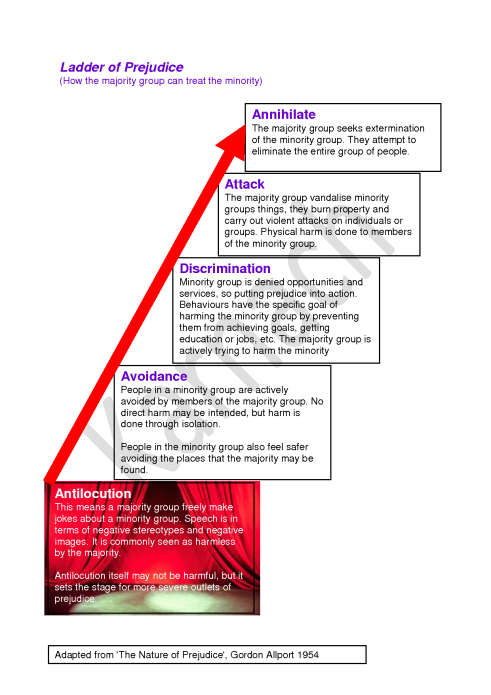
Allport's ladder

Further reading

“We must keep alert, so that the sense of these words will not be forgotten again. Ur-Fascism is still around us, sometimes in plainclothes. It would be so much easier, for us, if there appeared on the world scene somebody saying, “I want to reopen Auschwitz, I want the Black Shirts to parade again in the Italian squares.” Life is not that simple. Ur-Fascism can come back under the most innocent of disguises. Our duty is to uncover it and to point our finger at any of its new instances—every day, in every part of the world. Franklin Roosevelt’s words of November 4, 1938, are worth recalling: “I venture the challenging statement that if American democracy ceases to move forward as a living force, seeking day and night by peaceful means to better the lot of our citizens, fascism will grow in strength in our land.” Freedom and liberation are an unending task.” Umberto Eco, in Ur-Fascism


Politics and Insight’s independent, measured, authoritative reporting has never been so vital, or in the public interest. These are turbulent, decade-defining times. Whatever lies ahead for us all, I will be with you – investigating, disentangling, analysing and scrutinising, as I have done for the last 9 years. 

More people, like you, are reading and supporting independent, investigative and in particular, public interest journalism, than ever before.

I don’t make any money from my research and writing, and want to ensure my work remains accessible to all.

I have engaged with the most critical issues of our time – the often devastating impact of almost a decade of Conservative policies, widespread inequality to the influence of big tech on our lives. At a time when factual information is a necessity, I believe that each of us, around the world, deserves access to accurate reporting with integrity and the norms of democracy at its heart. 

My editorial independence means I set my own agenda and present my own research and analyisis.  My work is absolutely free from commercial and political interference and not influenced one iota by billionaire media barons.  I have worked hard to give a voice to those less heard, I have explored where others turn away, and always rigorously challenge those in power.

This morning I came across this on Twitter:

John Mann@LordJohnMann

I can this morning announce that as government advisor on antisemitism that I will be instigating an investigation this January into the role of the Canary and other websites in the growth of antisemitism in the United Kingdom. https://twitter.com/supergutman/status/1205296902301990912 

Marlon Solomon@supergutman

Who’d have guessed that Mendoza – one of the people most responsible for toxifying the British left with racially charged conspiracy theories about Jews – would blame a Jew before anyone else.

Whoever takes control of Labour, from whatever faction, please fuck these people off.

View image on Twitter
3,147 people are talking about this

Independent journalists are now facing a threat from an authoritarian government, who have successfully managed to distort our mainstream media.

I did expect this promise of a purge on left leaning sites if Boris Johnson was returned to office, but not quite so soon after the event. It’s a case of vote Tory on Thursday, get fascism by Saturday. 

John Mann isn’t by a long stretch the only so-called moderate ex-Labour neoliberal  extremist whipping up McCarthyist hysteria and hate. But he has been strategically placed for a while by the Conservatives to destroy independent sites like mine. He’s a particularly nasty individual.

My first step to fight back in the coming year is to join the National Union of Journalists (NUJ). It is an essential protection, now.

It’s not cheap, especially for someone like me, as I’ve no income from my work. I pay WordPress to keep adverts off my site, too. But I am one of those people who often has to make daily choices about whether to eat or keep warm. I am disabled because of an illness called lupus. Like many others in similar circumstances, I am now living in fear for our future under a government that has already systematically and gravely violated the human rights of disabled people, which has resulted in fear, suffering, harm and all too often, premature death.

I hope you will consider supporting me today, or whenever you can. As independent writers, we will all need your support to keep delivering quality research and journalism that’s open and independent.

Every reader contribution, however big or small, is so valuable and helps keep me going. 

DonatenowButton

Nihilism isn’t cool, trendy or the path to Nirvana: it’s a lazy abstention from all that matters.

1209102_539900659412800_1664499134_n

nihilismˈ noun 1. the rejection of all political, religious and moral principles, often in the belief that life is meaningless. “Insistence that man is a futile being”. synonyms: negativity, cynicism, pessimism; rejection, repudiation, renunciation, denial, abnegation; disbelief, non-belief, unbelief, scepticism, lack of conviction, absence of moral values, agnosticism, atheism, non-theism.
NO PRINCIPLES.

The road to nowhere, dissolution. In short, it’s the absence of belief in anything meaningful, positive, celebratory or decent. No acknowledgement of our remarkable potential as human beings. No faith in anything – it’s grubby, and leaves you groundless, rootless, unprincipled and in a no-place, with no escape.

Russell Brand is a “trendy” nihilist. However, this is not simply another article about Brand, but rather, I want to use this as an opportunity for discussing critical thinking. Brand is as good a case as any to use to explore this and propaganda techniques.

My friend, Charles Britton, commented on an article I wrote about the Russell Brand interview with Jeremy Paxman, and it’s a brilliant comment, because it shows a step-by-step process of critical thinking and analysis that exposes something that many seem to have have missed: an absence. A void. Brand used a lot of words that say nothing at all. Here is the comment:

“When I saw the argument between Russell Brand and Paxman, there were things he said that were clever, and which I liked and there seemed to be a real passion. Apart from the not voting, I thought, I couldn’t agree with that. And apart from the revolution idea because a) they are bloody, b) you don’t know who’ll you’ll end up with in charge (you may even lose the vote), and c) we do have the vote. If there were enough of a groundswell of anger about how we are being treated to spark a revolution, then it would show in how people voted (and how we campaigned). We’d vote out the bastards without needing a revolution! 

(I’m fairly certain that if people can’t be bothered voting, they won’t be bringing on a full-blown revolution any time soon either. Anyone out there got one booked? Please do pencil me in.)

“I still liked some other things he said. Apart from the implication that the parties are all the same. That’s the kind of thing you hear from most of the ”cutting-edge” (aggressive and politically ignorant) stand-ups on TV panel shows and celebs guesting on Question Time. Sadly, this blanket cynicism tends to win-over the politically illiterate of the crowd. Eventually I realised that there wasn’t really anything much in his statements apart from a certain  confident, [apparently] eloquent style. I’m left confused by this, wondering why his Newsnight interview was so “sensational”!


I have also pondered why Brand has such undeserved attention at the moment, and why some seem to think he had something to say, I clearly missed something, so I studied his interview with Paxman carefully. One thing that really struck me is that Brand completely failed to recognise and acknowledge that life wasn’t the same under the last government.

We didn’t have austerity, there were not thousands of sick and disabled people dying, and there was no substantial increase of absolute poverty and wealth inequalities under the Labour government, because of their policies, but these things are happening now.

Labour created human rights and equality policies, and the Tories are steadily unravelling those. Only the wealthy, and indifferent nihilists can afford imperviousness regarding the fundamental contrasts of Labour and Conservative governments. Brand’s self-serving claim that “they are all the same” only echoes what many of the most demigogic, disruptive, aggressive and very divisive individuals, have been using to misinform anyone who will listen. Brand is a multimillionaire who is likely invested in maintaining the status quo. A look at the differences in policies shows clearly that there are fundamental differences between the Conservatives and Labour. (For example, see here: Political Parties – NOT all as bad as each other).

So why would Brand or anyone else, for that matter, offer such a defeatist and dangerous idea up – that voting is futile – especially when the consequence is likely to be further divisions amongst those on the left, whilst the right-wing supporters, who ALWAYS vote, will simply ensure we have another Tory government in office in 2015?

How will that help the situation Brand outlined and criticised? And why is it ever okay to advocate no action? How about encouraging people to take some responsibility for how things are, and to work together to change things for the better?

I’ve written elsewhere about Brand’s narcissism and a fundamental lack of concern for others. As empathy, emotional sustenance and support, solidarity, loyalty, and a sense of belonging all become relics of a fast receding past due to the policies of the Tory-led Government, which act upon citizens as if they were objects, rather than serving them, as human subjects, the mass victims of anomic trauma put up as primitive, last resort narcissistic defences.

These, in turn, only exacerbate the very traumatic conditions, social dislocations, and experiences that necessitated their deployment in the first place. But our ability to organise, self-assemble, and act in co-operation and unison is in jeopardy, as is our future as a society, yet Brand advocated no action.

But some people promote themselves, making a lot of money from “criticising” the status quo, and Brand isn’t alone in being privately invested in how things are whilst publicly claiming otherwise.

Brand used recognisble propaganda techniques in his interview with Paxman, that signpost people to a variety of typified meanings, without actually meaningfully exploring any of them, using superficial Buzzwords (and phrases,) and Glittering Generalities.

The narrative isn’t coherent and meaningful, has no real depth, but what Brand does very well is implies – “signposts” you – via common stock phrases, creating the impression he understands and sees the world as you do. He creates a faux sense of rapport by doing so. But if you look elsewhere, the clues about Brand are there, in his books, articles and other interviews. It soon becomes clear that he does not connect with people, he doesn’t seem to relate. He generally seems to see others as a means to his own ends, and tends to exploit them. Those that have a joke at the expense of others have little empathy, and tend to be unsurprisingly exploitative and cruel.

That’s all Brand does, and even in the interview with Paxman, when he was asked something he couldn’t answer, he resorted to talking the piss out of Paxman.

It’s worth bearing in mind that when someone speaks or writes, they are trying to convince you of something. Ask yourself what it is that they want you to believe, then analyse their basic proposition carefully. Examine what they are saying, look for consistency, coherence, reasoning and logic, and look for the evidence to support the proposition.

Analyse what he actually said – there is NO proposition there at all, he used a lot of words to say nothing – it really is a cul-de-sac. Buzzwords and phrases are a propaganda technique to shape people’s perception, and persuade them that you “know” about their lives, situation and that you have insight.

Management jargon is an example – the familiarity of the words and phrases lulls you and fools you into feeling some important recognition has been made.

Here are some of the buzzwords and phrases Brand used to get your attention, gain your credibility, admiration, create a false sense of rapport; people, power, hierarchical, paradigm, serves a few people, humanity, alternate, alternate political systems, destroy the planet, economic disparity, needs of the people, treachery, deceit, political class, disenfranchised, disillusioned, despondent, underclass, represented, social conditions, undeserved underclass, impact, but that’s all just semantics really, political or corporate elites, serve the population, currently, public dissatisfaction.

We have all used these words and phrases, but we have put them together in structured and meaningful comments, with an aim. Brand didn’t do that.

Glittering Generalities is a propaganda technique, arises very often in politics and political propaganda. Glittering generalities are words that have different positive meaning for individual subjects, but are linked to highly valued concepts.

When these words are used, they demand approval without thinking, simply because such an important concept is involved. Brand made use of these Glittering Generalities; socialist, egalitarian, massive redistribution of wealth, heavy taxation of corporations, massive responsibility for energy companies, environment, profit is a filthy word, global utopian system, genuine option (amongst several others).

The whole dialogue is a propaganda vehicle that aims to deliver one message: there’s no point voting. Go back to sleep. There are identifiable dark fifth column ideologies of nihilism and conspiracy theories which have steadily gained popularity among some of the far-left here in the UK. Que sera sera. Idealism often morphs into cynicism.

These  ideologies reflect anti-values of defeatism, hopelessness, rejection of democracy, and organised government. What a deadly sedative – a very poisonous narcotic for a nation that desperately needs to rekindle respect for human rights, equality, and shared societal values of co-operation, compassion, hope, mutual support and community.

Nihilism is so dangerous because it is a glib, superficial and reactionary response that fundamentally attacks the very worth of humanity itself – because it’s based on the view that nothing really matters, everything is meaningless, nothing and no-one has any real worth, value or meaning.

Nihilism is a spiralling vortex of wretched and miserable relativism. It leaves people groundless and rootless. Que sera sera.

But we have a responsibility to take an interest in our lives, and the plight of others, regardless of our view of “human nature”.

The is /ought distinction highlights that there’s a fundamental difference between descriptive and prescriptive statements. As conscious beings with at least a degree of free-will, we can hoist our selves out of apathy by learning from consequences, by our empathy and concern for others, by our good will and by our conscious intent.

We are not cultural dupes – determined by social structure, or by our biology, sure, we are influenced by these, and a little constrained by them, but we are also capable of transcending these constraints – we are so much greater than that, or at least we have the potential to be so.

Conservatives don’t value such human potential: they tend formulate policy to squash it, curtail it, they stand against the tide of social evolution. Regressive ideology, authoritarian principles.

There is a tangible link with nihilism, and the egocentricity of psychopathy. First of all, psychopaths may be regarded as moral nihilists. Secondly, psychopaths like an apathetic, disengaged and anomic society, where citizens lack conviction, and there’s an absence or erosion of moral values.

Psychopaths regard the rest of us as being defective, and seek relentlessly to remake the world in their own image, to proselytize their viewpoint and  to “teach” their “defective” empathic fellows to think like them. Unfortunately, they can. People can become psychopathic, they can numb down their sensitivity to others. But a psychopath can never learn to think like an empathic person.

People with a normal capacity for empathy can turn off that capacity and think like psychopaths. Language is a powerful thing, and normal human beings respond to linguistic cues to switch to “psychopathy mode”.

The ancient Greeks and the Founders of our country understood the devastating destructiveness of the language of stigmatising, demonising and othering, particularly to democracies. They called the charismatic psychopaths who excelled at its practice “demagogues.” More recently, neuroscience has provided evidence that such demonising, dehumanising and hate radically alters the way the human brain processes information, making subjects immune to reason, increasingly intolerant, and very easily manipulated.

Divide and conquer is the age old defence of elites. Diversion. I am sure there is a link between nihilism, psychopathy and Conservative ideology. Extensive research has found significant correlations between key antisocial personality traits and  Conservative views. Specifically, the research claims to find elements of narcissism, psychopathy and Machiavellianism in Conservative subjects.

The Tory mantra: “there is no such thing as Society” leaks a significant clue about principle elements of core Conservative beliefs. The Conservative ideological justification for the destruction of the social unit, promotion of competitive individualism and “survival of the fittest” principles, the shrinking of the State and deliberately manipulated destruction of public belief in government overall is psychopathic.

It’s all about isolating people, breaking up networks and destroying co-operation and community. And of course such unifying and community-building ideas are the very foundations of socialist values and principles.

By focusing on competitive individualism as the primary method of improving the economy and society, Conservatism is an inherently misanthropic ideology; as all motives are seen through pure self-interest, cynicism in human nature becomes the norm. If people exist to simply get what they can for themselves, the motivation for sociability and co-operation decreases.

We become insular, fragmented and isolated. The characteristic of the psychopathic value system is its somewhat Manichean world view  – idealised me versus demonised him, idealised us  versus demonised them, reflecting the echo-other world view of the pathological narcissist or psychopath. The Tories deliberately create anxiety about others, divide social groups, reduce social cohesion, and create folk devils to bear the brunt of the blame for consequences of Tory policies.

It’s by no coincidence at all that those folk devils also bear the brunt of inhumane Tory policies, too. The Labour government didn’t get everything right for everyone, but Labour have never persecuted social groups like the Tories have, or wilfully destroyed state support for the most vulnerable citizens.

If we don’t vote, then that leaves the Tory supporters, who will simply vote the Tory authoritarians back into Office, and guess what? That doesn’t affect Brand at all. Well, except for the standard £107, 000 that all millionaires get under this Government, each, per year, in the form of a tax break.

We can politically engage, campaign, lobby politicians, and take some responsibility, rather than shrugging, disengaging, and ensuring that nothing will change. Authoritarian governments require a passive, disengaged public to emerge and to maintain their power. We have a duty to challenge and to push back – to demand positive changes and shape a society that supports those that cannot support themselves, that’s the mark of a civilised society. We simply have to fight our way back to decency.

We have to reclaim the progress we once made in an evolved human rights orientated culture. The Tories have undone many decades of hard work and struggle to establish those rights. We have to act, and we must vote. Vote Labour.

scroll2
This is also worth reading: “They are not all the same.” ‘They’re all the same’ is what reactionaries love to hear. It leaves the status quo serenely untroubled, it cedes the floor to the easy answers of Ukip and the Daily Mail. No, if you want to be a nuisance to the people whom you most detest in public life, vote. And vote Labour.”  Robert Webb

– http://www.newstatesman.com/politics/2013/10/robert-webb-re-joins-labour-protest-russell-brand

226786_150917841725939_960158327_n

Thanks to Robert Livingstone for his brilliant artwork

The moral nihilism of the Coalition

tumblr_m81dzafFA21qcekj1o1_500
Poster and slogan from Terry Gilliam’s dystopic film “Brazil”. David Cameron evidently has a strong sense of taunting irony.

Narratives of “welfare dependency” have once again become much more common place and increasingly assertive under the coalition Government – embedded in narratives driven by the the so-called Skivers and Strivers dichotomy. Poverty, according to this distinctly Tory perspective, is caused by a culture of deviance, idleness and dependency. The poor are responsible for their poverty. They cannot be trusted to be responsible, or make the right choices for themselves – or society more generally – and so are in need of paternalistic guidelines and cognitive behaviour therapy. Poverty is being re-responsiblised.

But the rich are not getting richer whilst the poor get poorer: the rich are getting richer because the poor getting poorer. There’s a chasmic conflict of interest between the rich persons’ selfish, individual goals and collective societal values.

A simple truth is that poverty happens because some people are very, very rich. That happens ultimately because of Government policies that create, sustain and extend inequalities. The very wealthy are becoming wealthier, the poor are becoming poorer. This is a consequence of vulture capitalism, designed by the sheer opportunism and pathological greed of a few, it is instituted, facilitated and directed by the Tory-led Coalition.  

Welfare provision was paid for by the public, via tax and NI contributions. It is not a handout. It is not the Governments money to cut. That is our provision, paid for by us to support us if and when we need it. It’s the same with the National Health Service. These public services and provisions do not and never did belong to the Government to sell off, exploit to make a profit from, to strip bare, as they have done

For the Tories, the competitive pursuit of economic gain is the only freedom worth having. And only those that have gained substantially have freedoms worth having. Let’s not lose sight of the fact that this social Darwinist approach to socio-economics means unbridled private business, insidious systematic indoctrination, gross exploitation of the masses and political extortion.

Public understanding is being purposefully distorted and the reality of society’s organisation is concealed to serve the interests of an elite, through a process of ideological hegemony – whereby existing political arrangements, ways of thinking and social organisation are tacitly accepted as logical and “common sense”. The media serve as ideological state apparatus that transmit this “common sense”. The truth is that poor people are the victims of politically manufactured  inequality and crass exploitation. Our once progressive, civilised society is being savagely dismantled, and the Tories are steadily and clumsily re-assembling it using identikit Victoriana.

The truth is that David Cameron has deliberately and spitefully targeted the poorest and most vulnerable to bear the brunt of the austerity cuts. When we actually look at the relative targeting of the Tory-led cuts of different social groups, then we see that:

  • People in poverty are targeted 5 times more than most citizens
  • Disabled people are targeted 9 times more than most citizens
  • People needing social care are targeted 19 times more than most citizens.From: A Fair Society? How the cuts target disabled people 

This is a Government that deliberately creates insecurity and scarcity for many: income, employment opportunities, affordable housing, education opportunities, access to justice, health, energy, for example, whilst private companies make lots of money from these deliberately engineered circumstances, such as by using workfare to boost their profits from the use of free labour (at the expense of the tax payer).

The Governments’ economic decisions, policies and driving, incoherent ideology has created high unemployment and underemployment, job instability, they’ve devalued the worth of labour, excluded those who are vulnerable from the labour market by withdrawing support from them, and then has the vindictive gall to savagely blame the victims of its own crimes, for those crimes, conducting media character assassinations of the poorest, the weakest, demeaning people via the media, stripping them of their dignity and LYING about them.

Our economy is being tailored by the Tories to serve 1% of the population and this has a detrimental effect on everyone else. The Government has removed support and services for the people who need them most, whilst insisting that they must work. To regard the poorest and most vulnerable members of our society as less valuable, and to constantly attack them via the media is quite frankly disgusting conduct for a Government and those that support these despicable and hideous political narratives and policy actions. Such narratives say everything about the authors, and have nothing meaningful at all to say about those left in the situations that this Government have manufactured via policies: those situations which none of them have ever had to experience or face personally.

When they diminish others, they diminish us ALL.

No-one seems to have challenged the idea that working to make someone else very wealthy is somehow virtuous, either. By implication, those that cannot work are regarded as lesser citizens, and that has become tacitly accepted. We have, once again, a Government that makes labouring compulsory, regardless of a persons capability, yet the same Government has devalued labour in terms of wages, rewards, and working conditions, whilst handing out huge amounts of our money to those exploiting the poor unemployed, the sick and disabled. And Tories are always about vicious and divisive rhetoric. Growing social inequality generates a political necessity for prejudices.

Most people who don’t work have no choice about it due to circumstances, such as poor health, disability, caring responsibilities, parenting responsibilities and a lack of reliable, affordable childcare, being frail and elderly. These are reasons that are completely out of a persons control. People forget that ill health doesn’t discriminate: it can happen to anyone. And so can unemployment. No-one is invulnerable, except for the very wealthy: the ones that won’t ever need any state support.

Let’s hear some mention of facts in the media, instead of the usual Tory mouth pieces sanctimoniously preaching at people, “advising” how to manage their loss of lifeline support better, whilst endorsing the sadism of this Government. Let’s hear a loud and civilised call for the halt to the current program of cruel cuts, which are disproportionately targeted at those with the very least, whilst this Government rewards those with the very most with massive tax handouts. Let’s hear the demand for decency, and a new and fair welfare system that is built on a fundamental recognition of the equal worth of all human beings and the guarantee of human rights for all.

It’s time we stood up as a nation on our hind legs.

538861_380839531985581_164896303_n                   Thanks to Robert Livingstone for his brilliant art work.

This was originally written as a part of a longer piece of work: The right-wing moral hobby horse: thrift and self-help, but only for the poor.

The New New Poor Law

547145_195460507271672_1145852710_n

A society with inequalities is and always has been the rational product of Conservative Governments. History shows this to be true. Tory ideology is built upon a very traditional and somewhat feudal vision of a “grand scheme of things”, a “natural order”, which is extremely hierarchical.

The New Poor Law of 1834 was based on the “principle of less eligibility,” which stipulated that the condition of the “able-bodied pauper” on relief be less “eligible” – that is, less desirable, less favourable – than the condition of the very poorest independent labourer. “Less-eligibility” meant not only that “the pauper” receive less by way of relief than the labourer did from his wages but also that he receive it in such a way (in the workhouse) that made pauperism (being in absolute poverty) less respectable than work – to stigmatise it. Thus the labourer would be discouraged from lapsing into a state of “dependency” on poor relief and the pauper would be “encouraged” to work.

The Poor Law “made work pay”, in other words.

The Poor Law Commission report, presented in March 1834, was largely the work of two of the Commissioners, Nassau Senior and Edwin Chadwick. The report took the outline that poverty was essentially caused by the indigence of the character and morality of individuals rather than arising because of inequality and the prevailing political, economic and social conditions. The general view that informed the New Poor Law was that: “Paupers claim relief regardless of his merits: large families get most, which encourages improvident marriages; women claim relief for bastards, which encourages immorality; labourers have no incentive to work; employers keep wages artificially low as workers are subsidised from the poor rate.”

I am sure that the commissioners have descendants that now write for the Daily Mail.

The Victorian era has made a deep impact upon Tory thinking, which had always tended towards nostalgia and tradition. Margaret Thatcher said that during the 1800s, “not only did our country become great internationally, also so much advance was made in this country … As our people prospered so they used their independence and initiative to prosper others, not compulsion by the state”.

There she makes an inference to the twin peaks of callous laissez-faire and the mythical and largely implied  “trickle down” effect. Yet history taught us only too well that both ideas were inextricably linked with an unforgivable and catastrophic increase in destitution, poverty and suffering for so many, for the purpose of extending profit for a few.

Writing in the 1840s, Engels observed that Manchester was a source of immense profit for a few capitalists. Yet none of this significantly improved the lives of those who created this wealth. Engels documents the medical and scientific reports that show how human life was stunted and deformed by the repetitive, back breaking work in The Condition Of The Working Class In England. Constantly in his text, we find Engels raging at those responsible for the wretched lives of the workers. He observed the horror of death by starvation, mass alienation, gross exploitation and unbearable, unremitting, grinding poverty.

The great Victorian empire was built while the completely unconscientious, harsh and punitive attitude of the Government further impoverished and caused distress to a great many. It was a Government that created poverty and also made it somehow dishonourable to be poor. While Britain became great, much of the population lived in squalid, disease-ridden and overcrowded slums, and endured the most appalling living conditions. Many poor families lived crammed in single-room accommodations without sanitation and proper ventilation. That’s unless they were unlucky enough to become absolutely destitute and face the horrors of the workhouse. It was a country of startling contrasts. New building and affluent development went hand in hand with so many people living in the worst conditions imaginable.

Michael Gove has written: For some of us Victorian costume dramas are not merely agreeable ways to while away Sunday evening but enactments of our inner fantasies … I don’t think there has been a better time in our history”  in “Alas, I was born far too late for my inner era”.

A better time for what, precisely? Child labour, desperation? Prostitution? Low life expectancy, disease, illiteracy, workhouses? Or was it the deferential protestant work ethic reserved only for the poor, the pre-destiny of the aristocracy, and “the rich man in his castle, the poor man at his gate”?

In a speech to the Confederarion of British Industry, (CBI) George Osborne argued that both parties in the Coalition had revitalised themselves by revisiting their 19th-century roots. He should have stayed there.

When Liberal Democrat David Laws gave his first speech to the Commons as the secretary to the Treasury, Tory MP Edward Leigh said: “I welcome the return to the Treasury of stern, unbending Gladstonian Liberalism”, and  Laws recognised the comparison to the Liberal prime minister, and said: “I hope that this is not only Gladstonian Liberalism, but liberalism tinged with the social liberalism about which my party is so passionate”.

The Coalition may certainly be described as “stern and unbending”, if one is feeling mild and generous. I usually prefer to describe them as “retro-authoritarian”.

We know that the 19th-century Conservative party would have lost the election had it not been rescued by Benjamin Disraeli, a “one-nation” Tory who won working-class votes only because he recognised the need and demand for essential social reform. Laissez-faire, competitive individualism and social Darwinism gave way to an interventionist, collectivist and more redistributive, egalitarian Keynesian paradigm.

There’s something that this Government have completely missed: the welfare state arose precisely because of the social problems and dire living conditions created in the 17th, 18th, 19th and early 20th centuryies The 19th century also saw the beginnings of the Labour Party. By pushing against the oppressions of the Conservative Victorian period, and by demanding reform, they built the welfare state and the public services that the current Government is now so intent on dismantling.

The UK Government’s welfare “reform” programme represents the greatest changes to welfare since its inception. These changes will impact on the poorest and the most vulnerable people in our society. It will further alienate already marginalised social groups. In particular, women rely on state support to a greater extent than men and will be disproportionately and adversely affected by benefit cuts. Disabled people even more so.

Former Conservative leader Iain Duncan Smith (who didn’t manage to lead his party to an election due to losing a motion of no confidence) is largely responsible for this blitzkreig of apparent moral rigour, a right wing permutation of “social justice” rhetoric and harsh Victorian orthodoxy. Work is being conflated with social justice and social mobility. However, people in work are also queuing at food banks because they can’t meet their basic needs. Reducing welfare simply creates a reserve army of labour that also serves to drive the value of wages down. It creates a downward spiral of living standrads for everyone.

The Government asserts that its welfare “reform” strategy is aimed at breaking the cycle of “worklessness” and dependency on the welfare system in the UK’s poorest families. Poor Law rhetoric. There’s no such thing as “worklessness”, it’s simply a blame apportioning word, made up by the Tories to hide the fact that they have destroyed the employment market, as they always do. It’s happened under every Tory government. At least Thatcher’s administration were honest about it. Her government admitted that they were prepared to tolerate high levels of unemployment in order to bring inflation down. Instead the UK ended up with high unemployment, low wages AND high inflation. The end result was recession.

The “reforms” (cuts) consist of 39 individual changes to welfare payments, eligibility, sanctions and timescales for payment and are intended to save the exchequer around £18 billion. How remarkable that the Department for Work and Pensions claim that such cuts to welfare spending will reduce poverty. I have never yet heard of a single case of someone who is poor actually benefitting from someone else reducing an amount from what little money they have. You can’t punish people out of poverty by making them more poor. That idea is simply absurd and cruel.

There’s nothing quite so diabolical as the shock of the abysmally expected: the brisk and brazen Tory lie, grotesquely untrue. Such reckless and Orwellian rhetoric permeates Government placations for the “reforms”.

The “reforms” were hammered through despite widespread protest, and when the House of Lords said “no“, the Tories deployed a rarely used and ancient parliamentary device, claimed “financial privilege” asserting that only the Commons had the right to make decisions on bills that have large financial implications. Determined to get their own way, despite the fact no-one welcomed their policy, the Tories took the rare jackbooted, authoritarian step to direct peers they have no constitutional right to challenge the Commons’ decisions further. Under these circumstances, what could possibly go right?

That marked the start of a very antidemocratic slippery slope.

The punitive approach to poverty didn’t work during the last century, it unfortnately simply stripped disadvanted citizens of their dignity and diverted people, for a while, from recognising the real cause of poverty. It isn’t about individual inadequacies: poor people do not cause poverty, but rather, Conservative Governments do via their hierarchical worldview, ideological incentives, policies and economic decision-making.

Conservative by name and retrogressive by nature.

This was taken from a larger piece of work: welfare reforms and the language of flowers: the Tory gender agenda

Related posts:

Largest study of UK poverty shows full-time work is no safeguard against deprivation

The link between Trade Unionism and equality

Follow the Money: Tory Ideology is all about handouts to the wealthy that are funded by the poor

The Poverty of Responsibility and the Politics of Blame

548467_541268255942707_974267629_n
Many thanks to Robert Livingstone

The “Let Lynton Lobby Bill” – Grubby Partisan Politics and a Trojan Horse

487830_443702979032569_895018330_n

The Transparency of Lobbying, non-Party Campaigning, and Trade Union Administration Bill  is a calculated and partisan move to insulate Tory policies and records from public and political scrutiny, and to stifle democracy. The Government’s Lobbying Bill has been criticised by bloggers and campaigners from right across the political spectrum, with the likes of Owen Jones and Guido Fawkes united in agreement over this issue: that the Bill is a “Gagging Act”. Five Conservatives – Douglas Carswell, Philip Davies, David Davis, Zac Goldsmith and David Nuttall – voted against the Bill, whilst others also expressed concerns.

The Bill will treat charities, think tanks, community groups and activists of every hue as “political parties”. From small groups addressing local matters to big national organisations, all equally risk being silenced in the year before a general election, to avoid falling under electoral law. Any organisation spending £5,000 a year and expressing an opinion on anything remotely political must register with the Electoral Commission. Since most aspects of our public life are political, (and a substantial proportion of our private life has been increasingly politicised under this authoritarian Government) this stifles much essential debate in election years when voters should be hearing and evaluating policy choices.

The ambiguous way in which this bill targets anything which may impact on an election is calculated and deliberate. It is a way of intimidating charities, trade unions, religious organisations and all protest groups into remaining silent on important issues (such as protecting the NHS, introducing fair taxation, fighting poverty, public health, education, financial sector reform, civil liberties, human rights, the privatisation agenda) in election years, and this includes European elections and local Council elections too, so it will mean an almost continuous constraint on organisational freedom to comment on politics in any way.

Political blogs may well be at risk of being included too, since they are campaigning entities that potentially attempt to impact the outcome of an election. This is a serious threat to independent politics and an abhorrent authoritarian attempt to silence criticism of the Government, using the threat of fines and imprisonment. Here in the UK, we have a Government very clearly intent on policing critical thinking and opinion.

The National Council For Voluntary Organisations (comprised of a large group of charities) has asked whether this Bill is rushed and badly written or whether it is deliberately intended as a “Trojan horse” in order to curtail the freedom of charities to campaign for their causes. Another 100 charities have also heavily criticised the proposed legislation. There is a broad public consensus that it is indeed calculated and fully intended as a Trojan horse, and it was a view shared widely in Parliament at the hearing of the Bill yesterday.

Trade Unions have reacted in disgust and horror as the scope of the Trojan horse element of the legislation became increasingly clear. Joint cooperation between various unions will be made more difficult to such an extent that the Trade Union Congress will effectively be banned in election years. Another absurd element to the legislation is that the arbitrary spending limit of £390,000 will mean the smaller the Trade Union (or charity, religious group or protest site) the greater their proportional influence will become.

The heads of the main lobbying agencies have attacked the Bill too, claiming that the way the Bill has been designed will mean even less transparency in the lobbying industry and a register of lobbyists with hardly any names on it.

Lansley claimed yesterday that charities raising their concerns about the consequences of the Bill  have “over-reacted”, but that view is not substantiated by the rather lethal analysis from the Electoral Commission, which was sent to every MP. Though it will have to enforce the law, the Commission was not consulted on the Bill. The Commission Chair said it has been given far too much discretion in interpreting “political campaigning”, so its decisions are bound to be challenged in law.

The controls “will be impossible to enforce”, and the Commission warns that the Bill greatly widens the range of activities that count as electoral costs – to include rallies, polling research, events, media work, transport and staffing costs for groups never previously regulated. One big danger for risk-averse charities: “it will not be an organisation’s “intent” but the “effect of the expenditure” that sweeps them into electoral law, so they can never know what might be challenged”. The Commission’s warning should alarm every single MP.

Most damning is the Commission’s statement that it will have serious problems interpreting this law because there is no “clear rationale for many of the changes”. That’s very diplomatic and polite, as most of us can see the rationale all too clearly. The Government has attacked so many people via its draconian policies, many are now suffering the brunt of the austerity cuts: a front for Tory ideology. Many organisations and charities see it as a duty to speak up for the causes that people donate to. Whether that’s for the victims of abuse, the homeless, deprived young offenders or victims of crime, it’s always a fine line – but the Charity Commission already polices their politics, and had already installed William Shawcross, a controversial and somewhat right-wing chair. (Despite his previous support for the Labour Party).

So many agree that the Lobbying  Bill is a thinly disguised crude gerrymander to try and stymie Labour, the Unions and gag the Government’s most dangerous potential critics. As Frances O’Grady said in the Guardian last month, the law means unions will hit the spending limit just by holding an annual conference in election year, leaving them unable to campaign.

Glenda Jackson summarised it all very tidily yesterday when she said: “The Lobbying Bill is a gagging act, and as it stands it will prevent democratic voices being heard. It’s a step backwards from the codes of conduct and sanctions that already exist”. 

Nick Clegg is a prime mover on this Bill, as minister in charge of constitutional reform, and Dennis Skinner humorously and astutely pointed out during the debate yesterday that: “The Liberal Democrats support the lobbying bill because they do not want students campaigning against them over tuition fees in 2015.”

Labour shadow Commons leader Angela Eagle called the bill “one of the worst pieces of legislation I’ve seen any government produce in a very long time”. Referring to Andrew Lansley’s former role as health secretary, she added: “I think the last bill this bad might even have been the Health and Social Care Act, and your fingerprints were all over that one too”.

Although the Chair of the Electoral Commission said that regulators could be forced to take legal action against community groups and activists due to “confusion over their new role”, I don’t think there is any “confusion”.

The Tories are well known historically for their liking for “Gagging Acts”. Paine’s “Rights of Man” reached several hundred thousand readers and in May 1792, the Government reacted with a Royal Proclamation against “seditious writing”. There were Tory-organised local demonstrations of loyalty, including over 300 ritualised burnings of Tom Paine. The Government rushed in the further ‘Gagging Acts’ to tighten the treason statute and to ban large political meetings. A huge petitioning campaign followed, with loyalists expressing support and reformers protesting against the restriction, but the Bills were passed anyway.

In 1819, Lord Liverpool and his Tory Government responded to public outcry regarding the Peterloo Massacre by introducing the extremely oppressive Six Acts, which included gagging the “radical” press, and suppression of rights to public meetings. On the 23rd November, 1819, Lord Sidmouth, the Government ‘s Home Secretary, announced details of what later became  the Six Acts. By the 30th December,1819, Parliament had debated and passed the six measures that it hoped would suppress further dissent. There are examples of the Tory tendency for oppressive responses to dissent and criticism littered throughout history.

What we learned from this is that British political culture can be changed fundamentally in the course of resisting authoritarian efforts such as these, and now, we really must do so again.

Lobbying is simply the act of attempting to influence decisions made by officials in the Government, most often legislators or members of regulatory agencies. Lobbying is done by many different types of people and organised groups, including individuals in the private sector, corporations, fellow legislators, Government officials, or advocacy/interest groups.

Although lobbying is often spoken of with contempt, when the implication is that people with inordinate socio-economic power are corrupting the law in order to serve their own interests, another side of lobbying is making sure that the interests of others are duly defended against others’ corruption, or even simply making sure that minority interests are fairly defended against a tyranny of the majority. So there can be elements of power struggles to establish justice involved. Lobbying is therefore a crucial and very valuable part of democracy. Problems arise when some lobbyists are given priority, and come to influence Government policy-making more than others.

Before he became prime minister, Cameron predicted that secret corporate lobbying was “the next big scandal waiting to happen”, adding: “We all know how it works.” As a former lobbyist himself, he certainly did – and he still does.

Cameron’s own election adviser, Lynton Crosby, is a lobbyist for tobacco, alcohol, oil and gas companies. Which is why the prime minister came under attack for dropping curbs on cigarette packaging and alcohol pricing. Then there is Beecroft, the head of the private equity group that administers the high profile barely legal loan shark operation Wonga. The Wonga business model is to prey on the poor, vulnerable and absolutely desperate by offering them exploitative loans at eye-watering interest rates of 5,853% APR. Tellingly, even in the globally renowned haven of free-marketeering – the United States – such outrageous loans are illegal, but in the UK the Tory party are defiantly resisting efforts to regulate the so-called Payday lending sector and introduce maximum APRs.

Cameron’s party treasurer Peter Cruddas resigned after offering access to Cameron for a £250,000 party donation. His defence secretary, Liam Fox, resigned over his relationship with the lobbyist Adam Werritty. Political lobbyists were paid thousands of pounds to help broker a meeting with Liam Fox through Adam Werrity. Bell Pottinger were secretly filmed boasting about its access to the heart of Government, including its ability to persuade Cameron to speak to the Chinese premier on their behalf as well as its exclusive access to figures like William Hague. Let’s not lose sight of the scandals that have prompted this partly diversionary grubby, oppressively partisan policy from the Tories.

Last year the Tory party website openly offered donors the opportunity to attend events where Cameron was present, inviting supporters to join the “premier supporter group”, the Leader’s Group, whose annual membership costs a mere £50,000. (Here is the list of members). So signing up to the group will leave many free to buy direct access to the Prime Minister, other politicians and their advisers.

It’s worth considering that lobbying alone doesn’t begin to cover the extent of corporate influence on Government. The Tory party finds over half of its income from bankers, hedge fund and private equity financiers. Peers who have made six-figure donations have been rewarded with Government jobs. There’s a corruption that is eating our democracy and eroding our public life, and it’s perpetrated not just by lobbyists, but by the politicians, civil servants, bankers and corporate advisers who have increasingly come to swap jobs, favours and insider information, and inevitably come to see their interests as mutual and interchangeable.

The Bill won’t prevent lobbyists walking the corridors of power and speaking in parliamentary debates on the subject on which they work as lobbyists –  those such as David Howell, for example, in the news yet again today. George Osborne’s father-in-law was accused of a conflict of interest last night after it emerged he is being paid by a Japanese high-speed rail firm with commercial interests in the UK at the same time as having top-level access to the Foreign Office as William Hague’s personal adviser.He is being paid as a “European consultant” to JR Central, a train company which could be a bidder for multimillion-pound contracts connected to the controversial HS2 rail line.

At least 142 peers linked to companies involved and invested in private healthcare were able to vote on last year’s Health Bill that opened the way to sweeping and corrosive outsourcing and privatisation.  Recently, the Tory MP Patrick Mercer resigned the party whip when details of yet another lobbying scandal emerged.

The Tories have normalised corruption and made it almost entirely legal. Our democracy and civic life are now profoundly compromised as a result of corporate and financial power “colonising” the State.

So against this backdrop of their own sleaze, the Tories responded with the anti-democratic Lobbying Bill. If the Tories were had a an ounce of honesty about their anti-democratic intentions, it would be called the “Protection of Corporate Lobbying and Silencing of Legitimate Political Debate and Criticism Bill”.

Or the “Let Lynton Lobby” Bill, as Angela Eagle has dubbed it. The Bill had not been presented to the Select Committee in full until the day before recess, it emerged yesterday. The Electoral Commission hadn’t see the draft either. Cameron is also attempting to limit judicial review. If Select Committees are excluded from the legislative process, a case can be challenged under judicial review as that means the legislation is being created on an undemocratic and procedurally unfair basis. Select Committees are part of the constitutional area of law making, they simply cannot be ignored.

The withholding of key details of drafted Bills from Select Committees means that effective and organised challenging from the opposition is stifled, too. We most certainly have an authoritarian Government that arrived unannounced and unauthorised, one that has very clearly spent some time out of Office rather vindictively planning an attack on civil society, reversing the gains of our post-war settlement, and preemptively dismantling the means of redress. The contents of the Lobbying Bill highlight this further. This was a carefully calculated move, and such tactics have become increasingly common since this Government took Office. It would be an enormous mistake, if not academic dishonesty, to pretend that we now live in a liberal democracy.

The Government has left a large loophole in this legislation that allows the likes of Crosby to get around being on the register. When was the last lobbying scandal we read about that involved Oxfam, Vox Political, or the Durham Miners Gala? The Lobbying Bill won’t do a thing to stop the revolving doors between Government and corporate interests (Wonga being a high profile example of this), and neither will it prevent corporate interest parties being invited to actually write Government legislation on their behalf.

Recent freedom of information requests reveal that Treasury officials met fracking industry representatives 19 times in the last 10 months about their generous tax breaks, yet the public are denied any further details of that lobbying on the grounds that it could prejudice commercial interests,” said Green MP Caroline Lucas. “Is the Leader of the House not ashamed that this Bill will drastically curtail the ability of charities to campaign in the public interest on issues such as fuel poverty and energy but do nothing to curb such secretive corporate influencing? The Bill does nothing to prevent lobbyists working directly for commercial concerns from approaching government ministers and trying to influence them”.

Part three of the Bill centres on trade union membership records, Angela Eagle and Caroline Lucas agreed that there appears to be no policy motive for the introduction of this new law other than as a vehicle for cheap, partisan attacks on the trade unionsof which only a minority are actually affiliated to the Labour party. During a belated consultation meeting with the TUC – it took place after the Bill had been published – Department for Business, Innovation and Skills officials could cast no light on why part three exists at all.

Nor were they able to explain the origin of these proposals beyond their oft-repeated mantra that the provisions contained in part three: “It came out of a high level meeting between the Prime Minister and the Deputy Prime Minister. I think that revelation tells us all we need to know about the grubby, partisan nature of the measures “ – Caroline Lucas

The contents of this Bill are all about stifling essential democratic debate, and stymying legitimate criticism of the Government, and that in itself is actually frightening. But it’s also important not to lose sight of how this Draft has progressed, or rather, has been sneaked along to a second hearing. As I stated, the Lobbying Bill was NOT presented to the Parliamentary Committee in full until 1 day before recess. In fact the  Committee was presented initially with only the Consultation, and with no details of the Bill, for scrutiny. There has been NO pre-legislative scrutiny of this Bill.

T
his Bill has been entirely deviously constructed by a spiteful and self-serving, anti-democratic Government. That this same Government no longer deems it necessary to be accountable for its policies, and is by-passing democratic processes and legal safeguards, is frankly terrifying. We really do have an oppressive, authoritarian Government. Consider how likely is it that will this Bill will affect the likes of Rupert Murdoch’s News Corp UK and the Daily Mail Group, because they spend a huge amount amount per day, and much of the content of the press is highly political in nature.

Surely if charities and trade unions are going to have their freedom of speech curtailed to just £390,000 worth of influence, the mainstream press must be curtailed in the same way. Of course that won’t happen because the Tories are quite happy to have the baying right-wing press supporting their every step towards absolute tyranny. The press will most likely be exempt, because the Tories wouldn’t want to interfere with the (particular) “freedom” of the press. (Unless of course they object to specific information being made accessible to the public, in which case, they may demand that particular newspapers smash up their hard drives, whilst government officials intimidate the families of journalists by arresting them under “anti-terrorism” legislation.)

How did we get here? How could we be facing such tyrannical constraints on our most fundamental liberties, and it has happened so very quickly, too.

Paulo Freire said “Men and women develop their power to perceive critically the way they exist in the world with which and in which they find themselves; they come to see the world not as a static reality but as a reality in the process of transformation.” – Pedagogy of the Oppressed.

This insight offers us – and all of those who experience subordination through any imposed regime – a path through which we come to understand what it means to be a moving, shared cultural voice in a Society that is being constructed by the tyranny of a few to hold us still and in place like an object.

It is a learning process that always involves pain and hope; a process through which, as forced cultural jugglers, we can come to, cooperatively and subjectivity, organising and transcending our object position in a Society that hosts us, yet is becoming alien. It’s up to us to reclaim it, to make it our own. And to rebuild if we have to. I believe that history is built upon possibilities and human potential. We simply cannot allow this Government to foreclose and reduce that.

More reading:
Petition against Bill.
Independent – Report calls for withdrawal of Government’s lobbying reforms.
Owen Jones: Under the disguise of fixing lobbying this bill will crush democratic protest.
Mike Siver: Free speech is under threat.


29015_450121201724080_980762499_n


A big thank you to Robert Livingstone for his superb art work