Category: Uncategorized

Authoritarian UK government is funding military grade psyops to smear and calumniate HM’s opposition

psyops

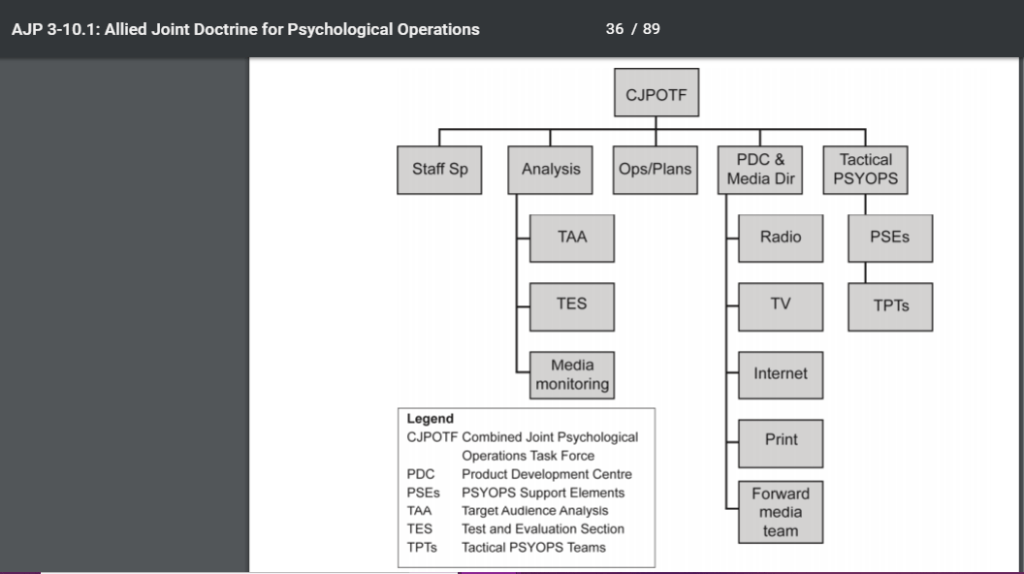
From the government’s ALLIED JOINT DOCTRINE FOR PSYCHOLOGICAL OPERATIONS WITH UK NATIONAL ELEMENTS, SEPTEMBER 2014 .

On page X of the document, it says: “NATO definition of PSYOPS. Allied Administrative Publication (AAP)-06 defines psychological operations as: planned activities using methods of communication and other means directed at approved audiences in order to influence perceptions, attitudes and behaviour, affecting the achievement of political and military objectives.” [My emphasis].

On page IX, this footnote – The term information strategy (its concept and definition) is not yet endorsed through official NATO policy. Its use here [in the UK], however, reflects current thinking on this subject and is coherent with current policy and doctrine initiatives in areas such as the effects-based approach, strategic communications and information operations.” 

Nudging democracy

The British government is financing a large-scale network that influences political and public opinion in Europe using psyops. A substantial part of it is designed to attack the left, and to promote anti-Russian rhetoric.

Psychological operations (PSYOP) are operations to convey selected information and indicators to audiences to manage perceptions, to influence their emotions, motives, and objective reasoning, and ultimately the behaviours of organizations, groups, and individuals.

Government plans to monitor and influence internet communications, and covertly infiltrate online communities in order to sow dissension and disseminate false information, have long been the source of speculation.

In June 2015, NSA files published by Glenn Greenwald revealed details of the JTRIG group at British intelligence agency GCHQ covertly manipulating online communities. This is in line with JTRIG’s goal: to “destroy, deny, degrade [and] disrupt” enemies by “discrediting” them, planting misinformation and shutting down their communications.

Harvard Law Professor Cass Sunstein, [co-author of “Nudge”], a close political adviser and the White House’s former head of the Office of Information and Regulatory Affairs, wrote a highly controversial paper in 2008 proposing that the US government employ teams of covert agents and pseudo-independent advocates to “cognitively infiltrate” online groups and websites, as well as other activist groups.

Sunstein also proposed sending covert agents into “chat rooms, online social networks, or even real-space groups” which spread what he views as false and damaging “conspiracy theories” about the government. Ironically, the very same Sunstein was recently named by Obama to serve as a member of the NSA review panel created by the White House, one that – while disputing key NSA claims – proceeded to propose many cosmetic reforms to the agency’s powers (most of which were ignored by the President who appointed them).

But the GCHQ documents are the first to prove that a major western government is using some of the most controversial techniques to disseminate deception online and harm the reputations of targets. Under the tactics they use, the state is deliberately spreading lies on the internet about whichever individuals it targets, including the use of what GCHQ itself calls “false flag operations” and emails to people’s families and friends.

Who would possibly trust a government to exercise these powers at all, let alone do so in secret, with virtually no oversight, and outside of any cognizable legal framework?

Now, inevitably, some politicians and academics have reacted with fury to news that a covert Government-funded unit has been systematically and strategically attacking the official opposition in Parliament, and seriously undermining democracy in the UK.  

Last month (5 November), Anonymous Europe obtained a large number of documents relating to the activities of the ‘Integrity Initiative’ project, which was launched back in autumn, 2015. The project is funded by the British government and has been established by the Institute for Statecraft.

It’s perhaps unsurprising that the hack has had zero substantive coverage in the UK, US or European press, but it was picked up by Russian media. 

The Institute for Statecraft is affiliated with the NATO HQ Public Diplomacy Division and the Home Office-funded ‘Prevent’ programme, among other things. Statecraft’s Security Economics director, Dr Shima D Keene, collaborated with John A. S. Ardis on a paper about information warfareAnonymous published the documents, which have unearthed the massive UK-led psyop to create a ‘large-scale information secret service’ in Europe, the US and Canada.

The declared goal of the project is to “counteract Russian propaganda” and Moscow’s hybrid warfare (a military strategy that employs political warfare and blends conventional warfare, ‘irregular’ warfare and cyberwarfare with other influencing methods, such as fake news, diplomacy, lawfare and foreign electoral intervention). 

The Integrity Initiative consists of representatives of political, military, academic and journalistic communities with the think tank in London at the head of it.

On 26 November, Integrity Initiative published a statement on the Russian media coverage of the hack. In it they said:

“The Integrity Initiative was set up in autumn 2015 by The Institute for Statecraft in cooperation with the Free University of Brussels (VUB) to bring to the attention of politicians, policy-makers, opinion leaders and other interested parties the threat posed by Russia to democratic institutions in the United Kingdom, across Europe and North America.”

“The Integrity Initiative aims to unite people who understand the threat, in order to provide a coordinated Western response to Russian disinformation and other elements of hybrid warfare.”

The documents included in the leak comprised of a handbook, funding information and lists of people organised by ‘cluster’.

iukcluster1

According to the handbook, Integrity Initiative aims to:

“Bring to the attention of politicians, policy-makers, opinion leaders and other interested parties the threat posed by Russia to democratic institutions in the United Kingdom, across Europe and North America.”

And it achieves this by organising  a network of clusters acress Europe and North America, which are made up of:

“[…] people who understand the threat posed to Western nations by a flood of disinformation.”

Integrity Initiative claim they have developed a network of people who operate to counter Russia’s ‘disinformation’. This may includes interference in the appointment of someone to a government position, using Twitter attacks to prevent the appointment of Colonel Pedro Baños as director of Spain’s Department of Homeland Security, for example. Yet the same network frequently accuse Russia of ‘meddling’ in the political affairs of other countries, and of being antidemocratic. 

In addition to personel from the Integrity Initiative’s  parent organisation – The Institute for Statecraft – there are people representing  think tanks like DEMOS, RUSI, hedge fund interests, Henry Jackson Society, European Council on Foreign Relations, and Chatham House, as well as from the Ministry of Defence, which includes the EU Joint Headquarters at Northwood, the Foreign and Commonwealth Office, and several journalists.

uk journos

For example, Andy Pryce, the Foreign Office Head of Counter Disinformation and Media Development, Ben Bradshaw MP, Sir Andrew Wood, former British ambassador to Russia, and a founder of Orbis Business Intelligence, the privatised British intelligence operation which also incudes Christopher Steele, the author of the Trump ‘dodgy dossier’.

It’s interesting that the old trick – slurring British Labour politicians with Russian/communist links – is back in fashion. The fake Zinoviev letter was traced back to British Intelligence services.

With recent declarations by leading Blairites and several Tory figures such as Michael Fallon, who claimed that Labour now represents a ‘security threat to you and your family’, Corbyn faced a media disinformation campaign of truly staggering proportions, and the allegations of ties to Russia played a significant part.

Corbyn reasonably called for de-escalation and de-militarisation in the Russia-Ukraine conflict on several occasions in the past year as a means to achieving a political solution. He has also called for ‘dialogue’. Some may deem that ‘idealistic’, perhaps, but not completely crazy. Russia is, after all a major nuclear state. Personally I prefer his diplomatic approach to the aggressive posturing of the government.

Quite frankly, the Sun, Daily Mail and other right wing propaganda rags have managed two quite remarkable things from this farrago. The first is to make Jeremy Corbyn look better than before. The second is to justify his calls for press regulation.

It turns out that Ben Nimmo, a “senior fellow” at the Institute for Statecraft, co-authored an article with Jonathan Eyal of the Royal United Services Institute alleged that TV news channel RT broadcast “systematic bias in favour of Corbyn” when he first stood for the Labour leadership. 

The article went on to say the motivation for this was “most likely to be executing the interests of the government which funds it.” Nimmo was also quoted in the Sun newspaper as saying Russia was “supporting Corbyn against his opponents both in the Labour Party and outside it.”

Of course the newspaper used this to support its conspiracy theory that “a twisted Russian cyber campaign which has backed Labour leader Jeremy Corbyn is aiming to sow division across the UK.” 

The crafty state institute

The Institute for Statecraft was set up, and is currently led by Chris Donnelly  (who, prior to joining NATO in 1989, was for 20 years at the Royal Military Academy, Sandhurst) and Daniel Lafayeedney (whose military service, legal background and career as an entrepreneur have led him to an “understanding of the importance of the link between business and national security.”) They are supported by a Board of Trustees, Board of Advisers, an Operations Staff, a Strategic Development Team and an extensive network of like minded Fellows, associates and researchers.

Defending disinformation against democracy

The Integrity Initiative’s Orwellian slogan is ‘Defending Democracy Against Disinformation’. On its About page it claims: “We are not a government body but we do work with government departments and agencies who share our aims.” 

The UK defines strategic communication (StratCom) as: “advancing national interests by using all Defence means of communication to influence the attitudes and behaviours of people. It is an MOD-level function that seeks to align words, images and actions by taking direction and guidance from the National Security Council and developing a Strategic Communication Actions and Effects Framework to guide targeting and planning activities.”

“Info Ops is a staff function that analyzes, plans, assesses and integrates information activities to create desired effects on the will, understanding and capability of adversaries, potential adversaries and North Atlantic Council (NAC) approved audiences in support of Alliance mission objectives. PSYOPS, along with other capabilities,
will be coordinated through Info Ops processes guided by the information strategy and within NATO’s StratCom approach.”

The UK defines target audience analysis (TAA) as: “the systematic study of people to enhance understanding and identify accessibility, vulnerability, and susceptibility to behavioural and attitudinal influence.”

In the document dump on November 5, the Anonymous group exposed the UK-based Integrity Initiative’.  The main stated objective is counter-terrorism, and “to provide a coordinated Western response to Russian disinformation and other elements of hybrid warfare.” The Institute for Statecraft is affiliated with the NATO HQ Public Diplomacy Division and the Home Office-funded ‘Prevent’ programme, so objectivity is, of course, at the forefront of their work… 

However, the secret UK Government-funded propaganda unit allegedly based in Scotland has also been running a campaign on social media, using posts attacking Jeremy Corbyn and the Labour Party. 

The Institute for Statecraft appears to be a small charity operating from an old Victorian mill in Fife. But the explosive leaked documents, which have been passed to the Sunday Mail, reveal the organisation’s Integrity Initiative is funded with £2million of Foreign Office cash and run by military intelligence specialists.

The Conservative group is supposed to counter Russian online propaganda by forming “clusters” of persuaders: friendly journalists and “key influencers” throughout Europe who use social media to hit back against ‘disinformation’.

On the siteDr Shima D Keene writes: “The new security environment is increasingly spawning a variety of asymmetric threats which require immediate attention. Many of these threats are driven by the desire for economic gain, either as an end in itself, or to assist in achieving an ultimate end. Efforts to tackle the economic aspects of these threats have frequently been neglected or, at best, fragmented. This is particularly the case in the international sphere, allowing our adversary to operate in a benign environment.

“Security Economics is the analysis of the economic aspects of human-induced insecurity, such as terrorism and organised crime.

“The Institute’s Security Economics Programme serves to unite existing knowledge while bringing new knowledge to the subject. The multi-disciplinary approach aims to provide new thinking and direction, both strategically and tactically, in order that effective financial warfare strategies can be devised and implemented to tackle the evolving threat environment. Network analysis plays a key part. Activities of the Programme include operational research, policy development, counselling and mentoring in the following subject areas:

  • Threat Finance (Terrorism, Narcotics, Human Trafficking, Proliferation/Weapons of Mass Destruction and Organised Crime)
  • Psychological Operations/Info Ops/ Influence
  • Financial Counter Insurgency
  • Economic Crime (to include Fraud and Money Laundering)
  • Maritime Piracy (Kidnap and Ransom)
  • Cyber crime and associated Technology
  • Forensic Finance/Financial Intelligence
  • Economic Warfare/ Asymmetric Financial Warfare
  • Counter Terrorist Finance/Anti Money laundering (Legislation/Regulation).

A message from the UK Government-funded organisation promotes an article that states: “Unlike Galloway (former MP George Galloway) Corbyn does not scream conspiracy, he implies it,” while another added: “It’s time for the Corbyn left to confront its Putin problem.”

A further message refers to an “alleged British Corbyn supporter” who “wants to vote for Putin”.

It is not just the Labour leader who has been on the receiving end of online attacks. The party’s strategy and communications director, Seumas Milne, was also targeted.

The Integrity Initiative, whose base, allegedly at Gateside Mill, near Auchtermuchty, retweeted a newspaper report that said: “Milne is not a spy – that would be beneath him.

“But what he has done, wittingly or unwittingly, is work with the Kremlin agenda.”

Another retweet promoted a journalist who said: “Just as he supports the Russian bombardment of Syria, Seumas Milne supported the Russian slaughter of Afghanistan, which resulted in more than a million deaths.”

The Integrity Initiative has been accused of supporting Ukrainian politicians who oppose Putin – even when they also have suspected far-right links.

Further leaked documents appear to show a Twitter campaign that resulted in a Spanish politician believed to be friendly to the Kremlin being denied a job.

The organisation’s “Spanish cluster” swung into action on hearing that Pedro Banos was to be appointed director of the national security department.

The papers detail how the Integrity Initiative alerted “key influencers” around Europe who launched an online campaign against the politician.

In the wake of the leaks, which also detail Government grant applications, the Foreign Office have been forced to confirm they provided massive funding to the Integrity Initiative.

In response to a parliamentary question by Chris Williamson, Europe Minister Alan Duncan said: “In financial year 2017-18, the FCO funded the Institute for Statecraft’s Integrity Initiative £296,500.

“This financial year, the FCO are funding a further £1,961,000. Both have been funded through grant agreements.” 

Apparently, the Institute launched the Integrity Initiative in 2015 to “defend democracy against disinformation.” However, the evidence uncovered strongly suggests that it’s rather more of an attempt to defend disinformation against democracy.   

Shadow Foreign Secretary Emily Thornberry expressed the party’s justifiable outrage:

“It is one of the cardinal rules of British public life that official resources should not be used for party political purposes. So, it is simply outrageous that the clearly mis-named ‘Integrity Initiative’ – funded by the Foreign Office to the tune of £2.25 million over the past two years – has routinely been using its Twitter feed to disseminate personal attacks and smears against the Leader of the Opposition, the Labour Party and Labour officials.

“And this cannot be dismissed as something outside the Government’s control, given the application for funding agreed by the Foreign Office last year stated explicitly that it would be used in part to expand “the impact of the Integrity Initiative website…and Twitter/social media accounts.

“So the Government must now answer the following questions: why did the Foreign Office allow public money to be spent on attempting to discredit Her Majesty’s Opposition? Did they know this was happening? If not, why not? And if they did, how on earth can they justify it?”

Labour MSP Neil Findlay said: “It would appear that we have a charity registered in Scotland and overseen by the Office of the Scottish Charity Regulator that is funded by the UK Government and is spewing out political attacks on UK politicians, the Labour Party and the Labour movement.

“Such clear political attacks and propaganda shouldn’t be coming from any charity. We need to know why the Foreign Office have been funding it.”

The UK’s links with NATO  psyops are well-established – see Countering propaganda: NATO spearheads use of behavioural change sciencefor example. From the article: “Target Audience Analysis, a scientific application developed by the UK based Behavioural Dynamics Institute, that involves a comprehensive study of audience groups and forms the basis for interventions aimed at reinforcing or changing attitudes and behaviour.”

The UK government openly discusses its policy intents regarding ‘behavioural change’, and instituted the Nudge Unit in 2010 to contribute to their behaviourist policy agenda. The behavioural economists from the Unit have contributed significantly to punitive welfare policy, for example.

The programme entailing the use of behavioural change science for NATO was delivered by the UK-based Strategic Communication Laboratories (SCL Defence), which has worked for the UK Ministry of Defence and the United States’ Department of Defense for a number of years and is the world’s only company licensed to deliver the Behavioural Dynamics process, and a team of Information Warfare experts drawn from seven nations, called IOTA-Global.

David Miller, a professor of political sociology in the School for Policy Studies at the University of Bristol, added: “It’s extraordinary that the Foreign Office would be funding a Scottish charity to counter Russian propaganda which ends up attacking Her Majesty’s opposition and soft-pedalling far-right politicians in the Ukraine.

“People have a right to know how the Government are spending their money, and the views being promoted in their name.”

Tamsin Shaw, an associate professor of philosophy at New York University, has researched the US military’s funding and use of psychological research for use in torture. She says: “The capacity for this science to be used to manipulate emotions is very well established. This is military-funded technology that has been harnessed by a global plutocracy and is being used to sway elections in ways that people can’t even see, don’t even realise is happening to them.”  

It’s about exploiting existing phenomenon like nationalism and then using it to manipulate people at the margins. To have so much data in the hands of a bunch of international plutocrats to do with it what they will is absolutely chilling.

We are in an information war and billionaires are buying up these companies, which are then employed to go to work in the heart of government. That’s a very worrying situation.”

Mass surveillance, data harvesting and analysis, psychographic profiling and behavioural modification strategies are embedded in the corporate sector and are now very clearly being used in a way that challenges the political canon of liberal democratic societies, where citizens are traditionally defined by principles of self-determination. I’ve spent the past few years writing critically about the neuroliberal turn, and the serious threat it poses to democracy.

The leaked documents show a funding application to the Foreign Office that details the unit’s work.

Further papers reveal a unit in Lithuania which received overseas funding to “support a new hub/cluster creation and to educate cluster leaders and key people in Vilnius in infowar techniques”.

It’s only over recent years that we are getting a glimpse of new behavioural economics discipline evolving into forms of social control that make the frightful 20th-century totalitarianism regimes seem like a primitive and crude method of governance by comparison. This all-pervasive control is elegant and hidden in plain view. It’s a subtle and stealthy form of totalitarianism. Behavioural science and its various applications as a new “cognitive-military complex” – it originated within intelligence and state security agencies.

BeWorks is one example of a company adopting the nudge approach to strategic communications and marketing, they describe themselves as “The first management consulting firm dedicated to the practice of applying behavioral science to strategy, marketing, operations, and policy challenges”, also “harness the powerful insights of behavioral economics to solve your toughest challenges.”

They work for the government, the energy industry, financial service sector, insurance industry and retail sectors, “helping organisations to embed behavioural economics into their culture”. 

The company says: “The team combines leading academics from the fields of cognitive and social psychology, neuroscience, and marketing with management consulting experts. Our multi-disciplinary expertise allows us to arm our clients with the latest in scientific insights coupled with a strategic business lens”.

They also wrote this article among others: How Science Can Help Get Out the VoteThey claim: Our team of scientists and business experts offers a powerful methodology that analyzes and measurably influences the decisions consumers make”. 

They go on to say “Neuromarketing studies, which measure brain activity and other biological indicators, are another way to gauge true emotional reactions instead of relying on how people say they feel. EEG caps and biometric belts are the most common tools used, though other techniques, ranging from reading facial expressions to measuring tiny differences in reaction time, are also used.”

The consequences of governments acting upon citizens to meet political aims, and to align behaviours with a totalising neoliberal ideology, turns democracy completely on its head. We are left with a form of inverted totalitarianism, or facade democracy, where direct methods of oppression are not required, as citizens are far easier to control and better ‘nudged’ when they continue to believe themselves free and autonomous. 

The Foreign Office have not yet responded to a request for comment.

Related

Controversial GCHQ Unit Engaged in Domestic Law Enforcement, Online Propaganda, Psychology Research Glenn Greenwald and Andrew Fishman

The government hired several murky companies plying the same methods as Cambridge Analytica in their election campaign

From the Zinoviev letter to the Labour party coup – the real enemy within

The revelations about Cambridge Analytica indicate clearly that western governments are subverting democracy


I don’t make any money from my work. But you can help me by making a donation to help me continue to research and write informative, insightful and independent articles, and to provide support to others. The smallest amount is much appreciated – thank you.

DonatenowButton

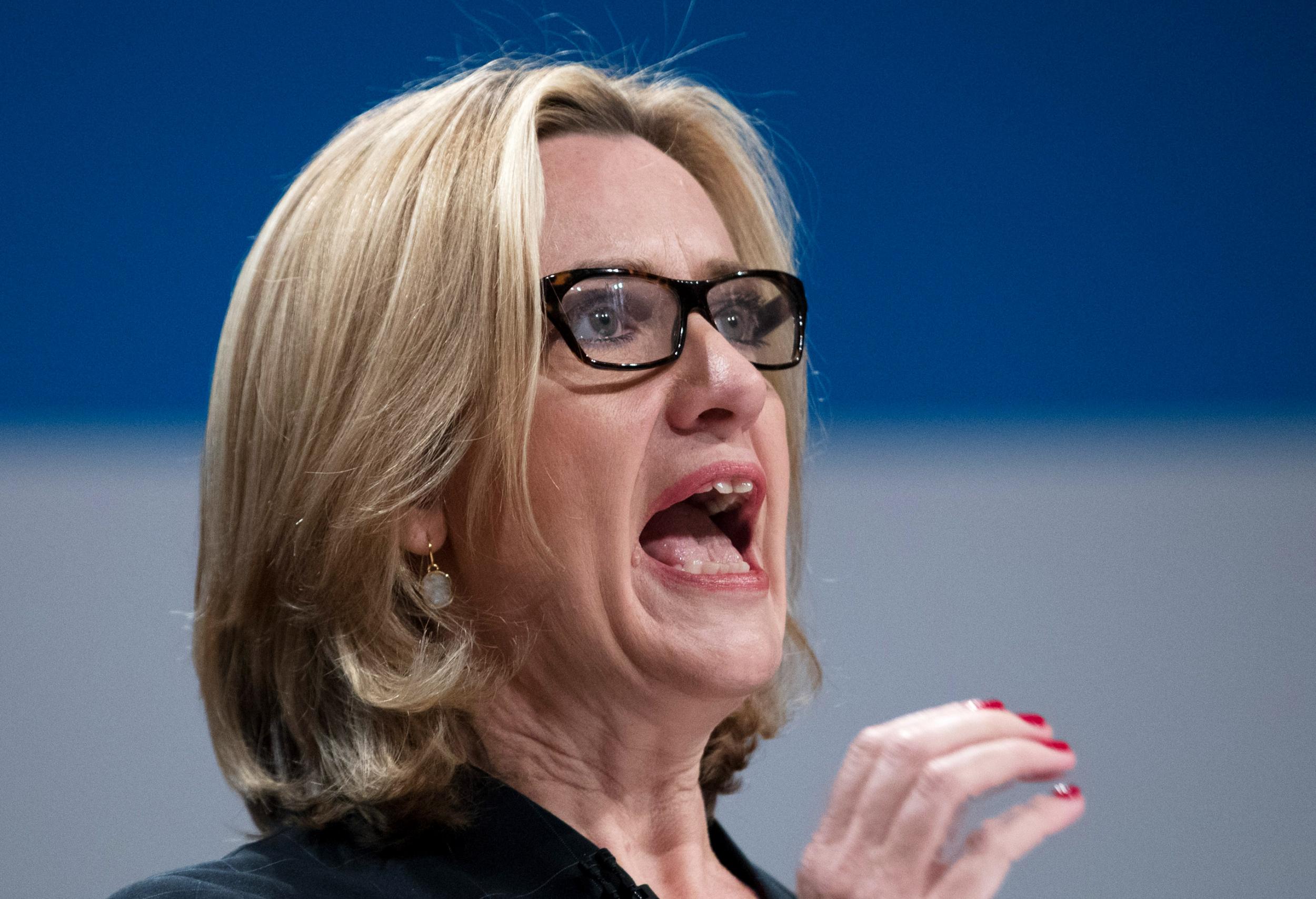
Amber Rudd is either telling deplorable lies or she is disgracefully ignorant of her own department’s policies

Image result for amber rudd

People claiming Universal Credit have been told by the Department for Work and Pensions to apply for provisional driving licences to use as a form of ID, with the costs being taken from their benefits, an MP has said. 

Liverpool Walton MP, Dan Carden, called on the Department of Work and Pensions (DWP) to postpone the roll-out of Universal Credit in his constituency until after Christmas and highlighted the issue with people having to pay out for a driving licence as one of many administrative problems with the new system.

In a letter to the secretary of state, Amber Rudd MP, Carden said: “We have families experiencing poverty on an unprecedented scale and now facing further avoidable hardship in the run up to Christmas. 

“I have now been informed that job centres across Liverpool are advancing payments to my constituents to obtain provisional driving licences for the purposes of identification and then deducting the cost from their benefits.

“Constituents are also having to pay for postal orders, passport photographs and postage, just to obtain provisional licences.”

He explained that the DVLA says there is a five-week wait for provisional licences, and highlighted the delays before the first payments are made when someone is transferred on to Universal Credit.

The controversial new benefit is claimed to simplify the system and it is being rolled out in many parts of Liverpool this week. Carden added: “Continuing with this roll-out will leave many of the most vulnerable families in Liverpool Walton destitute by Christmas and I am therefore asking you to intervene as a matter of urgency.”

In response to the letter, a DWP spokeswoman told Sky News: “Having ID is not a requirement for those making a Universal Credit claim but it does make the process easier.

“If customers don’t have any ID we can reimburse the cost if they choose to apply for a passport, driving licence or long birth certificates.”

Amber Rudd, the secretary of state for work and pensions, responded with a denial, as follows:

However, it seems Rudd failed to bother checking her own government’s web site for advice and evidence, which outlines how to claim Universal Credit.

Completely contradicting Rudd’s claims, it says on the government’s site:

Amber rudd lies 1

Amber rudd lies 2

So Rudd is either woefully ignorant of the policies that her own department is implementing, or she is telling lies. Either way, it’s utterly deplorable that she labelled the opposition ‘scaremongers’ for simply raising legitimate concerns about a cruel, unfit for purpose, out of touch policy. 

When people apply for Universal Credit they are asked to verify their identity online via the GOV.Verify service. 

To do so, you need either;

  • A valid UK driving license
  • A valid UK passport.

Of course this creates problems for those without the documents. The Universal Credit claim cannot go ‘live’ without conforming to the ID verification framework. People generally can’t get an advance because their claim isn’t live. Once they’ve received their new ID document, (takes around 6-8 weeks usually), it’s then a further 5 weeks (at least) until their first universal credit payment.

According to the government web site, you can only apply for an advance on your first payment if you have already verified your identity. It says:

You can apply for an advance payment in your online account or through your Jobcentre Plus work coach.

You’ll need to:

  • explain why you need an advance
  • verify your identity (you do this online when you submit your Universal Credit claim or at your first Jobcentre Plus interview)
  • provide bank account details for the advance (talk to your work coach if you cannot open an account.)

It seems that the “terrific” job coaches are not applying rules consistently, leading to a post code lottery concerning the verification requirements for claims. 

The Verify framework:

This particular response from Rudd has become a deplorable, standardised and authoritarian tactic of repressing legitimate criticism for the Conservatives, however. Other Tory ministers who have habitually used the term ‘scaremonger’ as a gaslighting technique include Sarah Newton and David Gauke among others. 

Gaslighting is a persistent manipulation and attempted brainwashing technique where the abuser manipulates narratives and/or situations repeatedly in an attempt to trick people into distrusting their own perceptions and experiences. Gaslighting is an insidious form of psychological abuse. It is not the kind of behaviour that one would expect from a government minister in a democratic society.

This kind of being somewhat Conservative with the truth may also be seen as a technique of neutralisation.

These techniques are used to switch off the conscience of both the perpetrator and their audience when someone plans or has already done something that causes distress and  harm to others.

The idea of techniques of neutralisation was first proposed by David Matza and Gresham Sykes during their work on Edwin Sutherland’s Differential Association in the 1950s. Matza and Sykes were working on juvenile delinquency, they theorised that the same techniques could be found throughout society and published their ideas in Delinquency and Drift, 1964.

They identified the following psychological techniques by which, they believed, delinquents justified their illegitimate actions, and Alexander Alverez further identified these methods used at a socio-political level in Nazi Germany to justify” the Holocaust:

1. Denial of responsibility. The offender(s) will propose that they were victims of circumstance or were forced into situations beyond their control.

2. Denial of harm and injury. The offender insists that their actions did not cause any harm or damage.

3. Denial of the victim. The offender believes that the victim deserved whatever action the offender committed. Or they may claim that there isn’t a victim.

4. Condemnation of the condemners. The offenders maintain that those who condemn their offence are doing so purely out of spite, ‘scaremongering’ or they are shifting the blame from themselves unfairly. 

5. Appeal to higher loyalties. The offender suggests that his or her offence was for the ‘greater good’, with long term consequences that would justify their actions, such as protection of a social group/nation, or benefits to the economy/ social group/nation.

6. Disengagement and Denial of Humanity is a category that Alverez
added to the techniques formulated by Sykes and Matza because of its special relevance to the Holocaust. Nazi propaganda portrayed Jews and other non-Aryans as subhuman.

A process of social division, scapegoating and dehumanisation was explicitly orchestrated by the government. This also very clearly parallels Gordon Allport’s work on explaining how prejudice arises, how it escalates, often advancing by almost inscrutable degrees, pushing at normative and moral boundaries until the unthinkable becomes tenable. This stage on the scale of social prejudice may ultimately result in genocide.

Any one of these six techniques may serve to encourage violence by neutralising the norms against prejudice and aggression to the extent that when they are all implemented together, as they apparently were under the Nazi regime, a society can seemingly forget its normative rules, moral values and laws in order to engage in wholesale prejudice, discrimination, exclusion of citizens, hatred and ultimately, in genocide.

In accusing citizens and the opposition of ‘scaremongering’, the Conservatives are denying responsibility for the consequences of their policies, denying harm, denying  distress; denying the victims and condemning the condemners.

Meanwhile, for many of us, the government’s approach to social security has become cruel, random, controlling; an unremitting, Orwellian trial. However, no amount of gaslighting or authoritarian ministers using techniques of neutralisation will discredit or deter the growing number of witnesses, nor will those authoritarians negate the lived and collective experiences of those of us undergoing the trials within an intentionally created hostile environment.


I don’t make any money from my work. I am disabled because of illness  and have a very limited income. But you can help by making a donation to help me continue to research and write informative, insightful and independent articles, and to provide support to others. The smallest amount is much appreciated – thank you.
DonatenowButton

Labour’s pledge to reinstate legal aid reflects a democratically accountable and trustworthy party


Related image

Yesterday I wrote about the Labour party’s plans to reinstate legal aid, so that people who need to challenge social security decision-making may access legal support to do so. A number of people commented that we shouldn’t need legal aid to challenge the government’s welfare policies, as they should be fit for purpose in the first place.

However, I think that is a measure of how very low public expectations of government have sunk. What the Labour party are offering, to date, is a reformed social security system that does not punish the very people it is meant to support. So far their pledges include scrapping the bedroom tax, the Conservative’s sanction regime, the work capability assessment, the personal independent payment assessment, and a ‘root and branch’ review of the welfare system more generally, to ensure it is fair and adequately supportive.

Social security as it stands does not provide enough support to meet the essential costs of living, which has had some recognisable and catastrophic concsequences. The Labour party’s work on welfare is ongoing, and importantly, it is in consultation with disabled people, allied organisations and academics who have researched the woeful and absolutely unacceptable shortcomings of the current system. The consultations have been ongoing, too, indicating a party that is democratically inclusive, responsive, and is genuine in its claim to meet the needs and best interests of the many. 

The Conservatives have turned justice into a commodity for the very wealthy. Legal support is available, provided people can afford it. That unequal access to justice serves as a buttress for social inequality and political oppression.

Furthermore, a government owes its citizens distributive justice, too: fair policies, just laws, effective means to participate in how we are governed, fairly distributed resources and services, and so on. The Conservatives are unable to understand that justice is the application of the law equally to all citizens of the state, and that in democracies, policies are generally regarded as a mechanism for distributive justice, they are not devices for the withdrawal of justice and increasing oppression.

Similarly, human rights are also universal. That is the whole point of them. However, the Conservatives have also made them increasingly conditional, which has exposed some communities and social groups to increasing political discrimination.

Recently, the Bar Council chair said the rule of law is at risk because of such “political folly and expediency.” Andrew Walker QC also said that justice in the UK is at risk because of political decisions that threaten to undermine the independence of the judiciary, underscoring a deep anger coursing through the legal profession.

Walker used his speech to the Annual Bar and Young Bar Conference last month to say: “In truth, in the last decade, we have been following a course that has set its face against justice, by political design, political folly and political expediency.”

He added “Cuts to legal aid represent “a huge threat to access to justice in our country. If we can no longer deliver access to justice of which we can be proud – even worse, if our systems of family and criminal justice start to fail – then our justice and rule of law are at risk.”

The comments reflect widespread, mounting concern about cuts to the legal system and the impact they are having on access to justice.

Referring to they way the justice system in the UK had taken centuries to evolve, Walker said: “Just because something is longstanding does not mean that it, or the people in it, are unbreakable.”

Many of us raised these concerns when the cuts were first proposed by the government. Access to justice is an absolute constitutional principle. It must not be undermined. Access to justice is a fundamental democratic right, and the chaos and failure unfolding across the legal system as the result of cuts should concern everyone who cares about justice.

The Ministry of Justice is under criminal investigation by the Information Commissioner’s Office for having failed to publish its research in full when ordered to, opting instead to publish a short and incomplete summary.  A review of 2012’s Legal Aid, Sentencing and Punishment of Offenders Act (Laspo) is being carried out. But ministers have already delayed far too long in the face of clear evidence that cuts in the family courts have been harmful.

Official figures show that the proportion of litigants with legal representation fell from 60% in 2012 to 33% in the first quarter of last year, and it is not uncommon for one party in a civil case to be represented by a lawyer while the other is not. Last year one senior family court judge, Mr Justice Bodey, described the current position as “shaming”, while Mr Justice Francis said it was remarkable that the parents of Charlie Gard did not qualify for legal aid in their dispute with their son’s doctors.

Meanwhile, the Law Society began a judicial review of cuts to the fees paid to solicitors for legal aid work, while a strike by barristers, which saw more than 100 chambers refuse to take on new cases, was called off in June only after the government came up with additional funds.

Legal aid began in the UK in the 1940s, along with the rest of the welfare state. In the US, a defendant’s entitlement to a lawyer in a criminal case is enshrined in an amendment to the constitution. While the rules in the UK may lack this constitutional underpinning, people should still be entitled to access to justice – including lawyers paid for with legal aid. Without equal access to justice, human rights frameworks are pretty much redundant. 

In a functioning democracy, regardless of what kind of policies a government puts in place, we must have equal access to justice. Legal aid was part of our post war democratic settlement, and the Conservatives have dismantled most of that. Restricting our access to justice was part of a deliberate and coordinated attack on citizens’ most fundamental rights, in an attempt to prevent people holding the government to account for their devastating welfare ‘reforms’ and cuts to the NHS, among other authoritarian changes the government have made to our society. 

A key point is this. Even when we have a rather more fair, balanced and egalitarian government in office, we must always, nonetheless, have access to justice, so that if or when things go wrong, we can hold that administration to account. In pledging to reinstate legal aid, Labour are not only doing the right thing, they are demonstrating a willingness to be held democratically accountable for their policies and their consequences. That must surely inspire a degree of faith and trust.

These are the essential mechanisms of democracy that we seem to have forgotten over the last eight years. We no longer expect government to act in the best interest of citizens.

However, that is not true of all governments.

I am hopeful that the Labour party’s social security policies will be fit for purpose precisely because Labour plan to reinstate legal aid. It shows that they plan to implement policies that comply with human rights frameworks, and are therefore much less likely to face legal challenges in the first place. Legal aid provides ordinary people with an essential democratic safeguard and demonstrates the Labour party are comfortable with being held accountable should the need arise.

These are the key reasons why I welcome this move.

Legal aid is a fundamental right and a crucial safeguard in a democratic society. Without equal access to justice, we simply cease to be free. 

Related

Labour party pledge to reinstate legal aid, restoring equal access to justice


My work is unfunded and I don’t make any money from it. But you can support Politics and Insights and contribute by making a donation which will help me continue to research and write informative, insightful and independent articles, and to provide support to others.

DonatenowButton

Labour party pledge to reinstate legal aid, restoring equal access to justice

Image result for justice

The Labour party will restore legal aid for people appealing against cuts to social security, such as Universal Credit and Personal Independent Payment, the shadow justice secretary, Richard Burgon, is to announce.

The UN special rapporteur on extreme poverty and human rights, Philip Alston, warned last month that cuts to legal aid meant many could no longer afford “to challenge benefit denials or reductions” and were “thus effectively deprived of their human right to a remedy”. 

Back in 2012, I warned that without equal access to justice, citizens simply cease to be free. I strongly welcome this move from the opposition, in particular because I regard access to justice – a basic human right – as absolutely fundamental to a functioning democracy.

Those seeking to challenge decisions by the Department for Work and Pensions (DWP) on social security payments, many of which are incorrect and unfair, will be able to gain access to legal advice to help them pursue appeals, Labour has pledged.

Burgon argues that restoring such financial support would encourage the DWP to get decisions right the first time, thereby reducing costs for the Ministry of Justice (MoJ).

More than two-thirds of appeals against DWP decisions on personal independence payments (PIP) and employment support allowance (ESA) are successful, says the Labour party, adding that those decisions have affected thousands of vulnerable people with illnesses, disabilities or in poor health. 

Since the Coalition government’s Legal Aid, Sentencing and Punishment of Offenders Act (Laspo) came into effect in early 2013, the number of people receiving legal aid to challenge benefit decisions has fallen by 99%. The MoJ spends more than £100m a year on tribunals disputing appeals against benefit decisions.

In addition, the DWP has spent more than £100m on PIP and ESA reviews and appeals since October 2015. That means  the state is spending huge amounts of money to get its’ own way in imposing wrongful decisions, while ensuring those affected cannot easily challenge such unjust decision making processes, which become embedded into an increasingly punitive social security system. It’s difficult to regard this as anything other than a politically coordinated attack on the rights of citizens and the welfare state by the Conservatives.

Since the Laspo act came into effect, many expert social security lawyers have left the field because cases were no longer funded. The MoJ has experienced the deepest cuts of any Whitehall department since 2010; its budget is to shrink further over the next two years.

Burgon said: “People should never be expected to navigate a complex appeals process all by themselves. That can force some to give up their claim altogether after a wrong initial decision. Others endure months of stress trying to prepare their own case. It’s bad now but will be even more difficult after universal credit’s rollout.

“Cuts to early legal advice have been a false economy. Ensuring that people are armed with expert legal advice to take on incorrect benefits decisions will not only help people get the benefits they are entitled to, it should make it less likely that flawed decision takes place in the first place, which would be good for the individuals themselves, and help to tackle the tens of millions of pounds spent on administering appeals against flawed decisions.”

Unless, of course, the intention all along was to ensure that the state’s ‘incorrect’ decisions stand. I rather suspect that is so.

The number of people granted legal aid in welfare cases has plummeted from 91,431 in 2012-13 to 478 in 2017-18, according to Legal Aid Agency figures.

A 2010 Citizens Advice report (pdf) concluded that for every £1 of legal aid expenditure on benefits advice, the state potentially saved £8.80.

Labour estimates that to restore early legal advice to pre-Laspo levels for benefits cases would cost £18m a year and help about 90,000 cases.

The party has already pledged to restore legal aid funding for advice in all housing cases, reversing far-reaching cuts imposed by the government five years ago. It has also promised to re-establish early advice entitlements in the family courts and to review the legal aid means tests.

Burgon says “Cuts have left vulnerable people without the legal support they need when faced with a rogue landlord, a difficult family breakup, or Theresa May’s “hostile environment. 

“But of all the cuts to legal aid, the slashing of advice for ill and disabled people unfairly denied their benefits is one of the cruellest. It creates the shameful situation where people are first denied the financial support to which they are legally entitled and then must struggle through a complex appeal without legal advice, causing further stress and anxiety.”

He says that the Labour-initiated Bach commission on access to justice outlined the direction in which the government needs to go. The Conservatives’ review (due before Christmas) should follow its recommendation to boost funding for early legal advice. Instead, however, it’s likely to be ‘another missed opportunity’. 

As Burgon notes, next year marks the 70th anniversary of the Legal Aid and Advice Act of 1949. Too often, legal aid has been treated as the forgotten pillar of the welfare state. Access to health and education are rightly recognised as the right of every citizen. Access to justice should be too.


See also: Labour will restore legal aid so all citizens have access to justice – not just the rich


My work is unfunded and I don’t make any money from it. But you can support Politics and Insights and contribute by making a donation which will help me continue to research and write informative, insightful and independent articles, and to provide support to others.

DonatenowButton

Labour is preparing for the possibility of a general election because of instability of the Tory government

Image result for john mcdonnell

Labour’s Shadow Chancellor John McDonnell has sent a letter to the Treasury’s permanent secretary, which shows the Labour party is prepared for a general election and an opportunity to mitigate the damage done by the Conservatives over the last 8 years:

JM letter


My work is unfunded and I don’t make any money from it. This is a pay as you like site. If you wish you can support me by making a one-off donation or a monthly contribution. This will help me continue to research and write independent, insightful and informative articles, and to continue to support others.

DonatenowButton

Government faces second judicial review of universal credit

Judge orders action to be fast tracked over claims removal of certain disability benefits had placed the most vulnerable under dire financial strain

The UK government’s highly controversial universal credit programme is to undergo another legal challenge at the High Court in London, as evidence mounts that the new benefits system will leave thousands of people already on low incomes significantly worse off. 

Four women are taking the government to court because of this reason.

This is the second judicial review of universal credit following the High Court’s finding in June that the system was unlawfully discriminating against severely disabled people. It comes amid mounting concern over universal credit, which academics have described as a “complicated, dysfunctional and punitive” system pushing people into debt and rent arrears. 

Last week it emerged that more than half of people denied universal credit were found to be entitled to it when their cases were investigated, prompting fresh demands for the national rollout of the new system to be halted. It’s something of an irony, given universal credit was introduced in 2013 with the intention of bringing “fairness and simplicity” to Britain’s social security system.

Now, four plaintiffs say the flaw, which relates to the way universal credit monthly payments are calculated, disproportionately affects working parents with children and leaves claimants with a “dramatically fluctuating income” and unable to budget from month to month.

In one case uncovered by the Child Poverty Action Group (CPAG) reported by The Guardian, a family’s monthly payment swung from £1,185 to zero, making budgeting impossible.

One of the women, Danielle Johnson, has claimed that as well as being irrational, the payment system is also discriminatory as it disproportionately affects single parents, who are predominantly female.

Last month, MP Frank Field said the system was driving women in his constituency into sex work in a bid to avoid absolute poverty.

However, responding to claims it was fundamentally flawed, Neil Couling, from the Department for Work and Pensions (DWP), told the court four days ago that the system relied heavily on automation to process claims.

He added would cost “hundreds of millions of pounds” to redesign and he claimed that less than 1% of claimants lost out as a result of the problem. 

Single mother Claire Woods says she was forced to turn down a promotion and use a food bank after issues with the assessment period for the new benefit system made it “impossible to budget”. 

Woods said: “I invested £40,000 in higher education studies so that I could become an occupational therapist and it’s great that I’ve got my degree but I have had to put my career hopes on hold because of universal credit.  

“I am competent managing my own finances and am someone who wants to work for professional and personal development, but the assessment period problem meant my income fluctuated so much that it was impossible to budget.  

“I had to go to a food bank and I took out an advance that I am still paying back. I took two jobs – as a PA and a waitress – which I could do without the education I invested in but which had paydays which don’t clash with my assessment period. I wanted to become free of welfare through my chosen profession but universal credit is holding me back from that.” 

Although Woods had originally wanted a healthcare job, which was relevant to her degree and would move her nearer earnings that would eventually take her out of the social security system altogether, she found that the NHS and other health organisations mostly paid salaries at the end of the working month so she would face the same trap. 

She left the council and initially took two part time jobs, and she now has one part time job.

Woods’ solicitor, Carla Clarke of Child Poverty Action Group (CPAG), said: “Universal credit is promoted as a benefit that incentivises work but in practice its rigid assessment period system undercuts that claim. 

“Our clients have been left repeatedly without money for family essentials simply because of the date of their paydays.

“One of them, for example, did her utmost to find a workaround but ultimately had to decline a promotion in a job with good prospects when her then contract came to an end just to escape the trap.

“We say that the DWP’s refusal to alter our clients’ assessment period dates to avoid this problem discriminates against working parents – one of the two groups who are entitled to a work allowance – as well as being irrational and undermining one of the stated purposes of universal credit – to make sure that ‘work always pays’.”

CPAG argues that the DWP refusal to alter Woods’ assessment period dates to avoid the problem discriminated against working parents – one of the two groups who are entitled to a work allowance – as well as being “irrational and undermining” one of the stated purposes of universal credit: to make sure that ‘work always pays.’  

“This is a fundamental defect in universal credit and an injustice to hard-working parents and their children that must be put right for our clients and everyone else affected,” Clarke added.

Lawyers acting on behalf of Danielle Johnson from Keighley, West Yorkshire, argue that the “irrational” universal credit payment system “has left some families worse off and coping with dramatically fluctuating income from month to month because of its rigid, inflexible assessment system”.

They will also argue that the new benefits system “is discriminatory because it disproportionately affects single parents, who are mainly female”.

Johnson, who will joined at the High Court by three other women in similar situations, is a single mother who works part-time as a dinner lady and relies on universal credit to top up her low income.

She is paid by her employer on the last working day of each month. However, the universal credit assessment periods run from the last day of each month, meaning that if she is paid before the last day of the month she is assessed as having been paid twice that month.

Lawyers from the legal firm supporting  Johnson at LeighDay, say: “This has resulted in her receiving fluctuating universal credit payments throughout the year, making it very hard to budget from one month to the next.”

They add: “It has also caused her to be around £500 worse off annually due to the fact that she is entitled to ‘work allowance’ as a parent.

“The work allowance is a disregard of £198 per month of a parent’s monthly earnings so in months where she is treated as having no earned income, she loses the whole benefit of the work allowance. In months where she is treated as having double income, she does not receive any extra work allowance.”

Johnson said: “I have never been this financially unstable before, to the point of being unable to afford my rent and having to go into my overdraft when buying food. It is getting me into a vicious cycle of debt.

“Universal credit is supposed to be simpler and fairer, but my experience of it is the opposite. I’m doing my best working part-time to make ends meet so that I can look after my daughter.

“I thought the government was supposed to help and support people like me trying to get back to work but I have found it to be the opposite.”

Tessa Gregory, partner at law firm Leigh Day, added: “It is very clear through the multitude of problems reported that universal credit is a broken and ill-thought out system.

“Universal Credit is supposed to “make work pay”. It was purportedly designed to assist those in work being paid on a regular monthly basis, yet flaws in the system mean that our client, who has a regular monthly salary paid like many on the last working day of the month, is struggling to support her family.

“She has been left wondering why she ever went back to work, it is an absurd situation.

“Our client has repeatedly asked the government to address this problem, but they have refused to take action, so our client has been forced to take her case to court.

“It is important that this issue gets addressed as soon as possible as once Universal Credit rolls out fully the numbers affected will run into the tens of thousands if not more.”

Legal aid for social security appeals is almost entirely gone. People adversely affected by unfair decisions are effectively being denied justice.

The legal challenge comes amid mounting concern over universal credit, which campaigners, academics and MPs have described as a “complicated, dysfunctional and punitive” system pushing people into debt and rent arrears.


My work is unfunded and I don’t make any money from it. This is a pay as you like site. If you wish you can support me by making a one-off donation or a monthly contribution. This will help me continue to research and write independent, insightful and informative articles, and to continue to support others.

DonatenowButton

Government says unpaid carers will be asked to repay up to £50,000 in benefit overpayments

Image result for DWP controversy

A senior MP has condemned ministers’ ‘ineptitude’ after the revelation that people have wrongly received tens of thousands of pounds in error. The huge size of some of the overpayments was exposed by Frank Field, chair of the Commons work and pensions committee. Field has demanded an urgent investigation by the National Audit Office. It is believed that £700m of overpayments have been made in the last five years.

In 2018, tens of thousands of people who receive Carer’s Allowance were overpaid  by amounts ranging from £67 to £48,560, and ministers plan to make many of them repay the money.  

Those among the 6.5 million unpaid carers who earn less than £120 a week after tax and expenses are entitled to receive £64.80 a week in Carer’s Allowance.

However, many had not realised that they completely lose their right to payments if their incomes rise even slightly above the threshold, which meant that many continued to be paid money they are not entitled to. 

That mistake is entirely is down to the government’s complex, opaque rules and incompetence in ensuring that people are actually aware of those rules and importantly, that their own employees are, too.

The Department for Work and Pensions (DWP) said 69,609 people could be asked to repay money through deductions from their welfare support. 

Reports also suggest that 1,000 of them may actually be prosecuted, while up to 10,000 could be forced to pay fines of up to £5,000.

However, it’s difficult to see how a prosecution can proceed when the mistake was down to the incompetence of ministers and staff, and not the result of any intended wrong doing on the part of carers. 

The size of some of the overpayments was revealed in a letter to Field from Peter Schofield, permanent secretary at the DWP. He said that the biggest overpayment in 2017-18 was £41,937, while the year before  at least one carer received £47,761 by mistake.

However, Schofield insisted that the DWP would take into account people’s personal circumstances when trying to reclaim the money, so some people would not be asked to repay anything. 

That anyone at all should face the likely hardship of having to rectify the DWP’s error is grossly unfair. Carers often find it difficult to access jobs with the right number of hours so that they are able to fit work around their caring responsibilities, often turning down extra hours or promotion because of their responsibilities and because they face losing essential support from Carer’s Allowance if they earn anything at all above the earnings limit.

Carers receiving Working Tax Credit because of low earnings are often hit the hardest. If they cut their working hours in order to stay under the Carer’s Allowance earnings limit, they would instead lose thousands of pounds in social security support. The threshold for stopping payments is very small. 

Carers whose earnings rise over the earnings threshold by just a matter of one pence are forced to choose between giving up work, reducing their hours or losing 100% of their lifeline support. While Carer’s Allowance is the lowest benefit of its kind, it can help offset the extra costs of caring and the huge loss of earnings that many carers face. It is hardly fair that just an additional penny in earnings means the loss of £64.80 carers’ support per week. 

Carers make a huge contribution to our society and many are forced to reduce their working hours or leave work altogether to care around the clock for older, disabled or seriously ill loved ones. For carers who are able to combine caring with a few hours of low paid work, the earnings limit has caused them serious problems. 

Yet in 2015, research by Carers UK and Sheffield University found that unpaid carers save the UK £132 billion a year in care costs. The study report, Valuing Carers 2015 – the rising value of carers’ support, was the third in a series of studies looking at the value of carers’ support to the UK economy.

In light of the fact that carers already struggle balancing earning with caring responsibilities and accessing support, and given their enormous contribution to our society and the economy, it seems particularly vindictive of government ministers to threaten them with prosecution and debt recovery because of a mistake their own department has made.

Frank Field said: “It is unfathomable that the DWP could allow someone to accrue close to £50,000 in overpaid Carer’s Allowance. 

“No carer should have to suffer as result of such shocking ineptitude and I believe those overpayments that are the fault of the government’s own incompetence should be written off with the greatest urgency.

“I am referring this gross failure of the DWP, to run properly this aspect of its duties, to the National Audit Office to investigate.”

Field has written to the head of the National Audit Office, Sir Amyas Morse, calling for an urgent investigation into the “truly shocking” matter.

He wrote: “It is deeply concerning that the department has allowed claimants to accrue such eye-wateringly large overpayments – nearly £50,000 at the top of the range. More than just oversight, these figures suggest that systematic failings or gross incompetence – or a combination of the two – are at play.

“It is carers who will bear the brunt of these failings, as the department seeks to claw back money from people who can ill afford to lose it.”

The Work and Pensions Committee has launched an inquiry and an online survey to gather the experience of claimants’ who have been contacted by the DWP about overpayments.

The Committee conducted an inquiry into support for carers including Carer’s Allowance, earlier this year and was deeply disappointed by the Government’s “non-response” received in July – Committee Chair rejects Government “non-response” on support for carers – which the Chair said “has barely paid lip service to an issue that is central to the lives of millions of people. I am sure it can do better for this country’s heroic and undervalued carers as well as their families. So we have taken the unusual step of inviting Government to go away and try again.”

It is now publishing the further response from DWP, as well as follow up on some of the greater remaining concerns, such as the benefit’s in-built “cliff edge”. The Committee is pursuing the possibility of introducing a “taper” such as that which operates for other benefits like Universal Credit, whereby the benefit is reduced rather than ended as earnings increase.

A DWP spokesperson said: “We work extremely hard to make claimants aware of their responsibility to provide correct information when making a benefit claim and to report any change in their circumstances. This includes informing customers of the consequences of incorrect or late reporting of information, including prosecution, financial penalty and debt implications.

“We are also introducing new technology to make it easier to identify and prevent overpayments and improve debt recovery.

“But it is right that we take the appropriate action – we have a duty to the taxpayer to recover outstanding money in all cases of fraud or error.”

Perhaps the DWP need reminding again that carers are also taxpayers, and that there is a fundamental difference between someone setting out to defraud money – which is not what happened here – and a government department behaving recklessly and being too incompetent to trust with our public funds. 


My work is unfunded and I don’t make any money from it. This is a pay as you like site. If you wish you can support me by making a one-off donation or a monthly contribution. This will help me continue to research and write independent, insightful and informative articles, and to continue to support others.

DonatenowButton

Studies find higher premature mortality rates are correlated with Conservative governments

Image result for mortality

In 2014, public health experts from Durham University denounced the impact of Margaret Thatcher’s policies on the health and wellbeing of the British public in research which examined social inequality and injustice in the 1980s.

The study, which looked at over 70 existing research papers, concludes that as a result of unnecessary unemployment, welfare cuts and damaging housing policies, the former prime minister’s legacy includes the unnecessary and unjust premature death of many British citizens, together with a substantial and continuing burden of suffering and loss of well-being.

The research shows that there was a massive increase in income inequality under  the Thatcher government – the richest 0.01 per cent of society had 28 times the mean national average income in 1978 but 70 times the average in 1990, and UK poverty rates went up from 6.7 per cent in 1975 to 12 per cent in 1985.

Thatcher’s governments wilfully engineered an economic catastrophe across large parts of Britain by dismantling traditional industries such as coal and steel in order to undermine the power of working class organisations, say the researchers. They suggest this ultimately fed through into growing regional disparities in health standards and life expectancy, as well as greatly increased inequalities between the richest and poorest in society.

Co-author Professor Clare Bambra from the Wolfson Research Institute for Health and Wellbeing at Durham University, commented: “Our paper shows the importance of politics and of the decisions of governments and politicians in driving health inequalities and population health. Advancements in public health will be limited if governments continue to pursue neoliberal economic policies – such as the current welfare state cuts being carried out under the guise of austerity.”

Housing and welfare changes are also highlighted in the paper, with policies to sell off council housing such as Right to Buy and to reduce welfare payments resulting in further inequalities and causing “a mushrooming of homelessness due to a chronic shortage of affordable social housing.” Homeless households in England tripled during the 1980s from around 55,000 in 1980 to 165,000 in 1990.

And while the NHS was relatively untouched, the authors point to policy changes in healthcare such as outsourcing hospital cleaners, which removed “a friendly, reassuring presence” from hospital wards and has ultimately led to increases in hospital acquired infections. 

Co-author Professor David Hunter, from Durham University’s Centre for Public Policy and Health, said: “Taking its inspiration from Thatcher’s legacy, the coalition government has managed to achieve what Thatcher felt unable to, which is to open up the NHS to markets and competition.”

The study, carried out by the Universities of Liverpool, Durham, West of Scotland, Glasgow and Edinburgh, is published in the International Journal of Health Services.

The backwards future

Image result for mortality

An increase in UK infant mortality over the past two years, after more than a century of a decline, is the starkest indicator of how, as a society, we are regressing, failing to support the physical and mental wellbeing of children and young people. In October, the frightening implications for individual families and the long-term pressures on the public sector were highlighted by the Royal College of Paediatrics and Child Health, which had published its projections of likely outcomes for child health up to 2030.

The study compares the UK with the EU15+, comprising 15 long-standing EU members plus Australia, Canada and Norway. It shows that by 2030 the UK infant mortality rate will be 80% higher than the EU15+, even if the country resumes its previous downward path. If we carry on as we are, the rate will be 140% higher. As always, the impact is greatest among the poorest citizens. To put this into persepctive, the United Nations’ estimates of infant mortality indicate that only around six other countries have had increases over the past two or three years. We are now comparable with countries such as Dominica, Grenada and Venezuela.

The brutal cuts to local government have increased the risks facing the most vulnerable. Child protection services are increasingly being driven to wait until a child is in crisis before intervening. This puts children in danger, increases family break-ups and drives up the long-term costs to public services as people struggle to cope in later life with the aftermath of avoidable trauma.

Problems associated with poverty are compounded as children grow. As many as 1,000 Sure Start children’s centres may have closed since 2010, stripping away early years support for children from the poorest homes. Remaining centres struggle to cope. 

Cuts in services addressing domestic violence and addiction put more children in danger. The repeal of child protection policies that the last Labour government brought in – Every Child Matters – has hardly helped, too. Michael Gove repealed the policy the day after he took office in 2010.

A more recent study, published in the medical journal Lancet Public Health, has revealed that people living in the most deprived regions of the country die up to ten years earlier than their wealthier counterparts.

According to the study, the life expectancy between rich and poor citizens has increased from six years in 2001 to eight years in 2016 for women, and from nine to ten years for men. The research was carried out by the Imperial College London.

The researchers say that stagnant wages and cuts to social security are among the main causes for the growing life expectancy gap, they warn that the their findings are a “deeply worrying indicator of the state of our nation’s health”.

The study also reveals that child mortality rates are higher among deprived communities, with the poorest children more than twice as likely to die before they reach adulthood, compared to children born into well-off families.

The researchers said people from the most deprived sections of society are at a far greater risk of developing diseases like heart disease, lung and digestive cancers, and respiratory conditions – despite the fact that most of these conditions are avoidable and treatable.

Professor Majid Ezzati, senior author of the research from Imperial’s School of Public Health, said: “Falling life expectancy in the poorest communities is a deeply worrying indicator of the state of our nation’s health, and shows that we are leaving the most vulnerable out of the collective gain.

“We currently have a perfect storm of factors that can impact on health, and that are leading to poor people dying younger.

“Working income has stagnated and benefits have been cut, forcing many working families to use foodbanks.

“The price of healthy foods like fresh fruit and vegetables has increased relative to unhealthy, processed food, putting them out of the reach of the poorest.

“The funding squeeze for health and cuts to local government services since 2010 have also had a significant impact on the most deprived communities, leading to treatable diseases such as cancer being diagnosed too late, or people dying sooner from conditions like dementia.”

Jonathan Ashworth MP, the Labour party’s Shadow Health and Social Care Secretary, said: “This is latest evidence of stark differences in life expectancy, which should act as an urgent wake up call for ministers ahead of the long term NHS plan.

“The shameful truth is women living in poorer areas die sooner and get sick quicker than women in more affluent areas.

“It’s why as well as ending austerity, Labour recently announced we’d target growing health inequalities and implement a specific women’s strategy in government to ensure the health and wellbeing needs of women are met.”

The ideologically prompted and systematic dismantling of public services has stalled our progress as a society, transforming it into a social Darwninist dystopia. The  inequalities in mortality between haves and have nots is proof that the government has abandoned and intentionally economically excluded growing numbers of citizens, causing harm, premature death, and leaving them in profound in distress and deprivation, while inequalities in wealth, inclusion, wellbeing and opportunity are being pushed even higher. 

If a parents neglect children child, intentionally leaving them without food, warmth and shelter, punishing them because of some unevidenced theory about ‘incentives’ and their attitude, behaviour and motivation, we would say that is abuse. When the state neglects children and treats them this way, we call it welfare ‘reform’. 

The public have paid into social security funds and other public services. It is citizen-funded provision FOR citizens when or if they need it. It is not the government’s moeny to take from ordinary people and hand out to millionaires.

Dying prematurely because you are poor is the most unfair outcome of all. As a society, we should all be concerned about the growing divergence in rich-poor life expectancy and the fact that this divergence is damaging citizens. It should also be a cause for substantial public concern that inequalities are being wilfully engineered and fuelled by the UK government.


My work is unfunded and I don’t make any money from it. This is a pay as you like site. If you wish you can support me by making a one-off donation or a monthly contribution. This will help me continue to research and write independent, insightful and informative articles, and to continue to support others.

DonatenowButton

‘This is our country, this is what the government are doing: targeting the vulnerable’, says Charlotte’s mother

Caroline Austin says: “This is Charlotte, my daughter, who has severe multiple sclerosis. She cant walk. She has a catheter, she can’t hold anything. She can’t feed herself, she’s weak. She has days where she can hardly talk or breathe properly. She is heat sensitive, the list goes on.

“I want as many people to see this …. universal credit has not given Charlotte any money since 29th September, despite me telling them [DWP] how severely disabled she is … even if she gets her money, she still will lose the severe disability allowance of £120.00 per month. I have to produce another sick note and they have said she could still be assessed for work. Our government should be ashamed.

“Charlotte could not go to a food bank even if she wanted to. Although I’ve tried to help as much as I can, she’s now fallen into arrears with some of her bills. It is shameful that the government will not accept her sick note been indefinately signed off. Our country should not be driving people into poverty because the system is failing the wrong people.

“I’m sure if given the choice of spending most of her time in bed or going to work, I’m sure Charlotte would love to work. As a mother, dealing with her illness and watching her suffer is hard. I’m now trying to sort this out too. All I can say is I stay strong for Charlotte, but some people don’t have this strength and that’s when they give up.”

Only around 1 in 10 universal credit claimants are unemployed, and those that are out of work typically get a job after 12 weeks. This was also true of unemployed people claiming job seeker’s allowance.

Universal credit is mainly a support for low income workers and people unable to work due to illness or because of caring responsibilities. Its scale is enormous, encompassing around 7 million families. These are people who cannot change their circumstances, yet the benefit conditionality of universal credit is extremely punitive. As families need more support because of extra costs, around half of all children in the UK will live in families exposed to the system of universal credit.

When universal credit has been rolled out in an area, Trussell Trust says that foodbank use goes up 52%. Rent arrears also increase.  It is patently obvious that universal credit leads to huge increases in hardship for many families.

It is undeniable that universal credit causes hardship, anxiety and distress for many.  There is a 5-week initial wait for a payment and other delays designed into the system. It’s apparently acceptable to the government that people spend 5 weeks with no means to meet their basic survival needs for food, fuel and shelter.  

There are other delays and stoppages because the bureaucracy is failing citizens and is difficult to navigate. Budgeting problems arise because of the wildly varying payments and deductions.

And when people do get the benefit successfully, they are shocked to discover that actually, the amount is simply far too little to meet even their most basic living costs.

It’s almost as if the government have intentionally created a system that ensures people don’t have a moment’s peace. It’s as if Conservative ministers believe that keeping people in a state of profound anxiety, and in circumstances of uncertainty and precarity, with the constant threat of absolute poverty, it will all somehow combine ‘help’ people into work. Even though a large proportion of those claiming welfare support are actually already in work, yet these families are still very unacceptably poor.

Poverty and the threat of even deeper poverty has never ‘incentivised’ anyone into work. Abraham Maslow explained all to well that unless people meet their basic survival needs, they simply cannot fulfil psychosocial ones. Not only is universal credit making people’s lives unbearably awful, it is destroying their human potential, too.

Many problems are fundamentally designed in and are ongoing throughout the claim. As I’ve stated, most of those affected are disabled people who can’t work, those with caring responsibilities, in the longer term, and low paid workers with families. The problems are not going away and the government aren’t listening to legitimate concerns being raised over and over.

They are not putting safeguards in place for very vulnerable people like Charlotte. 

Those who are yet to move onto universal credit are the longer term claimants. That includes lots of low paid families with children and, really worryingly, people with the most debilitating long-term health conditions, like Charlotte. The problems are going to become catastrophic unless the government listens and makes changes to the existing system. But to date, the Conservatives have fundamentally refused to take any responsibility for their own punitive policy, and the DWP have developed a ‘fortress mentality’ when it comes to legitimate concerns and criticisms being raised.   

A recent devastating National Audit Office report into universal credit concluded that Department for Work and Pensions (DWP) was institutionally defensive and prone to dismissing uncomfortable evidence of operational problems. Welfare secretary Esther McVey felt the need to make a speech in July in which she promised that where problems arose in future the department would “put our hands up, [and] admit things might not be be going right”.

It’s also clear – in the words of the public accounts committee – that there is a “culture of indifference” within the DWP and wider government.

It’s time that government ministers started to listen to citizens’ voices, to service users – as well as campaigners, researchers, charities and the opposition. And the United Nations. 

Universal credit’s malign effects are obvious to anyone who actually looks, and is willing to listen to the voices of those affected by this punitive, mean-spirited and fixated, theory-laden, ideologically driven, miserly provision, that was, at the end of the day, paid for by the very public who are claiming it.

Related image


My work is unfunded and I don’t make any money from it. This is a pay as you like site. If you wish you can support me by making a one-off donation or a monthly contribution. This will help me continue to research and write independent, insightful and informative articles, and to continue to support others.

DonatenowButton

The Choice Architecture Of Poverty

Special Rapporteur Philip Alston has presented a United Nations Report on Poverty in the UK. The UK Mainstream Media have not really excelled in analysis or presentation of the findings. After almost a decade of Nudge by Press Release, the Guardian has missed the vital message while the BBC has simply recycled old Government Press Releases. The Mainstream Media seem to be shy about embracing the most damning finding of the report.  

In December 2017, Professor Alston carried out a visit to the USA – California, Alabama, Georgia, Puerto Rico, West Virginia, and Washington DC – carrying out the same kind of investigation as has just finished in the UK. The most damning finding of the UN-US Report on Poverty was similar to the most damning finding of the UN-UK Report on Poverty. Had the Guardian excelled in Journalism they might have highlighted that the UN was not simply finding something isolated.

The Guardian and the BBC might not have concluded that the “Government is in denial” because following the implications of the most damning finding is that POVERTY IS A CHOICE 

Both in 2017, in the USA, and in 2018 in the UK, the UN has concluded that poverty is a choice and that Government has made the decision that the only choice on offer is compliance or poverty. The Mainstream Media is failing to follow any kind of analysis that follows the implications of the finding that poverty is a choice and there is no adequate explanation as to why? The notion that poverty is a choice is one that has been foisted onto everybody by the Government since 2010. Welfare Changes have been touted as Reforms which will enable people to choose to lift themselves out of poverty. That choice takes place within the Choice Architecture that has been created by policy.   

In the UN-US Report, Alston states that: 

“ …I heard how thousands of poor people get minor infraction notices which seem to be intentionally designed to quickly explode into unpayable debt, incarceration, and the replenishment of municipal coffers…”  

In the UN-UK Report, Alston similarly finds that:  

One of the key features of Universal Credit involves the imposition of draconian sanctions, even for infringements that seem minor. Endless anecdotal evidence was presented to the Special Rapporteur to illustrate the harsh and arbitrary nature of some of the sanctions, as well as the devastating effects that resulted from being completely shut out of the benefits system for weeks or months at a time. As the system grows older, some penalties will soon be measured in years.”  

The Mainstream Media make no connection between the American Experience and the British Experience. As if there was no connection between US Policy and UK Policy. As if all the shuttling back and forth between Republicans and Conservatives has never had any impact. As if the Minor Infraction Notices are, in no way, related to Benefit Sanctions. There is an almost willing blindness: never stray from the press release.  

The UN Rapporteur was never commissioned to analyse Nudge Theory. The outcome of eight years of Libertarian Paternalism has transformed British Society into something that, the UN recognises, punishes the Poverty it also chooses to deliver. The overwhelming Mainstream Media response has been the Punch and Judy caricature and Poverty Porn Prurience instead of analysis.

How did a Government get to the point where Human Rights are optional or contingent upon being an Employee: this is a question central to the current Welfare Policy which is transforming British Society. It also has an answer that the UN Rapporteur gives: POVERTY IS A CHOICE.  

In putting forward an endless series of press releases and promoting the production of daytime television portraying skivers and strivers the Department of Work and Pensions has been nudging the Mainstream Media into only presenting a narrative where strivers can choose to leave poverty and only skivers would want to avoid that choice. The constant nudging – the well written Press Releases that, frequently, substitute for actual Journalism – has worked. The Government has decided to provide the choice of poverty in a range of ways.  

The Government provision of choices of poverty underline that decisions are placed beyond Claimants in a calculated and cruel manner. The Choice Architecture prevents Claimants from making decisions. Decisions would empower Claimants and also permit innovation. Claimants could determine what is the best course of action. Instead the digital by default process has been used to provide a series of choices without any deviation permitted.

A Claimant who fails to fill in any choice – and fill it in correctly, and fill it in digitally – automatically chooses poverty. Similarly, those who fail to know that choices have been proffered are choosing poverty. The complexity of the choice architecture is overwhelming – even for those engaged in administering it. It is a system that has been designed to deliver poverty – and it has.  

The skills to interact with a State that is being made actively oppositional and digital as the UN-UK Report highlights:   

The reality is that digital assistance has been outsourced to public libraries and civil society organizations. Public libraries are on the frontline of helping the digitally excluded and digitally illiterate who wish to claim their right to Universal Credit.” 

Which is not too distant from the UN-US Report:

Much more attention needs to be given to the ways in which new technology impacts the human rights of the poorest Americans. This inquiry is of relevance to a much wider group since experience shows that the poor are often a testing ground for practices and policies that may then be applied to others. These are some relevant concerns.”  

The truth is, the US and the UK have parallel tracks in overarching Policy objectives: eliminate the State and have the Poor fend for themselves. The emphasis on digital systems as a means to distance Policy Makers from Policy Delivery and to “cut costs” is evident across the US and UK Reports. Pretrial detention has been an area calling for systematic reform in the US for decades. The UN-US Report observes:   

Automated risk assessment tools, take “data about the accused, feed it into a computerized algorithm, and generate a prediction of the statistical probability the person will commit some future misconduct, particularly a new crime or missed court appearance.”

The system will generally indicate whether the risk for the particular defendant, compared to observed outcomes among a population of individuals who share certain characteristics, is ‘high’, ‘moderate’, or ‘low’. Judges maintain discretion, in theory, to ignore the risk score.” 

Which reflects the “automated” nature of the Work Capability Assessment for the Disabled in the UK, previously reported by the UN as being either at risk or actually in the process of grave human rights abuse. In the UN-UK Report the Automated Risk Assessment tools are commented upon:   

But it is clear that more public knowledge about the development and operation of automated systems is necessary. The segmentation of claimants into low, medium and high risk in the benefit system is already happening in contexts such as ‘Risk-based verification.’ Those flagged as ‘higher risk’ are the subject of more intense scrutiny and investigation, often without even being aware of this fact. The presumption of innocence is turned on its head when everyone applying for a benefit is screened for potential wrongdoing in a system of total surveillance. And in the absence of transparency about the existence and workings of automated systems, the rights to contest an adverse decision, and to seek a meaningful remedy, are illusory.”   

Which underlines that the Government of the day – regardless of political inclination – are delivering Policy Objectives without transparency, clarity or even sufficient information to determine what the Policy Objectives are. When policy objectives only become clear through outcomes, there is a clear suspicion that Democracy has been subverted. Which is the general direction the UN-US and UN-UK Reports indicate. There are serious Human Rights failings but also a serious democratic deficit arising from the idea that POVERTY IS A CHOICE.   

The use of Computer Systems is not neutral or innocent. The Special Rapporteur notes that:   

it is worrying that the Data Protection Act 2018 creates a quite significant loophole to the GDPR for government data use and sharing in the context of the Framework for Data Processing by Government.”  

Which is not simplistically that UK Government Departments have “rights” to trawl through personal data but that it is increasingly criminalised for Claimants – more than eight million people – to object to that trawl or to object to the sharing of data with Commercial Contractors. Those same Contractors being Employers and the inevitable consequence of data sharing being to put Claimants at a distinct power and negotation disadvantage when contracts of Employment are considered. Because the UK Government Departments have zero obligation to ensure Claimants get the best possible job. Simply that Claimants flow off the Register.   

Which is how POVERTY IS A CHOICE is being delivered from Government to the People. Interaction with the Department of Work and Pensions has become the single most corrosive interaction with Government that People can have. The design of benefits has become an exercise in delivering the ideological convictions of the Government regardless of the practicality of those convictions. For the Conservative Government, that conviction is that people should be in poverty unless they are Employed. Which ensures the disabled, parents, students, pensioners, entrepreneurs in start-up and Carers are locked into a combative process in which the only exit is to choose poverty.  

The UK Mainstream Media is not really exploring this dimension of the UN Rapporteur’s commentary. It leads to uncomfortable terrain for any Journalist. Not least, the intimate connection between the Republicans in the US and the Conservatives in the UK. The ideological convergence of the Conservatives with the Republicans has delivered a wide range of public policy disasters. The Department of Work and Pensions has been allowed carte blanche to redesign the Welfare State based on the Workfare preferred by the Republicans.

The Nudge Unit has crossed, and recrossed, the Atlantic ensuring that the Conservative’s historic prejudice for “the right to manage” has become inflated. Including all aspects of social existence into contractual relationships between the Government and the People. Dating back to Ronald Reagan’s 1985 “Contract with America” speech where everything was reduced to legislation as contract and society became replaceable with a well ordered business.

The UK Mainstream Media is not really capable of exploring these ideas because, quite simply, to do so is to undermine the interests of their owners. Without any need for coercion, the Government is capable of nudging the Media into endlessly propagating the POVERTY IS A CHOICE agenda.  

Despite the comprehensive nature of the UN Rapporteurs investigations and reporting, there is little about the UN-UK Report that is actually surprising. The connection between the UN-UK and UN-US Reports might well be a surprise to the Media. Realistically, there should be no surprise at all. The Extremists of The Atlantic Bridge, The Heritage Foundation and all the myriad of Far Right Think Tanks since Reagan, have all been promoting the same ideas both sides of the Atlantic. They have all been ensuring that the tools exist for Government to make only once choice possible for the People and that choice is Poverty.  

UN-UK Report  

UN-US Report 

 Picture: Mika Rottenberg, Bowls Balls Souls Holes, Video Installation Rose Art Museum Waltham USA (2104). 

This article was written by Hubert Huzzah.