Category: Uncategorized

Please let’s help Peter to maintain his mobility and independence

Peter Nicholls's Profile Photo, Image may contain: 1 person

This is Peter, I’ve known him for a few years, through our mutual campaigning on Facebook to raise awareness of issues that affect disabled people.

Peter also has multiple health conditions – ME/CFS, fibromyalgia, chronic pain, chronic depression, painful nerve entrapments, and arthritic wear in his neck. These conditions leave him exhausted and debilitated for much of the time. Even doing the most simple tasks can severely exhaust him. Not only is Peter’s mobility substantially restricted at all times, there are many days when he is not even able to leave his bed due to profound fatigue,  a lack of energy and physical strength. He is unable to work, due to my impact of his health conditions.

For seven years, Peter received Disability Living Allowance (DLA) and then Personal Independence Payment (PIP). Under both awards, Peter also qualified for the enhanced mobility component. This meant that he could use this part of his lifefine benefit to lease a mobility car from the Motability scheme.

However, Peter was reassessed in January and despite the fact that Peter’s conditions are chronic, the assessor surprisingly decided that he now needs a lower level of support. This meant that Peter’s income was immediately cut by £50 per week.

Peter has appealed unsuccessfully through the Mandatory Reconsideration process, and is now going appeal the Department for Work and Pension’s decision at a tribunal court. However, the wait for appeals is currently long, and Peter has been told that his won’t likely happen until after Christmas 2018. In the mean time, Motability are taking back his car as they are no longer getting payments from the benefit agency.

The loss of income is becoming a struggle, but Peter tells me that the loss of his mobility car is absolutely devastating. He says: “A car gives someone like me freedom, it is autonomous mobility. I have no idea how I’m going to cope. Getting to and from bus stops is very hard. Buses end up causing me such pain and harm, that I cannot do anything once I’ve been on a journey. Taxis might be ok for one or two trips per week, but the cost soon becomes intolerable, and they restrict getting out of the house to just 2 or 3 times a week.

He added “I am appealing with the support of Disability Solutions West Midlands. They have an excellent record of overturning 90% of decisions on appeal, and on the evidence, they say my case is a good one. Therefore, once I finally get my appeal heard it is very likely I will have everything reinstated.”

Meanwhile, Peter is hoping to use crowd fund support to help him buy a car to help him over the difficulties and barriers he faces over the next six months or so. Without this support, Peter will be effectively housebound and unable to do everyday things, such as shopping, visiting the doctor and hospital, visiting friends, going for coffee or enjoying the outdoors. All of these things are vital his ongoing therapy, and basic inclusion in his community and wider society. 

Thousands of disabled people have already lost their specialist Motability vehicles because of the cruel Conservative cuts to PIP, and sadly, many more are likely to be affected. 

Personal Independence Payment is a non means tested benefit for people with a long-term health condition or impairment, whether physical, sensory, mental, cognitive, intellectual, or any combination of these. It is an essential financial support towards the extra costs that ill and disabled people face, to help them lead as full, active and independent lives as possible.

However, I’ve written at length about how the assessment process is unfit for purpose, and is creating distress and causing harm to disabled people. See for example: Government guidelines for PIP assessment: a political redefinition of the word ‘objective, which discusses how, prior to the introduction of PIP, Esther McVey stated that of the initial 560,000 claimants to be reassessed by October 2015, 330,000 of these are targeted to either lose their benefit altogether or see their payments reduced.

Of course the ever-shrinking category of “those with the greatest need” simply reflects a government that has made a partisan political decision to cut disabled people’s essential income to fund a financial gift to the wealthiest citizens. There is no justification for this decision, nor is it “fair.”

That article also discusses government guidelines for PIP assessors or ‘health care professionals’. The PIP assessment is geared towards looking for “inconsistencies” in “functional limitations”. For example, if you say you can’t sit unaided for half an hour, but then say that you watch soaps on TV, it will be assumed you sit unaided for at least half an hour to watch TV, and that will be classed as a “discrepancy between the reported need and the actual needs of the claimant.”

The whole assessment is set up and designed to look for “inconsistencies.” In other words, the assessor is looking for any excuse to justify a decision that you are not among those in “greatest need” for a PIP award. The entire process happens within a framework of reducing welfare costs, after all. This makes a mockery of the government’s fondness for using the word “objective.”

As someone who went through a PIP assessment last year, I know how harrowing and utterly unfair they can be. I was awarded basic rate. I was one point short of an enhanced level award. In a report concerning the decision, I was told that because I had a degree (I graduated in 1996, Master’s in 2007), because I worked as a social worker (until becoming too ill to work in 2010), and because I had a driving licence in 1993 (I can no longer drive because of flicker induced seizures), I had “no evident cognitive difficulties” caused by my conditions. It seemed inconceivable to the assessor that my illness, which arose after I graduated, has caused cognitive difficulties since 2010. 

Assessors use any irrational and outrageous excuse they can to award the lowest amount possible.

I manage my health care and hospital appointments, shopping and so on because my son and other family members support me by taking me themselves.  I’ve been unable to drive for a few years now.

However, Peter depends on his motability vehicle to get out to appointments, to shop and to meet friends. Without his car he will be trapped in the house, and the loss will cause him hardship and distress. That’s why I thought a crowdfund appeal would be  appropriate. 

The appeal is to raise £1,500 to help replace the loss of PIP payments and replace or keep Peter’s essential mobility car, so he can stay mobile and remain able to leave the house. 

Please add your support for Peter here at Just Giving (Click).


Serco, government contracts and the new minister for justice: what could possibly go right?

The Serious Fraud Office (SFO) is conducting a criminal investigation into Serco (and G4S) regarding electronic monitoring contracts – specifically concerning the tagging of prisoners. Although the case was opened and announced in 2014, the case is still ongoing, and is listed under ‘current cases’. Serco is reliant on the UK public sector for half of the group’s sales: £1.2 billion last year. As a “strategic supplier”, Serco’s contracts include running prisons, Royal Navy tugs and the Atomic Weapons Establishment.

Labour’s Richard Burgon has written to justice secretary David Gauke to express concern over the appointment of a new  junior minister who previously worked for the outsourcing giant Serco – which is under criminal investigation for overcharging Gauke’s own department. 

In 2013 Serco agreed to pay £68.5 million for overcharging the Ministry of Justice. There were allegations that the government had been billed for the electronic monitoring of people who were still in jail, were not tagged anymore, or were even, in a few cases, dead. Serco also had to pay back £2 million over claims of fraud concerning its prisoner transfer contract. In May 2014 a Survation poll for campaign group We Own It, found that 63% of respondents thought Serco should be banned from bidding for any new public contracts after the firm was investigated for overcharging on government contracts.

Despite the ongoing criminal investigation, it’s rather worrying that Serco continues running one of its most lucrative operations after it was announced in 2016 that the struggling government contractor was to retain its role in the manufacture and maintenance of the warheads for Britain’s Trident ­nuclear deterrent, and in the storage of UK atomic waste, especially given claims that the company has “mishandled” the disposal of nuclear waste. 

After months of contractual wrangling in which investors had feared that Serco and its joint venture partners would lose the work, the Ministry of Defence announced that it is keeping the contract to run the Atomic Weapons Establishment, based at Aldermaston, other sites in Berkshire and at Coulport in Scotland.

It was revealed in the Paradise Papers that Appleby, an offshore law firm, regarded Serco, who run “sensitive” government services in Australia and the UK, as a “high-risk” client, expressing concern about its “history of problems, failures, fatal errors and overcharging”. The company had also presented false data to the NHS  at least 252 times, was accused of fraudulent record keeping and had allegedly manipulated results when it failed to meet targets, Appleby’s compliance team warned. 

In health services, Serco’s ‘difficulties’ include the poor handling of pathology labs and fatal errors in patient records. At St Thomas’ Hospital, the increase in the number of clinical incidents arising from Serco non-clinical management has resulted in patients receiving incorrect and infected blood, as well as patients suffering kidney damage due to Serco providing incorrect data used for medical calculations. A Serco employee revealed that the company had disgracefully falsified 252 reports to the National Health Service regarding Serco health services in Cornwall. 

On 24 October 2017, it was reported that Serco was preparing to buy healthcare contracts from facilities management business Carillion. The deal included 15 contracts, with annual revenues of approximately £90m, for which Serco would pay £47.7m, with Carillion losing £1bn from the value of its order book. 

Chief among the law firm Appleby’s concerns about Serco were the  numerous allegations of fraud, the cover-up of the abuse of detainees, and the “mishandling” of radioactive waste in the UK.

Serco say: “Within the UK and Europe we work across public service sectors in Justice, Immigration, Healthcare, Defence, Transport and Citizen Services. From providing critical air navigation services for our aviation customers to pursuing innovative approaches to reduce reoffending in our prisons, we seek to transform the experience of our services users”. The company have a finger in many lies.

Edward Argar, Conservative MP for Charnwood, has replaced Phillip Lee at the Ministry of Justice (MoJ) following Lee’s resignation last week over the way Theresa May is delivering Brexit. He is ex-head of UK and Europe Public Affairs at Serco, working there until nine months before he was elected as MP for Charnwood in 2015.

Argar was previously head of UK and Europe public affairs at Serco, which has a number of prisons contracts and previously ran Hassockfield Secure Training Centre, in County Durham, prior to its closure in 2014.  Serco runs  a total of five private prisons on behalf of the MoJ – Doncaster, Ashfield, Dovegate, Lowdham Grange and Thameside. Doncaster was criticised by inspectors in 2016 who found vermin infestations and “overwhelmed” staff.

In September 2013, Serco was accused of extensive sexual abuse cover ups of immigrants at Yarl’s Wood Immigration Removal Centre prison in Bedfordshire. In August 2014, Serco, along with G4S, was criticised for using immigrant detainees as cheap labour, with some being paid as little as £1 per hour. 

The decision to give the company a new £70 million eight-year contract to run Yarl’s Wood has been criticised. Natasha Walter, of Women for Refugee Women, said “Serco is clearly unfit to manage a centre where vulnerable women are held and it is unacceptable the government continues to entrust Serco with the safety of women who are survivors of sexual violence.”

In January this year, a damning report by the Commons Public Accounts Committee described the programme – by this point five years late and £60 million over budget – as “a catastrophic waste of public money which has failed to deliver the intended benefits.”

Argar’s new role will include overseeing the establishment of proposed “secure schools” as part of efforts to place a greater focus on the education and rehabilitation of young offenders.

Argar’s voting record reveal a staunch and mean neoliberal, who believes, unsurprisingly, that the government should make the asylum system more ‘strict’ and should be ‘tough’ on illegal immigration. He strongly supports academy schools, austerity; welfare cuts, including the bedroom tax; mass surveilance and of course, increases in the tax-free allowance. He supports the replacement of Trident 100%, too, which is also unsurprising, given Serco’s role in the nuclear industry. He’s not so keen on equality and human rights legislation, however.

Labour’s shadow justice secretary Richard Burgon has quite rightly asked whether Argar will be dealing with any contracts related to his former employer as part of his work. 

The letter, sent on 15 June by shadow justice secretary, Burgon, says: “It is essential that government ministers can command public confidence that they are capable of holding such companies [as Serco] to account.”

It goes on to ask whether “Mr Argar will be involved in any way in liaising on behalf of the Ministry of Justice with the Serious Fraud Office about the ongoing investigation” or “dealing with any of the ministry’s contracts with Serco in his new ministerial capacity”.

The campaign group Transparency International has said that the government should have “mechanisms” in place to avoid the possibility or perception of any firm ‘gaining an advantage.’

Research manager Steve Goodrich said: “When appointing new Ministers it’s imperative that all real or potential conflicts of interest are fully scrutinised and addressed, and mechanisms are in place to avoid any decisions made in the interest of previous employers.

“Failing to do so can lead to the perception or reality that a Ministers may seek to put private interests first at the public’s expense.”

An MOJ source stressed: “There is no conflict of interest simply because someone has worked for a particular employer earlier in their career.

 “The Government benefits by having Ministers with a breadth of previous experience.”

And big business benefits by having Ministers in government with a breadth of big business experience, who vote on issues that affect and promote big business interests.

The Ministry of Justice has declined to comment further, when asked if any  mechanisms of transparency and accountability would be put in place, but said that Argar had been appointed “in line with normal procedures and rules.”

You can’t help but wonder just how many catastrophic failures it will take to demonstrate conclusively to an ideologically paralysed government that in reality, existing public services markets are a far cry from the paradigm of ‘competitive efficiencies’ in perfect markets.  Serco alone has perpetrated more scandals than a public agency would have ever survived. Yet this government has rolled over hundreds of major outsourcing contracts in 2017 without review, many of them 10 years long, because of the current Brexit workload. 

Within the neoliberal idiom of public services, there is clearly a fundamental inability to consider collective public interests because of the private profit motive. 

You also have to wonder what part of this idiom constitutes “sound public finance.” Yet despite the clear wake of crises thrown up by a fatally flawed outsourcing model, the government stumble on dogmatically, hiding their own ideological reach behind a privatised wall that completely blocks out transparency and democratic accountability.  

The companies profit, while all of the risks of privatisation are carried by citizens using the diminished, ‘streamlined’, ‘efficient’ facade services. Meanwhile, democratic transparency and accountability is denied; due to the ‘commercial sensitivity’ of private companies, they cannot be held to account by public appeals to the Freedom Of Information Act (FOI), debarring openness and transparency – the essential foundations for democratic decision making. 

Here is Richard Burgon’s letter in full:

Dear Secretary of State,

I am writing about the appointment of Edward Argar MP yesterday as a Justice Minister following the resignation of Dr Phillip Lee earlier this week.

Press reports today state that Mr Argar was formerly Head of Public Affairs in the UK and Europe for Serco, the outsourcing giant. A Serco spokesperson confirmed to the media that Mr Argar was employed there for over three years until August 2014.

As you know, Serco plays a significant role in our justice system, including by running five private prisons and in transporting 24,000 prisoners per month to court through the Prison Escort Contract.

The role of the private sector in our justice system is increasingly contentious given the widespread performance failings, for example in the probation service and in detention centres for young people such as Oakhill.

Serco itself has a controversial record in our justice system. It is currently under criminal investigation by the Serious Fraud Office for overcharging in an offender tagging contract. In 2013 it was forced to repay £68.5m to the Ministry of Justice after having charged for tagging offenders, some of whom had died or were back in prison. In addition, Serco previously had to repay £2m to the Ministry of Justice after being found to have falsely recorded prisoners as having been delivered to court on time.

It is essential that government ministers can command public confidence that they are capable of holding such companies to account, that the interests of the public, and not the profits of the corporations, are being put first and that there is no perceived conflict of interest.

Given this could you confirm whether Mr Argar will be involved in any way in liaising on behalf of the Ministry of Justice with the Serious Fraud Office about the ongoing investigation or will be dealing with any of the Ministry’s contracts with Serco in his new ministerial capacity?

Yours

Richard Burgon MP

As I’ve said elsewhere, in the UK market economy, everything is for sale, with the very wealthiest people finding considerable discounts on moral obligations and behavioural ethicality. It’s become very easy to lose track of why some things simply shouldn’t be. The Conservative’s privatisation programme has proved to be a theme park for economic crime and party profit; firms and politicians collude to ensure we have the ‘best’ system that money can buy.  It’s a system, however, that is incompatible with democracy and human rights frameworks.

We hear a lot from the new right fundamentalists about how the market place extends ‘liberty’, but there is little discussion about the fundamental imbalance built into the system that has systematically disempowered many others who can’t afford to pay for their liberty. Or their legal fees and penalties. The market place is not neutral. It’s a place where class discrimination is rampant, traditional power relations are fortified and morally constrained behaviour is only ascribed to and required from the poorest citizens. All of this has profound implications for democracy. 

‘Public choice’ economics has shaped the neoliberal reforms to the civil service and public institutions, resulting in the slippery sloped internal market in the NHS, the dismantling of the welfare state and outsourcing of many other state functions, student fees in higher education, the destruction of social housing, legal aid provision and the deregulation, bonfire-of-the-red-tape approach of the pro-market regulatory agencies of many other areas of public life, including the financial sector.

The wake of scandals to date, in which large corporations more generally, politicians, and bureaucrats have engaged in criminal activity in order to profit personally, facilitate mergers and block competition; in which officials accept private payments to facilitate private interests, and for public services rendered, demonstrates only too well the extent to which corruption is driven by the very economic and political reforms that are claimed to decrease it. 


Related

Neoliberalism and corruption: hidden in plain sight


I don’t make any money from my work. I am disabled because of illness and have a very limited income. But you can help by making a donation to help me continue to research and write informative, insightful and independent articles, and to provide support to others. The smallest amount is much appreciated – thank you.

DonatenowButton

The interdependence of the PR industry and neoliberal Conservative governments

The PR industry arose to promote and protect private interests in neoliberal economies

Public Relations (PR) and propaganda are key mechanisms by which power and influence are won (and lost). PR consultancies are also behind significant victories on behalf of big business, resulting in a tilted, biased market. PR emerged as a distinct discipline as a result of threats to the interests of business and government along with a ‘promotional culture’. 

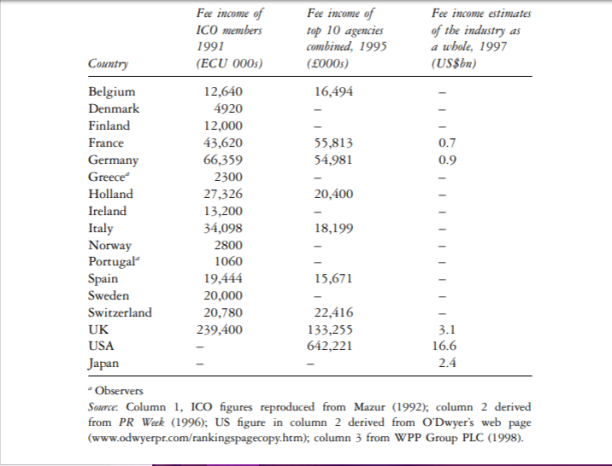
Evidence indicates that PR arose rapidly in tandem with neoliberal policies. Those countries with the most marked privatisation and deregulation from the 1980s onwards – the US, the UK and Japan – had the largest PR industries. By contrast, countries such as France and Germany, which retained significant elements of consensus-based policies and state investment in industry, have much smaller PR industries. The global PR industry is dominated by a few big players, most of which are US or UK in origin and
ownership. 

Relative size of PR agencies in Europe, the US and Japan:
PR US Japan Eu

The expansion and power of Trans National Corporations (TNCs) relative to nation states has been a key spur to the development of communications conglomerates, which provide a full range of ‘promotional’ services and aspire to a global reach.  TNCs’ influence over the policy making process by entering an international market place has also led to a globalising of  the PR industry.

Multinational corporations, particularly in the US, and increasingly in the UK, look for global PR agencies who can operate adaptably and locally, wherever they are needed. 

The consensus in British politics was based on a compromise between organised labour and capital, which was founded on the post war 1945 settlement. This did secure real and significant democratic advances for ordinary citizens in the shape of the NHS, the welfare state, universal education, significant public ownership of utilities and heavy industry and, partly as a result, some amelioration of inequality in wealth distribution.

The end of the consensus in British politics during the New Right era ushered in more competitive politics in which traditions were displaced by a neoliberal tilt to the market in government policy. The crisis of the consensus shifted decisively with the 1979 election of Margaret Thatcher’s government which favoured the role and ‘right’ of employers to ‘manage’, with government rolling back state mediation.  

During the Thatcher era, changes in the communication strategies of the nationalised industries were crucial to the changed relationships between management and workers.  Controversial government actions and policies also led to a vast increase in PR spending by governments and by corporations in their attempts to influence government policy.

Fundamental to this is the relationship between PR, lobbying, and neoliberalism, (particularly the privatisation of national assets and the deregulation of business and service provision in state institutions). There are several parts to this relationship which are interrelated and in some respects, mutually reinforcing. These include:

Lobbying and preparation for deregulation,
• Spending on privatisation by government/nationalised industries,
• Spending by newly privatised companies,
• Spending on promotion by industries and professions following
deregulation,
• Increased spending on PR in the new business climate created by the
deregulation of the City. 

Conservative policies could not work without the PR industry and the PR industry would not have developed in the spectacular way it did without consecutive Conservative governments. The British privatisations of the 1980s were instrumental in the rapid expansion of the PR industry.

Once industries are privatised, PR, corporate identity consultants and advertising are needed to promote the private interests of the companies and as a part of their strategic armoury to create positive public images of them. By the 1990s, accountancy firms also routinely employed lobbying firms.

Lobbying increased deregulation which increased PR spending by encouraging financial institutions to market themselves, and by ‘selling’ the marketing. Nowadays there are no matters for business, government or private interest pressure groups that have not been first addressed by promotional professionals, which has made, in turn, further contribution to shaping economic-political life and profoundly reduced the quality of our democracy. 

PR consultancy and neoliberal ideology are intimately connected, the role of PR has facilitated an institutional corruption in British governance.

The rise of political branding and marketing, where the primary development involves the way political candidates, parties, government, lobbyists and groups have borrowed communication techniques from the private sector in the attempt to achieve strategic objectives like gaining votes, driving public opinion or influencing legislation, is generally regarded to be an Americanisation of campaigning in the UK.

However, the identifiable practices like negative advertising, personalised politics, and high pre-election campaign expenditures are generally more about maintaining a neoliberal status quo, and these methods are a ‘whatever it takes’ approach that are subsequently exported in a pre-packaged box of persuasion techniques to other countries. Political identities are being constructed rather than given, policies are presented on showroom dummies, dressed up in techniques of persuasion. Yet there is evidence to suggest that overexposure to this kind of window dressing and made-over political coverage has contributed towards widespread political alienation.

Image result for pr and democracy

The rise of political marketing with its techniques of ‘spin’, selling and persuasion may have somewhat undermined the credibility of political leaders and institutions,  with the elevation of style over content and image over substance, along with a concomitant  ‘brand and package’ pack mentality political journalism, ultimately leading to hardened public cynicism. We are after all, inhabiting a world dominated by PR operations that leave little place for objective reporting. Every message that the public receives is “sponsored” by someone trying to sell us something – be it a product, a service, a candidate, a government or a legislative act.

The content of the messages is calculated to generate superficial and shallow emotive responses rather than inspiring deliberative, rational and critical thinking. 

It wouldn’t be such a stretch to imagine that, in addition to the reductionist and glib sloganisation of politics, the normalised use of  emotive, negative and ‘attack’ Conservative political advertising may in fact demobilise the electorate, too.

The Conservatives in the ‘war room’ – a case study

The UK Policy Group is the UK branch of a notorious US political organisation – Definers Public Affairs – which has worked for Donald Trump’s administration and has aggressively targeted his critics. The company boasts: “What sets us apart is our focus on political-style research, war room media monitoring, political due diligence and rapid response communications.

“We help our clients navigate public affairs challenges, influence media narratives and make informed decisions to disrupt crowded markets.

“The global political, policy and corporate communications landscapes are evolving rapidly. Decision makers need high quality research to make informed decisions and need relevant content to drive the court of public opinion and provide context to shape decisions by policymakers.

“With affiliates in Washington, D.C., and Silicon Valley, UK Policy Group employs some of the best communicators, researchers and media analysts as part of our team.”

The Conservatives have outsourced their “research” to the UK Policy Group, privatising their dirt digging and smear campaigns. 

US lobbying firm Definers Public Affairs was founded by Mitt Romney’s 2012 presidential campaign manager, Matt Rhoades and former Republican National Committee research director Joe Pounder. Rhoades and Pounder are also directors of UK Policy Group.

Definers made headlines in December 2017 when it was paid US$120,000 in a no-bid contract by the United States Environmental Protection Agency (EPA) to build up dossiers of compromising information on “resistance figures”, opposed to the policy agenda of Scott Pruitt, and Donald Trump, the man who appointed him. Definers cancelled the contract in short order after its activities were exposed. 

UK Policy Group was originally called, and registered with Companies House as, ‘UK Rising’. Rhoades and Pounder are co-founders of America Rising, a political action committee (PAC), that specialises in helping [Republican] party candidates and Conservative groups find damaging information on political rivals. Both companies “craft convincing narratives and focused messaging”.

The expansion by Definers Public Affairs came at a time when US lobbying firms were eyeing UK expansion in anticipation of flood of Brexit-related work.

UK Policy Group’s website unambiguously states it works for ‘corporate clients’, however, not a single one of those running the company has a significant private sector background. In fact, each of the five individuals standing alongside Pounder and Rhoades is intimately connected with the Conservative Party.

Former government officials are advising this highly controversial company. The UK company’s vice president is Andrew Goodfellow, who was the Conservative Party’s director of policy and research. He specialised in ‘opposition’ research.

James Caldecourt was previously a Political Adviser in the Conservative Research Department, also specialising in ‘opposition’ research, and was part of George Osborne’s team while he served as Chancellor of the Exchequer 2010 — 2015. He has worked on several national election and referendum campaigns in political, policy and operational roles. Louis McMahon worked for two tears for two Conservative government ministers, and previously co-authored a criminal justice report for the Center for Social Justice think tank, founded by Conservative MP Iain Duncan Smith MP in 2004.

Ameet Gill, who was the former director of strategy Number 10 and founder of lobbying company Hanbury Strategy, is providing consultancy to the firm. Official documents reveal that David Cameron ’s former director of strategy, Gill, was given permission by parliamentary authorities to accept a contract advising the firm through his political strategy company Hanbury Strategy. Pelham Groom, a company director, was previously head of ‘media monitoring’ for the Conservative Party. Chris Brannigan, Theresa May’s former Director of Government Relations is also a member of the group’s advisory board. Rhiannon Glover is an analyst, formerly, the late duty press officer for the Conservative Party and researcher in the office of Nick Hurd.

The company is also partnered with Trygve Olson, of Viking Strategies, who advised the European People’s Party in the 2009 EU elections and worked as a consultant to the Republican Party in the US.

The company says: “We offer our clients an end-to-end system of research on issues and opponents, monitoring the news cycles, and shaping narratives via rapid rebuttal communications.

UKPG provides our clients with unparalleled campaign-style research as the foundation of driving informed decisions that allow them to shape public opinion, and impact outcomes.”

The company employs people to find damaging information on political rivals. Scrutinising the personal histories, online videos and posts of Labour Party candidates, the company collects dossiers of potential discrediting and smear material to be handed to the Conservative Party. It’s understood that the information is then handed to right-wing websites and newspapers to construct narratives and add a veneer of evidence to negative articles.

The company expansion by US-based company Definers Public Affairs came at a time when US lobbying firms were eyeing UK expansion “in anticipation of flood of Brexit-related work, using their capacity to influence the national news cycle’ and as a ‘master of opposition research”. 

Ian Lavery MP, Labour Party Chair, said: “I am disappointed but not surprised to hear that in an attempt to deflect from their total lack of direction and policy, the Tories are reduced to digging low and dragging British politics through the gutter, in the desperate hope that they may find some salacious morsel.

“This kind of base mudslinging has no place in British democratic debate, and deflects from the real issues facing people today. It is time that Theresa May stops spending money and effort on these tactics and focuses on policies to improve the lives of those who have suffered because of her government’s heartless policies.”

It may be argued that there are communications requirements of modern democracies. However, a representative democracy requires that political communication is dialogic – it flows in both directions between government and people. In fact that is a prerequisite. Instead we witness a manipulative neoliberal monologue from the current administration.

Neoliberal Conservative governments and the PR industry are very closely aligned, each profiting from the other. The condition of the spectacular growth of the PR and lobbying  industry was to facilitate and profit from the marked redistribution of wealth from the poorest citizens to the rich, establishing, elevating and securing the prioritisation of the private interests and power base of the 1% over and above – and at the expense of – public interests.

Image result for pr and democracy chomsky


I don’t make any money from my work. I’m disabled through illness and on a very low income. But you can make a donation to help me continue to research and write free, informative, insightful and independent articles, and to provide support to others. The smallest amount is much appreciated – thank you.

DonatenowButton

Journalism in the UK is under threat from a repressive, authoritarian government

media networks on Twitter

Media network community, from The University of Exeter’s study – Different News for Different Views: Political News-sharing Communities on Social Media Through the UK General Election in 2015

In the 2018 World Press Freedom Index, an annual report produced by Reporters Without Borders (RSF), Britain was judged to have been in 40th place. This compared to Norway and Sweden at the top of the index, with the UK placed below Trinidad and Tobago and only just ahead of Taiwan. The United States is also trailing, to the dismay of US media organisations, at 45 on the list (with North Korea in bottom place, at 180). 

The Index is based on an evaluation of media freedom that measures pluralism, media independence, the quality of the legal framework and the safety of journalists in 180 countries. It is compiled by means of a survey questionnaire in 20 languages that is completed by experts all over the world. This qualitative analysis is combined with quantitative data on abuses and acts of violence against journalists during the period evaluated.

Last year, the World Press Freedom Index report said“The election of the 45th president of the United States set off a witchhunt against journalists. Donald Trump’s repeated diatribes against the Fourth Estate and its representatives – accusing them of being “among the most dishonest human beings on earth” and of deliberately spreading “fake news” – compromise a long US tradition of defending freedom of expression. The hate speech used by the new boss in the White House and his accusations of lying also helped to disinhibit attacks on the media almost everywhere in the world, including in democratic countries.”


Britain’s ranking, from the World Press Freedom Index 2018

The recent report has drawn attention to several issues that may have contributed to the UK’s place in the ranking. It says: “A continued heavy-handed approach towards the press (often in the name of national security) has resulted in the UK keeping its status as one of the worst-ranked Western European countries in the World Press Freedom Index.” 


Related 

The erosion of democracy and the repression of mainstream media in the UK

The BBC’s ‘churnalism’ and the government’s PR and strategic communications crib sheet 

Inverted totalitarianism and neoliberism 

Dishonest ways of being dishonest: an exploration of Conservative euphemisms

Once you hear the jackboots, it’s too late


I don’t make any money from my work. I write because I must. You can make a donation to help me continue to research and write free, informative, insightful and independent articles, and to provide support to others. The smallest amount is much appreciated – thank you.

DonatenowButton

A response to Guido Fawkes about his despicable use of my photosensitive seizures to score nasty political points

Image result for photosensitive scotoma

Migraine aura: scintilating scotoma

Yesterday I contacted the Labour party about their Labour Live event promotion video because it made me ill, causing a partial seizure. The video didn’t carry a warning about the flashing images it contained. I have had an apology from Jennie Formby on behalf of the Party, and it looks like the video has been taken down. The response came within a couple of hours of my contacting her. I feel that’s a very reasonable and rapid response. I was concerned that the video may trigger seizures in other people who are susceptible, too. 

I contacted Jennie on Twitter, as well as sending a direct message to the Party, and an email. The Tweet received a prompt response, for which I am very  grateful. I figured the Labour party get many emails and it may take a while for mine to be seen. 

It’s highly likely that the Labour party hired a communications and media company to undertake making the promotion video. So this issue needs to be addressed with those who actually did the work in putting the video together, too. 

I do feel the Labour party have responded appropriately. Although my hypersensitivity to flickering and flashing images and light is quite rare, it does make my time on social media very difficult. I only wish that Facebook and Twitter would respond as quickly to my complaints about the abundance of flashing GIFs that I encounter online, which sadly make me very ill, and can incapacitate me for days on end.

I also had the following excellent email response yesterday morning from the Labour Party:

Dear Sue,

Many thanks for your email. Thanks also for your support for the Labour Party – together we truly can build a Britain for the many not the few.

I am deeply sorry to hear that the video had this effect on you. I have noted your concerns and feedback and passed these onto the relevant team. They will factor this into any future video content we create. 

Many thanks for letting us know – it is very important to us that we can create video content that is accessible to all.

Best wishes,

Maria

Membership Services and Correspondence

The Labour Party.

I am more than happy with that swift response, because it indicates a party that cares about inclusion, and is more than willing to take responsibility for ensuring their material is up to a high health and safety standard. My condition isn’t very common, I guess I represent what you would call a very small minority group. Yet the Labour party have gone out of their way to ensure my wellbeing, and the safety of those who have the same level of sensitivity to flickering and flashing images. And best of all, the information I provided will be applied to released video material by the Party in future. That’s a very good outcome. 

All the more reason why I’m not happy that Guido Fawkes (AKA Paul Staines, the right wing politico gossip- monger) has used my illness to try and score political points. I am unusually very sensitive to flickering and flashing images, and don’t feel it’s appropriate to use someone’s illness and misfortune to make a tenuous attack on the Labour party. Or my account details, for that matter. In fact it’s a despicable thing to do.

I have requested that he removes the Tweet.

I have to say that it’s to their credit that Labour responded so quickly to my message.

I have a rare condition and don’t blame the makers of the video for being unaware of that. The Party responded promptly and appropriately. Unlike Facebook and Twitter, who have never responsed to my previous complaints about the flashing images that are frequently posted around social media. Christmas and New Year were particularly difficult for me on Facebook, for example, because of well meaning people sending me flashing images with their Christmas greetings. It caused me so much difficulty that I had to avoid my inbox for a couple of weeks. That’s because I am very very sensitive to flickering lights and flashing colours. Unfortunately such images can leave me ill and incapacitated for days.

Visual reflex seizures induced by complex stimuli may be triggered by patterned and flashing displays that are now ubiquitous, especially on social media. This said, ordinary fluorescent lighting, driving, walking past railings, moving escalators, looking at ripples on a pond and some geometric patterns may also trigger illness and seizures in some people who are particularly sensitive. I’m an individual who is unfortunately both photosensitive and pattern-sensitive, though I haven’t always been.

Sometimes, in susceptible people, seizures can happen because of the properties of video displays, the triggers are identified as perceived brightness, pattern, flicker frequency, and colour contrasts. 

Fawkes is a nasty gossip-mongering vulture, who will use anything he can to promote his vicious right wing views, while  being among the first in line to attack a “snowflake” like me. Some of his equally virulent followers commenting on the thread under his post thought my seizure was hilarious. 

That’s pretty low to stoop, even for someone who is a master at consistently clearing the pole in right wing moral limbo dancing competitions. 

A little about photosensitive and pattern-induced illness and seizures

Not everyone who has seizures because of flickering and flashing images has epilepsy. I don’t. Photosensitive epilepsy is quite rare, it’s a type of epilepsy, in which all, or almost all, seizures are triggered by flashing or flickering light. Only one in a hundred people with epilepsy have the photosensitive type of epilepsy. That’s a very small percentage of the population. However, some people complain that flashing imagery makes them feel generally unwell, too. A few people experience dizziness and nausea, but don’t have seizures. Others have flashing or flicker-induced migraines. I also suffer from migraines.

Both natural and artificial light may trigger seizures. In my case, it is thought that an illness I have called lupus has caused neurological changes that have led to the photosensitivity problems I experience. At first, I was diagnosed with classical migraine, as there is an overlap with seizure symptoms. An “aura” is common for both, which includes scotoma – a kind of temporary blindness, or ‘holes’, or sparkling shapes that take up large parts of people’s field of vision, severe vertigo, confusion, extreme mood and perception changes, coordination and speech difficulties, tingling and numbness, nausea and so on. Often there is muscle rigidity and twitching, or jerking. In my case, this usually affects my legs when it happens. Sometimes people lose consciousness during an attack, too.

My own symptoms started at the same time as the onset of the wider symptoms of lupus – susceptibility to infections, joint and tendon pain and inflammation, nerve pain, blood abnormalities and so on. Lupus is an autoimmune disease that can affect many organs and parts of the body. Very often it includes skin photosensitivity too, many of us develop a severe rash and illness in sunlight, even when we wear a sunblock.

Various types of seizure can be triggered by flashing or flickering light. These include tonic-clonic, absence, myoclonic and focal seizures. The most common is a tonic-clonic seizure. The seizure(s) will usually happen at the time of, or shortly after, looking at the “trigger.” Sometimes people may experience more than one kind of seizure, too. 

Again, photosensitive seizures affect a very small percentage of the population. Epilepsy -related forms of the condition usually begins before the age of 20, most commonly between the ages of seven and 19. Photosensitive epilepsy affects more girls than boys. 

The exact spacing of a pattern in time or space is important and varies from one individual to another: a person may readily experience seizures when exposed to lights that flash seven times per second, but may be unaffected by lights that flash twice per second or twenty times per second. Stimuli that fill the entire visual field are more likely to cause seizures than those that appear in only a portion of the visual field. 

Stimuli perceived with both eyes are usually much more likely to cause seizures than stimuli seen with one eye only (which is why covering one eye may allow people to avoid seizures when presented with visual challenges). Some people are more sensitive with their eyes closed; others are more sensitive with their eyes open.

Not everyone who experiences seizures through flicker sensitivity has epilepsy. A seizure without a known cause is called an “idiopathic” seizure. Those are the kind that I suffer from, though I am currently seeing a neurologist to try and work out why I am having the seizures. I have had an MRI scan to see if there are any brain lesions or inflammation, caused by the lupus, and I am waiting for some further tests.

A seizure is the result of experiencing a surge of electrical activity in the brain. The electrical disturbance can, as outlined, produce a variety of physical symptoms.

UK television broadcasters and studios now screen content through the Harding FPA Test, an objective standard of assessment of potential to trigger seizures in those susceptible to photosensitive seizures. I’d like to see social media platforms use the same standard of testing on GIFs and other moving images.

It’s now thought (by my GP) that my sensitivity to flickering has happened because of how lupus has affected my neurological system. I developed lupus during a pregnancy in my thirties. I’m so sensitive to flickering that I can’t drive, as lamp posts, trees and telegraph posts along the road act like a strobe light in a moving car, and trigger severe symptoms, such as the scotoma, which causes temporary blindness, severe vertigo, confusion, coordination difficulties and partial seizures. I can’t even walk past railings without experiencing problems, moving escalators also make me ill, and more recently, some geometric shapes with highly contrasting colours, like black, red and /or white stripes, have made me ill, too.

The word hertz (Hz) refers to how often something happens in a second. For example, it can mean the number of times something flashes or flickers in one second. It can also mean the number of times the scanning lines on televisions and computer monitors ‘refresh’ themselves in one second.

Most people with photosensitive epilepsy are sensitive to 16-25 Hz. Some people may be sensitive to rates as low as 3 Hz and as high as 60 Hz. I’ve yet to find out what ranges I am sensitive to. I know that a visible flicker on fluorescent lighting triggers seizures.I

I think a campaign to make social media a more “friendly” place for people like me would be a good thing.

I hope this article will help to raise awareness of this condition, which is extremely intrusive, restrictive and distressing.

Ways to reduce the risk of seizures if you have photosensitive epilepsy

  • Avoid looking at anything that you know may trigger a seizure. (Not aways easy!)
  • Avoid things that can increase your risk of having a seizure. These can include feeling tired or stressed, not having enough sleep, low blood sugar and drinking alcohol.
  • If you take epilepsy medicine, always take it as prescribed by your doctor.
  • If you look at something that might trigger a seizure, don’t close your eyes. This could increase your risk of having a seizure. Instead, immediately cover one eye with the palm of your hand and turn away from the trigger. This reduces the number of brain cells that are stimulated and reduces the risk of a seizure happening.

Related

One of the key reasons I have faith in the Labour Party, and give them my continued support, is their policies, which are inclusive, recognise the value of diversity and treat everyone’s life as having equal worth. This is such a stark contrast to Conservative policies, which emphasise competitive individualism and an elitist perspective of society, which is profoundly isolating, socially divisive and leads to exclusion and outgrouping.

This in particular impressed me last year, released in the run up to the general election –  Nothing about you without you – the Labour party manifesto for disabled people


I don’t make any money from my work. I’m disabled through illness and on a very low income. But you can make a donation to help me continue to research and write free, informative, insightful and independent articles, and to provide support to others. The smallest amount is much appreciated – thank you.

DonatenowButton

David Lammy on Oxford elitism and his responses to racist comment on social media

Image result for david lammy oxford

David Lammy

Oxford University has published data about its undergraduate admissions for the first time. The figures showed a continuing inequality gap in offered opportunities to study based on race and economic status. 

The 850-year-old university published data that was intended to challenge the views that it endured as a place of white, wealth-driven privilege and elitism.

The statistics offer some very worrying insights into a clear lack of representative diversity among undergraduate admissions. In a breakdown of admissions to the 29 individual colleges that are the blocks of Oxford’s academic structure, eight — including some of the most prestigious — failed to admit a single black Briton in one or more of the years from 2015 to 2017.

Oxford University has had to apologise to David Lammy after retweeting a post labelling his legitimate criticism “bitter”.

The original tweet, sent by a student, was in response to the Labour MP saying Oxford was “a bastion of white, middle class, southern privilege”.

Lammy asked if the tweet represented the university’s official position – at which point a senior staff member apologised and took responsibility.

Cherwell, a student newspaper at Oxford, reported on Wednesday that the university had admitted more students in 2017 from a single London private school, than it had admitted black undergraduates from the rest of Britain. .

Lammy’s original remarks came as Oxford University data revealed that eight of its 29 colleges included in the report accepted fewer than three black applicants in the past three years.

The university has a total of 38 colleges and permanent private halls. The university said it was “not getting the right number of black people with the talent to apply”.

Director of undergraduate admissions, Dr Samina Khan, said she was “pushing hard” on outreach activity to make sure those students felt welcome.

The proportion of Oxford students identifying as black and minority ethnic was 18% in 2017, up from 14% in 2013. However, that figure still falls below the wider UK university average of 25%.

The most recent UK census showed 14% of the UK population identifies as black or minority ethnic. Data in the university’s report showed that, of the students that achieved three ‘A’ grades or higher in their A-levels nationwide, 20% identified as black and minority ethnic.

One college, Corpus Christi, which has around 350 students, admitted just one black student resident in the UK in its 2015-2017 intakes. Balliol college, which has around 680 students, admitted two black and minority ethnic students over the same period, despite receiving 46 applications.

The number of admissions from state schools, during the same period, rose by just 1%, from 57% to 58%. 

Oxford’s intake also displayed a substantial geographic imbalance between the north of Britain and the more affluent south. London and the South East made up 46.7% of UK applications between 2015 and 2017, (and 47.9% of students admitted) while the North East accounted for 2% (2.3% admitted).

“Oxford reflects the inequalities — socio-economic, ethnic and regional — that exist in British society,” Louise Richardson, the university’s vice chancellor, said in a foreword to the report.

The picture that emergesis of a university which is changing: evolving fast for an institution of its age and standing, but perhaps too slowly to meet public expectations. It is a picture of progress on a great many fronts, but with work remaining to be done,” she added

In a section titled Key Points, the report focused on progress in admissions, including “more women admitted than men in 2017” and higher proportions of undergraduate admissions among groups that were traditionally disadvantaged.

According to the Cherwell article, “17 of the top 20 schools for Oxford admissions in 2017 are fee-paying, while the other three are prestigious grammar schools.” Additionally, the newspaper said, state-educated students tended to apply to the most oversubscribed subjects, lowering their prospects, while applicants from private schools tended to apply to less sought-after courses, such as classics or modern languages. 

Lammy, a former education minister who has campaigned against what he has called “social apartheid” at Oxford, said the latest figures showed that the university was “an institution defined by entrenched privilege that is the preserve of wealthy white students from London and the Southeast.”

Lammy previously accused the university of “social apartheid“, after a Freedom of Information (FoI) request by him revealed 10 out of 32 Oxford colleges did not award a place to any black British pupil with A-levels in 2015.

This prompted more than 100 MPs to write to Oxford and Cambridge urging the universities to recruit more students from disadvantaged and under-represented backgrounds.

Reacting to the latest figures, Lammy said the problem was “self-perpetuating”.

He added “If you’re on the 20th floor of a tower block estate and you’re getting straight A’s, you apply, go for a difficult interview.. you don’t get in, then none of the other kids apply the following year.”

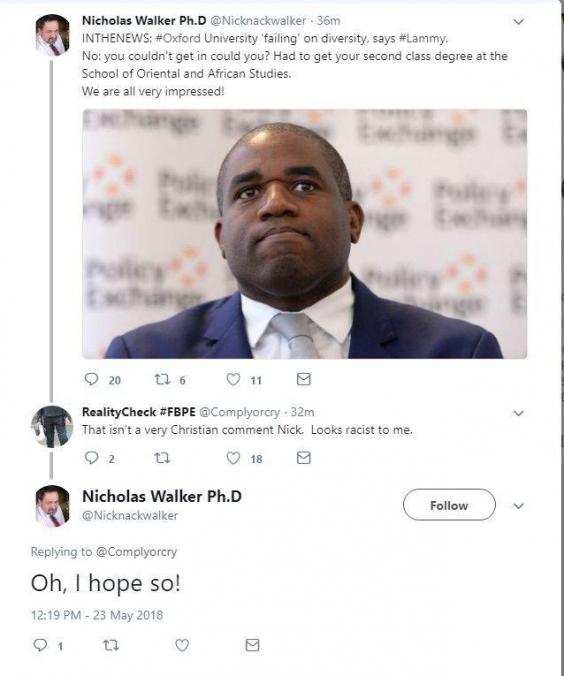
Some of the responses on Twitter to Lammy’s reasonable and empirically evidenced comments are dismally and appallingly racist:

lammy1.jpg

Walker has since deleted his tweet, following Lammy’s neat shot response:

And then this oik piped up:

And the response:

A spokesperson for Lammy recently told the BBC: “David regularly receives abusive and malicious communications, often of a racist nature.

“All such letters are passed onto the police. As David has made clear, receiving racist abuse will not have any impact on his work.”

In April, the Labour MP posted an image of a letter he received after he criticised the government’s handling of the deportation of Windrush migrants.

The offensive note told  Lammy to “be grateful that we have taken you in as a black man” and suggested he “go back to your country”.

Lammy pointed out that he was born in Whittington Hospital in north London.

He shouldn’t have had to. It’s a disgrace in a so-called civilised society that anyone has to confront racist and abusive comments. The barrage of hate that Lammy and others are subjected to on a regular basis is in part a product of an increasingly divided and prejudiced society. One which the government has contributed to by role modelling prejudiced and discriminatory behaviours, which in turn signals permission for citizens to do the same.

As Lammy says: “At root the hostile environment is a policy rooted in pernicious cruelty designed to make life so difficult for people who are here legally that they simply give up and, as suggested by Theresa May’s vans, “go home”. (…) A minister falling on their sword is usually an attempt to draw a line under a scandal and encourage the media to move on.

“But the person sat in the hot seat at the Home Office makes no difference to the thousands of people suffering as a result of the hostile environment policy. An unjust law is no law at all. The Windrush generation will not get justice until it is the law that is changed, not just the home secretary.” 

Attitudes, behaviours and ideologies that foster division, inequality, prejudice  and discrimination must also change. 

That is unlikely to happen under a Conservative government


I don’t make any money from my work. I’m disabled through illness and on a very low income. But you can make a donation to help me continue to research and write free, informative, insightful and independent articles, and to provide support to others. The smallest amount is much appreciated – thank you.

DonatenowButton

Research shows that Tory ‘hostile environment’ of welfare sanctions doesn’t help people to find work

Image result for welfare sanctions

The UK’s most extensive study of welfare conditionality has found that welfare sanctions are “ineffective” at “supporting” people into work and are more likely to reduce those affected to poverty, ill-health or survival crime. 

Despite dogmatic claims by Conservative ministers in recent years that rigorously enforced conditionality – including mandatory 35-hour job searches – “‘incentivised’ claimants to move off benefits into work”, the research found the positive impact was negligible.

The Economic and Social Research Council-funded study of welfare conditionality was carried out between 2013 and 2018 by researchers at six universities. It included repeat qualitative interviews over two years with 481 welfare service users in England and Scotland as well as interviews with 57 policy experts and 27 focus groups.

The five-year research programme that has been following the lives of hundreds of claimants concludes that the controversial policy of cutting benefits as a punishment for alleged failures to comply with jobcentre rules has been “little short of disastrous.”

For those people interviewed for the study who did gain employment, the most common outcome was a series of short-term, insecure jobs, interspersed with periods of unemployment, rather than a shift into sustained, well-paid work.

Sanctions generally delivered poor outcomes, including debt, poverty and reliance on charities such as food banks, the study found. Often imposed for trivial and seemingly cruel reasons, they frequently triggered high levels of stress, anxiety and depression.

The director of the study, Professor Peter Dwyer, based at the University of York, said “The outcomes from sanctions are almost universally negative.” 

One research finding is that, in many cases, the threat of sanctions had the unintended effect of encouraging a “culture of counterproductive compliance and futile behaviour” among some claimants, who learned “the rules of the game” rather than becoming genuinely “engaged with work.”  This of course is through necessity, as social security payments are claimed by people who need support to meet their basic survival needs: welfare (barely) covers the costs of food, fuel and shelter. 

The authors of the research paper conclude: “Benefit sanctions do little to enhance people’s motivation to prepare for, seek or enter paid work. They routinely trigger profoundly negative personal, financial, health and behavioural outcomes.” 

Many campaigners, including myself, have been pointing this out for years. It’s a fundamental truth – established by Abraham Maslow, and verified by a range of comprehensive studies, including the Minnesota semi-starvation experiment – that if people cannot meet their basic survival needs, that becomes their “cognitive priority” – their primary motivation. People caught in absolute poverty cannot then higher level psychosocial needs, until their basic survival needs are met. It takes a monstrously authoritarian government to ignore these empirical facts and to continue to punish citizens by withdrawing their fundamental means of survival.

The researchers call for a review of the use of sanctions, including an immediate moratorium on benefit sanctions for disabled people who are disproportionately affected, together with an urgent “rebalancing” of the social security system to focus less on compliance and more on helping claimants into work. 

The research report says that in the “rare” cases where claimants did move off benefits into sustained work, personalised job support, not sanctions, was the key factor. With few exceptions, however, jobcentres were more focused on enforcing benefit rules rather than helping people gain employment.

“Although some examples of good practice are evident, much of the mandatory job search, training and employment support offered by Jobcentre Plus and external providers is too generic, of poor quality and largely ineffective in enabling people to enter and sustain paid work,” the report says.

It’s very worrying that the research highlighted those citizens with “chaotic lives” – who were homeless or had addictions, for example – reacted to the “inherent hassle” of the conditionality system by dropping out of the social security system altogether. In some cases, they moved into survival crime, such as drug dealing.

Low-paid workers on universal credit who were subject to so-called “in-work conditionality” – a requirement for them to work more hours or face sanctions – in some cases elected to sign off, foregoing rent support and tax credits, to avoid what they saw as constant, petty harassment from jobcentre staff.

Welfare conditionality – the notion that eligibility for benefits and services should be linked to claimants’ compliance with certain rules and behaviours – has been progressively embedded into the UK social security system since the 1990s, although the scope and severity intensified dramatically after 2012, when the Conservative-led coalition “reformed” the welfare system.

Sanctions are imposed when claimants supposedly breach stringent jobcentre rules, typically by failing to turn up for appointments on time, or at all, or for failing to apply for “enough jobs”. They are effectively fined by having their benefit payments stopped for a minimum of four weeks (about £300) and a maximum of three years. This means that money to meet their basic living requirements is cut. 

At its peak in 2013, under the then secretary of state for work and pensions, Iain Duncan Smith, there were more than a million sanctions. Between 2010 and 2015, a quarter of all people on jobseeker’s allowance were sanctioned, with the Department for Work and Pensions (DWP) issuing £132m in sanctions penalties in 2015.

Sanctions fell to 350,000 in 2016 as a series of critical reports emerged questioning their effectiveness and calling for changes, including from the all-party work and pensions select committee, the DWP’s social security advisory committee and the National Audit Office.

fresh inquiry by MPs into sanctions is under way.

Dalia Ben-Galim, the policy director at the single parents’ charity Gingerbread, said: “Rather than threatening single parents with sanctions and widening the ‘conditionality’ agenda, it would be much more valuable to enable the conditions to support employment such as affordable childcare, access to flexible work and personalised support through job centres.”

A DWP spokesperson said: “Our research shows that over 70% of JSA claimants say sanctions make it more likely they will comply with reasonable and agreed requirements, and it is understandable that people meet certain expectations in return for benefits.

I wonder if this was a reference to the DWP “case studies” made up of fictitious characters and testimonies, as uncovered by Welfare Weekly ?

The DWP spokesperson continued with platitudes: “We tailor requirements to individual cases and sanctions are only used in a very small percentage of cases when people fail to meet their agreed requirements set out in their claimant commitment.”

Labour’s shadow secretary for work and pensions Margaret Greenwood said: “The current sanctions system is immoral and ineffective. It is not helping people into employment and at the same time is leaving vulnerable people on the brink of destitution, without any source of income for long periods.”

The authors of the report further conclude that the DWP’s sanctions regime:

“…compromises attempts to end child poverty. At best, current practice fails to support lone parents in the way proposed; at worst, it compounds the disadvantage they already face. The ethical legitimacy of the present system is highly questionable as a consequence.”

wrote in 2015:

Conservative anti-welfare discourse excludes the structural context of unemployment and poverty from public conversation by transforming these social problems into individua ones of ‘welfare dependency’ and ‘worklessness.’ The consequence is an escalating illogic of authoritarian policy measures which have at their core the intensification of punitive conditionality.

Such policies and interventions are then rationalised as innovative […] ultimately the presented political aim is to ‘mend’ Britain’s supposedly ‘broken society’ and to restore a country that ‘lives within its means’… bringing about a neoliberal utopia built on ‘economic competitiveness’ in a ‘global race.’

Disadvantage has become an individualised, private matter, rather than […] an inevitable feature of neoliberal […] competitive individualism. This allows the state to depoliticise social problems, while at the same time, justifying […] changing citizens’ behaviours to fit with neoliberal outcomes.

The government’s policies, founded on scapegoating already marginalised social groups, and creating “hostile environments” for the poorest citizens, including those with disabilities, who have been disproportionately weighed down with the burden of austerity, have caused immeasurable human suffering and untold damage to the very fabric of what was once a civilised society.

The answer to the problems generated by the politically imposed system of neoliberalism that fails the majority of citizens, according to the dogmatic government, is to apparently apply even more rigid neoliberal policies as an almost farcical sticking plaster. 

The Conservative’s answer to social problems such as inequality and poverty, which own policies createand extend, is to impose ideologically formulated “behavioural change” programmes on the poorest citizens, as a prop for dismally failing neoliberalism. All authoritarians are bullies and all bullies aim to change the behaviours of others. This technocratic and authoritarian approach to policy always entails the creation of scapegoats that the government then punish.

In 2002, as party chairwoman, Theresa May told the Conservatives that they were seen as the “nasty party”. Sixteen years later and under her premiership, that description of  an authoritarian and rigidly ideologically driven government has never been more apt.

Related

The politics of punishment and blame: in-work conditionality

Disabled people are sanctioned more than other people, according to research

The connection between Universal Credit, ordeals and experiments in electrocuting laboratory rats

Nudging conformity and benefit sanctions

G4S are employing Cognitive Behavioural Therapists to deliver “get to work therapy”

The new Work and Health Programme: government plan social experiments to “nudge” sick and disabled people into work

The importance of citizen’s qualitative accounts in democratic inclusion and political participation

Sanctions can’t possibly “incentivise” people to work. Here’s why


I don’t make any money from my work. I am disabled because of illness and have a very limited income. But you can help by making a donation to help me continue to research and write informative, insightful and independent articles, and to provide support to others. The smallest amount is much appreciated – thank you.

DonatenowButton

Neoliberalism has failed: Labour’s ideas are the new mainstream – John McDonnell

One of Corbyn’s most important achievements is in extending national debate beyond the limits of neoliberal ideology and challenging the hegemony imposed by Margaret Thatcher. The sell by date of neoliberal dogma was last century, it ought to have expired in Pinochet’s Chile. Yet the Tories continue to flog a dead horse, selling England by the pound, while selling the public very short indeed.

The Tories have frequently shrieked, with vindictive and borderline hysterical relish, that Labour’s pro-social economic policies reflect “fiscal irresponsibility”, but that doesn’t resonate with the government’s calamitous economic record over the past seven years. Nor does it fit with historic facts and empirical accuracy. 

The Labour party were in power when the global crash happened. The recession in 2007/8 in the UK was not one that happened as a direct consequence of Labour’s policies. The seeds of The Great Recession were sown in the 80s and 90s. The global crisis of 2008 was the result of the financialization process: of the massive creation of fictitious financial capital and the hegemony of a reactionary ideology, neoliberalism, which is based on the fatally flawed assumption that markets and humans are self-regulating and efficient. 

The New Right argued that competition and unrestrained selfishness was of benefit to the whole society in capitalist societies. It asserted that as a nation gets wealthier the wealth will “trickle down” to the poorest citizens, because it is invested and spent thereby creating jobs and prosperity. In fact the global financial crisis has demonstrated only too well that financial markets provide opportunities for investment that extend relatively few extra jobs and that feed a precarious type of prosperity that can be obliterated in just a matter of days. 

Labour’s second State of the Economy conference returned to Imperial College in London over the weekend. It confirmed that it is the ideas of the left that are now making the running. Eminent academic economists joined with council and business leaders, and hundreds of ordinary activists to debate and discuss how we can create the economic alternative that is now so urgently needed.

The Labour party has called out the accounting profession, pledging to eradicate poor practices following high-profile corporate collapses. John McDonnell, shadow chancellor, said on Saturday that the collapse of Carillion and a subsequent MP-led investigation into the outsourcing company’s demise had highlighted the “catastrophic failure and inadequacy” of the UK’s regulatory regime, as well as shortcomings in the audit market.

McDonnell said Labour had commissioned an independent review of how Britain’s audit market operates, including how it is policed by regulators. The review will be led by Prem Sikka, a professor of accounting at the University of Sheffield and an outspoken critic of the Big Four audit firms: PwC, Deloitte, KPMG and EY.

The review will examine whether existing regulatory bodies should be merged, abolished or restructured, and will consider the appropriate level of fines for accounting firms when misconduct is exposed. McDonnell said Carillion’s collapse demonstrated that the accounting and pensions regulators “have once more failed to do their jobs” and that “accountants and auditors seem to operate with impunity whilst lining their pockets”. 

McDonnell said “The lack of openness, transparency and accountability means nobody ever seems to be punished for their transgressions,” he said. “We have seen it all before. We still await proper investigation of the accounting and auditing shortcomings which led to the banking crash ten years ago.”

The independent review will also focus on the fact that the financial sector has at least 29 overlapping regulators. “This regulatory maze creates enormous opportunities for waste, duplication, obfuscation and buck-passing,” McDonnell said.

“It does not protect consumers or promote confidence. “We need a complete overhaul of the entire regulatory framework for finance and business, to promote openness, transparency, accountability and — where necessary — to impose appropriate punishments,” he added. “There will be no more Carillion scandals on Labour’s watch.”

McDonnell went on to say: “The tide of history has turned against the old neoliberal way of thinking. These ideas – Labour’s ideas – are becoming the new mainstream. Put into place, the next Labour government will build an economy for the many, not the few.”

Just this week, East Coast Mainline was taken out franchising for the third time, and the Treasury Select Committee condemned the directors of Carillion for “stuffing their mouths with gold” whilst the company collapsed. Both are damning examples of how the belief in government that markets and privatisation are the best way to organise society – the ideas of neoliberalism – have failed all but a very few at the top.

Too many governments, influenced by neoliberalism, have viewed effective corporate regulation as a barrier to prosperity, not an essential support. The result is a regulatory system that is not fit for purpose. The financial sector alone has at least 29 overlapping regulators, including the Faculty Office of the Archbishop of Canterbury.  The four big accountancy firms dominate the market and operate seemingly with impunity, as the collapse of Carillion demonstrated. Whether their clients win or lose, the big four always seem to ensure they themselves make a profit.

People are sick of losing their jobs, their pensions and their shareholding from corporate failures, but watching the culprits keep their large pay offs, pension pots and bonuses.  So I have asked Professor Prem Sikka to examine our regulatory system and bring forward proposals for reform to reinvigorate it.

Labour’s core economic objective is to create a prosperous economy that provides the richest quality of life possible for all our people, with its wealth produced in an environmentally sustainable manner. That means demonstrating how we can create the wealth needed to support this society in the new era of the fourth industrial revolution. And it means showing how we can confront the urgent, existential threat of climate change.

We need to secure major institutional changes to deliver the long-term, patient investment needed in new technologies, which is why Labour will create a National Investment Bank and transform our financial system, ending the excessive focus on short-term gains.

But it also means showing how that wealth can be fairly and sustainable shared. Our structural reforms are aimed at securing what Tony Benn described as an “irreversible shift in wealth and power in favour of working people”.

So we will democratise our economy at every level, massively scaling up the co-operative sector and introducing a “Right to Own” for workers when their companies are up for sale or threatened with takeover. It will require corporate governance reform, giving workers representation on company boards. We will restore trade union rights at work, and are exploring examples of legislation used elsewhere to enable profit sharing and share distribution. The wealth that our society produces includes the data we generate, and Labour will be exploring over the coming months ways in which that wealth can be put back into the hands of those who produce and use it.

Above all, it means improving the quality of people’s lives – not just in improving pay and giving people secure jobs, but in the human quality of people’s relationships and their free time.

We should work to live, not live to work, but under neoliberalism in Britain we seem to have got things the other way round. We work some of the longest hours in Europe to compensate for low investment and low productivity. A British worker produces in five days what a French or German worker produces in four.

As we invest and improve productivity we should look again at how we can reduce working hours, giving people more time for leisure and family life. The great promise of automation and the fourth industrial revolution is that we can liberate people from drudgery at work. But that will not happen without a government committed to making it happen, and able to assess its progress not only against the usual measures of success like GDP, but on metrics that show meaningful impacts for people – like real wages and inequality, and environmental protection, as the Institute for Public Policy Research has recommended.

The tide of history has turned against the old neoliberal way of thinking. These ideas – Labour’s ideas – are becoming the new mainstream. Put into place, the next Labour government will build an economy for the many, not the few.”

John McDonnell is Shadow Chancellor and MP for Hayes and Harlington

Related


Jeremy Corbyn’s greatest success is the discrediting of neoliberalism

Neoliberalism and corruption: hidden in plain sight

Neoliberalism, PR and spinning inverted totalitarianism


I don’t make any money from my work. I’m disabled through illness and on a very low income. But you can make a donation to help me continue to research and write free, informative, insightful and independent articles, and to provide support to others. The smallest amount is much appreciated – thank you.
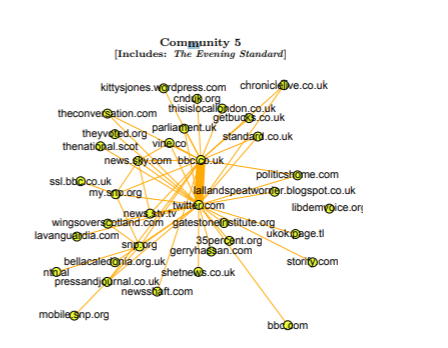
DonatenowButton


The revolving door of disability assessments and appeal is still killing people who are chronically ill


Sandra Burns

Sandra Burns

Social security was originally designed to ensure that everyone was protected from the worst ravages of unfettered capitalism. To say that we have regressed as a society since then is an understatement. 

‘Behavioural economics’ are currently embedded within our current welfare system. This is a technocratic solution to essentially politically created problems. It addresses social problems by simply shifting the blame and responsibility from state to individual. This has led to an increasingly punitive social security system, aimed at pushing people into employment, regardless of whether or not they are able to work. ‘Nudge’ is increasingly being used by an authoritarian Conservative government to ensure citizens behaviours are aligned with neoliberal ideology and policy outcomes.

People who are chronically ill are suffering terribly because of the government’s anti-welfare ideolology. Yet most of us have paid tax and National Insurance to ensure that we have access to social security if or when we need it, only to find that the hostile environment created by by the government has made claiming support an ordeal. 

Back in 2013, I wrote about the terrible impact of  stressful, continuous work capability assessments on disabled people, particularly those with chronic illness. It’s long been understood that stress exacerbates the symptoms of illness. 

Many people have described a “revolving door” process of endless assessment, ceased ESA claim, (based on an outcome of almost invariably being wrongly “assessed” as fit for work), appeal, successful appeal outcome, benefit reinstated, only to find just three or four months later that another assessment is required.

The uncertainty and loss of even the most basic financial security to meet the bare necessities to survive that this process creates, leading to constant fear and anxiety, is having a damaging, negative impact on the health and wellbeing of so many. It’s appalling that in a first world so-called liberal democracy, sick and disabled people are being punished for being ill and disabled by a system that was originally intended to support them in meeting their most basic living costs.

Five years on, nothing has changed. People are still dying because of a system that is fundamentally flawed and not fit for purpose. The government are not listening to us. 

I write all too regularly about disabled citizens who have been treated brutally because of Conservative policies, many who have died as a consequence of a system that is intentionally designed to punish people for their need. 

I’m saddened to report that disabled woman has died from a heart attack after she was repeatedly refused vital financial support following disability assessments carried out by a private benefits firm, Atos, over a five year period. 

Sandra Burns, who lived in Luton, was found dead at the bottom of the stairs at her home on 16 April. She was surrounded by letters from the Department of Work and Pensions (DWP) and overdue utility bills, having suffered what is believed to be a massive heart attack. 

Sandra’s brother, Ian, told Luton Today: “She was found dead at the foot of her stairs, apparently of a massive heart attack. 

“She was surrounded by letters informing her that the gas, electricity, water, telephone and television were all in danger of being cut off.” 

“This debt and anxiety lay all around her on the floor”.  

Ian also said that the stress of the process had a degenerative impact on Sandra. He says that the work assessments were “punitive” and that they “ignored the comments of her GP”.

“These appeals would take six to eight months. Every single time, she won the appeal and got a backdated payment. But in that period, she would get into debt and lose her credit rating. 

“And then she’d get back on an even keel until the next year, when the same thing would happen,” he added.

Sandra, who was 57, had worked in retail for 30 years before severe back pain caused by five fused vertebrae in her spine forced her to give up working. She had failed a number of work capability assessments over a five year period but had successfully challenged each decision at appeal. 

The disability assessments were carried out at the time by Atos, on behalf of the DWP, who withdrew from a contract to carry out assessments for Employment and Support Allowance (ESA) following widespread failures and mounting criticism. 

Each time she failed an assessment, Sandra found herself looking at a growing mountain of debts while she fought to have the harsh decisions overturned at appeal.

In a letter sent to the DWP before her death, Sandra wrote: “I am old school and would still be working if I could do it. Do you think I would be silly enough to do this? I have always worked.”

Why do they think it’s ok to treat me like this? It’s not acceptable”.

Her Brother Ian said the difficulties of living with a chronic health condition, coupled with having to repeatedly fight for the benefits she desperately needed, caused her health to deteriorate. 

He says that Atos “based their assessment on the fact she could walk the five or six steps of the stairwell to the interview room”.

“She could walk small distances and couldn’t stand for long”, he said.

Every time ATOS assessed her, they judged her fit for work.”

“She described how one man said, ‘I’ve been watching you walk from the waiting room and as far as I’m concerned, you’re fit for work’.”  

Ian Burns, who lives in Denmark, said his sister had become reclusive during the last year of her life, adding that he had last spoke to her on 3 April.

Having not heard from his sister for some time, Ian asked a friend and neighbour to check up on her. 

He said: “They knocked on the door and went around the back. Through the kitchen window, they could see piles of dishes.

“The police came quarter of an hour later. They got through the back door and found her at the bottom of the stairs.”

Ian came to his sister’s home the following day. “I came the next day … all around the sofa was a pile of letters and debts.

“It was terrible heartbreak and I just feel it could have all been avoided… everyone is treated as cheats or maybe the DWP have an agenda.

“Whatever it is, it’s putting people like Sandra under incredible amounts of stress.”

A DWP spokesman, offering the usual discordant platitudes, said: “Our thoughts are with Ms Burns’ family. We are absolutely committed to ensuring that people get the support they’re entitled to. 

“Assessments are carried out by qualified healthcare professionals who look at how someone’s disability or health condition impacts them on a day-to-day basis.”

Disabled people protesting about the punitive disability assessments in Parliament


If you have been affected by the issues raised in this article and need support, please contact the Samaritans free on 116 123 (UK).

Related

What you need to know about Atos assessments

Thousands of disability benefit assessments deemed ‘unacceptable’ by the Government’s own quality audits

Atos’s PR company director wants me to phone him about one of my articles

The connection between Universal Credit, ordeals and experiments in electrocuting laboratory rats

The ESA ‘Revolving Door’ Process, and its Correlation with a Significant Increase in Deaths among Sick and Disabled People

Government guidelines for PIP assessment: a political redefinition of the word ‘objective’

Disability Income Guarantee abolished under Universal Credit rules – a sly and cruel cut


I don’t make any money from my work. I’m disabled through illness and on a very low income. But you can make a donation to help me continue to research and write free, informative, insightful and independent articles, and to provide support to others. The smallest amount is much appreciated – thank you.

DonatenowButton

The UK government must stop selling arms to Israel and end its own complicity in human rights abuses

Image result for uk arms sales to israel

Russia, France, and the UK have all expressed “serious consternation” over the legality of the US Embassy moving to Jerusalem, and Israel’s heavy-handed response to the ‘clashes’ it has provoked, which have reportedly caused at least 58 deaths, including six children under 18, killed by Israeli fire during demonstrations on the day of the US embassy’s inauguration in Jerusalem. There are at least 2,771 injured among Gaza protesters.

Russian Foreign Minister, Sergey Lavrov, said: “We have publicly criticised the move multiple times. International resolutions declare that the status of Jerusalem – one of the most important issues of the entire peace process – must be resolved in direct negotiations between Israel and Palestine.” 

French Foreign Minister Jean-Yves Le Drian also said that Donald Trump’s decision, made last December, “violated international law,” but expressed particular alarm at IDF tactics.

“France calls on all actors to show responsibility to prevent a new escalation,” Le Drian said in a statement. “France again calls on the Israeli authorities to exercise discernment and restraint in the use of force that must be strictly proportionate.” 

The UK government has reaffirmed its commitment to keeping its embassy in Tel Aviv and said it was worried that the unilateral move could derail an already dormant peace process. 

A spokesperson Theresa May said “We are concerned by the reports of violence and loss of life in Gaza. We urge calm and restraint to avoid actions destructive to peace efforts. The UK remains firmly committed to a two-state solution with Jerusalem as a shared capital.” 

I think president Trump is at the helm of that very ship that has now sailed. 

Britain has also called for a UN investigation looking at why “such a volume” of live ammunition was used by Israeli troops against Palestinian protestors in Gaza. That is a truly priceless comment, given the sheer volume of arms sales the UK government has made with Israel. The UK government approves thousands of  arms deals with states it condemns for human rights abuses. And then is “surprised” when those states use them.

Back in 2015, the UK government lifted all restrictions on arms sales to Israel following a year-long review of 12 export licences for weaponry which it admitted may have been used in the bombardment of Gaza.

Then business secretary, Sajid Javid, said his department was satisfied that the licences for material including components for military radar and tanks meet the UK’s export criteria, which ban any sale of arms where there is a “clear risk” that they may be used to commit serious breaches of human rights.” 

The UK gave the go-ahead for dozens of military exports to Israel, including components for drones and air-to-surface missiles, in the immediate aftermath of Operation Protective Edge, which claimed more than 2,000 lives, including those of hundreds of Palestinian civilians.

Campaigners said the exports showed that the government was conducting “business as usual” in its arms sales to Israel and turning a “blind eye” to the risk that UK-made weaponry could be used in any fresh clashes between the Israelis and the Palestinians.

Britain’s refusal to suspend the 12 licences led to the resignation of Foreign Office minister Baroness Warsi, who said Britain’s stance was “morally indefensible”.

Labour party leader Jeremy Corbyn has today said that Israel’s killing of 58 Palestinian protesters and wounding of thousands more is an “outrage” and a “wanton disregard for international law”. 

He said: “Firing live ammunition into crowds of unarmed civilians is illegal and inhumane and cannot be tolerated.”

The Labour party leader also made comments on the humanitarian situation in Gaza, saying “the majority of the people of the Gaza Strip are stateless refugees, subject to a decade long blockade and the denial of basic human and political rights.

“More than two thirds are reliant on humanitarian assistance, with limited access to the most basic amenities, such as water and electricity,” he added. 

Corbyn has supported for the European Union and UN Secretary-General Antonio Guterres’ call for an independent investigation into Gaza, and long encouraged a review of arms sales to Israel.

He has previously said: “The UK government must support the UN Secretary-General’s call for an independent international inquiry into the killing of protesters in Gaza and review the sale of arms that could be used in violation of international law. The silence from international powers with the responsibility of bringing a just settlement of the Israel-Palestine conflict must end.”

His statement concluded that a return to negotiating a two-state solution is the only way to end the conflict.

Shadow Foreign Secretary Emily Thornberry was equally scathing, calling Israel’s actions “vicious and utterly avoidable slaughter” and urging an independent investigation.

Corbyn said the UK’s response was “wholly inadequate,” adding: “We cannot turn a blind eye to such wanton disregard for international law. That is why Labour is committed to reviewing UK arms sales to Israel while these violations continue.”

Labour MP Luciana Berger said America’s decision to relocate its embassy to Jerusalem was “hugely inflammatory”.

I’m currently researching and writing an in depth article on the UK’s arms trade and the implications of selling weapons and components to states with records of human rights abuse. I’m exploring the symbiotic relationship between neoliberalism and militarism. Scientific and technological research has made possible the manufacture of ever-more complex and powerful modern weaponry with such massive destructive potential and has further increased the risk of large-scale warfare and escalation into nuclear conflict. Yet the UK continues to sell weapons of mass destruction and arms components, which then inflame conflicts and further fuel proxy wars, that are already destabilising our fragile world security.

Information warfare has also gained a growing significance, exemplified by increasing US National Security Agency (NSA) and UK Government Communications Headquarters (GCHQ) global data capture, and has led reference to be made to the evolution of a “military-information complex”. 

There is a detailed list and quarterly breakdown, from Wolverhampton TUC, of UK’s arms and weapon component exports to Israel, going back years, here.

From the 2017 Department of Trade’s Strategic Arms Export Controls document, there are listed details of the exports the UK government made to Israel (page 420): 

Types of goods on licence     No. of licences       Value
Military                                            109                   £215,585,497
Non-military                                    158                  £65,428,168
Both Military and Non-military       7                  £2,545,798

Total                                                   274                 £283,559,464


For:

aircraft military communications equipment.
assault rifles (2).
ballistic test equipment.
body armour.
components for aircraft military communications equipment.
components for assault rifles.
components for ballistic test equipment.
components for body armour (2 licences) [See footnote 13].
components for combat aircraft.
components for combat helicopters (3 licences) [See footnote 23].
components for combat naval vessels (3 licences).
components for decoying/countermeasure equipment (4 licences).
T components for decoying/countermeasure equipment.
components for ground vehicle military communications equipment.
components for launching/handling/control equipment for missiles.
components for launching/handling/control equipment for munitions.
components for military aircraft head-up/down displays.
components for military communications equipment (5 licences).
components for military diving apparatus.
components for military guidance/navigation equipment.
T components for military guidance/navigation equipment.
T components for military helicopters.
components for military improvised explosive device decoying/detection/disposal/jamming equipment.
components for military infrared/thermal imaging equipment (3 licences).
components for military radars (3 licences).

components for military support aircraft (4 licences).
components for military support vehicles.
components for military training aircraft (6 licences).
components for naval electrical/electronic equipment (3 licences).
components for NBC protective/defensive equipment.
components for pistols.
components for sniper rifles.
components for submarines (10 licences) [See footnotes 18, 20, 21].
components for surface-to-air missiles (6 licences).
components for tanks (2 licences).
components for targeting equipment (4 licences).
T components for targeting equipment.
components for weapon control equipment.
decoying/countermeasure equipment.
energetic materials additives.
equipment for the development of multi-role missiles.
equipment for the production of military support aircraft.
equipment for the use of attack alerting/warning equipment (2 licences).
T equipment for the use of military electronic equipment.
equipment for the use of military radars.
equipment for the use of targeting equipment.
T general military vehicle components.
general naval vessel components (3 licences) [See footnote 22].
T high power RF weapon systems (2 licences).
T launching/handling/control equipment for munitions.
military aircraft ground equipment.
military aircraft head-up/down displays (2 licences).
military communications equipment (2 licences).
T military electronic equipment.
military equipment for initiating explosives.
T military guidance/navigation equipment.
military helmets (2 licences) [See footnote 13].
naval electrical/electronic equipment.
rangefinding equipment.
small arms ammunition [See footnote 19].
sniper rifles (4).
targeting equipment (2 licences).
technology for military communications equipment.
technology for military electronic equipment.
technology for military guidance/navigation equipment.
technology for military radars.
technology for multi-role missiles.
test models for multi-role missiles.
training small arms ammunition.
weapon sights (2 licences).
aero-engine assemblies.
T analogue-to-digital equipment.
biotechnology equipment (2 licences).
calibration equipment for guidance/navigation equipment.
civil explosive detection/identification equipment (7 licences).
civil NBC protection clothing.
civil NBC protection equipment.
components for civil explosive detection/identification equipment.
components for magnetometers.
composite structures.
corrosion resistant chemical manufacturing equipment (18 licences).
dimensional measuring equipment.
T direct view imaging equipment.
electromagnetic wave absorbing materials.
equipment for the production of gas turbines.
explosives detection equipment.
extended temperature range integrated circuits.
fibrous/filamentary materials (2 licences) [See footnote 5].
frequency changers (4 licences).
graphite materials.
helium-3.
imaging cameras (18 licences) [See footnotes 17, 25].
T imaging cameras (6 licences).
inertial equipment (3 licences).
information security equipment (28 licences) [See footnotes 10, 15, 31].
T information security equipment (3 licences) [See footnotes 27, 28].
information security software (7 licences).
instrumentation cameras (2 licences).
laser acoustic detection equipment.
lasers (2 licences).
liquid rocket propulsion systems.
machine tools.
magnetometers.
metal alloy cylindrical forms (2 licences).
T network analysers (2 licences) [See footnote 29].
neutron generators (2 licences).
nickel powders.
oscillators.
pressure transducers (11 licences).
T real-time oscilloscopes.
RF direction finding equipment.
semiconductor wafers with epitaxial layers.
T signal analysers (8 licences) [See footnotes 12, 30].
T signal generators (7 licences).
software for information security equipment (7 licences) [See footnotes 10, 15, 31].
sonar log equipment.

There have been more UK parliamentary visits to Israel-Palestine than anywhere in last two years. In total, the visits made either side of the 2017 election were worth more than £2 million, £1.2 million of which came from the Conservative side of the House. Other declarations show that Saudi Arabia, Taiwan and Hong Kong contributed to nearly half of the £1,105,490 worth of travel covered by foreign governments, offering free flights, hotels and meals to their guests.

Labour’s John Mann made trips to Israel, most were related to his role as the UK chair of the Inter-Parliamentary Committee Against Antisemitism. Nevertheless, eyebrows were raised at the discrepancy in declarations between a trip made by Mr Mann to Israel and the Palestinian Territories, said to have cost £818, and a trip to the same area, made by Hendon Conservative Matthew Offord, which he declared as costing $3,450. Offord’s visit — in April 2018 — is understood to have taken place under the auspices of the Conservative Friends of Israel.

Mann, who registered eight overseas visits on the Register of Interests in the year following the election, the most recorded by any MP, said these trips are “part of the job”.

Most trips to Israel and the Palestinian territories were covered by pressure groups including Conservative Friends of Israel, Labour Friends of Israel or Medical Aid for Palestine. And most of them were described as “fact-finding missions”, visiting both Israel and the Palestinian territories.


Britain is now the second biggest arms dealer in the world, official government figures show – with most of the weapons fuelling deadly conflicts in the Middle East.

Since 2010 Britain has also sold arms to 39 of the 51 countries ranked “not free” on the Freedom House “Freedom in the world” report, and 22 of the 30 countries on the UK Government’s own human rights watch list.

A full two-thirds of UK weapons over this period were sold to Middle Eastern countries, where instability has fed into increased risk of terror threats to Britain and across the West.

Israeli tank

Among the export licences granted to 130 British arms-makers, one is for a company selling components for Israel’s main battle tank. Photograph: Atef Safadi/EPA

Through the arms trade, the UK is complicit in the violations of Palestinians’ human rights. Despite the illegal occupation of Palestinian land, the UK remains a major arms exporter to Israel, and purchaser of Israeli weapons and technologies. More than 100 companies manufacturing and selling military equipment to Israel have offices and manufacturing plants in the UK. Many financial institutions are invested in the weapons trade and profit from it. By holding shares in companies that export military technology and weapons to Israel, and by providing and facilitating loans to companies producing such military technology and weapons, these companies are complicit in the murder of Palestinians. 

BAE systems, Rolls Royce, Boeing and Babcock are all involved in providing arms and components to Israel. Banks like HSBC are involved in financing loans for some companies, and have ties with the arms industry. 

The prime minister’s husband, Philip May, works for a private investors company that is the largest shareholder in arms manufacturer, BAE Systems, whose share price has soared since the recent airstrikes in Syria. The company, Capital Group, is also the second-largest shareholder in Lockheed Martin – a US military arms company that supplies weapons systems, aircraft and logistical support. Its shares have also rocketed since the missile strikes earlier this year. 

Capital Group was also linked to the Paradise Papers scandal in 2017. News and current affairs magazine, Private Eye, suggested at the time that Philip May’s company used offshore law firm Appleby to devise investments in tax havens.

When asked at the time of the scandal about her husband’s role, a spokesperson for the prime minister told reporters: “Mr May is involved in the development of Capital Group’s retirement solutions. He is not an investor but consults with other Capital associates on retirement products and solutions for clients.”

“Capital allocation strategy” is the process of allocating financial resources to different sources to ‘maximize profits’ and ‘increase efficiency’. Overall, it is management’s goal to ‘optimize’ capital allocation so that it generates as much wealth as possible for its shareholders. This is often done using a principle of ‘blind trust’. Investments are carried out through third-party companies. “Blind” investments are unseen. Politicians often place their personal assets in blind trusts to avoid public scrutiny and accusations of conflicts of interest.

Nonetheless, there clearly ARE some serious and deadly conflicts of interest.

Image result for uk arms sales to israel


I don’t make any money from my work. I’m disabled through illness and on a very low income. But you can make a donation to help me continue to research and write free, informative, insightful and independent articles, and to provide support to others. The smallest amount is much appreciated – thank you.

DonatenowButton