Category: Uncategorized

YouGov, an antidemocratic survey question and a brief investigation

SameDifference reports being deeply upset by this question from YouGov, today.

Firstly, all of these questions reflect a very cavalier and authoritarian view of the democratic rights of citizens. Excluding people from voting on the basis of their characteristics and the group they belong to violates their human rights. We do need to question why this subject is being surveyed, who will use the information gathered, and to what purpose. Secondly, the questions themselves normalise a view that repressing the right to participate in democracy for  some social groups is somehow acceptable.

Last year I wrote about how polls serve as a propaganda technique, by encouraging a bandwaggon effect, and sometimes act as self fulfilling prophesies of sorts. 

Image result for Peter Hitchens polls

And that’s from a Conservative

The question about people who ‘receive more money from welfare benefits than they pay in taxes” is particularly worrying. Many people claiming welfare currently need welfare support because of exploitatively low pay. People on low pay pay low rates of income tax. Also the question assumes that people’s circumstances are static, and seems to disregard previous tax contribution through previous employment. It also disregards the reasons why someone may be claiming welfare support – for example, because of disability or illness. It looks like Conservative kite flying, to me.

I decided to join YouGov. I was asked some initial questions such as whether or not my workspace is tidy or chaotic, if I arrive at events early or late, if I’m a ‘cat’ or ‘dog’ person, and about how I vote, which news papers I read and so on.

All of which will be used to “segment” and psychologically profile me. YouGov Profiles is the “media planning and audience segmentation tool for brands and their agencies. Powered by the world’s largest connected data set. YouGov Profiles gives marketers a richer, more detailed portrait of their customers’ entire lives.”

It is powered by our connected data vault, which holds over 190,000 data points, collected from 275,000 GB YouGov members.

Get the profile of your target audience across multi-channel data sets with greater granularity and accuracy than ever before.”

And also: “By using advanced techniques we can go beyond merely describing the data, we can begin to explain and even predict attitudes, behaviours and harder business outcomes. These explanations and predictions can help our clients to adapt their strategy, both internally and externally, and create informed decisions about their products/policies and how they approach their marketing, communications and people strategies.”

And: “YouGov helps PR clients gain maximum coverage for their campaigns everyday, and as the most quoted market research agency in the UK, we are able to offer clients the best possible chance of generating headlines and gaining media visibility.”

We also run bespoke services including Reputation Audits, thought leadership B2B studies, and Nation Branding projects, global or local.”

YouGov says its ad platform, YouGov Direct, will allow advertisers to use its audience data to target consumers more accurately and transparently. YouGov has made its name with political polling at general elections and selling data and analytics to ‘brands’ but has had little direct involvement in advertising until recently. (See YouGov eyes media budgets as it launches advertising data platform).

More about YouGov

YouGov is an international internet-based market research and data analytics company, headquartered in the UK, with operations in Europe, North America, the Middle East and Asia-Pacific. Shakespeare, the firm’s CEO, once stood as a Conservative candidate for Colchester; he was also a Conservative Party pollster. Shakespeare has been YouGov’s Chief Executive Officer since 2010. 

Roger Parry has been YouGov’s Chairman since 2007. Political commentator Peter Kellner was YouGov’s President until he stepped down in 2016. Formerly the political analyst of the BBC Newsnight current affairs programme, Kellner was engaged by YouGov’s founders, Stephan Shakespeare and Nadhim Zahawi, in December 2001. When YouGov floated for £18 million in April 2005, Kellner owned 6% of the company.

In 2012, Shakespeare was appointed as Chairman of the Data Strategy Board (DSB), the advisory body that was set up by the government to maximise value of data for ‘users across the UK’. He is the former owner of the websites ConservativeHome (now owned by Lord Ashcroft) and PoliticsHome (now owned by Dods Parliamentary Communications Ltd) which he launched in April 2008 after closing down his Internet television channel 18 Doughty Street.

Nadhim Zahawi is a British Conservative Party politician who has been the Member of Parliament (MP) for Stratford-on-Avon since 2010, after the retirement of previous MP John Maples.

YouGov has a Reputation Research practice which runs studies for governments, regulators, blue chip multinationals, NGOs and trade associations around the world, supporting clients in their reputation management and reputation development work.

YouGov combines research with ‘consulting and PR/public affairs’. The site describes YouGov as an international data and analytics group.  The site says: “We combine this continuous stream of data with our deep research expertise and broad industry experience into a systematic research and marketing platform.”

Our suite of syndicated, proprietary data products includes YouGov BrandIndex, the daily brand perception tracker, and YouGov Profiles, our planning and segmentation tool. Our market-leading YouGov Omnibus provides a fast and cost-effective service for obtaining answers to research questions from both national and selected samples. Our custom research service offers a wide range of quantitative and qualitative research, tailored by our specialist teams to meet our clients’ specific requirements.

With 30 offices in 20 countries and panel members in 38 countries, YouGov has one of the world’s top ten international market research networks.”

Summary of strategy: “A key objective for the Group is to increase the proportion of revenue from data products and services and bring these to parity with custom research. We are focusing on growing revenue from our core product suite across all our existing geographies. This involves bringing to market new products, as well as continuing to innovate with new products. In addition to making targeted investments in growing and expanding our syndicated data products and services suite, we are also continuing to explore opportunities to expand our core model geographically.”

On YouGov’s cookie page, it says they use cookies: “to monitor, and permit third parties to monitor the effectiveness of advertising campaigns; and to enable us, and third parties, to create target segments for advertising purposes.”

So, a good question to ask is this: Whose interests are YouGov actually serving?

More on the cookie page: “By continuing to use the Site and/or by accepting our Terms and Conditions of Use and ouPrivacy Policy, you are agreeing to the use of such cookies and tracking technology.

The company also uses Meltwater, which is a software that develops and markets media monitoring and business intelligence software

I tried in vain to find YouGov’s privacy policy. The link above just takes you here:

yougovThe homepage link takes you to YouGov’s Malaysia site

Related

Political polls, think tanks and propaganda: the antidemocratic writing on the wall

More allegations of Tory election fraud, now we need to talk about democracy


My work is unfunded and I don’t make any money from it.  But you can support Politics and Insights and contribute by making a donation which will help me continue to research and write informative, insightful and independent articles, and to provide support to others.

DonatenowButton

Cambridge Analytica, the commodification of voter decision making and marketisation of democracy

CA data

“We exploited Facebook to harvest millions of profiles. And built models to exploit that and target their inner demons”. Cambridge Analytica Whistleblower, Christopher Wylie.

Neuroliberalism 

It’s been a longstanding major area of concern, of course, that neurotechnologies and ‘behavioural change’ techniques may be used to redirect citizen decision making without their explicit permission. After all, neuromarketing – the idea that the brain, behaviours, emotions and preferences can reveal hidden and profitable truths – is founded on the development of strategies of persuasion in order to profit.

This doesn’t just raise ethical concerns in the market place, since neuromarketing strategies are being used in wider contexts, such as in shaping political narratives and communications, election campaigning, policy making and within the media. The motive for employing these techniques is nonetheless about gaining a profit, if not financially, then certainly in terms of advantage and power. 

I have criticised behavioural economics extensively and frequently on previous occasions, for precisely the same reasons. Since 2010, it has somehow become acceptable for governments to exercise an influence on the decision-making and behaviours of citizens. Libertarian paternalism, under the guise of ‘behavioural science’, has normalised a manipulative, authoritarian approach for state micro-management of the perceptions, decisions and behaviours of populations. However, being a political doctrine itself, libertarian paternalism is not value-neutral or ‘objective’.   

Behavioural economics is a flagrant political misuse of psychology, a form of manipulation without the publics’ knowledge and consent. This of course has profound implications for democracy, as the state is ‘acting upon’ citizens in ways that they won’t recognise to change their behaviours and to manipulate their decision-making. In fact the government’s use of behavioural economics turns democracy completely on its head.

It’s accepted uncritically that people can pay companies and organisations to change people’s minds and persuade them to change their decisions and behaviours, be it simply aimed politically at individuals’ perceived ‘faulty’ decision-making, allegedly involved in their circumstances of poverty, claiming welfare support, or voting for a party that hasn’t paid a PR company to manipulate your voting decision.

Harvard Law Professor Cass Sunstein, (co-author of “Nudge” and one of the founders of behavioural economics), wrote a controversial paper in 2008 proposing that the US government employ teams of covert agents and pseudo-independent advocates to “cognitively infiltrate” online groups and websites, as well as other activist groups.

Sunstein also proposed sending covert agents into “chat rooms, online social networks, or even real-space groups” which spread what he views as false and damaging “conspiracy theories” about the government. Ironically, the very same Sunstein was named by Obama to serve as a member of the NSA review panel created by the White House, one that – while disputing key NSA claims – proceeded to propose many cosmetic reforms to the agency’s powers (most of which were ignored by the President who appointed them).

Back in 2014, GCHQ documents released from the Edward Snowden archive by Glenn Greenwald, were the first to prove that a major western government is using some of the most controversial techniques to disseminate deception online and harm the reputations of targets. The ultimate aim, of course, is to shape public perceptions, decisions and behaviours.

Under the tactics they use, the state is deliberately spreading lies and misinformation on the internet about whichever individuals it targets, including the use of what GCHQ itself calls “false flag operations” and emails to people’s families and friends. The Snowden archive outlines how western intelligence agencies are attempting to manipulate and control online discourse with extreme tactics of deception and reputation-destruction.

Who would possibly trust a government to exercise these powers at all, let alone do so in secret, with virtually no oversight, and outside of any cognizable legal framework?

Then there is, as I’ve discussed, the political misuse of psychology and other social sciences to not only understand, but shape and control, how online activism and discourse unfolds.

Glenn Greenwald’s published document on the Intercept touts the work of GCHQ’s “Human Science Operations Cell,” devoted to “online human intelligence” and “strategic influence and disruption.” Under the title “Online Covert Action”, the document details a variety of means to engage in “influence and info ops” as well as “disruption and computer net attack,” while dissecting how human beings can be manipulated using “leaders,” “trust,” “obedience” and “compliance”.

It’s not such a big inferential leap to conclude that governments are attempting to manage legitimate criticism and opposition while stage-managing our democracy.

I don’t differentiate a great deal between the behavioural insights team at the heart of the Conservative cabinet office, and the dark world of PR and  ‘big data’ and ‘strategic communications’ companies like Cambridge Analytica. The political misuse of psychology has been disguised as some kind of technocratic “fix” for a failing neoliberal paradigm, and paraded as neutral “science”. 

However, its role as an authoritarian prop for an ideological imposition on the population has always been apparent to some of us, because the bottom line is that it is all about influencing people’s perceptions and decisions, using psychological warfare strategies

The Conservatives’ behaviour change agenda is designed to align citizen’s perceptions and behaviours with neoliberal ideology and the interests of the state. However, in democratic societies, governments are traditionally elected to reflect and meet public needs. The use of “behaviour change” policy involves the state acting upon individuals, and instructing them how they must be.

Last year, I wrote a detailed article about some of these issues, including discussion of Cambridge Analytica’s involvement in data mining and the political ‘dark’ advertising that is only seen by its intended recipients. This is a much greater cause for concern than “fake news” in the spread of misinformation, because it is invisible to everyone but the person being targeted. This means that the individually tailored messages are not open to public scrutiny, nor are they fact checked.

A further problem is that no-one is monitoring the impact of the tailored messages and the potential to cause harm to individuals. The dark adverts are designed to exploit people’s psychological vulnerabilities, using personality profiling, which is controversial in itself. Intentionally generating and manipulating fear and anxiety to influence political outcomes isn’t a new thing. Despots have been using fear and slightly less subtle types of citizen “behaviour change” programmes for a long time. 

About Cambridge Analytica: political psyops approach verified by a whistleblower

Controversy has arisen concerning Cambridge Analytica‘s use of personal information acquired by an external researcher, who claimed to be collecting it for “academic purposes”. The use of personal data collected without knowledge or permission to establish sophisticated models of user’s personalities raises ethical and privacy issues.

In a somewhat late response, Facebook banned Cambridge Analytica from advertising on its platform. The Guardian has further reported that Facebook had known about this security breach for two years, but did nothing to protect its millions of users.

It is well-known that Cambridge Analytica (CA) collects data on voters using sources such as demographics, consumer activity and internet activity, among other public and private sources. It has been reported that the company is using psychological data derived from millions of Facebook users, largely without users’ permission or knowledge. In short, the company operates using political voter surveillance and strategies of psychological manipulation.

The data analytics firm is a private company that offers services to businesses and political parties who want to “change audience behaviour”. CA combines data mining and data analysis with ‘strategic communication’ for the electoral process. It was created in 2013 as an offshoot of its British parent company, Strategic Communication Laboratories Group, to participate in US politics. 

The company claims to use “data enhancement and audience segmentation techniques” providing  “psychographic analysis” for a “deeper knowledge of the target audience”. The company is known to use the ‘big five’ OCEAN scale of personality traits, among other methods of psychographic profiling. 

The company also claims to use “behavioural microtargeting” and indicates that it can predict ‘needs’ of subjects and how these needs may change over time. Services then can be individually targeted for the benefit of its clients from the political arena, governments, and companies providing “a better and more actionable view of their key audiences.”

CA, who worked with Donald Trump’s election team and the Brexit campaign, has harvested millions of Facebook profiles of US voters, in one of the technological giant’s biggest ever data breaches, and used them to build a powerful software program to psychologically profile, predict and influence citizens’ voting choices. The managing director of CA’s controversial political division is Mark Turnbull, who spent 18 years at the communications firm Bell Pottinger before joining Strategic Communication Laboratories (SCL), which is a British ‘behavioural science’ company.

The SCL Group, that once advised Nato on so-called ‘psy-ops’, is a private British behavioural research and strategic communication company. The company describes itself as “global election management agency”.  SCL’s approach to propaganda is based upon a methodology developed by the associated Behavioural Dynamics Institute (BDI). 

Nigel Oakes founded the latter and also set up SCL and using the new methodology from BDI, ran election campaigns and national  communications campaigns for a broad variety of international governments.

BDI say: “The goal of the BDI is to establish Behavioural Dynamics as a discipline for the study of group behaviour change.”

There isn’t much information around about BDI’s connection with military operations, though links with NATO are well-established – see Countering propaganda: NATO spearheads use of behavioural change science, for example. From the article: “Target Audience Analysis, a scientific application developed by the UK based Behavioural Dynamics Institute, that involves a comprehensive study of audience groups and forms the basis for interventions aimed at reinforcing or changing attitudes and behaviour.”

SCL on the other hand, has a clearly defined defence and military division who: “Target Audience Analysis, a scientific application developed by the UK based Behavioural Dynamics Institute, that involves a comprehensive study of audience groups and forms the basis for interventions aimed at reinforcing or changing attitudes and behaviour.”

SCL has different ‘verticals’ in politics, military and commercial operations. All of those operations are based on the same methodology (Target Audience Analysis) and, as far as can be discerned from the outside, SCL and affiliates have very obscure corporate structures with confusing ownership.

In the United States, SCL has gained public recognition mainly though its affiliated corporation Cambridge Analytica. It was created in 2013 as an offshoot of its British parent company (the SCL Group,) to participate in US politics. In 2014, CA was involved in 44 US political races.

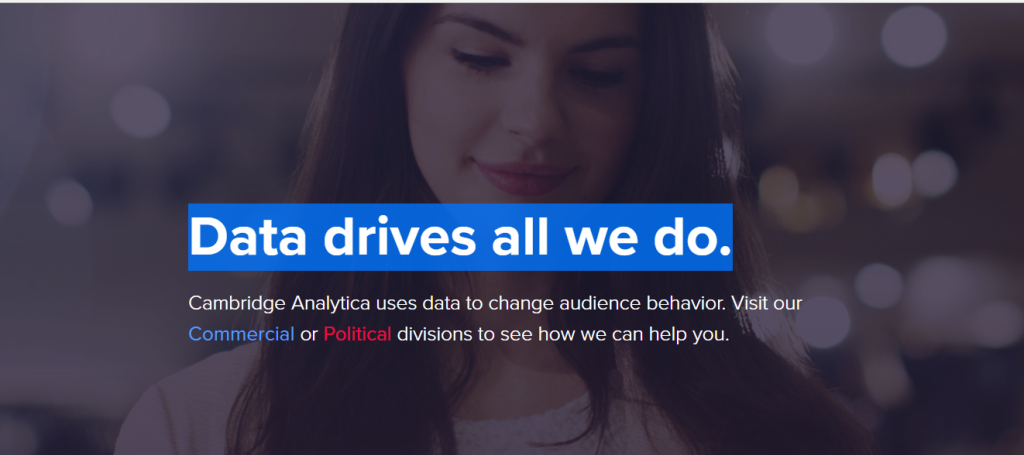
Their site says: Cambridge Analytica uses data to change audience behavior.” 

There doesn’t seem to be a lot of political will or respect on the right when it comes to the publics’ privacy, autonomy in decision making, citizens’ agency and civil liberties.   

The current controversy

Working with a whistleblower and ex-employee of Cambridge Analytica, the Observer and Guardian have seen documents and gathered eyewitness reports that lift the lid on the data analytics company that helped Donald Trump to victory. The company is currently being investigated on both sides of the Atlantic.

It is a key subject in two inquiries in the UK – by the Electoral Commission, into the company’s possible role in the EU referendum and the Information Commissioner’s Office, into data analytics for political purposes – and one in the US, as part of special counsel Robert Mueller’s probe into Trump-Russia collusion.

Previous articles by Carole Cadwalladr in the Observer and Guardian newspapers, respectively published in February and May 2017, speculated in detail that CA had influenced both the Brexit/Vote Leave option in the UK’s 2016 EU membership referendum and Trump’s 2016 US presidential campaign with Robert Mercer’s backing of Donald Trump being key. They also discuss the legality of using the social data farmed. CA says it is pursuing legal action over the claims made in Cadwalladr’s articles.

The whistleblower, Chris Wylie, claims that the 50 million mostly American, profiles were harvested in one of Facebook’s biggest data breaches has caused outrage on both sides of the Atlantic, with lawmakers in both the UK and America, and a state attorney general calling for greater accountability and regulation. The profiles were harvested by a UK-based academic, Aleksandre Kogan, and his company, Global Science Research (GSR).

Wylie said the personal information mined was used to build a system to influence voters. The Canadian, who previously worked for Cambridge Analyticahas lifted the lid on this and other practices at the company, which he describes as a “full-service propaganda machine”.

Shortly before the story broke, Facebook’s external lawyers warned the Observer that it was making “false and defamatory” allegations and reserved Facebook’s legal position. Facebook denies the harvesting of tens of millions of profiles by CA, working with Cambridge academic Aleksandr Kogan and his firm GSR, was a data breach. 

While Facebook insists that it wasn’t a data breach, claiming it was a violation by a third party app that abused user data, this responsibility offloading speaks volumes about Facebook’s approach to its users’ privacy.  

Private companies benefit from a lack of transparency over how profits are made from our personal data. Their priority seems to be to silo and hoard our data, prioritising its more commercial uses. Yet we need to think about data differently, moving away from ideas of data as a commodity to be bought and sold, and used to generate profit for a few people – be it financial or political profit.

The internet, and later the World Wide Web, was originally intended to be a democratising force, accessible to all and without walls or ownership. But the reality today is rather different. The inequalities in wealth and power inherent in neoliberalism have seeped online, marketising and commodifying our personal details, choices, views, dispositions, likes and dislikes.  

Personal data has become the driving force of the online economy, yet the economic and social value which can be generated from data is not remotely fairly distributed. In fact it isn’t being redistributed at all.

Facebook shoot the messenger

Facebook have also suspended the whistleblower Chris Wylie from the platform “pending further information” over misuse of data, along with his former employer, CA and its affiliates, and the academic they worked with, Aleksandr Kogan.

The public attack on Wylie came after he had approached Facebook about the data breach, offering to help investigate. He described it as a “chilling attack” on someone acting in the public interest.

“They acknowledged my offer but then turned around and shot the messenger. I’m trying to make amends for my mistakes and so should Facebook,” he told the Guardian.

“Facebook has known about this for at least two years and did almost nothing to fix it. This is not new. And it’s only by coming forward that Facebook is now taking action. People need to know this kind of profiling is happening.”

Kogan assembled the harvested information through an app on the site – it collected details of American citizens who were paid to take a personality test, but also gathered data on those people’s Facebook friends.

Kogan apparently had a deal to share this information with CA. But according to Wylie, most of this personal information had been taken without authorisation. He said Cambridge Analytica used it to build a powerful software program to predict and influence choices at the ballot box.

Last month, both Facebook and CA CEO Alexander Nix told the parliamentary inquiry into fake news that the company did not have or use private Facebook data, or any data from Kogan’s firm, GSR.

But in its statement on Friday night, explaining why it had suspended CA and Wylie, Facebook said it had known in 2015 that profiles were passed to Nix’s company. 

“In 2015, we learned that a psychology professor at the University of Cambridge named Dr Aleksandr Kogan lied to us and violated our platform policies by passing data from an app that was using Facebook Login to SCL/Cambridge Analytica,the statement said.

CA is heavily funded by the family of Robert Mercer, an American hedge-fund billionaire. I’ve mentioned Mercer in a previous article about the right’s undue influence on the media and on voting behaviour. Mercer made his money as a pioneer in the field of Computational Linguistics.

The company was headed by Trump’s key adviser Steve Bannon. CA used personal information taken without authorisation in early 2014 to build a system that could profile individual US voters, in order to target them with ‘personalised’ persuasive  political ‘advertisements’.

It’s scandalous that documents seen by the Observer, and confirmed by the Facebook statement, show that by late 2015 the Facebook had found out that information had been harvested on an unprecedented scale and failed to alert users, taking only limited steps to recover and secure the private information of more than 50 million individuals.

Last year, Dr Simon Moores, visiting lecturer in the applied sciences and computing department at Canterbury Christ Church University and a technology ambassador under the Blair government, said the Information commissioners Office’s recent decision to shine a light on the use of big data in politics was timely. He said:

“A rapid convergence in the data mining, algorithmic and granular analytics capabilities of companies like Cambridge Analytica and Facebook is creating powerful, unregulated and opaque ‘intelligence platforms’. In turn, these can have enormous influence to affect what we learn, how we feel, and how we vote. The algorithms they may produce are frequently hidden from scrutiny and we see only the results of any insights they might choose to publish.”

He goes on to say: ”They were using 40-50,000 different variants of an ad every day that were continuously measuring responses and then adapting and evolving based on that response.”

The head of the parliamentary committee investigating fake news has accused CA and Facebook of misleading MPs in their testimony. 

After Wylie detailed the harvesting of more than 50 million Facebook profiles for CA, Damian Collins, the chair of the House of Commons culture, media and sport select committee, said he would be calling on the Facebook boss, Mark Zuckerberg, to testify before the committee.

He said the company appeared to have previously sent executives able to avoid difficult questions who had “claimed not to know the answers”.

Collins also said he would be recalling the CA’s CEO, Alexander Nix, to give further testimony. “Nix denied to the committee last month that his company had received any data from [his firm] GSR,” he said. “We will be contacting Alexander Nix next week asking him to explain his comments.”

Collins has attacked Facebook for appearing to have been “deliberately avoiding answering straight questions” in to the committee.

“It is now clear that data has been taken from Facebook users without their consent, and was then processed by a third party and used to support their campaigns,” Collins said. “Facebook knew about this, and the involvement of Cambridge Analytica with it.”

CA claimed that its contract with GSR stipulated that Kogan should seek “informed consent” for data collection and it had no reason to believe he would not. 

GSR was “led by a seemingly reputable academic at an internationally renowned institution who made explicit contractual commitments to us regarding its legal authority to license data to SCL Elections”, a company spokesman said.

The Observer has seen a contract dated 4 June 2014, which confirms SCL, an affiliate of CA, entered into a commercial arrangement with GSR, entirely premised on harvesting and processing Facebook data. CA spent nearly $1m on data collection, which yielded more than 50 million individual profiles that could be matched to electoral rolls. It then used the test results and Facebook data to build an algorithm that could analyse individual Facebook profiles and determine personality traits linked to voting behaviour.

The algorithm and database together made a powerful political tool for the right. It allowed a campaign to identify possible swing voters and craft messages more likely to ‘resonate’.

“The ultimate product of the training set is creating a ‘gold standard’ of understanding personality from Facebook profile information,” the contract specifies. It promises to create a database of 2 million ‘matched’ profiles, identifiable and tied to electoral registers, across 11 states, but with room to expand much further.

CA responded to the Observer story on Twitter before Collins had said Nix would be recalled. “We refute(s) these mischaracterizations and false allegations,” it said:

“Reality Check: Cambridge Analytica uses client and commercially and publicly available data; we don’t use or hold any Facebook data,” the company said. “When we learned GSR sold us Facebook data that it shouldn’t have done, we deleted it all – system wide audit to verify.”

CA

CA not coercive

In response to the series of  defensive Tweets put out by CA, I quoted several claims from CA’s own site, which I had cited in an article last year. 

For example, the company offers to: “More effectively engage and persuade voters using specially tailored language and visual ad combinations crafted with insights gleaned from behavioral understandings of your electorate.”

And boasts:Leveraging CA’s massive team of data scientists and academics, CA is able to provide optimal audience segments based on big data and psychographic modeling. Then, using a sophisticated electronic data delivery system, CA is able to provide TV advertising campaign data that may be used to inform media buyers about shows that have the highest concentrations of target audiences and the least amount of waste; all of which leading to higher media ROI [return on investment] and more voter conversions.”

“Psychographic Modeling”? “Conversions”?  “[…] specially tailored language and visual ad combinations crafted with insights gleaned from behavioral understandings of your electorate” ?

That language doesn’t sound like “advertising” to me. It sounds like microsurveilance and psychological manipulation, using the vulnerabilities that make us susceptible to all kinds of manipulations, including the intentional manipulations performed by the political machinery of our culture.

If CA genuinely thought “people are smarter than that”, then their boasts about their service of psychographic modeling, behavioural science; “understandings of the electorates’ behaviour”, “changing voter behaviours” and increasing “conversions”, “driving” voters to the polls to win campaigns and so on is nothing more than an eloborate  scam. Why bother attempting to manipulate people you think are not susceptible to manipulation?

Either way, this company has transgressed ethical boundaries, either as snake oil merchants, or as peddlers of snake oil on behalf of governments and other clients, while exploiting our personal data.

CA Political will equip you with the data and insights necessary to drive your voters to the polls and win your campaign. We offer a proven combination of predictive analytics, behavioral sciences, and data-driven ad tech.”

“With up to 5,000 data points on over 230 million American voters, we build your custom target audience, then use this crucial information to engage, persuade, and motivate them to act.”

And offers to help to: “More effectively engage and persuade voters using specially tailored language and visual ad combinations crafted with insights gleaned from behavioral understandings of your electorate.”

One of our fundamental freedoms, as human beings, is that of owning the decision making regarding our own lives and experiences, including evaluating and deciding our own political preferences. To be responsible for our own thoughts, reflections, intentions and actions is generally felt to be an essential part of what it means to be human.

When David Cameron said that “knowledge of human behaviour” was part of his vision for a “new age of government” I was one of a few who didn’t see behavioural economics as the great breakthrough in social policy-making that it was being hailed as. Even the name ‘behavioural insights team’ suggests secrecy, surveilance and manipulation. It was only a matter of time before libertarian paternalism morphed into authoritarianism, hidden in plain view. 

We are being told what our ‘best interests’ are by a small group of powerful people whose interests are that want to stay powerful, despite being dogmatic, self-righteous and wrong. Despite the fact that they need specialists in techniques of persuasion, rather than rational and democratic engagement, to appear credible to the electorate.  

CA pivotal role
It seems that the overarching logic of New Right neoliberalism has led to the privatisation of citizens’ decision making and behaviour and a new form of exploiting the population by misuse of their trust and their personal information.

Also, it seems democracy has been commodified and marketised.

Update

Cambridge Analytica are trying to stop the broadcast of an undercover Channel 4 News report in which its chief executive talks unguardedly about its practices. Channel 4 reporters posed as prospective clients and had a series of meetings with Cambridge Analytica that they secretly filmed — including at least one with Alexander Nix, its chief executive.

Channel 4 declined to comment. Cambridge Analytica’s spokesman also declined to comment on the undercover Channel 4 report. The company is under mounting pressure over how it uses personal data in political and election campaign work. It was banned by Facebook on Friday, which claimed it had violated the social network’s rules by failing to delete Facebook user data collected by an app supposedly for ‘research purposes’.

Facebook is now investigating ties between one of its current employees and Cambridge Analytica. Joseph Chancellor, currently a researcher at Facebook, was a director of Global Science Research, a company that provided data to Cambridge Analytica.

The nature of Chancellor’s role as a director of Global Science Research and his knowledge of Kogan’s data collection practices are not clear. A spokesperson for Cambridge Analytica said “there was no recollection of any interactions or emails with” Chancellor.

Facebook didn’t mention Global Science Research. But Cambridge Analytica said on Saturday that it contracted the company in 2014 to “undertake a large scale research project in the United States.”

Global Science Research was incorporated in May 2014 and listed Kogan and Chancellor as directors, according to UK government records. (The records show that Global Science Research was dissolved in October 2017.) 

Channel 4 News went ahead to broadcast the Cambridge Analytica exposé despite the legal threat.

From Channel 4Revealed: Trump’s election consultants filmed saying they use bribes and sex workers to entrap politicians 

Watch Channel 4′s excellent undercover documentary.

Related 

Cambridge Analytica questioned on fake news  – UK parliament

Revealed: 50 million Facebook profiles harvested for Cambridge Analytica in major data breach

Cambridge Analytica: links to Moscow oil firm and St Petersburg university

More allegations of Tory election fraud, now we need to talk about democracy

The anti-social public relations of the PR industry

The Nudge Unit’s u-turn on benefit sanctions indicates the need for even more lucrative nudge interventions, say nudge theorists

How Covert Agents Infiltrate the Internet to Manipulate, Deceive, and Destroy Reputations – Glenn Greenwald

Controversial GCHQ Unit Engaged in Domestic Law Enforcement, Online Propaganda, Psychology Research – Glenn Greenwald and Andrew Fishman


I don’t make any money from my work. But you can support Politics and Insights and contribute by making a donation which will help me continue to research and write informative, insightful and independent articles, and to provide support to others. The smallest amount is much appreciated, and helps to keep my articles free and accessible to all – thank you. 

DonatenowButton

PM says ‘highly likely’ Russia is responsible for nerve agent attack, without any conclusive evidence

The prime minister says that it has been concluded that Sergei Skripal and his daughter Yulia were poisoned by “military-grade nerve agent of a type developed by Russia.”

May revealed that experts at Britain’s Porton Down defence laboratory, coincidently very close to where the attack happened, have confirmed the Salisbury poisoning involved “highly-specialised” and “military grade” Novichok, first developed by the Soviet Union in the 1970s. 

Updating the Commons earlier today, the prime minister explained that as a result of the nerve agent being found to be military grade Novichok, it is “highly likely that Russia was responsible” for the act against ex-double agent Sergei Skripal and his daughter, which also left Wiltshire Police Detective Sergeant Nick Bailey in a serious condition and parts of the medieval cathedral city closed off.

She also says the Russia was likely to be responsible for the attack because of Russia’s “history of involvement in state-sponsored attacks of this kind.” 

However, the Kremlin has denied involvement, while the Russian embassy accused Britain of playing a “very dangerous game” and warned of “serious long-term consequences.”  

Moscow responded, saying Theresa May’s words were “another political information campaign based on a provocation”, and has branded the prime minister’s suggestion that Moscow was “probably” behind the Salisbury poisonings as a “circus show”.

The spokesperson from Moscow also added, cryptically: “Before making up new fairy tales, let the British disclose how the Litvinenko case ended.” 

Russian dissident Alexander Litvinenko was poisoned with radioactive polonium-210 in London in 2006. It seems that Russia is pointing an accusation back at the UK. 

A former Kremlin adviser, Alexander Nekrasoff, has said that the nerve agent is “possessed by about 16 countries in their laboratories”.

“Why do I know this?” he added. “Because that’s how the antidote is developed.”

Andrei Lugovoi, one of the two men accused of assassinating Alexander Litvinenko with radioactive polonium in 2006, said Britain’s response to events was suspiciously quick. Evidence, he said, that London was operating according to its own script.

Any chemist or physicist will tell you that as a minimum you need some kind of serious expertise on a serious expert level to determine whether or not a country is responsible,” he told the Interfax news agency.

“When such statements are made in the course of a few days, this speaks only of irresponsibility and the fact that they haven’t set out to discover the truth.”

Novichok agents may feasibly be created in pesticide and agricultural fertilizer manufacturing plants, as they have an organophosphate core, as do other nerve agents. So far the government have offered no firm evidence of Russia’s involvement. 

May has said the decision to blame Russia is based on “Russia’s record of conducting state-sponsored assassinations and our assessment that Russia views some defectors as legitimate targets for assassinations”.Yet already the government are talking about ‘robust responses’, which is very worrying. 

The Washington Post reports: “Former special services agent Mikhail Lyubimov was quoted in Komsomolskaya Pravda, one of Russia’s most popular newspapers, as suggesting Skripal wouldn’t have been worth the trouble of a hit.

Skripal was sent to the West in a swap; that means he’s absolutely uninteresting to us. He’s a small-fry,’ Lyubimov said.”

Skripal was jailed for 13 years by Russia in 2006. In July 2010, he was one of four prisoners released by Moscow in exchange for 10 Russian spies arrested by the FBI as part of a swap. He was later flown to the UK.

On Sunday, Dimtry Kiselev, one of Russia’s most powerful media figures, spoke during his Sunday news programme on state-owned TV channel Rossiya-1, in Moscow. Kiselev suggested a possible connection between the poisonings in Salisbury, which British officials said resulted from exposure to an unspecified nerve agent, and international  upcoming World Cup football tournament. 

Kiselev suggested the poisoning could be a “special operation” aimed at justifying a boycott of the tournament. I don’t think that is likely, however.

Skripal wasn’t much use to Britain as an exposed ex-spy, but “as someone who’s been poisoned, who is ill, he’s very useful,” Kiselev said. 

The programme included an on-the-ground report from Britain. The reporter noted that Salisbury, the town where Skripal was lived and fell sick, is about a 20-minute drive from the Porton Down laboratories where Britain developed chemical and bacteriological agents.

“But in the British press and special services, there is no suspicion” [of any British involvement], said another reporter, Alexander Khabarov.

So Russia has been given an ultimatum. May goes on to say that if Russia does not give a “credible response”, the government will conclude that the attack involved “unlawful use of force by the Russian state against the United Kingdom”. 

May also said the UK must stand ready to take much more “extensive measures”, and these would be set out in the Commons on Wednesday should there be no adequate explanation from Russia.

The prime minister will then return to the Commons to outline retaliatory proposals, should there be no adequate explanation.

Here are the key passages from Theresa May’s statement today:

Mr Speaker, this morning I chaired a meeting of the National Security Council in which we considered the information so far available.

As is normal, the Council was updated on the assessment and intelligence picture, as well as the state of the investigation.

It is now clear that Mr Skripal and his daughter were poisoned with a military-grade nerve agent of a type developed by Russia.

This is part of a group of nerve agents known as ‘Novichok’.

Based on the positive identification of this chemical agent by world-leading experts at the Defence Science and Technology Laboratory at Porton Down; our knowledge that Russia has previously produced this agent and would still be capable of doing so; Russia’s record of conducting state-sponsored assassinations; and our assessment that Russia views some defectors as legitimate targets for assassinations; the Government has concluded that it is highly likely that Russia was responsible for the act against Sergei and Yulia Skripal.

Mr Speaker, there are therefore only two plausible explanations for what happened in Salisbury on the 4 March.

Either this was a direct act by the Russian State against our country.

Or the Russian government lost control of this potentially catastrophically damaging nerve agent and allowed it to get into the hands of others.

This afternoon my Rt Hon Friend the Foreign Secretary has summoned the Russian Ambassador to the Foreign and Commonwealth Office and asked him to explain which of these two possibilities it is – and therefore to account for how this Russian-produced nerve agent could have been deployed in Salisbury against Mr Skripal and his daughter.

My Rt Hon Friend has stated to the Ambassador that the Russian Federation must immediately provide full and complete disclosure of the Novichok programme to the Organisation for the Prohibition of Chemical Weapons.

And he has requested the Russian Government’s response by the end of tomorrow.

Mr Speaker, this action has happened against a backdrop of a well-established pattern of Russian State aggression.

Russia’s illegal annexation of Crimea was the first time since the Second World War that one sovereign nation has forcibly taken territory from another in Europe.

Russia has fomented conflict in the Donbas, repeatedly violated the national airspace of several European countries, and mounted a sustained campaign of cyber espionage and disruption. This has included meddling in elections, and hacking the Danish Ministry of Defence and the Bundestag, among many others.

During his recent State of the Union address, President Putin showed video graphics of missile launches, flight trajectories and explosions, including the modelling of attacks on the United States with a series of warheads impacting in Florida.

While the extra-judicial killing of terrorists and dissidents outside Russia were given legal sanction by the Russian Parliament in 2006.

And of course Russia used radiological substances in its barbaric assault on Mr Litvenenko. We saw promises to assist the investigation then, but they resulted in denial and obfuscation – and the stifling of due process and the rule of law …

Mr Speaker, on Wednesday we will consider in detail the response from the Russian State.

Should there be no credible response, we will conclude that this action amounts to an unlawful use of force by the Russian State against the United Kingdom.

And I will come back to this House and set out the full range of measures that we will take in response.

Mr Speaker, this attempted murder using a weapons-grade nerve agent in a British town was not just a crime against the Skripals.It was an indiscriminate and reckless act against the United Kingdom, putting the lives of innocent civilians at risk.

And we will not tolerate such a brazen attempt to murder innocent civilians on our soil.

In his response to May’s statement,  Jeremy Corbyn condemned the Salisbury attack, and he included criticism of the Tories for taking money from Russian donors. .

The government could impose unilateral sanctions on Russian individuals and businesses. However, it is unlikely to get support from European partners for tougher EU-wide sanctions. Brexit makes those kinds of negotiations much more difficult, and some EU countries are already trying to soften their approach to Moscow.

The government could also make it more difficult for Russians generally to get visas to the UK. However, this is unlikely as such restrictions might also hit Russian dissidents whom the UK welcomes and wealthy businessmen whose laundered cash the UK tolerates to support London’s property market. Few analysts believe targeting rich Russians with tougher asset-stripping orders would make much difference. They would simply take their money elsewhere. 

The government could pass a British version of the 2012 US Magnitsky act, which punishes Russians involved in corruption and human rights violations with asset freezes and travel bans. It is named after a Russian lawyer who died in custody after revealing alleged fraud by state officials. Opposition MPs have been pushing for a Magnitsky amendment to be added to the Sanctions and Anti-Money Laundering Bill now going through Parliament. 

Other options include the expulsion of Russian diplomats from the UK, as happened after the poisoning of former Russian Federal Security Service operative Litvinenko in 2006. 

There has also been discussion of taking Russian broadcasters such as RT (formerly Russia Today) off the air , and broadcasting regulator Ofcom has said it will “consider the implications for RT’s broadcast licences” after May speaks on Wednesday.  

The UK has already internationalised the matter by asking Russia to provide a “full and complete disclosure” of the Novichok nerve agent programme to an international agency, the Organisation for the Prohibition of Chemical Weapons.

By framing the poisoning as a possible “unlawful use of force” by Russia against the UK,  May has also prompted questions as to whether this could be a matter for NATO, the military alliance of 29 countries. The alliance’s policy of collective defence – under Article 5 – states that an attack on any one ally is seen as an attack on all. It was invoked for the first and only time by the United States after the 9/11 attacks in New York.

Lord Ricketts, a former UK national security adviser, told the BBC that such an “unlawful act” warranted the involvement of NATO.

Any action “will be much more effective if there can be a broader, Nato-EU solidarity behind us”, he said. So far, Downing Street has played down suggestions that this is an Article 5 matter, though.

However, the magnitude of the response that may be announced on Wednesday will depend on the scale of international co-operation that the government can secure, 

The risk with any of the options  considered is the scale of any Russian retaliation, of course.

Before the basic facts of the case have been established, both sides have indulged in an early confrontational exchange. Let’s hope and pray that a diplomatic solution can be reached, rather than any further potentially catastrophic escalation.


Related

From the age of nuclear ‘deterrence’ to an era of first-strike posturing – a creeping escalation


I don’t make any money from my work. I’m a disabled person with lupus, and I’m stuggling to get by. But you can help by making a donation and enable me to continue to research and write informative, insightful and independent articles, and to provide support to others going through disability benefit assessment processes and appeals. The smallest amount is much appreciated – thank you.

DonatenowButton

From the age of nuclear ‘deterrence’ to an era of first-strike posturing – a creeping escalation

Image result for pictures of nuclear detonations

“There is nothing worth having that can be obtained by nuclear war – nothing material or ideological – no tradition that it can defend. It is utterly self-defeating.” George Wald.

North Korean leader Kim Jong-un and President Donald Trump are to meet in person by May, it has been announced, which is an extraordinary overture after months of mutual hostility. News of the meeting was delivered by South Korean officials after talks with Trump at the White House. They passed a verbal message from chairman Kim, saying the North Korean leader was “committed to denuclearisation”. 

Though Trump hailed this as “great progress”, he said the current sanctions would remain in place. China has welcomed the development, saying the Korean peninsula issue was “heading in the right direction” and calling for “political courage”.

However, correspondents say the North had halted missile and nuclear tests during previous talks, only to resume them when it lost patience or felt it was not getting what it demanded.

The latest announcement came days after the South Korean delegation met chairman Kim in Pyongyang. 

In a statement sent to the Washington PostNorth Korea’s UN ambassador said the “courageous decision” of chairman Kim would help secure “peace and stability in the Korean Peninsula and the East Asia region”.

There is no indication yet of where the Trump-Kim talks might take place, but the Korean border’s demilitarised zone (DMZ) and Beijing are seen as likely options.

US Secretary of State Rex Tillerson said it would take “some weeks” to arrange the talks and admitted the US had been “surprised” at Kim Jong-un’s “forward-leaning” stance.

Former officials say that the US administration has spent a lot of time preparing sanctions and contingency planning for military action, but little or no time planning a negotiating strategy for use if Pyongyang entered serious talks.

The last remaining US diplomat with experience of talking to the North Koreans, Joseph Yun, left his post on Friday, and the US currently has no ambassador in Seoul, since the White House withdrew the nomination of another experienced diplomat, Victor Cha. Furthermore, no replacement nominees have been announced.

Yun and Cha were advocates of diplomatic engagement with North Korea and were viewed with suspicion by the White House, where senior officials have argued for a military solution to the challenge posed by Pyongyang’s nuclear and missile programme.

Cha’s nomination was withdrawn because he criticised a plan to carry out a “bloody nose” punitive strike against North Korean weapons sites. Stephen Miller, a hardline Trump adviser who has previously been associated with domestic policy, is reported to have ordered the withdrawal of Cha’s nomination. Today Professor Cha warned that “this dramatic act of diplomacy … may also take us closer to war. Failed negotiations at the summit level leave all parties with no other recourse for diplomacy.” 

The South Korean delegation returned from a visit to Pyongyang on Tuesday saying that the North Korean regime was ready to discuss the dismantling of its nuclear weapons programmes with the US, in return for guarantees of its security. Pyongyang is said to have offered to suspend nuclear and missile tests while talks were under way.

These are precisely the conditions that the Trump administration had demanded before starting talks with the North Koreans – but the response so far has been non-committal.

We’re going to see. They seem to be acting positively but we’re going to see,” Trump said on Tuesday. “Hopefully it will go the proper way. The proper way is the way that everybody knows and everybody wants. But we are prepared to go either way.” He added.

The announcement is a significant milestone, potentially, and a Trump-Kim summit would certainly make the history books, but it’s far from clear that North Korea has actually committed to what South Korea has assured the United States it has committed to, or that Washington is ready for a productive diplomatic process with Pyongyang.

As the only nation on Earth to have used nuclear weapons in warfare, the United States bears a heavy responsibility to exercise proper stewardship of nuclear weapons and to lead in working with other nations to reduce global nuclear dangers. Let’s hope and pray that somehow, Trump measures up to the role.

Both the South Korea and White House statements can be read in full here.

The UN Disarmament Research Report last year

“What is the only provocation that could bring about the use of nuclear weapons? Nuclear weapons. What is the priority target for nuclear weapons? Nuclear weapons. What is the only established defense against nuclear weapons? Nuclear weapons. How do we prevent the use of nuclear weapons? By threatening the use of nuclear weapons. And we can’t get rid of nuclear weapons, because of nuclear weapons. The intransigence, it seems, is a function of the weapons themselves.”  Martin Amis, Introduction: Thinkability” in Einstein’s Monsters.

In April 2017, the United Nations (UN) published a major report which highlights the massive risk of both an accidental and the deliberate use of the world’s most catastrophic weapons. The “poor relations” between nuclear powers has contributed to an atmosphere that “lends itself to the onset of crisis,” the report by the UN Institute for Disarmament Research says.

The report says: “The rise in cyber warfare and hacking has left the technical vulnerabilities of deadly nuclear weapons systems exposed to risk from states and terrorist groups.” 

The authors went on: “Nuclear deterrence works – up until the time it will prove not to work. The risk is inherent and, when luck runs out, the results will be catastrophic.”

“The more arms produced, particularly in countries with unstable societies, the more potential exists for terrorist acquisition and use of nuclear weapons.”

The authors added that denuclearisation would require “visionary leadership”, but added this was “sadly rare” as many powerful states have “increasingly turn inward”. Nationalism has certainly grown on a global scale over recent years.

The report goes on to say that new technology and spending on nuclear weapons had “enhanced” the risk of a detonation. However, it acknowledged the secrecy surrounding the programmes made it difficult to accurately assess their true scope. 

Increased reliance on technology has also introduced new problems. In the past, accidental nuclear detonations have been averted by human decisions. Replacing military officers with computers could therefore rule out a potential safety check on the weapons, and open the possibility of hacking a nuclear weapon. 

The report also referenced the January 2017 decision of the Bulletin of the Atomic Scientists Science to move the Doomsday Clock to two and a half minutes to midnight because of fears of a nuclear event – the most risky position it has been at since 1953.

Midnight represents Armageddon.

However, in January, a panel of scientists and policy experts moved the Doomsday Clock a further 30 seconds closer to midnight, citing President Trump’s rhetoric on nuclear weapons, environmental deterioration due to climate change and a lack of trust in political institutions more generally as the main reasons. 

The clock now stands at two minutes to midnight.


“We are very concerned with the unpredictability of the United States and how it’s thinking of its nuclear weapons,”
 said Rachel Bronson, the president and CEO of the Bulletin of Atomic Scientists, who created the clock. 

Bronson elaborated that nuclear issues took center stage this year for members of the Bulletin group, which was founded by researchers who helped build the first nuclear weapons during the Manhattan Project. At the top of their worries are advancements in North Korea’s nuclear weapons program as well as “huge [nuclear] investments being made by China, Russia, Pakistan and India in particular.”
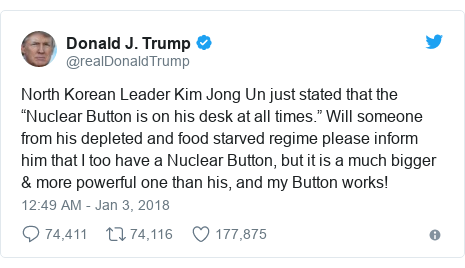
Twitter post by @realDonaldTrump: North Korean Leader Kim Jong Un just stated that the “Nuclear Button is on his desk at all times.” Will someone from his depleted and food starved regime please inform him that I too have a Nuclear Button, but it is a much bigger & more powerful one than his, and my Button works!

Trump’s singularly aggressive ego-parading, paranoiac and unpredictable approach to conducting foreign policy – and particularly to countering North Korea’s nuclear program – has moved many to express concerns about the potential implications of such vulgar posturing and crude lack of diplomacy.  Last autumn, for example, a congressional foreign-affairs committee held the first hearing in 41 years on presidential power over nuclear weapons.

“Donald Trump can launch nuclear codes just as easily as he can use his Twitter account,” observed Democrat Ed Markey, who has introduced legislation to prevent the president from authorising the first nuclear strike in a conflict without a congressional declaration of war. “No one human being should ever have that power.” Let alone one who lacks the necessary sophistication and outward-looking ethical disposition to carry that responsibility. 

Beatrice Fihn, a campaigner to eliminate the world’s nuclear weapons, said something similar shortly before accepting last year’s Nobel Peace Prize.  She said “If you’re uncomfortable with nuclear weapons under Donald Trump, you’re probably uncomfortable with nuclear weapons, because it means you recognize that [deterrence] won’t always hold up and things can go wrong. Once you start thinking ‘this person is appropriate for this weapon but not that person,’ then maybe it’s the weapon that’s the problem.”

Democracy depends on the responsible use of political and military power, with leaders held accountable to the majority of citizens. If a democratic nation is forced to use state-sanctioned violence to defend itself, its leaders must stay within publicly recognised moral and legal limits. There is a moral burden of possessing nuclear weapons, and the enormous responsibility that accompanies stewardship of such devastating weapons, as well as the technologies and nuclear materials that go into them. Sovereignty should be reframed to emphasise state responsibility and accountability to citizens and the international community rather than state prerogatives. 

Near misses over the decades

“It’s a near miracle that nuclear war has so far been avoided.”  Noam Chomsky

Despite a reduction in global nuclear tensions after the end of the Cold War, estimated nuclear warhead stockpiles total roughly 15,000 worldwide, with the United States and Russia holding 90% of the total.

Exact details on many nuclear close calls are difficult to access, the analysis of particular cases has highlighted the importance of a variety of factors in preventing ‘accidents’. At an international level, this includes the importance of context and outside mediation; at the national level, effectiveness in government communications, and involvement of key decision-makers, and, at the individual level, the decisive role of individuals in following logic, intuition and prudent decision-making, often in violation of protocol. Which gives us some cause for concern regarding the existing protocols in place.

In 1956, during the Suez canal crisis, the perceived nuclear threat was due to a coincidental combination of events, including a wedge of swans flying over Turkey, a fighter escort for the Syrian president returning from Moscow, a British bomber brought down by mechanical issues, and scheduled exercises of the Soviet fleet.

In 1960, radar equipment in Thule, Greenland mistakenly interpreted a moonrise over Norway as a large-scale Soviet missile launch. In 1961, Staff at the Strategic Air Command Headquarters (SAC HQ) simultaneously lost contact with the North American Aerospace Defense Command (NORAD) and multiple Ballistic Missile Early Warning System sites. It was later found that the failure of a single relay station in Colorado was the sole cause of the communications problems, which had initially been interpreted as an attack.

In 1962, at the height of the Cuban Missile Crisis, the Soviet patrol submarine B-59 almost launched a nuclear-tipped torpedo while under harassment by American naval forces. 

On the same day, a US U-2 spy plane was shot down over Cuba, and another U-2 flown by United States Air Force, Captain Charles Maultsby, strayed 300 miles (480 km) into Soviet airspace. Despite orders to avoid Soviet airspace by at least 100 miles (160 km), a navigational error took the U-2 over the Chukotka Peninsula, causing Soviet interceptors to scramble and pursue the aircraft. American interceptors armed with GAR-11 Falcon nuclear air-to-air missiles (each with a 0.25 kiloton yield) were then scrambled to escort the U-2 into friendly airspace. Individual pilots were capable of arming and launching their missiles. 

In 1965, there was a massive power outage in the northeastern United States. Several nuclear bomb detectors – used to distinguish between regular power outages and power outages caused by a nuclear blast – near major US cities malfunctioned due to circuit errors, creating the illusion of a nuclear attack. 

A powerful solar flare in 1967, interfered with multiple NORAD radars over the Northern Hemisphere. This interference was initially interpreted as intentional jamming of the radars by the Soviets, thus an act of war. A nuclear bomber counter-strike was nearly launched by the US.

In the 1970s there was another NORAD computer error, that entailed notification of 2,200 incoming Soviet missiles. It was found that a training scenario was inadvertently loaded into an operational computer.

There were several more near-misses in 1970s and 80s, and in 1995, Russian President Boris Yeltsin became the first world leader to activate a nuclear briefcase after Russian radar systems detected the launch of a Norwegian research rocket being used to study the Northern Lights.

As recent as 2010, commanders at a US Air Force base in Wyoming lost most forms of command, control, and security monitoring over 50 nuclear ICBMs for approximately 45 minutes. The missiles were taken offline after a suspected hardware problem caused multiple errors with control computers. Although military officials maintain that the missiles remained under control and were not susceptible to outside attempts to gain control, former Air Force launch officer Bruce G. Blair expressed concerns that missiles in this status could be vulnerable to launch attempts by hackers or compromised missile crews

Just last year, we learned of the death of a little-known but important figure in the history of the Cold War. His name was Stanislav Petrov, and he is sometimes referred to as “the man who saved the world.”

In 1983, Petrov was a Soviet military officer on duty at a nuclear early warning center when his computers detected a barrage of incoming American nuclear missiles. He said, “I had all the data to suggest it was true”. He added, “If I had sent my report up the chain of command, nobody would have said a word against it.”

He went on, “All I had to do was to reach for the phone to raise the direct line to our top commanders, but I couldn’t move. I felt like I was sitting on a frying pan.” Petrov had a hunch that the computer had made an error, and fortunately his intuition was right about a false alarm.

Instead of notifying his commanders to prepare an immediate nuclear counterattack, he  called army headquarters and reported a system malfunction.

This episode alone illustrates just how high the risk factor is with nuclear weapons, especially when decisions to use them are entrusted or could be entrusted to sometimes unreliable technologies or fallible human judgement. Perhaps those countries who want nuclear arms must ask themselves: Am I prepared to deal with this type of scenario in my own country?

Authoritarianism and the politics of posturing in the UK

“Gambling rules doesn’t work in nuclear war – everyone become loser.” Amit Ray, Peace on the Earth A Nuclear Weapons Free World.

In April 2017 the then defence secretary Michael Fallon confirmed that the UK would use nuclear weapons in a “pre-emptive initial strike” in “the most extreme circumstances.” He did not specify precisely what those circumstances may be. Nor did he say which country may be the UK’s likeliest target. 

In an extraordinary act of aggressive posturing, he added that a first strike may be launched even if Britain itself was not under threat of nuclear attack. He said that national security need not be under threat to warrant a “pre-emptive” nuclear launch. 

Asked in what circumstances the Conservatives would launch a first strike, Fallon replied: “They are better not specified or described, which would only give comfort to our enemies and make the deterrent less credible.”

Fallon clearly doesn’t understand the principle of “deterrence”, then. That is frankly terrifying. You would hope that a government responsible for the safety of citizens would only ever launch a nuclear attack as a very last resort, once all other options, such as diplomacy and negotiation, had been completely exhausted. How discomforting that Fallon sees the UK public as disposable – collateral damage. 

Why on earth would anyone trust a defence secretary who makes such an irrational comment – “even if Britain itself was not under threat of nuclear attack. He said that national security “need not be under threat to warrant a “pre-emptive” nuclear launch”. It sounds very much like the Conservatives have a specific target in mind, to me. I don’t think the changed nuclear posture – and without an open review – has come about incidentally or on a whim.

That statement doesn’t bode well for democratic accountability, nor is it particularly reassuring that the Conservatives have no central plan to prioritise the safety and protection citizen’s lives and the planet. That is surely the key strategic value of having a nuclear deterrent – that all parties in a potential conflict would be reluctant to launch a first strike because of the catastrophic consequences of a probable retaliation.

Fallon continued: “The whole point about the deterrent is that you have got to leave uncertainty in the mind of anyone who might be thinking of using weapons against this country.”

No you don’t. The point of nuclear deterrence is that it deters first strikes because a second strike is assumed. No world leader wants to initiate a sequence of terrible global events that would inevitably escalate, ultimately bringing home their own country’s destruction in the form of retaliation.

Fallon also insisted that critics of Trident – including senior military figures who have ridiculed the idea that it is an effective deterrent – were “absolutely wrong”, as if simply telling people that they are wrong means that they somehow must be. 

A report – British military attitudes to nuclear weapons and disarmament – by the Nuclear Information Service (NIS) and the Nuclear Education Trust – is a ground-breaking study into military thinking on nuclear weapons. It is rather startling to find that the military establishment is far from unanimous on the issue of Trident replacement. 

Some participants in the study, commenting on the exorbitant cost of Trident replacement, stated that “no circumstances justify the large amounts of money required by [Trident] and this money would be better spent elsewhere.” The problem is that a majority of the wider public generally support having of a nuclear deterrent.  

Many participants in the NIS survey were also unclear about many aspects of the UK’s nuclear weapons, including their costs, purpose and credibility. Many in the military think Trident is a “political” tool and little more and many would rather see the money spent on equipment which could actually be used: especially at a time when the forces have been faced with spending cuts. 

The Labour party manifesto states a clear commitment to renewing Trident under a Labour government. However, controversy in the media – directed by misleading comments from the Conservatives – has unbelievably problematised Corbyn’s perfectly reasonable caution in committing to launching a pre-emptive nuclear attack.

Personally I would much rather the prime minister put effort into finding rational and diplomatic solutions to protect the UK citizenry, rather than dancing in an unholy, manic glee at the very prospect of our assured nuclear annihilation.  

The debate, being cheer led from the right, has descended into a macabre and somewhat irrational political point-scoring exercise, using a strategy of tension in an attempt to portray the opposition leader as “weak”. This is a dangerous and absurd tactic that the Conservatives use at every single election, regardless of who is the leader of the opposition. Usually, though, they don’t show a grotesque display of eagerness to bring about Armageddon to demonstrate a “strong and stable” leadership. 

Deterrence and Mutually Assured Destruction: what that actually means

We’re capable of such beautiful dreams, and such horrible nightmares.” Carl Sagan

Mutually assured destruction (MAD) is a military doctrine and national security policy in which a full-scale use of nuclear weapons by two or more opposing sides would cause the complete annihilation of both the attacker and the defender. MAD is based on the strategy of deterrence, which holds that the threat of using catastrophic weapons against an enemy prevents the enemy’s use of those same weapons. The strategy is a form of Nash equilibrium (games theory), in which, once armed, neither side has any incentive to initiate a conflict or to disarm.

The deterrence strategy further rests on assumption that neither side will dare to launch a first strike because the other side would launch on warning (also called fail-deadly) or with surviving forces (a second strike), resulting in unacceptably catastrophic losses for both parties. The strategic MAD payoff is therefore an ongoing expectation of a tense global stability and peace. 

The major flaw in a first strike approach is that it encourages the opponent to perform a massive counterforce first strike. If both sides of a conflict adopt the same stance of massive response, it may result in unlimited and globally devastating escalation (a “nuclear spasm”), each believing that the other will back down after the first round of retaliation. This said, both problems are not unique to massive retaliation, but to nuclear deterrence as a whole. 

It is for these reasons that many countries have adopted a minimum credible deterrent/second strike policy. Previously we had a policy of using nuclear weapons only as a defence. 

Many of those arguing both for and against no-first-use misunderstand it: The policy reflects the power to set the rules of war, rather than some wayward pacifist ideal to end all war. Countries that issue no-first-use pledges boast strong conventional militaries. These states want to encourage a model of war where their army meets the enemy on a conventional battlefield with clearly defined rules – the kind of war, in other words, that they usually win. Nuclear weapons upend this model, because they help weaker actors of the world, such as North Korea and Pakistan, produce extraordinary destruction, level the playing field, and cast victory into doubt.

Therefore, a no-first-use pledge could potentially reinforce a powerful state’s strategic advantage by discouraging other countries from developing nuclear arsenals, and by dissuading nuclear-armed countries from pushing the button. This would happen with the assurance that a state would not fire first – thereby keeping war safely bound and safely winnable, on the powerful state’s terms.

In an article published in the Atlantic last year, titled Refusing to Nuke First. Why rejecting nuclear preemption reflects strength, not weakness, Dominic Tierney says:

“Countries that contemplate or introduce a no-first-use policy are almost always strong states that enjoy a conventional-weapons edge. Since its first nuclear test in 1964, China has repeatedly declared that it “undertakes not to be the first to use nuclear weapons at any time or under any circumstances.” It’s no coincidence that China is the most powerful East Asian country, and would hold the advantage in any conventional war with South Korea, Vietnam, Japan, or Taiwan (assuming, of course, that the United States stayed out). The spread of nuclear weapons in East Asia would diminish China’s strategic advantage; therefore, Beijing seeks to prevent this outcome with a no-first-use policy.

India announced in 1999 that it “will not be the first to initiate a nuclear strike, but will respond with punitive retaliation should deterrence fail.” In 2003, India qualified its no-first-use pledge by stating, “in the event of a major attack against India, or Indian forces anywhere, by biological or chemical weapons, India will retain the option of retaliating with nuclear weapons.” Again, it’s no coincidence that India is very likely to prevail over Pakistan in a future conventional war. India has a history of winning previous contests, and currently spends about $50 billion per year on defense compared to Pakistan’s $9.5 billion. New Delhi can safely issue a no-first-use pledge in the hope of keeping the strategic terrain favorable.

In  2016, General James E. Cartwright, former head of the US Strategic Command, and Bruce G. Blair, former Minuteman launch officer, co-authored an op-ed in The New York Times in favor of a U.S. no-first-use policy. They showed, explicitly, how power undergirds the proposed doctrine. “Our nonnuclear strength, including economic and diplomatic power, our alliances, our conventional and cyber weaponry and our technological advantages, constitute a global military juggernaut unmatched in history. The United States simply does not need nuclear weapons to defend its own and its allies’ vital interests, as long as our adversaries refrain from their use.”

If a country is willing to use nuclear weapons, it’s also willing to break a promise.

By contrast, weak states don’t even think about a no-first-use policy. Indeed, threatening to push the button early in a conflict is the basis of their deterrent plan. During the Cold War, when the Soviet Union had conventional superiority in Europe, the United States and its NATO allies intended to escalate to nuclear war if the Red Army launched an invasion. Similarly, today, Pakistan explicitly threatens to retaliate with nuclear weapons if it is ever attacked – even through a conventional invasion.

Viewed through a strategic – and perhaps more cynical – lens, the no-first-use doctrine also has a huge credibility problem. For the US pledge to truly matter, a president who otherwise favors a nuclear first strike would have to decide not to press the button because of this policy. But in an extreme national crisis – one involving, say, North Korean nuclear missiles – a president is unlikely to feel bound by America’s former assurance. After all, if a country is willing to use nuclear weapons, it’s also willing to break a promise.

Champions and critics of no-first-use often cast it as a principled policy and a revolutionary step, for good or for ill. But the idealistic symbolism of no-first-use betrays an underlying reality. Disavowing a first strike is a luxury afforded to the strong, and they play this card in the hope of strategic benefit. If Obama made a dramatic announcement of no-first-use, it would probably have less impact than people think because other countries wouldn’t follow suit, especially if they’re weak. And, in any case, the promise may be meaningless because no one can predict a president’s calculus when staring down a nuclear holocaust.

No-first-use is the policy of Goliath, not Gandhi.”

Former US Secretary of Defense William Perry said: “During my period as Secretary of Defense, I never confronted a situation, or could even imagine a situation, in which I would recommend that the President make a first strike with nuclear weapons  – understanding that such an action, whatever the provocation, would likely bring about the end of civilization.”

Perry’s life’s work, most of it highly classified, was nuclear weapons. He played a supporting role in the Cuban Missile Crisis, during which he went back to his Washington hotel room each night, fearing he had only hours left to live. He later founded his own successful defense firm, helped revolutionize the US way of high-tech war, and honed his diplomatic skills seeking common ground on security issues with the Soviets and Chinese. 

Nuclear bombs are an area of expertise for Perry, who had assumed they would be largely obsolete by now, seven decades after Hiroshima and Nagasaki, a quarter of a century after the fall of the Soviet Union. Instead, once again they have become a contemporary nightmare, and an emphatically ascendant one. A Russian president has recently make bellicose boasts about his arsenal. An American president free-associates on Twitter about starting a new nuclear arms race. Decades of cooperation between the two nations on arms control is nearly at a standstill. And, unlike the original Cold War, this time there is a world of busy fanatics excited by the prospect of a planet with more bombs – people who have already demonstrated the desire to slaughter many thousands of people in an instant. 

Perry is now a senior fellow at Stanford University’s Center for International Security and Cooperation. He serves as director of the Preventive Defense Project. He is an expert in US foreign policy, national security and arms control. In 2013 he founded the William J Perry Project (http://www.wjperryproject.org), a non-profit effort to educate the public on the current dangers of nuclear weapons.

Disarmament has fallen far from the top of the policy priority list. The largest upcoming generation, the millennials, were raised in a time when the problem felt largely solved, and it’s easy for them to imagine it’s still quietly fading into history.  

Since the end of the Cold War, we no longer think about the threat of a nuclear holocaust every day. It’s not embedded in our public psyche. During the Cold War the United States relied on deterrence rather than prevention as the central principle of its security strategy. However, Trump’s recent posturing indicates a far more aggressive stance, implying a shift from a defensive to a rather more offensive approach, making him an extremely unpredictable custodian of the substantial US nuclear arsenal.

The problem is that the threat of a nuclear event and escalation is no longer retreating. Perry said in an interview in his Stanford office: “Today, the danger of some sort of nuclear catastrophe is greater than it was during the Cold War, and most people are blissfully unaware of this danger.”

A report published during the UK’s General Election period sought to reframe the nuclear debate within the UK. The report comes from the British American Security Information Council (BASIC) and the United Nations Association (UNA-UK).

Up until now, the debate has been dominated by the decision about whether to invest in a renewal of the Trident system, linked to political judgements about the responsibilities of governments to maintain strong defence capabilities. As a result, wider questions about how best to tackle global nuclear dangers have been neglected.

This matters, particularly as the crisis with North Korea unfolds, but also as relations with Russia deteriorate and states frustrated with a lack of progress on disarmament begin negotiating a treaty to ban nuclear weapons without any nuclear armed states in the room. Commitment to the bargain at the heart of the nuclear non‑proliferation regime, always a little shaky as interpretations of its priorities have been contested, could easily fray, with drastic risks to global security.

This issue sits within broader questions about the UK’s role in the world. As we move through a period of growing instability, the need for effective international mechanisms to promote security is greater than at any other time since the UN was founded. Their success depends on states’ willingness to work together. The increasingly fractious geopolitical environment, however, is impeding progress and putting further pressure on our post-war international system, already overstretched by the convergence of multiple crises.

As a permanent member of the UN Security Council, a nuclear weapon state and one of the largest aid donors, the UK is an important player on the world stage. The international system has delivered prosperity and security for the UK as a whole. Its breakdown could have serious – and, in the context of nuclear weapons, existential – consequences for the country. Unfortunately, the UK has not been immune to the growing reluctance by states to invest in the continuing health of this system. 

Over the past decade, voices calling for a narrower outlook have grown louder in this country, as in many the world over. But the line between national and global interests is disappearing. British foreign policy must embrace this reality and prioritise strengthening collective efforts to create a more peaceful world.

The need for nuclear disarmament through multilateral diplomacy is greater now than it has been at any stage since the end of the Cold War. Trust and confidence in the existing nuclear non-proliferation regime is fraying, tensions are high, goals are misaligned, and dialogue is irregular. 

In Meaningful Multilateralism, BASIC and UNA–UK offer 30 multilateral disarmament proposals for the incoming UK Government after the General Election on June 8, themed according to three types of leadership the UK has previously shown in disarmament:

• Diplomatic leadership

• Technical leadership

• Leadership by example

The Conservatives don’t fulfil any of these criteria because of their strong authoritarian tendencies, and they certainly haven’t demonstrated a preference for diplomacy or leadership by example in particular.

Whatever one’s position on Trident, there are meaningful steps that can be taken in multilateral disarmament, and the next UK Government should actively take a leadership role.

The current growing global instability is a turn of events that has William Perry, former US defense Secretary, obsessed with one question: Why isn’t everyone as terrified as he is?

Why indeed.

There is a crisis in the Nuclear Non-Proliferation Treaty, with its vision unraveling due to different views on disarmament. If the deterrence principle were to break down, the potential global humanitarian impact would be truly apocalyptic. The strategic offence doctrine of Mutually Assured Destruction means just that. In such an exchange, there can’t possibly be a winner.

It wouldn’t be a simple act of genocide. A nuclear exchange may well culminate in omnicide – a small word that means the totalising enormity of the end of everything for everyone. Even a restrained tactical exchange would most probably have catastrophic bioecological and wider global impacts, and a devastating breakdown of civilisation. 

Everyone agrees that the risk of nuclear war is bad; if all else were equal, we would rather not have this risk. But all else is not equal. The probability of nuclear war is not zero. Nuclear deterrence can fail. It is a fallacy to presume that just because no nuclear war has occurred since the post-World War II advent of nuclear deterrence, therefore it will never happen. The historical record contains several near-misses in which nuclear war was narrowly avoided due in no small part to luck.  

The argument that nuclear deterrence makes the world a safer place is not particularly persuasive.

First strike posturing is considerably less so.


My work is unfunded and I don’t make any money from it. But you can support Politics and Insights and contribute by making a donation which will help me continue to research and write informative, insightful and independent articles, and to provide support to others.

DonatenowButton

People are faking their homelessness and poverty for money, says petty urban bourgeousie

A group of privileged vigilantes have called for councils across the nation to see off homeless people in order to protect the Tory-voting urban bourgeoisie from offense. Armed with posh Nikon cameras, a book on phrenology and a crystal ball, they have taken to the streets to try and catch out the millionaires who are scamming the public by dressing up in pauper rags and begging. 

“Some of these homeless people are rubbish at living in houses and are being incompetently hungry in full view of everyone,” says Mr Harris Mint.

“But we know a large number of them are Marxists and some are millionaires. Some of them are faking malnutrition and thinness. There are some even faking disabilities. Whatever next. They should go and take their fake pauperism with them.

Mr Vinnie Dicktive, the group gossip and lead curtain twitcher, said Everyone here knows these people are really trying to make everyone else miserable. One man went to great lengths to get a stay in hospital after conning the paramedics into saying he had pneumonia, but we know he was faking it, and we took photos of the fake resuscitation. They even conned us by sticking a drip into his arm. He must have paid them.

“The hospital said the fake tramp was in intensive care, but we know he sneaked into the canteen for some soup, really. We know the paramedics and hospital staff are Momentum supporters, so we took their photos and told them we would cross-reference them to deter them. We also got a good shot of the security guards who escorted us off the premises. Name and shame them, that’s what I say.” 

Another member of the vigilante group, Miss Dos Gowon, said: “One thing these people don’t like is being photographed or filmed, so we’ve gone and done that. These anarchy- commie woke Marxist types, languishing in doorways and lolling brazenly on park benches are a real menace to one’s view. They’re driving property prices down by pretending to be hoboes. 

“We have identified who is genuine with the relevant charities and their names and if they are homeless or not. We’ve ask them their names, we then translate them into runic symbols then use the crystal ball and a phrenology book. Everyone knows these charities are scaremongers and that homeless people can’t be causally linked with homelessness.

“Five of the paupers we photographed have told us they won’t go begging anymore if we don’t put their wanted photo up around town. Or give out their names, which are Getty Stoffed, Doo Won, Lemmie Bee, Goa Way and his brother, Noah Way. Most of them sound like nasty foreigners. 

Mr Lemmie Attem, the group strategist and phrenologist said “Not a single one of them sang the national anthem or denounced terrorism while they dossed around town. And they all have commie beards. And they’re Marxists. I know because I felt their bumps.

“Of the 17 hoboes we photographed, only two were genuine street homeless. Our sophisticated scientific character divination methods worked a treat. Not a single one could prove that they didn’t have a house or some money and clean clothes stashed somewhere.” 

Many great philosophers have come unstuck trying to prove the existence of nothing, however.

“See, we said they weren’t real homeless people. I could tell straight away by the shape of their heads. These philosophers are all Corbyn supporters and are just playing smart because they just want to make the government look bad as can be,” said Mr Noah Hoomaniti, the charismatic leader, rune writer of the group and lifelong Conservative supporter.

Newest member of the character and lifestyle divination vigilante group, Mr Lou Smorals said “The solution is to send homeless people to live in landfills. That way, they can sort through the rubbish for decent cardboard boxes, no-one has to see them and people get to feel charitable every time they throw food away. It’s the most humanitarian thing to do all round.”  

I asked the group what they thought genuinely homeless people would do when the ‘beast from the east’ struck. 

“Well, we will have to barricade ourselves in”, said Mr Willie Eckerslike, the group’s chief phrenologist and clairvoyant.

“I personally voted leave, and I’m annoyed we still have to put up with these foreigners coming over here. And foreign weather. It’s bad enough dealing with the fake homeless criminals without worrying about migrant sex offenders.”


Related

‘Nasty’ campaign to out fake beggars will ‘not be welcome’ in Liverpool


I don’t make any money from my work.  But you can help by making a donation and enable me to continue to research and write free, informative, insightful and independent articles, and to provide support to others going through disability benefit assessment processes and appeals. The smallest amount is much appreciated – thank you.

DonatenowButton

Oops! Telegraph ‘forgets’ to mention spy boss criticising Corbyn was responsible for dodgy Iraq War dossier heavily criticised by Corbyn

Tom Pride's avatarPride's Purge

The latest silly attempt by right-wing media barons to discredit Jeremy Corbyn as a Cold War spy, comes from the ever more ridiculous Telegraph’s Gordon Rayner.

Rayner has persuaded former MI6 boss Sir Richard Dearlove (no, I assure you that’s NOT a made-up name taken from a 1970s James Bond film) as the latest establishment figure to try to persuade the country that electing Corbyn as PM would be tantamount to electing Blofeld to Number 10:

The only problem is, in his bizarre article Rayner ‘forgets’ to mention that Dearlove is now an oil executive in a company with offshore funds under threat from a Corbyn government, an adviser to a neo-liberal right-wing thinktank  and most interestingly of all, according to the Chilcot report was responsible for the infamous dodgy Iraq War dossier so strongly criticised by Corbyn:

chilcot dearlove

Now, either Rayner is so incompetent he didn’t notice these…

View original post 19 more words

Disabled people are sanctioned more than other people, according to research

Image result for work disabled people

A study has found that people with disabilities who claim social security support are 26-53 per cent more likely to be sanctioned than people who are not disabled. According to the research, the main reason behind this is a “culture of disbelief” among jobcentre staff, who fail to take sufficient account of the impact of people’s disabilities on their capacity to meet strict welfare conditionality criteria.

This implies that welfare conditionality has an inbuilt discrimination, as it disproportionately affects people according to their characteristics.

Such discrimination violates the Equality Act 2010:

Ahead of the release of a Demos report by Ben Baumberg Geiger on the Work Capability Assessment on Tuesday, the headline findings on benefits conditionality were featured today in the Observer: ‘More than a million benefit sanctions imposed on disabled people since 2010′.

Ben is a Senior Lecturer in Sociology and Social Policy at the School of Social Policy, Sociology and Social Research (SSPSSR) at the University of Kent. The figures on benefits sanctions can be found in Ben’s 2017 paper ‘Benefits conditionality for disabled people: stylised facts from a review of international evidence and practice’ published (open access) here (p109-111), and the appendices that provide the source for the UK benefit sanctions data is here.

The article in the Guardian also briefly mentions new polling on the public’s attitudes to sanctioning disabled benefit claimants. However, full details of this will be available in the report to be released on Tuesday. 

The recent Work and Pensions Committee inquiry into Employment and Support Allowance (ESA) and Personal Independence Payment (PIP) assessments highlights how disability benefits are not a ‘safe place’ for disabled people, despite ministers using language that implies it is. Warnings from Iain Duncan Smith about “up to a million people ‘languishing’ on sickness benefits, who could be ‘put back to work’ with the right ‘help’, or descriptions in policy papers of disabled people being “parked” on benefits mislead the public.

It is through such political definitions that groups become restricted, face boundaries, become oppressed. Over the last seven years, disabled people have somehow lost the right to self-determination and to express our own group identity. The Government have redefined us and radically rewritten the terms and conditions of the social contract more generally, removing state obligations and duties towards citizens. The Conservative settlement – a fusion of economic neoliberalism with state and social authoritarianism – openly demonstrates an aversion to any notion of social equality and justice.  

Sanctions – the cutting or withholding of lifeline benefits – are applied as a punishment when citizens infringe the conditions of their welfare support by, say, through missing an appointment, being late or failing to apply for enough jobs.

The sanctions regime has been championed by the Government as a means of imposing ‘behavioural change’ on claimants, as they believe that people are unemployed because they need ‘incentives to work’. However, rather than addressing low pay, insecure employment and poor working conditions, the Government has instead decided that unemployed people and welfare itself are the problem: welfare is seen as a ‘perverse incentive’ that prevents people from looking for employment.

Sanctions and wider welfare conditionality were introduced to significantly reduce the basic security and material comfort of people needing social security, in order to push them back into the labour market. This behaviourist turn has transformed a system that was designed to ensure that all citizens could meet their basic survival needs into one that punishes people for non-compliance with politically imposed conditionality criteria, comprised of what the Conservatives regard as acceptable ‘job seeking behaviours’. In this way, Conservatives claim that people are more likely to gain employment. 

However, unsurprisingly most of the experts consulted as part of the Demos project have concluded that welfare conditionality has little or no effect on improving employment  for disabled people, often having a negative impact to the point where disabled people were even less likely to find employment than if they hadn’t been subjected to state impositions. There was also widespread anecdotal evidence that the threat of sanctions can lead to anxiety and have a wider impact on peoples’ health.

Polly Mackenzie, director of Demos, said it was now clear that the benefits system isn’t working for disabled people: “Conditionality is important in any benefits system, but when disabled people are so much more likely to be sanctioned, something is going wrong. Jobcentre advisers and capability assessors too often have a culture of disbelief about disability, especially mental illness, that leads them to sanction claimants who genuinely could not do the job they are being bullied into applying for.

“We need to think again about how we assess work capability. Employers also need to be better at adapting to disabled people’s needs so that more jobs can be done by people with fluctuating conditions.”

A damning research report by the National Audit Office (NAO) in 2016, also found that there was no evidence that sanctions were working. It also said there was a failure to measure whether money was being saved, and that the application of sanctions varied from one jobcentre to another. 

The 2017 Demos study uncovered that more than 900,000 JSA claimants who report a disability have been sanctioned since May 2010. People who claim ESA and have been placed in a work-related activity group – which requires them to attend jobcentre interviews and complete work-related activities – can also be sanctioned. The research found that more than 110,000 ESA sanctions have been applied since May 2010.

Mark Atkinson, chief executive at disability charity Scope, said: “Punitive sanctions can be extremely harmful to disabled people, who already face the financial penalty of higher living costs. There is no clear evidence that cutting disabled people’s benefits supports them to get into and stay in work.

“Sanctions are likely to cause unnecessary stress, pushing the very people that the government aims to support into work further away from the jobs market.”

The Work Capability Assessment (WCA) was introduced in part to bolster neoliberal imperatives related to the supply of labour. The political focus on these economic concerns fails to  prioritise the wellbeing of disabled people. Another reason for the introduction of the WCA was to cut costs. This intention was evident in the ‘scrounger’ and fraud’ narrative that seeped into political and media discourse. Disability welfare is portrayed as ‘unsustainable’, with the Government claiming that resources need to be ‘targeted’ at those ‘most in need’.

However, it is evident from the recent Work and Pensions inquiry into ESA and PIP assessments is that many of those most in need are being catastrophically let down by the current system.

The Guardian reports: Polling for the Demos project found that while the public often supported the imposition of sanctions for disabled people, they did not back the way in which they were applied in practice.

A majority thought that disabled people’s benefits should be cut if they do not take a job they can do, but they were less supportive of sanctioning for minor non-compliance, such as sometimes turning up late for meetings. Even those who supported sanctions preferred a much less punitive approach than the government currently imposes.

The sanctions are taking place in a context where the number of unemployed disabled people being supported with specialist help to find work has actually been halved. according to the companies running the government’s Health and Work programme.

Kirsty McHugh, chief executive of the Employment Related Services Association (Ersa), which represents the employment support sector, said: “The size of the new Work and Health Programme means only one in eight disabled people who want to work will have specialist help to do so. As a society, we have an obligation to ensure appropriate support is available and the report shows that we are in danger of failing disabled people and their families.” 

The analysis shows that there is to be a cut in funding from £750m in 2013-14 to less than £130m in 2017. Ersa says that the cut in funding will severely hamper the Government in its goal of securing work for more than 1.2 million more people with disabilities. It seems that the Government is relying on punitive and coercive measures such as the threat and use of sanctions, to achieve its goal. Disabled people are not permitted to have goals that don’t align with state-defined neoliberal ones. 

The collaborative Demos researchers recommend a reduction in the use of so-called “benefit conditionality” for disabled people and a strengthening of the safeguards to ensure disabled people are not unfairly punished. However, despite the growing numbers of campaigners, charity groups and academic researchers calling for the Government to introduce less aggressive sanctions, the Government remains disinclined to do so.

The theories of ‘behaviour change’ underpinning conditionality have been questioned by commentators, particularly with respect to the assumed ‘rationality’ of citzens’ responses to financial sanctions.

Concerns have been raised that welfare conditionality leads to a range of unintended effects, including distancing people from support, causing hardship and even destitution. There is also ample evidence that those social groups with complex needs, such as disabled people, young people with chaotic lifestyles and homeless people have been disproportionately affected by the intensification of welfare conditionality under successive Conservative governments. Research implies that there are differential impacts based on citizens’ characteristics. 

This observation is also consistent with international evidence, especially from the US, that the most potentially vulnerable claimants are at greatest disadvantage within highly conditional social security systems, for example, those with mental health problems, those with long term illnesses and disabled people more generally.

Welfare ensures that people are able to meet their basic needs. Welfare covers the costs of food, fuel and shelter. It’s a safeguard to prevent absolute poverty. That was its original purpose when it was introduced. It is difficult to imagine how removing the means that people have of meeting their basic survival needs can possibly motivate them to find work. Comprehensive historical research shows that when people cannot meet their basic biological needs, their pressing cognitive priority is simply survival.

In other words, when people are hungry and facing destitution, addressing those fundamental needs becomes a significant barrier to addressing their psychosocial needs such as seeking employment.

For disabled people, who already face additional barriers to addressing their  fundamental needs.  Welfare sanctions for disabled people has created injustices, caused fear and inflicted considerable distress and harm on disabled people.


I don’t make any money from my work. I am disabled because of illness and have a very limited income. But you can help by making a donation to help me continue to research and write informative, insightful and independent articles, and to provide support to others. The smallest amount is much appreciated – thank you.

DonatenowButton

Frank Field’s letter regarding the DWP’s non-existent/existent data: a Schrödinger kind of paradox

cat schro

The data is only real when someone looks for it

Following on from the article yesterday, (DWP spent £100m on disability benefit appeals over 2 year period), I have copied Frank Field’s letter to Esther McVey below, which highlights the discrepancy between what McVey informed the Work and Pensions Committee when they asked her to provide evidence regarding the costs of disability benefit appeals and mandatory reconsiderations in an inquiry into disability benefits, and the details provided, following a timely Freedom of Information request. 

Key facts

  • Department for Work and Pensions (DWP) spent £108.1 million on Personal Independent Payment (PIP) and Employment and Support Allowance (ESA) reviews and appeals since October 2015
  • Ministry of Justice (MoJ) spent £103.1 million on social security and child support tribunals in 2016/17
  • Around two-thirds of PIP and ESA tribunals have been won by claimants this year
  • More than 300,000 PIP and ESA decisions have been changed at review or appeal since October 2015

Figures obtained by the Press Association through a Freedom of Information (FoI) request show that the Department for Work and Pensions (DWP) has spent £108.1 million on direct staffing costs for ESA and PIP appeals since October 2015.  The cost covers mandatory reconsiderations, an internal DWP review, and appeals to tribunals run by HM Courts and Tribunals Service. 

This staggering amount of money is being spent on the administrative costs of a Department fighting to uphold the outcomes of its own incompetent and deeply flawed decision-making. This is unacceptably leaving thousands of ill and disabled people having to fight to receive lifeline support to which, as the high proportion of successful appeal outcomes informs us, they are legally entitled. Furthermore, when provided with a second chance to remedy incompetent decision-making at mandatory review, the Department has persistently continued to uphold the original flawed decision in many cases. 

Since October 2015, 87,500 PIP claimants had their decision changed at mandatory review, while a further 91,587 claimants went on to win their appeals at tribunal. In the first six months of 2017/18 some 66% of 42,741 PIP appeals went in the claimant’s favour, highlighting that both the original decision-making process and mandatory review are failing to effectively ensure eligibility for support is fairly and accurately assessed.

The figures for ESA since October 2015 show 47,000 people had decisions revised at mandatory reconsideration and 82,219 appeals went in the favour of those let down by the current system of assessment and DWP decsion-making.

It’s as if the system is weighted to refuse as many people as possible their lifeline support.

So far in 2017/18, 68% of 35,452 ESA appeals have gone in favour of the claimant.

Conservative peer Baroness Altmann, a former minister at the DWP, said the money could be spent on benefits for those who need them, rather than on the costs of fighting their claims.

“Disability benefits need an overhaul and, of course, we must not let people make bogus claims, but the extent of the appeals we are seeing clearly indicates that something is seriously wrong with the system,” she said.

Figures released to the select committee’s inquiry show further costs to taxpayers.

The Ministry of Justice says it spent £103.1 million on social security and child support tribunals in 2016/17, up from £92.6 million the year before and £87.4 million in 2014/15.

Around 190,000 cases were cleared with or without a hearing in 2016/17, the Ministry told the committee.

The select committee is due to publish the results of its inquiry into PIP and ESA on Wednesday.

Chair Frank Field has written to Esther McVey, the Work and Pensions Secretary, in the wake of the figures to question why MPs were not given such information.

DWP gave the committee the average costs of a mandatory reconsideration and appeal for PIP and ESA.

However, Field, a Labour MP, said the committee was unable to work out the full cost of the appeals process.

This was because it was told information on PIP appeals was not available on whether they were appeals from new claimants or those being reassessed, which have different costs.

The information released to the Press Association was broken down into costs for new claims and those undergoing reassessments.

Here is Field’s letter:

letter head

From the Chair
                                                                                                                            9 February 2018
Rt Hon Esther McVey
Secretary of State
Department for Work and Pensions

PIP appeal data

During our inquiry on PIP and ESA assessments, your Department kindly provided to us estimated unit costs of MRs and Appeals. This indicated that different costs are attached to PIP appeals depending on whether they relate to new or reassessed claims. 

Seeking to understand the financial implications of appeals for the Department, Committee staff inquired on 30 January: 

Of the 170,000 PIP appeals since 2013, how many were for new claims and how many were reassessments?  

We were duly informed:

The information on the number of PIP appeals is from HMCTS published statistics and this information is not available from HMCTS for new claims and reassessments separately.    

We were therefore unable to estimate the full cost of appeals to your Department, although the Ministry of Justice informed us that in 2016/17 its appeals expenditure was £103 million. 1

It was with some surprise, therefore, that we today received data released in response to an FOI request. This provided estimated costs per month spent on PIP appeals—broken down by new and reassessed claims.

You will be aware that we are shortly due to publish our report. That this data was provided in response to an FOI request, but not for our Report, is doubly regrettable since the key theme of our report is the need to introduce much greater trust and transparency into the PIP and ESA systems.

Might you please explain how this occurred?


1 Cost of Social Security and Child Support appeals, of which the majority relate to PIP/ESA.Franks sig


Related

A critique of the government’s claimant satisfaction survey

DWP spent £100m on disability benefit appeals over 2 year period

Thousands of disability assessments deemed ‘unacceptable’ under the government’s own quality control scheme

I don’t make any money from my work. But you can help if you like by making a donation to help me continue to research and write informative, insightful and independent articles, and to provide support to others. The smallest amount is much appreciated – thank you.
DonatenowButton