Category: Uncategorized

Government housing benefit cuts will have “catastrophic impact” on the most vulnerable social groups

o-HOMELESS-YOUTH-facebook.jpg

John Healey MP, Labour’s Shadow Cabinet Minister for Housing and Planning, has warned that housing providers could be forced to close accommodation for the most vulnerable because of housing benefit cuts.

Mr Healey responded to a recent survey released yesterday which reveals that 95 per cent of specialist housing providers could be forced to close accommodation for the most vulnerable because of housing benefit cuts. He said:

“Last month, we revealed that George Osborne’s cuts to housing benefit support for thousands of elderly, disabled and homeless people could mean that vital supported accommodation across the country could close.

This new survey confirms the catastrophic impact these cuts could have.

George Osborne must halt these dangerous plans, publish a full impact assessment and consult fully with housing providers to safeguard this essential housing for those who need it.”

Grave concerns regarding the impact of the proposed housing benefit cuts on the most vulnerable social groups have also arisen within the housing sector. A specialist housing association has warned that people under the age of 35 in mental health accommodation face rent shortfalls of almost £200 a week under  government plans to cap housing benefit for social housing tenants at Local Housing Allowance rates.

Brighton Housing Trust (BHT) have said that its fincancial modelling of the impact of capping housing benefit for social tenants, including supported housing tenants, at Local Housing Allowance rates revealed that 70% of all its homes would be unaffordable to under 35s under the plan, as they would only qualify for the “shared room rate” – the cost of renting a room within a house.

All its general needs housing in Brighton would become unaffordable to under-35s by between £12 and £32 per week. In its specialist supported housing, under-35s would face a shortfall of between £52.60 and £193.49 in 71 of 101 mental health units. There would also be shortfalls of up to £75 per week in specialist drug and alcohol units, homelessness hostels and young people’s accommodation.

Tenants older than 35 would also be unable to afford many of the homes, although the benefit gaps would be smaller.

BHT is a specialist housing association which provides for tenants with support needs, even in much of its general needs accommodation.

The association has warned that the government’s offer of additional Discretionary Housing Payments to plug the rent shortfalls would be insufficient.

The housing sector is urgently lobbying for an exemption for supported and sheltered housing from the LHA cap.


327,379 sick and disabled people were not paid their Christmas Bonus last year

david-cameron-main.jpg


Labour’s shadow Work and Pensions Secretary, Owen Smith MP, has accused the Department of Work and Pensions (DWP) of being “cruel and incompetent”, after at least 327,379 sick and disabled people were left without their £10 Christmas Bonus.

Benefits were originally calculated to meet only the basic costs of food, fuel and shelter. The Pensioners and Family Income Supplement Payments Act 1972 ensured that a Christmas Bonus of £10 is paid to the recipients of some benefits as a one off payment. The subsequent Pensioners’ Payments and Social Security Act of 1979 established the Bonus permanently, although the amount has never been uprated in line with rising prices and living costs. 

On the government site, it says:

The Christmas Bonus is a one-off tax-free £10 payment made before Christmas, paid to people who get certain benefits in the qualifying week. This is normally the first full week of December.

You don’t need to claim – you should get paid automatically.

Mr Smith said:

“They’ve [the DWP] now been forced to admit that 300,000 people went short because they couldn’t even manage to make a simple payment in time for the holidays.

People have always known the Tories are cruel, but they used to think they were at least competent.

Iain Duncan Smith seems to be having a good go at proving they’re both cruel and incompetent.”

A DWP spokesperson responded, saying 

“All regular ESA payments were made on time over Christmas, with the majority of people receiving their additional Christmas seasonal payment on schedule.

Due to an administrative error, a small minority may not receive their additional Christmas seasonal payment until the end of January.”

Some people have yet to receive their payment. How long does it take to fix an “administrative error”?

I can’t help but wonder about the reason presented by the DWP for the payment delays. I don’t believe it’s the truth, although I’d be amongst the first to acknowledge the Department’s wide-ranging ineptitude.

I am a sick and disabled person who claims ESA. Having worked all of my life, and after being forced though illness to give up a job and profession that I loved, I have to say that my standard of living has very drastically dropped, and I have experienced absolute poverty – times when I have not been able to meet even basic needs, such as keeping  warm and eating adequately. In 2012, a tribunal agreed with my decision to leave work on the grounds that my illness is now so severe it presents unacceptable risks to myself and potentially, to others in the work environment, as I am no longer able to fulfil even the basic responsibilities that my work entailed, reliably, consistently and safely. My consultant and GP fully supported my decision.

I wasn’t paid the Christmas Bonus in 2012, 2013 and 2014. I rang the DWP in 2014, when I realised I was entitled to the payment. After being told twice that the money had been paid into my account and it hadn’t, in October 2015, I finally received the backdated payments. I got a bizarre letter explaining that whilst the DWP had said they had paid me, they hadn’t, which I already knew.

I received my Christmas Bonus for 2015 on 14 January. It seems to me that the DWP seldom pay the Bonus unless you actually ask for it (several times) or unless an MP applies some ethical and rational pressure, as Owen Smith has done.

The government believe that any kind of welfare support creates perverse incentives for people not to work. There is no empirical evidence to support this claim. They also think that the general public are “cognitively incompetent,” drawing on the new paternalist behavioural economics (“nudge”) theoretical framework, their basic proposition is that we are fundamentally irrational and make faulty decisions that are founded entirely on our “cognitive biases.” Of course the new army of self-appointed cognitive experts and nudgers exist outside the realms of their own universal theory of “human nature” and are thus exempted from nudges. Poor people who need financial support are not.

The Tories also claim that one of the problems of providing social security arises because we believe the resulting income gain from employment is not enough to compensate for the (increased) work effort. However, the truly rational solution of course would be to raise the lowest wages, to provide a clear and positive “incentive” to work, when people are able, but instead the government have opted for a psychocratic, punitive approach, stigmatising those who are too ill to work to justify cutting essential lifeline benefits to amounts that barely cover the cost of meeting basic survival needs, adding the perpetual threat and administration of sanctions – which entail the complete withdrawal of support –  for any perceived non-compliance.

The conditionality regime means that eligibility for support requires constantly demonstrating an unbounded willingness to attend often pointless, resource and time-consuming jobcentre lectures from work coaches and advisors and applying for any job presented, regardless of its appropriateness, security or pay.

The Tories ludicrously claim that this punitive approach, entailing the systematic withdrawing of essential support, and the incremental dismantling of the welfare state, is “making welfare fair”,  “making work pay” , “helping people into work” and “supporting sick and disabled people” indicating an Orwellian tendency to turn the meaning of ordinary words into a form of tyranny.

Sanctions are founded on and legitimised by claptrap and psychobabble that originated from the pseudoscientific Behavioural Insights Team, too.  Perhaps the Tory “Grudge” Unit is a much more appropriate name for this mean and vindictive collection of neoliberal cognitive supremicists and economic Darwinists. Armchair psychopaths.

In particular, sanctions are founded on a theory of a cognitive bias called “loss aversion” which is being manipulated and turned into a big state stick to ensure that poor people are compliant with draconian benefit conditionality. “Loss aversion” is a behavioural economics theory that attempts to euphemise draconian policies; a substituted expression that serves as a technique of neutralisation for diabolical state actions designed to instil a deep fear of destitution and starvation amongst the increasingly growing precariat, we are perpetually “downsizing” our needs and expectations to become desperate, impoverished, needing to claim support from a system that most, if not all of us have paid into.

From the shrinking category of legitimate “disability” to forcing people to work in insecure jobs for low wages or for no pay at all on exploitative work fare schemes, nudge is being used to prop up neoliberal ideology, social conservatism, and to euphemistically frame punitive policies, “applying the principles of behavioural economics to the important issue of the transition from welfare to work.” (See Employing BELIEF:Applying behavioural economics to welfare to work, 2010 and Nudging Conformity and Benefit Sanctions, 2015.)

The steady drop in real wages since 2010, according to the Office for National Statistics, is the longest for 50 years. The fall in earnings under the Conservatives is the biggest in any parliament since 1880, according to analysis by the House of Commons Library.  “Making work pay” for whom, we should ask.

The Tories have a strongly anti-welfare ideology, and they also advocate using the tools of behavioural economics to “incentivise” people to work, and further claim that social security encourages dependency. Nudge theorists have proposed that making people’s present more livable with any kind of “cash gifts” only amplifies the alleged cognitive tendency people have to overestimate the magnitude of immediate benefits relative to the more distant ones of working. This is the kind of thinking that underpins Conservative policies aimed at keeping people who need to claim support perpetually poor, insecure and fearful.

However, there’s no such thing as a “cycle of benefit dependency”, it’s a traditional Tory prejudice and is based on historically unevidenced myths. Poverty arises because of socioeconomic circumstances that are unmitigated through government decision-making. In fact this government has intentionally extended and perpetuated inequality through its policies.

It’s therefore easy to see how deliberately withholding the Christmas Bonus would be justified by government officials. This government believes that people who have fallen on hard times and are desperate for financial support are driven by a “culture of entitlement.” People needing social security are being politically redefined as economic free riders. But most people claiming benefit have paid tax, national insurance, and continue to pay VAT and other hidden taxes. There is no discrete class of taxpayers: we ALL pay taxes, except of course for a number of the very wealthy and big businesses. Implying that people claiming social security are a “burden” on working people’s taxes is a fact screen, erected to prop up Tory ideology. Meanwhile the welfare state is being steadily dismantled by a government of neoliberal ideologues.

Perhaps this was just another paternalist experimental “trial” aimed at nudging sick and disabled people into work, and of course, it would be based entirely on operationalising the whopping cognitive biases and traditional prejudices of the Tories.

1002589_521987671204099_896277269_n (1)

Social Security

gret deceit
I always worry when David Cameron or Iain Duncan Smith use sentences like: “We will embark on an all out assault on poverty”, because what they actually mean, as past and recent history informs us, is an all out state assault on the poor and further attacks on our social security provision.

Benefits were originally carefully calculated to meet only basic needs. Welfare was designed to provide the minimal amount for food, fuel and shelter to ensure that those unable to provide for themselves didn’t fall into absolute poverty. The amount was based on “the amount the law says you need to live on.” This has been steadily eroded by the welfare “reforms” – cuts.  The severe and punitive welfare sanctions have normalised the idea of people having no welfare support at all, pushing the normative, moral, ethical and rational boundaries of ordinary people steadily, incrementally, in the same way that all tyrants do when they want to take away public rights and freedoms.

The Tories have a plain intent to completely dismantle the welfare state, step by step, using justification narratives that stigmatise and scapegoat the poorest people in order to harden public attitudes, diminishing empathy for the poor, and above all, to get their own way. All of this comes down to nothing more than traditional Tory prejudices towards poor people and their “small state” ideology.

People need welfare support when they become too old to work, lose their job, become injured at work, become disabled through illness or are disabled and can’t find suitable employment. All of these circumstances arise through no fault of th people experiencing these difficulties, and such difficulties may happen to anyone, including you, your children, grandchildren, other relatives and friends. Let’s not lose sight of the fact that the greatest welfare expenditure includes in-work benefits and pensions.

We have ALL contributed to paying for social security, and our parents, grandparents and great grandparents fought for our right to it, as part of our post-war settlement. It isn’t the government’s to take away.

It’s ours, and a measure of how decent, compassionate, civilised, developed and democratic we are as a society.

430847_149933881824335_1645102229_n (1)

Pictures courtesy of Robert Livingstone

Infantilizing the nation – an insight into Conservative ‘paternalism’

                                               hqdefault                                                 Young Bullers


Paternalist parenting classes? Heaven forbid

The Prime Minister claims that every family needs help in improving behaviour and discipline. Ironically, this is from a politician who claims to despise the “nanny state”. He much prefers the Bullingdon brand of paternalist interference in people’s everyday lives. Cameron is also recommending “parenting classes” for all, which is understandable given his own strong instincts as a parent. He left his own child in a pub, after all.

Of course Cameron feels that it’s other people that need parenting and discipline. After all, this is a man who spent his early adulthood involved in bizarre initiation rituals, patriarchal debauchery, recklessly banqueting, getting drunk, trashing college rooms and pubs, listening to Supertramp and smoking pot with James Delingpole and vandalising restaurants. In 2013, it was reported that members of the Bullingdon Club were required to burn a £50 note in front of a beggar as part of an “initiation ceremony”. How encouraging to see the elite showing responsibility, compassion, a concern for social justice and cohesion, equality and alleviating poverty, at an early age.

Now that’s a real deviant subculture.

The draconian sentences handed down to the rioters in 2011, advocated by Cameron –  like the 23-year-old student with no previous convictions who was jailed for the maximum permitted six months after pleading guilty to stealing bottles of water worth £3.50 from Lidl in Brixton, for example –  shows only too well that he believes there is one rule for the Oxford elite and another for the rest of the society. Punishment is a central component of the social order and a means by which social order is produced and maintained.

Actually, defining others as deviant is, too. It’s a Conservative means of enhancing social power and status differentials by degrading the rule-breaker’s status and power.

Cameron’s response to the riots reflects a characteristically Bullingdon conservative disdain: an authoritarian, strict and oppressive approach towards perceived, labelled and stigmatised subordinates. Conservatives have always seen the social world as being organised in terms of hierarchies of worth. Smashing up a pub or restaurant and causing 10k worth of damage is no problem if you can cough up the costs on the spot to keep your thuggish behaviour private, hidden away from the scrutiny of the legal system and the public. Money talks and bullshit struts.

The Conservatives inform us that it is bad parents that cause poverty, opting for a rhetoric of authoritarian populism, creating cardboard monsters, manufacturing folk devils and moral outrage for the tabloids, making excuses for the consequences of their own prejudiced and damaging policy-making.

The establishment is a kind of Moebius strip of finger-pointing, arrogant, moralising privileged and feckless bullies passing the buck. And importantly, these wayward boys and girls always get their own way. They can’t democratically govern the country; they lack the social skills, motivation, developmental and emotional capacity to actually engage in any genuine and democratic dialogue with ordinary people, so they rule. Conservatives have always prefered the simplicity of a socio-economic system defined by inherited social ranks.

Cameron says that the government’s Life Chances Strategy – an “initiative to target tackle child poverty” – will include a plan for “significantly expanding parenting provision”. It will also recommend ways to “incentivise” all parents to take up the offer of classes. The hope is, presumably, that if the middle class take Cameron up on his offer of state parenting instructions, the process of social norming will provide the foundation of state-defined “correct behaviours” for the insubordinate working classes, who are perpetually caught up, according to the Tories, in a pathological cycle of something or other, and therefore need state therapy from elitist antipodean role models to set them straight and put them in their place. It’s the new behaviourism: do as we say, but not what we do.

It seems that poverty is to be addressed with nothing more than a paternalist brand of cheap psychopolitics. The government won’t be dipping their hands into the treasury, which is what’s needed. Instead they prefer to employ shabby techniques of persuasion aimed at indoctrinating a Conservative world-view and enforcing conformity as a replacement for genuinely needs-led and evidence-based policies.

At no point does Cameron mention any commitment to improving people’s standard of living, or ensuring that families have a basic level of income in order to meet their fundamental needs, such as food, fuel and shelter – because struggling to meet basic material needs are the main barriers for people experiencing poverty. It’s sobering to consider that the Tory obsession with the work ethic, embodied in their mantra “making work pay”, is nothing more than a meaningless glittering generality, that purposefully diverts attention from elitist policy-making, and subsequent growing poverty and inequality.

Around half of those who are in poverty and of working age live in a household where at least one person works. The steady drop in real wages since 2010, according to the Office for National Statistics, is the longest for 50 years.

Furthermore, since 2010, the decline in UK wage levels has been amongst the very worst in Europe. The fall in earnings under the Coalition is the biggest in any parliament since 1880, according to analysis by the House of Commons Library, and at a time when the cost of living has spiralled upwards.

Ah, and Cameron uttered that inane managementspeak word again – “incentivise”. It never bodes well when Conservatives use that word. It means he has been listening to the psychobabbling of the Nudge Unit, again. Welfare sanctions, which are the punitive withdrawal of lifeline benefits from people who need to claim welfare support to meet their basic needs are claimed to “incentivise” people to find a job, despite empirical evidence to the contrary, and the cuts to child tax credit, limiting support to just two children, are based on the charming and archaic eugenicist idea that poor people ought to be “incentivised” to have fewer children.

Rich people are apparently “incentivised” by large cash carrots, but poor people just get the brutal, merciless stick. What a classic example of flagrant Conservative ideological incoherence.

Psychopolitical paternalism doesn’t address poverty, it is simply a way of apportioning blame, of abdicating political responsibility and ensuring that poor people accept the Conservative and neoliberal decree that they somehow deserve to be poor.

Cameron claims that:

“Families are the best anti-poverty measure ever invented. They are a welfare, education and counselling system all wrapped up into one. Children in families that break apart are more than twice as likely to experience poverty as those whose families stay together. That’s why strengthening families is at the heart of our agenda.”

The announcement from Cameron was welcomed by Relate, whose chief executive, Chris Sherwood, said:

“Relationship support can help to reduce family breakdown, which is a key driver of poverty and can result in poor outcomes for children.”

Actually, family breakdown is quite often a consequence of poverty, not a cause of it. Back in 2010, Fergus Drake, director of UK programmes with Save the Children expressed an unease that many of us felt, regarding the Conservative’s feckless drive to offload the responsibility for poverty onto poor people, who are casualities of the consequences of neoliberalism, which extends discriminatory economic policies. He said:

“We would say poverty causes family breakdown rather than vice versa. If you are worried about putting food on the table, or being able to turn on the heater so you can have a hot bath, the stress that causes to a relationship can make things really difficult.”

Poverty isn’t caused by family breakdown, it’s caused by discriminatory policies and social insititutions that extend and perpetuate inequality. We are now the most unequal country in the European Union, and even more unequal than the US. If Cameron really wanted to address childhood poverty, he would ensure that people have enough to meet their basic needs, instead of steadily withdrawing welfare support and cutting public services. He should end the class-contingent austerity that his government have imposed on only the poorest people.

Tim Nichols, of the Child Poverty Action Group, agrees that the Conservatives should be careful not to confuse causes and consequences. He says:

“We don’t think that this is robust strategy. Tackling child poverty can’t be done without more redistribution.”

Cameron is talking ideologically-driven nonsense, reflecting traditional Tory prejudices. This government has become obsessed with moralising about and manipulating individual agency, which is increasingly seen as being to blame for high levels of poverty and social exclusion in the UK, which are created entirely by callous, discriminatory political policies. Political gaslighting does not help people out of poverty.

People are poor because they don’t have enough money to meet their needs. That is what Cameron needs to acknowledge and address.

Parenting and elitist-authoritarian ideology

Cameron’s paternalist-authoritarian turn was evident back in 2010, when he said that:

“Discipline is the foundation of a good education. Headteachers need to decide on exclusions.”

Most people that have worked in either formal or informal education settings are very aware that using punishment and threats is very counterproductive. Making young people suffer in order to change their future behaviour can often elicit temporary compliance, but this strategy is highly unlikely to lead to conversion or to help children become ethical, responsible decision makers in the long term. Punishments don’t involve any engagement of deliberative processes.

Punishment, even if referred to euphemistically as “consequences,” tends to generate oppositional behaviours, anger and defiance.  Furthermore, it models the use of power rather than reason and damages the important trust-based relationship between adult and child.

Authoritarian models of parenting are emotionally and physically traumatising. There’s an Old Testament brand of harshness in conservative authoritarian approaches to human behaviours.

Authoritarian parents often have prejudices based on wealth and what may be defined as “achievement”, gender, class and race. They tend to be highly competitive, lacking warmth and empathy. They teach their children to compete at all costs, and to win by whatever means. Most authoritarians are behaviourists, with a preference for punishments rather than rewards to control others.

Authoritarians tend to advocate corporal punishment, they see freedom as chaotic, they can’t tolerate ambiguity or recognise the complexities and subtleties of human conduct, and they tend to advocate capital punishment.

Because authoritarian parents expect absolute obedience, children raised in such settings are typically very good at following rules.

However, they often lack self-discipline. Children raised by authoritarian parents are not encouraged to explore and act independently, so they never really learn how to set their own limits and personal standards.

Whilst developmental experts agree that rules, boundaries and consistency are important for children to have, most believe that authoritarian parenting is too punitive and lacks the warmth, unconditional love, safety, trust and nurturing that children need.

Of course public schools also foster authoritarianism and elitism. Boarding school: the trauma of the ‘privileged’ child by Joy Schaverien explores the emotional deprivation and abuse that many experience as a result of public school culture. Psychotherapist Nick Duffell (2000) wrote a book based on workshops he has conducted over ten years with adults who attended boarding schools as children. He has identified many lasting pathological psychological patterns common in those he calls Boarding school survivors.

In his recent work: Wounded Leaders: the Psychohistory of British Elitism and the Entitlement Illusion, Nick says:

“A cherished national character ideal, eschewing vulnerability and practising a normalised covert hostility based on bullying in the dorm adversely affects even those who did not have the privilege of such an education. It leaves Britain in the social and emotional dark ages, led by “the boys in the men that run things.

This specific culture of elitism, protected by financial interests and the “It never did me any harm” syndrome, means that Britain is unlikely to foster the kind of leadership necessary in our world of increasing complexity, which needs a communal mindset and cooperative global solutions. But worse, new scientific evidence shows that this hyper-rational training leaves its devotees trapped within the confines of an inflexible mind, beset with functional defects, presented here as the Entitled Brain.”

It’s a sobering thought that so many boarding school survivors – psychologically and emotionally damaged individuals – are involved in running the country and determining the terms and conditions of our lives.
002fc17b9115fe26a6ed5d9d58b1ece1.603x472x1


I don’t make any money from my work. My articles are free. If you like, you can make a donation to help me continue to research and write free, informative, insightful and independent articles, and to provide support to others. The smallest amount is much appreciated – thank you.

DonatenowButton

Sometimes people are not fit for work, and that includes MPs, Mr Jackson.

1235473_537097386359794_65317730_n (1)

Stewart Jackson, the Conservative MP for Peterborough, has claimed that Labour MP Simon Danczuk has been “stitched up” by supporters of Jeremy Corbyn within the Labour Party. He commented after Mr Danczuk was suspended from the Labour Party pending an investigation into allegations that he sent sexually explicit text messages to a 17-year-old girl.

Posting on Twitter, Jackson said: “Simon Danczuk has obviously been foolish but he’s also been stitched up like a kipper by the Corbyn cronies in UK Labour.” 

Asked why he believed this to be the case, Mr Jackson replied: “Maybe the haste with which he’s been suspended for what appears to be something that is not a criminal offence if stupid.”

“Given he’s had some mental health issues, [the] more compassionate thing would be to have given him space and return to the issue next week.”

It is a serious cause for concern that this MP doesn’t know that it IS a criminal offence for an adult to have any sexual activity with a person under the age of 18, if the older person holds a position of trust and power, as such sexual activity is an abuse of the position of trust. The Sexual Offences Act 2003 provides this specific legal protection.

Danczuk allegedly exchanged a number of sexually explicit text messages with a 17-year-old girl, it has been reported.

Mr Danczuk, who is 49, sent the messages to Sophena Houlihan after she asked him for a job.

She said: “At the time I played along with it, but now I feel like he duped me. I was keen for a career in politics and he is a very high-profile MP and I was in awe of him.”

Mr Danczuk allegedly asked Miss Houlihan to meet at the Labour Party conference and reportedly suggested that she join him on a trip to Spain. He told her that he was “horny”.

It’s absolutely disgraceful that MPs, regardless of their party politics, think it is in any way acceptable to use their position of trust and power to attempt to justify exploitative or sexually predatory behaviours.

However , a lifelong Conservative supporter, felt that it is Mr Danczuk who is the victim of impropriety, and all because of his mere “foolishness.” She overlooked his serial objectification of women and sexist tendencies, then. She tweeted: “Ironic when we were supposed to be introduced to “kinder” politics! Hypocrites. JC et al dangerous.”

Sure. Some people will go to any lengths to divert attention and discredit the opposition leader, no matter how dogmatic, incoherent and ridiculous this shows them up to be. Or misogynistic, for that matter.

I can just see the headlines in the Sun now: Dangerous Jeremy Corbyn supporters made me become a stalking horse and then they turned me into a disgraceful, stalking sexual predator.

If Mr Danczuk is experiencing mental health problems, he deserves support and has my sympathies. However, the situation that has arisen doesn’t just raise issues that are simply about how “kindly” he is treated: it is also important to establish whether or not he is fit for his post and to ensure that he does not pose a risk to members of the public, as well as himself. Suspending Mr Danczuk is not “dangerous” at all, in fact it is the only reasonable and compassionate thing to do.

Last year, Danczuk saidWhen it comes to Mental Health Problems, being in work can be something that really helps. I know that keeping busy and being motivated certainly works for me.”

However, sometimes, people are simply too ill to work. We have an unhealthy political culture and a government that has persistently refused to accept that sometimes, people are very ill and severely incapacitated. We have witnessed an extended, perpetuated, prejudice-driven political moralising and vicious stigmatisation of people who are ill and out of work, presumably so that the unprecedented, uncivilised cuts to essential support for disabled people have a façade of political justification, at least. But certainly not a respectable, legitimate one.

In fact this government have rather horribly and deceitfully normalised coercing people to work, regardless of their physical or mental illness, and regardless of the extent to which a person is disabled. Furthermore, it is regardless of the potentially devastating consequences for the person who is ill, AND the people that they work with or come into contact with.

Sometimes people need to take time out to recover, and should feel that they are permitted to do so without being judged and punished by the state. And sometimes, people are too ill, and no longer fit for their role. Consideration of these issues is compassionate and kind.

Nobody would expect a person who suffers blackouts to drive a bus or bin waggon if they thought through the potentially devastating consequences. But political, cultural, psychological and financial coercion is being used to force people to work – the government continues to cut welfare, which was calculated to cover only the costs of meeting basic needs. Cruel sanctions and strict, inflexible, often unreasonable behavioural conditions are being imposed on lifeline benefit receipt, adversely affecting some of our poorest and most vulnerable citizens; unemployed and disabled people are stigmatised in the media – all of this is done with an utterly callous disregard of a person’s capacity to work, or the availabilty of appropriate and suitable employment opportunities, and this can have tragic consequences.

This is a government that champions outgrouping and scapegoating already socially marginalised groups. It isn’t likely that they will listen to reason, because traditional Tory prejudices concerning minoritized groups are historically established and deeply embedded in Conservative ideological grammar.

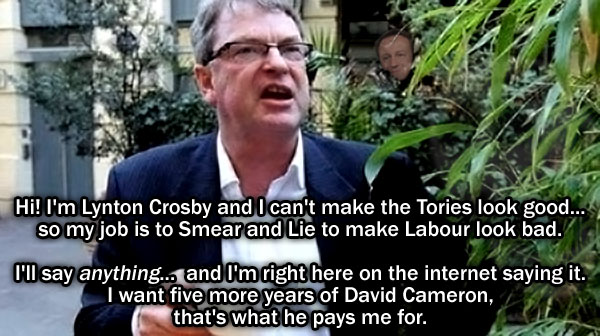
The Conservatives value the use of lies and deceit to get their own way. How fitting that the man who brought truly democratic and liberal values into Conservative electioneering, fostering a respect for diversity and championing equal opportunities, (stop laughing) has finally been awarded a knighthood for his highly salaried dastardy. The lizard of Oz, the kidder for kidders that kidded thousands, did declare war on the Scottish, he is very well known for his dogwhistle racism, but surely divided and prejudiced nations and ever-sinking standards of living are a price well worth paying when we have another Tory government. Hurrah!

The cult of Lyntonism is a by-product of the micro-managerialism, totalitarian tendencies and the widespread use of techniques of persuasion usually reserved for the advertising industry, that has infected the New Right, “libertarian paternalist” Conservative Party. You know, I always thought there is something very pre-war Berlin about the Crosby crocodile smile.

I keep forgeting that this is 2016, and that we live in a first-world liberal democracy. Don’t we?


Happy New year all.

10853165213_ddb97ac601_o
Pictures courtesy of Robert Livingstone

Update: Mr Stewart Jackson has blocked my Twitter account, surprisingly. It’s good to know how much Tory MPs value democratic exchange, reasoned discussion, transparency and accountability…

Blocked


Further news: Simon Danczuk Investigated Over Historic Rape Allegation By Lancashire Police


The Daily Mail calls right wingers stupid, Charlie Brooker made me laugh.


Daily_Mail

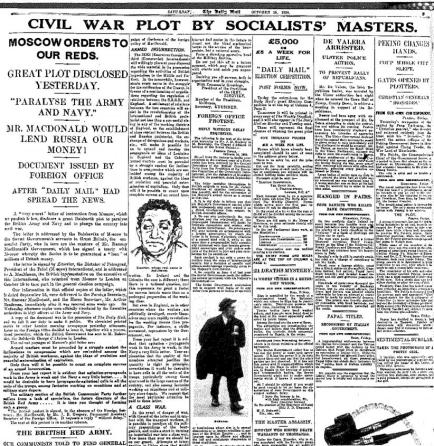
                 A classy Daily Mail moment – the  scandalous, fake Zinoviev letter


This article was originally published in the Guardian.

There was a minor kerfuffle a few weeks ago when the Daily Mail website overtook the New York Times to become the most popular news site in the world.  Liberals can whine all they like, but that’s a formidable achievement, especially considering it’s not really a conventional news site at all, more a big online bin full of pictures of reality stars, with the occasional Stephen Glover column lobbed in to lighten the mood.

The print edition of the paper is edited by Paul Dacre, who is regularly praised by media types for knowing what his customers want, and then selling it to them. This is an extraordinary skill that puts him on the same rarefied level as, say, anyone who works in a shoe shop. Or a bike shop. Or any kind of shop. Or in any absolutely any kind of business whatsoever. Whatever you think about Dacre’s politics, you can’t deny he’s got a job to do, and he does it. Like a peg. Or a ladle. Or even a knee. Dacre is perhaps Britain’s foremost knee.

Curiously, the online version of the Mail has become a hit by doing the reverse of what Dacre is commended for doing. It succeeds by remorselessly delivering industrial quantities of precisely the opposite of what a traditional Mail reader would presumably want to read: frothy stories about carefree young women enjoying themselves. Kim Kardashian or Kelly Brook “pour their curves” into a selection of tight dresses and waddle before the lens and absolutely nobody on the planet gives a toss apart from Mail Online, which is doomed to host the images, and Mail Online’s readers, who flock in their thousands to leave messages claiming to be not in the slightest bit interested in the story they’re reading and commenting on.

Now Mail Online has gone one step further by running a story that not only insults its own readers, but cruelly invites them to underline the insult by making fools of themselves. In what has to be a deliberate act of “trolling”, last Friday it carried a story headlined “Rightwingers are less intelligent than left wingers, says study”. In terms of enraging your core readership, this is the equivalent of Nuts magazine suddenly claiming only gay men masturbate to Hollyoaks babes.

The Mail’s report went on to detail the results of a study carried out by a group of Canadian academics, which appears to show some correlation between low childhood intelligence and rightwing politics. It also claimed that stupid people hold rightwing views in order to feel “safe”. Other items they hold in order to feel safe include clubs, rocks and dustbin lids. But those are easy to let go of. Political beliefs get stuck to your hands. And the only way to remove them is to hold your brain under the hot tap and scrub vigorously for several decades.

As you might expect, many Mail Online readers didn’t take kindly to a report that strived to paint them as simplistic, terrified dimwits. Many leapt from the tyres they were swinging in to furrow their brows and howl in anger. Others, tragically, began tapping rudimentary responses into the comments box. Which is where the tragi-fun really began.

“Stupidest study of them all,” raged a reader called Beth. “So were the testers conservative for being so thick or were they left and using a non study to make themselves look better?” Hmmm. There’s no easy answer to that. Because it doesn’t make sense.

“I seem to remember ‘academics’ once upon a time stating that the world was flat and the Sun orbitted the Earth,” scoffed Ted, who has presumably been keeping his personal brand of scepticism alive since the middle ages.

“Sounds like a BBC study, type of thing they would waste the Licence fee on, load of Cods wallop,” claimed Terry from Leicester, thereby managing to ignore the findings while simultaneously attacking public service broadcasting for something it hadn’t done. For his next trick, Terry will learn to whistle and shit at the same time.

Not all the respondents were stupid. Some were merely deluded. Someone calling themselves “Hillside” from Sydney claimed: “I have an IQ over 200, have six degrees and diplomas and am ‘right-wing’, as are others I know at this higher level of intelligence.” His IQ score is particularly impressive considering the maximum possible score on Mensa’s preferred IQ test is 161.

Whatever the numbers: intellectual dick-measuring isn’t to everyone’s tastes anyway. Simply by highlighting his own intelligence “Hillside” alienated several of his commentbox brethren.

“If there is one person I can not stand and that is a snob who thinks they are intelligent because if they were intelligent and educated they wouldn’t be snobs,” argued Liz from London. Once you’ve clambered over the broken grammar, deliberately placed at the start of the sentence like a rudimentary barricade of piled-up chairs, there’s a tragic conundrum at work here. She claims intellectual snootiness is ugly, which it is, but unfortunately she says it in such a stupid way it’s impossible for anyone smarter than a steak-and-ale pie not to look down on her. Thus, for Liz, the crushing cycle of snobbery continues.

On and on the comments went, turning a rather stark write-up of a daft-sounding study into a sublime piece of live online performance art. A chimps’ tea party of the damned. The Mail has long been a master at trolling lefties; now it’s mischievously turned on its own readers, and the results could only be funnier if the website came with free plastic lawn furniture for them to lob at the screen. You couldn’t make it up.

Corporate nudging and the graveyard shift: would a stint in a coffin inspire you to work harder?

The emergence of Nudge theory in the 2000s – generally described as a system for change/societal-management, has increasingly been used by governments to understand and alter group behaviour – reinforces the principle that governance must be driven by needs of the people being governed, not by the governing authority.

Nudge theory has found its way into the business management and corporate culture. Although Nudge was initially developed as a concept by behavioural economists, its stated aim was the improvement of society, theorists claimed it was not designed as a mechanism for commercial exploitation, or government manipulation. However, there are no safeguards in place to prevent such exploitation and manipulation in the application of Nudge theories.  

Imagine the scene. You knew office morale had been low for a while, but you never thought senior management would go to quite such lengths to try and get everyone enthusiastic about their jobs again.

You and your co-workers file slowly into the meeting room and an array of perfectly aligned coffins comes into view. As your team development manager smiles and asks you to climb into a coffin – after all, it has your name on it – you are met by a photograph of yourself taken years ago when you still were optimistic about the future: “Now hug the image of yourself” is the final instruction before the coffin’s lid is closed.

No, this is not some bizarre scene from a Philip K Dick novel but an actual motivation exercise reported to have occurred in South Korea.

Faced with high stress levels and low productivity in corporate Korea, some employers have upped the ante, trying to get employees to embrace life at work rather than seek ever more desperate forms of escape. Firms send staff to the Hyowon Healing Centre, where its president explains the rationale behind the coffin ritual: “Our company has always encouraged employees to change their old ways of thinking, but it was hard to bring about any real difference … I thought going inside a coffin would be such a shocking experience it would completely reset their minds for a completely fresh start in their attitudes.”

To get employees in the mood they are shown videos of people overcoming debilitating conditions including cancer. As one employee robotically says as he emerges from a coffin: “I’ve realised I’ve made lots of mistakes. I hope to be more passionate in all the work I do, and spend more time with my family.”

What on earth is going on here? Actually, this extreme motivational technique is symptomatic of how work has changed over the last 20 years. What some call 24/7 capitalism has seen work overtake all other social activities to become the centre of society.

This is not only down to mobile technology, as some have argued, since there is nothing inherent in a smartphone that makes us work 24/7. No, the compulsion to check email and always be “poised to work” stems from the expectation that if you are not ready for that call from the boss then you are somehow deficient, disposable and lacking important qualities. No wonder a survey found 80% of employers find it perfectly appropriate to contact workers outside of business hours.

This weird “24/7 perpetual worker” was always the ideal goal of neoliberal economists such as Friedrich Hayek and Gary Becker. Because homo economicus is considered a superior being, we are constantly encouraged to transform ourselves into tradeable “human capital” and “permanent enterprises” that never switch off in case we miss that crucial deal.

We would expect unions and anti-work lobbyist to be at the forefront of resisting this trend. And they are. But large corporations are also trying to deal with the fallout, recognising the all-too human limits of this extreme ethos. Having unleashed 24/7 capitalism – and the ideal-worker to go with it – some businesses are frantically trying to put the genie back in the bottle.

Some firms in Europe and the US, for example, now deactivate their employees’ email after business hours because they realise that the obsessive-compulsive behaviour it inspires is bad for the worker and bad for business.

A Barclays’ banker was fired after it was leaked he declared to summer interns: “I recommend bringing a pillow to the office (yoga mat works as well). It makes sleeping under your desk a lot more comfortable, in the very likely scenario that you have to do that.” In light of the tragic case of Moritz Erhardt, the intern who died of an epileptic seizure after working nonstop for 72 hours, the comment was deemed very bad taste.

No wonder South Korean employers are taking extreme measures to put work back into perspective: actually ordering workers into a coffin and reminding them that life isn’t all that bad … death is worse.

The intertwined relationship between work and dying is the dark-side of the neoliberal fantasy and ‘ideal’ worker, which probably can’t be reversed so easily. When our society is reconfigured singly around our job or search for one, then work becomes more than something we do among other things: it becomes who we are. Thus escaping our job when things go wrong becomes exceedingly difficult. For how do you escape yourself?

It seems that neoliberal capitalism wants its cake, and to eat it too: a life of nonstop work and normal, balanced individuals. But something has to give.

Indeed, we can imagine the “coffin exercise” backfiring, an employee refusing to ever return to the pettiness of office life after realising that her existence must add up to more than merely sending emails all day. Inspired by neoliberal capitalism’s own contradictions, perhaps we are on the cusp of a new workers’ movement and the coffin exercise is not so morbidly wacky after all.

4928

You can read the original article here.

Psychologists Against Austerity campaign – call for evidence

 1450041_569755536427312_1698223275_n

I was delighted to be invited recently to join and contribute to several ongoing projects with Psychologists against austerity.

Psychologists Against Austerity is a national campaign that highlights the psychological costs of austerity policies. We take the position that the austerity policies are an ideological choice by the Government and not necessary or inevitable economic measures. Psychologists are often in a position to see the effects that social and economic changes have on people and communities.  We draw attention to these human costs, which in the long-term will have additional social and economic repercussions.

It is our public and professional duty to speak out against the further implementation of austerity policies, as these have direct psychological impacts. We draw on academic research as well as our professional and personal experience to identify the damaging psychological costs of austerity measures, and we have produced a briefing paper detailing this research evidence base. We also outline an alternative vision for a society that creates the conditions for people to have ‘freedom to live a valued life’.

We call for social policy that works towards a more equitable and participatory society. We argue for a community-led approach to mental and emotional wellbeing that develops collective responses to individual needs and strengthens communities; one that supports and liberates, rather than punishing people in times of need.

We have identified five key ‘Austerity Ailments’ based on robust and long standing psychological evidence. They are: 

Humiliation and Shame

Fear and Mistrust

Instability and Insecurity

Isolation and Loneliness

Being Trapped and Powerless

You can read the evidence in full in our briefing paper.

Everyday Austerity

We would like to hear your stories about how the cuts have affected you and your service. We want the wider public and politicians to understand the real life costs of public sector cuts. It can be hard to speak up alone, so we are collating everyone’s stories – together we have more power and a louder voice. We all have stories of frustration, fear and anger, so please use this as a way to tell the world about how the cuts have impacted on you and/or the people you work with. We are interested in stories from everyone who works in, uses, or needs Psychology services.

We may use these stories in other contexts, such as publication and media.

Please visit our page to tell us about your experiences here

PAA-550x369