Category: Uncategorized

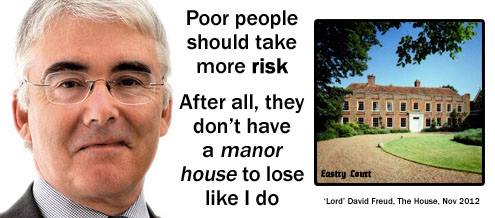
Libertarian Paternalism and David Freud’s comments in context

1374718_540929452643254_208125039_n (1)

.

It’s taken just four years since Labour’s Equality Act was implemented for it to appear reasonable for a government minister to propose that disabled people have fewer rights and are of less worth than everyone else. Only a corporocratic Tory would call exploiting disabled people for profit “support” and try and make out they are doing us a favour.

The Tories have made a virtue out of claiming they are giving something by taking something away. For example, the welfare cuts have been casually re-named reforms in true Orwellian style. We have yet to see how cutting the lifeline benefits of the poorest people, and imposing harsh sanctioning can possibly be an improvement for them, or how it is helping them into none-existent work, in a time of inflated living costs and recession.

This said, even the Tories have been forced to distance themselves from David Freud’s “business-friendly” Tory  commentary, about the lower economic worth of disabled people. 

Anyone endorsing Freud’s comments should perhaps try substituting the word “disabled” with “woman” or “gay” or any ethnic group and see how far they get with that.

We do have laws that demand people are treated equally, regardless of their characteristics, and for good reason, especially when people commenting on this issue think it’s ever acceptable to discriminate against disabled people. But then there’s also the issue of basic decency, and of what a civilised society allows and doesn’t allow. It’s telling that the loudest of defences for  Freud’s blatantly discriminatory remarks came from the Adam Smith Institute, who would have everyone on less than the minimum wage if they had their “all hail the competitive, managed free-market” minarchist way. 

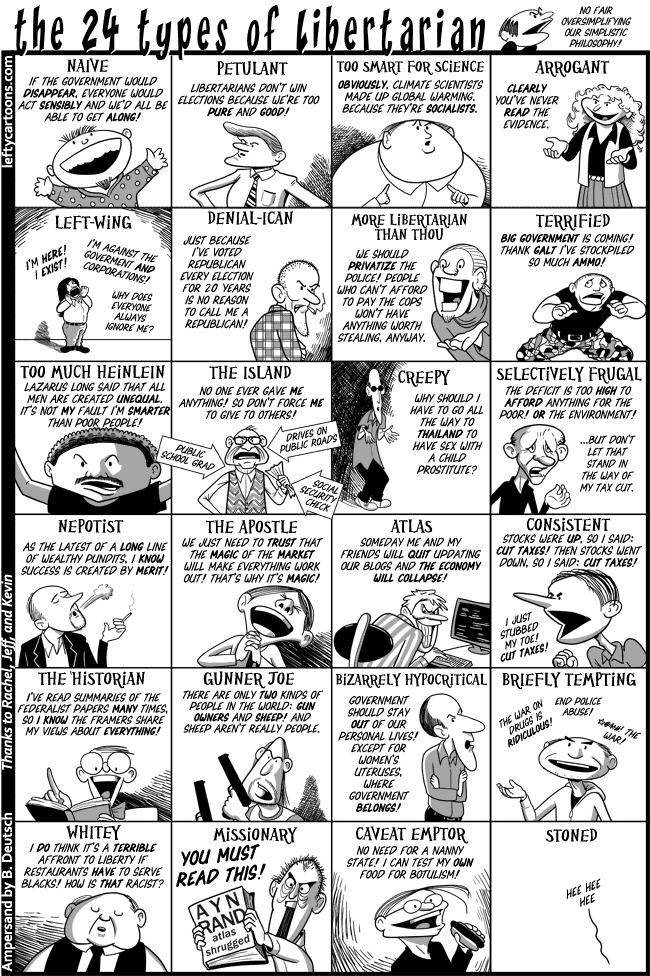
The real hypocrisy of Libertarians is that they know that the invisible hand of the market goes hand in hand with the iron fist of the state, in their rigged game. Indeed, politically  the idealised neoliberal small state has not disengaged from the public domain but its authoritarian arm has been extended.

Under the guise of a “new paternalism” (much the same as the old Tory 19th Century paternalism), which reduces the social world to the theories of behavioural economics and narrow neoliberal outcomes, the Tories have aligned public values with tradition – legitimated by a claimed concern for the welfare of society – but in reality it’s clear that Conservative paternalism is and always has been shorthand for hierarchical societies based upon privilege and a rigid control over the mass of people’s freedom, responsibilities (to the state), wellbeing and opportunities.

This is simply a social control mechanism with its micro-managerial politics; the tendency for politicians to devolve not power but responsibility for decision-making to citizens, without any reference to human experiences, constraints, or either micro or macro-level circumstances. And without extending genuine choices. It’s as if we have been placed in a state of perpetual Tabula rasa. The government and media re-write our narratives upon us.

Its also a preposterous zero-sum approach to wealth distribution. For the Tories, inequality is seen as necessary and beneficial.

State interventions this past four years have ensured that only the poorest and most vulnerable are left to the mercy of market forces, whilst welfare, in any meaningful sense, applies only to the wealthiest. Whilst austerity has been inflicted on the most vulnerable citizens in our society, the millionaires have enjoyed tax breaks and increased salaries. The elite play a rigged game: lobbying, the revolving doors between business and politics, being above the law, and tax-payer funded bailouts. The free-market isn’t open to the poor.

True laissez-faire capitalism is left for imposition only for the most vulnerable citizens, and only after we have been squeezed dry by those lying, pro-interventionist minarchists, who ensure that all protective, supportive public provision has been removed, and the public services we depend upon have been plundered and then sold off to the ever-circling private business and capitalist class vultures.

My point is this: the Tories, as neoliberal fundamentalists, have supplanted collective, public values with individualistic, private values of market rationality. They have successfully displaced established models of welfare provision and state regulation through policies of privatisation and de-regulation and have shifted public focus, instigating various changes in subjectivity, by normalising individualistic self-interest, entrepreneurial values, and crass consumerism. And increasing the social  and material exclusion of growing numbers living in absolute poverty

Basically, the Tories tell lies to change perceptions, divert attention from the growing wealth inequality manufactured by their own policies, by creating scapegoats and stigma. 

Freud’s comments have reduced disabled people’s worth to their economic value. Just as all Tories conflate everyone’s worth to an economic value. Human needs are being conflated to narrow neoliberal outcomes.

And they do tell such lies to justify their policy interventions.

For example, Disability Living Allowance (DLA) allows disabled people to purchase home adaptations, medication, treatment and equipment themselves. It is a very modest benefit of around £70 a week, it saves the taxpayer money because it allows early intervention, preventative treatment and, most importantly of all, it allows disabled people to work.

In fact the majority of DLA claimants were in work and use the extra cash to pay for the transport, software, screen readers, tactile keyboards and orthopaedic chairs, and so forth, thus allowing more and more disabled people to do a 9 to 5 job.

Yet the Chancellor said, in his 2010 emergency budget speech, that the Tory instigated reassessments for DLA would “significantly improve incentives to work, despite the fact that DLA has nothing whatsoever to do with unemployment.

“BRITAIN’S shirkers’ paradise shame with hordes of work shy benefit claimants was blamed last night for much of our economic mess…

…we have managed to create a block of people in Britain who do not add anything to the greatness of this country. (Now THAT is a typified Tory view)

They  have become conditioned to be users of services, not providers of money. This is a huge part of the reason we have this massive deficit. We have had to borrow vast sums of money. We went on this inflated spending spree”  –  More lies from Iain Duncan Smith, in The Sun, 1 December 2010, despite an official rebuke from the Office for National Statistics.

Duncan Smith has somehow forgotten that the global banking crisis is responsible for the recession, not poor people without jobs, and as for the lies about New Labour’s “big spending”  Fabianism, which has no empirical basis, it’s worth noting that total public spending under the Thatcher Governments averaged 42.11 per cent of GDP and, under the Blair Governments, 36.59 per cent (Source: HM Treasury, 2010).

The Access to Work fund was re-established by the last Labour Government to ease the transition to work for disabled people, by paying grants to businesses for vital equipment. It was put in place to support people with disabilities, it aimed to reduce inequalities between disabled people and non-disabled people in the workplace by removing practical barriers to work. This fund has seen severe cuts since 2010, which flies in the face of this Government’s claim to “make work pay” for all. By reducing this essential funding, the Coalition have effectively excluded many from work.

Additionally, disabled people with the highest support needs have been left in fear and distress following the Government announcement that it is to callously abolish a key source of independent living support. The Government decision to close the Independent Living Fund and devolve responsibility to severely under-funded local authorities follows a consultation that disabled people claim is unlawful and on which an urgent hearing scheduled by the High Court to go ahead on 13/14 March 2013.

Labour have also challenged the decision to close this crucial source of support. Labour has called for the retention of this vital fund which benefits the most severely disabled. To show her support for the retention of Independent Living Fund, which is relied upon by over 19,000 severely disabled, Labour’s Dame Anne Begg is the primary sponsor of  an Early Day Motion calling on the Government to reverse their decision to close the fund in June 2015. You can view the EDM here.

In May 2014,  the Court of Appeal, in the case of Bracking and others v Secretary of State for Work and Pensions found that the Department of Work and Pensions’ decision to close the Fund was not lawful, overturning a High Court decision of April 2013. It decided that the Department had not complied with the Public Sector Equality Duties imposed by section 149 of the Equality Act 2010. Opportunity for new applications for this funding was closed in June 2010 by the Coalition. Once again this plainly indicates that the Coalition do not consider the needs of disabled people as important, and clearly demonstrates the extent of their disgustingly eager ideological drive to strip away essential provision and support for the vulnerable.

As Sir Bob Hepple QC has pointed out, some provisions of the Labour Government’s Equality Act were very quietly edited by the Coalition, (only roughly 90% of the Act came into force, after the Coalition quickly said it would be “reviewing several sections of the legislation passed by parliament in April 2010,”) whilst other provisions have been repealed by the Enterprise and Regulatory Reform (ERR) Bill, including the duty on public authorities to have due regard to the need to reduce socio-economic inequalities.

The failure to implement the Act in full certainly sends out a clear signal that creating a more equal society is not priority for the Coalition. However, perhaps even more important has been the Conservative defense of increasing economic inequality, the lionisation of a Randian selfish individualism and a proliferation of ideological justification narratives regarding the dismantling the “Big (Welfare) State”, where the latter, in Orwellian fashion, is now being indicted for many of the very social and economic ills that the free-market era has actually delivered.

Ed Miliband is right to demand Freud’s resignation, and right to defend our vulnerable citizens from potential exploitation: that is not “playing politics” as claimed by the likes of Paul Staines and James Delingpole,  Freud was certainly not a victim in this.

To put this in context, the Labour Party introduced a host of measures to strengthen the rights of disabled people. They passed the Disability Discrimination Act 2005, introduced the Equality Act 2010, and formed the Equality and Human Rights Commission, and, in 2009, the Labour government signed the United Nations convention on the rights of persons with disabilities.

Kate Green and Anne McGuire have pointed out that the original intentions when Labour introduced the Employment Support Allowance (ESA)pilot and an assessment of people’s capacity for work, have been distorted – that the original aim was to be a supportive and facilitative process, with Disability Living Allowance (DLA), and other supportive measures in place to help people with disability lead a dignified life, fulfilling their potential, but, as Anne McGuire has pointed out, the renegotiation of the Atos contract by the current Government, (along with the addition of targets to remove people’s benefits, and sanctions,) has rebalanced the system to be punitive, rather than facilitative.

Of course the Tories have been very quick to blame Labour for the current situation, however, following a review of their pilot, Labour warned the government of problems with the Work Capability Assessment (WCA), which Iain Duncan Smith duly ignored, passing the ESA system into law, making the WCA even more problematic, and as stated, re-contracting Atos “in line with the welfare reforms”, including targets to take people’s lifeline benefits away, despite the claims made by the Tory liars.

Comparing policies indicates clearly the stark differences between the parties, and given the briefing from Labour from their ESA review that was blatantly disregarded, and the refusal of the Coalition to undertake a cumulative impact assessment of the “reforms”, it’s clear that the Tories do not regard the poorest and most vulnerable worthy of government diligence, accountability, support and fair treatment.

We simply cannot allow such a vindictive, uncivilised government another five years to harm our most vulnerable citizens, further undermine our democracy, destroy our public services and welfare provisions and trample our human rights. This is the first government to face a United Nations inquiry into disability rights violations. And that is absolutely shameful for a wealthy so-called first world liberal democracy.

Never in this country have those who fight for democracy and social justice carried a greater burden or faced the possibility of bigger losses of human rights, human freedoms, human dignity and human welfare than they do right now.
 

1459165_266124213538634_1461740450_n

Pictures courtesy of Robert Livingstone


An open letter from Rachel Reeves to Iain Duncan Smith: Universal Credit questions that need answering

12787_401370889932445_1764534847_n


By Rachel Reeves 

At your party conference you announced your intention to “accelerate the delivery of Universal Credit … from the New Year, bringing forward the national roll-out through 2015/16 to every community across Great Britain”.

As 985,920 fewer people receiving are Universal Credit than you originally said would be claiming the new benefit by April 2014, acceleration is clearly necessary.

However, given the litany of problems with the delivery of this scheme to date, and the £130m of public money wasted on IT, it would be extremely worrying if even the limited expansion of the scheme you have announced was being driven more by a political  timetable than by due concern for effective and efficient delivery.

Yesterday I visited the North West to find out first-hand how the Universal Credit pathfinders had been working in practice. I met with local authorities, the voluntary sector, housing providers and work programme contractors as well as staff and managers at the Jobcentre in Ashton-under-Lyme, which as you know has had the longest experience of handling Universal Credit claims. I would like to take this opportunity to record my gratitude and appreciation for the time they took to meet me and I am grateful also to you and officials at the DWP for helping to arrange this.

These meetings confirmed to me that the principle of Universal Credit is a good one that could bring real benefits to claimants, communities and taxpayers. It was also very clear that professionals across the public, private and voluntary sectors in these areas are working extremely hard to make Universal Credit a success.

However it was also clear that there remain a range of serious problems with the current operation of Universal Credit which risk being replicated and multiplied across the country on a far larger scale if Universal Credit unless they are resolved.

The serious problems that were raised with me included:

  •  the IT systems and related work processes around Universal Credit claims remain “clunky”, poor at handling complex or dynamic circumstances, and prone to delays and mistakes in processing claims and making payments.
  •  a significant level of system error which currently needs to be identified and corrected through costly manual checks.
  •  particular problems and high rates of error associated with the incorporation of the housing costs element of Universal Credit.
  •  concerns that claimants had not been informed of, or had difficulty in accessing, budgeting support, advance payments or alternative payment arrangements.
  •  an extremely high incidence of rent arrears that implied very substantial financial and administrative burdens for housing providers as caseloads increase.
  • the meaning of “in-work conditionality” and how in-work support will be delivered by jobcentres remains extremely unclear despite the fact that numbers of Universal Credit claimants in work will increase as the caseload expands and matures and the integral importance of this element to the programme’s aim of providing a different set of incentives to progress in work and increase working hours
  •  joint-working between the DWP and relevant local partners is patchy and there is poor data-sharing between the two, with little automatic integration of information on claimants and their circumstances.

The problems which I was told about during my visit are leading to concerns about the risks to claimants and additional costs to the public purse when Universal Credit is rolled out in other parts of the country. Therefore I am writing today to ask that you give us clarity and assurance on the following key issues:

1. What guarantee can you give that the IT systems for Universal Credit will not increase levels of error and delays in processing claims, payments and changes of circumstances?

2. What is your estimate of the current cost of manual processes for identifying and rectifying system errors, and how will you prevent this increasing as the caseload expands?

3. Will you publish a full evaluation of the impact of including new claims with a housing cost element in current Pathfinder areas before introducing Universal Credit to new areas?

4. Will you guarantee that all Universal Credit claimants will be fully informed of their options for budgeting support, advance payments and alternative payment arrangements, and set strict and published limits for the time taken to process and deliver on requests made?

5. What are the current levels of awareness and take up of options for budgeting support, advance payments and alternative payment arrangements among current claimants?

6. What increases in levels of rent arrears and related proceedings do you anticipate with the increasing incorporation of housing cost elements into the Universal Credit caseload?

7. How has “in work conditionality” been delivered in practice so far? What are the outcomes and lessons of its implementation so far? How will it be rolled out nationally?

8. What information on claimants and the circumstances and their partners is currently shared automatically between the DWP and relevant partners, and what can only be shared manually? What information cannot be provided even on request?

9. What steps will you take to ensure that joint working between the DWP and relevant partners is improved before introducing Universal Credit in new areas?

10. Will local authorities and voluntary sector partners in every area receive the same level of additional funding and support from the DWP for supporting the introduction of Universal Credit as has been available to Pathfinders? What has been the cost of this, and what will be the cost of extending it to all areas of the country?

And following your written ministerial statement of 13 October:

11. What IT system will underpin the full national roll-out, if, as you have stated, testing of the “enhanced digital service” is to start “later this year” in a “limited local area?

12. What exactly has been “assured by the Major Projects Authority and signed off by HM Treasury”, especially give the statement that “we will keep all longer-term plans under review.

13. When will a long-term plan for the full-implementation of Universal Credit be published?

14. How many people will be on universal credit by 2015, 2016, 2017 and 2018?

15. By what date will universal credit be rolled out entirely across the country?

16. By what date will the migration of all legacy benefits have been completed?

I look forward to hearing from you.

Rachel Reeves MP is shadow secretary of state for work and pensions.

Related: We can reduce the Welfare Budget by billions: simply get rid of Iain Duncan Smith

377683_445086432227557_1770724824_n (1)Pictures by Robert Livingstone

Children’s health – a casualty in Osborne’s war on the poor


Fenland Sunset

As George Osborne promises fresh hardship for the working poor, Professor Michael Marmot and Dr Angela Donkin look at the impact of growing inequality on child health

Clare Sambrook writes: Speaking at his party’s conference, Chancellor George Osborne harked back to the Steam Age, the “golden age” of Boulton, Murdoch and Watt, “when the spirit of invention was alive and the marriage of business and science made everything possible.” Osborne said: “I want us to be that Britain. Let’s raise the ambition of the nation so that everyone has the chance to succeed.”

Then he promised that a future Conservative government would freeze benefits to people of working age, squeezing the already stressed working poor. Over to Prof Sir Michael Marmot and Dr Angela Donkin:

Persisting social inequalities in early child development and an alarming increase in poverty were among figures we (the UCL Institute of Health Equity) published last week. We have been monitoring trends in health inequalities and their causes since the publication in 2010 of Fair Society, Healthy Lives: the Marmot Review.

The findings show a worrying picture. Inequalities in life expectancy and healthy life expectancy persist. The difference between life expectancy at birth between the most and least deprived areas of the country is eight years for women, and nine point two years for men.

There is an even higher level of inequalities in healthy life expectancy – that is the length of time someone can expect to live in good health.  For example if you are a man, you can expect to live 55 years in good health in Manchester, compared to 70.3 years in Richmond upon Thames.

We have shown, previously, that the majority of the variation in health can be explained by inequalities in the conditions in which we are born, grow, live, work and age. To address these inequalities in the life course Fair Society, Healthy Lives set out its policy recommendations, in six domains: To ensure every child has the best start in life,

1. Enable all children, young people and adults to maximise their capabilities and have control over their lives,

2. Create fair employment and good work for all,

3. Ensure a healthy standard of living for all,

4. Create and develop healthy and sustainable places and communities,

5. Strengthen the role and impact of ill-health prevention.

The Government white paper that followed Fair Society, Healthy Lives (Healthy Lives, Healthy People: Our strategy for public health in England) accepted all but one of the recommendations (the recommendation for a minimum income for healthy living). Encouragingly as well, alongside a general acceptance of the need for action, there has been significant support from the Department for Health, with for instance, the introduction of the Public Health Outcomes Framework (PHOF) within England. PHOF is a monitoring system with the ultimate aim of reducing health inequalities.

However the results regarding trends in the causes of health inequalities are discouraging.  More needs to be done across all government departments, and the approach needs to be joined up.

A key focus should be early child development.  Good early development is a predictor of better health outcomes in later life.

The Department for Education’s own figures sadly show only 52 per cent of children achieved a good level of development at the end of reception class. For those on free school meals this drops to a heart sinking 36 per cent. It isn’t as simple as being poor = bad health and being rich = good health. There is a gradient. For each step up the social ladder, for each increase in income decile, our health and the social determinants (the conditions in which we are born, grow, live, work and age) improve.

If we compare ourselves to other countries, then we don’t perform as well as we ought to on measures of child well-being. A Unicef report last year placed the UK in 16th place in the OECD, below Slovenia, the Czech Republic and Portugal.

Figures from the Joseph Rowntree Foundation, which we have made available at a regional level, illustrate that the number of households who do not have enough money to live a healthy life has increased by a fifth, between 2008/9 and 2011/12: from 3.8 million to 4.7 million. Currently, 23 per cent of households, fall below this poverty threshold.

In London, where costs are higher, more than one in four households (29.4 per cent) did not receive enough income to live a healthy life.  It is a disgrace that in this country nearly a million people will need to use food banks by the end of the year, according to estimates by the Trussell Trust.

If incomes are insufficient, it is more difficult to have adequately sized housing, free from damp, and adequately heated. It is more difficult to buy a nutritious diet, with fruits, vegetables and lean meat, leaving people to buy cheaper filling food, full of processed carbohydrates and fats.

Families with children will struggle to provide them with the opportunities for enrichment that other families do, they will avoid having birthday parties and friends round to play, they will struggle to buy birthday presents, sports equipment and warm clothes. Parents will be stressed, and less able to respond to children positively, which we know is important for their development.

Thomas Piketty, in his book Capital in the Twenty-First Century, captured attention by pointing to dramatic increases in the concentration of income and wealth – we are heading back to 19th Century levels. This increasing concentration of capital and income is not good for our society.

If we want a healthy economy, a healthy population, a fair society, a population with lower crime, we ought to be very concerned.

It is now the case in England that a majority of people below the poverty line are in households where at least one adult is in work. Whatever one’s political leaning, a failure to reward people adequately for hard work, cannot surely be the basis of a civilised society.

We need to ensure that work creates the opportunity for a healthy life, that the jobs created provide sufficient income and a healthy working environment.

We must do more to tackle health inequalities, starting from birth.  If we need a motivation beyond our ethical responsibilities, then we would do well to remember that health inequalities come at a huge cost.

More children reaching a good level of development means less financial burdens on the NHS in later life. Lower unemployment means less economic inactivity.  Better working conditions mean less money lost to sick pay and less cost to the NHS. Tackling these issues has the potential to save many billions in future years.

With many thanks to Counterfire


Related

Inequality has risen: Incomes increased for the richest last year, but fell for everyone else.

Poverty

It’s absolute poverty, not “market competition” that has led to a drop in food sales

Quantitative Data on Poverty from the Joseph Rowntree Foundation.

tory cuts

A snapshot of stupidity – from a Ukip voter

carswell

Quote from an “informed” resident of Clacton, after casting a carefully considered vote…

 UKIP suffers from a chronic, persistent failure to appeal to three key groups of voters – women (because of the chauvinistic and anti-feminist views of Ukip members and politicians); young people (who find the party almost farcically out of touch with their own world-view) and ethnic minorities (because of its strident and emotive language about immigration), but UKIP does represent something of a “blue-collar revolt”- its electoral base is “old, male, working class, white and less educated,” say academics Matthew Goodwin and Robert Ford. This would explain the strong anti-intellectual prejudice. Anti-intellectualism is a dominant feature of far-right politics.

And apparently, in Clacton, so is forgetfulness.

Gosh Carswell, the great “voice of the people” overthrowing that Westminster right-wing establishment…. with an established right-wing member of the establishment…

Ukip: for when the Tories aren’t Tory enough….

1904028_714854408584090_8727785646514177390_n


 Perhaps it was that toupée that fooled ’em….

scroll2

Many thanks to Robert Livingstone for his pictures.

Related

UKIP, Conservatism and the racist race to the bottom

UKIP: Parochialism, Prejudice and Patriotic Ultranationalism

Why did people in Clacton vote for UKIP in by-election? Here’s an exercise in superficial thinking

Minister insists DWP is right to ignore reports of deaths linked to benefits

536738_306169162785952_999031084_n

The new Conservative minister for disabled people has insisted that his department is right to ignore reports of deaths linked to the loss or non-payment of disability benefits.

The Tory pre-paid punishment and anti-welfare card. Again

526544_532055030197363_2137237288_n
Iain Duncan Smith told delegates at the Tory conference in Birmingham: “I have long believed that where parents have fallen into a damaging spiral – drug or alcohol addiction, even problem debt, or more – we need to find ways to safeguard them – and more importantly, their families, their children, ensuring their basic needs are met.

Benefits paid should go to support the well-being of families, not “to feed their destructive habits”.

Work and Pensions Secretary Iain Duncan Smith proposed that a “smartcard” scheme would see benefit payments loaded onto prepaid cash cards, and that transactions would be automatically stopped if people tried to buy anything on them but essentials. Again.

Smart Cards entered our collective consciousness during autumn 2012, as Iain Duncan Smith declared his intention to attempt to discipline Britain’s “troubled” families. In unveiling his proposals at the Conservative Conference  back in October  2012, Duncan Smith attempted to frame the cards as better value for taxpayers’ money, implying that poor people don’t pay taxes, (when we actually pay proportionally more) and his rhetoric stigmatised all benefit claimants: I am looking […] at ways in which we could ensure that money we give [benefit claimants] to support their lives is not used to support a certain lifestyle. 

MP Alex Shelbrooke presented his (rejected) private member’s bill in December 2012, providing us with yet another shuddering glimpse into the underlying Tory moral outrage and punitive attitudes towards people claiming benefits. He argued for a “welfare cash card” to limit spending to absolute basics. Despite his scapegoating narrative about addressing “idleness”, Shelbrooke’s restrictions were intended to apply to those in work, who claim benefits such as tax credits and housing benefit, thus penalising and stigmatising those on a minimum or low wage, also.

A principled objection is that we should not be stigmatising people and reducing their freedom to spend money as they wish just because they are forced to spend some time out of work, or because they aren’t paid a wage that is sufficient to live on.

And having been previously rejected, this is certainly not a democratically endorsed policy.

This is an authoritarian restriction on what people claiming benefits can buy, and is a particularly spitefully directed ideological move that does not make ANY sense in terms of the wider economy, or in terms of any notion of “supporting” people, and “fairness.” The latter two categories of reason would entail extending opportunities  and freedoms, not repressing them. Financial hardship already limits choice. When people are struggling financially, budgeting isn’t the problem: low wages, benefit cuts and rising costs of essentials are. Those factors are shaped by government policies, not poor people.

And no matter how this is semantically dressed up by the Tories, poor people don’t respond to “corrective” narratives and policy like Pavlov’s dogs. Yet the Tories nevertheless insist on placing  a pseudo-psychological variant of operant conditioning – behaviour modification – at the core of their psychopathic control freakery  repressive rhetoric. This isn’t about state “assistance” for the entitled poor.  It’s about state interference and intrusion. And more blaming and punishing the victim. 

The Tories have historically thought that poor people “deserve” to have their rights and freedoms curtailed, so that their corporate whores can profit.Tory policies create and sustain inequality because they have an underpinning Social Darwinist philosophy at their core, which is masqueraded as meritocracy.

Restrictions on spending will mean that money is being removed from the wider economy. Limiting “consumer choice” and spending flies in the face of the Tories own free market dogma, after all.

Furthermore, as it stands legally, the government cannot currently stipulate how people claiming benefits spend their money.

The sheer pace and blatancy of Cameron’s austerity program – a front for the theft and redistribution of public wealth to Tory donor private company bank accounts – is unprecedented, even for conservatives.

When the state makes judgements about what constitutes a necessity, and then enforces this on the poorest and most vulnerable citizens, it creates a “peasant” and “benevolent dictator” dichotomy. This is not democratic, progressive or ethically sound.

Conservatives claim to believe in personal responsibility, limited government, free markets, individual liberty, traditional values and a strong national defence. They believe the role of government should be to provide people the freedom necessary to pursue their own goals. Conservatives claim their policies generally emphasise “empowerment of the individual to solve problems”. So how does any of this tally with welfare cuts and prepaid cards, the removal of human rights, removal   of access to legal aid, limiting housing options for the poorest, and the welfare “conditionality” and sanction regime, for example?

As Christine Clifford  pointed out: “This is an interpretation of the individual based on an ideology bereft of informed knowledge of human beings and their need for social connection and interdependence.”1965037_301820166635705_1502392114_n (1)

Article One of the Declaration of Human Rights recognises our fundamental social context, it says: “All human beings are born free and equal in dignity and rights. They are endowed with reason and conscience and should act towards one another in a spirit of brotherhood.”

All Tory policy aimed at the poorest is a direct attack on equality, dignity and human freedom. It also aims at segregating and stigmatising the most vulnerable social groups.

The welfare state is a safety net to which we all contribute so that if circumstance dictates, we may use it: something those least likely to ever need it conveniently forget. When the state start incorporating punitive addendums, we lose sight of the wider issue. The poor have been deliberately stigmatised through a caricature of “scrounging, recklessness and fecklessness.”

Something that troubles me greatly is that the Tory definition of “troubled family” conflates poverty, ill health, unemployment and criminality. Iain Duncan Smith claims to be targeting substance abusers (“drug addicts” and “alcoholics”) but it’s clear that the government’s definition means he’s referring largely to the poor and disabled people. His proposal to deal with people who don’t buy their children food because they’re “drug addicted” would actually target people who don’t buy food because they can’t afford it.

And of course, once again we see the disciplinarian Tories blaming and stigmatising vulnerable people for the conditions that Tory policies have caused.  If such “troubled families” existed families (and the Joseph Rowntree foundation research has put paid to the myth of “families with three generations unemployed” ), it would not be reasonable to treat their situations as an issue of personal spending choices rather than a consequence of how our economy is run.

The Tories have, over the past four years, parodied a political process that is supposed to be about engaging the public’s rational, conscious minds, as well as facilitating their needs within society. Instead we see the employment of psychobabble and behaviourism by right-wing authoritarians, the former to appeal with a superficial authority directly to people’s irrational, primitive impulses which have little apparent bearing on issues outside of their own narrow self-interest, and the latter to manipulate and control them. The media are complicit in propping up an increasingly incoherent, irrational and phenomenologically violent ideology.

Tory policies have imposed increasingly damaging, punitive restrictions on the freedoms and limitations on choices available to our poorest and most vulnerable citizens. As well as having a determination to control and restrict every dimension of poor people’s lives, the oppressive Tories – those lying minarchists – intrude on an intimate psychological level, repressing, brutalising people’s very sense of self and assaulting their dignity with labels of loathing, with a constant monologue of hatred, a vicious contempt and pitiless, sadistic scorn. I can see it, I can feel it and I can hear it.

And these are not the actions of a democratic government.

538861_380839531985581_164896303_nMany thanks to Robert Livingstone for his excellent pictures

Thoughts On Human Rights and Society

robin-mcburnie's avatarRobin McBurnie

Human Rights are a basic requirement of any form of social structure. They are the basic agreement amongst groups of people as to the minimum standard of treatment any individual member of that group may expect from any other member, or group of members.

The exact nature of this minimum standard has of course changed over time. Changes which one would hope would be recognised as an improved direction. Unfortunately deteriorations have also occurred in different Cultures and Geographical (Political) regions.

This Agreement is unfortunately almost always expressed in terms of explicit Rights, without direct specification of the corresponding implied Responsibilities. Human Rights could be better described as Human Responsibilities as understanding the Responsibility implied by any “Right” actually defines the case of and for that Right better than simply stating the Right itself.

When looked at as a set of responsibilities, Human Rights can never be considered to be…

View original post 1,468 more words

The lord chancellor is dismantling the rule of law

995147_204045783079811_467247470_n
“Ministers keep using the mantra that their proposals are to protect the most vulnerable when, quite obviously, they are the exact opposite. If implemented their measures would, far from protecting the most vulnerable, directly harm them. Whatever they do in the end, Her Majesty’s Government should stop this 1984 Orwellian-type misuse of language.”
  – Lord Bach, discussing the Legal Aid Bill. 
Source: Hansard, Column 1557, 19 May, 2011.
 

Chris Grayling has been caught out again by the high court, this time for trying to protect insurance companies from people who have only a couple of years to live.Tomorrow he will try to scrap legal protections available to British citizens from the European Convention of Human Rights. It is a very damning charge sheet. What we are witnessing is a full scale assault against the rights of citizens and an attempt to bolster the powers of the state and private companies. And it is being conducted by the lord chancellor himself.

These were the victims he picked: mesothelioma sufferers. People who inhaled asbestos, usually through work. It is a horrible disease. From the point of diagnosis you usually have two years to live. That is why the House of Lords exempted them from the Legal Aid, Sentencing and Punishment of Offenders Act (Laspo).

This legislation forced people winning compensation to pay up to 25% of it in costs. It’s supposedly intended to address those personal injury claims you see on daytime TV,  according to the government.

But mesothelioma is not a typical personal injury claim. Sufferers have two years to live, through no fault of their own. Their only crime was simply doing their job. So Section 48 of the bill exempted them from the payback requirement until the lord chancellor had conducted a review.

But he did not conduct a review. He brought in what the Ministry of Justice later pretended was a consultation. It wasn’t.

The people being consulted had no idea it was happening. If they had, they would have brought evidence. It was all fakery. And then the government predictably lifted the exemption. This isn’t the behaviour of a first -world, liberal, democratic government.

During the case, Leigh Day partner Harminder Bains found that the government had made a deal with the insurance industry to benefit it at the expense of the mesothelioma sufferers.

As the judge said this afternoon, when he found against Grayling:

“The question I have to answer is simple: did the lord chancellor carry out a proper review of the likely effects of the Laspo reforms on mesothelioma claims as Section 48 required him to? I conclude that he did not. No reasonable lord chancellor faced with the duty imposed on him by Section 48 of the Act would have considered that the exercise in fact carried out fulfilled that duty. This is not a case in which the procedural failure was minor or technical in nature.”

Harminder said:

“It was obvious that the proposals would have a devastating effect, and cause great injustice to victims of mesothelioma. It would have reduced the compensation payments to many, and in some instances, it would have prevented some victims of mesothelioma from recovering any compensation at all.”

Shadow justice minister Andy Slaughter said:

“Mesothelioma is a horrific industrial disease. Its victims deserve better than the shameful way this government has treated them. Instead of honouring their commitments, David Cameron and Chris Grayling have wasted thousands of pounds of taxpayers’ money on expensive lawyers to dodge justice. Hardly a week goes by without the High Court finding the lord chancellor has acted unlawfully in driving through cuts in legal services for the most vulnerable groups in society.”

Meanwhile, Grayling is preparing tomorrow to unveil Tory plans to scrap Britain’s human rights laws. As published here, the plans would repeal the Human Rights Act and break the formal link between the European Court of Human Rights and British law. Its judgement would now be treated as advisory and need to be approved by parliament.

Let’s be clear what the human rights attack really is. It is not about euroscepticism or common sense or any of the other justifications they are using. It is about scrapping legal protections against the state.

Grayling has tried to take legal aid from the poorest and most vulnerable citizens, in a move branded contrary to the very principle of equality under the law. He turned legal aid into “an instrument of discrimination“.

He has tried to dismantle a vital legal protection available to the citizen – judicial review – which has been used to stop him abusing his powers again and again. He has tried to restrict legal aid for domestic abuse victims, welfare claimants seeking redress for wrongful state decisions, victims of medical negligence, for example. And now he wants to take away citizens’rights to take their case to the European court.

His every action is intent on tearing up essential British legal protections for citizens and massively bolstering the powers of the already authoritarian state.

The hypocrisy is evident in that this is a government which claims to pride itself on its dislike for the state. But in every meaningful way, it is vastly increasing its powers, and authoritarian reach.


Related

The Coming Tyranny and the Legal Aid Bill.

Children are being denied justice and their human rights by legal aid cuts

The Government’s Legal Aid Cuts Are Leaving Vulnerable People With Nowhere to Turn

Devastating blow to Grayling as judges halt his legal aid reform

 A strong case for the Human Rights Act

421077_263839013685634_1738380387_n
Pictures courtesy of Rob Livingstone


In four years, Cameron has told just two truths, and those were uttered inadvertently.

382035_141704259313964_676863845_n

David Cameron made a clear and very telling Freudian slip during his Conference speech today:

“This party is the trade union for children from the poorest estates and the most chaotic homes; this party is the union for the young woman who wants an apprenticeship; teenagers who want to make something of their lives – this is who we resent.”

See live coverage here

The only other truth Cameron has ever told is: We are raising more money for the rich,”  which was blurted out during Parliamentary debate on 12th December 2012. This was a memorable Commons debate, with Ed Miliband delivering some outstanding challenges to David Cameron, some of which provoked the Freudian-style slip, and exposed the traditional Tory values and ideology underpinning their policies.

See live coverage here539627_450600381676162_486601053_n (2)1235473_537097386359794_65317730_n (1)

These are such rare, historical occasions that simply ought to be reported.

See here for Tory lies and tall stories

See here for the official rebukes regarding the many  Tory lies

There is one policy proposal that we must also take very seriously: Cameron intends scrapping our Human Rights Act and withdrawing from the ECHR. Should the Tories get the opportunity via another Term in Office, they will certainly follow through with this policy proposal. Human rights are the bedrock of democracy, which the Tories have already imperiled. 

But the Tories have been quietly and steadily dismantling both rights and democratic process since 2010.

Thanks to our Robert Livingstone for his brilliant art work, exposing Tory lies.