Category: Uncategorized

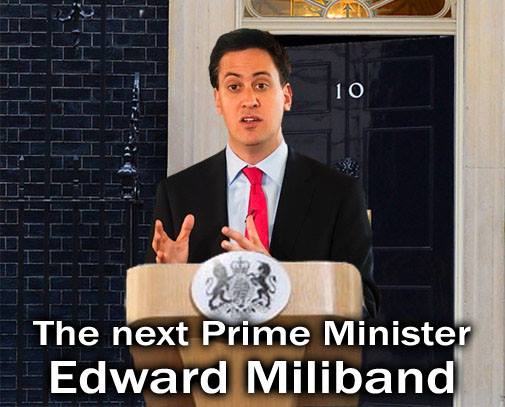
Miliband: hope, humanism, joined-up thinking and integrity.


1044468_500666173336249_1718830491_n


One of Miliband’s virtues is that he re-humanises politics. For him, people’s individual experiences matter, and he always cites many examples throughout his speeches. He includes qualitative accounts from real people. It’s a particularly contrasting quality to Cameron’s unempathic, dehumanising, quantitative and negative labelling approach.

To the Tories, we are all reducible to their often cited, fake statistics. The numbers tell us what the Tories want us to “know”, and not what actually is. And we know that the Tories have never been big on free speech – see the Gagging Act, for example. They like to exclude “inconvenient” voices of truth from the grand, overarching Tory narrative. Miliband listens to accounts of people’s realities, and accommodates those accounts. Cameron imposes both accounts and realities upon us.

Hardly surprising, therefore, that the right-wing bitcherati press have taken the piss once again and tried to make Miliband’s approach to the paramount importance of everyday people look small. Littlejohn in particular is being his pernicious, old, fascist self. How anyone that writes for the Mail for a living has the cheek to criticise anyone at all is beyond me. But it shows that the right are determined to portray any strengths that Ed Miliband has as a weakness. Propaganda at its worst. But its so blatant, superficial and unsophisticated, at least.

I have criticised Tory ontology and methodology previously, using social science as a frame of reference. Politics is a social science, and not a “stand-alone” one: it draws on the disciplines of psychology and sociology, too. As a critical interpretivist, I believe that social reality is not “out there” waiting to be discovered: we are constructing and reconstructing it meaningfully. However, politically, there’s been a marked shift away from understanding the lived experiences of real people in context: a systematic dehumanisation. The Tories have depopulated social policy. This is a characteristic of authoritarianism, and other hallmarks include stigmatisation of social groups, moral disengagement, moral exclusion, impunity, and a societal “bystander apathy”, as I’ve discussed elsewhere.

In the social sciences, there was a big shift away from Cameron’s approach to “understanding the social world” from the 70s onwards. Mostly we realised that  counting people’s responses doesn’t give us any clue about meanings and intentions, it can only turn up statistics. And these are open to reductionist and determinist interpretations and inferences from the persons gathering them, as we know.

Qualitative researchers aim to gather an in-depth understanding of human behaviour and intention – the reasons that govern such behaviour. The qualitative method investigates the why and how of our decision making, rather than just what. And we get to interpret our own reality and experiences. We are each experts in our realm of experiences, and Miliband understands this. He invites our expertise, Cameron stifles it.

The social researcher and the politician do not stand apart from or outside of the intersubjectively constructed universe they wish to describe/measure: there is no “objective” vantage point, because we all participate personally within it.

Clifford Geertz, an anthropologist said: Man is an animal suspended in webs of significance he himself has spun, I take culture to be those webs, and the analysis of it to be therefore not an experimental science in search of law but an interpretive one in search of meaning.

And in Thick Description, which compared the “thin” descriptions of measurements with the “thick”, densely layered description of context and meaning that qualitative research can provide in any given situation, he said : “The difference between a twitch and a wink is vast.  From a purely physiological perspective, a wink is the contraction of the muscles of a single eye that cause the eyelid to close.  So, of course, is a twitch.  And so is a slow-motion, exaggerated parody of a wink; a fast motion parody of a twitch; and any number of parodies of parodies of twitches and winks that a group boys sitting in the back row might engage in to amuse one another on a spring afternoon”.

And any measure of the interactions that include and are driven by these twitches and winks is bound to measure the wrong things and fail to measure the right ones.

No-one but the Tories would try to argue that poverty is an intentional act of the poor, that food banks are a symptom of rising greed rather than need. I have never known a government to be so blatantly insouciant with the measurable social phenomena it causes via its policies. Or with its own credibility, for that matter.

In contrast to quantitative research, qualitative research involves the collection and analysis of information that focuses on the meanings attached to people’s actions and behaviours, often referred to as the lived experience.It defines us as active participants in the world, instead of merely reducing us to statistics and preferences.  It makes priority of our perceptions and experiences and the way we make sense of our lives.

First-hand experiences matter. And quite properly so. It puts us, the people, in the driving seat, we construct our own meanings, rather than having authoritarians like Cameron imposing meanings, definitions, convenient labels and Tory ideology upon us. Quantitative methods tend to hammer the world into a presupposed state  – as Einstein once said: the theory tells you what you may observe. How very Cameron. All quantitative studies can yield are conventionalised expressions of the experience of the author, or the one commissioning the research.

Quantitative, positivist paradigms share commensurable assumptions but are largely incommensurable with critical, constructivist, and participatory paradigms.. In other words, they don’t accommodate any critical  approaches or analysis, nor are they inclusive. How very Cameron.

Furthermore, quantitative methodology in the social sciences depends upon faith in the “verification principle”. Which is itself unverifiable…

How very  cul-de-sac, and how very Cameron.

Quantitative methodology objectifies us, whereas the qualitative method draws on a humanist, hermeneutic/phenomenological approach: understanding moves from the outer manifestations of human action and productivity (the superficial) to the exploration of their inner meanings and references. Numbers cannot convey human experiences: it is thought, language and our expression that converts experience into meaning.

Humanist thinkers within the discipline of psychology, such as Ronald D Laing, drew on a qualitative  approach, and in his earliest works, he starts from the experience of the individual ego, in “The Divided Self” (1961) and moves towards existential phenomenology , and in his later work, such as “The Politics Of Experience And The Bird Of Paradise“(1967), he manages to integrate these perspectives within a Marxist framework.

Laing, along with others who led the anti-psychiatry movement in the late 50’s and early 60’s, such as Erving Goffman and Thomas Szasz, had a profound and hugely significant impact within the field of psychology, which had been dominated by associationism, behaviourism, psychometrics and eugenics and of course, psychoanalysis.

At a time when theorists from social sciences maintained that their perspectives were premised on scientific (usually positivistic) principles, Laing offered a humanist critique of these approaches, which he said trivialised psychology and dehumanised its subjects. Laing shifted the emphasis from an experimental approach, and a searching for “facts” and “predictability” regarding human behaviours to dialogue, intersubjectively constructed and reconstructed meanings and human experience. Laing and others challenged established categories of behaviour deemed pathological or abnormal, by meaningful explorations of individual accounts of their experience of being.

Laing in particular gave a rational voice to those individuals who had experienced exploitation within family relationships, which he studied extensively, discovering sets of interactions that often involved complex tactical games, relationship knots and strategies, with family members making alliances with some and creating enmity with other members. Within the nexus of the family there is an unremitting demand for constant strategic interpersonal interaction based on mutual reciprocal concern and attention. Individuals are therefore vulnerable to existential harm. They are emotionally imprisoned via the nexus, internalising other family members, and the interaction patterns.

Laing believed that some families acted like gangsters, offering each other protection against each other’s violence. Some governments do, too.  He also believed that the internalisation of family interaction patterns becomes our world – and it restricts the development of the self, with individuals carrying the emotional blueprint of their family for the rest of their life, which may inhibit any real autonomy or self awareness. This blueprint may manifest as expression through behaviours that are clinically identified and diagnosed as schizophrenia. Laing and others exposed the negative labelling processes, and ritualised humiliation directed towards those experiencing self-fragmentation because of the internalisation of negative family interaction patterns. For Laing, madness is simply a perfectly rational adjustment to an insane world. Of course that world exists within a political framework.

In sociology, phenomenology was expressed in the work of Alfred Schutz (1899 – 1959) who studied the ways in which people directly experience everyday life, and imbue their activities with meanings. In contrast to the predominant structural and somewhat deterministic perspectives within the discipline, Schultz moved away from the tendency of subordinating everything within disaffecting, abstruse and overarching ideologies or grand narratives, and he emphasised a multiplicity of new and often spontaneously co-authored ideologies lived out day-by-day and based on common sense and intersubjectively constructed values.

Schultz expressed a vitalism that engendered an organic way of thinking, with characteristics such as intuitive insight as a way of perceiving things from within, and placed emphasis on understanding as a holistic grasp of the widely varied, often complex and subtle elements of situations, and on experience as something that is lived through in common with others.

Schultz says that we draw on a common stock of knowledge – “typifications” and common sense which orientates us, helps us navigate socially, and achieve a reciprocity of perspective with others. Socialisation processes mediate and normalise this common stock of knowledge.

Phenomenological Sociology went hand in hand with a preference for a qualitative methodology that emphasised authentic everyday accounts of social reality, with agency and meaning being the focus. Quantitative methodology, on the other hand, had primarily focused on measurement, notions of the predictability of behaviours due to these being determined by social structure for example, as was the case with many advocates of Functionalism, such as Social Darwinist Herbert Spencer, and a socially detached and “objective” researcher.

Such a researcher was evidently armed with the belief that he/she possessed the somewhat unique ability to stand outside of human experience and values, unlike the subjects of enquiry, and would thus gather “social facts” and then interpret them from this independently existing standpoint. For example, a sociologist studying drug use amongst young people may gather statistics and hand out closed questionnaires with short directive and directed yes/no type questions. From the information gathered, the researcher may conclude that anomie and alienation lead to drug use, because, for example, many young drug users singled out for study live in deprived inner city areas.

Most young drug users, however, would not use terms like anomie to explain or give meaningful accounts of their drug use. This imposed conceptual framework of the researcher demonstrates very well how detachment and objectivity is not possible, in sociological enquiry. Indeed, some have extended this criticism to scientific enquiry. We each operate within idioms of belief, and Michael Polanyi has proposed that Western Science is such a self-sustaining idiom. (“Personal Knowledge”, 1958). He compares science with Azande Witchcraft, (Evans-Pritchard’s anthropological study: “Witchcraft, Oracles and Magic Among the Azande”), noting that each conceptual framework is “segregated’ by a logical gap” (they are incommensurable), but from within each idiom, beliefs tended to be circulatory, self-confirming and self-sustaining.

This is true of all ideologies. We can make inferences from sociological research, for example, but every sociologist knows about the Hawthorne effect: that the very fact that people know they are being observed changes their behaviour and distorts the result.

Polanyi had become acutely aware of the extent to which worldviews penetrate into language, and that he had sensed that this may have important ramifications for relations between frameworks of belief. As the basis of his argument, Polanyi gives a precis of his epistemology in “Science, Faith And Society” (1946) and “Scientific Beliefs” (1951). Polanyi considers that discovery, verification and falsification of propositions in science do not obey “any definite rule” but proceed with the aid of “certain maxims” which defy both precise formulation and rigorous evaluation. The maxims are “premisses or beliefs … embodied in … the tradition of science”.

Sustained by this tradition, science is governed by the coherent opinion of its practitioners, who employ the “idiom of science” in which its interpretative framework, Polanyi concludes, is an entrenched tangled and negotiated reciprocity of perspective, and all founded on the the belief of scientists that science is true: a personal conviction which they cannot factually justify. And again, how can we verify the principle at the heart of scientific methodology: verificationism itself, for example?

It is also possible to identify imported scientific metaphors operating at the heart of social science. For example, the shift from “structure” to “events” in physics is reflected in a similar shift in theoretical focus in sociology. There was a marked shift in structural and deterministic accounts of human behaviour and a move to study small scale interactions, social events, context bound interactions and situations, which can be linked with phenomenology. Behaviour was relativised by a multiplicity of contexts, which meant that more descriptive methodologies were employed.

A phenomenologist would ask open-ended questions, preferring interviews and the use of dialogue. Responses would be directed as little as possible, ensuring that the account given is a true and meaningful reflection of the direct experience of the person/social agent. This kind of research also reflects immediacy – the here and nowness of the social world, that has a full potential yet to be explored, rather than the positivist emphasis on a narrowing predictability and replicating results to try and determine their’ “accuracy.” It is also democratic and founded on notions of equality.

The person/agent has the centre stage and is the author of the research. Furthermore, phenomenologists have pointed out that sociologists are also embedded in everyday life and cannot therefore escape the shared norms, values and meanings of the life world they inhabit. Phenomenologists value valid accounts, rather than social “facts”, as it is not possible to be “objective” when one occupies a completely intersubjective realm of enquiry.

Miliband, of course, recognises this, he values authenticity, inclusion, equality, democracy and spontaneity over and above ideology. Cameron is completely driven by ideology. and the ghastly assumptions that Tory dogma entails.

Social existence is not one dimensional; it is complex, ambiguous, poorly defined, deceptive, fragmented, emotional and often unpredictable. It is animated by a plurality of perspectives. It is often based on what we take for granted – tacit knowledge – that which is self-evident that informs our intellectual constructions. A phenomenological approach can uncover those taken for granted underpinning assumptions – quintessentially cultural phenomena, in that these assumptions are what societies are built upon.

Miliband understands this. He acknowledges that human experiences are complex, multidimensional, inter and intrasubjective, and multipersonal, many layered events, where both “verifiable statement” and valid existential account each have an important place in our endlessly creative narratives, and of the endless possibilities of our being in a social universe of expansive potential. Cameron only reduces that potential. And he really has, in just four years.

In a sense, we’ve all been doing such qualitative research our whole life, and therefore have very much to contribute to a pluralist, socially democratic society. Miliband knows this, Cameron freely chooses not to. Cameron is an epistemological and ontological fascist: he predefines what we “know”, and what is “acceptable” as “knowledge”, and he predefines social reality, excluding its’ members accounts.

Max Weber’s principle of Verstehen  is a critical approach in all social sciences, and we can see the consequences of its absence in the cold, pseudo-positivist approach of the Coalition in the UK. Their policies clearly demonstrate that they lack the capacity to understand, or meaningfully “walk a mile in the shoes of another”. The Coalition treat the population of the UK as objects and not human subjects of their policies.

My own starting point is that regardless of any claim to value-freedom in political science, we cannot abdicate moral responsibility, and cannot justify moral indifference. We see this positive approach exemplified in our laws, human rights and democratic process. We are also seeing an erosion of this tendency to a globalisation of values, and inclusion of a recognition and account of the full range of human experiences in policy making. Indeed Tory policy has become an instrument of social exclusion and increasing minoritization.

We are being reduced to little more than economic statements here in the UK. We have a Government that tends to describe vulnerable social groups in terms of costs to the State, and responsibility is attributed to these social groups via media and State rhetoric, whilst those decision-makers actually responsible for the state of the economy have been exempted, legally and morally, and are hidden behind complex and diversionary scapegoating propaganda campaigns.

Sartre once said that oppressors oppress themselves as well as those they oppress. Freedom and autonomy are also reciprocal, and it’s only when we truly recognise our own liberty that we may necessarily acknowledge that of others. Conservatism has always been associated with a capacity to inhibit and control, and never liberate. We need to take responsibility for the Government that we have. In fact we must.

Miliband is offering us social democracy. The accusations of political “cross-dressing” from the fringes of the left are utter nonsense, hence the persistent right-wing media smear campaign. Miliband is offering us inclusivity, he speaks with an obvious decency and passion, and has consistently presented us with a  comprehensive and coherent narrative, if only we will listen.

Socialism for a Sceptical Age, by Ralph Miliband was about the continued relevance of socialism in a post-communist world. Ed Miliband has said that the final few sentences of this book are his favourites of all his father’s work:

In all the countries there are people in numbers large and small who are moved by the vision of a new social order in which democracy, egalitarianism and co-operation – the essential values of socialism – would be the prevailing values of social organization. It is in the growth of their numbers and in the success of their struggles that lies the best hope for mankind.”  

“Socialism is not a rigid economic doctrine, but ‘a set of values’ It is ‘a tale that never ends’. Indeed, the strange fact is that  while there’s capitalism, there’ll be socialism, because there is always a response to injustice.” Ed  Miliband. (Source)

He’s right.

14533697838_dffcc736f2_o (1)

Thanks to Robert Livingstone for his brilliant pictorial truths

A tale of two polls

10424302_677497562319775_766713150422913861_nWe need a vision for the millions, not the millionaires, and Ed’s speech looked like a good opening salvo..”  Florence.

Ed Miliband has consistently said that he won’t promise anything he may not be able to do, and he hasn’t. His first priority is taking back the money handed out to the wealthy by the Tories, and raising revenue, and that is precisely what he is doing, as well as saving the NHS and repealing the Gagging Act, of course.

It’s worth noting the redistributive pledges, also aimed at generating needed revenue in the meantime:

  • Labour vowed to introduce an increased Bankers’ Bonus Tax.
  • Ed Balls pledged to reverse the Pension Tax relief that the Tories gifted to millionaires.
  • Labour promised to reverse the Tory Tax cut for Hedge Funds.
  • Labour have pledged to reverse the £107,000 tax break that the Tories have given to the millionaires.
  • Labour will reintroduce the 50p tax.
  • Labour will introduce a Mansion Tax on properties worth more than £2 million.
    And a Labour government will cut government ministers’ pay by 5% – and block any pay rises until the books are balanced.
  • Ed Miliband promised to repeal the Bedroom Tax.
  • Labour would freeze gas and electricity bills for every home and business in the UK for at least 20 months, the big energy firms would be split up and governed by a new tougher regulator to end overcharging.

There are more pledges, of course, but these are a darn good STARTING point, to rebuild what the Tories have demolished.

It’s interesting that a YouGov poll finds support for several new Labour policies across the political spectrum – see here for full poll results : LABOUR PARTY’S TAX AND BENEFIT PROPOSALS A HIT WITH VOTERS

A day after Labour leader Ed Miliband’s 68-minute conference speech, many commentators have petulantly preferred to turn their attention to “what he didn’t mention”, rather than what he did. Of course speeches are finite, and are necessarily limited by time. However, Labour did propose a number of policies at the conference that will most likely be included in their address to voters ahead of the next general election in May 2015.

In a survey for the Times Red Box, YouGov tested public opinion on four of the policies and finds them all to be popular, even among those who say they currently plan to avoid Labour at the polls next year….

Perhaps surprisingly, the most popular policy of the four is means-testing the winter fuel payment for pensioners so it no longer goes to the richest 5% of pensioners: fully three-quarters support the policy, while only 18% oppose it.

The progressive tax proposals are also proving popular, across the political spectrum.

72% support and 18% oppose introducing a new tax on properties worth over £2 million, also known as the “mansion tax”. Here Labour voters overwhelmingly support the policy, by 85%-8%, while Conservatives show more muted, but still robust support, at 58%-35%.

The public support increasing the top rate of income tax to 50p for incomes over £150,000, by 65%-23%. This is the only of the four policies not supported by the majority of Conservative voters, who are evenly divided on it 47%-47%.

A  Survation poll for Labour List of 1,037 people shows that 72% of the public are in favour of the policy to fund the NHS to the tune of £2.5bn extra a year, partially using taxes against tobacco companies and mansions as well as closing loopholes. Only 12% were against.

Every one of Ed Miliband’s pledges from his speech has popular public support, according to the poll.

The question on participation in the conflict with Isis, on which Miliband’s stance (wait for a UN Security Council Resolution on Syria) also appears to be the most popular one.

The pledges, reiterated at the Conference:

  1. NHS pledge – Create a “world class” health service. Increasing homecare visits, more nurses, GPs, midwives and careworkers – paid for by clamping down on tax avoidance, using the proceeds of a mansion tax for properties over £2mm and a windfall tax on tobacco
  2. Minimum wage pledge – Raising the minimum wage by £1.50 to over £8 per hour by 2020, to reward “hard work” and halve the number of people in low pay. (Slightly different to speech as Miliband clarified that it would go “beyond £8”).
  3. Apprenticeships – By 2025, have as many people doing modern business apprenticeships as currently go to university. Only providing major government contracts to companies that provide apprenticeships.
  4. Self-employment – Granting the same employment rights for the many self-employed people in the UK that permanent employees have.
  5. Energy – A commitment to take carbon emissions out of the economy by 2025 and through Green investment banks to allow communities to insulate 5 million homes over 10 years.
  6. Decentralising Westminster power – Decentralising power from Westminster to the regions, including constitutional reform for England, Wales and Scotland.
  7. House building – Make house building a top priority and by 2025 “build as many homes the UK needs” doubling the number of first-time buyers.
  8. Breaking up high street banks – Breaking up the big high street banks in UK to allow more competition, to benefit consumers in financial services. 

Check with previous policy promises, gathered from Labour’s site here, it’s certainly a show of consistency: 45 more good reasons to vote labour

I particularly liked this commentary from Mike Sivier, over at Vox Political:

This is exactly the response Labour needed, in advance of next year’s general election. Clearly the general public thinks that Ed Miliband is on the right track.

Of course, the election is still eight months away and much may change in that time. Public opinion is fickle and we may well see polls supporting David Cameron’s plans – or even Nick Clegg’s – before the end of October. (Yes, we mustn’t ever be complacent)

But it’s a big boost for Labour and will give the party the momentum it needs, in order to win the campaign and – if elected – let us hope Miliband will hit the ground running.

Because the UK needs a change, and it can’t come soon enough.”

10853165213_ddb97ac601_o
Many thanks to Robert Livingstone for his excellent pictures

Related

Don’t believe the critics – Labour’s plans are good for Britain – Mike Sivier

The Tories attack Miliband because they’ve got no decent policies

Think the political parties are not partisan enough for you? Watch the food banks debate and think again

Political parties – there are very BIG differences in their policies.


Children are being denied justice and their human rights by legal aid cuts

564882_438358886199493_1982719183_n

“Ministers keep using the mantra that their proposals are to protect the most vulnerable when, quite obviously, they are the exact opposite. If implemented their measures would, far from protecting the most vulnerable, directly harm them. Whatever they do in the end, Her Majesty’s Government should stop this 1984 Orwellian-type misuse of language.”  – Lord Bach, discussing the Legal Aid Bill.

Source: Hansard, Column 1557, 19 May, 2011.

The Equality and Human Rights Commission’s analysis in 2012 warned that reducing the scope of legal aid in a substantial number of areas in civil and family law will create serious practical barriers to access to justice, potentially in breach of Article 6(1) of the European Convention on Human Rights (ECHR).

The cuts to the civil legal aid budget, which came in to effect from April 2013, mean many cases, including those about debt, private family law, employment, welfare benefits, clinical negligence and housing problems are no longer eligible for funding.

This is at a time when the Government have implemented other radical, controversial and contentious cuts to health, education and welfare, and it is no coincidence that the legal aid Bill will curtail justice for those with legitimate needs at a time when draconian Tory policies such as the bedroom tax will most likely result in a massive increase of numbers of people needing and seeking redress.

This will mean the compounding of effects of other fundamental  human rights breaches, legally unchecked, because of the profound impact of multiple, grossly unfair and unjust Tory-led policies. Each policy hitting the same vulnerable citizens, to their detriment, over and over.

Children are being denied justice by legal cuts, and rights guaranteed by UN conventions are being breached because children  are unable to navigate complex procedures unaided,” says children’s commissioner, Maggie Atkinson.

A report informed by evidence collected by the charity Just for Kids Law, which was commissioned to carry out research for the Children’s Commission, concludes that legitimate claims for housing, welfare and other cases are being abandoned and children overawed by officials are often unable to fight their way through hostile bureaucracies. Vulnerable teenagers are being deprived of justice because cuts to legal aid are preventing them from accessing representation.

Criticism of the impact of changes to legal aid – which cuts £350m from the civil legal aid budget, have been ongoing, but coming from an official body and focusing on the adverse effects it is having children it is likely to inflict greater political embarrassment.

“Behind the evidence in our research are countless heartrending stories of children and vulnerable young adults whose lives have been seriously affected by their inability to access legal representation,” Atkinson said. “This means, in effect, that they cannot seek, let alone receive, justice. We should not expect children and young adults to face the complexities of the legal system on their own. These systems are daunting enough for adults, let alone vulnerable children and young people.”

The system is so difficult to navigate that it leads to people having no legal representation. That in turn can prevent decision-makers making decisions properly, as well as stopping individuals obtaining the justice they need … Short-term savings to one part of the legal system – legal aid – are simply shifting costs to another, because judges direct that representation has to be funded.”

Furthermore, an “exceptional case” funding system created by the Ministry of Justice (MoJ) to help those whose human rights are at risk is not working, the report by the children’s commissioner adds: “Only 57 grants were provided in its first year, rather than the 3,700 the MoJ had expected, due to the complexity and strict criteria applied to the system.”  

It’s very dangerous to allow the State to decide which cases constitute the most need. In a free, democratic and fair Society, each and every single individual has equal legal worth and entitlement to opportunity to bring about legal justice. The Government choosing which cases are most “worthwhile” undermines this very premise of legal equality which is so fundamental to the notion of liberty.  Everybody has a right to take any grievances they have, which have invoked legal ramifications, to court. Everybody ought to have an absolute, inalienable right to free and fair trial in a so-called free, democratic and liberal country.

Rights contained within the UN Convention on the Rights of the Child (UNCRC), a treaty Britain has ratified, have been infringed, the report states. They include the right to be heard, the right for children not to be separated from parents and that their interests be given primary consideration.

We believe that urgent review and reform is needed in order to ensure that the legal aid system can adequately protect the rights of children and young people and that the government’s obligations under the UNCRC are met.”

Jo Edwards, chair of the family law organisation Resolution, said: “Since the cuts to family legal aid were introduced, Resolution has consistently argued that they are hurting the most vulnerable people in society. This report validates our concerns, highlighting the difficulties faced by children and young people going through the justice system without the support of legal aid: from facing the courts without representation, to dealing with their parents involved in protracted battles over their care arrangements without proper legal support.”

Laura Janes, of The Howard League for Penal Reform, said: “This important report echoes my experience of the problems young people in conflict with the law face. So many young people see the law as something that is there to punish them rather than a potential solution to the problems they face.

This means that children and young people are disadvantaged from the outset and require additional support to access and then make the best use of the law. The blanket application of legal aid cuts across the board means that children and young people, who do not even know about their legal rights or the existence of legal aid, have been doubly affected.”

Related

The Coming Tyranny and the Legal Aid Bill.

The Government’s Legal Aid Cuts Are Leaving Vulnerable People With Nowhere to Turn

7005_494073677328832_658777491_n

Thanks  to Robert Livingstone

Labour Party media release – Reeves: We’ll Uphold The ‘Principles Of Our Welfare State’

430835_148211001996623_1337599952_n (1)

Rachel Reeves MP, Shadow Work and Pensions Secretary said in her speech to Labour’s Annual Conference:

“Just think conference, it could be less than a year left for the Bedroom Tax.

Because the very first thing I will do if I am Secretary of State for Work and Pensions next May is repeal it.

It’s unfair, it’s unworkable, and it’s on its way out – across the whole of the United Kingdom. Scrapped, binned, axed, abolished, put out of its misery, consigned to the history books.

And that day can’t come soon enough.

And for those Liberal Democrats who now say they’re against it too – we will see how serious they are when Parliament returns. Because we will call a vote on the Bedroom Tax. Today I have written to Nick Clegg to urge him to do the right thing and vote with us – not to water it down, but to cancel it altogether.

Change can’t come soon enough for the half a million families caught by the Bedroom Tax, all of them on low incomes, two thirds of them disabled, clobbered by a government that has handed 13,000 millionaires a tax cut worth £100,000 with an average annual charge of more than £700.

Change can’t come soon enough for Tony Cunning, a former sheet metal worker I met in Trafford. He had to give up his job because he needed kidney dialysis three times a week. He was looking forward to having that equipment installed in his flat so he wouldn’t have to keep going into hospital. But then he was told that the room he needed for the dialysis machine counted as a “spare bedroom”. Tony faced the choice between finding another home, or finding another £977 a year to cover his rent.

Change can’t come soon enough for my constituent Alice. Alice works three shifts a day as a cleaner to support her family, but had to wait four months for tax credits she was entitled to. Alice was trying to survive on rolled over payday loans, and had to come to me to ask for food vouchers.

Change can’t come soon enough for the former Remploy workers I met in Wakefield. They were promised help to get new jobs when their factories were shut, but instead they were just abandoned.

So the Bedroom Tax is just the start of what we will have to put right after five years of this Tory-led Government. Five years of favours for a privileged few while life for working people and their families gets harder and harder. Five years in which David Cameron has left the Department for Work and Pensions in the hands of Iain Duncan Smith. A man with his own special Midas touch: everything he touches turns into a complete and utter shambles.

Universal Credit – stuck in first gear.

Work Capability Assessments – in meltdown.

Personal Independence Payments – mired in delays.

The Work Programme – failing the people who need help the most.

The Youth Contract – an embarrassing flop.

It would be comical if it wasn’t so criminal. We should be angry that taxpayers’ money is being squandered. That vulnerable people are being ill-treated. That lives are being scarred. That talent is being wasted. We should be angry – and they should be ashamed.

The Tories will leave a truly toxic legacy. And for all their talk about cutting welfare, they’ve overspent on social security by £13 billion in this Parliament with a rising in-work benefits bill left for the next government. Because what the Tories will never understand is that you can’t control the costs of social security if you’ve got economy where people can’t earn enough to keep up with the cost of living.

So let me be straight with you: there will be tough decisions on resources and priorities for the next Labour government. But we will also target the deeper causes of rising welfare spending by building a recovery that leaves no one behind.

That’s how we ensure a system that is fair and affordable, so we can keep up the fight against child and pensioner poverty, upholding and renewing the principles our welfare state was built on: responsibilities and opportunities for all who can work; dignity for those who cannot; hard work and contribution recognised and rewarded.

Those are my values, and this is my mission. So here’s our plan to deliver it:

Step one: a Compulsory Jobs Guarantee so no one is left on unemployment benefit for years on end.

Step two: a Basic Skills Test so we intervene early to tackle skills gaps that can condemn people to a life on benefits.

Step three: a Youth Allowance that means young people who lack key qualifications are expected and supported to do the training they need.

Step four: replace the failing Work Programme, with power devolved to local councils and communities, instead of big contracts signed in Whitehall.

Step five: ensure our pensions market works for all working people, so that everyone can save for their future with confidence.

Step six: ensure that disabled people who can work get the tailored support that they need.

And as for the Work Capability Assessment, we need real reform, with disabled people given clear rights and a real say. And I give you this commitment: as Secretary of State I will come down hard on any contractor that gets these critical assessments wrong, or fails to treat disabled people with the decency and respect they deserve.

And Conference, it’s not enough to get people into work if they’re still reliant on benefits to make ends meet. So we will get more workers paid a living wage. And because the fall in the real value of the National Minimum Wage since 2010 is now costing the taxpayer £270 million a year in additional benefits and tax credits, we’ll set the Low Pay Commission a target to raise the Minimum Wage to £8 an hour by the end of the Parliament, so we aren’t using our social security system to subsidise the profits of big companies paying poverty wages.

That’s a future worth fighting for. And the fight is now on. It’s a fight for hardworking mums and dads who put in the hours but still fear for their family’s future. A fight for every young person who deserves a fairer chance to make the most of their lives. A fight for all those doing what they can to get into work and who need to be supported not stigmatised. A fight for all the people forced into debt, or to queue at a foodbank, because of inexcusable benefit delays. A fight for hundreds of thousands of disabled people to stay in their homes without having to pay the indefensible Bedroom Tax.

We’ve got 226 days left to fight for that with everything we’ve got. Conference, let’s make it happen.”

scroll2

Miliband has consistently said that he won’t promise anything he may not be able to deliver, and he hasn’t. His first prioritiy is taking back our money that has been handed out to the wealthy by the Tories, and raise revenue: that is precisely what he is doing, as well as renationalising  the NHS and repealing the Gagging Act, of course.

These are redistributive pledges, also aimed at generating needed revenue in the meantime: Labour vowed to introduce an increased Bankers’ Bonus Tax if they win in 2015. Ed Balls pledged to reverse the Pension Tax relief that the Tories gifted to millionaires. Labour have promised to reverse the Tory Tax cut for Hedge Funds. Labour have pledged to reverse the £107,000 tax break that the Tories have given to the millionaires. Labour will reintroduce the 50p tax. Labour will introduce a Mansion Tax on properties worth more than £2 million. And a Labour government will cut government ministers’ pay by 5% – and block any pay rises until the books are balanced.

Ed Miliband promised to repeal the Bedroom Tax. Labour would freeze gas and electricity bills for every home and business in the UK for at least 20 months, the big energy firms would be split up and governed by a new tougher regulator to end overcharging.

There are more pledges, all of which are an excellent STARTING point, to rebuild what the Tories have demolished –  45 more good reasons to vote labour


10407927_677369232332608_5384979058089243718_n

 Thanks to Robert Livingstone  for his epics.

Labour Party Media Release

We can reduce the Welfare Budget by billions: simply get rid of Iain Duncan Smith


Ewan Morrison – YES: Why I Joined Yes and Why I Changed to No

Groupthink, repression, obedience and conformity are not what you would expect to confront in a group of passionate campaigners insisting loudly that they are about to wrestle power from the English authoritarians and take responsibility to develop a discrete State, no less, and to establish the “rule of the people by the people”.

This lucid account confirmed my worst fears in many respects about the Yes Campaign, and as an English outsider confined to observing the economic and socio-political processes involved in the independence debate, on a micro-level – analysis of personal encounters has been restricted to a few overtly angry, oppositional, strongly anti-Labour Yes campaigners, who felt my Englishness and Labour Party support warranted and justified bullying and abusive behaviour.

This powerful article provides an insight into a claustrophobic, awkward and defensive affiliation of disparate groups, of ontological insecurity, tempered with blind faith, psychic spit and glue, and a sprinkling of sugared silence, balanced only with negative campaigning and black propaganda.

wakeupscotland's avatarwakeupscotland

 Ewan Morrison is an award-winning Scottish author and screenwriter.

how one word silencedFour months ago I joined the Yes camp out of a desire to take part in the great debate that the Yes camp told me was taking place within their ranks. Being a doubter I thought maybe I’d failed to find this debate and that it was exclusive to the membership of the Yes camp, so I joined hoping I could locate it and take part. But even as I was accepted into the ranks – after my ‘Morrison votes Yes’ article in Bella Caledonia, I noted that 5 out of the meagre 20 comments I received berated me for either not having decided sooner or for having questioned Yes at all. Another said, and I paraphrase: ‘Well if he’s had to mull it over he could easily switch to the other side.’ That comment in Bella Caledonia worked away…
View original post 1,804 more words

Antidote to the anodyne: The Internationale.


10403560_335367326614322_7277306109560040209_n

The verses of the Internationale were written on 30 June, 1871,  in the immediate aftermath of the brutal crushing of the Paris Commune during La Semaine sanglante (“The Bloody Week”). The policies and outcome of the Commune had a significant influence on the ideas of Karl Marx, of course.

The author, Eugène Pottier, was hiding in fear of his life. The lyrics were intended to convey the historical experience of an important workers’ struggle to a worldwide audience. For Pottier, liberty, equality and fraternity meant the promise of a society in which poor people, like himself, had justice.

The Internationale has long been the anthem of the labour’ movement throughout the world. Its power to move people has survived the repression of fascism, the cruel parody that was Stalinism and free market capitalism. Those who sing it need know nothing about it’s history to feel a strong sense of international unity. The Internationale is simultaneously about history, political argument and is a powerful rallying statement. Pottier established a reputation as the workers’ poet. It earned him a seat on the Communal Council representing the 2nd arrondissement.

The sheer power of Pottier’s Internationale lies in the fact that he was able to encapsulate his personal experience of  specific  events and express them in universal terms. And that identification and recognition is socialism in action.

The Second International (now known as the “Socialist International”) adopted it as its official anthem. The title arises from the First International,  which was an alliance of socialist parties formed by Marx and Engels that held a congress in 1864. The author of the anthem’s lyrics, Pottier, attended this congress.

The original French refrain of the song is C’est la lutte finale / Groupons-nous et demain / L’Internationale / Sera le genre humain. That translates as: “This is the final struggle / Let us group together and tomorrow / The Internationale / Will be the human race.”) The Internationale has been translated into many languages, it is a left-wing anthem, and is celebrated by socialists, communists, anarchists, democratic socialists, and some social democrats.

There’s something of an irony in the fact that New Caledonia became a penal colony from the 1860s until the end of the transportations in 1897, about 22,000 criminals and political prisoners were sent to there, amongst were them many Communards arrested after the failed Paris Commune, including Henri de Rochefort and Louise Michel. But I’m a person that sometimes connects the obscure, and seemingly random.

Which brings me onto contemporary geopolitical issues. Perhaps the famous Caledonian antisyzygy is a highly romanticised way of saying “cognitive dissonance.” Nationalism is the driving ideology of the Scottish National Party, the current Government of Scotland. The clue is in the name.

In the face of the current bloated propagandeering and emotive battle-cry rhetoric, attacks from the cybernats (I’ve even had the “we know where you live, and it’s not far from the borders…”), well, I much prefer articulate cognitive dissidents.

As I have written at length on the subject of  UKIP and ultranationalism, I will focus here mainly on the issues that arise with Scottish independence, though the  two topics are closely related, particularly on an ideological and sociological level.

Although civic-national ideals influenced the development of representative democracy in countries such as the United States and France (the United States Declaration of Independence of 1776, and the Declaration of the Rights of Man and of the Citizen of 1789), these  examples are very distinct from the current wave of  Ultranationalism in the UK, which is founded on emotionalism, fomenting talk of presumed, real, or imagined enemies, predicating the existence of threats to the survival of the native, dominant or otherwise idealised national ethnicity or population group, and of course, secession.

This kind of nationalism is inherently divisive because it highlights perceived differences between people, emphasising an individual’s identification with their own nation. The idea is also potentially oppressive because it submerges individual identity within a national whole, and gives elites or political leaders potential opportunities to manipulate or control populations.

It’s worth keeping in mind that fascism is often founded on a form of palingenetic ultranationalism that promotes “class collaboration” (as opposed to class struggle), a totalitarian state.  Fascists have often promoted ethnic or cultural nationalism. Fascism stresses the subservience of the individual to the state, and the need for absolute and unquestioned loyalty to a strong ruler. The key elements are that fascism can be defined by its core myth, namely that of “national rebirth” — “palingenesis“.

Sociologist Max Weber’s conception of charismatic authority has historically been noted as the basis of many nationalist governments. Weber theorised,  before the outbreak of war in 1914, that charismatic authority was one part of a triadic typology of political legitimacy, along with legal-rational authority and traditional authority. He defined it as “devotion to an exceptional leader and to the normative rules ordained by him.” Unlike the other two types of legitimacy, the charismatic bond has an exceptional, highly intense, and emotional nature. It arises “out of suffering, conflict, and out of “enthusiasm, or of despair and hope, in times of psychic, physical, economic, ethical, religious, or political distress.”

In other words, nationalism is a poor, provincialist palliative for current, troubled global-scale socio-economic conditions. An anecdote, not an antidote.

Often, abstract political ideologies are generally incomprehensible to the rank and file and are only vaguely understood by their more articulate spokespersons, whose preference for a certain “ism” may be only an expedient means of getting the “in” group “out.” Furthermore, history again has shown us that disintegration of the manipulated sense of nationalist unity after independence often makes incompatible the simultaneous pursuit of the two goals of political development: the consolidation of the state and the growth of central government capacity to modernise. Economic and social challenges will never be addressed by simply drawing a new border.

“I’ll tell you what hermits realise. If you go off into a far, far forest and get very quiet, you’ll come to understand that you’re connected with everything.” – Alan Watts

Fascists aren’t just fascists when it comes to your preferred target group – be it the shabby, politically motivated case presented against migrants, sick and disabled people, unemployed people, women, gay people, academia or the “middle class” that appeals to you – fascists are fascists full stop. UKIP supporters fail to recognise, for example, that most migrants are working class, and oppressed, too. These are your brothers and sisters, in the artificial categories, the “other” groups that the elite have set up for you to hate. I have never seen the UK so divided, with oppressed groups pitched against other oppressed groups, and national boundaries being drawn to divide and weaken us further.

Dividing people by using blame and prejudice further weakens our opposition to oppression.

A recurring theme that SNP ministers and independence supporters alike have persistently utilised is that independence would enable Scotland to rid itself of “government’s that it did not vote for.” Given that the SNP came to power in 2011 on the back of under half of the votes cast, what are the majority of Scots who didn’t vote for them supposed to do, faced as they are by a government they did not vote for?

The SNP’s line of reasoning proves also that their case for independence can only ever be made when Conservatives reside in Downing Street. For 13 years, Scotland VOTED Labour and GOT a Labour government. It is only now that the SNP talk of Scotland getting a government they didn’t vote for. And of course, it’s only now that they decided that Labour are the “enemy” too, and Scotland’s problems are apparently  the fault of Westminster.  This is suddenly justified by a priceless criticism of  Labour’s previous “neoliberalism” coming from Salmond, who is a neoliberal.

 Salmond’s key economic taxation proposal of a reduction in corporation tax to 15 percent, which if implemented would make Scotland one of the most “business friendly economies in Europe”, with the Tory mantra of “job-creation” tagged on as the justification  mechanism,this  reveals his orientation towards trickle-down Thatcherite economic pifflebunk which has been discredited beyond redemption by the current recession. The SNP has refused to commit an independent Scotland to Labour’s proposal for a 50p top rate of tax. It has also refused to support a new top band of council tax. There are  no countervailing measures to replace the funds lost from public services.

With no measures at all to reduce income or wealth inequality, and with no corresponding transfer of income or wealth proposed for poorer Scots, inequality would not fall in the SNP’s independent state. And according to the independent Institute for Fiscal Studies, without the pooled resources from the rest of the UK, there would need to be an additional £3 to 10 billion of cuts or tax increases simply to keep Scotland’s finances sustainable.

Of course it’s a myth that nationalism is correlated with socialism, yet it’s one myth currently being used by some of the yes campaigners, especially the ones that (quite offensively and wrongly) conflate being English with conservatism.

On the issue of nations and the proletariat, the Communist Manifesto says:

“The working class have no country. We cannot take from them what they have not got. Since the proletariat must first of all acquire political supremacy, must rise to be the leading class of the nation, must constitute itself the nation, it is so far, itself national, though not in the bourgeois sense of the word. National differences and antagonism between peoples are daily more and more vanishing, owing to the development of the bourgeoisie, to freedom of commerce, to the world market, to uniformity in the mode of production and in the conditions of life corresponding thereto. The supremacy of the proletariat will cause them to vanish still faster. United action, of the leading civilised countries at least, is one of the first conditions for the emancipation of the proletariat.”

In general, Marx preferred internationalism and interaction between nations in class struggle, saying in preface to the Contribution to the Critique of Political Economy that ” one nation can and should learn from others.” Similarly, though Marx and Engels criticised Irish unrest for delaying a worker’s revolution in England, both Marx and Engels believed that Ireland was oppressed by Great Britain but believed that the Irish people would better serve their own interests by joining proponents of class struggle in Europe, as Marx and Engels claimed that the socialist workers of Europe were the natural allies of Ireland.

Nationalism was one consequence of imperialism (though far from exclusively so). As capitalism spread around the globe, it also gave rise to powerful movements of resistance. Initially, the revolt of workers and peasants in countries oppressed by imperialism almost invariably takes the form of primitive nationalism.

Lenin said: “Socialists must be especially prepared to give most emphatic warning to the proletariat and other working people of all nationalities against direct deception by the nationalistic slogans of “their own” bourgeoisie, who with their saccharine or fiery speeches about “our native land” try to divide the proletariat and divert its attention from their bourgeois intrigues while they enter into an economic and political alliance with the bourgeoisie of other nations…. It follows, therefore, that workers who place political unity with “their own” bourgeoisie above complete unity with the proletariat of all nations, are acting against their own interests, against the interests of socialism and against the interests of democracy.

Socialists are internationalists. Whereas nationalists believe that the world is divided primarily into different nationalities, geopolitical zones, socialists consider social class to be the primary divide. For socialists, class struggle, not national identity, is the driving force of history. And capitalism creates an international working class that must fight back, united and co-operatively against an international capitalist class.

Progress, evolution and development, by their very nature, demand of us that we extend ourselves beyond where we are. But the loss of a fundamental recognition of our common bonds, shared experiences, collectivism – the breakdown of solidarity – is retrogressive and involuted.

We are becoming socially fragmented and politically disempowered by a shifted focus on increasingly parochialised concerns. It’s what Thatcher wanted to see.That is why Veteran Labour MP Tony Benn,half-English and half-Scottish, believed independence would do nothing for socialism and would weaken both Scotland and England.

David Benn said his brother, Tony, who sadly died in March this year, was a “committed supporter” of devolution but was fervently against “outright independence”.

Hilary Benn said: “The socialism my father campaigned for all his life was about solidarity.

“He was a passionate believer in standing together and supporting one another in struggle and difficulty, not pushing people apart.

“To him, independence would not further the beliefs he fought for. That’s why he was clear that the Labour cause – and the Socialist cause – was best served by staying together.”

I agree.

People who view the social world parochially and hierarchically are more likely than others to hold prejudices toward low-status groups. This is especially true of people who want their own group to dominate and be superior to other groups – a characteristic known as “social dominance orientation.” It isn’t only the elite that hold this perspective, either

Any group claiming dominance over another – including the “working class” – is displaying social dominance orientation. The oppressed can be oppressive, too.

It is time to recognise those artificially constructed divisions and unite, for we have nothing left to lose but our chains.

“So comrades come rally
And the last fight let us face”.

scroll2


“The Yes campaign in Scotland, as reasonable as it imagines itself, seems to believe in the unreasonable proposition that you can improve your marriage by getting a divorce” –  Dear Scotland: An open letter from your Canadian cousins

“The Ukip leader Nigel Farage has accused Alex Salmond of stirring up “excessive nationalism” and “anti-English hatred” with just two weeks to go until the vote on Scottish independence.” Remarkable allegation from the king of closing borders – Scottish Independence10658811_698839816852216_7811240035919643833_o

 Many thanks to my friend Robert Livingstone, as ever, for his epic memes, and for seeding the idea for this article.


Peter Duut’s Mother In Law Speaks Out About Her Daughter’s Current Situation

This is how vulnerable people are treated here in the UK.

samedifference1's avatarSame Difference

Same Difference has been in touch with the mother-in-law of Mr Peter Duut, who has asked for the following to be published exclusively, and shared with those who might remember his quite high-profile case.

I am the mother of Mrs Laurel Joanna Duut, the widow of Peter Duut, who died tragically in October 2011, after financially supporting my disabled daughter for years preciously in Holland, and also in the UK after all of her benefits ceased in 2002 after she had cared for her terminally ill father – we have never been given any reason as to why her benefits had ceased.

In the months before his death, Peter was denied benefits even though he had worked very hard in the Netherlands and the UK paying tax and National insurance in both countries. He was refused benefits and advised that he had no right to reside in the UK. As…

View original post 621 more words

Mental Health Services in crisis because of Coalition cuts to funding


tory cuts

A succession of Conservative governments have demonstrated very clearly that when it comes to funding established and crucial provisions for our most vulnerable citizens, they lack the foresight required to grasp that reducing funding means reducing our public services to a bare capacity for “firefighting” only – crisis management – rather than a much preferred “preventative” approach.

Under the guise of a “policy of deinstitutionalisation”, Thatcher’s “Care in the Community” Bill was about anything but care: it was all about cutting costs, as reflected in the experiences of many people leaving long term institutional care and being left to fend for themselves in the community. 

Previous Conservative governments of 1979 to 1997 had been responsible for a series of changes in the conceptualisation and delivery of community care services. . In particular, this period saw the introduction of a series of private sector approaches and terminology, as well as the gradual transition of social workers and social services departments into service “purchasers” rather than necessarily the providers of care. As a result of these changes, the community care landscape changed dramatically.

And now, as predicted by many professionals who have consistently warned of the harmful consequences of the Heath and Social Care Bill, it’s the case that a serious funding shortage for mental health services in England is putting patients (and staff) at grave risk. A lack of resources and staff is severely compromising care in parts of the country, with frontline teams often being left to carry the burden of risk, to the detriment of patients.  NHS hospitals are experiencing a massive surge in the number of patients attempting to self-harm and take their own lives, new figures have revealed.

The data, disclosed by UK mental health trusts, following Labour Party freedom of information requests, indicates suicide and self-harm attempts increased by 50 percent in mental health hospitals across Britain between 2010 and 2013. In the past year alone, incidents of patients attempting to take their own lives or inflict self-harm in the institutions has risen by 30 percent.

The FOI requests were tendered by Labour’s Luciana Berger, who is the Shadow Minister for Public Health. Fifty NHS mental health trusts were approached in total, and each was asked for the number of self-harm incidents and suicide attempts on their wards over the past four years. Twenty-nine supplied figures, while twenty one failed to respond. This comes as experts warn that acute mental health services are in crisis and struggling to cope with demand. NHS staff are working very hard in very difficult circumstances. Although the Royal College of Psychiatrists recommends occupancy levels of 85%, figures show that mental health wards are operating over capacity, with some running at up to 138%, and the shortage of beds has forced some mental health patients to travel hundreds of miles for treatment. Figures from the BBC show that minimum of 1,711 mental health beds were closed between April 2011 and August 2013. 

A recent investigation by Health Service Journal (HSJ) revealed that there are 3,640 fewer nurses and 213 fewer doctors working in mental health in April this year compared to staffing levels two years ago. Mental health spending has been cut for the first time in a decade, by the Coalition. 

The same investigation showed that the NHS’s mental health trusts have lost over £250 million of their funding in the same period.

Number of self-harm and suicide attempts across 29 Mental Health Trusts:

2010 2011 2012 2013
Total 14815 16711 17946 23053
Average 511 576 619 795

Luciana Berger MP, Labour’s Shadow Minister for Public Health, said:

“This increase in self-harm and suicide attempts on NHS wards is deeply concerning.

“Mental health services have been squeezed year on year, the number of specialist doctors and nurses has dropped and there aren’t enough beds to meet demand. The pressure this is putting on mental health wards is intolerable.

“It is unacceptable that people in touch with mental health services may not be getting the support they need. These are some of the most vulnerable patients in our NHS. Ministers must now take urgent action to tackle this crisis.”

And given that 42 percent of the NHS mental health trusts approached by Labour failed to issue a concrete response to the party’s recent inquiry, the true extent of this crisis may be considerably more serious than  Luciana Berger’s recently published figures indicate.

Pressure on mental health beds is so severe that some patients are having to be sectioned to secure necessary care, a survey of doctors (conducted by online journal Community Care) found. Sectioning someone under the Mental Health Act – denying them their liberty – should only be done when a person is a risk either to themselves or others. It is a legal process led by a social worker (an approved mental health professional) working alongside two doctors. A patient cannot be sectioned purely to secure a bed, but the survey suggests doctors are being influenced towards detaining someone if it will make it more likely a necessary bed can be accessed.

Sir Simon Wessely, president of the Royal College of Psychiatrists, said that the figures were “a glaring warning sign” that mental health is “running dangerously close to collapse”.  If Wessely is concerned, we all ought to be.

The Government has been criticised for allowing mental health services to be cut disproportionately, as the NHS as a whole undergoes the most severe budget cut in its history.

1912510_690135534389311_7775048840596309303_o

Picture courtesy of Robert Livingstone scroll2

If you are supporting someone who feels suicidal – you  can download a pdf from MIND, that provides information and practical suggestions for what you can do and where you can go for support. 

From  Rethink – Mental health information – Crisis contacts

From NHS Choices – Mental health helplines

Sane Line: 0845 767 8000 (6pm – 11pm every day) www.sane.org.uk

Samaritans: 08457 90 90 90 (24 hours every day)  www.samaritans.org

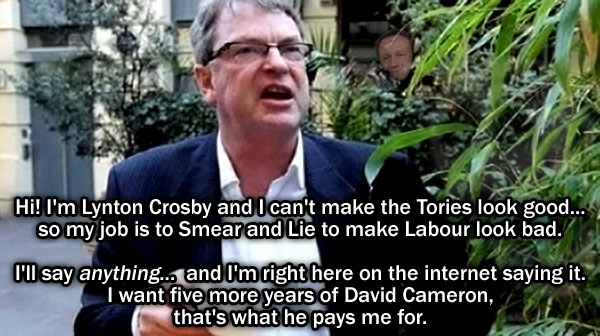
Lynton Crosby’s staff deleted valid criticism from Wikipedia

The Conservative election guru’s staff engaged in an ‘edit-war’ to delete details of his links with the tobacco industry and his election strategies from Wikipedia.

A Channel 4 News investigation has found that substantial sections were removed from the Wikipedia page of Lynton Crosby, an Australian political strategist, by staff at the Crosby Textor consultancy firm that he co-founded.

On 15 July last year, accounts linked to Crosby Textor staff deleted multiple times sections on the controversy when the Conservative party dropped its policy for plain cigarette packaging.

The policy on cigarette packs has been revived after a review, but at the time the press linked the policy being dropped to Crosby Textor representing the tobacco giant Philip Morris.

The deleted section includes a call by a Liberal Democrat MP for Lynton Crosby to be sacked.

Wikipedia editors reverted the changes, leading the Crosby Textor linked-staff to again make the deletions, initiating an “edit-war” in which users repeatedly try to edit a page, disregarding more senior Wikipedia editors’ warnings and revisions.

This lead to the Crosby Textor-linked accounts, including entire Crosby Textor computer networks, being permanently banned from editing any Wikipedia entry.

Crosby Textor said: “It’s hardly surprising that any individual or company would want to correct inaccuracies and falsehoods on its Wikipedia page. Indeed, Channel 4 News appears to have a team of editors making hundreds of corrections and alterations to its Wikipedia page.”

Channel 4 News has identified eleven changes made to its own page from computers on ITN servers. All of the edits relate to adding or removing the names of staff.

Election strategy deletions

Other edits made last year by Crosby Textor linked-accounts sought to delete information about Lynton Crosby’s election strategy.

The edits deleted a section outlining how Mr Crosby is said to favour the so-called ‘wedge issue’ strategy.

The deleted section on Wikipedia says: “The party he advises introduces a divisive or controversial social issue into a campaign… (with) the goal of causing vitriolic debate inside the opposing party.”

The edits also deleted information about Lynton Crosby’s alleged role in controversial claims made during the 2011 Australian federal election when allegations were made of asylum seekers throwing children overboard, and a slogan “We will decide who comes to this country and the circumstances in which they come” came to prominence.

One Crosby Textor-linked staff member annotated the edit with the words: “Spurious attempts are being made on this page. Opinion should not be confused with fact. If a user wishes to make changes they should balance the points rather than cherry-pick negative content.”

The only part of the “Tactics” section of the entry that was not deleted said: “Crosby is said to run a tight ship, focus on simple messages, target marginal constituencies and use lots of polls.”

News

Wikipedia ban

Channel 4 News has found that the edits were made by at least two separate Crosby Textor staff, one whom worked on Boris Johnson’s 2012 campaign to be re-elected Mayor of London.

A separate user on a Crosby Textor internet address in Australia on July 15, 2013, made three edits between 02:58 and 03:04 that deleted the sections on the plain packaging, and his controversial electoral technique.

Due to the number of edits, and reversions of attempts by independent editors to fix the changes, Wikipedia launched an investigation to determine who was making the changes.

Wikipedia administrator Basalisk checked what computer networks the edits were made from and found the users were working on “multiple continents”, making similar edits, and using similar tactics, such as the use of “sock-puppets”, a word for one person using multiple accounts under different names.

All of the accounts were banned indefinitely from making further edits.

“I suspect that you have a conflict of interest of some sort with the firm Crosby Textor,” the Wikipedia administrator Nick-D wrote to one of the users at the time.

“[The accounts] are single purpose accounts whose editing has almost only been to add similar positive material to and remove critical material from articles concerning the leaders of the political consultancy firm Crosby Textor.

“Their recent editing is indistinguishable,” said Nick-D.

One Crosby Textor-linked account in London rebuked a Wikipedia editor for an edit made to the page of Lynton Crosby saying: “Forcing your opinion on the wider community further damages the reputation and purpose behind Wikipedia.”

One has to ask in all seriousness which “opinions” are really being forced on the wider community, here, Mr Crosby?

Seems there’s a clear pattern of deceit, fabrication and being conservative with the truth emerging:

Some of the promises the Tories are trying to delete from the internet

The Tory “A” list of “mistruths” – Austerity, socio-economic entropy and being conservative with the truth

10853165213_ddb97ac601_o

Image used with big thanks to Robert Livingstone.

Thanks also to Channel 4 News.

The Tories attack Miliband because they’ve got no decent policies

10853165213_ddb97ac601_o
Originally posted on LabourList

As the 2015 general election approaches, it is becoming more obvious by the day what the Tory strategy is: there are no new ideas, policies will continue much as they are now, with the emphasis on denigrating Labour proposals and the Labour leader. If Labour announces details to increase income or corporation tax, Tories are ready to pounce.

The Tory propaganda machine has successfully convinced the more gullible that somehow the Labour government’s spending on schools and hospitals caused the 2008 economic crash, and that as a result, they cannot be trusted to manage the economy. It’s upon this, rather than their own proposals, that the Tory election programme is based.

David-Cameron-at-the-EU-s-007

Tories do not shout from the rooftops what their aims are: shrinking the state back to 1948 levels, a further reduction in social mobility and, of course, immigration, and more cuts in government spending. They will claim their “long-term economic plan” is successful, but will worry their assertion that more people than ever in Britain are working, with most new jobs part-time, on zero-hours contracts and very low pay, will be found out. On their “achievements” like the Bedroom tax, the continued tax gap of at least £50bn, the unregulated banks complete with bonuses and scams, the austerity policies that failed to kick start the economy or reduce borrowing, and the infamous tax reduction for the very rich, there will be silence!

Education, Tories will tell us, has improved exponentially. But they will ignore the fact that academisation has taken place because most schools are fearful of financial problems, and has not always brought examination success, despite heads having more freedom to expel problem students. Even more worrying, perhaps, is the fact that academies and free schools do not come under the auspices of the local authority, sometimes with worrying consequences. Similarly absent from the Tory manifesto will be the recent figures from the Institute for Fiscal Studies, which indicate the largest cut in public spending on education over a four year period since the 1950s has taken place since 2011.

With so many other no-go areas, like the NHS and Royal Mail, for the Tories to dwell on, the main focus of their strategy has, and will continue to be, the fabrication of the idea that Miliband is not prime-ministerial material, because of his “weirdness”. Has the Labour leader changed since becoming leader of the Opposition? No, of course not, but a sudden awareness of his “strangeness” has recently emerged, just months before the election; according to Tory propaganda, which is supported to the letter by Tories` allies in the media, Miliband’s looks, eating methods, speech, teeth, and geekiness make him out to be more like a cartoon character than a prime minister-in-waiting. They are so bereft of policies which can attract new votes, they will attack Miliband with anything they can dig, or make, up.

With humour and self-deprecation, Miliband defended himself well last week, but that should be it. He is no weirder or more geeky than other politicians. For goodness sakes, until a few months ago Gove was touted as a future PM. Yes, Gove!

Miliband’s “weirdness” is a Tory myth, created to divert voters’ attention from the fairness and validity of Labour policies, and the unfairness of theirs. Sadly, the few left-wing elements of our media have fallen for this Tory con-trick – articles by Toynbee, Rawnsley and Richards, and such like, have only added unnecessary gravitas to the issue. It’s time for all Labour supporters to rally around their leader, and when asked about his “geekiness” or whatever, to reply with the same response, learned off by heart, word for word: “The only difference between Ed Miliband and any other politician is that he is the leader of the party with the policies to transform this country, and create the just and fair society we all want”!

Repeat it, if asked again, robot-like if necessary, and the penny will soon drop!