Category: Uncategorized

Cameron’s crackdown on immigrant benefits is just another grubby con

999622_566748676727998_1599547969_n (1) Thanks to RL

Mike Sivier's avatarMike Sivier's blog

[Picture: I Am Incorrigible blog - http://imincorrigible.wordpress.com/2013/09/15/evidence-not-ideology-benefit-tourism-the-problem-only-fruitloops-and-tories-can-see/ - which agrees that benefit tourism is a non issue and distraction from the UK's real problems.] [Picture: I Am Incorrigible blog – http://imincorrigible.wordpress.com/2013/09/15/evidence-not-ideology-benefit-tourism-the-problem-only-fruitloops-and-tories-can-see/ – which agrees that benefit tourism is a non issue and distraction from the UK’s real problems.] The UK is to cut the amount of time EU migrants without realistic job prospects can claim benefits from six to three months, according to David Cameron – who seems desperate to take attention away from Andy Burnham’s speech today on the Coalition’s unwanted privatisation of the National Health Service.

According to the BBC, Cameron said the “magnetic pull” of UK benefits needed addressing to attract people for the right reasons.

But the announcement seems to be deliberately confusing.

It seems this restriction will only apply to people born abroad who have had a job in this country and then lost it. They are the only migrant group currently allowed to claim JSA for six months before the benefit is cut off “unless they…

View original post 416 more words

The government refuse to carry out a cumulative impact assessment of welfare “reforms”. Again.

430847_149933881824335_1645102229_n (1)

The Government has consistently stated its belief that “modelling difficulties” prevented the production of a cumulative impact assessment of welfare reform which is sufficiently robust to be published. In particular, the outcome of medical assessments – used in migrating claimants to reformed disability-related benefits – cannot be inferred from the survey data upon which the Government’s modelling is based.

The Government has implemented a programme of welfare reforms that have impacted on households in a variety of ways. Some households have been hit with cuts from more than one change in welfare law. The government have not carried out an assessment of how many people are affected by multiple cuts.

The Social Security Advisory Committee (SSAC) said they find it difficult to assess the cumulative impact of the reforms, but have recognised a number of the concerns raised by the currently available evidence.

They note that there are methodological challenges that are compounded by the need to assess impact longitudinally – over time –  and in various locations around the country.

Although some overall assessments of impact are available – this report looks to summarise their findings – it is clear that the evidence is incomplete.

The SSAC report contains three key conclusions:

  1. some overall assessments of impact already exist, in particular for impacts across the income distribution, and across geographic areas. These impacts are largely negative, as they focus on the direct and immediate effect of reforms upon incomes, rather than any employment or behavioural effects, and because the potentially positive effects of UC are yet to be introduced on a national scale;
  2. qualitative analysis can provide a more detailed understanding of the impacts felt by households with particular characteristics (for example by employing illustrative case studies). Case studies have been produced by a range of organisations focusing on areas of particular concern. However these case studies do not show the full range of impacts arising from welfare reform across different types of household; and
  3. particular focus has been drawn to the cumulative impact of welfare reform on disabled people. This is because they are both more likely to be claiming multiple benefits, and less likely to be able to change their behaviour to mitigate the impact of reforms.

And four key recommendations:

  1. that the Government produces further secondary analysis of the datasets behind Charts 1 and 2, bringing together the cumulative impact of welfare reform on vulnerable groups such as disabled people, and with the findings published within six months.
  2. that DWP provide a range of case study examples of the cumulative impact of welfare reform, to sit alongside further quantitative analysis. Such examples, based on model households, would illustrate how the effect of individual reforms might accumulate for particular claimant groups (in terms of their income and in influencing their behavioural choices).
  3. that DWP consider extending its forthcoming evaluation of Universal Credit so as to also evaluate the impact of its wider programme of welfare reform.
  4. that, following further analysis of the impact of welfare reform, the DWP consider whether there have been any cumulative impacts on vulnerable claimant groups that need to be mitigated.

Full report here.

Government response:

Lord Freud has responded, on behalf of the Government, in a two page letter rejecting the SSAC’s recommendations.

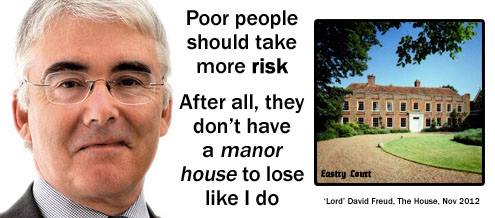
Lord Freud missed the purpose of cumulative impact assessments, which is to study the consequences of the policies by studying notable impacts on communities, social groups and individuals, and this is particularly important since the “reforms” target the most vulnerable for cuts to their income.  Freud’s response was that “Her Majesty’s Treasury produces an “analysis” of the welfare “reforms””, and he discussed only the anticipated savings in costs. He also said:

“More generally, we believe that cumulative impact analysis should be treated with some caution, as it will be based upon a comparison with the previous government’s  policies, which were unaffordable”.

That all depends on what your  priorities are, Mr Freud. The Coalition will leave more debt than all Labour governments since 1900. The current government is now responsible for £517 billion of the trillion-plus-pound UK public debt, compared to £472 billion accrued during the 33 years Labour led the country since the turn of the twentieth century.

But the Coalition don’t meet the needs of the vulnerable, yet remarkably, we can afford  a tax cut of £107,000 each per year for millionaires, and we can afford to throw money away on private Tory-donating companies that don’t deliver a service. Surely, Mr Freud, it’s  Iain Duncan Smith’s very expensive welfare “reforms” that we cannot afford.

It’s costing us millions to save money, curiously, yet those needing welfare support are not getting adequate State provision, and many are now experiencing absolute poverty as a consequence.(See Welfare Reforms and Poverty, Hansard).

Labour invested in public services, the Tories have bled them dry. So, what have this government done with the money?

Because the poorest have seen only austerity cuts, persecution and suffering since 2010.

We cannot afford this Government, Mr Freud.

1459165_266124213538634_1461740450_n
Thanks to Robert Livingstone

Some of the promises the Tories are trying to delete from the internet

1456601_560704250665774_390356424_n

Some of the promises the Tories are trying to delete from the internet:

1. No cuts to front-line services.

2. “We have absolutely no plans to raise VAT”.

3. Cameron said “I wouldn’t means-test child benefit”.

4. “No more top-down reorganisations of the NHS”.

5. On Educational Maintenance Allowance (EMA): “We don’t have any plans to get rid of them”.

6. Cameron on Sure Start: “Yes we back Sure Start. It’s a disgrace that Gordon Brown has been trying to frighten people about this”.

7. On the Future Jobs Fund: “We have no plans to change it”.

8. Cameron on green taxes: “[They] need to go up”.

9. Osborne on bank bonuses: “Totally unacceptable”.

10. And finally, Cameron’s commentary on transparency in 2007: “It’s clear to me that political leaders will have to learn to let go. Let go of the information we have guarded so jealously”.

♠♠♠♠♠♠♠

The internet won’t forget Cameron’s lies, and neither will the British people  – The Independent.

 “The throne was golden and the lectern was golden and the speech was very clear: austerity will not be temporary policy in Tory Britain. It will last forever. Addressing a roomful of diplomats and business leaders who had just dined lavishly at the Lord Mayor’s banquet, the Prime Minister this week promised a “leaner, more efficient state”. “We need to do more with less,” said David Cameron, looking comfy in his white tie and tails. “Not just now, but permanently.”

But he hadn’t counted on Ruth Hardy, a journalism student, who was working as a waitress that night. “The contrast of the two worlds was striking; someone said it was like a scene from Downton Abbey,” wrote Hardy for the Guardian.

“Maybe Cameron didn’t see the irony; perhaps he forgot about the army of waiting staff, cleaners, chefs and porters who were also present at the banquet. Perhaps he thought he was in a room of similarly rich people, who understood the necessity for austerity. Perhaps it didn’t occur to him that this message might not be as easily comprehended by those who hadn’t just enjoyed a four-course meal. Perhaps he forgot about those of us, disabled or unemployed or on the minimum wage, for whom austerity has had a catastrophic and wounding effect.”

The steep cuts to higher education funding were amongst the first austerity measures that the coalition imposed, in direct violation of their election promises, after taking office in 2010. It didn’t take the government long to raise VAT, cut front-line services, radically reform the NHS from the top down and close down Sure Start services. Child benefits are now means-tested, and child tax credit payment is to be restricted to only two children per family. 

The government are also planning on restricting Freedom of Information disclosures. The many rebukes for telling lies from the Office for National Statistics, amongst other organisations, indicates very clearly that this is not a transparent and democratically accountable government at all.

1235473_537097386359794_65317730_n (1)

No, Mr Osborne, it’s not party time yet

10407927_677369232332608_5384979058089243718_n
Whilst official figures show that the economic depression has ended, we need to be mindful of what the headlines have not mentioned – much damage has been done by the government’s austerity measures, such as the cuts and closures to our public services, and the wasteful and costly privatisations. The economic downturn may be temporary but it seems that the cuts and the consequences are permanent.
Growing poverty reflects a large-scale economic failure, regardless of the pitifully thin distillation of Tory evidence of “recovery” and “growth” which is mostly localised to a handful of millionaires. Poverty is about the loss of much more than money. Poverty entails indignity and humiliation and exclusion. For a so-called first world democracy to treat its most vulnerable citizens so callously ought to be a source of utter shame. Austerity is an attempt to disguise the fact that the Tories are not “paying down the debt” as claimed: they are “raising more money for the rich” At the expense of the tax-paying poor
We now have such frank inequalities, with increasing affluence and prosperity for a few, and increasing poverty and disenfranchisement of many reflects a political party that is FAR from democratic, serving the needs of no-one, fulfilling the wants and doing the bidding of a wealthy, influential elite. That isn’t an “achievement” to be jubilant about.
Kittysjones.
1450041_569755536427312_1698223275_n
This excellent article was posted originally by  in Coppola Comment
It seems the UK is something of a poster child for economic recovery. The ONS reports that GDP has grown by 0.8% in Q2 and by 3.1% since Q2 2013. This is a pretty solid performance. And it’s an important milestone, too: the UK’s GDP is now back to its pre-crisis peak.


And the UK has become one of the few bright spots in the IMF’s generally gloomy forecast for world growth. Upgrading the UK’s growth forecast to 3.2% by the end of the year, the IMF said that the UK would maintain its position as one of the world’s fastest-growing economies.

Predictably, the Coalition government and its supporters claimed this as success. George Osborne tweeted that the IMF’s upgrade showed his economic plans were working:

 · Jul 24

IMF upgrades UK growth by more than any other major economy. Further evidence that our is working.

And Matthew Holehouse,  political correspondent of The Telegraph, describes the IMF’s upgrade as “a vindication of George Osborne’s economic plan”.

This frankly is stretching things WAY too far. This chart from Ben Chu of the Independent places the UK’s economic performance in its G7 context:


How on earth is the second slowest recovery in the G7 “vindication” of George Osborne’s policies? And it’s not just because the UK had a very deep recession, either. Japan – yes, you know, that country we like to think is in an eternal slump – had a deeper contraction but has recovered faster despite the tsunami and Fukushima disaster. And Germany, whose contraction was nearly as deep as the UK’s, exceeded its 2008 GDP peak in Q1 2011.

In fact this chart shows clearly the derailing of the UK’s recovery in 2010 just after the Coalition came to power. Note that this is BEFORE the Eurozone crisis hit in 2011: the Eurozone crisis must have affected the UK economy, but it isn’t a sufficient explanation. I’ve also argued that high energy prices explain quite a bit of the evident slowdown from late 2010 onwards.

But it is hard not to conclude, as Simon Wren-Lewis and others do, that fiscal austerity delayed the UK’s recovery. Far from a vindication of the Coalition’s policies, the fact that the UK is only just back to its 2008 peak after four years of Osbornomics is quite an indictment. Whatever the reason, Osborne has actually presided over the slowest recovery since the Second World War:

And it is also far too soon to celebrate recovery. There is still a long way to go: wages are still falling in real terms, business investment is still weak and the UK’s external position is poor. GDP may be back to its pre-crisis peak, but GDP per capita is still some distance below (thanks to FT Alphaville for this chart):

Best keep the lid on the bubbly for a bit longer.

Related reading:

Tory dogma and hypocrisy: the “big state”, bureaucracy, austerity and “freedom” 

Britain’s long, weird recovery in 13 charts – FT Alphaville

The Great Debt Lie and the Myth of the Structural Deficit

Austerity, socio-economic entropy and being conservative with the truth

“The mess we inherited” – some facts with which to fight the Tory Big Lies – Alister Campbell

10001887913_f8b7888cbe_oMany thanks to Robert Livingstone for his excellent memes.

Work and Pensions Report says ESA needs a “fundamental redesign.”

536738_306169162785952_999031084_n

The Work and Pensions Committee say that the fundamental flaws in the Employment and Support Allowance (ESA) system are so grave that simply “rebranding” the work capability assessment (WCA) used to determine eligibility for ESA  by appointing a new contractor will not solve the problems in a report published today.

The Committee have called upon the Government to undertake a fundamental redesign of the ESA end-to-end process to ensure that the main purpose of the benefit – supporting claimants with health conditions and disabilities to move into employment where this is possible for them – is achieved.

One of the key issues the Report identifies is that ESA is not achieving its purpose of helping people who could work in the short to medium term to move back into employment.

The redesign is likely take some time, it is anticipated, but it should be completed before the new multi-provider contract is tendered, which is expected to be in 2018.

In the meantime, the Committee recommends that DWP implements a number of other changes in the shorter-term to ensure better outcomes and an improved service for claimants. These include:

  • DWP taking overall responsibility for the end-to-end ESA claims process, including taking decisions on whether claimants need a face-to-face assessment, rather than this decision being made by the assessment provider.
  • DWP proactively seeking “supporting evidence” on the impact of a claimant’s condition or disability on their functional capacity, rather than leaving this primarily to claimants, who often have to pay for it. DWP should seek this evidence from the most appropriate health and other professionals, including social workers and occupational therapists, rather than relying so heavily on GPs.
  • The “descriptors” used to assess functional capability in the WCA being applied more sensitively.
  • Placing claimants with a prognosis of being unlikely to experience a change in their functional abilities in the longer-term, particularly those with progressive conditions, in the Support Group and not the WRAG.

Dame Anne Begg MP, Committee Chair, said:

Many people going through the ESA claims process are unhappy with the way they are treated and the decisions which are made about their fitness for work. The current provider of the WCA, Atos, has become a lightning rod for all the negativity around the ESA process and DWP and Atos have recently agreed to terminate the contract early.

“But it is DWP that makes the decision about a claimant’s eligibility for ESA – the face-to-face assessment is only one part of the process. Just putting a new private provider in place will not address the problems with ESA and the WCA on its own.

“We are therefore calling for a number of changes which can be made to improve ESA in the short-term, while also recommending a longer-term, fundamental redesign of the whole process.

“We hope that the new Minister for Disabled People, who was appointed last week, will respond positively to our constructive recommendations for improving the ESA process.”


Work and Pensions Committee urge Ministers to pay disabled benefits during appeals

536738_306169162785952_999031084_n
Sheila Gilmore MP today welcomed a report from the Work and Pensions Select Committee – of which she is a member – that calls on the Government to pay sick and disabled people benefits while they appeal against incorrect ‘Fit for Work’ decisions.

Employment and Support Allowance (ESA) provides support for people who cannot work due to a health condition or disability. Entitlement is determined by the controversial Work Capability Assessment (WCA). Previously claimants who were declared ‘Fit for Work’ and wished to challenge their decision were paid ESA at a reduced rate throughout the appeal process. However since October 2013 claimants have had to submit an informal appeal – known as a mandatory reconsideration – to a DWP civil servant, and only if they are still refused benefit can they take their case to a judge.

During mandatory reconsideration, a claimant’s only option is to claim Jobseekers Allowance, which entails applying for jobs and attending an interview. As a result many sick and disabled people have been refused JSA or sanctioned, leaving them stuck between benefits and without any income. The DWP Committee have today called on the Government to pay claimants ESA during the mandatory reconsideration process.

In addition current statistics show that, since it replaced Incapacity Benefit in 2008, one in ten ESA claimants who are declared ‘Fit for Work’ successfully appeal this decision and are awarded ESA. However it emerged last year that the proportion of incorrect decisions could be a lot higher, as figures on the outcomes of mandatory reconsiderations were not being published. The DWP Committee have today called on Ministers to publish these statistics.

Sheila Gilmore said:

I regularly meet sick and disabled people who are unable to work but who have been declared fit to do so following a flawed ESA assessment.

Since last year people in this position have been forced to claim Jobseekers Allowance when they initially challenge an incorrect decision. Many are refused or quickly sanctioned, leaving them stuck between benefits for periods of up to ten weeks.

Ministers should implement the Work and Pensions Select Committee’s recommendation that claimants are paid ESA throughout the application process. This shouldn’t cost the Government any money, unless DWP are already factoring in sick and disabled people being unable to claim JSA.

Until recently we thought that the assessment was getting about one in ten fit for work decisions wrong – far too many in most people’s eyes – but since it emerged that the Government were withholding key figures, the reality could be much worse. Again the Government should do as the Select Committee says, and publish this data without delay.

Notes to Editors

  • The key paragraph of the Committee’s report reads: ‘However, DWP needs to set a reasonable timescale for the MR process, rather than this being left open-ended. The current illogical arrangement whereby claimants seeking MR are required to claim Jobseeker’s Allowance (JSA) instead of ESA should be abolished. Official statistics showing the impact of MR on the number of appeals and on outcomes for claimants should be published as a matter of urgency.’
  • Sheila Gilmore led a debate on mandatory reconsideration statistics in the House of Commons on 9 April 2014 where she summarised the issue as follows: ‘I acknowledge this is quite a hard argument to follow so let’s say, hypothetically, 100 people claim ESA. We are initially told that 50 are awarded benefit and 50 are declared Fit for Work. We are then told that 25 of this latter group successfully appeal their decision, so we can say that the assessment process is getting one in four decisions wrong. What if we then found out that 25 of the 50 who were initially awarded ESA only got benefit following an informal appeal to a civil servant? We would have to say that the assessment process was getting one in two decisions wrong – a level of performance significantly worse than previously thought.’
  • For more information Sheila Gilmore maintains dedicated pages on mandatory reconsiderations and reconsideration statistics on her website.
  • For more information please contact Matt Brennan, Parliamentary Assistant to Sheila Gilmore MP, on 020 7219 7062, 07742 986 513 or matthew.brennan@parliament.uk.

facebooktwittergoogle_plusredditpinterestlinkedinmail

Government to “overhaul” benefits sanctions process

Independent report shows systematic failings in the way benefit sanctions are communicated and processed.

Posted in The Guardian, Tuesday 22 July 2014, by .


544840_330826693653532_892366209_n
The government is to overhaul the way it treats benefit recipients threatened by sanctions, after an independent report it commissioned  showed systematic failings in the process, including disproportionate burdens placed on the most vulnerable.

[The inquiry into sanctions was demanded by the Labour Party last year]

The report found that the way in which the Department for Work and Pensions (DWP) communicated with claimants was legalistic, unclear and confusing. The most vulnerable claimants were often left at a loss as to why their benefits were stopped and frequently they were not informed about hardship payments to which they were entitled, the report said.

It also revealed serious flaws in how sanctions were imposed; providers of the government’s work programme were required to bring in sanctions when they knew the claimants had done nothing wrong, leaving those people “sent from pillar to post”.

The independent report was written for the DWP by Matthew Oakley, a respected welfare expert who has worked as an economic adviser for the Treasury and for the centre-right thinktank Policy Exchange.

The report was completed some weeks ago, but publication of its 17 reform proposals was delayed.

Oakley said that the system was not fundamentally broken, but his criticism was all the more damaging for a government that has consistently described the benefit sanctions regime as fair.

The DWP responded to the report by saying it would be altering the way it talked to benefit claimants, setting up a specialist team to look at all communications, including claimant letters.

The sanctions regime, and the confusing way in which it is administered, has been one reason behind the growth in the public’s use of food banks.

In a new commitment, the DWP promised that if vulnerable claimants claimed for hardship on or before their signing day, they would receive a hardship payment at their normal payment date.

The department also promised it would take steps to ensure local authorities did not dock housing benefit and that they gave claimants a clear chance to comply with sanctions, and that there was consideration over whether work programme providers could be empowered to make decisions on sanction referrals.

Oakley’s report said: “No matter what system of social security is in place, if it is communicated poorly, if claimants do not understand the system and their responsibilities, and if they are not empowered to challenge decisions they believe to be incorrect and seek redress, then it will not  fulfil its purpose. It will be neither fair nor effective.”

His terms of reference, he said, were about the way sanctions were administered on mandatory back-to-work schemes (covering a third of those claimants at risk of being sanctioned), but the proposed reforms would be relevant to the entire benefits system.

The report said sanction letters “were, on the whole, found to be complex and difficult to understand”.

It added that partly owing to the legal requirements the department had to fulfil when it wrote to claimants, the letters were overly long and legalistic in their tone and content; they lacked personalised explanations of the reason for sanction referrals; and they were not always clear about the possibility of, and process surrounding, appeals or applications for hardship payments. The letters were particularly hard to understand for the most vulnerable claimants – so those most in need of the hardship system “were the least likely to be able to access it”.

The report said: “Actual and sample letters that the review team saw were hard to understand (even for those working in the area), unclear as to why someone was being sanctioned and confusingly laid out.”

The review found that many people “expressed concerns that the first that claimants knew of adverse decisions was when they tried to get their benefit payment out of a cash point but could not”.

The report also said that Jobcentre advisers had highlighted the damage that sanctions imposed on the most vulnerable.

It stated: “Many advisers also highlighted the difficulties of communicating with particular groups of claimants. In particular, many advisers identified a ‘vulnerable’ group who tended to be sanctioned more than the others because they struggled to navigate the system. This concern for the vulnerable claimants was consistent throughout the visits.

“For these groups, particular difficulties were highlighted around the length of time it could take to ensure some claimants fully understood what was required of them, and in conveying that a ‘sanction’ could entail the loss of benefit for a prolonged period of time.”

The report also criticised the failure of Jobcentres to highlight hardship payments. It said: “A more specific concern surrounding the hardship system was that only those claimants that asked about help in Jobcentre Plus were told about the hardship system. Advisers, decision-makers and advocate groups argued that this meant that groups with poorer understanding of the system were less likely to gain access.

“Since, on the whole, more vulnerable claimants are those with the poorest understanding of the system, this suggests that some of those most in need are also those least able to access hardship.”

The report also found that providers of mandatory work schemes were unable to make legal decisions about claimants’ reasons for missing appointments and so had to impose sanctions.

“This means that they have to refer all claimants who fail to attend a mandatory interview to a decision-maker even if the claimant has provided them with what would ordinarily count as good reason, in Jobcentre Plus.

“This situation results in confusion as the claimant does not understand why they are being referred for a sanction. A very high proportion of referrals for sanctions from mandatory back-to-work schemes are subsequently cancelled or judged to be non-adverse.”scroll2

maslow-5

Maslow’s Hierarchy of needs

It’s a biological and psychological fact that benefit sanctions can only ever serve to demotivate, rather than “incentivise”, and that they severely limit people in fulfilling their potential.

We all know that there are basic physical requirements – such as food, fuel, shelter – that are universally essential for human survival. If these requirements are not met, the human body cannot function properly and will ultimately fail. Benefit sanctions mean that people are being deliberately placed at risk of failing to meet their fundamental survival needs.

Such a grossly punitive approach to welfare will never serve to achieve positive outcomes for those needing supportive provision. It’s a simple, basic fact that people cannot possibly find the motivation and resources to seek work and meet the benefits “conditionality” criteria when they are reduced to struggling for basic survival.

And some people are dying as a direct consequence of the Tory-led draconian benefit sanction regime – please see Lessons must be learned’ from diabetic former soldier, who died after benefits sanction and Man starved to death after benefits were cut.

Maslow’s basic humanist philosophy about universal human needs underpins Human Rights Laws and our welfare provision – well, it did so up until recently.

It’s utterly chilling and truly Orwellian that the government claim imposing arbitrary sanctions on the most vulnerable, and reducing them to desperation is “helping people into work”. Such a cruel measure is NOT helping anyone: it’s creating desperation, extreme distress, anxiety, harm, suicides and death. Furthermore, for the many being punished that are genuinely seeking work, the alleged employment opportunities simply do not exist.

Benefit sanctions have nothing to do with “helping” people, but have everything to do with conservative political ideology.

It really is a brutal, HARMFUL policy of draconian control, using right-wing  propaganda, misinformation, pseudo-psychology and an unforgivable, persistent denial of truth.

Although the government claims that there is a hardship fund available for those who are sanctioned, many people are being denied this support. Described as a “basic financial safety net” – which is basically what welfare was intended to be – the hardship fund has to be repaid, causing a further vicious cycle of hardships to individuals and their families.

Benefit sanctions are profoundly unjust, they are most damaging to the very people that need support the most, as the very vulnerable are being disproportionately and opportunistically targeted. There is simply no credible justification for benefit sanctions, on any level. And this policy really needs to be changed.

Kittysjones.

Further reading:

Jobcentre was set targets for benefit sanctions

Rising ESA sanctions: punishing the vulnerable for being vulnerable

The targeting, severity and impact of sanctions on benefit claimants needs urgent review

377683_445086432227557_1770724824_n (1)

Many thanks to Rob Livingstone


Cameron’s Gini and the hidden hierarchy of worth

385294_195107567306966_1850351962_n

On 04 June, 2014, at 3.52pm BST, Cameron said inequality is at its lowest level since 1986. I really thought I’d misheard him. Cameron lies, that’s established fact. But mendacity of such epic proportions is surely a clear indication that this really is the Coalition’s last stand.

This isn’t the first time Cameron has used this lie. We have a government that provides disproportionate and growing returns to the already wealthy, whilst imposing austerity cuts on the very poorest. How can such a government possibly claim that inequality is falling, when inequality is so fundamental to their ideology, and when social inequalities are extended and perpetuated by all of their policies? It seems the standard measure of inequality is being used to mislead us into thinking that the economy is far more “inclusive’ than it is.

The Gini coefficient is a measure of statistical dispersion intended to represent the income distribution of citizens. It was developed by the Italian statistician and sociologist Corrado Gini.

The Gini coefficient measures the inequality among values of a frequency distribution and is currently how we measure levels of income inequality.

However, the Gini coefficient is a relative measure. Its proper use and interpretation is controversial. A Gini index does not contain information about absolute national or personal incomes. Wealth inequality may well be greater than income inequality. For example, economist Edward Wolff found that, while the highest-earning fifth of U.S. families earned 59.1% of all income, the richest  fifth held 88.9% of all wealth.

A major limitation of Gini coefficient in empirical work is therefore its focus on relative income distribution, rather than real, absolute levels of poverty and prosperity in society, and that aspects of inequality can be hidden via demographics or government policies. The relative Gini is used because the alternative methodologies are deemed too complex: it is simple, convenient formula that presents simple, convenient but meaningless values. Such rootless, unanchored values can then be given the same traditional Tory solutions, convenience being an alibi for endorsing social injustice.

Such a method of poverty measurement that has so little regard for how much money people actually have and what living standards they enjoy (or don’t) deserves to be treated with scepticism, if not contempt, especially by the man on the Clapham omnibus. And it generally is.

The Equality Trust directly compare income distribution, and this analysis provides a completely different account to the one Cameron is telling, but then we all know that “Tory” is an abbreviation of “tall stories.”

And since when were Conservative governments ever equated with social equality and egalitarianism? Thatcher, that great “communist” and social reformer (!), never tried to impose the scale of austerity cuts that the current government have, but few would disagree that she presided over a massive rise in poverty and inequality.

Tory policy creates inequalities. This is academically confirmed and verified empirically time and time again. Public health experts from Durham University have denounced the impact of Margaret Thatcher’s policies on the well-being of the British public in new research, which examines social inequality in the 1980s. The research shows the importance of the decisions of governments and politicians in driving health inequalities and population health. The researchers warn that advancements in public health will be severely limited if governments continue to pursue heavily neoliberal economic policies – such as the current welfare state cuts being carried out under the guise of austerity.

When it comes to reliable data about inequality and poverty, I think the Joseph Rowntree Foundation (JRF) has a well-established credibility, based on over a hundred years of experience in reliably measuring poverty. Cameron, on the other hand, does tend to get publicly rebuked for being … conservative with the truth.

Since 2010, wages have been rising more slowly than prices, and over the past 12 months, incomes have been further eroded by cuts to benefits and tax credits. Tory ministers argue that the raising of the personal tax allowance to £10, 000 for low income households will help. However, according to the JRF report, its effect is cancelled out by cuts and rising living costs. (Please see Quantitative Data on Poverty from the Joseph Rowntree Foundation.)

Currently the rise in the number of people who are unable to adequately heat their homes is largely due to inflated, rising fuel costs. The alleged progressive nature of the income tax system is severely undermined by the regressive nature of stealth taxes, duties, Income tax, National Insurance, Bedroom Tax, Council tax, Licences, Social care charges, VAT and many others taxes, which take a much larger portion of income from the poor than from the rich.

In 2011/12, the poorest fifth of households spent 29 per cent of their disposable income on indirect taxes, compared with 14 per cent paid by the richest fifth. All told, the poorest households pay 37 per cent of their gross income in direct and indirect taxes. In other words, the single biggest expenditure for people in poverty is tax. It is, at the very least, morally unjustifiable to be taxing the poorest citizens at such a rate. The most important thing the government can do to help the poorest people is to stop taking their money.

We don’t have the figures that may reflect the impact of the welfare “reforms” from the Office of National Statistics yet.

Last years figures showed that absolute poverty among children rose by 300,000, with two-thirds of those living in households with one or more earners. That makes a mockery of the Tory claim that they are “making work pay.” How does cutting welfare improve the lot of the lowest paid?

Absolute poverty means that people cannot meet their basic survival  needs – such as meeting the costs of food, fuel and shelter. Welfare evolved to address such fundamental deprivation, and absolute poverty had been eradicated in Britain because of the protective social security system. Until now. Children are once again suffering from illnesses historically associated with poverty and malnutrition, such as rickets and scurvy.

Alison Garnham, chief executive of Child Poverty Action Group, said: “Despite all the talk about ‘scroungers’ and generations of families never working, today’s poverty figures expose comprehensively the myth that the main cause of poverty is people choosing not to work.

“The truth is that for a growing number of families, work isn’t working. The promise that work would be a route out of poverty has not been kept as wages stagnate and spending cuts have hurt low-income working families.”

In March this year, Oxfam urged the chancellor George Osborne to use his budget to make an assault on tax avoidance and introduce a living wage, in a report they published. The report highlighted how a handful of the super-rich, headed by the Duke of Westminster, have more money and financial assets than 12.6 million Britons put together. 

Oxfam’s director of campaigns and policy, Ben Phillips, said: “Britain is becoming a deeply divided nation, with a wealthy elite who are seeing their incomes spiral up, while millions of families are struggling to make ends meet.

“It’s deeply worrying that these extreme levels of wealth inequality exist in Britain today, where just a handful of people have more money than millions struggling to survive on the breadline.”

This is a prime minister that has overburdened very vulnerable citizens with austerity, austerity and more austerity, taken away support services and reduced, cut and sanctioned away lifeline benefits for the very poorest whilst liberating the wealthiest from any social responsibilities, handing out tax breaks to the tune of £107,000 each per year to the millionaires. How can that NOT lead to gross inequalities?

The only truth I’ve ever heard Cameron utter was his Freudian-styled slip, when he said: “We are raising more money for the rich.” Yes. From where?

The poor.

It’s not as if most of us haven’t spotted the growing gap between the wealthiest and the poorest, and made a fundamental connection there.

A simple truth is that poverty happens because some people are very, very rich. That happens ultimately because of Government policies that create, sustain and extend inequalities. The very wealthy are becoming wealthier, the poor are becoming poorer. This is a consequence of  “vulture capitalism” –  the opportunism and pernicious greed of a politically influential few, it is instituted, facilitated and directed by the Tory-led Coalition. That isn’t democracy: it’s blatant corruption

The real reason for the austerity measures that this Government have inflicted on the poorest citizens is that Tory sponsors and very greedy rich people are being handsomely rewarded with tax payers money. The money for our welfare provision, our healthcare, our public services, schools, and so on, is being stolen from the British public and backhanded to the undeserving rich – there is the REAL “culture of entitlement”.

Private companies, many of which donate to the Conservative party, and have a subsequent powerful (and corrupt) lobbying influence on Tory policies, are making a fortune from the poverty that has been inflicted on many citizens. We have seen that the private sector do not deliver public “services” or meet public needs at all. (Atos, A4EG4S, for example.) Private companies simply make profit. Indeed, that profit is all too often made at the expense of the well-being of Citizens.

Eugenic policy is now an acted out by stealth, dressed up as a “necessary” economic act, and further dressed up by propaganda to hide the consequences as well as the intent, carried out by a government that has rigged the neoliberal market. The act of murder simply requires policies that leave the vulnerable without support to meet their basic survival needs, denial from government that this is happening, and then it’s just a matter of withholding or hiding the evidence.

An openly declared belief in eugenics is a thing of the past, as Hitler discredited the eugenics movement so thoroughly, however, eugenics is far from a thing of the past, and the right are and always have been social Darwinists. But I predict that if the Conservatives win the election in May, we will start to see reductions in welfare support for children from poor backgrounds, and a limit placed on the number of children that are entitled to support in families. That is eugenics.

Human rights were a cooperative international response to the Holocaust, premised on a socialist axiom that every human life has equal worth.

Authoritarianism, nationalism, fascism and Conservatism are premised on inequality, a hierarchy of worth and Social Darwinism. That’s why the Right are so against EU membership and the ECHR: they see such safeguard rights as an obstacle to their neo-feudalist vision of how society should be.

Prior to the Holocaust, eugenics fitted well with the dominant paradigm – comprised of laissez faire economics, competitive individualism, Malthus’s ideas on population and Spencer’s Social Darwinism. Those ideas, once explicitly endorsed, are now implicitly captured in policies and Conservative narratives about sanctions, “conditionality,”  “making work pay,” (compare with the principle of less eligibility enshrined in the New Poor Law) “fairness,” “incentives,” “scroungers,” and so forth.

If you think this seems a little far-fetched, consider that the government are deliberately targeting the most poorest and vulnerable citizens to bear the brunt of austerity cuts.

The cuts are not fairly distributed at all.

They target the very groups that a decent, civilised society would protect:

  • People in poverty (1 in 5 of us) bear 39% of all the cuts
  • Disabled people (1 in 13 of us) bear 29% of all the cuts
  • People with severe disabilities (1 in 50 of us) bear 15% of all the cuts

The unfairness of this policy becomes even clearer when we look at the difference between the burden of cuts that falls on most citizens and the burdens that fall on minority groups. By 2015 the annual average loss in income or services will be:

  • People who are not in poverty or have no disability will lose £467 per year
  • People who are in poverty will lose £2,195 per year
  • Disabled people will lose £4,410 per year
  • Disabled people needing social care will lose £8,832 per year

Thank goodness that the Tory-led government shows some compassion for those poor millionaires, who were handed £107,000 each per year from our Treasury in the form of a tax cut in Osborne’s 2012 budget. I wonder where the money for that handout came from….

Taking money from the most vulnerable and poorest members of Society means they are unlikely to be able to meet their basic biological needs. Welfare provision was based on the carefully calculated amounts we need to survive, so the amount of benefit is just enough to cover the costs of housing, food and fuel. That’s all. There is no provision made in any benefit for cars, holidays abroad, children’s birthdays and Christmas, large, flat screened TV’s. books or clothing. Just food, fuel and shelter. Anything more generous is simply added via propaganda. The Tory-directed media perpetuate myths to cultivate petty and divisive social “concerns” to “justify” the fact that we are being systematically and massively robbed of the money we paid in for our own provisions and services.

And people are dying as a consequence.

Related: 

Follow the Money: Tory Ideology is all about handouts to the wealthy that are funded by the poor

Tory dogma and hypocrisy: the “big state”, bureaucracy, austerity and “freedom”

The Poverty of Responsibility and the Politics of Blame

The Tories are not simply “out of touch”, their policies are deliberate and malevolent

Does income inequality cause health and social problems?  –  In 2011, the Joseph Rowntree Foundation conducted this research, with the main aim of reviewing the evidence concerning the impact of income inequality on on health and social problems. However, the report concludes by considering a range of policy implications.

Given the main conclusion is that both individual income (material circumstances) and income inequality (relative income) make a crucial difference to health and social problems, it seems clear that both need to be tackled. A range of policy levers can be used to do this: from redistribution through the tax/benefit system, to original income and wealth policies, to stronger public services, to a greater focus on equal opportunities.

Medical experts recently wrote an open letter to David Cameron slamming the rise in food poverty, saying families “are not earning enough money to meet their most basic nutritional needs” and that “the welfare system is increasingly failing to provide a robust line of defence against hunger.” – New research by Oxfam has revealed the true extent of the amount of British children living in poverty, with families taking drastic measures.

382035_141704259313964_676863845_n

Pictures courtesy of Rob Livingstone 

The protection of freedom under the Human Rights Act: some illustrations

humanrights
By Helen Wildbore, Research Officer, Human Rights Futures Project, LSE
Protest.

Some examples of what difference the Human Rights Act (HRA) has made.

Protest: Preventing demonstrators reaching a protest is unjustified intrusion into right to freedom of assembly.

The decision by the police to stop a coach of demonstrators reaching an anti-war demonstration in 2003 was challenged under the HRA. The police concluded that a breach of the peace was not imminent but decided to send the coaches home with a police escort to prevent a breach of the peace occurring at the demonstration when the passengers arrived. The court said that the police must take no more intrusive action than appeared necessary to prevent the breach of the peace.

The police had failed to discharge the burden of establishing that the actions they took were proportionate and constituted the least restriction necessary to the rights of freedom of expression (Article 10) and freedom of peaceful assembly (Article 11). It was wholly disproportionate to restrict a person’s exercise of her rights under Articles 10 and 11 because she was in the company of others, some of whom might, at some time in the future, breach the peace.

The House of Lords referred to the “constitutional shift” brought about by the Human Rights Act, so that its no longer necessary to debate whether we have a right to freedom of assembly. (1)

Kettling to be used only as last resort.

To be lawful, crowd control measures by the police, such as kettling, must be resorted to in good faith, be proportionate and enforced for no longer than is reasonably necessary. (2)

The police must have a reasonable apprehension of an imminent breach of the peace, i.e. that it is “likely to happen”. Kettling had to be a last resort and no more intrusive than appeared necessary to avoid a descent into violence. This test of necessity would only be met in extreme and exceptional circumstances. Kettling a group of protesters at the G20 summit where the risk of a breach of the peace was not imminent, was an unlawful deprivation of liberty under Article 5.3

• Freedom of expression and the media.

Responsibly written articles on matters of public interest are protected
The common law defence of qualified privilege in libel cases includes a public interest defence for the media. (4)

Although this was developed in a case just before the HRA had come into force, but after it was passed, the court referred to the need for the common law to be developed and applied in a manner consistent with the right to freedom of expression (Article 10). The court listed ten matters to be taken into account in deciding whether the reporting was responsible.

More recently, this list has been held to be guidance, not hurdles, and the defence is to be applied in a flexible and practical manner. (5)

As a result, the media have much more freedom when reporting matters of public interest, where it may not be possible to subsequently prove the truth of the allegations, provided that they act responsibly and in the public interest.

Anonymity orders set aside to protect media’s right to free expression.

A group of media organisations successfully applied to set aside anonymity orders made in favour of individuals who were alleged to have links with Al-Qaeda and were suspected of facilitating acts of terrorism. The individuals had been designated under the Terrorism (United Nations Measures) Order 2006 and their assets were frozen.

The Supreme Court had to weigh the competing claims of the right to free expression of the press (Article 10) and the right to respect for private life of a relative of two of the individuals (Article 8), who would be identified if the anonymity orders were lifted. The court ruled that, in the circumstances, there was a powerful general public interest in identifying the relative which justified curtailment of his right to respect for private life. The anonymity orders were therefore set aside. (6)

Freedom of expression includes the right to receive information.

The right to freedom of expression (Article 10) includes not only the freedom to impart information and ideas but also to receive. The media have been granted access to a hearing in the Court of Protection, (7) when such hearings had previously been closed. (8)

Privacy: Damages awarded for unjustified intrusion into private life.

Where an invasion of private life is a matter of legitimate public interest because a public figure had previously lied about the matter, there will be a strong argument in favour of freedom of expression under Article 10 that will often defeat a claim of privacy under Article 8.

The publication of the fact that a public figure had taken drugs and was seeking treatment was necessary to set the record straight given her previous statements to the contrary, but the additional information published in the stories, including a photograph, was an unjustified intrusion into private life. Balancing the competing interests, the right to privacy under Article 8 outweighed the newspaper’s freedom of expression under Article 10 and damages were awarded for the breach. (9)

Retention of DNA and fingerprint evidence a breach of right to private life.

The blanket and indiscriminate retention of fingerprints, cellular samples and DNA profiles of people suspected but not convicted of offences failed to strike a fair balance between the competing public and private interests. The court* ruled that it was a disproportionate interference with the right to respect for private life (Article 8) and could not be regarded as necessary in a democratic society. (10)

Following this decision at the European Court of Human Rights, two men have brought a case in the domestic courts claiming that the retention of their DNA and fingerprints is a breach of their right to respect for private life (Article 8). One was arrested but released without charge, the other was charged of an offence but acquitted at trial. Both men had their requests to destroy their samples refused by the police, as there were no ‘exceptional circumstances’ for destroying them, as stated in the Association of Chief Police Officers guidelines.

The court made a declaration under the HRA that those guidelines on retention of biometric data are unlawful because they are incompatible with Article 8. The court noted that it was the intention of the government to bring new legislation on this issue into force later this year. (11)

Local authority snooping on family is intrusion of private life.

A council’s surveillance of a mother and her children to determine whether they lived within a school catchment area was ruled unlawful and a breach of their right to respect for private life (Article 8). The Council used surveillance powers given to it by the Regulation of Investigatory Powers Act 2000 but a tribunal found their use of the powers was improper and unnecessary. (12)

Stop and search regime a breach of ECHR.

The stop and search powers under section 44 of the Terrorism Act 2000 are a breach of the right to respect for private life (Article 8). Under section 44 senior police officers can authorise the police to stop and search vehicles and people without the precondition of reasonable grounds of suspicion. Authorisations under section 44 covering the whole of Greater London have been made continuously for successive periods since section 44 came into force in February 2001.

The court* ruled that the use of coercive powers conferred by anti-terrorism legislation to require an individual to submit to a detailed search of their person, clothing and personal belongings amounted to a clear interference with the right to respect for private life. The powers of authorisation and confirmation as well as of stop and search under s44-45 were not in accordance with the law, in violation of Article 8.13.

• Family life: Naming a deceased father on birth certificate.

Dianne Blood successfully challenged the provision of the Human Fertilisation and Embryology Act 1990 which prevented her from registering her deceased husband as the father of her two children conceived by IVF on the children’s birth certificates. The provision was declared to be incompatible with the right to respect for private and family life (Article 8) and the right to be free from discrimination (Article 14). (14)

The law was amended by the Human Fertilisation and Embryology (Deceased Fathers) Act 2003.

Right to respect for family life includes establishing details of identity.

A woman conceived by artificial donor insemination successfully challenged the decision by the Department of Health and the Human Fertilisation and Embryology Authority not to secure for her any information (even non-identifying information) relating to her donor parents. Referring to need for ‘flexible concept’ of family life and positive obligations, the High Court said that the right to respect for private and family life (under Article 8) means that everyone should be able to establish details of their identity, including a right to information about biological parents. (15)

The law was amended through the Human Fertilisation and Embryology Authority (Disclosure of Donor Information) Regulations 2004 so that people conceived as a result of sperm, egg or embryo donation are able once they reach the age of 18 to request non-identifying information about their donor from the Human Fertilisation and Embryology Authority.

Unmarried couples protected from unjustified discrimination.

The Adoption (Northern Ireland) Order 1987, which said only married couples or single people could be considered as adoptive parents, was successfully challenged under the HRA by an unmarried couple. The court said their right to respect for family life (Article 8) was engaged and therefore the policy could not be applied in a discriminatory way (under Article 14, the prohibition on discrimination).

As the HRA prohibited discrimination against married people, the court said it must follow that discrimination on the grounds of not being married must also be prohibited. The discrimination against unmarried couples would have to be justified. The court ruled that, although the state was entitled to consider that generally it was better for a child to be brought up by parents who were married, it was altogether another thing to say that no unmarried couples could be suitable adoptive parents.

The presumption in the Adoption Order contradicted the fundamental adoption principle of the best interest of the child and was disproportionate. The court declared that the unmarried couple were entitled to apply to adopt a child. (17)

Scheme to prevent sham marriages disproportionately interferes with right to marry.

The scheme under the Asylum and Immigration (Treatment of Claimants, etc) Act 2004,which required certain people subject to immigration control to obtain a certificate of approval from the Secretary of State before they were allowed to marry, other than in an Anglican ceremony, was challenged under the HRA. The court said while states have the right to regulate marriage and to seek to prevent marriages of convenience, the conditions imposed by the scheme were relevant to immigration status but had no relevance to the genuineness of the proposed marriage.

The scheme imposed a blanket prohibition on the exercise of the right to marry by all in the specified categories, irrespective of whether their proposed marriages were marriages of convenience or not (although there was a discretionary exception for compassionate circumstances). That was a disproportionate interference with the exercise of the right to marry under Article 12.

The court used their powers under the HRA to read the legislation compatibly with Article 12. The court also made a formal declaration that the legislation was incompatible with the prohibition of discrimination (Article 14) as it discriminated between civil and Anglican marriages. (18)

A remedial order under s10 HRA was laid before Parliament to abolish the certificate of approval scheme. (19)

• Outside courts: Fostered children secure visits to their mother in supported care

A mother with mental health problems was placed in 24 hour supported care and her children were fostered. The agreed three meetings per week for the children were gradually reduced to just one a week due to the authority’s lack of staff. This greatly distressed the mother and children.

The mother’s advocate invoked the children’s right to respect for
family life (Article 8) and convinced the mental health team to invite children’s services staff to the next care programme approach meeting so that the children’s interests could be represented. The three visits per week were restored as a result. (20)

Right to life can include positive obligation to protect life.

The right to life under Article 2 not only prevents the State from intentionally taking life, it also requires States to take appropriate steps to safeguard life. The court* ruled that the State’s duty includes putting in place effective criminal law provisions to deter the commission of offences and law-enforcement machinery.

Article 2 may also go beyond that to imply in certain well-defined circumstances a positive obligation on authorities to take preventative operational measures to protect an individual whose life is at risk from the criminal acts of another individual. This duty will be breached where it can be shown that the authorities failed to do all that could reasonably be expected of them to avoid a “real and immediate” risk to the life of an identified individual about which they knew, or ought to have known. (21)

Jurisdiction of HRA extends beyond UK territory.

The duty on public authorities under the HRA to comply with the Convention rights applies not only when a public authority acts within the UK but also when it acts outside the territory of the UK but within the jurisdiction of the UK. This will apply when the authority has effective control over the area outside the UK.

A man who had died as a result of injuries sustained in a detention unit in a British military base in Iraq was “within the jurisdiction” of the UK and covered by the HRA. Iraqi civilians who, it was claimed, had been unlawfully killed by members of British armed forces in southern Iraq in 2003, had not been within the jurisdiction of the UK when they were killed because the British troops did not have effective control over the area where the killings occurred. (22)

Soldiers on UK military bases in Iraq fall under the jurisdiction of the HRA. 

A British soldier serving in Iraq who died from hyperthermia in a UK military base after complaining that he couldn’t cope with the heat, was subject to the jurisdiction of the HRA. The circumstances of this soldier’s death gave rise to concerns that there might have been a failure by the army to provide an adequate system to protect his life (Article 2). An inquest was necessary to establish by what means and in what circumstances he met his death. (23)

• Investigations into deaths.

Duty to investigate death in custody Where a death has occurred in custody the state is under a duty to publicly investigate before an independent judicial tribunal with an opportunity for relatives of the deceased to participate. (24)

HRA secures inquest into murder

The human rights organisation Liberty used right to life (Article 2) arguments to secure the re-opening of the inquest into the death of Naomi Bryant, who was killed in 2005 by convicted sex offender Anthony Rice. (25)

• Disability: Duty to take positive action to secure physical integrity and dignity.

Where a local authority knew that a disabled tenant’s housing was inappropriate and prevented her from having a normal family life, but did not move her to suitably adapted accommodation, they failed in their duty to take positive steps to enable her and her family to lead as normal a family life as possible and secure her physical integrity and dignity (under Article 8). Damages were due for this failure. (26)

Policies on lifting must consider competing rights.

Health and Safety Executive guidance on manual lifting was updated in 2002, highlighting the need to comply with the HRA and the Disability Discrimination Act. It was aimed at a balance between health and safety policy and the needs and rights of disabled people. (27)

A lifting policy should balance the competing rights of the disabled person’s right to dignity and participation in community life and the care workers’ right to physical and psychological integrity and dignity (Articles 3 and 8). Following a challenge under the HRA, East Sussex local authority amended its Safety Code of Practice on Manual Handling to include consideration of the dignity and rights of those being lifted. This was circulated to other local authorities, NHS trusts and care providers to encourage them to review their  policies. (28)

Keeping autistic man in support unit against his and his family’s will violates HRA.

A 21 year old man with autism and a severe learning disability who lived with his father moved into his local authority’s support unit for a couple of weeks when his father was ill, as part of his respite care regime. The local authority then kept him there for nearly a year, against his and his father’s wish whilst it considered a long-term residential placement. The Court of Protection (29) ruled that the positive obligation under Article 8 (the right respect for family life) meant that the removal of vulnerable adults from their relatives or carers could only be justified when the state would provide better quality of care.

Keeping this man away from his home for almost a year was a breach of Article 8 HRA, and also Article 5 HRA (the right to liberty and to have a speedy decision by a court of the lawfulness of detention). (30)

• Outside courts: Disabled married woman secures special double bed.

A disabled women who was unable to leave her bed, needed a special bed which would allow carers to give her bed baths. Her authority refused her request to have a double bed so that she could continue to sleep next to her husband, even though she offered to pay the difference in cost between a single and double bed.

After she invoked her right to respect for private and family life (Article 8), the authority agreed to pay the whole cost of the double bed. (31)

Deaf patient challenged lack of interpreter during operation.

Ms J, a profoundly deaf patient, was treated for a heart condition in Manchester in 2001. The hospital consultant refused to allow a British Sign Language interpreter into the operating theatre on health and safety grounds. This meant that during part of the procedure – carried out under local anaesthetic – Ms J was conscious but with no interpreter present was unable to communicate with medical personnel, which she found extremely frightening.

She contacted RNID who reminded the hospital that qualified interpreters work to very high standards and follow a Code of Practice. The relevant human rights that the hospital should have considered included freedom of expression (Article 10), prohibition of discrimination (Article 14), and prohibition of degrading treatment (Article 3).

The hospital admitted its error and apologised to Ms J, and agreed to provide an interpreter for future operations, ensuring the dignity and equal treatment of disabled patients. (32)

Learning disabled couple challenge use of CCTV in their bedroom at night.

A couple with learning disabilities were living in residential care with their child so that their parenting skills could be assessed by social services. CCTV cameras were installed to observe them performing parental duties, including in their bedroom, even though the baby slept in a separate nursery. The couple were distressed by the use of the cameras in the bedroom at night and successfully used their right to private life to get the cameras switched off during the night. (33)

 Age: Before closing a care home, the effect on the residents must be investigated.

Where a local authority residential care home was being closed, the authority had to ensure that any consultation investigated the effect of the closure on the residents’ emotional, psychological and physical health and comply with its obligations under the HRA.34

Outside courts: Older couple helped to stay together in care home.

A husband and wife had lived together for over 65 years. He was unable to walk unaided and relied on his wife to help him move around. She was blind and used her husband as her eyes. They were separated after he fell ill and was moved into a residential care home.

She asked to join him but was told by the local authority that she did not fit the criteria. After a public campaign by the family, supported by the media and older people’s organisations, which argued that the local authority had breached the couple’s right to respect for family life (Article 8), the authority agreed to reverse its decision and offered the wife a subsidised place in the care home with her husband. (35)

Older woman supported to stay at home rather than move to residential care.

An older woman was staying in hospital following a number of strokes. She suffered a range of trauma related mental health problems following her internment as a prisoner of war in WWII and was observed re-enacting various behaviours from this period. Against her wishes, the hospital sought to discharge her and move her into residential care on cost grounds.

Her advocate was concerned that being in an institution was causing her
regression and used human rights arguments that she should not be placed in residential care but allowed to return home as she wanted. As a result, funding was secured to support her care at home. (36)

Sexual orientation: HRA provides protection against discrimination on grounds of sexual orientation. 

The courts have used their powers under the HRA to eliminate the discriminatory effect of  para 2, Schedule 1 of the Rent Act 1977 which meant that the survivor of a heterosexual couple could become a statutory tenant by succession but the survivor of a homosexual couple could not (in breach of the prohibition on discrimination under Article 14, read in conjunction with the right to respect for private and family life under Article 8). (37)

Same-sex partner given ‘nearest relative’ status.

The same-sex partner of a detained mental health patient, whom the local council had refused to afford the status of ‘nearest relative’, challenged this decision under the right to respect for private life (Article 8) arguing that private life includes issues of sexuality, personal choice and identity. The court accepted that same-sex partners should be covered by the co-habiting rule applied to heterosexual couples who qualify as ‘nearest relative’ after 6 months co-habitation. (38)

Race and religion: Changes to cell-sharing policies.

Following the murder of a prisoner by his racist cell-mate and a successful challenge under the HRA for a public inquiry (under the right to life in Article 2), the Prison Service introduced changes to its policy and procedures relating to cell-sharing risks, allowing information-sharing to identify high risk factors. (39)

An attack against a religious group which is incompatible with the values of the ECHR will not enjoy the protection of Article 10.

A member of the BNP who placed a poster in the window of his house depicting on of the Twin Towers in flames that said “Islam out of Britain” and “Protect British people” was convicted of an offence under section 5 of the Public Order Act and of committing the offence in a religiously aggravated way and fined.

His appeal to the High Court was rejected (40) on the grounds that the restriction upon his right to freedom of expression (Article 10) was proportionate to the legitimate aim of protecting the rights and freedoms of others, given also the fact that the speech arguably fell within Article 17 of the Convention (no right to act with the aim of destroying the rights in the Convention). (41)

His appeal to the European Court of Human Rights was found inadmissible because the anti-Islam images were a public attack on all Muslims in the UK and fell within Article 17, being incompatible with the values proclaimed in the Convention, so did not enjoy the protection of Articles 10 or 14 (prohibition on discrimination). (42)

A school uniform did not breach the right to religion.

A uniform policy that did not allow students to wear a jilbab did not breach their right to manifest their religion (Article 9), and that even if it did, the school’s decision was objectively justified. The court stressed the need in some situations to restrict freedom to manifest religious belief, the value of religious harmony and tolerance between opposing or competing groups and of pluralism and broad mindedness and the need for balance and compromise. (43)

New guidance was issued to schools by the Department for Children, Schools and Families stating that schools must be sensitive to the needs of all pupils and should consult the community, parents and pupils before setting or changing a uniform policy. Schools must act reasonably in accommodating pupils’ requirements but may have to balance the rights of an individual against the best interests of the whole school community. It is for a school to determine what sort of uniform policy is appropriate for it. (44)

Gender: re-assignment requires legal recognition.

A successful challenge was made against the different treatment for transsexual people in obtaining marriage certificates and a declaration was made that the Matrimonial Causes Act 1973 was incompatible with the right to respect for family life (Article 8) and the right to marry (Article 12). The government altered the law and the Gender Recognition Act 2004 now entitles a transsexual person to be treated in their acquired gender for all purposes,including marriage. (45)

Separation of mother and baby in prison requires flexibility.

Following a challenge to the blanket Prison Services rule, requiring compulsory removal of all babies from imprisoned mothers at 18 months, the Prison Service amended the requirements for the operation of Mother and Baby Units. The removal of the child had to be a proportionate interference with her right to respect for family life (Article 8). It was necessary to consider the individual circumstances and whether it was in the child’s best interest to be removed. (46)

HRA protects against modern-day slavery.

The Metropolitan police accepted that their failure to investigate a victim’s report of threats and violence by her employer, who withheld her passport and wages, had breached the prohibition of slavery and forced labour (Article 4) after the human rights organisation Liberty took judicial review proceedings under the HRA. The police agreed to reopen the investigation and the employer was found guilty of assault. (47)

Outside courts: Woman fleeing domestic violence helped to find accommodation.

A woman fleeing her violent husband, who moved towns with her children whenever he tracked them down, eventually arrived in London and was referred to the local social services department. Social workers told the mother that she was an ‘unfit’ parent and that she had made the family intentionally homeless. An advice worker helped the mother challenge this claim using the right to respect for family life (Article 8) and prevented the children being placed in foster care. Instead the family was offered help to secure accommodation. (48)

Children: Unnecessary physical restraint of young people in custody is a breach of HRA.

The Secure Training Centre (Amendment) Rules 2007 allowed officers working in these institutions for young offenders to physically restrain and seclude a young person to ensure‘good order and discipline’. These amendments were passed with very limited consultation and with no race equality impact assessment. The court ruled that any system of restraint that involves physical intervention against another’s will and carries the threat of injury or death, engages the prohibition on inhuman and degrading treatment (Article 3).

This is particularly so when it applies to a child who is in the custody of the state. The Secretary of State could not establish that the system was necessary for ensuring ‘good order and discipline’ and the Rules breached Article 3. The Rules were quashed. (49)

Procedural rights for children in decisions affecting their family life. 

The right to respect for private and family life (Article 8) affords children procedural rights in relation to decision-making processes which fundamentally effect their family life. If the child has sufficient understanding, and direct participation in such proceedings would not pose an obvious risk of harm, separate representation may be required. The court had to accept, in the case of articulate teenagers, that the right to freedom of expression (Article 10) and participation outweighed the paternalistic judgment of welfare. (50)

Right to religion did not allow corporal punishment in schools.

Although the ban on corporal punishment in schools did interfere with parents and teachers right to manifest their religion (Article 9), this interference was necessary in a democratic society for the protection of the rights of children. The court ruled that corporal punishment involved deliberately inflicting physical violence and its ban was intended to protect children against the distress, pain and other harmful effects this infliction of physical violence might cause. The means chosen to achieve that aim were appropriate and not a violation of the right to manifest one’s religion. (51)

Outside courts: Young girl with learning disabilities secures school transport.

A local authority had a policy of providing school transport for children with special educational needs living more than 3 miles from their school. A young girl with learning disabilities lived 2.8 miles from the special school she attended but was denied the transport, despite being unable to travel independently.

A parent supporter helped the girl’s mother to challenge the decision using the right to respect for private life (Article 8), given the failure to consider her special circumstances, and the decision was reversed. (52)

Mental health: Reversal of onus of proof in mental health cases.

The Mental Health Act 1983 was successfully challenged under the HRA, leading to an amendment to put the burden of proving that continued detention for treatment for mental illness is justified under the right to liberty (Article 5) on the detaining authority, and not the patient. The court made a formal declaration of incompatibility under the HRA, which was followed by a fast-track remedial order to bring the law into line with Article 5.53

Protection of an incapacitated person in a psychiatric hospital.

Where an autistic man, who lacked the capacity to consent or object to medical treatment, was admitted as an ‘informal patient’ at a psychiatric hospital and then eventually detained under s5(2) of the Mental Health Act, he successfully challenged the time spent in the psychiatric hospital as an informal patient as a deprivation of his liberty (Article 5). The court* said that the right to liberty is too important in a democratic society for a person to lose its protection because they may have given themselves up to be taken into detention, especially when it is not disputed that someone is legally incapable of consenting to or disagreeing with the proposed action.

The lack of procedural safeguards (fixed procedural rules by which the admission and detention of compliant incapacitated persons was
conducted) gave rise to a violation of Article 5(1).

Destitution of asylum seekers: Restrictions and deprivations on asylum seekers should not result in inhuman or degrading treatment.

A group of asylum seekers were excluded from support for ccommodation and essential living needs under asylum legislation (55) because the secretary of state had decided that they had not made their claims for asylum as soon as reasonably practicable after their arrival in the UK. They challenged this under the HRA.

The court ruled that as soon as an asylum seeker makes it clear that there is an imminent prospect of his treatment reaching inhuman and degrading levels (Article 3) – such as sleeping in street, being seriously hungry and unable to satisfy basic hygiene requirements – the secretary of state had a power under asylum legislation and a duty under the HRA to avoid it. (56)

Following the court’s decision, the Immigration and Nationality Directorate adopted a new approach to s55 to comply with the CA judgment: “no claimant who does not have alternative sources of support, including adequate food and basic amenities, such as washing facilities and night shelter, is refused support.” (57)

No torture: Evidence procured by torture must not be admitted in court.

The Special Immigration Appeals Commission (Procedure) Rules 2003, which said the Commission could receive evidence that would not be admissible in a court of law, did not extend to statements procured by torture. The Commission could not receive evidence that had or might have been procured by torture inflicted by officials of a foreign state even without the complicity of the British authorities.

This conclusion was based on the common law rule excluding evidence procured by torture and gave effect to the absolute prohibition against torture in Article 3. The Commission should refuse to admit evidence if it concluded on a balance of probabilities that the evidence had been obtained by torture. If the Commission was left in doubt as to whether the evidence had been obtained by torture, then it should admit it, but it had to bear its doubt in mind when evaluating the evidence. (58)

Deportation where there is a real risk of torture would violate ECHR.

Deporting an individual to a country where there was a real risk that they would be subjected to torture, inhuman or degrading treatment would be a breach of Article 3. The court* ruled that it is not possible to weigh the risk of ill-treatment against the reasons put forward for the expulsion in order to determine whether the responsibility of a State is engaged under Article 3. The prospect that the person might pose a serious threat to a community if not returned to his country of origin did not reduce in any way the degree of risk of ill treatment that the person may be subject to if deported. (59)

Liberty: Detention of suspected international terrorists without trial is breach of HRA.

A group of foreign nationals who had been certified by the secretary of state as suspected international terrorists under the Anti-terrorism, Crime and Security Act 2001, and detained without charge or trial, challenged their detention. The House of Lords formally declared that s23 of the Anti-Terrorism, Crime and Security Act was incompatible with the HRA as the detention provisions were disproportionate and discriminated on the ground of nationality or immigration status.

The measures did not rationally address the threat to the security of the UK presented by Al Qaeda terrorists because they did not address the threat presented by terrorists who were UK nationals. The detention of some suspects and not others, defined by nationality or immigration status, violated the prohibition of discrimination (Article 14) and could not be justified. The provisions were repealed by the Prevention of Terrorism Act 2005, which put in place a new regime of control orders. (60)

The claimants received (modest) damages for the violation of their right to liberty (Article 5) at the European Court of Human Rights. (61)

Control orders must not violate right to liberty.

The non-derogating control orders imposed on a group of Iraqi and Iranian asylum seekers under the Prevention of Terrorism Act 2005, which, among other things, imposed an 18-hour curfew and prohibited social contact with anybody who was not authorised by the Home Office, amounted to a deprivation of liberty contrary to Article 5.

The government responded by issuing new orders, subjecting the men to less restrictive conditions. (62)

Fair trial: Secret evidence in control order cases violates right to fair trial.

Control orders have also been successfully challenged under the right to a fair trial (Article 6) due to the use of ‘secret’ evidence. The right to a fair hearing means that a defendant must be given sufficient information about the allegations against him to enable him to give effective instructions to the special advocate representing him. (63)

A trial will not be fair where the case against the ‘controlled person’ is based on ‘closed materials’, the nature of which is not disclosed to them. As a result of the case, the Home Secretary has revoked two control orders rather than disclose the ‘secret’ evidence against the ‘controllees’. (64)

The government sought to get around this problem by introducing control orders with lighter, more limited obligations on ‘controlled persons’ that they said did not require them to disclose further evidence (the ‘controlled persons’ were still required to report to a police station daily and give two days written notice if they wished to sleep outside their present address).

The High Court rejected the government’s argument and ruled that there was an “irreducible minimum” of information that had to be provided even in the case of light control orders: “the approach to disclosure is the same for any control order”. (65)

scroll2

References:

1
R (Laporte) v Chief Constable of Gloucestershire [2006] UKHL 55
2
Austin v Commissioner of Police of the Metropolis (2009) UKHL 5.
3
R (Moos and McClure) v Commissioner of Police of the Metropolis [2011] EWHC 957 (Admin). See also Castle et al v Commissioner of the Police of the Metropolis [2011] EWHC 2317 where kettling was justified as a reach of the peace was imminent.
4
Reynolds v Times Newspaper (2001) 2 AC 127
5
Jameel v Wall Street Journal Europe [2006] UKHL 44
6
In the matter of Guardian News and Media Ltd and others Sub Nom Mohammed Jabar Ahmed and others v HM Treasury: Mohammed Al-Ghabra v HM Treasury: HM Treasury v R (Hani El Sayed Sabaei Youssef) [2010] UKSC 1
7
The Court of Protection adjudicates about people who lack mental capacity to make decisions themselves.
8
A v Independent News and Media and others [2010] EWCA Civ 343.
9
Campbell v Mirror Group Newspapers [2004] UKHL 22. See also Douglas v  hello! Ltd (2005) EWCA Civ 595 and HRH Prince of Wales v Associated Newspapers [2006] EWCA Civ 1776.
10
Marper v UK European Court of Human Rights Grand Chamber, 4 December 2008
11
R (GC) v Commissioner of Police of the Metropolis; R(C) v Commissioner of Police of the Metropolis [2011] UKSC 21
12
Paton v Poole Borough Council, decided by the Investigatory Powers Tribunal, 2 August 2010.
13
Gillan and Quinton v UK, European Court of Human Rights 12.01.10
14
Blood and Tarbuck v Secretary of State for Health, 2003, unreported.
15
Rose v Secretary of State for Health and Human Fertilisation and Embryology Authority [2002] EWHC 1593 (Admin)
16
R (L and others) v Manchester City Council, High Court, 26.09.01
17
Re P and others [2008] UKHL 38
18
R (Baiai) v Secretary of State for the Home Department [2008] UKHL 53.
19 Asylum and Immigration (Treatment of Claimants, etc) Act 2004 (Remedial Order) 2010.
20 ‘The Human Rights Act – Changing Lives’, Second Edition, British Institute of Human Rights, 2008.
21
Osman v UK European Court of Human Rights, 28 October 1998.
22
R (Al-Skeini) v Secretary of State for the Defence [2007] UKHL 26
23
R (Smith) v Oxfordshire Assistant Deputy Coroner and Secretary of State for Defence [2010] UKSC 29.
24
R (Amin) v Secretary of State for the Home Department [2003] UKHL 51. See also R (Middleton) v HM Coroner for Western Somerset [2004] UKHL 10; R (Takoushis) v HM Coroner for Inner North London et al [2005] EWCA Civ 1440  and D v Secretary of State for the Home Department [2006] EWCA Civ 143.
25
See http://www.liberty-human-rights.org.uk/media/press/2011/inquest-secured-by-human-rights-act-finds-institutional-.php
26
R (Bernard) v Enfield [2002] EWHC 2282 Admin
27
Health and Safety Executive, ‘Handling Home care: Achieving safe, efficient and positive outcomes for care workers and clients’, 2002.
28
R (A and B) v East Sussex County Council [2003] EWHC 167 (Admin)
29
The Court of Protection adjudicates about people who lack mental capacity to make decisions themselves.
30
Hillingdon London Borough Council v Neary [2011] EWHC 1377.
31
‘The Human Rights Act – Changing Lives’, Second Edition, British Institute of Human Rights, 2008.
32
‘Human Rights and the Human Rights Act’, Equality and Diversity Forum, June 2006.
33
‘The Human Rights Act – Changing Lives’, Second Edition, British Institute of Human Rights, 2008.
34
Cowl et al v Plymouth City Council [2001] EWCA Civ 1935 and R (Madden) v Bury MBC [2002] EWHC 1882
35
‘The Human Rights Act – Changing Lives’, Second Edition, British Institute of Human Rights, 2008.
36
‘The Human Rights Act – Changing Lives’, Second Edition, British Institute of Human Rights, 2008.
37
Ahmad Raja Ghaidan v Antonio Mendoza [2004] UKHL 30
38
R (SG) v Liverpool City Council October 2002 (unreported)
39
R (Amin) v Secretary of State for the Home Department [2003] UKHL 51
40
Norwood v DPP [2003] EWHC 1564 (Admin)
41
Art 17: “Nothing in the Convention may be interpreted as implying for any State, group or person any right to engage in activity or perform any act aimed at the destruction of any of the rights and freedoms set forth herein or at their limitation to a greater extent than is provided for the in Convention.”
42
Norwood v UK (2005) 40 EHRR SE11
43
R (Begum) v Denbigh High School [2006] UKHL 15. See also R (X) v Y School [2006] EWHC 298 (Admin).
44
See http://www.teachernet.gov.uk/management/atoz/u/uniform
45
Bellinger v Bellinger [2003] UKHL 21. See also Goodwin v UK, European Court of Human Rights, 2002.
46
R (P and Q) v Secretary of State for the Home Department [2001] EWCA Civ 1151
47
See http://www.liberty-human-rights.org.uk/human-rights/victims/forced-labour/index.php
48
‘The Human Rights Act – Changing Lives’, Second Edition, British Institute of Human Rights, 2008.
49
R (C) v Secretary of State for Justice [2008] EWCA 882
50
Mabon v Mabon [2005] EWCA Civ 634
51
R (Williamson) v Secretary of State for Education and Employment [2005] UKHL 15
52
‘The Human Rights Act – Changing Lives’, Second Edition, British Institute of Human Rights, 2008.
53
R (H) v Mental Health Review Tribunal (North and East London Region) [2002] QBD 1
54
HL v UK European Court of Human Rights, 5 October 2004.
55
They were excluded from support granted under the Immigration and Asylum Act 1999 Part VI by the Nationality,
Immigration and Asylum Act 2002 s.55(1).
56
R (Limbuela and others) v Secretary of State for the Home Department [2005] UKHL 66
57
Home Office, ‘Asylum Statistics: 4th quarter 2005 UK’, 2005.
58
A and others v Secretary of State for the Home Department [2005] UKHL 71
59
Saadi v Italy European Court of Human Rights Grand Chamber, 28.02.08 * In this case the European Court of Human Rights
60
A and others v Secretary of State for the Home Department [2004] UKHL 56
61
A and others v UK, European Court of Human Rights Grand Chamber, 19.02.09
62
Secretary of State for the Home Department v JJ and others [2007] UKHL 45. See also Secretary of State for the Home Dept v AP [2010] UKSC 24 where a control order which required the controlee to move 150 miles from his family was also found to breach Art 5 and the residence requirement was quashed by the Supreme Court.
63
Secretary of State for the Home Department v AF and others [2009] UKHL 28.
64
See Secretary of State for the Home Department v AN [2009] EWHC 1966 (Admin). A further control order was quashed by the Court of Appeal on the basis that evidence relied upon to impose it was too vague and speculative; BM v Secretary of State for the Home Department [2011] EWCA Civ 366.
65
Secretary of State for the Home Department v BC and BB, QBD (Admin), decided 11/11/09.

Think the political parties are not partisan enough for you? Watch the food banks debate and think again