Category: Welfare “reforms”

Call for evidence: Laura Pidcock secures debate on PIP and wants to hear about people’s experiences

No automatic alt text available.


Laura Pidcock, Labour MP for North West Durham, says: “I’m delighted to say that I’ve been able to secure a Westminster Hall debate on Personal Independence Payments (PIP) next Wednesday, the 31st of January. As the debate will be focusing on claimant experience, it would be really useful if those people who have been through PIP could share their experiences of the process, either on here [Facebookor by emailing laura.pidcock.mp@parliament.uk”. 

It’s very important to raise both political and public awareness of the consequences of  government policies and the harmful and distressing impact these are having on so many of us. The government have denied a ‘causal link’ between their policies and the correlated distressing experiences of disabled citizens. This is a good opportunity for us to present the government with the empirical evidence of that link. 


Related


I don’t make any money from my work. But you can support Politics and Insights and contribute by making a donation which will help me continue to research and write informative, insightful and independent articles, and to provide support to others. The smallest amount is much appreciated, and helps to keep my articles free and accessible to all – thank you. 

DonatenowButton

Cognitive Therapy for the Unemployed: G4S Crooks to Deliver ‘Service’ in Surrey, Sussex and Kent.

I broke this story in 2016: G4S are employing Cognitive Behavioural Therapists to deliver “get to work therapy”.

The following excerpts are from Ipswich Unemployed Action:

Image result for cognitive therapy for unemployed protests

“We are saving the taxpayer £120 million a year in benefit savings.” Sean Williams – Welfare to Work, Managing Director, G4S.

“Carillon’s collapse, which involved the farce of having fire-engines on standby today in Oxfordshire in case the company could not deliver school meals for one of their many outsourced contracts, has not stopped the government from continuing their policy of giving large sums of money to private companies to deliver ‘services’.

The problems of Universal Credit have tended to obscure other aspects of the government’s welfare policy.

One of the most outrageous sides is this, which we have previously posted on.

It is part of the Work and Health Programme, rolling out this year.

Service Providers for the Work and Health programme

It will be run by five service providers across six regions in England and Wales. The successful providers were:

  • Shaw Trust (Central England and Home Counties)
  • Reed in Partnership (North East)
  • Ingeus (North West)
  • Pluss (Southern)
  • Remploy (Wales)

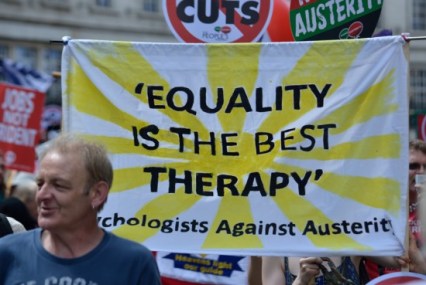
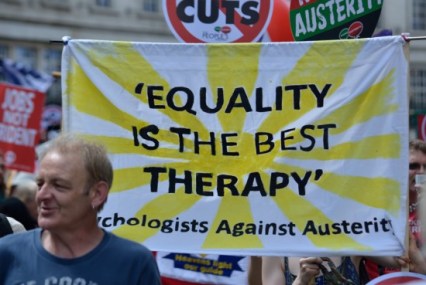
In 2015 the Guardian published this letter signed by more than 400 psychologists, counsellors and academics signed an open letter  protesting against chancellor George Osborne’s plans, laid out in the latest budget, to embed psychological therapy in a coercive back-to-work agenda. (I wrote about this in 2015, here: Psychologists Against Austerity: mental health experts issue a rallying call against coalition policies.)

The linkage of social security benefits to the receipt of “state therapy”, as announced in the chancellor’s latest budget, this is totally unacceptable. “Get to work therapy” is manifestly not therapy at all. With the ominous news that Maximus (the US company replacing Atos to do work capability assessments) will also be managing the new national Fit for Work programme, it is time for the field’s key professional organisations to wake up to these malign developments, and unequivocally denounce such so-called “therapy” as damaging and professionally unethical.

More generally, the wider reality of a society thrown completely off balance by the emotional toxicity of neoliberal thinking is affecting Britain in profound ways, the distressing effects of which are often most visible in the therapist’s consulting room. This letter sounds the starting-bell for a broadly based campaign of organisations and professionals against the damage that neoliberalism is doing to the nation’s mental health. For now, we call on all the parties in this election – and particularly Labour – to make it clear that they will urgently review such anti-therapeutic practices, and appropriately refashion their much-trumpeted commitment to mental health if and when they enter government.

To remind us of this Kitty S jones wrote last year:

A major concern that many of us have raised is regarding consent to participation, as, if benefit conditionality is attached to what ought to be a voluntary engagement, that undermines the fundamental principles of the right to physical and mental care. Such an approach would reduce psychologists to simply acting as agents of state control, enforcing compliance and conformity. That is not therapy: it’s psychopolitics and policy-making founded on a blunt behaviourism, which is pro-status quo, imbued with Conservative values and prejudices. It’s an approach that does nothing whatsoever to improve public life or meet people’s needs.


Kitty noted that: 

The highly controversial security company G4S are currently advertising for Cognitive Behavioural Therapists to deliver “return-to-work” advise in Surrey, Sussex and Kent.

This is yet another lucrative opportunity for private companies to radically reduce essential provision for those that really need support, nonetheless, costing the public purse far more to administer than such an arrangement could possibly save, despite the government’s dogged determination to rip every single penny from sick and disabled people and drive them into low paid, insecure jobs.


Yes, G4S is a player in the delivery of the “new Work and Health Programme 2017 – 2020/21. Commissioned by the Department for Work and Pensions, the programme is intended to assist people who are long term unemployed or who have disabilities and health conditions into work.”

You can read the rest of the post in full here.

Other related posts:

Workfare coercion in the UK: an assault on persons with disabilities and their human rights Anne-Laure Donskoy

The power of positive thinking is really political gaslighting

The new Work and Health Programme: government plan social experiments to “nudge” sick and disabled people into work

Rogue company Unum’s profiteering hand in the government’s work, health and disability green paper

Nudging conformity and benefit sanctions: a state experiment in behaviour modification

The connection between Universal Credit, ordeals and experiments in electrocuting laboratory rats

IAPT is value-laden, non-prefigurative, non-dialogic, antidemocratic and reflects a political agenda

G4S are employing Cognitive Behavioural Therapists to deliver “get to work therapy”

Andrew Coates's avatarIpswich Unemployed Action.

Image result for cognitive therapy for unemployed protests“We are saving the taxpayer £120 million a year in benefit savings.” Sean Williams – Welfare to Work, Managing Director, G4S.

Carillon’s collapse, which involved the farce of having fire-engines on standby today in Oxfordshire in case the company could not deliver school meals for one of their many outsourced contracts, has not stopped the government from continuing their policy of giving large sums of money to private companies to deliver ‘services’.

 The problems of Universal Credit have tended to obscure other aspects of the government’s welfare policy.

One of the most outrageous sides  is this, which we have previously posted on.

It is part of the Work and Health Programme, rolling out this year.

The key service providers are:

Service Providers

It will be run by five service providers across six regions in England and Wales. The successful providers were:

  • Shaw Trust (Central England and Home Counties)
  • Reed…

View original post 1,558 more words

It’s David Gauke and the government that need to change their behaviours, not poor people

Andrew Marr interviews David Gauke about the effects of welfare sanctions

David Gauke claims that the government’s harsh sanctions regime is to ‘change the behaviours’ of people who need to claim support from the welfare state. This is the welfare state that everyone, including those needing support, has funded through the National Insurance and tax system. Gauke clearly thinks that starving people and making them destitute will somehow punish people into working more. He’s riding the fabled rubber bicycle.

Gauke clearly needs to read Abraham Maslow’s work and the results of the Minnesota starvation experiment, because a vast amount of empirical evidence indicates that when people can’t maintain their basic living requirements – fulfilment of basic physical needs for food, fuel and shelter, which every human being has – then they simply will not have the capacity to fulfil higher level psychosocial needs, and that includes looking for work. 

maslow-5

Gauke tried to imply that more people are working and this is somehow linked to the punitive conditionality regime. However, he chose to completely ignore comments outlining how more people have become homeless, now face soaring debt and face more risk of experiencing mental health problems because of sanctions.

The government have ensured via systematic deregulation that the ‘supply side’ labour market is designed to suit the wants of employers and not the needs of employees. Much employment is insecure and wages have been driven down to the point where they are exploitative and no longer cover even the basic livings costs of workers. Wages have stagnated, and are most likely to remain stagnated for the foreseeable future.

So we now have an economic situation where even nurses and teachers are having to visit food banks because they can’t afford to eat. At a time when the government boasts more people than ever are in employment, cases of malnutrition and poverty related illnesses are actually rising. Work clearly does not pay.

An international study has recently shown that, rather than acting as a ‘perverse incentive’ as the Conservatives claim, generous welfare states tend to encourage people to work. This fits with Maslow’s framework, and findings of the extensive Minnesota starvation experiment, among many other reliable and valid sources of empirical evidence, indicating that sanctions cannot possibly work to ‘incentivise’ or motivate people to work.

If Gauke was remotely interested in ‘getting it right’, he would have surely paid a little attention to this and other important research findings. However, he seems very happy to operate from within his own and his party’s state of perpetual confirmation bias.

So much so that even the harrowing findings of a United Nations inquiry into the government’s woeful record of systematically abusing the human rights of disabled people who need welfare support didn’t break their stride at all. They simply denied it. I’m surprised that the government didn’t accuse the United Nations of being ‘Momentum supporters’, as they usually dismiss their critics with that comment, or simply label us as ‘scaremongers’ or ‘marxists’. However, unlike the word ‘Tory‘, the latter isn’t actually a derogatory term outside of the minds of the Tories and Daily Mail journalists.

Pressing him on the harmful effects of benefit sanctions, in the interview, Andrew Marr quoted an open letter to the Independent signed by representatives of the British Psychological Society (BPS) and the other leading UK psychotherapy organisations. 

The letter called on the government, in the words quoted by Andrew Marr, to “immediately suspend the benefits sanctions system” because:

“We see evidence … which links sanctions to destitution, disempowerment, and increased rates of mental health problems …

“Vulnerable people with multiple and complex needs, in particular, are disproportionately affected.”

In his reply, Gauke completely ignored this, and simply restated that work ‘can help people’s mental health’, while Marr mentioned that the National Audit Office and Public Accounts Committee have both criticised the Department for Work and Pension for not knowing enough about the effect of sanctions. Gauke implied that sanctions are pretty much experimental – a sort of trial and error approach, that the government ‘doesn’t always get right’. 

Actually, it’s not a government that gets much right. It’s not so long ago that government officials admitted that claimant’s comments used in an official benefit sanctions information leaflet were ‘for illustrative purposes only’. The Department for Work and Pensions tried to claim, using fake case studies, and fake ‘testimonials’ that people were ‘happy’ to be sanctioned. The government attempted to manufacture evidence, in other words, to justify the use of despotic state behaviours. It’s not a government that feels any need to be transparent and accountable. It is one, however, thatlikes to get its own way, regardless of how harmful and damaging that may be. 

Something I have also raised concerns about on previous occasions is that behavioural economics – the ideological and experimental ‘libertarian paternalist’ approach of the government in changing the behaviours of citizens (note it’s mostly poor citizens that are being targeted for nudge ‘interventions’) – isn’t being monitored, nor does it operate within a remotely ethical framework. No-one seems to care about the potential for abuse here, or about the potential for the state to inflict lasting psychological damage on citizens via its imposition of psychomanagement.

It’s hardly surprising that an authoritarian government using psychological coercion on the poorest citizens by inflicting extreme punishments – in making food, fuel and shelter (basic survival needs) entirely conditional on citizens’ absolute compliance – is causing serious harm and psychological distress to those citizens. It isn’t how people expect governments to behave in a developed, very wealthy so-called democracy.

B.F Skinner’s lab rats were treated better than people needing welfare support. At least once the rats pressed a lever in the operant conditioning chamber during the experiment, they were fed. Some people are left for weeks, months and sometimes up to 3 years without the means to cover their basic survival needs, just to put this into perspective. The government is experimenting on the poorest citizens without their consent. Punishment is being inflicted by the state in an attempt to ‘cure’ state inflicted poverty. Take a moment to think that through.

Behavioural economics entails ‘nudging’ citizens without their informed consent to change their perceptions and behaviours, so that they meet politically defined economic outcomes. The idea of increasing the severity and duration of welfare sanctions came from behavioural economists, who claim, along with the government, that they know what is ‘best’ for citizens and society. Apparently, conditions entailing starvation and destitution is ‘best’ for poor citizens, while handouts, tax cuts and offshore banking is best for the very wealthy minority.

When citizens experiencing such a deep fear of being sanctioned that they are forced to sit through a jobcentre interview while having a heart attack, when vulnerable disabled people are taking their own lives, rather than face a precarious future in a country that is no longer kind; when the government’s actions are causing real and irreversible harm to people who are ill; when the government’s ‘interventions’ are killing people, when cases of suffering, malnutrition and other poverty related diseases begin to reappear, after decades of progress through the welfare state, now being undone when the government refuses to acknowledge these consequences and does nothing to change its own enormously damaging behaviours – simply continuing to deny these inevitable consequences of its own actions – we must ask ourselves if those political actions and the consequences are fully intended.

Policies are political statements of intent, they provide messages about how a government thinks society and the economy should be organised and this is being imposed on citizens. The more a social group suffers the adverse consequences of a failing economic system, the more the government punishes them. It’s despicable. 

Ordinarily, governments in wealthy democracies are supposed to reflect the needs of the public they serve. This government expects the public to reflect the needs of the government and meet economic policy outcomes. The neoliberal framework is profoundly damaging, however, to most ordinary citizens. It seems it cannot be imposed without a considerable degree of authoritarianism, and irrational, unevidenced and pretty vile ideological justification. The justification simply reflects Conservative class prejudices and an elitism. All of this of course turns democracy completely on its head.

Gauke showed not a shred of remorse or concern regarding the terrible impact of sanctions during that interview. He simply didn’t respond, insisting instead that conditionality is necessary for ‘behaviour change’, and as a ‘fair’ gesture to that mythological beast of burden, the ‘tax payer’. While Gauke is casually discussing the political misuse of the worst kind of brutal, punitive behaviourist pseudopsychology, which is designed solely to prop up a failing economic system and to justify the steady dismantling of the welfare state, real and qualified psychologists are telling the government about the unforgivable harm and damage they are inflicting. The Conservatives are simply refusing to listen and engage with citizens.

The welfare state has always entailed a degree of conditionality ever since its inception. However, Gauke tried to claim that the extremely impoverishing sanctions now being imposed for often arbitrary reasons – on people who are late for an appointment, who are too ill to attend a meeting, or for a range of other reasons that indicate barriers people may face in complying with often meaningless, trivial tasks – are somehow ‘necessary’. But we know that most people who need to claim welfare support are either past working age, or they are actually in work. 

So let’s get this straight, it’s a government that believes withdrawing the means of meeting basic survival needs of poor people is necessary. Let that sink in for a moment.

The arrogant and taken-for-granted assumption is that poor people need behaviour changing ‘state therapy’, when the fault lies with the socioeconomic and political system. Not only has this government done their utmost to pathologise poor people, and scapegoat them for a failing political-economic system, it is a government that is quite happy to watch people suffer. If people can’t meet their basic needs for food, fuel and shelter, they will die. This is a government that is OK with people dying because of government policies. Take a moment to think that through.

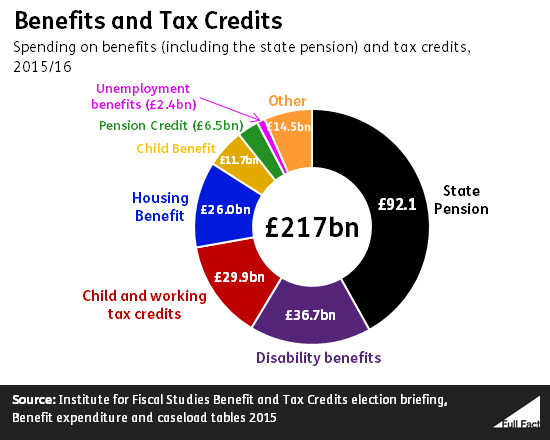
Gauke also claimed that work is the only sustainable basis for lifting people out of poverty. As stated previously, most of our welfare spending is on supporting people in work. The problem of low wages is not one that warrants the punitive ‘behaviour change’ approach aimed at those on poor pay and in precarious employment. It’s not as if the government values collective bargaining and trade union interventions. The behaviour that needs changing is that of exploitative, profit driven employers. Yet already disempowered citizens on low pay are being sanctioned for not ‘progressing in work’. This government is absolutely disgraceful, vindictive and unremittingly cruel.

Image result for welfare spending uk pie chart

‘Making work pay’ is a simply a Conservative euphemism for the dismantling of the welfare state – a civilised and civilising institution that came into existence to ensure that no-one faces starvation, destitution and the ravages of absolute poverty.

Gauke conveniently overlooked the fact that the majority of people needing support have worked, many move in and out of low paid, insecure employment, others are in employment but are not paid an adequate amount to meet even their essential living costs. In fact the majority are in employment. Everyone – in work and out – pays taxes and contributes to the treasury. Well, except for those with havens and the power to say ‘this is what we will pay, take it or leave it’ to the government. ‘Sweetheart deals’ generally don’t come from sweet hearts. These are people who don’t care if the welfare state, NHS and other gains made from our post-war settlement are being plundered and destroyed: they are the cheerleaders of social and economic destruction and the architects of absolute poverty for others.

Gauke also claimed that work was the only sustainable basis for ‘helping people out of poverty.’ However the original aim of the architects of the welfare state was to ensure no-one lived in absolute poverty. This is a government that fully intends to continue dismantling our social security system, regardless of the harm that this does to individuals and to society as a whole. 

The BPS’s call for the suspension of benefit sanctions was repeated in our report Psychology at Work, which was launched last month. The report said sanctions should be suspended pending an independent review into the link between their use and their impact on the mental health and wellbeing of claimants.

The Society called on the government to commit to an end-to-end review of the Work Capability Assessment process in order to bring about the culture change needed to make it beneficial. 

Psychology at Work also made recommendations for creating a psychologically healthy workplace and supporting neurodiverse people at work. 

Here is the Society’s full open letter to the Independent:

The DWP must see that a bad job is worse for your mental health than unemployment

We, the UK’s leading bodies representing psychologists, psychotherapists, psychoanalysts, and counsellors, call on the Government to immediately suspend the benefits sanctions system. It fails to get people back to work and damages their mental health.

Findings from the National Audit Office (NAO) show limited evidence that the sanctions system actually works, or is cost effective.

But, even more worrying, we see evidence from NHS Health Scotland, the Centre for Welfare Conditionality hosted by the University of York, and others, which links sanctions to destitution, disempowerment, and increased rates of mental health problems. This is also emphasised in the recent Public Accounts Committee report, which states that the unexplained variations in the use of benefits sanctions are unacceptable and must be addressed. 

Vulnerable people with multiple and complex needs, in particular, are disproportionately affected by the increased use of sanctions.

Therefore, we call on the Government to suspend the benefits sanctions regime and undertake an independent review of its impact on people’s mental health and wellbeing.

But suspending the sanctions system alone is not enough. We believe the Government also has to change its focus from making unemployment less attractive, to making employment more attractive – which means a wholesale review of the back to work system.

We want to see a range of policy changes to promote mental health and wellbeing. These include increased mental health awareness training for Jobcentre staff – and reform of the work capability assessment (WCA), which may be psychologically damaging, and lacks clear evidence of reliability or effectiveness.

We urge the Government to rethink the Jobcentre’s role from not only increasing employment, but also ensuring the quality of that employment, given that bad jobs can be more damaging to mental health than unemployment.

This should be backed up with the development of statutory support for creating psychologically healthy workplaces.

These policies would begin to take us towards a welfare and employment system that promotes mental health and wellbeing, rather than one that undermines and damages it.

Professor Peter Kinderman, President, British Psychological Society (BPS)

Martin Pollecoff, Chair, UK Council for Psychotherapy (UKCP)

Dr Andrew Reeves, Chair, British Association for Counselling and Psychotherapy (BACP)

Helen Morgan, Chair, British Psychoanalytic Council (BPC)

Steve Flatt, Trustee, British Association of Behavioural and Cognitive Psychotherapies (BABCP)

It seems that real psychologists believe it is the government, rather than poor people, who need to change their behaviours.


I don’t make any money from my work. I am disabled because of illness and have a very limited income. But you can help by making a donation to help me continue to research and write informative, insightful and independent articles, and to provide support to others. The smallest amount is much appreciated – thank you.

DonatenowButton

Mother of four found dead as she couldn’t afford to keep warm after her benefits were cut

Image result for benefit cuts

Tory cuts costs lives

A 38-year-old mother, Elaine Morrall died alone and cold while wearing a coat and a scarf indoors because she could not afford to pay for heating and had switched it off until her children got home from school. Elaine’s family said that her benefits were stopped because she was too ill to attend a universal credit interview.

Elaine was vulnerable, as she suffered from an eating disorder and mental health problems. Her mother, Linda, said that she had no income but was expected to be able to pay full rent. Elaine was told that being in intensive care was not sufficient reason for failing to attend a universal credit interview. She was sanctioned.

A fundraising campaign has been launched to raise money for her devastated four children. And Elaine’s mum has sent a scathing and “brokenhearted” letter to her local councillor in Halton.

In an open letter on Facebook, she wrote: “How many people have got to die before this government realises they are killing vulnerable people?”

Linda said: “My daughter lived in Boston Ave. She died on the afternoon of 2 November, 2017 at home on her own. She was 38 years. 

“In the cold with her coat & scarf on. Because she wouldn’t put her heating on until her kids came home from school. Why?? Because she couldn’t afford it.

“Because she was severely depressed. Suffered from eating disorder and many other problems for many years.

“Mainly due to authoritarians of one form or another. I can give you details. […] was in  out of hospital in recent months in intensive care.”

“But was deemed not ill enough for ESA [Employment and Support allowance]. Had her benefits stopped numerous times, which in turn stopped her housing benefit.

“No income but expected to be able to pay full rent. Was told being in intensive care was not sufficient reason for failing to attend a universal credit interview.

“I went to the job centre to inform them that she couldn’t attend. But benefits [her]stopped again.

“Uncaring housing taking her to court. She’s due to go to court on Monday. Is being dead now enough reason? Is that what’s had to happen to prove she was ill?

“How many people have got to die before this government realises they are killing vulnerable people??

“What are you and your fellow councillors going to do to protect your constituents?”

Halton MP Derek Twigg , who is now working with the family, said: “It is a very tragic case and I am providing assistance to my constituent.”

A Department for Work and Pensions spokesman said: “Our thoughts are with Ms Morrall’s family at this difficult time.

“We understand that people can’t always attend appointments, which is why we will re-arrange alternative times.

“Assessment decisions are made with consideration of all the information provided, including supporting evidence from a GP or medical specialist.

“Anyone who disagrees with a decision can appeal.”

Under the devastatingly tragic circumstances, the statement from the Department for Work and Pensions’ is not only excrciatingly jarring and insensitive, it’s an unforgivable exercise in excuses and denial, it also constitutes the most appalling political gaslighting technique, of monumental Orwellian proportions

If there was any truth in that statement at all, then Elaine simply would not be dead.

To add further insult to the families’ grief, Jonathan Horsfall, Halton Housing Trust debt recovery manager, said: “We always follow strict procedures around arrears.”

“We strive to find solutions with our customers and have intensive support workers who enable us to do so where possible.

“Our support services are on offer to those who we know are in arrears, and are always reached out to for support.

“If customers are concerned about arrears we always encourage anyone to get in touch with us as early as possible in the arrears process so we can do all we can to help.”

Such statements are only plausible if they are taken completely out of the catastrophic circumstances they attempt to address. These superficial, bureaucratic and utterly meaningless statements issued from warm tidy little offices from cold officials are denials that are pre-formulated responses ultimately from an authoritarian government that has absolutely no intention whatsoever of changing its draconian welfare policies, no matter how many more vulnerable citizens die as a consequence.

Elaine Morrall, who died alone and in the cold at home, too poor to put the heating on in the world’s 6th most wealthiest nation. Government officials claim they offer “support” to vulnerable people such as Elaine, yet clearly, they dismally failed to support Elaine at all.


I don’t make any money from my work. I am disabled because of illness and have a very limited income. But you can help by making a donation to help me continue to research and write informative, insightful and independent articles, and to provide support to others. The smallest amount is much appreciated – thank you.

DonatenowButton

Please don’t just walk on by, we are better than this

Related image

It’s absolutely freezing here in the North East. There’s a sparkling, thick layer of frost outside of my window every morning and the road gritters are out around the village every night. In some parts of the county, temperatures as low as minus 7 have been reported.

It’s an awful and distressing thought that there are homeless people who will be fighting to survive hypothermia and worse at this time of year. But it’s far more awful and distressing for those who are facing homelessness. This dangerous, freezing weather kills people who are exposed outdoors very quickly, especially at night when shops and public buildings are closed and locked up. In 2017, in one of the wealthiest nations, the number of people who are homeless is increasing, and as a society, we’ve permitted that to happen.

Image result for homelessness in the snow uk

Research underlines the particular difficulties many councils will face finding accommodation for young people and families over the next two to three years. This is because of the severity of local authority budget cuts. There are serious concerns for single young people because of rising unemployment, benefit cuts and spiralling rents.

Two thirds of local authorities told us they expect it to be “much more difficult” to help 18-21 year olds access housing in the next few years. These concerns will be amplified by planned removal of entitlement to support with housing costs for many people in this age group. 

Once again this year’s Homelessness Monitor warns about ongoing welfare reforms with the discrepancy between Local Housing Allowance and rents highlighted as a significant barrier to council attempts to house homeless applicants.

An ongoing upward trend in officially estimated rough sleeper numbers remained evident in 2016, with the national total up by 132 per cent since 2010. The welfare cuts introduced in this decade, and those planned for introduction in the coming years, will
cumulatively reduce the incomes of poor households in and out of work by some £25 billion a year by 2020/21.

This is in a context where existing welfare cuts, economic trends, and higher housing costs associated with the growth of private renting have already increased poverty amongst members of working families to record levels.

Related image

Then there are the recently publicised failings of Universal Credit, which was designed to reduce welfare spending, rather than to improve support for people who need it. 

And it’s going to get worse. The welfare “reforms” announced in the summer 2015 Budget and Autumn Statement will have particularly marked consequences both for families with more than two children, and for young single people.

These groups will either potentially be entirely excluded from support with their housing costs (if 18-21 and not subject to an exemption), or subject to Shared Accommodation Rate limits on eligible rents in the social as well as the private rented sector. Consequently, these are the groups that local authorities report greatest difficulty in rehousing.

More than 300,000 people in Britain – equivalent to one in every 200 – are officially recorded as homeless or living in inadequate homes, according to figures released by the charity Shelter. Using official government data and freedom of information returns from local authorities, it estimates that 307,000 people are sleeping rough, or accommodated in temporary housing, bed and breakfast rooms, or hostels – an increase of 13,000 over the past year.  However, Shelter say that this is likely to be an underestimation

Polly Neate, chief executive of Shelter, said: “It’s shocking to think that today, more than 300,000 people in Britain are waking up homeless. Some will have spent the night shivering on a cold pavement, others crammed into a dingy hostel room with their children. And what is worse, many are simply unaccounted for.

“On a daily basis, we speak to hundreds of people and families who are desperately trying to escape the devastating trap of homelessness. A trap that is tightening thanks to decades of failure to build enough affordable homes and the impact of welfare cuts.”

Although public perceptions of homelessness are dominated by rough sleeping, Shelter points out that the single leading cause of recorded homelessness is the ending of a private tenancy, accounting for three in every 10 cases, and often triggered by a combination of soaring rents and housing benefit cuts.

A National Audit Office (NAO) inquiry in September criticised the government for failing to get a grip on homelessness, despite recorded numbers of homeless people rising every year since 2010. The NAO said local housing allowance cuts helped fuel the crisis, which cost us around £1bn a year.  

One in five young people in the UK have sofa-surfed in the past year and almost half of them have done so for more than a month. In a country that is among the wealthiest in the world, how can this be possible?

Related image

report by the London Assembly housing committee on hidden homelessness is a timely reminder of an issue that goes unseen by most of the public and by many local and national politicians. 

However, as a so-called civilised society, we mustn’t look the other way. In cold weather, the plight of people who have no shelter is especially harsh, and many passersby may struggle to know what to do. But here are small things we can each do to make a difference, and reduce the dangers of freezing weather for homeless citizens. For example:

  • We could stop, smile and buy someone a warm drink, or provide some warm food.
  • We could set up places were people can take their old coats and blankets, socks, hats, gloves, scarves – and then distribute those to people sleeping rough. Or even set up a point in each town so that homeless people know where to go for warm clothes that have been donated.
  • We can also contact Streetlink. (Click) When a rough sleeper is reported via the Streetlink app, or by phone – telephone number 0300-500 0914. The details  you provide are sent to the local authority concerned, so they can help connect the person to local services and support. You will also receive an update on what action was taken so you’ll know if the situation was resolved. StreetLink aims to offer the public a means to act when they see someone sleeping rough, and is the first step someone can take to ensure rough sleepers are connected to the local services and support available to them.

Image result for homelessness in the snow uk

The thing is, we must do something. We must not become desensitised to the fact that so many people are struggling to survive. Shelter is one of our most fundamental survival needs, and it’s shameful that people in the UK cannot meet their most basic needs. It’s not enough to simply spare a thought. That doesn’t save lives, unless we act on those thoughts.

Related image

Please don’t just walk on by.


I’m disabled through an illness called lupus. I don’t make any money from my work. However, I do what I can, when I can, and in my own way. You can support Politics and Insights and contribute by making a donation which will help me continue to research and write informative, insightful and independent articles, and to provide support to others. The smallest amount is much appreciated, and helps to keep my articles free and accessible to all – thank you. 

DonatenowButton

The Paradise Papers, austerity and the privatisation of wealth, human rights and democracy

351-burden-cuts-by-population

Outdated Conservative ideology has long framed the social safety net as an obstacle to national prosperity, the government claims that welfare somehow depresses economic growth and job creation. Indeed, Conservative efforts to dismantle the welfare state have been a constant in UK national politics. However, the truth is that as income inequality increases, the potential for economic growth is constrained. Seven years of austerity aimed at the poorest citizens have provided empirical evidence that does not verify the government’s claims.

The Conservatives also claim that welfare creates “perverse incentives” and “moral hazards” – it produces negative “unintended consequences,” as people who are eligible for support don’t have a job. Welfare is therefore reduced to ensure that people are not comfortable in claiming financial support, in order to “make work pay”. The problem with that, however, is that many people who work are also struggling to make ends meet. Work doesn’t pay because a miserly state provides perverse incentives for unscrupulous profit-driven employers to pay miserly wages that are well below average living costs. There has also been a marked loss of job security, too, over the last seven years.

All of this reflects a troubling reality of the labour market – that without government regulations and collective bargaining – the government have a history of legislating to undermine trade unions and traditionally loathe collective bargaining – employers are able to use “competition” to reduce wages. This state of affairs is clearly attributable to political decisions. It can be traced back over decades of policies favouring businesses at the expense of established employee rights. 

In the free market, all that matters is how many people are capable of doing your job. Competition matters, at least on paper. It doesn’t matter what qualities and skills you have. Workers are not paid according to their skills, they’re paid according to what they can negotiate with their employers. The more people there are in the labour market, the less bargaining power they have. The steady reduction of the support offered by the welfare state creates desperation, and also significantly reduces peoples’ choices regarding employment. It creates a race to the bottom, where wages are depressed and stagnating, and “efficiency” rules, along with the profit motive.

Furthermore, some employers are discriminatory, and pay workers different wages on the grounds of disability, age, race, or gender.

Changing policies to include a progressive tax structure would enhance economic growth and see a structural lowering in the unemployment, underemployment and low pay rates, with the other very valuable benefit of being ethical, fair, decent and compassionate. There are several excellent macro-economic reasons for substantially raising wages AND raising welfare. Notably, it could boost consumption, reduce inequality as well enhance economic growth.

In 2014, the Organisation for Economic Co-operation and Development (OECD) published a report that stated income inequality actually stifles economic growth in some of the world’s wealthiest countries, whilst the redistribution of wealth via progressive taxation and benefits encourages growth.

The report from the OECD, a global think tank, shows basically that what creates and reverses growth is the exact opposite of what the current neoliberal government are telling us. It highlights that the Conservative austerity programme is purely ideologically driven, and not about effectively managing the economy at all. However, many of us already knew this was so. The Conservatives have managed to narrate neoliberal ideology effectively, it became naturalised, and established as an “intuitive” and common sense kind of justification system for crass inequality, (accumulation by the wealthy through the dispossession of the poor) while its very design was to fragment the truth and disjoint rationality. This is precisely how dominant ideologies operate. 

Austerity was never about what works for the economy. Austerity is simply a front for policies that are entirely founded on ideology, which is all about “handouts” to the wealthy that are funded by the poor

If we provide support for those on low incomes, there will inevitably be higher aggregate spending, more jobs and a stronger economy. And if the income distribution continues to include those on low incomes, rather than the current redistribution to the wealthiest, there will be a lift in the growth potential of the economy. Unemployment would be structurally lower and there would be a self-supporting cycle of stronger economic activity as a result.

The Paradise Papers and the privatised magic money tree

Tax havens are one of the key engines of the rise in global inequality. I started writing this article just as the Paradise Papers leak hit the media, following information that was garnered by the German newspaper Süddeutsche Zeitung – which also received the Panama Papers last year – and shared by the International Consortium of Investigative Journalists with partners including the Guardian, the BBC and the New York Times.

Conservatives argue that economic inequality is essential to a healthy economy to generate the financial incentives for individuals to remain in further and higher education, to work hard and to invest their savings in productive enterprises, all of which will result in faster economic growth and rising average living standards. Wealthy people create jobs, and so the poorest citizens will benefit indirectly from economic inequality as some of the benefits of faster economic growth “trickle down” to them. The Conservatives claim that wealthy people are essential to the economy because they “create jobs” and more wealth. 

However, regardless of the plausibility of the debate about competition, meritocracy,  equality of opportunity, rather than equality of outcome – and the debate around wealth redistribution, the world’s super-wealthy have taken advantage of lax tax rules to siphon off at trillions of pounds, from their home countries’ economies and hoard it abroad – and the offshore drain involves a sum larger than the entire American economy. The sheer scale of hidden assets held by the super-wealthy also strongly suggests that standard measures of inequality, which tend to rely on surveys of household income or wealth in individual countries, radically underestimate the true level of inequality – the gap between rich and poor. 

Wealth doesn’t “trickle down”: it’s hidden away offshore. It’s hoarded. If you are remotely concerned about fairness and inequalities of wealth and power, you really must be concerned about the very existence of tax havens, and the significant impact this has on national economies. The Conservatives prize the idea of private property, and that impacts on their decision-making. Rather than address the issue that would have had a larger positive impact on our economy – tax avoidance and hoarding – they chose instead to impose austerity on the poorest citizens in the UK, they made “difficult choices” to dismantle the welfare state and raid our public funds, damaging our services and eroding our post war social safeguards. Wealth doesn’t “trickle down”, it trickles away offshore. Furthermore, it’s not feasible that the government was unaware of this. They have chosen to focus on supply side labor policies, and blaming the poorest for the big hole in the economy, some of which followed the banking crisis. They have chosen to regard our public services as “unsustainable” to prop up the immoral financial habits of a wealthy and powerful elite.

At the centre of the Paradise leak is Appleby, a law firm with outposts in Bermuda, the Cayman Islands, the British Virgin Islands, the Isle of Man, Jersey and Guernsey. The project has been called the Paradise Papers. It reveals (courtesy of the Guardian):
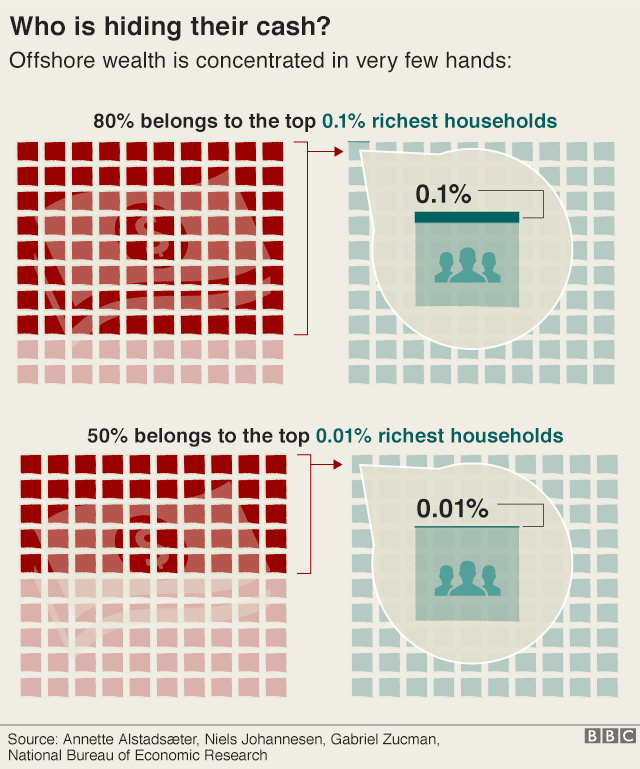
Graphic showing who is hiding their cash

The disclosures will certainly put pressure on world leaders, including Trump and the prime minister, Theresa May, who have both paid lip service to the idea of curbing aggressive tax avoidance schemes. 

The publication of this investigation, for which more than 380 journalists have spent a year combing through data that stretches back 70 years, comes at a time of growing global income inequality.

In the UK, the ideologically driven austerity programme has also contributed significantly to the redistribution of public funds from the poorest citizens to the wealthiest. I’ve said this before, but I’m going to say it again: 

Government policies are expressed political intentions regarding how our society is organised and governed. They have calculated social and economic aims and consequences. In democratic societies, citizen’s accounts of the impacts of policies ought to matter. But for the past seven years, the government have been completely disengaged with the public, and have failed to listen to accounts of the detrimental impacts of their public policies on marginalised social groups.

In the UK, the way that policies are justified is being increasingly detached from their aims and consequences, partly because democratic processes and basic human rights are being disassembled or side-stepped, and partly because the government employs the widespread use of linguistic strategies and techniques of persuasion to intentionally divert us from their aims and the consequences of their ideologically (rather than rationally) driven policies. Furthermore, policies have become increasingly detached from public interests and needs.

The justification offered by the government for its draconian policies aimed at society’s most marginalised (and protected) social groups is that welfare and other supportive public services are “unsustainable”. The government claims that “difficult decisions” have to be made, which invariably entail cuts to essential services and provisions, because we don’t have enough money.

In truth, the government simply has other plans for the money available, and prioritises the desires of the very wealthy, at the expense of meeting the needs of the poor. 

Other justifications reflect the behaviourist turn, which perpetuates the “culture of poverty” myth and embeds behaviourist theories regarding the presumed attitudes and “cognitive incompetence” of the poorest citizens in policies, which extend a disciplinarian and “correctional” element. However, such narratives and policies indicate a government of evidence-free fanatics. In policy, everything is something you decide to do, and there is nothing that you have to do. There are always alternative choices to consider regarding how our economy is managed.

Few things demonstrate the Conservatives’ wake of glib lies than their record on welfare spending – an area in which they have overseen a culture of waste. Just look at disability benefits. We’re told repeatedly that spending on “welfare” for disabled people is “out of control”, yet earlier this year it emerged that the Department for Work and Pensions has gone nearly £200m over budget, in paying two private companies from the public purse to run the personal independence payments (PIP) assessment system.

Then there is the Work Capability Assessment scandal. The National Audit Office (NAO) scrutinises public spending for Parliament and is independent of government. In their audit report last year, the NAO concluded that the Department for Work and Pension’s spending on contracts for disability benefit assessments is expected to double in 2016/17 compared with 2014/15. The government’s flagship welfare-cut scheme will be actually spending more money on the assessments themselves than it is saving in reductions to the benefits bill. It would be cheaper, and of course much more ethical to simply pay people what they were previously entitled to, based on their own doctors’ professional judgement.

The NAO report reflects staggering economic incompetence, a flagrant, politically motivated waste of tax payers money and even worse, the higher spending has not created a competent or ethical assessment framework, nor is it improving the lives of sick and disabled people. People are dying after being wrongly assessed as “fit for work” and having their lifeline benefits brutally withdrawn. Maximus is certainly not helping the government to serve even the most basic needs of sick and disabled people.

However, Maximus is serving the needs of a “small state” doctrinaire neoliberal government. The Conservatives are systematically dismantling the UK’s social security system, not because there is an empirically justifiable reason or economic need to do so, but because the government has purely ideological, anticollectivist prescriptions, and other plans for our public funds.

The Conservatives have now spent at least £700m in taxpayers’ money on these contracts with multinationals alone, despite the fact that the process they use is so flawed that one charity reported that as many as four out of five rejections for PIP that were appealed against were overturned. That indicates, at the very least, the use of a severely flawed assessment process. PIP assessments are purposefully designed to ensure that people are less likely to be found eligible for the support in meeting the additional costs of being disabled. Then there is the massive cost of tribunals to add to the cost of administrating the “cuts”. 

Meanwhile, multinational companies are shifting a growing share of profits offshore – €600bn in the last year alone – the leading economist Gabriel Zucman will reveal in a study to be published later this week. That money leaves a hole in our economy, which is refilled at the expense of those with the very least to contribute to paying off the “national debt” – another Conservative obsession and justification for their austerity programme. 

The human costs of a “business friendly” neoliberal economy

The government have long claimed that they are “helping” sick and disabled people into work. This “support” entails putting disabled people through systematic ordeals, and constantly moving ever-shrinking goalposts – the claimed objective of which is “targeting” resources to “those most in need”.

The Conservatives use glib, patronising, ridiculous and baffling phrases in their rhetoric, guidelines and policy papers, saying things like they don’t want disabled people to “fall out of employment”, for example. Yet PIP, which is a non means tested payment, quite often supports people in employment, as did the now abolished Independent Living Fund. But PIP is very difficult to qualify for. At my own assessment, my previous post (which ended seven years ago, with social services) was actually used as “evidence” that I don’t have significant cognitive difficulties. However I was forced to give up that post when I became too ill to work. PIP certainly doesn’t seem to be about supporting disabled people in maintaining independence, despite its title.

If it were, then we wouldn’t be witnessing so many losing their award as they are transferred from Disability Living Allowance, or seeing it reduced. Many disabled people are losing their mobility award and consequently, their motability vehicles, which inevitably means that some in this group won’t be able to continue working.

The government has targeted disabled people in order to cut their support and to make savings by reducing the availability of lifeline support that was once accessible to those of us unlucky enough to be disabled, to become ill or have an accident, leaving us unable to earn an income. You know, those provisions that our national insurance pays for.

There is no reason whatsoever to presume that disabled people are “frauds”. The ordeals that have been introduced into the welfare system to deter fraud are not justifiable, since prior to the “reforms”, welfare fraud stood at just 0.7%/. Some of that tiny percentage was actually down to bureaucratic error, too, as administrative errors are included in the statistic. 

The claim that the ordeals incorporated into the system are to “protect the public purse” from fraud is utter rubbish. The ordeals deter most people from claiming, unless they absolutely have no choice. I’ve put off claiming PIP since 2012, when I was advised to by my doctor. Who wants to suffer the utter loss of dignity and punishment that the system meters out unless they really REALLY have to.

Some perspective:
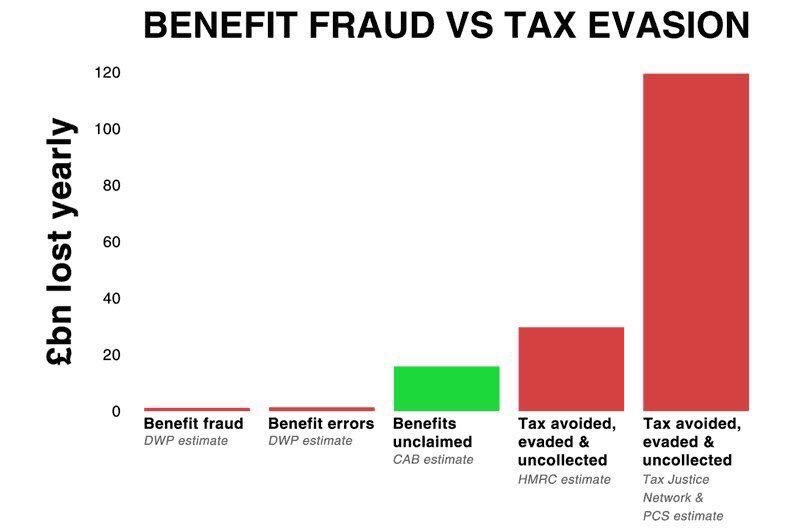
People don’t “fall” out of their jobs: they become too ill to work or they lose their jobs because they are disabled. Every person facing an assessment is in that position because both they and their doctor have concluded that they are unfit for work – too unwell or unable. But the government refuses to accept first hand accounts and the professional opinion of professionals.

The government isn’t “helping” disabled people; it is making it as difficult as possible for people to claim support. The Conservatives are actually trying to coerce sick and disabled people who cannot work to work. Let’s have it straight. Because the whole process is so difficult, and because you are assessed and reassessed constantly, often having to go through mandatory review then appeal, which takes months and months on end, people with chronic illnesses especially experience worsening health because of the terrible stress and strain they are placed under by the state, and are therefore even LESS likely to “move closer” to employment.

In looking to make savings on disability benefits, the government is inflicting unacceptable harm and damage on disabled people. The system damages people’s health, wellbeing and more generally, their lives, because they have to struggle endlessly for a little basic support that most civilised societies would deem essential and  unproblematic.

All of this is because of the insulting assumption the Conservatives make that people who have illnesses or are disabled for other reasons are using their circumstances to wriggle out of their obligations to work, and of course, to fulfil their duty towards national production and the economy. Unfortunately, disability and medical conditions often restrain people from full participation in society, whether they like that or not. Cutting support will simply make inclusion and participation even less likely. 

How assessments are weighted towards the miserly state

The government has justified cuts to welfare more generally by making claims about the characters, attitudes and cognitive capacities of people claiming social security more generally. However, regardless of the front of blame-mongering rhetoric, both ESA and PIP were never intended to be easily accessible support mechanisms for disabled people. The very design of the assessments indicates this.

The Work Capability Assessment is a “norm-referenced” system, not a criterion-referenced system. These terms refer to different ways in which the evidence gathered from an assessment process is used. Criteria-referenced systems are considered to be objective and consider each case individually and on its own terms. Norm-referencing is designed to compare and rank assessments in relation to one another, rather than in relation to objective criteria. Norm-reference assessments score better or worse against a hypothetical standard,  which is determined by comparing scores against the overall performance results of a statistically selected group (a cohort). 

All of which is a sophisticated way of saying that there are in-built targets. To receive ESA, someone must score the required number of points and fall within the proportion of people the system will actually permit.  In practice, this means there is a finite number of people who can be awarded benefit, and that’s regardless of the number of people who actually meet the eligibility criteria. A serious limitation of norm-reference assessments is that the reference group – the cohort – may not represent the current population of those being assessed. Norm-referencing does not ensure that an  assessment is valid, either (i.e. that it measures the construct it is intended to measure). There is nothing to stop a government from using a very biased sample of the population, when they select a cohort.

In 2007, Conservative MP Timothy Boswell warned (9 Jan 2007 : Column 169): “I can imagine circumstances […] in which a future minister […] might wish to say: ‘We will introduce a norm. We are not going to have, by definition, more than 1.5 million people on employment and support allowance,’ and the tests will, in effect, be geared to deliver that result.”

The reassessment of everyone claiming Incapacity Benefit and all disabled people claiming Income Support became a major Conservative crusade that was, we were told, to save billions of pounds a year from the welfare budget, in the Conservative age of austerity. 

Similarly PIP assessments were developed to fit with a pre-conceived idea of how many people ought to qualify for support. The assessment is designed to allocate as few points as possible, by ignoring the real barriers people face in their daily living and assessing a person’s ability to “function” by using the most trivial  and non comparable descriptors.  Esther McVey disclosed in 2012 that she anticipated 300,000 disabled people would have their disability support cut or ended during the change over from Disability Living Allowance (DLA) to PIP. That statement came before a single assessment had taken place. If that isn’t a declaration of the real intention behind the introduction of PIP, and that the assessment itself is pretty arbitrary, then I don’t know what is. It does strongly suggest the assessments are not being conducted fairly and “objectively”. 

In 2012, a GP posed as a trainee Atos assessor and recorded undercover video footage that was later broadcast by Channel 4’s investigative current affairs programme Dispatches. In the film, trainers warned the NHS doctor that if, on average, he were to recommend more than one claimant per day for the Support Group (out of the eight he would be expected to see each day) he would be subject to an increased level of management scrutiny through a mechanism known as “targeted audit”. The undercover doctor was told:

“If it’s more than I think 12% or 13%, you will be fed back ‘your rate is too high’.”

An assessor under “targeted audit” would have all of their reports scrutinised before they were sent to the Department for Work and Pensions (DWP) and would no longer be allowed to recommend any claimants for the Support Group without asking for permission first. When the doctor asked an experienced assessor where these rules had come from, she replied: “The DWP”.

Both the DWP and Atos categorically denied ever having had any target for getting claimants off sickness benefits. However, both eventually admitted that Support Group “norms” were being used nationwide, though they both denied that the purpose of “targeted audit” was to limit the number of claimants placed in the Support Group.

Atos said that the audit process triggered by the breach of a “norm” was intended to ensure consistency across the firm’s UK team: if the assessor’s reports met the DWP’s expectations, the healthcare professional would not be asked to change their recommendations.

The decision-making process for awards certainly do not command public confidence, they depend on assessments of “functional impact” that are far from a precise science. In fact it isn’t “science” at all. There is a continuing widespread misperception that PIP is a medical test rather than an assessment of functional capacity, not helped by the fact that assessors are refered to as “Health Professionals”, and Atos claims to be a “medical Service”, while Maximus claims it conducts a “health assessment” rather than a work capability assessment. 

Last November, a United Nations (UN) committee published a scathing report on the consequences of the austerity policies pursued by the UK government in welfare and social care, which it described as “grave and systematic violations” of the rights of people with disabilities. Many of us have raised our concerns and fears with the UK government about the harsh impacts of austerity on disabled people, following the publication of the welfare “reform” bill in 2012, but we were ignored. 

The members of the House of Lords, opposition ministers, the Work and Pensions committee, disabled people’s organisations, charities and support groups and many individuals all tried to engage the government, but to no avail. We were excluded from any democratic dialogue, with accusations of “scaremongering”, and then silenced with false statistics and dishonest claims from Conservative ministers, who presented to us nothing but their own prejudice and contempt. 

We meticulously presented cases to ministers that demonstrated the hardship, harm, distress, loss of independence and dignity, and sometimes, the deaths, that correlate with the reforms and cuts. However, the first hand accounts of our experiences of Conservative policies, as disabled people, were loudly dismissed as “anecdotal evidence”. Over and over we were told by ministers that there was no “proven causal link” established between the policies and the frightening events that we were experiencing and reporting. The fact that the government refused to listen to us and were so uncompromising added another dimension and depth to the fears we experienced.

Many of us raised felt we had no choice but to raise our concerns and fears with the United Nations using the Optional Protocol to the Convention on the Rights of Persons with Disabilities – a side-agreement to the Convention which allows its parties to recognise the competence of the Committee on the Rights of Persons with Disabilities to consider complaints from individuals. Many of us have been documenting and submitting evidence to the UN since 2012. There followed an inquiry, more evidence was gathered. The government dismissed the UN report as “patronising and offensive”. However, given that the government is well aware that disabled people and disability organisations were responsible for the complaints that initiated the inquiry, the  patronising and offensive bluster and attitude is descending from Whitehall. 

A recent report from the UN expressed grave concern regarding care and treatment policies, which were described as insufficient to the extent of being “inconsistent with the right to life of persons with disabilities as equal and contributing members of society”.

Labour’s Debbie Abrahams, the shadow work and pensions secretary said “The UN committee has found that this Tory government is still failing sick and disabled people. Their damning report highlights what many disabled people already know to be true: that they are being forced to bear the brunt of failed Tory austerity policies.”

Before 2010, the very idea of cutting disability support was unthinkable. The Conservative behaviourist turn is a cruel front for inexcusably squeezing a few pounds more from disabled peopleso that wealthy people can avoid paying tax.

Thatcher’s government was fond of perpetuating the “culture of poverty” myth, but the current government has taken that to a new low, and has implemented costly big state policies which aim at “recifying” behaviours considered “not in our best interests”. The only beneficiaries are the private companies and multinationals who make a profit from administering the punitive cuts. The cuts which are costing more to implement than they can possibly save, in a “business friendly” political climate. One where the government tells us that we need to “incentivise” wealthy people to create jobs and contribute to the economy by giving them more money, while poor people are “incentivised” by not having enough money to meet their basic survival needs. Accumulation by the wealthy by dispossession of the poorest.

Welfare has incorporated a Conservative moral crusade aimed at coercing conformity and compliance to draconian state-determined conditions.

Meanwhile, some very wealthy people are making massive profits from the governments’ austerity programme, particularly the welfare “reforms”. 

Conservatism is synonymous with social and economic inequality – with handouts for the rich and subsequently, much less money for the poor. 

In the UK, democracy, human rights, independence, wellbeing, security, freedom and wealth have been privatised. Only 1% of the population can afford them these days, and they tend to bank offshore.  

paradise-papers-logo-icij-759 (1)


I don’t make any money from my work. But you can support Politics and Insights and contribute by making a donation which will help me continue to research and write informative, insightful and independent articles, and to provide support to others. The smallest amount is much appreciated, and helps to keep my articles free and accessible to all – thank you. 

DonatenowButton

Our social security has been redesigned. It’s now a welfare deterrent

PIP

Hunger and desperation used quite ruthlessly by a “health care professional” to controversially justify refusing a disability support claim. Access to food banks can only happen if you are referred by a professional, such as a doctor or social worker. Furthermore, you can generally have a maximum of only 3 referrals per year. The ESA and PIP eassessment guidance says that a person must be able to walk the distance specified “reliably, consistently, safely and in a timely manner.”

universal-credit.jpg
Iain Duncan-Smith struggled financially once, but then he got off his backside and was given a Tudor mansion by his father-in-law, the fifth Baron Cottesloe, which proves rewards come to those prepared to make an effort.  Reuters.

“Universal Credit doesn’t go far enough – work won’t pay until people are running naked through stinging nettles to get their benefits.

As Universal Credit develops, it can encourage other skills, so if your electricity has been cut off, you have to screw your application form into a ball and dribble it through a line of cones before kicking it into a bucket. That way you can soon come off benefits and earn £5m a year as a winger for Manchester City.” Mark Steel, writing for the Independent

The Conservative notion of “deserving” and “undeserving” poor is a false dichotomy. No-one deserves to be poor

“Deserving” is a politically divergent word if there ever was one. The Conservatives have used it to apparently wage an all out class war, using austerity as a smokescreen. They certainly don’t take the side of the proverbial underdog. In fact the more need you have, the less this government considers you “deserving” of support and sympathy.

Policies aimed at people with what are politically regarded as “additional needs” are largely about ensuring your compliance, conformity and commitment to “behavioural change”, on the assumption that people somehow erroneously “choose” to need financial support. Claiming any form of state support has come to entail a deeply hostile and extremely challenging process that is causing psychological distress and often, physical harm, to our most vulnerable citizens. There are plently of examples of cases where this has happened documented on this site alone.

Such a disciplinarian mindset is now embedded in social security policy, rhetoric and administration. But we’ve been here before, back in 1832, when the Poor Law Amendment Act was aimed at categorising and managing “deserving” and “undeserving” poor. Those considered “deserving” were unfortunately placed in workhouses and punished by a loss of citizens freedoms and rights, in order to “deter” people from being poor. (See also The New New Poor Law, 2013.)

I’ve yet to come across a single case of someone being punished out of their poverty. Someone ought to send every government minister a copy of Maslow’s hierarchy of human needs, and remind them all that our post-war social security was originally designed and calculated to ensure people could meet the costs of basic survival needs, such as for food, fuel and shelter.

It was recognised back then that people struggling with basic survival requirements were highly unlikely to fulfil other higher level psychosocial potential, such as looking for work. If we want people to find work, we must first ensure they have the necessary resources to do so. And that the work available will make a real difference to their standard of living. 

Poor people don’t create poverty, state decision-making does. The economy and labor market conditions do. The punitive approach to poverty didn’t work in the 1800s and 1900s, and it isn’t working and can’t possibly be made to work now. It’s an ideological dead horse. It died because of the brutal and unrelentless use of too much political brutality, the heavy hand of the state offering all stick and no carrots for poor people.

Being poor is itself punishing enough. Now the poor are being punished for being punished with poverty.  No-one chooses to be poor, our overarching socioeconomic organisation is founded on the very principles of competition. Neoliberalism invariably means there will be a few “winners” (1%) and a lot of “losers” (99%). It’s embedded in the very nature of such a competitive system that emphasises individualism, rather than collectivism, to create increasing inequality and poverty. 

It’s worth considering that people on low pay, or with part-time hours in work are also being sanctioned, if they claim “top up” benefits to supplement their exploitative rate of pay or poor and unstable work conditions. This fact is hardly a good advertisment for the government’s claim of “making work pay”, unless of course we refer back to the poor law reform “deterrence” of 1834. Apparently, making welfare sufficiently punitive to deter people from claiming it is how we make work pay, not by raising wages in line with the cost of living. Silly me. I mistook a propaganda soundbite at face value. It seems old ideolologies die hard, with a vengeance.

Apparently it’s an individual’s fault for not “progressing in work”. Nothing to do with increasingly precarious employment situations, executive decision-making, or a deregulated labor market, of course. 

In-work benefits have effectively subsidised employers’ wage costs. Yet low paid workers are being punished by the government for this state of affairs.

It’s not so long ago that we had a strong trade union movement that used collective bargaining as a method of improving wages and working conditions. But the free market ideologues don’t like trade unions, or welfare provision. They like a neat, tidy and very small, limited interventionist state. Or so they claim.

The paradox, of course, is that in order to reduce supportive provisions, and dismantle the welfare state in order to fulfil the terms and conditions of neoliberalism, the government has to implement strategies that ensure citizen compliance. Many of those strategies are increasingly authoritarian, rather than “non interventionist”, in nature.

It’s not the welfare state, but the state of welfare that is the pressing problem

Private companies have become more firmly embedded in the core concerns of all departments of government in designing and delivering on public and social policies, and policies have become increasingly detached from public need, and more directed at meeting private interests, largely involving making huge and private profits. The Conservatives don’t seem to consider that rogue private businesses like G4S, Atos, Maximus, A4E, and so on, are extensions of the state, fulfilling what are, after all, state-determined functions.

Of course this creates an imbalance between the role of the welfare state in aiding private capital and its role in maintaining and supporting labor, and fulfilling the basic needs of citizens. Corporate welfare underpins neoliberal economies, and it costs the public far more than reduced public provisions promises to save.

In January 2016, the National Audit Office (NAO) published its evaluation of the DWP’s health and disability assessment contracts. It said the cost of each Work Capability Assessment (WCA) had risen from £115 under Atos to £190 under Maximus. The report also states that only half of all the doctors and nurses hired by Maximus – the US outsourcing company brought in by the Department for Work and Pensions (DWP) to carry out the assessments – had even completed their training.

The NAO report summarised:

5.5
Million assessments completed in five years up to March 2015

65%
Estimated increase in cost per Employment and Support Allowance (ESA) assessment based on published information after transfer of the service in 2015 (from £115 to £190)


84%
Estimated increase in healthcare professionals across contracts from 2,200 in May 2015 to 4,050 November 2016

£1.6 billion
Estimated cost of contracted-out health and disability assessments over three years, 2015 to 2018

£0.4 billion
Latest expected reduction in annual disability benefit spending

13%
Proportion of ESA and Personal Independence Payment (PIP) targets met for assessment report quality meeting contractual standard (September 2014 to August 2015).

Before 2010, cuts to disability support were unthinkable. Now the Treasury regards our provision as their pocket money for tax cuts for the very wealthy

This summary reflects staggering economic incompetence, a flagrant, politically motivated waste of tax payers money and even worse, the higher spending has not created a competent or ethical assessment framework, nor is it improving the lives of sick and disabled people. Some people are dying after being wrongly assessed as “fit for work” and having their lifeline benefits brutally withdrawn. Maximus is certainly not helping the government to serve even the most basic needs of sick and disabled people.

However, Maximus, and other private companies involved in the delivery of welfare programmes are serving the needs of a “small state” doctrinaire neoliberal government, and making a massive profit in doing so. It would cost much less to simply pay people the support they were once simply entitled to. However, the Conservatives are systematically dismantling the UK’s social security system, not because there is an empirically justifiable reason or economic need to do so, but because the government has purely ideological, anticollectivist prescriptions. 

As well as the heavy cost of each assessment to the public purse, there is also the considerable cost of many tribunals, because of the many “wrong decisions”on the part of the Department for Work and Pensions. That’s despite the fact that the government introduced another layer of bureacracy in the form of “mandatory review” in order to deter appeals. People going through mandatory review for a decision to stop their ESA cannot claim ESA again until after mandatory review (if you need to appeal, you can claim ESA once you have the review decision), and so are forced to either try and claim Universal Credit, going 6 weeks at least without any support, or to wait out the Review outcome, which has no set time limit, but usually takes at least 6 weeks for the decision about the original decision. Which is usually the same decision as the original decision, due to outrageous targets that were revealed in the department’s response to a Freedom of Information request, that stated staff conducting mandatory reconsideration reviews were held to a “key performance indicator” that said “80 per cent of the original decisions are to be upheld”.

This is a government that claims social security is “unsustainable” and a “burden” on the public purse, yet has no problem with an extraordinary profligacy with public funds and dispossessing tax payers when it comes to implementing “cost-cutting” and draconian welfare “reforms.” Conservative anti-welfare dogma and traditional prejudices are costing the UK billions of pounds. 

The Tories are all about ideology and not facts. As two authors astutely noted recently, the government seems to be driven by an idea that creating the conditions of purgatory for those they consider “undeserving” will somehow cleanse, redeem and purify people into not being so sinfully poor.  So it’s not actually “welfare” any more, but rather, it’s a “correctional” institution, for coercing citizens into conformity, compliance and a class contingent meekness, with a liberal dash of the protestant work ethic in with the catholic inquisition flavoured ingredients in the mix. Yes, the nasty authoritarian Conservatives really do think like this.

Disability support is virtually impossible to access for many people that doctors consider severely disabled, and involves a measured and ritualised humiliation. The assessments are solely designed to look for “discrepancies” in people’s accounts of how their illness/disability impacts on your day to day living. In other words, it is aimed at looking for reasons, no matter how flimsy, to ensure that welfare support for disabled and ill people is pretty much unobtainable.

Those questions you are asked by the (inappropriately named) Health Care Professional (HCP) that seem like innocent conversation, such as “Do you watch TV? Do you like the Soaps?” translate onto a report that says “Can sit unaided for at least half an hour”. “Do you have a pet?”becomes “Can bend to feed cat/dog.” “Do you use the internet at all?” becomes “No evidence of focus or cognitive difficulties, adequate hand dexterity.”

If you wear any jewellry, that may be noted and used as evidence that you have dexterity in your hands, even if you have severe arthritis and can’t fasten your buttons or a zip,  you won’t be asked if you ever remove your locket/ring/earrings. It will be assumed that you do. It’s a kind of opportunism of neglect and assumption used by HCPs to justify refusing some elements of PIP, or all of your claim. Or it’s the difference between being placed in the ESA Support Group, being placed in the WRAG on the lower award, or simply being refused an award altogether, and told you are “fit for work”. 

If you are unfortunate enough to need a referral to a food bank, and you actually manage to get to the appointment,  because you are desperate, that may also be used as evidence that you can walk further than 200 or 500 metres, even if you can’t, and managed to get a lift there and back.

Challenging such ridiculous assumptions wears you down. It creates distress when someone acting as a gatekeeper to the support you need dismisses your medical reports and account with such disdain, just stopping short of calling you a liar. Challenging the reasons provided for the DWP refusing you a PIP or ESA award is tedious, very stressful and time consuming and tiring. I’m sure that if you manage to do so successfully, even the fact that you managed to collate evidence, ask you doctor for supportive evidence and so forth may be used as evidence that you can function too well to warrant any support. If you demonstrate any ingenuity in coping with your condition, you’ve basically had it.

Once upon a time, support for disabled people was designed to help us remain independent, and to enable us to participate in society. PIP is non means-tested and people can claim it (allegedly) whilst in work.

However, I worked for social services until I became too ill to work. I loved my job, and my salary was very good, too. It was a terribly dehumanising experience to have to face the fact I was no longer well enough and fit for my post. 7 years later, at my PIP assessment, it was decided that my previous job “proved” that I don’t currently have “any cognitive problems.”

That’s despite the assessor acknowledging  in the report I now even need an aid to remember to take my treatments and medications, and that during the appointment, I had to be reminded several times what I’d been asked, as I kept forgetting what I was supposed to be answering. I have systemic lupus erythematosus (SLE), and cognitive dysfunction is very commonly experienced  symptom of this illness

People have even been refused PIP at appeal because they “spend too much time on Facebook.” Too much for what, exactly? Last time I checked, there were no laws in place that meant sick and disabled citizens were prohibited from using social media. Since when did it become acceptable for government officials to endorse and promote the social exclusion of disabled people online? 

But apparently, contradictions and paradoxes are allowed if you happen to be the assessing HCP. The report said that I was “thin” abut “adequately nourished”. She didn’t check my vitamin and mineral levels at all. Nor did she ask me about what I ate and how often. She just said that the aids I have were “adequate” (a perch stool, easy to use tin opener and specially designed easy to use cutlery, which are not especially designed for disabled people, but are easier for me to use because of the handle design and the steak knives instead of standard ones.)

What’s the point of welfare “support” if so few people are able to access it, despite their obvious need?

The United Nations (UN) inquiry into the allegations many of us made regarding the systematic abuse of the human rights of disabled people in the UK has exposed the multiple injustices of targeted cuts and the disproportionate burden of austerity heaped on sick and disabled people, their carers and their families, evidencing and detailing the effects of a range of policy measures affecting them that have been introduced since 2010. These include the bedroom tax and cuts to disability benefits, funds to support independence and social care.

The report concludes that the overall effect of what is now an essentially punitive welfare regime, which has been based almost entirely on unevidenced political claims and assumptions, has had an extremely detrimental and regressive effect on the rights of disabled people, to live independently, to meet their basic needs, to seek and stay in work,  and to be able to live an ordinary life as citizens.

The UN report documented multiple violations of disabled people’s rights, including the way that they are politically portrayed as being lazy and a “burden on taxpayers”, the harm to health caused by unfair assessments, the cuts to legal aid and curtailed access to justice, the imposition of the bedroom tax and the ending of the Independent Living Fund.

I wrote a lengthy article about the unsurprising but nonetheless disquieting report findings and recommendations, as I read throughit at the time, here.

The government have of course indignantly refused to accept the findings of the UN, or accept the accounts of individuals and campaigners like me, disability groups and charities, and other organisations. That’s because the government prefer to cling relentlessly to free market dogma and their traditional prejudices rather than face empirical evidence, facts and truths.

The days of genuine support, to ensure disabled people can maintain dignity and independence, and to be socially, economically, politically and culturally included, are gone. PIP and ESA focus exclusively on what you can’t do: on “functionality”. If you walk your dog or take a holiday, this is taken to somehow indicate that you are not ill or disabled enough to need support. In fact the media turns you into some kind of nasty folk devil and state parasite for trying to live as normal life as possible. If the government and media had their way, we would be trapped indoors in abject misery, or institutionalised.

How dare we try to live an ordinary life.

The government have formulated draconian policies aimed particularly at disabled people. And unemployed people, low paid people, and young people. And migrants. And old people who, like many disabled people, have paid in contributions towards a welfare system, should they need it, but now they also have to work until they drop.

Hey, and you thought governments are elected to meet public needs and spend our money wisely? No, apparently we’re here to serve government needs, to behave exactly as the Conservatives think we should. 

Welfare as a deterrent to… well, welfare.


Image result for poverty welfare punishment

And social security has been redesigned to punish those citizens who have the misfortune to find themselves in poverty.


I don’t make any money from my work. But you can support Politics and Insights and contribute by making a donation which will help me continue to research and write informative, insightful and independent articles, and to provide support to others. The smallest amount is much appreciated, and helps to keep my articles free and accessible to all – thank you. 

DonatenowButton

top 100 blogs

Man who had two heart attacks was forced to work resulting in another heart attack

Emily and Michael Bispham (Photo: cascadenews.co.uk)

A 44 year old man suffered his third heart attack after being refused disability benefits and being forced to work. Michael Bispham, who had already suffered two heart attacks, collapsed with a third on the day he started work as a delivery driver, just three hours into his shift.

He had been awarded zero points at his Work Capability Assessment (WCA), and was told he was not eligible to claim sickness benefit and must look for work.  

Michael was told he was found “fit for work” by the Department for Work and Pensions (DWP), despite 11 letters from consultants and other doctors that clearly stated he wasn’t.

Yet he received confirmation that he had won his Employment and Support Allowance tribunal – reversing the DWP decision – as he lay in hospital following his heart attack in work. 

Michael had been fitted with a cardiac defibrillator – a device that delivers electric shocks as a treatment for life-threatening cardiac dysrhythmias – before he started work on February 13.

As a delivery driver, Michael was forced into an unacceptable situation of risk, both to himself and to others, potentially, through no fault of his own. 

Anyone who has seen the film I, Daniel Blake will probably recognise parallels. It’s a work of art that really does imitate real life.

In February, the employer relationship manager at Jobcentre Plus in Tyne & Wear and Northumberland, who is based at the branch featured in the film I, Daniel Blake, said: “I, Daniel Blake is a representation … I hope people don’t think the film is a documentary, because it’s a story that doesn’t represent the reality we work in.”

“My team and I try to treat people as individuals, and we care about the work we do,” he told the Guardian. “There will be times when we get it wrong, but I don’t believe we are ever as wrong as how we are portrayed in this film.

“I remember talking about the film in the canteen. We were concerned about how it might affect our relationship with the people we were trying to help find work. How would they react to it?”

Ken Loach, however, defended the authenticity and realism of the film’s content. “I challenge anyone to find a single word in that film that isn’t true,” he said.

I, Daniel Blake tells the story of a joiner who has had a heart attack, and is no longer able to work. However, he becomes caught up in the nightmare bureacracy of the welfare state, is passed as “fit for work” at his Work Capability Assessment, and is told he has to look for work. He suffers a second attack just before his tribunal, as a consequence of the sustained psychological distress and strain he experiences because of the punitive Conservative welfare “reforms”. 

Damian Green, the work and pensions secretary, said the film was “monstrously unfair” – though he added he had not seen it. 

Michael’s wife, Emily, would disagree.

Emily has spoken out about the distress of helping Michael to recover, while having to fight the “horrendous and unfair” benefits system she says is designed to make “honest people feel worthless”.

She says: “My husband scored zero points when he was assessed for employment support allowance.

“He’d already had two heart attacks. That should have been it.

“We knew he was too poorly, we submitted 11 letters about his condition from consultants and the hospital, but they declared him fit to work.

“It nearly killed him. I’m so angry about it.

“Just when we needed help and support, we had to navigate the system with pages of forms.

“They stopped any money because he was no longer able to job seek and we were told to start from the beginning and apply again for the ESA he’d been turned down for in the first place.

“We had nothing for three weeks at what was the worst time of our lives. It was so difficult.”

Emily was forced to stop work herself last year after being diagnosed with Crohn’s disease. She is hoping to return to work as soon as she is well enough, though Crohn’s disease is a chronic illness.

She said: “We were just normal people with jobs. We’ve got a mortgage. This could happen to anyone. But the way you are treated by the government is appalling.

“Basically, it’s a case of guilty until proven innocent at these assessments. You are there to prove you’re not making it up.

A DWP spokesperson, giving what has become a standardised and somewhat meaningless response, said: The decision on whether someone is well enough to work is taken following a thorough assessment, including all available evidence from the claimant’s GP or medical specialist.

 “Anyone who disagrees with the outcome of their assessment can appeal.” 

However, recently a Freedom of Information (FoI) request showed that controversial targets exist within the DWP that prompt decision makers carrying out mandatory reconsiderations of DWP decisions to favour their original decision, regardless of the evidence submitted and the quality and appropriateness of the original decision. Appeals cannot go ahead until the mandatory reconsideration has been carried out.

The FoI response says:

The key measures which are used by the Department for Work and Pensions to monitor Mandatory Reconsideration (MR) Performance are: 
 
a) 90% to be cleared within target. 
         
b) 80% of the original decisions are to be upheld. 
 
The performance measures for April 2016 – March 2017 are: 
 
% MR Cleared within target = 70.2% 
 
% MR Original Decision Upheld = 87.5% 

This means that DWP “reconsiderations” are not objective, as they are likely to be favourable towards the original DWP decision.


I don’t make any money from my work. But you can support Politics and Insights and contribute by making a donation which will help me continue to research and write informative, insightful and independent articles, and to provide support to others. The smallest amount is much appreciated, and helps to keep my articles free and accessible to all – thank you.

DonatenowButton

Woman was too scared to leave job centre during a heart attack as she feared being sanctioned

Salena Hannah (Photo: Adam Sorenson)

A woman who suffered a heart attack during a job centre in-work progression interview has said she was too scared to get up and leave to get medical help as she was afraid of ­losing her benefits. Salena Hannah, who works part-time, says that she had the attack during her appointment, but was ignored by the “callous” job centre interviewer.

She explained: “I had been suffering with chest pains for about two weeks and took a couple of sprays of GTN spray, to help with my angina, before I walked in to meet my interviewer.

“My job is under 16 hours, so I am forced to attend regular meetings, or my benefits might be stopped.

“I was feeling some really bad pains in my chest and I told her at least two or three times that I was in agony, but she was just so callous, she just kept ignoring me.

“I said I needed to go to the NHS walk-in centre immediately, but it fell on deaf ears. I was living in fear of being sanctioned and just felt trapped. I didn’t think I could leave or I would be sanctioned.”

Salena says she was forced to endure a 40-minute interview, while sweating profusely and suffering chest pains.

As soon as she left the interview, she went straight to a nearby NHS walk-in centre, where medics immediately called an ambulance and took her to hospital.

Blood tests revealed she had suffered a heart attack and she had to have surgery to have two stents inserted into her arteries.

Although Salina was discharged after three days in hospital, she suffered serious chest pains an hour after she got home, and had to return to hospital, where doctors inserted three more stents.

Salina is now recovering at home but is struggling for breath and feels constantly weak.

She said: “I was just dreading getting sanctioned. I just would not be able to afford to live if that happened, so pain or no pain, I had to endure that meeting.

“It is unbelievable how cruel the sanction scheme can be to people like me. It is almost like they are trained to be unfeeling.

Is that what Britain is coming to these days under a Tory Government?”

Salena, a mum of four, is bringing up her two grandsons aged 14 and 10 on her own. Had she been sanctioned, she would not have been able to provide for their basic needs.

At the time of her heart attack, she was working in a chip shop and was in receipt of JSA and housing benefit.

Last year, the The National Audit Office launched a scathing attack on the benefit sanctions system, saying that punishing people for “non-compliance” with welfare conditionality does more harm than good and costs more to enforce than it saves. There is no evidence that the pointlessly cruel welfare sanctions work at all. 

The report said that withholding benefits, which is now very commonplace, plunges claimants into hardship, hunger and depression. It also seriously jeopardises their health, since sanctions leave people without the means to meet the costs of food, fuel and often, shelter – and these are fundamental survival needs.

Dr Wanda Wyporska, director of The Equality Trust, said: “It’s disgusting to see how some of the most vulnerable people in society are treated.

“Our social security system is being slowly eroded and further cuts will see the poorest families hit even harder.”

Tim Roache, general secretary of the GMB, said: “You have to wonder if all compassion has been completely ripped from our system by continued austerity and cuts to frontline services.”

A Department for Work and Pensions (DWP) spokesperson said: “We would always encourage claimants who suddenly fall ill to seek medical attention, or to speak to a member of staff for assistance.”

The Department, however, is not focused not on helping individuals but on cutting welfare expenditure while hitting targets for doing so. 

In February, employer relationship manager at Jobcentre Plus in Tyne & Wear and Northumberland, who is based at the branch featured in the film I, Daniel Blake, said: “I, Daniel Blake is a representation … I hope people don’t think the film is a documentary, because it’s a story that doesn’t represent the reality we work in.”

“My team and I try to treat people as individuals, and we care about the work we do,” he told the Guardian. “There will be times when we get it wrong, but I don’t believe we are ever as wrong as how we are portrayed in this film.

“I remember talking about the film in the canteen. We were concerned about how it might affect our relationship with the people we were trying to help find work. How would they react to it?”

Ken Loach, however, defended the authenticity and realism of the film’s content. “I challenge anyone to find a single word in that film that isn’t true,” he said.

I, Daniel Blake tells the story of a joiner who has had a heart attack, and is no longer able to work. However, he becomes caught up in the nightmare bureacracy of the welfare state, is passed as “fit for work” at his work capability assessment, and is told he has to look for work. He suffers a second fatal heart attack just before his tribunal, as a consequence of the sustained psychological distress and strain he experiences because of the punitive Conservative welfare “reforms”. 

Damian Green, the work and pensions secretary, said the film was “monstrously unfair” – though he added he had not seen it. 

I wonder if Green considers his department’s lies “monstrously unfair”. For example, in August 2015, the DWP admitted to using fictional stories from made-up claimants on leaflets, despicably advertising the “positive impact” of benefit sanctions, following a Freedom of Information request from Welfare Weekly, claiming that they were for “illustrative purposes only” and admitting that it was “quite wrong” to pass these off as genuine quotes.

Later that month figures were released which showed that between December 2011 and February 2014, 2,650 people died shortly after their Work Capability Assessment told them that they should be finding workThe DWP had fought hard for the figures not to be released, with chief minister Iain Duncan Smith at one point telling Parliament that they did not exist.

Research published in the Journal of Epidemiology and Community Health by Oxford University and Liverpool University, showed there were an additional 590 suicides between 2010 and 2013 in areas where Work Capability Assessments (WCA) were carried out. The researchers say that the DWP had introduced the policy of moving people off benefits without understanding the consequences. The research showed a correlation between worsening mental health and the assessments. The DWP of course denied the evidenced correlation between suicides and the WCA. 

I, Daniel Blake has been criticised by some media commentators, such as Toby Young (the Daily Mail) and the Sunday Times film critic Camilla Long who said it did not “ring true”. However, Hayley Squires, who plays a single mother in the film, said it showed “the absolute truth of what’s happening to millions of British people in this country” and accused Young and Long of “irresponsible journalism”.

The government’s controversial benefit sanctions regime can cause “damage to the wellbeing of vulnerable claimants and can lead to hunger, debt and destitution”, according to a damning new report, which debunks Tory myths that benefit sanctions – denying people who are already struggling the only means by which to support themselves and their families – “incentivise people into work.”

In a report titled Benefit Conditionality and Sanctions in Salford – One Year on, it was concluded that, far from than “incentivising” people to move into work, the sanctions regime actually serves as a demotivator and barrier, preventing people from engaging in appropriate training, volunteering and employment-related activities.

Furthermore, the sudden loss of income caused by removing benefits – through the imposition of a punitive sanctions regime – often damages people’s mental health, creates tensions within family relationships and may cause individuals to turn to crime in order to meet their basic survival needs.

Salford City Mayor, Paul Dennett said: “People on benefits are already struggling to afford food, heating and essential costs. They can’t save so they have no financial safety net. They live in dread of being sanctioned  which isn’t the right frame of mind for job hunting, volunteering or going back into education.” Or for looking for more hours of work.

The cruel and inhumane way that Salena Hannah was treated by a job centre “advisor”, and the fear and dread that she felt at the prospect of being sanctioned, is real.

Susan Roberts’ despair following her PIP application being refused, which led to her suicide, was real.

David Clapson’s awful death, which was the result of grotesque government policies, is real.

David Sugg, who was so afraid of the catastrophic health impacts that the strain of the Work Capability Assessment (WCA) may have had on him, left a letter for the local coroner, to be opened in the event of his sudden death. He feared the assessment would kill him. That is real.

George Vranjkovic’s extreme anxiety, agitation and fear facing the WCA, which he knows is designed to try and cut costs and take lifeline support from sick and disabled people, is real. He lost his lifeline support for six months previously. His panic attack the night before the WCA is real. 

A man who was forced to give up work with heart problems had his benefits stopped for failing to complete a WCA – after suffering a heart attack during the examination. That is real.

Sheila Holt, who suffers from bipolar disorder, was sectioned after being taken off Income Support. Days later she had a heart attack and fell into the coma. Nonetheless, she was sent a letter by Atos to ask why she was not working. That really happened. 

I co-run a support group on Facebook for sick and disabled people claiming disability benefits. I know from the accounts and everyday experience of many others just how stressful the assessment process is. It’s a terrible and shameful state of affairs when people who are already struggling with severe health problems are made even more vulnerable because of callous cost-cutting government policies. That is real.

It needs to change. That is real.

We are all, potentially, Daniel Blakes. That is real.

Dave Johns in I, Daniel Blake. (Mongrel Media)


I don’t make any money from my work. I am disabled because of illness and have a very limited income. The budget didn’t do me any favours at all.

But you can help by making a donation to help me continue to research and write informative, insightful and independent articles, and to provide support to others. The smallest amount is much appreciated – thank you.

DonatenowButton


The government has failed to protect the human rights of children

Related image

The UK has plummeted from 11th position to 156th in global ranking for meeting its children’s rights obligations in the space of just a year. The UK now ranks among the bottom 10 global performers in the arena of improving the human rights of the child, after it achieved the lowest possible score across all six available indicators in the domain of Child Rights Environment (CRE), according to the KidsRights Index 2017.

The Index gathers data from Unicef and the United Nations Committee on the Rights of the Child (UNCRC) to identify global trends in the arena of children’s rights protection. It comprises a ranking for all UN member states that have ratified the UN Convention on the Rights of the Child, a total of 165 countries. 

The report says that a nation’s prosperity does not always guarantee children’s rights. Interestingly, economically better performing countries are not necessarily doing a better job when it comes to safeguarding the rights of children.

This year’s overall worst performing countries are the United Kingdom, Papua New Guinea, New Zealand, Guinea-Bissau, Equatorial Guinea, Chad, Vanuatu, Sierra Leone, Afghanistan and Central African Republic.

Very serious concerns have been raised about structural discrimination in the UK. Muslim children are facing increased discrimination following recent anti-terrorism measures, and a rise in discrimination against gypsy and refugee children in recent years.

The KidsRights Index is comprised of 5 domains: 

  1. Right to Life
  2. Right to Health
  3. Right to Education
  4. Right to Protection
  5. Enabling Environment for Child Rights

Marc Dullaert, founder and chairman of the KidsRights Foundation, has urged the UK government to treat non-discrimination as a policy priority, and to speed up the process of aligning its child protection laws with the Convention on the Rights of the Child at both the national and devolved levels, as well as in all crown dependencies.

He said: “Discrimination against vulnerable groups of children and youths is severely hampering opportunities for future generations to reach their full potential.” 

“Following the general election, the new government should demonstrate to the world that it will not allow the retreat from the EU to adversely affect the rights and opportunities of its children.” 

In light of the findings, Lord Philip Hunt, shadow deputy leader of the House of Lords and shadow health spokesperson, accused the Government of “inactivity” and “inadequate service provision”, urging it to do more to protect the rights of the child.

He said: “This report exposes the inactivity of the current UK government and inadequate service provision in this most important area of policy making; rights of the child.” 

“The UK is the sixth largest economy globally and therefore has the resources at its disposal to ensure that our children are adequately protected and cared for across multiple disciplines. Our children are our future and the barometer of our approach to social justice and the state of our society.”

Although many states have adopted new children’s rights policies in recent years, the Index reveals that implementation is often not evident, and many new policies fail to fully comply with the principles and provisions of the Convention on the Rights of the Child.

The Index rates and ranks the extent to which a country has implemented the general principles of the Convention on the Rights of the Child while taking into account the basic infrastructure for making and implementing children’s rights policies. Portugal is this year’s global top ranking nation, with France, Norway, Sweden, Finland and Spain also ranking in the top ten.

The Index methodology means that extremely poor performances in one domain cannot be compensated by higher scores in other domains, as all of areas children’s rights are deemed to be equally important.

The report concluded that many industrialised nations, and especially the UK, are falling far short of allocating sufficient budgets towards creating a stable environment for children’s rights, by neglecting their leadership responsibilities and failing to invest in the rights of children to the best of their abilities.

Human rights and the impact of childhood poverty 

Earlier this month, another damning report published by the Royal College of Paediatrics, Child Health (RCPCH) and Child Poverty Action Group (CPAG) revealed that more than two-thirds of paediatricians believe poverty and low income contribute “very much” to the ill health of children that they work with. 

The report – Poverty and child health: views from the frontline  is based on a survey of more than 250 paediatricians across the country, whose comments provide an insight into the grave reality of life for the millions of UK children living in poverty.

Latest figures show that more than one in four (nearly 4 million) children in the UK live in poverty – with projections suggesting this could rise to 5 million by the end of the decade.

The report explores number of areas including food insecurity, poor housing and worry, stress and stigma – and the effect of these issues on the health of children.  

The report reveals that:

  • more than two-thirds of paediatricians surveyed said poverty and low income contribute ‘very much’ to the ill health of children they work with
  • housing problems or homelessness were a concern for two-thirds of respondents.
  • more than 60% said food insecurity contributed to the ill health amongst children they treat 3
  • 40% had difficulty discharging a child in the last 6 months because of concerns about housing or food insecurity
  • more than 50% of respondents said that financial stress and worry contribute ‘very much’ to the ill health of children they work with

Alison Garnham, Chief Executive of the Child Poverty Action Group, said:

“Day in, day out doctors see the damage rising poverty does to children’s health. Their disquiet comes through in the survey findings and should sound alarms for the next government. Low family incomes, inadequate housing and cuts to support services are jeopardising the health of our most vulnerable children.

“We can and must do better to protect the well-being of future generations. reinstating the UK’s poverty-reduction targets would be an obvious place to start.” 

Professor Russell Viner, Officer for Health Promotion at the Royal College of Paediatrics and Child Health, said:

“Poverty has a devastating effect on child health and this report makes disturbing reading. The health impact on children living in poverty is significant – whether that’s increased likelihood of respiratory problems, mental ill-health or obesity – than children living in more affluent areas.

“Worryingly, almost half of those surveyed feel the problem is getting worse, with the combination of increasing poverty, housing problems and cuts to services meaning more families are struggling.”  

The RCPCH and CPAG are calling on whoever forms the next Government to tackle poverty urgently through: 

  • the restoration of binding national targets to reduce child poverty, backed by a national child poverty strategy
  • the adoption of a ‘child health in all policies’ approach to decision making and policy development, with Her Majesty’s Treasury disclosing information about the impact of the Chancellor’s annual budget statement on child poverty and inequality
  • the reversal of public health cuts to ensure universal early years services, including health visiting and school nursing, are prioritised and supported financially, with additional targeted help for children and families experiencing poverty
  • the reversal of cuts to universal credit which will leave the majority of families claiming this benefit worse off.

As one survey respondent said: “We cannot expect to have a healthy future for the UK if we leave children behind. Poverty makes children sick.”

There were 3.9 million children living in “relative poverty” in 2014-15, up from 3.7 million a year earlier, according to figures from the Department for Work and Pensions (DWP).

The report follows the release of  figures from the DWP which revealed one in four (nearly four million) children in the UK live in poverty – with projections suggesting this could rise to five million by the end of the decade.

It’s not as if the government have been unaware of the consequences of their policies and the implications of a consistent failure to uphold the UK’s human rights obligations towards children. In 2014, the Children’s Commissioner warned that the increasing inequality resulting from the austerity cuts, and in particular, the welfare reforms, means that Britain is now in breach of the United Nations Convention on the Rights of the Child, which is supposed to protect children from the adverse effects of government economic measures.

In 2015, the Children’s Commissioner criticised the Conservative’s tax credit cuts and called for measures to reduce the impact that the changes will have on the poorest children. Anne Longfield, who took up her role on 1 March 2015, called on the government to exempt 800,000 children under five from tax credit cuts and to offer additional support to families with a child under five-years-old.

The role of Children’s Commissioner was established under Labour’s Children Act in 2004 to be the independent voice of children and young people and to champion their interests and bring their concerns and views to the national arena. The Commissioner’s work must take regard of children’s rights (the United Nations Convention on the Rights of the Child) and seek to improve the wellbeing of children and young people.

However, the government rejected the findings of what they deemed the “partial, selective and misleading” Children’s Commissioner report. The Commissioner wrote to the Chancellor to call for children in the poorest families aged under five to be protected from the cuts.

However, George Osborne shamefully remained brazenly unrepentant.

A damning joint report written by the four United Kingdom Children’s Commissioners for the UN Committee on the Rights of the Child’s examination of the UK’s Fifth Periodic Report under the UN Convention on the Rights of the Child (UNCRC), dated 14 August 2015, says, in its overall assessment of the UK’s record: 

“The Children’s Commissioners are concerned that the UK State Party’s response to the global economic downturn, including the imposition of austerity measures and changes to the welfare system, has resulted in a failure to protect the most disadvantaged children and those in especially vulnerable groups from child poverty, preventing the realisation of their rights under Articles 26 and 27 UNCRC. 

The best interests of children were not central to the development of these policies and children’s views were not sought. 

Reductions to household income for poorer children as a result of tax, transfer and social security benefit changes have led to food and fuel poverty, and the sharply increased use of crisis food bank provision by families. In some parts of the UK there is insufficient affordable decent housing which has led to poorer children living in inadequate housing and in temporary accommodation.

Austerity measures have reduced provision of a range of services that protect and fulfil children’s rights including health and child and adolescent mental health services; education; early years; preventive and early intervention services; and youth services. 

The Commissioners are also seriously concerned at the impact of systematic reductions to legal advice, assistance and representation for children and their parents/carers in important areas such as prison law; immigration; private family law; and education. This means that children are denied access to remedies where their rights have been breached.

The Commissioners are also concerned at the future of the human rights settlement in the United Kingdom due to the UK Government’s intention to repeal the Human Rights Act 1998 (HRA) which incorporates the European Convention on Human Rights (ECHR) into domestic law; replace it with a British Bill of Rights (the contents of which are yet to be announced), and ‘break the formal link between British courts and the European Court of Human Rights’.

The HRA has been vital in promoting and protecting the rights of children in the United Kingdom and the European Court of Human Rights has had an important role in developing the protection offered to children by the ECHR.The Commissioners are concerned that any amendment or replacement of the HRA is likely to be regressive.”

In another regressive and punitive policy move by the government, from April 6 2017, child tax credits and universal credit across the UK will be restricted to the first two children in a family. This measure will affect all households with two or more children that have an additional child after this date.

Analysis by consultancy Policy in Practice revealed a low-income family whose third or additional child is born before midnight on the day before the policy came into force would qualify for up to £50,000 in tax credit support over 18 years whereas a similar family whose third child is born on April 6 will miss out.

The government says it wants to save money and make the tax credit system “fairer”. It intends the two-child restriction to “influence the behaviour” of less well-off families by making them “think twice” about having a third child. But it also accepts there is no evidence to suggest this will happen.

This is an extremely regressive eugenic policy, with its emphasis being on social class. Eugenics was discredited following its terrible escalation and consequences in Nazi Germany.  

The two children only policy also a reflects a politically motivated form of crude behaviourism –  behaviour modification through the use of financial punishments. It’s probably true that all authoritarians and tyrants are behaviourists of sorts.

Critics say that at current birth rates, 100,000 third or subsequent children will not qualify for tax credit support over the next 12 months, inflating child poverty figures by at least 10% by 2020.

Social Darwinism is linked closely with eugenic ideas – a view that society and economics will naturally “check” the problem of dysgenics if no welfare policies are in place. 

The Conservative government has steadily dismantled the welfare state over the past seven years, so that now, there is no longer adequate support provision for people both in work and out of work, to meet their basic living needs. 

The current retrogressive, draconian approach to poverty needs to radically change if we are to be a nation that respects and upholds the human rights of all its citizens.


I don’t make any money from my work. I am disabled because of illness and have a very limited income. But you can help by making a donation to help me continue to research and write informative, insightful and independent articles, and to provide support to others. The smallest amount is much appreciated – thank you.

DonatenowButton