Category: Welfare “reforms”

Mandatory reconsiderations and the rule of law

When is a reconsideration not a reconsideration?

When the Department for Work and Pensions are reviewing their own decisions.

Mandatory reviews were introduced by the Conservative government to deter people from appealing unfair Department for Work and Pensions decisions. They are not actually genuine reconsiderations. A Freedom of Information (FoI) request has revealed that there is a target set so that decisions in at least 80% of cases are to be upheld in the Department’s favour. That is regardless of the actual details and circumstances of each case under review, and the level accuracy, fairness and rationale that informed the original decision. This fundamentally removes an opportunity for access to justice and the right to redress for people who are on the end of unfair political decision making processes.

“This appears to be an absolutely outrageous interference by the executive with the rule of law.”

Absolutely. I campaigned against the introduction of Mandatory Reconsideration back in 2012/13, precisely because it smacks of despicable political authoritarianism and rigid ideological antiwelfareism.

The FoI response says:

The key measures which are used by the Department for Work and Pensions to monitor Mandatory Reconsideration (MR) Performance are: 
 
a) 90% to be cleared within target. 
         
b) 80% of the original decisions are to be upheld. 
 
The performance measures for April 2016 – March 2017 are: 
 
% MR Cleared within target = 70.2% 
 
% MR Original Decision Upheld = 87.5% 

Henry Brooke's avatarHenry Brooke

Note: This should now be read alongside my next blog on Muddled language, as it appears that the DWP did not mean what it said in answer to the FOI request.

From time to time I have been invited to help seriously disabled people attain their rights after their applications for appropriate benefits have been turned down by agents appointed by the Department of Work and Pensions (DWP).

View original post 273 more words

Theresa May euphemizes savage cuts to PIP when confronted by an angry disabled person demanding democratic accountability

Theresa May

The prime minister has been avoiding confrontation with real citizens and voters so far, and has simply concerned herself with a series of stage-managed media appearances featuring Conservative supporters.

However, Theresa May faced a series of difficult questions after she was confronted by a furious voter over cuts to disability benefits while she was campaigning in Abingdon, Oxfordshire.

Cathy Mohan, who has learning difficulties, challenged the Prime Minister over Conservative cuts, which meant she lost her carer. She also asked about how others had been affected as the Disability Living Allowance (DLA) is replaced by the new cost cutting Personal Independence Payment (PIP). She told the PM that she has been forced to live on £100 a month in benefits after being denied essential support with the extra costs of coping with a learning disability.

In the footage captured by Channel 5 News, the voter demanded tht the government return to the DLA payments system, explaining that she couldn’t survive on the PIP scheme that has replaced it. 

Suprisingly, The Express also ran the story, although it was interesting to note the language use and interpretation to describe the exchange, with the Prime Minister “replying”, “saying”, “concluding” and Cathy “continuing her tirade” and “her rant“. Anyone would think that the Express journalist wanted to portray this citizen demanding democratic inclusion as unreasonable. 

Cathy simply asked: “Theresa, are you going to help people with learning difficulties? 

It’s good to see the Prime Minister being held democratically accountable for once by a real member of the public with a real life account of the devastating impacts of Tory austerity cuts, which have fallen disproportionately on those with the very least, and those who are among our most vulnerable citizens. 

2014-02-17-BurdenoftheCuts-thumb

You can see Cathy angrily and bravely confronting the Prime Minister here

Cathy says “I’m being serious, I want you to do something for us.”

 May replied: “We’ve got a lot of plans for people with mental health in particular…”

But absolutely furious with being fobbed off,  Cathy swiftly interrupted the Prime Minister and continued: “And learning difficulties? 

Because I’ve got mild learning disabilities and I haven’t got a carer at the moment, and I’m angry.

I would like somebody to help me because I can’t do everything I want to do.

I’m talking about everybody not just me, for everybody who’s got mental health and anybody who’s got learning disabilities.

I want them not to have their money taken away from them, and being crippled.

They just took it all away from me,” she said.

She added: “The fat cats keep the money and us lot get nothing.”

It’s true that the vulture capitalist private companies undertaking disability assessments take millions from the public purse to deliver pseudo-medical assessments that are specifically designed to make it unlikely that your claim will be successful, regardless of how ill and disabled you are. 

An audit report concluded that the Department for Work and Pension’s spending on contracts for disability benefit assessments is expected to double in 2016/17 compared with 2014/15. The government’s flagship welfare-cutting scheme will be actually spending more money on the assessments themselves than it is saving in reductions to the benefits bill – as Frances Ryan pointed out in the Guardian, it’s the political equivalent of burning bundles of £50 notes.

The report also states that only half of all the doctors and nurses hired by Maximus – the US outsourcing company brought in by the Department for Work and Pensions to carry out the assessments – had even completed their training.

The NAO report summarises:

£1.6 billion
Estimated cost of contracted-out health and disability assessments over three years, 2015 to 2018

£0.4 billion
Latest expected reduction in annual disability benefit spending

13%
Proportion of ESA and PIP targets met for assessment report quality meeting contractual standard (September 2014 to August 2015).

See: Doctors bribed with 70-90k salaries to join Maximus and “endorse a political agenda regardless of how it affects patients.”

May responded by using trite and meaningless sloganised reassurances: “The government is “particularly focused on those who are most in need”.

“Focusing on those most in need” is a Conservative euphemism for cutting lifeline support for those who need it, by a series of incremental restrictions to the eligibility criteria for PIP.

The criteria for receiving PIP has recently been restricted by the Conservatives, leading to more than 160,000 vulnerable people being denied the additional financial help that they once received.

May continued: What I can do is ensure that we’re giving more help to people with mental health and learning disabilities.

We want to ensure when we look at the help we’re giving to people with any disability that particularly we focus on those who are most in need.”

PIP is a non means tested benefit for people with a long-term health condition or impairment, whether physical, sensory, mental, cognitive, intellectual, or any combination of these. It is an essential financial support towards the extra costs that ill and disabled people face, to help them lead as full, active and independent lives as possible, including staying in work. 

Before 2010, policies that entailed cutting lifeline support for disabled people and those with serious illnesses were unthinkable. Now, systematically dismantling social security for those citizens who need support the most has become the political norm.

Any social security policy that is implemented with the expressed aim of “targeting those most in need” and is implemented to replace a policy that is deemed “unsustainable” is invariably about cost cutting, aimed at reducing the eligibility criteria for entitlement. The government were explicit in their statement about the original policy intent behind PIP. However, what it is that defines those “most in need” involves ever-shrinking, constantly redefined categories, pitched at an ever-shifting political goalpost.

Two independent tribunals have ruled that the Department for Work and Pensions (DWP) should expand the scope and eligibility criteria of PIP, which helps both in-work and out-of work disabled people fund their additional living costs. 

Following a court ruling in favour of disabled people, the government rushed in an “urgent change” to the law to prevent many people with mental health conditions being awarded the mobility component of PIP. Without any parliamentary debate. The court held that people  with conditions such as severe anxiety can qualify for the enhanced rate of the mobility component, on the basis of problems with “planning and following a journey”, or “going out”.  The new regulations were rushed in without any dialogue with the Social Security Advisory Committee, too, via statutory instrument. 

The government’s new regulations will reverse the recent ruling and means that people with mental health conditions such as severe anxiety who can go outdoors, even if they need to have someone with them, are much less likely to get an award of even the standard rate of the PIP mobility component. The new regulations also make changes to the way that the descriptors relating to taking medication are interpreted, again in response to a ruling by a tribunal in favour of disabled people.

The first tribunal said more points should be available in the “mobility” element for people who suffer “overwhelming psychological distress” when travelling alone. The second tribunal recommended more points in the “daily living” element for people who need help to take medication and monitor a health condition. 

The DWP warned that it would cost £3.7bn extra by 2022 to implement the court rulings. The government have responded by formulating an extremely authoritarian “emergency legislation” to stop the legal changes that the upper tribunals had ruled on from happening. From 16 March the law was changed, without any democratic conversation with disabled people and related organisations, or debate in parliament, so that the phrase “For reasons other than psychological distress will be added to the start of descriptors c, d and f in relation to “Planning and following journeys”on the PIP form.

It’s worth noting that the Coalition Government enshrined in law a “commitment” to parity of esteem for mental and physical health in the Health and Social Care Act 2012. In January 2014 it published the policy paper Closing the Gap: priorities for essential change in mental health (Department of Health, 2014), which sets out 25 priorities for change in how children and adults with mental health problems are supported and cared for.

The limiting changes to PIP legislation certainly does not reflect that commitment.  

Let us not forget that last year, the United Nations’ highly critical report confirmed that the UK government has systematically violated the human rights of disabled people.

And let us not forget that this government dismissed the findings of the inquiry and each of the major concerns raised, calling it “offensive”.

It’s rather more offensive that a government of one of the wealthiest so-called democratic nations in the world chooses to disregard its human rights obligations towards disabled people, often leaving them without lifeline support and with devastating consequences, whilst gifting millionaires and rogue multinationals with tax payers money.

Image result for disabled people's rights uk


I don’t make any money from my work. I am disabled because of illness and have a very limited income. But you can help by making a donation to help me continue to research and write informative, insightful and independent articles, and to provide support to others. The smallest amount is much appreciated – thank you.

DonatenowButton

Conditionality and discretionary housing payments: when paying rent is more important than buying food

gcs-guide-to-communications-and-behaviour-change1 - Copy

The government’s behavioural change agenda, which targets the poorest citizens, is being delivered via the increasing conditionality of social security and public service support provision. The underpinning rhetoric is that individual behaviours cause poverty, rather than government policies, which are causing a systemic unequal distribution of wealth.

Councils who are facing shortfalls in government funding to meet their statutory obligations have recently introduced behavioural conditionality to applications for awards of Discretionary Housing Payments (DHP). Most local authorities are now saying they will only help those who will have a “positive outcome” as a result of the support. Yet they claim that this is to ensure limited funds go to only those “most in need”.

The reasoning provided by councils for only supporting those “nearest to the labour market” to encourage “financial independence” is at odds with the aim of ensuring support goes to “those most in need”. Surely those unable to work through illness and disability, who are furthest away from the labour market, actually have more need, yet will be less likely to meet conditionaility requirements and so won’t receive the support that the government tells us is supposed to be in place for us.

DHP is now much less likely to be awarded for those in greatest need precisely because of the new conditionality criteria. It specifically supports people who are more able to find work. Those who can’t are expected to go without food and fuel to meet their housing costs and potentially face destitution.

Disabled people paying for disabled people’s support

On Thursday I went to apply for DHP as I no longer have enough money to live on, partly because of now having to pay council tax and bedroom tax. Like many people, my essential outgoings are considerably greater than my income. The government have claimed that disabled people like me can claim DHP as a safeguard from the financially damaging impact of the bedroom tax, which disproportionately affects disabled people.

However, my own council have warned me in advance that they have little funding left for providing DHP support.

ESA and other benefits were originally calculated to meet the costs of food and fuel, and other essential living costs, based on an assumption that you would also get FULL housing and council tax benefit. There hasn’t been full housing benefit provision for some years now, but previously, people who are disabled were exempt from paying council tax, until recent years.  

This is leaving some people without enough money to meet the costs of their basic survival needs – food, shelter and fuel. One reason I now have to pay more council tax, according to the statement from my local authority on my bill, is to raise money to meet the costs for the government’s pledged funds for improving adult social care – the adult social care precept. That is being taken from every household, including the poorest, many of which have people with serious medical conditions and disabilities in them.

My local authority says: “The introduction of the National Living Wage and increase in population means this is an area where we have seen significant financial pressures. The 2% increase will help us to maintain our current services.”

There’s a certain horrible irony here, too.

My local authority inform me that I now have to pay council tax to fund support for:

  • older people
  • people with a learning disability
  • people with a physical disability
  • people with sensory loss
  • people with mental health needs

The never-ending need to justify need: facing the bureaucratic wall around support provision

I am a person with physical disabilities because of an illness, and my only income is my ESA, at the support group rate. I ought to have claimed Personal Independence Payment (PIP) before now. However my experiences claiming ESA were extremely distressing and anxiety provoking, and that has deterred me. The enormous stress and anxiety of the assessments, facing a tribunal and then the reassessment almost immediately after I won my case in court exacerbated my already serious illness, and left me acutely and desperately ill for at least two years.

I’m a reasonably robust person ordinarily. I have worked most of my life, and I enjoyed my work, particularly the youth and community posts I undertook. I did a vocational part-time Master’s while I worked full time, and later went on to do mental health social work with young people at risk.

I was very unprepared for what followed when I suddenly became very ill with lupus. I was used to being fit, healthy and very active. I also had a good salary and a relatively comfortable standard of living. Though I was never very affluent, I had enough to cover my family’s needs, and to provide enough for my children to have stability.

I was forced to give up work as I was much too ill to fulfil my role competently and there were significant risks to my health in the workplace. My illness and some of the treatments I have also mean that I am very susceptible to infection. I caught a cold from a colleague in work and ended up with pneumonia and pleurisy more than once, for example. My illness impacted on my capacity to work for many reasons, such as an autoimmune bleeding disorder, widespread joint and tendon damage affecting my mobility, severe nerve pain, deteriorating eyesight, neurological problems, cognitive and coordination difficulties and so on. The tribunal panel (regarding my ESA eligibility) concluded that I had made the right decision to leave work because of the further serious risks to my health, after reading my medical reports from specialists. 

My house was repossessed because my modest mortgage payments became unmanageable as I had no way of making the payments. I did approach my local housing office for help, who told me they could only offer support once I was actually homeless. That would have meant having all my family’s possessions left on the street, too.

I found a house to rent just down the street for a very reasonable amount. In fact initially there was very little shortfall between my housing benefit and actual rent. I had two sons still at school, they didn’t want to leave the area as they were in their final years, and we have other family in this area. I was informed by the council that I would be eligible for housing benefit for a three bedroom house at that time. I took out a small loan for my deposit, as by then my last wage had long gone. The council were pleased I had managed to find cheap accommodation that suited my family’s needs.

I moved into the property, but I was very ill and struggled coping. My disability advisor at the job centre advised me to claim ESA at this time. By then I was having weekly chemotherapy treatment (Methotrexate) at the hospital and was considered unavailable for work, I didn’t (and couldn’t) meet the jobseeker’s allowance conditionality requirements, and my advisor recognised this.

Within two months of moving into the property, the law changed, and I had to pay bedroom tax for my older son’s room, as he was suddenly expected to share a room with his younger brother. There are no smaller houses locally, none with lower rents, and all of the limited number of two bedroom council flats here are inhabited. Not that moving again would have been easy for me as I was so poorly at this time. The first move down the street had affected my health, and exhausted me for months.

However, after almost a year of struggling to pay the bedroom tax, my oldest son reached 18 and my housing benefit went back up not long before he left for university.  I got almost a year of backpay when I won my ESA tribunal and that helped me get on top of my increasing debt, after months of really struggling. I also got a tax rebate from when I worked, also helped enormously. 

The Department for Work and Pensions (DWP) decided that they would take back an overpayment they made in 2007, while I was struggling on basic rate ESA, awaiting tribunal in 2011. I was also paying bedroom tax then. I had claimed income support briefly when I changed jobs, whilst I waited for social services to complete background checks that were necessary for my post. I couldn’t start the post until the checks were done. Meanwhile we had nothing to live on. The checks took three months.

I was entitled to a month of run-on benefit as a lone parent once I took up the post. However, despite the fact I had signed off, the income support payments continued another two months. I had phoned a couple of times and then written twice to inform the job centre again that I had taken up my post.

I don’t mind paying back the money I was overpaid. I did mind that the DWP also took back the run-on benefit that I was actually entitled to for the first month, and told me it was far too late to appeal that decision. The hefty deductions from my reduced ESA did cause me a lot of hardship, but at least I didn’t owe anything by the time I won the tribunal. It was claimed I did still owe money at one point and I had a letter saying my ESA back dated payment wasn’t going to be released as I owed money. I didn’t.

It’s almost as if the DWP want to keep people in a state of constant anxiety, despair and precarity, and to make sure that your life is never remotely acceptably comfortable, secure and safe. Social security is no longer a safety net, it seems to have been transformed into a bureaucratic wall that exists simply to discipline poor people and ensure as few people as possible have access to any lifeline support. The letters are written in a way that intends to cause anxiety, I am sure.

I managed financially for a couple of years, though budgeting on such a limited income is difficult. But having worked for a long time, I had furniture and household items, enough clothing and when things got very bad, I had a few personal items to sell if need be. 

Of course over time, vacuum cleaners, washing machines, fridges, kettles and cookers break down. Children grow and need clothes and shoes. I went a whole year without a washing machine when mine broke, but saved a little every month until I had enough for a second hand one. I don’t know how I managed to get by because much of the time I could barely walk or use my wrists/hands, but I had to wash clothes and bedding in the bath. It took up a lot of my time and effort. Poverty is cumulative, too. It gets much worse and more wearying as time goes by. If you are ill and disabled, the impacts of poverty are considerably greater.

Both my youngest sons are at university now. They come home out of term times. I feed them and support them as best I can, though we don’t have any money to cover their living costs. Both are at universities out of the region, they have student finance for term times, but both have struggled to meet living costs. When they come home, it’s for a couple of weeks, though considerably longer at Christmas. They have never managed to find work locally to tide them over out of term time, despite trying. No-one wants to hire people for a couple of weeks.

My oldest son found a part time job in his first year at university. He didn’t have regular hours and his employer simply called him when he needed him. However, my son’s travel costs to and from work exceeded what he earned, and more than once his allocated hours coincided with his lectures, which are compulsory.

Both boys are considered as living at home as they return home out of term times and are expected to return home once they complete their studies. 

In the new year, I caught ‘flu and within a couple of days I ended up with pneumonia and sepsis. At the time I was far too ill to know I was so poorly. It was my son who realised how serious my condition was and rang the ambulance, just in time.

I was already in a critical condition with septic shock when the ambulance arrived. My illness means my immunity to infection is very low, so I’m always at risk from pneumonia, kidney infections, random abscesses and so on, but this was the first time I have ever had life-threatening and severe sepsis. I was very ill in hospital and spent a couple of days drifting in and out of a bottomless sleep and hallucinating, while on the lifesaving IV treatments and fluids. I needed oxygen support for five days afterwards, anticoagulant injections, and continued taking combined oral antibiotics, steroids and a course of Tamiflu for a couple of weeks after I came home. 

When I got home from hospital in late January, we had no hot water or heating as my boiler had broken. But we used fan heaters, and I managed to keep warm in my room, I focused on recovery, until the electric went off because of a fault on a circuit. My landlord lives in the US currently and I had difficulty in contacting him. I had no choice but to find somewhere else to stay as the house was so cold it was uninhabitable, and we couldn’t cook food. I was still very weak and very slowly recovering. By this time my youngest son had returned to university. My oldest son and I had to stay with a friend.

The electrical fault was fixed and I got a new boiler fitted the following week. I remained weak and my pulmonary specialist told me it would likely be at least three months before I was fully recovered. I have been diagnosed with additional lung problems since, which showed up on a scan, following more tests showing my lung function is just 40% of what it is expected to be. Some of the problems are related to lupus, which has caused a lot of inflammation in both lungs.

My son decided I needed some additional support to recover and he has taken six months out from his degree to care for me. The alternative was for me to contact social services for support.

I now have to pay bedroom tax for his room, in addition to the council tax, as he is classed as a non-dependent adult. Having no boiler for several months has also meant I used a lot more electricity, so my bill is much bigger than usual, so my direct debit has more than doubled every fortnight. I managed to negotiate it down a bit, but it is still more than twice my usual payment. My new boiler is a lot more efficient than the old one, luckily, but I am nonetheless struggling to make ends meet.

So I applied for DHP.

I had an interview on Thursday at our local housing benefit office. 

Rent and council tax are more important than food and fuel, apparently

The interview went as follows:

Firstly, I was asked to give an account of my income and outgoings. 

Housing Officer: What have you done to look for work?

Me: I am in the Employment Support and Allowance Support Group (ESA). This is because I became too ill to work and it’s been agreed by my doctors, myself and the state that I can’t work “consistently, reliably and safely” due to the severity of my illness and the substantial risks I would face if I were to return to the workplace. I have tried to find a job writing from home that pays a wage to support myself, but had no luck so far. 

Housing Officer: What have you done to look for cheaper accommodation?

Me: I wasn’t aware I was expected to. However, there is no cheaper accommodation in the area, unless you have any two bedroom social housing to offer me. Then I would need considerable support in moving, as my illness means I have mobility problems, severe problems with profound fatigue, other health problems that make moving risky, and I also need to be organised to accommodate a strict routine for my health care.

Housing Officer: Have you considered taking in a lodger?

Me: I have no spare room to offer a lodger as my sons occupy them out of term time and are expected to return home once they graduate. However, I would not consider taking a stranger into my home because I am disabled and ill, therefore I am potentially vulnerable and feel that this may present an unacceptable risk to my wellbeing and safety. (See for example: Mother and son who ‘gave shelter to homeless man’ stabbed to death at family home.)

Housing Officer: Your weekly shopping average looks slightly high.

Me: Well at the moment it is for two of us. On Friday my youngest son is home for the Easter break, and I will then need to feed him too.

Housing Officer: I only want details of what you spend on yourself.

Me: Do the council expect that I leave my children without food?

(No response)

Me: My weekly shop includes essential items I can no longer get on prescription, such as eye drops, because my tear film is very poor, I don’t produce tears as I have Sjogren’s – painfully dry eyes – as part of my illness. I used to get moisturising drops on prescription from my opthalmologist but they have been discontinued. If I don’t use the eyedrops my cornea becomes scarred and I get eye infections.

I also have to buy sunblock, because I get a blistering and painful rash in the sunlight, even in winter – that’s also part of my illness.  

I have to buy detergents and toiletries that are very hypoallergenic and gentle because my skin is fragile, hypersensitive, prone to rashes and painful blistering in places because I have lupus and eczema, all of which leaves me prone to infection if I don’t treat the conditions with care. I also have to buy cleaning products and antibacterial items, to keep my home as clean as possible because my illness and treatments mean my immunity to infection is very poor. 

None of these items are available on prescription, but I do unfortunately need them. I have also included very modest clothing/footwear costs (I have to take care with footwear because I have severe Raynaud’s – a condition that causes very poor circulation that shuts down in my hands, feet and nose with even slight fluctuations in temperature – and so I need to keep my feet and hands warm.  I am prone to blisters from badly fitted shoes which then turn into serious infections and have developed sepsis at least once because of this. I also need shoes that are cushioned and support my Achilles tendons because of damage to them and my joints. 

I’ve also included modest costs for essential household items, which everybody needs sometimes due to wear and tear. I have a bleeding disorder, which affects me in a way that means I have to spend more on sanitary items than most people. I also have additional dietary needs because I am underweight, and I have IBS and acid reflux, which means I have to eat small meals frequently throughout the day. This is not a lifestyle choice: it’s because of my medical conditions.

Housing Officer: Don’t take any of the questions personally, everyone is asked the same.

Me: The problem with having the expectation of everyone having the same needs is that you then don’t have any opportunity to recognise the more vulnerable clients who need additional support because of their additional needs. Not everyone finds it easy to find suitable employment to support themselves.  Illness and disability can happen to anyone, it is sometimes a major barrier to working and I am not ill because of “lifestyle choices”: it’s not because of something I did or didn’t do. I have worked. Now I can’t. 

People are dying because of that built-in oversight and other government policies that don’t accommodate people’s circumstances and disregard their additional needs because of disability and illness. Many others are suffering unacceptable distress and harm to their health.

Housing Officer: I know.

She delivered that comment with complete and almost menacing detachment. I was so taken aback I couldn’t speak for a few moments. She didn’t even pause for breath, however.

The part that was by far the worst during the interview was this matter-of-fact agreement that people are dying as a result of the policies that she was calmly sat implementing.

It was delivered almost like a veiled threat: that if I didn’t or couldn’t comply with certain unstated behavioural requirements, which were not made explicit at any point during the interview or prior to it, I would also be left to die. 

I was then told I must “prioritise” my rent and council tax payments above everything else.

I explained that my rheumatology consultant has also told me I must prioritise eating well, putting weight on (I weighed less than 8 stones), and keeping warm (I have severe lupus-related Raynaud’s disease that leaves me very susceptible to severe infections and gangrene in winter.) I don’t have enough income to do both of those things, as it is. I explained again that I could meet my housing costs before I had to pay council and bedroom tax, and have managed to do so until now, and this is why I had applied for DHP.

My comment was met with silence. 

Apparently, not falling into rent and council tax arrears is more considered more important than meeting basic survival needs such as eating and keeping warm.

I was also almost casually asked if I had any pets or Sky TV. Next I was asked if I had a TV, broadband and a mobile phone contract. I was asked how much I spend on my phone monthly (it’s a pay as you go). I felt I was being turned into a Daily Mail stereotype by bureaucratic questioning that was designed to find ways of dismissing me as ineligible for support in an arbitrary way, under the cover of mundane chit chat.

The more I responded the more demand was placed on me to justify my outgoings, the more information I presented, the bigger the scope for potentially finding reasons for refusing my application.

ESA and PIP assessments work in much the same way – assessors fish for as much information as possible about your everyday life so they can use it to try and claim you are more able to work and less disabled than you and your doctor are claiming.

For example, “Do you watch soaps on TV?” – a deceptively conversational and informal question – may translate your response on the report potentially, as “Can sit unaided and concentrate for at least half an hour”.  The aims and motives behind the questions are deliberately obscured, so that you don’t have an opportunity to explain or clarify any details or challenge the assumptions being made to justify ending your lifeline support.

That gold locket and chain that was your mother’s, which you wear all the time because you can’t take it off, as the clasp is too difficult for your arthritic fingers, becomes a sign of finger and hand dexterity to an assessor, as it’s just assumed you take it off and put it on again. When I had a chest x-ray recently, I had to ask the radiographer to take it off. The whole process is designed to search out ways to discredit your doctor’s and your own account by any means at all concerning the level of your disability and the impact it has on your day to day living and work capability.  

Agents of state control and “changing behaviours”

Behavioural conditionality has now been built into every aspect of social safety net provision, this is to save costs and ultimately, to justify the dismantling of social security, public services and healthcare provision. It is justified by an ideological narrative of the neoliberal “small state”, austerity and paying off the national deficit, the “unsustainability” of safety net provision and the state re-translation of competitive individualism into a rhetoric of self help, thrift and “personal responsibility”. Only for the poorest, of course.  Thrift and self help doesn’t apply to government ministers, whose lavish lifestyles, food and fuel, housing costs, and so on are funded by the tax paying public. 

The behavioural change programme is being applied only to poor and vulnerable citizens. Against a backdrop of austerity and welfare “reforms” (cuts), millionaires were awarded a tax cut of £107,000 each per year, exempting them from the same obligation to practice personal responsibility, thrift and self help. The Conservatives’ low tax and low welfare society means that perversely, those who have a lot of money are not expected to contribute to our society, whereas those who are low earners or unemployed are expected to pay down the deficit and pull themselves up by imaginary bootstraps.

If you suffer or die in the process, apparently that is okay because the government inform us there is no “causal link” between such “adverse” consequences and their adverse policies. However, a correlation has been well-established by independent research and the narratives of many of those affected by the draconian policies, as well as campaigners.

What really struck me during my housing benefit interview was how the ordinary and seemingly reasonable woman in front of me seemed to suddenly shapeshift into a resentful, disapproving and prejudiced state drone who didn’t feel I deserved any support, about a third of the way into our interview.  I felt like Iain Duncan Smith was conducting the interview.

The government have built up almost impenetrable walls of authoritarian bureaucracy around social security provision, and a hive mind army to deliver their distinctive and punitive approach to poverty, which is now all pervasive. All bullies seek the “behavioural change” of others to get their own way.  Conditionality is built upon a behavioural change agenda to prop up neoliberal policies aimed at removing social provisions that the poorest citizens need to survive. Work is no longer the panacea it is held to be, since labour market deregulation and intentionally low social security creates a reserve army of labour, which “incentivises” profiteering employers to keep wages low. 

Even a trip to your GP is likely to trigger the question “do you work” these days, as job coaches are co-located in surgeries to enforce the government’s “work cure” and suck you back into a supply side reserve army of desperate labour. However, sometimes people are simply too ill to work. The state and its wall of bureaucracy, however, are absolutely refusing to accept this.

There is no end to intrusive state nudging and shoving, especially when you just want to be left to cope with being progressively ill in peace. The government believe that illness and disability are simply a set of “faulty” behaviours that need correcting, and that people will respond to a particularly punitive form of operant conditioning in order to change their behaviours to bring about a miraculous recovery. Work is considered a “health” outcome. However, work is a work outcome and has nothing whatsoever to do with a person’s health. In my own experience, work considerably contributed to the progression of my illness. Being constantly expected to work has also contributed significantly to the deterioration in my health.

Furthermore, I don’t recall giving consent for my taxes and national insurance to be used to pay rogue companies that cost the public billions to “save” relatively meagre amounts in welfare and public service spending just to punish, bully and coerce people who need support.

Nor did I give consent to a state experiment in value-laden, ideological, poorly designed and prejudice-determined operant conditioning on ill, disabled and unemployed citizens. 

tumblr_m81dzafFA21qcekj1o1_500

Cameron was surely mocking when he used this phrase as a slogan from Terry Gilliam’s darkly dystopic film, “Brazil”, which was coincidently about nightmarish totalitarian bureaucracy 

There were no innocent and random comments from the interviewing housing officer. Almost every question was geared towards making me feel guilty for being poor and not being in work, I was challenged over every single penny I spent, as if I have no right to food, items that I need to meet my complex health needs, and no right to extend an ordinary gesture of basic kindness and decency by taking in a stray cat that had no home and no-one. I’m surprised I wasn’t asked to sell everything I had bought and kept from when I worked.

I had no idea that disabled people could be refused support if they had a pet. Regardless of whether that pet was one you had when you were in better circumstances, working. How utterly callous to expect people to dispose of their cherished companions when they experience hard times, it’s cruel on the person and cruel on the poor and innocent animal.

Most pets cost very little to feed, too.

My cat is a great source of calm and comfort for me, at a time when I am struggling trying to constantly adapt to a progressive illness, and increasing absolute poverty.  I couldn’t bear to part with her.

I wonder what the decision-makers, who are gatekeeping funds that I have contributed to – and they are meant to support disabled people rather than punish them – expect a person should actually do with a cherished family pet, which may have been a part of a family long before severe financial problems and illness came along.

It’s rather like financially penalising people by cutting off support for some children just because a parent has lost a job and encountered difficult times. It’s a Poor Law/Work House mentality – we are all categorised as either “deserving” or “undeserving” based on our previous choices as well as our current ones. How very dare anyone have anything at all that gives them a little joy and comfort if they become too ill to work. Even if they worked for it prior to losing their job or becoming ill.

This said, those people who have never been able to work should be supported, unconditionally and without any resentment, to meet their living needs and to lead safe and secure lives. This is how a democratic, decent and civilised society should behave, after all.

2014-02-17-BurdenoftheCuts-thumb

I don’t need a behavioural change agenda. My behaviour didn’t put me in a position of hardship: ill-conceived state policies that disproportionately target ill and disabled people for austerity cuts are the root cause of my financial problems. I am not ill because of my behaviour, my medical condition arose because of a complex interplay between genetics (my mother and her father had a autoimmune/ connective tissue disease, and both my maternal aunt and uncle do), hormonal events (pregnancy was probably the trigger in my case, as that is when I first became ill, 21 years ago) and possibly some environmental triggers too, such as an infection. It was not because I did or didn’t do something. No-one could have predicted a pregnancy would trigger a autoimmune/connective tissue disease. No-one knows how it will progress either, unfortunately. I managed to work for some years whilst being ill, and stopped only because I absolutely had too when I my symptoms became too severe.

Neoliberalism is founded on the principles of “market competition” and competitive individualism. In competition, a few people do very well and “win”, and many more don’t. That is the nature of competition. This is how it works.

Neoliberalism itself causes inequality and poverty, whilst rewarding most the people who are already very wealthy. Addressing the “behaviours” of poor people to punish them into not being poor won’t change the consequences of inequality because of our socioeconomic organisation one bit. Poverty, by it’s very nature, reduces behavioural choices and opportunity.

It’s really the government who need to change their policies and prejudiced behaviours, not poor, ill and disabled people.

pie wealth

 
Related 

What do good Local Welfare Support and Conditionality Schemes look like? – The introduction of local welfare support and conditionality schemes are a side-effect of localisation.


I don’t make any money from my work. I am disabled because of illness and have a very limited income. Successive Conservative chancellors have left me in increasing poverty. But you can help by making a donation to help me continue to research and write informative, insightful and independent articles, and to provide support to others. The smallest amount is much appreciated – thank you. 

DonatenowButton

Cystic fibrosis sufferer refused PIP – the Conservative bureaucratic wall and systematic dismantling of social security

PAY-Protesters-with-posters-outside-the-Dept-of-Work-Pensions

A disabled person suffering from cystic fibrosis, who struggles breathing because his lungs function at as low as 31 per cent capacity, has been told that benefits he receives in order to help pay with his healthcare costs will be stopped.

Peter Trengove nearly died three days after he was born because of the illness, which makes it difficult for sufferers to breathe and digest food.

Cystic fibrosis also claimed the life of Peter’s older brother when he was just six years old.

Peter had been in receipt of disability living allowance (DLA) in order to help to pay care costs, but DLA is currently being replaced by personal independence payments (PIP) as the Department for Work and Pensions (DWP) believes it is “outdated” and “unsustainable”.

Peter received notice on New Year’s Eve that he would have to attend an assessment as part of his PIP application, with forms on how cystic fibrosis affects his day-to-day life taking three hours to fill out.

On Saturday, Peter was informed that his DLA will end next month and that he will not be awarded PIP.

He told the Warrington Guardian: “According to the unqualified professionals at the DWP, cystic fibrosis isn’t a disability and has no effect on the sufferer at all.

“I was informed by the assessor that the decision would not be based on the assessment but on the written evidence given by my consultant – this was something I was relieved about because the assessor saw me on a good day.

“The decision cannot be based on one hour spent with a cystic fibrosis patient, which is why the decision makers should be focussing more on the evidence given by the consultant.

“The assessor claimed I can walk 200m – however no physical evidence was given that I can do this and the assumption was made based on me walking from the waiting room to the assessor’s office, which is less than 5m.”

Peter believes his assessor also disregarded evidence presented from his doctors, including medical notes on a chest infection in October that took three months to treat and a further month to recover from.

Peter had used his DLA for health costs including prescriptions, travel to specialists clinics a 40-mile round trip away and the cost of a personal trainer who helps to keep his lungs working as well as possible.

He is now appealing the decision, but says his health has been affected by the PIP assessment process and the subsequent cut in payments.

Peter added: “Since the assessment I’ve had bad days, which mainly includes not leaving my house unless I really have to in fear of exposure to illness, plus I’ve had no motivation.

People with cystic fibrosis are very prone to chest infections that lead to pneumonia. Catching a cold can put someone with this condition at substantial risk of becoming very seriously ill.

He continued: “I even have to force myself to get ready to go to the gym because I know I’ll basically become ill again if I don’t go.

“Whether I will be motivated tomorrow with the weight of my PIP application outcome lying heavy on my shoulders is a question yet to be answered.

“The only hope I have at present is that by appealing the decision, this will result in the answer I had hoped for on this occasion.”

As Peter points out, the assessment and appeal process for disability related support is very stressful and intrusive, as is the loss of income when the claim is turned down. Stress tends to exacerbate illness.

A spokesman for the DWP said: “Decisions for PIP are made following consideration of all the information provided by the claimant, including supporting evidence from their GP or medical specialist.

Anyone that disagrees with a decision can ask us to look at it again and if they’re still unhappy with it they can appeal to an independent tribunal.”

When someone is very ill, dealing with day to day living and personal care becomes very difficult. The additional strain of facing a bureaucratic wall of assessments, mandatory reviews and tribunals is having adverse consequences on people who have health vulnerabilities as it is.  

I have been through assessment, tribunal and within three months of winning my appeal, a reassessment. The whole process, which took many months, exacerbated my illness substantially, hastening its progression. I have lupus. I also know only too well how having a limited lung capacity impacts on your day to day living, as mine is currently at 40%. 

The Conservatives claim that their recent authoritarian re-writing of the law, to exclude some categories of support for some kinds of disability, is to ensure that those in “most need” receive support. That is not happening. The category of “most in need” is being redefined to exclude more and more people who are struggling meet their basic living needs and cope with their disability. 

Perversely, the government claims that cutting disability support “incentivises” disabled people into work. Sanctions and cuts are described by Conservative ministers as “help” and “support” – a breathtakingly Orwellian doublespeak tactic.

Yet ESA benefit is only awarded to people that doctors and assessors acting on behalf of the state have deemed unfit for work. The recent re-titling of the minister for disabled people’s role to “Minister for disabled people, health and work indicates plainly that the government intends to continue to coerce people who have previously been exempted from work by both the state and by people’s doctors into work. 

The government have refused to accept that there is a well established correlation between their draconian cuts to disability support and severe psychological distress, material hardship, harm and sometimes, premature death

The commonly associated deterioration in people’s already poor health because of the unrelenting strain of facing the bureacratic wall – politically designed to ensure and enforce cuts to disabled people’s lifeline support provision and save costs on spending – is adding additional strain and cost to our NHS. It’s a false economy. As people’s health deteriorates further, they are more likely to need more social care support, too.

The majority of people who become ill and disabled have worked, contributed tax and national insurance, which was in part meant to contribute to social safety nets for people who may, through no fault of their own, face hardships because they became ill or had an accident which resulting in disability.  

The money we pay for publicly funded provisions and services is not the government’s money to cut and re-allocate to millionaires in the form of substantial tax cuts. Against the backdrop of the Conservative ideologically driven, neoliberal austerity programme, which disproportionately targeted disabled people, cuts to lifeline benefits were offset with a tax cut for millionaires, who gained £107, 000 each per year. 

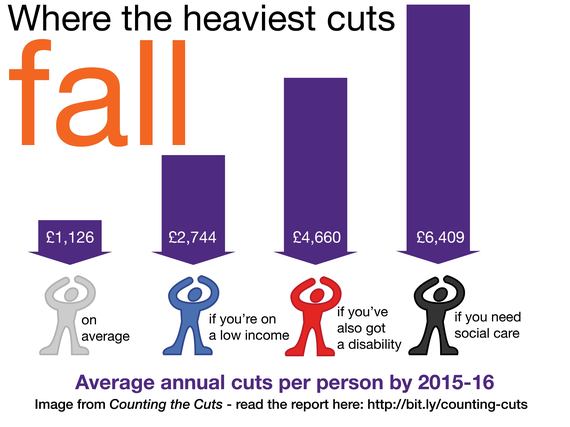
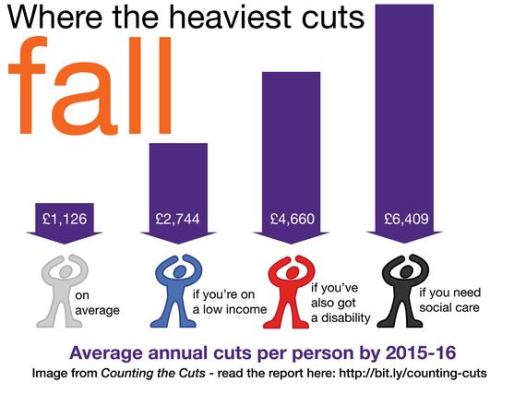
Disabled people who are struggling to meet the cost of their basic survival needs are awarded on average £6,000 per year, excluding a PIP award, if they somehow manage to get through the repressive bureaucratic wall composed of the work capability assessment, mandatory review, (without any income), and the appeal process.

This is what David Cameron meant when he attacked what he dubbed a “culture of entitlement.” It means the systematic dismantling of our welfare state, a cut at a time. It means the dismantling of other social gains that we made following the postwar settlement, such as the NHS, social housing and legal aid. It means a regressive and oppressive government that deliberately fails to observe the basic human rights of some of our most vulnerable citizens.

In one of the wealthiest so-called democracies in the world, we have an authoritarian government that is imposed draconian policies which are all about punishment and taking money from our poorest citizens, causing them severe material hardship, physical harm and lasting psychological damage.

That is not a decent, civilised or remotely democratic thing to do.

2014-02-17-BurdenoftheCuts-thumb


I don’t make any money from my work. I am disabled because of illness and have a very limited income. Successive Conservative chancellors have left me in increasing poverty. But you can help by making a donation to help me continue to research and write informative, insightful and independent articles, and to provide support to others. The smallest amount is much appreciated – thank you. 

DonatenowButton cards

A bad job is worse for your mental health than unemployment, say UK’s top psychologists

PAA-550x369

Last month, the following letter was sent to the Independent, titled The DWP must see that a bad job is worse for your mental health than unemployment:

“We, the UK’s leading bodies representing psychologists, psychotherapists, psychoanalysts, and counsellors, call on the Government to immediately suspend the benefits sanctions system. It fails to get people back to work and damages their mental health.

Findings from the National Audit Office (NAO) show limited evidence that the sanctions system actually works, or is cost effective.

But, even more worrying, we see evidence from NHS Health Scotland, the Centre for Welfare Conditionality hosted by the University of York, and others, which links sanctions to destitution, disempowerment, and increased rates of mental health problems. This is also emphasised in the recent Public Accounts Committee report, which states that the unexplained variations in the use of benefits sanctions are unacceptable and must be addressed.

Vulnerable people with multiple and complex needs, in particular, are disproportionately affected by the increased use of sanctions.

Therefore, we call on the Government to suspend the benefits sanctions regime and undertake an independent review of its impact on people’s mental health and wellbeing.

But suspending the sanctions system alone is not enough. We believe the Government also has to change its focus from making unemployment less attractive, to making employment more attractive – which means a wholesale review of the back to work system.

We want to see a range of policy changes to promote mental health and wellbeing. These include increased mental health awareness training for Jobcentre staff – and reform of the work capability assessment (WCA), which may be psychologically damaging, and lacks clear evidence of reliability or effectiveness.

We urge the Government to rethink the Jobcentre’s role from not only increasing employment, but also ensuring the quality of that employment, given that bad jobs can be more damaging to mental health than unemployment.

This should be backed up with the development of statutory support for creating psychologically healthy workplaces.

These policies would begin to take us towards a welfare and employment system that promotes mental health and wellbeing, rather than one that undermines and damages it.

Professor Peter Kinderman, President, British Psychological Society (BPS)

Martin Pollecoff, Chair, UK Council for Psychotherapy (UKCP)

Dr Andrew Reeves, Chair, British Association for Counselling and Psychotherapy (BACP)

Helen Morgan, Chair, British Psychoanalytic Council (BPC)

Steve Flatt, Trustee, British Association of Behavioural and Cognitive Psychotherapies (BABCP)”

“Making work pay” for whom?

pie wealth

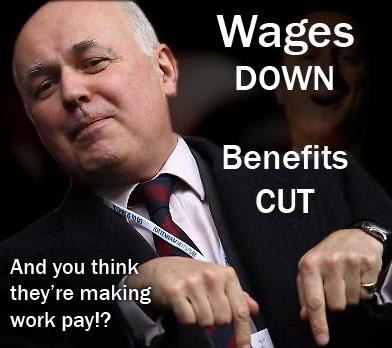
It’s a draconian, crude behaviourist and armchair technocratic government that would claim to “make work pay” by decreasing social security support for the poorest members of society, rather than raising wages to meet the rising costs of living. This approach was justified by claims that poor people became “dependent” on benefits because the welfare state provides “perverse incentives” for people seeking employment. However, there is no empirical evidence of these claims. Keith Joseph, a leading New Right advocate of the welfare dependency theories, set out to try and establish evidence dependency during the Thatcher era, and failed. Both Thatcher and Joseph wanted to extend Victorian bourgeois values of thrift, self-reliance and charity among all classes.

Such an approach has benefitted no-one but wealthy employers motivated by a profit incentive, as people who are out of work or claiming disability related benefits have become increasingly desperate. These imposed conditions have created a reserve army of labour, which has subsequently served to devalue labour, and drive wages down. We now witness high levels of in-work poverty, too. The Victorian Poor Law principle of less eligibility had the same consequences, and also “made work pay.” It’s shameful that in 2017, the government still believe that it is somehow effective and appropriate to punish people into not being poor. Especially when the government’s own policies are constructing inequality and poverty.

Last week I wrote about the Samaritans report: Dying from inequality: socioeconomic disadvantage and suicidal behaviour, which strongly links socioeconomic disadvantage and inequality with psychological distress and suicidal behaviours. The report reiterates that countries with higher levels of per capita spending on active labour market programmes, and which have more generous unemployment benefits, experience lower recession-related rises in suicides.

Research has consistently found that in countries with a generous social safety net, poor employment (low pay, poor conditions, job insecurity short-term contracts), rather than unemployment, has the biggest detrimental impact on mental health. This is particularly true of neoliberal states with minimal and means tested welfare regimes. It seems health and wellbeing are contingent on the degree to which individuals, or families, can uphold a socially acceptable standard of living independently of market participation, and on the kind of social stratification  (socioeconomic hierarchies indicating levels of inequality) is fostered by social policies.

Furthermore, despite the government’s rhetoric on welfare “dependency”, and the alleged need for removing the “perverse incentives” from the social security system by imposing a harsh conditionality framework and a compliance regime – using punitive sanctions – and work capability assessments designed to preclude eligibility to disability benefits, research shows that generous social security regimes make people more likely to want to work, not less.

The government’s welfare “reforms” have already invited scathing international criticism because they have disproportionately targeted cuts at those with the least income. Furthermore, the government have systematically violated the human rights of those with mental and physical disabilities. In a highly critical UN report last year, following a lengthy inquiry, it says: “States parties should find an adequate balance between providing an adequate level of income security for persons with disabilities through social security schemes and supporting their labour inclusion. The two sets of measures should be seen as complementary rather than contradictory.”

However, the UK government have continued to conflate social justice and inclusion with punitive policies and cuts, aimed at coercing disabled people towards narrow employment outcomes that preferably bypass any form of genuine support and the social security system completely. 

See – UN’s highly critical report confirms UK government has systematically violated the human rights of disabled people.

430835_148211001996623_1337599952_n (1)

Kitty.


I don’t make any money from my work. I am disabled because of illness and have a very limited income. The budget didn’t do me any favours at all.

But you can help by making a donation to help me continue to research and write informative, insightful and independent articles, and to provide support to others. The smallest amount is much appreciated – thank you.

DonatenowButton cards


Two EDMs have been tabled to stop Tory cuts to disability support, with cross-party endorsement

aaeaaqaaaaaaaad4aaaajdk1ytqwzdyxltjinwytngjhmc05njdlltmyzmu4mty4owi5za

I reported last week that the Liberal Democrats were planning an Early Day Motion (EDM) to halt the government’s authoritarian Personal Independence Payment (PIP) regulations. The new regulations are designed by the government to disregard the rulings of two upper tribunals regarding the scope of eligibility criteria for disabled people claiming PIP. However, upper tribunals are part of a body of administrative law that governs the activities of the administrative agencies of government. It is designed to independently review the decisions of governments, and as such, it provides protection and promotion of fundamental rights and freedoms for citizens.

The Upper Tribunal is a superior court of record, giving it equivalent status to the High Court and it can both set precedents and can enforce its decisions (and those of the First-tier Tribunal) without the need to ask the High Court or the Court of Session to intervene. It is also the first (and only) tribunal to have the power of judicial review. (The Conservatives have a historical dislike of judicial review. See for example: The real “constitutional crisis” is Chris Grayling’s despotic tendencies and his undermining of the Rule of Law.)

The first EDM has already gained excellent cross-party support. It’s primary sponsor is Tim Farron. Signatories include Jeremy Corbyn, Debbie Abrahams and a number of other Labour Party MPs, Caroline Lucas (Green Party), Jonathan Edwards (Plaid Cymru) and Scottish National Party MPs.  

It says: “That an humble Address be presented to Her Majesty, praying that the Social Security (Personal Independence Payment) (Amendment) Regulations 2017 (S.I., 2017, No. 194), dated 22 February 2017, a copy of which was laid before this House on 23 February, be annulled.”

From 1 April 2017, further cuts to Employment and Support Allowance (ESA) are to be introduced, again via statutory instrument (which are usually reserved for non-controversial policy amendments only). The new regulations mean that claimants who are placed in the Work-Related Activity Group (WRAG) will lose around £30 a week, receiving the same rate of payment as those claiming Jobseeker’s Allowance and the equivalent in Universal Credit.

Another EDM was tabled by the Labour Party, with the primary sponsor being Jeremy Corbyn, which says: “That an humble Address be presented to Her Majesty, praying that the Employment and Support Allowance and Universal Credit (Miscellaneous Amendments and Transitional and Savings Provisions) Regulations (S.I., 2017, No. 204), dated 23 February 2017, a copy of which was laid before this House on 27 February, be annulled.”

Disabled people have already carried a disproportionately large burden of austerity cuts.


2014-02-17-BurdenoftheCuts-thumb


The cuts to disability support have been widely opposed, yet the government apparently pays little heed to the need for democratic accountability. 

You can support disabled people who are being targeted by ever-increasingly punitive Conservative policies that are having an extremely damaging impacon us by emailing your MP and asking them to sign both EDMs. (Contact details here).


Related

A black day for disabled people – disability benefit cuts enforced by government despite widespread opposition

House of Lords debate: ESA – Monday 07 March 2016 (From 3.06pm)

MP attacks cuts hitting disabled people – Debbie Abrahams

Leading the debate against the Welfare Reform and Work Bill – 3rd reading – Debbie Abrahams

My speech at the Changes to Funding of Support for Disabled People Westminster Hall Debate – Debbie Abrahams

Man leaves coroner letter as he fears Work Capability Assessment will kill him

The government need to learn about the link between correlation and causality. Denial of culpability is not good enough.

The new Work and Health Programme: government plan social experiments to “nudge” sick and disabled people into work

Stephen Crabb’s obscurantist approach to cuts in disabled people’s support

A Critique of Conservative notions of “Social Research”

The DWP mortality statistics: facts, values and Conservative concept control


I don’t make any money from my work and I have limited income due to illness. But you make a donation and help me continue to research and write free, informative, insightful and independent articles, and to provide support to others. The smallest amount is much appreciated – thank you.

DonatenowButton cards


Terminally ill woman lost her ESA, home and all her belongings after being told she was fit for work


fireshot-capture-6-crowdfunding-to-hel_-https___www-justgiving-com_crowdfunding_tiffany-williams

Claire Hardwicke

Claire Hardwicke has stage four thyroid cancer. This means that it has spread to other parts of her body, and sadly, Claire was told that her cancer is terminal. She also has chronic osteoarthritis. Despite taking 80mg of morphine a day to cope, she still experiences considerable pain.

Additionally, Claire already had a life-threatening, acute allergy to latex. This means that she has to carry an EpiPen at all times, which is an epinephrine (adrenaline) injection to treat life-threatening anaphylaxis. Developing a severe allergy to latex unfortunately meant that Claire could no longer continue working as a mental health nurse. 

Claire first became ill 9 years ago with uterine/ovarian cancer, but it was the allergy that made her unemployable and ended her career as a mental-health nurse, her partner, Alan King, told me

Claire’s first bout of cancer was treated and she made a recovery, which lasted only 7 years. Sadly, the diagnosis of her more recent thyroid cancer and metastases wasn’t diagnosed until it was incurable. The tumours had spread throughout her thyroid gland, neck, lymph system and adrenal glands.   

All Claire can hope for now is palliative care, which is alleviatory only, as a cure isn’t possible. 

Unbelievably, Claire was assessed as “fit for work” by the Department for Work and Pensions (DWP) last year. Her Employment and Support Allowance was stopped. All of her financial support ended. This was despite being told by the Capita assessor (for Personal Independence Payments) that the report to the DWP would state that Claire was in need of more support, not less. 

Overnight the couple lost every bit of financial support they had previously been entitled to, so Alan decided to use what little financial resources he had left to help Claire to fulfill some of  her”Bucket List.”

The couple were forced to say goodbye to their rented bungalow and 99% of their possessions because their housing benefit was stopped. They had no income, as Claire’s Disability Living Allowance (DLA) and Employment Support Allowance (ESA) was stopped, and the Carer’s Allowance also ended.

Claire explained to me that when she lost her lifeline support, the wait for appeal hearings was over 18 months. The couple couldn’t afford to wait that long, as they had no income. They also didn’t know if Claire would survive the wait.

Claire and Alan went to visit family members around the UK before setting off, in October 2016, on a Mediterranean cruise for a month, which Alan paid for, using his credit cards. They already owed a lot of money on their credit cards, but with no income at all, the couple were facing destitution.  The incredible distress the couple suffered took its toll on Claire’s already poor health, too.   

On the return journey, both of them realised that coming all the way back to the UK – where they were homeless, with no income, and they no longer even qualified for free prescriptions – would be pointless. So the couple left the cruise when they got to Portugal, where it’s significantly warmer than the UK (and therefore less painful for Claire) – and they’ve been there ever since, living in a very basic, rented room.

Alan told me: “Claire’s cancer hasn’t claimed her life as quickly as we both had imagined, (which is good), but with medications, food and board, we’re now out of funds and out of options unless we can somehow fundraise for some subsistence.”

The couple have paid money in advance for their single room in Portugal, which covers rent until 14th March, after which time they will have absolutely nowhere to go.

Claire says: “There are new trial therapies for extreme cases of thyroid cancer like mine.

 I wish I had a pot of gold to pay for the experimental cancer therapy.
I don’t want to die, but choices and chances aren’t given to the poor people. We need a miracle, a winning lotto ticket. There should be equal opportunities for all patients.”

The treatment would possibly extend Claire’s life and improve the quality of the time she has left. She says: “I could have a chance of a longer, fuller life…. but I don’t have that option open to me….”

Tiffany Williams, a friend of Claire’s in the UK, has set up a crowdfunding page on JustGiving to raise £800 to help pay for her treatment. So far, 53% of the sum has been raised. 

It’s such a modest amount for a treatment that will make a huge difference to Claire and Alan, who have lost their home and everything else they had in the UK. Now they are at risk of losing their room in Portugal, too. 

You can make a donation at:  https://www.justgiving.com/crowdfunding/tiffany-williams

Update

Claire informs me that the gofundme collection has now closed. But for those wishing to help in some way, there is a beautiful painting of Claire by Jason Pearce, which is up for auction with funds going to her medical fees.  

She says many thanks. 

Jason Pearce is an administrator for a very popular political group, and like me, he was originally contacted and asked if a member (Alan) could post a gofundme page to raise money for treatment costs to the group, as his wife, Claire, is seriously ill. Jason agreed, and offered to help. As Jason is an artist, it was suggested that he could paint a portrait of Claire and it could then be auctioned online to help raise some more money towards Claire’s ongoing treatment.

This is Jason’s lovely painting of Claire.

17358823_10211339136927882_1860474519176663615_o

“Claire”

20″ x 16″ Mixed media on canvas.


My work is unfunded and I don’t make any money from it. I am disabled because of illness and struggle to get by. But you can support Politics and Insights and contribute by making a donation which will help me continue to research and write informative, insightful and independent articles, and to provide support to others.  DonatenowButton

Mental Wealth Alliance response to the psy professional bodies’ statement on benefit sanctions and mental health

aaeaaqaaaaaaaad4aaaajdk1ytqwzdyxltjinwytngjhmc05njdlltmyzmu4mty4owi5za

The British Psychological Society (BPS) has responded jointly with other psychological bodies to call on the UK Government to suspend its cruel and degrading benefit sanctions regime.

The BPS say that the government should suspend its benefit sanctions system as it fails to get people back to work and damages their mental health. s

The professional bodies highlight evidence that sanctions, or the threat of sanctions (benefit cuts following a claimant’s failure to comply with jobcentre conditions, e.g. missing an appointment with their work coach) can result in destitution, hardship, widespread anxiety and feelings of disempowerment.

The call came in a joint response to the Government’s consultation, ‘Improving Lives’, from the British Psychological Society, the British Association of Counselling and Psychotherapy, the British Psychoanalytic Council, the British Association for Behavioural and Cognitive Psychotherapies and the UK Council for Psychotherapy.

Findings from the National Audit Office  show that there is limited evidence the sanctions system actually works, or is cost effective. The bodies argue that the Government needs to change focus from trying to make unemployment less attractive, to trying to make employment more attractive.

BPS President Professor Peter Kinderman said:

“We call for the benefits sanctions regime to be suspended until the completion of an independent review of their impact on people’s mental health and wellbeing

While there is evidence that the sanctions process is undermining mental health and wellbeing, there is no clear evidence that it leads to increased employment.  Vulnerable people with specific multiple and complex needs are being disproportionately affected by the increased use of sanctions.”

In order to improve mental health, the bodies have also called for:

  • Jobcentres to care about the quality of work they provide – citing evidence that bad jobs can be more damaging to mental health than unemployment.
  • The development of statutory support for creating psychologically healthy workplaces.
  • Increased mental health awareness training for jobcentre staff.
  • Review and reform of the work capability assessment (WCA), which may be psychologically damaging, and lacks clear evidence of reliability or effectiveness. 

The Mental Wealth Alliance have written a response to the collective statement on benefit sanctions and mental health:

Source: the free psychotherapy network

From:

Mental Wealth Alliance [1]

 Mental Health Resistance Network; Disabled People Against Cuts; Recovery in the Bin; Boycott Workfare; The Survivors Trust; Alliance for Counselling and Psychotherapy; College of Psychoanalysts; Psychotherapists and Counsellors for Social Responsibility; Psychologists Against Austerity; Free Psychotherapy Network; Psychotherapists and Counsellors Union; Social Work Action Network (Mental Health Charter); National Unemployed Workers Combine; Merseyside County Association of Trades Union Councils; Scottish Unemployed Workers’ Network; Critical Mental Health Nurses’ Network; National Health Action Party.

To:

British Association for Behavioural and Cognitive Psychotherapies

British Association for Counselling and Psychotherapy

British Psychoanalytic Council

British Psychological Society

United Kingdom Council for Psychotherapy

30th January 2017

MWA response to the psy professional bodies’ statement on benefit sanctions and mental health  30th November 2016

We welcome the call from the psychological therapy bodies for the government to suspend the use of sanctions by the DWP subject to the outcomes of an independent review of its welfare policies and their potential damage to the mental health of benefit claimants. Given the accumulation of evidence over many years of the material and psychological suffering inflicted on benefit claimants by workfare-based conditionality[2], it has been frankly shocking that the professional bodies directly concerned with the mental health of the nation have preferred to welcome and participate in workfare policies rather than publicly and vociferously dissociate themselves.

The timing of the statement is given to be the recent report on sanctions by the National Audit Office. Welcome as its report is, the NAO’s perspective on government policy is primarily monetary, not one of health, ethics and social justice. Its “vision is to help the nation spend wisely”.  The choice of this timing represents realpolitik on the part of the professional bodies no doubt, as perhaps is the intention of the conditional statement: “The sanctions process may be detrimental to people’s mental health and wellbeing”. But surely as psychotherapists and counsellors we can do better to represent the overwhelming evidence of personal suffering on such a scale than point to poor returns on expenditure and an ambivalent proposal that sanctions may be detrimental to people’s mental health.

Sanctions are only one dimension, albeit at the sharp end, of a welfare regime based on the political assertion that people need to be coerced off benefits and “nudged” into work. The psychological pressure of WCA and PIP assessments, job search rules, work programmes on “good employee” behaviours and the regular cuts to welfare benefits generally are part and parcel of the psycho-compulsion of the DWP benefits regime.[3]

We dispute the government’s premise that work is a therapeutic priority for people suffering from mental health difficulties. The marshalling of evidence for this modern-day workhouse mentality lacks both substance and integrity. Work has become the ideological mantra for neoliberal welfare policies.

Obviously where people want to work and where employment possibilities exist that will support and nourish people’s mental health, then encouragement, training and professional support should be available. But why is there no acknowledgement of the hundreds of thousands of claimants with mental health difficulties who cannot work, whether they want to or not?[4] Where is the evidence that people with mental health difficulties are actually benefiting from what is now two decades of workfare conditionality in the UK? Where is the evidence that in our current labour market decent jobs exist that will nourish people’s mental health? And where is the evidence that psychological therapy for benefit claimants with long-term mental health disabilities succeeds in supporting them into decent jobs they want, can survive and maintain?

When the professional bodies say, “an estimated 86-90% of people with mental health conditions that are not in employment want to work”, they are supporting the proposition that getting into work is an overwhelmingly important and efficacious goal for this group of benefit claimants. It is not clear where this figure comes from and what it means.

A similar figure is quoted by The Royal College of Psychiatrists’ report on Mental Health and Work (2013)[5], making use of a Sheffield study by J. Secker and others (2001)[6]. In fact, Secker finds that of their sample of 149 unemployed service users, when asked if they were interested in work of any kind – including voluntary and supported work –  “around half (47%) responded positively, and almost the same proportion (43%) had a tentative interest. Only 15 people (10%) had no interest in work”. At the same time, only 25% of respondents saw full-time employment as a long-term goal. 71% said that their preferred vocational assistance would be “help for mental health/keep current service”.[7]

This study does not translate into “86-90% of people with mental health conditions that are not in employment want to work”.[8] What it points to is the complex texture of attitudes, desires and fears around waged work that are the common experience of service users, alongside the harsh realities of the current labour market, the socio-economic environment generally, and the dire state of mental health services of all kinds more particularly.[9]

From our point of view, the professional bodies’ statement is a step in the right direction. It is a step that must now be followed through with active political pressure on the DWP and the Dept of Health to suspend sanctions and set up an independent review of their use, including the damage they inflict on people’s mental health.  Parliament has already called for such a review.[10]

But more than this, the remit of such a review should include all aspects of conditionality in a benefits system that deploy psycho-compulsion through mandatory rules or through the more subtle imposition of behavioural norms which aim to override the claimant’s voice.

We again suggest that the psy professional bodies would benefit by widening their own conversations to include service users and the rank and file of their membership. They would also win more credibility as organisations with ethical and social values independent of the government’s policies of dismantlement of social security and the welfare state if they were willing to make transparent their currently private conversations with DWP.


[1] Mental Wealth Alliance (MWA), formerly the Mental Wealth Foundation, is a broad, inclusive coalition of professional, grassroots, academic and survivor campaigns and movements. We bear collective witness and support collective action in response to the destructive impact of the new paradigm in health, social care, welfare and employment. We oppose the individualisation and medicalisation of the social, political and material causes of hardship and distress, which are increasing as a result of austerity cuts to services and welfare and the unjust shift of responsibility onto people on low incomes and welfare benefits. Our recent conference focused on Welfare Reforms and Mental Health, Resisting the Impact of Sanctions, Assessments and Psychological Coercion.

[2] Parliamentary committees, the national press, endless reports from charities, service user organisations, people with disabilities, claimants unions and workfare campaigners have been reporting the physical and psychological damage of ‘welfare reform’ and its tragic outcomes for a decade.

[3] On psycho-compulsion and the benefits system see Friedli and Stearn http://mh.bmj.com/content/41/1/40.full and https://vimeo.com/157125824

[4] In February 2015 over a million people claiming ESA under a MH diagnosis were in either the Support Group or WRAG. Over 70% of new applicants for ESA are found unfit for work

https://www.gov.uk/government/uploads/system/uploads/attachment_data/file/470545/3307-2015.pdf

[5]https://www.gov.uk/government/uploads/system/uploads/attachment_data/file/212266/hwwb-mental-health-and-work.pdf p.17

[6] Secker, J., Grove, B. & Seebohm, P. (2001) Challenging barriers to employment, training and education for mental health service users. The service users’ perspective. London: Institute for Applied Health & Social Policy, King’s College London.

[7] Ibid, pp. 397-399

[8] Compare a DWP survey of disabled working age benefit claimants in 2013. 56% of 1,349 respondents agreed that they wanted to work. Only 15% agreed that they were currently able to work. Only 23% agreed that having a job would be beneficial for their health. https://www.gov.uk/government/uploads/system/uploads/attachment_data/file/224543/ihr_16_v2.pdf

[9] For example, some of this complexity is flagged by Blank, Harries and Reynolds (2012) The meaning and experience of work in the context of severe and enduring mental health problems: An interpretative phenomenological analysis Work: 47 45(3)    “Stigma, the disclosure of a mental health problem and the symptoms of the mental health problem are frequently described, as well as feelings of hopelessness, seeing recovery as uncertain, and feeling a lack of encouragement from services. Difficulties in accessing occupational health services, having a disjointed work history, lack of work experience, age, lack of motivation and fears about competency, as well as the social benefits system and caring commitments, are also experienced as barriers to accessing employment for people with mental health problems.”

[10] https://www.parliament.uk/business/committees/committees-a-z/commons-select/work-and-pensions-committee/news/benefit-sanctions-report


I don’t make any money from my work. I am disabled because of illness and have a very limited income. But you can help by making a donation to help me continue to research and write informative, insightful and independent articles, and to provide support to others. The smallest amount is much appreciated – thank you. 

DonatenowButton cards

‘Reforming’ ESA: the final frontier and the last moral boundary

 IDS ESA Speakout share post.png

Context

Employment and Support Allowance (ESA) is a benefit for people who are assessed as being unable to work because of a health condition and/or disability. Despite this, ESA has also been politically defined as financial support for people having difficulty finding a job because of a long-term illness or disability, to “help them back to work” despite their illness or disability. This presents a problematic tension because in order to qualify for ESA at all, people must be found to be unable to work, by their own doctor, and by the “independent” Work Capability Assessment.

There’s a significant difference between being unable to work, and facing significant additional barriers to work. People who are assessed are most commonly described as having “limited capability for work” – a phrase which is not precise in its meaning, and which does not include or prompt any consideration of social, cultural, political and economic contexts that also present disabled people with significant barriers to employment. 

The name of the allowance (“employment and support”) is also purposefully misleading, and betrays the original controversial political cost-cutting aims that prompted its inception. This re-branding of what was previously called “incapacity benefit” has been problematic. It implies that even those people placed in the Employment and Support Allowance Support Group, who are considered “unlikely” to be able to work in the foreseeable future, are nonetheless being “supported” into employment.

This blurring of definitions, categories and purposes has provided scope and political opportunity for discussion of introducing the mandatory requirement for pre-employment preparation, conditionality and sanctions to be applied to claimants with the most severe health conditions, in the Support Group. This has been casually suggested in the recent work, health and disability government consultation and green paper. Currently, anyone in the Support Group can voluntarily ask for pre-employment support, it isn’t compulsory.

A major assumption throughout the green paper is that disabled people claiming ESA are somehow mistaken in assuming they cannot work: “how can we improve a welfare system that leaves 1.5 million people – over 60% of people claiming Employment and Support Allowance – with the impression they cannot work and without any regular access to employment support, even when many others with the same conditions are flourishing in the labour market?   

This group were assessed by doctors and the state (via the Work Capability Assessment) as being unable to work. 

The aim behind the introduction of ESA was to actively reduce those previously eligible for Incapacity Benefit to a small group of people with severe disabilities (Support Group) and another moderately sized group who were to undergo fixed term pre-employment preparation and training (Work-Related Activity Group.)  The latter group are deemed unable to work, but expected to recover sufficiently to work within two years of the assessment. 

However, the controversial Work Capability Assessment (WCA) has been widely criticised, not least for its insensitivity and lack of capacity in differentiating between those people who “may” work, and those who cannot. Furthermore, the  WCA does not identify the social, cultural, political and economic barriers that disabled people face in finding suitable employment, and so the focus is on individuals without a context and their perceived personal “deficits” caused through illness and disability. This means that any pre-employment “support” for those who may or who wish to work is by its design unlikely to address the structural barriers to suitable employment that disabled people face.

The architects

Much of the politics of welfare in the 1980s revolved around “cuts” and restrictions in public spending designed to allow tax cuts, particularly reductions in the rates of income tax. Blair’s new programme, the New Deal, was all about moving people from social security benefits into work, as were many of the measures in the 1998 Budget.

David Freud, a former vice-chairman of bulge bracket investment banking at UBS, was an advisor on out-of-work benefit reform in December 2006. Freud’s 2007 report – dubbed “the Freud report” but officially titled Reducing dependency, increasing opportunity: options for the future of welfare to work – called for the greater use of private sector companies who would be paid by results, for substantial “resources” to be made available to help people on Incapacity Benefit back into work, and for a single working-age benefit payment to replace individual benefits such as Housing Benefit and Jobseeker’s Allowance (the forerunner of Universal Credit). His central idea was that spending on “delivery” – such as schemes to get people back to work, like the work programme – would save money in the long run because there would be fewer people being paid money in the form of benefits. 

Other contributions to the body of ideas behind ESA came from Frank Field, who was made Minister for Welfare Reform following the 1997 election, with Labour in power. Field felt that the state should have only a small role to play in the provision of welfare, and he viewed his task as “thinking the unthinkable” in terms of social security reform, but others report that Prime Minister Blair wanted some simpler vote-winning policy ideas. Blair writes that: “the problem was not so much that his thoughts were unthinkable as unfathomable”.

In January 2006, John Hutton published a White Paper outlining the government’s latest plans for welfare reform: the benefit that would replace Incapacity Benefit would be called Employment and Support Allowance and its “gateway” assessment would be transformed. Over the course of a decade, Hutton expected the number of people on Incapacity Benefit to fall by one million, saving £7billion a year.

In July 2008 a Green Paper was published, which James Purnell said was “inspired by the reforms proposed by David Freud”. The author announced that “between 2009 and 2013, all Incapacity Benefit claimants will be reassessed using a medical assessment called the Work Capability Assessment” that would divide them into three groups: fit for work; unfit for work but fit for work-related activity; or fit for neither. At the same time, Professor Paul Gregg was asked by the Department for work and Pensions (DWP) to conduct a feasibility study of conditionality and how it might be applied to people claiming sickness benefits. When responding to the Gregg Review, the DWP said that the study had recommended that conditionality be applied to “the vast majority of people in receipt of Employment and Support Allowance.”

In early 2011, under the Coalition government, the Incapacity Benefit reassessment programme was underway using a much more stringent version of the WCA. Atos were recontracted to carry out the work. Targets were written into Atos’s new contracts to reduce successful claims. Dr Steven Bick, a GP with 20 years’ experience, applied for a job as an assessor with Atos to carry out the WCA, and secretly filmed his training for Channel 4’s Dispatches programme, which was broadcasted on Monday 30 July. Undercover filming shows Bick being told by his trainer that he will be watched carefully over the number of applicants he “found eligible for the highest rate of disability payments.”

The documentary also highlighted the unease about the radically heightened eligibility criteria felt by some trainers employed by Atos to teach new recruits how to carry out the tests. It had become much more difficult for very severely disabled claimants to qualify for support. No matter how serious claimants problems are with their arms, for example, “as long as you’ve got one finger, and you can press a button,” they would be found fit for work, one trainer said. Bick said that assessors testing Incapacity Benefit claimants were told they should rate only about one in eight as needing to be placed in the Support Group. That’s regardless of the level of illness and disability they would be presented with, case by case.

In January 2016, the Conservative Welfare Secretary, Iain Duncan Smith, announced that ESA was “fundamentally flawed” and declared that a brand new policy, which would get nearly all ESA recipients back to work, would be unveiled within weeks. A hint of what that policy might be was given in a detailed report on ESA published the following month by Reform, the right-of-centre neoliberal think tank:

  • Effectively, ESA would be abolished: the amount of money paid each week to the claimant would be reduced to the level of Jobseekers Allowance
  • The WCA may be replaced by another assessment that set out to identify any barriers to work faced by the claimant, but which would play no role in determining eligibility to benefits
  • As a way to nudge claimants towards overcoming those barriers, extra money might be made available to fund a tailored programme of rehabilitation – although participation in this could be made a requirement of continued receipt of the benefit.

State diagnosis and treatment – a blunt instrument

The government say that according to previous research undertaken by the DWP, musculoskeletal conditions were the most common main condition of people claiming ESA. Mental health conditions have more recently overtaken this category of illnesses as the main condition that “triggers” an ESA claim.

In the recent work, health and disability green paper, the government also say: ““[..] how can we improve a welfare system that leaves 1.5 million people – over 60% of people claiming Employment and Support Allowance – with the impression they cannot work and without any regular access to employment support, even when many others with the same conditions are flourishing in the labour market?”

The research paper also says: “The belief that work improves health also positively influenced work entry rates; as such, encouraging people in this belief may also play a role in promoting return to work.”

The belief. Not evidenced fact.

That is a very dangerous idea. Many conditions are complex, unpredictable and difficult to diagnose. Some conditions have multiple symptoms affecting many different parts of the body. Musculoskeletal conditions, for example, are a category that includes conditions ranging from injuries to systemic and serious diseases. So “musculoskeletal conditions” include low back pain, injuries such as broken bones, torn or pulled ligaments and tendons, and slipped discs, wear and tear on joints, osteoarthritis, osteoporosis, and connective tissue diseases such as rheumatoid arthritis, lupus and scleroderma.

Connective tissue diseases are systemic illnesses that usually affect other parts of the body, such as major organs, as well as the widespread pain and damage in the musculoskeletal system. Most people with these illnesses don’t just contend with pain in their joints, tendons, ligaments and nerves; they usually feel very unwell, suffering from weight loss, profound fatigue, susceptibility to infections and general malaise. They may have serious lung, heart, kidney or blood disorders, neurological disorders, eye and ear problems, vascular problems and a wide range of other serious symptoms that can be caused through widespread inflammation throughout the body. Physiotherapy, splinting damaged joints, and other traditional measures for helping injury doesn’t help in the long term with connective tissue disease, because the damage is caused by a disease process: through autoimmune mediated widespread inflammation.

This is precisely why I see my doctor and not the government when I am ill. I want an objective and precise medical opinion, diagnosis and specialist treatment when needed, not an ideological diagnosis, dogma in soundbites and a prescription for hard labour, to “set me free.” 

“[…]with the impression they cannot work and without any regular access to employment support, even when many others with the same conditions are flourishing in the labour market?”  

Not all of the “same category” of conditions are the same. To assume they are is very dangerous. Furthermore, as previously stated, rehabilitation is unlikely to be helpful, since damage to the joints, tendons and ligaments isn’t caused through injury and it won’t heal. Medication is the only way to slow the damage that is caused by autoimmune complexes and inflammation. Connective tissue diseases are incurable. 

However, many of the treatments for connective tissue disease are also very risky and experimental. They include methotrexate, which is a chemotherapy, and immune suppressants such as enbrel and rituximab, which leave people at risk of dying from overwhelming infection, as well as other serious side effects, which may also kill.  

Having people believe that work is good for their health in order to reduce the numbers of people claiming ESA is authoritarian, disgracefully irresponsible and very dangerous.

On 22 December 2014 a bin lorry collided with pedestrians in the city centre of Glasgow, Scotland, killing six and injuring fifteen others. The driver of the council-owned vehicle, Harry Clarke, said he had passed out at the wheel. A similar blackout had happened to him in the driving seat of a bus, although he had not disclosed the incident on his heavy goods vehicle licence renewal application, despite such self-reporting being mandatory. 

Having been admitted to the Western Infirmary after the crash, Clarke was discharged on 7 January 2015 He was eventually diagnosed as having suffered neurocardiogenic syncope, a fainting episode caused by drop in blood pressure. The inquiry also revealed that Clarke’s medical history contained episodes of dizziness and fainting dating from the 1970s and that he had previously suffered a blackout while at the wheel of a First Glasgow bus, which was in service but stationary at a bus stop. 

It was stated that Clarke had been passed fit to return to work as a bus driver owing to failures by both the bus company’s doctor and Clarke’s own GP to spot that Clarke had changed his account of events, telling his GP that the episode had occurred in the canteen, which the GP then attributed to the hot conditions and deemed to be unlikely to be repeated. Clarke had a four-year history of episode-free driving after the 2010 incident, and First Glasgow’s occupational-health specialist had cleared him to drive after the 2010 incident and told him he need not notify the DVLA. 

A good question to ask is this. In the event of injury or death to either the person coerced by the state into work, assured that work is good for health, or to their work colleagues, as a consequence of that person not being fit for work, who is ultimately responsible? Bearing in mind that to qualify for ESA, a person has already been assessed as unfit for work. 

The shrinking category of illness and disability 

ESA was originally calculated to include the acknowledged additional every day costs that disabled people face in their day to day living. There was also a recognition that disabled people who can’t work face the cumulative effects of poverty because of a low income over time, too. The ESA Support Group have the higher rate because they are anticipated to be highly unlikely to work in the longer term. That outcome is assessed via the state WCA. So the state has already acknowledged that those in the Support Group are unlikely to be able to work. Those in the Work-Related Activity Group (WRAG) are deemed unable to work, but “may” be capable of work in the future, more specifically, “within two years”.

Although PIP covers some additional costs that disabled people face, it’s designed to cover highly specific needs, with “components” for mobility, and a daily living component which is paid if you need personal care. Both the mobility and daily living allowance are narrowly task related, not cost related. There is no component, for example, that would cover extra heating, special diet and additional laundry requirements. Many special adaptations that people may need are not included, too. 

Many people who were previously eligible for mobility support through the Disability Living Allowance (DLA) assessment are no longer eligible because of the much harsher eligibility criteria for PIP. This has meant many thousands of people have lost their specially adapted motability vehicles or motorised wheelchairs. This includes people who relied on their vehicles to get to and from work, since PIP and DLA are not means tested, it can be claimed by people in or out of work.

Earlier this year I wrote that a government advisor, who is a specialist in labour economics and econometrics, has proposed scrapping all ESA sickness and disability benefits. Matthew Oakley, a senior researcher at the Social Market Foundation, recently published a report entitled Closing the gap: creating a framework for tackling the disability employment gap in the UK, in which he proposes abolishing the ESA Support Group. To meet extra living costs because of disability, Oakley says that existing spending on PIP and the Support Group element of ESA should be brought together to finance a new extra costs benefit. Eligibility for this benefit should be determined on the basis of need, with an assessment replacing the WCA and PIP assessment.

Both ESA and PIP were introduced with the same claim: that eligibility should be determined on the basis of need. The category of disabled people that the government regard as “most in need” is shrinking as the political goalposts constantly shift. I think the word “need” is being conflated with politically defined neoliberal outcomes.

Oakley also suggests considering a “role that a form of privately run social insurance could play in both increasing benefit generosity and improving the support that individuals get to manage their conditions and move back to work.”

A toxic article from the Conservative and neoliberal Reform think tank suggests that “treatments” for some ESA claimants are made mandatory, subject to sanctions and so on.

And I can see that coming down the pipeline to the tune of an insane political mantra: “work is a health outcome.” 

In Working welfare: a radically new approach to sickness and disability benefits, Reform have this to say:

“Those with mild or moderate health conditions that, with support, could be managed should be expected to take reasonable rehabilitative steps – some level of conditionality should therefore be applied. Employment advisers must be appropriately trained to support those claimants, and given a high degree of discretion in how they apply that conditionality.”

“Could be managed” by work coaches and state sponsored occupational therapists? That comment implies that sick and disabled people and our health service are somehow “failing” to “manage” sickness and disability. Seriously? The inference we are supposed to make is that people are sick and disabled because they can’t be bothered helping themselves. I think that tells you all you need to know about the attitude that informs what kind of “rehabilitation” will be on offer. It won’t be tailored to your medical condition, it will be tailored to you simply getting a job. 

Another Reform articleReforming ESA: the final frontier? says: “There is a risk, though, with making health support mandatory and asking health professionals to police this.”

Compulsory medical treatment is against the law. There are also human rights implications. That’s regardless of the government’s narrow aim of coercing people into work by using “health” interventions as a prop. A medical intervention without valid informed consent is a criminal offence and the offending health care professional can be charged with assault or battery. Examples of such situations include treatment against the patient’s will, different treatment than the one consented for and treatment after consenting when a person has been deliberately provided with wrong information.

There are very few exceptions, which include: patients with acute or permanent incapacity (i.e loss of consciousness after an accident or patients on mechanical ventilation) or chronic illness (i.e dementia), patients suffering from severe mental illness, (but if a patient has clearly given an advance directive while still competent, the treating physician is legally bound to respect this) and patients suffering from communicable diseases, such as tuberculosis (TB).

The four main principles of medical ethics are justice, non-malificence, autonomy and beneficence. Autonomy is the main ethical consideration underlying informed consent. The patients’ right to determine what investigations and treatment to undergo must be respected by all doctors.

For consent to be valid it must be informed consent. For this to be the case it must be:

  • Given voluntarily with no coercion or deceit. Sanctioning and the threat of sanctioning would constitute coercion.
  • Given by an individual who has capacity
  • Given by an individual who has been fully informed about the issue.

There are further implications regarding job coaches accessing medical records for patient confidentiality:

  • Breaching confidentiality fails to respect patient autonomy.
  • Violation of patient confidentiality is a form of betrayal.
  • Patients have a right to confidentiality that has frequently been demonstrated in common law and in some specific areas outlined in statute law.

The Reform think tank has also recently proposed entirely scrapping what is left of the disability benefit support system, in their report Working welfare: a radically new approach to sickness and disability benefits and has called for the government to set a single rate for all out of work benefits and reform the way sick and disabled people are assessed.

You see dangerous, circular and irrational justifications such as: “Nonetheless, international evidence does show that the rate at which sickness benefits are set can have behavioural effects – particularly on claim duration. ”  

Well no. Those on the higher rates are assessed as unlikely to be able to work in the long term and thus the “behavioural effects” are simply that this group are too ill to work. That means they will be claiming for long periods. Yet this blunt, dangerous and backwards logic is being used to claim that higher disability rates serve as a “disincentive”for work. 

The Reform think tank proposes that the government should cut the weekly support paid to 1.3 million sick and disabled people in the ESA Support Group from £131 to £73. This is the same amount that Jobseeker’s Allowance claimants receive. However, those people placed in the Support Group after assessment have been deemed by the state as unlikely to be able to work again. It would therefore be very difficult to justify this proposed cut, given the additional needs that disabled people have, which is historically recognised, and empirically verified by research.

Reform had also promoted the idea that the ESA WRAG should be paid the same as those claiming job seeker’s allowance. That happened of course. Now they are arguing that there should be NO disability premium at all for the Support Group, on the grounds that it serves as a “disincentive” to work. The government’s recent green paper clearly shows the idea has been taken on board in principle, given the discussion for introducing conditionality, work related activity and sanctions for the previously exempt group of very ill and disabled people, placed in that group originally because doctors and government contracted “independent” assessors deemed them too ill to work.

Yet the authors of the report doggedly insist that having a higher rate of weekly benefit for extremely sick and disabled people encourages them“to stay on sickness benefits rather than move into work.” People on sickness benefits don’t move into work because they are sick. Forcing them to work is outrageous. “Too ill to work” is simply that. It has nothing to do with “incentives”, and that patronising and dangerous claim is simply a politically expedient reinterpretation.

The government’s aim is to manage sickness and disability in the short term sufficiently enough to meet narrow neoliberal outcomes including fueling the supply side of the “labour market”.

But it’s a well known historical fact that a large reserve army of labour drives wages down. The other trend, over this last decade, has been the unprecedented growth of “flexible” or insecure contracts, which are considerably attractive to employers, who dispute many of the downsides that unions, workers and analysts have highlighted. (See: More than 7m Britons now in precarious employment). In this highly competitive context, it is highly unlikely that employers who have increasingly come to regard their employees as a disposable means of making profit are going to be “disability confident.” The fact that the government are proposing offering temporary financial “incentives” to employers that recruit disabled people tells us there is a major barrier there. 

Further comment from Reform: “Reform call for a single rate of ‘income replacement’ for out of work claimants, whether disabled or not. This would mean a reduction for many ESA claimants. However, Reform ask why ESA is paid at a higher rate. If it is because there are extra costs associated with disability, then isn’t this what Personal Independence Payment (PIP) is for? If it is because ESA claimants are expected to take longer to find work, then doesn’t this also apply to some Jobseeker’s Allowance claimants and other groups?” From Reforming ESA: the final frontier?

PIP covers very only highly specific additional costs: those related to mobility and personal assistance, as I outlined earlier, and it is very difficult to fulfil the eligibility criteria, since this was another re-branded benefit designed to cut cost. Being sick and disabled does mean that at the very least, people may need recovery time, and meanwhile cannot meet even basic signing on conditionality, such as being available for work seven days a week. However, many in both ESA groups cannot work because they are chronically ill, or have degenerative conditions. Some people in the Support Group are terminally ill. This is very worryingly something that Reform have chosen to ignore. 

The title of Reform’s paper – Reforming ESA: the final frontier? provides a glimpse of a wider political intention – ESA is the “last unexplored area” for welfare “reform.”  “Thinking the unthinkable” is one of those trite things that ministers say when they expect something of a public backlash, but have nonetheless already made up their minds about cutting some public service or essential social support provision. Beforehand, think tanks and ministers periodically “kite fly” their proposals to test out public responses, using justification narratives: techniques of persuasion, usually reserved for the dodgy end of the advertising industry, and techniques of neutralisation to soothe and to sell their ideas about how things ought to be. And where our money should not be spent. The “public purse” is being “protected” from more and more of the public – ordinary citizens – and is now regarded as disposable income for the very wealthy and powerful. Austerity for us, tax gifts for the 1%

Six years ago it would have been unthinkable for a government to take away financial support from sick and disabled people, and to coerce them into work. It would have been unthinkable for a government to propose making any kind of medical treatment mandatory for a protected social group – sick and disabled people who need support to meet their basic needs. It would have been unthinkable that a UK government would systematically violate the human rights of disabled people. Yet they have. 

That we have progressed to become a society that permits a so-called democratic government to do this indicates that the public’s moral and rational boundaries have been pushed, this has been an incremental process, permeated by a wide variety of deliberative practices which have added to the problem of recognising it for what it is.

There has been a process of gradual habituation of the public, to being governed by shock and surprise; to receiving decisions and policies deliberated and passed in secret; to being persuaded that the justification for such deeds and controversial policy was based on real evidence that the government parades as slogans propped up by glittering generalities and techniques of persuasion. It happens in stages. Many don’t notice the calculated step-by-step changes, but those that do  – usually those affected – are often overwhelmed with the sheer volume of them.

 “The final frontier” is the political garnering of sufficient levels of public indifference and complicity with state cruelty, coercion and the uncivilised systematic sanctioning and removal of support for those sick and disabled citizens that doctors and state assessors have already said are not able to work. This is a government that likes to get its own way. 

Once the public’s rational and moral boundaries have been pushed sufficiently to accommodate this atrocity, it won’t be very difficult at all to argue a case for the complete dismantling of the welfare state.

That has always been the ultimate aim of the Conservatives.

If you think that’s okay, then perhaps it’s worth contemplating that illness can happen to anyone, and so can an accident. We have all paid into our social security system, as have our parents. It is ours; it’s there for if or when we need support. It reflects the collective best of us as a society, yet somehow this government have managed to attach shame and stigma to it. And as a society, we’ve allowed them to do that.

Disability can happen to any of us at any time. And when it does, you soon realise that it isn’t a “lifestyle choice” that you would ever have chosen to make.

14264869_10155156840200130_1352094000808474819_n


 Related

What you need to know about Atos assessments

G4S are employing Cognitive Behavioural Therapists to deliver “get to work therapy”

The power of positive thinking is really political gaslighting

Nudging conformity and benefit sanctions: a state experiment in behaviour modification

The new Work and Health Programme: government plan social experiments to “nudge” sick and disabled people into work

Research finds strong correlation between Work Capability Assessment and suicide


I don’t make any money from my work. But you can support me by making a donation and help me continue to research and write informative, insightful and independent articles, and to continue to provide support to others. The smallest amount is much appreciated – thank you.

DonatenowButton

UN’s highly critical report confirms UK government has systematically violated the human rights of disabled people

2014-02-17-BurdenoftheCuts-thumb

The United Nations (UN) have published a report following investigation into the allegations of “grave and systematic” abuses of the human rights of disabled people in the UK. Campaigners and disabled people’s groups contacted the UN, making formal complaint about violations of disabled people’s rights and raising serious concerns about the consequences of the welfare reforms for disabled people, in 2012, which triggered the inquiry under article 6 of the Optional Protocol to the Convention on the Rights of Persons with Disabilities (CRPD). Many of us also made further submissions, supporting the inquiry with evidence. The report has been welcomed by disability campaigners, with many saying the findings come as no surprise.

The report said “The Committee is impressed by the amount of data collected by stakeholders who contributed to the inquiry.”

The highly critical report was published in Geneva yesterday afternoon. It concludes that the rights of disabled people to live independently, to work, and achieve an adequate standard of living have been detrimentally affected by austerity measures. The range of measures aimed at reducing public spending since 2010, including controversial changes such as the bedroom tax, and cuts to disability benefits and social care budgets have disproportionately and adversely affected disabled people.

The UN report of the findings of contraventions by the UK government to the rights of disabled people, which said much of what many of us have been writing and campaigning about for the past four years –  since the controversial 2012 Welfare “Reform” Act and the targeted austerity programme – said nothing that many of us didn’t already know. But reading it personally was a surprisingly powerful emotional experience, despite the measured and emotionally-neutral language used throughout the report.

Whilst I am relieved most of our concerns, research, analysis and experiences were confirmed on one level, and that the government were exposed for their withholding of evidence, and of sometimes manufacturing it; of excluding disabled people from any consultation regarding the cuts to their support, I am nonetheless still shocked that we live in a country  with a society that has permitted a government to treat sick and disabled people with such contempt, excluding us from full democratic citizenship and denying us basic human rights.

Members of the UN committee of 18 independent experts visited Britain in October 2015 and the report was based on more than 200 interviews and some 3,000 pages of documentary evidence.

The 22-page report condemned the radical and largely unmonitored welfare cuts and benefit caps, and social care cuts introduced as a major part of the Conservative’s austerity programme – the government claimed these cuts would make the welfare system “fairer and reduce benefit fraud.” The UN found no evidence of benefit fraud or fairness.

As anticipated, the UK government has rejected the UN report, saying in a formal response that its findings presented an “inaccurate picture” of life for disabled people in the UK:  “While the government continues to improve and build on the support available to disabled people, it stands by and is proud of its record.”

The government went on to say: “As a strong parliamentary democracy, where the voices and opinions of disabled people are represented and listened to, the UK is a place where disabled people’s rights are respected, promoted and upheld.”

As a person who is disabled because of illness, and someone who has supported many other disabled people going through assessments, mandatory reviews and tribunals, I can say that our collective experiences indicate that we are NOT represented, nor have we been listened to. Our rights have clearly not been respected, promoted and upheld. The government have treated disabled people with contempt, we have not been included in the economy, we have experienced political and social prejudice and discrimination, we have not been extended equal opportunities, nor have we been permitted full citizenship and recognition of our human rights.

The government feel it’s acceptable to lie about the fact that they have failed to recognise our human rights, outrageously claiming that disabled people are “supported.” I have never heard of “support” that entails the systematic removal of people’s lifeline income, which was originally calculated to meet only basic needs.

The response is telling. The government did not produce evidence to substantiate their claims and denials, and there wasn’t a shred of concern for disabled people or remorse expressed about the distress and harm that the Conservative’s targeted austerity cuts have caused; there was just a refusal to be accountable and transparent, more denial and more gaslighting.

In their lengthy rebuttal, the Conservatives claimed that the UN inquiry was “too narrow in scope” and that the UK government did not plan to follow-up on the recommendations any further.

The inquiry findings

The conclusion of UN inquiry: “The Committee considers that there is reliable evidence that the threshold of grave or systematic violations of the rights of persons with disabilities has been met in the State party.

The facts submitted by the source were disputed by the State party. The Committee engaged in a verification exercise in which the facts that appeared to be controversial were cross-checked with data collected from a variety of sources, including parliamentary inquiries, reports of the independent monitoring body of the Convention, official statistics, reports and data originating from other government departments or units, entity governments, research institutes, service providers, academic centres, independent experts, former government officers, grass-roots non-governmental organizations, organizations of persons with disabilities and individuals.

In some cases, some State party’s statements were not supported by evidence collected by the investigation. In others, the State party indicated that no data were available. The findings below are based on a comprehensive analysis of data provided by various sources.

The Committee observes that various pieces of legislation related to recent welfare policies do not fully enforce the international human rights framework related to social protection and independent living. In connection thereto, it was observed that in the field of social protection, persons with disabilities have not been properly considered as right-holders and entitled to benefits with regard to their right to social protection.

Similarly, while the Care Act 2014 reflects the principles of well-being of persons with disabilities and underlines the objective of personalization of support packages, it fails to properly acknowledge the elements of autonomy and control and choice, which are intrinsic to the right to independent living as referred to in article 19 of the Convention.”

That conclusion is based on the following findings of systematic violations of the convention:

(a) The State party has implemented a policy aimed at reforming its welfare system and the reforms have been justified in the context of austerity measures to achieve fiscal and budgetary policy consolidation;

(b) The assumptions made under the policy include that: taxpayers need to be treated with fairness; large numbers of persons with disabilities have been relying and dependent on social benefits; persons are better off in work than on benefits; the dependency of persons with disabilities on benefits is in itself a disincentive to move them into employment; the number of persons with disabilities relying on social benefits were to be decreased; and tightening sanctions and conditionality of social benefits is a legitimate tool for incentivizing their moving into employment;

(c) The impact assessments conducted by the State party prior to the implementation of several measures of its welfare reform expressly foresaw an adverse impact on persons with disabilities;

(d) Several measures have disproportionally and adversely affected the rights of persons with disabilities;

(e) Measures resulting in reduction of support provided to meet the extra cost of disability, denial of reasonable accommodation in assessment procedures and realization of the right to employment have had a discriminatory effect on persons with disabilities;

(f) The core elements of the rights to independent living and being included in the community, an adequate standard of living and social protection and their right to employment have been affected: persons with disabilities affected by policy changes have had their freedom of choice and control over their daily activities restricted, the extra cost of disability has been set aside and income protection has been curtailed as a result of benefit cuts, while the expected policy goal of achieving decent and stable employment is far from being attained;

(g) There is evidence that a large number of persons with disabilities have been affected (e.g. 13,900 persons with disabilities have lost their Motability schemes and therefore their adapted cars, upon implementation of Personal Independence Payment up to February 2016; 492,180 had been placed in the Employment and Support Allowance work-related activity group by end of 2015; 41,792 Employment and Support Allowance work-related activity group sanctions were handed out up to March 2014);

(h) Evidence gathered nationally by the Parliament, the independent monitoring framework, universities and research institutes and centres and independent experts, has documented adverse and disproportionate effects of measures on persons with disabilities;

(i) The State party has not conducted a comprehensive human rights-based cumulative impact assessment even though reliable sources have indicated it is feasible;

(j) The State party continues its policy of reducing social benefits of persons with disabilities as reflected in the Welfare Reform and Work Act 2016.

Comments from the report

“Evidence indicates that legal aid to challenge administrative decisions ending or curtailing their benefits before first-tier tribunals has been restricted. Legal aid for cases before those tribunals has also been curtailed. Similarly, access to review by an independent and impartial tribunal has been restricted by the introduction of mandatory reconsideration procedures before the same administrative entity that has ruled on benefits.”

Further observation: “The availability of support [for disabled people] is established on the basis of what is considered to be an affordable service in the market, rather than on the specific needs of the person concerned.”  Austerity measures were introduced and targeted disproportionately at disabled people at the same time that UK millionaires were awarded a tax cut of £107, 000 each per year. What is considered “an affordable service” is entirely founded on ideologically driven political decision making and has no basis on economic necessity.

Critical comment about Conservative propaganda and scapegoating: “The roll out of those policies included the issuing of statements by high-ranking officers that the reform was aimed at making the welfare system fairer to taxpayers and more balanced and transparent and reducing benefit fraud. Persons with disabilities have been regularly portrayed negatively as being dependent or making a living out of benefits, committing fraud as benefit claimants, being lazy and putting a burden on taxpayers, who are paying “money for nothing”.

Although the State party produced evidence of formal efforts and public awareness campaigns to improve the image of persons with disabilities, the inquiry collected evidence that persons with disabilities continue to experience increasing hostility, aggressive behaviour and sometimes attacks to their personal integrity. The inquiry also found no substantiation of the alleged benefit fraud by persons with disabilities.”

Importantly: “Public sector equality duty obliges State authorities to carry out impact assessments when they plan to introduce measures, including legislative measures, to ensure that groups with protected characteristics, among them persons with disabilities, are properly consulted and any adverse impact on them is properly justified.

The State party submitted evidence that it has complied with domestic legal duties for all the intended changes to the welfare system. The inquiry collected evidence that a major piece of legislation of the welfare reform, the Welfare Reform Act 2012, was not thoroughly compliant with those requirements. Similarly, a court of law found that the decision to close the Independent Living Fund was not in compliance with domestic equality duty, which compelled the authorities of the State party to carry out another equality assessment.

The inquiry also collected evidence that the views of persons with disabilities and their representative organizations who had participated in consultations launched by the State party, were not meaningfully taken into account in the decision-making and had little or no influence on policy decisions. “

Particularly important in the current context and government work, health and disability green paper, the UN says that: “Given the barriers that still prevent the full participation of persons with disabilities in the labour market and mean higher unemployment rates for them, income-maintenance social security schemes are particularly important for persons with disabilities. Such schemes allow them to maintain their autonomy and freedom of control and choice of their living arrangements and day-to-day activities. Without an adequate level of social protection, persons with disabilities run the risk of being isolated, segregated from the community and/or institutionalized. 

States parties should find an adequate balance between providing an adequate level of income security for persons with disabilities through social security schemes and supporting their labour inclusion. The two sets of measures should be seen as complementary rather than contradictory. Measures aimed at facilitating the inclusion in the labour market of beneficiaries of social security should include transitional arrangements to ensure income protection while they reach a certain threshold and sustainability in their wages. They should become eligible again without delay if they lose their jobs.”

One of the recommendations is that the state party: “Take appropriate measures to combat any negative and discriminatory stereotypes or prejudice against persons with disabilities in public and the media, including that dependency on benefits is in itself a disincentive of employment; implement broad mass media campaigns, in consultation with organizations representing persons with disabilities, particularly those affected by the welfare reform, to promote them as full rights holders, in accordance with the Convention; and adopt measures to address complaints of harassment and hate crime by persons with disabilities, promptly investigate those allegations, hold the perpetrators accountable and provide fair and appropriate compensation to victims.”

“[…] including that dependency on benefits is in itself a disincentive of employment.”  This also has implications for the recent green paper, which discusses at length “incentives” for addressing disabled people in the ESA support group being “parked” on benefits and “mistakenly perceiving” that they are too ill to work. The findings of the inquiry expose most of the Conservative’s underpinning assumptions in the green paper, and in all their “interventions” aimed at disabled people, as utter tosh. (I will be including quotes from the UN report in my consultation responses to the work, health and disability green paper.) 

Most of the cuts to social security have been justified by that particular myth, and so has the increased, harsh welfare conditionality, the extremely punitive sanctions and exploitative workfare schemes, the endless pseudopsychological state “therapy” aimed at “behaviour change”, attitude modification, nudging and coercion, condescending character assassinations, and of course it’s worth considering the lucrative contracts handed to profiteering private providers ironically costing us billions, whilst being contracted to take money from poor people to save the “tax payer” money. 

Further comment:“Evidence indicates several flaws in the processes related to the Employment and Support Allowance. In particular, the Committee notes that, despite several adjustments made to the Work Capability Assessment, the assessment has continued to be focused on a functional evaluation of skills and capabilities, and puts aside personal circumstances and needs, and barriers faced by persons with disabilities to return to employment, particularly those of persons with intellectual and/or psychosocial disabilities. In the initial period covered by the present report, evidence indicates a significant percentage of assessments were overturned by tribunals.”

“The situation of persons with disabilities deemed “fit to work” is not monitored as such. Those who have re-entered the system by claiming the Job Seeker’s Allowance to support them until they find work face stringent levels of conditions and sanctions, which do not take into account the specific barriers they face. The Committee was informed that, in some cases, sanctions had led to financial hardship for persons with disabilities, and particularly persons with intellectual and/or psychosocial disabilities. 

The State party initially stated that it did not monitor deaths that occurred after assessments. Evidence gathered during the inquiry indicated that, in 2012 and 2015, such information was released by the Department of Work and Pension following freedom of information requests. Additionally, information originated from official sources indicated that 33 deaths of claimants who died after being assessed were being examined. The State party claims that there is no causal link. The Committee is not aware of any attempts at objective, thorough, open and impartial investigation regarding those deaths by an independent body.”

Recommendations

The Committee recommends that the State party:

      (a)          Conduct a cumulative impact assessment of the measures adopted since 2010, referred to in the present report, on the rights to independent living and to be included in the community, social protection and employment of persons with disabilities. The State party should ensure that such assessment is rights-based and meaningfully involves persons with disabilities and their representative organizations;

      (b)          Ensure that any intended measure of the welfare reform is rights-based, upholds the human rights model of disability and does not disproportionately and/or adversely affect the rights of persons with disabilities to independent living, an adequate standard of living and employment. To prevent adverse consequences, the States party should carry out human rights-based cumulative impact assessments of the whole range of intended measures that would have an impact on the rights of persons with disabilities;

      (c)          Ensure that: any intended legislation and/or policy measure respects the core elements of the rights analysed in the present report; persons with disabilities retain their autonomy, choice and control over their place of residence and with whom they live; they receive appropriate and individualized support, including through personal assistance, and have access to community-based services on an equal basis with others; they have access to security social schemes that ensure income protection, including in relation to the extra cost of disability, that is compatible with an adequate standard of living and ensure their full inclusion and participation in society; and they have access and are supported in gaining employment in the open labour market on an equal basis with others;

      (d)          Ensure that public budgets take into account the rights of persons with disabilities, that sufficient budget allocations are made available to cover extra costs associated with living with a disability and that appropriate mitigation measures, with appropriate budget allocations, are in place for persons with disabilities affected by austerity measures;

      (e)          Introduce all adjustments necessary to make all information, communications, administrative and legal procedures in relation to social security entitlements, independent living schemes and employment/unemployment-related support services fully accessible to all persons with disabilities;

      (f)           Ensure access to justice, by providing appropriate legal advice and support, including through reasonable and procedural accommodation for persons with disabilities seeking redress and reparation for the alleged violation of their rights, as covered in the present report;

      (g)          Actively consult and engage with persons with disabilities through their representative organizations and give due consideration to their views in the design, implementation, monitoring and evaluation of any legislation, policy or programme action related to the rights addressed in the present report;

      (h)          Take appropriate measures to combat any negative and discriminatory stereotypes or prejudice against persons with disabilities in public and the media, including that dependency on benefits is in itself a disincentive of employment; implement broad mass media campaigns, in consultation with organizations representing persons with disabilities, particularly those affected by the welfare reform, to promote them as full rights holders, in accordance with the Convention; and adopt measures to address complaints of harassment and hate crime by persons with disabilities, promptly investigate those allegations, hold the perpetrators accountable and provide fair and appropriate compensation to victims;

      (i)           Ensure that, in the implementation of legislation, policies and programmes, special attention is paid to persons with disabilities living with a low income or in poverty and persons with disabilities at higher risk of exclusion, such as persons with intellectual, psychosocial or multiple disabilities and women, children and older persons with disabilities. Those measures should be put in place within contributive and non-contributive regimes;

      (j)           Set up a mechanism and a system of human rights-based indicators to permanently monitor the impact of the different policies and programmes relating to the access and enjoyment by persons with disabilities of the right to social protection and an adequate standard of living, the right to live independently and be included in the community and the right to work, in close consultation with persons with disabilities and their representative organizations in all regions and countries that constitute the State party;

      (k)          Respond to the present report within the time limit prescribed under the Optional Protocol, widely disseminate the Committee’s findings and recommendations and provide appropriate follow-up to the recommendations of the present report, including during the consideration of the State party’s initial report before the Committee.

164204381

Inquiry reports

1. Report of the Inquiry Concerning the United Kingdom of Great Britain and Northern Ireland carried out by the Committee under article 6 of the Optional Protocol to the Convention

2. Observations of the Government of the United Kingdom of Great Britain and Northern Ireland on the report of the Inquiry carried out by the Committee under article 6 of the Optional Protocol to the Convention


I don’t make any money from my work. But you can help by making a donation to enable me continue to research and write informative, insightful and independent articles, and to continue to provide support to others. The smallest amount is much appreciated – thank you.

DonatenowButton cards