Category: Welfare “reforms”

Government backs new law to prevent people made homeless through government laws from becoming homeless

cn_fairchange_comp1.jpg

Theresa May’s ritualistic Tory chanting: “getting people’s lives back on track”

Earlier this month, Theresa May surprisingly unveiled a £40 million package designed to prevent homelessness by intervening to help individuals and families before they end up on the streets. It was claimed that the “shift” in government policy will move the focus away from dealing with the consequences of homelessness and place prevention “at the heart” of the Prime Minister’s approach. 

Writing in the Big Issue magazine – sold by homeless people – May said: “We know there is no single cause of homelessness and those at risk can often suffer from complex issues such as domestic abuse, addiction, mental health issues or redundancy.”

“So I believe it’s time we changed our approach. We can no longer focus on tackling the symptoms and immediate consequences of homelessness. We need to put prevention at the heart of a new approach.

“As a first step towards this change, I’m announcing a new £40 million package to both prevent and tackle the causes of homelessness. This will include £20 million for local authorities to pilot innovative initiatives to tackle the causes of homelessness – helping to find solutions for families and individuals before they reach crisis point.”

Earlier this year it was revealed that under David Cameron’s administration homelessness in England had risen by 54 per cent since 2010

This reflected the sixth consecutive annual rise, with households becoming homeless in London increasing to 17,530 (9 per cent) in the last year alone and 58,000 households across the whole of England.

That’s during six consecutive years of the Conservatives in Office, and six years of savage austerity measures that target the poorest citizens disproportionately, by coincidence.

Or by correlation.

There are a few causes that the prime minister seems to have overlooked, amidst the Conservative ritualistic chanting which reflects assumptions and prejudices about the “causal” factors of social problems and a narrative of individualism. It’s a curious fact that wealthy people also experience “complex issues” such as addiction, mental health problems and domestic abuse, but they don’t tend to experience homelessness and poverty as a result. 

The deregulated private sector and increasingly precarious tenancies

“This Government is therefore, very pleased to support Bob Blackman MP’s Private Members Bill, with its ambitious measures to help reduce homelessness.”

Blackman, the Conservative MP for Harrow East, said he welcomed the Government’s decision. He added: “Throughout my 24 years in local government prior to becoming an MP, I saw the devastation that can be caused by homelessness first hand, with too many people simply slipping through the net under the current arrangements.

“By backing this bill, the Government is demonstrating its commitment to an agenda of social justice and also shows that it is willing to listen. I look forward to working with Ministers going forward in order to bring about this important change in legislation.”

Crisis, the national charity for homeless people, welcomed the Government’s commitment but warned that unless “MPs [need to] offer their support at the bill’s second reading on Friday, this historic opportunity could easily be lost”.

Jon Sparkes, the charity’s chief executive, added: “This is a credible and much-needed piece of legislation which now has the backing of the Government, the opposition and the Communities and Local Government Select Committee. The cross-party consensus is there, and we hope that MPs from across the political spectrum will come together on October 28 to vote on the bill.

“Helping people to stay off the streets and rebuild their lives is about basic social justice – it’s the right thing to do – but it also makes good economic sense. New research from Crisis has revealed how preventing 40,000 people from becoming homelessness could save the public purse up to £370m a year, or just over £9,000 per year for every person helped. The logic is clear: preventing homelessness saves lives, but also reduces public costs.

“For 40 years we’ve had a system that fails too many homeless people and turns them away at their time of need. The Homelessness Reduction Bill could help put an end to that injustice once and for all. It is a major opportunity to improve the rights of people currently shut out of the system, whist continuing to protect families with children.”

Lord Porter, the chairman of the Local Government Association, which represents councils and had opposed an earlier draft of the Bill, said granting councils the ability to build homes would be a more effective step towards ending homelessness and the housing crisis in general.

“Councils want to end homelessness and are already doing everything they can within existing resources to prevent and tackle it. However, there is no silver bullet, and councils alone cannot tackle rising homelessness. The causes of homelessness are many and varied and range from financial to social,” he said.

“After having worked closely with Bob Blackman, we are confident that the new Bill, if it does go through Parliament, will be in a better place.

“However, it is clear that legislative change alone will not resolve homelessness. If we are all to succeed, then all new duties proposed in the Bill will need to be fully funded. Councils need powers to resume our role as a major builder of affordable homes.”

The shortage of housing and the impact of the Government’s welfare “reforms”

The 2013 annual State of the Nation report by the charities Crisis and Joseph Rowntree Foundation (JRF) revealed that the number sleeping rough had risen by six per cent in England this year, and by 13 per cent in London. There has been a 10 per cent increase in those housed temporarily, including a 14 per cent rise in the use of bed and breakfast accommodation.

Writing just a year after the highly controversial Welfare Reform Act was ushered through the legislative process on the back of Cameron’s claim to the “financial privilege” of the Commons , the report authors explicitly blamed the Government’s welfare cuts for compounding the problems caused by the high cost and shortage of housing as demand outstripped supply. The researchers found found that the cap on housing benefit made it more difficult to rent from a private landlord, especially in London, and claimed the controversial “bedroom tax” has caused a sharp rise in arrears for people in public housing, particularly in the Midlands and North.

A separate survey by Inside Housing magazine showed that councils and housing associations are increasingly resorting to the threat of eviction, as the loss of an adequate social security safety net is causing increasing hardship for social housing tenants. The reduction of council tax benefit for people who were previously exempt from paying council tax has also contributed significantly to experiences of material hardship, too. 

Ministers have emphatically denied that their reforms have contributed to the return of homelessness. However, homelessness has now risen in each of the five years since the Coalition was formed – after falling sharply in the previous six years, and has continued to rise throughout 2016.

The government’s welfare policies have emerged as the biggest single trigger for homelessness now the economy has allegedly recovered, and are likely to increase pressure on households for the next few years, with the new benefit cap increasing the strain, according to the independent research findings in the Homelessness Monitor 2015, the annual independent audit, published by Crisis and the Joseph Rowntree Foundation.

The housing minister, Kris Hopkins, said the study’s claims were “misleading”. Local authorities had “a wide range of government-backed options available to help prevent homelessness and keep people off the streets,” he said.

“This government has increased spending to prevent homelessness and rough sleeping, making over £500m available to local authorities and the voluntary sector,” he added.

It hasn’t worked. This is because, despite Theresa May’s claims, the government tends to simply address the effects and not the real causes of homelessness. Unless the government actually address the growing inequality, poverty and profound insecurity that their own policies have created, then homelessness and absolute poverty will continue to increase.

Hopkins added that the government had provided Crisis with nearly £14m in funding to help about 10,000 single homeless people find and sustain a home in the private rented sector.

Julia Unwin, chief executive of the Joseph Rowntree Foundation, said: “Homelessness can be catastrophic for those of us who experience it. If we are to prevent a deepening crisis, we must look to secure alternatives to home ownership for those who cannot afford to buy: longer-term, secure accommodation at prices that those on the lowest incomes can afford.”

The Homelessness Monitor study 2015 found:

  • Housing benefit caps and shortages of social housing has led to homeless families increasingly being placed in accommodation outside their local area, particularly in London. Out-of-area placements rose by 26% in 2013-14, and account for one in five of all placements.
  • Welfare reforms such as the bedroom tax contributed to an 18% rise in repossession actions by social landlords in 2013-14, a trend expected to rise as arrears increase and temporary financial support shrink
  • Housing benefit cuts played a large part in the third of all cases of homelessness last year caused by landlords ending a private rental tenancy, and made it harder for those who lost their home to be rehoused.

The study says millions of people are experiencing “hidden homelessness”, including families forced by financial circumstances to live with other families in the same house, and people categorised as “sofa surfers” who sleep on friends’ floors or sofas because they have nowhere to live.

Official estimates of  the numbers of people sleeping rough in England in 2013 were 2,414 – up 37% since 2010. But the study’s estimates based on local data suggest that the true figure could be at least four times that.

The Department for Work and Pensions also announced last month that it was cutting funding for homeless hostels and supported housing for disabled people by reducing supported housing benefit rent payments for three years. The homelessness reduction bill in the current policy context is yet another example of how Conservatives don’t seem to manage coherent, joined up thinking. 

“The Government’s proposals will compromise the right for people with a learning disability to live independently, and must be reconsidered urgently,” Dan Scorer, head of policy at the learning disabilities charity Mencap, warned after the announcement.

Meanwhile Howard Sinclair, the chief executive of the homelessness charity St Mungo’s, said the cut would leave the homeless charity with £3 million a year less to spend on services. 

“The rent reduction will threaten the financial viability of some of our hostels and other supported housing schemes and offers no direct benefit to vulnerable tenants who mostly rely on housing benefit to cover their housing costs,” he said.

It’s just not good enough that the Government simply attempts to colonise progressive rhetoric, claiming they stand for social justice, when they very clearly don’t walk the talk.

Conservative neoliberal “small state” anti-welfare policies are increasing homelessness. The bedroom tax, council tax benefit reductions, housing benefit reductions, welfare caps, sanctions, the deregulation of private sector, the selling off and privatising of social housing stock have all contributed to the current crisis of homelessness.

It was particularly remarkable that May claimed the government are “doing the right thing for social justice” yet the Conservative policy framework is, by its very design, inevitably adding to the precariousness of the situations those people with the least financial security are in.

Someone should explain to the prime minister that “social justice” doesn’t generally entail formulating predatory policies that ensure the wealthy accumulate more wealth by dispossessing the poorest citizens of their public assets, civilised institutions and civilising practices gained through the post-war settlement.

Devolving responsibility for the housing crisis and lack of adequate social security provision to local authorities that are already strapped for cash because of government cuts, and with an ever-dwindling housing stock, won’t help to address growing inequality, or alleviate poverty and destitution.

letter-to-a-homeless-person

Related

From homes fit for heroes to the end of secure, lifelong social housing tenancies

Update

Let’s Pressurise MP’s To Attend the Vote On the ‘Once In a Lifetime Homelessness Bill’ – template letter to MPs, courtesy of the Dorset Eye


I don’t make any money from my work. But you can help by making a donation to help me continue to research and write informative, insightful and independent articles, and to provide support to others. The smallest amount is much appreciated – thank you.

DonatenowButton cards


Andrew Samuels on Jobcentre Therapy and the Psy-Organisations

allianceforcp's avatarThe Alliance for Counselling & Psychotherapy

Letter submitted to Therapy Today (the BACP journal) but not published.


I’d like to respond to Catherine Jackson’s interesting article Colocation or collusion? How ethical are the Government’s proposals for closer working between IAPT services and Jobcentre Plus?’ (Therapy Today, April 2016, pp.8-9).

Catherine’s title suggests that the issue is generating heat and, at the end of this letter, I make a suggestion for a dialogical, relational next step.

What Catherine wrote illustrates the usual dilemma that the large professional organisations find themselves in with regard to Government policies – in this case, the many linkages between employment on the one hand and psychological therapies on the other. If bodies such as BACP, UKCP, BPC, BPS and BABCP are too robust in their criticism of Government policies, they will be labelled as ‘the awkward squad’ and ‘the usual suspects’. Doors in Whitehall close, requests for meetings go…

View original post 755 more words

Secret ‘internal reviews’ show clear link between Tory welfare ‘reforms’ and suicides

tory cuts


I’ve written more than one lengthy critique of Tory notions of what passes for “research” methods, and often criticised Conservative refusals to accept the research findings of academics regarding, for example, established links between the Work Capability Assessment, increased suicide and mortality, the link between sanctions and increased mortality. The Tory plea for the universal and unqualified dismissal of whatever they deem to be criticism of their policies is often based on the claim that “no causal link has been established.”

As I have pointed out previously, whilst correlation certainly isn’t quite the same thing as cause and effect, it quite often strongly hints at a causal link, and as such, warrants further investigation.

It is inaccurate to say that correlation doesn’t imply causation. It quite often does. Correlation means that an association has been established. The tobacco industry, for example, has historically relied on exactly the same dismissal of correlational evidence to reject the established link between tobacco and lung cancer.

The standard process of research doesn’t entail, at any point, a flat political denial that there is any relationship of significance to concern ourselves with, nor does it involve a systematic and deliberate withholding of relevant data, attempts at censoring democratic dialogue, and a point blank refusal to investigate further. Furthermore, the government claims that there is “no evidence of a causal link ” is unverified. There is no evidence to support government claims that there isn’t such a link, either. In fact empirical evidence strongly refutes the Conservative’s persistent claims of no association between the welfare cuts and an increase in suicide and mortality.

I’ve observed more than once that when it comes to government claims, the same methodological rigour that they advocate for others isn’t applied. Indeed, many policies have clearly been directed by ideology and traditional Tory prejudices, rather than being founded on valid research and empirical evidence. The fact that no cumulative impact assessment has been carried out with regard to the welfare “reforms” indicates a government that is not interested in accountability, and examining the potential negative outcomes of policy-making. Policies are supposed to be about meeting public needs and not about inflicting Conservative dogma and old prejudices in the form of financial punishment on previously protected social groups.

We need to ask why the government has so persistently refused to undertake cumulative impact assessments and conduct open, publicly accessible research into their austerity policies, the impact they are having and the associated deaths and suicides.

Without such research, it isn’t appropriate or legitimate to deny a causal link between what are, after all, extremely punitive, targeted, class-contingent policies and an increase in premature mortality rates.

Government policies are expressed political intentions regarding how our society is organised and governed. They have calculated social and economic aims and consequences. Political denial of responsibility is repressive, it sidesteps democratic accountability and stifles essential debate and obscures evidence. Denial of causality does not reduce the probability of it, especially in cases where a correlation has been well-established and evidenced. Nor does attempting to hide the evidence.

Being civilised, holding values of decency and having legitimate concerns about the welfare and wellbeing of sick and disabled citizens have all been depreciated as mere matters of “subjective interpretation” and not as worthy subjects of political, rational or objective discussion. This isn’t a government prepared to engage in a democratic dialogue with citizens, it is one intent on imposing authoritarianism.

 —

The following article titled “Suicides of benefit claimants reveal DWP flaws, says inquiry” was written by Patrick Butler and John Pring, for The Guardian on Friday 13th May 2016 22.59 UTC

A series of secret internal inquiries into the deaths of people claiming social security reveal that ministers were repeatedly warned of shortcomings in the treatment of vulnerable claimants facing potentially traumatic cuts to their benefits entitlements.

The conclusions are contained in 49 Department for Work and Pensions (DWP) inquiry reports finally released to campaigners on Friday after a two-year Freedom of Information (FOI) battle. Some 40 of the reports followed a suicide. In 10 cases, the claimant had had their benefits sanctioned.

Although the heavily redacted reports do not draw a direct link between the death of a claimant and problems caused by their dealings with the benefits system, they highlight widespread flaws in the handling by DWP officials of claims by people with mental illness or learning difficulty.

The reports, called “peer reviews,” appear to challenge blanket claims by ministers that there is no connection between government welfare reform policies and the deaths of vulnerable claimants.

Several suggest that claimants who died may not have received adequate support from DWP staff handling their benefit claims. At least five of the reports call for major reviews or substantial changes to procedures on identifying and supporting vulnerable claimants.

Many of them centre on the much-criticised Work Capability Assessment (WCA), the test used to assess whether claimants are fit for work. Campaigners argue the tests are flawed and linked to health relapses, depression, self-harm, and suicides.

Activists have linked the WCA to a string of tragic deaths – including poet Paul Reekie, former sheep farmer Nick Barker and ex-security guard Brian McArdle – all of whom died after being found “fit for work” and told by the DWP that they would lose their out-of-work disability benefits.

Peer reviews are triggered when a claimant death is “associated with a DWP activity”. The reports released on Friday were drawn up between February 2012 and August 2014, when an FOI request was originally submitted.

One report warns that vulnerable claimants risked being overlooked by DWP officials, with potentially harmful consequences, because staff resources were stretched by a ministerial decision to push ahead with the speedy re-assessment of hundreds of thousands of incapacity benefit claimants.

It says: “The risk associated with disregarding the possibility that some of these claimants need more support or a different form of engagement is that we fail to recognise more cases like [name redacted] with consequent potential impact on the claimant.”

The report adds: “We need to ask whether or not in the context of a fast-moving environment of high [claimant re-assessment] volumes and anticipated levels of performance, the current process requires, encourages and supports … colleagues to independently and systematically consider claimant vulnerability.”

Another report suggests that while official written policy demanded vulnerable claimants to be treated appropriately this was not implemented in practice. It says: “This case may highlight a dislocation between policy intent and what actually happens to claimants who are vulnerable.”

Ministers initially denied back in 2014 that they held any records on people whose deaths may have been linked to benefits system. Although they subsequently admitted that so-called “peer-review” investigations had been carried out since 2012, they argued social security laws prevented them from publishing them.

A DWP spokesman said it would be wrong to link benefit claims with deaths. “Any suicide is a tragedy and the reasons for them are complex, however it would be inaccurate and misleading to link it solely to a person’s benefit claim.”

They added that guidance was provided to staff on how best to support vulnerable claimants. Ministers were not routinely shown the reviews, which were undertaken internally help staff to deal with complex and challenging benefit cases.

However, they were unable to say whether ministers or senior officials had acted on any of the recommendations contained in the 49 reviews.

Disability News Service, a specialist press agency which submitted the original FOI request to obtain the reports, asked the Office of the Information Commissioner to review the DWP decision. The ICO ruled in favour of the DWP in July 2014, but a subsequent appeal was upheld in March and ministers ordered to publish the reports.

Officials have removed from the reports any references to the specific events that triggered an investigation, as well as dates, names of claimants or staff and locations. Several of the inquiry reports have been stripped of almost all data.

But a number retain entries under the heading “Lessons learned”. Collectively these show that investigators examining the links between a claimant’s death and their treatment by local DWP officials uncovered persistent problems.

They found frontline officials were often unable to identify potentially vulnerable claimants, failed to deal sensitively or appropriately with them, or anticipated problems they may have negotiating their way around the welfare bureaucracy.

Investigators found, variously, that communication between officials and vulnerable claimants was often poor, that practice guidelines were not followed, and that benefits staff often rigidly adhered to the rulebook rather than using “common sense” in their dealings with claimants.

In two instances, investigators reported that it was difficult to carry out a proper inquiry because DWP records had been purged, or not kept properly. In another instance the investigator concluded that officals precedural actions were followed correctly and could not have prevented the death of the claimant.

Other peer review findings include:

• Local DWP branch officials should be given awareness training to deal with “customers who made suicide/self harm declarations”, one report urges. It concludes: “In learning from this experience it is clear there is work to do”.

• In one local office staff failed to provide adequate support for vulnerable claimants, according to a report. It says: “It is clear that we had several opportunities to identify and address the errors made over the duration of this claim, but we neglected to do so”.

• DWP staff who decide on whether to award or disallow disability benefit claims should always consider the claimants’ full historical case files and medical history, a report concludes, to “minimise the risk of withdrawing benefit inappropriately and placing a vulnerable claimant at risk”.

It is understood nine similar DWP peer reviews have since been undertaken since August 2014 and are subject to further FOI requests.

guardian.co.uk © Guardian News & Media Limited 2010


Sign the petition asking the government to examine the DWP, ATOS & Maximus’s culpability for deaths of benefit claimants

“There’s been a marked increase in the number of deaths & suicides of claimants recently found “fit for work” by work capability assessments, possibly implying those benefits entitlements were removed hastily and that the DWP, ATOS & Maximus failed in its duty of care to vulnerable benefit claimants.”

I don’t make any money from my work. But you can support Politics and Insights and contribute by making a donation which will help me continue to research and write informative, insightful and independent articles, and to provide support to others. The smallest amount is much appreciated, and helps to keep my articles free and accessible to all – thank you.
DonatenowButtoncards

Call for submissions – inquiry launched into employment support for disabled people

disability-employment-gap

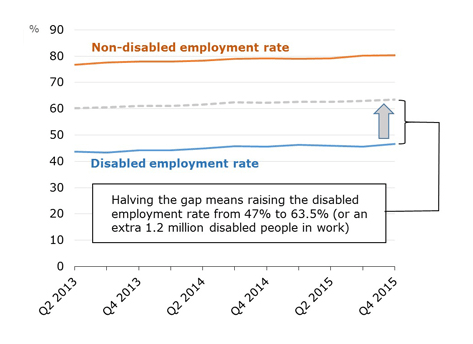
Disability Employment Gap 2015. Source: UK Parliament.

Inquiry background

The Work and Pensions Committee has launched an inquiry into the Government’s commitment to halve the “disability employment gap.” According to the most recent data, 46.7% of disabled people were in work at the end of 2015 compared to 80.3% of non-disabled people. In order to close this gap, the Committee says an extra 1.2 million disabled people would need to be supported into work.

The Committee’s welfare to work report, published in October 2015, raised concerns about the lack of success of existing employment programmes in supporting disabled people into sustained employment.

The Government has since announced:

  • A new Work and Health Programme to replace the current generalist Work Programme and specialist disability Work Choice programmes
  • A real terms increase in spending on the Access to Work Programme, which provides practical support for disabled people, beyond the “reasonable adjustments” required to be made by employers
  • A White Paper to be published this year which will “set out reforms to improve support for people with health conditions and disabilities, including exploring the roles of employers, to further reduce the disability employment gap and promote integration across health and employment.”

Concerns raised over Disability Confident campaign

In addition, the DWP’s Disability Confident campaign, launched in 2013, aims to promote the benefits of employing disabled people to employers.

However, concerns have been raised about the abolition of the Work Related Activity component of Employment and Support Allowance (ESA) worth £29.05 per week – and its equivalent in Universal Credit – for new claimants from April 2017, and the potential effects of this measure on disabled people’s ability to overcome their barriers to working.

Call for written submissions

The Committee invites written submissions addressing the following points:

Steps required to halve the disability employment gap:

  • To what extent are the current range of proposed measures likely to achieve the Government’s ambition of closing the disability employment gap?
  • Should the Government set interim targets along the way to meet the commitment to halve the disability employment gap? What should they be?

Support for employers:

  • How effective is the Disability Confident campaign in reducing barriers to employment and educating employers?
  • What more could be done to support employers?

Effective employment support for disabled people:

  • What should support for people with health conditions and disabilities in the proposed Work and Health programme look like?
  • How should providers be incentivised to succeed?

Likely effects of proposed ESA reform:

  • What are the likely impacts on disability employment of the abolition of the Employment and Support Allowance Work Related Activity component?
  • What evidence is there that it will promote ‘positive behavioural change’? What evidence is there that it will have unintended consequences, and how could these be mitigated?

Aim of the inquiry

The Committee intends to consider possible improvements in:

  • the DWP’s employment support programmes for disabled people
  • Support for employers to take on disabled people
  • Disabled people’s access to the labour market more broadly

The Committee will also examine possible adverse consequences of the Government’s current approach, particularly around proposed changes to ESA, and how these might be addressed.

Chair’s comment

Frank Field MP, Chair of the Committee said:

“The Government has made a welcome commitment to help more people with disabilities into a position where they can find and then keep a job. If it can successfully be seen through, this commitment could signal a major stride towards achieving full employment in our country.

The really important part now is to back-up this commitment with a series of reforms that are tailored to each person’s own skills and ambitions, as well as those conditions that currently limit their ability to work, so that each person can follow a feasible journey into work. We hope the evidence we receive will enable us to help the Government in its search for such a reform package.”

Send a written submission through the disability employment gap inquiry page.

Further information

The deadline for written submissions is Monday 9 May 2016.


ImageVaultHandler.aspx

Related

The new Work and Health Programme: government plan social experiments to “nudge” sick and disabled people into work

The biggest barrier that disabled people face is a prejudiced government

Let’s keep the job centre out of GP surgeries and the DWP out of our confidential medical records

Latest DWP information release reveals a huge rise in the numbers of sick and disabled people being sanctioned

G4S are employing Cognitive Behavioural Therapists to deliver “get to work therapy”

Universal Credit cuts will leave some people in work worse off

66864_464287263640807_1896397853_n

Despite Ian Duncan Smith’s persistent claims that “nobody loses a penny” under his flagship Universal Credit reform, the Department for Work and Pensions (DWP) has contradicted him and admitted that some claimants will be worse off. There seems to be a pattern emerging. Whenever the word “reform” is used by the Conservative government, it is always as a euphemism for “cuts to lifeline support.”

Guidance released this week by the DWP outlines how some working people will lose almost £900 a year. The memo supplies guidance on legislative amendments made in 2015 to the regulations which provide for the amount of earned income that is deducted from the Universal Credit maximum amount.

From 11.4.16 the range of work allowances available to Universal Credit claimants is reduced from seven to two (some rates are also reduced and some are removed completely). Consequently a work allowance will only be available where the claimant or either joint claimant is responsible for a child or qualifying young person and/or has limited capability to work (LCW).

On page three, the memo uses a case study – “Bella” – a 26-year-old shop worker who is single and lives with her parents. She works eight hours a week and earns £50, according to the DWP example. But at an hourly rate of £6.25, Bella apparently earns less than the legal minimum wage, which is £6.70 an hour for workers aged 21 and over. From April 1, the minimum wage is rising to £7.20 for employees aged over 25. The DWP guidance admits Bella, who is fictional, will see her monthly UC award plunge from £253.70 to £181.55 – a loss of £72.15 adding up to £865.80 a year.

There is no transitional protection for Universal Credit claimants whose work allowance is reduced or removed by this change.

The Shadow Work and Pensions Secretary Owen Smith said: “Iain Duncan Smith has spent months trying to pretend that ‘no one is going to lose a penny’ as a result of his Universal Credit cuts.”

“That’s now been blown out of the water by his own officials, who’ve produced a guidance note for DWP staff on how to implement the cut.

“Duncan Smith should read his own department’s guidance and call on the Chancellor to drop the Universal Credit cuts in the Budget.”

A DWP spokesman said: “Universal Credit (UC) is revolutionising welfare, with claimants moving into work faster and earning more than under the previous system.”

“As part of moving to a high-wage, low-tax society we are simplifying the work allowances under UC and giving those affected extra help to progress in work and earn more.”

“Even after the changes, UC claimants will know they are better off in work.”

The Poor Law Amendment Act of 1834 was based on the “principle of less eligibility,” which stipulated that the condition of the “able-bodied pauper” on relief be less “eligible” – that is, less desirable, less favourable – than the condition of the very poorest independent labourer. “Less-eligibility” meant not only that the pauper receive less by way of support than the labourer did from his wages but also that he receive it in such a way (in the workhouse, for example) that made pauperism less respectable than work – to stigmatise it. Thus the labourer would be discouraged from lapsing into a state of “dependency” and the pauper would be encouraged to work.

The less eligibility principle “made work pay”, in other words.

The current government is going even further, and applying the same punitive approach to people in low-paid employment, presumably to serve as a deterrent to poor wages. Personally, I think unions do that much better through collective bargaining, by addressing those actually at fault – exploitative employers, rather than poor, exploited employees.

This post was written for Welfare Weekly, which is a socially responsible and ethical news provider, specialising in social welfare related news and opinion.

Benefits Assessor: How Long Are You Likely To Have Parkinson’s?

I was asked in 2011 by an Atos assessor how long I thought I would have a “chronic, progressive illness”.  Medical testing had confirmed I have connective tissue disease (lupus). That was the diagnosis from my rheumatologist, which she read aloud at the assessment, from a correspondence between my consultant and my GP. Dumbfounded, I replied:

“Until I die. The clue is in the words ‘progressive’ and ‘chronic’.”

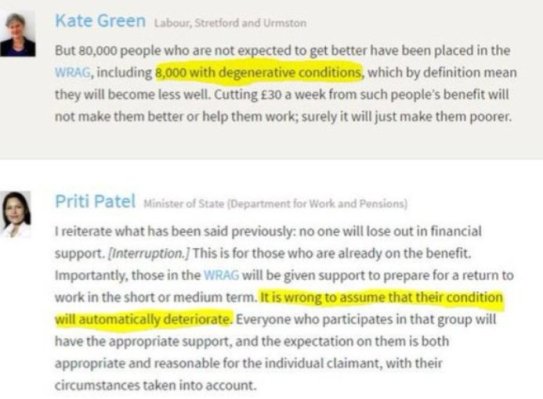
But an essential failure to grasp what words like “chronic”, “degenerative” and “progressive” actually mean isn’t peculiar to state assessors of illness and disability, who work for the government specifically to reduce the number of people eligible for sickness benefits. Government ministers display the same level of purposive ignorance:

Ca68L1xWcAA9MGT.jpg large

Hardly  “appropriate” , “reasonable” or taking “circumstances”, or medical diagnoses, for that matter, into account. A degenerative condition is one that DOES deteriorate. That is why it is called  a “degenerative condition.” It is therefore wrong and displays a degree of exceptional ignorance to assume that people WON’T or “may not” deteriorate.

This is why we don’t visit the government rather than a doctor when we become ill, especially when the state thinks it knows best about our medical conditions and how we should address those – and clearly doesn’t. This is about irrational ideology-driven policies aimed at cutting  back the welfare state. Regardless of how unreasonable that is and regardless of the consequences for those needing social security.

Sick and disabled people need support, understanding and medical care, not ignorance, Conservative dogma, vicious stigmatisation and a (neo)liberal re-translation of the words “Arbeit macht frei”.  

The government have conflated human needs with purely dogmatic economic outcomes.

Kitty S Jones.

samedifference1's avatarSame Difference

This paragraph from Frances Ryan’s latest article- an interview with a claimant called Phil Brehaut- just says it all.

“It was very daunting, like being in court,” he says. “The lady on the panel actually asked me, ‘How long are you likely to have Parkinson’s?’” He pauses. “The person next to her quickly whispered in her ear … You would think they’d know a little bit about it.”

View original post

Let’s keep the job centre out of GP surgeries and the DWP out of our confidential medical records


Image result for work coaches : you can still work if you are ill UK
Source: Work, health and disability green paper: improving lives. Consultation outcome


Last year I wrote a critical article about the government’s new
Work and Health Programme, I flagged up concerns regarding government plans to enlist GPs in prescribing work coaches for people who are sick and disabled, and in providing advice on job-seeking. The private and confidential patient-doctor relationship ought to be about addressing medical health problems, and supporting people who are ill, not about creating yet another space for an over extension of the coercive arm of the state to “help people into work”, regardless of whether or not they are actually well enough to cope with working.

I also posted my article on the Pulse site for medical professionals last October, raising some of my concerns. I proposed that the government may use the “intervention” as a further opportunity for sanctioning sick and disabled people for “non-compliance”, and I expressed concern that this would conflict with the ethics and role of a doctor. I also stated my concern about the potential this pilot has for damaging the trust between doctors and their patients. I do support the idea of social prescribing in theory, but this scheme is certainly not that. This is plain state harassment and coercion.

It’s interesting to see that among all those listed present at the various pilot-related meetings behind closed doors regarding the government’s new Work and Health programme, there isn’t a single sick and disabled person or relevant representative charity to be found. That’s telling, because it means that the provision is not founded on consultation, is not designed to be inclusive from the start, nor does it have a democratic or representative foundation. It’s another case of government policy that acts upon groups people, prescriptively, as if they were objects, rather than human subjects with identifiable needs and the capacity for democratic dialogue.

I discovered last October, almost by chance, that the Nudge Unit team have been working with the Department for Work and Pensions and the Department of Health to trial social experiments aimed at finding ways of: “preventing people from falling out of the jobs market and going onto Employment and Support Allowance (ESA).”

“These include GPs prescribing a work coach, and a health and work passport to collate employment and health information. These emerged from research with people on ESA, and are now being tested with local teams of Jobcentres, GPs and employers.”  Source: Matthew Hancock’s conference speech: The Future of Public Services.

Now GPs have raised their own concerns about sharing patient data with the Department for Work and Pensions – and quite properly so. Pulse reports that the Department for Work and Pensions (DWP) plans to extract information from GP records, including the number of Med3s or so-called “fit notes” issued by each practice and the number of patients recorded as “unfit” or “maybe fit” for work, in an intrusive move described by GP leaders as amounting to “state snooping.”

Part of the reason for this renewed government attack on sick and disabled people is that the Government’s flagship fit note scheme, which replaced sick notes five years ago in the hope it would see GPs sending thousands more employees back to work to reduce sickness-related absence, despite GPs having expressed doubts since before its launch, has predictably failed.

The key reason for the failure is that employers did not take responsibility for working with employees and GPs seriously, and more than half (59%) of employers said they felt unable to support employees by making all of the legally required workplace adjustments for those who had fit notes signed as “may be fit for work.” Rather than address this issue with employers, the government has decided instead to simply coerce patients back into work without essential support.

Another reason for the failure of this scheme is that most people who need time off from work are ill and genuinely cannot return to work until they have recovered. Regardless of the government’s concern for the business and state costs of sick leave, people cannot be simply ushered out of illness and into work by the state to “contribute to the economy.” When a GP says a person is “unfit for work”, they generally ARE unfit for work, regardless of whether the government likes that or not.

The government plans to merge health and employment services, and are now attempting to redefine work as a clinical outcome. Unemployment has been stigmatised and politically redefined as a psychological disorder, the government claims somewhat incoherently that the “cure” for unemployment due to illness and disability, and sickness absence from work, is work.

This is the kind of mentality that the new Work and Health programme is founded on: Dr Josephine Sauvage, the joint vice chair of NHS Islington CCG and a GP at City Road Medical Practice, where the programme is being trialed currently, said the programme can help patients.

She said: “When we become ill we often stop doing those things that get us out and about and bring fulfilment to our lives.”

Yes, that’s what being chronically ill means: we often become incapacitated and sometimes we can’t do all of the things we did before. But since when is working the only source of fulfilment? And how does forcing people who are ILL to look for ANY job, regardless of pay, security, terms and conditions and appropriateness lead to “fulfilment”? A patient is defined as:

  • A person who requires medical care.
  • A person receiving medical care or medical treatment.
  • A person under a physician’s care for a particular disease or condition.

There is no mention of a person’s employment status or the pressing need for a job prescription in that definition.

As part of the Work and Health programme, beginning next month, the DWP plans to access people’s medical information. Employment coaches will be able to directly “update” a patient’s medical record.

GPs will have to inform patients of the access to information and any extraction of confidential information from their medical files, but cannot withhold information unless their patient explicitly objects.

Sofia Lind, a senior journalist at Pulse, says: GPs, as data controllers, will be required to tell patients in person, via notices in the practice and on the practice website of the impending extraction.”

Patients have the right to object to the use and disclosure of confidential information that isn’t used for their medical care.

Patients can explicitly refuse their consent to data sharing. The Data Protection Act 1998 covers personal information including health records. Further provision under Article 8 of the Human Rights Act 1998 establishes a right to respect for private and family life. This underscores the duty to protect the privacy of individuals and preserve the confidentiality of their health records.

There is also additional guidance from the British Medical Association (BMA) here – GPs as Data controllers guidance. (PDF)

You can:

Write your own letter to the GP health centre. Here is a basic letter template in 3 formats that you can download and use:

Opt out letter (PDF)

Opt out letter (MS Word)

Opt out letter (Rich Text)

Make sure you state clearly that don’t wish for any of your data and medical information, including details of your fit notes, to be shared with the DWP and any other third party. You can also:

In addition to sharing information with the DWP, due to changes in legislation, your GP can now be required to upload personal and identifiable information from the medical record of every patient in England to central servers at the Health and Social Care Information Centre (HSCIC).

Once this information leaves your GP practice, your doctor will no longer be in control of what data is passed on or to whom. This information will include diagnoses, investigations, treatments and referrals as well as other things you may have shared with your doctor including your weight, alcohol consumption, smoking and family history. Each piece of information will be identifiable as it will be uploaded with your NHS number, date of birth, post code, gender and ethnicity. NHS England – the body now in charge of commissioning primary care services across England – will manage and use the information extracted by HSCIC for a range of purposes, none of which are to do with your direct medical care.

Whenever I am ill, I don’t ever consider consulting Iain Duncan Smith or the government more generally for advice. There are very good reasons for this. I don’t want to be confronted with pseudoscientific Conservative anti-welfare dogma, I prefer instead to seek the expert, trusted medical opinion of a qualified doctor. I expect professional medical care, not brute state coercion and a punishment regime that is particularly reminiscent of the 1834 Poor Law amendment Act.

And despite assurances from those professionals currently trialing the Work and Health programme that all participation is (currently) voluntary, against the current backdrop of ever-increasing welfare conditionality, the political stigmatisation of people not in work, the frequent punitive deployment of benefit sanctions, the mandatory  welfare-to-work schemes, it’s difficult to imagine a Conservative scheme that will not entail exercising Conservative prejudice and pseudoscientific justifications of Tory economic Darwinist ideology.

It’s hardly the case that the state has an even remotely credible track record of assessing people’s medical conditions, nor is it the case that this government bothers itself with empirical evidence, or deigns to listen to concerns raised by citizens, academics, professionals and charities regarding the harm that their policies are causing. This is a government that can’t even manage to observe basic human rights, let alone care about citizen’s best interests, health and wellbeing.

It’s not possible to make people who are ill better by punishing them, in just the same way as state coercion and using prejudiced language doesn’t “cure” poverty.  I don’t need more quack medicine on top of the current heavy doses of Conservative big state psychopolitics, traditional prejudices and subsequent quacking, slapstick psychobabble. It’s bad enough that Jeremy Hunt thinks he’s the all singing homeopathic Minister for magic and that Iain Duncan Smith thinks he can miraculously cure sick and disabled people by simply forcing them to work. The side-effects of five years of the Conservative’s ontologically insecure rhetoric, that’s been largely ranting, repetitive, incoherent monologue, are nauseating enough. Nobody should need to say any of this in 2016, but tragically, we seem to have a government that hasn’t yet escaped the feudal era. Or playing with their alchemy sets.

I’m in full agreement with Boycott Workfare, the Mental Health Resistance Network, and Disabled People Against the Cuts. I shared my original article with two of those groups and I’m pleased that they have since organised a protest for March 4, 3pm at the City Road Surgery, 190-196 City Road, London EC1V 2QH to raise public awareness of the issues and implications outlined. I just wish I was currently well enough to get to the protest.

They say: GP surgeries are for medical treatment, the job centre is for “employment coaching” and job-hunting.

And governments in first-world liberal democracies are for creating policies that actually meet public needs, rather than imposing totalitarian control, manipulating and micromanaging citizens to meet government needs and political outcomes.

650

My work isn’t funded. But you can support Politics and Insights, and help me to continue researching, analysing and writing independently.

Doctors bribed with 70-90k salaries to join Maximus and “endorse a political agenda regardless of how it affects patients.”

maximus-logoYes, but which people?


The National Audit Office (NAO) scrutinises public spending for Parliament and is independent of government. An audit report earlier this month concluded that the Department for Work and Pension’s spending on contracts for disability benefit assessments is expected to double in 2016/17 compared with 2014/15. The government’s flagship welfare-cut scheme will be actually spending more money on the assessments themselves than it is saving in reductions to the benefits bill – as
Frances Ryan pointed out in the Guardian, it’s the political equivalent of burning bundles of £50 notes.

The report also states that only half of all the doctors and nurses hired by Maximus – the US outsourcing company brought in by the Department for Work and Pensions to carry out the assessments – had even completed their training.

The NAO report summarises:

5.5
Million assessments completed in five years up to March 2015

65%
Estimated increase in cost per ESA assessment based on published information after transfer of the service in 2015 (from £115 to £190)


84%
Estimated increase in healthcare professionals across contracts from 2,200 in May 2015 to 4,050 November 2016

£1.6 billion
Estimated cost of contracted-out health and disability assessments over three years, 2015 to 2018

£0.4 billion
Latest expected reduction in annual disability benefit spending

13%
Proportion of ESA and PIP targets met for assessment report quality meeting contractual standard (September 2014 to August 2015).

This summary reflects staggering economic incompetence, a flagrant, politically motivated waste of tax payers money and even worse, the higher spending has not created a competent or ethical assessment framework, nor is it improving the lives of sick and disabled people. Some people are dying after being wrongly assessed as “fit for work” and having their lifeline benefits brutally withdrawn. Maximus is certainly not helping the government to serve even the most basic needs of sick and disabled people.

However, Maximus is serving the needs of a “small state” doctrinaire neoliberal government. The Conservatives are systematically dismantling the UK’s social security system, not because there is an empirically justifiable reason or economic need to do so, but because the government has purely ideological, anticollectivist prescriptions.

This is a government that claims social security is “unsustainable” and a “burden” on the public purse, yet has no problem with an extraordinary profligacy with public funds and dispossessing tax payers when it comes to implementing “cost-cutting” and draconian welfare “reforms.” Conservative anti-welfare dogma and prejudice are costing the UK billions of pounds.

In April 2014, Atos was forced to abandon their contract with the government because of a growing public backlash, but not before they had profited from very large sums of public money. Meanwhile, sick and disabled people have had their support callously slashed to the bone, people have suffered and some have died as a consequence of that. Yet our welfare state is being used as a sporting arena for big business profit-making, eating up public funds that were supposed to help people who have encountered difficulties meeting their basic needs through disability, losing their job or becoming ill.

The selling of our public services and lucrative contracting out of state functions to private companies who exchange public money for a notoriously poor service is a prominent feature of Tory “small state” Britain.

The Department for Work and Pensions uses the controversial work capability assessments to decide if people are eligible for benefits or to force those on long-term sick leave back into work. The assessment is conducted using a computer software package called Logic Integrated Medical Assessment (LiMA) application.

The assessments are heavily weighted towards finding people capable for work, regardless of the medical evidence presented by claimant’s own doctors. Patients with severe brain damage, kidney failure, cancer, multiple sclerosis and Parkinson’s Disease, amongst many others with seriously incapacitating illnesses, have been found fit for work. On 24 April 2013, a woman who was a double heart and lung transplant patient died in hospital only days after she had been told that her Incapacity Benefit was being stopped and that she was fit for work. There are many other instances of grave errors in the decision-making of the Department for Work and Pensions which are based on the work capability assessment.

Between April 2015 and March 2018, the Department for Work and Pensions expects to carry out around 7 million assessments which it estimates will cost a total of £1.6 billion.

The National Audit Office report on contracted-out “health and disability assessments” states that the cost of providing assessments is rising and providers are still struggling to meet expected performance standards, and that providers continue to struggle with hiring and training staff.

From the NAO summary:

“The Department continues, however, to struggle with setting targets and requirements with clear evidence and failed to adequately test bidders’ assumptions, for example about staff training, during the contract tender process. It does not yet have a clear strategy for contracting-out assessments and risks damaging market interest through tight procurement timetables, inflexibility towards critical assumptions and lack of transparency.

…For PIP, both providers have failed to meet targets for the quality of assessment reports since October 2013. The Department is paying more for assessments, caused in part by capacity shortages pushing up salaries.”

In the last month, recruitment website healthjobs.co.uk has added almost 100 job advertisements for “functional assessor” roles with Maximus, the US company contracted by the Department for Work and Pensions to conduct work capability assessments. Applicants are required to have two years post-qualification medical experience and are offered positions with whoppingly “incentivising” salaries that start at £72,000, with some roles attracting salaries of up to £98,000. The salary for a junior doctor working in the National Health Service (NHS) with two years of experience is approximately £30,000.

Junior doctors working within the NHS were forced to take industrial action recently – the first strike action for more than four decades – over the government’s proposed new junior doctor contracts, because of serious concerns about patient safety, the quality of doctor’s working lives and the lack of recognition regarding the strain of working long and unsocial hours.

The British Medical Association said:

“The biggest threat to patient care is the government’s insistence on removing safeguards which prevent junior doctors from being forced to work dangerously long hours without breaks, with patients facing the prospect of being treated by exhausted doctors.

“The government is threatening to impose contracts in which junior doctors have no confidence and which represents the first step in a wholesale attack on all NHS staff at night and over weekends. We want a contract that is safe for patients, fair for juniors and good for the NHS.”

Maximus offer substantially better working conditions and pay for junior doctors, but compromising patient safety is an inevitable consequence of the company drive to provide administrative solutions to improve the cost effectiveness … and efficiency of government-sponsored benefit programs.

One NHS doctor, Karl Norrington, noted on Twitter that despite Maximus’s company motto: “Helping Government Serve the People” – in reality Maximus is: “paying drs to medically endorse a political agenda regardless of how it affects patients.”

enhanced-9119-1453733217-2

Related

The disturbing truth about disability assessments

Why I blew the whistle on Atos fitness-for-work test

We can reduce the Welfare Budget by billions: simply get rid of Iain Duncan Smith


Frank Field’s New Report: Fixing Broken Britain?


In a study report that was published today – Fixing Broken Britain? An audit of working-age welfare reform since 2010, Labour MP Frank Field and co-author Andrew Forsey argue that: 

The Department for Business, Innovation and Skills should take a lead role in tackling the dependence of employers and landlords, whose subsidies in the form of tax credits and Housing Benefit have grown exponentially, by raising wages and productivity.

… the next front in welfare reform will see a fundamental switch from the Department for Work and Pensions – historically always responsible for welfare reform – to the Department for Business, Innovation and Skills, reflecting the new reform agenda.

Field and Forsey, writing for the cross-party think tank Civitas, propose that the next step of welfare reform:

 … involves a renewed drive to help those who have not yet been found a job under the Work Programme – principally the over-50s and the disabled. This should involve weighting the payment-by-results systems further in favour of those claimants facing the steepest barriers to work. This major task, and the prompt and efficient payment of benefits, should be the primary objective of the Department for Work and Pensions.

We believe the payment-by-results system the government introduced now requires a significant recalibration to give the most disadvantaged participants a fighting chance of getting and keeping a job.

The language used in the publication is controversial and I was both concerned and disappointed to see the phrase “welfare dependency” used more than once. It alludes to the Conservative claims of a so-called “culture of dependency”, for which there has never been any supportive empirical evidence presented, (and that’s despite Sir Keith Joseph’s notorious best efforts and meticulous but ultimately forlorn research into a neoliberal New Right myth.)

However, there is much empirical evidence to support structural explanations of unemployment and poverty, but the current government has tended to psychopoliticise these issues, blaming the character and attitudes of unemployed people, reflected in language shifts – for example, the frequent use of words such as “worklessness” which implies responsibility and choice – making unfortunate circumstances a very personal  burden – as opposed to “unemployment”, which at least accommodates factors such as labour market constraints, economic conditions, structural inequalities, state responsibilities and the consequences of political decision-making.

Field and Forsey also recommend “identifying claimants’ strengths and difficulties” as early as possible once they begin claiming benefit; early referrals to the new Work and Health Programme for those on any benefit in most need of support; and lifting the cap on numbers who can enrol on the voluntary welfare-to-work programme for claimants with disabilities, and extending the time for which they can participate.

The problem is that referrals are unlikely to be on a voluntary basis. One of the aims of the Work and Health Programme is to enlist the support of GPs in “prescribing” work coaches to sick and disabled people. Given the confidential nature of the patient/doctor relationship, such an intrusive measure is likely to ultimately undermine people’s trust in their GP, and leave sick people who genuinely cannot work feeling harrassed and coerced by the state. There is good evidence that the work programme has not increased sustainable employment outcomes, and furthermore, it has harmed people with mental health problems.

In fairness to Field and Dorsey, they do accommodate some structural factors in their analysis. They say:

A second major new front against benefit dependency involves raising the earnings of low-paid workers, which requires a national productivity strategy that can be built around the new National Living Wage. The major objective here is to prevent yesterday’s workless poor becoming today’s working poor.

The conditionality attached to the receipt of benefit may have made work an easier option, but real wage growth at the bottom end of the labour market has been the missing piece of the government’s welfare reform puzzle.

In order to enshrine work as the best route out of poverty, the next front in welfare reform must build upon the National Living Wage to deliver the higher productivity that can sustain rising real incomes across the board. This policy needs to be driven by the Secretary of State for Business, Innovation and Skills.

Field and Forsey criticise Universal Credit, stating that if it is ever rolled out nationally, it will not “incentivise” work.  They go on to say:

The government’s flagship welfare scheme will only deliver a lower marginal tax rate for certain groups of claimants and even for them it will be undermined by Universal Credit’s failure to encompass council tax support and free school meals.

Because of Universal Credit’s higher taper rate for many claimants the strategy of fixing “broken Britain” by offering lower withdrawal rates than the current system lies in ruins.

If creating an incentive to work is the goal the present system for the vast majority of claimants meets that goal more effectively. Any reduction in the marginal tax rate will only come for particular groups of Universal Credit claimants should the benefit be introduced.

But then, the failure of Universal Credit to encompass also Council Tax support and free school meals will throw all of these calculations into a mild chaos, to put it at its gentlest.

However, it’s clear that the whole point of Universal Credit is to facilitate a further withdrawal of funding for welfare support.

Field and Forsey argue in the report that because there is little prospect of Universal Credit being rolled out fully by 2020,  George Osborne should act now to “protect lower-paid families with children within the framework of the welfare cuts he is planning.”

They formulate a five-point plan for in-work benefit reform in the current parliament:

  • The tax credit system should be centred on lower-paid workers with children, with entitlements to families earning up to twice the level of the National Living Wage, a ceiling of £32,000.
  • By 2020, childless couples and single workers without children should no longer be eligible for support from the tax credit system.
  • Jobcentre Plus should be revamped so that staff have the skills to help claimants in work increase their hours and/or pay, either in their current job or by finding a new one.
  • Tax credit claimants should be allowed to increase their earnings by up to £5,000 in any 18-month period without any clawback of entitlement, so that they do not lose large chunks of income for working more or for better pay.
  • Vulnerable workers who cannot currently work a full week should be allowed to work up to 24 hours a week and claim Jobseeker’s Allowance or Employment and Support Allowance, rather than the current 16-hour maximum.

They say:

These five reforms would be much more effective in protecting those in work on modest earnings than anything the government is proposing. They build around the revolutionary idea the chancellor has introduced into British politics, particularly welfare reform, namely of introducing a National Living Wage.

This move begins the process of transferring the responsibility for lower earners’ welfare to employers and the Department for Business, Innovation and Skills, and away from the Department for Work and Pensions and Her Majesty’s Revenue and Customs.

However, this is a heavily corporate-sponsored “business friendly” neoliberal government with a clear anti-welfare agenda. What could possibly go right?

 —

 This post was written for Welfare Weekly, which is a socially responsible and ethical news provider, specialising in social welfare related news and opinion.

Audit finds whereabouts and circumstances of 1.5 million people leaving welfare records each year “a mystery”

10270806_319228004894921_8005540502444686357_n

Labour MP Frank Field has called on the government to conduct a survey into the circumstances of those hundreds of thousands of citizens whose benefit income is withdrawn each year under the current harsh sanctioning regime.

Mr Field, who also chairs the Commons Work and Pensions Committee, carried out a forensic audit of the government’s welfare reform programme – Fixing Broken Britain? An audit of working-age welfare reform since 2010, which is to be published today (18 January 2016) by Civitas and co-authored by Andrew Forsey.

Worryingly, the research found that the whereabouts of 1.5 million people leaving the welfare records each year is “a mystery.” The authors also raise concern that the wellbeing of at least a third of those who have been sanctioned “is anybody’s guess.” It’s not the first time these concerns have been raised.

It emerged in 2014, during an inquiry which was instigated by the parliamentary Work and Pensions Select Committee, that research conducted by Professor David Stuckler shows more than 500,000 Job Seekers Allowance (JSA) claimants have disappeared from unemployment statistics, without finding work, since the sanctions regime was toughened in October, 2012.

This means that in August 2014, the claimant count – which is used to gauge unemployment – is likely to be very much higher than the 970,000 figure that the government is claiming, if those who have been sanctioned are included.

The research finding confirms what many of us already knew.

Professor Stuckler, who has analysed data from 375 local authorities, said:

“The data clearly show that many people are not leaving Job Seekers Allowance for work but appear to be being pushed off in unprecedented numbers in association with sanctions.”

The Work and Pensions Committee decided to conduct a further in depth inquiry into benefit sanctions policy at the time, following the findings of the research. This inquiry considered aspects of sanctions policy which were outside the remit of the Oakley Review. (You can see the terms of reference for the inquiry, and submissions were invited, all details of which are here – Committee launch inquiry into benefit sanctions.)

Labour MP Debbie Abrahams said:

“Sanctions are being applied unfairly to job-seekers, as well as the sick and disabled.

The reason the Government is doing this is that it gets them off the JSA claimant figures, so it looks like there are fewer people unemployed.”

Mrs Abraham added:

“Hundreds of thousands of people have had their benefits stopped for a minimum of four weeks and then approximately a quarter of these people, from the research that I’ve seen, are disappearing.

They are leaving and we don’t know where they are going. That’s an absolute indictment of this policy and it’s a little bit worrying if we’re trying to tout this internationally as a real success story.”

The MP for Oldham East and Saddleworth, and shadow disability minister memorably added:

“People have died after being sanctioned, Minister.”

The Government claims that sanctioned claimants who leave the benefit system are going into work – they also claim that their punitive sanctions regime “works”. But the Oxford study found this is untrue in a “majority” of cases. At the time, the government were accused of massaging unemployment figures via benefit sanctions.

Frank Field and Andrew Forsey write:

“The number of sanctions was halved in the year leading up to the 2015 election, but it still remained at half a million. Sanctions are therefore being applied at a scale unknown since the Second World War, and the operation of sanctions on this scale makes for a most significant change in the social security system as it has existed in the post-war period.

A number of people – we know not how large a number – are being totally disconnected from both work and welfare, and risk being exposed to destitution.

Justice calls for a major survey of what happens to the hundreds of thousands of people thrown off the welfare rolls each year through the sanctioning process. It is unacceptable, not only for this government but for its predecessor and those who will follow, to take away benefit from a mass of people each year and not trouble themselves with how this army of people survive. For that is what is happening under the government’s sanctions policy. The ability to track the wellbeing of the whole population is now a part of being a grown up government, let alone a ‘One Nation’ government.”

In the report, Field and Forsey call for four safeguarding reforms, “to restore greater fairness and transparency to the sanctions regime.” They:

  • Propose that the government must forthwith begin a survey so that they can answer the simple but crucial question of what happens to those citizens expelled from the welfare rolls who appear not to find work.
  • Welcome the government’s decision to trial a Yellow Card early warning system, but suggest that should it fail to prevent injustices from occurring, the government should supplement this policy with the option for Jobcentre Plus staff of issuing a non-financial sanction for a claimant’s first failure to meet the terms of their Claimant Commitment. 
  • Recommend that the Department for Work and Pensions trials a ‘grace period’ for vulnerable claimants of Jobseeker’s Allowance or Employment and Support Allowance, during which the requirements placed upon them are eased at times of transition or acute difficulty.
  • Request information from the government showing how much expenditure is withdrawn through its policy of sanctioning claimants.

Last year year, the Work and Pensions Select Committee heard independent estimates that since late 2012 sanctions had resulted in at least £275m being withheld from benefit claimants (the comparable figure for 2010 was £50m). Committee member Debbie Abrahams MP said that the Department for Work and Pensions will not give or does not have actual figures.

However, it’s truly remarkable that the government somehow manage to pull numbers out of their secret Thunderball when they believe it’s in their own interests to do so. The latest “employment” figures, for example. How likely is it that those numbers are remotely accurate when we have a government that happily presides over the disappearance of many thousands of sanctioned people every year from their accounts?

This post was written for Welfare Weekly, which is a socially responsible and ethical news provider, specialising in social welfare related news and opinion.