Tag: austerity

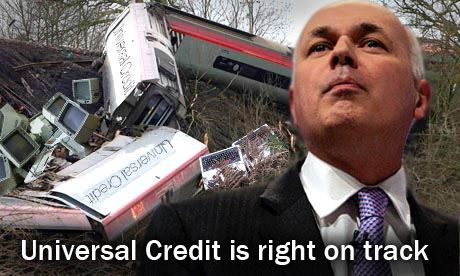
Iain Duncan Smith abandoned his own sinking ship

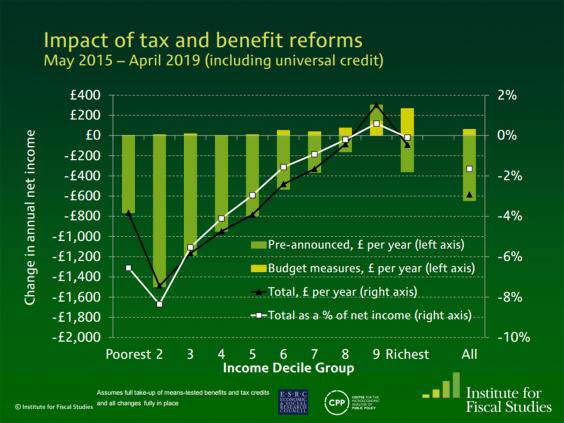
Impact of tories on income.jpg

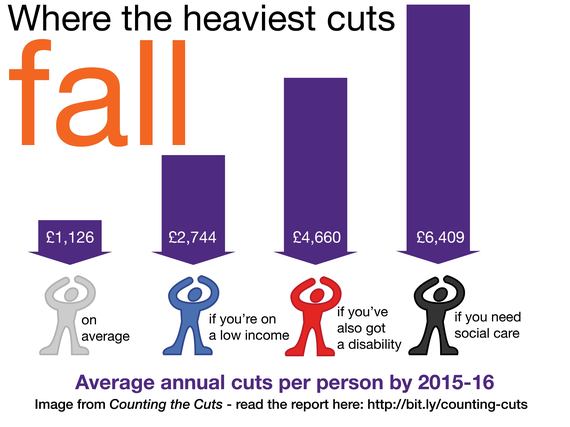
Analysis of George Osborne’s budget from the Institute for Fiscal Studies.

Stephen Crabb has been appointed as the new work and pensions secretary, after Iain Duncan Smith resigned in a flurry of controversy on Friday.

Mr Duncan Smith has said the latest planned cuts to disability benefits were “not defensible” in a Budget that benefited higher-earning taxpayers.

David Cameron said he was “puzzled and disappointed” that Mr Duncan Smith had decided to go when they had agreed to have a rethink about the policies

Iain Duncan’s Smith’s letter of resignation must be a BIG embarrassment to the  Government. It was certainly designed to inflict maximum damage particularly on Chancellor George Osborne. I’ve previously noted that the Chancellor has a tendency to regard the Department for Work and Pensions as little more than an annex to the Treasury, and the welfare budget as the Treasury’s disposable income, but I never anticipated that Duncan Smith would come to say that he sees it that way, too. This is, after all, a minister that has invented statistics and told some pretty far-fetched fibs to prop up justifications of his policies that entail some pretty draconian measures, such as sanctions and work fare, after all.

Yet surprisingly, Duncan Smith has also quite willingly and very publicly provided the government’s opponents with ammunition. He has effectively denounced not only Osborne’s budget, but also, his targeted austerity measures, yet curiously, Duncan Smith has until now been one of the most ideologically devout Thatcherite Conservatives, which is reflected in every policy he has formulated.

He has basically said what many of us have been saying for a long time: that the cuts are political and not because of economic necessity, nor will they help the economy. He also as good as said he doesn’t think we are “all in it together”. It turns out that Osborne blamed Duncan Smith for the Personal Independence Payment (PIP) and Employment Support Allowance (ESA) cuts. But Duncan Smith has been a very quiet man recently, often conspicuous by his absence during parliamentary debates, with Priti Patel left defending the ESA cuts in particular in the Commons.

However, the Department for Work and Pensions did a review of PIP last year, and that’s where the “justification” for the cuts came from – a sample of just 150 people, which was hardly a representative sample. It’s difficult to imagine that IDS didn’t order that review. But it was Osborne who announced the cuts to PIP, not Iain Duncan Smith. Just who carries the original responsibility for the proposed PIP cuts is probably never going to be fully untangled from the crossfire of accusations and counter accusations. But surely Cameron is ultimately responsible for Conservative policies?

In his resignation letter, Iain Duncan Smith says:

“I have for some time and rather reluctantly come to believe that the latest changes to benefits to the disabled, and the context in which they’ve been made are, a compromise too far. While they are defensible in narrow terms, given the continuing deficit, they are not defensible in the way they were placed within a budget that benefits higher earning taxpayers. They should have instead been part of a wider process to engage others in finding the best way to better focus resources on those most in need.

I am unable to watch passively while certain policies are enacted in order to meet the fiscal self imposed restraints that I believe are more and more perceived as distinctly political rather than in the national economic interest.

Too often my team and I have been pressured in the immediate run up to a budget or fiscal event to deliver yet more reductions to the working age benefit bill. There has been too much emphasis on money saving exercises and not enough awareness from the Treasury, in particular, that the government’s vision of a new welfare-to-work system could not be repeatedly salami-sliced.

It is therefore with enormous regret that I have decided to resign. You should be very proud of what this government has done on deficit reduction, corporate competitiveness, education reforms and devolution of power.

I hope as the government goes forward you can look again, however, at the balance of the cuts you have insisted upon and wonder if enough has been done to ensure ‘we are all in this together’ “

You can read the letter in full here

You can see Cameron’s response in full here

Many Conservatives have suggested that Duncan Smith – a supporter of Brexit – had been looking over several weeks for an opportunity to resign, and claimed that he wanted to find a moment when he could inflict maximum damage on the campaign led by Cameron and Osborne to keep Britain in the European Union. But writing in the Observer, Bernard Jenkin, a Tory MP and chair of the Commons public administration select committee, says that Duncan Smith was not prepared to tolerate another raid on the disability budget.

Referring to the prime minister’s letter to Duncan Smith, in which Cameron said he was “puzzled” by the resignation, Jenkin says: “What that letter does not make clear is that the £4bn savings in the budget from welfare still stands and, once again, Iain was being told to find similar cuts from other benefits for working-age people – including for the disabled – again undermining the positive incentives that make it worthwhile for them to take work. That is what he finds morally indefensible.”

However, Debbie Abrahams, the shadow minister for disabled people, who has faced Duncan Smith many times during Commons debates and Work and Pensions Committee inquiries, says she does not accept the reasons Iain Duncan Smith has given for resigning, and believes he chose to resign so he could “embarrass the government as much as he can”.

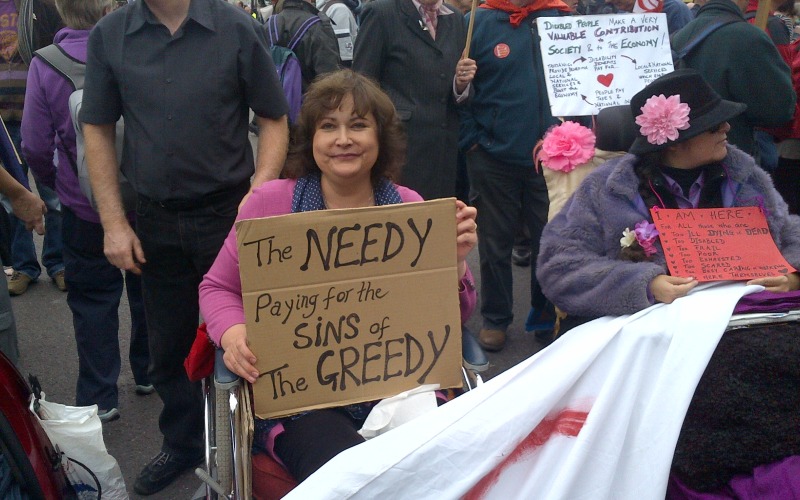
She adds that planned cuts to disability benefit payments in the Budget were “grossly unfair” and would hit “the most vulnerable in society at the same time the highest earners are getting tax cuts”. 

She says she is grateful that many Conservative MPs are critical of the proposals, but adds: 

“We must make sure that this last cut that has been announced around Personal Independence Payments is stopped and does not carry on.”

The resignation is particularly surprising given that, just hours earlier, the Treasury shelved the proposed cuts to PIP – following threats of a Tory backbench rebellion. Three Tory MPs – including mayoral candidate Zac Goldsmith – have  also been asked to resign as patrons of disability charities over their support for the recent welfare cuts. The complete failure of the austerity project is finally unravelling the Conservatives, and at a time when the Brexit faction of the party is already causing considerable disarray.

Even some of the most loyal Tories were finding it difficult to defend taking money away from sick and  disabled people – particularly since many of those who receive PIP are in work, and in fact some rely on it to stay in work. The cuts to ESA and PIP take place in the context of a Tory manifesto that included a pledge not to cut disability benefits. In fact in March last year, the Prime Minister signalled that the Conservatives will protect disabled claimants from welfare cuts in the next parliament (this one). Cameron said the Conservatives would not “undermine” PIP, which was introduced under the Coalition to save money by “targeting those most in need.” Now it seems those most in need are not the ones originally defined as such.

Controversially, the cuts to disability benefits were planned to fund tax cuts for the most affluent – the top 7% of earners. The Chancellor raised the threshold at which people start paying the 40p tax, in a move that will  see many wealthier people pulled out of the higher rate of income tax, in the coming budget. Mr Osborne said that he wants to “accelerate progress” towards the Conservative’s manifesto pledge of raising the threshold for the 40p rate to £50,000 in 2020. The average annual income in the UK is around £27,000.

The Labour Party have urged Stephen Crabb to appear before MPs on Monday to announce formally that the cuts to disability benefits had been dropped. Owen Smith, the shadow work and pensions secretary, said: “His very first act as secretary of state must be to come to parliament on Monday to announce the full reversal of cruel Tory cuts that will see 370,000 disabled people lose £3,500 a year.”

He also urged Crabb to “stand up to a Treasury that is intent on cutting support for those most in need to pay for tax breaks for those who least need them”.

The main retaliation from the Conservative frontbench has been that Duncan Smith knew about the disability cuts (which he did) and that this is an act of mischief and sabotage designed and timed to destablise Cameron regarding Europe. It may well be. But the divisions had already caused wobbles, Duncan Smith just delivered a swift and hefty kick to the “in” crowd.

However, it’s also clear there has been a rising tension between the Treasury and the Department for Work and Pensions for some time. Duncan Smith felt that the benefits system could be scaled back only so far. Osborne and Cameron would prefer to see the welfare state completely dismantled.

Nonetheless, we have witnessed Duncan Smith’s long term disconnection from the impacts of his policies. He has persistently refused to engage with critics raising serious concerns about the consequences of the welfare “reforms”. He has refused to carry out a cumulative impact assessment of his policies and absolutely refused to monitor the impacts, most of which have been dire for sick and disabled people, and when the specifics of negative consequences were pointed out to him, he has typically reacted with denial, anger and accusations of “scaremongering.”

Duncan Smith used the mantra “there’s no proof of causality” to dismiss those who recognised a correlation between his welfare “reforms” and an increase in premature mortality rates and suicide. He has consistently and quite unforgivably shown that he is more concerned about hiding evidence and stifling criticism than he is about conscienciously investigating the harmful and sometimes devastating consequences that his policies have had on many people.

On the day he resigned, Duncan Smith’s department lost a four year legal battle to keep the many potentially humiliating problems with Universal Credit from the public.

Whatever the reasons may be for Duncan Smith’s resignation, he has certainly highlighted very well that Conservative budget decisions are partisan, taken for  party political interest rather than with consideration for the national interest. But in more than one way.

It’s also worth bearing in mind that it is Iain Duncan Smith’s “reforms” that have prompted a United Nations inquiry into grave and systematic violations of the human rights of disabled people. It’s highly unlikely that Duncan Smith’s reputation will be enhanced in the long-term regarding his legislative legacy, particularly regarding disabled people. He has collaborated with other ministers in designing and extending techniques of neutralisation to attempt justify what are extremely prejudiced, discriminatory and punitive policies aimed at the poorest citizens.

This is a man who has removed people from a structural socioeconomic context and then intentionally blamed them for their individual socioeconomic circumstances, most of which have been created by this government’s actions since 2010. Every single Conservative budget has taken money from the poorest and gifted it to the wealthiest. It’s inconceivable that Tory ministers don’t understand such policies will invariably extend and perpetuate inequality and poverty.

Duncan Smith has damned himself, but nonetheless, a Conservative minister resigning and stating that it is because of a Conservative budget, publicly citing reasons that correlate with the opposition’s objections regarding the government’s ideologically driven and targeted austerity, is a particularly damning turn of events for the Conservative Party as a whole, that’s for sure.

Now that Duncan Smith has publicly denounced the Conservative austerity project, I wonder if he will also recognise and embrace the rational expertise and economic competence of a real party of social justice, which rescued this country from the consequences of a global recession by the last quarter of 2009, whilst Osborne had us back in recession by 2011, and lost us our triple A Fitch and Moody credit ratings after promising not to. I wonder if Duncan Smith now supports the fair party with a track record of verifiable economic expertise – that would be the Labour Party.
rich keep millons
Picture courtesy of Robert Livingstone

I don’t make any money from my work and I’m not funded. You can support Politics and Insights by making a donation to help me continue researching and writing independently, and to continue to help others.

DonatenowButton
cards

Universal Credit cuts will leave some people in work worse off

66864_464287263640807_1896397853_n

Despite Ian Duncan Smith’s persistent claims that “nobody loses a penny” under his flagship Universal Credit reform, the Department for Work and Pensions (DWP) has contradicted him and admitted that some claimants will be worse off. There seems to be a pattern emerging. Whenever the word “reform” is used by the Conservative government, it is always as a euphemism for “cuts to lifeline support.”

Guidance released this week by the DWP outlines how some working people will lose almost £900 a year. The memo supplies guidance on legislative amendments made in 2015 to the regulations which provide for the amount of earned income that is deducted from the Universal Credit maximum amount.

From 11.4.16 the range of work allowances available to Universal Credit claimants is reduced from seven to two (some rates are also reduced and some are removed completely). Consequently a work allowance will only be available where the claimant or either joint claimant is responsible for a child or qualifying young person and/or has limited capability to work (LCW).

On page three, the memo uses a case study – “Bella” – a 26-year-old shop worker who is single and lives with her parents. She works eight hours a week and earns £50, according to the DWP example. But at an hourly rate of £6.25, Bella apparently earns less than the legal minimum wage, which is £6.70 an hour for workers aged 21 and over. From April 1, the minimum wage is rising to £7.20 for employees aged over 25. The DWP guidance admits Bella, who is fictional, will see her monthly UC award plunge from £253.70 to £181.55 – a loss of £72.15 adding up to £865.80 a year.

There is no transitional protection for Universal Credit claimants whose work allowance is reduced or removed by this change.

The Shadow Work and Pensions Secretary Owen Smith said: “Iain Duncan Smith has spent months trying to pretend that ‘no one is going to lose a penny’ as a result of his Universal Credit cuts.”

“That’s now been blown out of the water by his own officials, who’ve produced a guidance note for DWP staff on how to implement the cut.

“Duncan Smith should read his own department’s guidance and call on the Chancellor to drop the Universal Credit cuts in the Budget.”

A DWP spokesman said: “Universal Credit (UC) is revolutionising welfare, with claimants moving into work faster and earning more than under the previous system.”

“As part of moving to a high-wage, low-tax society we are simplifying the work allowances under UC and giving those affected extra help to progress in work and earn more.”

“Even after the changes, UC claimants will know they are better off in work.”

The Poor Law Amendment Act of 1834 was based on the “principle of less eligibility,” which stipulated that the condition of the “able-bodied pauper” on relief be less “eligible” – that is, less desirable, less favourable – than the condition of the very poorest independent labourer. “Less-eligibility” meant not only that the pauper receive less by way of support than the labourer did from his wages but also that he receive it in such a way (in the workhouse, for example) that made pauperism less respectable than work – to stigmatise it. Thus the labourer would be discouraged from lapsing into a state of “dependency” and the pauper would be encouraged to work.

The less eligibility principle “made work pay”, in other words.

The current government is going even further, and applying the same punitive approach to people in low-paid employment, presumably to serve as a deterrent to poor wages. Personally, I think unions do that much better through collective bargaining, by addressing those actually at fault – exploitative employers, rather than poor, exploited employees.

This post was written for Welfare Weekly, which is a socially responsible and ethical news provider, specialising in social welfare related news and opinion.

Welcome to the Labour Party’s excellent Economic Advisory Committee of experts

gret deceit

Labour Press released this in September 2015:

The importance of citizens’ qualitative accounts in democratic inclusion and political participation

disempowerment
Government policies are expressed political intentions regarding how our society is organised and governed. They have calculated social and economic aims and consequences. In democratic societies, citizens’ accounts of the impacts of policies ought to matter.

However, in the UK, the way that policies are justified is being increasingly detached from their aims and consequences, partly because democratic processes and basic human rights are being disassembled or side-stepped, and partly because the government employs the widespread use of linguistic strategies and techniques of persuasion to intentionally divert us from their aims and the consequences of their ideologically (rather than rationally) driven policies. Furthermore, policies have become increasingly detached from public interests and needs.

The merits of quantitative analysis

The government have denied there is a causal link between their welfare policies, austerity measures and an increase in mental distress, premature death and suicide. However, ministers cannot deny there is a clear and well-established correlation, which warrants further research. But the government are hiding behind a distinction often made by researchers, to avoid accountability and to deny any association at all between policy and policy impacts. That’s just plain wrong.

Correlation isn’t quite the same as causality. When researchers talk about correlation, what they are saying is that they have found a relationship between two (or more) variables. “Correlation does not mean causation” is a quip that researchers and quite often, the government, chucks at us to explain that events or statistics that happen to coincide with each other are not necessarily causally related.

However, the possibility of causation isn’t refuted by political denial or somehow invalidated by the establishment of a correlation. Quite the contrary. Indeed an established association implies there may also be a causal link. To prove causation, further research into the association between variables must be pursued. So, care should be taken not to make an assumption that correlation never implies causation, because it quite often does indicate a causal link.

Correlations between two things may be caused by a third factor that affects both of them. This sneaky, hidden third factor is called a confounding variable, or sometimes, simply a confounder.

However, a lot of social research tends to indicate and discuss a correlation between variables, not a direct cause and effect relationship. Researchers are inclined to talk cautiously about associations.

It’s worth bearing in mind that establishing correlation is crucial for research and shows that something needs to be examined and investigated further. That’s precisely how we found out that smoking causes cancer, for example – through repeated findings showing an association (those good solid, old fashioned science standards of replicability and verification). It is only by systematically eliminating other potential associations – variables – that we can establish causalities.

The objective of most research or scientific analysis is to identify the extent to which one variable relates to another variable and the direction of the association. If there is a correlation then this guides further research into investigating whether one action causes the other. Statistics measure occurrences in time and can be used to calculate probabilities. Probability is important in research because measurements, observations and findings are often influenced by variation. In addition, probability theory provides the theoretical groundwork for statistical inference.

Statistics are fundamental to good government; to the delivery of public services and to decision-making at all levels of society. Statistics provide parliament and the public with a window on the work, performance and intentions of a government. Such data allows for the design of policies and programmes that aim to bring about a desired and stated outcome, and permits better targeting of resources.

Once a policy has been implemented it is necessary to monitor and evaluate the effectiveness of the policy to determine whether it has been successful in achieving the intended outcomes. It is also important to evaluate whether services (outputs) are effectively reaching those people for whom they are intended. Statistics play a crucial role in this process. So statistics, therefore, represent a significant role in good policy-making, monitoring and political accountability. The impact of policy can be measured with statistics.

So firstly, we need to ask why the government are not doing this.

If policy impacts cannot be measured then it is not good policy.

Ensuring accuracy and integrity in the reporting of statistics is a serious responsibility. In cases where there may not be an in-depth understanding of statistics in general, or of a particular topic, the use of glossaries, explanatory notes and classifications ought to be used to assist in their interpretation.

Statistics can be presented and used in ways that may lead readers and politicians to draw misleading conclusions. It is possible to take numbers out of context, as Iain Duncan Smith, amongst others, is prone to do. However, official statistics are supposed to be produced impartially and free from political influence, according to a strict code of practice. This is a government that systematically breaches the code of conduct. See: List of official rebukes for Tory lies and statistical misrepresentations, for example.

We need to ask why the government refuses to conduct any research into their austerity policies, the impacts they are having and the associated mental distress, physical harm, deaths and suicides.

Without such research, it isn’t appropriate or legitimate to deny a causal link between what are, after all, extremely punitive, targeted, class-contingent policies and an increase in adverse consequences, such as premature mortality rates.

It isn’t unreasonable to be concerned about policies that are targeted to reduce the income of those social groups already struggling because of limited resources, nor is it much of an inferential leap to recognise that such policies will have some adverse consequences.

In social research, traditionally, quantitative methods emphasise maintaining objectivity, and aim to keep social inquiries “value-free.” However, the area of study is intentionally selected by researchers, funded by interested parties and there are problems related to the connection between observation and interpretation. Perhaps every observation is an interpretation, since “facts” are seen through a lens of perceptions, pre-conceptions and ideology.

The Joseph Rowntree Foundation choose to study poverty. Cynical Iain Duncan Smith simply changes the definition of it to reduce its visibility.

The importance of qualitative research: who are the witnesses?

Social phenomena cannot always be studied in the same way as natural phenomena, because human beings are subjective, intentional and have a degree of free will. One problem with quantitative research is that it tends to impose theoretical frameworks on those being studied, and it limits responses from those participating in the study.

Social reality is not “out there” waiting to be discovered: we are constructing and reconstructing it meaningfully. However, politically, there’s been a marked shift away from understanding the lived experiences of real people in context.

There are also distinctions to be made between facts, values and meanings. Qualitative researchers are concerned with generating explanations and extending understanding rather than simply describing and measuring social phenomena and establishing basic cause and effect relationships. Qualitative research tends to be exploratory, potentially illuminating underlying intentions, responses, beliefs, reasons, opinions, and motivations to human behaviours.

This type of analysis often provides insights into social problems, helps to develop ideas and establish explanations, and may also be used to formulate hypotheses for further quantitative research.

The dichotomy between quantitative and qualitative methodological approaches, theoretical structuralism (macro-level perspectives) and interpretivism (micro-level perspectives) in sociology, for example, is not nearly so clear as it once was, however, with many social researchers recognising the value of both means of data and evidence collection and employing methodological triangulation, reflecting a commitment to methodological and epistemological pluralism.

Qualitative methods tend to be much more inclusive than quantitative analysis, lending participants a dialogic, democratic and first hand voice regarding their own experiences.

The current government have tended to dismiss qualitative evidence from first hand witnesses of the negative impacts of their policies – presented cases studies, individual accounts and ethnographies – as “anecdotal.” However, that is a very authoritarian approach to social administration and it needs to be challenged. 

The most rigid form of quantitative research, associated with positivism, is a traditionally Conservative way of rigidly demarcating the world, imposing hierarchies of priority, worth and order, to assure ontological security and maintain the status quo, regardless of how absurd this shrinking island of certainty appears to the many of us that are being systematically exiled from it.

Neither positivism nor Conservatism extend an acknowledgement, recognition or account of human diversity – which is among our greatest assets, after all. It’s a curious ideological tension for neoliberal Conservatives: they value competitive individualism on the one hand, but have such rigid ideas about pluralism and social group deviations from imposed, value-laden norms, on the other. 

Competitive individualism arises from competitive systems, rather than co-operative, collective ones. The function of the system is to maintain inequality in the society and fields of human engagement, based on the largely unchallenged notions of ‘deserving’ and ‘undeserving’. These are tacit notions at the heart of meritocracy. Neoliberals believe that competition acts as an incentive to people’s behaviours, encouraging a “race to the top”. Those at the top then ‘trickle down’ wealth to benefit the poorest citizens, according to this behaviourist theory. But of course that hasn’t happened.

In any system of competition, there are inevitably relatively few ‘winners’ and rather more ‘losers’. Such is the logic of competition. And most people don’t share their trophies with others.

The competition is rigged in any case, since the Conservatives are not too keen on widening access to equality of opportunity. Such is the acrobatic, logic of elitism. 

The Conservatives don’t like social individualism, difference or diversity within society.  For them, the only individualism worth anything is that defined and categorised by how much money you have.  A ‘good citizen’ is wealthy. The logic follows that they must be ‘good’ to be so wealthy, after all.  Such is the politically convenient circular argument of meritocracy. 

In the current context, the Conservatives’ approach to ‘research’ is tantamount to a politically extended epistemological totalitarianism. (Epistemology is an important and underpinning branch of philosophy that extends various theories of the nature and grounds of knowledge in the social sciences, particularly with reference to its limits, reliability and validity.)

It’s merely politically convenient to use a discredited positivist approach to policy-making, because such pseudoscientific narratives can be used to legitimise and impose virtually any policy.  Pseudoscience was once used to justify eugenic policies, after all. This is an approach that purposefully excludes citizens’ accounts. It’s authoritarian.

However, a qualitative approach to research potentially provides insight, depth and richly detailed accounts. The evidence collected is much more coherent and comprehensive, because it explores beneath surface appearances, and reaches above causal relationships, delving much deeper than the simplistic analysis of ranks, categories and counts.

It provides a reliable and rather more authentic record of experiences, attitudes, feelings and behaviours, it prompts an openness and is expansive, whereas quantitative methods tend to limit and are somewhat reductive. Qualitative research methods encourage people to expand on their responses and may then open up new issues and topic areas not initially considered by researchers. 

As such, qualitative methods are prefigurative and bypass problems regarding potential power imbalances between the researcher and the subjects of research, by permitting participation and creating space for genuine dialogue and reasoned discussions to take place. Research regarding political issues and policy impacts must surely engage citizens on a democratic, equal basis and permit participation in decision-making, to ensure an appropriate balance of power between citizens and the state.

That assumes, of course, that governments want citizens to engage and participate. There is nothing to prevent a government deliberately exploiting a research framework as a way to test out highly unethical and ideologically-driven policies, and to avoid democratic accountability, transparency and public safeguards. How appropriate is it to apply a biomedical model of prescribed policy “treatments” to people experiencing politically and structurally generated social problems, such as unemployment, inequality and poverty, for example? This is happening and needs to be challenged.

Iain Duncan Smith and Priti Patel, amongst other ministers, claim that we cannot make a link between government policies and the increasing number of deaths of sick and disabled people. There are no grounds whatsoever for their claim. There has been no cumulative impact assessment or monitoring of welfare policies, no inquiry, no further research regarding an established correlation and a longstanding refusal from the Tories to undertake any of these. There is therefore no evidence for their claim.

Such political denial is oppressive – it serves to sustain and amplify a narrow, hegemonic political narrative, stifling pluralism and excluding marginalised social groups, excluding alternative accounts of citizen’s experiences, negating counternarratives; it sidesteps democratic accountability, stultifies essential public debate, obscures evidence and hides politically inconvenient, exigent truths. Denial of causality does not reduce the probability of it, especially in cases where a correlation has been well-established and evidenced.

So, how do we address these issues?

Democracy is not something we have: it’s something we have to DO 

Government ministers like to hear facts, figures and statistics all the time. What we need to bring to the equation is a real, live human perspective. We need to let ministers know how the policies they are implementing and considering directly impact ourselves, their constituents and social groups more widely. One of the most powerful things we can do to make sure the government listens to our concerns is to engage and support the organisation of family, friends, neighbours and wider communities. While many people regard state or national-level politics as an intractable mess that’s impossible to influence, collective voices really do make a difference. The best weapon of influence we have is meticulous documentation of our experiences.

Once upon a time, policy was a response from government aimed at meeting public needs. It was part of an intimate democratic dialogue between the state and citizens. Traditional methods of participating in government decision-making include:

  • political parties or individual politicians
  • lobbying decision-makers in government
  • community groups
  • voluntary organisations
  • public opinion
  • public consultations
  • the media
  • prefigurative politics

Nowadays, policies have been unanchored from any democratic dialogue regarding public needs and are more about monologues aimed at shaping those needs to suit the government and rigid policy outcomes. For many of us, policies are being formulated to act upon us as if we are objects, rather than autonomous human subjects. This political dehumanisation has contributed significantly to a wider process of social outgrouping and increasing stigmatisation.

But in democracies, Governments are elected to represent and serve the needs of the population. Democracy is not only about elections. It is also about distributive and social justice. The quality of the democratic process, including transparent and accountable Government and equality before the law, is crucial to social organisation, yet it seems the moment we become distracted, less attentive and permit inequality to fundamentally divide our society, the essential details and defining features of democracy seem to melt into air.

arnstein-ladder-citizenship-participation

 Sherry Arnstein’s Ladder of Citizen Participation and Power.

Whereabouts are you on the ladder? I think socioeconomic status has some bearing on how far up people place themselves and how much power they feel they have to influence decision-making. 

For Arnstein, participation reflects “the redistribution of power that enables the have-not citizens, presently excluded from the political and economic processes, to be deliberately included in the future. It is the strategy by which the excluded join in determining how information is shared, goals and policies are set, tax resources are allocated, programmess are operated, and benefits like contracts and patronage are parceled out. In short, it is the means by which they can induce significant social reform which enables them to share in the benefits of the affluent society.”

A starting point may be the collective gathering of evidence and continual documentation of our individual narratives concerning experiences of austerity and the welfare “reforms”, which we must continue to present to relevant ministers, parliament, government departments, the mainstream media and any organisations that may be interested in promoting citizen inclusion, empowerment and democratic participation.

We can give our own meaningful account of our own experiences and include our own voice, reflecting our own first hand witnessing, experiencing and knowledge of policy impacts, describing how we make sense of and understand our situations, including the causal links between our own circumstances, hardships, sense of isolation and distress, and Conservative policies and subsequent socioeconomic frameworks, as active, intentional, conscientious citizens. Furthermore, we can collectively demand a democratic account and response (rather than accepting denial and a refusal to engage) from the government.

ImageVaultHandler.aspx

Related

How can we find out whether people are really turning against democracy? – Democratic Audit UK

Psychologists Against Austerity campaign – call for evidence

The Psychological Impact of Austerity – Psychologists Against Austerity

A critique of Conservative notions of social research

The Conservative approach to social research – that way madness lies

Research finds strong correlation between Work Capability Assessment and suicide

Suicides reach a ten year high and are linked with welfare “reforms”

I don’t make any money from my work, and I’m not funded. You can help to support Politics and Insights by making a donation to help me continue to research and write independently and continue to support other people

DonatenowButton
cards

Conservatives plan stealth raid on in-work benefits and the long-term phasing out of child benefit


Tory UK

Picture courtesy of Tina Millis

The respected Institute for Fiscal Studies (IFS) has warned in a recent Green budget report that George Osborne’s plan to achieve a budget surplus will result in 500,000 families losing child benefit and tens of thousands having to pay a higher tax rate. More than half a million families will be stripped of child benefit over the next five years under a series of “stealth” tax raids by the Chancellor to help “balance the books.” Fuel duty will also need to be be significantly raised over the next five years or Osborne will face a £3billion black hole in his surplus plans.

Currently those earning £50,000 will lose some benefit and those earning £60,000 or more lose it all. Eventually, the report concluded, even those earning modest wages and paying the basic rate of tax will start to lose their child benefit entitlement.

The authors of the report concluded that Mr Osborne’s tax plans “lack any coherent principle” and called for more transparency, adding: “If the desire is for these tax rates to apply to a greater fraction of individuals than is currently the case, it would be better for politicians to state this clearly, rather than achieving the outcome through stealth using fiscal drag.”

Osborne’s promise to deliver a budget surplus from 2019-20 is “risky” and could have a long-term impact on the UK because the Government refuse to borrow money to fund large-scale infrastructure projects, despite low inflation.

Total public spending, excluding health, will be at its lowest level since 1948 as a proportion of national income.

The authors said: “If continued indefinitely, child benefit would be received by fewer and fewer families over time.

“But if this is the government’s intention, it would again be better to state this clearly rather than achieving it by stealth.”

Tim Loughton, a former Conservative education minister, branded the IFS findings a “double whammy” for families who are already paying the 40p higher rate of income tax.

He said: “This was inevitable. It inevitably means more and more families suffer a double whammy of having to pay higher rate tax because of the freezing of the threshold and losing out on all or most of their child benefit at the same time.

“This is hardly helpful for hardworking families trying to do the right thing for their children – if you don’t index up the rates and if you have very complicated formula that doesn’t accurately reflect household income … it’s a double unfairness.”

The Treasury has declined to comment on the IFS criticism of the Office of Responsible Budget (OBR) charter, which Osborne has committed to. But a spokesperson has said: “There may be bumpy times ahead – so here in the UK we must stick to the plan that’s cutting the deficit.”

That will invariably mean further austerity cuts. Up until recently austerity targeted those claiming out of work benefits, particularly those who are unemployed because they are sick and disabled. But increasingly, austerity is being aimed at those in low paid or part-time work, and the middle classes are set to lose further income, under the Conservative plans, too.

Despite being a party that claims to support “hard-working families,” the Conservatives have nonetheless made several attempts to undermine the income security of a signifant proportion of that group of citizens recently. Their proposed tax credit cuts, designed to creep through parliament in the form of secondary legislation, which tends to exempt it from meaningful debate and amendment in the Commons, was halted only because the House of Lords have been paying attention to the game.

The use of secondary legislation has risen at an unprecedented rate, reaching an extraordinary level since 2010, and it’s increased use is to ensure that the Government meet with little scrutiny and challenge in the House of Commons when they attempt to push through controversial and unpopular, ideologically-driven legislation. The Shadow secretary for Work and Pensions, Owen Smith, has pointed out that cuts to benefit in-work entitlements being introduced through Universal Credit mean controversial tax credit reductions have been simply been “rebranded” by the government rather than reversed.

In the Spending Review last November, George Osborne announced that tax credit reforms, which were set to almost halve the income level at which support is withdrawn from £6,420 to £3,850, would not be enacted, an analysis of the changes published by the Office for Budget Responsibility (OBR) highlighted that cuts to work allowances in Universal Credit, which set the level at which benefits will begin to be withdrawn under the new system, have not been reversed. Furthermore, people claiming Universal Credit needing in-work benefit because of low pay and  part-time hours will be expected to increase their wages and working hours, or controversially, face losing their benefit.

The Chancellor has cut in half the amount people can earn before their working tax credit starts to “taper” (reduce) – down from £6,420 to £3,850 from April 2016. Restrictions to eligibility for child tax credit means that families with more than two children are set to lose a significant amount of weekly income from April 2017. whilst the flat £545 “family element” paid before the amount for each child will also be removed completely. This will affect people in work, the think-tank Resolution Foundation said that working mothers would be worst hit – accounting for 70% of money saved by the Treasury, but overall the cuts will hit those out of work the hardest.

Many of us recognised the Tory “making work pay” mantra for what it was in 2012, when the first welfare “reforms” were pushed through parliament against widespread resistance, on the back of “financial privilege.” It was and always has been a diversion to allow the Conservatives to dismantle our welfare state, and reduce the value of labour, in much the same way as the 1834 Poor Law principle of less eligibility, which fulfilled the same purpose. The Poor Law Committee also wanted to “make work pay.” Since 2012, steadily rising in-work poverty has shown that having a job no longer provides a route out of poverty.

web-earnings-graphic

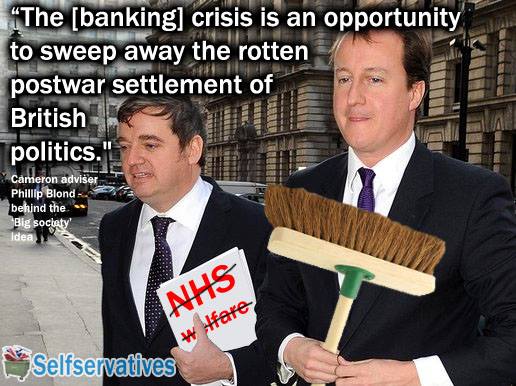
The IFS report conclusions simply confirm what many of us have suspected since 2012: that the government have a secret long-term aim to completely dismantle the social gains of our post-war settlement: the welfare state, affordable social housing provision, the National Health Service and access to justice through legal aid.

proper Blond
Picture courtesy of Robert Livingstone

Thousands of disabled people have lost their specialist Motability vehicles because of Conservative benefit cuts and many more are likely to be affected

westminster-20121020-00081


In 2012, Esther McVey, then the Minister for people with disabilities, as good as admitted there are targets to reduce or remove eligibility for the new disability benefit Personal Independent Payment (PIP), which was to replace Disability Living Allowance. How else could she know in advance of people’s reassessment that 330,000 of claimants are expected to either lose their benefit altogether or see their payments reduced as she had informed the House of Commons?

This was a clear indication that the new assessment framework was designed to cut support for disabled people. A recent review led the government to conclude that PIP doesn’t currently fulfil the original policy intent, which was to cut costs and “target” the benefit to “those with the greatest need.”

That basically meant a narrowing of eligibility criteria for people formerly claiming Disability Living Allowance, increasing the number of reassessments required, and limiting the number of successful claims. The government have used the review to attempt to justify further restrictions to PIP eligibility, aimed at cutting support for people who require aids to meet fundamental needs such as preparing food, dressing, basic and essential personal care and managing incontinence. “Greatest need” has become an ever-shrinking category under Conservative austerity measures. 

McVey also said that around 200 disabled people in every parliamentary constituency were likely to lose their Motability vehicle when she changed the qualifying walking distance limit from 50 metres to 20-metres. 

And she pointed out that one of the Department for Transport’s own publications, Inclusive Mobility, recommends that “seating should be provided on pedestrian routes at intervals of no more than 50 metres, and that parking spaces for blue badge holders should preferably be provided within 50 metres of the facilities they serve”.

The Motability Scheme helped around 650,000 disabled people to lease specialist cars, wheelchairs and scooters. Anyone on the highest level of the Disability Living Allowance (DLA) was entitled to join the scheme which also helped to pay for expensive adaptations. Motability provides financial help (grants) to disabled people who would not otherwise be able to afford the vehicle or adaptations they need, and the charity undertakes a range of fundraising activities to contribute to the provision of financial help to those Scheme customers whose allowance does not cover the cost of the mobility solution that they need.

Last year, Motability revealed that around 100 disabled people claiming PIP are losing their crucial vehicle benefit every week.

According to Motability, who lease specialised cars and powered wheelchairs to disabled people, 3,000 out of 8,000 of their customers who have so far been reassessed for PIP, who were previously claiming the Disability Living Allowance, have lost their eligibility for the scheme and have therefore had to give up their vehicles.

Motability raised concerns that the government reforms to DLA would affect many more. It has.

Nearly 14,000 disabled people have had their mobility vehicle confiscated after the changes to benefit assessment, which are carried out by private companies. Many more, yet to be reassessed, are also likely to lose their specialised vehicles.

Under the new PIP rules thousands more people who rely on disability allowance to keep their independence are set to lose their vehicles. Many had been adapted to meet their owners’ needs and many campaigners warn that it will lead to a devastating loss of independence for disabled people.

A total of 45% or 13,900 people, were deemed as not needing the higher rate of PIP, and therefore lost their vehicles after reassessment. And out of the 31,200 people who were once on the highest rate of DLA who have been reassessed, just 55%, or 17,300 – have kept their car.

Given that many Motability vehicles are specially adapted to meet the highly individual needs of each person, I wonder what happens to all of those vehicles that are lost under the new restricted benefit eligibility criteria.

Around 51,200 disabled people have joined the Motability scheme using their PIP. Around 360,000 more people will undergo PIP reassessments and that will include “indefinite” or “lifetime” awards under the original DLA support.

Perhaps the government expect that severely and chronically ill people will miraculously recover, their progressive illness will stop progressing, maybe people will grow new limbs, find cures of their own where medical professionals and drug companies have failed and battle their “choice” of disability alone.

Being disabled is very expensive. The charity Scope has calculated that disabled people pay a huge financial penalty over and above the everyday living costs faced by the typical able-bodied person – on average £550 per month. One in ten pay more than £1000 a month over the odds.

Expenses range from door-to-door taxis to get around, extra heating costs, pricey specialist items like wheelchairs, hoists, or stair lifts. There may be extra laundry costs, continence aids, special dietary requirements, a need for home help and meals on wheels. Some disabilities place more wear and tear on shoes and clothing, some people need suitable kinds of footwear. Non-prescription medical items are also an additional cost. These are just a few examples of extra expenses. There are many more that most able-bodied people wouldn’t ever need to think of.

Liz Sayce, chief executive of Disability Rights UK, said: “Being disabled costs money.

The Personal Independence Payment is supposed to help with those costs, but many people are being denied the benefit because they are not assessed properly. Sometimes that means people lose their cars; a massive blow which impacts on their ability to remain independent, take part in their communities or get and keep a job.”

Recent research revealed that of all the appeals related to PIP, 60% of tribunals have ruled in the claimant’s favour.

Motability provides a support package, including a £2,000 grant, to anyone forced to leave the scheme following a PIP reassessment.

The charity added: “This helps individuals to remain mobile, in many cases by purchasing a used car. Motability has already provided some £16m in support through this transitional package.”

The Conservative claim that “Government is committed to supporting the most vulnerable” doesn’t stand up to scrutiny, given the Conservative policy record, including cruelly scrapping the Independent Living Fund, which has had a hugely negative impact on those trying their best to lead independent and dignified lives, and the Access To Work funding has been severely cut, this is also a fund that helps people and employers to cover the extra living costs arising due to disabilities that might present barriers to work. 

Mr Duncan Smith said at the Conservative conference last year that many sick and disabled people “wanted to work” and that the Government should give them “support” to find jobs and make sure the welfare system encouraged them to get jobs. I’m wondering what the word “support” actually means to Conservatives, because there’s every indication that over the past five years, there has only been a withdrawal of essential support and lifeline benefits from those who need them the most.

Article 19 of the United Nations Convention on the rights of persons with disabilities states that persons with disabilities have access to a range of in-home, residential and other community support services, including personal assistance necessary to support living and inclusion in the community, and to prevent isolation or segregation from the community. Article 20 states that Parties shall take effective measures to ensure personal mobility with the greatest possible independence for persons with disabilities, including by:

a) Facilitating the personal mobility of persons with disabilities in the manner and at the time of their choice, and at affordable cost;

b) Facilitating access by persons with disabilities to quality mobility aids, devices, assistive technologies and forms of live assistance and intermediaries, including by making them available at affordable cost;

c) Providing training in mobility skills to persons with disabilities and to specialist staff working with persons with disabilities;

d) Encouraging entities that produce mobility aids, devices and assistive technologies to take into account all aspects of mobility for persons with disabilities.

Article 28 requires that States Parties recognise the right of persons with disabilities to an adequate standard of living for themselves and their families, including adequate food, clothing and housing, and to the continuous improvement of living conditions, and should take appropriate steps to safeguard and promote the realisation of these rights without discrimination on the basis of disability.

It’s difficult to see how the government’s cuts to lifeline disability benefits can possibly be consistent with their obligations to uphold human rights law. 


images

Mother who faced bedroom tax eviction after son’s suicide found hanged with note to David Cameron

An inquest has heard that Frances McCormack, a 53-year-old school cook, had been hounded for bedroom tax payments since the tragic suicide of her 16-year-old son, Jack Allen, in 2013. A handwritten note, dated 10 days before her death, was found in her bedroom, part of which was addressed to David Cameron, outlining the hardships and distress that the Bedroom Tax was causing her.

Ms McCormack’s body was discovered by her close friend Natalie Richardson at her home in Maltby, near Rotherham.

An eviction notice was served on Ms McCormack the day before her body was discovered, the court heard.

Frances McCormack had been helping Rotherham Council with its suicide prevention work following the tragic suicides of an increasing number of local young people.

Her ex-husband Jimmy Allen said after the inquest: “She was a strong-willed woman and a good, loving mother. This was a totally unseen body blow to the family.”

Close friend Natalie Richardson told the Doncaster inquest: “Frances had spoken to me previously about the property.

“She wanted to buy into it, it was where the three boys were raised and where Jack took his last breaths, ate his last meal and spoke his last words.

“She was a very strong woman, very strong minded. I felt she was getting a lot better with herself. She had decided to go out a bit more, she had started going to the gym, she was very focused and always had something to do.

“She never gave me any kind of inkling and was strong for me when my partner passed away. She was my rock.”

A Department for Work and Pensions spokesman said: “Our sympathies are with the family of Ms McCormack. This is a tragic and complex issue and it would be misleading to link it to one cause.”

The cause of Frances McCormack’s suicide was the distressing impact of a cruel and punitive policy that is intentionally designed to target our poorest and most vulnerable citizens. Frances was already vulnerable because she was grieving her son. But she was also bravely supporting others, in her contributions to suicide prevention work. It must have been profoundly distressing to receive notice that she was to be forced out of her family home.

How many more suicides will it take before this souless, indifferent government recognise the all too often devastating consequences of their “reforms” and engage with citizens, honestly and openly investigating their accounts, and those of campaigners, academics and professionals? There is an established correlation between Conservative austerity cuts and an increase in suicides and deaths that demands urgent investigation.

Surely what is needed, instead of a wall of oppressive political denial, is a democratically accountable impact assessment of the Conservative’s draconian and ideologically-driven policies. Denying other people’s experiences of inflicted political cruelty is the hallmark of Despotism. It’s not the behaviour one would expect from an elected government in a first-world liberal democracy.

Recent research by Iain Duncan Smith’s own department showed 78% of bedroom tax victims were penniless by the month’s end and at least half had to turn down their heating.

The study report was released on December 17 – the very last day of parliament before the Christmas break.

The Labour Party have confirmed the report was received by the Department for Work and Pensions on December 8 and signed off completely for publication on December 11.

A Department for Work and Pensions spokesman insisted it was standard practice for there to be a week’s delay between reports being received and published online.

But the shadow work and pensions secretary Owen Smith said: 

“The Tories are right to be ashamed about a report showing the Bedroom Tax is driving people deeper and deeper in to poverty.

“Iain Duncan Smith should show some decency, by being honest about the damage his hated policy is causing. Then listen to Labour’s calls to scrap the Bedroom Tax at once.”

The government released 36 ministerial statements – compared to three or four on an average day – in a mountain of information on the last day of Parliament before Christmas. Anyone would think the Conservatives want to avoid any democratic scrutiny or accountability.

Alison Garnham of the Child Poverty Action Group said:

“The DWP’s own evaluation finds the ‘bedroom tax’ is not only pushing families into hardship but it’s also failing to free up more accommodation for families – the key argument ministers used to justify this controversial policy.

“This is a long and deep look at a hugely controversial policy – it really should not have been released just as MPs rise for Christmas.”

Department for Work and Pensions sources maintain that the bedroom tax is “fair”, claiming that it was “wrong” that “taxpayers had to “subsidise” benefit claimants to live in houses that are “larger than they require.”

However, most benefit claimants have actually worked or are working in low paid jobs, and have therefore contributed to their own provision.

It would be far more reasonable, credible and valid to object to the “taxpayer” having to subsidise big businesses who are avoiding paying their taxes. The public are paying for a grotesquely greedy level of bonuses and multimillion figure salaries awarded to incompetent private sector CEOs. Only a quarter of government revenue comes from income tax, with much of the rest coming from national insurance and indirect taxes such as VAT, paid by the population as a whole, including by those people needing social security. But tax avoidance is widespread amongst much of the corporate and wealthy elite that benefits so much from state handouts. There’s a real “culture of entitlement” that the Conservatives happily endorse. And it is costing us far more than the welfare state, established for those in need, after the war.

In the Conservative benefit-cutting climate of austerity Britain, one of the wealthiest nations of the world, disability charities have reported that the despicable scapegoating “scrounger” rhetoric has provoked a significant surge in abuse and hate crime towards disabled people. But the behaviour of state-funded private contractors such as G4S and Atos must surely raise the question of who the “scroungers” really are.

In April 2014, Atos was forced to abandon their contract with the government because of a growing backlash, but not before they had syphoned off very large sums of public money. Meanwhile, sick and disabled people have had their support brutally slashed to the bone, people have died as a consequence of that. Yet our welfare state is being used as a sporting arena for big business profit-making, eating up public funds that were supposed to help people who have encountered difficulties meeting their basic needs through losing their job or becoming ill. Now there is a cause for public and political outrage.

The selling of our public services and lucrative contracting out of state functions to private companies who exchange public money for a notoriously poor service is a prominent feature of Tory “small state” Britain. Tax-funded corporate welfare has never been more generous. Another such woefully inept business is A4e, a welfare-to-work company dogged by controversy over poor performance and corruption. Former chairman Emma Harrison paid herself £8.6m in dividends, all courtesy of the taxpayer. In February 2014, four former A4e employees admitted committing acts of fraud and forgery after charging the state for working for clients that did not even exist.

The Conservative’s draconian policies, which they claim were intended to “solve” Britain’s housing crisis, have done nothing but actually make it worse. The Tories have overseen the withdrawal of the right to lifetime tenancies, introduced a dubious “help to buy” guarantee that further inflates housing costs and they have imposed an arbitrary benefits cap, applied indiscriminately whatever a family’s size or needs, which will see an exodus of poorer people, effectively bringing about a “social cleansing” of the capital and other major cities.

Few groups have suffered more than disabled people from this government’s five years in office. Though the human rights of women and children have also been violated by this government’s grinding and unrelentlessly discriminatory legislative machine.

I wrote earlier about the grave concerns regarding the impact of the next round of proposed housing benefit cuts on the most vulnerable social groups from within the housing sector. A specialist housing association has warned that people under the age of 35 in mental health accommodation face rent shortfalls of almost £200 a week under  government plans to cap housing benefit for social housing tenants at Local Housing Allowance rates. Financial modelling shows that at least 95 per cent of supported housing providers would be forced to evict their tenants if the government succeeds in slashing housing benefits.

Capping benefits at the level of Local Housing Allowance (LHA), the council-administered benefit for people in the private rented sector, would affect almost everyone in supported housing.

Every single Tory austerity measure targets the most vulnerable and those citizens with the very least to lose, and not “those with the broadest shoulders,” as Cameron claimed would be the case in 2010.

Charities, mental health professionals, campaigners and researchers have warned the government that austerity cuts are causing mental distress and are linked to rise in suicides.  Research published in September 2015 by Mind, the UK’s largest mental health charity, reported that for people with mental health problems, the Government’s flagship back-to-work scheme, the Work Programme, made their distress worse in 83 per cent of cases. 

A letter, published before the 2015 election, signed by 442 professionals ranging from psychologists to epidemiologists, stated:

“The past five years have seen a radical shift in the kinds of issues generating distress in our clients: increasing inequality and outright poverty, families forced to move against their wishes, and, perhaps most important, benefits claimants (including disabled and ill people) and those seeking work being subjected to a quite new, intimidatory kind of disciplinary regime.”

Psychologists Against Austerity, an alliance of mental health professionals, formed with the aim of directly challenging the cuts and welfare changes that they said were adding to mental distress. The group produced a briefing paper that includes five “austerity ailments” that contribute to worsening mental distress and despair. These are: humiliation and shame, instability and insecurity, isolation and loneliness, being trapped or feeling powerless, and fear and distrust.

The government continue to deny any “causal link” between their draconian policies and an increase in suicide, refusing to carry out an investigation into the impacts of their callous legislative authoritarianism that not only treats our poorest and most vulnerable citizens with disgusting contempt, but also systematically and shamefully contravenes their human rights.


2014-02-17-BurdenoftheCuts-thumb

Infantilizing the nation – an insight into Conservative ‘paternalism’

                                               hqdefault                                                 Young Bullers


Paternalist parenting classes? Heaven forbid

The Prime Minister claims that every family needs help in improving behaviour and discipline. Ironically, this is from a politician who claims to despise the “nanny state”. He much prefers the Bullingdon brand of paternalist interference in people’s everyday lives. Cameron is also recommending “parenting classes” for all, which is understandable given his own strong instincts as a parent. He left his own child in a pub, after all.

Of course Cameron feels that it’s other people that need parenting and discipline. After all, this is a man who spent his early adulthood involved in bizarre initiation rituals, patriarchal debauchery, recklessly banqueting, getting drunk, trashing college rooms and pubs, listening to Supertramp and smoking pot with James Delingpole and vandalising restaurants. In 2013, it was reported that members of the Bullingdon Club were required to burn a £50 note in front of a beggar as part of an “initiation ceremony”. How encouraging to see the elite showing responsibility, compassion, a concern for social justice and cohesion, equality and alleviating poverty, at an early age.

Now that’s a real deviant subculture.

The draconian sentences handed down to the rioters in 2011, advocated by Cameron –  like the 23-year-old student with no previous convictions who was jailed for the maximum permitted six months after pleading guilty to stealing bottles of water worth £3.50 from Lidl in Brixton, for example –  shows only too well that he believes there is one rule for the Oxford elite and another for the rest of the society. Punishment is a central component of the social order and a means by which social order is produced and maintained.

Actually, defining others as deviant is, too. It’s a Conservative means of enhancing social power and status differentials by degrading the rule-breaker’s status and power.

Cameron’s response to the riots reflects a characteristically Bullingdon conservative disdain: an authoritarian, strict and oppressive approach towards perceived, labelled and stigmatised subordinates. Conservatives have always seen the social world as being organised in terms of hierarchies of worth. Smashing up a pub or restaurant and causing 10k worth of damage is no problem if you can cough up the costs on the spot to keep your thuggish behaviour private, hidden away from the scrutiny of the legal system and the public. Money talks and bullshit struts.

The Conservatives inform us that it is bad parents that cause poverty, opting for a rhetoric of authoritarian populism, creating cardboard monsters, manufacturing folk devils and moral outrage for the tabloids, making excuses for the consequences of their own prejudiced and damaging policy-making.

The establishment is a kind of Moebius strip of finger-pointing, arrogant, moralising privileged and feckless bullies passing the buck. And importantly, these wayward boys and girls always get their own way. They can’t democratically govern the country; they lack the social skills, motivation, developmental and emotional capacity to actually engage in any genuine and democratic dialogue with ordinary people, so they rule. Conservatives have always prefered the simplicity of a socio-economic system defined by inherited social ranks.

Cameron says that the government’s Life Chances Strategy – an “initiative to target tackle child poverty” – will include a plan for “significantly expanding parenting provision”. It will also recommend ways to “incentivise” all parents to take up the offer of classes. The hope is, presumably, that if the middle class take Cameron up on his offer of state parenting instructions, the process of social norming will provide the foundation of state-defined “correct behaviours” for the insubordinate working classes, who are perpetually caught up, according to the Tories, in a pathological cycle of something or other, and therefore need state therapy from elitist antipodean role models to set them straight and put them in their place. It’s the new behaviourism: do as we say, but not what we do.

It seems that poverty is to be addressed with nothing more than a paternalist brand of cheap psychopolitics. The government won’t be dipping their hands into the treasury, which is what’s needed. Instead they prefer to employ shabby techniques of persuasion aimed at indoctrinating a Conservative world-view and enforcing conformity as a replacement for genuinely needs-led and evidence-based policies.

At no point does Cameron mention any commitment to improving people’s standard of living, or ensuring that families have a basic level of income in order to meet their fundamental needs, such as food, fuel and shelter – because struggling to meet basic material needs are the main barriers for people experiencing poverty. It’s sobering to consider that the Tory obsession with the work ethic, embodied in their mantra “making work pay”, is nothing more than a meaningless glittering generality, that purposefully diverts attention from elitist policy-making, and subsequent growing poverty and inequality.

Around half of those who are in poverty and of working age live in a household where at least one person works. The steady drop in real wages since 2010, according to the Office for National Statistics, is the longest for 50 years.

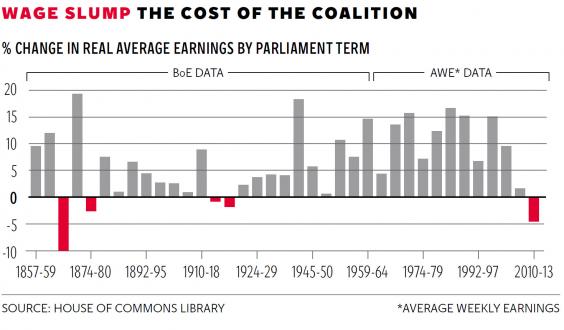
Furthermore, since 2010, the decline in UK wage levels has been amongst the very worst in Europe. The fall in earnings under the Coalition is the biggest in any parliament since 1880, according to analysis by the House of Commons Library, and at a time when the cost of living has spiralled upwards.

Ah, and Cameron uttered that inane managementspeak word again – “incentivise”. It never bodes well when Conservatives use that word. It means he has been listening to the psychobabbling of the Nudge Unit, again. Welfare sanctions, which are the punitive withdrawal of lifeline benefits from people who need to claim welfare support to meet their basic needs are claimed to “incentivise” people to find a job, despite empirical evidence to the contrary, and the cuts to child tax credit, limiting support to just two children, are based on the charming and archaic eugenicist idea that poor people ought to be “incentivised” to have fewer children.

Rich people are apparently “incentivised” by large cash carrots, but poor people just get the brutal, merciless stick. What a classic example of flagrant Conservative ideological incoherence.

Psychopolitical paternalism doesn’t address poverty, it is simply a way of apportioning blame, of abdicating political responsibility and ensuring that poor people accept the Conservative and neoliberal decree that they somehow deserve to be poor.

Cameron claims that:

“Families are the best anti-poverty measure ever invented. They are a welfare, education and counselling system all wrapped up into one. Children in families that break apart are more than twice as likely to experience poverty as those whose families stay together. That’s why strengthening families is at the heart of our agenda.”

The announcement from Cameron was welcomed by Relate, whose chief executive, Chris Sherwood, said:

“Relationship support can help to reduce family breakdown, which is a key driver of poverty and can result in poor outcomes for children.”

Actually, family breakdown is quite often a consequence of poverty, not a cause of it. Back in 2010, Fergus Drake, director of UK programmes with Save the Children expressed an unease that many of us felt, regarding the Conservative’s feckless drive to offload the responsibility for poverty onto poor people, who are casualities of the consequences of neoliberalism, which extends discriminatory economic policies. He said:

“We would say poverty causes family breakdown rather than vice versa. If you are worried about putting food on the table, or being able to turn on the heater so you can have a hot bath, the stress that causes to a relationship can make things really difficult.”

Poverty isn’t caused by family breakdown, it’s caused by discriminatory policies and social insititutions that extend and perpetuate inequality. We are now the most unequal country in the European Union, and even more unequal than the US. If Cameron really wanted to address childhood poverty, he would ensure that people have enough to meet their basic needs, instead of steadily withdrawing welfare support and cutting public services. He should end the class-contingent austerity that his government have imposed on only the poorest people.

Tim Nichols, of the Child Poverty Action Group, agrees that the Conservatives should be careful not to confuse causes and consequences. He says:

“We don’t think that this is robust strategy. Tackling child poverty can’t be done without more redistribution.”

Cameron is talking ideologically-driven nonsense, reflecting traditional Tory prejudices. This government has become obsessed with moralising about and manipulating individual agency, which is increasingly seen as being to blame for high levels of poverty and social exclusion in the UK, which are created entirely by callous, discriminatory political policies. Political gaslighting does not help people out of poverty.

People are poor because they don’t have enough money to meet their needs. That is what Cameron needs to acknowledge and address.

Parenting and elitist-authoritarian ideology

Cameron’s paternalist-authoritarian turn was evident back in 2010, when he said that:

“Discipline is the foundation of a good education. Headteachers need to decide on exclusions.”

Most people that have worked in either formal or informal education settings are very aware that using punishment and threats is very counterproductive. Making young people suffer in order to change their future behaviour can often elicit temporary compliance, but this strategy is highly unlikely to lead to conversion or to help children become ethical, responsible decision makers in the long term. Punishments don’t involve any engagement of deliberative processes.

Punishment, even if referred to euphemistically as “consequences,” tends to generate oppositional behaviours, anger and defiance.  Furthermore, it models the use of power rather than reason and damages the important trust-based relationship between adult and child.

Authoritarian models of parenting are emotionally and physically traumatising. There’s an Old Testament brand of harshness in conservative authoritarian approaches to human behaviours.

Authoritarian parents often have prejudices based on wealth and what may be defined as “achievement”, gender, class and race. They tend to be highly competitive, lacking warmth and empathy. They teach their children to compete at all costs, and to win by whatever means. Most authoritarians are behaviourists, with a preference for punishments rather than rewards to control others.

Authoritarians tend to advocate corporal punishment, they see freedom as chaotic, they can’t tolerate ambiguity or recognise the complexities and subtleties of human conduct, and they tend to advocate capital punishment.

Because authoritarian parents expect absolute obedience, children raised in such settings are typically very good at following rules.

However, they often lack self-discipline. Children raised by authoritarian parents are not encouraged to explore and act independently, so they never really learn how to set their own limits and personal standards.

Whilst developmental experts agree that rules, boundaries and consistency are important for children to have, most believe that authoritarian parenting is too punitive and lacks the warmth, unconditional love, safety, trust and nurturing that children need.

Of course public schools also foster authoritarianism and elitism. Boarding school: the trauma of the ‘privileged’ child by Joy Schaverien explores the emotional deprivation and abuse that many experience as a result of public school culture. Psychotherapist Nick Duffell (2000) wrote a book based on workshops he has conducted over ten years with adults who attended boarding schools as children. He has identified many lasting pathological psychological patterns common in those he calls Boarding school survivors.

In his recent work: Wounded Leaders: the Psychohistory of British Elitism and the Entitlement Illusion, Nick says:

“A cherished national character ideal, eschewing vulnerability and practising a normalised covert hostility based on bullying in the dorm adversely affects even those who did not have the privilege of such an education. It leaves Britain in the social and emotional dark ages, led by “the boys in the men that run things.

This specific culture of elitism, protected by financial interests and the “It never did me any harm” syndrome, means that Britain is unlikely to foster the kind of leadership necessary in our world of increasing complexity, which needs a communal mindset and cooperative global solutions. But worse, new scientific evidence shows that this hyper-rational training leaves its devotees trapped within the confines of an inflexible mind, beset with functional defects, presented here as the Entitled Brain.”

It’s a sobering thought that so many boarding school survivors – psychologically and emotionally damaged individuals – are involved in running the country and determining the terms and conditions of our lives.

002fc17b9115fe26a6ed5d9d58b1ece1.603x472x1


I don’t make any money from my work. My articles are free. If you like, you can make a donation to help me continue to research and write free, informative, insightful and independent articles, and to provide support to others. The smallest amount is much appreciated – thank you.

DonatenowButton

Conservative governments are bad for your health

proper Blond 

Context: the politics of blame

Increasing employment and pushing ill and disabled people into work are key elements of the UK Government’s public health and welfare “reform” agendas. The arguments presented for this approach are primarily economic and particularly, moralistic. The reasoning presented is not founded on biological, psychological or sociological evidence. The government maintains that work is the most effective way to improve the wellbeing of individuals, their families and their communities. There is a perception that unemployment is harmful to physical and mental health, so the corollary has been assumed – that work is beneficial for health. 

However, that does not necessarily follow, and to claim that it does is distinctly unscientific and irrational. As the Conservatives themselves have often pointed out in less appropriate circumstances in order to avoid democratic accountability and responsibility, there is a difference between an association and a causal relationship.

There is a clear ideological context from which the welfare “reforms” proceeded, and the politically-directed media campaigns that have purposefully stigmatised and outgrouped unemployed people demonstrates quite clearly that reducing welfare support is not about a politically calculated extension of social inclusion and social justice policies, Conservative bonhomie, or overall concern for the wellbeing of welfare recipients and people who are disabled.

The government are attempting to entrench neoliberal ideology in our culture by co opting GPs, social workers and other professionals as agents of the state. The idea that “work is a health outcome” has been embedded in policies such as the Orwellian renaming of sick notes (now “fit notes”), which are designed to explore what work a person who is absent from work because of illness may undertake.  However, the government intend a much more far-reaching outcome than simply attempting to reduce the sick “role” and recovery time. The government’s “behavioural change” agenda has become a centrally-orchestrated programme for governance. The provision of public goods and crucial support, from housing and discretionary housing payments to employment benefits and disability support is becoming increasingly conditional. 

Political rhetoric, aimed at perpetuating an extremely divisive and intentionally misleading “strivers and skivers” dichotomy is designed to undermine public support for the welfare state and the other gains of our post-war settlement – the NHS, legal aid and social housing for example – also betrays the lack of coherence, rationality and empirical support for the Conservative’s “reforms.” Furthermore, the extremely targeted, class-contingent and punitive nature of the Conservative austerity programme indicates that the welfare “reforms” were founded on traditional Tory prejudices, rather than on any genuine causal relationship based on empirical evidence and social or economic necessity.

This explains why the government have persistently ignored the many evidence-based concerns raised by academic researchers, campaigners and opposition MPs that their austerity policies are having an extremely harmful effect, most often on our poorest and most vulnerable citizens.

The Conservatives are ideologically bound to notions of a small state, minimal levels of political responsibility and intervention, minimal levels of government spending, the heavy promotion and administration of privatisation, competition, fiscal austerity, deregulation and free trade in order to enhance the role of the private sector in the economy, all of which are the central strands of the neoliberal hegemony. Conservative ideology runs counter to any notion that all citizens must be treated fairly, which also means that they must be given equal economic opportunities and provided with a adequate minimum standard of living. Neoliberal ideology is incompatible with a human rights-based society.

Democracy exists partly to ensure that the powerful are accountable to the public, and particularly to our most vulnerable citizens. This government have blocked that crucial exchange, and show disdain for human rights, the welfare state and the NHS, all of which provides ordinary people and the most vulnerable citizens basic protection from those in power.

Conservatives despise human rights and rights-based social provision. They absurdly claim that welfare provision causes vulnerability, and a “culture of dependency,” despite the fact that there is absolutely no empirical evidence to support this view. History has consistently taught us otherwise. The Conservative’s policies are expressions of contempt for the lessons and empirical evidence from over a century of social history and administration.

Tory rhetoric is designed to have us believe there would be no poor people if the welfare state didn’t somehow “create” them. If the Conservatives must insist on peddling the myth of meritocracy, then surely they must also concede that whilst a neoliberal system has a few beneficiaries, it also creates situations of insolvency and poverty for many others. That is what a system based on competitive individualism is about: it creates a few “winners” and a lot of others lose.

Conservative cuts are based on nothing more than the ridiculous myth that poverty is somehow a lifestyle choice or a moral failing which people can be punished or starved out of. The new Tory neoliberal “paternalists” really seem to believe that if they make life for poor people insufferable, they will simply be “incentivised” to choose to be wealthier. It’s a thinly disguised revamp of the ill-conceived 1834 Poor Law deterrence principle of “less eligibility” – that was supposedly aimed at “making work pay” too. But it didn’t. It’s not possible to frighten and punish people out of poverty. Only a Conservative government would claim to be making work pay by cutting welfare down to the bare bones, rather than increasing wages. The welfare cuts have actually had the effect of driving down wages too.

Of course, by framing the issue of poverty in terms of personal responsibility and morality, the Conservatives have stifled debate and restricted public discussion in the hope that people won’t recognise the wider structural inequalities and economic failings, for which this government are solely responsible.

Debbie Abrahams said: “The Conservatives point the finger at sick and disabled people for the rise in spending. They are still shamelessly spinning their tired “shirkers” and “strivers” narrative, designed to whip up public support for cuts to the most vulnerable. But this divisive rhetoric can no longer conceal the fact their economic strategy has failed. It is the government’s failure that has led to rising social security costs. 

As we saw at the Autumn Statement (2016), borrowing is up, growth is down, deficit targets have been hopelessly missed and wages have flat-lined. At the same time, the government has refused to tackle the driving forces behind increased social security spending, from low pay to high housing costs. Instead, the government is slashing support to those who need it most, exacerbating the financial strain so many are facing this Christmas, and failing its own targets in the process.   

[…] Research by the Joseph Rowntree Foundation suggested that we need to be building 80,000 affordable homes a year to meet demand and keep the current spend on housing benefit stable. This government managed a pathetic 30,000 homes last year. It is this refusal to build enough homes that keeps the housing benefit bill growing. People are left struggling to find somewhere affordable to live, and the state is forced to subsidise the sky-high rents charged by private landlords 

We could also look at tax credits, which currently make up more than £20bn a year in the spending under the cap. Tax credits top up working people’s pay where it is insufficient. Wages today are lower than they were in 2008, and won’t even return to the levels of 2008 until 2021. A record six million workers are paid less than the living wage. This is why tax credit costs have risen – because the government has had to increase the amount spent on topping wages up. 

Labour founded the welfare state to give pensioners and disabled people dignity, to prevent homelessness, children going hungry, and to cover for periods of unemployment or ill-health. It was never designed to be spending tens of billions substituting for low-wage employers or subsidising rip-off landlords.”

Economic productivity is the new health outcome

The claim that “work is good for you” is allegedly based on “scientific evidence” that people in work tend to be healthier than those claiming unemployment and sickness benefits. However, to draw the conclusion that “employment is good for you” from the data is an example of inferring causality inappropriately, from what is only an association. Yet it is being used to prop up Conservative justifications for dismantling the welfare state.

Unemployment has been linked to increased rates of sickness, disability and mental health problems, and to decreased life expectancy. The claim has also been made that it results in an increased use of medication, medical services, and higher hospital admission rates. However, surely it makes much more sense to say that sickness, disability and mental health problems, the use of medication, medical services, and higher hospital admission rates all cause unemployment, rather than the converse. This government seem to have a major problem accepting the fact that sometimes, people really are simply too ill to work.

Most people who are too ill to work are obviously not as healthy as those who can work. That is hardly controversial. However, that doesn’t mean that work itself is good for your health, it just means those who don’t work tend to have worse health than those who do. People don’t work because they have poor health.

Linking ill health with “worklessness” is an ideological preference which ignores other variables. It is much more likely that the “reforms”, which have reduced welfare provision to inadequate levels – leaving people all too often unable to meet their basic needs – is bad for health, rather than being out of work. 

But the Conservatives have used this “evidence” of an association between poor health and unemployment to make an inference based on a “causal link” that hasn’t actually been empirically verified. Iain Duncan Smith has made the claim, for example, that “work is good for you.” He has even claimed that work can make people’s health problems “better.” But that isn’t very likely to be true. It’s akin to claiming that chatting and exercise is a cure for multiple sclerosis, lupus, blindness or cancer. Or that a work coach on prescription will cure rheumatoid arthritis, a disc prolapse or schizophrenia.

This is why I visit my doctor when I am ill, and not Iain Duncan Smith or the government.

The claim that work is good for your health is simply a part of Tory justification narratives for cutting support for sick and disabled people, and hounding people who need to claim benefits. Yet this axiom informs current UK policy towards increased benefit conditionality, harsh sanctions, compulsory work experience and the “workfare” or “work-for-benefits” thinking which the Conservatives favour. However, this is an approach that can never work, unless, of course, the aim is to completely dismantle the welfare state. Oh, hang on…

The biopsychosocial model

The biopsychosocial model (BPS) of ill health is not without controversy, although many see it as more pragmatic or humanistic than the medical model of illness, which came to be regarded as reductionist and deterministic. The biopsychosocial model is the conceptual status quo of contemporary psychiatry, and many believe that it has played an important role in combatting psychiatric dogmatism.

The biological component of the model is based on a traditional allopathic (bio-medical) approach to health. The social part of the model investigates how different social factors such as socioeconomic status, culture and poverty impact on health. The psychological component of the biopsychosocial model looks for potential psychological causes for a health problem such as lack of self-control, emotional turmoil, and negative thinking.

Of course a major criticism is that the BPS model has been used to disingenuously trivialise and euphemise serious physical illnesses, implying either a psychosomatic basis or reducing symptoms to nothing more than a presentation of malingering tactics. This ploy has been exploited by medical insurance companies (infamously by Unum Provident in the USA) and government welfare departments keen to limit or deny access to medical, social care and social security payments, and to manufacture ideologically determined outcomes that are not at all in the best interests of patients, invalidating diagnoses, people’s experience and accounts, and the existence of serious medical conditions. (See also: Getting rich on disability denial, and  A Tale of two Models by Debbie Jolly.)

Unum was involved in advising the government on making the devastating cuts to disabled people’s support in the UK’s controversial Welfare Reform Bill. (See also: The influence of the private insurance industry on the UK welfare reforms.)

This is a government that tends to emphasise citizen responsibilities over rights, moralising and psychologizing social problems, whilst quietly editing out government responsibilities and democratic obligations towards citizens.

For example, poverty, which is caused by political decisions affecting socioeconomic outcomes, is described by the Conservatives, using elaborate victim-blame narratives, and this is particularly objectionable at a time when inequality has never been greater in the UK.

Poverty may only be properly seen in a structural context, including account of the exclusion and oppression experienced by those living in poverty, the global neoliberal order, the gender order, the disability, racial, sexual and other orders which frame social life and precipitate poverty in complex and diverse ways. It’s down to policy-makers to address the structural origins of poverty, not the poor, who are currently regarded as the “collateral damage” – casualities – of politically imposed structural constraints.

Conservative governments are unhealthy

The effects of loss of income on people who can’t work because of illness is a confounding factor, too. How is it possible to isolate the devastating impacts of the Conservative “reforms” and the steady dismantling of the welfare state on unemployed people from the misleading generalisation that unemployment is bad for health? Surely if the Conservatives genuinely believed their own claims, they would be more inclined to increase rather than radically decrease provision and support for unemployed people.

Of course, not all work is beneficial. The review that led to the widespread folk tale that work is good for you is based on research involving people who had common and minor illnesses, and fulfilling, secure jobs. That doesn’t reflect the experiences of many people.

Not all jobs are rewarding and positive experiences, and some work can cause serious risks to health.

Doctor Frank Scheer, a neuroscientist at Harvard Medical School and Brigham and Women’s Hospital in Boston, says:

“There is strong evidence that shift work is related to a number of serious health conditions, like cardiovascular disease, diabetes, and obesity.

These differences we’re seeing can’t just be explained by lifestyle or socioeconomic status.”

Shift work and poor quality working environments and employment conditions are also linked to stomach problems and ulcers, hypertension, depression, musculoskeletal disorders, chronic infections, diabetes, general health complaints, all-cause mortality and an increased risk of accidents or injury. Long working hours are equally linked with a detrimental impact on health, according to medical research – see: The impact of overtime and long work hours on occupational injuries and illnesses: new evidence from the United States.

There is a growing and potentially corrosive problem of low paid, poor quality, precarious and temporary work which threatens levels of social inclusion and, ultimately, the health of the workforce.

Research shows unambiguously that the psychosocial quality of bad jobs is worse than unemployment. Peter Butterworth examined the mental health implications of those moving from unemployment into employment and found that:

“Those who moved into optimal jobs showed significant improvement in mental health compared to those who remained unemployed. Those respondents who moved into poor-quality jobs showed a significant worsening in their mental health compared to those who remained unemployed.”

Overall, unemployed respondents had poorer mental health than those who were employed. However the mental health of those who were unemployed was comparable or superior to those in jobs of the poorest psychosocial quality. (See: The psychosocial quality of work determines whether employment has benefits for mental health: results from a longitudinal national household panel survey.)

More recently, in a letter to the Guardian, the UK’s leading bodies representing psychologists, psychotherapists, psychoanalysts, and counsellors called on the Government “to immediately suspend the benefits sanctions system. It fails to get people back to work and damages their mental health.

Findings from the National Audit Office (NAO) show limited evidence that the sanctions system actually works, or is cost effective.

But, even more worrying, we see evidence from NHS Health Scotland, the Centre for Welfare Conditionality hosted by the University of York, and others, which links sanctions to destitution, disempowerment, and increased rates of mental health problems. This is also emphasised in the recent Public Accounts Committee report, which states that the unexplained variations in the use of benefits sanctions are unacceptable and must be addressed.”

The impact of poverty on health

The largest study of poverty conducted in the UK has laid out the dire extent of British material deprivation – and seriously undercut the government’s claim to be lifting people out of poverty through work.

The Poverty and Social Exclusion in the UK (PSE) project details how, over recent years, the percentage of households living below society’s minimum standard of living has increased from 14% to 33% – despite the fact that the economy has increased in size over the same period. The study found that low wages are a central cause of widespread deprivation. For many people, full-time work is not enough to lift them out of poverty; almost half of the working poor work 40 hours a week or more. And one in six adults in paid work (17%) is poor, suffering low income and unable to afford basic necessities.

Commenting on the study’s findings, Professor Jonathan Bradshaw of the University of York said they showed many parents who work full time still have to make huge sacrifices to try and protect their children from deprivation.

“We already know from DWP data that the majority of children with incomes below the the relative income poverty threshold have a working parent. The PSE survey shows that the majority of deprived children, those lacking two or more socially perceived necessities, and very deprived children (lacking five or more socially perceived necessities) have a working parent.

We found that 65% of the deprived and 58% of the very deprived children had a working parent, and 50% of the deprived and 35% of the very deprived had at least one parent working full-time. Child poverty is not being driven by skivers, but is the consequence of strivers working for low earnings while in-work benefits are being dissipated by government austerity measures.”

Responding to the findings, Clare Bambra, a professor at Durham University, said that the research was a shameful picture of “the devastating and far-reaching human costs of inequality and poverty in the UK today.”

She said:

“It’s shameful for a rich country like ours to be tolerating such levels of poverty especially amongst our children and young people. The mantra that work sets people free from poverty has been shown to be a grand old lie.

We will be living with the long term consequences of this social neglect for decades to come – there are clear links between poverty and reduced life expectancy and higher rates of ill health, especially concentrated in deprived areas and the north.

These findings show us the true cost of austerity.”

Public health experts from Durham University have denounced the impact of Margaret Thatcher’s policies on the wellbeing of the British public in a comprehensive study which examines social inequality in the 1980s.

The study, which looked at over 70 existing research papers, concludes that as a result of unnecessary unemployment, welfare cuts and damaging housing policies, the former prime minister’s legacy includes the unnecessary and unjust premature death of many British citizens, together with a substantial and continuing burden of suffering and loss of wellbeing.

The research shows that there was a massive increase in income inequality under Baroness Thatcher – the richest 0.01 per cent of society had 28 times the mean national average income in 1978 but 70 times the average in 1990, and UK poverty rates went up from 6.7 per cent in 1975 to 12 per cent in 1985.

Baroness Thatcher’s governments wilfully engineered an economic catastrophe across large parts of Britain by dismantling traditional industries such as coal and steel in order to undermine the power of working class organisations, say the researchers. They suggest this ultimately fed through into growing regional disparities in health standards and life expectancy, as well as greatly increased inequalities between the richest and poorest in society.

Professor Clare Bambra from the Wolfson Research Institute for Health and Wellbeing at Durham University, co-author of the research report, commented:

“Our paper shows the importance of politics and of the decisions of governments and politicians in driving health inequalities and population health. Advancements in public health will be limited if governments continue to pursue neoliberal economic policies – such as the current welfare state cuts being carried out under the guise of austerity.”

Thatcher’s policies  have been condemned for causing “unjust premature deaths.” Cameron’s policies are even more class-contingent and cruel.

I think there is a growing body of empirical evidence which indicates clearly that Conservative governments are much worse for public health, prosperity and wellbeing than unemployment.

10407927_677369232332608_5384979058089243718_n

Pictures courtesy of Robert Livingstone


I don’t make any money from my work. I am disabled because of illness and have a very limited income. The budget didn’t do me any favours at all.

But you can help by making a donation to help me continue to research and write informative, insightful and independent articles, and to provide support to others. The smallest amount is much appreciated – thank you.

DonatenowButton cards

UK has shameful but unsurprising levels of inequality


1459720_569627496440116_902730897_n

Austerity was never about what works or what is needed. It’s about traditional Tory class-based prejudices. Austerity is simply a front for policies that are entirely founded on Tory ideology, which is  all about handouts to the wealthy that are funded by the poor.

David Cameron has often denied claims that his party has overseen a rapid rise in inequality. In fact last year, Cameron said that inequality is at its lowest level since 1986. I really thought I’d misheard him. 

This wasn’t the first time Cameron has used this lie. We have a government that provides disproportionate and growing returns to the already wealthy, whilst imposing austerity cuts on the very poorest. How can such a government possibly claim that inequality is falling, when inequality is so fundamental to their ideology and when social inequalities are extended and perpetuated by all of their policies? It seems that the standard measure of inequality has been used to mislead us into thinking that the economy is far more “inclusive’ than it is. Yet the UK is one of the wealthiest nations in the world.

Earlier this year a published report by the Dublin-based Foundation for the Improvement of Living and Working Conditions (Eurofound) stated that the UK has become the most unequal country in Europe, on the basis of income distribution and wages.

The report also says that the UK has the highest Gini coefficient of all European Union (EU) member states – and higher than that of the US. The coefficient is a widely used measure of the distribution of income within a nation, and is commonly used to calculate inequality.

A year ago, the Organisation for Economic Cooperation and Development (OECD) published research that confirmed what most of us already knew: that income inequality actually stifles economic growth in some of the world’s wealthiest countries, whilst the redistribution of wealth via taxes and benefits encourages growth. That debunks one of the nastiest Tory myths. Having long been advocates and engineers of social inequality, implying a mythological  “trickle down” as a justification, and hankering after a savage, axe-wielding minarchism, chopping away at our civilising public services and institutions, they are now officially a cult of vicious cranks. The problem is that the general public don’t pay much attention to research like this. They really ought to.

Conservatism is centred around the preservation of traditional social hierarchy and inequality. Tories see this, erroneously, as an essential element for expanding national economic opportunity. But never equal opportunity.

Conservatives think that civilised society requires imposed order, control and clearly defined classes, with each person aware of their rigidly defined “place” in the social order. Conservatism is a gate-keeping exercise geared towards economic discrimination and preventing social mobility for the vast majority. Inequality is so clearly embedded in policies – which are written statements of political intent.

According to the annual Family Spending Review for 2014, published by  the Office for National Statistics (ONS), the richest 1 per cent of the population have as much wealth as the poorest 57 per cent combined.  Wealth inequality has increased since 2012. The richest 10 per cent own half the country’s wealth.

Charities have urged the government to address Britain’s shameful and growing inequality after the figures published this week show that the country’s richest 10 per cent spend as much on alcohol and cigarettes in a week as the poorest spend on gas and electricity. That turns the dominant “feckless” poor narrative in the media on its head. Poverty doesn’t happen because people have poor budgeting skills. Poverty happens because people don’t have enough money to meet their basic needs.

The richest 10 per cent of households spent more per week on furniture – an average of £43.40 – than the poorest spent on food – £30.40.

The average weekly household spend was found to be £531.30, but there was great variation of this amount between the highest and lowest earning 10 per cent – £1,143.40 and £188.50 per week respectively.

By 2011/12, the poorest fifth of households spent 29 per cent of their disposable income on indirect taxes, compared with 14 per cent paid by the richest fifth. All told, the poorest households pay 37 per cent of their gross income in direct and indirect taxes. In other words, the single biggest expenditure for people in poverty is tax. It is, at the very least, morally unjustifiable to be taxing the poor at such a rate. The most important thing the government can do to help the poor is to stop taking their money.

David Cameron did once tell a truth, though it was an inadvertent Freudian-styled slip. He said: We are raising more money for the rich. Yes. From where, I wonder?

Oh yes. The poor.

 382035_141704259313964_676863845_n


 Pictures courtesy of Robert Livingstone