Tag: conservatives

More allegations of Tory election fraud, now we need to talk about democracy

The Conservative Party are facing another investigation from the Electoral Commission following evidenced allegations that they operated a secret call centre during the general election campaign, breaching electoral law, an undercover investigation by Channel 4 News has revealed. 

An undercover reporter working for Channel 4 News secured work at Blue Telecoms, a company in Neath, South Wales. In an area plagued by unemployment and low wages, the call centre hired up to a hundred people on zero-hours contracts. For weeks, they contacted thousands of potential voters in marginal seats across the UK. 

The hired callers were told to say they were working for a market research company called “Axe Research”. No such company is registered in England and Wales. Furthermore, callers were instructed to say that the call centre was situated in Cardiff, rather than Neath.

The investigation has uncovered underhand and potentially unlawful practices at the centre, in calls made on behalf of the Conservative Party. These allegations include:

Paid canvassing on behalf of Conservative election candidates – illegal under election law.

● Political cold calling to prohibited numbers

● Misleading calls claiming to be from an “independent market research company” which does not appear to exist

The Conservative Party have admitted it had commissioned Blue Telecoms to carry out “market research and direct marketing calls” during the campaign, and insisted the calls were legal.

A Conservative spokesman said: “Political parties of all colours pay for market research and direct marketing calls. All the scripts supplied by the party for these calls are compliant with data protection and information law.”

Under the Representation of the People Act, it is illegal to employ someone “for payment or promise of payment as a canvasser for the purpose of promoting or procuring a candidate’s election”.

Call centre employees working on behalf of the party used a script that certainly appeared to canvass for support on film, rather than conduct market research. On the day of the election, call centre employees contacted voters to promote individual candidates.

Anya Proops, a QC specialising in information law, told Channel 4 that political parties had to ensure that third parties working on their behalf followed the law.

“It’s an illegal practice, it’s prohibited under the legislation and in so far as it’s something which has tainted the overall result in favour of a political candidate, then it can void that result.” 

Blue Telecoms is run by Sascha Lopez. He told The Guardian: “In relation to the Conservative party project, I am unable to comment on the content of the scripts or calls to TPS [Telephone Preference Service] numbers, as the scripts and lists of who to call and when to call were given to us by Conservative campaign HQ in London and were not influenced by my team.”

However, a whistleblower at the call centre told Channel 4 News that they had been making potentially unlawful phone calls to voters. 

Undecided voters were fed key Conservative campaign messages, including references to the Brexit negotiations and warnings about a hung parliament.

On the day that voters went to the polls, undecided voters were told that: “the election result in your marginal constituency is going to be very close between Theresa May’s Conservatives and Jeremy Corbyn’s Labour Party”. Callers were also recorded quoting media articles that were pro-Conservative. Operating from a script, the staff claimed they were carrying out calls for “market research” and “polling”. 

One caller is recorded saying: “It was reported in the Daily Mirror in September last year that Jeremy Corbyn is not concerned about the numbers of people coming to live in the UK and it was reported on Sky News this year that Theresa May has restated her pledge to reduce net Migration.”

People were then asked: “Just thinking about these reports in the media and the reports that you live in a marginal constituency that may determine who is prime minister. So does knowing that you live in a marginal constituency that will determine who is prime minister for the Brexit negotiations, does that make you a lot more likely to vote for Theresa May’s Conservative candidate or a little more likely to vote for Theresa May’s Conservative candidate, or are you still unsure, or does it not make a difference?”

The broadcaster’s evidence suggests that on the day of the election, staff called voters in 10 marginal seats, including Bridgend, Gower, Clwyd South and Wrexham.

As the election campaign started, the information commissioner, Elizabeth Denham, wrote to all the major political parties reminding them of the law around telephone calls and data protection. She said that calling voters to promote a political party was “direct marketing” and was regulated by law.

A week before the election, the same call centre staff started saying they were calling on behalf of Theresa May’s Conservatives.

The Conservative party said the call centre was conducting “market research” on its behalf, and was not canvassing for votes. The call centre confirmed it was employed by the party, but has so far denied canvassing on its behalf. 

The Channel 4 undercover reporter has captured evidence that certainly seems to refute that claim. 

The use of ‘big data’ and psychographic targeting

Teams of statisticians and behavioural psychologists who subscribe to the burgeoning practice of “psycho­graphic targeting” have designed their own version of a Myers-Briggs personality test. The original test explores “the basic differences in the ways individuals prefer to use their perception and judgement.”

The test data is supplemented by recent issue surveys, and information from online surveilance, together they are used to categorise political supporters, who then receive psychologically tailored canvassing messages, social media targeting, phone calls and doorstep visits. The micro-targeting of voters has been around for a while, but the Conservative operation has deepened the intensity of the effort and the use of vast resources of psychological data.

This is the campaign approach from a government that claims to advocate a “small state” and “minimal interventions”. However the methods being used which entail the manipulation and management of public perceptions and voting behaviours resemble those of authoritarian regimes, not a healthy liberal democracy. 

Authoritarian propagandists attempt to convey power by defining reality. The reality they portray is usually very simple. The account of reality is offered with the primary goal of switching voters’ value systems to align with the authoritarian value system.

This whole approach is the logical conclusion of the libertarian paternalists‘ “behavioural change” agenda that has been embedded in policies designed by the nudge unit since 2010 in the UK. The political misuse of psychology has been disguised as some kind of technocratic “fix” for a failing neoliberal paradigm, and paraded as neutral “science”. However, its role as an authoritarian prop for an ideological imposition on the population has always been apparent to some of us, especially given the more visible evidence of political narratives and the stage management of our democracy via an extremely manipulative mainstream media over recent years.

The Conservatives’ behaviour change agenda is designed to align citizen’s perceptions and behaviours with neoliberal ideology and the interests of the state. However, in democratic societies, governments are traditionally elected to reflect and meet public needs. The use of “behaviour change” policy involves the state acting upon individuals, and instructing them how they must be. This is profoundly undemocratic. In fact it turns democracy completely on its head. 

A dark message for democracy

Political “dark” advertising that is only seen by its intended recipients is a much greater cause for concern than “fake news” in the spread of misinformation, because it is invisible to everyone but the person being targeted. This means that the individually tailored messages are not open to public scrutiny, nor are they fact checked.

A further problem is that no-one is monitoring the impact of the tailored messages and the potential to cause harm to individuals. The dark adverts are designed to exploit people’s psychological vulnerabilities, using personality profiling, which is controversial in itself. Intentionally generating and manipulating fear and anxiety to influence political outcomes isn’t a new thing. Despots have been using fear and slightly less subtle types of citizen “behaviour change” programmes for a long time. 

The right wing media’s blatant propaganda approach to election campaigning on behalf of the Tories had already contributed significantly to a serious erosion of democratic norms in the UK, the undermining of public trust, to such an extent that profoundly anti-democratic alternatives suddenly seem perfectly acceptable here.

The reality is that often, authoritarians construct an incongruent, flimsy and meaningless language of democracy in order to erect a fact proof screen around an undemocratic reality.  They offer a lot of glittering generalities to the public. However, those apparently incoherent, meaningless slogans are especially designed to signal intents to groups from which the government wants to gain approval. Dog whistling and wedge issues are used extensively by the right.  

Dog whistling is closely associated with a broader wedge strategy, whereby the political party introduces a divisive or controversial social issue into a campaign, aligning its own stance with the dissenting faction of its opponent party, with the goal of causing vitriolic debate inside the opposing party, defection of its supporters, and the legitimising of sentiment which had previously been considered inappropriate. Political campaigns use wedge issues to exploit tension within a targeted population, and undermine unity. 

In light of this, it’s hardly a shocking revelation that an authoritarian government is also using highly tailored and underhanded “dark adverts” to target individuals online, on the basis of information gathered about them and then applied to a process of extensive psychological profiling in order to influence voting behaviours, and the election outcome.

UK voters are being targeted with highly specific and manipulative messages in an attempt to influence their vote.

The shadowy world of online political advertising has until recently gone largely unmonitored, despite the huge power and reach of Facebook and despite social media messaging now thought to have contributed to the election of Donald Trump and the Vote Leave victory.

The new forms of psychological electioneering are invisible to all but the individual people they are designed to reach and influence. 

During the EU referendum, Vote Leave spent a whopping 98 per cent of its £6.8m budget on digital advertising, mostly via Facebook. In the 2015 election, the Conservatives spent £1.2m on digital campaigning, compared with Labour’s £160,000. This meant that the Conservatives reached 17 million people per week, while Labour reached only 16 million in their best month. Facebook claimed that the Conservatives had been able to serve adverts to 80 cent of the site’s users in key marginals. It also boasted that the company “played a part on a highly targeted campaign, helping the Conservatives to speak to the right people over and over again.”

The private companies and individuals who are stage managing our democracy

Dr Simon Moores, visiting lecturer in the applied sciences and computing department at Canterbury Christ Church University and a technology ambassador under the Blair government, said the Information Commisioners Office’s recent decision to shine a light on the use of big data in politics was timely. He said:

“A rapid convergence in the data mining, algorithmic and granular analytics capabilities of companies like Cambridge Analytica and Facebook is creating powerful, unregulated and opaque ‘intelligence platforms’. In turn, these can have enormous influence to affect what we learn, how we feel, and how we vote. The algorithms they may produce are frequently hidden from scrutiny and we see only the results of any insights they might choose to publish.”

He goes on to say: ”They were using 40-50,000 different variants of an ad every day that were continuously measuring responses and then adapting and evolving based on that response.”

Strategic Communication Laboratories (SCL) is a British behavioural science company. The SCL Group, that once advised Nato on so-called “psy-ops”, is a private British behavioural research and strategic communication company. The company describes itself as “global election management agency”.  SCL’s approach to propaganda is based upon a methodology developed by the associated Behavioural Dynamics Institute (BDI). Nigel Oakes founded the latter and also set up Strategic Communication Laboratories and using the new methodology from BDI, ran election campaigns and national communication campaigns for a broad variety of international governments. BDI say: “The goal of the BDI is to establish Behavioural Dynamics as a discipline for the study of group behaviour change.”

There isn’t much information around about BDI‘s connection with military operations, though links with NATO are well-established – see Countering propaganda: NATO spearheads use of behavioural change science, for example. From the article: “Target Audience Analysis, a scientific application developed by the UK based Behavioural Dynamics Institute, that involves a comprehensive study of audience groups and forms the basis for interventions aimed at reinforcing or changing attitudes and behaviour.”

SCL on the other hand, has a clearly defined defence and military division who: “Target Audience Analysis, a scientific application developed by the UK based Behavioural Dynamics Institute, that involves a comprehensive study of audience groups and forms the basis for interventions aimed at reinforcing or changing attitudes and behaviour.”

SCL has different “verticals” in politics, military and commercial operations. All of those operations are based on the same methodology (Target Audience Analysis) and, as far as can be discerned from the outside, SCL and affiliates have very obscure corporate structures with confusing ownership.

In the United States, SCL has gained public recognition mainly though its affiliated corporation Cambridge Analytica (CA). It was created in 2013 as an offshoot of its British parent company (the SCL Group,) to participate in US politics. In 2014, CA was involved in 44 US political races. Their site says: Cambridge Analytica uses data to change audience behavior.” 

And:

PERSUASION

“More effectively engage and persuade voters using specially tailored language and visual ad combinations crafted with insights gleaned from behavioral understandings of your electorate.”

And: “Leveraging CA’s massive team of data scientists and academics, CA is able to provide optimal audience segments based on big data and psychographic modeling. Then, using a sophisticated electronic data delivery system, CA is able to provide TV advertising campaign data that may be used to inform media buyers about shows that have the highest concentrations of target audiences and the least amount of waste; all of which leading to higher media ROI [return on investment] and more voter conversions.”

The company is heavily funded by the family of Robert Mercer, an American hedge-fund billionaire. I’ve mentioned Mercer in a previous article about the right’s undue influence on the media and on voting behaviour. Mercer made his money as a pioneer in the field of Computational Linguistics.

Mercer later became joint CEO of Renaissance Technologies, a hedge fund that makes its money by using algorithms to model and trade on the financial markets. 

One of its funds, Medallion, which manages only its employees’ money, is the most successful in the world – generating $55bn so far. And since 2010, Mercer has donated $45m to different political campaigns – all Republican – and another $50m to non-profits – all right wing, ultra-conservative. This is a billionaire who is trying to reshape the world according to his personal interests, beliefs, wishes and wont. He is an advocate of the neoliberal right, who seek to combine a market economy and economic deregulation with the traditional right wing beliefs in patriotism, élitism, and law and order, delivered within an authoritarian framework. Mercer is known for his anti-welfare and right libertarian views.

To give you a flavour of Mercer’s interests, you only need to follow the money trail: he funds a climate change denial thinktank, the Heartland Institute, and he likes to disrupt the mainstream media. In this aim, he is helped by his close associate Steve Bannon, self-declared “economic nationalist”, Trump’s campaign manager and now chief strategist. The money he gives to the Media Research Center, with its paranoid, anti-progressive mission of correcting “liberal bias” is just one of his pet media projects. He has also worked as vice president of Cambridge Analytica‘s board, the private data-analytics that is owned largely by the Mercer family

Mercer and his family are major donors to Conservative political causes such as Breitbart News. He is the principal benefactor of the Make America Number 1 political action committee (Super PAC). Around 2012, Mercer reportedly invested $5 million in the British data science company, the SCL Group. Most political campaigns run highly sophisticated micro-targeting efforts to locate voters. SCL promised much more, claiming to be able to manipulate voter behaviour through psychographic modeling. This was precisely the kind of work Mercer values.

SCL claimed to be able to formulate complex psychological profiles of voters. These, say the company, would be used to tailor the most persuasive possible message, acting on that voter’s personality traits, hopes or fears.

Of course Mercer was a major supporter of Donald Trump’s 2016 campaign for president and Brexit in the UK. Mercer donated the services of the data analytics company Cambridge Analytica to Nigel Farage and UKIP. The company was able to “advise” and influence Leave.eu through harvesting data from people’s Facebook profiles in order to target them with individualised persuasive messages to vote for Brexit. However, Leave.eu did not inform the UK electoral commission of the donation, contrary to the law which demands that all donations valued over £7,500 must be reported. 

When SCL Elections formed Cambridge Analytica in 2013, the company hired researchers from Cambridge University, hence the name. CA collects data on voters using sources such as demographics, consumer behaviour, internet activity, and other public and private sources. CA is using psychological data derived from millions of Facebook users, largely without users’ permission or knowledge. The company is also trying to change people’s perceptions and behaviours without their consent.

The company maintains offices in New York City, Washington, D.C., and London.

Cambridge Analytica claim to predict not just peoples’ voting intentions and preferences, but also their personality types. The company is proprietorial about its precise methods, but says large-scale research into personality types, based on hundreds of thousands of interviews with citizens, enables them to chart voters against five main personality types – openness, conscientiousness, extraversion, agreeableness and neuroticism. With its head office in London, the company is “A global election management agency, skilled in applying behavioural modeling and microtargeting solutions to political campaigns.”

The marketisation of democracy: the highest bidder wins all, while claiming to speak for the “ordinary person”

Stephen K. Bannon, President Trump’s chief strategist and the intellectual force behind his nationalist agenda, said in February that the new administration is locked in an unending battle against the media and other globalist forces to “deconstruct” an “outdated system of governance”. Jennifer Rubin in The Washington Post writes:

“’They’re going to continue to fight,’” Bannon said of the media, which he repeatedly described as ‘the opposition party,’ and other forces he sees as standing in the president’s way. ‘If you think they are giving you your country back without a fight, you are sadly mistaken.’

Atop Trump’s agenda, Bannon said, was the ‘deconstruction of the administrative state’ — meaning a system of taxes, regulations and trade pacts that the president and his advisers believe stymie economic growth and infringe upon one’s sovereignty.

For those who doubted Trump-Bannon’s determination to destroy the liberal international order that has kept world war at bay and promoted global prosperity since the end of World War II, this will come as a rude awakening. Bannon’s simultaneous attack on the media suggests that it is not simply about trade or immigration policy.”

So data technology, surveilance, psychology and social media and manipulative messaging campaigns are being combined in a powerful new way to sway opinions and win elections without people’s knowledge. In essence, a new, dark, subliminal propaganda war is being waged against citizens by those who wield power, serving the narrow interests of those who do and who are funded by a hidden few who want to weild power also.

Lynton Crosby has been a close advisor in the Conservative election campaigns of Australia, Canada and the UK, and is well known for his racist dog whistling and wedge strategies, influential at an international level.

“In a campaign, what you try to do is either change or reinforce some perceptions that people have in order to influence their behaviour,” says Crosby. 

Crosby’s emphasis is on “below the radar” campaigning, and the targeting of marginal constituencies with highly localised campaigning, latching on to local issues and personalities. To find such divisive and potentially diversionary issues, Crosby’s business partner Mark Textor runs focus groups to find which social groups to target with what questions. Crosby is said to focus on delivering simple messages, targeting marginal constituencies and the use of lots of polls and data. 

 Lynton Crosby, second left, at the party’s annual conference in 2015 with, from left, Lord Feldman, Jim Messina (former Obama campaign chief also hired by the Tories) and then party chairman Grant Shapps. Photograph: David Hartley/Rex

“In a campaign, what you try to do is either change or reinforce some perceptions that people have in order to influence their behaviour,” Crosby says.

Their site commentary highlights whose “democratic” interests Crosby and Textor serve:

“We combine decades of experience in research, political campaigns, strategic communications, media, and corporate intelligence to deliver winning strategies at the highest levels of business and government.

Having worked on successful election campaigns across four continents, we understand the need for timely, actionable intelligence, so our clients can focus the right message and resources on their most persuadable ‘swing voters’ to get the results they want.”

Note the reference to “behaviour changing messages”.

textor

Crosby Textor also claim that: “the team are specialists in advising major companies in how to position themselves to ensure they are integral to government decision-making.”

It was Crosby that created the campaign for the Conservatives with the slogan “Are you thinking what we’re thinking?”: a series of posters, billboards, TV commercials and direct mail pieces with messages such as “It’s not racist to impose limits on immigration” and “how would you feel if a bloke on early release attacked your daughter?” focused on hot-button issues like “dirty” hospitals, landgrabs by “gypsies” and restraints on police behaviour.

In April 2016, Mayor of London and Conservative, MP Boris Johnson, was accused of “dog whistle racism” by Shadow Chancellor of the Exchequer and Labour MP John McDonnell, when Johnson suggested US President Barack Obama held a grudge against the United Kingdom due to his “ancestral dislike of the British Empire” as a result of his “part-Kenyan” heritage after Obama expressed his support for the UK to vote to remain in the European Union ahead of the UK’s referendum on EU membership. Crosby also tried to link Sadiq Khan with terrorist organisations –  the Conservative mayoral candidate’s campaign, was run by Crosby Textor

Mark Textor, co-founder of the private company, was mentored by the late Richard Wirthlin, a pollster who was chief strategist to US President Ronald Reagan. Someone else with past connections to the Wirthlin Group is Kellyanne Conway, President Trump’s election campaign manager and now counsellor to the president, serving alongside Steve Bannon, assistant to the President and White House chief strategist.

All singing from the same crib sheet.

Since Trump’s inauguration, Conway has been embroiled in a series of controversies, including using the phrase “alternative facts, making reference to a “Bowling Green massacre” which never occurred, (Conway “cited” it as justification for a travel and immigration ban from seven Muslim-majority countries enacted by Trump), claiming Michael Flynn had the full confidence of the president hours before he was dismissed, and publicly endorsing commercial products associated with the president’s daughter Ivanka Trump. As a result, a number of media outlets have called her credibility into question, with some refusing her requests for one-on-one interviews.

When such manipulative tactics are exposed from time to time, it’s like a curtain shifting temporarily to give you a glimpse into another dimension, populated by billionaires and a handful of mercenary henchmen who drew up the machinations of a war being waged on democracies, in order to terraform political landscapes to suit the dystopic interests of one percent of the global population, at the expense of the needs of the ninety nine percent. You would be forgiven for thinking that the world and the media are being run almost exclusively by a small number of elitist, pan-nationalist aliens. It’s not a conspiracy theory. It’s a reality.

Jim Messina is a political adviser who was the White House Deputy Chief of Staff for Operations under President Barack Obama from 2009 to 2011 and served as the campaign manager for Obama’s highly successful 2012 re-election campaign. Messina was hired as a campaign strategy adviser to the UK Conservative Party in August 2013. Messina operated from the US during the 2015 general election campaign. He has made statements about his personal admiration for David Cameron. Theresa May has also added him to her team of strategists. 

Gone are the days when it was expected that the public decided who to vote for because of the policies on offer from each party. Now the government focuses on the use of private political masters of the dark campaign arts, who use “political-voter surveillance” techniques, along with a combative and emotional approach to messaging, rather than a rational and reasonable one, and a level of cunning that most definitely treads around the very outer edges of ethics. 

One of Messina’s key strategic methods is finding and targeting swing voters through the meticulous gathering and monitoring of voter information using private polls, and the use of social media “targeting”.  He uses social networking techniques and social media, having sought and received advice from top names in the tech world including Steve Jobs.

Messina uses micro-targeting based on online data. His approach is based on the in-depth psychometrically profiling of people, using publicly available data, including their Facebook “likes” and group memberships. This information is used to create effective and directed digital dark advertising to target millions of voters and manipulate their psychological tendencies and play to their traits.  

Messina has developed a private consulting firm –The Messina Group, which “works with organizations in the private, public, and social sectors to achieve their strategic goals.” The company has an office in London, on Old Park Lane. It says on the site says:

“Using state of the art data and analytics, The Messina Group can harness and amplify the reach of your social network. We accurately model your organization’s likely supporter, voter, or consumer, and – by overlaying that with your existing social media base – we can develop a targeted list of potential new supporters. This targeted, person-to-person sharing is the future of advertising in a fundamentally digital and social world. The Messina Group will ensure that your organization is ahead of the competition.” 

One tactic integrated in this method is aimed at generating a bandwaggon effect, which I have discussed at length elsewhere. The bandwagon effect occurs in voting: some people vote for those candidates or parties who are likely to succeed (or are proclaimed as such by the media). The bandwagon propaganda technique has been applied to situations involving majority opinion, such as political outcomes, where people alter their opinions to the majority view. 

Such a shift in opinion can occur because individuals draw inferences from the decisions of others, which shapes an informational cascade. A cascade develops when people “abandon their own information in favour of inferences based on earlier people’s actions, regardless of how irrational that may be. Bandwaggon propaganda draws on our natural tendency towards social conformity.

During the 2015 general election, the government were accused of trying to “buy the general election” by quietly raising the legal spending limit by £6.2 million to £32.7m in the face of concerns from the Electoral Commission over “undue influence”. The party has reportedly amassed a war chest of more than £70 million. The change to the law on candidates’ election spending, passed without parliamentary debate.

A new project called Who Targets Me, has been attempting to address the lack of transparency of targeted election messaging, by recruiting social media users to share information on what political adverts they are seeing.

It says on their site: “Analysing the aggregated data will allow us to draw out insights about exactly which demographics are being targeted and the exact media and language that campaigners are using to influence your vote.”

In an effort to do something about the lack of transparency, Who Targets Me built a browser extension for Facebook users to download that will then report live to that individual when a political advert is being targeted at them. It also tracks that information in its database. You can sign up to be a Who Targets Me volunteer here.

Given the instability of the government, following the general election delivering a hung parliament, it’s likely that political advertising will continue. You will need to use the Chrome browser and install the Who Targets Me extension.

The Information Commissioner’s Office has already launched a wide-ranging investigation over possible breaches of UK data laws. The Conservatives have so far refused to supply examples of adverts the party is sending to individual voters on Facebook, despite the growing concern over unregulated online election activity.

One problem is money. There are no spending limits on digital advertising and, put simply, the more you spend the more people you reach. Until now, that means it is primarily the wealthier, Conservative campaigns that have benefited.

Another is that psychological influences are different from transparent attempts at rational, reasoned and material persuasion, because they operate outside of conscious awareness. Hiding in plain sight, they trigger involuntary emotive responses in the human subconscious that most people are powerless to resist – and that happens even when they know they’re being influenced. Much of the material being used to “persuade” is dishonest, and aimed at simply smearing the opposition and generating irrational and unfounded fears, rather than open discussion, about political and socioeconomic alternatives to neoliberalism and social conservatism. 

Such tactics are nothing less than a political micro-management of the public’s beliefs an behaviours and are ultimately aimed at nudging your voting decisions to maintain a profoundly unbalanced, increasingly pathological and authoritarian status quo. Such tactics deployed in manufacturing consensus are widely used, and combined, they also serve to reduce public expectation of opposition and in doing so establish diktats: it’s a way of mandating acceptance of ideology, policies or laws by presenting them as if they are the only viable alternative.

There is a much needed public debate to be had about the distinction between political “persuasion” and “manipulation”.

And another about undue political influence. In their summary of electoral offences, the electoral commission says: “A person may also be guilty of undue influence if they impede or prevent any voter from freely exercising their right to vote – even where the attempt is unsuccessful.

Also: “It is an illegal practice to make or publish a false statement of fact about the personal character or conduct of a candidate in order to affect the return of a candidate at an election.”

“Certain offences relate specifically to election campaign publicity material. Election campaign publicity material must contain an imprint, not resemble a poll card and not contain a false statement as to the personal character or conduct of another candidate.”

The Conservatives have certainly taken advantage of our basic tendency to be more motivated by the threat of something presented and subsequently perceived as “bad” than by the presented opportunity for examining positive alternatives.

This is not just a story about the political and commercial misuse of social psychology and data analytics. It has to be understood in the context of a military contractor using military strategies on a civilian population. The public.

David Miller, a professor of sociology at Bath University and an authority in psyops and propaganda, says it is “an extraordinary scandal that this should be anywhere near a democracy. It should be clear to voters where information is coming from, and if it’s not transparent or open where it’s coming from, it raises the question of whether we are actually living in a democracy or not.”

https://www.youtube.com/watch?v=cqK0odTyXjA

Related:

Social media is being used to stage manage our democracy using nudge-based strategies

EXPOSED: CONSERVATIVES IN HOUSE ‘SURVEY’ TEAM

The great British Brexit robbery: how our democracy was hijacked

Negative campaigning, emotions and political participation

Inverted totalitarianism and neoliberalism

What I don’t understand about Conservatism

‘Tory Election Fraud’ Investigation Sees Conservatives Fined £70,000 By Electoral Commission

Political polls, think tanks and propaganda: the antidemocratic writing on the wall

Strategies and motives for resistance to persuasion: an integrative framework

How To Use 10 Psychological Theories To Persuade People

CONTROVERSIAL GCHQ UNIT ENGAGED IN DOMESTIC LAW ENFORCEMENT, ONLINE PROPAGANDA, PSYCHOLOGY RESEARCH

How Covert Agents Infiltrate the Internet to Manipulate, Deceive, and Destroy Reputations – Glenn Greenwauld

Theresa May pledges to create new internet that would be controlled and regulated by government 


I don’t make any money from my work. But you can support Politics and Insights and contribute by making a donation which will help me continue to research and write informative, insightful and independent articles, and to provide support to others. The smallest amount is much appreciated, and helps to keep my articles free and accessible to all – thank you. 

DonatenowButton

top 100 blogs

Conservative dark ads on Facebook and the media commentaries grossly misrepresent Corbyn’s views on ‘national security’ issues

Pg-26-sinking-reu

                The real – Right wing authoritarian meets Pinochet

image-20150206-28612-128izlw

The fake – Déjà vu: the Tories seem to imply that every Labour leader has “links” with the IRA and need a “coalition of chaos” to succeed. 

There is a picture of Corbyn circulating in both the mainstream media and on social media that was taken in 1995 with Gerry Adams, of Sinn Fein, in an attempt to try and link Corbyn with the IRA, albeit indirectly. The picture was actually taken after the Downing Street Declaration (an agreement between the UK and Ireland that the Northern Irish people had the right to self determination) which led to the first IRA ceasefire.

Corbyn contributed to the debate by pushing the IRA to abandon the bombings and sit down to negotiate since the 1980s. Margaret Thatcher held secret meetings with the IRA with the very same objective. By 1995, the Conservative Prime Minister John Major had taken the first hugely important steps towards peace in Northern Ireland. Blair built on that with the Good Friday Agreement, which led to lasting peace.

Corbyn has publicly denounced ALL acts of terrorism. Several times.

 Image result for Corbyn's links with IRA
You never hear of the Tories being “concerned” about Prince Charles’s links with the IRA, do you.

Image result for Theresa May meets Gerry Adams
Or Donald Trump’s

Image result for Theresa May meets Gerry Adams
and curiously, Boris Johnson’s (what a complete hypocrit).

DBV_9kHW0AE-2T6

The Conservatives win general elections by using a combination of lying, smearing the opposition, misquoting the opposition and micro-targeted psychological manipulation that largely entails fearmongering and more lies.  Furthermore, much of this approach is being embedded in “dark ads” on social media, which target individuals, and are tailored according to the psychological profile of the recipient, to manipulate their perceptions. The profiling is based on “big data”, collected from a variety of sources, including social media platforms. The role of big data and social data and the micro-targeting of voters to influence voting decisions and election outcomes cannot be ignored.

The Information Commissioner’s Office (ICO), a public body in charge of data protection in Britain, began a formal investigation into the use of data analytics for political purposes last month. In a statement, an ICO spokesperson said:

“These tools have a significant potential impact on individuals’ privacy,” adding that public awareness about how personal data was being collected online was generally low.

“It is important that there is greater and genuine transparency about the use of such techniques.”

Facebook itself has declined to comment on its advertising sales strategy for the British election.

In 2015, I wrote an article about Cameron being subjected to much ridicule after he misquoted the leader of the opposition, Jeremy Corbyn, by taking his comments out of context, during the Prime minster’s Conservative party conference speech. This led to thousands of people sharing a video of Cameron himself describing Osama bin Laden’s death as “a tragedy.” 

Corbyn’s original comments had come from an interview with Iranian news channel, The Agenda. During the interview, Jeremy Corbyn, who was actually introduced as an “outspoken rebel in the Labour party’s ranks”, said:

“There was no attempt whatsoever that I can see to arrest him, to put him on trial, to go through that process.

This was an assassination attempt, and is yet another tragedy, upon a tragedy, upon a tragedy.

The World Trade Center was a tragedy, the attack on Afghanistan was a tragedy, the war in Iraq was a tragedy. Tens of thousands of people have died. Torture has come back on to the world stage, been canonised virtually into law by Guantanamo and Bagram.”

However the malicious Cameron made no show of an attempt at quoting Corbyn correctly and instead used the old quote out of context, to mislead people, claiming he felt Corbyn somehow constituted a “threat to national security.” This is a long running theme in Conservative propaganda.

BBC’s Steven Sackur has previously said that as soon as Corbyn was elected as Labour party leader, the Conservatives “issued propaganda” suggesting that Corbyn is a “threat” to national security. He also pointed directly to the government’s fundamental lack of accountability, transparency and democracy in the unprecedented move to refuse to share military and intelligence information in 2015, which is conventionally shared with the leader of the opposition.

“National security” is a theme that has run through the Conservatives campaigns and media commentary since. It works because it generates fear. It’s the political use of psychological manipulation at its very worst, as it presents an “enemy” for the public to vote against, rather than something inspiring to vote for. 

The Conservative party always emphasise and distort issues of national defense and magnify our perception of threat, whether of foreign aggressors, immigrants, terrorists, or “invading” ideologies like Socialism (see the Zinoviev letter, for example). They reduce and present the world as a frightening place, and justify authoritarian policies to remedy the perceived threats. This is then used to portray the party as “strong”, and any opposition as “weak”. 

The Conservatives, with the cooperation of much of the media, are using this strategy of tension, designed intentionally to create public alarm, to divide, manipulate, and control public opinion using fear, propaganda, disinformation, intensive psychological operations and false flags in order to achieve their strategic aims – to portray the left as a “threat” to the wellbeing of society – and it reverberates around the media, to be used as part of an arsenal of pro-establishment, anti-progressive propaganda to discredit Corbyn. That is before he even has an opportunity to put the record straight. Yet even a glance through the Labour manifesto shows that this “threat” patently untrue.

The Labour party has again accused the Conservatives of creating “fake news” after a Tory attack video that went viral was edited to show Jeremy Corbyn refusing to condemn the IRA, when in fact the Labour leader said: “I condemn all the bombing by the loyalists and the IRA.”

The 85-second montage of Corbyn’s quotes has been circulating online for the last week and has been viewed 5.3m times, three times more than any other political campaign video. The Conservatives are also paying Facebook to insert it into people’s news feeds. It is subtitled: “On June 9th, this man could be Prime Minister. We can’t let that happen.”

Actually, we can and must. The frightful and unthinkable alternative is an extreme authoritarian right wing government with clear fascistic tendencies. 

Another Facebook advert that was paid for by the Conservatives claims Corbyn wants to abolish Britain’s armed forces. This is false. The Labour manifesto pledges to spend 2% of GDP on defence and states: “We will ensure that our armed forces are properly equipped and resourced to respond to wide-ranging security challenges.”

A spokesperson for the Labour Party said: “The Conservatives are running a hateful campaign based on smears, innuendo and fake news.

“They do so because they have nothing to offer the British people and their super-rich donors fear Labour’s plan to transform Britain for the many not the few.”

For balance, the Guardian asked Conservative HQ if they wanted to highlight false claims in any Labour party advertisments, but it declined. 

The media don’t help people sift facts from fiction either. Home Secretary Amber Rudd has claimed several times that she is “worried” about Labour’s ability to deal with terror threats. She based her claim on Corbyn’s “voting record”, saying: 

“I am shocked that Jeremy Corbyn, just in 2011, boasted that he had opposed every piece of anti-terror legislation in his 30 years in office.”

Much to Rudd’s discomfort, Corbyn has replied:

“Can I just remind you that in 2005 Theresa May voted against the anti-terror legislation at that time. She voted against it, as did David Davis, as did a number of people that are now in your cabinet, because they felt that the legislation was giving too much executive power.”  Jeremy Corbyn, Labour leader, BBC Election Debate.

I looked at the voting records to fact check this. Corbyn is right, of course. Here is what I found:

On 28 Feb 2005: Theresa May voted no on the Prevention of Terrorism Bill — Third Reading 

On 9 Mar 2005: Theresa May voted no on Prevention of Terrorism Bill — Rejection of New Lords’ Amendment — Sunset Clause

On 9 Mar 2005: Theresa May voted no on Prevention of Terrorism Bill — Rejection of Lords’ Amendment — Human Rights Obligations

On 10 Mar 2005: Theresa May voted no on Prevention of Terrorism Bill — Insisted Amendment — on Human Rights Obligations 

Source: Theyworkforyou.  

Broadening my search, I also found:

Terrorism Act 2000 – legislation introduced by the Labour government which gave a broad definition of terrorism for the first time. The Act also gave the police the power to detain terrorist suspects for up to seven days and created a list of proscribed terrorist organisations.

May: Absent from the final vote (there was no Second Reading)

Counter-terrorism Act 2008

This legislation gave powers to the police to question terrorist suspects after they had been charged. It also tried to extend detention without charge to 42 days, but the Labour government abandoned this after being defeated in the House of Lords.

May: Absent from the vote

Character assassination

Character assassination is a deliberate and sustained process that destroys the credibility and reputation of a person, institution, or social group. The method involves a mix of open and covert methods, such as raising false accusations, planting and fostering rumours, and manipulating information. It may also involve exaggeration, misleading half-truthsto present an untrue picture of the targeted person. It is a form of defamation and typifies the Conservative overuse of ad hominem argument in debate.

The Labour leader’s rising popularity, particularly since his recent televised appearances, has led to the Conservatives stepping up their heavy targeting of Corbyn with nine out of 10 of their adverts attacking him, according to an analysis of 889 Facebook ads placed by the three main parties into the feeds of more than 8,000 voters. The data has been gathered by the Who Targets Me project and analysed by the Bureau of Investigative Journalism.

One ad is subtitled: “A leader who supports our armed forces or one who wants to abolish them? The choice is clear: Corbyn and your security is too big a risk.”

By contrast, the Labour party hardly Theresa May in its social media campaign with only 9% of the 136 different ads seen so far by Who Targets Me referring to the prime minister.

The adverts that Labour is promoting hardest are related to policy, but the majority are urging people to get out and vote. The next most common topics addressed in paid for ads by the party are the NHS and tuition fees. The Conservatives are focusing most on smearing Corbyn, Brexit, the economy and security while the Liberal Democrats are using Facebook ads to talk about Brexit and dementia but also to seek donations.

The fact that the Conservatives feel safe enough to reduce politics to little more than smear and fear campaigning, and accusing anyone opposing them as subverting “the people’s will” indicates just how dangerously authoritarian they are.

It’s not as if the Conservatives have demonstrated any such democratic accountability and actually care about what the wider public think, until the run-up to an election day. Nor do they listen to what we have to say. A plurality of perspectives and healthy debate are the foundation of democracy, yet the Conservatives don’t want that. 

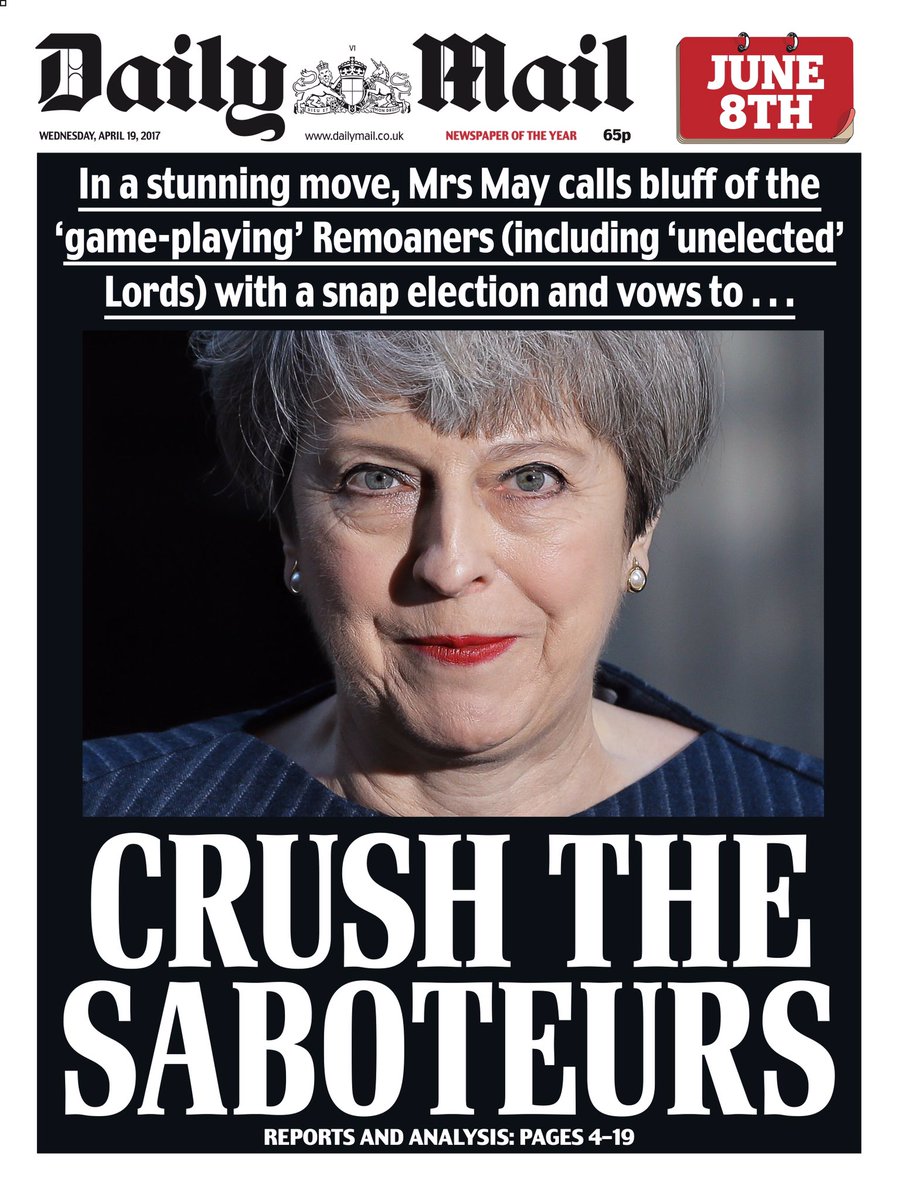
Image result for saboteurs daily mail
Elections are supposed to provide choices: the opportunity for voters to have a say on the big issues. There is no shortage of serious questions facing Britain in 2017 – not just what type of relationship we want with the European Union after we leave, but on a much wider range of important economic and social challenges, after seven years of an unsuccessful “long term plan” of austerity cuts. 

It’s time to ensure that your voting decision is based on real policy choices, a responsible decision that prioritises both societies’ and your own best interests, rather than on a fleeting emotional response from empty style-over-content marketing strategies, and superficial glittering generalities captured in a meaningess Tory slogan or meme. The Tories don’t do dialogue or democracy: they simply shout over their opponents and critics very loudly to stifle healthy debate. They also pay a lot of money to ensure that they saturate social media with toxic smear campaigns and lies.

Don’t let the Tories buy the election again.


vote_labour_red


I don’t make any money from my work. But you can support Politics and Insights and contribute by making a donation which will help me continue to research and write informative, insightful and independent articles, and to provide support to others. The smallest amount is much appreciated, and helps to keep my articles free and accessible to all – thank you.

DonatenowButton


Alleged Conservative Twitter account claims poor people are ‘dangerous’ and food bank users spend their money on drugs and alcohol

Tories on poor

A Twitter account claiming to be the Lincolnshire Conservatives has been suspended after complaints were made about some of its tweets which said poor people were “dangerous” and food bank users had “no cooking skills”.

The tweets were posted overnight on June 2  and originate from an account claiming to be to be the official Twitter account for Lincolnshire Conservatives, with a location tag in Grantham. 

Several offensive tweets were posted, including ridiculous with claims that Labour leader Jeremy Corbyn was “impotent” and “disappoints his wife,” suggesting that he would similarly disappoint voters.

The poster boasted about tweeting from Grantham, the birthplace of Margaret Thatcher, and professing to have “never been more confident” about winning the election.

Tweets from the account also said: “The vast majority of people who use food banks have poor budgeting skills and no cooking skills.

“They usually resort to a life crime and then blame the government for their deplorable lifestyle. Corbyn supports those rogues.”

The account also tweeted that “poor people are not “vulnerable”, they are dangerous due to the fact that they are addicted to drugs and have NOTHING to lose.

It’s certainly true that Conservative ministers and peers such as Iain Duncan Smith and Baroness Jenkin of Kennington, have tended to conflate poverty with poor budgeting and cooking skills. Many Tories have implied poverty arises because of “faulty behaviours” and “lifestyle choices” rather than being a consequence of political choices and policies that extend inequality, and an inevitable feature of our “competitive” economic organisation.

This scapegoating approach has been used by the Conservatives to attempt to justify the extremely punitive “behaviour change” policies and austerity programme directed almost exclusively at the poorest citizens. 

Both Iain Duncan Smith and David Cameron have previously implied that poverty arises because of “worklessness”, obesity, alcoholism and substance misuse. There is no evidence to support this claim. In fact the available evidence strongly suggests that individuals are more likely to drink regularly and above recommended limits during the week if s/he is a high-income earning managerial/professional worker. 

The tweets, from a fake account or otherwise, certainly capture something of the Conservative mindset, and reflect their traditional prejudices.

Richard Davies, Conservative county councillor for Grantham, North West, told Lincolnshire Reporter: “It’s a fake account.

“We’ve reported it to Twitter for impersonating us and they’ve taken it down.

“Our account is @LincsTories.”

It’s unusual for Conservatives to call themselves “Tories” because of the derogatory connotations of the word – “Tory” derives from the Irish word tóraidhe; modern Irish tóraí; modern Scottish Gaelic Tòraidh: outlaw, robber or brigand, from the Irish word tóir, meaning “pursuit”, since outlaws were “pursued men”. The term was originally a term of abuse, and remains a pejorative.


See also: Conservatives, Cruelty and the Collective Unconscious


I don’t make any money from my work. But you can support Politics and Insights and contribute by making a donation which will help me continue to research and write informative, insightful and independent articles, and to provide support to others. The smallest amount is much appreciated, and helps to keep my articles free and accessible to all – thank you.

DonatenowButton


A comparison of Labour and Conservative manifestos – CLASS

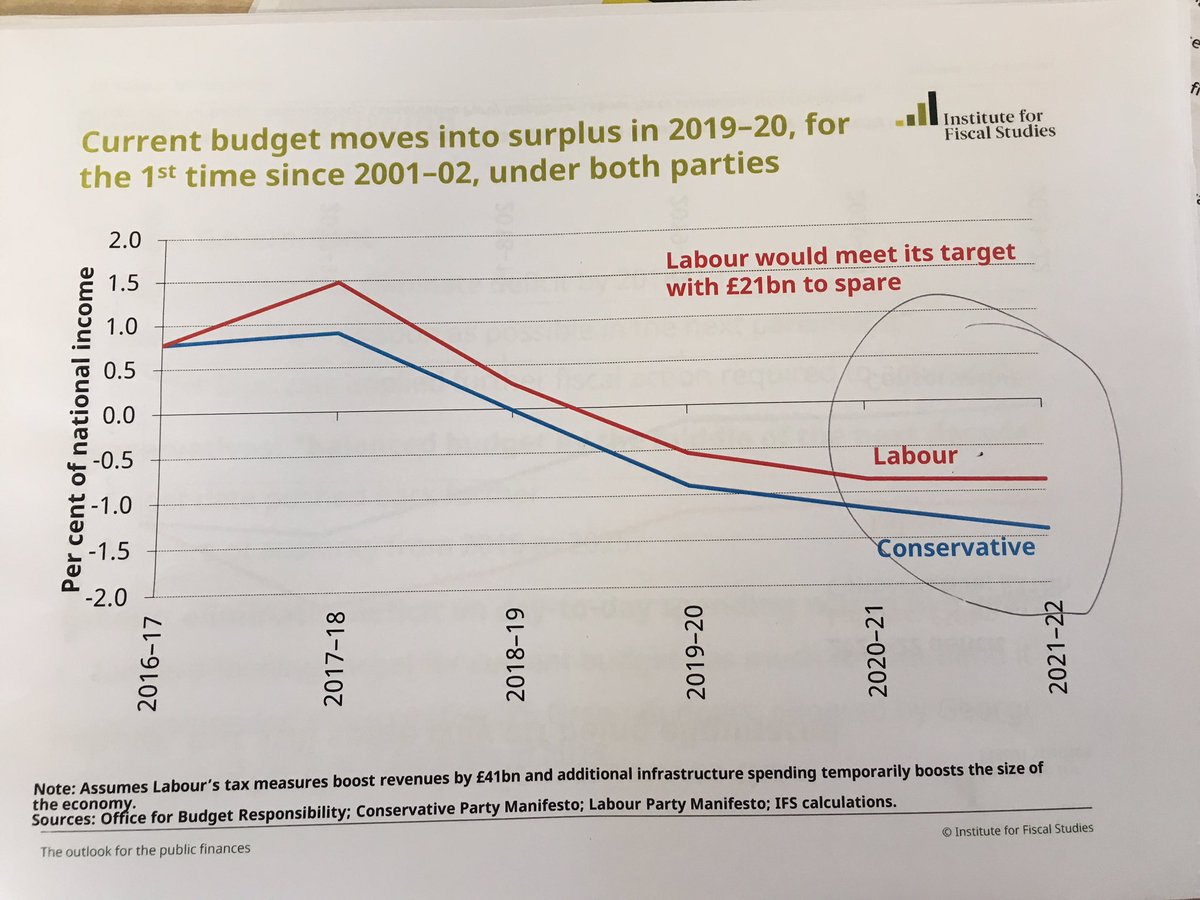
The Institute For Fiscal Studies (IFS) analysis of the Conservative and Labour manifesto proposals, which shows that both parties will run a surplus by 2019/20 , with Labour having £21 Billion spare. 

The Centre for Labour and Social Studies (CLASS) is a thinktank established in 2012 to act as a centre for left debate and discussion. Originating in the labour movement, CLASS works with a broad coalition of supporters, academics and experts to develop and advance alternative policies. 

CLASS produces briefings, policy papers and think pieces to influence policy development, which spans a field. Projects already underway address issues of growth and the economy, work and pay, housing and equality, security and aspiration, democracy and welfare, amongst many others.

CLASS have produced a comprehensive briefing which  breaks down and compares Labour and Conservative manifesto proposals across policy areas including public services, tax, education, employment and Brexit.

Here is a summary. I recommend you read the full report here.

Brexit

Labour has pledged to focus on jobs and living standards as the first priorities in Brexit negotiations:

 Labour states that leaving the EU with no deal would be the worst possible outcome, and reject it as a possibility.

 Labour has accepted the end of freedom of movement, meaning that the UK will have to leave the single market.

 Labour wants to maintain as many benefits of the single market and customs union as possible.

 Labour will scrap the Conservatives’ Great Repeal Bill, replacing it with an EU Rights and Protections Bill that will protect working rights, consumer rights, equality law and environmental protections.

The Conservatives have made Brexit a central theme in their manifesto, stating that it is the biggest challenge the UK will face in most of our lifetimes.

 The Conservative manifesto maintains that no deal would be better than a bad deal.

 The Conservatives have pledged to scrap freedom of movement as a red line in Brexit negotiations. This means that the UK will leave the single market, which is made clear in the manifesto.

 The Conservative manifesto pledges a deep and special relationship with the EU, but there are no specific details. 

Conclusion: Both Labour and the Conservatives have pledged to accept the referendum result, and both parties voted to trigger Article 50 and start the formal process of leaving the EU.

However, their priorities in Brexit negotiations are different. The Conservatives’ acceptance that no deal is a possibility for Brexit would have huge implications for the UK economy. We welcome Labour’s statement that leaving with no Brexit deal should not be an option.

Immigration

The Labour party has stated that freedom of movement will end post-Brexit, but have not pledged to reduce immigration.

 Labour would guarantee the rights of EU migrants in the UK immediately.

 Labour will not set an arbitrary target on immigration levels to the UK.

 Labour will reintroduce the Migrant Impact Fund, to ensure that increased migration in certain areas does not place a strain on public services. The Conservative party have pledged to end freedom of movement and reduce migration, claiming that when immigration is too high it is difficult to build a cohesive society.

 The Conservatives will not guarantee the rights of EU citizens before Brexit negotiations start.

 Despite missing their immigration targets repeatedly while in government, the Conservatives have again pledged to reduce immigration to the tens of thousands -including students.

Conclusion: Both parties are committing to ending freedom of movement post-Brexit. This could have serious consequences for the UK – 10% of our doctors and 4% of our nurses are from elsewhere in the EU.

It is also concerning to see that students will be included in Conservative immigration numbers. However, while the Conservatives continue to suggest that immigration must be limited, Labour have stated that immigration targets are unhelpful. This is a positive step forward in our national conversation about migration.

Tax and redistribution

Labour pledges to make the taxation system fairer through a combination of increasing existing taxes on the top 5%, new taxes, and tighter rules on existing taxes to crack down on evasion and avoidance. This aims to raise £48.6bn in revenue. Key proposals are as follows:

 Lowering the 45p additional rate threshold to £80k (Top 5%) and reintroducing the 50p rate on earnings above £123k. Raising £6.4bn.

 Excessive Pay Levy: paid by employers directly on salaries over £330k. Raising £1.3bn.1

 Increase corporation tax to 26% in 2020–21 (2011 levels) with a lower rate for companies with annual profits below £300k. Raising £19.4bn.

 Introduce a Robin Hood Tax – a tax of about 0.05% on financial transactions. Raising £26bn.

 A clamp down on tax avoidance. Raising £6.5bn. A £3.9bn allowance has been made for behavioural changes and uncertainty.

The Conservatives have emphasised a low tax economy with a new deal for ordinary people (see our employment section). As could be expected with a low tax focus, their plans are more modest than Labour’s:

 Increase the personal allowance to £12,500 and the higher rate of tax to £50,000 by 2020.

 Cut corporation tax to 17% by 2020.

 Conduct re-evaluations more frequently to prevent large changes.

 Stop tax avoidance and evasion.

Conclusion: Tax is one of the biggest dividing lines between the parties. We welcome Labour’s plan for increased taxes on the rich and bold measures to tackle inequality. We are concerned that the Conservatives plan for a low tax economy would simply mean high earners and corporations gain, while low and middle income earners would see their wages eaten away by inflation.

Investment

Labour announced a £250bn fund for investment in infrastructure – transport, energy systems, telecommunications – scientific research, and housing (to be raised by borrowing). Funds will be targeted at:

 Extending HS2 into Scotland.

 Building Crossrail for the North.

 Investment in new, state-of-the-art low-carbon gas and renewable electricity production.

 Universal superfast broadband by 2022.

 3% of GDP on research and development.

 A goal of 60% of jobs created through investment to be high skilled.

The Conservatives have also proposed an industrial strategy with major investment in infrastructure, skills and research and development. They plan to continue the existing £170bn infrastructure investment plan over the next parliament. A part of this funding will come from borrowing and part is already allocated in the budget.

They aim to:

 Meet OECD average of 2.4% of GDP on research and development.

 Launch a £23bn National Productivity Investment Fund.

Conclusion: Both parties have pledged to invest in infrastructure and skills. Labour’s measures are more ambitious in outlook and funding, and are more clearly costed. CLASS believes that this big and bold idea brings the investment the UK so vitally needs.

Environment

 The Labour party used their manifesto to link the environment to sustainable agricultural industries and flood defences. Their main policies are:

 An end to fracking.

 Championing sustainable farming, food and fishing by investing in and promoting skills, technology, market access and innovation.

 Introduce a new Clean Air Act to deal with illegal levels of air pollution.  Halt the privatisation of public forests.

The Conservative party talked about the environment in the context of business, with relatively little on environmental protections by themselves, arguing for:

 More fracking, hailing the technique as a “revolution”.

 Devise a new “agri-environment system”.

 Produce a 25 year Environment Plan.

 A pledge to be the first generation to leave the environment in a better state than they inherited it.

Conclusion: There are clear dividing lines on the environment, most noticeably regarding fracking, with the Labour party firmly opposed to the industry, and the Conservatives proudly supportive.

There is also the matter of Labour’s greater emphasis on environmental protection and clean air, and lack of Tory attention to these issues. Given this divide, we do not see how a Conservative government would be the one to leave the environment in a better state.

NHS and social care

The Labour party has focused on additional funding for the NHS and social care, stating that cuts to NHS and social care budgets by previous Conservative governments have led those services to crisis point.

 Labour has committed to £30bn in extra NHS funding over the next parliament.

 Labour has committed £8bn for social care over the next parliament.

 Labour pledges to guarantee access to NHS treatment within 18 weeks, and that patients will be seen in A&E within 4 hours. The Conservative party manifesto has pledged to increase NHS spending, while proposing new rules for social care costs.

 Conservatives will increase NHS spending by at least £8bn over the next parliament.

 The Conservatives propose ensuring that anyone who needs social care will be able to keep £100,000 of assets.

 People will be able to defer payment on social care until after their death, enabling them to keep their house.

Four days after the Conservative manifesto launch, Theresa May announced that there will be a cap on the amount an individual will pay towards their care, despite the manifesto mentioning no cap and specifying only that no one would be left with less than £100,000 in assets after paying care costs. There has been speculation that a narrowing poll lead led to this announcement, which the Conservatives refuse to describe as a change.

Conclusion: We welcome commitments to properly fund the NHS, but Conservative commitments do not equal the missing funding identified by many campaigners, and their figure is less than a third of Labour’s commitment.

The Conservative social care proposals are also flawed, as people would be likely to pass on their assets to their children to avoid charges. While four in five councils can’t cope with the demand for elderly social care, Labour’s proposals for a big funding boost would be the better option for social care.

Education

The Labour party has pledged to create a National Education Service to reform our education system.

 Labour will reverse cuts to school funding.

 Labour will increase Sure Start funding.

 Labour will create a National Education Service for cradle to grave education, free at the point of use.

 Labour will reduce class sizes to less than 30 for all five, six and seven year olds.

 Labour has pledged to scrap tuition fees and reintroduce maintenance grants.

 Labour has pledged to restore the Education maintenance Allowance (EMA).

 Labour will provide free Further Education, including English lessons. The Conservative party has made pledges to increase school funding and make sure that more children attend good schools.

 The Conservatives have pledged that no school will have their budget cut as a result of the new funding formula.

 The Conservatives will build 100 new free schools a year.

 Conservatives will lift restriction on creating grammar schools.

 Conservatives will open a specialist maths school in every major English city.

 Conservatives will stop universal free school lunches for primary age children, replacing them with free universal breakfasts. The savings will be used for £4bn in schools funding over the next parliament.

Conclusion: Labour’s commitment to reversing school cuts should be welcomed – 99% of schools will have per pupil funding cut by 2020 under current government policy.1 The creation of a national education service for lifelong learning is another welcome proposal, enabling people to retrain in a fast changing jobs market.

However, we were disappointed to see another commitment to new grammar schools from the Conservatives, with a pledge to lift restrictions on the creation of new selective schools. As we have highlighted before, there is no evidence that shows grammar schools increase social mobility – it actually shows the opposite.

Welfare system

The Conservative party state that they have no plans for further radical welfare system reform in the next parliament. The Conservatives will therefore continue to roll out universal credit.

The Labour party has pledged to reform the controversial Universal Credit program. Labour has also pledged to:

 Scrap the bedroom tax.

 Scrap punitive benefit sanctions. 

 Scrap the Work Capability Assessment.

 Scrap cuts to bereavement support.

 Restore housing benefit for under 21s.

Conclusion: After several years of cuts to benefits, and numerous examples of suffering caused by those cuts, it is disappointing to see no changes to the welfare system proposed by the Conservatives. However, we should welcome commitments by Labour to scrap some of the worst features of recent welfare reforms.

Working rights and employment  

Labour released a 20-point plan to increase workers’ rights and provide better security at work. The most important are as follows:

 Give all workers equal rights from day one, whether part-time or temporary.  Ban zero hours contracts.

 Legislate to ensure that recruitment of labour from abroad does not undercut workers at home.

 Repeal the Trade Union Act and roll out sectoral collective bargaining.

 Maximum pay ratios of 20:1 in the public sector and in companies bidding for public contracts.

 Raise the Minimum Wage to the level of the Living Wage (expected to be at least £10 per hour by 2020) – for all workers aged 18 or over.

 End the Public Sector Pay Cap.

 Action on bogus self-employment so the law assumes a worker is an employee unless the employer can prove otherwise.

 Double paid paternity leave to four weeks and increase paternity pay.

The Conservatives have taken a different focus on workers’ rights. Their promises are certainly less ambitious, but there are some positive commitments:

 A statutory right to a year’s unpaid leave to care for a relative.

 EU workers’ rights protected.

 Protection from the gig economy.

 Improve worker representation on boards – watered down from previous commitments to have workers on boards.

 A right to training.

However, the Conservatives have weakened their National Living Wage commitment to meet 60% of the median wage by 2020. With rising inflation, this is likely to cause increased poverty among low earners.

Conclusion: Although this is one of the Conservative party’s more worker friendly manifestos, Labour’s finger is definitely more on the pulse when it comes to workers’ rights. Labour’s manifesto has a real potential to tackle the deep inequality that the UK suffers from.

Inequalities

Labour has pledged a range of measures to reduce equality for several groups. Some of these include:

 Labour will assess future policy for its impact on women.

 Bring offences against LGBT people in line with hate crimes based on race and faith.

 Labour will introduce a requirement for equal pay audits on large employers to tackle the pay gap faced by BME workers.

 Labour would classify British Sign Language as a recognised language.

The Conservative party had a particular focus on disability discrimination.

 A one year national insurance holiday for companies who employ a person with a disability.

 The Conservatives will continue plans to tackle hate crimes against a person based on their sexual orientation, gender identity, disability and religion.

 The Conservatives will review access for disabled people and pledge to work with service providers to reduce any extra costs faced by people with disabilities. 

Conclusion: Labour have proposed concrete policies to help improve equalities in the UK. Although the Conservatives have clearly stated a commitment to people with disabilities, this is in the context of cuts to benefits under a Conservative government which have had a disproportionate impact on people with disabilities.

Housing

The Labour Party has an ambitious goal of council house building and a raft of protections for renters:

 Build 100,000 council and housing association dwellings for every year of the next parliament.

 Build more affordable housing.

 Make three year tenancies the norm.

 Abolish the bedroom tax.

 Inflation capped rent increases, and a ban on letting agent fees.

 New minimum standards introduced for the private rental sector.  Reinstate housing benefit for 18-21 year olds.

 A plan to end rough sleeping within the next Parliament, with 4,000 additional homes for people with a history of rough sleeping.

The Conservative Party is also making bold pledges on house building:

 A promise to deliver on their 2015 manifesto commitment to build a million homes by 2020, and a pledge to built another 500,000 homes by 2022.

 A new generation of fixed-term council housing linked to a new Right to Buy.

 Free up more land for new homes.

 Give housing associations more flexibility to increase their stock.

 Give councils more power to intervene when developers don’t act on planning permissions.

 Look at increasing protections for renters

Conclusion: We are happy to see commitments from both parties to building large numbers of houses, though this does reflect how bad the crisis has become.

We call on both parties to commit to building 200,000 social houses to meet demand. We applaud the multiple new protections for renters from Labour, and are concerned with the lack of firm policy commitments from the Tories.

Pensions

Labour plans bring both strong protections for pensions and a potentially radical shift in pensions policy. Proposals include:

 Keeping the triple lock on pensions, so the state pension rises by 2.5%, inflation, or earnings growth.

 Commission a new review of the pension age, to develop a flexible retirement policy reflecting people’s contributions, the variations in life expectancy and the varying health effects of work.

 The Winter Fuel Allowance and free bus passes will be guaranteed as universal benefits.

 Protect pensions of UK citizens living overseas.

The Conservative proposals broke with the political consensus on pensions and the elderly (See the social care section for more detail on that particular policy). Their commits on pensions are:

 Means testing the winter fuel allowance (potentially affecting 9m pensioners).

 Change to a double lock on pensions, so they go up in line with earnings or inflation, whichever is higher (removing the third 2.5% lock).

 Measures to protect private pensions by increasing punishment for mismanaging schemes.  

Conclusion: We are happy to see commitments from both parties to building large numbers of houses, though this does reflect how bad the crisis has become. We call on both parties to commit to building 200,000 social houses to meet demand.

We applaud the multiple new protections for renters from Labour, and are concerned with the lack of firm policy commitments from the Tories. 

Public services and nationalisation

The Labour party has pledged to prioritise public service over private profit, and stated that prices have risen and services have suffered in privatised industries.

 Renationalise railways by bringing them back into public ownership as franchises expire.

 Renationalise Royal Mail.

 Establish publically owned regional water companies.

The Conservative party have pledged to take action on rip-off bills.

 Pledge to freeze energy bills, a policy that was also in the 2015 Labour manifesto.

 Pledge an independent review into energy costs.

 Pledge the largest investment in railways since the Victorian era and extra capacity to tackle overcrowding.

Conclusion: Labour have made it clear that privatisation of public services, all natural monopolies, has not worked. We should welcome the commitment to nationalise industries to make them accountable to the public who use them, and with the aim of reducing prices.

The Conservatives have made no pledges on nationalisation, but have promised rail investment. It is unlikely that investment alone could tackle the issues facing our railways. 


Related

What Labour achieved

Image result for manifesto 2017


I don’t make any money from my work. I am disabled because of illness and have a very limited income. But you can help by making a donation to help me continue to research and write informative, insightful and independent articles, and to provide support to others. The smallest amount is much appreciated – thank you.

DonatenowButton


I’ve just told the Conservative director of campaigning to jog on

17992309_1302068139828559_7295604745407481410_n

I have just been given an award for Discretionary Housing Payment (DHP). Not sure how much I will get towards my rent as the award notice doesn’t make much sense, but I got it after sending in my medical evidence recently. 

It means I get to keep a roof over my head for a bit longer, anyway. It’s very, very difficult to get an award of DHP now, as it has been made highly conditional, partly because councils are so strapped for cash due to Conservative cuts, partly because Conservative policies, such as the bedroom tax and other “reforms”, have increased the need considerably for this support.

My own council informed me that already there are very little funds left for DHP. I applied because since becoming too ill to work, my income has dwindled to the point where I’m now short by more than £100 per month to pay for my rent, council tax, food and fuel. I don’t have a spare room, but I have to pay council tax currently because my son is taking a couple of months out from university to care for me, following a severe bout of pneumonia and sepsis, which almost cost me my life. My son is therefore classed as a “non dependent”. Despite the fact he has no income out of term time, he is still expected to contribute to the rent. I am currently so poor because of draconian Conservative policies. 

So imagine my surprise and disgust when I got an email today from the Conservative campaign director, asking me to donate £30 to the Tory election campaign. You couldn’t make it up. 

Note the nudges used in their grubby mail opening: “We’ve had a great response…” which is an approach that the Behavioural Insights Team at the heart of the cabinet office call “social norming“. It was designed by the advertising industry and is increasingly being used in polcy and political rhetoric to create a false consensus effect. Social norming is increasingly being used in policies aimed at behavioural change. That the government is using such an approach from their Nudge Unit to influence voting behaviour is deplorable.

This kind of nudge is based on the bandwaggon propaganda technique. It’s an improper appeal to emotion, used for the purpose of swaying the opinions of an audience.  This technique involves encouraging people to think or act in some way simply because other people are doing so, or so it is implied. It’s an appeal to “join the winning side” because pretty much everyone apparently endorses it, after all. 

Plus there is an urge for us to “all stand together”, remarkably, from a government that has intentionally caused massive social division in order to manipulate the populations’ perceptions and behaviours towards politically scapegoated others, (unemployed and disabled people, refugees and asylum seekers, for example) to divert attention from the fact that Conservative policies are causing massive inequality as their policies reward the wealthy and punish the poorest citizens, their policies are aimed at dismantling the social gains of our post war settlement, and creating scapegoats and the growth of social prejudice as a diversionary tactic to protect those responsible for our ruined economy – the financier class and the government.

Image result for bandwagon propaganda

I’m wondering just how many people needing social security would be donating half their weekly income to these sadistic jokers after years of their extremely punitive “reforms”?

I’m guessing none.

Quite properly so.

Here is a copy of the email, with my considered response:

From: Darren Mott – Chief Agent and Director of Campaigning
Sent: 24 April 2017 12:39
To: suejones
Subject: Re: We need to stand together Susan 

Dear Susan,

We have had a great response from supporters across the country joining our 2017 Fighting Fund supporters list.

It has been exciting to see such support for our plan for a stronger Britain through Brexit and beyond.

I will be speaking to our campaign team at midday tomorrow to set spending priorities in this crucial phase of the campaign to strengthen the Prime Minister’s negotiating hand in Europe. Donate now to help.

The stakes couldn’t be higher, Susan, we need you. Elections are always hard fought. Only Theresa May and the Conservatives can ensure we have strong leadership, certainty and stability through Brexit and beyond.

If you haven’t already, please donate £30 today and join our 2017 Fighting Fund supporters list.

Thank you,

Darren

Darren Mott
Chief Agent and Director of Campaigning

PS: Donate by midday to make sure you are on our supporters list for this key phase of the campaign.

From: Conservative Campaign Headquarters
Subject: We Stand Together 

Tory

Dear Susan,           

This is urgent.

In 6 weeks’ time there will be a general election. Your donation is vital. It is vital to bolster an election campaign that aims to strengthen Theresa May’s and the UK’s negotiating position on Brexit.

Your donation will help defeat Jeremy Corbyn, and our Lib Dem and SNP opponents, who together are planning to disrupt our Brexit negotiations, raise taxes, increase borrowing and waste.

Will you be one of our General Election 2017 Fighting Fund supporters, and will you help us get on with the job of making life in the United Kingdom even better, Susan?            

Donate today:

£20 gets us 100 campaign posters

£35 delivers 500 leaflets to target voters

£50 helps us call 1000 target voters

£100 delivers 3000 letters to target voters

£500 delivers 3000 freepost surveys to target voters

We are finalising our election plans now, Susan. Will you donate to our campaign and become a Fighting Fund supporter today?

Thanks for your support,     

Conservative Campaign Headquarters
                 

  Promoted by Alan Mabbutt on behalf of the Conservative Party, both at 4 Matthew Parker Street, London, SW1H 9HQ


My measured response:

Bootstraps

Susan Jones
05:56

RE: We need to stand together Susan

To: Darren Mott – Chief Agent and Director of Campaigning

After this government’s policies have systematically robbed me of an adequate income, I am afraid I haven’t even enough money to meet my basic needs, let alone donate to a party that has nothing but disdain for those of us who become too ill to work. I have worked most of my life and contributed tax and National Insurance, only to see you dismantle the social gains of our publicly funded post-war settlement and hand out my money to millionaires and rogue multinationals.

You’re right, the stakes have never been higher. That’s why I will be campaigning as hard as I possibly can for a Labour government, which will acknowledge and reflect public needs in their policies. That’s rather more democratic than a government that imposes their own needs on the population to meet their ideological and draconian policy outcomes.

So jog on.

It’s time to put the Tories out of our misery

 Sent from Mail for Windows 10

Related

The Conservative’s negative campaign strategy: “share the lies and win a prize”


I don’t make any money from my work and I am not funded. I am disabled because of illness and struggle to get by. But you can help me continue to research and write informative, insightful and independent articles, and to provide support to others, by making a donation. The smallest amount is much appreciated – thank you.

DonatenowButton

Conservative social security policy is not founded on rational analysis and evidence

650
Recently I wrote an article about the new benefit cap which parodied Conservative ideology, traditional class prejudices and subsequent justification narratives for their welfare “reforms”, likening the latter to nineteenth century character divination – phrenology in particular. Sometimes, it’s easier to highlight the ridiculous by simply ridiculing it.

A lot of my work is themed around serious and rational critique of Conservative shortcomings when it comes to the whole process of policy-making and research, from the theories” that inform the process, to the ideologically-driven impacts and narrow neoliberal aims and outcomes, which have led to some catastrophic social consequences. This is because austerity has been aimed exclusively at those citizens who had the very least to start off with. Sick and disabled people have been systematically and disproportionately targeted for cuts to their support.

2014-02-17-BurdenoftheCuts-thumb

I’ve written previously about the government’s increasing use of secondary legislation to push through controversial and highly partisan policies without an adequate degree of parliamentary scrutiny and debate. The public are entirely excluded from this process. This is one way that the Conservatives have been getting away with highly prejudiced, ideologically-driven policies that have not been analysed in terms of safeguarding citizens, impact, compatibility with our international human rights obligations and are neither adequately justified nor evidenced. 

The Strathclyde review and Conservative authoritarianism

Secondary legislation is unamendable and is allocated 90 minutes debate in the Commons at best, by the Conservatives. Secondary legislation in the form of Statutory Instruments was only ever intended for non-controversial and small tidying up legislative measures. A Tory aide admitted that the government are trying to get as much unpopular legislation in through the secondary route as possible. But this has been very evident anyway. The government is intent on dismantling any inconvenient piece of the constitution.

In a democracy there is always a responsibility and need to ensure additional checks and balances against incumbent governments and for extending opportunities to review and improve the quality of legislation. There is always a need to broaden the political participation and democratic inclusion of particular groups in society; to explore ways by which under-represented groups may be identified and included in political decision-making processes.

Statutory Instruments are the principal form in which delegated legislation is made, and are intended to be used for simple, non-controversial measures, in contrast to more complex items of primary legislation (known as Bills.) The opposition has frequently complained that the government uses Statutory Instruments to pass complex and controversial legislation which should have been subject to full Parliamentary scrutiny. Universal credit, the legal aid and tax credit cuts are clear examples of the misuse of secondary legislation, each with far-reaching and detrimental socioeconomic consequences for many people.

The steep rise in the use of Statutory Instruments since 2010 is an indication of how the Conservatives are politically managing pre-legislative scrutiny, stifling healthy debate, curtailing opposition, and side-stepping essential democratic transparency and accountability. It’s also an indication that much Conservative legislation is ideologically-driven rather than needs-driven: the use of secondary legislation as a means of avoiding scrutiny demonstrates that the government are aware that much of their planned programme won’t stand up to close Parliamentary examination and rational debate.

Lord Strathclyde was asked in October last year by David Cameron to undertake a “rapid review” that considered how to secure the decisive role of the House of Commons in relation to its primacy on financial matters and secondary legislation. Of course, Strathclyde’s report was published by the Government on the 17 December, 2015, which marked the final sitting of Parliament before Christmas. Nonetheless the media did actually cover the contents of the report and some of the implications of the recommendations made.

Strathclyde concluded in his report that the House of Lords should be permitted to ask the Commons to “think again” when a disagreement on proposed legislation exists, but should not be allowed to veto. MPs would ultimately make a decision on whether a measure is passed into law. The review focuses in particular on the relationship between the Commons and the Lords, in relation to the former’s primacy on financial matters and secondary legislation.

The key problem is that Statutory Instruments (SI) are being over-used and are under-scrutinised in the Commons. SIs have become a major form of law-making activity in the UK. In 2015, the UK Parliament passed 34 Acts, whilst 1,999 Statutory Instruments were made. (In fact, 2015 has been a relatively light year for SIs: in 2013 and 2014, 3,292 and 3,486 SIs were made.)

The government ensure they have a majority on any SI committee and MPs are chosen by Whips. The Hansard Society estimate that SIs currently account for as much as 80 per cent of the Government legislation that impacts citizens. However, they are given substantially less Parliamentary time than Bills, enabling government to push through their ideologically designed legislative programme with very little scrutiny, exacerbating a lack of democratic transparency and accountability of the Executive (the government). 

Further presented justification for grotesquely unfair policies from the Conservatives is based on a claim that “we have a clear mandate to do this.” The concept of a government having a legitimate mandate to govern via the fair winning of a democratic election is a central component of representative democracy. However, new governments who attempt to introduce policies that they did not make explicit and public during an election campaign are said to not have a legitimate mandate to implement such policies. 

In order to keep his promises on further future tax cuts for higher earners, George Osborne made even more cuts to public services, public sector pay and the social security safety net that are so deep they will severely damage both the economy and potentially, the fabric of our society. The Institute for Fiscal Studies (IFS) have criticised Osborne’s proposed tax credit cuts, because it is “at odds” with wider Conservative stated aims to “support hardworking families”.

Research conducted by the IFS calculated that only around quarter of money take from families through tax credit cuts would be returned by the new National “Living Wage”.Tax credits are payments made by the government to people on lower incomes, most of whom are in work. 

Cameron effectively ruled out cutting the benefit before the election, telling a voter’s Question Time that he “rejected” proposals to cut tax credits and did not want to do so. The cuts are part of £12bn cuts to the social security budget that the government is to make – the details of which the Conservatives refused to announce before the election.

However, in an unprecedented move, the Conservatives have threatened a constitutional “showdown”, and have refused to engage in dialogue with peers that want kill off the proposed Tory cuts. The government warned the House of Lords it would trigger a full-scale constitutional crisis by pressing ahead with their plans. 

The review by Lord Strathclyde, commissioned by a rancorous and retaliatory Cameron followed the delay and subsequently effective defeat of government tax credit legislation in the House of Lords, and it has, of course, recommended curtailing the powers of Upper House. 

Strathclyde proposed that the House of Commons is given the final say over secondary legislation (in particular, Statutory Instruments), which are, as previously stated, frequently being used for political manoeuvring to edit the details of Acts, and ensure rules, regulations and even changes to legal definitions are made by ministerial order, rather than by the rather more open and democratic process of primary legislation: it’s being used as a way of bypassing Parliamentary scrutiny. 

sis

The view from the Social Security Advisory Committee

More recently, the Chair of the Social Security Advisory Committee (SSAC) has also concluded that “pressure from the Treasury” resulted in welfare changes being pushed through parliament “without meaningful analysis of impact or interactions with other parts of the benefit system.” He also raises the same issues that I previously have regarding the government’s increased use of secondary legislation.

In a very damning report on how the government develops welfare policies, SSAC Chair Paul Gray says top-down pressure from the former chancellor, Osborne, to meet Budget deadlines meant legislation was being rushed without proper analysis or scrutiny.

In a foreword to the report, Gray writes: “On the basis that primary legislation was to be debated in some detail in Parliament, the Government was not required to bring the majority of these provisions to SSAC.

Consequently, the amount of secondary legislation presented to us in the first few months of the reporting year was lighter than usual.

By contrast from September onwards a number of sets of regulations were presented to us for scrutiny – most with their origins in the Chancellor of the Exchequer’s Budget proposals for reducing benefit expenditure.”

He goes on to say: “The Committee has observed that legislation required to deliver policies announced by the Chancellor during his Budget or autumn statements is often developed at pace to meet challenging deadlines set by HM Treasury.

This has regularly resulted in secondary legislation being presented to us without meaningful analysis of impact or interactions with other parts of the benefit system.

The absence of evidence underpinning some of the Government’s policy choices has been a significant concern to us over the past year, and we hope that the Government will adjust this aspect of its approach to policy-making in the coming year.”

He added: “The committee has noted in the past the absence of analytical material on the cumulative impact of welfare reforms.”

Gray also draws attention in particular to tax credit changes proposed in the summer budget highlighting “the lack of available evidence to support the policy changes being presented to us”.

Gray concludes: “There can be no question that this committee is hampered in its role of scrutinising proposed changes in cases where the supporting explanatory material and evidence is scant.”

It’s a point I have made myself many many times. However, unlike the government, I do tend to include evidence and analysis in my ongoing critique of Conservative policies.

The ideological drive to dismantle the welfare state

Despite the relentless Conservative attacks on social security since 2010, (which is funded by the citizens that it supports when they experience hardships), Theresa May will not rule out delivering yet more brutal welfare cuts if the economy suffers a downturn because of Britain exiting the EU. The prime minister refused to offer any guarantees that she will spare struggling families if Whitehall savings are needed in the coming months. 

May has made it clear there will be no end to Tory austerity, she said: “What I’m clear about is we’re going to continue as we have done in Government over the last six years – ensuring that we’re a country that can live within our means.”

I’m just wondering how awarding millionaires £107,000 each per year in the form of a “tax break” in 2012 at the same time as introducing the radical cuts to social security can possibly be construed as an act that ensures “a country that can live within our means.” It seems to me that the Conservatives want to completely dismantle our welfare state, along with all the other gains of our social settlement (social housing, the NHS, legal aid and public services) but fear public opposition.

So rather than be honest about their intention, the Conservatives have chosen to stigmatise people needing welfare support to disperse public sympathy, to create scapegoats and generate moral panic. The public gradually come to accept the anti-welfare narrative as “fact”, despite the lack of evidence and analysis. Moral and rational boundaries will be pushed, prejudice will advance stage by stage. The incremental cuts will continue until there is nothing left to cut.

Earlier this year, the chancellor was forced to try and defend his decision to use the cuts in disability benefits to fund tax breaks for the wealthy. Controversially, the cuts benefitted the top 7% of earners. The Chancellor raised the threshold at which people start paying 40p tax, in a move that saw many wealthier people pulled out of the higher rate of income tax. 

Osborne callously claimed that the Conservative government was “increasing spending on disabled people”, he said: “Controlling welfare bills is part of what you need to do if you’re a secure country confronting the problems in the world.” It was an utterly ludicrous comment.

The cuts to ESA and PIP show an intended substantial reduction on government spending to essential support for disabled people.

In a wealth transfer from the poorest to the very rich, we have witnessed the profits of public services being privatised, but the losses have been socialised – entailing a process of economic enclosure for the wealthiest. The burden of losses have been placed on the poorest social groups and some of our most vulnerable citizens – largely those people who are ill, disabled and elderly. The Conservative’s justification narratives regarding their draconian policies, targeting the poorest social groups, have led to media scapegoating, social outgrouping, persistent political denial of the aims and consequences of policies and reflect a wider process of political disenfranchisement of the poorest citizens, especially sick and disabled people.

That the cuts are ideologically driven, and have nothing whatsoever to do with economic necessity, was demonstrated only too well by the National Audit Office (NAO) report earlier this year. The NAO scrutinises public spending for Parliament and is independent of government. The report indicates how public services are being appropriated for purely private benefit.

The audit report in January concluded that the Department for Work and Pension’s spending on contracts for disability benefit assessments is expected to double in 2016/17 compared with 2014/15. The government’s flagship welfare-cut scheme will be actually spending more money on the assessments conducted by private companies than it is saving in reductions to the benefits bill.

From the report:

£1.6 billion
Estimated cost of contracted-out health and disability assessments over three years, 2015 to 2018

£0.4 billion
Latest expected reduction in annual disability benefit spending.

This summary reflects staggering economic incompetence, a flagrant, politically motivated waste of tax payer’s money and even worse, the higher spending has not created a competent or ethical assessment framework, nor is it improving the lives of sick and disabled people. Some people are dying after being wrongly assessed as “fit for work”and having their lifeline benefits brutally withdrawn. Private companies like Maximus are paid millions from our welfare budget, yet they are certainly not “helping the government” to serve even the most basic needs of sick and disabled people.

However, private companies serve the private needs of a “small state” doctrinaire neoliberal government, and making lots of private profit whilst it does so. The Conservatives are systematically dismantling the UK’s social security system, not because there is an empirically justifiable reason or economic need to do so, but because the government has purely ideological, anticollectivist, antidemocratic, profoundly uncivilising prescriptions and longstanding class-based prejudices.

When the Conservatives say they are going to “tackle poverty”, what they mean is that they intend to rigidly police the poor, rather than alleviate poverty. Meanwhile, the new right’s economic enclosure act – austerity – will continue to impoverish many more. The state will respond to each crisis with more authoritarianism and psychopolitical techniques of persuasion, amplified via the media. And the wealthy and powerful will become wealthier and more powerful.

Unless we collectively fight back.

— 

Related

The Conservative approach to social research – that way madness lies

Cases of malnutrition continue to soar in the UK

Two key studies show that punitive benefit sanctions don’t ‘incentivise’ people to work, as claimed by the government

Benefit Sanctions Can’t Possibly ‘Incentivise’ People To Work – And Here’s Why


I don’t make any money from my work. But you can contribute by making a donation and help me continue to research and write informative, insightful and independent articles, and to provide support to others. The smallest amount is much appreciated – thank you.

DonatenowButton


Basic Income Guarantee gains popularity across the political spectrum

10385552_479102985558780_2515272025941356803_n

Basic income (which is sometimes called “citizen’s income” or “universal income”) is the idea that absolute poverty can be alleviated by providing every member of a society with an unconditional subsistence income. Supporters of basic income argue that it would alleviate absolute poverty and would also motivate people to work because they would always better off, as work-related income would be additional to their subsistence income. 

Earlier this year I wrote  about the Labour Party’s consideration of the universal basic income as a part of its new policy, during their talk at the London School of Economics. John McDonnell said: “It’s an idea we want to look at. Child benefit was a form of basic income so it’s not something that I would rule out.”

At the very least, this indicates the idea of universal provision has regained some credence in the face of a longstanding and seemingly unchallengeable political norm of increasing means-testing and welfare conditionality, established by the Thatcher adminstration, and radically extended by the current government.

Although basic income is a feature in many proposed models of market socialism, and has been particularly popular with the Green Party, support for basic income has also been expressed by several people associated with right-wing political views. While adherents of such views generally favour minimization or abolition of the public provision of welfare services, some have cited basic income as a viable strategy to reduce the amount of bureaucratic administration that is prevalent in many contemporary welfare systems. Others have contended that it could also act as a form of compensation for fiat currency inflation

Though the details vary, the basic income model has been advocated by  Right-wing thinkers such as Charles Murray, Milton Friedman and the Adam Smith Institute, amongst others. Libertarians who object to income redistribution in principle usually concede that a Negative Income Tax is the least controversial form of welfare, because it is administratively simple and “perverts incentives” less than most welfare schemes. It is particularly appealing to many liberals and libertarians because it is unpaternalistic – it’s highly compatible with laissez faire and neoliberal economic models. However, the current government are libertarian paternalists, blending a small state ideology with a psychocratic approach to governing, using behavioural change techniques (Nudge) to fulfil ideologically-driven policy outcomes.

Last year, the Citizen’s Income Trust (CIT), which has given advice to the Green Party and often cited by the Greens, has modelled the party’s scheme and discovered a major design flaw. It was revealed that that 35.15% of households would lose money, with many of the biggest losers among the poorest households. At the time, Malcolm Torry, director of the CIT, which is a small charitable research body, said: “I am not sure the Green party has yet taken on our new research or the need to retain a means-tested element. We have only just published the new work.”

The criticisms of the scheme, as well as doubts about costings, led the Greens to make a temporary tactical retreat on the issue, with the party’s leader, Natalie Bennett, saying detailed costings for the policy would not be available in the manifesto last March. The Greens had proposed a citizen’s income of around £72 to every adult in Britain regardless of wealth and existing income, which would cost the Treasury around £280bn.

One longstanding criticism of basic income is that it would provide  payments to citizens that are already very wealthy, perpetuating social inequality, and wasting resources. Another is that it does not take into account the long-term impacts and provide adequate support for those who cannot work, such as those who are ill and disabled. Such detail matters very much, and we must not allow basic income to be used as an excuse for dismantling essential welfare support for social groups that need long-term aid to survive.

The CIT added that if the policy was applied without a means-tested component, then poorer households would end up receiving far less in state benefits than they would under the existing system. 

However, one of the strongest arguments for basic income is that people would no longer be compelled to work in order to meet their basic needs. This means that employers would find it difficult to exploit workers, and would be pushed to offer decent wages, good terms and employment conditions in order to attract workers. People would have greater freedom to pursue meaningful, suitable and appropriate employment rather than having to take any job to avoid poverty and destitution. De-commodifying labor by decoupling work from income liberates people from the “tyranny of wage slavery” and leaves a space for innovation, creativitity and rebalances power relationships between wealthy, profit-motivated employers and employees.

It seems that the idea of basic income is gaining support. Reform Scotland, an independent non-party think tank, also propose in their recent report – The Basic Income Guaranteethat  the current work-related benefits system is replaced with a new Basic Income Guarantee (BIG).

However, despite claims that the think tank is independent of political parties, Reform Scotland is a public policy institute which works to promote increased economic prosperity and more effective public services based on the libertarian paternalist notions and Conservative principles of limited government and personal responsibility. Reform Scotland is funded by donations from private individuals, charitable trusts and corporate organisations.

The calculations used in the report imply that a Basic Income Guarantee would cost more initially to implement, but the think tank argue that there are strong arguments (which are couched in Conservative terms) to suggest that it would lead to “changed behaviour” and “a bigger workforce.” The think tank proposes that there remains a “disincentive” to work (the so-called “welfare trap”) which is caused by the high level of marginal taxes faced by those moving into work or increasing their hours. In their report, Reform Scotland say: “Our conclusion is that the benefits system should protect the unemployed and under-employed but at the same time must reduce – and ideally remove – any disincentives to take work, particularly part-time work. The manifest failing of the present system is the cash penalty many face when they take a job.”

Reform Scotland is proposing a Basic Income Guarantee which is paid to all working-age adults and children, whether in or out of work. All earnings would be taxed, but the basic income would never be withdrawn, meaning that “work would always pay.”

The think tank argues that radical reform of the current welfare system is required and that a Basic Income Guarantee is the best way forward. This would give every working-age person a basic income from the state of £5,200 per year, and every child £2,600.  The income would be a right of citizenship and would be the same regardless of income or gender. It would be non-means tested and would not increase or decrease as someone’s income changes, thereby removing the need for the associated bureaucracy.

The Basic Income Guarantee would replace a number of means-tested work related benefits, as well as child benefit, and would be a new way of providing a social safety net.

Welfare spending on working-age people has decreased since 2010, and the report highlights a context of the rising costs of pensions, and of £207.6 billion spent on welfare in 2014/15, £114 billion was in relation to pensioners. Of this, about £93 billion is made up by the state pension and pensioner credit. The Reform Scotland proposals therefore relate to the remaining  £93.6 billion, spent on working-age adults and children.

The report, written by former Scottish Green Party Head of Media, James Mackenzie, and former Scottish Liberal Democrat Policy Convener, Siobhan Mathers, in conjunction with Geoff Mawdsley and Alison Payne of Reform Scotland, seeks to promote informed debate of this idea by examining what the level of the basic income might be and how much implementing it would cost.

Reform Scotland’s report also calls for a single department to be responsible for welfare payments, ending the current split between HMRC and the DWP.

Commenting on the report, author James Mackenzie, former Scottish Green Party Head of Media, said: Basic income is one of those ideas that should appeal right across the political spectrum. When I was unemployed I remember having to think hard about whether to accept part time or short-term work because of the impact on my income. We should be making it easier for people to work who can and who want to, not penalising them. Basic income does just that, as well as helping those who have caring responsibilities, or who want to volunteer or study. 

There’s a resurgence of interest in the idea around the world, especially in Europe, with proposals being considered in Switzerland, Holland, France and elsewhere. The principle is the same everywhere, but policy makers need to know more about the practicalities. Now, for the first time, we are providing some detailed information about how it could work in Scotland, either after independence or after the devolution of the necessary powers.”

Co-author Siobhan Mathers, Reform Scotland advisory board member and former Scottish Liberal Democrat Policy Convener said: “There is a great opportunity for Scotland to design a welfare system that best suits its needs in the 21st Century. We could leave behind the unnecessary complexity of the UK system and provide a fair Basic Income Guarantee for all. This would make any transitions in and out of work more manageable and provide a clear, fair safety net for all.”

We have seen an unprecedented increase in a dark, unaccountable bureacracy this past five years, with private companies such as Atos, Maximus, and the likes of A4E and other private welfare-for-work providers marking the increased conditionality of welfare support – for both out of work support, and soon, for support paid to those in low paid and part-time work.

Conservative inclination has been towards substantially raising the (increasingly privatised and for profit) administrative costs of welfare, whilst at the same time radically reducing the lifeline benefits for people needing support for meeting basic needs.

Conservatives may well raise the “something for nothing” objection to basic income, which is founded on the absurd idea that the only way people may contribute to society is through paid labor.

Yet non-remunerated activities such as bringing up children, caring for elderly or sick and disabled relatives, supporting vulnerable neighbours, community work, volunteering for charities or investing time and effort in other voluntary endeavours such as contributions to the arts, sharing knowledge, education, writing, are all clearly valuable contributions to society. But these skills and activities have been steadily devalued, whilst providing an increasingly disposable (“flexible”) labor force is seen by the Conservatives as somehow fulfilling the best of our potential.

Reform Scotland has previously argued, when putting forward its Devolution Plus proposals, that there is plenty of logic behind bringing together the policy areas associated with alleviating poverty that are currently devolved, such as social inclusion and housing, with benefit provision, which remains reserved. This would help to provide a more coherent approach to tackling poverty and inequality.

The debate on this issue will, no doubt, continue in the years to come.


I don’t make any money from my work. But you can support Politics and Insights and contribute by making a donation which will help me continue to research and write informative, insightful and independent articles, and to provide support to others. The smallest amount is much appreciated, and helps to keep my articles free and accessible to all – thank you.

DonatenowButton
cards

Study of welfare sanctions – have your say

ImageVaultHandler.aspx

National Audit Office (NAO) is currently undertaking a study of benefit sanctions, in order to:

“… examine whether the Department for Work and Pensions is achieving value for money from its administration of benefit sanctions. This includes how benefit sanctions fit with the intended aims and outcomes of DWP’s wider working age employment policy, whether sanctions are being implemented in line with policy and whether use of sanctions is leading to the intended outcomes for claimants.”

I wrote two days ago about the Department for Work and Pensions document about the Randomised Control Trial (RCT) they are currently conducting regarding in-work “progression.” The document was a submission made to the Work and Pensions Committee in January, as the Committee have conducted an inquiry into in-work conditionality. The document specifies that: This document is for internal use only and should not be shared with external partners or claimants.” 

The Department for Work and Pensions claim that the Trial is about “testing whether conditionality and the use of financial sanctions are effective for people that need to claim benefits in low paid work.” The document focuses on methods of enforcing the “cultural and behavioural change” of people claiming both in-work and out-of-work social security, and evaluation of the Trial will is the responsibility of the Labour Market Trials Unit. (LMTU). Evaluation will “measure the impact of the Trial’s 3 group approaches, but understand more about claimant attitudes to progression over time and how the Trial has influenced behaviour changes.”

Worryingly, claimant participation in the Trial is mandatory. There is clearly no appropriate procedure to obtain and record clearly informed consent from research participants. Furthermore, the Trial is founded on a coercive psychopolitical approach to labour market constraints, and is clearly expressed as a psychological intervention, explicitly aimed at “behavioural change” and this raises some serious concerns about research ethics and codes of conduct.

Sanctions are “penalties that reduce or terminate welfare benefits in cases where claimants are deemed to be out of compliance with  requirements.” They are, in many respects, the neoliberal-paternalist tool of discipline par excellence – the threat that puts a big stick behind coercive welfare programme rules and “incentivises” citizen compliance with a heavily monitoring and supervisory administration. The Conservatives have broadened the scope of behaviours that are subject to sanction, and have widened the application to include previously protected social groups, such as sick and disabled people and lone parents.

There is plenty of evidence that sanctions don’t help people to find work, and that the punitive application of severe financial penalities is having a detrimental and sometimes catastrophic impact on people’s lives. We can see from a growing body of research how sanctions are not working in the way the government claim they intended.

Sanctions, under which people lose benefit payments for between four weeks and three years for “non-compliance”, have come under fire for being unfair, punitive, failing to increase job prospects, and causing hunger, debt and ill-health among jobseekers. And sometimes, causing death.

The Conservative shift in emphasis from structural to psychological explanations of poverty has far-reaching consequences. The reconceptualision of poverty makes it much more difficult to define and very difficult to measure. Such a conceptual change disconnects poverty from more than a century of detailed empirical and theoretical research, and we are witnessing an increasingly experimental approach to policy-making, aimed at changing the behaviour of individuals, without their consent. This turns democracy completely on its head. Policies are meant to meet public needs, rather than being used simply as tools of government to have the public meet ideologically-determined government outcomes.

This approach isolates citizens from the broader structural political, economic, sociocultural and reciprocal contexts that invariably influence and shape an individuals’s experiences, meanings, motivations, behaviours and attitudes, causing a problematic duality between context and cognition. It also places unfair and unreasonable responsibility on citizens for circumstances which lie outside of their control, such as the socioeconomic consequences of political decision-making.

It’s clear that the government intends to continue embedding sanctions in policies which were meant to provide a minimal income for people needing support. This is policy based entirely on ideology and traditional Conservative prejudice, aimed at punishing sick and disabled people, unemployed people, the poorest paid, and part-time workers, inflicting conditions of hardship, distress and absolute poverty on those social groups. Meanwhile, the collective bargaining traditionally afforded us by trade unions has been systematically undermined by successive Conservative governments, showing clearly how the social risks of the labour market are being personalised and redefined as being solely the economic responsibility of individuals rather than the government and profit-driven big business employers.

It’s important that we gather and present as much evidence as possible about the detrimental impact of welfare sanctions. The NAO study will run until the Autumn, so that gives us some time to have our say about our own experiences.

It is easy to make a submission to the study. Just go to the contact page and select welfare and benefits as the topic, and write “FAO Colin Ross” or “Max Tse” in the subject field. Alternatively,  you can email Colin Ross, the audit manager, directly at Colin.ROSS@nao.gsi.gov.uk

0_0_0_0_370_308_csupload_52703375

Maslow’s hierarchy of human needs. If we can’t meet our basic physiological needs, it isn’t likely that we will be able to meet higher level psychosocial needs.

Related

We would like to hear your stories about how the cuts have affected you and your service. We want the wider public and politicians to understand the real life costs of public sector cuts. It can be hard to speak up alone, so we are collating everyone’s stories – together we have more power and a louder voice. We all have stories of frustration, fear and anger, so please use this as a way to tell the world about how the cuts have impacted on you and/or the people you work with. We are interested in stories from everyone who works in, uses, or needs Psychology services:

Psychologists Against Austerity campaign – call for evidence

Stigmatising unemployment: the government has redefined it as a psychological disorder

The politics of punishment and blame: in-work conditionality

Nudging conformity and benefit sanctions

G4S are employing Cognitive Behavioural Therapists to deliver “get to work therapy”

The new Work and Health Programme: government plan social experiments to “nudge” sick and disabled people into work

The importance of citizen’s qualitative accounts in democratic inclusion and political participation

Sanctions can’t possibly “incentivise” people to work. Here’s why


My work is unfunded and I don’t make any money from it. But you can support Politics and Insights and contribute by making a donation which will help me continue to research and write informative, insightful and independent articles, and to provide support to others.

DonatenowButton

cards

Granfalloonery, scapegoating, social dominance theory and Conservatism

images

Anyone who has read Kurt Vonnegut’s Cat’s Cradle will know what a granfalloon is. The University of Chicago awarded Vonnegut a Master’s in anthropology for what was essentially a work of satire, irony, black humor and parody. The term has since been adopted by market researchers and social scientists.

A granfalloon is a group of people who affect a proud and shared identity or some cohesive purpose, but whose mutual association is actually meaningless – associations and societies based on a shared but ultimately fabricated premise. Yet members often feel very superior in some way to others.

Granfalloons are powerful propaganda devices because they are easy to create and, once established, the granfalloon then defines social reality, establishes a normative order, by demarcating and maintaining social identities. Granfalloons also play to our strong normative tendencies towards sociability, grouping and a fundamental need for a sense of belonging, based on perceived shared characteristics. They tend not to like deviations from the norm. Or at least from what they perceive as the norm.  

However, group identities constructed around labels such as “strivers”, “tax payers” and “hard working families” are non inclusive, too. These are created politically to justify economic exclusion and outgrouping, and to manage public perceptions. Exclusive language and dominant, prejudiced narrative is an effective means of social control since it can be used to frame the interpretation of events. The group categories are designed to create or redefine moral norms and also, to stigmatise, to define deviance and to create scapegoats.

One of the purposes of the construction of granfalloons is to create categories of outsiders, as much as it is to create a false sense of privilege amongst ingroup members.

The granfalloon technique is used in advertising, in political rhetoric and by pseudoscientists, cults and other dubious groups, as a technique of persuasion in which individuals are encouraged to identify with a particular granfalloon or social group. The pressure to identify with a group is meant as a method of securing the individual’s loyalty and commitment through adoption of the group’s symbols, slogans, language, norms, rituals, actions, goals and beliefs. We like to conform and we like to “belong” and that is manipulated endlessly by granfallooners everywhere.

It’s ultimately very socially divisive. 

Think of UKIP’s extensive granfalloonery; the shrinking island of logic; an ever-decreasing ingroup of supremicists, and you get the gist. The only people who properly “belong” in UKIP  are older, “hard done by” white labourers, predominantly but not quite exclusively males, who don’t like anyone else’s social groups. Everyone else is “privileged” in some way, and that’s a bad thing to be, apparently. Scapegoating can often cause oppressed groups to attack other oppressed groups. Even when injustices are committed against a minority group by a majority ingroup, minorities sometimes lash out against a different minority group in lieu of confronting the more powerful majority.

Sometimes the oppressed can be very oppressive too.

Then there is the “all in it together” granfalloonery of Conservatism, where social groups are targeted by the ever-electioneering, purposeful and powerful elite to vote for policies that serve absolutely no-one but the elite, and cause real harm to other group members of society. All that “hate thy neighbour stuff”, you know: it’s the sick and disabled people, the unemployed people, the ethnic minorities, the working poor, the junior doctors, the unions, the Labour Party, Harold Wilson, Ed Miliband, Jeremy Corbyn, the “extremist” critics and academics. How very dare they.

But the biggest miscreants of all are in office, for crying out loud. “They’re behind you!” came the pantomime call from a usually passive, disengaged audience. We all know the score, yet here we are as an entire society of sub-grouped granfalloons, following all the divisive finger-pointing and scapegoating like dizzy, distracted cats running around in circles chasing unravelling strings.

tumblr_m81dzafFA21qcekj1o1_500

The Conservatives are creatures of habit rather than reason. Traditional. That is why their policies are so anti-progressive, and stifling for the majority of us. It’s also why Tory policies don’t meet public needs. 

I’ve observed before that there’s always an air of doom and gloom when we have a Tory government, and a largely subdued, depressed, repressed nation, carrying vague and fearful intuitions that something truly catastrophic is just around the corner.

I’ve said more than once before that we always witness the social proliferation of fascist ideals with a Tory government, too. It stems from the finger-pointing divide and rule mantra: it’s them not us, them not us. But history refutes as much as it verifies, and we learned that it’s been the Tories all along.

With a Conservative government, we are always fighting something. Poverty, social injustice: we are forced to compete and fight for political recognition of our fundamental rights, which the Tories always circumvent. We fight despair and material hardship, caused by the rising cost of living, low wages, high unemployment or more recently, underemployment, and recession that is characteristic of every Tory government.

I think people often mistranslate what that something is. Because Tory rhetoric is all about othering: dividing, atomising of society into bite-sized manageable pieces by amplifying a narrative of sneaking suspicion and hate thy neighbour via the media. Scapegoating serves as a mechanism of psychological dumping and emotional relief in acts of misplaced aggression towards oppressed outgroups for oppressed ingroups. The social order is maintained this way.

In social psychology, the granfalloon concept stems from research by the British social psychologist Henri Tajfel, in particular, from social identity theory. The significance of ingroup and outgroup categorization was identified using a method that has come to be known as the minimal group paradigm. In his research, Tajfel found that strangers would form groups on the basis of completely inconsequential criteria, such as liking certain paintings, fictions, pseudoscientific dogmas or Elvis.

In one study, Tajfel’s experimental subjects were asked to watch a coin toss. They were then designated to a particular group based on whether the coin landed on heads or tails. The subjects placed in groups based on such meaningless associations between them have consistently been found to “act as if those sharing the meaningless labels were kin or close friends.” Research demonstrates that people are differentially influenced by ingroup members. That is, under conditions where group categorisation is psychologically salient, people will shift their beliefs in line with ingroup social norms.

Outgrouping leads to the homogeneity effect. This is a process where the perception of members of an outgroup as being homogenous arises (“all the same”), while members of one’s ingroup are perceived as being individual and diverse. This is especially likely to occur on the basis of prejudiced, stereotyped negative characteristics. Of course ingroup members can be perceived as being similar to one another in regards to loosely identified positive characteristics. This effect is called ingroup homogeneity.

Authoritarian governments often utilise granfalloonery, maintaining social order by the creation of social allegiances through various means of outgrouping and ingrouping, socialisation and indoctrination. This is also used to justify prejudice, discrimination and socioeconomic inequality.

Being sociable is a positive human quality. But perhaps being duped by trivia and artificially constructed categories, intentionally stigmatised identities and politically constructed social taxonomies is also a human tendency. It seems so.

Granfalloonery is used as a propaganda technique. It is an improper appeal to emotion, which purposefully bypasses the rational thought-processes of populations. It used for the purpose of changing the opinions of a targeted audience or population. The closely related Bandwagon technique involves encouraging people to think or act in some way simply because other people are doing so.

Some people much prefer wide social inequalities. Social dominance orientation (SDO) is conceptualised as a measure of individual differences in levels of group-based discrimination; that is, it is a measure of a person’s preference for status-ranking and hierarchy within society and domination over what are perceived as lower-status outgroups. It is a predisposition toward anti-egalitarianism within and between social groups. High scores of SDO predict stereotyping, discrimination and prejudice. SDO correlates with forms of right-wing authoritarianism. Hello Mrs May.

The concept of SDO as a measurable individual difference arose from social dominance theory. Individuals who score high in SDO desire to maintain and, in many cases, increase the differences between social statuses of different groups, as well as individual group members. Typically, they are controlling, manipulative, competitive, aggressive, dominating, tough, and relatively unempathic, uncaring power-seekers. People scoring high in SDO also prefer hierarchical group orientations. Often, people who score high in SDO have strongly held beliefs in ‘meritocracy’, hierarchical societies and forms of social Darwinism.

See also:

Groupthink

False-consensus effect

How to sell a pseudoscience – Anthony R. Pratkanis

Don’t believe everything you think: cognitive dissonance

3822587_600x600


I don’t make any money from my work. But you can support Politics and Insights and contribute by making a donation which will help me continue to research and write informative, insightful and independent articles, and to provide support to others. The smallest amount is much appreciated, and helps to keep my articles free and accessible to all – thank you.

DonatenowButton

The importance of citizens’ qualitative accounts in democratic inclusion and political participation

disempowerment
Government policies are expressed political intentions regarding how our society is organised and governed. They have calculated social and economic aims and consequences. In democratic societies, citizens’ accounts of the impacts of policies ought to matter.

However, in the UK, the way that policies are justified is being increasingly detached from their aims and consequences, partly because democratic processes and basic human rights are being disassembled or side-stepped, and partly because the government employs the widespread use of linguistic strategies and techniques of persuasion to intentionally divert us from their aims and the consequences of their ideologically (rather than rationally) driven policies. Furthermore, policies have become increasingly detached from public interests and needs.

The merits of quantitative analysis

The government have denied there is a causal link between their welfare policies, austerity measures and an increase in mental distress, premature death and suicide. However, ministers cannot deny there is a clear and well-established correlation, which warrants further research. But the government are hiding behind a distinction often made by researchers, to avoid accountability and to deny any association at all between policy and policy impacts. That’s just plain wrong.

Correlation isn’t quite the same as causality. When researchers talk about correlation, what they are saying is that they have found a relationship between two (or more) variables. “Correlation does not mean causation” is a quip that researchers and quite often, the government, chucks at us to explain that events or statistics that happen to coincide with each other are not necessarily causally related.

However, the possibility of causation isn’t refuted by political denial or somehow invalidated by the establishment of a correlation. Quite the contrary. Indeed an established association implies there may also be a causal link. To prove causation, further research into the association between variables must be pursued. So, care should be taken not to make an assumption that correlation never implies causation, because it quite often does indicate a causal link.

Correlations between two things may be caused by a third factor that affects both of them. This sneaky, hidden third factor is called a confounding variable, or sometimes, simply a confounder.

However, a lot of social research tends to indicate and discuss a correlation between variables, not a direct cause and effect relationship. Researchers are inclined to talk cautiously about associations.

It’s worth bearing in mind that establishing correlation is crucial for research and shows that something needs to be examined and investigated further. That’s precisely how we found out that smoking causes cancer, for example – through repeated findings showing an association (those good solid, old fashioned science standards of replicability and verification). It is only by systematically eliminating other potential associations – variables – that we can establish causalities.

The objective of most research or scientific analysis is to identify the extent to which one variable relates to another variable and the direction of the association. If there is a correlation then this guides further research into investigating whether one action causes the other. Statistics measure occurrences in time and can be used to calculate probabilities. Probability is important in research because measurements, observations and findings are often influenced by variation. In addition, probability theory provides the theoretical groundwork for statistical inference.

Statistics are fundamental to good government; to the delivery of public services and to decision-making at all levels of society. Statistics provide parliament and the public with a window on the work, performance and intentions of a government. Such data allows for the design of policies and programmes that aim to bring about a desired and stated outcome, and permits better targeting of resources.

Once a policy has been implemented it is necessary to monitor and evaluate the effectiveness of the policy to determine whether it has been successful in achieving the intended outcomes. It is also important to evaluate whether services (outputs) are effectively reaching those people for whom they are intended. Statistics play a crucial role in this process. So statistics, therefore, represent a significant role in good policy-making, monitoring and political accountability. The impact of policy can be measured with statistics.

So firstly, we need to ask why the government are not doing this.

If policy impacts cannot be measured then it is not good policy.

Ensuring accuracy and integrity in the reporting of statistics is a serious responsibility. In cases where there may not be an in-depth understanding of statistics in general, or of a particular topic, the use of glossaries, explanatory notes and classifications ought to be used to assist in their interpretation.

Statistics can be presented and used in ways that may lead readers and politicians to draw misleading conclusions. It is possible to take numbers out of context, as Iain Duncan Smith, amongst others, is prone to do. However, official statistics are supposed to be produced impartially and free from political influence, according to a strict code of practice. This is a government that systematically breaches the code of conduct. See: List of official rebukes for Tory lies and statistical misrepresentations, for example.

We need to ask why the government refuses to conduct any research into their austerity policies, the impacts they are having and the associated mental distress, physical harm, deaths and suicides.

Without such research, it isn’t appropriate or legitimate to deny a causal link between what are, after all, extremely punitive, targeted, class-contingent policies and an increase in adverse consequences, such as premature mortality rates.

It isn’t unreasonable to be concerned about policies that are targeted to reduce the income of those social groups already struggling because of limited resources, nor is it much of an inferential leap to recognise that such policies will have some adverse consequences.

In social research, traditionally, quantitative methods emphasise maintaining objectivity, and aim to keep social inquiries “value-free.” However, the area of study is intentionally selected by researchers, funded by interested parties and there are problems related to the connection between observation and interpretation. Perhaps every observation is an interpretation, since “facts” are seen through a lens of perceptions, pre-conceptions and ideology.

The Joseph Rowntree Foundation choose to study poverty. Cynical Iain Duncan Smith simply changes the definition of it to reduce its visibility.

The importance of qualitative research: who are the witnesses?

Social phenomena cannot always be studied in the same way as natural phenomena, because human beings are subjective, intentional and have a degree of free will. One problem with quantitative research is that it tends to impose theoretical frameworks on those being studied, and it limits responses from those participating in the study.

Social reality is not “out there” waiting to be discovered: we are constructing and reconstructing it meaningfully. However, politically, there’s been a marked shift away from understanding the lived experiences of real people in context.

There are also distinctions to be made between facts, values and meanings. Qualitative researchers are concerned with generating explanations and extending understanding rather than simply describing and measuring social phenomena and establishing basic cause and effect relationships. Qualitative research tends to be exploratory, potentially illuminating underlying intentions, responses, beliefs, reasons, opinions, and motivations to human behaviours.

This type of analysis often provides insights into social problems, helps to develop ideas and establish explanations, and may also be used to formulate hypotheses for further quantitative research.

The dichotomy between quantitative and qualitative methodological approaches, theoretical structuralism (macro-level perspectives) and interpretivism (micro-level perspectives) in sociology, for example, is not nearly so clear as it once was, however, with many social researchers recognising the value of both means of data and evidence collection and employing methodological triangulation, reflecting a commitment to methodological and epistemological pluralism.

Qualitative methods tend to be much more inclusive than quantitative analysis, lending participants a dialogic, democratic and first hand voice regarding their own experiences.

The current government have tended to dismiss qualitative evidence from first hand witnesses of the negative impacts of their policies – presented cases studies, individual accounts and ethnographies – as “anecdotal.” However, that is a very authoritarian approach to social administration and it needs to be challenged. 

The most rigid form of quantitative research, associated with positivism, is a traditionally Conservative way of rigidly demarcating the world, imposing hierarchies of priority, worth and order, to assure ontological security and maintain the status quo, regardless of how absurd this shrinking island of certainty appears to the many of us that are being systematically exiled from it.

Neither positivism nor Conservatism extend an acknowledgement, recognition or account of human diversity – which is among our greatest assets, after all. It’s a curious ideological tension for neoliberal Conservatives: they value competitive individualism on the one hand, but have such rigid ideas about pluralism and social group deviations from imposed, value-laden norms, on the other. 

Competitive individualism arises from competitive systems, rather than co-operative, collective ones. The function of the system is to maintain inequality in the society and fields of human engagement, based on the largely unchallenged notions of ‘deserving’ and ‘undeserving’. These are tacit notions at the heart of meritocracy. Neoliberals believe that competition acts as an incentive to people’s behaviours, encouraging a “race to the top”. Those at the top then ‘trickle down’ wealth to benefit the poorest citizens, according to this behaviourist theory. But of course that hasn’t happened.

In any system of competition, there are inevitably relatively few ‘winners’ and rather more ‘losers’. Such is the logic of competition. And most people don’t share their trophies with others.

The competition is rigged in any case, since the Conservatives are not too keen on widening access to equality of opportunity. Such is the acrobatic, logic of elitism. 

The Conservatives don’t like social individualism, difference or diversity within society.  For them, the only individualism worth anything is that defined and categorised by how much money you have.  A ‘good citizen’ is wealthy. The logic follows that they must be ‘good’ to be so wealthy, after all.  Such is the politically convenient circular argument of meritocracy. 

In the current context, the Conservatives’ approach to ‘research’ is tantamount to a politically extended epistemological totalitarianism. (Epistemology is an important and underpinning branch of philosophy that extends various theories of the nature and grounds of knowledge in the social sciences, particularly with reference to its limits, reliability and validity.)

It’s merely politically convenient to use a discredited positivist approach to policy-making, because such pseudoscientific narratives can be used to legitimise and impose virtually any policy.  Pseudoscience was once used to justify eugenic policies, after all. This is an approach that purposefully excludes citizens’ accounts. It’s authoritarian.

However, a qualitative approach to research potentially provides insight, depth and richly detailed accounts. The evidence collected is much more coherent and comprehensive, because it explores beneath surface appearances, and reaches above causal relationships, delving much deeper than the simplistic analysis of ranks, categories and counts.

It provides a reliable and rather more authentic record of experiences, attitudes, feelings and behaviours, it prompts an openness and is expansive, whereas quantitative methods tend to limit and are somewhat reductive. Qualitative research methods encourage people to expand on their responses and may then open up new issues and topic areas not initially considered by researchers. 

As such, qualitative methods are prefigurative and bypass problems regarding potential power imbalances between the researcher and the subjects of research, by permitting participation and creating space for genuine dialogue and reasoned discussions to take place. Research regarding political issues and policy impacts must surely engage citizens on a democratic, equal basis and permit participation in decision-making, to ensure an appropriate balance of power between citizens and the state.

That assumes, of course, that governments want citizens to engage and participate. There is nothing to prevent a government deliberately exploiting a research framework as a way to test out highly unethical and ideologically-driven policies, and to avoid democratic accountability, transparency and public safeguards. How appropriate is it to apply a biomedical model of prescribed policy “treatments” to people experiencing politically and structurally generated social problems, such as unemployment, inequality and poverty, for example? This is happening and needs to be challenged.

Iain Duncan Smith and Priti Patel, amongst other ministers, claim that we cannot make a link between government policies and the increasing number of deaths of sick and disabled people. There are no grounds whatsoever for their claim. There has been no cumulative impact assessment or monitoring of welfare policies, no inquiry, no further research regarding an established correlation and a longstanding refusal from the Tories to undertake any of these. There is therefore no evidence for their claim.

Such political denial is oppressive – it serves to sustain and amplify a narrow, hegemonic political narrative, stifling pluralism and excluding marginalised social groups, excluding alternative accounts of citizen’s experiences, negating counternarratives; it sidesteps democratic accountability, stultifies essential public debate, obscures evidence and hides politically inconvenient, exigent truths. Denial of causality does not reduce the probability of it, especially in cases where a correlation has been well-established and evidenced.

So, how do we address these issues?

Democracy is not something we have: it’s something we have to DO 

Government ministers like to hear facts, figures and statistics all the time. What we need to bring to the equation is a real, live human perspective. We need to let ministers know how the policies they are implementing and considering directly impact ourselves, their constituents and social groups more widely. One of the most powerful things we can do to make sure the government listens to our concerns is to engage and support the organisation of family, friends, neighbours and wider communities. While many people regard state or national-level politics as an intractable mess that’s impossible to influence, collective voices really do make a difference. The best weapon of influence we have is meticulous documentation of our experiences.

Once upon a time, policy was a response from government aimed at meeting public needs. It was part of an intimate democratic dialogue between the state and citizens. Traditional methods of participating in government decision-making include:

  • political parties or individual politicians
  • lobbying decision-makers in government
  • community groups
  • voluntary organisations
  • public opinion
  • public consultations
  • the media
  • prefigurative politics

Nowadays, policies have been unanchored from any democratic dialogue regarding public needs and are more about monologues aimed at shaping those needs to suit the government and rigid policy outcomes. For many of us, policies are being formulated to act upon us as if we are objects, rather than autonomous human subjects. This political dehumanisation has contributed significantly to a wider process of social outgrouping and increasing stigmatisation.

But in democracies, Governments are elected to represent and serve the needs of the population. Democracy is not only about elections. It is also about distributive and social justice. The quality of the democratic process, including transparent and accountable Government and equality before the law, is crucial to social organisation, yet it seems the moment we become distracted, less attentive and permit inequality to fundamentally divide our society, the essential details and defining features of democracy seem to melt into air.

arnstein-ladder-citizenship-participation

 Sherry Arnstein’s Ladder of Citizen Participation and Power.

Whereabouts are you on the ladder? I think socioeconomic status has some bearing on how far up people place themselves and how much power they feel they have to influence decision-making. 

For Arnstein, participation reflects “the redistribution of power that enables the have-not citizens, presently excluded from the political and economic processes, to be deliberately included in the future. It is the strategy by which the excluded join in determining how information is shared, goals and policies are set, tax resources are allocated, programmess are operated, and benefits like contracts and patronage are parceled out. In short, it is the means by which they can induce significant social reform which enables them to share in the benefits of the affluent society.”

A starting point may be the collective gathering of evidence and continual documentation of our individual narratives concerning experiences of austerity and the welfare “reforms”, which we must continue to present to relevant ministers, parliament, government departments, the mainstream media and any organisations that may be interested in promoting citizen inclusion, empowerment and democratic participation.

We can give our own meaningful account of our own experiences and include our own voice, reflecting our own first hand witnessing, experiencing and knowledge of policy impacts, describing how we make sense of and understand our situations, including the causal links between our own circumstances, hardships, sense of isolation and distress, and Conservative policies and subsequent socioeconomic frameworks, as active, intentional, conscientious citizens. Furthermore, we can collectively demand a democratic account and response (rather than accepting denial and a refusal to engage) from the government.

ImageVaultHandler.aspx

Related

How can we find out whether people are really turning against democracy? – Democratic Audit UK

Psychologists Against Austerity campaign – call for evidence

The Psychological Impact of Austerity – Psychologists Against Austerity

A critique of Conservative notions of social research

The Conservative approach to social research – that way madness lies

Research finds strong correlation between Work Capability Assessment and suicide

Suicides reach a ten year high and are linked with welfare “reforms”

I don’t make any money from my work, and I’m not funded. You can help to support Politics and Insights by making a donation to help me continue to research and write independently and continue to support other people

DonatenowButton
cards