Tag: conservatives

Infantilizing the nation – an insight into Conservative ‘paternalism’

                                               hqdefault                                                 Young Bullers


Paternalist parenting classes? Heaven forbid

The Prime Minister claims that every family needs help in improving behaviour and discipline. Ironically, this is from a politician who claims to despise the “nanny state”. He much prefers the Bullingdon brand of paternalist interference in people’s everyday lives. Cameron is also recommending “parenting classes” for all, which is understandable given his own strong instincts as a parent. He left his own child in a pub, after all.

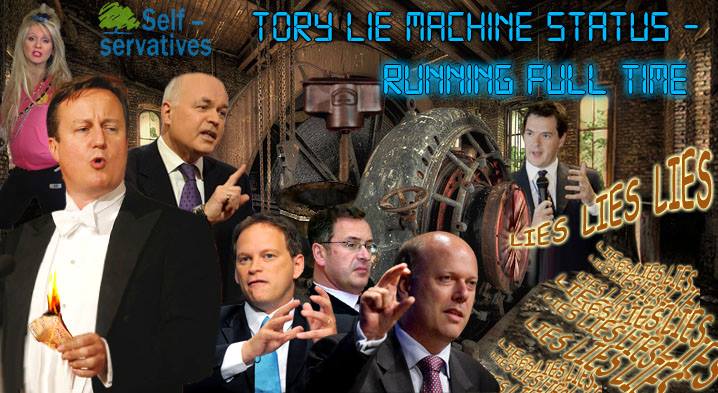
Of course Cameron feels that it’s other people that need parenting and discipline. After all, this is a man who spent his early adulthood involved in bizarre initiation rituals, patriarchal debauchery, recklessly banqueting, getting drunk, trashing college rooms and pubs, listening to Supertramp and smoking pot with James Delingpole and vandalising restaurants. In 2013, it was reported that members of the Bullingdon Club were required to burn a £50 note in front of a beggar as part of an “initiation ceremony”. How encouraging to see the elite showing responsibility, compassion, a concern for social justice and cohesion, equality and alleviating poverty, at an early age.

Now that’s a real deviant subculture.

The draconian sentences handed down to the rioters in 2011, advocated by Cameron –  like the 23-year-old student with no previous convictions who was jailed for the maximum permitted six months after pleading guilty to stealing bottles of water worth £3.50 from Lidl in Brixton, for example –  shows only too well that he believes there is one rule for the Oxford elite and another for the rest of the society. Punishment is a central component of the social order and a means by which social order is produced and maintained.

Actually, defining others as deviant is, too. It’s a Conservative means of enhancing social power and status differentials by degrading the rule-breaker’s status and power.

Cameron’s response to the riots reflects a characteristically Bullingdon conservative disdain: an authoritarian, strict and oppressive approach towards perceived, labelled and stigmatised subordinates. Conservatives have always seen the social world as being organised in terms of hierarchies of worth. Smashing up a pub or restaurant and causing 10k worth of damage is no problem if you can cough up the costs on the spot to keep your thuggish behaviour private, hidden away from the scrutiny of the legal system and the public. Money talks and bullshit struts.

The Conservatives inform us that it is bad parents that cause poverty, opting for a rhetoric of authoritarian populism, creating cardboard monsters, manufacturing folk devils and moral outrage for the tabloids, making excuses for the consequences of their own prejudiced and damaging policy-making.

The establishment is a kind of Moebius strip of finger-pointing, arrogant, moralising privileged and feckless bullies passing the buck. And importantly, these wayward boys and girls always get their own way. They can’t democratically govern the country; they lack the social skills, motivation, developmental and emotional capacity to actually engage in any genuine and democratic dialogue with ordinary people, so they rule. Conservatives have always prefered the simplicity of a socio-economic system defined by inherited social ranks.

Cameron says that the government’s Life Chances Strategy – an “initiative to target tackle child poverty” – will include a plan for “significantly expanding parenting provision”. It will also recommend ways to “incentivise” all parents to take up the offer of classes. The hope is, presumably, that if the middle class take Cameron up on his offer of state parenting instructions, the process of social norming will provide the foundation of state-defined “correct behaviours” for the insubordinate working classes, who are perpetually caught up, according to the Tories, in a pathological cycle of something or other, and therefore need state therapy from elitist antipodean role models to set them straight and put them in their place. It’s the new behaviourism: do as we say, but not what we do.

It seems that poverty is to be addressed with nothing more than a paternalist brand of cheap psychopolitics. The government won’t be dipping their hands into the treasury, which is what’s needed. Instead they prefer to employ shabby techniques of persuasion aimed at indoctrinating a Conservative world-view and enforcing conformity as a replacement for genuinely needs-led and evidence-based policies.

At no point does Cameron mention any commitment to improving people’s standard of living, or ensuring that families have a basic level of income in order to meet their fundamental needs, such as food, fuel and shelter – because struggling to meet basic material needs are the main barriers for people experiencing poverty. It’s sobering to consider that the Tory obsession with the work ethic, embodied in their mantra “making work pay”, is nothing more than a meaningless glittering generality, that purposefully diverts attention from elitist policy-making, and subsequent growing poverty and inequality.

Around half of those who are in poverty and of working age live in a household where at least one person works. The steady drop in real wages since 2010, according to the Office for National Statistics, is the longest for 50 years.

Furthermore, since 2010, the decline in UK wage levels has been amongst the very worst in Europe. The fall in earnings under the Coalition is the biggest in any parliament since 1880, according to analysis by the House of Commons Library, and at a time when the cost of living has spiralled upwards.

Ah, and Cameron uttered that inane managementspeak word again – “incentivise”. It never bodes well when Conservatives use that word. It means he has been listening to the psychobabbling of the Nudge Unit, again. Welfare sanctions, which are the punitive withdrawal of lifeline benefits from people who need to claim welfare support to meet their basic needs are claimed to “incentivise” people to find a job, despite empirical evidence to the contrary, and the cuts to child tax credit, limiting support to just two children, are based on the charming and archaic eugenicist idea that poor people ought to be “incentivised” to have fewer children.

Rich people are apparently “incentivised” by large cash carrots, but poor people just get the brutal, merciless stick. What a classic example of flagrant Conservative ideological incoherence.

Psychopolitical paternalism doesn’t address poverty, it is simply a way of apportioning blame, of abdicating political responsibility and ensuring that poor people accept the Conservative and neoliberal decree that they somehow deserve to be poor.

Cameron claims that:

“Families are the best anti-poverty measure ever invented. They are a welfare, education and counselling system all wrapped up into one. Children in families that break apart are more than twice as likely to experience poverty as those whose families stay together. That’s why strengthening families is at the heart of our agenda.”

The announcement from Cameron was welcomed by Relate, whose chief executive, Chris Sherwood, said:

“Relationship support can help to reduce family breakdown, which is a key driver of poverty and can result in poor outcomes for children.”

Actually, family breakdown is quite often a consequence of poverty, not a cause of it. Back in 2010, Fergus Drake, director of UK programmes with Save the Children expressed an unease that many of us felt, regarding the Conservative’s feckless drive to offload the responsibility for poverty onto poor people, who are casualities of the consequences of neoliberalism, which extends discriminatory economic policies. He said:

“We would say poverty causes family breakdown rather than vice versa. If you are worried about putting food on the table, or being able to turn on the heater so you can have a hot bath, the stress that causes to a relationship can make things really difficult.”

Poverty isn’t caused by family breakdown, it’s caused by discriminatory policies and social insititutions that extend and perpetuate inequality. We are now the most unequal country in the European Union, and even more unequal than the US. If Cameron really wanted to address childhood poverty, he would ensure that people have enough to meet their basic needs, instead of steadily withdrawing welfare support and cutting public services. He should end the class-contingent austerity that his government have imposed on only the poorest people.

Tim Nichols, of the Child Poverty Action Group, agrees that the Conservatives should be careful not to confuse causes and consequences. He says:

“We don’t think that this is robust strategy. Tackling child poverty can’t be done without more redistribution.”

Cameron is talking ideologically-driven nonsense, reflecting traditional Tory prejudices. This government has become obsessed with moralising about and manipulating individual agency, which is increasingly seen as being to blame for high levels of poverty and social exclusion in the UK, which are created entirely by callous, discriminatory political policies. Political gaslighting does not help people out of poverty.

People are poor because they don’t have enough money to meet their needs. That is what Cameron needs to acknowledge and address.

Parenting and elitist-authoritarian ideology

Cameron’s paternalist-authoritarian turn was evident back in 2010, when he said that:

“Discipline is the foundation of a good education. Headteachers need to decide on exclusions.”

Most people that have worked in either formal or informal education settings are very aware that using punishment and threats is very counterproductive. Making young people suffer in order to change their future behaviour can often elicit temporary compliance, but this strategy is highly unlikely to lead to conversion or to help children become ethical, responsible decision makers in the long term. Punishments don’t involve any engagement of deliberative processes.

Punishment, even if referred to euphemistically as “consequences,” tends to generate oppositional behaviours, anger and defiance.  Furthermore, it models the use of power rather than reason and damages the important trust-based relationship between adult and child.

Authoritarian models of parenting are emotionally and physically traumatising. There’s an Old Testament brand of harshness in conservative authoritarian approaches to human behaviours.

Authoritarian parents often have prejudices based on wealth and what may be defined as “achievement”, gender, class and race. They tend to be highly competitive, lacking warmth and empathy. They teach their children to compete at all costs, and to win by whatever means. Most authoritarians are behaviourists, with a preference for punishments rather than rewards to control others.

Authoritarians tend to advocate corporal punishment, they see freedom as chaotic, they can’t tolerate ambiguity or recognise the complexities and subtleties of human conduct, and they tend to advocate capital punishment.

Because authoritarian parents expect absolute obedience, children raised in such settings are typically very good at following rules.

However, they often lack self-discipline. Children raised by authoritarian parents are not encouraged to explore and act independently, so they never really learn how to set their own limits and personal standards.

Whilst developmental experts agree that rules, boundaries and consistency are important for children to have, most believe that authoritarian parenting is too punitive and lacks the warmth, unconditional love, safety, trust and nurturing that children need.

Of course public schools also foster authoritarianism and elitism. Boarding school: the trauma of the ‘privileged’ child by Joy Schaverien explores the emotional deprivation and abuse that many experience as a result of public school culture. Psychotherapist Nick Duffell (2000) wrote a book based on workshops he has conducted over ten years with adults who attended boarding schools as children. He has identified many lasting pathological psychological patterns common in those he calls Boarding school survivors.

In his recent work: Wounded Leaders: the Psychohistory of British Elitism and the Entitlement Illusion, Nick says:

“A cherished national character ideal, eschewing vulnerability and practising a normalised covert hostility based on bullying in the dorm adversely affects even those who did not have the privilege of such an education. It leaves Britain in the social and emotional dark ages, led by “the boys in the men that run things.

This specific culture of elitism, protected by financial interests and the “It never did me any harm” syndrome, means that Britain is unlikely to foster the kind of leadership necessary in our world of increasing complexity, which needs a communal mindset and cooperative global solutions. But worse, new scientific evidence shows that this hyper-rational training leaves its devotees trapped within the confines of an inflexible mind, beset with functional defects, presented here as the Entitled Brain.”

It’s a sobering thought that so many boarding school survivors – psychologically and emotionally damaged individuals – are involved in running the country and determining the terms and conditions of our lives.
002fc17b9115fe26a6ed5d9d58b1ece1.603x472x1


I don’t make any money from my work. My articles are free. If you like, you can make a donation to help me continue to research and write free, informative, insightful and independent articles, and to provide support to others. The smallest amount is much appreciated – thank you.

DonatenowButton

UK has shameful but unsurprising levels of inequality


1459720_569627496440116_902730897_n

Austerity was never about what works or what is needed. It’s about traditional Tory class-based prejudices. Austerity is simply a front for policies that are entirely founded on Tory ideology, which is  all about handouts to the wealthy that are funded by the poor.

David Cameron has often denied claims that his party has overseen a rapid rise in inequality. In fact last year, Cameron said that inequality is at its lowest level since 1986. I really thought I’d misheard him. 

This wasn’t the first time Cameron has used this lie. We have a government that provides disproportionate and growing returns to the already wealthy, whilst imposing austerity cuts on the very poorest. How can such a government possibly claim that inequality is falling, when inequality is so fundamental to their ideology and when social inequalities are extended and perpetuated by all of their policies? It seems that the standard measure of inequality has been used to mislead us into thinking that the economy is far more “inclusive’ than it is. Yet the UK is one of the wealthiest nations in the world.

Earlier this year a published report by the Dublin-based Foundation for the Improvement of Living and Working Conditions (Eurofound) stated that the UK has become the most unequal country in Europe, on the basis of income distribution and wages.

The report also says that the UK has the highest Gini coefficient of all European Union (EU) member states – and higher than that of the US. The coefficient is a widely used measure of the distribution of income within a nation, and is commonly used to calculate inequality.

A year ago, the Organisation for Economic Cooperation and Development (OECD) published research that confirmed what most of us already knew: that income inequality actually stifles economic growth in some of the world’s wealthiest countries, whilst the redistribution of wealth via taxes and benefits encourages growth. That debunks one of the nastiest Tory myths. Having long been advocates and engineers of social inequality, implying a mythological  “trickle down” as a justification, and hankering after a savage, axe-wielding minarchism, chopping away at our civilising public services and institutions, they are now officially a cult of vicious cranks. The problem is that the general public don’t pay much attention to research like this. They really ought to.

Conservatism is centred around the preservation of traditional social hierarchy and inequality. Tories see this, erroneously, as an essential element for expanding national economic opportunity. But never equal opportunity.

Conservatives think that civilised society requires imposed order, control and clearly defined classes, with each person aware of their rigidly defined “place” in the social order. Conservatism is a gate-keeping exercise geared towards economic discrimination and preventing social mobility for the vast majority. Inequality is so clearly embedded in policies – which are written statements of political intent.

According to the annual Family Spending Review for 2014, published by  the Office for National Statistics (ONS), the richest 1 per cent of the population have as much wealth as the poorest 57 per cent combined.  Wealth inequality has increased since 2012. The richest 10 per cent own half the country’s wealth.

Charities have urged the government to address Britain’s shameful and growing inequality after the figures published this week show that the country’s richest 10 per cent spend as much on alcohol and cigarettes in a week as the poorest spend on gas and electricity. That turns the dominant “feckless” poor narrative in the media on its head. Poverty doesn’t happen because people have poor budgeting skills. Poverty happens because people don’t have enough money to meet their basic needs.

The richest 10 per cent of households spent more per week on furniture – an average of £43.40 – than the poorest spent on food – £30.40.

The average weekly household spend was found to be £531.30, but there was great variation of this amount between the highest and lowest earning 10 per cent – £1,143.40 and £188.50 per week respectively.

By 2011/12, the poorest fifth of households spent 29 per cent of their disposable income on indirect taxes, compared with 14 per cent paid by the richest fifth. All told, the poorest households pay 37 per cent of their gross income in direct and indirect taxes. In other words, the single biggest expenditure for people in poverty is tax. It is, at the very least, morally unjustifiable to be taxing the poor at such a rate. The most important thing the government can do to help the poor is to stop taking their money.

David Cameron did once tell a truth, though it was an inadvertent Freudian-styled slip. He said: We are raising more money for the rich. Yes. From where, I wonder?

Oh yes. The poor.

 382035_141704259313964_676863845_n


 Pictures courtesy of Robert Livingstone


Propaganda techniques part one: Glittering Generalities – language and the New Word Order.

Image result for securing a better futurePropaganda techniques

Introduction.

This is part one of a series of articles I am writing about propaganda techniques, with the aim of explaining the seven main types that The Institute for Propaganda Analysis identified in 1938, and looking at current examples of their use.

Propaganda techniques are still very commonly used in the media, in advertising, in politics, in rhetoric and debate. In the US, much of the work by the Institute of Propaganda Analysis tended to focus on the techniques of persuasion used by Stalin and Hitler. Many people think that there is no need for research nowadays, but propaganda techniques are still being used widely.

In Britain, the current government has adopted a psychocratic approach to governing, reflected in public policies that have a central aim of  directing”behavioural change” of targeted social groups, and are founded on quasi-scientific understandings of the basis of human decision-making.

The Conservatives claim to champion the small-state and minimal intervention, yet the consequences of their policies insidiously intrude into people’s everyday experiences and thoughts. Our attitudes and beliefs are being manipulated, our decision-making is being “nudged,” citizens are being micro-managed and policed by the state.

The Conservatives use Orwellian-styled rhetoric crowded with words like “market forces”, “meritocracy” “autonomy”, “incentivisation”, “democracy”, “efficient, small state”, and even “freedom”, whilst all the time they are actually extending a brutal, bullying, extremely manipulative, all-pervasive state authoritarianism.

Furthermore, this authoritarianism entails a mediacratic branch of government that powerfully manipulates public opinion. The mind-numbing mainstream media is conformative rather than informative, and is designed to manufacture and manage public consensus, whilst setting agendas for what ought to be deemed important issues. The media is scripting events rather than simply reporting them, filtering information by deciding which events may and may not have precedence.

And really, it’s the same old same old. Propaganda is an extremely powerful weapon and seizing control of the mainstream media is one of the first things that all tyrants do:

“Everything within the state, nothing outside the state, nothing against the state.” Benito Mussolini.

The current government is not interested in any form of democratic dialogue. They simply want to set a rigid agenda to control socio-political outcomes to benefit the powerful and wealthy elite.

We are witnessing attempts to control virtually all aspects of social life, including the economy, education, our private life, morals and the beliefs and attitudes of citizens. We are also seeing the rise of political behaviourism, which is closely linked with totalitarian forms of thinking.

The officially proclaimed ideology penetrates into the deepest reaches of societal structure and the totalitarian government seeks to completely control the thoughts and actions of its citizens.” Richard Pipes.

Recent public policies related to behavioural change exploit the emotive, automatic drivers of decision-making through methods such as subconscious priming or default settings. This is extremely worrying, as it bypasses rational processes, and has some serious implications for conceptions of human autonomy and agency, which is central to the design of liberal democracies.

Democracy is based on a process of dialogue between the public and government, ensuring that the public are represented: that governments are responsive, shaping policies that address identified social needs. However, Conservative policies are no longer about reflecting citizen’s needs: they are increasingly all about telling us how to be.

So we do need to expose and challenge such insidious, anti-democratic state control freakery and psychocratic shenanigans.

scroll2Part 1. Glittering Generalities: all that glitters is glib, not gold.

Glittering Generalities is one category of the seven main propaganda techniques identified by the Institute for Propaganda Analysis in 1938. It’s a device often used by the media and in political rhetoric to persuade us to approve and accept something without examining any evidence.

This is a propaganda technique purposefully designed to divert and distract, so that people are less likely to develop their own critical thoughts. This said, the purpose of all forms of propaganda is to tell you what to think, and not how to think.

Glittering Generalities capitalise on increasingly sloganised political discourses, leading to a loss of conceptual clarity, over-idealisation and they also reflect conceptual miserliness – a tendency for some people to prefer simple, superficial and easy answers, rather than having to expend time and effort to grapple with complexity, critical analysis and the need to weigh up evidence. They also succeed in conveying codified messages that reference underpinning discourses which are often prejudiced and controversial, but presented in a way that bypasses any detailed scrutiny, as a consensus view and “common sense.”  An example is the slogan “Taking our country back” as it references an underpinning racist, supremicist discourse.

Gordon Allport’s Principle of Least Effort is a theory that humans engage in economically prudent thought processes, taking “short-cuts” instead of acting like “naive scientists” who rationally investigate, weigh evidence, costs and benefits, test hypotheses, and update their expectations based upon the results of the “experiments” that are a part of our everyday actions.

Sometimes we are more inclined to act as cognitive misers, using mental short-cuts to make assessments and decisions, concerning issues and ideas about which we know very little, as well as issues of great salience.

The term “Cognitive Miser” was coined by Fiske and Taylor (in 1984) to refer, like Allport, to the general idea that individuals frequently rely on simple and time efficient strategies when evaluating information and making decisions.

Rather than rationally and objectively evaluating new information, the cognitive miser assigns new information to categories that are easy to process mentally. These categories arise from prior information, including schemas, scripts and other knowledge structures, such as stereotypes, that have been stored in our memory.

The cognitive miser tends not to extend much beyond established belief when considering new information. This of course may perpetuate prejudices and cognitive biases.

Glittering Generalities imply – or signpost us – via common stock phrases to our own tacit knowledge, which often lies below our current focal awareness – prior information, beliefs, ideals, values, schemata and mental models, stereotypes and so on, creating the impression that the person using the terms and phrases understands and sees the world as you do, creating a false sense of rapport by doing so. Or the feeling that some very important recognition has been made.

Glittering Generalities propaganda is sometimes based on a kind of logical fallacy known as Equivocation – it is the misleading use of a term with more than one meaning (usually by glossing over which meaning is intended at a particular time)

Glittering Generalities is a technique very often used by people who seek to stifle debate, sidestep accountability and suppress democratic processes. Because Glittering Generalities tend to obscure or gloss over serious areas of disagreement, they hide controversy and submerge alternative propositions.

As such, Glittering Generalities may often be used to neutralise opposition to dominant ideas. It’s a way of disguising partisanship and of manipulating and reducing democratic choices. It’s part of a process of the political micro-management of your beliefs and decision-making.

It also reduces public expectation of opposition and in doing so it contributes to establishing diktats: it’s a way of mandating acceptance of ideology, policies or laws by presenting them as if they are the only viable alternative.

This propaganda technique bypasses rationality altogether, by employing morally laden or emotionally appealing words and phrases so closely associated with highly valued concepts and beliefs that carry conviction – convince us – without need for enquiry, supporting information or reason.

The meanings of such words and phrases is generally based on a loose, tacit public consensus, often varying between groups and individuals. Semantic shift describes a process of how the meanings of words may change over time, but meanings also shift and vary amongst social groups. Language is elusive and changeable. (Words like wicked and bad, for example, shifted subculturally. Originally: evil, corrupt, sinful, malevolent → superb, excellent, great, fantastic. ) Let’s not forget that when we use language, it is with purpose and intent.

So, Glittering Generalities are rather like platitudes or clichés presented as semantic signs to cognitive short-cuts that are often used to distract and placate people, they provide a superficial, broad, symbolic map to a logical cul-de-sac. They are superficially appealing and convincing but ultimately empty, meaningless words or phrases.

To summarise, Glittering Generalities may be identified by the following criteria:

  • Use of attractive, but vague “virtue” words that make speeches and other communications sound good, but in practice say nothing in particular.
  • Use of lulling linguistic patterns such as alliteration, metaphor and reversals that turn your words into easy to remember soundbites that often flow and rhyme in hypnotic patterns.
  • Use of words that appeal to morals and values, which often themselves are related to triggering of powerful emotions.
  • A common element of glittering generalities are intangible nouns that embody ideals, such as freedom, democracy, integrity, justice, respect.

Some further examples of Glittering Generalities are: economic plan, all in it together, big society,  freedom, family values, the common good, democracy,  principles, choice, incentivise, efficiency, fairness, hard-working families, parental choice, a caring society, fiscal responsibility, market choice, meritocracy, personal responsibility, making work pay, scroungers and strivers, anti-austerity, socialism, progressive, disenfranchised, deceit, Westminster establishment, the needs of the people, but that’s all just semantics really.

A good example of a Glittering Generality is the Conservative’s phrase “making work pay.” It refers to the Tory welfare “reforms” which were nothing to do with the level of wages. How does reducing benefits for unemployed people actually make work pay? Especially given the fact that wages have dropped for those in work, at the same time, the cost of living has risen, and consequently many working people are now living in poverty. The question to ask is: making work pay for whom?

The Tories have an Orwellian dexterity in manipulating semantic shifts. They do like to dress-up words and parade them as something else. For example, take the word “reform,” which usually means to make changes to an institution, policy or practice in order to improve it. The welfare “reforms” have involved the steep and steady reduction of welfare provision and an increase in political scapegoating and victim-blame narratives.

We have also seen the return of absolute poverty since the “reforms” were (undemocratically) implemented in 2012, which can hardly be considered as an “improvement” to what came before the Tories made savage and brutal cuts to poor people’s lifeline benefits, making them even poorer, with some people dying as a consequence.

Then there is the Tory drift on the word “fair.”  It’s generally taken to mean treating people equally without favouritism or discrimination, and without cheating or trying to achieve unjust advantage.

However, the Conservatives have repeatedly claimed that cutting people’s lifeline benefits is “fair.”  As I’ve previously stated, the value of wages has also dropped to its lowest level ever, whilst the cost of living has risen and many in low paid work are now living in poverty, in reality the welfare cuts have simply made people desperate enough to take any low paid work, which does not alleviate circumstances of poverty.

Furthermore, how can the welfare cuts be regarded as remotely fair, when they took place in a context where the government handed out £107,000 of public funds to each millionaire, in the form of an annual tax break?

Finally, it’s not only the Tories that utilise propaganda techniques, and some parties on the Left have also used Glittering Generalities. These parties especially capitalized on the public’s growing cynicism and dissatisfaction with the “Westminster establishment.” UKIP and the Scottish National Party drew on nationalism (and independence,) whilst using superficial, simplistic and ambiguous phrases and symbols, the Green Party and other Left-wing factions also drew on public dissatisfaction with “mainstream parties” and appealed to people’s hopes and fears to present an “alternative.”

Both the Greens and the Scottish nationalists presented a rhetoric skillfully tailored and laden with words and phrases that reflect progressive ideals whilst also claiming a position that opposed austerity. Yet this lacked integrity, as the rhetoric wasn’t fully connected to actual manifesto policies.

Crucially, the Scottish National Party’s spending plans implied deeper cuts than Labour’s plans entailed over the next five years, as the Institute for Fiscal Studies (IFS) said in a report in April, highlighting a “considerable disconnect” between the nationalist’s rhetoric on austerity and their policies.

The Green Party had a similar disconnect between an anti-austerity rhetoric and their incompatable policy proposals of a zero-growth economy and the universal citizen’s income. The latter was heavily criticised because, as it was modelled, the universal basic income would create deeper poverty for the poorest citizens and further extend social inequality.

The Labour Party ran a more rational but superficially less appealing campaign based on improving the material conditions of society for the majority of people. The policy plans for an extensively redistributive tax system, for example, matched the rhetoric about addressing growing social inequality, as well as a social reality. But the current climate of  right-wing anti-intellectualism, widespread disillusionment with the political establishment and increasing public disengagement from democracy doesn’t prompt a rational exploration of policy proposals and any analysis of potential consequences for society from many people.

The Conservatives are guilty of great deceit in blaming Labour for the deficit – Ed Miliband.

gret deceit

The first part of this article was originally posted in the Guardian, on Thursday 6 January 2011:

Ed Miliband accuses the Conservatives today of a “great deceit” in blaming Labour for the national deficit and warned that they have concocted a false narrative to justify politically driven cuts. Speaking at Labour’s campaign centre in Oldham yesterday, the Labour leader  attacked the Tories for rewriting history.

In announcing a raft of swingeing public spending cuts the coalition government has repeatedly sought to portray that its hands are tied because of the size of the deficit it inherited from the last government.

The same argument was rolled out this week to defend this week’s rise in VAT from 17.5% to 20%, after warnings of the likely impact on low and middle-income families and the fragile economy. Amid Labour concerns that the opposition has not been forcefully contradicting the coalition’s narrative on the deficit, Miliband insisted that it was not caused by Labour overspending but by the global financial crisis.

“My concern is that a great deceit designed to damage Labour has led to profoundly misguided and dangerous economic decisions that I fear will cause deep damage to Britain’s future,” he writes in today’s Times (paywall).

The Labour leader says that by blaming the deficit on overspending the Conservative-led government is seeking to win consensus for its policy of cutting the deficit “as far and as fast as possible”. But he accuses the chancellor of “gambling on a rapid rebalancing of the economy” and says he is going “too far and too fast on the deficit”.

Accusing the Tories of attempting to rewrite history, Miliband points out that Britain’s debt at the outset of the economic crisis was the second-lowest in the G7 and lower than it was under the Conservatives in 1997 and says neither of the parties in the coalition government called for lower spending at the time.

Miliband repeats his warning from earlier this week that the VAT increase will squeeze families on middle and low incomes and says growth will be restricted as a consequence. He argues that while some would argue those are prices worth paying in the short-term, the effect will be to store up greater problems for the future.

He says Labour is not opposed to every cut, but that he does oppose those being inflicted on the county’s poorest. He added: “but neither is it true that Labour is to blame for the deficit or that the deficit-reduction programme being pursued by this government is necessary and fair. Because this Conservative-led government is trying to deceive people about the past, it is making the wrong judgments about the future”.

David Cameron said yesterday that the joint impact of increases on duty and VAT meant things were “very painful and difficult” and raised the prospect of introducing a fair fuel stabiliser which would keep fuel duty down when oil prices rise. He also admitted that the rise in VAT to 20% this week was regressive in terms of people’s income but “might not be if it was looked at in terms of people’s spending.”

See also: Ed Miliband’s speech on the deficit and economy: George Osborne’s cuts are extreme and ideological.

scroll2
Ed Miliband’s speech shows that he is a very perceptive and conscientious leader.

The claims made by the Conservatives that Labour “left a mess” don’t stand up to scrutiny. Here is a little evidence which demonstrates that the Tories have a track record of lying, and of blaming everyone else for their own ideological preferences, policy decisions and economic incompetence:

https://i0.wp.com/www.taxresearch.org.uk/Blog/wp-content/uploads/2014/10/Screen-Shot-2014-10-06-at-09.36.30.png

Thanks to Richard Murphy, who produced this graphic, all data is from the HM Treasury Pocket Bank for 30 September on the Government’s own website.

See also: Labour is not responsible for crash, says former Bank of England governor

OBR head rebukes Osborne: the UK was never at risk of bankruptcy. Osborne was rebuked by the Office for Budget Responsibility (OBR) for telling the great big lie about Labour leaving the country “near bankrupt”, yet Cameron has used that same lie in the televised leaders debates. You’d think that a near “bankrupt” country would have had the Fitch and Moody triple A credit ratings downgraded …oh hang on, didn’t that happen … under the TORIES?

And haven’t the Tories borrowed more in 5 years than Labour did in 13? Surely we must be bankrupt now, by the Tories’ own reckoning.

Then there is the oft-cited Liam Byrne note. The jest recalls a similar note left by Tory Reginald Maudling to his Labour successor James Callaghan in 1964: “Good luck, old cock … Sorry to leave it in such a mess.”

Byrne clarified at the time that the note was meant in jest: “My letter was a joke, from one chief secretary to another,” he said. “I do hope David Laws’s sense of humour wasn’t another casualty of the coalition deal.”

Treasury sources said the full text of the letter from Byrne – dated 6 April, the day Gordon Brown called the general election – was: “Dear chief secretary, I’m afraid there is no money. Kind regards – and good luck! Liam.”

Byrne’s notes have caused bemusement before. When he was promoted to the cabinet in 2008, he gave officials a set of instructions entitled “Working with Liam Byrne”, which included the lines: “Coffee/Lunch. I’m addicted to coffee. I like a cappuccino when I come in, an espresso at 3pm and soup at 12.30-1pm … If I see things that are not of acceptable quality, I will blame you.”

Gary Gibbon of Channel 4 News remembers that former chancellor Alistair Darling had also left a note for his successor, George Osborne, as well as a bottle (how very civilsed) – but, in Gibbon’s words, “no revolver.”

It’s an indication of how desperately determined this government are to blame the previous government for the consequences of their own policy decisions and economic catastrophe, that the Tories have to seize on a traditional and humorous exchange between outgoing and incoming ministers as “proof” to bolster their spurious claims and to prop up such deception.

The Office of National Statistics (ONS) has said that David Cameron has presided over an economy with the weakest productivity record of any government since the second world war, and revealed that output per worker fell again in the final three months of 2014.

In a separate blow to the credibility of the government, two-thirds of leading UK economists said they believed George Osborne’s austerity strategy had been damaging for the economy.

The Centre for Macroeconomics polled 50 leading economists, asking them whether they agreed that the government’s deficit-reduction strategy had a positive impact on growth and employment. One third disagreed and a further third strongly disagreed.

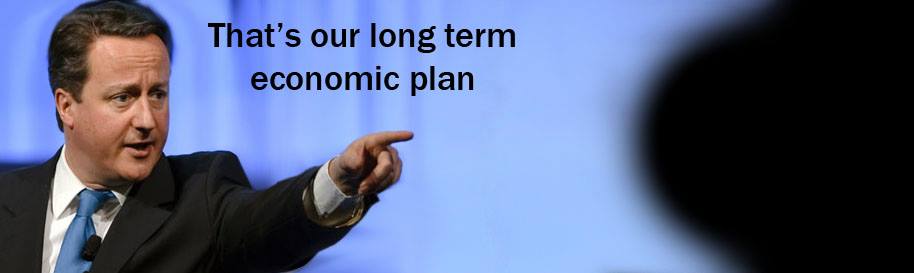
Furthermore, 77% feel that the outcome of the general election will have serious (“non-trivial”) consequences for the economy, and are clearly not in favour of the Conservatives’ “long-term economic plan.”

The Tories seem to think we have forgotten that it was they that lost the Moody’s Investors Service triple A grade, despite pledges to keep it secure. Moody’s credit ratings represent a rank-ordering of creditworthiness, or expected loss.

The Fitch credit rating was also downgraded due to increased borrowing by the Tories, who have borrowed more in 4 years than Labour did in 13.

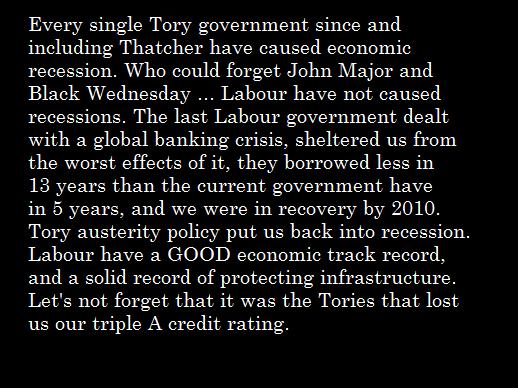
I remember that we were very well sheltered from the consequences of the global banking crisis by the last government. It’s remarkable that despite George Osborne’s solid five-year track record of failure, the Tories still mechanically repeat the “always cleaning up Labour’s mess” lie, as if increasing the national debt by 11% of GDP in 13 years, mitigated by a global recession, caused by bankers, as Labour did, is somehow significantly worse than George Osborne’s unmitigated record of increasing the national debt by 26% in just 5 years. Osborne has ironically demonstrated that it is possible to dramatically cut spending and massively increase debt. Austerity doesn’t work as a means of reducing debt, but works exceptionally well as a smokescreen for an ideologically-driven reduction of the state.

econ lies

The Tories have seized an opportunity to dismantle the institutions they have always hated since the post-war social democratic settlement – institutions of health, welfare, education, culture and human rights which should be provided for all citizens. The Tories attempt to destroy fundamental public support for the health, education and welfare of its people. Offering and inflicting only regressive, punitive policies and devastating cuts, the Tories lie, lie and lie some more to attempt to justify the unustifiable.

proper Blond

The Conservatives have not encouraged investment in the UK either:


The Tories have told many lies. Here’s a list of those that have earned them official rebukes – A list of official rebukes for Tory lies.

Further reading:

The Austerity Con Simon Wren-Lewis

The Tory election strategy is more of the same: Tories being conservative with the truth.

The Great Debt Lie and the Myth of the Structural Deficit.

One of the most destructive Tory myths has been officially debunked.

“The mess we inherited” – some facts with which to fight the Tory Big Lies.

Political scrapbook: Telegraph business leaders letter ‘was padded out with Sam Cam’s luvvie friends’

Follow the Money: Tory Ideology is all about handouts to the wealthy that are funded by the poor.

The word “Tories” is an abbreviation of “tall stories”.

10689499_731152076954323_875040546185242333_nWith thanks to Robert Livingstone 

Inflicting suffering on those in need is now at the heart of our benefits system – Frances Ryan

430847_149933881824335_1645102229_n (1)The main part of this article was originally published in the Guardian on 10 March and was written by Frances Ryan.

I tend to think I am beyond shock at the actions of the Department for Work and Pensions (DWP) now. The expectation that this government is capable of morality or even basic competence was lost some time ago, somewhere between enacting policy that pushes people already in poverty into losing their homes and denying deaf, blind eight-year-olds disability benefits. Still, Dispatches’ Benefits Britain investigation was painful viewing.

During seven weeks of undercover work at a universal credit contact centre in Bolton, Channel 4 journalists witnessed a farcical mess of centralised IT failure. But what really stood out were the underhand tactics DWP staff were found to use against claimants: from deliberately withholding hardship payments from people struggling after having their benefits sanctioned, to hiding the flexible fund put in place to pay for clothes or a bus fare they needed to help them get a job.

What Dispatches showed is not an isolated incident, a black spot polluting an otherwise untarnished record. It is an example of both attitude and action that runs through the entire system: the growing conditionality on benefits, the withholding of emergency help, all the way back to how benefits are assessed.

As of last week, there is quantitative evidence that the notorious fit-for-work tests are inflicting damage to disabled people’s bodies (not to mention the impact on their minds). Yes, we have now reached a point where the benefit system is making disabled and chronically ill people sicker. Over 60% of disabled people going through the work capability assessment – designed by the DWP and sold off to private firms – report being in pain afterwards. Others said their condition was made worse or their recovery delayed. One claimant surveyed, who has progressive rheumatoid arthritis, said she left her appointment “feeling absolutely awful and suffered a lot of pain in the following days.” She went on to have a stroke a few weeks later.

It might be worth remembering that this is an assessment that is meant to help people – one million people are due to go through the process this year – if only because those orchestrating it appear to have forgotten. It is the same cavalier attitude to the vulnerable that means claimants have killed themselves after being spat out by the benefit system, as if desperation and distress means nothing.

We are sliding back to the notion that suffering helps the soul, that the underclass – be it the unemployed, the disabled, or chronically ill – need to be trained in order to behave. And, as almost a secondary consequence, their punishment cuts the welfare bill down. A bonus all round.

The ideology of a small state or the belief that benefits build dependency are crass, irrelevant details to what at its core is simply a decision about how to treat a human being. This is particularly damning when one person has all the power and the other is forced through economic necessity to take whatever humiliation or pain they are given. To do that to someone – let alone hundreds of thousands – is no accident. It is a conscious decision, that has been made over and over again by this government.

scroll2I wrote this last year:

Here are two articles about the terrible, extremely harsh and punitive consequences of the governments’ historically regressive, ethically challenging benefit sanctions regime. This is a very cruel and limited application of operant conditioning: the government are applying punishment to vulnerable people who need the support of lifeline benefits to meet their fundamental survival needs, under the guise of “paternalistic libertarianism.”

The punishments are applied most frequently to the most vulnerable people. Our welfare system was designed to support people, but under the Tory-led Coalition, it has been transformed into an administration that is run on unethical principles, akin to the Milgram experiment, with the difference that the punishments used are real, and decisions to punish welfare claimants are resulting in very real and terrible consequences.

It’s a biological fact that when people cannot meet their basic survival needs – food, fuel and shelter – they will die. Everybody understands this, no matter how well-insulated by personal wealth they may be.

The government understands this.

The welfare “reforms” are harming people, and are causing deaths. Full article – Benefit sanctions are not fair and are not helping people into work.

Related

Aktion Arbeitsscheu Reich, Human Rights and infrahumanisation

Techniques of neutralisation – a framework of prejudice

Cameron’s Nudge that knocked democracy down – a summary of the implications of Nudge theory


385294_195107567306966_1850351962_nThanks to Robert Livingstone for the memes.


WORKING FOR PATIENTS OR NOT? – a guest post by Suzanne Kelsey

imgres


A guest post by Suzanne Kelsey, who is a key campaigner for the NHS, amongst other things.

In 1988, when Margaret Thatcher had been in office for some 9 years, and the very foundations of our NHS had been shaken with more of the public encouraged to use private medical care,  there were serious concerns about capacity in the hospital services as waiting lists increased and wards closed.  The Conservative government appointed a group of people, without consulting the health professions, to look at this growing problem.

As a result of this the NHS experienced the most significant cultural shift since its inception with a White Paper entitled, ‘Working for Patients, ’ which proposed what we now  know as the ‘Internal Market’ and the development of the purchase provider split. GPs become the purchaser and the hospitals are the providers. This passed into law as the NHS and Community Care Act 1990. Understandably there was a great deal of opposition from trade unions, Labour and the general public but it went ahead as did the Private Finance Initiative in 1992 implemented for the first time in the UK by the Conservative government of John Major.

There is no doubt that further major problems were created for our NHS, although I would question if on the same scale as we are currently witnessing with the threat of complete privatisation and the sell-off of our publically funded service to huge private international companies, who have been waiting in the wings for quite some time and would have been rubbing their hands in glee some years ago if Thatcher and the Conservatives had continued in office.

The definition of ‘privatisation’ also needs to be acknowledged because with the downgrading of facilities and existing provision struggling to meet demands, more and more people will become anxious and tempted to pay for their treatment even if it is to ensure they have a hospital bed!

We must never let this practice become the ‘norm.’ Campaigners must ensure that the ‘free at point of use’ core principle is upheld or we will be taken back to pre-war years, removing freedom from fear that was fought long and hard for by our champions of social justice. At the same time we must remember the mantra, ‘public health not private wealth’ with numerous examples available to us of how private companies will always put profits before patients, but more of that later.

When Tony Blair became Prime Minister in 1997 he inherited a very impoverished NHS and although we expected him to abolish the internal market this did not happen, perhaps for a variety of justifiable reasons. How do you replace crumbling hospitals and inadequate resources without massively raising taxes, whilst also limiting the upheaval that had already been caused?

Alan Milburn was Minister of State at the Department of Health during this time and he stated that after years of the Tory’s gross underfunding, there was absolutely no money to fund the infrastructure, hence the use of John Major’s PFI initiative. Labour therefore it would seem had little choice but to implement this because of the historic neglect of the NHS under the Conservatives that led to understaffing and an NHS unable to manage with the rising expectations of the population, coupled with the costly advances in modern medicine and technology.

A global recession, which was not Labour’s fault, further compounded the challenges of meeting the complex needs of the nation’s health care. Dennis Skinner MP for Bolsover Derbyshire, passionately summarised this in parliament in 2014 when he stated; ‘Between 1997 and 2010 Labour dragged the NHS from the depths of degradation that the Tories had left it in and hoisted it back to the pinnacles of achievement.’

I would like to pose some questions to those experts of marketisation and competition. My knowledge is very limited on the economic implications but I am learning, slowly but surely, through my long involvement with local and national campaigning, speaking to key people in politics and campaign groups, who are also passionate about our NHS. I become increasingly frustrated when people continually blame Labour for the introduction of privatisation  Yes Blair did carry on certain aspects of it which was a disappointment for many, including me, but perhaps my arguments surely go some way to addressing why this was.

  •  My first question is in the title of this article; ‘IS THIS WORKNG FOR PATIENTS OR NOT?’
  •  If Labour had made such massive inroads into privatisation surely there would have been no need for the Coalition’s unwieldy and costly three billion pound reforms, so huge they were just about visible from outer space and the truth is many of those who voted for it would not have time to read it fully. The bill was a long time in the writing and despite the pause because of massive opposition it was nevertheless hastily introduced by the Coalition, despite all the election promises, notably, ‘there will be no top down reorganisation of the NHS.’ They have as predicted caused unprecedented chaos and in fact a major crisis in our NHS, with exhausted frontline workers propping up a system, becoming totally stressed, angry and demoralised.

Many of the population are afraid of becoming ill, because of worrying inadequacies not only at primary and secondary health care levels but also in social care. The frail and elderly feel a burden as they are constantly labelled as ‘bed blockers,’ Thus long queues have been created to see your GP and at A+E, the gateway to the hospital, all of which can result in a lack of timely care. In contrast however Labour ensured patient satisfaction was at its highest with waiting times were at their lowest and the NHS during their time was lauded as one of the best, if not the best health service in the world.

  • Were the massive and unprecedented reforms therefore unnecessary and unjustified?
  • What are the implications for binding private contracts that have taken place across large swathes of the country if hopefully there is a change of government?
  • What lesson have been learnt from the withdrawal of Circle, the private company that took over Hitchingbrooke hospital, with claims of managers installed by these private operators creating a ‘blame culture?’ Allegedly Circle were willing to ensure local GPs incurred financial losses as long as it meant corporations continued to make a profit and the damning report about the quality of care in this hospital is shocking. CQC inspecting the hospital felt obliged to intervene when they became fearful of a sickening child and Professor Mike Richards the chief inspector of hospitals said that the findings were the worst it had ever published.
  • Clive Efford Labour MP for Eltham, South East London,   presented a private members bill to parliament in November 2014,which in order to avoid further top down reorganisation, focussed on the most damaging aspects of the Health and Social Care Act 2012, that gave powers to competition regulators to interfere in decisions of local health care commissioners. The most significant change is that the Secretary of State is once again accountable to you and me through parliament. If the bill is passed he can no longer avoid answering parliamentary questions by saying that it is down to local decision making and not his responsibility. Efford’s Bill also provides that neither EU competition rules nor EU procurement rules will apply. That is an important change from the present because, at the moment, a disappointed private provider can sue an NHS commissioner for damages for failing to put a service out to tender or running a tender process wrongly. My thanks to Clive Efford for that explanation and for securing a vote of 241 for the bill to 18 against.
  • How is this Bill progressing and how it is being supported by NHS campaign groups and health professionals.
  • If the Conservatives are allowed to waltz back in by a public who have been influenced by the hype and propaganda through a biased media and/or have become disengaged, disenchanted or disillusioned , or indeed confused by the outrageous claims of some minor parties who seem to be making it up as they go along, what do we do next!?

I hear talk of a revolution being the only answer from those extremists who are likely to be the least affected by one. Perhaps we would do well to remember that our NHS has just seen the biggest revolution since its inception in 1948. Unfortunately we have seen a glimpse into our future and the outcomes are dire, if we do not use our votes wisely.

Suzanne Kelsey 1stFebruary 2015

http://www.nhshistory.net/shorthistory.htm#_ednref15

http://www.nhs.uk/NHSEngland/thenhs/nhshistory/Pages/NHShistory1948.aspx

https://abetternhs.wordpress.com/2011/01/18/commissioning-and-the-purchaser-provider-split/

http://www.healthp.org/node/71

http://labourlist.org/2014/11/commons-pass-vote-on-clive-effords-nhs-bill/

http://www.telegraph.co.uk/news/politics/11333986/Damning-report-as-first-private-firm-to-run-NHS-hospital-pulls-out.html

Battle with GPs led to Circle’s retreat from Hinchingbrooke hospital,   The Guardian, January 9, 2015

Hinchingbrooke staff in CQC abuse concerns fear bosses BBC, September 29, 2014

http://www.independent.co.uk/news/uk/uks-healthcare-ranked-the-best-out-of-11-western-countries-with-us-coming-last-9542833.html

Electioneering and grandstanding: how to tell the difference between a moral political party and a moralistic one.

1796655_294409220710133_3373329_nThis past four years or so, I’ve watched the media distort the truth, often removing it from a meaningful context and twisting it out of recognisable shape. Or very often avoiding it altogether. I’ve watched minor parties claiming to be on the Left do the same, too, and I won’t ever forgive them for that. Nonetheless we have done our best to share truths and information and to decode rhetoric and re-translate lies.

One thing I can do is analyse social policy, I’ve a perceptive and predictive eye for how policies will affect us – the implications and probable consequences – well before they are implemented. The last four years will bear that out. It’s not just because I studied it, it’s also because I see underpinning ideology, too. I recognise that policy is comprised of a set of scripted motives and intentions on the part of any government and instructions to society on how to organise itself, how to behave and how our individual degree of freedoms are defined, extended or restricted. Policies also send out instructions regarding how social groups are perceived and treated.

Policies may express and extend tolerance and reflect a valuing of diversity, or, as the case is now, they may also prescribe social prejudice and serve to institutionalize discrimination.

Ideology reflects how a government believes society is (and what it isn’t,) and also prescribes how it SHOULD be. The Tories have been imposing their own narrow, nightmarish vision upon us for the past five years.

Today it struck me again just how we have had to decode so very much misinformation. For example, someone asked me about the headline lie that the Labour Party intend to “scrap benefits for young people.” Of course it’s not true. Or rather, it’s a carefully selected, out of context, partial truth.

Miliband is REPLACING jobseekers allowance with another allowance for young people. He thinks that conditional benefits are inappropriate for young people, as to be entitled to jobseekers allowance requires having to be available for work and actively looking for work, so it excludes the very possibility of further education and learning experiences. But young people need the freedom and support to gain from learning. That’s why Ed Miliband will replace out of work benefits for those aged 18-21 with a youth allowance of the same value – currently around £57 a week. This isn’t the controversial issue that was presented by the mainstream media and other parties at all: it’s actually a very well thought out, cost efficient and positive policy.

So young people don’t have to be available for work, but they do have to use their freedom to be learning or training. This detail matters a lot and was excluded from most accounts of the policy. Miliband had a good idea, it won’t cost any more than we currently pay young people, but it means we are investing in young people’s potential and their futures.

This is just one example of how truths are being distorted and not just by the media, but also by the likes of the SNP, the Green Party, TUSC and many of the other increasingly authoritarian groups competing for votes from the Left. Yet when you think about how they have lied to you on fundamental issues, (and they really have) would you REALLY trust them with your vote? Would you REALLY have faith that these parties will suddenly become honest and develop some integrity if they ever got any power?  They won’t. Not one bit.

More recently, there was an intentional distortion of the parliamentary debate on the Infrastructure Bill and fracking, with the Green Party in particular being very critical of Labour’s fracking amendments, which involve regulations that were, after all, succesful: they were accepted by the Tories. Labour proposals considerably tighten environmental regulations. In the UK, drilling for shale gas is still at an exploratory stage, though the Conservatives had planned on fast-tracking the fracking process. The regulations will halt exploratory drilling going ahead in the UK for at least a year. Meanwhile, the Environmental Audit Committee continue with its inquiry, gathering the strong, credible evidence we need if there is to be a justifiable, democratic and fully accountable ban on fracking.

A ban would never have been successful at this stage, and Labour knew this. The other thing NONE of the of aggressive, electioneering “critics” consider, apparently, is that had the proposed moratorium actually scraped a successful yes vote, and that was unlikely, the Tories would most certainly NOT have abided by that outcome, leaving them free without amendments and thus no regulation at all, to go ahead and fast-track fracking. Labour got them to agree on considerable restrictions, which will tie the Tories’ hands at least until well after the election. That is a success.

Anyone with concerns regarding fracking and the legislation ought to be big and authentic enough to take their issues directly to the TORIES, they are the ones that introduced this Bill, after all, not Labour. Yet all we have seen is moralising accounts from rival left parties about how Labour should have done things. Labour have made a difference. Only the grandstanding, electioneering parties would and did turn a success into an opportunity for unreasonable criticism. And they do this every single time the Labour Party achieve or present something positive.

Evidence is much more important than rhetoric and gesture politics. Reasoned and evidenced debate, however, seems to have been sidelined by those who, rather than engaging in genuine politics, prefer gesturing and politicking, no matter what that costs us.

Another claim made recently by the Green Party, again, amongst others, is that “Labour voted to keep austerity”. That is such a blatant lie, because the vote, clearly stated on the Hansard record (13 Jan 2015: Column 738, Charter for Budget Responsibility), was pertaining strictly to the motion: “That the Charter for Budget Responsibility: Autumn Statement 2014 update, which was laid before this House on 15 December 2014, be approved.”

The charter sets out that the Office of Budget Responsibility (OBR) will continue to monitor our fiscal rules. As we know, the  OBR has written extremely critical economic forecasts and analysis of austerity and the Tory spending cuts, clearly expressing the risks that the Chancellor is running and the scale of the damage his strategy will inflict on what remains of our public services. It’s worth noting that whilst Ed Balls challenged Osborne, there was a curious silence from the  SNP and the Green Party. It was Ed Balls that challenged Osborne’s outrageous claims regarding “halving the deficit”- such a blatant lie, upon which even the exceedingly Conservative Spectator spluttered contempt. Or any of the other lies, some of which have already earned the Conservatives official rebukes from the Office for National Statistics. (See “bankruptcy lie” for example, on the hyperlinked article)

Furthermore, it’s about time that some MP’s, including Caroline Lucas, amongst others, recognised that there is a fundamental difference between the meaning of the word budget and the word austerity. Conflating the two for the purpose of politicking is unprincipled and dishonest.

It’s also worth noting from the same debate on the Hansard record:

13 Jan 2015 : Column 746

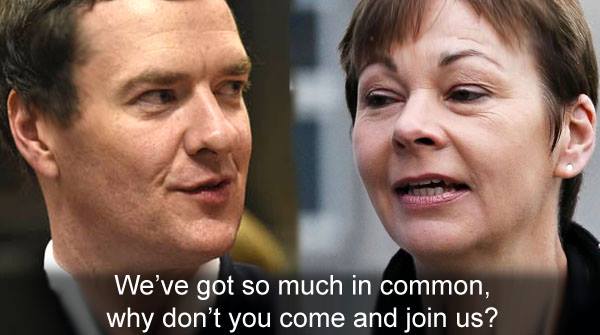
Caroline Lucas: Does the Chancellor agree with me that with the feeble and inconsistent opposition coming from the Labour Front Bench, there is a very good reason for seeing the SNP, the Greens and Plaid as the real opposition on this issue because we are clear and consistent about the fact that austerity is not working?

Mr Osborne: That shows why we want the hon. Lady’s party in the TV debates.

Yes, I just bet they do, to collaborate with the Tories in attacking and undermining the Labour Party, not the Coalition, who are, after all, the ones responsible for introducing austerity measures. I don’t imagine for a moment that Osborne values further challenges to his outrageous claims of efficacy regarding austerity measures. What is very evident when you read through this debate, is that Ed Balls and a couple of other Labour MPs presented the ONLY challenges to Osborne on this matter, just to reiterate.

10940505_767712909964906_6225427822143651262_nThere’s a clear gap between professed principles and their application amongst the parties that claim to be “real socialists”.  How can it be principled or moral (or “socialist” for that matter) to collaborate with the Tories in attempting to damage, smear and discredit the only viable option of removing the Tories from Office in May? Bearing in mind that many people are suffering profoundly, some have died as a consequence of Conservative-led policies, we can see what the Green Party’s priorities actually are, here. They don’t include the best interests of citizens and consideration of their well-being, that’s for sure.

There is a big difference between being moral and being moralistic. Being moral means that we know what is right and wrong, what is fair and what is unfair, and so on. Being moral means we take responsibility for ourselves. We extend our morality to others, it shapes how we relate to them, our esteem of others and respect. It tends to frame democratic relationships

Being moralistic means we impose on others our own definitions. We tell others what is right and wrong, we define those things for them. Being moral is also about being authentic, being moralistic is often inauthentic and hypocritical. It’s more about control and overburdening others with  responsibility, whilst restricting their choices, than genuine morality. Moralising shapes how we interact with others too, forming power imbalances and inequalities.

We can use this dichotomy to explore political parties and democracy. The Tories often talk about morality, they are a moralistic party that impose what they think is right on everyone else. We know how that has worked out this past five years and it’s got nothing to do with right and wrong, nor is it even remotely related to fairness or social justice. Tory moralising is about control and subjugation of the poorest, liberation and freedom of the wealthiest. That’s what the Tories are all about.They don’t possess any moral core themselves, which is evident in the sleaze and corruption that they tend to leave in their wake.

Labour are moral. This is evident in policies which are coherent, embedding human rights and equality principles. There’s an integrity evident in their social policies, because they reflect core values that Labour have always held, regardless of who has been party leader. They  impose a legal framework of moral codes that establish decent, civilised conduct. Labour’s policies accommodate democracy, equality, diversity and meet a broad array of social needs. In debate, the Labour party are generally rational and reasoned, rather than emotive and judgemental. They favour a learning approach – which is progressive – it’s about development, rather than imposing dogma on the population.

It’s evident that the Green Party are moralisers too. They criticise Labour, often imposing their view of what Labour should do. Meanwhile, the Tories are destroying the country and people’s lives. Even a cursory glance at the Green manifesto indicates plainly that it is a set of policies from idealising moralists, rather than a meaningful democratic representation of the whole population and a balanced reflection of their varied needs.

For example, the universal basic income that the Green Party propose – will it be paid to millionaires as well as the poorest? How would that address inequality – an issue which the Green Party claims to be concerned with? How will it contribute to a so-called steady-state, zero growth economy?

How does banning page three, but legalising prostitution and the sex industry, which is also about economically exploited women being economically exploited, reflect any joined-up thinking? Inconsistency and incoherence.

It’s more dogma.

Think very carefully about what you are voting for. Look for the facts and truth to inform that decision, because in such bleak times, it’s easy to cling to a populist, superficial, dressed-up promise of better things than the Tories offer, but easy fixes don’t exist. Look for coherence, depth and consistency in the narratives being proffered. And look for evidence. You will see that once you look below the surface of false claims, false promises and electioneering, there’s a big difference between moral policies (they tend to be democratic) and moralising ones (they tend to be authoritarian).

14301012075_2454438e62_o (1)Many thanks to Robert Livingstone for his outstanding pictures.

One of the most destructive Tory myths has been officially debunked

1450041_569755536427312_1698223275_n

The Organisation for Economic Co-operation and Development (OECD) has discovered what most of us already knew: that income inequality actually stifles economic growth in some of the world’s wealthiest countries, whilst the redistribution of wealth via progressive taxation and benefits encourages growth.

The recent report from the OECD, a leading global think tank, shows basically that what creates and reverses growth is the exact opposite of what the current right-wing government are telling us, highlighting the truth of Miliband’s comments in his speech today – that the Tory austerity cuts are purely ideologically-driven, and not about effectively managing the economy at all. But again, many of us knew this was so.

The Labour Party’s economic plan, based on progressive taxation, equality and funding of public services is the best way forward for economic growth and social stability. The Conservatives have killed the potential for a sustainable economic recovery, and will continue to do so, because they promise endless austerity. This is rather akin to treating a disease with more disease.

Osborne’s economic policy is comparable with riding the fabled rubber bicycle.

We aren’t going anywhere.

The report showed evidence that the UK would have been at least 20 percent better off if the gap between the rich and poor hadn’t widened since the eighties under Thatcher, and successive Conservative administrations – the most recent having reversed the equality measures put in place by Blair. (Yes, he really did).

Prior to the global recession, the Tories said they would match the Labour government’s state spending and suggested they may even further it. However, when the global crash happened, a sudden opportunity presented for Tories to become fully-fledged… Tories, grinding their ideological axe, taking a neoliberal swing at the “bloated” public sector and at Labours’ public spending for the protection of public services and the most vulnerable citizens during the economic crisis.

It’s worth remembering that the Coalition has borrowed more in just 3 years than Labour did in 13. In fact Osborne has borrowed more than every Labour government since 1900 combined. And the current government have nothing to show for it, whereas the Labour government at least adequaltely funded public services and effectively sheltered the poorest citizens from the worst consequences of the global crisis.

Let us not forget that this feckless government inherited an economy that was in recovery. They destroyed that and caused a UK recession by imposing austerity, savagely cutting public spending and public services. Thatcher used the same basic strategy to redistribute public wealth to private bank accounts and create inequality, although she didn’t cut as deeply. It didn’t work back then either. She caused a deep recession, as did John Major – Tories being Tories.

Let us not forget that despite the finger-pointing blame game that the Conservatives indulge in – their perpetual attempts to undermine Labour’s economic credibility and bolster their own ineptitude – that it was Osborne that lost the triple A Fitch and Moody credit ratings, despite his pledge that he wouldn’t. We are regarded as an economic liability on an international level, which flies in the face of Osborne’s lies about economic growth and removes any credibility from his blustering, swaggering claims. I do wish the public more broadly would engage in some joined-up thinking, since many have believed that the cuts were inevitable, but Tory propaganda, in fairness, is designed to fragment the truth and disjoint rationality.

The truth is that Gordon Brown was right with his ideas about fiscal stimulation (rather than Osborne’s coercive fiscal contraction): it’s been a confirmed model over and over by economists and by the fact that we were out of recession in 2010. The Tories’ austerity measures have since damaged the economy profoundly.

But austerity was never about what works. Austerity is simply a front for policies that are entirely founded on Tory ideology, which is  all about handouts to the wealthy that are funded by the poor. 

Accumulation for the wealthy by dispossession of the poor.

The OECD report highlights the fact that Conservative economic rhetoric is based on utter nonsense: it isn’t remotely rational. Tory ideology is incoherent, vindictive towards the poorest and extremely damaging, socio-economically. It shows us that the sacrifices of austerity, which were cruelly imposed on those least able to carry that burden, were justified by a malicious lie dressed-up as a promise of economic growth. But that is precisely what the Tories are destroying.

We knew that the laissez faire capitalism of industrial capitalism  and the more recent financial capitalism of post industrial neoliberalism  extend inequality. How can such systems, founded on competitive individualism, not do so? But now we have the evidence that inequality damages rather than encourages economic growth.

I’ve said elsewhere that Conservatism is centred around the preservation of traditional social hierarchy and inequality. Tories see this, erroneously, as an essential element for expanding economic opportunity. But never equal opportunity.

Conservatives think that civilised society requires imposed order, top down control and clearly defined classes, with each person aware of their rigidly defined “place” in the social order. Conservatism is a gate-keeping exercise geared towards economic discrimination and preventing social mobility for the vast majority.

David Cameron’s Conservative party got into Office by riding on the shockwaves of the 2008 global banking crisis: by sheer opportunism, dishonesty and by extensively editing the narrative about cause of that crisis. The Conservatives shamefully blamed it on “the big state” and “too much state spending.”

They have raided and devastated the public services and social security that citizens have paid for via taxes and national insurance. Support provision for citizens is cut to the bone. And then unforgivably, they blamed the victims of those savage, ideologically-directed cuts for the suffering imposed on them by the Conservative Party, using the media to amplify their despicable, vicious scapegoating narratives.

Conservatives really do think that inequality is necessary, they think that our society ought to be divided and hierarchical. They are traditional rather than rational. They have an almost feudalist approach to economic policy, blended with a strong old boys network of corporocrats.

The Tories have long been advocates of the market society, which turns everyone and everything into a commodity. Neoliberalism is an invisible hand in an iron glove, with its whispered broken promise of a mythological “trickle down” as justification – now the new right neoliberals are officially a cult of vicious cranks.


Related

The BBC expose a chasm between what the Coalition plan to do and what they want to disclose

The word “Tories” is an abbreviation of “tall stories”

Conservatism in a nutshell

Osborne’s Autumn statement reflects the Tory ambition to reduce State provision to rubble

A list of official rebukes for Tory lies


1017174_500690710000462_512008904_n
Many thanks to Robert Livingstone @LivingstonePics


I don’t make any money from my work. I am disabled because of illness. But you can contribute by making a donation and help me continue to research and write informative, insightful and independent articles, and to provide support to others.

The smallest amount is much appreciated – thank you.
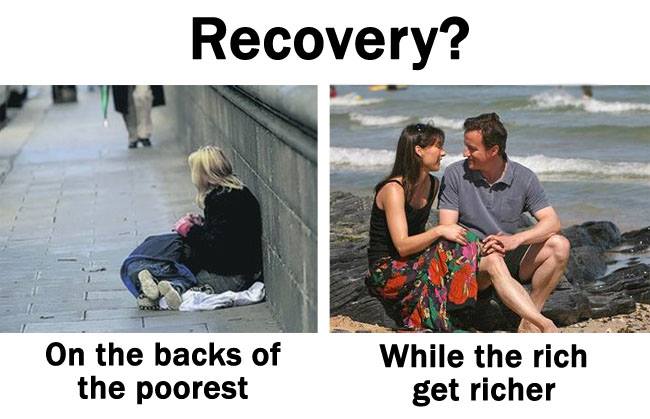
DonatenowButton

The link between Trade Unionism and equality

10553308_680322242037307_1558281906340939819_n

In an article I wrote earlier this year – Conservatism in a nutshell – I outlined some basic themes of New Right Conservative ideology. I said:

Conservatives don’t like social spending or welfare – our safety net. That’s because when you’re unemployed and desperate, companies can pay you whatever they feel like – which is inevitably next to nothing. You see, the Tories want you in a position to work for next to nothing or starve, so their business buddies can focus on feeding their profits, which is their only priority. Cheap-labour conservatives don’t like the minimum wage, or other improvements in wages and working conditions. These policies undo all of their efforts to keep you desperate. They don’t like European Union labour laws and directives either, for the same reason.

Conservatives prioritise handing out our money to their big business partners, no matter what it costs us as a society. For example, a spending breakdown reveals how NHS funding has flowed to private firms, much of that money has gone to companies with corrupt ties to the Tories, whilst health care is being rationed, care standards have plummeted, services are cut, and by the end of the next financial year, health service workers will have had their pay capped for six years, prompting fully justified strike action.

Following the tide of sleaze and corruption allegations, Cameron “dealt” with parliamentary influence-peddling by introducing the Gagging Act, which is primarily a blatant attack on trade unions (which are the most democratic part of the political funding system) and Labour Party funding, giving the Tories powers to police union membership lists, to make strike action very difficult and to cut union spending in election campaigns.

The Transparency of Lobbying, non-Party Campaigning, and Trade Union Administration Bill is a calculated and partisan move to insulate Tory policies and records from public and political scrutiny, and to stifle democracy. And there are many other examples of this government removing mechanisms of transparency, accountability and safeguards to rights and democracy.

We have witnessed a dramatic increase in levels of economic inequality this past four years, reflected in the fact that income differences between top earners and those on the lowest wages are now higher than at any time since records began. The UK now ranks as one of the most unequal societies in the developed world, even more unequal than the US, home of the founding fathers of neoliberalism. Our current levels of inequality have far exceeded the point at which campaigners need any further proof to show how socially corrosive and life-limiting the subsequent deepening poverty is.

Despite the legislative framework of Labour’s Equality Act, passed in 2010, there is a growing gender-based pay gap, continued abuse of agency workers, the problem of the two-tier work force and the contracting out of public servicesStrong trade unions improve public services, too.

Speaking at a press conference on the first day of the 2014 TUC Congress, TUC General Secretary Frances O’Grady said:

“The key message of this year’s congress is Britain needs a pay rise and I also expect many of the debates on the floor to focus on the importance of the coming general election for people at work.

Today, I want to highlight the threat posed by the Conservative Party’s promised manifesto proposals on strike ballots.

Because these proposals are designed to make unions weaker. And if unions become weaker, then the chances of people winning a pay rise, improving living standards and tackling inequality in Britain today will become a good deal harder.

The Conservative Party is not just proposing a few more bureaucratic obstacles that will make life a bit more difficult for trade unions.

Taken together, they would effectively ban strikes by the back door. And, on top of that, they would open up elected union leaders to increased surveillance by the state.

They are not just an attack on fundamental liberties. They will act to lower living standards for the majority of working people – whether or not they are union members.”

One half of the British population owns 9% of household wealth whilst the other half owns 91% of the wealth; and the five richest families in the UK are wealthier than the poorest 20% of the entire population.

Conservatives are always obsessed with “economic growth”, but we know from history that economic expansion in itself does not promote equality: it is the types of employment, the rules and structure of the economy and policies that matter most. Conservative governments always create high levels of inequality.  Furthermore, they rarely manage to bring about the economic growth they promise. But recession due to reduced public spending is an inbuilt feature of neoliberalism, as we witnessed during the Thatcher era.

Inequality hinders growth in another important way: it fuels social conflict. However, social diversity has no negative impact on economic growth, despite what those on the blame-mongering Right would try and have us believe. It is economic policies that shape inequalities, not minority groups: they are the casualities of inequality not its creators.

Economic inequality is also about discrimination. Black and ethnic minority workers are disadvantaged in finding employment. Dismissal of pregnant workers is a widespread practice. Last year, the wage gap between men and women’s earnings increased and the progress previously made towards equal pay has been reversed.

Cameron’s government has mobilised resentment and fear on the part of relatively privileged social groups in relation to other subordinate or putatively threatening groups of politically defined Others – immigrants, unemployed people, disabled people, unionised workers, single mothers and so on.

Social inequalities and hierarchies are defended by Conservatives and secured in several ways. The defence of power, wealth and property, when threatened, tends to be micro-managed via rigid authoritarianism, through systems of mobilised prejudice and through free-market policies (the predictable effects of which are to transfer wealth upwards). All Conservative politics pivot on a fundamental commitment – the defence of privilege, status, and thus sustaining social inequality.

But it is only by shifting money from the high-hoarding rich to the high-spending rest of us, and not the other way around, that investment and growth may be stimulated and sustainable.

The Office of Budgetary Responsibility forecasts that the Coalition are facing a £17BILLION blackhole after the low pay  that their own policies have strongly encouraged have caused a slump in tax payments to the treasury.

It is very clear that austerity is not an economic necessity, but rather, it is an ideological preference, used as a justification for “shrinking the State” whilst defending power, wealth and privilege.

The Coalition have introduced trade union laws which inhibit trade union recruitment, activity and collective bargaining. Employment rights are being removed, at a time when policies have reduced access to unfair dismissal protection and access to employment tribunals.

Trade unions are most effective when all workers are represented and therefore trade unionism encourages social inclusion. Collective bargaining and representational support will not work in the long term if some workers have substantially less to gain from the process than others.

For this reason, trade unions and the Labour Party have worked at eliminating sex, race and other forms of discrimination in the workplace. This has taken time, given how deeply ingrained inequalities have been in our society. We know that where trade unions are active, employers are more likely to have equal opportunities policies.

But for proper support of economic equality, trade unions need legal protection for their activities so they may operate freely and build effective social solidarity and promote egalitarianism.  Trade unions seek increased participation by working people in the decisions that influence their lives and a fairer distribution of the nation’s wealth. That is the antithesis of Conservatism.

Freedom to speak out against injustice, to campaign for economic equality and to work together through trade unions are underpinned by rights set out in the European Convention on Human Rights (ECHR). It’s no surprise that Cameron has pledged to exit the ECHR and to scrap Labour’s Human Rights Act.

To tackle economic inequality and build a fairer society, it is essential that trade-unions can operate freely and that collective bargaining is renewed. The impoverishment and exploitation of any one group of workers is a threat to the well-being and livelihood of everyone.

Building a future economy where the benefits of work and profit are shared requires legal reform in support of effective trade unions.

Lydia Hayes and Tonia Novitz from the Centre For Labour and Social Studies have written  the following proposals, designed to change public policy, so that trade unions are better able to represent their members, by  simplifying the statutory procedure for trade union recognition, and putting in place arrangements for sector-wide collective bargaining:

1. Introduce a legal framework through which trade unions can freely organise and engage in collective action to build economic equality.

2. Amend trade union recognition legislation so that all workers who choose to join a union can be represented in collective bargaining and other workplace matters.

3. Ensure the law provides for sectoral bargaining which can set minimum terms and conditions across an industry or a service sector.

4. Defend human rights which protect the functioning of trade unions (including rights to free speech, freedom of assembly and freedom of association).

5. Give trade unions access to workers and workplaces, so that they can advise on the benefits of membership and collective bargaining.

6. Enable workers to have access to information about trade unions at their workplace so that they can make an informed choice and easily join a trade union if they want to.

None of this will happen during the current government’s term, because Conservatism is in diametric opposition to trade unionism, equality, human rights and egalitarianism.

Related
The Institute of employment Rights

10174840_680246428711555_4476316988383611981_n

Thanks to Robert Livingstone for the graphics.


I don’t make any money from my work. I am disabled because of illness and have a very limited income. But you can help by making a donation to help me continue to research and write informative, insightful and independent articles, and to provide support to others. The smallest amount is much appreciated – thank you.
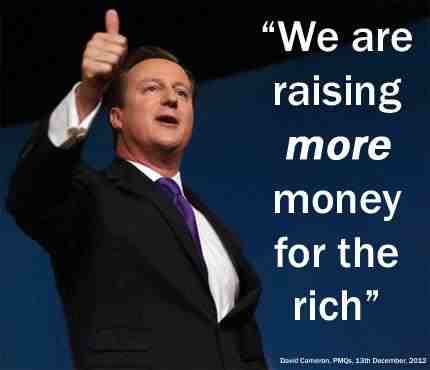
DonatenowButton

Conservatism in a nutshell

Image result for Theresa May poor wages
It’s not enough to challenge Tory ideology. We also have to dismantle the Orwellian semantic thrifts and shifts. We have to defeat the Tory propaganda machine that lies, persuades and lulls people with meaningless populist slogans, empty glittering generalities and glib catch-phrases.

You’ve heard those slogans – “less government”, “personal responsibility”, “hard-working families”, “making work pay” and lots of nationalist flag waving. These are shorthand messages to the public that are thrifty with the truth, codifications for an entire world-view. But it’s ever such a shabby, ruthless, isolating and paltry one.

1209102_539900659412800_1664499134_n

The clue is in the name: the word “Tory” derives from the Middle Irish word tóraidhe, which means outlaw, robber or brigand, from the Irish word tóir, meaning “pursuit”, since outlaws were “pursued men”. It was originally used to refer to an Irish outlaw and later applied to Confederates or Royalists in arms. The term was originally one of abuse.

The Tories live by plundering. They steal your taxes, your public services, your state provision and your labour in order to raise more money for the rich. They have reneged on our post war democratic settlement. Legal aid, human rights, social housing, the NHS, lifeline welfare support – the essential components of any functioning democracy – are being viciously and systematically dismantled by the Tories. 

It’s a dystopic world of corporate fiefdom. I heard a very smart person from the States once sum up the Tories neatly with the phrase “cheap-labour conservatism”. How very apt. It fits so well. It makes sense of such a lot.

Basically, the larger the labour supply, the cheaper it is. The more desperately you need a job, the less you tend to demand for your wages to be fair, and the more power those big business Tory buddies have over you. This is what the Tories actually mean by “making work pay” – it’s either rationed out peanuts or starvation. But for big business, your work pays them handsomely in fat profits.

The Tories engineer this same socioeconomic situation every time they are in office. Think back to the Thatcher era, she did it, Major did it – it’s a manufactured recession and a large reserve army of cheap labour every time. ALWAYS the same with the Tories. Because it suits their “business friendly” agenda.

That’s another Tory slogan that means corporate greed, profit before people and Tory donations – see the Beecroft Report, for example, written by a British “venture capitalist” that has donated more than £500,000 to the Conservative Party. The overdogs write policies to make sure that we remain the underdogs. Fat profits are all that matter to the vulture capitalists. 

Beecroft is currently Chairman of Dawn Capital. The release in May 2012, of the long awaited Beecroft Report in the UK caused considerable controversy because it recommended that the government should “cut red tape” in order to make the hiring and firing of employees easier and cheaper.

The report claimed this would help to ‘boost’ the economy although no evidence for this was provided. It’s hard to imagine how increasing job insecurity would encourage workers to spend their money. It does, however, help boost profits for venture  vulture capitalists, and the government-commissioned report strips workers of their rights.

As the TUC said at the time, the ideas have taken the UK back towards Victorian era working conditions and standards. Conservatives don’t like social spending or welfare – our safety net. The safety net we funded. That’s because when you’re unemployed and desperate, companies can pay you whatever they feel like – which is inevitably next to nothing, so their profits can grow. 

You see, the Tories want you in a position to work for next to nothing or starve, so their business buddies can focus on feeding their profits, which is their only priority.

Cheap-labour conservatives don’t like the minimum wage, or other improvements in wages and working conditions. These policies undo all of their efforts to keep you desperate. They don’t like European Union labour laws and directives either, for the same reason.

Cheap-labour conservatives don’t like unions, because when we unite, organise and collectively bargain, wages go up and living standards rise. Working conditions improve. That’s why workers unionise. Seems workers don’t like being desperate.

10553308_680322242037307_1558281906340939819_n

But businesses don’t like to pay out money. They like to hoard it. Cheap-labour conservatives constantly bray about “morality”, “virtue”, “respect for authority”, “hard work”, “responsibility” and other such vaguely defined values. This is only so that they can blame you for being desperate due to your own “immorality”, “lack of values”, “lack of character” , “idleness” and “poor life-choices”  when you are poor, within a system designed to generate a few ‘winners’ and a lot more ‘losers’. It’s not a level playing field that hosts the great neoliberal ‘competition’.

Those inane soundbites have been used to dismantle another worker’s protection: the welfare state.

They have also been deployed so that the Tories can justify their “business friendly” workfare schemes to further exploit the reserve army of labour and keep us desperate, unpaid and in our place.

1235473_537097386359794_65317730_n (1)

Cheap-labour conservatives encourage racism, misogyny, homophobia and other forms of bigotry. That’s because bigotry among wage earners distracts them, and keeps them from recognising their common interests as wage earners. Divide and rule was invented by cheap labour-conservatives. To keep labour cheap.

An ugly truth is that cheap-labour conservatives don’t like working people. They don’t like working class opportunities and prosperity, and the reason for this is very simple. Lords have a harder time kicking us around when we aren’t desperate, hungry and in fear of destitution.

Once we understand this about the cheap-labour conservatives, the real motivation for their policies makes perfect sense. Cheap-labour conservatives, the neo-feudalist fools, believe in social hierarchy and limited privilege, so the only prosperity they want to permit is limited to them and their elite class.

They want to see absolutely nothing that benefits us whatsoever. And even better if we fight amongst ourselves for scraps. Divide and rule. The Tory mantra “making work pay” is an argument for RAISING WAGES, not cutting benefits, talk about the rationally illiterate …. But then cheap-labour conservatives hope that those affected will take comfort in the fact that if your wages are not enough to meet the cost of living, at least those without a job are much worse off.

The Tory “race to the bottom” is hidden in plain view, and after five years of austerity, Osborne is forced to concede that the new welfare cuts leave £9bn of the deficit reductions promised by the Chancellor unaccounted for. The cuts are PURELY ideological. Tories: dangerous with the economy, dangerous for society.

1965037_301820166635705_1502392114_n (1)

“Less government” is another defining right-wing slogan. It’s also all about cheap labour. Referenced by the slogan is the whole conservative set of assumptions about the nature of the “free market” and government’s role in that market. However, we pay for government. We pay for protective state services. It is not the government’s money to hand out to millionaires, it is ours. 

The slogan “less government” permitted the conservatives’ cunning transformation of a crisis caused by banks into a crisis of public spending. It was a huge triumph of Tory dogma over the facts. And of course, our public services are being sold off to private companies. A few people are quietly making megabucks while the rest of us are told to “live within our means.”

And anyone would think, to hear the Tories talk, that the “free-market” isn’t rigged to benefit the wealthy. There’s no such thing as an “invisible hand”, unless you count the iron fist of the authoritarian state, getting on with getting their own way. The bedroom tax, welfare cuts, public service cuts, cutting inheritance tax and handing out tax breaks to the wealthy are, after all, examples of state interventions, and not “market forces”, which the Tories always use as a front to suck the life out of entire communities and to keep people desperate.

The whole “public sector/private sector” distinction is an invention of the cheap-labour conservatives. They say that the “private sector” exists outside and independently of the “public sector”. The public sector, according to cheap-labour ideology, can only “interfere” with the “private sector”, and that such “interference” is “inefficient”, “costly” and “unprincipled”.

Using this ideology, the cheap-labour ideologue paints him/her self as a defender of “freedom” against “big government tyranny,” while all the time, the conservatives are extending an extreme, oppressive authoritarianism.They have to because no ordinary person who knows what they’re up to actually wants their policies. And in fact, the whole idea that the “private sector” is independent of the public sector is totally bogus, because “the market” is created by public laws, public institutions and public infrastructure. 

But the cheap-labour conservative isn’t really interested in “freedom”. What they want is the privatised tyranny of industrial and financial serfdom, the main characteristic of which is – you guessed it – cheap labour.

1395990_559940054075527_258446375_n

Pictures courtesy of Robert Livingstone 


I don’t make any money from my work. But you can contribute by making a donation and help me continue to research and write informative, insightful and independent articles, and to provide support to others. The smallest amount is much appreciated – thank you.

DonatenowButton