Tag: DWP

The DWP left a terminally ill man penniless until after he died

0_jill-fennell mark

Jill Fennell and her partner Mark Scholfield. She says: “The benefits system is barbaric and inhumane.” (Image: Jill Fennell/Facebook).

A man who was terminally ill with cancer was forced to spend his final days penniless as he waited for a Universal Credit payment that cruelly arrived the day after he died.

Mark Scholfield was made to endure an eight-week delay for the social security payment before he died, aged just 62, of mouth cancer.

Mark’s partner, Jill Fennell, who was with him for 23 years, said: “When you’ve been given a devastating blow, being told you have terminal cancer, money is the last thing anyone should be worrying about.

“The benefits system is barbaric and inhumane.”

Jill, also 62, said self-employed musician, Mark, was unable to work for two months before he had his diagnosis in February 2017. He was told his condition was terminal, she said, and initially, he was  encouraged to apply for fast-track Employment Support Allowance (ESA) to help him meet the costs of living and pay bills.

However, because he lived in Camberwell, South London, where the government’s controversial flagship failure – Universal Credit – was being rolled out, he was told that he did not qualify for ESA.

Instead he had to apply to Universal Credit (UC). The Department for Work and Pensions (DWP) often use Credit Reference Agencies to verify the identity citizens making a claim, but Mark had never had credit, and he was told that must visit a Jobcentre with ID.

Jill said that despite his failing health and diagnosis of terminal cancer, Mark was forced by the DWP to go through a health and work assessment over the phone. She  said that she was distraught, and  left “screaming hysterically down the phone”, asking “did they realise he was dying?”

After five weeks Mark received his first payment, which just about covered rent and council tax, but left him with little to live on. But for the next eight weeks he did not receive any more money, and died on July 19, 2017.

It was only after Mark’s death that Jill discovered an ESA payment had been made a day later, as well as a UC payment.

She said: “Mark had needed the money while he was alive to live his final months in some level of comfort and dignity, but he was denied that.”

A DWP spokesperson said: “Our thoughts are with Mr Scholfield’s friends and family.

“While Mr Scholfield was receiving Universal Credit, we are extremely sorry for the delay in his ESA payment which should have been fast-tracked.”

That response is simply unacceptable. Because this kind of glib, standardised apology for an apology is happening far too frequently, it to reflect any shred of sincerity, meaning, reflection or learning on the part of the DWP.  

Linguistic behaviourism: cruelty is compassion, indifference is care

Yesterday, heartless Amber Rudd was accused of shrugging off ‘heartbreaking’ Universal Credit experiences and stories by suggesting they are about only “one or two” people. 

This is a government who tell us with a straight face that inflicting absolute poverty on the poorest citizens is somehow going to make them less poor. This ideological framework is also imposed upon people in low paid work, struggling to meet their basic living costs. So the government slogan “making work pay” is meaningless Orwellian tosh, as is the Conservative’s longstanding ‘culture of dependency’ thesis and ideological justification narrative for inflicting devastating cuts on those who can least manage to get by. 

The Work and Pensions Secretary made the outrageous comments after being confronted by the Mirror about flaws in Universal Credit.

For years many of us have published articles ranging from flaws in the social security system, affecting millions, to struggling readers who’ve been forced to use food banks to survive, as well as administrative ineptitude and bullying that has often had catastrophic consequences. The roll out of Universal Credit has caused hunger, destitution, deaths and suicides, let’s be frank and pay some attention to the empirical evidence, rather than expedient ideological soundbites.  

Amber Rudd told the Mirror: “Some of the criticisms that have come from various publications have been based on one or two particular individuals where the advice hasn’t worked for them.

That statement flies in the face of empirical evidence. On this site alone there are MANY individual accounts of the harms arising as a result of Universal Credit. And to claim the reason for these harms is because “the advice hasn’t worked or them” is a serious and disgusting trivialisation of the psychological distress and trauma, the deaths, suicides, rising numbers of those facing hunger, hardship, and destitution that Universal Credit, combined with such systematic government denial and indifference, is causing.

“But in the vast majority of cases, and I would urge everybody who hasn’t to take the opportunity to speak to work coaches, the sort of support that individuals get is a completely different approach to what they had previously.”

Yes. It’s not actually support. It’s a programme of discipline, coercion and punishment.

It isn’t work coaches who have to live with the consequences of a system that was designed to be an increasingly standardised Conservative hostile environment. The government seem to believe that publicly funded public services should serve as a deterrent to people needing support from the public services they have paid into.

Work coaches don’t have to live with the direct consequences of state policies. What matters most is the accounts of citizens, which tell their raw, first hand experiences of the system, not of those administrating it. But citizens’ voices are being intentionally stifled, edited out and worse, their accounts are being re-written by politically expedient civil servants and government ministers. This presentation of ideological fictions and the use of gaslighting techniques is usually the preserve of totalitarian regimes, it’s not the behaviour one would expect of a democratic government in a so-called liberal society. 

Governments with such limited social intelligence don’t lie very convincingly, but they do tend to be hard faced and tenacious. The real horror is their utter indifference and lack of responsiveness: that they really don’t care. They continue to demand our suspension of belief and dizzying cognitive dissonance. The relationship between citizen and state is one of abuse, founded on gaslighting strategies.

There is very little empirical evidence of the “professionalism, care and compassion” that Rudd claims. Furthermore, the trivialisation and persistent denials of the harm, distress and extreme hardship that is being inflicted on people because of government policies are all utterly unacceptable behaviours from a government minister, reflecting a profound spite within policy design, a profound lack of political accountability and a profound indifference for the consequences of these behaviours on the lives of ordinary people.

Rudd added: “And it is delivered with professionalism and care and compassion.”

Sure. The kind of “professionalism, care and compassion” that leaves a terminally ill man without sufficient support to meet his most basic needs, or that leaves a pregnant mother in extreme hardship, homeless, and resulting in the loss of her unborn child. Or one that pushes people towards suicide.

And former Universal Credit staff reveal call targets and ‘deflection scripts, which means staff having to block or deflect vulnerable claimants, telling them that they would not be paid, or would have to submit a new claim, or have a claim closed for missing a jobcentre appointment, or be sanctioned – a penalty fine for breaching benefit conditions – or go to the food bank.

One whistleblower said that her role often felt adversarial. She said: “It was more about getting the person off the phone, not helping.” That’s a very strange kind of “compassion.”

As researchers have concluded, Universal Credit is a complicated, dysfunctional and punitive’ system that makes people increasingly anxious, distressed, with some of the most vulnerable citizens in the UK being pushed to consider suicide, and it ‘simply doesn’t work.’ (See Universal Credit is a ‘serious threat to public health’ say public health researchersfor example).

A devastating National Audit Office report last year about Universal Credit concluded that the DWP was institutionally defensive and prone to dismissing uncomfortable evidence of operational problems. Welfare secretary at the time, Esther McVey, felt the need to make a speech in July in which she promised that where problems arose in future the department would “put our hands up, [and] admit things might not be be going right”.

It’s also clear – in the words of the public accounts committee – that there is a “culture of indifference” within the DWP and wider government.

It’s time that government ministers started to listen to citizens’ voices, to service users – as well as campaigners, researchers, charities and the opposition Parties. And the United Nations – instead of presenting denials that policies are seriously harming people. But there is every indication that they won’t. 

Universal Credit’s malign effects are obvious to anyone who actually looks, and is willing to listen to the voices of those affected by this punitive, mean-spirited and fixated, theory-laden, ideologically driven, miserly provision, that was, at the end of the day, paid for by the very public who are claiming it.

Labour MP Maria Eagle flatly stated that Rudd’s comments are “not true” and are “out of touch”.

She said: “The entire design of the system puts people in debt and the benefit cuts accompanying its introduction have made it far worse.” 

Rudd was questioned by the Mirror after she said yesterday: “Maybe things that were  proposed previously weren’t effective or weren’t compassionate in the way that I want them to be.”

Mirror journalists asked if she could, ‘hand on heart’, say it was “compassionate” to double UC claimants this year, keep the two-child limit and keep the benefit freeze until 2020.

Rudd did not respond to the question, instead replying: “The overall product that is Universal Credit is absolutely compassionate.”

Product? That’s a very odd word to use for lifeline support – the public services that are our social insurance which people have paid into for those times when they need it. 

And using key words from a government strategic comms crib sheet – James Cleverly among others has also opted for the word ‘compassionate’ to describe the welfare ‘reforms’ – does not make those narratives the reality experienced by citizens who need to access support from public services. Saying it does not make it real. This is something the Conservatives seem to have overlooked – that their narratives don’t match people’s realities. That’s the problem with telling lies – the empirical evidence catches up with you sooner or later.

Starving people and leaving them in destitution is not ‘compassionate’. Using a publicly funded public service to deliver punitive and a blunt, coercive, authoritarian behavioural modification programme is not ‘compassionate’. These are the actions and narratives of a government dipping a toe into the realms of totalitarianism.

Rudd claimed that UC needs to be ‘improved’, including to make it fairer to woman, but also said it was a “vital reform delivering a fair and compassionate welfare system”, “by far the most important and crucial reform” and a “force for good”.

Yesterday, the high court concluded that the Universal Credit assessment is illegal. The first judicial review verdict of Universal Credit found that the cutting of severe disability premiums from those who had previously claimed ESA was discriminatory.  How many more legal changes will it take to make the government act with some decency and observe basic laws and human rights?

Rudd went on to claim, somewhat incoherently, that the ‘old system’ was “broken”, “not a utopia that we should return to” and under Labour someone unemployed could receive “£100,000 housing benefit per year.”

The charity Fullfact submitted a freedom of information (FoI) request to the DWP in 2012, following the same claims from David Freud, among other Conservative minsters, that people claiming social security support were receiving £100,000 housing benefit per year. The figures in the response showed that over four out of every five Housing Benefit claims are below £100 per week (the equivalent of £5,200 per year) according to the September 2010 figures, while only 70 out of over 4.5 million recipients claimed over £1000 per week, around 0.001% of the total.

Even this is likely to overstate the number claiming £100,000 per year however, as a family would need to claim over £1,900 per week to hit this total. Previous FoI responses from the Department have suggested around five families were awarded this amount.

Ministers and the media repeatedly failed to highlight what is such a small number of the total, and printed screaming and misleading headlines that were inaccurate, without putting this into a wider context. While the evidence suggests that there are a small number of Housing Benefit claims of more than £100,000 per year –  around five – these cases are very much the exception rather than the rule. Focusing exclusively on these outliers without first putting them into context, where over 80% of claims are below £100 per week, has [intentionally] distorted the debate about welfare, aimed at de-empathising the public and providing a justification narrative for cuts.  

Other information drawn from the FoI request found that larger claims tended to come from larger families, and the average household size for people claiming over £40,000 was six. For more details, do check out the numbers in the request itself, which is available here.

People weren’t suffering profound distress, hunger, destitution, suicide ideation and dying because of the ‘old system’.

Perhaps ‘utopias’ are relative. What we are currently witnessing is not “compassionate” or a “force for the good”: it is the dystopic system of an authoritarian state inflicting punishment, discipline and coercion on our most vulnerable citizens.

It’s a state programme that dispossesses citizens, with catastrophic human costs, to fund the tax cuts demanded by a handful of powerful and wealthy vultures, who live lavishly within a culture of entitlement, while the rest of us are increasingly impoverished.

facade-welfare

Amber Rudd claims that Universal Credit is ‘compassionate’. She must have been taking lessons in Doublespeak again.


My work is unfunded and I don’t make any money from it. This is a pay as you like site. If you wish you can support me by making a one-off donation or a monthly contribution. This will help me continue to research and write independent, insightful and informative articles, and to continue to provide support others who are affected by the welfare ‘reforms’. 

DonatenowButton

Woman loses her baby after Universal Credit ‘error’ forced her to sleep in a car park

misccariage _homeless_couple_01

Ryan Gifford and Debbie Ballard, both 23, who were made homeless just before Christmas (Image: Devon Live).

A young couple in Devon were left facing homelessness because of an error with Universal Credit rent payments which resulted in them being forced to sleeping rough. Their distressing circumstances of destitution and severe hardship resulted in Debbie Ballard, aged 23, to suffer a miscarriage.

Debbie and her partner, Ryan Gifford, were forced to spend 15 nights sheltering in a car park after a DWP error meant that an ‘automatic’ rent payment was missed.

The couple say they became homeless just before Christmas. It happened  after being moved onto Universal Credit. A rent payment was missed and their landlord subsequently evicted them.

They are now staying in emergency accommodation, but the terrible damage has already been done as they have lost their unborn child.

Debbie said: “Losing my baby makes me feel like s**t. I feel useless and worthless. And now I have lost another baby.

“I was about six weeks pregnant when we were street homeless in December. I had a miscarriage because of all the stress.

“All we want is a chance for us to be a proper family.”

Before they were evicted, the couple were living in a flat, but were switched onto the new benefits system when they had a row, and Ryan took Debbie off his claim. However, due to the change in circumstance, they were automatically switched onto Universal Credit.

Originally, their rent was paid directly to the landlord but a payment was missed in the changeover and the pair were evicted due to being in arrears.

Debbie said: “We were living in a flat. It was full of mould and rats outside and we had made complaints to the landlords.

“Our Housing Benefit was being paid direct to the landlord but when it switched over to Universal Credit he said we were in arrears and served us with a notice and said he would take us to court.”

The couple say they did not receive any notification letters about the changeover to Universal Credit, and before they realised, their housing benefit was stopped and it was too late.

Debbie said: “It’s too late now. We should have been told that before we were made homeless.

They said it was because of a change in circumstances. We were without money for eight weeks. We were literally begging and borrowing from everybody we knew.

“At the beginning of December, we had 15 days sleeping on the streets because of Universal Credit. We were sleeping in a car park on the harbour. It was really horrible.

“It was so cold at night. If you go down to the bottom car park near the Harvester pub it’s warm in there.

“But there’s an alarm that goes off every 10 minutes for 20 seconds.

“You can’t sleep but it’s warmer.

“We have to pay £20 a time to wash and dry our clothes because there’s no washing facilities in temporary accommodation. Everything is really expensive. It’s really hard.”

Ryan said: “We lost our home when we were switched over to Universal Credit. Now we are expected to live on a joint sum of £161 a month.”

“I want Universal Credit to stop. I think that now Universal Credit is coming in properly it’s going to get a lot worse. It’s going to be a nightmare.

“Anybody who has a drink or drug habit is going to be shoplifting to feed their habits.”

Debbie and Ryan received support from local homelessness charity People Assisting Torbay’s Homeless, where they now volunteer.

“When we were on the streets you felt like you were taking one step forward and four steps back.

“Now we are in emergency accommodation and we are expected to live on £161 a month.

“I am trying my hardest but I hit barriers everywhere I go.”

PATH chairman Kath Friedrich said: “There is nothing wrong with the theory of Universal Credit. On paper it’s fine.

“But what’s causing all these problems is that all these pre-payment, backdated loans are handed out like sweeties to people who do not have budgeting skills while they are waiting for their Universal Credits.

“Then when they finally get their money all the loans are deducted. We’ve got lots of people coming in here who are only getting £10 a week to live on.

Sometimes they are paying back old loans they didn’t even know they had.”

A Department for Work and Pensions spokesman said: “We are working with Mr Gifford to support him with his Universal Credit claim.

“If requested we can arrange for rent to be paid directly to the landlord.”

The Department are very good at delivering ad hoc platitudes that are all to often founded on glib promises of rather too little too late, increasingly frequently with tragic consequences.


My work is unfunded and I don’t make any money from it. This is a pay as you like site. If you wish you can support me by making a one-off donation or a monthly contribution. This will help me continue to research and write independent, insightful and informative articles, and to continue to provide support others who are affected by the welfare ‘reforms’. 

DonatenowButton

Hello: Which Service, Please?

l-egypte-de-mlle-cleo-de-merode-cours-l-mentaire-d-histoire-naturelle-1940.jpg!large

Joseph Cornell was an American Surrealist. Possibly less known than Salvador Dalí or Max Ernst but a significant, if invisible, contributor. Cornell worked with assemblage and collage to build tiny Wunderkammer of places he had never visited or people he had never met. Much of his life was defined by caring for his mother and disabled brother. Yet, he managed to keep in contact with international artists and produce a body of work that recycled once beautiful objects into things of beauty and wonder. Cornell worked in a cultural parallel to the creation and production of computer systems: he reused and recycled in innovative ways. He transformed the discarded into desirable objects which tell stories appealing to Art Collectors – works have been sold for $5.3m despite Cornell living in relative poverty for much of his life. Caring has always been costly. 

The Government Digital by Default Strategy seeks to emulate the kind of amplification of effort that Cornell achieved. Published in November 2012, the Strategy has fourteen illuminating action points that define what it is the Government seeks to achieve. In general, the strategic direction being taken is one of transforming government into a flat, lean, low cost, machine; of eliminating anything superfluous to the delivery of the task; of reducing spending by up to £1.8Bn a year; moving all Government Services to a single website. The entire strategy seems utterly marvellous, aspirationally wonderful and easy to achieve in 2012. By 2013 the shiny glint was gone.

Investigation had found that 18% of the population were not willing to go online at all although 6% might be persuaded. This was not deemed to be a death knell for the Strategy because Action Point Nine of the Strategy specifically states, “This means that people who have rarely or never been online will be able to access services offline, and we will provide additional ways for them to use the digital services.”

A commitment that was rolled out to the seven key Departments who handle the majority of Central Government transactions: HM Revenue and Customs (HMRC), Department for Transport (DFT), Department for Work and Pensions (DWP), Ministry of Justice (MOJ), Department for Business Innovation and Skills (BIS), Department for Environment Food and Rural Affairs (Defra), and the Home Office. 

HMRC, being the Department that does most online transactions – and has done even before the Digital By Default Strategy – had a perfectly functional identity checking system. This system had been working and refined since before the debacle of Labour’s Identity Card. Indeed, the HMRC identity check was an aspirational blueprint for the Identity Card. When the Cameron Government came to power, the Identity Card was dumped and, immediately, private companies such as Experian, Equifax, Barclays and others were invited to become “Identity Services Providers”.

Identity Services Providers use the Electoral Register, your credit history, your outstanding debts and your payment history to determine a credit score. For people who use cash – through necessity or decision – this Credit Score is useless. For example, a person who has never had a credit card will fail to have an accurate credit score and a person who buys a house in cash will never have a good credit score. The entire industry of credit scoring is based on the idea that a company can collect all the relevant financial information about someone and be certain the information is correct. Indeed, the early Credit Scoring Industries gained exemptions from the Data Protection Act 1984 to ensure they could collect private information without penalty.

Over the decades the number of people for whom Credit Scoring Industries have accurate information has stabilised at about 30% of the population. Which means, in the shiny world of Digital By Default the Government’s privatised Identity Service Providers cannot identify 30% of the people who need to be identified in order to use Government Digital Services. This is a stark contrast to the HMRC identity checking which identified everybody who participates in the Economy with a success rate of over 97%. 

Digital By Default has a grand set of objectives. Many of them are aimed at reuse and recycling of information in order to flatten Government hierarchies – to shrink the State. Many of them are twaddle that looks good on a Management Consultant’s report but fail when exposed to reality. For example: Action 03 All departments will ensure that they have appropriate digital capability in-house, including specialist skills immediately fails when the development is outsourced. Specialist skills take time to nurture and develop.

Exactly like Commercial Companies, the Government has no desire to pay to train or pay to develop those skills. Which means a rash of Contract Workers and increasingly unfair and unreasonable contract terms. Such as defining Contract Workers as being Workers and therefore to be taxed as Workers but without having any of the Rights associated with Workers because they are contractors. In the grand scheme of things, this is a minor niggle. It is, however, a minor niggle that is amplified by technology. Contractors move on seeking the highest payer and leave without completing work and only complete work defined.

The debacle of the Universal Credit Computer Systems demonstrates that poor Management and unreasonable treatment of Skilled Workers ends badly. The Universal Credit System works as defined and has no flexibility to work otherwise because the desire to shrink the State and do everything cheaper overrides any design skills that exist in appropriating, reusing and recycling existing systems. 

The single biggest failing of Digital By Default is that it has been colonised by Nudge Theory. The default of digital is a policy lever that the Government can pull and magically people will be nudged to use the service and so the non-digital alternative will never be required. Which has then informed the reduction of the number of Civil Servants – regardless of practical necessity – in a masterly exemplification of the lump of labour fallacy.

The truth is that the Government has failed to genuinely engage with the Digital By Default Strategy for a wide range of ideologically driven reasons which fetishise Business Best Practice but fails to engage by following one of the stated aims of the Strategy: Departmental and transactional agency boards will include an active digital leader. 

When it came to the Northern Irish Border, the Government simply stated that there would be a technological solution in place. When the European Union asked the most basic of design questions the entire claim fell apart. Not because the European Union was seeking to frustrate anything but because the Government is profoundly ignorant of what Digital actually means. By insisting that Leadership is needed they have circumvented the precise thing that is essential to every digital strategy, public or private: delivery.

The aim of the Strategy: Departmental and transactional agency boards will include an active digital leader only works if All departments [will] ensure that they have appropriate digital capability in-house, including specialist skills. Leadership without delivery is like a Shipping Line without Ships. 

Fundamentally the Digital By Default Strategy is a sales document which short changes the Civil Service and lays out a prospectus of outsourcing. The failure to build any kind of Management structure to ensure that outsourcing delivered the same services, but digitally, is nowhere more obvious than in Universal Credit. A project that has more than 100,000 transactions, according to Digital By Default, fall under Action Two: Services handling over 100,000 transactions each year will be re-designed, operated and improved by a skilled, experienced and empowered Service Manager” and need to be consistent with Action Nine: “This means that people who have rarely or never been online will be able to access services offline, and we will provide additional ways for them to use the digital services.”

The evidence is that Universal Credit achieves none of this. Universal Credit is digital only – which means Action Nine can never be achieved. However, Universal Credit can be outsourced as it becomes a “simple endpoint service”. People turn up, log on and claim. 

The “turn up, log on and claim” approach does not work. The approach automatically excludes that 18% of the population who are not on line and conflates the 6% who can be persuaded to go on line with the 12% who have no means or interest. The failure of the commercial Identity Service Providers to know who 30% of the adult population are raises the exclusion to somewhere between 18% and 48%.

The kind of fetish of Big Data that accompanies the “turn up, log on and claim” approach is quite particular. It is the fetish of demanding more information than is needed because the process fails with insufficient information and can filter out information.

It is normal behaviour in systems development: see what data can be gathered and then move backwards towards what is required; but in Big Data the approach is to overcollect and then see how to monetise the non-essential data. Which has been the essential business model of Credit Checking Agencies who grew out of Catalogues such as Great Universal Stores deciding to monetise their record of debts. 

The “turn up, log on and claim” approach needs a complete and accurate record of transactions to exist in order to work. That means an accurate record for every person of working age – for working age benefits – in order to function effectively. It is not some end point service like a credit check which simply says yes or no to a question such as does this person have a credit score greater than X? The Digital By Default approach assumes that the complexity of Universal Credit can be a simple endpoint service.

Which is exactly what technical developers sell to their managers when Big Data applications are developed. It can all be simple because a computer can do that. What is rarely discussed is the question: what happens when it goes wrong? 

Action Fourteen: Policy teams will use digital tools and techniques to engage with and consult the public is a statement that every development project – regardless of the development methodology – proposes they will do: consult the end users. The consultation for Universal Credit has not included the Public. It has included the Think Tanks The Institute for Government – whose board of directors include Morgan Stanley Bankers, Former Bank of England Directors, Conservative Politicians and members of the House of Lords – Centre for Social Justice – whose directors include Conservative Politicians, links to American Right Wing pressure groups, a smattering of the Lords and various Right Wing Politicians.

The Consultation with Think Tanks is, in development terms, consulting with the public. But it is not consultation with the End User Community. Morgan Stanley Bankers are unlikely to need to budget to put a fiver’s credit onto the electricity meter in order to make the benefit work. It is, as Developers might say, a low probability use case scenario. 

Which leaves the entire development of Digital By Default firmly outside of the realm of the End Users and with the System Owners. In other words: Universal Credit is not broken. It does what it is designed to do because it does what the consultation discovered was a requirement. Reflect on those who were actually consulted: Right Wing Politicians and Bankers. The same people who created and sustained the 2007 Financial Collapse. Universal Credit does what it is designed to do: eliminate Government Employees, lower the cost of benefits – most frequently by delaying or refusing them – and shrink the use of Government Services in order to have “small government”.

The Digital By Default strategy documents outline the way in which the technical aspirations of the technically illiterate Government can be nudged into amplified effect so that small decisions cascade rapidly, significantly and with increased impact.

The most significant problem with the Digital By Default strategy has been appallingly naive management. From the pathological good news culture at the Department for Work and Pensions that resulted in the delay, cancellation and restarting of the Universal Credit development project to the ending of the existence of the Vehicle Levy Disc. The good news culture of the Universal Credit development project is well documented; but, the more telling is the Vehicle Levy Disc. Coincident with the abolition of the Disc, the revenue from Vehicle Excise Duty began to fall. The loss of the Disc acting as a nudge for people to not commit to payment.

The badge of good citizenship that was embodied in the historic tax disc was simply dumped because the digital service neither needed the disc nor wanted the additional cost of posting out discs. It was a money saving measure that resulted in the loss of the daily nudge: you will need to pay the car tax in three months… …two months… …the end of this month… 

The truth is that the Digital by Default strategy has resulted in services which are Dysfunctional by Default. The public that is consulted is not the End User Community but groups with an ideological, financial and career limiting interest in the outcome. When Cornell built his assemblages he did so in the kitchen, at night, after his brother and mother were safely resting. His biography tells how he would use an open oven for heat and would clear all of his work away before his family awoke. What he understood was the weaving of mythology, the evocation of symbolic exchanges from deep within his audience.

The work of Cornell illustrates that it takes significant efforts to achieve things where there are limits, barriers and powerful, inescapable, constraints in place. There are very few people who can claim the same Artistic Success as Cornell along with the limiting domestic circumstances. Many female artists have been crushed by the existence of the Domestic and there are very, very, very few significant artists with the same constraints as Cornell. 

Which is not to make broad, unsustained, claims about the History of Art but a highlighting of the very real fact that the political policies of the Government are formed and limited by their life experience. The failures of Universal Credit are illustrations that the theory of human nature and existence that underpin the approach are not really applicable to society. The truth is that Computer Systems amplify symbolic, social and political exchanges and can make social existence, literally, unbearable by enforcing political decisions and symbolic exchanges that are utterly alien.

Computer Systems are not just numerical calculation machines but also culture machines. Life is not Digital By Default and where Digital can enrich and enhance Life there is a clear divergence between Government Policy and Life. The underlying drive is to use Digital to remake Society as something that does not really exist. Something that is virtual.

A return to the Thatcherite Mantra: there is no such thing as society. Except, unlike when Thatcher was pandering to the embryonic Credit Reference Agencies, the Government is pandering to organisations who want to monetise all information about everybody. 

The truth is that, Government has ceased to have worldly experiences such as Cornell had. The result is a range of digital services designed to service an ideology which places profit and shareholder value above everything. The system design is already leading to loss of life and to significant patterns of dysfunction in society. Yet, the Digital By Default strategy remains unquestioned. It is leading to wild swings that are, systematically destabilising society and casting us all adrift into the unnatural histories of neoliberalism.

Picture: L’Egypte de Mlle Cleo de Merode, cours élémentaire d’histoire naturelle, Joseph Cornell, 1940.

Article by Hubert Huzzah

250,000 disabled people sent 45-page form demanding evidence by DWP bureaucrats following DWP underpayment blunder

Image result for disabled people

The Department for Work and Pensions (DWP) have issued ‘senseless’ 45 page forms to thousands of ill and disabled people who are owed £970m in unpaid Employment and Support Allowance (ESA) by the government, leaving people having to provide evidence of details of their lives from up to seven years ago.

More than 250,000 people are being told they must fill out the ‘scandalous’ 45 page form to have their award changed after a government error has left them underpaid by thousands of pounds.

Unreasonably, families are expected to recall intricate financial details and arrangements from up to seven years ago. The form asks claimants to state exact dates they were in hospital and give details of insurance payouts, mortgage payments and savings. 

Campaigners warn it is “passing the buck” to benefit claimants who now face an unnecessary barrier to justice.

Shadow Minister for Disabled People, Marsha De Cordova, branded the form “scandalous”, adding: “People will very often not have kept the evidence the DWP is asking for which could lead to many being denied vital support once again.”

The 45 page form is being sent to thousands of people who are owed £970m in unpaid ESA dating back to 2011, through no fault of their own. 

The government blunder, revealed earlier this year, affects people who moved from older incapacity benefit – Incapacity Benefit to ESA between 2011 and 2014,when the government made fundamental cost-cutting changes to the welfare system. In total 570,000 cases are currently being reviewed, of which 180,000 are expected to receive back payments by the end of 2019.

A DWP spokesperson insists that everyone owed money will receive it. But some claimants expressed bafflement after the ESA3(IBR) form dropped on their doormats.

Carol Willoughby, 73, from Chessington, was asked to fill in details dating back to February 2013 for her 68-year-old husband Michael.

ESA claim form

 A page of the form asks about money set aside for repairs or from a pension.

Questions on her form included “please provide dates that you have been an inpatient in hospital” and requests to state amounts of lump-sum state pension, trust fund income and money set aside for essential repairs.

Mrs Willoughby said: “The DWP were supposed to check all the errors and deal with it.

“Now they’re putting the onus back onto us to provide all the information going back five years, half of which we won’t have any more.

“It will take me hours. They’re asking ‘have you been in hospital, when were you in, how long were you in for’.”

ESA claim 2

Another page asks for details of dates and visits to hospital from years ago.

When they were asked about Mr Willoughby’s case, the DWP said that some 261,000 of the excessively bureaucratic forms have been sent out.

This huge figure is utterly shocking, and it comes just weeks after the Mirror revealed up to 15,000 people caught up in the scandal have already died.

James Taylor, Head of Policy at disability charity Scope, said: “This feels like the DWP is passing the buck onto disabled people and their families.

“They have already been short-changed by bureaucratic errors in the welfare system that go back nearly a decade. 

“The DWP need to make sure that those who have missed out on their full ESA entitlement are payed back promptly with the minimum amount of stress and anxiety.”

ESA claim 3
The intrusive form also asks disabled people to provide details of payments from ex-partners, if relevant

Ayaz Manji, policy officer at mental health charity Mind, said the DWP must ensure “nobody falls through the gaps”.

He added: “Those of us with mental health problems can struggle to navigate a complex application process.

“The DWP needs to do all it can to take responsibility for fixing these errors.

“It’s senseless to place unnecessary barriers in front of those who have already gone through a lengthy, complicated and stressful process.”

Yes, anyone would think that the government have placed this bureaucratic barrier in front of ill and disabled people to make it as difficult as possible for them to be fairly reimbursed the money they were entitled to but not paid because of a government error.

esa claim 4
The form asks for details of property owned in the dates on the form.

A DWP spokeswoman insisted people only need to complete sections that are relevant to their circumstances. Officials claim that anyone can seek help completing the form over the phone, and where needed staff can arrange a home visit.

The DWP are also contacting people who they do not hear from within three weeks of sending out a form.

The DWP spokeswoman said: “We want to have all the information we need to make sure everyone gets the money they are owed and anyone can provide this over the phone with our support.”

I wonder why the DWP bothered with the forms, then, if that’s the case. 

It’s widely assumed that public services are organized and delivered for the benefit of citizens. The reality, however, is very different. The more we scrutinise the role and function of different government departments and programmes, the clearer it becomes that they are being redesigned to bring direct and indirect benefits to private businesses.

Ministers have been accused of creating a “hostile environment for sick and disabled people” following the blunder, which occurred when claimants were transferred onto the main sickness benefit, ESA.

Both PIP and DLA are designed to help people with the extra costs of disability, or long-term health conditions, yet any award is reluctantly made, and all too often people have to go to court to challenge extremely inaccurate assessment reports and enormously unfair decision-making.

Yet the British public are funding corporations as well as government departments, and we should expect and demand that those businesses observe certain conditions of basic fairness. Private companies were hired to fulfil a role of  discrediting disabled people’s accounts of their disability, and to engage in very bad report writing, with an ultimate aim of resource gatekeeping. At the same time, legal aid was withdrawn to prevent citizens from accessing justice and seeking redress.

The Centre for Health and Disability Assessments Ltd (Maximus, who conduct Universal Credit Work Capability Assessments) saw profits double between 2016 and 2017. 

One director got a £373k dividend and £12 million was paid in shares. Thousands of disabled and ill people had their lifeline support cut due to the private companies contracted to gatekeep essential financial support. The majority of ill and disabled people have worked and paid tax. They now need to draw on their social insurance, and are finding instead of support, they face punitive policies and a hostile environment, while big businesses are making obscene levels of profit for inflicting  hardship and utter misery on some of our most vulnerable citizens.  

Meanwhile, the government and media constructed a narrative to demonise and condemn the poorest citizens, labelling them as undeserving “scroungers” and would be “fraudsters.” This was a justification narrative –  an attempt to try and pass the state abuse of disabled people as somehow “fair”. 

Image result for disabled benefit scroungers

The government has awarded at least £1.4billion of outsourcing contracts linked to the roll-out of Universal Credit and the other welfare reforms since 2012.

The 10 highest value contracts awarded by DWP linked to Universal Credit and welfare reforms since 2012

  • £595million to Maximus People Services Ltd for health and disability assessment services. 
  • £207million to Atos for Personal Independence Payments assessment service Lot 1 contract extension (Lot numbers refer to different geographical areas)
  • £184million to Atos for Personal Independence Payments assessment service Lot 3
  • £122million to Capita for Personal Independence Payments assessment service contract extension Lot 1
  • £122million to Capita for Personal Independence Payments assessment service contract Extension Lot 2
  • £90million to Atos for a medical services IT contract
  • £8.2million to Serco to deliver a new claims telephony service for Personal Independence Payments
  • £6million to Advanced Personnel Management Group to provide healthcare staff to conduct work capability assessments for Universal Credit and Employment Support Allowance
  • £3.9million to Pinnacle People Limited for Phase 2 of the New Enterprise Allowance Scheme in the north east to support people into self-employment and to start their own businesses
  • £3.3million to Ixion Holdings (Contracts) Limited for Phase 2 of the New Enterprise Allowance Scheme in London and the home counties

Source: Tussell

It’s about time we had a public debate about the size and uses of the corporate welfare state. And about democratic accountability.

Curiously, none of those private companies that were contracted to profit through disabled people’s loss and distress have received forms that demand evidence and details of their histories.

Corporate welfare is prioritised rather more by the government than citizen welfare. In fact private companies are faced with perverse incentives – to generate profit requires undermining the welfare of citizens.


I don’t make any money from my work. If you want to, you can help by making a donation to help me continue to research and write informative, insightful and independent articles, and to provide support to others.

DonatenowButton

Mother advised by DWP to visit food bank if Universal Credit doesn’t arrive by Christmas Eve

A mother of three children has been left with just £10 for Christmas after her Universal Credit money was not paid.

Paulette Reid from London was expecting to receive her money today but nothing was paid into her account. When she telephoned the Department for Work and Pensions (DWP) she was told that the money should be paid on Christmas Eve.

Reid was then stunned to be told to go to a local food bank if the money did not arrive. She has just £10 left in her bank account and now fears she and her three children could be spending Christmas without electricity or food.

“At this point I don’t actually know what I’m going to do. If I don’t get anything I won’t even have money so that I can travel to a family member’s house,” she said. 

“I will have to spend Christmas at home possibly with no electricity. It really is at that point because I was really relying on that money today, I need to pay the electricity, there’s no food in the fridge.

“I’ve done no Christmas shopping either – it’s not like I’m ok until that point.”

Reid has recently found a job in customer services after months of unemployment. However,  because she only started work on 4th December, she will not receive her wage until the end of December.

“I went in to my local DWP to say to them ‘look I’m working’ and I’m struggling because I’ve got childcare fees to pay, I’ve got to get to work everyday and I don’t have anything right now so I can pay my childcare fees in advance because I have to do that,” she said.

Reid’s youngest child is six and she has two adult children. Last week she was given £90 to cover childcare, but nothing else.

She added: “Nothing for travel, nothing for food, nothing to help support me stay in work in general.”

She was told instead that she would receive a full payment on 21st December because payments were being early due to the Christmas holiday period.

She said:”I thought ‘ok that’s not too bad’,” but I woke up this morning and there was nothing.

“I called the 0800 number and was told ‘if you were due to be paid on Christmas Day normally then you won’t get anything until Christmas Eve if you’re financially stuck and you find Christmas Eve arrives and you haven’t received any money then you’re welcome to visit one of your local foodbanks for support’.”

However, that was also the money she had planned to spend on her family for Christmas.

“That was also me getting presents for my little one, being able to contribute towards Christmas dinner,” she said. 

She added: “The rent is due on Christmas Day so they will either take it before or after so if they take it this weekend that’s me failing on my rent.”

In utter despair, Reid called her local MP Rupa Huq who has written to the Secretary of State for Work and Pensions, raising her case.

Reid made a claim for Universal Credit in March after being made redundant.

She said of the system: “I’m shocked by the way that it’s run, I can see why people are in debt, why they’re suicidal, why they’re depressed. It isn’t a system that is set up to help people get back to work.”

The MP for Ealing and Acton tweeted a photograph of the letter saying: “Last weekday before Christmas/ first day of recess.

“Office has just received a call from a mum of two in tears as payment not come through yet and has £10 to her name for festive season.”

A DWP spokesman said: “Same day advances worth up to 100% of a Universal Credit award are available on day one, so no one should be without money.”

Perhaps it’s time the Department spent time ensuring that people actually get the advances when they are badly let down.

No matter how many time this line is repeated by government ministers and the DWP, it’s meaningless unless it actually happens.

former DWP

A comment in a Facebook group where I have posted this article.


I don’t make any money from my work. If you want to, you can help by making a donation to help me continue to research and write informative, insightful and independent articles, and to provide support to others  affected by the draconian welfare ‘reforms’.

DonatenowButton

Gaslighting Conservative MP says Universal Credit protest is a ‘political stunt’

A Conservative MP, Simon Clarke, has condemned a protest against Universal Credit in Guisborough, dismissing it as a “political stunt”.

Clarke said the protest will ‘disrupt local businesses’ on one of the busiest days in the run up to Christmas.

Local Labour MPs and unions are holding a march in the town on Saturday. They join thousands of other people, accusing the government of a “callous approach”.

They said the so-called flagship reform – which replaces six existing benefits, and has been introduced across Teesside in recent months – was “causing real poverty and hardship in our communities”.

Redcar and Cleveland Council has written to the Government three times to delay the roll-out until after Christmas, saying that claimants’ waiting five weeks for their first payment would leave families penniless over the Christmas period.

However Clarke, whose Middlesbrough South and East Cleveland is the only Conservative seat on Teesside, claims he has not had a single constituent flag any problems with the system.

Clarke claims: “At the heart of Universal Credit is the principle that work should always pay and those who need support should receive it.” 

“That is what it delivers – bringing an end to the broken culture we inherited from Labour, where the number of households where nobody had ever worked doubled between 1997 and 2010.”

Clarke continued with his myth making: “I have liaised really closely with the brilliant team at Loftus Job Centre in recent weeks. The team there could not have been clearer: they think Universal Credit will help people, they are well trained to deliver it and they are fed up of being demonised by politicians who only want to frighten their clients unnecessarily.”

However, it is very problematic to accept the narratives of administrators and to completely discount the negative experiences and citizen accounts of those Universal Credit is being imposed on. The system is so riddled with design flaws and process faults that it is practically guaranteed to generate mistakes and delays that would push vulnerable benefit claimants into hardship, according to administrative whistleblowers. 

Service centre workers have told the Guardian that glitches and errors in the “cobbled-together” system have commonly led to peoples’ benefit payments being delayed for weeks or wrongly reduced by hundreds of pounds. Mistakes and delays can add on average an extra three weeks to the formal 35-day wait for an initial benefit payment, pushing claimants into debt, rent arrears, and reliance on food banks.

Campaigners warn that the problems may get worse next year when more than 3 million claimants start to be “migrated” to the new system.

One employee said: “The IT system on which Universal Credit is built is so fundamentally broken and poorly designed that it guarantees severe problems with claims.”

He said the system was “overcomplex and prone to errors that affected payments and often proved slow to correct.”

“In practical terms, it is not working the way it was intended and it is having an actively harmful effect on a huge number of claimants.”

Bayard Tarpley, who left the Grimsby service centre after two years as a telephony agent, told the Guardian that he had been dealing with distressed claimants every day. “My hope is that by speaking out I can help explain why these processes have such a significant, harmful impact on claimants.”

He gave several examples of where poor system design and practice caused delays and payment errors, including:

  • Staff are not notified when claimants leave messages on their online journal; for example, if they wish to challenge payment errors. As a result, messages sent to officials can go unanswered for days or weeks unless claimants pursue the inquiry by phone.
  • Claimants are discouraged by staff from phoning in to resolve problems or to book a home visit and instead are actively persuaded to go online, using a technique called “deflection”, even when callers insist they are unable to access or use the internet.
  • Callers have often been given wrong or contradictory advice about their entitlements by DWP officials. These include telling severely disabled claimants who are moving on to universal credit from existing benefits that they must undergo a new “fit for work” test to receive full payment.
  • Although the system is equipped to receive scanned documents, claimants instead are told to present paper evidence used to verify their claim, such as medical reports, either at the local job centre or through the post, further slowing down the payment process.
  • Small delays or fluctuations in the timing of employers’ reporting of working claimants’ monthly wages via the real time information system can lead to them being left hundreds of pounds out of pocket through no fault of their own.

Food banks are regarded as a formal backstop for when the system fails, he said. Officials are told to advise those claimants who are in hardship and who do not qualify for cash advances to contact charities or their council for help. However, many councils have closed local welfare provision as a result of central government cuts to funding.

These disclosures add to the mounting concerns over Universal Credit, and provides evidence that the system is not supporting people with even their most basic living costs. Universal Credit roll out is six years behind schedule but will eventually handle £63bn of welfare support going to 8 million people.

Campaigners and researchers say their concerns have been met with a “defensive and insular” approach to managing welfare reform by the Department for Work and Pensions (DWP). 

The department came under withering fire from a cross-party group of MPs who accused it of a “culture of indifference” after it had repeatedly ignored warnings of basic process errors that led to 70,000 disabled benefit claimants being underpaid an estimated £500m over six years.

The then work and pensions secretary, Esther McVey, sought to limit the damage in a speech in which she admitted there were problems with Universal Credit, and promised to listen to campaigners, claimants and frontline staff to find ways to change and improve the system.

If Universal Credit is so ‘helpful’ for citizens, wouldn’t you think that the United Nations would have recognised that this was the case during the recent inquiry? As it is, Philip Alston said that Universal Credit is “entrenching people in poverty” and inflicting “unnecessary misery” on citizens, because of the government’s “radical social re-engineering programe”. 

Alston concluded: “In the fifth richest country in the world, this is not just a disgrace, but a social calamity and an economic disaster, all rolled into one.” 

He also warned that the motivation behind the controversial benefit reform was to slash spending, despite finding little evidence that there had been any savings, and that the message to claimants is, “You are alone” and that state assistance is the “last resort”.

Yet Clarke says: “Since roll-out began here last month, not a single constituent has come forward with a problem for me to help with. My staff have all received training if anyone does. No amount of staff training, however, can ensure that people have enough money to meet their basic living costs within a punitive framework that is purposely designed to create a hostile environment to deter people from claiming social security support. 

“But I think people in Guisborough will rightly be unimpressed that their town is being disrupted on one of the busiest shopping days before Christmas by what is frankly a political stunt,” said Clarke, using what is frankly a deplorable gaslighting technique.

I can’t imagine that many people experiencing problems with their Universal Credit claim would find Clarke particularly approachable. He seems to be surrounded by an impervious wall of denial.

Redcar MP Anna Turley has also called for the roll out of Universal Credit to be stopped until flaws in the system are put right. She said that low income families and vulnerable people would be left reliant on food banks and forced into personal debt.

A similar protest, organised by Unite the Union, was held in Redcar last weekend.

Cllr Sue Jeffrey, leader of Redcar and Cleveland Council, said: “I am dismayed at the callous approach being taken by this Government.

“We know that there is likely to be difficulties for many people who are forced to move onto Universal Credit in the month before Christmas.”

The TUC said that the Conservatives “are in denial about the hardship Universal Credit will cause in our area”.

Accusing the accuser: Conservative techniques of neutralisation and perception management

However, it’s an intentional, evidence-vaulting sort of deliberated response – a habitualised, patterned, crib sheet, ‘strategic communication’ (communication tactically aligned with the government’s overall strategy and ideological aims, to enhance its strategic positioning) kind of denial:

Another MP who called for an end to “scaremongering” about Universal Credit last year is Wendy Morton. Speaking in a Commons debate about Universal Credit, she said: “It is this government who are helping people, which is why I am disappointed to have sat through a lot of this debate and heard scaremongering stories from Opposition Members.”

She responded with the sloganised, detached and meaningless comment: Universal Credit “makes work pay and helps people into work” and staff at job centres, who administer the benefit, were “working hard to get it right.” 

In October, during a parliamentary debate, St Austell and Newquay’s MP, Steve Double, claimed that jobcentre staff “love it, and claimants like it” and that “one of the problems is all the scaremongering, primarily from the Labour party.”

The evidence from a wide variety of sources, however, strongly suggests otherwise. 

As Labour MP Liz McInnes said at the time: “If these claims are in fact true, who could possibly object to impact assessments being released? They will no doubt reflect the happiness and joy being spread to Universal Credit claimants in beautiful Cornwall. One would think that the Government would be shouting this marvellous news from the rooftops – if it were true.”

Esther McVey memorably refused to agree to meet with the women so bady affected by Universal Credit that they were forced into sex work to avoid destitution. She coldly asked former Labour minister Frank Field, who raised his concerns, to remind them “there are now record job opportunities” in the UK.

During that particular debate, Shadow Work and Pensions Secretary Margaret Greenwood called on the government to stop the  roll-out, adding: “There’s a real danger that hundreds of thousands of people could fall out of the social security system altogether and be pushed into poverty and left at risk of destitution.”

McVey dismissed those concerns as “scaremongering”. And again in March, McVey accused Labour of “scaremongering and misinformation”, saying an extra 50,000 children would benefit under the Universal Credit system, when MPs raised concerns of growing childhood poverty.

In March, at a meeting ,the Conservative Mansfield MP and Hucknall councillor Ben Bradley said, ludicrously, that Labour were “weaponising poor people” and “scaremongering rubbish”.

The government are weaponising social security.

And Labour councillor Michael Payne, who represents Arnold North, quoted parts of a disgraceful blog written by Bradley in which he said people on benefits should have vasectomies

There are many on the Opposition Benches who have expressed legitimate concerns about the catastrophic Universal Credit roll out on behalf of their constituents only to have them passed off as “scaremongering.”

However, the government should not ignore the concerns shared by affected citizens, many outside the House, by the charities and organisations at the forefront of supporting people through such difficult and distressing periods when they don’t have the means to meet even their basic living needs, leaving them extremely vulnerable. 

Last week I wrote about Dan Carden’s letter to Amber Rudd, also asking her to postpone the roll out of Universal Credit in his Liverpool Walton constituency. 

He said: “We have families experiencing poverty on an unprecedented scale and now facing further avoidable hardship in the run up to Christmas. 

“I have now been informed that job centres across Liverpool are advancing payments to my constituents to obtain provisional driving licences for the purposes of identification and then deducting the cost from their benefits.

“Constituents are also having to pay for postal orders, passport photographs and postage, just to obtain provisional licences.”

He explained that the DVLA says there is a five-week wait for provisional licences, and highlighted the delays before the first payments are made when someone is transferred on to Universal Credit.

Carden added: “Continuing with this roll-out will leave many of the most vulnerable families in Liverpool Walton destitute by Christmas and I am therefore asking you to intervene as a matter of urgency.”

The secretary of state for work and pensions, responded despicably and oppressively, as follows:

However, it seems Rudd failed to bother checking her own government’s web site for advice and evidence.

When people apply for Universal Credit, they are asked to verify their identity online via the GOV.Verify service. 

To do so, you need either;

  • A valid UK driving license
  • A valid UK passport.

Of course this creates problems for those without the documents. Their Universal Credit claim cannot go ‘live’ without conforming to the ID verification framework. People generally can’t get an advance because their claim isn’t live. Once they’ve received their new ID document, (takes around 6-8 weeks usually), it’s then a further 5 weeks (at least) until their first Universal Credit payment.

According to the government web site, you can only apply for an advance on your first payment if you have already verified your identity.

You can apply for an advance payment in your online account or through your Jobcentre Plus work coach.

You’ll need to:

  • explain why you need an advance
  • verify your identity (you do this online when you submit your Universal Credit claim or at your first Jobcentre Plus interview)
  • provide bank account details for the advance (talk to your work coach if you cannot open an account.)

It seems that the “terrific” job coaches are not applying rules consistently, leading to a post code lottery concerning the verification requirements for claims. 

The Verify framework:


The response from Rudd and other ministers has become a deplorable, standardised and authoritarian tactic of repressing legitimate criticism for the Conservatives, however. Other ministers who have habitually used the term ‘scaremonger’ as a gaslighting technique include Sarah Newton and David Gauke among others. 

Traditional Conservative prejudices about poverty: blame the victims

Gordon Henderson the Conservative MP for Sittingbourne and Sheppey in Kent, has tried to argue that the move to Universal Credit was not responsible for a significant rise in the use of foodbanks.

He said that he had secured information from a local foodbank about claimants who had faced difficulties with Universal Credit, and he claimed he had ‘discovered’ that many of them were “living in a local hostel that provides temporary accommodation for homeless adults” conflating cause with effects as a matter of prejudice, ideological preference and despicable politcal expediency.

He went on that it “soon became obvious that some of them suffered from underlying problems that affected their ability to manage the transition to Universal Credit, and that forced them into using the food bank”, such as “drug addiction, alcoholism, mental health problems, an inability to manage money, or plain fecklessness”.

It’s not possible to ‘manage’ no money, or amounts that are insufficient to meet basic survival needs. 

He added, disgracefully, that making Universal Credit perfect overnight would not “solve their mental health problems” and issues with drugs and alcohol and “would not make them less feckless” and that “they would still have the same problems, whatever benefits system was put in place”. 

He concluded that he was “glad” that such people were “in the minority” and appeared to suggest that those with mental health problems – and seemingly people with learning difficulties – were to blame for their difficulties with Universal Credit, after adding that there were also “some people who have genuine concerns”.

In 2014, Anglican bishops and the new Roman Catholic Cardinal Archbishop of Westminster joined the Left to claim that a national crisis had driven half a million people to use food banks.

Deplorable right wing ideologue Simon Heffer said “Government ministers knew that was nonsense. The level of benefits is, they believe, sufficient to feed those who receive them.”

Yet a huge and growing amount of evidence says otherwise.

He continued: “Though Leftists cynically exploit the existence of food banks as proof that a Tory-led government has inflicted terrible hardship on the poor, there is a widespread belief that some people use them because they have chosen to spend their money, instead, on drink, tobacco, slot machines, tattoos or pornography. This leaves little cash to buy food.” Heffer was advocating the use of prepaid cards welfare cards, to restrict what people can spend their money on, to “incentivise them out of dependency and into work”. 

Exposing Conservative mythologies

them-and-us-640x300 (1)

One of the biggest myths that the Conservatives peddle is that of ‘intergenerational dependency on welfare’. However, only 0.3% of households have two generations that have not worked, according to studies of the Labour Force Survey.  The majority of these households included children who had only come out of education within the last five years and in a third of these households, the member of the younger generation had been out of work for less than a year. The Conservative folk devils created from the “longterm undeserving benefit claimant” sponger stereotype is very much exaggerated.  

Detailed research into what ordinary people think should go into a minimum household budget showed that actual out of work benefits are no way near as generous as some politicians would have you believe – and were actually well below the minimum level before the welfare cuts were implemented.

Research by the Joseph Rowntree Foundation found that while pensioners did receive 100% of what people think they need, a single adult of working age received just 40% of the weekly minimum and a couple with two children received just 62% of the weekly minimum. Those amounts have been further reduced because of the welfare caps, Universal Credit, bedroom tax and reductions in Emloyment and Support Allowance (ESA), council tax support, in a context of ever-rising living costs.   

The biggest part of social security spending – 53% – actually goes to pensioners. Overall, out-of-work benefits account for under a quarter of all welfare spending. Even excluding pensioners’ benefits, nearly half of welfare spending goes on benefits such as Disability Living Allowance or Personal Independence Payment, which helps disabled people (both in and out of work) with extra costs; Child Benefit and Tax Credits or Universal Credit to working families; and Statutory Maternity Pay. The majority of children and working age adults in poverty in the UK live in working, not “workless” households. 

Cuts to the social security budget are having a huge impact, and will continue to have an even bigger impact on those in work, especially the poorest families. 

Furthermore, the idea that social security spending has increased and is currently out of control is shown to be incorrect as spending in 2011-12 accounted for 10.4% of GDP, lower than an average of 11% in the mid-1980s and 12% in the mid 1990s. 

The commonly held public perceptions of large numbers of long-term social security claimants are incorrect as less than 10% of Job Seekers Allowance claimants claimed for more than one year. Moreover the majority of people claiming social security support are in work.

An interesting Conservative council’s report on Universal Credit: off the crib sheet 

Sedgemoor in Somerset has a Conservative district council.  Last year the council produced a report about the impact of Universal Credit, which was rolled out in 2016 in Somerset. The intention behind the report was to formally present the findings to the Department for Work and Pensions. 

The authors of the report say that although they support Universal Credit, they are concerned about the way in which the system is being rolled out.  They say that Sedgemoor District Council’s experiences mirror those of both Citizens Advice and Digilink, particularly in terms of the level of support required.

However, they also raised concerns around the administration of the scheme and the additional costs to local service providers. They maintain Universal Credit Telephone Records (and a sample of these are attached as Appendix B in the report).

Here is a list of some of the concerns expressed in the report, which contradict the Conservatives’ official line:

Inadequate support for most vulnerable in Society;
 Lack of understanding of the nature and often severity of some customers’ personal circumstances (see case study 6 on the report);
 Delay in receiving first payment and the need to budget carefully (case study 7);
 Rent element of UC not paid in the first instance and clients using the personal element on housing to stay in their homes until the ‘top-up’ is received;
 Additional work with tenants to prevent them going into arrears (and the additional cost of this to service providers);
 Some concerns that the administration of the virtual call centres around the country are failing, for example through providing inadequate answers and explanation, and these cases are being picked up by Citizens Advice and others;
 The policy of the scheme is set centrally and the delivery of the scheme is controlled  nationally, yet solutions on a local level are needed; 
 Specific issues with some customers unable to make an online application due to no computer/internet access or the skills to do so;
 Inadequate funding to support the scheme, e.g. the £6,000 for Digilink sessions;
 Lack of understanding and explanation of the scheme and the frustration this causes (case studies 8 and 9).

Other concerns raised were that the “DWP’s approach encourages all applicants to take responsibility for their own claim, which means that service providers cannot interact with the DWP without the client being present. Unfortunately, this does not take into account that many of the most vulnerable residents are not in a position to fully manage their own claim, for example, if they do not have the technological skills.”

Despite some Conservatives disgracefully attempting to link food bank use with individuals’ “fecklessness”, in the council’s report it says that the Trussell Trust, which runs foodbanks in Somerset, has reported nationally that benefit delays/changes remain the biggest cause of foodbank use, accounting for 42% of all referrals, up from about a third the previous year. Around 10,000 emergency food parcels were distributed in Somerset in 2015/16. Bridgwater has seen an increase in referrals in the last year.

The government claim that the social security system is designed to target and provide for those who need support. Yet the report above raises concerns that those most in need are not getting the support they need.

However, it is clear that Conservatives generally believe that many people needing support don’t ‘deserve’ it because of traditionally held Conservative prejudices about poor people. These prejudices are plainly evident in their narratives that justify punitive ‘behavioural change’ policies and the creation of a hostile environment to deter members of the public from accessing a public service that most of them have paid for via taxes and national insurance contributions. 


Related

Universal discredit


I don’t make any money from my work. I am disabled because of illness and have a limited income. But you can help me if you like by making a donation to help me continue to research and write informative, insightful and independent articles, and to provide support to others. The smallest amount is much appreciated – thank you.

DonatenowButton

Universal Discredit

Philip Alston, UN special rapporteur on extreme poverty and human rights, travelled across the country to examine the impact of austerity. He came to Newcastle, visiting a West End foodbank, among other places. He concluded that Universal Credit and other ‘reforms’ are “entrenching high levels of poverty and inflicting unnecessary misery.” According to his research, 14 million people – a fifth of the population – live in poverty. Four million of these are more than 50% below the poverty line, and 1.5 million are destitute, unable to afford basics essentials. Alston said: “In the fifth richest country in the world, this is not just a disgrace, but a social calamity and an economic disaster, all rolled into one.” 

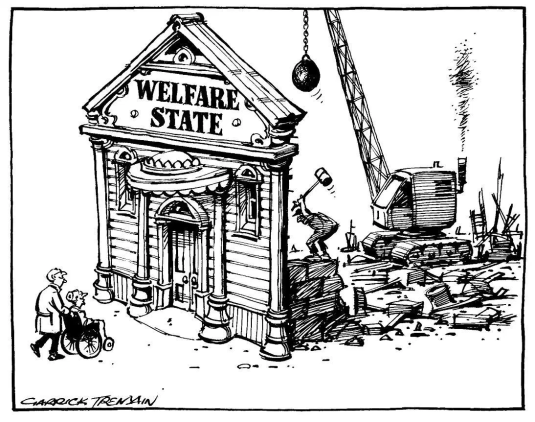
Universal Credit has been designed to change the relationship between the state and citizens. It is about altering the public’s expectations of the role of government. It is about deepening targeted austerity. It is also about cutting social security and dismantling the welfare state. 

The one-off £10 payment, which was designed to be an extra boost to families over the festive period, has been axed under Universal Credit, which demonstrates very well what kind of “mean spirited” intentions went into the design of system. I rang the Department for Work and Pensions press office to confirm this and it was affirmed that the cut has happened. A spokesperson said: “Universal Credit claimants have never received a one-off December payment, but many disabled people on Universal Credit will be better off on average by £100 month than when they received Employment and Support Allowance (ESA).”

Yesterday, someone I know through social media sent me a copy of a notice they got when they logged onto the Universal Credit system. It said: Image may contain: text

So, if an employer pays his employees early in December due to the Christmas holiday period or pays a Christmas bonus, people may well receive a reduced Universal Credit payment in December or none at all. This is due the fact that the unadaptable system cannot cope with people being paid twice in one assessment period, even though it isn’t an additional payment, it is simply an early payment. 

Judicial reviews

The controversial Universal Credit programme is to undergo another legal challenge at the High Court in London, as evidence mounts further that the new social security system will leave thousands of people already on low incomes significantly worse off. Four women are taking the government to court because of this reason.

This is the second judicial review of Universal Credit. It follows the High Court’s finding in June that the Universal Credit system was unlawfully discriminating against severely disabled people. Those who had qualified for the support component of income-related Employment and Support Allowance (ESA) are also eligible for a disability premium.  However, as a result of the abolition of both the severe disability premium (SDP) and enhanced disability premium (EDP) under Universal Credit rules, according to the disability charity, Scope, the cut to the disability income guarantee will see disabled people lose as much as £395 a month

The high court judge ruled that the Department for Work and Pensions unlawfully discriminated against two severely disabled men who both saw their benefits dramatically reduced when they moved Local Authority – one of them because of the bedroom tax – and were required to claim Universal Credit. The court found that the implementation of Universal Credit and the absence of any ‘top up’ payments for this vulnerable group as compared to others constitutes discrimination contrary to the European Convention on Human Rights.

Since the court case, Esther McVey, then Secretary of State for Work and Pensions, announced that no severely disabled person in receipt of the SDP will be made to move onto Universal Credit until transitional protection is in place. She also committed to compensating those like the two claimants who have lost out on their disability premium because they had to claim Universal Credit.

Yet despite this, Secretary of State for Work and Pensions has sought permission to appeal, maintaining that there was “nothing unlawful” with the way the claimants were treated.

The second judicial review comes amid mounting concern over Universal Credit, which academics have described as a “complicated, dysfunctional and punitive” system pushing people into debt and rent arrears. 

Last week it emerged that more than half of people denied Universal Credit were found to be entitled to it when their cases were investigated, prompting fresh demands for the national rollout of the new system to be halted. It’s something of an irony, given that Universal Credit was introduced in 2013 with the stated intention of bringing “fairness and simplicity” to Britain’s social security system.

Now, four plaintiffs say the flaw, which relates to the way Universal Credit monthly payments are calculated, disproportionately affects working parents with children and leaves claimants with a “dramatically fluctuating income” and unable to budget from month to month.

In one case uncovered by the Child Poverty Action Group (CPAG) reported by The Guardian, a family’s monthly payment swung from £1,185 to zero, making budgeting impossible. One of the women has said that as well as being irrational, the payment system is also discriminatory as it disproportionately affects single parents, who are predominantly female. Last month, MP Frank Field said the system was driving some women in his constituency into sex work in a bid to avoid absolute poverty.

A single mother says she was forced to turn down a promotion and use a food bank after issues with the assessment period for the new benefit system made it “impossible to budget”.  

She said: “I invested £40,000 in higher education studies so that I could become an occupational therapist and it’s great that I’ve got my degree but I have had to put my career hopes on hold because of Universal Credit.  

“I had to go to a food bank and I took out an advance that I am still paying back. I took two jobs – as a PA and a waitress – which I could do without the education I invested in but which had paydays which don’t clash with my assessment period. I wanted to become free of welfare through my chosen profession but Universal Credit is holding me back from that.” 

Although she had originally wanted a healthcare job, which was relevant to her degree and would move her nearer earnings that would eventually take her out of the social security system altogether, she found that the NHS and other health organisations mostly paid salaries at the end of the working month so she would face the same assessment period trap. 

She left the council and initially took two part time jobs, and she now has one part time job.

Her solicitor, Carla Clarke of Child Poverty Action Group (CPAG), said: “Universal Credit is promoted as a benefit that ‘incentivises’ work but in practice its rigid assessment period system undercuts that claim. 

“Our clients have been left repeatedly without money for family essentials simply because of the date of their paydays.

“One of them, for example, did her utmost to find a workaround but ultimately had to decline a promotion in a job with good prospects when her then contract came to an end just to escape the trap.

“We say that the DWP’s refusal to alter our clients’ assessment period dates to avoid this problem discriminates against working parents – one of the two groups who are entitled to a work allowance – as well as being irrational and undermining one of the stated purposes of universal credit – to make sure that ‘work always pays’.”

CPAG argues that the DWP refusal to alter Woods’ assessment period dates to avoid the problem discriminated against working parents – one of the two groups who are entitled to a work allowance – as well as being “irrational and undermining.” 

Clarke added “This is a fundamental defect in Universal Credit and an injustice to hard-working parents and their children that must be put right for our clients and everyone else affected”.

Another of the women involved in the court case is paid by her employer on the last working day of each month. However, the Universal Credit assessment periods run from the last day of each month, meaning that if she is paid before the last day of the month she is assessed as having been paid twice that month.

Lawyers from the legal firm supporting  Johnson at LeighDay, say: “This has resulted in her receiving fluctuating Universal Credit payments throughout the year, making it very hard to budget from one month to the next.”

They add: “It has also caused her to be around £500 worse off annually due to the fact that she is entitled to ‘work allowance’ as a parent.

“The work allowance is a disregard of £198 per month of a parent’s monthly earnings so in months where she is treated as having no earned income, she loses the whole benefit of the work allowance. In months where she is treated as having double income, she does not receive any extra work allowance.”

Legal aid for social security appeals is almost entirely gone. People adversely affected by unfair decisions are effectively being denied support in accessing justice. It’s difficult to see this as anything other than a planned and coordinated attack on people’s most basic human and democratic rights. 

Universal Credit increases and extends the risk of domestic abuse

Couples who live together are required to make a single household claim for Universal Credit. Their individual entitlements are calculated—based on household income—and combined into a single payment, paid into one account only. In December 2017, 55,000 couple households, including 40,000 with dependent children, were claiming Universal Credit. Once it is fully rolled out, around 2.9 million couple households will claim it. MPs have warned that Universal Credit increases the risk of allowing domestic abusers to exert financial control over victims. 

A critical report by the Work and Pensions committee in August said the way Universal Credit is paid per household means that perpetrators could too easily take control of the entire budget, leaving vulnerable women and their children dependent on an abusive partner to survive. Frank Field, Labour chair of the committee, said: “This is not the 1950s. Men and women work independently, pay taxes as individuals, and should each have an independent income.

“Not only does Universal Credit’s single household payment bear no relation to the world of work, it is out of step with modern life and turns back the clock on decades of hard-won equality for women.”

He added “The government must acknowledge the increased risk of harm to claimants living with domestic abuse it creates by breaching that basic principle, and take the necessary steps to reduce it.”

Ministers were urged by the committee to consider overhauling the system so payments are automatically split between couples, as victims face “great danger” if they request their own payments under current rules.

The report said: “Universal Credit currently only allows claims to be split between partners in ‘exceptional circumstances’.

“The DWP itself recognises the risk that requesting such an arrangement poses to survivors. The perpetrator will realise the survivor has requested the split when their own payments fall, potentially putting them in great danger.

“In light of this risk, many survivors simply will not request a split.”

The committee also suggested the main carer of children should automatically receive the whole payment, while officials explore ways to develop a split payment scheme. JobCentres must set aside private rooms for vulnerable claimants and appoint a domestic violence specialist to deal with specific claims, the report also said.

Katie Ghose, chief executive of Women’s Aid, said: “We have long been warning that Universal Credit risks making the domestic abuse worse for survivors and putting an additional barrier in the way of them escaping the abuse.

“That’s why we welcome the committee’s report and urge the government to take action to make Universal Credit safe for survivors.

“We know from our work with survivors that abusers will exploit single household payments, yet applying for a split payment can also be dangerous. If the abuser finds out that a survivor has made an application, she may be at further risk.”

Domestic abuse is hugely complex, and the training Work Coaches currently receive leaves them ill-equipped to perform this vital function. Under Universal Credit, claimants living with domestic abuse can face seeing their entire monthly income—including money meant for their children—go into their abusive partner’s account. There is no guarantee that any of the money they need to live or care for their children will reach them. That risks them remaining dependent on their abusive partner and making it much harder for them to leave, should the opportunity present itself.

Yet the Scottish Parliament has passed legislation which requires the Scottish Government to introduce split payments by default.

Universal Credit is perpetuating gender inequality – an issue that the Equality and Human Rights Commission have also raised concerns about. If money is paid into an abuser’s account, that compromises a woman’s financial autonomy. Their recent report recommends:

  • offering Universal Credit as single payments to individuals rather than joint payments to avoid exacerbating financial abuse for women experiencing domestic violence
  • reconsidering the ‘spare room subsidy’ regulations which discriminate against survivors of domestic abuse who have safe rooms.

But the government justifies the policy by claiming that few couples manage their finances separately. They argue that paying one benefit into a single bank account means families can make decisions about their household finances without government interference. However, this assessment ignores the realities of women trapped in controlling relationships.

Two child policy – regarding children as a commodity, and some say, eugenics by stealth

This policy restricts support through means-tested family benefits to two children only and affects the child tax credit payable for all third or subsequent children born after April 2017 and all new claims for Universal Credit, whenever they were born. In doing so, the two-child policy breaks the fundamental link between need and the provision of minimum support and implies that some children, by virtue of their birth order, are less deserving of support. It is a very large direct cut to the living standards of the poorest families of up to £2780 per child, per year.

In 2015/16 — the latest year for which data is available — 27 per cent of households with children had more than two children, representing more than 1 in 3 children in poverty (after housing costs). The risk of poverty is already 39 per cent for households (after housing costs) with three or more children compared with 26 per cent for one- and 27 per cent for two-child families. The most recent statistics reveal that during the first year of operation, 59% of the 73,500 families who lost financial support for a third child were in work. Nine per cent of UK claimant households with three or more children were affected.

A number of groups in the population are particularly likely to be hard hit by the policy, including Orthodox Jews, Pakistani and Bangladeshi families, and Roman Catholics. It will also hit large families bereaved by the loss of  a parent, divorced families, and all large families falling upon hard times and needing to claim means-tested support.

Originally there were no intentions to make exceptions to the two-child policy, but the government was forced to make concessions for, among others, third and subsequent children under kinship care and those conceived as a result of rape — which in itself forces highly sensitive disclosure. A number of women’s rights and rape support organisations have raised serious concerns about the third-party evidence model for the rape/coercion exception and the risk that women claiming this exception will be exposed to further trauma and gross breaches of privacy.

The so-called rape clause has been condemned by campaigners, who say it is outrageous that a woman must account for the circumstances of her rape to qualify for support. The SNP MP Alison Thewliss called it “one of the most inhumane and barbaric policies ever to emanate from Whitehall”.

A government spokesperson said: “The policy to provide support in child tax credit and universal credit for a maximum of two children ensures people on benefits have to make the same financial choices as those supporting themselves solely through work.

The rationale for the two-child limit was to reduce the deficit by £1.36 billion per year by 2020/21. But the government also sought to justify it on the basis that they are hoping to ‘change behaviours’ — hoping to ‘encourage parents to reflect carefully on their readiness to support an additional child’. Yet, the savings to be made from the policy are quite modest in the context of the austerity cuts of £27 billion per year since 2010.

The rollout of Universal Credit will increase the number of families affected. All new claims for the benefit after February 2019 will have the child element restricted to two children in a family, even if they were born before the policy was introduced.

The government estimated 640,000 families will lose support as a direct result of the proposed changes. The Children’s Society estimate that the total loss of a child element plus the family element of child tax credit will mean that a family with three children will lose up to £3,325 per year. A family with four children will lose up to £6100. Troublingly, disabled children will also be affected by this measure on top of the major cuts in children’s disability support through Universal Credit.

Jamie Grier, the development director at the welfare advice charity Turn2us, has spoken out about mothers in low income families faced with the agonising choice of terminating wanted pregnancies already, because of their financial circumstances.

Alison Garnham, the chief executive of Child PovertyAction Group, said: “An estimated one in six UK children will be living in a family affected by the two-child limit once the policy has had its full impact. It’s a pernicious, poverty-producing policy.”

The Institute for Fiscal Studies has projected that 600,000 more children will live in absolute child poverty by 2020/21 compared with 2015/16 — all of them in families with three or more children. The absolute child poverty rate is to increase over that period from 15.1 per cent to 18.3 per cent. The two-child limit accounts for around a third of this impact. Absolute poverty is when people can’t meet one or more of their basic survival needs.

The policy is extremely likely to contravene human rights treaties to which the UK is a signatory, including those relating to women’s reproductive rights and protection from religious and gender-based discrimination contrary to Article 16 of the Convention on the Elimination of all Forms of Discrimination Against Women.

It would also discriminate against groups with a conscientious objection to contraception and abortion, or for whom large families are a central tenet of faith, in breach of Article 14 of the European Convention on Human Rights. Furthermore, it fails to give primary consideration to the best interest of the child in contravention of Article 3(1) of the UN Convention on the Rights of the Child. 

The UN Committee on Economic, Social and Cultural Rights raised a specific concern about the effect of cuts to social security on the standard of living enjoyed by families with two or more children in the Concluding Observations of its recent review of the UK’s compliance with the International Covenant on Economic, Social and Cultural Rights. The policy is going to be challenged in the courts on discrimination grounds and may well reach the Supreme Court and European Court of Justice. 

Context and policy intent

Universal credit is the controversal reform of the social security system, rolling together six so-called “legacy” benefits (including unemployment benefit, employment and tax credits and housing benefit) into one benefit paid monthly to claimants, to “make work pay.”

However, at a time of stagnant wages and ever-increasing living costs, the government slogan ‘making work pay’ is certainly not about a national wage increase. It’s rather more about neoliberal supply-side ideology.  Supply-side policies include the promotion of greater competition in labour markets, through the removal of what are deemed ‘restrictive practices’, and labour market rigidities, such as the protection of employment and workers’ rights. For example, as part of  neoliberal supply-side reforms in the 1980s, trade union powers were greatly reduced by a series of measures including limiting workers’ ability to call a strike, and by enforcing secret ballots of union members prior to strike action. More recently the Conservatives have again made substantial legislative changes that undermine the role of trade unions.

Deregulation and privatisation of state industry and services are also components of supply-side economics. Supply-side measures have a negative effect on the distribution of income. For example, lower taxes rates for the wealthiest, lower wages for workers, reduced union power, and privatisation have all contributed to a widening of the gap between rich and poor citizens. Universal Credit facilitates a supply-side labour market, it coerces people into accepting low paid, insecure work. Any work.

People claiming Universal Credit do not get a say in the kind of work they take on. If people don’t comply with Universal Credit conditionality they are generally sanctioned. This entails a loss of welfare support for between four weeks and up to a maximum of three years for refusing to take a job or prescribed community work. 

Some economists argue that a lack of bargaining power because union membership has been in long term decline – is leading to fewer widespread agreements on earnings increases, which has served to  keep wages stagnant. A lack of employee confidence and certainty following the recession and fears, then, over job losses has also led to fewer demands for rises.

Given that collective bargaining has been politically undermined, it is particularly outrageous that the government has introduced sanctions for those on low pay and in work, for a failure to single handedly negotiate better pay or an increase in working  hours with their employer. 

Perhaps we should ask “making work pay” for whom?

It’s interesting that the government have outlined what Universal Credit means for employers, indicating the intent behind the policy is not about mitigating poverty. It’s about employers “having access to a more flexible and responsive workforce, which can help your business with the challenges of filling vacancies.

“Universal Credit payments automatically adjust each month based on the real time PAYE information you report to HMRC, so it’s important that you report this information accurately and on time.”

The ‘business friendly’ government says “Universal Credit increases the financial incentive of work and provides employers like you with a more flexible workforce.”

So while employers are promised a workforce that will accept more, in terms of conditions, rates of pay and job security, the same workforce is being set up to fail when trying to negotiate more pay and longer hours by the government’s ‘business friendly’ deregulation. And failure can mean facing having their Universal Credit cut via sanctions.

It does go on to say on the site that “Jobcentre Plus work coaches will encourage claimants to discuss with their employers how they can increase their chances of earning more. This could be by improving their skills which may help them to take on more responsibilities. You may find your employees asking for more hours or for help with building their skills. You can play a role in this – helping your business become more productive.”

So, employers “can” but workers “must”, despite the substantial imbalance of power, made worse by the fact that workers are being coerced into “flexibility”. That invariably means lowering their expectations of employers and of the conditions of their employment.

The publicly stated aim of Universal Credit, for which there was orginally general support across the political divide, was to simplify the welfare system, making it more “efficient” and easy to access at a single claim point. Despite these claims, many have complained that Universal Credit is bafflingly complex, unreliable and difficult to manage, particularly if you are without internet access, and that Universal Credit staff are often poorly trained. The combination of these problems is leaving people in precarious and very vulnerable circumstances.

For families and lone parents in particular, there are barriers to taking short term low paid work, as continuity of income and availability of childcare are key priorities for parents.

The Conservatives have also claimed that the new benefit will provide incentives for people to work rather than stay on benefits. Perhaps it’s worth noting that only 34% of people claiming state welfare are of working age, the majority – 66% – are people of pension age.

The government say “It is intended that by introducing a single in-work and out-of-work benefit, previous barriers to employment such as taking up temporary employment or fewer hours are removed, therefore making it easier for claimants to take up any work and changing claimant perceptions of work and welfare, and their employment behaviours, at an individual and household level.”

The Conservatives go on to claim that employment levels are at a record high, because Universal Credit is “working”. Some 80% of men are in work, the joint highest employment rate since 1991. And over 70% of women are in work, the highest employment rate since records began in 1971. But that increase is down, partly, to state pension age changes which mean fewer women are retiring between the ages of 60 and 65. 

However, as I have indicated, the structure of the employment market also matters. Zero hours contracts and hyper-flexible employment might be welcomed by some for the options they offer, but they work against collective bargaining agreements on earnings, keeping wages low. And low wages, not lack of incentives, are the reason why people need welfare support. The trade union wage gap, the difference in earnings of union members compared with non-members, is 16.9% in the public sector and 7.1% in the private sector (which employs well over 80% of people). There cannot be any genuine economic ‘bounce back’ until the UK’s decade-long stagnation in wages ends.

Universal Credit was supposedly intended as a payment to help people with living costs. It’s for those on a low income or out of work. As of February this year, the number of people on Universal Credit was 770 thousand. Of these people 300 thousand were in employment. The intention embedded in the design of Universal Credit to force up to a million low-paid workers to seek more hours or move to higher-paid jobs, under threat of financial sanctions (in-work conditionality), is another ticking bomb.

It is being introduced in stages across the country.  People claiming Universal Credit receive a single monthly household payment, paid into a bank account in the same way as a monthly salary; support with housing costs will usually go direct to the person claiming as part of their monthly payment. 

People will usually make a claim for Universal Credit online, during which initial claim verification will take place. This entails people providing evidence of their identity. However, there have been some problems highighted with the government’s verification framework. 

MP for Liverpool Walton, Dan Carden, called on the Department of Work and Pensions (DWP) to postpone the roll-out of Universal Credit in his constituency until after Christmas and highlighted an issue with people having to pay out for a driving licence as one of many administrative problems with the new system.

In a letter to the secretary of state, Amber Rudd MP, Carden said: “We have families experiencing poverty on an unprecedented scale and now facing further avoidable hardship in the run up to Christmas. 

“I have now been informed that job centres across Liverpool are advancing payments to my constituents to obtain provisional driving licences for the purposes of identification and then deducting the cost from their benefits.

“Constituents are also having to pay for postal orders, passport photographs and postage, just to obtain provisional licences.”

He explained that the DVLA says there is a five-week wait for provisional licences, and highlighted the delays before the first payments are made when someone is transferred on to Universal Credit.

The controversial benefit is being rolled out in many parts of Liverpool this week. Carden added: “Continuing with this roll-out will leave many of the most vulnerable families in Liverpool Walton destitute by Christmas and I am therefore asking you to intervene as a matter of urgency.”

Rudd’s response was to say Carden was ‘scaremongering’, and she denied that ID was needed to claim Universal Credit. However, it seems she failed to bother checking her own government’s web site for advice and evidence. The site which outlines how to claim Universal Credit  completely contradicts Rudd’s claims, it says on the government’s site:

Amber rudd lies 1

Amber rudd lies 2

When people apply for Universal Credit they are asked to verify their identity online via the GOV.Verify service. 

To do so, you need either;

  • A valid UK driving license
  • A valid UK passport.

On the government document it says “Universal Credit cannot be paid to a claimant whose identity has not been verified. Failure to provide identity documentation means that there is no valid claim.”

Of course this creates significant problems for those without the required documents. Their Universal Credit claim cannot go ‘live’ without conforming to the ID verification framework. People generally can’t get an advance because their claim isn’t live. Once they’ve received their new ID document, (takes around 6-8 weeks usually), it’s then a further 5 weeks (at least) until their first Universal Credit payment. That’s a very long time to go without support that is intended to meet people’s most basic living needs: food, fuel and shelter. 

According to the government web site, you can only apply for an advance on your first payment if you have already verified your identity. It says:

You can apply for an advance payment in your online account or through your Jobcentre Plus work coach.

You’ll need to:

  • explain why you need an advance
  • verify your identity (you do this online when you submit your Universal Credit claim or at your first Jobcentre Plus interview)
  • provide bank account details for the advance (talk to your work coach if you cannot open an account.)

The claim date is the date that a claimant completes this process and submits their claim. After making a claim, an initial interview will take place with the claimant, where the eligibility for Universal Credit will be confirmed and the claimant will accept a Claimant Commitment. Failure to comply with the Commitment without ‘good reason’ will result in a sanction. What constitutes a ‘good reason’ unfortunately varies from area to area and even among advisors in the same building. One of the many criticisms of welfare sanctions is how arbitrary they are. Universal Credit is a far stricter regime than the previous ones, and indications are that people are being sanctioned more frequently.

The Universal Credit project was passed through legislation in 2011 under the patronage of its loudest champion, former secretary of state for work and pensions Iain Duncan Smith. The plan was to roll it out across the UK by 2017. However, a series of management failures, expensive IT blunders and design faults mean it has fallen at least five years behind schedule.

Under the current schedule it will be fully implemented to include about 7 million claimants by 2022-23, when it is estimated that it will account for around £63bn of spending. A substantial proportion of that is due to administration blunders. Earlier this year, the National Audit Office said “The benefits that it set out to achieve through Universal Credit, such as increased employment and lower administration costs, are unlikely to be achieved.”

The administrative cost of every Universal Credit claim is an eye-watering £699 per case against an ultimate target of just £173, others in the field are calling to stop this utter shambles now and reconsider all options. 

The Department is seriously criticised for “a lack of regard in failing to understand the hardship faced by some claimants”. Forget normal Whitehall tact, here are eight years of unrelenting failure, ploughing on despite alarms as costs rose to £2bn. One of the most urgent needs is to restore the £23bn that George Osborne cut from the budget, which is due to cause a record 37% of children in poverty by 2022, according to the Institute for Fiscal Studies. That’s likely to be a conservative estimate.

Despite a few minor changes, such as shortening the waiting period by a week, huge underlying problems remain with Universal Credit. Multibillion-pound cuts to work allowances imposed by the former chancellor have left it hollowed out. According to the Resolution Foundation thinktank, Universal Credit will leave about 2.5 million low-income working households more than £1,000 a year worse off. Reversing those cuts requires a political decision, not more tinkering around the edges and technical fixes.

Universal Credit is paid monthly, in arrears, so people have to wait one calendar month from the date they submitted their application before their first UC payment is made. This is called the assessment period. People then have to wait up to seven days for the payment to reach your bank account. That is of course providing everything goes right. 

So far, the ‘customer’ experience of Universal Credit for too many people (and other stakeholders, such as landlords) has been utterly dismal. Critics argue that Treasury cuts to the benefit mean it is now far less likely to incentivise people to move into work, or to work more hours – what the Conservatives call ‘in-work progression’. As a result of cuts, Universal Credit is significantly less generous than originally intended, leaving many claimants worse off when they move on to it than they were while claiming legacy benefits. Added to that are design flaws and administrative glitches that put poorer claimants especially at heightened risk of hunger, debt and rent arrears, ill-health and homelessness. 

Their report is intended to help the Council and partners to further develop the approach to supporting those affected by current and future welfare reforms. 

It builds on Sheffield Hallam University research published in March 2016 which suggested that welfare reforms have cost the city’s economy the equivalent of £157M per year, set to rise to £292M per year by 2020. Liverpool City Council has had a 58% cut in central government funding since 2010 and has to find another £90M in savings by 2020, is having to use around £7M of those reduced funds to help with rent top ups and crisis payments.

Liverpool Food People are part of a food insecurity sub group that reports into The Mayoral Action Group on Fairness and Tackling Poverty – food has been identified as one of the basic needs – and a recommendation within the report is that action to address food poverty and fuel poverty is coordinated across the city and that research is carried out on the level of food insecurity (both moderate and severe) across the city. 

New research conducted for Gateshead council concludes that Universal credit has become a serious threat to public health after the study revealed that the stress of coping with the new benefits system had so profoundly affected peoples’ mental health that some considered suicide.

The researchers found overwhelmingly negative experiences among vulnerable citizens claiming Universal Credit, including high levels of anxiety and depression, as well as physical problems and social isolation, all of which was exacerbated by hunger and destitution.

The Gateshead study comes as the United Nation’s special rapporteur on extreme poverty and human rights, Philip Alston, prepares to publish a report of the impact of Conservative austerity in the UK. Alston has been collecting evidence and testimonies on the effects of the welfare reforms, council funding cuts, and Universal Credit during a two-week visit of the UK. 

This research is highly likely to raise fresh calls for the system’s rollout to be halted, or at the very least, paused to attempt to fix the fundamental design flaws and ensure adequate protections are in place for the most vulnerable people claiming it.

Approximately 750,000 chronically ill and disabled claimants are expected to transfer on to Universal Credit from 2019. Yet earlier this year, the first legal challenge against Universal Credit found that the government unlawfully discriminated against two men with severe disabilities who were required to claim the new benefit after moving into new local authority areas. Both saw their benefits dramatically reduced when they moved to a different Local Authority and were required to claim Universal Credit instead of Employment and Support Allowance.

The study findings are yet another indication of how unfit for purpose Universal Credit is. Six of the participants in the study reported that claiming Universal Credit had made them so depressed that they considered taking their own lives. The lead researcher, Mandy Cheetham, said the participant interviews were so distressing she undertook a suicide prevention course midway through the study.

The report says: “Universal Credit is not only failing to achieve its stated aim of moving people into employment, it is punishing people to such an extent that the mental health and wellbeing of claimants, their families and of [support] staff is being undermined.”

One participant told the researchers: “When you feel like ‘I can’t feed myself, I can’t pay my electric bill, I can’t pay my rent,’ well, all you can feel is the world collapsing around you. It does a lot of damage, physically and mentally … there were points where I did think about ending my life.”

An armed forces veteran said that helplessness and despair over Universal Credit had triggered insomnia and depression, for which he was taking medication. “Universal Credit was the straw that broke the camel’s back. It really did sort of drag me to a low position where I don’t want to be sort of thrown into again.”

Unsurprisingly, the report concludes that Universal Credit is actively creating poverty and destitution, and says it is not fit for purpose for many people with disabilities, mental illness or chronic health conditions. It calls for a radical overhaul of the system before the next phase of its rollout next year.

Alice Wiseman, the director of public health at Gateshead council, which commissioned the study, said: “I consider Universal Credit, in the context of wider austerity, as a threat to the public’s health.” She said many of her public health colleagues around the country shared her concerns.

Wiseman said that Universal Credit is “seriously undermining” efforts to prevent ill-health in one of the UK’s most deprived areas.

She added “This is not political, this is about the lives of vulnerable people in Gateshead. They are a group that should be protected but they haven’t been.”

The qualitative study focused on those claimants with disabilities, mental illness and long-term health conditions, as well as homeless people, veterans and care leavers.

The respondents found that compared to the legacy benefits, Universal Credit is less accessible, remote, inflexible, demeaning and intrusive. It was less sensitive to claimants’ health and personal circumstances, the researchers said. This heightened peoples’ anxiety, sense of shame, guilt, and feelings of loss of dignity and control.

The Universal Credit system itself was described by those claiming it as dysfunctional and prone to administrative error. People experienced the system as “hostile, punitive and difficult to navigate,” and struggled to cope with payment delays that left them in debt, unable to eat regularly, and reliant on food banks.

The government claimed that people making a new claim are expected to wait five weeks for a first payment. That’s a long time to wait with no money for basic living requirements. However, the average wait for participants on the study was seven and a half weeks, with some waiting as long as three months. Researchers were told of respondents who were so desperate and broke they turned to begging or shoplifting.

Wiseman made a point that many campaigners have made, and said that alongside the human costs, Universal Credit was placing extra burdens on NHS and social care, as well as charities such as food banks. It also affected the wellbeing of advice staff, who reported high stress levels and burnout from dealing with the fallout on those claiming the benefit.

Guy Pilkington, a GP in Newcastle said that the benefits system had always been tough, but under Universal Credit, those claiming faced a higher risk of destitution.

“For me the biggest [change] is the ease with which claimants can fall into a Victorian-style system that allows you to starve. That’s really shocking, and that’s new,” he said.

A spokesperson for the Department for Work and Pensions (DWP) said: “This survey of 33 claimants doesn’t match the broader experience of more than 9,000 people receiving Universal Credit in Gateshead, who are taking advantage of its flexibility and personalised support to find work.”

“We have just announced a £4.5bn package of support so people can earn £1,000 more before their credit payment begins to be reduced, and we are providing an additional two weeks’ payments for people being moved from the old system.”

That will still leave people with nothing to live on or to cover their rent for at least three weeks. The study focused on those less likely to be able to work – people with disabilities, mental illness or chronic health conditions. The DWP failed to recognise that this group have different needs and experiences than the broader population, which leave them much more likely to become vulnerable when they cannot meet their needs.

Vulnerable people are suffering great harm and some are dying because of this government’s policies. It is not appropriate to attempt to compare those peoples’ experiences with some larger group who have not died or have not yet experienced those harms. Where is the empirical evidence of these claims, anyway? Where is the DWP’s study report?

Callousness and indifference to the suffering and needs of disadvantaged citizens – disadvantaged because of discriminatory policies – has become so normalised to this government that they no longer see or care how utterly repugnant and dangerous it is.

The DWP are not ‘providing’ anything. Social security is a publicly funded safety net, paid for by the public FOR the public. It’s a reasonable expectation that citizens, most of who have worked and contributed towards welfare provision, should be able to access a system of support when they experience difficulties – that is what social security was designed to provide, so that no one in the UK need to face absolute poverty. It’s supposed to be there so that everyone can meet their basic survival needs.

What people in their time of need find instead is a system that has been redesigned to administer punishments, shame and psychological abuse. What kind of government kicks people hard when they are already down?

Universal Credit was considered the antidote for the Conservative’s ‘welfare dependency’ myth, yet there has never been any empirical evidence to support their claims of the existence of a ‘culture of dependency’ and that’s despite the dogged research conducted by Keith Joseph some years ago, when he made similar claims. He never found any evidence despite trying very hard. Most people move in and out of work, because jobs have become increasingly precarious over the last few years. 

In fact over recent years, an international study of social safety nets from The Massachusetts Institute of Technology (MIT) and Harvard economists categorically refutes the Conservative ‘scrounger’ stereotype and dependency rhetoric.  Gabriel Kreindler, Benjamin Olken and colleagues re-analyzed data from seven randomized experiments evaluating cash programs in poor countries and found “no systematic evidence that cash transfer programmes discourage work.”

The phrase ‘welfare dependency’ diverts us from political class discrimination via policies, increasing inequality, and it serves to disperse public sympathies towards the poorest citizens, normalising the inequality and prejudice embedded in neoliberal ideology and resetting social norm defaults that then permit the state to target protected social groups for further punitive and cost-cutting interventions to ‘incentivise’ them towards ‘behavioural change.’ Outrageously, the behavioural change required by the state is that the public do not use publicly funded welfare services.

Stepping back from this, it becomes clear that the policy driver is ‘small state’, antiwelfarist neoliberal ideology. This is being propped up by pseudoscientific behavioural economic rationalisations. 

There is mounting evidence, according to local authority researchers in Liverpool, for example, that shows the actual effect is the reverse of what was claimed was intended; Universal Credit is harming the very people it was designed to support. It is forcing households into debt, causing severe poverty including to those in work, leaving too many people, including children, facing food insecurity, destitution and eviction. Liverpool council’s welfare reform cumulative impact analysis last year shows that the groups most adversely affected by the Government’s raft of ‘welfare reforms’ are the long-term sick and disabled, families with children, women, young adults and the 40-59 age group who live in social housing. 

Many working households are suffering a shortfall in Housing Benefit, Housing Allowance and a reduction and removal of many other benefits, all set against the backdrop of ever increasing living costs. Poverty disincentives people. 

In recent years welfare conditionality has become conflated with severe financial penalities (sanctions), and has mutated into an ever more stringent, complex, demanding set of often arbitrary requirements, involving frequent and rigid jobcentre appointments, meeting job application targets, providing evidence of job searches and mandatory participation in workfare schemes. The emphasis of welfare provision has shifted from providing support for people seeking employment to increasing conditionality of conduct, enforcing particular patterns of behaviour and monitoring citizen compliance.

Government Statistics tell us that more people get sanctioned under Universal Credit than under the existing legacy benefits system.

Sanctions are “penalties that reduce or terminate welfare payments in cases where claimants are deemed to be out of compliance with  requirements.” They are, in many respects, the neoliberal-paternalist tool of discipline par excellence – the threat that puts a big stick behind coercive welfare programme rules and “incentivises” citizen compliance with a heavily monitoring and supervisory administration. The Conservatives have broadened the scope of behaviours that are subject to sanction, and have widened the application to include previously protected social groups, such as sick and disabled people and lone parents.

There is plenty of evidence that sanctions don’t help people to find work, and that the punitive application of severe financial penalities is having a detrimental and sometimes catastrophic impact on people’s lives. We can see from a growing body of research how sanctions are not working in the way the government claim they intended.

Sanctions, under which people lose benefit payments for between four weeks and three years for “non-compliance”, have come under fire for being unfairpunitive, failing to increase job prospects, and causing hunger, debt and ill-health among jobseekers. And sometimes, even causing death.

However, if people are already needing to claim financial assistance which was designed to meet only very basic needs, such as provision for food, fuel and shelter, then imposing further financial penalities will simply reduce those people to a struggle for basic survival, which will inevitably demotivate them and stifle their potential.

The current government demand an empirical rigour from those presenting criticism of their policy, yet they curiously fail in meeting the same exacting standards that they demand of others. Often, the claim that “no causal link has been established” is used as a way of ensuring that established correlative relationships, (which often do imply causality,) are not investigated further.

Qualitative evidence – case studies, for example – is very often rather undemocratically dismissed as ‘anecdotal,’ or as ‘scaremongering’ which of course stifles further opportunities for research and inquiry.

The Conservative shift in emphasis from structural to psychological explanations of poverty has far-reaching consequences. The partisan reconceptualision of poverty makes it much harder to define and very difficult to measure. Such a conceptual change disconnects poverty from more than a century of detailed empirical and theoretical research, and we are witnessing an increasingly experimental approach to policy-making, aimed at changing the behaviour of individuals, without their consent.

This approach isolates citizens from the broader structural political, economic, sociocultural and reciprocal contexts that invariably influence and shape an individuals’s experiences, meanings, motivations, behaviours and attitudes, causing a problematic duality between context and cognition. It places unfair and unreasonable responsibility on citizens for circumstances which lie outside of their control, such as the socioeconomic consequences of political decision-making.

I want to discuss two further considerations to add to the growing criticism of the extended use of sanctioning, which are related to why sanctions don’t work. One is that imposing such severe financial penalities on people who need social security support to meet their basic needs cannot possibly bring about positive “behaviour change” or incentivise people to find employment, as claimed. This is because of the evidenced and documented broad-ranging negative impacts of financial insecurity and deprivation – particularly food poverty – on human physical health, motivation, behaviour and mental states.

The second related consideration is that “behavioural theories” on which the government rests the case for extending and increasing benefit sanctions are simply inadequate and flawed, having been imported from a limited behavioural economics model (otherwise known as nudge” and libertarian paternalism) which is itself ideologically premised.

Sanctions and workfare arose from and were justified by nudge theory, which is now institutionalised and deeply embedded in Conservative policy-making. Sanctions entail the manipulation of a specific theoretical cognitive bias called loss aversion.

At best, the new “behavioural theories” are merely theoretical  propositions, at a broadly experimental stage, and therefore profoundly limited in terms of scope and academic rigour, as a mechanism of explanation, and in terms of capacity for generating comprehensive, coherent accounts and understanding about human motivation and behaviour.

I reviewed research and explored existing empirical evidence regarding the negative impacts of food poverty on physical health, motivation and mental health. In particular, I focussed on the Minnesota Semistarvation Experiment and linked the study findings with Abraham Maslow’s central idea about cognitive priority, which is embedded in the iconic hierarchy of needs pyramid. Maslow’s central proposition is verified by empirical evidence from the Minnesota Experiment.

The Minnesota Experiment explored the physical impacts of hunger in depth, but also studied the effects on attitude, cognitive and social functioning and the behaviour patterns of those who have experienced semistarvation. The experiment highlighted a marked loss of ambition, self-discipline, motivation and willpower amongst the subjects once food deprivation commenced. There was a marked flattening of affect, and in the absence of other emotions, Doctor Ancel Keys observed the resignation and submission that continual hunger manifests.

The understanding that food deprivation dramatically alters emotions, motivation, personality and that nutrition directly and predictably affects the mind as well as the body is one of the legacies of the experiment.

The experiment highlighted very clearly that there’s a striking sense of immediacy and fixation that arises when there are barriers to fulfiling basic physical needs – human motivation is frozen to meet survival needs, which take precedence over all other needs. This is observed and reflected in both the researcher’s and the subject’s accounts throughout the study. If a person is starving, the desire to obtain food will trump all other goals and dominate the person’s thought processes.

In a nutshell, this means that if people can’t meet their basic survival needs, it is extremely unlikely that they will have either the capability or motivation to meet higher level psychosocial needs, including social obligations and responsibilities to seek work. Abraham Maslow’s humanist account of motivation also highlights the same connection between fundamental motives and immediate situational threats.

maslow's hierarchy of needs

Ancel Keys published a full report about the experiment in 1950. It was a substantial two-volume work titled The Biology of Human Starvation. To this day, it remains the most comprehensive scientific examination of the physical and psychological effects of hunger.

Keys emphasised the dramatic effect that semistarvation has on motivation, mental attitude and personality, and he concluded that democracy and nation building would not be possible in a population that did not have access to sufficient food.

I also explored the link between deprivation and an increased risk of mental illnesses, including schizophrenia, depression, anxiety and substance addiction. Poverty can act as both a causal factor (e.g. stress resulting from poverty triggering depression) and a consequence of mental illness (e.g. schizophrenic symptoms leading to decreased socioeconomic status and prospects).

Poverty is a significant risk factor in a wide range of psychological illnesses. Researchers recently reviewed evidence for the effects of socioeconomic status on three categories: schizophrenia, mood and anxiety disorders and substance abuse. Whilst not a comprehensive list of conditions associated with poverty, the issues raised in these three areas can be generalised, and have clear relevance for policy-makers.

The researchers concluded: “Fundamentally, poverty is an economic issue, not a psychological one. Understanding the psychological processes associated with poverty can improve the efficacy of economically focused reform, but is not a panacea. The proposals suggested here would supplement a focused economic strategy aimed at reducing poverty.” (Source: A review of psychological research into the causes and consequences of poverty – Ben Fell, Miles Hewstone, 2015.)

There is no evidence that keeping benefits at below subsistence level or imposing punitive sanctions ‘incentivises’ people to work and research indicates it is likely to have the opposite effect

Food banks have reported that demand for charity food goes up significantly when Universal Credit is introduced into the local area.

The Trussell Trust has expressed concern that, given the links between Universal Credit, financial hardship, and foodbank use, the next stage of the roll out could lead to further increased financial need and more demand for foodbanks. Their report uses referral data from Trussell Trust foodbank vouchers to examine the impact of Universal Credit on foodbank use. Their key findings were:

  1. On average, 12 months after rollout, foodbanks see at least a 52% increase in demand, compared to 13% in areas with Universal Credit for 3 months or less. This increase cannot be attributed to randomness and exists even after accounting for seasonal and other variations. 
  2. Benefit transitions, most likely due to people moving onto Universal Credit, are increasingly accounting for more referrals and are likely driving up need in areas of full Universal Credit rollout. Waiting for the first payment is a key cause, while for many, simply the act of moving over to a new system is causing serious hardship.

The Trussell Trust says that poor administration, the long wait for the first payment, and repayments for loans and debts are driving some people into severe financial need. This is particularly acute for families with dependent children and disabled people.

Ministers still claim that evidence from early official trials shows people claiming Universal Credit were more likely to get a job. However, the Office for Budgetary Responsibility (OBR) has said there remains insufficient evidence for this claim. Other researchers have found that the low benefit amounts coupled with rigid conditionality and sanctions profoundly disincentivise people to find work or progress in work. Evidence supports the latter proposition. 

But the government simply responds by labelling researchers and campaigners as ‘scaremongers’ and continues to deny the well-evidenced and documented experiences of citizens which demonstrate that Universal Credit is harmful, creating distress and entrenching inequality and absolute poverty.


I don’t make any money from my work. But if you like, you can help me by making a donation to help me continue to research and write informative, insightful and independent articles and to provide support to others. The smallest amount is much appreciated – thank you.

DonatenowButton

Government faces second judicial review of universal credit

Judge orders action to be fast tracked over claims removal of certain disability benefits had placed the most vulnerable under dire financial strain

The UK government’s highly controversial universal credit programme is to undergo another legal challenge at the High Court in London, as evidence mounts that the new benefits system will leave thousands of people already on low incomes significantly worse off. 

Four women are taking the government to court because of this reason.

This is the second judicial review of universal credit following the High Court’s finding in June that the system was unlawfully discriminating against severely disabled people. It comes amid mounting concern over universal credit, which academics have described as a “complicated, dysfunctional and punitive” system pushing people into debt and rent arrears. 

Last week it emerged that more than half of people denied universal credit were found to be entitled to it when their cases were investigated, prompting fresh demands for the national rollout of the new system to be halted. It’s something of an irony, given universal credit was introduced in 2013 with the intention of bringing “fairness and simplicity” to Britain’s social security system.

Now, four plaintiffs say the flaw, which relates to the way universal credit monthly payments are calculated, disproportionately affects working parents with children and leaves claimants with a “dramatically fluctuating income” and unable to budget from month to month.

In one case uncovered by the Child Poverty Action Group (CPAG) reported by The Guardian, a family’s monthly payment swung from £1,185 to zero, making budgeting impossible.

One of the women, Danielle Johnson, has claimed that as well as being irrational, the payment system is also discriminatory as it disproportionately affects single parents, who are predominantly female.

Last month, MP Frank Field said the system was driving women in his constituency into sex work in a bid to avoid absolute poverty.

However, responding to claims it was fundamentally flawed, Neil Couling, from the Department for Work and Pensions (DWP), told the court four days ago that the system relied heavily on automation to process claims.

He added would cost “hundreds of millions of pounds” to redesign and he claimed that less than 1% of claimants lost out as a result of the problem. 

Single mother Claire Woods says she was forced to turn down a promotion and use a food bank after issues with the assessment period for the new benefit system made it “impossible to budget”. 

Woods said: “I invested £40,000 in higher education studies so that I could become an occupational therapist and it’s great that I’ve got my degree but I have had to put my career hopes on hold because of universal credit.  

“I am competent managing my own finances and am someone who wants to work for professional and personal development, but the assessment period problem meant my income fluctuated so much that it was impossible to budget.  

“I had to go to a food bank and I took out an advance that I am still paying back. I took two jobs – as a PA and a waitress – which I could do without the education I invested in but which had paydays which don’t clash with my assessment period. I wanted to become free of welfare through my chosen profession but universal credit is holding me back from that.” 

Although Woods had originally wanted a healthcare job, which was relevant to her degree and would move her nearer earnings that would eventually take her out of the social security system altogether, she found that the NHS and other health organisations mostly paid salaries at the end of the working month so she would face the same trap. 

She left the council and initially took two part time jobs, and she now has one part time job.

Woods’ solicitor, Carla Clarke of Child Poverty Action Group (CPAG), said: “Universal credit is promoted as a benefit that incentivises work but in practice its rigid assessment period system undercuts that claim. 

“Our clients have been left repeatedly without money for family essentials simply because of the date of their paydays.

“One of them, for example, did her utmost to find a workaround but ultimately had to decline a promotion in a job with good prospects when her then contract came to an end just to escape the trap.

“We say that the DWP’s refusal to alter our clients’ assessment period dates to avoid this problem discriminates against working parents – one of the two groups who are entitled to a work allowance – as well as being irrational and undermining one of the stated purposes of universal credit – to make sure that ‘work always pays’.”

CPAG argues that the DWP refusal to alter Woods’ assessment period dates to avoid the problem discriminated against working parents – one of the two groups who are entitled to a work allowance – as well as being “irrational and undermining” one of the stated purposes of universal credit: to make sure that ‘work always pays.’  

“This is a fundamental defect in universal credit and an injustice to hard-working parents and their children that must be put right for our clients and everyone else affected,” Clarke added.

Lawyers acting on behalf of Danielle Johnson from Keighley, West Yorkshire, argue that the “irrational” universal credit payment system “has left some families worse off and coping with dramatically fluctuating income from month to month because of its rigid, inflexible assessment system”.

They will also argue that the new benefits system “is discriminatory because it disproportionately affects single parents, who are mainly female”.

Johnson, who will joined at the High Court by three other women in similar situations, is a single mother who works part-time as a dinner lady and relies on universal credit to top up her low income.

She is paid by her employer on the last working day of each month. However, the universal credit assessment periods run from the last day of each month, meaning that if she is paid before the last day of the month she is assessed as having been paid twice that month.

Lawyers from the legal firm supporting  Johnson at LeighDay, say: “This has resulted in her receiving fluctuating universal credit payments throughout the year, making it very hard to budget from one month to the next.”

They add: “It has also caused her to be around £500 worse off annually due to the fact that she is entitled to ‘work allowance’ as a parent.

“The work allowance is a disregard of £198 per month of a parent’s monthly earnings so in months where she is treated as having no earned income, she loses the whole benefit of the work allowance. In months where she is treated as having double income, she does not receive any extra work allowance.”

Johnson said: “I have never been this financially unstable before, to the point of being unable to afford my rent and having to go into my overdraft when buying food. It is getting me into a vicious cycle of debt.

“Universal credit is supposed to be simpler and fairer, but my experience of it is the opposite. I’m doing my best working part-time to make ends meet so that I can look after my daughter.

“I thought the government was supposed to help and support people like me trying to get back to work but I have found it to be the opposite.”

Tessa Gregory, partner at law firm Leigh Day, added: “It is very clear through the multitude of problems reported that universal credit is a broken and ill-thought out system.

“Universal Credit is supposed to “make work pay”. It was purportedly designed to assist those in work being paid on a regular monthly basis, yet flaws in the system mean that our client, who has a regular monthly salary paid like many on the last working day of the month, is struggling to support her family.

“She has been left wondering why she ever went back to work, it is an absurd situation.

“Our client has repeatedly asked the government to address this problem, but they have refused to take action, so our client has been forced to take her case to court.

“It is important that this issue gets addressed as soon as possible as once Universal Credit rolls out fully the numbers affected will run into the tens of thousands if not more.”

Legal aid for social security appeals is almost entirely gone. People adversely affected by unfair decisions are effectively being denied justice.

The legal challenge comes amid mounting concern over universal credit, which campaigners, academics and MPs have described as a “complicated, dysfunctional and punitive” system pushing people into debt and rent arrears.


My work is unfunded and I don’t make any money from it. This is a pay as you like site. If you wish you can support me by making a one-off donation or a monthly contribution. This will help me continue to research and write independent, insightful and informative articles, and to continue to support others.

DonatenowButton

Government says unpaid carers will be asked to repay up to £50,000 in benefit overpayments

Image result for DWP controversy

A senior MP has condemned ministers’ ‘ineptitude’ after the revelation that people have wrongly received tens of thousands of pounds in error. The huge size of some of the overpayments was exposed by Frank Field, chair of the Commons work and pensions committee. Field has demanded an urgent investigation by the National Audit Office. It is believed that £700m of overpayments have been made in the last five years.

In 2018, tens of thousands of people who receive Carer’s Allowance were overpaid  by amounts ranging from £67 to £48,560, and ministers plan to make many of them repay the money.  

Those among the 6.5 million unpaid carers who earn less than £120 a week after tax and expenses are entitled to receive £64.80 a week in Carer’s Allowance.

However, many had not realised that they completely lose their right to payments if their incomes rise even slightly above the threshold, which meant that many continued to be paid money they are not entitled to. 

That mistake is entirely is down to the government’s complex, opaque rules and incompetence in ensuring that people are actually aware of those rules and importantly, that their own employees are, too.

The Department for Work and Pensions (DWP) said 69,609 people could be asked to repay money through deductions from their welfare support. 

Reports also suggest that 1,000 of them may actually be prosecuted, while up to 10,000 could be forced to pay fines of up to £5,000.

However, it’s difficult to see how a prosecution can proceed when the mistake was down to the incompetence of ministers and staff, and not the result of any intended wrong doing on the part of carers. 

The size of some of the overpayments was revealed in a letter to Field from Peter Schofield, permanent secretary at the DWP. He said that the biggest overpayment in 2017-18 was £41,937, while the year before  at least one carer received £47,761 by mistake.

However, Schofield insisted that the DWP would take into account people’s personal circumstances when trying to reclaim the money, so some people would not be asked to repay anything. 

That anyone at all should face the likely hardship of having to rectify the DWP’s error is grossly unfair. Carers often find it difficult to access jobs with the right number of hours so that they are able to fit work around their caring responsibilities, often turning down extra hours or promotion because of their responsibilities and because they face losing essential support from Carer’s Allowance if they earn anything at all above the earnings limit.

Carers receiving Working Tax Credit because of low earnings are often hit the hardest. If they cut their working hours in order to stay under the Carer’s Allowance earnings limit, they would instead lose thousands of pounds in social security support. The threshold for stopping payments is very small. 

Carers whose earnings rise over the earnings threshold by just a matter of one pence are forced to choose between giving up work, reducing their hours or losing 100% of their lifeline support. While Carer’s Allowance is the lowest benefit of its kind, it can help offset the extra costs of caring and the huge loss of earnings that many carers face. It is hardly fair that just an additional penny in earnings means the loss of £64.80 carers’ support per week. 

Carers make a huge contribution to our society and many are forced to reduce their working hours or leave work altogether to care around the clock for older, disabled or seriously ill loved ones. For carers who are able to combine caring with a few hours of low paid work, the earnings limit has caused them serious problems. 

Yet in 2015, research by Carers UK and Sheffield University found that unpaid carers save the UK £132 billion a year in care costs. The study report, Valuing Carers 2015 – the rising value of carers’ support, was the third in a series of studies looking at the value of carers’ support to the UK economy.

In light of the fact that carers already struggle balancing earning with caring responsibilities and accessing support, and given their enormous contribution to our society and the economy, it seems particularly vindictive of government ministers to threaten them with prosecution and debt recovery because of a mistake their own department has made.

Frank Field said: “It is unfathomable that the DWP could allow someone to accrue close to £50,000 in overpaid Carer’s Allowance. 

“No carer should have to suffer as result of such shocking ineptitude and I believe those overpayments that are the fault of the government’s own incompetence should be written off with the greatest urgency.

“I am referring this gross failure of the DWP, to run properly this aspect of its duties, to the National Audit Office to investigate.”

Field has written to the head of the National Audit Office, Sir Amyas Morse, calling for an urgent investigation into the “truly shocking” matter.

He wrote: “It is deeply concerning that the department has allowed claimants to accrue such eye-wateringly large overpayments – nearly £50,000 at the top of the range. More than just oversight, these figures suggest that systematic failings or gross incompetence – or a combination of the two – are at play.

“It is carers who will bear the brunt of these failings, as the department seeks to claw back money from people who can ill afford to lose it.”

The Work and Pensions Committee has launched an inquiry and an online survey to gather the experience of claimants’ who have been contacted by the DWP about overpayments.

The Committee conducted an inquiry into support for carers including Carer’s Allowance, earlier this year and was deeply disappointed by the Government’s “non-response” received in July – Committee Chair rejects Government “non-response” on support for carers – which the Chair said “has barely paid lip service to an issue that is central to the lives of millions of people. I am sure it can do better for this country’s heroic and undervalued carers as well as their families. So we have taken the unusual step of inviting Government to go away and try again.”

It is now publishing the further response from DWP, as well as follow up on some of the greater remaining concerns, such as the benefit’s in-built “cliff edge”. The Committee is pursuing the possibility of introducing a “taper” such as that which operates for other benefits like Universal Credit, whereby the benefit is reduced rather than ended as earnings increase.

A DWP spokesperson said: “We work extremely hard to make claimants aware of their responsibility to provide correct information when making a benefit claim and to report any change in their circumstances. This includes informing customers of the consequences of incorrect or late reporting of information, including prosecution, financial penalty and debt implications.

“We are also introducing new technology to make it easier to identify and prevent overpayments and improve debt recovery.

“But it is right that we take the appropriate action – we have a duty to the taxpayer to recover outstanding money in all cases of fraud or error.”

Perhaps the DWP need reminding again that carers are also taxpayers, and that there is a fundamental difference between someone setting out to defraud money – which is not what happened here – and a government department behaving recklessly and being too incompetent to trust with our public funds. 


My work is unfunded and I don’t make any money from it. This is a pay as you like site. If you wish you can support me by making a one-off donation or a monthly contribution. This will help me continue to research and write independent, insightful and informative articles, and to continue to support others.

DonatenowButton

The Choice Architecture Of Poverty

Special Rapporteur Philip Alston has presented a United Nations Report on Poverty in the UK. The UK Mainstream Media have not really excelled in analysis or presentation of the findings. After almost a decade of Nudge by Press Release, the Guardian has missed the vital message while the BBC has simply recycled old Government Press Releases. The Mainstream Media seem to be shy about embracing the most damning finding of the report.  

In December 2017, Professor Alston carried out a visit to the USA – California, Alabama, Georgia, Puerto Rico, West Virginia, and Washington DC – carrying out the same kind of investigation as has just finished in the UK. The most damning finding of the UN-US Report on Poverty was similar to the most damning finding of the UN-UK Report on Poverty. Had the Guardian excelled in Journalism they might have highlighted that the UN was not simply finding something isolated.

The Guardian and the BBC might not have concluded that the “Government is in denial” because following the implications of the most damning finding is that POVERTY IS A CHOICE 

Both in 2017, in the USA, and in 2018 in the UK, the UN has concluded that poverty is a choice and that Government has made the decision that the only choice on offer is compliance or poverty. The Mainstream Media is failing to follow any kind of analysis that follows the implications of the finding that poverty is a choice and there is no adequate explanation as to why? The notion that poverty is a choice is one that has been foisted onto everybody by the Government since 2010. Welfare Changes have been touted as Reforms which will enable people to choose to lift themselves out of poverty. That choice takes place within the Choice Architecture that has been created by policy.   

In the UN-US Report, Alston states that: 

“ …I heard how thousands of poor people get minor infraction notices which seem to be intentionally designed to quickly explode into unpayable debt, incarceration, and the replenishment of municipal coffers…”  

In the UN-UK Report, Alston similarly finds that:  

One of the key features of Universal Credit involves the imposition of draconian sanctions, even for infringements that seem minor. Endless anecdotal evidence was presented to the Special Rapporteur to illustrate the harsh and arbitrary nature of some of the sanctions, as well as the devastating effects that resulted from being completely shut out of the benefits system for weeks or months at a time. As the system grows older, some penalties will soon be measured in years.”  

The Mainstream Media make no connection between the American Experience and the British Experience. As if there was no connection between US Policy and UK Policy. As if all the shuttling back and forth between Republicans and Conservatives has never had any impact. As if the Minor Infraction Notices are, in no way, related to Benefit Sanctions. There is an almost willing blindness: never stray from the press release.  

The UN Rapporteur was never commissioned to analyse Nudge Theory. The outcome of eight years of Libertarian Paternalism has transformed British Society into something that, the UN recognises, punishes the Poverty it also chooses to deliver. The overwhelming Mainstream Media response has been the Punch and Judy caricature and Poverty Porn Prurience instead of analysis.

How did a Government get to the point where Human Rights are optional or contingent upon being an Employee: this is a question central to the current Welfare Policy which is transforming British Society. It also has an answer that the UN Rapporteur gives: POVERTY IS A CHOICE.  

In putting forward an endless series of press releases and promoting the production of daytime television portraying skivers and strivers the Department of Work and Pensions has been nudging the Mainstream Media into only presenting a narrative where strivers can choose to leave poverty and only skivers would want to avoid that choice. The constant nudging – the well written Press Releases that, frequently, substitute for actual Journalism – has worked. The Government has decided to provide the choice of poverty in a range of ways.  

The Government provision of choices of poverty underline that decisions are placed beyond Claimants in a calculated and cruel manner. The Choice Architecture prevents Claimants from making decisions. Decisions would empower Claimants and also permit innovation. Claimants could determine what is the best course of action. Instead the digital by default process has been used to provide a series of choices without any deviation permitted.

A Claimant who fails to fill in any choice – and fill it in correctly, and fill it in digitally – automatically chooses poverty. Similarly, those who fail to know that choices have been proffered are choosing poverty. The complexity of the choice architecture is overwhelming – even for those engaged in administering it. It is a system that has been designed to deliver poverty – and it has.  

The skills to interact with a State that is being made actively oppositional and digital as the UN-UK Report highlights:   

The reality is that digital assistance has been outsourced to public libraries and civil society organizations. Public libraries are on the frontline of helping the digitally excluded and digitally illiterate who wish to claim their right to Universal Credit.” 

Which is not too distant from the UN-US Report:

Much more attention needs to be given to the ways in which new technology impacts the human rights of the poorest Americans. This inquiry is of relevance to a much wider group since experience shows that the poor are often a testing ground for practices and policies that may then be applied to others. These are some relevant concerns.”  

The truth is, the US and the UK have parallel tracks in overarching Policy objectives: eliminate the State and have the Poor fend for themselves. The emphasis on digital systems as a means to distance Policy Makers from Policy Delivery and to “cut costs” is evident across the US and UK Reports. Pretrial detention has been an area calling for systematic reform in the US for decades. The UN-US Report observes:   

Automated risk assessment tools, take “data about the accused, feed it into a computerized algorithm, and generate a prediction of the statistical probability the person will commit some future misconduct, particularly a new crime or missed court appearance.”

The system will generally indicate whether the risk for the particular defendant, compared to observed outcomes among a population of individuals who share certain characteristics, is ‘high’, ‘moderate’, or ‘low’. Judges maintain discretion, in theory, to ignore the risk score.” 

Which reflects the “automated” nature of the Work Capability Assessment for the Disabled in the UK, previously reported by the UN as being either at risk or actually in the process of grave human rights abuse. In the UN-UK Report the Automated Risk Assessment tools are commented upon:   

But it is clear that more public knowledge about the development and operation of automated systems is necessary. The segmentation of claimants into low, medium and high risk in the benefit system is already happening in contexts such as ‘Risk-based verification.’ Those flagged as ‘higher risk’ are the subject of more intense scrutiny and investigation, often without even being aware of this fact. The presumption of innocence is turned on its head when everyone applying for a benefit is screened for potential wrongdoing in a system of total surveillance. And in the absence of transparency about the existence and workings of automated systems, the rights to contest an adverse decision, and to seek a meaningful remedy, are illusory.”   

Which underlines that the Government of the day – regardless of political inclination – are delivering Policy Objectives without transparency, clarity or even sufficient information to determine what the Policy Objectives are. When policy objectives only become clear through outcomes, there is a clear suspicion that Democracy has been subverted. Which is the general direction the UN-US and UN-UK Reports indicate. There are serious Human Rights failings but also a serious democratic deficit arising from the idea that POVERTY IS A CHOICE.   

The use of Computer Systems is not neutral or innocent. The Special Rapporteur notes that:   

it is worrying that the Data Protection Act 2018 creates a quite significant loophole to the GDPR for government data use and sharing in the context of the Framework for Data Processing by Government.”  

Which is not simplistically that UK Government Departments have “rights” to trawl through personal data but that it is increasingly criminalised for Claimants – more than eight million people – to object to that trawl or to object to the sharing of data with Commercial Contractors. Those same Contractors being Employers and the inevitable consequence of data sharing being to put Claimants at a distinct power and negotation disadvantage when contracts of Employment are considered. Because the UK Government Departments have zero obligation to ensure Claimants get the best possible job. Simply that Claimants flow off the Register.   

Which is how POVERTY IS A CHOICE is being delivered from Government to the People. Interaction with the Department of Work and Pensions has become the single most corrosive interaction with Government that People can have. The design of benefits has become an exercise in delivering the ideological convictions of the Government regardless of the practicality of those convictions. For the Conservative Government, that conviction is that people should be in poverty unless they are Employed. Which ensures the disabled, parents, students, pensioners, entrepreneurs in start-up and Carers are locked into a combative process in which the only exit is to choose poverty.  

The UK Mainstream Media is not really exploring this dimension of the UN Rapporteur’s commentary. It leads to uncomfortable terrain for any Journalist. Not least, the intimate connection between the Republicans in the US and the Conservatives in the UK. The ideological convergence of the Conservatives with the Republicans has delivered a wide range of public policy disasters. The Department of Work and Pensions has been allowed carte blanche to redesign the Welfare State based on the Workfare preferred by the Republicans.

The Nudge Unit has crossed, and recrossed, the Atlantic ensuring that the Conservative’s historic prejudice for “the right to manage” has become inflated. Including all aspects of social existence into contractual relationships between the Government and the People. Dating back to Ronald Reagan’s 1985 “Contract with America” speech where everything was reduced to legislation as contract and society became replaceable with a well ordered business.

The UK Mainstream Media is not really capable of exploring these ideas because, quite simply, to do so is to undermine the interests of their owners. Without any need for coercion, the Government is capable of nudging the Media into endlessly propagating the POVERTY IS A CHOICE agenda.  

Despite the comprehensive nature of the UN Rapporteurs investigations and reporting, there is little about the UN-UK Report that is actually surprising. The connection between the UN-UK and UN-US Reports might well be a surprise to the Media. Realistically, there should be no surprise at all. The Extremists of The Atlantic Bridge, The Heritage Foundation and all the myriad of Far Right Think Tanks since Reagan, have all been promoting the same ideas both sides of the Atlantic. They have all been ensuring that the tools exist for Government to make only once choice possible for the People and that choice is Poverty.  

UN-UK Report  

UN-US Report 

 Picture: Mika Rottenberg, Bowls Balls Souls Holes, Video Installation Rose Art Museum Waltham USA (2104). 

This article was written by Hubert Huzzah.