Tag: George Osborne

What will the Tories suggest next. “Compassionate” genocide?

68196_116423458427191_5364492_n
The Tory parliamentary candidate for Cambridge, Chamali Fernando sparked outrage and horror after saying mental health patients should wear wristbands to identify their conditions. Fernando was speaking at a hustings event hosted by the campaign group Keep Our NHS Public when she made the comment.

Andy Burnham, Labour’s Shadow Health Secretary, said:

“There has been an enormous amount of work in Parliament to challenge the stigma surrounding mental health. But comments like this are so disappointing – they set us back and remind us how far we have to go. Jeremy Hunt must disown these comments, instruct his candidate to apologise and make it clear that they form no part of Conservative Party policy.”

“This proposal shows the candidate’s harmful views on mental health.

Disability and Mental Health Adviser at University of the Arts, London Annabel Crowley said.

“Research carried out by the Institute of Psychiatry, Psychology & Neuroscience at King’s College London shows personal contact with mentally ill people is the most effective way to reduce discrimination.”

Crowley says Fernando’s proposals would only alienate the mentally ill and “further curtail their freedom,” which would encourage further stigmatization.

We need to provide adequate care and support, not blame the victims of a failing health service,” she added.

Mental Health Services are in crisis because of Coalition cuts to funding. The Government has been criticised for allowing mental health services to be cut disproportionately, as the NHS as a whole undergoes the most severe budget cut in its history. And let’s not forget that under the guise of a “policy of deinstitutionalisation,” Thatcher’s “Care in the Community” Bill was about anything but care: it was all about cutting costs, as reflected in the experiences of many people leaving long term institutional care and being left to fend for themselves in the community. “Compassionate Tories”: there is no such thing.

Dr. Pooky Kingsmith, a mental health specialist, said that she [Fernando] “fails to understand” what the wristbands would achieve “beyond increasing the stigma and prejudice already experience by mentally ill people.”

A petition has since been set up calling for Fernando to stand down in the election. The description on the petition read:

“This kind of thinking has no place in modern society and especially not in someone who is hoping to be elected as an MP.

I can’t see any possible justification in allowing Ms Fernando to continue to stand for election after showing such prejudice against the mentally ill, and if allowed to do so, shows a total disregard to the people in this country, who already have to battle against the misunderstanding and ignorance of their mental illness.”

Chamali Fernando was asked how the authorities could help the police better deal with people with mental health issues.

Fernando responded that wristbands which disclose a person’s illness could help barristers, such as herself, to better aid the public.

She said wearing colour-coded wristbands indicating the nature of the person’s condition would be helpful to professionals as “they often could not explain themselves.”

Perhaps Fernando had designs that are something like this in mind:


1936 illustration of Nazi camp ID-emblems.

The red triangle was used by the Nazis to identify social democrats, socialists, trade unionists, Freemasons and communists, for example. The pink triangle was primarily used for identifying homosexual men, and the black triangle was used to identify “asocial elements” (asozial) and “work shy” (arbeitsscheu) including those who were mentally ill, pacifists, vagrants and the Roma.

And for anyone itching to invoke Godwin’s law at this point, I suggest you hang fire and read about Allport’s Ladder of Prejudice. Whilst I am very aware that we need take care not to trivialise the terrible events of Nazi Germany by making casual comparisons, there are some clear and important parallels on a socio-political level and a psycho-social one, that I feel are crucially important to recognise.

Gordon Allport studied the psychological and social processes that create a society’s progression from prejudice and discrimination to genocide. In his research of how the Holocaust happened, he describes socio-political processes that foster increasing social prejudice and discrimination and he demonstrates how the unthinkable becomes acceptable: it happens incrementally, because of a steady erosion of our moral and rational boundaries, and propaganda-driven changes in our attitudes towards “others” that advances culturally, by almost inscrutable degrees.

The process always begins with political scapegoating of a social group and with ideologies that identify that group as an “enemy” or a social “burden” in some way. A history of devaluation of the group that becomes the target, authoritarian culture, and the passivity of internal and external witnesses (bystanders) all contribute to the probability that violence against that group will develop, and ultimately, if the process is allowed to continue evolving, genocide.

As I have discussed elsewhere on this site, we have a government that uses words like workshy to describe vulnerable groups. This is a government that is intentionally scapegoating poor, unemployed, disabled people and migrants. One Tory councillor called for the extermination of gypsies, more than one Tory MP has called for illegal and discriminatory levels of pay for disabled people. (See also David Freud was made to apologise for being a true Tory in public.)

David Freud’s comment that disabled people are not worth the minimum wage was not a momentary lapse, nor was it unrepresentative of Tory views more generally. He is the contemptuous architect of the grossly punitive Tory Bedroom Tax that disproportionately affects households of disabled people. The Tories endorsed Freud’s discriminatory policy proposal, and savagely ridiculed the UN rapporteur, Raquel Rolnik, when she pointed out, very professionally and reasonably, that the policy contravenes human rights.

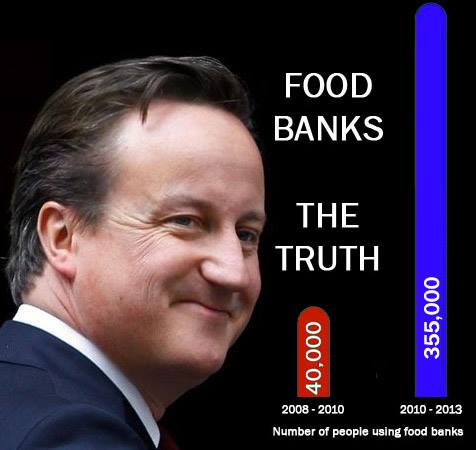
He is the same government minister that rejected suggestions that austerity policies have led to an increase in food bank use – making the jaw-droppingly astonishing suggestion that food bank charities are somehow to blame. This former investment banker and peer told the Lords that the increase in the usage of food banks was “supply led”. He said:

“If you put more food banks in, that is the supply. Clearly, food from the food banks is a free good and by definition with a free good there’s almost infinite demand.”

Poverty reduced to blame-the-individual neoliberal motivational formulae. Yet it is the government that are responsible for policies that create and sustain inequality and poverty.

We need only look at the discriminatory nature of policies such as the legal aid bill, the wider welfare “reforms” and research the consequences of austerity for the vulnerable – those with the  “least broad shoulders” –  to understand that these comments reflect how conservatives think.

This is a government that is using public prejudice to justify massive socio-economic inequalities and their own policies that are creating a steeply hierarchical, society based on social Darwinist “survival of the fittest” libertarian, minarchist principles.

The Tory creation of socio-economic scapegoats, involving vicious stigmatisation of vulnerable social groups, particularly endorsed by the mainstream media, is simply a means of manipulating public perceptions and securing public acceptance of the increasingly punitive and repressive basis of the Tories’ welfare “reforms”, and the steady stripping away of essential state support and provision.

Let’s not forget that we were recently informed that the Tories plan to limit child benefit to the first two children because it would save money. The idea is being examined by the Conservatives, despite previously being vetoed by Downing Street because of fears that it could “alienate” parents.

Asked about the idea on the BBC’s Sunday Politics programme, Duncan Smith said:

“I think it’s well worth looking at. It’s something if we decide to do it we’ll announce out. But it does save significant money and also it helps behavioural change.”

This is a clear indication of the Tories’ underpinning eugenicist designs – exercising control over the reproduction of the poor, albeit by stealth. It also reflects the underpinning belief that poverty somehow arises because of faulty individual choices, (as opposed to faulty political decision-making and ideologically-driven socio-economic policies), that those choices are non-rational, stereotypical, and that reducing cost to the State involves making people change their “faulty,” stereotypical behaviours.

This government’s policies are contibuting significantly to mental illness: Suicides have reached a ten year high and are linked with welfare “reforms”.

And Osborne announced in the budget that the government will be funding a “package of measures” to improve “employment outcomes” which will entail putting Cognitive Behaviour therapists in more than 350 job centres to provide “support” to those with “common mental health conditions” who are claiming employment support allowance (ESA) and job seekers allowance (JSA).

As I have written elsewhere, the government have put up an online contract notice which specifically states:

“This provision is designed to support people with common mental health conditions to prepare for and move into work, with intervention at the earliest possible point in a claim to benefit or access to the Fit for Work service.”

Cognitive Behaviour Therapy (CBT) is used to change how you think (“Cognitive”) and what you do (“Behaviour”). It bypasses emotions, personal history and narrative, to a large extent, and tends to focus on the “here and now.” In this case, the here and now consists of taking any job available, regardless of its suitability, or face being sanctioned.

CBT is an approach that facilitates the identification of “negative thinking patterns” and associated “problematic behaviours” and challenges them. This approach is at first glance a problem-solving approach, however, it is of course premised on the assumption that interpreting situations “negatively” is a bad thing, and that thinking positively about bad events is beneficial.

The onus is on the individual to adapt by perceiving their circumstances in a stoical and purely rational way.

So we need to ask what are the circumstances that the government are expecting people claiming benefits to accept stoically. Sanctions? Work fare? Being forced to accept very poorly paid work, abysmal working conditions and no security? The loss of social support, public services and essential safety nets ? Starvation and destitution?

The political vilification of sick and disabled people and the poor, amplified in the media, has preceded policies particularly aimed at the steady removal of State support, indicating a clear scapegoating process, and this isn’t indicative of a government that is “neglectful”- it is patently intentional, hence the pre-emptive “justification” narratives to garner public support and acceptance towards such punitive and harsh policies.

As Frances Ryan says:

“The ideology of a small state or the belief that benefits build dependency are crass, irrelevant details to what at its core is simply a decision about how to treat a human being. This is particularly damning when one person has all the power and the other is forced through economic necessity to take whatever humiliation or pain they are given. To do that to someone – let alone hundreds of thousands – is no accident. It is a conscious decision, that has been made over and over again by this government.”

I’ve consistently expressed my own well-founded, carefully considered, evidenced view that the Tories are authoritarians,  social Dawinists, and their social policies are founded on a creeping and implicit eugenics by stealth, fueled by their preference for a steeply hierarchical, unequal society, anachronistic ideas about “deserving” and “undeserving”, which belong to the 1834 Poor Law era, and a behaviourist approach to socio-economic circumstances .

In Edgbaston, Keith Joseph, (1974) announced to the world that:

“The balance of our population, our human stock is threatened … a high and rising proportion of children are being born to mothers least fitted to bring children into the world and bring them up. They are born to mothers who were first pregnant in adolescence in social classes 4 and 5. Many of these girls are unmarried, many are deserted or divorced or soon will be. Some are of low intelligence, most of low educational attainment.”

And in 2010, the former deputy chairman of Conservative Party, Lord Howard Flight, told the London Evening Standard:

“We’re going to have a system where the middle classes are discouraged from breeding because it’s jolly expensive. But for those on benefits, there is every incentive. Well, that’s not very sensible.”

These comments are not momentary lapses, nor are they unrepresentative of Tory views more generally. They reflect the true colours of the nazi nasty party.

demcracy

Pictures courtesy of Robert Livingstone


My work is unfunded and I don’t make any money from it. I am disabled because of illness and struggle to get by. But you can support Politics and Insights and contribute by making a donation which will help me continue to research and write informative, insightful and independent articles, and to provide support to others.  DonatenowButton

This unsnookered isle

1395990_559940054075527_258446375_nWriting in the New York Times, Paul Krugman said Britain’s performance since 2010, after the global financial crisis struck, has been “startlingly bad,” with a tentative recovery that began in 2009, which was stalled in the last quarter of 2010. In his article entitled This Snookered Isle, Krugman provides an indictment of the Coalition’s claims and their methods of managing the UK economy. Mr Krugman echoes many leading economists in Britain.

Krugman says: “Unfortunately, economic discourse in Britain is dominated by a misleading fixation on budget deficits. Worse, this bogus narrative has infected supposedly objective reporting; media organizations routinely present as fact propositions that are contentious if not just plain wrong.”

Simon Wren-Lewis of Oxford University has dubbed this narrative “mediamacro.” As his coinage suggests, this is what you hear all the time on TV and read in British newspapers, presented not as the view of one side of the political debate, but as simple fact.

Yet none of it is true.

Krugman goes on to ask: “Was the Labour government that ruled Britain before the crisis profligate? [As so often claimed by the Conservatives.] Nobody thought so at the time.”

In 2007, government debt as a percentage of G.D.P. was close to its lowest level in a century (and well below the level in the United States), while the budget deficit was quite small. The only way to make those numbers look bad is to claim that the British economy in 2007 was operating far above capacity, inflating tax receipts. But if that had been true, Britain should have been experiencing high inflation, which it wasn’t.

What about growth? When the current British government came to power in 2010, it imposed harsh austerity — and the British economy, which had been recovering from the 2008 global slump, soon began slumping again. In response, Prime Minister David Cameron’s government backed off, putting plans for further austerity on hold (but without admitting that it was doing any such thing). And growth resumed.” (See also: The Return of Expansionary Austerity.)

He adds: “If this counts as a policy success, why not try repeatedly hitting yourself in the face for a few minutes? After all, it will feel great when you stop.

Given all this, you might wonder how mediamacro gained such a hold on British discourse. Don’t blame economists. As Mr. Wren-Lewis points out, very few British academics (as opposed to economists employed by the financial industry) accept the proposition that austerity has been vindicated. This media orthodoxy has become entrenched despite, not because of, what serious economists had to say.”

Cameron has misled the public by making Government debt analogous with personal debt. It isn’t. If a person misses a mortgage payment, for example, they may risk damaging their credit rating, and possibly even losing their home. So if we owe money, we need to find a way to pay it back as soon as possible. But government debt does not need to be paid back overnight – in fact, it’s widely recognised to be potentially damaging to do so.

In an economy, one person’s spending is another person’s income. So when the government cuts spending, it reduces people’s income, leading to less business, more unemployment, and a vicious spiral of slowing down the economy.

Osborne’s austerity measures have achieved nothing, except deepening poverty, widening economic inequality, and suffering for the poorest and most vulnerable communities – and Osborne announced in his Autumn statement that we face at least four more years of it, should the Tories gain office again.

Austerity is not an economic necessity, nor is it temporary measure to balance the books, but rather, it reflects the Conservative’s long-standing ideological commitment to dismantle the gains and achievements of the post war settlement: public services, the welfare state and the National Health Service. This is where most of the cuts have been aimed.

With a shortfall in tax receipts set to increase the size of the deficit by at least £25 billion during the next parliament, the Office for Budget Responsibility have said the only way Osborne could balance the books would be through shrinking the state to a level not seen since before the Second World War: “Total public spending is now projected to fall to 35.2 percent of GDP by 2019-20, taking it below the previous post-war lows reached in 1957-8 and 1999-2000 to what would probably be its lowest level in 80 years”. Robert Chote.

Despite facing a global recession, the Labour Government invested in our public services, and borrowed substantially less in thirteen years than the Coalition have in just five years. UK citizens were sheltered very well from the worst consequences of the global bank-induced crash.

Gordon Brown got it right in his championing of the G20 fiscal stimulus, agreed at the London summit of early April 2010, which was a continuation of his policies that had served to steer the UK economy out of the consequences of a global recession, and to protect citizens from those consequences.

Osborne’s policy of imposing austerity and budget cuts on an economy that was actually recovering was a catastrophic error. The austerity cuts propelled the economy backwards and into depression; and, far from using public spending as a countervailing force against the cutbacks in private sector investment, the Coalition’s budget cuts served to aggravate the crisis. Many people are suffering terribly as a consequence, many have been reduced to a struggle for basic survival.

The Conservatives have been engaged in a significant transfer of income from the least well-off half of the population to the more affluent in the past five years. Those with the lowest incomes have been hit hardest by austerity. Deliberately so.

It’s inconceivable that Coalition policies were formulated for anything other than profiting the wealthy at the expense of the poorest.

The following cuts came into force in April 2013:

  • 1 April – Housing benefit cut, including the introduction of the bedroom tax
  • 1 April – Council tax benefit cut
  • 1 April – Legal Aid savagely cut
  • 6 April – Tax credit and child benefit cut
  • 7 April – Maternity and paternity pay cut
  • 8 April – 1% cap on the rise of in working-age benefits (for the next three years)
  • 8 April – Disability living allowance replaced by personal independence payment (PIP)
  • 15 April – Cap on the total amount of benefit working-age people can receive.

Here are some of the Tory “incentives” and consquences for the wealthy:

In November last year, my proposition was also verified in a study of the cumulative impact of tax and welfare changes, from in-work benefits to council tax support, to the cut in the top rate of income tax and an increase in tax-free personal allowances, the report concluded that Coalition policy has been regressive across the income spectrum.

Its authors, Paola De Agostini and Professor Holly Sutherland at the university of Essex, and Professor John Hills at the LSE, wrote: “Whether we have all been ‘in it together’, making equivalent sacrifices through the period of austerity, is a central question in understanding the record of the coalition government … It is clear that the changes did not lead to uniform changes in people’s incomes. The reforms had the effect of making an income transfer from the poorer half of households (and some of the very richest) to most of the richer half, with no net effect on the public finances.

“In effect, the reductions in benefits and tax credits financed the cuts in taxes. Some groups were clear losers on average – including lone-parent families, large families, children, and middle-aged people (at the age when many are parents).”

Last year, the scale of Britain’s growing inequality was revealed by a report from the leading charity, Oxfam, showing that the country’s five richest families now own more wealth than the poorest 20% of the population.

Oxfam urged the chancellor to use the 2014 spring budget to make an assault on tax avoidance and introduce a living wage, in a report highlighting how a handful of the super-rich, headed by the Duke of Westminster, have more money and financial assets than 12.6 million Britons put together.

In the report,  A Tale of Two Britains, Oxfam said the poorest 20% in the UK had wealth totalling £28.1bn – an average of £2,230 each. The latest rich list from Forbes magazine showed that the five top UK entries – the family of the Duke of Westminster, David and Simon Reuben, the Hinduja brothers, the Cadogan family, and Sports Direct retail boss Mike Ashley – between them had property, savings and other assets worth £28.2bn.

And:

Increasing inequality is a sign of economic failure rather than success. It’s far from inevitable – a result of political choices that can be reversed.

The Labour Party have announced this week that tackling tax avoidance and evasion is a priority, and they plan to push emergency laws through parliament designed to impose far higher fines and close  tax loopholes. This move alone will raise more than £7.5bn a year in revenue for the Treasury. It’s a measure that sends out a clear message: the poorest people should not have to pay more to compensate for tax abuses by the rich.

Also announced this week was Labour’s intention to abolish archaic rules that allow wealthy “non-domiciles”, who live in the UK but claim to be domiciled overseas, to avoid paying tax in this country on what they earn outside of Britain.

Labour’s careful, costed and evidence-based policies also include: a Bankers’ Bonus Tax; a Mansion Tax; repeal of the Bedroom Tax; a reversal of the Pension Tax relief that the Tories gifted to millionaires; a reversal of the Tory Tax cut for Hedge Funds; freezing gas and electricity bills for every home a the UK for at least 20 months; the big energy firms will be split up and governed by a new tougher regulator to end overcharging; banning exploitative zero hour contracts; introduction of a living wage (already introduced by some Labour councils); a reversal of the £107,000 tax break that the Tories have given to the millionaires; reintroduction of the 50p tax; scrapping George Osborne’s “Shares for Rights” scheme that has opened up a tax loophole of £1 billion; ensuring Water Companies place the poorest households on a Social Tariff that makes it easier for them to pay their Water Bills; breaking up the banks and separating retail banking from investment banking; introduction of measures to prevent corporate tax avoidance, scrapping the Profit Tax Cut (Corporation Tax) that George Osborne has already announced for 2015 and many more.

These are not austerity measures. They are much needed, strongly redistributive policies.

The Organisation for Economic Co-operation and Development (OECD) has recently found what most of us already knew: that income inequality actually stifles economic growth in some of the world’s wealthiest countries, whilst the redistribution of wealth via taxes and benefits encourages growth.

Will the super-rich leave the UK, bag, baggage and all, as the right-wing scaremongers bleat, if we have a fair government that expects tax contributions from the cosseted rich? I seriously doubt it. They could start an exodus to New York I suppose, a city with a currently heavier tax regime, yet curiously not short of thousands of super-rich residents.

Ask yourself this: what are these tax-evading, hoarding and loudly complaining people actually contributing to our society? As far as I can see, they are supported by enormous state handouts, at everyone elses’ expense. They are propped up in their greed for ever-increasing profits,

Tax avoidance is costing us at least £70bn each year.

The most costly benefit payments in the UK are Tax Credits, Housing Benefit and Child Benefit, totalling £56.4bn a year.  These are not out of work benefits.  Some 65% of the total spent on working age benefits, is paid to people in work, whose wages are below subsistence levels.

Add to that the corporate tax benefits, such as the value of the cheap credit made available to banks and other business, the insurance schemes run by the government to protect exporters, the marketing for British business laid on by Vince Cable’s ministry, the public procurement from the private sector … a recent study conducted by Kevin Farnsworth, a senior lecturer in social policy at the University of York, concludes that direct corporate welfare costs British taxpayers just short of £85bn a year.

The Tory’s justification for allowing exploitative tax avoiders to have all of their own way is the mythological “trickle down effect.” Or “voodoo economics” to Keynsians. It was also known as the “horse and sparrow theory” a couple of centuries back. The idea being that if you feed a horse plenty of oats, the sparrows in it’s wake will also be fed .

And we are most certainly being fed horsesh*t.

It’s time to put an end to corporate welfare, and state handouts to the wealthy. We can do that by voting for a Labour government.

And if some thieving, hoarding, greedy misers threaten to leave the UK, why, I think I’ll offer to help them pack.

rich keep millonsBig thanks to Robert Livingstone for his excellent memes.

Osborne’s razor: the Tory principle of parsimony is applied only to the poorest

The BBC reports that leaked documents from the Department for Work and Pensions suggest the government is planning a regional benefits cap, reducing child benefit, taxing disability benefits and reducing eligibility for the carers’ allowance. The proposals are aimed at helping to save £12 billion from the welfare budget by 2017/18. The Conservatives have of course insisted that the proposals were “not party policy.” Yet. They dismissed the leaked report as “ill-informed and inaccurate speculation.”

However, the documents were prepared by civil servants and commissioned by Conservative Party officials. These are the key proposals in the report:

  • Industrial Injuries Compensation Scheme – could be replaced by companies providing industrial injury insurance policy for employees. Any that did not would become members of a default national industrial injuries scheme, similar to the programme for asbestos sufferers. DWP predicted saving – £1bn
  • Carer’s Allowance – this could be restricted to those eligible for Universal Credit. Leaked documents suggest about 40% of claimants would lose out. DWP predicted saving – £1bn
  • The contributory element of Employment and Support Allowance and Job Seekers Allowance – currently claimants who have paid enough National Insurance contributions can get the benefits with little means testing; DWP analysis suggests 30% of claimants, over 300,000 families, would lose about £80 per week. DWP predicted saving – £1.3bn in 2018/19
  • Disability benefits – Disability Living Allowance, Personal Independence Payments and Attendance Allowance (for over 65s who have personal care needs) would no longer be paid tax free. Possible saving – £1.5bn per annum (based on IFS Green Budget calculation )
  • Council Tax Support – to be incorporated into Universal Credit. Possible saving – not known
  • Child Benefit – Limiting the benefit to the first two children. Possible saving IFS estimates £1bn saving per annum in the long run but little initially
  • Regional Benefit Caps – The £23,000 limit would vary in different parts of the country, with for instance Londoners receiving the top amount due to the higher cost of living. Possible saving – not known and dependent on where levels were set

Meetings about these options have taken place in recent weeks between the chancellor and Iain Duncan Smith. It is also understood that the permanent secretary, Sir Jeremy Heywood, has been coordinating some of the efforts to find savings.

The government has cut around £20bn from projected welfare spending over the course of the past five years, through a range of measures from freezing payments rates to cutting housing benefit. But Robert Joyce, a senior economist with the IFS, says finding another £12bn over the next two years will not be easy.

The easier benefit cuts are the ones that will have been done first, so what’s left will be harder.

“In addition, the Conservatives want to do this by 2017-18, in the next two years. It means they have to be looking at less palatable options that would involve overnight takeaways from certain families.”

Shadow work and pensions secretary, Rachel Reeves, said the Conservatives now needed to explain how they would achieve the welfare savings they needed to make.

She said: “These plans to hit the disabled and carers were drawn up for Conservative ministers to deliver their extreme cuts plan.” “The Tories now need to come clean about what cuts they plan to make and who will pay the price. If they are ruling out these extreme cuts for the most disabled and carers, then it is clear they will be hitting the tax credits, and support for children, for millions of working families.”

Rosanna Trudgian, policy officer at the charity Mencap, said the proposed changes were unfair. “Disabled people don’t choose to have their disability. They don’t choose to pay for these additional costs related to that disability,” she told BBC News.

“For example, if you have to go to hospital on a regular basis and you are paying for those huge car parking fees. Therefore, it’s just unfair if this is treated as taxable income.”

These cuts would hit the elderly, disabled people, poor people, especially those with large families, and those injured at work – and would devastate many communities.

Earlier this week, the Institute for Fiscal Studies (IFS) has asked Osborne to specify how he will reach targets announced in the budget, given that the poorest had been the hardest hit by draconian benefit cuts already. The IFS say the worst of the UK’s spending cuts are still to come.

I proposed that, as a society, we cannot possibly accommodate a further 12 billion cut from welfare spending. It’s not that Osborne can’t answer the IFS challenge: he won’t. He’s being conservative with the truth – which is that we cannot afford to reduce any more from welfare without ending welfare provision as we know it.

Related

Osborne’s razor, smoke and mirrors

Osborne’s Autumn statement reflects the Tory ambition to reduce State provision to rubble

Follow the Money: Tory Ideology is all about handouts to the wealthy that are funded by the poor

385294_195107567306966_1850351962_n  Thanks to Robert Livingstone for the memes used in this article

You’d have to be Green to believe the Green Party: two more lies exposed.

PANews+BT_N0321471377269205233A_I1“David Cameron and George Osborne believe the only way to persuade millionaires to work harder is to give them more money. But they also seem to believe that the only way to make you (ordinary people) work harder is to take money away.” Ed Miliband. Source: Hansard, 12 December, 2012

The Tories have trashed the economy, damaged the very structure of our society and destroyed people’s lives. We have seen the return of absolute poverty, malnutrition and illnesses not seen since Victorian times. People have died as a consequence of Tory policies. What do the Green Party do? Lie about the Labour Party.

The Green Party are not opposing Tory austerity: they are opposing what is currently the only credible alternative instead. They prefer to undermine those that ARE challenging the Coalition regarding policies that are having devastating consequences on the poorest and most vulnerable citizens. That’s very telling. I fully support some Green policies, and wish that the Left generally would work in a much more collaborative way. Really that’s the only way of effectively challenging the current neoliberal conservative dominant paradigm.

Given an opportunity to engage in genuine political conversation and to cooperate in opposing the Tory-led draconian policies, those parties claiming to be “further left” than Labour have instead behaved exactly like the Tories. They chose to undermine Labour. These are parties that prioritise grandstanding and electioneering above the needs of the public. That has entailed lying and smearing campaigns. Yet we all share many of the same aims and objectives, values and principles. The infighting simply weakens a broader and more important progressive Movement.

Here are two examples of lies that are currently being circulated on Facebook and elsewhere by the Green Party and the Scottish National Party (SNP), amongst others:

Lie number 1: “Rachel Reeves said she would be tougher on welfare.”

Rachel Reeves has NEVER said she will be “tougher on welfare.” Those saying that she did are lying. She issued a statement shortly after being misquoted. It was Natalie Bennett who perpetuated that misquote too, originally from the Observer. (See Bennett’s article: Rachel Reeves is clear: Labour would set the struggling against the poorest.)

What Rachel actually said was she would be “tougher on the CAUSES of high welfare spending – such as low wages, unemployment, high private sector rents, private company contracts and outsourcing – especially that of Iain Duncan Smith: his vanity projects have cost us millions because contracted private companies have failed to deliver services, the policies are ill-conceived, creating higher costs, ultimately, rather than making any savings as the Tories claimed – the bedroom tax being an example.

The fact that Rachel Reeves was misquoted was clarified to Caroline Lucas too, so the Green Party have no excuse for shamefully lying about the Labour Party’s policy intentions.

In the middle of crucial debate about the Work Capability Assessment and the plight of disabled people because of Coalition policies, initiated by the WOW campaign, Lucas lost all of my respect when she chose political point scoring instead of constructive debate and said this:

Caroline Lucas (Brighton, Pavilion, Green); I was disappointed that Rachel Reeves, on taking up her post as shadow Secretary of State for Work and Pensions, used the opportunity of her first interview to say that she would be tougher than the Tories on people on benefits.

Kate Green (Shadow Minister (Work and Pensions); Stretford and Urmston, Labour); My hon. Friend the Member for Leeds West did not say that. She said that she would be tougher on welfare spending, not on people on benefits.

Sheila Gilmore (Edinburgh East, Labour); Does the hon. Lady agree that there are some forms of welfare spending that we should bring down? In my view, one of those is the excessive amount that is paid to private landlords through housing benefit. I am certainly in favour of reducing that form of welfare spending. Is she not?

Caroline Lucas (Brighton, Pavilion, Green); I am very much in favour of that if the hon. Lady wants to put it under the heading of welfare spending... Source: Hansard which is the parliamentary record. (See: 27 Feb 2014 : Column 457  at 1.29 pm, on the 2nd page.)

Nonetheless the Green Party has continued to misquote Reeves, to my disgust, using negative campaigning and smear tactics akin to the Tories to promote their own party. It’s time that some people distinguished between welfare spending and benefits, to conflate the two purely for political gain is deplorable, dishonest and not in the best interests of the electorate.

Lie number 2: “Labour voted for austerity.”

This is such a blatant lie. The vote, clearly stated on the Hansard record (see 13 Jan 2015: Column 738, Charter for Budget Responsibility), was pertaining strictly to the motion: “That the Charter for Budget Responsibility : Autumn Statement 2014 update, which was laid before this House on 15 December 2014, be approved.”  That isn’t about austerity.

The charter sets out that the Office of Budget Responsibility (OBR) will continue to monitor our fiscal rules. As we know, the  OBR has written extremely critical economic forecasts and analysis of austerity and the Tory spending cuts, clearly expressing the risks that the Chancellor is running and the scale of the damage his strategy will inflict on what remains of our public services.

It’s worth noting that whilst Ed Balls challenged Osborne, there was a curious silence from the  SNP and the Green Party. It was Ed Balls that challenged Osborne’s outrageous claims regarding “halving the deficit”- such a blatant lie, upon which even the exceedingly Conservative Spectator spluttered contempt. Or any of the other lies, some of which have already earned the Conservatives official rebukes from the Office for National Statistics. (See “bankruptcy lie” for example, on the hyperlinked article)

Furthermore, it’s about time that some MP’s, including Caroline Lucas, amongst others, recognised that there is a fundamental difference between the meaning of the word budget and the word austerity. Conflating the two for the purpose of politicking is unprincipled and dishonest.

It’s also worth noting from the same debate on the Hansard record:

13 Jan 2015 : Column 746

Caroline Lucas: Does the Chancellor agree with me that with the feeble and inconsistent opposition coming from the Labour Front Bench, there is a very good reason for seeing the SNP, the Greens and Plaid as the real opposition on this issue because we are clear and consistent about the fact that austerity is not working?

Mr Osborne: That shows why we want the hon. Lady’s party in the TV debates.

Yes, I just bet they do, to collaborate with the Tories in attacking and undermining the Labour Party, not the Coalition, who are, after all, the ones responsible for introducing austerity measures. I don’t imagine for a moment that Osborne values further challenges to his outrageous claims of efficacy regarding austerity measures. What is very evident when you read through this debate, is that Ed Balls and a couple of other Labour MPs presented the ONLY challenges to Osborne on this matter, just to reiterate this important point.

10940505_767712909964906_6225427822143651262_n

It’s also worth bearing in mind that Ed Miliband established the International ANTI-austerity Alliance. Back in 2012, Miliband said: “There is a grip of centre-right leadership on Europe which has said there’s only one way forward and that’s austerity, and you’ve got to have a decisive move away from that.(See also: Labour leader Ed Miliband’s anti-austerity alliance will fight for the European dream.)

And why would Miliband be attending ANTI-austerity protests if he supported austerity?

Labour leader Ed Miliband speaks on stage at Hyde Park, during the TUC organised protest against austerity measures in London

 Labour leader Ed Miliband speaks on stage to over 150,000 at Hyde Park, during the TUC organised protest against austerity measures in London

It’s interesting to see the Chicago Tribune’s article: Ed Balls, UK’s anti-austerity finance chief in waiting.  Balls dismissed Osborne as a “downgraded chancellor”after Britain lost its triple-A credit rating.One of his main charges has been that the government is unfairly spreading the economic pain it deems necessary to fix the economy. Austerity cuts are the burden of the poorest.

Balls says that a decision to cut the top tax rate amounts to an unjustified “tax cut for millionaires”, whilst his party has been scathing of reform of the welfare system. A point echoed many times by Ed Miliband, too. Accusing the government of making lower or no income groups pay for the recovery while shielding the rich is a claim which strikes a chord with some voters who view Cameron and his government – many of whom were educated at the same top fee-paying school – as out of touch.

Caroline Lucas was born in Malvern to Conservative parents and attended Malvern Girls’ College (which became Malvern St James in 2006), a fee-paying private school. Ed Miliband, on the other hand, went to a comprehensive school. Polls also show that many voters approve of the government’s drive to rein in welfare costs and the government has demanded Labour spell out what it would do to fix the economy. They have, but with understandable caution.

Labour’s careful, costed and evidence-based policies include: a Bankers’ Bonus Tax; a Mansion Tax; repeal of the Bedroom Tax; a reversal of the Pension Tax relief that the Tories gifted to millionaires; a reversal of the Tory Tax cut for Hedge Funds; freezing gas and electricity bills for every home a the UK for at least 20 months; the big energy firms will be split up and governed by a new tougher regulator to end overcharging; banning exploitative zero hour contracts; introduction of a living wage (already introduced by some Labour councils); a reversal of the £107,000 tax break that the Tories have given to the millionaires; reintroduction of the 50p tax; scrapping George Osborne’s “Shares for Rights” scheme that has opened up a tax loophole of £1 billion; ensuring Water Companies place the poorest households on a Social Tariff that makes it easier for them to pay their Water Bills; breaking up the banks and separating retail banking from investment banking; introduction of measures to prevent corporate tax avoidance, scrapping the Profit Tax Cut (Corporation Tax) that George Osborne has already announced for 2015 and many more.

These are not austerity measures. They are strongly redistributive policies.

It’s difficult enough opposing the manipulative, lying authoritarian Conservative-led government, without having to constantly counter lies and smears from parties claiming to be on the left, too. Shame on the Green Party and the SNP.

As I have said elsewhere, there’s a clear gap between professed principles and their application amongst the parties that claim to be “real socialists”.  How can it be principled or moral (or “socialist” for that matter) to collaborate with the Tories in attempting to damage, smear and discredit the only viable option of removing the Tories from Office in May? Bearing in mind that many people are suffering profoundly, some have died as a consequence of Conservative-led policies, we can see what the Green Party’s priorities actually are, here.

They don’t include the best interests of citizens and consideration of their well-being, that’s for sure.

403898_365377090198492_976131366_nThanks to Robert Livingstone for his excellent memes.

Public perceptions of party positions on the political spectrum: Labour’s leftward shift under Ed Miliband, the Conservatives’ rightward swing since 2010.

Good to see the public generally don’t swallow the “allthesame” myth.

Osborne has failed to publish the new Charter for Budget Responsibility that he promised.


Last autumn, the Tories cynically vetoed Ed Balls’s plan to allow the Office for Budget Responsibility to audit Labour’s manifestoEd Ball’s said:

“In tough times it’s even more important that all our policies and commitments are properly costed and funded.

The British people rightly want to know that the sums add up. So we will go one step further and ask the independent Office for Budget Responsibility (OBR) – the watchdog set up by this government – to independently audit the costings of every individual spending and tax measure in Labour’s manifesto at the next election.”

This is the first time a Shadow Chancellor – the first time any political party in Britain – has ever said it wants this kind of independent audit. A radical change from what’s gone before, but the right thing to do to help restore public trust in politics. The Tories have persistently lied  about Labour’s economic performance, claiming that Labour borrowed “too much,” yet Osborne has borrowed more in 4 years than every Labour administration since 1900 combined.

Whilst the Labour Party invested what they borrowed in public services, at a time of global financial crisis, to protect the poorest from the worst of the consequences inflicted on us by the bankers and financial sector, the Coalition have not only got nothing to show for the money they’ve added to the debt, they have inflicted additional cuts on the poorest, leaving many citizens vulnerable to absolute poverty.

Osborne’s refusal to allow the OBR to audit policies is clearly an indication that he intends to continue to attempt discrediting what has been confirmed internationally as a sound economic approach from Labour, whilst ensuring Conservative policy proposals avoid scrutiny.

The Tories’ decision is entirely politically motivated` and certainly not in the public’s best interests. There is no reason in principle why they should refuse to allow the watchdog founded by Osborne in 2010 to audit Labour’s policies.

There is no sign of the updated Charter for Budget Responsibility that the Chancellor promised would be published by now. It was to be another of George Osborne’s political traps laid for the opposition in an attempt to undermine their economic credibility. In his recent Autumn Statement, the Chancellor promised an updated Charter for Budget Responsibility committing the government (and in theory a Labour administration) to an aggressive pace of deficit reduction. He said:

“Next week we will publish a new Charter for Budget Responsibility that will reinforce our commitment to finish the job in the next Parliament, and we will ask the House to vote on it in the new year.”

The implicit aim was to force Labour to either match his plans, and commit to billions of pounds of additional cuts (something which wouldn’t be well received by the left and the trade unions), or to oppose them and be denounced as fiscally irresponsible.

Chris Leslie MP, Labour’s shadow chief secretary to the Treasury, commenting on George Osborne’s failure to publish as he promised a new Charter for Budget Responsibility in the week following the Autumn Statement, said:

“George Osborne’s latest stunt has become a shambles.

“In the Budget George Osborne was talking about a vote on balancing the overall budget. Then last month the Treasury tried to lay the ground for a big u-turn by briefing that the vote would only be on balancing the current budget, excluding capital investment.

“And now, after all the hype and promises that a new Charter would have been published over the last week, the government has totally failed to publish anything. This is a total mess. As ever, these so called Tory traps are backfiring on the Chancellor.

“Labour has set out a tough but balanced approach to get the current budget into surplus and the national debt falling as soon as possible in the next Parliament.

“Our first election pledge announced this week is that we will balance the books and cut the deficit every year, while securing the future of our NHS. This will require sensible spending cuts in non-protected areas, fairer choices including reversing the Tory tax cut for millionaires and a plan to deliver the rising living standards and stronger growth needed to balance the books.

“In contrast the Tories are pursuing an increasingly unbalanced and extreme approach. They have chosen to pencil in even deeper spending cuts, which would return public spending to a share of GDP last seen in the 1930s.

“They are refusing to ask those with the broadest shoulders to make a greater contribution and ignoring the need for a plan to deliver the rising living standards that are vital to getting the deficit down. And they have now made £7 billion of unfunded tax promises, which can only be paid for by even deeper cuts to public spending or another Tory VAT rise.

“George Osborne should spend less time playing silly political games and more time sorting out the economy and trying to make his sums add up.”

Update

Without any further announcement to the opposition, the government has published its Charter on Budget Responsibility. In his economy speech this afternoon, David Cameron announced that the Charter “would have the structural current budget into balance” in 2017/18, which appears to enshrine into law the Labour plan that he is attacking in the same speech.

 Cameron has defended Conservative plans for public spending cuts through the next parliament as “sensible and reasonable”, claiming that Britain was still vulnerable to being “tipped over the edge” by another financial crash.

 Cameron was joined by George Osborne in arguing that the next government had a duty to run a budget surplus, in what is set to become one of the defining issues of the general election next May.

Labour  have accused the Tories of an “ideological” obsession with cutting the state; Mr Osborne wants to carry on squeezing public spending even after the overall budget is balanced.

Ed Balls MP, Labour’s Shadow Chancellor, responding to publication of the Charter for Budget Responsibility, said:

“Once again, a silly political stunt by George Osborne has totally backfired. David Cameron has just given a speech attacking Labour’s target to get the current budget into surplus. But this is exactly what they are putting to a vote in this new Charter.

“In the Budget George Osborne talked about a vote on balancing the overall budget. Today he and David Cameron have done a staggering U-turn on this vote and are now proposing a vote on the current budget, excluding capital investment. This is the same measure of the deficit the Labour Party has been committed to targeting for the last three years. They have also changed the fiscal mandate from being a ‘target’ to an ‘aim’.

“We said in January that we want to get the current budget into surplus and national debt falling as soon as possible in the next Parliament. This Charter is consistent with our position so we’ll vote for it. We’re not going to change our view about what’s in Britain’s best interests because of one of George Osborne’s silly games.

“Labour will cut the deficit every year and get the current budget into surplus, and the national debt falling, as soon as possible in the next Parliament. How fast we can go will depend on the state of the economy, including what happens to wages, growth, the housing benefit bill and events around the world.

“But our approach will be very different to the Tories. There will need to be sensible spending cuts in non-protected areas, but we will make fairer choices including reversing the Tory tax cut for millionaires and our plan will deliver the rising living standards and stronger growth needed to balance the books.
 
“In contrast the Tories are pursuing an increasingly unbalanced and extreme approach. They have chosen to pencil in even deeper spending cuts, which would return public spending to a share of GDP last seen in the 1930s.” 

Echoing Chris Leslie, he added:

“They are refusing to ask those with the broadest shoulders to make a greater contribution and ignoring the need for a plan to deliver the rising living standards that are vital to getting the deficit down. And they have now made £7 billion of unfunded tax promises, which can only be paid for by even deeper cuts to public spending or another Tory VAT rise.

“This is a complete own goal for the Chancellor. Perhaps George Osborne should spend less time thinking up silly political games which end up backfiring and more time sorting out the economy and trying to make his sums add up.” 

It’s very clearly all about ideological commitment for the Tories, at any cost, and not about meeting economic and social need.

And that isn’t democracy.

Thanks to Robert @LivingstonePics

The BBC expose a chasm between what the Coalition plan to do and what they want to disclose

1379986_541109785958554_2049940708_n

“Traditions are not killed by facts” – George Orwell.

The Conservatives are creatures of habit rather than reason. Traditional. That is the why their policies are so stifling and anti-progressive for the majority of us. It’s why Tory policies don’t meet public needs.

There’s always an air of doom and gloom when we have a Tory government, and a largely subdued, depressed, repressed nation, carrying vague and fearful intuitions that something truly catastrophic is just around the corner.

I can remember the anxiety and creeping preternatural fear amongst young people in the eighties, and our transcendent defiance, which we carried like the banners at a Rock Against Racism march, back in the Thatcher era. We always witness the social proliferation of fascist ideals with a Tory government, too. It stems from the finger-pointing divide and rule mantra: it’s them not us, them not us. But history refutes as much as it verifies, and we learned that it’s been the Tories all along.

With a Conservative government, we are always fighting something. Poverty, social injustice: we fight for political recognition of our fundamental rights, which the Tories always circumvent. We fight despair and material hardship, caused by the rising cost of living, low wages, high unemployment and recession that is characteristic of every Tory government.

I think people often mistranslate what that something is. Because Tory rhetoric is all about othering: dividing, atomising of society into bite-sized manageable pieces by amplifying a narrative of sneaking suspicion and hate thy neighbour via the media.

The Tories are and always have been psychocrats. They insidiously intrude into people’s everyday thoughts and try to micro-manage and police them. They use Orwellian-styled rhetoric crowded with words like “market forces”, “meritocracy” “autonomy”, “incentivisation”, “democracy”, “efficient, small state”, and even “freedom”, whilst all the time they are actually extending a brutal, bullying, extremely manipulative, all-pervasive authoritarianism.

The Conservative starting point is control of the media and information. All Conservatives do this, and historically, regardless of which country they govern. (As well as following the hyperlinks (in blue) to British and Canadian media takeovers, also, see the Australian media Tory takeover via Murdoch, from last year: The political empire of the News Corp chairman.)

As we saw earlier this year when the Tories launched an attack on Oxfam, any implied or frank criticism of Conservative policies or discussion of their very often terrible social consequences is stifled, amidst the ludicrous accusations of “politically biased.”

When did concern for poverty and the welfare of citizens become the sole concern of “the left wing”? I think that casually spiteful and dismissive admission of indifference tells us all we need to know about the current government’s priorities. And no amount of right-wing propaganda will hide the fact that poverty and inequality rise under every Tory government. And how is it possible to discuss poverty meaningfully without reference to the policies that cause it? That isn’t “bias”: it’s truthful. Tory policies indicate consistently that when it comes to spending our money, the Tories are very generous towards the wealthy, and worse than parsimonious regarding the rest of us.

Then there are the Tory pre-election promises, all broken and deleted from the internet. And valid criticism of their spinner of Tory yarns and opposition smears, also deleted. This is not a democratic government that values political accountability, nor is it one that is prepared to bear any scrutiny at all.

The Conservatives are attempting to intimidate the BBC (again) into silence regarding its candid commentary regarding the autumn statement made by Osborne, exposing the vast scale of cuts to come for the British public. I’m pleased to see the BBC hitting back, for once, with a robust defence, declaring that: “We’re satisfied our coverage has been fair and balanced and we’ll continue to ask ministers the questions our audience want answered.”

It was BBC assistant political editor Norman Smith’s description of the Office for Budget Responsibility (OBR) response to the autumn statement document as “the book of the doom” and his suggestion that the UK was heading “back to the land of Road to Wigan Pier” that provoked Osborne’s outrage.

But whilst journalists are hardly unknown for hyperbole, Smith certainly can be cleared of this charge. Because many agree that the figures contained in the OBR blue book are truly remarkable and worry-provoking. Many of us have concluded the same, from the OBR and Institute of Fiscal Studies (IFS) to an army of quietly reflective bloggers, who have collectively anticipated this purely ideological outcome for some time.

The BBC are absolutely right to point out to the public that there will be severe social repercussions as a consequence of the scale of cuts that Osborne is planning, especially given that sixty percent of the cuts are yet to come.

The judgements of the OBR, which Osborne set up, and IFS, were at least as damning as the BBC’s, but it’s worth noting that the Chancellor doesn’t publicly attack either report. Because he can’t.

Instead the Conservatives have accused the BBC of “bias” and “systematic exaggeration,”  David Cameron and George Osborne launched an unprecedented attack on the coverage of the Autumn Statement. However, the Conservatives have been openly policing the media for a while. (See: Tories to closely monitor BBC for left wing bias ahead of party conference season and: Once you hear the jackboots, it’s too late.)

Senior Tory MP Andrew Bridgen suggested there was a risk that unless the BBC was “scrupulously fair” in its reporting, it may “drive voters into the arms of Labour”, adding the threat “and may even find its future funding arrangements affected.”

A blatant threat.

On Thursday, Bridgen wrote to Rona Fairhead, the BBC Trust’s chairperson, to complain “about a pattern of systematic exaggeration in the BBC’s reporting of the Autumn Statement”. It’s not his first complaint about alleged bias, either: he whined when the TUC’s senior economist Duncan Weldon became Newsnight’s new economics correspondent earlier this year.

Mr Bridgen said he wanted “to seek assurances that in the remaining six months until the general election your coverage will demonstrate the impartiality and balance that the public, and indeed the BBC charter, demand”.

He added: “Over the last four years the entire nation has pulled together to achieve something many said could not be done: we are now the fastest growing advanced economy in the developed world. The sacrifices and hard work of the British people are ill-served by pessimistic reporting which obscures our economic success with the language of fear and doom.”

I don’t think this is about “impartiality” or what best serves the British people. This is about the Conservatives not getting their own way, so they resort to bullying and  attempts to discredit people who have simply told the truth.

The Chancellor responded angrily to the references to Orwell’s The Road to Wigan Pier in the Today report on BBC Radio 4. He said: “I would have thought the BBC would have learned from the last four years that its totally hyperbolic coverage of spending cuts has not been matched by what has actually happened. I had all that when I was interviewed four years ago and has the world fallen in? No it has not.”

Well, that all depends George. For many people, the only genuine growth we’ve seen is in poverty, inequality, destitution, hunger, suffering and referrals to foodbanks. And deaths. So yes, for growing numbers, their’ world has fallen in.

A BBC spokesman said the BBC was satisfied that the Today programme’s coverage had been “fair and balanced and we gave the Chancellor plenty of opportunity to respond on the programme.”

And the comments were justified because the Office for Budget Responsibility had itself said that nominal government consumption will fall to its lowest level since 1938, the BBC said.

Both the OBR and IFS said in their responses to the autumn statement that Britain has not seen public spending reduced to this level as a proportion of GDP since the grim days of the 1930s.

The public sector spending cuts over the next five years set out in the autumn statement may force a “fundamental re-imagining of the state,” the Institute for Fiscal Studies said in their report.

The warning from the IFS – Britain’s public spending analysts – came only hours after Osborne had angrily rounded on the BBC, accusing its reporters of “totally hyperbolic” reporting about his spending plans and “conjuring up bogus images of the 1930s depression”.

The IFS confirmed that the scale of cuts to departmental budgets and local government would reduce the role of the state to a point where it would have “changed beyond recognition.” The government’s spending watchdog, the Office for Budget Responsibility (OBR), also said yesterday that Osborne’s statement indicated that with the cuts set out in Treasury assumptions, we would see the state reduced to its smallest size relative to GDP for 80 years – since the 1930s.

It was about this era, the Great Depression, against which Orwell set The Road to Wigan Pier, in his account of the bleak living conditions, social injustices, suffering and misery of the working class in the Northwest of England. Norman Smith made an apt comparison.

Scenes from the Jarrow Crusade, 1936, Marchers from Jarrow in the North East of England, walk to London where they will hand in a petition to the House of Commons in a plead for more work as the depression and starvation of the 1930's hits hard

Scenes from the Jarrow Hunger March, 1936, Marchers from Jarrow in the North East of England, walked to London where they handed a petition to the House of Commons in a plead for more work as the depression and starvation of the 1930’s hit hard

Osborne admitted to John Humphrys two hours later, that “difficult” decisions on welfare would include freezing working age benefits for two years and lowering the welfare cap on spending from £26,000 for a family each year on benefits to a maximum of £23,000. But he maintained his glib assurances that the outlook was not as grim as Smith and Humphrys were claiming.

With the cost of living rising sharply year after year, and with the catastrophic consequences of the first wave of welfare “reforms” now clearly evident, it is difficult to envisage how the outlook for the poorest can be deemed anything other than enduringly, grindingly bleak.

If any evidence was needed that the Conservatives fear the political consequences of the cuts to come, the assault on the BBC’s coverage of the autumn statement has certainly provided it. The Conservative responses are strictly about discrediting the BBC as a means of pre-election damage-limitation, and not about the accuracy or “bias” of the reporting, because Osborne had not anticipated that the real consequences of his budget plans would be shared with the public. Most people don’t, after all, read the OBR or IFS forecasts and reports. As it is, Osborne had set out to mislead the public, and was well and truly exposed.

The IFS director, Paul Johnson, said: “The chancellor is right to point out that it has proved possible to implement substantial cuts over this parliament. One cannot just look at the scale of implied cuts going forward and say they are unachievable. But it is surely incumbent upon anyone set on taking the size of the state to its smallest in many generations to tell us what that means.

It’s also worth bearing in mind that Clegg has claimed co-authorship of the budget statement. Clegg’s absence from parliament for the third Wednesday in a row suggests he is farcically trying to distance himself from David Cameron and Osborne in the run-up to the election.

However, he attempted to take credit for the central policies of the statement, including the stamp duty overhaul unveiled by Osborne, when questioned on his LBC 97.3 radio show by Ed Balls, the shadow chancellor.

“Everything in that autumn statement is there because we’ve agreed it and I fully support it,” Clegg said.

The BBC exposed the chasm between what the Tory-led Coalition plan and what they are prepared to disclose and discuss publicly. That’s because of a chasm that exists between Tory ideology and a genuine economic problem-solving approach to policy: Osborne’s autumn budget statement was entirely about political gesturing, designed to divert attention from the sheer extent of social and economic damage  wreaked by five years of strictly ideologically-prompted policy.

This is a Chancellor who rested all of his credibility on paying down the debt and has borrowed more than every Labour government combined.

It must be abundantly clear that the Tory aim of much bigger and destructive cuts after 2015 is not about deficit reduction, but the destruction of the public sector, our services and social safety nets, the undoing of a century of our the hard-won achievements of civil rights movements, and all in favour of greedy, elevated, unbridled market forces.

Conservatism is centred around the preservation of traditional social hierarchy and inequality. Tories see this, erroneously, as an essential element for expanding economic opportunity. But never equal opportunity.

Conservatives think that civilised society requires imposed order, control and clearly defined classes, with each person aware of their rigidly defined “place” in the social order. Conservatism is a gate-keeping exercise geared towards economic discrimination and preventing social mobility for the vast majority.

It is these core beliefs that fuel Osborne’s stubborn adherence to austerity policies, even though it is by now patently obvious that austerity isn’t working for the economy, and for majority of the public. It never will.

942124_214298768721179_2140233912_nThanks to Robert Livingstone for the memes.

Related

Osborne’s Autumn statement reflects the Tory ambition to reduce State provision to rubble

Ed Balls: response to the Autumn Statement

Osborne’s Autumn statement reflects the Tory ambition to reduce State provision to rubble

Embedded image permalink

Osborne’s austerity measures have achieved nothing, except deepening poverty, widening economic inequality, and destitution for the poorest and most vulnerable communities – and Osborne announced in his Autumn statement that we face at least four more years of it.

Austerity is not an economic necessity, nor is it temporary measure to balance the books, but rather, it reflects the Conservative’s long-standing ideological commitment to dismantle the gains and achievements of the post war settlement: public services, the welfare state and the National Health Service.

The plans, according to the Treasury spending watchdog, the Office of Budget Responsibility, also presume the loss of a further one million public sector jobs by 2020, a renewed public sector pay squeeze and a further freezing of tax credits.

Robert Chote, the Office for Budget Responsibility chairman, conceded that the projections sent to him by the Treasury meant there would have to be a “very sharp squeeze” on spending in the next parliament. He added that so far the UK has seen 40 percent of the necessary cuts in this parliament and the next 60 percent would fall under the next parliament. 

The chairman says that spending on public services as a share of gross domestic product is set to fall by considerably more over the next five years than it did over the last five years, accounting for the lion’s share of the shift from a budget deficit of percent of GDP to a surplus of around 1 percent of GDP. He says that spending in non-protected departments will fall from £147 billion in 2014/15 to £86 billion in 2019/20 – on top of all the cuts to spending in recent years.

With a shortfall in tax receipts set to increase the size of the deficit by £25 billion during the next parliament, the Office for Budget Responsibility said the only way Osborne could balance the books would be through shrinking the state to a level not seen since before the Second World War:

“Total public spending is now projected to fall to 35.2 percent of GDP by 2019-20, taking it below the previous post-war lows reached in 1957-8 and 1999-2000 to what would probably be its lowest level in 80 years”.

The Office for Budget Responsibility (OBR) has written an extremely critical economic forecast and analysis of the spending cuts, clearly expressing the risks that the Chancellor is running and the scale of the damage his strategy will inflict on what remains of our public services.

Key findings from the damning analysis are:

The scale of planned post-election spending cuts is severe.

“Between 2009-10 and 2019-20, spending on public services, administration and grants by central government is projected to fall from 21.2 per cent to 12.6 per cent of GDP and from £5,650 to £3,880 per head in 2014-15 prices. Around 40 per cent of these cuts would have been delivered during this Parliament, with around 60 per cent to come during the next. The implied squeeze on local authority spending is similarly severe.

And as stated: “Total public spending is now projected to fall to 35.2 per cent of GDP in 2019-20, taking it below the previous post-war lows reached in 1957-58 and 1999-00 to what would probably be its lowest level in 80 years.”

The spending cuts are playing the most significant role in deficit reduction and of the tax rises Osborne introduced, it’s the most regressive (VAT) which are making the largest contribution:

“Just over 80 per cent of the reduction is accounted for by lower public spending. Just under 20 percent of the drop in borrowing is accounted for by higher receipts, with the majority having taken place by 2012-13, largely as result of rises in the standard rate of VAT.”

So despite the cuts, the Chancellor has failed to meet any of his original targets (to have closed the structural deficit over a parliament and to have debt falling as a proportion of GDP) and it’s unlikely that his new plan can be delivered.

The OBR say:

“On the Government’s latest plans and medium-term assumptions, we are now in the fifth year of what is projected to be a 10-year fiscal consolidation.

It remains on course to miss its supplementary target, to have net debt falling as a share of GDP in 2015-16.

On our best estimate of a like-for-like basis, borrowing is expected to be higher in the initial years of the forecast and slightly lower from 2016-17 than we thought in March. The largest single-year effect of a Government decision comes via its new assumption for total spending in 2019/20, although this does not appear in the Treasury’s table of policy decisions. This implies another cut in current spending by central government departments in that year equivalent to £14.5 billion”.

Wage growth has been very poor, which has affected income tax revenues. And growth is expected to slow after the election next year. In part, this will be because of the scale of government cuts, which of course also bring real economic risks.

The OBR say:

“Lower wage growth has reduced our income tax forecast. The fall in unemployment is not yet pushing pay settlements up significantly.

We still expect the economy to lose momentum through 2015 – and by a little more than we thought in March – thanks to weaker external demand and the expectation that consumer spending growth will slow to rates more in line with growth in people’s incomes.

The Government’s fiscal plans imply three successive years of cash reductions in government consumption of goods and services from 2016 onwards, the first since 1948. The corresponding real cuts directly reduce GDP. The economy should be able to adjust to such changes over time, but it is unlikely to be a simple process when monetary policy is already very loose and external demand subdued.

Over the course of the next Parliament, we project that government employment will fall by 1.0 million, compared to the 0.4 million decline that we are likely to have seen over this Parliament.”

The OBR’s damning conclusion is that real wages will not be back to even the pre-recession peak within five years (as opposed to household debt which is well on track to surpass it’s previous highs).

The OBR’s critical report on Osborne’s budget plans warns us that 60 percent  of the spending cuts have not yet been implemented in this parliament, and Osborne’s planned cuts will mean that by the end of the next government,  public spending is projected to fall to its lowest level as a proportion of GDP since the 1930s. And this was a period in history when we had no public services, no NHS, no effective welfare support, no education system, no social housing, no legal aid. Those post-war provisions have formed the very foundations of our democracy.

Osborne’s Autumn Statement has revealed that the Conservative mission to shrink the State will be complete by the budget of 2019/20 if their current budget plans remain unchallenged, and if the Conservatives remain in office.

They must not be permitted to inflict any further damage on the foundations of our once democratic society. We must ensure that they don’t.

From the Independent – The Autumn Statement: 4 charts that show how badly George Osborne has got it wrong:

GDP growth has been much lower than forecast in 2010


Government borrowing has been considerably higher every year

As a result the national debt is much higher as a share of GDP than predicted in 2010

Wages have also grown much less than expectations four years ago

 In the Autumn statement, the growth forecast for 2014 is likely to be, finally, in line with the 2010 forecast, at around three percent. But the forecast for public borrowing for 2014-15 is expected to be remain close to £100bn, meaning the deficit will remain stuck in cash terms. If the Chancellor ever had any genuine hopes of balancing the books by the end of the Parliament, the chances of fulfilling them  disappeared long ago.

Despite facing a global recession, the Labour Government invested in our public services, and borrowed substantially less in thirteen years than the Coalition have in just three years. UK citizens were sheltered very well from the worst of the global bank-induced crash.

Gordon Brown got it right in his championing of the G20 fiscal stimulus, agreed at the London summit of early April 2010, which was a continuation of his policies that had served to steer the UK economy out of the consequences of a global recession, and to protect citizens from the consequences.

Osborne’s policy of imposing austerity and budget cuts on an economy that was actually recovering was a catastrophic error. The austerity cuts have propelled the economy backwards and into depression; and, far from using public spending as a countervailing force against the cutbacks in private sector investment, the Coalition’s budget cuts served to aggravate the crisis. Many people are suffering terribly as a consequence, many  have been reduced to a struggle for basic survival.

People have died as a direct consequence of the austerity cuts.

Further cuts to provisions, services and welfare – support for the poorest – is unthinkable and untenable.

600839_539897852746414_2066719011_n


Update: The Institute for Fiscal Studies (IFS) have also agreed with this analysis. In their report, they say: “The Autumn Statement means the UK is set for cuts on a colossal scale. One thing is for sure. If we move in anything like this direction, whilst continuing to protect health and pensions, the role and shape of the state will have changed beyond recognition.”


1450041_569755536427312_1698223275_n
Many thanks to Robert Livingstone for his excellent and often prophetic memes

David Cameron promised a further £7.2 BILLION tax cuts to the rich at the expense of the poor

1450041_569755536427312_1698223275_n

I wrote an article last year – Follow the Money: Tory Ideology is all about handouts to the wealthy that are funded by the poor – which outlines Coalition policies that have widened inequalities and increased poverty by handing out public money to the wealthy that has been taken from the poorest. I pointed out that this Government have raided our tax-funded welfare provision and used it to provide handouts to the very wealthy – £107,000 EACH PER YEAR in the form of a tax break for millionaires, amongst other things.

And what does our imperturbable chancellor promise if this disgrace of a government is re-elected? True to Tory form, more of the same: austerity for the poor and public services cuts, and tax breaks for the wealthiest.

But further cuts to lifeline benefits and public services is surely untenable. Absolute poverty has risen dramatically, this past four years, heralding the return of Victorian illnesses that are associated with malnutrition. People have died as a consequence of the welfare “reforms”. Supporting the wealthy has already cost the poorest so very much, yet this callous, indifferent, morally nihilistic  government are casually discussing taking even more from those with the very least.

This isn’t anything to do with economic necessity: it’s all about Tory ideology. Under the guise of austerity, the Tory-led Coalition have stripped our welfare and public services down to the bare bones. Any further cuts will destroy what remains of our post-war settlement.

Despite facing a global recession, the Labour Government invested in our public services, and borrowed substantially less in thirteen years than the Coalition have in just three years. UK citizens were sheltered very well from the worst of the global bank-induced crash.

Gordon Brown got it right in his championing of the G20 fiscal stimulus, agreed at the London summit of early April 2010, which was a continuation of his policies that had served to steer the UK economy out of the consequences of a global recession, and to protect citizens from the consequences of cuts to services and welfare.

Osborne’s policy of imposing austerity and budget cuts on an economy that was actually recovering was a catastrophic error. The austerity propelled the economy backwards and into depression; and, far from using public spending as a countervailing force against the cutbacks in private sector investment, the Coalition’s budget cuts served to aggravate the crisis. Many people are suffering terribly as a consequence, reduced to a struggle for survival.

And in these socio-economic circumstances, the Tories have pledged a further £7.2 BILLION tax cuts to the rich. The funding for the tax cuts will come from further catastrophic “savings” made at the expense of the poorest yet again – £25 billion more to be sliced from welfare, Local Authorities,  education, police and other vital services.

Three things are immediately clear. Firstly, without the ramping up of VAT in 2010, to 20%, Osborne would be in even more dire financial straits than he is.

Secondly, income tax has, despite allegedly rising employment, failed to increase.

Thirdly, corporation tax, targeted for cuts, year after year, has slumped. The tax system is increasingly veering toward very regressive – biased in favour of the wealthy – consumption taxes, which affects the poorest, most, and failing to deliver fairer taxes on income.

This is the result of government policy: increasing VAT but cutting corporation tax, and the engineered kind of “recovery” we have ended up with. The Office for Budgetary Responsibility (OBR) reminded us in October of the extent of the Coalition’s failure to reduce the deficit.

Public sector net borrowing in 2013-14 was originally expected to be £60 billion; the out-turn for borrowing was £108 billion (on a comparable basis). This amounts to a shortfall of nearly £50 billion, with borrowing approaching double the original predictions made when the government’s austerity policies were announced in 2010.

Much of this shortfall is accounted for by the current earnings crisis. UK workers are suffering the longest and most severe decline in real earnings since records began in Victorian times, according to an analysis published by the TUC. But Tories always lower wages, and hike up the cost of living. And whilst workers are struggling to make ends meet, private business owners/Tory donors are raking in millions of pounds. But this is exactly how Tories like to run society in a nutshell.

It’s their imposition of a feudalist schemata for social relationships. Cognitively, Tories are the equivalent of historical egocentric toddlers: they are stuck at this painful stage of arrested development.

“The deficit reduction programme takes precedence over any of the other measures in this agreement” – stated in the Coalition Agreement.

For a government whose raison d’etre is deficit reduction, the Coalition really isn’t very good at all. But austerity reflects the triumph of discriminatory Tory ideology over needs-led, evidenced-based policy making.

The OBR said the forecast from 2010 was over-optimistic because it did not take into consideration the effect of lower wages as well as a higher levels of tax-free personal allowance on the upper brackets of income tax. National Insurance contributions were also £7.4 billion below forecast.

Which brings us back to the issue of further tax cuts for the wealthy, with no mention of raising wages for the poorer work-force, and of course there is the promise of more cuts to come for those relying on lifeline benefits. I don’t think that the Coalition cares that their policies don’t balance the books, as it were, or mend the economy. Nor do they care what the consequences are for the wider public.

TUC General Secretary Frances O’Grady said:

The government’s failure to get wages growing again has not only left families far worse off than in 2010, it’s put the public finances in a mess too. The economy has become very good at creating low-paid jobs, but not the better paid work that brings in income tax. The Chancellor’s sums just don’t add up – he can’t make the tax cuts for the better off that he is promising and meet his deficit reduction target without making cuts to public services.

His cuts would be so deep that no government could deliver them without doing damage to both the economy and the fabric of our society. We can’t cut our way out of this problem any more than we can dig ourselves out of a hole. More austerity would only keep us stuck in a downward spiral. The Chancellor should use next week’s Autumn Statement to invest in growth and to put a wages recovery at the top of the agenda.

Shadow Chancellor Ed Balls said:

Nobody will be fooled by pie in the sky promises of tax cuts when David Cameron cannot tell us where the money is coming from. Even the Tories admit this is an unfunded commitment of over £7 billion, so how will they pay for it? Will they raise VAT on families and pensioners again?

Cameron has also announced the basic rate before we start paying tax would rise from £10,500 to £12,500. While a worker on £12,500 would save £500 a year, someone earning £50,000 would keep £1,900 extra.

Those earning up to £123,000 would be £484 richer. Someone on £12,500 would save £500 a year, while someone on up to £50,000 would keep £1,900 extra. And the £500 tax cut for basic rate earners will be almost wiped out by George Osborne’s raid on in-work benefits.

Paul Johnson of the Institute for Fiscal Studies think tank says it was:

very difficult to see how the £7billion tax giveaway could be paid for.

We’re looking at promises of £7billion of tax giveaways in the context of an overall plan to get the deficit down but even without tax giveaways that requires pretty extraordinary levels of spending cuts such that most government departments will see their spending cut by a third by 2020.

How are you going to afford this? Even more dramatic spending cuts?

At the Tory Conference, Cameron promised to expand the National Citizen Service youth project for every teenager in the country, have the lowest rate of corporation tax of any major economy.

There was also a pledge to abolish youth unemployment by the end of the decade. But the Tory faithful gave the loudest applause for his pledge to scrap the Human Rights Act.

This is a truly terrifying pledge, because human rights were originally formulated as an international response to the atrocities of the 2nd World war, and to ensure that citizens are protected from abuses of their government.

A Labour Party analysis found the proposed tax break would hand David Cameron and other Cabinet ministers an extra £132 a year. But a family with two children with one earner on £25,000 a year would lose £495 by 2017-17 due to the benefits freeze announced by Mr Osborne.

The Tory plan is based solely on spending cuts, mainly directed at the working age poor. And the Conservative plan to raise the higher rate threshold to £50,000 means that  working-age poor people are to fund a tax cut that is four times greater for higher rate tax payers than for basic rate taxpayers.

Ed Balls said in response:

David Cameron’s speech showed no recognition that working people are £1,600 a year worse off under the Tories nor that the NHS is going backwards on their watch. The only concrete pledge we’ve had from the Tories this week is a promise to cut tax credits by hundreds of pounds for millions of hard working people while keeping a £3 billion tax cut for the richest one per cent.

TUC general Secretary Frances O’Grady added:

No amount of dressing up can hide the fact that the policies in this speech pass by those who need the most help to reward richer voters.

Alison Garnham, Chief Executive of Child Poverty Action Group, said:

What was missing in the PM’s speech was any recognition that independent projections show that child poverty rates are set to soar. We know that raising the personal tax allowance is an ineffective way of supporting low paid families.Independent analysis shows that just 15% of the £12 billion required to raise the PTA to £12,500 would go to working families in the lowest-income half of the population.

Many simply don’t earn enough to benefit from this policy, and those that do just see their benefits and tax credits withdrawn as their incomes rise.

The Institute for Fiscal Studies showed in their Green Budget publication this year that just 15% of the gains from increasing the personal allowance would benefit the poorest half of Britons, concluding:

There are better ways to help the low paid via the tax and benefit system.

Ex-Treasury official James Meadway,  now a senior economist at the New Economics Foundation, said Cameron’s changes were:

irresponsible, expensive gimmicks that scarcely affect the poorest workers.

They imply swingeing public sector cuts and mean handing over more cash to the already rich.

Ed Miliband will respond tomorrow (Monday), declaring that the Tories’ failure to tackle the cost-of-living crisis has helped cost the Exchequer £116.5 billion – leading to higher borrowing and broken promises on the deficit. The price tag, equivalent to almost £4,000 for every taxpayer, is based on new research from the House of Commons Library being published by the Labour Party.

This shows that low pay and stagnant salaries, combined with soaring housing costs and the failure to tackle root causes of increased welfare bills, means that over the course of this Parliament:

  • Income tax receipts have fallen short of forecasts by more than £66 billion.
  • National Insurance Contributions are £25.5 billion lower than expected.
  • Spending on social security is £25 billion higher than planned [despite brutal cuts to lifeline benefits]

Mr Miliband is expected to say the test for George Osborne in this week’s Autumn Statement will be to set out a plan to build a recovery for working people – one which recognises the link between the living standards and Britain’s ability get the deficit down.

He is expected to say:

For a very long time, our country has worked well for a few people, but not for everyday people. “We live in a country where opportunities are too skewed to those at the top, where too many people work hard for little reward, where too many young people can’t find a job or apprenticeship worthy of their talents, and where families can’t afford to buy a home of their own.

For all the Government’s boasts about a belated economic recovery, there are millions of families still caught in the most prolonged cost-of-living crisis for a century.  For them this is a joy-less and pay-less recovery.

My priority as Prime Minister will be tackling that cost-of-living crisis so that hard work is properly rewarded again, so that our children can dream of a better future, so that our public services including the NHS are safe.

Building a recovery that works for everyday people is the real test of the Autumn Statement.

But that isn’t a different priority to tackling the deficit. Building a recovery that works for most people is an essential part of balancing the books.

The Government’s failure to build a recovery that works for every-day people and tackle the cost-of-living crisis isn’t just bad for every person affected, it also hampers our ability to pay down the deficit.

Britain’s public finances have been weakened by a Tory-led Government overseeing stagnant wages which keep tax revenues low.

Britain’s public finances have been weakened by Tory policies which focus on low paid, low skilled, insecure jobs – often part-time or temporary – because they do not raise as much revenue as the high skill, high wage opportunities we need to be creating.

And our public finances have been weakened by higher social security bills to subsidise low paid jobs and the chronic shortage of homes.   

The result has been David Cameron and George Osborne missing every single target they set themselves on clearing the deficit and balancing the books by the end of this parliament.

Their broken promises, their abject failure, are not an accident. They are the direct result of an outdated ideology which says all a Government has to do is look after a privileged few at the top and everyone else will follow.

That is why this Government has done a great job of squeezing the middle, but a bad job of squeezing the deficit.

The test this week for David Cameron and George Osborne is whether they recognise that Britain will only succeed and prosper for the long term by tackling the cost-of-living crisis and building a recovery which works for the many, not just for a few.

Or whether they will just offer more of the same old ideas that have failed them, failed everyday working people, and failed Britain over the past four years.

10001887913_f8b7888cbe_o

Thanks to Robert Livingstone for the brilliant memes

Conservatism in a nutshell, part 2: Laissez-faire isn’t.

PANews+BT_N0321471377269205233A_I1

 “David Cameron and George Osborne believe the only way to persuade millionaires to work harder is to give them more money.

But they also seem to believe that the only way to make ordinary people work harder is to take money away.”

Ed Miliband.

Source: Hansard, December 12, 2012.

10689499_731152076954323_875040546185242333_n

Oh, the irony of Cameron trying to blame the “global economy” for the utter mess of the UK economy that his party has created. (Well, unless you are a millionaire, then it’s all a pretty good mess, actually.) Cameron’s mess is an entirely homegrown one, and is entirely down to his policies. Worse still, no matter how desperate things get, his message to the UK is that the only solution is to stick to his plan – more austerity – the plan that has created the problems in the first place.

Labour dealt with the global banking crisis without the need for austerity, and had steered the UK out of recession by 2009/10, Cameron, and his government caused a homegrown recession just like Thatcher and Major did, through redistributing public wealth to private pockets and offshore bank accounts.

The Conservative’s “long term economic plan” is to continue transferring public funds to private bank accounts. Not for the benefit of the economy, or the public, but for the sole benefit of hoarding millionaires and Tory donors who are sucking our public funds out of circulation and killing the economy.

“Trickle-down economics” is a term imported from the US, to refer to the idea that tax breaks and other economic benefits provided to businesses and upper income levels of society will benefit poorer citizens by improving the economy as a whole. It’s linked with Laissez-faire ideology.

Laissez-faire is basically the theory of Conservative/Liberal governments that uphold the apparent autonomous character of the economic order, believing that government should not intervene in the direction of economic affairs. “Free markets” and “free competition” are seen as a reflection of the natural system of liberty.

From a Laissez-faire perspective, the State has no responsibility to engage in positive intervention to promote equality through wealth distribution or to create a welfare state to protect people from poverty, instead relying on charity to provide poor people with relief. I rather suspect this is what Cameron means by “big society”.

The claim that people who have their taxes lowered, with greater wealth, will distribute their benefit to less wealthy individuals, so that a fraction will reach the general population and stimulate the economy, is of course completely unfounded and absurd. It’s worth noting that proponents of the policy generally do not use the term “trickle-down” themselves. But the underpinning assumptions of trickle-down theory are implicit in the rhetoric of Laissez-faire/supply-side economics, and clearly expressed in social policy.

The phrase “trickle-down” has been attributed to humorist Will Rogers, who originally said of the US New Deal (the response to the Great Depression of 1930s) that “money was all appropriated for the top in hopes that it would trickle down to the needy.”

It’s original use was entirely pejorative and it was drawn on as a lampoonery device .

The Depression of the 1930s profoundly influenced our theories of economics and resulted in many changes in how governments dealt with economic downturns, and the subsequent widespread poverty, such as the use of stimulus packages, Keynesian economics, and Social Security, manifested in our post-war settlement.

Cameron is dismantling those civilised foundations we built, using the malfeasance of his own administration – austerity – and of the finance sectors that caused the global crash, as an excuse to drive their prize ultra-conservative Ayn Rand ideology into manifest existence – the withdrawal of State support for anyone who may need it. For those that don’t, the State is there as your best buddy, and will continue to intervene on your behalf to feed you great gifts.

For a party claiming to reduce the State and reduce interventions, they sure intervene a lot. Talk about an Adam Smith sleight of hand…with one “invisible hand” they take money from the poor, by introducing policies that purposefully cut income and public services, and with the other, they hand out our money to the millionaires.(See: Follow the Money: Tory Ideology is all about handouts to the wealthy that are funded by the poor.)

The trickle-down theory is not a genuine feature of the economy, but an illusion maintained by Conservatives to fool the poor into believing that there is opportunity for social mobility, and to excuse their miserly, cruel cuts to the poor, and generosity to those that don’t actually need it. It’s political hocus-pocus.

What we need, as history has taught us, is broad fiscal policies that are directed across the entire economy, and not toward just one specific income  group: that merely condenses wealth into the private bank accounts of a few, reducing the entire economy and society to a few stagnant pools of hoarding greed. It also reflects the implicit Conservative advocacy of Social Darwinist philosophy, with the “market place” absurdly operating as “natural law”, generating a socioeconomic hierarchy.

A 2012 study by the Tax Justice Network indicates that wealth of the super-rich does not trickle down to improve the economy, but tends to be amassed and sheltered in tax havens with a negative effect on the tax bases of the home economy. (See: Wealth doesn’t trickle down – it just floods offshore, research reveals.)

The trickle down theory and Laissez-faire philosophy formed the basis of economic policy during the industrial revolution of the 1800s.  It didn’t work then either, in the wake of widespread absolute poverty resulting from deeply exploitatively low wages combined with very dangerous work environments, it became evident that exclusively Laissez-faire economic attitudes resulted in the political engineering and endorsement of exploitation and harsh mistreatment of citizens. It shortened people’s lives and reduced most citizens to a harsh, miserable existence. It was a time when economic theory was mistranslated into a social doctrine of”survival of the fittest.”

Conservatives: the more things change, the more they stay the same.

Bloody Feudalists.

As Hilary Mantel observed this week, the Tory-led Coalition are more brutal towards the poor and vulnerable than Thomas Cromwell was, she said that the Middle Ages appeared a positively enlightened era compared to the “retreat into insularity” which the UK had currently embraced. Mantel summed up criticism of this Government’s regressive justification narratives very well:

The government portrays poor and unfortunate people as being morally defective. This is a return to the thinking of the Victorians. Even in the 16th century, Thomas Cromwell was trying to tell people that a thriving economy has casualties and that something must be done by the state for people out of work.

“Even back then, you saw the tide turning against this idea that poverty was a moral weakness.”

Of course we know that poverty is caused entirely by Government policies. And if you didn’t know that, then ask yourself how the following policies could possibly cause anything but inequality and increasing poverty for the poorest:

These cuts, aimed at the poorest, came into force in April 2013:

  • 1 April – Housing benefit cut, including the introduction of the bedroom tax
  • 1 April – Council tax benefit cut
  • 1 April – Legal Aid savagely cut
  • 6 April – Tax credit and child benefit cut
  • 7 April – Maternity and paternity pay cut
  • 8 April – 1% cap on the rise of in working-age benefits (for the next three years)
  • 8 April – Disability living allowance replaced by personal independence payment (PIP)
  • 15 April – Cap imposed on the total amount of benefit working-age people can receive.

At the same time, note the Tory “incentives” for the wealthy:

  • Rising wealth – 50 richest people from this region increased their wealth by £3.46 billion last year to a record £28.5 billion.
  • Falling taxes – top rate of tax cut from 50% to 45% for those earning over £150,000 a year. This is 1% of the population who earn 13% of the income.
  • No mansion tax and caps on council tax mean that the highest value properties are taxed proportionately less than average houses.
  • Benefited most from Quantitative Easing (QE) – the Bank of England say that as 50% of households have little or no financial assets, almost all the financial benefit of QE was for the wealthiest 50% of households, with the wealthiest 10% taking the lions share
  • Tax free living – extremely wealthy individuals can access tax avoidance schemes which contribute to the £25bn of tax which is avoided every year, as profits are shifted offshore to join the estimated £13 trillion of assets siphoned off from our economy.
  • Millionaires were awarded a “tax break” of £107,000 each per year.
  • The richest 1,000 in UK double their wealth since crash while average incomes drop 6%

That most definitely does not indicate any “trickle-down” of wealth.

It was noted by the Keynsian economist John Kenneth Galbraith, adviser to President John F. Kennedy, that trickle down theory was originally less elegantly called the “horse and sparrow” theory in the 1800s.

The original theory was based on the idea that if you feed a horse enough oats, it will shit enough to feed a lot of sparrows.

And the Conservatives are certainly feeding us horse shit.

10407927_677369232332608_5384979058089243718_n


Related

The Great Debt Lie and the Myth of the Structural Deficit

Conservatism in a nutshell

The World At One, Radio 4, 17th November, 2014“The economic situation explained in 3 minutes.Tory austerity has given us the slowest recovery since the South Sea Bubble.Professor David Blanchflower absolutely slaughters Cameron over his pre-excuse warning over the world economy, he blames Tory austerity for tanking Britain’s economy and preventing a recovery, and states that any recovery we do have is simply part of the cycle as long as you don’t wreck it with austerity, and confirms that our economy was on the RISE in 2009 / 2010.” Robert Livingstone.

Some highlights of the Conservative long term economic plan so far:

540525_186110078206715_79170441_nFitch and Moody triple A credit rating lost
1390648_548165358586330_1740107407_nThe return of absolute poverty and Victorian malnutrition-related illnesses, such as rickets and scurvy.
10001887913_f8b7888cbe_oAusterity was never about “paying down the debt”, that was a Tory lie: it is entirely about “raising more money for the rich“.
1374847_539931546076378_846200727_n
This is conservatism in a nutshell

482882_456712161064984_1212213617_nConservative socio-economic ideology is incompatible with human rights.

1379986_541109785958554_2049940708_n

Many thanks to Robert Livingstone for his persistence in exposing the Tory lies and hypocrisy in his pictures.


Children’s health – a casualty in Osborne’s war on the poor


Fenland Sunset

As George Osborne promises fresh hardship for the working poor, Professor Michael Marmot and Dr Angela Donkin look at the impact of growing inequality on child health

Clare Sambrook writes: Speaking at his party’s conference, Chancellor George Osborne harked back to the Steam Age, the “golden age” of Boulton, Murdoch and Watt, “when the spirit of invention was alive and the marriage of business and science made everything possible.” Osborne said: “I want us to be that Britain. Let’s raise the ambition of the nation so that everyone has the chance to succeed.”

Then he promised that a future Conservative government would freeze benefits to people of working age, squeezing the already stressed working poor. Over to Prof Sir Michael Marmot and Dr Angela Donkin:

Persisting social inequalities in early child development and an alarming increase in poverty were among figures we (the UCL Institute of Health Equity) published last week. We have been monitoring trends in health inequalities and their causes since the publication in 2010 of Fair Society, Healthy Lives: the Marmot Review.

The findings show a worrying picture. Inequalities in life expectancy and healthy life expectancy persist. The difference between life expectancy at birth between the most and least deprived areas of the country is eight years for women, and nine point two years for men.

There is an even higher level of inequalities in healthy life expectancy – that is the length of time someone can expect to live in good health.  For example if you are a man, you can expect to live 55 years in good health in Manchester, compared to 70.3 years in Richmond upon Thames.

We have shown, previously, that the majority of the variation in health can be explained by inequalities in the conditions in which we are born, grow, live, work and age. To address these inequalities in the life course Fair Society, Healthy Lives set out its policy recommendations, in six domains: To ensure every child has the best start in life,

1. Enable all children, young people and adults to maximise their capabilities and have control over their lives,

2. Create fair employment and good work for all,

3. Ensure a healthy standard of living for all,

4. Create and develop healthy and sustainable places and communities,

5. Strengthen the role and impact of ill-health prevention.

The Government white paper that followed Fair Society, Healthy Lives (Healthy Lives, Healthy People: Our strategy for public health in England) accepted all but one of the recommendations (the recommendation for a minimum income for healthy living). Encouragingly as well, alongside a general acceptance of the need for action, there has been significant support from the Department for Health, with for instance, the introduction of the Public Health Outcomes Framework (PHOF) within England. PHOF is a monitoring system with the ultimate aim of reducing health inequalities.

However the results regarding trends in the causes of health inequalities are discouraging.  More needs to be done across all government departments, and the approach needs to be joined up.

A key focus should be early child development.  Good early development is a predictor of better health outcomes in later life.

The Department for Education’s own figures sadly show only 52 per cent of children achieved a good level of development at the end of reception class. For those on free school meals this drops to a heart sinking 36 per cent. It isn’t as simple as being poor = bad health and being rich = good health. There is a gradient. For each step up the social ladder, for each increase in income decile, our health and the social determinants (the conditions in which we are born, grow, live, work and age) improve.

If we compare ourselves to other countries, then we don’t perform as well as we ought to on measures of child well-being. A Unicef report last year placed the UK in 16th place in the OECD, below Slovenia, the Czech Republic and Portugal.

Figures from the Joseph Rowntree Foundation, which we have made available at a regional level, illustrate that the number of households who do not have enough money to live a healthy life has increased by a fifth, between 2008/9 and 2011/12: from 3.8 million to 4.7 million. Currently, 23 per cent of households, fall below this poverty threshold.

In London, where costs are higher, more than one in four households (29.4 per cent) did not receive enough income to live a healthy life.  It is a disgrace that in this country nearly a million people will need to use food banks by the end of the year, according to estimates by the Trussell Trust.

If incomes are insufficient, it is more difficult to have adequately sized housing, free from damp, and adequately heated. It is more difficult to buy a nutritious diet, with fruits, vegetables and lean meat, leaving people to buy cheaper filling food, full of processed carbohydrates and fats.

Families with children will struggle to provide them with the opportunities for enrichment that other families do, they will avoid having birthday parties and friends round to play, they will struggle to buy birthday presents, sports equipment and warm clothes. Parents will be stressed, and less able to respond to children positively, which we know is important for their development.

Thomas Piketty, in his book Capital in the Twenty-First Century, captured attention by pointing to dramatic increases in the concentration of income and wealth – we are heading back to 19th Century levels. This increasing concentration of capital and income is not good for our society.

If we want a healthy economy, a healthy population, a fair society, a population with lower crime, we ought to be very concerned.

It is now the case in England that a majority of people below the poverty line are in households where at least one adult is in work. Whatever one’s political leaning, a failure to reward people adequately for hard work, cannot surely be the basis of a civilised society.

We need to ensure that work creates the opportunity for a healthy life, that the jobs created provide sufficient income and a healthy working environment.

We must do more to tackle health inequalities, starting from birth.  If we need a motivation beyond our ethical responsibilities, then we would do well to remember that health inequalities come at a huge cost.

More children reaching a good level of development means less financial burdens on the NHS in later life. Lower unemployment means less economic inactivity.  Better working conditions mean less money lost to sick pay and less cost to the NHS. Tackling these issues has the potential to save many billions in future years.

With many thanks to Counterfire


Related

Inequality has risen: Incomes increased for the richest last year, but fell for everyone else.

Poverty

It’s absolute poverty, not “market competition” that has led to a drop in food sales

Quantitative Data on Poverty from the Joseph Rowntree Foundation.

tory cuts