Tag: #Ideology

Infantilizing the nation – an insight into Conservative ‘paternalism’

                                               hqdefault                                                 Young Bullers


Paternalist parenting classes? Heaven forbid

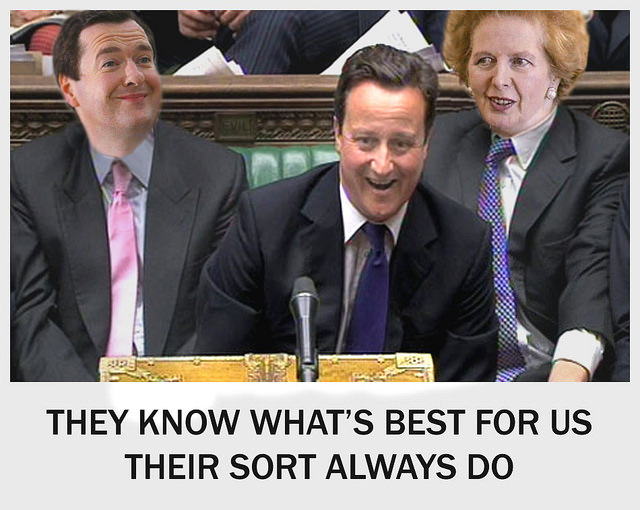
The Prime Minister claims that every family needs help in improving behaviour and discipline. Ironically, this is from a politician who claims to despise the “nanny state”. He much prefers the Bullingdon brand of paternalist interference in people’s everyday lives. Cameron is also recommending “parenting classes” for all, which is understandable given his own strong instincts as a parent. He left his own child in a pub, after all.

Of course Cameron feels that it’s other people that need parenting and discipline. After all, this is a man who spent his early adulthood involved in bizarre initiation rituals, patriarchal debauchery, recklessly banqueting, getting drunk, trashing college rooms and pubs, listening to Supertramp and smoking pot with James Delingpole and vandalising restaurants. In 2013, it was reported that members of the Bullingdon Club were required to burn a £50 note in front of a beggar as part of an “initiation ceremony”. How encouraging to see the elite showing responsibility, compassion, a concern for social justice and cohesion, equality and alleviating poverty, at an early age.

Now that’s a real deviant subculture.

The draconian sentences handed down to the rioters in 2011, advocated by Cameron –  like the 23-year-old student with no previous convictions who was jailed for the maximum permitted six months after pleading guilty to stealing bottles of water worth £3.50 from Lidl in Brixton, for example –  shows only too well that he believes there is one rule for the Oxford elite and another for the rest of the society. Punishment is a central component of the social order and a means by which social order is produced and maintained.

Actually, defining others as deviant is, too. It’s a Conservative means of enhancing social power and status differentials by degrading the rule-breaker’s status and power.

Cameron’s response to the riots reflects a characteristically Bullingdon conservative disdain: an authoritarian, strict and oppressive approach towards perceived, labelled and stigmatised subordinates. Conservatives have always seen the social world as being organised in terms of hierarchies of worth. Smashing up a pub or restaurant and causing 10k worth of damage is no problem if you can cough up the costs on the spot to keep your thuggish behaviour private, hidden away from the scrutiny of the legal system and the public. Money talks and bullshit struts.

The Conservatives inform us that it is bad parents that cause poverty, opting for a rhetoric of authoritarian populism, creating cardboard monsters, manufacturing folk devils and moral outrage for the tabloids, making excuses for the consequences of their own prejudiced and damaging policy-making.

The establishment is a kind of Moebius strip of finger-pointing, arrogant, moralising privileged and feckless bullies passing the buck. And importantly, these wayward boys and girls always get their own way. They can’t democratically govern the country; they lack the social skills, motivation, developmental and emotional capacity to actually engage in any genuine and democratic dialogue with ordinary people, so they rule. Conservatives have always prefered the simplicity of a socio-economic system defined by inherited social ranks.

Cameron says that the government’s Life Chances Strategy – an “initiative to target tackle child poverty” – will include a plan for “significantly expanding parenting provision”. It will also recommend ways to “incentivise” all parents to take up the offer of classes. The hope is, presumably, that if the middle class take Cameron up on his offer of state parenting instructions, the process of social norming will provide the foundation of state-defined “correct behaviours” for the insubordinate working classes, who are perpetually caught up, according to the Tories, in a pathological cycle of something or other, and therefore need state therapy from elitist antipodean role models to set them straight and put them in their place. It’s the new behaviourism: do as we say, but not what we do.

It seems that poverty is to be addressed with nothing more than a paternalist brand of cheap psychopolitics. The government won’t be dipping their hands into the treasury, which is what’s needed. Instead they prefer to employ shabby techniques of persuasion aimed at indoctrinating a Conservative world-view and enforcing conformity as a replacement for genuinely needs-led and evidence-based policies.

At no point does Cameron mention any commitment to improving people’s standard of living, or ensuring that families have a basic level of income in order to meet their fundamental needs, such as food, fuel and shelter – because struggling to meet basic material needs are the main barriers for people experiencing poverty. It’s sobering to consider that the Tory obsession with the work ethic, embodied in their mantra “making work pay”, is nothing more than a meaningless glittering generality, that purposefully diverts attention from elitist policy-making, and subsequent growing poverty and inequality.

Around half of those who are in poverty and of working age live in a household where at least one person works. The steady drop in real wages since 2010, according to the Office for National Statistics, is the longest for 50 years.

Furthermore, since 2010, the decline in UK wage levels has been amongst the very worst in Europe. The fall in earnings under the Coalition is the biggest in any parliament since 1880, according to analysis by the House of Commons Library, and at a time when the cost of living has spiralled upwards.

Ah, and Cameron uttered that inane managementspeak word again – “incentivise”. It never bodes well when Conservatives use that word. It means he has been listening to the psychobabbling of the Nudge Unit, again. Welfare sanctions, which are the punitive withdrawal of lifeline benefits from people who need to claim welfare support to meet their basic needs are claimed to “incentivise” people to find a job, despite empirical evidence to the contrary, and the cuts to child tax credit, limiting support to just two children, are based on the charming and archaic eugenicist idea that poor people ought to be “incentivised” to have fewer children.

Rich people are apparently “incentivised” by large cash carrots, but poor people just get the brutal, merciless stick. What a classic example of flagrant Conservative ideological incoherence.

Psychopolitical paternalism doesn’t address poverty, it is simply a way of apportioning blame, of abdicating political responsibility and ensuring that poor people accept the Conservative and neoliberal decree that they somehow deserve to be poor.

Cameron claims that:

“Families are the best anti-poverty measure ever invented. They are a welfare, education and counselling system all wrapped up into one. Children in families that break apart are more than twice as likely to experience poverty as those whose families stay together. That’s why strengthening families is at the heart of our agenda.”

The announcement from Cameron was welcomed by Relate, whose chief executive, Chris Sherwood, said:

“Relationship support can help to reduce family breakdown, which is a key driver of poverty and can result in poor outcomes for children.”

Actually, family breakdown is quite often a consequence of poverty, not a cause of it. Back in 2010, Fergus Drake, director of UK programmes with Save the Children expressed an unease that many of us felt, regarding the Conservative’s feckless drive to offload the responsibility for poverty onto poor people, who are casualities of the consequences of neoliberalism, which extends discriminatory economic policies. He said:

“We would say poverty causes family breakdown rather than vice versa. If you are worried about putting food on the table, or being able to turn on the heater so you can have a hot bath, the stress that causes to a relationship can make things really difficult.”

Poverty isn’t caused by family breakdown, it’s caused by discriminatory policies and social insititutions that extend and perpetuate inequality. We are now the most unequal country in the European Union, and even more unequal than the US. If Cameron really wanted to address childhood poverty, he would ensure that people have enough to meet their basic needs, instead of steadily withdrawing welfare support and cutting public services. He should end the class-contingent austerity that his government have imposed on only the poorest people.

Tim Nichols, of the Child Poverty Action Group, agrees that the Conservatives should be careful not to confuse causes and consequences. He says:

“We don’t think that this is robust strategy. Tackling child poverty can’t be done without more redistribution.”

Cameron is talking ideologically-driven nonsense, reflecting traditional Tory prejudices. This government has become obsessed with moralising about and manipulating individual agency, which is increasingly seen as being to blame for high levels of poverty and social exclusion in the UK, which are created entirely by callous, discriminatory political policies. Political gaslighting does not help people out of poverty.

People are poor because they don’t have enough money to meet their needs. That is what Cameron needs to acknowledge and address.

Parenting and elitist-authoritarian ideology

Cameron’s paternalist-authoritarian turn was evident back in 2010, when he said that:

“Discipline is the foundation of a good education. Headteachers need to decide on exclusions.”

Most people that have worked in either formal or informal education settings are very aware that using punishment and threats is very counterproductive. Making young people suffer in order to change their future behaviour can often elicit temporary compliance, but this strategy is highly unlikely to lead to conversion or to help children become ethical, responsible decision makers in the long term. Punishments don’t involve any engagement of deliberative processes.

Punishment, even if referred to euphemistically as “consequences,” tends to generate oppositional behaviours, anger and defiance.  Furthermore, it models the use of power rather than reason and damages the important trust-based relationship between adult and child.

Authoritarian models of parenting are emotionally and physically traumatising. There’s an Old Testament brand of harshness in conservative authoritarian approaches to human behaviours.

Authoritarian parents often have prejudices based on wealth and what may be defined as “achievement”, gender, class and race. They tend to be highly competitive, lacking warmth and empathy. They teach their children to compete at all costs, and to win by whatever means. Most authoritarians are behaviourists, with a preference for punishments rather than rewards to control others.

Authoritarians tend to advocate corporal punishment, they see freedom as chaotic, they can’t tolerate ambiguity or recognise the complexities and subtleties of human conduct, and they tend to advocate capital punishment.

Because authoritarian parents expect absolute obedience, children raised in such settings are typically very good at following rules.

However, they often lack self-discipline. Children raised by authoritarian parents are not encouraged to explore and act independently, so they never really learn how to set their own limits and personal standards.

Whilst developmental experts agree that rules, boundaries and consistency are important for children to have, most believe that authoritarian parenting is too punitive and lacks the warmth, unconditional love, safety, trust and nurturing that children need.

Of course public schools also foster authoritarianism and elitism. Boarding school: the trauma of the ‘privileged’ child by Joy Schaverien explores the emotional deprivation and abuse that many experience as a result of public school culture. Psychotherapist Nick Duffell (2000) wrote a book based on workshops he has conducted over ten years with adults who attended boarding schools as children. He has identified many lasting pathological psychological patterns common in those he calls Boarding school survivors.

In his recent work: Wounded Leaders: the Psychohistory of British Elitism and the Entitlement Illusion, Nick says:

“A cherished national character ideal, eschewing vulnerability and practising a normalised covert hostility based on bullying in the dorm adversely affects even those who did not have the privilege of such an education. It leaves Britain in the social and emotional dark ages, led by “the boys in the men that run things.

This specific culture of elitism, protected by financial interests and the “It never did me any harm” syndrome, means that Britain is unlikely to foster the kind of leadership necessary in our world of increasing complexity, which needs a communal mindset and cooperative global solutions. But worse, new scientific evidence shows that this hyper-rational training leaves its devotees trapped within the confines of an inflexible mind, beset with functional defects, presented here as the Entitled Brain.”

It’s a sobering thought that so many boarding school survivors – psychologically and emotionally damaged individuals – are involved in running the country and determining the terms and conditions of our lives.
002fc17b9115fe26a6ed5d9d58b1ece1.603x472x1


I don’t make any money from my work. My articles are free. If you like, you can make a donation to help me continue to research and write free, informative, insightful and independent articles, and to provide support to others. The smallest amount is much appreciated – thank you.

DonatenowButton

Welfare sanctions can’t possibly “incentivise” people to work

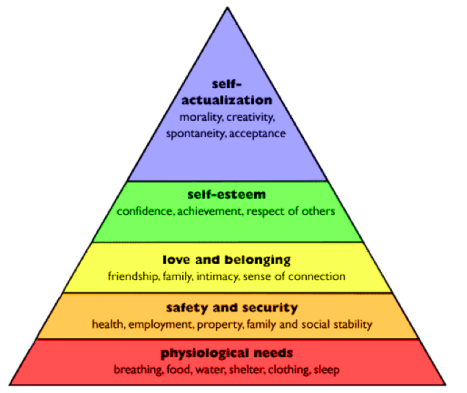
Maslow

Abraham Maslow’s Hierarchy of Human Needs

A summary

The Conservative-led welfare “reforms” had the stated aim of ensuring that benefit claimants – who have been stigmatised and inaccurately redefined as economic free-riders are entitled to a minimum income provided that they uphold responsibilities, which entail being pushed into any available work. Conditionality for social security has been around as long as the welfare state. Eligibility criteria have always been an intrinsic part of the benefits system. For example, to qualify for jobseekers’ allowance, a person has to be out of work, able to work, and seeking employment.

But in recent years welfare conditionality has become conflated with severe financial penalities (sanctions), and has mutated into an ever more stringent, complex, demanding set of often arbitrary requirements, involving frequent and rigid jobcentre appointments, meeting job application targets, providing evidence of job searches and mandatory participation in workfare schemes. The emphasis of welfare provision has shifted from providing support for people seeking employment to increasing conditionality of conduct, enforcing particular patterns of behaviour and monitoring compliance.  In short, welfare has become a hostile environment, designed specifically to deter claims for support.

Sanctions are “penalties that reduce or terminate welfare benefits in cases where claimants are deemed to be out of compliance with  requirements.” They are, in many respects, the neoliberal-paternalist tool of discipline par excellence – the threat that puts a big stick behind coercive welfare programme rules and “incentivises” citizen compliance with a heavily monitoring and supervisory administration. The Conservatives have broadened the scope of behaviours that are subject to sanction, and have widened the application to include previously protected social groups, such as sick and disabled people and lone parents.

There is plenty of evidence that sanctions don’t help people to find work, and that the punitive application of severe financial penalities is having a detrimental and sometimes catastrophic impact on people’s lives. We can see from a growing body of research how sanctions are not working in the way the government claim they intended.

Sanctions, under which people lose benefit payments for between four weeks and three years for “non-compliance”, have come under fire for being unfair, punitive, failing to increase job prospects, and causing hunger, debt and ill-health among jobseekers. And sometimes, causing death.

I’ve always felt that it is self evident – common sense – that if people are already claiming financial assistance which was designed to meet only very basic needs, such as provision for food, fuel and shelter, then imposing further financial penalities would simply reduce those people to a struggle for basic survival, which will inevitably demotivate them and stifle their potential.

However, the current government demand an empirical rigour from those presenting criticism of their policy, yet they curiously fail in meeting the same exacting standards that they demand of others. Often, the claim that “no causal link has been established” is used as a way of ensuring that established correlative relationships, (which often do imply causality,) are not investigated further. Qualitative evidence – case studies, for example – is very often rather undemocratically dismissed as “anecdotal,” which of course stifles further opportunities for research and inquiry.

The Conservative shift in emphasis from structural to psychological explanations of poverty has far-reaching consequences. The partisan reconceptualision of poverty makes it much harder to define and very difficult to measure. Such a conceptual change disconnects poverty from more than a century of detailed empirical and theoretical research, and we are witnessing an increasingly experimental approach to policy-making, aimed at changing the behaviour of individuals, without their consent.

This approach isolates citizens from the broader structural political, economic, sociocultural and reciprocal contexts that invariably influence and shape an individuals’s experiences, meanings, motivations, behaviours and attitudes, causing a problematic duality between context and cognition. It also places unfair and unreasonable responsibility on citizens for circumstances which lie outside of their control, such as the socioeconomic consequences of political decision-making.

I want to discuss two further considerations to add to the growing criticism of the extended use of sanctioning, which are related to why sanctions don’t work. One is that imposing such severe financial penalities on people who need social security support to meet their basic needs cannot possibly bring about positive “behaviour change” or “incentivise” people to find employment, as claimed. This is because of the evidenced and documented broad-ranging negative impacts of financial insecurity and deprivation – particularly food poverty – on human physical health, motivation, behaviour and mental states.

The second related consideration is that “behavioural theories” on which the government rests the case for extending and increasing benefit sanctions are simply inadequate and flawed, having been imported from a limited behavioural economics model (otherwise known as nudge” and libertarian paternalism) which is itself ideologically premised.

I also explored in depth how sanctions and workfare arose from and were justified by nudge theory, which is now institutionalised and deeply embedded in Conservative policy-making. Sanctions entail the manipulation of a specific theoretical cognitive bias called loss aversion.

At best, the new “behavioural theories” are merely theoretical  propositions, at a broadly experimental stage, and therefore profoundly limited in terms of scope and academic rigour, as a mechanism of explanation, and in terms of capacity for generating comprehensive, coherent accounts and understanding about human motivation and behaviour.

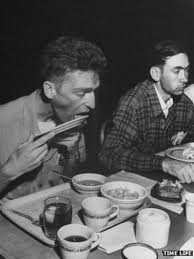
I reviewed research and explored existing empirical evidence regarding the negative impacts of food poverty on physical health, motivation and mental health. In particular, I focussed on the Minnesota Semistarvation Experiment and linked the study findings with Abraham Maslow’s central idea about cognitive priority, which is embedded in the iconic hierarchy of needs pyramid. Maslow’s central proposition is verified by empirical evidence from the Minnesota Experiment.

The Minnesota Experiment explored the physical impacts of hunger in depth, but also studied the effects on attitude, cognitive and social functioning and the behaviour patterns of those who have experienced semistarvation. The experiment highlighted a marked loss of ambition, self-discipline, motivation and willpower amongst the subjects once food deprivation commenced. There was a marked flattening of affect, and in the absence of other emotions, Doctor Ancel Keys observed the resignation and submission that hunger manifests.

The understanding that food deprivation dramatically alters emotions, motivation, personality and that nutrition directly and predictably affects the mind as well as the body is one of the legacies of the experiment.

The experiment highlighted very clearly that there’s a striking sense of immediacy and fixation that arises when there are barriers to fulfiling basic physical needs – human motivation is frozen to meet survival needs, which take precedence over all other needs. This is observed and reflected in both the researcher’s and the subject’s accounts throughout the study. If a person is starving, the desire to obtain food will trump all other goals and dominate the person’s thought processes.

In a nutshell, this means that if people can’t meet their basic survival needs, it is extremely unlikely that they will have either the capability or motivation to meet higher level psychosocial needs, including social obligations and responsibilities to seek work. Abraham Maslow’s humanist account of motivation also highlights the same connection between fundamental motives and immediate situational threats.

Ancel Keys published a full report about the experiment in 1950. It was a substantial two-volume work titled The Biology of Human Starvation. To this day, it remains the most comprehensive scientific examination of the physical and psychological effects of hunger.

Keys emphasised the dramatic effect that semistarvation has on motivation, mental attitude and personality, and he concluded that democracy and nation building would not be possible in a population that did not have access to sufficient food.

I also explored the link between deprivation and an increased risk of mental illnesses, including schizophrenia, depression, anxiety and substance addiction. Poverty can act as both a causal factor (e.g. stress resulting from poverty triggering depression) and a consequence of mental illness (e.g. schizophrenic symptoms leading to decreased socioeconomic status and prospects).

Poverty is a significant risk factor in a wide range of psychological illnesses. Researchers recently reviewed evidence for the effects of socioeconomic status on three categories: schizophrenia, mood and anxiety disorders and substance abuse. Whilst not a comprehensive list of conditions associated with poverty, the issues raised in these three areas can be generalised, and have clear relevance for policy-makers.

The researchers concluded: “Fundamentally, poverty is an economic issue, not a psychological one. Understanding the psychological processes associated with poverty can improve the efficacy of economically focused reform, but is not a panacea. The proposals suggested here would supplement a focused economic strategy aimed at reducing poverty.” (Source: A review of psychological research into the causes and consequences of poverty – Ben Fell, Miles Hewstone, 2015.)

There is no evidence that keeping benefits at below subsistence level or imposing punitive sanctions “incentivises” people to work and research indicates it is likely to have the opposite effect. In 2010/2011 there 61,468 people were given 3 days emergency food and support by the Trussell Trust and this rose to 913,138 people in 2013-2014.

Hanna, Gabriel Kreindler, and Benjamin Olken re-analyzed data from seven randomized experiments evaluating cash programs in developing countries and found “no systematic evidence that cash transfer programs discourage work.”

The phrase “welfare dependency” purposefully diverts us from political prejudice, discrimation via policies and disperses public sympathies towards the poorest citizens.

Conservative claims about welfare sanctions are incommensurable with reality, evidence, academic frameworks and commonly accepted wisdom. It’s inconceivable that this government have failed to comprehend that imposing punishment in the form of financial sanctions on people who already have very limited resources for meeting their basic survival needs is not only irrational, it is absurdly and spectacularly cruel.

Minnes

 The Minnesota semistarvation experiment

This is a summary of a much longer, detailed piece of research and review work about welfare sanctions. You can see the original here

Further study of the impact of food deprivation and starvation on psychological and cognitive deterioration: The Psychological Effects of Starvation in the Holocaust

Cognitive function deficits and demotivation associated with food deprivation and hypoglycaemia: Blood glucose influences memory and attention in young adults

Nutritional deficiencies and detrimental consequences for mental health: Nutrition and mental health

A comprehensive study of the detrimental impacts of food insecurity on the development, behaviour, mental health and wellbeing, learning, educational attainment, citizenship and physical health of children in America: Child Food Insecurity: The Economic Impact on our Nation

Comprehensive computerized assessment of cognitive sequelae of a complete 12-16 hour fast

The Minnesota food deprivation experiment also established a link between food insecurity and deprivation and later unhealthful eating practice, eating disorders and obesity: Journal of the American Dietetic Association


Nudging conformity and benefit sanctions: a state experiment in behaviour modification

cogs


“Behavioural theory is a powerful tool for the government communicator, but you don’t need to be an experienced social scientist to apply it successfully to your work.”
Alex Aiken
Executive Director of
Government Communications


Normalising structural violence and state punishment 

Conservative anti-welfare discourse excludes the structural context of unemployment and poverty from public conversation by transforming these social problems into individual pathologies of “welfare dependency” and “worklessness.” The consequence is an escalating illogic of authoritarian policy measures which have at their core the intensification of punitive conditionality. These state interventions are justified by the construction and mediation of stigma, which is directed at already marginalised social groups that the policies target.

The groups, which include ill and disabled people, people who are unemployed, are painted with a Malthusian brush, as a “burden on the state” and a drain on what are politically portrayed and publicly seen as scarce resources in an era of austerity. Political processes of scapegoating, stigmatisation and outgrouping have been amplified by a largely complicit UK corporate media. These calculated outgrouping narratives have in turn been used to legitimise state violence.

Such policies and interventions are then rationalised as innovative and new political and economic responses. Behavioural economics theories, which “nudge” is a part of, for example, are aimed at “changing the behaviours” of citizens perceived to “make the wrong choices” – ultimately the presented political aim is to mend Britain’s supposedly “broken society” and to restore a country that “lives within its means”, according to a narrow, elitist view, bringing about a neoliberal utopia built on “economic competitiveness” in a “global race.” 

Disadvantage has become an individualised, private matter: it has been politically reduced and is explained as a private, internal characteristic of disadvantaged individuals, rather than it being an inevitable feature of a socioeconomic form of organisation founded on competitive individualism. This allows the state to depoliticise it, making disadvantage the private and sole responsibility of citizens, whilst at the same time, justifying a psychopolitical approach to changing citizen’s behaviours to fit with neoliberal outcomes. 

Institutions structure political struggles, they provide models, schemas and scripts for citizen’s behaviours. Bureaucratic norms within the welfare state have become increasingly about moral rectification. Debate about addressing structural inequality and poverty has been transformed into political rhetoric about behavioural incentives to change what are deemed to be poor people’s biased attitudes, cognitive deficits and faulty actions. Apparently, wealthy people don’t have these flaws. 

Welfare dependency is now a synonym for poverty, with its perceived dimensions of moral/psychological dependency accepted as a character “trait” or a “personality disorder.”  The sociopolitical relations of subordination, exploitation and economic organisation that were hidden within the discourse of “dependency” have now completely disappeared from public conversations about poverty. 

Context

Narratives about social security in the UK that emphasise a deepening of neoliberalisation became particularly virulent in the context of the global economic crash, which raised threats to the New Right neoliberal hegemony.

In August 2008, James Purnell, then Work and Pensions secretary, ordered a review of welfare to cut costs. The review explored how behavioural economics (nudge) may be used to “motivate” those claiming  welfare support and to establish what the “right conditions” are for the long-term unemployed or to deal with those thought to be “abusing the system.”

The review also addressed issues such as how people’s aversion to loss could be used to reduce the claimant count, which included consideration of the loss of high regard in the community; respect for legitimate authority; reciprocity – including a sense of obligation to give something back – and finally, “social proof” (using normative setting) – responding to the behaviour of others, such as their successful search for work.

Following some targeted survey work carried out by the Department for Work and Pensions, it was claimed that more than half of claimants say they are more likely to look for work because of the threat of sanctions. It was also suggested that attaching more stringent conditions to welfare could draw on the then latest British interest in nudge economics, and the “hidden art of persuasion.” This took place in a context of other European countries and the US exploring similar radical welfare reforms. (See also: Experiments on Unemployment Benefit Sanctions and Job Search Behaviour, 2004).

However, the direct evidence on the impact of sanctions largely concerns how it affected the compliance; rule-following job seeking behaviour and employment rates of those who have actually experienced or been formally warned of a sanction. However, how “employment rates” are actually measured poses a problem, as, in the UK, an outcome of employment is assumed if someone’s claim is closed.

Several US studies have used high quality designs to analyse differences in post-welfare outcomes and found that, on average, those who are sanctioned out of the welfare system are less likely to enter employment than those who leave for other reasons. Sanctioned welfare leavers are more likely to experience severe hardship and some become disconnected from income and other support systems.

Purnell resigned in 2009, as Gordon Brown refused to implement his neoliberal welfare proposals. The Nudge Unit was established and formally instituted as part of the Cabinet in 2010, under Cameron’s coalition government.

I’ve written more than one critical piece about the Government’s part-privatised Nudge Unit – the Behavioural Insights Team – particularly its insidious and malevolent influence on the range of psychocratic policies aimed at “behavioural changes” which are now being imposed on the poorest citizens. 

From the shrinking category of legitimate “disability” to forcing people to work for no pay on exploitative workfare schemes, “nudge” has been used to euphemistically frame punitive policies, “applying the principles of behavioural economics to the important issue of the transition from welfare to work.” (See: Employing BELIEF:Applying behavioural economics to welfare to work, 2010.)

The Conservatives have claimed to make welfare provision “fair” by introducing substantial cuts to benefits and harsh conditionality requirements regarding eligibility to social security, including the frequent use of extremely punitive benefit sanctions as a means of “changing behaviours,” and “incentivising” people to find work, highlighting plainly that the Conservatives regard unemployment and disability as some kind of personal deficit on the part of those who are, in reality, simply casualties of structural constraints; labor market conditions, exclusion from acceptable living standards because of cuts to income and rising living costs, bad political decision-making and subsequent policy-shaped socioeconomic circumstances.

The word “fair” originally meant “treating people equally without favouritism or discrimination, without cheating or trying to achieve unjust advantage.” Under the Conservatives, we have witnessed more than one manipulated semantic shift, words like “fair” , “support” , “reform” , “responsibility”, “opportunities” and “help” , for example, have become embedded in a narrative of superficial  Glittering Generalities – part of a lexicon of persuasion and precarious psychosemantics that simply prop up Tory ideology  – an idiom of belief – in an endlessly erroneous, irrational and self-referential way.

The problem is that the power of a system of such implicit beliefs to defeat valid objections one by one is entirely due to the circularity  and self-perpetuating nature of such systems, as Iain Duncan Smith, who stands firmly within this idiom, consistently demonstrates only too well. After being rebuked by the UK Statistics Authority (ONS) for his claim that his policies have “forced 8,000 benefit claimants back into work” in 2013, he was informed politely that this wasn’t empirically evidenced – his claim could not be proven with his statistics. His response was: “I have a belief that I am right […] you cannot disprove what I said.” His “theory” tells him what he may observe.

There is a gulf between the rhetoric and empirical evidence on benefit sanctions. The evidence base is both small and limited in its scope, and it does not accommodate the differing approaches to preventing poverty and promoting opportunity that arise in international policy design. Increased welfare conditionality and sanctions are too narrowly based on a rhetoric of moral(ising) philosophy, and takes a highly selective approach evidence.

Iain Duncan Smith is the expert Tory pop-psychologist, fluent in psychobabble words like “incentivise” and “behavioural change” and whilst he demands rigorous research standards from academics and his critics, he doesn’t ever uphold those same standards himself.

If you “just know” you’re right, then does it matter if you regularly make up the evidence to support your mighty powers of New Right and very neoliberal intuitions?  It ought to, and it would if Conservative policy was genuinely based on meeting public needs, evidence and objective measures of effectiveness, rather than being based on prejudice and political expediency.

Words like “fair” and “help” now signpost an intentionally misleading Conservative discourse. Nudge permeates language, prompting semantic shifts towards bland descriptors which mask power and class relations, coercive state actions and political intentions. One only need to look at the context in which the government use words like “fair”, “support”, “help” “justice” and “reform” to recognise linguistic behaviourism in action. Or if you prefer, Orwellian doublespeak.

The Conservatives have orchestrated semantic shifts which reflect neoliberal values and reference a distinctive New Right ideological repertoire, from which is constructed basic pseudo-scientific justification narratives, asserting that people claiming welfare do so, as I said previously, because of “faulty” personal characteristics and various types of cognitive incompetence and laziness. In short, the government have pathologised and stigmatised unemployment, redefining it as a psychological disorder.

The government have also problematised welfare, based on the absurd New Right idea that financial support when people really need it somehow creates problems, rather than it being an essential mechanism aimed at alleviating poverty, extending social and economic support, justice and opportunities: social insurance and security

The government have adopted a strongly disciplinarian approach to structural problems such as poverty, using narratives that are strikingly reminiscent of the attitudes and values that shaped the extremely punitive and ill-conceived 1834 Poor Law amendment act.

The post-war welfare state is founded on the idea that government plays a key role in ensuring the protection and promotion of the economic and social well-being of its citizens. It is based on the principles of equality of opportunity, equitable distribution of wealth, and both political and social responsibility for those unable to avail themselves of the minimal provisions for health and wellbeing.

Restricting choices to “choice”

The increased use and rising severity of benefit sanctions became an integrated part of welfare “conditionality” in 2012. Sanctions are based on a principle borrowed from behavioural economics theory – a cognitive bias called “loss aversion.” It refers to the idea that people’s tendency is to strongly prefer avoiding losses to acquiring gains. The idea is embedded in the use of sanctions to “nudge” people towards compliance with welfare rules of conditionality, by using a threat of punitive financial loss, since the longstanding, underpinning Conservative assumption is that people are unemployed because of behavioural deficits.

I’ve argued elsewhere, however, that benefit sanctions are more closely aligned with operant conditioning (behaviourism) than “libertarian paternalism,” since sanctions are a severe punishment intended to modify behaviour and restrict choices to that of compliance and conformity or destitution.

Libertarian paternalists claim that whilst it is legitimate for government, private and public institutions to affect behaviour the aims should be to ensure that “people should be free to opt out of specified arrangements if they choose to do so.” The nudges favoured by libertarian paternalists are also supposed to be “unobtrusive.” That clearly is not the case with the application of coercive, draconian Conservative welfare sanctions.

Last year I wrote about the connection between the Nudge Unit’s pseudoscientific obsession with manipulating people’s decision-making by utilising various cognitive bias theories – in this case, particularly, the behavioural economic theory of loss aversion and the increased use and severity of benefit sanctions. Though most people succumbing to the Nudge Unit’s guru effect (ironically, another cognitive bias) think that “nudging” is just about prompting men to pee on the right spot in urinals, or about persuading us to donate organs and to pay our taxes on time. Nudge is at the very heart of the New  Right’s neo-behaviourist turn, which entails the application of operant conditioning to individualise and privatise social problems such as inequality and poverty. 

When it comes to technocratic fads like nudge, it’s worth bearing in mind that truth and ethics quite often have an inversely proportional relationship with the profit motive. It’s a cognitive bias, if you will.

For anyone curious as to how such tyrannical behaviour modification techniques like benefit sanctions arose from the bland language, inane, managementspeak acronyms and pseudo-scientific framework of “paternal libertarianism” – nudge – read this paper, focused almost exclusively on New Right small state obsessions, paying particular attention to the part about loss aversion, on page 7.

And this on page 18: The most obvious policy implication arising from loss aversion is that if policy-makers can clearly convey the losses that certain behaviour will incur, it may encourage people not to do it,” and page 46: “Given that, for most people, losses are more important than comparable gains, it is important that potential losses are defined and made explicit to jobseekers (e.g. the sanctions regime).”

The recommendation on that page: We believe the regime is currently too complex and, despite people’s tendency towards loss aversion, the lack of clarity around the sanctions regime can make it ineffective. Complexity prevents claimants from fully appreciating the financial losses they face if they do not comply with the conditions of their benefit.”

The Conservatives duly “simplified” sanctions by extending them in terms of severity and increasing the frequency of use. Sanctions have also been extended to include previously protected social groups, such as disabled people.

The paper was written in November 2010, prior to the Coalition policy of increased “conditionality” and the extended sanctions element of the Tory-led welfare “reforms” in 2012.

Sanctioning welfare recipients by removing their lifeline benefit – originally calculated to meet the cost of only basic survival needs – food, fuel and shelter – isn’t about “arranging choice architecture”, it’s not nudging: it’s operant conditioning. It’s a brand of particularly dystopic, psychopolitical behaviourism, and is all about a totalitarian level of micromanaging people to ensure they are obedient and compliant to the needs of  the “choice architects” and policy-makers. Nudge in this context is nothing more than a prop for austerity, neoliberalism and social conservatism.

It is all-pervasive, nudge permeates political rhetoric and discursive practices. Words like “help” and “support” disguise coercive and punitive state actions. Bland language is used to normalise inequality and discriminatory political practices. The word “incentivise,” for example, is used a lot by the Conservatives, but to wealthy people, it means financial privileges in the form of tax cuts and privatised wealth, and to poor people, it means having lifeline income taken away by the state. 

Deploying behavioural modification techniques (and without the public’s consent) marginalises political discussion, stifles public debate, sidesteps democratic dialogue, problem-solving, criticism and challenges and forecloses the possibility of social justice considerations.

Furthermore, an individual’s autonomy, which is also the basis of his or her dignity, as a person, is worthy of protection and should not be interfered with by any kind of behavioural modification, “nudge” or otherwise. Nor should removing people’s lifeline income designed to meet only basic survival needs ever be withdrawn as a state “correction” and punishment.

Nudge operates at a much broader level, too. The intentional political construction of folk devils and purposeful culturally amplified references to a stereotype embodying fecklessness, idleness and irresponsibility, utilising moral panic and manufactured public outrage as an effective platform for punitive welfare reform legislation, is one example of the value-laden application of pseudoscientific “behavioural insights” theory. The new paternalists have drawn on our psychosocial inclinations towards conformity, which is evident in the increasing political use of manipulative normative messaging. (For example, see: The Behavioral Insights Team in the U.K. used social normative messages to increase tax compliance in 2011.) 

The paternalist’s behavioural theories have been used to increasingly normalise a moral narrative based on a crude underpinning “deserving” and “undeserving” dichotomy, that justifies state interventions imposing conditions of extreme deprivation amongst some social groups – especially those previously considered legally protected. Public rational and moral boundaries have been and continue to be nudged and shifted, incrementally. Gordon Allport outlined a remarkably similar process in his classic political psychology text, The Nature of Prejudice, which describes the psychosocial processes involved in the construction of categorical others, and the subsequent escalating scale of prejudice and discrimination

In the UK, the growth and institutionalisation of prejudice and discrimination is reflected in the increasing tendency towards the  transgression of international legal human rights frameworks at the level of public policy-making. Policies that target protected social groups with moralising, stereotypical normative messages, accompanied with operant disciplinary measures, have led to extremely negative and harmful outcomes, but there is a marked political and social indifference to the serious implications and consequences of the impacts of such policies .

The theory tells you what you may observe

There is no evidence that welfare sanctions improve employment outcomes. There is no evidence that sanctions “change behaviours.” There is, in any case, a substantial difference between people conforming with welfare conditionality and rules and gaining appropriate and secure employment.

One difficulty is that since 2011, Job Centre Plus’s (JCP) primary key performance indicator has been off-flow from benefit at the 13th, 26th, 39th and 52nd weeks of claims. Previously JCP’s performance had been measured against a range of performance indicators, including off-flows from benefit into employment.

Indeed, when asked for evidence by the Work and Pensions Committee, one minister, in her determination to defend the Conservative sanction regime, regrettably provided misleading information on the destinations of JSA, Income Support and Employment Support Allowance claimants from 2011, that pre-dated the new sanctions regime introduced in 2012, in an attempt to challenge the findings of the University of Oxford/LSHTM study on the effects of sanctions on getting JSA claimants off-flow. (Fewer than 20% of this group of people who were no longer in receipt of JSA were recorded as finding employment.) Source: Benefit sanctions policy beyond the Oakley Review – Work and Pensions.

Studies have shown that being “treated” by at least one “stick” (punitive measure) significantly reduces an individual’s earnings after periods of unemployment; on the other hand, participating in a supportive programme affects earnings positively.

 Treatment and policy regime effects of Carrots and Sticks, in % of average earnings

 Effects are expressed in percent of average monthly earnings within 3.5 years after unemployment (3547 CHF = 3290 EUR = 3575 USD in sample). Treatment effects: effects of being exposed to at least one carrot (job search assistance, training) or stick (sanction, workfare programme).

Source: Arni, P, Lalive, R, and G J van den Berg (2015) “Treatment versus regime effects of Carrots and Sticks”, IZA Discussion Paper 9457.

It’s remarkably difficult to reconcile state imposed responsibilities that illiberally target only one social group, with democracy and universal human rights, which are based on core principles like dignity, fairness, equality, respect and autonomy.

We ought to question the claim that the manipulation of public decision-making to cut costs to the state is in our “best interests.” Who is nudging the nudgers, and  clearly they have their own whopping great “cognitive biases.”

Behavioural modification techniques are particularly prone to abuse because they are very effective – all tyrants and bullies are behaviourists – and such techniques represent, because of the range of subtle to threatening methods in which they exercise control and can elicit compliance, a political tool that is difficult to observe, challenge and control.

It’s also worth noting that the application of nudge is entirely experimental and nonconsenusal. For the record, when a government in a so called first world liberal democracy – that are generally expected to recognise and address public needs – decides to act upon citizens to change their behaviours to meet partisan, ideologically directed outcomes, we tend to call that authoritarianism, not nudge.

If it wasn’t for this government’s “behaviourist turn” and psychosemantic approach to the inequality and poverty that their policies tend to extend, the Department for Work and Pensions would have been renamed “The Department for Punitive State Correction and Neoliberal Behaviour Modification Experiments.” 

 
Nudge. It’s become another clever little euphemism. 
gcs-guide-to-communications-and-behaviour-change1From the Ministry of euphemism and semantic thrifts, 1984th edition


I wrote much of this as part of a considerably longer piece, but felt that this particular point and the evidence regarding the intensification of sanctions was lost in the weight of other important issues raised in the original article: The government plan social experiments to “nudge” sick and disabled people into work


Related

The benefit cap, phrenology and the new Conservative character divination

Man with diabetes had to have his leg amputated because of benefit sanctions

Cases of malnutrition continue to soar in the UK

Two key studies show that punitive benefit sanctions don’t ‘incentivise’ people to work, as claimed by the government


I don’t make any money from my work. But you can help by making a donation and help me continue to research and write free, informative, insightful and independent articles, and to provide support to others. The smallest amount is much appreciated – thank you.
DonatenowButton cards

Osbornomics – the self-perpetuating omnishambles that we can’t escape

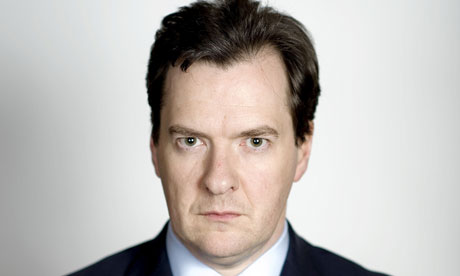
Chancellor George Osborne


Osborne’s targeted austerity measures, based entirely on Conservative small state ideology, rather than economic necessity, have established an economic trap. It’s a vicious cycle, because tax cuts to the wealthy, and low, stagnated wages reduce Treasury income, thus increasing the deficit – which is the gap between Treasury income and what is needed for spending. His solution? Cut spending and public services. Again and again.

Yet this is clearly not working. Reducing spending means shrinking the economy further. The services that the state provides – education, healthcare, social security, housing, for example – also contribute to our wellbeing and raise our standard of living. Of course reducing consumer spending also serves to deflate the economy further.

Meanwhile our overall debt has increased. It’s a strategy doomed to failure all round, and it certainly exposes the lie that the financial burden of paying the deficit is shared and that “those with the broadest shoulders” carry the largest burden. Those experiencing the worst of the cuts are the poorest.

I’m not sure if the Conservatives have massively understated the damage that spending cuts inflict on a weak economy because they don’t understand that this is the case or because they don’t actually care. But you would think that the evidence after five years would have prompted a rethink, if it were the former case.

The initial economic research that was held up to support austerity measures has since been thoroughly discredited. Widely touted statistical results were, it turned out, based on highly dubious assumptions and procedures and a few outright mathematical errors –  it didn’t stand up to scrutiny.

The textbook answer to recession was and still is fiscal expansion: increasing government spending both to create jobs directly and to put money in consumers’ pockets to stimulate the economy. Fiscal stimulus measures should continue until economies had recovered. John Maynard Keynes wrote in 1937: “The boom, not the slump, is the right time for austerity at the Treasury.”

You really can’t cut your way out of a shrinking economy. Austerity and spending cuts are actually intrinsic to New Right and neoliberal ideology. Margaret Thatcher radically cut public spending, created recession and generally messed up, but Cameron’s government have gone much further than she dared.


proper Blond


Conservatives have manipulated the general public’s lack of understanding about basic economics, and lied about the “dangers” of debt and deficits in order to radically reduce the welfare state and justify cuts to people’s lifeline benefits, cuts to public services such as the national health service, social care, legal aid, and to councils, for example.

The Tories have also set about reversing all of the social gains of our post-war settlement, in fact. It’s something they have always hated. They have persistently denied that higher spending might actually be beneficial to the majority of UK citizens. Austerity has been paraded as the only possibility, as “economically necessary” but that’s utter tosh.

Gordon Brown said today that when the worst of the global recession hit, his government protected the most vulnerable social groups – including children. He’s right, we didn’t need austerity back then, in the throes of the global crisis. Brown put in place a package of expansionary fiscal measures, and we were in recovery by the last quarter of 2009.

The Conservatives put us straight back into recession and lost our Fitch and Moody international credit ratings to boot. Something that George Osborne pledged he would maintain as a priority, back in 2010.


539627_450600381676162_486601053_n (2)

And the national debt is growing, not shrinking.

uk debt


Economic competence is measured by our social conditions and the living standards of citizens far more than by dry numbers and the ideological commitments of government. Austerity is failing millions, who have witnessed the biggest fall in living standards since before the war.

And if a political strategy is failing and damaging people’s lives, as austerity clearly is, then it’s time to change that strategy.

Related

The word “Tories” is an abbreviation of “tall stories”

The Great Debt Lie and the Myth of the Structural Deficit

Osborne’s Autumn statement reflects the Tory ambition to reduce State provision to rubble

Tory dogma and hypocrisy: the “big state”, bureaucracy, austerity and “freedom”

The BBC expose a chasm between what the Coalition plan to do and what they want to disclose

Follow the Money: Tory Ideology is all about handouts to the wealthy that are funded by the poor

Jeremy Corbyn is being stalked by a pantomime horse

3359686

In a recent stage production called “Closing The Barn Door after the Chicken Coup,” a well-known actor who plays the rear end of a horse has complained how much he dislikes Labour party leaders, just on principle. He’s a Labour MP; he says that it’s good to have a hobby in his spare time.

“I hate them all. But more than any of them, I really feel that Corbyn is just too beardy, and I simply can’t get behind him,” says the sullen actor.

“I say neigh, neigh and thrice neigh. How very dare he. He’s only gone and appealed to the tens of thousands of new party recruits, enthusing them by his pesky kid anti-austerity messages. I’m worried that the electorate will spot what a sham Tory austerity is soon, because of such strong opposition from the extremists amongst them who are sick of being made poorer. That simply must not happen.

We can’t have a Labour party that is just about social things for any Tom, Dick or Harry. We need to look after big business. I know all about trickle down economics, being the back end of a mule. In the 1800s it was called the “horse and sparrow” theory. You feed the big horse all the oats and the many little sparrows get to feed in its wake. That’s what it’s all about. I say give all the money to the big private horses.”

I think he means that the public are being fed horse shit.

The actor claims to be a long-standing supporter and member of the Labour party, as well as a part-time MP. However, earlier this year he complained bitterly to the Daily Mail that the then party leader, Ed Miliband, is “a f****** knob.”  As Labour’s new self-appointed publicist, the actor has become famous for his nonsensical outbursts, controversial business interests and excessively large luvvie ego, which is the impressive size of a cathedral.

He told the Mail on Sunday: “I would be prepared to stand as a stalking horse against Jeremy Corbyn.”

“My only intention is to secure a better leader for the Labour party as they’re all rubbish, none of them are ever good enough, in my very important opinion. They need to be nagged. The person to do it is me me me!”

Although the actor says “We know that Labour only wins when it is united and when it is patriotic and speaks for the whole country,” he has nonetheless decided that unbridled disunity and carping about the party is the best way forward. From the back.

He says: “The only way forward for the Labour party is for them to stop opposing the Conservatives completely, especially on welfare cuts and austerity. This crazy left wing politics is nonsense and needs to stop.  And it would do us no harm to behave like blue-collar UKIP supporters. I say we should bring back hanging as well, that would get us elected as most of the public like reality TV entertainment and punishing the poor. We should do what the public want.”

When asked about his leading role as the rear end of a horse, he replied: “Farce doesn’t begin to describe my position any more, it’s the political equivalent of all the slapstick staples and stables rolled into one. But I make hay while the sun shines from my back end.”

He wouldn’t disclose the identity of the front end of the horse, despite the truth being right under his nose. But he has never been one to bury his head in the … sand, and said his real ambition was to progress and play the rear end of a rocking horse.

The actor complained that during the pantomime, the horses head kept pitching abruptly further and further to the right, whilst he couldn’t see where he was going. It made him feel very un-stable. But he added “It’s much better than turning left I suppose.”

He went on to say: “It’s a night mare. Sometimes it’s better to laugh than cry. Because the inescapable truth from here is painfully hard to countenance.”

It must be difficult to keep a tight reign from his position, which lends a form to his pressing sense of inadequacy. Yet despite his own unfortunate position, with his nose pressed firmly to the grind, the actor, left in the dark and certainly left behind, went on to say that “Corbyn should let his trousers fall down and John McDonnell plant a custard pie in his face.”

“The world’s my stage and I’m a horse’s ass”, he added.

A recent Gallop poll showed that many agree. He is.

images

Austerity Is a Choice, Labour Must Offer Another – Jeremy Corbyn

1459720_569627496440116_902730897_n

Austerity is a political choice not an economic necessity. When the Chancellor rose to his feet at the emergency Budget in July, and when he does so for his Spending Review in October, what is being put forward is an ideologically-driven rolling back of the state.

The analysis published today by the TUC reveals how the Budget gives money to the rich, but takes away from the poor.

jeremy corbyn

This is the Conservative project, dressed up in the post-crisis language of budget deficits and national debt for extra impetus. Inequality doubled under the Thatcher government, and her heirs seem to be doing all they can to ensure that legacy is extended.

The Budget showed austerity is about political choices, not economic necessities. There is money available: the inheritance tax cuts announced in the Budget will lose the exchequer over £2.5billion in revenue between now and 2020. What responsible government committed to closing the deficit would give a tax break that only applies to the richest 4% of households?

The Conservatives are giving away to the very rich in inheritance tax cuts twice as much as reducing the benefit cap will raise by further impoverishing the poorest, and socially cleansing many towns and cities.

Another choice was to cut UK corporation tax to 18%, which at 20% is already the lowest in the G7, lower too than the 25% in China, and half the 40% rate in the United States.

The Treasury estimates that this political choice will see our revenue intake from big business fall by £2.5billion in 2020. That’s nearly twice the amount saved by cutting the tax credits available families with more than two children.

In such circumstances, Labour must be clear: we oppose the Budget, and we oppose austerity. As a group of 40 economists wrote to the Observer a few weeks ago, “opposition to austerity is actually mainstream economics, even backed by the conservative IMF”.

The language of “bringing down the deficit” is non-controversial, it is the method (austerity) that reveals the Chancellor’s agenda as just a cover for the same old Conservative policies: run down public services, slash the welfare state, sell-off public assets and give tax cuts to the wealthiest.

I stood in this race because Labour should not swallow the story that austerity is anything other than a new facade for the same old Conservative plans.

We must close the deficit, but to do so we will make the economy work for all, and create a more equal and prosperous society. Bringing down the deficit on the backs of those on low and average incomes will only mean more debt, more poverty, more insecurity, more anxiety and ultimately more crisis.

We must invest in a more productive economy. Our national infrastructure – energy, housing, transport, digital – is outdated, leaving the UK lagging behind other developed economies. In the Budget, the Chancellor cut back public investment even further.

You cannot cut your way to prosperity. We need to invest in our future. And that takes a strategic state that seeks to shape the economy so that it works for all.

That is the choice for Britain and the choice that Labour must offer.

Jeremy Corbyn is the Labour MP for Islington North and Labour Party leader.

This article was originally published on 7.09.15

1450041_569755536427312_1698223275_n
Pictures courtesy of Robert Livingstone


Work: for what it’s worth

b584

I’ve yet to see a decent challenge to the Tory proposition that citizenship and rights can be determined by, and ought to be conditional, on how hard-working a person is. Of course the definition of “hard-working” is narrowly restricted to categories of paid employment. People working for nothing on workfare programs aren’t considered to have any value at all. They are simply left to fall down into the vortex created by neoliberal logical gaps.

The Conservatives have always had a pathological need to create social systems comprised of ranks and categories, it’s a fundamental feature of their collective ontological insecurity and fits in very well with the key features and demands of neoliberalism.

It’s complete and utter nonsense. Dogma

People’s worth isn’t measured in terms of their contribution to the increasingly private wealth of businesses, or what they can do for an employer. Or their participation in an increasingly enclosed neoliberal economy. Human worth is universal, regardless of whether or not we work to make someone else rich.

Nor is entrepreneurship the pinnacle of human achievement.

Behave.

If work was so rewarding, there wouldn’t be any resentment directed at people who aren’t working. Workers would be content with their lot, rather than regarding others with envy, sneaking suspicion and vilifying those people trying to simply survive on the meagre benefits that most of them contributed towards via taxes. The establishment and the media would have no public complicity in their perpetual scapegoating, outgrouping and socially divisive programmes. We can always expect a particularly controversial, targeted and damaging policy from the Tories when we see the sudden appearance in the media of a new category of folk devils. It’s intentional, strategic, calculated and scapegoating is presented as a justification narrative for yet another battle against another marginalised group in the establishment’s broader class war.

The truth is that the majority of people don’t find work rewarding at all, and for many, having a paid job isn’t a way out of poverty. Labourers are deeply envious of the perceived freedom of those they feel don’t have to toil. The Conservatives know this and have virtually culturally criminalised being unemployed. This said, if you end up in prison, at least you can rely on being fed, whereas if you are claiming jobseekers allowance or sickness and disability benefits, there’s a substantial risk of being arbitrarily sanctioned, suddenly leaving you without the means of buying food and meeting other basic survival needs.

Effective collective bargaining can only happen if people have the right to refuse jobs that are exploitative. Workfare has taken that right away. Welfare conditionality has taken that right away. 

As welfare provision shrinks, an increasingly desperate reserve army of disposable labour becomes easier to exploit; work choices shrink, wages are driven down, job insecurity grows and working conditions worsen. It’s the cast-iron law of Conservatism. As I’ve pointed out before, the Poor Law of 1834 worked in the same way: the enshrined principle of less eligibility, which meant that conditions in workhouses had to be much worse than conditions available to those in the lowest paid work outside so that there was a deterrence to claiming support. In reality this meant that an individual had to be completely destitute in order to quality for poor relief.  The Tory mantra “making work pay” is based on the same ideology as the less eligibility principle. It was always a front for the neoliberal New Right imperative to dismantle welfare support and compete in a race to the bottom through the various descending layers and facets of absolute poverty. Whilst employers ascend and profit.

We decided, agreed and ratified that each human life has equal worth at an international level after the consequences of hierarchical thinking culminated in the atrocities of World War Two. Hitler thought that some people were worth more than others. All despots do. However, we progressed, we learned. We evolved. We formulated Human Rights as a coherent and collective response.

But it’s a lesson the Tories clearly have forgotten. Or chose not to learn. Our society is more unequal and steeply hierarchical than ever, inequalities are greater here than anywhere else in Europe, and including the USA. That’s a direct result of Tory policy, weighted towards handouts to the wealthy at the expense of the poor. Despite our human rights and equality legislations.

But the blame doesn’t entirely belong to the Tories. The next time you look down on your neighbours for being sick, disabled, mentally ill, unemployed or for being from a different ethnic background, remember where that sort of collective thinking takes us as a society. If you don’t believe me, go away and read Gordon Allport’s The Nature of Prejudice, have a look at Allport’s Ladder, and compare to where we are now, in the UK, in the 21st Century.

As a society, we need to learn from history. Progress. Evolve.But we are regressing instead. Human Rights are fundamentally incompatible with neoliberalism.

Allport wrote about how the Holocaust happened. Public acceptance of eugenic thinking happens incrementally; rational and moral boundaries are pushed, bit by bit, almost imperceptibly, until the unacceptable becomes acceptable. And prejudice multi-tasks. Hitler killed the sick, disabled, the poor and “workshy” first.

That psychosocial and political process is happening here, unfolding in stages day by day, week by week, year by year: the media are a large part of the ideological mechanism; a state apparatus used to push against our rational and moral boundaries. And this mechanism is being used to de-empathise us, to make us less sympathetic to the plight of politically defined others. And to regard them as having less worth than ourselves. Neoliberalism creates steep hierarchies of power and wealth, it isn’t generous to most people. 

My message here is about the equal worth of all human beings. Who we are is a universal, and not the same as “what” we are or the labels we may acquire because of our superficial characteristics. Those things are artificial and culturally relative. We all share the same basic needs, fears and hopes, we share archetypal dreams and nightmares. To paraphrase RD Laing:

All in each, each in all, all distinctions are mind; of mind, in mind, by mind. No distinctions, no mind to distinguish.

All lives equally precious.

Our worth can never be measured out in meagre pounds and pennies.

demcracy
But they don’t and they never will.

Many thanks to Robert Livingstone for the image.

Benefit cuts “will involve cuts to benefits” shocker

imagesBy Private Eye Political Correspondent Noah Surprise.

There was widespread shock across Britain today that the £12 billion of welfare cuts promised in the Tory election manifesto would turn out to be £12 billion of cuts to the welfare budget.

“We definitely didn’t think these 12 billion worth of cuts would involve people like us,” said one first-time Tory voter, having her child tax credits halved.

“We thought it would only affect those wretched people on those awful benefit shows on Channel 4.” https://upload.wikimedia.org/wikipedia/en/b/bb/Benefits_Street.jpg “We feel utterly betrayed by the Tories,” said another father, who is having his family working tax credits slashed.
“Why didn’t Osborne say these 12 billion worth of cuts would affect me? I naturally assumed it would hit people in the North, guests on the Jeremy Kyle show and muslims. That’s why I voted Tory.”

George Osborne has insisted he’d worked hard to ensure that the cuts to benefits were spread evenly between those people most likely to vote Labour and those most likely to vote Lib Dem.

539627_450600381676162_486601053_n (2)Courtesy of Robert Livingstone

See also:

Budget 2015: cuts to make Daily Mail readers wince, but not just yet

The budget: from trickle-down to falling down, whilst holding hands with Herbert Spencer

And finally, a timely reminder of Martin Niemöller’s words on the ultimately self-destructive complicity of bystander apathy, because despots never simply attack and persecute the group of your choosing:

Budget 2015: cuts to make Daily Mail readers wince, but not just yet

9686687899_74d73c6216_oPicture courtesy of Robert Livingstone.

Article by Michael Kitson, University of Cambridge

George Osborne is preparing to deliver the first Tory budget since 1996. He will proclaim the success of the government’s “long-term economic plan” and will use this as a platform to launch a radical reduction of welfare expenditure. But repeatedly extolling the success of your long-term economic plan does not mean that you have one. And an economy that in the first quarter was growing at a sluggish annual rate of 2.2% per head – after a deep and protracted recession – is not an indicator of sustained economic revival.

There are two main components of the government’s economic plan. First, to decrease the budget deficit and eventually move it to surplus – with the fiscal burden being borne by cuts in government spending. Second, to reduce the size of the state in the British economy. This is not an “economic plan”, it is a political agenda based on a doctrine of faith.

The focus on fiscal austerity has meant that monetary policy (interest rates and quantitative easing) has been the main stimulant to the economy. Thus, private sector debt is considered good and desirable whereas public sector debt is bad and harmful.

This makes little economic sense; what is important is the appropriate balance between borrowing to consume and borrowing to invest. In a period of cheap money, it is no surprise that consumers are buying new cars in record numbers (85% of which are manufactured abroad); the problem is that the state is not investing in the infrastructure that the economy needs.

The growth record

The supporters of austerity have argued that the return of economic growth is justification for the policy. This argument is full of holes. The anti-austerity group never argued that the economy would remain in a permanent recession – their concern was that recovery would be delayed and the downturn would cause long-term damage. The normal path for an economy that suffers a shock is that it bounces back with a period of rapid economic growth. The bounce-back has been feeble in the UK and growth has yet to get back to trend.

Furthermore, the most important indicator of prosperity is GDP per capita, and as shown by the red line in the chart below, this is still below the level achieved in 2008. This reflects the UK’s productivity problem. As the liberal economist Paul Krugman observed:

Productivity isn’t everything, but in the long run it is almost everything. A country’s ability to improve its standard of living over time depends almost entirely on its ability to raise its output per worker.

Although it will probably receive a lot of lip service in the budget, there has been no coherent plan to raise productivity in the UK.

ONS, Quarterly National Accounts, Quarter 1 (Jan to Mar) 2015

The retreat of the makers

The UK remains an unbalanced economy: regional disparities have widened since the early 1980s and this process was not halted by the financial crisis. The government has proclaimed that it is putting the power into the “Northern powerhouse”. But regional policy in the UK is piecemeal and parsimonious; and you do not build a powerhouse by postponing infrastructure spending in the North.

Support for industry is another area where soundbites trump substance. The chancellor has called for “a Britain carried aloft by the march of the makers”. But as the chart below shows, although there has been a recovery of the service sector, the manufacturing sector remains smaller than it was before the financial crisis.

The coalition government revived the notion of “industrial policy” to support the manufacturing sector; but this was a Vince Cable initiative which is not being pursued by the current government – which is instead implementing major cuts at the Department for Business, Innovation & Skills, the department responsible for business support and innovation.

ONS, Quarterly National Accounts, Quarter 1 (Jan to Mar) 2015

Of course, it is often argued that manufacturing does not matter any more as we are a service-based economy. Services will continue to provide most of the jobs and most of the output of the economy. Where manufacturing plays a crucial role is as an important source of exports: to help address the deficit that the chancellor rarely talks about – our massive and persistent trade deficit with the rest of the world.

The size of the state

An important part of the long-term political plan is to reduce the size of government – to wield the axe to what the Daily Mail refers to as the “the bloated overweening state. This is a big challenge as the size of the state (as a share of GDP) has increased in all advanced economies since World War II.

This has not been due to some statist plot, but reflects the implications of prosperity. As economies have grown and the standard of living and life expectancy have increased, there has been expanding demand for health, education and pensions. And much of this demand has been met by the state and funded by tax revenue. These are the largest components of government expenditure in the UK; and if the chancellor is serious about reducing the size of the state this is where his axe will have to eventually fall.

Hitting benefit claimants in the meantime is an easy target – and, after all, not many of them are likely to vote Conservative. But large-scale cuts to school budgets, the NHS and state pensions may even make some readers of the Daily Mail wince.

The Conversation

Michael Kitson is University Lecturer in Global Macroeconomics at University of Cambridge.

This article was originally published on The Conversation.
Read the original article.

The Labour Party tells David Cameron to abandon plans to dismantle the Human Rights Act

936319_485819054820961_1954794757_nA group of senior Labour Party figures have said that David Cameron should drop his plans to dismantle the Human Rights Act.

In a joint letter, headed by acting leader Harriet Harman and Lord Falconer, the Shadow Secretary of State for Justice, the Prime Minister is asked to abandon his plans to scrap the Act entirely.

Harriet Harman said: “What an irony that yesterday the Prime Minister was presiding over the celebration of Magna Carta at the same time he’s planning to undermine the Human Rights Act.

“No wonder that though he mentioned human rights in South Africa – and preyed in aid Nelson Mandela – and mentioned human rights in India – and preyed in aid Ghandi – he could not bring himself to mention Europe and our Convention.”

The Human Rights Act is a UK law passed by the Labour government in 1998. It means that you can defend your rights in the UK courts, instead of having to travel to Strasbourg – and that public organisations, including the Government, the Police and local councils, must treat everyone equally, with fairness, dignity and respect.

The Human Rights Act protects all of us – young, old, rich and poor. It originates from an international response to the atrocities of World War Two, including the Holocaust and fascist regimes. The Human Rights Act consolidates much of the United Nations Declaration of Human Rights, 1948.

The whole point of Human Rights is that they are universal. Yet despite this, the Government wants to replace our Human Rights Act with their “British Bill of Rights and Responsibilities”. This would weaken everyone’s rights, they would become open to subjective interpretation – leaving politicians to decide when our fundamental freedoms should and should not apply.

This is the same Conservative Party who despise open justice, who have destroyed legal aid and tried to destroy Judicial Review. This is the same Party that thinks they are above the Rule of Law. It is the same Party that has systematically dismissed the Human Rights of disabled people, women and children.

The letter to David Cameron says:

Dear Prime Minister

As you are aware, this year is the 800th anniversary of the signing of Magna Carta, a year to celebrate Britain’s role as a guarantor of individual rights. Yet, as we celebrate this great landmark, the commitment to individual human rights now appears to be under threat.

The Universal Declaration of Human Rights – adopted in 1948 – which Conservative politicians contributed to – enshrines:

  • The right to life, liberty and security
  • The right to a fair trial
  • Protection from torture
  • Freedom of thought, conscience, religion, speech and assembly
  • The right to free elections
  • The right not to be discriminated against

Which of these rights do you not agree with?

Defending the Human Rights Act and our membership of the European Convention on Human Rights is not straightforward because it often involves defending the rights of an unworthy individual from a legitimate authority, or the rights of an unpopular minority from a popular majority.

The Human Rights Act is always going to be a nuisance to those in power because it stops them getting on and doing things unconstrained. But there is an inherent susceptibility for those who have power to extend it, to over-reach and ultimately abuse it. And that is irrespective of how legitimate that power is, how they acquired that power and whether or not they think they are doing the right thing.

So it is right that government ministers should have to look over their shoulder and that their power is tempered by other people’s rights. And we do need to have our executive and our legislature set within a framework of human rights.

This is important to people’s human rights here in Britain and for the human rights of those in other countries. If we were to walk away from our international human rights treaty obligations, we would not be able to press other countries to respect human rights. We cannot say to others in Europe – particularly Eastern Europe – that they should stay within a European framework but that we have somehow outgrown it, or don’t need it anymore.

Human rights are part of, not at variance with, our British values and they matter for our place in the world.

We understand you have put your plans on hold for a year, while you work out exactly how you will go about the dismantling of our human rights laws.

We ask you today to abandon your plans entirely, and as a result of the public interest in this issue, will be releasing this letter to the media.”

It is signed by the Rt Hon Harriet Harman MP, Interim Leader of the Labour Party, and the Rt Hon Lord Charles Falconer QC, Shadow Lord Chancellor and Shadow Secretary of State for Justice.

The letter is also signed by Andy Slaughter, shadow minister for justice, Lord Bach, shadow attorney general, Karl Turner, shadow solicitor general, Keir Starmer MP, Baroness Corston, former chair of the Joint Committee on Human Rights, Baroness Kennedy QC and Kate O’Rourke, chairman of the Society of Labour Lawyers.

Related:

A strong case for the Human Rights Act

Human rights are the bedrock of democracy, which the Tories have imperiled.

15553155399_94869b2dcd_oMany thanks to Rob Livingstone for his excellent memes