Tag: inequality

The impact of a Conservative government on Child Poverty – analysis of report by UNICEF

crdb2_0xiaacsaz
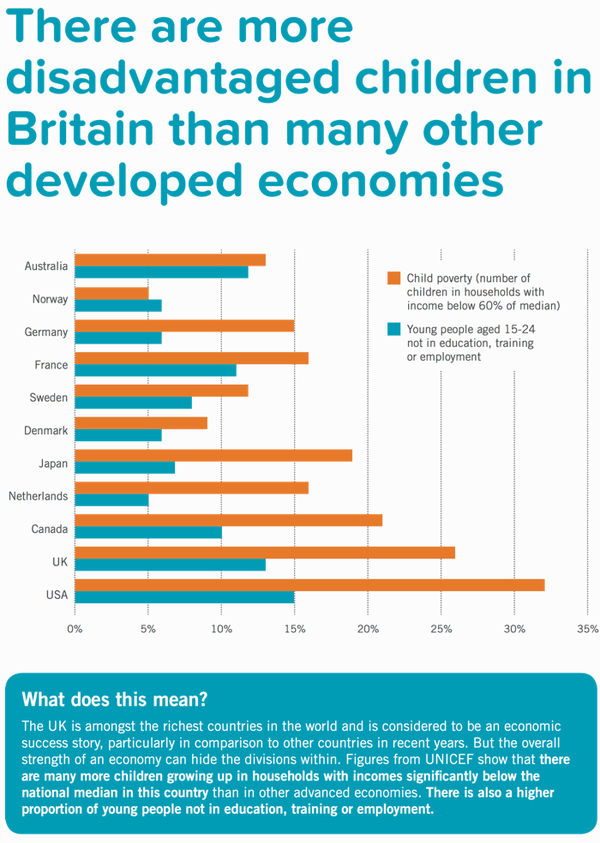
Graphic from Inequality Briefing

If ever you needed convincing evidence that austerity – which is central to neoliberalism and social conservatism – doesn’t benefit the majority, and that the UK has a system that extends inequality and increases poverty, this is it.

Furthermore, austerity was not imposed as an economic necessary, and there were other choices available to the UK government that were less damaging to the poorest citizens and to the economy.

UNICEF have published a report about the impact of the global economic crisis and its aftermath on children. It runs fron 2007 to 2013, so worryingly, the more recent UK government welfare cuts and the consequences are not yet included in this international analysis.

In the executive summary, the report says:

“For each country, the extent and character of the crisis’s impact on children has been shaped by the depth of the recession, pre-existing economic conditions, the strength of the social safety net and, most importantly, policy responses

Remarkably, amid this unprecedented social crisis, many countries have managed to limit – or even reduce – child poverty. It was by no means inevitable, then, that children would be the most enduring victims of the recession.”

The report goes on to say that those Governments that supported existing public institutions and programmes helped to buffer countless children from the crisis – a strategy that others may consider adopting.

The UK was quite clearly not one such country, and more recently, Iain Duncan Smith has conveniently announced changes to how we measure child poverty, shifting the economic responsibility and moral focus by blaming individuals for circumstances created by socioeconomic constraints and political decisions.

The report says:

“Many countries with higher levels of child vulnerability would have been wise to strengthen their safety nets during the pre-recession period of dynamic economic growth, which was marked by rising disparity and a growing concentration of  wealth.”

In the UK, inequality has grown since the recession because of austerity measures that have been targeted at the poorest households. In fact, the UK is now the most unequal country in the EU, and has even higher levels of inequality than the US.

“The magnitude of change since the recession is worth noting. The absolute number of children living in severe material deprivation in the 30 European countries analysed was 11.1 million in 2012 – 1.6 million more than in 2008

This trend is the result of a net effect that includes substantial decreases (more than 300,000 fewer deprived children in Germany and Poland) and unprecedented increases in four countries (Greece, Italy, Spain and the United Kingdom).”

Almost half of the severely materially deprived children (44 percent) in 2012 lived in three countries: Italy (16 percent), Romania (14 per cent) and the United Kingdom (14 per cent).

The report goes on to say:

“At the start of the recession, not surprisingly, child poverty was lower where public spending on families and children was higher. During the recession, welfare states were expected to increase their public protection spending, and many did. 

In such countries, the health and well-being of citizens, especially those in financial or social need, are safeguarded by grants, unemployment assistance programmes, pensions and other benefits. 

In a recession, these benefits act as counter-cyclical economic stabilizers.”

One of the most striking contrasts in the report was that whilst many other countries increased spending on welfare and essential public services to shelter the most vulnerable citizens from the impact of the global recession, in the UK, the government chose to target those social provisions for all of the austerity cuts.

The report says:

“Since 2010, the United Kingdom has implemented a series of cuts that have reduced the real value and coverage of child benefits and tax credits for families withchildren. In 2013, a cap was imposed on the total benefits a household can receive, mainly affecting a small number of large families with high housing costs, while housing benefits were cut (the so-called ‘bedroom tax’), affecting large numbers of social tenants.”

It’s clear that the impacts and aftershocks of the global recession were not shared equally in our society, and the austerity measures have only made things worse for those most affected – the poorest. One emerging certainty from this report is that economic indicators alone do not reveal the complexity of social reality.

The report recommends that governments increase investment in social protection policies and programmes that can reduce poverty, enhance social resilience in children and support economic development in an efficient, costeffective way.

Such measures include guaranteeing basic incomes for families, and a child rights impact assessment as strategy for political decision-making in the best interests of children.

Last year, I wrote that the government’s Children’s Commissioner for England published a report criticising the Coalition’s austerity policies, which have reduced the incomes of the poorest families by up to 10 percent since 2010.

The Children’s Commissioner said that the increasing inequality which has resulted from the cuts, and in particular, the welfare reforms, means that Britain is now in breach of the United Nations Convention on the Rights of the Child, which protects children from the adverse effects of government economic measures.

It therefore comes as no surprise that the current government is planning to repeal our Human Rights Act and replace it with an alternative Bill of Rights. That will mean that  human rights will no longer be absolute – they will be subject to stipulations and caveats. The government will establish a threshold below which Convention rights will not be engaged, allowing UK courts to strike out what are deemed “trivial cases”.

During their last term, the Conservatives contravened the Human Rights of disabled people, women and children. It’s clear that we have a government that regards the rights and wellbeing of most of the population as an inconvenience to be brushed aside.

You can read the UNICEF report in full here.

(Non -discrimination): The Convention applies to all children, whatever their race, religion or abilities; whatever they think or say, whatever type of family they come from. It doesn’t matter where children live, what language they speak, what their parents do, whether they are boys or girls, what their culture is, whether they have a disability or whether they are rich or poor. No child should be treated unfairly on any basis.

Article 3

(Best interests of the child): The best interests of children must be the primary concern in making decisions that may affect them. All adults should do what is best for children. When adults make decisions, they should think about how their decisions will affect children. This particularly applies to budget, policy and law makers.

Article 26

(Social security): Children – either through their guardians or directly – have the right to help from the government if they are poor or in need.

Article 27

(Adequate standard of living): Children have the right to a standard of living that is good enough to meet their physical and mental needs. Governments should help families and guardians who can not afford to provide this, particularly with regard to food, clothing and housing.

1957929_293215800829475_303676825_o

Largest study of UK poverty shows full-time work is no safeguard against deprivation

430835_148211001996623_1337599952_n (1)

By Andrew Naughtie, Deputy editor, Politics + Society, The Conversation

The largest study of poverty ever conducted in the UK has laid out the dire state of British deprivation – and seriously undercut the government’s claim to be lifting people out of poverty through work.

The Poverty and Social Exclusion in the UK (PSE) project details how, over the last 30 years, the percentage of households living below society’s minimum standard of living has increased from 14% to 33% – despite the fact that the economy has doubled in size over the same period.

The 3rd Peter Townsend Memorial Conference, which begins in London today, will hear from an array of academic analysts discussing the findings and how the problems they reveal can best be tackled.

The extent of poverty

Funded by the Economic and Social Research Council and led by the University of Bristol, the PSE report is based on surveys of more than 12,000 people made in June 2012. The surveys found that that millions of Britons in paid employment live with high levels of deprivation.

Among other things, the report found that around 5.5m adults go without essential clothing, around 2.5m children live in homes that are damp, and around 1.5m children live in households that cannot afford to heat their homes.

Meanwhile, one in four adults lives on an income below what they themselves consider necessary to avoid poverty, while one in every six in paid work is technically poor. More than one in five had been forced to borrow money to pay for basic day-to-day needs in the year prior to being surveyed.

But most topically of all, the PSE finds that full-time work is not always sufficient to keep families out of poverty. This calls into question the government’s flagship strategy of getting low-income families into employment and shifting them off state assistance.

Since 2010, Iain Duncan Smith, the work and pensions secretary, has put reducing unemployment and dependence on benefits at the core of his welfare policy. But the PSE finds that children who suffer multiple deprivations are not typically living in homes marked by family breakdown and unemployment.

Instead, the majority live with both parents, at least one of whom is employed; they live in small families, with one or two siblings, are white, and live in England.

The cost of austerity

Commenting on the study’s findings, Professor Jonathan Bradshaw of the University of York said they showed many parents who work full time still have to make huge sacrifices to try and protect their children from deprivation.

“We already know from DWP data that the majority of children with incomes below the the relative income poverty threshold have a working parent. The PSE survey shows that the majority of deprived children, those lacking two or more socially perceived necessities, and very deprived children (lacking five or more socially perceived necessities) have a working parent.

“We found that 65% of the deprived and 58% of the very deprived children had a working parent, and 50% of the deprived and 35% of the very deprived had at least one parent working full-time. Child poverty is not being driven by skivers, but is the consequence of strivers working for low earnings while in-work benefits are being dissipated by government austerity measures”.

The study finds that low wages are a central cause of the widespread deprivation it describes. For many people, full-time work is not enough to lift them out of poverty; almost half of the working poor work 40 hours a week or more. And one in six adults in paid work (17%) is poor, suffering low income and unable to afford basic necessities.

Reacting to the findings, Clare Bambra, professor of geography at Durham University, said that the research was a shameful picture of “the devastating and far-reaching human costs of inequality and poverty in the UK today”.

She said: “It’s shameful for a rich country like ours to be tolerating such levels of poverty especially amongst our children and young people. The mantra that work sets people free from poverty has been shown to be a grand old lie.

“We will be living with the long term consequences of this social neglect for decades to come – there are clear links between poverty and reduced life expectancy and higher rates of ill health, especially concentrated in deprived areas and the north.

“These findings show us the true cost of austerity.”

The Conversation

Andrew Naughtie, Deputy editor, Politics + Society, The Conversation

This article was originally published on The Conversation.

Read the original article.

Jeremy Corbyn confronted the Tories with the poverty they’re creating at PMQs – and all they could do was laugh – Liam Young

Originally published in the Independent by Liam Young.

jeremy-corbyn-1
The Tories seem to forget that they were the last government – at some point they will have to take responsibility for their handling of the nation.

As Jeremy Corbyn stood for his second PMQs today, the mocking Tory laughs told us everything we need to know about their enduring Bullingdon Club-style politics. Old habits die hard, it seems. But Corbyn opened strongly, with an issue that unites the Labour party: the cuts to working tax credits which penalise the lowest earners, known colloquially as the Tory work penalty.

Again, the Tories laughed at the name ‘Kelly’, so apparently unbelievable do they find the first names of Corbyn’s constituents; they soon fell silent, however, as they heard of her struggle as the mother of a disabled child earning minimum wage in a 40.5-hour-per-week job. Corbyn tackled the bullyboys by pausing at their laughter this time. ‘Some may find this funny,’ he said, as he continued to talk about mass inequality and the housing problem in London. It was a subtle highlight of something glaringly obvious: for millionaires protected by Tory policies, inequality bolstered by unfair taxes and buy-to-let properties really is hilarious.

Cameron’s reply to the work penalty issue was the same old line: apparently a £20-a-week increase in wages will magically solve the problem. This is not true, of course, as Corbyn promptly replied: working families are set to be £1,300 a year worse off as the Conservative government hammers the working and middle classes so as to give to the super rich.

Cameron claimed that Corbyn’s figures on poverty were wrong, but perhaps that is something to do with the fact that the Work and Pensions Secretary fixed the definition of ‘poverty’ recently. You don’t feed and clothe homeless children by changing a definition, and the government should be ashamed. The fact that 50 per cent of wealth is in 1 per cent of hands globally is shambolic, and reports today that inequality is growing in the UK even as our country now has the third most ‘ultra-high net worth individuals’ in the world put paid to Cameron’s claims to have driven opportunity. There could be no bigger proof that his policies continue to squeeze the middle and punish the poor.

Jeremy Corbyn probably had a headache even before PMQs started. George Osborne’s proposal of a ‘fiscal charter’ has been causing problems for Labour over the last few days, not least because it was once a Labour policy rubbished by Cameron himself. It seems strange, then, that Tories are so desperate to implement it now, considering that the Governor of the Bank of England has not endorsed its proposal and no economist has come out in support of it. Most commentary has focused on how it is unrealistic to try and tie the hands of future governments – almost as though Osborne is trying to make an ideological (and erroneous) point about how Labour ‘caused the recession by their overspending’, rather than the truth about rich bankers running wild without regulation. Of course, it also gave Osborne an excellent opportunity to personally ask Labour MPs to rebel – little more than a cynical attempt to ruffle some feathers.

In June, over 70 economists published a letter that clearly noted that the charter has ‘no basis in economics’ and that permanent surplus would increase the debt of households and businesses. The policy is not about protecting the British economy; it is an attempt to bury the Labour party under the same message of the last government. The Tories seem to forget that they were the last government – they have been in power now for almost six years, and at some point they will have to take responsibility for their handling of the nation.

Despite all this, PMQs today were the best moment of Corbyn’s leadership of the Labour party so far. Osborne’s attempt to destabilise the Labour party and force Labour MPs to rebel spectacularly failed, while Corbyn asked if he could bring the Prime Minister back to reality as Tory rhetoric failed against his grassroots facts.

Cameron wants to get Britain building houses, he wants to alleviate poverty, and he wants to rebuild the economy – or so he’d have you believe. In the last five years, house-building has stalled, poverty has increased, inequality appears to be rising and the national debt has doubled. At some point, the Tories have to stop blaming Labour for their own disastrous record. Corbyn is now attacking their mythology head-on – and he might just be getting somewhere. 

Liam Young is a freelance political journalist studying international relations at the LSE

Sanctions are founded on Tory psychobabble. You can’t “incentivise” people by starving them

430835_148211001996623_1337599952_n (1)

The fact that there is now such an extensive gap between Conservative rhetoric, the claims being made and reality makes the task of critical analysis difficult.

But the most striking thing isn’t just the disorientating gap between rhetoric and reality: it is also the gap between the bland vocabulary used and the references, meanings and implications of what is actually being said.

Lying, saying one thing and doing another, creating a charade to project one false reality when something else is going on, is very damaging: it leaves people experiencing such deception deeply disorientated, doubting their own memory, perception and sanity.

To cover their tracks and gloss over the gaping holes in their logic, the Tories employ mystification techniques, the prime function of which is to maintain the status quo. Marx used the concept of mystification to mean a plausible misrepresentation of what is going on (process) or what is being done (praxis) in the service of the interests of one socioeconomic class (the exploiters) over or against another class (the exploited). By representing forms of exploitation as forms of benevolence, the exploiters confuse and disarm the exploited.

The Conservatives also use Orwellian-styled language – semantic shifts – and construct incongruent, dissonance-inducing narratives to misdirect us, and to mask the aims and consequences of their policies.  For example, the words “fair”, “support” and the phrase “making work pay” have shifted to become simple socio-linguistic codifications for very regressive punitive measures such as cuts to social security support. 

The semantics are also stratified. People who are unaffected by austerity policies will probably take the bland vocabulary at face value. Cameron said:

“The British people are decent, sensible, reasonable, and they just want a government that supports the vulnerable.”

However, the “vulnerable” know a very different reality to the one substituted and described on their behalf. People who are adversely affected by Conservative policy will regard the bland vocabulary as bewildering, deceitful, frightening – especially because of its incongruence with reality – and most likely, as very threatening. Such rhetoric is designed to hide intention, but it is also designed to deliberately invalidate people’s own experiences of Tory policies and ultimately, the consequences of an imposed Tory ideology.

Not that there can be any mistaking the threats aimed at sick and disabled people from Duncan Smith in his Conference speech. He said:

“We won’t lift you out of poverty by simply transferring taxpayers’ money to you. With our help, you’ll work your way out of poverty.”

Of course the Work and Pensions secretary employed a traditionally Tory simplistic, divisive rhetoric that conveniently sections the population into “deserving” tax payers and “undeserving” non-tax paying citizens, to justify his balefully misanthropic attitude towards the latter group, as usual. However, the majority of sick and disabled people have worked and have contributed tax. 

Tory claims are incongruent with reality, evidence, academic frameworks and commonly accepted wisdom.

As Dr Simon Duffy, from the Centre for Welfare Reform points out, the poor not only pay taxes they also pay the highest taxes.  For example, the poorest 10% of households pay 47% of their income in tax. This is a higher percentage than any other group. We tend to forget that people in poverty pay taxes because we forget how many different ways we are taxed:

  • VAT
  • Duties
  • Income tax
  • National Insurance
  • Council tax
  • Licences
  • Social care charges, and many others taxes.

Mr Duncan Smith said that many sick and disabled people “wanted to work” and that the Government should give them “support” to find jobs and make sure the welfare system encouraged them to get jobs.

Ah, he means the “making work pay,” approach, which is the Tory super-retro approach to policy-making, based on the 1834 Poor Law principle of less eligibility again.  The reality is that sick and disabled people are being coerced by the state into taking any very poorly paid work, regardless of whether or not they can work, and to translate the rhetoric further, Duncan Smith is telling us that the government will ensure the conditions of claiming social security are so dismal and brutal that no-one can survive it.

Cameron also claims that the Conservatives are the “party for workers”, and of course lamblasted Labour. Again. Yet it was the Labour party that introduced tax credits to ensure low paid workers had a decent standard of living, and this government are not only withdrawing that support, we are also witnessing wages drop lower than all of the other G20 countries, since 2010, the International Labour Organisation reliably informs us.

This fall not only led to a tight squeeze on living standards (the cost of living has rapidly increased), it also led to a shortfall in treasury income in the form of tax revenues. But all of this is pretty standard form for Conservative governments, and shouldn’t come as any surpise, given their history and ideological foundation. We see recession, lower standards of living, wages being driven down and poorer working conditions under very single Tory government. Thatcher did the same, for example.

And Cameron’s promise during his address to the Conservative party conference that “an all-out assault on poverty” would be at the centre of his second term is contradicted by a sturdy research report from the Resolution Foundation that reveals planned welfare cuts will lead to an increase of 200,000 working households living in poverty by 2020.

Duncan Smith also criticised what he claimed was Labour’s “something for nothing culture” which was of course a very supportive and fair, reasonably redistributive system. He also dismissed and scorned the protests against his policies, which his party’s conference has been subject to. But demonstration and protest is a mechanism of democracy for letting a government know that their policies are having adverse consequences.

Many of the disabled protesters at the conference are being hounded, hurt and persecuted by this government and actually, we are fighting for our lives. But clearly this is not a government that listens, nor is it one that likes democratic dialogue and accountability.

In his teeth-grindingly vindictive and blindly arrogant speech, Duncan Smith also criticised the old Employment Support Allowance benefit for signing people off work when they were judged by doctors as too sick to work. He claimed that Labour treated disabled people as “passive victims.” I’m wondering what part of professional judgements that a person is too sick to work this lunatic and small-state fetishist finds so difficult to grasp. Duncan Smith is a confabulating zealot who drives a dogmatic steam-roller over people and their experiences until they take some Tory neo-feudalist deferential, flat-earth shape that he thinks they should be.

Let’s not forget that this government have actually cut support for disabled people who want to work. The Access To Work funding has been severely cut, this is a fund that helps people and employers to cover the extra living costs arising due to disabilities that might present barriers to work. The Independent Living fund was also cruelly scrapped by this Government, which also has a huge impact on those trying their best to lead independent and dignified lives.

By “support to get jobs”, what Duncan Smith actually means is no support at all. He means more workfare – free labor for Tory donors – and more sanctions – the removal of people’s lifeline social security. He also means that good ole’ totalitarian dictum of “behaviour change,” a phrase that the Tories are bandying about a lot, these days.  Ask not what the government can do for you.

And what about the very frail and elderly people needing support?

The public care sector has been cut by a third this past 5 years, yet people are still aging and living longer, so demand for the services has risen. We know that private residential care homes notoriously put profit over care standards, as yet there’s not been an equivalent local authority scandal, but cuts and gross underfunding mean care workers are stretched beyond limit, and there aren’t enough funds to run an adequate home care service. It’s mostly the very frail and elderly who need this service. And it’s those vulnerable citizens that are being increasingly left without adequate care, and certainly not care of a sufficient standard to maintain their dignity.

These are citizens that have paid into a social security system that was established for “cradle to the grave” support if it was needed. This government has so wickedly betrayed them. That’s hardly making a lifetime of work and contribution “pay”.

The knock-on effect is that many people without adequate care end up stranded in hospital, taking up beds and resources, through no fault of their own, and as we know, the health service is also desperately struggling to provide adequate service because of Tory cuts.

Tory policy is all about social engineering using justification narratives founded on an insensate, draconian ideological and semantic unobtainium equivalent. It’s clear that this government lacks the experience and understanding necessary for the proper use of psychological terms. The content of their smug and vindictive justification narratives and stapled-together, alienating and psychopathic rhetoric deviates markedly from even basic common sense and good judgement.

The Tories reduce long debated, complex ideas to surprisingly spiteful platitudes, and hand us back dogmas gift wrapped in aggrandized certitude.

They bandy about insidiously bland, psychobabble words like “incentivise” in the context of coercive state actions – such as the ideas for welfare increased conditionality and brutal operant conditioning based sanctions.

I sent an Freedom of Information request (FOI) to the Department of Work and Pensions asking about the sanction figures from 2010 to present day, and I also asked how sanctions can possibly “incentivise” or “help” people into work,  what psychological/academic/theoretical framework the claim is premised on and what research evidence supports this claim, after I pointed out Maslow’s motivation theory based on a hierarchy of needs – accepted conventional wisdom is that you can’t fulfil higher level psycho-social needs without first fulfiling the fundamental biological ones.

If people are reduced to struggling to meet basic survival needs, then they can’t be “incentivised” to do anything else. And even very stupid people know that if you remove people’s means to eat, keep warm and shelter, they will probably die. It’s worth remembering that originally, benefits were calculated to meet only these basic survival needs. That’s why welfare is called a social “safety net”.

No response from the Department of Work and Pensions yet.

maslow-5Maslow’s hierarchy of needs

There can be no justification whatsoever for removing that crucial safety net, and certainly not as a political punishment for people falling on hard times – that may happen to anyone through no fault of their own.

No matter what vocabulary is used to dress this up and attempt to justify the removal of people’s lifeline benefits, such treatment of citizens by an allegedly democratic, first-world government is unacceptable, despicable, cruel: it’s an act of violence that cannot fail to cause harm and distress, it traps people into absolute poverty and it is particularly reprehensible because it jeopardises people’s lives.

And what kind of government does that?

This is an excerpt, taken from a much longer article about the Tory Conference.
430847_149933881824335_1645102229_n (1)
Related

Sanctions misery for tens of thousands of families this Christmas

If the Tories don’t like being compared to the Nazis, then they need to stop behaving like despots.

Government under fire for massaging unemployment figures via benefit sanctions from Commons Select Committee

A tale of two suicides and a very undemocratic, inconsistent government

Rising ESA sanctions: punishing sick and disabled people for being sick and disabled

Benefit sanctions are not fair and are not helping people into work

292533_330073053728896_1536469241_nThanks to Robert Livingstone for the illustrations

The new social prescribing: ask not what your government can do for you

socialprescribing


I have a background in community work and have always seen it as a progressive mechanism for social transformation; challenging oppression; extending inclusion and democracy; offering learning and personal growth opportunities; empowerment, social justice, equity, fairness, participation, self-determination, amongst many other things. Communities potentially provide essential support for individuals, groups and organisations, and opportunities for reciprocity. Good community work promotes human development, and fosters civic responsibility through solidarity, cooperation and mutual aid.

Social prescribing is basically a community-based referral: it’s a means of enabling primary care services to refer patients with psycho-social, emotional or practical needs to a range of local, non-clinical services, often provided by the voluntary and community sector, and it’s aim is to improve people’s mental health, physical health and wellbeing, using community interventions.

In practice this means that GPs, nurses and other healthcare practitioners work with patients to identify non-medical opportunities or interventions that will help, improving support and the wider social aspects of their lives. The services that patients can choose from include everything from debt counselling, support groups, allotments and walking clubs, to community cooking classes and one-to-one coaching. Both evidence and commons sense suggests that social prescribing may be particularly appropriate and beneficial for isolated, marginalised groups. And needs-led community provision that supports and enhances psychosocial health and wellbeing is an excellent idea.

Poor mental health is often correlated with poverty, (Melzer et al. 2004) poor community integration, and competitiveness amongst social groups (Arrindell et al., 2003). Key questions arise as to the efficacy, therefore, of working with individuals, when much research suggests community work would be more effective (Orford, 2008).

So far so good.

I had the following message yesterday from friend and fellow writer, Linda:

“I have received an email from my local Tory MP letting me (and other constituents) know that he is going to be setting up a ‘Mental Health Surgery’ Hub with a ‘Mental Health Expert’ who will be handing out ‘social Prescriptions’ as he says he is aware that many mental health problems are caused by ‘Social Problems’. Im wondering if there is perhaps a wider agenda from the Conservatives.”

This is the relevant paragraph taken from his email:

“Since my election in May I have been surprised at the number of my constituents with different mental health issues, so much so I am looking to run a surgery ‘hub’ with a mental health specialist so people can drop in and have their needs assessed and be issued with a form of ‘social prescription’. I recognise many mental health issues are caused or exacerbated by social factors so sometimes a social solution can be more effective than a medical one.

I did a little research.

The 2010 Marmot Review (Fair Society, Healthy Lives) of health inequalities identified social prescribing as an, “approach [that] facilitates greater participation of patients and citizens and support in developing health literacy and improving health and wellbeing”.

It identified additional NHS healthcare costs linked to inequality as being well in excess of £5.5 billion per year. It is claimed that social prescriptions can cut the NHS bill.

However, despite the growing popularity of social prescriptions amongst cash and resource-strapped professionals, the University of York has surprisingly produced research to show that there is little good quality evidence that social prescribing is cost-effective.

But the thing that bothers me the most is the link that the Conservative government have made between social prescriptions, cost-cutting and (as I deeply suspected) as a mechanism of extending behavioural modification (euphemistically called “nudging” by the government’s team of behavioural economists and decision-making “experts”).

I read several current reviews of social precribing, each mentioning both criteria in recommendations for “success.”:

“The work of social prescribing health trainers fits with the approach of the Coalition Government as described in its White Paper on Public Health which emphasises the need to ‘build people’s self esteem and confidence’ in order to bring about changes in behaviour.”

It also fits with the Marmot Review’s recommendation on tackling the social problems that undermine health and with the Coalition Government’s approach to behaviour change as outlined in recent publications such as MINDSPACE.” (Link added by me.)

and:

“In times when finances are under pressure and the NHS is charged with achieving ‘better for less’, primary care needs to be looking at how to do things differently.”

Nesta, who now partly own the Government’s Behavioural Insights Team (the Nudge Unit) are of course at the forefront of promoting social prescriptions amongst medical professionals, firmly linking what is very good idea with very anti-democratic Conservative notions of behaviour change, citizen responsibility and small-state ideology. So, it’s no longer just about helping people to access a wider range of community-based services and support, social prescribing has also places strong emphasis on “encouraging patients to think about how they can take better care of themselves.”

Of course, there is what may easily be construed as a whopping self-serving process of linking behavioural change with social prescribing, opening some potentially very lucrative opportunities for Nesta.  

However, taken at face value, the idea of promoting patient participation in their own care sounds very democratic and reasonable. Common sense, in fact.

In this context, social prescribing can be seen as a logical extention of the Biopsychosocial model (BPS) of ill health. The biological component of the model is based on a traditional allopathic (bio-medical) approach to health. The social part of the model investigates how different social factors such as socioeconomic status, culture and poverty impact on health. The psychological component of the biopsychosocial model looks for potential psychological causes for a health problem such as lack of self-control, difficulties with coping, emotional turmoil, and negative thinking.

Of course a major criticism is that the BPS model has been used to disingenuously trivialise and euphemise serious physical illnesses, implying either a psychosomatic basis or reducing symptoms to nothing more than a presentation of malingering tactics. This ploy has been exploited by medical insurance companies (infamously by Unum Provident in the USA) and government welfare departments keen to limit or deny access to medical, social care and social security payments, and to manufacture ideologically determined outcomes that are not at all in the best interests of patients, invalidating diagnoses, people’s experience and accounts, and the existence of serious medical conditions.

Unum was involved in advising the government on making the devastating cuts to disabled people’s support in the UK’s controversial Welfare Reform Bill. (See also: The influence of the private insurance industry on the UK welfare reforms.)

Secondly, this is a government that tends to emphasise citizen responsibilities over rights, moralising and psychologizing social problems, whilst quietly editing out government responsibilities and democratic obligations towards citizens.

For example, poverty, which is caused by political decisions affecting socioeconomic outcomes, is described by the Conservatives, using elaborate victim-blame narratives, and this is particularly objectionable at a time when inequality has never been greater in the UK. Poverty may only be properly seen in a structural context, including account of the exclusion and oppression experienced by those living in poverty, the global neoliberal order, the gender order, the disability, racial, sexual and other orders which frame social life and precipitate poverty in complex and diverse ways. It’s down to policy-makers to address the structural origins of poverty, not the poor, who are the casualities of politically imposed structural constraints.

In this context, social prescriptions are used to maintain the status quo, and are likely to be part of a broader process of responsibility ascription – based on the traditional Conservative maxim of self-help, which is used to prop up fiscal discipline and public funding cuts, the extensive privatisation of public services, defense of private property and privilege, and of course, the free market. The irony of the New Right, neoliberal, paternalistic libertarianism is that the associated policies are not remotely libertarian. They are strongly authoritarian. It’s a government that doesn’t respond to public needs, but rather, it’s one that pre-determines public interests to fit within an ideological framework

A government that regards individuals as the architects of their own misfortune tends to formulate policies that act upon individuals to change their behaviour, rather than to address the structural constraints (and meet public needs,) such as social injustice and unequal access to resources. This isn’t a government prepared to meet public needs at all. Instead it’s a government that expects citizens to change their behaviour to accommodate the government’s ideologically directed needs.

That approach flies in the face of established professional community work values and principles.

Poor people suffering mental ill health because we live in a society that is extremely unequal, are blamed by the government for the “symptoms” of their poverty – poor eating habits and “lifestyle choices”. But poverty is all about limited choices, which is itself not a “lifestyle choice.” No-one actually chooses to be poor. Government policies, social structures and systemic failures create poverty.

The Conservatives extend an economic Darwinism, coupled with an extremely intrusive disciplinary approach, mass surveillance and a stigmatising rhetoric, whilst moralising a free-market framework that constrains many and preserves the privilege of a few. The absurdity is this: if an economic framework isn’t meeting the needs of a population, it isn’t an adequate response for the government to act upon citizens who have become casualities of that framework, to persuade or coerce people into fitting within an increasingly harmful and useless socioecomomic ideology.

There is a clear correlation with low socioeconomic status and poor mental health. Poverty is a complex, multidimensional phenomenon, encompassing the lack of means to satisfy basic needs, lack of control over resources, often, a lack of access to education, exclusion from opportunities, and poor health. Poverty is intrinsically alienating and distressing, and of particular concern are the direct and indirect effects of poverty on the development of psychosocial stress. (See also: The Psychological Impact of Austerity – Psychologists Against Austerity.)

State “therapy” aimed at changing the behaviour of individuals diverts attention from growing inequality, and from policies that are creating circumstances of absolute poverty. It also diverts attention from the fact that if people cannot meet their basic physiological needs, they cannot possibly be “incentivised” to meet higher level psychosocial ones. 

I wrote a critical analysis of the government proposal to introduce Cognitive Behaviour Therapists to deliver state “therapy” in job centres earlier this year, with the sole aim of improving “employment outcomes.” There is also an extensive critique of Cognitive Behaviour Therapy (CBT) included in the article, along with some discussion about the merits of community work, which is very relevant to this discussion. (See: The power of positive thinking is really political gaslighting.)

I also wrote earlier this year about how the government has stigmatised and redefined unemployment, problematizing and re-categorising it as an individual psychological disorder. Both articles are very pertinent to this discusion. (See: Stigmatising unemployment: the government has redefined it as a psychological disorders.)

Welfare has been redefined: it is a now a reflecton of a government pre-occupied with assumptions about and modification of the behaviour and character of recipients rather than with the alleviation of poverty and ensuring economic and social wellbeing.

The stigmatisation of people needing benefits is designed purposefully to displace public sympathy for the poor, and to generate moral outrage, which is then used to further justify the steady dismantling of the welfare state.

Many psychosocial problems have arisen because of social conservatism and neoliberalism. The victims of this government’s policies and decision-making are being portrayed as miscreants – as perpetrators of the social problems caused by the government’s decisions.

It’s all too often the case that good ideas are placed in political ideological frameworks, distorted, and are then applied to simply justify and prop up dogma.

Meanwhile, mental health services are facing crisis because of budget cuts by this government, Local Authorities and community services have also been cut to the bone. (See: The cost of the cuts: the impact on local government and poorer communities.) Those with mental health problems are stranded on an ever-shrinking island.

Policy initiatives such as social prescriptions, which focus on how to remediate problems at an individual level, seeing both poverty and mental illness, for example, as simply states of being – rather than dealing with the generative political and economic practices and social relations framework which precipitated that state in the first place, effectively depoliticises political problems leaving people with an internalised state of oppression, disabling them from taking effective action.

The political refusal to permit people to voice their concerns and anxieties in political rather than personal terms further exacerbates sociopolitical marginalisation, low status, it breaks a sense of connectedness with others and wider communities, it reinforces a sense isolation and of personal responsibility for circumstances that are politically constructed and disowned.


Austerity Is a Choice, Labour Must Offer Another – Jeremy Corbyn

1459720_569627496440116_902730897_n

Austerity is a political choice not an economic necessity. When the Chancellor rose to his feet at the emergency Budget in July, and when he does so for his Spending Review in October, what is being put forward is an ideologically-driven rolling back of the state.

The analysis published today by the TUC reveals how the Budget gives money to the rich, but takes away from the poor.

jeremy corbyn

This is the Conservative project, dressed up in the post-crisis language of budget deficits and national debt for extra impetus. Inequality doubled under the Thatcher government, and her heirs seem to be doing all they can to ensure that legacy is extended.

The Budget showed austerity is about political choices, not economic necessities. There is money available: the inheritance tax cuts announced in the Budget will lose the exchequer over £2.5billion in revenue between now and 2020. What responsible government committed to closing the deficit would give a tax break that only applies to the richest 4% of households?

The Conservatives are giving away to the very rich in inheritance tax cuts twice as much as reducing the benefit cap will raise by further impoverishing the poorest, and socially cleansing many towns and cities.

Another choice was to cut UK corporation tax to 18%, which at 20% is already the lowest in the G7, lower too than the 25% in China, and half the 40% rate in the United States.

The Treasury estimates that this political choice will see our revenue intake from big business fall by £2.5billion in 2020. That’s nearly twice the amount saved by cutting the tax credits available families with more than two children.

In such circumstances, Labour must be clear: we oppose the Budget, and we oppose austerity. As a group of 40 economists wrote to the Observer a few weeks ago, “opposition to austerity is actually mainstream economics, even backed by the conservative IMF”.

The language of “bringing down the deficit” is non-controversial, it is the method (austerity) that reveals the Chancellor’s agenda as just a cover for the same old Conservative policies: run down public services, slash the welfare state, sell-off public assets and give tax cuts to the wealthiest.

I stood in this race because Labour should not swallow the story that austerity is anything other than a new facade for the same old Conservative plans.

We must close the deficit, but to do so we will make the economy work for all, and create a more equal and prosperous society. Bringing down the deficit on the backs of those on low and average incomes will only mean more debt, more poverty, more insecurity, more anxiety and ultimately more crisis.

We must invest in a more productive economy. Our national infrastructure – energy, housing, transport, digital – is outdated, leaving the UK lagging behind other developed economies. In the Budget, the Chancellor cut back public investment even further.

You cannot cut your way to prosperity. We need to invest in our future. And that takes a strategic state that seeks to shape the economy so that it works for all.

That is the choice for Britain and the choice that Labour must offer.

Jeremy Corbyn is the Labour MP for Islington North and Labour Party leader.

This article was originally published on 7.09.15

1450041_569755536427312_1698223275_n
Pictures courtesy of Robert Livingstone


Tory policies are class contingent, express prejudice and are discriminatory

incon
Conservatives persistently peddle a fallacy that they don’t subscribe to an ideological belief system.
Francis Fukuyama announced the end of history and the arrival of a post-ideological world. But Fukuyama’s declarations were really just New Right ideology incognito.

I always saw Fukuyama as an ardent champion of ultra-neoliberalism, and he disguised his neo-conservatist ideology behind apparently benign virtue words and phrases (as part of a propaganda technique called Glittering Generalities), such as “Man’s universal right to freedom.” 

He meant the same sort of self-interested “freedom” as Ayn Rand – “a free mind and a free market are corollaries.” He meant the same kind of implicit Social Darwinist notions long-held by Conservatives like Herbert Spencer – where the market rather than evolution decides who is “free,” who survives; and as we know, that’s rigged in favour of a minority of rich and powerful people, by rich and powerful people. Tory ideology does not ever yield a remotely utilitarian outcome.

Fukuyama’s ideas have been absorbed culturally, and serve to naturalise the dominance of the Right, to stifle the rationale for critical debate and discredit alternatives. Not all “common sense” is established by consensus, nor does it always make sense. Tacit assumptions and prejudices often lie beneath the stock of glittering generalities and comforting soundbites that are quite commonly what passes as public and political acumen.

To quote Owen Jones:

“Since they were founded as a modern political force in 1834, the Conservatives have acted as the parliamentary wing of the wealthy elite. When I was at university, a one-time very senior Tory figure put it succinctly at an off-the-record gathering: the Conservative Party, he explained, was a “coalition of privileged interests. Its main purpose is to defend that privilege. And the way it wins elections is by giving just enough to just enough other people.”

It’s not just that Tories don’t reflect working class interests though. It’s much worse. Margaret Thatcher’s policies caused premature deaths, and her Cabinet were far less harsh towards unemployed, sick and disabled people than Cameron’s government.

A research report which looked at over 70 existing research papers concludes that as a result of unnecessary unemployment, welfare cuts and damaging housing policies, the former prime minister’s legacy includes the unnecessary and unjust premature death of many British citizens, together with a substantial and continuing burden of suffering and loss of well-being.

It doesn’t take a genius to work out that if you inflict stress and harm on people who are already ill, by withholding their lifeline support; by constantly reassessing them and telling them they are fit for work when they clearly are not; by invalidating their experiences, by forcing them to fight for the means of survival – without having the means of survival, it will probably exacerbate any illness and quite possibly, this will kill them.

Cameron and his government have consistently displayed an absolute lack of concern for sick and disabled people, who have borne the brunt of Tory austerity cuts. Yet it’s inconceivable that Conservatives don’t grasp the fact that their policies are at least potentially very harmful, and certainly very punitive in nature.

Government policies are expressed political intentions, regarding how our society is organised and governed. They have calculated social and economic aims and consequences.

Tory ideology is founded on toxic subterranean values and principles, which are anachronistic and incompatible with a society that has evolved to value democracy, human rights and the socio-economic gains from our post-war settlement.

Conservatives have always seen inequality as a necessary and beneficial element to a market driven economy, for example; and their policies tend to assemble a steeply hierarchical society, especially given their small state fetishism, which involves removing socioeconomic support services and civilising mechanisms such as welfare, free healthcare and access to legal aid.

Beneath the familiar minarchist, class contingent Conservative policies and neoliberal schema is a tacit acceptance of socioeconomic Darwinism and a leaning towards eugenicist principles, expressed most clearly recently in the withdrawal of tax credit support for low paid families with more than two children, in order to “change behaviours” as Iain Duncan Smith put it. The reasoning behind this is the government believe they can “nudge” poor people into “breeding” less. Such a class contingent policy, based on archaic methods of operant conditioning, reflects a deep prejudice and also demonstrates a considerable degree of authoritarianism that is certainly incompatible with democracy.

(See also David Freud was made to apologise for being a true Tory in public, Paternalistic Libertarianism and Freud’s comments in context and What will the Tories suggest next. “Compassionate” eugenics?)

The Tories employ a variety of strategies to attempt to justify their ideology, narratives and policies amongst which are techniques of neutralisation. These are used to rationalise or justify acts that contravene social norms or that are illegal.  There are five basic techniques of neutralization; denial of responsibility; denial of injury; denial of victims; condemnation of the condemners and an appeal to higher loyalties.

The recognition of techniques of neutralisation by David Matza and Gresham Sykes happened during their work on Edwin Sutherland’s Differential Association in the 1950s. Matza and Sykes were working on juvenile delinquency at the time, and they theorised that the same techniques could be found throughout society and published their ideas in Delinquency and Drift, 1964.

It was Alexander Alverez who identified that these techniques were used more broadly at a socio-political level in Nazi Germany to “justify” the Holocaust. He added a sixth technique – Disengagement and Dehumanisation.

Such techniques allow people to neutralise and temporarily suspend their commitment to societal and moral values, and to switch off their own “inner protests”, providing them with the freedom to commit deviant acts. Some people don’t have such inner protests – psychopaths, for example – but they may employ techniques of neutralisation to manipulate, and switch off the conscience protests of others.

It’s clear that this is a method frequently employed by the government. The Tories systematically attempt to distort meanings, to withhold, or to deny any evidence that may expose the impact of their draconian policies on targeted social groups.

For example, when the Tories habitually and dishonestly use the word “reform” in reference to cutting public funding or support and “help” and “support” is Tory-speak that means to coerce and punish. The claim that the bedroom tax is “helping” people into workorhelping child poverty– when empirical research shows that 96% of those affected by the bedroom tax can NOT downsize due to a lack of available homes in their area – is a completely outrageous lie. People can’t move as there is a housing crisis, which is due to a lack of affordable homes and appropriately sized accommodation.

How can policies that further impoverish the poorest ever “help them to into work” or alleviate poverty? It’s glib, irrational tosh from a Government that can’t do coherent, joined up thinking, and even worse, thinks that we can’t either.

Forms of social prejudice are normalised gradually, almost inscrutably and incrementally – in stages. Allport describes the political, social and psychological processes, and how techniques of persuasion – propaganda – are used to facilitate stigmatising and dehumanisation of targeted groups to justify discrimination, until the unthinkable becomes acceptable, because of a steady erosion of our moral and rational boundaries.

The prejudice happens on a symbolic level first – via language – and it starts with subtlety, such as the use of divisive and stigmatising phrases like “scroungers and strivers” in the media and political rhetoric, referring to people who need support and social security as “stock”, suggesting that disabled people are not worth a minimum wage and so on.

These comments and strategies are not “mistakes”; this is how Conservatives really think. People who are prejudiced very seldom own up to being so, nor do bullies. They employ linguistic strategies, deceitful, diversionary and irrational responses that makes challenging them very difficult.

But as history has taught us, we really must challenge them.

This was taken from a longer article, in part – Techniques of neutralisation: David Cameron’s excuses for Iain Duncan Smith

Related

Conservatism in a nutshell

Briefing on How Cuts Are Targeted – Dr Simon Duffy

Inverted totalitarianism and neoliberalism. Oh dear.

There is no such thing as a ‘one nation’ Tory: they always create two nations

Inequality has risen: Incomes increased for the richest last year, but fell for everyone else

The UK is now the most unequal country in EU, and Cameron has been very conservative with the truth

Cameron’s Gini and the hidden hierarchy of worth

Follow the Money: Tory Ideology is all about handouts to the wealthy that are funded by the poor

‘We are raising more money for the rich’ revisited: some thoughts

UK becomes the first country to face a UN inquiry into disability rights violations

Aktion Arbeitsscheu Reich, Human Rights and infrahumanisation

A list of official rebukes for Tory lies

demcracyPictures courtesy of Robert Livingstone

The budget: from trickle-down to falling down, whilst holding hands with Herbert Spencer.

proper Blond
“We are moving Britain from a high welfare, high tax economy, to a lower welfare, lower tax society.”

George Osborne, 8 July 2015

The pro-wealthy and anti-humanist budget indicates clearly that the Conservatives are preoccupied with highlighting and cutting the state cost of sustaining the poorest citizens rather than the costs of subsidising the rich.

I’ve pointed out before that the Conservatives operate a perverse, dual logic: that wealthy people need support and encouragement – they are offered substantial financial incentives – in order to work and contribute to the economy, whereas poor people apparently need to be punished – by the imposition of financial cuts – in order to work and contribute to the economy.

That Osborne thinks it is acceptable to cut the lifeline benefits of sick and disabled people to pay for government failures, whilst offering significant cuts to corporation tax rates; raising the tax-free personal allowance and extending inheritance tax relief demonstrates very clearly that the myth of trickle-down is still driving New Right Conservative ideology, and that policy is not based on material socio-economic conditions and public need. (And Cameron is not a one-nation Tory, despite his claims.)

Research by the Tax Justice Network in 2012 indicates that wealth of the very wealthy does not trickle down to improve the economy, but tends to be amassed and sheltered in tax havens with a detrimental effect on the tax bases of the home economy.

A more recent report – Causes and Consequences of Income Inequality : A Global Perspective by the International Monetary Fund concluded in June this year that there is no trickle-down effect –  the rich simply get richer:

“We find that increasing the income share of the poor and the middle class actually increases growth while a rising income share of the top 20 percent results in lower growth—that is, when the rich get richer, benefits do not trickle down.”

It’s inconceivable that the Conservatives fail to recognise such policy measures will widen inequality. Conservatives regard inequality and social hierarchy as inevitable, necessary and functional to the economy. Furthermore, Conservatives hail greed and envy as emotions to be celebrated, since these drive competition.

Since the emergence of the New Right, from Thatcher to Cameron, we have witnessed an increasing entrenchment of Neoliberal principles, coupled with an aggressive, authoritarian brand of social conservatism that has an underpinning of crude, blunt social Darwinist philosophy, as carved out two centuries ago by the likes of Thomas Malthus and Herbert Spencer.

Spencer is best known for the expression “survival of the fittest,” which he coined in Principles of Biology (1864), after reading Charles Darwin’s work. Spencer extended natural selection into realms of sociology, political theory and ethics, ultimately contributing to the eugenics movement. He believed that struggle for survival spurred self-improvement which could be inherited. Maslow would disagree. All a struggle for survival motivates is just a struggle for survival.

Spencer’s ideas of laissez-faire; a survival-of-the-fittest brand of competitive individualism; minarchism – minimal state interference in the processes of natural law – and liking for private charity, are echoed loudly in the theories of 20th century thinkers such as Friedrich HayekMilton Friedman and Ayn Rand who each popularised Spencer’s ideas, whilst Neoliberal New Right Conservatives such as Ronald Reagan, Margaret Thatcher and David Cameron have translated these ideas into policies.

Ideology has considerable bearing on policies, and policies may be regarded as overt, objective statements of political intent. I’ve said many times over the past five years that Conservatives have forgotten that democracy is based on a process of dialogue between the public and government, ensuring that the public are represented: that governments are responsive, shaping policies that address identified social needs. Conservative policies are quite clearly no longer about reflecting citizen’s needs: they are increasingly authoritarian, and all about telling us how to be.

Conservatives have always coldly conceived society as a hierarchy of human value, and they have, from their pinnacle of supremacist, self-appointed authority, historically cast the vulnerable and the poorest as the putative “enemies of civilization.” Social Darwinism is written in bold throughout their policies.

Furthermore, such a combination of Neoliberal and Conservative political theory, explicitly opposes democratic goals and principles. Neoliberalism was originally used by academics on the Left as a pejorative to capture the policies of imposed exploitation, privatisation, and inequality.

Neoliberalism is now characterised by the use of international loans and other mechanisms to suppress unions, squash state regulation, elevate corporate privilege, privatise public services, and protect the holdings of the wealthy. The term became widely recognised shorthand for rule by the rich, authoritarianism and the imposition of limits on democracy.

Banks, corporations, the financial sector, and the very wealthy are exercising power and blocking any attempt to restructure the economic system that brought about the crash.

Meanwhile, the free market is a market free for powerful interests; the profit motive has transformed the organising value of social life, and those who the Conservatives evidently regard as collateral damage of this socio-economic dogma made manifest are paying the price for the global crash, with Osborne and the Conservatives constructing narratives that problematise welfare support, generating moral panic and folk devils to demonise the poorest citizens in need of support.

Growing social inequality generates a political necessity for cultivating social prejudices.

Such Othering narratives divert public attention from the fact that the right to a fair and just legal system, a protective and effective safety net for the poorest, free healthcare – all of the social gains of our post-war settlement – are all under attack.

I have said elsewhere that Conservative ideology is incompatible with our legal commitments to human rights. The United Nations declaration of Human Rights is founded on the central tenet that each and every human life has equal worth. The Conservatives don’t agree, preferring to organise society into hierarchies of worth and privilege.

Conservative austerity measures and further impending welfare cuts are not only a deliberate attack on the poorest and most vulnerable social groups; the range of welfare cuts do not conform to a human rights standard; the “reforms” represent a serious failure on the part of the government to comply with Britain’s legal international human rights obligations.

The cuts announced by the chancellor include a further reduction to the benefits cap – not only from £26,000 to £23,000, as promised in the Conservative Party’s 2015 manifesto, but down even further to £20,000 outside of London.

Child tax credit, housing benefit and working tax credit will be reduced, with child tax credit only being paid for the first two children. Presumably this is, to quote Iain Duncan Smith, to “incentivise behavioural change,” placing pressure on the poorest to “breed less,” though personally, being the direct, blunt, no-nonsense sort, I prefer to call it a nudge towards “eugenics by stealth.”

The Social Mobility and Child Poverty Commission say that any cuts to tax credits will cut the incomes of 45 per cent of working families. These cuts are particularly controversial, since the benefits cap was partly justified as a way of “making work pay”  – a Conservative narrative that echoes the punitive 1834 New Poor Law Principle of less eligibility – see: The New New Poor Law.

The Government asserts that its welfare “reform” strategy is aimed at breaking the cycle of “worklessness” and dependency on the welfare system amongst the poorest families. It’s more punitive Poor Law rhetoric.

There’s no such thing as “worklessness”, it’s simply a blame apportioning word, made up by the Tories to hide the fact that they have destroyed the employment market, just as Thatcher did, and as the Conservatives always do.

Punishing the low paid, cutting the income of families who work for low wages directly contradicts the claim that the Conservatives are “making work pay.”

Yet Osborne has framed his welfare cuts with the “The best route out of poverty is work” mantra, claiming that slashing the social security budget by £46 billion in the next five years, (including cutting those benefits to disabled people, who have been assessed as unfit for work and placed in the Work Related Activity Group (WRAG), and cutting in-work benefits, such as tax credits) is needed to make sure “work pays” and that: “we give a fair deal for those on welfare and a fair deal to the people, the taxpayers of this country who pay for it.”

The Conservatives always conveniently divide people into an ingroup of taxpayers and an outgroup of stigmatised others – non-tax payers. However, most people claiming benefits are either in work, and are not paid enough, through no fault of their own, to pay tax, or are pensioners who have worked most of their lives; or are unemployed, but have previously worked and contributed tax.

Most people claiming disability benefits have also worked and contributed tax, too.

Unemployment and in-work benefit claims are generally a measure of how well or poorly the government is handling the economy, not of how “lazy” or “incentivised” people are.

And only the Tories have the cheek to claim that raising the minimum wage (long overdue, especially given the hikes in the cost of living) is the introduction of a living wage. The basic idea is that these are the minimum pay rates needed so that workers have an acceptable standard of living. Over the last few years, wages have very quickly fallen far behind the ever-rising cost of living.

The increase is at a rate of £7.20 an hour for people over the age of 25.  Housing benefit will be withdrawn from those aged between 18 and 21, while tax credits and universal credits will be targeted at people on lower wages by reducing the level at which they are withdrawn.

The chancellor’s announcement amounted merely to an increase in the minimum wage, and the curbs on tax credits would hit low-paid workers in other ways, unfortunately.

Whilst the announcement of a phased increase in the minimum wage is welcome, it is difficult to see how this will reverse the increasing inequality that will be extended as a further consequence of this budget without a matching commitment to improving the structural framework – the quality and stability of employment available. As it is, we are now the most unequal country in EU.

If the government were sincerely interested in raising wages to make work genuinely pay, ministers would be encouraging rather than stifling trade unionism and collective bargaining. But instead we see further cuts to public sector pay in real terms year after year and the raising of the legal bar for industrial action so that strikes will be effectively outlawed in public services. And let’s not forget the grubby partisan policy of two years ago – the Let Lynton Lobby Gagging Act.

Rhys Moore, director of the Living Wage Foundation, said:

“Is this really a living wage? The living wage is calculated according to the cost of living whereas the Low Pay Commission calculates a rate according to what the market can bear. Without a change of remit for the Low Pay Commission this is effectively a higher national minimum wage and not a living wage.”

Those most affected by the extreme welfare cuts are those groups for which human rights law provides special protections. The UK government has already contravened the human rights of women, children, and disabled people.

The recent report of the UK Children’s Commissioner to the UN Committee on the Rights of the Child, published in July this year, says:

“Response to the global economic downturn, including the imposition of austerity measures and changes to the welfare system, has resulted in a failure to protect the most disadvantaged children and those in especially vulnerable groups from child poverty, preventing the realisation of their rights under Articles 26 and 27 [of the UN CRC] … Reductions to household income for poorer children as a result of tax, transfer and social security benefit changes have led to food and fuel poverty, and the sharply increased use of crisis food bank provision by families.”

The parliamentary Joint Committee on Human Rights recently reported on the UK’s compliance with the United Nations Convention on the Rights of the Child (CRC), and found it woefully lacking:

“Welfare cuts will ensure that the government is not in compliance with its international human rights obligations to realise a right to an adequate standard of living under Article 11 of the International Covenant on Economic and Social Rights (ICESR) and a child’s right to an adequate standard of living under Article 27 of the UN CRC. Further it will be in breach of the statutory target to eliminate child poverty contained in the Child Poverty Act 2010.”

Just in case you missed it, there has been a very recent, suspiciously timed change to the definition of child poverty, and a proposed repeal of the Child Poverty Act – something that Iain Duncan Smith has been threatening to bring about since 2013.

It’s yet another ideologically directed Tory budget, dressed-up in the rhetoric of economic necessity, detached from public needs.

And Conservative ideology is all about handouts to the wealthy that are funded by the poor.

Related:

George Osborne’s Political MasterstrokeA View from the Attic

Osborne’s class spite wrapped in spin will feed a backlashSeumas Milne

Budget 2015: what welfare changes did George Osborne announce, and what do they mean?  New Statesman: The Staggers

How Osborne’s new cuts breach the UK’s human rights obligations, Lecturer in Law at Lancaster University

Osborne’s Autumn statement reflects the Tory ambition to reduce State provision to rubble

Osborne’s razor: the Tory principle of parsimony is applied only to the poorest

The BBC expose a chasm between what the Coalition plan to do and what they want to disclose

1450041_569755536427312_1698223275_n
Thanks to Robert Livingstone

The poverty of responsibility and the politics of blame. Part 3 – the Tories want to repeal the 2010 Child Poverty Act

demcracy

Political theories of poverty vary across the political spectrum, with those on the right tending to individualise social problems more generally, and those on the left tending to socialise them. Very different policy implications stem from each perspective.

Since the Thatcher era, the New Right have developed a distinctive behaviourist approach to poverty, founded on the idea that poor people are poor because they lack certain qualities and traits.

In 2013, Iain Duncan Smith worked on developingbetter measures of child povertyto provide a “more accurate reflection of the reality of child poverty.” According to the Conservatives, poverty isn’t caused by a lack of income.

The Coalition conducted a weighted and biased consultation at the time that did little more than provide a Conservative ideological framework in the form of leading questions, to catch carefully calculated, led and subliminally shaped public responses.

Iain Duncan Smith has indicated he will repeal the 2010 Child Poverty Act, which committed the government to a target of eradicating child poverty in the UK by 2020. He has dispensed with the current relative definition of poverty (anyone in a household beneath 60% of median income), abandoned the targets and introduced a new (although rather unclear) definition: the child poverty target is to be replaced with a new duty to report levels of educational attainment, “worklessness” and addiction, rather than relative material deprivation and disadvantage.

Duncan Smith argues that the measures set originally by Tony Blair are a “poor measure of poverty”, and he claims that families can fall or go above the relative poverty line for reasons that have little to do with their material wealth.

Using the Centre for Social Justice’s 2012 report Rethinking Child Poverty, (set up by none other than Iain Duncan Smith in 2004) to support his ideological perspective, Duncan Smith’s account of UK poverty is defined by bad parenting, by alcohol dependency and drug-addiction.

There is of course very little focus on accounts of parents who are poor because they are unemployed or in low-paid work. Or because of government policies that are directed at rewarding wealthy people and punishing poor people. (See also: We are raising more money for the rich.) Duncan Smith said:

“We know in households with unstable relationships, where debt and addiction destabilise families, where parents lack employment skills, where children just aren’t ready to start school, these children don’t have the same chances in life as others. It is self evident.”

Of course it’s also “self-evident” that debt, addiction and unstable relationships happen to wealthy people as well, so as far as causal explanations of poverty go, this one certainly lacks credibility and coherence.

Furthermore, I propose that a lack of opportunities and life chances arise from the cumulative effects of discriminatory economic and social structures and policies. Iain Duncan Smith went on to say:

“They cannot break out of that cycle of disadvantage. We are currently developing these measures right now – family breakdown, problem debt and drug and alcohol dependency – and we will report each year on these life chances as well.”

The Conservatives are claiming that poverty arises because of the “faulty” lifestyle choices of people with personal deficits and aim to reconstruct the identities of poor people via psychopolitical interventions, but it is only through a wholesale commitment to eliminating poverty by addressing unemployment, underemployment, job insecurity, low paid work, inadequate welfare support and institutionalised inequalities that any meaningful social progress can be made.

Over the last five years, the UK has become the most unequal country in Europe, on the basis of income distribution and wages. If that increase in inequality arose because of individual failings, as the Conservatives are claiming, why have those personal failings only become apparent so suddenly within the past five years? The Child Poverty Action Group voiced concerns :

“The statement isn’t about strengthening efforts to end child poverty, but about burying the failure of the government’s child poverty approach. And with more cuts coming down the line, child poverty is set to rise.”

The Bell Swerve

Iain Duncan Smith draws on a framework of ideas that was shaped to a large extent by the white male supremacist musings of Charles Murray, the controversial ultra-conservative American sociologist that exhumed social Darwinism and gave the bones of it originally to Bush and Thatcher to re-cast.

Murray’s New Right culture of poverty theory popularised notions that poverty is caused by an individual’s personal deficits and character flaws; that the poor have earned their position in society; the poor deserve to be poor because this is a reflection of their lack of qualities and level of abilities. Murray’s very controversial work The Bell Curve was a novel of racist pseudoscience and manipulated, misleading statistics which he used to propose that social inequality is caused by the genetic inferiority of the black and Latino communities, women and the poor.

According to Murray, disadvantaged groups are disadvantaged because, on average, they cannot compete with white men, who are intellectually, psychologically and morally superior. Murray advocates the total elimination of the welfare state, arguing that public policy cannot overcome the “innate deficiencies” that cause unequal social and educational outcomes.

Many critics, including myself, regard Murray as a white supremacist, a nationalist that has a long history of advocating discredited ideas that are rooted in eugenics. Nonetheless, Murray has had a significant influence on Conservative thinking about welfare in particular, both here in the UK and across the Atlantic.

“Unless the government sets out a clear target for improving the life chances of the poorest families, its agenda for healing social division in our country will lack both ambition and credibility.”

The Children’s Commissioner issued a statement regarding the repeal of the Child Poverty Act:

“The Child Poverty Act targets were not just about relative poverty – which is a measure of inequality, important in itself – but also included a measure of material deprivation. Critically, the new measures proposed today would not include any tangible measure of poverty, hunger, cold, or deprivation of any kind. Poverty is a financial measure. Unemployment statistics and statistics on educational attainment are already collected.

“The majority of children living in poverty have at least one parent who is working. Employment is important but if wages do not rise substantially in relation to living costs it will not provide a route out of poverty alone. The Joseph Rowntree Foundation has today published a report stating that families with children working full-time on the National Minimum Wage are now 15% short of the Minimum Income Standard that people believe offers an acceptable standard of living.  Today’s announcement will effectively confine to history any figures on the millions of children being raised in families who experience in-work poverty denying them necessities such as adequate food, clothing and heating.”

Last year, the Children’s Commissioner said that the increasing inequality which has resulted from the cuts, and in particular, the welfare reforms, means that Britain is now in breach of the United Nations Convention on the Rights of the Child, which protects children from the adverse effects of government economic measures.

Austerity cuts are disproportionately targeted at the poorest. It’s particularly shameful that absolute poverty has returned to Britain since 2010, given that we are the 5th wealthiest nation in the world. That indicates clearly just how much inequality has increased under the Conservatives since 2010.

Poverty and inequality are a consequence of the way that society is organised, political decision-making and how resources are allocated through discriminatory government policies.

Poverty arises because of the behaviour of the powerful and wealthy, not the poor.

___

See also:

The Poverty of Responsibility and the Politics of Blame

The poverty of responsibility and the politics of blame – part 2

The just world fallacy

The right-wing moral hobby horse: thrift and self-help, but only for the poor

The New New Poor Law

UK Wealth Divide widens, with inequality heading for “most unequal country in the developed world”

Poor people are poor because they don’t know how to get something from nothing

1957929_293215800829475_303676825_oPictures courtesy of  Robert Livingstone

The UK is now the most unequal country in EU, and Cameron has been very conservative with the truth

tory lies

Last year I wrote an article – Cameron’s Gini and the hidden hierarchy of worthand I said: On 04 June, 2014, at 3.52pm BST, Cameron said that inequality is at its lowest level since 1986. I really thought I’d misheard him. But of course Cameron lies, that’s an established fact.

This isn’t the first time Cameron has used this lie. We have a government that provides disproportionate and growing returns to the already wealthy, whilst imposing austerity cuts on the very poorest. How can such a government possibly claim that inequality is falling, when inequality is so fundamental to their ideology and when social inequalities are extended and perpetuated by all of their policies? It seems the standard measure of inequality is being used to mislead us into thinking that the economy is far more “inclusive’ than it is.

A newly published report by the Dublin-based Foundation for the Improvement of Living and Working Conditions (Eurofound) states that the UK has become the most unequal country in Europe, on the basis of income distribution and wages.

The report also says that the UK has the highest Gini coefficient of all European Union (EU) member states – and higher than that of the US. The coefficient is a widely used measure of the distribution of income within a nation, and is commonly used to calculate inequality.

According to analysts at Eurofound, Britain has a Gini coefficient of 0.404, whilst that of the US is 0.4. Portugal and Latvia followed the UK with Gini coefficients of 0.358 and 0.357, respectively. The average Gini index for the EU as a whole in 2011 was 0.346.

Eurofound was established in 1975 to contribute to the planning and design of improved living and working conditions. This role is undertaken in partnership with governments, employers, trade unions and the European Union institutions.

The report says that there was a decrease in inequality before the global crisis that was entirely due to a significant reduction in between-country wage differentials (in other words, a process of convergence in pay levels – see: Labour’s excellent record on poverty and inequality – which came to a halt, reflecting the effects of the global crash, in 2008, and then started to reverse towards the end of the period of this analysis, in 2011.

My friend, the British economist Michael Burke, observed that  Eurofound’s study demonstrates the previous claims by David Cameron that Britain’s economy is recovering from the recession were false.

Speaking to RT on Tuesday, Mr Burke said: “The Tory government is fond of making spurious claims about Britain being the strongest economy in Europe. But the reality is that Britain under the Tories is the European capital of inequality.”

All of the deterioration in the Gini coefficient in the EU is caused by the worsening of inequality,” he added.

The jobs machine that David Cameron [is referring to] is in reality low-paid jobs, many of them providing unproductive services to the ultra-rich.”

The UK now has the worst Gini coefficient in the EU. Gini is the most widely accepted measure of how fairly income is distributed amongst a nation’s residents and is the standard measure of inequality. Cameron, parroting Thatcher, has claimed that there is no such thing as “public money,” indicating clearly that the economic enclosure that was initiated by the Tories under the guise of austerity, affecting the poorest citizens most of all, but leaving the wealthy unaffected by cuts, is going to be permanent.

A YouGov survey conducted this month and published on Monday found that most voters in the UK believe the government should prioritize tackling inequality – reducing the gap between rich and poor – over faster economic growth.

The findings, which suggest strong public support for redistribution, will complicate the debate about precisely how the Labour Party lost the general election, particularly given the Labour manifesto, outlining strongly redistributive and progressive tax policies, which had disgruntled a number of super petulant super-rich celebrities, who threatened to flounce from the UK if Labour gained office.

YouGov found that of the main parties, only Conservative supporters were significantly more likely to care about economic growth than inequality. Bearing in mind that Cameron won with 36.9% of the vote, the considerable gap between the priorities of Conservatives and those of the other parties will most likely mean a difficult five years for the prime minister.

With homelessness increasing by 55% between 2010 and 2014, whilst food bank use has surged, malnutrition and absolute poverty, not seen in this country since before the inception of the welfare state, are becoming more commonplace, and with more draconian cuts planned by the Tories for the already diminished and essential support for the poorest – many of whom are in low waged work – it’s going to be an extremely punishing five years for those already at the poorest end of the UK’s steeply hierarchical society.

Last year, I wrote about the study from the Organisation for Economic Co-operation and Development (OECD), who found what most of us already knew: that income inequality actually stifles economic growth in some of the world’s wealthiest countries, whilst the redistribution of wealth via taxes and benefits encourages growth.

The report from the OECD, a leading global think tank, shows basically that what creates and reverses growth is the exact opposite of what the current right-wing government are telling us, highlighting the truth of Ed Miliband’s comments in his speech – that the Tory austerity cuts are purely ideologically driven, and not about managing the economy at all.

But many of us already knew this was so.

1459720_569627496440116_902730897_nPictures courtesy of Robert Livingstone