Tag: Jeremy Corbyn

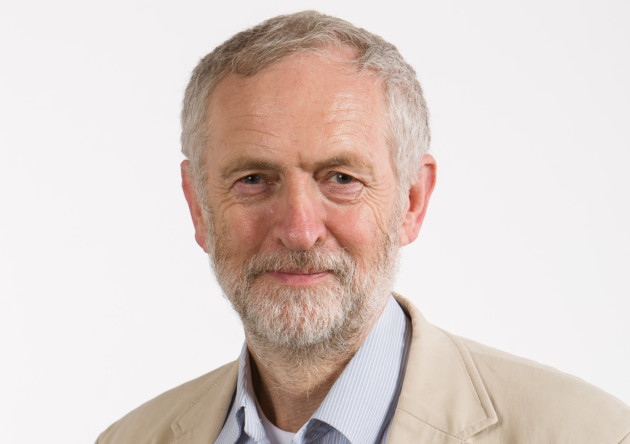
David Dimbleby says Jeremy Corbyn is treated unfairly by a biased right wing press

Image result for Biased media UK

David Dimbleby has confirmed what many of us already knew – that Jeremy Corbyn has been treated unfairly and misrepresented by the media.

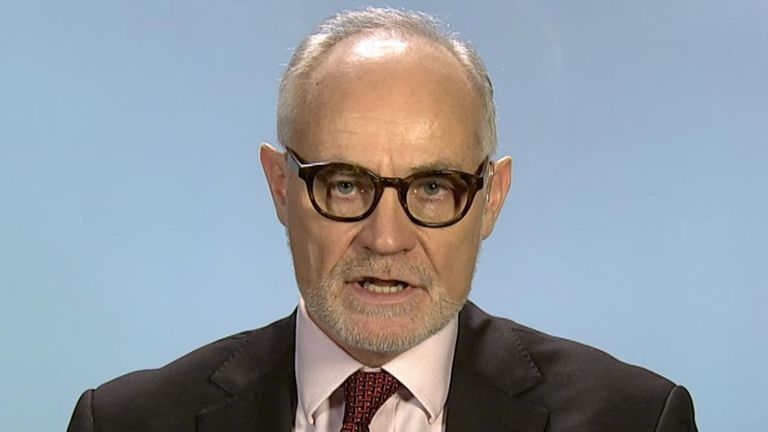
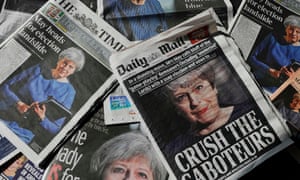
Dimbleby will be interviewing both Jeremy Corbyn and Theresa May for a Question Time special on Thursday. Dimbleby said that most British newspapers show a right wing bias and complained of their “lazy pessimism”.

He said: “I don’t think anyone could say that Corbyn has had a fair deal at the hands of the press, in a way that the Labour party did when it was more to the centre, but then we generally have a rightwing press.”

He also suggested the Labour leader has more support among the public than he does among the parliamentary Labour party.

He went on to say: “My own prediction is that, contrary to the scepticism and lazy pessimism of the newspapers and the British media, it’s going to be a really fascinating night, and it will drive home some messages about our political system and the political appeal of different parties that no amount of polling or reading the papers will tell us.”

Just four months ago, the BBC Trust found a BBC political editor inaccurately reported Jeremy Corbyn’s views about shoot-to-kill policies in the aftermath of the terror attacks in Paris. 

The broadcaster’s regulator concluded that Laura Kuenssbergs report for the News at Six in November 2015 breached the broadcaster’s impartiality and accuracy guidelines, in a ruling that triggered an angry response from the corporation’s director of news. 

The News at Six item included a clip of Jeremy Corbyn saying: “I am not happy with a shoot-to-kill policy in general. I think that is quite dangerous and I think can often be counterproductive.”

Kuenssberg had presented the clip as Corbyn’s response to a question put to him on whether he would be “happy for British officers to pull the trigger in the event of a Paris-style attack”, but the Trust concluded that Corbyn had been speaking in a different context.

The Labour leader had acually been responding to a question about whether he would be happy to order police or military “to shoot to kill” on Britain’s streets – and not specifically regarding a Paris-style terrorist attack in the UK. 

The Trust agreed with the complainant that the news report misrepresented the Labour leader’s views on the use of lethal force and that it had wrongly suggested he was against the additional security measures which the item had said the government was proposing. The Trust also found that the inaccuracy was “compounded” when Kuenssberg went on to claim that Corbyn’s message “couldn’t be more different” to that of the prime minister, who was about to publish anti-terrorism proposals. 

The Trust agreed with the complainant, pointing out that accuracy in any one programme rather than the entire output was particularly important when dealing “with a critical question at a time of extreme national concern”.

The news item was edited to mislead the public. It’s a curious thing that the Conservatives have frequently used the very same tactic of deliberately misquoting Corbyn to misrepresent his views in their election campaign. It’s time there were tighter laws on this kind of nasty manipulation of pubic perceptions and opinion. 

It was agreed that: “According to this high standard [of accuracy], the report had not been duly accurate in how it framed the extract it used from Mr Corbyn’s interview.”

Inaccurate portrayals like this have become normalised by the media and the government.

However, it isn’t just the way that responses are mispresented that is problematic. The framing of issues is also heavily biased, reflecting the permitted success of the Conservatives and a predominantly right wing press to shape the entire news agenda. What we hear and read is a long way from impartiality and accuracy. 

BBC’s Steven Sackur has said that as soon as Corbyn was elected, the Conservatives “issued propaganda” suggesting that Corbyn is a “threat” to national security. He also pointed directly to the government’s fundamental lack of accountability, transparency and democracy in the unprecedented move to refuse to share military and intelligence information in 2015, which is conventionally shared with the leader of the opposition.

“National security” is a theme that has run through the Conservatives campaigns and media commentary since. It works because it generates fear. It’s the political use of psychological manipulation at its very worst, as it presents an “enemy” for the public to vote against, rather than something inspiring to vote for. 

The Conservative party always emphasise and distort issues of national defense and magnifies our perception of threat, whether of foreign aggressors, immigrants, terrorists, or “invading” ideologies like Socialism (see the Zinoviev letter, for example). They reduce and present the world as a frightening place, and justify authoritarian policies to remedy the perceived threats. This is then used to portray the party as “strong”, and any opposition as “weak”. 

The Conservatives, with the cooperation of most of the media, are using this strategy of tension, designed intentionally to create public alarm – to portray the left as a “threat” to the wellbeing of society – and it reverberates around the media, to be used as part of an arsenal of pro-establishment, anti-progressive propaganda to discredit Corbyn. That is before he even has an opportunity to put the record straight. Yet even a glance through the Labour manifesto shows that this “threat” patently untrue.

The media does not engage the public, instead there is a pre-determined, biased and right wing agenda being imposed and then presented as a consensus. The media is   contributing significantly to public cynicism and alienation and sowing divisiveness. We are witnessing the erosion of the media’s role of watchdog, as a guardian of public interest, and as a conduit between the governing and the governed. We are witnessing the mainstreaming of democratic decay.


Related

Election coverage alert 30 May: Distorted debates, vacuous interviewing techniques and more fake news in the Telegraph – 

The erosion of democracy and the repression of mainstream media in the UK


I don’t make any money from my work. I am disabled because of illness and have a very limited income. But you can help by making a donation to help me continue to research and write informative, insightful and independent articles, and to provide support to others. The smallest amount is much appreciated – thank you.

DonatenowButton


Noam Chomsky endorses Jeremy Corbyn. Here’s why

Image result for Noam Chomsky

Professor Noam Chomsky has urged the British electorate to vote for Labour. In an exclusive interview with the Guardian, earlier this month, Chomsky stated: “If I were a voter in Britain, I would vote for him.”

The linguist, cognitive academic and philosophical anarchist endorsed Jeremy Corbyn, and observes that the Labour Party would be doing far better in opinion polls if it were not for the “bitter” hostility of the mainstream media.

As Chomsky is world renowned for being a major critic of neoliberalism, it comes as no surprise that he supports a candidate who would reverse the radical socioeconomic reforms that Britain has gone through since the Thatcher era.

He said there were a lot of factors involved, but insisted that Labour would not be trailing the Conservatives so heavily in the polls if the media was more open to Corbyn’s agenda.  He said: “If he had a fair treatment from the media – that would make a big difference.” 

Asked what motivation he thought newspapers had to oppose Corbyn, Chomsky said the Labour leader had, like Bernie Sanders in the US, broken out of the “elite, liberal consensus” that he claimed was “pretty conservative”.

It’s potentially a fresh and hopeful view from the Overton window, if only we would open the curtains.

The academic, who was in Britain to deliver a lecture at the University of Reading on what he believes is the deteriorating state of western democracy, says that voters had turned to the Conservatives in recent years because of “an absence of anything else”.

He said: “The shift in the Labour party under [Tony] Blair made it a pale image of the Conservatives which, given the nature of the policies and their very visible results, had very little appeal for good reasons.”

He added that Labour had needed to “reconstruct itself” in the interests of working people, with concerns about human and civil rights at its core, arguing that such a programme could appeal to the majority of people. As a human rights activist, I have to agree.

Chomsky said that the future must lie with the left of the party. “The constituency of the Labour party, the new participants, the Momentum group and so on … if there is to be a serious future for the Labour party that is where it is in my opinion,” he said.

The comments came as Chomsky prepared to deliver a university lecture entitled Racing for the precipice: is the human experiment doomed?

He told the Guardian that he believed people had created a “perfect storm” in which the key defence against the existential threats of climate change and the nuclear age were being radically weakened.

“Each of those is a major threat to survival, a threat that the human species has never faced before, and the third element of this pincer is that the socio-economic programmes, particularly in the last generation, but the political culture generally has undermined the one potential defence against these threats,” he said.

Chomsky described the defence as a “functioning democratic society with engaged, informed citizens deliberating and reaching measures to deal with and overcome the threats”. 

He said that neoliberal policies are the reason for the breakdown in democracy, they had transferred power from public institutions to markets and deregulated financial institutions while failing to benefit ordinary people. 

It’s certainly true that neoliberalism is incompatible with democracy and human rights frameworks.

He said: “In 2007 right before the great crash, when there was euphoria about what was called the ‘great moderation’, the wonderful economy, at that point the real wages of working people were lower – literally lower – than they had been in 1979 when the neoliberal programmes began. You had a similar phenomenon in England.”

Chomsky said that the disillusionment that followed gave rise to the surge of anti-establishment movements – including Donald Trump and Brexit, but also Emmanuel Macron’s victory in France and the rise of Corbyn and Sanders. 

He said: The Sanders achievement was maybe the most surprising and significant aspect of the November election. Sanders broke from a century of history of pretty much bought elections. That is a reflection of the decline of how political institutions are perceived.”

But he said the positions that the US senator, who challenged Hillary Clinton for the Democratic nomination, had taken would not have surprised Dwight Eisenhower, who was US president in the 1950s.

“[Eisenhower] said no one belongs in a political system who questions the right of workers to organise freely, to form powerful unions. Sanders called it a political revolution but it was to a large extent an effort to return to the new deal policies that were the basis for the great growth period of the 1950s and 1960s.”

Chomsky believes that Corbyn stands in the same tradition.

The media is the massage

Chomsky has written extensively about the role of the free market media in reinforcing dominant ideology and maintaining the unequal distribution and balance of power. 

In Manufacturing Consent, Chomsky and Herman explore the pro-establishment media’s role in establishing the apparence of a political and economic orthodoxy (neoliberalism) and extending a seemingly normative compliance with state policies, while also marginalising antithetical or alternative perspectives, dismissing them as heresy. In the US and UK, most left wing commentors have a very diminished media platform from which to present their perspectives and policy proposals.

This “free-market” version of censorship is more subtle and difficult to identify, challenge and undermine than the equivalent propaganda system which was present in Nazi Germany or the Soviet Union. 

As Chomsky argues, the mainstream press is corporate owned and so reflects corporate priorities and interests. While acknowledging that some journalists are dedicated and well-intentioned, he says that the choice of topics and issues featured in the mass media, the unquestioned premises on which that “coverage” rests, and the range of opinions that are expressed are all constrained to reinforce the state’s dominant ideology.

Last year, research by YouGov found that the British media is the most right wing in Europe. Readers also ranked the British press as the most biased in all of the seven countries surveyed.

Noam Chomsky: I would vote for Jeremy Corbyn (extended interview) – BBC Newsnight

Noam Chomsky’s 8-Point Rationale for Voting for the “Lesser Evil” Candidate

Although this was written about the American political system, it applies equally well to the UK one.

Chomsky says: “Critics of “lesser evil voting” (LEV) should consider that their footing on the high ground may not be as secure as they often take for granted. 

Generally associated with the religious left, secular leftists implicitly invoke it when they reject LEV on the grounds that “a lesser of two evils is still evil.” Leaving aside the obvious rejoinder that this is exactly the point of lesser evil voting – i.e. to do less evil, what needs to be challenged is the assumption that voting should be seen a form of individual self-expression rather than as an act to be judged on its likely consequences. 

The basic moral principle at stake is simple: not only must we take responsibility for our actions, but the consequences of our actions for others are a far more important consideration than feeling good about ourselves.

Leaving aside the obvious rejoinder that this is exactly the point of lesser evil voting-i.e. to do less evil, what needs to be challenged is the assumption that voting should be seen a form of individual self-expression rather than as an act to be judged on its likely consequences, specifically those outlined in 4). The basic moral principle at stake is simple: not only must we take responsibility for our actions, but the consequences of our actions for others are a far more important consideration than feeling good about ourselves.

While some would suggest extending the critique by noting that the politics of moral witness can become indistinguishable from narcissistic self-agrandizement, this is substantially more harsh than what was intended and harsher than what is merited. That said, those reflexively denouncing advocates of LEV on a supposed “moral” basis should consider that their footing on the high ground may not be as secure as they often take for granted to be the case.

A third criticism of LEV equates it with a passive acquiescence to the bipartisan status quo under the guise of pragmatism, usually deriving from those who have lost the appetite for radical change. It is surely the case that some of those endorsing LEV are doing so in bad faith-cynical functionaries whose objective is to promote capitulation to a system which they are invested in protecting. Others supporting LEV, however, can hardly be reasonably accused of having made their peace with the establishment.

Their concern, as alluded to in 6) and 7) inheres in the awareness that frivolous and poorly considered electoral decisions impose a cost, their memories extending to the ultra-left faction of the peace movement having minimized the comparative dangers of the Nixon presidency during the 1968 elections. The result was six years of senseless death and destruction in Southeast Asia and also a predictable fracture of the left setting it up for its ultimate collapse during the backlash decades to follow.

The broader lesson to be drawn is not to shy away from confronting the dominance of the political system under the management of the two major parties. Rather, challenges to it need to be issued with a full awareness of their possible consequences.

This includes the recognition that far right victories not only impose terrible suffering on the most vulnerable segments of society but also function as a powerful weapon in the hands of the establishment center, which, now in opposition can posture as the “reasonable” alternative. A Trump presidency, should it materialize, will undermine the burgeoning movement centered around the Sanders campaign, particularly if it is perceived as having minimized the dangers posed by the far right.

A more general conclusion to be derived from this recognition is that this sort of cost/benefit strategic accounting is fundamental to any politics which is serious about radical change. Those on the left who ignore it, or dismiss it as irrelevant are engaging in political fantasy and are an obstacle to, rather than ally of, the movement which now seems to be materializing.

Finally, it should be understood that the reigning doctrinal system recognizes the role presidential elections perform in diverting the left from actions which have the potential to be effective in advancing its agenda. These include developing organizations committed to extra-political means, most notably street protest, but also competing for office in potentially winnable races. The left should devote the minimum of time necessary to exercise the LEV choice then immediately return to pursuing goals which are not timed to the national electoral cycle.

*****

1) Voting should not be viewed as a form of personal self-expression or moral judgement directed in retaliation towards major party candidates who fail to reflect our values, or of a corrupt system designed to limit choices to those acceptable to corporate elites.

2) The exclusive consequence of the act of voting in 2016 will be (if in a contested “swing state”) to marginally increase or decrease the chance of one of the major party candidates winning.

3) One of these candidates, Trump, denies the existence of global warming, calls for increasing use of fossil fuels, dismantling of environmental regulations and refuses assistance to India and other developing nations as called for in the Paris agreement, the combination of which could, in four years, take us to a catastrophic tipping point. Trump has also pledged to deport 11 million Mexican immigrants, offered to provide for the defense of supporters who have assaulted African American protestors at his rallies, stated his “openness to using nuclear weapons”, supports a ban on Muslims entering the U.S. and regards “the police in this country as absolutely mistreated and misunderstood” while having “done an unbelievable job of keeping law and order.” Trump has also pledged to increase military spending while cutting taxes on the rich, hence shredding what remains of the social welfare “safety net” despite pretenses.

4) The suffering which these and other similarly extremist policies and attitudes will impose on marginalized and already oppressed populations has a high probability of being significantly greater than that which will result from a Clinton presidency.

5) 4) should constitute sufficient basis to voting for Clinton where a vote is potentially consequential-namely, in a contested, “swing” state.

6) However, the left should also recognize that, should Trump win based on its failure to support Clinton, it will repeatedly face the accusation (based in fact), that it lacks concern for those sure to be most victimized by a Trump administration.

7) Often this charge will emanate from establishment operatives who will use it as a bad faith justification for defeating challenges to corporate hegemony either in the Democratic Party or outside of it. They will ensure that it will be widely circulated in mainstream media channels with the result that many of those who would otherwise be sympathetic to a left challenge will find it a convincing reason to maintain their ties with the political establishment rather than breaking with it, as they must.

8) Conclusion: by dismissing a “lesser evil” electoral logic and thereby increasing the potential for Clinton’s defeat the left will undermine what should be at the core of what it claims to be attempting to achieve.”

 
 —
 

Noam Chomsky is institute professor emeritus in the Department of Linguistics and Philosophy at Massachusetts Institute of Technology. His most recent books are Who Rules the World? (Metropolitan Books, 2016) and Requiem for the American Dream: The 10 Principles of Concentration of Wealth & Power (Seven Stories Press, 2017). His website is www.chomsky.info.

Political polls, think tanks and propaganda: the antidemocratic writing on the wall

Image result for propaganda UK Tories bitter future

The Mail on Sunday columnist, christian and Burkean Conservative, Peter Hitchens, has said:

“Opinion polls are a device for influencing public opinion, not a device for measuring it. Crack that, and it all makes sense.”

I don’t agree with Hitchens on very much, but he is right about this.

In his book The Broken Compass, Hitchens informs us that opinion polls are actually a device for influencing public opinion. He says that the establishment and the media are responsible for this manipulation, based on the misuse of statistics. The overall purpose is to “bring about the thing it claims is already happening”. 

The author cites contemporary examples of the media attacking Gordon Brown and the “predicted” win of the Conservative Party at the 2010 general election, although Hitchens also described Brown, as a “dismal Marxoid.”  Hitchens’ comments are based on his time as a reporter at Westminster. He says that political journalists are uninterested in serious political debate, and describes how a media reporting bias is attempting to facilitate a Tory general election win.

Remarkably, as a social Conservative, Hitchens states one of his motivations for writing the book was to frustrate this exercise.

Of course government influence isn’t the only problem. Neoliberal bias and “market forces” that result in a biased presentation include the ownership of the news source, concentration of media ownership, the selection of staff, the preferences of an intended audience, and pressure from advertisers. In short, we cannot escape the cultural saturation of pro-establishment views, and the establishment is of course both neoliberal and Conservative. 

Predicting elections may seem interesting, fun, and perhaps even educational from an academic perspective, but it doesn’t add much to our democratic practices. Polls give an apparency of “data-driven journalism” but it produces a reductive “horse-race” narrative, in which political and policy context is mostly ignored with the numbers, accurate or not, pretty much being framed as all that matters. This trivialises our democracy and obscures the importance of critical thinking and informed choices regarding policies in influencing the public’s voting decisions. 

Priming and framing

Priming is a subconscious form of memory, based on identification of related ideas and objects. This effect happens when external stimuli “manipulate” internal thoughts, feelings or behaviours. After becoming activated by stimuli, priming triggers these associations in our memory. For example, one study showed that a store playing traditional French or German music can prime shoppers to buy French or German products. Political slogans are also frequently used as a priming tool. They provide reference points – they are gateways to underlying ideological narratives.

So, priming may be used as a strategy that entails the intentional use of certain words, phrases or images that can subtly influence our thinking – via an interpretive frame – at least to an extent. Some psychologists have argued that priming can have effects on changing our decision-making and behaviour, that seeing an image of money can affect our political views, for instance, or that reminding individuals of stereotypes applied to their social group can harm their performance in a test and in other ways. Stigma is a political tool, usually reserved for despotic regimes, but in Western democracies, othering traditionally marginalised groups has become such common practice that it’s almost hidden in plain view.

Attempts to test such effects suggest that at least some of them are not reliable. But priming, in a more general sense, still matters, such as when people use contextual cues during a conversation to interpret the meaning of ambiguous language.

Political media priming is “the process in which the media attend to some issues and not others and thereby alter the standards by which people evaluate election candidates”. A number of studies have demonstrated that there is a dimension of powerful media effects that goes beyond basic agenda setting.

In 1982, Iyengar, Peters, and Kinder first identified this added dimension as the “priming effect.” The theory is founded on the basic assumption that people do not have elaborate knowledge about political matters and do not take into account all of what they do know when making political decisions — they must consider what more readily comes to mind. Through drawing attention to some aspects of politics at the expense of others, the media might help to set the terms by which political judgements are reached, including evaluations of political figures. A process of carefully calculated uses of public opinion on policy issues may (and are) very easily  used as strategies to intentionally influence voters’ standards for assessing political candidates’ attributes. 

In sociology, framing is a schema of interpretation: a sort of shorthand collection of anecdotes and stereotypes that individuals depend on to understand and respond to and navigate events. In other words, people build a series of mental “filters” through biological, social, political and cultural influences. Citizens then use these filters or signposts to make sense of the world. The choices they then make are influenced by the  creation of a frames. The effects of framing can be seen in the media.

With the same information being used as a base, the “frame” surrounding the issue can change the reader’s perceptions without having to alter the underlying facts. In the context of politics or mass-media communication, a frame defines the packaging of an element of rhetoric in such a way as to encourage certain interpretations and to discourage others. 

For political purposes, framing often presents facts in such a way that implicates a social problem that is in need of a certain solution. Members of political parties attempt to frame issues in a way that makes a solution favouring their own political leaning appear as the most appropriate course of action for the situation at hand.

Research on frames in sociologically driven media research generally examines the influence of “social norms and values, organisational pressures and constraints, pressures of interest groups, journalistic routines, and ideological or political orientations and bias of journalists” on the existence of frames in media content

Roger Pielke Jr, professor of Technology Policy Research at the University of Colorado, says: Rather than trying to see the future, political science might serve us better by helping citizens to create that future by clarifying the choices we face and their possible consequences for policy.”

“In treating politics like a sporting event, we diminish the partisanship, the choices, and the fundamental values that lie at the core of politics. I fear that data journalists have diminished our politics.” 

When political opinion polls and the media appear to support one political party over another, there can be little doubt that this will have an influence on the psychology of voters, because it’s akin to declaring election winners before the election is actually held. It works rather like a self-fulfilling prophecy.

In the UK, the media is biased and leans heavily towards the right. Despite the fact that the Labour party currently has the highest party membership in Western Europe, yet the party leader is viciously attacked, and very often in a particularly nasty, personal and highly misleading way. The systematic way in which the media are actively attempting to delegitimise Corbyn is unworthy of a so-called democracy.

party membership

Some countries, such as France, Brazil and South Korea, impose a halt on election polling because of the bandwagon effect, which may skew the democratic process. The bandwagon effect describes a process of voters favouring a party that is doing well in the polls, while the underdog effect predicts that support will go to a party trailing in the polls.

There is also the possibility of a projection effect, with voters’ expectations conforming to their partisanship. There is rather less empirical evidence for the existence of underdog effect than there is for the existence of the bandwagon effect, which is based on individuals rallying to the perceived majority opinion, because of a fairly widespread psychological need for feeling we are part of a social ingroup, and a general tendency towards normative compliance and social conformity. And at a time when the strategically engineered and toxic social divisions of political outgrouping is widespread and affecting citizens’ fundamental sense of identity and self worth, this type of insidious call for a normative compliance and artificial consensus creates a false sense of security for some.

We know that political opinion polls are certainly not always an accurate reflection of public opinion. Samples of the population selected to participate may be biased. For example, asking Daily Mail readers who they will vote for will almost certainly produce a majority right wing set of responses. However, if you ask the same question on Twitter, you are much more likely to get a Labour majority.  

The polls do have an effect on voter intentions and on those trying to influence the outcome of elections.

poll correct

itv tm

Poll by ITV’s This Morning asked viewers which party leader they would prefer to see as Prime Minister.

More generally, in sociology and other social sciences, bias is defined as any tendency which prevents unprejudiced consideration of a research question. Bias can occur at any phase of research, including study design, or sampling and data collection, as well as in the process of data analysis and publication.  

It is widely recognised that quantitative social research methods, such as surveys, may be susceptible to reduced reliability and research bias, sometimes entailing a process where the researchers performing the survey influence the results by selecting a specific kind of sample of the population, for example.

Human nature is complex and can not be reduced easily to just a simple either/or response. Bias may arise when researchers inadvertently or deliberately select subjects that are more likely to generate the desired results. Either way, this is a reversal of the normal processes governing science.

Additionally, there is also a risk of response bias – a general term for a wide range of cognitive biases that influence the responses of participants away from accuracy or truthfulness. These biases are most prevalent in the types of studies and research that involve participant self-report, in quantitative research such as surveys. Response biases can have a large impact on the validity of questionnaires, surveys and polls.

With all of this in mind, we need to think about how the conventional political polls are run, who runs them, who funds them and for what and whose purpose.

In the UK, some of the major polls are run by:

  • Survation, pollster to The Mail on Sunday, Daily Mirror, Daily Record and Sky News. They say: “Survation also have an active strategy and campaign advisory business helping clients better understand customers & members, appreciate & help shape public opinion. We help our clients improve customer engagement and effectiveness of campaigns – be they charitable, political or commercial.” 
  • ComRes, retained pollster for the BBC and The Independent. It says on their site: ComRes provides specialist research and insight to support reputation management, public policy and communications. For more than a decade we have used the latest developments in market and opinion research to inform strategies, change behaviours and define debates.”
  • Ipsos MORI (formerly MORI). Ipsos MORI’s Social Research Institute works extensively for the Government of the United Kingdom, looking at public attitudes to key public services, and so informing social policy. Issues such as identity, social cohesion, loyalty, physical capital and the impact of place on attitudes are all key themes of the Institute’s work. The company also specialises in mass media, brand loyalty, marketing and advertising research.
  • YouGov. – Stephan Shakespeare, the firm’s founder and CEO from 2010, once stood as a Conservative candidate for Colchester; he was also a Conservative Party pollster. The other founder, and CEO until 2010, is Nadhim Zahawi a British Conservative Party politician who has been the Member of Parliament (MP) for Stratford-on-Avon since 2010.
  • ICM. They say Understanding choice means you know how your audience feels, thinks and behaves. And how you can change that. We help influence choice in three areas. How do you energise your brand and communications? How do you improve your customers’ experience of you? How do you understand and influence citizens?  
  • Populus, official The Times pollster. They say: “Our Reputation & Strategy team works with the boards of global companies and public institutions to help them understand, influence, and improve their reputations. We are specialists in reputation. We understand why it matters, how to measure it, what drives it, who influences it, how to align it with existing activity, and what you should do to improve it.”
  • TNS-BMRBTNS changed their name to Kantar Public UK: a leading agency providing research and consultancy to UK policymakers. The company is structured around specific areas of marketing expertise: Brand & Communication; Innovation & Product Development; Retail & Shopper; Customer Experience; Employee Engagement; Qualitative; Automotive; and Political & Social.

All of these companies operate within a taken-for-granted neoliberal context, supporting various actors within the “global market place” paradigm, including governments, and therefore have a distinct ideological leaning and very clearly defined economic interests in maintaining the status quo. 

Nudging voting decisions

It’s likely that Lynton Crosby’s international notoriety made him the subject of considerable press attention during the Conservative’s election campaign. However, there was another man also behind the Conservative campaign who was probably even more cunning. American strategist Jim Messina was hired as a strategy adviser in August 2013. Senior Conservative staff had been impressed by Barack Obama’s easy victories in the 2008 and 2012 presidential elections, crediting a relentless focus on data collection to Messina.

Access to this level of personal data was crucial to the success of the Conservative campaign: it determined which voters the party needed to target, contact and which type of message they would present. This process began with direct mail – personally addressed to voters in each target seat, who were divided into 40 different categories, with a slightly different tailored message for each one.

A telephone research company called Return Marketing (now known as Return Research) canvassed thousands of voters in the run-up to the 2015 general election. The calls they made rather tellingly targeted voters in specific, marginal constituencies.

Last year, the The Canary found evidence that the Conservatives may have broken a law that prohibits paying canvassers to support a specific candidate’s election. Whistleblowers speaking to an independent journalist have alleged that they were told to push poll voters (sway voters towards voting for the Conservatives by using loaded questions.)

Channel Four’s secret filming of the company Return Market’s “push polling”- polling designed to influence voters while masquerading as political research – during the EU referendum.

Pollsters, by and large, reject the charge that they herd public opinion, but social psychologists and behavioural economists inform us that there is more than a little truth in the bandwaggon effect theory.

Pollsters say they are careful to avoid influencing the outcome of a poll through priming and order effects in the survey design, but there are many other stumbling blocks to bear in mind. Social psychologists and the new behavioural economists say that in general people want to follow the crowd and do not like to challenge the normative order (which as a concept is in itself a very functionalist and conservative framing of society).

This is reflected in the nudge theorists’ use of social norming strategies, currently being adopted in public policies, which politically target some social groups to change their perceptions and behaviours. Social norming is based on an assumption of pluralistic ignorance bychoice architects. Ultimately, the “choice architects” are the government, who, after all, are responsible for public policies which utilise experimental behavioural theory.

It’s of major concern that attempts by a government to surreptitiously change the perceptions, behaviours, emotions and decision-making of a population using experimental behavioural economic theory and discriminatory policies is not currently subject to public scrutiny and ethical standards. There is nothing standing in the way of “choice architects” using social norming to generate, manipulate or exploit pluralistic ignorance in order to simply maintain and justify the status quo. In fact they DO.

So if we see an opinion poll telling us what the majority thinks, believe or is doing, because many have an inbuilt psychological bias towards following the crowd, we need to question potential motives underpinning that “information”.

The government know about the bandwaggon bias and are designing communications strategies and policies which play to this heuristic. Buying Facebook ‘likes’ is one example of this attempt to create a false impression of  public consensus and political popularity.

Think tanks, the media and the Conservative influence on public thinking

In the late 1960s and 1970s, movement Conservatives persuaded wealthy individuals and businesses to establish a conservative intellectual and political infrastructure. This includes think tanks that resemble academic institutions but publish studies supporting Conservative and libertarian arguments. The American Enterprise Institute was founded in 1943, but was expanded dramatically with new funding in 1971. The Heritage Foundation was created in 1973 and the Cato Institute was founded in 1974.

In Britain, Tim Montgomerie, has described the Conservative movement as “the infrastructure outside of the party that supports small ‘c’ conservative values.”

A March 2009 presentation by Montgomerie and Matthew Elliott listed a number of organisations as part of the British Conservative movement: 

Institute of Economic Affairs | Centre for Policy Studies | Reform | Adam Smith Institute | Policy Exchange | Centre for Social Justice | Civitas | International Policy Network | Taxpayers’ Alliance | ConservativeHome | New Culture Forum | Standpoint | Migration Watch UK | Countryside Alliance | Centre for Social Cohesion

Elliott compared this with the smaller size of the movement in 1997. According to Montgomerie, the comparison was intended to be indicative rather than comprehensive. An up to date, comprehensive powerbase list might include: 

2020 Health | Atlantic Bridge | Adam Smith Institute | Better Off Out | Big Brother Watch | Bow Group | Bruges Group | Campaign for an English Parliament | Campaign for the Protection for Rural England | Centre for Policy Studies | Centre for Social Cohesion | Centre for Social Justice | Christian Conservative Fellowship | Civitas | Conservative Education Society | ConservativeHome | Conservative Intelligence | Conservative Party | Conservative Philosophy Group | Countryside Alliance | Democracy Institute | Direct Democracy | Drivers Alliance | Doctors for Reform | Economic Policy Centre | Enterprise Forum | European Foundation | European Policy Forum | Family Education Trust | First Defence | Forest | Freedom Alliance | Freedom Association | Freedom Zone | The Free Society | Global Vision | Global Warming Policy Foundation | Henry Jackson Society | Institute of Ideas | Institute of Directors | Institute of Economic Affairs | International Policy Network | Legatum Institute | Liberty League | Localis | Message Space | Migration Watch | New Culture Forum | Nothing British about the BNP | Nurses for Reform | Open Europe | Policy Exchange | Politeia | Progressive Vision | Reform | Reform Scotland | ResPublica | Safe Speed | Save Our Pubs and Clubs | Selsdon Group | Social Affairs Unit | Social Market Foundation | Spiked | Standpoint | Student Rights | Sunlight COPS | Taxpayers Alliance | TEA Party UK | UK National Defence AssociationYoung Britons Foundationamong others. 

The problem is that think tanks synthesise, create and communicate “information” and give “advice” to the public and policy-makers, very often through the media. Think tanks tend to be far more media savvy than academics, often with staff who have backgrounds in the communication industry – media, PR or lobbying organisations.

This means that policy proposals, media narratives and public debate are much more likely to reflect Conservative ideology and favour pro-establishment outcomes, rather than being non-partisan, evidence-based and crucially, a representation of public needs. This of course turns democracy completely on its head. 

As Professor Judy Sebba points out in Getting research into policy: the role of think tanks and other mediators: “Far from educating the public about evidence, think tanks are characterised by closedness and exclusivity. They do not subject their work to review by others and so the quality of their outputs are not assessed. Most worryingly, the media present the work of think tanks as credible sources of research and facts without any checks being in place.”  

As key players in “democratic” politics and in shaping public opinion, think tanks have a responsibility to be transparent about their operations, but seldom are. A good question to ask is who funds them and what is their agenda?

The bandwaggon propaganda technique is also used as a key campaign strategy

More recently, I explored the role of intentionally deceitful political language and rhetoric in another article  which highlights the role that the media play in shaping our public life. Media manipulation involves a series of related techniques in which partisans create images or arguments that favour their own particular interests. Such tactics may include the use of logical fallacies, psychological manipulations, deception, linguistic, rhetorical and propaganda techniques, and often involve the suppression of information or alternative perspectives by simply crowding them out. 

Discrediting and minimisation are often used in persuading other people or social groups to stop listening to certain perspectives and arguments, or by simply diverting public attention elsewhere. An example of diversion is the recent widespread scapegoating of refugees and people who need social security, such as disabled people or those who have lost their jobs, in a bid to maintain the hegemony of neoliberalism and its values at a time when its failings were brought into sharp focus during and following the global crisis – also exposing failings in the behaviours and practices of the government and the vulture capitalist financier class.

Neoliberalism always gravitates towards increasing inequality, extending and deepening poverty. Fear mongering is sometimes used with a diversion or misdirection propaganda technique to mask this, and may be pervasive. Sometimes politicians and media commentators suddenly take a debate in a weird and irrational but predictable direction to avoid democratic accountability.

During the coalition and Conservative governments, the tabloids have chosen and framed most of the debates that have dominated domestic politics in the UK, ensuring that immigration, welfare, law and order, the role of the state, and Britain’s relationship with Europe have all been discussed in increasingly right wing terms, while almost ironically, the government have colonised progressive rhetoric to cover their intentions. It also serves to further discredit the narrative of the left.

The reason in part for this rhetoric, importing words such as “fair”, “social justice” and “equal opportunity” and repeating them ad nauseam is that the Conservatives know that such ideas build the trust of ordinary citizens. 

However, there is therefore a growing chasm between Conservative discourse, and policy intentions and outcomes. There isn’t a bridge between rhetoric and reality. 

The Conservatives commonly use a nudge technique called “social norming” – a Behavioural Insights Team variant of the bandwaggon propaganda technique – particularly for General Election campaigning. It’s about manipulating a false sense of consensus, and normalising Conservative ideology. It’s also about prompting behavioural change, and as such, this method is a blatant attempt to influence the voting behaviours of the public, by suggesting that many others have already “joined” the Conservative “cause” and are happier or better off for doing so. The technique uses societal pressures to play on several basic emotional elements of human nature.

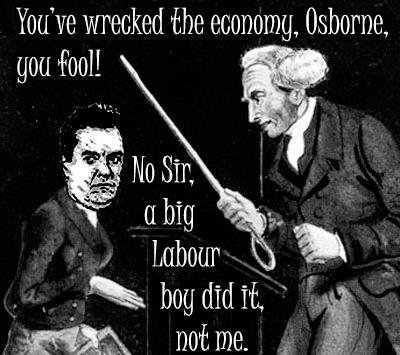
Oh, and then there is the basic technique of telling lies, of course.

Image result for george osborne big labour boy did it kittysjones

And using euphemism:


Image result for Tory lies

Social norming is an appeal to emotional needs to fit in and belong, and also, to be on the side that wins. As stated earlier, it has a kind of self fulfilling prophecy element to it, too. It’s used in advertising – words like “everyone”, “we”, “our” and “most people” or “many” are used a lot to sell brands and imply a popularity of certain products that usually isn’t real.

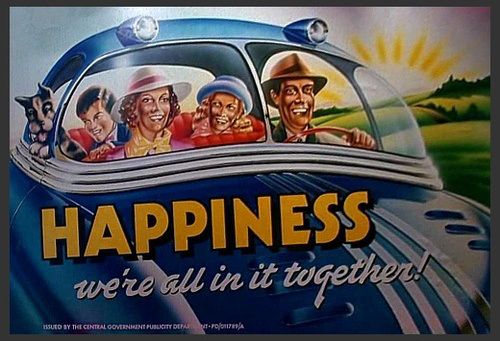
Political slogans like the almost farcical “country that works for everyone” and the previous “all in it together” are examples of poor attempts at social norming. It’s aimed at shifting our normative framework to accommodate the status quo, too, regardless of how the accounts don’t tally with reality. Once you see it, you can’t unsee it.

Image result for we are all in this together Tory slogan

It’s worth noting that “We are all in it together” was a slogan made famous in Terry Guiliams’s dystopic black comedy Brazil. Cameron certainly had a moment of recycling propaganda with grim irony there.

00122e59eb74fe0acab5f6838951c280

Propaganda techniques commonly used by the Conservatives

As mentioned previously, bandwagon and “inevitable-victory” appeals attempt to persuade the target audience to join in and take the course of action that “everyone else is taking.” Inevitable victory invites those not already on the bandwagon to join those already convinced they are on the road to certain victory. Those already or at least partially on the bandwagon are reassured that staying aboard is their best course of action.  

Join the crowd is a technique that reinforces people’s natural desire to be on the winning side. This technique is used to convince the audience that a programme is an expression of an irresistible mass movement and that it is in their best interest to join. As an example, see Grant Shapps under fire over website ‘sham’ which used models featured on Australian university site to make Tory activists look ‘youthful and in touch’ with Britain. Also see Behaviourism.

Common man – The ordinary folks or Common Man technique is an attempt to convince the audience that the propagandist’s positions reflect the common sense of the people. It is designed to win the confidence of the audience by communicating in the common manner and style of the target audience. Propagandists use ordinary language and mannerisms (and clothe their message in face-to-face and audiovisual communications) in attempting to identify their point of view with that of the average person, and to naturalise it.

Image result for Pictures of MPs pretending being ordinary

hqdefault

Ad hominem is a Latin phrase which has come to mean personally attacking your opponent, as opposed to challenging their propositions and arguments. A recent example is Boris Johnson’s strange attack on Jeremy Corbyn, calling him a “benign herbivore” but at the same time, also a “mutton-headed old mugwump.

The word comes from Massachusett, an Algonquian language spoken by the Massachusett people, from whom the US state takes its name. The word mugquomp, meaning “war leader” or “great chief”, appeared frequently in John Eliot’s 1663 translation of the Bible into the Massachusett language, where it was used as a gloss for an officer, captain, and duke.

Sadly, Johnson, languishing in his own in solipsism, has clearly invented his own personal meaning, though he really should pay heed to Wittgenstein, who warned of the dangers of private language (the idea of a language understandable by only a single individual is incoherent.) Then he wouldn’t sound like such a mutton-headed numpty. Johnson, like many Conservatives, has problems reconciling his “inner” (subjective) experience with the “outside” (objective) world.

By the early 1800s the form “mugwump” had been adopted into English as a humorous term for an important person, leader, or boss. J K Rowling was probably thinking of the earlier meaning when she used the word for the head of the International Confederation of Wizards in Harry Potter, the Supreme Mugwump.

Ad nauseam – This approach uses tireless repetition of an idea. An idea, especially a simple slogan, that is repeated enough times, may begin to be taken as the truth. This approach works best when media sources are limited and controlled by the propagator. Joseph Goebbels, not known to be driven by the passionate inspiration of the moment, but by the result of sober psychological calculation, was particularly talented in utilising this approach. Iain Duncan Smith has previously shown a similar penchant for repeated mendacity. Then there is Theresa May’s ad nauseum slogans: ” A strong and stable leadership in the national interest,” and “A country that works for everyone.”

Image result for Theresa May's slogan United
   Image courtesy of News Thump

Which brings us to the Glittering Generalities technique. This another category of the seven main propaganda techniques identified by the Institute for Propaganda Analysis in 1938. It’s a device often used by the media and in political rhetoric to persuade us to approve and accept something without examining any evidence.

This is a propaganda technique purposefully designed to divert and distract, so that people are less likely to develop their own critical thoughts. This said, the purpose of all forms of propaganda is to tell you what to think, and not how to think.

Glittering Generalities capitalise on increasingly sloganised political discourses, leading to a loss of conceptual clarity, over-idealisation and they also reflect conceptual miserliness – a tendency for some people to prefer simple, superficial and easy answers, rather than having to expend time and effort to grapple with complexity, critical analysis and the need to weigh up evidence. They also succeed in conveying codified messages that reference underpinning discourses which are often prejudiced and controversial, but presented in a way that bypasses any detailed scrutiny, as a consensus view and “common sense.”  An example is the slogan “Taking our country back” as it references an underpinning racist, supremicist discourse, whilst sounding vaguely rightous, because someone nicked England, or hid it on another planet.

Glittering Generalities imply – or signpost us – via common stock phrases to our own tacit knowledge, which often lies below our current focal awareness – prior information, beliefs, ideals, values, schemata and mental models, stereotypes and so on, creating the impression that the person using the terms and phrases understands and sees the world as you do, creating a false sense of rapport by doing so. Or the feeling that some very important recognition has been made.

Glittering Generalities propaganda is sometimes based on a kind of logical fallacy known as Equivocation – it is the misleading use of a term with more than one meaning (usually by glossing over which meaning is intended at a particular time)

Glittering Generalities is a technique very often used by people who seek to stifle debate, sidestep accountability and suppress democratic processes. Because Glittering Generalities tend to obscure or gloss over serious areas of disagreement, they hide controversy and submerge alternative propositions.

As such, Glittering Generalities may often be used to neutralise opposition to dominant ideas. It’s a way of disguising partisanship and of manipulating and reducing democratic choices. It’s part of a process of the political micro-management of your beliefs and decision-making.

Here is a bit of refreshing straight talk for a change:

Related image

I’m not above a bit of sloganeering myself. In 2015, I came up with “Tory cuts cost lives”, which my friend, Robert Livingstone, turned into a couple of memes.

Image result for Tory cuts cost lives

This one recent one went very viral very quickly, glad to see it so widely used:

17992309_1302068139828559_7295604745407481410_n

Finally, I thought I would share that the widely used word “selfservative” came from a disillusioned Tory I knew called Derek. I used it a lot on social media, and my friend, Robert Livingstone, popularised it in his memes. Derek defected to Labour and vanished from the Conservative Facebook groups where Robert and I used to have surprisingly civilised debate with him. 

I will be writing more about electioneering, exposing propaganda and other techniques of persuasion, over the next couple of weeks.

Related

Propaganda Techniques (Summary)

The Conservative’s negative campaign strategy: “share the lies and win a prize”

Dishonest ways of being dishonest: an exploration of Conservative euphemisms

The erosion of democracy and the repression of mainstream media in the UK

Department for Work and Pensions officials admit to using fake claimant’s comments to justify benefit sanctions – a very basic propaganda technique called “telling lies”

Our attitudes and beliefs are being manipulated, our decision-making is being “nudged,” citizens are being micro-managed and policed by the state:

“In a white paper authored by Facebook’s security team and published on Thursday, the company detailed well-funded and subtle techniques used by nations and other organizations to spread misleading information and falsehoods for geopolitical goals. These efforts go well beyond “fake news”, the company said, and include content seeding, targeted data collection and fake accounts that are used to amplify one particular view, sow distrust in political institutions and spread confusion.

“We have had to expand our security focus from traditional abusive behavior, such as account hacking, malware, spam and financial scams, to include more subtle and insidious forms of misuse, including attempts to manipulate civic discourse and deceive people,” said the company.

“In general, Facebook said it faced a new challenge in tackling “subtle and insidious forms of misuse, including attempts to manipulate civic discourse and deceive people.

“Facebook described much of the activity as “false amplification” – which included the mass creation of fake accounts; the coordinated sharing of content and engagement with that content (such as likes); and the distribution of “inflammatory and sometimes racist memes”.  – BBC

In its effort to clamp down on information operations, Facebook suspended 30,000 accounts in France before the presidential election. The company said it was a priority to remove suspect accounts with high volumes of posting activity and the biggest audiences.

The company also explained how it monitored “several situations” that fit the pattern of information operations during the US presidential election. The company detected “malicious actors” using social media to share information stolen from other sources such as email accounts “with the intent of harming the reputation of specific political targets”. This technique involved creating dedicated websites to host the stolen data and then creating social media accounts and pages to direct people to it.

At the same time, a separate set of malicious actors created fake Facebook accounts to falsely amplify narratives and themes related to topics exposed in the stolen data.

Facebook did not specify which stolen data it was referring to, but we know that tens of thousands of emails were hacked from Clinton campaign chairman John Podesta’s Gmail account and released by Wikileaks.

Nor did Facebook attribute the manipulation to any nation state, although it said that the company’s investigation “does not contradict” the findings of a January report by the US Director of National Intelligence that outlined Russian involvement in the election.

Russia has also been implicated in the hacking of French presidential frontrunner, Emmanuel Macron, according to a report by researchers with Japanese anti-virus firm Trend Micro, published this week.

Facebook pledged to monitor attempts to manipulate the platform, to develop new ways of identifying fake accounts, educate at-risk people about how to keep their information safe, and support civil society programs around media literacy.

“We recognize that, in today’s information environment, social media plays a sizable role in facilitating communications – not only in times of civic events, such as elections, but in everyday expression,” said the report. “In some circumstances, however, we recognize that the risk of malicious actors seeking to use Facebook to mislead people or otherwise promote inauthentic communications can be higher.” – The Guardian

“The JTRIG unit of GCHQ is so notable because of its extensive use of propaganda methods and other online tactics of deceit and manipulation. The 2011 report on the organization’s operations, published today, summarizes just some of those tactics:

Throughout this report, JTRIG’s heavy reliance on its use of behavioral science research (such as psychology) is emphasized as critical to its operations. That includes detailed discussions of how to foster “obedience” and “conformity”:


An “I told you so” moment from Glenn Greewald


My work is unfunded and I don’t make any money from it. I am disabled because of illness and struggle to get by. But you can support Politics and Insights and contribute by making a donation which will help me continue to research and write informative, insightful and independent articles, and to provide support to others.  DonatenowButton

The erosion of democracy and the repression of mainstream media in the UK

Daily Mail crush the saboteurs
In George Orwell’s Nineteen Eighty-Four, Winston Smith invents the heroic historical figure Comrade Ogilvy, who had “no aim in life except the defeat of the Eurasian enemy and the hunting-down of spies, saboteurs, thought-criminals, and traitors generally”. Theresa May’s world, too, seems to have shrunk to one in which the greatest enemies are the enemies within and democracy must be democratically eliminated for the good of the people.” Steven Poole.

The Daily Mail headline calling those who oppose the government “saboteurs” is the kind of oppressive tactic and despotic language that is commonly used in totalitarian regimes and by dictators. It’s not the kind of media headline expected in liberal democracies, where opposition to the status quo is necessary for the best interests of the country and essential for any meaningful democratic exchange.

Dr. Lawrence Britt examined the fascist regimes of Hitler (Germany), Mussolini (Italy), Franco (Spain), Suharto (Indonesia) and several Latin American regimes. Britt found 14 defining characteristics common to each, and it is becoming increasingly difficult to overlook some of the parallels with the increasingly authoritarian characteristics of our own right wing government here in the UK. Fascism is an authoritarian and nationalistic right wing system of government and social organisation, though not all authoritarian governments are fascist. However, the two terms are quite often used interchangeably. 

Controlled mass media is one example of a key defining feature of authoritarianism, with “news” being directly controlled and manipulated by the government, by regulation, or via sympathetic media spokespeople and executives. Censorship is very common. There is often an identifiable obsession with “National Security” – along with fear being used as a “motivational tool” by the government on the public, and also, as a justification for greater degrees of censorship.

The United Nations’ 1948 Universal Declaration of Human Rights states: “Everyone has the right to freedom of opinion and expression; this right includes freedom to hold opinions without interference, and impart information and ideas through any media regardless of frontiers”. However, unlike the United States, Britain has no constitutional guarantee of press freedom

The right to freedom of expression is fundamental to a functioning democracy – information and ideas help to inform political debate and are essential to public accountability and transparency in government.

Just to clarify, I don’t, however, condone any incitements of hatred. This is not the same thing as free speech. In fact hate speech is designed to close discussion down by intimidating and silencing targeted social groups. In the Uk, several statutes criminalize hate speech against several categories of persons. The statutes forbid communication which is hateful, threatening, or abusive, and which targets a person on account of disability, ethnic or national origin, nationality (including citizenship), race, religion, sexual orientation, or skin colour. 

Yet just last year, the European Commission against Racism and Intolerance (ECRI) criticised the  right wing Daily Mail and the Sun for “offensive, discriminatory and provocative terminology”.

The ECRI report said hate speech was a serious problem, including against Roma, gypsies and travellers, as well as “unscrupulous press reporting” targeting the LGBT community. 

The report also concluded that some reporting on immigration, terrorism and the refugee crisis was “contributing to creating an atmosphere of hostility and rejection”.

It cited Katie Hopkins’ infamous column in The Sun, where she likened refugees to “cockroaches” and sparked a blistering response from the UN High Commissioner for Human Rights, and the same newspaper’s debunked claim over “1 in 5 Brit Muslims’ sympathy for jihadis”. It seems that the tabloids have confused their frequent incitements to hatred, their many contributions to growing social prejudice and hate speech with free speech.

We have witnessed the political right and the tabloids using rhetoric that has increasingly transformed a global economic crisis into an apparently ethno-political one, and this also extends to include the general scapegoating and vilification of other groups and communities that have historically been the victims of prejudice and social exclusion: the poorest citizens, unemployed and disabled people. These far-right rhetorical flourishes define and portray the putative “outsider” as an economic threat. This is then used to justify active political discrimination and exclusion of the constitutive Other. 

Only some people have the right to freely express themselves, apparently.

Freedom of expression is a universal human right. It is not the prerogative of the politician. Nor is it the privilege of the journalist. In their day-to-day work, journalists are simply exercising every citizen’s right to free speech.

This includes the right to communicate and to express oneself in any medium, including through words, pictures, images and actions (including through public protest and demonstrations).

However, the UK government is more generally failing to live up to its human rights obligations. Social groups with protected characteristics, such as disabled people and asylum seekers, have fared very badly over the past few years. The tabloids have preempted draconian Conservative policies which target those social groups with extensive stigmatising and scapegoating campaigns. This is another indication of the Conservative’s radical authoritarian turn. 

The News Media Association (NMA) say: “Threats to press freedom include attempts to strip back journalistic exemptions under the EU and UK data protection legislation, efforts to water down Freedom of Information legislation which the NMA is campaigning against, new court reporting restrictions, a review of the D-Notice Committee, strengthening police powers to obtain journalistic material, the use of RIPA powers to uncover journalists’ sources, and the continuing campaign to introduce jail sentences for breaches of the Data Protection Act.

Journalists in the UK are also subject to a wide range of legal restrictions which inhibit freedom of expression. These include the libel laws, official secrets and anti-terrorism legislation, the law of contempt and other legal restrictions on court reporting, the law of confidence and development of privacy actions, intellectual property laws, legislation regulating public order, trespass, harassment, anti-discrimination and obscenity.

There is some special provision for journalism and other literary and artistic activities, chiefly intended as protection against prior restraint, in the data protection and human rights legislation. There are some additional, judicial safeguards requiring court orders or judicial consent before the police can gain access to journalistic material or instigate surveillance in certain circumstances, but, in practice, the law provides limited protection to journalistic material and sources.”

The new proposed Espionage Act and a data disclosure law.

The UK government are proposing to change the four Official Secrets Acts, which date back to 1911. They want them scrapped and replaced with a “modernised” Espionage Act and a data disclosure law.

However, the Conservatives have been accused of “criminalising public interest journalism” as it plans to increase the number of years for the “leaking of state secrets” from 2 years to 14, in the first “overhaul” of the Official Secrets Act for over 100 years.

Under the proposals, which were published in February, officials who leak “sensitive information” about the British economy that damages national security could also be jailed. Currently, official secrets legislation is limited to breaches which jeopardise security, intelligence defence, confidential information and international relations.

The government released the proposals citing the “new reality” of the 21st-century internet and national security dangers as justification for a more “robust” system of prosecution.

The recommendations centre around the Official Secrets Act (1989) which governs how public servants in government and the military must keep government information secret and out of publication.

Journalists and civil liberties groups have warned that the threshold for the increased sentence has been lowered and that journalists and whistleblowers acting in the public interest will be effectively gagged. 

In the new government recommendations, the threshold for being prosecuted for revealing state secrets will be changed from “having caused definite damage” to the likelihood of causing damage to national interests. The Law Commission also stated that a defendant should be prevented from making a defence that they believed they were working in the public interest. 

Michelle Stanistreet, general secretary of the National Union of Journalists, said: “The ramifications of these recommendations are huge for journalists and freedom of the press. Journalists face being criminalised for simply doing their job and the public’s right to know will be severely curtailed by these proposals. The union will respond robustly to the Law Commission’s consultation on changes to the Official Secrets Act.

“The National Union of Journalists is also concerned that the Digital Economy Bill, now in Parliament, threatens to undermine journalists sharing information in the public interest.” 

“This union is deeply concerned at yet another attempt by the UK government to curtail the media. The Investigatory Powers Act has put journalists’ sources at risk now that a large number of authorities have the power to intercept reporter’s’ emails, mobile phone and computer records.

“We have plenty of evidence that some police forces routinely used the Regulation of Investigatory Powers Act to get their hands on journalists’ records without their knowledge. The NUJ is also concerned that the Digital Economy Bill, now in Parliament, threatens to undermine journalists sharing information in the public interest.”

The consultation on the UK Government’s new proposals closed earlier this month. Organisations such as Amnesty have submitted their statements and expressed their opposition. 

Campaigners say the bill would make any investigation of government culpability harder and lower the amount of accountability in the civil service, military and government.

From the consultation document: “Chapter 6 – Freedom of Expression Enshrined in Article 10 of the European Convention on Human Rights, freedom of expression is a fundamental right. We consider whether compliance with Article 10 requires the introduction of a statutory public interest defence for those who make unauthorised disclosure. Our conclusion is that Article 10 does not require the introduction of a statutory public interest defence. Our view accords with that the House of Lord in R v Shayler.” 

Once you hear the jackboots…

Three years ago, I wrote an article  – Once you hear the jackboots, it’s too late – which discussed the unannounced visit by government national security agents to smash computer hard drives at the Guardian newspaper offices, though it hit the news unsurprisingly quietly, when Edward Snowden exposed a gross abuse of power and revealed mass surveillance programmes by American and British secret policing agencies (NSA and GCHQ) last year. (More detailed information here).

David Miranda, partner of Glenn Greenwald, Guardian interviewer of the whistleblower Edward Snowden, was held for nine hours at Heathrow Airport and questioned under the Terrorism Act. Officials confiscated electronics equipment including his mobile phone, laptop, camera, memory sticks, DVDs and games consoles. This was a profound attack on press freedoms and the news gathering process, and as Greenwald said: “To detain my partner for a full nine hours while denying him a lawyer, and then seize large amounts of his possessions, is clearly intended to send a message of intimidation.”

My article also outlined another extraordinary and vicious attack on The Guardian, instigated by the Department for Work and Pensions (DWP) communications chief and senior government spin doctor, Richard Caseby, who called for the newspaper to be “blackballed” and prevented from joining the new press regulatory body, because “day after day it gets its facts wrong.” Remarkably, “ineptitude or ideology” were to blame for what he deemed “mistakes” in the paper’s coverage of the DWP’s cuts to benefits. He called for the broadsheet to be kept out of the new Independent Press Standards Organisation (IPSO), set up after the Leveson Inquiry into media standards. 

As a former journalist at the establishment-directed Sun and The Sunday Times, Caseby certainly has an axe to grind against the paper that revealed how those right wing papers’ stablemate, the News Of The World, had hacked the voicemail of murdered teenager Millie Dowler, sparking the phone hacking scandal that forced Rupert Murdoch to close the tabloid down.

In connection with Murdoch’s testimony to the Leveson Inquiry “into the ethics of the British press,” editor of Newsweek International, Tunku Varadarajan, referred to him as “the man whose name is synonymous with unethical newspapers.”

Not a shred of concern was raised about any of this or Murdoch’s nasty and corrupt myth production industry, and right wing scapegoating empire, coming from our government, a point worth reflecting on for a moment. Miliband said the phone-hacking was not just a media scandal, but it was a symbol of what was wrong with British politics.

He called for cross-party agreement on new media ownership laws that would cut Murdoch’s current market share, arguing that he has “too much power over British public life.He said: “If you want to minimise the abuses of power, then that kind of concentration of power is frankly quite dangerous.”  I completely agree.

Those that criticise the unscrupulous right wing status quo, on the other hand, are being increasingly filtered out from the media, or censored. Yet journalists are regarded as “democracy’s watchdogs” and the protection of their sources is the “cornerstone of freedom of the press.” And freedom of the press is a cornerstone of democracy. Although enshrined in such terms by the European Court of Human Rights, these democratic safeguarding principles are being attacked in an increasingly open manner all over the world, including in the democratic countries that first proclaimed them.

The erosion of democracy and the Press Freedom Index

Related image

Reporters Without Borders (RSF) are a collective of journalists who study freedom of the press at a comparative and international level. RSF publish an annual Press Freedom Index (PFI), which provides a ranking for every country, calculated to indicate how much governments restrict the media. The UK has been consistently in low position (the higher the score, the lower the ranking) for the last five years, this year it dropped lower still, highlighting an increasing intrusion of the government on and restriction of the freedom of the press.

This won’t surprise many, especially given the numerous public announcements in the press by the likes of Iain Duncan Smith over the last few years regarding the government’s “monitoring” of the BBC and other media for “left wing bias”. We have a media with a very heavy weighted right wing bias, yet any criticism of government policy reduces our government to shrieking hysterically that the communists have been infiltrating the establishment. It’s a curious fact that authoritarians project their rigidity, insecurities and micro-controlling tendencies onto everyone else.

I’m sure Chris Patten, Rhona Fairhead and Sir David Cecil Clementi, successive government appointed chairpersons of the BBC Trustto act as the ultimate decision makers regarding the BBC’s strategic direction, are just the kind of people who are not tied to political ideologies and corporate interests. After all, everyone knows what a veritable hotbed of communism Chris Patten secretly nurtured. (Sorry, my tongue appears to be momentarily stuck to my cheek).

That the UK government felt the need to announce even more surveillance of the BBC indicates a creeping and considerable degree of authoritarianism, and worryingly, it demonstrates how supremely unconcerned and utterly without shame they are in building a public bonfire to burn what remains of media impartiality in the UK. 

The current RSF report says that the decline in respect for media freedom in democracies is not new. It was already noticeable in previous Indexes. But what is striking in this year’s Index is the growing scale and the nature of the violations seen.

The erosion of democracy and subsequent muting of the media isn’t a problem peculiar to the UK, it’s happening on a global scale. The RSF report says:

“Most of the movement in the World Press Freedom Index unveiled today by Reporters Without Borders is indicative of a climate of fear and tension combined with increasing control over newsrooms by governments and private-sector interests.”

“Journalism worthy of the name must be defended against the increase in propaganda and media content that is made to order or sponsored by vested interests.”

The Index is based on an evaluation of media freedom that measures pluralism, media independence, the quality of the legal framework and the safety of journalists in 180 countries. It is compiled by means of a survey questionnaire in 20 languages that is completed by experts all over the world. This qualitative analysis is combined with quantitative data on abuses and acts of violence against journalists during the period evaluated.

The report says: “The election of the 45th president of the United States set off a witchhunt against journalists. Donald Trump’s repeated diatribes against the Fourth Estate and its representatives – accusing them of being “among the most dishonest human beings on earth” and of deliberately spreading “fake news” – compromise a long US tradition of defending freedom of expression. The hate speech used by the new boss in the White House and his accusations of lying also helped to disinhibit attacks on the media almost everywhere in the world, including in democratic countries.”

Framing and tilting the media: asking the million dollar questions

Robert Mercier is the plutocrat and right wing US computer scientist and media “strategist” at the heart of a US-based multimillion-dollar propaganda network, who expresses an “unwavering commitment to neutralising left wing bias in the news, media and popular culture”. He funded the setting up of Breitbart and has close links to Steve Bannon, Donald Trump and Nigel Farage. See: Robert Mercer: the big data billionaire waging war on mainstream media.

It is a very troubling development, give the US had a global reputation for promoting a strong free press, protected by the First Amendment. This said, it’s certainly not a recent development that political leaders of western so-called democratic countries have intervened directly in an attempt to modify and direct media reporting. The US is ranked at 43 in the 2017 World Press Freedom Index. 

RSF now ranks the UK 40th in the index; a fall from 38th place in 2016. The Nordic countries have the most favourable PFI ranking, with Norway being at the top, followed by Sweden, Finland, and Denmark. It’s an indictment of both UK and US claims to democracy and freedom of the media that three former Soviet countries: Estonia, Latvia, and Lithuania rank more highly. The British press were also outranked by Uruguay, Costa Rica, Jamaica, Namibia, Samoa, Trinidad and Tobago.

RSF’s report says: “Media freedom has never been so threatened and RSF’s “global indicator” has never been so high (3872). This measure of the overall level of media freedom constraints and violations worldwide has risen 14% in the span of five years. In the past year, nearly two thirds (62.2%) of the countries measured have registered a deterioration in their situation, while the number of countries where the media freedom situation was “good” or “fairly good” fell by 2.3%.”

“It was also in late 2016 that the United Kingdom (down 2 places at 40th) adopted a new law extending the surveillance powers of the British intelligence agencies. Dubbed the “Snoopers’ Charter,” the Investigatory Powers Act put the UK in the unenviable position of having adopted “the most extreme surveillance legislation in UK history”, with a law that lacks sufficient protection mechanisms for journalists and their sources. Even more alarming, in early 2017, the Law Commission put forward a proposal for a new ‘Espionage Act’ that would allow the courts to imprison journalists and others for up to 14 years for obtaining leaked information.”

It goes on to say: “The past year also saw a continuation in the trend for media ownership to become concentrated in ever fewer hands, which is exacerbating the media’s dependence on political and economic power holders.”

“A heavy-handed approach towards the press – often in the name of national security – has resulted in the UK slipping down the [PFI]. Parliament adopted the most extreme surveillance legislation in UK history, the Investigatory Powers Act… posing a serious threat to investigative journalism. Even more alarming, the Law Commission’s proposal for a new ‘Espionage Act’ would make it easy to classify journalists as ‘spies’ and jail them for up to 14 years for simply obtaining leaked information.”

The extensive report also warns that:

“Journalism worthy of the name must be defended against the increase in propaganda and media content that is made to order or sponsored by vested interests.”

“It is unfortunately clear that many of the world’s leaders are developing a form of paranoia about legitimate journalism.” (RSF secretary-general Christophe Deloire).

“The climate of fear results in a growing aversion to debate and pluralism, a clampdown on the media by ever more authoritarian and oppressive governments, and reporting in the privately owned media that is increasingly shaped by personal interests. Journalism worthy of the name must be defended against the increase in propaganda and media content that is made to order or sponsored by vested interests. Guaranteeing the public’s right to independent and reliable news and information is essential if humankind’s problems, both local and global, are to be solved.”

The press freedom map below is a visual overview of the situation in each country in the Index. The darker the colour, the worse the PFI ranking. 

The mass media are often referred to as the fourth branch of government because of the power they wield and the oversight function they exercise. However, democracy requires the active participation of citizens. Ideally, the media should encourage citizens to engage in the business of governance by informing, educating and mobilising the public.

The notion of the media as a watchdog, as a guardian of public interest, and as a conduit between governors and the governed was once deeply ingrained. The reality, however, is that the media in democracies are failing to live up to this ideal. They are hobbled by stringent and often repressive laws, monopolistic ownership, and too often, the threat of brute force. State controls are not the only constraints. Balanced and impartial reporting is difficult to sustain in a context of neoliberalism because of competitive media markets that put a premium on the superficial and sensational.

Moreover, the media are manipulated and used as proxies in the battle between political groups, in the process sowing divisiveness rather than consensus, hate speech instead of sober debate, and suspicion rather than social trust. The media significantly contribute to public cynicism and democratic decay.

Noam Chomsky has written extensively about the role of the free market media in reinforcing dominant ideology and maintaining the unequal distribution and balance of power. In Manufacturing Consent, Chomsky and Herman explore the media’s role in establishing the apparence of a political and economic orthodoxy (neoliberalism) and extending a seemingly normative compliance with state policies, while also marginalising antithetical or alternative perspectives, dismissing them as heresy. In the US and UK, most left wing commentors have a very diminished media platform from which to present their perspectives and policy proposals.

This “free-market” version of censorship is more subtle and difficult to identify, challenge and undermine than the equivalent propaganda system which was present in Nazi Germany or the Soviet Union. 

As Chomsky argues, the mainstream press is corporate owned and so reflects corporate priorities and interests. While acknowledging that some journalists are dedicated and well-intentioned, he says that the choice of topics and issues featured in the mass media, the unquestioned premises on which that “coverage” rests, and the range of opinions that are expressed are all constrained to reinforce the state’s dominant ideology.

Image result for media bias uk

Last year, research by YouGov found that the British media is the most right wing in Europe. Readers also ranked the British press as the most biased in all of the seven countries surveyed.
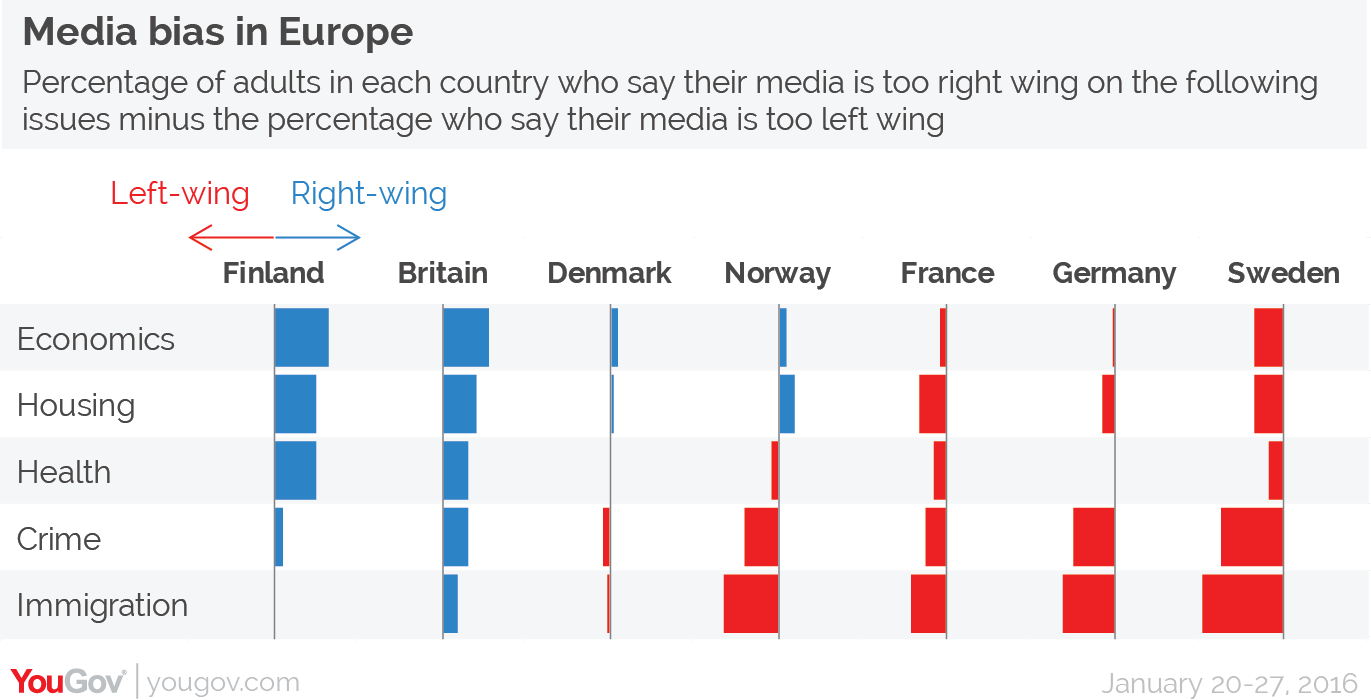
On average British people are more likely than any other country to see the media as skewed towards the right (26% compared to 23% for Finland and 19% for France). Britain’s media is viewed as having a right wing bias, most of all on the subject of economics (net 15 points to the right).

The media have recently portrayed Jeremy Corbyn as both a pacifist and as someone with a paradoxical tendency to “love terrorists”, but then logic and accuracy have never been apparent in most media attacks of the left. (See the Zinoviev letter, for a historic example). 

You know the world is in big trouble when diplomacy and negotiation skills are considered a “threat” to security. It seems that the establishment prefer bombing civilians to get other governments to comply with their wishes. I know which is probably going to contribute to keeping peace the most, and it isn’t “humanitarian” bombing. 

The “poor relations” between nuclear powers has contributed to an atmosphere that “lends itself to the onset of crisis,” according to a very worrying report by the UN Institute for Disarmament Research. The report goes on to say: “The rise in cyber warfare and hacking has left the technical vulnerabilities of nuclear weapons systems exposed to risk from states and terrorist groups.

Nuclear deterrence works—up until the time it will prove not to work. The risk is inherent and, when luck runs out, the results will be catastrophic.

The report went on to say: “The more arms produced, particularly in countries with unstable societies, the more potential exists for terrorist acquisition and use of nuclear weapons.”

The UN report comes as Donald Trump of the US and Vladmir Putin of Russia have both indicated support for expanding their country’s nuclear weapon arsenals. 

Deterrence is at the “greatest risk of breaking down” in North Korea and between India and Pakistan over the disputed territory of Kashmir.

The report also stated an expressed concern over tensions between the West and Russia, which have grown since the annexation of Crimea in 2014. President Putin has maintained Russia would use nuclear weapons if it felt sufficiently threatened.

You know, I think diplomatic skill is a far better quality to look for in a leader, speaking from the perspective of a civilian, in these troubled times. 

istock-456613403.jpg

In most newspapers, including even The Daily Mirror and The Independent, Labour voices that are unreasonably anti-Corbyn outweigh those that are pro-Corbyn. Corbyn’s voice is often absent in the narratives and reporting on him, and when it is present it is often presented in a highly distorted way. 

We all want and need a strong and a critical media, a watchdog of the powers that be, but maybe we do not need an “attack dog” who kills off anyone who dares challenge the status quo and dares to suggest we need a different kind of politics.

 

Related image

Ed Miliband eating a bacon butty on Channel four’s The Last Leg

The coming of epistemological totalitarianism in the UK

Epistemology relates to the theory of knowledge, especially with regard to its methods, validity, and scope, and the distinction between justified belief and opinion. In the UK, our “knowledge” is being framed by the right wing media. The media doesn’t exactly tell us how to think, but it does tell us what to think about, by a selective agenda of topics and the framing of public debate.

The UK establishment news media are highly centralised and dominated by elites who serve and maintain the status quo and who detest democracy.

Image result for media bias examples uk corbyn terrorism

In 2015, I wroteOne particularly successful way of neutralising opposition to an ideology is to ensure that only those ideas that are consistent with that ideology saturate the media and are presented as orthodoxy, to “naturalise” them. The Conservative election campaigns are a thoroughly dispiriting and ruthless masterclass in media control.

Communication in the media is geared towards establishing a dominant paradigm and maintaining an illusion of a consensus. This ultimately serves to reduce democratic choices. Such tactics are nothing less than a political micro-management of your beliefs and are ultimately aimed at nudging your voting decisions and maintaining a profoundly unbalanced, pathological status quo.

Presenting an alternative narrative is difficult because the Tories have not only framed all of the issues to be given public priority – they set and stage-manage the media agenda – they have also almost completely dominated the narrative; they construct and manage the political lexicon and now treat words associated with the left, such as welfare, trade unionism, collective bargaining, like semantic landmines, generating explosions of right wing scorn, derision and ridicule. This form of linguistic totalitarianism discredits any opposition before it even arises.

Words like cooperation, inclusion, mutual aid, reciprocity, equality, nationalisation, redistribution – collective values – are simply dismissed as mere anachronisms that need to be stricken from public conversation and exiled from our collective consciousness, whilst all the time enforcing their own bland language of an anti-democratic political doxa. The political manufacturing of a culture of anti-intellectualism extends this aim, too.”

The London School of Economics (LSE) media and communications department undertook a research project, aiming at contributing to the ongoing public debate regarding the role of mainstream media and of journalists in a media-saturated democracy. In Journalistic Representations of Jeremy Corbyn in the British Press: From “Watchdog” to “Attackdog”, the research team say:

“We set out to recognise and acknowledge the legitimate role of the press to critique and challenge the powers that be, which is often encapsulated by the metaphor of the watchdog. Our systematic content analysis of a representative sample of newspaper articles published in 8 national newspapers between 1 September and 1 November 2015, however, shows that the press reacted in a highly transgressive manner to the new leader of the opposition, hence our reference to the attackdog metaphor.

Our analysis shows that Corbyn was thoroughly delegitimised as a political actor from the moment he became a prominent candidate and even more so after he was elected as party leader, with a strong mandate. This process of delegitimisation occurred in several ways: 1) through lack of or distortion of voice; 2) through ridicule, scorn and personal attacks; and 3) through association, mainly with terrorism.

All this raises, in our view, a number of pressing ethical questions regarding the role of the media in a democracy. Certainly, democracies need their media to challenge power and offer robust debate, but when this transgresses into an antagonism that undermines legitimate political voices that dare to contest the current status quo, then it is not democracy that is served.”

Image result for corbyn terrorism

See Cameron ridiculed for hypocrisy and quoting Corbyn out of context.

According to the Independent Press Standards Organization (IPSO), newspapers are obliged to “make a clear distinction between comment, conjecture and fact and this has not been applied to media discussion of Jeremy Corbyn, by and large.

You can download the full LSE report here.

Also worth a read: How many of Jeremy Corbyn’s policies do you actually disagree with?

More recently, I explored the role of intentionally deceitful political language and rhetoric in another article  which highlights the role that the media play in shaping our public life. Media manipulation involves a series of related techniques in which partisans create images or arguments that favour their own particular interests. Such tactics may include the use of logical fallacies, psychological manipulations, deception, linguistic, rhetorical and propaganda techniques, and often involve the suppression of information or alternative perspectives by simply crowding them out. 

Discrediting and minimisation are often used in persuading other people or social groups to stop listening to certain perspectives and arguments, or by simply diverting public attention elsewhere. An example of diversion is the recent widespread scapegoating of refugees and people who need social security, such as disabled people or those who have lost their jobs, in a bid to maintain the hegemony of neoliberalism and its values at a time when its failings were brought into sharp focus during and following the global crisis – also exposing failings in the behaviours and practices of the government and the vulture capitalist financier class.

Neoliberalism always gravitates towards increasing inequality, extending and deepening poverty. Fear mongering is sometimes used with a diversion or misdirection propaganda technique to mask this, and may be pervasive. Sometimes politicians and media commentators suddenly take a debate in a weird and irrational but predictable direction to avoid democratic accountability.

The process often begins with a marginalised group being singled out and held to blame for the socioeconomic problems created by the system of socioeconomic organisation itself. Using the construction of folk devils (welfare “skivers” , “workshy” “something for nothing culture”, “culture of entitlement” or “dependency” for example), the political class and media generate moral panic and outrage, which serves to de-empathise the public and to justify the dehumanisation of politically created outgroups, and draconian policies.

Campaigners against social injustice are labeled “extremist” and politicians on the left who stand up against prejudice and discrimination are labeled “saboteurs”, “weak”, “anti-British” and extensively ridiculed and smeared. Every single Labour leader, with the exception of Blair, has had this treatment from the mainstream media.

During the coalition and Conservative governments, the tabloids have chosen and framed most of the debates that have dominated domestic politics in the UK, ensuring that immigration, welfare, law and order, the role of the state, and Britain’s relationship with Europe have all been discussed in increasingly right wing terms, while almost ironically, the government have colonised progressive rhetoric to cover their intentions. It also serves to further discredit the narrative of the left.

However, there is therefore a growing chasm between Conservative discourse, and policy intentions and outcomes. There isn’t a bridge between rhetoric and reality.

The Conservatives commonly use a nudge technique called “social norming” – a Behavioural Insights Team variant of the bandwaggon propaganda technique – particularly for General Election campaigning. It’s about manipulating a false sense of consensus, and normalising Conservative ideology. It’s also about prompting behavioural change, and as such, this method is a blatant attempt to influence the voting behaviours of the public, by suggesting that many others have already “joined” the Conservative “cause” and are happier or better off for doing so. The technique uses societal pressures to play on several basic emotional elements of human nature.

Oh, and then there is the basic technique of telling lies, of course.

Social norming is an appeal to emotional needs to fit in and belong, and also, to be on the side that wins. It has a kind of self fulfilling prophecy element to it, too. It’s used in advertising – words like “everyone” and “most people” or “many” are used a lot to sell brands and imply a popularity of certain products that usually isn’t real.

Political slogans like “a country that works for everyone” and the previous “all in it together” are examples of poor attempts at social norming. It’s aimed at shifting our normative framework to accommodate the status quo, too, regardless of how the accounts don’t tally with reality. Once you see it, you can’t unsee it.

With this in mind, we need to think about how the conventional political polls are run, who runs them and for what and whose purpose.

I wouldn’t dream of telling you who to vote for in the coming General Election. However, I will ask that you please very carefully consider what you vote for. 

Independent media organisations like Novara Media, Evolve Politics, Media Diversified, Media Lens, CommonSpace, The Canary, Bella Caledonia, Real Media, The Dorset Eye, Welfare Weekly, Scisco Media, Ekklesia, STRIKE! magazine, The Bristol Cable, Now Then, the Manchester Mule, and many others are taking the fight to the establishment. The new independent media have freedom from institutional dependencies, and in particular, from the influence of government and corporate interests.

Independent media includes any form of autonomous media project that is free from institutional dependencies.

We are not constrained by the interests of society’s major power-brokers.

The independent media collectively reflect a model that is democratic, prefigurative, often collaborative and that has a mutually supportive approach to public interest and conscience-based, as opposed to market-based, media.

We are a collection of diligent witnesses writing a collective, qualitative social testimony, marking and evidencing an era of especially historic political upheavals on a global scale.

The Canary says that independent media “have been ably assisted by an array of skilled and committed bloggers like Vox Political, Another Angry Voice, Pride’s Purge and Politics and Insights (Kitty S Jones) to name but a few.” (Takes a small bow). I would add THE SKWAWKBOX to the list, too.

Related

Don’t buy the lie. To oppose the government is not sabotage –  video by Paul Mason

The bias in our mainstream media makes a lot more sense when you see who owns and runs it – Kerry-Anne Mendoza

We need to talk about the mainstream media and the election. Because a disaster is looming – Steve Topple

BBC’s Stephen Sackur accuses Tories of spreading propaganda about Jeremy Corbyn, and of being unaccountable and undemocratic

Inverted totalitarianism and neoliberism 

Dishonest ways of being dishonest: an exploration of Conservative euphemisms

Once you hear the jackboots, it’s too late

Through the looking glass darkly: the Conservatives are colonising progressive rhetoric

Hypernormalisation – Adam Curtis

Politics and Insights condemns George Osborne’s appointment to the Evening Standard in joint independent media statement


My work is unfunded and I don’t make any money from it. But you can support Politics and Insights and contribute by making a donation which will help me continue to research and write informative, insightful and independent articles, and to provide support to others.

DonatenowButton

A democratic message from Jeremy Corbyn – contribute to Labour policies

Prefigurative, inclusive, participatory democracy in action. We must be the change we want to see.

The Conservatives don’t really do public consultations in any meaningful sense. But they are an essential part of a functioning democracy. Our current government took an authoritarian turn, prefering to impose policies that act upon people as if they are passive objects, rather than including us in decision-making, as autonomous human subjects. The Conservatives have no consideration for democracy, rights, the law and importantly, public needs.

Have your say in shaping the Labour Party’s policy agenda. It matters. 

Kitty.

jeremy-corbyn
I had the following email from Jeremy Corbyn on 17 March:

Subject: Help us write our policies for the challenges ahead of us.

Dear Sue,

Last year I said that I wanted us to reconnect with our values and our people, so we can rebuild and transform Britain, for the many, not just the few.

To do this we need to hear from you, our members, to harness your views, passions and expertise. 

At conference I set out ten pledges outlining my priorities. I asked Labour’s National Policy Forum to build on this work, to develop Labour’s thinking in these and other key areas.

Today we are launching eight new consultation documents on key issues we’d like your opinions on:  

Find out more and get involved.

The consultation period runs until Wednesday, 31 May 2017. I hope that you, other members and local parties will take the opportunity to read the documents and send in your comments and ideas.

The more people that get involved, the stronger and better our policy making process is.

The best and easiest way to send in your ideas and join the discussion is via our online home of policy making:

www.policyforum.labour.org.uk.

(You’ll need to register an account or use your Labour Login). 

By standing up for what we believe in; by engaging people as we develop our policies; and by building a policy platform together, we can deliver our vision of a more just and better Britain.

Yours,

Jeremy Corbyn MP
Leader of the Labour Party


Remember: You will need to use your new Labour Login to sign in to the consultation

We’ve been in touch to let you know your log in to some systems is changing – this is so we can get to a point where you just have to use one password and user name to access all Labour systems.

If you have signed-up for My Labour, you will already have a Labour Login and will be able to use these details to sign-in. If not, you will need to create a Labour Login.

Two EDMs have been tabled to stop Tory cuts to disability support, with cross-party endorsement

aaeaaqaaaaaaaad4aaaajdk1ytqwzdyxltjinwytngjhmc05njdlltmyzmu4mty4owi5za

I reported last week that the Liberal Democrats were planning an Early Day Motion (EDM) to halt the government’s authoritarian Personal Independence Payment (PIP) regulations. The new regulations are designed by the government to disregard the rulings of two upper tribunals regarding the scope of eligibility criteria for disabled people claiming PIP. However, upper tribunals are part of a body of administrative law that governs the activities of the administrative agencies of government. It is designed to independently review the decisions of governments, and as such, it provides protection and promotion of fundamental rights and freedoms for citizens.

The Upper Tribunal is a superior court of record, giving it equivalent status to the High Court and it can both set precedents and can enforce its decisions (and those of the First-tier Tribunal) without the need to ask the High Court or the Court of Session to intervene. It is also the first (and only) tribunal to have the power of judicial review. (The Conservatives have a historical dislike of judicial review. See for example: The real “constitutional crisis” is Chris Grayling’s despotic tendencies and his undermining of the Rule of Law.)

The first EDM has already gained excellent cross-party support. It’s primary sponsor is Tim Farron. Signatories include Jeremy Corbyn, Debbie Abrahams and a number of other Labour Party MPs, Caroline Lucas (Green Party), Jonathan Edwards (Plaid Cymru) and Scottish National Party MPs.  

It says: “That an humble Address be presented to Her Majesty, praying that the Social Security (Personal Independence Payment) (Amendment) Regulations 2017 (S.I., 2017, No. 194), dated 22 February 2017, a copy of which was laid before this House on 23 February, be annulled.”

From 1 April 2017, further cuts to Employment and Support Allowance (ESA) are to be introduced, again via statutory instrument (which are usually reserved for non-controversial policy amendments only). The new regulations mean that claimants who are placed in the Work-Related Activity Group (WRAG) will lose around £30 a week, receiving the same rate of payment as those claiming Jobseeker’s Allowance and the equivalent in Universal Credit.

Another EDM was tabled by the Labour Party, with the primary sponsor being Jeremy Corbyn, which says: “That an humble Address be presented to Her Majesty, praying that the Employment and Support Allowance and Universal Credit (Miscellaneous Amendments and Transitional and Savings Provisions) Regulations (S.I., 2017, No. 204), dated 23 February 2017, a copy of which was laid before this House on 27 February, be annulled.”

Disabled people have already carried a disproportionately large burden of austerity cuts.


2014-02-17-BurdenoftheCuts-thumb


The cuts to disability support have been widely opposed, yet the government apparently pays little heed to the need for democratic accountability. 

You can support disabled people who are being targeted by ever-increasingly punitive Conservative policies that are having an extremely damaging impacon us by emailing your MP and asking them to sign both EDMs. (Contact details here).


Related

A black day for disabled people – disability benefit cuts enforced by government despite widespread opposition

House of Lords debate: ESA – Monday 07 March 2016 (From 3.06pm)

MP attacks cuts hitting disabled people – Debbie Abrahams

Leading the debate against the Welfare Reform and Work Bill – 3rd reading – Debbie Abrahams

My speech at the Changes to Funding of Support for Disabled People Westminster Hall Debate – Debbie Abrahams

Man leaves coroner letter as he fears Work Capability Assessment will kill him

The government need to learn about the link between correlation and causality. Denial of culpability is not good enough.

The new Work and Health Programme: government plan social experiments to “nudge” sick and disabled people into work

Stephen Crabb’s obscurantist approach to cuts in disabled people’s support

A Critique of Conservative notions of “Social Research”

The DWP mortality statistics: facts, values and Conservative concept control


I don’t make any money from my work and I have limited income due to illness. But you make a donation and help me continue to research and write free, informative, insightful and independent articles, and to provide support to others. The smallest amount is much appreciated – thank you.

DonatenowButton cards


National consultation on the rights of disabled people – the Labour party’s disability equality roadshow

https-cdn-evbuc-com-images-26194810-195402787332-1-original

Jeremy Corbyn, Paul Rutherford and Debbie Abrahams at the Roadshow in Manchester

The Labour party would like to invite you to attend the Disability Equality Roadshow, an event asking disabled people, their carers and service providers, which policies Labour should develop to best defend and extend their rights.

The events are free and the next one is to be held in the North East in Newcastle on 3 December. You can register to attend here.

Regardless of your personal party affiliations, I think as many of us as possible need to attend these events and have a positive input into policy because we need political parties to recognise disabled people’s needs, especially given the past six years of harrowing and disproportionately targeted austerity cuts and systematic violation of disabled people’s human rights.

I don’t support the Liberal Democrats, but nonetheless have permitted the party to use some of my work on disabled people’s rights and the impact of austerity on their site, because our needs and views ought to matter to every political party. Something as fundamental as the recognition and observation of human rights should be a collaborative and collective cross-party endeavour – a cooperative effort in a democratic, inclusive society.

Human rights should not be a party political issue, but it’s a fact that they are. The Conservatives want to repeal our Human Rights Act, and that must not happen. The government have already demonstrated clearly that they will not observe the rights of disabled people. Without a robust legal framework in place, we would have absolutely no access to justice and redress, and no protection from the brutality and disregard of an increasingly authoritarian government .

Debbie Abrahams has organised and launched the Roadshow, which is an important opportunity for us to have a democratic say in political decision-making and shape future policies. 

The Labour party are using the United Nations Convention on the Rights of Disabled People as a framework to help develop policies not just on social security but on education, health and social care, justice and more. It was the last Labour government that signed the UK up to the Convention.

The Roadshow will be going across the country to every region and to every nation state. 

Debbie is the Member of Parliament for Oldham East and Saddleworth and Shadow Secretary of State for Work and Pensions. She has represented the constituency since her by-election victory in January 2011.

Debbie was a member of the Work and Pensions Select Committee from June 2011-March 2015, where she led the call for an independent inquiry into the Government’s punitive New Sanctions Regime. She was re-elected as a member of the Work and Pensions Committee in July 2015 until her appointment as Shadow Minister for Disabled People in September 2015.  In June 2016 she was appointed Shadow Secretary of State for Work and Pensions.

Debbie is passionate about tackling inequalities and has campaigned extensively for a fairer society, setting up the Oldham Fairness Commission to deliver this in her own constituency. 

The Labour party assure us that the next Labour government will ensure that the UK upholds its obligations under the UN convention on persons with disabilities. They say their “commitment to people-powered politics means that they believe that future social security policy should be co-produced with deaf and disabled people, carers and service providers”. That is our democratic right. The party want to transform our social security system, based on the principles of dignity, independence and support. 

 The Labour party say they will listen to our views on improving social security, removing the punitive elements such as sanctions, the work capability assessment and the bedroom tax, to ensure it is fit for purpose; ensuring fair and equal access to employment for people who can and want to work; suitable housing and education; improving the provision of care and best supporting carers. 

If you have any additional access needs please email Huma on huma_haq@labour.org.uk by Thursday 1st December. 

Hope to see you there.


DATE AND TIME: Sat 3 December 2016, 10:45 – 13:45 GMT

LOCATION: Unite the union

John Dobson Street

Newcastle upon Tyne

NE1 8TW

View Map

Dead cat conditioning, attention deficit and the social order

blog56_johnnicola_sadface


Last week I wrote about hundreds of people dying of malnutrition in the UK over this past twelve months alone, as a consequence of government policies. I wrote about how our universities are no longer permitting free speech and critical thinking, and how dissenting academics have taken to blogging, using pseudonyms and writing anonymous letters because of the repressive political developments in the UK.  I am now about to write another piece on how our Human Rights Act is to be scrapped and replaced by a Conservative Bill of Frights.

The Labour party needs to be collectively opposing the government and addressing these pressing, socially calamitous issues, raising public awareness regarding the profound damage that this authoritarian government are inflicting on our society and drafting remedial policy outlines which extend social justice and equality. 

In the Labour Party Forum – a Facebook group for party members – I was told that my post about the implications of the Government Higher Education white paper, along with an analysis of the illogic of neoliberalism and its consequences is “irrelevant” to the Labour party.

There is a problem with that. 

If the Labour party is to reach out and persuade the electorate that they have an alternative which is better than the current government, they will need to recognise and to fully understand issues that are affecting the wider public. In the Labour Party forum, every single post (except mine) is about about the leadership debate. But being engaged with what is culturally popular isn’t always in our best interests.

The comments from members are dripping with bad feeling, oozing impotent anger and bleeding bitterness. The party infighting is clearly visible on every thread, the hostility is palpable, and all of this in a group that was once united in fighting the real enemy of ordinary people: the Tories. The old, easy camaraderie among members has seeped away.  Cooperation has plummeted sickeningly down the chasms of division. Fallen socialist values, lying broken. Many who claim they are fighting for a “socialist party” seem to have forgotten to practice what they preach. 

I do understand the anger that many feel in the face of a neoliberal, right wing establishment openly demonstrating a hegemonic stranglehold via the media, with endless streams of poisonous propaganda. We witness overt claims, subtexts and a level of perpetual subliminal messaging about who is fit to lead our country and who isn’t. The attacks on Corbyn in particular highlight just how the powers that be in the UK  have ensured that alternatives to the status quo never become established as a part of our mainstream conceptual and linguistic universe. The media write them out. There is a war going on, for sure. But this is nothing new.

The roots of our current crisis of democracy and class warfare go back a long way, and many of these have been embedded deeply in the changes to Britain’s sociopolitical economy since the Thatcher era. Neoliberalism is a doxa, it didn’t come into being as a means of social and economic organisation because it works: it became mainstreamed “common sense” because the establishment won. 

I gave an interview last year to Phil, who is a very public sociologist on the All That Is Solid site, outlining my own position on developments within the Labour party. Since then, I have written just two articles about party ideology, values and the leadership issues. I do write regularly about ideology, propaganda and the techniques of persuasion that are used by the establishment and media to maintain the status quo. This is an issue that extends well beyond the arising claustrophobic parochialism of Labour party disunity, leadership battles and current disarray. 

The media is the message

Social control is maintained in part by the use of a strategy of distraction, which is designed to divert public attention from important issues and changes determined by the political and economic elites, using a technique of flooding continuous diversions and insignificant information. Distraction strategy is also used to prevent public interest in essential knowledge that is then used to exercise control, whilst ensuring those being controlled are also completely disarmed.  The media maintain public attention, and divert it away from real social and economic problems. The public become an audience captivated by matters of no real importance. I’m probably loosely paraphrasing Noam Chomsky, here. 

From within the Westminster playpen, originating from the likes of Conservative babysitter, Lynton Crosby, the dead cat strategy is basically deployed as a major distraction tactic, usually entailing insulting diversion from a government’s political controversies and failings. So when, for example, the government are investigated by the United Nations for contravening basic human rights, they will scream that the opposition leader is somehow a threat to our national security. 

Everyone will gasp, clutch their brand of indignation and moral panic, and bang on about that for the rest of the week. The fact that democracy is gone for a burton, or human rights are being sidestepped and people are dying because of austerity policies is buried under a pile of furry corpses piling up on the allegoric political table, whilst commentators across the land discuss Jeremy Corbyn’s tweed jacket and beard. 

Then there is the age-old strategy of dīvide et īmpera. Every person on the left of the political spectrum knows what “divide and rule” means. It refers to a strategy that breaks up existing power structures, undermines democracy, and especially prevents smaller power groups from organising, collaborating, cooperating and forming alliances, by creating rivalries, fostering discord, distrust and enmity among the groups. Hello.

Thing is, despite these strategies being common knowledge, this hasn’t stopped many Labour party supporters using the disgracefully unreliable and establishment-collaborative media to present their own personal preferences. The Labour Pary Forum is filled with trivial articles about Owen Smith, this, Jeremy Corbyn, that and Tom Watson, the other, the comment threads full of screaming  indignation and neatly blinkered participants.

Socialist politics is supposed to be conscientious, and rather more about the social, not the personal.

This week, we see  the Independent, the Spectator, the Mirror, the Huffington Post, Politics Home, the London Economic, Channel four, amongst many others, report an audience booing the mention of a perceived political rival at a rally comprised of his opponent’s supporters. I’m all for freedom of speech, but for crying out loud, why and how is this by now mind-numbing tittle tattle considered to be NEWS? And even more importantly, why do social media campaigners think it is?

Don’t look away now

banksy-elephant-in-room1


Only a matter of weeks ago, a Labour MP was murdered by a far right fanatic, because of her political work, and because we are a distracted society that permits a right wing authoritarian othering and outgrouping demagoguery.

But now there are no ripples on the pond.

How can so many people seemingly forget such a horror? It’s almost as if this outrageous, politically motivated murder was a normal event, expected and accepted. Why are we allowing an ideology-driven and opportunistic establishment to divide our society into hierarchies of human worth and value? There’s an underpinning message in policies and political rhetoric that some lives are worth more than others; it’s has crept in unchecked, almost unnoticed, and we have allowed that to happen because we look the other way. In fact many of us seem quite determined to look the other way.

It’s not only migrants that are being politically and socially outgrouped. Disabled people are experiencing an unprecedented increase in hate crime and people are dying of malnutrition in the 5th wealthiest nation of the world. People are dying because of a government’s policies here in the UK. Prejudices are flourishing, violence growing. This is the kind of society we have become. Yet many people are still not paying attention. We are being conditioned not to look and not to see.

Whilst so many people are so happily distracted and so easily diverted by the most trivial details, our democracy is being quietly dismantled, the social gains of our post-war settlement have been almost erased from history, our human rights are being sidelined and re-written to shift the balance of obligation and responsibility from the state to the individual. Such profoundly damaging developments with such dire and toxic implications for our country ought to be recognised and challenged. Citizens are dying prematurely because of class contingent Conservative policies in a post-welfare, low waged Britain.

Those of us who reject austerity and neoliberalism are not “Trot entryists” , “revolutionaries” , “militants” or “extremists”. We are simply people who see beyond prejudiced ideologies and doxas. We recognise neoliberalism only works for 1% of the population. Furthermore, I am certain that in a world where people paid attention, instead of being distracted by mainstreamed, dominant narratives and  the mind-numbingly mediocre, homogenenised X factor culture, almost everyone else would recognise this, too.

I support Corbyn. Not because I invest in a superficial cult of personality type of politics. Not because I see a Corbyn-led Labour party as an end in itself. I have always maintained that a Labour government would simply mark a viable starting point  – the means – for a concerted campaign for social justice and equality.

I support Corbyn because I object to the destruction of people’s lives and the dismantling of protective civilised and civilising social structures because of a neoliberal and social Darwinist politics that invariably creates, through class contingent policies, inequality and social injustice – a few winners and many losers, the latter are then blamed by the state for the faults that are actually intrinsic to the system and extended by the state. I believe that in democracies, governments are elected to meet public needs, we don’t elect them to manipulate public perceptions and nudge us into meeting political and narrow, economic needs. I also believe that progress won’t happen unless we actively participate in democratic processes and work to extend them. Democracy (rather like intelligence) isn’t something we have: it’s something we must DO.

 The current infighting will kill the Labour movement. Vote for Corbyn, (or don’t), but there’s no need for the endless and insular justifications of your voting choice. Let’s keep some perspective and deal with what we NEED to – the  much bigger picture –  instead of impotently bickering among ourselves about a single issue. Socialism is surely all about a vision of the kind of society that is just and fair for the majority; it’s not about personal preferences and narrowly individualist perspectives.

Right now, the establishment have got us exactly where they want us. Their corporate media mouthpieces have made sure of that. The infighting, meanwhile, is destroying the Labour movement from within. 

But we can resist dead cats, Conservative bouncing bomb propaganda and such blatant techniques of persuasion… really, we can do so much better than this.

We won’t do so if we ignore the wider social realities and policy impacts being shaped by an authoritarian government.

sociologyexchangecouk-shared-resource-5-728It’s time to fight back


CONTRIBUTE TO POLITICS AND INSIGHTS

I don’t make any money from my work. But you can contribute by making a donation and help me continue to research and write informative, insightful and independent articles, and to provide support to others. The smallest amount is much appreciated – thank you.


From the Zinoviev letter to the Labour party coup – the real enemy within

crispin-blunt-conservative_4493847


Last September I wrote about an unusually unbiased BBC World News interview with Crispin Blunt (pictured above), the (then) Chairman of the Foreign Affairs Select Committee. The interview highlighted an ongoing crisis of democracy and reflects a broader, longstanding and insidious establishment conflict with the Labour party. Blunt told Stephen Sackur during the interview that the government is not under any obligation to share intelligence information with the (then) new Labour leader Jeremy Corbyn. 

His comments came just days after a senior serving general, scaremongering anonymously in the Sunday Timessaid Corbyn’s victory had been greeted with “wholesale dismay” in the army. The general said that any plans to scrap Trident, pull out of Nato or announce “any plans to emasculate and shrink the size of the armed forces” will meet fierce opposition. His hint that some in the military planned an illegal seizure of the state if Corbyn wins the next General Election is particularly extraordinary. He said the army would “use whatever means possible, fair or foul to maintain security.”

A coup d’état is an anachronistic and violent method of political engineering that ordinarily happens only in one-party fascist, totalitarian and despotic states, it’s not an event you would expect to see used as a threat in a so-called first world liberal democracy.

Regardless of how far-fetched the threats may seem, that a general feels it’s okay to threaten a coup or “mutiny” against a future left wing government using the mainstream right-wing press as a mouthpiece is a cause for some concern. It’s a symptom of how oppressive the establishment have become, and how apparently acceptable it is to attack, discredit and threaten anyone who presents a challenge and an alternative perspective to the status quo.  

The nameless, gutless and anti-democratic general’s comments reminded me of the Zinoviev letter, and the other subversive plots in the 1960s and 1970s that were engineered by the establishment using the military and intelligence services to destabilise Harold Wilson’s government.

The Labour leader has said that as far as the party is concerned, the UK’s role in Nato is a matter for discussion for the shadow cabinet, the party at large and most importantly, the public. Emily Thornberry announced that there will be a public consultation regarding the value of the UK nuclear deterrent. That is, after all, the democratic thing to do.

The anonymous general claimed that there would be “mass resignations at all levels and you would face the very real prospect of an event which would effectively be a mutiny” if Corbyn became [democratically elected as] prime minister.

The threat, regardless of its authenticity, is undoubtedly part of a broader strategy of tension, designed purposefully to create public alarm – to portray the left as a threat to the well-being of society – and it has continued to reverberate around the media; used as part of an arsenal of pro-establishment, anti-progressive propaganda to discredit Corbyn and the left.  

Mr Blunt told BBC Hardtalk Stephen Sackur that the serving general’s opinion was “inappropriate”, did not reflect the view of the government and that if Jeremy Corbyn were elected prime minister the army like everyone else would have to carry out the instructions of the elected government. 

In the meantime, Blunt said that it was a matter for the government to decide how much access to “privileged information” the leader of the opposition had. There would be no point in passing on such information if it would not “achieve consensus.”

In other words, the government don’t want a critical and democratic dialogue about potential military decisions. They are refusing to include anyone else in crucial political decision-making processes.

Sackur said that as soon as Corbyn was elected, the Conservatives “issued propaganda” suggesting that Corbyn is a threat to national security. He also pointed directly to the government’s fundamental lack of accountability, transparency and democracy in the unprecedented move to refuse to share military and intelligence information, which is conventionally shared with the leader of the opposition.

Blunt simply confirmed Stephen Sackur’s point about the government’s lack of democracy, accountability and transparency. Sackur exposed the rank hypocrisy of a government that claims to be democratic, yet does not tolerate parties with differing views, nor does it invite or engage in dialogue and critical debate, choosing instead to exercise totalitarian control over what ought to be democratic decision-making, the will and thoughts of others, including the public that a government is meant to serve.


Perhaps a coup in the event of a left wing win in 2020 isn’t so far-fetched in the current oppressive political climate.

You can see the Hardtalk interview here, which is still up on the BBC iPlayer: http://bbc.in/1WgxmXF

From the Zinoviev letter to GBH and Spycatcher: the real enemy within

A scene from Alan Bleasdale’s perceptive GBH, a much misunderstood, darkly comedic series from 1991. Some commentators in the mainstream media at the time portrayed GBH as an indication that Bleasdale had shifted to the right, claiming that he was attempting to discredit the militant left. Many drew purposeful and convenient parallels with Derek Hatton and one of the central characters, Michael Murray.

However, for me there was a deeper, important and far more sinister message, which was not part of the mainstream conversation. Bleasdale’s central theme is an infiltation of the Labour party by MI5, ordered by the Conservative government at the time. Their aim was to recruit, manipulate and indoctrinate local “young bulls” with quasi left wing ideology to have them assist, unknowingly, in destablising and discrediting the Labour party in its entirety.

It’s certainly true that the far right, racism and social conflict always bloom and flourish under Conservative governments.

Fueling social tensions, MI5 agents provocateurs were prepared to use the ethnic communities to foster social division, in the hope of causing riots and ultimately, the hardened right wing thugs (MI5 were eventually revealed as the real thugs here) dismissed the minority groups as collateral damage, a callous, calculated move that was deemed necessary to destroy the Labour party.

MI5 staged a series of violent racist assaults on the city’s ethnic minorities, using hired local hardcases posing as police officers. They “made things happen.” Ultimately to preserve the status quo. In the drama, it’s eventually revealed that the plot to destablise the left involves Britain’s entire intelligence community.

Many felt that Bleasdale was portraying the end of socialism, but if he was, it was ultimately at the hand of the Tories – the real enemy within – not the militant left.

It’s not such a far-fetched “conspiracy theory”, especially in light of other developments, such as Peter Wright’s Spycatcher and Seamas Milne’s work The enemy Within.

The Zinoviev letter – one of the greatest but almost forgotten British political scandals of last century – was forged by a MI6 agent’s source and almost certainly leaked by MI6 or MI5 officers to the Conservative Party, according to an official report published in 1999.

Britain’s most senior security and intelligence officials discussed the smearing of the Labour party just as it was emerging as a major political force according to previously secret documents.

The potential repercussions of attempts by the intelligence agencies to damage the Labour party were debated at length by the little-known Secret Service Committee, later research – now released at the National Archives – shows.

Of course it was not the only time Britain’s intelligence agencies were implicated in attempts to destabilise a Labour government. A group of right wing intelligence officers attempted to destabilise Harold Wilson’s administrations in the 1960s and 70s.

One newly released document at the National Archives is a minute of the Secret Service Committee, dated 11 March 1927. It quotes Sir William Tyrrell, top official at the Foreign Office, referring to a conversation he had with the prime minister, Stanley Baldwin, about politically inspired leaks by the police special branch as well as the security and intelligence agencies.

Baldwin’s main concern, said Tyrrell, was the fear that the political work done at Scotland Yard might at any moment give rise to a scandal, owing to the Labour party obtaining some “plausible pretext to complain that a government department was being employed for party politics.”

On 8 October, 1924, Britain’s first Labour government lost a vote of confidence in the House of Commons. The next day the Foreign Office was evidently sent a copy of a letter, purportedly originally sent from Grigori Zinoviev, the president of Comintern, addressed to the central committee of the Communist Party of Great Britain. The letter urged the party to stir up the British proletariat and the military in preparation for class war.

On 25 October the letter appeared in the heavily Conservative-biased Daily Mail just four days before the election. The political and diplomatic repercussions were immense.

The Daily Mail published a series of sensationalist headlines:

  • Civil War Plot by Socialists’ Masters
  • Moscow Order to Our Reds
  • Great Plot Disclosed Yesterday
  • Paralyse the Army and Navy
  • Mr. MacDonald Would Lend Russia Our Money

Here is the entire Zinoviev letter:

Very secret

Executive Committee, Third Communist International.

To the Central Committee, British Communist Party.

Presidium, September 15, 1924. Moscow.

Dear Comrades,

The time is approaching for the Parliament of England to consider the Treaty concluded between the Governments of Great Britain and the S.S.S.R. for the purpose of ratification. The fierce campaign raised by the British bourgeoisie around the question shows that the majority of the same, together with reactionary circles, are against the Treaty for the purpose of breaking off an agreement consolidating the ties between the proletariats of the two countries leading to the restoration of normal relations between England and the S.S.S.R.

The proletariat of Great Britain, which pronounced its weighty word when danger threatened of a break-off of the past negotiations, and compelled the Government of MacDonald to conclude the treaty, must show the greatest possible energy in the further struggle for ratification and against the endeavours of British capitalists to compel Parliament to annul it.

It is indispensable to stir up the masses of the British proletariat to bring into movement the army of unemployed proletarians whose position can be improved only after a loan has been granted to the S.S.S.R. for the restoration of her economics and when business collaboration between the British and Russian proletariats has been put in order. It is imperative that the group in the Labour Party sympathising with the Treaty should bring increased pressure to bear upon the Government and Parliamentary circles in favour of the ratification of the Treaty.

Keep close observation over the leaders of the Labour Party, because these may easily be found in the leading strings of the bourgeoisie. The foreign policy of the Labour Party as it is, already represents an inferior copy of the policy of the Curzon Government. Organize a campaign of disclosure of the foreign policy of MacDonald.

The I.K.K.I. (Executive Committee, Third [Communist] International) will willingly place at your disposal the wide material in its possession regarding the activities of British Imperialism in the Middle and Far East. In the meanwhile, however, strain every nerve in the struggle for the ratification of the Treaty, in favour of a continuation of negotiations regarding the regulation of relations between the S.S.S.R. and England.

A settlement of relations between the two countries will assist in the revolutionising of the international and British proletariat not less than a successful rising in any of the working districts of England, as the establishment of close contact between the British and Russian proletariat, the exchange of delegations and workers, etc., will make it possible for us to extend and develop the propaganda of ideas of Leninism in England and the Colonies.

Armed warfare must be preceded by a struggle against the inclinations to compromise which are embedded among the majority of British workmen, against the ideas of evolution and peaceful extermination of capitalism. Only then will it be possible to count upon complete success of an armed insurrection. In Ireland and the Colonies the case is different; there is a national question, and this represents too great a factor for success for us to waste time on a prolonged preparation of the working class.

But even in England, as other countries, where the workers are politically developed, events themselves may more rapidly revolutionise the working masses than propaganda. For instance, a strike movement, repressions by the Government etc.

From your last report it is evident that agitation-propaganda work in the army is weak, in the navy a very little better. Your explanation that the quality of the members attracted justifies the quantity is right in principle, nevertheless it would be desirable to have cells in all the units of the troops, particularly among those quartered in the large centres of the country, and also among factories working on munitions and at military store depots. We request that the most particular attention be paid to these latter.

In the event of danger of war, with the aid of the latter and in contact with the transport workers, it is possible to paralyse all the military preparations of the bourgeoisie, and make a start in turning an imperialist war into a class war. Now more than ever we should be on our guard.

Attempts at intervention in China show that world imperialism is still full of vigour and is once more making endeavours to restore its shaken position and cause a new war, which as its final objective is to bring about the break-up of the Russian Proletariat and the suppression of the budding world revolution, and further would lead to the enslavement of the colonial peoples. ‘Danger of War’, ‘The Bourgeoisie seek War’, ‘Capital fresh Markets’ – these are the slogans which you must familiarise the masses with, with which you must go to work into the mass of the proletariat. These slogans will open to you the doors of comprehension of the masses, will help you to capture them and march under the banner of Communism.

The Military Section of the British Communist Party, so far as we are aware, further suffers from a lack of specialists, the future directors of the British Red Army.

It is time you thought of forming such a group, which together with the leaders, might be in the event of an outbreak of active strife, the brain of the military organisation of the party.

Go attentively through the lists of the military ‘cells’ detailing from them the more energetic and capable men, turn attention to the more talented military specialists who have for one reason or another, left the Service and hold Socialist views. Attract them into the ranks of the Communist Party if they desire honestly to serve the proletariat and desire in the future to direct not the blind mechanical forces in the service of the bourgeoisie, but a national army.

Form a directing operative head of the Military Section.

Do not put this off to a future moment, which may be pregnant with events and catch you unprepared.

Desiring you all success, both in organisation and in your struggle.

With Communist Greetings,

President of the Presidium of the I.K.K.I.

ZINOVIEV

Member of the Presidium: McMANUS

Secretary: KUUSINEN

Some historians say that the letter aided the Conservative party in hastening the collapse of the Liberal party which led to a decisive Conservative victory. Curiously, a now familiar tactic.

Others say the letter was an example of Conservative deceit, which in 1924, enabled Britain’s Conservative party to cheat their way to a general election victory. Personally, I’m inclined to believe the latter. It’s not as if the Conservatives have a history of democratic engagement, transparency, accountability and honesty, after all.

The letter came at a sensitive time in relations between Britain and the Soviet Union, due to the Conservative opposition to the parliamentary ratification of the Anglo-Soviet trade agreement of 8 August 1924.

The publication of the letter was severely embarrassing to Prime Minister James Ramsay MacDonald and his Labour party. The chance of a victory was dashed as the spectre of internal revolution and a government oblivious to the “red peril” dominated the public consciousness, via the media.

MacDonald’s attempts to establish doubt regarding the authenticity of the letter were catastrophically in vain, hampered by the document’s widespread acceptance amongst Tory government officials. MacDonald told his Cabinet he “felt like a man sewn in a sack and thrown into the sea.”

New light on the scandal which triggered the fall of the first Labour government in 1924 is shed in a study by Gill Bennett, chief historian at the Foreign Office, commissioned by Robin Cook in 1998.

Bennett’s investigation implicates Desmond Morton, an MI6 officer and close friend of Churchill who appointed him personal assistant during the second world war, and also points to Major Joseph Ball, an MI5 officer who joined Conservative Central Office in 1926. Ball later went on to be one of the earliest spin doctors – for the Tories.

The exact route of the forged letter to the Daily Mail will probably never be known. There were other possible conduits, including Stewart Menzies, a future head of MI6 who, according to MI6 files, admitted sending a copy to the Mail.

In summary, the letter was purported to be from Grigori Zinoviev, president of the Comintern, the internal communist organisation, called on British communists to mobilise “sympathetic forces” in the Labour party to support an Anglo-Soviet treaty (including a loan to the Bolshevik government) and to encourage “agitation-propaganda” in the armed forces.

As stated, on 25 October, 1924, just four days before the election, the Mail splashed headlines across its front page claiming: Civil War Plot by Socialists’ Masters: Moscow Orders To Our Reds; Great Plot Disclosed. Labour lost the election by a landslide.

Bennett said the letter “probably was leaked from SIS [the Secret Intelligence Service, commonly known as MI6] by somebody to the Conservative Party Central Office.” She named Major Ball and Mr Morton, who was responsible for assessing agents’ reports.

“I have my doubts as to whether he thought it was genuine but [Morton] treated it as if it was,” she said.

She described MI6 as being at the centre of the scandal, although it was impossible to say whether the head of MI6, Admiral Hugh Sinclair, was involved.

Bennett also said there was “no evidence of a conspiracy” in what she called “the institutional sense.”

But there was no evidence that refuted such a conspiracy either. The security and intelligence community at the time consisted of a “very, very incestuous circle, an elite network” who went to school together. Their allegiances, she says in her report, “lay firmly in the Conservative camp.”

Bennett had full access to secret files held by MI6 (though some have been destroyed) and MI5. She also saw Soviet archives in Moscow before writing her 128-page study. The files show the forged Zinoviev letter was widely circulated, including to senior army officers, to inflict maximum damage on the Labour government.

She found no evidence to identify the name of the forger. The report says there is no hard evidence that MI6 agents in Riga were directly responsible – though it is known they had close contacts with White Russians – or that the letter was commissioned in response to British intelligence services’ “uneasiness about its prospects under a re-elected Labour government.”

The report does not tie up loose ends. But by putting a huge amount of material into the public domain, it at least allows people to make up their own minds. Important questions remain, and may always go unanswered – such as who actually forged the letter.

However, if Bennett is right in her suggestion that MI6 chiefs did not set up the forgery, her report claims that MI6 deceived the Foreign Office by asserting it did know who the source was – a deception it used to insist, wrongly, that the Zinoviev letter was genuine.

Bennett claims that we cannot conclude the scandal brought down Ramsay Macdonald’s government, which had already lost a confidence vote and Liberal support on which it depended was disappearing.

“In electoral terms,” she says, “the impact of the Zinoviev letter on Labour was more psychological than measurable.”

I don’t agree.

Firstly, I think that it’s a fairly safe and balanced conclusion that the Intelligence Services lack diversity, with a strong tendency to recruit staunch establishmentarians. The impact was calculated to be measurable. Secondly, the media has always exercised enormously heavy influence on voters, I find it a little odd that such a connection was deemed insignificant. Especially given the wide use of black propaganda, very evident at the time.

Besides, this isn’t an isolated event, and there does appear to be an established relationship between Conservative governments and the secret services staging persistent attempts at “destabilising,” discrediting and smearing the left. And the media.

Fast-forward to more recent events, and low and behold, the mainstream media are still feeding us the fear-mongering and pseudo-warnings of an “evil Communist threat.” Last year we heard how the late Ralph Miliband “influenced” his son, “Red Ed,”  with the media claiming that the then Labour leader’s policies are founded on a “legacy of evil” and a “poisonous creed.” That’s once again according to the very pro-establishment, corrupt Daily Mail, of course. (See also: Tory Fascist Lie Machine The Daily Mail Has Met Its Match.) Same old tactics.

Miliband had established the International Anti-Austerity Alliance to challenge the neoliberal consensus, his progressive tax proposals and promise to implement the Leveson recommendations chafed the establishment’s ass.

The Comintern and Soviet government vehemently and consistently denied the authenticity of the document. Grigori Zinoviev issued a denial on 27 October 1924 (two days before the election), which was finally published in the December 1924 issue of The Communist Review, considerably well after the MacDonald government had fallen.

Zinoviev declared:

“The letter of 15th September, 1924, which has been attributed to me, is from the first to the last word, a forgery. Let us take the heading. The organisation of which I am the president never describes itself officially as the “Executive Committee of the Third Communist International”; the official name is “Executive Committee of the Communist International.” Equally incorrect is the signature, “The Chairman of the Presidium.” The forger has shown himself to be very stupid in his choice of the date. On the 15th of September, 1924, I was taking a holiday in Kislovodsk, and, therefore, could not have signed any official letter. […]

It is not difficult to understand why some of the leaders of the Liberal-Conservative bloc had recourse to such methods as the forging of documents. Apparently they seriously thought they would be able, at the last minute before the elections, to create confusion in the ranks of those electors who sincerely sympathise with the Treaty between England and the Soviet Union. It is much more difficult to understand why the English Foreign Office, which is still under the control of the Prime Minister, MacDonald, did not refrain from making use of such a white-guardist forgery.”

Peter Wright, a former MI5 officer, showed in Spycatcher – a candid autobiography – how elements in his agency worked against the Wilson government in the 1970s.

Despite the Thatcher government’s attempts to prevent publication, the book gained worldwide attention. MI5’s own archives have shown there was a “permanent file” on the Labour leader throughout his time in office. He is the only serving prime minister to have a permanent Secret Service file.

MI5 opened the dossier in 1945 when Mr Wilson became an MP after communist civil servants suggested he had similar “political sympathies.”

His file was so secret that he was given the pseudonym Norman John Worthington.

Sir Michael Hanley, MI5 director general from 1972, went to even greater lengths to conceal its existence by removing it from the central index, meaning any search would result in a “no trace.”

Personal permission from Sir Michael was required to access it.

This is backed up by corroborating interviews with senior figures at the time.

These events unfolded at a time when the establishment, from the intelligence services down to parts of Fleet Street, were paranoid about the “threat of communism.” So paranoid it seems they were prepared to believe a prime minister of Britain was an active Soviet spy.

At a time of continuing Cold War tensions, industrial unrest was rife, the country had suffered power cuts and a three-day working week and in 1975 the government was being warned privately that the consequences would be severe if it could not curb inflation.

Whilst some on the hard left believed revolution was imminent, former military figures, angry at the extent of union control, were building private armies, in preparation for the coming conflict, according to the then BBC investigative journalist Barrie Penrose. (Penrose co-authored The Pencourt File with another journalist, Roger Courtiour.)

Meetings with Wilson were secretly recorded in 1976 by both the journalists (Penrose and Courtiour) weeks after his shock departure from Number 10.

“Wilson spoke darkly of two military coups which he said had been planned to overthrow his government in the late 1960s and in the mid 1970s,” Penrose writes.

Wilson told the journalists they “should investigate the forces that are threatening democratic countries like Britain.”

In his book, Peter Wright also tells of a plot to force Wilson’s resignation by MI5 agents who were convinced he was a Communist spy. Wright’s account is often dismissed as an exaggeration, but fresh evidence of plots surfaced in 2006.

Penrose says that witnesses confirm such plotting “wasn’t in the fevered imagination of an embittered ex-PM.”

Writing about the drama documentary The Plot Against Harold Wilson, shown on BBC Two at 21:00 on Thursday 16 March, 2006, Penrose concludes:

“You may ask, at the end of the programme, how much of it can be believed. My view now, as it was then, is that Wilson was right in his fears…. in answer to the question ‘how close did we come to a military government’ I can only say – closer than we’d ever be content to think.”


Harold Wilson, Aneurin Bevan, Ian Mikardo, Tom Driberg and Barbara Castle of the Keep Left Group (1951)

Chris Mullins, a former Foreign Office minister and author, writes:

“By the time A Very British Coup was published, in 1982, the political climate was even more propitious. Prompted by the imminent arrival of cruise missiles, CND demonstrations were attracting crowds in excess of 200,000. The establishment was getting so twitchy that, as we later learned, Michael Heseltine had set up a special unit in the Ministry of Defence to counter the impact of CND.

The US was getting twitchy too. When A Very British Coup was published I was editor of the political weekly Tribune, and we were selling the book by mail order through the paper. A few days after the first advert appeared we were intrigued to receive an order from the US embassy. We duly dispatched a copy and waited to see what would happen next. We did not have to wait long.

An invitation arrived to lunch with the minister, the most important man at the embassy after the ambassador. He even sent his bullet-proof Cadillac to Tribune’s modest headquarters in Gray’s Inn Road to convey me to his mansion in Kensington.

At first I assumed that I was one of a number of guests, but no: there was just the minister, two of his colleagues, an Asian butler and myself.

“Why are you interested in a minnow like me?” I inquired.

“I reckon,” he drawled, “that you are among the top 1,000 opinion formers in the country.”

“Well, I must be about number 999.”

“The other 999 have been here too.”

A year or two later I received from an anonymous source an envelope posted in Brussels. It contained an internal US state department memorandum addressed to US diplomats in London listing a number of questions they were to put to “authorised contacts” in London regarding the balance of power within the Labour party and opinion regarding the US bases in general and the impending arrival of cruise missiles in particular. Although, in retrospect, we can see they had no cause for concern, there is no doubt that alarm bells were ringing in Washington.

A Very British Coup attracted attention elsewhere too. It was helpfully denounced in the correspondence columns of the Times, and as a result sales in Hatchards of Piccadilly almost matched those at the leftwing bookshop Collets. (When it comes to selling books, a high-profile denunciation is worth half a dozen friendly reviews and I have always done my best to organise one).

Thereafter interest might have faded, but for events conspiring to make it topical. In August 1985 the Observer revealed that an MI5 officer, Brigadier Ronnie Stoneham, was to be found in room 105 at Broadcasting House. His job? Stamping upturned Christmas trees on the personnel files of BBC employees he deemed to be unsuitable for promotion. Students of A Very British Coup will know that my head of MI5, Sir Peregrine Craddock, was also vetting BBC employees. What’s more, he also had a spy on the general council of CND – and in due course the MI5 defector Cathy Massiter revealed that there had indeed been such a spy. His name was Harry Newton.

Finally, in 1987 Peter Wright, a retired MI5 officer, caused a sensation with his claim that he and a group of MI5 colleagues had plotted to undermine the Wilson government. Suddenly the possibility that the British establishment might conspire with its friends across the Atlantic to destabilise the elected government could no longer be dismissed as leftwing paranoia.”

The Enemy Within

Margaret Thatcher branded Arthur Scargill and the other leaders of the 1984-5 miners’ strike the enemy within. With the publication of Seumas Milne’s bestselling book a decade later, the full irony of that accusation became clear. There was an enemy within. But it was not the National Union of Mineworkers (NUM) that was out to subvert liberty. It was the secret services of the British state – operating inside the NUM itself.

Seumas Milne reveals the astonishing lengths to which the government and its intelligence machine were prepared to go to destroy the power of Britain’s miners’ union. Using phoney bank deposits, staged cash drops, forged documents, agents provocateurs and unrelenting surveillance, MI5 and police Special Branch set out to discredit Scargill and other miners’ leaders.

Now we know that the Tory prime minister intended to extend the charge of seditious insurrection, not only to left wing Labour councils in Liverpool and London resisting cuts in services, but against the Labour party as a whole.

Planted tales of corruption were seized on by the media and both Tory and Labour politicians in what became an unprecedentedly savage smear campaign. This is one of the UK’s most important post-war class confrontations. We are currently facing another in the form of a battle for the heart and soul of the Labour party – Corbyn has come to represent for many among the working classes that very heart and soul, still beating strongly under a gangrened body of neoliberal apologists and class traitors.. 

Milne has highlighted the continuing threat posed by the security services to democracy today.

Milne describes the Conservative government’s systematic resort to anti-democratic measures to break the resistance of Britain’s most powerful union: from the use of the police and security services to infiltrate and undermine the miners’ union to the manipulation of the courts and media to discredit and tie the hands of its leaders.

He says:

“A decade after the strike, I called the book I wrote about that secret war against the miners “The Enemy Within”, because the phrase turned out to have multiple layers of meaning. As the evidence has piled up with each new edition, the charge that Thatcher laid at the door of the National Union of Mineworkers can in fact be seen to fit her own government’s use of the secret state far better.

It wasn’t just the militarised police occupation of the coalfields; the 11,000 arrests, deaths, police assaults, mass jailings and sackings; the roadblocks, fitups and false prosecutions – most infamously at the Orgreave coking plant where an orgy of police violence in June 1984 was followed by a failed attempt to prosecute 95 miners for riot on the basis of false evidence.

It’s that under the prime minister’s guidance, MI5, police Special Branch, GCHQ and the NSA were mobilised not only to spy on the NUM on an industrial scale, but to employ agents provocateurs at the highest level of the union, dirty tricks, slush funds, false allegations, forgeries, phoney cash deposits and multiple secretly sponsored legal actions to break the defence of the mining communities.

In the years since, Thatcher and her former ministers and intelligence mandarins have defended such covert action by insisting the NUM leaders were “subversive” because they wanted to bring down the government. Which of course they did – but “legitimately,” as Scargill remarked recently, by bringing about a general election – as took place in the wake of the successful coal strike of 1974.

In reality, as 50 MPs declared when some of these revelations first surfaced, Thatcher’s government and its security apparatus were themselves guilty of the mass “subversion of democratic liberties”. And, as the large-scale malpractices of police undercover units have driven home in the past couple of years, their successors are still at it today.”


The insidious threat to democracy is still very real, hidden in plain view. And plain clothes.

File:MI5 crest and logo.png

See also:

Wilson, MI5 and the rise of Thatcher – Lobster

Bugger – Adam Curtis

How Covert Agents Infiltrate the Internet to Manipulate, Deceive, and Destroy Reputations – Glenn Greenwald

Controversial GCHQ Unit Engaged in Domestic Law Enforcement, Online Propaganda, Psychology Research – Glenn Greenwald and Andrew Fishman

Think the idea of UK leftie movements being infiltrated is all a conspiracy theory? Here are some of the times it’s actually happened – Raphael Schlembach


I don’t currently make any money at all from my work and I’m not funded. But you can support Politics and Insights and contribute by making a donation which will help me continue to research and write informative, insightful and independent articles and to provide support to others. I co-run groups to support disabled people going through the claims, review and appeal process. The smallest amount is much appreciated, and helps to keep my articles free and accessible to all – thank you.

DonatenowButton

I wrote this article for Scisco Media, a new and revolutionary independent platform for news, analysis and alternative media. 

Brexit, dirty campaigning, the TTIP and a case for Remain

images


“We cannot be content with the state of the EU as it stands. But that does not mean walking away, but staying to fight together for a better Europe.”  Jeremy Corbyn, Statement to The Guardian, 28 July 2015.

Despite his reservations, and a desire to see progressive reform within the European Union, Mr Corbyn strongly supports the Remain campaign. He has been very clear about his views, and he has presented powerful arguments to support his position. He says:

“I have seen first-hand jobs, investment, workers’ rights and environmental protection that being part of the EU helps secure for working people. That’s why, despite its faults, I believe it’s best we vote to stay and work with our friends to make the changes Europe needs.”

It was therefore something of a surprise to see the Leave campaign use a quote with such malicious intent from Mr Corbyn, that was so outdated and out of context, to deliberately mislead people into thinking that the Labour leader supports Brexit.

This post was sponsored on Facebook, and came up more than once in my feed: Stand with Jeremy Corbyn.  

The site is promoted by Matthew Elliot, the founder and former Chief Executive of the TaxPayers’ Alliance and Big Brother Watch. He also acted as Campaign Director for the successful NOtoAV campaign in the 2011 Alternative Vote referendum. He is the Founder and was the Chief Executive of Business for Britain, and is now the Chief Executive of the Vote Leave Campaign Committee, having founded and been the chief executive of the main Vote Leave.

Elliott also founded the Politics and Economics Research Trust (PERT) in 2004. Labour MP and former Shadow Minister for Europe, Emma Reynolds, raised significant questions about the affairs of the TPA and PERT, she wrote to the Charity Commission and said that “PERT may be in breach of charities legally binding commitments to preserve their independence, specifically regarding political activity and the delivery of charitable objectives.”

Of £532,000 PERT paid out in grants in 2014, £300,000 went to the TPA and £205,000 to Business for Britain, both of which are Eurosceptic. £10,000 went to Global Britain, which has campaigned for Brexit. Charitable trusts are not allowed to be used for political purposes under British charity law.

There were some pretty grubby tricks employed during November 2015, when the group established a fake company in order to gain entry to a speech being given by the Prime Minister at the Confederation of British Industry where they heckled him and held banners stating “CBI = voice of Brussels.” Dominic Cummings, campaign director of Leave, subsequently stated:

“You think it is nasty? You ain’t seen nothing yet. These guys have failed the country, they are going to be under the magnifying glass. Tough shit … It is going to be tough”.

The campaign group also stated their intention to target and disrupt meetings of pro-EU organisations and companies. In a letter to the Electoral Commission, Eric Pickles, the former Conservative cabinet minister, said he believed Vote Leave had disqualified itself from lead status in the referendum (which entitles the campaign to public funding) after it pledged to run a “nasty” campaign against opponents.

The European referendum, some have argued, is more important than any general election, because it will potentially change Britain’s relationship with Europe and the rest of the world. There’s a lot of grand and quaint imperialist talk from the Leave camp about power, sovereignty and Britain’s “place in the world.” But it’s a clever sales pitch, nonetheless, as it harnesses the public restiveness, which reflects a broader disquiet with social democracy in the UK. 

I have to agree with Michael Sandel’s comment, in his excellent interview in today’s New Stateman with Jason Crowley: “A big part of the debate has been about economics – jobs and trade and prosperity – but my hunch is that voters will decide less on economics than on culture and ­questions of identity and belonging.”

The Right have always been strongly inclined towards socioeconomic outgrouping, creating categories of others, using stigma and scapegoating techniques to formulate justification narratives for policy that is purposefully designed to impose gross social inequalities. This alienates already marginalised groups, fragments social identities, and of course, breaks social solidarity. It’s therefore no surprise that immigration and othering have been the focus of a substantial part of the Brexit campaign.

He goes on to say: “Social democracy is in desperate need of reinvigoration, because it has over the past several decades lost its moral and civic energy and purpose. It’s become a largely managerial and technocratic orientation to politics. It’s lost its ability to inspire working people, and its vision, its moral and civic vision, has faltered. So for two generations after the Second World War, social democracy did have an animating vision, which was to create and to deepen and to articulate welfare states, and to moderate and provide a counterbalance to the power of unfettered market capitalism.

“This was the raison d’être of social democracy, and it was connected to a larger purpose, which was to empower those who were not at the top of the class system, to empower working people and ordinary men and women, and also to nurture a sense of solidarity and an understanding of citizenship that enabled the entire society to say we are all in this together. But over the past, well, three or four decades, this sense of purpose has been lost, and I think it begins with the Ronald Reagan/Margaret Thatcher era.”   

Yes, the transatlantic neoliberal turn. The commentary throughout the article is coherent and compelling, and well worth the read.

Leaving the EU would mean the UK giving up its place and influence in Europe, turning back the clock and retreating from the established global power networks of the 21st century. It would also legitimize the Conservatives’ crusade against what remains of a political settlement based on an inclusive, multicultural democracy. Without a level of international scrutiny and legal safeguards, I believe that this Conservative governments’ already evident authoritarian inclinations would be held under rather less constraint. 

The Labour Party, except for a small handful of eurosceptics, is now firmly pro-Europe  – we are, after all, internationalists – despite the fact that leader Jeremy Corbyn has in the past questioned whether the EU structure delivers more for business than it does workers. The Scottish National Party, most of the Liberal Democrats, Green Party and Welsh nationalists Plaid Cmyru are firmly placed with the ‘In’ camp. 

Jeremy Corbyn has said that David Cameron must not have a carte blanche to negotiate away workers’ rights as part of his desired EU reform package, ahead of the in-out referendum. However, Corbyn knows for sure that workers’ rights will not be stronger if the UK ends up outside the EU. 

It was the New Labour Government who ended the Tories’ opt-out on EU social policy (the “social chapter” as it was then called) back in 1998. The Trades Union Congress (TUC) have also staunchly defended workers’ rights in the EU over the last two decades. Now Cameron is aiming to undermine such positive EU employment laws in the UK, as the Tories successfully did back in the 1990s with an across-the-board opt-out. This said, Cameron’s “re-negotiation” has been pretty quickly sidelined. 

A Labour government could easily opt back into any areas that the Tories did succeed in opting-out of, as long as the UK is still an EU member state. The real attack on workers’ rights would inevitably happen if the UK left the EU. Then it would be straightforward for the Tory government to repeal other directives protecting workers’ rights. And they would – obligations to implement EU laws would cease, and so leaving the EU would reduce rather than help workers’ rights. And joining the EU again in the future would be very difficult – it would require a new referendum and fresh negotiations with Brussels, at the very least.

One final point. Some on the Left have said that the Transatlantic Trade and Investment Partnership (TTIP) is a reason for them to vote to leave the EU.  I can understand this, because the TTIP will lead to a large-scale transfer of democratic power to multinationals. It is a blueprint for deregulation and privatisation. 

The Left Leave group argue that the deal promotes the privatisation of the NHS, and that leaving the EU would mean avoiding TTIP and hence save Britain’s free healthcare system. However, TTIP would still have a strong influence on the UK economy. Once outside the EU, the UK would be unable to stop the TTIP, or shape it. TTIP would create a transatlantic marketspace that would influence British firms and the UK economy by aligning regulation in the US and EU.  

Britain would need to stop trading with both the EU and the US to escape the TTIP’s regulations. The EU, like the US, would most likely remain an important trading partner for the UK in the event of a success for the Brexit campaign. Brexit is premised on extreme free trade agreements coupled with looser regulation to make us more “competitive.” 

The TTIP deal was supposed to be signed by now – but together, the Progressive Alliance of Socialists and Democrats (S&D) group and Europe’s people have seriously stalled things. Would it really be possible to stop such a move if we couldn’t link up with campaigners across Europe? If being in the EU has brought us TTIP, it has also brought us the means to stop it. Labour MEPs fought hard to secure support within the EU to get the toxic Investor State Dispute Settlement (ISDS) clause removed from the TTIP at the negotiating table last year. 

This was an excellent achievement by our own Labour MEPs within the broader S&D group. The ISDS contradicts principles of democratic accountability and would potentially allow one government to bind another for decades to come. Unlike the great majority of other treaties, investment treaties have very long minimum lifespans ranging up to 30 years. 

Much debate has arisen concerning the impact of controversial ISDS on the capacity of governments to implement reforms and legislative and policy programs related to public health, environmental protection, labour and human rights. 

In the UK, we already have a highly corporatised Government. We have witnessed scandalous price-rigging, and massive job losses, decreased standards in service delivery and a disempowerment of our Unions. This is because the Tories will always swing policy towards profiting private companies and not towards meeting public needs, as we know. 

In Britain, privatisation was primarily driven by Tory neoliberal ideological motives, to “roll back the frontiers of the State.” 

This Conservative government has done everything possible to push the most extreme version of TTIP, just as they’ve fought against pretty much every financial regulation, from bankers bonuses to a financial transaction tax. Cameron has his own programme of stripping away laws that direct big business towards reasonable behaviours and standards, no matter how important those laws are for safeguarding people and our environment.

 —

Related

Three excellent articles: –

EU debate: what are the real choices? – Red Pepper

The energy of the Brexiteers and Trump is born of the failure of elites Michael Sandel / Jason Cowley

#BREXIT ANTI-IMMIGRATION ARGUMENT CONTINUES WAR AGAINST POOR – Rupert Dreyfus/Consented


I don’t make any money from my work. But you can support Politics and Insights and contribute by making a donation which will help me continue to research and write informative, insightful and independent articles, and to provide support to others. The smallest amount is much appreciated, and helps to keep my articles free and accessible to all – thank you.
DonatenowButton