Tag: WCA

Thanks Mr Green, but we want more than token gestures and political opportunism

519670

The work and pensions secretary, Damian Green, is expected to announce at the Conservative conference that those people with severe, lifelong conditions will no longer face six-monthly reassessments.

Employment and support allowance (a misleading title for sickness and disability support for those people whose doctors say are too unwell to work) will now continue automatically for people who have lifelong, severe health conditions, with no prospect of improvement, according to Green.

However, the retesting of chronically ill or disabled people for another key disability benefit – personal independence payments – is to remain, and thousands with unchanging or degenerative conditions are preparing to be put through that pointless assessment again.

I can’t help wondering how “chronic” and “degenerative” will be defined and how exemption from reassessment will be decided. It’s unclear which medical conditions will be considered grounds for a reprieve from further WCAs, but apparently the criteria will be drawn up by “health professionals. There were no details provided about who these “health professionals” will be. Many people have no faith whatsoever in the medical judgments of the assessors themselves – especially when they have previously been known to ask woefully ignorant questions like “how long are you likely to have Parkinson’s disease?”

It may be the case that those claiming Employment and Support Allowance, placed in the support group will be exempt from the reassessments. However, as Samuel Miller, a human rights specialist and campaigner for disabled people, points out: 

“The Department for Work and Pensions says that it is scraping retesting for people with severe, lifelong conditions at the same time that there has been a sharp drop in Support Group awards and a sharp increase in people placed in the Work Related Activity Group (WRAG). Charities report that 45% of people who put in a claim for Employment Support Allowance (ESA), and had Parkinson’s, Cystic Fibrosis, Multiple Sclerosis, or Rheumatoid Arthritis, were placed in the WRAG.

Disability rights campaigners are concerned that the figures show the government is cutting spending on disability benefits “below the radar”, after being forced to abandon its attempts to reduce expenditure on personal independence payment (PIP) in April.

The Department for Work and Pensions (DWP) statistics, released last month, show the proportion of disabled people applying for ESA who were placed in the support group – for those assessed with “the highest barriers to work” – plunged by 42 per cent in just three months. There are concerns that the Work Capability Assessment has been made even more harsh by stealth.

For assessments completed during November 2015, 57 per cent of claimants were placed in the support group; but by February 2016 that had dropped by 24 percentage points to just 33 per cent. 

Far too little far too late

This small change will not undo the suffering of sick and disabled people who have already been caught in the revolving door of the assessment and reassessment process. It’s not uncommon for people fighting a wrong “fit for work” decision to wait for many months before they win at tribunal, only to find that within three months of their successful appeal, they have another appointment for reassessment.

You would think that if someone has just won an appeal, common sense would prevail – that someone at the DWP would acknowledge that it’s highly unlikely these people have suddenly got better in such a short space of time. The strain of being put through this callous revolving door process has an adverse impact on people with chronic conditions, exacerbating their symptoms. It is profoundly stressful and anxiety-provoking. 

This political token gesture will not undo the profound physical and psychological damage that the WCA has caused some of our most vulnerable citizens. And for many who did not feel vulnerable – those who felt they coped pretty well with their illness ordinarily – the constant strain of having to prove themselves ill and the loss of lifeline income whilst they await mandatory review and appeal, has led to increased vulnerability.

It’s also tragic and painful that it’s far too late to help the people who have died as a consequence of  being told they are fit for work when they are not, and being forced to fight for lifeline social security to meet their basic needs.

I am happy to see the announced decision to stop reassessing chronically sick people every six months, because it’s unlikely they will get better. (The clue was always in the word “chronic,” curiously enough). If that brings about a reduction in the widespread suffering caused by the callous cost-cutting WCA , it’s a small step towards much needed positive change. This move would have been more credible as a signal of good intentions had Green also intended to announce the reversal of the cuts planned for those in the work related activity group, claiming ESA.

That a UK government feels it’s acceptable to financially penalise and punish a previously protected social group – comprised of people judged as too ill to work by doctors – shows how far our society has regressed in terms of equality and human rights. And democracy. 

Labour have already pledged to abolish the Work Capability Assessment

Call me a cynic, but didn’t the Labour party pledge to completely scrap the Work Capability Assessment at their conference? Debbie Abrahams, shadow work and pensions secretary, spoke of strong ethical and empirically evidenced reasons for doing so.

She says: “As ever with this government though, the devil is in the detail. While the end to repeated assessments will be a relief to those that have been affected, this announcement falls far short of the fundamental shift to a more holistic, person-centred approach we so desperately need.

“Too many sick and disabled people will remain subject to this harmful, ineffective assessment. We will continue to push the Tories for a better deal for disabled people.”

After years of people suffering and evidenced feedback from victims of their policies, campaigners and academic researchers, the government decide NOW that chronic actually means “chronic”?

Duncan Smith, whose resignation from the role of work and pensions secretary was seen as an attack on the then leadership of David Cameron and George Osborne, told the Today programme he “completely agreed with the changes.”

“We worked to change this process, it was one we inherited and it just functioned badly on this area,” he said.

That isn’t true.

Some historical context

The Work Capability Assessment was piloted under the last Labour government, but Duncan Smith passed it into law after disregarding the concerns that the Labour party had raised following their review, regarding the assessment process being insensitive to fluctuating conditions and mental health status. In fact Duncan Smith modified the assessment process, making it even less sensitive. In early 2011, the Conservative-Liberal Democrat coalition government initiated the planned expansion of the programme to reassess 1.5 million people whom previous governments had judged to be entitled to Incapacity Benefit.

At the same time the DWP introduced long-planned revisions to the test’s eligibility criteria, which became more stringent overall: most notably, the 03/11 version awarded no points when a claimant who had difficulty walking could overcome the disability by using a wheelchair, if reasonably practicable. When Atos were recontracted in 2010, targets to remove the higher rate benefits from seven out of eight claimants were built into the new contract. Dr Steven Bick reported that “experts” testing Incapacity Benefit claimants were told they should rate only about one in eight as so disabled they will never work. The “quota” was enforced by French firm Atos, paid £100 million a year for the testing, and was revealed by undercover GP Bick on Channel 4’s Dispatches.

In February 2011, Professor Paul Gregg, an economist and one of the original architects of ESA, warned that the WCA was “badly malfunctioning” and urged further pilot studies before the more stringent 03/11 version was used as the default assessment. Nevertheless, the mammoth Incapacity Benefit reassessment programme got under way in the spring of 2011, using the new version of the test.

In January 2016, the National Audit Office (NAO) published its evaluation of the DWP’s health and disability assessment contracts. It said the cost of each WCA had risen from £115 under Atos to £190 under Maximus.

The report went on to say that Maximus was facing “significant challenges with staff failing to complete training requirements” and revealed that in July 2015 – less than six months into the new contract – the DWP had been obliged to draw up a “performance improvement plan” with Maximus because “volume targets were not being met”.

Perhaps the real reasons for stopping the six-monthly assessments are entirely financial – merely cost-cutting measures. As well as the heavy cost of each assessment to the public purse, there is also the considerable cost of many tribunals, because of the many “wrong decisions”. 

Green told the Press Association: “We are building a country that works for everyone – not just the privileged few. A key part of that is making sure that all those who are able to work are given the support and the opportunity to do so. But it also means ensuring that we give full and proper support to those who can’t.”

(You can laugh now. I’m just wondering when an assessment for tax-dodging millionaires who were awarded at least £107,000 each per year in the form of a “tax break” will happen. This was at the same time the first round of welfare cuts were announced. It would be refreshing to see the minority of privileged citizens shouldering some of the burden of austerity and “paying down the the deficit” for a change. It would be fair to expect those who have gained the most from society to put something back, after all.)

He went on to say: “That includes sweeping away any unnecessary stress and bureaucracy – particularly for the most vulnerable in society.

“If someone has a disease which can only get worse then it doesn’t make sense to ask them to turn up for repeated appointments. If their condition is not going to improve, it is not right to ask them to be tested time after time. So we will stop it.”

I find it incredible that it’s taken six years for this “revelation” to hit home. Overwhelming empirical evidence that the assessment process is harming sick and disabled people has been presented to the government on many occasions, only to prompt what is, after all, a very small and inadequate policy change.

Green has almost always voted for a reduction in spending on welfare benefits, generally voted against raising welfare benefits at least in line with prices, almost always voted against paying higher benefits over longer periods for those unable to work due to illness or disability, and almost always voted for reducing housing benefit for social tenants deemed to have excess bedrooms (the “Bedroom Tax”), which has disproportionately affected sick and disabled people and their carers.

Earlier this year, a report for the Social Market Foundation thinktank recommended that the government entirely scrap the work capability assessment. The report also said the government should introduce a properly funded system – making use of trial projects and extensive consultation with benefit claimants – which would identify those disabled people closest to being able to get a job, while those too ill or disabled to work should have a “level of benefit provided … sufficient to allow them to live comfortably and engage fully in society.”

It also recommended that the government abandon the failing benefit sanction system for people with chronic illness or a disability – instead putting an emphasis on support meetings and financial incentives through a “steps to work wage” on top of their unemployment benefit. 

Remarkably, the report was written by Matthew Oakley – a former Treasury adviser who until 2013 was head of economics at the right-of-centre Policy Exchange thinktank. He was also on Iain Duncan Smith’s own social security advisory committee.

What Green has offered falls far short of Oakley’s recommendations.

Let’s not accept politically opportunistic sops and scraps of small comfort.

Sick and disabled people deserve so much better than this. The Work Capability Assessment is not only consistently empirically demonstrated as being unfit for purpose, arbitrary and cruel, but it is also one of the most shocking political betrayals of those most in need that has ever been allowed to go unchecked.


Related

Man leaves coroner letter as he fears Work Capability Assessment will kill him

The Tories are epistemological tyrants: about the DWP’s Mortality Statistics release

Labour pledge to scrap punitive Tory sanctions and the Work Capability Assessment

The Government’s brutal cuts to disability support isn’t ‘increasing spending’, Chancellor, but handing out tax cuts to the rich is

Government Finally Reveals That More Than 4,000 Died Within Six Weeks Of Being Deemed ‘Fit For Work’

Research finds strong correlation between Work Capability Assessment and suicide

What you need to know about the Work Capability Assessment


I don’t make any money from my work. But you can help me by making a donation and support me to continue to research and write informative, insightful and independent articles, and to provide support to others. The smallest amount is much appreciated – thank you.

DonatenowButton cards

Secret ‘internal reviews’ show clear link between Tory welfare ‘reforms’ and suicides

tory cuts


I’ve written more than one lengthy critique of Tory notions of what passes for “research” methods, and often criticised Conservative refusals to accept the research findings of academics regarding, for example, established links between the Work Capability Assessment, increased suicide and mortality, the link between sanctions and increased mortality. The Tory plea for the universal and unqualified dismissal of whatever they deem to be criticism of their policies is often based on the claim that “no causal link has been established.”

As I have pointed out previously, whilst correlation certainly isn’t quite the same thing as cause and effect, it quite often strongly hints at a causal link, and as such, warrants further investigation.

It is inaccurate to say that correlation doesn’t imply causation. It quite often does. Correlation means that an association has been established. The tobacco industry, for example, has historically relied on exactly the same dismissal of correlational evidence to reject the established link between tobacco and lung cancer.

The standard process of research doesn’t entail, at any point, a flat political denial that there is any relationship of significance to concern ourselves with, nor does it involve a systematic and deliberate withholding of relevant data, attempts at censoring democratic dialogue, and a point blank refusal to investigate further. Furthermore, the government claims that there is “no evidence of a causal link ” is unverified. There is no evidence to support government claims that there isn’t such a link, either. In fact empirical evidence strongly refutes the Conservative’s persistent claims of no association between the welfare cuts and an increase in suicide and mortality.

I’ve observed more than once that when it comes to government claims, the same methodological rigour that they advocate for others isn’t applied. Indeed, many policies have clearly been directed by ideology and traditional Tory prejudices, rather than being founded on valid research and empirical evidence. The fact that no cumulative impact assessment has been carried out with regard to the welfare “reforms” indicates a government that is not interested in accountability, and examining the potential negative outcomes of policy-making. Policies are supposed to be about meeting public needs and not about inflicting Conservative dogma and old prejudices in the form of financial punishment on previously protected social groups.

We need to ask why the government has so persistently refused to undertake cumulative impact assessments and conduct open, publicly accessible research into their austerity policies, the impact they are having and the associated deaths and suicides.

Without such research, it isn’t appropriate or legitimate to deny a causal link between what are, after all, extremely punitive, targeted, class-contingent policies and an increase in premature mortality rates.

Government policies are expressed political intentions regarding how our society is organised and governed. They have calculated social and economic aims and consequences. Political denial of responsibility is repressive, it sidesteps democratic accountability and stifles essential debate and obscures evidence. Denial of causality does not reduce the probability of it, especially in cases where a correlation has been well-established and evidenced. Nor does attempting to hide the evidence.

Being civilised, holding values of decency and having legitimate concerns about the welfare and wellbeing of sick and disabled citizens have all been depreciated as mere matters of “subjective interpretation” and not as worthy subjects of political, rational or objective discussion. This isn’t a government prepared to engage in a democratic dialogue with citizens, it is one intent on imposing authoritarianism.

 —

The following article titled “Suicides of benefit claimants reveal DWP flaws, says inquiry” was written by Patrick Butler and John Pring, for The Guardian on Friday 13th May 2016 22.59 UTC

A series of secret internal inquiries into the deaths of people claiming social security reveal that ministers were repeatedly warned of shortcomings in the treatment of vulnerable claimants facing potentially traumatic cuts to their benefits entitlements.

The conclusions are contained in 49 Department for Work and Pensions (DWP) inquiry reports finally released to campaigners on Friday after a two-year Freedom of Information (FOI) battle. Some 40 of the reports followed a suicide. In 10 cases, the claimant had had their benefits sanctioned.

Although the heavily redacted reports do not draw a direct link between the death of a claimant and problems caused by their dealings with the benefits system, they highlight widespread flaws in the handling by DWP officials of claims by people with mental illness or learning difficulty.

The reports, called “peer reviews,” appear to challenge blanket claims by ministers that there is no connection between government welfare reform policies and the deaths of vulnerable claimants.

Several suggest that claimants who died may not have received adequate support from DWP staff handling their benefit claims. At least five of the reports call for major reviews or substantial changes to procedures on identifying and supporting vulnerable claimants.

Many of them centre on the much-criticised Work Capability Assessment (WCA), the test used to assess whether claimants are fit for work. Campaigners argue the tests are flawed and linked to health relapses, depression, self-harm, and suicides.

Activists have linked the WCA to a string of tragic deaths – including poet Paul Reekie, former sheep farmer Nick Barker and ex-security guard Brian McArdle – all of whom died after being found “fit for work” and told by the DWP that they would lose their out-of-work disability benefits.

Peer reviews are triggered when a claimant death is “associated with a DWP activity”. The reports released on Friday were drawn up between February 2012 and August 2014, when an FOI request was originally submitted.

One report warns that vulnerable claimants risked being overlooked by DWP officials, with potentially harmful consequences, because staff resources were stretched by a ministerial decision to push ahead with the speedy re-assessment of hundreds of thousands of incapacity benefit claimants.

It says: “The risk associated with disregarding the possibility that some of these claimants need more support or a different form of engagement is that we fail to recognise more cases like [name redacted] with consequent potential impact on the claimant.”

The report adds: “We need to ask whether or not in the context of a fast-moving environment of high [claimant re-assessment] volumes and anticipated levels of performance, the current process requires, encourages and supports … colleagues to independently and systematically consider claimant vulnerability.”

Another report suggests that while official written policy demanded vulnerable claimants to be treated appropriately this was not implemented in practice. It says: “This case may highlight a dislocation between policy intent and what actually happens to claimants who are vulnerable.”

Ministers initially denied back in 2014 that they held any records on people whose deaths may have been linked to benefits system. Although they subsequently admitted that so-called “peer-review” investigations had been carried out since 2012, they argued social security laws prevented them from publishing them.

A DWP spokesman said it would be wrong to link benefit claims with deaths. “Any suicide is a tragedy and the reasons for them are complex, however it would be inaccurate and misleading to link it solely to a person’s benefit claim.”

They added that guidance was provided to staff on how best to support vulnerable claimants. Ministers were not routinely shown the reviews, which were undertaken internally help staff to deal with complex and challenging benefit cases.

However, they were unable to say whether ministers or senior officials had acted on any of the recommendations contained in the 49 reviews.

Disability News Service, a specialist press agency which submitted the original FOI request to obtain the reports, asked the Office of the Information Commissioner to review the DWP decision. The ICO ruled in favour of the DWP in July 2014, but a subsequent appeal was upheld in March and ministers ordered to publish the reports.

Officials have removed from the reports any references to the specific events that triggered an investigation, as well as dates, names of claimants or staff and locations. Several of the inquiry reports have been stripped of almost all data.

But a number retain entries under the heading “Lessons learned”. Collectively these show that investigators examining the links between a claimant’s death and their treatment by local DWP officials uncovered persistent problems.

They found frontline officials were often unable to identify potentially vulnerable claimants, failed to deal sensitively or appropriately with them, or anticipated problems they may have negotiating their way around the welfare bureaucracy.

Investigators found, variously, that communication between officials and vulnerable claimants was often poor, that practice guidelines were not followed, and that benefits staff often rigidly adhered to the rulebook rather than using “common sense” in their dealings with claimants.

In two instances, investigators reported that it was difficult to carry out a proper inquiry because DWP records had been purged, or not kept properly. In another instance the investigator concluded that officals precedural actions were followed correctly and could not have prevented the death of the claimant.

Other peer review findings include:

• Local DWP branch officials should be given awareness training to deal with “customers who made suicide/self harm declarations”, one report urges. It concludes: “In learning from this experience it is clear there is work to do”.

• In one local office staff failed to provide adequate support for vulnerable claimants, according to a report. It says: “It is clear that we had several opportunities to identify and address the errors made over the duration of this claim, but we neglected to do so”.

• DWP staff who decide on whether to award or disallow disability benefit claims should always consider the claimants’ full historical case files and medical history, a report concludes, to “minimise the risk of withdrawing benefit inappropriately and placing a vulnerable claimant at risk”.

It is understood nine similar DWP peer reviews have since been undertaken since August 2014 and are subject to further FOI requests.

guardian.co.uk © Guardian News & Media Limited 2010


Sign the petition asking the government to examine the DWP, ATOS & Maximus’s culpability for deaths of benefit claimants

“There’s been a marked increase in the number of deaths & suicides of claimants recently found “fit for work” by work capability assessments, possibly implying those benefits entitlements were removed hastily and that the DWP, ATOS & Maximus failed in its duty of care to vulnerable benefit claimants.”

I don’t make any money from my work. But you can support Politics and Insights and contribute by making a donation which will help me continue to research and write informative, insightful and independent articles, and to provide support to others. The smallest amount is much appreciated, and helps to keep my articles free and accessible to all – thank you.
DonatenowButtoncards

Maximus ‘has falsified results of fitness for work tests’, says MP – John Pring

By John Pring

The discredited US outsourcing giant contracted to carry out “fitness for work” tests on behalf of the government has been accused by an MP of “falsifying” the results of assessments.

Labour MP Louise Haigh attacked the track record, ethics and even criminal behaviour of Maximus in delivering public contracts in the US, during a debate on the work capability assessment (WCA).

But she also highlighted what she described as a “disconcerting pattern of behaviour” by Maximus in the UK since taking over the WCA contract from Atos last year.

She said: “There seems to be an alarming trend of cases being rejected based on factual errors or even – I hesitate to say this – falsification.”

Haigh (pictured speaking in the debate), a shadow Cabinet Office minister, also raised concerns that there was no way for the public to check whether targets set for Maximus by the government – such as the number of serious complaints and the payment of travel expenses within nine working days – were being met.


You can read the rest of this excellent article here

Related

Doctors bribed with 70-90k salaries to join Maximus and “endorse a political agenda regardless of how it affects patients.”

Iain Duncan Smith is complaining about valid criticisms of his draconian policies by journalists and social media commentators

36626_217452248405831_532419169_n

The Work and Pensions Select Committee has just published some letters between Frank Field, the chair, and Iain Duncan Smith, who responded to questions about the correlation between benefit assessments and suicide.

Mr Field had asked what data the Department for Work and Pensions collects on the deaths of benefit claimants.

The issue had been raised in a research report by Oxford University and Liverpool University entitled First Do No Harm, which I also reported on last year.

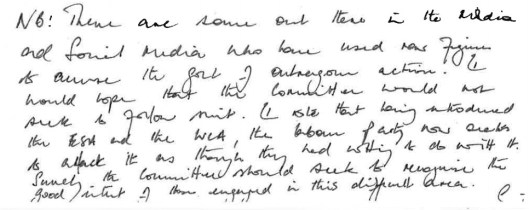
The letter addressed to Frank Field MP, features a barely legible hand-written footnote warning against listening to those “in the media and on social media” who “accuse the Government of outrageous actions.”

Duncan Smith writes in the footnote:

“There are some out there in the media and social media who have used [raw?] [ons ?- Office for National Statistics?] figures to accuse the govt of outrageous actions.

I would hope that the committee would not seek to follow suit. I [illegible] [note?] that having introduced ESA and the WLA, the Labour Party now seeks to attack it as though they had nothing to do with it.

Surely the committee should seek to recognise the good intent of those engaged in this difficult area.”

2014-02-17-BurdenoftheCuts-thumb
I would say that this blatant political discrimination constitutes an “outrageous action.” It’s difficult to recognise any “good intent” here, Mr Duncan Smith.

The correlation between the work capability assessment and suicide was established by academic researchers, not by journalists or social media commentators. We simply reported the findings.

Iain Duncan Smith will be accusing the United Nations (UN) of failing to see the government’s “good intent” when the inquiry into “grave and systematic violations” of the rights of disabled people in the UK concludes, next. Despite the fact that we are the first country to face such an inquiry, and given that the UN investigate only when there is evidence of grave and systematic violations of human rights, the prime minister has already dismissed the significance of the inquiry, ludicrously claiming “it may not be all it’s cracked up to be.”

It’s particularly noteworthy that when it comes to government claims, the same methodological rigour that they advocate for others isn’t applied. Indeed, many policies have clearly been directed by ideology and traditional Tory prejudices, rather than valid research and empirical evidence. The fact that no cumulative impact assessment has been carried out with regard to the welfare “reforms” indicates a government that is not interested in accountability, and examining the potential negative outcomes of policy-making. Policies are supposed to be about meeting public needs and not about inflicting Conservative dogma and old prejudices in the form of financial punishment on protected social groups.

As someone with a background in the social sciences, I have written extensive criticism of Iain Duncan Smith’s peculiar brand of epistemological and methodological fascism. He’s not exactly well known for his skill in statistical analysis, having been rebuked more than once for being notoriously conservative with the truth and numbers. Yet he feels compelled to dismiss the accounts of academics, campaigners, empirical evidence and the many qualitative accounts of those adversely impacted by his policies, in his vain attempt to exercise a stranglehold on his own peculiar brand of “truth.”

The goverment often claim that any research revealing negative social consequences arising from their draconian policies, which they don’t like to be made public “doesn’t establish a causal link.”  Recently there has been a persistent, aggressive and flat denial that there is any “causal link” between the increased use of food banks and increasing poverty, between benefit sanctions and extreme hardship and harm, between the work capability assessment and an increase in numbers of deaths and suicides, for example.

The government are referring to a scientific maxim: “Correlation doesn’t imply causality.” 

The tobacco industry made exactly the same claim about the established link between lung cancer and smoking.

It’s true that correlation is not the same as causation.

It’s certainly true that no conclusion may be drawn regarding the existence or the direction of a cause and effect relationship only from the fact that event A and event B are correlated.

Determining whether there is an actual cause and effect relationship requires further investigation.

This is something the government has persistently refused to do. (Here’s a full critique of Conservative methods of “social research”. I sent Mr Duncan Smith a copy, along with some information about proper definitions and measurement of poverty, but he clearly hasn’t read either. Unless he has included those in his arrogant and dismissive horror of “accusations”  criticisms on social media of course)

It is completely inaccurate to say that correlation doesn’t imply causation. It quite often does.

Here’s a final comment from a social media-based campaigner, analytical writer and a qualified social scientist who knows about statistical inference, causality and correlation and suchlike:

Iain Duncan Smith, you’re a blatant numpty.

160211IDSnote-outrageousaction

You can read the full letter here.

Benefits Assessor: How Long Are You Likely To Have Parkinson’s?

I was asked in 2011 by an Atos assessor how long I thought I would have a “chronic, progressive illness”.  Medical testing had confirmed I have connective tissue disease (lupus). That was the diagnosis from my rheumatologist, which she read aloud at the assessment, from a correspondence between my consultant and my GP. Dumbfounded, I replied:

“Until I die. The clue is in the words ‘progressive’ and ‘chronic’.”

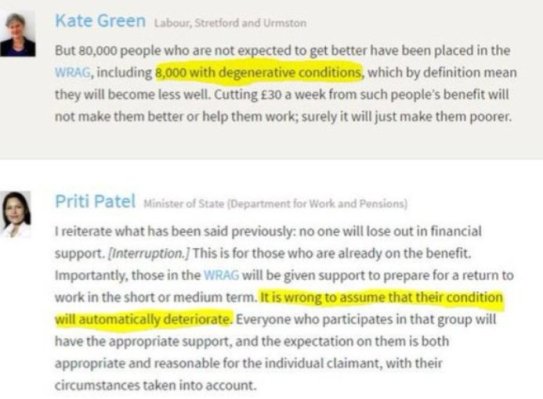
But an essential failure to grasp what words like “chronic”, “degenerative” and “progressive” actually mean isn’t peculiar to state assessors of illness and disability, who work for the government specifically to reduce the number of people eligible for sickness benefits. Government ministers display the same level of purposive ignorance:

Ca68L1xWcAA9MGT.jpg large

Hardly  “appropriate” , “reasonable” or taking “circumstances”, or medical diagnoses, for that matter, into account. A degenerative condition is one that DOES deteriorate. That is why it is called  a “degenerative condition.” It is therefore wrong and displays a degree of exceptional ignorance to assume that people WON’T or “may not” deteriorate.

This is why we don’t visit the government rather than a doctor when we become ill, especially when the state thinks it knows best about our medical conditions and how we should address those – and clearly doesn’t. This is about irrational ideology-driven policies aimed at cutting  back the welfare state. Regardless of how unreasonable that is and regardless of the consequences for those needing social security.

Sick and disabled people need support, understanding and medical care, not ignorance, Conservative dogma, vicious stigmatisation and a (neo)liberal re-translation of the words “Arbeit macht frei”.  

The government have conflated human needs with purely dogmatic economic outcomes.

Kitty S Jones.

samedifference1's avatarSame Difference

This paragraph from Frances Ryan’s latest article- an interview with a claimant called Phil Brehaut- just says it all.

“It was very daunting, like being in court,” he says. “The lady on the panel actually asked me, ‘How long are you likely to have Parkinson’s?’” He pauses. “The person next to her quickly whispered in her ear … You would think they’d know a little bit about it.”

View original post

Doctors bribed with 70-90k salaries to join Maximus and “endorse a political agenda regardless of how it affects patients.”

maximus-logoYes, but which people?


The National Audit Office (NAO) scrutinises public spending for Parliament and is independent of government. An audit report earlier this month concluded that the Department for Work and Pension’s spending on contracts for disability benefit assessments is expected to double in 2016/17 compared with 2014/15. The government’s flagship welfare-cut scheme will be actually spending more money on the assessments themselves than it is saving in reductions to the benefits bill – as
Frances Ryan pointed out in the Guardian, it’s the political equivalent of burning bundles of £50 notes.

The report also states that only half of all the doctors and nurses hired by Maximus – the US outsourcing company brought in by the Department for Work and Pensions to carry out the assessments – had even completed their training.

The NAO report summarises:

5.5
Million assessments completed in five years up to March 2015

65%
Estimated increase in cost per ESA assessment based on published information after transfer of the service in 2015 (from £115 to £190)


84%
Estimated increase in healthcare professionals across contracts from 2,200 in May 2015 to 4,050 November 2016

£1.6 billion
Estimated cost of contracted-out health and disability assessments over three years, 2015 to 2018

£0.4 billion
Latest expected reduction in annual disability benefit spending

13%
Proportion of ESA and PIP targets met for assessment report quality meeting contractual standard (September 2014 to August 2015).

This summary reflects staggering economic incompetence, a flagrant, politically motivated waste of tax payers money and even worse, the higher spending has not created a competent or ethical assessment framework, nor is it improving the lives of sick and disabled people. Some people are dying after being wrongly assessed as “fit for work” and having their lifeline benefits brutally withdrawn. Maximus is certainly not helping the government to serve even the most basic needs of sick and disabled people.

However, Maximus is serving the needs of a “small state” doctrinaire neoliberal government. The Conservatives are systematically dismantling the UK’s social security system, not because there is an empirically justifiable reason or economic need to do so, but because the government has purely ideological, anticollectivist prescriptions.

This is a government that claims social security is “unsustainable” and a “burden” on the public purse, yet has no problem with an extraordinary profligacy with public funds and dispossessing tax payers when it comes to implementing “cost-cutting” and draconian welfare “reforms.” Conservative anti-welfare dogma and prejudice are costing the UK billions of pounds.

In April 2014, Atos was forced to abandon their contract with the government because of a growing public backlash, but not before they had profited from very large sums of public money. Meanwhile, sick and disabled people have had their support callously slashed to the bone, people have suffered and some have died as a consequence of that. Yet our welfare state is being used as a sporting arena for big business profit-making, eating up public funds that were supposed to help people who have encountered difficulties meeting their basic needs through disability, losing their job or becoming ill.

The selling of our public services and lucrative contracting out of state functions to private companies who exchange public money for a notoriously poor service is a prominent feature of Tory “small state” Britain.

The Department for Work and Pensions uses the controversial work capability assessments to decide if people are eligible for benefits or to force those on long-term sick leave back into work. The assessment is conducted using a computer software package called Logic Integrated Medical Assessment (LiMA) application.

The assessments are heavily weighted towards finding people capable for work, regardless of the medical evidence presented by claimant’s own doctors. Patients with severe brain damage, kidney failure, cancer, multiple sclerosis and Parkinson’s Disease, amongst many others with seriously incapacitating illnesses, have been found fit for work. On 24 April 2013, a woman who was a double heart and lung transplant patient died in hospital only days after she had been told that her Incapacity Benefit was being stopped and that she was fit for work. There are many other instances of grave errors in the decision-making of the Department for Work and Pensions which are based on the work capability assessment.

Between April 2015 and March 2018, the Department for Work and Pensions expects to carry out around 7 million assessments which it estimates will cost a total of £1.6 billion.

The National Audit Office report on contracted-out “health and disability assessments” states that the cost of providing assessments is rising and providers are still struggling to meet expected performance standards, and that providers continue to struggle with hiring and training staff.

From the NAO summary:

“The Department continues, however, to struggle with setting targets and requirements with clear evidence and failed to adequately test bidders’ assumptions, for example about staff training, during the contract tender process. It does not yet have a clear strategy for contracting-out assessments and risks damaging market interest through tight procurement timetables, inflexibility towards critical assumptions and lack of transparency.

…For PIP, both providers have failed to meet targets for the quality of assessment reports since October 2013. The Department is paying more for assessments, caused in part by capacity shortages pushing up salaries.”

In the last month, recruitment website healthjobs.co.uk has added almost 100 job advertisements for “functional assessor” roles with Maximus, the US company contracted by the Department for Work and Pensions to conduct work capability assessments. Applicants are required to have two years post-qualification medical experience and are offered positions with whoppingly “incentivising” salaries that start at £72,000, with some roles attracting salaries of up to £98,000. The salary for a junior doctor working in the National Health Service (NHS) with two years of experience is approximately £30,000.

Junior doctors working within the NHS were forced to take industrial action recently – the first strike action for more than four decades – over the government’s proposed new junior doctor contracts, because of serious concerns about patient safety, the quality of doctor’s working lives and the lack of recognition regarding the strain of working long and unsocial hours.

The British Medical Association said:

“The biggest threat to patient care is the government’s insistence on removing safeguards which prevent junior doctors from being forced to work dangerously long hours without breaks, with patients facing the prospect of being treated by exhausted doctors.

“The government is threatening to impose contracts in which junior doctors have no confidence and which represents the first step in a wholesale attack on all NHS staff at night and over weekends. We want a contract that is safe for patients, fair for juniors and good for the NHS.”

Maximus offer substantially better working conditions and pay for junior doctors, but compromising patient safety is an inevitable consequence of the company drive to provide administrative solutions to improve the cost effectiveness … and efficiency of government-sponsored benefit programs.

One NHS doctor, Karl Norrington, noted on Twitter that despite Maximus’s company motto: “Helping Government Serve the People” – in reality Maximus is: “paying drs to medically endorse a political agenda regardless of how it affects patients.”

enhanced-9119-1453733217-2

Related

The disturbing truth about disability assessments

Why I blew the whistle on Atos fitness-for-work test

We can reduce the Welfare Budget by billions: simply get rid of Iain Duncan Smith


Research finds strong correlation between Work Capability Assessment and suicide

IDS_n

In England between 2010 and 2013, just over one million recipients of the main out-of-work disability benefit, Employment Support Allowance (ESA) had their eligibility reassessed using a new stringent functional (as opposed to medical) checklist – the Work Capability Assessment.

Doctors, disability rights organisations, mental health chaities and individual campaigners, such as myself, have raised concerns that this has had an adverse effect on the mental health of claimants, but there have been no population level studies exploring the health effects of this or similar policies, until now.

Research, conducted by B Barr, D Taylor-Robinson, D Stuckler, R Loopstra, A Reeves, and M Whitehead, has established a link between the Work Capability Assessment (WCA) and suicide. The research, published in the Journal of Epidemiology and Community Health (which is peer-reviewed,) and carried out by social scientists from a variety of backgrounds, from the universities of Oxford and Liverpool, scrutinised the rates of mental health issues and suicide in different local authorities in England.

The study found that the authorities with a greater number of people undergoing WCAs also have more people reporting mental health problems, more people being prescribed antidepressants, and more people taking their own lives. The research found that every 10,000 assessments led to around six suicides.

For comparison in terms of statistical significance, isotretinoin, an acne medication which was notoriously linked to suicides, is associated with around four extra deaths per 10,000 treatments.

The researchers estimate that for every 10,000 people reassessed, you would expect to see an additional six suicides (95% confidence interval (CI) 2 to 9), an extra 2,700 reports of mental health problems (95% CI 548 to 4,840) and 7,020 extra antidepressants prescriptions (95% CI 3,930 to 10,100). By convention, 95% certainty is considered high enough for researchers to draw conclusions that can be generalised from samples to populations.

There have been more than 1 million assessments since the WCA was introduced, which suggests that there may be more than 600 people who have taken their own lives who would otherwise have not. The researchers say: “Our study provides evidence that the policy in England of reassessing the eligibility of benefit recipients using the WCA may have unintended but serious consequences for population mental health.”

There have been earlier claims and evidence that the Department for Work and Pension’s (DWP) reforms have led to deaths. However, the DWP has persistently refused to release data which would make it possible to assess whether the death rate for people found fit for work is higher than would be expected.

Both the assessment and appeals process itself, which is widely reported to be stressful, and the financial hardship that occurs when people are denied disability benefits, could result in negative health effects. There is good evidence that loss of income, particularly for people already on low incomes, increases the risk of common mental health problems.

People undergoing a WCA are likely to be particularly vulnerable to the adverse mental health consequences of this policy because a very high proportion have a pre-existing mental health problem. Furthermore, those with physical chronic illness are more prone to mental health problems such as reactive depression, and sometimes, forms of depression that are associated with the illness itself.

The research included efforts to rule out other possible causes of suicide – to eliminate potential confounding variables and bias – for example, there is no similar effect found in people over 65, who are not subject to the WCA – and so the results suggest that the link between the WCA and suicide is not due to “confounding” factors, but is most likely causal.

The Department for Work and Pensions has rejected the study’s findings. A spokesperson said in a statement: “This report is wholly misleading, and the authors themselves caution that no conclusions can be drawn about cause and effect.” 

However, the DWP have no grounds for their own claim whatsoever. Whilst correlation isn’t quite the same thing as cause and effect, it often strongly hints at a causal link, and as such, warrants further investigation. It certainly ought to raise concern from the DWP and ministers, regarding the negative impact of policy on many of the UK’s most vulnerable citizens.

The association with the WCA and its adverse effects is, after all, more clearly defined than the one between the drug isotretinoin and suicide, and the drug was withdrawn in the US and some European Member States.

In the UK, it is now (as of November last year) prescribed only under strict monitoring conditions, and patients are provided with warnings about the possibility of adverse psychiatric effects. No such warning and monitoring exists regarding the possible adverse psychiatric effects of the WCA. In fact the government have stifled both enquiry into a causal link and discussion of even the possibility there may be such a causal link, despite being presented with much evidence of a strongly indicated correlative association.

Dr Benjamin Barr, one of the researchers from Liverpool University, said that a causal link was likely: “Whilst we cannot prove from our analysis that this is causal, there are various reasons why this is a likely explanation,” he said.

He agreed that a study looking specifically at people who had undergone a WCA would be more precise, but added that the DWP has not released that information.

Dr Barr said: “If the DWP has data on this they should make it openly available to independent analysis.” He added that the DWP has so far chosen not to run a trial of its own into a link between WCAs and suicides.

The researchers found that those local areas where a greater proportion of the population were exposed to the reassessment process experienced a greater increase in three adverse mental health outcomes – suicides, self-reported mental health problems and antidepressant prescribing.

These associations were independent of baseline conditions in the areas, including baseline prevalence of benefit receipt, long-term time trends in these outcomes, economic trends and other characteristics associated with risk of mental ill-health. These increases followed – rather than preceded – the reassessment process.

The report concluded that the study results have important implications for policy. The WCA and reassessment policy was introduced without prior evidence of its potential impact or any plans to evaluate its effects. Given that doctors and other health professional have professional and statutory duties to protect and promote the health of patients and the public, this evidence that the process is potentially harming the recipients of these assessments raises serious ethical issues for those involved.

The Royal College of Psychiatrists has also said the research was of “high quality”, adding that it called into question the wisdom of the Government’s reforms.

Last year, coroner Mary Hassell told the DWP she had concluded that the “trigger” for Michael O’Sullivan’s suicide was his fit for work assessment.

“During the course of the inquest, the evidence revealed matters giving rise to concerns. In my opinion, there is a risk that future deaths will occur unless action is taken,” she wrote in the document, known as a Prevention of Future Deaths or regulation 28 report.

At the inquest, Hassell said O’Sullivan had been suffering from long-term anxiety and depression, “but the intense anxiety which triggered his suicide was caused by his recent assessment by the Department for Work and Pensions [benefits agency] as being fit for work and his view of the likely consequences of that”.

The inquest heard that the DWP assessing doctor, a former orthopaedic surgeon, did not factor in the views of any of the three doctors treating O’Sullivan. The coroner said O’Sullivan was never asked about suicidal thoughts, despite writing them down in a DWP questionnaire.

Previously, the loss or reduction of benefits has been cited by coroners as a factor in deaths and suicides of claimants.

The DWP have so far failed to respond coherently, other than with a denial of a “causal” link.

You can read the full research report here.

It’s not the only time that Conservative austerity policies have been implicated in causing harm to citizens. Nor is it the only time that Conservatives have responded with utter indifference to the disproportionately negative impact of their policies on the poorest people. 

A study from Durham University, which looked at over 70 existing research papers, concluded that as a result of unnecessary recession, unemployment, welfare cuts and damaging housing policies, Margaret Thatcher’s legacy includes the unnecessary and unjust premature death of many British citizens, together with a substantial and continuing burden of suffering and loss of wellbeing.

The research shows that there was a massive increase in income inequality under Baroness Thatcher – the richest 0.01 per cent of society had 28 times the mean national average income in 1978 but 70 times the average in 1990, and UK poverty rates went up from 6.7 per cent in 1975 to 12 per cent in 1985. Suicides increased.

Co-author Professor Clare Bambra from the Wolfson Research Institute for Health and Wellbeing at Durham University, commented: “Our paper shows the importance of politics and of the decisions of governments and politicians in driving health inequalities and population health. Advancements in public health will be limited if governments continue to pursue neoliberal economic policies – such as the current welfare state cuts being carried out under the guise of austerity.”

David Cameron’s government has gone much further than Thatcher ever did in cutting essential support and services for protected social groups, such as sick and disabled people, and poorer citizens.

 486294_4737578711832_1816039541_n

Pictures courtesy of Robert Livingstone

British Psychological Society and charity consortium campaign for reform of WCA gains momentum

paa-550x3691


I reported previously that the British Psychological Society (BPS) have called for the reform of the highly controversial Work Capability Assessment.

The BPS have cited a growing body of evidence that seriously ill people are being inappropriately subjected to the Work Capability Assessment (WCA). Psychologists also argue that the WCA does not effectively measure fitness for work and that its application is producing inappropriate outcomes for claimants.

The Society’s call for reform has gained momentum, with more than  20,000 people signing a petition to the Department for Work and Pensions (DWP) and representatives of the charities Mind, the National Autistic Society and Rethink Mental Illness delivered the petition on Thursday, 5 November.

The highly problematic WCA is used to determine whether someone applying for employment and support allowance is “fit for work.” The charities say flaws in the test are causing a great deal of stress and anxiety. In some cases people are being wrongly assessed as fit for work, which can have devastating financial and personal consequences.”

Professor Jamie Hacker Hughes, President of the British Psychological Society, said:

“The Society has repeatedly asked for a meeting with ministers at the DWP so that we can express our concerns over the WCA – so far without success. We are particularly concerned that the government’s benefits policy may misuse psychological tools and techniques. We want to ensure policies are informed by appropriate psychological, theoretical and practical evidence.”

The Society published a briefing paper in June.

A Judicial Review of the WCA was instigated by two anonymous claimants with mental health problems, who were represented by the Public Law Project.

In May 2013 the Upper Tribunal made an “interim” judgment that the WCA puts people with mental health problems, learning disabilities and autism at a “substantial disadvantage”. It was a landmark ruling.

The Tribunal panel ruled that the DWP had failed to make reasonable adjustments, according to the Equality Act, to ensure people with mental health problems were treated fairly by the system. This failure meant such claimants were placed at a substantial disadvantage.

Directors of the three charities, Mind, the National Autistic Society and Rethink Mental Illness, all backed the case and welcomed the judgment, calling on the government to stop assessing people’s fitness for work under the current system until the issue was resolved.

The DWP immediately appealed against the judgment, stating there was no intention of halting the WCA process, but in December 2013 the Court of Appeal upheld the Upper Tribunal’s interim ruling.

The Tribunal held further Hearings in 2014, which were focused on whether or not there is a “reasonable” adjustment that the DWP should have put in place.

The Upper Tribunal confirmed its earlier ruling that the WCA puts people with mental health problems, learning disabilities and autism at a “substantial disadvantage”. However, it did not find, at this point,  that the claimants had been personally discriminated against.

As a result, the court said it could not compel the DWP to trial changes to the WCA. They also said that they did not have enough information to determine whether or not there is a reasonable adjustment which could be put in place for people with mental health problems.

However, the court said that there still may be reasonable adjustments that the DWP can make to the WCA, and has encouraged the DWP to trial changes “as soon as possible”.

Paul Jenkins, CEO of Rethink Mental Illness, said:

“This ruling proves once and for all that this cruel and unfair process is unlawful. The judges have independently confirmed what our members have been saying for years – the system is discriminating against some of the most ill and vulnerable people in our society, the very people it is meant to support.

The work capability assessment process is deeply unfair for people with a mental illness – it’s like asking someone in a wheelchair to walk to the assessment centre.”

Professor Malcom Harrington’s first review – published in back in November 2010 – had previously criticised the way the WCA process failed to properly account for and accommodate people that have chronic illnesses with fluctuating symptoms and people with mental health problems, and he recommended changes, including placing mental health experts in all test centres.

His recommendations have not been implemented.

Pictures courtesy of Robert Livingstone

Prime minister dismisses UN inquiry into government’s discriminatory treatment of disabled people

disability_2218977b

Labour leader Jeremy Corbyn has asked David Cameron at Prime Minister’s Questions today to publish the details of the Government’s response to the United Nations inquiry into the allegations that Conservative policies are breaching the rights of disabled people in the UK. He also asked if the government intended to co-operate with the inquiry.

Such UN investigations are conducted confidentially by the UN and officials will not confirm or deny whether the UK is currently being put under scrutiny.

However, the ongoing inquiry been widely reported by disability rights groups and campaigners. The Department for Work and Pensions has previously declined to comment on the possibility of an investigation.

Mr Corbyn used his final question to ask about the United Nations inquiry into alleged “grave or systemic violations” of the rights of disabled people in the UK. The PM gave a dismissive response, saying the inquiry may not be “all it’s cracked up to be” and said that disabled people in other countries do not have the rights and support that “they” [disabled people] in the UK are offered. Cameron also implied that Labour’s “strong” equality legislation was a Conservative policy. However, the Equality Act was drafted under the guidance of Harriet Harman.

Jeremy Corbyn asks about David Cameron about his response to the UN inquiry at Prime Minister’s Questions

The United Nations team of investigators are expecting to meet with the Equality and Human Rights Commission, members of parliament, individual campaigners and disabled people’s organisations, representatives from local authorities and academics.

The team will be gathering direct evidence from individuals about the impact of government austerity measures, with a focus on benefit cuts and sanctions; cuts to social care; cuts to legal aid; the closure of the Independent Living Fund (ILF); the adverse impact of the Work Capability Assessment (WCA); the shortage of accessible and affordable housing; the impact of the bedroom tax on disabled people, and also the rise in disability hate crime.

Mr Corbyn said:

“This is deeply embarrassing to all of us in this house and indeed to the country as a whole. It’s very sad news.”

The Government’s approach to people with disabilities had been extremely controversial and been met with criticism from campaign groups. Disabled people have borne the brunt of austerity cuts, losing more income and support than any other social group, and this is despite the fact that Cameron promised in 2010 to protect the poorest, sick and disabled people and the most vulnerable.

In 2013, Dr Simon Duffy at the Centre for Welfare Reform published a briefing outlining how the austerity cuts are targeted. The report says:

The cuts are not fair.

They target the very groups that a decent society would protect:

  • People in poverty (1 in 5 of us) bear 39% of all the cuts
  • Disabled people (1 in 13 of us) bear 29% of all the cuts
  • People with severe disabilities (1 in 50 of us) bear 15% of all the cuts

The report outlines further discrimination in how the austerity cuts have been targeted. The report says:

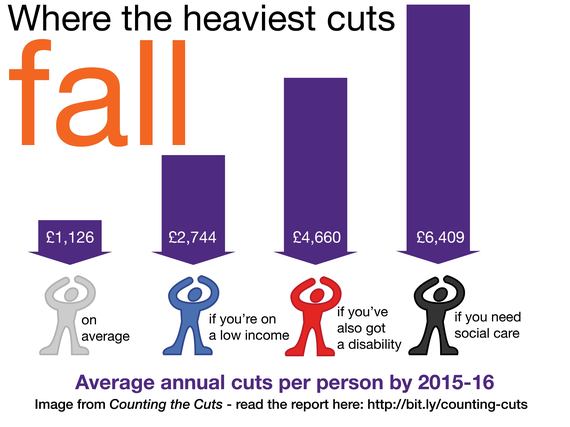
The unfairness of this policy is seen even more clearly when we look at the difference between the burden of cuts that falls on most citizens and the burdens that fall on minority groups. By 2015 the annual average loss in income or services will be:

  • People who are not in poverty or have no disability will lose £467 per year
  • People who are in poverty will lose £2,195 per year
  • Disabled people will lose £4,410 per year
  • Disabled people needing social care will lose £8,832 per year

Work and Pensions Secretary Iain Duncan Smith said at the  Conservative party conference speech in Manchester that disabled people “should work their way out of poverty.”

The Work and Pensions Secretary has been widely criticised for removing support for disabled people who want to work: by closing Remploy factories, scrapping the Independent Living Fund, cuts to payments for a disability Access To Work scheme and cuts to Employment and Support Allowance.

The reformed Work Capability Assessment has been very controversial, with critics labeling them unfair, arbitrary, and heavily bureaucratic, weighted towards unfairly removing people’s sickness and disability benefit and forcing them to look for work.

The bedroom tax also hits disabled people disproportionately, with around two thirds of those affected by the under-occupancy penalty being disabled.

The United Nations have already deemed that the bedroom tax constitutes a violation of the human right to adequate housing in several ways. If, for example, the extra payments force tenants to cut down on their spending on food or heating their home. There are already a number of legal challenges to the bedroom tax under way in British courts. In principle the judiciary here takes into account the international human rights legislation because the UK has signed and ratified the International Covenant on Economic, Social and Cultural Rights.

The right to adequate housing is recognised in a number of international human rights instruments that the UK has signed up to.

UN rapporteur Raquel Rolnik called for the UK government last year to scrap its controversial bedroom tax policy. Rolnik’s report was dismissed as a “misleading Marxist diatribe” by Tory ministers, and she had been subject to a “blizzard of misinformation” and xenophobic tabloid reports.

The DWP’s sanctions regime has also been widely discredited, and there has been controvery over death statistics, eventually released by the Department after a long-running refusal to release the information under freedom of information law.

The Daily Mail has already preempted the visit from the special rapporteur, Catalina Devandas Aguilar, who is spearheading the ongoing inquiry into many claims that Britain is guilty of grave or systematic violations of the rights of sick and disabled people, by using racist stereotypes, and claiming that the UN are “meddling”. The Mail blatantly attempted to discredit this important UN intervention and the UN rapporteur before the visit.

Meanwhile, Cameron seems very keen to play the investigation down, and dismiss the impact of his government’s “reforms” on the lives of sick and disabled people.

We are a very wealthy, so-called first-world liberal democracy, the fact that such an inquiry has been deemed necessary at all ought to be a source of great shame for this government.


United Nation’s investigation in the UK concerning the human rights of disabled people- submission deadline

536738_306169162785952_999031084_n

I reported last year that the UK is to be investigated formally by the United Nations because of allegations of “systematic and grave” violations of disabled people’s human rights.

In August I wrote that officials from the United Nation’s Committee on the Rights of Persons with Disabilities (UNCRPD) are to visit Britain. The inquiry is confidential, and those giving evidence have been asked to sign a confidentiality agreement.

A United Nations team have arrived in the UK and it’s understood they will visit Manchester, London, Bristol, as well as parts of Scotland, Wales and Northern Ireland.

The United Nations team are also expecting to meet with the Equality and Human Rights Commission, members of parliament, individual campaigners and disabled people’s organisations, representatives from local authorities and academics.

The team will be gathering direct evidence from individuals about the impact of government austerity measures, with a focus on benefit cuts and sanctions; cuts to social care; cuts to legal aid; the closure of the Independent Living Fund (ILF); the adverse impact of the Work Capability Assessment (WCA); the shortage of accessible and affordable housing; the impact of the bedroom tax on disabled people, and also, the rise in disability hate crime.

In 2013, Amnesty International condemned the erosion of human rights of disabled people in UK, and the Joint Parliamentary Committee on Human Rights conducted an inquiry into the UK Government’s implementation of Article 19 of the United Nations Convention on the Rights of Persons with Disabilities – the right to live independently and to be included in the community. The inquiry, which began in 2011, has received evidence from over 300 witnesses.

The inquiry highlighted just how little awareness, understanding and employment of the Convention there is by the (then) Tory-led Government. Very few of the witnesses made specific reference to the Convention in their presented evidence, despite the inquiry being conducted by the Parliamentary Human Rights Committee, with the terms of reference clearly framing the inquiry as being about Article 19 of the UN’s committee on the rights of persons with disabilities. (UNCRPD.)

“This finding is of international importance”, said Oliver Lewis, MDAC Executive Director, “Our experience is that some Governments are of the view that the CRPD is nothing more than a policy nicety, rather than a treaty which sets out legal obligations which governments must fulfil.”

The report was particularly critical of the Minister for Disabled People (Maria Miller, at the time) who told the Committee that the CRPD was “soft law”. The Committee criticised this as “indicative of an approach to the treaty which regards the rights it protects as being of less normative force than those contained in other human rights instruments.” (See the full report.) The Committee’s view is that the CRPD is hard law, not soft law. 

In August, I wrote about how the inquiry was triggered by campaigners and groups using the convention’s optional protocol, (which the last Labour government signed us up to, in addition to the convention.) The protocol allows individuals (and groups) who are affected by violations to submit formal complaint to the UNCRPD.

The deadline for evidence submissions to the UNCRPD is thought to be 31 October.

Contact details are here.