Month: March 2019

The government’s identity verification portal – Verify – is another Tory flagship failure

gov.uk verify icon

The National Audit Office has strongly criticised the government’s flagship identity verification scheme. The damning report says Gov.UK Verify has fallen well short of its target of 25 million users by 2020, managing only 3.6 million so far.

The government has had to lower its estimates for Verify’s financial benefits by 75%.

Nineteen government services currently use Verify, such as the Department for Work and Pensions, in the process of delivering universal credit, those claiming a tax refund from HM Revenue & Customs (HMRC) and HM Land Registry’s Sign your mortgage deed may all be accessed through Verify, too.

The National Audit Office (NAO) scrutinises public spending for Parliament and is independent of government. The NAO have published its investigation on Verify, the government’s flagship identity verification portal. It has found Verify’s performance has consistently been below the standards initially set, and take-up among the public and departments has been much lower than expected.

Verify asks people wanting to sign up to government services via the GOV.UK website to pick a commercial identity provider to check and verify their identity. Current providers include Barclays, Digidentity, Experian, Post Office and secureidentity/Morpho. (Royal Mail and CitizenSafe/GBG were also providers but recently decided not to continue as identity providers on the commercial terms applying from October 2018.)

For those that do use Verify, problems are widespread.

Currently only 48% of people who try to sign up for the service are successful on their first try.

This rate is even lower (38%) for universal credit claimants using the service to authenticate their identity online. This has led to increased operational costs, with the Department for Work and Pensions (DWP) expecting its spend on manual verification to be about £40m over the next decade.

The NAO’s report follows on from their previous work on Verify in the Digital transformation in government report. This found that Verify’s take-up had been undermined by its performance and that Government Digital Service had lost focus on the longer-term strategic case for the project.

The Government Digital Service (GDS), part of the Cabinet Office, developed Verify to be the default way for people to prove their identities so they can access online government services securely. It originally intended for Verify to be largely self-funding by the end of March 2018.

However, the NAO’s investigation highlights that the number of people and departments using Verify is well below expectations. GDS has significantly revised down its estimated financial benefits by over £650 million, for the period 2016-17 to 2019-20, from £873 million to £217 million. Government also continues to fund it centrally, although it announced in October 2018 that this would stop in March 2020.

In 2016 GDS forecast that 25 million people would use Verify by 2020. By February 2019, 3.6 million people had signed up for the service. If current trends continue, approximately just 5.4 million users will have signed up by 2020.

Nineteen government services currently use Verify, less than the 46 expected to by March 2018, and of those, at least 11 can still be accessed through other online systems. Some government service users, such as Universal Credit claimants, have experienced problems. As a result, departments have needed to undertake more manual processing than they anticipated, increasing their costs.

Verify uses commercial providers to check people’s identities. GDS has reported a verification success rate of 48% at February 2019, against a projection of 90%. The success rate measures the proportion of people who succeed in signing up for Verify, having had their identities confirmed by a commercial provider. It does not count the number of people dropping out before they finish their applications nor indicate whether people can actually access and use the government services they want after signing up with Verify.

The vast majority of funding comes from central government (and ultimately, the tax payer). Verify has cost at least £154 million by December 2018 but this is likely to be an underestimate of all costs, as GDS’s reported spend does not include costs of departments reconfiguring their systems to use Verify.

The largest component of known costs, some £58 million, was payments to commercial providers. In addition, out of seven departments invoiced for their use of Verify from 2016-17 only one department (HMRC) has paid. The total amount invoiced was £3.6 million, of which £2 million is currently still outstanding.

Universal Credit remains Verify’s biggest government customer base in verifying claimants identities and remains the major constraint in closing Verify.

However, most claimants cannot even use Verify to apply for Universal Credit: only 38% of Universal Credit claimants can successfully verify their identity online (of the 70% of claimants that attempt to sign up through Verify). The Department for Work and Pensions (DWP) is working with GDS on an improvement plan to increase the number of claimants successfully verified.

Verify has been subject to over 20 internal and external reviews, including a July 2018 review by the Infrastructure and Projects Authority that recommended Verify be closed as quickly as practicable, bearing in mind Universal Credit’s critical dependency on it. This followed a Cabinet Office and Treasury decision in May 2018 to approve GDS’s proposal to ‘reset’ Verify in an attempt to improve its performance and take up.

Meg Hillier MP, who chairs the Public Accounts Committee, called Verify “a textbook case of government’s over-optimism and programme-management failure.”

“Despite spending at least £154m on Verify, only half the people that try to sign up are able to use it and take-up is much lower than expected.”

The report notes that the total cost of Verify is in fact likely to exceed £154m, as this figure does not include the amount it has cost departments to reconfigure their systems to use Verify.

Of the known costs, more than one-third has gone on payments to the commercial identity providers behind the system, including Barclays and the Post Office.

The Cabinet Office announced in October 2018 that government would stop funding Verify in March 2020. It has capped the amount it will spend on Verify during this time to £21.5 million. GDS has confirmed 18-month contracts with five commercial identity providers who will continue to verify people’s identities. After March 2020, GDS’s intention is for the private sector to take over responsibility for Verify.

GDS will withdraw from its operational role running Verify from April 2020. GDS claims that under a market-based model, departments will procure Verify’s services directly from commercial providers. This means departments that currently do not pay their full usage costs for Verify would have to in future.

The NAO report concludes: “Unfortunately, Verify is also an example of many of the failings in major [government] programmes that we often see, including optimism bias and failure to set clear objectives. Even in the context of GDS’s redefined objectives for the programme, it is difficult to conclude that successive decisions to continue with Verify have been sufficiently justified.” 

The full privatisation of this service is highly likely to present further problems, however, since the prospect of private profit introduces perverse incentives, which empirical evidence demonstrates are clearly linked with poor service standards and delivery.

It is a purely ideological strategy that has resulted in the poor management of public funds increasingly over the last few decades, and particularly, over this past eight years.


My work is unfunded and I don’t make any money from it. This is a pay as you like site. If you wish you can support me by making a one-off donation or a monthly contribution. This will help me continue to research and write independent, insightful and informative articles, and to continue to support others going through PIP and ESA assessment, mandatory review and appeal.

DonatenowButton

Tory racism is embedded in policy and clearly evident in Tory social media groups

racism

A Conservative councillor has been suspended by the Conservative Party after a Facebook group he moderates was found to contain several Islamophobic and racist comments.

Martyn York, a Conservative councillor in Wellingborough, was a moderator for “Boris Johnson: Supporters’ Group”, which included  members whose comments called for the bombing of mosques around the UK. Dorinda Bailey, a former Conservative council candidate, has also been accused of supporting Islamophobia with her comments following a post in the group calling for mosques to be bombed.

Furthermore, the group, which has 4,800 members, can only be joined after receiving approval from moderators, and its guidelines explicitly call on members not to post hate speech. 

Comments in the group, however, seriously violate these rules, with several referring to Muslims as “ragheads” and calling immigrants “cockroaches”.

In one comment, the mayor of London, Sadiq Khan, is called a “conniving little muzrat”, and Muslim Labour MP Naz Shah is also targeted with abuse and told to “p*** off to [her] own country”.

Someone posted in the group that any mosques “found to preach hate” should be shut down, another group member responded: “Bomb the f****** lot.” 

Bailey responded, without a trace of irony: “I agree, but any chance you could edit your comment please. No swearing policy.”

There were also comments in the group telling an African solider to “p*** off back to Africa” and for Labour MP Fiona Onasanya to be “put on a banana boat back home”.

After the offensive posts were brought to his attention, Conservative Party chairman Brandon Lewis confirmed York’s suspension and said Bailey was no longer a member of the party.

The Muslim Council of Britain (MCB), which has repeatedly called for an inquiry into Islamophobia in the Conservative Party, said this was further evidence of a “significant problem”.

“A Facebook group led by Conservative politicians containing unashamed bigotry has made it completely apparent that there is a significant problem with racism and Islamophobia within the party of government,” a spokesperson for the MCB said.

“Polls revealing that half of all Conservative voters in 2017 believe Islam to be a threat to the British way of life have shown how widespread this sentiment is. We reiterate our call for the government to launch an inquiry into Islamophobia and lead by example by committing to tackle bigotry everywhere, not just where it’s politically convenient.”

There government were happy enough to ensure an inquiry into the allegations of antisemitism in the Labour party, and ‘inappropriate’ posts on social media took place. However, the conclusions of the Home Office Committee contradicted the claims being made on the right and among the neoliberal centrists, about the Labour party.

Nonetheless, the claims have continued, indicating a degree of underpinning political expedience and media misdirection.commons-select-committee-antisemitism

That is not to say there is no antisemitism at all among Labour party members, and where allegations arise, those MUST be addressed. However, it does indicate that political and media claims that the party is ‘institutionally antisemitic’ are completely unfounded. 

It is also absolutely reasonable to point this out. 

Unlawful and discriminatory Conservative policy

Meanwhile the Conservatives have continued to embed their prejudices and racism in  discriminatory policies. For example, in 2014 Theresa May was the Home Secretary who introduced the disgraceful Hostile Environment legislation that ultimately led to the Windrush scandal.  On March 1st 2019 a central mechanism of that legislation was ruled unlawful by the High Court because of the way it has unleashed a wave of racism, and because it was found to violate the European Convention on Human Rights. 

Judge Martin Spencer found the policy caused landlords to discriminate against both black and ethnic minority British people and foreign UK residents.

He also ruled that rolling out the scheme in Scotland, Wales or Northern Ireland without further evaluation would be “irrational” and breach equality laws.

“The evidence, when taken together, strongly showed not only that landlords are discriminating against potential tenants on grounds of nationality and ethnicity but also that they are doing so because of the scheme,” Mr Justice Spencer told the court on Friday.

He added “It is my view that the scheme introduced by the government does not merely provide the occasion or opportunity for private landlords to discriminate, but causes them to do so where otherwise they would not.”

The changes that came into force in 2016 required private landlords to check the immigration status of potential tenants, or face unlimited fines or even prison for renting to undocumented migrants, coercing landlords into becoming agents of the state, effectively.

Judge Martin Spencer said: “The government cannot wash its hands of responsibility for the discrimination which is taking place by asserting that such discrimination is carried out by landlords acting contrary to the intention of the scheme.”

He also said he had found that Right to Rent had “little or no effect” on controlling immigration and that the Home Office had “not come close” to justifying it.

The legal challenge was launched by the Residential Landlords Association (RLA) and Joint Council for the Welfare of Immigrants (JCWI), which called Right to Rent a “key plank of Theresa May’s hostile environment” policy.

Chai Patel, JCWI legal policy director, said: “Now that the High Court has confirmed that Ms May’s policy actively causes discrimination, parliament must act immediately to scrap it.

“But we all know that this sort of discrimination, caused by making private individuals into border guards, affects almost every aspect of public life – it has crept into our banks, hospitals, and schools. Today’s judgment only reveals the tip of the iceberg and demonstrates why the Hostile Environment must be dismantled.” 

John Stewart, policy manager for the RLA, called the ruling a “damning critique of a flagship government policy”. 

He added : “We have warned all along that turning landlords into untrained and unwilling border police would lead to the exact form of discrimination the court has found.” 

Rather than accept the High Court’s findings, a Home Office spokesperson has said that an independent mystery shopping exercise found “no evidence of systemic discrimination”.

“We are disappointed with the judgement and we have been granted permission to appeal, which reflects the important points of law that were considered in the case. In the meantime, we are giving careful consideration to the judge’s comments,” he added.

I have written at length about the prejudiced, discriminatory and unlawful policies that the Conservatives have directed at ill and disabled people over the last few years. I also submitted evidence to the United Nations on this matter. However, the UN’s findings of “grave and systematic violations” of disabled peoples’ human rights, and the examples of structural violence inflicted on our politically marginalised community currently fails to get the media attention that mere allegations of antisemitism within the Labour party attracts.

People are suffering harm and psychological distress, and increasingly, some are dying, as a direct consequence of oppressive, cruel, illegal and dangerously authoritarian Conservative policies, while shamefully, much of the media prefers to look the other way.

That is, where the state directs them to ‘look’. 

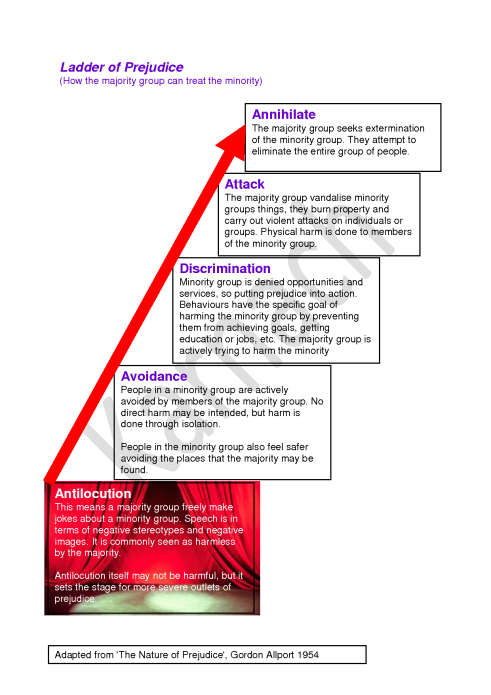
If you’ve ever wondered how some societies have permitted conscious cruelty to flourish, to the point where entire groups are targeted with oppressive and discriminatory policies resulting in distress, harm and death, I have to tell you that it’s pretty much like this.

Allport's ladder


My work is unfunded and I don’t make any money from it. This is a pay as you like site. If you wish you can support me by making a one-off donation or a monthly contribution. This will help me continue to research and write independent, insightful and informative articles, and to continue to support others going through PIP and ESA assessment, mandatory review and appeal.

DonatenowButton

The state is policing social security claimants in hospital and via their medical records to find reasons to cut their support

Related image

The Department for Work and Pensions (DWP) officers have been visiting patients in hospital to check if they are actually unwell, a damning new review into the roll-out of universal credit has revealed. This news comes after it emerged that the DWP are in the process of designing an automated system to trawl claimants NHS health records. 

Doctors have already raised serious concerns that social security claimants could be deterred from accessing healthcare after it emerged that the government is to start accessing medical records as an intrusive part of the welfare assessment process. A job advert posted by the DWP shows that a team in Leeds is building a system to “capture information from citizens and present this to DWP agents”. The work is proceeding on the controversial assumption that the consent of patients would make the system lawful. 

However the DWP have told doctors that when people make a claim for disability benefits, they have already consented for medical information to be shared.

GPs and charities said the plans resemble the controversial data-sharing scheme  between the Home Office and the NHS, which prompted outrage after it emerged some immigrants were subsequently afraid to access healthcare, ultimately forcing the government to end the policy.

In response, Professor Helen Stokes-Lampard, chair of the Royal College of GPs, expressed concern that the process would damage the doctor-patient relationship, and “deter vulnerable people from seeking medical assistance when they need it”.

“If the reports are true, the DWP, like the Home Office before them, must not consider GP patient data as an open resource to support them to carry out their duties. We are doctors, whose first interest is the care of our patient: we are not border guards, and we are not benefits assessors.

“We do not hold our patients’ confidential data to help other organisations check their eligibility for welfare, their immigration status, or any other function not related to their health and wellbeing,” she said.

Head of policy and profile at Law Centres Network, Nimrod Ben-Cnaan, said the sharing of people’s medical records would breach patient confidentiality and put GPs and other medical staff in the “invidious” position of benefits assessors.

However it seems the DWP are determined to co-opt doctors into policing people who are ill and claiming social security. I raised my own concerns about this back in 2015-16 and have continued to campaign on this issue, raising awareness of the implications and consequences of state intrusion in the health care of vulnerable citizens.

The DWP continually look for reasons to end people’s disability awards, even following assessments that have deemed them eligible. Trawling through people’s medical records presents another opportunity to look for tenuous reasons to cut people’s support claim. 

As does intruding on people who are ill in hospital.

The all-pervasiveness of welfare conditionality and the state panopticon

In 1965, American historian Gertrude Himmelfarb published an essay, The Haunted House of Jeremy Bentham, in which she portrayed Bentham’s mechanism of surveillance as a tool of oppression and social control. Bentham’s famous mechanistic and inhumane approach to human lives – the Panopticon – is a type of institutional building and a system of control designed by the English philosopher  in the late 18th century. The scheme of the design is to allow all (pan-) inmates of an institution to be observed (-opticon) by a single watchman without the inmates being able to tell whether or not they are being watched.

Bentham conceived the basic plan as being equally applicable to hospitals, schools, sanatoriums, and asylums. The idea is that people are in constant fear of being scrutinised, and so are coerced or compelled to regulate or change their own behaviour to comply. Bentham described the Panopticon as “a new mode of obtaining power of mind over mind, in a quantity hitherto without example”. Elsewhere, in a letter, he described the Panopticon prison as “a mill for grinding rogues honest.”

The Panopticon is the tool of a deeply suspicious state with a very pessimistic view of human nature. 

Last year, Dr Jay Watts wrote:  “The level of scrutiny all benefits claimants feel under is so brutal that it is no surprise that supermarket giant Sainsbury’s has a policy to share CCTV “where we are asked to do so by a public or regulatory authority such as the police or the Department for Work and Pensions”. Gym memberships, airport footage and surveillance video from public buildings are now used to build cases against claimants, with posts from social media used to suggest people are lying about their disabilities. More and more private companies are being asked to send in footage. The atmosphere is one of pervasive suspicion, fuelled by TV programmes such as Benefits Street and successive governments’ mentality of “strivers v skivers”. 

People claiming disability benefits have often raised concerns that the right to privacy is no longer their own – and this is a deliberate function of an extremely punitive regime.

Mass surveillance has become a norm in developed countries, through both the proliferation of overt measures like security cameras, the use of facial recognition software, but also more subtle and invasive means like data trawling, analysis, segmentation, psychograpic profiling and targeted , tailored ‘interventions’.

Governments, corporations and other powerful entities are able to comb through large volumes of data on specific people or larger demographics in order to gather information on them and exert control over their decision-making and behaviours. Nudge reflects the further development of covert state strategies to scrutinise and  manage citizens’ perceptions and behaviours.

Foucault, in Discipline and Punish, developed the Panopticon as a metaphor for the modern disciplinary society, in which the state constantly oversees the behaviour of the citizens, and he saw it as a mechanistic tool and oppressive system of permanent visibility as a tool of power. Foucault’s idea of panoptic architecture turned it into an omnipresent and insidious institution. It’s true to say that now, the disciplinary “eye of the state Inspector” is upon all of us. But some are scrutinised more than others.

More recently, DWP employees have also found to be interviewing people awaiting NHS treatment to ensure they were on the “right money” and not “abusing the system.” This is a particularly intrusive, oppressive practice, designed to police claims and scrutinise the ever-shrinking criteria of validity for someone’s need or social security support.

The visits were condemned as ‘grotesque’ by a council scrutiny panel in London, where it has emerged that hospitalised universal credit claimants have received shock visits from the welfare officials policing patient’s claims.

Islington’s Policy and Performance Scrutiny Committee, which has been tracking the full roll out of universal credit in Islington since last June, published a review earlier this month, where the information emerged that DWP officers have been pursuing ill claimants while in hospital.

In the meeting on 14 February, concern was expressed that DWP staff visiting claimants in hospital and this added to the stress that patients were already under while in hospital.

The DWP responded that “the visiting team may occasionally visit claimants in hospital but this would be done in a supportive manner and it happened on only a very small number of cases”.

On one occasion, DWP officers visited a person in hospital awaiting an operation because they had missed an appointment,
 reports the Islington Gazette.

The committee’s vice chair, Councillor Troy Gallagher, told the Gazette: “The fact that the DWP send people out to the hospital to interview and pursue people sends the wrong message.

“When people are in hospital they are not there to be chased and it’s not for the DWP to guess or validate if they are well or unwell. I think it’s callous.

“It’s an issue they need to amend quickly because it’s highly stressful and deeply upsetting.”

Cllr Gallagher added: “It’s grotesque and unbelievable.

“If someone says they’re unwell, whatever the reason is, you should always accept that.”

A DWP spokesperson said: “Jobcentre staff occasionally conduct hospital visits to confirm people’s bank account or rent details. This ensures we can pay their full benefits on time.”

They added that visits to claimants homes will be made “if necessary”.

The DWP told me “Claimants must inform the relevant benefit office when they go into hospital and when they come out. If they don’t report changes and they’re overpaid as a result, they have to pay back any money they owe. They may also have to pay a civil penalty.

“State Pension will not be affected.

“A stay in hospital affects people’s disability benefit support in the following ways:

“If someone has been in hospital for 28 days, they should stop receiving these benefits:

  • Attendance Allowance
  • Disability Living Allowance (DLA)
  • Personal Independence Payment (PIP)

“If someone is discharged but goes back into hospital within 28 days, the days spent in hospital on both occasions will be added together and if the total is more than 28 days they will lose eligibility until they go back home. They will still be paid for the days they spend at home between hospital stays.”

I was also informed: “Employment and support allowance is paid for an indefinite period as long as the other qualifying conditions are met. If someone is getting income-related employment and support allowance (ESA), certain premiums and housing costs are affected:

  • Severe disability premium will stop after four weeks if someone is in hospital and they lose their attendance allowance, disability living allowance care component or personal independence payment daily living component. If the person has a partner who is not in hospital and who also qualifies for the severe disability premium, they will continue to receive it.
  • Carer premium will stop 8 weeks after the person’s carer’s allowance stops.
  • After 52 weeks, they will lose the enhanced disability premium unless they have a partner who meets the conditions for the premium themselves. They will also lose their work-related activity or support component.”

It seems that documented evidence from doctors isn’t considered sufficient for the DWP to verify that someone is ill and in need of support. People who are ill in hospital are being treated as though they have done something wrong because of the effect their ill health has on their ability to work.

The government claims that disability support such as PIP is “targeted at those most in need”. Yet we see that those who are clearly most in need are being policed constantly and in an inexcusably intrusive, disrespectful way that strips disabled people of security and dignity.

What use is a social security system that is being designed to constantly work against those very people it was initially set up to help? 


I don’t make any money from my work. But if you like, you can contribute by making a donation and help me continue to research and write informative, insightful and independent articles, and to provide support to others going through PIP and ESA assessments, mandatory review and appeals. The smallest amount is much appreciated – thank you.

DonatenowButton