Author: Kitty S Jones

I’m a political activist with a strong interest in human rights. I’m also a strongly principled socialist. Much of my campaign work is in support of people with disability. I am also disabled: I have an autoimmune illness called lupus, with a sometimes life-threatening complication – a bleeding disorder called thrombocytopenia. Sometimes I long to go back to being the person I was before 2010. The Coalition claimed that the last government left a “mess”, but I remember being very well-sheltered from the consequences of the global banking crisis by the last government – enough to flourish and be myself. Now many of us are finding that our potential as human beings is being damaged and stifled because we are essentially focused on a struggle to survive, at a time of austerity cuts and welfare “reforms”. Maslow was right about basic needs and motivation: it’s impossible to achieve and fulfil our potential if we cannot meet our most fundamental survival needs adequately. What kind of government inflicts a framework of punishment via its policies on disadvantaged citizens? This is a government that tells us with a straight face that taking income from poor people will "incentivise" and "help" them into work. I have yet to hear of a case when a poor person was relieved of their poverty by being made even more poor. The Tories like hierarchical ranking in terms status and human worth. They like to decide who is “deserving” and “undeserving” of political consideration and inclusion. They like to impose an artificial framework of previously debunked Social Darwinism: a Tory rhetoric of division, where some people matter more than others. How do we, as conscientious campaigners, help the wider public see that there are no divisions based on some moral measurement, or character-type: there are simply people struggling and suffering in poverty, who are being dehumanised by a callous, vindictive Tory government that believes, and always has, that the only token of our human worth is wealth? Governments and all parties on the right have a terrible tradition of scapegoating those least able to fight back, blaming the powerless for all of the shortcomings of right-wing policies. The media have been complicit in this process, making “others” responsible for the consequences of Tory-led policies, yet these cruelly dehumanised social groups are the targeted casualties of those policies. I set up, and administrate support groups for ill and disabled people, those going through the disability benefits process, and provide support for many people being adversely affected by the terrible, cruel and distressing consequences of the Governments’ draconian “reforms”. In such bleak times, we tend to find that the only thing we really have of value is each other. It’s always worth remembering that none of us are alone. I don’t write because I enjoy it: most of the topics I post are depressing to research, and there’s an element of constantly having to face and reflect the relentless worst of current socio-political events. Nor do I get paid for articles and I’m not remotely famous. I’m an ordinary, struggling disabled person. But I am accurate, insightful and reflective, I can research and I can analyse. I write because I feel I must. To reflect what is happening, and to try and raise public awareness of the impact of Tory policies, especially on the most vulnerable and poorest citizens. Because we need this to change. All of us, regardless of whether or not you are currently affected by cuts, because the persecution and harm currently being inflicted on others taints us all as a society. I feel that the mainstream media has become increasingly unreliable over the past five years, reflecting a triumph for the dominant narrative of ultra social conservatism and neoliberalism. We certainly need to challenge this and re-frame the presented debates, too. The media tend to set the agenda and establish priorities, which often divert us from much more pressing social issues. Independent bloggers have a role as witnesses; recording events and experiences, gathering evidence, insights and truths that are accessible to as many people and organisations as possible. We have an undemocratic media and a government that reflect the interests of a minority – the wealthy and powerful 1%. We must constantly challenge that. Authoritarian Governments arise and flourish when a population disengages from political processes, and becomes passive, conformist and alienated from fundamental decision-making. I’m not a writer that aims for being popular or one that seeks agreement from an audience. But I do hope that my work finds resonance with people reading it. I’ve been labelled “controversial” on more than one occasion, and a “scaremonger.” But regardless of agreement, if any of my work inspires critical thinking, and invites reasoned debate, well, that’s good enough for me. “To remain silent and indifferent is the greatest sin of all” – Elie Wiesel I write to raise awareness, share information and to inspire and promote positive change where I can. I’ve never been able to be indifferent. We need to unite in the face of a government that is purposefully sowing seeds of division. Every human life has equal worth. We all deserve dignity and democratic inclusion. If we want to see positive social change, we also have to be the change we want to see. That means treating each other with equal respect and moving out of the Tory framework of ranks, counts and social taxonomy. We have to rebuild solidarity in the face of deliberate political attempts to undermine it. Divide and rule was always a Tory strategy. We need to fight back. This is an authoritarian government that is hell-bent on destroying all of the gains of our post-war settlement: dismantling the institutions, public services, civil rights and eroding the democratic norms that made the UK a developed, civilised and civilising country. Like many others, I do what I can, when I can, and in my own way. This blog is one way of reaching people. Please help me to reach more by sharing posts. Thanks. Kitty, 2012

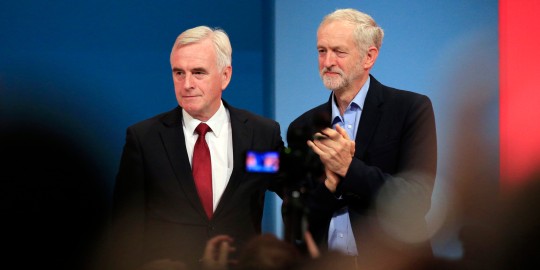
The Labour Party is considering a Universal Basic Income policy

o-JEREMY-CORBYN-JOHN-MCDONNELL-facebook.jpg

There was some speculation last year about the possibility of the Labour Party leader, Jeremy Corbyn, lending his support to the idea of basic universal income. Basic income (which is sometimes called “citizen’s income” or “universal income”) is the idea that absolute poverty can be alleviated by providing every member of a society with an unconditional subsistence income. Supporters of basic income argue that it would alleviate absolute poverty and would also motivate people to work because they would always better off, as work-related income would be additional to their subsistence income. 

Jeremy Corbyn had stated during the leadership contest that he was interested in the idea of a “guaranteed social wage” but that he believed there were issues that needed to be worked through.

Richard Murphy is a highly esteemed economist at Tax Research UK and an advocate of basic income. He’s also the co-author of Financing the Social State (pdf), which recommends the implementation of basic income in the U.K. This policy paper was published in 2013 by the Centre for Labour and Social Studies. Grassroots supporters across the left are happy to see Richard Murphy is involved in drafting Corbyn’s economic policy.

John McDonnell, the shadow chancellor, has said that the Labour Party will consider universal basic income as a part of its new policy, during a recent talk at the London School of Economics. He said: “It’s an idea we want to look at. Child benefit was a form of basic income so it’s not something that I would rule out.”

At the very least, this indicates the idea of universal provision has regained some credence in the face of a longstanding and seemingly unchallengeable political norm of increasing means-testing and welfare conditionality, established by the Thatcher adminstration, and radically extended by the current government.

McDonnell also said that economists were “close to consensus” that the Conservative Party’s austerity policies had failed, highlighting a largely welcomed and clear opposition to rigid, neoliberal Osbornomics. It’s true that austerity was founded purely on ideology and traditional Conservative prejudices, it was a political decision taken in the context of better alternatives and more humane choices. The poorest citizens have been targeted for the largest proportion of austerity cuts, with disabled people carrying the financial largest burden. It’s worth remembering that after the global recession of 2007, we were in economic recovery by the last quarter of 2009, without any need for austerity.
1379986_541109785958554_2049940708_n

Last month, an Early Day Motion (EDM) on the policy, tabled by Green Party MP Caroline Lucas, calls on the Government to commission research into the idea of universal basic income’s effects and examine its feasibility to replace the UK’s existing social security system, instead paying all citizens a flat, unconditional income, which would likely come in place of existing social security measures like means-tested benefits.

The motion, which raises the profile of the idea, says the policy “has the potential to offer genuine social security to all while boosting entrepreneurialism.”

But opponents of the basic income have raised concerns including work disincentives, lack of targeted support for those most in need, and the size of the political spending commitment required.

Lucas says:

“The basic income offers genuine social security to everyone and sweeps away most of the bureaucracy of the current welfare system. Fundamentally it would allow people the freedom and flexibility to do more of what they want to do – as well as supporting them in the caring roles they might need – or choose – to do,” she said.

“A basic income would also protect people from rising insecurity in our increasingly ‘flexible’ labour market and help rebuild our crumbling welfare state. I also know from speaking to people in my own constituency that the stability of a basic income could be a real boost to freelancers and entrepreneurs who need support to experiment, learn and take risks, while keeping their heads above water.”

“It’s crucial that any shift towards this bold new policy protects and increases the income for the poorest and those who aren’t able to work. A universal payment for all must not undermine additional help for those who need it most.”

However, last year, the Citizen’s Income Trust (CIT), which has given advice to the Green Party and often cited by the Greens, has modelled the party’s scheme and discovered a major design flaw. It was revealed that that 35.15% of households would lose money, with many of the biggest losers among the poorest households. At the time, Malcolm Torry, director of the CIT, which is a small charitable research body, said: “I am not sure the Green party has yet taken on our new research or the need to retain a means-tested element. We have only just published the new work.”

The criticisms of the scheme, as well as doubts about costings, led the Greens to make a temporary tactical retreat on the issue, with the party’s leader, Natalie Bennett, saying detailed costings for the policy would not be available in the manifesto last March. The Greens had proposed a citizen’s income of around £72 to every adult in Britain regardless of wealth and existing income, which would cost the Treasury around £280bn.

One longstanding criticism of basic income is that it would provide  payments to citizens that are already very wealthy, perpetuating social inequality, and wasting resources.

The CIT added that if the policy was applied without a means-tested component, then poorer households would end up receiving far less in state benefits than they would under the existing system. 

In 2012, an affordability study done in the Republic of Ireland by Social Justice Ireland found that basic income would be affordable with a 45% income tax rate. This would lead to an improvement in income for the majority of the population.

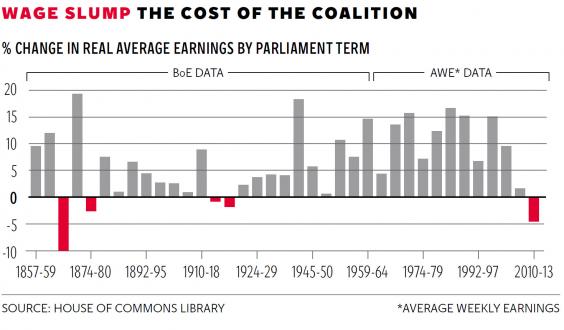
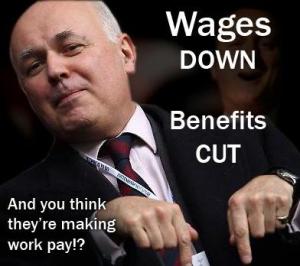
At a time when the politically planned decline in state provision leaves us questioning how we may prepare for the future, state provision funded by taxation seems by far the most fair way of providing for social support in the long term, and is part of a philosophy that each person, community and society as a whole should care for all. Furthermore, as we have witnessed the biggest and most sustained drop in wages since the 1800s, the government’s assurances that “work is the only route from poverty” no longer carry weight and credibility. For many, work does not “pay.”
430835_148211001996623_1337599952_n (1)

Collectivist values are under threat – the failure of “reformed” social security, which has in reality entailed ideologically-driven cuts to the poorest people’s lifeline income, leaves people marginalised, excluded from society, and increasingly, in absolute poverty, is clear evidence of this loss of the core principles of community cohesion, consensus and the post-war collectivist spirit. Collectivism is founded on the idea that everyone has equal worth, and that equality does not imply a lack of unique individuality, but an equal amount of freedom and equal opportunity to develop one’s own potential. Collectivists also tend to strongly favour inclusion and democratic decision-making.

One valid concern about raising people’s household wealth through citizen’s income is that it would encourage inflation. The price of services may rise. Rents may be hiked by private landlords, for example. After the introduction of child tax credits, many private childcare companies subsquently massively increased their prices, and it wasn’t unusual for some to demand payments for a full year, which included periods when childcare wasn’t required. An introduction of basic income must also, therefore, include a package of anti-inflationary measures (such as rent caps) or the value of the payment will soon be eroded, as basic costs for essentials and services rise.

One of the strongest arguments for basic income is that people would no longer be compelled to work in order to meet their basic needs. This means that employers would find it difficult to exploit workers, and would be pushed to offer decent wages, good terms and employment conditions in order to attract workers. People would have greater freedom to pursue meaningful, suitable and appropriate employment rather than having to take any job to avoid poverty and destitution.

However, opponents claim that the incentive to work would be destroyed because basic income is unconditional. Nonetheless it’s difficult to justify dehumanising policies that keep people financially desperate so that they take any job, regardless of its pay, security, terms and conditions. That ignores the fact that people have potential, skills and talents, and simply reduces working to a way of meeting only basic survival needs, which demotivates people and means that they are not willing participants in their working lives. Very wealthy people that inherited fortunes often continue to work, it’s a nonsense that keeping people close to starvation can “incentivise” them in any way at all, other than to fight for their survival. That reduces and regresses society, uncivilising us.

De-commodifying labor by decoupling work from income liberates people from the “tyranny of wage slaveryand leaves a space for innovation, creativitity and rebalances power relationships between wealthy, profit-motivated employers and employees.

There is little support for basic income from the Conservatives, as a means of redistributing income. Whilst a handful of right-wing advocates of basic income generally favour the minimisation or abolition of the public provision of welfare, some have cited basic income as a viable strategy to reduce the amount of bureaucratic administration that is prevalent in many contemporary welfare systems.

Yet we have seen an unprecedented increase in a dark, unaccountable  bureacracy this past five years, with private companies such as Atos, Maximus, and the likes of A4E and other private welfare-for-work providers marking the increased conditionality of welfare support – for both out of work support, and soon, for support paid to those in low paid and part-time work. Conservative inclination has been towards substantially raising the (increasingly privatised and for profit) administrative costs of welfare, whilst at the same time radically reducing the lifeline benefits for people needing support for meeting basic needs.

Conservatives may well raise the “something for nothing” objection to basic income, which is founded on the absurd idea that the only way people may contribute to society is through paid labor. Yet non-remunerated activities such as bringing up children, caring for elderly or sick and disabled relatives, supporting vulnerable neighbours, community work, volunteering for charities or investing time and effort in other voluntary endeavours such as contributions to the arts, sharing knowledge, education, writing, are all clearly valuable contributions to society, but these skills and activities have been steadily devalued, whilst providing an increasingly passive, exploitable, disposable (“flexible”) labor force for employers is seen by the Conservatives as somehow fulfiling the best of our potential.

The Conservatives would have us believe that any kind of social security system, which supports the casualties of free-markets, somehow creates those casualties, via vague pet theories of unverified mechanisms such as a “culture of dependency” and a “something for nothing” culture. But we know that the competitive, market choice-driven Tory policies create a few haves and many have-nots.

Even the most ardent neoliberalist would concede that whilst such a free-market system creates clear winners, it also invariably creates casualities – situations of insolvency for others. Inequality is a fundamental element of the meritocracy script that neoliberals so often pull from the top pockets of their bespoke suits. It’s the big contradiction in the smug, vehement meritocrat’s competitive individualism narrative.

This is why the welfare state came into being, after all – because when we allow such competitive economic dogmas to manifest, there are always winners and losers. It’s hardly “fair”, therefore, to leave the casualties of competition facing destitution and starvation, with a hefty, cruel and patronising barrage of calculated psychopolicical scapegoating, politically-directed cultural blamestorming, and a coercive, pathologising and punitive behaviourist approach to the casualities of inbuilt, systemic, inevitable and pre-designated sentences of economic exclusion and poverty.

For me, the most compelling argument for a basic income comes from Abraham Maslow, who was humanist psychologist. He proposed his classical theory of motivation and the hierarchical nature of human needs in 1943. Maslow said basically that the imperative to fulfil basic needs will become stronger the longer the duration that they are denied. For example, the longer a person goes without food, the more hungry and preoccupied with food they will become.

So, a person must satisfy lower level basic biological needs before progressing on to meet higher level personal growth needs. A pressing need would have to be satisfied before someone would give their attention to the next highest need. If a person has not managed to meet their basic physical needs, it’s highly unlikely that they will be motivated to fulfil higher level psychosocial ones.

Maslow’s theory has certainly been verified by the findings of the Minnesota semi-starvation Experiment, and other studies of the effects of food deprivation. Abraham Maslow’s humanist account of motivation also highlights the same connection between fundamental motives and immediate situational threats.

The experiment highlighted a striking sense of immediacy and fixation that arises when there are barriers to fulfiling basic physical needs – human motivation is frozen to meet survival needs, which take precedence over all other needs. This is observed and reflected in both the researcher’s and the subject’s accounts throughout the study. If a person is starving, the desire to obtain food will trump all other goals and dominate the person’s thought processes. This idea of cognitive priority is also clearly expressed in Maslow’s needs hierarchy. 

In a nutshell, this means that if people can’t meet their basic survival needs, it is extremely unlikely that they will have either the capability or motivation to meet higher level psychosocial needs, including personal aspirations, social obligations and responsibilities, and the capacity to seek employment.

Keeping people in a state of desperation to meet their basic needs damages social cohesion, places limits on both individual’s and society’s developmental and progressive potential: it stifles personal and social growth. A basic income would liberate people from the all-consuming struggle to meet basic survival needs, allowing them to live meaningful lives. A basic income would rebalance citizen’s rights and responsibilities fairly. It would also ensure that the state does not abuse and exploit socially protected groups.

As a very wealthy first-world nation, ensuring that all citizens can meet their basic needs for food, fuel and shelter is the very least we ought to expect from a so-called democratic government.
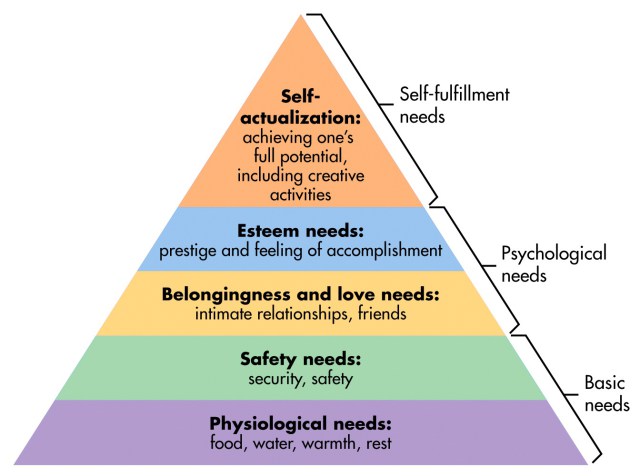
maslow-5

Maslow’s classic hierarchy of human needs


 —

I don’t make any money from my work. But you can support Politics and Insights and contribute by making a donation which will help me continue to research and write informative, insightful and independent articles, and to provide support to others. The smallest amount is much appreciated, and helps to keep my articles free and accessible to all – thank you.

DonatenowButton
cards

The Conservative approach to social research – that way madness lies

b584


I’ve written more than one lengthy critique of Tory notions of what passes for “research” methods (so I’ll make this one relatively short), and often criticised Tory refusals to accept the research findings of academics regarding, for example, established links between the Work Capability Assessment, increased suicide and mortality, the link between sanctions and increased mortality. The Tory plea for the universal and unqualified dismissal of whatever they deem to be criticism of their policies is often based on the claim that “no causal link has been established.”

As I have pointed out on many occasions previously, whilst correlation certainly isn’t quite the same thing as cause and effect, it quite often strongly hints at a causal link, and as such, warrants further investigation.

It is therefore inaccurate to say that correlation doesn’t imply causation. It quite often does. The tobacco industry has historically relied on exactly the same dismissal of correlational evidence to reject any discussion of an established link between tobacco and lung cancer.

The standard process of research and investigation doesn’t entail, at any point, a flat political denial that there is any relationship of significance to concern ourselves with, nor does it involve a systematic and deliberate withholding of relevant data, attempts at censoring democratic dialogue, and a point blank refusal to investigate further. Furthermore, the government claims that there is “no evidence of a causal link ” is unverified. There is no evidence to support government claims that there isn’t such a link, either.

I’ve observed more than once that when it comes to government claims, the same methodological rigour that they advocate for others isn’t applied. Indeed, many policies have clearly been directed by ideology and traditional Tory prejudices, rather than being founded on valid research and empirical evidence.

The fact that no cumulative impact assessment has been carried out with regard to the welfare “reforms” indicates a government that is not interested in accountability, and examining the potential negative outcomes of policy-making. Policies are supposed to be about meeting public needs and not about inflicting Conservative dogma and old prejudices in the form of financial punishment on previously protected social groups. How on earth can taking lifeline income from people who are already poor ever cure poverty or unemployment?

Where is the causal link between work and improved health outcomes? One confounder there is the effect of the ideologically-driven Tory welfare cuts that massively reduce the quality of life for those who need to claim social security. It’s not “worklessness” but rather, it is Tory “reforms” and a refusal to accept that sometimes people cannot work that lead to poor health outcomes, and all too often, the somewhat traditional Conservative habit of refusing to listen to the public they are meant to serve democratically results in premature deaths.

And what about the discredited theories that stereotype the poor – as a diversionary and scapegoating convenience – like the “cycle of deprivation,” “cycle of dependency” made-up words and pre-loaded concepts such as “worklessness” and “workshy” presented as a fictitious medical condition or personality disorder, or the deliberately divisive “culture of entitlement”? There is NO empirical evidence that these categories exist as the Conservatives claim.

Sir Keith Joseph researched the “cycle of deprivation” theory extensively some years back and found NO evidence to support it, despite his dogmatic assertion of its existence. Again there are confounders. How do you separate the effects of policies and ideologically-driven political decision-making, subsequently discriminatory socio-economic conditions and of course, pure bad luck from people’s politically constructed “innate” traits or maliciously ascribed character “flaws”?

People exist in structural contexts, no amount of political pretending that they don’t will ever hide the fact that every single Conservative budget has taken money from the poorest citizens and our publicly funded services and gifted it to the wealthiest. It’s inconceivable that ministers don’t recognise that such policies create economic enclosure, perpetuate crass inequality and extend poverty.

Where is the causal link between welfare sanctions and people getting jobs? Or between the Work Capability Assessment and disabled people being “supported” or better off? Or between workfare and people finding appropriate, secure, quality jobs with fair wages that actually alleviates poverty?

Where is the causal link between austerity measures and economic growth? Or between austerity and a reduced national debt for that matter? Or between tax cuts for the wealthy and “trickle-down” prosperity for everyone else?

Where is the causal link between privatisation and better, more “efficient” services? Not to be found in examples such as Atos, Maximus, G4S, A4E, Circle, Serco, City Link, and many more, that’s for sure. Private companies by and large make hefty profits by inflating prices, radically cutting jobs and the quality of services delivered (“efficiency”), whilst generating scandal after scandal.

As a vast social and economic experiment, privatisation has massively failed the British public, and has grotequely rewarded a handful of unscrupulous, greedy, wealthy people – grotesquely rewarded, grotesquely undertaxed – whilst ordinary people in the UK face spiralling living costs and the obscene, cruel limitations of austerity to prop up the fraternity of vulture neoliberals and perpetrators of a toxic rhetoric that attempts to justify decreasing public inclusion in a shrivelling economy.

From a government that has been rebuked many times for manufacturing and misusing statistics, making claims that are fictions, inventing testimonies regarding the fake impacts of their draconian policies, sneaking through controversial and undemocratic policies via statutory instruments because they KNOW that those policies won’t stand up to scrutiny, it’s remarkable that any member of the Conservative party have the cheek to claim “no causal link has been established” when confronted with empirical evidence and strong correlational links from meticulous academic research.

The inherent contradictions of Conservative discourse and the construction of ideological mythologies that are translated into stigmatising mechanisms and anti-humanist policies are seen at their most stark in Conservative anti-welfarism, and themes of social Darwinism.

Neoliberal mythologies are manifested in a narrative of meritocracy and in extended in notions of “deserving and “undeserving”, whilst rapidly expanding social inequalities and increasing poverty, and increasingly limited access to justice and remedy, reflect a broader political refusal to engage in democratic dialogue with the electorate and a dogmatic determination to pursue anti-progressive, neoliberal programmes, which empirical evidence informs us, are socially harmful and destructive.


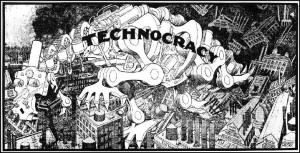
technocracy

I don’t make any money from my work. But you can support Politics and Insights and contribute by making a donation which will help me continue to research and write informative, insightful and independent articles, and to provide support to others. The smallest amount is much appreciated, and helps to keep my articles free and accessible to all – thank you.

DonatenowButton
cards

Granfalloonery, scapegoating, social dominance theory and Conservatism

images

Anyone who has read Kurt Vonnegut’s Cat’s Cradle will know what a granfalloon is. The University of Chicago awarded Vonnegut a Master’s in anthropology for what was essentially a work of satire, irony, black humor and parody. The term has since been adopted by market researchers and social scientists.

A granfalloon is a group of people who affect a proud and shared identity or some cohesive purpose, but whose mutual association is actually meaningless – associations and societies based on a shared but ultimately fabricated premise. Yet members often feel very superior in some way to others.

Granfalloons are powerful propaganda devices because they are easy to create and, once established, the granfalloon then defines social reality, establishes a normative order, by demarcating and maintaining social identities. Granfalloons also play to our strong normative tendencies towards sociability, grouping and a fundamental need for a sense of belonging, based on perceived shared characteristics. They tend not to like deviations from the norm. Or at least from what they perceive as the norm.  

However, group identities constructed around labels such as “strivers”, “tax payers” and “hard working families” are non inclusive, too. These are created politically to justify economic exclusion and outgrouping, and to manage public perceptions. Exclusive language and dominant, prejudiced narrative is an effective means of social control since it can be used to frame the interpretation of events. The group categories are designed to create or redefine moral norms and also, to stigmatise, to define deviance and to create scapegoats.

One of the purposes of the construction of granfalloons is to create categories of outsiders, as much as it is to create a false sense of privilege amongst ingroup members.

The granfalloon technique is used in advertising, in political rhetoric and by pseudoscientists, cults and other dubious groups, as a technique of persuasion in which individuals are encouraged to identify with a particular granfalloon or social group. The pressure to identify with a group is meant as a method of securing the individual’s loyalty and commitment through adoption of the group’s symbols, slogans, language, norms, rituals, actions, goals and beliefs. We like to conform and we like to “belong” and that is manipulated endlessly by granfallooners everywhere.

It’s ultimately very socially divisive. 

Think of UKIP’s extensive granfalloonery; the shrinking island of logic; an ever-decreasing ingroup of supremicists, and you get the gist. The only people who properly “belong” in UKIP  are older, “hard done by” white labourers, predominantly but not quite exclusively males, who don’t like anyone else’s social groups. Everyone else is “privileged” in some way, and that’s a bad thing to be, apparently. Scapegoating can often cause oppressed groups to attack other oppressed groups. Even when injustices are committed against a minority group by a majority ingroup, minorities sometimes lash out against a different minority group in lieu of confronting the more powerful majority.

Sometimes the oppressed can be very oppressive too.

Then there is the “all in it together” granfalloonery of Conservatism, where social groups are targeted by the ever-electioneering, purposeful and powerful elite to vote for policies that serve absolutely no-one but the elite, and cause real harm to other group members of society. All that “hate thy neighbour stuff”, you know: it’s the sick and disabled people, the unemployed people, the ethnic minorities, the working poor, the junior doctors, the unions, the Labour Party, Harold Wilson, Ed Miliband, Jeremy Corbyn, the “extremist” critics and academics. How very dare they.

But the biggest miscreants of all are in office, for crying out loud. “They’re behind you!” came the pantomime call from a usually passive, disengaged audience. We all know the score, yet here we are as an entire society of sub-grouped granfalloons, following all the divisive finger-pointing and scapegoating like dizzy, distracted cats running around in circles chasing unravelling strings.

tumblr_m81dzafFA21qcekj1o1_500

The Conservatives are creatures of habit rather than reason. Traditional. That is why their policies are so anti-progressive, and stifling for the majority of us. It’s also why Tory policies don’t meet public needs. 

I’ve observed before that there’s always an air of doom and gloom when we have a Tory government, and a largely subdued, depressed, repressed nation, carrying vague and fearful intuitions that something truly catastrophic is just around the corner.

I’ve said more than once before that we always witness the social proliferation of fascist ideals with a Tory government, too. It stems from the finger-pointing divide and rule mantra: it’s them not us, them not us. But history refutes as much as it verifies, and we learned that it’s been the Tories all along.

With a Conservative government, we are always fighting something. Poverty, social injustice: we are forced to compete and fight for political recognition of our fundamental rights, which the Tories always circumvent. We fight despair and material hardship, caused by the rising cost of living, low wages, high unemployment or more recently, underemployment, and recession that is characteristic of every Tory government.

I think people often mistranslate what that something is. Because Tory rhetoric is all about othering: dividing, atomising of society into bite-sized manageable pieces by amplifying a narrative of sneaking suspicion and hate thy neighbour via the media. Scapegoating serves as a mechanism of psychological dumping and emotional relief in acts of misplaced aggression towards oppressed outgroups for oppressed ingroups. The social order is maintained this way.

In social psychology, the granfalloon concept stems from research by the British social psychologist Henri Tajfel, in particular, from social identity theory. The significance of ingroup and outgroup categorization was identified using a method that has come to be known as the minimal group paradigm. In his research, Tajfel found that strangers would form groups on the basis of completely inconsequential criteria, such as liking certain paintings, fictions, pseudoscientific dogmas or Elvis.

In one study, Tajfel’s experimental subjects were asked to watch a coin toss. They were then designated to a particular group based on whether the coin landed on heads or tails. The subjects placed in groups based on such meaningless associations between them have consistently been found to “act as if those sharing the meaningless labels were kin or close friends.” Research demonstrates that people are differentially influenced by ingroup members. That is, under conditions where group categorisation is psychologically salient, people will shift their beliefs in line with ingroup social norms.

Outgrouping leads to the homogeneity effect. This is a process where the perception of members of an outgroup as being homogenous arises (“all the same”), while members of one’s ingroup are perceived as being individual and diverse. This is especially likely to occur on the basis of prejudiced, stereotyped negative characteristics. Of course ingroup members can be perceived as being similar to one another in regards to loosely identified positive characteristics. This effect is called ingroup homogeneity.

Authoritarian governments often utilise granfalloonery, maintaining social order by the creation of social allegiances through various means of outgrouping and ingrouping, socialisation and indoctrination. This is also used to justify prejudice, discrimination and socioeconomic inequality.

Being sociable is a positive human quality. But perhaps being duped by trivia and artificially constructed categories, intentionally stigmatised identities and politically constructed social taxonomies is also a human tendency. It seems so.

Granfalloonery is used as a propaganda technique. It is an improper appeal to emotion, which purposefully bypasses the rational thought-processes of populations. It used for the purpose of changing the opinions of a targeted audience or population. The closely related Bandwagon technique involves encouraging people to think or act in some way simply because other people are doing so.

Some people much prefer wide social inequalities. Social dominance orientation (SDO) is conceptualised as a measure of individual differences in levels of group-based discrimination; that is, it is a measure of a person’s preference for status-ranking and hierarchy within society and domination over what are perceived as lower-status outgroups. It is a predisposition toward anti-egalitarianism within and between social groups. High scores of SDO predict stereotyping, discrimination and prejudice. SDO correlates with forms of right-wing authoritarianism. Hello Mrs May.

The concept of SDO as a measurable individual difference arose from social dominance theory. Individuals who score high in SDO desire to maintain and, in many cases, increase the differences between social statuses of different groups, as well as individual group members. Typically, they are controlling, manipulative, competitive, aggressive, dominating, tough, and relatively unempathic, uncaring power-seekers. People scoring high in SDO also prefer hierarchical group orientations. Often, people who score high in SDO have strongly held beliefs in ‘meritocracy’, hierarchical societies and forms of social Darwinism.

See also:

Groupthink

False-consensus effect

How to sell a pseudoscience – Anthony R. Pratkanis

Don’t believe everything you think: cognitive dissonance

3822587_600x600


I don’t make any money from my work. But you can support Politics and Insights and contribute by making a donation which will help me continue to research and write informative, insightful and independent articles, and to provide support to others. The smallest amount is much appreciated, and helps to keep my articles free and accessible to all – thank you.

DonatenowButton

Osborne’s housing benefit cap could mean tens of thousands of the most vulnerable citizens losing their homes

994596_517805604955639_608589568_n

Grave concerns regarding the impact of proposed housing benefit cuts on the most vulnerable social groups have also arisen. Last month a specialist housing association warned that people under the age of 35 in mental health accommodation face rent shortfalls of almost £200 a week under  government plans to cap housing benefit for social housing tenants at Local Housing Allowance rates.

John Healey MP, Labour’s Shadow Cabinet Minister for Housing and Planning, warned at the time that housing providers could be forced to close accommodation for the most vulnerable because of housing benefit cuts.

Brighton Housing Trust (BHT) said that its fincancial modelling of the impact of capping housing benefit for social tenants, including supported housing tenants, at Local Housing Allowance rates revealed that 70% of all its homes would be unaffordable to under 35s under the plan, as they would only qualify for the “shared room rate” – the cost of renting a single room within a house.

The Trust said in its specialist supported housing, under-35s would face a shortfall of between £52.60 and £193.49 in 71 of 101 mental health units. There would also be shortfalls of up to £75 per week in specialist drug and alcohol units, homelessness hostels and young people’s accommodation.

Tenants older than 35 would also be unable to afford many of the homes, although the benefit gaps would be smaller.

BHT is a specialist housing association which provides for tenants with support needs, even in much of its general needs accommodation.

The association warned that the government’s offer of additional Discretionary Housing Payments to plug the rent shortfalls would also be insufficient.

The housing benefit cuts which were announced last Autumn in  George Osborne’s budget Statement are claimed to be aimed at bringing housing benefit rates for social housing in line with the sums paid to landlords in the private sector. However, the National Housing Federation has raised further concerns in a press release statement today. The Federation’s Chief Executive, David Orr, said:

“New homes for people with support needs – vulnerable people – that would be being built have been cancelled.

The impacts of the LHA cap are real and immediate. The threat alone has caused the building of thousands of specialist homes for the nation’s most vulnerable to grind to a halt. And if the cap comes into force, our research suggests that 156,000 specialist homes could be lost.

The PM has said that this would be a government that supports the vulnerable. But if this cap applies, society’s most vulnerable – dementia patients, women fleeing domestic violence, army veterans suffering mental health problems, older and disabled people – will be asked to find an extra £68 a week.

“We have repeatedly tried to engage the Government on the urgency and severe impacts of this cap on supported housing – we need clarity that this won’t apply to those in specialist homes today.”

Mr Osborne said the move, which will affect England, Scotland and Wales, would deliver savings of £225m by 2020-21, and is part of a £12bn package of cuts from the welfare bill. Conservative ministers claim they are reviewing the sheltered housing sector “to ensure it works in the best way possible”.

But hundreds of planned new sheltered accommodation units have been delayed or scrapped owing to proposed cuts to housing benefit. And several housing associations have said they are no longer financially viable. The National Housing Federation (NHF) has calculated that nearly 2,500 units have so far been scrapped or delayed as sheltered housing providers face losing an average of £68 a week per tenant.

Flats for elderly people and people with learning disabilities are more expensive to build and run because they provide crucial additional support. Concerns raised about the cap on housing benefit will affect society’s poorest and most vulnerable people, such as  women fleeing domestic violence, dementia patients,  army veterans suffering mental health problems, older and disabled people, because these peoeple  will need to find an extra £68 a week.

BBC News reports that a further four housing associations confirmed their plans had needed to change:

  • Southdown Housing in East Sussex has ben forced to scrap plans for 18 units for people with learning disabilities
  • Knightstone Housing in Somerset has delayed a complex of 65 homes for the elderly and 13 properties for learning-disabled people
  • In Manchester, Contour Homes has had to put on hold a scheme to build 36 units for the elderly
  • In North Yorkshire, Harrogate Neighbours has delayed construction of 55 extra care flats

John Healey MP Labour’s Shadow Cabinet Minister for Housing and Planning, has commented further today on the new reports of the effect that the Chancellor’s planned cuts to housing benefit are having on specialist accommodation for elderly and vulnerable people. He said:

“George Osborne’s crude cuts to housing benefit could mean tens of thousands of people losing their homes, including elderly people with dementia, veterans and women fleeing domestic violence.

“The consequences of these cuts are being felt right now, with the building of thousands of new homes stopped or scrapped because of Ministers’ failure to act.

“Labour will continue to lead the opposition to these crude cuts. George Osborne must halt these dangerous plans and consult fully with housing providers to safeguard this essential specialist housing.”

1459720_569627496440116_902730897_n
Pictures courtesy of Robert Livingstone

Maximus ‘has falsified results of fitness for work tests’, says MP – John Pring

By John Pring

The discredited US outsourcing giant contracted to carry out “fitness for work” tests on behalf of the government has been accused by an MP of “falsifying” the results of assessments.

Labour MP Louise Haigh attacked the track record, ethics and even criminal behaviour of Maximus in delivering public contracts in the US, during a debate on the work capability assessment (WCA).

But she also highlighted what she described as a “disconcerting pattern of behaviour” by Maximus in the UK since taking over the WCA contract from Atos last year.

She said: “There seems to be an alarming trend of cases being rejected based on factual errors or even – I hesitate to say this – falsification.”

Haigh (pictured speaking in the debate), a shadow Cabinet Office minister, also raised concerns that there was no way for the public to check whether targets set for Maximus by the government – such as the number of serious complaints and the payment of travel expenses within nine working days – were being met.


You can read the rest of this excellent article here

Related

Doctors bribed with 70-90k salaries to join Maximus and “endorse a political agenda regardless of how it affects patients.”

Iain Duncan Smith is complaining about valid criticisms of his draconian policies by journalists and social media commentators

36626_217452248405831_532419169_n

The Work and Pensions Select Committee has just published some letters between Frank Field, the chair, and Iain Duncan Smith, who responded to questions about the correlation between benefit assessments and suicide.

Mr Field had asked what data the Department for Work and Pensions collects on the deaths of benefit claimants.

The issue had been raised in a research report by Oxford University and Liverpool University entitled First Do No Harm, which I also reported on last year.

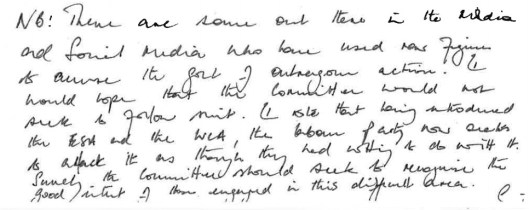
The letter addressed to Frank Field MP, features a barely legible hand-written footnote warning against listening to those “in the media and on social media” who “accuse the Government of outrageous actions.”

Duncan Smith writes in the footnote:

“There are some out there in the media and social media who have used [raw?] [ons ?- Office for National Statistics?] figures to accuse the govt of outrageous actions.

I would hope that the committee would not seek to follow suit. I [illegible] [note?] that having introduced ESA and the WLA, the Labour Party now seeks to attack it as though they had nothing to do with it.

Surely the committee should seek to recognise the good intent of those engaged in this difficult area.”

2014-02-17-BurdenoftheCuts-thumb
I would say that this blatant political discrimination constitutes an “outrageous action.” It’s difficult to recognise any “good intent” here, Mr Duncan Smith.

The correlation between the work capability assessment and suicide was established by academic researchers, not by journalists or social media commentators. We simply reported the findings.

Iain Duncan Smith will be accusing the United Nations (UN) of failing to see the government’s “good intent” when the inquiry into “grave and systematic violations” of the rights of disabled people in the UK concludes, next. Despite the fact that we are the first country to face such an inquiry, and given that the UN investigate only when there is evidence of grave and systematic violations of human rights, the prime minister has already dismissed the significance of the inquiry, ludicrously claiming “it may not be all it’s cracked up to be.”

It’s particularly noteworthy that when it comes to government claims, the same methodological rigour that they advocate for others isn’t applied. Indeed, many policies have clearly been directed by ideology and traditional Tory prejudices, rather than valid research and empirical evidence. The fact that no cumulative impact assessment has been carried out with regard to the welfare “reforms” indicates a government that is not interested in accountability, and examining the potential negative outcomes of policy-making. Policies are supposed to be about meeting public needs and not about inflicting Conservative dogma and old prejudices in the form of financial punishment on protected social groups.

As someone with a background in the social sciences, I have written extensive criticism of Iain Duncan Smith’s peculiar brand of epistemological and methodological fascism. He’s not exactly well known for his skill in statistical analysis, having been rebuked more than once for being notoriously conservative with the truth and numbers. Yet he feels compelled to dismiss the accounts of academics, campaigners, empirical evidence and the many qualitative accounts of those adversely impacted by his policies, in his vain attempt to exercise a stranglehold on his own peculiar brand of “truth.”

The goverment often claim that any research revealing negative social consequences arising from their draconian policies, which they don’t like to be made public “doesn’t establish a causal link.”  Recently there has been a persistent, aggressive and flat denial that there is any “causal link” between the increased use of food banks and increasing poverty, between benefit sanctions and extreme hardship and harm, between the work capability assessment and an increase in numbers of deaths and suicides, for example.

The government are referring to a scientific maxim: “Correlation doesn’t imply causality.” 

The tobacco industry made exactly the same claim about the established link between lung cancer and smoking.

It’s true that correlation is not the same as causation.

It’s certainly true that no conclusion may be drawn regarding the existence or the direction of a cause and effect relationship only from the fact that event A and event B are correlated.

Determining whether there is an actual cause and effect relationship requires further investigation.

This is something the government has persistently refused to do. (Here’s a full critique of Conservative methods of “social research”. I sent Mr Duncan Smith a copy, along with some information about proper definitions and measurement of poverty, but he clearly hasn’t read either. Unless he has included those in his arrogant and dismissive horror of “accusations”  criticisms on social media of course)

It is completely inaccurate to say that correlation doesn’t imply causation. It quite often does.

Here’s a final comment from a social media-based campaigner, analytical writer and a qualified social scientist who knows about statistical inference, causality and correlation and suchlike:

Iain Duncan Smith, you’re a blatant numpty.

160211IDSnote-outrageousaction

You can read the full letter here.

Benefits Assessor: How Long Are You Likely To Have Parkinson’s?

I was asked in 2011 by an Atos assessor how long I thought I would have a “chronic, progressive illness”.  Medical testing had confirmed I have connective tissue disease (lupus). That was the diagnosis from my rheumatologist, which she read aloud at the assessment, from a correspondence between my consultant and my GP. Dumbfounded, I replied:

“Until I die. The clue is in the words ‘progressive’ and ‘chronic’.”

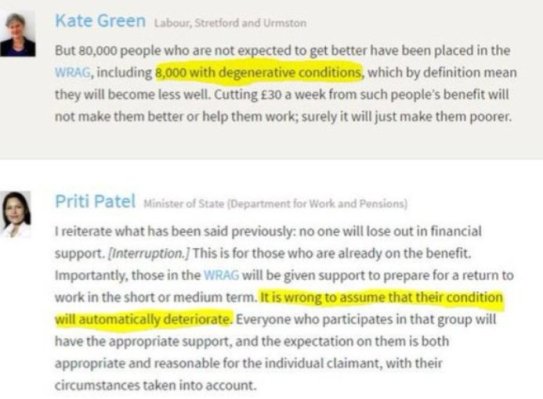
But an essential failure to grasp what words like “chronic”, “degenerative” and “progressive” actually mean isn’t peculiar to state assessors of illness and disability, who work for the government specifically to reduce the number of people eligible for sickness benefits. Government ministers display the same level of purposive ignorance:

Ca68L1xWcAA9MGT.jpg large

Hardly  “appropriate” , “reasonable” or taking “circumstances”, or medical diagnoses, for that matter, into account. A degenerative condition is one that DOES deteriorate. That is why it is called  a “degenerative condition.” It is therefore wrong and displays a degree of exceptional ignorance to assume that people WON’T or “may not” deteriorate.

This is why we don’t visit the government rather than a doctor when we become ill, especially when the state thinks it knows best about our medical conditions and how we should address those – and clearly doesn’t. This is about irrational ideology-driven policies aimed at cutting  back the welfare state. Regardless of how unreasonable that is and regardless of the consequences for those needing social security.

Sick and disabled people need support, understanding and medical care, not ignorance, Conservative dogma, vicious stigmatisation and a (neo)liberal re-translation of the words “Arbeit macht frei”.  

The government have conflated human needs with purely dogmatic economic outcomes.

Kitty S Jones.

samedifference1's avatarSame Difference

This paragraph from Frances Ryan’s latest article- an interview with a claimant called Phil Brehaut- just says it all.

“It was very daunting, like being in court,” he says. “The lady on the panel actually asked me, ‘How long are you likely to have Parkinson’s?’” He pauses. “The person next to her quickly whispered in her ear … You would think they’d know a little bit about it.”

View original post

Conservative welfare “reforms” – the sound of one hand clapping

1022654909

“Labour MPs sat perplexed … By cutting housing benefit for the poor, the Government was helping the poor. By causing people to leave their homes, the Government was helping people put a roof over their heads. By appealing the ruling that it discriminated against the vulnerable, the Government was supporting the vulnerable.

Yes, this was a tricky one.” – From an unusually insightful article in the Telegraph about the incoherence of Conservative welfare rhetoric:  How bedroom tax protects the vulnerable.

“Ministers keep using the mantra that their proposals are to protect the most vulnerable when, quite obviously, they are the exact opposite. If implemented their measures would, far from protecting the most vulnerable, directly harm them. Whatever they do in the end, Her Majesty’s Government should stop this 1984 Orwellian-type misuse of language.”  – Lord Bach, discussing the Legal Aid Bill. Source: Hansard, Column 1557, 19 May, 2011.

Conservative policies are incoherent: they don’t fulfil their stated aims and certainly don’t address public needs. Furthermore, Conservative rhetoric has become completely detached from the experiences of most citizens and their everyday realities.

Under the Equality Act, provision was made by the Labour government to ensure that legislations didn’t discriminate against protected social groups, which included disabled people. However, the need for public bodies in England to undertake or publish an equality impact assessment of government policies, practices and decisions was quietly removed by David Cameron in April 2011. The legal requirement in the Equality Act that ensured public bodies attempt to reduce inequalities caused by socio-economic factors was also scrapped by Theresa May in November 2010, who said she favoured a greater focus on “fairness” rather than “equality.”

The Conservatives have since claimed to make welfare provision “fair” by introducing substantial cuts to benefits and introducing severe conditionality requirements regarding eligibility to social security, including the frequent use of extremely punitive benefit sanctions as a means of “changing behaviours,” highlighting plainly that the Conservatives regard unemployment and disability as some kind of personal deficit on the part of those who are, in reality, simply casualties of unfortunate circumstances, bad political decision-making and subsequent politically-constructed socio-economic circumstances.

The word “fair” originally meant “treating people equally without favouritism or discrimination, without cheating or trying to achieve unjust advantage.” Under the Conservatives, we have witnessed a manipulated semantic shift, “fair” has become a Glittering Generality – part of a lexicon of propaganda that simply props up Tory ideology in an endlessly erroneous and self-referential way. Conservative ideology is permeating language, prompting semantic shifts towards bland descriptors which mask power and class relations, coercive state actions and political intentions. One only need to look at the context in which the government use words like “fair”, “support”, “help”, “justice” , “equality” and “reform” to recognise linguistic behaviourism in action. Or if you prefer, Orwellian doublespeak.

The altered semantics clearly signpost an intentionally misleading Conservative narrative, constructed on the basic, offensive idea that people claiming welfare do so because of “faulty” personal characteristics, and that welfare creates problems, rather than it being an essential mechanism aimed at alleviating poverty, extending social and economic support and opportunities – social insurance and security when people need it.

The government claims to be “committed to supporting the most vulnerable” and ensuring “everyone contributes to reducing the deficit, and where those with the most contribute the most.” That is blatantly untrue, as we can see from just a glance at Conservative policies.

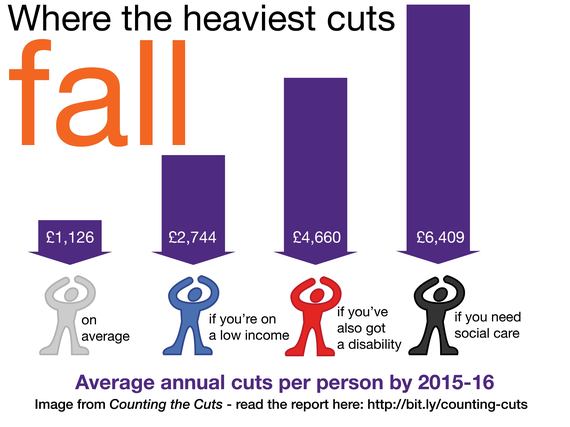
2014-02-17-BurdenoftheCuts-thumb

Conservative rhetoric is a masterpiece of stapled together soundbites and meaningless glittering generalities. And intentional mystification. Glittering Generalities are being used to mask political acts of discrimination.

Cameron claims that he is going to address “inequality” and “social problems”, for example, but wouldn’t you think that he would have done so over the past five years, rather than busying himself creating those problems via policies? Under Cameron’s government, we have become the most unequal country in the European Union, even the USA, home of the founding fathers of neoliberalism, is less divided by wealth and income, than the UK.

I’m also wondering how tripling university tuition fees, removing bursaries and maintainance grants for students from poorer backgrounds and reintroducing banding in classrooms can possibly indicate a party genuinely interested in extending “equal opportunities.”

It’s perplexing that a government claiming itself to be “economically competent” can possibly attempt to justify spending more tax payers money on appealing a Supreme Court decision that the bedroom tax policy is discriminatory, when it would actually cost less implementing the legal recommendations of the court. As Owen Smith, Shadow Work and Pensions Secretary, said: “Just the Supreme Court session itself will cost the Government more in legal fees than the £200,000 needed to exempt domestic abuse victims affected.

“If the Tories had an ounce of decency they could have stood by the decision and exempted the two groups.

“Instead they are instructing expensive lawyers to fight in the Supreme Court for the right to drive people further into poverty.”

As a consequence of the highly discriminatory and blatantly class-contingent Tory policies, rampant socio-economic inequality apparently is the new Tory “fair”. There is a clear incongruence between Conservative rhetoric and the impact of their policies. This is further highlighted by the fact that the UK is currently being investigated by the United Nations regarding serious contraventions of the human rights of sick and disabled people, and other marginalised groups, because of the dire impact of Conservative welfare “reforms.”

It’s clear that the austerity cuts which target the poorest are intentional, ideologically-driven decisions, taken within a context of other available choices and humane options.

The rise in the need for food banks in the UK, amongst both the working and non-working poor, over the past five years and the return of absolute poverty, not seen since before the advent of the welfare state in this country, makes a mockery of government claims that it supports the most vulnerable.

Income tax receipts to the Treasury have fallen because those able to pay the most are being steadily exempted from social responsibility, and wages for many of the poorer citizens have fallen, whilst the cost of living has risen significantly over this past five years.

The ideologically motivated transfer of funds from the poorest half of the country to the more affluent has not contributed to deficit reduction. It doesn’t take a genius to work out that the cumulative impact of Tory tax and welfare changes, from out-of-work and in-work benefits to council tax support, to the cut in the top rate of income tax and an increase in tax-free personal allowances, has been extremely regressive and detrimental to the poorest.

The revenue gains from the tax changes and benefit cuts were offset by the cost of tax reductions, particularly the increase in the income tax personal allowance, benefitting the wealthiest.

The Treasury response to this is to single out the poorest yet again for more cuts to “balance the books” – which basically translates as the Conservative “small state” fetish, and deep dislike of the gains we made from the post-war settlement. Yet for a government that claims a non-interventionist stance, it sure does make a lot of interventions. Always on behalf of the privileged class, with policies benefitting only the wealthy minority.

How can Conservatives believe that poor people are motivated to work harder by taking money from them, yet also apparently believe that wealthy people are motivated by giving them more money? This is not “behavioural science,” it’s policy-making founded entirely on traditional Tory prejudices.

The government claim that “Every individual policy change is carefully considered, including looking at the effect on disabled people in line with legal obligations,” but without carrying out a cumulative impact assessment, the effects and impacts of policies can’t possibly be accurately measured. And that is intentional, too.

Despite being a party that claims to support “hard-working families,” the Conservatives have nonetheless made several attempts to undermine the income security of a signifant proportion of that group of citizens recently. Their proposed tax credit cuts, designed to creep through parliament in the form of secondary legislation, which tends to exempt it from meaningful debate and amendment in the Commons, was halted only because the House of Lords have been paying attention to the game.

The use of secondary legislation has risen at an unprecedented rate, reaching an extraordinary level since 2010, and it’s increased use is to ensure that the Government meet with little scrutiny and challenge in the House of Commons when they attempt to push through controversial and unpopular, ideologically-driven legislation.

Conservative cuts are most often applied by stealth, using statutory instruments. This indicates a government that is well aware that its policies are not fit for purpose.

We can’t afford Conservative ideological indulgence.

The National Audit Office (NAO) scrutinises public spending for Parliament and is independent of government. An audit report earlier this month concluded that the Department for Work and Pension’s spending on contracts for disability benefit assessments is expected to double in 2016/17 compared with 2014/15. The government’s flagship welfare-cut scheme will be actually spending more money on the assessments themselves than it is saving in reductions to the benefits bill – as Frances Ryan pointed out in the Guardian, it’s the political equivalent of burning bundles of £50 notes.

The report also states that only half of all the doctors and nurses hired by Maximus – the US outsourcing company brought in by the Department for Work and Pensions to carry out the assessments – had even completed their training.

The NAO report summarises:

5.5
Million assessments completed in five years up to March 2015

65%
Estimated increase in cost per ESA assessment based on published information after transfer of the service in 2015 (from £115 to £190)


84%
Estimated increase in healthcare professionals across contracts from 2,200 in May 2015 to 4,050 November 2016

£1.6bn
Estimated cost of contracted-out health and disability assessments over three years, 2015 to 2018

£0.4 billion
Latest expected reduction in annual disability benefit spending

13%
Proportion of ESA and PIP targets met for assessment report quality meeting contractual standard (September 2014 to August 2015).

This summary reflects staggering and deliberate economic incompetence, a flagrant, politically-motivated waste of tax payers money and even worse, the higher spending has not created a competent or ethical assessment framework, nor is it improving the lives of sick and disabled people.

The government claim they want to “help” sick and disabled people into work, but nearly 14,000 disabled people have lost their mobility vehicle after the changes to Personal Independence Payments (PIP) assessment, which are carried out by private companies. Many more, yet to be reassessed, are also likely to lose their specialised vehicles.

In 2012, Esther McVey revealed that the new PIP  was about cutting costs and that there were targets to reduce the number of successful claims when she told the House of Commons:330,000 of claimants are expected to either lose their benefit altogether or see their payments reduced.How else could she have known that before those people were actually assessed? A recent review led the government to conclude that PIP doesn’t currently fulfil the original policy intent, which was to cut costs and “target” the benefit to “those with the greatest need.”

That basically meant a narrowing of eligibility criteria for people formerly claiming Disability Living Allowance, increasing the number of reassessments required, and limiting the number of successful claims. The government have used the review to attempt to justify further restrictions to PIP eligibility, aimed at cutting support for people who require aids to meet fundamental needs such as preparing food, dressing, basic and essential personal care and managing incontinence. “Greatest need” has become an ever-shrinking category under Conservative austerity measures. 

DPAC

The use of political pseudo-psychological “diagnoses” to both stigmatise and “treat” what are generally regarded by the Conservatives as deviant behaviours from cognitively incompetent citizens, infering that the problem lies within the individual rather than in their circumstances, or arise as a consequence of political decision-making and socio-economic models, has become the new normal. We are discussing people here who have been deemed too ill to work by their own doctor AND the state. Not for the first time, the words Arbeit macht frei spring to mind.

Welfare has been redefined: it is preoccupied with assumptions about and modification of the behaviour and character of recipients rather than with the alleviation of poverty and ensuring economic and social wellbeing.

The stigmatisation of people needing benefits is designed purposefully to displace public sympathy for the poor, and to generate moral outrage, which is then used to further justify the steady dismantling of the welfare state.

It is the human costs that are particularly distressing, and in a wealthy, first world liberal democracy, such draconian policies ought to be untenable. Some people are dying after being wrongly assessed as “fit for work” and having their lifeline benefits brutally withdrawn. Maximus is certainly not helping the government to serve even the most basic needs of sick and disabled people.

However, Maximus is serving the needs of a “small state” doctrinaire neoliberal government. The Conservatives are systematically dismantling the UK’s social security system, not because there is an empirically justifiable reason or economic need to do so, but because the government has purely ideological, anticollectivist prescriptions. Those prescriptions are costing the UK in terms of the economy, but MUCH worse, it is costing us in terms of our decent, collective, civilised response to people experiencing difficult circumstances through no fault of their own; it’s costing the most vulnerable citizens their wellbeing and unforgivably, it is also costing precious human lives.

It’s not just that Conservative rhetoric is incoherent and incongruent with the realities created by their policies. Policy-making has become increasingly detached from public needs and instead, it is being directed at “incentivising” and “changing behaviours” of citizens to meet a rigidly ideological state agenda. That turns democracy completely on its head. There is no longer a genuine dialogue between government and citizens, only a diversionary and oppressive state monologue.

And it’s the sound of one hand clapping.

one hand clapping

There are many ways of destroying people’s lives, not all of them are obvious. Taking away people’s means of meeting basic survival needs, such as money for food, fuel and shelter – which are the bare essentials that benefits were originally calculated to cover – invariably increases the likelihood that they will die. The people most adversely and immediately affected are those who have additional needs for support.

The moment that sick and disabled people were defined as a “burden on the state” by the government, we began climbing Allport’s Ladder of Prejudice.

Whilst I am very aware that we need take care not to trivialise the terrible events of  world war 2 and Nazi Germany by making casual comparisons, there are some clear and important parallels on a socio-political level and a psycho-social one, that I feel are crucially important to recognise.

Gordon Allport studied the psychological and social processes that create a society’s progression from prejudice and discrimination to genocide. In his research of how the Holocaust happened, he describes socio-political processes that foster increasing social prejudice and discrimination and he demonstrates how the unthinkable becomes acceptable: it happens incrementally, because of a steady erosion of our moral and rational boundaries, and propaganda-driven changes in our attitudes towards “others” that advances culturally, by almost inscrutable degrees.

The process always begins with the political scapegoating and systematic dehumanisation of a social group and with ideologies that identify that group as an “enemy” or a social “burden” in some way. A history of devaluation of the group that becomes the target, authoritarian culture, and the passivity of internal and external witnesses (bystanders) all contribute to the probability that violence against that group will develop, and ultimately, if the process is allowed to continue evolving, genocide.

If you think this observation is “extreme” then you really haven’t been paying attention. By 2012, hate crime incidents against disabled people had risen to be the highest ever recorded. By 2015, there was a further 41 per cent rise in disability hate crime. This is the so-called “civilised” first world, very wealthy liberal democracy that is the UK.

Most disabled people have worked, contributed to society, paid taxes and national insurance. Those that haven’t genuinely cannot work, and as a decent, civilised society, we should support them. Being ill and disabled is not a “lifestyle choice.” Unfortunately it can happen to anyone. A life-changing accident or illness doesn’t only happen to others: no-one is exempted from such a possibility. That this government thinks it can get away with peddling utter nonsense about the characters, lives and motivations of a marginalised social group, dehumanising them, directing hatred, resentment, prejudice and public derision towards them, demonstrates only too well just how far we have moved away from being a decent, civilised society. 

It seems to be almost weekly that there’s a report in the media about a sick and disabled person dying after being told by the state that they are “fit for work” and their lifeline benefits have been halted, or because the state has sanctioned someone and withdrawn their only support. There are many thousands more suffering in silence, fearful and just about living.


The importance of citizens’ qualitative accounts in democratic inclusion and political participation

disempowerment
Government policies are expressed political intentions regarding how our society is organised and governed. They have calculated social and economic aims and consequences. In democratic societies, citizens’ accounts of the impacts of policies ought to matter.

However, in the UK, the way that policies are justified is being increasingly detached from their aims and consequences, partly because democratic processes and basic human rights are being disassembled or side-stepped, and partly because the government employs the widespread use of linguistic strategies and techniques of persuasion to intentionally divert us from their aims and the consequences of their ideologically (rather than rationally) driven policies. Furthermore, policies have become increasingly detached from public interests and needs.

The merits of quantitative analysis

The government have denied there is a causal link between their welfare policies, austerity measures and an increase in mental distress, premature death and suicide. However, ministers cannot deny there is a clear and well-established correlation, which warrants further research. But the government are hiding behind a distinction often made by researchers, to avoid accountability and to deny any association at all between policy and policy impacts. That’s just plain wrong.

Correlation isn’t quite the same as causality. When researchers talk about correlation, what they are saying is that they have found a relationship between two (or more) variables. “Correlation does not mean causation” is a quip that researchers and quite often, the government, chucks at us to explain that events or statistics that happen to coincide with each other are not necessarily causally related.

However, the possibility of causation isn’t refuted by political denial or somehow invalidated by the establishment of a correlation. Quite the contrary. Indeed an established association implies there may also be a causal link. To prove causation, further research into the association between variables must be pursued. So, care should be taken not to make an assumption that correlation never implies causation, because it quite often does indicate a causal link.

Correlations between two things may be caused by a third factor that affects both of them. This sneaky, hidden third factor is called a confounding variable, or sometimes, simply a confounder.

However, a lot of social research tends to indicate and discuss a correlation between variables, not a direct cause and effect relationship. Researchers are inclined to talk cautiously about associations.

It’s worth bearing in mind that establishing correlation is crucial for research and shows that something needs to be examined and investigated further. That’s precisely how we found out that smoking causes cancer, for example – through repeated findings showing an association (those good solid, old fashioned science standards of replicability and verification). It is only by systematically eliminating other potential associations – variables – that we can establish causalities.

The objective of most research or scientific analysis is to identify the extent to which one variable relates to another variable and the direction of the association. If there is a correlation then this guides further research into investigating whether one action causes the other. Statistics measure occurrences in time and can be used to calculate probabilities. Probability is important in research because measurements, observations and findings are often influenced by variation. In addition, probability theory provides the theoretical groundwork for statistical inference.

Statistics are fundamental to good government; to the delivery of public services and to decision-making at all levels of society. Statistics provide parliament and the public with a window on the work, performance and intentions of a government. Such data allows for the design of policies and programmes that aim to bring about a desired and stated outcome, and permits better targeting of resources.

Once a policy has been implemented it is necessary to monitor and evaluate the effectiveness of the policy to determine whether it has been successful in achieving the intended outcomes. It is also important to evaluate whether services (outputs) are effectively reaching those people for whom they are intended. Statistics play a crucial role in this process. So statistics, therefore, represent a significant role in good policy-making, monitoring and political accountability. The impact of policy can be measured with statistics.

So firstly, we need to ask why the government are not doing this.

If policy impacts cannot be measured then it is not good policy.

Ensuring accuracy and integrity in the reporting of statistics is a serious responsibility. In cases where there may not be an in-depth understanding of statistics in general, or of a particular topic, the use of glossaries, explanatory notes and classifications ought to be used to assist in their interpretation.

Statistics can be presented and used in ways that may lead readers and politicians to draw misleading conclusions. It is possible to take numbers out of context, as Iain Duncan Smith, amongst others, is prone to do. However, official statistics are supposed to be produced impartially and free from political influence, according to a strict code of practice. This is a government that systematically breaches the code of conduct. See: List of official rebukes for Tory lies and statistical misrepresentations, for example.

We need to ask why the government refuses to conduct any research into their austerity policies, the impacts they are having and the associated mental distress, physical harm, deaths and suicides.

Without such research, it isn’t appropriate or legitimate to deny a causal link between what are, after all, extremely punitive, targeted, class-contingent policies and an increase in adverse consequences, such as premature mortality rates.

It isn’t unreasonable to be concerned about policies that are targeted to reduce the income of those social groups already struggling because of limited resources, nor is it much of an inferential leap to recognise that such policies will have some adverse consequences.

In social research, traditionally, quantitative methods emphasise maintaining objectivity, and aim to keep social inquiries “value-free.” However, the area of study is intentionally selected by researchers, funded by interested parties and there are problems related to the connection between observation and interpretation. Perhaps every observation is an interpretation, since “facts” are seen through a lens of perceptions, pre-conceptions and ideology.

The Joseph Rowntree Foundation choose to study poverty. Cynical Iain Duncan Smith simply changes the definition of it to reduce its visibility.

The importance of qualitative research: who are the witnesses?

Social phenomena cannot always be studied in the same way as natural phenomena, because human beings are subjective, intentional and have a degree of free will. One problem with quantitative research is that it tends to impose theoretical frameworks on those being studied, and it limits responses from those participating in the study.

Social reality is not “out there” waiting to be discovered: we are constructing and reconstructing it meaningfully. However, politically, there’s been a marked shift away from understanding the lived experiences of real people in context.

There are also distinctions to be made between facts, values and meanings. Qualitative researchers are concerned with generating explanations and extending understanding rather than simply describing and measuring social phenomena and establishing basic cause and effect relationships. Qualitative research tends to be exploratory, potentially illuminating underlying intentions, responses, beliefs, reasons, opinions, and motivations to human behaviours.

This type of analysis often provides insights into social problems, helps to develop ideas and establish explanations, and may also be used to formulate hypotheses for further quantitative research.

The dichotomy between quantitative and qualitative methodological approaches, theoretical structuralism (macro-level perspectives) and interpretivism (micro-level perspectives) in sociology, for example, is not nearly so clear as it once was, however, with many social researchers recognising the value of both means of data and evidence collection and employing methodological triangulation, reflecting a commitment to methodological and epistemological pluralism.

Qualitative methods tend to be much more inclusive than quantitative analysis, lending participants a dialogic, democratic and first hand voice regarding their own experiences.

The current government have tended to dismiss qualitative evidence from first hand witnesses of the negative impacts of their policies – presented cases studies, individual accounts and ethnographies – as “anecdotal.” However, that is a very authoritarian approach to social administration and it needs to be challenged. 

The most rigid form of quantitative research, associated with positivism, is a traditionally Conservative way of rigidly demarcating the world, imposing hierarchies of priority, worth and order, to assure ontological security and maintain the status quo, regardless of how absurd this shrinking island of certainty appears to the many of us that are being systematically exiled from it.

Neither positivism nor Conservatism extend an acknowledgement, recognition or account of human diversity – which is among our greatest assets, after all. It’s a curious ideological tension for neoliberal Conservatives: they value competitive individualism on the one hand, but have such rigid ideas about pluralism and social group deviations from imposed, value-laden norms, on the other. 

Competitive individualism arises from competitive systems, rather than co-operative, collective ones. The function of the system is to maintain inequality in the society and fields of human engagement, based on the largely unchallenged notions of ‘deserving’ and ‘undeserving’. These are tacit notions at the heart of meritocracy. Neoliberals believe that competition acts as an incentive to people’s behaviours, encouraging a “race to the top”. Those at the top then ‘trickle down’ wealth to benefit the poorest citizens, according to this behaviourist theory. But of course that hasn’t happened.

In any system of competition, there are inevitably relatively few ‘winners’ and rather more ‘losers’. Such is the logic of competition. And most people don’t share their trophies with others.

The competition is rigged in any case, since the Conservatives are not too keen on widening access to equality of opportunity. Such is the acrobatic, logic of elitism. 

The Conservatives don’t like social individualism, difference or diversity within society.  For them, the only individualism worth anything is that defined and categorised by how much money you have.  A ‘good citizen’ is wealthy. The logic follows that they must be ‘good’ to be so wealthy, after all.  Such is the politically convenient circular argument of meritocracy. 

In the current context, the Conservatives’ approach to ‘research’ is tantamount to a politically extended epistemological totalitarianism. (Epistemology is an important and underpinning branch of philosophy that extends various theories of the nature and grounds of knowledge in the social sciences, particularly with reference to its limits, reliability and validity.)

It’s merely politically convenient to use a discredited positivist approach to policy-making, because such pseudoscientific narratives can be used to legitimise and impose virtually any policy.  Pseudoscience was once used to justify eugenic policies, after all. This is an approach that purposefully excludes citizens’ accounts. It’s authoritarian.

However, a qualitative approach to research potentially provides insight, depth and richly detailed accounts. The evidence collected is much more coherent and comprehensive, because it explores beneath surface appearances, and reaches above causal relationships, delving much deeper than the simplistic analysis of ranks, categories and counts.

It provides a reliable and rather more authentic record of experiences, attitudes, feelings and behaviours, it prompts an openness and is expansive, whereas quantitative methods tend to limit and are somewhat reductive. Qualitative research methods encourage people to expand on their responses and may then open up new issues and topic areas not initially considered by researchers. 

As such, qualitative methods are prefigurative and bypass problems regarding potential power imbalances between the researcher and the subjects of research, by permitting participation and creating space for genuine dialogue and reasoned discussions to take place. Research regarding political issues and policy impacts must surely engage citizens on a democratic, equal basis and permit participation in decision-making, to ensure an appropriate balance of power between citizens and the state.

That assumes, of course, that governments want citizens to engage and participate. There is nothing to prevent a government deliberately exploiting a research framework as a way to test out highly unethical and ideologically-driven policies, and to avoid democratic accountability, transparency and public safeguards. How appropriate is it to apply a biomedical model of prescribed policy “treatments” to people experiencing politically and structurally generated social problems, such as unemployment, inequality and poverty, for example? This is happening and needs to be challenged.

Iain Duncan Smith and Priti Patel, amongst other ministers, claim that we cannot make a link between government policies and the increasing number of deaths of sick and disabled people. There are no grounds whatsoever for their claim. There has been no cumulative impact assessment or monitoring of welfare policies, no inquiry, no further research regarding an established correlation and a longstanding refusal from the Tories to undertake any of these. There is therefore no evidence for their claim.

Such political denial is oppressive – it serves to sustain and amplify a narrow, hegemonic political narrative, stifling pluralism and excluding marginalised social groups, excluding alternative accounts of citizen’s experiences, negating counternarratives; it sidesteps democratic accountability, stultifies essential public debate, obscures evidence and hides politically inconvenient, exigent truths. Denial of causality does not reduce the probability of it, especially in cases where a correlation has been well-established and evidenced.

So, how do we address these issues?

Democracy is not something we have: it’s something we have to DO 

Government ministers like to hear facts, figures and statistics all the time. What we need to bring to the equation is a real, live human perspective. We need to let ministers know how the policies they are implementing and considering directly impact ourselves, their constituents and social groups more widely. One of the most powerful things we can do to make sure the government listens to our concerns is to engage and support the organisation of family, friends, neighbours and wider communities. While many people regard state or national-level politics as an intractable mess that’s impossible to influence, collective voices really do make a difference. The best weapon of influence we have is meticulous documentation of our experiences.

Once upon a time, policy was a response from government aimed at meeting public needs. It was part of an intimate democratic dialogue between the state and citizens. Traditional methods of participating in government decision-making include:

  • political parties or individual politicians
  • lobbying decision-makers in government
  • community groups
  • voluntary organisations
  • public opinion
  • public consultations
  • the media
  • prefigurative politics

Nowadays, policies have been unanchored from any democratic dialogue regarding public needs and are more about monologues aimed at shaping those needs to suit the government and rigid policy outcomes. For many of us, policies are being formulated to act upon us as if we are objects, rather than autonomous human subjects. This political dehumanisation has contributed significantly to a wider process of social outgrouping and increasing stigmatisation.

But in democracies, Governments are elected to represent and serve the needs of the population. Democracy is not only about elections. It is also about distributive and social justice. The quality of the democratic process, including transparent and accountable Government and equality before the law, is crucial to social organisation, yet it seems the moment we become distracted, less attentive and permit inequality to fundamentally divide our society, the essential details and defining features of democracy seem to melt into air.

arnstein-ladder-citizenship-participation

 Sherry Arnstein’s Ladder of Citizen Participation and Power.

Whereabouts are you on the ladder? I think socioeconomic status has some bearing on how far up people place themselves and how much power they feel they have to influence decision-making. 

For Arnstein, participation reflects “the redistribution of power that enables the have-not citizens, presently excluded from the political and economic processes, to be deliberately included in the future. It is the strategy by which the excluded join in determining how information is shared, goals and policies are set, tax resources are allocated, programmess are operated, and benefits like contracts and patronage are parceled out. In short, it is the means by which they can induce significant social reform which enables them to share in the benefits of the affluent society.”

A starting point may be the collective gathering of evidence and continual documentation of our individual narratives concerning experiences of austerity and the welfare “reforms”, which we must continue to present to relevant ministers, parliament, government departments, the mainstream media and any organisations that may be interested in promoting citizen inclusion, empowerment and democratic participation.

We can give our own meaningful account of our own experiences and include our own voice, reflecting our own first hand witnessing, experiencing and knowledge of policy impacts, describing how we make sense of and understand our situations, including the causal links between our own circumstances, hardships, sense of isolation and distress, and Conservative policies and subsequent socioeconomic frameworks, as active, intentional, conscientious citizens. Furthermore, we can collectively demand a democratic account and response (rather than accepting denial and a refusal to engage) from the government.

ImageVaultHandler.aspx

Related

How can we find out whether people are really turning against democracy? – Democratic Audit UK

Psychologists Against Austerity campaign – call for evidence

The Psychological Impact of Austerity – Psychologists Against Austerity

A critique of Conservative notions of social research

The Conservative approach to social research – that way madness lies

Research finds strong correlation between Work Capability Assessment and suicide

Suicides reach a ten year high and are linked with welfare “reforms”

I don’t make any money from my work, and I’m not funded. You can help to support Politics and Insights by making a donation to help me continue to research and write independently and continue to support other people

DonatenowButton
cards

Conservatives plan stealth raid on in-work benefits and the long-term phasing out of child benefit


Tory UK

Picture courtesy of Tina Millis

The respected Institute for Fiscal Studies (IFS) has warned in a recent Green budget report that George Osborne’s plan to achieve a budget surplus will result in 500,000 families losing child benefit and tens of thousands having to pay a higher tax rate. More than half a million families will be stripped of child benefit over the next five years under a series of “stealth” tax raids by the Chancellor to help “balance the books.” Fuel duty will also need to be be significantly raised over the next five years or Osborne will face a £3billion black hole in his surplus plans.

Currently those earning £50,000 will lose some benefit and those earning £60,000 or more lose it all. Eventually, the report concluded, even those earning modest wages and paying the basic rate of tax will start to lose their child benefit entitlement.

The authors of the report concluded that Mr Osborne’s tax plans “lack any coherent principle” and called for more transparency, adding: “If the desire is for these tax rates to apply to a greater fraction of individuals than is currently the case, it would be better for politicians to state this clearly, rather than achieving the outcome through stealth using fiscal drag.”

Osborne’s promise to deliver a budget surplus from 2019-20 is “risky” and could have a long-term impact on the UK because the Government refuse to borrow money to fund large-scale infrastructure projects, despite low inflation.

Total public spending, excluding health, will be at its lowest level since 1948 as a proportion of national income.

The authors said: “If continued indefinitely, child benefit would be received by fewer and fewer families over time.

“But if this is the government’s intention, it would again be better to state this clearly rather than achieving it by stealth.”

Tim Loughton, a former Conservative education minister, branded the IFS findings a “double whammy” for families who are already paying the 40p higher rate of income tax.

He said: “This was inevitable. It inevitably means more and more families suffer a double whammy of having to pay higher rate tax because of the freezing of the threshold and losing out on all or most of their child benefit at the same time.

“This is hardly helpful for hardworking families trying to do the right thing for their children – if you don’t index up the rates and if you have very complicated formula that doesn’t accurately reflect household income … it’s a double unfairness.”

The Treasury has declined to comment on the IFS criticism of the Office of Responsible Budget (OBR) charter, which Osborne has committed to. But a spokesperson has said: “There may be bumpy times ahead – so here in the UK we must stick to the plan that’s cutting the deficit.”

That will invariably mean further austerity cuts. Up until recently austerity targeted those claiming out of work benefits, particularly those who are unemployed because they are sick and disabled. But increasingly, austerity is being aimed at those in low paid or part-time work, and the middle classes are set to lose further income, under the Conservative plans, too.

Despite being a party that claims to support “hard-working families,” the Conservatives have nonetheless made several attempts to undermine the income security of a signifant proportion of that group of citizens recently. Their proposed tax credit cuts, designed to creep through parliament in the form of secondary legislation, which tends to exempt it from meaningful debate and amendment in the Commons, was halted only because the House of Lords have been paying attention to the game.

The use of secondary legislation has risen at an unprecedented rate, reaching an extraordinary level since 2010, and it’s increased use is to ensure that the Government meet with little scrutiny and challenge in the House of Commons when they attempt to push through controversial and unpopular, ideologically-driven legislation. The Shadow secretary for Work and Pensions, Owen Smith, has pointed out that cuts to benefit in-work entitlements being introduced through Universal Credit mean controversial tax credit reductions have been simply been “rebranded” by the government rather than reversed.

In the Spending Review last November, George Osborne announced that tax credit reforms, which were set to almost halve the income level at which support is withdrawn from £6,420 to £3,850, would not be enacted, an analysis of the changes published by the Office for Budget Responsibility (OBR) highlighted that cuts to work allowances in Universal Credit, which set the level at which benefits will begin to be withdrawn under the new system, have not been reversed. Furthermore, people claiming Universal Credit needing in-work benefit because of low pay and  part-time hours will be expected to increase their wages and working hours, or controversially, face losing their benefit.

The Chancellor has cut in half the amount people can earn before their working tax credit starts to “taper” (reduce) – down from £6,420 to £3,850 from April 2016. Restrictions to eligibility for child tax credit means that families with more than two children are set to lose a significant amount of weekly income from April 2017. whilst the flat £545 “family element” paid before the amount for each child will also be removed completely. This will affect people in work, the think-tank Resolution Foundation said that working mothers would be worst hit – accounting for 70% of money saved by the Treasury, but overall the cuts will hit those out of work the hardest.

Many of us recognised the Tory “making work pay” mantra for what it was in 2012, when the first welfare “reforms” were pushed through parliament against widespread resistance, on the back of “financial privilege.” It was and always has been a diversion to allow the Conservatives to dismantle our welfare state, and reduce the value of labour, in much the same way as the 1834 Poor Law principle of less eligibility, which fulfilled the same purpose. The Poor Law Committee also wanted to “make work pay.” Since 2012, steadily rising in-work poverty has shown that having a job no longer provides a route out of poverty.

web-earnings-graphic

The IFS report conclusions simply confirm what many of us have suspected since 2012: that the government have a secret long-term aim to completely dismantle the social gains of our post-war settlement: the welfare state, affordable social housing provision, the National Health Service and access to justice through legal aid.

proper Blond
Picture courtesy of Robert Livingstone