Author: Kitty S Jones

I’m a political activist with a strong interest in human rights. I’m also a strongly principled socialist. Much of my campaign work is in support of people with disability. I am also disabled: I have an autoimmune illness called lupus, with a sometimes life-threatening complication – a bleeding disorder called thrombocytopenia. Sometimes I long to go back to being the person I was before 2010. The Coalition claimed that the last government left a “mess”, but I remember being very well-sheltered from the consequences of the global banking crisis by the last government – enough to flourish and be myself. Now many of us are finding that our potential as human beings is being damaged and stifled because we are essentially focused on a struggle to survive, at a time of austerity cuts and welfare “reforms”. Maslow was right about basic needs and motivation: it’s impossible to achieve and fulfil our potential if we cannot meet our most fundamental survival needs adequately. What kind of government inflicts a framework of punishment via its policies on disadvantaged citizens? This is a government that tells us with a straight face that taking income from poor people will "incentivise" and "help" them into work. I have yet to hear of a case when a poor person was relieved of their poverty by being made even more poor. The Tories like hierarchical ranking in terms status and human worth. They like to decide who is “deserving” and “undeserving” of political consideration and inclusion. They like to impose an artificial framework of previously debunked Social Darwinism: a Tory rhetoric of division, where some people matter more than others. How do we, as conscientious campaigners, help the wider public see that there are no divisions based on some moral measurement, or character-type: there are simply people struggling and suffering in poverty, who are being dehumanised by a callous, vindictive Tory government that believes, and always has, that the only token of our human worth is wealth? Governments and all parties on the right have a terrible tradition of scapegoating those least able to fight back, blaming the powerless for all of the shortcomings of right-wing policies. The media have been complicit in this process, making “others” responsible for the consequences of Tory-led policies, yet these cruelly dehumanised social groups are the targeted casualties of those policies. I set up, and administrate support groups for ill and disabled people, those going through the disability benefits process, and provide support for many people being adversely affected by the terrible, cruel and distressing consequences of the Governments’ draconian “reforms”. In such bleak times, we tend to find that the only thing we really have of value is each other. It’s always worth remembering that none of us are alone. I don’t write because I enjoy it: most of the topics I post are depressing to research, and there’s an element of constantly having to face and reflect the relentless worst of current socio-political events. Nor do I get paid for articles and I’m not remotely famous. I’m an ordinary, struggling disabled person. But I am accurate, insightful and reflective, I can research and I can analyse. I write because I feel I must. To reflect what is happening, and to try and raise public awareness of the impact of Tory policies, especially on the most vulnerable and poorest citizens. Because we need this to change. All of us, regardless of whether or not you are currently affected by cuts, because the persecution and harm currently being inflicted on others taints us all as a society. I feel that the mainstream media has become increasingly unreliable over the past five years, reflecting a triumph for the dominant narrative of ultra social conservatism and neoliberalism. We certainly need to challenge this and re-frame the presented debates, too. The media tend to set the agenda and establish priorities, which often divert us from much more pressing social issues. Independent bloggers have a role as witnesses; recording events and experiences, gathering evidence, insights and truths that are accessible to as many people and organisations as possible. We have an undemocratic media and a government that reflect the interests of a minority – the wealthy and powerful 1%. We must constantly challenge that. Authoritarian Governments arise and flourish when a population disengages from political processes, and becomes passive, conformist and alienated from fundamental decision-making. I’m not a writer that aims for being popular or one that seeks agreement from an audience. But I do hope that my work finds resonance with people reading it. I’ve been labelled “controversial” on more than one occasion, and a “scaremonger.” But regardless of agreement, if any of my work inspires critical thinking, and invites reasoned debate, well, that’s good enough for me. “To remain silent and indifferent is the greatest sin of all” – Elie Wiesel I write to raise awareness, share information and to inspire and promote positive change where I can. I’ve never been able to be indifferent. We need to unite in the face of a government that is purposefully sowing seeds of division. Every human life has equal worth. We all deserve dignity and democratic inclusion. If we want to see positive social change, we also have to be the change we want to see. That means treating each other with equal respect and moving out of the Tory framework of ranks, counts and social taxonomy. We have to rebuild solidarity in the face of deliberate political attempts to undermine it. Divide and rule was always a Tory strategy. We need to fight back. This is an authoritarian government that is hell-bent on destroying all of the gains of our post-war settlement: dismantling the institutions, public services, civil rights and eroding the democratic norms that made the UK a developed, civilised and civilising country. Like many others, I do what I can, when I can, and in my own way. This blog is one way of reaching people. Please help me to reach more by sharing posts. Thanks. Kitty, 2012

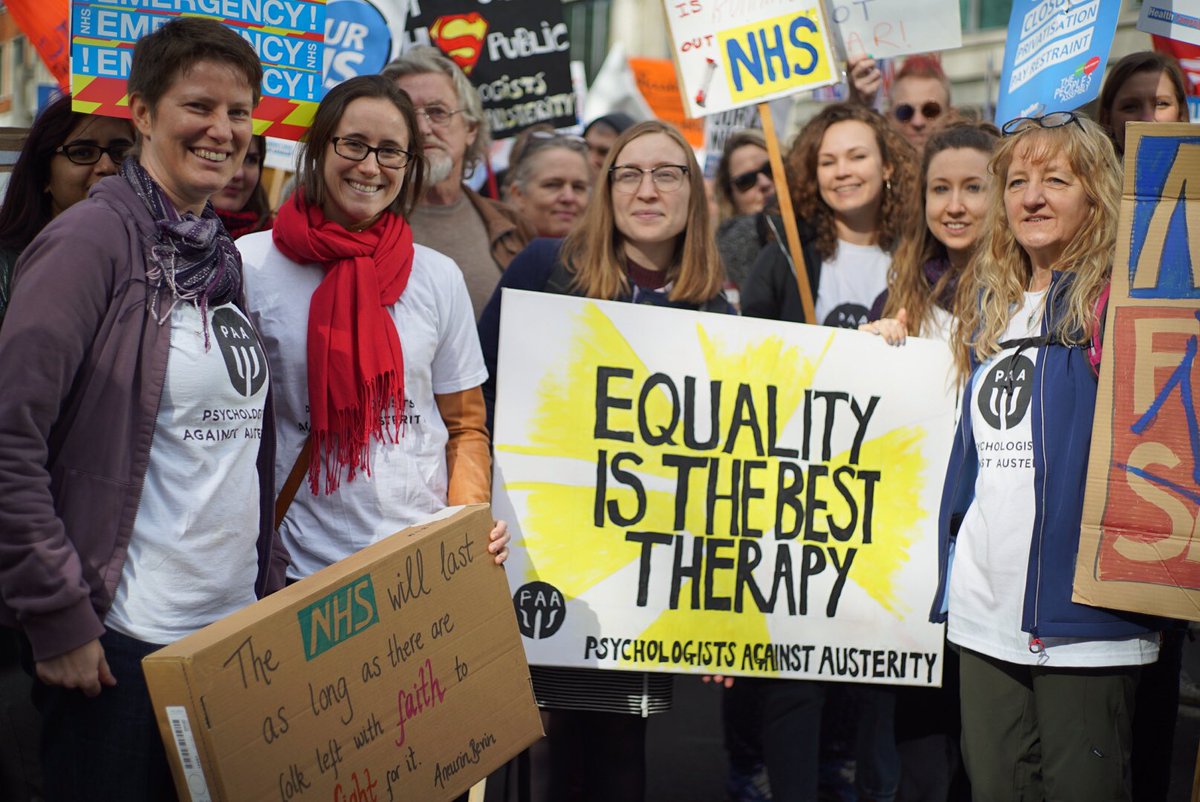
The Psychological Impact of Austerity – Psychologists Against Austerity

Image result for psychologists against austerity

A recent report from the Psychologists Against Austerity collective directly links cuts to public services with mental health problems.

Well-established psychological research that explains these links already exists. However, this knowledge has been missing from the debate on austerity so far.

Psychologists are often in a position to see the effects that social and economic changes have on people. We also occupy a relatively powerful position as professionals and therefore have an ethical responsibility to speak out about these effects.

Introduction

The Coalition government since 2010 has implemented a program of cuts to public services and welfare that has disproportionately affected  the most vulnerable people in our society in the name of ‘Austerity’. Measures like the bedroom tax, cuts to disability benefits, the introduction of Universal Credit and cuts to local government, social services and NHS budgets have been presented by the Coalition as necessary to the UK’s economic recovery.

Ideas like ‘the nation has maxed out its credit card’ and austerity as a painful but necessary medicine have been used to frame these policy choices as unavoidable and moral.

We argue that recent cuts are both avoidable and immoral. As psychologists we are often in a position to see the effects that societal and economic conditions have on people.

Psychologists also occupy a relatively powerful position as professionals with access to resources like theory and research and therefore have an ethical responsibility to speak about these effects. Indeed, according to the British Psychological Society (BPS) code of ethics, part of the standard for competence is sensitivity to developments in our social and political context.

It is imperative to take into account the psychological costs of austerity for individuals and communities. Psychological impacts of recent austerity policies have been little discussed in media and policy debates, yet there is clear and robust research linking recent austerity policies with damaging psychological outcomes.

Work at an epidemiological level on social determinants of health like the Marmot Review and The Spirit Level shows robust evidence for the effects of social inequality on health, including emotional well-being. Mental health problems are associated with markers of low income and social economic status in all the developed nations, no matter which indicator is used. There are indications of higher levels of mental health problems following austerity, with a rise in antidepressant prescriptions, and GPs reporting increasing numbers of mental health appointments, and a rise in male suicides.

Since the financial crisis, suicides have increased in European countries that have adopted austerity policies (UK, Greece, Spain and Portugal), but not in those who have protected their welfare state (Iceland and Germany). In this paper, we assume that the emotional well-being of societies and individuals is determined by multiple factors that interact with each another. These include economic, societal, familial, psychological and biological influences.

We use the terms ‘emotional well-being’, ‘distress’ and ‘mental health problems’ rather than ‘mental illness’. This is because there is disagreement about whether emotional difficulties are best understood as a product of individual pathology, or a consequence of toxic environments and difficult life experiences. We use diagnostic terminology as a proxy for a wide range of experiences of distress, which are biographically unique. As psychologists, we believe that the diagnostic and medical understanding of ‘mental illness’ often neglects socioeconomic context.

As Lynne Friedli says:

“Mental health is produced socially: the presence or absence of mental health is above all a social indicator and therefore requires social, as well as individual solutions.”

Psychological research provides evidence for some of the wide range of pathways by which increasing social inequality and austerity increase emotional distress. In this paper, we have outlined well-established pathways to short and long term psychological damage from austerity policies; we have called these ‘austerity ailments’.

They are:

  • Humiliation and shame
  • Fear and distrust
  • Instability and insecurity
  • Isolation and loneliness
  • Being trapped and powerless

Key conclusions

Austerity policies have damaging psychological costs. Mental health problems are being created in the present, and further problems are being stored for the future.

We have identified five ‘Austerity Ailments’. These are specific ways in which austerity policies impact on mental health. These experiences have been shown to increase mental health problems. Prolonged humiliation following a severe loss trebles the chance of being diagnosed with clinical depression. Job insecurity is as damaging for mental health as unemployment.

Feeling trapped over the long term nearly trebles the chances of being diagnosed with anxiety and depression. Low levels of trust increase the chance of being diagnosed with depression by nearly 50 per cent.

These five ‘ailments’ are indicators of problems in society, of poisonous public policy, weakness of social cohesion and inequalities in power and wealth. We also know what kind of society promotes good health.

Key markers are that societies are equal, participatory and cohesive.

Some important indicators of a psychologically healthy society are:

1. Agency
2. Security
3. Connection
4. Meaning
5. Trust

Mental health isn’t just an individual issue. To create resilience and promote wellbeing, we need to look at the entirety of the social and economic conditions in which people live.

Implications and recommendations

The evidence presented in this report indicates that a range of key psychological experiences can be directly linked to public policy, and are sensitive to macro social and economic changes.

It is therefore crucial that policy makers and service developers consider the psychological impacts of current and future policies. Creating the conditions for wellbeing and resilience directly helps to prevent distress in the short and long term, thereby saving resources and reducing suffering.

 We call for:

  • Social policy that works towards a more equitable and participatory society, to facilitate individual well-being, resilient places, and strong communities.
  •  Policy makers to take into account the psychological impacts of macro social and economic changes.
  • A social security system that empowers and supports, rather than punishing people in times of need.
  • Public services to increase focus on preventing distress, improving citizen participation and social justice, as well as help facilitate the five positive indicators above.
  • Co-production to be one such model of public service reform. This approach harnesses individuals’ and communities’ assets and expertise rather than viewing them just as passive recipients of and burdens on services.
  • A community-led approach to mental health and emotional wellbeing that develops collective responses to individual needs and by doing so works to strengthen communities and build on communal resources.

You can read the full briefing paper here.


Image result for psychologists for social change


I don’t make any money from my work. I’m disabled through illness and on a very low income. But you can make a donation to help me continue to research and write free, informative, insightful and independent articles, and to provide support to others. The smallest amount is much appreciated – thank you.

DonatenowButton

Health officials and sociologists voice concerns about the effects of tabloids on the general public

Image result for tabloids


Research has consistently shown that reading tabloid newspapers such as the Sun, Express and Daily Mail causes an obsession with borders, contagious fatalism, addictive irritable incoherence syndrome, an anxiety-inducing paranoia, a pre-occupation with foreigners and other people stealing tax payer’s money. It’s thought to be the fault of vagabonds, migrants, the EU and scrounging poor, everyone knows offshore banks and tax avoidance are run by the EU. A highly suggestible state results, presenting with swollen spite, distended misery guts, clinical resentment retention, rash folk devils and suppurating moral panic.

These symptoms usually precede the completely incapacitating open mouth of closed-mind syndrome, leading to premature, ejaculated brain death.

Sociologists have discovered that many unfortunate tabloid addicts have nasty outbreaks of brazen neighbours, usually from other countries, or with very dodgy disabilities. Some poor and self-rightously outraged readers even have suspiciously lazy single mothers, layabout, loutish students, suspected illegal foreigners wearing cunning disguises or daring unemployed bad sorts living right next door or just down the street. This is usually preceded by a malignant disdain that is difficult to contain.

Although there has been fierce debate about the aetiology of this condition, sociologists believe that it’s psycho-semantic. The cause also precedes the effects. In other words, it is the victims of these nasty epidemics of dodgy bad sorts that actually manifest those symptomatic phenomena, during fits of psycho-enigmatic, convulsive curtain twitching, whilst presenting further shocking symptoms of frank, febrile tutting. 

Health officials carried out research over many years, which revealed  that during the early stages of chronic tabloiditis, acute, screaming headlines bind to the victim’s brain and dopamine receptors, releasing a surge of bile and some other unidentifiable, free-floating, profuse bitter stuff. This has the unfortunate effect of oxidising the part of the brain ordinarily used to rationalise and the nubbin in the noggin that usually facilitates discernment. The deadly process also affects the vocal chords, leaving the poor patient with an over-developed sense of indignance and a hyper-reactive moral outrage. This culminates in excessive sweating, incoherent shrieking and convulsive knee-jerk responses.

The most alarming health survey reports have revealed that the process involves rapid shrinkage and withering of the gland that regulates reality uptake – the part of the body that scientists call the “getagrippe.”  This reduces the reader to thinking in unsound soundbites, leading to a terminal condition called “end-stage pernicious gullibility.” Once patients reach this stage, there is little hope for them. They tend to rapidly succumb to the malignant “cuttingyournoseofftospiteyourface” syndrome.

For example, many patients suffer a dreadful condition involving hallucinations that it’s better to have no welfare, human rights or NHS rather than have other people using them. In particular, patients tend to stipulate that unless they alone need to use tax-funded public services, they should be blown up or demolished, so no-one else can use them. Some have resorted to self-lobotomising, whilst other hopeless cases mimic end-stage Rumplestiltskinism.

Another symptom is that patients become clinically cynical. These poor victims become increasingly intolerant of everyone else, especially anyone claiming benefits, who chaf their considerably swollen sensibilities. This common reaction is a severe allergic response to others, along with a strong dose of feverish outrage manifested in the obsessive compulsive thought that anyone else should be punished regularly with public floggings, being hung, drawn and quartered and no supper. Or anything. 

Once a person is in a super state of autoimmunity to others, (a condition that some in the government Nudge Unit call “Pavlov’s delight”) the body rejects the spleen, which exits the body through the bile duct and vents. Transplants have been unsuccessful, with issues around host and grafting and NHS tourism, leading to further rejection, atrophic anomie and gonadotrophic adenoids, empathy deficiency heart failure syndrome, brought on by persistent exposure to viral epidemics of the protestant work ethic.

The patient becomes fixated on what they think everyone else has, particularly the poor, and it’s always thought to be a lot more than what the patient has, though this is usually fueled by short bursts of media stereotypes, acute delusions of impacted resentment with profuse sub-arachnoid diarrhoea, spasms of inferiority complexes and feverish exaggerations, culminating in the fatal vomited outcry of “they’ve got a flat-screened TV, an iPhone, and two scruffy kids and a packet of fags that I paid for, the cheeky scrounging b*stards.”

It’s a pernicious, humourless disease that leads to rapid degeneration and further distress through pustular outbreaks of inflamatory comments, extensive diversionary metastases, profound rectal aphasia and ultimately, to a terminal and toxic irrelevance leaking like pus from the brain and mouth. The patient is usually unaware that he/she is mortally offensive to other people at this stage. Painful class envy and terminal false consciousness follow, inevitably.

The contamination was believed to have originated from 2010, when an acute case of Murdochitis broke out and spread to other media. Some sociologists pin-pointed David Cameron’s government as the main source of the outbreak, though many public health officials have argued that Cameron’s lot were merely the original carrier of the deadly bug.

Evidence suggests that even some of the working class on the left of the political spectrum are succumbing rapidly to chronic, deteriorating narksism. This is usually characterised by a pitiful and repetitive cry of “Blair blah blah red Tory. That Nigel Farage speaks his mind.” Unfortunately, Nigel Farrage’s mind causes further contamination, which requires radical treatment in cultural isolation units, but there is currently no cure for having associated symptoms like phobias of God’s wrath and gay rain flooding.

Many narksists have succumbed to the terrible agony of massively enlarged bolsheviks. There’s been a reported number of tragic suicides associated with the condition, and so far, thirty people have been found hung by the baubles on christmas trees after their extreme state of delirium had inexplicably led them to vote for turkeys. What a terrible way to go.

There is no cure for these epidemics, and officials don’t think there is any hope for sufferers in sight until at least 2020. Then there’s a small chance of putting them out of our misery.

Iain Duncan Smith has denied that there is any cause for concern, and today, determined to demonstrate tabloid safety, he ate a full Daily Mail in front of cameras in a public place. Despite growing contrary evidence from experts in their field, government advice, meanwhile, is to keep taking the tabloids.

No automatic alt text available.


I don’t make any money from my work. But you can contribute by making a donation and help me continue to research and write informative, insightful and independent articles, and to provide support to others, if you like. The smallest amount is much appreciated – thank you.

The Department of Whopping Porkies is rebuked as claimants suddenly develop mysterious superpowers after being sanctioned


994108_672923769443821_3242642514371587924_n

Courtesy of Robert Livingstone

We all know that the Tory welfare “reforms” are the gift that just keeps on giving. Various people from an alternative universe where benefit sanctions and starvation actually work to motivate have told us so. I think in that universe you can see Skinner and Pavlov’s house.

I digress.

My recent benefit sanction really worked wonders. I was so delighted to be chosen for this special treatment by the government, and for no reason in particular. I really don’t deserve it. I have now developed spectacular superpowers as a result, and a special liking for hospital food. Every time I have a hypoglycemic attack coz I have no food, and a bout of Raynaud’s because I’ve no electricity or gas, hey presto, I get rushed into hospital where I can eat and eat until my belly is full. And there’s even heating! I couldn’t manage that with my benefit. And no worries about becoming homeless now I have a near-permanent bed. My life is transformed!

I thought I’d developed a superpower for seeing around corners as well, but it turns out that I’ve just developed a squint because I can’t afford new spectacles.

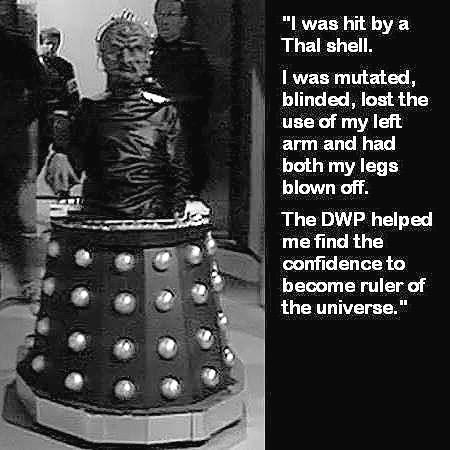
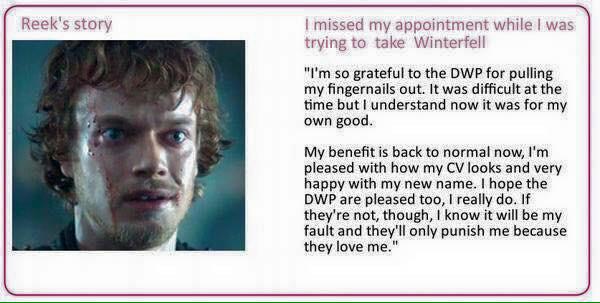
Here are some more lucky people who have been touched by extraordinary life-changing experiences through the multi-dimensional DWP:

Simon John Duffy I just wanted to share my testimony and thank the DWP for helping me to understand the true meaning of social justice. For so long I’ve simply not understood the wisdom of their policies. But now I see the light.

[You couldn’t make it up! Oh, wait, it’s the DWP, that’s what exactly they do – just make things up.]

Aug 18  Here’s the s best case study by far…. Meet Iain….


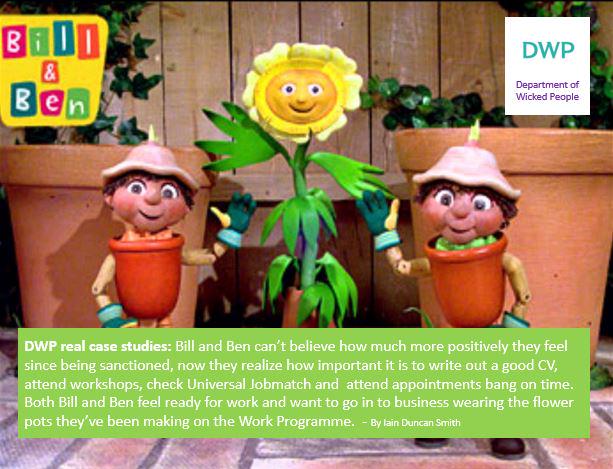
  Aug 18  More amazing case studies from the . Bill & Ben, their story is a real example to us all!   Aug 19 Shame on the government for using . Perhaps they should try featuring , like Steven’s.

Aug 18  Poor old Walter’s story is even more heart breaking

  Since sanctions forced me to go on the game, I have gained new confidence in my naked body! IDS is Gok Wan for povs!

Aug 18 Wargrave, England After the DWP convinced me my brain damage was “all in my head” I have learnt to apply germoline up my nose to fix my brain.

Aug 21 Who News: Benefit breakthrough on an intergalactic scale!

Aug 21  And now the REAL fictional characters are speaking out…

Aug 18  Without my non-intrusive Work Capability Assessment I would never have known my Parkinson’s diagnosis was merely a cold.

And a favourite tribute to the great innovator:

Of course, Iain Duncan Smith tells a great success story. Somewhere in the multi-verse of infinite possibilities. For example, there’s the lie account of his education and qualifications, as stated in his biography on the Conservative Party website, his entry in Who’s Who, and various other places, which make the claim that he went to the Universita di Perugia in Italy. In an alternative universe, unfortunately, Mr Duncan Smith’s office has been forced to explain to Newsnight researchers investigating his academic background that he didn’t get any qualifications in Perugia, or even finish his exams. His statements about the qualifications are simply examples of his remarkable superpowers. And his multi-lives and mega-talent of trans-dimensional travel.

It was also claimed that he was “educated at Dunchurch College of Management”. In fact, in this universe, Dunchurch was the former staff college for GEC Marconi, for whom he worked in the 1980s. Mr Duncan Smith’s office was forced to admit said that that he did not get any qualifications there either, in this universe, but that he completed six separate courses lasting a few days each, adding up to about a month in total.

See what I mean? Extraordinary  superpowers! (See Newsnight reveals ‘inaccuracies’ in Iain Duncan Smith’s CV ). It’s easy to see why Mr Duncan Smith has made it his very own superpower campaign to “monitor” the BBC forleft-wing bias.”

Work: for what it’s worth

b584

I’ve yet to see a decent challenge to the Tory proposition that citizenship and rights can be determined by, and ought to be conditional, on how hard-working a person is. Of course the definition of “hard-working” is narrowly restricted to categories of paid employment. People working for nothing on workfare programs aren’t considered to have any value at all. They are simply left to fall down into the vortex created by neoliberal logical gaps.

The Conservatives have always had a pathological need to create social systems comprised of ranks and categories, it’s a fundamental feature of their collective ontological insecurity and fits in very well with the key features and demands of neoliberalism.

It’s complete and utter nonsense. Dogma

People’s worth isn’t measured in terms of their contribution to the increasingly private wealth of businesses, or what they can do for an employer. Or their participation in an increasingly enclosed neoliberal economy. Human worth is universal, regardless of whether or not we work to make someone else rich.

Nor is entrepreneurship the pinnacle of human achievement.

Behave.

If work was so rewarding, there wouldn’t be any resentment directed at people who aren’t working. Workers would be content with their lot, rather than regarding others with envy, sneaking suspicion and vilifying those people trying to simply survive on the meagre benefits that most of them contributed towards via taxes. The establishment and the media would have no public complicity in their perpetual scapegoating, outgrouping and socially divisive programmes. We can always expect a particularly controversial, targeted and damaging policy from the Tories when we see the sudden appearance in the media of a new category of folk devils. It’s intentional, strategic, calculated and scapegoating is presented as a justification narrative for yet another battle against another marginalised group in the establishment’s broader class war.

The truth is that the majority of people don’t find work rewarding at all, and for many, having a paid job isn’t a way out of poverty. Labourers are deeply envious of the perceived freedom of those they feel don’t have to toil. The Conservatives know this and have virtually culturally criminalised being unemployed. This said, if you end up in prison, at least you can rely on being fed, whereas if you are claiming jobseekers allowance or sickness and disability benefits, there’s a substantial risk of being arbitrarily sanctioned, suddenly leaving you without the means of buying food and meeting other basic survival needs.

Effective collective bargaining can only happen if people have the right to refuse jobs that are exploitative. Workfare has taken that right away. Welfare conditionality has taken that right away. 

As welfare provision shrinks, an increasingly desperate reserve army of disposable labour becomes easier to exploit; work choices shrink, wages are driven down, job insecurity grows and working conditions worsen. It’s the cast-iron law of Conservatism. As I’ve pointed out before, the Poor Law of 1834 worked in the same way: the enshrined principle of less eligibility, which meant that conditions in workhouses had to be much worse than conditions available to those in the lowest paid work outside so that there was a deterrence to claiming support. In reality this meant that an individual had to be completely destitute in order to quality for poor relief.  The Tory mantra “making work pay” is based on the same ideology as the less eligibility principle. It was always a front for the neoliberal New Right imperative to dismantle welfare support and compete in a race to the bottom through the various descending layers and facets of absolute poverty. Whilst employers ascend and profit.

We decided, agreed and ratified that each human life has equal worth at an international level after the consequences of hierarchical thinking culminated in the atrocities of World War Two. Hitler thought that some people were worth more than others. All despots do. However, we progressed, we learned. We evolved. We formulated Human Rights as a coherent and collective response.

But it’s a lesson the Tories clearly have forgotten. Or chose not to learn. Our society is more unequal and steeply hierarchical than ever, inequalities are greater here than anywhere else in Europe, and including the USA. That’s a direct result of Tory policy, weighted towards handouts to the wealthy at the expense of the poor. Despite our human rights and equality legislations.

But the blame doesn’t entirely belong to the Tories. The next time you look down on your neighbours for being sick, disabled, mentally ill, unemployed or for being from a different ethnic background, remember where that sort of collective thinking takes us as a society. If you don’t believe me, go away and read Gordon Allport’s The Nature of Prejudice, have a look at Allport’s Ladder, and compare to where we are now, in the UK, in the 21st Century.

As a society, we need to learn from history. Progress. Evolve.But we are regressing instead. Human Rights are fundamentally incompatible with neoliberalism.

Allport wrote about how the Holocaust happened. Public acceptance of eugenic thinking happens incrementally; rational and moral boundaries are pushed, bit by bit, almost imperceptibly, until the unacceptable becomes acceptable. And prejudice multi-tasks. Hitler killed the sick, disabled, the poor and “workshy” first.

That psychosocial and political process is happening here, unfolding in stages day by day, week by week, year by year: the media are a large part of the ideological mechanism; a state apparatus used to push against our rational and moral boundaries. And this mechanism is being used to de-empathise us, to make us less sympathetic to the plight of politically defined others. And to regard them as having less worth than ourselves. Neoliberalism creates steep hierarchies of power and wealth, it isn’t generous to most people. 

My message here is about the equal worth of all human beings. Who we are is a universal, and not the same as “what” we are or the labels we may acquire because of our superficial characteristics. Those things are artificial and culturally relative. We all share the same basic needs, fears and hopes, we share archetypal dreams and nightmares. To paraphrase RD Laing:

All in each, each in all, all distinctions are mind; of mind, in mind, by mind. No distinctions, no mind to distinguish.

All lives equally precious.

Our worth can never be measured out in meagre pounds and pennies.

demcracy
But they don’t and they never will.

Many thanks to Robert Livingstone for the image.

Department for Work and Pensions officials admit to using fake claimant’s comments to justify benefit sanctions

From the Welfare Weekly site.

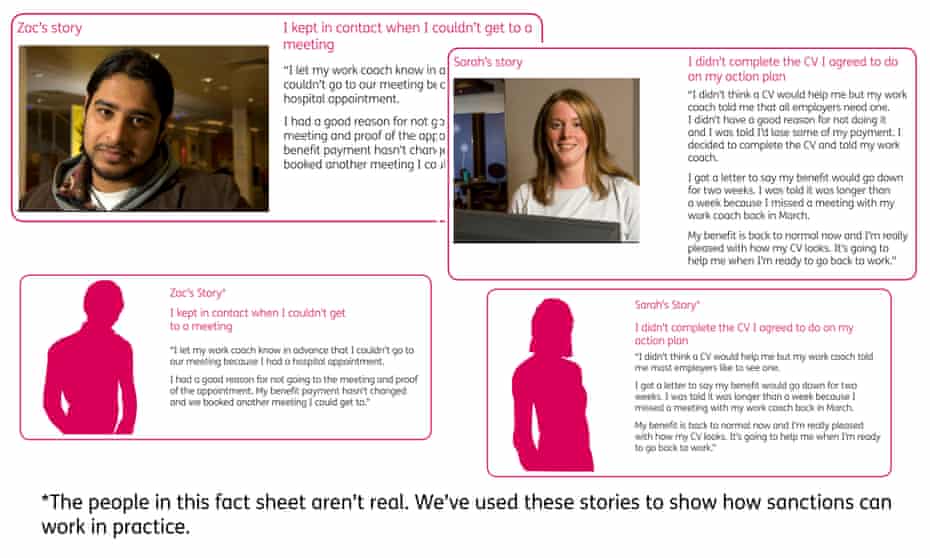
A DWP leaflet included pictures of ‘Sarah’ and ‘Zac’, who were presented as sickness benefits claimants – except neither existed. The DWP now says they were for ‘illustrative’ purposes only.
Government officials have admitted that claimant’s comments used in an official benefit sanctions information leaflet were “for illustrative purposes only”.

The revelation comes in response to a Freedom of Information (FOI) request from Welfare Weekly, in which the site authors questioned whether the comments used in the leaflet were of a genuine or fake nature.

Welfare Weekly asked the Department of Work and Pensions (DWP) to provide any evidence or information to prove that the comments used in the publication were from “genuine” claimants.

Within days of submitting their request to the DWP, the original information leaflet suddenly disappeared from the government’s website without explanation.

However, we at Welfare Weekly had already downloaded a copy of the leaflet (pdf) in anticipation of the response to our FOI request.

That leaflet included comments from two sickness benefit claimants who had supposedly been affected by benefit sanctions, Zac and Sarah.

Source: DWP
Source: DWP

According to the leaflet, Zac had said:

“I let my work coach know in advance that I couldn’t go to our meeting because I had a hospital appointment.

I had a good reason for not going to the meeting and proof of the appointment. My benefit payment hasn’t changed and we booked another meeting I could get to.”

While Susan had allegedly said:

“I didn’t think a CV would help me but my work coach told me that all employers need one. I didn’t have a good reason for not doing it and I was told I’d lose some of my payment. I decided to complete the CV and told my work coach.

I got a letter to say my benefit would go down for two weeks. I was told it was longer than a week because I missed a meeting with my work coach back in March.

My benefit is back to normal now and I’m really pleased with how my CV looks. It’s going to help me when I’m ready to go back to work.”

However, Welfare Weekly have revealed that neither of these comments came from genuine Employment and Support Allowance claimants.

Both comment’s were completely made up and included to “help people understand when sanctions can be applied and how they can avoid them by taking certain actions”, according to the DWP.

The response to Welfare Weekly’s Freedom of Information request reads:

“The photos used are stock photos and along with the names do not belong to real claimants.

The stories are for illustrative purposes only.

We want to help people understand when sanctions can be applied and how they can avoid them by taking certain actions. Using practical examples can help us achieve this.

We have temporarily changed the pictures to silhouettes and added a note to make it more clear that these are illustrative examples only.

We will test both versions of the factsheet with claimants and external stakeholders to further improve it in the future. This will include working with external organisations.”

___

The DWP have used comments and accounts that are categorically untrue in a blatant attempt to justify the use of cruel and punitive welfare sanctions, and to invalidate the experiences of genuine claimants in distress and material hardship because of sanctions. The revelation is particularly controversial because the sanctions system is causing extreme hardship, extreme psychological distress and sometimes, death, it is being operated in an unfair and arbitrary way.

 Mark Serwotka, the general secretary of the PCS union, said:

“It’s disgraceful and sinister that the DWP has been trying to trick people into believing claimants are happy to have their benefits stopped or threatened. Sanctions are unnecessarily punitive and counterproductive, and should be scrapped.”

The institute that is responsible for regulating the behaviour of organisations producing public relations material – the Chartered Institute of Public Relations (CIPR) – has launched an investigation into whether any of its members were involved in producing the document of lies.

CIPR president Sarah Pinch said:

“Falsely creating the impression of independent, popular support is a naive and opaque technique which blatantly disregards the CIPR’s standards of ethical conduct. It is deeply disappointing if public relations professionals allowed it to be published.”

I’ve written at length about the adverse consequences of increased benefit conditionality and sanctioning elsewhere on this site. See Despotic paternalism and punishing the poor. Can this really be England?  This is a blatant attempt to normalise an exceptionally punitive political approach to “supporting people into work”, inappropriately using social norming – one of several nudge techniques. Another name for the psychological technique used here is frank ‘gaslighting’.

I’ve also written about the fact that we have a government formulating policy that does not address economic, structural and political causes of poverty, instead the aim is to bring about “behavioural changes” within the population – particularly amongst the poorest and the most vulnerable social groups – to suit the anti-welfare ideology of New Right Conservatism, ministers seem to have forgotten that democratically elected governments are meant to address the needs of a population, rather than the converse being true. This despicable tactic was aimed at hiding the truth: sanctions have a devastating impact on people’s lives, as the benefit being removed is calculated at a rate to meet only basic needs, such as food, fuel and shelter in the first place.

In a democratic, rights-based society, we ought to expect that the public are not stigmatised and “acted upon,” by a government using techniques of persuasion ordinarily reserved for the seedy end of advertising and marketing industry, and by the deployment of propaganda and outright lies by the powers-that-be, in order to fulfil purely ideological directives. Governments serve the public, in first-world Liberal democracies. This government serves the government.

We call a political system where the public are expected and directed to accommodate the government’s needs and wants “totalitarianism.”

___

Are you willing to share your experience of benefit sanctions? 38 Degrees are asking people to share their sanction stories, if you would be happy for it to be used publicly. 38 degrees will ensure all contributions are published using first names only.  Please click here to participate in the Speak Out survey and campaign.

1002589_521987671204099_896277269_n (1)
Many thanks to Robert Livingstone for the image.

The Welfare Reform Bill and Labour’s reasoned amendment

307438_447255352010665_491067854_nCourtesy of Robert Livingstone

I’m writing this short article as the media have most certainly distorted the account of events regarding the Welfare Reform Bill at its Second Reading. I want to focus on parliamentary process rather than offer an opinion, just to clarify the issues. Many people think that the Labour Party didn’t oppose the Tory Bill, some even believe that Labour supported it. That’s untrue.

Labour opposed the Bill using reasoned amendments. This type of amendment is used by MPs to record their reasons for opposing the Second Reading of a Bill. The important reasoned amendment that the Labour Party proposed was as follows:

“That this house declines to give a Second Reading to the Welfare Reform and Work Bill because the Bill will prevent the Government from continuing to pursue an ambition to reduce child poverty in both absolute and relative terms, it effectively repeals the Child Poverty Act 2010 which provides important measures and accountability of government policy in relation to child poverty, and it includes a proposal for the work-related activity component of employment and support allowance which is an unfair approach to people who are sick and disabled.”

So, the motion being debated and voted on was: “That the Bill be now read a Second time.” Labour opposed that.

Had the amendment been agreed at the vote, the Bill would have been halted. As it is, the Liberal Democrats, one UKIP MP and one UUP MP voted with Labour, supporting the amendment. All of the SNP MPs were absent or abstained on this vote. The majority of MPs voted to support the Welfare Reform and Work Bill (all Conservatives) at its Second Reading, allowing it to continue to Committee stage.

Reasoned amendments may only be added at the Second Reading (and not at the Third Reading). The Bill then passes to Committee and Report stage, where it is scrutinised line by line, it then has its Third Reading, which involves very little debate and a final Commons vote.

The media reported very little regarding this process, if any, and did not mention that the Bill is in its early stages, and that there is still a Commons vote to come at the Third Reading, and that bothers me. You have to wonder why. The media accounts have left many people with the impression that the passage of the Bill has concluded. It hasn’t.

Furthermore, the corporate media have managed to create further division and disunity amongst the already factionalised Left, as we witnessed today across social media platforms. Which was probably the aim. There’s nothing like encouraging inighting to disempower groups that threaten the status quo.

This account of parliamentary process is of course all verifiable on the Parliamentary website.

Links to the website are provided here: Welfare Reform and Work Bill — Decline Second Reading — 20 Jul 2015 at 21:50

Inverted totalitarianism and neoliberalism

edward-bernays-pic1
One particularly successful way of neutralising opposition to an ideology is to ensure that only those ideas that are consistent with that ideology saturate the media and are presented as orthodoxy. The Conservative election campaign was a thoroughly dispiriting and ruthless masterclass in media control.

Communication in the media is geared towards establishing a dominant paradigm and maintaining an illusion of a consensus. This ultimately serves to reduce democratic choices. Such tactics are nothing less than a political micro-management of your beliefs and are ultimately aimed at nudging your voting decisions and maintaining a profoundly unbalanced, pathological status quo.

Presenting an alternative narrative is difficult because the Tories have not only framed all of the issues to be given public priority – they set and stage-manage the media agenda – they have also dominated the narrative; they constructed and manage the political lexicon and now treat words associated with the Left, such as welfare, like semantic landmines, generating explosions of right-wing scorn, derision and ridicule. Words like cooperation, inclusion, mutual aid, reciprocity, equality, nationalisation, redistribution – collective values – are simply dismissed as mere anachronisms that need to be stricken from public conversation and exiled from our collective consciousness, whilst all the time enforcing their own bland language of an anti-democratic political doxa. The political manufacturing of a culture of anti-intellectualism extends this aim, too.

We also see a strong political trend towards negative labelling and derogatory terms flung at the Opposition, words like ‘snowflake’, ‘cult’, ‘woke’ and ‘Stalinist’, for example. The policies associated with the Left are also traduced, and the emphasis on a universal rights-based support and economic inclusion for all citizens, including public services such as welfare and the NHS, workers’ rights and so on  are being ridiculed and deemed ‘unsustainable’.  ‘Virtue signalling’, ‘political correctness’ and ‘woke’ are terms used to demonise the Left, and to de-sensitise the public to the dire, profoundly damaging social impacts of crass inequality, which is happening as a consequence of harsh authoritarian, corrupt, right wing, ‘libertarian’, neoliberal policies.  The Conservatives are not content with demonising the Left: they are denigrating basic human qualities of caring, empathy, compassion, and conscience, along with concepts of equality and fairness, which they consider as a mere interference and inconvenience in their complete ‘marketisation’ of every realm of social existence. For the neoliberal Conservatives, competition and individualism, not co-operation and solidarity, are all that matters. But it is the latter qualities that create a civilised, democratic, inclusive society    

Words like competition, market place, small state, efficiency, responsibility and so on, now crowd out any opportunity of even a fleeting glance of another way of socio-economic organisation.

Anything presented that contradicts the consensus – a convincing, coherent, viable alternative perspective – is treated to a heavily staged editing via meta-coverage by the media. Anyone would think that the media regards the UK as a one-party state.

And here, people tend to take the Daily Mail with totalitarianism and tea …

“There’s something happening here
  But what it is ain’t exactly clear …”

Such tactics deployed in manufacturing consensus are widely used, and combined, they serve to reduce public expectation of opposition and in doing so establish diktats: it’s a way of mandating acceptance of ideology, policies or laws by presenting them as if they are the only viable alternative.

Adam Curtis explores themes of “power and how it works in society” in depth, and his works draw on areas of sociology, psychology, philosophy and political history.

Curtis points out, in his Oh-Dearism documentary, that there is an emerging “strategy of power that keeps any opposition constantly confused, a ceaseless shapeshifting that is unstoppable because it’s indefinable.” 

Adam Curtis’s Oh-Dearism on Charlie Brooker’s 2014 ScreenWipe show.

I have been reading about totalitarianism recently. You know when you have an itching recognition of something and need clarification of what it is precisely? I’ve felt for a long time that our own Tory government has totalitarian tendencies.

Totalitarianism is the name given to a political system that aims to mobilise entire populations in support of an official state ideology, and to exercise a repressive, absolute control over society, seeking to micro-manage all aspects of public and private life.

However, Sheldon Wolin has outlined an alternative form – inverted totalitarianism  – as not only signaling the political demobilization of the citizenry, but goes on to say that because it isn’t clearly evident in neoliberal ideology or policy, and it isn’t named, this makes recognition, reflection and challenging it very difficult. It is inverted because it does not require the use of overt coercion, police power and a messianic ideology as in the classical Nazi, Fascist and Stalinist versions of totalitarianism.

It’s true that dominant ideologies tend to become naturalised epistemology – acquiring an illusory consensus – and so become embedded and disguised as “common sense.” This makes it very difficult to identify and articulate the doxa, and even more difficult to present coherent challenges to it. See: Manufacturing consensus: the end of history and the partisan man.

Wolin writes:

“Our thesis is this: it is possible for a form of totalitarianism, different from the classical one, to evolve from a putatively “strong democracy” instead of a “failed” one.

Democracy is about the conditions that make it possible for ordinary people to better their lives by becoming political beings and by making power responsive to their hopes and needs. It depends on the existence of a demos – a politically engaged and empowered citizenry, one that voted, deliberated, and occupied all branches of public office.”

Wolin proposes that the United States on occasion came close to genuine democracy, but it was because citizens struggled against and momentarily defeated the elitism that was written into the Constitution.

He sees the New Deal as perhaps the only period of American history in which rule by a true demos prevailed. That is comparable with the rise of welfare states elsewhere in European democracies. Here in the UK, the welfare state arose in part because of the enfranchisement of the working class. The welfare state may be considered a fundamental part of the foundations for democracy. 

Other features of inverted totalitarianism are the same as the ones that formal definitions of classical totalitarianism identify: the mass media is the first mechanism of control that tyrants generally seek, which is used to erect fact-proof screens from reality. 

The regime attempts to control virtually all aspects of social life, including the economy, education, art, science, private life, psychology, morals and the perceptions of citizens. And decision-making. 

I had already linked the government Behavioural Insights Team (the Nudge Unit) with behaviourism and totalitarian thinking last year

To influence the decision-making of the public without their knowledge and consent, using techniques of persuasion – usually associated with advertising – is profoundly anti-democratic. As is the underpinning assumption that the public are generally irrational and fallible, but the government are somehow infallible, formulating a theory of human nature as if from some impossible, mind-independent, species-independent, “objective,” external vantage point. 

It’s like saying: “That’s your human nature, but not ours. We are somehow miraculously exempted from it.” 

This is a government that is encroaching at an existential level and surreptitiously imposing instructions about how we must be. And how we must be is ultimately confined to accommodating neoliberalism.

Edward Bernays, amongst others, has contributed significantly to the rise and perpetuation of inverted totalitarianism through the imported methods and practice of techniques of persuasion drawn from knowledge of social psychology and sociology, from advertising, and the rule of “market forces” to many other contexts than markets, including politics and the media. The ultimate purpose for the use of such techniques is to subvert and obscure the truth. 

Of course history showed that Bernays’ identification of the “manipulation of the masses” as a “natural and necessary feature of a democratic society” was a flawed theory when the rise to power of the totalitarian Nazis demonstrated that propaganda could be used to subvert democracy and generate social conflicts. In his autobiography – Biography of an Idea – Bernays recalls a dinner at his home in 1933 where: 

“Karl von Weigand, foreign correspondent of the Hearst newspapers, an old hand at interpreting Europe and just returned from Germany, was telling us about Goebbels and his propaganda plans to consolidate Nazi power. Goebbels had shown Weigand his propaganda library, the best Weigand had ever seen. Goebbels, said Weigand, was using my book ‘Crystallizing Public Opinion’ as a basis for his destructive campaign against the Jews of Germany. This shocked me. … Obviously the attack on the Jews of Germany was no emotional outburst of the Nazis, but a deliberate, planned campaign.” 

In Days of Destruction, Days of Revolt by Chris Hedges and Joe Sacco, inverted totalitarianism is described as a system where corporations have corrupted and subverted democracy and where economics trumps politics. Inverted totalitarianism is a system where every natural resource and every living being is commodified and exploited to collapse as the citizenry is lulled and manipulated into surrendering their liberties and their participation in government.

Although this is a critique aimed at the US, we have the same social conservatism and neoliberal ideology here in the UK, and to me, it’s as plain as day. One of the main objectives of managed democracy is to increase the profits of large corporations and dismantle the institutions of social democracy – our social security, trade unions, public health services, social housing, access to legal aid, human rights and so forth, and roll back the social and political ideals of the post-war settlement here in the UK, and the New deal in the US. The primary tool is privatisation. 

Managed democracy aims at the abdication of governmental responsibility for the well-being of most citizens, under the cover of improving “efficiency,” reducing small state “intrusion” and cost-cutting. Over recent years, austerity has been used as a front to accelerate this process, increasing economic inequality, redistributing public funds to increasingly wealthy individual’s private bank accounts. 

Another feature of managed democracy is the need to keep citizens preoccupied with the peripheral and the private conditions of human life so that they fail to focus on the widespread corruption and betrayal of public trust. The political function of this is to divide the public whilst obscuring class differences and diverting the voters’ attention from the social and economic concerns (and interests) of the general population.

Neoliberalism is a system of economic arrangements that greatly benefits a few powerful and wealthy people and impoverishes the majority of the public incrementally. As each social group reaches a crisis – struggling to survive – scapegoating narratives are constructed and disseminated via the media that blame them for their insolvency, creating socially divisive and politically managed categories of “others,” which serve to de-empathise the rest of the population and divert them from the fundamental fact that it isn’t the poor that create poverty: it is the neoliberal decision-makers and those who are steadily removing and privatising our public funds and ebulliently shrinking state responsibility towards citizens, leaving many at the mercy of “market forces” without a state safety net – it’s economic Darwinism. 

The Nazis openly mocked democracy, the UK and United States maintain the conceit that they serve as the model of democracy for the whole world. Instead, we have become a showcase for how to reduce democracy to just a brand, displaying how it can be managed without appearing to be suppressed. Democracy has been reduced to a flimsy façade, obscuring its antithesis. 

Totalitarianism isn’t simply a feature of a dystopian novel by George Orwell: it’s become entrenched and naturalised. Alternatives to social conservatism and neoliberalism are either edited out in advance of reaching public attention, or meta-edited, distorted and presented as “all the same” or straw man fallacies to buttress the status quo. 

I’ve been saying since 2012 that democracy is being subverted. The welfare “reforms” were hammered through parliament despite widespread and strong opposition, when Cameron used “financial privilege” as a justification to sidestep democratic process. Then came the widely opposed Health and Social Care Bill, and the Conservative’s refusal to release the details of the risk register to the public. It has remained unreleased.

But mostly, the recognition starts as an uneasy feeling, an indefinable something being not quite right, like a fleeting glimpse from the corner of your eye that triggers an adrenaline trickle of unease. Then comes the discovery that laws are being edited quietly, protective policies are eroded and some have been secretly repealed. Our human rights are being disregarded, and there’s a clearly expressed intention to heavily edit the existing legislation. Human rights are the bedrock of democracy, and observation of them separates democrats from despots. 

It’s so essential that we don’t disengage from politics, but rather, we need to organise, we need to construct a cogent narrative of resistance and transformation, formulating an alternative vocabulary that helps to raise awareness; to motivate; to inspire; to change public perceptions and directly challenge the tyrants. We need to fight to reclaim our democracy; to collectively insist on the re-population of increasingly dehumanising public and economic policies; to re-assert human needs and rights over and above the absurd, anti-humanist and socially fatal demands of desolating, pathological and ever-escalating neoliberalism.


I don’t make any money from my work. I am disabled and don’t have any paid employment. But you can contribute by making a donation and help me continue to research and write informative, insightful and independent articles, and to provide support to others. The smallest amount is much appreciated – thank you.

DonatenowButton

Benefit cuts may not be as popular as we’re led to believe – Bernadette Meaden

IDS_nIn 2013, the Joseph Rowntree Foundation reported that public attitudes towards welfare have “hardened.” Similarly, the British Social Attitudes Survey report concluded that public support for government spending on social security benefits has declined markedly over the last decade, and that people are also more sceptical about whether benefit recipients deserve the support they get. Seems that people forget that the majority of people claiming benefits have worked previously and paid for their own provision through the national insurance and tax systems.

However, the way questions in surveys are framed often influences the responses by introducing bias, which affects the validity and reliability of research findings.

Furthermore, simply adding detail, such as using examples that include real groups of people in survey questions may elicit a different set of responses.  Re-humanising groups claiming benefits tends to prompt sympathetic responses. As it is, the current government and much of the media tend to dehumanise those claiming any form of welfare support quite purposefully.

Of course the media has and continues to play a major role in defining public perceptions about welfare, but the media are conveying what are ultimately political justification narratives for the Tory notion of an “efficient” small state and their aim to dismantle our post-war settlement.

___

This excellent article is by Bernadette Meaden, originally posted on the Ekklesia site:

We are constantly being told that the British public has swallowed the ‘scroungers and skivers’ rhetoric about benefit claimants, and is broadly in favour of welfare cuts. Any politician who opposes these cuts is widely portrayed as unrealistic and unelectable. But what if that is not true, and the public’s attitude is actually far less harsh than the Westminster bubble would have us believe?

A poll carried out by YouGov in the two days after the recent Budget makes interesting reading, with some valuable lessons, and encouragement, for all who oppose the welfare cuts.

When asked a rather leading question about benefit claimants in general, and the total amount spent on benefits, 45% of respondents agreed with the statement that benefits are ‘Too high – the amount of money people can claim in benefits is too much, it’s too expensive and unfair on taxpayers.”

So far, so Daily Mail. But when asked to think about specific groups of benefit claimants, i.e. to think of real people not statistics, attitudes changed significantly.

Listing different groups of benefit recipients, respondents were asked if too much money was spent on them, or not enough. For disabled people, 46% felt that too little was spent, whilst only 9% felt that too much was spent on them. 28% felt that the amount was about right.

The figures were roughly the same for people in work on low pay, and for pensioners who have only a state pension. The group which received the least sympathy was ‘better off retired people’, whilst the views on what people who are out of work receive was almost evenly split – there was certainly no majority for the view that they get too much.

Taking the cuts in general, 38% of people thought that benefit cuts had gone too far, whilst only 24% thought they had not gone far enough. So there is no real appetite for further cuts. We should also bear in mind that the poll was conducted on the two days immediately after the Budget, when the media was trumpeting George Osborne’s claims about a new National Living Wage. As people discover the reality, that this is no more than a small rise in the minimum wage and comes with a large cut to tax credits, it seems likely that the percentage who feel cuts have gone too far may rise significantly.
.
Those who responded to the survey were probably also not fully aware of the drastic cut to Employment and Support Allowance which will see people in the Work Related Activity Group (who aren’t fit for work) losing around £30 per week. If this is spelled out, it seems highly likely that based on this survey, a clear majority of the public would oppose it.

The poll should also provide food for thought to politicians who feel they have to constantly defer to the business community in order to be electable. Asked about how to address low pay, a clear majority of respondents wanted government to get tough with employers, choosing the statement, ‘It is better for government to use the law to force companies to pay low paid workers a better wage, even if this leads to higher unemployment.’

This poll should encourage all who are campaigning to defend the welfare state and oppose cuts to the incomes of the poorest people. Despite the hyperbolic headlines and the poverty porn, British people still want to see the poor, the disabled and the elderly guaranteed a decent standard of living. They may have absorbed some of the propaganda about ‘out of control’ welfare spending, but if we can show that to be false, and continue to highlight what benefit cuts mean in terms of real people rather than statistics, we should be able to build a groundswell of opinion in defence of the welfare state.

___

See also:

Why we can’t afford not to have a welfare state

The budget: from trickle-down to falling down, whilst holding hands with Herbert Spencer.

430847_149933881824335_1645102229_n (1)Pictures courtesy of Robert Livingstone

Debunking the myths on Commons procedure and the Welfare Bill part two – Peter Kyle MP

Many thanks to Peter Kyle MP for this explanation of his decision to abstain on a vote for the second reading of the Welfare Reform and Work Bill.


The Welfare Bill

Last night I abstained on a vote for the Second Reading of the Welfare Bill. I did this after a lot of thought and I want to explain why. There’s already some myths about what was being voted on last night and also misunderstanding of parliamentary procedure and I want to tackle all these issues, too.

When I first read the Bill it became abundantly clear what the government was up to. They had lumped together measures that Labour – and many of you – would wholeheartedly support with other policies that we would rightly hate. These are the games they are playing simply to divide the left – that’s right, they’re playing games with welfare simply to get one over on us.

On the issues that I support in this Bill, the three most significant are the creation of three million new apprentices (many are the higher and advanced ones included in the Labour manifesto); lowering of rents for social housing; and more investment into the ‘troubled families programme’ which has its origins in the early intervention policies I worked on in 2006 and 2007. Each of these measures would directly benefit us in Hove and Portslade and I want them as soon as possible.

Then there are some really terrible policies that will damage not just our community but society too, such as scrapping targets on abolishing child poverty, and cuts to funding for people with disabilities or living with cancer or Parkinson’s disease, or are declared unfit for work. These I obviously oppose with all my heart.

So you see my predicament: people have suggested to me that it is a matter of principle that I should have voted against this Bill. But for me, as someone who has worked so hard to end youth unemployment, it is also a matter of principle to vote for the very apprenticeships that will help me honour my pledge to you. To vote against that part of the Bill would mean I also vote against my principles. I also see the suffering of people in arrears in social housing, it would have also meant breaking my principles to vote against help for them, too.

So, as a way forward, Labour tabled what is called a ‘reasoned amendment’. This is a way of stating which parts of a Bill you oppose and which you support when you abstain. It enabled me to not vote for or against the overall Bill, but instead make a public statement about why that course of action was taken and which parts I supported and opposed.

And there’s more. There are three more stages that this Bill must pass through in the House of Commons before it moves to the House of Lords. The next is Committee Stage (which is what I just sat on for the Education and Adoption Bill) where you can scrutinise the Bill line by line and table amendments to each section of it. Labour have already published some of the amendments we will seek to introduce at this stage and I’ve included them at the bottom of this update. Each one of these will have to be voted on by MPs and you should all lobby the MPs who are on this committee to support them. All it would take is for two or three Tories to do the right thing and the amendment will become law.

Then the Bill returns for its Report Stage, and finally it’s Third Reading. At these points it is still possible for me to vote against the entire Bill if I believe that is the only course of action left. After that, the Bill passes to the Lords where the government lacks a majority and the Labour team there can try to bring further influence.

Some people have said on social media that I am now supporting cuts to Tax Credits which contradicts an interview I gave to the Argus recently, so let me clear this up: cuts to Tax Credits are not included in this Bill, they will be introduced later in the year by another parliamentary procedure called a ‘statutory instrument’ and I will vote against them. The only time I will vote for cuts to tax credits is when wages are already at a level at which they are no longer needed, not before, as the government are doing

There’s one more myth doing the rounds that I’d like to debunk: Labour could not have won the vote last night because not a single Tory voted against this Bill. Some people are suggesting that because not every Tory voted last night, we could have beaten them. The truth is that if it had looked like we were going to vote against the Bill the government would have simply forced all the ministers and cabinet to break free of meetings to come and vote. It is a heartbreaking truth but because we lost the election we cannot beat the government unless Tories vote with us.

I won’t pretend that this has been easy for me because it hasn’t. Because we lost the election we don’t get to choose the battles we fight or the battleground. The Tories chose to put all these conflicting policies into one Bill to make it difficult for people like you and me. They are hoping that the general public’s lack of awareness of the intricacies of how laws are made will force the left to split and for Labour to crumble yet further after our defeat.

I told you during the campaign when I wrote about other tough issues like my Israel / Palestine visit that I would not dodge difficult decisions but I would always be available to explain myself, to listen, and to learn from your perspective and experiences. I didn’t reach the conclusion to abstain simply because the whips told me to.

For me, it was the only way I saw of moving forward while being true to my principles even though I knew a lot of people would be shocked and concerned upon reading the headlines. Believe me, I’d rather that hadn’t been necessary.

I want to get going and solve the tough challenges we face, like youth unemployment and the cost of housing and families that need support, and I want to oppose the vindictive nature of the way this government are using welfare reform to demonise the poor and vulnerable. I will do both with all the strength I have, even though sometimes it will mean taking difficult decisions that risk upsetting the very people I have gone into politics to help. I knew this job would have its difficult moments and this is one of them. I’m doing the best I can to deliver positive change on your behalf even though it is the Tories who are dealing the cards in parliament.

I’ve had my say now, and I’m really looking forward to hearing what you think, so please post and share your thoughts and experiences and I’ll do everything I can to respond to as many as possible.

All the best, Peter.

Here are some of the amendments Labour will try to have included in the Bill:

  • An amendment to prevent the Government abolishing the targets for reducing child poverty;
  • The Government are also trying to delete child poverty from the remit of the ‘Social Mobility and Child Poverty Commission’ so that it becomes just the ‘Social Mobility Commission’. An amendment will prevent that taking place; 
  • An amendment which will mean that the household benefit cap would not apply to persons who are responsible for a child under 2 years old, are a carer, or are in temporary accommodation because of domestic violence; 
  • A new clause which will require the Secretary of State to report each year on the impact of the household benefit cap, particularly on child poverty;
  • An amendment which will require the level of the household benefit cap to be reviewed every year, rather than only once in a Parliament. The review would be based on the new clause above requiring the impact of the benefit cap on child poverty to be assessed each year;
  • An amendment which will require the Social Security Advisory Committee to review the Discretionary Housing Payments fund each year to ensure that sufficient resources are available. Discretionary Housing Payments are used to support those who are unfairly affected by the benefit cap; 
  • An amendment which will set the target of full employment as 80 per cent of the working age population – in line with the Labour Government’s definition and recent research which shows that this would be an ambitious target. The Bill includes a process for reviewing progress towards ‘full employment’, but does not define what is meant by that; 
  • An amendment to require the UK Commission on Employment and Skills to assess whether the Government’s target for apprenticeships is being met, so that the Government can be held to account. There is significant concern among businesses and others that the quality of apprenticeships is being watered down in order to increase the numbers; 
  • An amendment which will require the resources which are being dedicated to helping troubled families to be clearly set out; 
  • An amendment which will ensure that interventions to support troubled families are focused on helping people into work; 
  • An amendment to prevent the Bill restricting Universal Credit for three or subsequent children even when the third child is born before 5 April 2017;
  • A new clause preventing the restrictions to tax credits applying to three or more children where a third child is born as a result of a multiple birth, where a third of subsequent child is fostered or adopted, where a third child or subsequent child is disabled, or where a family with three or more children moves onto tax credits or universal credit in exceptional circumstances – including but not restricted to the death of one member of the family, the departure of one parent or loss of income through unemployment – which would be set out by the Social Security Advisory Committee. It also sets up an appeals process for all cases covered by this clause; 
  • An amendment preventing cuts in the Employment and Support Allowance (ESA) for the WRAG group of around £30 a week. People who are in the WRAG group have been through a rigorous test which has deemed them not fit for work, for example because they have Parkinson’s or are being treated for cancer;
  • An amendment requiring the Government to produce a plan to offset the impact of lower social rents on housing associations. Labour supports the reduction in social housing rents, which will help low-income families and bring down the housing benefits bill. However, we must protect against impacts on the ability of housing associations to build new affordable homes and maintain their existing properties;
  • An amendment which subjects the four-year benefit freeze to an annual review subject to changes in inflation.

    ___

    See also: Emma’s statement on the Welfare Reform and Work Bill


    Michael Meacher MP said:

    It is extraordinary that the Labour party could have got itself into such a muddle over welfare reform (which is Tory-speak for crippling welfare cutbacks) when Osborne’s sole motive for this bill, which had its second reading today, is to create divisions within Labour and label it as the party of shirkers.  The bill is awful.

Debunking the myths on Commons procedure and the Welfare Bill – Andrew Gwynne MP

1235473_537097386359794_65317730_n (1)Courtesy of Robert Livingstone.

Many thanks to Andrew Gwynne MP for clarifying the Welfare Bill, informing us of the complex details and for explaining the Commons procedure.

Firstly, let’s debunk a media myth: last night, the Parliamentary Labour Party, as a bloc, in its entirety, united, voted AGAINST the Welfare Reform and Work Bill.

Certainly, how we got to that point probably would not have been my way of doing it, if I am being totally honest, but the facts are facts: We voted against the Bill. 

Labour tabled a ‘Reasoned Amendment’ to the Bill. These are Parliamentary devices which allow you to set out (the clue is in the name) the reasons why you are opposing the entire Bill, even when there are things in it that you support.

It was necessary because the Tories have, perhaps craftily, lumped a load of stuff we don’t like, with a load of stuff they’d love us to vote against – that we most certainly ARE NOT opposed to.

Firstly, what is in the Bill that we do like?

Well there’s a commitment to three million apprenticeships, including more at a higher and advanced-level (I’m in favour of that.  Indeed I had a Private Members’ Bill in the last Parliament to do just that!); then there are measures to cut council and social housing rents (one in four people living in my Denton and Reddish constituency live in social housing and should see their rents fall because of measures in this Bill. I’m not against that); and then there’s extra support for ‘troubled’ families – a scheme that has been proven to work and has saved the public purse millions (as well as transformed the lives of many people who’ve been engaged in this work).

But then there are the measures like the abolition of child poverty targets and cuts to support for the sick and disabled who are not fit for work – this includes people who have cancer or Parkinson’s disease – which we most certainly DO OPPOSE.  Indeed I spoke out on this issue in the debate yesterday.

And then there’s a few myths about what some people think is in the Bill that aren’t: tax credits.

Let’s be clear, we will vote against the tax credit cuts which will make 3 million low and middle income working families worse off. These measures are not in the Welfare Reform and Work Bill – they will be in Statutory Instruments in the autumn, and Labour will oppose them.

So last night all Labour MPs voted against the Welfare Reform and Work Bill on a Reasoned Amendment.  Some colleagues also voted against the entirety of the Bill.  I could not do that because this Bill is so finely balanced with things I do want to see happen.

So what happens next?  This is where we get to vote on all the things we don’t like in the Bill…

Labour has tabled detailed amendments on the substance of the Bill at Committee and Report Stage.

These include:

  • An amendment to prevent the Government abolishing the targets for reducing child poverty.
  • The Government are also trying to delete child poverty from the remit of the ‘Social Mobility and Child Poverty Commission’ so that it becomes just the ‘Social Mobility Commission’. An amendment will prevent that taking place.
  • An amendment which will mean that the household benefit cap would not apply to persons who are responsible for a child under 2 years old, are a carer, or are in temporary accommodation because of domestic violence.
  • A new clause which will require the Secretary of State to report each year on the impact of the household benefit cap, particularly on child poverty.
  • An amendment which will require the level of the household benefit cap to be reviewed every year, rather than only once in a Parliament. The review would be based on the new clause above requiring the impact of the benefit cap on child poverty to be assessed each year.
  • An amendment which will require the Social Security Advisory Committee to review the Discretionary Housing Payments fund each year to ensure that sufficient resources are available. Discretionary Housing Payments are used to support those who are unfairly affected by the benefit cap.
  • An amendment which will set the target of full employment as 80 per cent of the working age population – in line with the Labour Government’s definition and recent research which shows that this would be an ambitious target. The Bill includes a process for reviewing progress towards ‘full employment’, but does not define what is meant by that.
  • An amendment to require the UK Commission on Employment and Skills to assess whether the Government’s target for apprenticeships is being met, so that the Government can be held to account. There is significant concern among businesses and others that the quality of apprenticeships is being watered down in order to increase the numbers.
  • An amendment which will require the resources which are being dedicated to helping troubled families to be clearly set out.
  • An amendment which will ensure that interventions to support troubled families are focused on helping people into work.
  • An amendment to prevent the Bill restricting Universal Credit for three or subsequent children even when the third child is born before 5 April 2017.
  • A new clause preventing the restrictions to tax credits applying to three or more children where a third child is born as a result of a multiple birth, where a third of subsequent child is fostered or adopted, where a third child or subsequent child is disabled, or where a family with three or more children moves onto tax credits or universal credit in exceptional circumstances – including but not restricted to the death of one member of the family, the departure of one parent or loss of income through unemployment – which would be set out by the Social Security Advisory Committee. It also sets up an appeals process for all cases covered by this clause.
  • An amendment preventing cuts in the Employment and Support Allowance (ESA) for the WRAG group of around £30 a week. People who are in the WRAG group have been through a rigorous test which has deemed them not fit for work, for example because they have Parkinson’s or are being treated for cancer.
  • An amendment requiring the Government to produce a plan to offset the impact of lower social rents on housing associations. Labour supports the reduction in social housing rents, which will help low-income families and bring down the housing benefits bill. However, we must protect against impacts on the ability of housing associations to build new affordable homes and maintain their existing properties.
  • An amendment which subjects the four-year benefit freeze to an annual review subject to changes in inflation.

We will force individual votes on our amendments, so it’s clear what we do and don’t support, without the Tory Party or their media friends trying to paint us as being one thing or another. 

And if none of our amendments succeed? Then we still have an opportunity to vote against the Bill at Third Reading.