Category: Behavioural Science

Our social security has been redesigned. It’s now a welfare deterrent

PIP

Hunger and desperation used quite ruthlessly by a “health care professional” to controversially justify refusing a disability support claim. Access to food banks can only happen if you are referred by a professional, such as a doctor or social worker. Furthermore, you can generally have a maximum of only 3 referrals per year. The ESA and PIP eassessment guidance says that a person must be able to walk the distance specified “reliably, consistently, safely and in a timely manner.”

universal-credit.jpg
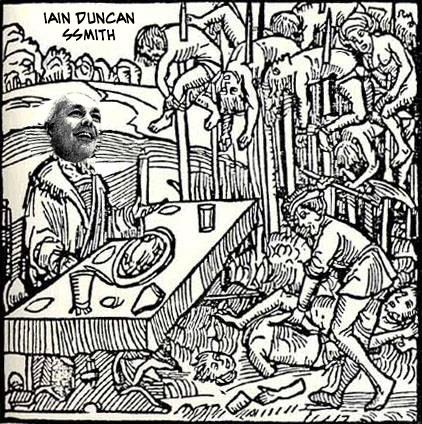
Iain Duncan-Smith struggled financially once, but then he got off his backside and was given a Tudor mansion by his father-in-law, the fifth Baron Cottesloe, which proves rewards come to those prepared to make an effort.  Reuters.

“Universal Credit doesn’t go far enough – work won’t pay until people are running naked through stinging nettles to get their benefits.

As Universal Credit develops, it can encourage other skills, so if your electricity has been cut off, you have to screw your application form into a ball and dribble it through a line of cones before kicking it into a bucket. That way you can soon come off benefits and earn £5m a year as a winger for Manchester City.” Mark Steel, writing for the Independent

The Conservative notion of “deserving” and “undeserving” poor is a false dichotomy. No-one deserves to be poor

“Deserving” is a politically divergent word if there ever was one. The Conservatives have used it to apparently wage an all out class war, using austerity as a smokescreen. They certainly don’t take the side of the proverbial underdog. In fact the more need you have, the less this government considers you “deserving” of support and sympathy.

Policies aimed at people with what are politically regarded as “additional needs” are largely about ensuring your compliance, conformity and commitment to “behavioural change”, on the assumption that people somehow erroneously “choose” to need financial support. Claiming any form of state support has come to entail a deeply hostile and extremely challenging process that is causing psychological distress and often, physical harm, to our most vulnerable citizens. There are plently of examples of cases where this has happened documented on this site alone.

Such a disciplinarian mindset is now embedded in social security policy, rhetoric and administration. But we’ve been here before, back in 1832, when the Poor Law Amendment Act was aimed at categorising and managing “deserving” and “undeserving” poor. Those considered “deserving” were unfortunately placed in workhouses and punished by a loss of citizens freedoms and rights, in order to “deter” people from being poor. (See also The New New Poor Law, 2013.)

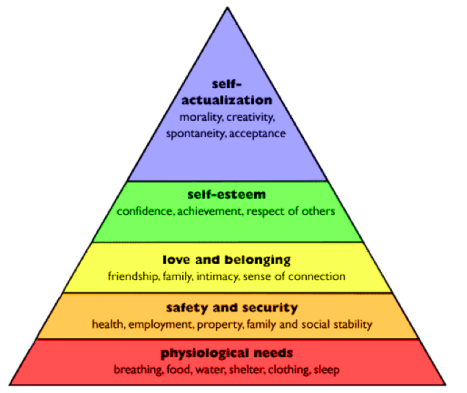
I’ve yet to come across a single case of someone being punished out of their poverty. Someone ought to send every government minister a copy of Maslow’s hierarchy of human needs, and remind them all that our post-war social security was originally designed and calculated to ensure people could meet the costs of basic survival needs, such as for food, fuel and shelter.

It was recognised back then that people struggling with basic survival requirements were highly unlikely to fulfil other higher level psychosocial potential, such as looking for work. If we want people to find work, we must first ensure they have the necessary resources to do so. And that the work available will make a real difference to their standard of living. 

Poor people don’t create poverty, state decision-making does. The economy and labor market conditions do. The punitive approach to poverty didn’t work in the 1800s and 1900s, and it isn’t working and can’t possibly be made to work now. It’s an ideological dead horse. It died because of the brutal and unrelentless use of too much political brutality, the heavy hand of the state offering all stick and no carrots for poor people.

Being poor is itself punishing enough. Now the poor are being punished for being punished with poverty.  No-one chooses to be poor, our overarching socioeconomic organisation is founded on the very principles of competition. Neoliberalism invariably means there will be a few “winners” (1%) and a lot of “losers” (99%). It’s embedded in the very nature of such a competitive system that emphasises individualism, rather than collectivism, to create increasing inequality and poverty. 

It’s worth considering that people on low pay, or with part-time hours in work are also being sanctioned, if they claim “top up” benefits to supplement their exploitative rate of pay or poor and unstable work conditions. This fact is hardly a good advertisment for the government’s claim of “making work pay”, unless of course we refer back to the poor law reform “deterrence” of 1834. Apparently, making welfare sufficiently punitive to deter people from claiming it is how we make work pay, not by raising wages in line with the cost of living. Silly me. I mistook a propaganda soundbite at face value. It seems old ideolologies die hard, with a vengeance.

Apparently it’s an individual’s fault for not “progressing in work”. Nothing to do with increasingly precarious employment situations, executive decision-making, or a deregulated labor market, of course. 

In-work benefits have effectively subsidised employers’ wage costs. Yet low paid workers are being punished by the government for this state of affairs.

It’s not so long ago that we had a strong trade union movement that used collective bargaining as a method of improving wages and working conditions. But the free market ideologues don’t like trade unions, or welfare provision. They like a neat, tidy and very small, limited interventionist state. Or so they claim.

The paradox, of course, is that in order to reduce supportive provisions, and dismantle the welfare state in order to fulfil the terms and conditions of neoliberalism, the government has to implement strategies that ensure citizen compliance. Many of those strategies are increasingly authoritarian, rather than “non interventionist”, in nature.

It’s not the welfare state, but the state of welfare that is the pressing problem

Private companies have become more firmly embedded in the core concerns of all departments of government in designing and delivering on public and social policies, and policies have become increasingly detached from public need, and more directed at meeting private interests, largely involving making huge and private profits. The Conservatives don’t seem to consider that rogue private businesses like G4S, Atos, Maximus, A4E, and so on, are extensions of the state, fulfilling what are, after all, state-determined functions.

Of course this creates an imbalance between the role of the welfare state in aiding private capital and its role in maintaining and supporting labor, and fulfilling the basic needs of citizens. Corporate welfare underpins neoliberal economies, and it costs the public far more than reduced public provisions promises to save.

In January 2016, the National Audit Office (NAO) published its evaluation of the DWP’s health and disability assessment contracts. It said the cost of each Work Capability Assessment (WCA) had risen from £115 under Atos to £190 under Maximus. The report also states that only half of all the doctors and nurses hired by Maximus – the US outsourcing company brought in by the Department for Work and Pensions (DWP) to carry out the assessments – had even completed their training.

The NAO report summarised:

5.5
Million assessments completed in five years up to March 2015

65%
Estimated increase in cost per Employment and Support Allowance (ESA) assessment based on published information after transfer of the service in 2015 (from £115 to £190)


84%
Estimated increase in healthcare professionals across contracts from 2,200 in May 2015 to 4,050 November 2016

£1.6 billion
Estimated cost of contracted-out health and disability assessments over three years, 2015 to 2018

£0.4 billion
Latest expected reduction in annual disability benefit spending

13%
Proportion of ESA and Personal Independence Payment (PIP) targets met for assessment report quality meeting contractual standard (September 2014 to August 2015).

Before 2010, cuts to disability support were unthinkable. Now the Treasury regards our provision as their pocket money for tax cuts for the very wealthy

This summary reflects staggering economic incompetence, a flagrant, politically motivated waste of tax payers money and even worse, the higher spending has not created a competent or ethical assessment framework, nor is it improving the lives of sick and disabled people. Some people are dying after being wrongly assessed as “fit for work” and having their lifeline benefits brutally withdrawn. Maximus is certainly not helping the government to serve even the most basic needs of sick and disabled people.

However, Maximus, and other private companies involved in the delivery of welfare programmes are serving the needs of a “small state” doctrinaire neoliberal government, and making a massive profit in doing so. It would cost much less to simply pay people the support they were once simply entitled to. However, the Conservatives are systematically dismantling the UK’s social security system, not because there is an empirically justifiable reason or economic need to do so, but because the government has purely ideological, anticollectivist prescriptions. 

As well as the heavy cost of each assessment to the public purse, there is also the considerable cost of many tribunals, because of the many “wrong decisions”on the part of the Department for Work and Pensions. That’s despite the fact that the government introduced another layer of bureacracy in the form of “mandatory review” in order to deter appeals. People going through mandatory review for a decision to stop their ESA cannot claim ESA again until after mandatory review (if you need to appeal, you can claim ESA once you have the review decision), and so are forced to either try and claim Universal Credit, going 6 weeks at least without any support, or to wait out the Review outcome, which has no set time limit, but usually takes at least 6 weeks for the decision about the original decision. Which is usually the same decision as the original decision, due to outrageous targets that were revealed in the department’s response to a Freedom of Information request, that stated staff conducting mandatory reconsideration reviews were held to a “key performance indicator” that said “80 per cent of the original decisions are to be upheld”.

This is a government that claims social security is “unsustainable” and a “burden” on the public purse, yet has no problem with an extraordinary profligacy with public funds and dispossessing tax payers when it comes to implementing “cost-cutting” and draconian welfare “reforms.” Conservative anti-welfare dogma and traditional prejudices are costing the UK billions of pounds. 

The Tories are all about ideology and not facts. As two authors astutely noted recently, the government seems to be driven by an idea that creating the conditions of purgatory for those they consider “undeserving” will somehow cleanse, redeem and purify people into not being so sinfully poor.  So it’s not actually “welfare” any more, but rather, it’s a “correctional” institution, for coercing citizens into conformity, compliance and a class contingent meekness, with a liberal dash of the protestant work ethic in with the catholic inquisition flavoured ingredients in the mix. Yes, the nasty authoritarian Conservatives really do think like this.

Disability support is virtually impossible to access for many people that doctors consider severely disabled, and involves a measured and ritualised humiliation. The assessments are solely designed to look for “discrepancies” in people’s accounts of how their illness/disability impacts on your day to day living. In other words, it is aimed at looking for reasons, no matter how flimsy, to ensure that welfare support for disabled and ill people is pretty much unobtainable.

Those questions you are asked by the (inappropriately named) Health Care Professional (HCP) that seem like innocent conversation, such as “Do you watch TV? Do you like the Soaps?” translate onto a report that says “Can sit unaided for at least half an hour”. “Do you have a pet?”becomes “Can bend to feed cat/dog.” “Do you use the internet at all?” becomes “No evidence of focus or cognitive difficulties, adequate hand dexterity.”

If you wear any jewellry, that may be noted and used as evidence that you have dexterity in your hands, even if you have severe arthritis and can’t fasten your buttons or a zip,  you won’t be asked if you ever remove your locket/ring/earrings. It will be assumed that you do. It’s a kind of opportunism of neglect and assumption used by HCPs to justify refusing some elements of PIP, or all of your claim. Or it’s the difference between being placed in the ESA Support Group, being placed in the WRAG on the lower award, or simply being refused an award altogether, and told you are “fit for work”. 

If you are unfortunate enough to need a referral to a food bank, and you actually manage to get to the appointment,  because you are desperate, that may also be used as evidence that you can walk further than 200 or 500 metres, even if you can’t, and managed to get a lift there and back.

Challenging such ridiculous assumptions wears you down. It creates distress when someone acting as a gatekeeper to the support you need dismisses your medical reports and account with such disdain, just stopping short of calling you a liar. Challenging the reasons provided for the DWP refusing you a PIP or ESA award is tedious, very stressful and time consuming and tiring. I’m sure that if you manage to do so successfully, even the fact that you managed to collate evidence, ask you doctor for supportive evidence and so forth may be used as evidence that you can function too well to warrant any support. If you demonstrate any ingenuity in coping with your condition, you’ve basically had it.

Once upon a time, support for disabled people was designed to help us remain independent, and to enable us to participate in society. PIP is non means-tested and people can claim it (allegedly) whilst in work.

However, I worked for social services until I became too ill to work. I loved my job, and my salary was very good, too. It was a terribly dehumanising experience to have to face the fact I was no longer well enough and fit for my post. 7 years later, at my PIP assessment, it was decided that my previous job “proved” that I don’t currently have “any cognitive problems.”

That’s despite the assessor acknowledging  in the report I now even need an aid to remember to take my treatments and medications, and that during the appointment, I had to be reminded several times what I’d been asked, as I kept forgetting what I was supposed to be answering. I have systemic lupus erythematosus (SLE), and cognitive dysfunction is very commonly experienced  symptom of this illness

People have even been refused PIP at appeal because they “spend too much time on Facebook.” Too much for what, exactly? Last time I checked, there were no laws in place that meant sick and disabled citizens were prohibited from using social media. Since when did it become acceptable for government officials to endorse and promote the social exclusion of disabled people online? 

But apparently, contradictions and paradoxes are allowed if you happen to be the assessing HCP. The report said that I was “thin” abut “adequately nourished”. She didn’t check my vitamin and mineral levels at all. Nor did she ask me about what I ate and how often. She just said that the aids I have were “adequate” (a perch stool, easy to use tin opener and specially designed easy to use cutlery, which are not especially designed for disabled people, but are easier for me to use because of the handle design and the steak knives instead of standard ones.)

What’s the point of welfare “support” if so few people are able to access it, despite their obvious need?

The United Nations (UN) inquiry into the allegations many of us made regarding the systematic abuse of the human rights of disabled people in the UK has exposed the multiple injustices of targeted cuts and the disproportionate burden of austerity heaped on sick and disabled people, their carers and their families, evidencing and detailing the effects of a range of policy measures affecting them that have been introduced since 2010. These include the bedroom tax and cuts to disability benefits, funds to support independence and social care.

The report concludes that the overall effect of what is now an essentially punitive welfare regime, which has been based almost entirely on unevidenced political claims and assumptions, has had an extremely detrimental and regressive effect on the rights of disabled people, to live independently, to meet their basic needs, to seek and stay in work,  and to be able to live an ordinary life as citizens.

The UN report documented multiple violations of disabled people’s rights, including the way that they are politically portrayed as being lazy and a “burden on taxpayers”, the harm to health caused by unfair assessments, the cuts to legal aid and curtailed access to justice, the imposition of the bedroom tax and the ending of the Independent Living Fund.

I wrote a lengthy article about the unsurprising but nonetheless disquieting report findings and recommendations, as I read throughit at the time, here.

The government have of course indignantly refused to accept the findings of the UN, or accept the accounts of individuals and campaigners like me, disability groups and charities, and other organisations. That’s because the government prefer to cling relentlessly to free market dogma and their traditional prejudices rather than face empirical evidence, facts and truths.

The days of genuine support, to ensure disabled people can maintain dignity and independence, and to be socially, economically, politically and culturally included, are gone. PIP and ESA focus exclusively on what you can’t do: on “functionality”. If you walk your dog or take a holiday, this is taken to somehow indicate that you are not ill or disabled enough to need support. In fact the media turns you into some kind of nasty folk devil and state parasite for trying to live as normal life as possible. If the government and media had their way, we would be trapped indoors in abject misery, or institutionalised.

How dare we try to live an ordinary life.

The government have formulated draconian policies aimed particularly at disabled people. And unemployed people, low paid people, and young people. And migrants. And old people who, like many disabled people, have paid in contributions towards a welfare system, should they need it, but now they also have to work until they drop.

Hey, and you thought governments are elected to meet public needs and spend our money wisely? No, apparently we’re here to serve government needs, to behave exactly as the Conservatives think we should. 

Welfare as a deterrent to… well, welfare.


Image result for poverty welfare punishment

And social security has been redesigned to punish those citizens who have the misfortune to find themselves in poverty.


I don’t make any money from my work. But you can support Politics and Insights and contribute by making a donation which will help me continue to research and write informative, insightful and independent articles, and to provide support to others. The smallest amount is much appreciated, and helps to keep my articles free and accessible to all – thank you. 

DonatenowButton

top 100 blogs

More allegations of Tory election fraud, now we need to talk about democracy

The Conservative Party are facing another investigation from the Electoral Commission following evidenced allegations that they operated a secret call centre during the general election campaign, breaching electoral law, an undercover investigation by Channel 4 News has revealed. 

An undercover reporter working for Channel 4 News secured work at Blue Telecoms, a company in Neath, South Wales. In an area plagued by unemployment and low wages, the call centre hired up to a hundred people on zero-hours contracts. For weeks, they contacted thousands of potential voters in marginal seats across the UK. 

The hired callers were told to say they were working for a market research company called “Axe Research”. No such company is registered in England and Wales. Furthermore, callers were instructed to say that the call centre was situated in Cardiff, rather than Neath.

The investigation has uncovered underhand and potentially unlawful practices at the centre, in calls made on behalf of the Conservative Party. These allegations include:

Paid canvassing on behalf of Conservative election candidates – illegal under election law.

● Political cold calling to prohibited numbers

● Misleading calls claiming to be from an “independent market research company” which does not appear to exist

The Conservative Party have admitted it had commissioned Blue Telecoms to carry out “market research and direct marketing calls” during the campaign, and insisted the calls were legal.

A Conservative spokesman said: “Political parties of all colours pay for market research and direct marketing calls. All the scripts supplied by the party for these calls are compliant with data protection and information law.”

Under the Representation of the People Act, it is illegal to employ someone “for payment or promise of payment as a canvasser for the purpose of promoting or procuring a candidate’s election”.

Call centre employees working on behalf of the party used a script that certainly appeared to canvass for support on film, rather than conduct market research. On the day of the election, call centre employees contacted voters to promote individual candidates.

Anya Proops, a QC specialising in information law, told Channel 4 that political parties had to ensure that third parties working on their behalf followed the law.

“It’s an illegal practice, it’s prohibited under the legislation and in so far as it’s something which has tainted the overall result in favour of a political candidate, then it can void that result.” 

Blue Telecoms is run by Sascha Lopez. He told The Guardian: “In relation to the Conservative party project, I am unable to comment on the content of the scripts or calls to TPS [Telephone Preference Service] numbers, as the scripts and lists of who to call and when to call were given to us by Conservative campaign HQ in London and were not influenced by my team.”

However, a whistleblower at the call centre told Channel 4 News that they had been making potentially unlawful phone calls to voters. 

Undecided voters were fed key Conservative campaign messages, including references to the Brexit negotiations and warnings about a hung parliament.

On the day that voters went to the polls, undecided voters were told that: “the election result in your marginal constituency is going to be very close between Theresa May’s Conservatives and Jeremy Corbyn’s Labour Party”. Callers were also recorded quoting media articles that were pro-Conservative. Operating from a script, the staff claimed they were carrying out calls for “market research” and “polling”. 

One caller is recorded saying: “It was reported in the Daily Mirror in September last year that Jeremy Corbyn is not concerned about the numbers of people coming to live in the UK and it was reported on Sky News this year that Theresa May has restated her pledge to reduce net Migration.”

People were then asked: “Just thinking about these reports in the media and the reports that you live in a marginal constituency that may determine who is prime minister. So does knowing that you live in a marginal constituency that will determine who is prime minister for the Brexit negotiations, does that make you a lot more likely to vote for Theresa May’s Conservative candidate or a little more likely to vote for Theresa May’s Conservative candidate, or are you still unsure, or does it not make a difference?”

The broadcaster’s evidence suggests that on the day of the election, staff called voters in 10 marginal seats, including Bridgend, Gower, Clwyd South and Wrexham.

As the election campaign started, the information commissioner, Elizabeth Denham, wrote to all the major political parties reminding them of the law around telephone calls and data protection. She said that calling voters to promote a political party was “direct marketing” and was regulated by law.

A week before the election, the same call centre staff started saying they were calling on behalf of Theresa May’s Conservatives.

The Conservative party said the call centre was conducting “market research” on its behalf, and was not canvassing for votes. The call centre confirmed it was employed by the party, but has so far denied canvassing on its behalf. 

The Channel 4 undercover reporter has captured evidence that certainly seems to refute that claim. 

The use of ‘big data’ and psychographic targeting

Teams of statisticians and behavioural psychologists who subscribe to the burgeoning practice of “psycho­graphic targeting” have designed their own version of a Myers-Briggs personality test. The original test explores “the basic differences in the ways individuals prefer to use their perception and judgement.”

The test data is supplemented by recent issue surveys, and information from online surveilance, together they are used to categorise political supporters, who then receive psychologically tailored canvassing messages, social media targeting, phone calls and doorstep visits. The micro-targeting of voters has been around for a while, but the Conservative operation has deepened the intensity of the effort and the use of vast resources of psychological data.

This is the campaign approach from a government that claims to advocate a “small state” and “minimal interventions”. However the methods being used which entail the manipulation and management of public perceptions and voting behaviours resemble those of authoritarian regimes, not a healthy liberal democracy. 

Authoritarian propagandists attempt to convey power by defining reality. The reality they portray is usually very simple. The account of reality is offered with the primary goal of switching voters’ value systems to align with the authoritarian value system.

This whole approach is the logical conclusion of the libertarian paternalists‘ “behavioural change” agenda that has been embedded in policies designed by the nudge unit since 2010 in the UK. The political misuse of psychology has been disguised as some kind of technocratic “fix” for a failing neoliberal paradigm, and paraded as neutral “science”. However, its role as an authoritarian prop for an ideological imposition on the population has always been apparent to some of us, especially given the more visible evidence of political narratives and the stage management of our democracy via an extremely manipulative mainstream media over recent years.

The Conservatives’ behaviour change agenda is designed to align citizen’s perceptions and behaviours with neoliberal ideology and the interests of the state. However, in democratic societies, governments are traditionally elected to reflect and meet public needs. The use of “behaviour change” policy involves the state acting upon individuals, and instructing them how they must be. This is profoundly undemocratic. In fact it turns democracy completely on its head. 

A dark message for democracy

Political “dark” advertising that is only seen by its intended recipients is a much greater cause for concern than “fake news” in the spread of misinformation, because it is invisible to everyone but the person being targeted. This means that the individually tailored messages are not open to public scrutiny, nor are they fact checked.

A further problem is that no-one is monitoring the impact of the tailored messages and the potential to cause harm to individuals. The dark adverts are designed to exploit people’s psychological vulnerabilities, using personality profiling, which is controversial in itself. Intentionally generating and manipulating fear and anxiety to influence political outcomes isn’t a new thing. Despots have been using fear and slightly less subtle types of citizen “behaviour change” programmes for a long time. 

The right wing media’s blatant propaganda approach to election campaigning on behalf of the Tories had already contributed significantly to a serious erosion of democratic norms in the UK, the undermining of public trust, to such an extent that profoundly anti-democratic alternatives suddenly seem perfectly acceptable here.

The reality is that often, authoritarians construct an incongruent, flimsy and meaningless language of democracy in order to erect a fact proof screen around an undemocratic reality.  They offer a lot of glittering generalities to the public. However, those apparently incoherent, meaningless slogans are especially designed to signal intents to groups from which the government wants to gain approval. Dog whistling and wedge issues are used extensively by the right.  

Dog whistling is closely associated with a broader wedge strategy, whereby the political party introduces a divisive or controversial social issue into a campaign, aligning its own stance with the dissenting faction of its opponent party, with the goal of causing vitriolic debate inside the opposing party, defection of its supporters, and the legitimising of sentiment which had previously been considered inappropriate. Political campaigns use wedge issues to exploit tension within a targeted population, and undermine unity. 

In light of this, it’s hardly a shocking revelation that an authoritarian government is also using highly tailored and underhanded “dark adverts” to target individuals online, on the basis of information gathered about them and then applied to a process of extensive psychological profiling in order to influence voting behaviours, and the election outcome.

UK voters are being targeted with highly specific and manipulative messages in an attempt to influence their vote.

The shadowy world of online political advertising has until recently gone largely unmonitored, despite the huge power and reach of Facebook and despite social media messaging now thought to have contributed to the election of Donald Trump and the Vote Leave victory.

The new forms of psychological electioneering are invisible to all but the individual people they are designed to reach and influence. 

During the EU referendum, Vote Leave spent a whopping 98 per cent of its £6.8m budget on digital advertising, mostly via Facebook. In the 2015 election, the Conservatives spent £1.2m on digital campaigning, compared with Labour’s £160,000. This meant that the Conservatives reached 17 million people per week, while Labour reached only 16 million in their best month. Facebook claimed that the Conservatives had been able to serve adverts to 80 cent of the site’s users in key marginals. It also boasted that the company “played a part on a highly targeted campaign, helping the Conservatives to speak to the right people over and over again.”

The private companies and individuals who are stage managing our democracy

Dr Simon Moores, visiting lecturer in the applied sciences and computing department at Canterbury Christ Church University and a technology ambassador under the Blair government, said the Information Commisioners Office’s recent decision to shine a light on the use of big data in politics was timely. He said:

“A rapid convergence in the data mining, algorithmic and granular analytics capabilities of companies like Cambridge Analytica and Facebook is creating powerful, unregulated and opaque ‘intelligence platforms’. In turn, these can have enormous influence to affect what we learn, how we feel, and how we vote. The algorithms they may produce are frequently hidden from scrutiny and we see only the results of any insights they might choose to publish.”

He goes on to say: ”They were using 40-50,000 different variants of an ad every day that were continuously measuring responses and then adapting and evolving based on that response.”

Strategic Communication Laboratories (SCL) is a British behavioural science company. The SCL Group, that once advised Nato on so-called “psy-ops”, is a private British behavioural research and strategic communication company. The company describes itself as “global election management agency”.  SCL’s approach to propaganda is based upon a methodology developed by the associated Behavioural Dynamics Institute (BDI). Nigel Oakes founded the latter and also set up Strategic Communication Laboratories and using the new methodology from BDI, ran election campaigns and national communication campaigns for a broad variety of international governments. BDI say: “The goal of the BDI is to establish Behavioural Dynamics as a discipline for the study of group behaviour change.”

There isn’t much information around about BDI‘s connection with military operations, though links with NATO are well-established – see Countering propaganda: NATO spearheads use of behavioural change science, for example. From the article: “Target Audience Analysis, a scientific application developed by the UK based Behavioural Dynamics Institute, that involves a comprehensive study of audience groups and forms the basis for interventions aimed at reinforcing or changing attitudes and behaviour.”

SCL on the other hand, has a clearly defined defence and military division who: “Target Audience Analysis, a scientific application developed by the UK based Behavioural Dynamics Institute, that involves a comprehensive study of audience groups and forms the basis for interventions aimed at reinforcing or changing attitudes and behaviour.”

SCL has different “verticals” in politics, military and commercial operations. All of those operations are based on the same methodology (Target Audience Analysis) and, as far as can be discerned from the outside, SCL and affiliates have very obscure corporate structures with confusing ownership.

In the United States, SCL has gained public recognition mainly though its affiliated corporation Cambridge Analytica (CA). It was created in 2013 as an offshoot of its British parent company (the SCL Group,) to participate in US politics. In 2014, CA was involved in 44 US political races. Their site says: Cambridge Analytica uses data to change audience behavior.” 

And:

PERSUASION

“More effectively engage and persuade voters using specially tailored language and visual ad combinations crafted with insights gleaned from behavioral understandings of your electorate.”

And: “Leveraging CA’s massive team of data scientists and academics, CA is able to provide optimal audience segments based on big data and psychographic modeling. Then, using a sophisticated electronic data delivery system, CA is able to provide TV advertising campaign data that may be used to inform media buyers about shows that have the highest concentrations of target audiences and the least amount of waste; all of which leading to higher media ROI [return on investment] and more voter conversions.”

The company is heavily funded by the family of Robert Mercer, an American hedge-fund billionaire. I’ve mentioned Mercer in a previous article about the right’s undue influence on the media and on voting behaviour. Mercer made his money as a pioneer in the field of Computational Linguistics.

Mercer later became joint CEO of Renaissance Technologies, a hedge fund that makes its money by using algorithms to model and trade on the financial markets. 

One of its funds, Medallion, which manages only its employees’ money, is the most successful in the world – generating $55bn so far. And since 2010, Mercer has donated $45m to different political campaigns – all Republican – and another $50m to non-profits – all right wing, ultra-conservative. This is a billionaire who is trying to reshape the world according to his personal interests, beliefs, wishes and wont. He is an advocate of the neoliberal right, who seek to combine a market economy and economic deregulation with the traditional right wing beliefs in patriotism, élitism, and law and order, delivered within an authoritarian framework. Mercer is known for his anti-welfare and right libertarian views.

To give you a flavour of Mercer’s interests, you only need to follow the money trail: he funds a climate change denial thinktank, the Heartland Institute, and he likes to disrupt the mainstream media. In this aim, he is helped by his close associate Steve Bannon, self-declared “economic nationalist”, Trump’s campaign manager and now chief strategist. The money he gives to the Media Research Center, with its paranoid, anti-progressive mission of correcting “liberal bias” is just one of his pet media projects. He has also worked as vice president of Cambridge Analytica‘s board, the private data-analytics that is owned largely by the Mercer family

Mercer and his family are major donors to Conservative political causes such as Breitbart News. He is the principal benefactor of the Make America Number 1 political action committee (Super PAC). Around 2012, Mercer reportedly invested $5 million in the British data science company, the SCL Group. Most political campaigns run highly sophisticated micro-targeting efforts to locate voters. SCL promised much more, claiming to be able to manipulate voter behaviour through psychographic modeling. This was precisely the kind of work Mercer values.

SCL claimed to be able to formulate complex psychological profiles of voters. These, say the company, would be used to tailor the most persuasive possible message, acting on that voter’s personality traits, hopes or fears.

Of course Mercer was a major supporter of Donald Trump’s 2016 campaign for president and Brexit in the UK. Mercer donated the services of the data analytics company Cambridge Analytica to Nigel Farage and UKIP. The company was able to “advise” and influence Leave.eu through harvesting data from people’s Facebook profiles in order to target them with individualised persuasive messages to vote for Brexit. However, Leave.eu did not inform the UK electoral commission of the donation, contrary to the law which demands that all donations valued over £7,500 must be reported. 

When SCL Elections formed Cambridge Analytica in 2013, the company hired researchers from Cambridge University, hence the name. CA collects data on voters using sources such as demographics, consumer behaviour, internet activity, and other public and private sources. CA is using psychological data derived from millions of Facebook users, largely without users’ permission or knowledge. The company is also trying to change people’s perceptions and behaviours without their consent.

The company maintains offices in New York City, Washington, D.C., and London.

Cambridge Analytica claim to predict not just peoples’ voting intentions and preferences, but also their personality types. The company is proprietorial about its precise methods, but says large-scale research into personality types, based on hundreds of thousands of interviews with citizens, enables them to chart voters against five main personality types – openness, conscientiousness, extraversion, agreeableness and neuroticism. With its head office in London, the company is “A global election management agency, skilled in applying behavioural modeling and microtargeting solutions to political campaigns.”

The marketisation of democracy: the highest bidder wins all, while claiming to speak for the “ordinary person”

Stephen K. Bannon, President Trump’s chief strategist and the intellectual force behind his nationalist agenda, said in February that the new administration is locked in an unending battle against the media and other globalist forces to “deconstruct” an “outdated system of governance”. Jennifer Rubin in The Washington Post writes:

“’They’re going to continue to fight,’” Bannon said of the media, which he repeatedly described as ‘the opposition party,’ and other forces he sees as standing in the president’s way. ‘If you think they are giving you your country back without a fight, you are sadly mistaken.’

Atop Trump’s agenda, Bannon said, was the ‘deconstruction of the administrative state’ — meaning a system of taxes, regulations and trade pacts that the president and his advisers believe stymie economic growth and infringe upon one’s sovereignty.

For those who doubted Trump-Bannon’s determination to destroy the liberal international order that has kept world war at bay and promoted global prosperity since the end of World War II, this will come as a rude awakening. Bannon’s simultaneous attack on the media suggests that it is not simply about trade or immigration policy.”

So data technology, surveilance, psychology and social media and manipulative messaging campaigns are being combined in a powerful new way to sway opinions and win elections without people’s knowledge. In essence, a new, dark, subliminal propaganda war is being waged against citizens by those who wield power, serving the narrow interests of those who do and who are funded by a hidden few who want to weild power also.

Lynton Crosby has been a close advisor in the Conservative election campaigns of Australia, Canada and the UK, and is well known for his racist dog whistling and wedge strategies, influential at an international level.

“In a campaign, what you try to do is either change or reinforce some perceptions that people have in order to influence their behaviour,” says Crosby. 

Crosby’s emphasis is on “below the radar” campaigning, and the targeting of marginal constituencies with highly localised campaigning, latching on to local issues and personalities. To find such divisive and potentially diversionary issues, Crosby’s business partner Mark Textor runs focus groups to find which social groups to target with what questions. Crosby is said to focus on delivering simple messages, targeting marginal constituencies and the use of lots of polls and data. 

 Lynton Crosby, second left, at the party’s annual conference in 2015 with, from left, Lord Feldman, Jim Messina (former Obama campaign chief also hired by the Tories) and then party chairman Grant Shapps. Photograph: David Hartley/Rex

“In a campaign, what you try to do is either change or reinforce some perceptions that people have in order to influence their behaviour,” Crosby says.

Their site commentary highlights whose “democratic” interests Crosby and Textor serve:

“We combine decades of experience in research, political campaigns, strategic communications, media, and corporate intelligence to deliver winning strategies at the highest levels of business and government.

Having worked on successful election campaigns across four continents, we understand the need for timely, actionable intelligence, so our clients can focus the right message and resources on their most persuadable ‘swing voters’ to get the results they want.”

Note the reference to “behaviour changing messages”.

textor

Crosby Textor also claim that: “the team are specialists in advising major companies in how to position themselves to ensure they are integral to government decision-making.”

It was Crosby that created the campaign for the Conservatives with the slogan “Are you thinking what we’re thinking?”: a series of posters, billboards, TV commercials and direct mail pieces with messages such as “It’s not racist to impose limits on immigration” and “how would you feel if a bloke on early release attacked your daughter?” focused on hot-button issues like “dirty” hospitals, landgrabs by “gypsies” and restraints on police behaviour.

In April 2016, Mayor of London and Conservative, MP Boris Johnson, was accused of “dog whistle racism” by Shadow Chancellor of the Exchequer and Labour MP John McDonnell, when Johnson suggested US President Barack Obama held a grudge against the United Kingdom due to his “ancestral dislike of the British Empire” as a result of his “part-Kenyan” heritage after Obama expressed his support for the UK to vote to remain in the European Union ahead of the UK’s referendum on EU membership. Crosby also tried to link Sadiq Khan with terrorist organisations –  the Conservative mayoral candidate’s campaign, was run by Crosby Textor

Mark Textor, co-founder of the private company, was mentored by the late Richard Wirthlin, a pollster who was chief strategist to US President Ronald Reagan. Someone else with past connections to the Wirthlin Group is Kellyanne Conway, President Trump’s election campaign manager and now counsellor to the president, serving alongside Steve Bannon, assistant to the President and White House chief strategist.

All singing from the same crib sheet.

Since Trump’s inauguration, Conway has been embroiled in a series of controversies, including using the phrase “alternative facts, making reference to a “Bowling Green massacre” which never occurred, (Conway “cited” it as justification for a travel and immigration ban from seven Muslim-majority countries enacted by Trump), claiming Michael Flynn had the full confidence of the president hours before he was dismissed, and publicly endorsing commercial products associated with the president’s daughter Ivanka Trump. As a result, a number of media outlets have called her credibility into question, with some refusing her requests for one-on-one interviews.

When such manipulative tactics are exposed from time to time, it’s like a curtain shifting temporarily to give you a glimpse into another dimension, populated by billionaires and a handful of mercenary henchmen who drew up the machinations of a war being waged on democracies, in order to terraform political landscapes to suit the dystopic interests of one percent of the global population, at the expense of the needs of the ninety nine percent. You would be forgiven for thinking that the world and the media are being run almost exclusively by a small number of elitist, pan-nationalist aliens. It’s not a conspiracy theory. It’s a reality.

Jim Messina is a political adviser who was the White House Deputy Chief of Staff for Operations under President Barack Obama from 2009 to 2011 and served as the campaign manager for Obama’s highly successful 2012 re-election campaign. Messina was hired as a campaign strategy adviser to the UK Conservative Party in August 2013. Messina operated from the US during the 2015 general election campaign. He has made statements about his personal admiration for David Cameron. Theresa May has also added him to her team of strategists. 

Gone are the days when it was expected that the public decided who to vote for because of the policies on offer from each party. Now the government focuses on the use of private political masters of the dark campaign arts, who use “political-voter surveillance” techniques, along with a combative and emotional approach to messaging, rather than a rational and reasonable one, and a level of cunning that most definitely treads around the very outer edges of ethics. 

One of Messina’s key strategic methods is finding and targeting swing voters through the meticulous gathering and monitoring of voter information using private polls, and the use of social media “targeting”.  He uses social networking techniques and social media, having sought and received advice from top names in the tech world including Steve Jobs.

Messina uses micro-targeting based on online data. His approach is based on the in-depth psychometrically profiling of people, using publicly available data, including their Facebook “likes” and group memberships. This information is used to create effective and directed digital dark advertising to target millions of voters and manipulate their psychological tendencies and play to their traits.  

Messina has developed a private consulting firm –The Messina Group, which “works with organizations in the private, public, and social sectors to achieve their strategic goals.” The company has an office in London, on Old Park Lane. It says on the site says:

“Using state of the art data and analytics, The Messina Group can harness and amplify the reach of your social network. We accurately model your organization’s likely supporter, voter, or consumer, and – by overlaying that with your existing social media base – we can develop a targeted list of potential new supporters. This targeted, person-to-person sharing is the future of advertising in a fundamentally digital and social world. The Messina Group will ensure that your organization is ahead of the competition.” 

One tactic integrated in this method is aimed at generating a bandwaggon effect, which I have discussed at length elsewhere. The bandwagon effect occurs in voting: some people vote for those candidates or parties who are likely to succeed (or are proclaimed as such by the media). The bandwagon propaganda technique has been applied to situations involving majority opinion, such as political outcomes, where people alter their opinions to the majority view. 

Such a shift in opinion can occur because individuals draw inferences from the decisions of others, which shapes an informational cascade. A cascade develops when people “abandon their own information in favour of inferences based on earlier people’s actions, regardless of how irrational that may be. Bandwaggon propaganda draws on our natural tendency towards social conformity.

During the 2015 general election, the government were accused of trying to “buy the general election” by quietly raising the legal spending limit by £6.2 million to £32.7m in the face of concerns from the Electoral Commission over “undue influence”. The party has reportedly amassed a war chest of more than £70 million. The change to the law on candidates’ election spending, passed without parliamentary debate.

A new project called Who Targets Me, has been attempting to address the lack of transparency of targeted election messaging, by recruiting social media users to share information on what political adverts they are seeing.

It says on their site: “Analysing the aggregated data will allow us to draw out insights about exactly which demographics are being targeted and the exact media and language that campaigners are using to influence your vote.”

In an effort to do something about the lack of transparency, Who Targets Me built a browser extension for Facebook users to download that will then report live to that individual when a political advert is being targeted at them. It also tracks that information in its database. You can sign up to be a Who Targets Me volunteer here.

Given the instability of the government, following the general election delivering a hung parliament, it’s likely that political advertising will continue. You will need to use the Chrome browser and install the Who Targets Me extension.

The Information Commissioner’s Office has already launched a wide-ranging investigation over possible breaches of UK data laws. The Conservatives have so far refused to supply examples of adverts the party is sending to individual voters on Facebook, despite the growing concern over unregulated online election activity.

One problem is money. There are no spending limits on digital advertising and, put simply, the more you spend the more people you reach. Until now, that means it is primarily the wealthier, Conservative campaigns that have benefited.

Another is that psychological influences are different from transparent attempts at rational, reasoned and material persuasion, because they operate outside of conscious awareness. Hiding in plain sight, they trigger involuntary emotive responses in the human subconscious that most people are powerless to resist – and that happens even when they know they’re being influenced. Much of the material being used to “persuade” is dishonest, and aimed at simply smearing the opposition and generating irrational and unfounded fears, rather than open discussion, about political and socioeconomic alternatives to neoliberalism and social conservatism. 

Such tactics are nothing less than a political micro-management of the public’s beliefs an behaviours and are ultimately aimed at nudging your voting decisions to maintain a profoundly unbalanced, increasingly pathological and authoritarian status quo. Such tactics deployed in manufacturing consensus are widely used, and combined, they also serve to reduce public expectation of opposition and in doing so establish diktats: it’s a way of mandating acceptance of ideology, policies or laws by presenting them as if they are the only viable alternative.

There is a much needed public debate to be had about the distinction between political “persuasion” and “manipulation”.

And another about undue political influence. In their summary of electoral offences, the electoral commission says: “A person may also be guilty of undue influence if they impede or prevent any voter from freely exercising their right to vote – even where the attempt is unsuccessful.

Also: “It is an illegal practice to make or publish a false statement of fact about the personal character or conduct of a candidate in order to affect the return of a candidate at an election.”

“Certain offences relate specifically to election campaign publicity material. Election campaign publicity material must contain an imprint, not resemble a poll card and not contain a false statement as to the personal character or conduct of another candidate.”

The Conservatives have certainly taken advantage of our basic tendency to be more motivated by the threat of something presented and subsequently perceived as “bad” than by the presented opportunity for examining positive alternatives.

This is not just a story about the political and commercial misuse of social psychology and data analytics. It has to be understood in the context of a military contractor using military strategies on a civilian population. The public.

David Miller, a professor of sociology at Bath University and an authority in psyops and propaganda, says it is “an extraordinary scandal that this should be anywhere near a democracy. It should be clear to voters where information is coming from, and if it’s not transparent or open where it’s coming from, it raises the question of whether we are actually living in a democracy or not.”

https://www.youtube.com/watch?v=cqK0odTyXjA

Related:

Social media is being used to stage manage our democracy using nudge-based strategies

EXPOSED: CONSERVATIVES IN HOUSE ‘SURVEY’ TEAM

The great British Brexit robbery: how our democracy was hijacked

Negative campaigning, emotions and political participation

Inverted totalitarianism and neoliberalism

What I don’t understand about Conservatism

‘Tory Election Fraud’ Investigation Sees Conservatives Fined £70,000 By Electoral Commission

Political polls, think tanks and propaganda: the antidemocratic writing on the wall

Strategies and motives for resistance to persuasion: an integrative framework

How To Use 10 Psychological Theories To Persuade People

CONTROVERSIAL GCHQ UNIT ENGAGED IN DOMESTIC LAW ENFORCEMENT, ONLINE PROPAGANDA, PSYCHOLOGY RESEARCH

How Covert Agents Infiltrate the Internet to Manipulate, Deceive, and Destroy Reputations – Glenn Greenwauld

Theresa May pledges to create new internet that would be controlled and regulated by government 


I don’t make any money from my work. But you can support Politics and Insights and contribute by making a donation which will help me continue to research and write informative, insightful and independent articles, and to provide support to others. The smallest amount is much appreciated, and helps to keep my articles free and accessible to all – thank you. 

DonatenowButton

top 100 blogs

PR firms are becoming more powerful, but good journalism still prevails – John Jewell

freedom-of-speech-megaphone2

Recent articles about the public relations firm Bell Pottinger are a stark reminder of the power and pervasiveness of PR in today’s fragmented media landscape.

Source: PR firms are becoming more powerful, but good journalism still prevails – John Jewell

The Nudge Unit’s u-turn on benefit sanctions indicates the need for even more lucrative nudge interventions, say nudge theorists

b584


Some context: the new neuroliberalism and “behavioural insights”

The behaviourist turn in government administration – the use of targeted citizen behavioural conditionality in neoliberal policy making –  has expanded globally and is linked to the growth of behavioural economics theory (“nudge”) and a New Right brand of “libertarian paternalism.”  

Reconstructing citizenship as highly conditional stands in sharp contrast to democratic principles, rights-based policies and to those policies based on prior financial contribution, as underpinned in the social insurance and social security frameworks that arose from the post-war democratic settlement.

The fact that the poorest citizens are being targeted with behavioural theory-based interventions also indicates discriminatory policy, which reflects traditional Conservative class-based prejudices. It’s an authoritarian approach to poverty which simply strengthens existing power hierarchies, rather than addressing the unequal distribution of power and wealth in the UK.

Some of us have dubbed this trend neuroliberalism because it serves as a justification for enforcing politically defined neoliberal outcomes. A hierarchical socioeconomic organisation is being shaped by increasingly authoritarian policies, placing the responsibility for growing inequality and poverty on individuals, side-stepping the traditional (and very real) political/structural explanations of social and economic problems.

Such a behavioural approach to poverty also adds a dimension of cognitive prejudice which serves to reinforce and established power relations and inequality. It is assumed that those with power and wealth have cognitive competence and know which specific behaviours and decisions are best for poor citizens, who are assumed to lack cognitive competence (because they are poor and therefore make “the wrong decisions”). Apparently the theories and insights of cognitive bias don’t apply to the theorists applying them to increasingly marginalised social groups. Policy has increasingly extended a neoliberal cognitive competence and decision-making hierarchy. 

It’s very interesting that the Behavioural Insights Team now claim the state using the threat of benefit sanctions may be “counterproductive”. The idea of increasing welfare conditionality, enlarging the scope of its’ application and increasing the frequency of benefit sanctions originated from the behavioural economics theories of the Nudge Unit in the first place. 

The increased use and rising severity of benefit sanctions became an integrated part of welfare conditionality in the Conservative’s Welfare “reform” Act, 2012. The current sanction regime is based on a principle borrowed from behavioural economics theory – an alleged cognitive bias we have called loss aversion.

It refers to the idea that people’s tendency is to strongly prefer avoiding losses to acquiring gains. The idea is embedded in the use of sanctions to “nudge” people towards compliance with welfare rules of conditionality, by using a threat of punitive financial loss, since the longstanding, underpinning Conservative assumption is that people are unemployed because of alleged behavioural deficits and poor decision-making. Hence the need for policies that “rectify” behaviour.

I’ve argued elsewhere, however, that benefit sanctions are more closely aligned with operant conditioning (behaviourism) than libertarian paternalism, since sanctions are a severe punishment intended to modify behaviour and restrict choices to that of compliance and conformity or destitution. At the very least this approach indicates a slippery slope from “arranging choice architecture” in order to support the “right” decisions that are felt to benefit people, to downright punitive and coercive policies that entail psycho-compulsion, such as sanctioning and mandatory workfare. 

Psychology is being misused by the government to explain unemployment (it’s claimed to happen because people have the “wrong attitude” for work) and as a means to achieve the “right” attitude for job readiness. Psycho-compulsion is the imposition of often pseudo-psychological explanations of unemployment and justifications of mandatory activities which are aimed at changing presumed beliefs, attitudes and dispositions. The Behavioural Insights Team have previously propped up this approach.

Welfare conditionality and its experimental approach to behavioural change doesn’t operate within an ethical framework, citizens cannot withdraw from behavioural experiments, nor is this framework based on informed consent. The impact of state directed psycho-compulsion and potential harm that it may cause citizens is not being monitored. 

The Behavioural Insights Team (BIT) is composed of mostly behavioural economists, who also claim the title of libertarian paternalists (and who have a clear and distinct ideological premise for their behavioural theories, while attempting to claim “objectivity”.)

They claim that while it is legitimate for government, private and public institutions to affect behaviour the aims should be to ensure that “people should be free to opt out of specified arrangements if they choose to do so.” Apparently, that proviso doesn’t apply to poor citizens.

The nudges favoured by libertarian paternalists are also supposed to be “unobtrusive.” That clearly is not the case with the application of extremely coercive and punitive Conservative welfare sanctions.

When it comes to technocratic fads like nudge, it’s worth bearing in mind that truth and ethics quite often have an inversely proportional relationship with the profit motive. It’s a cognitive bias, if you will.

And when one nudge theory fails, there are always lucrative and political opportunities to generate more.

Of course Dr Kizzy Gandy, a leading researcher at the policy unit says: “We are optimistic that behavioural science can help government departments to better design policies to help those who are ‘just managing’ in order to prevent and overcome poverty.”

In a new report released today from the Behavioural Insights Team, the authors say: “There is evidence that welfare conditionality in the UK – mandatory behavior requirements such as attending meetings with work coaches or providing repeated evidence of disability in order to receive benefits – is associated with anxiety and feelings of disempowerment.” 

“However, as far as we know no one has examined whether welfare conditionality has cognitive depleting effects.”

It’s particularly worrying that there is a proposal in the report for further experimental pseudo-psychological approaches to policies aimed at the poorest citizens. The researchers call on the Department for Work and Pensions to conduct experiments into whether welfare conditionality actually had any positive effects and suggested that “self-set” and “enforced goals” might be a better way of “helping people into work.” Although this allows for a little tokenist self-determination and permits a little autonomy, it is still an approach ultimately based on coercion and enforcement.

There is a clear distinction to be made between “behavioural science” – which is almost entirely about economic outcomes; what is politically deemed “best” for citizens and social conformity, and mainstream psychology – which embraces a much broader and deeper perspective of the complexities of human potential and wellbeing.

For anyone curious as to how such tyrannical behaviour modification techniques like benefit sanctions arose from the bland language, inane, managementspeak acronyms and pseudo-scientific framework of “paternal libertarianism” – nudge – here is an interesting read: Employing BELIEF: Applying behavioural economics to welfare to work, which is focused almost exclusively on New Right small state obsessions.

(Update 27/10/17 – the link to the original document no longer works. But I found a copy with the same page layout here, luckily: – https://www2.learningandwork.org.uk/sites/default/files/publications/CESI_employing_BELIEF.pdf).

Pay particular attention to the part about the alleged cognitive bias called loss aversion, on page 7.

And this on page 18: The most obvious policy implication arising from loss aversion is that if policy-makers can clearly convey the losses that certain behaviour will incur, it may encourage people not to do it,” and page 46: “Given that, for most people, losses are more important than comparable gains, it is important that potential losses are defined and made explicit to jobseekers (e.g.the sanctions regime).”

The recommendation on that page: We believe the regime is currently too complex and, despite people’s tendency towards loss aversion, the lack of clarity around the sanctions regime can make it ineffective. Complexity prevents claimants from fully appreciating the financial losses they face if they do not comply with the conditions of their benefit.”

The Conservatives duly “simplified” sanctions by extending them in terms of severity and increasing the frequency of use. Sanctions have also been extended to include previously protected social groups, such as lone parents, sick and disabled people. 

The paper was written in November 2010, prior to the Coalition policy of increased “conditionality” and the extended sanctions element of the Tory-led welfare “reforms” in 2012. I wrote about this at length earlier this year, here: Nudging conformity and benefit sanctions: a state experiment in behaviour modification.

The Behavioural Insights Team, (otherwise known as the Nudge Unit) was set up by David Cameron in 2010. In their most recent report called Poverty and decision-making: How behavioural science can improve opportunity in the UK, the nudge researchers now say that burdening unemployed people with responsibilities, using the threat of sanctions might actually be making it harder for them to get jobs.

According to the behavioural economist theorists authoring this highly jargonised report, government policies designed to help people are reducing and impairing people’s so-called cognitive scope and abilities.

However, it’s difficult to imagine how punitive sanctioning, which entails the removal of people’s lifeline income, originally calculated to meet the costs of only basic survival needs, such as for food, fuel and shelter, could ever be seen as “helping people.”

I don’t believe that Orwellian semantic shifts (or ‘thrifts’, in this case) can ever provide a genuine and effective solution to poverty and inequality. 

Some major inconsistencies and incoherences in the report

In the latest BIT report, loss aversion is mentioned again:  “People dislike losses more than they like equivalent gains. Babcock, Congdon, Katz, and Mullainathan (2012) hypothesise that people may experience loss aversion if they consider taking a job paying below past earnings. Therefore, they may stay on unemployment benefits longer than they should. Unrealistic wage expectations may be reinforced when the social status and personal identities of workers are strongly tied to their previous job.” [My emphasis]

Note the phrase “unrealistic wage expectations” and later incoherent comments in the report about in-work poverty, which I will highlight.

The summary report states in the introduction: A third of the UK population spent at least one year in relative income poverty between 2011 and 2014.

Traditionally policymakers and anti-poverty organisations such as the Joseph Rowntree Foundation (JRF) have focused on boosting people’s economic capital (e.g., income) and human capital (e.g., educational attainment) to reduce poverty. While investments in these areas have led to important gains in opportunity for many Britons, emerging research from behavioural science shows that other less tangible resources, which derive from psychological, social and cultural processes, significantly influence people’s ability to overcome disadvantage.

BIT was commissioned by JRF to examine the role of individual decisions in shaping people’s experiences of poverty in the UK and to identify the drivers of these decisions. This reflects JRF’s interest in looking beyond traditional, structural drivers of poverty. Our findings, based on a review of the published literature, are presented in a new report, launched today.”

Let’s cut to the chase. The entire document is framed by the use of a distinct and established narrative; it’s composed of a pre-loaded ideological language, references and signposts, using comments and phrases like “[…] we explain some of the ways that cognitive, character and social capital influence social mobility, via decision-making.”  

And a sub-heading:Character capital: Self-efficacy and responsive parenting.” Apparently, “home visits by health workers have had positive effects in preventing intergenerational poverty.” That’s quite a remarkable claim, given that the document acknowledges poverty is actually increasing in the UK.

The whole concept of character capital is itself founded on the notion that people with an “internal locus of control” tend to perform tasks better than those with an “external locus of control.” This is about where people place the responsibility for what they achieve – either “inside” individuals, based solely on notions of merit, specific skills and talents, or external to individuals – “outside” of them, based on environmental conditions such as competition, chance, opportunities, socioeconomic, employment market context and so on. However, the cited evidence to support this theory was later contradicted in the report.

One of the key features of poverty is loss of choice and a steady erosion of control over one’s decisions, of course.

It’s also worrying that it is implied those who believe that achievement is linked with structural conditions are “under-performers.” It reads a little like a Samuel Smiles Victorian treatise on “thrift, character and self-help.”

It’s also an almost subliminal method of dismissing the impact of structural constraints on the opportunities available to individuals. It serves to make invisible what was once a key consideration in public discussions about poverty: the unequal distribution of power, wealth, resources and opportunity.

Also of note: “low levels of financial literacy” was conflated with notions of “human capital”, which “potentially exacerbate the effects of depleted cognitive capital among low income groups when choosing between credit options.”  Nothing to see here, then, regarding the behaviour of lenders. I mean whoever heard of a bank offering an overdraft to people who actually need one. Still, thank goodness there are generous companies like Wonga, always ready to step up to the mark, with eye-watering interest rates to offer those on low incomes.

The research authors seem to think that the only human potential worth recognising is that of our economic decision-making. Yet when people are materially poor, budgeting and decision-making are invariably constrained – that’s intrinsic to the very nature of poverty.

Limited decision-making and reduced available choices don’t cause poverty: they are the subsequent exclusion effects of poverty.

It’s telling that none of the recommendations made in this document actually address the structural and political causes of material poverty and growing inequality in the UK.

There is a substantial incoherence in some of the claims made, too. For example: “The world of work is possibly the single most important policy area for maximising individual and household resources to prevent and overcome poverty.”

Yet: “Just under half of those in poverty in the UK live in a workless household (Joseph Rowntree Foundation, 2014)”. So work clearly doesn’t pay for over half of those people in poverty. 

In fairness, it is later acknowledged that: “However, simply being in work is not sufficient to prevent or overcome poverty. Nearly two-thirds of children in poverty live in working families.” 

This heavily jargonised rhetoric is, on the whole, about looking for cheap individualist “solutions” to poverty that disregard the need for improving people’s material and financial situations, by extending on an existing neoliberal narrative of alleged individual fault, character deficits, cognitive bias and decision-making flaws.

None of this will raise the profile of crucial issues such as the conditions imposed by austerity and neoliberal policies, socioeconomic organisation and political decision-making, that are having a profound impact on growing inequality and increasing poverty in the UK. The persistent use of the word “workless” rather than “unemployed” is another linguistic signpost for neoliberal competitive individualism, too. 

Geographer David Harveydescribes neoliberalism as a process of accumulation by dispossession: predatory policies are used to centralise wealth and power in the hands of a few by dispossessing the public of their wealth and assets. The report does not refer to the mode of political-economic organisation of which growing inequality and poverty are an intrinsic and inevitable feature.

Proposed solutions: more of the same

Summary of recommendations:

MINIMISING COSTS

Consumer credit

1 Make it easier to access low cost credit through extending access to interest-free Budgeting Advances; assisting credit unions to expand online services; and providing tax relief to individuals taking out payroll loans.

2 Further restrict practices by high cost credit providers that play on consumer biases, and test remedies that will improve consumer credit decision-making.

3 Continue to evaluate financial capability programmes through initiatives like the Money Advice Service What Works Fund.

(Access to credit does not alleviate poverty in the long-term.)

Savings

1 Test ways of automating rainy day savings through employer enrolment, default savings accounts with banks, and Universal Credit payments.

2 Evaluate the effectiveness of financial apps for helping people save.

3 Optimise the Help to Save matching scheme, through testing auto-enrolment and prizes for regular saving, to encourage low-income groups to save.

(Poor citizens do not have sufficient funds to make savings. And research shows that absolute poverty is growing in the UK, which means that many people often don’t have sufficient funds for meeting even fundamental survival needs, such as for food and fuel.) 

MAXIMISING RESOURCES

Work

1 Use identity-building activities in Jobcentres to cultivate intrinsic motivation for work in order to improve the quality and sustainability of jobs that people find.

2 Collect longer-term and more holistic outcome measures of labour market interventions to understand their full impact on poverty.

3 Develop a simple tool for Jobcentres to identify capital deficits in order to match interventions to individual job seeker needs.

Entitlements

1 Develop a common “cognitive load stress test” that measures how easy it is for eligible groups to access government entitlements.

2 Use annual entitlement summaries to prompt existing welfare recipients to apply for other assistance they may be eligible for, and to help them budget.

3 Experiment with the design of welfare conditionality to boost cognitive capacity and self-efficacy, such as having claimants set their own payment conditions.

PREVENTING INTERGENERATIONAL POVERTY

Parenting

1 Provide families in or near poverty with free access to evidence-based online parenting programmes.

2 Develop community to strengthen social ties between parents from different backgrounds.

3 Conduct research into whether small and inexpensive adjustments to housing conditions can reduce cognitive load and improve parental decision-making.

Post secondary education

1 Make the application process for post-secondary education as simple as possible, for example, by pre-populating application forms.

2 Use personalised assistance and prompts to encourage students and parents to apply to post-secondary education.

3 Link formal information about returns to post-secondary education with informal information (from peers) about what post-secondary education will be like.

Every single intervention recommendation fails to address the structural causes of poverty, which lie outside of the control of people experiencing poverty. Yet most of these recommendations are aimed at prompting the state to act upon individuals.  

Proposals such as providing access to parenting programmes, “identity-building activities in Jobcentres to cultivate intrinsic motivation for work”, “rainy day savings”, and to “develop a simple tool for Jobcentres to identify capital deficits in order to match interventions to individual job seeker needs” all sound like a New Right blame-storming exercise. Again, the problem of poverty is regarded as being intrinsic to the individual, rather than one that is about material deprivation which arises in a wider political, economic, cultural and social context.

Post secondary education costs money and isn’t supported by the state. The Education Maintenance Award (EMA) was withdrawn by the Conservatives, and the cost of a university education is now far too much for many young people from poorer backgrounds because of the tripling of fees and reduction in maintenance support. It’s the government that need a nudge, here. This is a good example of how opportunities and choices are being limited for poorer citizens by cuts and constraints imposed by the neoliberal ideologues in office.  

The government never question the decision-making of the powerful and wealthy, yet it certainly wasn’t the poorest citizens that caused the global recession in 2007, nor was it the poorest citizens that imposed damaging austerity policies. The poorest people are burdened with a disproportionate weight of austerity cuts to their income and support. The wealthiest citizens have meanwhile been gifted with substantial tax cuts. 

Nudge is a state prop for neoliberalism, inequality and social control

Neoliberals argue that public services present moral hazards and perverse incentives. Providing lifeline support to meet basic survival requirements is seen as a barrier to the effort people put into searching for jobs. From this perspective, the social security system, which supports the inevitable casualties of neoliberal free markets, has somehow created those casualties. But we know that external, market competition-driven policies create a few “haves” and many “have-nots.” This is why the  welfare state came into being, after all – because when we allow such competitive economic dogmas to manifest without restraint, we must also concede that there are always ”winners and losers.”

Neoliberalism organises societies into hierarchies. Inequality is therefore an inevitable feature of the UK’s current mode of socioeconomic organisation. 

The UK currently ranks highly among the most unequal countries in the world.

Inequality and poverty are central features of neoliberalism and the causes therefore cannot be located within individuals.  

Neoliberals see the state as a means to reshape social institutions and social relationships based on the model of a competitive market place. This requires a highly invasive power and mechanisms of persuasion, manifested in an authoritarian turn. Public interests are conflated with narrow economic outcomes. Public behaviours are politically micromanaged. Social groups that don’t conform to ideologically defined outcomes are stigmatised, and outgrouped.

Shamefully, in a so-called first world, wealthy liberal democracy, othering and outgrouping have become common political practices.  

Replacing spent micro-managementspeak with more micro-managementspeak

The Nudge Unit, which was part-privatised in 2014, have now warned that some Government policies were reducing so-called “cognitive bandwidth” or “headspace” of the people they were designed to help. So more theoretical psychobabble to overwrite the previous psychobabble which didn’t work when applied via policy.

This is bland neoliberal managementspeak at its very worst. The policies are causing profound damage, harm and distress to those they were never actually designed to “help”. Let’s not permit an evading of accountability and techniques of neutralisation: the use of rhetoric to obscure the real intention behind policies, as well as the consequences of them. It’s nothing less than political gaslighting. 

Of course the report attempts to apply “the latest findings from behavioural science to improve government services.” In a neoliberal framework, there are many lucrative opportunities for private companies to experiment in the psychological management of populations who have become the casualties of political decision-making, for political ends. The ethical relativity, moral entrepreneurship and sheer financial opportunism on display here certainly reflect some fundamental neoliberal values and principles. The main one being profit over human need.

Dr Kizzy Gandy proposes that cost-effective “simple tweaks” to services could help improve the way services worked. “Government policies should help people to have less on their mind, not more,” she added. 

However, I propose that government policies in democratic societies should also be designed to meet the public’s needs, including alleviating poverty, rather than being about impoverishing targeted social groups and then undemocratically acting upon individuals, without their consent, directing them how to behave in order to accommodate government ideology and meet politically defined neoliberal outcomes.

Material poverty steals aspiration and motivation from any and every person that is reduced to struggling for basic survival. Abraham Maslow (a real social psychologist) explained that when people struggle to meet their basic physical needs, they cannot be “incentivised” to fulfil higher level psychosocial needs – that includes job seeking.

Further criticism 

Labour Shadow Work and Pensions Secretary, Debbie Abrahams, said: “Even the government’s own Behavioural Insights Team now recognise the mountains of evidence that the widespread use of sanctions is not leading to better outcomes for people seeking work. Indeed, this government team’s report suggests that sanctions may be operating as a barrier to finding a job.

“This government should be ashamed of their persistent failure to act on this issue over many years, after I, and other campaigners, have provided evidence of the devastating impacts of their sanctions policy.  I have committed to putting an end to Tories’ cruel and unnecessary sanctions regime, as part of our work to transform the social security system.” 

In fairness to the BIT, the report does say on page nine, among the listed areas of proposed future research: “A significant portion of behavioural science research focuses on improving the decisions of end-users – in this case people in poverty. But what about the decisions of service providers and policymakers? How can we improve the quality of their decisions to support people [to] escape poverty? And how can we build their empathy with those whose opportunities are at stake?”  

But who is nudging the nudgers?  I would think nudgers are “incentivised” by those providing the contracts that pay their salaries, on the whole. The government part-own the nudge unit.

Researchers from a variety of universities across the UK, using qualitative longitudinal interviews with nine groups of welfare service users from across England and Scotland, aim at determining longer-term effects of sanctions. The first wave findings from this collaborative ongoing study regarding the effects and ethics of welfare conditionality were released last year 

It was found that linking continued receipt of benefit and services to mandatory behavioural requirements has created widespread anxiety and feelings of disempowerment. The impacts of benefit sanctions are universally reported by service users as profoundly negative, having severely detrimental financial, material, emotional, psychological and health impacts. Some individuals disengaged from services, some were even pushed toward “survival crime”.  

The most surprising thing about these findings was the general lack of surprise they raised.

A recurring theme is that sanctions are grossly out of proportion to “offences”, such as being a few minutes late for an appointment. Many reported being sanctioned following administrative mistakes. The Claimant Commitment was criticised for not taking sufficient account of individuals’ capabilities, wider responsibilities and vulnerabilities. Many saw job centres as being primarily concerned with monitoring compliance, imposing discipline and enforcement, rather than providing any meaningful support. 

Power relations, class and economic organisation have now completely disappeared from public conversations about poverty. Neoliberal anti-welfarism, amplified by a corporate media, has aimed at reconstruction of society’s “common sense” assumptions, values and beliefs. Class, disability and race narratives in particular, associated with traditional prejudices and categories from the right wing, have been used to nudge the UK to re-imagine citizenship, human rights and democratic inclusion as highly conditional.  

This is not just about shifting public rational and moral boundaries to de-empathise the electorate to the circumstances of politically defined others. It also obscures the consequences more generally of increasingly non-inclusive, anti-democratic, prejudiced and extremely punitive policies.  

The bottom line is that government policies are expressed political intentions regarding how our society is organised and governed. They have calculated social and economic aims and consequences. In democratic societies, citizens’ accounts of the impacts of policies ought to matter. 
 
However, in the UK, the way that policies are justified is being increasingly detached from their aims and consequences, partly because democratic processes and basic human rights are being disassembled or side-stepped, and partly because the government employs the widespread use of linguistic strategies: euphemisms, superficial glittering generalities and techniques of persuasion to intentionally divert us from aims and consequences of ideologically (rather than rationally) driven policies. Furthermore, policies have become increasingly detached from public interests and needs. 

For example, the state has depoliticised disadvantage, making it the private responsibility of citizens, whilst at the same time, justifying a psychopolitical approach that encodes a punitive Conservative moral framework. 

According to the behavioural economist theorists, in their highly jargonised and fairly meaningless report, government policies are reducing so-called “cognitive bandwidth” or “headspace” of the people they were designed to help.

That the government imposes additional “cognitive costs”, as well as material and financial ones, on low-income groups, is hardly a groundbreaking revelation. 

I can put it much more plainly, and strip it of neoliberal psychobabbling: imposing sanctions on people who already have very limited resources is not only irrational, it is absurdly unjust, damaging, distressing and spectacularly cruel. 

See also:

Benefit Sanctions Can’t Possibly ‘Incentivise’ People To Work – And Here’s Why

Two key studies show that punitive benefit sanctions don’t ‘incentivise’ people to work, as claimed by the government

Welfare, Conditional Citizenship and the Neuroliberal State – Conference Presentation


Dr. Robert J. Lifton’s Eight Criteria for Thought Reform, Cult Thinking and how they relate to Neoliberalism

behavchange
Dr Robert J. Lifton is a psychologist who studied and identified the techniques of mass persuasion and groupthink used in propaganda and in cults (from political to religious). I found his interesting article about the eight criteria for “thought reform” on the International Cultic Studies Association (ICSA) site.

What struck me immediately about Lifton’s criteria is how easily they may be applied to neoliberalism – a totalising, authoritarian New Right ideology, imposed by an elite of very financially secure and powerful oppressors. Neoliberalism is incompatible with democracy, values of equality and human rights. It also requires narratives of othering in order for governments to justify the inequality that neoliberalism is designed to cause. 

Over the last few years, much of the population in the UK have experienced growing inequality and increasingly precarious socioeconomic circumstances, exacerbated by class-contingent neoliberal austerity and ‘small state’ policies.

The neoliberal approach to public policy has become naturalised. Political theorist Francis Fukuyama announced in 1992 that the great ideological battles between “east and west” were over, and that ‘western [neo]liberal democracy’ had triumphed. He was dubbed the “court philosopher of [post-industrial] global capitalism” by John Gray.

In his book The End of History and the Last Man, Fukuyama wrote:

“At the end of history, it is not necessary that all societies become successful liberal societies, merely that they end their ideological pretensions of representing different and higher forms of human society…..What we are witnessing, is not just the end of the cold war, or a passing of a particular period of postwar history, but the end of history as such: that is, the end point of mankind’s ideological evolution and the universalisation of western liberal democracy as the final form of human government.”

I always saw Fukuyama as an ardent champion of ultra-neoliberalism, he disguised his conservatism behind apparently benign virtue words and phrases (as part of a propaganda technique called Glittering Generalities), such as “Man’s universal right to freedom.” 

He meant the same sort of self-interested “freedom” as Ayn Rand: “a free mind and a free market are corollaries.” He meant the same kind of implicit social Darwinist notions long held by Conservatives like Herbert Spencer – where the conditions of the market rather than evolution decides who is “free,” who survives, and as we know, the market is rigged by the invisible hand of government.

Fukuyama’s ideas have been absorbed culturally, and serve to normalise the dominance of the right, and stifle the rationale for critical debate. Additionally a political context has been created to pathologize the left.

Fukuyama’s work is a celebration of neoliberal hegemony. It’s an important work to discuss simply because it has been so widely and tacitly accepted, and because of that, some of the implicit, taken-for-granted assumptions and ramifications need to be made explicit. 

Neoliberalism requires an authoritarian approach to public administration. Rather than an elected government recognising and meeting public needs, instead, we now have a government manipulating citizens to adapt their views, behaviours and circumstances to meet the politically defined needs of the state, in the form of ‘nudging’ and behavioural economics. 

This turns democracy on its head. It is also presents us with a political framework that is incompatible with the UK’s international human rights obligations and equality legislation. 

Government policies have become increasingly irrational.  We have a government that has decided work is a health outcome, for example. In an absurd world where medical sick notes have been politically redefined as fit notes, sick and disabled people are apparently no longer exempt from work, which is now held to be a magic “cure”. The only way out of the politically imposed punitive and increasing poverty for those who cannot work is… to work. (See: Let’s keep the job centre out of GP surgeries and the DWP out of our confidential medical records.) 

Neoliberalism has become a doxa in the Western world. Here in the UK, citizen behaviours are being aligned with politically defined neoliberal outcomes, via policies that extend behaviour modification techniques, based on methodological behaviourism. Policies that “incentivise” have become the norm. This is a psychocratic approach to administration: the government are delivering public policies that have an expressed design and aim to act upon individuals, with an implicit set of instructions that inform citizens how they should be

Aversives and punishment protocols are most commonly used. Coercive welfare policies are one example of this. The recent eugenics by stealth policy entailing the restricting of welfare support to two children only is another. Both were introduced with the explicitly stated political intention of “changing behaviours” of poorer citizens. Those that cannot or will not conform are politically stigmatised and outgrouped, as well as being being further “disciplined” by state-imposed economic sanctions.

Another particularly successful way of neutralising opposition to an ideology is to ensure that only those ideas that are consistent with that ideology saturate the media and are presented as orthodoxy. Every Conservative campaign has been a thoroughly dispiriting and ruthless masterclass in media control.

Communication in the media is geared towards establishing a dominant paradigm and maintaining an illusion of a consensus. This ultimately serves to reduce democratic choices. Such tactics are nothing less than a political micro-management of your beliefs and are ultimately aimed at nudging your voting decisions and maintaining a profoundly unbalanced, pathological status quo. (See also: Inverted totalitarianism and neoliberalism.)

As a frame of analysis, Lifton’s criteria are very useful in highlighting parallels between cult thinking and how political dogma may gain an illusion of consensus; how it becomes a dominant paradigm and is accepted as everyday “common sense.” 

Kitty.

Lifton’s criteria for “thought reform” are:

  1. Milieu Control.  This involves the control of information and communication both within the environment and, ultimately, within the individual, resulting in a significant degree of isolation from society at large.

  2. Mystical Manipulation.  There is manipulation of experiences that appear spontaneous but in fact were planned and orchestrated by the group or its leaders in order to demonstrate divine authority, spiritual advancement or some special gift or talent, such as claims of having a high IQ, that will then allow the leader to reinterpret events, scripture, and experiences as he or she wishes. (This can include “natural order” ideas and political doxa.) 
  3. Demand for Purity.  The world is viewed as black and white and the members are constantly exhorted to conform to the ideology of the group and strive for perfection.  The induction of guilt and/or shame is a powerful control device used here. (Stigma and political outgrouping is used to deter and exile non-conformists.)
  4. Confession.  Sins, as defined by the group, are to be confessed either to a personal monitor or publicly to the group.  There is no confidentiality; members’ “sins,” “attitudes,” and “faults” are discussed and exploited by the leaders. (Mainstream media have bombarded us with “confessions” of “scroungers”, for example. The lives and experiences of those out of work have become public moral “property.”)
  5. Sacred Science.  The group’s doctrine or ideology is considered to be the ultimate Truth, beyond all questioning or dispute.  Truth is not to be found outside the group.  The leader, as the spokesperson for God or for all humanity, is likewise above criticism. (Ties in with Conservative notions of a “natural social order.” But also, pseudoscience may be used to justify controversial policies.)
  6. Loading the Language.  The group interprets or uses words and phrases in new ways so that often the outside world does not understand.  This jargon consists of thought-terminating cliches; slogans which serve to alter members’ thought processes to conform to the group’s way of thinking. (See Glittering Generalities and The Conservatives are colonising progressive rhetoric.)
  7. Doctrine over person.  Member’s personal experiences are subordinated to the sacred science and any contrary experiences must be denied or reinterpreted to fit the ideology of the group. 
  8. Dispensing of existence.  The group has the prerogative to decide who has the right to exist and who does not.  This is usually not literal but means that those in the outside world are not saved, unenlightened, unconscious and they must be converted to the group’s ideology.  If they do not join the group or are critical of the group, then they must be rejected by the  members.  Thus, the outside world loses all credibility.  In conjunction, should any member leave the group, he or she must be rejected also.  (Lifton, 1989)

*Italics in blue added by me.

Related

Nudging conformity and benefit sanctions: a state experiment in behaviour modification

The new Work and Health Programme: government plan social experiments to “nudge” sick and disabled people into work

Cameron’s Nudge that knocked democracy down: mind the Mindspace.

Link: The Government Communication Service guide to communications and behaviour changegcs-guide-to-communications-and-behaviour-change1


I don’t make any money from my work. But you can support my work by making a donation and help me continue to research and write informative, insightful and independent articles, and to provide support to others. The smallest amount is much appreciated – thank you.

DonatenowButton

UK government is trialing the use of virtual food voucher-styled currency as social security payments

th

Smart Cards entered our collective consciousness during autumn 2012, as Iain Duncan Smith declared his intention to discipline Britain’s “troubled” families. In unveiling his proposals at the Conservative Conference back in October 2012, Duncan Smith attempted to frame the cards as better value for taxpayers’ money, implying that poor people don’t pay taxes, (when the poorest actually pay proportionally more) and his rhetoric was extremely stigmatising.

He said: I am looking […] at ways in which we could ensure that money we give [benefit claimants] to support their lives is not used to support a certain lifestyle.”  [Boldings mine.]

Then MP Alex Shelbrooke presented his private member’s bill in December 2012, providing us with yet another shuddering glimpse into the underlying Tory moral outrage, prejudice and punitive attitudes towards people claiming benefits. He argued for a “welfare cash card” to limit spending to absolute basics. Isn’t welfare provision as it is just enough to cover the absolute basics for survival? It’s calculated to meet the cost of food, fuel and shelter only.

Despite his scapegoating narrative about addressing “idleness”, Shelbrooke’s proposal  was intended to apply to those in work, who claim benefits such as tax credits and housing benefit, penalising and outgrouping those on a minimum or low wage, also. The plan was to restrict the goods that people claiming benefits could buy with their cards. Not so much offering a “nudge” or “incentive”, but rather, a bludgeoning enforcement. 

Government proposals: virtual food vouchers and automated nudge

Earlier this year, the government set out proposals in a report regarding how Blockchain Technologies’ distributed ledger technology which provides “efficient and transparent” digital records of cryptocurrency transactions, could be used for public services. In their report called Distributed Ledger Technology: Beyond block chain, the government’s scientific advisor says:

“Distributed ledger technology (DLTs) offer significant challenges to established orthodoxy and assumptions of best practice, far beyond the recording of transactions and ledgers. These potentially revolutionary organisational structures and practices should be experimentally trialed — perhaps in the form of technical and non-technical demonstrator projects — so that practical, legal and policy implications can be explored.”

“Areas where we believe work could be taken forward include the protection of national infrastructure, reducing market friction for SMEs [Small and medium-sized enterprises] and the distribution of funds from Department for Work and Pensions and other government departments.” [Boldings mine.]

A distributed ledger is a database that can record financial, physical or electronic assets for sharing across a network through what is claimed to be entirely transparent updates of information.

Its first incarnation was Blockchain in 2008, which underpinned digital cash systems such as Bitcoin. The technology has now evolved into a variety of models that may be applied to different business problems.

Speaking at Payments Innovation Conference earlier this month, Lord Freud, one of the main architects of the welfare “reforms” said:

“Claimants are using an app on their phones through which they are receiving and spending their benefit payments. With their consent, their transactions are being recorded on a distributed ledger to support their financial management.”

The Department for Work and Pensions (DWP) has been working withBarclays, Npower, University College London and a UK-based distributed ledger platform startup called GovCoin to create an app which tracks people’s benefit spending

The ongoing trial which, is designed to demonstrate “the practical applications of the technology,” began in June. It’s another Conservative experiment on people claiming social security.

Jeremy Wilson, the vice chairman of corporate banking at Barclays, said: “This initiative focuses on adding an additional layer of richer data and identity onto payments, so that a deeper and more effective relationship can be established between the government and claimants.”

I wonder exactly what that “effective relationship” will entail? I bet it’s not one based on mutual respect and democratic dialogue. I also wonder if the Department for Work and Pensions will be issuing people who have no income with Smart phones. 

How will the collected information on spending be used? Are we going to see people claiming social security being named and shamed for buying Mars bars, a bottle of wine or a book? Or birthday and Christmas presents for their children? Will the state be sanctioning people that make purchases which the government deems “unnecessary”? 

He added: “We are keen to see how the positive potential of this service develops and adds to our wider efforts to explore the uses of distributed ledger technology.”

Distributed ledger technology was identified as a way of potentially “saving billions of pounds a year from welfare fraud and overpayment errors.“

Oh, that whoppingly over-inflated  0.7% of claimants again. Just imagine how many trillions we would save if we used technology to get a grip of tax avoidance. 

The technology is hoped to provide a cheap and easy way of getting welfare claimants without bank accounts into the system as well as verifying their identities, and would also provide a “transparent account of how public money was spent, transform the delivery of public services and boost productivity,” the government’s chief science adviser, Sir Mark Walport, said in a report last January. Those same words are used every time vulture capitalists are circling a public service.

Walport said: “Distributed ledger technology has the potential to transform the delivery of public and private services.” More words from the vulture capitalist crib sheet of glittering generalities.

“It has the potential to redefine the relationship between government and the citizen in terms of data sharing, transparency and trust and make a leading contribution to the government’s digital transformation plan.”

The government distributes £3.8bn in payments every day. However, there are some concerns over how protection of data and privacy with the technology will be “managed.”

The Open Data Institute welcomed the findings on the whole. However, it warned that the government must be wary of the challenges involved in blockchain technology and apply it in an effective way. They say: “We agree that blockchains could be used to build confidence in government services, through public auditability, and could also be used for widely distributed data collection and publishing, such as supply chain information. Smart contracts also hold great potential; what if your train tickets were smart contracts that meant you paid less for delayed trains?” 

Smart cards and smart contracts, the more things change, the more the Tories stay the same.

Further: “However, in our research we have seen cases where people are trying to bolt old, failed or impossible policy and business ideas onto the new technology or to unnecessarily reinvent things that work perfectly well.”

The institute also warned of the privacy issues raised by incorporating private data and suggested the government better develop and solve these challenges by focusing on industry specific groups such as the finance or healthcare sectors.

Having failed in introducing the punitive smart card more than once, the Conservatives are now resorting to a stealthy introduction of a variation to curtail the freedom of poor people claiming social security, using cryptocurrency, state regulation and an unprecedented, Orwellian level of state monitoring and control of what people who are struggling to make ends meet are buying. 

Some further thoughts

Conservatives claim to endorse personal responsibility, limited government, free markets, individual liberty, and deregulation, amongst other things. They believe the role of government should be to provide people the freedom necessary to pursue their own goals. Conservatives claim their policies generally emphasise “empowerment of the individual to solve problems”. So how does any of this tally with harsh welfare cuts, public service cuts, restrictions on the right to by certain goods, the removal of access to legal aid, limiting housing options for the poorest, bedroom tax, numerous human rights contraventions, psychocompulsion through increasingly stringent welfare “conditionality” and  the draconian sanction regime, for example?

Limiting “consumer choice” and spending flies in the face of the Tories’ own free market dogma. Furthermore, as it stands legally, the government cannot currently stipulate how people claiming benefits spend their money.

The Tory definition of “troubled family” conflates poverty, ill health, unemployment and criminality. Iain Duncan Smith claims to be targeting substance abusers (“drug addicts” and “alcoholics”) but it’s clear that the government’s definition means he’s referring largely to the poor and disabled people. His proposal to deal with people who don’t buy their children food because they’re “drug addicted” would actually target people who don’t buy food because they can’t afford it.


blockchain_2-large_trans++LNxyO0DwVu6AfV8OD9VhqByRWR8tXKJRXAf-JOaUjFA
This was taken from a longer article: State-regulated cryptocurrency and micro-managing people claiming welfare


This post was written for Welfare Weekly, which is a socially responsible and ethical news provider, specialising in social welfare related news and opinion.


State-regulated cryptocurrency and micro-managing people claiming welfare

blockchain_2-large_trans++LNxyO0DwVu6AfV8OD9VhqByRWR8tXKJRXAf-JOaUjFA


Context

I’ve written more than one critical piece about the Government’s part-privatised Behavioural Insights Team (Nudge Unit), particularly with regard to its insidious and malevolent influence, manifested in a range of psychoregulation policies aimed at “behavioural changes” which are being imposed on the poorest citizens. Technocracy is the “science of social engineering.” Nudge is a technocratic approach to fulfilling the requirements of neoliberalism. It’s about maintaining an established socioeconomic order, rather than advancing progressive social change.

In 1932, Howard Scott and Marion King Hubbert founded Technocracy Incorporated, and proposed that money be replaced by energy certificates. The group argued that “apolitical, rational engineers should be vested with authority to guide an economy into a thermodynamically balanced load of production and consumption, thereby doing away with unemployment and debt.” Sounds just like old school sociological Functionalism to me: it’s a systems theory  – utterly tautological and deterministic tosh. Bear with me, because there’s a couple of contemporary parallels I want to discuss.

The Conservatives prefer to do away with unemployment and debt by “incentivising behaviour change” to ensure that poor people who don’t have any money to live on are punished out of their poverty. 

Smart Cards, another antiwelfarist, technocratic imposition, entered our collective consciousness during autumn 2012, as Iain Duncan Smith declared his intention to discipline Britain’s “troubled” families. In unveiling his proposals at the Conservative Conference back in October 2012, Duncan Smith attempted to frame the cards as better value for taxpayers’ money, implying that poor people don’t pay taxes, (when the poorest actually pay proportionally more) and his rhetoric was extremely stigmatising.

He said: I am looking […] at ways in which we could ensure that money we give [benefit claimants] to support their lives is not used to support a certain lifestyle.”  [Boldings mine.]

Then MP Alex Shelbrooke presented his private member’s bill in December 2012, providing us with yet another shuddering glimpse into the underlying Tory moral outrage, prejudice and punitive attitudes towards people claiming benefits. He argued for a “welfare cash card” to limit spending to absolute basics. Isn’t welfare provision as it is just enough to cover the absolute basics for survival? It’s calculated to meet the basic cost of food, fuel and shelter only.

Despite his scapegoating narrative about addressing “idleness”, Shelbrooke’s proposed psychocompulsion was intended to apply to those in work, who claim benefits such as tax credits and housing benefit, penalising and outgrouping those on a minimum or low wage, also. The plan was to restrict the goods that people claiming benefits could buy with their cards. Not so much offering a “nudge” or “incentive”, but rather, delivering a bludgeoning enforcement, without a shred of respect for diverse needs and individuals’ autonomy and choice. 

A principled objection is that we should not be stigmatising or inflicting punishments on people, or reducing their freedom to spend money as they need and wish, just because they are forced to spend some time out of work, or because they aren’t paid a wage that is sufficient to live on. Such an approach is extremely draconian.

Having been previously rejected, this is certainly not a democratically endorsed policy.

This is an authoritarian restriction on what people claiming benefits may buy, and a limiting of lifestyle choices that they are permitted. It is a particularly spitefully directed ideological move that does not make any sense in terms of the wider economy, or in terms of any notion of “supporting” people, and “fairness.” The latter two categories of reason would entail extending opportunities and freedoms, not repressing them. 

Financial hardship already limits choice. When people are struggling financially, budgeting isn’t the problem: low wages, benefit cuts and rising costs of essential items are. Those factors are ultimately shaped by government policies, not poor people.

No matter how this is dressed up by the Tories, poor people don’t respond to “corrective” narratives and coercive policy like Pavlov’s dogs. Yet the Tories nevertheless insist on placing a psychopolitical variant of operant conditioning – behaviour modification – at the core of their increasingly repressive class-contingent policies. This isn’t about state “assistance” for the entitled poor, most of who have worked and contributed to the treasury, contrary to the politically expedient “economic free rider” label.  It’s about traditional Tory prejudices, state interference and coercion. It’s more blaming and punishing the casualities of neoliberalism and social conservatism. 

Having failed in introducing the punitive smart card more than once, the Conservatives are now resorting to a stealthy introduction of a variation to curtail the freedom of poor people claiming social security, using cryptocurrency, state regulation and an unprecedented, Orwellian level of state monitoring and control of what people who are struggling to make ends meet are buying. 

th

Some basic (but wordy) definitions

Cryptocurrency is a medium of exchange, alternative to Fiat currencies, which uses a type of virtual currency, such as bitcoin. It uses cryptography for security and anti-counterfeiting measures. Public and private keys are often used to transfer cryptocurrency between individuals. Ownership of bitcoins, for example, implies that a user can spend bitcoins associated with a specific address. To do so, a payer must digitally sign the transaction using the corresponding private key. Without knowledge of the private key, the transaction cannot be signed and bitcoins cannot be spent. The network verifies the signature using the public key.

Bitcoin is a pseudonymous currency, meaning that funds are not tied to real-world entities, but rather, to bitcoin addresses. For cryptocurrency enthusiasts, the pseudoanonymity element is attractive, as it tends to empower individuals rather than institutions. Cryptocurrencies typically feature decentralised and unregulated control, and transactions are recorded in a public distributed ledger called the blockchain. 

Owners of bitcoin addresses are not explicitly identified, but all transactions on the blockchain are public

The value of a cryptocurrency is determined by the market (whatever people are willing to pay for it). The welfare or state of your nation’s economy will not affect the value of your cryptocurrency. The value of a cryptocurrency is based solely on global supply and demand and functions much like a commodity on the stock market.

Cryptocurrencies are ordinarily used outside of existing banking and governmental institutions and exchanged over the Internet. They have often been seen by the establishment as a “rogue currency”, and as a potential threat to the monetary order. Because of the pseudoanonymity afforded by “virtual assets”, cryptocurrency is also sometimes used in controversial settings such as online darknet markets, like Silk Road, accessible by Tor, (free software for enabling anonymous communication, it conceals a user’s location and usage) which further minimises the risk of detection by law enforcement agencies. (See: Silk Road and Bitcoin.)

People in Russia and China have been bypassing very strict surveillance laws by using bitcoin-like cryptocurrencies in order to communicate securely. Cryptocurrencies, starting with bitcoin, have emerged and been increasingly utilised almost in parallel with revelations from National Security Agency (NSA) whistle-blower Edward Snowden about mass government surveillance. 

As the sheer extent of government spying still continues to emerge, encrypted communication services become important and have surged in popularity. Tech companies, including Facebook, Google and Apple, have capitalised on this by adding encryption to their services. However revelations that these same companies seem complicit in the NSA’s surveillance operations have led to some reservations from users. Now it seems the UK government wants to utilise cryptocurrency, inverting the political freedom it allowed by turning it into a tool of state control. 

Government proposals: virtual food vouchers and automated nudge

Earlier this year, the government set out proposals in a report regarding how Blockchain Technologies’ distributed ledger technology which provides “efficient and transparent” digital records of cryptocurrency transactions, could be used for public services. In their report called Distributed Ledger Technology: Beyond block chain, the government’s scientific advisor says:

“Distributed ledger technology (DLTs) offer significant challenges to established orthodoxy and assumptions of best practice, far beyond the recording of transactions and ledgers. These potentially revolutionary organisational structures and practices should be experimentally trialed — perhaps in the form of technical and non-technical demonstrator projects — so that practical, legal and policy implications can be explored.”

“Areas where we believe work could be taken forward include the protection of national infrastructure, reducing market friction for SMEs [Small and medium-sized enterprises] and the distribution of funds from Department for Work and Pensions and other government departments.” [Boldings mine.]

To recap, a distributed ledger is a database that can record financial, physical or electronic assets for sharing across a network through what is claimed to be entirely transparent updates of information.

Its first incarnation was Blockchain in 2008, which underpinned digital cash systems such as Bitcoin. The technology has now evolved into a variety of models that may be applied to different business problems.

Speaking at Payments Innovation Conference earlier this month, Lord Freud, one of the main architects of the welfare “reforms” said:

“Claimants are using an app on their phones through which they are receiving and spending their benefit payments. With their consent, their transactions are being recorded on a distributed ledger to support their financial management.”

The Department for Work and Pensions (DWP) has been working with Barclays, Npower, University College London and a UK-based distributed ledger platform startup called GovCoin to create an app which tracks people’s benefit spending

The ongoing trial which, is designed to demonstrate “the practical applications of the technology,” began in June. It’s yet another Conservative experiment on people claiming social security.

Jeremy Wilson, the vice chairman of corporate banking at Barclays, said: “This initiative focuses on adding an additional layer of richer data and identity onto payments, so that a deeper and more effective relationship can be established between the government and claimants.”

I wonder exactly what that “effective relationship” will entail? I bet it’s not one based on mutual respect and democratic dialogue. I also wonder if the Department for Work and Pensions will be issuing people who have no income with Smart phones. 

How will the collected information on spending be used? Are we going to see people claiming social security being named and shamed for buying Mars bars, a bottle of wine or a book? Or birthday and Christmas presents for their children? Will the state be sanctioning people that make purchases which the government deems “unnecessary”? 

He added: “We are keen to see how the positive potential of this service develops and adds to our wider efforts to explore the uses of distributed ledger technology.”

Distributed ledger technology was identified as a way of potentially “saving billions of pounds a year from welfare fraud and overpayment errors.”

Oh, that whoppingly over-inflated 0.7% of claimants again. Many of whom were simply overpaid as the result of an administrative error, after all. Just imagine how many trillions we would save if we used technology to get a grip of tax avoidance and tackle offshore tax havens, and addressing the “spending habits” of the hoarding wealthy. 

The technology is hoped to provide a cheap and easy way of getting welfare claimants without bank accounts into the system as well as verifying their identities, and would also provide a “transparent account of how public money was spent, transform the delivery of public services and boost productivity,” the government’s chief science adviser, Sir Mark Walport, said in a report last January. Those same words are used every time vulture capitalists are circling a public service, on the hunt for easy profits.

Walport said: “Distributed ledger technology has the potential to transform the delivery of public and private services.”  

More words from the vulture capitalist crib sheet of glittering generalities.

“It has the potential to redefine the relationship between government and the citizen in terms of data sharing, transparency and trust and make a leading contribution to the government’s digital transformation plan.”

The government distributes £3.8bn in payments every day. However, there are some serious concerns over how protection of data and privacy with the technology will be “managed.”

The Open Data Institute (ODI) welcomed the findings on the whole. However, it warned that the government must be wary of the challenges involved in blockchain technology and apply it in an effective way. They say: “We agree that blockchains could be used to build confidence in government services, through public auditability, and could also be used for widely distributed data collection and publishing, such as supply chain information. Smart contracts also hold great potential; what if your train tickets were smart contracts that meant you paid less for delayed trains?” 

Smart cards and smart contracts, the more things change, the more the Tories stay the same.

Further comment from the ODI: “However, in our research we have seen cases where people are trying to bolt old, failed or impossible policy and business ideas onto the new technology or to unnecessarily reinvent things that work perfectly well.”

The institute also warned of the privacy issues raised by incorporating private data and suggested the government better develop and solve these challenges by focusing on industry specific groups such as the finance or healthcare sectors.

Some thoughts

Conservatives claim to endorse personal responsibility, limited government, free markets, individual liberty, and deregulation, amongst other things. They believe the role of government should be to provide people the freedom necessary to pursue their own goals. Conservatives claim their policies generally emphasise “empowerment of the individual to solve problems”.

So how does any of this tally with harsh welfare cuts, public service cuts, restrictions on the right to by certain goods, the removal of access to legal aid, limiting housing options for the poorest, bedroom tax, numerous human rights contraventions, increasing conditionality for ill and disabled people, psychocompulsion through increasingly stringent welfare behavioural conditionality and the draconian sanction regime, for example?

Limiting consumer choice and spending flies in the face of the Tories’ own free market dogma. Furthermore, as it stands legally, the government cannot currently stipulate how people claiming benefits spend their money. So they would have to re-write the law to suit their “policy outcomes.” Again.

The Tory definition of “troubled family” conflates poverty, ill health, unemployment and criminality. Iain Duncan Smith claims to be targeting substance abusers (“drug addicts” and “alcoholics”) but it’s clear that the government’s definition means he’s referring largely to the poor and disabled people. His proposal to deal with people who don’t buy their children food because they’re “drug addicted” would actually target people who don’t buy food because they can’t afford it.

Once again we see the disciplinarian and psychocratic Tories stigmatising the poorest people for the conditions that Tory policies have caused. If such “troubled families” existed (and the Joseph Rowntree foundation research has put paid to the myth of  “families with three generations unemployed”), it would not be reasonable to treat their situations as an issue of personal spending choices rather than a consequence of how our economy is run.

The Tories have, over the past five years, parodied a political process that is supposed to be about engaging the publics’ rational, conscious minds, as well as facilitating their needs within society. The UK is not an inclusive democracy. Instead we see the employment of a behaviourist brand of psychocomplulsion, and the media are complicit in propping up an increasingly incoherent, irrational and profoundly prejudiced ideology which informs class-contingent, anti-social and deeply damaging neoliberal policies.

I’ve pointed out previously that government policies are expressed political intentions regarding how our society is organised and governed. They have calculated social and economic aims and consequences.

In democratic societies, citizen’s accounts of the impacts of policies ought to matter. “Accountability to the taxpayer” is being used more and more by the state as a justification to exclude those needing financial support from democratic society. Yet those people claiming benefits are not the same people year by year. The “economic free-rider” myth assumes that people claiming welfare do so continuously, yet we know that most move in and out of work, being forced to undertake insecure, poorly paid work regularly. It’s hardly fair to punish people for the detrimental conditions of the wider labor market.

In the UK, the way that policies are justified is being increasingly detached from their aims and consequences, partly because democratic processes and basic human rights are being disassembled or side-stepped, and partly because the government employs the widespread use of linguistic strategies and techniques of persuasion to intentionally divert us from their aims and the consequences of their ideologically (rather than rationally) driven policies. Furthermore, policies have become increasingly detached from public interests and needs. Instead, policy is about directing us in how to be. We are being coerced into behaving only in ways that accommodate and prop up neoliberalism.

Neoliberalism is a system of economic arrangements that greatly benefits a few powerful and wealthy people and impoverishes the majority of the public incrementally. As each social group reaches a crisis – struggling to survive – scapegoating narratives are constructed and disseminated via the media that blame them for their insolvency, creating socially divisive and politically managed categories of “others,” which serve to de-empathise the rest of the population and divert them from the fundamental fact that it isn’t the poor that create poverty: it is the neoliberal decision-makers and those who are steadily removing and privatising our public funds and ebulliently shrinking state responsibility towards citizens, leaving many at the mercy of “market forces” without a state safety net – it’s economic Darwinism.

“Workers of the World unite. You have nothing to lose but their blockchains.” Hubert Huzzah

 —

All despots and bullies are behaviourists. They inflict punishment on others to get the “outcomes” that they want. 

Governments are elected to reflect and accommodate public need. In the UK, the government expects the public to change their perceptions, expectations and behaviours to meet the government’s need. They say:

“Behaviour change is one of the primary functions of government communications – helping change and save lives, helping the government run more effectively as well as save taxpayer’s money.

Our approach is to use a mix of awareness raising, persuasion, practical help and behavioural theory, to demonstrate why changes in behaviour are important and to make these changes easy for the public to adopt”.

The Government Communication Service guide to communications and behaviour change

gcs-guide-to-communications-and-behaviour-change1

I don’t make any money from my work. But you can support Politics and Insights and contribute by making a donation which will help me continue to research and write informative, insightful and independent articles, and to provide support to others. The smallest amount is much appreciated, and helps to keep my articles free and accessible to all – thank you.

DonatenowButton
cards

Covert agents gaming Facebook to suppress political dialogue and censor information

deception_p47.png


Here is an illustrative list of tactics from the latest GCHQ document.


8+Ways+to+Protect+Yourself+From+Emotional+Manipulation


Yesterday morning whilst I was sharing this post in groups on Facebook, I received a notification informing me that my account was temporarily restricted, and that I wasn’t allowed to comment or post in Facebook groups for three days. No reason for the ban was provided, though the notice allowed me to click on “appeal,” which I did. But Facebook staff never read and respond to appeals or feedback.

This is the third such ban I have had from Facebook in the last twelve months, I have never been given any reasons for the restrictions on my account, and I have asked several times for them. There is provision for flagging up errors by following a link that says “if you think you are seeing this notice by mistake.” Facebook have never once provided any explanation of their actions, nor have they responded to my appeal or to any accounts of my experience. 

My post had been removed in some of the groups I’d posted in and people informed me that where it remained, when they tried to open the link, it said “Content not available.”

There is nothing in the article that breaches Facebook’s “Community Standards” or that is offensive. There was nothing in the previous blogs that earned me a ban which could be deemed abusive or offensive either.

My previous bans happened the day after the election and earlier this month. Both times I was posting one of my own articles when the account restrictions were applied. I wasn’t even informed of the duration of the ban on the previous occasions. Just prior to the last ban, someone reported a meme by Robert Livingstone that I used as a group photo in a Facebook group I set up. Facebook notified me that the person complaining had said it contained “graphic violence”, though in fairness, it wasn’t removed.

544840_330826693653532_892366209_n

The “offending” meme

The group in question is all about criticising Conservative anti-welfare policies, exposing Iain Duncan Smith and the government’s anti-humanist ideological prescriptions. Someone clearly shouldn’t have joined.

At the same time, someone also reported several of my personal photos on my own page as “offensive” and my account as “fake” so this is looking like a targeted campaign to try and restrict the sharing of my posts. It’s not the first time this has happened. I also know that I’m not the only person this has happened to. My site is reasonably popular, with 1, 143, 370 readers so far, and my articles also get quite widely shared. However, someone somewhere clearly doesn’t like what I write.

I left a couple of groups last year because Facebook sent me a notification whenever I tried to post an article on those sites that the content had been reported as “abusive or offensive” by members. They were groups claiming to support the Labour Party. As far as bloggers go, I’m probably amongst the top ten most pro-Labour commentators. But regardless of which party you support, censorship should bother everyone. It’s not only humble bloggers that are being silenced. It’s not so long ago that government agents marched into a Guardian office and smashed up the hard drives storing the Snowden leaks. Once you hear the jackboots, it’s too late.

Someone told me that the article earning me the ban has probably been reported by a group of people determined to trigger a Facebook algorithm in order to get the ban imposed.

Political gaming and manipulating group discussion outcomes on Facebook by using an algorithm for the censorship of reasonable and factual comments or information that you disagree with is a very problematic and particularly totalitarian tactic. If that’s what you have to resort to, it means that you have no credible arguments, can’t engage in mature dialogue and it reflects very badly on your opinions, world-view, personal integrity and ethics more generally.

Most groups I am a member of are left-leaning political debate groups – if you can’t debate democratically and have to resort to such oppressive and cowardly tactics to shut down discussion then it really is time for you to leave. With articles, you always have the option of not reading them. Especially recommended for those of you with right-wing fragile ego syndome, incoherent ideologies and non-robust views and prejudices. And GCHQ.

Now for the punchline. I have a Facebook Community page – Politics and Insights – where Facebook regularly offer to “boost” my posts for a fee. I don’t make any money from writing and so don’t have cash to invest in promoting my site. The post that got me the ban was shared a lot from my page, and so Facebook offered to boost it, only if I paid money, of course … 

Last year I was harrassed by the charming Tommy Robinson, co-founder of the far-right English Defence League (EDL), on Twitter. I told him to stop mithering me and to go peddle far-right myths elsewhere. He then designed a meme that used my account photograph and details, claiming I had said that “child abuse is a far-right myth”, which of course is untrue. I didn’t mention child abuse at all. There was also an invitation on the meme for people to “let her know what you think of this” and details of my account were on there with the comment “she can be found here.”

The meme was circulated repeatedly by Britain First, some UKIP groups, on the National Front page, amongst others. As a consequence I received numerous death threats, threats of rape and a threat involving Combat 18, a neo-Nazi organisation, that is the armed branch of Blood and Honour. My crime? Simply being a Labour Party supporter and irritating Tommy Robinson by telling him to do one from my Twitter page. It’s also possible that my involvement with the Rock Against Racism movement back in the eighties marked my card.

I involved the police, and reports were made to Facebook about Tommy Robinson’s nasty design by a police officer and others regarding the malicious content of the meme and concerns about my personal safety. Guess what? Facebook did not remove the meme or ban any of the posters. The meme wasn’t just malicious, nor did it compromise just my own safety – my children also received threats – it was illegal, too. 

Perhaps it’s time for an alternative to Facebook, a large social media platform where the Tories can’t buy favours and power, and where free speech is actually permitted. I don’t think Facebook banned my post and restricted my account because of a political motivation to do so. But those who reported my article to trigger the ban definitely have a political agenda, and Facebook don’t care about that, nor do they apply “Community Standards” consistently, fairly and when they actually ought to.

Meanwhile I’m not sure about the value of complaining to Facebook, I have yet to have a response from them. However it may be done at the Feedback link. It may also be useful to report the algorithm as a bug.

Further reading

Coup engulfs Facebook’s largest Corbyn group

Letter to the Guardian from Amnesty International and other Human Rights Organisations –Inquiry needed into GCHQ’s spying on us

“Government plans to monitor and influence internet communications, and covertly infiltrate online communities in order to sow dissension and disseminate false information, have long been the source of speculation.

Harvard Law Professor Cass Sunstein, [co-author of “Nudge”], a close Obama adviser and the White House’s former head of the Office of Information and Regulatory Affairs, wrote a controversial paper in 2008 proposing that the US government employ teams of covert agents and pseudo-independent advocates to “cognitively infiltrate” online groups and websites, as well as other activist groups.

Sunstein also proposed sending covert agents into “chat rooms, online social networks, or even real-space groups” which spread what he views as false and damaging “conspiracy theories” about the government.” Glenn Greenwald – How Covert Agents Infiltrate the Internet to Manipulate, Deceive, and Destroy Reputations

The banned post. Please share widely – Doctors bribed with 70-90k salaries to join Maximus and “endorse a political agenda regardless of how it affects patients.”

Welfare sanctions can’t possibly “incentivise” people to work

Maslow

Abraham Maslow’s Hierarchy of Human Needs

A summary

The Conservative-led welfare “reforms” had the stated aim of ensuring that benefit claimants – who have been stigmatised and inaccurately redefined as economic free-riders are entitled to a minimum income provided that they uphold responsibilities, which entail being pushed into any available work. Conditionality for social security has been around as long as the welfare state. Eligibility criteria have always been an intrinsic part of the benefits system. For example, to qualify for jobseekers’ allowance, a person has to be out of work, able to work, and seeking employment.

But in recent years welfare conditionality has become conflated with severe financial penalities (sanctions), and has mutated into an ever more stringent, complex, demanding set of often arbitrary requirements, involving frequent and rigid jobcentre appointments, meeting job application targets, providing evidence of job searches and mandatory participation in workfare schemes. The emphasis of welfare provision has shifted from providing support for people seeking employment to increasing conditionality of conduct, enforcing particular patterns of behaviour and monitoring compliance.  In short, welfare has become a hostile environment, designed specifically to deter claims for support.

Sanctions are “penalties that reduce or terminate welfare benefits in cases where claimants are deemed to be out of compliance with  requirements.” They are, in many respects, the neoliberal-paternalist tool of discipline par excellence – the threat that puts a big stick behind coercive welfare programme rules and “incentivises” citizen compliance with a heavily monitoring and supervisory administration. The Conservatives have broadened the scope of behaviours that are subject to sanction, and have widened the application to include previously protected social groups, such as sick and disabled people and lone parents.

There is plenty of evidence that sanctions don’t help people to find work, and that the punitive application of severe financial penalities is having a detrimental and sometimes catastrophic impact on people’s lives. We can see from a growing body of research how sanctions are not working in the way the government claim they intended.

Sanctions, under which people lose benefit payments for between four weeks and three years for “non-compliance”, have come under fire for being unfair, punitive, failing to increase job prospects, and causing hunger, debt and ill-health among jobseekers. And sometimes, causing death.

I’ve always felt that it is self evident – common sense – that if people are already claiming financial assistance which was designed to meet only very basic needs, such as provision for food, fuel and shelter, then imposing further financial penalities would simply reduce those people to a struggle for basic survival, which will inevitably demotivate them and stifle their potential.

However, the current government demand an empirical rigour from those presenting criticism of their policy, yet they curiously fail in meeting the same exacting standards that they demand of others. Often, the claim that “no causal link has been established” is used as a way of ensuring that established correlative relationships, (which often do imply causality,) are not investigated further. Qualitative evidence – case studies, for example – is very often rather undemocratically dismissed as “anecdotal,” which of course stifles further opportunities for research and inquiry.

The Conservative shift in emphasis from structural to psychological explanations of poverty has far-reaching consequences. The partisan reconceptualision of poverty makes it much harder to define and very difficult to measure. Such a conceptual change disconnects poverty from more than a century of detailed empirical and theoretical research, and we are witnessing an increasingly experimental approach to policy-making, aimed at changing the behaviour of individuals, without their consent.

This approach isolates citizens from the broader structural political, economic, sociocultural and reciprocal contexts that invariably influence and shape an individuals’s experiences, meanings, motivations, behaviours and attitudes, causing a problematic duality between context and cognition. It also places unfair and unreasonable responsibility on citizens for circumstances which lie outside of their control, such as the socioeconomic consequences of political decision-making.

I want to discuss two further considerations to add to the growing criticism of the extended use of sanctioning, which are related to why sanctions don’t work. One is that imposing such severe financial penalities on people who need social security support to meet their basic needs cannot possibly bring about positive “behaviour change” or “incentivise” people to find employment, as claimed. This is because of the evidenced and documented broad-ranging negative impacts of financial insecurity and deprivation – particularly food poverty – on human physical health, motivation, behaviour and mental states.

The second related consideration is that “behavioural theories” on which the government rests the case for extending and increasing benefit sanctions are simply inadequate and flawed, having been imported from a limited behavioural economics model (otherwise known as nudge” and libertarian paternalism) which is itself ideologically premised.

I also explored in depth how sanctions and workfare arose from and were justified by nudge theory, which is now institutionalised and deeply embedded in Conservative policy-making. Sanctions entail the manipulation of a specific theoretical cognitive bias called loss aversion.

At best, the new “behavioural theories” are merely theoretical  propositions, at a broadly experimental stage, and therefore profoundly limited in terms of scope and academic rigour, as a mechanism of explanation, and in terms of capacity for generating comprehensive, coherent accounts and understanding about human motivation and behaviour.

I reviewed research and explored existing empirical evidence regarding the negative impacts of food poverty on physical health, motivation and mental health. In particular, I focussed on the Minnesota Semistarvation Experiment and linked the study findings with Abraham Maslow’s central idea about cognitive priority, which is embedded in the iconic hierarchy of needs pyramid. Maslow’s central proposition is verified by empirical evidence from the Minnesota Experiment.

The Minnesota Experiment explored the physical impacts of hunger in depth, but also studied the effects on attitude, cognitive and social functioning and the behaviour patterns of those who have experienced semistarvation. The experiment highlighted a marked loss of ambition, self-discipline, motivation and willpower amongst the subjects once food deprivation commenced. There was a marked flattening of affect, and in the absence of other emotions, Doctor Ancel Keys observed the resignation and submission that hunger manifests.

The understanding that food deprivation dramatically alters emotions, motivation, personality and that nutrition directly and predictably affects the mind as well as the body is one of the legacies of the experiment.

The experiment highlighted very clearly that there’s a striking sense of immediacy and fixation that arises when there are barriers to fulfiling basic physical needs – human motivation is frozen to meet survival needs, which take precedence over all other needs. This is observed and reflected in both the researcher’s and the subject’s accounts throughout the study. If a person is starving, the desire to obtain food will trump all other goals and dominate the person’s thought processes.

In a nutshell, this means that if people can’t meet their basic survival needs, it is extremely unlikely that they will have either the capability or motivation to meet higher level psychosocial needs, including social obligations and responsibilities to seek work. Abraham Maslow’s humanist account of motivation also highlights the same connection between fundamental motives and immediate situational threats.

Ancel Keys published a full report about the experiment in 1950. It was a substantial two-volume work titled The Biology of Human Starvation. To this day, it remains the most comprehensive scientific examination of the physical and psychological effects of hunger.

Keys emphasised the dramatic effect that semistarvation has on motivation, mental attitude and personality, and he concluded that democracy and nation building would not be possible in a population that did not have access to sufficient food.

I also explored the link between deprivation and an increased risk of mental illnesses, including schizophrenia, depression, anxiety and substance addiction. Poverty can act as both a causal factor (e.g. stress resulting from poverty triggering depression) and a consequence of mental illness (e.g. schizophrenic symptoms leading to decreased socioeconomic status and prospects).

Poverty is a significant risk factor in a wide range of psychological illnesses. Researchers recently reviewed evidence for the effects of socioeconomic status on three categories: schizophrenia, mood and anxiety disorders and substance abuse. Whilst not a comprehensive list of conditions associated with poverty, the issues raised in these three areas can be generalised, and have clear relevance for policy-makers.

The researchers concluded: “Fundamentally, poverty is an economic issue, not a psychological one. Understanding the psychological processes associated with poverty can improve the efficacy of economically focused reform, but is not a panacea. The proposals suggested here would supplement a focused economic strategy aimed at reducing poverty.” (Source: A review of psychological research into the causes and consequences of poverty – Ben Fell, Miles Hewstone, 2015.)

There is no evidence that keeping benefits at below subsistence level or imposing punitive sanctions “incentivises” people to work and research indicates it is likely to have the opposite effect. In 2010/2011 there 61,468 people were given 3 days emergency food and support by the Trussell Trust and this rose to 913,138 people in 2013-2014.

Hanna, Gabriel Kreindler, and Benjamin Olken re-analyzed data from seven randomized experiments evaluating cash programs in developing countries and found “no systematic evidence that cash transfer programs discourage work.”

The phrase “welfare dependency” purposefully diverts us from political prejudice, discrimation via policies and disperses public sympathies towards the poorest citizens.

Conservative claims about welfare sanctions are incommensurable with reality, evidence, academic frameworks and commonly accepted wisdom. It’s inconceivable that this government have failed to comprehend that imposing punishment in the form of financial sanctions on people who already have very limited resources for meeting their basic survival needs is not only irrational, it is absurdly and spectacularly cruel.

Minnes

 The Minnesota semistarvation experiment

This is a summary of a much longer, detailed piece of research and review work about welfare sanctions. You can see the original here

Further study of the impact of food deprivation and starvation on psychological and cognitive deterioration: The Psychological Effects of Starvation in the Holocaust

Cognitive function deficits and demotivation associated with food deprivation and hypoglycaemia: Blood glucose influences memory and attention in young adults

Nutritional deficiencies and detrimental consequences for mental health: Nutrition and mental health

A comprehensive study of the detrimental impacts of food insecurity on the development, behaviour, mental health and wellbeing, learning, educational attainment, citizenship and physical health of children in America: Child Food Insecurity: The Economic Impact on our Nation

Comprehensive computerized assessment of cognitive sequelae of a complete 12-16 hour fast

The Minnesota food deprivation experiment also established a link between food insecurity and deprivation and later unhealthful eating practice, eating disorders and obesity: Journal of the American Dietetic Association


Corporate nudging and the graveyard shift: would a stint in a coffin inspire you to work harder?

The emergence of Nudge theory in the 2000s – generally described as a system for change/societal-management, has increasingly been used by governments to understand and alter group behaviour – reinforces the principle that governance must be driven by needs of the people being governed, not by the governing authority.

Nudge theory has found its way into the business management and corporate culture. Although Nudge was initially developed as a concept by behavioural economists, its stated aim was the improvement of society, theorists claimed it was not designed as a mechanism for commercial exploitation, or government manipulation. However, there are no safeguards in place to prevent such exploitation and manipulation in the application of Nudge theories.  

Imagine the scene. You knew office morale had been low for a while, but you never thought senior management would go to quite such lengths to try and get everyone enthusiastic about their jobs again.

You and your co-workers file slowly into the meeting room and an array of perfectly aligned coffins comes into view. As your team development manager smiles and asks you to climb into a coffin – after all, it has your name on it – you are met by a photograph of yourself taken years ago when you still were optimistic about the future: “Now hug the image of yourself” is the final instruction before the coffin’s lid is closed.

No, this is not some bizarre scene from a Philip K Dick novel but an actual motivation exercise reported to have occurred in South Korea.

Faced with high stress levels and low productivity in corporate Korea, some employers have upped the ante, trying to get employees to embrace life at work rather than seek ever more desperate forms of escape. Firms send staff to the Hyowon Healing Centre, where its president explains the rationale behind the coffin ritual: “Our company has always encouraged employees to change their old ways of thinking, but it was hard to bring about any real difference … I thought going inside a coffin would be such a shocking experience it would completely reset their minds for a completely fresh start in their attitudes.”

To get employees in the mood they are shown videos of people overcoming debilitating conditions including cancer. As one employee robotically says as he emerges from a coffin: “I’ve realised I’ve made lots of mistakes. I hope to be more passionate in all the work I do, and spend more time with my family.”

What on earth is going on here? Actually, this extreme motivational technique is symptomatic of how work has changed over the last 20 years. What some call 24/7 capitalism has seen work overtake all other social activities to become the centre of society.

This is not only down to mobile technology, as some have argued, since there is nothing inherent in a smartphone that makes us work 24/7. No, the compulsion to check email and always be “poised to work” stems from the expectation that if you are not ready for that call from the boss then you are somehow deficient, disposable and lacking important qualities. No wonder a survey found 80% of employers find it perfectly appropriate to contact workers outside of business hours.

This weird “24/7 perpetual worker” was always the ideal goal of neoliberal economists such as Friedrich Hayek and Gary Becker. Because homo economicus is considered a superior being, we are constantly encouraged to transform ourselves into tradeable “human capital” and “permanent enterprises” that never switch off in case we miss that crucial deal.

We would expect unions and anti-work lobbyist to be at the forefront of resisting this trend. And they are. But large corporations are also trying to deal with the fallout, recognising the all-too human limits of this extreme ethos. Having unleashed 24/7 capitalism – and the ideal-worker to go with it – some businesses are frantically trying to put the genie back in the bottle.

Some firms in Europe and the US, for example, now deactivate their employees’ email after business hours because they realise that the obsessive-compulsive behaviour it inspires is bad for the worker and bad for business.

A Barclays’ banker was fired after it was leaked he declared to summer interns: “I recommend bringing a pillow to the office (yoga mat works as well). It makes sleeping under your desk a lot more comfortable, in the very likely scenario that you have to do that.” In light of the tragic case of Moritz Erhardt, the intern who died of an epileptic seizure after working nonstop for 72 hours, the comment was deemed very bad taste.

No wonder South Korean employers are taking extreme measures to put work back into perspective: actually ordering workers into a coffin and reminding them that life isn’t all that bad … death is worse.

The intertwined relationship between work and dying is the dark-side of the neoliberal fantasy and ‘ideal’ worker, which probably can’t be reversed so easily. When our society is reconfigured singly around our job or search for one, then work becomes more than something we do among other things: it becomes who we are. Thus escaping our job when things go wrong becomes exceedingly difficult. For how do you escape yourself?

It seems that neoliberal capitalism wants its cake, and to eat it too: a life of nonstop work and normal, balanced individuals. But something has to give.

Indeed, we can imagine the “coffin exercise” backfiring, an employee refusing to ever return to the pettiness of office life after realising that her existence must add up to more than merely sending emails all day. Inspired by neoliberal capitalism’s own contradictions, perhaps we are on the cusp of a new workers’ movement and the coffin exercise is not so morbidly wacky after all.

4928

You can read the original article here.