Category: Democracy

Ian Blackford confronted the prime minister with links to Cambridge Analytica, but what about the other companies of the same ilk?


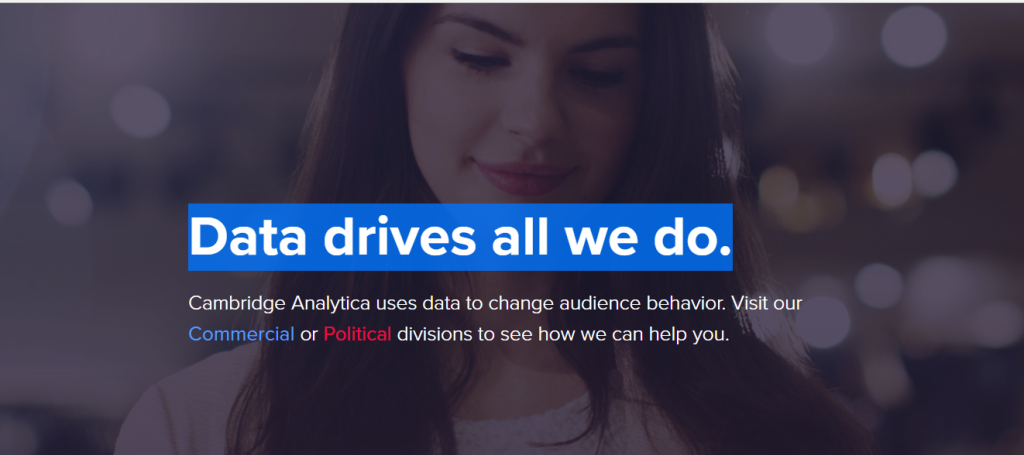
Screengrab taken at 2pm on Tuesday from AIQ’s homepage

Theresa May faced questions in the Commons over alleged Conservative Party links to the parent company of the embattled data firm Cambridge Analytica, (CA) the company that has been accused of acquiring and misusing the personal data of millions of Facebook users. Both Facebook and CA deny the allegations.

The prime minister’s comments follow the suspension of CA’s CEO, Alexander Nix, following the allegations that the company harvested personal data from up to 50m Facebook users.

Theresa May insisted that she is unaware of any “current” Government contracts with Strategic Communications Laboratories (SCL) – the parent company of the CA – or CA.  

It is understood that CA contacted the Conservative Party to discuss and offer their services under David Cameron’s administration, but the party ‘chose not to take the offer any further.’ 

“An approach was made and the party decided not to take that forward,” May’s spokesperson said.

However, here is a photograph (it looks like a selfie) tweeted by the Chairman of the board of the SCL Group, Julian Wheatland, campaigning alongside former Conservative leader David Cameron. 
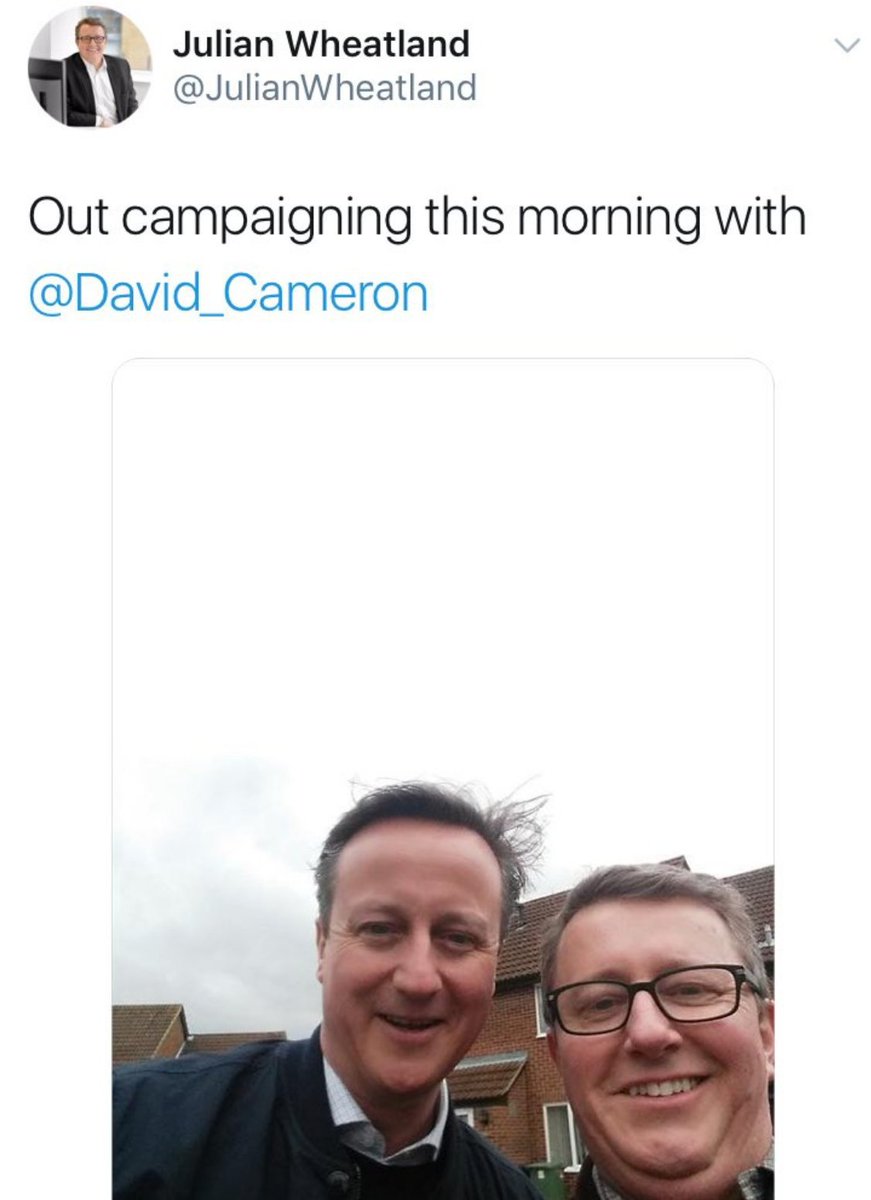
A photograph of the Chairman of the board of SCL Group, which The Times and The Guardian have reported as being the 'parent company' of Cambridge Analytica, campaigning alongside David Cameron.

“The Conservative Party has never employed Cambridge Analytica, or its parent company, nor used their services,” a party spokesperson said.

Ian Blackford, the SNP’s leader in Westminster, had challenged Theresa May over the Conservative party links to SCL Group –  the parent company of CA. Blackford said the company had been run by a chairman of Oxford Conservative Association.

It’s founding chairman was a former Conservative MP,” he added. “A director appears to have donated over £700,000 to the Tory Party. A former Conservative Party treasurer is  shareholder. 

“We know about the links to the Conservative Party. They go on and on. Will the Prime Minister confirm to the House her Government’s connections to the company?” said Blackford.

However, May replied: “As far as I’m aware the Government has no current contracts with Cambridge Analytica or with the SLC group.”

A Downing Street spokesman confirmed that the Ministry of Defence had previously had a contract with SCL, but this had ended before the recent allegations came to light. It was between 2014 and 2015.

We are looking across Government to see if there were any other contracts,” said the spokesman. “As the Prime Minister said, we are not aware of any current contracts.”


Image may contain: 3 people, people smiling

Reports that the government sought the help of CA have resurfaced as the political consultants face growing questions over their citizen surveilance, data harvesting, psychological profiling, strategic communications and targeting, aimed at ‘behaviour change’. 

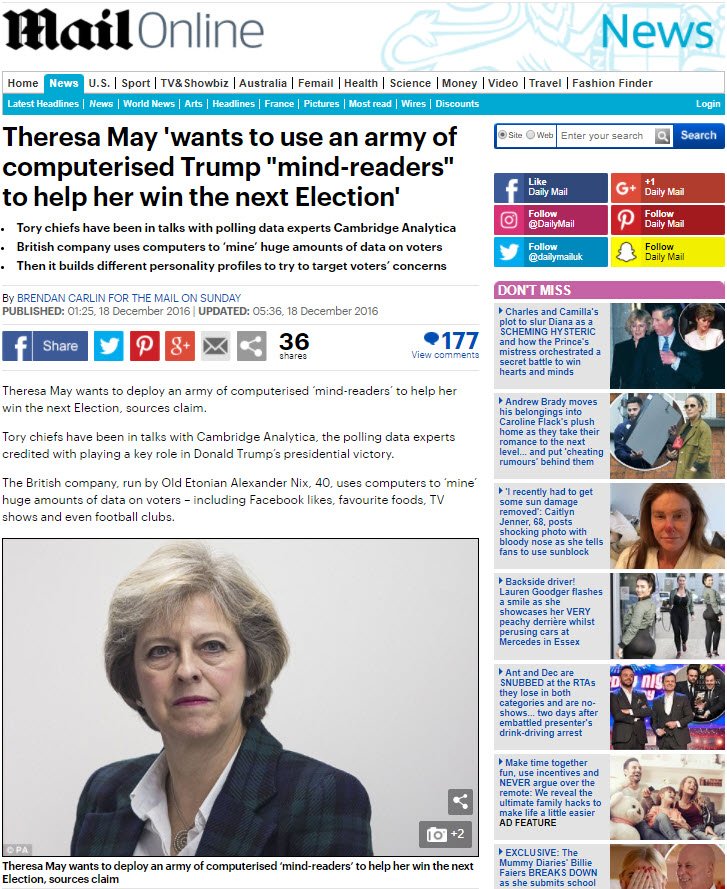
Conservative chiefs held talks with the company in 2016, according to the Daily Mail. The article, published on December 18, 2016, claims that: “Theresa May wants to deploy an army of computerised ‘mind-readers’ to help her win the next Election, sources claim.”

The source reportedly told the Daily Mail“The Tories have been in talks with these guys for about three months now and I understand they’re close to a deal.” 

It is unclear whether an agreement was reached between the company and the Conservatives at that time. 

However, the chair of the Commons home affairs committee has called for a full investigation into the activities of Cambridge Analytica after it emerged that its parent company, SCL, was granted provisional “List X” status by the Ministry of Defence until 2013, granting it access to secret documents.

SCL group and it’s ‘verticals’

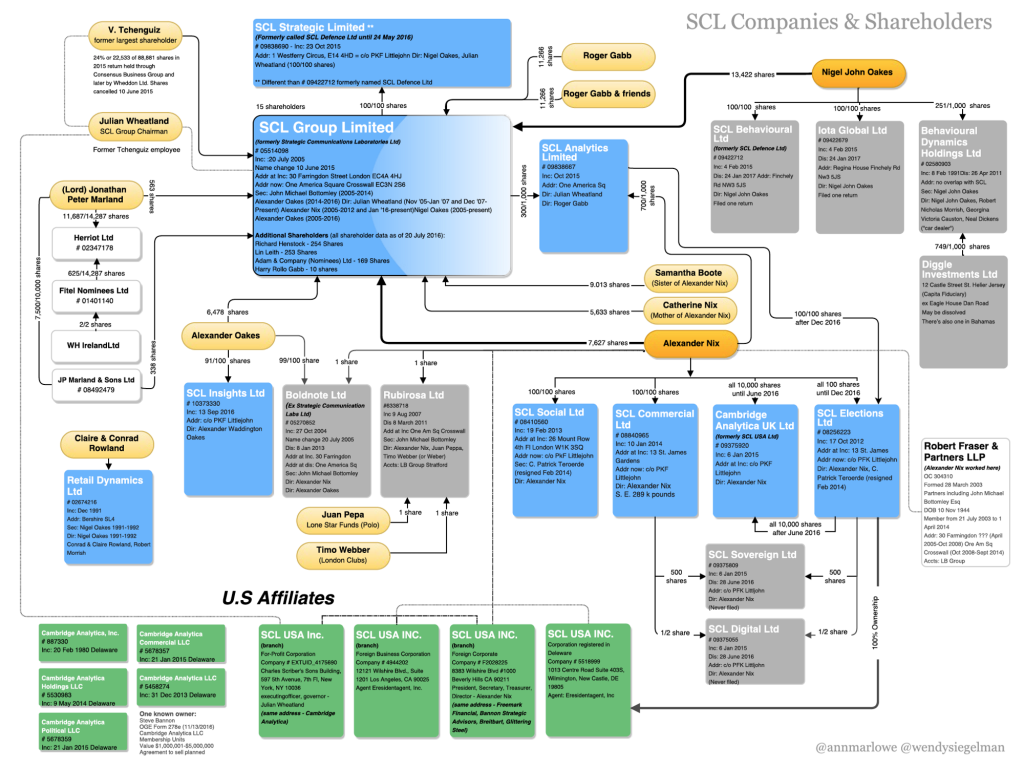
SCL has what they call different “verticals” in politics, military and commercial operations. All of those operations are based on the same methodology (Target Audience Analysis) and, as far as can be discerned from the outside, SCL and affiliates have very obscure corporate structures with confusing and overlapping ownership. 

The SCL Group says on its website that it provides “data, analytics and strategy to governments and military organizations worldwide.”

The organisation claims that it has conducted “behavioral change programs” in over 60 countries and its clients have included the British Ministry of Defence, the US State Department and NATO. SLC Defense is another subsidiary of the umbrella organisation

Labour MP Yvette Cooper said there were serious concerns around the SCL Group and its subsidiary, CA, which is being investigated by the information commissioner. The SCL Group had a close working relationship with the MoD and was paid almost £200,000 for carrying out two separate projects. List X contractors are bound by strict rules over document security, and the MoD insists there was no recorded data breach.

The government team, which included psychologists and analysts, worked with SCL in 2014 to assess how “target audience analysis” could be used by the British government.

Over the course of the project in 2014, MoD officials flagged concerns over SCL’s data management, saying there were “rudimentary security mechanisms” in place.

As part of Project Duco, UK officials assessed SCL’s methods, which included analysing “psychological and anthropological principles” – and the social sciences more generally – and assessing how these could contribute to the government’s ‘strategic communications’.

The company’s ‘target audience analysis’ allows governments or companies to assess how to target individuals with a psychologically tailored message to ‘change behaviour’.

As part of Project Duco, the MoD was given “source background detail” by SCL, which included “analysis processes, data collection plans and sampling strategies”.

Target audience analysis (TAA) is a very controversial approach to government communications that evolved during the ‘battle for hearts and minds’ in Afghanistan.

According to an assessment of the method by Dr Steve Tatham – now a private consultant specialising in ‘Strategic Communication, influence, target audience analysis, and information operations’ after he resigned from the UK’s Armed Forces in July 2014 –  it allows governments to “diagnose the exact groupings that exist within target populations”, leading to a ranking that “depends upon the degree of influence they may have in either promoting or mitigating constructive behaviour”.

It then uses “psycho-social research parameters” in order to “determine how best to change that group’s behaviour”.

According to Statham, the data “builds up a detailed understanding of current behaviour, values, attitudes, beliefs and norms, and examines everything from whether a group feels in control of its life to who they respect and what radio stations they listen to.” He added: “TAA can be undertaken covertly.”

During the work with SCL, the MoD noted that “it was ascertained that some SCL staff are vetted and they have rudimentary security mechanisms in place (eg a locked cabinet).”

The report stated: “It is not thought that they have the capability to handle any electronic material above unclassified not considered the secure dissemination of documents.”

The SCL Group says on its website that it provides “data, analytics and strategy to governments and military organizations worldwide.”

The organisation claims that it has conducted “behavioral change programs” in over 60 countries and its clients have included the British Ministry of Defence, the US State Department and NATO. SLC Defense is another subsidiary of the umbrella organisation.

A freedom of information request from August 2016, shows that the MOD has twice bought services from SCL in recent years. In 2010/11, the MOD paid £40,000 to SCL for the “provision of external training”. Meanwhile, in 2014/2015, it paid SCL £150,000 for the “procurement of target audience analysis”. July 2017, the SCL website for Cambridge Analytica claimed its methods has been approved by the “UK Ministry of Defence, the US State Department, Sandia and NATO” and carried their logos on its website.

The SCL Group, that advised Nato on so-called “psy-ops”, is a private British behavioural research and strategic communication company. The company describes itself as “global election management agency”.  

SCL’s approach to propaganda is based upon a methodology developed by the associated Behavioural Dynamics Institute (BDI)Nigel Oakes founded the latter and also set up Strategic Communication Laboratories and using the new methodology from BDI, ran election campaigns and national communication campaigns for a broad variety of international governments. BDI say: The goal of the BDI is to establish Behavioural Dynamics as a discipline for the study of group behaviour change.”

There isn’t much information around about BDI‘s connection with military operations, though links with NATO are well-established – see Countering propaganda: NATO spearheads use of behavioural change science, for example.

From the article: “Target Audience Analysis, a scientific application developed by the UK based Behavioural Dynamics Institute, that involves a comprehensive study of audience groups and forms the basis for interventions aimed at reinforcing or changing attitudes and behaviour.”

SCL on the other hand, has a clearly defined defence and military division who: “Target Audience Analysis, a scientific application developed by the UK based Behavioural Dynamics Institute, that involves a comprehensive study of audience groups and forms the basis for interventions aimed at reinforcing or changing attitudes and behaviour.”

It’s reported that SCL elections was bought by the billionaire Robert Mercer. He is known to be a heavily invested stakeholder in CA. Before becoming a White House advisor, Steve Bannon was a vice-president and part owner of CA. The Guardian reports that the  firm is owned by the Mercer family and the UK company SCL Elections, which is part of the SCL Group.

To give you a flavour of Mercer’s interests, you only need to follow the money trail: he funds a climate change denial thinktank, the Heartland Institute, and he likes to disrupt the mainstream media. In this aim, he is helped by his close associate Steve Bannon, self-declared “economic nationalist”, fomerly Trump’s campaign manager and chief strategist. The money he gives to thMedia Research Center, with its paranoid and authoritarian, anti-progressive mission of correcting “liberal bias” is just one of his pet media projects. He has also worked as vice president of  CA’s board.

Mercer and his family are major donors to Conservative political causes such as Breitbart News. He is the principal benefactor of the Make America Number 1 political action committee (Super PAC). Around 2012, Mercer reportedly invested $5 million in the SCL Group. Most political campaigns run highly sophisticated micro-targeting efforts to locate voters. However, SCL promised much more, claiming to be able to manipulate voter behaviour through psychographic modeling. This was precisely the kind of work Mercer values.

SCL claimed to be able to formulate complex psychological profiles of voters. These, say the company, would be used to tailor the most persuasive possible message, acting on that voter’s personality traits, hopes or fears.

Of course Mercer was a major supporter of Donald Trump’s 2016 campaign for president and Brexit in the UK. Mercer donated the services of CA company  to Nigel Farage and UKIP. The company was allegedly able to “advise” and influence Leave.eu through harvesting data from people’s Facebook profiles in order to target them with individualised persuasive messages to vote for Brexit. However, Leave.eu did not inform the UK electoral commission of the donation, contrary to the law which demands that all donations valued over £7,500 must be reported. 

When SCL Elections formed Cambridge Analytica in 2013, the company hired researchers from Cambridge University, hence the name. CA collects data on voters using sources such as demographics, consumer behaviour, internet activity, and other public and private sources. CA is using psychological data derived from millions of Facebook users, largely without users’ permission or knowledge. The company is also trying to change people’s perceptions and behaviours without their consent.The company maintains offices in New York City, Washington, D.C., and London.

Cambridge Analytica claim to predict not just peoples’ voting intentions and preferences, but also their personality types. The company is proprietorial about its precise methods, but says large-scale research into personality types, based on hundreds of thousands of interviews with citizens, enables them to chart voters against five main personality types – openness, conscientiousness, extraversion, agreeableness and neuroticism. 

The President of SLC is Sir Geoffrey Pattie, a former Conservative MP and the Defence Minister in Margaret Thatcher’s government. Pattie also co-founded Terrington Management which lists BAE Systems and Lockheed Martin among its clients.

As a UK-registered company, SCL Group had investors from the upper echelons of British Society. Lord Marland, a successful businessman who became a minister in 2010, held shares personally and through two related investment vehicles, Herriot Limited and a family trust.

An MoD spokesman said: “We have no current relationship or contracts with SCL Group, which includes Cambridge Analytica. As such, the company has no access to any classified information.”

The Cambridge Analytica revelations are a symptom of a much darker disease 

I did some research into the Conservatives’ election campaign spending last year. They spent hundreds of thousands of pounds on murky companies that peddle the same methods as Cambridge Analytica and SCL.

While the government’s controversialdark ads’ campaign attracted some concerned commentary last year, in part because it used data and psychographic profiling to manipulate individual traits and characteristics, it seems like no-one is joining the dots, still.

textor

From the Crosby Textor Group site

The government claims that they haven’t used Cambridge Analytica for their election campaigns. However, in 2017, the Conservatives used several similar shadowy private companies that peddle data analytics, psychological profiling and ‘behavioural change’  to research, canvass, advertise and target message voters with ‘strategic communications’ – which also exploit their psychological characteristics.

I trawled through the Conservatives’ campaign expenses listed on the Electoral Commission site to find the following.

The government used Experian (paid £683,636.34), Reed Consultancy  (paid £178,558.03), Google Analytics (paid £1,020,232.17), Facebook (paid £3,177,416.68), Twitter (paid £56,504.32), among others, to research, canvass and advertise their party ‘brand’. And £76,800 was spent advertising through Express Newspapers.

Blue Telecoms were paid £375,882.56 for ‘unsolicited material to electors’ and ‘advertising’. It says on their site that Blue Telecoms is a trading name for Direct Market Solutions Ltd. The company director is Sascha Lopez , a businessman who stood as a local council candidate for the Tories in the 2017 local elections. He is also an active director of the Lopez Group, although that company’s accounts are very long overdue, there is an active proposal to strike off on the government’s Companies House page. If directors are late in filing their company accounts, and don’t reply to warnings from Companies House, their company can be struck-off the Companies House register and therefore cease to exist. Other companies he was active in have been liquidated (3) and dissolved (2).

An undercover reporter working for Channel 4 News secured work at Blue Telecoms, in Neath, South Wales. In an area plagued by unemployment and low wages, the call centre hired up to a hundred people on zero-hours contracts. For weeks, they contacted thousands of potential voters in marginal seats across the UK. 

The hired callers were told to say they were working for a market research company called “Axe Research”. No such company is registered in England and Wales. Furthermore, callers were instructed to say that the call centre was situated in Cardiff, rather than Neath.

The investigation uncovered underhand and potentially unlawful practices at the centre, in calls made on behalf of the Conservative Party. These allegations include:

● Paid canvassing on behalf of Conservative election candidates – illegal under election law.

● Political cold calling to prohibited numbers

● Misleading calls claiming to be from an “independent market research company” which does not appear to exist

The Conservative Party have admitted it had commissioned Blue Telecoms to carry out “market research and direct marketing calls” during the campaign, and insisted the calls were legal.

A Conservative spokesman said: “Political parties of all colours pay for market research and direct marketing calls. All the scripts supplied by the party for these calls are compliant with data protection and information law.” 

However, I discovered that the record of funds paid to Blue Telecoms were not listed under ‘market research’, however. They were listed under ‘advertising’ and ‘unsolicited material to electors’. 

(See also: More allegations of Tory election fraud, now we need to talk about democracy)

Much of the ‘advertising’ was based on data collection, data analytics and psychological profiling, which were used to target people with communications according to their hopes, fears, anxieties, degrees of conformity and other general dispositions. Without their consent.

Another company that the Conservatives used and paid £120,000 for market research and canvassing during their general election campaign is OutraJim Messina is the executive director, and the team includes the notorious Lynton Crosby.

outra.png

Crosby Textor (listed as CTF) also earned £4,037,400 for market research/canvassing.

Messina Group Inc were also paid £544,153.57 for transport, advertising, market research and canvassing. This company uses data analytics and ‘intelligence’ services. (CRM = ‘Customer Relations Management’ and BI =’Business Information’, which comprises the strategies and technologies used by enterprises for the data analysis of business information.) The company conductsTargeted Ads Programs [….] ensuring precise targeting via Facebook, geo-targeting, zipcodes, IP addresses, and other tactics”. 

The company also says:

MGI.png

(See also: World leaders across 5 continents trust TMG with the highest stakes in politics.)

Combobulate Limited, which is listed as a management consultancyearned £43,200 for research/canvassing and for ‘unsolicited material to electors’.

The director is listed as Nicholas Jack Walton Mason, also listed as the director of Uplifting DataMason is also listed as Director of Mason Investment Consultants Limited, which was dissolved via compulsory strike-off . However, I couldn’t find an information site for Combobulate, the only site I found bizarrely took me here.

combob

Another similar company, An Abundance Limited, which is listed as a ‘behaviour change agency’, were paid £2,400 for market research and canvassing by the Conservatives in the run-up to the election last year. 

Populus Data Solutions, who say they provide “state of the art data capture”, were paid £196,452 for research/canvasing and ‘unsolicited material to electors’. This company have also developed the use of biometrics – facial coding in particular.

St Ives management services were paid £3,556,030.91, for research/canvasing, ‘unsolicited material to electors’, advertising, overheads and general administration, media and rallies, and manifesto material.
sims
Walker Media Limited are a digital marketing and media company, they facilitate Facebook adverts and campaigns, among other services. They were paid £798,610.21 during the Conservatives’ election campaign. One of their other social media marketing campaigns listed on their site is for “The Outdoor and Hunting Industry”.

Simon Davis serves as the Chief Executive Officer at Walker Media Holdings Limited and Blue 449. Davis served as Managing Director of Walker Media at M&C Saatchi plc, a global PR and advertising company, who have worked for the Conservatives before, designing campaign posters and anti-Labour adverts – including the controversial ‘New Labour, New Danger’ one in particular.

There are a few subsidaries of this company which include “harnessing data to find, engage and convert customers efficiently through digital media.” M&C Saatchi acquired the online media ‘intelligence agency’ Human Digital, whose “innovative approach marries rich behavioural insight with robust metrics.”

There is a whole submerged world of actors making huge profits from data mining and analytics, ‘targeted audience segmentation’, behaviour change techniques, ‘strategic communications and political lobbying. Much of the PR industry is built upon the same territory of interests: financial profit, maintaining power relations and supporting the vested interests of the privileged class. The subterranean operations of the surveillance and persuasion industry and citizen manipulation has become the establishment’s norm, hidden in plain view.


Related

The government hired several murky companies plying the same methods as Cambridge Analytica in their election campaign


I don’t make any money from my work. But you can support Politics and Insights and contribute by making a donation which will help me continue to research and write informative, insightful and independent articles, and to provide support to others. The smallest amount is much appreciated, and helps to keep my articles free and accessible to all – thank you. 

DonatenowButton

The government hired several murky companies plying the same methods as Cambridge Analytica in their election campaign

Lizard ofOz

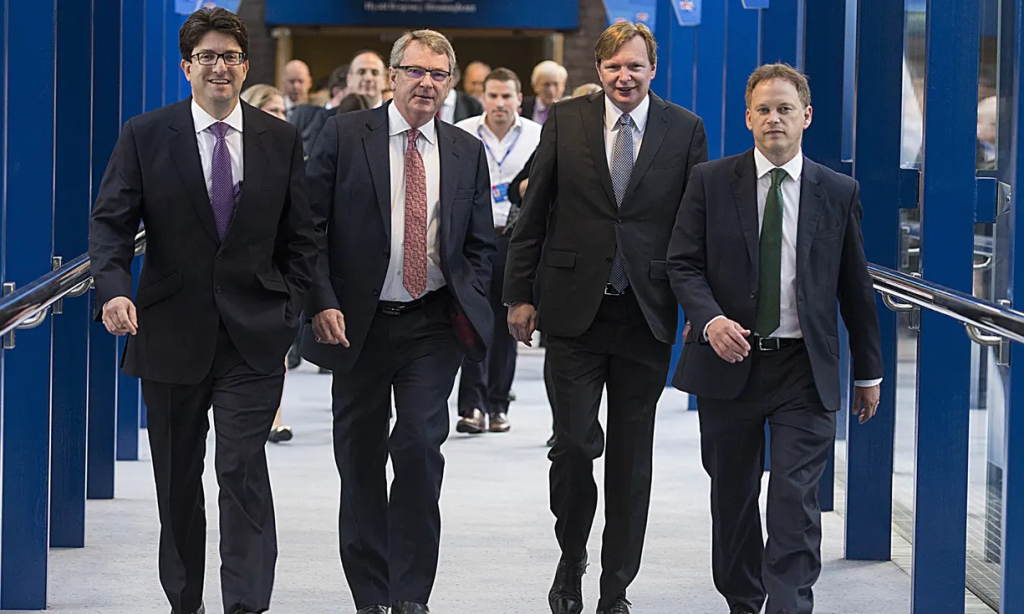
From left to right: Lord Feldman, (in March 2016, Feldman was questioned by journalist Michael Crick about election expenses that may have broken the law); Lynton Crosby (longstanding ‘campaigner’ and expert dog whistler, dead cat strategist and wedge tactician for the Conservatives); Jim Messina (a former Obama campaign chief also hired by the Conservatives) and then party chairman Grant Shapps.  Photograph: David Hartley/Rex

The political and corporate economy is driving the implementation of ‘behavoural science’, including ‘nudge’, by self-interested (and boundedly rational) incumbent governments, policy makers, bureaucrats and corporations has been largely neglected, though a few of us have been raising concerns about the implications of the microregulation of citizen perceptions and behaviour for democracy for a few years.

In their haste to portray populations as irrational and cognitively flawed, behavioural economists, governments, bureaucrats and the murky underworld of the big corporate lobbying, PR, ‘strategic communications’ and ‘consultancy’ industry seem to have overlooked a couple of whopping ‘cognitive biases’ of their own. These are their strong inclination towards profit and power, regardless of any ethical boundaries. 

As soon as the Conservatives casually announced their ‘behaviour change’ agenda back in 2010, and instituted the ‘Nudge Unit’, a scandal of the type surrounding Cambridge Analytica/SCL was inevitable. How could anyone expect that an authoritarian government, somewhat defined by resistance to change, would resist the temptation to draw on ‘behavioural science’ techniques to manipulate citizens’ perceptions, cognitions, behaviours, choices, and ultimately, their voting decisions? 

Cambridge Analytica’s commercial vice-president Richard Robinson once said that there is no fundamental difference between getting someone to vote and persuading them to swap toothpaste brands. He added: “It is about understanding what message is relevant to that person at that time when they are in that particular mind-set.”

Robinson claimed that using data to profile citizens, overlaying “the person” on data – a method that has previously been available to advertisers –  is “humanising marketing.” 

I don’t agree. I see this level of surveillance, intrusion and micromanagement of citizens decision-making as a form of commodifying and marketising humans for commercial behavioural modification. Without our consent. Or a share in the profits generated. It is profoundly ‘dehumanising marketing.’

Our personal data is being used to construct ‘persuasion profiles’, using sets of estimates – based on probabilities – on the effectiveness of particular influence-strategies on individuals, which are also based on past responses to these strategies. Some of these companies are also experimenting with biometrics. Many businesses in marketing openly admit that they aim to achieve behavioural change. It cannot be right for private companies and governments to use citizens as Pavlovian dogs. Such personalised persuasive strategies seriously undermine the human autonomy that is central to human dignity and democracy. 

The internet has rapidly become an environment in which citizens and populations are being sorted, profiled, typed, categorised, ranked and “managed”, based on data mining  mass surveillance and psycho-profiling.

It was only a matter of time before the powerful tools of digital tracking and corporate surveillance, including techniques designed for  manipulating opinions and behaviours, shifted from the realm of PR, product and service marketing to politics and voter targeting. The markets for personal data have always been markets for behavioural control also. And markets of behavioural control are composed of those who sell opportunities to influence behaviour for profit and power, and those who purchase such opportunities.  

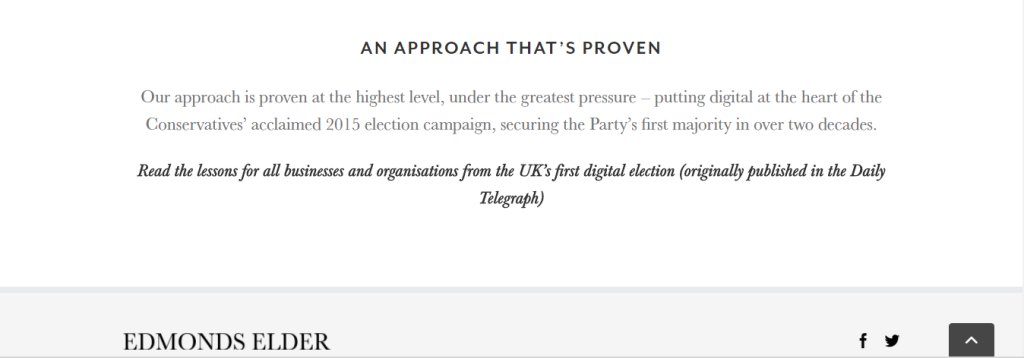
Screengrab taken at 2pm on Tuesday from AIQ’s homepage

Screengrab taken at 2pm on Tuesday from AIQ’s homepage. By Thursday, after the company was contacted by the Observer, it had been taken down. Photograph: AggregateIQ

The Observer first disclosed connections between the firms a year ago when it published details of an intellectual property licence that linked AIQ and Cambridge Analytica.

The leaked intellectual property licence document that shows a link between AggregateIQ and SCL Elections (the company behind Cambridge Analytica).

The leaked intellectual property licence document that shows a link between AggregateIQ and SCL Elections (the company behind Cambridge Analytica). Photograph: Observer

From the Telegraph in February 2017: Exclusive: How a tiny Canadian IT company helped swing the Brexit vote for Leave 

The overlap between behavioural economics, PR and techniques of persuasion

Last month, the government’s procurement service widened the public sector’s choice of ‘behavioural insight’ experts to call on. Previously the Behavioural Insights Team (Nudge Unit) were the single suppliers, but the new Crown Commercial Service Behavioural Insights framework expands the number to six. The framework retains the Nudge Unit, and the new suppliers are CFE (Research and Consulting), Kantar Public, McKinsey, and Ipsos Mori. There is a sixth supplier that has not yet been named because it has not yet formally signed up to the new contract.

The PR industry, with it overlaps in marketing, consultancy, strategic communications,  behavioural economics, nudge and so on has been using behavioural analytics, psychographic profiling and targeted communications for years. Many corporate practices are kept as secret as possible, which places some limitations on research. 

‘Data-intensive’ companies communicate in a vague and ambiguous way, however they are more bold when it comes to selling their services and in this context they reveal internal practices through public statements, occasionally.

The Hunting Dynasty a “behavioural insight and communications agency,” say on their site: “WE IMPROVE THE WAY YOUR WORLD BEHAVES BY DISCOVERING YOUR AUDIENCE’S UNTAPPED DESIRES AND EFFORTLESSLY INCREASING YOUR EFFICIENCY USING ROBUST SCIENCE, PSYCHOLOGY, AND NUDGE TECHNIQUES”, and go on to say “welcome to the first step in eliminating damaging behaviour.”

“Our unique combination of deep applied and academic behavioural knowledge, and experience working in the world’s largest advertising agencies makes us supremely qualified to deliver robust, full-stack, out-of-the-box, A+ projects and retained services, every time.”

The company received the gold retail ‘Nudge award’ in 2015, and were shortlisted for the award in 2016 and last year. 

BeWorks, another example of  a company adopting the nudge approach to communications and marketing, describe themselves as “The first management consulting firm dedicated to the practice of applying behavioral science to strategy, marketing, operations, and policy challenges”, also “harness the powerful insights of behavioral economics to solve your toughest challenges.”

They work for the government, the energy industry, financial service sector, insurance industry and retail sectors “helping organisations to embed behavioural economics into their culture”. 

The company says: “The team combines leading academics from the fields of cognitive and social psychology, neuroscience, and marketing with management consulting experts. Our multi-disciplinary expertise allows us to arm our clients with the latest in scientific insights coupled with a strategic business lens”.

They also wrote this article among others: How Science Can Help Get Out the VoteThey claim “Our team of scientists and business experts offers a powerful methodology that analyzes and measurably influences the decisions consumers make”. 

They go on to say “Neuromarketing studies, which measure brain activity and other biological indicators, are another way to gauge true emotional reactions instead of relying on how people say they feel. EEG caps and biometric belts are the most common tools used, though other techniques, ranging from reading facial expressions to measuring tiny differences in reaction time, are also used.”

Over a six-year period, Ogilvy Public Relations Global CEO, Christopher Graves, digested more than 800 pieces of primary research to connect emerging findings in behavioral economics, neuroscience and narrative theory in order to ‘craft a new point of view on narrative effectiveness in communications.’

The findings overturn much of what communications professionals believed through conventional wisdom. The company concludes that “Emotional narrative beats analytical messaging. All human decision making depends heavily on emotion. Our efforts to persuade or explain need to also be rooted in emotion-triggering narratives.” 

Linstock Communications consultancy say they are: “AN AWARD-WINNING COMMUNICATIONS CONSULTANCY THAT SPECIALISES IN THOUGHT LEADERSHIP AND CRISIS MANAGEMENT UNDERPINNED BY BEHAVIOURAL SCIENCE.”

Rolph Merchant of Instinctif Communications DMCC, says:

“Public relations exists to influence and to effect change. To do so more successfully, the industry needs to find ways to target audiences, those it wishes to move, more scientifically. The PR industry clearly recognises this and I think the adoption of a more surgical targeting strategy will become incumbent on PR companies. 

A very positive development for the PR industry would be to embrace the more advanced approaches to targeting using techniques based on behavioural economics. The pioneering work of The Behavioural Insights Team to understand what influences the public’s decision making, and design ‘nudges’ to get desired results for government, could certainly be replicated in the private sector. 

These techniques have been touted for use in measuring campaign success, a perennial issue for PR. To give a simple example of its application, by measuring peoples’ behaviour or sentiment before and after a period of communications activity, it is possible to gain a clearer idea of how successful a campaign has been. In turn, this insight can be channelled to improve communications strategy and tactics. 

“Though in its infancy, behaviour change is nonetheless a fascinating area of communications, which could well see significant attention and growth in the next decade.”

Instinctif offers “strategic insight, and creative solutions; government relations, and public and corporate affairs services that include lobbying, strategic information, analysis and advice, media and reputation management mandates, and public affairs training services.”

At the moment, the media is focused on the sins of Cambridge Anaytica/ SCL and Facebook. However, there are MANY other private companies involved in stage managing our democracy, employing the same deeply unethical and antidemocratic methods. Crosby Textor is just one example. 

Cambridge Analytica are not the only company that are being employed by governments to stage-manage our democracy

While the government’s controversial ‘dark ads’ campaign attracted some concerned commentary last year, in part because it used data and psychographic profiling to manipulate individual traits and characteristics, it seems like no-one is joining the dots, still.

textor

From the Crosby Textor Group site

The government claims that they haven’t used Cambridge Analytica for their election campaigns. However, in 2017, the Conservatives used several similar shadowy private companies that peddle data analytics, psychological profiling and ‘behavioural change’  to research, canvass, advertise and target message voters with ‘strategic communications’ – which also exploit their psychological characteristics and tendencies.

I trawled through the Conservatives’ campaign expenses listed on the Electoral Commission site to find the following: the government spent an eye-watering total of £1502,3516•79p on ‘campaigning’, to persuade people to vote Conservative.

Here is a breakdown of that sum:

The government used Experian (paid £683,636.34), Reed Consultancy (paid £178,558.03), Google Analytics (paid £1,020,232.17), Facebook (paid £3,177,416.68), Twitter (paid £56,504.32), among others, to research, canvass and advertise their party ‘brand’. And £76,800 was spent advertising through Express Newspapers.

Blue Telecoms were paid £375,882.56 for ‘unsolicited material to electors’ and ‘advertising’. It says on their site that Blue Telecoms is a trading name for Direct Market Solutions Ltd. The company director is Sascha Lopez , a businessman who stood as a local council candidate for the Tories in the 2017 local elections. He is also an active director of the Lopez Group, although that company’s accounts are very overdue, there is an active proposal to strike off on the government’s Companies House page. If directors are late in filing their company accounts, and don’t reply to warnings from Companies House, their company can be struck-off the Companies House register and therefore cease to exist. Other companies he was active in have been liquidated (3) and dissolved (2).

An undercover reporter working for Channel 4 News secured work at Blue Telecoms, in Neath, South Wales. In an area plagued by unemployment and low wages, the call centre hired up to a hundred people on zero-hours contracts. For weeks, they contacted thousands of potential voters in marginal seats across the UK. 

The hired callers were told to say they were working for a market research company called “Axe Research”. No such company is registered in England and Wales. Furthermore, callers were instructed to say that the call centre was situated in Cardiff, rather than Neath.

The investigation uncovered underhand and potentially unlawful practices at the centre, in calls made on behalf of the Conservative Party. These allegations include:

● Paid canvassing on behalf of Conservative election candidates – illegal under election law.

● Political cold calling to prohibited numbers

Misleading calls claiming to be from an “independent market research company” which does not appear to exist

The Conservative Party have admitted it had commissioned Blue Telecoms to carry out “market research and direct marketing calls” during the campaign, and insisted the calls were legal.

A Conservative spokesman said: “Political parties of all colours pay for market research and direct marketing calls. All the scripts supplied by the party for these calls are compliant with data protection and information law.” 

However, I discovered that the record of funds paid to Blue Telecoms were not listed under ‘market research.’ They were listed under ‘advertising’ and ‘unsolicited material to electors’. 

(See also: More allegations of Tory election fraud, now we need to talk about democracy)

Much of the ‘advertising’ was based on data collection, data analytics and psychological profiling, which were used to target people with communications according to their hopes, fears, anxieties, degrees of conformity and other general dispositions. Without their consent.

Another company that the Conservatives used and paid £120,000 out to for market research and canvassing during their general election campaign is Outra. Jim Messina is the executive director, and the team includes Lynton Crosby.

outra.png

Crosby Textor (listed as CTF) also earned £4,037,400 for market research/canvassing.

Messina Group Inc were also paid £544,153.57 for transport, advertising, market research and canvassing. This company uses data analytics and ‘intelligence’ services.  The company conducts “Targeted Ads Programs [….] ensuring precise targeting via Facebook, geo-targeting, zipcodes, IP addresses, and other tactics”. 

The company also says:

MGI.png

The Messina Group are in astrategic partnership’ with Outra serving as one of Outra’s primary advisors on data, analytics, and ‘customer engagement.’

(See also: World leaders across 5 continents trust TMG with the highest stakes in politics.)

British electoral law forbids co-ordination between different campaign groups, which must all comply with strict spending limits. If they plan tactics or co-ordinate together, the organisations must share a cap on spending.

Combobulate Limited, which is listed as a management consultancy, earned £43,200 for research/canvassing and for ‘unsolicited material to electors’.

The director is listed as Nicholas Jack Walton Mason, also listed as the director of Uplifting Data. Mason is also listed as Director of Mason Investment Consultants Limited, which was dissolved via compulsory strike-off .

However, I couldn’t find an information site for Combobulate, the only site I found bizarrely took me here. I can’t find any other website.

combob

Another similar company, An Abundance Limited, which is listed as a ‘behaviour change agency, were paid £2,400 for market research and canvassing by the Conservatives in the run-up to the election last year. 

Populus Data Solutions, who say they provide “state of the art data capture”, were paid £196,452 for research/canvasing and ‘unsolicited material to electors’. This company have also developed the use of biometrics – facial coding in particular.

St Ives management services were paid £3,556,030.91, for research/canvasing, ‘unsolicited material to electors’, advertising, overheads and general administration, media and rallies, and manifesto material.

sims

Edmonds Elder Ltda digital consultancy, were paid £156,240.00 for advertising. The site  says the company also provides services in vague sounding ‘government affairs: “We use cutting-edge digital techniques to help government affairs teams make the case for their policy and regulatory positions – harnessing support from communities across the country to ensure a positive outcome.”   

Craig Elder is also the Conservative party’s digital directorTom Edmonds was the Conservative party’s creative director between 2013 and 2015.

Hines Digital  who is a partner of Edmonds Elder Ltd, is a conservative digital agency that builds strong brands, huge email lists, and big league fundraising revenue for our clients, helping conservative campaigns & causes, and companies, achieve their goals.”

It says on the site that “Hines worked with conservative campaigns & causes in fifteen U.S. states and nine countries.” The company designed the ‘digital infrastructure’ of Theresa May’s leadership campaign launch in 2016, they built her website (but aren’t listed in election expenses.) Hines says: 

That timely initial website launch proved invaluable. Approximately 35% of her overall email list signed up on that first day, a significant shot in the arm on Day One made possible because her team — led in part by our partners at Edmonds Elder—was prepared to capitalize on the day’s earned media through effective online organizing.

Overall, the initial holding page saw a 18% conversion rate on day one — meaning nearly 1/5 people who visited the website signed up to join the campaign. That’s a fantastic response to a site optimized for supporter recruitment.”

eldre

And: “We are experts at identifying people online – and targeting them to drive the activity your organisation needs.”

With political adverts like this, which aren’t fact checked and only the person targeted gets to see them:

Anti-Labour ‘attack’ ad

Walker Media Limited are a digital marketing and media company, they facilitate Facebook adverts and campaigns, among other services. They were paid £798,610.21 from the Conservatives’ election campaign. One of their other social media marketing campaigns listed on their site is for “The Outdoor and Hunting Industry”.

Simon Davis serves as the Chief Executive Officer at Walker Media Holdings Limited and Blue 449. Davis served as Managing Director of Walker Media at M&C Saatchi plc, a global PR and advertising company, who have worked for the Conservatives before, designing campaign posters and anti-Labour adverts – including the controversial ‘New Labour, New Danger’ one in particular.

There are a few subsidaries of this company which include “harnessing data to find, engage and convert customers efficiently through digital media.” M&C Saatchi acquired the online media ‘intelligence agency’ Human Digital, whose “innovative approach marries rich behavioural insight with robust metrics.”

There is a whole submerged world of actors making huge profits from data mining and analytics, ‘targeted audience segmentation’, behaviour change techniques, ‘strategic communications and political lobbying. Much of the PR industry is built upon the same territory of interests: financial profit, maintaining power relations and supporting the vested interests of the privileged class. The subterranean operations of the surveillance and persuasion industry and citizen manipulation has become the establishment’s norm, hidden in plain view.

Neoliberalism has evolved into a form of surveillance and microregulation capitalism. Traditional mass marketing has become much more focused, using precise target marketing, techniques which psychologically profile, sort, segment, categorise and target all forms of advertising to individual consumers. From behavioural targeting to mobile messaging apps sharing conversation data for adverts, target marketing requires personal data and a behavioural profile of ‘consumers’ .

Neuroliberalism

Surveillance strategies and targeted marketing also include the use of biometrics. Endless gain, for example, uses biometrics and psychology and “to understand human emotions and behaviour, and Psychology to optimise human emotions and behaviour. Our way helps our clients convert more customers, keep them for longer, and have them spend more.” 

Endless Gain claim on their site to “optimise conversions” in the same way that behavioural economists at the Nudge Unit claim to “optimise decision-making”, in their quest to align citizens’ choices with neoliberal outcomes.

The company uses eyetrackingfacial expression recognitiongalvanic skin response,  EEG and pupil dilation – biometrics, in addition to conventional psychological research, “bringing together biometric research with findings from decades of academic psychology – particularly on emotional decision-making and the psychology of persuasion – to make changes to your site that increase both revenue and conversions.”  

Other companies, such as the hugely influential Crimson Hexagon, use AI.  The company is based in Boston, Massachusetts and has also a European division in London.  Edelman Intelligence, a massive PR company, are a client of this company, as are Twitter. The company’s online data library consists of over 1 trillion posts, and includes documents from social networks such as Twitter and Facebook as well as blogs, forums, and news sites. 

The company’s ForSight platform is a Twitter Certified Product. (See also: The anti-social public relations of the PR industry, which details the intrusive ‘360 degree’ social media listening and monitoring posts used by companies to gather data and intelligence and to formulate ‘strategic communications’ to discredit critics)

This level of surveillance and persuasion is deeply intrusive form of commodification and control that effectively exiles citizens from their own characteristics, perceptions, behaviours and choices, while producing lucrative markets aimed at data mining, behavioural analysis, prediction and modification.

Furthermore, the data collection, analysis and profiling is likely to build in discrimination, reflecting and reinforcing material and power inequalities. Credit reference agencies, insurance companies and the financial sector have previously demonstrated this point only too well. 

The data mining, analytics and persuasion market exists because large corporations and governments want to micromanage and psychoregulate citizens. However, such intrusive surveillance and micromanagement poses fundamental challenges to our democratic norms and personal autonomy.  

Tailored and targeted ‘strategic communications’ and persuasions are based on behaviour modelling and presupposed preferences, which may or may not be accurate or comprehensive. However, such an approach forecloses the possibility of citizens seeing alternative choices and developing new preferences: of accessing a full range of choices, learning and developing. It reduces citizens, commodifying their biology, psychology and decision-making, and transforming human nature into profits for big businesses and maintaining the power of the establishment.

The Cambridge Analytica scandal highlights the erosion of democracy because governments are paying to use these sophisticated techniques of persuasion to unduly influence voters and to maintain a hegemony, amplifying and normalising dominant political narratives that justify neoliberal policies.

‘Behavioural science’ is used on every level of our society, from many policy programmes – it’s become embedded in our institutions – to forms of “expertise”, and through the state’s influence on the mass media, and other social and cultural systems. It also operates at a subliminal level: it’s embedded in the very language that is being used in political narratives. Repetition is an old propaganda technique that sometimes works. The ‘Strong and Stable’ ideological motif of the government, however, was a tad overused, and led to ridicule because it became so visible as a ill-conceived technique of persuasion. But what about all of the psycholinguistic cues that remain opaque?

The debate should not be about whether or not these methods of citizen ‘conversion’ are wholly effective, because that distracts us from the intentions behind the use of them, and especially, the implications for citizen autonomy, civil rights and democracy. 

As I said in my last article, profit-seeking private PR companies are paid to brand, market, engineer a following, build trust and credibility and generally sell the practice of micromanaging the spread of information between an individual or an organisation (such as a business, government agency, the media) and the public.

Most of these companies use ‘behavioural science’ strategies (a euphemism for psychological warfare) to do so. It’s a dark world where governments pay to be advised not to talk about “capitalism,” but instead discuss “economic freedom” , “business friendly policies” or the “free market”. Austerity is simply translated into “balancing the budget” or “living within our means”. The political coercion of sick and disabled people to look for work by cutting their lifeline support is “equality and social justice” or “helping to move them closer to employment”. Propaganda and deception is “strategic communications” and “PR”. Psychological coercion is “behavioural science”. The democratic opposition are described as “virtue signallers”, “snowflakes”, “Marxists”, “militants” and “the hard left.” 

On the Institute for Government website, the section called MINDSPACE Behavioural Economics  discusses “behaviour change theory” and “influencing behaviour through public policy.” Using a language of managementspeak and psychobabble. A lot.

But surely, in democracies, public policies are supposed to reflect and serve identified public needs, rather than being about the public meeting specific policy outcomes and government needs. And surely governments ought to be elected on what they offer citizens in terms of policy, not on the basis of what they pay for PR, strategic communications, behaviour modification techniques and spying on populations.

We have nothing in place to prevent powerful and wealthy interlopers – such as Robert Mercer, from making an end run around election laws, either. Mercer played a key role in the Brexit campaign by donating data analytics services via Cambridge Analytica to Nigel Farage. 

The company was able to advise Leave.EU through its ability to harvest data from people’s Facebook profiles in order to target them with individualized persuasive messages to vote for Brexit. However, Leave.EU did not inform the UK electoral commission of the donation despite the fact that a law demands that all donations valued over £7,500 must be reported.


I don’t make any money from my work. But you can help by making a donation to help me continue to research and write informative, insightful and independent articles, and to provide support to others. The smallest amount is much appreciated – thank you.

DonatenowButton

Hubert

The revelations about Cambridge Analytica indicate clearly that western governments are subverting democracy

Image result for PR companies manipulation

I wrote an article about Cambridge Analytica, the commodification of voter decision making and the marketisation of democracy, along with previous articles about western government strategies for subverting democracy. I have also extensively criticised governments’ use of ‘behavioural economics, and the authoritarian neuroliberal turn more generally. 

Within the neoliberal framework, it seems that anything which may be commodified and marketised is, including our consummer preferences, Facebook likes, behaviours, emotions, subconscious inclinations, cognitive habits, perceptions and decisions. If companies like Cambridge Analytica could mine and sell our souls, they would do so in much they same way they did their own collective conscience.

The CEO of Cambridge Analytica has been suspended, Alexander Nix, has been suspended. However, Nix is a symptom of a problem, rather than being the problem itself. 

Cambridge Analytica is just the tip of a very dirty, subterranean iceberg. It’s worth keeping in mind that without paying clients, among which are governments, antidemocratic companies like this would not thrive and profit. The extensive Public Relations (PR) and ‘strategic communications’ industry, along with the ‘behavioural economics’ technocrats, are all working on sustaining power relations and extending corporate and right wing political interests. 

The hidden persuaders behind the Conservative government

During last year’s general election, the government used a number of companies that bear a lot of similarity to Cambridge Analytic during their election campaign.

textor

From the Crosby Textor Group site

The government used data from Experian (paid £683,636.34),
Reed Consultancy (paid £178,558.03),
G
oogle Analytics  (paid £1,020,232.17),
Facebook 
(paid £3,177,416.68),

Twitter was paid £56,504.32, to “research, canvass and advertise” their party ‘brand’. And £76,800 was spent advertising through Express Newspapers.

Another company that the Conservatives used for their campaign, paying them £120,000 for market research and canvassing, is OutraJim Messina is the executive director, and the team includes Lynton Crosby.

outra.png

However, Crosby Textor (listed as CTF) also earned £4,037,400 for market research/canvassing.

The Messina Group Inc were also paid £544,153.57 for transport, advertising, market research and canvassing. This company uses data analytics and ‘intelligence’ services. The company conducts “Targeted Ads Programs [….] ensuring precise targeting via Facebook, geo-targeting, zipcodes, IP addresses, and other tactics”.

Crosby and Messina made staggering amounts of money from the Conservative’s election campaign, using three separate, listed companies between them.

The company also says:

MGI.png

Apparently, the Messina Group are in a strategic partnership’ with Outra, “serving as one of Outra’s primary advisors on data, analytics, and ‘customer engagement’.”

(See also: World leaders across 5 continents trust TMG with the highest stakes in politics.)

British electoral law forbids co-ordination between different campaign groups, which must all comply with strict spending limits. If they plan tactics or co-ordinate together, the organisations must share a cap on spending.

Combobulate Limited, which is listed as a management consultancy, earned £43,200 for research/canvassing and for ‘unsolicited material to electors’.

The director is listed as Nicholas Jack Walton Mason, also listed as the director of Uplifting DataMason is also listed as Director of Mason Investment Consultants Limited, which was dissolved via compulsory strike-off . However, I couldn’t find an information site for Combobulate, the only site I found bizarrely took me here. I can’t find any other website.

combob

Another similar company, An Abundance Limited, which is listed as a ‘behaviour change’ agency, were paid £2,400 for market research and canvassing by the Conservatives in the run-up to the election. 

Populus Data Solutions, who say they provide “state of the art data capture”, were paid £196,452 for research/canvasing and ‘unsolicited material to electors’. This company have also developed the use of biometrics – facial coding in particular.

St Ives management services (SIMS) were paid £3,556,030.91, for research/canvasing, ‘unsolicited material to electors’, advertising, overheads and general administration, media and rallies, and manifesto material.

sims

Edmonds Elder Ltda digital consultancy, were paid £156,240.00 for advertising. The site  says the company also provides services in vague sounding ‘government affairs’ “We use cutting-edge digital techniques to help government affairs teams make the case for their policy and regulatory positions – harnessing support from communities across the country to ensure a positive outcome.”   

Craig Elder is also the Conservative party’s digital director. Tom Edmonds was the Conservative party’s ‘creative director’ between 2013 and 2015.

Hines Digital  who is a partner of Edmonds Elder Ltd, is a conservative digital agency that builds strong brands, huge email lists, and big league fundraising revenue for our clients, helping conservative campaigns & causes, and companies, achieve their goals.”

It says on the site that “Hines worked with conservative campaigns & causes in fifteen U.S. states and nine countries.” The company designed the ‘digital infrastructure’ of Theresa May’s leadership campaign launch in 2016, they built her website (but aren’t listed in election expenses.) Hines says: 

That timely initial website launch proved invaluable. Approximately 35% of her overall email list signed up on that first day, a significant shot in the arm on Day One made possible because her team — led in part by our partners at Edmonds Elder—was prepared to capitalize on the day’s earned media through effective online organizing.

Overall, the initial holding page saw a 18% conversion rate on day one — meaning nearly 1/5 people who visited the website signed up to join the campaign. That’s a fantastic response to a site optimized for supporter recruitment.”

eldre

And“We are experts at identifying people online – and targeting them to drive the activity your organisation needs.”

With political adverts that are targeted and ‘dark’, which aren’t fact checked as only the person targeted gets to see them. 

Walker Media Limited are a digital marketing and media company, they facilitate Facebook adverts and campaigns, among other services. They were paid £798,610.21 from the Conservatives’ election campaign. One of their other social media marketing campaigns listed on their site is for “The Outdoor and Hunting Industry”.

Simon Davis serves as the Chief Executive Officer at Walker Media Holdings Limited and Blue 449. Davis served as Managing Director of Walker Media at M&C Saatchi plc, a global PR and advertising company, who have worked for the Conservatives before, designing campaign posters and anti-Labour adverts – including the controversial ‘New Labour, New Danger’ one in particular.

There are a few subsidaries of this company which include “harnessing data to find, engage and convert customers efficiently through digital media.” M&C Saatchi acquired the online media ‘intelligence agency’ Human Digital, whose “innovative approach marries rich behavioural insight with robust metrics.”

Under the 1998 Data Protection Act, it can be illegal to process ‘sensitive’ data – a category that includes ‘political opinions’ – without explicit consent from the individuals concerned, though consent is only one of a number of conditions under which sensitive personal data may be legally processed. Despite numerous attempts to contact Conservative HQ last week, the party refused to say if they used any data, modelling or insight gathered during either the election or the referendum campaigns.

There is a whole submerged world of actors making huge profits from data mining and analytics, ‘targeted audience segmentation’, behaviour change techniques, ‘strategic communications and political lobbying. Much of the PR industry is built upon the same territory of interests: financial profit, maintaining power relations and supporting the vested interests of the privileged class. The subterranean operations of the surveillance and persuasion industry and citizen manipulation has become the establishment’s normative tool of authoritarian control, and it is hidden in plain view.

Blue Telecoms were paid £375,882.56 for ‘unsolicited material to electors’ and ‘advertising’. It says on their site that Blue Telecoms is a trading name for Direct Market Solutions Ltd. The company director is Sascha Lopez , a businessman who stood as a local council candidate for the Tories in the 2017 local elections. He is also an active director of the Lopez Group, although that company’s accounts are very overdue, there is an active proposal to strike off on the government’s Companies House page. If directors are late in filing their company accounts, and don’t reply to warnings from Companies House, their company can be struck-off the Companies House register and therefore cease to exist. Other companies he was active in have been liquidated (3) and dissolved (2).

A Channel Four investigation uncovered underhand and potentially unlawful practices at the centre, in calls made on behalf of the Conservative Party. These allegations include:

● Paid canvassing on behalf of Conservative election candidates – illegal under election law.

● Political cold calling to prohibited numbers

● Misleading calls claiming to be from an “independent market research company” which does not appear to exist

The Conservative Party have admitted it had commissioned Blue Telecoms to carry out “market research and direct marketing calls” during the campaign, but insisted the calls were legal.

The government is attempting to align citizen perceptions, decisions and behaviours with the desired outcomes of the government, turning democracy on its head

The internet has rapidly become an environment in which citizens and populations are being sorted, profiled, typed, categorised, ranked and “managed”, based on data mining  mass surveillance and psycho-profiling.

It was only a matter of time before the powerful tools of digital tracking and corporate surveillance, including techniques designed for  manipulating opinions and behaviours, shifted from the realm of PR, product and service marketing to politics and voter targeting. The markets for personal data have always been markets for behavioural control also. And markets of behavioural control are composed of those who sell opportunities to influence behaviour for profit and those who purchase such opportunities.  

Daily Mail article showing that Theresa May wanted to work with Cambridge Analytica back in 2016

Profit-seeking private PR companies are paid to brand, market, engineer a following, build trust and credibility and generally sell the practice of managing the spread of information between an individual or an organisation (such as a business, government agency, the media) and the public.

Most of these companies use ‘behavioural science’ strategies (a euphemism for psychological warfare) to do so. It’s a dark world where governments pay to be advised not to talk about “capitalism,” but instead discuss “economic freedom” , “business friendly policies” or the “free market”. Austerity is simply translated into “balancing the budget” or “living within our means”. The political coercion of sick and disabled people to look for work by cutting their lifeline support is “equality and social justice” or “helping to move them closer to employment”. Propaganda and deception is “strategic communications” and “PR”. Psychological coercion is “behavioural science”. The democratic opposition are described as “virtue signallers”, “snowflakes”, “marxists”, “militants” and “the hard left.” 

Chris Wylie on Cambridge Analytica, microsurveilance, information weapons and the politics of psychological warfare.

PR is concerned with selling products, persons, governments and policies, corporations, and other institutions. In addition to marketing products, PR has been variously used to attract investments, influence legislation, raise companies’ public profiles, put a positive spin on policies, disasters, undermine citizens campaigns, gain public support for conducting warfare and to change the public perception of repressive regimes.

63606308539839586285265400_revolving-door (1).jpg

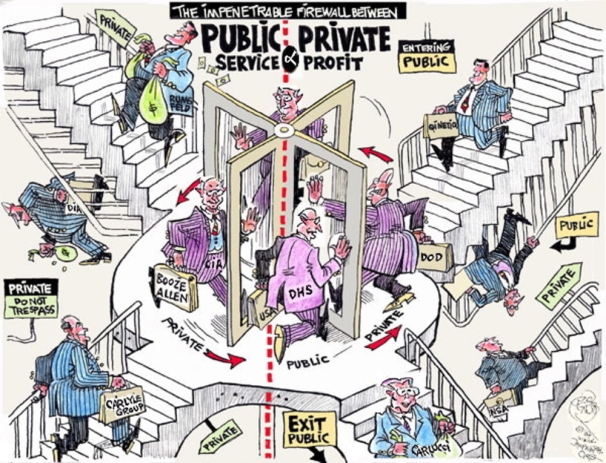
The revolving door of mutually exclusive political and corporate favour operates by keeping up the spin.

The company at the centre of the Facebook data breach has boasted of using honey traps, fake news campaigns and operations with ex-spies to swing election campaigns around the world, the recent Channel 4 investigation has revealed. 

Executives from Cambridge Analytica spoke to undercover reporters from Channel 4 News about the “dark arts” used by the company to “help” clients, which included entrapping rival candidates in fake bribery stings and hiring prostitutes to seduce them.

In one filmed exchange, the company chief executive, Alexander Nix, is recorded telling reporters: “It sounds a dreadful thing to say, but these are things that don’t necessarily need to be true as long as they’re believed.”

The excellent Channel 4 News investigation, broadcast on Monday, despite threats of legal action from the company, comes two days after the Observer reported that Cambridge Analytica had unauthorised access to tens of millions of Facebook profiles in one of the social media company’s biggest data breaches. 

Nix detailed the deception, glorified propaganda techniques, entrapment and other dirty tricks that the company would be prepared to pull for money behind the scenes to help its clients. When the Channel 4 reporter asked if Cambridge Analytica could offer investigations into the damaging secrets of rivals, Nix said it worked with former spies from Britain and Israel to look for political dirt. He also volunteered that his team were ready to go further than an ‘investigation’. 

“Oh, we do a lot more than that,” Nix said. Deep digging is interesting, but you know equally effective can be just to go and speak to the incumbents and to offer them a deal that’s too good to be true and make sure that that’s video recorded.

“You know these sort of tactics are very effective, instantly having video evidence of corruption.”

Nix suggested one possible scenario, in which the managing director of Cambridge Analytica’s political division, Mark Turnbull, would pose as a wealthy developer looking to exchange campaign finance for land. “I’m a master of disguise,” Turnbull said.

Another option, Nix suggested, would be to create a sex scandal. “Send some girls around to the candidate’s house, we have lots of history of things,” he told the reporter. “We could bring some Ukrainians in on holiday with us, you know what I’m saying.

Facebook’s own little investigation

Facebook in CA s office

Facebook seems to have missed its opportunity to get a handle on the Cambridge Analytica scandal, having been told to stay out of its offices by the UK Information Commissioners Office.

Digital forensics firm Stroz Friedberg was hired by Facebook yesterday “to conduct a comprehensive audit of Cambridge Analytica,” according to a Facebook announcement. Apparently the private company at the centre of the scandal was happy to give Facebook full access to its servers and systems but the UK Information Commissioners Office (ICO), which is ‘sponsored by the governmental department for Digital, Culture, Media and Sport, apparently had other ideas.

On 7 March, my office issued a Demand for Access to records and data in the hands of Cambridge Analytica,” said Information Commissioner Elizabeth Denham.

Cambridge Analytica has not responded by the deadline provided; therefore, we are seeking a warrant to obtain information and access to systems and evidence related to our investigation.

On 19 March, Facebook announced that it will stand down its search of Cambridge Analytica’s premises at our request. Such a search would potentially compromise a regulatory investigation.”

It’s not known how long Facebook, via its proxies, had access to Cambridge A’nalytica‘s files and how much investigating it managed to do, but being kicked out by the ICO is presumably a major inconvenience.

The Information Commissioner, Denham, has criticised Cambridge Analytica for being “uncooperative” with her investigation, and she confirmed that the watchdog will apply for a warrant to examine the company’s activities.

Someone is currently editing the information about Cambridge Analytica on  Wikipedia: re-writing history

CA editing wiki

The Conservative election guru Lynton Crosby had his staff engage in an ‘edit-war’ to delete details of his links with the tobacco industry and his election strategies from Wikipedia. Channel 4 News investigation found that substantial sections were removed from the Wikipedia page of Lynton Crosby, an Australian political strategist, by staff at the Crosby Textor consultancy firm that he co-founded. On 15 July 2013, accounts linked to Crosby Textor staff deleted multiple times sections on the controversy when the Conservative party dropped its policy for plain cigarette packaging. 

In 2015, Wikipedia also blocked a user account on suspicions that it was being used by the Conservative party chairman, Grant Shapps, “or someone acting on his behalf” to edit his own page along with the entries of Conservative rivals and political opponents.

The online encyclopedia, where pages are edited and created by readers, had tracked the changes made by a user calledContribsxthought to be a sock puppet who had systematically removed embarrassing references on Shapps’ Wikipedia page about the Tory chairman’s business activities as Michael Green, the self-styled millionaire web marketer.

wayback machine

Screenshot from The Wayback Machine – an initiative of the Internet Archive, a 501(c)(3) non-profit, building a digital library of Internet sites and other cultural artifacts in digital form. Other projects include Open Library and archive-it.org.

A sharp-eyed friend, Hubert Huzzah, has spotted that there are currently lots of edits and re-writes on the Cambridge Analytica entry page on Wikipedia. Curiously, it is also possible to trace a Wikipedia edit in a linked reference being deleted on another website. It seems that in editing Wikipedia someone (or a group), is somehow then using what they have edited to take down the information “in the wild”.

It appears that the availability of the information is being removed more generally elsewhere on other sites.

What seems evident is that someone has gone through the links in the Wikipedia article and removed them from the Wikipedia article. It’s possible to simply cut and paste the link into a browser and go to the original. But quite a number of the originals now do not exist. Or they exist with different content.

Here is a snapshot of the Wikipedia entry from 3 January, 2018.

This is one taken on 19 March 2018 (one of five)

And another today (one of ten)It’s reasonable to expect the page to be updated, but you can see from some of the edits that this is rather more that a simple updating of information. 

It’s something of a Winston Smith moment…

The bottom line

It is fundamentally wrong for private companies and authoritarian governments to use alter public information, use personal information, data mining, psychological profiling, targeted ‘strategic communications’ (a euphemism for propaganda) , ‘behavioural science’, ‘social science insights’ and military grade psyops – in short, deception – in order to manipulate citizens’ decision-making, perceptions and behaviours in order to profit and maintain their power.

All of this has profound and dark implications for democracy, or at least what is left of it. Totalitarians throughout history have sought to change the perceptions, decisions and behaviours of populations. These are the intentions and actions of tyrants.

Governments in so-called democratic nations are assumed to seek to be elected or remain in office on the basis of the preferences of voters, their accountable policies and their capacity for public representation – based on those meritocratic principles that they preach to everyone else.

The fact that governments are paying – using taxpayers’ money – to attempt to manipulate the electorate – regardless of whether or not the methodologies used actually work – speaks volumes about government intentions, their lack of transparency, their disregard of citizens’ agency, their disdain for human rights, lack of respect for civil liberties and utter contempt for anything remotely resembling democratic accountability.

The Channel 4 News exposé  of Cambridge Analytica


I don’t make any money from my work. But you can help by making a donation to help me continue to research and write informative, insightful and independent articles, and to provide support to others. The smallest amount is much appreciated – thank you.

DonatenowButton

Cambridge Analytica, the commodification of voter decision making and marketisation of democracy

CA data

“We exploited Facebook to harvest millions of profiles. And built models to exploit that and target their inner demons”. Cambridge Analytica Whistleblower, Christopher Wylie.

Neuroliberalism 

It’s been a longstanding major area of concern, of course, that neurotechnologies and ‘behavioural change’ techniques may be used to redirect citizen decision making without their explicit permission. After all, neuromarketing – the idea that the brain, behaviours, emotions and preferences can reveal hidden and profitable truths – is founded on the development of strategies of persuasion in order to profit.

This doesn’t just raise ethical concerns in the market place, since neuromarketing strategies are being used in wider contexts, such as in shaping political narratives and communications, election campaigning, policy making and within the media. The motive for employing these techniques is nonetheless about gaining a profit, if not financially, then certainly in terms of advantage and power. 

I have criticised behavioural economics extensively and frequently on previous occasions, for precisely the same reasons. Since 2010, it has somehow become acceptable for governments to exercise an influence on the decision-making and behaviours of citizens. Libertarian paternalism, under the guise of ‘behavioural science’, has normalised a manipulative, authoritarian approach for state micro-management of the perceptions, decisions and behaviours of populations. However, being a political doctrine itself, libertarian paternalism is not value-neutral or ‘objective’.   

Behavioural economics is a flagrant political misuse of psychology, a form of manipulation without the publics’ knowledge and consent. This of course has profound implications for democracy, as the state is ‘acting upon’ citizens in ways that they won’t recognise to change their behaviours and to manipulate their decision-making. In fact the government’s use of behavioural economics turns democracy completely on its head.

It’s accepted uncritically that people can pay companies and organisations to change people’s minds and persuade them to change their decisions and behaviours, be it simply aimed politically at individuals’ perceived ‘faulty’ decision-making, allegedly involved in their circumstances of poverty, claiming welfare support, or voting for a party that hasn’t paid a PR company to manipulate your voting decision.

Harvard Law Professor Cass Sunstein, (co-author of “Nudge” and one of the founders of behavioural economics), wrote a controversial paper in 2008 proposing that the US government employ teams of covert agents and pseudo-independent advocates to “cognitively infiltrate” online groups and websites, as well as other activist groups.

Sunstein also proposed sending covert agents into “chat rooms, online social networks, or even real-space groups” which spread what he views as false and damaging “conspiracy theories” about the government. Ironically, the very same Sunstein was named by Obama to serve as a member of the NSA review panel created by the White House, one that – while disputing key NSA claims – proceeded to propose many cosmetic reforms to the agency’s powers (most of which were ignored by the President who appointed them).

Back in 2014, GCHQ documents released from the Edward Snowden archive by Glenn Greenwald, were the first to prove that a major western government is using some of the most controversial techniques to disseminate deception online and harm the reputations of targets. The ultimate aim, of course, is to shape public perceptions, decisions and behaviours.

Under the tactics they use, the state is deliberately spreading lies and misinformation on the internet about whichever individuals it targets, including the use of what GCHQ itself calls “false flag operations” and emails to people’s families and friends. The Snowden archive outlines how western intelligence agencies are attempting to manipulate and control online discourse with extreme tactics of deception and reputation-destruction.

Who would possibly trust a government to exercise these powers at all, let alone do so in secret, with virtually no oversight, and outside of any cognizable legal framework?

Then there is, as I’ve discussed, the political misuse of psychology and other social sciences to not only understand, but shape and control, how online activism and discourse unfolds.

Glenn Greenwald’s published document on the Intercept touts the work of GCHQ’s “Human Science Operations Cell,” devoted to “online human intelligence” and “strategic influence and disruption.” Under the title “Online Covert Action”, the document details a variety of means to engage in “influence and info ops” as well as “disruption and computer net attack,” while dissecting how human beings can be manipulated using “leaders,” “trust,” “obedience” and “compliance”.

It’s not such a big inferential leap to conclude that governments are attempting to manage legitimate criticism and opposition while stage-managing our democracy.

I don’t differentiate a great deal between the behavioural insights team at the heart of the Conservative cabinet office, and the dark world of PR and  ‘big data’ and ‘strategic communications’ companies like Cambridge Analytica. The political misuse of psychology has been disguised as some kind of technocratic “fix” for a failing neoliberal paradigm, and paraded as neutral “science”. 

However, its role as an authoritarian prop for an ideological imposition on the population has always been apparent to some of us, because the bottom line is that it is all about influencing people’s perceptions and decisions, using psychological warfare strategies

The Conservatives’ behaviour change agenda is designed to align citizen’s perceptions and behaviours with neoliberal ideology and the interests of the state. However, in democratic societies, governments are traditionally elected to reflect and meet public needs. The use of “behaviour change” policy involves the state acting upon individuals, and instructing them how they must be.

Last year, I wrote a detailed article about some of these issues, including discussion of Cambridge Analytica’s involvement in data mining and the political ‘dark’ advertising that is only seen by its intended recipients. This is a much greater cause for concern than “fake news” in the spread of misinformation, because it is invisible to everyone but the person being targeted. This means that the individually tailored messages are not open to public scrutiny, nor are they fact checked.

A further problem is that no-one is monitoring the impact of the tailored messages and the potential to cause harm to individuals. The dark adverts are designed to exploit people’s psychological vulnerabilities, using personality profiling, which is controversial in itself. Intentionally generating and manipulating fear and anxiety to influence political outcomes isn’t a new thing. Despots have been using fear and slightly less subtle types of citizen “behaviour change” programmes for a long time. 

About Cambridge Analytica: political psyops approach verified by a whistleblower

Controversy has arisen concerning Cambridge Analytica‘s use of personal information acquired by an external researcher, who claimed to be collecting it for “academic purposes”. The use of personal data collected without knowledge or permission to establish sophisticated models of user’s personalities raises ethical and privacy issues.

In a somewhat late response, Facebook banned Cambridge Analytica from advertising on its platform. The Guardian has further reported that Facebook had known about this security breach for two years, but did nothing to protect its millions of users.

It is well-known that Cambridge Analytica (CA) collects data on voters using sources such as demographics, consumer activity and internet activity, among other public and private sources. It has been reported that the company is using psychological data derived from millions of Facebook users, largely without users’ permission or knowledge. In short, the company operates using political voter surveillance and strategies of psychological manipulation.

The data analytics firm is a private company that offers services to businesses and political parties who want to “change audience behaviour”. CA combines data mining and data analysis with ‘strategic communication’ for the electoral process. It was created in 2013 as an offshoot of its British parent company, Strategic Communication Laboratories Group, to participate in US politics. 

The company claims to use “data enhancement and audience segmentation techniques” providing  “psychographic analysis” for a “deeper knowledge of the target audience”. The company is known to use the ‘big five’ OCEAN scale of personality traits, among other methods of psychographic profiling. 

The company also claims to use “behavioural microtargeting” and indicates that it can predict ‘needs’ of subjects and how these needs may change over time. Services then can be individually targeted for the benefit of its clients from the political arena, governments, and companies providing “a better and more actionable view of their key audiences.”

CA, who worked with Donald Trump’s election team and the Brexit campaign, has harvested millions of Facebook profiles of US voters, in one of the technological giant’s biggest ever data breaches, and used them to build a powerful software program to psychologically profile, predict and influence citizens’ voting choices. The managing director of CA’s controversial political division is Mark Turnbull, who spent 18 years at the communications firm Bell Pottinger before joining Strategic Communication Laboratories (SCL), which is a British ‘behavioural science’ company.

The SCL Group, that once advised Nato on so-called ‘psy-ops’, is a private British behavioural research and strategic communication company. The company describes itself as “global election management agency”.  SCL’s approach to propaganda is based upon a methodology developed by the associated Behavioural Dynamics Institute (BDI). 

Nigel Oakes founded the latter and also set up SCL and using the new methodology from BDI, ran election campaigns and national  communications campaigns for a broad variety of international governments.

BDI say: “The goal of the BDI is to establish Behavioural Dynamics as a discipline for the study of group behaviour change.”

There isn’t much information around about BDI’s connection with military operations, though links with NATO are well-established – see Countering propaganda: NATO spearheads use of behavioural change science, for example. From the article: “Target Audience Analysis, a scientific application developed by the UK based Behavioural Dynamics Institute, that involves a comprehensive study of audience groups and forms the basis for interventions aimed at reinforcing or changing attitudes and behaviour.”

SCL on the other hand, has a clearly defined defence and military division who: “Target Audience Analysis, a scientific application developed by the UK based Behavioural Dynamics Institute, that involves a comprehensive study of audience groups and forms the basis for interventions aimed at reinforcing or changing attitudes and behaviour.”

SCL has different ‘verticals’ in politics, military and commercial operations. All of those operations are based on the same methodology (Target Audience Analysis) and, as far as can be discerned from the outside, SCL and affiliates have very obscure corporate structures with confusing ownership.

In the United States, SCL has gained public recognition mainly though its affiliated corporation Cambridge Analytica. It was created in 2013 as an offshoot of its British parent company (the SCL Group,) to participate in US politics. In 2014, CA was involved in 44 US political races.

Their site says: Cambridge Analytica uses data to change audience behavior.” 

There doesn’t seem to be a lot of political will or respect on the right when it comes to the publics’ privacy, autonomy in decision making, citizens’ agency and civil liberties.   

The current controversy

Working with a whistleblower and ex-employee of Cambridge Analytica, the Observer and Guardian have seen documents and gathered eyewitness reports that lift the lid on the data analytics company that helped Donald Trump to victory. The company is currently being investigated on both sides of the Atlantic.

It is a key subject in two inquiries in the UK – by the Electoral Commission, into the company’s possible role in the EU referendum and the Information Commissioner’s Office, into data analytics for political purposes – and one in the US, as part of special counsel Robert Mueller’s probe into Trump-Russia collusion.

Previous articles by Carole Cadwalladr in the Observer and Guardian newspapers, respectively published in February and May 2017, speculated in detail that CA had influenced both the Brexit/Vote Leave option in the UK’s 2016 EU membership referendum and Trump’s 2016 US presidential campaign with Robert Mercer’s backing of Donald Trump being key. They also discuss the legality of using the social data farmed. CA says it is pursuing legal action over the claims made in Cadwalladr’s articles.

The whistleblower, Chris Wylie, claims that the 50 million mostly American, profiles were harvested in one of Facebook’s biggest data breaches has caused outrage on both sides of the Atlantic, with lawmakers in both the UK and America, and a state attorney general calling for greater accountability and regulation. The profiles were harvested by a UK-based academic, Aleksandre Kogan, and his company, Global Science Research (GSR).

Wylie said the personal information mined was used to build a system to influence voters. The Canadian, who previously worked for Cambridge Analyticahas lifted the lid on this and other practices at the company, which he describes as a “full-service propaganda machine”.

Shortly before the story broke, Facebook’s external lawyers warned the Observer that it was making “false and defamatory” allegations and reserved Facebook’s legal position. Facebook denies the harvesting of tens of millions of profiles by CA, working with Cambridge academic Aleksandr Kogan and his firm GSR, was a data breach. 

While Facebook insists that it wasn’t a data breach, claiming it was a violation by a third party app that abused user data, this responsibility offloading speaks volumes about Facebook’s approach to its users’ privacy.  

Private companies benefit from a lack of transparency over how profits are made from our personal data. Their priority seems to be to silo and hoard our data, prioritising its more commercial uses. Yet we need to think about data differently, moving away from ideas of data as a commodity to be bought and sold, and used to generate profit for a few people – be it financial or political profit.

The internet, and later the World Wide Web, was originally intended to be a democratising force, accessible to all and without walls or ownership. But the reality today is rather different. The inequalities in wealth and power inherent in neoliberalism have seeped online, marketising and commodifying our personal details, choices, views, dispositions, likes and dislikes.  

Personal data has become the driving force of the online economy, yet the economic and social value which can be generated from data is not remotely fairly distributed. In fact it isn’t being redistributed at all.

Facebook shoot the messenger

Facebook have also suspended the whistleblower Chris Wylie from the platform “pending further information” over misuse of data, along with his former employer, CA and its affiliates, and the academic they worked with, Aleksandr Kogan.

The public attack on Wylie came after he had approached Facebook about the data breach, offering to help investigate. He described it as a “chilling attack” on someone acting in the public interest.

“They acknowledged my offer but then turned around and shot the messenger. I’m trying to make amends for my mistakes and so should Facebook,” he told the Guardian.

“Facebook has known about this for at least two years and did almost nothing to fix it. This is not new. And it’s only by coming forward that Facebook is now taking action. People need to know this kind of profiling is happening.”

Kogan assembled the harvested information through an app on the site – it collected details of American citizens who were paid to take a personality test, but also gathered data on those people’s Facebook friends.

Kogan apparently had a deal to share this information with CA. But according to Wylie, most of this personal information had been taken without authorisation. He said Cambridge Analytica used it to build a powerful software program to predict and influence choices at the ballot box.

Last month, both Facebook and CA CEO Alexander Nix told the parliamentary inquiry into fake news that the company did not have or use private Facebook data, or any data from Kogan’s firm, GSR.

But in its statement on Friday night, explaining why it had suspended CA and Wylie, Facebook said it had known in 2015 that profiles were passed to Nix’s company. 

“In 2015, we learned that a psychology professor at the University of Cambridge named Dr Aleksandr Kogan lied to us and violated our platform policies by passing data from an app that was using Facebook Login to SCL/Cambridge Analytica,the statement said.

CA is heavily funded by the family of Robert Mercer, an American hedge-fund billionaire. I’ve mentioned Mercer in a previous article about the right’s undue influence on the media and on voting behaviour. Mercer made his money as a pioneer in the field of Computational Linguistics.

The company was headed by Trump’s key adviser Steve Bannon. CA used personal information taken without authorisation in early 2014 to build a system that could profile individual US voters, in order to target them with ‘personalised’ persuasive  political ‘advertisements’.

It’s scandalous that documents seen by the Observer, and confirmed by the Facebook statement, show that by late 2015 the Facebook had found out that information had been harvested on an unprecedented scale and failed to alert users, taking only limited steps to recover and secure the private information of more than 50 million individuals.

Last year, Dr Simon Moores, visiting lecturer in the applied sciences and computing department at Canterbury Christ Church University and a technology ambassador under the Blair government, said the Information commissioners Office’s recent decision to shine a light on the use of big data in politics was timely. He said:

“A rapid convergence in the data mining, algorithmic and granular analytics capabilities of companies like Cambridge Analytica and Facebook is creating powerful, unregulated and opaque ‘intelligence platforms’. In turn, these can have enormous influence to affect what we learn, how we feel, and how we vote. The algorithms they may produce are frequently hidden from scrutiny and we see only the results of any insights they might choose to publish.”

He goes on to say: ”They were using 40-50,000 different variants of an ad every day that were continuously measuring responses and then adapting and evolving based on that response.”

The head of the parliamentary committee investigating fake news has accused CA and Facebook of misleading MPs in their testimony. 

After Wylie detailed the harvesting of more than 50 million Facebook profiles for CA, Damian Collins, the chair of the House of Commons culture, media and sport select committee, said he would be calling on the Facebook boss, Mark Zuckerberg, to testify before the committee.

He said the company appeared to have previously sent executives able to avoid difficult questions who had “claimed not to know the answers”.

Collins also said he would be recalling the CA’s CEO, Alexander Nix, to give further testimony. “Nix denied to the committee last month that his company had received any data from [his firm] GSR,” he said. “We will be contacting Alexander Nix next week asking him to explain his comments.”

Collins has attacked Facebook for appearing to have been “deliberately avoiding answering straight questions” in to the committee.

“It is now clear that data has been taken from Facebook users without their consent, and was then processed by a third party and used to support their campaigns,” Collins said. “Facebook knew about this, and the involvement of Cambridge Analytica with it.”

CA claimed that its contract with GSR stipulated that Kogan should seek “informed consent” for data collection and it had no reason to believe he would not. 

GSR was “led by a seemingly reputable academic at an internationally renowned institution who made explicit contractual commitments to us regarding its legal authority to license data to SCL Elections”, a company spokesman said.

The Observer has seen a contract dated 4 June 2014, which confirms SCL, an affiliate of CA, entered into a commercial arrangement with GSR, entirely premised on harvesting and processing Facebook data. CA spent nearly $1m on data collection, which yielded more than 50 million individual profiles that could be matched to electoral rolls. It then used the test results and Facebook data to build an algorithm that could analyse individual Facebook profiles and determine personality traits linked to voting behaviour.

The algorithm and database together made a powerful political tool for the right. It allowed a campaign to identify possible swing voters and craft messages more likely to ‘resonate’.

“The ultimate product of the training set is creating a ‘gold standard’ of understanding personality from Facebook profile information,” the contract specifies. It promises to create a database of 2 million ‘matched’ profiles, identifiable and tied to electoral registers, across 11 states, but with room to expand much further.

CA responded to the Observer story on Twitter before Collins had said Nix would be recalled. “We refute(s) these mischaracterizations and false allegations,” it said:

“Reality Check: Cambridge Analytica uses client and commercially and publicly available data; we don’t use or hold any Facebook data,” the company said. “When we learned GSR sold us Facebook data that it shouldn’t have done, we deleted it all – system wide audit to verify.”

CA

CA not coercive

In response to the series of  defensive Tweets put out by CA, I quoted several claims from CA’s own site, which I had cited in an article last year. 

For example, the company offers to: “More effectively engage and persuade voters using specially tailored language and visual ad combinations crafted with insights gleaned from behavioral understandings of your electorate.”

And boasts:Leveraging CA’s massive team of data scientists and academics, CA is able to provide optimal audience segments based on big data and psychographic modeling. Then, using a sophisticated electronic data delivery system, CA is able to provide TV advertising campaign data that may be used to inform media buyers about shows that have the highest concentrations of target audiences and the least amount of waste; all of which leading to higher media ROI [return on investment] and more voter conversions.”

“Psychographic Modeling”? “Conversions”?  “[…] specially tailored language and visual ad combinations crafted with insights gleaned from behavioral understandings of your electorate” ?

That language doesn’t sound like “advertising” to me. It sounds like microsurveilance and psychological manipulation, using the vulnerabilities that make us susceptible to all kinds of manipulations, including the intentional manipulations performed by the political machinery of our culture.

If CA genuinely thought “people are smarter than that”, then their boasts about their service of psychographic modeling, behavioural science; “understandings of the electorates’ behaviour”, “changing voter behaviours” and increasing “conversions”, “driving” voters to the polls to win campaigns and so on is nothing more than an eloborate  scam. Why bother attempting to manipulate people you think are not susceptible to manipulation?

Either way, this company has transgressed ethical boundaries, either as snake oil merchants, or as peddlers of snake oil on behalf of governments and other clients, while exploiting our personal data.

CA Political will equip you with the data and insights necessary to drive your voters to the polls and win your campaign. We offer a proven combination of predictive analytics, behavioral sciences, and data-driven ad tech.”

“With up to 5,000 data points on over 230 million American voters, we build your custom target audience, then use this crucial information to engage, persuade, and motivate them to act.”

And offers to help to: “More effectively engage and persuade voters using specially tailored language and visual ad combinations crafted with insights gleaned from behavioral understandings of your electorate.”

One of our fundamental freedoms, as human beings, is that of owning the decision making regarding our own lives and experiences, including evaluating and deciding our own political preferences. To be responsible for our own thoughts, reflections, intentions and actions is generally felt to be an essential part of what it means to be human.

When David Cameron said that “knowledge of human behaviour” was part of his vision for a “new age of government” I was one of a few who didn’t see behavioural economics as the great breakthrough in social policy-making that it was being hailed as. Even the name ‘behavioural insights team’ suggests secrecy, surveilance and manipulation. It was only a matter of time before libertarian paternalism morphed into authoritarianism, hidden in plain view. 

We are being told what our ‘best interests’ are by a small group of powerful people whose interests are that want to stay powerful, despite being dogmatic, self-righteous and wrong. Despite the fact that they need specialists in techniques of persuasion, rather than rational and democratic engagement, to appear credible to the electorate.  

CA pivotal role
It seems that the overarching logic of New Right neoliberalism has led to the privatisation of citizens’ decision making and behaviour and a new form of exploiting the population by misuse of their trust and their personal information.

Also, it seems democracy has been commodified and marketised.

Update

Cambridge Analytica are trying to stop the broadcast of an undercover Channel 4 News report in which its chief executive talks unguardedly about its practices. Channel 4 reporters posed as prospective clients and had a series of meetings with Cambridge Analytica that they secretly filmed — including at least one with Alexander Nix, its chief executive.

Channel 4 declined to comment. Cambridge Analytica’s spokesman also declined to comment on the undercover Channel 4 report. The company is under mounting pressure over how it uses personal data in political and election campaign work. It was banned by Facebook on Friday, which claimed it had violated the social network’s rules by failing to delete Facebook user data collected by an app supposedly for ‘research purposes’.

Facebook is now investigating ties between one of its current employees and Cambridge Analytica. Joseph Chancellor, currently a researcher at Facebook, was a director of Global Science Research, a company that provided data to Cambridge Analytica.

The nature of Chancellor’s role as a director of Global Science Research and his knowledge of Kogan’s data collection practices are not clear. A spokesperson for Cambridge Analytica said “there was no recollection of any interactions or emails with” Chancellor.

Facebook didn’t mention Global Science Research. But Cambridge Analytica said on Saturday that it contracted the company in 2014 to “undertake a large scale research project in the United States.”

Global Science Research was incorporated in May 2014 and listed Kogan and Chancellor as directors, according to UK government records. (The records show that Global Science Research was dissolved in October 2017.) 

Channel 4 News went ahead to broadcast the Cambridge Analytica exposé despite the legal threat.

From Channel 4Revealed: Trump’s election consultants filmed saying they use bribes and sex workers to entrap politicians 

Watch Channel 4′s excellent undercover documentary.

Related 

Cambridge Analytica questioned on fake news  – UK parliament

Revealed: 50 million Facebook profiles harvested for Cambridge Analytica in major data breach

Cambridge Analytica: links to Moscow oil firm and St Petersburg university

More allegations of Tory election fraud, now we need to talk about democracy

The anti-social public relations of the PR industry

The Nudge Unit’s u-turn on benefit sanctions indicates the need for even more lucrative nudge interventions, say nudge theorists

How Covert Agents Infiltrate the Internet to Manipulate, Deceive, and Destroy Reputations – Glenn Greenwald

Controversial GCHQ Unit Engaged in Domestic Law Enforcement, Online Propaganda, Psychology Research – Glenn Greenwald and Andrew Fishman


I don’t make any money from my work. But you can support Politics and Insights and contribute by making a donation which will help me continue to research and write informative, insightful and independent articles, and to provide support to others. The smallest amount is much appreciated, and helps to keep my articles free and accessible to all – thank you. 

DonatenowButton

The Tories’ digital surveillance regime is ruled unlawful

Image result for surveillance UK

In June 2013, Edward Snowden – a former contractor at the US National Security Agency – blew the whistle on the huge scale of Government spying on every one of us.

He revealed that GCHQ, the UK’s eavesdropping agency, was intercepting and processing billions of communications every day and sharing the information with the US. This included recordings of our phone calls, the content of our private messages, entries on social media sites and our internet histories. This level of intrusion has no place in a democratic society, where we all have the right to protest, speak freely and to a fair trial – and our free press holds the Government to account. If those in power can watch our every move, those rights are seriously undermined.

Snowden had hoped that by exposing this unlawful and undemocratic mass surveillance, the resulting public outcry would stop it.

But the UK Government responded not just by legalising those extremely intrusive, eye-wateringly authoritarian powers – but by expanding them.

However, the British Government’s spying legislation is unlawful, the Court of Appeal has ruled. Judges say that the Snooper’s charter lacks adequate safeguards around accessing personal data. The decision follows similar findings from the European Court of Justice and the High Court in London. 

Labour MP, Tom Watson, had challenged the legality of the Data Retention and Investigatory Powers Act 2014 (DRIPA) after it was introduced by Theresa May when she was Home Secretary.

Liberty, the human rights campaign group which represented Watson in the case, said the ruling meant significant parts of the Investigatory Powers Act 2016 – known as the snooper’s charter – are effectively unlawful and must be urgently changed. The legal challenge was also crowdfunded by almost 2,000 people.

The court of appeal ruling on Tuesday 30 January said that the powers in the Data Retention and Investigatory Powers Act 2014, (DRIPA) which paved the way for the snooper’s charter legislation, did not restrict the accessing of confidential personal phone and web browsing records to investigations of serious crime, and allowed police and other public bodies to authorise their own access without adequate oversight.

The court said DRIPA was “inconsistent with EU law” because of this lack of safeguards, including the absence of “prior review by a court or independent administrative authority”.

Responding to the ruling, Watson said: “This legislation was flawed from the start. It was rushed through parliament just before recess without proper parliamentary scrutiny.

“The government must now bring forward changes to the Investigatory Powers Act to ensure that hundreds of thousands of people, many of whom are innocent victims or witnesses to crime, are protected by a system of independent approval for access to communications data. I’m proud to have played my part in safeguarding citizens’ fundamental rights.”

Martha Spurrier, the director of Liberty, said: “Yet again a UK court has ruled the government’s extreme mass surveillance regime unlawful. This judgement tells ministers in crystal clear terms that they are breaching the public’s human rights.”

She said that no politician was above the law. “When will the government stop bartering with judges and start drawing up a surveillance law that upholds our democratic freedoms?”

When the law expired at the end of 2016 it was replaced with The Investigatory Powers Act 2016 (IPA), which continued to give the Government most of the same surveillance powers it had under DRIPA.

While a separate legal challenge to the IPA will be heard at the end of February – it has been referred to the European court of justice – the recent judgement has already established that many of its provisions are unlawful and must be changed.

DRIPA allowed the government to force Internet Service Providers to collect and retain people’s phone records and log their internet activity.

It also permitted a wide range of public bodies to grant themselves access to this information without proper independent oversight, and in many cases where there was no suspicion that a serious crime had occurred. Local Councils have been caught using data retention legislation – introduced to fight terrorism – to crack down on issues such as dog fouling and littering.

Then there have been the cases of companies, including insurance and financial firms, that have illicitly acquired confidential personal details of victims. An insurance firm and two senior figures were handed record data breach fines for illegally obtaining  private banking records in January this year. The two private dectectives hired to break the law were also fined heavily. Illegal trading in personal information for profit has become a growing problem.

It’s therefore very good news that, as all access requests are not subject to a prior review by an independent body or court, the legislation is in breach of human rights law, the Court of Appeal has ruled.

Previous rulings

The High Court ruled against the government in 2015, finding that DRIPA was incompatible with Articles 7 and 8 of the Human Rights Convention because the data collection was indiscriminate rather than targeted, and it was too easy for organisations to gain access to it without proper scrutiny. Article 7 says that there can be no punishment without law, and 8 provides a right to respect for one’s private and family life, home and correspondence.

The government then appealed this decision and the Court of Appeal referred the case to the European Court of Justice for clarification. In its ruling, it agreed with the High Court ruling in London, and ordered the government to introduce greater safeguards to protect citizens’ privacy. The matter then went back to the Court of Appeal in the UK which made its ruling on January 30.

Watson launched his legal challenge in 2014 in partnership with David Davis, who withdrew from the challenge when he entered the government as Brexit secretary in 2016.

The European court of justice ruled in December 2016 that the “general and indiscriminate retention” of confidential personal communications data was unlawful without safeguards, including independent judicial authorisation.

The recent decision by the Court of Appeal means that the government will almost certainly have to amend the Investigatory Power Act to protect our human rights.

However, security minister Ben Wallace responded to the ruling with this:

“Communications data is used in the vast majority of serious and organised crime prosecutions and has been used in every major security service counter-terrorism investigation over the last decade. It is often the only way to identify paedophiles involved in online child abuse as it can be used to find where and when these horrendous crimes have taken place.”

He went on to say that the judgment related to legislation which was no longer in force and did not change the way in which law enforcement agencies could detect and disrupt crimes.

He added: “We had already announced that we would be amending the Investigatory Powers Act to address the two areas in which the court of appeal has found against the previous data retention regime. We welcome the fact that the court of appeal ruling does not undermine the regime and we will continue to defend these vital powers, which Parliament agreed were necessary in 2016, in ongoing litigation.”

Online data has already been subjected to manipulation and political abuse, and the age of big data is still in its infancy. When a Government can combine a high level of monitoring with nudging techniques and technologies – tools designed to subtly to change people’s cognitions, responses, opinions and behaviours  – they have the tools to develop a system that will tend towards a totalitarian-level of control.

In combination with advances in cognitive science, psychological profiling, cognitive linguistics and neuroscience, this data could very easily become a powerful tool for changing the electoral decisions we make. We’ve already seen that money exercises illegitimate power over political systems, making a mockery of democracy – how campaign finance gives billionaires and corporations a huge political advantage over ordinary citizens; the dark money network (a web of lobby groups, funded by billionaires, that disguise themselves as thinktanks); astroturf campaigning (employing people to masquerade as grassroots movements); and ‘botswarming’, a technological variant of bandwaggon propaganda, using fake online accounts to give the impression that large numbers of people support a political position.

All of this currently threatens our democracy and political freedom. Yet the Electoral Commission in the UK have failed to control these abuses, or even, in most cases, to actually acknowledge them. 

We have recently seen integrated voter management platforms, the shift from mass-messaging to personalised micro-targeting, based on psychological profiling and the  employment of personal data from commercial data brokerage firms, the analysis of social media, and increasingly intrusive ways to influence political behaviour. (See More allegations of Tory election fraud, now we need to talk about democracy.)

The right to privacy and democratic autonomy are intimately connected.

Related

Social media is being used to stage manage our democracy using nudge-based strategies

How Covert Agents Infiltrate the Internet to Manipulate, Deceive, and Destroy Reputations – Glenn Greenwald

Controversial GCHQ Unit Engaged in Domestic Law Enforcement, Online Propaganda, Psychology Research – Glenn Greenwald and Andrew Fishman


I don’t make any money from my work. But you can support Politics and Insights and contribute by making a donation which will help me continue to research and write informative, insightful and independent articles, and to provide support to others. The smallest amount is much appreciated, and helps to keep my articles free and accessible to all – thank you. 

DonatenowButton


Government criticised for lack of diversity, lack of transparency and poor fiscal management

Image result for scrutiny of government

The Institute For Government (IFG) published their annual Whitehall Monitor Report on Thursday, presenting an insight and analysis of the size, shape and performance of government and the civil service.

In the opening paragraph, the IFG say: “The Prime Minister Theresa May lost her parliamentary majority in a snap general election. Revelations about ministers’ inappropriate conduct resulted in three Cabinet resignations. Preparations for Brexit have been disrupted by the snap election, by turnover in personnel and by difficulties in parliamentary management. The Government faces challenges in key public services, notably hospitals, prisons and adult social care.

It was noted in the report that preparations for Brexit have been disrupted by “difficulties in parliamentary management”. The Government has introduced only five of the nine new bills it says are needed for Brexit, and a third of the Government’s major projects worth over £1bn are at risk of not being delivered on time and on budget.

This Whitehall Monitor annual report – which is the fifth – summarises:

  • The political situation following the early election constrained the Prime Minister’s political authority and created challenges for the Government’s legislative programme and management of public services, major projects and Brexit.
  • The civil service is growing, in terms of size, but should be more diverse.
  • Government is less open than it was after 2010, and is not using data as effectively as it should.

I’ve used the summary to shape my analysis.

Fiscal management

The forecasts for tax revenues have been downgraded, the Government also forgoes billions of pounds through tax expenditures that are not subject to rigorous value-for-money assessments.

Since 2010, the value of liabilities on the government’s balance sheet has grown more quickly than the value of assets, increasing net liabilities. Furthermore, “revenue is not likely to overtake spending, in the foreseeable future”. 

Despite the promises from George Osborne of a budget surplus by 2020, and his fiscal straitjacket – the imposed, rigid programme of spending cuts and austerity for the majority of citizens, and tax cuts to the wealthiest ones. 

In real terms, revenues from taxes have grown 7% since 2010/11. This is largely the result of:

  • VAT receipts increasing by 22% (partly due to the standard VAT rate increasing from 17.5% to 20% in 2011)
  • National Insurance contributions increasing by 11%
  • Some increases in income tax collected following a stabilisation following the global crash

Council tax is also included in Treasury revenue, and that will have risen, since many low paid or out of work people now pay a contribution, whereas previously, they were exempt. Despite the increases in VAT, revenue from the sale of goods and services has fallen 34% since 2010/11. 

For the 2017 Autumn Budget, the Office for Budget Responsibility (OBR) downgraded its forecasts for productivity growth. This, in turn, has resulted in the outlook for Government revenue being revised downwards.

Tax expenditures cost £135bn per year. Tax expenditures are tax discounts or exemptions that “further the policy aims of government”. The total sum of all forgone revenue from tax expenditures across income tax, National Insurance contributions, VAT, corporation tax, excise duties, capital gains tax and inheritance tax was £135bn in 2015/16. This is equal to a quarter of the total central government tax revenue in that year, and is larger than the total budgets of all but two departments (Department for Work and Pensions and Department of Health).

For capital gains tax, the cost of tax expenditures was more than four times the amount of revenue collected

This certainly provides a strong indication of the government’s policy and budget priorities, making a mockery of trite sloganised claims of “a country that works for everyone”. Some social groups clearly raise rather more hidden political costs than others, but it is only disadvantaged and marginalised groups that tend to be negatively ideologically portrayed as a “burden” on the state by Conservatives and the media. 

In the 2017 Autumn Budget, the Chancellor announced new stamp duty reliefs for first time buyers purchasing properties worth under £500,000. Due to the policy being specifically targeted at first time buyers, this policy resembles a tax expenditure, and in 2018/19 (its first full year) is expected to cost £560m.

Furthermore, the National Audit Office has reported that the Treasury does not monitor tax expenditures and assess the value for money they offer with the same rigour as it does general expenditure. The Institute for Government, along with the Chartered Institute of Taxation and the Institute for Fiscal Studies, has called for the tax reliefs that most closely resemble spending measures to be treated as spending for accountability and scrutiny purposes.

Net government liabilities are now over £2 trillion. The Whitehall Monitor report says: “The Government’s net liability has implications for future generations of taxpayers, who will bear the costs of meeting these obligations, but the long-term nature of such obligations can make discussions around the government balance sheet seem more remote than the immediate choices about how much departments should spend each year.

“Nonetheless, policy choices have important implications for the Government’s liabilities – for example, the decisions taken by the Coalition Government to increase the state pension age, and to set a triple lock that guarantees annual increases of at least 2.5% in the state pension, are likely to have contrasting effects on the size of the state pension liability.”

The report goes on to say: “But the Government has made commitments to voters on public services, productivity, social mobility and major projects. If it fails to meet their expectations, it risks further undermining confidence in government.”

The government is still not transparent about its spending plans. The report says that “Better data is needed to understand the benefits – and risks – of outsourced public services”. 

“Wider government contracting includes back-office outsourcing by departments and the purchase of goods they use in the delivery of public services (e.g. paper, energy), as well as privately run public services. In 2015/16, £192bn was spent by government on goods and services, of which £70bn was spent by local government, £65bn by the NHS and £9bn by public corporations, with central government departments and other public bodies accounting for the remaining £49bn. 

“While some contract data is published, the Institute for Government and Spend Network have previously highlighted gaps in transparency – including on contractual terms, performance and the supply chains of third-party service providers.

“The Information Commissioner has said that the public should have the same right to know about public services whether the service is provided directly by government or by an outsourced provider”. [My emphasis]

The IFG also say in their report: “In 2016, the Public Accounts Committee concluded that the outsourcing of health disability assessments at DWP had resulted in claimants ‘not receiving an acceptable level of service from contractors’, while costs per assessment had increased significantly. [My emphasis. Some 10% of the budget for the Department for Work and Pensions goes to private contractors.]

“Similarly, in 2013 MoJ [Ministry of Justice] found that it had been overbilled in relation to contracts worth £722m.”

There have been numerous high-profile failings in government outsourcing. The recent collapse of Carillion highlights many of the longstanding and existing issues, and should encourage a political focus on solving them.

The report continues: “There is no centrally collected data outlining the scope, cost and quality of contracted public services across government. Nonetheless, we know that Whitehall departments account for only a portion of outsourced service delivery, which can also happen further downstream after departments have provided funds to public bodies (for example, the purchasing of services from GPs by the NHS) or local authorities.”

The next section of the report outlines the 2016–17 parliamentary session, in which 24 government bills were passed – fewer than in any session under the 2010–15 Coalition Government. In part, this reflects the curtailed session, which ended with the dissolution of Parliament on 3 May ahead of the election in early June. The report goes on to say that 1,097 pages of legislation – 38% of all pages passed in the session – were dealt with at speed, raising questions about the adequacy of the scrutiny these bills received.

There were also concerns raised about the scope of the powers the government has sought regarding the EU Withdrawal Bill, which has proven controversial. In particular, the inclusion of so-called ‘Henry VIII’ powers, allowing the Government to amend or repeal existing primary legislation without the scrutiny normally afforded to bills. This has quite properly provoked concern among parliamentarians.

Curiously, the report says that the use of statutory instruments (SIs) – previously used only to pass non-controversial policies and amendments – has dropped. However, this flies in the face of existing evidence, which is sourced from the government’s own site. If there has been a drop since 2014, it certainly contradicts the trend set since 2010. Furthermore, the Government has been criticised for using SIs to pass controversial policies, such as welfare cuts.

It seems that IFG counted the number of SIs by parliamentary session (the parliamentary year which tends to run from Spring to Spring) rather than by calendar year.

Scrutiny of SIs is rather less intensive than scrutiny of primary legislation. They are subject to two main procedures, neither of which allows Parliament to make any amendments:

  • negative procedure, in which an SI is laid before Parliament and incorporated into law unless either House objects within 40 days
  • affirmative procedure, in which both Houses must approve a draft SI when it is laid before them.

It’s also worth reading: Conservative Government accused of ‘waging war’ on Parliament by forcing through key law changes without debate.

The lack of progress on inclusion and diversity

The IFG says there has been “little recent progress” in numbers of senior civil servants with disabilities or ethnic minority backgrounds, while the percentage of women  also decreases proportionally with ascending Whitehall pay scales. .

They report: “The civil service needs to fulfil the promise of its diversity and inclusion strategy, especially in improving the representation of ethnic minority and disabled staff at senior levels.”  

Of those appointed to the highest departmental rank of permanent secretary in 2017, “as many were men with the surname Rycroft as were women – two in each case”. The report notes also “there has never been a female cabinet secretary for the UK”.

Despite the much-trumpeted launch of the Disability Confident employment scheme, aimed at “helping to positively change attitudes, behaviours and cultures,” and “making the most of the talents that disabled people can bring to the workplace”, sadly there is no evidence that the Government intends role-modeling positive behaviours or putting into practice what it preaches.

The representation of disabled civil servants at senior level has improved only very slightly: 5.3%, up from 4.7% in 2016. Across the UK population as a whole, according to the Office for National Statistics (ONS), 21% of people are estimated to have a disability (some 18% of the working-age population). 

Lack of openness, transparency and accountability

In the UK, the idea that government should be open to public scrutiny and policies congruent with public opinion is central to our notion of democracy. Government openness and transparency also tends to be linked with citizen inclusion, democratic participation and a higher degree of collaboration between citizens and government on public policy decisions. It also ensures that corruption and the misuse of political  t power for other purposes, such as forms repression of political opponents is less likely.

Information and data deficits are more likely to lead to political corruption and a reduction in democratic accountability.

The IFG report says that in 2016–17, more ministerial correspondence was answered in time, which were thanks to more generous targets, while fewer parliamentary questions were answered on time and information was withheld in response to more Freedom of Information requests.

Parliament has other mechanisms to hold government to account, including urgent questions (which have most tellingly increased significantly in recent years) or select committee inquiries (which have also increased in number, with the election delaying government responses). The Government has established a track record of withholding details of planned legislation from the opposition. (See for example: PIP and the Tory Monologue).

According to Democracy Audit UK  an independent research organisation, established as a not-for-profit company, and based at the Public Policy Group in the LSE’s Government Department – the lack of transparency has been fuelled by the coalition period, and now, the Conservative’s’ narrow majority,  as the amount of secondary legislation is growing, and primary legislation is drafted in ways that increasingly leave its consequences obscure, to be filled in later via statutory instruments or regulation. Commons scrutiny of such “delegated legislation” is subsequently reduced, and likely to be very weak and ineffective.

Meanwhile, departments’ publication of mandated data releases, including spending over £25,000, organograms and ministerial hospitality, is patchy. Departments also proactively publish on GOV.UK, though supply and demand differs by department

The IFG says that many departments are not publishing their data as frequently as they should and this, coupled with the difficulty of measuring government performance, suggests that the government is becoming less transparent and accountable.

A rise in the numbers of Freedom of Information requests that are being refused

Since 2010, government departments have become rather less open in response to Freedom of Information (FoI) requests. In 2010, 39% of requests were fully or partially withheld; this had increased to 52% by 2017. 

Departments are able to refuse requests on a number of grounds: if the request falls under one of the 23 exemptions in the Freedom of Information Act 2000 (such as national security or personal information) or those in the Environmental Information Regulations; if it breaches the limit for the cost involved in responding (£600 for central departments and Parliament); if the request is repeated; or if the request is ‘vexatious’ (meaning it is likely ‘to cause a disproportionate or unjustifiable level of distress, disruption or irritation’). 

Of the 2,342 requests withheld in full in 2017, 50% were held to be due to FoI Act exemptions, 47% to cost, 2% to repetition and 1% to vexatiousness.

Of course exemptions may also be used as “good reasons” – excuses – to withhold inconveniently controversial information that is likely to bring valid criticism and cause scandal.

Mike Sivier‘s request for information about how many people have died after going through the Work Capability Assessment, which had resulted in a decision that they were fit for work, was originally refused. The figures were only released after the Information Commission overruled a Government decision to block the statistics being made public, through Mike’s Freedom of Information request.

After the request, the Information Commissioner’s Office (ICO), an independent authority set up to uphold public information rights, agreed that there was no reason not to publish the figures, despite the Department for Work and Pensions variously claiming the request was “vexatious”, and that it “could impose a burden in terms of time and resources, distracting the DWP from its main functions”.

However, clearly the real reason for the original refusal of this request is that the information was highly controversial and contradicted political claims regarding the completely unacceptable level of harm that has been caused to citizens by the damaging impact of the Conservative’s draconian welfare policies. 

The ICO said: “Given the passage of time and level of interest in the information, it is difficult to understand how the DWP could reasonably withhold the requested information.”

More recently, the Department for Work and Pensions (DWP) has continued to try to block John Slater’s FoI request which is likely to expose the widespread failings of two of its Personal Independent Payment (PIP) disability assessment contractors, initially claiming that it did not hold the information he had requested, before arguing that releasing the monthly reports would prejudice the “commercial interests” of Atos and Capita.

The DWP later told the Information Commissioner’s Office (ICO) that releasing the information “will give rise to items being taken out of context… [and] will be misinterpreted in ways that could lead to reputational damage to both the Department and the PIP Providers”, and would “prejudice the efficient conduct of public affairs” by DWP.

It also warned the ICO that the information could be “maliciously misinterpreted to feed the narrative that the Department imposes ‘targets’ for the outcomes of assessments”.

However, that comment alone indicates the highly controversial nature of the information being withheld, and thus also betrays the real motive. Information is being restricted to stifle legitimate criticism of Government policy and to hide from public view the empirical evidence of its consequences.

The ICO has nonetheless ordered the release of the information requested. A DWP spokeswoman said: “We have received the ICO judgement and we are currently considering our position.” 

If the DWP disagree with the decision and wish to appeal, it must lodge an appeal with the First Tier Tribunal (Information Rights) within 28 calendar days. The requester also has a right of appeal.

The ICO say: Failure to comply with a decision notice is contempt of court, punishable by a fine.

It’s also worth noting that the DWP are obliged to inform any contractors of how the Freedom of Information Act may affect them, making it clear that no guarantee of complete confidentiality of information may be made and that, as a public body, it must consider for release any information it holds if it is requested. 

The Department for Exiting the European Union (DExEU) overtakes the DWP to become the most opaque department. This is one example of a wider lack of transparency around Brexit and reflects the wider reluctance of the Government to share assessments of the anticipated impact of Brexit on different parts of the UK economy. Publication of spending and organisational data remains patchy, suggesting departments are not using the data themselves. 

The Scotland Office, Wales Office and Department for Transport tend to grant more requests in full, and in a timely manner. Among the more opaque are several departments regularly granting fewer than 30% of requests, particularly since 2015, including the Cabinet Office, Foreign and Commonwealth Office (FCO), the Treasury, HM Revenue and Customs (HMRC) and Minstry of Justice (MoJ).

None of the departments created in July 2016 – DExEU, DIT and BEIS – has ever granted even half of its total requests in full. In the three-quarters leading up to Q3 2017, DExEU was the least likely of all departments to comply with FoI requests, respectively answering 18%, 10% and 15% in full. It also refused a higher percentage because they were considered “vexatious” than any other department in 2017; 14% of requests.

The IFG report says “DExEU’s lack of transparency here, and its tardy responses to other requests for information (though not on FoI, where it is the sixth most responsive department), are consistent with its wider reluctance to release information, including the Government’s assessments of the anticipated impact of Brexit on different parts of the UK economy.”

Chart percentage of Freedom of Information requests withheld by government departments

You can read the full IFG Whitehall Monitor Report here


I don’t make any money from my work. But you can support Politics and Insights and contribute by making a donation which will help me continue to research and write informative, insightful and independent articles, and to provide support to others. The smallest amount is much appreciated, and helps to keep my articles free and accessible to all – thank you. 

DonatenowButton

top 100 blogs


Jeremy Corbyn and Noam Chomsky receive the prestigious international MacBride Peace Prize


Jeremy Corbyn was awarded the Sean MacBride Peace Prize along with Noam Chomsky and Japanese anti-military base activists, yet the award received no coverage in the British media. It was International Human Rights day today. Corbyn made an outstanding speech in Geneva, but the UK media unbelievably appear to have vetoed what ought to have been headline news.

So it’s been left to a handful independent journalists and writers like me to report this event.

The International Peace Bureau presents the prestigious Sean MacBride Peace Prize to individuals, organisations or movements for their work for peace, disarmament and human rights. 

Sean MacBride was a founding member of Amnesty International, a hugely well-known and successful charity that was set up by “ordinary people from across the world standing up for humanity and human rights.” MacBride was also a prominent Irish MP who participated in many international organisations including the United Nations and the Council of Europe as well as Amnesty International. He received the Nobel Peace Prize in 1974, the Lenin Peace Prize for 1975–1976 and the UNESCO Silver Medal for Service in 1980. He was Secretary-General of the International Commission of Jurists from 1963 to 1971. Following this, he was also elected Chair (1968–1974) and later President (1974–1985) of the International Peace Bureau in Geneva. He was Vice-President of the Organisation for European Economic Co-operation and President of the Committee of Ministers of the Council of Europe. He had many other key roles.

Despite the significance of such an award being handed to a mainstream British politician, the only media platforms to report the story were independent ones such as EvolvePolitics, The Canary, The Skwawkbox and Vox Political.

As Skwawkbox commented: “Had Theresa May or any other establishment lackey been awarded with a prestigious International Peace Award, can you seriously imagine the entire media would ignore it?”

Corbyn was this year’s recipient, along with renowned scholar Noam Chomsky and the All Okinawa Council Against Henoko New Base. He received his award in Geneva on Friday. 

Noam Chomsky was recognised “for his tireless commitment to peace, his strong critiques to U.S. foreign policy, and his anti-imperialism. Professor Chomsky has been properly described as ‘a genuine people’s hero, an inspiration for struggles all over the world for that basic decency known as freedom’, as ‘one of the greatest and most radical public thinkers of our time’, ‘one of the most significant challengers of unjust power and delusions’, and as a ‘guru’ for the world’s anti-capitalist and anti-imperialist movement. In recent years, in addition to his continuing contributions to the fields of linguistics, philosophy and cognitive science, his critiques have focused on the U.S. post-9-11 ‘War on Terror’ which has provided cover for a continuation of U.S. imperial policies, and the imperative of addressing the dangers posed by nuclear weapons and climate change.” 

Corbyn was recognised and honoured for his “sustained and powerful political work for disarmament and peace.” His longtime work with the Campaign for Nuclear Disarmament in the UK and the Stop the War Campaign was commended, along with his outstanding work for peace as a politician more generally. The award is presented jointly by the International Peace Bureau (IPB) and the World Democratic Forum. The reasons for the award are described on the IPB’s website. It says:

“As a member of parliament in the UK he has, for 34 years continually taken that work for justice, peace and disarmament to the political arena both in and outside of Parliament. He has ceaselessly stood by the principles, which he has held for so long, to ensure true security and well-being for all – for his constituents, for the citizens of the UK and for the people of the world. Now, as leader of the Labour Party and Leader of the Opposition he continues to carry his personal principles into his political life – stating openly that he could not press the nuclear button and arguing strongly for a re-orientation of priorities – to cut military spending and spend instead on health, welfare and education.”

You can watch his speech here:

You can read Corbyn’s outstanding speech here

In 2013, Corbyn was also given The Gandhi Foundation International Peace Award. This is a leader who has unwavering principles and he has shown a deep and lasting commitment to peace and human rights.

Jeremy Corbyn receiving The Gandhi Foundation International Peace Award 

Corbyn has always preferred a diplomatic approach to conflict. The biased media made a big issue of that during general election campaigning earlier this year, with some of the right wing rags wearing away the proverbial barrel to label him a “terrorist sympathiser”. 

Despite the fact the Labour leader said several times during televised interviews that he condemns “all bombing”, journalists, political editors and correspondents seemed to nonetheless feel an inexplicable need to constantly ask if he would “denounce” IRA terrorism.

Meanwhile, Conservatives have been permitted to peddle untruths and manipulate half-truths unchecked. It was almost as if Lynton Crosby, the high priest of divisive politics, dead cats and dog whistles, had widely distributed a crib sheet of a limited range of limited questions to be repeated over and over, such as this one, to divert everyone from any discussion whatsoever about policies or anything remotely meaningful. 

The so-called “impartial” national media are pretty disgusting for allowing this to happen without any critical thought or investigation whatsoever. They permitted no genuine facilitation of democratic debate. You know, those things that journalists are actually paid to do. 

Consequently the run-up to the general election this year saw an absolutely disgusting media manipulation and misrepresentation of Corbyn’s integrity. 

It is possible to feel sympathy for ALL of the deaths and those family and loved ones left behind, in such a tragic, violent and seemingly relentless ethno-nationalist conflict. It’s possible to recognise that all of civilian deaths are an outrage and tragic. It’s possible to recognise the pain of their loved ones and families left behind. It’s also possible to condemn the acts of terrorism that left english civilians dead, too. It’s possible to honour ALL of those people who were killed in the conflict. I know I do.

Human lives are equally precious and have equal worth. It’s a mark of Corbyn’s insighfulness, maturity and integrity that he recognises this. History has a scattering of despots who committed atrocities and genocide, because they refused to consider all people as human beings. It seems some people never learn, though. Holding this perspective does not mean that we cannot also condemn acts of despicable terrorism. 

The Good Friday Agreement in 1998 brought lasting peace. History demonstrated that Corbyn’s approach was the right one. So we need to ask ourselves why it is that Theresa May, her party, and the media are so fixated on events that happened over 20 years ago. For the record, Margaret Thatcher held secret meetings with the IRA to negotiate peace.

Despite being known for her unyielding stance against the IRA during the Troubles, released documents show Thatcher made secret concessions, and that in May 1985 a member of her Cabinet approved a Royal Prerogative of Mercy for Donal Donnelly, who had fled prison 25 years earlier, after being convicted for his membership of the IRA. It seems the media had forgotten this detail in the run-up to the general election.

John Major also had established links with the IRA to negotiate peace.

It’s reasonable to expect governments to explore diplomatic solutions in conflicts in order to keep citizens safe. It’s also reasonable to expect governments to be honest. The Conservatives haven’t been that.

Jermy Corbyn, however, has been consistently open and honest.

Well done and congratulations, Jeremy Corbyn!

This is a very well-deserved award and a measure of his hard work, integrity, honesty, ethics and principles.


I don’t make any money from my work, and I’m not funded. You can help to support Politics and Insights by making a donation to help me continue to research and write independently and continue to support other people

DonatenowButton

The debate on tuition fees today was a prime example of Tory abuse and bullying

Related image

Today the Speaker of the House of Commons,  John Bercow, was forced to intervene in debate and issue reprimands because of the deplorable behaviour of hectoring and abusive Conservative MPs, who persistently heckled and shouted over Labour’s Angela Rayner’s questions and responses. 

Corbyn promised to scrap university tuition fees. And he will

The Labour party gained a huge swell of student support when they made a manifesto pledge to scrap tuition fees, which increased to £9,000-a-year under the coalition government in 2012. 

However, many recent graduates complained that the pledge was “unfair”, leaving them as a “collateral damage generation” when it comes to tuition fees. Corbyn sympathised with the group, and hinted he may try to find a way of ameliorating or wiping tuition fees debt for thousands of graduates if he was elected on June 8. 

The problem is that if Labour’s tuition fee policy were to be implemented from 2018, students who began three-year degrees between 2012 and 2015 will be the only ones left with £27,000 worth of tuition fee debt.  

Speaking to the NME, Corbyn acknowledged that: “Yes, there is a block of those that currently have a massive debt, and I’m looking at ways that we could reduce that, ameliorate that, lengthen the period of paying it off, or some other means of reducing that debt burden.” 

However, Corbyn admitted at the time that he’s not sure how he would fund such a scheme – in 2013 alone, almost 496,000 people started full-time undergraduate courses in the UK. 

He said: “I don’t have the simple answer for it yet – I don’t think anybody would expect me to, because this election was called unexpectedly; we had two weeks to prepare all this – but I’m very well aware of that problem.” 

“And I don’t see why those that had the historical misfortune to be at university during the £9,000 period should be burdened excessively compared to those that went before or those that come after. I will deal with it. ” 

The Labour party have pledged to scrap tuition fees in their manifesto. That pledge will be honoured in the event of a Labour government. Although there is no pledge to cancel out the debt of those who have already graduated, Corbyn did commit to at least exploring ways of helping graduates to ameliorate their massive debt burden.

The Conservatives have claimed that the Labour party have “broken a promise” to reimburse students who have already graduated. However, that promise was never made. Nor is it in the Labour manifesto. What the shadow Chancellor, John McDonnell, and other MPs have said is that finding the money to do this would be difficult, but nonetheless they will at least try to do so. I think that is refreshingly fair and honest. 

That didn’t stop Conservative MP Amanda Milling MP saying: “Yet another member of Jeremy Corbyn’s top team backtracks on Labour’s promise on student debt – betraying many of the young people who voted for them.” 

She may want to consider that sentence more carefully. The real betrayal was the tripling of student tuition fees, brought in under the Tory-led Coalition. If she considers the acknowledgement of difficulties in reimbursing graduates “a betrayal”, then surely she must also concede that the act of raising of tuition fees and inflicting such massive debts on young people as a result constituted the betrayal in the first place. 

The pledge to scrap tuition fees IS in Labour’s manifesto, and that pledge will be honoured. 

The Tories frequently like to take quotes out of context in order to smear the opposition, and mislead the public. That’s because they cannot win debates with honest, legitimate and rational argument.

The following excerpt is taken from an NME  interview with Jeremy Corbyn on the issue of student debt:

student debt

Speaking to HuffPost UK in May, a Labour Party spokesperson said: We think that it is deeply unfair that a generation has been saddled with huge debts since the Tory-Lib Dem Coalition trebled fees in 2012, and will look for ways to ameliorate this debt burden in future.”  

In May, Corbyn also said he would look at ways to reduce the tuition fee debt of former students, adding : “‘We’ve not got a policy or proposal on it. There wasn’t time between the announcement of the election and the publication of the manifesto but I do understand that point and I’m entirely sympathetic to it.” 

Despite claiming that there is “no magic money tree” when it comes to ensuring that people aren’t individually saddled with the nation’s huge debt, Damian Green has since said that cutting university bills needs a “national debate” in response to Labour winning over youth voters with their manifesto promise to scrap tuition fees. This is a move is all about the Tories winning elections and clinging onto power, rather than about a genuine interest in student debt and wellbeing. If you want a vote from students, then include them in your policy and economic decision-making, rather than marginalising them year in year out. 

Many Tory MPs are angry about the fact that despite their high profile, media amplified, deplorable and persistent personalised smear campaign, Labour received a higher number of votes than they had expected, based on a democratically inclusive manifesto and costed policies.

Disabled people also welcomed the disabled people’s manifesto from Labour, which was also economically inclusive, after five years of Conservative policy that has systematically marginalised us, causing distress and harm, as well as contravening our human rights. That the Conservatives regard this democratic and economic inclusion of the social outgroups they themselves have created as “bribery” speaks volumes about their own nasty authoritarian mindset.

Shadow education secretary Angela Rayner has said: “If they [the Conservatives] want a debate on fees they could start by allowing one in the Commons on their latest fee hike, along with a vote.” 

Rayner, the Shadow Education Secretary, made the application for a debate in the Commons after a previous one scheduled for 19 April – the day after Theresa May called the general election – was cancelled.

MPs had been due to debate a decision made last year to raise university fees to £9,250 from £9,000 per year from 2017 and then with inflation in subsequent years. 

Rayner went on: “Oddly, Mr Speaker, they have been determined not to grant the House a vote since that election,” adding that her party had raised the issue on multiple occasions and had received a letter from Andrea Leadsom, the Commons leader, saying there were no plans to schedule these debates in Government time.

“Both universities and thousands of students across the country are now uncertain about the rate of tuition fees that can be charged,” Ms Rayner added. ”With neither Government nor opposition time being provided, we have no choice but to use Standing Order 24.

“So, Mr Speaker, 109 days since it was first promised by ministers, I ask leave of the House for an emergency debate on their plans to raise tuition fees.” 

Approving the application, John Bercow, the Speaker, said the emergency debate will now take place following the Prime Minister’s Questions on Wednesday (today) – the penultimate day of Government before the summer parliamentary recess. 

The Conservatives have, despite having absolutely no policies that would benefit students, attempted to use the right wing media’s limp and dishonest”pledge breaking” accusations as a blatant attempt to try to discourage students from voting Labour. Additionally, 38 Tory MPs have labelled student voters as “frauds”, claiming that they voted twice, when the electoral commission has found no hard evidence of these claims, just hearsay from the Conservatives. This is an utterly deplorable, dishonest and authoritarian way of conducting what should be democratic political debate. 

Today’s debate

Tory MPs behaved disgracefully, hectoring and refusing to listen and talking over opposition responses pretty much all the way through the debate. They were given a slap down for failing to listen to shadow education secretary Angela Rayner and shouting over her during the emergency debate on tuition fees. The debate was called because the Conservatives used a statutory instrument to push their policy on tuition fees. Statutory instruments are usually reserved for uncontroversial policies, but increasingly, the Conservatives have used them to push through controversial legislation which enables them to pass legislation and amendments without proper parliamentary scrutiny and debate.

sis

The significant increase in the use of statutory instruments by the Conservatives to pass unpopular policies, which bypasses proper democratic scrutiny and signals their authoritarianism loud and clear

Statutory Instruments are the principal form in which delegated legislation is made, and are intended to be used for simple, non-controversial measures, in contrast to more complex items of primary legislation (known as Bills.) The opposition has frequently complained that the Government uses Statutory Instruments to pass complex and controversial legislation which should have been subject to full Parliamentary scrutiny. Universal credit, the legal aid and tax credit cuts are clear examples of the misuse of secondary legislation, each with far-reaching and detrimental socioeconomic consequences for many people.

More Tory hectoring and bullying tactics – another hallmark of authoritarianism 

Speaker John Bercow was forced to intervene after Conservative MPs repeatedly interrupted the Labour politician, who eventually said she would refuse to take any more interventions. 

Bercow said: “It is normal manners and parliamentary etiquette that a member is given the chance to respond to an intervention before being hollered at to take another.

“It’s not a laughing matter. I am telling you what the situation is, and you can accept it whether you like it or not.  Behave.” Bercow also reprimanded the Conservative minister he addressed for smirking at him. 

Throughout the debate, Tory ministers behaved deplorably, heckled, sneered and spoke over the opposition’s questions and responses and repeatedly tried to claim that scrapping “all student debt” was a Labour policy, attempting to divert the debate.

Again, the policy that was stated clearly in the Labour party’s manifesto is the scrapping of tuition fees. The intention to look further at the wider impact of graduate debt was stated in an interview with NME. Yet Tory MPs repeatedly misquoted the NME interview claiming it was a “policy”.

Meanwhile, Labour ARE looking at feasible ways of ameliorating student debt.

Absolutely disgraceful conduct and claims from Tory ministers, which are being intentionally used as a crib sheet propaganda tactic to mislead the public and divert democratic debate.

Image result for angela rayner

Labour’s shadow education secretary, Angela Rayner

You can read today’s full debate here on Hansard.


Related

It’s time the government took some lessons in the ethical use of power and influence amid the discussion about abuse


I don’t make any money from my work and I am not funded. I am disabled because of illness and struggle to get by. But you can help me continue to research and write informative, insightful and independent articles, and to provide support to others, by making a donation. The smallest amount is much appreciated – thank you.

DonatenowButton

Not one day more: Tory councillor suspended for sneering racism and vindictive Tory anti-welfarism

Rosemary Carroll

Councillor Rosemary Carroll

A Conservative councillor has been suspended for her sneering racism and despicable prejudice regarding welfare claimants. Some media outlets have described the comments as a “joke”. It wasn’t.

Rosemary Carroll, a Conservative councillor, shared a post about a man asking for benefits for his pet dog, making offensive rascist comparisons.

She was Mayor of Pendle until last month but was suspended from her party after the post appeared on her account this week.

The local Conservative branch posted a statement about the “inappropriate post” on Facebook after the allegations came to light.

Councillor Joe Cooney, leader of the Conservatives on Pendle Council, said Councillor Rosemary Carroll was suspended pending an investigation.

The comments, which have now been deleted, compared an Asian person claiming social security support to a dog. 

Speaking before the suspension was confirmed, Carroll said she had meant to delete the post but ended up publishing it “by mistake”.

Philip Mousdale, Pendle Council’s corporate director, said he received two formal complaints about the post at the time.

He said the complaints against the councillor, who represents Earby Ward, allege she had breached the council’s code of conduct.

“As monitoring officer for the council I’m looking into the complaints,” Mousdale added.

Cooney said: “We will not tolerate racism of any form. Rosemary Carroll has been suspended from the Conservative Group on Pendle Borough Council and the Conservative Party with immediate effect, pending a full investigation in due course.”

Carroll claims she planned to post an apology for her bigotry.

However, this is not an isolated incident, and the Conservatives continue to show utter contempt for both people of colour as well as people who need welfare support, as this extremely offensive post from one of their Councillors shows.

Conservative councillor 'posted joke comparing Asian people to dogs'
Damage limitation

                        The obscene and extremely offensive original post

This isn’t a one-off, it’s how many Tories actually think

When it comes to displays of prejudice, the Conservatives have a long history. It’s no coincidence that the far right flourishes under every Tory government, from Thatcher in particular, to present day.

Racism isn’t the only traditional Conservative prejudice. Who could forget David Freud’s offensive comments, made when he was a Conservative Welfare Reform Minister, that some disabled people are  not worth the full national minimum wage”  and that some “could only be paid £2 an hour.” Cameron claimed the disgraceful comments made by Lord Freud at the Tory conference do not represent the views of government. 

However, his government’s punitive austerity measures and the welfare “reforms” tell us a very different story. The comments came to light after they were disclosed by Ed Miliband during Prime Minister’s Questions.

Freud’s comments are simply a reflection of a wider implicit and fundamental Social Darwinism underpinning Tory ideology, and even Tim Montgomerie, who founded the Conservative­Home site has conceded that: “Conservative rhetoric often borders on social Darwinism […] and has lost a sense of social justice.” 

David Freud was made to apologise for simply being a Tory in public.

Social Darwinism, with its brutal and uncivilising indifference to human suffering, has been resurrected from the nineteenth century and it fits so well with the current political spirit of neoliberalism. As social bonds are replaced by narcissistic, unadulterated materialism, public concerns are now understood and experienced as utterly private miseries, except when offered up to us on the Jerry Springer Show or Benefit Street as spectacle.

Conservative policies are entirely ideologically-driven. We have a government that uses words like workshy to describe vulnerable social groups. This is a government that is intentionally scapegoating poor, unemployed, disabled people, asylum seekers and migrants.

One Tory councillor, Alan Mellins – called for the “extermination of gypsies”, more than one Tory MP has called for illegal and discriminatory levels of pay for disabled people. Philip Davies has also said that the national minimum wage is “more a hindrance than a help” for disabled people, and proposed that we are paid less. A Conservative deputy mayor – retired GP, Owen Lister –  said, unforgivably, that the “best thing for disabled children is the guillotine.”

Let’s not forget Boris Johnson’s grossly racist comments describing black people as “piccaninnies” with “watermelon smiles” in the Telegraph in 2002. He only apologised when he first ran for London mayor in 2008.

And Cabinet minister Oliver Letwin also escaped disciplinary action after it was revealed that he had said black people have “bad moral attitudes” when he was a top adviser to Thatcher. He actually said that any government schemes to help black people would be wasted in “the disco and drugs trade.” 

In August, 201, Dover Conservative councillor Bob Frost describes rioters as “jungle bunnies.” He lost his teaching job but the Tories suspended him for just two months. In 2014, he referred to the prospective Middle Eastern buyers of Dover port as “sons of camel drivers.” No action was taken.

In January 2013, Enfield Conservative councillor Chris Joannides compared Muslim children to black bin bags in a Facebook post. In April 2014, Barnet councillor Tom Davey complained online about “benefit claiming scum”, and said that it might be easier to find a job if he were “a black female wheelchair-bound amputee who is sexually attracted to other women.” He was not disciplined by the party.  

These are NOT “slips”, it’s patently clear that the Tories believe these beliefs and comments are acceptable, just as long as they aren’t made in public. We need only look at the discriminatory nature of policies such as the legal aid bill, the wider welfare “reforms”, the cuts aimed at disabled peoples support and services – which were unthinkable before 2010 – and to research the consequences of austerity for the most vulnerable citizens, those with the “least broad shoulders” and the least to lose – to understand that these comments reflect accurately how Conservatives actually think.

The fact that dog whistle politics – political messaging employing coded language that appears to mean one thing to the general population but has an additional, different or more specific resonance for a targeted and prejudiced subgroup, maintaining plausible deniability by avoiding overtly racist language – has been normalised by the likes of Lynton Crosby, and is intrinsic to Conservative  campaigns, indicates clearly that the Conservatives want to appeal to racist groups.

Crosby created a campaign for the Conservatives with the slogan “Are you thinking what we’re thinking?”: a series of posters, billboards, TV commercials and direct mail pieces with messages like “It’s not racist to impose limits on immigration” and “how would you feel if a bloke on early release attacked your daughter?” which focused on “hot-button issues” like dirty and over-stretched hospitals, “landgrabs” by “gypsies” and restraints on police behaviour.  

In the 2016 London Mayoral Election, Conservative candidate Zac Goldsmith ran a dog whistle campaign against Labour’s Sadiq Khan, playing on Khan’s Muslim faith by suggesting he would target Hindus and Sikhs with a “jewellery tax” and attempting to link him to extremists.

That this is considered acceptable behaviour by a government – who serve as public role models – is an indication of just how far our society has regressed in terms of human rights and our democratic ideals of equality and diversity. This is a government that has purposefully seeded and permitted social prejudice in order to gain support and power. 

This is a government that is creating and manipulating public prejudice to justify massive socio-economic inequalities and their own policies that are creating a steeply hierarchical society based on social Darwinist survival of the wealthiest neoliberal “small state” ideology.

The dispossession of the majority to ensure the relentless acculation of wealth for an elitist and greedy minority.  

The Tory creation of socioeconomic scapegoats, involving vicious stigmatisation of vulnerable and protected social groups, particularly endorsed by the mainstream media, is simply a means of de-empathising the population, manipulating public perceptions and securing public acceptance of the increasingly punitive and repressive basis of the Tories’ crass neoliberal welfare “reforms”, and the steady stripping away of essential state support and provision, for the public, which the public have paid for via taxes and national insurance.

At the same time that austerity was imposed on the poorest citizens, the millionaires were awarded a £107,000 each per year tax cut. It seems only some of us have to “live within our means”. 

The political construction of social problems also marks an era of increasing state control of citizens with behaviour modification techniques, (under the guise of paternalistic libertarianism and behavioural economic theories), all of which are a part of the process of restricting access rights to welfare provision. Discriminatory political practices and rhetoric send out a message to the public, and that permits wider prejudice, hate speech, hate crime and discrimination.

The mainstream media has been complicit in the process of  constructing deviant welfare stereotypes and in engaging prejudice and generating moral outrage from the public:

“If working people ever get to discover where their tax money really ends up, at a time when they find it tough enough to feed their own families, let alone those of workshy scroungers, then that’ll be the end of the line for our welfare state gravy train.” James Delingpole 2014.

Delingpole was a close friend of Cameron’s at university. Apparently, they would get stoned and listen to Supertramp regularly, whilst hatching their profoundly antisocial and anti-democratic obscenities. Their plot sickens.

Poverty cannot be explained away by reference to simple individualist narratives of the workshy scrounger as the likes of Delingpole claim, no matter how much he would like to apply such simplistic, blunt, stigmatising, dehumanizing labels that originated from the Nazis (see arbeitssheu.)

Poverty arises because of the consequence of political decisions, and structural conditions.

Climbing Allport’s ladder

Gordon Allport studied the psychological and social processes that create a society’s progression from prejudice and discrimination to genocide. In his research of how the Holocaust happened, he describes sociopolitical processes that foster increasing social prejudice and discrimination and he demonstrates how the unthinkable becomes tenable: it happens incrementally, because of a steady erosion of our moral and rational boundaries, and propaganda-driven changes in our attitudes towards politically defined others, that advances culturally, by almost inscrutable degrees. 

The process always begins with political scapegoating of a social group and with ideologies that identify that group as the Other: a common “enemy” or a social “burden” in some way. A history of devaluation of the group that becomes the target, authoritarian culture, and the passivity of internal and external witnesses (bystanders) all contribute to the probability that violence against that group will develop, and ultimately, if the process is allowed to continue evolving, extermination of the group being targeted. 

Economic recession, uncertainty and political systems on the authoritarian -> totalitarian spectrum contribute to shaping the social conditions that seem to trigger Allport’s escalating scale of prejudice.

In the UK, the media is certainly being used by the right-wing as an outlet for blatant political propaganda, and much of it is manifested as a pathological persuasion to hate others. The Conservatives clearly have strong authoritarian tendencies, as I have been pointing out since 2012, when the welfare “reform” act was pushed through parliament with unholy haste, with the excuse of “economic privilege”, despite the widespread opposition to that bill. The authoritarianism of the Tories is most evident in their anti-democratic approach to policy, human rights, equality, social inclusion and processes of government accountability.

Vulnerable groups are those which our established principles of social justice demand we intervene to help, support and protect. However, the Conservative’s rhetoric is aimed at a deliberate identification of citizens as having inferior behaviour.

The poorest  citizens are presented as a problem group because of their individual faulty characteristics, and this is intentionally diverting attention from wider socioeconomic and political causes of vulnerability. Individual subjects experiencing hardships have been placed beyond state protection and are now the objects of policies that embody punitive and crude behaviourism, and pathologising, coercive elements of social control.

After seven years of Conservative governments, our most vulnerable citizens are no longer regarded as human subjects, they have become objects of the state, which is acting upon them, not for or on behalf of them. 

This has turned our democracy completely on its head.

It quite often isn’t until someone Carroll, Freud or Mellins push our boundaries of decency a little too far. Then we suddenly see it, and wonder how such prejudiced and discriminatory comments could be deemed acceptable and how anyone could possibly think they would get away with such blatantly offensive rhetoric without being challenged. It’s because they have got away with less blatantly offensive comments previously: it’s just that they pushed more gently and so it wasn’t obvious, we simply didn’t see.

During a debate in the House of Lords, Freud described the changing number of disabled people likely to receive the employment and support allowance as a “bulge of, effectively, stock”After an outraged response, this was actually transcribed by Hansard as “stopped”, rendering the sentence meaningless.  He is not the only person in the Department for Work and Pensions who uses this term. The website describes disabled people entering the government’s work programme for between three and six months as 3/6Mth stock.

This infrahumanised stock are a source of profit for the companies running the programme. The Department’s delivery plan recommends using  credit reference agency data to cleanse the stock of fraud and error”.

The linguistic downgrading of human life requires dehumanising metaphors: a dehumanising socio-political system using a dehumanising language, and it is becoming familiar and pervasive: it has seeped almost unnoticed into our lives.

As Allport’s scale of prejudice indicates, hate speech and incitement to genocide start from often subliminal expressions of prejudice and subtle dehumanisation, which escalate. Germany didn’t wake up one morning to find Hitler had arranged the murder of millions of people. It happened, as many knew it would, and was happening whilst they knew about it. And many opposed it, too. It still happened.

The dignity and equal worth of every human being is the axiom of international human rights. International law condemns statements which deny the equality of all human beings.

As a so-called civilised and wealthy society, so should we. It’s time we said goodbye to austerity, the right-wing politics of inequality and prejudice.

This is a government that thinks that PEOPLE are a disposable commodity – “collateral damage” of a failing neoliberal mode of organisation. People dying as a result of austerity cuts are passed off by Tory ministers as “anecdotal evidence.” The government claim there is no “provable causality” between their policies and premature deaths. Yet there is a well-established correlation, that requires further investigation, which the government has so far refused to undertake. But it is very clear that Conservative policies are driven by traditional Tory prejudices.

It really is time to say not one day more.

And never, ever again.

Image result for allports ladder of prejudice

Update

A Tory Brexiteer has described the UK leaving the EU without a deal as a “real n****r in the woodpile” at a meeting of eurosceptics in Central London.

Anne Marie Morris, MP for Newton Abbot since 2010, made the astonishing remark while discussing what financial services deal the UK could strike with Brussels after 2019.

The phrase she used is from the nineteenth Century, and refers to slavery. It is thought the phrase arose in reference to instances of the concealment of fugitive slaves in their flight north under piles of firewood.

The origin of the phrase is from the practice of transporting pulpwood on special railroad cars. In the era of slavery, the pulpwood cars were built with an outer frame with the wood being stacked inside in rows and stacks. Given the nature of the cars, it was possible to smuggle persons in the pile itself, giving rise to the phrase.  

In July 2008, the leader of the British Conservative Party, David Cameron, was urged to sack Conservative peer Lord Dixon-Smith, who said in the House of Lords that concerns about government housing legislation were “the n***er in the woodpile”. Dixon-Smith said the phrase had “slipped out without my thinking”, and that “It was common parlance when I was younger”

Despite using the racist term, none of Morris’s fellow panelists, including Tory MPs Bill Cash and John Redwood, reacted at the time.

After saying just 7% of financial services in the UK would be affected by Brexit, Morris said: “Now I’m sure there will be many people who’ll challenge that, but my response and my request is look at the detail, it isn’t all doom and gloom.

“Now we get to the real n****r in the woodpile which is in two years what happens if there is no deal?”

Morris said: “The comment was totally unintentional. I apologise unreservedly for any offence caused.”  

She has been suspended.  

However, such supremicist, hierarchical thinking and language is entrenched in Conservative rhetoric and practices. This is far from an isolated case of an offensive, racist, prejudiced speech act.


I don’t make any money from my work and I am not funded. I am disabled because of illness and struggle to get by. But you can help me continue to research and write informative, insightful and independent articles, and to provide support to others, by making a donation. The smallest amount is much appreciated – thank you.

DonatenowButton