Category: Election

A crib sheet of responses to the crib sheet of lies about the Labour Party: Part two

1796655_294409220710133_3373329_n
I decided to consolidate the frequently encountered lies about Labour Party policies and construct a crib sheet of responses founded on facts and evidence for anyone to use in challenging propaganda, nonsense and misinformation. Or to simply enlighten.

Here are some of the most frequently used lies that are paraded as “criticisms” of Labour, by a variety of fringe parties, the greens and the Scottish Nationalists, all claiming to be “left.” Ultimately, the only beneficiaries will be the Conservatives, left largely unchallenged by the narxist parties. The only party actually opposing the Tories is Labour.

In part one, I addressed the “allthesame” lie, the Iraq war and Labour’s position on austerity.

In part two, I aim to address Labour’s position on the TTIP, welfare, fracking and the renewal of Trident:

  • Labour support the Transatlantic Trade and Investment Partnership trade deal (TTIP).”

Whilst the Labour Party recognise that greater transatlantic trade and investment could be beneficial for Britain, they have always opposed the inclusion of the Investor State Dispute Settlement (ISDS) in the agreement.

The ISDS contradicts principles of democratic accountability and would potentially allow one government to bind another for decades to come. Unlike the great majority of other treaties, investment treaties have very long minimum lifespans ranging up to 30 years.

Much debate has arisen concerning the impact of the controversial ISDS on the capacity of governments to implement reforms and legislative and policy programs related to public health, environmental protection, labour and human rights. (See – Labour MPs speak out against the TTIP and investigation opens into the impacts on environmental protections.)

In Britain, privatisation was primarily driven by Tory ideological motives, to “roll back the frontiers of the State.” The ISDS would stifle moves by a future democratically elected government to put the deregulation and privatisation process into reverse and bring our public services – including our NHS, railways, water, energy and other utilities – back into public ownership.

Where the ISDS has been forced into other trade agreements, it has allowed big global corporations, already with too much power, to sue Governments in front of secretive arbitration panels composed of corporate lawyers, which bypass our domestic courts and override the decisions of parliaments and interests of citizens.

The Labour Party understand that no matter how economically beneficial the TTIP may be, potentially, such very serious threats posed by the ISDS clause to public services, civil rights, citizen well-being and democracy are untenable.

This is why in January, Labour MEPs called on the European Commission to remove the ISDS clause from the EU-US trade deal. It will now be opposed by the Progressive Alliance of Socialists and Democrats (S&D) group, which Labour MEPs are a part of. On 4 March, the S&D group in the European Parliament decided to oppose the ISDS in an almost unanimous vote.

The proposal was supported by 78 votes to five against. The adopted position was drafted by Labour MEP David Martin, who is the group co-ordinator on trade issues. (See – Labour MEPs secure support to reject the ISDS clause in the TTIP.)

The most controversial element of the TTIP has been taken off the negotiating table, thanks to Labour.

  • “Labour will be tougher on welfare than the Tories.”

Rachel Reeves has NEVER said that she will be “tougher on welfare.” She issued a statement shortly after being misquoted. Natalie Bennett perpetuated that misquote, too, originally from the Observer. (See Bennett’s article: Rachel Reeves is clear: Labour would set the struggling against the poorest.)

What Rachel Reeves actually said was she would be “tougher on the CAUSES of high welfare spending”  – such as low wages, unemployment, high private sector rents, lack of adequate housing, private company contracts and outsourcing – especially that instigated by Iain Duncan Smith: his vanity projects have cost us millions because contracted private companies have failed to deliver services, the policies are ill-conceived, creating higher costs, ultimately, rather than making any savings as the Tories claimed – the bedroom tax being an example, which Labour have pledged to scrap.

In simple terms, Labour strongly contest the causes of high spending on social security, seeing structural problems such as high unemployment, shortages of housing and poor policies as the underlying reasons, for example, whereas Tories simply blame individuals.

Labour has not committed to match the £12bn of further cuts to the welfare bill promised by George Osborne. Reeves said Labour aimed to cut welfare spending by increasing the minimum wage to £8 an hour, and increasing youth employment. She said: “Labour believes in strong safety net, work for those who can and support for those who can’t.”

“The big savings to be had are by tackling the root causes of the benefits bill,” she said. “If every young person who can work is working and if people are paid a wage that they can afford to live on, so they don’t have to draw down on housing benefit and tax credit, then that’s going to save a lot more money than all the talk in the world about ‘shirkers and scroungers’.”

The fact that Rachel Reeves was misquoted was clarified to Caroline Lucas in Parliament, so the Green Party have no excuse for shamefully lying about the Labour Party’s policy intentions.

In the middle of crucial debate about the Work Capability Assessment and the plight of disabled people because of Coalition policies, initiated by the WOW campaign, Lucas lost all of my respect when she chose political point scoring instead of constructive debate and said this:

Caroline Lucas (Brighton, Pavilion, Green); I was disappointed that Rachel Reeves, on taking up her post as shadow Secretary of State for Work and Pensions, used the opportunity of her first interview to say that she would be tougher than the Tories on people on benefits.

Kate Green (Shadow Minister (Work and Pensions); Stretford and Urmston, Labour); My hon. Friend the Member for Leeds West did not say that. She said that she would be tougher on welfare spending, not on people on benefits.

Sheila Gilmore (Edinburgh East, Labour); Does the hon. Lady agree that there are some forms of welfare spending that we should bring down? In my view, one of those is the excessive amount that is paid to private landlords through housing benefit. I am certainly in favour of reducing that form of welfare spending. Is she not?

Caroline Lucas (Brighton, Pavilion, Green); I am very much in favour of that if the hon. Lady wants to put it under the heading of welfare spending... Source: Hansard – which is the parliamentary record. (See: 27 Feb 2014 : Column 457  at 1.29 pm, on the 2nd page.)

Nonetheless many have continued to misquote Reeves, using negative campaigning and smear tactics akin to the Tories to promote their own party. It’s time that some people distinguished between welfare spending and benefits, to conflate the two purely for political gain is deplorable, dishonest and not in the best interests of the electorate. (Also, see – We can reduce the Welfare Budget by billions: simply get rid of Iain Duncan Smith.)

Another lie about Labour’s intentions is that they intend to “scrap benefits for young people.” Of course this not true.

Ed Miliband has made it clear that he is REPLACING jobseekers allowance with another allowance for young people. He thinks that conditional benefits are inappropriate for young people, as to be entitled to jobseekers allowance requires having to be available for work and actively looking for work, so it excludes the very possibility of further education and learning experiences. But young people need the freedom and support to gain from learning.

That’s why Ed Miliband will replace out of work benefits for those aged 18-21 with a youth allowance of the same value. This isn’t the controversial issue that was presented by the mainstream media and other parties at all: it’s actually a very well thought out, cost efficient and positive policy.

So young people won’t have to be available for work, but they do have to use their freedom to be learning or training. This detail matters a lot and was excluded from most accounts of the policy. The new “youth allowance” is set at £57 – the same as Job Seekers Allowance for under 25s – provided they undertake vocational training of AS level or equivalent. Miliband had a good idea, it won’t cost any more than we currently pay young people, but it means we are investing in young people’s potential and their futures. (See – Template for costing policies of opposition parties: Training support for young people.)

  • “Labour support fracking.”

Labour have always had concerns about the safety of fracking and have demanded that robust regulations are put in place before any exploratory drilling takes place.

In Government, the Labour Party led the way on an international level as the first nation to put climate change at the heart of the G8 and to call a United Nations Security Council meeting on climate change.

On 16 October 2008, Ed Miliband, then the Secretary of State for Energy and Climate Change, announced the world’s first Climate Change Act. It is worth remembering this historical legislative context: it has considerable bearing on why Labour opposes the current government’s almost fanatical faith in shale gas.

Labour’s position on fracking is that the development of shale gas cannot and must not come at the expense of meeting our legally binding obligation to avoid dangerous climate change, nor can fracking be given any nod of approval at all without scrupulous environmental safeguards in place. Any future Labour policy on fracking, either way, would be formulated with due care, after drawing on research and the meticulous gathering of evidence of all potential environmental risks.

Over the last three years, Labour has worked with organisations including the RSPB, Friends of the Earth and the Local Government Association, drawing on work by Royal Academy of Engineering and other bodies to produce a list of vital conditions to reform the regulatory regime for shale gas. The conditions include independent inspection of well integrity, mandatory monitoring for fugitive emissions and a presumption against development in protected areas such as National Parks.

They represent a comprehensive approach, based on scientific evidence, to bring a rigour and coherence to the UK’s regulatory framework.

Labour recently successfully forced through these conditions as a series of legislative amendments to constrain government plans to “fast-track” fracking. George Osborne, the chancellor, was demanding “rapid progress” from cabinet ministers, including delivering the “asks” of fracking company Cuadrilla.

A moratorium, as proposed by the Green Party, would never have been successful at this stage, and Labour knew that. Had the moratorium actually gathered a successful yes vote, the Tories would most certainly not have abided by that, leaving them free without constraint to go ahead with their plans to fast-track the industry.

Labour succeeded in binding them to agree on considerable restrictions, which will tie the Tories’ hands until well after the election, as well as excluding almost half of the Country’s potential shale gas sites from being potential drilling sites.

Such a wide-ranging ban is a significant blow to the UK’s fracking industry, which David Cameron and George Osborne have enthusiastically backed. The future of fracking now looks to be in the balance. Many analysts say the outlook for fracking is bleak.

The Guardian goes on to say: “An independent analysis by Greenpeace also found that 45 per cent of the 931 blocks being licensed for fracking in England were at least 50 per cent covered by protected areas, which it said was likely to make them unattractive to fracking companies.

“Just three per cent of the blocks have no protected areas at all, Greenpeace found.”

Louise Hutchins at Greenpeace UK added: “The shale industry’s seemingly irresistible advance is now looking more and more resistible every day, unless ministers can explain why fracking is too risky for the South Downs but perfectly safe in the Lancashire countryside, the next obvious step is to ban this controversial technique from the whole of the UK.” (See: Legislative amendments from the Labour Party effectively constrain Tory plans to fast-track the fracking industry.)

  • “Labour support the renewal of Trident.”

Labour has historically close ties with the Campaign for Nuclear Disarmament (CND). In March 2007 the CND organised a rally in Parliament Square to coincide with the Commons motion to renew the Trident weapons system. The rally was attended by over 1,000 people. It was addressed by Labour MPs Jon Trickett, Emily Thornberry, John McDonnell, Michael Meacher, Diane Abbott and Jeremy Corbyn.

In the House of Commons, 161 MPs (88 of them Labour) voted against the renewal of Trident and the Government motion was carried only with the heavy support of Conservatives.

High profile members of Labour CND include Jeremy Corbyn MP, former MP Alice Mahon and Walter Wolfgang. Former Prime Minister Tony Blair and former Foreign Secretary Jack Straw were once members as young MPs.

Labour had announced their intentions of unilateral disarmament at their 1982 Conference and Kinnock subsequently retreated from that policy of outright unilateral nuclear disarmament because it was that which had lost Labour the previous two General Elections. Public support for the CND fell after the end of the Cold war. It had not succeeded in converting the British public to unilateralism and even after the collapse of the Soviet Union, British nuclear weapons still have majority support.

Unilateral disarmament has always been opposed by a majority of the British public, with the level of support for unilateralism remaining steady at around one in four of the population

A bitter dispute broke out after Kinnock sought to clarify policy by pledging to retain Trident indefinitely until the successful negotiation of an international agreement to eliminate all nuclear weapons. The public opinion on Trident was that we should keep it until there is a multilateral agreement reached.

However, Labour’s prospective parliamentary candidates in the 2015 election are speaking out about their opposition to Trident. There has been quite a marked swing towards unilateralism within the Party once more.

The views of Labour candidates are being published on the CND website as part of an ongoing survey, with 75% expressing opposition to Trident replacement to date. (See: Labour PPCs say Scrap Trident.

Even if Labour were to make only small gains, the unilateralist cause will be much stronger than in this parliament. (See: New Statesman – Exclusive: 75% of Labour PPCs oppose Trident renewal.)

14301012075_2454438e62_o (1)
Thanks to Robert Livingstone for the excellent memes.

Narxism


10534673_673759979360200_9173930462113592426_n

Socialism is not just about what you believe or what you say, it’s about how you see, treat and relate to OTHERS.

Socialism has never been about division and exclusion, yet there are some that have rigid ideas about who and what can properly be labelled “socialist.”

I call this elitist perspective “narxism,” as protagonists, drawn from several scattered, disparate camps, tend to be perpetually disgruntled, often aggressive and they don’t half nark a lot. Narxists tend to have a highly selective, limited and unsophisticated grasp of what Marxism entails. They tend to use nasty personal insults and call you a “class traitor” in discussions, which is a tactic aimed at closing down debate.

Included under this rubric are some of the neomilitants, Trotskyists, nationalists, some of the more nihilistic anarchist revolutionaries, some of the Greens and the “none of the above” group. (NOTA, who advocate voting for no-one in order to register “protest” but end up helping the Tories back into office.)

vote
Robert Livingstone compiled a list of some of the various fringe parties, each claiming left-wing status: Behold, the united Left.

Oh, and there’s The People’s Front of Judea.  Image result for small wink emoticon copy and paste

We certainly don’t need any more new parties of the Left: what we do need is people that are willing to get behind Labour, to contribute and to take some responsibility by having a positive input – to engage in democratic dialogue with the Party – rather than expecting some silent and spontaneous process of political osmosis to happen.

A Labour government would be only a starting point for us to build a strong movement, not an end to our effort. They are certainly not the best we can do, but they are currently the most viable challenge to the Conservatives that we have, and their policies would make things easier for many people currently struggling under the authoritarians. Not ideal, but an improvement on what we have now. For the moment, we only have an available route comprised of small steps.

Meanwhile, we can contribute to setting a policy agenda and shaping priorities. Democracy doesn’t just happen to us: it is an ongoing process that requires our responsibility-taking and active participation.

There are some people amongst the various fragmentary fringe groups that state plainly they would rather see another Tory government than see the Labour Party in Office, some believe that this will “speed up the revolution”, others think that another Tory term will push Labour far left, sufficiently enough to fulfil their own personal wish list of limited, undemocratic, identity politics; reflecting undemocratic, cherry-picked ideals and an aggressive, highly circumscribed kind of socialist perfection.

Over the last five years, we’ve seen the public view shift rightwards though the Overton window. Many welcomed the welfare “reforms”, for example. If the Tories get back in office again this year, it will be almost impossible to get them out by 2020. There’s already a big gap opened up between electoralism and ideological integrity. Meanwhile, the Right only push further rightwards. That process will continue to factionalise the Left. It will continue to polarise the moderates and the socialists. It will ultimately fragment the Labour movement.

Narxists don’t like to be inclusive, they tend to see socialism as some kind of exclusive, highly idealised, olden-days “working class” club with a membership of people that use a distinctive and adapted language, incorporating heavily utilised and negative terms such “blue labour,” “red tories,” “new labour,” “tory lites,” and they also have a penchant for endless unforgiving discussion of both Clause 4 and “Tony Blair” (Blair blah blah…). Sure some things should change, but we need to take responsibility for making that change, instead of simply bleating about all that’s wrong.

Narxists tend to spread a lot of propaganda and outright lies, which they often parade as “criticism.” Narxists can become very aggressive and personal when their continually repeated soundbites are effectively challenged with solid evidence. That gets us nowhere fast. And it’s not very genuinely socialist either.

There is an identifiable strand of classist anti-intellectualism amongst the narxists, too: an inverted elitism. It’s something of an irony to hear that Labour are “no longer the party of the working class”, when you consider that Marx, who is quoted quite often by such ideological purists, wasn’t remotely “working class”, nor was Engels, for that matter. Or Kropotkin and Bakunin, whose family owned 500 serfs. Most academic neo-marxist theorists were terribly middle-class, too, you know.

1796655_294409220710133_3373329_n
Narxists claim to be “real socialists.” Yet in their insistence on orthodoxy and their quest for a kind of socialist supremacy, the claim to being “principled” does not generally extend to those foundational socialist values of collectivism, cooperation, organisation and unity. Instead we see a mandatory ideological purism, monocratic perfectionism and bellicose individualism rather than collectivism, that simply divides the Left into competitive factions, which serve only to dilute and disempower us, ultimately.

Narxists seem to have no awareness that the world is populated by others, and it really has moved on. Nor do they seem to pay heed to the more pressing circumstances we currently face. Sick and disabled people are being persecuted by our current Tory-led Government, and many have died as a consequence of this Government’s welfare “reforms.” Many are suffering distress and hardship, and that must stop.

For the record, I hate party politics. My own political inclinations lie somewhere along an anarcho-socialist axis. However, I’m a realist, for the moment the only viable means we have of improving social conditions is to vote, whilst organising, awareness-raising, agitating and promoting progressive ideas for positive change.

Who we choose to vote for has profound implications for everyone else, too. This is the most important general election of our lifetime: the outcome will have historic ramfications. It will affect generations to come. If we allow the Tories another unforgiving (and unforgivable) five years, our once progressive and civilised society will be reduced to a neo-feudalist hinterland, where market forces maintain serfdom and increase pauperisation for the majority and the government of aristocrats select who lives and dies.

Remarkably, narxists prefer to endlessly criticise Tony Blair, who left the building some years back, rather than address and oppose the atrocities of the current government. We have an authoritarian government that are unravelling the very fabric of our once civilised society, dismantling democratic process, abusing human rights and destroying lives. People really are suffering and dying because of Tory policies. The typified, dogmatic response from Narxists everywhere? “Yeah, yeah, but I won’t vote for Labour, because that Tony Blair was a tory lite….” or “Yeah, but they’re all the same…” Ad nauseam.

Oh but they are not the same at all.

And the Labour Party has moved on since Blair.

The only viable means currently available to us of preventing another five years of Tory dystopic vision being realised and the destruction of all that reflects the very best of our society – the blueprint of which is our post-war settlement – is a collective act: a Labour vote. The electoral system is the way that it is – we don’t have proportional representation – nonetheless, we have to use what we have intelligently , strategically and conscientiously. For now. Small steps.

I didn’t like Tony Blair either. I am strongly opposed to neoliberalism more generally, and felt he betrayed the working-class by advocating an economic system that invariably creates social hierarchies of wealth. Some of his social policies were okay. But this isn’t about dogma: it’s about doing the very best we can, acknowledging our circumstances. There is so very much at stake. The Tories want to completely destroy our NHS, public services and support provisions. They want to repeal our Human Rights Act and withdraw from the European Convention. Many of us won’t survive another Tory term. Unfortunately, I don’t see a revolution on the horizon. I do see a very fragmented, disillusioned, apathetic, disengaged and indifferent population.

We need to be responsive to our current situation – in the here and now, and clinging to tired and past-their-usefulness doctrines isn’t going to achieve that. The world has moved on, we have to adapt, respond and move with it.

Let’s try for some genuine solidarity, let’s unite in our common aims, let’s recognise our basic similarities as fellow humans with the same fundamental basic needs, and fight the real enemy, instead of bickering about what socialism is or ought to be about, and what our only current hope – the Labour party – ought to adopt as its brand and mantle. We don’t have a choice, we have to be strategic and tactical at the present. It sucks, but that’s how it is.

Socialism isn’t about what we think and say: it’s about what we DO. Collectively, and for each other.

I’m not a Blairite, but I’m no “Narxist” either. Socialism isn’t about ideological purity, it isn’t about what you think or say, or even what you want: it’s what you DO. It’s about how you relate to others and how you view community and society. It’s about solidarity, cooperation, mutual aid and all of those other values that we should practice instead of just preaching. It’s not ever about competitiveness and exclusivity.

The hardline “real socialists” have damaged our movement every bit as much as “blue labour” have, in their advocacy of factionism.

Without cooperation, solidarity and unity, the Labour movement will die. That must not happen.

In solidarity.

Upwards and onwards.

Related

Osborne’s Autumn statement reflects the Tory ambition to reduce State provision to rubble

Human rights are the bedrock of democracy, which the Tories have imperiled.

47 more good reasons to vote Labour

The moment Ed Miliband said he’ll bring socialism back to Downing Street

Ed Miliband’s policy pledges at a glance

Electioneering and grandstanding: how to tell the difference between a moral political party and a moralistic one.

You’d have to be Green to believe the Green Party: two more lies exposed.

 10635953_696483917087806_7307164383030383606_nMany thanks to Robert Livingstone for his brilliant memes

A crib sheet of responses to the crib sheet of lies about the Labour Party: Part one

Over the past few years, many of us have spent a lot of time and effort repeating ourselves to dispel Tory lies. However, we have also had to contend with negative campaigning and tiresome lies from UKIP, the Greens, the SNP, the NHA, Left Unity and a variety of other parties, posting on social media sites, in the mainstream media and smearing the Labour Party. The repetition becomes very tedious very quickly.

Each of the offending parties prefer to attack the Labour Party and lie about their policies, rather than promoting their own party by merit – by using positive statements about their own policies and achievements. This strategy cannot possibly help them gain any lasting credibility and support, since credibility cannot be sustained when it’s being built upon a foundation of lies and political grandstanding.

Ultimately, the only beneficiaries of this behaviour will be the Conservatives, left largely unchallenged by the fringe “narxist” parties on the so-called Left. The only party actually meaningfully opposing the Tories is Labour.

Whilst the Left vote is being intentionally diluted by a proliferation of lies and smear campaigns to confuse, demoralise and bolster fringe party support, you can pretty much bank on the fact that Tory supporters will ALWAYS vote for the Tories. No amount of claiming “I’m more socialist than you” will stand up to scrutiny or save this country and those people already suffering terribly if the Tories manage to succeed in May.

I decided to consolidate the frequently encountered lies and construct a crib sheet of facts and evidence for anyone to use in response to lies, propaganda, nonsense and misinformation. Or to simply enlighten.

Here are some of the most frequently used “criticisms” of Labour:

  • All political parties are the same.

A compare and contast of New Labour and Conservative policies and achievements. This demonstrates very well that there are very clear differences, despite the fact that many considered Blair to be further right than Miliband or his predecessors Political parties – there are very BIG differences in their policies.

47 key costed and evidenced policy proposals currently from the Labour Party: 47 more good reasons to vote labour.

I’ve also addressed this issue at length here – The ultimate aim of the “allthesame” lie is division and disempowerment of the Left.

  • Labour took us to war with Iraq. Blair lied about “weapons of mass destruction”.

1. In 2003, Conservatives voted with the Government to send British troops into military action,  the Conservative votes carried  the motion authorising the conflict, since 139 Labour MPs rebelled against their party’s whip. Iain Duncan Smith led Conservative MPs in demanding a rush to war as early as 2002. 139 Labour MPs rebelled against the governments’ line and saying there was no moral case for war against Iraq.15 Tory MPs defied their leadership and voted  against the government’s policy.

53 Liberal Democrat MPs voted against the government. (See: Parliament gives Blair go-ahead for war and How MPs voted.)

It’s also worth noting that the same democratic process prevented a war with Syria in 2013, thanks to Ed Miliband rallying the opposition. Miliband repudiated the Iraq war, and his principled stance regarding Syria drew a clear line under the Blair era. (Another useful link –Ed Miliband Attacks Previous Labour Government In One Nation Speech To Fabian Society.)

2. Saddam Hussein, was internationally known for his use of chemical weapons in the 1980s against Iranian and Kurdish civilians during and after the Iran–Iraq War. This has been classified as an act of genocide. It was known in the 1980s that he pursued an extensive biological weapons program and a nuclear weapons program, though it’s unclear if nuclear bombs were built. Chemical, biological and nuclear weapons are all classified as weapons of mass destruction (WMDs). Both the US and the UK had sold weapon components to manufacture WMDs to Iraq previously, during the 80s, under the Thatcher government.

The chemical weapons which had already been deployed against the Kurds killed between 3,200 and 5,000 people and injured 7,000 to 10,000 more, most of them civilians. Thousands more died of complications, diseases, and birth defects in the years after the attack.

It still remains the largest chemical weapons attack directed against a civilian-populated area in history. The Halabja attack has been recognised by the UK, amongst other countries, as a separate event from the Anfal Genocide  – also known as “Chemical Ali” due to the use of chemical weapons, too – that was also conducted against the Kurdish people by the Iraqi regime under Saddam Hussein.

Furthermore, the New York Times and other sources reported recently that from 2004 to 2011, American and American-trained Iraqi troops repeatedly encountered, and were wounded by, chemical weapons remaining from years earlier during Saddam Hussein’s rule. American troops reported finding roughly 5,000 chemical warheads, shells or aviation bombs, according to interviews with dozens of participants, Iraqi and American officials, and heavily redacted intelligence documents obtained under the Freedom of Information Act. (See also: Iraq and weapons of mass destruction and Do Reports of WMD Found in Iraq Vindicate George W. Bush?) Thatcher’s arms deals with Saddam Hussein ultimately led to genocide and the first Gulf War (1990-91) under John Major.

(For the record, I strongly protested against the Iraq war, however, establishing the facts about how and why it happened is important. I don’t doubt that Persian Gulf oil resources, vested interests and profit incentives contributed significantly to the motivations of some, but I also think there is evidence that others genuinely believed that the war was founded on a humanitarian issue, and that’s regardless of my own perspective on the matter. I don’t agree, but if anything of value is to be learned, we have to take all of the contributing perspectives and debate into account.)

  • “Labour voted for austerity.

This is such a blatant lie. The vote, clearly stated on the Hansard record (see 13 Jan 2015: Column 738, Charter for Budget Responsibility), was pertaining strictly to the motion: “That the Charter for Budget Responsibility : Autumn Statement 2014 update, which was laid before this House on 15 December 2014, be approved.”  That isn’t about austerity.

The charter sets out that the Office of Budget Responsibility (OBR) will continue to monitor our fiscal rules. As we know, the  OBR has written extremely critical economic forecasts and analysis of austerity and the Tory spending cuts, clearly expressing the risks that the Chancellor is running and the scale of the damage his strategy will inflict on what remains of our public services.

It’s worth noting that whilst Ed Balls challenged Osborne, there was a curious silence from the  SNP and the Green Party. It was Ed Balls that challenged Osborne’s outrageous claims regarding “halving the deficit”- such a blatant lie, upon which even the exceedingly Conservative Spectator spluttered contempt. Or any of the other lies, some of which have already earned the Conservatives official rebukes from the Office for National Statistics. (See “bankruptcy lie” for example, on the hyperlinked article)

Furthermore, it’s about time that some MP’s, including Caroline Lucas, amongst others, recognised that there is a fundamental difference between the meaning of the word budget and the word austerity. Conflating the two for the purpose of politicking is unprincipled and dishonest.

It’s also worth noting from the same debate on the Hansard record:

13 Jan 2015 : Column 746

Caroline Lucas: Does the Chancellor agree with me that with the feeble and inconsistent opposition coming from the Labour Front Bench, there is a very good reason for seeing the SNP, the Greens and Plaid as the real opposition on this issue because we are clear and consistent about the fact that austerity is not working?

Mr Osborne: That shows why we want the hon. Lady’s party in the TV debates.

Yes, I just bet they do, to collaborate with the Tories in attacking and undermining the Labour Party, not the Coalition, who are, after all, the ones responsible for introducing austerity measures. I don’t imagine for a moment that Osborne values further challenges to his outrageous claims of efficacy regarding austerity measures.

What is very evident when you read through this debate, is that Ed Balls and a couple of other Labour MPs presented the ONLY challenges to Osborne on this matter, just to reiterate this important point.

10940505_767712909964906_6225427822143651262_n

It’s also worth bearing in mind that Ed Miliband established the International ANTI-austerity Alliance. Back in 2012, Miliband said: “There is a grip of centre-right leadership on Europe which has said there’s only one way forward and that’s austerity, and you’ve got to have a decisive move away from that.(See also: Labour leader Ed Miliband’s anti-austerity alliance will fight for the European dream.)

And why would Miliband be attending ANTI-austerity protests if he supported austerity?

Labour leader Ed Miliband speaks on stage at Hyde Park, during the TUC organised protest against austerity measures in London

 Labour leader Ed Miliband speaks on stage to over 150,000 at Hyde Park, during the TUC organised protest against austerity measures in London

It’s interesting to see the Chicago Tribune’s article: Ed Balls, UK’s anti-austerity finance chief in waiting.  Balls dismissed Osborne as a “downgraded chancellor” after Britain lost its triple-A credit rating.

One of his main charges has been that the government is unfairly spreading the economic pain it deems necessary to fix the economy. Austerity cuts are the burden of the poorest.

Balls says that a decision to cut the top tax rate amounts to an unjustified “tax cut for millionaires”, whilst his party has been scathing of reform of the welfare system.

A point echoed many times by Ed Miliband, too. Accusing the government of making lower or no income groups pay for the recovery while shielding the rich is a claim which strikes a chord with some voters who view Cameron and his government – many of whom were educated at the same top fee-paying school – as out of touch.

Caroline Lucas was born in Malvern to Conservative parents and attended Malvern Girls’ College (which became Malvern St James in 2006), a fee-paying private school. Ed Miliband, on the other hand, went to a comprehensive school.

Polls also show that many voters approve of the government’s drive to rein in welfare costs and the government has demanded that Labour spell out what they would do to fix the economy. They have, but with understandable caution.

Labour’s careful, costed and evidence-based policies include: a Bankers’ Bonus Tax; a Mansion Tax; repeal of the Bedroom Tax; a reversal of the Pension Tax relief that the Tories gifted to millionaires; a reversal of the Tory Tax cut for Hedge Funds; freezing gas and electricity bills for every home a the UK for at least 20 months; the big energy firms will be split up and governed by a new tougher regulator to end overcharging; banning exploitative zero hour contracts; introduction of a living wage (already introduced by some Labour councils); a reversal of the £107,000 tax break that the Tories have given to the millionaires; reintroduction of the 50p tax; scrapping George Osborne’s “Shares for Rights” scheme that has opened up a tax loophole of £1 billion; ensuring Water Companies place the poorest households on a Social Tariff that makes it easier for them to pay their Water Bills; breaking up the banks and separating retail banking from investment banking; introduction of measures to prevent corporate tax avoidance, scrapping the Profit Tax Cut (Corporation Tax) that George Osborne has already announced for 2015 and many more.

These are not austerity measures. They are strongly redistributive policies.It’s difficult enough opposing the manipulative, lying authoritarian Conservative-led government, without having to constantly counter lies and smears from fringe parties claiming to be on the Left, whilst propping up the Right. Shame on them.

403898_365377090198492_976131366_nMany thanks to Robert Livingstone.

Labour’s excellent record on poverty and inequality

miliband country in decline

Originally published by the Fabian Society on Friday, 9 October 2009.

Perhaps the most audacious aspect of David Cameron’s speech to the Conservative Party conference this year was his attempt, while reconnecting with Thatcherism, also to project his party as the party of the poor.

Part of this strategy involves presenting Labour’s record on inequality and poverty as one of downright failure.

So what is the reality? What is Labour’s record on poverty and inequality?

The place to look for reliable data on this topic are the regular publications by the IFS. Reviewing them, these seem to be the key facts.

(1) Inequality increased enormously under the Conservatives. The Gini coefficient, a standard measure of inequality, rose from around 0.25 for income inequality in 1979 to around 0.34 in the early 1990s. In the IFS’s words: ‘The scale of this rise in inequality has been shown…to be unparalleled both historically and compared with changes taking place at the same time in most other developed countries’ (Brewer et al, 2008, p.27).

David Cameron joked about the way Labour refers to the ‘wicked Tories’. Well, there’s a reason for that. The last time they held power for a significant period of time they produced an ‘unparalleled’ increase in income inequality.

(2) Yes, inequality has increased under Labour. The Gini rose to 0.35 under Labour’s first term, then fell in the second term, back to where it had been in 1996/7 (about 0.33). In Labour’s third term, inequality has increased again and is estimated at about 0.36 for 2007/8, higher than at any time since the relevant records began in 1961 (Brewer et al, 2009, pp.23-24).

(3) But Labour has been consistently redistributive. IFS analyses show repeatedly, however, that Labour’s budgets have been consistently redistributive in their effects. That is to say, if you look at who has gained and lost from the changes to the tax-benefit system since 1996/7, the gains are biggest at the bottom, disappear in the middle, with losses at the top (Phillips, 2008).

(4) And Labour has (probably) reduced ‘counterfactual’ income inequality. To assess the impact of Labour’s policies since 1996/7, it is not enough to just look at where inequality is now compared to then. One has to ask: Where would inequality be now if we had just continued with the old tax-benefit system inherited from the Conservatives (with appropriate adjustments for inflation and the like)?

In Poverty and Inequality in the UK: 2007, IFS researchers calculated what the Gini for income inequality would be in 2005/6 under unchanged Conservative policies. The actual Gini in 2005/6 was 0.347. The ‘counterfactual’ Gini, reflecting unchanged Conservative policies, was 0.378 (Brewer et al, 2007, p.22). I have not managed to find a more recent calculation of this sort.

But up to 2005/6 at least, it seems that Labour’s redistributive budgets were preventing inequality rising by as much as it would otherwise have done – as much as it would have done under the policy regime inherited from the Conservatives.

(5) Poverty, on most indicators, is lower for most groups than when Labour came to office. If we turn from inequality to poverty, the basic story seems to be, first, that on most measures, and for most groups (children, pensioners, etc.), poverty rates are lower than in 1996/7 (Brewer et al, 2009, pp.34-36). Accordingly, I would judge any broad-brush claim that ‘Poverty has increased under Labour’ or that ‘Labour has been bad for the poor’ as risible.

The usual headline measures of poverty focus on those with incomes less than 60% of the median. One Conservative line of attack has been to switch the attention to those in ‘severe’ poverty, defined as those with incomes less than 40% of the median. Analysis shows that ‘severe’ poverty rates have increased since 1996/7. However, the most recent IFS report on this subject argues that the data on those with incomes at this level is hard to interpret. Many of those in this group record expenditure well above their income level, suggesting that they might be on temporary low incomes and using savings or borrowing in expectation of higher income to maintain their living standards.

There might also be some recording error. The IFS researchers are thus sceptical that we should regard those in this group in general as really in ‘severe’ poverty (see Brewer et al, 2009, p.32).

(6) Labour’s third term has been bad for poverty reduction. Labour’s progress on reducing poverty went into reverse in its third term. Looking across the various groups (children, pensioners, etc.), poverty rates are higher now than they were in 2004/5 (Brewer et al, 2009, pp.32-34), though still lower for most groups than in 1996/7.

It should be noted, however, that IFS researchers expect child poverty to fall by 500-600,000 up to 2010/11, on the basis of existing policies and allowing for likely economic changes (Brewer, Browne, Joyce and Sutherland, 2009).

Overall, then?

Labour has (1) pursued consistently redistributive policies – it has shifted resources from rich to poor – and these policies (2) have had some effect in reducing poverty and (3) have probably helped to check, without altogether preventing (let alone reversing), increased inequality.

The Conservatives say they can do better. But, as part of the rhetoric of ‘progressive Conservatism’, they also tend to downplay the role of redistribution in tackling poverty and inequality. For they want the ‘progressive end’ of reduced poverty or inequality while using ‘conservative means’ (i.e., not redistribution).

To test what you think about this claim it helps to consider the ‘counterfactual’ exercise I mentioned above: If the Conservative approach – eschewing greater redistribution – had been applied since 1997, in place of Labour’s consistently redistributive approach, do you think poverty and/or inequality would be lower today or higher?

I think the question just about answers itself.

Related:

Cameron’s Gini and the hidden hierarchy of worth

Inequality has risen: Incomes increased for the richest last year, but fell for everyone else

Ed Miliband interview: The biggest issue we face is inequality

UK Wealth Divide widens, with inequality heading for “most unequal country in the developed world”

1379986_541109785958554_2049940708_nMany thanks to Robert Livingstone for his excellent memes

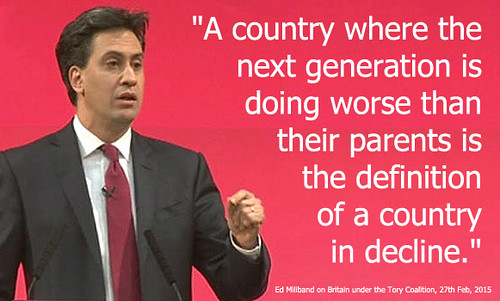
A country where the next generation is doing worse than their parents is the definition of a country in decline – Ed Miliband

63268_113108112092059_4514415_n (1)Labour pledges to cut tuition fees

Ed Miliband has confirmed that if elected, Labour will cut tuition fees in England to £6,000 from autumn 2016. He has also promised that the policy would be non-negotiable in the event of a coalition. Mr Miliband explained that the fee cut would be funded by reducing tax relief on pensions for those earning more than £150,000 per year.

Speaking in Leeds, at the College of Music, Mr Miliband said that the tripling of higher education fees by he Coalition has been a “betrayal of an entire generation”, as students struggled with average debts of $44,000. He added that Nick Clegg’s broken promise to abolish university fees caused young people to doubt anyone in politics can be trusted.

“I made you a promise on tuition fees. I will keep my promise,” Miliband has vowed.

Non-repayable maintenance grants would also be extended by £400 per year for families with a total income below £42,000, to help cover students’ living costs.

The National Union of Students (NUS) has welcomed plans for a cut in fees.

“Forcing debt on to students as a way of funding universities is an experiment that has failed,” said NUS vice president, Megan Dunn.

“Higher education is a public good which should be publicly funded and shouldn’t involve any additional charges for students or graduates, but lowering tuition fees and a move away from the market in higher education is a positive step forward.

We would also welcome any improved financial support measures like an increase in maintenance loans, as we know that students are currently in the throes of a cost-of-living crisis.”

Ed Miliband set out the true cost of the Government’s disastrous tuition fees policy which has not only burdened graduates with debts unimaginable for previous generations – but the taxpayer, also, with billions of pounds more in national debt.

In his speech in Leeds, he warned that young people have been betrayed by this Government from their first days in school through declining training opportunities, the trebling of tuition fees, rising housing costs and even changes in voting registration which is denying them a voice in the coming election.

Unveiling Labour’s fourth election pledge, he set out details of Labour’s Zero-Based Review into Higher Education funding which show that under the system introduced by this government:

  • A total of £281 billion will have been added to the national debt by 2030.
  • Students will graduate with an average of £44,000 of debt.
  • National debt will grow by £16bn more by the end of the next parliament than the Government predicted only a year ago.
  • Write-offs from student loans are set to jump to £21bn a year over the next three decades – almost double the total spent now on police services in England and Wales.

Key extracts from the speech:

Ed Miliband said that this is the first time in almost a century when the next generation cannot expect to do better than the last – a huge issue not just for young people themselves but for their parents and grandparents too.

This used to be a country where it was almost taken for granted that the next generation would do better than the last. This was the Promise of Britain. Now we are a country where it is almost taken for granted they will do worse. 

This is a promise unfulfilled: all that talent, ambition, hope for the future going to waste. Plans put to one side, dreams dashed; the Promise of Britain is being broken. Today I appeal to every parent and grandparent in  Britain: we can turn this around for your children and your grandchildren. None of us want to see our kids treated like this. 

This is a disaster for them and a disaster for the future of Britain too –  a country where the next generation is doing worse than their parents is the definition of a country in decline.”

Ed Miliband said the Government is responsible for a betrayal of  young people.

“What has happened over the last five years is more than just a betrayal of election promises, it is a betrayal of an entire generation: a betrayal from their first steps to the time when they stride into the world of work; a betrayal from nursery to school, from college to university, a betrayal to the jobs or homes they hope to have afterwards – and even on their ability to vote.”

Ed Miliband criticises the Government for failing to act.

“All the young people of Britain have had from government during the last five years is blame, denial and broken promises. Young people out of work? Blame them for not making an effort. Apprenticeships for young people falling? Rebadge some training schemes for older workers and claim they’re going up. 

The cost of going to university? Promise one thing in an election and deliver exactly the opposite immediately after. Worried about being held to account by young people for all those broken promises?  Change the rules and it is harder for them to vote.”

Ed Miliband set out how the trebling of tuition fees has affected millions of young people.

“We all know that under David Cameron and Nick Clegg the fee cap for full-time undergraduates was trebled to £9,000 per year. With most universities charging close to the maximum, graduates now leave university with more than £44,000 debt on average. 

My generation would never have imagined beginning our adult life with that amount of debt. But this government expects it of this generation.”

Ed Miliband said this is not just burdening young people with debt but also the taxpayer.

“Today we are publishing our Zero Based Review into the current tuition fees system. Its findings are stark. It reveals beyond doubt that the scourge of debt is not just holding back young people, it is holding back our country. 

The Government has designed a system which is burdening students with debt today and set to weight down the taxpayer with more debt tomorrow.

This is a system that will have added an extra £16 billion more than predicted to public debt by the end of the next Parliament. If left unchecked the system will have added £281 billion to debt by 2030. And much of this money will never be paid back.  

By the late 2040s student loan write-offs will be hitting £21 billion a year – almost double the entire cost of police services in England and Wales. It must go down as one of the most expensive broken promises in history.”

We must extend equal opportunities to young people, widening access to higher education is one way of doing this. It also ensures we progress as an inclusive society, each generation building on the achievements of the last.

Full text: Ed Miliband’s speech pledging tuition fees cut.

rob miliFabulous memes by Robert Livingstone

Ed Miliband announces that Labour will put democratic leaders’ debates on a statutory footing. And Cameron is a coward.

chickenEd Miliband is quite right to call Cameron a chicken. Tory MP Rees-Mogg appeared on Channel 4 News and laid bare the reason for Cameron’s “predicament” regarding the pre-election debates – it’s all because of a “left-wing conspiracy.” Really.

Gosh, does that mean the BBC’s political editor, Nick Robinson, once chairman of the Young Conservatives, has undergone a radical Trotskyist transformation whilst we slept?

Since when was debate, open discussion of pressing issues that affect the electorate, democratic discussion of policies, political transparency and  accountability deemed a “left-wing conspiracy”? Given the priceless claim of “BBC bias”, despite Iain Duncan Smith’s ongoing intensive monitoring campaign to keep the beeb “right”, I had to chuckle very heartily at that. It gave me quite a sarcastic turn.

I’m sure that emminent communist Lord Patten of Barnes must be delighted that standards haven’t slipped since he resigned last May as the Chairman of the BBC Trust, which is the appointed governing body.

Mind you, the government appointment of Pattern’s successor, following backroom negotiations, certainly raised a few eyebrows. Renowned socialist, Rona Fairhead (appointed a Commander of the Order of the British Empire in 2012) is one of the government’s business ambassadors and a director at the Cabinet Office, advising Francis Maude. There may be a glimpse of a political hinterland, however, from the fact that her husband, Tom, a director of the private equity firm Campbell Lutyens, was a Tory councillor.

Andrew Neil, the presenter of the BBC’s flagship political programmes Daily Politics and This Week, is chairman of the Spectator magazine. His editor is Robbie Gibb, former chief of staff to Francis Maude. And after the BBC’s economics editor Stephanie Flanders left for a £400,000-a-year job at that communist hotbed, JP Morgan, she was replaced by its business editor Robert Peston.

Peston himself has said: “Any suggestion the BBC has a left-wing bias is bollocks and the broadcaster actually veers towards a right-wing, pro-establishment view for fear of criticism.”

Research does indeed indicate that the BBC’s output is heavily biased towards the establishment and right-wing sources. Cardiff University undertook an extensive study, revealing that whilst there is always a slight bias towards political incumbents, the ratio in favour of Conservative politicians appearing on BBC news is significantly far greater than it was in favour of Labour figures when Gordon Brown was prime minister. Business representatives appear much more than they do on commercial news, and appear 19 times more frequently than trade union spokespersons on the BBC Six O’Clock News.

The evidence from the research is very clear. The BBC tends to reproduce a pro-Establishment, Conservative, Eurosceptic, pro-business version of the world. Furthermore, the Queen appoints the regulatory body – the BBC trust –  advised by government ministers, and the BBC trust then appoints the Director General. This has led to a public service run by people with strongly right-wing political and business affiliation.

Tory insiders say that Cameron is “determined” to avoid participating in the televised debates on equal terms with Miliband before the election, as he believes the Labour leader is the only one who would benefit. Chief election strategist Lynton Crosby and the former party deputy chairman Lord Ashcroft both insist Cameron should not risk taking part in a head to head, even if he endures “short-term criticism” for not doing so.

Ed Milband has announced that a Labour government would take legal steps to make sure leaders’ debates become a permanent feature in general election campaigns following David Cameron’s flat, arrogant refusal to take part in the three showdowns proposed by broadcasters.

A Labour government will move to put “fair and impartial leaders’ debates” on a statutory footing in an effort to avoid them becoming subject to the kind of “political wrangling” that has characterised the programmes scheduled for next month in the run-up to polling day.

The new system would work on similar lines to the current rules for planning the number, length and timing of party political broadcasts, under which parties are consulted but not given the power to veto them.

This may be done by establishing the body which negotiates the terms of debates as a trust in statute with responsibility for determining the dates, format, volume and attendees.

A Labour government would set a deadline of 2017 for changes to be put in place, giving more than enough time to plan the debates for a 2020 election.

Meanwhile, the four broadcasters – the BBC, ITV, Sky and Channel 4 – have said they will stick to their previously-announced plans for three debates during the election campaign, and urged the Prime Minister to “reconsider” his refusal to take part in these shows, including a head-to-head showdown with Mr Miliband.

Miliband told the Observer: “In recent days the British public has been treated to the unedifying and tawdry spectacle of a prime minister seeking to duck out of the TV debates he once claimed to support with great enthusiasm. Yesterday the broadcasters made it clear they would not be cowed by his tactics but it is wrong for them and the British public to have governing parties use this kind of pressure in campaign periods. It is time to ensure, once and for all, that these debates belong to the people not the prime minister of the day.”

But Cameron hasn’t exactly led a democratically inclined, transparent and accountable government for the past five years. He knows that in agreeing to just one debate with seven parties, questions will get such a short time for responses that he can evade any meaningful, in-depth scrutiny regarding his appalling policy record, entailing the myriad U-turns, inflicted cruelties and crass, prolific dishonesties of his leadership. And the one debate that Cameron has agreed will take place before his party manifesto is published, which again dodges accountability to the electorate: a profoundly (and consistently) undemocratic approach.

As Vernon Bogdanor, professor of government at King’s College, London says: “Debates should not be subject to the tactical calculations of party leaders. There is certainly the case for a statute requiring debates between leaders of all parties with over 5% of the vote; and a separate debate between the PM and leader of the opposition. That statute is best administered by the Electoral Commission rather than the broadcasters who can too easily be accused of bias.”

Cameron clearly dare not debate head-to-head with Ed Miliband – which is remarkable, given that the Tories’ entire campaign is predicated on portraying the Labour leader as “weak and incompetent.” So why is Cameron too afraid to confront him in public?

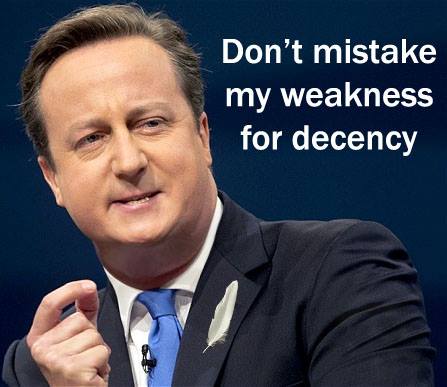
Last year I wrote that people often mistake Miliband’s decency and refusal to engage in negative smear campaigning as “weak”: it isn’t. This year, Ed Miliband has acknowledged that perception – fueled by a desperate Tory party and right-wing media barons that have endeavoured to portray Miliband as “unelectable” – asked us not to make that mistake, in an interview with Simon Hattenstone  – Ed Miliband: don’t mistake my decency for weaknessIt’s worth reading the entire interview, what shines through is Miliband’s genuine warmth, honesty, decency, strength and conviction in his principles.

Miliband is no “career politician” and Cameron knows that formal debate with him would serve to juxtapose unfavourably – exposing the vast differences between his own unprincipled archetypal anti-heroic Flashman character – a manipulative scoundrel and liar, a cunning cheat, a corrupt and coarse coward  – and a steadfast, decent, true partisan, conviction politician with principles and integrity. Miliband is precisely the prime minister that this country so desperately needs. Cameron knows it. He doesn’t want the public to know it.

Cam weaknessThe right-wing media campaign, aimed at attempting to undermine Miliband’s credibility as a leader, arose precisely because Miliband is the biggest threat to the UK power base and status quo that we’ve seen for many decades. He’s challenging the neo-liberal consensus of the past 30 years – now that is a plain indication of strong leader, and someone with personal strength and courage. Qualities that Cameron so conspicuously lacks.

I wonder if the Tories consider their imminent loss on 7 May due to their own callous policies, prolific lying and unmitigated economic disaster these past five years a left-wing conspiracy, too?

Laugh out loud.


Further reading:

Cameron’s chief spinner on leaders’ debates: No no no! The PM should hide and throw things at Miliband

The establishment are ‘frit’ because Ed Miliband is the biggest threat to the status quo we’ve seen for decades

The moment Ed Miliband said he’ll bring socialism back to Downing Street

Miliband is an excellent leader, and here’s why

The Tories attack Miliband because they’ve got no decent policies

The BBC expose a chasm between what the Coalition plan to do and what they want to disclose

Once you hear the jackboots, it’s too late

tory liesThanks to Robert Livingstone for the excellent memes.

It’s about time the Green Party stopped their compliance with the Conservatives

10940505_767712909964906_6225427822143651262_n

“Of all tyrannies, a tyranny sincerely exercised for the good of its victims may be the most oppressive.”  C.S Lewis.

Following her election as party leader, Natalie Bennett told a press conference that the policies of the Green Party were “the only viable way forward for British people, for the world.”  It is extremely presumptuous of people to claim to act for “the people” when they seem to despise the ideology of a large part of “the people.”

Much Green Party policy and philosophy seems to be essentially grounded in a sort of eco-supremicist bad faith. We consume too much. (Who does, exactly? ) And no matter how much the Greens try to distance themselves from the stigma attached to Malthusianism there is no escaping the fact that arguments about consumption and population are inextricably linked.

Tristam Hunt recently described the Green Party as “stop-the-world-I-want-to-get-off politics.” Apt for what is ultimately a politics of perpetual bad faith and lip-curling disapproval of others. The language used to describe other parties by grassroot supporters betrays this and lends to the Green Party worrying characteristics of cult thinking.

The ecology movement will never gain any real influence or have any significant impact on society if it advances a message of despair rather than hope, of a regressive and impossible return to primordial human cultures and sensibilities, rather than a commitment to human progress and to a uniquely human empathy for life as a whole. I agree with the following:

“I can easily understand why despair exists among mystical ecologists – indeed, in the environmental movement generally – over the impact of a grow-or-die capitalistic economy on the biosphere and on the human psyche. While a patronising, quasi-religious often misanthropic ecology that denigrates the uniqueness of human beings and the wondrous role they can play in natural evolution may be an understandable response to that economy, it is a flat denial of humanities’ most human potentiality: the ability to change the world for the better and enrich it for all life forms.

We must recover the utopian impulses, the hopefulness, the appreciation of what is good, what is worth rescuing in human civilization, as well as what must be rejected, if the ecology movement is to play a transformative and creative role in human affairs. For without changing society, we will not change the disastrous ecological direction in which capitalism is moving.” – Murray Bookchin, 1991

In an article titled: In response to the Socialist Party of GB’s slur on the Green Party & Ecosocialism, Martin O’Beirne writes:“We also need a mass movement against climate change and to promote new ways of existing, prefigurative, perhaps moneyless, primitivist, eco-technic or some combination. Something that points the way to that which can exist beyond capitalism.”  He went on to say: “Capitalism and consumerism, manufacturing consent, keep the multitude docile chasing trinkets and so on.”

In other words, most of us are stupid, and need “fixing”. Not moral, progressive, socialist proposals, but rather, moralising, regressive ones.

The Green Party have gathered up many dislillusioned ex-Liberal Democrat voters, the ones who haven’t learned from last time that like the Liberal  Democrats, any party that tries to appear to be all things to all people is not being honest with you.

Badly disappointed idealists most readily succumb to the depths of disillusioned, resentful cynicism. The Greens are very busy trying to hoover up the votes of all of those disillusioned souls on the Left, and regardless of the potentially devastating consequences that may have on the election outcome.

The pressing issue for me is that people are suffering, some have died because of Tory policies, our society is being fundamentally damaged, and to the point where it will soon be impossible to repair it in our lifetimes. The damage will be lasting, probably for more than one generation. I care about that. I care about the suffering, growing inequality, the re-appearance of absolute poverty, not seen in the UK since the 1930s, and the damage to our society and country.

I’m a socialist because of those long-standing concerns, which transcend the parochial and actually, they transcend party politics. What matters to me is ensuring that we vote intelligently for the best possible outcome we can, especially for those who are suffering greatly because of the current government. I am fundamentally cooperative and community-minded. I care about what happens to others.

Cameron has made no secret of the fact he is playing up the Greens’ potential for influencing and eating into Labour voters. It was very apparent when he refused to appear in TV debates unless Bennett is also invited to take part. The Conservatives’ sudden pro-Green tactics, focusing on the party’s exclusion from the debates, and some Tory MPs suggesting left-wing voters in their constituencies vote Green instead of Labour, are pretty transparent.

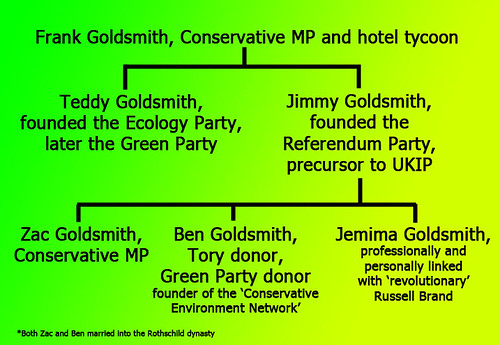
All this from the prime minister who dismissed environment policy as “green crap” not long ago. It isn’t just the Tories displaying utter cynicism, here. The Greens are too. They have attempted to account for their unlikely alliance with the Tories by claiming that the Green Party sees itself as having a role to put pressure on Labour to become more “progressive”  However, the Greens themselves are not progressive at all. As their roots indicate, as much as their policies:

goldsmith greenHow about putting pressure on left-wing voters to divide them, with the likeliest outcome of allowing another Tory government? It’s rather pointless trying to claim the Greens are “pushing Labour left” when the outcome of that is likely to bleed votes from Labour, ultimately.

And that attempt at explanation of the fact that the Greens attack and undermine Labour, rather than the Tories conveniently circumvents the fact that the Green Party tell intentional lies about Labour’s policies. A genuine attempt to influence Labour policy would entail negotiation and co-operation, not constant, hostile undermining tactics, coupled with an alliance with the Tories.

The Greens are not cooperative or community-minded. They are dividing our opposition to the Tories and risking returning Cameron to Office in May. They prefer to undermine the Labour Party, because they are purely electioneering, rather that directing challenges at the Tory-led Coalition. That is not “socialist”.

How “socialist” is it to join ranks with the party inflicting all of that damage and harm on people of this country to attack and undermine the only viable alternative to the tories? That’s not genuine politics, that’s grandstanding. It’s not “socialist” at all.

Jon Ashworth, Labour’s shadow Cabinet Office minister, said: “David Cameron’s new-found affection for the Green Party is nothing short of political opportunism. If you ever needed proof that a vote for the Greens is a vote for David Cameron, this is it.

The Tories and the Greens seem to be working hand-in-hand. The Tories need the Greens because they are scared to run on their own record. The Greens need the Tories because Labour is the only party with a progressive policy agenda.”

You can’t claim to be a “progressive ” political party and at the same time advocate zero growth and parochialisation – to cut us off from global trade. The Green Party says: “In our Green vision for Europe we seek to replace the unsustainable economics of free trade and unrestricted growth with the ecological alternative of local self reliance and resource conservation, within a context of wider diversity.” That’s a clear step back from internationalism and forwards towards parochialisation. It’s not progressive at all to shut out the rest of the world. And socialists have always been internationalists. The Green Party, on the other hand, find natural allies with nationalist parties such as the Scottish National Party (SNP).

The economy matters to every country in the world and no growth or low growth economies invariably mean high unemployment, increased inequality and increased absolute poverty. There are a variety of ways by which governments may mitigate social inequality. It’s known that Countries with a left-leaning legislature have lower levels of inequality. Many factors constrain economic inequality – they are often divided into two classes: government sponsored, and market driven. The relative merits and effectiveness of each approach is of course debated.

Government initiatives to reduce economic inequality include: public education: increasing the supply of skilled labor and reducing income inequality due to education differentials.

Progressive taxation: the rich are taxed proportionally more than the poor, reducing the amount of income inequality in society if the change in taxation does not cause changes in income. These form the basis of  Miliband’s approach, with his proposals for redistribution via a very progressive tax system. This is why tax-dodging billionaires  such as Stephano Pessina are complaining about Labour’s genuinely coherent, costed, evidenced, progressive equality-focussed redistributive tax policies, and not Green Party policies.

Market forces outside of government intervention may also reduce economic inequality, including the propensity to spend. The Green Party, however, does not support any of these options. Their anti-growth, anti-consumption starting point excludes all of these measures. Their key policy  proposal – Universal Basic Income – was shown to be so flawed that the Greens announced it is to be withdrawn from their manifesto.

Bennett has tried to brush aside criticisms that her party’s policies would lead to economic catastrophe, emphasising the Green’s stance against materialism. “People don’t just want to work to earn more and more money,” she said. “They want to do other things that often now aren’t recognised and valued.”

However, an isolationist zero growth economy would be a disastrous experiment, just like the austerity measures have been – with the same outcomes. The Green Party does not present a single coherent policy that may be deemed a viable alternative to austerity, yet it claims: A real change: from austerity and welfare cuts to investment in decent jobs.”

Not only would the Green Party’s anti-progressive zero growth economy create high unemployment, it most certainly create deep recession and the policies are cumulatively pro-austerity, in that they advocate inhibiting public spending on consumer goods.

The Green Party fail to show us any understanding of imbalances of power, they provide no class analysis, they aren’t connected with marginalised groups, they don’t reflect their needs and they clearly have no understanding of the mechanics and virtues of redistribution. There isn’t a single policy currently in their manifesto that demonstrates a coherent offer of support to very poorest. That isn’t “socialist” at all.

The Greens grew out of the environmental movement, with David Icke at the helm as a spokesperson, well, until they got embarrassed by him and sacked him. As Suzanne Moore commented, the incoherence is even apparent at how they fail to define the State. They offer the biggest of big-state polices with huge intervention in some areas, without specifying the role of the state except as a series of committees. It’s a curious mix of immense levels of authoritarian state control over our private lives, a strongly moralising approach, alongside a moral relativism towards things like sex industry, terrorism and crime. Page 3 is frowned upon, but how can prostitution be regarded as any less economical exploitative of women? That’s certainly not coherent policy-making.

The Green’s “anti-austerity measures” seem to translate as “taking on corporations and vested interests.” But Miliband has already explicitly stated (and shown) that he will do that. (He already has – Leveson, the banks, the big power companies, water companies, to name a few)

The Green Party’s key policy idea – that of a Citizen’s Income for everyone whether they work or not – sounds so great on the surface. Just like a lot of their rhetoric and policies, it lacks depth and doesn’t connect up – it lacks integrity and falls to pieces when properly examined. Many of the poorest households would lose out. Most wealthy households will gain. How does that address inequality – something the Greens claim to be concerned about?

The “citizen’s income” of just £71 a week, at an annual cost of £280billion would replace existing welfare payments such as personal tax allowances and means tested benefits such as income allowance and jobseekers benefit.

It was a popular policy during the 1990s, with notable libertarian economists on the Right, such as Milton Friedman (the founding father of monetarism) favoring the model as a type of negative income tax. Friedman attacked the very notion of Social Security, stating that it had created welfare dependency. Friedman’s political philosophy extolled the virtues of a free-market economic system with minimal state intervention. Friedman proposed the replacement of the existing U.S. welfare system with a negative income tax, a progressive tax system in which the poor receive a basic living income from the government.

The Liberal Democrats have included similar policies in their manifesto in 1996.

The Citizen’s Income Trust (CIT), which has given advice to the Green party (and has also been repeatedly cited by the Greens a credible source), has modelled the Green Party scheme and discovered it would mean 35.15% of households would be losers, with many of the biggest losers among the poorest households.

The Trust’s research shows that for the two lowest disposable income deciles, more than one-fifth would suffer income losses of more than 10%.

If anything, this policy will EXTEND inequality.  That’s not very “socialist”.

Many critics of the Green party point to their many failures in Brighton and Hove, where they couldn’t even get the rubbish collection right. However, the most damning criticism – their fundamental inability to run services for the most vulnerable – is the one that ought to concern us the most. That’s not very “socialist.”

Using minorities as nothing more than political props and tools. That’s not very “socialist”.

During a recent interview, with the Times, Bennett defended commitments to decriminalise membership of terrorist organisations, possession of drugs, and prostitution, as well as promising to abolish the monarchy and remove the Queen from Buckingham Palace.

Bennett said: “I can’t see that the Queen is ever going to be really poor, but I’m sure we can find a council house for her.”

The remark appeared to be a glib, clumsy attempt to grab some media attention, given the Queen’s private wealth. As far as an appeal to juvenile anti-establishmentarians go, it was probably a successful glib, clumsy remark. The Green Party’s stated policy on the monarchy is that it should cease to be an office of government and that the property held by the royal family should be divided between that required for the private life of current members of the family, with the remainder to become public property. Not sure I could use any staff, spare tiaras or corgis, personally, but thanks for the thought.

The Tories have trashed the economy, damaged the very structure of our society and destroyed people’s lives. We’ve seen the return of absolute poverty, malnutrition and illness, such absolute poverty-related illness has not been seen since Victorian times. People have died as a consequence of Tory policy.

What do the Greens do? Bitch about LabourMany thanks to Robert Livingstone for his excellent memes

The ultimate aim of the “allthesame” lie is division and disempowerment of the Left.

1796655_294409220710133_3373329_n

The speech-writer for David Cameron in the run-up to the 2010 general election, Ian Birrellseems to have finger in every lie on behalf of the Tories. He’s the contributing editor of The Mail on Sunday, whilst writing columns regularly in several other papers. He’s been published in The Guardian, The Wall Street Journal, The Economist, The Daily Mail, The Financial Times, The Times, The Observer, The London Evening Standard, The Sun, The Daily Telegraph, The Sunday Telegraph, The Independent, The Independent on Sunday, Prospect, New Statesman and The Spectator.

On the 2nd January, Birrell cobbled together a somewhat strange and hugely speculative article in the Guardianclaiming that “a Tory-Labour unity coalition may be the only way forward after 7 May” and the two parties have more in common with each other than with the insurgents. A national government would prevent a constitutional crisis.”

There are no quotes or citations, just an unsubstantiated comment: “But most people in Westminster privately predict a hung parliament.”

As I said, entirely speculative, seemingly without an aim.

Birrell also claims there was “a brief flicker of unity” between the parties during the Scottish referendum. That’s a neat side-stepping of the fundamental fact that Labour, like most socialists, have always been internationalists, which has absolutely nothing to do with the Tories’ position on Scottish independence at all, and everything to do with Labour’s core values. It’s also a claim frequently made by the Scottish Nationalists –  Labour “sided with the Tories.” Anyone would think that the Scottish National Party want to undermine support for the Labour Party in Scotland…

There is of course a subtext to Birrell’s article. It is a piece of propaganda. The subtext is “the mainstream political parties are all the same.”

The “allthesame” myth came straight from Tory HQ. The BBC’s Tory correspondent Nick Robinson admitted live on air that Cameron’s best chance of winning the next election is if people believe politicians are “all the same.” That is very clearly not the case. I think this is a major ploy aimed at propagandarising an exclusively class-based identity politics, to target and fragment the “working class left.”

It purposefully excludes other social groups and also sets them against each other, for example, working class unemployed people attacking migrants – it really is divisive, anti-democratic, and quite deliberately flies in the face of Labour’s equality and diversity principles. That’s the problem with identity politics: it tends to enhance a further sense of social segregation, fragmentation and it isn’t remotely inclusive.

Of course it also enhances the tropes “outoftouch” and  “allthesame.” It’s a clever strategy, because it attacks Labour’s equality and inclusive principles – the very reason why the Labour movement happened in the first place – and places restriction on who ought to be included.

Think of that divisive strategy 1) in terms of equality; 2) in terms of appealing to the electorate; 3) in terms of policy. Note how it imposes limits and is reductive.

It also demoralises and confuses people.

The Tories set this strategy up in the media, UKIP have extended it further and the minority rival parties, including the Green Party and the Scottish National Party have utilised the same rhetoric tool: all of these parties frequently use the term “liblabcon”for example. That’s a sort of cognitive shortcut to what has been tacitly accepted, apparently, as a “common sense” view that partisanship amongst the mainstream parties is dead. I’ve written at length about this process of “normalisation” –  how social conservatism and neoliberalism have been absorbed culturally, and how this serves to naturalise the dominance of the Right and stifle the rationale for critical debate here – Manufacturing consensus: the end of history and the partisan man.

Be prepared for much more of this propaganda tactic: the Right are engaged in an all out war.

Firstly they know that Ed Miliband has edited their script, abandoning the free-market fundamentalist consensus established by Thatcherism in favour of social democracy.

Secondly, the right-wing media barons who set the terms of what is deemed politically palatable in Britain have never forgiven Ed Miliband for his endorsement of Leveson, which they believe is an unacceptable threat to their power.

Thirdly, they know Labour under Ed Miliband may well actually win the 2015 election.

It doesn’t take much effort to work out that the two main parties in competition have nothing in common at all. They debate oppositionally in parliament. Cameron attacks Miliband at every opportunity and on a very personal level, quite often. It’s plain, if you listen to the parliamentary debates, that neither man can stand what the other represents.

And how would the Tories and Labour reconcile their fundamental differences regarding human rights, the European Convention On Human Rights (ECHR) and the European Union? How about the bedroom tax? The National Health Service? Taxation? The welfare reforms? Equality? These are issues on which the two rival parties will never be able reach a consensus.

10635953_696483917087806_7307164383030383606_n

It’s quite difficult to assert that there are significant differences between the parties, because of the constant repetition of the “allthesame” lie. It has become almost like a comforting, lulling mantra and a shortcut from cognitive dissonance. People often get quite angry when confronted with evidence that challenges this soundbite. But policies provide very good evidence, they are scripted from ideologies and are statements of a party’s intentions.

Ed Miliband has been cautious in making policy promises and has said that he won’t pledge anything that he may not be able to deliver. Here are Labour’s key policies to date, each has been costed and evidenced.

The thing about policies that have been passed into law is that they can be verified on the Parliamentary website and elsewhere. How many of you reading this think that Blair was a “Thatcherite”? I’m not a Blairite. I do like Miliband, who is a very different leader than Blair was. Miliband denounced New Labour in 2010. His stance on Syria in 2013 draws a clean line under the Blair approach. Yet Blair is still being used as a stick to hit the Labour Party with.

The claims made in lying articles in the media and the often inaccurate and distorted claims of fringe party supporters are based on a propaganda technique called transfer and association, which is a method of projecting negative (or positive) qualities of a person, entity, object, or value (an individual, group, organisation) to another in order to discredit it (or sometimes, to make the second more acceptable, this tactic is used in advertising a lot.)

It evokes an emotional response, which stimulates the target to identify with recognised authorities. But that stick is hitting a closed door now. Newsflash: Blair hasn’t been party leader for some years.

I worked on compiling a list of New Labour’s policies, and despite Blair’s faults, there really were some outstanding achievements, such as the Equality Act, the Human Rights Act, various animal welfare laws, Every Child Matters and the Good Friday Agreement. I have listed New Labour’s achievements with a comparable list of the Coalition’s “memorable” moments, too. If you hated Blair, and see him as some sort of high priest of neoliberalism, it’s probably even more important that you read this. I promise it will help you to understand cognitive dissonance, at the very least, and perhaps to appreciate the importance of evidence and critical thinking: Political parties – there are very BIG differences in their policies.

And this, for some balance and perspective: Thatcher, Mad Cow Disease and her other failings, the Blair detour and déjà entendu, Mr Cameron.

The “allthesame” lie is a way of neutralising opposition to dominant ideas. It’s a way of disguising partisanship and of manipulating and reducing democratic choices. It’s nothing less than a political micro-management of your beliefs and decision-making.

It also reduces public expectation of opposition and in doing so it establishes diktats: it’s a way of mandating acceptance of ideology, policies or laws by presenting them as if they are the only viable alternative. And those that refuse to accept the diktats are enticed by the marginal parties who offer much, safe in the knowledge that they won’t have to rationalise, evidence, cost or deliver those promises. This also plays a part in diluting viable opposition, because the smaller parties tend to employ the same strategy to gain credibility and support – negative campaigning and repeated lies and soundbites.

Lynton Crosby, who has declared that his role is to destroy the Labour Party, rather than promote the Conservatives, based on any notion of merit, is also all about such a targeted “divide and rule” strategy. This is a right wing tactic of cultivating and manipulating apostasy amongst support for the opposition. It’s a very evident ploy in the media, too, with articles about Labour screaming headlines that don’t match content, and the Sun, Mail and Telegraph in particular blatantly lying about Labour’s policy intentions regularly.

Propaganda isn’t always obvious, and that’s how it works. We need to be very mindful of this.

Ultimately, the only party that will gain from any of this negative campaigning approach and divisive propaganda is the Tories. And that is who we should be collectively opposing.

The Tories launched their election campaign a couple of days ago, and already, it’s obvious that the entire campaign is founded on attempting to undermine Labour’s  credibility by telling lies about their economic management – The Tory election strategy is more of the same: Tories being conservative with the truth.

Contrast the Conservative with the truth approach I’ve discussed here with Miliband’s consistently genuine approach to politics – Ed Miliband: Labour election campaign will be one of hope, not falsehood.  

Whatever party you support and regardless of whether or not we agree on the issues I raise, my key aim, whenever I write, is to inspire a sense of responsibility and some critical thinking. That helps to reliably inform our decision-making.

I won’t apologise to my critics for being a Labour Party supporter, but I will always provide evidence and analysis to support and justify my own views and I will always be happy to engage in dialogue, provided that it’s a respectful and polite exchange. No party is above criticism, quite rightly so, as politics has to be an accountable, reflective and responsive process. That’s what democracy is about.

There is, however, a big difference between genuine criticism, on the one hand and propaganda and lies on the other, which are being masqueraded as “criticism.” If debate isn’t established on a genuine, critical exploration of evidence and establishing truths, then it’s not debate: it’s simply indoctrination.

Related

Don’t believe everything you think: it’s almost election time.

From  Psycho-Linguistics to the Politics of Psychopathy. Part 1: Propaganda

Ed Miliband is the biggest threat to the status quo we’ve seen for decades.

Once you hear the jackboots, it’s too late.

The moment Ed Miliband said he’ll bring socialism back to Downing Street.

Ed Miliband’s policy pledges at a glance

Miliband is an excellent leader, and here’s why.

Cameron’s Nudge that knocked democracy down: mind the Mindspace.

403898_365377090198492_976131366_nThanks to Robert Livingstone for the excellent memes.

David Cameron promised a further £7.2 BILLION tax cuts to the rich at the expense of the poor

1450041_569755536427312_1698223275_n

I wrote an article last year – Follow the Money: Tory Ideology is all about handouts to the wealthy that are funded by the poor – which outlines Coalition policies that have widened inequalities and increased poverty by handing out public money to the wealthy that has been taken from the poorest. I pointed out that this Government have raided our tax-funded welfare provision and used it to provide handouts to the very wealthy – £107,000 EACH PER YEAR in the form of a tax break for millionaires, amongst other things.

And what does our imperturbable chancellor promise if this disgrace of a government is re-elected? True to Tory form, more of the same: austerity for the poor and public services cuts, and tax breaks for the wealthiest.

But further cuts to lifeline benefits and public services is surely untenable. Absolute poverty has risen dramatically, this past four years, heralding the return of Victorian illnesses that are associated with malnutrition. People have died as a consequence of the welfare “reforms”. Supporting the wealthy has already cost the poorest so very much, yet this callous, indifferent, morally nihilistic  government are casually discussing taking even more from those with the very least.

This isn’t anything to do with economic necessity: it’s all about Tory ideology. Under the guise of austerity, the Tory-led Coalition have stripped our welfare and public services down to the bare bones. Any further cuts will destroy what remains of our post-war settlement.

Despite facing a global recession, the Labour Government invested in our public services, and borrowed substantially less in thirteen years than the Coalition have in just three years. UK citizens were sheltered very well from the worst of the global bank-induced crash.

Gordon Brown got it right in his championing of the G20 fiscal stimulus, agreed at the London summit of early April 2010, which was a continuation of his policies that had served to steer the UK economy out of the consequences of a global recession, and to protect citizens from the consequences of cuts to services and welfare.

Osborne’s policy of imposing austerity and budget cuts on an economy that was actually recovering was a catastrophic error. The austerity propelled the economy backwards and into depression; and, far from using public spending as a countervailing force against the cutbacks in private sector investment, the Coalition’s budget cuts served to aggravate the crisis. Many people are suffering terribly as a consequence, reduced to a struggle for survival.

And in these socio-economic circumstances, the Tories have pledged a further £7.2 BILLION tax cuts to the rich. The funding for the tax cuts will come from further catastrophic “savings” made at the expense of the poorest yet again – £25 billion more to be sliced from welfare, Local Authorities,  education, police and other vital services.

Three things are immediately clear. Firstly, without the ramping up of VAT in 2010, to 20%, Osborne would be in even more dire financial straits than he is.

Secondly, income tax has, despite allegedly rising employment, failed to increase.

Thirdly, corporation tax, targeted for cuts, year after year, has slumped. The tax system is increasingly veering toward very regressive – biased in favour of the wealthy – consumption taxes, which affects the poorest, most, and failing to deliver fairer taxes on income.

This is the result of government policy: increasing VAT but cutting corporation tax, and the engineered kind of “recovery” we have ended up with. The Office for Budgetary Responsibility (OBR) reminded us in October of the extent of the Coalition’s failure to reduce the deficit.

Public sector net borrowing in 2013-14 was originally expected to be £60 billion; the out-turn for borrowing was £108 billion (on a comparable basis). This amounts to a shortfall of nearly £50 billion, with borrowing approaching double the original predictions made when the government’s austerity policies were announced in 2010.

Much of this shortfall is accounted for by the current earnings crisis. UK workers are suffering the longest and most severe decline in real earnings since records began in Victorian times, according to an analysis published by the TUC. But Tories always lower wages, and hike up the cost of living. And whilst workers are struggling to make ends meet, private business owners/Tory donors are raking in millions of pounds. But this is exactly how Tories like to run society in a nutshell.

It’s their imposition of a feudalist schemata for social relationships. Cognitively, Tories are the equivalent of historical egocentric toddlers: they are stuck at this painful stage of arrested development.

“The deficit reduction programme takes precedence over any of the other measures in this agreement” – stated in the Coalition Agreement.

For a government whose raison d’etre is deficit reduction, the Coalition really isn’t very good at all. But austerity reflects the triumph of discriminatory Tory ideology over needs-led, evidenced-based policy making.

The OBR said the forecast from 2010 was over-optimistic because it did not take into consideration the effect of lower wages as well as a higher levels of tax-free personal allowance on the upper brackets of income tax. National Insurance contributions were also £7.4 billion below forecast.

Which brings us back to the issue of further tax cuts for the wealthy, with no mention of raising wages for the poorer work-force, and of course there is the promise of more cuts to come for those relying on lifeline benefits. I don’t think that the Coalition cares that their policies don’t balance the books, as it were, or mend the economy. Nor do they care what the consequences are for the wider public.

TUC General Secretary Frances O’Grady said:

The government’s failure to get wages growing again has not only left families far worse off than in 2010, it’s put the public finances in a mess too. The economy has become very good at creating low-paid jobs, but not the better paid work that brings in income tax. The Chancellor’s sums just don’t add up – he can’t make the tax cuts for the better off that he is promising and meet his deficit reduction target without making cuts to public services.

His cuts would be so deep that no government could deliver them without doing damage to both the economy and the fabric of our society. We can’t cut our way out of this problem any more than we can dig ourselves out of a hole. More austerity would only keep us stuck in a downward spiral. The Chancellor should use next week’s Autumn Statement to invest in growth and to put a wages recovery at the top of the agenda.

Shadow Chancellor Ed Balls said:

Nobody will be fooled by pie in the sky promises of tax cuts when David Cameron cannot tell us where the money is coming from. Even the Tories admit this is an unfunded commitment of over £7 billion, so how will they pay for it? Will they raise VAT on families and pensioners again?

Cameron has also announced the basic rate before we start paying tax would rise from £10,500 to £12,500. While a worker on £12,500 would save £500 a year, someone earning £50,000 would keep £1,900 extra.

Those earning up to £123,000 would be £484 richer. Someone on £12,500 would save £500 a year, while someone on up to £50,000 would keep £1,900 extra. And the £500 tax cut for basic rate earners will be almost wiped out by George Osborne’s raid on in-work benefits.

Paul Johnson of the Institute for Fiscal Studies think tank says it was:

very difficult to see how the £7billion tax giveaway could be paid for.

We’re looking at promises of £7billion of tax giveaways in the context of an overall plan to get the deficit down but even without tax giveaways that requires pretty extraordinary levels of spending cuts such that most government departments will see their spending cut by a third by 2020.

How are you going to afford this? Even more dramatic spending cuts?

At the Tory Conference, Cameron promised to expand the National Citizen Service youth project for every teenager in the country, have the lowest rate of corporation tax of any major economy.

There was also a pledge to abolish youth unemployment by the end of the decade. But the Tory faithful gave the loudest applause for his pledge to scrap the Human Rights Act.

This is a truly terrifying pledge, because human rights were originally formulated as an international response to the atrocities of the 2nd World war, and to ensure that citizens are protected from abuses of their government.

A Labour Party analysis found the proposed tax break would hand David Cameron and other Cabinet ministers an extra £132 a year. But a family with two children with one earner on £25,000 a year would lose £495 by 2017-17 due to the benefits freeze announced by Mr Osborne.

The Tory plan is based solely on spending cuts, mainly directed at the working age poor. And the Conservative plan to raise the higher rate threshold to £50,000 means that  working-age poor people are to fund a tax cut that is four times greater for higher rate tax payers than for basic rate taxpayers.

Ed Balls said in response:

David Cameron’s speech showed no recognition that working people are £1,600 a year worse off under the Tories nor that the NHS is going backwards on their watch. The only concrete pledge we’ve had from the Tories this week is a promise to cut tax credits by hundreds of pounds for millions of hard working people while keeping a £3 billion tax cut for the richest one per cent.

TUC general Secretary Frances O’Grady added:

No amount of dressing up can hide the fact that the policies in this speech pass by those who need the most help to reward richer voters.

Alison Garnham, Chief Executive of Child Poverty Action Group, said:

What was missing in the PM’s speech was any recognition that independent projections show that child poverty rates are set to soar. We know that raising the personal tax allowance is an ineffective way of supporting low paid families.Independent analysis shows that just 15% of the £12 billion required to raise the PTA to £12,500 would go to working families in the lowest-income half of the population.

Many simply don’t earn enough to benefit from this policy, and those that do just see their benefits and tax credits withdrawn as their incomes rise.

The Institute for Fiscal Studies showed in their Green Budget publication this year that just 15% of the gains from increasing the personal allowance would benefit the poorest half of Britons, concluding:

There are better ways to help the low paid via the tax and benefit system.

Ex-Treasury official James Meadway,  now a senior economist at the New Economics Foundation, said Cameron’s changes were:

irresponsible, expensive gimmicks that scarcely affect the poorest workers.

They imply swingeing public sector cuts and mean handing over more cash to the already rich.

Ed Miliband will respond tomorrow (Monday), declaring that the Tories’ failure to tackle the cost-of-living crisis has helped cost the Exchequer £116.5 billion – leading to higher borrowing and broken promises on the deficit. The price tag, equivalent to almost £4,000 for every taxpayer, is based on new research from the House of Commons Library being published by the Labour Party.

This shows that low pay and stagnant salaries, combined with soaring housing costs and the failure to tackle root causes of increased welfare bills, means that over the course of this Parliament:

  • Income tax receipts have fallen short of forecasts by more than £66 billion.
  • National Insurance Contributions are £25.5 billion lower than expected.
  • Spending on social security is £25 billion higher than planned [despite brutal cuts to lifeline benefits]

Mr Miliband is expected to say the test for George Osborne in this week’s Autumn Statement will be to set out a plan to build a recovery for working people – one which recognises the link between the living standards and Britain’s ability get the deficit down.

He is expected to say:

For a very long time, our country has worked well for a few people, but not for everyday people. “We live in a country where opportunities are too skewed to those at the top, where too many people work hard for little reward, where too many young people can’t find a job or apprenticeship worthy of their talents, and where families can’t afford to buy a home of their own.

For all the Government’s boasts about a belated economic recovery, there are millions of families still caught in the most prolonged cost-of-living crisis for a century.  For them this is a joy-less and pay-less recovery.

My priority as Prime Minister will be tackling that cost-of-living crisis so that hard work is properly rewarded again, so that our children can dream of a better future, so that our public services including the NHS are safe.

Building a recovery that works for everyday people is the real test of the Autumn Statement.

But that isn’t a different priority to tackling the deficit. Building a recovery that works for most people is an essential part of balancing the books.

The Government’s failure to build a recovery that works for every-day people and tackle the cost-of-living crisis isn’t just bad for every person affected, it also hampers our ability to pay down the deficit.

Britain’s public finances have been weakened by a Tory-led Government overseeing stagnant wages which keep tax revenues low.

Britain’s public finances have been weakened by Tory policies which focus on low paid, low skilled, insecure jobs – often part-time or temporary – because they do not raise as much revenue as the high skill, high wage opportunities we need to be creating.

And our public finances have been weakened by higher social security bills to subsidise low paid jobs and the chronic shortage of homes.   

The result has been David Cameron and George Osborne missing every single target they set themselves on clearing the deficit and balancing the books by the end of this parliament.

Their broken promises, their abject failure, are not an accident. They are the direct result of an outdated ideology which says all a Government has to do is look after a privileged few at the top and everyone else will follow.

That is why this Government has done a great job of squeezing the middle, but a bad job of squeezing the deficit.

The test this week for David Cameron and George Osborne is whether they recognise that Britain will only succeed and prosper for the long term by tackling the cost-of-living crisis and building a recovery which works for the many, not just for a few.

Or whether they will just offer more of the same old ideas that have failed them, failed everyday working people, and failed Britain over the past four years.

10001887913_f8b7888cbe_o

Thanks to Robert Livingstone for the brilliant memes

The “Let Lynton Lobby Bill” – Grubby Partisan Politics and a Trojan Horse

487830_443702979032569_895018330_n

The Transparency of Lobbying, non-Party Campaigning, and Trade Union Administration Bill  is a calculated and partisan move to insulate Tory policies and records from public and political scrutiny, and to stifle democracy. The Government’s Lobbying Bill has been criticised by bloggers and campaigners from right across the political spectrum, with the likes of Owen Jones and Guido Fawkes united in agreement over this issue: that the Bill is a “Gagging Act”. Five Conservatives – Douglas Carswell, Philip Davies, David Davis, Zac Goldsmith and David Nuttall – voted against the Bill, whilst others also expressed concerns.

The Bill will treat charities, think tanks, community groups and activists of every hue as “political parties”. From small groups addressing local matters to big national organisations, all equally risk being silenced in the year before a general election, to avoid falling under electoral law. Any organisation spending £5,000 a year and expressing an opinion on anything remotely political must register with the Electoral Commission. Since most aspects of our public life are political, (and a substantial proportion of our private life has been increasingly politicised under this authoritarian Government) this stifles much essential debate in election years when voters should be hearing and evaluating policy choices.

The ambiguous way in which this bill targets anything which may impact on an election is calculated and deliberate. It is a way of intimidating charities, trade unions, religious organisations and all protest groups into remaining silent on important issues (such as protecting the NHS, introducing fair taxation, fighting poverty, public health, education, financial sector reform, civil liberties, human rights, the privatisation agenda) in election years, and this includes European elections and local Council elections too, so it will mean an almost continuous constraint on organisational freedom to comment on politics in any way.

Political blogs may well be at risk of being included too, since they are campaigning entities that potentially attempt to impact the outcome of an election. This is a serious threat to independent politics and an abhorrent authoritarian attempt to silence criticism of the Government, using the threat of fines and imprisonment. Here in the UK, we have a Government very clearly intent on policing critical thinking and opinion.

The National Council For Voluntary Organisations (comprised of a large group of charities) has asked whether this Bill is rushed and badly written or whether it is deliberately intended as a “Trojan horse” in order to curtail the freedom of charities to campaign for their causes. Another 100 charities have also heavily criticised the proposed legislation. There is a broad public consensus that it is indeed calculated and fully intended as a Trojan horse, and it was a view shared widely in Parliament at the hearing of the Bill yesterday.

Trade Unions have reacted in disgust and horror as the scope of the Trojan horse element of the legislation became increasingly clear. Joint cooperation between various unions will be made more difficult to such an extent that the Trade Union Congress will effectively be banned in election years. Another absurd element to the legislation is that the arbitrary spending limit of £390,000 will mean the smaller the Trade Union (or charity, religious group or protest site) the greater their proportional influence will become.

The heads of the main lobbying agencies have attacked the Bill too, claiming that the way the Bill has been designed will mean even less transparency in the lobbying industry and a register of lobbyists with hardly any names on it.

Lansley claimed yesterday that charities raising their concerns about the consequences of the Bill  have “over-reacted”, but that view is not substantiated by the rather lethal analysis from the Electoral Commission, which was sent to every MP. Though it will have to enforce the law, the Commission was not consulted on the Bill. The Commission Chair said it has been given far too much discretion in interpreting “political campaigning”, so its decisions are bound to be challenged in law.

The controls “will be impossible to enforce”, and the Commission warns that the Bill greatly widens the range of activities that count as electoral costs – to include rallies, polling research, events, media work, transport and staffing costs for groups never previously regulated. One big danger for risk-averse charities: “it will not be an organisation’s “intent” but the “effect of the expenditure” that sweeps them into electoral law, so they can never know what might be challenged”. The Commission’s warning should alarm every single MP.

Most damning is the Commission’s statement that it will have serious problems interpreting this law because there is no “clear rationale for many of the changes”. That’s very diplomatic and polite, as most of us can see the rationale all too clearly. The Government has attacked so many people via its draconian policies, many are now suffering the brunt of the austerity cuts: a front for Tory ideology. Many organisations and charities see it as a duty to speak up for the causes that people donate to. Whether that’s for the victims of abuse, the homeless, deprived young offenders or victims of crime, it’s always a fine line – but the Charity Commission already polices their politics, and had already installed William Shawcross, a controversial and somewhat right-wing chair. (Despite his previous support for the Labour Party).

So many agree that the Lobbying  Bill is a thinly disguised crude gerrymander to try and stymie Labour, the Unions and gag the Government’s most dangerous potential critics. As Frances O’Grady said in the Guardian last month, the law means unions will hit the spending limit just by holding an annual conference in election year, leaving them unable to campaign.

Glenda Jackson summarised it all very tidily yesterday when she said: “The Lobbying Bill is a gagging act, and as it stands it will prevent democratic voices being heard. It’s a step backwards from the codes of conduct and sanctions that already exist”. 

Nick Clegg is a prime mover on this Bill, as minister in charge of constitutional reform, and Dennis Skinner humorously and astutely pointed out during the debate yesterday that: “The Liberal Democrats support the lobbying bill because they do not want students campaigning against them over tuition fees in 2015.”

Labour shadow Commons leader Angela Eagle called the bill “one of the worst pieces of legislation I’ve seen any government produce in a very long time”. Referring to Andrew Lansley’s former role as health secretary, she added: “I think the last bill this bad might even have been the Health and Social Care Act, and your fingerprints were all over that one too”.

Although the Chair of the Electoral Commission said that regulators could be forced to take legal action against community groups and activists due to “confusion over their new role”, I don’t think there is any “confusion”.

The Tories are well known historically for their liking for “Gagging Acts”. Paine’s “Rights of Man” reached several hundred thousand readers and in May 1792, the Government reacted with a Royal Proclamation against “seditious writing”. There were Tory-organised local demonstrations of loyalty, including over 300 ritualised burnings of Tom Paine. The Government rushed in the further ‘Gagging Acts’ to tighten the treason statute and to ban large political meetings. A huge petitioning campaign followed, with loyalists expressing support and reformers protesting against the restriction, but the Bills were passed anyway.

In 1819, Lord Liverpool and his Tory Government responded to public outcry regarding the Peterloo Massacre by introducing the extremely oppressive Six Acts, which included gagging the “radical” press, and suppression of rights to public meetings. On the 23rd November, 1819, Lord Sidmouth, the Government ‘s Home Secretary, announced details of what later became  the Six Acts. By the 30th December,1819, Parliament had debated and passed the six measures that it hoped would suppress further dissent. There are examples of the Tory tendency for oppressive responses to dissent and criticism littered throughout history.

What we learned from this is that British political culture can be changed fundamentally in the course of resisting authoritarian efforts such as these, and now, we really must do so again.

Lobbying is simply the act of attempting to influence decisions made by officials in the Government, most often legislators or members of regulatory agencies. Lobbying is done by many different types of people and organised groups, including individuals in the private sector, corporations, fellow legislators, Government officials, or advocacy/interest groups.

Although lobbying is often spoken of with contempt, when the implication is that people with inordinate socio-economic power are corrupting the law in order to serve their own interests, another side of lobbying is making sure that the interests of others are duly defended against others’ corruption, or even simply making sure that minority interests are fairly defended against a tyranny of the majority. So there can be elements of power struggles to establish justice involved. Lobbying is therefore a crucial and very valuable part of democracy. Problems arise when some lobbyists are given priority, and come to influence Government policy-making more than others.

Before he became prime minister, Cameron predicted that secret corporate lobbying was “the next big scandal waiting to happen”, adding: “We all know how it works.” As a former lobbyist himself, he certainly did – and he still does.

Cameron’s own election adviser, Lynton Crosby, is a lobbyist for tobacco, alcohol, oil and gas companies. Which is why the prime minister came under attack for dropping curbs on cigarette packaging and alcohol pricing. Then there is Beecroft, the head of the private equity group that administers the high profile barely legal loan shark operation Wonga. The Wonga business model is to prey on the poor, vulnerable and absolutely desperate by offering them exploitative loans at eye-watering interest rates of 5,853% APR. Tellingly, even in the globally renowned haven of free-marketeering – the United States – such outrageous loans are illegal, but in the UK the Tory party are defiantly resisting efforts to regulate the so-called Payday lending sector and introduce maximum APRs.

Cameron’s party treasurer Peter Cruddas resigned after offering access to Cameron for a £250,000 party donation. His defence secretary, Liam Fox, resigned over his relationship with the lobbyist Adam Werritty. Political lobbyists were paid thousands of pounds to help broker a meeting with Liam Fox through Adam Werrity. Bell Pottinger were secretly filmed boasting about its access to the heart of Government, including its ability to persuade Cameron to speak to the Chinese premier on their behalf as well as its exclusive access to figures like William Hague. Let’s not lose sight of the scandals that have prompted this partly diversionary grubby, oppressively partisan policy from the Tories.

Last year the Tory party website openly offered donors the opportunity to attend events where Cameron was present, inviting supporters to join the “premier supporter group”, the Leader’s Group, whose annual membership costs a mere £50,000. (Here is the list of members). So signing up to the group will leave many free to buy direct access to the Prime Minister, other politicians and their advisers.

It’s worth considering that lobbying alone doesn’t begin to cover the extent of corporate influence on Government. The Tory party finds over half of its income from bankers, hedge fund and private equity financiers. Peers who have made six-figure donations have been rewarded with Government jobs. There’s a corruption that is eating our democracy and eroding our public life, and it’s perpetrated not just by lobbyists, but by the politicians, civil servants, bankers and corporate advisers who have increasingly come to swap jobs, favours and insider information, and inevitably come to see their interests as mutual and interchangeable.

The Bill won’t prevent lobbyists walking the corridors of power and speaking in parliamentary debates on the subject on which they work as lobbyists –  those such as David Howell, for example, in the news yet again today. George Osborne’s father-in-law was accused of a conflict of interest last night after it emerged he is being paid by a Japanese high-speed rail firm with commercial interests in the UK at the same time as having top-level access to the Foreign Office as William Hague’s personal adviser.He is being paid as a “European consultant” to JR Central, a train company which could be a bidder for multimillion-pound contracts connected to the controversial HS2 rail line.

At least 142 peers linked to companies involved and invested in private healthcare were able to vote on last year’s Health Bill that opened the way to sweeping and corrosive outsourcing and privatisation.  Recently, the Tory MP Patrick Mercer resigned the party whip when details of yet another lobbying scandal emerged.

The Tories have normalised corruption and made it almost entirely legal. Our democracy and civic life are now profoundly compromised as a result of corporate and financial power “colonising” the State.

So against this backdrop of their own sleaze, the Tories responded with the anti-democratic Lobbying Bill. If the Tories were had a an ounce of honesty about their anti-democratic intentions, it would be called the “Protection of Corporate Lobbying and Silencing of Legitimate Political Debate and Criticism Bill”.

Or the “Let Lynton Lobby” Bill, as Angela Eagle has dubbed it. The Bill had not been presented to the Select Committee in full until the day before recess, it emerged yesterday. The Electoral Commission hadn’t see the draft either. Cameron is also attempting to limit judicial review. If Select Committees are excluded from the legislative process, a case can be challenged under judicial review as that means the legislation is being created on an undemocratic and procedurally unfair basis. Select Committees are part of the constitutional area of law making, they simply cannot be ignored.

The withholding of key details of drafted Bills from Select Committees means that effective and organised challenging from the opposition is stifled, too. We most certainly have an authoritarian Government that arrived unannounced and unauthorised, one that has very clearly spent some time out of Office rather vindictively planning an attack on civil society, reversing the gains of our post-war settlement, and preemptively dismantling the means of redress. The contents of the Lobbying Bill highlight this further. This was a carefully calculated move, and such tactics have become increasingly common since this Government took Office. It would be an enormous mistake, if not academic dishonesty, to pretend that we now live in a liberal democracy.

The Government has left a large loophole in this legislation that allows the likes of Crosby to get around being on the register. When was the last lobbying scandal we read about that involved Oxfam, Vox Political, or the Durham Miners Gala? The Lobbying Bill won’t do a thing to stop the revolving doors between Government and corporate interests (Wonga being a high profile example of this), and neither will it prevent corporate interest parties being invited to actually write Government legislation on their behalf.

Recent freedom of information requests reveal that Treasury officials met fracking industry representatives 19 times in the last 10 months about their generous tax breaks, yet the public are denied any further details of that lobbying on the grounds that it could prejudice commercial interests,” said Green MP Caroline Lucas. “Is the Leader of the House not ashamed that this Bill will drastically curtail the ability of charities to campaign in the public interest on issues such as fuel poverty and energy but do nothing to curb such secretive corporate influencing? The Bill does nothing to prevent lobbyists working directly for commercial concerns from approaching government ministers and trying to influence them”.

Part three of the Bill centres on trade union membership records, Angela Eagle and Caroline Lucas agreed that there appears to be no policy motive for the introduction of this new law other than as a vehicle for cheap, partisan attacks on the trade unionsof which only a minority are actually affiliated to the Labour party. During a belated consultation meeting with the TUC – it took place after the Bill had been published – Department for Business, Innovation and Skills officials could cast no light on why part three exists at all.

Nor were they able to explain the origin of these proposals beyond their oft-repeated mantra that the provisions contained in part three: “It came out of a high level meeting between the Prime Minister and the Deputy Prime Minister. I think that revelation tells us all we need to know about the grubby, partisan nature of the measures “ – Caroline Lucas

The contents of this Bill are all about stifling essential democratic debate, and stymying legitimate criticism of the Government, and that in itself is actually frightening. But it’s also important not to lose sight of how this Draft has progressed, or rather, has been sneaked along to a second hearing. As I stated, the Lobbying Bill was NOT presented to the Parliamentary Committee in full until 1 day before recess. In fact the  Committee was presented initially with only the Consultation, and with no details of the Bill, for scrutiny. There has been NO pre-legislative scrutiny of this Bill.

T
his Bill has been entirely deviously constructed by a spiteful and self-serving, anti-democratic Government. That this same Government no longer deems it necessary to be accountable for its policies, and is by-passing democratic processes and legal safeguards, is frankly terrifying. We really do have an oppressive, authoritarian Government. Consider how likely is it that will this Bill will affect the likes of Rupert Murdoch’s News Corp UK and the Daily Mail Group, because they spend a huge amount amount per day, and much of the content of the press is highly political in nature.

Surely if charities and trade unions are going to have their freedom of speech curtailed to just £390,000 worth of influence, the mainstream press must be curtailed in the same way. Of course that won’t happen because the Tories are quite happy to have the baying right-wing press supporting their every step towards absolute tyranny. The press will most likely be exempt, because the Tories wouldn’t want to interfere with the (particular) “freedom” of the press. (Unless of course they object to specific information being made accessible to the public, in which case, they may demand that particular newspapers smash up their hard drives, whilst government officials intimidate the families of journalists by arresting them under “anti-terrorism” legislation.)

How did we get here? How could we be facing such tyrannical constraints on our most fundamental liberties, and it has happened so very quickly, too.

Paulo Freire said “Men and women develop their power to perceive critically the way they exist in the world with which and in which they find themselves; they come to see the world not as a static reality but as a reality in the process of transformation.” – Pedagogy of the Oppressed.

This insight offers us – and all of those who experience subordination through any imposed regime – a path through which we come to understand what it means to be a moving, shared cultural voice in a Society that is being constructed by the tyranny of a few to hold us still and in place like an object.

It is a learning process that always involves pain and hope; a process through which, as forced cultural jugglers, we can come to, cooperatively and subjectivity, organising and transcending our object position in a Society that hosts us, yet is becoming alien. It’s up to us to reclaim it, to make it our own. And to rebuild if we have to. I believe that history is built upon possibilities and human potential. We simply cannot allow this Government to foreclose and reduce that.

More reading:
Petition against Bill.
Independent – Report calls for withdrawal of Government’s lobbying reforms.
Owen Jones: Under the disguise of fixing lobbying this bill will crush democratic protest.
Mike Siver: Free speech is under threat.


29015_450121201724080_980762499_n


A big thank you to Robert Livingstone for his superb art work