Category: Political ideology

Iain Duncan Smith is complaining about valid criticisms of his draconian policies by journalists and social media commentators

36626_217452248405831_532419169_n

The Work and Pensions Select Committee has just published some letters between Frank Field, the chair, and Iain Duncan Smith, who responded to questions about the correlation between benefit assessments and suicide.

Mr Field had asked what data the Department for Work and Pensions collects on the deaths of benefit claimants.

The issue had been raised in a research report by Oxford University and Liverpool University entitled First Do No Harm, which I also reported on last year.

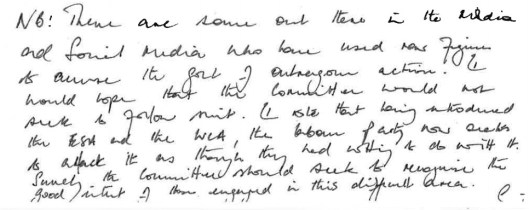
The letter addressed to Frank Field MP, features a barely legible hand-written footnote warning against listening to those “in the media and on social media” who “accuse the Government of outrageous actions.”

Duncan Smith writes in the footnote:

“There are some out there in the media and social media who have used [raw?] [ons ?- Office for National Statistics?] figures to accuse the govt of outrageous actions.

I would hope that the committee would not seek to follow suit. I [illegible] [note?] that having introduced ESA and the WLA, the Labour Party now seeks to attack it as though they had nothing to do with it.

Surely the committee should seek to recognise the good intent of those engaged in this difficult area.”

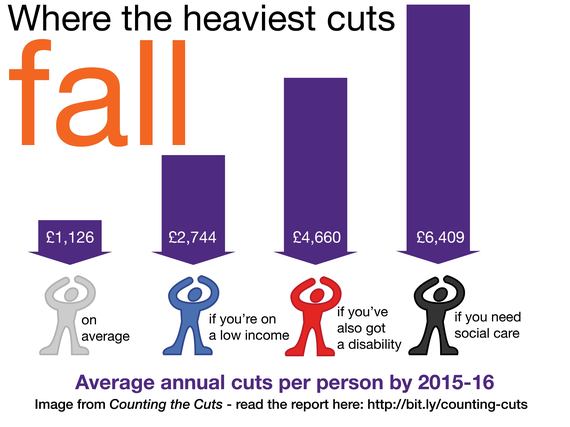
2014-02-17-BurdenoftheCuts-thumb
I would say that this blatant political discrimination constitutes an “outrageous action.” It’s difficult to recognise any “good intent” here, Mr Duncan Smith.

The correlation between the work capability assessment and suicide was established by academic researchers, not by journalists or social media commentators. We simply reported the findings.

Iain Duncan Smith will be accusing the United Nations (UN) of failing to see the government’s “good intent” when the inquiry into “grave and systematic violations” of the rights of disabled people in the UK concludes, next. Despite the fact that we are the first country to face such an inquiry, and given that the UN investigate only when there is evidence of grave and systematic violations of human rights, the prime minister has already dismissed the significance of the inquiry, ludicrously claiming “it may not be all it’s cracked up to be.”

It’s particularly noteworthy that when it comes to government claims, the same methodological rigour that they advocate for others isn’t applied. Indeed, many policies have clearly been directed by ideology and traditional Tory prejudices, rather than valid research and empirical evidence. The fact that no cumulative impact assessment has been carried out with regard to the welfare “reforms” indicates a government that is not interested in accountability, and examining the potential negative outcomes of policy-making. Policies are supposed to be about meeting public needs and not about inflicting Conservative dogma and old prejudices in the form of financial punishment on protected social groups.

As someone with a background in the social sciences, I have written extensive criticism of Iain Duncan Smith’s peculiar brand of epistemological and methodological fascism. He’s not exactly well known for his skill in statistical analysis, having been rebuked more than once for being notoriously conservative with the truth and numbers. Yet he feels compelled to dismiss the accounts of academics, campaigners, empirical evidence and the many qualitative accounts of those adversely impacted by his policies, in his vain attempt to exercise a stranglehold on his own peculiar brand of “truth.”

The goverment often claim that any research revealing negative social consequences arising from their draconian policies, which they don’t like to be made public “doesn’t establish a causal link.”  Recently there has been a persistent, aggressive and flat denial that there is any “causal link” between the increased use of food banks and increasing poverty, between benefit sanctions and extreme hardship and harm, between the work capability assessment and an increase in numbers of deaths and suicides, for example.

The government are referring to a scientific maxim: “Correlation doesn’t imply causality.” 

The tobacco industry made exactly the same claim about the established link between lung cancer and smoking.

It’s true that correlation is not the same as causation.

It’s certainly true that no conclusion may be drawn regarding the existence or the direction of a cause and effect relationship only from the fact that event A and event B are correlated.

Determining whether there is an actual cause and effect relationship requires further investigation.

This is something the government has persistently refused to do. (Here’s a full critique of Conservative methods of “social research”. I sent Mr Duncan Smith a copy, along with some information about proper definitions and measurement of poverty, but he clearly hasn’t read either. Unless he has included those in his arrogant and dismissive horror of “accusations”  criticisms on social media of course)

It is completely inaccurate to say that correlation doesn’t imply causation. It quite often does.

Here’s a final comment from a social media-based campaigner, analytical writer and a qualified social scientist who knows about statistical inference, causality and correlation and suchlike:

Iain Duncan Smith, you’re a blatant numpty.

160211IDSnote-outrageousaction

You can read the full letter here.

Benefits Assessor: How Long Are You Likely To Have Parkinson’s?

I was asked in 2011 by an Atos assessor how long I thought I would have a “chronic, progressive illness”.  Medical testing had confirmed I have connective tissue disease (lupus). That was the diagnosis from my rheumatologist, which she read aloud at the assessment, from a correspondence between my consultant and my GP. Dumbfounded, I replied:

“Until I die. The clue is in the words ‘progressive’ and ‘chronic’.”

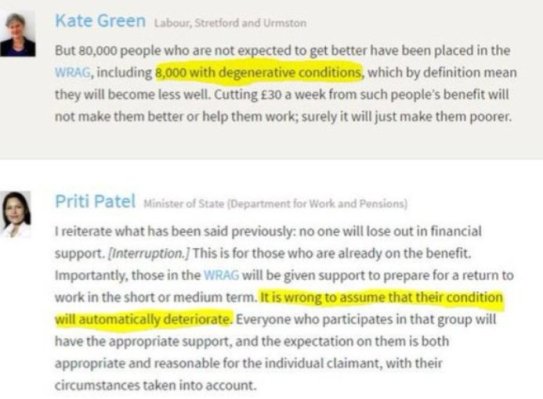
But an essential failure to grasp what words like “chronic”, “degenerative” and “progressive” actually mean isn’t peculiar to state assessors of illness and disability, who work for the government specifically to reduce the number of people eligible for sickness benefits. Government ministers display the same level of purposive ignorance:

Ca68L1xWcAA9MGT.jpg large

Hardly  “appropriate” , “reasonable” or taking “circumstances”, or medical diagnoses, for that matter, into account. A degenerative condition is one that DOES deteriorate. That is why it is called  a “degenerative condition.” It is therefore wrong and displays a degree of exceptional ignorance to assume that people WON’T or “may not” deteriorate.

This is why we don’t visit the government rather than a doctor when we become ill, especially when the state thinks it knows best about our medical conditions and how we should address those – and clearly doesn’t. This is about irrational ideology-driven policies aimed at cutting  back the welfare state. Regardless of how unreasonable that is and regardless of the consequences for those needing social security.

Sick and disabled people need support, understanding and medical care, not ignorance, Conservative dogma, vicious stigmatisation and a (neo)liberal re-translation of the words “Arbeit macht frei”.  

The government have conflated human needs with purely dogmatic economic outcomes.

Kitty S Jones.

samedifference1's avatarSame Difference

This paragraph from Frances Ryan’s latest article- an interview with a claimant called Phil Brehaut- just says it all.

“It was very daunting, like being in court,” he says. “The lady on the panel actually asked me, ‘How long are you likely to have Parkinson’s?’” He pauses. “The person next to her quickly whispered in her ear … You would think they’d know a little bit about it.”

View original post

Conservative welfare “reforms” – the sound of one hand clapping

1022654909

“Labour MPs sat perplexed … By cutting housing benefit for the poor, the Government was helping the poor. By causing people to leave their homes, the Government was helping people put a roof over their heads. By appealing the ruling that it discriminated against the vulnerable, the Government was supporting the vulnerable.

Yes, this was a tricky one.” – From an unusually insightful article in the Telegraph about the incoherence of Conservative welfare rhetoric:  How bedroom tax protects the vulnerable.

“Ministers keep using the mantra that their proposals are to protect the most vulnerable when, quite obviously, they are the exact opposite. If implemented their measures would, far from protecting the most vulnerable, directly harm them. Whatever they do in the end, Her Majesty’s Government should stop this 1984 Orwellian-type misuse of language.”  – Lord Bach, discussing the Legal Aid Bill. Source: Hansard, Column 1557, 19 May, 2011.

Conservative policies are incoherent: they don’t fulfil their stated aims and certainly don’t address public needs. Furthermore, Conservative rhetoric has become completely detached from the experiences of most citizens and their everyday realities.

Under the Equality Act, provision was made by the Labour government to ensure that legislations didn’t discriminate against protected social groups, which included disabled people. However, the need for public bodies in England to undertake or publish an equality impact assessment of government policies, practices and decisions was quietly removed by David Cameron in April 2011. The legal requirement in the Equality Act that ensured public bodies attempt to reduce inequalities caused by socio-economic factors was also scrapped by Theresa May in November 2010, who said she favoured a greater focus on “fairness” rather than “equality.”

The Conservatives have since claimed to make welfare provision “fair” by introducing substantial cuts to benefits and introducing severe conditionality requirements regarding eligibility to social security, including the frequent use of extremely punitive benefit sanctions as a means of “changing behaviours,” highlighting plainly that the Conservatives regard unemployment and disability as some kind of personal deficit on the part of those who are, in reality, simply casualties of unfortunate circumstances, bad political decision-making and subsequent politically-constructed socio-economic circumstances.

The word “fair” originally meant “treating people equally without favouritism or discrimination, without cheating or trying to achieve unjust advantage.” Under the Conservatives, we have witnessed a manipulated semantic shift, “fair” has become a Glittering Generality – part of a lexicon of propaganda that simply props up Tory ideology in an endlessly erroneous and self-referential way. Conservative ideology is permeating language, prompting semantic shifts towards bland descriptors which mask power and class relations, coercive state actions and political intentions. One only need to look at the context in which the government use words like “fair”, “support”, “help”, “justice” , “equality” and “reform” to recognise linguistic behaviourism in action. Or if you prefer, Orwellian doublespeak.

The altered semantics clearly signpost an intentionally misleading Conservative narrative, constructed on the basic, offensive idea that people claiming welfare do so because of “faulty” personal characteristics, and that welfare creates problems, rather than it being an essential mechanism aimed at alleviating poverty, extending social and economic support and opportunities – social insurance and security when people need it.

The government claims to be “committed to supporting the most vulnerable” and ensuring “everyone contributes to reducing the deficit, and where those with the most contribute the most.” That is blatantly untrue, as we can see from just a glance at Conservative policies.

2014-02-17-BurdenoftheCuts-thumb

Conservative rhetoric is a masterpiece of stapled together soundbites and meaningless glittering generalities. And intentional mystification. Glittering Generalities are being used to mask political acts of discrimination.

Cameron claims that he is going to address “inequality” and “social problems”, for example, but wouldn’t you think that he would have done so over the past five years, rather than busying himself creating those problems via policies? Under Cameron’s government, we have become the most unequal country in the European Union, even the USA, home of the founding fathers of neoliberalism, is less divided by wealth and income, than the UK.

I’m also wondering how tripling university tuition fees, removing bursaries and maintainance grants for students from poorer backgrounds and reintroducing banding in classrooms can possibly indicate a party genuinely interested in extending “equal opportunities.”

It’s perplexing that a government claiming itself to be “economically competent” can possibly attempt to justify spending more tax payers money on appealing a Supreme Court decision that the bedroom tax policy is discriminatory, when it would actually cost less implementing the legal recommendations of the court. As Owen Smith, Shadow Work and Pensions Secretary, said: “Just the Supreme Court session itself will cost the Government more in legal fees than the £200,000 needed to exempt domestic abuse victims affected.

“If the Tories had an ounce of decency they could have stood by the decision and exempted the two groups.

“Instead they are instructing expensive lawyers to fight in the Supreme Court for the right to drive people further into poverty.”

As a consequence of the highly discriminatory and blatantly class-contingent Tory policies, rampant socio-economic inequality apparently is the new Tory “fair”. There is a clear incongruence between Conservative rhetoric and the impact of their policies. This is further highlighted by the fact that the UK is currently being investigated by the United Nations regarding serious contraventions of the human rights of sick and disabled people, and other marginalised groups, because of the dire impact of Conservative welfare “reforms.”

It’s clear that the austerity cuts which target the poorest are intentional, ideologically-driven decisions, taken within a context of other available choices and humane options.

The rise in the need for food banks in the UK, amongst both the working and non-working poor, over the past five years and the return of absolute poverty, not seen since before the advent of the welfare state in this country, makes a mockery of government claims that it supports the most vulnerable.

Income tax receipts to the Treasury have fallen because those able to pay the most are being steadily exempted from social responsibility, and wages for many of the poorer citizens have fallen, whilst the cost of living has risen significantly over this past five years.

The ideologically motivated transfer of funds from the poorest half of the country to the more affluent has not contributed to deficit reduction. It doesn’t take a genius to work out that the cumulative impact of Tory tax and welfare changes, from out-of-work and in-work benefits to council tax support, to the cut in the top rate of income tax and an increase in tax-free personal allowances, has been extremely regressive and detrimental to the poorest.

The revenue gains from the tax changes and benefit cuts were offset by the cost of tax reductions, particularly the increase in the income tax personal allowance, benefitting the wealthiest.

The Treasury response to this is to single out the poorest yet again for more cuts to “balance the books” – which basically translates as the Conservative “small state” fetish, and deep dislike of the gains we made from the post-war settlement. Yet for a government that claims a non-interventionist stance, it sure does make a lot of interventions. Always on behalf of the privileged class, with policies benefitting only the wealthy minority.

How can Conservatives believe that poor people are motivated to work harder by taking money from them, yet also apparently believe that wealthy people are motivated by giving them more money? This is not “behavioural science,” it’s policy-making founded entirely on traditional Tory prejudices.

The government claim that “Every individual policy change is carefully considered, including looking at the effect on disabled people in line with legal obligations,” but without carrying out a cumulative impact assessment, the effects and impacts of policies can’t possibly be accurately measured. And that is intentional, too.

Despite being a party that claims to support “hard-working families,” the Conservatives have nonetheless made several attempts to undermine the income security of a signifant proportion of that group of citizens recently. Their proposed tax credit cuts, designed to creep through parliament in the form of secondary legislation, which tends to exempt it from meaningful debate and amendment in the Commons, was halted only because the House of Lords have been paying attention to the game.

The use of secondary legislation has risen at an unprecedented rate, reaching an extraordinary level since 2010, and it’s increased use is to ensure that the Government meet with little scrutiny and challenge in the House of Commons when they attempt to push through controversial and unpopular, ideologically-driven legislation.

Conservative cuts are most often applied by stealth, using statutory instruments. This indicates a government that is well aware that its policies are not fit for purpose.

We can’t afford Conservative ideological indulgence.

The National Audit Office (NAO) scrutinises public spending for Parliament and is independent of government. An audit report earlier this month concluded that the Department for Work and Pension’s spending on contracts for disability benefit assessments is expected to double in 2016/17 compared with 2014/15. The government’s flagship welfare-cut scheme will be actually spending more money on the assessments themselves than it is saving in reductions to the benefits bill – as Frances Ryan pointed out in the Guardian, it’s the political equivalent of burning bundles of £50 notes.

The report also states that only half of all the doctors and nurses hired by Maximus – the US outsourcing company brought in by the Department for Work and Pensions to carry out the assessments – had even completed their training.

The NAO report summarises:

5.5
Million assessments completed in five years up to March 2015

65%
Estimated increase in cost per ESA assessment based on published information after transfer of the service in 2015 (from £115 to £190)


84%
Estimated increase in healthcare professionals across contracts from 2,200 in May 2015 to 4,050 November 2016

£1.6bn
Estimated cost of contracted-out health and disability assessments over three years, 2015 to 2018

£0.4 billion
Latest expected reduction in annual disability benefit spending

13%
Proportion of ESA and PIP targets met for assessment report quality meeting contractual standard (September 2014 to August 2015).

This summary reflects staggering and deliberate economic incompetence, a flagrant, politically-motivated waste of tax payers money and even worse, the higher spending has not created a competent or ethical assessment framework, nor is it improving the lives of sick and disabled people.

The government claim they want to “help” sick and disabled people into work, but nearly 14,000 disabled people have lost their mobility vehicle after the changes to Personal Independence Payments (PIP) assessment, which are carried out by private companies. Many more, yet to be reassessed, are also likely to lose their specialised vehicles.

In 2012, Esther McVey revealed that the new PIP  was about cutting costs and that there were targets to reduce the number of successful claims when she told the House of Commons:330,000 of claimants are expected to either lose their benefit altogether or see their payments reduced.How else could she have known that before those people were actually assessed? A recent review led the government to conclude that PIP doesn’t currently fulfil the original policy intent, which was to cut costs and “target” the benefit to “those with the greatest need.”

That basically meant a narrowing of eligibility criteria for people formerly claiming Disability Living Allowance, increasing the number of reassessments required, and limiting the number of successful claims. The government have used the review to attempt to justify further restrictions to PIP eligibility, aimed at cutting support for people who require aids to meet fundamental needs such as preparing food, dressing, basic and essential personal care and managing incontinence. “Greatest need” has become an ever-shrinking category under Conservative austerity measures. 

DPAC

The use of political pseudo-psychological “diagnoses” to both stigmatise and “treat” what are generally regarded by the Conservatives as deviant behaviours from cognitively incompetent citizens, infering that the problem lies within the individual rather than in their circumstances, or arise as a consequence of political decision-making and socio-economic models, has become the new normal. We are discussing people here who have been deemed too ill to work by their own doctor AND the state. Not for the first time, the words Arbeit macht frei spring to mind.

Welfare has been redefined: it is preoccupied with assumptions about and modification of the behaviour and character of recipients rather than with the alleviation of poverty and ensuring economic and social wellbeing.

The stigmatisation of people needing benefits is designed purposefully to displace public sympathy for the poor, and to generate moral outrage, which is then used to further justify the steady dismantling of the welfare state.

It is the human costs that are particularly distressing, and in a wealthy, first world liberal democracy, such draconian policies ought to be untenable. Some people are dying after being wrongly assessed as “fit for work” and having their lifeline benefits brutally withdrawn. Maximus is certainly not helping the government to serve even the most basic needs of sick and disabled people.

However, Maximus is serving the needs of a “small state” doctrinaire neoliberal government. The Conservatives are systematically dismantling the UK’s social security system, not because there is an empirically justifiable reason or economic need to do so, but because the government has purely ideological, anticollectivist prescriptions. Those prescriptions are costing the UK in terms of the economy, but MUCH worse, it is costing us in terms of our decent, collective, civilised response to people experiencing difficult circumstances through no fault of their own; it’s costing the most vulnerable citizens their wellbeing and unforgivably, it is also costing precious human lives.

It’s not just that Conservative rhetoric is incoherent and incongruent with the realities created by their policies. Policy-making has become increasingly detached from public needs and instead, it is being directed at “incentivising” and “changing behaviours” of citizens to meet a rigidly ideological state agenda. That turns democracy completely on its head. There is no longer a genuine dialogue between government and citizens, only a diversionary and oppressive state monologue.

And it’s the sound of one hand clapping.

one hand clapping

There are many ways of destroying people’s lives, not all of them are obvious. Taking away people’s means of meeting basic survival needs, such as money for food, fuel and shelter – which are the bare essentials that benefits were originally calculated to cover – invariably increases the likelihood that they will die. The people most adversely and immediately affected are those who have additional needs for support.

The moment that sick and disabled people were defined as a “burden on the state” by the government, we began climbing Allport’s Ladder of Prejudice.

Whilst I am very aware that we need take care not to trivialise the terrible events of  world war 2 and Nazi Germany by making casual comparisons, there are some clear and important parallels on a socio-political level and a psycho-social one, that I feel are crucially important to recognise.

Gordon Allport studied the psychological and social processes that create a society’s progression from prejudice and discrimination to genocide. In his research of how the Holocaust happened, he describes socio-political processes that foster increasing social prejudice and discrimination and he demonstrates how the unthinkable becomes acceptable: it happens incrementally, because of a steady erosion of our moral and rational boundaries, and propaganda-driven changes in our attitudes towards “others” that advances culturally, by almost inscrutable degrees.

The process always begins with the political scapegoating and systematic dehumanisation of a social group and with ideologies that identify that group as an “enemy” or a social “burden” in some way. A history of devaluation of the group that becomes the target, authoritarian culture, and the passivity of internal and external witnesses (bystanders) all contribute to the probability that violence against that group will develop, and ultimately, if the process is allowed to continue evolving, genocide.

If you think this observation is “extreme” then you really haven’t been paying attention. By 2012, hate crime incidents against disabled people had risen to be the highest ever recorded. By 2015, there was a further 41 per cent rise in disability hate crime. This is the so-called “civilised” first world, very wealthy liberal democracy that is the UK.

Most disabled people have worked, contributed to society, paid taxes and national insurance. Those that haven’t genuinely cannot work, and as a decent, civilised society, we should support them. Being ill and disabled is not a “lifestyle choice.” Unfortunately it can happen to anyone. A life-changing accident or illness doesn’t only happen to others: no-one is exempted from such a possibility. That this government thinks it can get away with peddling utter nonsense about the characters, lives and motivations of a marginalised social group, dehumanising them, directing hatred, resentment, prejudice and public derision towards them, demonstrates only too well just how far we have moved away from being a decent, civilised society. 

It seems to be almost weekly that there’s a report in the media about a sick and disabled person dying after being told by the state that they are “fit for work” and their lifeline benefits have been halted, or because the state has sanctioned someone and withdrawn their only support. There are many thousands more suffering in silence, fearful and just about living.

 

Covert agents gaming Facebook to suppress political dialogue and censor information

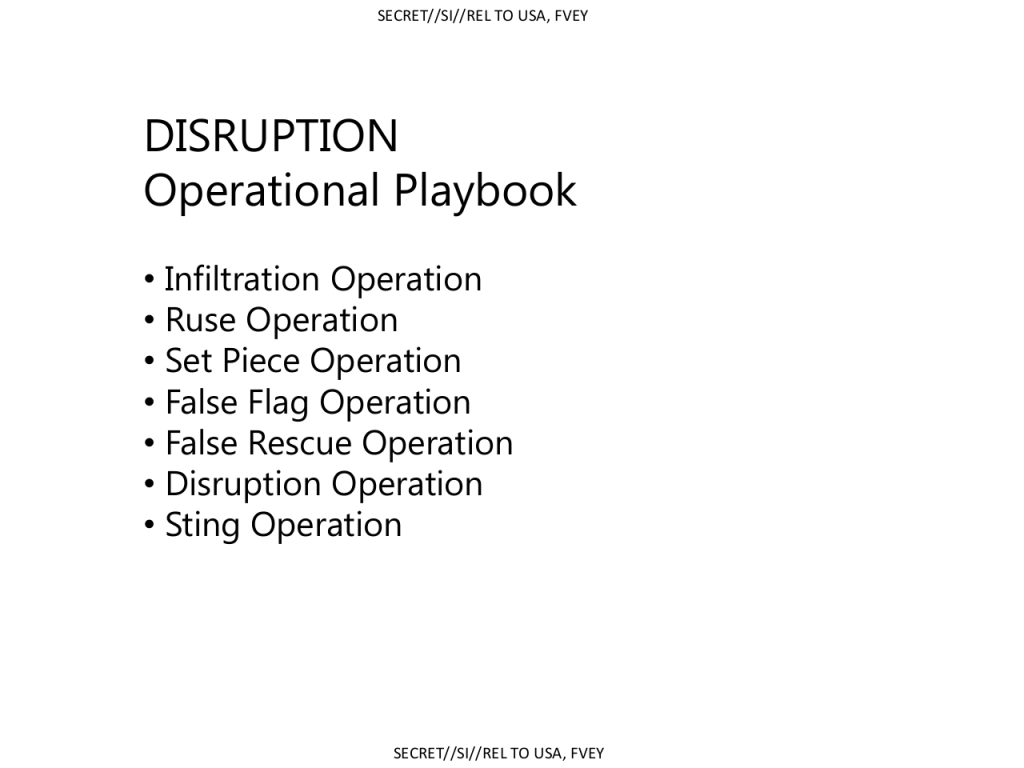
deception_p47.png


Here is an illustrative list of tactics from the latest GCHQ document.


8+Ways+to+Protect+Yourself+From+Emotional+Manipulation


Yesterday morning whilst I was sharing this post in groups on Facebook, I received a notification informing me that my account was temporarily restricted, and that I wasn’t allowed to comment or post in Facebook groups for three days. No reason for the ban was provided, though the notice allowed me to click on “appeal,” which I did. But Facebook staff never read and respond to appeals or feedback.

This is the third such ban I have had from Facebook in the last twelve months, I have never been given any reasons for the restrictions on my account, and I have asked several times for them. There is provision for flagging up errors by following a link that says “if you think you are seeing this notice by mistake.” Facebook have never once provided any explanation of their actions, nor have they responded to my appeal or to any accounts of my experience. 

My post had been removed in some of the groups I’d posted in and people informed me that where it remained, when they tried to open the link, it said “Content not available.”

There is nothing in the article that breaches Facebook’s “Community Standards” or that is offensive. There was nothing in the previous blogs that earned me a ban which could be deemed abusive or offensive either.

My previous bans happened the day after the election and earlier this month. Both times I was posting one of my own articles when the account restrictions were applied. I wasn’t even informed of the duration of the ban on the previous occasions. Just prior to the last ban, someone reported a meme by Robert Livingstone that I used as a group photo in a Facebook group I set up. Facebook notified me that the person complaining had said it contained “graphic violence”, though in fairness, it wasn’t removed.

544840_330826693653532_892366209_n

The “offending” meme

The group in question is all about criticising Conservative anti-welfare policies, exposing Iain Duncan Smith and the government’s anti-humanist ideological prescriptions. Someone clearly shouldn’t have joined.

At the same time, someone also reported several of my personal photos on my own page as “offensive” and my account as “fake” so this is looking like a targeted campaign to try and restrict the sharing of my posts. It’s not the first time this has happened. I also know that I’m not the only person this has happened to. My site is reasonably popular, with 1, 143, 370 readers so far, and my articles also get quite widely shared. However, someone somewhere clearly doesn’t like what I write.

I left a couple of groups last year because Facebook sent me a notification whenever I tried to post an article on those sites that the content had been reported as “abusive or offensive” by members. They were groups claiming to support the Labour Party. As far as bloggers go, I’m probably amongst the top ten most pro-Labour commentators. But regardless of which party you support, censorship should bother everyone. It’s not only humble bloggers that are being silenced. It’s not so long ago that government agents marched into a Guardian office and smashed up the hard drives storing the Snowden leaks. Once you hear the jackboots, it’s too late.

Someone told me that the article earning me the ban has probably been reported by a group of people determined to trigger a Facebook algorithm in order to get the ban imposed.

Political gaming and manipulating group discussion outcomes on Facebook by using an algorithm for the censorship of reasonable and factual comments or information that you disagree with is a very problematic and particularly totalitarian tactic. If that’s what you have to resort to, it means that you have no credible arguments, can’t engage in mature dialogue and it reflects very badly on your opinions, world-view, personal integrity and ethics more generally.

Most groups I am a member of are left-leaning political debate groups – if you can’t debate democratically and have to resort to such oppressive and cowardly tactics to shut down discussion then it really is time for you to leave. With articles, you always have the option of not reading them. Especially recommended for those of you with right-wing fragile ego syndome, incoherent ideologies and non-robust views and prejudices. And GCHQ.

Now for the punchline. I have a Facebook Community page – Politics and Insights – where Facebook regularly offer to “boost” my posts for a fee. I don’t make any money from writing and so don’t have cash to invest in promoting my site. The post that got me the ban was shared a lot from my page, and so Facebook offered to boost it, only if I paid money, of course … 

Last year I was harrassed by the charming Tommy Robinson, co-founder of the far-right English Defence League (EDL), on Twitter. I told him to stop mithering me and to go peddle far-right myths elsewhere. He then designed a meme that used my account photograph and details, claiming I had said that “child abuse is a far-right myth”, which of course is untrue. I didn’t mention child abuse at all. There was also an invitation on the meme for people to “let her know what you think of this” and details of my account were on there with the comment “she can be found here.”

The meme was circulated repeatedly by Britain First, some UKIP groups, on the National Front page, amongst others. As a consequence I received numerous death threats, threats of rape and a threat involving Combat 18, a neo-Nazi organisation, that is the armed branch of Blood and Honour. My crime? Simply being a Labour Party supporter and irritating Tommy Robinson by telling him to do one from my Twitter page. It’s also possible that my involvement with the Rock Against Racism movement back in the eighties marked my card.

I involved the police, and reports were made to Facebook about Tommy Robinson’s nasty design by a police officer and others regarding the malicious content of the meme and concerns about my personal safety. Guess what? Facebook did not remove the meme or ban any of the posters. The meme wasn’t just malicious, nor did it compromise just my own safety – my children also received threats – it was illegal, too. 

Perhaps it’s time for an alternative to Facebook, a large social media platform where the Tories can’t buy favours and power, and where free speech is actually permitted. I don’t think Facebook banned my post and restricted my account because of a political motivation to do so. But those who reported my article to trigger the ban definitely have a political agenda, and Facebook don’t care about that, nor do they apply “Community Standards” consistently, fairly and when they actually ought to.

Meanwhile I’m not sure about the value of complaining to Facebook, I have yet to have a response from them. However it may be done at the Feedback link. It may also be useful to report the algorithm as a bug.

Further reading

Coup engulfs Facebook’s largest Corbyn group

Letter to the Guardian from Amnesty International and other Human Rights Organisations –Inquiry needed into GCHQ’s spying on us

“Government plans to monitor and influence internet communications, and covertly infiltrate online communities in order to sow dissension and disseminate false information, have long been the source of speculation.

Harvard Law Professor Cass Sunstein, [co-author of “Nudge”], a close Obama adviser and the White House’s former head of the Office of Information and Regulatory Affairs, wrote a controversial paper in 2008 proposing that the US government employ teams of covert agents and pseudo-independent advocates to “cognitively infiltrate” online groups and websites, as well as other activist groups.

Sunstein also proposed sending covert agents into “chat rooms, online social networks, or even real-space groups” which spread what he views as false and damaging “conspiracy theories” about the government.” Glenn Greenwald – How Covert Agents Infiltrate the Internet to Manipulate, Deceive, and Destroy Reputations

The banned post. Please share widely – Doctors bribed with 70-90k salaries to join Maximus and “endorse a political agenda regardless of how it affects patients.”

Doctors bribed with 70-90k salaries to join Maximus and “endorse a political agenda regardless of how it affects patients.”

maximus-logoYes, but which people?


The National Audit Office (NAO) scrutinises public spending for Parliament and is independent of government. An audit report earlier this month concluded that the Department for Work and Pension’s spending on contracts for disability benefit assessments is expected to double in 2016/17 compared with 2014/15. The government’s flagship welfare-cut scheme will be actually spending more money on the assessments themselves than it is saving in reductions to the benefits bill – as
Frances Ryan pointed out in the Guardian, it’s the political equivalent of burning bundles of £50 notes.

The report also states that only half of all the doctors and nurses hired by Maximus – the US outsourcing company brought in by the Department for Work and Pensions to carry out the assessments – had even completed their training.

The NAO report summarises:

5.5
Million assessments completed in five years up to March 2015

65%
Estimated increase in cost per ESA assessment based on published information after transfer of the service in 2015 (from £115 to £190)


84%
Estimated increase in healthcare professionals across contracts from 2,200 in May 2015 to 4,050 November 2016

£1.6 billion
Estimated cost of contracted-out health and disability assessments over three years, 2015 to 2018

£0.4 billion
Latest expected reduction in annual disability benefit spending

13%
Proportion of ESA and PIP targets met for assessment report quality meeting contractual standard (September 2014 to August 2015).

This summary reflects staggering economic incompetence, a flagrant, politically motivated waste of tax payers money and even worse, the higher spending has not created a competent or ethical assessment framework, nor is it improving the lives of sick and disabled people. Some people are dying after being wrongly assessed as “fit for work” and having their lifeline benefits brutally withdrawn. Maximus is certainly not helping the government to serve even the most basic needs of sick and disabled people.

However, Maximus is serving the needs of a “small state” doctrinaire neoliberal government. The Conservatives are systematically dismantling the UK’s social security system, not because there is an empirically justifiable reason or economic need to do so, but because the government has purely ideological, anticollectivist prescriptions.

This is a government that claims social security is “unsustainable” and a “burden” on the public purse, yet has no problem with an extraordinary profligacy with public funds and dispossessing tax payers when it comes to implementing “cost-cutting” and draconian welfare “reforms.” Conservative anti-welfare dogma and prejudice are costing the UK billions of pounds.

In April 2014, Atos was forced to abandon their contract with the government because of a growing public backlash, but not before they had profited from very large sums of public money. Meanwhile, sick and disabled people have had their support callously slashed to the bone, people have suffered and some have died as a consequence of that. Yet our welfare state is being used as a sporting arena for big business profit-making, eating up public funds that were supposed to help people who have encountered difficulties meeting their basic needs through disability, losing their job or becoming ill.

The selling of our public services and lucrative contracting out of state functions to private companies who exchange public money for a notoriously poor service is a prominent feature of Tory “small state” Britain.

The Department for Work and Pensions uses the controversial work capability assessments to decide if people are eligible for benefits or to force those on long-term sick leave back into work. The assessment is conducted using a computer software package called Logic Integrated Medical Assessment (LiMA) application.

The assessments are heavily weighted towards finding people capable for work, regardless of the medical evidence presented by claimant’s own doctors. Patients with severe brain damage, kidney failure, cancer, multiple sclerosis and Parkinson’s Disease, amongst many others with seriously incapacitating illnesses, have been found fit for work. On 24 April 2013, a woman who was a double heart and lung transplant patient died in hospital only days after she had been told that her Incapacity Benefit was being stopped and that she was fit for work. There are many other instances of grave errors in the decision-making of the Department for Work and Pensions which are based on the work capability assessment.

Between April 2015 and March 2018, the Department for Work and Pensions expects to carry out around 7 million assessments which it estimates will cost a total of £1.6 billion.

The National Audit Office report on contracted-out “health and disability assessments” states that the cost of providing assessments is rising and providers are still struggling to meet expected performance standards, and that providers continue to struggle with hiring and training staff.

From the NAO summary:

“The Department continues, however, to struggle with setting targets and requirements with clear evidence and failed to adequately test bidders’ assumptions, for example about staff training, during the contract tender process. It does not yet have a clear strategy for contracting-out assessments and risks damaging market interest through tight procurement timetables, inflexibility towards critical assumptions and lack of transparency.

…For PIP, both providers have failed to meet targets for the quality of assessment reports since October 2013. The Department is paying more for assessments, caused in part by capacity shortages pushing up salaries.”

In the last month, recruitment website healthjobs.co.uk has added almost 100 job advertisements for “functional assessor” roles with Maximus, the US company contracted by the Department for Work and Pensions to conduct work capability assessments. Applicants are required to have two years post-qualification medical experience and are offered positions with whoppingly “incentivising” salaries that start at £72,000, with some roles attracting salaries of up to £98,000. The salary for a junior doctor working in the National Health Service (NHS) with two years of experience is approximately £30,000.

Junior doctors working within the NHS were forced to take industrial action recently – the first strike action for more than four decades – over the government’s proposed new junior doctor contracts, because of serious concerns about patient safety, the quality of doctor’s working lives and the lack of recognition regarding the strain of working long and unsocial hours.

The British Medical Association said:

“The biggest threat to patient care is the government’s insistence on removing safeguards which prevent junior doctors from being forced to work dangerously long hours without breaks, with patients facing the prospect of being treated by exhausted doctors.

“The government is threatening to impose contracts in which junior doctors have no confidence and which represents the first step in a wholesale attack on all NHS staff at night and over weekends. We want a contract that is safe for patients, fair for juniors and good for the NHS.”

Maximus offer substantially better working conditions and pay for junior doctors, but compromising patient safety is an inevitable consequence of the company drive to provide administrative solutions to improve the cost effectiveness … and efficiency of government-sponsored benefit programs.

One NHS doctor, Karl Norrington, noted on Twitter that despite Maximus’s company motto: “Helping Government Serve the People” – in reality Maximus is: “paying drs to medically endorse a political agenda regardless of how it affects patients.”

enhanced-9119-1453733217-2

Related

The disturbing truth about disability assessments

Why I blew the whistle on Atos fitness-for-work test

We can reduce the Welfare Budget by billions: simply get rid of Iain Duncan Smith


Mother who faced bedroom tax eviction after son’s suicide found hanged with note to David Cameron

An inquest has heard that Frances McCormack, a 53-year-old school cook, had been hounded for bedroom tax payments since the tragic suicide of her 16-year-old son, Jack Allen, in 2013. A handwritten note, dated 10 days before her death, was found in her bedroom, part of which was addressed to David Cameron, outlining the hardships and distress that the Bedroom Tax was causing her.

Ms McCormack’s body was discovered by her close friend Natalie Richardson at her home in Maltby, near Rotherham.

An eviction notice was served on Ms McCormack the day before her body was discovered, the court heard.

Frances McCormack had been helping Rotherham Council with its suicide prevention work following the tragic suicides of an increasing number of local young people.

Her ex-husband Jimmy Allen said after the inquest: “She was a strong-willed woman and a good, loving mother. This was a totally unseen body blow to the family.”

Close friend Natalie Richardson told the Doncaster inquest: “Frances had spoken to me previously about the property.

“She wanted to buy into it, it was where the three boys were raised and where Jack took his last breaths, ate his last meal and spoke his last words.

“She was a very strong woman, very strong minded. I felt she was getting a lot better with herself. She had decided to go out a bit more, she had started going to the gym, she was very focused and always had something to do.

“She never gave me any kind of inkling and was strong for me when my partner passed away. She was my rock.”

A Department for Work and Pensions spokesman said: “Our sympathies are with the family of Ms McCormack. This is a tragic and complex issue and it would be misleading to link it to one cause.”

The cause of Frances McCormack’s suicide was the distressing impact of a cruel and punitive policy that is intentionally designed to target our poorest and most vulnerable citizens. Frances was already vulnerable because she was grieving her son. But she was also bravely supporting others, in her contributions to suicide prevention work. It must have been profoundly distressing to receive notice that she was to be forced out of her family home.

How many more suicides will it take before this souless, indifferent government recognise the all too often devastating consequences of their “reforms” and engage with citizens, honestly and openly investigating their accounts, and those of campaigners, academics and professionals? There is an established correlation between Conservative austerity cuts and an increase in suicides and deaths that demands urgent investigation.

Surely what is needed, instead of a wall of oppressive political denial, is a democratically accountable impact assessment of the Conservative’s draconian and ideologically-driven policies. Denying other people’s experiences of inflicted political cruelty is the hallmark of Despotism. It’s not the behaviour one would expect from an elected government in a first-world liberal democracy.

Recent research by Iain Duncan Smith’s own department showed 78% of bedroom tax victims were penniless by the month’s end and at least half had to turn down their heating.

The study report was released on December 17 – the very last day of parliament before the Christmas break.

The Labour Party have confirmed the report was received by the Department for Work and Pensions on December 8 and signed off completely for publication on December 11.

A Department for Work and Pensions spokesman insisted it was standard practice for there to be a week’s delay between reports being received and published online.

But the shadow work and pensions secretary Owen Smith said: 

“The Tories are right to be ashamed about a report showing the Bedroom Tax is driving people deeper and deeper in to poverty.

“Iain Duncan Smith should show some decency, by being honest about the damage his hated policy is causing. Then listen to Labour’s calls to scrap the Bedroom Tax at once.”

The government released 36 ministerial statements – compared to three or four on an average day – in a mountain of information on the last day of Parliament before Christmas. Anyone would think the Conservatives want to avoid any democratic scrutiny or accountability.

Alison Garnham of the Child Poverty Action Group said:

“The DWP’s own evaluation finds the ‘bedroom tax’ is not only pushing families into hardship but it’s also failing to free up more accommodation for families – the key argument ministers used to justify this controversial policy.

“This is a long and deep look at a hugely controversial policy – it really should not have been released just as MPs rise for Christmas.”

Department for Work and Pensions sources maintain that the bedroom tax is “fair”, claiming that it was “wrong” that “taxpayers had to “subsidise” benefit claimants to live in houses that are “larger than they require.”

However, most benefit claimants have actually worked or are working in low paid jobs, and have therefore contributed to their own provision.

It would be far more reasonable, credible and valid to object to the “taxpayer” having to subsidise big businesses who are avoiding paying their taxes. The public are paying for a grotesquely greedy level of bonuses and multimillion figure salaries awarded to incompetent private sector CEOs. Only a quarter of government revenue comes from income tax, with much of the rest coming from national insurance and indirect taxes such as VAT, paid by the population as a whole, including by those people needing social security. But tax avoidance is widespread amongst much of the corporate and wealthy elite that benefits so much from state handouts. There’s a real “culture of entitlement” that the Conservatives happily endorse. And it is costing us far more than the welfare state, established for those in need, after the war.

In the Conservative benefit-cutting climate of austerity Britain, one of the wealthiest nations of the world, disability charities have reported that the despicable scapegoating “scrounger” rhetoric has provoked a significant surge in abuse and hate crime towards disabled people. But the behaviour of state-funded private contractors such as G4S and Atos must surely raise the question of who the “scroungers” really are.

In April 2014, Atos was forced to abandon their contract with the government because of a growing backlash, but not before they had syphoned off very large sums of public money. Meanwhile, sick and disabled people have had their support brutally slashed to the bone, people have died as a consequence of that. Yet our welfare state is being used as a sporting arena for big business profit-making, eating up public funds that were supposed to help people who have encountered difficulties meeting their basic needs through losing their job or becoming ill. Now there is a cause for public and political outrage.

The selling of our public services and lucrative contracting out of state functions to private companies who exchange public money for a notoriously poor service is a prominent feature of Tory “small state” Britain. Tax-funded corporate welfare has never been more generous. Another such woefully inept business is A4e, a welfare-to-work company dogged by controversy over poor performance and corruption. Former chairman Emma Harrison paid herself £8.6m in dividends, all courtesy of the taxpayer. In February 2014, four former A4e employees admitted committing acts of fraud and forgery after charging the state for working for clients that did not even exist.

The Conservative’s draconian policies, which they claim were intended to “solve” Britain’s housing crisis, have done nothing but actually make it worse. The Tories have overseen the withdrawal of the right to lifetime tenancies, introduced a dubious “help to buy” guarantee that further inflates housing costs and they have imposed an arbitrary benefits cap, applied indiscriminately whatever a family’s size or needs, which will see an exodus of poorer people, effectively bringing about a “social cleansing” of the capital and other major cities.

Few groups have suffered more than disabled people from this government’s five years in office. Though the human rights of women and children have also been violated by this government’s grinding and unrelentlessly discriminatory legislative machine.

I wrote earlier about the grave concerns regarding the impact of the next round of proposed housing benefit cuts on the most vulnerable social groups from within the housing sector. A specialist housing association has warned that people under the age of 35 in mental health accommodation face rent shortfalls of almost £200 a week under  government plans to cap housing benefit for social housing tenants at Local Housing Allowance rates. Financial modelling shows that at least 95 per cent of supported housing providers would be forced to evict their tenants if the government succeeds in slashing housing benefits.

Capping benefits at the level of Local Housing Allowance (LHA), the council-administered benefit for people in the private rented sector, would affect almost everyone in supported housing.

Every single Tory austerity measure targets the most vulnerable and those citizens with the very least to lose, and not “those with the broadest shoulders,” as Cameron claimed would be the case in 2010.

Charities, mental health professionals, campaigners and researchers have warned the government that austerity cuts are causing mental distress and are linked to rise in suicides.  Research published in September 2015 by Mind, the UK’s largest mental health charity, reported that for people with mental health problems, the Government’s flagship back-to-work scheme, the Work Programme, made their distress worse in 83 per cent of cases. 

A letter, published before the 2015 election, signed by 442 professionals ranging from psychologists to epidemiologists, stated:

“The past five years have seen a radical shift in the kinds of issues generating distress in our clients: increasing inequality and outright poverty, families forced to move against their wishes, and, perhaps most important, benefits claimants (including disabled and ill people) and those seeking work being subjected to a quite new, intimidatory kind of disciplinary regime.”

Psychologists Against Austerity, an alliance of mental health professionals, formed with the aim of directly challenging the cuts and welfare changes that they said were adding to mental distress. The group produced a briefing paper that includes five “austerity ailments” that contribute to worsening mental distress and despair. These are: humiliation and shame, instability and insecurity, isolation and loneliness, being trapped or feeling powerless, and fear and distrust.

The government continue to deny any “causal link” between their draconian policies and an increase in suicide, refusing to carry out an investigation into the impacts of their callous legislative authoritarianism that not only treats our poorest and most vulnerable citizens with disgusting contempt, but also systematically and shamefully contravenes their human rights.


2014-02-17-BurdenoftheCuts-thumb

327,379 sick and disabled people were not paid their Christmas Bonus last year

david-cameron-main.jpg


Labour’s shadow Work and Pensions Secretary, Owen Smith MP, has accused the Department of Work and Pensions (DWP) of being “cruel and incompetent”, after at least 327,379 sick and disabled people were left without their £10 Christmas Bonus.

Benefits were originally calculated to meet only the basic costs of food, fuel and shelter. The Pensioners and Family Income Supplement Payments Act 1972 ensured that a Christmas Bonus of £10 is paid to the recipients of some benefits as a one off payment. The subsequent Pensioners’ Payments and Social Security Act of 1979 established the Bonus permanently, although the amount has never been uprated in line with rising prices and living costs. 

On the government site, it says:

The Christmas Bonus is a one-off tax-free £10 payment made before Christmas, paid to people who get certain benefits in the qualifying week. This is normally the first full week of December.

You don’t need to claim – you should get paid automatically.

Mr Smith said:

“They’ve [the DWP] now been forced to admit that 300,000 people went short because they couldn’t even manage to make a simple payment in time for the holidays.

People have always known the Tories are cruel, but they used to think they were at least competent.

Iain Duncan Smith seems to be having a good go at proving they’re both cruel and incompetent.”

A DWP spokesperson responded, saying 

“All regular ESA payments were made on time over Christmas, with the majority of people receiving their additional Christmas seasonal payment on schedule.

Due to an administrative error, a small minority may not receive their additional Christmas seasonal payment until the end of January.”

Some people have yet to receive their payment. How long does it take to fix an “administrative error”?

I can’t help but wonder about the reason presented by the DWP for the payment delays. I don’t believe it’s the truth, although I’d be amongst the first to acknowledge the Department’s wide-ranging ineptitude.

I am a sick and disabled person who claims ESA. Having worked all of my life, and after being forced though illness to give up a job and profession that I loved, I have to say that my standard of living has very drastically dropped, and I have experienced absolute poverty – times when I have not been able to meet even basic needs, such as keeping  warm and eating adequately. In 2012, a tribunal agreed with my decision to leave work on the grounds that my illness is now so severe it presents unacceptable risks to myself and potentially, to others in the work environment, as I am no longer able to fulfil even the basic responsibilities that my work entailed, reliably, consistently and safely. My consultant and GP fully supported my decision.

I wasn’t paid the Christmas Bonus in 2012, 2013 and 2014. I rang the DWP in 2014, when I realised I was entitled to the payment. After being told twice that the money had been paid into my account and it hadn’t, in October 2015, I finally received the backdated payments. I got a bizarre letter explaining that whilst the DWP had said they had paid me, they hadn’t, which I already knew.

I received my Christmas Bonus for 2015 on 14 January. It seems to me that the DWP seldom pay the Bonus unless you actually ask for it (several times) or unless an MP applies some ethical and rational pressure, as Owen Smith has done.

The government believe that any kind of welfare support creates perverse incentives for people not to work. There is no empirical evidence to support this claim. They also think that the general public are “cognitively incompetent,” drawing on the new paternalist behavioural economics (“nudge”) theoretical framework, their basic proposition is that we are fundamentally irrational and make faulty decisions that are founded entirely on our “cognitive biases.” Of course the new army of self-appointed cognitive experts and nudgers exist outside the realms of their own universal theory of “human nature” and are thus exempted from nudges. Poor people who need financial support are not.

The Tories also claim that one of the problems of providing social security arises because we believe the resulting income gain from employment is not enough to compensate for the (increased) work effort. However, the truly rational solution of course would be to raise the lowest wages, to provide a clear and positive “incentive” to work, when people are able, but instead the government have opted for a psychocratic, punitive approach, stigmatising those who are too ill to work to justify cutting essential lifeline benefits to amounts that barely cover the cost of meeting basic survival needs, adding the perpetual threat and administration of sanctions – which entail the complete withdrawal of support –  for any perceived non-compliance.

The conditionality regime means that eligibility for support requires constantly demonstrating an unbounded willingness to attend often pointless, resource and time-consuming jobcentre lectures from work coaches and advisors and applying for any job presented, regardless of its appropriateness, security or pay.

The Tories ludicrously claim that this punitive approach, entailing the systematic withdrawing of essential support, and the incremental dismantling of the welfare state, is “making welfare fair”,  “making work pay” , “helping people into work” and “supporting sick and disabled people” indicating an Orwellian tendency to turn the meaning of ordinary words into a form of tyranny.

Sanctions are founded on and legitimised by claptrap and psychobabble that originated from the pseudoscientific Behavioural Insights Team, too.  Perhaps the Tory “Grudge” Unit is a much more appropriate name for this mean and vindictive collection of neoliberal cognitive supremicists and economic Darwinists. Armchair psychopaths.

In particular, sanctions are founded on a theory of a cognitive bias called “loss aversion” which is being manipulated and turned into a big state stick to ensure that poor people are compliant with draconian benefit conditionality. “Loss aversion” is a behavioural economics theory that attempts to euphemise draconian policies; a substituted expression that serves as a technique of neutralisation for diabolical state actions designed to instil a deep fear of destitution and starvation amongst the increasingly growing precariat, we are perpetually “downsizing” our needs and expectations to become desperate, impoverished, needing to claim support from a system that most, if not all of us have paid into.

From the shrinking category of legitimate “disability” to forcing people to work in insecure jobs for low wages or for no pay at all on exploitative work fare schemes, nudge is being used to prop up neoliberal ideology, social conservatism, and to euphemistically frame punitive policies, “applying the principles of behavioural economics to the important issue of the transition from welfare to work.” (See Employing BELIEF:Applying behavioural economics to welfare to work, 2010 and Nudging Conformity and Benefit Sanctions, 2015.)

The steady drop in real wages since 2010, according to the Office for National Statistics, is the longest for 50 years. The fall in earnings under the Conservatives is the biggest in any parliament since 1880, according to analysis by the House of Commons Library.  “Making work pay” for whom, we should ask.

The Tories have a strongly anti-welfare ideology, and they also advocate using the tools of behavioural economics to “incentivise” people to work, and further claim that social security encourages dependency. Nudge theorists have proposed that making people’s present more livable with any kind of “cash gifts” only amplifies the alleged cognitive tendency people have to overestimate the magnitude of immediate benefits relative to the more distant ones of working. This is the kind of thinking that underpins Conservative policies aimed at keeping people who need to claim support perpetually poor, insecure and fearful.

However, there’s no such thing as a “cycle of benefit dependency”, it’s a traditional Tory prejudice and is based on historically unevidenced myths. Poverty arises because of socioeconomic circumstances that are unmitigated through government decision-making. In fact this government has intentionally extended and perpetuated inequality through its policies.

It’s therefore easy to see how deliberately withholding the Christmas Bonus would be justified by government officials. This government believes that people who have fallen on hard times and are desperate for financial support are driven by a “culture of entitlement.” People needing social security are being politically redefined as economic free riders. But most people claiming benefit have paid tax, national insurance, and continue to pay VAT and other hidden taxes. There is no discrete class of taxpayers: we ALL pay taxes, except of course for a number of the very wealthy and big businesses. Implying that people claiming social security are a “burden” on working people’s taxes is a fact screen, erected to prop up Tory ideology. Meanwhile the welfare state is being steadily dismantled by a government of neoliberal ideologues.

Perhaps this was just another paternalist experimental “trial” aimed at nudging sick and disabled people into work, and of course, it would be based entirely on operationalising the whopping cognitive biases and traditional prejudices of the Tories.

1002589_521987671204099_896277269_n (1)

If even the DWP isn’t Disability Confident, how will a million disabled people get jobs? – Bernadette Meaden

Nobody would expect a person who suffers blackouts to drive a bus or bin waggon once they had thought through the potentially devastating consequences. But political, cultural, psychological and financial coercion is being used to force sick and disabled people to work – the government continues to cut welfare, which was calculated originally to cover only the costs of meeting basic needs.

Cruel sanctions and strict, inflexible, often unreasonable behavioural conditions are being imposed on lifeline benefit receipt, adversely affecting some of our poorest and most vulnerable citizens; unemployed and disabled people are being stigmatised by the government and the media – all of this is done with an utterly callous disregard of a person’s capacity to work, and importantly, the availabilty of appropriate and suitable employment opportunities, and this can often have tragic consequences.

Modern employment practices, which have an increasingly strong focus on attendance micromanagement, present yet another barrier for disabled people who want to work.

The following is taken from an excellent article which was posted on Bernadette Meaden’s blog, on January 16, 2016.

The numbers of disabled people in ‘absolute poverty’ (unable to meet their basic needs) has risen steeply following welfare reforms. Yet in his most recent party conference speech Iain Duncan Smith said to disabled people, “We won’t lift you out of poverty by simply transferring taxpayers’ money to you. With our help, you’ll work your way out of poverty.”

The recent case  of a Department for Work and Pensions (DWP) employee sacked for taking time off for illness illustrates a truth that the government does not acknowledge. Modern employment practices often appear to be incompatible with its aim of getting sick and disabled people off disability benefits and into work.

In this particular case it was reported that after working at the DWP for thirty four years, Ms Powell, who has a disability, fell foul of its sickness absence procedure, whereby formal action is taken against employees after eight days absence, or four spells of absence within a 12-month period.

‘Health problems meant that Ms Powell was frequently off sick. As some of her absences were related to a disability, her trigger point was adjusted from the usual eight to 12 days. However, Ms Powell later went over her allotted 12 days’ absence by a few days, and she was dismissed.’

A year earlier, a DWP whistleblower had revealed :

“Attendance management continues to get more draconian and sackings have become a regular occurrence: a recent guideline instructed managers to consider dismissal for staff off work for longer than 28 days regardless of the reason.”

So despite its own Disability Confident campaign, which calls on employers to “help improve employment opportunities for disabled people and retain disabled people and those with long term health conditions in your business”, the DWP itself seems unable to provide employment for people who may have long or frequent spells of illness. This would suggest that if you have, say, a long term fluctuating health condition, or a disability that requires frequent hospital appointments, you will find it very difficult to keep a job at the DWP.

Of course the DWP is not alone in this. We know that in some workplaces the pressure to attend even when very ill is overwhelming. At the Sports Direct warehouse, for instance, it was reported that over a two year period, 76 calls for an ambulance had been made, with 36 cases classed as ‘life-threatening’ including strokes, convulsions and breathing problems. One woman gave birth in the toilets, and employees said they were too frightened to take time off when they were ill, in case they lost their job. The employment agency that supplied staff to the warehouse had a ‘six strikes and you’re out’ policy, where a strike could include being off sick, or taking ‘excessive or long toilet breaks’. Very few people with a long term health condition would find it possible to keep their job in these circumstances. 

The reality is that in a fiercely competitive economy and austerity-driven government departments, there is very little room for anyone who has a long term health problem. Perhaps somebody in the government should do a little experiment. Try applying for jobs and declaring a long-term illness or disability which may require regular absences. See how easy it is to get a job.

You can read the rest of Bernadette’s excellent article here.

Related
The new Work and Health Programme: the government plan social experiments to “nudge” sick and disabled people into work

Man walks into Ashton Under Lyne Jobcentre, gets sanctioned goes home and commits suicide. Another day outside the Jobcentre.

11196235_481003708719482_8797603064126897147_n

Source: Man walks into Ashton Under Lyne Jobcentre, gets sanctioned goes home and commits suicide. Another day outside the Jobcentre.

More: Sanctions are founded on Tory psychobabble. You can’t “incentivise” people by starving them

Benefit Sanctions can’t possibly ‘incentivise’ people to work – here’s why


Conservative governments are bad for your health

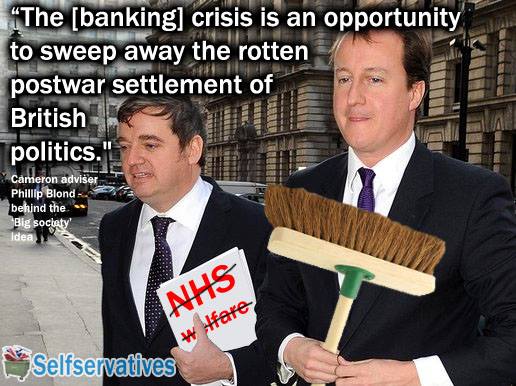
proper Blond 

Context: the politics of blame

Increasing employment and pushing ill and disabled people into work are key elements of the UK Government’s public health and welfare “reform” agendas. The arguments presented for this approach are primarily economic and particularly, moralistic. The reasoning presented is not founded on biological, psychological or sociological evidence. The government maintains that work is the most effective way to improve the wellbeing of individuals, their families and their communities. There is a perception that unemployment is harmful to physical and mental health, so the corollary has been assumed – that work is beneficial for health. 

However, that does not necessarily follow, and to claim that it does is distinctly unscientific and irrational. As the Conservatives themselves have often pointed out in less appropriate circumstances in order to avoid democratic accountability and responsibility, there is a difference between an association and a causal relationship.

There is a clear ideological context from which the welfare “reforms” proceeded, and the politically-directed media campaigns that have purposefully stigmatised and outgrouped unemployed people demonstrates quite clearly that reducing welfare support is not about a politically calculated extension of social inclusion and social justice policies, Conservative bonhomie, or overall concern for the wellbeing of welfare recipients and people who are disabled.

The government are attempting to entrench neoliberal ideology in our culture by co opting GPs, social workers and other professionals as agents of the state. The idea that “work is a health outcome” has been embedded in policies such as the Orwellian renaming of sick notes (now “fit notes”), which are designed to explore what work a person who is absent from work because of illness may undertake.  However, the government intend a much more far-reaching outcome than simply attempting to reduce the sick “role” and recovery time. The government’s “behavioural change” agenda has become a centrally-orchestrated programme for governance. The provision of public goods and crucial support, from housing and discretionary housing payments to employment benefits and disability support is becoming increasingly conditional. 

Political rhetoric, aimed at perpetuating an extremely divisive and intentionally misleading “strivers and skivers” dichotomy is designed to undermine public support for the welfare state and the other gains of our post-war settlement – the NHS, legal aid and social housing for example – also betrays the lack of coherence, rationality and empirical support for the Conservative’s “reforms.” Furthermore, the extremely targeted, class-contingent and punitive nature of the Conservative austerity programme indicates that the welfare “reforms” were founded on traditional Tory prejudices, rather than on any genuine causal relationship based on empirical evidence and social or economic necessity.

This explains why the government have persistently ignored the many evidence-based concerns raised by academic researchers, campaigners and opposition MPs that their austerity policies are having an extremely harmful effect, most often on our poorest and most vulnerable citizens.

The Conservatives are ideologically bound to notions of a small state, minimal levels of political responsibility and intervention, minimal levels of government spending, the heavy promotion and administration of privatisation, competition, fiscal austerity, deregulation and free trade in order to enhance the role of the private sector in the economy, all of which are the central strands of the neoliberal hegemony. Conservative ideology runs counter to any notion that all citizens must be treated fairly, which also means that they must be given equal economic opportunities and provided with a adequate minimum standard of living. Neoliberal ideology is incompatible with a human rights-based society.

Democracy exists partly to ensure that the powerful are accountable to the public, and particularly to our most vulnerable citizens. This government have blocked that crucial exchange, and show disdain for human rights, the welfare state and the NHS, all of which provides ordinary people and the most vulnerable citizens basic protection from those in power.

Conservatives despise human rights and rights-based social provision. They absurdly claim that welfare provision causes vulnerability, and a “culture of dependency,” despite the fact that there is absolutely no empirical evidence to support this view. History has consistently taught us otherwise. The Conservative’s policies are expressions of contempt for the lessons and empirical evidence from over a century of social history and administration.

Tory rhetoric is designed to have us believe there would be no poor people if the welfare state didn’t somehow “create” them. If the Conservatives must insist on peddling the myth of meritocracy, then surely they must also concede that whilst a neoliberal system has a few beneficiaries, it also creates situations of insolvency and poverty for many others. That is what a system based on competitive individualism is about: it creates a few “winners” and a lot of others lose.

Conservative cuts are based on nothing more than the ridiculous myth that poverty is somehow a lifestyle choice or a moral failing which people can be punished or starved out of. The new Tory neoliberal “paternalists” really seem to believe that if they make life for poor people insufferable, they will simply be “incentivised” to choose to be wealthier. It’s a thinly disguised revamp of the ill-conceived 1834 Poor Law deterrence principle of “less eligibility” – that was supposedly aimed at “making work pay” too. But it didn’t. It’s not possible to frighten and punish people out of poverty. Only a Conservative government would claim to be making work pay by cutting welfare down to the bare bones, rather than increasing wages. The welfare cuts have actually had the effect of driving down wages too.

Of course, by framing the issue of poverty in terms of personal responsibility and morality, the Conservatives have stifled debate and restricted public discussion in the hope that people won’t recognise the wider structural inequalities and economic failings, for which this government are solely responsible.

Debbie Abrahams said: “The Conservatives point the finger at sick and disabled people for the rise in spending. They are still shamelessly spinning their tired “shirkers” and “strivers” narrative, designed to whip up public support for cuts to the most vulnerable. But this divisive rhetoric can no longer conceal the fact their economic strategy has failed. It is the government’s failure that has led to rising social security costs. 

As we saw at the Autumn Statement (2016), borrowing is up, growth is down, deficit targets have been hopelessly missed and wages have flat-lined. At the same time, the government has refused to tackle the driving forces behind increased social security spending, from low pay to high housing costs. Instead, the government is slashing support to those who need it most, exacerbating the financial strain so many are facing this Christmas, and failing its own targets in the process.   

[…] Research by the Joseph Rowntree Foundation suggested that we need to be building 80,000 affordable homes a year to meet demand and keep the current spend on housing benefit stable. This government managed a pathetic 30,000 homes last year. It is this refusal to build enough homes that keeps the housing benefit bill growing. People are left struggling to find somewhere affordable to live, and the state is forced to subsidise the sky-high rents charged by private landlords 

We could also look at tax credits, which currently make up more than £20bn a year in the spending under the cap. Tax credits top up working people’s pay where it is insufficient. Wages today are lower than they were in 2008, and won’t even return to the levels of 2008 until 2021. A record six million workers are paid less than the living wage. This is why tax credit costs have risen – because the government has had to increase the amount spent on topping wages up. 

Labour founded the welfare state to give pensioners and disabled people dignity, to prevent homelessness, children going hungry, and to cover for periods of unemployment or ill-health. It was never designed to be spending tens of billions substituting for low-wage employers or subsidising rip-off landlords.”

Economic productivity is the new health outcome

The claim that “work is good for you” is allegedly based on “scientific evidence” that people in work tend to be healthier than those claiming unemployment and sickness benefits. However, to draw the conclusion that “employment is good for you” from the data is an example of inferring causality inappropriately, from what is only an association. Yet it is being used to prop up Conservative justifications for dismantling the welfare state.

Unemployment has been linked to increased rates of sickness, disability and mental health problems, and to decreased life expectancy. The claim has also been made that it results in an increased use of medication, medical services, and higher hospital admission rates. However, surely it makes much more sense to say that sickness, disability and mental health problems, the use of medication, medical services, and higher hospital admission rates all cause unemployment, rather than the converse. This government seem to have a major problem accepting the fact that sometimes, people really are simply too ill to work.

Most people who are too ill to work are obviously not as healthy as those who can work. That is hardly controversial. However, that doesn’t mean that work itself is good for your health, it just means those who don’t work tend to have worse health than those who do. People don’t work because they have poor health.

Linking ill health with “worklessness” is an ideological preference which ignores other variables. It is much more likely that the “reforms”, which have reduced welfare provision to inadequate levels – leaving people all too often unable to meet their basic needs – is bad for health, rather than being out of work. 

But the Conservatives have used this “evidence” of an association between poor health and unemployment to make an inference based on a “causal link” that hasn’t actually been empirically verified. Iain Duncan Smith has made the claim, for example, that “work is good for you.” He has even claimed that work can make people’s health problems “better.” But that isn’t very likely to be true. It’s akin to claiming that chatting and exercise is a cure for multiple sclerosis, lupus, blindness or cancer. Or that a work coach on prescription will cure rheumatoid arthritis, a disc prolapse or schizophrenia.

This is why I visit my doctor when I am ill, and not Iain Duncan Smith or the government.

The claim that work is good for your health is simply a part of Tory justification narratives for cutting support for sick and disabled people, and hounding people who need to claim benefits. Yet this axiom informs current UK policy towards increased benefit conditionality, harsh sanctions, compulsory work experience and the “workfare” or “work-for-benefits” thinking which the Conservatives favour. However, this is an approach that can never work, unless, of course, the aim is to completely dismantle the welfare state. Oh, hang on…

The biopsychosocial model

The biopsychosocial model (BPS) of ill health is not without controversy, although many see it as more pragmatic or humanistic than the medical model of illness, which came to be regarded as reductionist and deterministic. The biopsychosocial model is the conceptual status quo of contemporary psychiatry, and many believe that it has played an important role in combatting psychiatric dogmatism.

The biological component of the model is based on a traditional allopathic (bio-medical) approach to health. The social part of the model investigates how different social factors such as socioeconomic status, culture and poverty impact on health. The psychological component of the biopsychosocial model looks for potential psychological causes for a health problem such as lack of self-control, emotional turmoil, and negative thinking.

Of course a major criticism is that the BPS model has been used to disingenuously trivialise and euphemise serious physical illnesses, implying either a psychosomatic basis or reducing symptoms to nothing more than a presentation of malingering tactics. This ploy has been exploited by medical insurance companies (infamously by Unum Provident in the USA) and government welfare departments keen to limit or deny access to medical, social care and social security payments, and to manufacture ideologically determined outcomes that are not at all in the best interests of patients, invalidating diagnoses, people’s experience and accounts, and the existence of serious medical conditions. (See also: Getting rich on disability denial, and  A Tale of two Models by Debbie Jolly.)

Unum was involved in advising the government on making the devastating cuts to disabled people’s support in the UK’s controversial Welfare Reform Bill. (See also: The influence of the private insurance industry on the UK welfare reforms.)

This is a government that tends to emphasise citizen responsibilities over rights, moralising and psychologizing social problems, whilst quietly editing out government responsibilities and democratic obligations towards citizens.

For example, poverty, which is caused by political decisions affecting socioeconomic outcomes, is described by the Conservatives, using elaborate victim-blame narratives, and this is particularly objectionable at a time when inequality has never been greater in the UK.

Poverty may only be properly seen in a structural context, including account of the exclusion and oppression experienced by those living in poverty, the global neoliberal order, the gender order, the disability, racial, sexual and other orders which frame social life and precipitate poverty in complex and diverse ways. It’s down to policy-makers to address the structural origins of poverty, not the poor, who are currently regarded as the “collateral damage” – casualities – of politically imposed structural constraints.

Conservative governments are unhealthy

The effects of loss of income on people who can’t work because of illness is a confounding factor, too. How is it possible to isolate the devastating impacts of the Conservative “reforms” and the steady dismantling of the welfare state on unemployed people from the misleading generalisation that unemployment is bad for health? Surely if the Conservatives genuinely believed their own claims, they would be more inclined to increase rather than radically decrease provision and support for unemployed people.

Of course, not all work is beneficial. The review that led to the widespread folk tale that work is good for you is based on research involving people who had common and minor illnesses, and fulfilling, secure jobs. That doesn’t reflect the experiences of many people.

Not all jobs are rewarding and positive experiences, and some work can cause serious risks to health.

Doctor Frank Scheer, a neuroscientist at Harvard Medical School and Brigham and Women’s Hospital in Boston, says:

“There is strong evidence that shift work is related to a number of serious health conditions, like cardiovascular disease, diabetes, and obesity.

These differences we’re seeing can’t just be explained by lifestyle or socioeconomic status.”

Shift work and poor quality working environments and employment conditions are also linked to stomach problems and ulcers, hypertension, depression, musculoskeletal disorders, chronic infections, diabetes, general health complaints, all-cause mortality and an increased risk of accidents or injury. Long working hours are equally linked with a detrimental impact on health, according to medical research – see: The impact of overtime and long work hours on occupational injuries and illnesses: new evidence from the United States.

There is a growing and potentially corrosive problem of low paid, poor quality, precarious and temporary work which threatens levels of social inclusion and, ultimately, the health of the workforce.

Research shows unambiguously that the psychosocial quality of bad jobs is worse than unemployment. Peter Butterworth examined the mental health implications of those moving from unemployment into employment and found that:

“Those who moved into optimal jobs showed significant improvement in mental health compared to those who remained unemployed. Those respondents who moved into poor-quality jobs showed a significant worsening in their mental health compared to those who remained unemployed.”

Overall, unemployed respondents had poorer mental health than those who were employed. However the mental health of those who were unemployed was comparable or superior to those in jobs of the poorest psychosocial quality. (See: The psychosocial quality of work determines whether employment has benefits for mental health: results from a longitudinal national household panel survey.)

More recently, in a letter to the Guardian, the UK’s leading bodies representing psychologists, psychotherapists, psychoanalysts, and counsellors called on the Government “to immediately suspend the benefits sanctions system. It fails to get people back to work and damages their mental health.

Findings from the National Audit Office (NAO) show limited evidence that the sanctions system actually works, or is cost effective.

But, even more worrying, we see evidence from NHS Health Scotland, the Centre for Welfare Conditionality hosted by the University of York, and others, which links sanctions to destitution, disempowerment, and increased rates of mental health problems. This is also emphasised in the recent Public Accounts Committee report, which states that the unexplained variations in the use of benefits sanctions are unacceptable and must be addressed.”

The impact of poverty on health

The largest study of poverty conducted in the UK has laid out the dire extent of British material deprivation – and seriously undercut the government’s claim to be lifting people out of poverty through work.

The Poverty and Social Exclusion in the UK (PSE) project details how, over recent years, the percentage of households living below society’s minimum standard of living has increased from 14% to 33% – despite the fact that the economy has increased in size over the same period. The study found that low wages are a central cause of widespread deprivation. For many people, full-time work is not enough to lift them out of poverty; almost half of the working poor work 40 hours a week or more. And one in six adults in paid work (17%) is poor, suffering low income and unable to afford basic necessities.

Commenting on the study’s findings, Professor Jonathan Bradshaw of the University of York said they showed many parents who work full time still have to make huge sacrifices to try and protect their children from deprivation.

“We already know from DWP data that the majority of children with incomes below the the relative income poverty threshold have a working parent. The PSE survey shows that the majority of deprived children, those lacking two or more socially perceived necessities, and very deprived children (lacking five or more socially perceived necessities) have a working parent.

We found that 65% of the deprived and 58% of the very deprived children had a working parent, and 50% of the deprived and 35% of the very deprived had at least one parent working full-time. Child poverty is not being driven by skivers, but is the consequence of strivers working for low earnings while in-work benefits are being dissipated by government austerity measures.”

Responding to the findings, Clare Bambra, a professor at Durham University, said that the research was a shameful picture of “the devastating and far-reaching human costs of inequality and poverty in the UK today.”

She said:

“It’s shameful for a rich country like ours to be tolerating such levels of poverty especially amongst our children and young people. The mantra that work sets people free from poverty has been shown to be a grand old lie.

We will be living with the long term consequences of this social neglect for decades to come – there are clear links between poverty and reduced life expectancy and higher rates of ill health, especially concentrated in deprived areas and the north.

These findings show us the true cost of austerity.”

Public health experts from Durham University have denounced the impact of Margaret Thatcher’s policies on the wellbeing of the British public in a comprehensive study which examines social inequality in the 1980s.

The study, which looked at over 70 existing research papers, concludes that as a result of unnecessary unemployment, welfare cuts and damaging housing policies, the former prime minister’s legacy includes the unnecessary and unjust premature death of many British citizens, together with a substantial and continuing burden of suffering and loss of wellbeing.

The research shows that there was a massive increase in income inequality under Baroness Thatcher – the richest 0.01 per cent of society had 28 times the mean national average income in 1978 but 70 times the average in 1990, and UK poverty rates went up from 6.7 per cent in 1975 to 12 per cent in 1985.

Baroness Thatcher’s governments wilfully engineered an economic catastrophe across large parts of Britain by dismantling traditional industries such as coal and steel in order to undermine the power of working class organisations, say the researchers. They suggest this ultimately fed through into growing regional disparities in health standards and life expectancy, as well as greatly increased inequalities between the richest and poorest in society.

Professor Clare Bambra from the Wolfson Research Institute for Health and Wellbeing at Durham University, co-author of the research report, commented:

“Our paper shows the importance of politics and of the decisions of governments and politicians in driving health inequalities and population health. Advancements in public health will be limited if governments continue to pursue neoliberal economic policies – such as the current welfare state cuts being carried out under the guise of austerity.”

Thatcher’s policies  have been condemned for causing “unjust premature deaths.” Cameron’s policies are even more class-contingent and cruel.

I think there is a growing body of empirical evidence which indicates clearly that Conservative governments are much worse for public health, prosperity and wellbeing than unemployment.

10407927_677369232332608_5384979058089243718_n

Pictures courtesy of Robert Livingstone


I don’t make any money from my work. I am disabled because of illness and have a very limited income. The budget didn’t do me any favours at all.

But you can help by making a donation to help me continue to research and write informative, insightful and independent articles, and to provide support to others. The smallest amount is much appreciated – thank you.

DonatenowButton cards