Category: Political ideology

From homes fit for heroes to the end of secure, lifelong social housing tenancies

Social housing arose to supply uncrowded, well-built homes on secure tenancies at reasonable rents to primarily working class people. The First World War indirectly provided a new impetus for house building programmes, when the poor physical health and condition of many urban recruits to the army raised alarm. This led to a post-war campaign – Homes fit for heroes and in 1919 the Government first required councils to provide housing, helping them to do so through the provision of subsidies, under the Housing Act 1919.

Determined to “lift the shadow of the workhouse from the homes of the poor”, David Lloyd George also promised “a land fit for heroes.” But it was after the Second World War that council house building programmes and inner city slum clearance began in earnest. There was and still is a constant demand for social housing, and “waiting lists” are maintained, with preference being given to those in greatest need.

The post-war settlement refers to an era of public policy consensus that included support for collectivism, a mixed economy, access to justice, healthcare, social housing and a broader welfare state. It lasted until the monetarism and privatisation programmes of the New Right government of Thatcher.

Thatcher’s “right to buy” scheme depleted social housing stock, and there was a sharp decline in the building of new council homes, as she legislated to prevent councils reinvesting money from the sales of housing in building new council houses.

Now the Conservative government is planning to scrap lifetime security of tenure for renters in council and housing association properties, in favour of in favour of fixed-term contracts, according to housing industry reports. Up until recently, most tenants in council and housing association properties had lifetime security, compare to private renters who generally face six-month or one year tenancies.

However, the Tory bedroom tax has eroded the very idea of secure social housing tenure, because people on unemployment benefits, low wages and particularly disabled people now face either an unaffordable housing benefit penalty (and therefore a rise in the amount they have to pay in rent) if they are deemed to be “under-occupying” their home.

Now, under government plans, social landlords will no longer be able to automatically issue tenancies on a lifetime basis and would instead be forced to offer fixed-term lets for prospective tenants.

Although social landlords have been allowed to issue five-year tenancies since the Government changed the law in 2012, only around 1 in 10 new tenancies have seen the offer taken up.

In July the government said it would review the use of lifetime tenancies and limit their use. Civil servants have briefed several sector figures in the last few weeks that this strategy will go as far as preventing landlords offering lifetime tenancies to new tenants.

The Government and the social housing sector recently had a major disagreement over Tory plans to extend its Right To Buy policy to housing associations.

Landlords initially threatened legal action over the proposals when they first appeared in the Tory manifesto, but were apparently encouraged to agree a deal that involved no primary legislation.

The Government recently cut social housing rents in the budget but is planning to raise them for higher earners, under a new policy dubbed “pay to stay”.

Although Natalie Elphicke, co-author of the Treasury-commissioned House/Elphicke review of council house building, has previously urged that lifetime tenancies are restricted to groups such as those in “extreme old age” or “highly disabled” people, at the moment there is no guarrantee  that this will happen.

Michael Gelling, chair of the Tenants and Residents Organisations of England (TAROE), said the prospect was “alarming”, and that long-term tenancies gave tenants and communities stability.

Civil servants are said to be briefing industry figures on the changes, with an official announcement due within the next few months.

A spokesperson for the Department for Communities and Local Government told Inside Housing: “More details will be available in due course.”

547145_195460507271672_1145852710_nCourtesy of Robert Livingstone

This post was written for Welfare Weekly, which is a socially responsible and ethical news provider, specialising in social welfare related news and opinion.

Corbyn’s best PMQs reveals Prime Minister evades accountability regarding impact of tax credit cuts

Prime ministers questions today

Today, David Cameron strategically evaded a question about his government’s controversial tax credit cuts six times today. The Labour leader, Jeremy Corbyn, had a Jeremy Paxman moment when he repeatedly asked whether people would be left worse off by the cuts after the Treasury revises the proposals.But despite pressing the question, Cameron has yet to respond to it rationally and directly.

Corbyn also challenged Cameron regarding the persistent denial before the election from the Conservatives – including from Cameron, Michael Gove, and the chief whip, that they intended to cut tax credits

The Treasury was forced re-examine the plans after the House of Lords voted down the government’s tax credit cuts twice, tabling amendments to delay the plans until the governmernt took on board new evidence about the negative impacts of the cuts, and until there was better compensation for workers who could lose an average of £1,300 a year.

In a blustering non-response to the Labour leader’s question, Cameron complained that the tax credit plans were defeated by Labour and other opposition peers in a “new alliance of the unelected and unelectable”.

Corbyn responded to an increasingly furious Prime Minister with: “This is not a constitutional crisis. This is a crisis for 3 million people.” 

Corbyn again asked:  “Can he confirm they will not make anyone worse off?”
Cameron responded with:  “He will have to be patient… we will set out our proposals in the Autumn Statement.”

Corbyn said: “People are “very concerned”… “Is he going to cut tax credits or not?”

Cameron said that: “£12 billion welfare cuts were promised in the Tory manifesto. …  I’m happy to have a debate as to how we cut welfare”… “because of what happened in the other place.

“We need to reform welfare.”

The Labour leader cited the case of “Karen” who was concerned about the cuts and said “people are very worried about what’s going to happen to them”.
He said: “Following the events in the Lords on Monday evening, and the rather belated acceptance from the prime minister of the result there, can you now guarantee to the house and the wider country that nobody will be worse off next year as a result of cuts to working tax credits?”

However, the prime minister simply refused to elaborate how the government would reduce the impact of the cuts.

Cameron said : “What I can guarantee is we remain committed to the vision of a high-pay, low-tax, lower welfare economy. We believe the way to ensure everyone is better off is keep growing our economy, keep inflation low, keep cutting people’s taxes and introduce the national living wage.

As for our changes, the chancellor will set them out in the autumn statement.”

Corbyn continued to press Cameron for an answer several times. Cameron admitted that “every penny we do not save” from welfare would have to be found elsewhere,” indicating that the government clearly regards lifeline benefits to poor families as the Treasury’s “disposable income“, and no matter what those political decisions to cut the deficit on the backs of those with the least will cost people in terms of income and living standards, whether in work or not, this government intends to continue with swingeing austerity cuts that target the poorest.

It’s clear that the Prime Minister doesn’t have a response for either Jeremy Corbyn or for all of those hard-working people who are set to lose income and see a drop in their living standards because of the tax credit cuts – many of whom may have voted Conservative at the last election, reassured before the election that their welfare support was safe.

A senior Labour spokesperson said the party regarded Cameron’s House of Lords review “as a smokescreen to cover up the real problem of tax credits”.

The new Work and Health Programme: government plan social experiments to “nudge” sick and disabled people into work


Illustration by Jack Hudson

The government’s Nudge Unit team is currently working with the Department for Work and Pensions and the Department of Health to trial social experiments aimed at finding ways of: “preventing people from falling out of the jobs market and going onto Employment and Support Allowance (ESA).”

“These include GPs prescribing a work coach, and a health and work passport to collate employment and health information. These emerged from research with people on ESA, and are now being tested with local teams of Jobcentres, GPs and employers.”

This is a crass state intrusion on the private and confidential patient-doctor relationship, which ought to be about addressing medical health problems, and supporting people who are ill, not about creating yet another space for obsessive political micromanagement. It’s yet another overextension of the coercive arm of the state to “help” people into work. Furthermore, this move will inevitably distort people’s interactions with their doctors: it will undermine the trust and rapport that the doctor-patient relationship is founded on.

In the current political context, where the government extends a brutally disciplinarian approach to basic social security entitlement, it’s very difficult to see how the plans to place employees from the Department for Work and Pensions in GP practices can be seen as anything but a threatening gesture towards patients who are ill, and who were, up until recent years, quite rightly exempted from working. Now it seems that this group, which includes some of our most vulnerable citizens, are being politically bullied and coerced into working, regardless of the consequences for their health and wellbeing.

Of course the government haven’t announced this latest “intervention” in the lives of disabled people. I found out about it quite by chance because I read Matthew Hancock’s recent conference speech: The Future of Public Services.

I researched a little further and found an article in Pulse which confirmed Hancock’s comment: GP practices to provide advice on job seeking in new pilot scheme.

Hancock is appointed Minister for the Cabinet Office and Paymaster General, and was previously the Minister of State for Business and Enterprise. He headed David Cameron’s “earn or learn” taskforce which aims to have every young person earning or “learning” from April 2017.

He announced that 18 to 21-year-olds who can’t find work would be required to do work experience (free labour for Tory business donors) as well as looking for jobs or face losing their benefits. But then Hancock is keen to commodify everyone and everything, including public data.

However his references to “accountability and transparency” don’t stand up to much scrutiny when we consider the fact that he recently laid a statement before parliament outlining details about the five-person commission that will be asked to decide whether the Freedom of Information act is too expensive and “overly intrusive.”

He goes on to say: “And this brings me onto my second area of reform: experimentation. Because in seeking to improve our services, we need to know what actually works.”

But we need to ask for whom services are being “improved” and for whom does such reform work, exactly?

And did any of the public actually consent to being experimented upon by the state?

Or to having their behaviour modified without their knowledge?

Now that the nudge unit has been privatised, it is protected from public scrutiny, and worryingly, it is also no longer subject to the accountability afforded the public by the Freedom of Information Act.

The Tory welfare “reforms” are a big business profiteering opportunity, whilst lifeline benefits are being steadily withdrawn: policy context

The current frame of reference regarding Conservative welfare policies is an authoritarian and punitive one. It’s inconceivable that a government proposing to continue cutting the lifeline income of sick and disabled people, including a further £120 a month to those people in the ESA Work Related Activity group (WRAG), will suddenly show an interest in actually supporting disabled people. There are also proposals to further limit eligibility for Personal Independence Payments (PIP) for sick and disabled people. 

From the shrinking category of legitimate “disability” to forcing people to work for no pay on exploitative workfare schemes, “nudge” has been used to euphemistically frame punitive policies, “applying the principles of behavioural economics to the important issue of the transition from welfare to work.” (From: Employing BELIEF: Applying behavioural economics to welfare to work, 2010.)

And guess who sponsored the “research” into “nudging” people into workfare? Steve Moore, Business Development Director from esg, which is a leading welfare to work and vocational skills group, created through the merger and acquisition of four leading providers in the DWP and LSC sector.” How surprising.

It’s even more unsurprising that esg was established by two Conservative donors with very close ties to ministers, and were subsequently awarded very lucrative contracts with the Department for Work and Pensions. I think there may have been a “cognitive bias” in operation there, too. But who is nudging the nudgers?

Of course the “aim” of the “research” is: “breaking the cycle of benefit dependency especially for our hardest to help customers, including the “cohort” of disabled people.”

However, there’s no such thing as a “cycle of benefit dependency”, it’s a traditional Tory prejudice and is based on historically unevidenced myths. Poverty arises because of socioeconomic circumstances that are unmitigated through government decision-making. In fact this government has intentionally extended and perpetuated inequality through its policies.

2020health – Working Together is a report from 2012 that promotes the absurd notion of work as a health outcome.  This is a central theme amongst ideas that are driving the fit for work and the work and health and programme. Developing this idea further, Dame Carol Black and David Frost’s Health at Work – an independent review of sickness absence was aimed at reviewing ways of “reducing the cost of sickness to employers, ‘taxpayers’ and the economy.” Seems that the central aim of the review wasn’t a genuine focus on sick and disabled people’s wellbeing and “health outcomes,” then. Black and Frost advocated changing sickness certification to further reduce the influence of GPs in “deciding entitlement to out-of-work sickness benefits.”

The subsequent “fit notes” that replaced GP sick notes (a semantic shift of Orwellian proportions) were designed to substantially limit the sick role and reduce recovery periods, and to “encourage” GPs to disclose what work-related tasks patients may still be able to perform. The idea that employers could provide reasonable adjustments that allowed people who are on sick leave to return to work earlier, however, hasn’t happened in reality.

The British Medical Association (BMA) has been highly critical of the language used by the government when describing the fit for work service. The association said it was “misleading” to claim that fit for work was offering “occupational health advice and support” when the emphasis was on sickness absence management and providing a focused return to work.

The idea that work is a “health” outcome is founded on an absurd and circular Conservative logic that people in work are healthier than those out of work. It’s true that they are, however, the government have yet again confused causes with effects. Work does not make people healthier: it’s simply that healthy people can work and do. People who have long term or chronic illnesses often can’t work. The government’s main objection to sick leave and illness more generally, is that it costs businesses money. As inconvenient as that may be, politically and economically, it isn’t ever going to be possible to cure people of serious illnesses by cruelly coercing them into work.

The government’s removal of essential in-work support for disabled people – such as the Independent Living Fund, and the replacing of Disability Living Allowance  with Personal Independence Payment in order to reduce eligibility, cut costs and “target” support to those most severely disabled, and the cuts to the Access To Work scheme – means that it is now much more difficult for those disabled people who want to work to find suitable and supported employment.

The politics of punishment

There’s a clear connection between the Nudge Unit’s obsession with manipulating “cognitive bias” – in particular, “loss aversion” – and the increased use, extended scope and severity of sanctions, though most people succumbing to the Nudge Unit’s guru effect (ironically, another cognitive bias) think that “nudging” is just about prompting men to pee on the right spot in urinals, or persuading us to donate organs and to pay our taxes on time.

When it comes to technocratic fads like nudge, it’s worth bearing in mind that truth and ethics quite often have an inversely proportional relationship with the profit motive.

For anyone curious as to how such tyrannical behaviour modification techniques like benefit sanctions arose from the bland language, inane, managementspeak acronyms and pseudo-scientific framework of “paternal libertarianism” – nudge – read this paper, focused almost exclusively on New Right obsessions, paying particular attention to the part about “loss aversion” (a cognitive bias according to behavioural economists) on page 7.

And this on page 18: The most obvious policy implication arising from loss aversion is that if policy-makers can clearly convey the losses that certain behaviour will incur, it may encourage people not to do it,” and page 46: “Given that, for most people, losses are more important than comparable gains, it is important that potential losses are defined and made explicit to jobseekers (e.g.the sanctions regime).” 

The recommendation on that page: We believe the regime is currently too complex and, despite people’s tendency towards loss aversion, the lack of clarity around the sanctions regime can make it ineffective. Complexity prevents claimants from fully appreciating the financial losses they face if they do not comply with the conditions of their benefit.”

The Conservatives duly “simplified” sanctions by extending them in terms of severity, frequency and by broadening the scope of their application to include previously protected social groups.

The paper was written in November 2010, prior to the Coalition policy of increased “conditionality” and extended sanctions element of the Tory-led welfare “reforms” in 2012.

Sanctioning welfare recipients by removing their lifeline benefit – originally calculated to meet the cost of only basic survival needs – food, fuel and shelter – isn’t about “arranging choice architecture”, it’s not nudging: it’s operant conditioning. It’s a brand of particularly dystopic, psychopolitical neobehaviourism, and is all about a totalitarian level of micromanaging people to ensure they are obedient and conform to meet the needs of the “choice architects” and policy-makers.

Nudge even permeates language, prompting semantic shifts towards bland descriptors which mask power and class relations, coercive state actions and political intentions. One only need to look at the context in which the government use words like “fair”, “support”, “help” “justice” and “reform” to recognise linguistic behaviourism in action. Or if you prefer, Orwellian doublespeak.

It’s rather difficult to see how starving people and threatening them with destitution can possibly improve the well-being of many socially excluded people, and help to bring them to inclusion.”

The conclusion that Ancel Keys drew from the Minnesota Starvation Experiment in the the US during the 1940s, (which explored the physical and psychological effects of undernutrition, and stressed the dramatic, adverse effect that starvation had on competence, motivation, behaviour, mental attitude and personality) was that “democracy and nation building would not be possible in a population that did not have access to sufficient food.”

No amount of bland and meaningless psychobabble or intransigent, ideologically-tainted policies can legitimize the economic sanctioning of people who are already poor and in need of financial assistance.

Apparently, citizenship and entitlement to basic rights and autonomy is a status conferred on only the currently economically productive. Previous employment and contributions don’t count as “responsibility,” and don’t earn you any rights – the government believes that citizens owe a perpetual debt of unconditional service to the Conservative’s steeply stratified economy. Not much of a social contract, then. Cameron says he wants to “build a responsible society” by removing people’s rights and reducing or removing their lifeline income. Presumably, free invisible bootstraps are part of the deal.

Government decision-making has contributed the most significant influence on “health outcomes.” Conservative policies have entailed a vicious cutting back of support and a reduction of essential provision for sick and disabled people. In fact this group have been disproportionately targeted for austerity cuts time and time again, massively reducing their lifeline income. It’s not being “workless” that has a detrimental impact on people’s health and wellbeing: it is the deliberate impoverishment of those requiring state aid and support, funded from the public purse, (including contributions from those who now need support), which is being dogmatically and steadily withdrawn.

Making work pay for whom?

If work truly paid, then there would be no need to incentivise” almost 1.2 million low-paid workers claiming the new universal credit with the threat of in-work benefit sanctions if they fail to “take steps to boost their earnings.”

It’s very difficult to see how punishing individuals for perhaps being too ill to work more that a few hours, or those working for low pay or part-time in the context of a chronically weak labour market, depressed wages and with little scope for effective negotiating and collective bargaining can possibly be justified. It’s an utterly barbaric way for a government to treat citizens.

Surely if the government was genuinely seeking to increase choices and to widen access to the workplace for sick and disabled people, it would not be cutting the very programmes supporting and extending this aim, such as the Access to Work scheme  – a fund that helps people and employers to cover the extra living costs arising due to disabilities that might present barriers to work – and the Independent Living Fund.

This government has pushed at the public’s rational and moral boundaries, establishing and attempting to justify a draconian trend of punishing those unable to work, and what was previously unthinkable – stigmatising and punishing legally protected social groups such as sick and disabled people – has become somehow acceptable. We are on a very slippery slope, clearly mapped out previously by Allport’s scale of prejudice.

People’s needs don’t disappear just because the government has decided to “pay down” an ever-growing debt and build a “surplus” by taking money from those that have the least. Or because the government doesn’t like “big state interventions.”

So the recent proposed cut to ESA – and this is a group of sick and disabled people deemed physically incapable of work by doctors – is completely unjustified and unjustifiable. No amount of pseudo-psychology and paternalist cruelty can motivate or “incentivise” people who are medically ill.

It’s for disabled individuals and their doctors – professionals, specialists and experts – to decide if a person can work or not, it’s not the role of the state, motivated only by a perverse economic Darwinist ideology. Maslow taught us that we must attend to our physiological needs before we may be motivated to meet higher level psychosocial ones.

Iain Duncan Smith is a zealot who actually tries to justify further punitive cuts to disabled people’s provision by claiming that working is “good” for people and is the only “route out of poverty.”

Presumably he believes work can cure people of the serious afflictions that they erroneously thought exempted them from full-time employment. 

He stated: “There is one area on which I believe we haven’t focused enough – how work is good for your health. Work can help keep people healthy as well as help promote recovery if someone falls ill. So, it is right that we look at how the system supports people who are sick and helps them into work.”

Duncan Smith undoubtedly “just knows” that his absurd claim is “right.” He’s never really grown out of his “magical thinking” stage, or transcended his dereistic tendencies. His department had to manufacture “evidence” recently in a ridiculous attempt to support Iain Duncan Smith’s imaginative, paternalist claim that punitive sanctions are somehow “beneficial” to claimants, by using fake characters to supply fake testimonials, but this was rumbled and exposed by a well-placed Freedom of Information request from Welfare Weekly.

Recent research indicates that not all work serves to “keep people healthy” nor does it ever “promote recovery.” This assumption that work can promote recovery in the case of people with severe illness and disability – which is why people claim ESA – is particularly bizarre. We have yet to hear of a single case involving a job miracle entailing people’s limbs growing back, vision being restored, or a wonder cure for heart failure, cerebral palsy, multiple sclerosis and lupus, for example.

The government’s Fit for Work scheme is founded on exactly the same misinformative nonsense. It supports profit-making for wealthy employers, at the expense of the health and wellbeing of employees that have been signed off work because of medically and professionally recognised illness that acts as a real barrier to work.

Furthermore, there is no proof that work in itself is beneficial. Indeed much research evidence strongly suggests otherwise.

And where have we heard these ideas from Iain Duncan Smith before?

Arbeit macht frei.

If work really paid then surely there would be no need to “nudge” people by using sanctions, regardless of whether or not they are employed. “Making work pay” is all about reducing support for those who the government deems “undeserving,” to “discourage welfare dependency” by making any support as horrible as the workhouse – founded on the principle of “less eligibility”, where conditions for those in need of support were punitive and kept people in a state of desperation so that even the lowest paid work in the worst of conditions would seem appealing.

The public/private divide

For a government that claims a minarchist philosophy, remarkably it has engineered an unprecedented blurring of public/private boundaries and a persistent violation of traditionally private experiences, including thoughts, beliefs, preferences, autonomy and attitudes via legislations and of course a heavy-handed fiscal conflation of public interests with private ones.

This also caught my attention from Matthew Hancock’s speech transcript:

“My case is that we need continuous improvement in public services. And for that we must reform the relationship between citizen and state. [My bolding]

“The case for reform is strong. Because people have high and rising expectations about what our public services should deliver. Because budgets are tight, and we have to make significant savings for our country to live within her means.”

Basically, the “paternalistic libertarian” message here is that we will have to expect less and less from the state, as the balance between rights and responsibilities is heavily weighted towards the latter, hence requiring the “reform” of the relationship between citizen and state.

However, surely it is active, democratic participation in processes of deliberation and decision-making that ensures that individuals are citizens, not subjects.

Social democracy evolved to include the idea of access to social goods and improving living standards as a means of widening and legitimizing the scope of political representation.

Political policies are defined as (1) The basic principles by which a government is guided. (2) The declared objectives that a government  seeks to achieve and preserve in the interest of national community. As applied to a law, ordinance, or Rule of Law, it’s the general purpose or tendency considered as directed to the welfare or prosperity of the state or community.

Once upon a time, policy was a response from government aimed at meeting public needs. It was part of an intimate democratic dialogue between the state and citizens. Traditional methods of participating in government decision-making include:

  • political parties or individual politicians
  • lobbying decision makers in government
  • community groups
  • voluntary organisations
  • public opinion
  • public consultations
  • the media

Nowadays, policies have been unanchored from any democratic dialogue regarding public needs and are more about monologues aimed at shaping those needs to suit the government. 

Nudge does not entail citizen involvement in either its origin or design. The state intrusions are at such an existential level, of an increasingly authoritarian nature, and are of course reserved for the poorest, who are deemed “irrational” and incapable of making “the right decisions.”

Yet those “faulty decisions” are deemed so from the perspective of the Behavioural Insights Team, (the “Nudge Unit”) who are not social psychologists: they are predominantly concerned with behavioural economics, decision-making and how governments influence people – “economologists”, changing people’s behaviours, enforcing compliance to fulfil political aims. That turns democracy completely on its head.

The Nudge Unit gurus claim that we need help to “correct our cognitive biases”, but those who make policies have their own whopping biases, too.

Nudge is the new fudging

Nudge is a prop for New Right neoliberal ideology that is aimed at dismantling a rights-based society and replacing it with an insidiously nudged, manipulated, compliant, and entirely “responsible”, “self-reliant” population of divided, isolated state-determined individuals who expect nothing from their elected government.

The Conservatives are obsessive about strict social taxonomies and economic enclosures. The Nudge Unit was set up by David Cameron in 2010 to try to “improve” public services and save money. The asymmetrical, class-contingent application of paternalistic libertarian “insights” establishes a hierarchy of decision-making “competence” and autonomy, which unsurprisingly corresponds with the hierarchy of wealth distribution.

So Nudge inevitably will deepen and perpetuate existing inequality and prejudice, adding a dimension of patronising psycho-moral suprematism to add further insult to politically inflicted injury. Nudge is a fashionable fad that is overhyped, trivial, unreliable; a smokescreen, a prop for neoliberalism and monstrously unfair, bad policy-making.

As someone who (despite the central dismal and patronising assumptions about the irrationality of others that king nudgers have as a central cognitive bias and the traditional prejudices that Tory ideology narrates,) manages to make my own decisions relatively without bias, intelligently, rationally, critically, carefully and coherently, and that, along with my professional and academic background, I can and will conclude that no matter how you dress it up, nudge is a pretentious, cringeworthy pseudo-intellectual dead-end.

 A Nudge for the Conservatives from history

The more things change for the Tories, the more they tend to stay the same.

In the 1870s, England had a recession and the Conservatives launched a Crusade of cuts to welfare expenditure to diminish “dependency” on poor law outdoor relief – non-institutional benefits called “out-relief” because it was paid to the poor in their own homes from taxation, rather than their having to go into the punitive “deterrent” workhouses.

The Crusade included cutting medical payments to lone mothers, widows, the elderly, chronically sick and disabled people and those with mental illness. The 1834 Poor Law amendment was shaped by people such as Jeremy Bentham, who argued for a disciplinary, punitive approach to social problems and particularly poverty, whilst Thomas Malthus focused attention on overpopulation, and moralising about the growth of illegitimacy. He placed emphasis on moral restraint rather than poor relief as the best means of easing the poverty of the lower classes. 

David Ricardo argued that there was a problem with poor relief provision “interfering” with an iron law of wages. Ricardo claimed that aid given to poor workers under the old Poor Law to supplement their wages had the effect of undermining the wages of other workers, so that the Roundsman System and Speenhamland system led employers to reduce wages, and needed reform to help workers who were not getting such aid and rate-payers whose poor-rates were going to subsidise low-wage employers. Yet we found, despite Ricardo’s pet theory, that the poor law deterrent element served to push wages down further.

The effect of poor relief, in the absurd view of the reformers, was to undermine the position of the “independent labourer.” They also wanted to “make work pay.” And end the “something for nothing” culture. But much subsequent evidence shows that reducing support for people out of work actually drives wages and working conditions down.

Neither the punitive poor law amendment act of 1834 or the Crusade “helped” people into work or addressed the lack of available paid work – that’s unemployment, not the made-up and intentionally stigmatizing word “worklessness”.

And its utter failure as a credible account of poverty – the-blame-the-individual narrative and the notion that relief discourages “self-reliance” – fuelled the national insurance act of 1911 and the development of the welfare state along with the other civilising and civilised benefits of the post-war settlement. 

The Conservatives inadvertently taught us as a society precisely why we need a welfare state.

We learned that it isn’t possible to be “thrifty” or help ourselves if we haven’t got the means for meeting basic survival needs. Nor is it possible to be nudged out of poverty when the means of doing so are not actually available. No amount of moralising and pseudo-psychologising about poor people actually works to address poverty, and structural socioeconomic inequalities.

The government’s undeclared preoccupation with behavioural change through personal responsibility is simply a revamped version of Samuel Smiles’s bible of Victorian and over-moralising, a hobby-horse: “thrift and self-help” – but only for the poor, of course. Smiles and other powerful, wealthy and privileged Conservative thinkers, such as Herbert Spencer, claimed that poverty was caused largely by the irresponsible habits of the poor during that era. But we learned historically that socioeconomic circumstances caused by political decision-making creates poverty.

Conservative rhetoric is designed to have us believe there would be no poor people if the welfare state didn’t somehow “create” them. If the Tories must insist on peddling the myth of meritocracy, then surely they must also concede that whilst such a system has some beneficiaries, it also creates situations of insolvency and poverty for others.

In other words, the same system that allows some people to become very wealthy is the same system that condemns others to poverty.

This wide recognition that the raw “market forces” of the old liberal laissez-faire (and the current starker neoliberalism) causes casualties is why the welfare state came into being, after all – because when we allow such competitive economic dogmas to manifest, there are invariably winners and losers.

That is the nature of “competitive individualism,” and along with inequality, it’s an implicit, undeniable and fundamental part of the meritocracy myth and neoliberal script. And that’s before we consider the fact that whenever there is a Conservative government, there is no such thing as a “free market”: in reality, all markets are rigged for elites.

Public policy is not an ideological tool for a so-called democratic government to simply get its own way. Democracy means that the voices of citizens, especially members of protected social groups, need to be included in political decision-making, rather than so frankly excluded.

We elect governments to meet public needs, not to “change behaviours” of citizens to suit government needs and prop up policy “outcomes” that are driven entirely by traditional Tory prejudice and ideology.

And by the way, we call any political notion that citizens should be totally subject to an absolute state authority “totalitarianism,” not “nudge.”

demcracy
Courtesy of Robert Livingstone

Update: The government have since announced the introduction of a number of “policy initiatives” aimed at reducing the number of people claiming Employment and Support Allowance (ESA). These initiatives are currently still at a research and trialing stage. Health Management, a subsidiary of MAXIMUS are to deliver the fit for work programme, which was set up based on recommendations from the Health at Work – an independent review of sickness absence report by Dame Carol Black and David Frost. The review was aimed at “reducing the cost of sickness to employers, ‘taxpayers’ and the economy.”

Fit for Work occupational health professional will have access to people’s diagnoses from their fit notes, the fit note end date and any further information that the GP considers relevant to their absence from work or current treatment (at the discretion of the GP). The primary referral route for an assessment for the Maximus programme will be via the GP.

The government is cutting funding for contracted-out employment support by 80%, following the Spending Review. The Department for Work and Pensions has indicated that total spending on employment will be reduced, including not renewing Mandatory Work Activity and Community Work Placements, the new Work and Health Programme will have funding of around £130 million a year – around 20% of the level of funding for the unsuccessful Work Programme and Work Choice, which it will replace.

Iain Duncan Smith says: “This Spending Review will see the start of genuine integration between the health and work sectors, with a renewed focus on supporting people with health conditions and disabilities return to and remain in work. We will increase spending in this area, expanding Access to Work and Fit for Work, and investing in the Health and Work Innovation Fund and the new Work and Health Programme.” 

Meeting the Government’s goal of halving the employment gap between disabled and non-disabled workers – moving around one million more disabled people into work – will be no easy task. Not least because despite Iain Duncan Smith’s ideological commitments, and aims to “reduce welfare dependency,” most disabled people who don’t work (and claim ESA) can’t do so because of genuine and insurmountable barriers such as incapacitating and devastating, life-changing illness. No amount of targeting those people with the Conservative doublespeak variant of “help” and nasty “incentivising” via welfare sanctions and benefit cuts will remedy that.


Welfare must not be seen as the Treasury’s disposable income

In the 2010 Coalition emergency budget, David Cameron claimed that austerity measures were to be introduced only to reduce the deficit.

Doesn’t anyone else remember that since then, David Cameron stood up at a Lord Mayor’s banquet in London, in front of the financial elite, in November 2013 and ostensibly admitted – and from an ostentatious golden throne, no less – that austerity was not an emergency response to difficult economic events after all, but a permanent disassembling of the state, signalling that he had no intention of resuming public spending once the structural deficit has been eliminated.

Many of us had already recognised that the cuts were ideologically driven. But not enough of us to make a difference in May and to vote and prevent an unforgivable betrayal of future generations. It’s also a grievous betrayal of the previous generations who fought to establish universal suffrage and fought to secure the post-war settlement. Our Social Security, Legal Aid and National Health Service. These are civilising and civilised prerequisites for a fair, human rights-based first world democracy.

proper Blond
There was another fall in income tax receipts that sent Britain’s deficit
spiralling to £12.1bn in August, the widest shortfall in government funding since 2012. So where is our money going exactly?

For a government whose raison d’etre is deficit reduction, the Conservatives aren’t very good at all. And the rigid emphasis on a series of self-imposed fiscal moving goalposts is distracting the government from the social, moral and democratic obligations it is also expected to uphold.

The Office for National Statistics said low wages and a dip in corporation tax receipts were to blame for the worsening situation, which will put pressure on George Osborne ahead of “tough” expenditure decisions due in November when Whitehall agrees its five-year spending targets.

But if you look at Conservative policies, which are designed to redistribute and privatise public wealth, it’s easy to see why this has happened.

The Conservatives regard the income of the poorest as somehow dispensable – the compensatory and disposable income of the Conservative state. Yet the very mention of raising taxes for the rich is met with shrieks of outrage and threats to leave the country. This is always justified in advance by a fresh mainstream narration of the puritan work ethic and the myth of meritocracy.

What’s yours is mine, what’s mine is my own.

What did the imperturbable chancellor promise before the election? True to Tory form, more of the same: austerity for the poor, more public services cuts, and tax breaks for the wealthiest. No mention of tax credit cuts, though, even when Conservatives were asked directly about those. Several times.

But further cuts to lifeline benefits and public services are surely untenable. Absolute poverty has risen dramatically this past four years, heralding the return of Victorian illnesses that are associated with malnutrition. People have died as a consequence of the welfare “reforms”. Supporting the wealthy has already cost the poorest so very much, yet this callous, indifferent, morally nihilistic government are casually discussing taking even more from those with the very least.

Our welfare state arose as a social security safety net – founded on an assurance that as a civilised and democratic society we value the wellbeing and health of every citizen.

There was a cross-party political consensus that such provision was in the best interests of the nation as a whole at a time when we were collectively spirited enough to ensure that no one should be homeless or starving in modern Britain.

As such, welfare is a fundamental part of the UK’s development –  our progress – the basic idea of improving people’s lives was at the heart of the welfare state and more broadly, it reflects the evolution of European democratic and rights-based societies.

A welfare state is founded on the idea that government plays a key role in ensuring the protection and promotion of the economic and social wellbeing of its citizens. It is based on the principles of equality of opportunity, equitable distribution of wealth, and both political and social responsibility for those unable to avail themselves of the minimal provisions for wellbeing.

It was recognised that people experienced periods of economic difficulty because of structural constraints such as unemployment and recession, through no fault of their own. It was also recognised that poor health and disability may happen to anyone through no fault of their own.

The welfare state arose in the UK during the post-war period, and following the Great Depression, for numerous reasons, most of these were informed by research carried out into the causes of poverty, its effects on individuals and more broadly, on the UK economy. There were also political reasons for the Conservatives and Liberals supporting the poorer citizens – the newly enfranchised working class.

Charles Booth in London and Sebohm Rowntree in York carried out the first serious studies of poverty and its causes. They both discovered that the causes were structural – casual labour, low pay, unemployment, illness and old age – not laziness, fecklessness, drunkenness and gambling, as previously assumed. The poverty studies raised awareness of the extent of poverty in Britain and the myriad social problems that caused it, and that it caused.

The Boer war of 1899-1902 highlighted the general poor state of health of the nation. One out of every three volunteers failed the army medical due to malnutrition, other illnesses due to poor diet and very poor living conditions. The military informed the government at the time of the shockingly poor physical condition of many of those conscripted.

We learned that the effects of poverty were potentially damaging to  the whole of society. Health problems and infectious disease – rife in the overcrowded slums – could affect rich and poor alike. It was recognised that the economy suffered if large numbers of people were too poor to buy goods and social problems such as exploitation, debt, crime, prostitution and drunkenness were a direct result of poverty, and not the cause of it.

Related image
The discovery of  widespread poor health as a consequence of poverty raised concerns about Britain’s future ability to compete with new industrial nations such as Germany and the USA. National efficiency would only increase if the health and welfare of the population improved. It was recognised that welfare is about extending opportunities, not “dependency”.

At the same time, the growth of the Labour Party and Trade Unionism presented a threat to the Liberals and the Conservatives. The new working class voters were turning to these organizations to improve their lives. The traditionally laissez-faire Liberals recognised this and supported the idea of government support for the working class.

Yet since 2010, there’s been an unprecedented, historic assault on the very ideal of social security, and it’s sustained and systematic: it didn’t stop with the 2012 welfare cuts.

As I’ve said elsewhere, welfare has been redefined by the Conservatives: it is pre-occupied with assumptions about and modification and monitoring of the behaviour and character of recipients, rather than with the alleviation of poverty and ensuring economic and social well-being.

Policies aimed at restricting support available for families where parents are either unemployed or in low paid work are effectively class contingent policies.

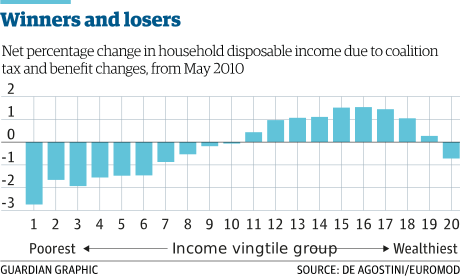
The vast total of around £25bn in benefit cuts already set in motion by the chancellor brings in less than he has freely handed out in personal tax allowances, generous tax breaks, petrol duties and corporation tax cuts. To govern is to make choices. It’s worth noting that the Conservative’s “difficult choices” are resolved by targeting the same social groups, over and over.

Cuts to welfare have been offset by the cost of tax cuts higher up income scale, with no overall contribution to paying down deficit, according to an unsurprising comprehensive study of social policies.

Professor John Hills, director of the London School of Economics (LSE) Centre for Analysis of Social Exclusion, said: “Protection of some of the core parts of the welfare state from the greatest cuts, and initial protection of the value of benefits, meant that those at the bottom, and important services, were initially shielded from the worst effects of the recession.

“But in the second part of the coalition’s period, selective cuts to benefits and to unprotected services have begun to take their toll, leaving the next government … with much greater social policy challenges than the coalition inherited.”

If David Cameron had been honest and declared that his government intended to dismantle our social infrastructure; the welfare state (and yes, that means in-work benefits too), the NHS, legal aid, and to refuse to honour any meaningful legal commitment to human rights, whilst handing out the money generated from this unravelling of our civilising institutions and services, in the form of handsome rewards to feckless millionaires, would he be in office now?

The Tory mantra “Making work pay” is a doublespeak soundbite version of the 1834 Poor Law principle of less eligibility, which is founded on the atrocious idea that poverty is caused by people simply refusing to work, and it can be “cured” if it is made as unbearable as possible. People will work if they are shamed and psychologically coerced. The whole idea of less eligibility is that “workless” people have to be kept in penury to “teach” them value of the work ethic and to discourage others from becoming an “idle pauper.”

But many poor people are in work.

The tax credit cuts proposed by the Conservatives exposed the “shirker” myth for what it is: a lazy, barely coherent narrative – a cover story for an ideologically driven and increasingly irrational government that is happy to reintroduce Dickensian levels of absolute poverty so that a few rich people can increase their wealth. Punishing poor people and creating a desperate class that are prepared to work for next to nothing rather than starve on a grossly inadequate and punitive social security system serves to drive wages down further, reduces working conditions and removes constraint from private sector profit-making.

It serves to dampen down collective bargaining. It changes the relationship between employers and employees, as well as between the state and citizens, turning increasingly desperate, impoverished people into a reserve army of cheap labour.

The welfare “reforms” were never about “making work pay.”

Unless, of course, you ask “for whom, precisely?” 

1379986_541109785958554_2049940708_nCourtesy of Robert Livingstone
Related

The Tories’ war on welfare has caused untold suffering. Here are three ways we can stop it

The New New Poor Law

Conservatism in a nutshell

Jeremy Corbyn is being stalked by a pantomime horse

3359686

In a recent stage production called “Closing The Barn Door after the Chicken Coup,” a well-known actor who plays the rear end of a horse has complained how much he dislikes Labour party leaders, just on principle. He’s a Labour MP; he says that it’s good to have a hobby in his spare time.

“I hate them all. But more than any of them, I really feel that Corbyn is just too beardy, and I simply can’t get behind him,” says the sullen actor.

“I say neigh, neigh and thrice neigh. How very dare he. He’s only gone and appealed to the tens of thousands of new party recruits, enthusing them by his pesky kid anti-austerity messages. I’m worried that the electorate will spot what a sham Tory austerity is soon, because of such strong opposition from the extremists amongst them who are sick of being made poorer. That simply must not happen.

We can’t have a Labour party that is just about social things for any Tom, Dick or Harry. We need to look after big business. I know all about trickle down economics, being the back end of a mule. In the 1800s it was called the “horse and sparrow” theory. You feed the big horse all the oats and the many little sparrows get to feed in its wake. That’s what it’s all about. I say give all the money to the big private horses.”

I think he means that the public are being fed horse shit.

The actor claims to be a long-standing supporter and member of the Labour party, as well as a part-time MP. However, earlier this year he complained bitterly to the Daily Mail that the then party leader, Ed Miliband, is “a f****** knob.”  As Labour’s new self-appointed publicist, the actor has become famous for his nonsensical outbursts, controversial business interests and excessively large luvvie ego, which is the impressive size of a cathedral.

He told the Mail on Sunday: “I would be prepared to stand as a stalking horse against Jeremy Corbyn.”

“My only intention is to secure a better leader for the Labour party as they’re all rubbish, none of them are ever good enough, in my very important opinion. They need to be nagged. The person to do it is me me me!”

Although the actor says “We know that Labour only wins when it is united and when it is patriotic and speaks for the whole country,” he has nonetheless decided that unbridled disunity and carping about the party is the best way forward. From the back.

He says: “The only way forward for the Labour party is for them to stop opposing the Conservatives completely, especially on welfare cuts and austerity. This crazy left wing politics is nonsense and needs to stop.  And it would do us no harm to behave like blue-collar UKIP supporters. I say we should bring back hanging as well, that would get us elected as most of the public like reality TV entertainment and punishing the poor. We should do what the public want.”

When asked about his leading role as the rear end of a horse, he replied: “Farce doesn’t begin to describe my position any more, it’s the political equivalent of all the slapstick staples and stables rolled into one. But I make hay while the sun shines from my back end.”

He wouldn’t disclose the identity of the front end of the horse, despite the truth being right under his nose. But he has never been one to bury his head in the … sand, and said his real ambition was to progress and play the rear end of a rocking horse.

The actor complained that during the pantomime, the horses head kept pitching abruptly further and further to the right, whilst he couldn’t see where he was going. It made him feel very un-stable. But he added “It’s much better than turning left I suppose.”

He went on to say: “It’s a night mare. Sometimes it’s better to laugh than cry. Because the inescapable truth from here is painfully hard to countenance.”

It must be difficult to keep a tight reign from his position, which lends a form to his pressing sense of inadequacy. Yet despite his own unfortunate position, with his nose pressed firmly to the grind, the actor, left in the dark and certainly left behind, went on to say that “Corbyn should let his trousers fall down and John McDonnell plant a custard pie in his face.”

“The world’s my stage and I’m a horse’s ass”, he added.

A recent Gallop poll showed that many agree. He is.

images

Jeremy Corbyn confronted the Tories with the poverty they’re creating at PMQs – and all they could do was laugh – Liam Young

Originally published in the Independent by Liam Young.

jeremy-corbyn-1
The Tories seem to forget that they were the last government – at some point they will have to take responsibility for their handling of the nation.

As Jeremy Corbyn stood for his second PMQs today, the mocking Tory laughs told us everything we need to know about their enduring Bullingdon Club-style politics. Old habits die hard, it seems. But Corbyn opened strongly, with an issue that unites the Labour party: the cuts to working tax credits which penalise the lowest earners, known colloquially as the Tory work penalty.

Again, the Tories laughed at the name ‘Kelly’, so apparently unbelievable do they find the first names of Corbyn’s constituents; they soon fell silent, however, as they heard of her struggle as the mother of a disabled child earning minimum wage in a 40.5-hour-per-week job. Corbyn tackled the bullyboys by pausing at their laughter this time. ‘Some may find this funny,’ he said, as he continued to talk about mass inequality and the housing problem in London. It was a subtle highlight of something glaringly obvious: for millionaires protected by Tory policies, inequality bolstered by unfair taxes and buy-to-let properties really is hilarious.

Cameron’s reply to the work penalty issue was the same old line: apparently a £20-a-week increase in wages will magically solve the problem. This is not true, of course, as Corbyn promptly replied: working families are set to be £1,300 a year worse off as the Conservative government hammers the working and middle classes so as to give to the super rich.

Cameron claimed that Corbyn’s figures on poverty were wrong, but perhaps that is something to do with the fact that the Work and Pensions Secretary fixed the definition of ‘poverty’ recently. You don’t feed and clothe homeless children by changing a definition, and the government should be ashamed. The fact that 50 per cent of wealth is in 1 per cent of hands globally is shambolic, and reports today that inequality is growing in the UK even as our country now has the third most ‘ultra-high net worth individuals’ in the world put paid to Cameron’s claims to have driven opportunity. There could be no bigger proof that his policies continue to squeeze the middle and punish the poor.

Jeremy Corbyn probably had a headache even before PMQs started. George Osborne’s proposal of a ‘fiscal charter’ has been causing problems for Labour over the last few days, not least because it was once a Labour policy rubbished by Cameron himself. It seems strange, then, that Tories are so desperate to implement it now, considering that the Governor of the Bank of England has not endorsed its proposal and no economist has come out in support of it. Most commentary has focused on how it is unrealistic to try and tie the hands of future governments – almost as though Osborne is trying to make an ideological (and erroneous) point about how Labour ‘caused the recession by their overspending’, rather than the truth about rich bankers running wild without regulation. Of course, it also gave Osborne an excellent opportunity to personally ask Labour MPs to rebel – little more than a cynical attempt to ruffle some feathers.

In June, over 70 economists published a letter that clearly noted that the charter has ‘no basis in economics’ and that permanent surplus would increase the debt of households and businesses. The policy is not about protecting the British economy; it is an attempt to bury the Labour party under the same message of the last government. The Tories seem to forget that they were the last government – they have been in power now for almost six years, and at some point they will have to take responsibility for their handling of the nation.

Despite all this, PMQs today were the best moment of Corbyn’s leadership of the Labour party so far. Osborne’s attempt to destabilise the Labour party and force Labour MPs to rebel spectacularly failed, while Corbyn asked if he could bring the Prime Minister back to reality as Tory rhetoric failed against his grassroots facts.

Cameron wants to get Britain building houses, he wants to alleviate poverty, and he wants to rebuild the economy – or so he’d have you believe. In the last five years, house-building has stalled, poverty has increased, inequality appears to be rising and the national debt has doubled. At some point, the Tories have to stop blaming Labour for their own disastrous record. Corbyn is now attacking their mythology head-on – and he might just be getting somewhere. 

Liam Young is a freelance political journalist studying international relations at the LSE

Sanctions are founded on Tory psychobabble. You can’t “incentivise” people by starving them

430835_148211001996623_1337599952_n (1)

The fact that there is now such an extensive gap between Conservative rhetoric, the claims being made and reality makes the task of critical analysis difficult.

But the most striking thing isn’t just the disorientating gap between rhetoric and reality: it is also the gap between the bland vocabulary used and the references, meanings and implications of what is actually being said.

Lying, saying one thing and doing another, creating a charade to project one false reality when something else is going on, is very damaging: it leaves people experiencing such deception deeply disorientated, doubting their own memory, perception and sanity.

To cover their tracks and gloss over the gaping holes in their logic, the Tories employ mystification techniques, the prime function of which is to maintain the status quo. Marx used the concept of mystification to mean a plausible misrepresentation of what is going on (process) or what is being done (praxis) in the service of the interests of one socioeconomic class (the exploiters) over or against another class (the exploited). By representing forms of exploitation as forms of benevolence, the exploiters confuse and disarm the exploited.

The Conservatives also use Orwellian-styled language – semantic shifts – and construct incongruent, dissonance-inducing narratives to misdirect us, and to mask the aims and consequences of their policies.  For example, the words “fair”, “support” and the phrase “making work pay” have shifted to become simple socio-linguistic codifications for very regressive punitive measures such as cuts to social security support. 

The semantics are also stratified. People who are unaffected by austerity policies will probably take the bland vocabulary at face value. Cameron said:

“The British people are decent, sensible, reasonable, and they just want a government that supports the vulnerable.”

However, the “vulnerable” know a very different reality to the one substituted and described on their behalf. People who are adversely affected by Conservative policy will regard the bland vocabulary as bewildering, deceitful, frightening – especially because of its incongruence with reality – and most likely, as very threatening. Such rhetoric is designed to hide intention, but it is also designed to deliberately invalidate people’s own experiences of Tory policies and ultimately, the consequences of an imposed Tory ideology.

Not that there can be any mistaking the threats aimed at sick and disabled people from Duncan Smith in his Conference speech. He said:

“We won’t lift you out of poverty by simply transferring taxpayers’ money to you. With our help, you’ll work your way out of poverty.”

Of course the Work and Pensions secretary employed a traditionally Tory simplistic, divisive rhetoric that conveniently sections the population into “deserving” tax payers and “undeserving” non-tax paying citizens, to justify his balefully misanthropic attitude towards the latter group, as usual. However, the majority of sick and disabled people have worked and have contributed tax. 

Tory claims are incongruent with reality, evidence, academic frameworks and commonly accepted wisdom.

As Dr Simon Duffy, from the Centre for Welfare Reform points out, the poor not only pay taxes they also pay the highest taxes.  For example, the poorest 10% of households pay 47% of their income in tax. This is a higher percentage than any other group. We tend to forget that people in poverty pay taxes because we forget how many different ways we are taxed:

  • VAT
  • Duties
  • Income tax
  • National Insurance
  • Council tax
  • Licences
  • Social care charges, and many others taxes.

Mr Duncan Smith said that many sick and disabled people “wanted to work” and that the Government should give them “support” to find jobs and make sure the welfare system encouraged them to get jobs.

Ah, he means the “making work pay,” approach, which is the Tory super-retro approach to policy-making, based on the 1834 Poor Law principle of less eligibility again.  The reality is that sick and disabled people are being coerced by the state into taking any very poorly paid work, regardless of whether or not they can work, and to translate the rhetoric further, Duncan Smith is telling us that the government will ensure the conditions of claiming social security are so dismal and brutal that no-one can survive it.

Cameron also claims that the Conservatives are the “party for workers”, and of course lamblasted Labour. Again. Yet it was the Labour party that introduced tax credits to ensure low paid workers had a decent standard of living, and this government are not only withdrawing that support, we are also witnessing wages drop lower than all of the other G20 countries, since 2010, the International Labour Organisation reliably informs us.

This fall not only led to a tight squeeze on living standards (the cost of living has rapidly increased), it also led to a shortfall in treasury income in the form of tax revenues. But all of this is pretty standard form for Conservative governments, and shouldn’t come as any surpise, given their history and ideological foundation. We see recession, lower standards of living, wages being driven down and poorer working conditions under very single Tory government. Thatcher did the same, for example.

And Cameron’s promise during his address to the Conservative party conference that “an all-out assault on poverty” would be at the centre of his second term is contradicted by a sturdy research report from the Resolution Foundation that reveals planned welfare cuts will lead to an increase of 200,000 working households living in poverty by 2020.

Duncan Smith also criticised what he claimed was Labour’s “something for nothing culture” which was of course a very supportive and fair, reasonably redistributive system. He also dismissed and scorned the protests against his policies, which his party’s conference has been subject to. But demonstration and protest is a mechanism of democracy for letting a government know that their policies are having adverse consequences.

Many of the disabled protesters at the conference are being hounded, hurt and persecuted by this government and actually, we are fighting for our lives. But clearly this is not a government that listens, nor is it one that likes democratic dialogue and accountability.

In his teeth-grindingly vindictive and blindly arrogant speech, Duncan Smith also criticised the old Employment Support Allowance benefit for signing people off work when they were judged by doctors as too sick to work. He claimed that Labour treated disabled people as “passive victims.” I’m wondering what part of professional judgements that a person is too sick to work this lunatic and small-state fetishist finds so difficult to grasp. Duncan Smith is a confabulating zealot who drives a dogmatic steam-roller over people and their experiences until they take some Tory neo-feudalist deferential, flat-earth shape that he thinks they should be.

Let’s not forget that this government have actually cut support for disabled people who want to work. The Access To Work funding has been severely cut, this is a fund that helps people and employers to cover the extra living costs arising due to disabilities that might present barriers to work. The Independent Living fund was also cruelly scrapped by this Government, which also has a huge impact on those trying their best to lead independent and dignified lives.

By “support to get jobs”, what Duncan Smith actually means is no support at all. He means more workfare – free labor for Tory donors – and more sanctions – the removal of people’s lifeline social security. He also means that good ole’ totalitarian dictum of “behaviour change,” a phrase that the Tories are bandying about a lot, these days.  Ask not what the government can do for you.

And what about the very frail and elderly people needing support?

The public care sector has been cut by a third this past 5 years, yet people are still aging and living longer, so demand for the services has risen. We know that private residential care homes notoriously put profit over care standards, as yet there’s not been an equivalent local authority scandal, but cuts and gross underfunding mean care workers are stretched beyond limit, and there aren’t enough funds to run an adequate home care service. It’s mostly the very frail and elderly who need this service. And it’s those vulnerable citizens that are being increasingly left without adequate care, and certainly not care of a sufficient standard to maintain their dignity.

These are citizens that have paid into a social security system that was established for “cradle to the grave” support if it was needed. This government has so wickedly betrayed them. That’s hardly making a lifetime of work and contribution “pay”.

The knock-on effect is that many people without adequate care end up stranded in hospital, taking up beds and resources, through no fault of their own, and as we know, the health service is also desperately struggling to provide adequate service because of Tory cuts.

Tory policy is all about social engineering using justification narratives founded on an insensate, draconian ideological and semantic unobtainium equivalent. It’s clear that this government lacks the experience and understanding necessary for the proper use of psychological terms. The content of their smug and vindictive justification narratives and stapled-together, alienating and psychopathic rhetoric deviates markedly from even basic common sense and good judgement.

The Tories reduce long debated, complex ideas to surprisingly spiteful platitudes, and hand us back dogmas gift wrapped in aggrandized certitude.

They bandy about insidiously bland, psychobabble words like “incentivise” in the context of coercive state actions – such as the ideas for welfare increased conditionality and brutal operant conditioning based sanctions.

I sent an Freedom of Information request (FOI) to the Department of Work and Pensions asking about the sanction figures from 2010 to present day, and I also asked how sanctions can possibly “incentivise” or “help” people into work,  what psychological/academic/theoretical framework the claim is premised on and what research evidence supports this claim, after I pointed out Maslow’s motivation theory based on a hierarchy of needs – accepted conventional wisdom is that you can’t fulfil higher level psycho-social needs without first fulfiling the fundamental biological ones.

If people are reduced to struggling to meet basic survival needs, then they can’t be “incentivised” to do anything else. And even very stupid people know that if you remove people’s means to eat, keep warm and shelter, they will probably die. It’s worth remembering that originally, benefits were calculated to meet only these basic survival needs. That’s why welfare is called a social “safety net”.

No response from the Department of Work and Pensions yet.

maslow-5Maslow’s hierarchy of needs

There can be no justification whatsoever for removing that crucial safety net, and certainly not as a political punishment for people falling on hard times – that may happen to anyone through no fault of their own.

No matter what vocabulary is used to dress this up and attempt to justify the removal of people’s lifeline benefits, such treatment of citizens by an allegedly democratic, first-world government is unacceptable, despicable, cruel: it’s an act of violence that cannot fail to cause harm and distress, it traps people into absolute poverty and it is particularly reprehensible because it jeopardises people’s lives.

And what kind of government does that?

This is an excerpt, taken from a much longer article about the Tory Conference.
430847_149933881824335_1645102229_n (1)
Related

Sanctions misery for tens of thousands of families this Christmas

If the Tories don’t like being compared to the Nazis, then they need to stop behaving like despots.

Government under fire for massaging unemployment figures via benefit sanctions from Commons Select Committee

A tale of two suicides and a very undemocratic, inconsistent government

Rising ESA sanctions: punishing sick and disabled people for being sick and disabled

Benefit sanctions are not fair and are not helping people into work

292533_330073053728896_1536469241_nThanks to Robert Livingstone for the illustrations

Employment and Support Allowance – Another Mean Cut From IDS – Sheila Gilmore

Originally posted in the Huff Post, by Sheila Gilmore.

544840_330826693653532_892366209_nCruel cuts.

Policies developed on a false premise will inevitably run into problems. When these policies apply to people this can also cause great harm.

The Government’s policy on ‘sickness benefits’ is framed on the assertion that previous governments ‘dumped’ people on these benefits who never worked again. For their own good they needed to be re-tested on a new basis. Many people would then be returned to the labour market and spending on the benefit would be cut. The trouble is that numbers haven’t reduced much, and projected savings haven’t been made. But rather than review the basis on which their policy was built, it appears that the Government is simply going to cut by £30 per week the benefits of many of those its own test has found unfit for work for the time being. 

Like all good myths this has some elements of truth. Incapacity Benefit was used to deal with the problem of those displaced from industries like coal, textiles and steel during the 1980s. Job opportunities where they lived were limited, and many genuinely suffered from work related poor health . This was particularly true of older workers whose chances of a new job were always the slimmest. Under the Conservatives between 1978/79 and 1996/97, the total number of claimants more than doubled from 1.204 million to 2.569 million. This rate of increase slowed under Labour, with total numbers eventually peaking at 2.678 million in 2008/09 when ESA was introduced.

As this Budget rolls out I suspect we are going to hear a vigorous refreshing of the ‘people being callously dumped’ argument from Tory Ministers and backbenchers. However the truth is more complex. Even where total numbers have remained similar over a fairly long period, these are not by any means the same people. There is substantial flow both on and off benefit. Of those who are long term claimants , many have long term conditions making employment difficult, sometimes impossible.

 The Government insisted on rolling out the transfer of all existing Incapacity Benefit claimants to Employment & Support Allowance from 2011 , believing that the more stringent test applied for ESA would result in many existing claimants being found fit for work. In its first three years ESA was for new claimants only, with around 35% being found fit for work. The correctness of the testing process has rightly been the subject of much controversy , but applying the same test to those moving from IB produced a different result with only 23% being found fit for work initially.
One conclusion which may be reached is that in fact many people in receipt of IB actually were more unwell or disabled than the Government’s propaganda keeps suggesting . Not a conclusion it appears the Government wants to accept.

Even more crucially despite all the numbers being found ‘fit for work’, trumpeted by the Government as proof of their assertions, when you look at the total numbers in receipt of ESA, together those still on the older benefits, this number remains very high. The total number in receipt of ESA and IB is only 100,000 lower than in 2008/9.

Yet taking just the period between April 2011 and March 2013 some 234,600 former IB claimants had been found fit for work. With the toughness of the test also applying to new claimants, and the time-limiting of contributory ESA to a year for many , one would expect the total number of claimants to drop by more than the number of Incapacity Benefit claimants declared Fit for Work – but bizarrely it has dropped by considerably less.

With unemployment falling since 2008/9, one might hope that more people with health issues would have been able to find work.

Something unexplained is going on. Despite all the stress to individuals, the increasing cost and difficulty of administering the system (the migration process created a huge backlog in the assessment process), nothing much seems to have changed and savings not achieved. Are more people are becoming ill or disabled? This seems unlikely.

But what if the initial assumptions were wrong, and that there are not lots of ‘fit’ people sidelined onto incapacity benefits. Three quarters of those being ‘migrated ‘ from IB are not fit for work. The proportion of new claimants being found fit for work has fallen to 23%, and has been steadily falling . In addition I suspect that a good number of those declared Fit for Work, are simply not getting better, not getting jobs, getting less well and end up reapplying for ESA and being awarded benefit the second time round.

If we accept that most claimants actually face significant barriers to returning to work, we need to be putting more effort into both giving them the help they need, and encouraging employers to take people on. This was what the Work Related Activity Group was intended to do, but for many the support offered is minimal . People are invited to ‘work focused interviews (in letters that contain severe warnings about the consequences of not attending) and are then sent away for a year in some cases. Box ticked but no help given. Some are referred to the Work Programme which has very poor outcomes for this group, not surprising given that those attending say that all the emphasis was on the mechanics of job search with little reference to their heath.

Taking away £30 pw of income won’t tackle these weaknesses of the system. Will there still be a Work Related Activity Group at all? The only difference from being on JSA will be less conditionality (although there is still some and examples of ESA-WRAG claimants being sanctioned).

Nor are we dealing here with people with minor illness. Charities report that 45% of people who put in a claim for ESA, and had Parkinson’s, Cystic Fibrosis, multiple sclerosis, or Rheumatoid Arthritis, were placed in the Work Related Activity Group (WRAG).

While this change isn’t due to start until 2017 it won’t take long for it to apply to a substantial number of people . Around 700,000 apply each year for ESA, of which number around 60% proceed to full assessment (the others generally return to work before the process is complete). Currently around 14% of these go into the WRAG. That’s around 60,000 people affected every year.

37079_433060243430176_1848475368_nPictures courtesy of Robert Livingstone

The new social prescribing: ask not what your government can do for you

socialprescribing


I have a background in community work and have always seen it as a progressive mechanism for social transformation; challenging oppression; extending inclusion and democracy; offering learning and personal growth opportunities; empowerment, social justice, equity, fairness, participation, self-determination, amongst many other things. Communities potentially provide essential support for individuals, groups and organisations, and opportunities for reciprocity. Good community work promotes human development, and fosters civic responsibility through solidarity, cooperation and mutual aid.

Social prescribing is basically a community-based referral: it’s a means of enabling primary care services to refer patients with psycho-social, emotional or practical needs to a range of local, non-clinical services, often provided by the voluntary and community sector, and it’s aim is to improve people’s mental health, physical health and wellbeing, using community interventions.

In practice this means that GPs, nurses and other healthcare practitioners work with patients to identify non-medical opportunities or interventions that will help, improving support and the wider social aspects of their lives. The services that patients can choose from include everything from debt counselling, support groups, allotments and walking clubs, to community cooking classes and one-to-one coaching. Both evidence and commons sense suggests that social prescribing may be particularly appropriate and beneficial for isolated, marginalised groups. And needs-led community provision that supports and enhances psychosocial health and wellbeing is an excellent idea.

Poor mental health is often correlated with poverty, (Melzer et al. 2004) poor community integration, and competitiveness amongst social groups (Arrindell et al., 2003). Key questions arise as to the efficacy, therefore, of working with individuals, when much research suggests community work would be more effective (Orford, 2008).

So far so good.

I had the following message yesterday from friend and fellow writer, Linda:

“I have received an email from my local Tory MP letting me (and other constituents) know that he is going to be setting up a ‘Mental Health Surgery’ Hub with a ‘Mental Health Expert’ who will be handing out ‘social Prescriptions’ as he says he is aware that many mental health problems are caused by ‘Social Problems’. Im wondering if there is perhaps a wider agenda from the Conservatives.”

This is the relevant paragraph taken from his email:

“Since my election in May I have been surprised at the number of my constituents with different mental health issues, so much so I am looking to run a surgery ‘hub’ with a mental health specialist so people can drop in and have their needs assessed and be issued with a form of ‘social prescription’. I recognise many mental health issues are caused or exacerbated by social factors so sometimes a social solution can be more effective than a medical one.

I did a little research.

The 2010 Marmot Review (Fair Society, Healthy Lives) of health inequalities identified social prescribing as an, “approach [that] facilitates greater participation of patients and citizens and support in developing health literacy and improving health and wellbeing”.

It identified additional NHS healthcare costs linked to inequality as being well in excess of £5.5 billion per year. It is claimed that social prescriptions can cut the NHS bill.

However, despite the growing popularity of social prescriptions amongst cash and resource-strapped professionals, the University of York has surprisingly produced research to show that there is little good quality evidence that social prescribing is cost-effective.

But the thing that bothers me the most is the link that the Conservative government have made between social prescriptions, cost-cutting and (as I deeply suspected) as a mechanism of extending behavioural modification (euphemistically called “nudging” by the government’s team of behavioural economists and decision-making “experts”).

I read several current reviews of social precribing, each mentioning both criteria in recommendations for “success.”:

“The work of social prescribing health trainers fits with the approach of the Coalition Government as described in its White Paper on Public Health which emphasises the need to ‘build people’s self esteem and confidence’ in order to bring about changes in behaviour.”

It also fits with the Marmot Review’s recommendation on tackling the social problems that undermine health and with the Coalition Government’s approach to behaviour change as outlined in recent publications such as MINDSPACE.” (Link added by me.)

and:

“In times when finances are under pressure and the NHS is charged with achieving ‘better for less’, primary care needs to be looking at how to do things differently.”

Nesta, who now partly own the Government’s Behavioural Insights Team (the Nudge Unit) are of course at the forefront of promoting social prescriptions amongst medical professionals, firmly linking what is very good idea with very anti-democratic Conservative notions of behaviour change, citizen responsibility and small-state ideology. So, it’s no longer just about helping people to access a wider range of community-based services and support, social prescribing has also places strong emphasis on “encouraging patients to think about how they can take better care of themselves.”

Of course, there is what may easily be construed as a whopping self-serving process of linking behavioural change with social prescribing, opening some potentially very lucrative opportunities for Nesta.  

However, taken at face value, the idea of promoting patient participation in their own care sounds very democratic and reasonable. Common sense, in fact.

In this context, social prescribing can be seen as a logical extention of the Biopsychosocial model (BPS) of ill health. The biological component of the model is based on a traditional allopathic (bio-medical) approach to health. The social part of the model investigates how different social factors such as socioeconomic status, culture and poverty impact on health. The psychological component of the biopsychosocial model looks for potential psychological causes for a health problem such as lack of self-control, difficulties with coping, emotional turmoil, and negative thinking.

Of course a major criticism is that the BPS model has been used to disingenuously trivialise and euphemise serious physical illnesses, implying either a psychosomatic basis or reducing symptoms to nothing more than a presentation of malingering tactics. This ploy has been exploited by medical insurance companies (infamously by Unum Provident in the USA) and government welfare departments keen to limit or deny access to medical, social care and social security payments, and to manufacture ideologically determined outcomes that are not at all in the best interests of patients, invalidating diagnoses, people’s experience and accounts, and the existence of serious medical conditions.

Unum was involved in advising the government on making the devastating cuts to disabled people’s support in the UK’s controversial Welfare Reform Bill. (See also: The influence of the private insurance industry on the UK welfare reforms.)

Secondly, this is a government that tends to emphasise citizen responsibilities over rights, moralising and psychologizing social problems, whilst quietly editing out government responsibilities and democratic obligations towards citizens.

For example, poverty, which is caused by political decisions affecting socioeconomic outcomes, is described by the Conservatives, using elaborate victim-blame narratives, and this is particularly objectionable at a time when inequality has never been greater in the UK. Poverty may only be properly seen in a structural context, including account of the exclusion and oppression experienced by those living in poverty, the global neoliberal order, the gender order, the disability, racial, sexual and other orders which frame social life and precipitate poverty in complex and diverse ways. It’s down to policy-makers to address the structural origins of poverty, not the poor, who are the casualities of politically imposed structural constraints.

In this context, social prescriptions are used to maintain the status quo, and are likely to be part of a broader process of responsibility ascription – based on the traditional Conservative maxim of self-help, which is used to prop up fiscal discipline and public funding cuts, the extensive privatisation of public services, defense of private property and privilege, and of course, the free market. The irony of the New Right, neoliberal, paternalistic libertarianism is that the associated policies are not remotely libertarian. They are strongly authoritarian. It’s a government that doesn’t respond to public needs, but rather, it’s one that pre-determines public interests to fit within an ideological framework

A government that regards individuals as the architects of their own misfortune tends to formulate policies that act upon individuals to change their behaviour, rather than to address the structural constraints (and meet public needs,) such as social injustice and unequal access to resources. This isn’t a government prepared to meet public needs at all. Instead it’s a government that expects citizens to change their behaviour to accommodate the government’s ideologically directed needs.

That approach flies in the face of established professional community work values and principles.

Poor people suffering mental ill health because we live in a society that is extremely unequal, are blamed by the government for the “symptoms” of their poverty – poor eating habits and “lifestyle choices”. But poverty is all about limited choices, which is itself not a “lifestyle choice.” No-one actually chooses to be poor. Government policies, social structures and systemic failures create poverty.

The Conservatives extend an economic Darwinism, coupled with an extremely intrusive disciplinary approach, mass surveillance and a stigmatising rhetoric, whilst moralising a free-market framework that constrains many and preserves the privilege of a few. The absurdity is this: if an economic framework isn’t meeting the needs of a population, it isn’t an adequate response for the government to act upon citizens who have become casualities of that framework, to persuade or coerce people into fitting within an increasingly harmful and useless socioecomomic ideology.

There is a clear correlation with low socioeconomic status and poor mental health. Poverty is a complex, multidimensional phenomenon, encompassing the lack of means to satisfy basic needs, lack of control over resources, often, a lack of access to education, exclusion from opportunities, and poor health. Poverty is intrinsically alienating and distressing, and of particular concern are the direct and indirect effects of poverty on the development of psychosocial stress. (See also: The Psychological Impact of Austerity – Psychologists Against Austerity.)

State “therapy” aimed at changing the behaviour of individuals diverts attention from growing inequality, and from policies that are creating circumstances of absolute poverty. It also diverts attention from the fact that if people cannot meet their basic physiological needs, they cannot possibly be “incentivised” to meet higher level psychosocial ones. 

I wrote a critical analysis of the government proposal to introduce Cognitive Behaviour Therapists to deliver state “therapy” in job centres earlier this year, with the sole aim of improving “employment outcomes.” There is also an extensive critique of Cognitive Behaviour Therapy (CBT) included in the article, along with some discussion about the merits of community work, which is very relevant to this discussion. (See: The power of positive thinking is really political gaslighting.)

I also wrote earlier this year about how the government has stigmatised and redefined unemployment, problematizing and re-categorising it as an individual psychological disorder. Both articles are very pertinent to this discusion. (See: Stigmatising unemployment: the government has redefined it as a psychological disorders.)

Welfare has been redefined: it is a now a reflecton of a government pre-occupied with assumptions about and modification of the behaviour and character of recipients rather than with the alleviation of poverty and ensuring economic and social wellbeing.

The stigmatisation of people needing benefits is designed purposefully to displace public sympathy for the poor, and to generate moral outrage, which is then used to further justify the steady dismantling of the welfare state.

Many psychosocial problems have arisen because of social conservatism and neoliberalism. The victims of this government’s policies and decision-making are being portrayed as miscreants – as perpetrators of the social problems caused by the government’s decisions.

It’s all too often the case that good ideas are placed in political ideological frameworks, distorted, and are then applied to simply justify and prop up dogma.

Meanwhile, mental health services are facing crisis because of budget cuts by this government, Local Authorities and community services have also been cut to the bone. (See: The cost of the cuts: the impact on local government and poorer communities.) Those with mental health problems are stranded on an ever-shrinking island.

Policy initiatives such as social prescriptions, which focus on how to remediate problems at an individual level, seeing both poverty and mental illness, for example, as simply states of being – rather than dealing with the generative political and economic practices and social relations framework which precipitated that state in the first place, effectively depoliticises political problems leaving people with an internalised state of oppression, disabling them from taking effective action.

The political refusal to permit people to voice their concerns and anxieties in political rather than personal terms further exacerbates sociopolitical marginalisation, low status, it breaks a sense of connectedness with others and wider communities, it reinforces a sense isolation and of personal responsibility for circumstances that are politically constructed and disowned.