Category: Uncategorized

Health cuts most likely cause of steep rise in mortality, government in denial

unnamed

Government denies that NHS and social care cuts may have caused 30,000 excess deaths in England and Wales 2015.

An unprecedented rise in mortality in England and Wales, where 30,000 excess deaths occurred in 2015, is likely to be linked to cuts to the NHS and social care, according to research which has drawn an angry response from the government.

The highly charged claim is made by researchers from the London School of Hygiene & Tropical Medicine, Oxford University and Blackburn with Darwen council, who say the increase in mortality took place against a backdrop of “severe cuts” to the NHS and social care, compromising their performance.

(The report can be accessed here: Why has mortality in England and Wales been increasing? An iterative demographic analysis.)

The Department of Health (DH) responded by accusing the authors of the paper and accompanying commentary, published in the Journal of the Royal Society of Medicine on Thursday, of “bias”.

The researchers ruled out other possible causes of the increase, including cold weather, flu and the relatively low effectiveness of the flu vaccine that year, noting that fatalities from the virus rose “but not exceptionally”.

After examination of NHS performance data for the period, which shows the service missing almost all its targets, they concluded: “The evidence points to a major failure of the health system, possibly exacerbated by failings in social care.”

The rise in deaths from 2014 to 529,655 in 2015 was the biggest in percentage terms in almost 50 years and the mortality rate was the highest since 2008. The excess deaths were largely among older people who are most dependent on health and social care, the authors said. 

See: Excess deaths per month in 2015 compared with 2006-2014

The research further warned that the “spike” was showing signs of becoming an established pattern, with provisional official weekly mortality data from 2016 showing deaths from October onwards increasing by 7% compared with the five-year average.

While accepting their findings would generate controversy, the authors expressed surprise that the rise and the reasons for it had not previously been scrutinised.

Professor Danny Dorling from the University of Oxford said: “It may sound obvious that more elderly people will have died earlier as a result of government cutbacks, but to date the number of deaths has not been estimated and the government have not admitted responsibility.”

The researchers observed that the increase in mortality came as waiting times rose in A&E departments – despite unexceptional attendances – for admissions, diagnostic tests and also consultant-led care. Ambulance response times also increased as did operations cancelled for non-clinical reasons. Staff absence rates rose and more posts remained empty as staff had not been appointed.

The authors said health service austerity had been exacerbated by £16.7bn of cuts to the welfare budget and a 17% decrease in spending for older people since 2009, while the number of people aged 85 and over had risen almost 9%.

See: Age-standardised death rates per 100,000 population for all ages

Barbara Keeley, the shadow social care minister, said: “The Tories have created a crisis in social care. They have cut billions of pounds from council budgets and care is suffering as a result.

“In the March budget, the government must provide extra funding urgently and deliver a sustainable settlement to deal with the crisis in health and social care.”

The Liberal  Democrat leader, Tim Farron, called it “a national scandal that in one of the richest countries in the world, vulnerable older people are missing out on the services they need and may even have died due to poor care”.

The report’s co-author, Dominic Harrison, the director of public health at Blackburn with Darwen council, said the research “raises a red flag that is telling us that the health and care system may have reached the limits of its capacity to safely and effectively care for the population that funds it. Our analysis suggests that the most likely cause of that failure, when all other possible explanations have been excluded, is insufficient resources and capacity”.

The paper will make uncomfortable reading for the government at a time when it is under substantial pressure to boost spending for both the NHS and social care amid fears they are at breaking point.

See: Number of patients spending more than 12 hours from decision to admit to admission

A Department of Health (DH) spokesman described the study as “a triumph of personal bias over research”. He added: “Every year there is significant variation in reported excess deaths, and in the year following this study they fell by nearly 20,000, undermining any link between pressure on the NHS and the number of deaths. Moreover, to blame an increase in a single year on ‘cuts’ to the NHS budget is arithmetically impossible given that budget rose by almost £15bn between 2009-10 and 2014-15.”

The fall the DH refers to is the reduction in excess winter deaths, which compares those between December and March with those in the rest of the year. Excess deaths over the year are measured relative to the average in recent years.

Harrison said the point the authors were making was that in months such as January 2015, which saw a spike in deaths, there was an insufficient service response to a surge in demand. He termed this a “fail event” and warned there could be recurrences over the next five years without a rise in funding. He added that preliminary figures pointed to a possible significant increase in excess deaths last month.

“I have few doubts that our findings will be strongly contested,” he said. “This report has been published in good faith in a peer-reviewed academic journal by senior health professionals who are concerned to understand the causes of avoidable death in the population – precisely so that we can avoid it happening again.”


From The Guardian, 17th February 2017


imgres

Related

Public health experts from Durham University have denounced the impact of Margaret Thatcher’s policies on the wellbeing of the British public in a comprehensive study which examines social inequality in the 1980s.

The study, which looked at over 70 existing research papers, concludes that as a result of unnecessary unemployment, welfare cuts and damaging housing policies, the former prime minister’s legacy includes the unnecessary and unjust premature death of many British citizens, together with a substantial and continuing burden of suffering and loss of wellbeing.

The research shows that there was a massive increase in income inequality under Baroness Thatcher – the richest 0.01 per cent of society had 28 times the mean national average income in 1978 but 70 times the average in 1990, and UK poverty rates went up from 6.7 per cent in 1975 to 12 per cent in 1985.

Baroness Thatcher’s governments wilfully engineered an economic catastrophe across large parts of Britain by dismantling traditional industries such as coal and steel in order to undermine the power of working class organisations, say the researchers. They suggest this ultimately fed through into growing regional disparities in health standards and life expectancy, as well as greatly increased inequalities between the richest and poorest in society.

Professor Clare Bambra from the Wolfson Research Institute for Health and Wellbeing at Durham University, co-author of the research report, commented:

“Our paper shows the importance of politics and of the decisions of governments and politicians in driving health inequalities and population health. Advancements in public health will be limited if governments continue to pursue neoliberal economic policies – such as the current welfare state cuts being carried out under the guise of austerity.”

Thatcher’s policies  have been condemned for causing “unjust premature deaths.” Cameron’s policies are even more class-contingent and cruel.

I think there is a growing body of empirical evidence which indicates clearly that Conservative governments are much worse for public health, prosperity and wellbeing than unemployment. (From: Conservative governments are bad for your health.)


I don’t make any money from my work. But you can help me continue to research and write informative, insightful and independent articles, and to provide support to others by making a donation. The smallest amount is much appreciated – thank you.

DonatenowButton cards

Jobcentre tells GP to stop issuing sick notes to patient assessed as ‘fit for work’ and he died.

pizapcom14829621211221

Abbie and her late father, James Harrison.

Julia Savage is a manager at Birkenhead Benefit Centre in Liverpool. She wrote a letter addressed to a GP regarding a seriously ill patient. It said:

“We have decided your patient is capable of work from and including January 10, 2016.

“This means you do not have to give your patient more medical certificates for employment and support allowance purposes unless they appeal against this decision.

“You may need to again if their condition worsens significantly, or they have a new medical condition.” 

The patient, James Harrison, had been declared “fit for work” and the letter stated that he should not get further medical certificates. 

However, 10 months after the Department for Work and Pensions (DWP) contacted his doctor without telling him, James died, aged 55, the Daily Record has reported.

He was clearly not fit for work.

His grieving daughter, Abbie, said: “It’s a disgrace that managers at the Jobcentre, who know nothing about medicine, should interfere in any way in the relationship between a doctor and a patient.

“They have no place at all telling a doctor what they should or shouldn’t give a patient. It has nothing to do with them.

“When the Jobcentre starts to get involved in telling doctors about the health of their patients, that’s a really slippery slope.”

Abbie said James had worked since leaving school at a community centre near his home. But his already poor health went downhill after the centre was shut down because of austerity cuts.

James had a serious lung condition and a hernia before the centre closed, and also developed depression and anxiety afterwards.

Abbie said: “He’d worked all his life. He wasn’t the kind of guy who knew anything about benefits.

“But as his health deteriorated, there wasn’t any chance he could do a job. He applied for employment and support allowance.”

James received Employment and Support Allowance (ESA), but only at the low rate of £70 a week, the same amount as jobseekers’ allowance. He was then sent to attend one of the DWP’s controversial Work Capability Assessments – and declared fit for work.

Despite that decision, Abbie said James remained in constant need of medical help and had to visit his doctor regularly.

However, the GP concerned repeatedly refused to give him a sick note, and James began to suspect the Jobcentre were to blame for this.

Abbie said: “He really needed a note. He was too ill to go to the constant appointments at the Jobcentre and he didn’t want to be sanctioned.

“He became convinced the DWP had been talking to his doctor behind his back.”

Although Abbie felt her father was confused, and didn’t think his explanation was right at the time, she later asked to see her father’s medical records. She found the letter in his file from Julia Savage, the manager at Birkenhead Benefit Centre, in James’s home city of Liverpool.

The letter was addressed to James’s GP.

Context: Government claims that work is a “health outcome”

James Harrison was very worried that his ill health interfered with his obligation to comply with the inflexible and constant conditions attached to his eligibility for welfare support, and that this would lead to sanctions – the withdrawal of his lifeline support, which was calculated to meet basic survival needs only.

The GP should have provided evidence that this was the case. The doctor was advised not to provide further fit notes by the DWP, however, unless James appealed. Yet the circumstances warranted that the GP provide a fit note. 

fit-note-guidance

Last year, the Department for Work and Pensions issued an ideologically directed new guidance to GPs regarding when they should issue a Fit Note. This was updated in December 2016.

In the document, doctors are warned of the dangers of “worklessness” and told they must consider “the vital role that work can play in your patient’s health”.  According to the department, “the evidence is clear that patients benefit from being in some kind of regular work”.

The biopsychosocial model, with a current political emphasis on the psychological element, has become a disingenuous euphemism for psychosomatic illness, which has been exploited by successive governments (and rogue insurance companies) to limit or deny access to social security, medical and social care.

Nobody would deny that illness has biological, psychological and social dimensions, however, the model has been adapted to fit a neoliberal “small state” ideology – one that rests almost entirely on Conservative individualist notions of citizen responsibility, as opposed to a rights-based approach and provision of publicly funded state support.

This approach to disability and ill health has been used by the government to purposefully question the extent to which people claiming social security bear personal responsibility for their own health status, rehabilitation and prompt return to work. It also leads to the alleged concern that a welfare system which was originally designed to provide a livable income to those with disabling health problems, may provide “perverse incentives” for perverse behaviours, entrenching “worklessness” and a “culture of dependency”. It’s worth pointing out at this point that there has never been any empirical evidence to support the Conservative notion of welfare “dependency”. 

Instead of being viewed as a way of diversifying risk and supporting those who have suffered misfortune and ill health, social and private insurance systems are to be understood as perverse incentives that pay people, absurdly, to remain ill and keep them from being economically productive.

The idea that people remain ill deliberately to avoid returning to work  – what Iain Duncan Smith and David Cameron have termed “the sickness benefit culture” – is not only absurd, it’s very offensive. This is a government that not only disregards the professional judgements of doctors, it also disregards the judgements of sick and disabled people. However, we have learned over the last decade that political “management” of people’s medical conditions does not make people healthier or suddenly able to work. Government policies, designed to “change behaviours” of sick and disabled people have resulted in harm, distress and sometimes, in premature deaths

The government have made it clear that there are plans to merge health and employment services. In a move that is both unethical and likely to present significant risk of harm to many patients, health professionals are being tasked to deliver benefit cuts for the DWP. This involves measures to support the imposition of work cures, including setting employment as a clinical outcome and allowing medically unqualified job coaches to directly update a patient’s medical record.

The Conservatives (and the Reform think tank) have also proposed mandatory treatment for people with long term conditions (which was first flagged up in the Conservative Party Manifesto) and this is currently under review, including whether benefit entitlements should be linked to “accepting appropriate treatments or support/taking reasonable steps towards “rehabilitation”.  The work, health and disability green paper and consultation suggests that people with the most severe illnesses in the support group may be subjected to welfare conditionality and sanctions.

Many campaigners have raised concerns about the DWP interfering with people’s medical care and accessing their medical files. I wrote an article last year about how the government plans to merge health and employment services and are now attempting to redefine work as a clinical outcome. I raised concerns about the fact that unemployment has been stigmatised and politically redefined as a psychological disorder, and that the government claims, somewhat incoherently, that the “cure” for unemployment due to illness and disability, and sickness absence from work, is work.

In a critical analysis of the recent work, health and disability green paper, I said: 

“And apparently qualified doctors, the public and our entire health and welfare systems have ingrained “wrong” ideas about sickness and disability, especially doctors, who the government feels should not be responsible for issuing the Conservatives recent Orwellian “fit notes” any more, since they haven’t “worked” as intended and made every single citizen economically productive from their sick beds.

It seems likely, then, that a new “independent” assessment and some multinational private company will most likely very soon have a lucrative role to ensure the government get the “right” results.”

The medical specialists are to be replaced by another profiteering corporate giant who will enforce a political agenda in return for big bucks from the public purse. Health care specialists are seeing their roles being incrementally and systematically  de-professionalised. That means more atrocious and highly irrational attempts from an increasingly authoritarian government at imposing an ideological “cure” – entailing the withdrawal of any support and imposing punitive “behavioural incentives” – on people with medical conditions and disabilities. Doctors, who are clever enough to recognise, diagnose and treat illness, are suddenly deemed by this government to be insufficiently clever to judge if patients are fit for work.

The political de-professionalisation of medicine, medical science and specialisms (consider, for example, the implications of permitting job coaches to update patient medical files), the merging of health and employment services and the recent absurd declaration that work is a clinical “health” outcome, are all carefully calculated strategies that serve as an ideological prop and add to the justification rhetoric regarding the intentional political process of dismantling publicly funded state provision, and the subsequent stealthy privatisation of Social Security and the National Health Service. 

“De-medicalising” illness is also a part of that process:

“Behavioural approaches try to extinguish observed illness behaviour by withdrawal of negative reinforcements such as medication, sympathetic attention, rest, and release from duties, and to encourage healthy behaviour by positive reinforcement: ‘operant-conditioning’ using strong feedback on progress.” Gordon Waddell and Kim Burton in Concepts of rehabilitation for the management of common health problems. The Corporate Medical Group, Department for Work and Pensions, UK. 

Waddell and Burton are cited frequently by the DWP as providing “evidence” that their policies are “evidence based.” Yet the DWP have selectively funded their research, which unfortunately frames and constrains the theoretical starting point, research processes and the outcomes with a heavy ideological bias. 

This framing simply shifts the focus from the medical conditions that cause illness and disability to the “incentives”, behaviours and perceptions of patients and ultimately, to neoliberal notions of personal responsibility and self-sufficient citizenship in a context of a night watchman, non-welfare state. 

Medication, rest, release from duties, sympathetic understanding – the remedies to illness – are being appallingly redefined as “perverse incentives” for ill health, yet the symptoms necessarily precede the prescription of medication, the Orwellian renamed (and political rather than medical) “fit note” and exemption from work duties. Notions of “rehabilitation” and medicine are being redefined as behaviour modification: here it is proposed that operant conditioning in the form of negative reinforcement – which the authors seem to have confused with punishment – will “cure” ill health. 

People cannot simply be “incentivised” into not being ill. 

The political use of the biopsychosocial model to cut costs at the expense of people who are ill will undoubtedly have further extremely serious implications. Such an approach, which draws on behaviourism and punishment (such as the threat and implementation of sanctions) is extremely unethical and makes the issue of consent to medical treatment very problematic if it is linked to the loss of lifeline support or the fear of loss of benefits.

This is clearly the direction that government policy is moving in and this represents a serious threat to the health, welfare, wellbeing and human rights of patients and the political independence of health professionals.


I don’t make any money from my work. But you can contribute by making a donation and help me continue to research and write informative, insightful and independent articles, and to provide support to others. The smallest amount is much appreciated – thank you.

DonatenowButton cards


Reframing frames – ideology, George Lakoff and a call for your views

Wall Street Protestors Rally Against Police Brutality

An excellent example of using a slogan to reframe debate about neoliberalism and inequality from the Occupy movement


Left wing progressives hope that we can win elections by citing facts, rational debate and by offering policy programmes that serve the majority of voters’ interests. When we lose, we either conclude that we need to move farther to the right, where the voters are; where the Overton window opens, or that we need to move further to the left, to present a genuine alternative to the status quo. That dilemma has rigidly polarised the Labour party, undermining our unity and turning what was once a “broad church” appeal into an either/or basic dichotomy of alliances and reflected interests. The problem is how do we know which of these responses to the dilemmas of being a party in opposition will engage the public? And what if it is neither?

Yet, how can the left possibly lose a debate about the economy and social policy, when our current steeply hierarchical socioeconomic organisation serves the interests of so very few citizens? In fact those policies are seriously harming some social groups, especially those traditionally afforded social protections by previous Labour policies. 

Margaret Thatcher once made the absurd claim that the “problem” with socialism is that it “runs out of other people’s money to spend.” However, the New Right became experts on spending our public funds on extending the wealth of a few privileged millionaires, taking money from those who have the very least and handing it out to those who have the very most.

That really is “spending other peoples’ money.” As a consequence, the UK is now the most unequal country in the world, and that includes the US, where the Chicago boys – the founding fathers of neoliberalism – operationalised their experiment in hierarchical and authoritarian modes of neoliberal socioeconomic organisation.

Things ain’t what they ought to be

I’ve pointed out before that it’s easy to mistake the patterns and social circumstances of our era for “natural laws”. We really do need to revisit the is/ought distinction  (the naturalistic fallacy: we cannot use descriptive statements – what “is” – to make or justify prescriptive ones – what “ought” to be). So many people assume the Conservative world view of competition, mysterious “market forces” and the “invisible hand”, survival of the wealthiest, and Randian self interest is simply how things are: that these qualities are all fundamental to our “human nature”. They are not.

They are the qualities required of us – what “ought” to be the case – in order to prop up a hierarchical society, preserving a privileged elite and the material inequality and power relations of neoliberalism. Social Darwinism, which is like a comic strip version of Darwinism, was debunked last century, but here we are with policies that are directed by an ideology founded on social Darwinist principles once again. It’s become  a “common sense” assumption that we are naturally inclined to be competitive, and as a society, hierarchically ranked, on the basis of power and worth. Yet the matter of what “human nature” actually is has never been resolved over the centuries, let alone accounts of how that “nature” translates into the kind of society we have. Or ought to have, for that matter.

How can the Tories be right in their cynical miserablism, regarding our competitive social Darwinist tendencies?  If we are so fundamentally selfish and self-interested, with a generally Hobbesian temperament, moulded a little more by Burke’s profound anti-intellectualism, how, then, did we end up with a trade union and labour movement, working class enfranchisement, the welfare state, the NHS, legal aid, social housing, human rights and to generally progress to develop an altruistic, collectivist, cooperative approach for our post war settlement?  

“Human nature” is far more complex and much less static and defined than the Conservatives would have us believe. The kind of society that we live in, with its prevailing beliefs, attitudes and organisation, also contributes significantly to the kind of people we are, and importantly, to how we see ourselves and others.

Façade democracy

George Lakoff, a linguist and cognitive scientist, says that Conservatives exalt “obedience to authority,” insulate leaders from accountability, oppose checks and balances against leaders and rely on fear. All of this is true.

Lakoff says the right wins and keeps power by framing issues and “controlling minds”. This explains why Conservatives win elections. They manipulate us more effectively than the Progressives. They’ve been “preparing the seedbed of our brains with their high-level general principles” so that when the “low tax/low welfare society” idea, for example,  was planted in its various guises, repeatedly, “their framing could take root and sprout.” And “as a result, progressive messages don’t take root.”

Tories successfully reframe social issues, re-set defaults and normalise their prejudices and values. They become “common sense.” As dominant narratives do. In doing so, the Conservatives shape how the public see themselves and others.

Lakoff proposes that the left present frames instead of raw facts, in order to “train” the public to think less about neoliberal competition and self-interest and more about serving others. It’s not the platform that needs to be changed. It’s the voters. 

Lakoff says that we need to beat Conservatives at their own game. “Democracy is too important to leave the shaping of the brains of the public to authoritarians.” 

I like a lot of Lakoff’s work, but cannot get behind the idea of using techniques of persuasion to win support and (re)grow a movement. But then, the use of such techniques has been effective for the Conservatives, and that level of manipulation creates a problem for democracy. Lakoff is proposing we address the problem of a managed democracy by attempting to manage it too.

Is it possible to propose we manipulate voters and then still claim to be a democrat? 

He is right in that the rational approach doesn’t always work, but perhaps it’s more a question of how we present our alternative. I can get behind a shorthand and punchier general messages, just as long as it isn’t a strung together lexicon of glittering generalities with nothing meaningful referenced below the surface level. Integrity matters. The new world order is maintained partly by a precarious new word order. But it rests only on the very surface of our mind. It exists, not because it is rational or serves our best interests, but because it appears to be “normal.”

It’s probably true that many voters don’t pay much attention to the details and implications of policies. We have a tendency towards cognitive miserliness – the Principle of Least Effort; we frequently rely on simple and time efficient strategies when evaluating information and making decisions. But this can lead to prejudices. We formulate stereotypes, for example, which are simplistic ways of categorising others. Heuristics are mental shortcuts we often use in order to lessen the cognitive load that decision making requires. We often rely on habitual, superficial explorations and generalisations because we are caught up in our lives, and so to some degree, its a strategy of necessity and efficiency. 

However, this tendency towards cognitive miserliness is also manipulated. We often assign new information to categories that are easy to process mentally. These categories arise from prior information, including schemas, scripts and other knowledge structures, that has been stored in memory and so storage of new information does not require much cognitive energy. Cognitive miserliness means we tend not to stray far from our established beliefs when considering new information. That’s partly why repetition and slogans work so well as propaganda techniques. 

My own view is that we should try multiple approaches to messaging the public, but none of it should be simply about changing a vote for the sake of it. We also need to engage citizens in active participation in democracy. That is something the authoritarian Conservatives will never do: they have a policy agenda informed by private companies and millionaires, not ordinary citizens, and that won’t change.

Public needs have been privatised and pushed into the “market place” of competition and invisible capitalist hands. Increasingly, private companies are operating our essential public services, as the Conservatives claim that this is “efficient.” It isn’t, because it’s costing us billions to support unaccountable private businesses whose only motivation is to make profit.(See for example: Doctors bribed with 70-90k salaries to join Maximus and “endorse a political agenda regardless of how it affects patients.” )

Meanwhile, the privatisation of public need means that individuals shoulder the responsibility for them, rather than the state, who are still taking money from the public to fund those public “services.” Making individuals responsible for the consequences of political decision-making and arising socioeconomic problems like unemployment and poverty then justifies an authoritarian state intrusion in the form of “therapy.” For example, the rise of nudging, which is about the political directives to “change behaviours” because people make “the wrong choices” and so it turns democracy on its head.

This is because nudge is used without public consent, and it is solely aimed at “changing behaviours” of citizens to meet the states’ idealised and narrow neoliberal outcomes, rather than it being about actually recognising and meeting social needs and democratic inclusion.

The left tend to have a rather more optimistic, expansive and generous view of human nature. We believe in the human potential for learning, development and progress. However, that optimism is also tempered with an acknowledgement of our darker side, too. Policies which protect social groups that are prone to being exploited, scapegoated and other socially constructed vulnerabilities have largely been Labour party ones.

However, the problem is that the Conservatives hold up a darkly distorting looking-glass to the public, showing only what they want people to see of themselves. In that mirror, we are rendered ugly – always prone to being stupid, selfish, greedy, impulsive savages that need to to be ruled and controlled. Our self perceptions are shaped by significant others. There arises a subsequent social self-fulfilling prophecy. We project and scapegoat: it is always others that are savage and selfish, not us. This is facilitated by the Conservative tendency to marginalise poor people, creating folk devil stereotypes and social outgroups. 

We’re capable of changing minds. But we have good SOCIAL reasons to do so. That, for me is the key – there’s a difference between propaganda and reasoning; public interest and simply maintaining the public’s interest. The answer probably lies somewhere in a compromise – using both a rational and evidenced approach and the reductive pop politics soundbites to capture public interests AND public interest.

Tory cuts cost lives was a soundbite of mine from 2015. I wanted to reference war, and highlight the enemy in a longstanding and ongoing class conflict. It’s got integrity as a slogan because I’ve spent a few years writing about and presenting evidence of how  Conservative austerity is harming and sometimes killing people. 

But I don’t have all the answers. To come up with effective solutions requires our willingness for collaboration and cooperation.   

I’m particularly interested in what others think about this issue. If you have any thoughts on this, please leave me a comment, and I will revisit them in due course. We can do what the left always do very well: hold a democratic discussion and problem-solve collectively.


th


I don’t make any money from my work. At this moment in time, I am struggling to live. But you can help by making a donation so I can continue to research and write free, informative, insightful and independent articles, and to provide support to others. The smallest amount is much appreciated – thank you.

DonatenowButton cards

Numbers of cases of malnutrition continue to soar in the UK

Minnes

The Office of National Statistics (ONS) have released figures that show 391 people died from malnutrition in 2015. There were 746 hospital admissions for malnutrition in just 12 months. The statistics also show two people in the UK are admitted to hospital with the condition every day in what campaigners have called a “national scandal.” 

Health minister Nicola Blackwood confirmed the numbers in a written answer in Parliament.

More than six people a month perish from starvation in England, which is one of the richest nations in the world.  The UK’s biggest food bank network, the Trussell Trust, provided more than a million three-day food packages over the past year, including 415,866 to children.What is worrying is that people may only have this support for a maximum of three days and have to be referred by a professional, such as a doctor or social worker.

Chairman Chris Mould said: It’s a scandal that people living in the sixth largest economy in the world are going hungry, which is why we’re working to engage the public, other charities and politicians from all parties to find solutions to the underlying causes of food poverty.

Our food banks support many thousands of people in various states of hunger.

Some people have been missing meals for days at a time; others have been unable to afford certain food groups or have sacrificed quality for long periods of time to keep costs down.

This, no doubt, has a negative effect on their health – and for people at the extreme end of the scale it will lead to malnutrition.

Every day we meet families across the UK who are struggling to put enough nutritious food on the table and hear from parents who go without food so their children have enough to eat.”

A Department for Work and Pensions spokeswoman said: “We now have record numbers of people in work and wages rising faster than inflation. 

But we need to go further, which is why we’ve committed to increase the National Living Wage, we’re taking the lowest paid out of income tax and our welfare reforms are ensuring it always pays to work.”

However it seems that “making work pay” is a euphemism for punishing those out of work or those in part-time or low-paid work with absolute poverty. In December 2015, I wrote about research from the Child Poverty Action Group, Oxfam, Church of England and the Trussell Trust which found that failures in the social safety net itself are most often the trigger for food bank referrals.

The report said that while money is tight for many reasons, including bereavement, relationship breakdown, illness or job loss, issues such as sanctions, delays in benefits decisions or payments or being declared “fit for work” led people to turn to food banks for support.

  • Around a third of foodbank users in the sample were waiting for a decision on their benefits – and struggling in the meantime
  • Between 20 and 30% more had their household benefits reduced or stopped because of a sanction

Other factors included loss of income due to the “bedroom tax” or the benefit cap. For between half and two-thirds of the people included in this research, the immediate income crisis was linked to the operation of the benefits system (with problems including waiting for benefit payments, sanctions, or reduction in disability benefits) or tax credit payments.

Amongst this group of people are many that are actually in low-paid work, claiming top-up benefits. The remaining number of people needing support from food banks to meet their most basic need are certainly in work, making a complete mockery of the Department for Work and Pension’s statement.

The research used 40 in-depth interviews with food bank users, data from over 900 users at three food banks around the country, and detailed analysis of nearly 200 clients accessing one food bank in Tower Hamlets. Another academic study said the government’s welfare reformsincluding benefit sanctions and the bedroom tax, are a central factor in the explosion in the numbers of impoverished people turning to charity food banks

The study, part of a three-year investigation into emergency food provision, was carried out by Hannah Lambie-Mumford, a Sheffield University researcher who co-authored a recently published government report into the extent of food aid in the UK.

That report concluded there was insufficient evidence to demonstrate a clear causal link between welfare reform and food bank demand in the UK. This is because the government has refused to make that information available by ensuring the reason for food bank referrals are no longer recorded. But Lambie-Mumford’s study says the rise in demand for charity food is a clear signal “of the inadequacy of both social security provision and the processes by which it is delivered”.

In 2015, more than 2,000 cases of patients with malnutrition were recorded by 43 hospital trusts in a single year.

There were 193 “episodes” of malnutrition in 12 months at Salford Royal NHS Foundation Trust alone, according to new figures.

Freedom of Information (FOI) figures show a rise of 259 between the 43 trusts compared with three years previously.

With the more recent introduction of more stringent in-work conditionality, including the extension of sanctions to those in part-time and low-paid work, the Conservative’s coercive psychopolitical approach to poverty will invariably make it even more difficult for many more to meet their basic survival needs.

At the same time, in 2014,  Community Links published a study called Just about Surviving which revealed that far from encouraging people on benefits to move into work, the draconian welfare cuts have pushed many further from employment. The report said that the state has reduced welfare support to the point where it barely enables people to survive.

Overwhelmingly, the reforms have made people “feel insecure and vulnerable to even small fluctuations in their small income or circumstance; continuing to erode their resilience.”

Furthermore, by forcing people into stressful situations where day-to-day survival becomes a pressing priority, the “reforms” (that are, in reality, simply cuts to people’s benefits), which were hailed by the Conservatives as a system of help and incentives – to “nudge” people into changing their behaviour so that they try harder to find work – are in fact eroding people’s motivation. In other words, the reforms have deincentivised and hindered people looking for employment, achieving the very opposite to the intent claimed by the Tories, to justify their draconian policies.

The report states that people are caught between trying to escape welfare reform through poor employment alternatives and feeling trapped in poverty. They move in and out of low paid work and are extremely susceptible to financial shocks and unprepared for the future.

In 2014, Oxfam’s director of campaigns and policy, Ben Phillips, said: “Britain is becoming a deeply divided nation, with a wealthy elite who are seeing their incomes spiral up, while millions of families are struggling to make ends meet.”

“It’s deeply worrying that these extreme levels of wealth inequality exist in Britain today, where just a handful of people have more money than millions struggling to survive on the breadline.”

Diseases associated with malnutrition, which were very common in the Victorian era in the UK, became rare with the advent of our welfare state and universal healthcare, but they are now making a reappearance because of the rise of numbers of people living in absolute poverty.

NHS statistics indicate that the number of cases of gout and scarlet fever have almost doubled within five years, with a rise in other illnesses such as scurvy, cholera, whooping cough and general malnutrition. People are more susceptible to infectious illness if they are under-nourished.

In 2013/14, more than 86,000 hospital admissions involved patients who were diagnosed with gout – an increase of 78 per cent in five years, and of 16 per cent on the year before. Causes of gout include a lack of vitamin C in the diet of people who are susceptible.

The figures from the Health and Social Care Information Centre (HSCIC) show a 71 per cent increase in hospital admissions among patients suffering from malnutrition – from 3,900 admissions in 2009-10 to 6,690 admissions in 2013-14.

Cases of scarlet fever admitted to hospital doubled, from 403 to 845, while the number of hospital patients found to be suffering from scurvy also rose, with 72 cases in 2009/10 rising to 94 cases last year.

The figures also show a steep rise in cases diagnosed with cholera, a water-borne disease which was extremely prevalent in the 19th century, causing nearly 40,000 deaths.

The new in-work conditionality regime may eventually apply to around one million more people.

The quantity of food being bought in food stores is also decreasing. It doesn’t take a genius to work out that repressed, stagnant wages and RISING living costs will result in reduced sale volumes. Survation’s research in March 2014 indicates that only four out of every ten of UK workers believe that the country’s economy is recovering.

But we know that the bulk of the Tory austerity cuts were aimed at those least able to afford any cut to their income.

We really must challenge the Conservative’s use of words such as “encourage” and “support” and generally deceptive language use in the context of what are, after all, extremely punitive, coercive  policies. The government intends to continue formulating policies which will punish sick and disabled people, unemployed people, the poorest paid, and part-time workers.

Meanwhile, the collective bargaining traditionally afforded us by trade unions has been systematically undermined by successive Conservative governments, showing clearly how the social risks of the labour market are being personalised and redefined as being solely the economic responsibility of individuals rather than the government and profit-driven big business employers.


1390648_548165358586330_1740107407_n

Related

Welfare sanctions cannot possibly incentivise people to work

The Coalition are creating poverty via their policies

Welfare sanctions make vulnerable reliant on food banks, says YMCA

Study finds Need For Food Banks IS Caused By Welfare Cuts

It’s absolute poverty, not “market competition” that has led to a drop in food sales.

Welfare reforms, food banks, malnutrition and the return of Victorian diseases are not coincidental, Mr Cameron

The politics of punishment and blame: in-work conditionality


I don’t make any money from my work. But you can contribute by making a donation and help me continue to research and write informative, insightful and independent articles, and to provide support to others. The smallest amount is much appreciated – thank you.

DonatenowButton cards

State-regulated cryptocurrency and micro-managing people claiming welfare

blockchain_2-large_trans++LNxyO0DwVu6AfV8OD9VhqByRWR8tXKJRXAf-JOaUjFA


Context

I’ve written more than one critical piece about the Government’s part-privatised Behavioural Insights Team (Nudge Unit), particularly with regard to its insidious and malevolent influence, manifested in a range of psychoregulation policies aimed at “behavioural changes” which are being imposed on the poorest citizens. Technocracy is the “science of social engineering.” Nudge is a technocratic approach to fulfilling the requirements of neoliberalism. It’s about maintaining an established socioeconomic order, rather than advancing progressive social change.

In 1932, Howard Scott and Marion King Hubbert founded Technocracy Incorporated, and proposed that money be replaced by energy certificates. The group argued that “apolitical, rational engineers should be vested with authority to guide an economy into a thermodynamically balanced load of production and consumption, thereby doing away with unemployment and debt.” Sounds just like old school sociological Functionalism to me: it’s a systems theory  – utterly tautological and deterministic tosh. Bear with me, because there’s a couple of contemporary parallels I want to discuss.

The Conservatives prefer to do away with unemployment and debt by “incentivising behaviour change” to ensure that poor people who don’t have any money to live on are punished out of their poverty. 

Smart Cards, another antiwelfarist, technocratic imposition, entered our collective consciousness during autumn 2012, as Iain Duncan Smith declared his intention to discipline Britain’s “troubled” families. In unveiling his proposals at the Conservative Conference back in October 2012, Duncan Smith attempted to frame the cards as better value for taxpayers’ money, implying that poor people don’t pay taxes, (when the poorest actually pay proportionally more) and his rhetoric was extremely stigmatising.

He said: I am looking […] at ways in which we could ensure that money we give [benefit claimants] to support their lives is not used to support a certain lifestyle.”  [Boldings mine.]

Then MP Alex Shelbrooke presented his private member’s bill in December 2012, providing us with yet another shuddering glimpse into the underlying Tory moral outrage, prejudice and punitive attitudes towards people claiming benefits. He argued for a “welfare cash card” to limit spending to absolute basics. Isn’t welfare provision as it is just enough to cover the absolute basics for survival? It’s calculated to meet the basic cost of food, fuel and shelter only.

Despite his scapegoating narrative about addressing “idleness”, Shelbrooke’s proposed psychocompulsion was intended to apply to those in work, who claim benefits such as tax credits and housing benefit, penalising and outgrouping those on a minimum or low wage, also. The plan was to restrict the goods that people claiming benefits could buy with their cards. Not so much offering a “nudge” or “incentive”, but rather, delivering a bludgeoning enforcement, without a shred of respect for diverse needs and individuals’ autonomy and choice. 

A principled objection is that we should not be stigmatising or inflicting punishments on people, or reducing their freedom to spend money as they need and wish, just because they are forced to spend some time out of work, or because they aren’t paid a wage that is sufficient to live on. Such an approach is extremely draconian.

Having been previously rejected, this is certainly not a democratically endorsed policy.

This is an authoritarian restriction on what people claiming benefits may buy, and a limiting of lifestyle choices that they are permitted. It is a particularly spitefully directed ideological move that does not make any sense in terms of the wider economy, or in terms of any notion of “supporting” people, and “fairness.” The latter two categories of reason would entail extending opportunities and freedoms, not repressing them. 

Financial hardship already limits choice. When people are struggling financially, budgeting isn’t the problem: low wages, benefit cuts and rising costs of essential items are. Those factors are ultimately shaped by government policies, not poor people.

No matter how this is dressed up by the Tories, poor people don’t respond to “corrective” narratives and coercive policy like Pavlov’s dogs. Yet the Tories nevertheless insist on placing a psychopolitical variant of operant conditioning – behaviour modification – at the core of their increasingly repressive class-contingent policies. This isn’t about state “assistance” for the entitled poor, most of who have worked and contributed to the treasury, contrary to the politically expedient “economic free rider” label.  It’s about traditional Tory prejudices, state interference and coercion. It’s more blaming and punishing the casualities of neoliberalism and social conservatism. 

Having failed in introducing the punitive smart card more than once, the Conservatives are now resorting to a stealthy introduction of a variation to curtail the freedom of poor people claiming social security, using cryptocurrency, state regulation and an unprecedented, Orwellian level of state monitoring and control of what people who are struggling to make ends meet are buying. 

th

Some basic (but wordy) definitions

Cryptocurrency is a medium of exchange, alternative to Fiat currencies, which uses a type of virtual currency, such as bitcoin. It uses cryptography for security and anti-counterfeiting measures. Public and private keys are often used to transfer cryptocurrency between individuals. Ownership of bitcoins, for example, implies that a user can spend bitcoins associated with a specific address. To do so, a payer must digitally sign the transaction using the corresponding private key. Without knowledge of the private key, the transaction cannot be signed and bitcoins cannot be spent. The network verifies the signature using the public key.

Bitcoin is a pseudonymous currency, meaning that funds are not tied to real-world entities, but rather, to bitcoin addresses. For cryptocurrency enthusiasts, the pseudoanonymity element is attractive, as it tends to empower individuals rather than institutions. Cryptocurrencies typically feature decentralised and unregulated control, and transactions are recorded in a public distributed ledger called the blockchain. 

Owners of bitcoin addresses are not explicitly identified, but all transactions on the blockchain are public

The value of a cryptocurrency is determined by the market (whatever people are willing to pay for it). The welfare or state of your nation’s economy will not affect the value of your cryptocurrency. The value of a cryptocurrency is based solely on global supply and demand and functions much like a commodity on the stock market.

Cryptocurrencies are ordinarily used outside of existing banking and governmental institutions and exchanged over the Internet. They have often been seen by the establishment as a “rogue currency”, and as a potential threat to the monetary order. Because of the pseudoanonymity afforded by “virtual assets”, cryptocurrency is also sometimes used in controversial settings such as online darknet markets, like Silk Road, accessible by Tor, (free software for enabling anonymous communication, it conceals a user’s location and usage) which further minimises the risk of detection by law enforcement agencies. (See: Silk Road and Bitcoin.)

People in Russia and China have been bypassing very strict surveillance laws by using bitcoin-like cryptocurrencies in order to communicate securely. Cryptocurrencies, starting with bitcoin, have emerged and been increasingly utilised almost in parallel with revelations from National Security Agency (NSA) whistle-blower Edward Snowden about mass government surveillance. 

As the sheer extent of government spying still continues to emerge, encrypted communication services become important and have surged in popularity. Tech companies, including Facebook, Google and Apple, have capitalised on this by adding encryption to their services. However revelations that these same companies seem complicit in the NSA’s surveillance operations have led to some reservations from users. Now it seems the UK government wants to utilise cryptocurrency, inverting the political freedom it allowed by turning it into a tool of state control. 

Government proposals: virtual food vouchers and automated nudge

Earlier this year, the government set out proposals in a report regarding how Blockchain Technologies’ distributed ledger technology which provides “efficient and transparent” digital records of cryptocurrency transactions, could be used for public services. In their report called Distributed Ledger Technology: Beyond block chain, the government’s scientific advisor says:

“Distributed ledger technology (DLTs) offer significant challenges to established orthodoxy and assumptions of best practice, far beyond the recording of transactions and ledgers. These potentially revolutionary organisational structures and practices should be experimentally trialed — perhaps in the form of technical and non-technical demonstrator projects — so that practical, legal and policy implications can be explored.”

“Areas where we believe work could be taken forward include the protection of national infrastructure, reducing market friction for SMEs [Small and medium-sized enterprises] and the distribution of funds from Department for Work and Pensions and other government departments.” [Boldings mine.]

To recap, a distributed ledger is a database that can record financial, physical or electronic assets for sharing across a network through what is claimed to be entirely transparent updates of information.

Its first incarnation was Blockchain in 2008, which underpinned digital cash systems such as Bitcoin. The technology has now evolved into a variety of models that may be applied to different business problems.

Speaking at Payments Innovation Conference earlier this month, Lord Freud, one of the main architects of the welfare “reforms” said:

“Claimants are using an app on their phones through which they are receiving and spending their benefit payments. With their consent, their transactions are being recorded on a distributed ledger to support their financial management.”

The Department for Work and Pensions (DWP) has been working with Barclays, Npower, University College London and a UK-based distributed ledger platform startup called GovCoin to create an app which tracks people’s benefit spending

The ongoing trial which, is designed to demonstrate “the practical applications of the technology,” began in June. It’s yet another Conservative experiment on people claiming social security.

Jeremy Wilson, the vice chairman of corporate banking at Barclays, said: “This initiative focuses on adding an additional layer of richer data and identity onto payments, so that a deeper and more effective relationship can be established between the government and claimants.”

I wonder exactly what that “effective relationship” will entail? I bet it’s not one based on mutual respect and democratic dialogue. I also wonder if the Department for Work and Pensions will be issuing people who have no income with Smart phones. 

How will the collected information on spending be used? Are we going to see people claiming social security being named and shamed for buying Mars bars, a bottle of wine or a book? Or birthday and Christmas presents for their children? Will the state be sanctioning people that make purchases which the government deems “unnecessary”? 

He added: “We are keen to see how the positive potential of this service develops and adds to our wider efforts to explore the uses of distributed ledger technology.”

Distributed ledger technology was identified as a way of potentially “saving billions of pounds a year from welfare fraud and overpayment errors.”

Oh, that whoppingly over-inflated 0.7% of claimants again. Many of whom were simply overpaid as the result of an administrative error, after all. Just imagine how many trillions we would save if we used technology to get a grip of tax avoidance and tackle offshore tax havens, and addressing the “spending habits” of the hoarding wealthy. 

The technology is hoped to provide a cheap and easy way of getting welfare claimants without bank accounts into the system as well as verifying their identities, and would also provide a “transparent account of how public money was spent, transform the delivery of public services and boost productivity,” the government’s chief science adviser, Sir Mark Walport, said in a report last January. Those same words are used every time vulture capitalists are circling a public service, on the hunt for easy profits.

Walport said: “Distributed ledger technology has the potential to transform the delivery of public and private services.”  

More words from the vulture capitalist crib sheet of glittering generalities.

“It has the potential to redefine the relationship between government and the citizen in terms of data sharing, transparency and trust and make a leading contribution to the government’s digital transformation plan.”

The government distributes £3.8bn in payments every day. However, there are some serious concerns over how protection of data and privacy with the technology will be “managed.”

The Open Data Institute (ODI) welcomed the findings on the whole. However, it warned that the government must be wary of the challenges involved in blockchain technology and apply it in an effective way. They say: “We agree that blockchains could be used to build confidence in government services, through public auditability, and could also be used for widely distributed data collection and publishing, such as supply chain information. Smart contracts also hold great potential; what if your train tickets were smart contracts that meant you paid less for delayed trains?” 

Smart cards and smart contracts, the more things change, the more the Tories stay the same.

Further comment from the ODI: “However, in our research we have seen cases where people are trying to bolt old, failed or impossible policy and business ideas onto the new technology or to unnecessarily reinvent things that work perfectly well.”

The institute also warned of the privacy issues raised by incorporating private data and suggested the government better develop and solve these challenges by focusing on industry specific groups such as the finance or healthcare sectors.

Some thoughts

Conservatives claim to endorse personal responsibility, limited government, free markets, individual liberty, and deregulation, amongst other things. They believe the role of government should be to provide people the freedom necessary to pursue their own goals. Conservatives claim their policies generally emphasise “empowerment of the individual to solve problems”.

So how does any of this tally with harsh welfare cuts, public service cuts, restrictions on the right to by certain goods, the removal of access to legal aid, limiting housing options for the poorest, bedroom tax, numerous human rights contraventions, increasing conditionality for ill and disabled people, psychocompulsion through increasingly stringent welfare behavioural conditionality and the draconian sanction regime, for example?

Limiting consumer choice and spending flies in the face of the Tories’ own free market dogma. Furthermore, as it stands legally, the government cannot currently stipulate how people claiming benefits spend their money. So they would have to re-write the law to suit their “policy outcomes.” Again.

The Tory definition of “troubled family” conflates poverty, ill health, unemployment and criminality. Iain Duncan Smith claims to be targeting substance abusers (“drug addicts” and “alcoholics”) but it’s clear that the government’s definition means he’s referring largely to the poor and disabled people. His proposal to deal with people who don’t buy their children food because they’re “drug addicted” would actually target people who don’t buy food because they can’t afford it.

Once again we see the disciplinarian and psychocratic Tories stigmatising the poorest people for the conditions that Tory policies have caused. If such “troubled families” existed (and the Joseph Rowntree foundation research has put paid to the myth of  “families with three generations unemployed”), it would not be reasonable to treat their situations as an issue of personal spending choices rather than a consequence of how our economy is run.

The Tories have, over the past five years, parodied a political process that is supposed to be about engaging the publics’ rational, conscious minds, as well as facilitating their needs within society. The UK is not an inclusive democracy. Instead we see the employment of a behaviourist brand of psychocomplulsion, and the media are complicit in propping up an increasingly incoherent, irrational and profoundly prejudiced ideology which informs class-contingent, anti-social and deeply damaging neoliberal policies.

I’ve pointed out previously that government policies are expressed political intentions regarding how our society is organised and governed. They have calculated social and economic aims and consequences.

In democratic societies, citizen’s accounts of the impacts of policies ought to matter. “Accountability to the taxpayer” is being used more and more by the state as a justification to exclude those needing financial support from democratic society. Yet those people claiming benefits are not the same people year by year. The “economic free-rider” myth assumes that people claiming welfare do so continuously, yet we know that most move in and out of work, being forced to undertake insecure, poorly paid work regularly. It’s hardly fair to punish people for the detrimental conditions of the wider labor market.

In the UK, the way that policies are justified is being increasingly detached from their aims and consequences, partly because democratic processes and basic human rights are being disassembled or side-stepped, and partly because the government employs the widespread use of linguistic strategies and techniques of persuasion to intentionally divert us from their aims and the consequences of their ideologically (rather than rationally) driven policies. Furthermore, policies have become increasingly detached from public interests and needs. Instead, policy is about directing us in how to be. We are being coerced into behaving only in ways that accommodate and prop up neoliberalism.

Neoliberalism is a system of economic arrangements that greatly benefits a few powerful and wealthy people and impoverishes the majority of the public incrementally. As each social group reaches a crisis – struggling to survive – scapegoating narratives are constructed and disseminated via the media that blame them for their insolvency, creating socially divisive and politically managed categories of “others,” which serve to de-empathise the rest of the population and divert them from the fundamental fact that it isn’t the poor that create poverty: it is the neoliberal decision-makers and those who are steadily removing and privatising our public funds and ebulliently shrinking state responsibility towards citizens, leaving many at the mercy of “market forces” without a state safety net – it’s economic Darwinism.

“Workers of the World unite. You have nothing to lose but their blockchains.” Hubert Huzzah

 —

All despots and bullies are behaviourists. They inflict punishment on others to get the “outcomes” that they want. 

Governments are elected to reflect and accommodate public need. In the UK, the government expects the public to change their perceptions, expectations and behaviours to meet the government’s need. They say:

“Behaviour change is one of the primary functions of government communications – helping change and save lives, helping the government run more effectively as well as save taxpayer’s money.

Our approach is to use a mix of awareness raising, persuasion, practical help and behavioural theory, to demonstrate why changes in behaviour are important and to make these changes easy for the public to adopt”.

The Government Communication Service guide to communications and behaviour change

gcs-guide-to-communications-and-behaviour-change1

I don’t make any money from my work. But you can support Politics and Insights and contribute by making a donation which will help me continue to research and write informative, insightful and independent articles, and to provide support to others. The smallest amount is much appreciated, and helps to keep my articles free and accessible to all – thank you.

DonatenowButton
cards

Stephen Crabb’s obscurantist approach to cuts in disabled people’s support

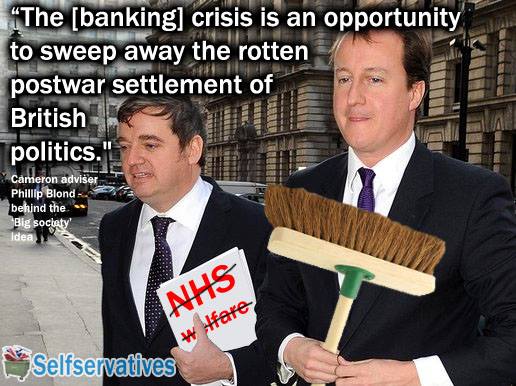
proper Blond

It’s less than two months ago that the new Work and Pensions secretary, Stephen Crabb, assured us that the Government had “no further plans” for specific welfare cuts. Now, he has admitted that welfare is to be the source of further austerity cuts to “bring down the deficit,” bearing in mind that the last budget saw alternative  and far more fair, humane measures taken off the table when the Conservatives controversially announced cuts to disability benefits to fund tax cuts for the most affluent – the top 7% of earners. The Chancellor raised the threshold at which people start paying the 40p tax. This leaves the poorest and some of our most vulnerable citizens carrying the entire burden of austerity and the whole responsibility for cutting the deficit.

Of course Crabb assumes we believe that austerity is an economic necessity and not an ideological choice. However, austerity is being used as a euphemism for the systematic dismantling of the gains of our post-war settlement: welfare, social housing, the NHS, legal aid and democracy. There is no such thing as conditional democracy. It can’t be rationed out or applied with prejudice and discrimination. That would make it something else, more akin to totalitarianism and not a necessarily inclusive democracy.

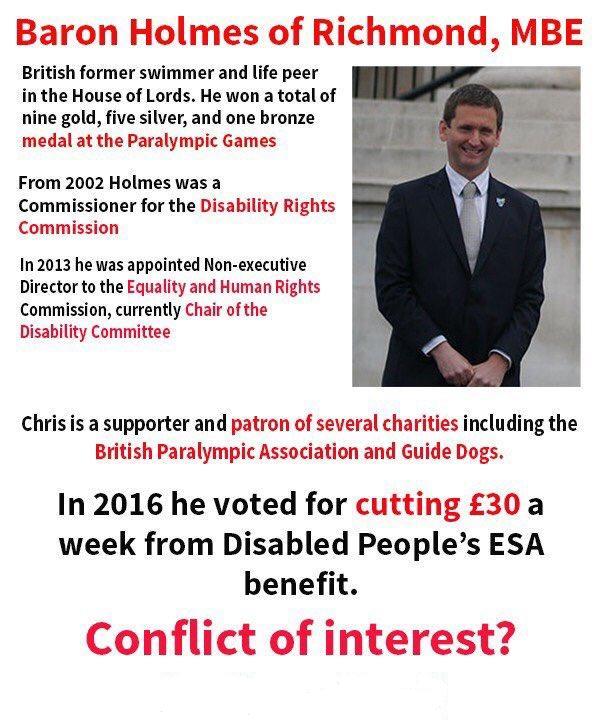
The Government has already made substantial cuts to the Employment and Support Allowance disability benefit, cutting the rate for new claimants in the Work Related Activity Group by £30 a week from 2017. Now the Work and Pensions Secretary has said he wants to go further than the £12 billion welfare cuts declared in the Conservative manifesto and to “re-frame discussion” around disability welfare support, signalling his intention to cut expenditure on disability benefits through further reform to the welfare system. The Conservatives are clearly using the word “reform” as a euphemism for dismantling the welfare state in its entirety.

Prior to 2010, cutting support for sick and disabled people was unthinkable, but the “re-framing” strategy and media stigmatising campaigns have been used by the Conservatives to systematically cut welfare, push the public’s normative boundaries and to formulate moralistic justification narratives for their draconian policies. Those narratives betray the Conservative’s intentions.

Crabb said that he will set out a “discursive” Green Paper on the additional proposed cuts to disability benefits later this year. Iain Duncan Smith had previously promised a more formal White Paper which was considered key to persuading Tory rebels to vote through the cuts despite opposition in February.

The shadow Work and Pensions secretary, Owen Smith, said that the Government should reverse the ESA cuts which had already been passed, adding that the Conservatives needed to offer clarity on how the “reforms” would support disabled people into work.

He said: “Yet again the Tories have let down disabled people, by breaking their promise to quickly publish firm plans on supporting disabled people in to work.

“When the Tories forced through cuts to Employment Support Allowance in the face of widespread opposition they bought off their own rebels with a promise to have a firm plan in place by the summer.

“Now the new Secretary of State has confirmed that he is going to downgrade the plan to a Green Paper, effectively kicking the issue in to the long grass for months, if not years.

The flimsy case for the cuts to Employment Support Allowance is now totally blown apart by this broken promise and the Tories must listen to Labour’s calls for them to be reversed.”

Remarkably, Crabb has claimed that disability benefit cuts are among policies “changing things for the better.” However, if cutting people’s income is such a positive move, we do need to ask why the Conservatives won’t consider taxing wealthy people proportionately, distributing the burden of austerity more fairly amongst UK citizens, instead of handing out money for tax cuts to those who need the very least support, at the expense of those who need the most.

The secretary for Work and Pensions has said: “The measures  that have either already been legislated for or announced get us to the £12 billion [welfare cuts planned in the Conservative manifesto].

Does that mean welfare reform comes to an end? I would say no. I’ve already pointed to what I see as one of the big challenges of welfare reform – and that’s around work and health.”

Crabb told MPs on Work and Pensions Select Committee that he would deploy “smart strategies” for cutting expenditure on disability and sickness benefits and would hopefully be able to secure the support of disability charities.

“In terms of how you make progress of welfare reform there when you are talking about people who are very vulnerable, people with multiple barriers, challenges, sicknesses, disabilities – I am pretty clear in my mind that you can’t just set targets for cutting welfare expenditure,” he said.

“When you’re talking about those cohorts of people you’ve actually got to come up with some pretty smart strategies for doing it which carry the support and permission of those people and organisations who represent those people who we are talking about.”

Both Crabb and his predecessor, Duncan Smith, have claimed that there are “millions of sick and disabled people parked on benefits,” yet rather than providing support for those who may be able to work, the Conservatives have abolished the Independent Living Fund and made substantial reductions to payments for the Access To Work scheme, creating more barriers instead of providing support for those who feel they are well enough to work.

A government advisor, who is a specialist in labour economics and econometrics, has proposed scrapping all ESA sickness and disability benefits. Matthew Oakley, a senior researcher at the Social Market Foundation, recently published a report entitled Closing the gap: creating a framework for tackling the disability employment gap in the UK, in which he proposes abolishing the ESA Support Group. To meet extra living costs because of disability, Oakley says that existing spending on PIP and the Support Group element of ESA should be brought together to finance a new extra costs benefit. Eligibility for this benefit should be determined on the basis of need, with an assessment replacing the WCA and PIP assessment. The Conservative definition of “the basis of need” seems to be an ever-shrinking category.

Oakely also suggests considering a “role that a form of privately run social insurance could play in both increasing benefit generosity and improving the support that individuals get to manage their conditions and move back to work.”

I’m sure the private company Unum would jump at the opportunity. Steeped in controversy, with a wake of scandals that entailed the company denying people their disabilty insurance, in 2004, Unum entered into a regulatory settlement agreement (RSA) with insurance regulators in over 40 US states. The settlement related to Unum’s handling of disability claims and required the company “to make significant changes in corporate governance, implement revisions to claim procedures and provide for a full re-examination of both reassessed claims and disability insurance claim decisions.

The company is the top disability insurer in both the United States and United Kingdom. By coincidence, the  company has been involved with the UK’s controversial Welfare Reform Bill, advising the government on how to cut spending, particularly on disability support. What could possibly go right?

It’s difficult to see how someone with a serious, chronic and progressive illness, (which most people in the ESA Support Group have) can actually “manage” their illness and “move back into work.” The use of the extremely misinformed, patronising and very misleading term manage implies that very ill people actually have some kind of choice in the matter. For people with Parkinson’s disease, rheumatoid arthritis, lupus and multiple sclerosis, cancer and kidney failure, for example, mind over matter doesn’t fix those problems, positive thinking and sheer will power cannot cure these illnesses, sadly. Nor does refusing to acknowledge or permit people to take up a sick role, or imposing benefit conditionality and coercive policies to push chronically ill people into work by callous and insensitive and medically ignorant assessors, advisors and ministers.  

The Reform think tank has also recently proposed scrapping what is left of the disability benefit support system, in their report Working welfare: a radically new approach to sickness and disability benefits and has called for the government to set a single rate for all out of work benefits and reform the way sick and disabled people are assessed. 

Reform says the government should cut the weekly support paid to 1.3 million sick and disabled people in the ESA Support Group from £131 to £73. This is the same amount that Jobseeker’s Allowance claimants receive. However, those people placed in the Support Group after assessement have been deemed by the state as unlikely to be able to work again. It would therefore be very difficult to justify this proposed cut.

Yet the authors of the report doggedly insist that having a higher rate of weekly benefit for extremely sick and disabled people encourages them “to stay on sickness benefits rather than move into work.”

The report recommended savings which result from removing the disability-related additions to the standard allowance should be reinvested in support services and extra costs benefits – PIP. However, as outlined, the government have ensured that eligibility for that support is rapidly contracting, with the ever-shrinking political and economic re-interpretation of medically defined sickness and disability categories and a significant reduction in what the government deem to be a legitimate exemption from being “incentivised” into hard work.

The current United Nations investigation into the systematic and gross violations of the rights of disabled people in the UK because of the Conservative welfare “reforms” is a clear indication that there is no longer any political commitment to supporting disabled people in this country, with the Independent Living Fund being scrapped by this government, ESA for the work related activiy group (WRAG) cut back, PIP is becoming increasingly very difficult to access, and now there are threats to the ESA Support Group. The Conservative’s actions have led to breaches in the CONVENTION on the RIGHTS of PERSONS with DISABILITIES – CRPD articles 4, 8, 9, 12, 13, 14, 15, 17, and especially 19, 20, 27 and 29 (at the very least.) There are also probable violations of articles 22, 23, 25, 30, 31.

The investigation began before the latest round of cuts to ESA were announced. That tells us that the government is unconcerned their draconian policies violate the human rights of sick and disabled people.

And that, surely, tells us all we need to know about this government.

 —

This post was written for Welfare Weekly, which is a socially responsible and ethical news provider, specialising in social welfare related news and opinion.


I don’t make any money from my work. But you can support Politics and Insights and contribute by making a donation which will help me continue to research and write informative, insightful and independent articles, and to provide support to others. The smallest amount is much appreciated, and helps to keep my articles free and accessible to all – thank you.
DonatenowButton
cards


How a far-right Tory, the media & Blairites tried to ambush Corbyn re #AntiSemiticGate

Undercover1's avatarUndercoverInfo

paul-staines-guido-fawkes-2011 Paul Staines (aka Guido Fawkes)

AntiSemiticGate was engineered by a loose alliance of tabloid media, Blairites and, primarily, a far-right blogger who tends to support Tory extremism. Below we examine the timelines, expose the main player who stage-managed the ‘crisis’ (and on the way show just how ignorant politicians and elements of the media are on history – ignore it at our peril).

Paul Staines is otherwise known as the blogger Guido Fawkes. He also has a fascinating history. Staines, worked as “foreign policy analyst” for the Committee for a Free Britain, a right-wing Conservative pressure group, alongside David Hart. Staines also acted as editor of British Briefing, a long-standing publication by the group that was a “monthly intelligence analysis of the activities of the extreme left” that sought to “smear Labour MPs and left-leaning lawyers and writers”. British Briefing was originally called The Background…

View original post 1,782 more words

Shut The Door On Your Way Out Campaign

CgtFl6zWYAAwO50
                                                   We call for his resignation.


This cross-border Campaign aims at naming and shaming those colluding in the cuts to disabled people instead of addressing disabled people’s rights. We will be writing a series of letters asking for the resignations of those not defending our rights as appointed to do so.

This letter is to the Chair of EHRC.

Dear Lord Holmes of Richmond,

I wish to draw your attention to the functions that were delegated to the Disability Committee and the Commissions duties as they relate to “disability matters” in:

  • Promoting understanding of the importance of equality and diversity
  • Encourage good practice
  • Promoting equality of opportunity
  • Promoting awareness and understanding of rights
  • Enforcing equality law
  • working towards the elimination of unlawful discrimination and harassment
  • Promoting understanding of good relations

Let me draw your attention to an article printed in the Guardian by the  EHRC on 01.03.2016 http://www.theguardian.com/politics/2016/mar/01/equalities-watchdog-criticises-planned-cuts-to-work-support-allowance

The very body you are a Commissioner for, the EHRC, say that the proposed cuts to ESA will disproportionately affect disabled people, widen inequalities and undermine the UK’s Human Rights obligations.

How can you be seen to be promoting the above when you went on to vote for these cuts to both ESA and PIP as a Conservative Peer, your actions will have a detrimental effect on disabled people’s lives, to both  Independent living and will undermine the UK’s Human Rights obligations.

As a disability rights campaigner I am calling for your immediate resignation of the position you hold as Disability Commissioner and Chair of the Disability Committee for EHRC as alongside my peers and other user led organization’s we think you are no longer worthy of this position.

Look forward to your reply

Susan Archibald
Disability Rights Campaigner.

Please sign the petition and support this campaign – Campaigners Demand For Lord Chris Holmes Resignation.

Supported by:

Dr Stephen Carty -Black Triangle Campaign

Professor Peter Beresford, Co-Chair, Shaping Our Lives

Mo Stewart –Disabled Veteran/Researcher

Dr Simon John Duffy – Centre of Welfare Reform

Gail Ward – Cross Border Alliance

John McArdle-Black Triangle Campaign

Pat Onions – Pats Petition

Rosemary ONeill – Carerwatch

Frances Kelly – Carerwatch/Dead Parrot Campaign

Linda Burnip – DPAC

Debbie Jolly – DPAC

Anita Bellows – DPAC

Merry Cross – DPAC

Rick Burgess – DPAC  Manchester

Paula Peters – DPAC

Annie Bishop – Involve North East & Cumbria for deaf, blind and people with disabilities

Carole Robinson – Bolshy Divas

Tracey Flynn – Bolshy Divas

Catherine Hale – Disability Researcher

C  Richardson – Disability Researcher

Stef Benstead – Disability Researcher

Jayne Linney DEAP

Sue Livett-Campaign for a Fair Society England

Michelle Mayer

Rosemary Trustam-Publisher Community Living Magazine

Jo Walker

Sue Jones – Psychologists against Austerity/Human Rights/Policy Researcher/Writer

Again, if you want to sign our petition please click the link here.


Further reading:

http://www.independent.co.uk/news/uk/politics/dwp-drew-up-plans-to-charge-disabled-people-for-fit-to-work-appeals-internal-documents-reveal-a6993996.html

http://thirdforcenews.org.uk/tfn-news/disability-activists-call-for-commissioner-to-resign?

http://www.mirror.co.uk/news/uk-news/secret-government-plan-charge-disabled-7798786

http://www.disabilitynewsservice.com/tory-peer-faces-calls-to-quit-as-ehrc-commissioner-over-support-for-wrag-cuts/

http://www.disabilitynewsservice.com/revealed-dwps-secret-financially-devastating-proposals-for-benefits-appeals/

http://www.disabilitynewsservice.com/secret-dwp-proposal-to-scrap-esa-substantial-risk-rules-would-breach-right-to-life/

http://www.thenational.scot/news/snp-calls-to-see-reports-on-suicides-following-benefits-cuts.16660


A Warning For People on Medication for Depression

beastrabban's avatarBeastrabban\'s Weblog

This is a warning based on my personal experience. Like many people, I suffer from depression, for which I am, thankfully, on medication. However, the government, David Cameron, George Osborne, the head of the health service, Jeremy Hunt, and their corporate paymasters seem to resent the fact that so many people in Britain now are on medicine to treat this condition. So they’re doing their best to throw people off it. About a year or so I had to go to my doctor again for an examination after I had a repeat prescription turned down. I was told that because the government was concerned about the mental wellbeing of sufferers like myself, they were stopping automatic repeat conditions in order to make people see their doctors. It is, I was told, a condition that can get worse, and so it had been decided that sufferers like myself had to be…

View original post 385 more words

Why are parents in England not doing more to stand up for their children?

Tom Pride's avatarPride's Purge

Soon all parents in England – those of us who can’t afford schools like Eton anyway – will be forced to send our children to one of the academy schools run by Cameron’s fat cat mates.

Cameron has, by the way, very nicely allowed his chums in charge of academies to employ any unqualified Tom, Dick or Harry to look after our children. They’re cheaper you see.

And our PM has also scrapped any official lines of complaint should parents be concerned, worried or even outraged by the treatment of their children at an academy school:

This is what happens when you try to hold an academy school to account… good luck parents

Which means Cameron’s mates can more or less do what they like with our kids and there’s nothing any parent can do about it.

I have only one question about all of this.

WHY ARE PARENTS IN ENGLAND NOT DOING MORE…

View original post 17 more words