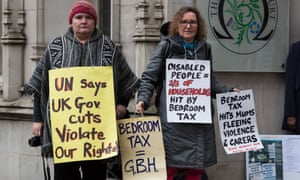
Category: Welfare

A tale of two suicides and a very undemocratic, inconsistent government

385294_195107567306966_1850351962_n

“No, we have not carried out a review […] you cannot make allegations about individual cases, in tragic cases where obviously things go badly wrong, you can’t suddenly say this is directly as a result of government policy”– Iain Duncan Smith, Secretary of State for Work and Pensions, 5 May 2015.

Back in July, the Information Commissioner’s Office opened an investigation into four of the UK’s largest charities, following allegations that their fundraisers contacted people registered with the government’s opt-out nuisance call database.

David Cameron led the calls for fundraising regulators to investigate whether a 92-year-old poppy-seller, found dead in Avon Gorge after committing suicide, had been under pressure from charities asking for donations.

A spokesperson for the Information Commissioner’s Office, the watchdog responsible for enforcing data protection laws, said: “We’re aware of allegations raised against several charities, and will be investigating whether there have been any breaches of the Data Protection Act or privacy and electronic communication regulations.” 

It was the workers at a London call centre, fundraising on behalf of the charities, who were accused of calling, and being prepared to take money from, vulnerable people, including the elderly and those living with dementia, the Daily Mail reported.

Those with dementia and Alzheimer’s were allegedly being treated as legitimate targets – as long as they agree to the call and are able to answer a few basic questions over the phone.

Cameron said: “I know there is a code that is meant to protect people from feeling pressured by charities and I hope the Fundraising Standards Board will look at whether any more could have been done to prevent this.” 

However, although Olive Cooke did tragically kill herself, it has since been established by her family and at an inquest that her suicide wasn’t related to charity fundraising requests at all.

So, Mr Cameron didn’t hesitate to make a connection between a tragic suicide and the policy of “charities, who were accused of calling, and being prepared to take money from, vulnerable people.” As it happens, he drew the wrong inference from remarkably little empirical evidence. I say remarkably little, because in similar circumstances involving suicides and deaths in other social groups, David Cameron demands that people don’t make any inferences at all and from much more reliable evidence than he had to draw on in order to conclude that an investigation was warranted into the impact of charities’ fundraising requests.

This said, one tragic death really ought to trigger an inquiry into policy. That is the right thing to do.

The Stark Contrast.

In 2013, a disabled man committed suicide as a direct result of being found “fit to work” by the government’s work capability assessment. In a report to the Department of Work and Pensions, the coroner for Inner North London demanded that the Government department take action to prevent further deaths.

The coroner’s report on the death of Michael O’Sullivan warns of the risk of more such deaths. Michael, a 60-year-old father of two from north London, killed himself at his home after being moved from employment support onto jobseekers allowance, despite providing reports from three doctors, including his GP, that he was suffering from serious long-term depression and agoraphobia and had been certified as unable to work.

The coroner said that Michael’s anxiety and depression were long-term problems, but the intense anxiety that triggered his suicide was caused by his (then) recent assessment by the DWP as being fit for work.

Surprisingly, David Cameron did not lead any calls for an investigation into the policies that caused this tragic suicide, despite the coroner’s report and widely shared, well-documented, (and evidenced) concerns that the Department of Work and Pensions is placing sick and disabled people under enormous strain which is unacceptably harmful and distressing. The Conservative welfare reforms included an increase in benefit “conditionality” which involves punitive sanctions and rigid assessments that are not designed to provide support, but rather, to save money and remove people’s eligibility for lifeline social security benefit, causing them severe hardship, harm, and sometimes, causing their death.

In other words, the Department of Work and Pensions “are prepared to take money from vulnerable people.”  This is the only income that people claiming benefits have to meet their basic survival needs.

Furthermore, Mr Cameron has persistently refused to carry out even basic monitoring of the impact of his government’s policies despite longstanding public concerns about the fact that they are causing sick and disabled people harm. This government have doggedly refused to release information regarding the mortality rates of people who face the negative impact of Conservative policies every day.

David Clapson, 59, was a former soldier and had type-one diabetes, he died in last year after he was sanctioned – his benefit was stopped as a punishment – because he missed an appointment at the jobcentre. The coroner reported that Mr Clapson had no food in his stomach, £3.44 in the bank and no money on his electricity meter card, leaving him unable to operate his fridge where he kept insulin, which has to be kept refrigerated. He died of diabetic ketoacidosis because he couldn’t take his insulin.

In addition to tragic cases like those of Michael and David that are reported in the media, there are many others raised in parliament by MPs and through the work of select committees, which are evidenced on the parliamentary Hansard record of course. Additionally, some of us also keep a record of the growing number of people who have died prematurely because of the welfare “reforms”. 

Furthermore, the United Nations believe there is sufficient evidence to warrant an investigation into the impact of Tory policies, the UK has  become the first developed country to be the subject of an inquiry into “grave and systematic” violations of the rights of disabled people. Wouldn’t you think that this would prompt some concern and scrutiny of policies and impacts from the Government? But it hasn’t.

The government persistently deny there is any correlation between suffering, hardship, an increase in suicide and deaths amongst disabled people and their punitive policies. Yet there is substantial evidence to demonstrate a very clear correlation, and certainly more than enough to warrant an inquiry into the harmful impact of the policies on sick and disabled people. After all, one unrelated death was sufficient to warrant an inquiry into the fundraising policy of charities.

Yet we are told by David Cameron that “it is quite wrong to suggest any causal link between the death of an individual and their benefit claim” when evidence strongly suggests such a link. An inquiry is the only way that the correlation could possibly be refuted, but the Government realise that a refutation is an unlikely outcome, hence their refusal to allow an inquiry in the first place.

Campaigners have fought to ensure that information about the harmful impact of government reforms was open to public scrutiny. The truth, however, still remains hidden beneath the excessively and purposeful bureaucratic management of this information and political denials of culpability. Mike Sivier, a fellow campaigner and writer at Vox Political, requested a tribunal after he made a Freedom of Information request for access to the information – and it was refused. Over the last three years, many of us submitted FOI requests for the same information and all were refused.

This is not an accountable, transparent or democratic Government. Let’s not forget the political fabrication of case studies of people “helped” by having their lifeline benefits stopped, presumably because they couldn’t find any real people who would attest to such absurd, ideologically driven, class contingent political acts of targeted cruelty. What real person would ever claim that starvation, being cold and facing destitution “helped” them in any way?

After suppressing information for years, the Department of Work and Pensions finally released data about the deaths of sick and disabled people, but the release was partial, and was not responsive to the detailed request made for detailed and specific information. In fact the data was presented in such an intentionally contextless and incomplete way that there wasn’t even scope for analytical cross comparisons to be made. The release was deliberately limited and impenetrable, as the department of Work and Pensions acknowledged when the report was published with this proviso:

“Any causal effect between benefits and mortality cannot be assumed from these statistics. Additionally, these isolated figures provide limited scope for analysis and nothing can be gained from this publication that would allow the reader to form any judgement as to the effects or impacts of the Work Capability Assessment.”

(From the Department of Work and Pensions report Mortality Statistics, 2015.)

I will leave you to draw your own inferences regarding the startling disparity and incoherence apparent in the two distinct government  responses to suicides and deaths in two separate and differentially valued social groups – one that is politically marginalised, one that is not – and the government suppression of information regarding the impact of their targeted, draconian austerity policies.

All lives have equal worth. But I think it’s safe to say that we’re not “all in it together” as Cameron claimed. He believes that some lives are more important and some suicides are more worthy of investigation than others. It is very clear that this government does not care about the lives and welfare of sick and disabled people.

Call me cynical but I wonder which social group are more likely to vote Conservative?

Related

Suicides reach a ten year high and are linked with welfare “reforms”

292533_330073053728896_1536469241_nPictures courtesy of Robert Livingstone

Work Programme continues to harm people with mental health problems

10270806_319228004894921_8005540502444686357_n
The Government’s Work Programme is making the lives of people with mental health problems worse, and having a detrimental impact on people’s ability to work, research by a leading mental health charity has found.

A report from Mind said the flagship scheme, which requires people to take unpaid work allocated by contractors or face losing their lifeline benefits, was taking entirely the wrong approach and actually damaging people’s motivation and capacity to work.

The research found that most people who are on the scheme because of their mental health problems reported worsening health issues due to their experiences of it.

83 per cent of people surveyed said the scheme’s “support” had made their mental health problems worse or much worse.

The latest statistics from the Department for Work and Pensions (DWP) reveal that less than 8 per cent of people being supported by Employment and Support Allowance (ESA) have moved into employment through the Work Programme. Around half of people on ESA are being supported primarily because of their mental health problems.

Tom Pollard, Policy and Campaigns Manager at Mind, said:

“These latest figures provide further evidence that the overwhelming majority of people with disabilities and mental health problems are not being helped by the Government’s flagship back-to-work support scheme. A recent report from Mind found that people with mental health problems are less likely to be supported into employment through the Work Programme than those with other health conditions and are more likely to have their benefits sanctioned.”

Even more worryingly, the majority of respondents to our survey said the Work Programme was actually making their health worse, and as a result they had needed more support from health services and felt further from work than previously. Mind is calling for everyone with a mental health problem who is receiving mainstream support through this scheme to be placed onto a new scheme and offered more personalised, specialist support which acknowledges and addresses the challenges people face in getting and keeping a job.”

Additionally, over three quarters of people – 76 per cent – said the Work Programme had actually made them feel less able to work than before they were coerced to participate in the scheme.

The results resonate with figures released in a number of previous years suggesting that people on the Work Programme are actually far less likely to return to work than people who are simply left to their own initiative.

In the first year of the £450 million programme, just two out of 100 people on the scheme returned to work for more than six months.

In 2013 Labour’s then shadow work and pensions secretary Liam Byrne described the scheme as “literally worse than doing nothing”.

Mind’s chief executive Paul Farmer wrote:

“Cutting someone’s support for failing to meet certain requirements causes not just financial problems but a great deal of psychological distress too.

Mind was one of a group of six mental health organisations to respond to a Work and Pensions Committee Welfare to Work inquiry within which we voiced concerns with the system and made a number of recommendations for improving benefits and back-to-work support. A number of schemes deliver far more effective support to people with mental health problems, at a fraction of the cost of the Work Programme.

WorkPlace Leeds, for example, delivered by Leeds Mind, costs much less than the Work Programme and achieves far better outcomes, with nearly a third (32 per cent) of people with severe and enduring mental health problems gaining paid employment. Schemes such as these are far more helpful and effective in supporting those ready and able to work into fulfilling, appropriate paid employment, relevant to their individual skills and ambitions.

We wholeheartedly support the Government’s aspiration to halve the disability employment gap by helping a million more disabled people into work. However, this will only happen if bold changes are made. As the Welfare Reform and Work Bill makes its way through Parliament, Mind is calling on Employment Minister Priti Patel to overhaul the benefits system, by focusing less on pressurising people and investing more in tailored, personalised support. We’re calling for everyone with mental health problems on the Work Programme to be taken out of this scheme, and instead given alternative support which acknowledges and addresses the challenges they face in getting and keeping a job.”

There are perverse political incentives for pushing people onto workfare programmes. The DWP has simplified its performance measures and now primarily targets the move by claimants away from benefits, or “off-flow”, as a simple and intuitive measure of performance. However, this gives no information about how individual jobcentres perform in supporting claimants to work. Some may have found work but, in more than 40 per cent of cases, the reason for moving off benefits is not actually recorded.

The government does not track or follow up the destination of all those leaving the benefit system, and so the off-flow figures will inevitably include many having their claim ended for reasons other than securing employment, including sanctions, awaiting mandatory review, appeal, death, hospitalisation, imprisonment, on a government “training scheme” (see consent.me.uk  and the Telegraph – those on workfare are counted as employed by the Labour Force Survey, which informs government “employment” statistics.)

Workfare programmes offer further opportunity for imposing sanctions, too. Last year, Iain Duncan Smith met a whistle-blower who has worked for his Department for Work and Pensions for more than 20 years. Giving the Secretary of State a dossier of evidence, the former Jobcentre Plus adviser told him of the development of a “brutal and bullying” culture of “setting claimants up to fail”.

“The pressure to sanction customers was constant,” he said. “It led to people being stitched-up on a daily basis.”

The whistle-blower wished to remain anonymous but gave his details to Iain Duncan Smith, DWP minister Esther McVey and Neil Couling, Head of Jobcentre Plus, who also attended the meeting.

“We were constantly told ‘agitate the customer’ and that ‘any engagement with the customer is an opportunity to ­sanction’,”  he told them. 

Iain Duncan Smith and his department have repeatedly denied there are targets for sanctions.

“They don’t always call them targets, they call them ‘expectations’ that you will refer people’s benefits to the decision maker,”  the whistle-blower says. “It’s the same thing.”

He said that managers fraudulently altered claimants’ records, adding: “Managers would change people’s appointments without telling them. The appointment wouldn’t arrive in time in the post so they would miss it and have to be sanctioned. That’s fraud. The customer fails to attend. Their claim is closed. It’s called ‘off-flow’ – they come off the statistics. Unemployment has dropped. They are being stitched up.”

The Department of Work and Pensions no longer meets the needs of people requiring support to find work. Instead it serves only the requirements of an ideologically-driven, irrational and authoritarian government.


Related

The Government are under fire for massaging employment statistics

A letter of complaint to Andrew Dilnot regarding Coalition lies about employment statistics

544840_330826693653532_892366209_nPictures courtesy of Robert Livingstone

Fit for work assessment was trigger for suicide, coroner says

385294_195107567306966_1850351962_n


A disabled man killed himself as a direct result of being found “fit to work” by the government’s work capability assessment, a coroner has ruled. In a report to the Department of Work and Pensions, the coroner for Inner North London demanded it take action to prevent further deaths.

The coroner’s report on the death of Michael O’Sullivan  warns of the risk of more such deaths. Michael, a 60-year-old father of two from north London, killed himself at his home after being moved from employment support onto jobseekers allowance, despite providing reports from three doctors, including his GP, that he was suffering from long-term depression and agoraphobia and had been certified as unable to work.

The coroner said that Michael’s anxiety and depression were long-term problems, but the intense anxiety that triggered his suicide was caused by his (then) recent assessment by the DWP as being fit for work.

Previously, the loss or reduction of benefits have been cited as a factor in deaths and suicides of claimants by coroners. However it is believed to be the first time the work capacity assessment (WCA) process has been blamed directly for the death of a claimant. Iain Duncan Smith can no longer deny a causal link between benefit cuts and suicide following this landmark verdict.

Michael O’Sullivan died on 24 September 2013, but his case came to light after Disability News Service reported the story.

In a document marked “sensitive”, Mary Hassell, the coroner for Inner North London, told the DWP she concluded the “trigger” for his suicide was his “fit for work” assessment and detailed her concerns over future deaths.

The report, known as a Prevention of Future Deaths or Regulation 28 report, Hassell wrote:

“I found the trigger for Mr O’Sullivan’s suicide was his recent assessment by a DWP doctor as being fit for work. During the course of the inquest, the evidence revealed matters giving rise to concerns. In my opinion, there is a risk that future deaths will occur unless action is taken.”

At an inquest into his death last year, Hassell said that O’ Sullivan was suffering from long-term anxiety and depression “but the intense anxiety which triggered his suicide was caused by his recent assessment by the Department of Work and Pensions [benefits agency] as being fit for work and his view of the likely consequences of that”.

The inquest heard that in his assessment, the Department of Work and Pensions (DWP) assessing doctor, a former orthopaedic surgeon, did not factor in the views of any of the three doctors treating O’Sullivan. She also said that he was never asked about suicidal thoughts, despite writing them down in a DWP questionnaire.

Under a heading marked “matters of concern” in her report to the DWP, Hassell said the assessing doctor did not take into account the view of any of the three doctors who were treating O’Sullivan. She said:

“However, the ultimate decision maker (who is not, I understand, medically qualified) did not request and so did not see any reports or letters from Mr O’Sullivan’s general practitioner (who had assessed him as being unfit for work), his psychiatrist or his clinical psychologist.

In my opinion, action should be taken to prevent future deaths and I believe that you and Jobcentre Plus have the power to take such action.”

In its 16-page response to the coroner’s report, the DWP admitted it had got it wrong. It said that its policy to request further evidence when a claimant mentions suicide on claim forms was “regrettably not followed in this case”.

It also said the WCA process remained under “continual review and development”, including through five independent reviews, and concluded:

“We have noted the issues in this case and will continue to monitor our policies around assessment of people with mental health problems while we await the outcome of related litigation.”

The Department of Work and Pensions has conducted at least 60 internal investigations into suicides linked to benefit changes since 2012. Last month, DWP data showed the equivalent of nearly 90 people died every month after being declared fit for work and losing their benefits between 2011 and 2014.

A Department of Work and Pensions spokesman said last Monday that improvements have been made to the system since the coroner’s report. The spokesman said:

“Following reforms to the work capability assessment, which was introduced in 2008, people are getting more tailored support to return to work instead of being written off on long-term sickness benefits as happened too often in the past.”

People were not dying in their thousands before the introduction of the Tory austerity measures. The so-called “reforms” to the work capability test have been going on according to the DWP for the past five years, yet we see no improvement in outcomes.

Reducing a response regarding a suicide brought about by departmental and wider negligence to petty political point scoring, casualising tragic, needless and premature deaths that are linked with the welfare “reforms” and Conservative small state fetishism, is an outrage. This is not an acceptable or appropriate response from the DWP.

This tragic case along with the recorded, detailed evidence of many others, has been presented to the government by campaigners, opposition MPs, and by the parliamentary work and pensions committee as part of their inquiries related to the reforms, clearly demonstrating that government policies are causing harm to people. This case alone ought to have triggered an independent inquiry regarding the impact of the “reforms”, but instead we are presented with persistent and aggressive denials of a causal link between an increase in premature mortality and Tory policies, such as the non-medical WCA, (which was  re-designed by the Tories when they re-contracted Atos to deny people their entitlement to benefits,) without any grounds for those denials whatsoever.

This is a government that has abdicated its responsibility – its democratic, ethical, moral and legal duties towards those people who need the most support. Furthermore, by modelling such callous indifference towards the social groups that they have also stigmatised and scapegoated, this government are also pushing public moral and rational boundaries, too,  leading to desensitisation, and a normalisation of prejudice, discrimination and of a government’s actions that are designed to intentionally punish and coerce unemployed, sick and disabled people rather than support them.

We must challenge that and keep pushing back, because the alternative –  bystander apathy – is untenable. To do nothing is to give a silent consent to a continuing and devastating cumulative policy impact on the poorest and weakest citizens that is tantamount to eugenics, albeit by stealth.

Kitty

430835_148211001996623_1337599952_n (1)

Pictures courtesy of  Robert Livingstone.

Techniques of neutralisation: David Cameron’s excuses for Iain Duncan Smith

430835_148211001996623_1337599952_n (1)

I wrote earlier about the way the Department of Work and Pensions (DWP) heavily micro-managed the recent Mortality Statistics release, and how the Government are using an excessively bureaucratic approach to ensure that no inferences are drawn from the data published, insisting that it’s “wrong” to link the mortality rates of sick and disabled people with punitive, Conservative austerity policies.

However, the accounts and experiences of sick and disabled people and their families (recorded in the media, in parliamentary inquiries, Commons debates – all preserved on the Hansard record) inform us that there is a clear correlation between the Tory “reforms” and increased distress, a loss of dignity and autonomy, financial insecurity and insolvency, increasing ill health, and sometimes, the death, of disabled people.

When confronted in the Commons, Iain Duncan Smith and other ministers dispensed with civilised debate, and simply blocked any discussion regarding concerns raised by the opposition about the negative impact of the Tory welfare cuts on sick and disabled people.  Values of decency and legitimate concerns about the welfare of sick and disabled citizens were depreciated as mere matters of “subjective interpretation” and not as worthy subjects of political, rational or objective discussion.

The Mortality Statistics release from Department of Work and Pension “provides further commentary on the appropriate use of this information” – in other words, it informs us what we may and may not do with the “data”, and carries this pre-emptive caution:

“Any causal effect between benefits and mortality cannot be assumed from these statistics. Additionally, these isolated figures provide limited scope for analysis and nothing can be gained from this publication that would allow the reader to form any judgement as to the effects or impacts of the Work Capability Assessment.”

Bearing in mind that the information in the release came about because of many Freedom of Information (FOI) requests from many of us, and the rulings of the Information Commissioner and a tribunal (Mike Sivier from Vox Political appealed against the original decision by the Information Commissioner and the DWP to refuse the Freedom of Information requests), it’s difficult to see why the Government have been so determined, firstly, to withhold the information requested, secondly, when forced to make the release, to present the information in a decontextualized way that renders it virtually meaningless, thirdly, to go to such extraordinary lengths to instruct us how we may and may not analyse the data and fourthly, to respond to any interpretive reference to the data as “wrong”, refusing to engage in any further discussion.

Unless of course it’s a Government that doesn’t want open and democratic accountability and public scrutiny of the often devastating impact of its policies.

Debbie Abrahams, the new shadow minister for disabled people, has long been an outstanding campaigner and spokesperson for disabled people. Earlier this month, she asked David Cameron:

“Two weeks ago, the Work and Pensions Secretary’s Department not only admitted to falsifying testimonies in leaflets, but published data on the deaths of people on sickness benefit, which showed that they are four times more likely to die than the general population. That was after the Secretary of State told the House that these data did not exist. Given that, and his offensive remarks earlier this week—referring to people without disabilities as “normal”—when will the Prime Minister take control and respond to my call for the Work and Pensions Secretary to be investigated for breaching the ministerial code?”

Here is the Ministerial code. Ministers are also expected to observe the seven Nolan Principles, which are the basis of the ethical standards of conduct that is expected of all holders of public office. 

Last year, I sent David Cameron a reminder of the established standards and ethics of Public Office, as the Coalition had exempted themselves, but he didn’t respond and it didn’t make any difference.

It’s true that the Department of Work Pensions (DWP) has admitted falsifying testimonies in leaflets. The DWP’s own data does indicate that people on incapacity benefits are four times more likely to die than other people in the general population. Iain Duncan Smith did tell MPs that this data did not even exist. Then he told them it did.

Let’s be frank here, Iain Duncan Smith has established a culture where it’s acceptable to lie, even his Curriculum Vitae is comprised of  Machiavellian, narcissistic-inspired confabulations – he’s qualified only in absolute and utter tosh, he graduated without Honour. Or a degree.

And it’s truly priceless that Iain Duncan Smith or David Cameron can accuse anyone of misrepresenting statistics with a straight face, given the large number of official rebukes the Tories have had from the Office for National Statistics (ONS) for manipulating or  misrepresenting statistics and telling lies.

Today, Debbie received the following written response to her question from the Prime sinister Minister:

Cameron letter on claimant deaths

Cameron letter on claimant deaths

I’ve already addressed a lot of the content above, however I couldn’t help but note the apparent “policing” of Debbie’s tweets. The response isn’t a rational or reasonable one, and certainly not of a standard that is expected of a prime minister.

How can the use of fake statements from fake characters about fictitious “benefits” of harsh sanctions – the arbitrary and punitive removal of lifeline income to support people in meeting basic survival needs – ever “help claimants and advisers to understand the benefit system”?

How is telling lies about the impact of policy and constructing fake positive testimonies ever “illustrative”? That was no “error”: it was an intentional, deceitful act designed solely to mislead the public and to justify the Conservative’s crass and primitive behaviourist approach to what was once our social security.

As is the insistence that “the statistics showed it is quite wrong to suggest any causal link between the death of an individual and their benefit claim.” Tosh. The statistics showed no such thing,  they did not demonstrate that there is no existing causal link – but the data was presented in a way that intentionally obscures such a link. That does not mean we can conclude there’s no connection between increased mortality and the Conservative “reforms” at all.

Whilst we are warned not to draw inferences of causal links from the statistics, the prime minister thinks that it’s perfectly appropriate to do just that himself. Yet there is no empirical evidence whatsoever to support his denial of a causal link.  The statistical data does not falsify or refute the proposition that such a link exists. We have plenty of recorded evidence, however, to support our proposition that Tory policies are actually harming people.

Tory policies do. Margaret Thatcher’s policies caused premature deaths, too, and her Cabinet were far less harsh towards sick and disabled people than Cameron’s government. A research report which looked at over 70 existing research papers, concludes that as a result of unnecessary unemployment, welfare cuts and damaging housing policies, the former prime minister’s legacy includes the unnecessary and unjust premature death of many British citizens, together with a substantial and continuing burden of suffering and loss of well-being.

It doesn’t take a genius to work out that if you inflict stress and harm on people who are already ill, by withholding their lifeline support, by constantly reassessing them and telling them they are fit for work when they clearly are not, by invalidating their experiences, by forcing them to fight for the means of survival – without the means of survival, it will probably exacerbate any illness and quite possibly this will kill them.

As I discussed earlier today, Cameron and his government have consistently displayed an absolute lack of concern for sick and disabled people, who have borne the brunt of Tory austerity cuts. Yet it’s inconceivable that Conservatives don’t grasp the fact that their policies are at least potentially very harmful, and certainly very punitive in nature.

I’ve discussed many times before that Tory ideology is founded on toxic subterranean values and principles, which are anachronistic and incompatible with a society that has evolved to value democracy, human rights and the socio-economic gains from our post-war settlement.

Conservatives have always seen inequality as a necessary and beneficial element to a market driven economy, for example, and their policies tend to assemble a steeply hierarchical society, especially given their small state fetishism, which involves removing socio-economic support services and civilising mechanisms such as welfare, free healthcare and access to legal aid.

Beneath the familiar minarchist, class contingent Conservative policies and neoliberal schema is a tacit acceptance of socioeconomic Darwinism, and a leaning towards eugenicist principles, expressed most clearly recently in the withdrawal of tax credit support for low paid families with more than two children, in order to “change behaviours” as Iain Duncan Smith put it. The reasoning behind this is the government believe they can “nudge” poor people into “breeding” less. Such a class contingent policy reflects a deep prejudice and also demonstrates an authoritarianism that is certainly incompatible with democracy and human rights.

(See also David Freud was made to apologise for being a true Tory in public, Paternalistic Libertarianism and Freud’s comments in context and What will the Tories suggest next. “Compassionate” eugenics?)

The Tories employ techniques of neutralization which are used to rationalise or justify acts that contravene social norms or that are illegal.  There are five basic techniques of neutralization; denial of responsibility, denial of injury, denial of victims, condemnation of the condemners, and an appeal to higher loyalties.

The recognition of techniques of neutralisation by David Matza and Gresham Sykes happened during their work on Edwin Sutherland’s Differential Association in the 1950s. Matza and Sykes were working on juvenile delinquency at the time, and they theorised that the same techniques could be found throughout society and published their ideas in Delinquency and Drift, 1964.

It was Alexander Alverez who identified that these techniques were used more broadly at a socio-political level in Nazi Germany to “justify” the Holocaust. He added a sixth technique – Disengagement and Dehumanisation.

Such techniques allow people to neutralise and temporarily suspend their commitment to societal and moral values, and to switch off their own “inner protests”, providing them with the freedom to commit deviant acts. Some people don’t have such inner protests – psychopaths, for example – but they may employ techniques of neutralization to manipulate, and switch off the conscience protests of others.

It’s clear that this is a method frequently employed by the government. The Tories systematically attempt to to distort meanings, to withhold,  or deny any evidence that may expose the impact of their draconian policies on targeted social groups.

For example, when they habitually use the word “reform”, when   referring to is cutting funding or support. and “help” and “support” is Tory-speak that means to coerce and punish. The claim that the bedroom tax ishelping” people into workorhelping child poverty– when empirical research shows that 96% of those affected by the bedroom tax can NOT downsize due to a lack of available homes in their area – is a completely outrageous lie. People can’t move as there is a housing crisis, which is due to a lack of affordable homes and appropriately sized accommodation.

How can policies that further impoverish the poorest ever “help them to into work” or alleviate poverty? It’s glib, irrational tosh from a Government that can’t do coherent, joined up thinking, and even worse, thinks that we can’t either.

Forms of social prejudice are normalised gradually, almost inscrutably and incrementally – in stages. Allport describes the political, social and psychological processes, and how techniques of persuasion – propaganda – are used to facilitate stigmatising and dehumanisation of targeted groups to justify discrimination, until the unthinkable becomes acceptable, because of a steady erosion of our moral and rational boundaries.

The prejudice happens on a symbolic level first – via language – and it starts with subtlety, such as the use of divisive and stigmatising phrases like “scroungers and strivers” in the media and political rhetoric, referring to people who need support and social security as “stock”, suggesting that disabled people are not worth a minimum wage and so on.

These comments and strategies are not “mistakes”, this is how Conservatives really think. People who are prejudiced very seldom own up, and nor do bullies. They employ linguistic strategies, deceitful, diversionary and irrational responses that makes challenging them very difficult.

But as history has taught us, we really must challenge them.

36626_217452248405831_532419169_nPictures courtesy of Robert Livingstone

Related reading:

This is an excellent, substantial collection of evidenced lies, deceits and more lies from Ian Duncan Smith, collated by Bob Ellard, researcher for DPAC The IDS Files: the truth is out there 

The DWP mortality statistics: facts, values and Conservative concept control

rich keep millons


I wrote
last week about the exchange in the Commons between Debbie Abrahams and Iain Duncan Smith regarding the Mortality Statistics Report released by Department of Work and Pensions. Debbie Abrahams asked a very reasonable question:

“The Government’s own data show that people in the work-related activity group are twice as likely to die than the general population. How can the Secretary of State justify £30-a-week cuts for people in that category?”

Duncan Smith gave a petty, vindictive and unqualified retort to avoid answering the question:

“The hon. Lady put out a series of blogs on the mortality stats last week that were fundamentally wrong. Her use of figures is therefore quite often incorrect. I simply say to her—[Interruption.] She has had an offer to meet the Under-Secretary of State for Work and Pensions, my hon. Friend the Member for North Swindon (Justin Tomlinson), time and again, but she just wants to sit in the bitter corner screaming abuse.”

Adversarial style over meaningful content every time.

It’s certainly true that Conservatives advocate a limited ambition in politics, especially when it comes to maintaining the state support of even basic levels of human welfare. Small state fetishist Duncan Smith failed to provide a rational and evidenced response to a very reasonable question. He didn’t qualify why he thought that the blogs on the mortality statistics release last week were “fundamentally wrong,” either.

It has to be said that in light of the many official public rebukes that the Tories have faced for telling lies and using misrepresentations of statistics to justify their own value-laden, ideologically driven policies, and given the fact that the Government face a United Nations inquiry regarding the fact that their welfare “reforms” are incompatible with the Convention on the Rights of Persons with Disabilities, it’s truly remarkable that Priti Patel and Iain Duncan Smith have the cheek to call disability campaigners “thugs” and state that all other accounts of the mortality statistics are “wrong”, or to imply that opposition MPs are “liars”, when they are faced with valid concerns and founded criticisms regarding the consequences of their draconian policies.

Moreover, being civilised, values of decency and legitimate concerns about the welfare of sick and disabled citizens were depreciated as mere matters of “subjective interpretation” and not as worthy subjects of political, rational or objective discussion.

The Mortality Statistics release from Department of Work and Pension “provides further commentary on the appropriate use of this information” – in other words, it informs us what we may and may not do with the “data”, and carries this pre-emptive caution:

“Any causal effect between benefits and mortality cannot be assumed from these statistics.

Additionally, these isolated figures provide limited scope for analysis and nothing can be gained from this publication that would allow the reader to form any judgement as to the effects or impacts of the Work Capability Assessment.”

The way that the statistical data was intentionally presented without context, clarification or meaning, but with a warning that we may not draw any inferences from it lends a whole new layer of meaning to the phrase “the disappeared”.

The question we ought to ask is why? Firstly, why is it the case that we are being told that there is no reliable data regarding the impact of the Government’s policies, including their reformed Work Capability Assessment?

And of course, what is being hidden beneath the excessively  bureacratic management of information?

What kind of Government doesn’t concern itself with the well-being of citizens that it is meant to represent? A basic expectation surely ought to be that Governments monitor the effects of policy, especially the sort of policies that are, by their very design, likely to have a negative impact on sick and disabled people.

Cutting lifeline benefits, and using punishment in the form of sanctions to leave people without money to meet basic survival needs is never going to have a positive, or, to use a toryism, “incentivising” impact on people who are deemed medically unfit for work. The Government know this. And everyone who claims Employment Support Allowance may only do so because a qualified doctor has provided an evidenced statement that those people are unfit for work.

And what justification can there possibly be for a Government that is persistently refusing to carry out a cumulative impact assessment on such extensive, far-reaching welfare “reforms”?

When it comes to “knowledge” and “evidence,” the most significant struggle in what passes for Conservative epistemology is simply nothing more than wrestling with a grasping and malicious stranglehold over control of the terms of discourse. Those who can frame a controversial issue or concept in terms they prefer have the advantage in shaping and controlling public opinion.

There is existing empirical evidence (“data” if you prefer) of the correlation between the Government’s punitive policy regime and its negative effects, including increased mortality. As I argued with the Telegraph journalist Tom Chivers last year, the media have presented a record of evidence of tragic, individual cases where Government policy has clearly been correlated with deaths.

Though Chivers questioned the inferences and experiences of disabled people and disability campaigners back then, and though he stated how abysmally “unclear” the previous mortality statistics release was, remarkably, he didn’t once question that or investigate why.

Many studies have also clearly linked Tory policies with evidence of extremely adverse consequences of Tory policies. But Conservatives don’t take kindly to challenge, preferring to discredit those who criticise policy, and threaten them rather than stepping up to adopt a dialogic, democratic, transparent and accountable approach to Government.

Additionally, MPs, including Dennis Skinner, John McDonnell, Michael Meacher, Debbie Abrahams, Sheila Gilmore, Anne Begg, and Glenda Jackson, amongst many others, have raised concerns regarding people’s awful experiences of the negative impact of the Tory “reforms” as well as the mortality statistics, meticulously citing the evidence of case studies, often from their own constituencies. Those cited cases are recorded on the parliamentary Hansard site.

As well as via the use of early day motions (EDM) and adjournment debate, the many problems concerning the consequences of the welfare “reforms” are also addressed rigorously by the Work and Pensions Committee, through formal inquiries, (again, see Hansard record,) which are also informed by witnesses and empirical evidence.

I’ve also gathered some evidence here: Suicides reach a ten-year high and are linked with welfare “reforms” and here: Remembering the Victims of the Government’s Welfare “Reforms”

The Tories have dismissed such collective accounts of individual cases as “anecdotal evidence,” whilst also dismissing any attempt to cite quantitative data – statistics – as “wrong” simply to divert criticism of their policies and diminish public sympathy and concern.

I’m wondering where the empirical evidence is for Tory notions, such as a “culture of worklessness” or the “something for nothing culture”. Or for “making work pay”. The Tories tend to adopt a pseudo-positivist stance, claiming credibility via their ideological assumptions and by making invalid inferences from statistics when it suits them, and dismissing other accounts as merely “subjective”, yet no-one conflates the fact-value distinction more than the rigidly ideologically bound, staunchly neoliberal Conservatives, who produce every discussion as if there are no alternatives to Conservatism at all.

Statistics tend to dehumanise, and exclude people’s own validating  accounts of experiences of the social phenomena they measure. In a democratic society, qualitative accounts – “the people’s voice” – ought to matter to the Government. The impact of such draconian, punitive policies cannot be reduced to abstract speculation regarding what inferences may and may not be drawn from statistics: this is about very real experiences, real lives and real people being damaged and some, destroyed, in a real world of real and brutal Tory policies.

I’ve argued elsewhere that the point-blank refusal to enter into open debate and to allow an independent inquiry into the deaths that are most likely correlated with Tory policy reflects a callous, irrational and undemocratic government that draws on an underpinning toxic social Darwinist ideology and presents a distinctly anti-enlightenment, impervious epistemological fascism from which to formulate justification narratives for their draconian policies, in order to avoid democratic accountability and to deflect well-reasoned and justified criticism.

The lack of rational responses from Iain Duncan Smith, or concern about the welfare of the sick and disabled people that he tellingly differentiates from “normal” people, and the message from his Department, urging us not to make inferences about the deaths of sick and disabled people is an oblique reference to the fact/value distinction. It’s a method called “framing”. Such concept control is a way of rigging the debate: You must talk about this controversial issue using our categories, terms, and definitions only.

Or a way of avoiding debate altogether.

 The fact/value distinction is the alleged difference between descriptive statements (about what is) and prescriptive or normative statements (about what ought to be). Facts are one sort of thing, values another sort of thing, and the former never determine the latter. That’s the idea, anyway. But it isn’t considered to be very clear-cut when it comes to the “social sciences” such as politics and economics. I go further than the critics of logical positivism, and propose that it’s a false dichotomy anyway, especially where politics and policy-making are concerned, as these are invariably value-laden activities.

Whenever the Conservatives talk about “difficult decisions” or “tough choices”, they are in fact reflecting their own subjectivity and indulging Tory values, demonstrating their intentionality – and the capacity for a degree of free-will. Those “difficult decisions” have included the wilful handing out of £107,000 each per year to millionaires, in the form of a tax-break, and the intentional cutting of our social security down to the bone, the purposeful cutting of crucial public support services.

Sick and disabled people in this country have borne the brunt of the Tory directed austerity cuts. These cuts were the “tough choice” that the Tories freely made, ignoring less cruel and harmful alternative choices that could have been made. The Tories are masters at foreclosing possibilities.

Would you like to see some empirical data about Tory decision-making? Statistics? Facts and figures?  Here they are: Briefing on How Cuts Are Targeted – Dr Simon Duffy and here: Follow the Money: Tory Ideology is all about handouts to the wealthy that are funded by the poor.

tough choices

Government policies are expressed political intentions, regarding how our society is organised and governed. They have calculated social and economic aims and consequences.

How policies are justified is increasingly being detached from their aims and consequences, partly because democratic processes and basic human rights are being disassembled or side-stepped, and partly because the government employs the widespread use of propaganda to intentionally divert us from their aims and the consequences of their ideologically (rather than rationally) driven policies. Furthermore, policies have become increasingly detached from public interests and needs.

Regardless of what kind of epistemology you may subscribe to, there are no “facts” that can ever justify the targeted political persecution of social groups in democratic societies. And the Tories know exactly what the impacts of their policies are likely to be. The level and extent of the stigmatisation and scapegoating of sick and disabled people in the media, coming from the Conservative camp to justify punitive cuts informs us of that.

Politics is invariably about values. That’s not a bad thing in itself. However, being open and honest about those values is crucial, and expected behaviour from a democratically elected government.

Human societies are not shaped by unchanging natural laws, despite what the Tories try and tell you. They are shaped by ideas of what ought to be. We make moral judgements about how to live and be. We have potential, intention and we make collective, cooperative decisions about how best to organise society. We progress, we change and evolve. 

Well, except during those times that we have regressive, authoritarian Right-wing Governments. 

Governments ought to face their moral obligations towards the well-being and interests of all citizens, to take responsibility for their ethical decisions and own their value-judgements. Rather than disguise them as shallow and meaningless “facts” to hide behind, as the pseudo-positivist Tories frequently do.

It’s truly remarkable that Tories loudly attribute the capacity for moral agency to people claiming benefits, for example, formulating punitive sanctions and “assessments” to both shape and question the morality of the poor constantly, yet stand outside of any obligation to morality and ethical behaviour themselves. It’s always someone else’s responsibility, never theirs.

Any claim to “value-freedom” in political decision-making does not and cannot exempt ministers from moral responsibility, or justify moral indifference.

A genuinely rational and morally responsible Government would hold an independent investigation into the reasons why people have died after being told they are “fit for work” when they clearly were not, and  commit to keeping data that effectively monitors and accurately reflects the impact of policy changes on citizens. A genuinely rational and morally responsible Government would be concerned about the possibility that their policies are harming people and causing deaths.

After all, this is a first-world liberal democracy, isn’t it?

430847_149933881824335_1645102229_n (1)Pictures courtesy of Robert Livingstone


I don’t make any money from my work. I am disabled because of illness and have a very limited income. But you can help by making a donation to help me continue to research and write informative, insightful and independent articles, and to provide support to others. The smallest amount is much appreciated – thank you. 

DonatenowButton cards

An inclusive well done to all who worked to bring about the UN Inquiry into the systematic and grave violations of disabled people’s human rights

377683_445086432227557_1770724824_n (1)

I reported last August that the United Nations is to carry out an unprecedented inquiry into “systematic and grave violations” of disabled people’s human rights by the UK government. The UK is the first developed country to face such an inquiry, a fact which should be a source of shame for the Conservatives.

Many campaigners have been concerned for a long time by the disproportionate impact of the Tory-led cuts on disabled people. Many of those campaigners have themselves been adversely affected by the Tory’s draconian welfare cuts, myself included.

My own experiences of the Government’s Work Capability Assessment process led to a deterioration in my health in 2011. (I have lupus, a chronic and life-threatening autoimmune illness). I was wrongly assessed as fit for work, after being forced to give up my job as a mental health social worker because I was deemed too ill to work by my doctor, and my benefit was withdrawn – my only source of income. I appealed and after waiting nine months for the tribunal, I won.

Since then I have worked to support others going through this often harrowing and extremely punitive process. I co-run a group on Facebook called ESA/DLA, which offers support and free legal advice to sick and disabled people facing adverse circumstances because of the draconian Tory policies. The other administrators are Tracey Flynn, who is a qualified human rights specialist, Robert Livingstone, a friend and fellow campaigner, and Sonia Wilson, who originally set the group up. We are all ill and affected by disabilty. We welcome the United Nations inquiry, and both Tracey and I have made our own detailed submissions to the UN.

I reported in 2013 that the Joint Parliamentary Committee on Human Rights conducted an inquiry into the UK Government’s implementation of Article 19 of the United Nations Convention on the Rights of Persons with Disabilities (UNCRPD) – the right to live independently and to be included in the community. The inquiry which began in 2011 has received evidence from over 300 witnesses.

As I reported last month, the UN inquiry has taken place under the Convention’s Optional Protocol on the Rights of Persons with Disabilities, which is a side-agreement to the Convention on the Rights of Persons with Disabilities. It was adopted on 13 December 2006, and entered into force at the same time as its parent Convention on 3 May 2008. As of July 2015, it has 92 signatories and 87 state parties.

The Optional Protocol establishes an individual complaints mechanism for the Convention similar to that of other Conventions. But this Protocol also accepts individual economic, social and cultural rights. Parties agree to recognise the competence of the Committee on the Rights of Persons with Disabilities to consider complaints from individuals or groups who claim their rights under the Convention have been violated. The Committee can request information from and make recommendations to a party.

In addition, parties may permit the Committee to investigate, report on and make recommendations on “grave or systematic violations” of the Convention. The mechanism has allowed many disabled campaigners to submit reports and evidence to the United Nations, including myself.

The inquiry has arisen because of the hard work of many campaigners, since 2012. As well as collective contributions from prominent disability rights groups such as Disabled People Against the Cuts (DPAC), many other groups and independent campaigners have also worked very hard to make this inquiry happen, and have submitted evidence to the UN. That needs to be acknowledged, we need to be inclusive and celebrate the achievement of everyone who has collaborated and contributed to this.

I would like to say a special and personal thank you to Samuel Miller, a Canadian disability rights specialist who has supported many campaigners here in the UK, and who also recognised the retrogressive and draconian nature of Tory policies. Samuel has worked hard to submit reports and evidence to the UN over the last few years, he has included and incorporated the work of other campaigners, such as myself, as well as supporting other campaigners with their own independent submissions.

The WOW campaign also deserve a massive thank you for their work in raising awareness of the need for a cumulative impact assessment of the welfare “reforms”. Another thank you goes to Jane Young, for her work and leading authorship of the Dignity and Opportunity for All: Securing the rights of disabled people in the austerity era report for the Just Fair consortium.

A massive thank you to everyone who has contributed to awareness raising and campaigning for the rights of disabled people, many have worked so hard, independently, unsupported and with quiet determination and strength.

Every single contribution is precious and every effort is valued and deserves recognition, inclusion and thanks.

Another personal thanks goes to Dr Simon Duffy, director of think tank The Centre for Welfare Reform for his research and hard work. He demonstrated through independent research carried out since 2010 that the UK Government has targeted cuts on people in poverty and people with disabilities.

Many of us have consistently and repeatedly pointed to the disproportionate, negative impact of the bedroom tax on sick and disabled people; the closure of the Independent Living Fund (ILF); the political stigmatisation of sick and disabled people and the role played by the media in inflaming disability hate crime; the extent of cuts to local authority care funding; the government’s persistent unwillingness to carry out cumulative impact assessment of its “reforms” on sick and disabled people; the impact of benefit sanctions on disabled people; delays in benefit assessments; and the government’s reluctance to monitor disabled people found fit for work and who have lost their lifeline benefits – their only means of support.

Dr Duffy said:

“In fact the people with the most severe disabilities have faced cuts several times greater than those faced by cuts to the average citizen. This policy has been made even worse by processes of assessment and sanctions that are experienced as stigmatising and bullying.

The government has utterly failed to find jobs for the people they target – people who are often very sick, who have disabilities or who have mental health problems.

Instead we are seeing worrying signs that they are increasing rates of illness, suicide and poverty.”

In December 2014, the UN Human Rights Council created the role of UN Special Rapporteur on the rights of persons with disabilities. Part of the Special Rapporteur’s broad mandate is to report annually to the Human Rights Council and General Assembly with recommendations on how to better promote and protect the rights of persons with disabilities.

The Special Rapporteur, Catalina Devandas Aguilar, will be coming to the UK in the next couple of months to gather further evidence of the grave and systematic  violations of disabled people’s human rights.

United Nations (UN) investigations are conducted confidentially, I’ve already submitted evidence. Anyone wishing to make a submission may contact the UN here:

Catalina Devandas Aguilar
Special rapporteur on the rights of persons with disabilities
Address: OHCHR-UNOG; CH-1211 Geneva 10, Switzerland
Email: sr.disability@ohchr.org

Witnesses will be asked to sign an agreement to prevent them from speaking about the meeting with the UN rapporteurs, or identifying who gave evidence. The UN said that confidentiality is necessary to secure the co-operation of the host country and importantly, to protect witnesses.

Evidence submitted to the inquiry, its subsequent report to the UK government and the government’s response will not be published until the CRPD meets to discuss the inquiry in Geneva in 2017.


536738_306169162785952_999031084_n
Images courtesy of Robert Livingstone

Full Fact’s ‘fit for work’ coverage is unfit for use as toilet paper – Vox Political

http://i0.wp.com/voxpoliticalonline.com/wp-content/uploads/2015/08/falsefacts.png

I had my own issues with Full Fact last year, when the site supported Tom Chivers of the Telegraph in denying that sick and disabled people had died after their lifeline benefits had been stopped by the Department of Work and Pensions, despite the fact that the Hansard Parliamentary record and the media have recorded many examples of this being the case. The row I had with Tom Chivers last year about the mortality statistics can be seen here – Black Propaganda.

This article is from Mike Sivier at Vox Political:

Here’s a slimy little article for you: Sam Ashworth-Hayes’ piece on the benefit deaths at Full Fact.

The fact-checking website set him to respond to reporting of the DWP’s statistical release on incapacity benefit-related deaths, and he’s done a proper little cover-up job.

“It was widely reported that thousands of people died within weeks of being found ‘fit for work’ and losing their benefits,” he scribbled.

“This is wrong.

“Within weeks of ending a claim, not within weeks of an assessment.”

Not true – unless Sam is saying the DWP has failed to answer my Freedom of Information request properly.

If Sam had bothered to check the FoI request to which the DWP was responding, he would have seen that it demanded the number of ESA claimants who had died since November 2011, broken down into categories including those who had been found fit for work and those who had had an appeal completed after a ‘fit for work’ decision.

The date the claim ended is irrelevant; the fact that they were found fit for work and then died is the important part.

If the DWP finds someone fit for work, then it ends the claim anyway, you see. Obviously.

But Sam continues: “If someone is found fit for work, they can appeal the decision, and continue to receive ESA during the appeal process. There is no way of telling how long after the start of the appeal process those claims ended.”

Not true.

The statistical release covers those who had had such an appeal completed and then died – 1,360 of them. The release does not state that they should be considered separately from those who had a fit for work decision, meaning that this is one of several areas in which the release is not clear. In order to err on the side of caution, This Writer has chosen not to add them to the 2,650 total of those found fit for work. Any who were still deemed to be fit for work after their appeal ended, I have deemed to be among the 2,650.

The release most emphatically does not mention those who had appealed against a fit for work decision, but the appeal was continuing when they died, as Sam implies. The DWP asked me to alter my request to exclude them, and I agreed to do so. Therefore Sam’s claim is false. Nobody included in these figures died mid-appeal. Some died after being found fit for work again. Some died after winning their appeal and while they were continuing to receive their benefit – but they do not skew the figures because they aren’t added onto the number we already had (we don’t know how many of them succeeded because the DWP has chosen to follow the letter of the FoI request and has not provided that information). The outcome of the appeal is, therefore, irrelevant.

The point is, the decision that they were fit for work was wrong, because they died.

Let’s move on. Under a section entitled Mortality rates matter, Sam burbles:

“If 2,380 people were found fit for work from late 2011 to early 2014, and all 2,380 subsequently died in the process of challenging that decision, that would indicate that something was almost certainly going wrong in the assessment process.”

2,380? He means 2,650! For a person supposedly checking the facts, this was an elemental mistake to make.

“But if 2 million people were found to be fit for work, there would be less concern that the assessment process was going wrong; one in 1,000 dying could just be the result of the ‘normal’ level of accident, misfortune and sudden illness.

“If we want to know if people found fit for work are more likely to die than the general population, then age-standardised mortality rates would let us make that comparison while adjusting for differences in age and gender.

“Unfortunately, the DWP has not published an age-standardised mortality rate for those found ‘fit for work’.”

Fortunately, This Writer has been directed to a site whose author has attempted just that. This person states that the problem is that we don’t know how many people were found fit for work in total – only that there were 742,000 such decisions during the period in question. This would suggest that the number of people dying within the two-week period used by the DWP is 0.35 per cent of the total. We know that there were 74,600 deaths among the general working-age population in 2013 – a population totalling around 39 million – meaning the chance of dying within any two-week period was 0.007 per cent. So, using these crude figures, the probability of an incapacity benefits claimant dying after being found fit for work is no less than 50 times higher than for the working-age population as a whole, and probably much higher.

So sure, if Sam thinks mortality rates matter, let him look at that.

His article isn’t fit to be toilet paper, though.

Read the original article at the Vox Political Facebook page.

It’s truly priceless that Iain Duncan Smith can accuse anyone of misrepresenting statistics with a straight face.

430847_149933881824335_1645102229_n (1)

I’m not well at the moment and supposed to be resting, but I must make some comment on record regarding the disgraceful behaviour yesterday in parliament of Priti Patel and Iain Duncan Smith, such is my utter disbelief, disgust and outrage.

For example, Debbie Abrahams (Oldham East and Saddleworth) (Labour) asked the very reasonable question:

“The Government’s own data show that people in the work-related activity group are twice as likely to die than the general population. How can the Secretary of State justify £30-a-week cuts for people in that category?”

Duncan Smith made a petty and vindictive retort to avoid answering the question:

“The hon. Lady put out a series of blogs on the mortality stats last week that were fundamentally wrong. Her use of figures is therefore quite often incorrect. I simply say to her—[Interruption.] She has had an offer to meet the Under-Secretary of State for Work and Pensions, my hon. Friend the Member for North Swindon (Justin Tomlinson), time and again, but she just wants to sit in the bitter corner screaming abuse.”

Hardly a reasonable and adult response to a very reasonable question, which wasn’t anything remotely like “screaming abuse” as claimed. In light of the many official public rebukes that the Tories have faced for telling lies and using fake statistics, and given the fact that the Government face a United Nations inquiry regarding the fact that their welfare “reforms” are incompatible with the Convention on the Rights of Persons with Disabilities, it’s truly remarkable that Priti Patel and Iain Duncan Smith have the cheek to call disability campaigners “thugs” and imply the opposition MPs are “liars”, when they are faced with valid concerns and founded criticisms regarding the consequences of their draconian policies.

This said, a well-known bullying tactic is projection of the bully’s own inadequacies and nasty traits onto their victims to cover their tracks. Scapegoating is used to divert public attention, to discredit the victims and invalidate their experience of bullying and to justify the bully’s own vicious actions towards their targets. It’s so telling that bullies always accuse others of the very things that they themselves are guilty of.

Rather than do the decent, democratic thing and organise an independent inquiry into the Work Capability Assessment related deaths of sick and disabled people, and carry out a legally required cumulative impact assessment of their nasty, punitive and cruel welfare “reforms”, the Tories prefer to simply loudly and repeatedly deny that there is any correlation between their policies and the increased mortality statistics, released recently by the Department of Work and Pensions, following the order of the Information commissioner and a tribunal ruling.

Debbie Abrahams, amongst others, had raised concerns regarding the  recent mortality statistics release, as well as calling for an inquiry into the cruel sanctions regime that is leaving people without their lifeline benefits, and too often, without the means of meeting basic survival needs. The aggression, malice, defensive diversionary tactics and lack of capacity for rational response that Patel and Duncan Smith demonstrated was frankly far beyond disgusting: it was frightening.

These ministers are sneering, dishonourable, dishonest and callous Social Darwinist stains in British political history and they need removing from the position of power that they occupy, simply on the grounds that they are formulating and continually justifying policies that cause harm, distress, and sometimes, terrible and tragic consequences for sick and disabled people. That they demonstrate such a fundamental lack of concern for the welfare of UK citizens and persist in their refusal to accept that there is even a possibility that Tory policies may be causing harm to ill and disabled people is a very damning indictment.

Yet these ministers have no grounds whatsoever for their claims that there is no provable causal link between their policies and the increase in mortality, because the correlation is shown by their own record of statistics. The same statistics that they fought very hard to withhold.

Denial, sneering and directing malice at anyone who raises concerns and by accusing everyone else of being liars does not constitute a reasoned debate, as is expected of a government, nor does it count as empirical evidence of the claims being made by Tory ministers.

So it’s absolutely priceless comment from Patel and Duncan Smith that opposition ministers, who have raised concerns and cited cases of extreme hardship and tragic deaths many times – all recorded on the Hansard record, as well as in the media – that are clearly correlated with the welfare “reforms,” are “liars” and are “misrepresenting statistics” by the despicable liar Iain Duncan Smith.

It’s very reasonable to raise concerns about policies that are damaging people. It’s unreasonable of the government to deny those concerns have any legitimacy, despite evidence to the contrary. Many of us have gone through the Tory-reformed Work Capability Assessment more than once and know only too well what a dreadfully stressful experience it is, and how the strain tends to exacerbate illness, only to be dismissed by the Tories and told that the accounts we have provided and the cases we present as evidence of the urgent need for investigation are merely “anecdotal”.

Yet when the government talk of “scroungers”, the “workshy”, “generations of ‘worklessness’”, a “culture of entitlement”, a “something for nothing culture”, we are expected to accept that at face value as “empirical evidence”. With no offer of reasoned discussion.

The Tories are masters at closing down crucial open and democratic debate, which worries me greatly. This is not a government that models responsible and accountable behaviours towards UK citizens, or the opposition parties, for that matter.

With further debate about the assisted dying Bill due in parliament, one Tory minister said: “ We have to legislate on behalf of the weak and vulnerable”. However, the Tories’ track record on policies aimed at the weak and vulnerable is hardly shining with compassion and good intention.

This is a government that doesn’t provide adequate support for many sick and disabled people to live, so I doubt it has the capacity for the compassionate administration of assisted dying. It’s a government that prefers to simply scapegoat rather than support social groups and dismiss them as some kind of “burden on the state”. How could we be sure that “euthanasia” won’t simply become another Tory method of reducing welfare and healthcare costs?

Yet most sick and disabled people have worked and paid for their own support provision. And for those that have been unable to work, any civilised country would choose to support them, rather than direct malice at them. I don’t think this is a good context to debate euthanasia – with such an untrustworthy and unreasonable government in power and with their history of draconian policies, and rationing of health care and welfare for those most in need of support. Such class-directed rationing of services and the systematic closing down of access to support is very clearly underpinned by Social Darwinist ideology.

In fact I am very worried because history has taught us that there’s a very steep, slippery slope from euthanasia to eugenics.

As I have discussed elsewhere, the point-blank refusal to enter into an open debate and allow an open, independent inquiry into the deaths that are correlated with Tory policy is extremely worrying and reflects a callous, irrational and undemocratic government that draws on a toxic and implicit eugenicist ideology and presents a distinctly anti-enlightenment, impervious epistemological fascism from which to formulate justification narratives for their draconian policies, in order to avoid democratic accountability and to deflect well-reasoned and justified criticism.

This is not the conduct expected of a government of a very wealthy, so-called first-world liberal democracy. It’s not the behaviour of accountable, responsible, decent, moral, rational and reasonable people, either.

See also:

Black Propaganda

Iain Duncan Smith used false statistics again to justify disability benefit cuts again

A list of official rebukes for Tory lies

Department of Department of Work and Pensions officials admit to using fake claimant’s comments to justify benefit sanctions

The Department of Whopping Porkies is rebuked as claimants suddenly develop mysterious superpowers after being sanctioned

A distillation of thoughts on Tory policies aimed at the vulnerable

We can reduce the Welfare Budget by billions: simply get rid of Iain Duncan Smith

UN officials to visit UK over coming months to investigate whether Iain Duncan Smith’s “reforms” to disability benefits are compatible with Human Rights

The Daily Mail is a far-right rag and an utter disgrace for meddling in the Human Rights of sick and disabled people

Techniques of neutralisation – a framework of prejudice

UK becomes the first country to face a UN inquiry into disability rights violations

385294_195107567306966_1850351962_nPictures courtesy of Robert Livingstone


I don’t make any money from my work. I am disabled because of illness and have a very limited income. But you can help by making a donation to help me continue to research and write informative, insightful and independent articles, and to provide support to others. The smallest amount is much appreciated – thank you.

DonatenowButton cards

A critical analysis of the DWP’s Mortality Statistics release


Disability rights activists protest in London, November 2016

The government’s release of mortality statistics related to sickness and disability benefits has caused fierce debate about what the figures actually mean. It has to be said that the way the figures were presented – in a flat descriptive way – makes drawing causal links and inferences very difficult and making useful comparisons impossible. This of course was intentional.

There’s a simple difference between descriptive and inferential statistics – descriptive statistics simply summarise a current dataset, it’s just raw data. Subsequently, analysis is limited to the data and does not provide a scope that permits the extrapolation of any conclusions about a group or population. Inferential statistics are usually used to test an hypothesis, and aim to draw conclusions about an additional population outside of the dataset. Inferential statistics allow researchers to make well-reasoned inferences about the populations in question, and may be tested for validity and reliability, using various appropriate formulae.

To complicate matters further, the Department for Work and Pensions (DWP) claim that they don’t keep detailed information regarding whether a person died before or after their benefit claim was ended. So when the data is about people who died within six weeks of their claim ending, it could mean that the claim ended before they died, or after, because the person had died.

Of course the question we need to ask is why the DWP don’t keep a more accurate record of that data. And furthermore, why are the government so supremely unconcerned about even basic monitoring of the consequences of their welfare “reforms” on sick and disabled people?

I had a lengthy debate with Tom Chivers from the Telegraph last year about this very issue. He said that it was most reasonable to assume that the overwhelming majority of deaths happened before the claim ended, rather than the converse being true. He criticised campaigners for claiming that people were dying as a consequence of the “reforms”.

However, we know from media coverage of some of those tragic deaths that people have died as a consequence of having their employment and support allowance (ESA) benefit claim ended. We also know from the debates in parliament that have been tabled by the opposition on this topic, and the inquiries instigated by the work and pensions committee, that many people have been adversely affected by having their claims ended because they were assessed as “fit for work”, some of the cases presented had also died – details of which can be found on the Hansard record.

So it isn’t a reasonable assumption that most people died and then had their claim closed, on the part of Tom Chivers (and others) at all. But there’s more.

I made a statistical cross comparison of deaths, using the same Department for Work and Pensions statistics as Tom Chivers, though my analysis was undertaken the year before his. I found that the data showed people having their claim for Employment Support Allowance (ESA) stopped, between October 2010 and November 2011, with a recorded date of death within six weeks of that claim ceasing, who were until recently claiming Incapacity Benefit (IB) – and who were migrated onto ESA – totalled 310.

Between January and November 2011, those having their ESA claim ended, with a recorded date of death within six weeks of that claim ending totalled 10,600.

This is a very substantial, significant statistical variation over a comparatively similar time scale (although the 10,600 deaths actually happened over a shorter time scale – by 3 months) that appears to be correlated with the type of benefit and, therefore, the differing eligibility criteria – the assessment process – as both population samples of claimants on ESA and IB contain little variation regarding the distribution in the cohorts in terms of severity of illness or disability. Bearing in mind that those who were successfully migrated to ESA from IB were assessed and deemed unfit for work, (under a different assessment process, originally) one would expect that the death rates would be similar to those who have only ever claimed ESA.

This is very clearly not the case.

Further evidence that very ill and disabled people have been excluded from an award of ESA may be found in the statistical outcomes of tribunals – there is a consistently very high success rate amongst those who have appealed Atos/DWP decisions, over that time period. Those on IB were not required to have continuous assessments, whereas those on ESA are constantly required to undergo the Work Capability Assessment.

Dr Steven Bick indicated that there are targets to reduce the number of people who “qualify” for ESA payments, the WCA is unfairly and irrationally weighted towards finding people fit for work, often when it’s clearly not the case, so each assessment is simply an opportunity for the DWP to end claims. Many claimants have described a “revolving door” process of endless assessment, ceased ESA claim, (based on an outcome of almost invariably being wrongly “assessed” as fit for work), appeal, successful appeal outcome, benefit reinstated, only to find just three months later that another assessment is required.

The uncertainty and loss of even basic security that this process creates, leading to constant fear and anxiety, is having a damaging, negative impact on the health and well-being of so many. A significant proportion of those required to have endless assessments have very obviously serious illnesses such as cancer, kidney failure, lung disease, heart disease, severe and life-threatening chronic conditions such as multiple sclerosis, lupus, myalgic encephalomyelitis, rheumatoid arthritis, brain tumours, severe heart conditions, and severe mental health illness, for example. To qualify for ESA, the claimant must provide a note from a doctor stating that the person is unfit for work.

There can be no justification for subjecting people who are so ill to further endless assessments, and to treating us as if we have done something wrong. Negative labelling, marginalising and stigmatising sick and disabled people via propaganda in the media, using despiteful and malicious terms such as “fraudster”, “workshy” and “feckless” is a major part of the government’s malevolent attempt at justification for removing the lifeline of support from sick and disabled citizens.

In addition to very justified anxieties regarding the marked increase in disability hate crime that the Tory-led propaganda campaign has resulted in, many sick and disabled people have also stated that they feel harassed and bullied by the Department for Work and Pensions and Atos. All of this is taking place in a setting of government generosity to very wealthy people, with Osborne implementing austerity cuts, which disproportionately target the poorest citizens, at the same time as he awarded millionaires £107, 000 each per year in the form of a tax cut.

Many sick and disabled people talk of the dread they feel when they see the brown Atos envelope containing the ESA50 form arrive through the letter box. The strain of constantly fighting for ESA entitlement – a lifeline support calculated to meet basic needs –  and perpetually having to prove that we are a ‘deserving’ and ‘genuine’ sick and disabled person is clearly taking a toll on so many people’s health and well being. I know from personal experience that this level of stress and anxiety exacerbates chronic illness. 

Many families of those who have died have said that the constant strain, anxiety and stress of this revolving door process has contributed significantly to their loved ones’ decline in health and subsequent death. The figures from the DWP, and the marked contrast between the ESA and IB death statistics certainly substantiate these claims. At a meeting in June 2012, British Medical Association doctors voted that the Work Capability Assessment (WCA) should be ended “with immediate effect and be replaced with a rigorous and safe system that does not cause unavoidable harm to some of the weakest and vulnerable in society”.

On 22 May 2013, a landmark decision by the courts in a judicial review brought by two individuals with mental health problems ruled that the WCA is not fit for purpose, and that Atos assessments substantially disadvantage people with mental health conditions. Despite the ruling’s authoritative importance, the decision had a similar lack of real-world effect as it did not halt or slow down the WCA process: Atos and the DWP have ignored the judgement and its implications.

Many of us have reasonably demanded a cumulative impact assessment of government welfare policies, AND an inquiry into the statistically significant increase in mortality rates correlated with the government’s welfare “reforms” aimed at sick and disabled people, only to be told that the cases we present as evidence of the need for investigation are merely “anecdotal”.

Yet when the government talk of “scroungers”, the “workshy”, “generations of ‘worklessness'”, a “culture of entitlement”, a “something for nothing culture”, we are expected to accept that at face value as ’empirical evidence”. With no offer of evidence or reasoned discussion to support these ideological claims.

There is an argument to be had (which I’ve presented previously) about the need for more methodological pluralism in social and political research, with a leaning towards qualitative data. The government should not be attempting to invalidate people’s accounts of their own everyday experiences and attempting to re-write them to suit themselves. I’ve a strongly qualitative preference when it comes to methodology, because of issues relating to validity, reliability and because of the meaningful, authentic, rich details that can be gathered this way. Using quantitative methods only tends to exclude the voices of those groups that are being studied. Qualitative methodologies also tend to be more conducive to understanding issues being researched, rather than simply describing them numerically. Statistics tend to dehumanise because they exclude the narratives of citizens’ lived experiences, and of how they make sense of their circumstances.

As it is, we have ministers shamefully rebuked by the Office for National Statistics (ONS) for lying to justify extremely punitive welfare cuts, more than once, yet with even more cuts to come, and an ongoing United Nations’ inquiry into this government’s human rights abuses, it’s very worrying that there is a silence and lack of concern from the wider public about any of these issues.

The point blank refusal to enter into an open debate and open an inquiry into the deaths that are correlated with Tory policy reflects a callous, irrational and undemocratic government that draws on an underpinning toxic social Darwinist ideology and presents a distinctly anti-enlightenment, impervious epistemological fascism from which to formulate justification narratives for their draconian policies, in order to avoid democratic accountability and to deflect well-reasoned and justified criticism.

That ought to be a cause for considerable concern for the wider public of the UK – a very wealthy, former first-world liberal democracy.


Campaigners from Disabled People against Cuts (DPAC) protest in central London against welfare reform


Endnote

A few people have asked me what epistemology means. It’s a branch of philosophy, very relevant to science and the social sciences, that is the study and investigation of the origin, nature, methods, and limits of human knowledge. It’s about what and how we understand. It’s related to ontology, which is the study of the nature of reality and existence, and both branches of philosophy are important to social sciences such as politics, sociology and psychology, influencing methodology – informing how we conduct research.

I’m always happy to explain any terms or phrases I use. I sometimes use sociology or psychology terminology and conceptual frameworks, because these are often very useful for presenting clearly defined and very specific meanings, and for framing debates meaningfully to raise our understanding of social issues. But I don’t assume everyone has done a degree in the social sciences, so please don’t hesitate to ask for meanings.

I always do when I don’t understand something.


I don’t make any money from my work. But you can help by making a donation to help me continue to research and write informative, insightful and independent articles, and to provide support to others. The smallest amount is much appreciated – thank you.

DonatenowButton

UN officials to visit UK over coming months to investigate whether Iain Duncan Smith’s “reforms” to disability benefits are compatible with Human Rights

292533_330073053728896_1536469241_n

I reported last year that the UK has become the first country to face a United Nations inquiry into disability rights violations. A formal investigation was launched by the United Nation’s Committee regarding the Rights of Persons with Disabilities.

Officials from the United Nation’s Committee on the Rights of Persons with Disabilities are to visit Britain after the Tories announced a wave of new austerity measures, including slashing disability benefits by a further £30 a week.

Thousands of sick and disabled people claiming Employment and Support Allowance (ESA) are to have their weekly payment cut from £102.15 to £73.10, which is the same amount as jobseekers’ allowance, if they are assessed as being able to undertake “work-related activity”. Bearing in mind that in order to claim ESA in the first place, prior to assessment, a doctor has already deemed this group of people unfit for work, the move to cut lifeline benefits further is especially cruel and inhumane.

We signed up to the Convention on the Rights of Persons with Disabilities under the last Labour government. On 8 June 2009, the UK government ratified the Convention, signaling its commitment to take concrete action to comply with the legal rights and obligations contained in the Convention. The Government also ratified the Convention’s Optional Protocol.

The Optional Protocol to the Convention on the Rights of Persons with Disabilities is a side-agreement to the Convention on the Rights of Persons with Disabilities. It was adopted on 13 December 2006, and entered into force at the same time as its parent Convention on 3 May 2008. As of July 2015, it has 92 signatories and 87 state parties.

The Optional Protocol establishes an individual complaints mechanism for the Convention similar to that of other Conventions. But this Protocol also accepts individual rights on economic, social and cultural rights. Parties agree to recognise the competence of the Committee on the Rights of Persons with Disabilities to consider complaints from individuals or groups who claim their rights under the Convention have been violated. The Committee can request information from and make recommendations to a party.

In addition, parties may also permit the Committee to investigate, report on and make recommendations on “grave or systematic violations” of the Convention.

In December 2014, the UN Human Rights Council created the role of UN Special Rapporteur on the rights of persons with disabilities. Part of the Special Rapporteur’s broad mandate is to report annually to the Human Rights Council and General Assembly with recommendations on how to better promote and protect the rights of persons with disabilities.

The Special Rapporteur chose to focus her first report on a thematic inquiry into the right to social security, globally. The report will be published in October 2015.

The Commission’s response focuses on three areas from the UK that are highly relevant to the Special Rapporteur’s inquiry:

  • The impact of reforms to the UK’s social security system on disabled people’s rights to independence and to an adequate standard of living;
  • Whether the design and delivery of health and social care services in England is consistent with the rights to physical and mental health, independent living and freedom from cruel, inhuman or degrading treatment or punishment; and
  • The impact of reforms affecting access to civil law justice in England and Wales on disabled people’s right to effective access to justice.

The Commission’s response to the UN Special Rapporteur’s inquiry into persons with disabilities right to social security can be found here.

The Disability Convention requires governments to designate one or more independent mechanisms to “promote, protect and monitor implementation” of the Convention.

The Commission, which is Britain’s National Human Rights Institution, has been designated alongside the Scottish Human Rights Commission, the Northern Ireland Human Rights Commission and the Northern Ireland Equality Commission to fulfill this role in UK.

The Sunday Herald has more recently reported that UN officials will visit the UK in the next few months to investigate whether Iain Duncan Smith’s welfare “reforms” have led to “grave or systematic violations” of disabled people’s human rights.  According to the Scottish Herald, a leading Scottish disability charity has been advised that a visit by the Special Rapporteur and members of the Committee on the rights of persons with disabilities is expected in the “near future”.

United Nations (UN) investigations are conducted confidentially, I’ve already submitted reports and evidence regarding the impact of the welfare “reforms” on sick and disabled people. I’ve mostly focussed on the withdrawal of the Independent Living Fund (ILF), the adverse consequences of the Work Capability Assessment, workfare and sanctions.

Anyone wishing to make a submission may contact the UN here:

Catalina Devandas Aguilar
Special rapporteur on the rights of persons with disabilities
Address: OHCHR-UNOG; CH-1211 Geneva 10, Switzerland
Email: sr.disability@ohchr.org

The Department of Work and Pensions have refused to comment regarding the inquiry.

Shocking statistics published by the Department of Work and Pensions last week showed thousands of people have died after being declared “fit for work”. The figures, which did not detail the cause of the deaths, revealed that at least 2,380 people died between December 2011 and February 2014 within six weeks of a work capability assessment (WCA), which found them found them fit for work.

Bill Scott, director of policy at Inclusion Scotland, a consortium of disability organisations, said: “The UN have notified us they will be visiting Britain to investigate … and want to meet with us when they come, sometime in the next few months.”

Inclusion Scotland has also made a submission to the study being prepared by the Special Rapporteur on the Rights of Persons with Disabilities, Catalina Devandas-Aguilar, which is examining the right of disabled people to social protection.

In the submission, Inclusion Scotland warned that the UK Government’s welfare reforms are “jeopardising disabled people’s right to life” by increasing the risk of suicide after loss of benefits. Last week, the Sunday Herald revealed that DWP staff had been given official guidance on how to deal with suicidal claimants left penniless after suffering benefit sanctions.

The Inclusion Scotland submission also highlights a series of shocking findings, including that disabled people in some areas of Scotland are waiting for up to ten months to access Personal Independent Payment (PIP) disability benefits, due to delays in assessments taking place.

Dr Simon Duffy, director of think tank The Centre for Welfare Reform, said independent research carried out since 2010 had shown the UK Government has targeted cuts mostly at people in poverty and people with disabilities. Disabled people have been targeted by cuts nine times more than other citizens. It also found that people with disabilities, who make up one in 13 of the population, bore almost a third (29%) of the cuts.

He added:

In fact the people with the most severe disabilities have faced cuts several times greater than those faced by cuts to the average citizen. This policy has been made even worse by processes of assessment and sanctions that are experienced as stigmatising and bullying.

The government has utterly failed to find jobs for the people they target – people who are often very sick, who have disabilities or who have mental health problems.

Instead we are seeing worrying signs that they are increasing rates of illness, suicide and poverty.

Many disabled people’s rights campaigners, such as Samuel Miller, Robert LivingstoneMike Sivier and myself, amongst others, welcome this development. Many  campaigners and organisations have made submissions to the UN, using the Optional Protocol mechanism. As I’ve said elsewhere, our political freedoms and human rights must not be subservient to Tory notions of economic success. Democracy is not about the private accumulation of wealth. It is about the wise use of the collective wealth for the common good of the public – that must extend to include ALL of our citizens. And a decent, civilised, democratic society supports its vulnerable members and upholds universal human rights.

Disabled people have been stigmatised, scapegoated and subjected to cuts in their lifeline support because of the financial mistakes and poor decision-making of government.

We need to ask why our Government has so far refused to instigate or agree an inquiry into the substantial rise in deaths amongst sick and disabled people, as these deaths are so clearly correlated with policy changes.  Or why a cumulative impact assessment has not been carried out regarding the consequences of these extremely draconian policies.

37079_433060243430176_1848475368_n

Pictures courtesy of Robert Livingstone, used with thanks