Tag: DWP

Universal Credit “in-work progression” inquiry launched – call for evidence

ImageVaultHandler.aspx

The Work and Pensions Committee opened an in-work progression in Universal Credit inquiry on the 9th December.

Background of the inquiry

The Department for Work and Pensions (DWP) intends to establish an “in-work service”, designed to encourage individual Universal Credit claimants on very low earnings to increase their income. Benefit payments may be stopped if claimants fail to take action as required by the DWP. The DWP is conducting a range of pilots to test different approaches but there is very little detail about these. The new regime might eventually apply to around one million people.

The Committee is considering the Department’s plans and options for a fair, workable and effective approach.

These measures will make benefit payments to people who are in work, but on low earnings, conditional on them taking certain steps to increase their pay or hours.

Scope of the inquiry:

Written submissions are invited addressing the following points:

    • DWP’s plans for in-work progression pilots in 2015/16, and how they should be evaluated
    • Which organisations are best-placed to deliver the in-work service for DWP e.g. Jobcentre Plus/other providers from the private, public or voluntary sectors?
    • What should in-work progression support entail and how should it be delivered (e.g. regularity and nature of contact with claimants)?
    • Which groups of claimants should be included and which should be exempt?
    • How should employers be encouraged to facilitate progression?
    • In what circumstances would it be appropriate to sanction a Universal Credit claimant who is in work?
    • Is there any UK or international evidence on effective ways of encouraging in-work progression?

The deadline for submissions is Monday 18 January 2016.

Chair’s comment

Rt Hon Frank Field MP DL, Chair of the Work and Pensions Committee, said:

“The welfare-to-work strategy of successive governments has begun to crack the dependency on out-of-work benefits that had appeared to be an almost intractable problem. Efforts now also need to be focused on a welfare-to-work strategy that not only moves claimants off out-of-work benefit, but more importantly helps them move up the pay ladder and out of poverty. Too many people on low benefit incomes have been encouraged into low-paid jobs whose rewards are only brought up to a more acceptable income level by tax credits and other in-work benefits. I hope our Committee therefore will examine the available evidence and carefully develop an approach to in-work support which is effective, and which people accept as fair.”

I will publish my own submission, prompted by Frank Field’s spectacularly misguided and conservative statement, in due course. Here are a few of the issues and concerns I will be raising: 

Field refers to the Conservative “dependency” myth, yet there has never been any empirical evidence to support the claims of the existence of a “culture of dependency” and that’s despite the dogged research conducted by Keith Joseph some years ago, when he made similar claims. In fact, a recent international study of social safety nets from The Massachusetts Institute of Technology (MIT) and Harvard economists categorically refutes the Conservative “scrounger” stereotype and dependency rhetoric. Abhijit Banerjee, Rema Hanna, Gabriel Kreindler, and Benjamin Olken re-analyzed data from seven randomized experiments evaluating cash programs in poor countries and found “no systematic evidence that cash transfer programmes discourage work.”

The phrase “welfare dependencydiverts us from political discrimation via policies, increasing inequality, and it serves to disperse public sympathies towards the poorest citizens, normalising prejudice and resetting social norm defaults that then permit the state to target protected social groups for further punitive and “cost-cutting” interventions to “incentivise” them towards “behavioural change.”

Furthermore, Welfare-to-Work programmes do not “help” people to find jobs, because they don’t address exploitative employers, structural problems, such as access to opportunity and resources and labor market constraints. Work programmes are not just a failure here in the UK, but also in other countries, where the programmes have run extensively over at least 15 years, such as Australia.

Welfare-to-work programes are intimately connected with the sanctioning regime, aimed at punishing people claiming welfare support. Work programme providers are sanctioning twice as many people as they are signposting into employment (David Etherington, Anne Daguerre, 2015), emphasising the distorted priorities of “welfare to work” services, and indicating a significant gap between claimant obligations and employment outcomes.

The Conservatives have always constructed discourses and shaped institutions which isolate some social groups from health, social and political resources, with justification narratives based on a process of class-contingent characterisations and the ascribed responsiblisation of social problems such as poverty, using quack psychology and pseudoscience. However, it is socioeconomic conditions which lead to deprivation of opportunities, and that outcome is undoubtedly a direct consequence of inadequate political decision-making and policy.

It’s worth bearing in mind that many people in work are still living in poverty and reliant on in-work benefits, which undermines the libertarian paternalist/conservative case for increasing benefit conditionality somewhat, although those in low-paid work are still likely to be less poor than those reliant on out-of-work benefits. The Conservative “making work pay” slogan is a cryptographic reference to the punitive paternalist 1834 Poor Law principle of less eligibility.

The government’s Universal Credit legislation has enshrined the principle that working people in receipt of in-work benefits may face benefits sanctions if they are deemed not to be trying hard enough to find higher-paid work. It’s not as if the Conservatives have ever valued legitimate collective wage bargaining. In fact their legislative track record consistently demonstrates that they hate it, prioritising the authority of the state above all else.

There are profoundly conflicting differences in the interests of employers and employees. The former are generally strongly motivated to purposely keep wages as low as possible so they can generate profit and pay dividends to shareholders and the latter need their pay and working conditions to be such that they have a reasonable standard of living.

Workplace disagreements about wages and conditions are now typically resolved neither by collective bargaining nor litigation but are left to management prerogative. This is because Conservative aspirations are clear. They want cheap labor and low cost workers, unable to withdraw their labor, unprotected by either trade unions or employment rights and threatened with destitution via benefit sanction cuts if they refuse to accept low paid, low standard work. Similarly, desperation and the “deterrent” effect of the 1834 Poor Law amendment served to drive down wages.

In the Conservative’s view, trade unions distort the free labor market which runs counter to New Right and neoliberal dogma. Since 2010, the decline in UK wage levels has been amongst the very worst in Europe. The fall in earnings under the Coalition is the biggest in any parliament since 1880, according to analysis by the House of Commons Library, and at a time when the cost of living has spiralled upwards. And whose fault is that?

It’s certainly not the fault of those who need financial support to meet their basic survival needs despite being in employment.

Send a written submission through the in-work progression in Universal Credit inquiry page.

Don’t forget the deadline is Monday 18 January 2016.

8+Ways+to+Protect+Yourself+From+Emotional+Manipulation

The Department for Work and Pensions don’t know what their ethical and safeguarding guidelines are but still claim they have some

dc308-media_http1bpblogspot_yzchd

I have recently written quite extensively about problems with how the government conduct “research,” I’ve also highlighted the many official rebukes the Conservatives have faced because of their tendency to invent statistics to “verify” their ideologically-driven, value-laden “hypotheses.”

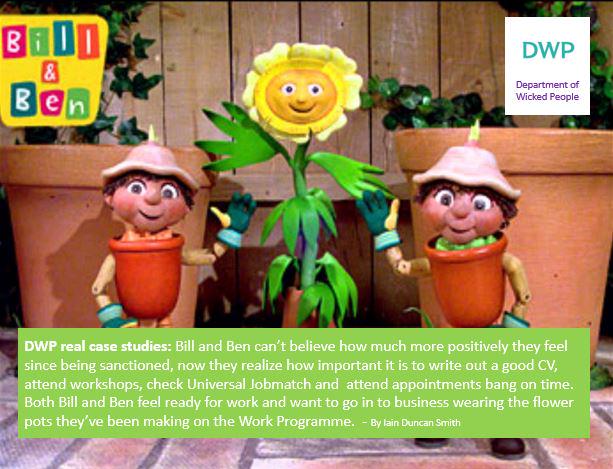
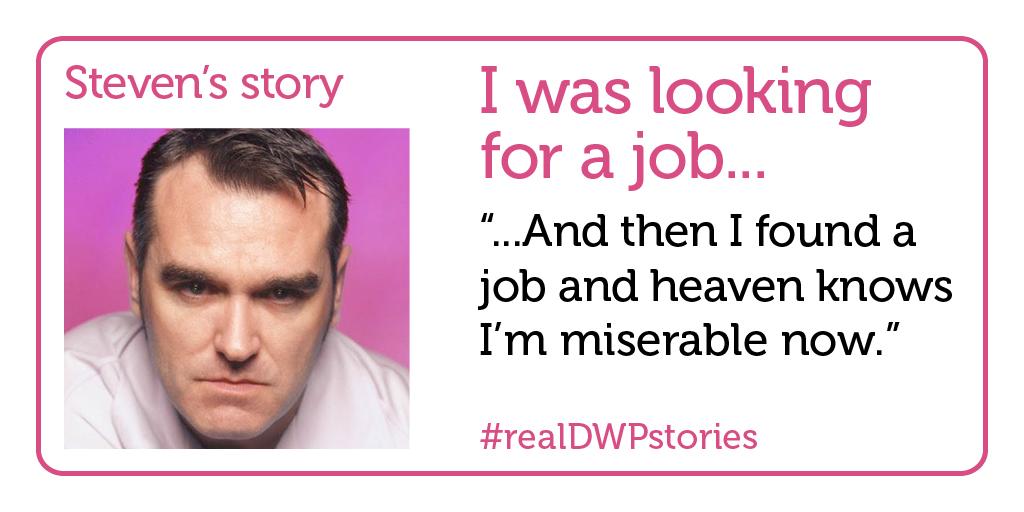
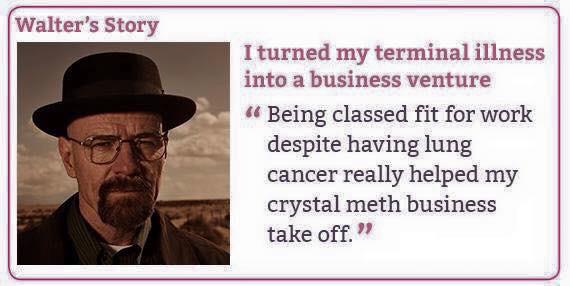
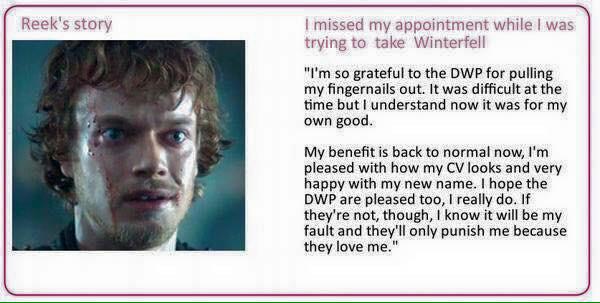
Who could ever forget the Department for Work and Pension’s fake testimonials from fake benefit claimants telling us all how fakely beneficial the fakesters had found having their fake lifeline benefits withdrawn for fake non-compliance, leading to fake improvements of behaviour, presumably after a bout of fake starvation and destitution.

The new Work and Health Programme, aimed at reducing the number of people claiming Employment and Support Allowance (ESA), is currently still at a research and trialing stage. Part of the experimental nudge element of this research entails enlisting GPs to “prescribe” job coaches, and to participate in constructing “a health and work passport to collate employment and health information.”  (See The new Work and Health Programme: the government plan social experiments to “nudge” sick and disabled people into work.)

This raised some serious ethical concerns for me, which I addressed in a Freedom of Information (FoI) request to the Department for Work and Pensions (DWP). The most important part of the request was:

I should like to ask what ethical guidelines are in place regarding the use of behavioural theory on claimants. What guidelines are in place to protect claimants from any potential adverse effects of trials and experiments using methods aimed at changing behaviours of claimants? And what method of gaining claimant consent (to be used as a subject in trials and experiments ) is used by the Department and by job centres?

I did ask a further three brief and reasonable questions, citing a source of information – The Government Communication Service guide to communications and behaviour change quoting from it and explaining the questions.

My request was refused.

The DWP response

I can confirm that we hold information falling within the description specified in your request. However, we estimate that the cost of complying with your request would exceed the appropriate limit for central Government, set by regulations at £600. This represents the estimated cost of one person spending 3½ working days in determining whether the Department holds the information, and locating, retrieving and extracting it.

Under section 12 of the Freedom of Information Act the Department is not therefore obliged to comply with your request and we will not be processing it further.

images

Firstly, something as fundamentally important as safeguarding and ethical guidelines regarding government behavioural/psychological experimentation should actually be available for public access and scrutiny, not hidden away in a place that allegedly takes so much time, effort and money to locate.

Anyone would think those comments are simply an obstructive tactic, if the DWP can confirm that they have the information, then surely that reduces the cost and time spent retrieving and extracting it to comply with my request. Wouldn’t you think?

Someone who is earning £600 for 3½days work is on a very generous annual salary of around £45K. Unless this person is being paid to be intentionally incompetent and obstructive, their job skills suck, it has to be said. So do the logic and reasoning skills of the person who wrote that response.

I also know from experience that the DWP regularly respond only partially. They had the option of answering some of my request, at least. After all, they claim to have the information, seems a shame not to share some of it.

However, because the ethical considerations of government experiments and trials on people needing welfare support are so very important, I have pursued this request further by taking the option of simplifying it.

I wrote:

Dear DWP CAXTON HOUSE Communications,

You confirm that you have the information that I requested, but then claim that it would exceed the £600 limit to provide that
information which you state is because of the “estimated cost of one person spending 3½ working days in determining whether the Department holds the information, and locating, retrieving and extracting it.”

If you confirm you have the information, then surely that reduces the cost and time spent retrieving and extracting it to comply with my request.

I will however simplify my request. Most people would expect that ethical guidelines, safeguards and the important matter of client consent to participating in Government trials and experiments on people needing welfare support is something that the DWP would have to hand – easy to retrieve and very important information that one would expect to be in the public domain in any case. But I can’t find it.

I refer again to the The Government Communication Service guide to communications and behaviour change –
https://gcn.civilservice.gov.uk/wp-conte…

In particular, I refer to page 5: “Behavioural theory is a powerful
tool for the government communicator, but you don’t need to be an experienced social scientist to apply it successfully to your work.”

I should like to ask:

  • What ethical guidelines are in place regarding the use of behavioural theory on claimants?
  • What guidelines are in place to protect claimants from any potential adverse effects of trials and experiments using methods aimed at changing the behaviours of claimants?
  • And what method of gaining claimant consent (to be used as a subject in trials and experiments ) is used by the Department for Work and Pensions and by job centres?

Yours sincerely,

Susan Jones

Link to the request

Here is the FoI request and response in full: Use of behavioural theory to change behaviours of people claiming benefits.

Under Section 16 of the FoI Act the DWP should assist me in helping to narrow my request so that it may fall beneath the cost limit. I have narrowed my request and submitted a shorter, simplified version, focussing on the ethical issues only. It is reasonable to expect the DWP, whose remit includes face to face work with some of our most vulnerable citizens, to have ethical and safeguarding guidelines and consent forms to hand without having to pay someone hundreds of pounds for days of work to “find and retrieve” information that ought to be in the public domain anyway. 

In the event of that request being refused, I will be pursuing this further via the Internal Review Mechanism, and if need be, I shall be contacting the Information Commissioner’s Office.

gcs-guide-to-communications-and-behaviour-change1

I wonder if the response was influenced by this

Update

My second amended request has been refused. I have therefore asked for an Internal Review. I said:

Dear DWP CAXTON HOUSE Communications,

I refer to your first response: “Under section 16 of the Act we
should assist you in helping you narrow your request so that it may fall beneath the cost limit. It may help to reduce the number of questions by refocusing it to only a few elements of the presently broad request. We will consider a fresh any revised request however we cannot guarantee that any revised request will fall within the cost limit.”

I subsequently submitted a narrowed and focussed request in
response, with just 3 basic questions from the initial FOI request. You responded by refering to my original request, and completely ignored my amended and narrowed down, shorter request.

I am therefore making a formal complaint that you did not address the reduced, simplified and narrowed down request. I am asking for an internal review.

I wrote:

“I should like to ask what ethical guidelines are in place
regarding the use of behavioural theory on claimants.

What guidelines are in place to protect claimants from any
potential adverse effects of trials and experiments using methods aimed at changing the behaviours of claimants?

And what method of gaining claimant consent (to be used as a
subject in trials and experiments ) is used by the Department for Work and Pensions and by job centres?”

You have stated that you do have this information. As I have
considerably narrowed down the request to 3 very basic questions, the costs involved in retrieving and providing it ought to be quite minimal. It’s also a very reasonable request. The DWP works with some of our most vulnerable citizens. It is especially important that in light of the current experimental nature of behavioural theories, and the current trialing of the new government health and work programme, that there are ethical guidelines and safeguards in place to protect vulnerable clients, and also, that there is a mechanism for gaining informed consent from clients who are subjects of trials and experiments.

These are issues that researchers within the medical sciences and social sciences have to consider every day. Using behavioural modification (“behavioural change theory”) methods on citizens without their consent and without engaging their deliberative processes has enormous ethical implications.

The British Psychological Society , for example, has strict code of
conduct and human research ethics –
http://www.bps.org.uk/sites/default/file…

And I refer to the Helsinki Declaration regarding medical research http://www.ncbi.nlm.nih.gov/pmc/articles…

The Geneva Declaration – https://en.wikipedia.org/wiki/Declaratio…

And the the Nuremberg code includes such principles as informed consent and absence of coercion; properly formulated scientific experimentation; and beneficence towards experiment participants – https://en.wikipedia.org/wiki/Nuremberg_…

These are just a few examples of codes of ethics regarding human research.

There are a wide range of legal and Human Rights implications
connected with experimentation and research trials conducted on social groups and human subjects. My request for clarification that there are ethical guidelines, safeguards and protections for subjects and basic consent mechanisms in place and the details of what they are is therefore a very reasonable one.

Yours sincerely,

Susan Jones

Link to this

I also added that Section 16 of the FoI Act places a duty on public authorities to provide reasonable advice and assistance to applicants. I was not provided with “advice or assistance.” I was not asked if I prefer to narrow my request in an alternative way to reduce costs (this is a breach of the section 16 duty to advise and assist). Nonetheless I did narrow my request, and that was completely ignored, the second response I received was related entirely to the initial request. In fact it was exactly the same response. I also challenged the DWP’s estimate of the costs of meeting my request. The rest of the grounds for my request for an Internal Review may be viewed here.

Research finds strong correlation between Work Capability Assessment and suicide

IDS_n

In England between 2010 and 2013, just over one million recipients of the main out-of-work disability benefit, Employment Support Allowance (ESA) had their eligibility reassessed using a new stringent functional (as opposed to medical) checklist – the Work Capability Assessment.

Doctors, disability rights organisations, mental health chaities and individual campaigners, such as myself, have raised concerns that this has had an adverse effect on the mental health of claimants, but there have been no population level studies exploring the health effects of this or similar policies, until now.

Research, conducted by B Barr, D Taylor-Robinson, D Stuckler, R Loopstra, A Reeves, and M Whitehead, has established a link between the Work Capability Assessment (WCA) and suicide. The research, published in the Journal of Epidemiology and Community Health (which is peer-reviewed,) and carried out by social scientists from a variety of backgrounds, from the universities of Oxford and Liverpool, scrutinised the rates of mental health issues and suicide in different local authorities in England.

The study found that the authorities with a greater number of people undergoing WCAs also have more people reporting mental health problems, more people being prescribed antidepressants, and more people taking their own lives. The research found that every 10,000 assessments led to around six suicides.

For comparison in terms of statistical significance, isotretinoin, an acne medication which was notoriously linked to suicides, is associated with around four extra deaths per 10,000 treatments.

The researchers estimate that for every 10,000 people reassessed, you would expect to see an additional six suicides (95% confidence interval (CI) 2 to 9), an extra 2,700 reports of mental health problems (95% CI 548 to 4,840) and 7,020 extra antidepressants prescriptions (95% CI 3,930 to 10,100). By convention, 95% certainty is considered high enough for researchers to draw conclusions that can be generalised from samples to populations.

There have been more than 1 million assessments since the WCA was introduced, which suggests that there may be more than 600 people who have taken their own lives who would otherwise have not. The researchers say: “Our study provides evidence that the policy in England of reassessing the eligibility of benefit recipients using the WCA may have unintended but serious consequences for population mental health.”

There have been earlier claims and evidence that the Department for Work and Pension’s (DWP) reforms have led to deaths. However, the DWP has persistently refused to release data which would make it possible to assess whether the death rate for people found fit for work is higher than would be expected.

Both the assessment and appeals process itself, which is widely reported to be stressful, and the financial hardship that occurs when people are denied disability benefits, could result in negative health effects. There is good evidence that loss of income, particularly for people already on low incomes, increases the risk of common mental health problems.

People undergoing a WCA are likely to be particularly vulnerable to the adverse mental health consequences of this policy because a very high proportion have a pre-existing mental health problem. Furthermore, those with physical chronic illness are more prone to mental health problems such as reactive depression, and sometimes, forms of depression that are associated with the illness itself.

The research included efforts to rule out other possible causes of suicide – to eliminate potential confounding variables and bias – for example, there is no similar effect found in people over 65, who are not subject to the WCA – and so the results suggest that the link between the WCA and suicide is not due to “confounding” factors, but is most likely causal.

The Department for Work and Pensions has rejected the study’s findings. A spokesperson said in a statement: “This report is wholly misleading, and the authors themselves caution that no conclusions can be drawn about cause and effect.” 

However, the DWP have no grounds for their own claim whatsoever. Whilst correlation isn’t quite the same thing as cause and effect, it often strongly hints at a causal link, and as such, warrants further investigation. It certainly ought to raise concern from the DWP and ministers, regarding the negative impact of policy on many of the UK’s most vulnerable citizens.

The association with the WCA and its adverse effects is, after all, more clearly defined than the one between the drug isotretinoin and suicide, and the drug was withdrawn in the US and some European Member States.

In the UK, it is now (as of November last year) prescribed only under strict monitoring conditions, and patients are provided with warnings about the possibility of adverse psychiatric effects. No such warning and monitoring exists regarding the possible adverse psychiatric effects of the WCA. In fact the government have stifled both enquiry into a causal link and discussion of even the possibility there may be such a causal link, despite being presented with much evidence of a strongly indicated correlative association.

Dr Benjamin Barr, one of the researchers from Liverpool University, said that a causal link was likely: “Whilst we cannot prove from our analysis that this is causal, there are various reasons why this is a likely explanation,” he said.

He agreed that a study looking specifically at people who had undergone a WCA would be more precise, but added that the DWP has not released that information.

Dr Barr said: “If the DWP has data on this they should make it openly available to independent analysis.” He added that the DWP has so far chosen not to run a trial of its own into a link between WCAs and suicides.

The researchers found that those local areas where a greater proportion of the population were exposed to the reassessment process experienced a greater increase in three adverse mental health outcomes – suicides, self-reported mental health problems and antidepressant prescribing.

These associations were independent of baseline conditions in the areas, including baseline prevalence of benefit receipt, long-term time trends in these outcomes, economic trends and other characteristics associated with risk of mental ill-health. These increases followed – rather than preceded – the reassessment process.

The report concluded that the study results have important implications for policy. The WCA and reassessment policy was introduced without prior evidence of its potential impact or any plans to evaluate its effects. Given that doctors and other health professional have professional and statutory duties to protect and promote the health of patients and the public, this evidence that the process is potentially harming the recipients of these assessments raises serious ethical issues for those involved.

The Royal College of Psychiatrists has also said the research was of “high quality”, adding that it called into question the wisdom of the Government’s reforms.

Last year, coroner Mary Hassell told the DWP she had concluded that the “trigger” for Michael O’Sullivan’s suicide was his fit for work assessment.

“During the course of the inquest, the evidence revealed matters giving rise to concerns. In my opinion, there is a risk that future deaths will occur unless action is taken,” she wrote in the document, known as a Prevention of Future Deaths or regulation 28 report.

At the inquest, Hassell said O’Sullivan had been suffering from long-term anxiety and depression, “but the intense anxiety which triggered his suicide was caused by his recent assessment by the Department for Work and Pensions [benefits agency] as being fit for work and his view of the likely consequences of that”.

The inquest heard that the DWP assessing doctor, a former orthopaedic surgeon, did not factor in the views of any of the three doctors treating O’Sullivan. The coroner said O’Sullivan was never asked about suicidal thoughts, despite writing them down in a DWP questionnaire.

Previously, the loss or reduction of benefits has been cited by coroners as a factor in deaths and suicides of claimants.

The DWP have so far failed to respond coherently, other than with a denial of a “causal” link.

You can read the full research report here.

It’s not the only time that Conservative austerity policies have been implicated in causing harm to citizens. Nor is it the only time that Conservatives have responded with utter indifference to the disproportionately negative impact of their policies on the poorest people. 

A study from Durham University, which looked at over 70 existing research papers, concluded that as a result of unnecessary recession, unemployment, welfare cuts and damaging housing policies, Margaret Thatcher’s legacy includes the unnecessary and unjust premature death of many British citizens, together with a substantial and continuing burden of suffering and loss of wellbeing.

The research shows that there was a massive increase in income inequality under Baroness Thatcher – the richest 0.01 per cent of society had 28 times the mean national average income in 1978 but 70 times the average in 1990, and UK poverty rates went up from 6.7 per cent in 1975 to 12 per cent in 1985. Suicides increased.

Co-author Professor Clare Bambra from the Wolfson Research Institute for Health and Wellbeing at Durham University, commented: “Our paper shows the importance of politics and of the decisions of governments and politicians in driving health inequalities and population health. Advancements in public health will be limited if governments continue to pursue neoliberal economic policies – such as the current welfare state cuts being carried out under the guise of austerity.”

David Cameron’s government has gone much further than Thatcher ever did in cutting essential support and services for protected social groups, such as sick and disabled people, and poorer citizens.

 486294_4737578711832_1816039541_n

Pictures courtesy of Robert Livingstone

British Psychological Society and charity consortium campaign for reform of WCA gains momentum

paa-550x3691


I reported previously that the British Psychological Society (BPS) have called for the reform of the highly controversial Work Capability Assessment.

The BPS have cited a growing body of evidence that seriously ill people are being inappropriately subjected to the Work Capability Assessment (WCA). Psychologists also argue that the WCA does not effectively measure fitness for work and that its application is producing inappropriate outcomes for claimants.

The Society’s call for reform has gained momentum, with more than  20,000 people signing a petition to the Department for Work and Pensions (DWP) and representatives of the charities Mind, the National Autistic Society and Rethink Mental Illness delivered the petition on Thursday, 5 November.

The highly problematic WCA is used to determine whether someone applying for employment and support allowance is “fit for work.” The charities say flaws in the test are causing a great deal of stress and anxiety. In some cases people are being wrongly assessed as fit for work, which can have devastating financial and personal consequences.”

Professor Jamie Hacker Hughes, President of the British Psychological Society, said:

“The Society has repeatedly asked for a meeting with ministers at the DWP so that we can express our concerns over the WCA – so far without success. We are particularly concerned that the government’s benefits policy may misuse psychological tools and techniques. We want to ensure policies are informed by appropriate psychological, theoretical and practical evidence.”

The Society published a briefing paper in June.

A Judicial Review of the WCA was instigated by two anonymous claimants with mental health problems, who were represented by the Public Law Project.

In May 2013 the Upper Tribunal made an “interim” judgment that the WCA puts people with mental health problems, learning disabilities and autism at a “substantial disadvantage”. It was a landmark ruling.

The Tribunal panel ruled that the DWP had failed to make reasonable adjustments, according to the Equality Act, to ensure people with mental health problems were treated fairly by the system. This failure meant such claimants were placed at a substantial disadvantage.

Directors of the three charities, Mind, the National Autistic Society and Rethink Mental Illness, all backed the case and welcomed the judgment, calling on the government to stop assessing people’s fitness for work under the current system until the issue was resolved.

The DWP immediately appealed against the judgment, stating there was no intention of halting the WCA process, but in December 2013 the Court of Appeal upheld the Upper Tribunal’s interim ruling.

The Tribunal held further Hearings in 2014, which were focused on whether or not there is a “reasonable” adjustment that the DWP should have put in place.

The Upper Tribunal confirmed its earlier ruling that the WCA puts people with mental health problems, learning disabilities and autism at a “substantial disadvantage”. However, it did not find, at this point,  that the claimants had been personally discriminated against.

As a result, the court said it could not compel the DWP to trial changes to the WCA. They also said that they did not have enough information to determine whether or not there is a reasonable adjustment which could be put in place for people with mental health problems.

However, the court said that there still may be reasonable adjustments that the DWP can make to the WCA, and has encouraged the DWP to trial changes “as soon as possible”.

Paul Jenkins, CEO of Rethink Mental Illness, said:

“This ruling proves once and for all that this cruel and unfair process is unlawful. The judges have independently confirmed what our members have been saying for years – the system is discriminating against some of the most ill and vulnerable people in our society, the very people it is meant to support.

The work capability assessment process is deeply unfair for people with a mental illness – it’s like asking someone in a wheelchair to walk to the assessment centre.”

Professor Malcom Harrington’s first review – published in back in November 2010 – had previously criticised the way the WCA process failed to properly account for and accommodate people that have chronic illnesses with fluctuating symptoms and people with mental health problems, and he recommended changes, including placing mental health experts in all test centres.

His recommendations have not been implemented.

Pictures courtesy of Robert Livingstone

DWP Staff Gifted £42 Million in ‘Bonus Bonanza’.

IDS_n

At a time when the Conservatives have inflicted draconian cuts on those needing financial support because of illness, disability or losing their job, justifying this by their claim of “economic necessity” and the need to “live within our means” to “pay down the debt”, which is increasing rather than decreasing, the “responsibilities” imposed by the Tory austerity measures apply only to those with the very least.

Meanwhile, Whitehall bureaucrats, many involved in the implementation of the punitive welfare cuts, pocketed more than £90million in hand-outs last year.

Figures obtained by The Huffington Post UK show that in the year to April, 12 Government departments forked out £89.4million in bonuses to staff.

The most rewarding was Department for Work and Pensions, overseen by Iain Duncan Smith, which handed out £42.1million in bonuses to its staff – £38.1million of which went to Senior Civil Servants. And these figures only relate to 12 out of the 20 Government departments, meaning the total bonus figure could soar to almost £140million if the average pay out of almost £7million per department continues.

Labour MP Andrew Gwynne, who uncovered the figures, said: “For all his talk of belt-tightening, these figures show that David Cameron is happy to splash the cash on bonuses.

“Whilst the NHS is in crisis, this bonus bonanza would pay for thousands of new nurses.”

In 2012, the then Treasury minister Danny Alexander vowed to end bonuses for “run of the mill performance” as the coalition Government slashed departmental budgets.

Since 2010-11 the Government says it has restricted awards for senior civil servants to the “top 25 per cent of performers.”

Mark Serwotka, general secretary of the Public and Commercial Services Union called for the bonus system to be scrapped.

He said: “It is unfair and favours the already well paid. The money should be put towards decent pay rises, especially considering that since 2010 rank and file civil servants have seen their real incomes fall by 20 per cent.”

Prospect, a union for professionals, defended the civil service workers and he claimed the focus on bonuses is a “distraction” from the drop in take home pay of many civil servants.

Deputy general secretary Garry Graham said: “Pay in the private sector is increasingly buoyant with average increases running at more than 3.5 per cent. Civil servants have been told that average increases will be capped at 1 per cent until 2020.

“Pay rates in the private sector outstrip those of the public sector – and that gap is only forecast to increase, creating real problems in recruiting and retaining staff, particularly the professional specialists and managers Prospect represents.

“Many, if not all of our members would happily forgo the opportunity to earn a bonus in return for a decent and fair increase to their base pay.

“Government has created the bonus culture in the civil service, not the staff. And only 1 per cent of the civil service paybill is spent on bonuses.”

In a statement alongside his department’s figures, Work and Pensions Minister Justin Tomlinson said: “In line with Civil Service pay guidance, DWP rewards employees for their performance through either end of year non-consolidated payments and/or in-year payments. In year payments are limited to 0.23 per cent of the total DWP paybill.

I can’t help wondering what indicators are used to measure “performance,” and what actually constitutes “good performance.”

This post was written for Welfare Weekly, which is a socially responsible and ethical news provider, specialising in social welfare related news and opinion.

Government refuses to review the negative impact of sanctions on people with mental illness

Illustration by Jack Hudson.

The increased use and rising severity of benefit sanctions became an integrated part of welfare “conditionality” in 2012. Sanctions are based on the behavioural theory called “loss aversion,” which is borrowed from economics and decision theory. Loss aversion refers to the idea that people’s tendency is to strongly prefer avoiding losses to acquiring gains. The idea is embedded in the use of sanctions to “nudge” people towards “changing their behaviours,” by using a threat of punitive loss, since the underpinning assumption is that people are unemployed because of personal behavioural deficits and making “wrong decisions,” rather than because of socio-economic conditions and political policy decisions.

However, a wealth of evidence has demonstrated that sanctioning does not help clients into work; indeed, it is more likely to make it much harder to get a job. Furthermore, sanctions are often applied in an arbitrary manner, without due regard to proportionality, rationality or for the health and wellbeing of people claiming benefits.

The Government is facing renewed calls for an independent review to examine its controversial benefit sanctions policy and to ensure vulnerable people are protected. However, Department of Work and Pensions minister, Priti Patel, has refused to examine the effect of its  sanctions regime on the mental health of people who are affected by it.

MPs used a question session in the Commons to raise concerns over the impact of benefit sanctions on the mental health of claimants.

Employment minister, Patel, said any analysis of the temporary benefit cuts’ effects would be “misleading” in isolation and that their effect should therefore not be examined.

“There are many factors affecting an individual’s mental health. To assess the effect of sanctions in isolation of all other factors would be misleading,” she told MPs at a Work and Pensions Questions session in the House of Commons.

She also claimed that there was no evidence that sanctions particularly affected people with mental health problems – a claim contrary to the results of independent research.

More than 100 people with mental health issues have their benefits sanctioned every day, according to figures released earlier this year.

The government’s refusal to engage with criticism of the sanction system’s effect on mental health comes after the highly critical study by the charity Mind.

83 per cent of Work Programme participants with mental health issues surveyed by Mind said the scheme’s “support” had made their mental health problems worse of much worse.

Jobseekers are to be given 14 days’ notice before facing benefit sanctions under a new scheme being trialled next year by the Department for Work and Pensions (DWP).

But the government were questioned why they are waiting until next year to trial this idea.

Eilidh Whiteford, the SNP’s social justice and welfare spokeswoman, told Ms Patel: “The so-called yellow pilot scheme is actually an admission by the Government that the sanctions regime isn’t working at the present time, and it’s particularly badly failing people with serious mental illnesses.

“Why is the Government waiting until next year to bring in this pilot scheme, and in the meantime will they please just stop sanctioning people who are seriously ill?”

Ms Patel said she would “respectfully disagree” with Ms Whiteford, adding: “Claimants are only asked to meet reasonable requirements taking into account their circumstances and I think, as you will find with the pilots as they are under way, that again this is about how we can integrate support for claimants and importantly provide them with the support and the guidance to help them get back to work.”

Ms Whiteford insisted the reality is people with mental health problems are being “disproportionately sanctioned”, adding that has been clear for “some time”.

Ms Patel replied: “For a start, the Government has been listening and we have responded to the Work and Pensions Select Committee, hence the reason we will be trialling and piloting the new scheme.”

She reiterated staff in jobcentres are trained to support claimants with mental health conditions, adding: “There is no evidence to suggest mental health claimants are being sanctioned more than anybody else.”

Shadow work and pensions minister Debbie Abrahams told Ms Patel: “You may have inadvertently slipped up there.

“There is clear evidence from last year that 58% of people with mental health conditions on the Employment Support Allowance work-related activity group were sanctioned.

“Obviously that’s over half and that’s the equivalent to 105,000 people – 83% in a Mind survey say that their health condition was made worse as a result of this.”

Data released by the mental health charity Mind recently revealed the scale of sanctions imposed on people with mental health problems being supported by out-of-work disability benefits.

Obtained by the charity under the Freedom of Information Act, the figures show that there were up to three times more benefit sanctions issued by the Department for Work and Pensions (DWP) to people with mental health problems last year than there were people “supported” into work.

There were almost 20,000 benefits sanctions received by people who were out of work because of their mental health last year, while only 6340 of this group were successfully supported into a job during the same period.

Professor Jamie Hacker Hughes, President of the British Psychological Society, said:

“Today’s news, from a Freedom of Information request made by the mental health charity Mind, shows that three times as many people are subject to benefit sanctions as those who have been supported back into work.”

“We in the British Psychological Society have become increasingly concerned about benefit sanctions and a number of other issues concerning the psychological welfare of those on benefits.

“We have repeatedly sought a meeting with the Secretary of State and his team and now repeat that request so that his Department may become aware of the most up-to-date psychological research and opinion on these issues.

“There are approximately 250,000 people receiving the benefit Employment and Support Allowance who need this support primarily because of their mental health. People can be sanctioned – have their benefits cut – if they fail to participate in work-related activity, including missing appointments or being late for meetings or CV writing workshops.

“However, many people with mental health problems find it difficult to participate in these activities due to the nature of their health problem and the types of activities they’re asked to do, which are often inappropriate.”

The government has a duty to monitor the impact of its policies, and to make the results public. Sanctions are founded on theory and experimental behavioural science, which adds a further dimension of legitimacy to calls for a review into the impacts of sanctions on people.

This post was written for Welfare Weekly, which is a socially responsible and ethical news provider, specialising in social welfare related news and opinion.

Prime minister dismisses UN inquiry into government’s discriminatory treatment of disabled people

disability_2218977b

Labour leader Jeremy Corbyn has asked David Cameron at Prime Minister’s Questions today to publish the details of the Government’s response to the United Nations inquiry into the allegations that Conservative policies are breaching the rights of disabled people in the UK. He also asked if the government intended to co-operate with the inquiry.

Such UN investigations are conducted confidentially by the UN and officials will not confirm or deny whether the UK is currently being put under scrutiny.

However, the ongoing inquiry been widely reported by disability rights groups and campaigners. The Department for Work and Pensions has previously declined to comment on the possibility of an investigation.

Mr Corbyn used his final question to ask about the United Nations inquiry into alleged “grave or systemic violations” of the rights of disabled people in the UK. The PM gave a dismissive response, saying the inquiry may not be “all it’s cracked up to be” and said that disabled people in other countries do not have the rights and support that “they” [disabled people] in the UK are offered. Cameron also implied that Labour’s “strong” equality legislation was a Conservative policy. However, the Equality Act was drafted under the guidance of Harriet Harman.

Jeremy Corbyn asks about David Cameron about his response to the UN inquiry at Prime Minister’s Questions

The United Nations team of investigators are expecting to meet with the Equality and Human Rights Commission, members of parliament, individual campaigners and disabled people’s organisations, representatives from local authorities and academics.

The team will be gathering direct evidence from individuals about the impact of government austerity measures, with a focus on benefit cuts and sanctions; cuts to social care; cuts to legal aid; the closure of the Independent Living Fund (ILF); the adverse impact of the Work Capability Assessment (WCA); the shortage of accessible and affordable housing; the impact of the bedroom tax on disabled people, and also the rise in disability hate crime.

Mr Corbyn said:

“This is deeply embarrassing to all of us in this house and indeed to the country as a whole. It’s very sad news.”

The Government’s approach to people with disabilities had been extremely controversial and been met with criticism from campaign groups. Disabled people have borne the brunt of austerity cuts, losing more income and support than any other social group, and this is despite the fact that Cameron promised in 2010 to protect the poorest, sick and disabled people and the most vulnerable.

In 2013, Dr Simon Duffy at the Centre for Welfare Reform published a briefing outlining how the austerity cuts are targeted. The report says:

The cuts are not fair.

They target the very groups that a decent society would protect:

  • People in poverty (1 in 5 of us) bear 39% of all the cuts
  • Disabled people (1 in 13 of us) bear 29% of all the cuts
  • People with severe disabilities (1 in 50 of us) bear 15% of all the cuts

The report outlines further discrimination in how the austerity cuts have been targeted. The report says:

The unfairness of this policy is seen even more clearly when we look at the difference between the burden of cuts that falls on most citizens and the burdens that fall on minority groups. By 2015 the annual average loss in income or services will be:

  • People who are not in poverty or have no disability will lose £467 per year
  • People who are in poverty will lose £2,195 per year
  • Disabled people will lose £4,410 per year
  • Disabled people needing social care will lose £8,832 per year

Work and Pensions Secretary Iain Duncan Smith said at the  Conservative party conference speech in Manchester that disabled people “should work their way out of poverty.”

The Work and Pensions Secretary has been widely criticised for removing support for disabled people who want to work: by closing Remploy factories, scrapping the Independent Living Fund, cuts to payments for a disability Access To Work scheme and cuts to Employment and Support Allowance.

The reformed Work Capability Assessment has been very controversial, with critics labeling them unfair, arbitrary, and heavily bureaucratic, weighted towards unfairly removing people’s sickness and disability benefit and forcing them to look for work.

The bedroom tax also hits disabled people disproportionately, with around two thirds of those affected by the under-occupancy penalty being disabled.

The United Nations have already deemed that the bedroom tax constitutes a violation of the human right to adequate housing in several ways. If, for example, the extra payments force tenants to cut down on their spending on food or heating their home. There are already a number of legal challenges to the bedroom tax under way in British courts. In principle the judiciary here takes into account the international human rights legislation because the UK has signed and ratified the International Covenant on Economic, Social and Cultural Rights.

The right to adequate housing is recognised in a number of international human rights instruments that the UK has signed up to.

UN rapporteur Raquel Rolnik called for the UK government last year to scrap its controversial bedroom tax policy. Rolnik’s report was dismissed as a “misleading Marxist diatribe” by Tory ministers, and she had been subject to a “blizzard of misinformation” and xenophobic tabloid reports.

The DWP’s sanctions regime has also been widely discredited, and there has been controvery over death statistics, eventually released by the Department after a long-running refusal to release the information under freedom of information law.

The Daily Mail has already preempted the visit from the special rapporteur, Catalina Devandas Aguilar, who is spearheading the ongoing inquiry into many claims that Britain is guilty of grave or systematic violations of the rights of sick and disabled people, by using racist stereotypes, and claiming that the UN are “meddling”. The Mail blatantly attempted to discredit this important UN intervention and the UN rapporteur before the visit.

Meanwhile, Cameron seems very keen to play the investigation down, and dismiss the impact of his government’s “reforms” on the lives of sick and disabled people.

We are a very wealthy, so-called first-world liberal democracy, the fact that such an inquiry has been deemed necessary at all ought to be a source of great shame for this government.


The government need to learn about the link between correlation and causality. Denial of culpability is not good enough.


IDS_n

Correlation isn’t quite the same as causality. When researchers talk about correlation, what they are saying is that they have found a relationship between two, or more, variables. “Correlation does not mean causation” is a quip that researchers chuck at us to explain that events or statistics that happen to coincide with each other are not necessarily causally related.

Correlation means that an association has been established, however, and the possibility of causation isn’t refuted or somehow invalidated by the establishment of a correlation. Quite the contrary. Indeed an established association implies there may also be a causal link. To prove causation, further research into the association must be pursued. So, care should be taken not to assume that correlation never implies causation, because it quite often does indicate a causal link.

Whilst the government deny there is a causal link between their welfare policies, austerity measures and an increase in premature deaths and suicides, they cannot deny there is a clear correlation, which warrants further research – an independent inquiry at the VERY least. But the government are hiding behind this distinction to deny any association at all between policy and policy impacts. That’s just plain wrong.

Correlations between two things may be caused by a third factor that affects both of them. This sneaky, hidden third factor is called a confounding variable, or simply a confounder.

However, most of the social research you read tends to indicate and discuss a correlation between variables, not a direct cause and effect relationship. Researchers tend to talk about associations, not causation. Causation is difficult but far from impossible to establish, especially in complex sociopolitical environments. It’s worth bearing in mind that establishing correlations is crucial for research and show that something needs to be examined and investigated further. That’s precisely how we found out that smoking causes cancer, for example – through repeated findings showing an association (those good solid, old fashioned science standards of replicability and verification). It is only by eliminating other potential associations – variables – that we can establish causalities.

The objective of a lot of research or scientific analysis is to identify the extent to which one variable relates to another variable. If there is a correlation then this guides further research into investigating whether one action causes the other. Statistics measure occurrences in time and can be used to calculate probabilities. Probability is important in studies and research because measurements, observations and findings are often influenced by variation. In addition, probability theory provides the theoretical groundwork for statistical inference.

Statistics are fundamental to good government, to the delivery of public services and to decision-making at all levels of society. Statistics provide parliament and the public with a window on the work and performance of a government. Such data allows for the design of policies and programs that aim to bring about a desired outcome, and permits better targeting of resources. Once a policy has been implemented it is necessary to monitor and evaluate the effectiveness of the policy to determine whether it has been successful in achieving the intended outcomes. It is also important to evaluate whether services (outputs) are effectively reaching those people for whom they are intended. Statistics play a crucial role in this process.  So statistics, therefore, represent a significant role in good policy making and monitoring. The impact of policy can be measured with statistics.

So firstly, we need to ask why the government are not doing this.

If policy impacts cannot be measured then it is not good policy.

Ensuring accuracy and integrity in the reporting of statistics is a serious responsibility. In cases where there may not be an in-depth understanding of statistics in general, or of a particular topic, the use of glossaries, explanatory notes and classifications ought to be used to assist in their interpretation.

Statistics can be presented and used in ways that may lead readers and politicians to draw misleading conclusions. It is possible to take numbers out of context, as Iain Duncan Smith, amongst others, is prone to do. However, official statistics are supposed to be produced impartially and free from political influence, according to a strict code of practice. This is a government that systematically breaches the code of conduct. See: List of official rebukes for Tory lies and statistical misrepresentations, for example

We need to ask why the government refuses to conduct any research into their austerity policies, the impact they are having and the associated deaths and suicides.

Without such research, it isn’t appropriate or legitimate to deny a causal link between what are, after all, extremely punitive, targeted, class contingent policies and an increase in premature mortality rates.

The merits of qualitative research

However, I believe that social phenomena cannot always be studied in the same way as natural phenomena. There are, for example, distinctions to be made between facts and meanings. Qualitative researchers are concerned with generating explanations and extending understanding rather than simply describing and measuring social phenomena and establishing basic cause and effect relationships. Qualitative research tends to be exploratory, potentially illuminating underlying intentions, reasons, opinions, and motivations to human behaviours. It often provides insight into problems, helps to develop ideas, and may also be provide potential for the formulation hypotheses for further quantitative research.

The dichotomy between quantitative and qualitative methodological approaches, theoretical structuralism (macro-level perspectives) and interpretivism (micro-level perspectives) in sociology, for example, is not nearly so clear as it once was, however, with many social researchers recognising the value of both means of data collection and employing methodological triangulation, reflecting a commitment to methodological and epistemological pluralism. Qualitative methods tend to be much more inclusive, lending participants a dialogic, democratic voice regarding their experiences.

The government have tended to dismiss qualitative evidence of the negative impacts of their policies – presented cases studies, individual accounts and ethnographies – as “anecdotal.”

However, such an approach to research potentially provides insight, depth and rich detail because it explores beneath surface appearances, delving deeper than the simplistic analysis of ranks, categories and counts. It provides a reliable record of experiences, attitudes, feelings and behaviours and prompts an openness that quantitative methods tend to limit, as it encourages people to expand on their responses and may then open up new topic areas not initially considered by researchers. As such, qualitative methods bypass problems regarding potential power imbalances between the researcher and the subjects of research, by permitting participation and creating space for genuine dialogue and reasoned discussions to take place. Research regarding political issues and impacts must surely engage citizens on a democratic basis and allow participation in decision-making, to ensure an appropriate balance of power between citizens and government.

That assumes of course that governments want citizens to engage and participate. There is nothing to prevent a government deliberately exploiting a research framework as a way to test out highly unethical and ideologically-driven policies, and to avoid democratic accountability, transparency and safeguards. How appropriate is it to apply a biomedical model of prescribed policy “treatments” to people experiencing politically and structurally generated social problems, such as unemployment, inequality and poverty, for example?

Conservative governments are indifferent to fundamental public needs

The correlation between Conservative policies and an increase in suicides and premature deaths is a fairly well-established one.

For example, Australian social scientists found the suicide rate in the country increased significantly when a Conservative government was in power.

And an analysis of figures in the UK strongly suggests a similar trend.

The authors of the studies argue that Conservative admininistration traditionally implies a less supportive, interventionist and more market-orientated policy than a Labour one. This may make people feel more detached from society, they added. It also means support tends to be cut to those who need it the most.

Lead researcher Professor Richard Taylor, of the University of Sydney, told BBC News Online:

“We think that it may be because material conditions in lower socio-economic groups may be relatively better under labour because of government programmes, and there may be a perception of greater hope by these groups under labour.

There is a strong relationship between socio-economic status and suicide.”

The research is published in the Journal of Epidemiology and Community Health.

In one of a series of accompanying editorials, Dr Mary Shaw and colleagues from the University of Bristol say the same patterns were evident in England and Wales between 1901 and 2000.

Rates have been lower under Labour governments and soared under the last Conservative regime, which began in 1979 under Margaret Thatcher.

Interestingly, the authors of more recent research point out that although suicide rates tend to increase when unemployment is high, they were also above average during the 1950s when Britain “never had it so good,” but was ruled by the Conservative party.

Overall, they say, the figures suggest that 35,000 people would not have died had the Conservatives not been in power, equivalent to one suicide for every day of the 20th century or two for every day that the Conservatives ruled.

The UK Conservative Party typically refused to comment on the research.

Not a transparent, accountable and democratic government, then.

More recently, public health experts from Durham University have denounced the impact of Margaret Thatcher’s policies on the wellbeing of the British public in research which examines social and health inequality in the 1980s.

The study, which looked at over 70 existing research papers, concludes that as a result of unnecessary unemployment, welfare cuts and damaging housing policies, the former prime minister’s legacy includes the unnecessary and unjust premature death of many British citizens, together with a substantial and continuing burden of suffering and loss of well-being.

The research shows that there was a massive increase in income inequality under Baroness Thatcher – the richest 0.01 per cent of society had 28 times the mean national average income in 1978 but 70 times the average in 1990, and UK poverty rates went up from 6.7 per cent in 1975 to 12 per cent in 1985.

Thatcher’s governments wilfully engineered an economic catastrophe across large parts of Britain by dismantling traditional industries such as coal and steel in order to undermine the power of working class organisations, say the researchers. They suggest this ultimately fed through into growing regional disparities in health standards and life expectancy, as well as greatly increased inequalities between the richest and poorest in society.

Co-author Professor Clare Bambra from the Wolfson Research Institute for Health and Wellbeing at Durham University, commented:

“Our paper shows the importance of politics and of the decisions of governments and politicians in driving health inequalities and population health. Advancements in public health will be limited if governments continue to pursue neoliberal economic policies – such as the current welfare state cuts being carried out under the guise of austerity.”

Housing and welfare changes are also highlighted in the paper, with policies to sell off council housing such as Right to Buy  scheme and to reduce welfare payments resulting in further inequalities and causing “a mushrooming of homelessness due to a chronic shortage of affordable social housing.” Homeless households in England tripled during the 1980s from around 55,000 in 1980 to 165,000 in 1990.

And while the NHS was relatively untouched, the authors point to policy changes in healthcare such as outsourcing hospital cleaners, which removed “a friendly, reassuring presence” from hospital wards, led to increases in hospital acquired infections, and laid the ground for further privatisation under the future Coalition government.

The figures analysed as part of the research also show high levels of alcohol and drug-related mortality and a rise in deaths from violence and suicide as evidence of health problems caused by rising inequality during the Thatcher era.

The study, carried out by the Universities of Liverpool, Durham, West of Scotland, Glasgow and Edinburgh, is published in the International Journal of Health Services. It was scientifically peer-reviewed and the data upon which it was based came from more than 70 other academic papers as well as publicly available data from the Office for National Statistics (ONS).

The Government has repeatedly denied any links between social security cuts and deaths, despite the fact that there is mounting and strong evidence to the contrary. Yet it emerged that the Department for Work and Pensions (DWP) has carried out 60 reviews into deaths linked to benefit cuts in the past three years.

The information, released by John Pring, a journalist who runs the Disability News Service (DNS), was obtained through Freedom of Information requests. The data showed there have been 60 investigations into the deaths of benefit claimants since February 2012.

The DWP says the investigations are “peer reviews following the death of a customer.”

Iain Duncan Smith has denied that this review happened:

“No, we have not carried out a review […] you cannot make allegations about individual cases, in tragic cases where obviously things go badly wrong, you can’t suddenly say this is directly as a result of government policy.”

Secretary of State for Work and Pensions, 5 May 2015.

Several disability rights groups and individual campaigners, including myself, have submitted evidence regularly to the United Nations over the past three years, including details of Conservative policies, decision-making narratives and the impact of those policies on sick and disabled people. This collective action has triggered a welcomed international level investigation, which I reported last August: UK becomes the first country to face a UN inquiry into disability rights violations.

The United Nations only launch an inquiry where there is evidence of “grave or systemic violations” of the rights of disabled people.

Government policies are expressed political intentions regarding how our society is organised and governed. They have calculated social and economic aims and consequences.

How policies are justified is increasingly being detached from their aims and consequences, partly because democratic processes and basic human rights are being disassembled or side-stepped, and partly because the government employs the widespread use of propaganda to intentionally divert us from their aims and the consequences of their ideologically (rather than rationally) driven policies.  All bullies and despots scapegoat and stigmatise their victims. Furthermore, policies have become increasingly detached from public interests and needs.

It’s possible to identify which social groups this government are letting down and harming the most – it’s the ones that are being politically marginalised and socially excluded. It’s those groups that are scapegoated and deliberately stigmatised by the perpetrators of their misery.

Iain Duncan Smith and Priti Patel claim that we cannot make a link between government policies and the deaths of some sick and disabled people. There are no grounds whatsoever for that claim. There has been no cumulative impact assessment, no inquiry, no further research regarding an established correlation and a longstanding refusal from the Tories to undertake any of these. There is therefore no evidence for their claim.

Political denial is repressive, it sidesteps democratic accountability and stifles essential debate and obscures evidence. Denial of causality does not reduce the probability of it, especially in cases where a correlation has been well-established and evidenced.

arnstein-ladder-citizenship-participation.png

This is Sherry Arnstein’s Ladder of Citizen Participation and Power. Whereabouts are we?

For Arnstein, participation reflects “the redistribution of power that enables the have-not citizens, presently excluded from the political and economic processes, to be deliberately included in the future. It is the strategy by which the excluded join in determining how information is shared, goals and policies are set, tax resources are allocated, programmess are operated, and benefits like contracts and patronage are parceled out. In short, it is the means by which they can induce significant social reform which enables them to share in the benefits of the affluent society.”

A starting point may be the collective gathering of evidence and continual documentation of our individual experiences of austerity and the welfare “reforms”, which we must continue to present to relevant ministers, parliament, government departments, the mainstream media and any organisations that may be interested in promoting citizen inclusion, empowerment and democratic  participation.

We can give our own meaningful account of our own experiences and include our own voice, reflecting our own first-hand knowledge of policy impacts, describing how we make sense of and understand our own situations, including the causal links between our own circumstances, hardships, sense of isolation and distress, and Conservative policies, as active, intentional, consciencious citizens. Furthermore, we can collectively demand a democratic account and response (rather than accepting denial) from the government.


Related

A tale of two suicides and a very undemocratic, inconsistent government

The Tories are epistemological fascists: about the DWP’s Mortality Statistics release

The DWP mortality statistics: facts, values and Conservative concept control
1450041_569755536427312_1698223275_n

Pictures courtesy of Robert Livingstone


I don’t make any money from my work. I am disabled because of illness and have a very limited income. But you can help by making a donation to help me continue to research and write informative, insightful and independent articles, and to provide support to others. The smallest amount is much appreciated – thank you. 

DonatenowButton cards

Techniques of neutralisation: David Cameron’s excuses for Iain Duncan Smith

430835_148211001996623_1337599952_n (1)

I wrote earlier about the way the Department of Work and Pensions (DWP) heavily micro-managed the recent Mortality Statistics release, and how the Government are using an excessively bureaucratic approach to ensure that no inferences are drawn from the data published, insisting that it’s “wrong” to link the mortality rates of sick and disabled people with punitive, Conservative austerity policies.
However, the accounts and experiences of sick and disabled people and their families (recorded in the media, in parliamentary inquiries, Commons debates – all preserved on the Hansard record) inform us that there is a clear correlation between the Tory “reforms” and increased distress, a loss of dignity and autonomy, financial insecurity and insolvency, increasing ill health, and sometimes, the death, of disabled people.

When confronted in the Commons, Iain Duncan Smith and other ministers dispensed with civilised debate, and simply blocked any discussion regarding concerns raised by the opposition about the negative impact of the Tory welfare cuts on sick and disabled people.  Values of decency and legitimate concerns about the welfare of sick and disabled citizens were depreciated as mere matters of “subjective interpretation” and not as worthy subjects of political, rational or objective discussion.

The Mortality Statistics release from Department of Work and Pension “provides further commentary on the appropriate use of this information” – in other words, it informs us what we may and may not do with the “data”, and carries this pre-emptive caution:

“Any causal effect between benefits and mortality cannot be assumed from these statistics. Additionally, these isolated figures provide limited scope for analysis and nothing can be gained from this publication that would allow the reader to form any judgement as to the effects or impacts of the Work Capability Assessment.”

Bearing in mind that the information in the release came about because of many Freedom of Information (FOI) requests from many of us, and the rulings of the Information Commissioner and a tribunal (Mike Sivier from Vox Political appealed against the original decision by the Information Commissioner and the DWP to refuse the Freedom of Information requests), it’s difficult to see why the Government have been so determined, firstly, to withhold the information requested, secondly, when forced to make the release, to present the information in a decontextualized way that renders it virtually meaningless, thirdly, to go to such extraordinary lengths to instruct us how we may and may not analyse the data and fourthly, to respond to any interpretive reference to the data as “wrong”, refusing to engage in any further discussion.

Unless of course it’s a Government that doesn’t want open and democratic accountability and public scrutiny of the often devastating impact of its policies.

Debbie Abrahams, the new shadow minister for disabled people, has long been an outstanding campaigner and spokesperson for disabled people. Earlier this month, she asked David Cameron:

“Two weeks ago, the Work and Pensions Secretary’s Department not only admitted to falsifying testimonies in leaflets, but published data on the deaths of people on sickness benefit, which showed that they are four times more likely to die than the general population. That was after the Secretary of State told the House that these data did not exist. Given that, and his offensive remarks earlier this week—referring to people without disabilities as “normal”—when will the Prime Minister take control and respond to my call for the Work and Pensions Secretary to be investigated for breaching the ministerial code?”

Here is the Ministerial code. Ministers are also expected to observe the seven Nolan Principles, which are the basis of the ethical standards of conduct that is expected of all holders of public office. 

Last year, I sent David Cameron a reminder of the established standards and ethics of Public Office, as the Coalition had exempted themselves, but he didn’t respond and it didn’t make any difference.

It’s true that the Department of Work Pensions (DWP) has admitted falsifying testimonies in leaflets. The DWP’s own data does indicate that people on incapacity benefits are four times more likely to die than other people in the general population. Iain Duncan Smith did tell MPs that this data did not even exist. Then he told them it did.

Let’s be frank here, Iain Duncan Smith has established a culture where it’s acceptable to lie, even his Curriculum Vitae is comprised of  Machiavellian, narcissistic-inspired confabulations – he’s qualified only in absolute and utter tosh, he graduated without Honour. Or a degree.

And it’s truly priceless that Iain Duncan Smith or David Cameron can accuse anyone of misrepresenting statistics with a straight face, given the large number of official rebukes the Tories have had from the Office for National Statistics (ONS) for manipulating or  misrepresenting statistics and telling lies.

Today, Debbie received the following written response to her question from the Prime sinister Minister:

Cameron letter on claimant deaths

Cameron letter on claimant deaths

I’ve already addressed a lot of the content above, however I couldn’t help but note the apparent “policing” of Debbie’s tweets. The response isn’t a rational or reasonable one, and certainly not of a standard that is expected of a prime minister.

How can the use of fake statements from fake characters about fictitious “benefits” of harsh sanctions – the arbitrary and punitive removal of lifeline income to support people in meeting basic survival needs – ever “help claimants and advisers to understand the benefit system”?

How is telling lies about the impact of policy and constructing fake positive testimonies ever “illustrative”? That was no “error”: it was an intentional, deceitful act designed solely to mislead the public and to justify the Conservative’s crass and primitive behaviourist approach to what was once our social security.

As is the insistence that “the statistics showed it is quite wrong to suggest any causal link between the death of an individual and their benefit claim.” Tosh. The statistics showed no such thing,  they did not demonstrate that there is no existing causal link – but the data was presented in a way that intentionally obscures such a link. That does not mean we can conclude there’s no connection between increased mortality and the Conservative “reforms” at all.

Whilst we are warned not to draw inferences of causal links from the statistics, the prime minister thinks that it’s perfectly appropriate to do just that himself. Yet there is no empirical evidence whatsoever to support his denial of a causal link.  The statistical data does not falsify or refute the proposition that such a link exists. We have plenty of recorded evidence, however, to support our proposition that Tory policies are actually harming people.

Tory policies do. Margaret Thatcher’s policies caused premature deaths, too, and her Cabinet were far less harsh towards sick and disabled people than Cameron’s government. A research report which looked at over 70 existing research papers, concludes that as a result of unnecessary unemployment, welfare cuts and damaging housing policies, the former prime minister’s legacy includes the unnecessary and unjust premature death of many British citizens, together with a substantial and continuing burden of suffering and loss of well-being.

It doesn’t take a genius to work out that if you inflict stress and harm on people who are already ill, by withholding their lifeline support, by constantly reassessing them and telling them they are fit for work when they clearly are not, by invalidating their experiences, by forcing them to fight for the means of survival – without the means of survival, it will probably exacerbate any illness and quite possibly this will kill them.

As I discussed earlier today, Cameron and his government have consistently displayed an absolute lack of concern for sick and disabled people, who have borne the brunt of Tory austerity cuts. Yet it’s inconceivable that Conservatives don’t grasp the fact that their policies are at least potentially very harmful, and certainly very punitive in nature.

I’ve discussed many times before that Tory ideology is founded on toxic subterranean values and principles, which are anachronistic and incompatible with a society that has evolved to value democracy, human rights and the socio-economic gains from our post-war settlement.

Conservatives have always seen inequality as a necessary and beneficial element to a market driven economy, for example, and their policies tend to assemble a steeply hierarchical society, especially given their small state fetishism, which involves removing socio-economic support services and civilising mechanisms such as welfare, free healthcare and access to legal aid.

Beneath the familiar minarchist, class contingent Conservative policies and neoliberal schema is a tacit acceptance of socioeconomic Darwinism, and a leaning towards eugenicist principles, expressed most clearly recently in the withdrawal of tax credit support for low paid families with more than two children, in order to “change behaviours” as Iain Duncan Smith put it. The reasoning behind this is the government believe they can “nudge” poor people into “breeding” less. Such a class contingent policy reflects a deep prejudice and also demonstrates an authoritarianism that is certainly incompatible with democracy and human rights.

(See also David Freud was made to apologise for being a true Tory in public, Paternalistic Libertarianism and Freud’s comments in context and What will the Tories suggest next. “Compassionate” eugenics?)

The Tories employ techniques of neutralization which are used to rationalise or justify acts that contravene social norms or that are illegal.  There are five basic techniques of neutralization; denial of responsibility, denial of injury, denial of victims, condemnation of the condemners, and an appeal to higher loyalties.

The recognition of techniques of neutralisation by David Matza and Gresham Sykes happened during their work on Edwin Sutherland’s Differential Association in the 1950s. Matza and Sykes were working on juvenile delinquency at the time, and they theorised that the same techniques could be found throughout society and published their ideas in Delinquency and Drift, 1964.

It was Alexander Alverez who identified that these techniques were used more broadly at a socio-political level in Nazi Germany to “justify” the Holocaust. He added a sixth technique – Disengagement and Dehumanisation.

Such techniques allow people to neutralise and temporarily suspend their commitment to societal and moral values, and to switch off their own “inner protests”, providing them with the freedom to commit deviant acts. Some people don’t have such inner protests – psychopaths, for example – but they may employ techniques of neutralization to manipulate, and switch off the conscience protests of others.

It’s clear that this is a method frequently employed by the government. The Tories systematically attempt to to distort meanings, to withhold,  or deny any evidence that may expose the impact of their draconian policies on targeted social groups.

For example, when they habitually use the word “reform”, when   referring to is cutting funding or support. and “help” and “support” is Tory-speak that means to coerce and punish. The claim that the bedroom tax ishelping” people into workorhelping child poverty– when empirical research shows that 96% of those affected by the bedroom tax can NOT downsize due to a lack of available homes in their area – is a completely outrageous lie. People can’t move as there is a housing crisis, which is due to a lack of affordable homes and appropriately sized accommodation.

How can policies that further impoverish the poorest ever “help them to into work” or alleviate poverty? It’s glib, irrational tosh from a Government that can’t do coherent, joined up thinking, and even worse, thinks that we can’t either.

Forms of social prejudice are normalised gradually, almost inscrutably and incrementally – in stages. Allport describes the political, social and psychological processes, and how techniques of persuasion – propaganda – are used to facilitate stigmatising and dehumanisation of targeted groups to justify discrimination, until the unthinkable becomes acceptable, because of a steady erosion of our moral and rational boundaries.

The prejudice happens on a symbolic level first – via language – and it starts with subtlety, such as the use of divisive and stigmatising phrases like “scroungers and strivers” in the media and political rhetoric, referring to people who need support and social security as “stock”, suggesting that disabled people are not worth a minimum wage and so on.

These comments and strategies are not “mistakes”, this is how Conservatives really think. People who are prejudiced very seldom own up, and nor do bullies. They employ linguistic strategies, deceitful, diversionary and irrational responses that makes challenging them very difficult.

But as history has taught us, we really must challenge them.

36626_217452248405831_532419169_nPictures courtesy of Robert Livingstone

Related reading:

This is an excellent, substantial collection of evidenced lies, deceits and more lies from Ian Duncan Smith, collated by Bob Ellard, researcher for DPAC The IDS Files: the truth is out there 

The Department of Whopping Porkies is rebuked as claimants suddenly develop mysterious superpowers after being sanctioned


994108_672923769443821_3242642514371587924_n

Courtesy of Robert Livingstone

We all know that the Tory welfare “reforms” are the gift that just keeps on giving. Various people from an alternative universe where benefit sanctions and starvation actually work to motivate have told us so. I think in that universe you can see Skinner and Pavlov’s house.

I digress.

My recent benefit sanction really worked wonders. I was so delighted to be chosen for this special treatment by the government, and for no reason in particular. I really don’t deserve it. I have now developed spectacular superpowers as a result, and a special liking for hospital food. Every time I have a hypoglycemic attack coz I have no food, and a bout of Raynaud’s because I’ve no electricity or gas, hey presto, I get rushed into hospital where I can eat and eat until my belly is full. And there’s even heating! I couldn’t manage that with my benefit. And no worries about becoming homeless now I have a near-permanent bed. My life is transformed!

I thought I’d developed a superpower for seeing around corners as well, but it turns out that I’ve just developed a squint because I can’t afford new spectacles.

Here are some more lucky people who have been touched by extraordinary life-changing experiences through the multi-dimensional DWP:

Simon John Duffy I just wanted to share my testimony and thank the DWP for helping me to understand the true meaning of social justice. For so long I’ve simply not understood the wisdom of their policies. But now I see the light.

[You couldn’t make it up! Oh, wait, it’s the DWP, that’s what exactly they do – just make things up.]

Aug 18  Here’s the s best case study by far…. Meet Iain….


  Aug 18  More amazing case studies from the . Bill & Ben, their story is a real example to us all!   Aug 19 Shame on the government for using . Perhaps they should try featuring , like Steven’s.

Aug 18  Poor old Walter’s story is even more heart breaking

  Since sanctions forced me to go on the game, I have gained new confidence in my naked body! IDS is Gok Wan for povs!

Aug 18 Wargrave, England After the DWP convinced me my brain damage was “all in my head” I have learnt to apply germoline up my nose to fix my brain.

Aug 21 Who News: Benefit breakthrough on an intergalactic scale!

Aug 21  And now the REAL fictional characters are speaking out…

Aug 18  Without my non-intrusive Work Capability Assessment I would never have known my Parkinson’s diagnosis was merely a cold.

And a favourite tribute to the great innovator:

Of course, Iain Duncan Smith tells a great success story. Somewhere in the multi-verse of infinite possibilities. For example, there’s the lie account of his education and qualifications, as stated in his biography on the Conservative Party website, his entry in Who’s Who, and various other places, which make the claim that he went to the Universita di Perugia in Italy. In an alternative universe, unfortunately, Mr Duncan Smith’s office has been forced to explain to Newsnight researchers investigating his academic background that he didn’t get any qualifications in Perugia, or even finish his exams. His statements about the qualifications are simply examples of his remarkable superpowers. And his multi-lives and mega-talent of trans-dimensional travel.

It was also claimed that he was “educated at Dunchurch College of Management”. In fact, in this universe, Dunchurch was the former staff college for GEC Marconi, for whom he worked in the 1980s. Mr Duncan Smith’s office was forced to admit said that that he did not get any qualifications there either, in this universe, but that he completed six separate courses lasting a few days each, adding up to about a month in total.

See what I mean? Extraordinary  superpowers! (See Newsnight reveals ‘inaccuracies’ in Iain Duncan Smith’s CV ). It’s easy to see why Mr Duncan Smith has made it his very own superpower campaign to “monitor” the BBC forleft-wing bias.”